The Emergence of the Christian
Political world
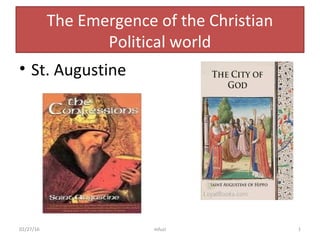
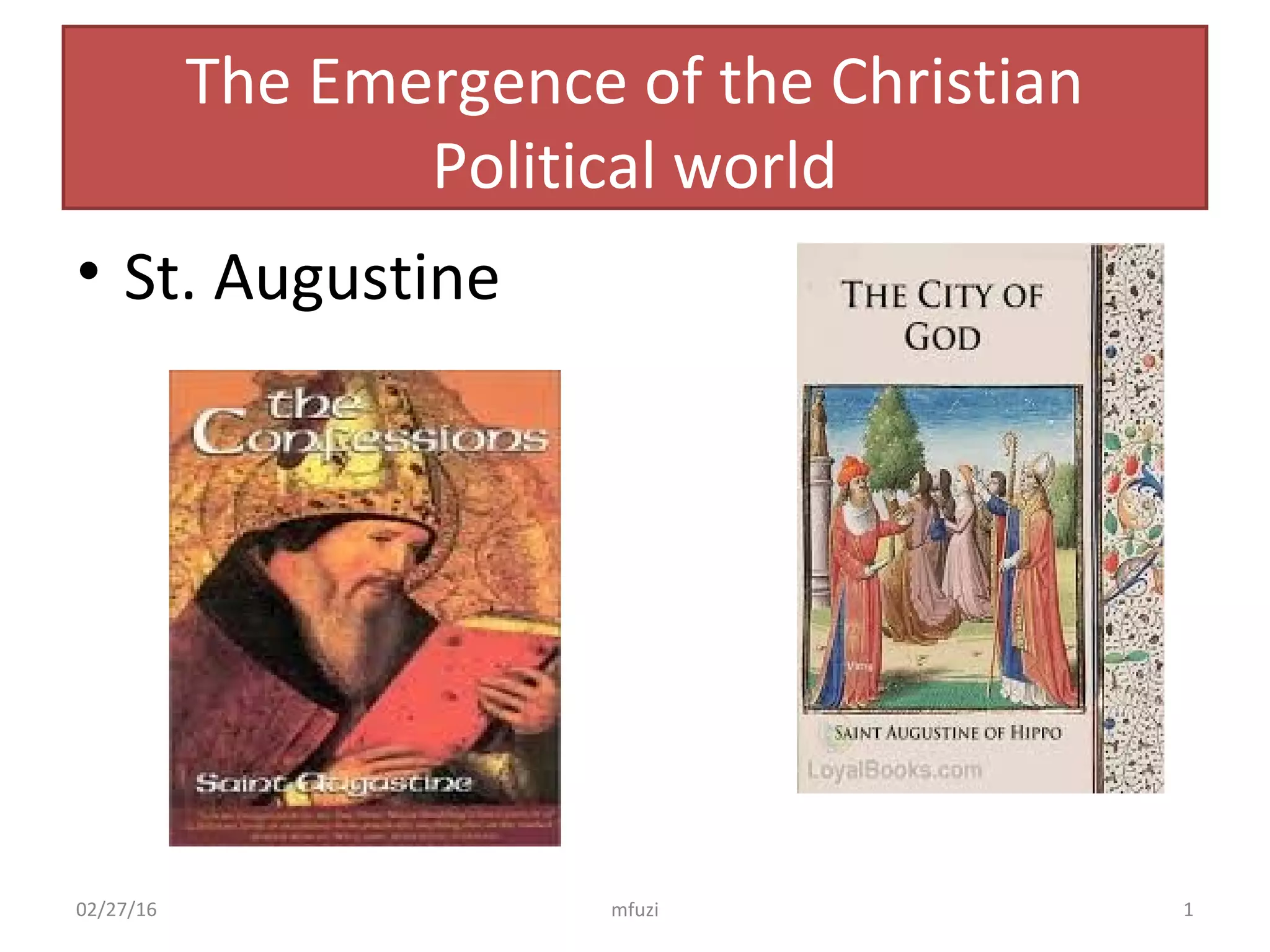
• St. Augustine
02/27/16 mfuzi 1
INTRODUCTION
• Doctrine of Christianity
• Subordinated the
temporal to the spiritual
• Commitment to the faith
over reason
• Believed that the Greeco-
Roman institutions had
failed
• Impact:
• Next world was far more
important than this
• Temporal affairs,
including government,
less important
• Divine government under
the fatherhood of God
• Secular government was
both unnecessary and
undesirable
02/27/16 mfuzi 2
The Rise of Christianity
• The period of Cristianity
development was
considered as one of
hardship for the Christian.
• Refusal to worship the gods
of the state was considered
as treason.
• Christians were deprived of
property and citizenship,
and their churches were
destroyed.
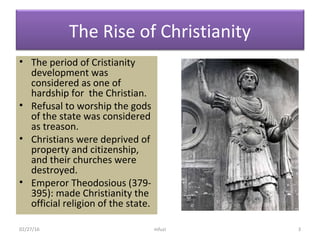
• Emperor Theodosious (379-
395): made Christianity the
official religion of the state.
02/27/16 mfuzi 3
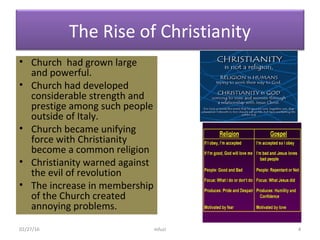
The Rise of Christianity
• Church had grown large
and powerful.
• Church had developed
considerable strength and
prestige among such people
outside of Italy.
• Church became unifying
force with Christianity
become a common religion
• Christianity warned against
the evil of revolution
• The increase in membership
of the Church created
annoying problems.
02/27/16 mfuzi 4
The Rise of ChristianityThe Rise of Christianity
• Circumstances soon
conspired to change the
situation.
• The organization of the
Church was developing in
size and in the
effectiveness of its
administration.
• Implication: the issue of
divided loyalty.
02/27/16 mfuzi 5
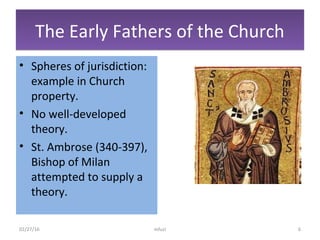
The Early Fathers of the ChurchThe Early Fathers of the Church
• Spheres of jurisdiction:
example in Church
property.
• No well-developed
theory.
• St. Ambrose (340-397),
Bishop of Milan
attempted to supply a
theory.
02/27/16 mfuzi 6
Rome and Christianity
• 4th
Century:
– Rome become Christian
government.
– Church and state
merged, reconcile itself
with political power
– Church became part of
political establishment
• How to accommodate
church and state authority
in a way that recognized the
altered social and political
context of both.?
• Christians: to articulate a
doctrine defending the
need for political authority
and insist on the true
Christian Commonwealth.
02/27/16 mfuzi 7
The Early Fathers of the Church
• St. Augustine
• The most influential of the early fathers
• A student of St. Ambrose
• His most important work is City of God
• Purpose: to defense the Church against the charge
leveled against its enemies that Christianity was
responsible for the fall of Rome to Alaric and the
Visigoths. (first ten books)
• His views of man and the society (12 books)
• How to reconcile the religious doctrine and political
authority
02/27/16 8mfuzi
St. Augustine
• Nature of Human
Beings
– Because of the fall from
grace, humans are not
naturally sociable
– They are self-interested
and need the state to
compel order,
obedience, and social
cooperation
– Without state, anarchy would
result.
– The original sin :
emerges the creation
and separation of two
cities, each with its own
political and moral
values and loves that
hold them together.
– State: the origin is
located at a certain
point in God’s plan for
the universe.
02/27/16 mfuzi 9
St. AugustineSt. Augustine
• Theory of the two communities:
• (1)The heavenly city and the earthly city
• Like Stoicism: reason was the common tie which make men
able to live together and to understand universal natural law.
• For Augustine: the force for mutually was belief in and
obedience to God.
• The cities are not heaven and earth, nor church and state,
rather they are the forces of good and evil.
• They are the kingdoms of God and of Satan.
• History is the struggle between the forces of the earthly city
and heavenly city which would eventually culminate in the
establishment of a Christian Commonwealth.
02/27/16 10mfuzi
St. Augustine
• (2) Basis of the two Cities: earthly city
– Dominated by the principle of self-love
– It devotees are those to whom material interests
are more important than spiritual.
02/27/16 11mfuzi
St. Augustine
• (2) Basis of the cities: The heavenly city:
• Dominated by the principle of love of God.
• Its inhabitants are those to whom spiritual things are
paramount.
• Agencies are provided by God to help achieve
salvation: Church and the state.
02/27/16 12mfuzi
St. AugustineSt. Augustine
• (3) Functions of each institution :
• State should had a proper function. He suggested a
definition of a good commonwealth.
• Commonwealth: an assemblage of a reasonable beings
bound together by a common agreement as to the objects
of their love.
• Whether it is good or bad it depend on the object of the
people’s love.
• It must bring justice to its people.
• Justice to be found in the word of God.
• It must be a Christian commonwealth: provide the
advancement of God’s cause
• Justice is impossible if people did not know the true God.
02/27/16 13mfuzi
St. AugustineSt. Augustine
(3)Functions; continue
• The primary function of a state( Christian or non-
Christian) is to maintain peace and order.
• Those of the earthly city wish peace in order to better
enjoy the objects of their love, that is material things,
the goods of this world.
• Those of the heavenly city wish peace so they can
devote themselves to the worship of God
02/27/16 14mfuzi
St. Augustine
• (4) Justice
• The past states lacked justice because they do not
have the Church and Christian doctrine.
• All pagan empires must fall in the course of history.
• What is important is to learn how to live in the ways
prescribed by God through his church.
• Man is born in sin, and life is not supposed to be easy.
• Problems man faced can never be solved because the
human mentality is limited.
• If God is obeyed perfection will be achieved, and it will
last forever.
02/27/16 15mfuzi
St. Augustine
• (5) Concept of men sinfulness
• If man were not sinful he would not be disorderly.
• Thus government is needed by man’s sinfulness.
• Men’s sin led to an inequality manifested by slavery,
government, and private property.
• God himself gave them to men to enable them to live
in a world in which equality was no longer possible and
peace no longer normal.
• Evil and brutal king is imposed upon people as
punishment for their sins, and still he must be obeyed:
doctrine of passive obedience
02/27/16 16mfuzi
St. Augustine
• (4)Concept of men sinfulness; continue
• 4 reasons for the development of the doctrine:
» To combat tendencies for anarchism
» New Testament writing which suggested all power from
God
» The Old testament represent the King as the anointed of
God
» The new Christian church was anxious to allay the fears
that the empire had developed concerning the Church as
subversive organization.
02/27/16 17mfuzi
St. Augustine
• (5)Function of government:
• Not merely to secure and preserve the rights
• It is to enforce order
• Thus a stable tyranny is better than a disorderly
democracy.
• Equality, justice and freedom are goals to be attained
only in in the heavenly city.
• In the interest of maintaining order society is and must
be based upon the authoritarian principle.
02/27/16 18mfuzi
St. Augustine
• (6) On slavery:
• It is necessitated by human sinfulness
02/27/16 19mfuzi
ConclusionConclusion
• The doctrine of two swords may serve as a
summary of the development of political
thought in the period extending from Christ to
the sixth century.
• However, the doctrine failed to provide
solution to the problem of relationship
between the state and the church.
02/27/16 20mfuzi

Topic 7 - St. Augustine

  • 1.
    The Emergence ofthe Christian Political world • St. Augustine 02/27/16 mfuzi 1
  • 2.
    INTRODUCTION • Doctrine ofChristianity • Subordinated the temporal to the spiritual • Commitment to the faith over reason • Believed that the Greeco- Roman institutions had failed • Impact: • Next world was far more important than this • Temporal affairs, including government, less important • Divine government under the fatherhood of God • Secular government was both unnecessary and undesirable 02/27/16 mfuzi 2
  • 3.
    The Rise ofChristianity • The period of Cristianity development was considered as one of hardship for the Christian. • Refusal to worship the gods of the state was considered as treason. • Christians were deprived of property and citizenship, and their churches were destroyed. • Emperor Theodosious (379- 395): made Christianity the official religion of the state. 02/27/16 mfuzi 3
  • 4.
    The Rise ofChristianity • Church had grown large and powerful. • Church had developed considerable strength and prestige among such people outside of Italy. • Church became unifying force with Christianity become a common religion • Christianity warned against the evil of revolution • The increase in membership of the Church created annoying problems. 02/27/16 mfuzi 4
  • 5.
    The Rise ofChristianityThe Rise of Christianity • Circumstances soon conspired to change the situation. • The organization of the Church was developing in size and in the effectiveness of its administration. • Implication: the issue of divided loyalty. 02/27/16 mfuzi 5
  • 6.
    The Early Fathersof the ChurchThe Early Fathers of the Church • Spheres of jurisdiction: example in Church property. • No well-developed theory. • St. Ambrose (340-397), Bishop of Milan attempted to supply a theory. 02/27/16 mfuzi 6
  • 7.
    Rome and Christianity •4th Century: – Rome become Christian government. – Church and state merged, reconcile itself with political power – Church became part of political establishment • How to accommodate church and state authority in a way that recognized the altered social and political context of both.? • Christians: to articulate a doctrine defending the need for political authority and insist on the true Christian Commonwealth. 02/27/16 mfuzi 7
  • 8.
    The Early Fathersof the Church • St. Augustine • The most influential of the early fathers • A student of St. Ambrose • His most important work is City of God • Purpose: to defense the Church against the charge leveled against its enemies that Christianity was responsible for the fall of Rome to Alaric and the Visigoths. (first ten books) • His views of man and the society (12 books) • How to reconcile the religious doctrine and political authority 02/27/16 8mfuzi
  • 9.
    St. Augustine • Natureof Human Beings – Because of the fall from grace, humans are not naturally sociable – They are self-interested and need the state to compel order, obedience, and social cooperation – Without state, anarchy would result. – The original sin : emerges the creation and separation of two cities, each with its own political and moral values and loves that hold them together. – State: the origin is located at a certain point in God’s plan for the universe. 02/27/16 mfuzi 9
  • 10.
    St. AugustineSt. Augustine •Theory of the two communities: • (1)The heavenly city and the earthly city • Like Stoicism: reason was the common tie which make men able to live together and to understand universal natural law. • For Augustine: the force for mutually was belief in and obedience to God. • The cities are not heaven and earth, nor church and state, rather they are the forces of good and evil. • They are the kingdoms of God and of Satan. • History is the struggle between the forces of the earthly city and heavenly city which would eventually culminate in the establishment of a Christian Commonwealth. 02/27/16 10mfuzi
  • 11.
    St. Augustine • (2)Basis of the two Cities: earthly city – Dominated by the principle of self-love – It devotees are those to whom material interests are more important than spiritual. 02/27/16 11mfuzi
  • 12.
    St. Augustine • (2)Basis of the cities: The heavenly city: • Dominated by the principle of love of God. • Its inhabitants are those to whom spiritual things are paramount. • Agencies are provided by God to help achieve salvation: Church and the state. 02/27/16 12mfuzi
  • 13.
    St. AugustineSt. Augustine •(3) Functions of each institution : • State should had a proper function. He suggested a definition of a good commonwealth. • Commonwealth: an assemblage of a reasonable beings bound together by a common agreement as to the objects of their love. • Whether it is good or bad it depend on the object of the people’s love. • It must bring justice to its people. • Justice to be found in the word of God. • It must be a Christian commonwealth: provide the advancement of God’s cause • Justice is impossible if people did not know the true God. 02/27/16 13mfuzi
  • 14.
    St. AugustineSt. Augustine (3)Functions;continue • The primary function of a state( Christian or non- Christian) is to maintain peace and order. • Those of the earthly city wish peace in order to better enjoy the objects of their love, that is material things, the goods of this world. • Those of the heavenly city wish peace so they can devote themselves to the worship of God 02/27/16 14mfuzi
  • 15.
    St. Augustine • (4)Justice • The past states lacked justice because they do not have the Church and Christian doctrine. • All pagan empires must fall in the course of history. • What is important is to learn how to live in the ways prescribed by God through his church. • Man is born in sin, and life is not supposed to be easy. • Problems man faced can never be solved because the human mentality is limited. • If God is obeyed perfection will be achieved, and it will last forever. 02/27/16 15mfuzi
  • 16.
    St. Augustine • (5)Concept of men sinfulness • If man were not sinful he would not be disorderly. • Thus government is needed by man’s sinfulness. • Men’s sin led to an inequality manifested by slavery, government, and private property. • God himself gave them to men to enable them to live in a world in which equality was no longer possible and peace no longer normal. • Evil and brutal king is imposed upon people as punishment for their sins, and still he must be obeyed: doctrine of passive obedience 02/27/16 16mfuzi
  • 17.
    St. Augustine • (4)Conceptof men sinfulness; continue • 4 reasons for the development of the doctrine: » To combat tendencies for anarchism » New Testament writing which suggested all power from God » The Old testament represent the King as the anointed of God » The new Christian church was anxious to allay the fears that the empire had developed concerning the Church as subversive organization. 02/27/16 17mfuzi
  • 18.
    St. Augustine • (5)Functionof government: • Not merely to secure and preserve the rights • It is to enforce order • Thus a stable tyranny is better than a disorderly democracy. • Equality, justice and freedom are goals to be attained only in in the heavenly city. • In the interest of maintaining order society is and must be based upon the authoritarian principle. 02/27/16 18mfuzi
  • 19.
    St. Augustine • (6)On slavery: • It is necessitated by human sinfulness 02/27/16 19mfuzi
  • 20.
    ConclusionConclusion • The doctrineof two swords may serve as a summary of the development of political thought in the period extending from Christ to the sixth century. • However, the doctrine failed to provide solution to the problem of relationship between the state and the church. 02/27/16 20mfuzi