BAHRIA UNIVERSITY LAHORE CAMPUS
(CIVIC CENTER JOHAR TOWN LAHORE)
NAME:
FARAZ QURESHI
SAFI ULLAH SHAHID
CLASS:
BS(CS)1
SUBJECT:
PHYSICS
INCHARGE:
SIR ZAIN
Archimedes was one of the greatest mathematicians in history. He was also a great
inventor and scientist. Born in Syracuse, Sicily (then part of Greece), in about 287 B.C.
Archimedes was obsessed with mathematics. He would become so involved in his work
that he would forget to eat. Out of this obsession came many of his greatest theories
and proofs, such as the means for approximating square roots, the value of pi (the
ratio of a circle's circumference to its diameter), and the creation of a way to describe
very large numbers. He also devised methods for calculating areas and volumes 2,000
years before the invention of calculus. In addition, Archimedes proved that the volume
of a sphere is two-thirds the volume of a circumscribed cylinder.
Archimedes was well known for his inventions and scientific discoveries. The most
famous of these were the Archimedes' Screw (a device for raising water that is still
used in crop irrigation and sewage treatment plants today) and Archimedes' principle
of buoyancy. Legend has it that he discovered this principle while in the bath, where he
noticed that the more of his body he submerged in the water, the greater the amount
of water that over-flowed the bath. Upon making this discovery, he is said to have run
naked through the streets of Syracuse, shouting "Eureka!" (Greek for "I have found it!").
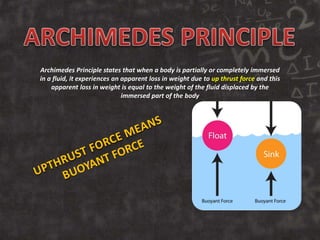
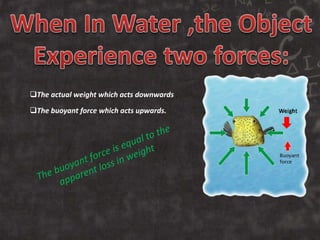
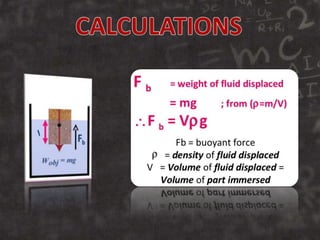
Archimedes Principle states that when a body is partially or completely immersed
in a fluid, it experiences an apparent loss in weight due to up thrust force and this
apparent loss in weight is equal to the weight of the fluid displaced by the
immersed part of the body
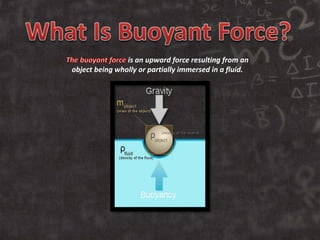
is an upward force resulting from an
object being wholly or partially immersed in a fluid.
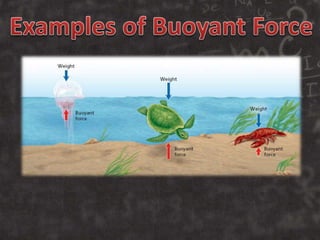
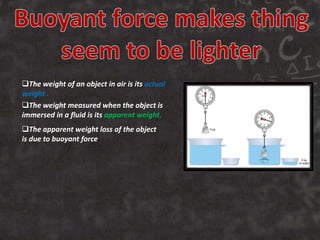
The weight of an object in air is its actual
weight .
The weight measured when the object is
immersed in a fluid is its apparent weight.
The apparent weight loss of the object
is due to buoyant force.
The actual weight which acts downwards .
The buoyant force which acts upwards.
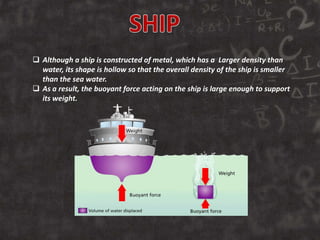
 Although a ship is constructed of metal, which has a Larger density than
water, its shape is hollow so that the overall density of the ship is smaller
than the sea water.
 As a result, the buoyant force acting on the ship is large enough to support
its weight.
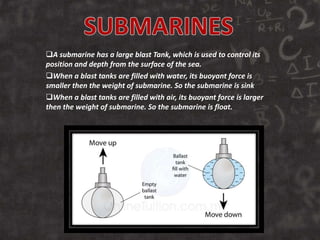
A submarine has a large blast Tank, which is used to control its
position and depth from the surface of the sea.
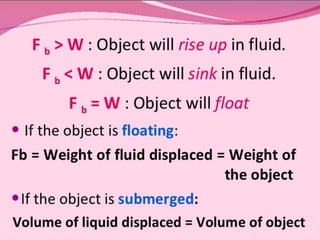
When a blast tanks are filled with water, its buoyant force is
smaller then the weight of submarine. So the submarine is sink
When a blast tanks are filled with air, its buoyant force is larger
then the weight of submarine. So the submarine is float.
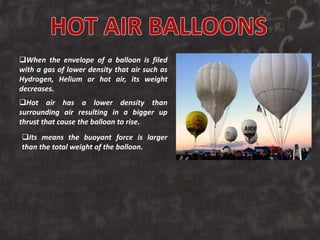
When the envelope of a balloon is filed
with a gas of lower density that air such as
Hydrogen, Helium or hot air, its weight
decreases.
Hot air has a lower density than
surrounding air resulting in a bigger up
thrust that cause the balloon to rise.
Its means the buoyant force is larger
than the total weight of the balloon.
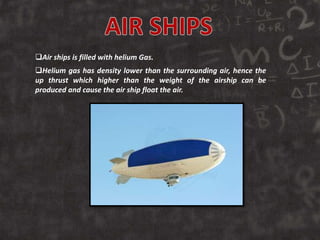
Air ships is filled with helium Gas.
Helium gas has density lower than the surrounding air, hence the
up thrust which higher than the weight of the airship can be
produced and cause the air ship float the air.
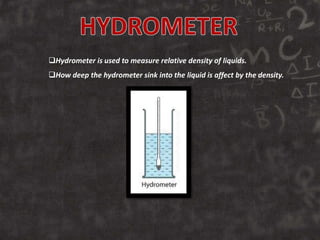
Hydrometer is used to measure relative density of liquids.
How deep the hydrometer sink into the liquid is affect by the density.
Archimedes Principle