
ARCHES OF FOOT - FINAL
Dr. HETA PATEL(PT)
Assistant Professor
ARIP
CHARUSAT
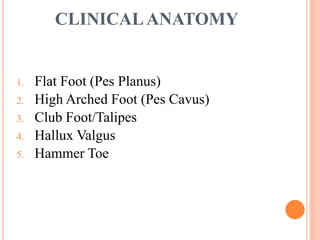
CLINICALANATOMY
1. Flat Foot (Pes Planus)
2. High Arched Foot (Pes Cavus)
3. Club Foot/Talipes
4. Hallux Valgus
5. Hammer Toe
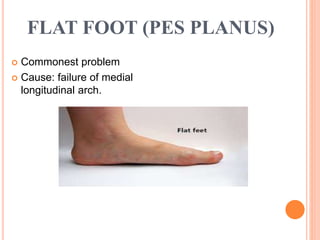
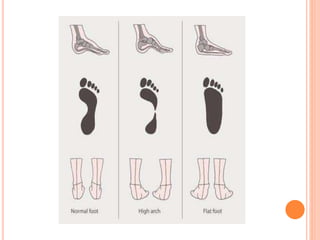
FLAT FOOT (PES PLANUS)
 Commonest problem
 Cause: failure of medial
longitudinal arch.
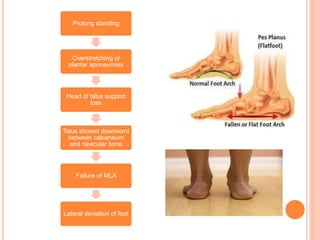
Prolong standing
Overstretching of
plantar aponeurosis
Head of talus support
loss
Talus shoved downward
between calcaneum
and navicular bone
Failure of MLA
Lateral deviation of foot
 The impacts of the flat foot are:
1. The individual typically has awkward shuffling
pace as a result of loss of spring in the foot.
2. Makes the foot more likely to trauma because of
reduction of the shock absorbing function.
3. The compression of the nerves and vessels of
the sole is as a result of reduction of concavity
of the sole.
4. The compaction of the communication between
the medial and lateral plantar nerves results in
neuralgic pain in the forefoot (metatarsalgia).
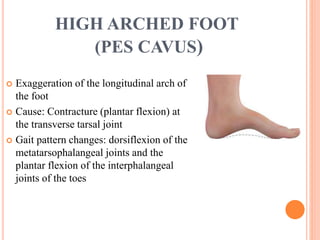
HIGH ARCHED FOOT
(PES CAVUS)
 Exaggeration of the longitudinal arch of
the foot
 Cause: Contracture (plantar flexion) at
the transverse tarsal joint
 Gait pattern changes: dorsiflexion of the
metatarsophalangeal joints and the
plantar flexion of the interphalangeal
joints of the toes
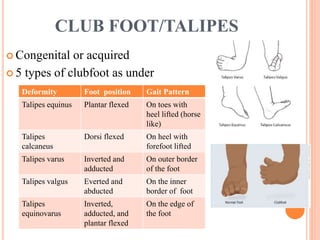
CLUB FOOT/TALIPES
 Congenital or acquired
 5 types of clubfoot as under
Deformity Foot position Gait Pattern
Talipes equinus Plantar flexed On toes with
heel lifted (horse
like)
Talipes
calcaneus
Dorsi flexed On heel with
forefoot lifted
Talipes varus Inverted and
adducted
On outer border
of the foot
Talipes valgus Everted and
abducted
On the inner
border of foot
Talipes
equinovarus
Inverted,
adducted, and
plantar flexed
On the edge of
the foot
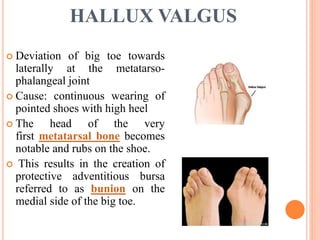
HALLUX VALGUS
 Deviation of big toe towards
laterally at the metatarso-
phalangeal joint
 Cause: continuous wearing of
pointed shoes with high heel
 The head of the very
first metatarsal bone becomes
notable and rubs on the shoe.
 This results in the creation of
protective adventitious bursa
referred to as bunion on the
medial side of the big toe.
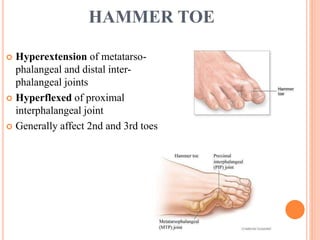
HAMMER TOE
 Hyperextension of metatarso-
phalangeal and distal inter-
phalangeal joints
 Hyperflexed of proximal
interphalangeal joint
 Generally affect 2nd and 3rd toes
THANK YOU
LIKE#SHARE#SUBSCRIBE
STAYHOME#STAYSAFE

Archesoffoot

  • 1.
    ARCHES OF FOOT- FINAL Dr. HETA PATEL(PT) Assistant Professor ARIP CHARUSAT
  • 4.
    CLINICALANATOMY 1. Flat Foot(Pes Planus) 2. High Arched Foot (Pes Cavus) 3. Club Foot/Talipes 4. Hallux Valgus 5. Hammer Toe
  • 5.
    FLAT FOOT (PESPLANUS)  Commonest problem  Cause: failure of medial longitudinal arch.
  • 6.
    Prolong standing Overstretching of plantaraponeurosis Head of talus support loss Talus shoved downward between calcaneum and navicular bone Failure of MLA Lateral deviation of foot
  • 7.
     The impactsof the flat foot are: 1. The individual typically has awkward shuffling pace as a result of loss of spring in the foot. 2. Makes the foot more likely to trauma because of reduction of the shock absorbing function. 3. The compression of the nerves and vessels of the sole is as a result of reduction of concavity of the sole. 4. The compaction of the communication between the medial and lateral plantar nerves results in neuralgic pain in the forefoot (metatarsalgia).
  • 8.
    HIGH ARCHED FOOT (PESCAVUS)  Exaggeration of the longitudinal arch of the foot  Cause: Contracture (plantar flexion) at the transverse tarsal joint  Gait pattern changes: dorsiflexion of the metatarsophalangeal joints and the plantar flexion of the interphalangeal joints of the toes
  • 10.
    CLUB FOOT/TALIPES  Congenitalor acquired  5 types of clubfoot as under Deformity Foot position Gait Pattern Talipes equinus Plantar flexed On toes with heel lifted (horse like) Talipes calcaneus Dorsi flexed On heel with forefoot lifted Talipes varus Inverted and adducted On outer border of the foot Talipes valgus Everted and abducted On the inner border of foot Talipes equinovarus Inverted, adducted, and plantar flexed On the edge of the foot
  • 11.
    HALLUX VALGUS  Deviationof big toe towards laterally at the metatarso- phalangeal joint  Cause: continuous wearing of pointed shoes with high heel  The head of the very first metatarsal bone becomes notable and rubs on the shoe.  This results in the creation of protective adventitious bursa referred to as bunion on the medial side of the big toe.
  • 12.
    HAMMER TOE  Hyperextensionof metatarso- phalangeal and distal inter- phalangeal joints  Hyperflexed of proximal interphalangeal joint  Generally affect 2nd and 3rd toes
  • 13.