The Fertilizer Forecaster:
guiding short‐term decisions in nutrient management 
Project Director’s Meeting
July 29, 2015
United States 
Department of 
Agriculture
National Institute
of Food
and Agriculture
This project was supported by Agriculture and Food Research Initiative Competitive Grant 
number 2012‐67019‐1929 from the USDA National Institute of Food and Agriculture.
Anthony Buda, Peter Kleinman, 
Ray Bryant, and Gordon Folmar
USDA Agricultural Research Service
Patrick Drohan, Jasmeet Lamba, Lauren Vitko, 
Doug Miller, Brian Bills, and Paul Knight
Penn State University
Seann Reed and Peter Ahnert
NOAA NWS Middle Atlantic River Forecast Center
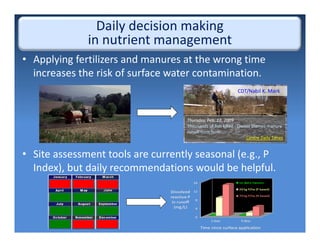
• Applying fertilizers and manures at the wrong time 
increases the risk of surface water contamination.
CDT/Nabil K. Mark
Thursday, Feb. 12, 2009
Thousands of fish killed ‐ Owner blames manure 
runoff from farm
Centre Daily Times
• Site assessment tools are currently seasonal (e.g., P 
Index), but daily recommendations would be helpful.
Daily decision making 
in nutrient management
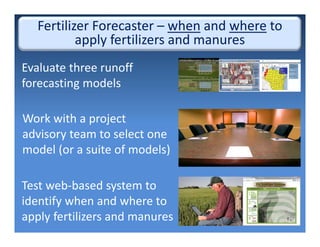
Evaluate three runoff 
forecasting models
Work with a project 
advisory team to select one 
model (or a suite of models)
Test web‐based system to 
identify when and where to 
apply fertilizers and manures
Fertilizer Forecaster – when and where to 
apply fertilizers and manures
Allegheny
Plateau
Piedmont
Coastal
Plain
Ridge &
Valley
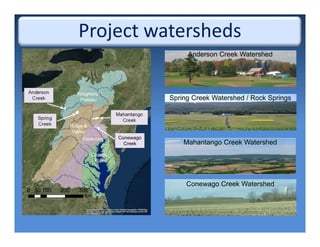
Project watersheds
Anderson Creek Watershed
Anderson
Creek Spring Creek Watershed / Rock Springs
Spring
Creek
Mahantango Creek Watershed
Mahantango
Creek
Conewago Creek Watershed
Conewago
Creek
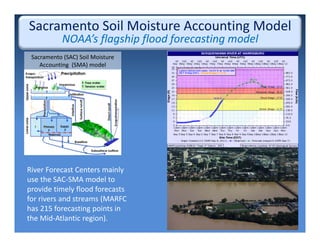
Sacramento (SAC) Soil Moisture 
Accounting  (SMA) model
MARFC River Forecast Points
River Forecast Centers mainly 
use the SAC‐SMA model to 
provide timely flood forecasts 
for rivers and streams (MARFC 
has 215 forecasting points in 
the Mid‐Atlantic region).
Sacramento Soil Moisture Accounting Model
NOAA’s flagship flood forecasting model
Sacramento (SAC) Soil Moisture 
Accounting  (SMA) model
Mahantango Creek Experimental Watershed
WE‐38
Adapting NOAA’s SAC‐SMA model to 
runoff prediction in small basins
Surface runoff observed (cfs)
SAC‐SMA 
interflow +
surface 
runoff (cfs)
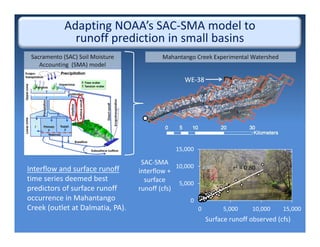
Interflow and surface runoff
time series deemed best 
predictors of surface runoff 
occurrence in Mahantango
Creek (outlet at Dalmatia, PA). 
0
5,000
10,000
15,000
0 5,000 10,000 15,000
r2 = 0.80
Sacramento (SAC) Soil Moisture 
Accounting  (SMA) model
Mahantango Creek Experimental Watershed
WE‐38
Surface runoff observed (cfs)
SAC‐SMA 
interflow +
surface 
runoff (cfs)
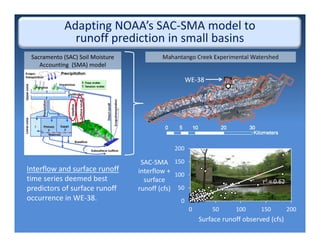
Interflow and surface runoff
time series deemed best 
predictors of surface runoff 
occurrence in WE‐38.  0
50
100
150
200
0 50 100 150 200
r2 = 0.62
Adapting NOAA’s SAC‐SMA model to 
runoff prediction in small basins
&
Runoff contributing areas
vs.
Runoff   No runoff
0.0
0.2
0.4
0.6
0.8
1.0
0 0.1 0.2 0.3 0.4 0.5
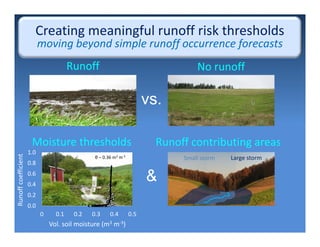
Moisture thresholds
Runoff coefficient
Vol. soil moisture (m3 m‐3)
θ  0.36 m3 m‐3
Large stormSmall storm
Creating meaningful runoff risk thresholds
moving beyond simple runoff occurrence forecasts
Sacramento (SAC) Soil Moisture 
Accounting  (SMA) model
•Saturation ratio = 
θ − θr
θs − θr
 , where
•SAC‐SMA expresses soil 
moisture as a saturation ratio
θ = volumetric water content
θr = permanent wilting point
θs = porosity
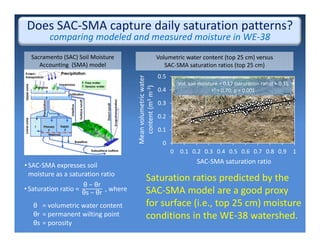
Saturation ratios predicted by the 
SAC‐SMA model are a good proxy 
for surface (i.e., top 25 cm) moisture 
conditions in the WE‐38 watershed. 
0
0.1
0.2
0.3
0.4
0.5
0 0.1 0.2 0.3 0.4 0.5 0.6 0.7 0.8 0.9 1
Mean volumetric water 
content (m3m‐3) 
SAC‐SMA saturation ratio
Vol. soil moisture = 0.17 (saturation ratio) + 0.15
r2 = 0.70; p < 0.001
Volumetric water content (top 25 cm) versus 
SAC‐SMA saturation ratios (top 25 cm)
Does SAC‐SMA capture daily saturation patterns?
comparing modeled and measured moisture in WE‐38
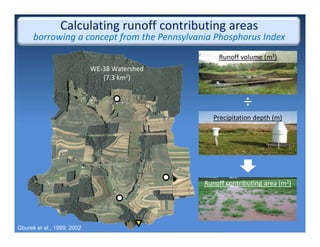
Runoff volume (m3)
WE‐38 Watershed
(7.3 km2)
Gburek et al., 1999; 2002
Precipitation depth (m)
÷
Runoff contributing area (m2)
Calculating runoff contributing areas
borrowing a concept from the Pennsylvania Phosphorus Index
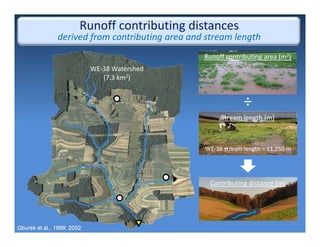
Gburek et al., 1999; 2002
Runoff contributing area (m2)
Contributing distance (m)
Stream length (m)
÷
WE‐38 stream length = 11,250 m
WE‐38 Watershed
(7.3 km2)
Runoff contributing distances
derived from contributing area and stream length
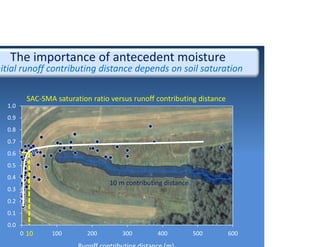
10 m contributing distance 
The importance of antecedent moisture 
nitial runoff contributing distance depends on soil saturation
SAC‐SMA saturation ratio versus runoff contributing distance
0.0
0.1
0.2
0.3
0.4
0.5
0.6
0.7
0.8
0.9
1.0
0 100 200 300 400 500 60010
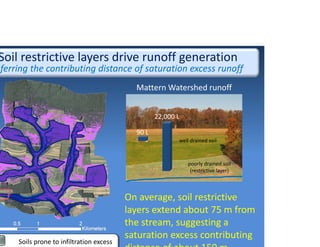
Soil restrictive layers drive runoff generation
ferring the contributing distance of saturation excess runoff 
Soils prone to infiltration excess
On average, soil restrictive 
layers extend about 75 m from 
the stream, suggesting a 
saturation excess contributing 
Mattern Watershed runoff
poorly drained soil
(restrictive layer)
well drained soil
90 L
22,000 L
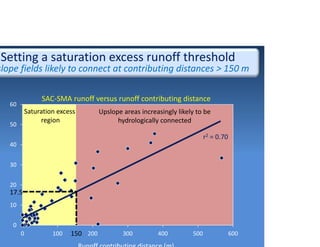
Upslope areas increasingly likely to be 
hydrologically connected
Saturation excess 
region
0
10
20
30
40
50
60
0 100 200 300 400 500 600
Setting a saturation excess runoff threshold
slope fields likely to connect at contributing distances > 150 m
SAC‐SMA runoff versus runoff contributing distance
r2 = 0.70
150
17.5
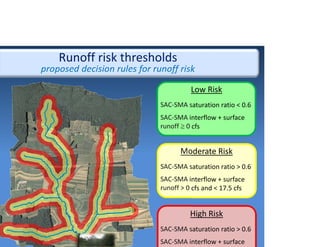
Runoff risk thresholds
proposed decision rules for runoff risk
Low Risk
SAC‐SMA saturation ratio < 0.6
SAC‐SMA interflow + surface 
runoff  0 cfs
Moderate Risk
SAC‐SMA saturation ratio > 0.6
SAC‐SMA interflow + surface 
runoff > 0 cfs and < 17.5 cfs
High Risk
SAC‐SMA saturation ratio > 0.6
SAC‐SMA interflow + surface 
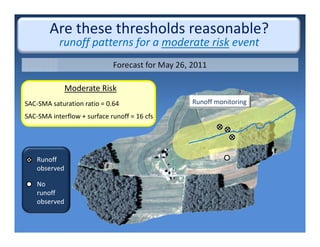
Are these thresholds reasonable? 
runoff patterns for a moderate risk event
Forecast for May 26, 2011
Moderate Risk
SAC‐SMA saturation ratio = 0.64
SAC‐SMA interflow + surface runoff = 16 cfs
Runoff monitoring
Runoff 
observed
No 
runoff 
observed
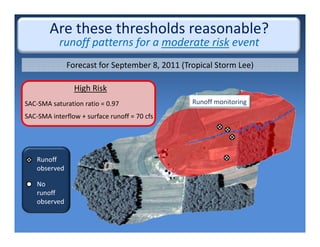
Are these thresholds reasonable? 
runoff patterns for a moderate risk event
High Risk
SAC‐SMA saturation ratio = 0.97
SAC‐SMA interflow + surface runoff = 70 cfs
Runoff monitoring
Forecast for September 8, 2011 (Tropical Storm Lee)
Runoff 
observed
No 
runoff 
observed
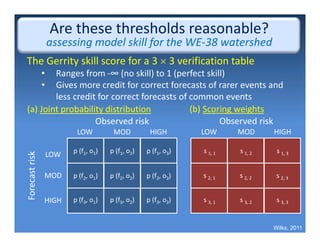
The Gerrity skill score for a 3  3 verification table
• Ranges from ‐∞ (no skill) to 1 (perfect skill)
• Gives more credit for correct forecasts of rarer events and 
less credit for correct forecasts of common events
Observed risk
LOW MOD HIGH
LOW
MOD
HIGH
Forecast risk
(a) Joint probability distribution
p (f1, o1) p (f1, o2) p (f1, o3)
p (f2, o1) p (f2, o2) p (f2, o3)
p (f3, o1) p (f3, o2) p (f3, o3)
(b) Scoring weights
Observed risk
LOW MOD HIGH
s 1, 1 s 1, 2 s 1, 3
s 2, 1 s 2, 2 s 2, 3
s 3, 1 s 3, 2 s 3, 3
Are these thresholds reasonable? 
assessing model skill for the WE‐38 watershed
Wilks, 2011
Are these thresholds reasonable? 
assessing model skill for the WE‐38 watershed
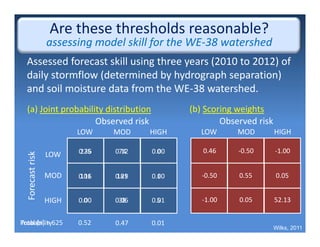
Assessed forecast skill using three years (2010 to 2012) of 
daily stormflow (determined by hydrograph separation) 
and soil moisture data from the WE‐38 watershed.  
Observed risk
LOW MOD HIGH
LOW
MOD
HIGH
Forecast risk
(a) Joint probability distribution (b) Scoring weights
Observed risk
LOW MOD HIGH
0.46 ‐0.50 ‐1.00
‐0.50 0.55 0.05
‐1.00 0.05 52.13
225 74 0
101 181 1
0 38 5
Total (n) = 625 
0.36 0.12 0.00
0.16 0.29 0.00
0.00 0.06 0.01
Probability  0.52 0.47 0.01
Wilks, 2011
Are these thresholds reasonable?
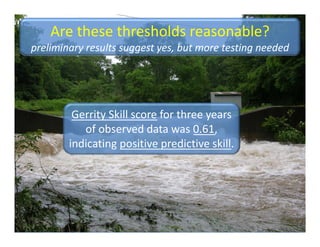
preliminary results suggest yes, but more testing needed
Gerrity Skill score for three years 
of observed data was 0.61, 
indicating positive predictive skill.
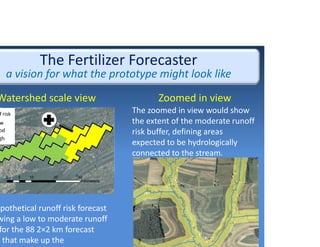
The Fertilizer Forecaster
a vision for what the prototype might look like
Watershed scale view
w
od
gh
f risk
ypothetical runoff risk forecast 
wing a low to moderate runoff 
for the 88 2×2 km forecast 
 that make up the 
Zoomed in view
The zoomed in view would show 
the extent of the moderate runoff 
risk buffer, defining areas 
expected to be hydrologically 
connected to the stream.
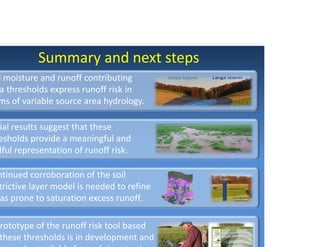
Summary and next steps
l moisture and runoff contributing 
a thresholds express runoff risk in 
ms of variable source area hydrology. 
ial results suggest that these 
esholds provide a meaningful and 
lful representation of runoff risk. 
ntinued corroboration of the soil 
trictive layer model is needed to refine 
as prone to saturation excess runoff.
rototype of the runoff risk tool based 
these thresholds is in development and 
Thank you
Partners
Middle Atlantic 
River Forecast 
Center

Developing a Web-based Forecasting Tool for Nutrient Management