Integrated crop, soil health and livestock technologies for ecological
intensification in Kongwa and Kiteto, Tanzania
Anthony Kimaro
ICRAF
Africa RISING East and Southern Africa Review and Planning Meeting, Malawi, 14-16 July 2015
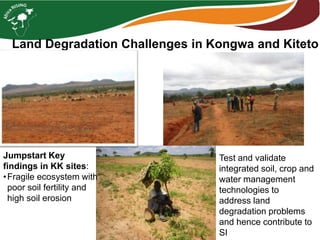
Land Degradation Challenges in Kongwa and Kiteto
Test and validate
integrated soil, crop and
water management
technologies to
address land
degradation problems
and hence contribute to
SI
Jumpstart Key
findings in KK sites:
•Fragile ecosystem with
poor soil fertility and
high soil erosion
Land Degradation Challenges in Kongwa and Kiteto
• Improved management of land and water is a critical step
in sustainable intensification (SI) of farming systems
• Limited availability of site-specific nutrient management
guidelines for semiarid zones in Tanzania undermines
efforts to target technologies to biophysical and/or socio-
economic conditions in which farmers operate.
• Technologies adopted under these circumstances may be
risky to farmers.
• Soils in Kongwa and Kiteto districts were characterized to
assess soil fertility status and drivers of land degradation
so as to inform the development of integrated land
management options for SI.
Theme 2 Clusters/Components
• Soil Fertility Enhancing Technologies
• Integrated Land and Water Management Options
• Tree (Agroforestry) based technologies for SI
• Livestock - Crop integration
• Socio-economic Analysis and Adoption Monitoring
to guide technology scaling
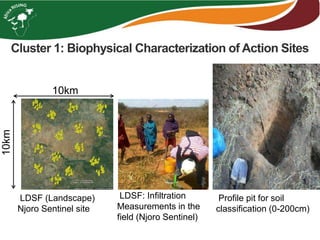
Cluster 1: Biophysical Characterization of Action Sites
LDSF (Landscape)
Njoro Sentinel site
LDSF: Infiltration
Measurements in the
field (Njoro Sentinel)
Profile pit for soil
classification (0-200cm)
10km
10km
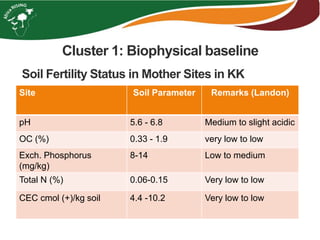
Soil Fertility Status in Mother Sites in KK
Site Soil Parameter Remarks (Landon)
pH 5.6 - 6.8 Medium to slight acidic
OC (%) 0.33 - 1.9 very low to low
Exch. Phosphorus
(mg/kg)
8-14 Low to medium
Total N (%) 0.06-0.15 Very low to low
CEC cmol (+)/kg soil 4.4 -10.2 Very low to low
Cluster 1: Biophysical baseline
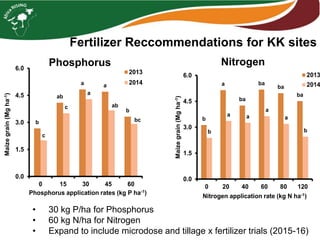
Fertilizer Reccommendations for KK sites
b
ab
a a
b
c
c
a
ab
bc
0.0
1.5
3.0
4.5
6.0
0 15 30 45 60
Maizegrain(Mgha-1)
Phosphorus application rates (kg P ha-1)
2013
2014
b
a
ba
ba
ba
ba
b
a a
a
a
b
0.0
1.5
3.0
4.5
6.0
0 20 40 60 80 120
Maizegrain(Mgha-1)
Nitrogen application rate (kg N ha-1)
2013
2014
Phosphorus Nitrogen
• 30 kg P/ha for Phosphorus
• 60 kg N/ha for Nitrogen
• Expand to include microdose and tillage x fertilizer trials (2015-16)
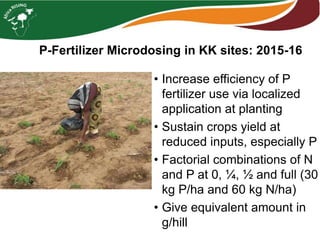
• Increase efficiency of P
fertilizer use via localized
application at planting
• Sustain crops yield at
reduced inputs, especially P
• Factorial combinations of N
and P at 0, ¼, ½ and full (30
kg P/ha and 60 kg N/ha)
• Give equivalent amount in
g/hill
P-Fertilizer Microdosing in KK sites: 2015-16
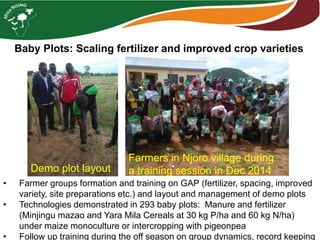
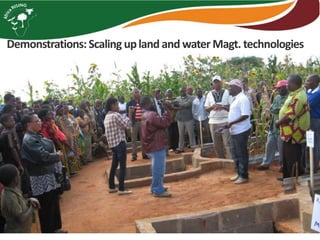
• Farmer groups formation and training on GAP (fertilizer, spacing, improved
variety, site preparations etc.) and layout and management of demo plots
• Technologies demonstrated in 293 baby plots: Manure and fertilizer
(Minjingu mazao and Yara Mila Cereals at 30 kg P/ha and 60 kg N/ha)
under maize monoculture or intercropping with pigeonpea
• Follow up training during the off season on group dynamics, record keeping
Baby Plots: Scaling fertilizer and improved crop varieties
Farmers in Njoro village during
a training session in Dec 2014Demo plot layout
Cluster 2: Integrated Land and
Water Management
Led by ARI-Hombolo (E. Swai)
CONTROLOF SOILEROSION IN KITETOAND KONGWADISTRICTS
From 2012/2013 cropping season to date an attempt has been
made under “Africa RISING Project” to fast track the integration
of soil erosion control measure in cropping and land management
systems.
For effective control measures efforts have been geared towards
the use of “landscape approach” through fully engagement of
farming communities in the entire process of implementing the
followings strategies:
 Application of physical and biological barriers on control
of soil erosion
 Assessment of the efficacy of physical barriers for erosion
control.
 Testing of in situ water harvesting technologies.
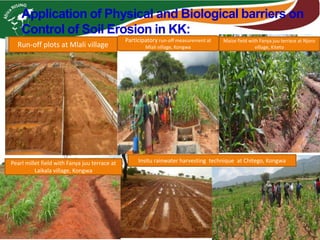
Application of Physical and Biological barriers on
Control of Soil Erosion in KK:
Run-off plots at Mlali village
Participatory run-off measurement at
Mlali village, Kongwa
Insitu rainwater harvesting technique at Chitego, KongwaPearl millet field with Fanya juu terrace at
Laikala village, Kongwa
Maize field with Fanya juu terrace at Njoro
village, Kiteto
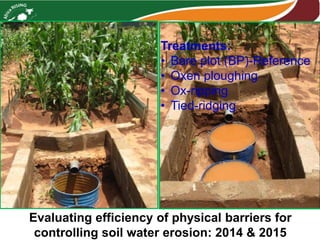
Evaluating efficiency of physical barriers for
controlling soil water erosion: 2014 & 2015
Treatments:
• Bare plot (BP)-Reference
• Oxen ploughing
• Ox-ripping
• Tied-ridging
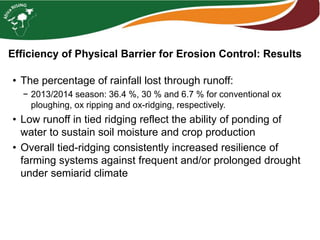
• The percentage of rainfall lost through runoff:
− 2013/2014 season: 36.4 %, 30 % and 6.7 % for conventional ox
ploughing, ox ripping and ox-ridging, respectively.
• Low runoff in tied ridging reflect the ability of ponding of
water to sustain soil moisture and crop production
• Overall tied-ridging consistently increased resilience of
farming systems against frequent and/or prolonged drought
under semiarid climate
Efficiency of Physical Barrier for Erosion Control: Results
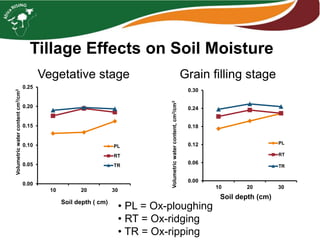
Tillage Effects on Soil Moisture
0.00
0.05
0.10
0.15
0.20
0.25
10 20 30
Volumetricwatercontentcm3/cm3
Soil depth ( cm)
PL
RT
TR
0.00
0.06
0.12
0.18
0.24
0.30
10 20 30
Volumetricwatercontent,cm3/cm3
Soil depth (cm)
PL
RT
TR
Vegetative stage Grain filling stage
• PL = Ox-ploughing
• RT = Ox-ridging
• TR = Ox-ripping
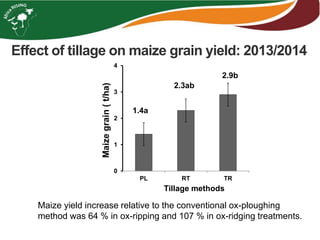
1.4a
2.3ab
2.9b
0
1
2
3
4
PL RT TR
Maizegrain(t/ha)
Tillage methods
Maize yield increase relative to the conventional ox-ploughing
method was 64 % in ox-ripping and 107 % in ox-ridging treatments.
Effect of tillage on maize grain yield: 2013/2014
Demonstrations:Scaling upland and water Magt. technologies
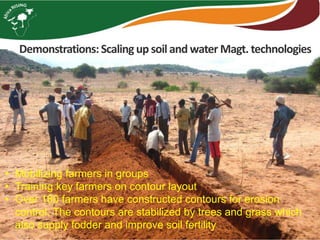
Demonstrations:Scaling up soil and water Magt. technologies
• Mobilizing farmers in groups
• Training key farmers on contour layout
• Over 180 farmers have constructed contours for erosion
control. The contours are stabilized by trees and grass which
also supply fodder and improve soil fertility
Cluster 3: Tree (Agroforestry)-
based Technologies for SI
• Intercropping and double legume arrangements
• Shelterbelts and boundary tree planting
• Woodlots for fodder and wood supply
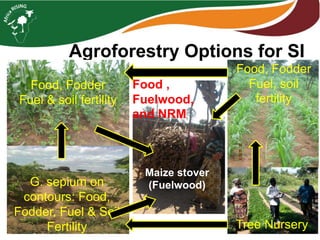
Agroforestry Options for SI
Maize stover
(Fuelwood)
Food, Fodder
Fuel, soil
fertility
Food, Fodder
Fuel & soil fertility
Tree Nursery
G. sepium on
contours: Food,
Fodder, Fuel & Soil
Fertility
Food ,
Fuelwood,
and NRM
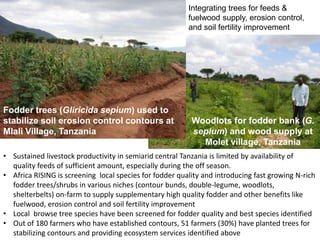
• Sustained livestock productivity in semiarid central Tanzania is limited by availability of
quality feeds of sufficient amount, especially during the off season.
• Africa RISING is screening local species for fodder quality and introducing fast growing N-rich
fodder trees/shrubs in various niches (contour bunds, double-legume, woodlots,
shelterbelts) on-farm to supply supplementary high quality fodder and other benefits like
fuelwood, erosion control and soil fertility improvement
• Local browse tree species have been screened for fodder quality and best species identified
• Out of 180 farmers who have established contours, 51 farmers (30%) have planted trees for
stabilizing contours and providing ecosystem services identified above
Integrating trees for feeds &
fuelwood supply, erosion control,
and soil fertility improvement
Woodlots for fodder bank (G.
sepium) and wood supply at
Molet village, Tanzania
Fodder trees (Gliricida sepium) used to
stabilize soil erosion control contours at
Mlali Village, Tanzania
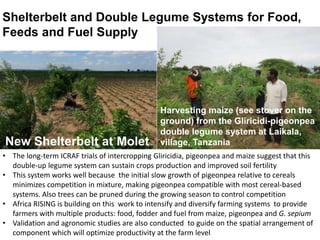
• The long-term ICRAF trials of intercropping Gliricidia, pigeonpea and maize suggest that this
double-up legume system can sustain crops production and improved soil fertility
• This system works well because the initial slow growth of pigeonpea relative to cereals
minimizes competition in mixture, making pigeonpea compatible with most cereal-based
systems. Also trees can be pruned during the growing season to control competition
• Africa RISING is building on this work to intensify and diversify farming systems to provide
farmers with multiple products: food, fodder and fuel from maize, pigeonpea and G. sepium
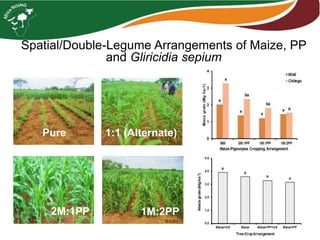
• Validation and agronomic studies are also conducted to guide on the spatial arrangement of
component which will optimize productivity at the farm level
Harvesting maize (see stover on the
ground) from the Gliricidi-pigeonpea
double legume system at Laikala,
village, Tanzania
Shelterbelt and Double Legume Systems for Food,
Feeds and Fuel Supply
New Shelterbelt at Molet
Spatial/Double-Legume Arrangements of Maize, PP
and Gliricidia sepium
Pure 1:1 (Alternate)
2M:1PP 1M:2PP
Cluster 4: Integrated livestock and poultry
management for productivity enhancement
• Characterization of rangelands productivity and
grazing land management systems
• Fodder/feeds quality assessment to guide
livestock and poultry feeding trials
• Characterization of indigenous chicken to select
for superior ecotypes to improve productivity
and income
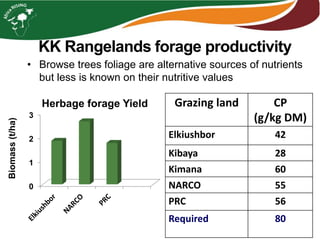
KK Rangelands forage productivity
Grazing land CP
(g/kg DM)
Elkiushbor 42
Kibaya 28
Kimana 60
NARCO 55
PRC 56
Required 80
0
1
2
3
Herbage forage Yield
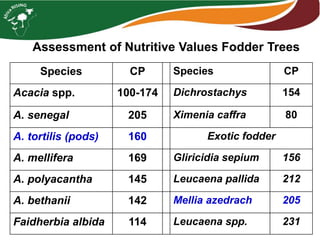
• Browse trees foliage are alternative sources of nutrients
but less is known on their nutritive values
Biomass(t/ha)
Species CP Species CP
Acacia spp. 100-174 Dichrostachys 154
A. senegal 205 Ximenia caffra 80
A. tortilis (pods) 160 Exotic fodder
A. mellifera 169 Gliricidia sepium 156
A. polyacantha 145 Leucaena pallida 212
A. bethanii 142 Mellia azedrach 205
Faidherbia albida 114 Leucaena spp. 231
Assessment of Nutritive Values Fodder Trees
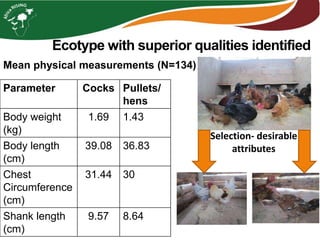
Ecotype with superior qualities identified
Parameter Cocks Pullets/
hens
Body weight
(kg)
1.69 1.43
Body length
(cm)
39.08 36.83
Chest
Circumference
(cm)
31.44 30
Shank length
(cm)
9.57 8.64
Mean physical measurements (N=134)
Selection- desirable
attributes
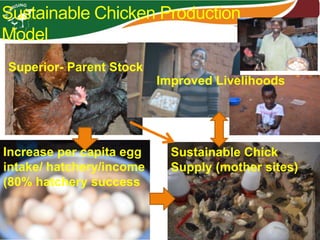
Sustainable Chicken Production
Model
Sustainable Chick
Supply (mother sites)
Increase per capita egg
intake/ hatchery/income
(80% hatchery success
Superior- Parent Stock
Improved Livelihoods
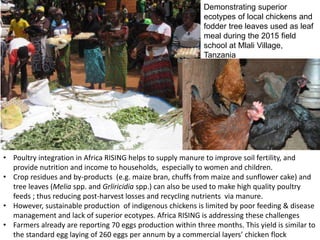
• Poultry integration in Africa RISING helps to supply manure to improve soil fertility, and
provide nutrition and income to households, especially to women and children.
• Crop residues and by-products (e.g. maize bran, chuffs from maize and sunflower cake) and
tree leaves (Melia spp. and Grliricidia spp.) can also be used to make high quality poultry
feeds ; thus reducing post-harvest losses and recycling nutrients via manure.
• However, sustainable production of indigenous chickens is limited by poor feeding & disease
management and lack of superior ecotypes. Africa RISING is addressing these challenges
• Farmers already are reporting 70 eggs production within three months. This yield is similar to
the standard egg laying of 260 eggs per annum by a commercial layers’ chicken flock
Demonstrating superior
ecotypes of local chickens and
fodder tree leaves used as leaf
meal during the 2015 field
school at Mlali Village,
Tanzania
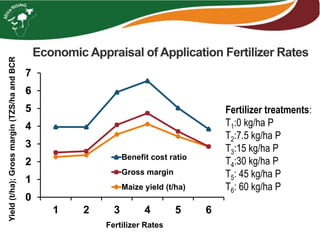
Economic Appraisal of Application Fertilizer Rates
0
1
2
3
4
5
6
7
1 2 3 4 5 6
Benefit cost ratio
Gross margin
Maize yield (t/ha)
Fertilizer treatments:
T1:0 kg/ha P
T2:7.5 kg/ha P
T3:15 kg/ha P
T4:30 kg/ha P
T5: 45 kg/ha P
T6: 60 kg/ha P
Yield(t/ha);Grossmargin(TZS/haandBCR
Fertilizer Rates
Highlights of Key Achievements
• Developed fertilizer guidelines for semiarid Tanzania
• Integrated land and water conservation techniques for
reducing runoffs by up to 80% and doubling maize yields
validated and up-scaled in action sites
• Identified superior ecotypes of indigenous chicken
• Potential fodder trees identified and introduced on-farm for
livestock/poultry feeds supplementation and other benefits
• Graduate students training (2 theses completed, 3 in
progress)
• Farmer groups formed and/or strengthened to support
scaling up of tested technologies through demonstrations
• Initiated economic appraisal and monitoring adoption of
promising technologies
• Conference presentations (4 posters in international conf.)

Integrated crop, soil health and livestock technologies for ecological intensification in Kongwa and Kiteto, Tanzania

  • 1.
    Integrated crop, soilhealth and livestock technologies for ecological intensification in Kongwa and Kiteto, Tanzania Anthony Kimaro ICRAF Africa RISING East and Southern Africa Review and Planning Meeting, Malawi, 14-16 July 2015
  • 2.
    Land Degradation Challengesin Kongwa and Kiteto Test and validate integrated soil, crop and water management technologies to address land degradation problems and hence contribute to SI Jumpstart Key findings in KK sites: •Fragile ecosystem with poor soil fertility and high soil erosion
  • 3.
    Land Degradation Challengesin Kongwa and Kiteto • Improved management of land and water is a critical step in sustainable intensification (SI) of farming systems • Limited availability of site-specific nutrient management guidelines for semiarid zones in Tanzania undermines efforts to target technologies to biophysical and/or socio- economic conditions in which farmers operate. • Technologies adopted under these circumstances may be risky to farmers. • Soils in Kongwa and Kiteto districts were characterized to assess soil fertility status and drivers of land degradation so as to inform the development of integrated land management options for SI.
  • 4.
    Theme 2 Clusters/Components •Soil Fertility Enhancing Technologies • Integrated Land and Water Management Options • Tree (Agroforestry) based technologies for SI • Livestock - Crop integration • Socio-economic Analysis and Adoption Monitoring to guide technology scaling
  • 5.
    Cluster 1: BiophysicalCharacterization of Action Sites LDSF (Landscape) Njoro Sentinel site LDSF: Infiltration Measurements in the field (Njoro Sentinel) Profile pit for soil classification (0-200cm) 10km 10km
  • 6.
    Soil Fertility Statusin Mother Sites in KK Site Soil Parameter Remarks (Landon) pH 5.6 - 6.8 Medium to slight acidic OC (%) 0.33 - 1.9 very low to low Exch. Phosphorus (mg/kg) 8-14 Low to medium Total N (%) 0.06-0.15 Very low to low CEC cmol (+)/kg soil 4.4 -10.2 Very low to low Cluster 1: Biophysical baseline
  • 7.
    Fertilizer Reccommendations forKK sites b ab a a b c c a ab bc 0.0 1.5 3.0 4.5 6.0 0 15 30 45 60 Maizegrain(Mgha-1) Phosphorus application rates (kg P ha-1) 2013 2014 b a ba ba ba ba b a a a a b 0.0 1.5 3.0 4.5 6.0 0 20 40 60 80 120 Maizegrain(Mgha-1) Nitrogen application rate (kg N ha-1) 2013 2014 Phosphorus Nitrogen • 30 kg P/ha for Phosphorus • 60 kg N/ha for Nitrogen • Expand to include microdose and tillage x fertilizer trials (2015-16)
  • 8.
    • Increase efficiencyof P fertilizer use via localized application at planting • Sustain crops yield at reduced inputs, especially P • Factorial combinations of N and P at 0, ¼, ½ and full (30 kg P/ha and 60 kg N/ha) • Give equivalent amount in g/hill P-Fertilizer Microdosing in KK sites: 2015-16
  • 9.
    • Farmer groupsformation and training on GAP (fertilizer, spacing, improved variety, site preparations etc.) and layout and management of demo plots • Technologies demonstrated in 293 baby plots: Manure and fertilizer (Minjingu mazao and Yara Mila Cereals at 30 kg P/ha and 60 kg N/ha) under maize monoculture or intercropping with pigeonpea • Follow up training during the off season on group dynamics, record keeping Baby Plots: Scaling fertilizer and improved crop varieties Farmers in Njoro village during a training session in Dec 2014Demo plot layout
  • 10.
    Cluster 2: IntegratedLand and Water Management Led by ARI-Hombolo (E. Swai)
  • 11.
    CONTROLOF SOILEROSION INKITETOAND KONGWADISTRICTS From 2012/2013 cropping season to date an attempt has been made under “Africa RISING Project” to fast track the integration of soil erosion control measure in cropping and land management systems. For effective control measures efforts have been geared towards the use of “landscape approach” through fully engagement of farming communities in the entire process of implementing the followings strategies:  Application of physical and biological barriers on control of soil erosion  Assessment of the efficacy of physical barriers for erosion control.  Testing of in situ water harvesting technologies.
  • 12.
    Application of Physicaland Biological barriers on Control of Soil Erosion in KK: Run-off plots at Mlali village Participatory run-off measurement at Mlali village, Kongwa Insitu rainwater harvesting technique at Chitego, KongwaPearl millet field with Fanya juu terrace at Laikala village, Kongwa Maize field with Fanya juu terrace at Njoro village, Kiteto
  • 13.
    Evaluating efficiency ofphysical barriers for controlling soil water erosion: 2014 & 2015 Treatments: • Bare plot (BP)-Reference • Oxen ploughing • Ox-ripping • Tied-ridging
  • 14.
    • The percentageof rainfall lost through runoff: − 2013/2014 season: 36.4 %, 30 % and 6.7 % for conventional ox ploughing, ox ripping and ox-ridging, respectively. • Low runoff in tied ridging reflect the ability of ponding of water to sustain soil moisture and crop production • Overall tied-ridging consistently increased resilience of farming systems against frequent and/or prolonged drought under semiarid climate Efficiency of Physical Barrier for Erosion Control: Results
  • 15.
    Tillage Effects onSoil Moisture 0.00 0.05 0.10 0.15 0.20 0.25 10 20 30 Volumetricwatercontentcm3/cm3 Soil depth ( cm) PL RT TR 0.00 0.06 0.12 0.18 0.24 0.30 10 20 30 Volumetricwatercontent,cm3/cm3 Soil depth (cm) PL RT TR Vegetative stage Grain filling stage • PL = Ox-ploughing • RT = Ox-ridging • TR = Ox-ripping
  • 16.
    1.4a 2.3ab 2.9b 0 1 2 3 4 PL RT TR Maizegrain(t/ha) Tillagemethods Maize yield increase relative to the conventional ox-ploughing method was 64 % in ox-ripping and 107 % in ox-ridging treatments. Effect of tillage on maize grain yield: 2013/2014
  • 17.
    Demonstrations:Scaling upland andwater Magt. technologies
  • 18.
    Demonstrations:Scaling up soiland water Magt. technologies • Mobilizing farmers in groups • Training key farmers on contour layout • Over 180 farmers have constructed contours for erosion control. The contours are stabilized by trees and grass which also supply fodder and improve soil fertility
  • 19.
    Cluster 3: Tree(Agroforestry)- based Technologies for SI • Intercropping and double legume arrangements • Shelterbelts and boundary tree planting • Woodlots for fodder and wood supply
  • 20.
    Agroforestry Options forSI Maize stover (Fuelwood) Food, Fodder Fuel, soil fertility Food, Fodder Fuel & soil fertility Tree Nursery G. sepium on contours: Food, Fodder, Fuel & Soil Fertility Food , Fuelwood, and NRM
  • 21.
    • Sustained livestockproductivity in semiarid central Tanzania is limited by availability of quality feeds of sufficient amount, especially during the off season. • Africa RISING is screening local species for fodder quality and introducing fast growing N-rich fodder trees/shrubs in various niches (contour bunds, double-legume, woodlots, shelterbelts) on-farm to supply supplementary high quality fodder and other benefits like fuelwood, erosion control and soil fertility improvement • Local browse tree species have been screened for fodder quality and best species identified • Out of 180 farmers who have established contours, 51 farmers (30%) have planted trees for stabilizing contours and providing ecosystem services identified above Integrating trees for feeds & fuelwood supply, erosion control, and soil fertility improvement Woodlots for fodder bank (G. sepium) and wood supply at Molet village, Tanzania Fodder trees (Gliricida sepium) used to stabilize soil erosion control contours at Mlali Village, Tanzania
  • 22.
    • The long-termICRAF trials of intercropping Gliricidia, pigeonpea and maize suggest that this double-up legume system can sustain crops production and improved soil fertility • This system works well because the initial slow growth of pigeonpea relative to cereals minimizes competition in mixture, making pigeonpea compatible with most cereal-based systems. Also trees can be pruned during the growing season to control competition • Africa RISING is building on this work to intensify and diversify farming systems to provide farmers with multiple products: food, fodder and fuel from maize, pigeonpea and G. sepium • Validation and agronomic studies are also conducted to guide on the spatial arrangement of component which will optimize productivity at the farm level Harvesting maize (see stover on the ground) from the Gliricidi-pigeonpea double legume system at Laikala, village, Tanzania Shelterbelt and Double Legume Systems for Food, Feeds and Fuel Supply New Shelterbelt at Molet
  • 23.
    Spatial/Double-Legume Arrangements ofMaize, PP and Gliricidia sepium Pure 1:1 (Alternate) 2M:1PP 1M:2PP
  • 24.
    Cluster 4: Integratedlivestock and poultry management for productivity enhancement • Characterization of rangelands productivity and grazing land management systems • Fodder/feeds quality assessment to guide livestock and poultry feeding trials • Characterization of indigenous chicken to select for superior ecotypes to improve productivity and income
  • 25.
    KK Rangelands forageproductivity Grazing land CP (g/kg DM) Elkiushbor 42 Kibaya 28 Kimana 60 NARCO 55 PRC 56 Required 80 0 1 2 3 Herbage forage Yield • Browse trees foliage are alternative sources of nutrients but less is known on their nutritive values Biomass(t/ha)
  • 26.
    Species CP SpeciesCP Acacia spp. 100-174 Dichrostachys 154 A. senegal 205 Ximenia caffra 80 A. tortilis (pods) 160 Exotic fodder A. mellifera 169 Gliricidia sepium 156 A. polyacantha 145 Leucaena pallida 212 A. bethanii 142 Mellia azedrach 205 Faidherbia albida 114 Leucaena spp. 231 Assessment of Nutritive Values Fodder Trees
  • 27.
    Ecotype with superiorqualities identified Parameter Cocks Pullets/ hens Body weight (kg) 1.69 1.43 Body length (cm) 39.08 36.83 Chest Circumference (cm) 31.44 30 Shank length (cm) 9.57 8.64 Mean physical measurements (N=134) Selection- desirable attributes
  • 28.
    Sustainable Chicken Production Model SustainableChick Supply (mother sites) Increase per capita egg intake/ hatchery/income (80% hatchery success Superior- Parent Stock Improved Livelihoods
  • 29.
    • Poultry integrationin Africa RISING helps to supply manure to improve soil fertility, and provide nutrition and income to households, especially to women and children. • Crop residues and by-products (e.g. maize bran, chuffs from maize and sunflower cake) and tree leaves (Melia spp. and Grliricidia spp.) can also be used to make high quality poultry feeds ; thus reducing post-harvest losses and recycling nutrients via manure. • However, sustainable production of indigenous chickens is limited by poor feeding & disease management and lack of superior ecotypes. Africa RISING is addressing these challenges • Farmers already are reporting 70 eggs production within three months. This yield is similar to the standard egg laying of 260 eggs per annum by a commercial layers’ chicken flock Demonstrating superior ecotypes of local chickens and fodder tree leaves used as leaf meal during the 2015 field school at Mlali Village, Tanzania
  • 30.
    Economic Appraisal ofApplication Fertilizer Rates 0 1 2 3 4 5 6 7 1 2 3 4 5 6 Benefit cost ratio Gross margin Maize yield (t/ha) Fertilizer treatments: T1:0 kg/ha P T2:7.5 kg/ha P T3:15 kg/ha P T4:30 kg/ha P T5: 45 kg/ha P T6: 60 kg/ha P Yield(t/ha);Grossmargin(TZS/haandBCR Fertilizer Rates
  • 31.
    Highlights of KeyAchievements • Developed fertilizer guidelines for semiarid Tanzania • Integrated land and water conservation techniques for reducing runoffs by up to 80% and doubling maize yields validated and up-scaled in action sites • Identified superior ecotypes of indigenous chicken • Potential fodder trees identified and introduced on-farm for livestock/poultry feeds supplementation and other benefits • Graduate students training (2 theses completed, 3 in progress) • Farmer groups formed and/or strengthened to support scaling up of tested technologies through demonstrations • Initiated economic appraisal and monitoring adoption of promising technologies • Conference presentations (4 posters in international conf.)

Editor's Notes

  • #3 Causes of Land degradations Poor tillage and crop management practices. Extensive grazing system widely adopted in the area Lack of knowledge on control of soil erosion among others.
  • #4 Improved management of land is critical to overcoming soil related constraints to sustainable food production in degraded soils. However, limited availability of site-specific nutrient management guidelines for semiarid zones in Tanzania undermines efforts to target technologies to biophysical and/or socio-economic conditions in which farmers operate. Thus technologies adopted under these circumstances may be risky to farmers. We characterized soils in Kongwa and Kiteto districts to assess the nature and fertility status and drivers of land degradation so as to inform the development of integrated land management options for sustainable intensification. Both landscape- (Land degradation Surveillance Framework-LDSF) and field-based sampling approaches were used to collect soil data (nutrients, carbon levels, infiltration rates and types) and ecological data (land use types tree cover and density etc.)
  • #5 Cluster1: Integrated Soil Fertility Management Technologies for SI Cluster 2: Integrated Land and Water Management Options for SI Cluster 3. Landscape based Agroforestry Options for SI Cluster 4: Livestock - Crop integration Scaling, economic analysis and Adoption monitoring
  • #6 The land degradation surveillance framework (LDSF) sampling protocol described in UNEP (2012) was used. The LSDF involves establishing a block (sentinel site) of 10 km x 10 km. In each block, a total of 16 clusters sized 2.5 km x 2.5 km were systematically laid out (Fig. 2). Ten random plots (35 m diameter equivalent to 1,000 m2) were generated using GPS and then laid in each of the cluster, concentrated within 1 km.
  • #8 Agronomic site specific application rates are: 30 kg N/ha for Phosphorus as this rate was associated with the highest maize yield (4.29 in Njoro & 4.57 in Molet = 4.4t/ha). However, farmers who can not afford this rate may use 15 kg P ha-1 as maize yield obtained by this rate was similar to the yield of the optimum rate. The CBA data are still being processed to understand the economical rate for farmers. 60 kg N/ha for Nitrogen Expand to develop micro-dose application options for P (rates in Lilian study and sources in Swai)
  • #10 Farmer groups formation and GAP training Fertilizer/manure use, intercropping, tillage practices Plant density (spacing, rows) & improved crop variety Demo plot layout and other management practices
  • #11 From 2012/2013 cropping season to date an attempt has been made under “Africa RISING Project” to fast track the integration of soil erosion control measure in cropping and land management systems. For effective control measures efforts have been geared towards the use of “landscape approach” through fully engagement of farming communities in the entire process of implementing the followings strategies: Application of physical and biological barriers on control of soil erosion Assessment of the efficacy of physical barriers for erosion control. Testing of in situ water harvesting technologies.
  • #15 The study on the efficiency of physical barriers for controlling soil water erosion in 2013/2014 cropping season revealed that the lowest and highest runoff were 18.9 mm for tie ridging and 102.3 for conventional oxen drawn ploughing tillage system. The ox-ripping tillage technique generated 85.6 mm of runoff . On the other hand, the percentages of rainfall lost through runoff were respectively 36.4 %; 30 % and 6.7 % for conventional ox ploughing, ox ripping and ox-ridging. Runoff generation in ridged treatments was generally lower than in oxen drawn ploughing tillage method. Low runoff in tied ridging could partly be attributed to the ability of ponding of water, as opposed to other treatments namely ox-ploughing and ox-ripping tillage technique
  • #21 Implication for Integrations Tillage & Fertilizer (reserve for implications)?? Agronomics for spatial integration of promising Maize and PP varieties Tree/shrub integration in shelterbelts/boundary planting for land management (erosional control and soil fertility) and fodder supply
  • #22 Farmer integrating fodder trees on contours and other niches (intercroping, fodder bank, shelterbelts etc) Mlali (18+5+2) Laikala (10-intercropping), Molet (6), Njoro (10-countours)=
  • #23 Ask Abdala to visit Laikala and get estimate of yield from these farmers. We need to include them in the training on group dynamics, record keeping etc.
  • #25 The key challenge for sustainable livestock production in semiarid areas is limited availability of feeds/fodder of sufficient quantity and quality Characterization of rangelands and livestock management systems Rangeland productivity (biomass) Role of local institutions in grazing land management Fodder bank/woodlot establishment Fodder quality assessments to improving feeding and nutrition of livestock and poultry Nutritive value of rangeland fodder species (fodder) Improving feeding and nutrition of animal through supplementation of leaf meal (Melia azediract) and Acacia tortilis pods Characterization of chicken population and enhancing production on-farm through improved feeding and nutrition Selection of superior ecotype of indigenous chicken Evaluation of growth performance and egg production (farmer & controlled experiments) Formation of farmer groups for scaling up
  • #26 Rangelands forage biomass productivity Low biomass productivity (1.74- 2.65 t DM/ ha) Low carrying capacity – (few animal / ha) The forages have low feed protein Browse tree foliages represent the available alternative source of nutrients although less is known on their nutritive values Objective: To assess herbage forage biomass productivity and nutritive value of herbage forages and browse tree spe
  • #27 Browse tree foliage in farmlands, grazing lands and fodder banks form important protein supplement of the deficient protein