Africa’s Regreening: Its Integral Role in
 Increasing Agricultural Productivity and
         Strengthening Resiliency

                  Mike McGahuey
                 EGAT/NRM/USAID


 World Resources Institute’s Symposium on Regreening
                    March 1, 2012
What is Regreening and Its
                                 Significance?

•   Rainfall capture technologies
    – Burkina Faso– 300,000 ha
    – Niger—200,000 ha
    – Mali—100,000 ha


•   On-Farm Forestry
    – Niger- 5.0 million ha
    – Mali—500,000 ha
    – Zambia and Malawi—280K HH’s
Two Key Challenges Facing
                 Africa’s Dryland Smallholders

• Rainfall Variability: Rainfall variability is a greater
  challenge than absolute amount of rainfall

• Weathered Soils: Over 80% of Africa’s soils have
  major productivity constraints (Breman, et.al, 2007)
  – Naturally low in nutrients
  – Low capacity to retain nutrients  Benefits of
    mineral fertilizers marginalized

 Both of these challenges have been addressed at
   scale by initiatives that set the stage for more
                intensified agriculture
Climate Change Will
              Exacerbate Rainfall Variability

• More intensive rainfall events  More run-off
  (currently estimated at 25-50%)
• Longer intervals between events  Root zone
  desiccation at critical times
• Changing rainfall patterns  Shortened season
  or elimination of season

 Innovative rainfall management technologies
   have allowed farmers to successfully adapt
               to greater variability
Combating Rainfall Variability by Slowing
                     Run-off and Increasing Infiltration

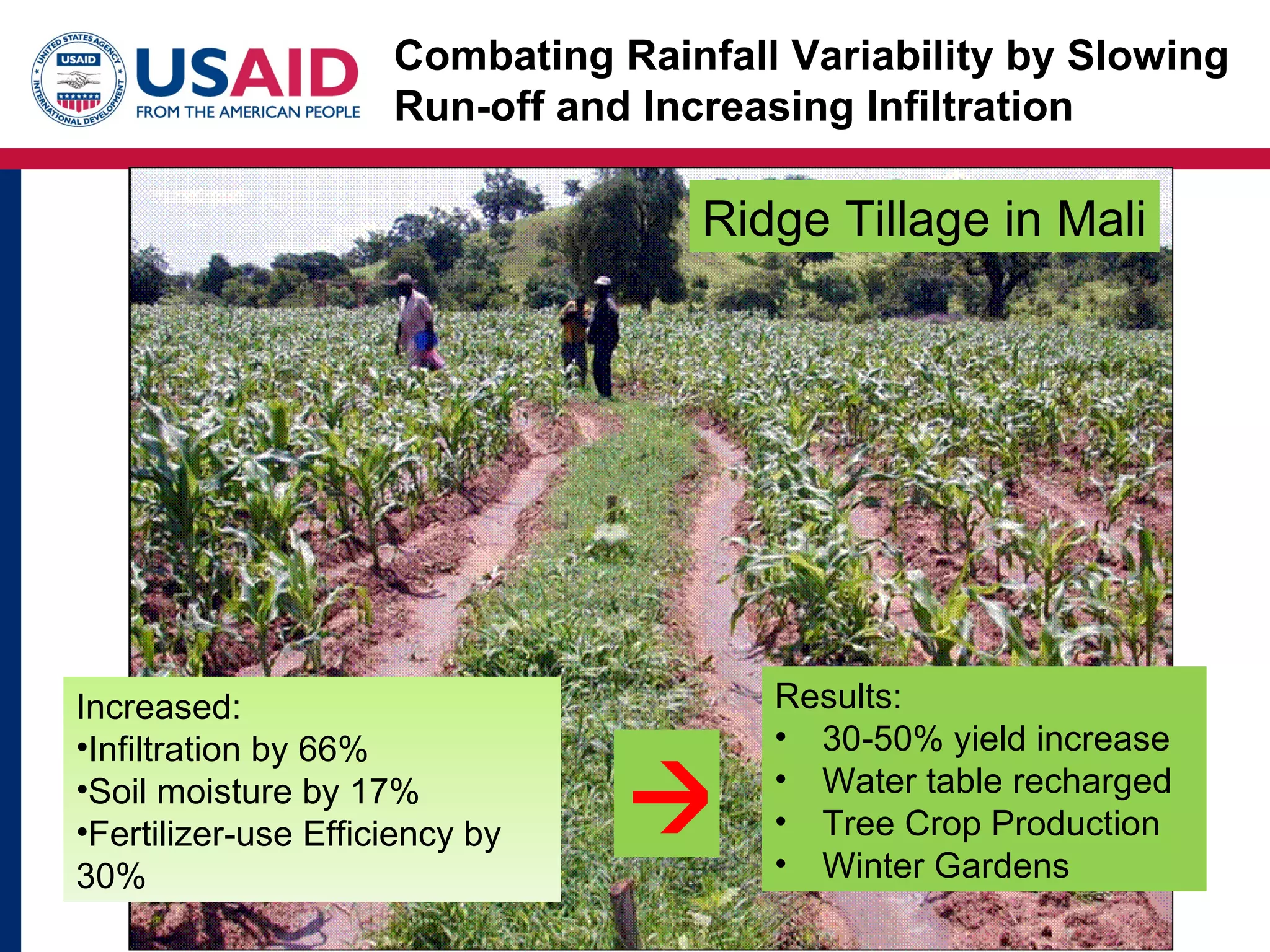
                                    Ridge Tillage in Mali


Increased:                             Results:
•Infiltration by 66%                   • 30-50% yield increase
•Soil moisture by 17%
•Fertilizer-use Efficiency by         • Water table recharged
                                       • Tree Crop Production
                                       • Winter Gardens
30%
Dry Season Gardens: A Dividend
                               of Rainwater Management
                                                               • Higher water table
                                                                 allows dry season
                                                                 irrigation;
                                                               • Higher prices for
                                                                 counter-season
                                                                 produce;
                                                               • New and additional
                                                                 sources of revenue
                                                                 and nutritious foods.
                                                               • Resilience
                                                                 Strengthened
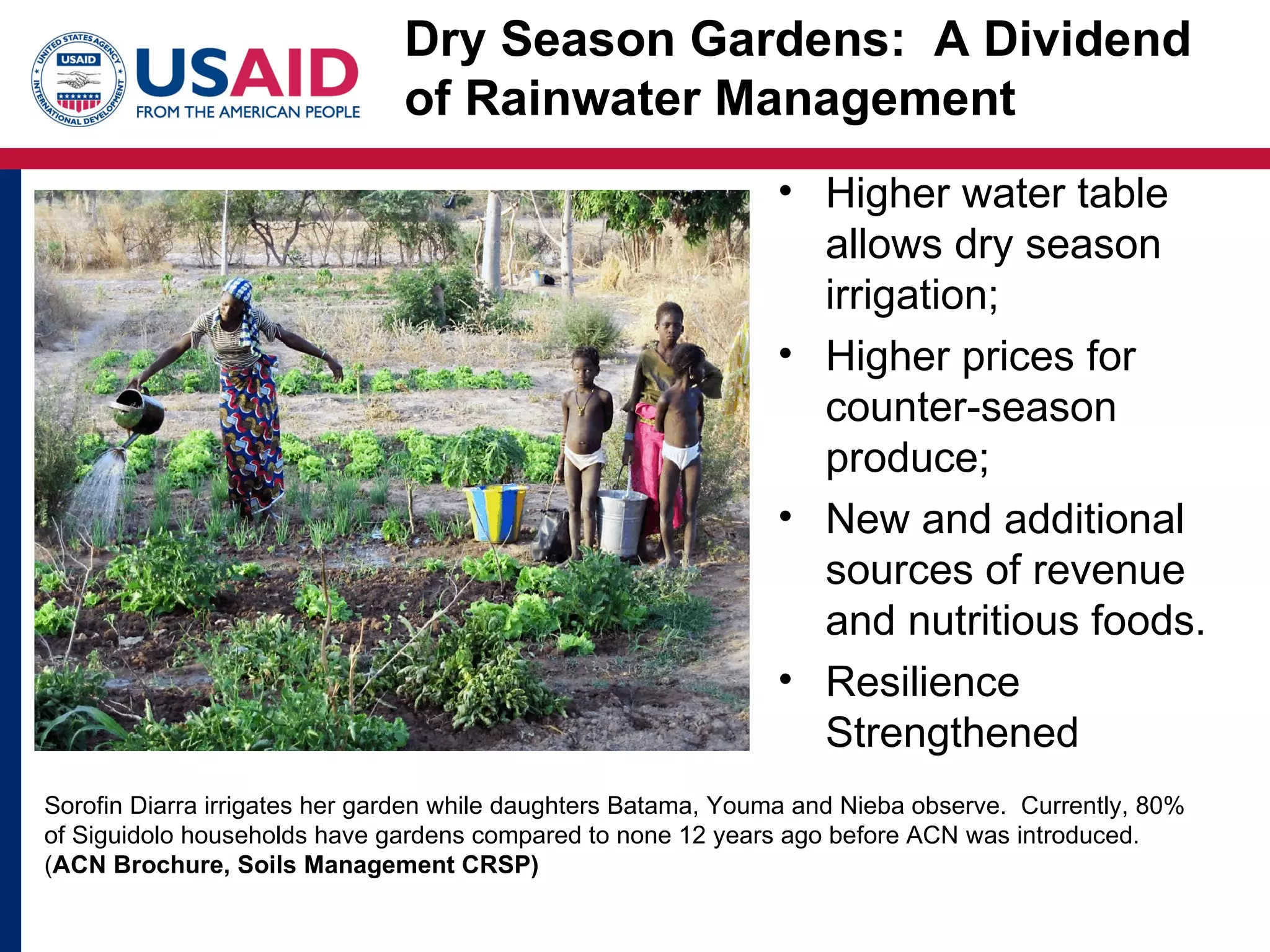
Sorofin Diarra irrigates her garden while daughters Batama, Youma and Nieba observe. Currently, 80%
of Siguidolo households have gardens compared to none 12 years ago before ACN was introduced.
(ACN Brochure, Soils Management CRSP)
High-Value Field Trees: Additional
                        Source of Revenue and Nutrition


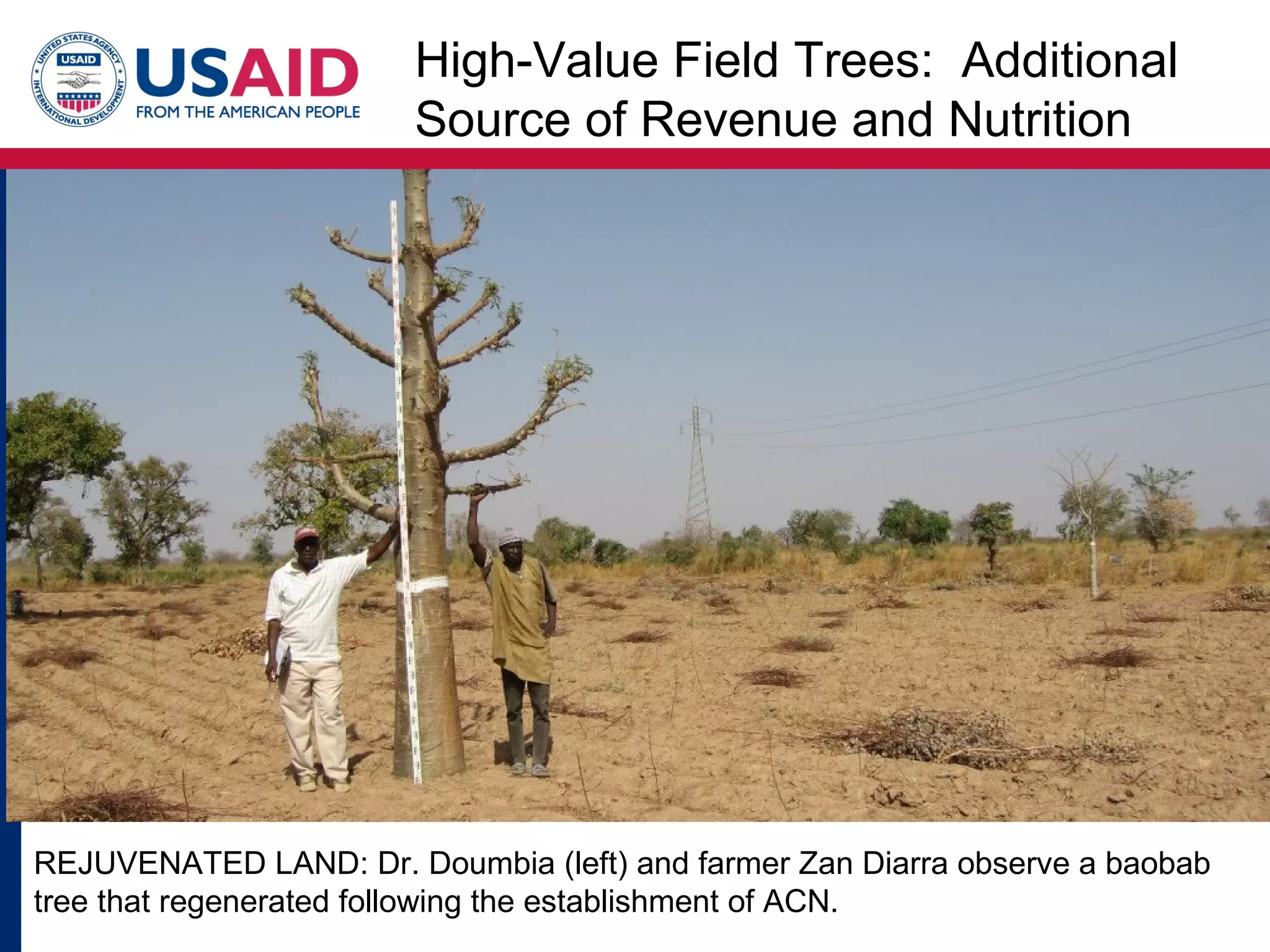
REJUVENATED LAND: Dr. Doumbia (left) and farmer Zan Diarra observe a baobab
tree that regenerated following the establishment of ACN.
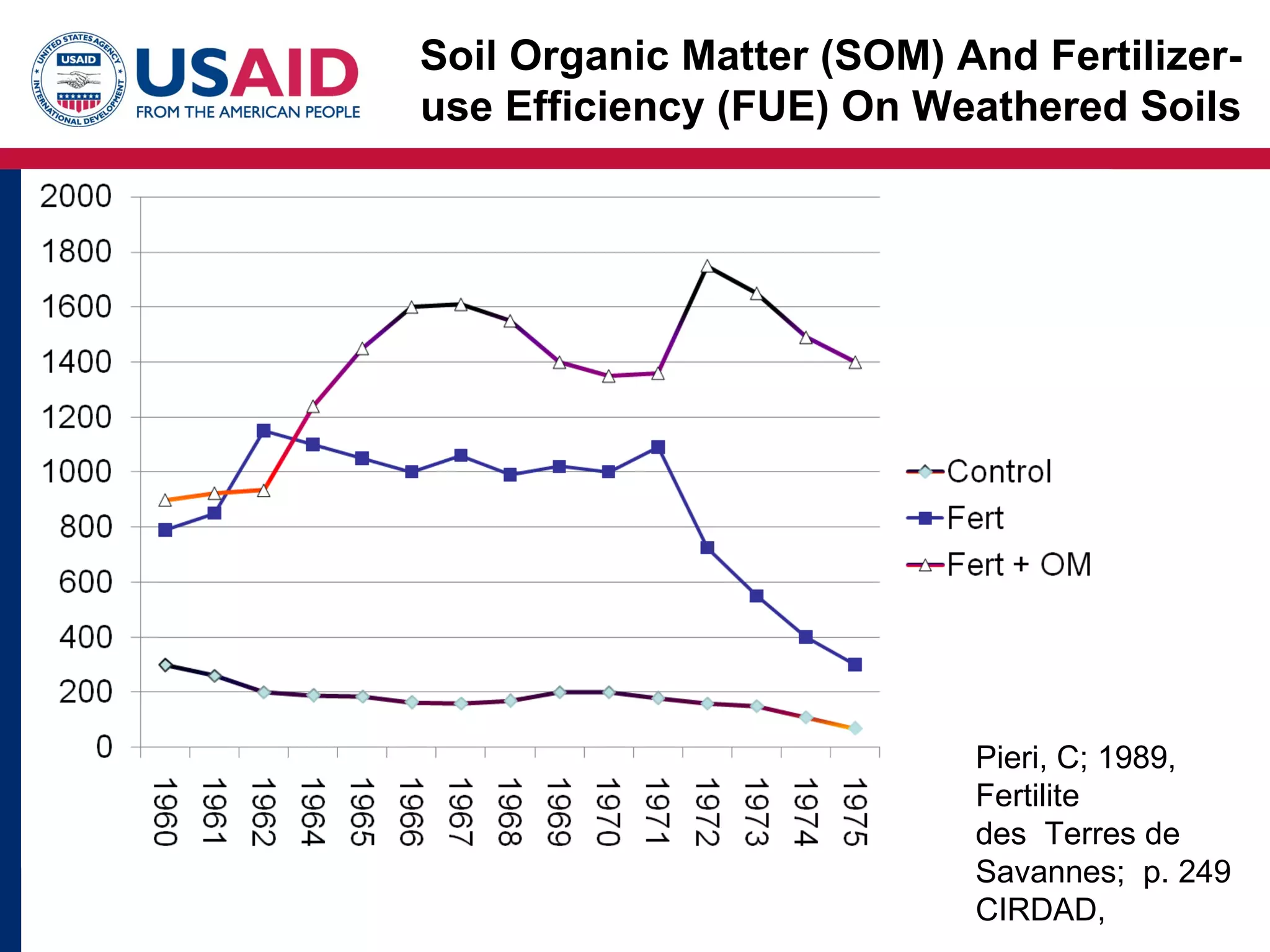
Soil Organic Matter (SOM) And Fertilizer-
use Efficiency (FUE) On Weathered Soils


                           Pieri, C; 1989,
                           Fertilite
                           des Terres de
                           Savannes; p. 249
                           CIRDAD,
Addressing Challenges through Mixed
           Production Systems

Benefits of Perennials
•Increases Soil Organic Matter
    • Higher fertilizer-use efficiency
    • Improved green-water productivity
•Recycles nutrients
•Enhances drought resilience
•Provides alternative income when annual crops fail.
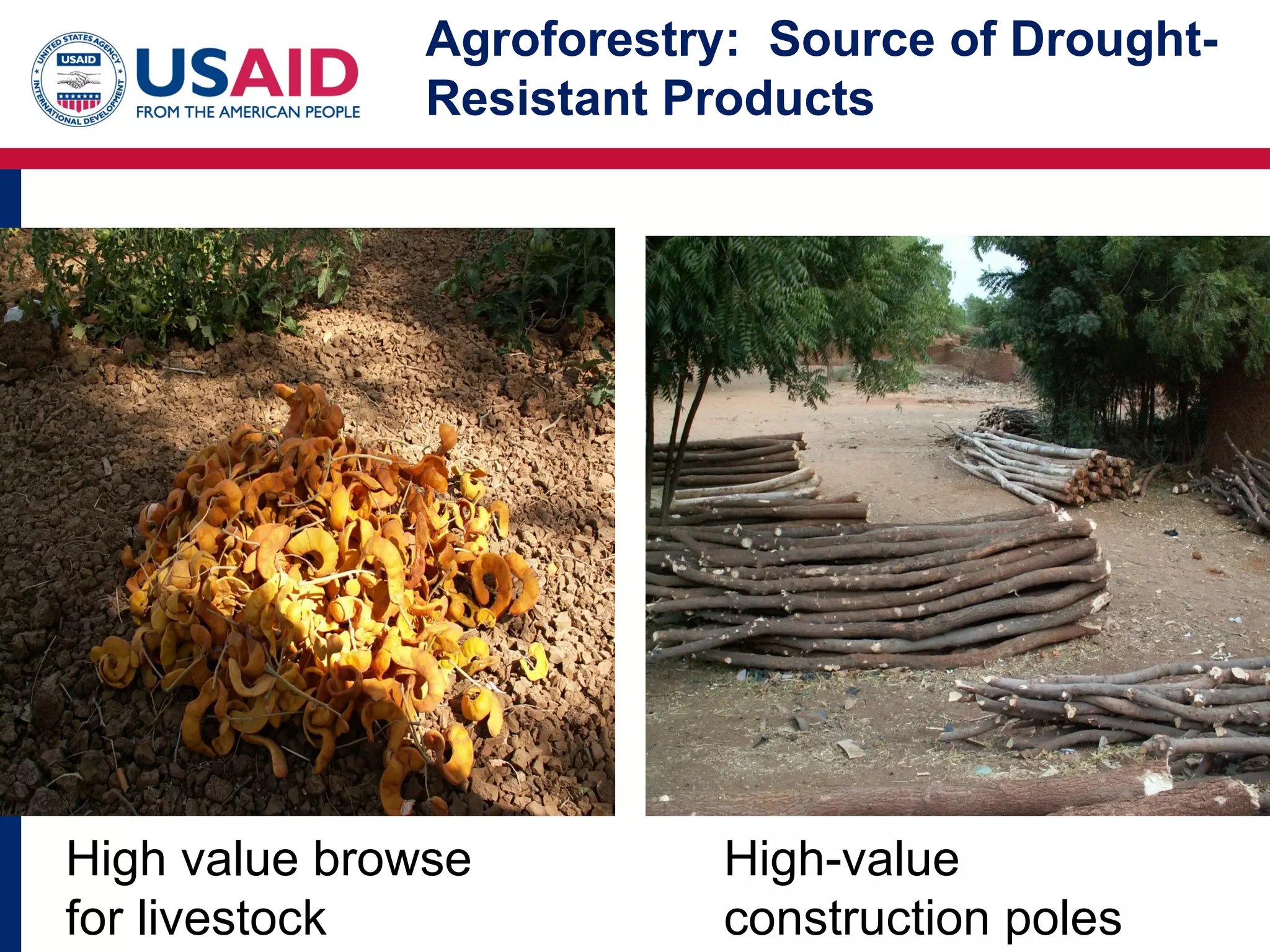
Agroforestry: Source of Drought-
               Resistant Products


High value browse          High-value
for livestock              construction poles
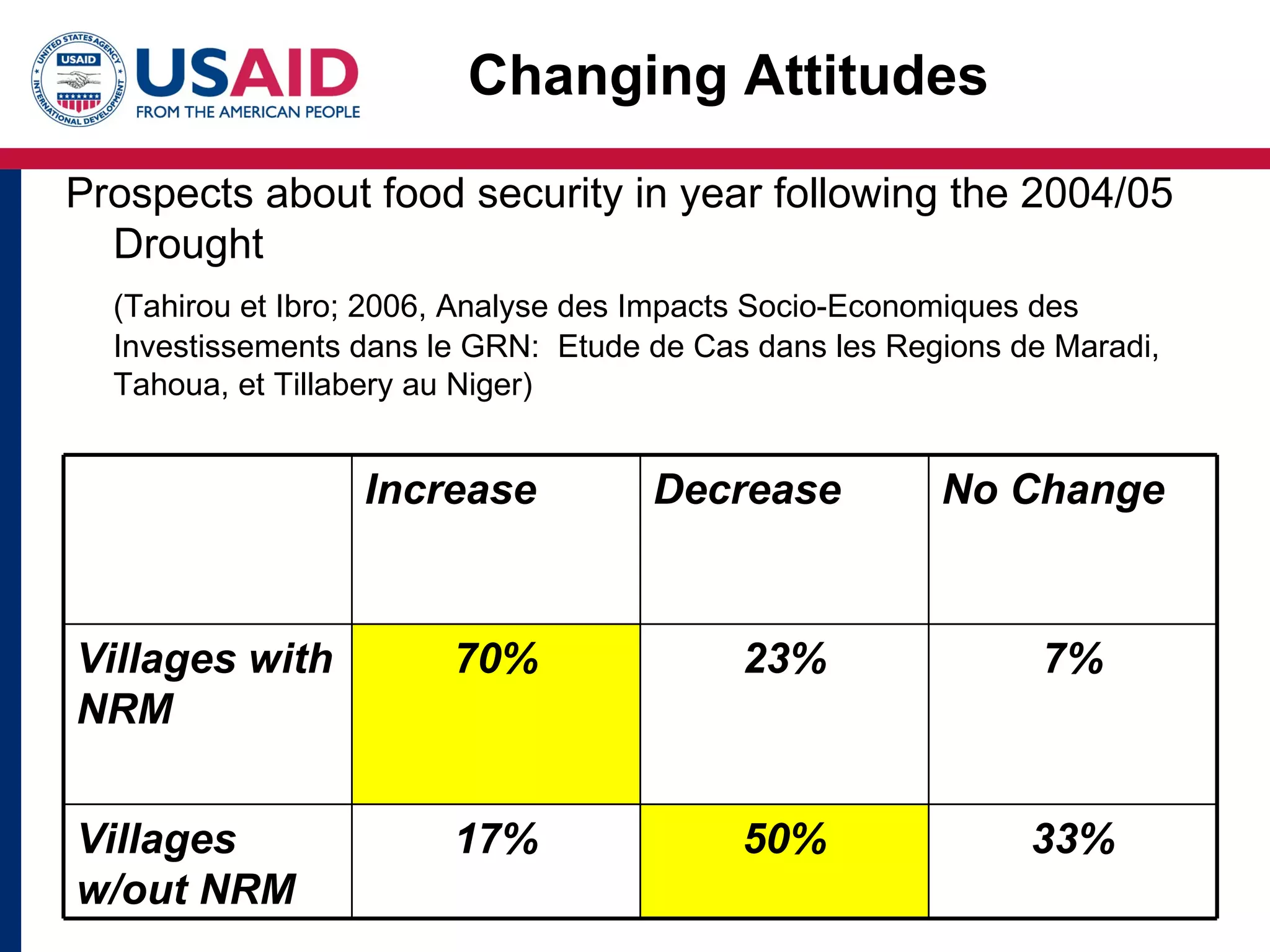
Changing Attitudes

Prospects about food security in year following the 2004/05
  Drought
  (Tahirou et Ibro; 2006, Analyse des Impacts Socio-Economiques des
  Investissements dans le GRN: Etude de Cas dans les Regions de Maradi,
  Tahoua, et Tillabery au Niger)


                  Increase           Decrease           No Change


Villages with           70%                23%                 7%
NRM


Villages                17%                50%                33%
w/out NRM
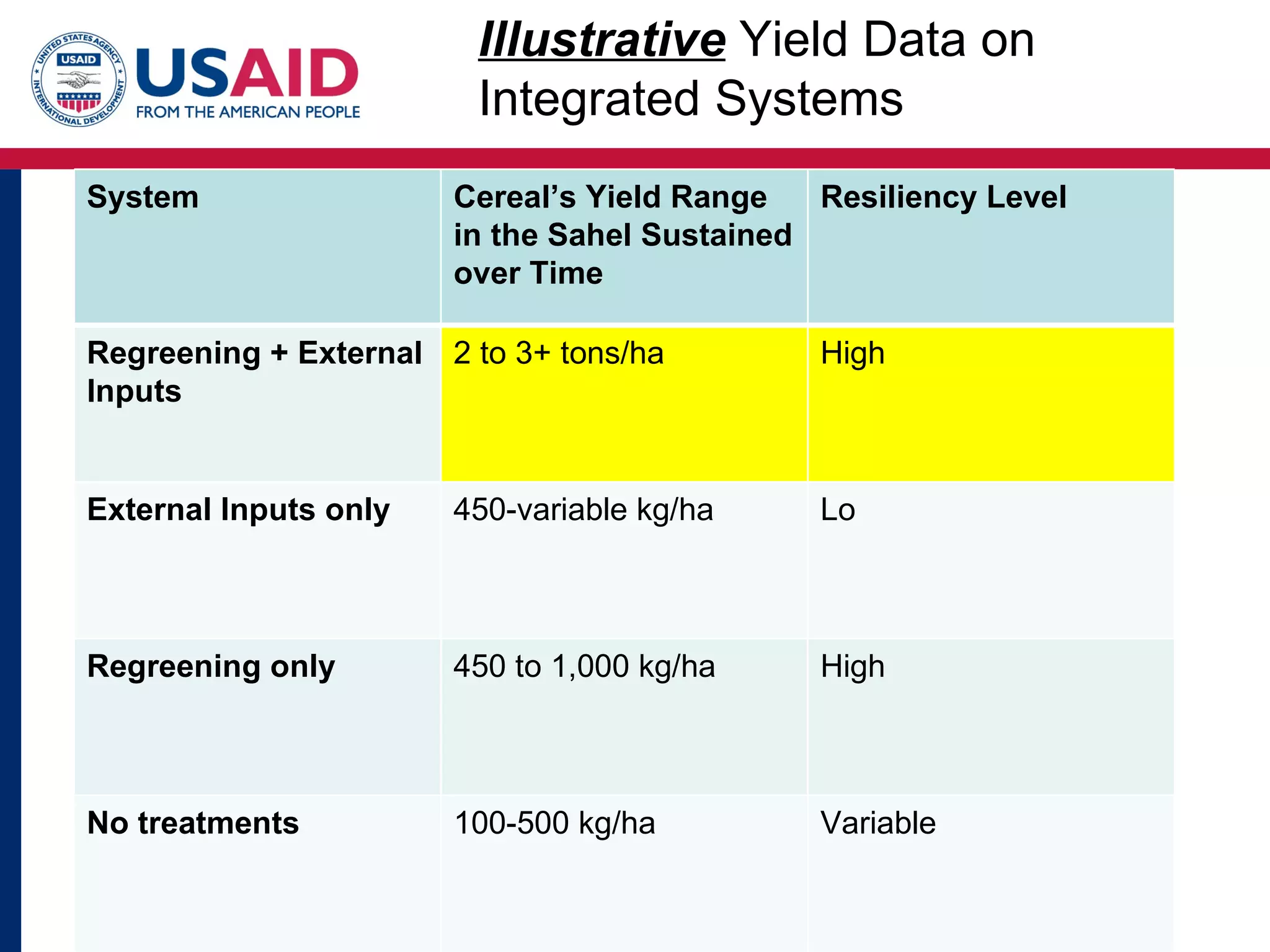
Illustrative Yield Data on
                         Integrated Systems
System                 Cereal’s Yield Range   Resiliency Level
                       in the Sahel Sustained
                       over Time

Regreening + External 2 to 3+ tons/ha         High
Inputs


External Inputs only   450-variable kg/ha     Lo


Regreening only        450 to 1,000 kg/ha     High


No treatments          100-500 kg/ha          Variable
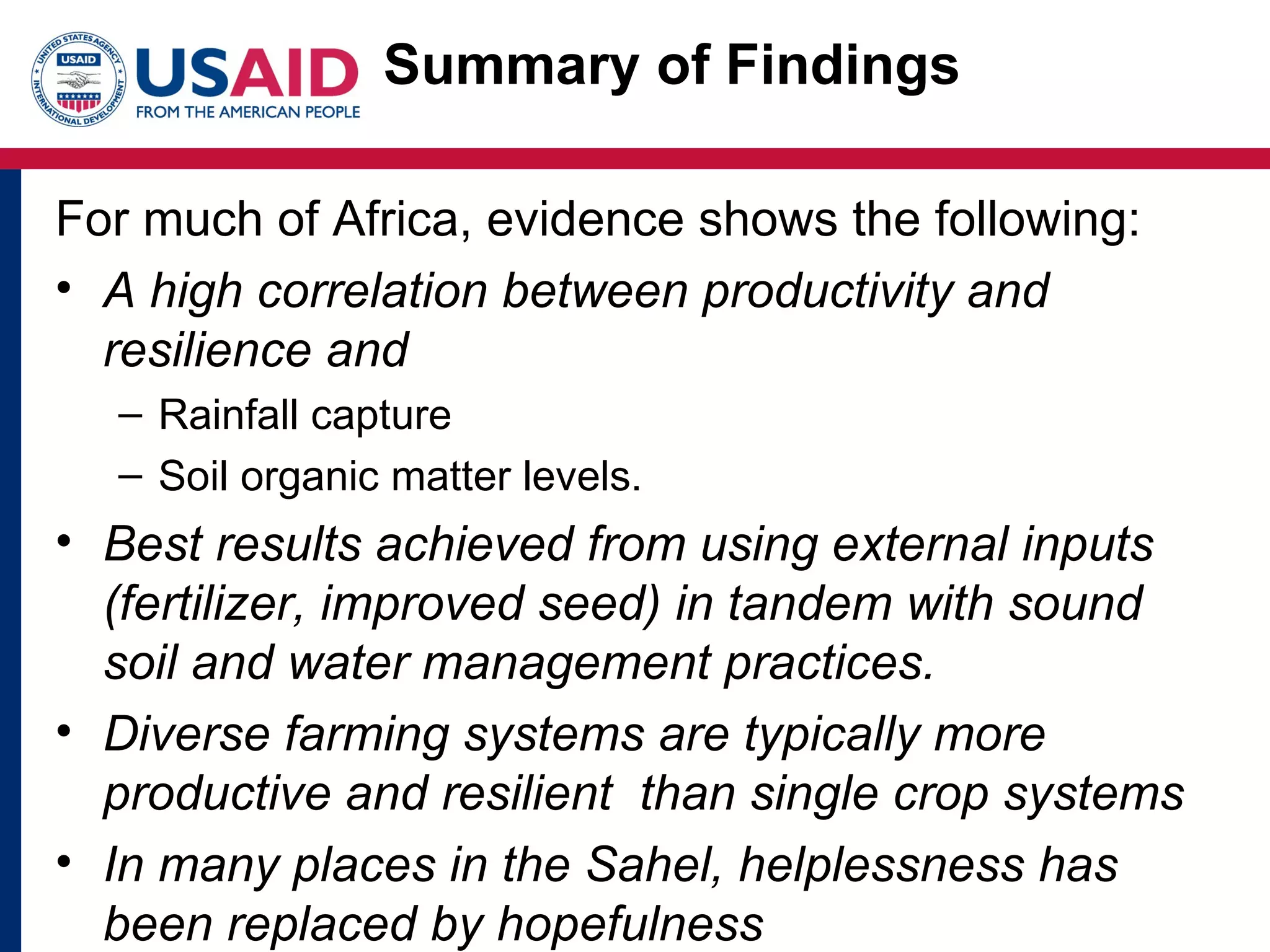
Summary of Findings

For much of Africa, evidence shows the following:
• A high correlation between productivity and
  resilience and
  – Rainfall capture
  – Soil organic matter levels.
• Best results achieved from using external inputs
  (fertilizer, improved seed) in tandem with sound
  soil and water management practices.
• Diverse farming systems are typically more
  productive and resilient than single crop systems
• In many places in the Sahel, helplessness has
  been replaced by hopefulness

Africa's Regreening: Its Integral Role in Increasing Agricultural Productivity and Strengthening Resiliency

  • 1.
    Africa’s Regreening: ItsIntegral Role in Increasing Agricultural Productivity and Strengthening Resiliency Mike McGahuey EGAT/NRM/USAID World Resources Institute’s Symposium on Regreening March 1, 2012
  • 2.
    What is Regreeningand Its Significance? • Rainfall capture technologies – Burkina Faso– 300,000 ha – Niger—200,000 ha – Mali—100,000 ha • On-Farm Forestry – Niger- 5.0 million ha – Mali—500,000 ha – Zambia and Malawi—280K HH’s
  • 3.
    Two Key ChallengesFacing Africa’s Dryland Smallholders • Rainfall Variability: Rainfall variability is a greater challenge than absolute amount of rainfall • Weathered Soils: Over 80% of Africa’s soils have major productivity constraints (Breman, et.al, 2007) – Naturally low in nutrients – Low capacity to retain nutrients  Benefits of mineral fertilizers marginalized Both of these challenges have been addressed at scale by initiatives that set the stage for more intensified agriculture
  • 4.
    Climate Change Will Exacerbate Rainfall Variability • More intensive rainfall events  More run-off (currently estimated at 25-50%) • Longer intervals between events  Root zone desiccation at critical times • Changing rainfall patterns  Shortened season or elimination of season Innovative rainfall management technologies have allowed farmers to successfully adapt to greater variability
  • 5.
    Combating Rainfall Variabilityby Slowing Run-off and Increasing Infiltration Ridge Tillage in Mali Increased: Results: •Infiltration by 66% • 30-50% yield increase •Soil moisture by 17% •Fertilizer-use Efficiency by  • Water table recharged • Tree Crop Production • Winter Gardens 30%
  • 6.
    Dry Season Gardens:A Dividend of Rainwater Management • Higher water table allows dry season irrigation; • Higher prices for counter-season produce; • New and additional sources of revenue and nutritious foods. • Resilience Strengthened Sorofin Diarra irrigates her garden while daughters Batama, Youma and Nieba observe. Currently, 80% of Siguidolo households have gardens compared to none 12 years ago before ACN was introduced. (ACN Brochure, Soils Management CRSP)
  • 7.
    High-Value Field Trees:Additional Source of Revenue and Nutrition REJUVENATED LAND: Dr. Doumbia (left) and farmer Zan Diarra observe a baobab tree that regenerated following the establishment of ACN.
  • 8.
    Soil Organic Matter(SOM) And Fertilizer- use Efficiency (FUE) On Weathered Soils Pieri, C; 1989, Fertilite des Terres de Savannes; p. 249 CIRDAD,
  • 9.
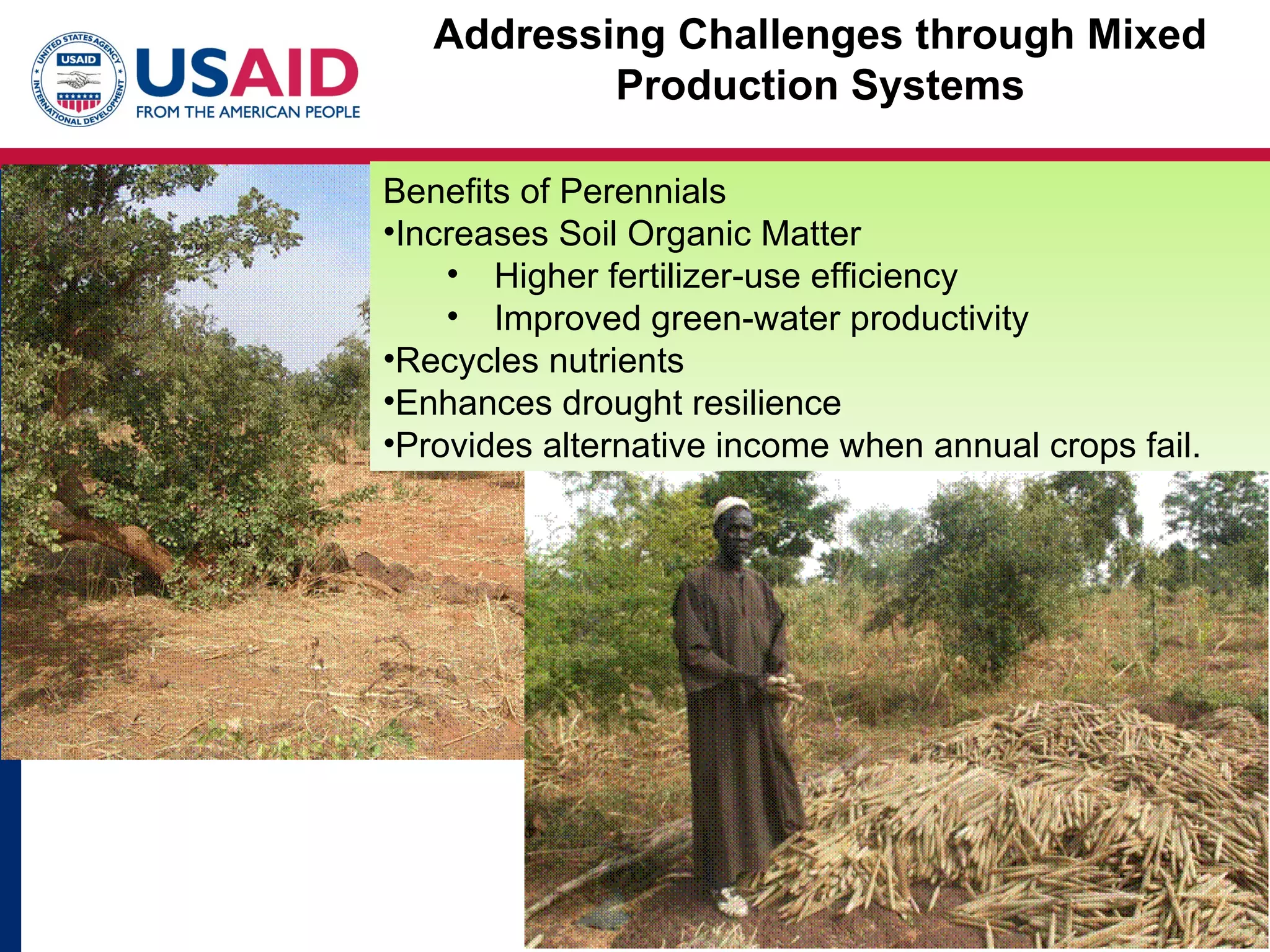
    Addressing Challenges throughMixed Production Systems Benefits of Perennials •Increases Soil Organic Matter • Higher fertilizer-use efficiency • Improved green-water productivity •Recycles nutrients •Enhances drought resilience •Provides alternative income when annual crops fail.
  • 10.
    Agroforestry: Source ofDrought- Resistant Products High value browse High-value for livestock construction poles
  • 11.
    Changing Attitudes Prospects aboutfood security in year following the 2004/05 Drought (Tahirou et Ibro; 2006, Analyse des Impacts Socio-Economiques des Investissements dans le GRN: Etude de Cas dans les Regions de Maradi, Tahoua, et Tillabery au Niger) Increase Decrease No Change Villages with 70% 23% 7% NRM Villages 17% 50% 33% w/out NRM
  • 12.
    Illustrative Yield Dataon Integrated Systems System Cereal’s Yield Range Resiliency Level in the Sahel Sustained over Time Regreening + External 2 to 3+ tons/ha High Inputs External Inputs only 450-variable kg/ha Lo Regreening only 450 to 1,000 kg/ha High No treatments 100-500 kg/ha Variable
  • 13.
    Summary of Findings Formuch of Africa, evidence shows the following: • A high correlation between productivity and resilience and – Rainfall capture – Soil organic matter levels. • Best results achieved from using external inputs (fertilizer, improved seed) in tandem with sound soil and water management practices. • Diverse farming systems are typically more productive and resilient than single crop systems • In many places in the Sahel, helplessness has been replaced by hopefulness

Editor's Notes

  • #2 My job will be to set the stage for Chris, Gray, Emmy and Bob. I will be talking first about what the science and experience says about the challenges facing Sahelian farmers and , secondly about Regreening technologies that have helped them these challenges
  • #3 First, what is Regreening? It is characterized by farmers investing in better management of soils, water and vegetation. Examples include: Rainfall harvesting technologies in Burkina Faso, Niger and Mali, and Agroforestry systems in West and East Africa As you can see, many of these have been adopted at a broad scale.
  • #4 To understand the importance of Regreening technologies, let’s look at challenges shared by most African dryland farmers. They include: High rainfall variability, which is often more of limiting factor than the absolute amount of rainfall and Weathered soils. Africa is an old continent and more than 80% of its soils have significant productivity constraints including: Being low in nutrients and Having little natural capacity to retain nutrients applied in fertilizers. .
  • #5 In facing climatic changes, farmers can expect the following: More intensive rainfall events, meaning more run-off; Longer intervals between rainfall events, meaning loss of early-season crops; Changing rainfall patterns (e.g., late start in the rainy season) meaning more frequent crop failures. However, there is a proven track record in addressing these challenges.
  • #6 For example, ridge tillage is one of several technologies used by farmers to hold rainfall where it falls allowing it to infiltrate the soil. Other rainfall management technologies include “zai’s”, contour dikes, half-moons, etc. Research on ridge tillage by Malian and US Scientists showed the following results: 66% increase in rainfall infiltration 17% more soil moisture at the end of the season, and 30% increase in fertilizer-use efficiency—which I will address later. The above results contributed to a 30-50% yield increase.
  • #7 In addition, ridge tillage recharged the water table which: Allowed farmers to establish dry-season irrigated gardens, and Increased productivity of high-value field trees
  • #8 These secondary benefits not only provided new and additional sources of revenue and nutritious food, but, because they were less susceptible to climatic variability, they reduced farmers’ risks and increased resiliency.
  • #9 Moving to the challenges of weathered soils, this graph shows the importance of soil management to fertilizer-use efficiency and productivity. This research, conducted on sorghum fields in Burkina Faso, compared two treatments: One with additions of both fertilizer and organic matter and one with fertilizer and removal of organic matter. The control received no fertilizer. As can be seen, in the first year both treatments produced significant yield increases and maintained those increases for several years. But, around year 12, the response of the Fertilizer Only treatment went into a steady decline until, by year 15, yields were back to the control levels. This indicated no response to the fertilizer being applied. At the same time, the fields that received organic matter maintained a high-yield response to fertilizer. The reason for this difference is that organic matter provided the soil, which was likely weathered, with increased capacity to retain nutrients. A lesson here is that on many African soils, applying fertilizer without maintaining adequate soil organic matter levels will produce marginal returns.
  • #10 However, amending the soil’s organic matter content is an arduous task if the organic matter has to be carried to the field. But, a growing number of dryland farmers amend their soils through various forms of agroforestry systems which drop tons of litter per hectare yielding a continual and convenient source of organic matter. Consequently, agroforestry farmers should expect higher returns and less risk from investments in fertilizers and improved seed.
  • #11 In addition to increasing soil productivity, these systems are less susceptible to climatic variability. Even in a poor or erratic rainy season where annual crops do poorly or fail entirely, the farmer will be able to harvest wood, browse, gum, oils, pharmacopeia, etc. will not have the catastrophic impact on tree products as on annual crops.
  • #12 These new production systems appear to have had an intangible impact on people’s attitudes. Recalling that the 1970’s were marked with a feeling of helplessness, I think that we are now seeing large pockets where people feel that they have more control in being able to do something in the face of climatic and land challenges. While a small sample, this research showed that people that practiced agroforestry were more optimistic than those who did not. Given that this survey was published in the year following the 2005 Food Crisis in Niger might give it additional weight.
  • #13 Given that we are focusing on crop production, I wanted to provide illustrative ranges of yields and resiliency levels from various systems. These are based upon specific research findings, but I wish to emphasize that they are illustrative. Given that provision, I would like to make the following points: To address food security challenges in the long run, farmers will need to achieve the higher yields on this table. While “regreening-only” will provide substantial increases over “no-treatments,” will help farmers buy time, and strengthen resiliency, the yields will need to be higher. While external inputs-only will provide initial yield increases, they will need to be accompanied by better soil and water management to be sustained. And, they will provide little resiliency. In sum, achieving the necessary yields and strengthening resiliency will require external inputs used in tandem with Regreening systems.