

By
Ch Ravinder Reddy
MS Swaminathan Research Foundation,
Chennai, India
Chrr.34@gmail.com
Pulse Panchayath
International Conference on Pulses for Health, Nutrition, and
Sustainable Food Security in the Dry Areas
April 18, 2016 until April 20, 2016; Marrakesh, Morocco
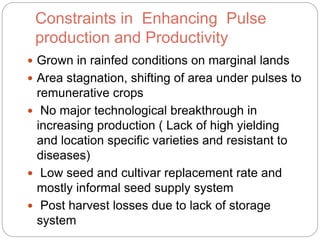
Constraints in Enhancing Pulse
production and Productivity
 Grown in rainfed conditions on marginal lands
 Area stagnation, shifting of area under pulses to
remunerative crops
 No major technological breakthrough in
increasing production ( Lack of high yielding
and location specific varieties and resistant to
diseases)
 Low seed and cultivar replacement rate and
mostly informal seed supply system
 Post harvest losses due to lack of storage
system
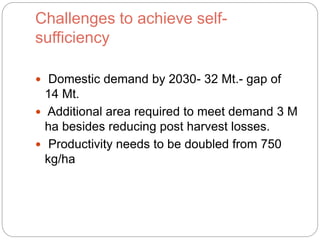
Challenges to achieve self-
sufficiency
 Domestic demand by 2030- 32 Mt.- gap of
14 Mt.
 Additional area required to meet demand 3 M
ha besides reducing post harvest losses.
 Productivity needs to be doubled from 750
kg/ha
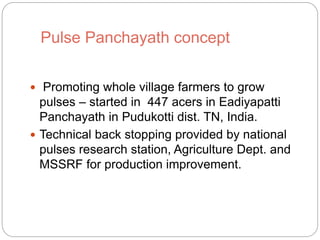
Pulse Panchayath concept
 Promoting whole village farmers to grow
pulses – started in 447 acers in Eadiyapatti
Panchayath in Pudukotti dist. TN, India.
 Technical back stopping provided by national
pulses research station, Agriculture Dept. and
MSSRF for production improvement.
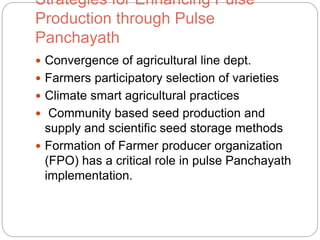
Strategies for Enhancing Pulse
Production through Pulse
Panchayath
 Convergence of agricultural line dept.
 Farmers participatory selection of varieties
 Climate smart agricultural practices
 Community based seed production and
supply and scientific seed storage methods
 Formation of Farmer producer organization
(FPO) has a critical role in pulse Panchayath
implementation.
Effect of Pulse Panchayath
 Awareness improved among small and
marginal farmers
 Access to improved technologies
 Improved varieties , seed availability and
innovative seed storage technology.
 Linkages to credit institutions and markets
 Yield increased by 32% (1155-1300 kg ha-1)
over control (875-1000 kg ha-1)
 Can influence the policy makers
Thank You

Pulses Panchayat

  • 1.
    By Ch Ravinder Reddy MSSwaminathan Research Foundation, Chennai, India Chrr.34@gmail.com Pulse Panchayath International Conference on Pulses for Health, Nutrition, and Sustainable Food Security in the Dry Areas April 18, 2016 until April 20, 2016; Marrakesh, Morocco
  • 2.
    Constraints in EnhancingPulse production and Productivity  Grown in rainfed conditions on marginal lands  Area stagnation, shifting of area under pulses to remunerative crops  No major technological breakthrough in increasing production ( Lack of high yielding and location specific varieties and resistant to diseases)  Low seed and cultivar replacement rate and mostly informal seed supply system  Post harvest losses due to lack of storage system
  • 3.
    Challenges to achieveself- sufficiency  Domestic demand by 2030- 32 Mt.- gap of 14 Mt.  Additional area required to meet demand 3 M ha besides reducing post harvest losses.  Productivity needs to be doubled from 750 kg/ha
  • 4.
    Pulse Panchayath concept Promoting whole village farmers to grow pulses – started in 447 acers in Eadiyapatti Panchayath in Pudukotti dist. TN, India.  Technical back stopping provided by national pulses research station, Agriculture Dept. and MSSRF for production improvement.
  • 5.
    Strategies for EnhancingPulse Production through Pulse Panchayath  Convergence of agricultural line dept.  Farmers participatory selection of varieties  Climate smart agricultural practices  Community based seed production and supply and scientific seed storage methods  Formation of Farmer producer organization (FPO) has a critical role in pulse Panchayath implementation.
  • 6.
    Effect of PulsePanchayath  Awareness improved among small and marginal farmers  Access to improved technologies  Improved varieties , seed availability and innovative seed storage technology.  Linkages to credit institutions and markets  Yield increased by 32% (1155-1300 kg ha-1) over control (875-1000 kg ha-1)  Can influence the policy makers
  • 7.