Increasing food legumes production by small farmers to
strengthen food and nutrition security through adoption of
improved technologies and governance within South-South
Cooperation
ICP 2016, Marrakech
Initiative objective
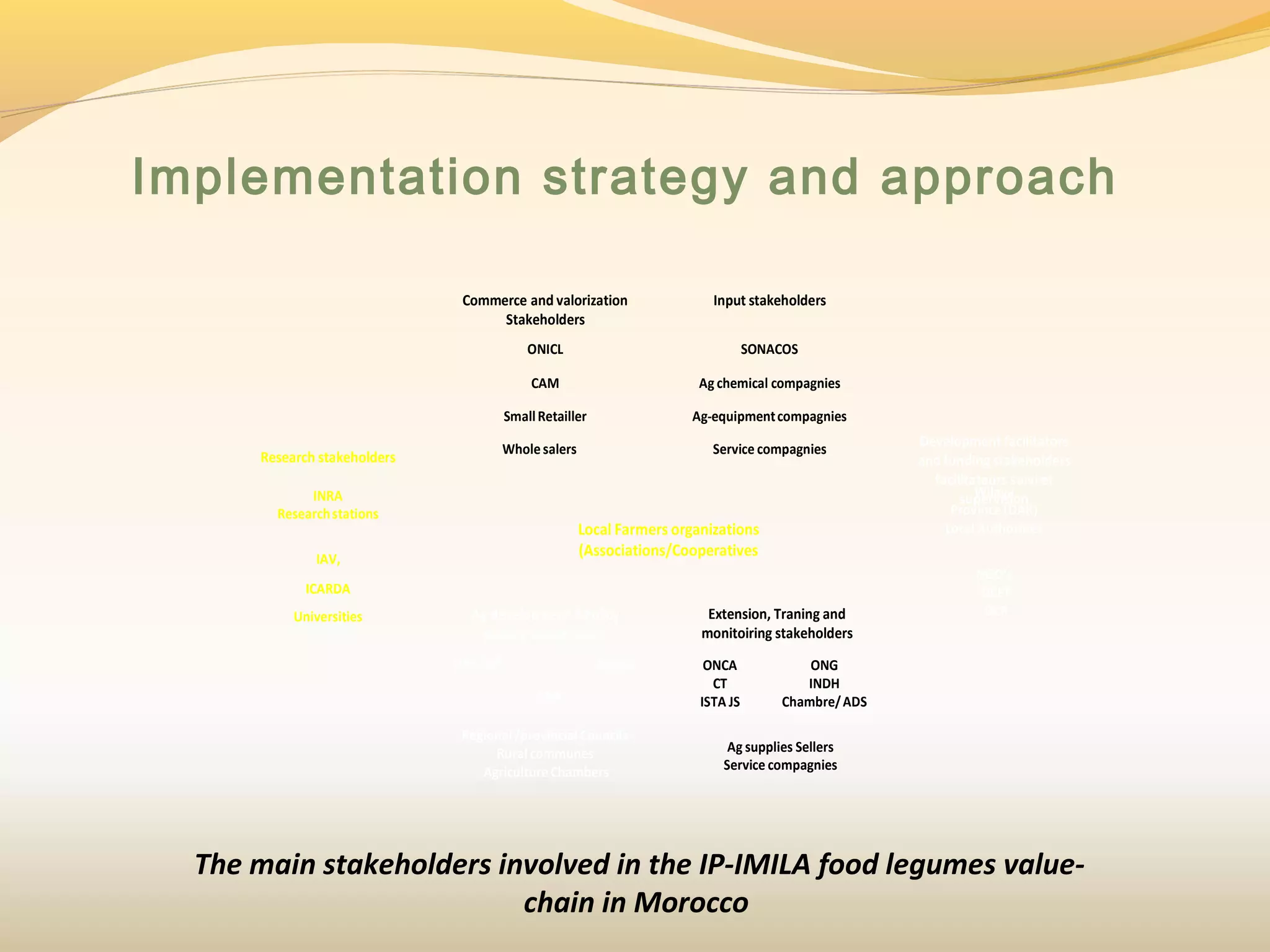
Implementation strategy and approach
Local Farmers organizations
(Associations/Cooperatives
Research stakeholders
INRA
Researchstations
IAV,
ICARDA
Universities
Commerce and valorization
Stakeholders
ONICL
CAM
SmallRetailler
Wholesalers
Input stakeholders
SONACOS
Ag chemical compagnies
Ag-equipmentcompagnies
Service compagnies
Development facilitators
and funding stakeholders
facilitateurs suivi et
supervisionWilaya
Province (DAR)
Local Authorities
NGO’s
OCPF
OCPExtension, Traning and
monitoiring stakeholders
ONCA
CT
ISTA JS
ONG
INDH
Chambre/ADS
Ag supplies Sellers
Service compagnies
Ag development &Policy
making stakeholders
DRA
DPA Safi
Regional/provincial Councils
Rural communes
AgricultureChambers
ONSSA
The main stakeholders involved in the IP-IMILA food legumes value-
chain in Morocco
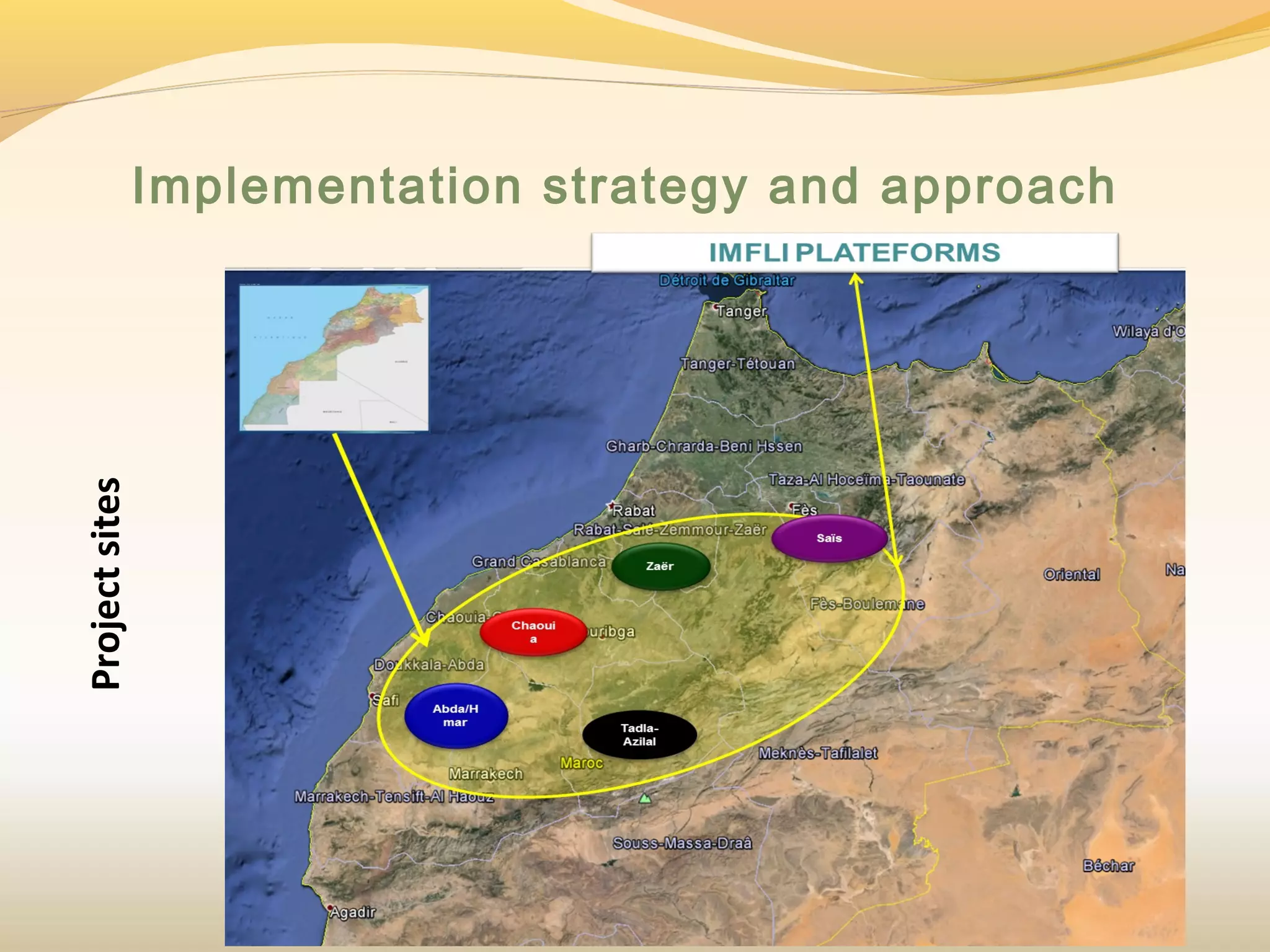
Projectsites
Implementation strategy and approach
 Presentation of two oral communications in the 1st North African
workshop on crop fertilization organized in Marrakech.
IP
components:
IP
components:
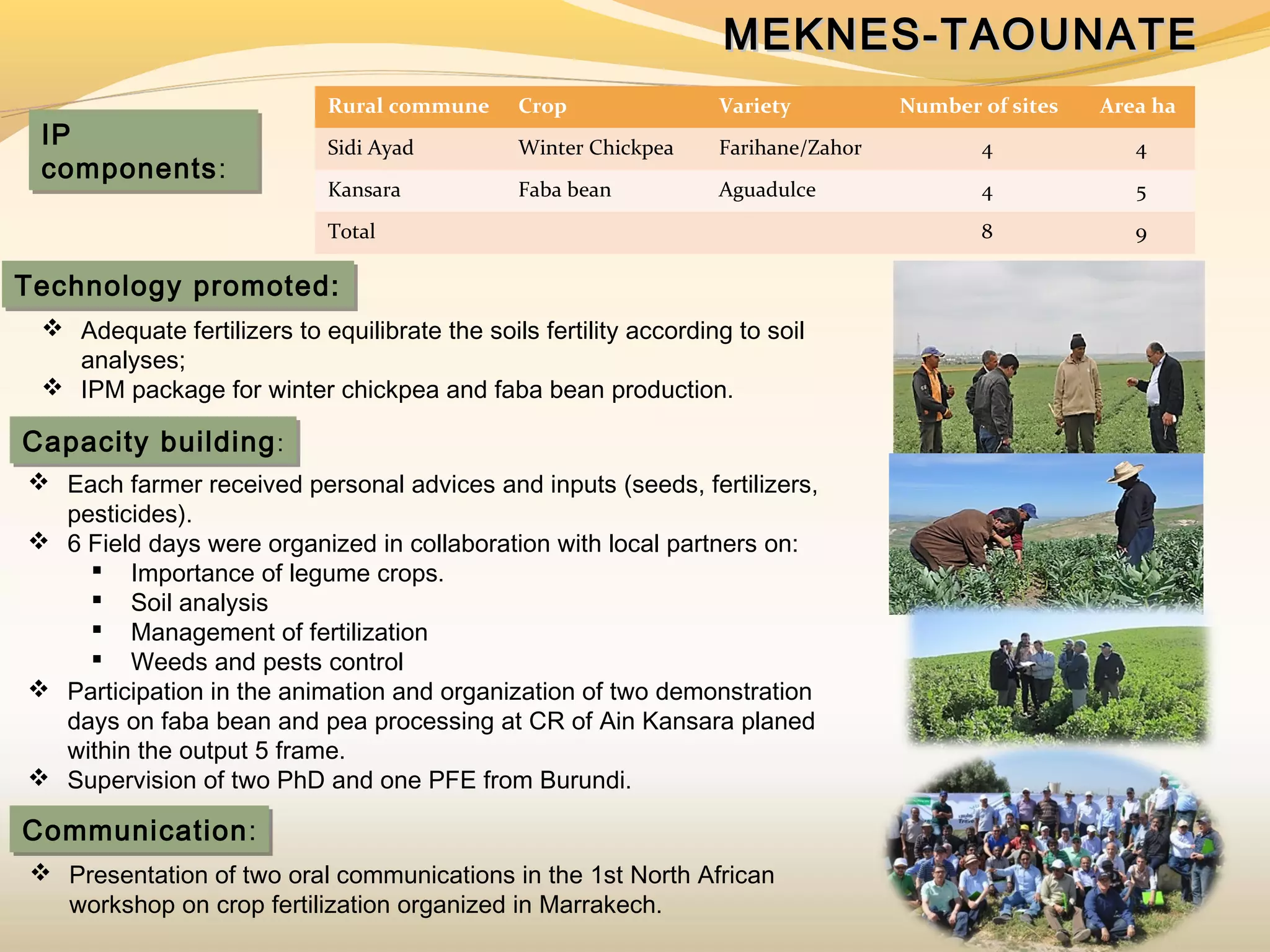
MEKNES-TAOUNATEMEKNES-TAOUNATE
Technology promoted:Technology promoted:
 Adequate fertilizers to equilibrate the soils fertility according to soil
analyses;
 IPM package for winter chickpea and faba bean production.
Capacity building:Capacity building:
 Each farmer received personal advices and inputs (seeds, fertilizers,
pesticides).
 6 Field days were organized in collaboration with local partners on:
 Importance of legume crops.
 Soil analysis
 Management of fertilization
 Weeds and pests control
 Participation in the animation and organization of two demonstration
days on faba bean and pea processing at CR of Ain Kansara planed
within the output 5 frame.
 Supervision of two PhD and one PFE from Burundi.
Communication:Communication:
Rural commune Crop Variety Number of sites Area ha
Sidi Ayad Winter Chickpea Farihane/Zahor 4 4
Kansara Faba bean Aguadulce 4 5
Total 8 9
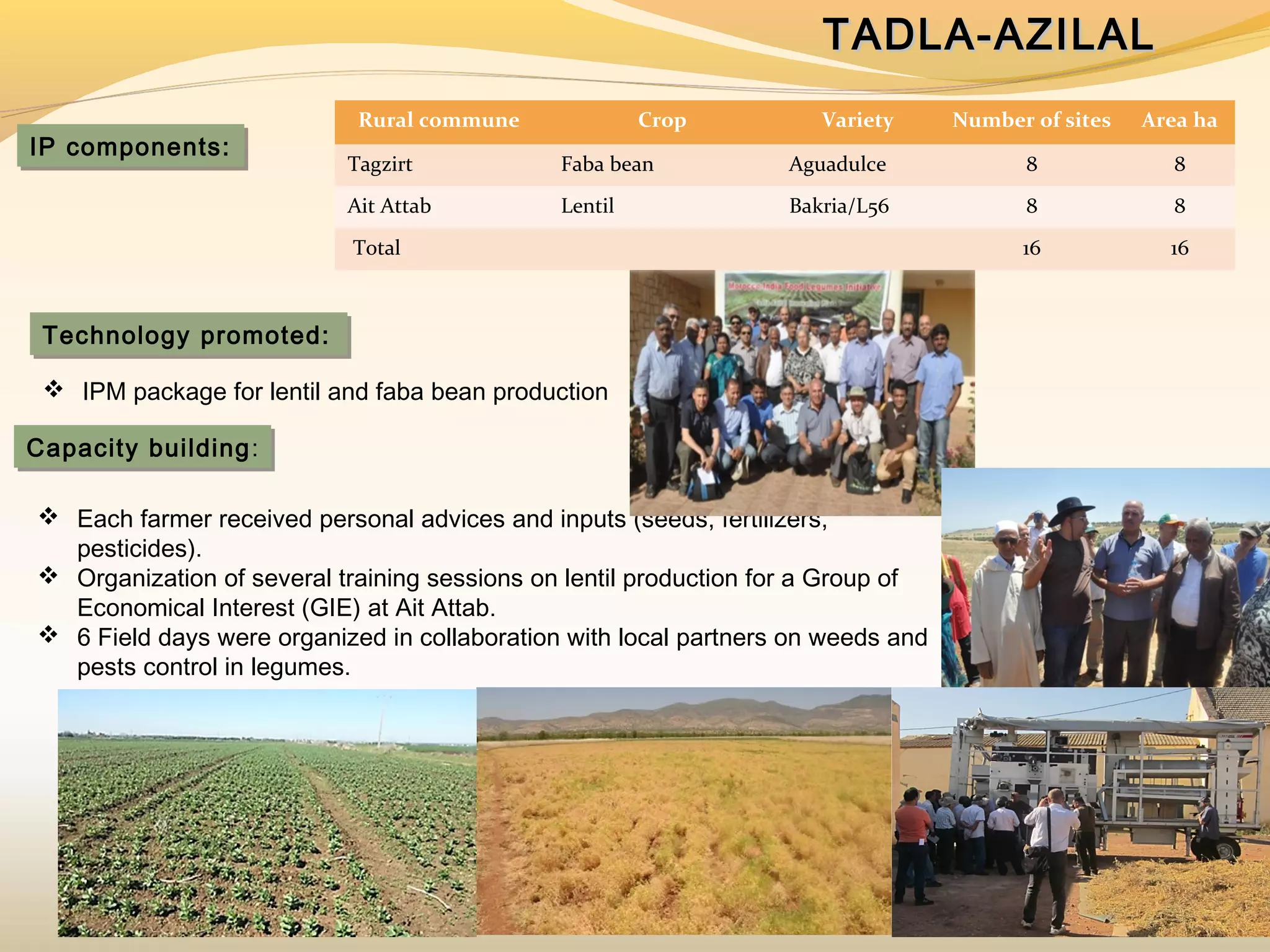
 Each farmer received personal advices and inputs (seeds, fertilizers,
pesticides).
 Organization of several training sessions on lentil production for a Group of
Economical Interest (GIE) at Ait Attab.
 6 Field days were organized in collaboration with local partners on weeds and
pests control in legumes.
TADLA-AZILALTADLA-AZILAL
IP components:IP components:
Technology promoted:Technology promoted:
 IPM package for lentil and faba bean production
Capacity building:Capacity building:
Rural commune Crop Variety Number of sites Area ha
Tagzirt Faba bean Aguadulce 8 8
Ait Attab Lentil Bakria/L56 8 8
Total 16 16
 
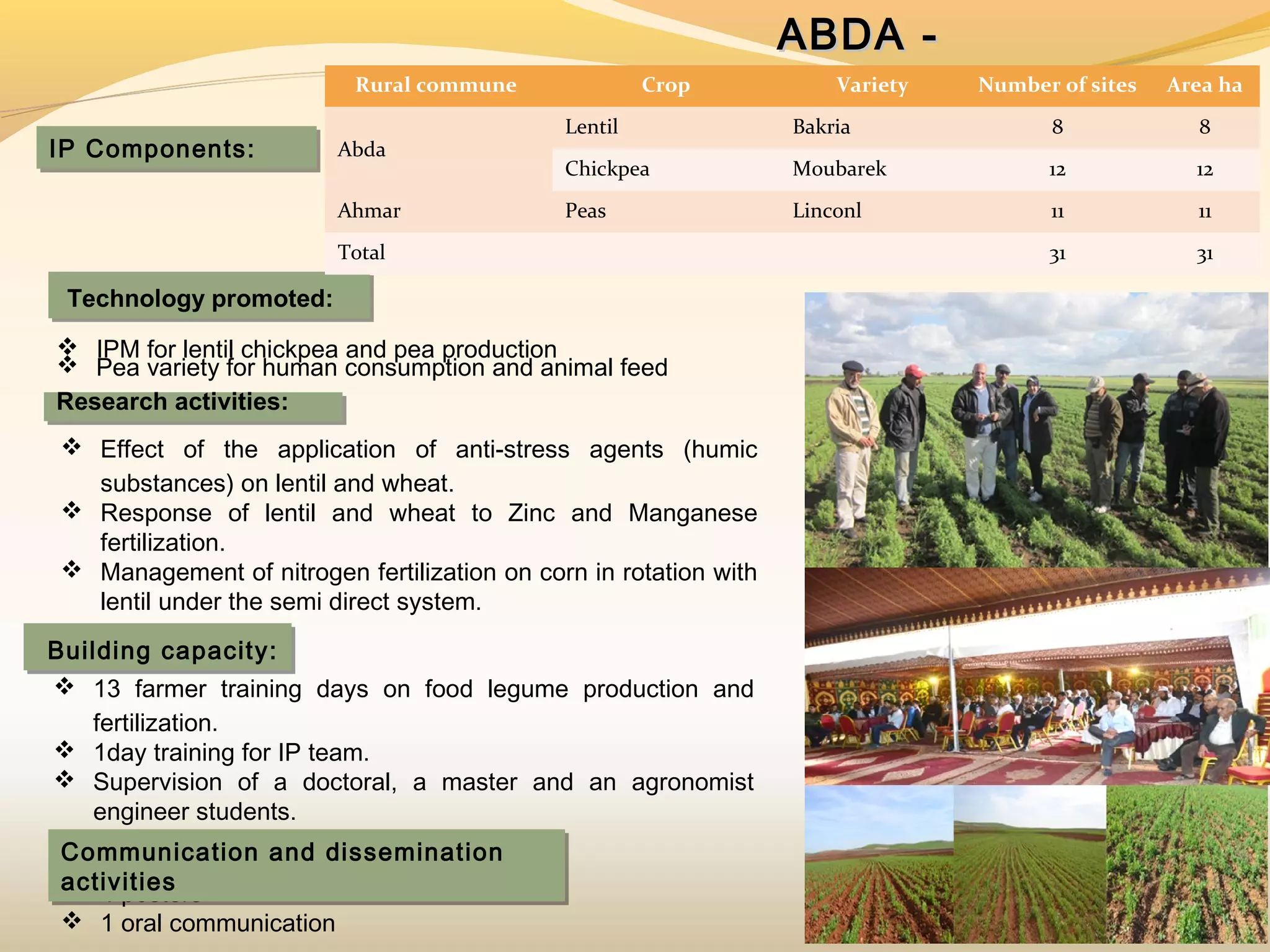
 Technology promoted:
 
 Technology promoted:
IP Components:IP Components:
 13 farmer training days on food legume production and
fertilization.
 1day training for IP team.
 Supervision of a doctoral, a master and an agronomist
engineer students.
 IPM for lentil chickpea and pea production
 Pea variety for human consumption and animal feed
Research activities:Research activities:
 Effect of the application of anti-stress agents (humic
substances) on lentil and wheat.
 Response of lentil and wheat to Zinc and Manganese
fertilization.
 Management of nitrogen fertilization on corn in rotation with
lentil under the semi direct system.
Building capacity:Building capacity:
 4 posters
 1 oral communication
Communication and dissemination
activities
Communication and dissemination
activities
ABDA -ABDA -
DOUKALADOUKALARural commune Crop Variety Number of sites Area ha
Abda
Lentil Bakria 8 8
Chickpea Moubarek 12 12
Ahmar Peas Linconl 11 11
Total 31 31
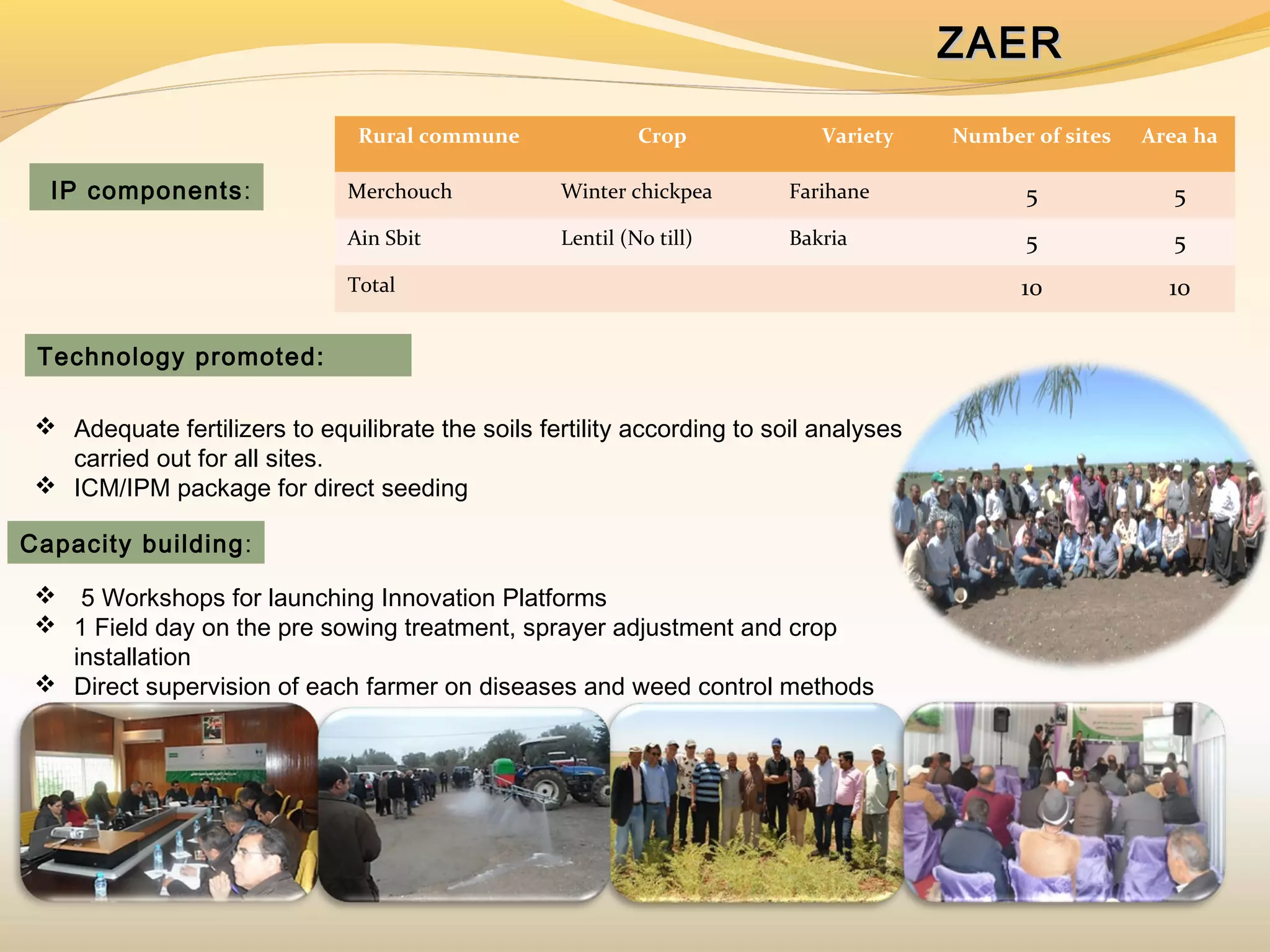
IP components:
  5 Workshops for launching Innovation Platforms
 1 Field day on the pre sowing treatment, sprayer adjustment and crop
installation
 Direct supervision of each farmer on diseases and weed control methods
ZAERZAER
Technology promoted:
 Adequate fertilizers to equilibrate the soils fertility according to soil analyses
carried out for all sites.
 ICM/IPM package for direct seeding
Capacity building:
Rural commune Crop Variety Number of sites Area ha
Merchouch Winter chickpea Farihane 5 5
Ain Sbit Lentil (No till) Bakria 5 5
Total 10 10
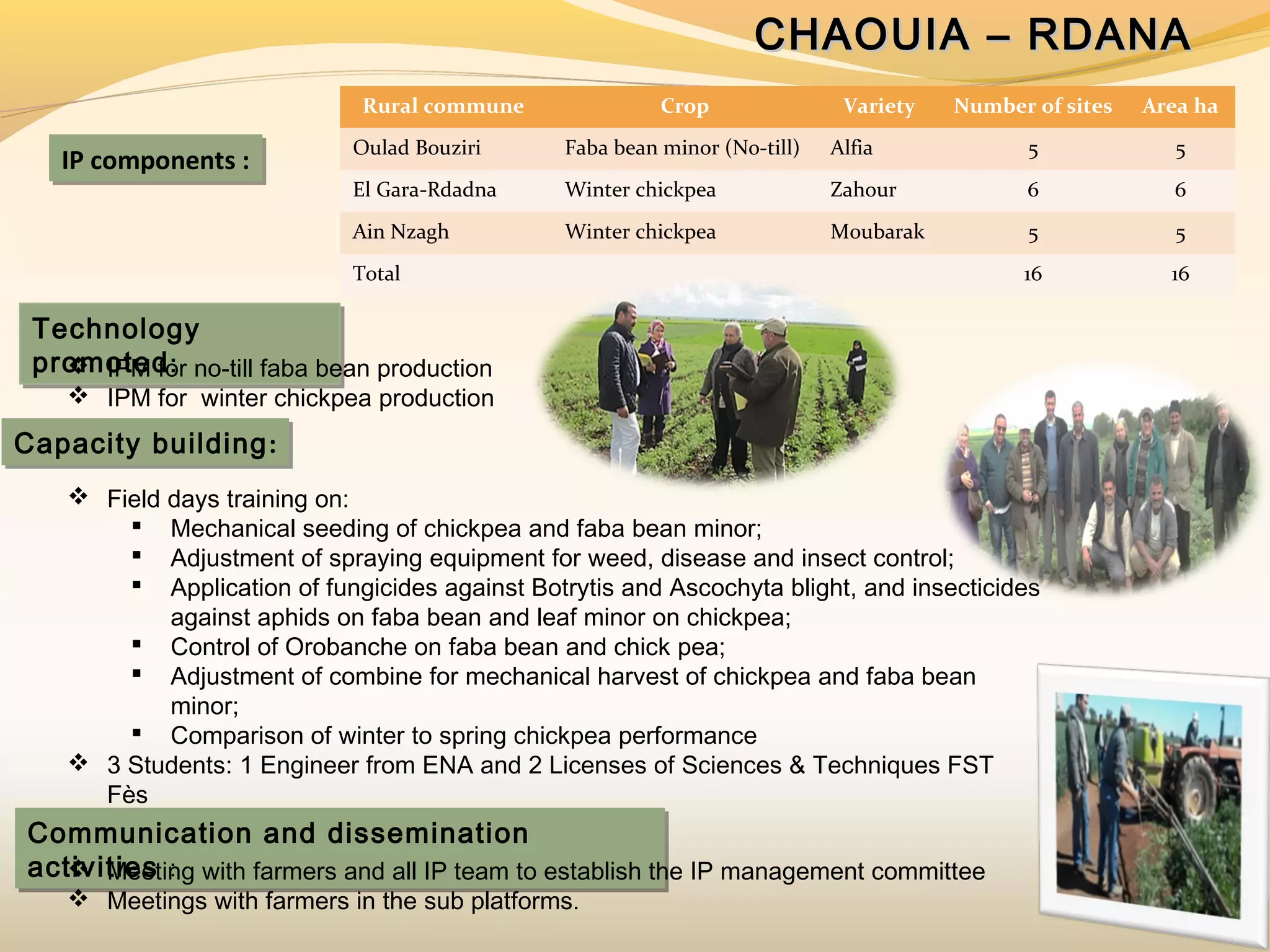
CHAOUIA – RDANACHAOUIA – RDANA
 Field days training on:
 Mechanical seeding of chickpea and faba bean minor;
 Adjustment of spraying equipment for weed, disease and insect control;
 Application of fungicides against Botrytis and Ascochyta blight, and insecticides
against aphids on faba bean and leaf minor on chickpea;
 Control of Orobanche on faba bean and chick pea;
 Adjustment of combine for mechanical harvest of chickpea and faba bean
minor;
 Comparison of winter to spring chickpea performance
 3 Students: 1 Engineer from ENA and 2 Licenses of Sciences & Techniques FST
Fès
IP components :IP components :
Technology
promoted:
Technology
promoted: IPM for no-till faba bean production
 IPM for winter chickpea production
Communication and dissemination
activities :
Communication and dissemination
activities :
Capacity building:Capacity building:
 Meeting with farmers and all IP team to establish the IP management committee
 Meetings with farmers in the sub platforms.
Rural commune Crop Variety Number of sites Area ha
Oulad Bouziri Faba bean minor (No-till) Alfia 5 5
El Gara-Rdadna Winter chickpea Zahour 6 6
Ain Nzagh Winter chickpea Moubarak 5 5
Total 16 16
Outputs Achievements
Output 1:
 
Value chains of
targeted food
legumes
studied and
analyzed
  
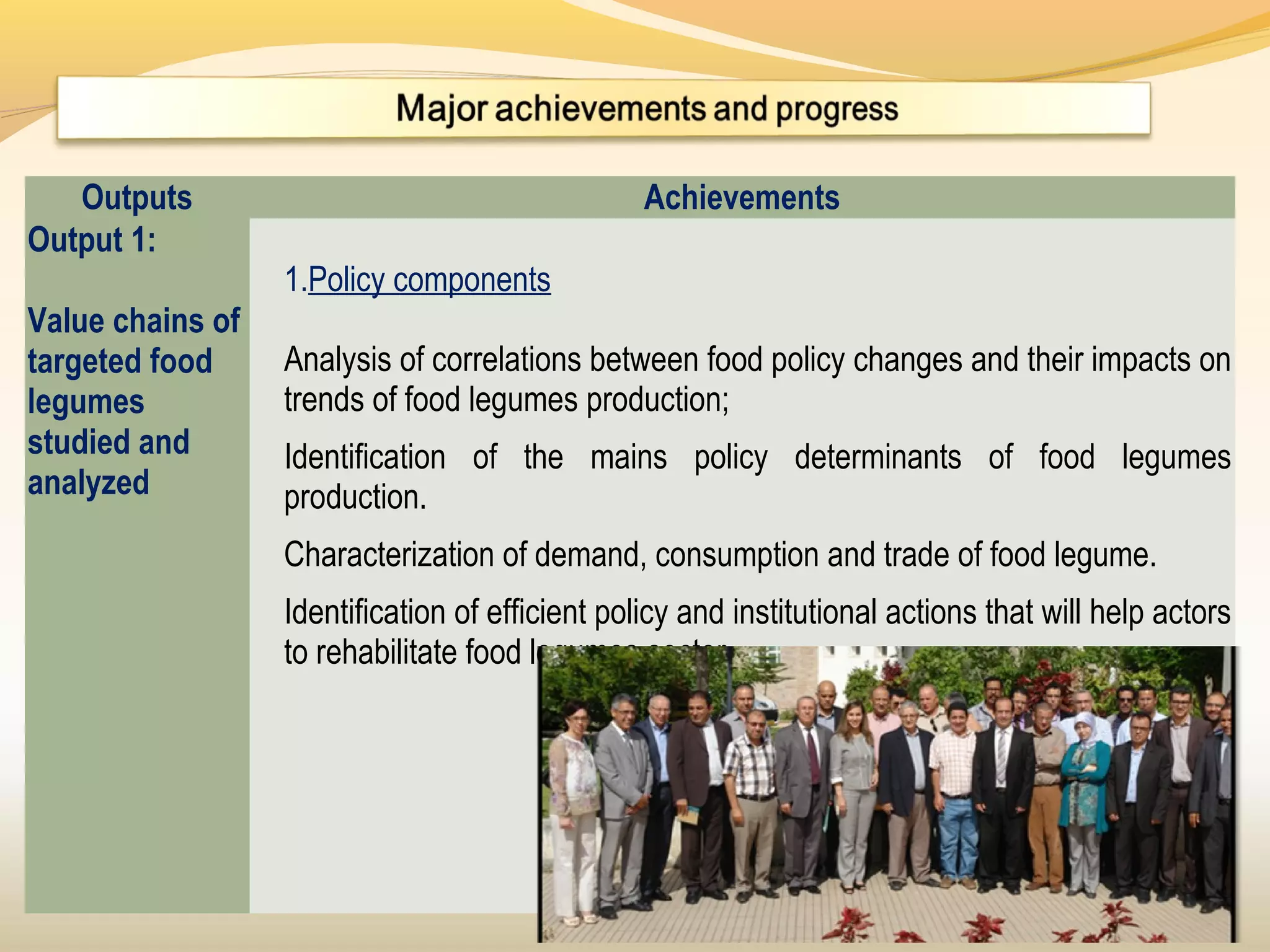
1.Policy components
 
Analysis of correlations between food policy changes and their impacts on 
trends of food legumes production; 
Identification  of  the  mains  policy  determinants  of  food  legumes 
production.
Characterization of demand, consumption and trade of food legume.
Identification of efficient policy and institutional actions that will help actors 
to rehabilitate food legumes sector.
Outputs Activities
Output 1:
 
Value chains of targeted food legumes
studied and analyzed
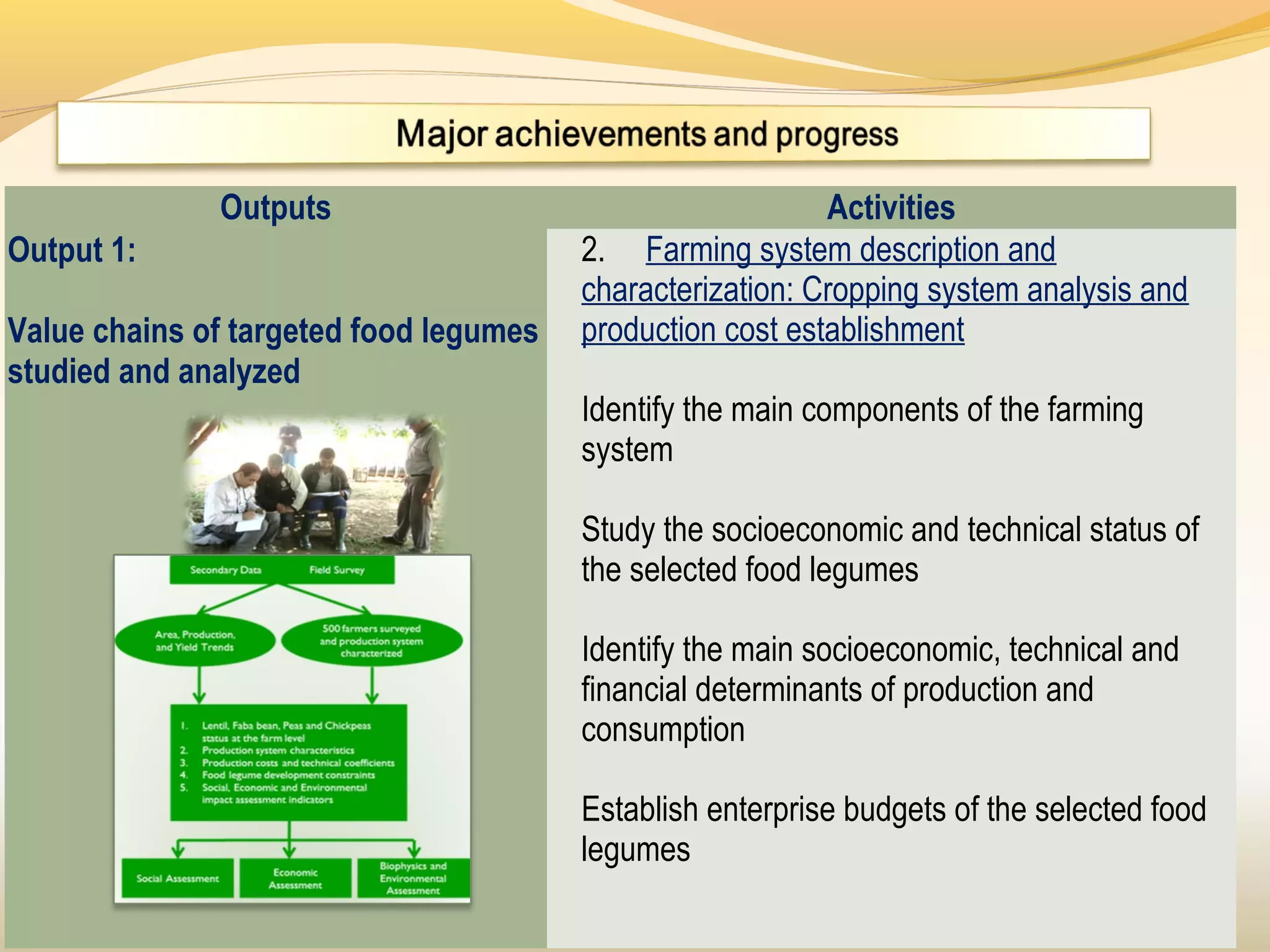
2.     Farming system description and 
characterization: Cropping system analysis and 
production cost establishment
Identify the main components of the farming 
system
 
Study the socioeconomic and technical status of 
the selected food legumes
 
Identify the main socioeconomic, technical and 
financial determinants of production and 
consumption   
 
Establish enterprise budgets of the selected food 
legumes
Outputs Activities
Output 1:
 
Value chains of targeted food legumes
studied and analyzed
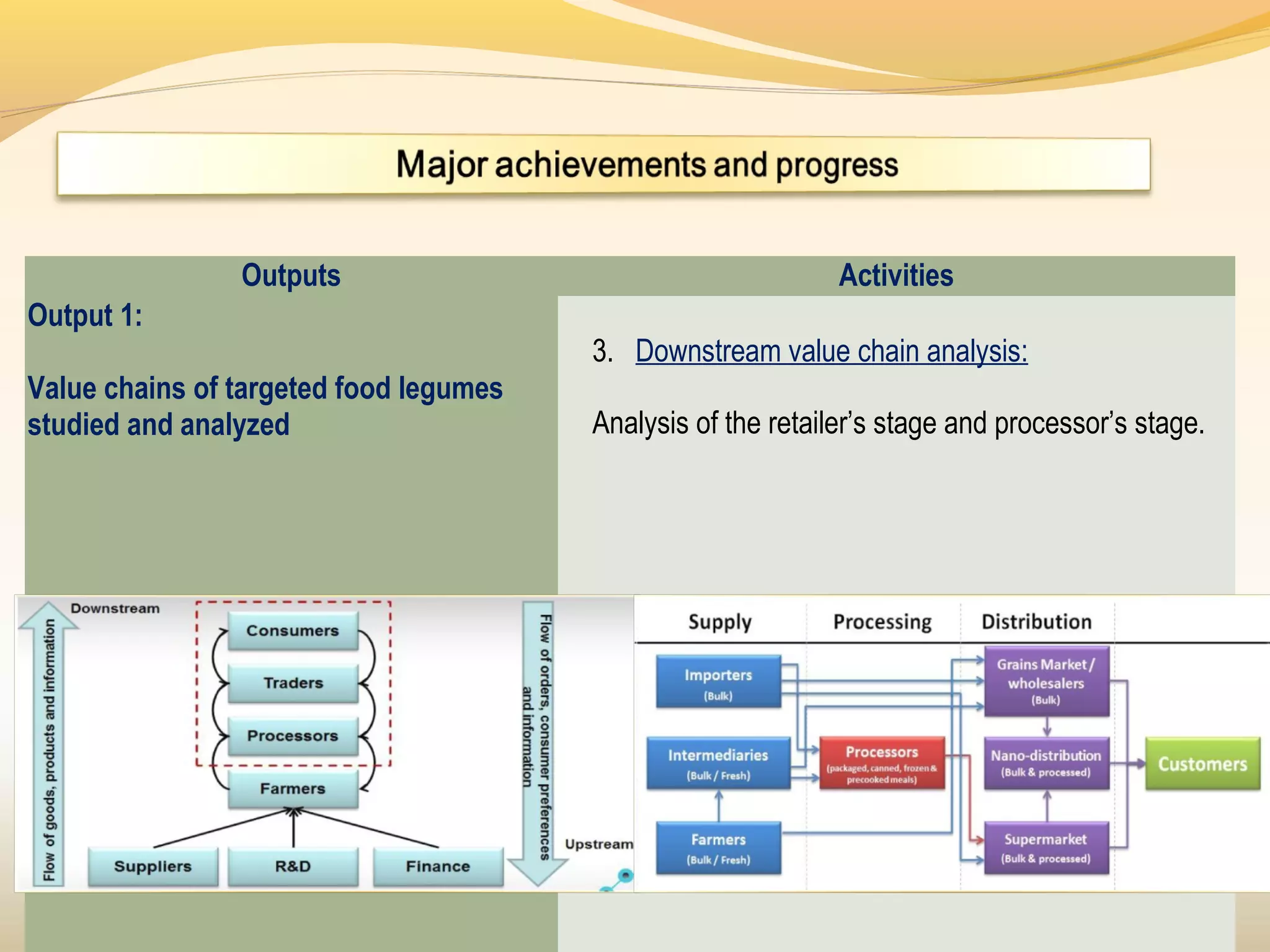
3. Downstream value chain analysis:
Analysis of the retailer’s stage and processor’s stage.
Outputs Activities
Output 1:
 
Value chains of targeted food legumes studied
and analyzed
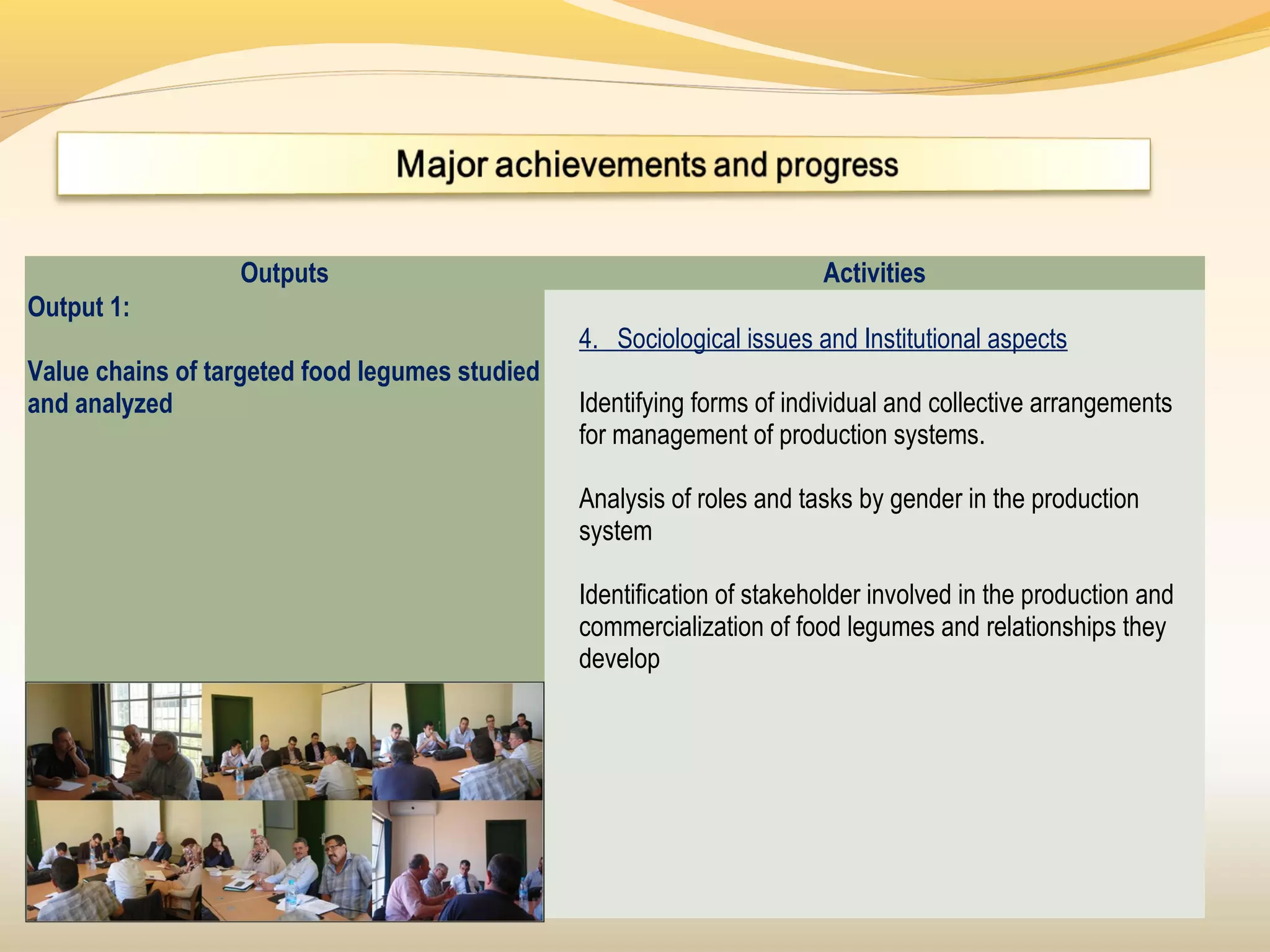
4. Sociological issues and Institutional aspects
Identifying forms of individual and collective arrangements
for management of production systems.
Analysis of roles and tasks by gender in the production
system
Identification of stakeholder involved in the production and
commercialization of food legumes and relationships they
develop
Outputs Activities Progress & achievements
Output 2:
 
Improved varieties tested
and evaluated through
on-farm participatory
approach
 
1.Identify suitable varieties for
different agro-ecologies
2.Implement multi-location farmer
participatory varietal demonstration
and selection of farmer preferred
varieties of Lentil, Chickpea, and
Fababean;
3.Organize field days for all
stakeholders to demonstrate the
performance of varieties;
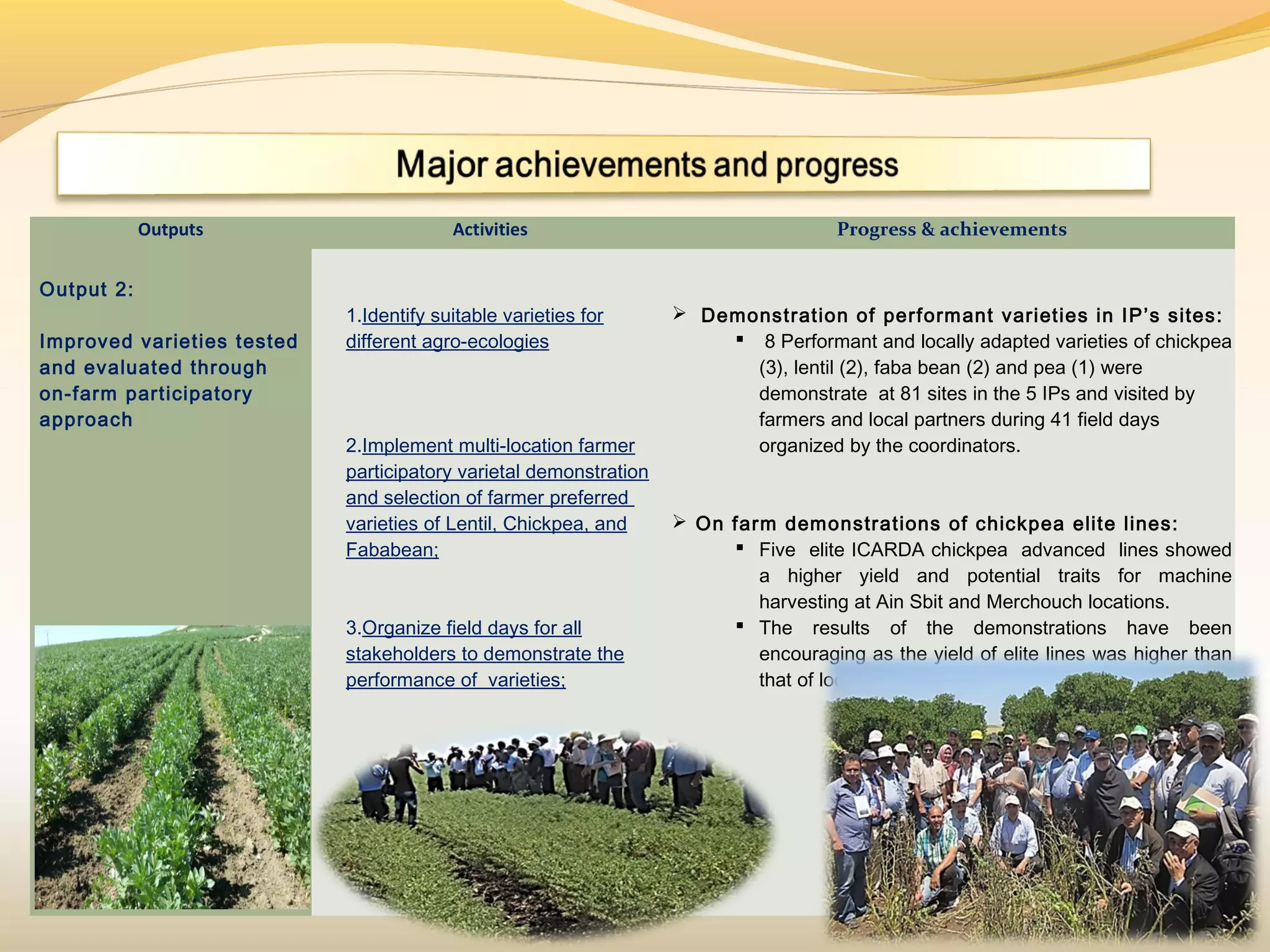
  Demonstration of performant varieties in IP’s sites:
  8 Performant and locally adapted varieties of chickpea
(3), lentil (2), faba bean (2) and pea (1) were
demonstrate at 81 sites in the 5 IPs and visited by
farmers and local partners during 41 field days
organized by the coordinators.
 On farm demonstrations of chickpea elite lines:
 Five elite ICARDA chickpea advanced lines showed
a higher yield and potential traits for machine
harvesting at Ain Sbit and Merchouch locations.
 The results of the demonstrations have been
encouraging as the yield of elite lines was higher than
that of local variety Farihane.
Outputs Activities Progress & achievements
Output 3:
 
Integrated crop
management options
refined and tested by
farmers
1.Evaluate and demonstrate
appropriate agronomic
practices to enhance legume
productivity in different
cropping systems
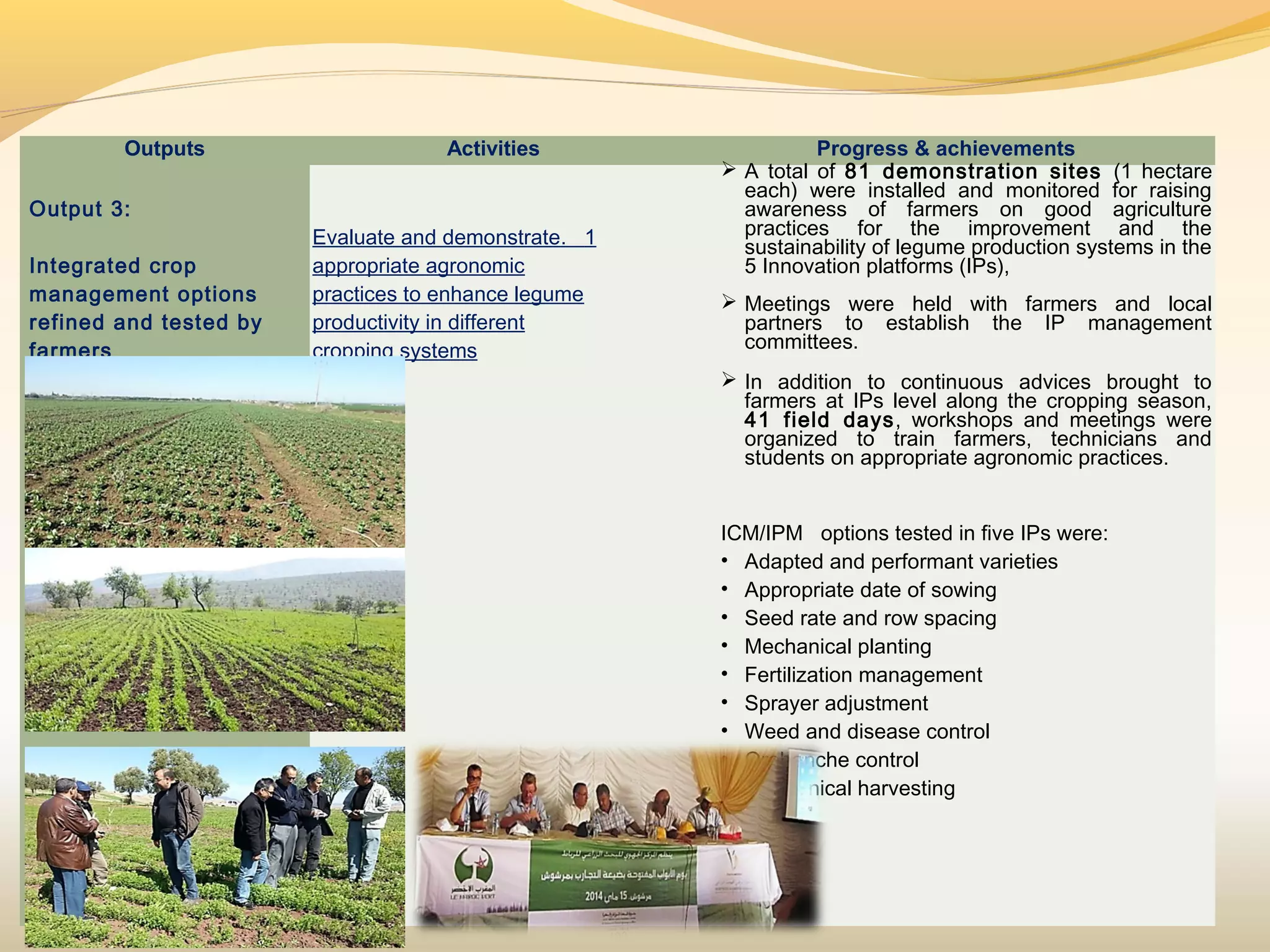
 A total of 81 demonstration sites (1 hectare
each) were installed and monitored for raising
awareness of farmers on good agriculture
practices for the improvement and the
sustainability of legume production systems in the
5 Innovation platforms (IPs),
 Meetings were held with farmers and local
partners to establish the IP management
committees.
 In addition to continuous advices brought to
farmers at IPs level along the cropping season,
41 field days, workshops and meetings were
organized to train farmers, technicians and
students on appropriate agronomic practices.
ICM/IPM options tested in five IPs were:
• Adapted and performant varieties
• Appropriate date of sowing
• Seed rate and row spacing
• Mechanical planting
• Fertilization management
• Sprayer adjustment
• Weed and disease control
• Orobanche control
• Mechanical harvesting
Outputs Activities Progress & achievements
Output 3:
 
Integrated crop
management options
refined and tested by
farmers
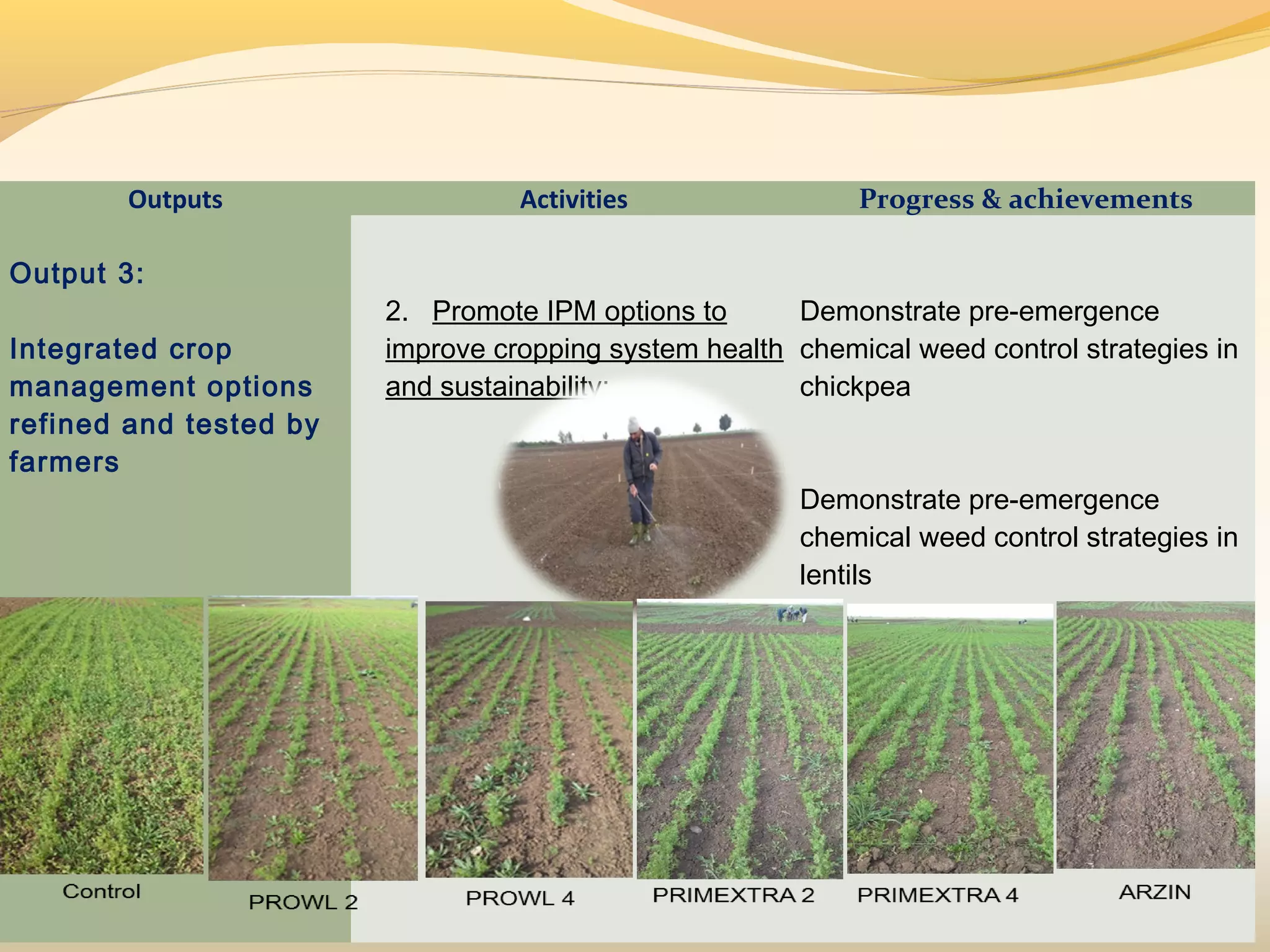
2. Promote IPM options to
improve cropping system health
and sustainability;
Demonstrate pre-emergence
chemical weed control strategies in
chickpea
 
Demonstrate pre-emergence
chemical weed control strategies in
lentils
Outputs Activities Target Progress & achievements
Output 3:
ntegrated crop
management options
refined and tested
by farmers
2. Promote IPM options to
improve cropping system
health and sustainability;
Demonstrate foliar fertilization
strategies in food legumes
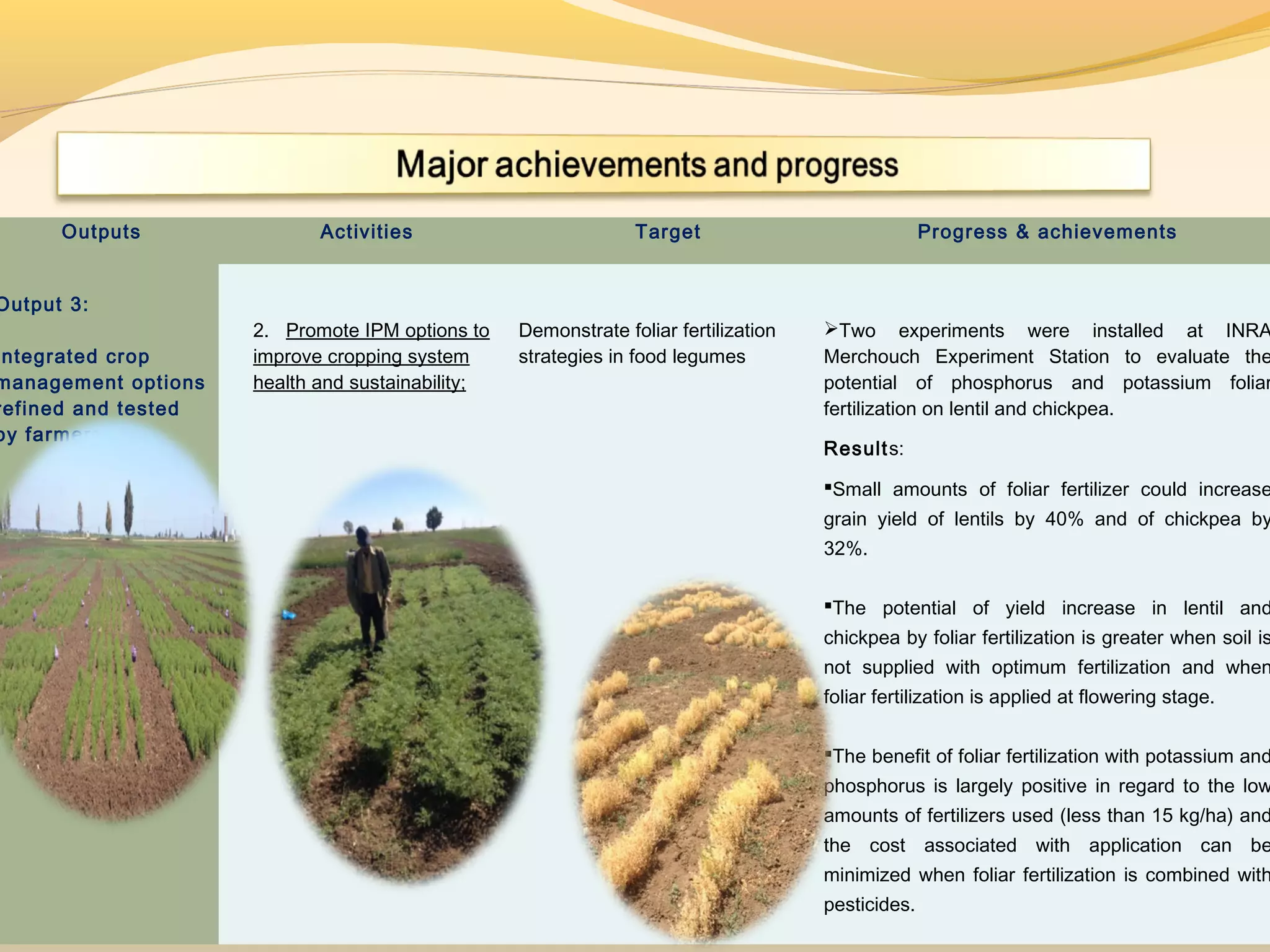
Two experiments were installed at INRA
Merchouch Experiment Station to evaluate the
potential of phosphorus and potassium foliar
fertilization on lentil and chickpea.
 
Results:
 
Small amounts of foliar fertilizer could increase
grain yield of lentils by 40% and of chickpea by
32%.
The potential of yield increase in lentil and
chickpea by foliar fertilization is greater when soil is
not supplied with optimum fertilization and when
foliar fertilization is applied at flowering stage.
The benefit of foliar fertilization with potassium and
phosphorus is largely positive in regard to the low
amounts of fertilizers used (less than 15 kg/ha) and
the cost associated with application can be
minimized when foliar fertilization is combined with
pesticides.
Outputs Activities Target Progress & achievements
Output 3:
 
Integrated crop
management options
refined and tested by
farmers
2. Promote IPM options to
improve cropping system
health and sustainability;
3. Organize field days for
all stakeholders to
demonstrate the
performance of the options
Demonstrate of direct
seeding system in lentil crop
Organize on-site learning and
awareness meetings on :
•Mechanical sowing
•Weed control
•Diseases, insect and pest
identification and control
•Harvesting and storage
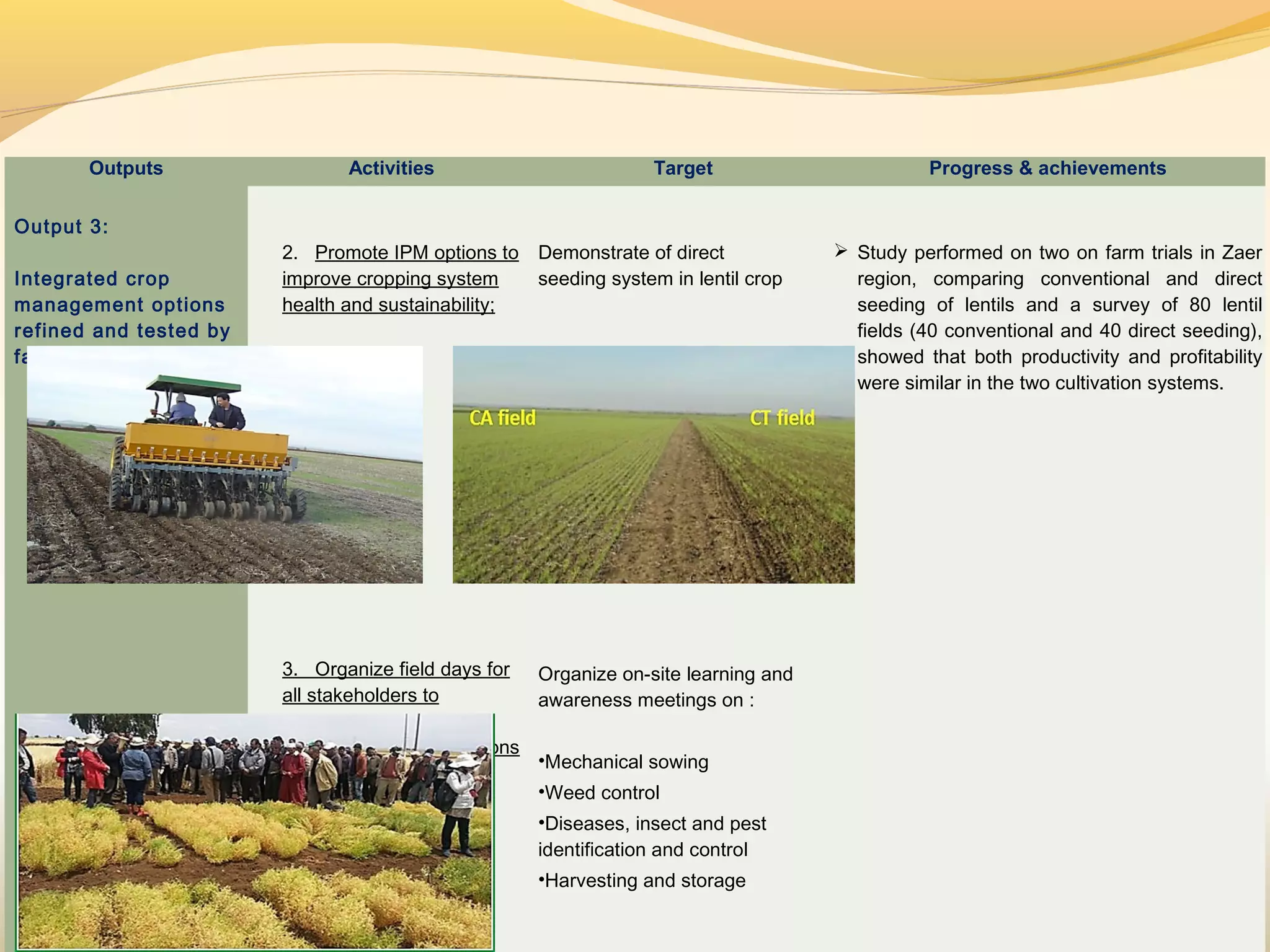
 Study performed on two on farm trials in Zaer
region, comparing conventional and direct
seeding of lentils and a survey of 80 lentil
fields (40 conventional and 40 direct seeding),
showed that both productivity and profitability
were similar in the two cultivation systems.
Outputs Activities Progress & achievements
Output 4:
 
Functional village-
level based seed
delivery systems
established
 
1. Develop a business plan
for village based ‘seed
enterprise’;
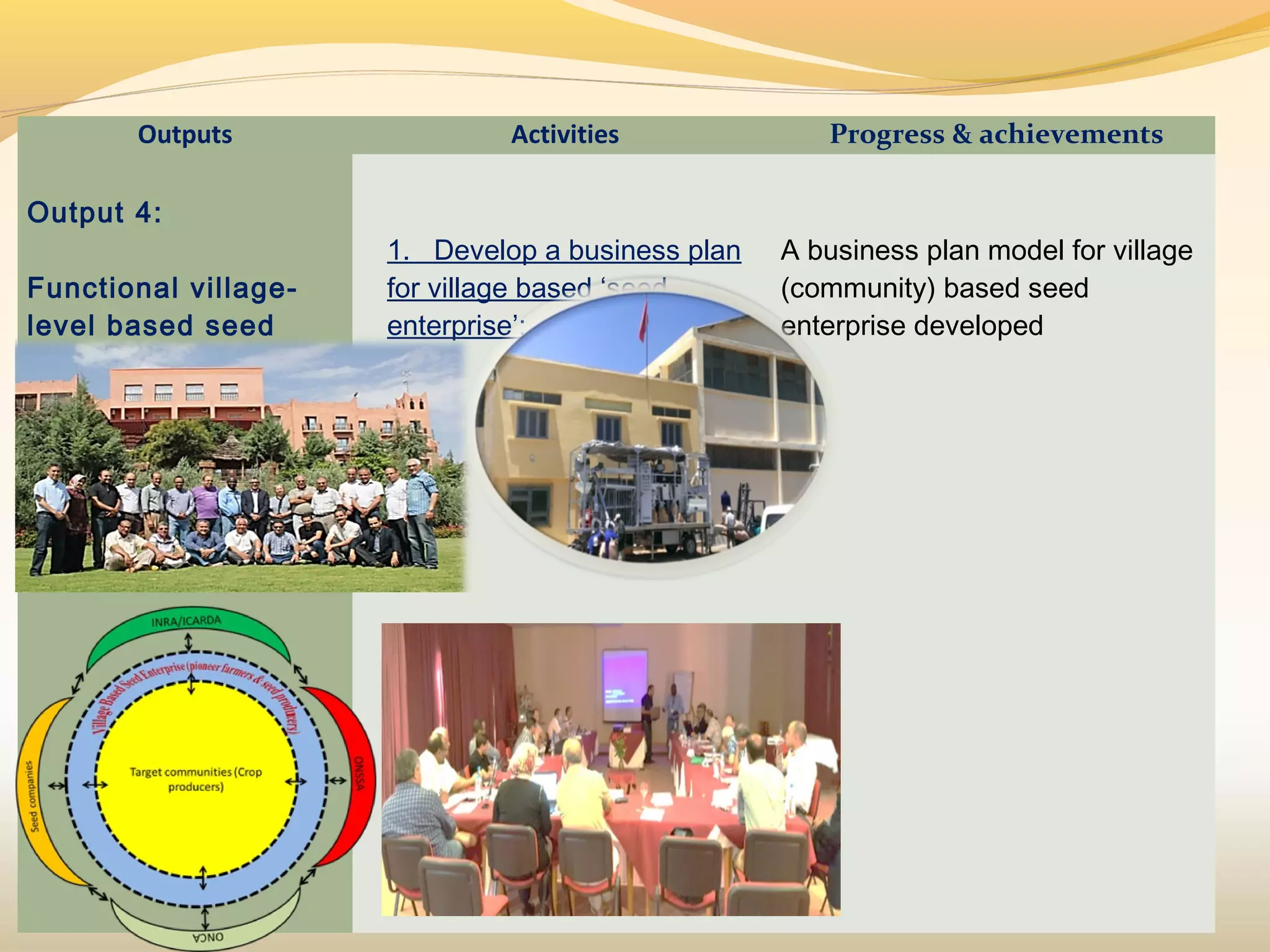
A business plan model for village
(community) based seed
enterprise developed
 
Outputs Activities Progress & achievements
Output 4:
 
Functional village-
level based seed
delivery systems
established
 
2. Establish pilot VBSEs in target
districts and maintained by
farmer’s groups;
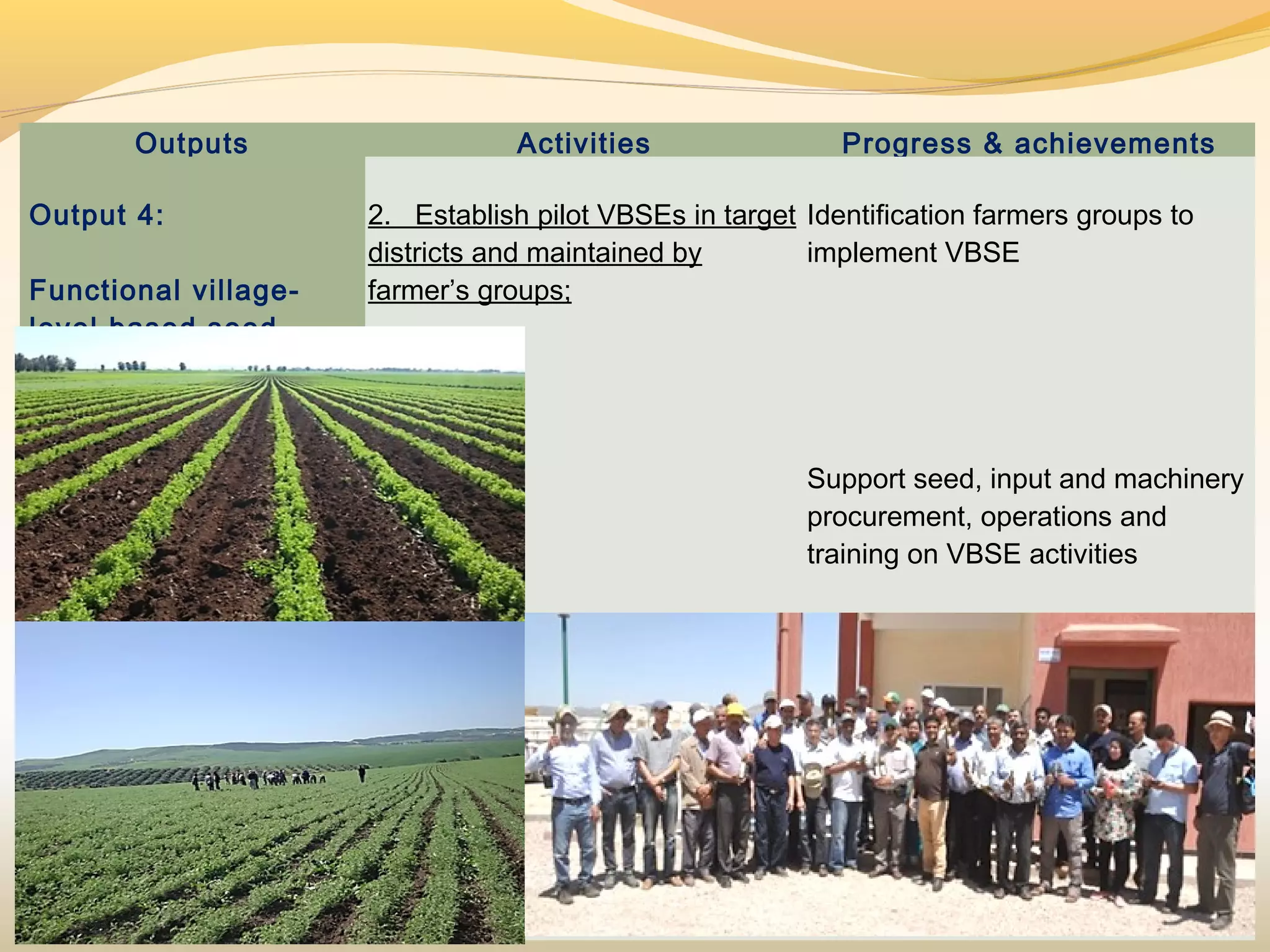
Identification farmers groups to
implement VBSE
 
 
Support seed, input and machinery
procurement, operations and
training on VBSE activities
 
Outputs Activities Progress & achievements
Output 4:
 
Functional village-
level based seed
delivery systems
established
 
2. Establish pilot VBSEs in
target districts and maintained
by farmer’s groups;
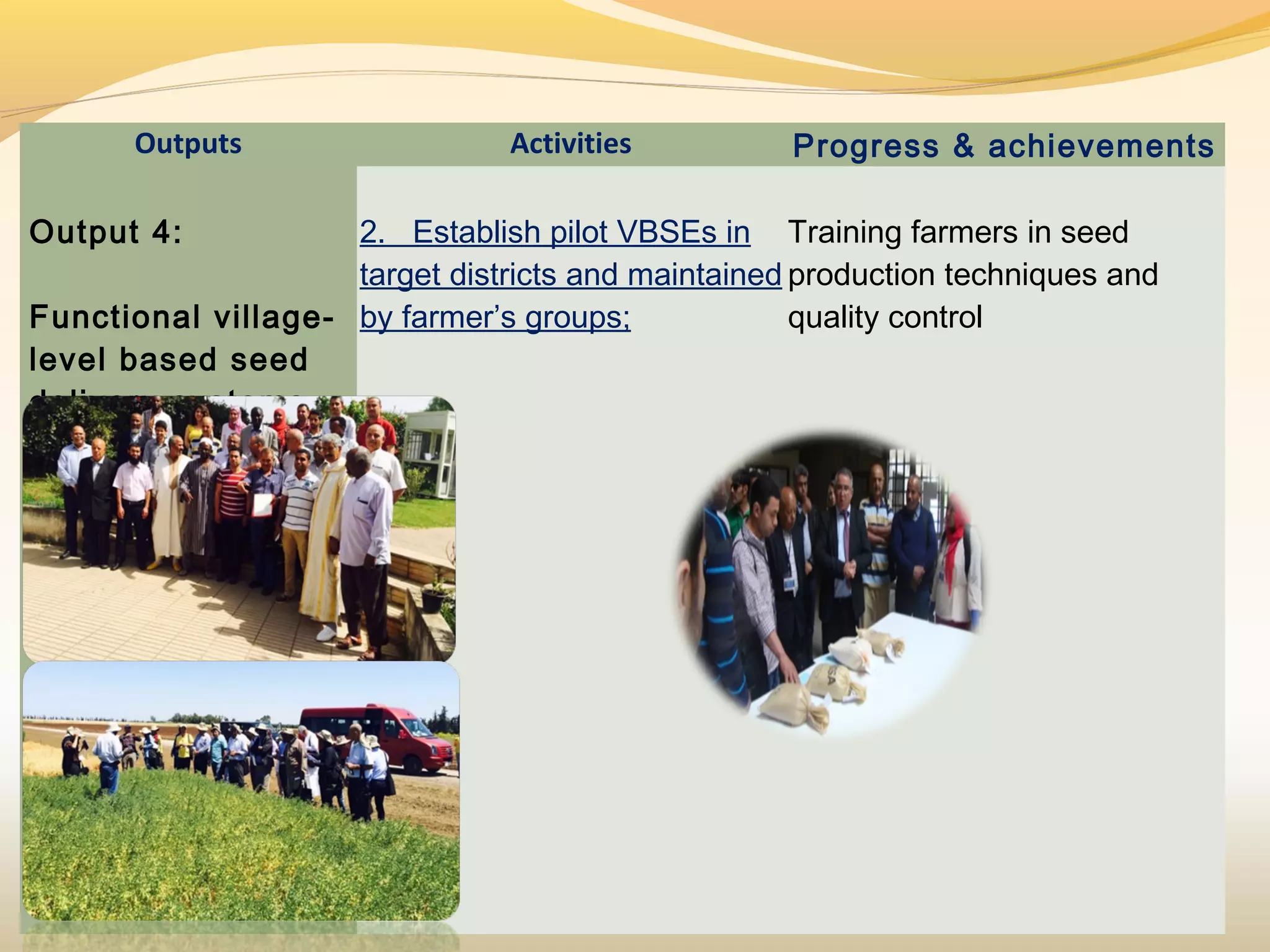
Training farmers in seed
production techniques and
quality control
Outputs Activities Progress & achievements
Output 4:
 
Functional village-level
based seed delivery
systems established
 
3. Produce and distribute quality
seed of target legumes at village
level to meet the needs of a
selected community.
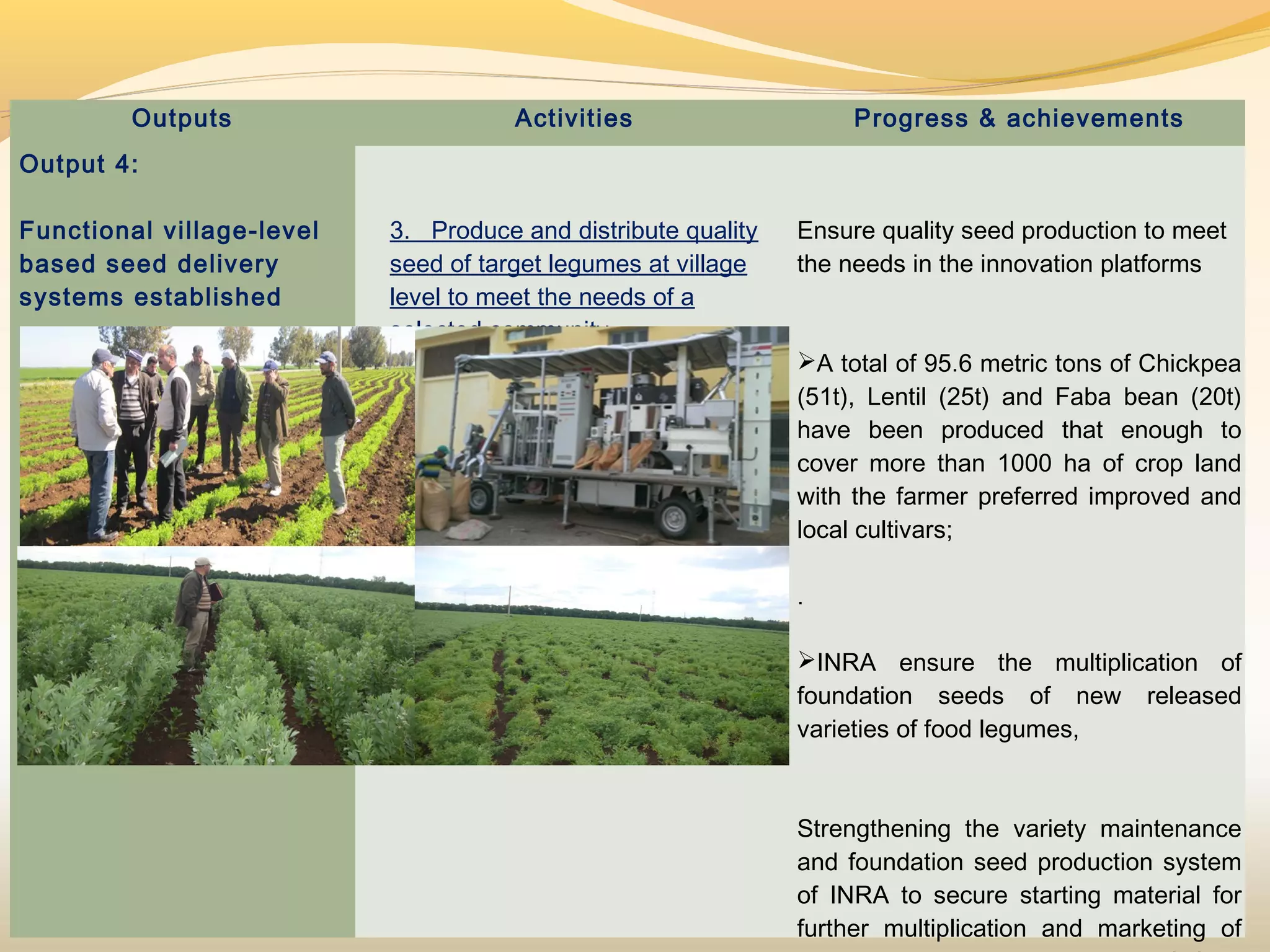
Ensure quality seed production to meet
the needs in the innovation platforms
 
 
A total of 95.6 metric tons of Chickpea
(51t), Lentil (25t) and Faba bean (20t)
have been produced that enough to
cover more than 1000 ha of crop land
with the farmer preferred improved and
local cultivars;
.
INRA ensure the multiplication of
foundation seeds of new released
varieties of food legumes,
Strengthening the variety maintenance
and foundation seed production system
of INRA to secure starting material for
further multiplication and marketing of
Outputs Activities Progress & achievements
Output 5:
 
Value addition
through post-harvest
processing, storage
and labeling of food
legumes
investigated
 
1. Analyze and document post-
harvest and storage conditions
of grain legumes
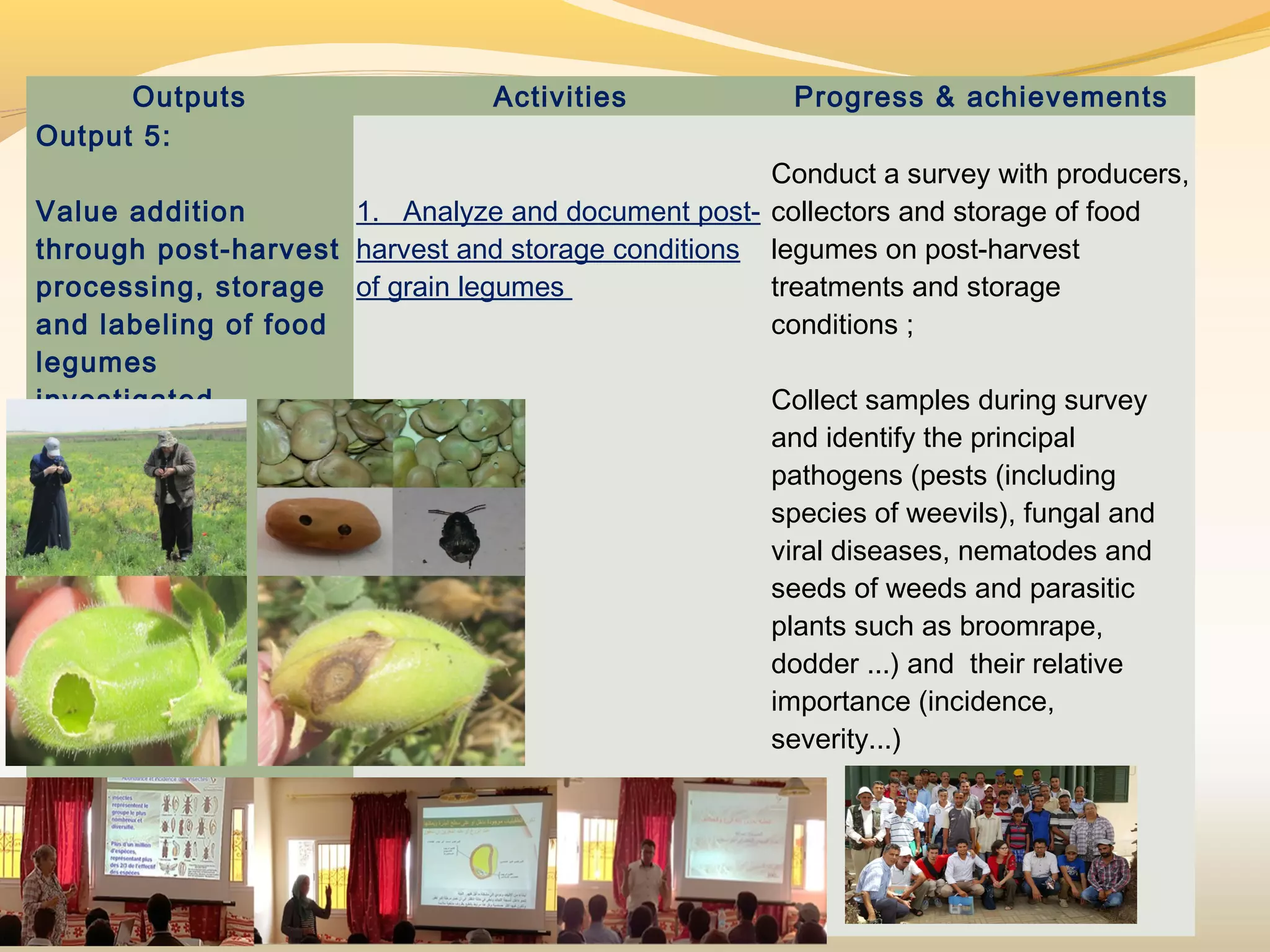
Conduct a survey with producers,
collectors and storage of food
legumes on post-harvest
treatments and storage
conditions ;
 
Collect samples during survey
and identify the principal
pathogens (pests (including
species of weevils), fungal and
viral diseases, nematodes and
seeds of weeds and parasitic
plants such as broomrape,
dodder ...) and their relative
importance (incidence,
severity...)
Outputs Activities Target
Output 5:
 
Value addition
through post-harvest
processing, storage
and labeling of food
legumes investigated
 
2. Promote local value
addition activities (cleaning,
grading, processing, labeling
etc.)
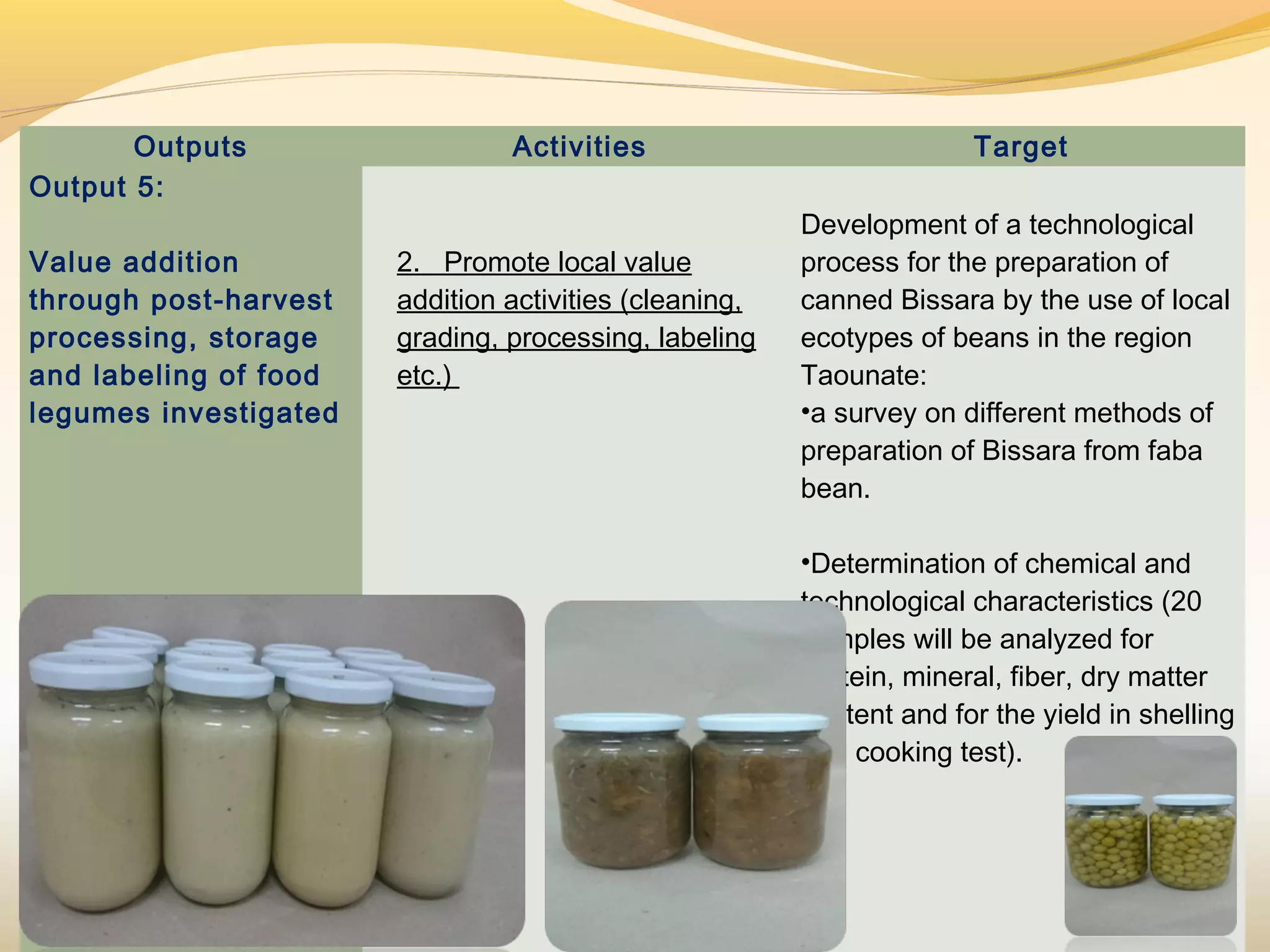
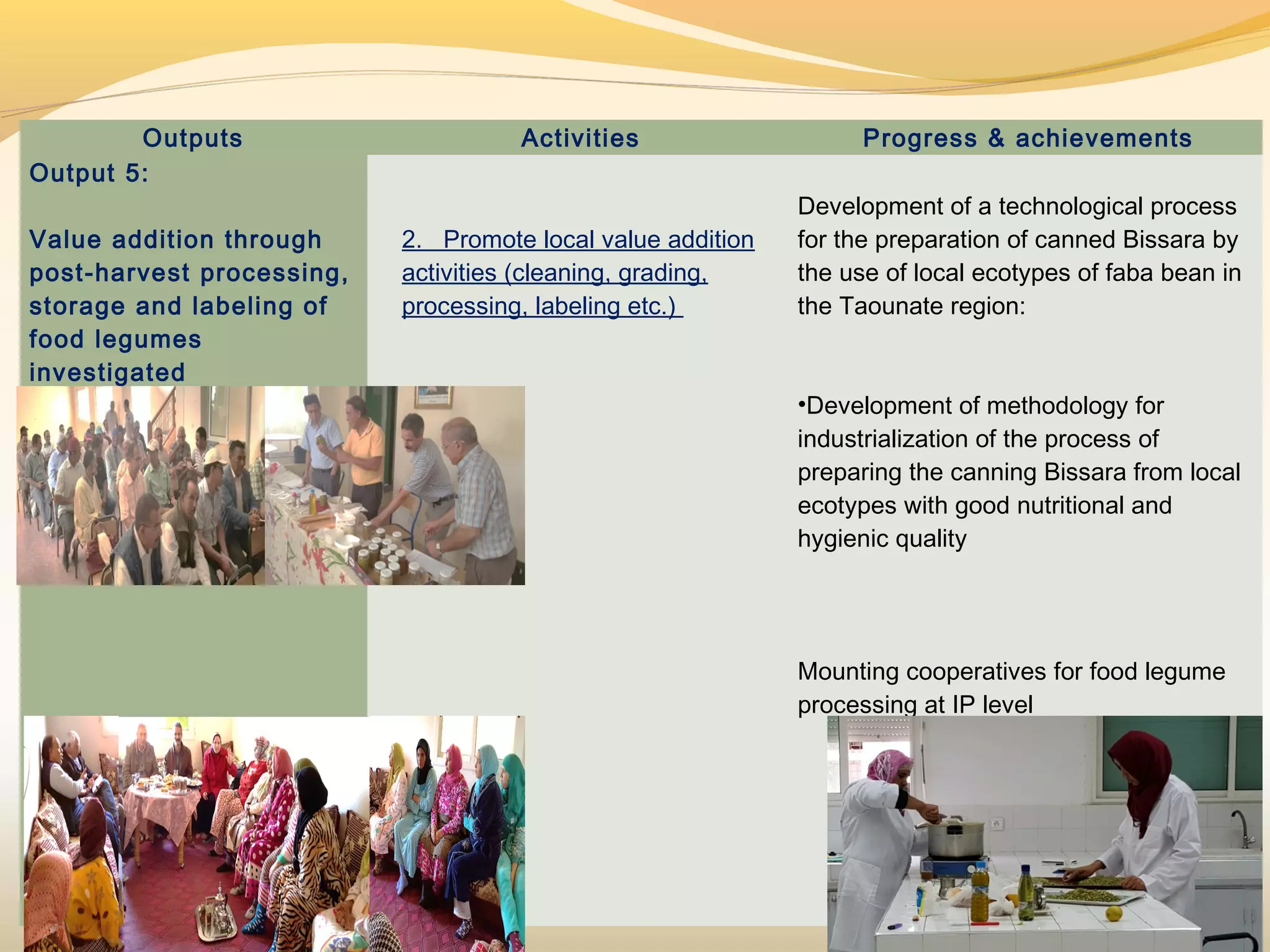
Development of a technological
process for the preparation of
canned Bissara by the use of local
ecotypes of beans in the region
Taounate:
•a survey on different methods of
preparation of Bissara from faba
bean.
•Determination of chemical and
technological characteristics (20
samples will be analyzed for
protein, mineral, fiber, dry matter
content and for the yield in shelling
and cooking test).
Outputs Activities Progress & achievements
Output 5:
 
Value addition through
post-harvest processing,
storage and labeling of
food legumes
investigated
 
2. Promote local value addition
activities (cleaning, grading,
processing, labeling etc.)
Development of a technological process
for the preparation of canned Bissara by
the use of local ecotypes of faba bean in
the Taounate region:
•Development of methodology for
industrialization of the process of
preparing the canning Bissara from local
ecotypes with good nutritional and
hygienic quality
Mounting cooperatives for food legume
processing at IP level
Outputs Activities Progress & achievements
Output 5:
 
Value addition
through post-
harvest
processing,
storage and
labeling of food
legumes
investigated
 
2. Promote local
value addition
activities (cleaning,
grading, processing,
labeling etc.)
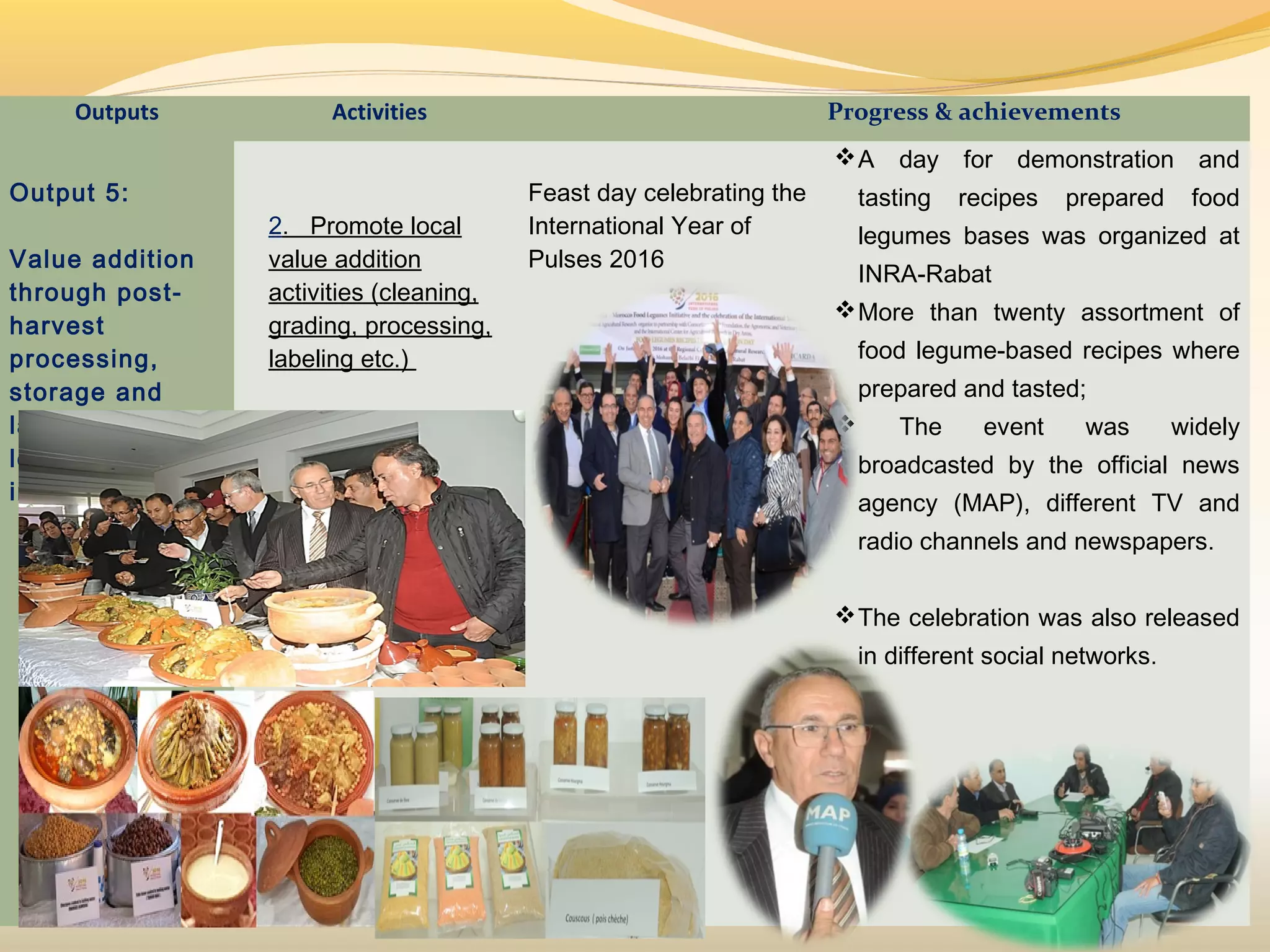
Feast day celebrating the
International Year of
Pulses 2016
A day for demonstration and
tasting recipes prepared food
legumes bases was organized at
INRA-Rabat
More than twenty assortment of
food legume-based recipes where
prepared and tasted;
 The event was widely
broadcasted by the official news
agency (MAP), different TV and
radio channels and newspapers.
The celebration was also released
in different social networks.
Outputs Activities Progress & achievements
Output 6:
 
A pilot knowledge
connectivity system
using different ICT
tools to meet the
needs of information
and knowledge of
targeted rural
communities
established
 
1.Analyse the existing /
possible technologies
platform in the project
areas
 
 
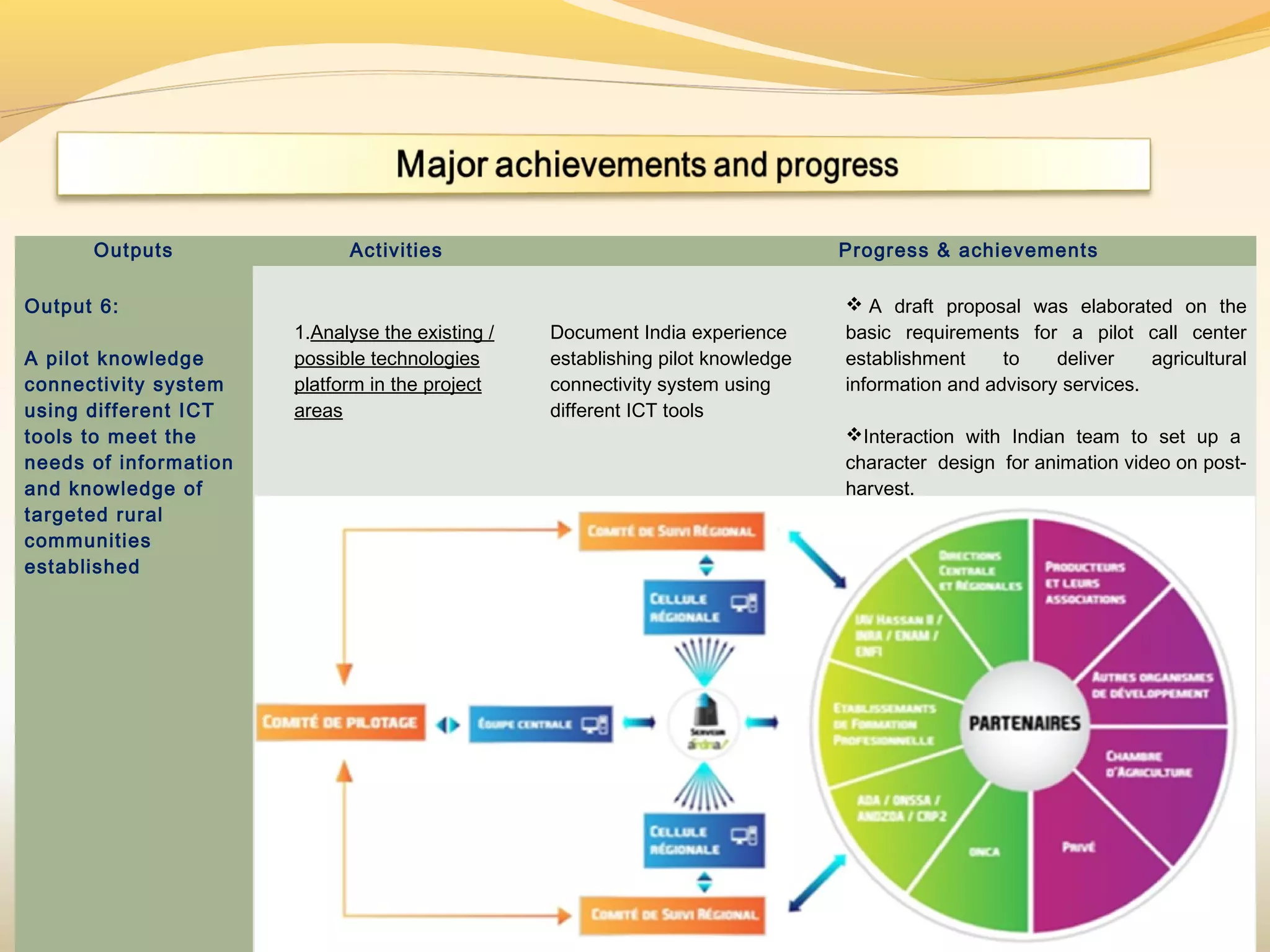
Document India experience
establishing pilot knowledge
connectivity system using
different ICT tools


 A draft proposal was elaborated on the
basic requirements for a pilot call center
establishment to deliver agricultural
information and advisory services.
Interaction with Indian team to set up a
character design for animation video on post-
harvest.
Outputs Activities Progress & achievements
Output 7:
Pilot community based
organizations (CBO/
farmer aggregation)
demonstrated
1. Inventory and document
existing CBOs in target areas
2. Conduct awareness
meetings on the purpose of
CBO
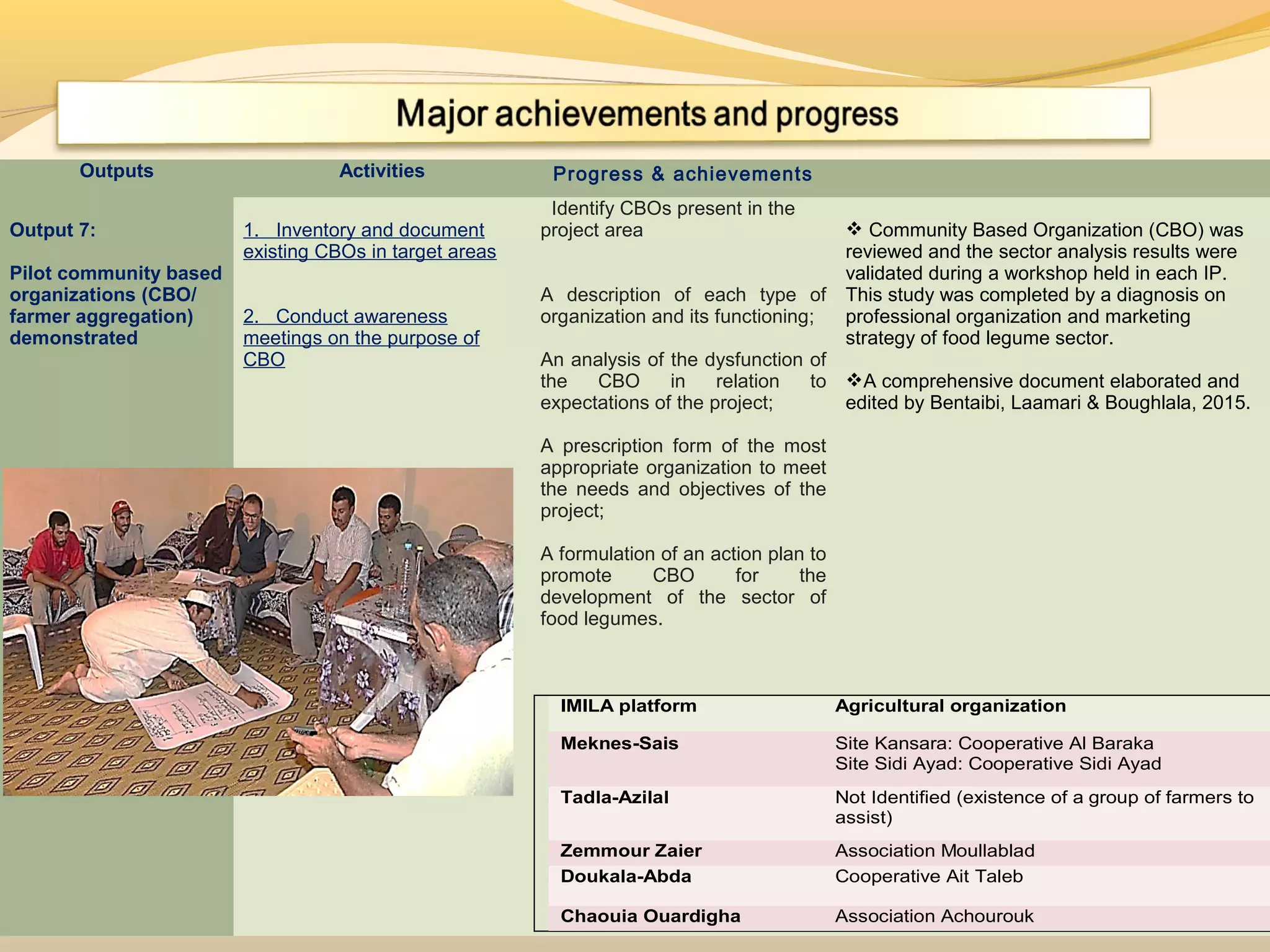
Identify CBOs present in the
project area
A description of each type of
organization and its functioning;
An analysis of the dysfunction of
the CBO in relation to
expectations of the project;
A prescription form of the most
appropriate organization to meet
the needs and objectives of the
project;
A formulation of an action plan to
promote CBO for the
development of the sector of
food legumes.
 Community Based Organization (CBO) was
reviewed and the sector analysis results were
validated during a workshop held in each IP.
This study was completed by a diagnosis on
professional organization and marketing
strategy of food legume sector.
A comprehensive document elaborated and
edited by Bentaibi, Laamari & Boughlala, 2015.
IMILA platform Agricultural organization
Meknes-Sais Site Kansara: Cooperative Al Baraka
Site Sidi Ayad: Cooperative Sidi Ayad
Tadla-Azilal Not Identified (existence of a group of farmers to
assist)
Zemmour Zaier Association Moullablad
Doukala-Abda Cooperative Ait Taleb
Chaouia Ouardigha Association Achourouk
Outputs Activities Target Progress & achievements
Output 8:
Back up research to
enhance technology
generation, including,
IPM/ICM, Crop
improvement, adapted
mechanization carried
out
1. Develop new elite lines of
food legume crops with
improved resistance to abiotic
and biotic stresses with better
yield and end use quality
suitable for mechanized
harvesting
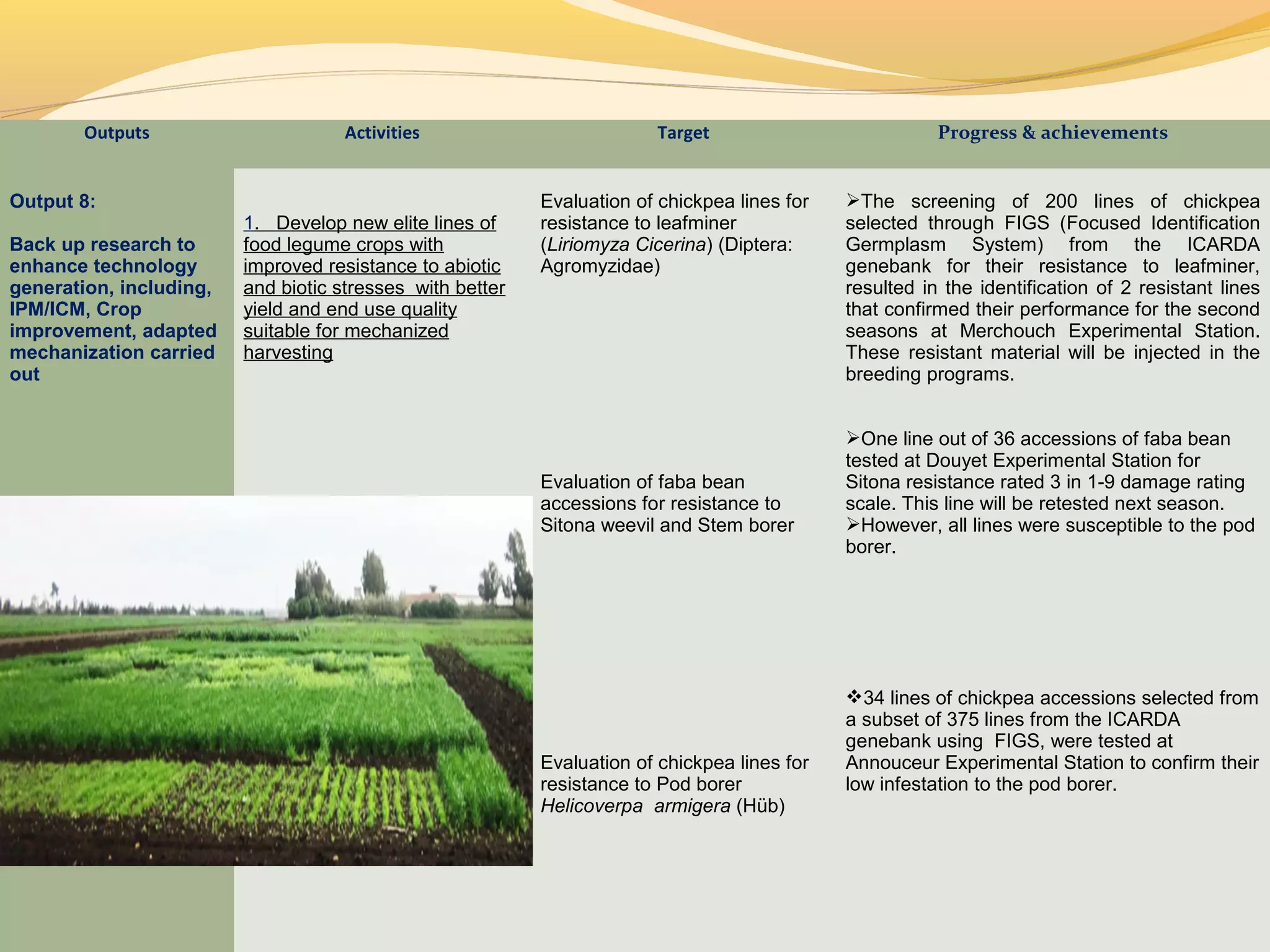
Evaluation of chickpea lines for
resistance to leafminer
(Liriomyza Cicerina) (Diptera:
Agromyzidae)
Evaluation of faba bean
accessions for resistance to
Sitona weevil and Stem borer
Evaluation of chickpea lines for
resistance to Pod borer
Helicoverpa armigera (Hüb)
The screening of 200 lines of chickpea
selected through FIGS (Focused Identification
Germplasm System) from the ICARDA
genebank for their resistance to leafminer,
resulted in the identification of 2 resistant lines
that confirmed their performance for the second
seasons at Merchouch Experimental Station.
These resistant material will be injected in the
breeding programs.
One line out of 36 accessions of faba bean
tested at Douyet Experimental Station for
Sitona resistance rated 3 in 1-9 damage rating
scale. This line will be retested next season.
However, all lines were susceptible to the pod
borer.
34 lines of chickpea accessions selected from
a subset of 375 lines from the ICARDA
genebank using FIGS, were tested at
Annouceur Experimental Station to confirm their
low infestation to the pod borer.
Outputs Activities Target Progress & achievements
Output 8:
Back up research to
enhance technology
generation, including,
IPM/ICM, Crop
improvement, adapted
mechanization carried
out
1. Develop new elite lines of
food legume crops with
improved resistance to abiotic
and biotic stresses with better
yield and end use quality
suitable for mechanized
harvesting
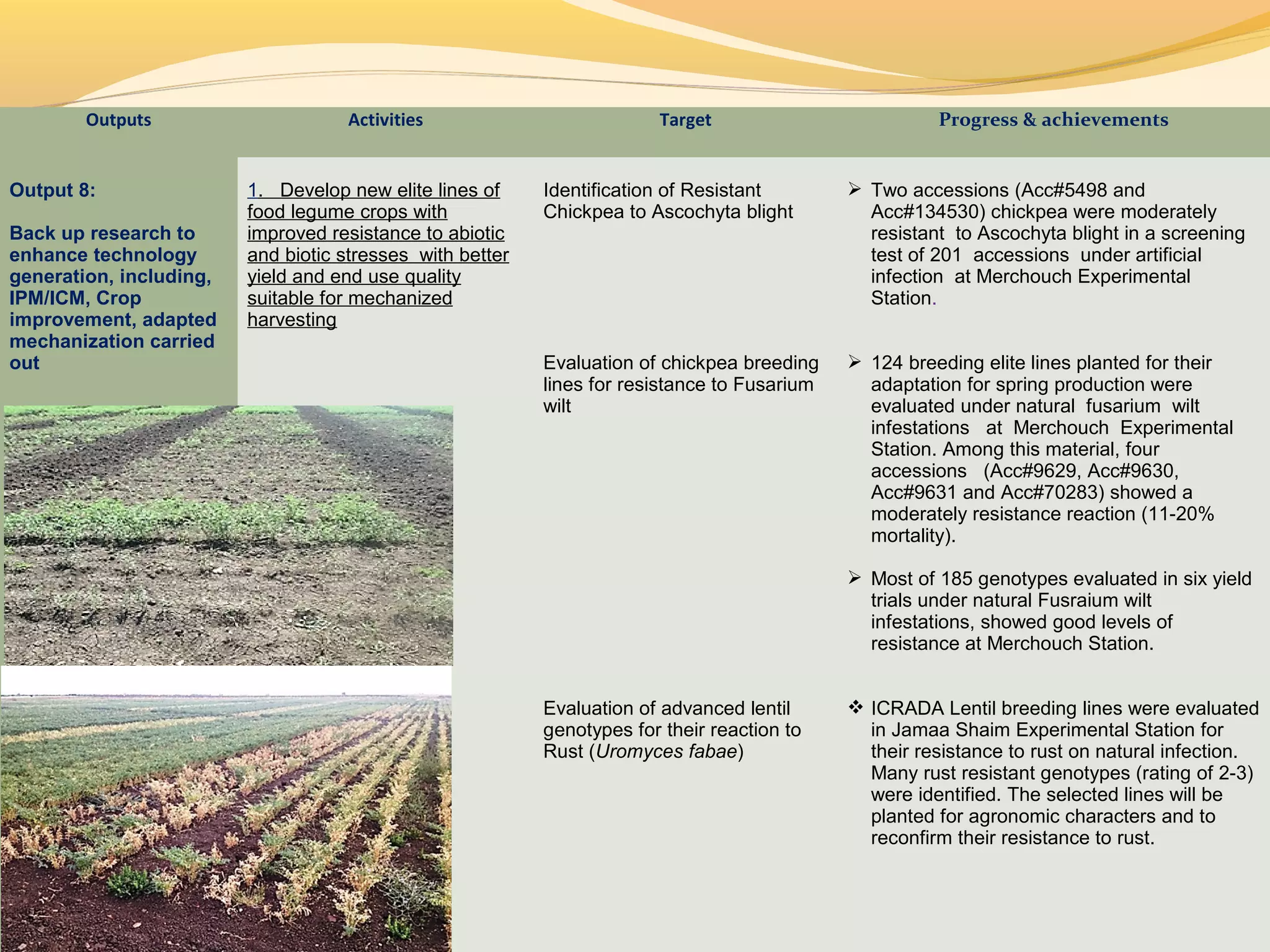
Identification of Resistant
Chickpea to Ascochyta blight
Evaluation of chickpea breeding
lines for resistance to Fusarium
wilt
Evaluation of advanced lentil
genotypes for their reaction to
Rust (Uromyces fabae)
 Two accessions (Acc#5498 and
Acc#134530) chickpea were moderately
resistant to Ascochyta blight in a screening
test of 201 accessions under artificial
infection at Merchouch Experimental
Station.
 124 breeding elite lines planted for their
adaptation for spring production were
evaluated under natural fusarium wilt
infestations at Merchouch Experimental
Station. Among this material, four
accessions (Acc#9629, Acc#9630,
Acc#9631 and Acc#70283) showed a
moderately resistance reaction (11-20%
mortality).
 Most of 185 genotypes evaluated in six yield
trials under natural Fusraium wilt
infestations, showed good levels of
resistance at Merchouch Station.
 ICRADA Lentil breeding lines were evaluated
in Jamaa Shaim Experimental Station for
their resistance to rust on natural infection.
Many rust resistant genotypes (rating of 2-3)
were identified. The selected lines will be
planted for agronomic characters and to
reconfirm their resistance to rust.
Outputs Activities Target Progress & achievements
Output 8:
Back up research to
enhance technology
generation, including,
IPM/ICM, Crop
improvement, adapted
mechanization carried
out
1. Develop new elite lines of
food legume crops with
improved resistance to abiotic
and biotic stresses with better
yield and end use quality
suitable for mechanized
harvesting
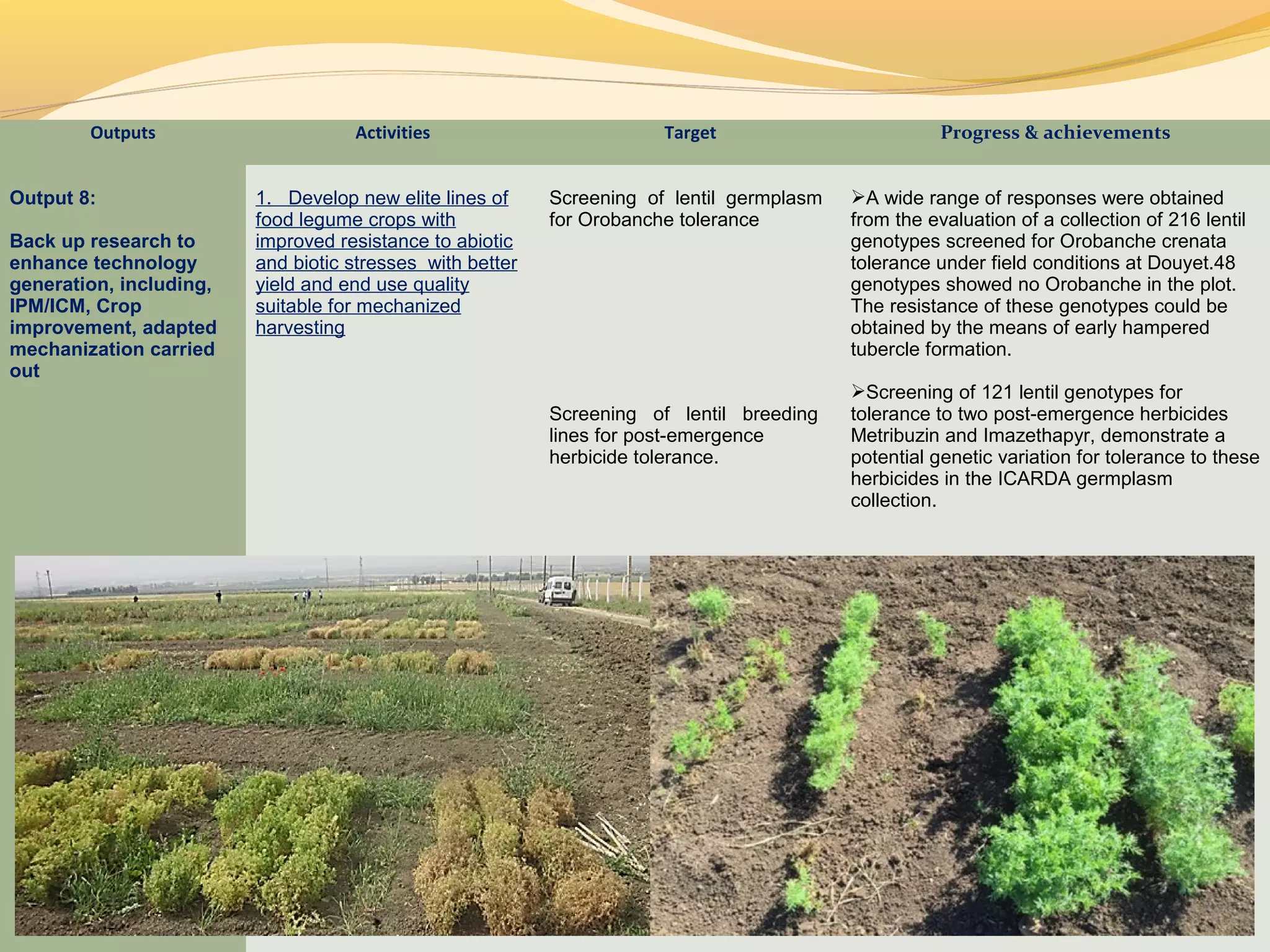
Screening of lentil germplasm
for Orobanche tolerance
Screening of lentil breeding
lines for post-emergence
herbicide tolerance.
A wide range of responses were obtained
from the evaluation of a collection of 216 lentil
genotypes screened for Orobanche crenata
tolerance under field conditions at Douyet.48
genotypes showed no Orobanche in the plot.
The resistance of these genotypes could be
obtained by the means of early hampered
tubercle formation.
Screening of 121 lentil genotypes for
tolerance to two post-emergence herbicides
Metribuzin and Imazethapyr, demonstrate a
potential genetic variation for tolerance to these
herbicides in the ICARDA germplasm
collection.
Outputs Activities Target Progress & achievements
Output 8:
Back up research to
enhance technology
generation, including,
IPM/ICM, Crop
improvement, adapted
mechanization carried
out
1. Develop new elite lines of
food legume crops with
improved resistance to abiotic
and biotic stresses with better
yield and end use quality
suitable for mechanized
harvesting
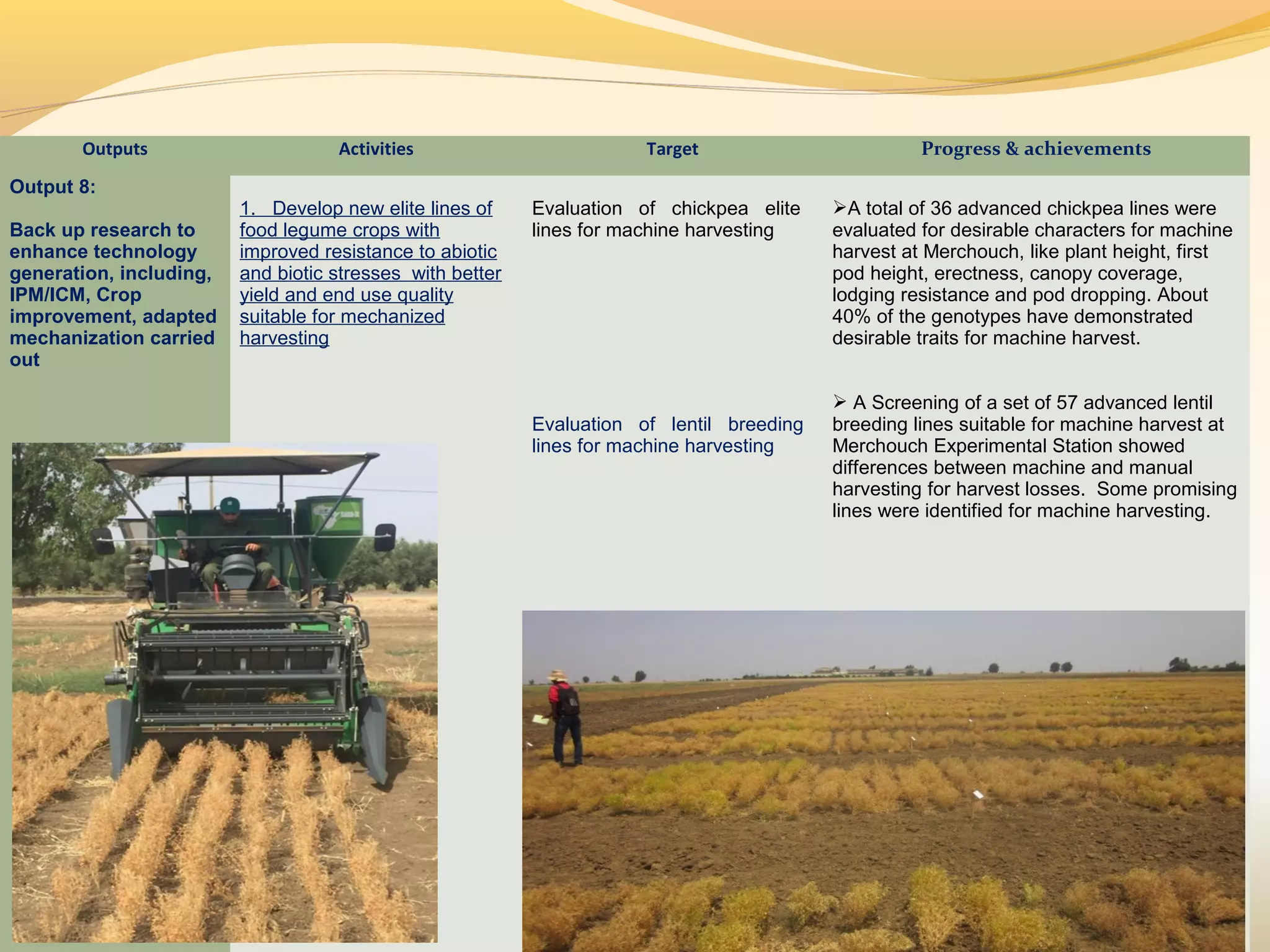
Evaluation of chickpea elite
lines for machine harvesting
Evaluation of lentil breeding
lines for machine harvesting
A total of 36 advanced chickpea lines were
evaluated for desirable characters for machine
harvest at Merchouch, like plant height, first
pod height, erectness, canopy coverage,
lodging resistance and pod dropping. About
40% of the genotypes have demonstrated
desirable traits for machine harvest.
 A Screening of a set of 57 advanced lentil
breeding lines suitable for machine harvest at
Merchouch Experimental Station showed
differences between machine and manual
harvesting for harvest losses. Some promising
lines were identified for machine harvesting.
Outputs Activities Target Progress & achievements
Output 8:
Back up research to
enhance technology
generation, including,
IPM/ICM, Crop
improvement,
adapted
mechanization carried
out
2. Investigate alternative IPM
and ICM technologies to
increase and stabilize the
productivity of target legumes
Effect of sowing date and seed
treatment on insects of faba
bean.
Effect of seed treatment against
green aphid of lentils
Efficacy of different insecticides
against leafminer Liriomyza
cicerina (Diptera: Agromyzidae)
on chickpea
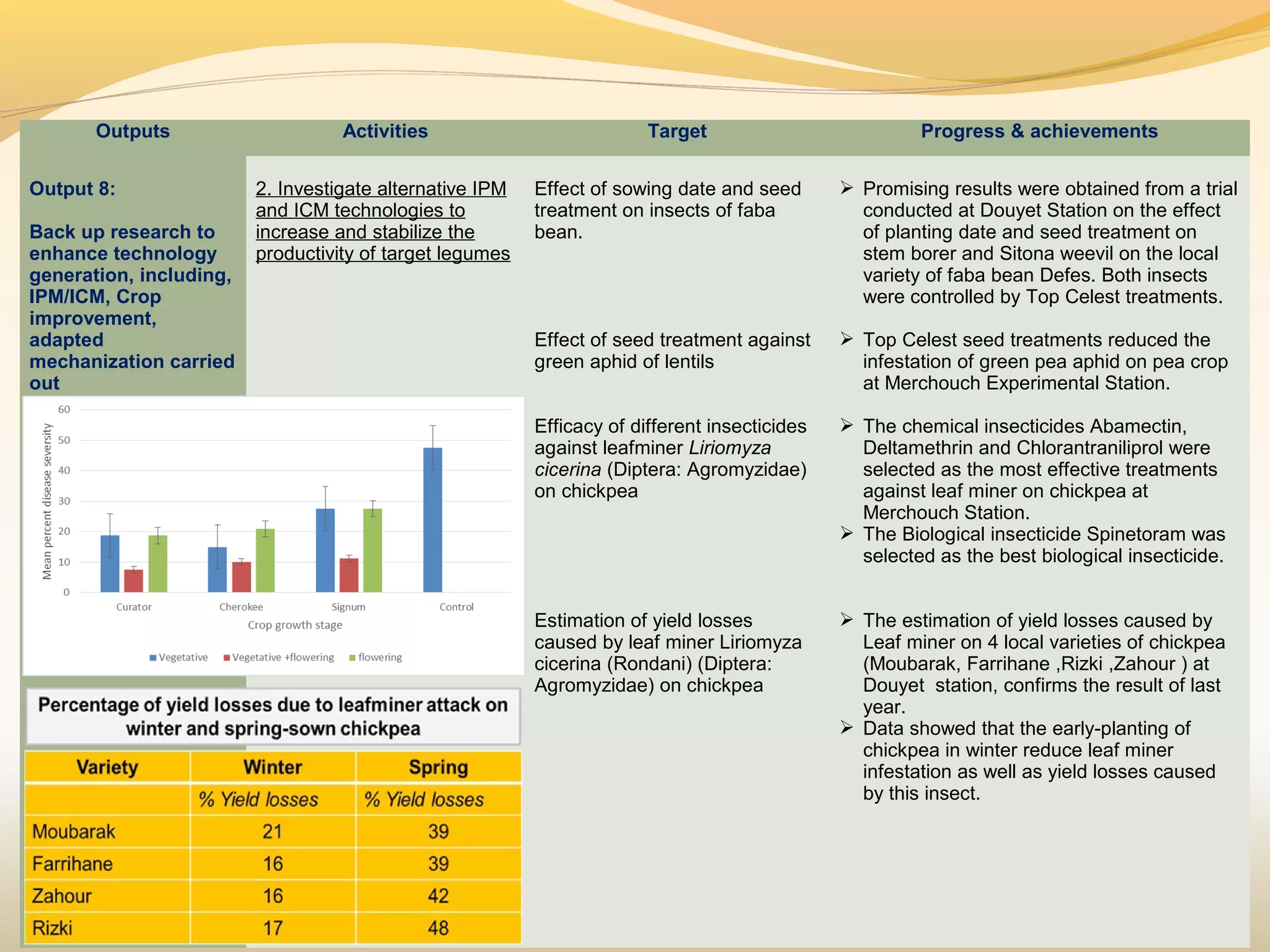
Estimation of yield losses
caused by leaf miner Liriomyza
cicerina (Rondani) (Diptera:
Agromyzidae) on chickpea
 Promising results were obtained from a trial
conducted at Douyet Station on the effect
of planting date and seed treatment on
stem borer and Sitona weevil on the local
variety of faba bean Defes. Both insects
were controlled by Top Celest treatments.
 Top Celest seed treatments reduced the
infestation of green pea aphid on pea crop
at Merchouch Experimental Station.
 The chemical insecticides Abamectin,
Deltamethrin and Chlorantraniliprol were
selected as the most effective treatments
against leaf miner on chickpea at
Merchouch Station.
 The Biological insecticide Spinetoram was
selected as the best biological insecticide.
 The estimation of yield losses caused by
Leaf miner on 4 local varieties of chickpea
(Moubarak, Farrihane ,Rizki ,Zahour ) at
Douyet station, confirms the result of last
year.
 Data showed that the early-planting of
chickpea in winter reduce leaf miner
infestation as well as yield losses caused
by this insect.
Outputs Activities Target Progress & achievements
Output 8:
Back up research to
enhance technology
generation, including,
IPM/ICM, Crop
improvement, adapted
mechanization carried
out
2. Investigate alternative IPM
and ICM technologies to
increase and stabilize the
productivity of target legumes
Integrated management of
chocolate spot on faba bean
Adaptive weed management for
efficient mechanical harvesting
of chickpea in conventional and
no-till systems
 Out of three fungicides, tested in an IPM trial
planted at Allal Tazi, curator was the most
effective against chocolate spot on faba
bean variety (Aguaduce) at the rate 80g a.i./l
of azoxystrobin + 400g a.i./l of chlorothalonil.
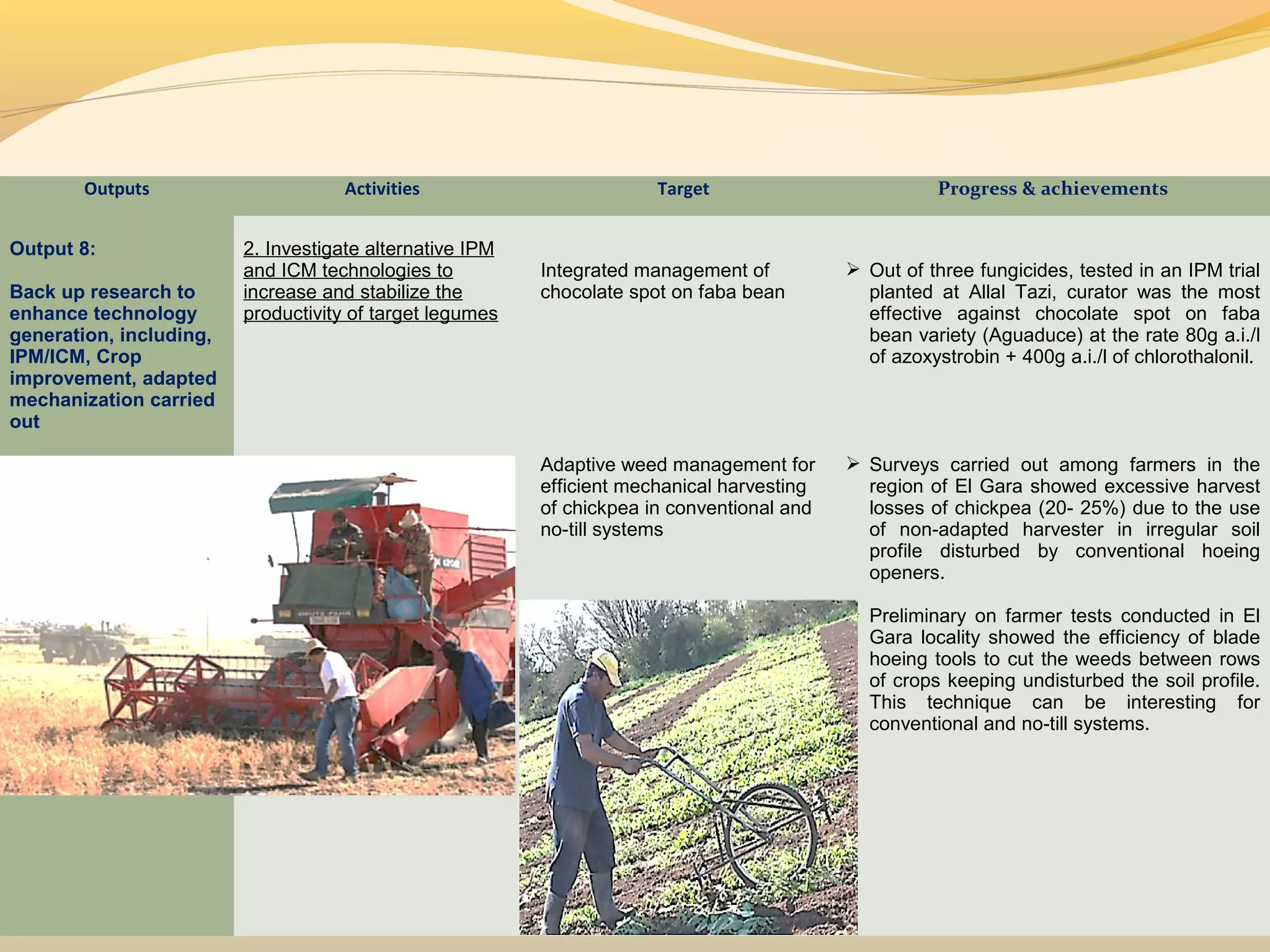
 Surveys carried out among farmers in the
region of El Gara showed excessive harvest
losses of chickpea (20- 25%) due to the use
of non-adapted harvester in irregular soil
profile disturbed by conventional hoeing
openers.
 Preliminary on farmer tests conducted in El
Gara locality showed the efficiency of blade
hoeing tools to cut the weeds between rows
of crops keeping undisturbed the soil profile.
This technique can be interesting for
conventional and no-till systems.
Outputs Activities Target Progress & achievements
Output 9:
Capacity building and
networking of all
stakeholders
achieved
1. Promote networking
between India and Morocco
and within the region including
exchange travelling workshop
for understanding and
planning the implementation of
concept of knowledge
connectivity system;
2. Exchange of expertise
through mutual visits of
scientists, farmers, policy
makers, and other
stakeholders to promote
South-South cooperation;
Provide information to
policymakers on ways and
means to empower small holder
farmers along the grain
legumes value chain
Review and planning workshop
of all IMFLI partners at
ICRISAT, Hyderabad
travelling workshop
Capacity building
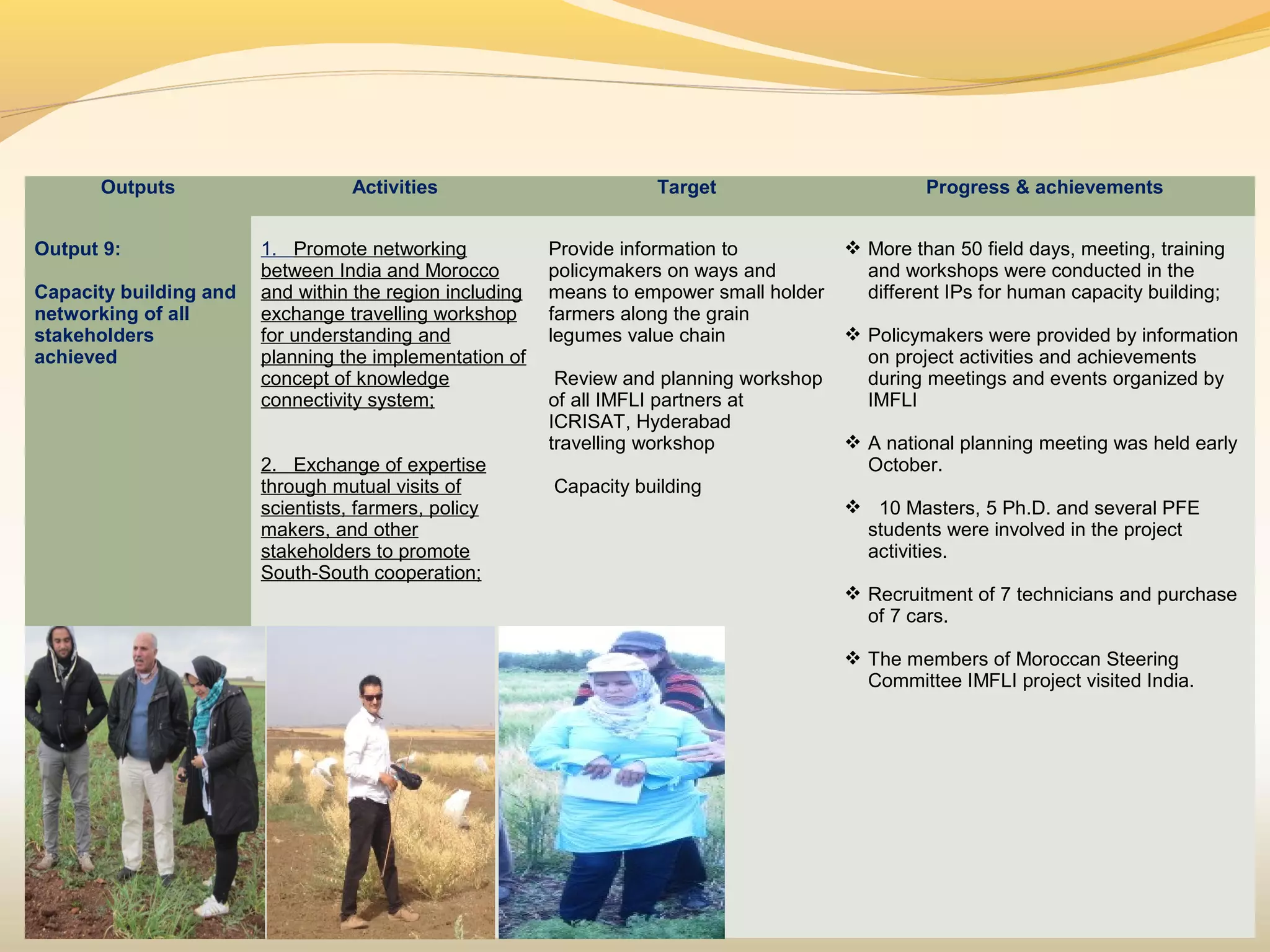
 More than 50 field days, meeting, training
and workshops were conducted in the
different IPs for human capacity building;
 Policymakers were provided by information
on project activities and achievements
during meetings and events organized by
IMFLI
 A national planning meeting was held early
October.
 10 Masters, 5 Ph.D. and several PFE
students were involved in the project
activities.
 Recruitment of 7 technicians and purchase
of 7 cars.
 The members of Moroccan Steering
Committee IMFLI project visited India.
Outputs Activities Target Progress & achievements
Output 9:
Capacity building and
networking of all
stakeholders
achieved
2. Exchange of expertise
through mutual visits of
scientists, farmers, policy
makers, and other
stakeholders to promote
South-South cooperation;
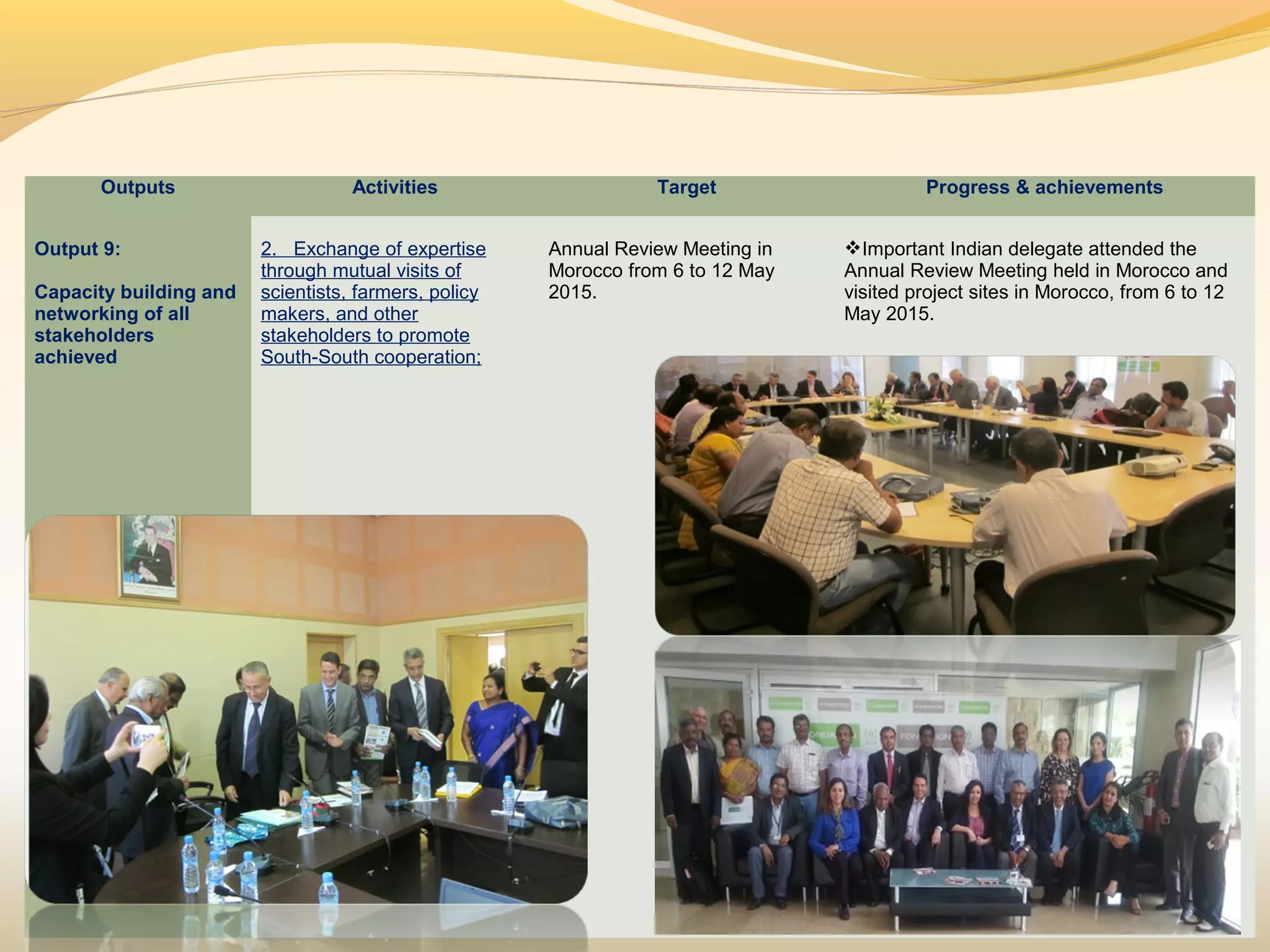
Annual Review Meeting in
Morocco from 6 to 12 May
2015.
Important Indian delegate attended the
Annual Review Meeting held in Morocco and
visited project sites in Morocco, from 6 to 12
May 2015.
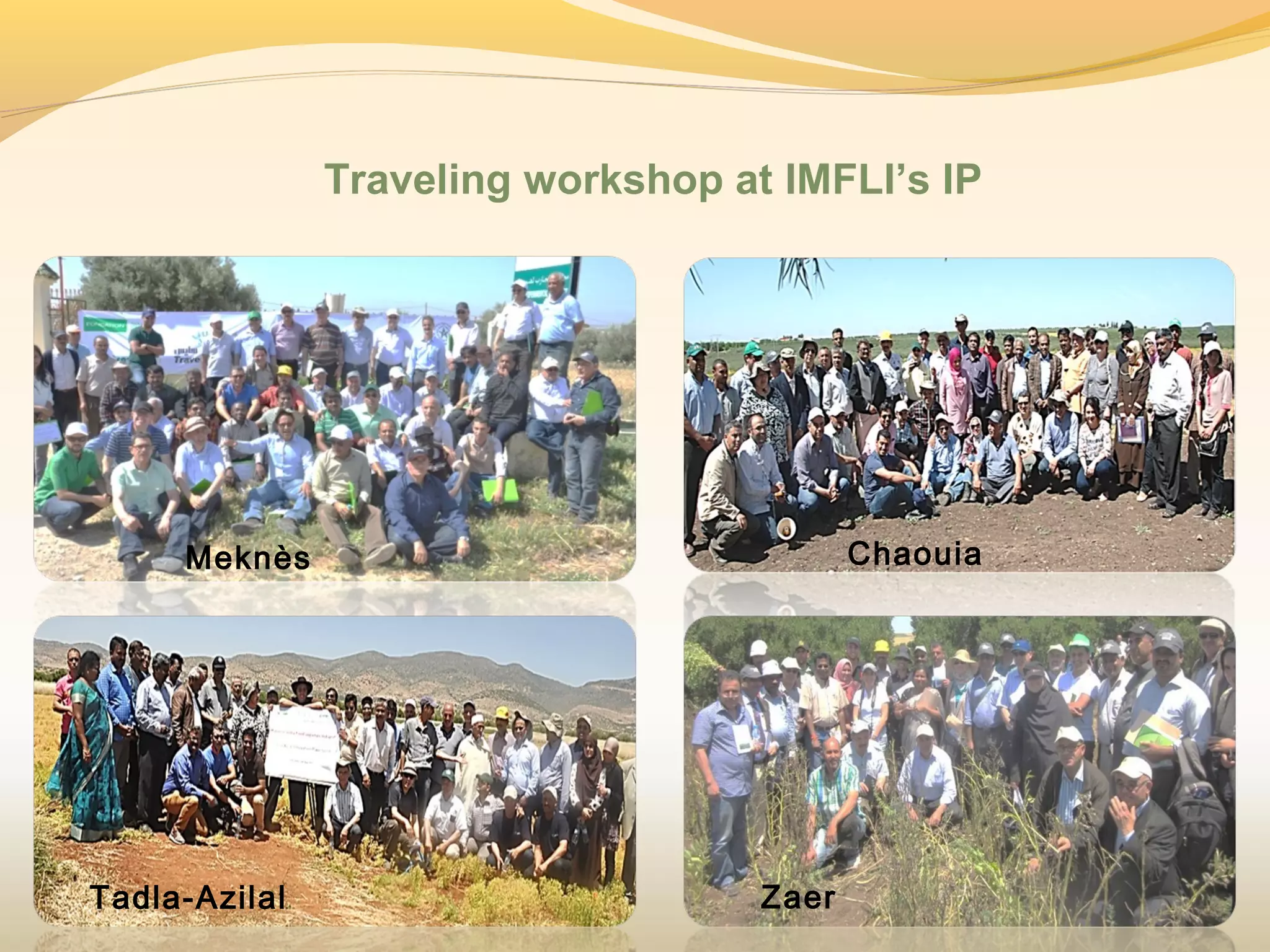
Traveling workshop at IMFLI’s IP
Tadla-Azilal
Meknès Chaouia
Zaer
Outputs Activities Target Progress & achievements
Output 9:
Capacity building and
networking of all
stakeholders
achieved
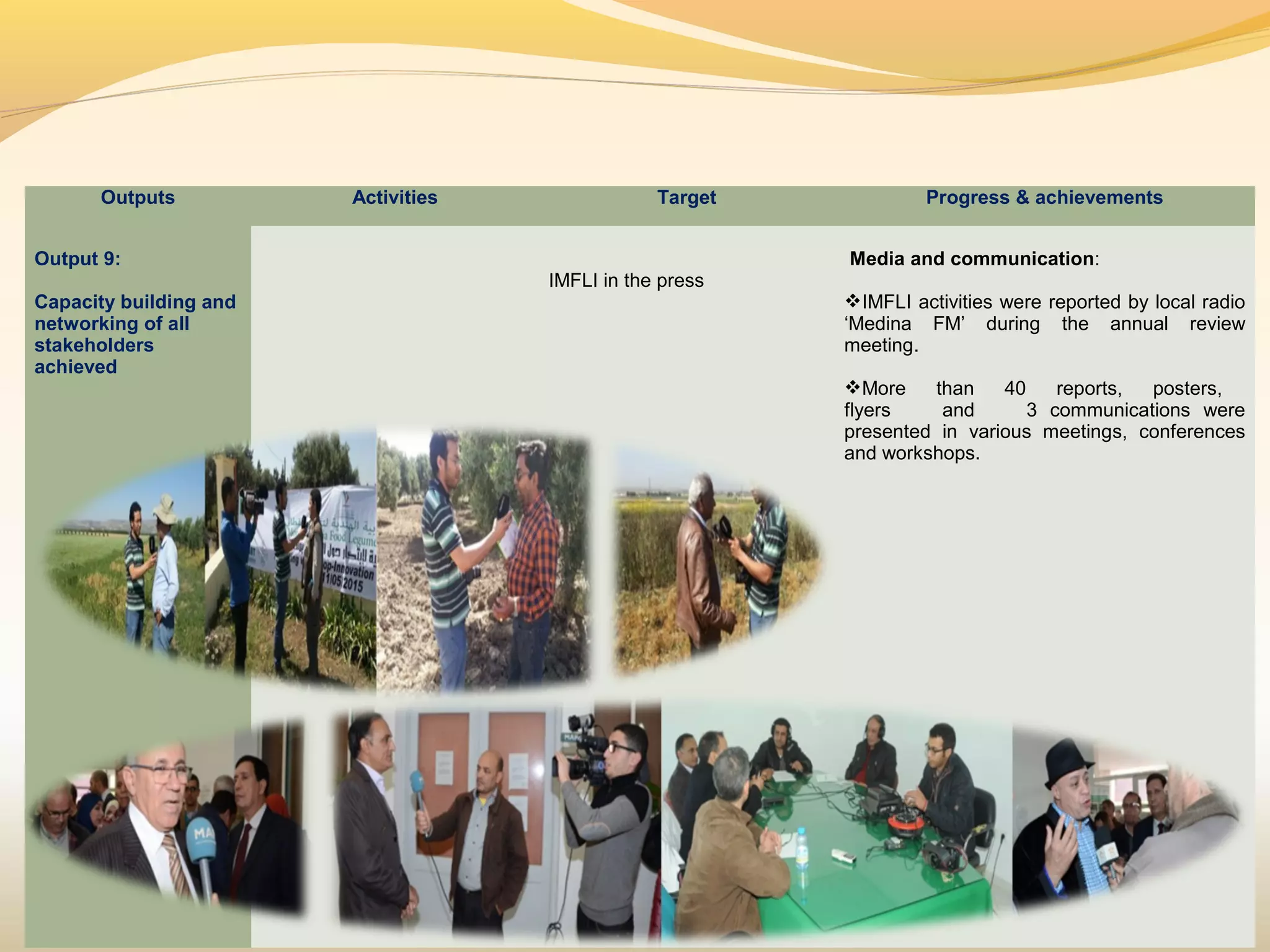
IMFLI in the press
Media and communication:
IMFLI activities were reported by local radio
‘Medina FM’ during the annual review
meeting.
More than 40 reports, posters,
flyers and 3 communications were
presented in various meetings, conferences
and workshops.
Outputs Activities Target Progress & achievements
Output 9:
Capacity building and
networking of all
stakeholders
achieved
Capacity building in establishment
and implementation of Business
Plan for VBSE
Variety maintenance and
community based seed production
training
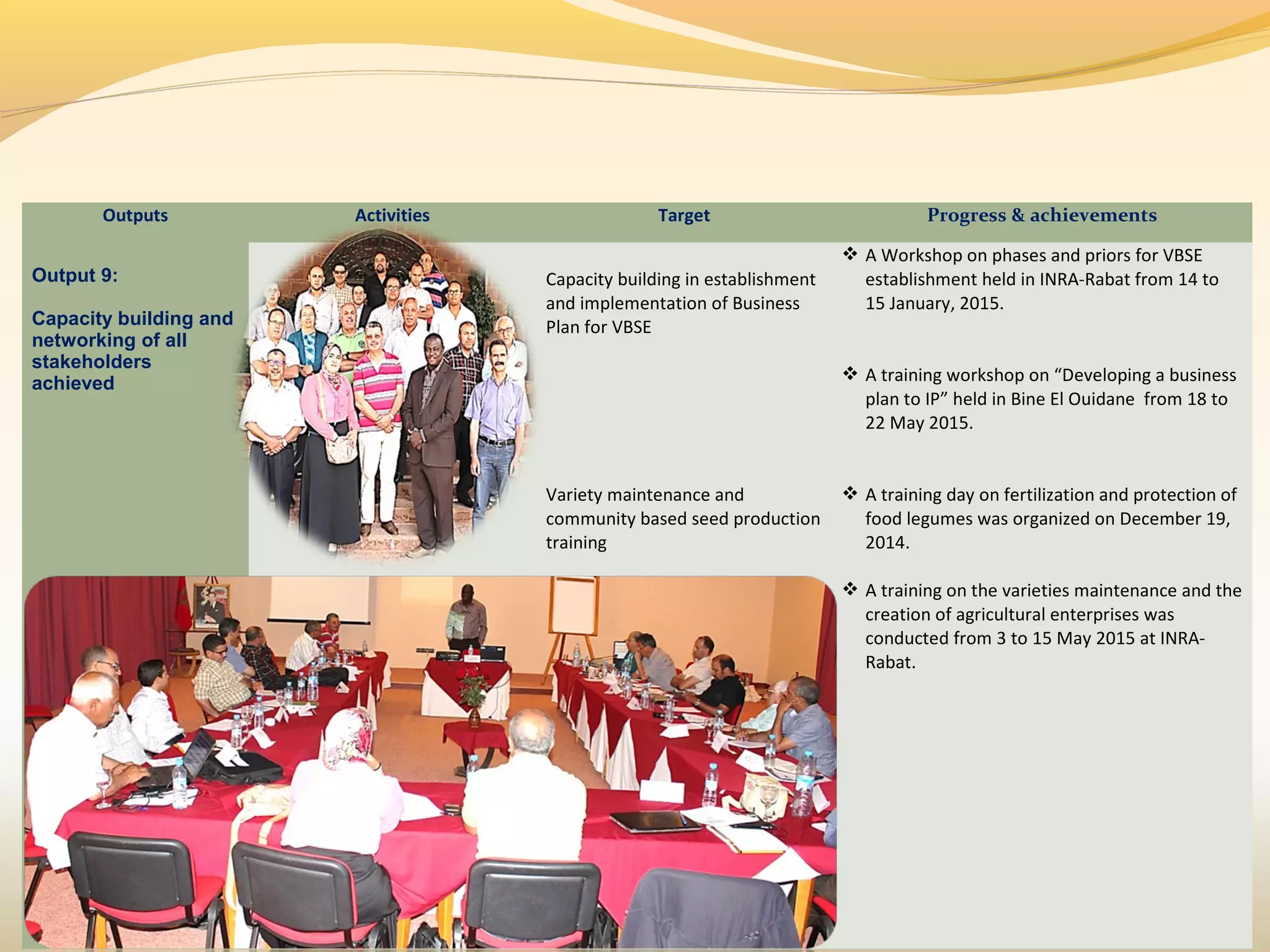
 A Workshop on phases and priors for VBSE
establishment held in INRA-Rabat from 14 to
15 January, 2015.
 A training workshop on “Developing a business
plan to IP” held in Bine El Ouidane from 18 to
22 May 2015.
 A training day on fertilization and protection of
food legumes was organized on December 19,
2014.
 A training on the varieties maintenance and the
creation of agricultural enterprises was
conducted from 3 to 15 May 2015 at INRA-
Rabat.
Outputs Activities Target Progress & achievements
Output 10:
M&E system for
project
implementation,
management and
impact developed and
monitored on a
regular basis
1.Develop a participatory
M&E system for project
implementation;
2.Capacity building of M&E
system for all the
stakeholders
3.Development of a
baseline data set for
monitoring and impact
assessment of the FLIP
project
Conduct a baseline survey in
the specific areas
Identify key indicators to be
assessed during technology
transfer process and by the end
of the project
 Food legumes baseline study was
performed in the five IP regions on a sample
of 500 household farms concerning supply
analysis and production costs..
Basic indicators were estimated and can
be considered as references for measuring
the impact of transferred technologies at the
IPs level.
CONCLUSION
 After two years, efforts were concentrated on strengthening the
implementation of IPs and the adhesion and integration of different
actors working in the context of the value chain around the project
activities for more efficiency. Certainly, the contribution of various
players in the food legumes sector is more than necessary for
optimal functioning and economically beneficial to all.
 
 Furthermore, the multiple activities undertaken at different IP’s sites
foresee technological innovations that will provide appropriate
solutions to remove constraints on the sector development.
Thank you for yourThank you for your
attentionattention

Increasing food legumes production by small farmers to strengthen food and nutrition security through adoption of improved technologies and governance within South-South Cooperation

  • 1.
    Increasing food legumesproduction by small farmers to strengthen food and nutrition security through adoption of improved technologies and governance within South-South Cooperation ICP 2016, Marrakech
  • 2.
  • 3.
    Implementation strategy andapproach Local Farmers organizations (Associations/Cooperatives Research stakeholders INRA Researchstations IAV, ICARDA Universities Commerce and valorization Stakeholders ONICL CAM SmallRetailler Wholesalers Input stakeholders SONACOS Ag chemical compagnies Ag-equipmentcompagnies Service compagnies Development facilitators and funding stakeholders facilitateurs suivi et supervisionWilaya Province (DAR) Local Authorities NGO’s OCPF OCPExtension, Traning and monitoiring stakeholders ONCA CT ISTA JS ONG INDH Chambre/ADS Ag supplies Sellers Service compagnies Ag development &Policy making stakeholders DRA DPA Safi Regional/provincial Councils Rural communes AgricultureChambers ONSSA The main stakeholders involved in the IP-IMILA food legumes value- chain in Morocco
  • 4.
  • 5.
     Presentation oftwo oral communications in the 1st North African workshop on crop fertilization organized in Marrakech. IP components: IP components: MEKNES-TAOUNATEMEKNES-TAOUNATE Technology promoted:Technology promoted:  Adequate fertilizers to equilibrate the soils fertility according to soil analyses;  IPM package for winter chickpea and faba bean production. Capacity building:Capacity building:  Each farmer received personal advices and inputs (seeds, fertilizers, pesticides).  6 Field days were organized in collaboration with local partners on:  Importance of legume crops.  Soil analysis  Management of fertilization  Weeds and pests control  Participation in the animation and organization of two demonstration days on faba bean and pea processing at CR of Ain Kansara planed within the output 5 frame.  Supervision of two PhD and one PFE from Burundi. Communication:Communication: Rural commune Crop Variety Number of sites Area ha Sidi Ayad Winter Chickpea Farihane/Zahor 4 4 Kansara Faba bean Aguadulce 4 5 Total 8 9
  • 6.
     Each farmerreceived personal advices and inputs (seeds, fertilizers, pesticides).  Organization of several training sessions on lentil production for a Group of Economical Interest (GIE) at Ait Attab.  6 Field days were organized in collaboration with local partners on weeds and pests control in legumes. TADLA-AZILALTADLA-AZILAL IP components:IP components: Technology promoted:Technology promoted:  IPM package for lentil and faba bean production Capacity building:Capacity building: Rural commune Crop Variety Number of sites Area ha Tagzirt Faba bean Aguadulce 8 8 Ait Attab Lentil Bakria/L56 8 8 Total 16 16
  • 7.
       Technology promoted:    Technology promoted: IPComponents:IP Components:  13 farmer training days on food legume production and fertilization.  1day training for IP team.  Supervision of a doctoral, a master and an agronomist engineer students.  IPM for lentil chickpea and pea production  Pea variety for human consumption and animal feed Research activities:Research activities:  Effect of the application of anti-stress agents (humic substances) on lentil and wheat.  Response of lentil and wheat to Zinc and Manganese fertilization.  Management of nitrogen fertilization on corn in rotation with lentil under the semi direct system. Building capacity:Building capacity:  4 posters  1 oral communication Communication and dissemination activities Communication and dissemination activities ABDA -ABDA - DOUKALADOUKALARural commune Crop Variety Number of sites Area ha Abda Lentil Bakria 8 8 Chickpea Moubarek 12 12 Ahmar Peas Linconl 11 11 Total 31 31
  • 8.
    IP components:   5Workshops for launching Innovation Platforms  1 Field day on the pre sowing treatment, sprayer adjustment and crop installation  Direct supervision of each farmer on diseases and weed control methods ZAERZAER Technology promoted:  Adequate fertilizers to equilibrate the soils fertility according to soil analyses carried out for all sites.  ICM/IPM package for direct seeding Capacity building: Rural commune Crop Variety Number of sites Area ha Merchouch Winter chickpea Farihane 5 5 Ain Sbit Lentil (No till) Bakria 5 5 Total 10 10
  • 9.
    CHAOUIA – RDANACHAOUIA– RDANA  Field days training on:  Mechanical seeding of chickpea and faba bean minor;  Adjustment of spraying equipment for weed, disease and insect control;  Application of fungicides against Botrytis and Ascochyta blight, and insecticides against aphids on faba bean and leaf minor on chickpea;  Control of Orobanche on faba bean and chick pea;  Adjustment of combine for mechanical harvest of chickpea and faba bean minor;  Comparison of winter to spring chickpea performance  3 Students: 1 Engineer from ENA and 2 Licenses of Sciences & Techniques FST Fès IP components :IP components : Technology promoted: Technology promoted: IPM for no-till faba bean production  IPM for winter chickpea production Communication and dissemination activities : Communication and dissemination activities : Capacity building:Capacity building:  Meeting with farmers and all IP team to establish the IP management committee  Meetings with farmers in the sub platforms. Rural commune Crop Variety Number of sites Area ha Oulad Bouziri Faba bean minor (No-till) Alfia 5 5 El Gara-Rdadna Winter chickpea Zahour 6 6 Ain Nzagh Winter chickpea Moubarak 5 5 Total 16 16
  • 10.
    Outputs Achievements Output 1:   Valuechains of targeted food legumes studied and analyzed    1.Policy components   Analysis of correlations between food policy changes and their impacts on  trends of food legumes production;  Identification  of  the  mains  policy  determinants  of  food  legumes  production. Characterization of demand, consumption and trade of food legume. Identification of efficient policy and institutional actions that will help actors  to rehabilitate food legumes sector.
  • 11.
    Outputs Activities Output 1:   Valuechains of targeted food legumes studied and analyzed 2.     Farming system description and  characterization: Cropping system analysis and  production cost establishment Identify the main components of the farming  system   Study the socioeconomic and technical status of  the selected food legumes   Identify the main socioeconomic, technical and  financial determinants of production and  consumption      Establish enterprise budgets of the selected food  legumes
  • 12.
    Outputs Activities Output 1:   Valuechains of targeted food legumes studied and analyzed 3. Downstream value chain analysis: Analysis of the retailer’s stage and processor’s stage.
  • 13.
    Outputs Activities Output 1:   Valuechains of targeted food legumes studied and analyzed 4. Sociological issues and Institutional aspects Identifying forms of individual and collective arrangements for management of production systems. Analysis of roles and tasks by gender in the production system Identification of stakeholder involved in the production and commercialization of food legumes and relationships they develop
  • 14.
    Outputs Activities Progress& achievements Output 2:   Improved varieties tested and evaluated through on-farm participatory approach   1.Identify suitable varieties for different agro-ecologies 2.Implement multi-location farmer participatory varietal demonstration and selection of farmer preferred varieties of Lentil, Chickpea, and Fababean; 3.Organize field days for all stakeholders to demonstrate the performance of varieties;   Demonstration of performant varieties in IP’s sites:   8 Performant and locally adapted varieties of chickpea (3), lentil (2), faba bean (2) and pea (1) were demonstrate at 81 sites in the 5 IPs and visited by farmers and local partners during 41 field days organized by the coordinators.  On farm demonstrations of chickpea elite lines:  Five elite ICARDA chickpea advanced lines showed a higher yield and potential traits for machine harvesting at Ain Sbit and Merchouch locations.  The results of the demonstrations have been encouraging as the yield of elite lines was higher than that of local variety Farihane.
  • 15.
    Outputs Activities Progress& achievements Output 3:   Integrated crop management options refined and tested by farmers 1.Evaluate and demonstrate appropriate agronomic practices to enhance legume productivity in different cropping systems  A total of 81 demonstration sites (1 hectare each) were installed and monitored for raising awareness of farmers on good agriculture practices for the improvement and the sustainability of legume production systems in the 5 Innovation platforms (IPs),  Meetings were held with farmers and local partners to establish the IP management committees.  In addition to continuous advices brought to farmers at IPs level along the cropping season, 41 field days, workshops and meetings were organized to train farmers, technicians and students on appropriate agronomic practices. ICM/IPM options tested in five IPs were: • Adapted and performant varieties • Appropriate date of sowing • Seed rate and row spacing • Mechanical planting • Fertilization management • Sprayer adjustment • Weed and disease control • Orobanche control • Mechanical harvesting
  • 16.
    Outputs Activities Progress& achievements Output 3:   Integrated crop management options refined and tested by farmers 2. Promote IPM options to improve cropping system health and sustainability; Demonstrate pre-emergence chemical weed control strategies in chickpea   Demonstrate pre-emergence chemical weed control strategies in lentils
  • 17.
    Outputs Activities TargetProgress & achievements Output 3: ntegrated crop management options refined and tested by farmers 2. Promote IPM options to improve cropping system health and sustainability; Demonstrate foliar fertilization strategies in food legumes Two experiments were installed at INRA Merchouch Experiment Station to evaluate the potential of phosphorus and potassium foliar fertilization on lentil and chickpea.   Results:   Small amounts of foliar fertilizer could increase grain yield of lentils by 40% and of chickpea by 32%. The potential of yield increase in lentil and chickpea by foliar fertilization is greater when soil is not supplied with optimum fertilization and when foliar fertilization is applied at flowering stage. The benefit of foliar fertilization with potassium and phosphorus is largely positive in regard to the low amounts of fertilizers used (less than 15 kg/ha) and the cost associated with application can be minimized when foliar fertilization is combined with pesticides.
  • 18.
    Outputs Activities TargetProgress & achievements Output 3:   Integrated crop management options refined and tested by farmers 2. Promote IPM options to improve cropping system health and sustainability; 3. Organize field days for all stakeholders to demonstrate the performance of the options Demonstrate of direct seeding system in lentil crop Organize on-site learning and awareness meetings on : •Mechanical sowing •Weed control •Diseases, insect and pest identification and control •Harvesting and storage  Study performed on two on farm trials in Zaer region, comparing conventional and direct seeding of lentils and a survey of 80 lentil fields (40 conventional and 40 direct seeding), showed that both productivity and profitability were similar in the two cultivation systems.
  • 19.
    Outputs Activities Progress& achievements Output 4:   Functional village- level based seed delivery systems established   1. Develop a business plan for village based ‘seed enterprise’; A business plan model for village (community) based seed enterprise developed  
  • 20.
    Outputs Activities Progress& achievements Output 4:   Functional village- level based seed delivery systems established   2. Establish pilot VBSEs in target districts and maintained by farmer’s groups; Identification farmers groups to implement VBSE     Support seed, input and machinery procurement, operations and training on VBSE activities  
  • 21.
    Outputs Activities Progress& achievements Output 4:   Functional village- level based seed delivery systems established   2. Establish pilot VBSEs in target districts and maintained by farmer’s groups; Training farmers in seed production techniques and quality control
  • 22.
    Outputs Activities Progress& achievements Output 4:   Functional village-level based seed delivery systems established   3. Produce and distribute quality seed of target legumes at village level to meet the needs of a selected community. Ensure quality seed production to meet the needs in the innovation platforms     A total of 95.6 metric tons of Chickpea (51t), Lentil (25t) and Faba bean (20t) have been produced that enough to cover more than 1000 ha of crop land with the farmer preferred improved and local cultivars; . INRA ensure the multiplication of foundation seeds of new released varieties of food legumes, Strengthening the variety maintenance and foundation seed production system of INRA to secure starting material for further multiplication and marketing of
  • 23.
    Outputs Activities Progress& achievements Output 5:   Value addition through post-harvest processing, storage and labeling of food legumes investigated   1. Analyze and document post- harvest and storage conditions of grain legumes Conduct a survey with producers, collectors and storage of food legumes on post-harvest treatments and storage conditions ;   Collect samples during survey and identify the principal pathogens (pests (including species of weevils), fungal and viral diseases, nematodes and seeds of weeds and parasitic plants such as broomrape, dodder ...) and their relative importance (incidence, severity...)
  • 24.
    Outputs Activities Target Output5:   Value addition through post-harvest processing, storage and labeling of food legumes investigated   2. Promote local value addition activities (cleaning, grading, processing, labeling etc.) Development of a technological process for the preparation of canned Bissara by the use of local ecotypes of beans in the region Taounate: •a survey on different methods of preparation of Bissara from faba bean. •Determination of chemical and technological characteristics (20 samples will be analyzed for protein, mineral, fiber, dry matter content and for the yield in shelling and cooking test).
  • 25.
    Outputs Activities Progress& achievements Output 5:   Value addition through post-harvest processing, storage and labeling of food legumes investigated   2. Promote local value addition activities (cleaning, grading, processing, labeling etc.) Development of a technological process for the preparation of canned Bissara by the use of local ecotypes of faba bean in the Taounate region: •Development of methodology for industrialization of the process of preparing the canning Bissara from local ecotypes with good nutritional and hygienic quality Mounting cooperatives for food legume processing at IP level
  • 26.
    Outputs Activities Progress& achievements Output 5:   Value addition through post- harvest processing, storage and labeling of food legumes investigated   2. Promote local value addition activities (cleaning, grading, processing, labeling etc.) Feast day celebrating the International Year of Pulses 2016 A day for demonstration and tasting recipes prepared food legumes bases was organized at INRA-Rabat More than twenty assortment of food legume-based recipes where prepared and tasted;  The event was widely broadcasted by the official news agency (MAP), different TV and radio channels and newspapers. The celebration was also released in different social networks.
  • 27.
    Outputs Activities Progress& achievements Output 6:   A pilot knowledge connectivity system using different ICT tools to meet the needs of information and knowledge of targeted rural communities established   1.Analyse the existing / possible technologies platform in the project areas     Document India experience establishing pilot knowledge connectivity system using different ICT tools                A draft proposal was elaborated on the basic requirements for a pilot call center establishment to deliver agricultural information and advisory services. Interaction with Indian team to set up a character design for animation video on post- harvest.
  • 28.
    Outputs Activities Progress& achievements Output 7: Pilot community based organizations (CBO/ farmer aggregation) demonstrated 1. Inventory and document existing CBOs in target areas 2. Conduct awareness meetings on the purpose of CBO Identify CBOs present in the project area A description of each type of organization and its functioning; An analysis of the dysfunction of the CBO in relation to expectations of the project; A prescription form of the most appropriate organization to meet the needs and objectives of the project; A formulation of an action plan to promote CBO for the development of the sector of food legumes.  Community Based Organization (CBO) was reviewed and the sector analysis results were validated during a workshop held in each IP. This study was completed by a diagnosis on professional organization and marketing strategy of food legume sector. A comprehensive document elaborated and edited by Bentaibi, Laamari & Boughlala, 2015. IMILA platform Agricultural organization Meknes-Sais Site Kansara: Cooperative Al Baraka Site Sidi Ayad: Cooperative Sidi Ayad Tadla-Azilal Not Identified (existence of a group of farmers to assist) Zemmour Zaier Association Moullablad Doukala-Abda Cooperative Ait Taleb Chaouia Ouardigha Association Achourouk
  • 29.
    Outputs Activities TargetProgress & achievements Output 8: Back up research to enhance technology generation, including, IPM/ICM, Crop improvement, adapted mechanization carried out 1. Develop new elite lines of food legume crops with improved resistance to abiotic and biotic stresses with better yield and end use quality suitable for mechanized harvesting Evaluation of chickpea lines for resistance to leafminer (Liriomyza Cicerina) (Diptera: Agromyzidae) Evaluation of faba bean accessions for resistance to Sitona weevil and Stem borer Evaluation of chickpea lines for resistance to Pod borer Helicoverpa armigera (Hüb) The screening of 200 lines of chickpea selected through FIGS (Focused Identification Germplasm System) from the ICARDA genebank for their resistance to leafminer, resulted in the identification of 2 resistant lines that confirmed their performance for the second seasons at Merchouch Experimental Station. These resistant material will be injected in the breeding programs. One line out of 36 accessions of faba bean tested at Douyet Experimental Station for Sitona resistance rated 3 in 1-9 damage rating scale. This line will be retested next season. However, all lines were susceptible to the pod borer. 34 lines of chickpea accessions selected from a subset of 375 lines from the ICARDA genebank using FIGS, were tested at Annouceur Experimental Station to confirm their low infestation to the pod borer.
  • 30.
    Outputs Activities TargetProgress & achievements Output 8: Back up research to enhance technology generation, including, IPM/ICM, Crop improvement, adapted mechanization carried out 1. Develop new elite lines of food legume crops with improved resistance to abiotic and biotic stresses with better yield and end use quality suitable for mechanized harvesting Identification of Resistant Chickpea to Ascochyta blight Evaluation of chickpea breeding lines for resistance to Fusarium wilt Evaluation of advanced lentil genotypes for their reaction to Rust (Uromyces fabae)  Two accessions (Acc#5498 and Acc#134530) chickpea were moderately resistant to Ascochyta blight in a screening test of 201 accessions under artificial infection at Merchouch Experimental Station.  124 breeding elite lines planted for their adaptation for spring production were evaluated under natural fusarium wilt infestations at Merchouch Experimental Station. Among this material, four accessions (Acc#9629, Acc#9630, Acc#9631 and Acc#70283) showed a moderately resistance reaction (11-20% mortality).  Most of 185 genotypes evaluated in six yield trials under natural Fusraium wilt infestations, showed good levels of resistance at Merchouch Station.  ICRADA Lentil breeding lines were evaluated in Jamaa Shaim Experimental Station for their resistance to rust on natural infection. Many rust resistant genotypes (rating of 2-3) were identified. The selected lines will be planted for agronomic characters and to reconfirm their resistance to rust.
  • 31.
    Outputs Activities TargetProgress & achievements Output 8: Back up research to enhance technology generation, including, IPM/ICM, Crop improvement, adapted mechanization carried out 1. Develop new elite lines of food legume crops with improved resistance to abiotic and biotic stresses with better yield and end use quality suitable for mechanized harvesting Screening of lentil germplasm for Orobanche tolerance Screening of lentil breeding lines for post-emergence herbicide tolerance. A wide range of responses were obtained from the evaluation of a collection of 216 lentil genotypes screened for Orobanche crenata tolerance under field conditions at Douyet.48 genotypes showed no Orobanche in the plot. The resistance of these genotypes could be obtained by the means of early hampered tubercle formation. Screening of 121 lentil genotypes for tolerance to two post-emergence herbicides Metribuzin and Imazethapyr, demonstrate a potential genetic variation for tolerance to these herbicides in the ICARDA germplasm collection.
  • 32.
    Outputs Activities TargetProgress & achievements Output 8: Back up research to enhance technology generation, including, IPM/ICM, Crop improvement, adapted mechanization carried out 1. Develop new elite lines of food legume crops with improved resistance to abiotic and biotic stresses with better yield and end use quality suitable for mechanized harvesting Evaluation of chickpea elite lines for machine harvesting Evaluation of lentil breeding lines for machine harvesting A total of 36 advanced chickpea lines were evaluated for desirable characters for machine harvest at Merchouch, like plant height, first pod height, erectness, canopy coverage, lodging resistance and pod dropping. About 40% of the genotypes have demonstrated desirable traits for machine harvest.  A Screening of a set of 57 advanced lentil breeding lines suitable for machine harvest at Merchouch Experimental Station showed differences between machine and manual harvesting for harvest losses. Some promising lines were identified for machine harvesting.
  • 33.
    Outputs Activities TargetProgress & achievements Output 8: Back up research to enhance technology generation, including, IPM/ICM, Crop improvement, adapted mechanization carried out 2. Investigate alternative IPM and ICM technologies to increase and stabilize the productivity of target legumes Effect of sowing date and seed treatment on insects of faba bean. Effect of seed treatment against green aphid of lentils Efficacy of different insecticides against leafminer Liriomyza cicerina (Diptera: Agromyzidae) on chickpea Estimation of yield losses caused by leaf miner Liriomyza cicerina (Rondani) (Diptera: Agromyzidae) on chickpea  Promising results were obtained from a trial conducted at Douyet Station on the effect of planting date and seed treatment on stem borer and Sitona weevil on the local variety of faba bean Defes. Both insects were controlled by Top Celest treatments.  Top Celest seed treatments reduced the infestation of green pea aphid on pea crop at Merchouch Experimental Station.  The chemical insecticides Abamectin, Deltamethrin and Chlorantraniliprol were selected as the most effective treatments against leaf miner on chickpea at Merchouch Station.  The Biological insecticide Spinetoram was selected as the best biological insecticide.  The estimation of yield losses caused by Leaf miner on 4 local varieties of chickpea (Moubarak, Farrihane ,Rizki ,Zahour ) at Douyet station, confirms the result of last year.  Data showed that the early-planting of chickpea in winter reduce leaf miner infestation as well as yield losses caused by this insect.
  • 34.
    Outputs Activities TargetProgress & achievements Output 8: Back up research to enhance technology generation, including, IPM/ICM, Crop improvement, adapted mechanization carried out 2. Investigate alternative IPM and ICM technologies to increase and stabilize the productivity of target legumes Integrated management of chocolate spot on faba bean Adaptive weed management for efficient mechanical harvesting of chickpea in conventional and no-till systems  Out of three fungicides, tested in an IPM trial planted at Allal Tazi, curator was the most effective against chocolate spot on faba bean variety (Aguaduce) at the rate 80g a.i./l of azoxystrobin + 400g a.i./l of chlorothalonil.  Surveys carried out among farmers in the region of El Gara showed excessive harvest losses of chickpea (20- 25%) due to the use of non-adapted harvester in irregular soil profile disturbed by conventional hoeing openers.  Preliminary on farmer tests conducted in El Gara locality showed the efficiency of blade hoeing tools to cut the weeds between rows of crops keeping undisturbed the soil profile. This technique can be interesting for conventional and no-till systems.
  • 35.
    Outputs Activities TargetProgress & achievements Output 9: Capacity building and networking of all stakeholders achieved 1. Promote networking between India and Morocco and within the region including exchange travelling workshop for understanding and planning the implementation of concept of knowledge connectivity system; 2. Exchange of expertise through mutual visits of scientists, farmers, policy makers, and other stakeholders to promote South-South cooperation; Provide information to policymakers on ways and means to empower small holder farmers along the grain legumes value chain Review and planning workshop of all IMFLI partners at ICRISAT, Hyderabad travelling workshop Capacity building  More than 50 field days, meeting, training and workshops were conducted in the different IPs for human capacity building;  Policymakers were provided by information on project activities and achievements during meetings and events organized by IMFLI  A national planning meeting was held early October.  10 Masters, 5 Ph.D. and several PFE students were involved in the project activities.  Recruitment of 7 technicians and purchase of 7 cars.  The members of Moroccan Steering Committee IMFLI project visited India.
  • 36.
    Outputs Activities TargetProgress & achievements Output 9: Capacity building and networking of all stakeholders achieved 2. Exchange of expertise through mutual visits of scientists, farmers, policy makers, and other stakeholders to promote South-South cooperation; Annual Review Meeting in Morocco from 6 to 12 May 2015. Important Indian delegate attended the Annual Review Meeting held in Morocco and visited project sites in Morocco, from 6 to 12 May 2015.
  • 37.
    Traveling workshop atIMFLI’s IP Tadla-Azilal Meknès Chaouia Zaer
  • 38.
    Outputs Activities TargetProgress & achievements Output 9: Capacity building and networking of all stakeholders achieved IMFLI in the press Media and communication: IMFLI activities were reported by local radio ‘Medina FM’ during the annual review meeting. More than 40 reports, posters, flyers and 3 communications were presented in various meetings, conferences and workshops.
  • 39.
    Outputs Activities TargetProgress & achievements Output 9: Capacity building and networking of all stakeholders achieved Capacity building in establishment and implementation of Business Plan for VBSE Variety maintenance and community based seed production training  A Workshop on phases and priors for VBSE establishment held in INRA-Rabat from 14 to 15 January, 2015.  A training workshop on “Developing a business plan to IP” held in Bine El Ouidane from 18 to 22 May 2015.  A training day on fertilization and protection of food legumes was organized on December 19, 2014.  A training on the varieties maintenance and the creation of agricultural enterprises was conducted from 3 to 15 May 2015 at INRA- Rabat.
  • 40.
    Outputs Activities TargetProgress & achievements Output 10: M&E system for project implementation, management and impact developed and monitored on a regular basis 1.Develop a participatory M&E system for project implementation; 2.Capacity building of M&E system for all the stakeholders 3.Development of a baseline data set for monitoring and impact assessment of the FLIP project Conduct a baseline survey in the specific areas Identify key indicators to be assessed during technology transfer process and by the end of the project  Food legumes baseline study was performed in the five IP regions on a sample of 500 household farms concerning supply analysis and production costs.. Basic indicators were estimated and can be considered as references for measuring the impact of transferred technologies at the IPs level.
  • 41.
    CONCLUSION  After twoyears, efforts were concentrated on strengthening the implementation of IPs and the adhesion and integration of different actors working in the context of the value chain around the project activities for more efficiency. Certainly, the contribution of various players in the food legumes sector is more than necessary for optimal functioning and economically beneficial to all.    Furthermore, the multiple activities undertaken at different IP’s sites foresee technological innovations that will provide appropriate solutions to remove constraints on the sector development.
  • 42.
    Thank you foryourThank you for your attentionattention