Considerations for the Successful Establishment of
Fodder Banks as a Source of Crude Protein and
Energy for Ruminant Production
B. H. Lawrence
Jamaica Dairy Development Board
Introduction
• Ruminant performance constrained by poor quality in the dry season
• Dry season duration in Jamaica – 8 mth or more
• Outcome – poor quality forage: CP and Energy declining below levels needed to
maintain efficient rumen function – poor nutrition
• Traditional response of livestock farmers
• More practical options – establishment of fodder bank
• Fodder Bank – defined
– Cultivation of nutrient dense fodder species to augment fodder availability under conditions of
drought.
• Factors determining spp. incorporation into fodder bank
- biomass yield; CP content: Energy content; adaptability to farming system
• Preferred spp.
– Legumes (CP): Mulberry, Gliricidia, Stylosanthes
– Energy : Pennisetum spp., Panicum spp., Brachiaria spp., Sugar cane
Establishment
• Land Preparation
– Fodder banks are valuable crops that support productive farming system –
managed intensively.
– Thorough site preparation should be done
– Use method practiced locally for other high valued crops
– Objective being to have selected area completely devoid of weeds
– As with all crop planting activities fodder bank activities should coincide with
the season when precipitation is at its highest.
Planting Material
• Selection of spp.
– Characteristics of spp. that make excellent fodder bank components.
a. Establish readily
b. Grow fast
c. Outcompete weeds
d. Produce high quality fodder
e. Remain productive during dry season
f. Survive on poor sites (soil)
Planting Material (cont’d.)
• Direct Seeding /Cuttings
- Direct seeding is usually required for fodder bank establishment.
- Where necessary seeds maybe treated to enhance germination.
- Use sowing method that is locally applicable for similar type of seeds
- Certain spp. will require cuttings, e.g. Erythrina, Mulberry, Gliricidia, and
the high biomass content species (Pennisetum, Sugar cane).
Spacing and Design
• To maximize dry season production, fodder banks should be dense, nearly pure
stands – rationale.
• Choice of spacing depends on management objectives
• Total biomass yield increase at higher densities
• Closer spacing maximizes fodder production but may restrict access for harvesting
difficult.
• Row establishment should conform to site geography.
• Fencing is prerequisite to successful management of a fodder bank
• Size of the fodder bank
Size of the Fodder Bank and Forage
Requirements
This will be determined by the following:
• The type and number of animals targeted (species, age, sex female vs. male,
• The objective of production (dairy vs. meat, weight vs. maintenance etc.),
• Climate and environmental conditions,
• Farm type and size,
• Availability of existing forage resources in terms of quantity and quality at different
seasons,
• The type of feed supplement proposed, with estimates of its yield and quality.
* These are details that need to be known before undertaking efforts to establish
fodder banks.
Management
• Age at first harvest
– Should be delayed until approx. 15 mth.
– Actual age : function of environmental cond. and bank
growth,
– Biomass production and long-term production increase
when first harvest is delayed.
• Grazing
āˆ’ Not usually recommended – loss and wastage of forage
material.
Management (contd.)
• Cut and Carry
āˆ’ Most fodder banks are manged through a cut
and carry system,
āˆ’ Decreases fodder waste,
Important management considerations for this system:
āˆ’ Cutting height,
āˆ’ Cutting frequency,
āˆ’ Dry season management.
Fertilizer Application
• Fodder banks are long term crops that must be
maintained to continue high productivity, hence the
need for fertilizer application.
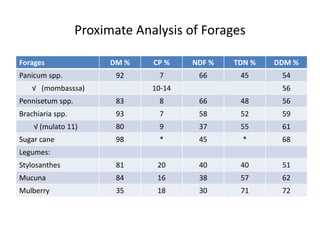
Proximate Analysis of Forages
Forages DM % CP % NDF % TDN % DDM %
Panicum spp. 92 7 66 45 54
√ (mombasssa) 10-14 56
Pennisetum spp. 83 8 66 48 56
Brachiaria spp. 93 7 58 52 59
√ (mulato 11) 80 9 37 55 61
Sugar cane 98 * 45 * 68
Legumes:
Stylosanthes 81 20 40 40 51
Mucuna 84 16 38 57 62
Mulberry 35 18 30 71 72
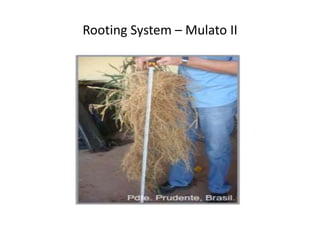
Rooting System – Mulato II
Considerations for Feeding Whole Sugarcane
• Correct supplementation is the key to animal
productivity on sugarcane. The principles are based
on:
āˆ’ satisfying the need for rumen microbes for
fermentable nitrogen, trace minerals and
vitamins and the physical attributes of an
efficient rumen ecosystem (small amount of
fermentable fibre)
āˆ’ feeding by-pass protein.
Conclusion
• Fodder banks can provide high protein , high energy
forage supplement for ruminant livestock. They are
readily adaptable to the need and circumstances to
small and medium sized livestock farms.
• The methodology to the establishment of fodder
banks is not universal and will depend on the ecology
of the area, topography and adaptability of the
component species, and the need for certain amount
of special considerations, as the need arise.

CSA Symposium - Byron Lawrence - Day 2 Session 1B

  • 1.
    Considerations for theSuccessful Establishment of Fodder Banks as a Source of Crude Protein and Energy for Ruminant Production B. H. Lawrence Jamaica Dairy Development Board
  • 2.
    Introduction • Ruminant performanceconstrained by poor quality in the dry season • Dry season duration in Jamaica – 8 mth or more • Outcome – poor quality forage: CP and Energy declining below levels needed to maintain efficient rumen function – poor nutrition • Traditional response of livestock farmers • More practical options – establishment of fodder bank • Fodder Bank – defined – Cultivation of nutrient dense fodder species to augment fodder availability under conditions of drought. • Factors determining spp. incorporation into fodder bank - biomass yield; CP content: Energy content; adaptability to farming system • Preferred spp. – Legumes (CP): Mulberry, Gliricidia, Stylosanthes – Energy : Pennisetum spp., Panicum spp., Brachiaria spp., Sugar cane
  • 3.
    Establishment • Land Preparation –Fodder banks are valuable crops that support productive farming system – managed intensively. – Thorough site preparation should be done – Use method practiced locally for other high valued crops – Objective being to have selected area completely devoid of weeds – As with all crop planting activities fodder bank activities should coincide with the season when precipitation is at its highest.
  • 4.
    Planting Material • Selectionof spp. – Characteristics of spp. that make excellent fodder bank components. a. Establish readily b. Grow fast c. Outcompete weeds d. Produce high quality fodder e. Remain productive during dry season f. Survive on poor sites (soil)
  • 5.
    Planting Material (cont’d.) •Direct Seeding /Cuttings - Direct seeding is usually required for fodder bank establishment. - Where necessary seeds maybe treated to enhance germination. - Use sowing method that is locally applicable for similar type of seeds - Certain spp. will require cuttings, e.g. Erythrina, Mulberry, Gliricidia, and the high biomass content species (Pennisetum, Sugar cane).
  • 6.
    Spacing and Design •To maximize dry season production, fodder banks should be dense, nearly pure stands – rationale. • Choice of spacing depends on management objectives • Total biomass yield increase at higher densities • Closer spacing maximizes fodder production but may restrict access for harvesting difficult. • Row establishment should conform to site geography. • Fencing is prerequisite to successful management of a fodder bank • Size of the fodder bank
  • 7.
    Size of theFodder Bank and Forage Requirements This will be determined by the following: • The type and number of animals targeted (species, age, sex female vs. male, • The objective of production (dairy vs. meat, weight vs. maintenance etc.), • Climate and environmental conditions, • Farm type and size, • Availability of existing forage resources in terms of quantity and quality at different seasons, • The type of feed supplement proposed, with estimates of its yield and quality. * These are details that need to be known before undertaking efforts to establish fodder banks.
  • 8.
    Management • Age atfirst harvest – Should be delayed until approx. 15 mth. – Actual age : function of environmental cond. and bank growth, – Biomass production and long-term production increase when first harvest is delayed. • Grazing āˆ’ Not usually recommended – loss and wastage of forage material.
  • 9.
    Management (contd.) • Cutand Carry āˆ’ Most fodder banks are manged through a cut and carry system, āˆ’ Decreases fodder waste, Important management considerations for this system: āˆ’ Cutting height, āˆ’ Cutting frequency, āˆ’ Dry season management.
  • 10.
    Fertilizer Application • Fodderbanks are long term crops that must be maintained to continue high productivity, hence the need for fertilizer application.
  • 11.
    Proximate Analysis ofForages Forages DM % CP % NDF % TDN % DDM % Panicum spp. 92 7 66 45 54 √ (mombasssa) 10-14 56 Pennisetum spp. 83 8 66 48 56 Brachiaria spp. 93 7 58 52 59 √ (mulato 11) 80 9 37 55 61 Sugar cane 98 * 45 * 68 Legumes: Stylosanthes 81 20 40 40 51 Mucuna 84 16 38 57 62 Mulberry 35 18 30 71 72
  • 12.
  • 13.
    Considerations for FeedingWhole Sugarcane • Correct supplementation is the key to animal productivity on sugarcane. The principles are based on: āˆ’ satisfying the need for rumen microbes for fermentable nitrogen, trace minerals and vitamins and the physical attributes of an efficient rumen ecosystem (small amount of fermentable fibre) āˆ’ feeding by-pass protein.
  • 14.
    Conclusion • Fodder bankscan provide high protein , high energy forage supplement for ruminant livestock. They are readily adaptable to the need and circumstances to small and medium sized livestock farms. • The methodology to the establishment of fodder banks is not universal and will depend on the ecology of the area, topography and adaptability of the component species, and the need for certain amount of special considerations, as the need arise.