AQUASOMES
Presented by
Arabinda Changmai
M. Pharm 2nd sem
Department of pharmacy
Assam downtown university
CONTENT
Introduction
Properties
Method of preparation
Preparation of core
Coating of core
Immobilization of drug molecule.
Principle of self assembly
Interaction between charged group.
Hydrogen bonding and dehydration effect.
Structural stability.
Characterization
Characterization of ceramic core
Characterization of coated core
Characterization of drug-loaded aquasomes
Reference
Department of pharmacy, ADTU
INTRODUCTION
• It was first developed by NIR KOSSOVSKY.
• These are nanoparticulate carrier systems with three layered self
assembled structures
• These comprises of central solid nanocrystalline core coated with
polyhydroxy oligomers onto which biochemically active molecules are
adsorbed.
• Aquasomes are spherical 60-300nm particles used for drug and antigen
delivery.
• Aquasomes are also called as “bodies of water” and their water like
properties protect and preserve fragile biological molecules.
• It is a successful carrier system for bioactive molecules like peptide,
protein, hormones, antigens and genes to specific sites that is for targeting
because of its conformational integrity as well as high degree of surface
exposure.
Department of pharmacy, ADTU
PROPERTIES
• Aquasomes water like preserving the conformational Integrity and bio
chemical stability of bio-actives.
• Aquasomes due to their size and structure stability, avoid clearance by
reticuloendothelial system or degradation by other environmental
challenges .
• Aquasomes possess large size and active surface area.
Department of pharmacy, ADTU
• In general these aquasomes are assemblies of simple polymers, complex
lipid mixtures
• As these are solid or glassy particles dispersed in an aqueous
environment, they exhibit the physical properties of colloids and their
mechanism of action is controlled by their surface chemistry.
• Aquasomes deliver their contents through a combination of specific
targeting, slow and sustained release process
Department of pharmacy, ADTU
METHOD OF PREPARATION OF
AQUASOMES
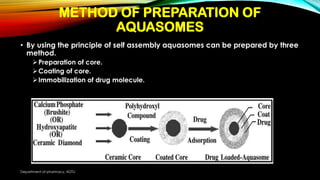
• By using the principle of self assembly aquasomes can be prepared by three
method.
Preparation of core.
Coating of core.
Immobilization of drug molecule.
Department of pharmacy, ADTU
Preparation of core
This stage mainly depends on
The selection of material for core.
Its physical chemical properties
This can be fabricated by the
Sonication
Colloidal precipitation
Plasma condensation
For the core material ceramic material is widely used ,as they are structurally
the most regular material known.
Two ceramic cores that are most often used are diamond and calcium
phosphate.
Department of pharmacy, ADTU
Carbohydrate coating
o The second step involves coating by carbohydrate on the surface of
ceramic cores.
o There are number of processes to enable the carbohydrate (polyhydroxy
oligomers) coating to adsorb epitaxially on to the surface of the Nano
crystalline ceramic cores.
o The coating is carried out by the addition of carbohydrate into an aqueous
dispersion of the cores under sonication.
o These are then subjected to lyophilization to promote an irreversible
adsorption of carbohydrates onto the ceramic surface.
o The unadsorbed carbohydrate is removed by centrifugation or stir cell ultra-
filtration.
o The commonly used coating materials are cellobiose, pyridoxal-5-
phosphate, sucrose, trihalose, citrate.
Department of pharmacy, ADTU
Immobilization of drug
• The surface modified Nano crystalline core provide the solid phase for
subsequent non denaturing self assembly for a broad range of biological
active molecule.
• The drug is loaded to the coated particles by partial adsorption.
• A solution of known concentration of drug is prepared in a suitable pH buffer,
and coated particles are dispersed into it.
• The dispersion is then either kept overnight at low temperature for drug
loading or lyophilized after some time so as to obtain the drug-loaded
formulation (i.e., aquasomes).
Department of pharmacy, ADTU
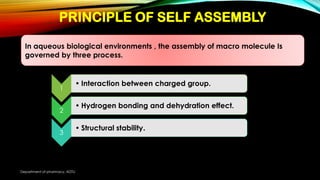
PRINCIPLE OF SELF ASSEMBLY
1
• Interaction between charged group.
2
• Hydrogen bonding and dehydration effect.
3
• Structural stability.
In aqueous biological environments , the assembly of macro molecule Is
governed by three process.
Department of pharmacy, ADTU
• Most of the Biological product are charged due to intrinsic chemical group
or absorbed ion from the biological environment.
• Interaction of charged group such as amino, carbonyl, sulphate, phosphate
groups facilitate self assembling.
• Example of ion pairs -carboxylated or phosphate group bound to ionized
arginine or lysine side chain of protein.
Interaction between charged group.
1
Department of pharmacy, ADTU
Hydrogen bond are formed between hydrogen atom attached to an
electronegative donor atom (Ex oxygen ,Nitrogen,) and an electronegative
or basic acceptor (Ex carbonyl oxygen).
Molecules forming hydrogen bonds are hydrophilic, and this confers a
significant degree of organization to the surrounding water molecules.
In the case of hydrophobic molecules, which do not form hydrogen bonds,
their tendency to repel water helps to organize the moiety to surrounding
environment.
The organized water decreases level of entropy and is thermodynamically
unfavorable, molecules dehydrate and get self-assembled.
2
Hydrogen bonding and dehydration effect.
Department of pharmacy, ADTU
 The structural stability of Protein in the biological environment is
determined by the interaction between charged groups and hydrogen
bond largely external to the molecule and vander walls forces largely
internal to the molecule.
 These are responsible for hardness and softness of molecule and the
maintenance of internal secondary structures, provide sufficient softness,
and allow maintenance of conformation during self-assembly.
3
Structural stability.
Department of pharmacy, ADTU
Characterization of ceramic core
Size distribution:
For morphological characterization and size distribution analysis,
scanning electron microscopy (SEM) and transmission electron
microscopy (TEM) are generally used.
Core, coated core, as well as drug-loaded aquasomes are analyzed
by these techniques.
Mean particle size and zeta potential of the particles can also be
determined by using photon correlation spectroscopy
CHARACTERIZATION
Department of pharmacy, ADTU
 Structural analysis:
1. FT-IR spectroscopy can be used for structural analysis. Using the
potassium bromide sample disk method, the core as well as the
coated core can be analyzed by recording their IR spectra in the
wave number range 4000-400 cm-1;
2. The characteristic peaks observed are then matched with reference
peaks. Identification of sugar and drug loaded over the ceramic
core can also be confirmed by FT-IR analysis of the sample.
 Crystallinity:
The prepared ceramic core can be analyzed for its crystalline or
amorphous behavior using X-ray diffraction. In this technique, the X-ray
diffraction pattern of the sample is compared with the standard
diffractogram, based on which the interpretations are made.
Department of pharmacy, ADTU
Characterization of coated core
 Concanavalin A-induced aggregation method (determines the amount
of sugar coated over core) or
 Anthrone method (Determines the residual sugar unbound or residual
sugar remaining after coating).
 Furthermore, the adsorption of sugar over the core can also be
confirmed by measurement of zeta potential
 Carbohydrate coating
 Coating of sugar over the ceramic core can be confirmed by
Department of pharmacy, ADTU
Characterization of drug-loaded aquasomes
 Drug payload
• The drug loading can be determined by measuring the drug remaining in
the supernatant liquid after loading which can be estimated by any
suitable method of analysis.
 In vitro drug release studies
 The in vitro release kinetics of the loaded drug is determined to study the
release pattern of drug from the aquasomes by incubating a known
quantity of drug-loaded aquasomes in a buffer of suitable pH at 37 °C with
continuous stirring.
Department of pharmacy, ADTU
APPLICATION
• Aquasomes as red blood cell substitute.
 It can effectively deliver large, complex liable molecule-Hb.
 Hb, can be immobilized at surface of the degradable, carbohydrate
coated diamond particles and than encapsulated in a standard
mixture of phospholipid.
• For viral antigen delivery or vaccine.
 For deliver of the Epstein-Barr virus(EBV).
 Human immune deficiency virus (HIV).
• Delivery of enzymes like DNAase.
• Antigen delivery.
• As oxygen carrier.
• Aquasomes for gene therapy.
• Aquasomes for insulin delivery.
Department of pharmacy, ADTU

Aquasomes

  • 1.
    AQUASOMES Presented by Arabinda Changmai M.Pharm 2nd sem Department of pharmacy Assam downtown university
  • 2.
    CONTENT Introduction Properties Method of preparation Preparationof core Coating of core Immobilization of drug molecule. Principle of self assembly Interaction between charged group. Hydrogen bonding and dehydration effect. Structural stability. Characterization Characterization of ceramic core Characterization of coated core Characterization of drug-loaded aquasomes Reference Department of pharmacy, ADTU
  • 3.
    INTRODUCTION • It wasfirst developed by NIR KOSSOVSKY. • These are nanoparticulate carrier systems with three layered self assembled structures • These comprises of central solid nanocrystalline core coated with polyhydroxy oligomers onto which biochemically active molecules are adsorbed. • Aquasomes are spherical 60-300nm particles used for drug and antigen delivery. • Aquasomes are also called as “bodies of water” and their water like properties protect and preserve fragile biological molecules. • It is a successful carrier system for bioactive molecules like peptide, protein, hormones, antigens and genes to specific sites that is for targeting because of its conformational integrity as well as high degree of surface exposure. Department of pharmacy, ADTU
  • 4.
    PROPERTIES • Aquasomes waterlike preserving the conformational Integrity and bio chemical stability of bio-actives. • Aquasomes due to their size and structure stability, avoid clearance by reticuloendothelial system or degradation by other environmental challenges . • Aquasomes possess large size and active surface area. Department of pharmacy, ADTU
  • 5.
    • In generalthese aquasomes are assemblies of simple polymers, complex lipid mixtures • As these are solid or glassy particles dispersed in an aqueous environment, they exhibit the physical properties of colloids and their mechanism of action is controlled by their surface chemistry. • Aquasomes deliver their contents through a combination of specific targeting, slow and sustained release process Department of pharmacy, ADTU
  • 6.
    METHOD OF PREPARATIONOF AQUASOMES • By using the principle of self assembly aquasomes can be prepared by three method. Preparation of core. Coating of core. Immobilization of drug molecule. Department of pharmacy, ADTU
  • 7.
    Preparation of core Thisstage mainly depends on The selection of material for core. Its physical chemical properties This can be fabricated by the Sonication Colloidal precipitation Plasma condensation For the core material ceramic material is widely used ,as they are structurally the most regular material known. Two ceramic cores that are most often used are diamond and calcium phosphate. Department of pharmacy, ADTU
  • 8.
    Carbohydrate coating o Thesecond step involves coating by carbohydrate on the surface of ceramic cores. o There are number of processes to enable the carbohydrate (polyhydroxy oligomers) coating to adsorb epitaxially on to the surface of the Nano crystalline ceramic cores. o The coating is carried out by the addition of carbohydrate into an aqueous dispersion of the cores under sonication. o These are then subjected to lyophilization to promote an irreversible adsorption of carbohydrates onto the ceramic surface. o The unadsorbed carbohydrate is removed by centrifugation or stir cell ultra- filtration. o The commonly used coating materials are cellobiose, pyridoxal-5- phosphate, sucrose, trihalose, citrate. Department of pharmacy, ADTU
  • 9.
    Immobilization of drug •The surface modified Nano crystalline core provide the solid phase for subsequent non denaturing self assembly for a broad range of biological active molecule. • The drug is loaded to the coated particles by partial adsorption. • A solution of known concentration of drug is prepared in a suitable pH buffer, and coated particles are dispersed into it. • The dispersion is then either kept overnight at low temperature for drug loading or lyophilized after some time so as to obtain the drug-loaded formulation (i.e., aquasomes). Department of pharmacy, ADTU
  • 10.
    PRINCIPLE OF SELFASSEMBLY 1 • Interaction between charged group. 2 • Hydrogen bonding and dehydration effect. 3 • Structural stability. In aqueous biological environments , the assembly of macro molecule Is governed by three process. Department of pharmacy, ADTU
  • 11.
    • Most ofthe Biological product are charged due to intrinsic chemical group or absorbed ion from the biological environment. • Interaction of charged group such as amino, carbonyl, sulphate, phosphate groups facilitate self assembling. • Example of ion pairs -carboxylated or phosphate group bound to ionized arginine or lysine side chain of protein. Interaction between charged group. 1 Department of pharmacy, ADTU
  • 12.
    Hydrogen bond areformed between hydrogen atom attached to an electronegative donor atom (Ex oxygen ,Nitrogen,) and an electronegative or basic acceptor (Ex carbonyl oxygen). Molecules forming hydrogen bonds are hydrophilic, and this confers a significant degree of organization to the surrounding water molecules. In the case of hydrophobic molecules, which do not form hydrogen bonds, their tendency to repel water helps to organize the moiety to surrounding environment. The organized water decreases level of entropy and is thermodynamically unfavorable, molecules dehydrate and get self-assembled. 2 Hydrogen bonding and dehydration effect. Department of pharmacy, ADTU
  • 13.
     The structuralstability of Protein in the biological environment is determined by the interaction between charged groups and hydrogen bond largely external to the molecule and vander walls forces largely internal to the molecule.  These are responsible for hardness and softness of molecule and the maintenance of internal secondary structures, provide sufficient softness, and allow maintenance of conformation during self-assembly. 3 Structural stability. Department of pharmacy, ADTU
  • 14.
    Characterization of ceramiccore Size distribution: For morphological characterization and size distribution analysis, scanning electron microscopy (SEM) and transmission electron microscopy (TEM) are generally used. Core, coated core, as well as drug-loaded aquasomes are analyzed by these techniques. Mean particle size and zeta potential of the particles can also be determined by using photon correlation spectroscopy CHARACTERIZATION Department of pharmacy, ADTU
  • 15.
     Structural analysis: 1.FT-IR spectroscopy can be used for structural analysis. Using the potassium bromide sample disk method, the core as well as the coated core can be analyzed by recording their IR spectra in the wave number range 4000-400 cm-1; 2. The characteristic peaks observed are then matched with reference peaks. Identification of sugar and drug loaded over the ceramic core can also be confirmed by FT-IR analysis of the sample.  Crystallinity: The prepared ceramic core can be analyzed for its crystalline or amorphous behavior using X-ray diffraction. In this technique, the X-ray diffraction pattern of the sample is compared with the standard diffractogram, based on which the interpretations are made. Department of pharmacy, ADTU
  • 16.
    Characterization of coatedcore  Concanavalin A-induced aggregation method (determines the amount of sugar coated over core) or  Anthrone method (Determines the residual sugar unbound or residual sugar remaining after coating).  Furthermore, the adsorption of sugar over the core can also be confirmed by measurement of zeta potential  Carbohydrate coating  Coating of sugar over the ceramic core can be confirmed by Department of pharmacy, ADTU
  • 17.
    Characterization of drug-loadedaquasomes  Drug payload • The drug loading can be determined by measuring the drug remaining in the supernatant liquid after loading which can be estimated by any suitable method of analysis.  In vitro drug release studies  The in vitro release kinetics of the loaded drug is determined to study the release pattern of drug from the aquasomes by incubating a known quantity of drug-loaded aquasomes in a buffer of suitable pH at 37 °C with continuous stirring. Department of pharmacy, ADTU
  • 18.
    APPLICATION • Aquasomes asred blood cell substitute.  It can effectively deliver large, complex liable molecule-Hb.  Hb, can be immobilized at surface of the degradable, carbohydrate coated diamond particles and than encapsulated in a standard mixture of phospholipid. • For viral antigen delivery or vaccine.  For deliver of the Epstein-Barr virus(EBV).  Human immune deficiency virus (HIV). • Delivery of enzymes like DNAase. • Antigen delivery. • As oxygen carrier. • Aquasomes for gene therapy. • Aquasomes for insulin delivery. Department of pharmacy, ADTU