Presented By - Payal Dnyaneshwar Borawake.
M. Pharm SEM-II
Subject – Molecular Pharmaceutics.
PDEA’s S.G.R.S. College Of Pharmacy , Saswad.
1
CONTENTS
Introduction
Rationale for developing aquasomes
Principle of self assembly
Method of preparation
Characterization of aquasomes
Applications
References
2
INTRODUCTION
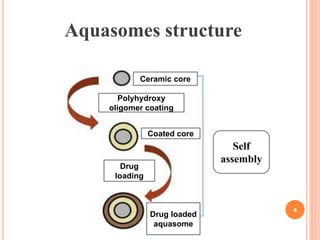
Aquasomes are self assembled three
layered nanostructures.
It consist of core on which carbohydrate
coat is present and then drug loaded on
this coated core.
They are like ‘Bodies of water’.
Their water like properties help to protect
and preserve fragile biological molecules.
3
Ceramic core
Polyhydroxy
oligomer coating
Coated core
Drug
loading
Drug loaded
aquasome
Self
assembly
Aquasomes structure
4
RATIONALE FOR DEVELOPING AQUASOMES
Carriers like prodrugs, macromolecules,
liposomes are prone to biophysical constraints
(UV rays, heat or dehydration).
 This brings destructive interaction between drug
and carrier and causes limitation in drug delivery
system.
In such cases, aquasomes are promising.
When drugs incorporated in aquasomes with
natural stabilizers (sugars ,polyols), molecular
conformation and thus molecule is preserved.
5
PRINCIPLE OF SELF-ASSEMBLY
In aqueous biological environment assembly of
macromolecules is by 3 physico-chemical
process :
They are
i) Interaction of charged groups
ii) Hydrogen bonding and dehydration effect
iii) Structural stability
6
METHOD OF PREPARATION
 By using principle of self assembly, aquasomes
are prepared in 3 steps :
1. Preparation of core
2. Coating of core with carbohydrate
3. Immobilization of drug molecule
 Aquasome is aqueous colloid consist of small
solids formed from few atoms clustered in solid
crystal to which glassy carbohydrates are
coated.
7
METHOD OF PREPARATION
Carbohydrate coated core act as non-
denaturing solid phase and further
subsequent attachment of active drug is
there.
Three layered solid phase of colloid
aquasome is self assembling and maintained
through both ionic, non-covalent bonds,
vander-waals force and entropic forces. 8
PREPARATION OF CORE
 First step of fabrication of ceramic core.
 Process depends on selection of material for core.
 Ceramic cores can be fabricated by
- Colloidal precipitation and sonication
- Inverted magnetron sputtering
- Plasma condensation
 Ceramic is most widely used material for core due to
- more regular structure, crystalline nature
- high degree of order, so high surface energy &
this favours binding of polyhydroxy oligomeric
surface film.
9
PREPARATION OF CORE
 Two ceramic cores that are often used are diamond
and calcium phosphate.
Synthesis of nanocrystalline tin oxide core:
- 3 inches diameter target of high purity tin is sputtered
in high pressure gas mixture of argon and oxygen.
- In gas phase, ultrafine particles are formed.
- Particles collected on copper tubes cooled to 77oK
with flowing nitrogen.
- Direct current reactive magnetron sputtering method
used for synthesis. 10
PREPARATION OF CORE
 Self assembled nanocrystalline brushite (calcium
phosphate dihydrate)
This core prepared by colloidal precipitation and
sonication by reacting solution of disodium hydrogen
phosphate and calcium chloride.
 Features of various cores:
 Crystalline
 When introduced into synthetic process, measures
between 50-150 nm
 Show clean and reactive surfaces
11
COATING OF CORE WITH CARBOHYDRATE
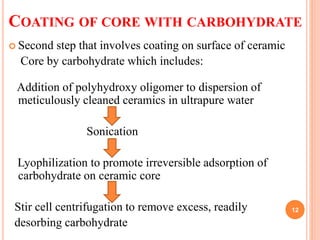
 Second step that involves coating on surface of ceramic
Core by carbohydrate which includes:
Addition of polyhydroxy oligomer to dispersion of
meticulously cleaned ceramics in ultrapure water
Sonication
Lyophilization to promote irreversible adsorption of
carbohydrate on ceramic core
Stir cell centrifugation to remove excess, readily
desorbing carbohydrate
12
COATING OF CORE WITH CARBOHYDRATE
 Commonly uesd material for coating includes cellobiose,
citrate, pyridoxal-5-phosphate, sucrose, trehalose.
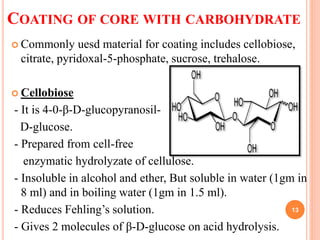
 Cellobiose
- It is 4-0-β-D-glucopyranosil-
D-glucose.
- Prepared from cell-free
enzymatic hydrolyzate of cellulose.
- Insoluble in alcohol and ether, But soluble in water (1gm in
8 ml) and in boiling water (1gm in 1.5 ml).
- Reduces Fehling’s solution.
- Gives 2 molecules of β-D-glucose on acid hydrolysis.
13
COATING OF CORE WITH CARBOHYDRATE
 Pyridoxal-5-phosphate
- Prepared by action of phosphorous
oxychloride on pyridoxal in
aqueous solution and by phosphorylation of
pyridoxamine with
100% H3PO4 followed by oxidation.
- It is colourless in acid solution and bright yellow in
alkaline solution.
- On oxidation with Hydrogen peroxide in alkaline
solution gives [(2-methyl-3,4-dihydroxy-5-
pyridyl)methyl] phosphoric acid.
- It gives negative 2,6-dichloroquinone chlorimide test.
14
COATING OF CORE WITH CARBOHYDRATE
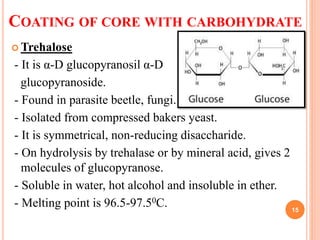
 Trehalose
- It is α-D glucopyranosil α-D
glucopyranoside.
- Found in parasite beetle, fungi.
- Isolated from compressed bakers yeast.
- It is symmetrical, non-reducing disaccharide.
- On hydrolysis by trehalase or by mineral acid, gives 2
molecules of glucopyranose.
- Soluble in water, hot alcohol and insoluble in ether.
- Melting point is 96.5-97.50C. 15
IMMOBILIZATION OF DRUGS
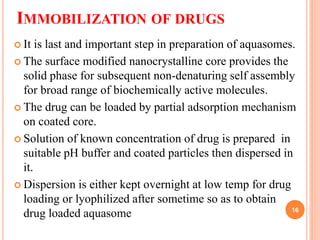
 It is last and important step in preparation of aquasomes.
 The surface modified nanocrystalline core provides the
solid phase for subsequent non-denaturing self assembly
for broad range of biochemically active molecules.
 The drug can be loaded by partial adsorption mechanism
on coated core.
 Solution of known concentration of drug is prepared in
suitable pH buffer and coated particles then dispersed in
it.
 Dispersion is either kept overnight at low temp for drug
loading or lyophilized after sometime so as to obtain
drug loaded aquasome 16
CHARACTERIZATION
 Characterization of prepared aquasomes done at 3
steps.
1) Characterization of ceramic core
2) Characterization of coated core
3) Characterization of drug loaded aquasome
17
CHARACTERIZATION OF CERAMIC CORE
 Size distribution :
- For morphological characterization, size distribution :
Scanning Electron Microscopy(SEM) and Transmission
Electron Microscopy(TEM) used.
- Mean particle size & zeta potential : Determined using
Photon Correlation Spectroscopy.
 Crystallinity :
- Ceramic core analyzed for crystalline/amorphous nature
by using X-ray diffraction method.
- X-ray diffraction pattern of sample is compared with
standard diffractogram and then interpretations are done.
18
CHARACTERIZATION OF CERAMIC CORE
 Structural analysis :
- FT-IR Spectroscopy used for structural analysis.
- Potassium Bromide sample disk method can be used.
- Core as well as coated core analyzed by recording
their IR spectra in range of 4000-400 cm-1 .
- Obtained peaks are then matched with reference
peaks.
- Identification of sugar and drug loaded core also
confirmed by FT-IR analysis of sample.
19
CHARACTERIZATION OF
CARBOHYDRATE COATED CORE
 Coating of sugar over ceramic core confirmed by :
 Concanavalin A-induced aggregation method:
(Determines amount of sugar coated on core).
 Anthrone method:
(Determines residual sugar unbound or remaining
after coating).
 Zeta Potential measurement:
(Confirms adsorption of sugar over core).
20
CHARACTERIZATION OF DRUG LOADED AQUASOME
 Drug payload:
- Drug loading determined by measuring the drug remaining in
the supernatant liquid after loading which can be estimated by
any suitable method.
 In-vitro Drug release studies:
- The In-vitro Release kinetics of loaded drug is determined to
study release pattern of aquasome.
- In this known quantity of drug loaded aquasome is incubated
in buffer of suitable pH at 370C with continuous stirring.
- Samples withdrawn periodically and centrifuged at high
speed for certain time & equal volume of media replaced.
- Supernatants then analyzed for amount of drug release .
21
APPLICATIONS
 As a red blood cell substitute
 For viral antigen delivery or vaccine
 For insulin delivery
 For efficient delivery of enzymes like DNAse
 For efficient delivery of genetic material ,
pigments/dyes/cosmetics. 22
APPLICATION OF AQUASOME AS A
RED BLOOD CELL SUBSTITUTE
 Effectively delivers large, complex & labile molecule,
Haemoglobin(Hb).
 Hb can be immobilized at surface of degradable
carbohydrate coated diamond particles and then
encapsulated in standard mixture of phospholipids.
 By incorporating in aquasome carrier, toxicity of Hb is
reduced and thus biological activity is preserved.
 Hb concentration of 80% can achieved and it delivers
oxygen in non-linear manner like natural RBCs.
23
REFERENCES
 Advances in controlled & novel drug delivery by
N.K.Jain .
 Pharmaceutical product development by N.K.Jain.
 www.wikipedia.com
 www.slideshare.net
24
25

Aquasomes

  • 1.
    Presented By -Payal Dnyaneshwar Borawake. M. Pharm SEM-II Subject – Molecular Pharmaceutics. PDEA’s S.G.R.S. College Of Pharmacy , Saswad. 1
  • 2.
    CONTENTS Introduction Rationale for developingaquasomes Principle of self assembly Method of preparation Characterization of aquasomes Applications References 2
  • 3.
    INTRODUCTION Aquasomes are selfassembled three layered nanostructures. It consist of core on which carbohydrate coat is present and then drug loaded on this coated core. They are like ‘Bodies of water’. Their water like properties help to protect and preserve fragile biological molecules. 3
  • 4.
    Ceramic core Polyhydroxy oligomer coating Coatedcore Drug loading Drug loaded aquasome Self assembly Aquasomes structure 4
  • 5.
    RATIONALE FOR DEVELOPINGAQUASOMES Carriers like prodrugs, macromolecules, liposomes are prone to biophysical constraints (UV rays, heat or dehydration).  This brings destructive interaction between drug and carrier and causes limitation in drug delivery system. In such cases, aquasomes are promising. When drugs incorporated in aquasomes with natural stabilizers (sugars ,polyols), molecular conformation and thus molecule is preserved. 5
  • 6.
    PRINCIPLE OF SELF-ASSEMBLY Inaqueous biological environment assembly of macromolecules is by 3 physico-chemical process : They are i) Interaction of charged groups ii) Hydrogen bonding and dehydration effect iii) Structural stability 6
  • 7.
    METHOD OF PREPARATION By using principle of self assembly, aquasomes are prepared in 3 steps : 1. Preparation of core 2. Coating of core with carbohydrate 3. Immobilization of drug molecule  Aquasome is aqueous colloid consist of small solids formed from few atoms clustered in solid crystal to which glassy carbohydrates are coated. 7
  • 8.
    METHOD OF PREPARATION Carbohydratecoated core act as non- denaturing solid phase and further subsequent attachment of active drug is there. Three layered solid phase of colloid aquasome is self assembling and maintained through both ionic, non-covalent bonds, vander-waals force and entropic forces. 8
  • 9.
    PREPARATION OF CORE First step of fabrication of ceramic core.  Process depends on selection of material for core.  Ceramic cores can be fabricated by - Colloidal precipitation and sonication - Inverted magnetron sputtering - Plasma condensation  Ceramic is most widely used material for core due to - more regular structure, crystalline nature - high degree of order, so high surface energy & this favours binding of polyhydroxy oligomeric surface film. 9
  • 10.
    PREPARATION OF CORE Two ceramic cores that are often used are diamond and calcium phosphate. Synthesis of nanocrystalline tin oxide core: - 3 inches diameter target of high purity tin is sputtered in high pressure gas mixture of argon and oxygen. - In gas phase, ultrafine particles are formed. - Particles collected on copper tubes cooled to 77oK with flowing nitrogen. - Direct current reactive magnetron sputtering method used for synthesis. 10
  • 11.
    PREPARATION OF CORE Self assembled nanocrystalline brushite (calcium phosphate dihydrate) This core prepared by colloidal precipitation and sonication by reacting solution of disodium hydrogen phosphate and calcium chloride.  Features of various cores:  Crystalline  When introduced into synthetic process, measures between 50-150 nm  Show clean and reactive surfaces 11
  • 12.
    COATING OF COREWITH CARBOHYDRATE  Second step that involves coating on surface of ceramic Core by carbohydrate which includes: Addition of polyhydroxy oligomer to dispersion of meticulously cleaned ceramics in ultrapure water Sonication Lyophilization to promote irreversible adsorption of carbohydrate on ceramic core Stir cell centrifugation to remove excess, readily desorbing carbohydrate 12
  • 13.
    COATING OF COREWITH CARBOHYDRATE  Commonly uesd material for coating includes cellobiose, citrate, pyridoxal-5-phosphate, sucrose, trehalose.  Cellobiose - It is 4-0-β-D-glucopyranosil- D-glucose. - Prepared from cell-free enzymatic hydrolyzate of cellulose. - Insoluble in alcohol and ether, But soluble in water (1gm in 8 ml) and in boiling water (1gm in 1.5 ml). - Reduces Fehling’s solution. - Gives 2 molecules of β-D-glucose on acid hydrolysis. 13
  • 14.
    COATING OF COREWITH CARBOHYDRATE  Pyridoxal-5-phosphate - Prepared by action of phosphorous oxychloride on pyridoxal in aqueous solution and by phosphorylation of pyridoxamine with 100% H3PO4 followed by oxidation. - It is colourless in acid solution and bright yellow in alkaline solution. - On oxidation with Hydrogen peroxide in alkaline solution gives [(2-methyl-3,4-dihydroxy-5- pyridyl)methyl] phosphoric acid. - It gives negative 2,6-dichloroquinone chlorimide test. 14
  • 15.
    COATING OF COREWITH CARBOHYDRATE  Trehalose - It is α-D glucopyranosil α-D glucopyranoside. - Found in parasite beetle, fungi. - Isolated from compressed bakers yeast. - It is symmetrical, non-reducing disaccharide. - On hydrolysis by trehalase or by mineral acid, gives 2 molecules of glucopyranose. - Soluble in water, hot alcohol and insoluble in ether. - Melting point is 96.5-97.50C. 15
  • 16.
    IMMOBILIZATION OF DRUGS It is last and important step in preparation of aquasomes.  The surface modified nanocrystalline core provides the solid phase for subsequent non-denaturing self assembly for broad range of biochemically active molecules.  The drug can be loaded by partial adsorption mechanism on coated core.  Solution of known concentration of drug is prepared in suitable pH buffer and coated particles then dispersed in it.  Dispersion is either kept overnight at low temp for drug loading or lyophilized after sometime so as to obtain drug loaded aquasome 16
  • 17.
    CHARACTERIZATION  Characterization ofprepared aquasomes done at 3 steps. 1) Characterization of ceramic core 2) Characterization of coated core 3) Characterization of drug loaded aquasome 17
  • 18.
    CHARACTERIZATION OF CERAMICCORE  Size distribution : - For morphological characterization, size distribution : Scanning Electron Microscopy(SEM) and Transmission Electron Microscopy(TEM) used. - Mean particle size & zeta potential : Determined using Photon Correlation Spectroscopy.  Crystallinity : - Ceramic core analyzed for crystalline/amorphous nature by using X-ray diffraction method. - X-ray diffraction pattern of sample is compared with standard diffractogram and then interpretations are done. 18
  • 19.
    CHARACTERIZATION OF CERAMICCORE  Structural analysis : - FT-IR Spectroscopy used for structural analysis. - Potassium Bromide sample disk method can be used. - Core as well as coated core analyzed by recording their IR spectra in range of 4000-400 cm-1 . - Obtained peaks are then matched with reference peaks. - Identification of sugar and drug loaded core also confirmed by FT-IR analysis of sample. 19
  • 20.
    CHARACTERIZATION OF CARBOHYDRATE COATEDCORE  Coating of sugar over ceramic core confirmed by :  Concanavalin A-induced aggregation method: (Determines amount of sugar coated on core).  Anthrone method: (Determines residual sugar unbound or remaining after coating).  Zeta Potential measurement: (Confirms adsorption of sugar over core). 20
  • 21.
    CHARACTERIZATION OF DRUGLOADED AQUASOME  Drug payload: - Drug loading determined by measuring the drug remaining in the supernatant liquid after loading which can be estimated by any suitable method.  In-vitro Drug release studies: - The In-vitro Release kinetics of loaded drug is determined to study release pattern of aquasome. - In this known quantity of drug loaded aquasome is incubated in buffer of suitable pH at 370C with continuous stirring. - Samples withdrawn periodically and centrifuged at high speed for certain time & equal volume of media replaced. - Supernatants then analyzed for amount of drug release . 21
  • 22.
    APPLICATIONS  As ared blood cell substitute  For viral antigen delivery or vaccine  For insulin delivery  For efficient delivery of enzymes like DNAse  For efficient delivery of genetic material , pigments/dyes/cosmetics. 22
  • 23.
    APPLICATION OF AQUASOMEAS A RED BLOOD CELL SUBSTITUTE  Effectively delivers large, complex & labile molecule, Haemoglobin(Hb).  Hb can be immobilized at surface of degradable carbohydrate coated diamond particles and then encapsulated in standard mixture of phospholipids.  By incorporating in aquasome carrier, toxicity of Hb is reduced and thus biological activity is preserved.  Hb concentration of 80% can achieved and it delivers oxygen in non-linear manner like natural RBCs. 23
  • 24.
    REFERENCES  Advances incontrolled & novel drug delivery by N.K.Jain .  Pharmaceutical product development by N.K.Jain.  www.wikipedia.com  www.slideshare.net 24
  • 25.