Unit 4: The Skeleton System
Section 5: Articulations & Movement
Anatomy & Physiology
Mrs. DeFord
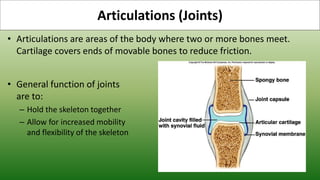
• Articulations are areas of the body where two or more bones meet.
Cartilage covers ends of movable bones to reduce friction.
Articulations (Joints)
• General function of joints
are to:
– Hold the skeleton together
– Allow for increased mobility
and flexibility of the skeleton
• Joints can be classified based on:
– Structure (what material is found in the joint and if there is a joint
cavity present)
– Function (what kind of movement they allow)
Classification of Joints
• The structural classification of joints:
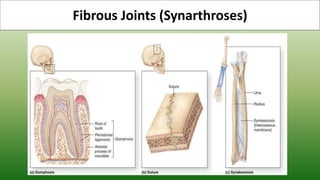
– Fibrous joints
• Bones held together by dense collagen fibers
• Ex: skull sutures
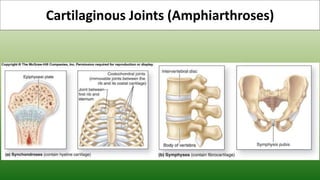
– Cartilaginous joints
• Bones held together by cartilage
• Ex: pelvic girdle, intervertebral discs
– Synovial joints
• Bones held together by ligaments to absorb shock and protect the
bone; bathed in synovial fluid
• Most common
Structural Classification of Joints
• The functional classification of joints:
– Synarthrodial joints
• Fibrous joints
• An immovable joint
• Ex: sutures such as skull sutures, teeth
– Amphiarthrodial joints
• Cartilaginous joints
• A slightly movable joint
• Ex: joints of the ribs with the sternum, pubic symphysis
– Diarthrodial joints
• Synovial joints
• A freely movable joint; most joints that unite bone of appendicular
skeleton
Functional Classification of Joints
Fibrous Joints (Synarthroses)
Cartilaginous Joints (Amphiarthroses)
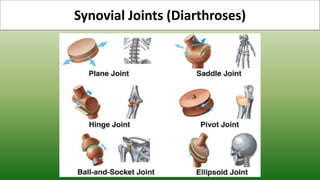
Synovial Joints (Diarthroses)
– Diarthrodial joints (synovial joints; a freely movable joint)
• Hinge joint – allows motion in only one direction, up/down; EX:
elbow, knee
• Pivot joint – the rotation of one bone around another; EX: proximal
end of radius and ulna, neck
• Condyloid joint – allows for all movement except rotation; EX:
fingers and jaw
• Saddle joint – allows back and forth and side/side motion but little
rotation; EX: thumb
• Ball & Socket joint – joint with the widest range of motion; EX: hips
and shoulder
• Gliding (plane) joint – allows bones to glide past one another, or
twist; EX: vertebrae, ankle, wrist
Types of Synovial Joints (Diarthroses)
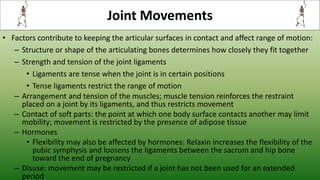
• Factors contribute to keeping the articular surfaces in contact and affect range of motion:
– Structure or shape of the articulating bones determines how closely they fit together
– Strength and tension of the joint ligaments
• Ligaments are tense when the joint is in certain positions
• Tense ligaments restrict the range of motion
– Arrangement and tension of the muscles; muscle tension reinforces the restraint
placed on a joint by its ligaments, and thus restricts movement
– Contact of soft parts: the point at which one body surface contacts another may limit
mobility; movement is restricted by the presence of adipose tissue
– Hormones
• Flexibility may also be affected by hormones: Relaxin increases the flexibility of the
pubic symphysis and loosens the ligaments between the sacrum and hip bone
toward the end of pregnancy
– Disuse: movement may be restricted if a joint has not been used for an extended
period
Joint Movements
• Gliding – bony surfaces of bones
slide or glide over each other
Synovial Joint Movements
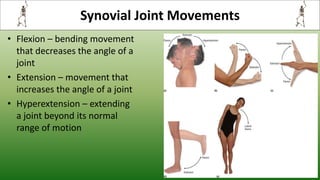
• Flexion – bending movement
that decreases the angle of a
joint
• Extension – movement that
increases the angle of a joint
• Hyperextension – extending
a joint beyond its normal
range of motion
Synovial Joint Movements
• Abduction – movement
away from the midline of
the body
• Adduction – movement
toward the midline of the
body
Synovial Joint Movements
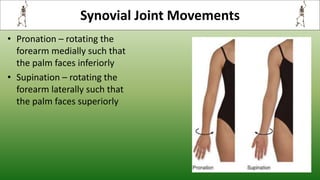
• Pronation – rotating the
forearm medially such that
the palm faces inferiorly
• Supination – rotating the
forearm laterally such that
the palm faces superiorly
Synovial Joint Movements
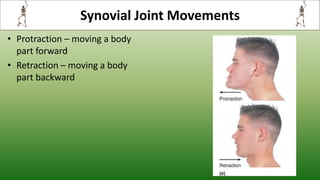
• Protraction – moving a body
part forward
• Retraction – moving a body
part backward
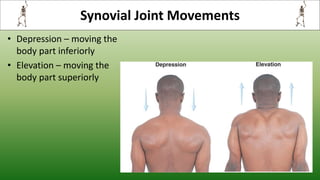
• Depression – moving the
body part inferiorly
• Elevation – moving the
body part superiorly
Synovial Joint Movements
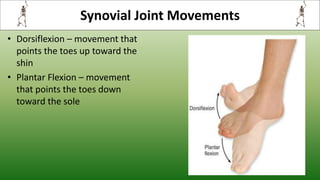
• Dorsiflexion – movement that
points the toes up toward the
shin
• Plantar Flexion – movement
that points the toes down
toward the sole
Synovial Joint Movements
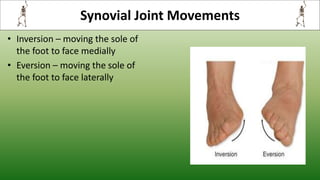
• Inversion – moving the sole of
the foot to face medially
• Eversion – moving the sole of
the foot to face laterally
Synovial Joint Movements
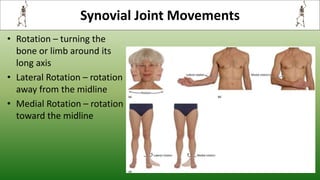
• Rotation – turning the
bone or limb around its
long axis
• Lateral Rotation – rotation
away from the midline
• Medial Rotation – rotation
toward the midline
Synovial Joint Movements
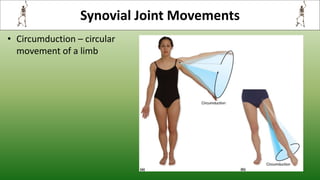
• Circumduction – circular
movement of a limb
Synovial Joint Movements
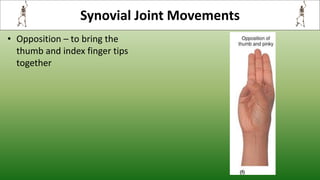
• Opposition – to bring the
thumb and index finger tips
together

APU4.5 Skeleton System (Articulations & Movement)

  • 1.
    Unit 4: TheSkeleton System Section 5: Articulations & Movement Anatomy & Physiology Mrs. DeFord
  • 2.
    • Articulations areareas of the body where two or more bones meet. Cartilage covers ends of movable bones to reduce friction. Articulations (Joints) • General function of joints are to: – Hold the skeleton together – Allow for increased mobility and flexibility of the skeleton
  • 3.
    • Joints canbe classified based on: – Structure (what material is found in the joint and if there is a joint cavity present) – Function (what kind of movement they allow) Classification of Joints
  • 4.
    • The structuralclassification of joints: – Fibrous joints • Bones held together by dense collagen fibers • Ex: skull sutures – Cartilaginous joints • Bones held together by cartilage • Ex: pelvic girdle, intervertebral discs – Synovial joints • Bones held together by ligaments to absorb shock and protect the bone; bathed in synovial fluid • Most common Structural Classification of Joints
  • 5.
    • The functionalclassification of joints: – Synarthrodial joints • Fibrous joints • An immovable joint • Ex: sutures such as skull sutures, teeth – Amphiarthrodial joints • Cartilaginous joints • A slightly movable joint • Ex: joints of the ribs with the sternum, pubic symphysis – Diarthrodial joints • Synovial joints • A freely movable joint; most joints that unite bone of appendicular skeleton Functional Classification of Joints
  • 6.
  • 7.
  • 8.
  • 9.
    – Diarthrodial joints(synovial joints; a freely movable joint) • Hinge joint – allows motion in only one direction, up/down; EX: elbow, knee • Pivot joint – the rotation of one bone around another; EX: proximal end of radius and ulna, neck • Condyloid joint – allows for all movement except rotation; EX: fingers and jaw • Saddle joint – allows back and forth and side/side motion but little rotation; EX: thumb • Ball & Socket joint – joint with the widest range of motion; EX: hips and shoulder • Gliding (plane) joint – allows bones to glide past one another, or twist; EX: vertebrae, ankle, wrist Types of Synovial Joints (Diarthroses)
  • 10.
    • Factors contributeto keeping the articular surfaces in contact and affect range of motion: – Structure or shape of the articulating bones determines how closely they fit together – Strength and tension of the joint ligaments • Ligaments are tense when the joint is in certain positions • Tense ligaments restrict the range of motion – Arrangement and tension of the muscles; muscle tension reinforces the restraint placed on a joint by its ligaments, and thus restricts movement – Contact of soft parts: the point at which one body surface contacts another may limit mobility; movement is restricted by the presence of adipose tissue – Hormones • Flexibility may also be affected by hormones: Relaxin increases the flexibility of the pubic symphysis and loosens the ligaments between the sacrum and hip bone toward the end of pregnancy – Disuse: movement may be restricted if a joint has not been used for an extended period Joint Movements
  • 11.
    • Gliding –bony surfaces of bones slide or glide over each other Synovial Joint Movements
  • 12.
    Synovial Joint Movements •Flexion – bending movement that decreases the angle of a joint • Extension – movement that increases the angle of a joint • Hyperextension – extending a joint beyond its normal range of motion
  • 13.
    Synovial Joint Movements •Abduction – movement away from the midline of the body • Adduction – movement toward the midline of the body
  • 14.
    Synovial Joint Movements •Pronation – rotating the forearm medially such that the palm faces inferiorly • Supination – rotating the forearm laterally such that the palm faces superiorly
  • 15.
    Synovial Joint Movements •Protraction – moving a body part forward • Retraction – moving a body part backward
  • 16.
    • Depression –moving the body part inferiorly • Elevation – moving the body part superiorly Synovial Joint Movements
  • 17.
    • Dorsiflexion –movement that points the toes up toward the shin • Plantar Flexion – movement that points the toes down toward the sole Synovial Joint Movements
  • 18.
    • Inversion –moving the sole of the foot to face medially • Eversion – moving the sole of the foot to face laterally Synovial Joint Movements
  • 19.
    • Rotation –turning the bone or limb around its long axis • Lateral Rotation – rotation away from the midline • Medial Rotation – rotation toward the midline Synovial Joint Movements
  • 20.
    Synovial Joint Movements •Circumduction – circular movement of a limb
  • 21.
    Synovial Joint Movements •Opposition – to bring the thumb and index finger tips together

Editor's Notes

  • #2 What would happen if humans didn't have bones? You'd be floppy like a beanbag. Could you stand up? Forget it. Could you walk? No way. Without bones you'd be just a puddle of skin and guts on the floor.