Advanced Planning & Scheduling


Supply Chain
Management
07.12.2011
Agenda
                                            APS


 1. Introduction

 2. Advanced Planning & Scheduling Systems (APS)

 3. APS in the Pharmaceutical Industry

 4. Conclusion


                                                   2
Agenda
                                            APS


 1. Introduction

 2. Advanced Planning & Scheduling Systems (APS)

 3. APS in the Pharmaceutical Industry

 4. Conclusion


                                                   3
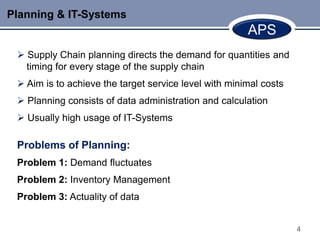
Planning & IT-Systems
                                                       APS
  Supply Chain planning directs the demand for quantities and
   timing for every stage of the supply chain
  Aim is to achieve the target service level with minimal costs
  Planning consists of data administration and calculation
  Usually high usage of IT-Systems

 Problems of Planning:
 Problem 1: Demand fluctuates
 Problem 2: Inventory Management
 Problem 3: Actuality of data


                                                                   4
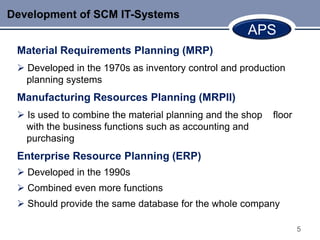
Development of SCM IT-Systems
                                                    APS
 Material Requirements Planning (MRP)
  Developed in the 1970s as inventory control and production
   planning systems
 Manufacturing Resources Planning (MRPII)
  Is used to combine the material planning and the shop   floor
   with the business functions such as accounting and
   purchasing
 Enterprise Resource Planning (ERP)
  Developed in the 1990s
  Combined even more functions
  Should provide the same database for the whole company

                                                                   5
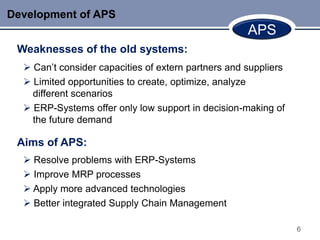
Development of APS
                                                     APS
 Weaknesses of the old systems:
   Can’t consider capacities of extern partners and suppliers
   Limited opportunities to create, optimize, analyze
    different scenarios
   ERP-Systems offer only low support in decision-making of
    the future demand

 Aims of APS:
   Resolve problems with ERP-Systems
   Improve MRP processes
   Apply more advanced technologies
   Better integrated Supply Chain Management

                                                                 6
Agenda
                                          APS


 1. Introduction

 2. Advanced Planning & Scheduling Systems (APS)

 3. APS in the Pharmaceutical Industry

 4. Conclusion


                                                   7
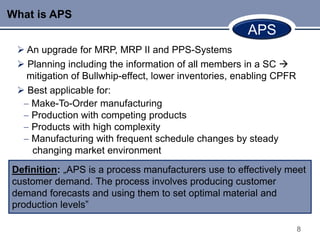
What is APS
                                                      APS
  An upgrade for MRP, MRP II and PPS-Systems
  Planning including the information of all members in a SC 
   mitigation of Bullwhip-effect, lower inventories, enabling CPFR
  Best applicable for:
    Make-To-Order manufacturing
    Production with competing products
    Products with high complexity
    Manufacturing with frequent schedule changes by steady
    changing market environment
Definition: „APS is a process manufacturers use to effectively meet
customer demand. The process involves producing customer
demand forecasts and using them to set optimal material and
production levels”

                                                                     8
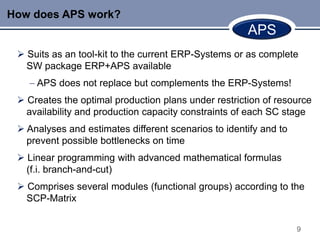
How does APS work?
                                                      APS
  Suits as an tool-kit to the current ERP-Systems or as complete
   SW package ERP+APS available
     APS does not replace but complements the ERP-Systems!
  Creates the optimal production plans under restriction of resource
   availability and production capacity constraints of each SC stage
  Analyses and estimates different scenarios to identify and to
   prevent possible bottlenecks on time
  Linear programming with advanced mathematical formulas
   (f.i. branch-and-cut)
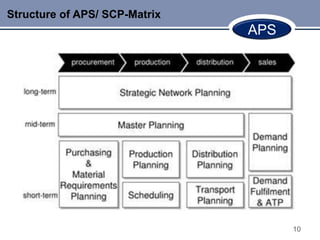
  Comprises several modules (functional groups) according to the
   SCP-Matrix


                                                                   9
Structure of APS/ SCP-Matrix
                               APS


                                     10
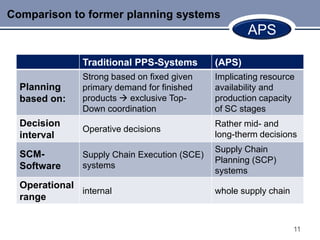
Comparison to former planning systems
                                                      APS

               Traditional PPS-Systems        (APS)
               Strong based on fixed given    Implicating resource
  Planning     primary demand for finished    availability and
  based on:    products  exclusive Top-      production capacity
               Down coordination              of SC stages
  Decision                                    Rather mid- and
               Operative decisions
  interval                                    long-therm decisions
                                              Supply Chain
  SCM-         Supply Chain Execution (SCE)
                                              Planning (SCP)
  Software     systems
                                              systems
  Operational
              internal                        whole supply chain
  range


                                                                   11
APS-Systems on the market
                                                APS
 Selected vendors of APS-Systems with full range of
 APS-modules:

    SAP advanced planner & optimizer

    Wassermann

    DynaSys

    MAPICS APS for SyteLine

    Agilsys APS


                                                      12
Agenda
                                            APS


 1. Introduction

 2. Advanced Planning & Scheduling Systems (APS)

 3. APS in the Pharmaceutical Industry

 4. Conclusion


                                                   13
APS-Systems: Pharmaceutical Industry
                                                         APS
 Overview:
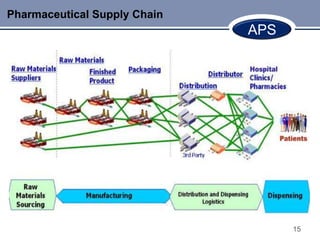
  Three main levels of the supply chain:
    Suppliers: chemical plants, production ingredients
    Producers: manufacturing plants
    Customers: marketing affiliates, wholesalers, e.g
  Distribution Centers located closely to the production sites
  Direct shipment of the finished goods from the Distribution
   Centers to the customers
  Relative insignificance of the distribution system


                                                                  14
Pharmaceutical Supply Chain
                              APS


                                    15
APS-Systems: Pharmaceutical Industry
                                                       APS
 Initial Situation:
  Local organisations instead of integrated company
  Separate local ERP-Systems
  Low data integration / information sharing
  No central supply chain network planning
  Massive manual production planning
  Sub-optimal capacity utilisation
  No central statistical forecasting system
  Absence of common Key Performance Indicators
  No clear vision of the complete demand and supply


                                                             16
APS-Systems: Pharmaceutical Industry
                                                     APS
 Introduction of APS
  Collaborative capacity scheduling and master planning
     improved resource utilisation, reduced inventories,
     better investment planning
  Collaborative demand planning and usage of common data
     proactive demand stabilisation
  Consolidation of IT-Systems and standardization
     reduced IT costs
  Faster information flow within the supply chain
     improved decision-making
  Reduced administrative workload
  Integrated company
                                                            17
Agenda
                                            APS


 1. Introduction

 2. Advanced Planning & Scheduling Systems (APS)

 3. APS in the Pharmaceutical Industry

 4. Conclusion


                                                   18
Benefits of APS
                                                  APS

    Fast reaction to market changes (almost in real-time)
    Simultaneous planning
       activities can be processed concurrently
    Improved throughput and delivery times
    Optimum inventory level
    Improved customer service level
    Cost reduction


                                                             19
Disadvantages of APS
                                                   APS

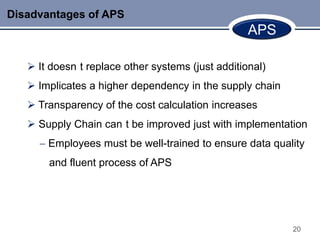
    It doesn t replace other systems (just additional)
    Implicates a higher dependency in the supply chain
    Transparency of the cost calculation increases
    Supply Chain can t be improved just with implementation
       Employees must be well-trained to ensure data quality
       and fluent process of APS


                                                          20
Conclusion
                                                          APS
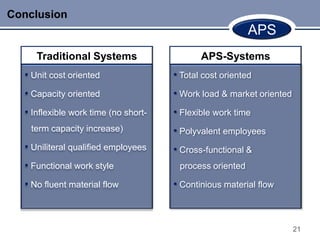
     Traditional Systems                     APS-Systems
  • Unit cost oriented                • Total cost oriented
  • Capacity oriented                 • Work load & market oriented
  • Inflexible work time (no short-   • Flexible work time
   term capacity increase)            • Polyvalent employees
  • Uniliteral qualified employees    • Cross-functional &
  • Functional work style              process oriented

  • No fluent material flow           • Continious material flow


                                                                      21
Thank you for your attention!
Group Discussion
                                                APS

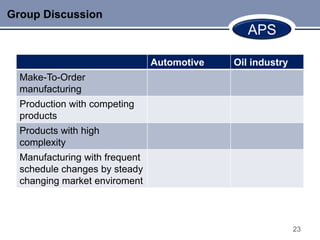
                                Automotive   Oil industry
  Make-To-Order
  manufacturing
  Production with competing
  products
  Products with high
  complexity
  Manufacturing with frequent
  schedule changes by steady
  changing market enviroment


                                                            23

Advanced Planning & Scheduling

  • 1.
    Advanced Planning &Scheduling Supply Chain Management 07.12.2011
  • 2.
    Agenda APS 1. Introduction 2. Advanced Planning & Scheduling Systems (APS) 3. APS in the Pharmaceutical Industry 4. Conclusion 2
  • 3.
    Agenda APS 1. Introduction 2. Advanced Planning & Scheduling Systems (APS) 3. APS in the Pharmaceutical Industry 4. Conclusion 3
  • 4.
    Planning & IT-Systems APS  Supply Chain planning directs the demand for quantities and timing for every stage of the supply chain  Aim is to achieve the target service level with minimal costs  Planning consists of data administration and calculation  Usually high usage of IT-Systems Problems of Planning: Problem 1: Demand fluctuates Problem 2: Inventory Management Problem 3: Actuality of data 4
  • 5.
    Development of SCMIT-Systems APS Material Requirements Planning (MRP)  Developed in the 1970s as inventory control and production planning systems Manufacturing Resources Planning (MRPII)  Is used to combine the material planning and the shop floor with the business functions such as accounting and purchasing Enterprise Resource Planning (ERP)  Developed in the 1990s  Combined even more functions  Should provide the same database for the whole company 5
  • 6.
    Development of APS APS Weaknesses of the old systems:  Can’t consider capacities of extern partners and suppliers  Limited opportunities to create, optimize, analyze different scenarios  ERP-Systems offer only low support in decision-making of the future demand Aims of APS:  Resolve problems with ERP-Systems  Improve MRP processes  Apply more advanced technologies  Better integrated Supply Chain Management 6
  • 7.
    Agenda APS 1. Introduction 2. Advanced Planning & Scheduling Systems (APS) 3. APS in the Pharmaceutical Industry 4. Conclusion 7
  • 8.
    What is APS APS  An upgrade for MRP, MRP II and PPS-Systems  Planning including the information of all members in a SC  mitigation of Bullwhip-effect, lower inventories, enabling CPFR  Best applicable for: Make-To-Order manufacturing Production with competing products Products with high complexity Manufacturing with frequent schedule changes by steady changing market environment Definition: „APS is a process manufacturers use to effectively meet customer demand. The process involves producing customer demand forecasts and using them to set optimal material and production levels” 8
  • 9.
    How does APSwork? APS  Suits as an tool-kit to the current ERP-Systems or as complete SW package ERP+APS available APS does not replace but complements the ERP-Systems!  Creates the optimal production plans under restriction of resource availability and production capacity constraints of each SC stage  Analyses and estimates different scenarios to identify and to prevent possible bottlenecks on time  Linear programming with advanced mathematical formulas (f.i. branch-and-cut)  Comprises several modules (functional groups) according to the SCP-Matrix 9
  • 10.
    Structure of APS/SCP-Matrix APS 10
  • 11.
    Comparison to formerplanning systems APS Traditional PPS-Systems (APS) Strong based on fixed given Implicating resource Planning primary demand for finished availability and based on: products  exclusive Top- production capacity Down coordination of SC stages Decision Rather mid- and Operative decisions interval long-therm decisions Supply Chain SCM- Supply Chain Execution (SCE) Planning (SCP) Software systems systems Operational internal whole supply chain range 11
  • 12.
    APS-Systems on themarket APS Selected vendors of APS-Systems with full range of APS-modules: SAP advanced planner & optimizer Wassermann DynaSys MAPICS APS for SyteLine Agilsys APS 12
  • 13.
    Agenda APS 1. Introduction 2. Advanced Planning & Scheduling Systems (APS) 3. APS in the Pharmaceutical Industry 4. Conclusion 13
  • 14.
    APS-Systems: Pharmaceutical Industry APS Overview:  Three main levels of the supply chain: Suppliers: chemical plants, production ingredients Producers: manufacturing plants Customers: marketing affiliates, wholesalers, e.g  Distribution Centers located closely to the production sites  Direct shipment of the finished goods from the Distribution Centers to the customers  Relative insignificance of the distribution system 14
  • 15.
  • 16.
    APS-Systems: Pharmaceutical Industry APS Initial Situation:  Local organisations instead of integrated company  Separate local ERP-Systems  Low data integration / information sharing  No central supply chain network planning  Massive manual production planning  Sub-optimal capacity utilisation  No central statistical forecasting system  Absence of common Key Performance Indicators  No clear vision of the complete demand and supply 16
  • 17.
    APS-Systems: Pharmaceutical Industry APS Introduction of APS  Collaborative capacity scheduling and master planning improved resource utilisation, reduced inventories, better investment planning  Collaborative demand planning and usage of common data proactive demand stabilisation  Consolidation of IT-Systems and standardization reduced IT costs  Faster information flow within the supply chain improved decision-making  Reduced administrative workload  Integrated company 17
  • 18.
    Agenda APS 1. Introduction 2. Advanced Planning & Scheduling Systems (APS) 3. APS in the Pharmaceutical Industry 4. Conclusion 18
  • 19.
    Benefits of APS APS  Fast reaction to market changes (almost in real-time)  Simultaneous planning activities can be processed concurrently  Improved throughput and delivery times  Optimum inventory level  Improved customer service level  Cost reduction 19
  • 20.
    Disadvantages of APS APS  It doesn t replace other systems (just additional)  Implicates a higher dependency in the supply chain  Transparency of the cost calculation increases  Supply Chain can t be improved just with implementation Employees must be well-trained to ensure data quality and fluent process of APS 20
  • 21.
    Conclusion APS Traditional Systems APS-Systems • Unit cost oriented • Total cost oriented • Capacity oriented • Work load & market oriented • Inflexible work time (no short- • Flexible work time term capacity increase) • Polyvalent employees • Uniliteral qualified employees • Cross-functional & • Functional work style process oriented • No fluent material flow • Continious material flow 21
  • 22.
    Thank you foryour attention!
  • 23.
    Group Discussion APS Automotive Oil industry Make-To-Order manufacturing Production with competing products Products with high complexity Manufacturing with frequent schedule changes by steady changing market enviroment 23