Inventory Management


 Rajendran Ananda Krishnan


      https://www.facebook.com/ialwaysthinkpr
                     ettythings
Inventory Management
Inventory- Any idle resource that could be put to some future use.
Inventory- A stock or store of goods
inventory includes raw material, work-in-process, finished goods and
stores and spares.
Institute of Chartered Accountants of India defines inventory in AS2
as
“Inventories as an assets held
         - For sale in the ordinary course of business
        - In the process of production for such sale
        - In the form of materials and supplies to be consumed in the
         production process or in rendering services.

                       https://www.facebook.com/ialwaysthinkpr
                                      ettythings
Types of inventory

Types of inventory
1. Seasonal Inventory
2. Decoupling inventory
3. Pipe-line Inventory
4. Cyclic Inventory
5. Safety Stock
Others
Raw Materials Inventory
Work in Progress Inventory
Finished Goods Inventory

                     https://www.facebook.com/ialwaysthinkpr
                                    ettythings
Inventory Management and control

Inventory Management involves the “Development and
administration of polices , systems and procedures which will
minimize total costs relative to inventory decisions and related
functions such as customer service requirements ,production
scheduling , purchasing and traffic” .


                 https://www.facebook.com/ialwaysthinkpr
                                ettythings
Inventory control Techniques
1.   Always better control (ABC) classification.
2.   Vital, essential and desirable (VED) classification.
3.   Fast moving, slow moving and non-moving (FSN).
4.   Economic order quantity (EOQ).


                          https://www.facebook.com/ialwaysthinkpr
                                         ettythings
Inventory Cost
    Inventory costs includes ordering cost plus carrying costs.
1.   Ordering Costs
2.   Carrying Costs
    Capital Costs
    Storage Space Costs
     Inventory Service Costs
     Handling-equipment Costs
     Inventory Risk Costs
3.    Out-of-stock Costs or Shortage Cost


                          https://www.facebook.com/ialwaysthinkpr
                                         ettythings
Economic Order Quantity
        EOQ is the optimal order size at which the total annual cost is the
        least.
        It is used to identify a fixed order size that will minimize the sum
        of the inventory carrying cost and ordering cost.

        Assumptions of the basic inventory model
Only one product is involved
Annual demand requirements known
Demand is even throughout the year
Lead time does not vary
Each order is received in a single delivery
There are no quantity discounts


                        https://www.facebook.com/ialwaysthinkpr
                                       ettythings
Economic Order Quantity


  Graphic Presentation of EQQ


     https://www.facebook.com/ialwaysthinkpr
                    ettythings
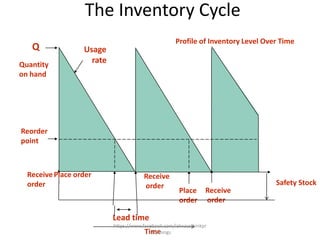
The Inventory Cycle
                                                     Profile of Inventory Level Over Time
   Q              Usage
Quantity
                    rate
on hand


Reorder
point


  Receive Place order                  Receive
  order                                order                                       Safety Stock
                                                      Place      Receive
                                                      order      order

                           Lead time
                           https://www.facebook.com/ialwaysthinkpr
                                        Time
                                          ettythings
Safety Stock
 Safety Stock - Stock that is held in excess of expected demand due
                 to variable demand rate and/or lead time.
 To meet the uncertainty demand , an additional quantity , known as
safety stock is kept

Higher the uncertainty in demand- Higher safety stock


                        https://www.facebook.com/ialwaysthinkpr
                                       ettythings
Safety Stock
      Quantity


                                          Maximum probable demand
                                          during lead time

                                                     Expected demand
                                                     during lead time


ROP

                                                     Safety stock
                               LT                                   Time
                 https://www.facebook.com/ialwaysthinkpr
                                ettythings
Reorder Point
Reorder Point - When the quantity on hand of an item drops to pre
determined amount, the item is reordered

Determinants of the Reorder Point

The rate of demand
The lead time
Demand and/or lead time variability
Stock out risk (safety stock)


                        https://www.facebook.com/ialwaysthinkpr
                                       ettythings
Quantity Discounts
• Quantity Discounts are price reductions for large orders offered to
  customers to induce them to buy in large quantities
Example- A Chicago surgical supply company publishes the price list
  for gauge strips

  Order Quantity             Price per box
  1 to 44                    $ 2.00
  45 t0 69                   $1.70
  70 or more                 $ 1.40


The buyer’s goal with quantity discounts is to select the order quantity
  that will minimize
TC= Carrying cost + Ordering cost+ Purchasing cost
                       https://www.facebook.com/ialwaysthinkpr
                                  ettythings
Key Inventory Terms

• Lead time: time interval between ordering and receiving the
  order
• Holding (carrying) costs: cost to carry an item in inventory for
  a length of time, usually a year
• Ordering costs: costs of ordering and receiving inventory
• Shortage costs: costs when demand exceeds supply


                      https://www.facebook.com/ialwaysthinkpr
                                     ettythings

Inventory management

  • 1.
    Inventory Management RajendranAnanda Krishnan https://www.facebook.com/ialwaysthinkpr ettythings
  • 2.
    Inventory Management Inventory- Anyidle resource that could be put to some future use. Inventory- A stock or store of goods inventory includes raw material, work-in-process, finished goods and stores and spares. Institute of Chartered Accountants of India defines inventory in AS2 as “Inventories as an assets held - For sale in the ordinary course of business - In the process of production for such sale - In the form of materials and supplies to be consumed in the production process or in rendering services. https://www.facebook.com/ialwaysthinkpr ettythings
  • 3.
    Types of inventory Typesof inventory 1. Seasonal Inventory 2. Decoupling inventory 3. Pipe-line Inventory 4. Cyclic Inventory 5. Safety Stock Others Raw Materials Inventory Work in Progress Inventory Finished Goods Inventory https://www.facebook.com/ialwaysthinkpr ettythings
  • 4.
    Inventory Management andcontrol Inventory Management involves the “Development and administration of polices , systems and procedures which will minimize total costs relative to inventory decisions and related functions such as customer service requirements ,production scheduling , purchasing and traffic” . https://www.facebook.com/ialwaysthinkpr ettythings
  • 5.
    Inventory control Techniques 1. Always better control (ABC) classification. 2. Vital, essential and desirable (VED) classification. 3. Fast moving, slow moving and non-moving (FSN). 4. Economic order quantity (EOQ). https://www.facebook.com/ialwaysthinkpr ettythings
  • 6.
    Inventory Cost  Inventory costs includes ordering cost plus carrying costs. 1. Ordering Costs 2. Carrying Costs  Capital Costs  Storage Space Costs  Inventory Service Costs  Handling-equipment Costs  Inventory Risk Costs 3. Out-of-stock Costs or Shortage Cost https://www.facebook.com/ialwaysthinkpr ettythings
  • 7.
    Economic Order Quantity EOQ is the optimal order size at which the total annual cost is the least. It is used to identify a fixed order size that will minimize the sum of the inventory carrying cost and ordering cost. Assumptions of the basic inventory model Only one product is involved Annual demand requirements known Demand is even throughout the year Lead time does not vary Each order is received in a single delivery There are no quantity discounts https://www.facebook.com/ialwaysthinkpr ettythings
  • 8.
    Economic Order Quantity Graphic Presentation of EQQ https://www.facebook.com/ialwaysthinkpr ettythings
  • 9.
    The Inventory Cycle Profile of Inventory Level Over Time Q Usage Quantity rate on hand Reorder point Receive Place order Receive order order Safety Stock Place Receive order order Lead time https://www.facebook.com/ialwaysthinkpr Time ettythings
  • 10.
    Safety Stock SafetyStock - Stock that is held in excess of expected demand due to variable demand rate and/or lead time. To meet the uncertainty demand , an additional quantity , known as safety stock is kept Higher the uncertainty in demand- Higher safety stock https://www.facebook.com/ialwaysthinkpr ettythings
  • 11.
    Safety Stock Quantity Maximum probable demand during lead time Expected demand during lead time ROP Safety stock LT Time https://www.facebook.com/ialwaysthinkpr ettythings
  • 12.
    Reorder Point Reorder Point- When the quantity on hand of an item drops to pre determined amount, the item is reordered Determinants of the Reorder Point The rate of demand The lead time Demand and/or lead time variability Stock out risk (safety stock) https://www.facebook.com/ialwaysthinkpr ettythings
  • 13.
    Quantity Discounts • QuantityDiscounts are price reductions for large orders offered to customers to induce them to buy in large quantities Example- A Chicago surgical supply company publishes the price list for gauge strips Order Quantity Price per box 1 to 44 $ 2.00 45 t0 69 $1.70 70 or more $ 1.40 The buyer’s goal with quantity discounts is to select the order quantity that will minimize TC= Carrying cost + Ordering cost+ Purchasing cost https://www.facebook.com/ialwaysthinkpr ettythings
  • 14.
    Key Inventory Terms •Lead time: time interval between ordering and receiving the order • Holding (carrying) costs: cost to carry an item in inventory for a length of time, usually a year • Ordering costs: costs of ordering and receiving inventory • Shortage costs: costs when demand exceeds supply https://www.facebook.com/ialwaysthinkpr ettythings