Responding to Non- 
Responders: 
Managing Escalations 
Colvin & Sugai, 1989 
D
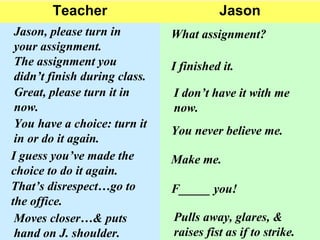
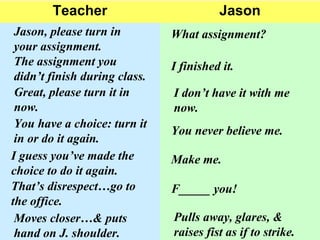
Teacher Jason 
Jason, please turn in 
your assignment. 
What assignment? 
I finished it. 
I don’t have it with me 
now. 
You never believe me. 
F_____ you! 
Pulls away, glares, & 
raises fist as if to strike. 
The assignment you 
didn’t finish during class. 
Great, please turn it in 
now. 
You have a choice: turn it 
in or do it again. 
I guess you’ve made the 
choice to do it again. 
That’s disrespect…go to 
the office. 
Moves closer…& puts 
hand on J. shoulder. 
Make me.
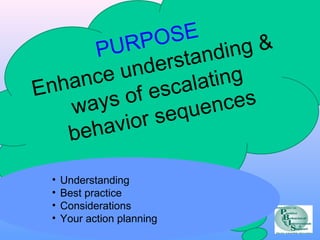
PURPOSE 
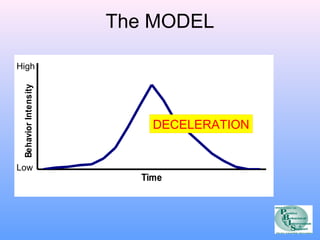
Enhance understanding & 
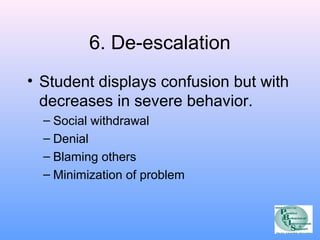
ways of escalating 
behavior sequences 
• Understanding 
• Best practice 
• Considerations 
• Your action planning
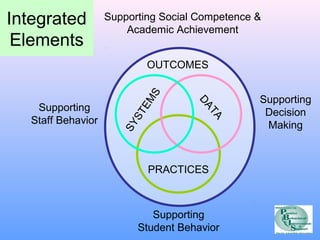
Supporting Social Competence & 
Academic Achievement 
OUTCOMES 
SYSTEMS 
DATA 
PRACTICES 
Supporting 
Staff Behavior 
Supporting 
Student Behavior 
Supporting 
Decision 
Making 
Integrated 
Elements
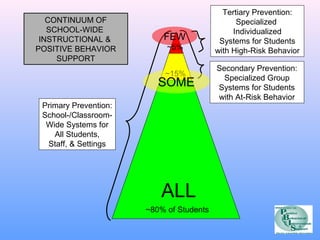
Primary Prevention: 
School-/Classroom- 
Wide Systems for 
All Students, 
Staff, & Settings 
Tertiary Prevention: 
Specialized 
Individualized 
Systems for Students 
with High-Risk Behavior 
Secondary Prevention: 
Specialized Group 
Systems for Students 
with At-Risk Behavior 
FEW 
~5% 
~15% 
SOME 
~80% of Students 
CONTINUUM OF 
SCHOOL-WIDE 
INSTRUCTIONAL & 
POSITIVE BEHAVIOR 
SUPPORT 
ALL
ASSUMPTIONS 
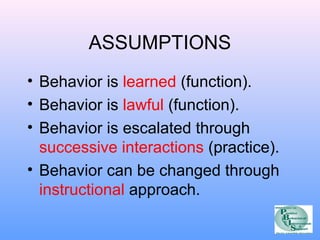
• Behavior is learned (function). 
• Behavior is lawful (function). 
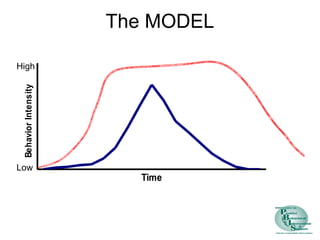
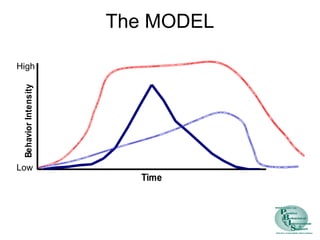
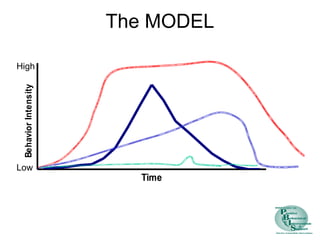
• Behavior is escalated through 
successive interactions (practice). 
• Behavior can be changed through 
instructional approach.
OUTCOMES 
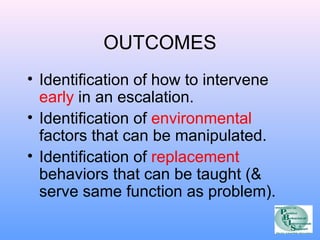
• Identification of how to intervene 
early in an escalation. 
• Identification of environmental 
factors that can be manipulated. 
• Identification of replacement 
behaviors that can be taught (& 
serve same function as problem).
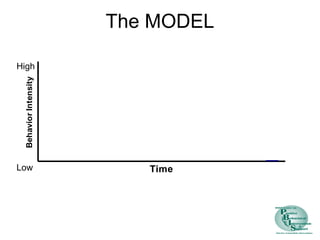
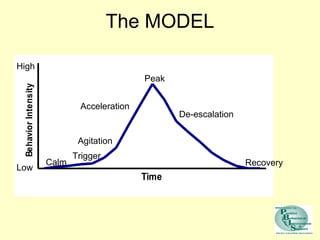
Time 
Behavior Intensity 
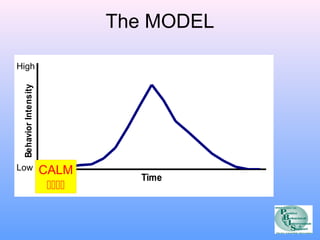
The MODEL 
High 
Low
Time 
Behavior Intensity 
The MODEL 
High 
Low Calm 
Peak 
De-escalation 
Recovery 
Acceleration 
Agitation 
Trigger
Time 
Behavior Intensity 
The MODEL 
High 
Low
Time 
Behavior Intensity 
The MODEL 
High 
Low
Time 
Behavior Intensity 
The MODEL 
High 
Low
Time 
Behavior Intensity 
The MODEL 
High 
Low Calm 
Peak 
De-escalation 
Recovery 
Acceleration 
Agitation 
Trigger
Time 
Behavior Intensity 
The MODEL 
High 
Low CALM 

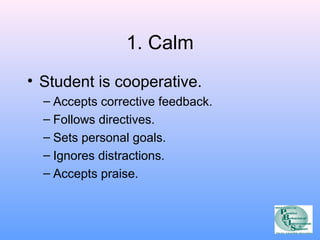
1. Calm 
• Student is cooperative. 
– Accepts corrective feedback. 
– Follows directives. 
– Sets personal goals. 
– Ignores distractions. 
– Accepts praise.
Calm 
• Intervention is focused on prevention. 
– Assess problem behavior 
• Triggers 
• Function 
• Academic & behavioral learning history 
– Arrange for high rates of successful academic & social 
engagements. 
– Use positive reinforcement. 
– Teach social skills. 
• Problem solving 
• Relaxation strategy 
• Self-management 
– Communicate positive expectations.
Time 
Behavior Intensity 
The MODEL 
High 
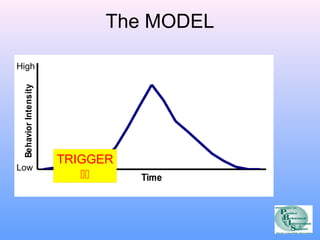
Low TRIGGER 

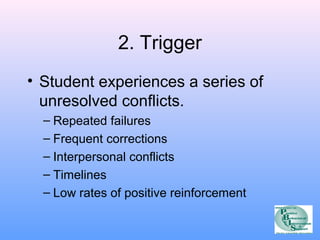
2. Trigger 
• Student experiences a series of 
unresolved conflicts. 
– Repeated failures 
– Frequent corrections 
– Interpersonal conflicts 
– Timelines 
– Low rates of positive reinforcement
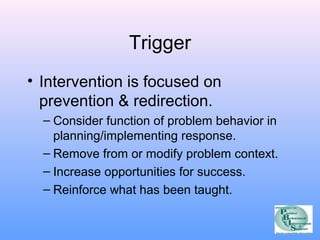
Trigger 
• Intervention is focused on 
prevention & redirection. 
– Consider function of problem behavior in 
planning/implementing response. 
– Remove from or modify problem context. 
– Increase opportunities for success. 
– Reinforce what has been taught.
Time 
Behavior Intensity 
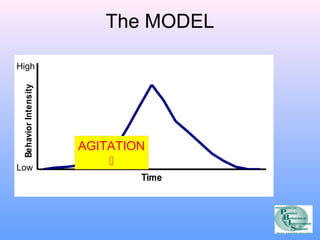
The MODEL 
High 
Low 
AGITATION 

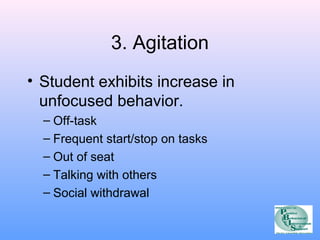
3. Agitation 
• Student exhibits increase in 
unfocused behavior. 
– Off-task 
– Frequent start/stop on tasks 
– Out of seat 
– Talking with others 
– Social withdrawal
Agitation 
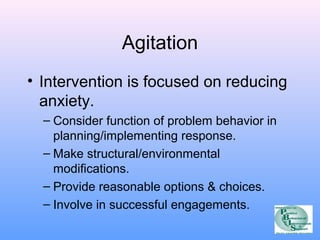
• Intervention is focused on reducing 
anxiety. 
– Consider function of problem behavior in 
planning/implementing response. 
– Make structural/environmental 
modifications. 
– Provide reasonable options & choices. 
– Involve in successful engagements.
Time 
Behavior Intensity 
The MODEL 
High 
Low 
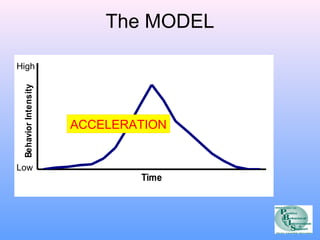
ACCELERATION
4. Acceleration 
• Student displays focused behavior. 
– Provocative 
– High intensity 
– Threatening 
– Personal
Acceleration 
• Intervention is focused on safety. 
– Remember: 
• Escalations & self-control are inversely related. 
• Escalation is likely to run its course.
Acceleration 
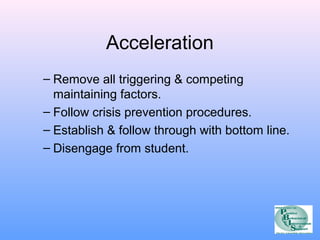
– Remove all triggering & competing 
maintaining factors. 
– Follow crisis prevention procedures. 
– Establish & follow through with bottom line. 
– Disengage from student.
Time 
Behavior Intensity 
The MODEL 
High 
Low 
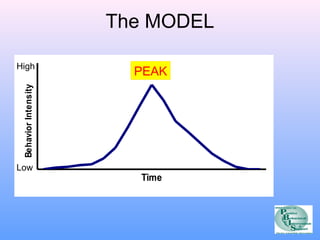
PEAK
5. Peak 
• Student is out of control & displays 
most severe problem behavior. 
– Physical aggression 
– Property destruction 
– Self-injury 
– Escape/social withdrawal 
– Hyperventilation
Peak 
• Intervention is focused on safety. 
– Procedures like acceleration phase, except 
focus is on crisis intervention
Time 
Behavior Intensity 
The MODEL 
High 
Low 
DECELERATION
6. De-escalation 
• Student displays confusion but with 
decreases in severe behavior. 
– Social withdrawal 
– Denial 
– Blaming others 
– Minimization of problem
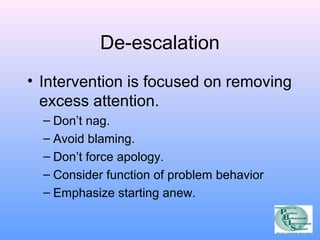
De-escalation 
• Intervention is focused on removing 
excess attention. 
– Don’t nag. 
– Avoid blaming. 
– Don’t force apology. 
– Consider function of problem behavior 
– Emphasize starting anew.
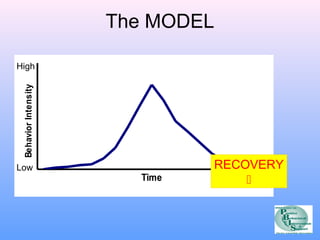
Time 
Behavior Intensity 
The MODEL 
High 
Low RECOVERY 

7. Recovery 
• Student displays eagerness to 
engage in non-engagement 
activities. 
– Attempts to correct problem. 
– Unwillingness to participate in group 
activities. 
– Social withdrawal & sleep.
Recovery 
• Follow through with consequences 
for problem behavior. 
• Positively reinforce any displays of 
appropriate behavior. 
• Intervention is focused on re-establishing 
routines activities.
Recovery 
• Debrief 
– Purpose of debrief is to facilitate transition 
back to program….not further negative 
consequence 
– Debrief follows consequences for problem 
behavior. 
– Goal is to increase more appropriate 
behavior.
Recovery 
• Problem solving example: 
– What did I do? 
– Why did I do it? 
– What could I have done instead? 
– What do I have to do next? 
– Can I do it?
Time 
Behavior Intensity 
The MODEL 
High 
Low Calm 
Peak 
De-escalation 
Recovery 
Acceleration 
Agitation 
Trigger
Teacher Jason 
Jason, please turn in 
your assignment. 
What assignment? 
I finished it. 
I don’t have it with me 
now. 
You never believe me. 
F_____ you! 
Pulls away, glares, & 
raises fist as if to strike. 
The assignment you 
didn’t finish during class. 
Great, please turn it in 
now. 
You have a choice: turn it 
in or do it again. 
I guess you’ve made the 
choice to do it again. 
That’s disrespect…go to 
the office. 
Moves closer…& puts 
hand on J. shoulder. 
Make me.
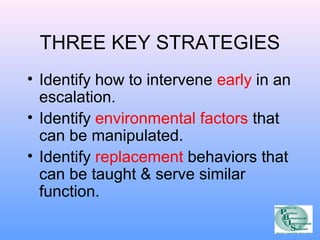
THREE KEY STRATEGIES 
• Identify how to intervene early in an 
escalation. 
• Identify environmental factors that 
can be manipulated. 
• Identify replacement behaviors that 
can be taught & serve similar 
function.
FINAL THOUGHT 
• Geoff Colvin (1989): 
– It is always important to remember that “if 
you inadvertently assist the student to 
escalate, do not be concerned; you will get 
another chance to do it right the next time 
around.”
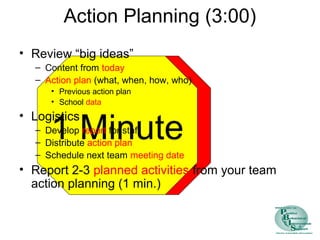
Action Planning (3:00) 
• Review “big ideas” 
– Content from today 
– Action plan (what, when, how, who) 
• Previous Attention 
action plan 
• School data 
1P Mleiansuete 
• Logistics 
– Develop report for staff 
– Distribute action plan 
– Schedule next team meeting date 
• Report 2-3 planned activities from your team 
action planning (1 min.)

Escalation

  • 1.
    Responding to Non- Responders: Managing Escalations Colvin & Sugai, 1989 D
  • 2.
    Teacher Jason Jason,please turn in your assignment. What assignment? I finished it. I don’t have it with me now. You never believe me. F_____ you! Pulls away, glares, & raises fist as if to strike. The assignment you didn’t finish during class. Great, please turn it in now. You have a choice: turn it in or do it again. I guess you’ve made the choice to do it again. That’s disrespect…go to the office. Moves closer…& puts hand on J. shoulder. Make me.
  • 3.
    PURPOSE Enhance understanding& ways of escalating behavior sequences • Understanding • Best practice • Considerations • Your action planning
  • 4.
    Supporting Social Competence& Academic Achievement OUTCOMES SYSTEMS DATA PRACTICES Supporting Staff Behavior Supporting Student Behavior Supporting Decision Making Integrated Elements
  • 5.
    Primary Prevention: School-/Classroom- Wide Systems for All Students, Staff, & Settings Tertiary Prevention: Specialized Individualized Systems for Students with High-Risk Behavior Secondary Prevention: Specialized Group Systems for Students with At-Risk Behavior FEW ~5% ~15% SOME ~80% of Students CONTINUUM OF SCHOOL-WIDE INSTRUCTIONAL & POSITIVE BEHAVIOR SUPPORT ALL
  • 6.
    ASSUMPTIONS • Behavioris learned (function). • Behavior is lawful (function). • Behavior is escalated through successive interactions (practice). • Behavior can be changed through instructional approach.
  • 7.
    OUTCOMES • Identificationof how to intervene early in an escalation. • Identification of environmental factors that can be manipulated. • Identification of replacement behaviors that can be taught (& serve same function as problem).
  • 8.
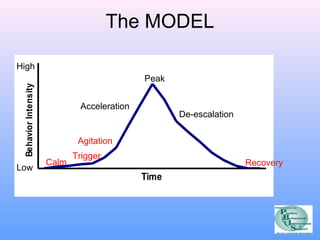
    Time Behavior Intensity The MODEL High Low
  • 9.
    Time Behavior Intensity The MODEL High Low Calm Peak De-escalation Recovery Acceleration Agitation Trigger
  • 10.
    Time Behavior Intensity The MODEL High Low
  • 11.
    Time Behavior Intensity The MODEL High Low
  • 12.
    Time Behavior Intensity The MODEL High Low
  • 13.
    Time Behavior Intensity The MODEL High Low Calm Peak De-escalation Recovery Acceleration Agitation Trigger
  • 14.
    Time Behavior Intensity The MODEL High Low CALM 
  • 15.
    1. Calm •Student is cooperative. – Accepts corrective feedback. – Follows directives. – Sets personal goals. – Ignores distractions. – Accepts praise.
  • 16.
    Calm • Interventionis focused on prevention. – Assess problem behavior • Triggers • Function • Academic & behavioral learning history – Arrange for high rates of successful academic & social engagements. – Use positive reinforcement. – Teach social skills. • Problem solving • Relaxation strategy • Self-management – Communicate positive expectations.
  • 17.
    Time Behavior Intensity The MODEL High Low TRIGGER 
  • 18.
    2. Trigger •Student experiences a series of unresolved conflicts. – Repeated failures – Frequent corrections – Interpersonal conflicts – Timelines – Low rates of positive reinforcement
  • 19.
    Trigger • Interventionis focused on prevention & redirection. – Consider function of problem behavior in planning/implementing response. – Remove from or modify problem context. – Increase opportunities for success. – Reinforce what has been taught.
  • 20.
    Time Behavior Intensity The MODEL High Low AGITATION 
  • 21.
    3. Agitation •Student exhibits increase in unfocused behavior. – Off-task – Frequent start/stop on tasks – Out of seat – Talking with others – Social withdrawal
  • 22.
    Agitation • Interventionis focused on reducing anxiety. – Consider function of problem behavior in planning/implementing response. – Make structural/environmental modifications. – Provide reasonable options & choices. – Involve in successful engagements.
  • 23.
    Time Behavior Intensity The MODEL High Low ACCELERATION
  • 24.
    4. Acceleration •Student displays focused behavior. – Provocative – High intensity – Threatening – Personal
  • 25.
    Acceleration • Interventionis focused on safety. – Remember: • Escalations & self-control are inversely related. • Escalation is likely to run its course.
  • 26.
    Acceleration – Removeall triggering & competing maintaining factors. – Follow crisis prevention procedures. – Establish & follow through with bottom line. – Disengage from student.
  • 27.
    Time Behavior Intensity The MODEL High Low PEAK
  • 28.
    5. Peak •Student is out of control & displays most severe problem behavior. – Physical aggression – Property destruction – Self-injury – Escape/social withdrawal – Hyperventilation
  • 29.
    Peak • Interventionis focused on safety. – Procedures like acceleration phase, except focus is on crisis intervention
  • 30.
    Time Behavior Intensity The MODEL High Low DECELERATION
  • 31.
    6. De-escalation •Student displays confusion but with decreases in severe behavior. – Social withdrawal – Denial – Blaming others – Minimization of problem
  • 32.
    De-escalation • Interventionis focused on removing excess attention. – Don’t nag. – Avoid blaming. – Don’t force apology. – Consider function of problem behavior – Emphasize starting anew.
  • 33.
    Time Behavior Intensity The MODEL High Low RECOVERY 
  • 34.
    7. Recovery •Student displays eagerness to engage in non-engagement activities. – Attempts to correct problem. – Unwillingness to participate in group activities. – Social withdrawal & sleep.
  • 35.
    Recovery • Followthrough with consequences for problem behavior. • Positively reinforce any displays of appropriate behavior. • Intervention is focused on re-establishing routines activities.
  • 36.
    Recovery • Debrief – Purpose of debrief is to facilitate transition back to program….not further negative consequence – Debrief follows consequences for problem behavior. – Goal is to increase more appropriate behavior.
  • 37.
    Recovery • Problemsolving example: – What did I do? – Why did I do it? – What could I have done instead? – What do I have to do next? – Can I do it?
  • 38.
    Time Behavior Intensity The MODEL High Low Calm Peak De-escalation Recovery Acceleration Agitation Trigger
  • 39.
    Teacher Jason Jason,please turn in your assignment. What assignment? I finished it. I don’t have it with me now. You never believe me. F_____ you! Pulls away, glares, & raises fist as if to strike. The assignment you didn’t finish during class. Great, please turn it in now. You have a choice: turn it in or do it again. I guess you’ve made the choice to do it again. That’s disrespect…go to the office. Moves closer…& puts hand on J. shoulder. Make me.
  • 40.
    THREE KEY STRATEGIES • Identify how to intervene early in an escalation. • Identify environmental factors that can be manipulated. • Identify replacement behaviors that can be taught & serve similar function.
  • 41.
    FINAL THOUGHT •Geoff Colvin (1989): – It is always important to remember that “if you inadvertently assist the student to escalate, do not be concerned; you will get another chance to do it right the next time around.”
  • 42.
    Action Planning (3:00) • Review “big ideas” – Content from today – Action plan (what, when, how, who) • Previous Attention action plan • School data 1P Mleiansuete • Logistics – Develop report for staff – Distribute action plan – Schedule next team meeting date • Report 2-3 planned activities from your team action planning (1 min.)

Editor's Notes

  • #5 SWPBS is also not just about “behavior management” It’s about doing business in ways where there is equal and integrated emphasis on 4 key elements: Data = Making decisions based on real and measurable data or information Outcomes = Selecting educationally important and measurable goals and objectives that are based on the data Practices = Selecting evidence-based behavioral interventions that have proved to achieve those outcomes Systems = Arranging teaching and learning environments so these practices can be implemented in relevant, efficient, and accurate ways.
  • #6 SWPBS organizes its behavioral interventions along a continuum of behavior support. Like the logic of “response to intervention” (RtI), SWPBS starts by providing the most appropriate and effective behavioral interventions for all students (Primary), and then provides more specialized and intensive interventions for those students whose behaviors do not respond (secondary/tertiary).