Positive Reinforcement In
the Classroom
ASHLEY LAMBERT
SOE 115 PSYCHOLOGY OF
TEACHING AND LEARNING
KENDALL COLLEGE
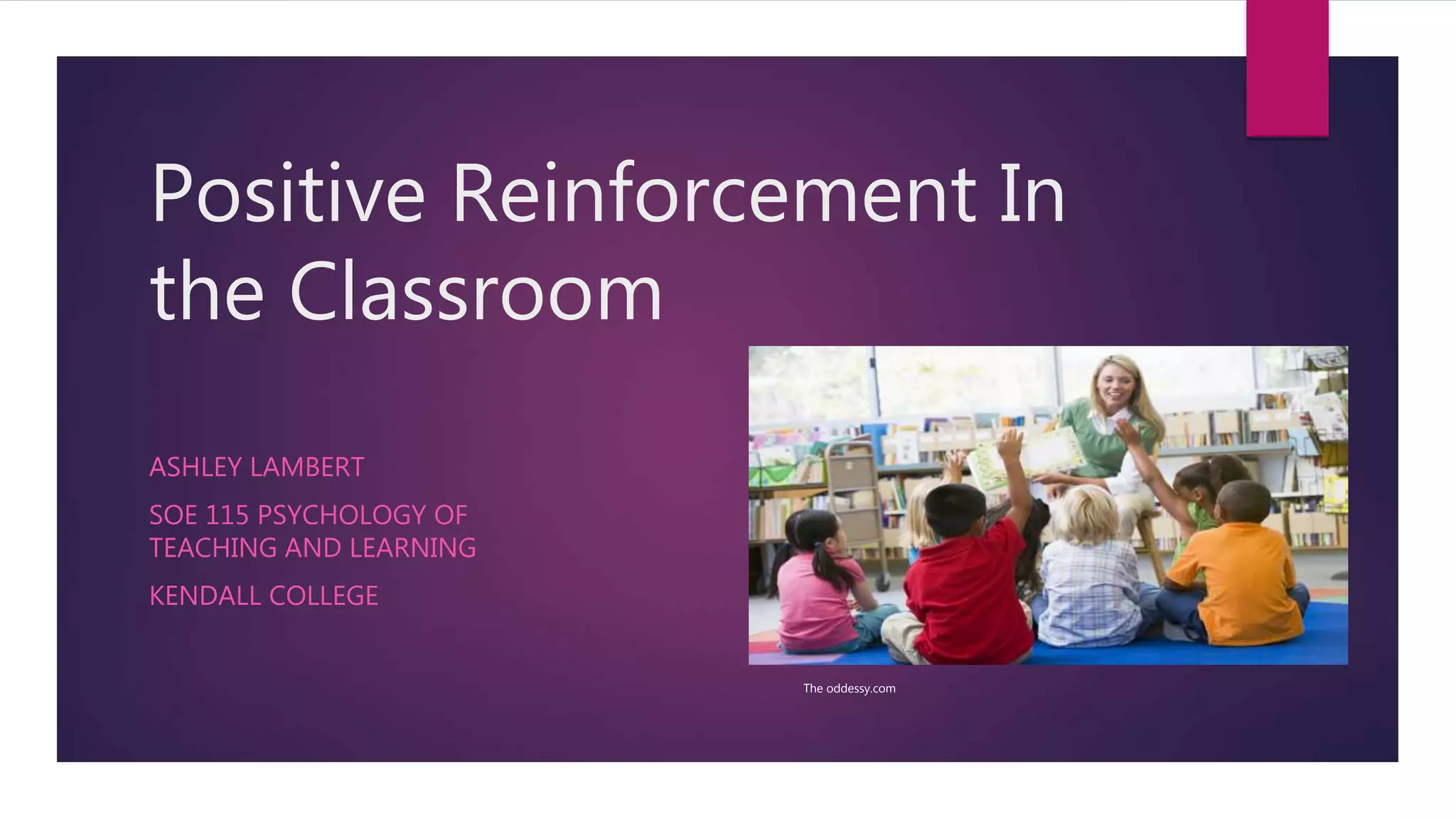
The oddessy.com
Classroom Management
 Every year teachers welcome 20-30 New students into their classroom.
Every child comes from a unique background with equally diverse
experiences. Teachers face the difficult task of how to manage and
support student behaviors displayed in their classroom. Behaviors
management is a skill every teacher must learn to implement in there
classroom. There are a variety of ways teachers can help children
understand classroom rules and expectations. It is also important for
teacher to keep in mind the developmental level of their students when
choosing a behavioral management method. For example, Your would
not use the exact same behavioral management method for first graders
you would use for eighth graders. In order for children to be successful
in their education it is crucial for students to be willing participants in
their own education. It is the teachers responsibility to ensure the
student is on board with there learning journey. Teachers must ask
themselves how do I motivate my students. The answer is all in the
name, “Positive” reinforcement.
Shutterstock.com
What is Classroom management?
 “Positive reinforcement Is described as the direct relationship between a behavior
or action and the result of that action. (Positive Reinforement,Techniques)”
Positive reinforcement is a behavioral management tool that can transform
classroom behaviors. Teachers in can use positive reinforcement to encourage a
behavior they would like to see repeated.
 “Positive reinforcement occurs after a behavior and increases the likelihood that
the behavior will continue to occur. (Positive Reinforement,Techniques)”
 Positive reinforcement helps create positive teacher and student relationships by
focusing on the positive action or behavior of a child. Teachers who choose to use
positive reinforcement instead and promotes healthy learning environments.
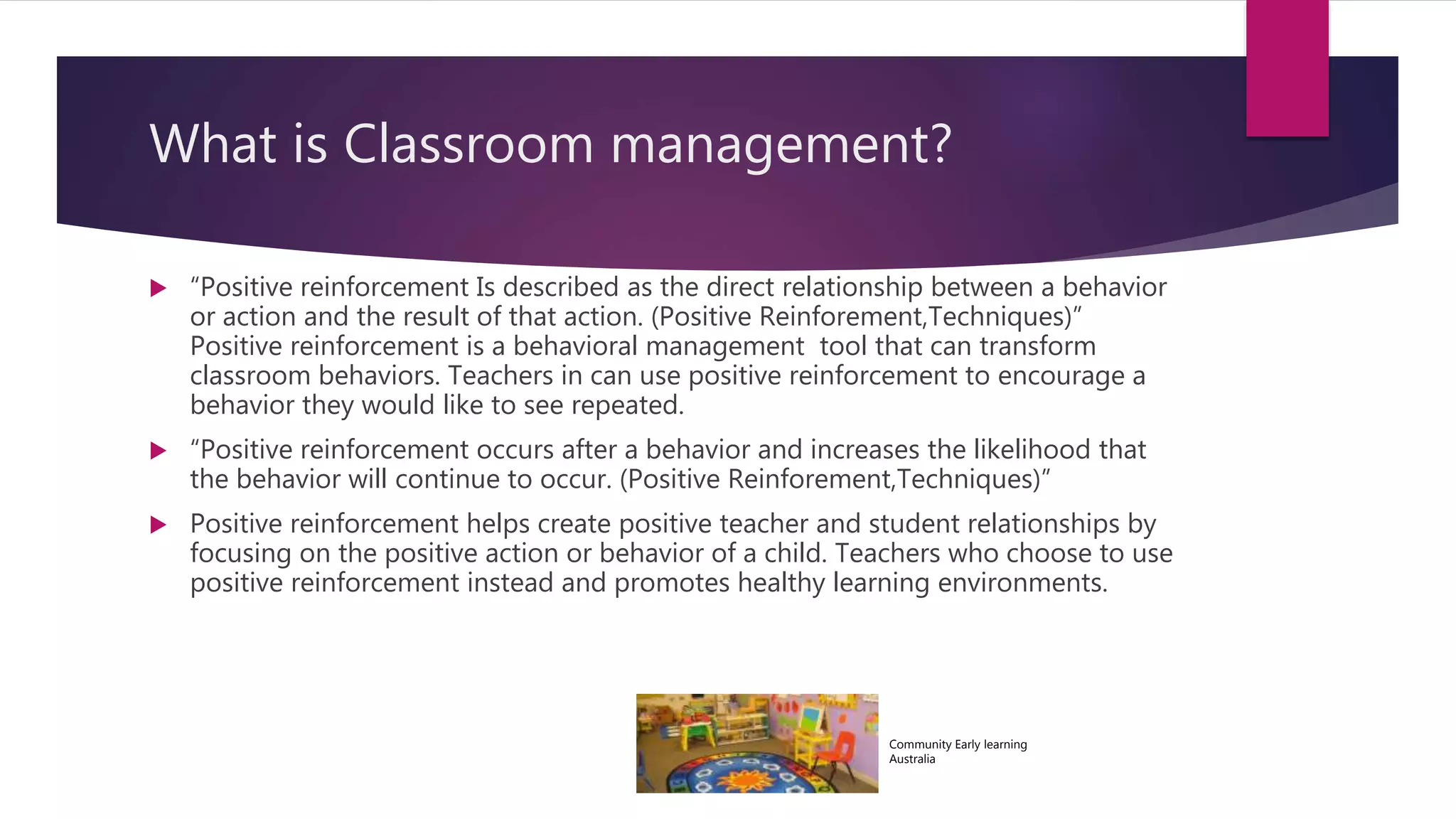
Community Early learning
Australia
Behavioral Management
 “Some educators disagree with the use of positive reinforcement as a behavioral
management tool in the classroom. They prefer punishment or negative reinforcement
to address the behavior because the consequences are quick and effective.(Positive
Reinforement,Techniques)” Other educators prefer positive reinforcement over
negative reinforcement or punishment. Educators who prefer positive reinforcement
over any other form of behavioral management tool argue positive reinforcement
happens in a variety of settings as an adult. . Positive reinforcement can be given out in
a variety of fashions. Teachers can provide positive reinforcement to the whole class or
to an independent student. Critics believe that children can receive negative
reinforcement through the responses of other students. For instance, if a child throws a
paper plan across the room the other students may laugh. The child who threw the
plane may like the laughter from the other students therefore the behavior being being
displayed is being reinforced.
The Bridges child care center
Behavioral Management
 If adults complete training they receive a certificate of completion, when high school
students graduate high school they receive a high school diploma. When adults get up
every morning and go to work they receive positive reinforcement for going to work by
receiving a paycheck. Why shouldn’t we educators be allowed to promote positive
behaviors in a classroom in exchange for small toys, privileges, lunch with the teachers, or
extra free time. Positive reinforcement can be given out in a form of social reinforce through
a smile, compliments or praise. “(Positive Reinforement,Techniques)” Positive reinforcement
can be given out in a variety of fashions. Teachers can provide positive reinforcement to the
whole class or to an independent student. Critics believe that children can receive negative
reinforcement through the responses of other students. For instance, if a child throws a
paper plan across the room the other students may laugh. The child who threw the plane
may like the laughter from the other students therefore the behavior being being displayed
is being reinforced.
Critten center
Positive Behavioral Support
 Positive behaviors support is designed to promote desired behaviors in the classroom. The
positive behaviors support methods goal is to create a classroom environment where
children will be empowered by the teacher’s positive reinforcement of the behaviors being
displayed in the classroom. When teachers focus on the desired behaviors rather than the
unwanted behaviors the interactions between the student and the teacher’s interactions
remain positive, which intern creates a positive classroom climate. Positive behavior practice
is especially effective in early childhood or preschool settings. During the preschool year’s
children have being exposed to school for the first time. Preschool is the first classroom
experience a child will have therefore the child will be encouraged to learn many new
behaviors. Focusing to the behaviors the child does correctly reinforces the desired
behaviors and maintains the integrity of the program and classroom.
Ford Elementary School
Praise and Feedback
 The use of praise and feedback when using positive reinforcement is key. Feed back
needs to be specific for children to gain understanding of the behavior that is being
reinforced. Depending on the age and developmental level of the student feedback will
vary.
 “Beginners need corrective feedback. (Al-Ghamdi,A.,Jeddah)”
 “Intermediate students have acquired the basics but they need to be guided to a form
of alternative strategies.(Al-Ghamdi,A.,Jeddah)”
 “Highly skilled students need self regulation feedback along with detailed
descriptions.(Al-Ghamdi,A.,Jeddah)”
 When educators use praise they inform students they recognized efforts or
achievements made by the child. Praise can motivate children who may otherwise go
without acknowledgement.
Kidmartchair.com
Praise and Feedback
Ymcacapcod.org
Positive reinforcement relays heavily on praise and Feedback given to
students. When educators use praise it sends a message to students
and tell students I notice you. Adults and children both like to be
noticed for accomplishments. Children will respond quickly when
praise is given. They are more likely to try hard or continue to exhibit
positive behavior when a teacher recognizes the behaviors
immediately.
Educators must be specific when giving feedback for the positive
reinforcement method to be effective.
For example: “You did a good job today!” is not ask effective as saying
You raised your hand and participated a lot during reading today.
Keep up the good work.”
Conclusion
Visonslovesteachers.com
Classroom management directly impacts all students ability to learn. Behavioral
management in the classroom is essential to providing a safe and healthy
learning environment. Every classroom teacher choses a behavioral method
they prefer best. Teachers are also responsible for creating the climate of the
classroom. The use of positive reinforcement in a classroom varies. Positive
reinforcement is most effective when teachers give immediate and specific
feedback to students and more importantly focus on the behaviors teachers
would like to see repeated.
Information for Parent
 Positive reinforcement helps modify behavior by pointing out the good things
your child is doing. When using praise and feed back it is critical to point out
specifically what the child is doing that your are praising.
 Positive reinforcement helps keep the parent and child relationship positive and
helps keep self confidence intact.
 “Positive reinforcement occurs after a behavior and increases the likelihood that
the behavior will continue to occur. (Positive Reinforement,Techniques)”
References
Al-Ghamdi,A.,Jeddah, Building a Positive Environment in Classrooms through Feedback and Praise, English
Language Teaching, 10,(6), 37-43.
Jolstead, K.A., Caldarella, P., Hansen,Bl., Korth,B.B, Williams,L., Kamps,D., Implementing Positive Behavior
Support in Preschool: An Exploratory study of CW-FIT Tier 1,Journal of Positive Behavior Interventions,
19(1),48-60.
N.p., Positive Reinforement,Techniques: Connecting Education & Careers. , 82, (4),10-11.

Positive reinforcement in the classroom

  • 1.
    Positive Reinforcement In theClassroom ASHLEY LAMBERT SOE 115 PSYCHOLOGY OF TEACHING AND LEARNING KENDALL COLLEGE The oddessy.com
  • 2.
    Classroom Management  Everyyear teachers welcome 20-30 New students into their classroom. Every child comes from a unique background with equally diverse experiences. Teachers face the difficult task of how to manage and support student behaviors displayed in their classroom. Behaviors management is a skill every teacher must learn to implement in there classroom. There are a variety of ways teachers can help children understand classroom rules and expectations. It is also important for teacher to keep in mind the developmental level of their students when choosing a behavioral management method. For example, Your would not use the exact same behavioral management method for first graders you would use for eighth graders. In order for children to be successful in their education it is crucial for students to be willing participants in their own education. It is the teachers responsibility to ensure the student is on board with there learning journey. Teachers must ask themselves how do I motivate my students. The answer is all in the name, “Positive” reinforcement. Shutterstock.com
  • 3.
    What is Classroommanagement?  “Positive reinforcement Is described as the direct relationship between a behavior or action and the result of that action. (Positive Reinforement,Techniques)” Positive reinforcement is a behavioral management tool that can transform classroom behaviors. Teachers in can use positive reinforcement to encourage a behavior they would like to see repeated.  “Positive reinforcement occurs after a behavior and increases the likelihood that the behavior will continue to occur. (Positive Reinforement,Techniques)”  Positive reinforcement helps create positive teacher and student relationships by focusing on the positive action or behavior of a child. Teachers who choose to use positive reinforcement instead and promotes healthy learning environments. Community Early learning Australia
  • 4.
    Behavioral Management  “Someeducators disagree with the use of positive reinforcement as a behavioral management tool in the classroom. They prefer punishment or negative reinforcement to address the behavior because the consequences are quick and effective.(Positive Reinforement,Techniques)” Other educators prefer positive reinforcement over negative reinforcement or punishment. Educators who prefer positive reinforcement over any other form of behavioral management tool argue positive reinforcement happens in a variety of settings as an adult. . Positive reinforcement can be given out in a variety of fashions. Teachers can provide positive reinforcement to the whole class or to an independent student. Critics believe that children can receive negative reinforcement through the responses of other students. For instance, if a child throws a paper plan across the room the other students may laugh. The child who threw the plane may like the laughter from the other students therefore the behavior being being displayed is being reinforced. The Bridges child care center
  • 5.
    Behavioral Management  Ifadults complete training they receive a certificate of completion, when high school students graduate high school they receive a high school diploma. When adults get up every morning and go to work they receive positive reinforcement for going to work by receiving a paycheck. Why shouldn’t we educators be allowed to promote positive behaviors in a classroom in exchange for small toys, privileges, lunch with the teachers, or extra free time. Positive reinforcement can be given out in a form of social reinforce through a smile, compliments or praise. “(Positive Reinforement,Techniques)” Positive reinforcement can be given out in a variety of fashions. Teachers can provide positive reinforcement to the whole class or to an independent student. Critics believe that children can receive negative reinforcement through the responses of other students. For instance, if a child throws a paper plan across the room the other students may laugh. The child who threw the plane may like the laughter from the other students therefore the behavior being being displayed is being reinforced. Critten center
  • 6.
    Positive Behavioral Support Positive behaviors support is designed to promote desired behaviors in the classroom. The positive behaviors support methods goal is to create a classroom environment where children will be empowered by the teacher’s positive reinforcement of the behaviors being displayed in the classroom. When teachers focus on the desired behaviors rather than the unwanted behaviors the interactions between the student and the teacher’s interactions remain positive, which intern creates a positive classroom climate. Positive behavior practice is especially effective in early childhood or preschool settings. During the preschool year’s children have being exposed to school for the first time. Preschool is the first classroom experience a child will have therefore the child will be encouraged to learn many new behaviors. Focusing to the behaviors the child does correctly reinforces the desired behaviors and maintains the integrity of the program and classroom. Ford Elementary School
  • 7.
    Praise and Feedback The use of praise and feedback when using positive reinforcement is key. Feed back needs to be specific for children to gain understanding of the behavior that is being reinforced. Depending on the age and developmental level of the student feedback will vary.  “Beginners need corrective feedback. (Al-Ghamdi,A.,Jeddah)”  “Intermediate students have acquired the basics but they need to be guided to a form of alternative strategies.(Al-Ghamdi,A.,Jeddah)”  “Highly skilled students need self regulation feedback along with detailed descriptions.(Al-Ghamdi,A.,Jeddah)”  When educators use praise they inform students they recognized efforts or achievements made by the child. Praise can motivate children who may otherwise go without acknowledgement. Kidmartchair.com
  • 8.
    Praise and Feedback Ymcacapcod.org Positivereinforcement relays heavily on praise and Feedback given to students. When educators use praise it sends a message to students and tell students I notice you. Adults and children both like to be noticed for accomplishments. Children will respond quickly when praise is given. They are more likely to try hard or continue to exhibit positive behavior when a teacher recognizes the behaviors immediately. Educators must be specific when giving feedback for the positive reinforcement method to be effective. For example: “You did a good job today!” is not ask effective as saying You raised your hand and participated a lot during reading today. Keep up the good work.”
  • 9.
    Conclusion Visonslovesteachers.com Classroom management directlyimpacts all students ability to learn. Behavioral management in the classroom is essential to providing a safe and healthy learning environment. Every classroom teacher choses a behavioral method they prefer best. Teachers are also responsible for creating the climate of the classroom. The use of positive reinforcement in a classroom varies. Positive reinforcement is most effective when teachers give immediate and specific feedback to students and more importantly focus on the behaviors teachers would like to see repeated.
  • 10.
    Information for Parent Positive reinforcement helps modify behavior by pointing out the good things your child is doing. When using praise and feed back it is critical to point out specifically what the child is doing that your are praising.  Positive reinforcement helps keep the parent and child relationship positive and helps keep self confidence intact.  “Positive reinforcement occurs after a behavior and increases the likelihood that the behavior will continue to occur. (Positive Reinforement,Techniques)”
  • 11.
    References Al-Ghamdi,A.,Jeddah, Building aPositive Environment in Classrooms through Feedback and Praise, English Language Teaching, 10,(6), 37-43. Jolstead, K.A., Caldarella, P., Hansen,Bl., Korth,B.B, Williams,L., Kamps,D., Implementing Positive Behavior Support in Preschool: An Exploratory study of CW-FIT Tier 1,Journal of Positive Behavior Interventions, 19(1),48-60. N.p., Positive Reinforement,Techniques: Connecting Education & Careers. , 82, (4),10-11.