Approaches to solid waste management
Course code- RT-205 (Rural Waste Management)
Contents
Introduction
History
Type of waste
New approaches
Discussions and Conclusions
Introduction
It is a known fact that as urbanization continues to
take place, the management of solid waste becomes a
major public health and environmental concern in
urban areas and towns throughout and other
developing countries of the world. The primary
purposes of solid waste management(SWM)
strategies are to address the health, environmental,
aesthetic, land-use, resource, and economic concerns
associated with the improper disposal of waste These
issues are ongoing concern for nations,
municipalities, corporations, and individuals around
the world.
History
• From ancient times, people have been mass-producing solid
waste.
• Most communities manage to burry solid waste just outside
their settlements or dispose of it in nearby rivers or water
bodies.
• There were exceptions: organized SWM processes were
implemented in ancient city of Mohenjo-Daro in the Indus
Valley by 2000 BC.
• The Greeks had both issued a decree banning waste disposal in
the streets and organized the Western world’s first
acknowledged “municipal dumps” by 500 BC.
• Chinese cities had “disposal police” responsible for enforcing
disposal laws by 200 BC.
TYPES OF WASTE
Garbage's
Rubbish
Ashes
Refuse
Industrial waste
Approaches to solid waste
management
• This is a process by which the size of
waste is reduced as much as possible.
This makes the landfill sites and transfer
stations last longer. So, size-reduction of
refuse is necessary.
Reduction
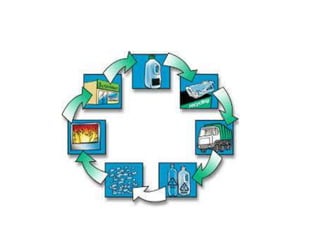
In waste recycling, a waste component is
extracted and used again in another
manufacturing process.
This helps to minimize what ends up in
the sanitary landfill for ultimate disposal,
thereby making the landfill last longer.
 It is particularly applicable to materials
like plastics and steel which are not
biodegradable.
Recycling
Some of the wastes generated and collected
could be Putin to use.
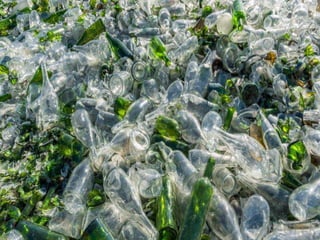
 Wastes that could be re-used include: off-
cut iron in construction sites, re-useable
bottles, etc. Also used tire's could be
shredded and used as aggregates for concrete
works to repair worn-out roads.
 These reuse able wastes are sorted out at
source (i.e. at generation points or at transfer
stations by scavengers
Reuse
Any waste or discard material is technically
worthless if it cannot, in its current form, be used.
The value of a waste is therefore potential rather
than real and depends entirely on its ability to be
re-utilized .
Recovery
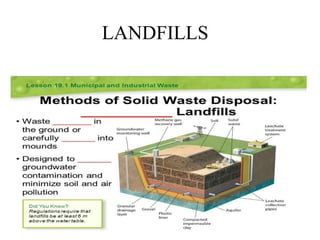
LANDFILLS
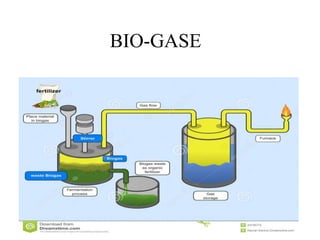
BIO-GASE
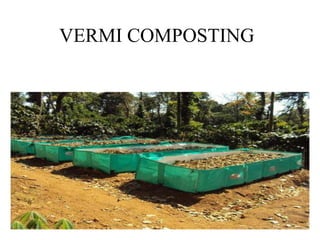
VERMI COMPOSTING
DISCUSSIONS & CONCLUSIONS
•In most cities of the world especially in developing
countries, adequate attention is not paid to proper
waste disposal systems.
• The practice is mostly disposal of waste in open
dumps, incineration, composting etc.
•These practices degrade the environment and increase
public health hazards which can lead to outbreak of
diseases. This work discussed new approach to SWM
that will be comprehensive, cost-effective
environment-friendly and sustainable.
• These new approaches to SMM lead to wealth
creation from wastes.
REFERENCES
[1] Henry, R. K., Yongsheng , Z.,
and Jun D. “Municipal solid
waste management challenges in
developing countries.”
Waste management, 2006, 26(1),
pp. 92-100.
SUGGESTIONS

Apporoches of solid waste management

  • 1.
    Approaches to solidwaste management Course code- RT-205 (Rural Waste Management)
  • 2.
    Contents Introduction History Type of waste Newapproaches Discussions and Conclusions
  • 3.
    Introduction It is aknown fact that as urbanization continues to take place, the management of solid waste becomes a major public health and environmental concern in urban areas and towns throughout and other developing countries of the world. The primary purposes of solid waste management(SWM) strategies are to address the health, environmental, aesthetic, land-use, resource, and economic concerns associated with the improper disposal of waste These issues are ongoing concern for nations, municipalities, corporations, and individuals around the world.
  • 4.
    History • From ancienttimes, people have been mass-producing solid waste. • Most communities manage to burry solid waste just outside their settlements or dispose of it in nearby rivers or water bodies. • There were exceptions: organized SWM processes were implemented in ancient city of Mohenjo-Daro in the Indus Valley by 2000 BC. • The Greeks had both issued a decree banning waste disposal in the streets and organized the Western world’s first acknowledged “municipal dumps” by 500 BC. • Chinese cities had “disposal police” responsible for enforcing disposal laws by 200 BC.
  • 5.
  • 8.
    Approaches to solidwaste management • This is a process by which the size of waste is reduced as much as possible. This makes the landfill sites and transfer stations last longer. So, size-reduction of refuse is necessary. Reduction
  • 9.
    In waste recycling,a waste component is extracted and used again in another manufacturing process. This helps to minimize what ends up in the sanitary landfill for ultimate disposal, thereby making the landfill last longer.  It is particularly applicable to materials like plastics and steel which are not biodegradable. Recycling
  • 11.
    Some of thewastes generated and collected could be Putin to use.  Wastes that could be re-used include: off- cut iron in construction sites, re-useable bottles, etc. Also used tire's could be shredded and used as aggregates for concrete works to repair worn-out roads.  These reuse able wastes are sorted out at source (i.e. at generation points or at transfer stations by scavengers Reuse
  • 13.
    Any waste ordiscard material is technically worthless if it cannot, in its current form, be used. The value of a waste is therefore potential rather than real and depends entirely on its ability to be re-utilized . Recovery
  • 14.
  • 15.
  • 16.
  • 17.
    DISCUSSIONS & CONCLUSIONS •Inmost cities of the world especially in developing countries, adequate attention is not paid to proper waste disposal systems. • The practice is mostly disposal of waste in open dumps, incineration, composting etc. •These practices degrade the environment and increase public health hazards which can lead to outbreak of diseases. This work discussed new approach to SWM that will be comprehensive, cost-effective environment-friendly and sustainable. • These new approaches to SMM lead to wealth creation from wastes.
  • 18.
    REFERENCES [1] Henry, R.K., Yongsheng , Z., and Jun D. “Municipal solid waste management challenges in developing countries.” Waste management, 2006, 26(1), pp. 92-100.
  • 19.