This document summarizes the history and current state of solid waste management (SWM) practices in developed and developing countries. In developed countries, public health concerns, environmental protection, resource scarcity, climate change, and public participation have driven SWM practices towards more integrated systems since the 1960s. However, in developing countries SWM is complicated by rapid urbanization, inequality, cultural and socioeconomic factors, weak policies and governance, and international influences. Traditional systems analysis approaches used in developed countries have limited applicability in developing country contexts due to their complexity. There is a need for new SWM approaches founded on post-normal science and complex adaptive systems thinking to address the unique challenges faced in developing countries.
![992
R.E. Marshall, K. Farahbakhsh / Waste Management 33 (2013) 988–1003
European sanitary revolution, despite increasing globalization
(Konteh, 2009). In industrialized nations, the health benefits from
solid waste and sanitation systems are largely taken for granted,
and the focus has moved from sanitation-related communicable
diseases to ‘diseases of affluence’ (cancer, cardiovascular disease,
drug and alcohol abuse) and ‘‘sustainability’’ (Konteh, 2009; Langeweg et al., 2000; McGranahan, 2001). Meanwhile, many developing
countries are currently affected by the ‘double burden’ of the combined effects of the diseases of affluence and communicable diseases (Boadi et al., 2005; Konteh, 2009). Wilson (2007, p. 204)
points out that ‘‘[i]n some countries, simple survival is such a predominant concern, that waste management does not feature
strongly on the list of public concerns’’. When SWM is on the public
agenda in developing countries, it is driven by the same concerns
as industrialized countries, although it tends to be driven most
strongly by public health; the key priority is still getting the waste
out from underfoot, as it was for the Europe and the United States
up until the 1960s (Coffey and Coad, 2010; Memon, 2010; Rodic
et al., 2010; Wilson, 2007). Environmental protection is still relatively low on the political and public agendas, although this is
starting to change (Wilson, 2007). Though legislation is often in
place requiring closure and phasing out of unregulated disposal,
enforcement tends to be weak (Wilson, 2007). The resource value
of waste is an important driver in many developing countries today; informal recycling provides a livelihood for the urban poor
in many parts of the world (UN-HABITAT, 2010; Wilson, 2007). Climate change is an important driver worldwide – the clean development mechanism under the Kyoto protocol, in which
developed countries can buy ‘carbon credits’ from developing nations, can provide a key source of income to encourage cities in
developing countries to improve waste management systems (Wilson, 2007).
Many similarities exist between the historical SWM development trajectories of industrialized countries and the current trajectories of developing countries. Many cities in lower income nations
are experiencing similar conditions to those of the 19th century in
high income countries: ‘‘high levels of urbanization, degrading sanitary conditions and unprecedented levels of morbidity and mortality, which affected mostly the working class population’’
(Konteh, 2009, p. 70). Indeed, increasing urbanization and socioeconomic disparities, inadequate provision of sanitary and environmental amenities, social exclusion and inequalities related to
existing SWM systems, and high levels of morbidity and mortality
linked to inadequate sanitation, waste disposal, and water supply
provision were common then as they are today, particularly in
poorer urban neighbourhoods in lower income countries (Konteh,
2009).
In spite of the apparent parallels, the contexts in which developing nations are situated are starkly different from the historical
contexts of developed countries. Rapid urbanization, soaring
inequality, and the struggle for economic growth; varying economic, cultural, socio-economic, and political landscapes; governance, institutional, and responsibility issues; and international
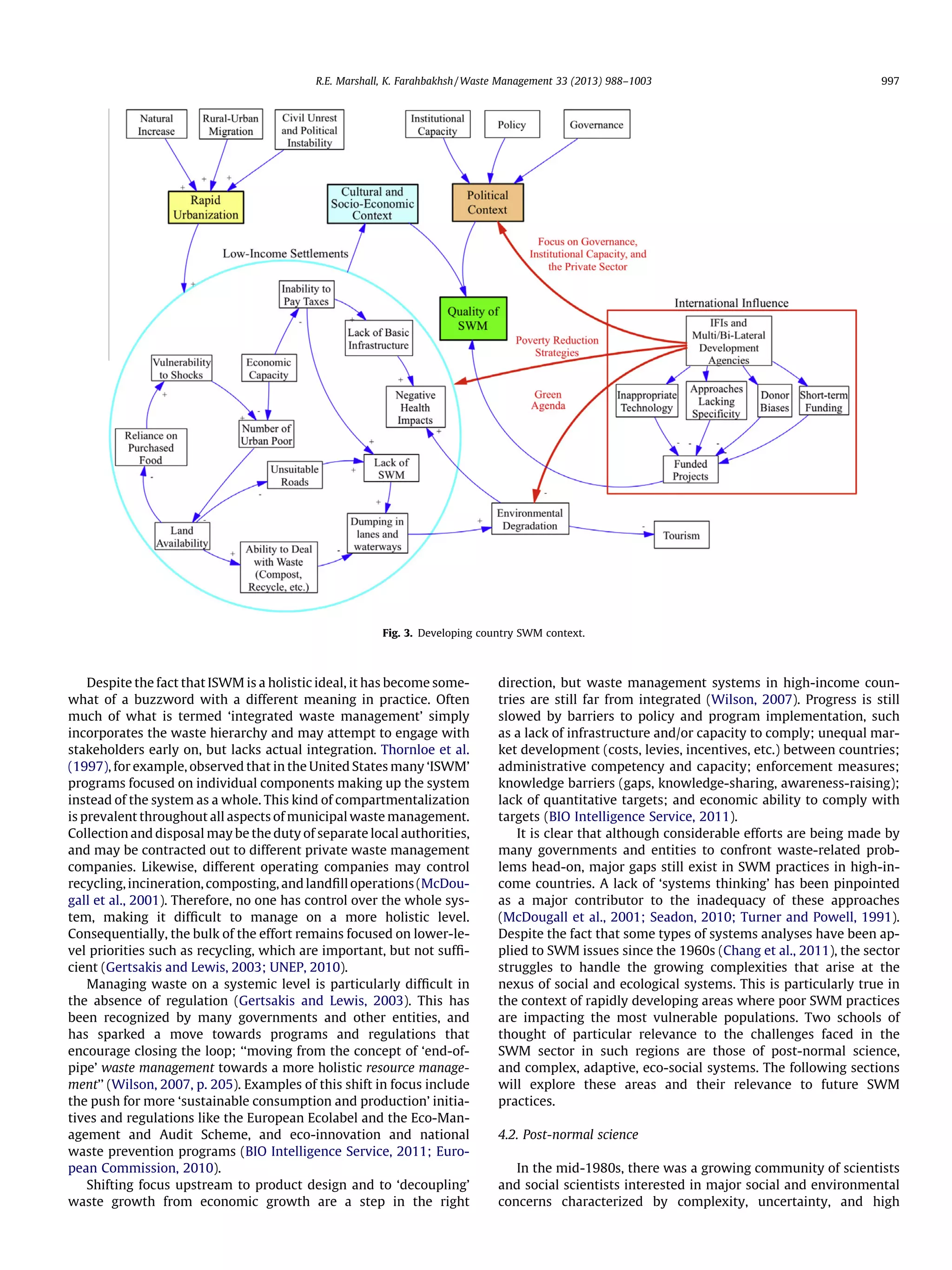
influences have created locally specific, technical and non-technical challenges of immense complexity (see Fig. 3). The following
sections will explore these contextual aspects and the challenges
they present for SWM systems in the developing world.
3.1. Urbanization, inequality, and economic growth
Urbanization has exploded with great speed and scale in recent
decades with ‘‘more than half the world’s population now living in
urban centres’’ (Tacoli, 2012, p. 4), as countries and even individual
cities struggle to be competitive in the global marketplace (Cohen,
2004). While just 16 cities contained at least a million people at the
start of the 20th century – the vast majority of which were in
industrial nations – at the start of the 21st century 400 cities contained over a million people, and approximately three-quarters of
these urban centers were in low- and middle-income countries
(Cohen, 2004). This rapid, unplanned growth has resulted in a
number of extreme land use planning and infrastructural challenges that have crippled the capacity of national and municipal
governments to increase SWM service levels at the rate they are
demanded. This, in combination with extremely slow and inefficient institutional structures, has had a disastrous effect on the
quality and reach of SWM services in many regions of the world
– one that is projected to worsen in the future. The fact that nearly
all of the world’s population growth is projected to occur in urban
areas (Cohen, 2004) from now until 2050 – much of which will
take place in the world’s poorer regions – has raised ‘‘concerns
about growing urban poverty and the inability of national and city
governments to provide services to the residents of their burgeoning cities’’ (Tacoli, 2012, p. 5). Many more people will be pushed
into slums, where sanitary conditions are appalling and waste
amenities are non-existent; the number of people living in slums
is now estimated at some 828 million and growing in actual numbers even though 200 million slum-dwellers have moved out of
slum quality conditions (UNFPA, 2011).
Almost invariably, the SWM demands of these high-density,
low-income settlements are inadequately served or neglected altogether even though these areas have the greatest need for these
services since there is no space among the densely packed housing
for waste burial or composting and they are less able to make alternate arrangements to dispose of waste (Coffey and Coad, 2010).
Collection may not be carried out in these unplanned settlements
due to a lack of space for refuse containers, narrow roadways, steep
gradients, and unsurfaced roads that standard collection vehicles
cannot manage (see Fig. 3) (Coffey and Coad, 2010; Henry et al.,
2006). Therefore, waste is dumped into open spaces, on access
roads and in waterways where disease vectors breed (see Fig. 3)
(Coffey and Coad, 2010; Konteh, 2009). Waste clogs drains, creating flooded, stagnant nurseries for mosquitos carrying malaria
and dengue fever. Animals and waste pickers scatter the waste,
and leachate from garbage heaps percolates into soil and waterways. This results in contaminated food, water, and soil, and serious environmental and health implications, particularly for the
most vulnerable, such as children and the elderly (Coffey and Coad,
2010; Tacoli, 2012). This kind of environmental degradation can
also negatively impact the (sometimes fragile) economies of those
countries that rely heavily on tourism (Henry et al., 2006).
3.2. Cultural and socio-economic aspects
The structure and functioning of SWM systems are founded on
the behaviour patterns and underlying attitudes of the population
– factors that are shaped by the local cultural and social context
(Schübeler, 1996). The substantial diversity of social and ethnic
groups that often exists within rapidly expanding cities, even within individual residential communities, greatly influences municipalities’ capacities to implement SWM strategies (Schübeler,
1996). Public awareness and attitudes towards waste can impact
the entire SWM system, from household storage to separation,
interest in waste reduction, recycling, demand for collection services, willingness to pay for SWM services, opposition to proposed
locations of waste facilities, the amount of waste in the streets, and
ultimately the success or failure of a SWM system (Henry et al.,
2006; Schübeler, 1996; Yousif and Scott, 2007; Zurbruegg, 2003).
In parts of the Arab world and Latin America, for example, opportunities to strengthen waste institutions may be limited by the fact
that SWM is not seen as an honourable profession (Wilson, 2007).
The cultural and socio-economic context also influences the
waste composition generated by a population (Coffey and Coad,](https://image.slidesharecdn.com/wastemanagement-131112055504-phpapp02/75/Waste-management-summary-5-2048.jpg)
![R.E. Marshall, K. Farahbakhsh / Waste Management 33 (2013) 988–1003
2010; Schübeler, 1996). In some cases, shops sell food that is largely pre-prepared, while in others, fresh meat or large quantities
of fresh vegetables and fruit drastically alter the waste composition. Cooking and heating with solid fuel affects the waste composition by eliminating items that would otherwise be discarded,
such as paper, and contributing hot, abrasive ashes to the waste
stream (Coffey and Coad, 2010). Local architecture, such as mud
brick housing and unpaved floors can mean large quantities of dust
and soil enter the waste stream, while sanitary practices can influence the quantity of excreta in the waste (Coffey and Coad, 2010).
Socio-economic status at the neighbourhood and household level
affect waste composition: higher literacy increases the paper content of waste, and wealthier groups often choose to discard durable
items instead of repairing them (Coffey and Coad, 2010). Recycling
and reuse is affected by differences in how social groups value
items that would otherwise enter the waste stream. Often much
of the organic waste is fed to livestock, and items like food and
drink containers are reused in the household (Coffey and Coad,
2010). Informal recycling is carried out by waste pickers, who value much of what might otherwise enter the waste stream (Coffey
and Coad, 2010; Schübeler, 1996; UN-HABITAT, 2010; Wilson,
2007).
Social expectations of waste collection are also dependent on
waste composition, and therefore on cooking and eating habits. If
large quantities of odour-generating food (e.g. fish) are consumed,
waste collection rates are expected to be more frequent, particularly in warmer climates (Coffey and Coad, 2010; Jha et al.,
2011). Disposal is also greatly influenced by social attitudes. Some
social groups always dispose of waste in the appropriate containers, while others view the street as an appropriate disposal location. Householders and city officials alike may have no interest in
whether waste is dumped illegally or sent to a proper disposal
facility, as long as it is removed from the urban zone (Coffey and
Coad, 2010). In some urban areas, the primary focus is still on food,
shelter, security and livelihoods; waste will become a priority only
when these more basic needs have been met (Konteh, 2009), and
only becomes an issue when public health or environmental damage impact these priorities (Wilson, 2007).
3.3. Political landscapes: Policy, governance, institutional issues
Politics inevitably play a large role in SWM systems. The structure, functioning, and governance of SWM systems are affected by
the relationship between central and local governments, the role of
party politics in local government administration, and the extent
that citizens participate democratically in policy making processes
(Schübeler, 1996). In low-income countries, the greatest challenge
‘‘is to strike the right balance between policy, governance, institutional mechanisms and resource provision and allocation’’ (Konteh,
2009, p. 74).
3.3.1. Policy
A democratic, public process of SWM goal formulation is essential to determine the actual needs of the citizens, and therefore to
be able to prioritize limited municipal resources in a just manner.
Policy weaknesses are consequently some of the critical causes of
failed SWM systems in many low-income countries, as inadequate
formulation and implementation of realistic policies is common
(see Fig. 3) (Konteh, 2009). While developed countries addressed
their SWM needs by putting in place effective, functioning policy
measures, ‘‘[i]n many cities of the developing world remedial measures have been elusive; efforts are uncoordinated or ad hoc, and
the resources invested in the sector inadequate’’ (Konteh, 2009,
p. 72). Additionally, civil unrest and political instability has contributed to the growing SWM problem in low-income urban areas
993
by forcing millions of displaced people to seek refuge in major cities (Boadi et al., 2005; Konteh, 2009).
SWM is also not always a high priority for local and national
policy makers and planners. Other issues with more social and
political urgency may take precedence and leave little budget for
waste issues (Memon, 2010; Yousif and Scott, 2007). In some countries, such as Guatemala, serious SWM project continuity problems
arise because all municipal office workers – including those not involved in elections – are replaced during any change in government (Yousif and Scott, 2007). This lack of long-term
commitment results in the abandonment of work completed in
previous terms (Zarate et al., 2008). Projects can also be shelved
due to political fallout between different political parties and local
authorities (Henry et al., 2006).
3.3.2. Governance
In all urban centers around the world, any form of environmental management ‘‘is an intensely political task, as different
interests (including very powerful interests) compete for the most
advantageous locations, for the ownership or use of resources and
waste sinks, and for publicly provided infrastructure and services’’
(Hardoy et al., 2001, p. 19). Many of these conflicting interests
contribute to the degradation of essential resources and urban
environmental health if good environmental management is absent (Hardoy et al., 2001; Konteh, 2009). As these factors have
gained recognition, there has been a shift in the urban development literature from ‘government’, which focuses on the role,
responsibilities and performance of government bodies, to ‘governance’, which additionally considers the relationship between
government and civil society (Hardoy et al., 2001). Good governance requires the participation and collaboration of all relevant
parties, including government, non-governmental organizations
(NGOs), community groups and the private sector (see Fig. 3)
(Konteh, 2009). According to the Asian Development Bank, the
four principle elements of good governance are accountability,
participation, predictability, and transparency (Bhuiyan, 2010).
Good governance allows low-income groups to influence policy
and resource allocation (Hardoy et al., 2001), and therefore it is
essential for equitable, effective, and efficient SWM. Indeed, the
efficiency, along with ‘‘the effectiveness of SWM in a city [are
some] of the indices for assessing good governance’’ (Bhuiyan,
2010, p. 126). Low-income countries tend to lack the appropriate
governance institutions and structures typically found in high-income countries, such as public policy research institutions, freedom of information laws, judicial autonomy, auditors general,
police academies, etc. (Bhuiyan, 2010). This lack of democratic
structures and competent, representative local government creates barriers to proper SWM. Political jostling for power means
that local authorities base decision-making on the interests of
their parties (Henry et al., 2006; Zurbruegg, 2003). Henry describes how ‘‘the upgrading of Nairobi slums has not been implemented because some councilors incite their constituents to reject
such a move out of an unfounded fear of voters who might be
moved out once slum upgrading efforts get underway. There are
instances when some councilors hinder particular projects for
political reasons only’’ (Henry et al., 2006, p. 97). Government
bodies maintain inflated workforces for political reasons, which
consume much-needed funds (Henry et al., 2006). Petty and high
profile corruption are also rampant in many countries. While ‘‘it
has been widely recognized that corruption retards economic
growth, distorts the political system, debilitates administration
and undermines the interests and welfare of the community’’, corruption remains one of the most pervasive and least confronted
challenges facing public institutions in developing countries
(Bhuiyan, 2010, p. 131).](https://image.slidesharecdn.com/wastemanagement-131112055504-phpapp02/75/Waste-management-summary-6-2048.jpg)
![R.E. Marshall, K. Farahbakhsh / Waste Management 33 (2013) 988–1003
of the local situation. van de Klundert (1995) makes several observations about this: donor biases exist towards certain technical approaches or insistence on the use of equipment that supports their
own export industries; the scale at which donors work is often
inappropriate for local conditions; either too small, without sufficient consideration for various larger contexts, or too large for a
particular situation; coordination issues arise between donors
from different countries, which may be competing for contracts,
and within countries as development agencies work at cross-purposes; and donors without the time or political will to produce locally appropriate results opt for large, technical interventions
rather than small-scale, context appropriate approaches, since they
are easier to understand, finance, and monitor.
Coffey and Coad (2010) report that the objective of many foreign aid programs for SWM in developing countries is to capture
markets for supplying sophisticated machinery and related spare
parts, which are more often than not completely inappropriate
for local conditions. Additionally, municipal SWM is often a component within a wider development program aimed at improving
urban environmental projection and/or urban management capacity, meaning many bilateral and multilateral development agencies
lack the considerable expertise needed to implement successful
SWM programs (Schübeler, 1996).
Such issues have a detrimental effect on the evolution of SWM
practices in many developing countries. Zarate et al. (2008, p.
2543) point out that ‘‘in spite of the million-dollar loans and grants
that developing countries have received to improve the basic services sector, including SWM, the lack of suitable qualified human
resources contributed to the inability of municipalities and communities to implement new projects’’. Grants or loans for sanitary
landfill construction do not always result in the actual use of this
method of disposal; well-trained personnel and sufficient financial
support for a reasonable standard of operation are also necessary
(Zurbruegg, 2003). Many SWM projects initially funded through
grants or loans have had problems obtaining continued external
funding to operate and maintain SWM systems (Coffey and Coad,
2010). Overseas consultants often recommend techniques and
equipment developed in counties with extremely different social
and economic conditions, and entirely different waste characteristics (Coffey and Coad, 2010). For example, numerous cases have
been documented in which expensive, sophisticated composting
and recycling plants have failed for a wide range of reasons: the
use of imported, inappropriate technology that is too expensive or
difficult to maintain; limited development of a market for recyclable materials; absence of technical personnel to with operational or
management capacity; failure to complete the necessary financial
and economic appraisals; and failure to adequately consult significant stakeholders and the public (Yousif and Scott, 2007).
Researchers are calling for multifaceted SWM methods that are
considered on a case-to-case basis and tailored to each community’s individual needs (Jha et al., 2011; Yousif and Scott, 2007).
Schübeler (1996, p. 19) aptly summarizes the need for a different
approach: ‘‘The essential condition of sustainability implies that
waste management systems must be absorbed and carried by the
society and its local communities. These systems must, in other
words, be appropriate to the particular circumstances and problems of the city and locality, employing and developing the capacities of all stakeholders, including the households and communities
requiring service, private sector enterprises and workers (both formal and informal), and government agencies at the local, regional
and national levels’’ [original emphasis].
4. The need for a systems approach
Managing waste is a complex task that requires appropriate
technical solutions, sufficient organizational capacity, and co-oper-
995
ation between a wide range of stakeholders (Zarate et al., 2008).
According to Seadon (2010), the interdisciplinary and multi-sectoral considerations needed for the proper management of solid
waste – manufacturing, transportation, urban growth and development, land use patterns, public health, etc. – highlights ‘‘the interaction and complexity between the physical components of the
system and the conceptual components that include the social
and environmental spheres. When waste is seen as part of a ... system, the relationship of waste to other parts of the system is revealed and thus the potential for greater sustainability of the
operation increases. Conceptually, this broader view increases
the difficulty of managing waste requiring an approach that handles complexity’’ (Seadon, 2010, p. 1641). However, the conventional SWM approach is reductionist, not tailored to handle
complexity; interacting systems and their elements are divided
into ever-smaller parts. System processes, such as waste generation, collection, and disposal operations, are considered independently, though each is interlinked and influenced by the others
(Seadon, 2010). This reductionist approach is even applied to
waste, as it is not a single entity that can be easily managed
(Dijkema et al., 2000). It is typically separated into many primary
and many more secondary classifications, and waste streams from
different sectors, such as residential and commercial, are often
considered separately (Seadon, 2010). Techniques therefore tend
to focus on dealing with one type of waste at a time, leading to a
focus on single technologies instead of waste management systems. Consequentially, one waste problem can be solved, but other
waste problems are often generated with each compartmentalized
‘solution’ (Dijkema et al., 2000). This tendency to analyze things in
small, understandable pieces, to trace straight paths from cause to
effect, and to problem solve by attempting to control the system of
concern is increasingly being recognized as problematic (Funtowicz and Ravetz, 1993; Meadows, 2008). This is evidenced in
the SWM sector by the growing demand for SWM approaches that
recognize the social, cultural, political, and environmental spheres;
that engage with a broad community of stakeholders; and that
consider the larger system through holistic, integrating
methodologies
(Carabias et al., 1999; Dijkema et al., 2000; Henry et al., 2006;
McDougall et al., 2001; Morrissey and Browne, 2004; Petts, 2000;
Seadon, 2006, 2010; Turner and Powell, 1991; Wilson, 2007; Zarate
et al., 2008).
4.1. Integrated solid waste management – The current paradigm
Integrated solid waste management (ISWM), the current SWM
paradigm that has been widely accepted throughout the developed
world, emerged from the policy shift away from landfilling and the
push for a broader perspective that began in the 1990s. While the
‘modern’ SWM practices that began in the 1970s were defined in
engineering terms – technical problems with technical solutions
(van de Klundert and Anschutz, 2001), the concept of ISWM strives
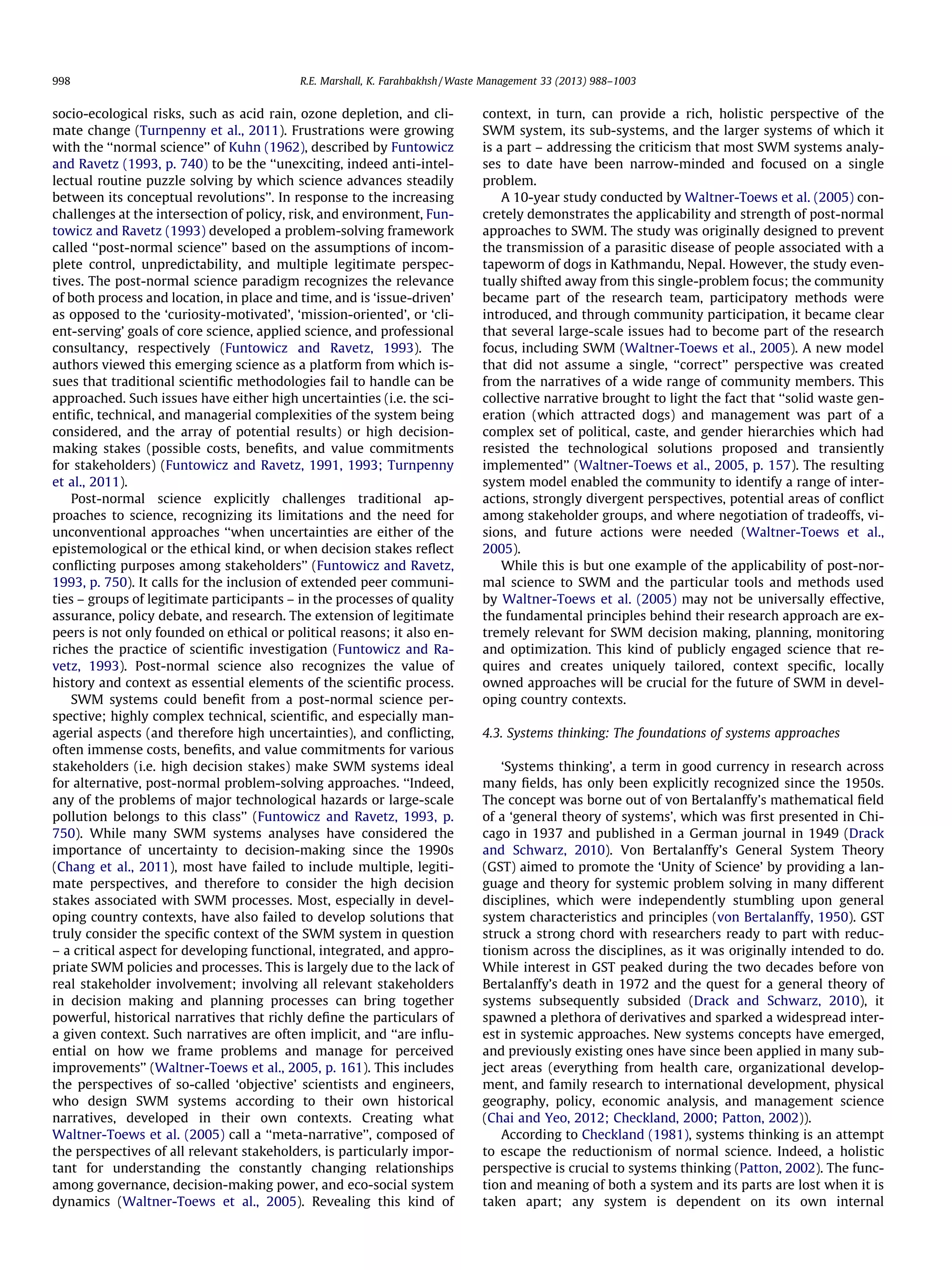
to strike a balance between three dimensions of waste management: environmental effectiveness, social acceptability, and economic affordability (see Fig. 2). (McDougall et al., 2001;
Morrissey and Browne, 2004; Petts, 2000; Thomas and McDougall,
2005; van de Klundert and Anschutz, 2001). ISWM also focuses on
the integration of the many inter-related processes and entities that
make up a waste management system (McDougall et al., 2001). To
reduce environmental impacts and drive costs down, a system
should be integrated (in waste materials, sources of waste, and
treatment methods), market oriented (i.e. energy and materials
have end uses), and flexible, allowing for continual improvement
(McDougall et al., 2001). ISWM systems are tailored to specific
community goals by incorporating stakeholders’ perspectives and
needs; the local context (from the technical, such as waste](https://image.slidesharecdn.com/wastemanagement-131112055504-phpapp02/75/Waste-management-summary-8-2048.jpg)
![996
R.E. Marshall, K. Farahbakhsh / Waste Management 33 (2013) 988–1003
Fig. 2. Integrated solid waste management.
characteristics, to the cultural, political, social, environmental, economic and institutional); and the optimal combination of available,
appropriate methods of prevention, reduction, recovery and disposal (Kollikkathara et al., 2009; McDougall et al., 2001; van de
Klundert and Anschutz, 2001).
It has been widely recognized that waste management systems
that ignore social components and priorities are doomed to failure
(Carabias et al., 1999; Dijkema et al., 2000; Henry et al., 2006;
Morrissey and Browne, 2004; Petts, 2000). The issues of public
acceptance, changing value systems, public participation in planning and implementation stages, and consumer behaviour are
equally as important as the technical and economic aspects of
waste management (Carabias et al., 1999). Effective waste management must be fully embraced by local authorities and the public
sphere, and go beyond traditional consultative methods that require the ‘expert’ to outline a solution prior to public involvement
(Henry et al., 2006; Morrissey and Browne, 2004). Key elements to
the success of these programs are public participation and empowerment, decision transparency, networking, co-operation and collective action, communication, and accessibility of information
(Carabias et al., 1999; Zarate et al., 2008). However, it has been difficult to fully integrate stakeholders and ensure public involvement (Morrissey and Browne, 2004); this is in large part due to
the fact that citizens did not shape the SWM systems they depend
upon. These systems were shaped by technically minded ‘‘experts’’
who defined and designed the system in engineering terms.
Traditionally, the term ‘waste’ has assumed a negative connotation, but it is a subjective concept – a label applied to something
unwanted by the person discarding it (Dijkema et al., 2000; van
de Klundert and Anschutz, 2001). In the context of ISWM, ‘waste’
bears a negative connotation only if it cannot be regarded as a resource that that has not been used to its full potential and can subsequently be processed to produce useful energy or goods
(Dijkema et al., 2000; van de Klundert and Anschutz, 2001). In this
sense, ISWM incorporates elements of the waste hierarchy ‘‘by
considering direct impacts (transportation, collection, treatment
and disposal of waste) and indirect impacts (use of waste materials
and energy outside the waste management system)’’ (Seadon,
2006, p. 1328). However, unlike the hierarchy, ISWM does not
define the ‘best’ system, as there is no universal best system
(McDougall et al., 2001). In reality, ISWM is a theoretical, optimal
outcome – a framework from which new systems can be designed
and implemented and existing ones can be optimized (UNEP,
1996). However, the integrated nature of ISWM creates a host of
variables that may pull a system in different directions. Clearly, it
is difficult to optimize more than one variable, and for this reason
there will always be trade-offs (McDougall et al., 2001). No ISWM
system design will achieve either environmental or economic sustainability because ‘‘[t]his is a total quality objective ... it can never
be reached, since it will always be possible to reduce environmental impacts further, but it will lead to continual improvements’’
(McDougall et al., 2001, p. 19).](https://image.slidesharecdn.com/wastemanagement-131112055504-phpapp02/75/Waste-management-summary-9-2048.jpg)
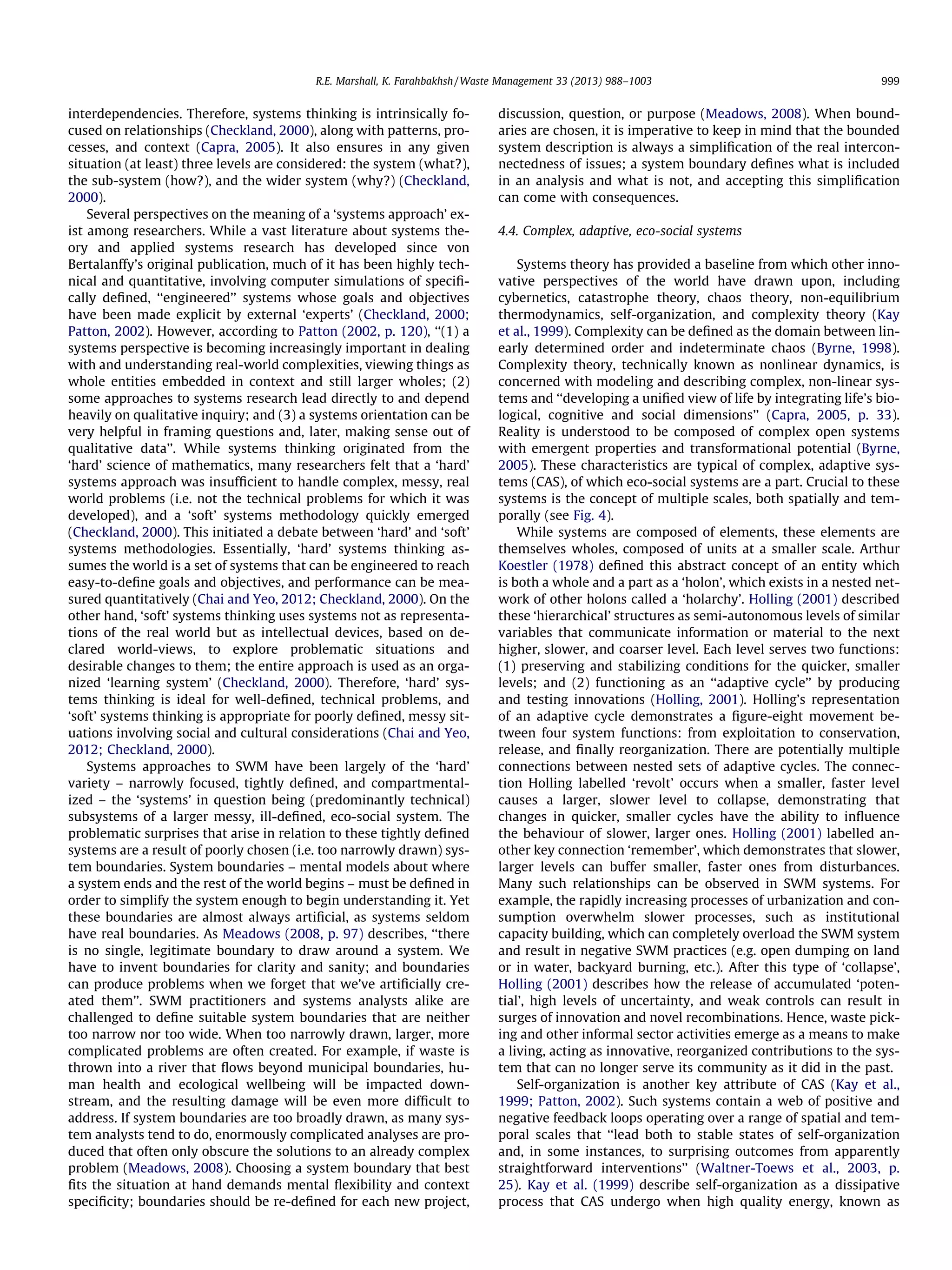
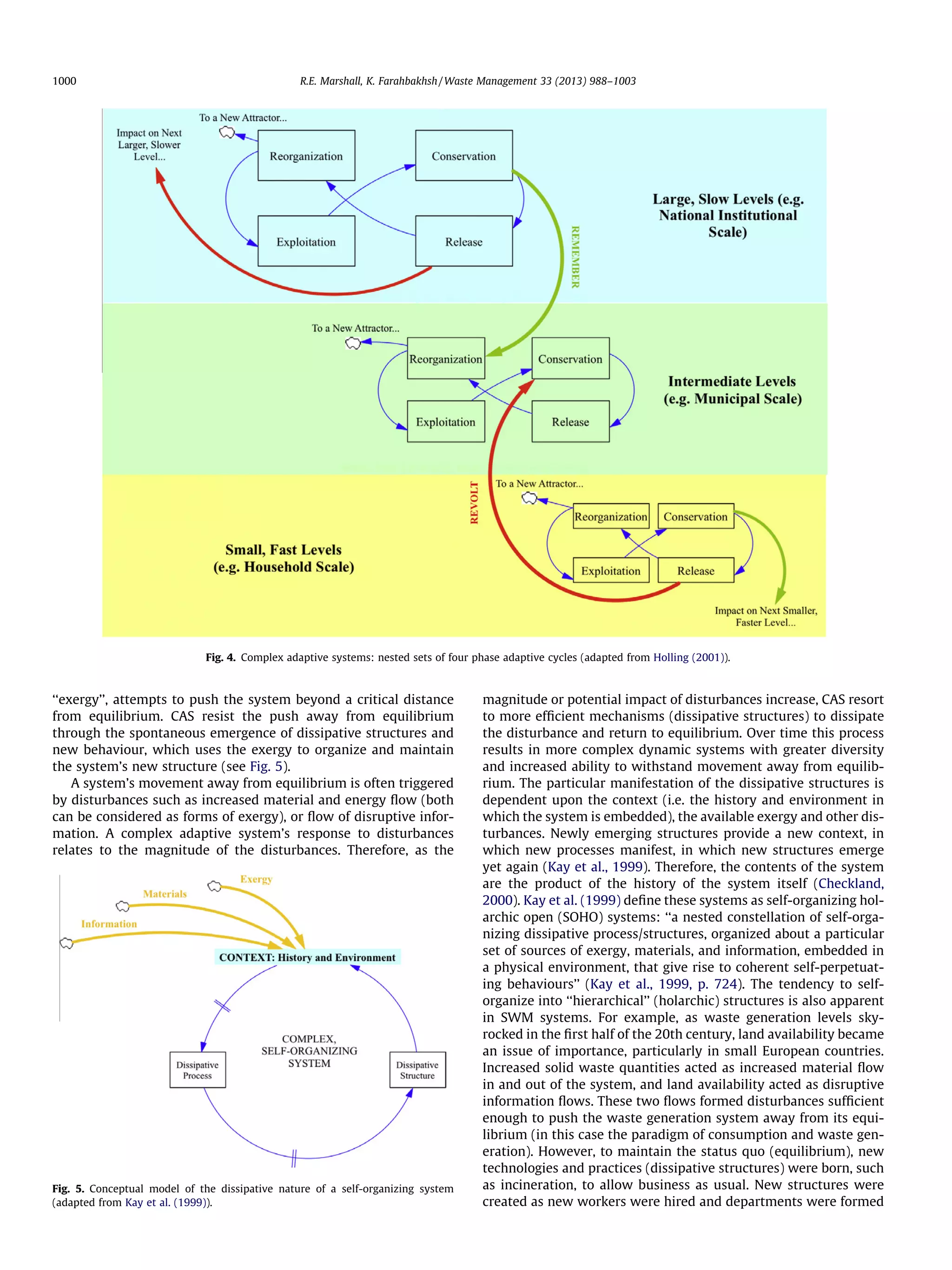
![R.E. Marshall, K. Farahbakhsh / Waste Management 33 (2013) 988–1003
to manage the inward and outward flow of materials and information. A second example of this kind of self-organization emerged in
the 1970s, when the environmental movement pushed for the protection of ecosystems from poor waste management practices. In
this case, environmental issues acted as information flows that,
in combination with increased waste material flows, disturbed
the system’s equilibrium. Instead of moving to a new equilibrium
where waste generation levels would be dramatically reduced,
recycling facilities began to spring up. As recycling evolved due
to sustained pressure to protect the environment, a few recycling
streams differentiated into tens and even hundreds of specialized
streams, and again, new departments and systemic relationships
were generated to manage the flow, pay the workers, and coordinate the selling of raw materials. The waste management system,
meanwhile, remained near the original equilibrium of waste generation, though disposal methods had proliferated into a host of
hierarchical structures. Many more examples of this kind of adaptation and self-organization in SWM systems exist. In both of these
instances, the SWM system resisted a complete flip to a new equilibrium state where waste generation would have dramatically decreased, (more) environmental systems would have collapsed, or a
host of other surprises would have occurred. This was accomplished by creating elaborate hierarchies of structure and relationships to reduce disturbances to the system (i.e., consume excess
material, or ‘‘exergy’’). However, the maintenance of the current
state of equilibrium has required significant input of energy and resources and is pushing waste management systems to their limits
of viability in many jurisdictions.
The self-organizing tendencies of CAS highlight the challenges
humans face in attempting to ‘manage’ them (or our outright
inability to do so). It also highlights the potential for surprising
outcomes due to ‘‘time lags, cross-scale effects, and what might
have been left out [of a system model]. These types of feedback
mean that prediction of individual outcomes is limited; prediction
of overall system behaviour is only possible in broad outline, and
then only if we have historical data to suggest the canon of states
available to that system... Such data are rarely available’’ (WaltnerToews et al., 2003, p. 25). Both ecological and human systems
exhibit strongly developed self-organized patterns, meaning that
linear policies are more likely to produce temporary solutions
and many worsening problems in the future (Holling, 2001). Waltner-Toews et al. (2005) hold the view that ecological and social
systems are intertwined, and the separation of these systems is
both artificial and arbitrary. The term ‘eco-social systems’
acknowledges these connections. Limits for the possible alternative states of such systems are set by the accumulated social, cultural, ecological, and economic capital, in addition to chance
innovations (Holling, 2001). SWM systems are certainly eco-social
systems, and thus their evolution is shaped by these factors.
Central to a CAS approach is the essential need to include multiple perspectives. Kay et al. (1999) consider human values and a
diversity of views to be crucial to the process of identifying appropriate methods of investigation necessary to deal with issues in a
systemic context. Issues of social reality, which are ‘‘continuously
socially constructed and reconstructed by individuals and groups’’
(Checkland, 2000, p. S24), are relevant, as are issues of inclusiveness, mutual trust in the investigation process, and relative power
among stakeholders (Kay et al., 1999). Any action taken must be
feasible in the context of the local history, relationships, culture,
and aspirations of all concerned parties (Checkland, 2000). Cultural
context and historical narratives are strongly influential on how
public decisions about environment and health are both framed
and managed (Waltner-Toews et al., 2005). Ensuring real stakeholder participation in SWM processes – everything from determining what problems are most important to solution
implementation – will greatly help to identify system structures,
1001
behavioural tendencies, precious historical information, and potential future system states. Developing this kind of shared understanding of the eco-social SWM systems in developing countries
can lay the groundwork for much needed innovation and improvement in the sector.
5. Conclusion
While the need for a systems approach to SWM has been both
explicitly recognized (e.g. see Seadon (2010)) and inexplicitly recognized through the many calls for ‘integrated’ methodologies, there is
a lack of literature exploring the actual application of post-normal
approaches and complex, adaptive systems thinking to SWM systems in many developing country contexts. While not a cure-all
‘solution’, this kind of publicly engaged systems thinking can provide some understanding and create approaches for coping with
complexity (Waltner-Toews et al., 2008). Collaborating with a host
of legitimate peers can also help to create rich ‘‘meta-narratives’’
that enable stakeholders to frame their particular context, and take
the next appropriate SWM steps. The need for this kind of context
specificity is critical for the future of SWM. It has been widely recognized that it is counterproductive for developing countries to use
strategies and policies developed for high-income countries; approaches should be locally sensitive, critical, creative, and ‘owned’
by the community of concern (Coffey and Coad, 2010; Henry et al.,
2006; Konteh, 2009; Schübeler, 1996; UN-HABITAT, 2010). Holling
suggests beginning an analysis ‘‘with a historical reconstruction of
the events that have occurred, focusing on the surprises and crises
that have arisen as a result of both external influences and internal
instabilities’’, in the ecological, social, political, and economic systems, and the management institutions (Holling, 2001, p. 402).
It should be noted that while systems thinking is concerned with
how patterns of relationships translate into emergent behaviours
(Waltner-Toews et al., 2008), these translations take time and so
will any system alterations; delays are inherent in complex systems
(Meadows, 2008). It has taken decades for the management, efficiency, and reliability of SWM systems in high-income countries
to evolve to the far from ideal states they are currently in (Coffey
and Coad, 2010). Wilson (2007) describes the impracticality of current expectations for developing country SWM systems: ‘‘If there is
one key lesson that I have learned from 30 years in waste management, it is that there are no ‘quick fixes’. All developed countries
have evolved their current systems in a series of steps; developing
countries can benefit from that experience, but to expect to move
from uncontrolled dumping to a ‘modern’ waste management system in one great leap is just not realistic’’ (Wilson, 2007, p. 205).
Approaches developed to handle the complexity of specific
developing country contexts, particularly at the nexus of eco-social
systems, could contribute substantially to solid waste management research and decision-making in developing country contexts. Thus, there is a need for new approaches emerging from
the interface of SWM, post-normal science, and complex-adaptive
systems research as the bleak state of SWM systems in many
developing regions continues to threaten and degrade the health
of the most vulnerable human populations and the ecosystems
they are a part of. While systems thinking has played a role in technically-focused SWM research, predominantly in developed countries, solid waste researchers and decision-makers will need to
adopt a strongly participatory, contextually grounded complex,
adaptive systems perspective if any real progress is to be made
in the SWM practices of the developing world.
References
Bhuiyan, S.H., 2010. A crisis in governance: urban solid waste management in
Bangladesh. Habitat International 34 (1), 125–133.](https://image.slidesharecdn.com/wastemanagement-131112055504-phpapp02/75/Waste-management-summary-14-2048.jpg)