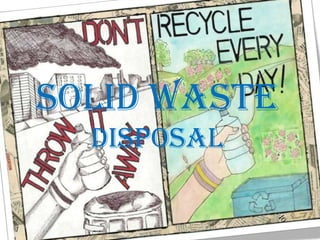
Solid waste
  disposal
-solid waste is any unwanted material
thatis intentionally thrown away for
disposal.


-Commercial Waste- waste from trade or
business.
-Institutional      Waste-     waste       from
institutions ,like schools,hospitals, etc.
-Construction/Demolition Waste
-Process Waste- generated from
manufacturing a product or doing a
service
-Agricultural Waste
-Nuclear Waste- to be discussed by the
other group.
-industrial waste- factory waste,
usually hazardous
-Domestic Waste – residential waste
       * Biodegradable / Compostable waste
            -Decomposed to make fertilizer, or compost.
            -Composes majority of solid waste
            -ex. Fruit peelings, leftover
       * Recyclable waste
           -Waste that is processed again to make
             something else
         - Ex. PTE bottles, paper, metal
      * Toxic/Hazardous Waste
            - Waste that doesn’t fall under any of the other three
categories
            -Cannot be composted, recycled, and isn’t toxic.
            -Ex. Plastic , ceramic, nailpolish
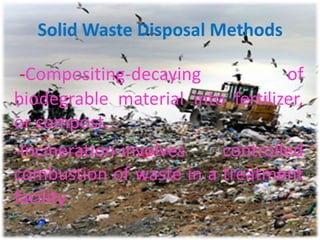
Solid Waste Disposal Methods

 -Compositing-decaying            of
biodegrable material into fertilizer,
or compost.
-Incineration-involves   controlled
combustion of waste in a treatment
facility
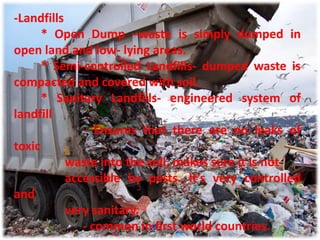
-Landfills
      * Open Dump –waste is simply dumped in
open land and low- lying areas.
      * Semi-controlled Landfills- dumped waste is
compacted and covered with soil.
      * Sanitary Landfills- engineered system of
landfill
              - Ensures that there are no leaks of
toxic
           waste into the soil, makes sure it is not
           accessible by pests. It’s very controlled
and
           very sanitary.
              - common in first world countries.
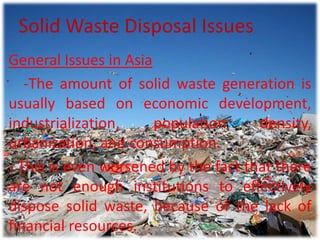
Solid Waste Disposal Issues
General Issues in Asia
   -The amount of solid waste generation is
usually based on economic development,
industrialization,     population     density,
urbanization, and consumption.
- This is even worsened by the fact that there
are not enough institutions to effectively
dispose solid waste, because of the lack of
financial resources.
-Climate, topography, and geographical location greatly
affect SWD.
North Asia
-Earthquakes and volcanic eruptions can disrupt SWD
sites in North Asia.
-North Asia is highly industrialized , so majority of its
waste are toxic, factory waste.
East Asia
- Solid Waste is increasing by more than 10 % a year in
China because of rapid population growth and booming
economic activity.
-east Asia is also becoming very urbanized, so there are
high rates of construction and demolition wastes.
-East Asia is prone to earthquakes and
typhoons.
West and South Asia
-Overpopulation in South and West Asia
greatly affect SWD.
-Many SWD are being used for shelter.
-South and West Asia are becoming more
industrialized, so factory wastes pollute
surrounding areas.
Southeast Asia
-SWD is very difficult in SEA because
of its geographic location; the
climate and the topography affect
                    .
areas for SWD.
-Industrialization of South East Asia
generates toxic factory waste.
-High population density increase
solid waste, and fills up SWD site.
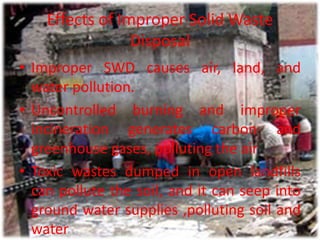
Effects of Improper Solid Waste
                 Disposal
• Improper SWD causes air, land, and
  water pollution.
• Uncontrolled burning and improper
  incineration generates carbon and
  greenhouse gases, polluting the air
• Toxic wastes dumped in open landfills
  can pollute the soil, and it can seep into
  ground water supplies ,polluting soil and
  water
• Solid waste can clog drains and sewers,
  creating stagnant water for breeding insects.
• Land can get degraded and poisoned.

-because of polluted air, land, and water , it can
  cause diseases and sickness in humans.
-improper SWD affects Asian economy.
*the government ends up paying for the impact
  of acid rain on crops, medical bills of citizens ,
  lost work from sick workers, disaster relief
  after floods and earthquakes , etc.
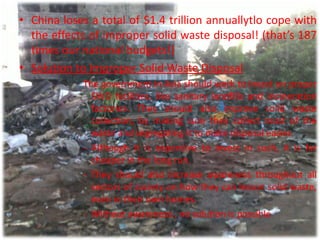
• China loses a total of $1.4 trillion annuallytlo cope with
  the effects of improper solid waste disposal! (that’s 187
  times our national budgets!)
• Solution to Improper Solid Waste Disposal
            The government in Asia should work to invest on proper
              SWD facilities, like sanitary landfills and incineration
              factories. They should also improve solid waste
              collection, by making sure they collect most of the
              waste and segregating it to make disposal easier.
            - Although it is expensive to invest in such, it is far
              cheaper in the long run.
            - They should also increase awareness throughout all
              sectors of society on how they can lesson solid waste,
              even in their own homes.
            - Without awareness , no solution is possible
Solid waste disposal

Solid waste disposal

  • 1.
    Solid waste disposal
  • 2.
    -solid waste isany unwanted material thatis intentionally thrown away for disposal. -Commercial Waste- waste from trade or business. -Institutional Waste- waste from institutions ,like schools,hospitals, etc.
  • 3.
    -Construction/Demolition Waste -Process Waste-generated from manufacturing a product or doing a service -Agricultural Waste -Nuclear Waste- to be discussed by the other group. -industrial waste- factory waste, usually hazardous
  • 4.
    -Domestic Waste –residential waste * Biodegradable / Compostable waste -Decomposed to make fertilizer, or compost. -Composes majority of solid waste -ex. Fruit peelings, leftover * Recyclable waste -Waste that is processed again to make something else - Ex. PTE bottles, paper, metal * Toxic/Hazardous Waste - Waste that doesn’t fall under any of the other three categories -Cannot be composted, recycled, and isn’t toxic. -Ex. Plastic , ceramic, nailpolish
  • 5.
    Solid Waste DisposalMethods -Compositing-decaying of biodegrable material into fertilizer, or compost. -Incineration-involves controlled combustion of waste in a treatment facility
  • 6.
    -Landfills * Open Dump –waste is simply dumped in open land and low- lying areas. * Semi-controlled Landfills- dumped waste is compacted and covered with soil. * Sanitary Landfills- engineered system of landfill - Ensures that there are no leaks of toxic waste into the soil, makes sure it is not accessible by pests. It’s very controlled and very sanitary. - common in first world countries.
  • 7.
    Solid Waste DisposalIssues General Issues in Asia -The amount of solid waste generation is usually based on economic development, industrialization, population density, urbanization, and consumption. - This is even worsened by the fact that there are not enough institutions to effectively dispose solid waste, because of the lack of financial resources.
  • 8.
    -Climate, topography, andgeographical location greatly affect SWD. North Asia -Earthquakes and volcanic eruptions can disrupt SWD sites in North Asia. -North Asia is highly industrialized , so majority of its waste are toxic, factory waste. East Asia - Solid Waste is increasing by more than 10 % a year in China because of rapid population growth and booming economic activity. -east Asia is also becoming very urbanized, so there are high rates of construction and demolition wastes.
  • 9.
    -East Asia isprone to earthquakes and typhoons. West and South Asia -Overpopulation in South and West Asia greatly affect SWD. -Many SWD are being used for shelter. -South and West Asia are becoming more industrialized, so factory wastes pollute surrounding areas.
  • 10.
    Southeast Asia -SWD isvery difficult in SEA because of its geographic location; the climate and the topography affect . areas for SWD. -Industrialization of South East Asia generates toxic factory waste. -High population density increase solid waste, and fills up SWD site.
  • 11.
    Effects of ImproperSolid Waste Disposal • Improper SWD causes air, land, and water pollution. • Uncontrolled burning and improper incineration generates carbon and greenhouse gases, polluting the air • Toxic wastes dumped in open landfills can pollute the soil, and it can seep into ground water supplies ,polluting soil and water
  • 12.
    • Solid wastecan clog drains and sewers, creating stagnant water for breeding insects. • Land can get degraded and poisoned. -because of polluted air, land, and water , it can cause diseases and sickness in humans. -improper SWD affects Asian economy. *the government ends up paying for the impact of acid rain on crops, medical bills of citizens , lost work from sick workers, disaster relief after floods and earthquakes , etc.
  • 13.
    • China losesa total of $1.4 trillion annuallytlo cope with the effects of improper solid waste disposal! (that’s 187 times our national budgets!) • Solution to Improper Solid Waste Disposal The government in Asia should work to invest on proper SWD facilities, like sanitary landfills and incineration factories. They should also improve solid waste collection, by making sure they collect most of the waste and segregating it to make disposal easier. - Although it is expensive to invest in such, it is far cheaper in the long run. - They should also increase awareness throughout all sectors of society on how they can lesson solid waste, even in their own homes. - Without awareness , no solution is possible