Solid Waste Management
      and Disposal
Outline
 Background
 Waste Disposal Methods
  – Landfills
  – Incineration
 Source Reduction
 Recycling
  – Pros and Cons
Introduction
 Lack of dumping space has become a
  problem for many large metropolitan
  areas
 Communities are increasingly concerned
  about waste disposal costs, and
  groundwater and air quality hazards.
Disposable Decades
   In the mid 1950’s a disposable lifestyle was
    marketed as the wave of the future, and as a
    way to reduce household duties.
   Consumerism began in earnest following
    WWII.
   Convenience was sold to prosperous post-war
    consumers. “Convenience” was quickly
    changed to necessity.
Nature of the Problem
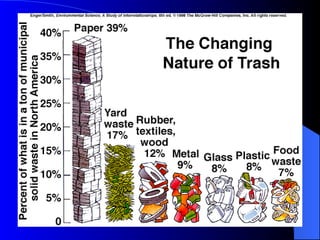
   Garbage = Municipal Solid Waste
   US produces 220 million metric tons of
    municipal waste per year.
   US volume has more than doubled since 1960.
    MDCs have a higher standard of living, and
    thus produce more waste.
   Traditional Methods (dumping and burning)
    are no longer accepted.
Waste Disposal Methods
Landfills
 Landfilling has traditionally been the primary
  method of waste disposal - cheap and
  convenient.
 Modern landfills have complex impermeable
  bottom layers to trap contaminants, and daily
  deposits are covered by layer of dirt.
   – Methane gas and leachate detection
     systems.
 Currently, almost 80% of NA municipal
  solid waste is deposited in landfills.
 New landfills are often resisted due to
  public concerns over groundwater
  contamination, odors, and truck traffic.
 Due to tight, anaerobic conditions,
  biological decay in modern landfills is
  retarded.
What is the largest man made structure on the planet?
Opened as a "temporary landfill" in 1947, The Fresh Kills Landfill
covers 2200 acres, can be seen with the naked eye from space and is
taller then the Statue of Liberty, at a height of 225 ft. It is situated on the
western shore of Staten Island and is made up of four sections which
contain fifty plus years of landfill, mostly in the form of household
waste. The waste disposed at the Fresh Kills Landfill and the
decomposition products of this waste contain numerous chemicals. The
chemicals can enter into the environment in a variety of ways: releases
into the air from barge unloading and garbage trucks unloading; the
cement crushing trucks releases chemical dust into the air; and into the
local groundwater by leaching.
Incineration

 Prior to 1940, incineration was common
  in NA and western Europe.
 Many incinerators were eliminated
  because of aesthetic concerns.
 Currently, about 16% of US municipal
  solid waste is incinerated.
   – Derived heat often used for electrical
     generation.
 Incinerators drastically reduce the
  amount of municipal solid waste - up to
  90% by volume and 75% by weight.
 Even with modern pollution controls,
  small amounts of pollutants are still
  released into env.
 Cost and siting of new incinerators major
  problems facing communities.
Source Reduction
   Most fundamental method of reducing
    waste is to prevent it from being
    produced.
    – Since 2 liter soft drink bottle was
      introduced in 1977, weight has been
      reduced by 35%
    – Since 1965, aluminum cans have been
      reduced in weight by 35%.
Recycling
 Currently 23% of NA waste is recycled.
 Recycling initiatives have grown rapidly
  in NA during the past several years.
Recycling Benefits
 Resource Conservation
 Pollution Reduction
 Example: Crushed glass reduces the
  energy required to manufacture new
  glass by 50%
 Example: One Sunday edition of N.Y.
  times consumes 62,000 trees. Only 20%
  of NA paper is recycled.
Recycling Concerns
 Plastics are recyclable, but technology
  differs from plastic to plastic.
   – Industry is researching new
     technologies.
 Economics are of concern. Unless
  demand for products keeps pace with
  growing supply, recycling programs will
  face an uncertain future.
   Long-term success of recycling programs is
    also tied to other economic incentives such as
    taxation and the development of and demand
    for products manufactured from recycled
    materials.
   Currently in the US, it is often still cheaper to
    use virgin material than transport recycled
    materials.
Summary
   Post WWII, increased consumption of consumer
    goods became a way of life.
   Municipal solid waste is managed by:
     – Landfilling            Incineration
     – Waste Reduction        Recycling
   Waste prevention is the most fundamental waste
    reduction technique
   Recycling can only be successful if markets
    exist for recycled materials.
Maybe the best method of “disposal”
is not to produce it in the first place ...

Ch. 19 material diff

  • 1.
  • 2.
    Outline  Background  WasteDisposal Methods – Landfills – Incineration  Source Reduction  Recycling – Pros and Cons
  • 3.
    Introduction  Lack ofdumping space has become a problem for many large metropolitan areas  Communities are increasingly concerned about waste disposal costs, and groundwater and air quality hazards.
  • 6.
    Disposable Decades  In the mid 1950’s a disposable lifestyle was marketed as the wave of the future, and as a way to reduce household duties.  Consumerism began in earnest following WWII.  Convenience was sold to prosperous post-war consumers. “Convenience” was quickly changed to necessity.
  • 7.
    Nature of theProblem  Garbage = Municipal Solid Waste  US produces 220 million metric tons of municipal waste per year.  US volume has more than doubled since 1960.  MDCs have a higher standard of living, and thus produce more waste.  Traditional Methods (dumping and burning) are no longer accepted.
  • 9.
    Waste Disposal Methods Landfills Landfilling has traditionally been the primary method of waste disposal - cheap and convenient.  Modern landfills have complex impermeable bottom layers to trap contaminants, and daily deposits are covered by layer of dirt. – Methane gas and leachate detection systems.
  • 10.
     Currently, almost80% of NA municipal solid waste is deposited in landfills.  New landfills are often resisted due to public concerns over groundwater contamination, odors, and truck traffic.  Due to tight, anaerobic conditions, biological decay in modern landfills is retarded.
  • 12.
    What is thelargest man made structure on the planet?
  • 13.
    Opened as a"temporary landfill" in 1947, The Fresh Kills Landfill covers 2200 acres, can be seen with the naked eye from space and is taller then the Statue of Liberty, at a height of 225 ft. It is situated on the western shore of Staten Island and is made up of four sections which contain fifty plus years of landfill, mostly in the form of household waste. The waste disposed at the Fresh Kills Landfill and the decomposition products of this waste contain numerous chemicals. The chemicals can enter into the environment in a variety of ways: releases into the air from barge unloading and garbage trucks unloading; the cement crushing trucks releases chemical dust into the air; and into the local groundwater by leaching.
  • 15.
    Incineration  Prior to1940, incineration was common in NA and western Europe.  Many incinerators were eliminated because of aesthetic concerns.  Currently, about 16% of US municipal solid waste is incinerated. – Derived heat often used for electrical generation.
  • 16.
     Incinerators drasticallyreduce the amount of municipal solid waste - up to 90% by volume and 75% by weight.  Even with modern pollution controls, small amounts of pollutants are still released into env.  Cost and siting of new incinerators major problems facing communities.
  • 17.
    Source Reduction  Most fundamental method of reducing waste is to prevent it from being produced. – Since 2 liter soft drink bottle was introduced in 1977, weight has been reduced by 35% – Since 1965, aluminum cans have been reduced in weight by 35%.
  • 18.
    Recycling  Currently 23%of NA waste is recycled.  Recycling initiatives have grown rapidly in NA during the past several years.
  • 19.
    Recycling Benefits  ResourceConservation  Pollution Reduction  Example: Crushed glass reduces the energy required to manufacture new glass by 50%  Example: One Sunday edition of N.Y. times consumes 62,000 trees. Only 20% of NA paper is recycled.
  • 20.
    Recycling Concerns  Plasticsare recyclable, but technology differs from plastic to plastic. – Industry is researching new technologies.  Economics are of concern. Unless demand for products keeps pace with growing supply, recycling programs will face an uncertain future.
  • 22.
    Long-term success of recycling programs is also tied to other economic incentives such as taxation and the development of and demand for products manufactured from recycled materials.  Currently in the US, it is often still cheaper to use virgin material than transport recycled materials.
  • 23.
    Summary  Post WWII, increased consumption of consumer goods became a way of life.  Municipal solid waste is managed by: – Landfilling Incineration – Waste Reduction Recycling  Waste prevention is the most fundamental waste reduction technique  Recycling can only be successful if markets exist for recycled materials.
  • 24.
    Maybe the bestmethod of “disposal” is not to produce it in the first place ...