
Seminar
on
Session-2018-19
Presenting by:-Vanika Murty
M.Sc. (RT) 2nd semester
DEPARTMENT OF RURAL TECHNOLOGY
AND
SOCIAL DEVELOPMENT, GGV ,BILASPUR (C.G)
 Definition
 Principle
 Characteristics of landfills
 Collecting and transporting
 Important aspects
 Factors affecting
 Methods of land-filling
 Advantages of land-filling
 Disadvantages of land-filling
 Conclusion
SOLID WASTE MANAGEMENT:-
The collecting , treating and disposing of solid
material that is discarded because , it has served its
purpose or is no longer useful. Improper disposal of
municipal solid waste can create unsanitary conditions
and these conditions in turn can lead to pollution of
the environment and to outbreaks of vector-borne
disease that is, disease spread by rodents and insects .
The tasks of solid waste management present complex
technical challenges. They also pose a wide variety of
administrative , economic , and social problems that
must be managed and solved.
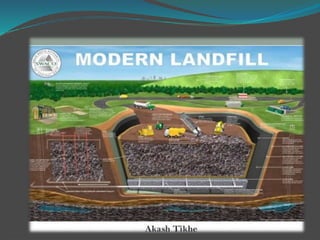
 A Landfill is an engineered method for land disposal of
solid and hazardous waste.
 Land-filling is the term used to describe the process by
which solid waste is placed in the landfill.
 Landfills for individual waste constituents such as
combustion ash , asbestos and other similar wastes are
known as mono-fills.
 Landfills for the disposal of hazardous wastes are called
secure landfills.
The purpose of land-filling is to bury/alter the chemical
composition of the waste so that they do not pose any
threat to environment/public health.
Landfills are usually made up of cells in which a discrete
volume of waste is kept isolated from adjacent waste cells
by a suitable barrier.
The term cell is used to describe the volume of material
placed in a landfill during one operating period.
1. Solid waste is placed in a suitably selected and
prepared (lined) landfill site in a carefully prescribed
manner.
2. The waste material is spread out and compacted with
appropriate heavy machinery.
3. The waste is covered each day with a layer of
compacted soil.
4. Most important feature of modern sanitary landfill
design is the technology used to prevent GW
pollution.
5. It relies on containment rather than treatment.
Proper solid waste collection is important for the
protection of public health , safety and maintain
environment quality. It is a labour-intensive activity ,
accounting for approximately three quarters of the total
cost of solid waste management. Public employees are
often assigned to the task , but sometimes it is more
economical for private collectors to be paid by
individual home owners.
A driver and one or two loaders serve each collection
vehicle. These are typically trucks of the enclosed ,
compacting type , with capacities upto 30 cubic meters
(40 cubic yards).
In communities where appropriate sites are available ,
sanitary landfills usually provides the most economical
option for disposal of non-recyclable refuse . However , it
is becoming increasingly difficult to find sites that offer
adequate , accessibility , and environmental conditions.
Landfills will always play a key role in solid waste
management. It is not possible to recycle all components
of solid waste , landfills can actually improve poor-quality
land. In some communities properly completed landfills
are converted into recreational parks , playgrounds or golf
courses.
1. NATURE OF WASTE: Amount of gas depends on the
content of biodegradable matter in the waste.
2. MOISTURE CONTENT: Microorganisms require
minimum 12% moisture for growth , thus it is important
factor in determining gas production.
3. PH: Methanogens grow only at low PH around
neutrality. % of gas depends on PH.
4. PARTICLE SIZE AND DENSITY: Particle size affects
density achieved by compaction that affects surface area
and hence volume . This affects the moisture absorption
and thus the biological degradation.
5. TEMPERATURE: Increase in temperature tends to
increase in gas production. Its affects microbial activity.
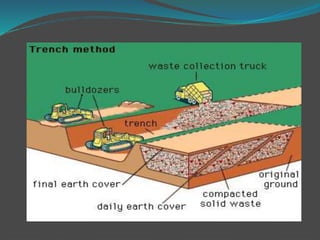
 EXCAVATED CELL/ TRENCH METHOD:-
 Ideally suited to areas where an adequate depth of
cover material is available at the site and water table
is not near the surface.
 SW are placed in cells/ trenches excavated in
the soil.
 Soil excavated from the site is used for daily
and final cover.
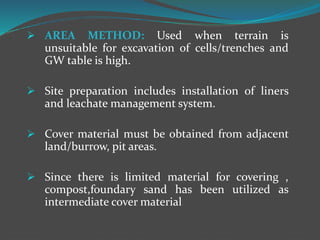
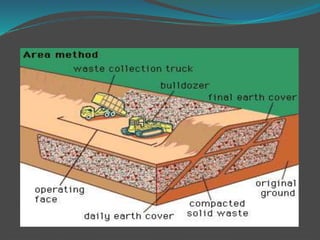
 AREA METHOD: Used when terrain is
unsuitable for excavation of cells/trenches and
GW table is high.
 Site preparation includes installation of liners
and leachate management system.
 Cover material must be obtained from adjacent
land/burrow, pit areas.
 Since there is limited material for covering ,
compost,foundary sand has been utilized as
intermediate cover material
Temporary cover material of soil and geosynthetic
blankets placed temporarily over completed cell and
removed before next lift is began.
Leachate generation may occur and may be difficult to
control.
 In addition to provide an option for waste management , it
also serves to improve/reclaim poor quality land.
It raises the ground elevation/surface grade of the site .
Completed landfills have been converted to municipal parks ,
playgrounds , golf courses , community land use projects.
It is the most economical alternative for SW disposal which
accounts for its frequent application.
Other disposal methods are not entirely safe and efficient
throughout the year.
Incineration is a costly process , residue ultimate
disposal on land.
Composting is a seasonal option.
It is not possible to reclaim and recycle all SW
material.
Thus land-filling is the most convient option.
Difficult to find suitable site within economically feasible distance.
It is not possible to build a completely safe and secure SW landfill.
Some of the pollutants may escape in the environment in the form of
leachate .
Potential harm to public health due to air , soil , water and noise
pollution.
Damage to local ecosystem.
Public oppose.
 Landfill should not be located in low lying wetland areas
that is marshes , swamps , as the waste should not come
in contact with surface/GW.
 It should be located in unstable areas or if it is present it
must be designed to resist forces caused by seismic
activity.
 It is important to minimize contamination from landfill
to the surrounding environment.
 There should be minimum distance of 60m from any
lake/pond.
solid waste management to landfills

solid waste management to landfills

  • 1.
    Seminar on Session-2018-19 Presenting by:-Vanika Murty M.Sc.(RT) 2nd semester DEPARTMENT OF RURAL TECHNOLOGY AND SOCIAL DEVELOPMENT, GGV ,BILASPUR (C.G)
  • 2.
     Definition  Principle Characteristics of landfills  Collecting and transporting  Important aspects  Factors affecting  Methods of land-filling  Advantages of land-filling  Disadvantages of land-filling  Conclusion
  • 3.
    SOLID WASTE MANAGEMENT:- Thecollecting , treating and disposing of solid material that is discarded because , it has served its purpose or is no longer useful. Improper disposal of municipal solid waste can create unsanitary conditions and these conditions in turn can lead to pollution of the environment and to outbreaks of vector-borne disease that is, disease spread by rodents and insects . The tasks of solid waste management present complex technical challenges. They also pose a wide variety of administrative , economic , and social problems that must be managed and solved.
  • 4.
     A Landfillis an engineered method for land disposal of solid and hazardous waste.  Land-filling is the term used to describe the process by which solid waste is placed in the landfill.  Landfills for individual waste constituents such as combustion ash , asbestos and other similar wastes are known as mono-fills.  Landfills for the disposal of hazardous wastes are called secure landfills.
  • 6.
    The purpose ofland-filling is to bury/alter the chemical composition of the waste so that they do not pose any threat to environment/public health. Landfills are usually made up of cells in which a discrete volume of waste is kept isolated from adjacent waste cells by a suitable barrier. The term cell is used to describe the volume of material placed in a landfill during one operating period.
  • 7.
    1. Solid wasteis placed in a suitably selected and prepared (lined) landfill site in a carefully prescribed manner. 2. The waste material is spread out and compacted with appropriate heavy machinery. 3. The waste is covered each day with a layer of compacted soil. 4. Most important feature of modern sanitary landfill design is the technology used to prevent GW pollution. 5. It relies on containment rather than treatment.
  • 8.
    Proper solid wastecollection is important for the protection of public health , safety and maintain environment quality. It is a labour-intensive activity , accounting for approximately three quarters of the total cost of solid waste management. Public employees are often assigned to the task , but sometimes it is more economical for private collectors to be paid by individual home owners. A driver and one or two loaders serve each collection vehicle. These are typically trucks of the enclosed , compacting type , with capacities upto 30 cubic meters (40 cubic yards).
  • 10.
    In communities whereappropriate sites are available , sanitary landfills usually provides the most economical option for disposal of non-recyclable refuse . However , it is becoming increasingly difficult to find sites that offer adequate , accessibility , and environmental conditions. Landfills will always play a key role in solid waste management. It is not possible to recycle all components of solid waste , landfills can actually improve poor-quality land. In some communities properly completed landfills are converted into recreational parks , playgrounds or golf courses.
  • 11.
    1. NATURE OFWASTE: Amount of gas depends on the content of biodegradable matter in the waste. 2. MOISTURE CONTENT: Microorganisms require minimum 12% moisture for growth , thus it is important factor in determining gas production. 3. PH: Methanogens grow only at low PH around neutrality. % of gas depends on PH. 4. PARTICLE SIZE AND DENSITY: Particle size affects density achieved by compaction that affects surface area and hence volume . This affects the moisture absorption and thus the biological degradation. 5. TEMPERATURE: Increase in temperature tends to increase in gas production. Its affects microbial activity.
  • 12.
     EXCAVATED CELL/TRENCH METHOD:-  Ideally suited to areas where an adequate depth of cover material is available at the site and water table is not near the surface.  SW are placed in cells/ trenches excavated in the soil.  Soil excavated from the site is used for daily and final cover.
  • 14.
     AREA METHOD:Used when terrain is unsuitable for excavation of cells/trenches and GW table is high.  Site preparation includes installation of liners and leachate management system.  Cover material must be obtained from adjacent land/burrow, pit areas.  Since there is limited material for covering , compost,foundary sand has been utilized as intermediate cover material
  • 15.
    Temporary cover materialof soil and geosynthetic blankets placed temporarily over completed cell and removed before next lift is began. Leachate generation may occur and may be difficult to control.
  • 17.
     In additionto provide an option for waste management , it also serves to improve/reclaim poor quality land. It raises the ground elevation/surface grade of the site . Completed landfills have been converted to municipal parks , playgrounds , golf courses , community land use projects. It is the most economical alternative for SW disposal which accounts for its frequent application. Other disposal methods are not entirely safe and efficient throughout the year.
  • 18.
    Incineration is acostly process , residue ultimate disposal on land. Composting is a seasonal option. It is not possible to reclaim and recycle all SW material. Thus land-filling is the most convient option.
  • 19.
    Difficult to findsuitable site within economically feasible distance. It is not possible to build a completely safe and secure SW landfill. Some of the pollutants may escape in the environment in the form of leachate . Potential harm to public health due to air , soil , water and noise pollution. Damage to local ecosystem. Public oppose.
  • 20.
     Landfill shouldnot be located in low lying wetland areas that is marshes , swamps , as the waste should not come in contact with surface/GW.  It should be located in unstable areas or if it is present it must be designed to resist forces caused by seismic activity.  It is important to minimize contamination from landfill to the surrounding environment.  There should be minimum distance of 60m from any lake/pond.