Baoji Mingkun Nonferrous Metal

               1. Aerospace and marine
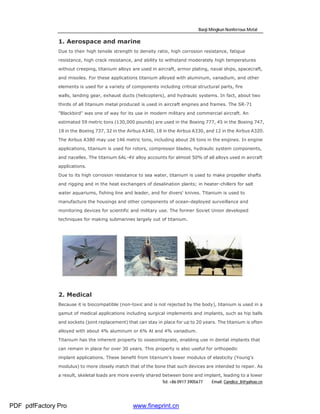
               Due to their high tensile strength to density ratio, high corrosion resistance, fatigue

               resistance, high crack resistance, and ability to withstand moderately high temperatures

               without creeping, titanium alloys are used in aircraft, armor plating, naval ships, spacecraft,

               and missiles. For these applications titanium alloyed with aluminum, vanadium, and other

               elements is used for a variety of components including critical structural parts, fire

               walls, landing gear, exhaust ducts (helicopters), and hydraulic systems. In fact, about two

               thirds of all titanium metal produced is used in aircraft engines and frames. The SR-71

               "Blackbird" was one of way for its use in modern military and commercial aircraft. An

               estimated 59 metric tons (130,000 pounds) are used in the Boeing 777, 45 in the Boeing 747,

               18 in the Boeing 737, 32 in the Airbus A340, 18 in the Airbus A330, and 12 in the Airbus A320.

               The Airbus A380 may use 146 metric tons, including about 26 tons in the engines. In engine

               applications, titanium is used for rotors, compressor blades, hydraulic system components,

               and nacelles. The titanium 6AL-4V alloy accounts for almost 50% of all alloys used in aircraft

               applications.

               Due to its high corrosion resistance to sea water, titanium is used to make propeller shafts

               and rigging and in the heat exchangers of desalination plants; in heater-chillers for salt

               water aquariums, fishing line and leader, and for divers' knives. Titanium is used to

               manufacture the housings and other components of ocean-deployed surveillance and

               monitoring devices for scientific and military use. The former Soviet Union developed
               techniques for making submarines largely out of titanium.


               2. Medical
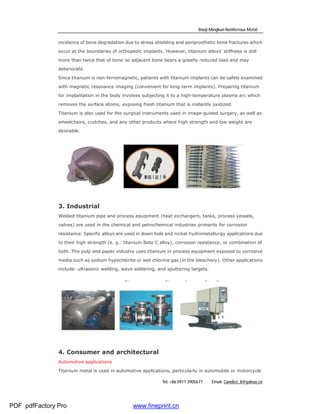
               Because it is biocompatible (non-toxic and is not rejected by the body), titanium is used in a

               gamut of medical applications including surgical implements and implants, such as hip balls

               and sockets (joint replacement) that can stay in place for up to 20 years. The titanium is often

               alloyed with about 4% aluminum or 6% Al and 4% vanadium.

               Titanium has the inherent property to osseointegrate, enabling use in dental implants that

               can remain in place for over 30 years. This property is also useful for orthopedic

               implant applications. These benefit from titanium's lower modulus of elasticity (Young's

               modulus) to more closely match that of the bone that such devices are intended to repair. As

               a result, skeletal loads are more evenly shared between bone and implant, leading to a lower
                                                               Tel: +86 0917 3905677 Email: Candice_li@yahoo.cn


PDF pdfFactory Pro                                www.fineprint.cn
Baoji Mingkun Nonferrous Metal

               incidence of bone degradation due to stress shielding and periprosthetic bone fractures which

               occur at the boundaries of orthopedic implants. However, titanium alloys' stiffness is still

               more than twice that of bone so adjacent bone bears a greatly reduced load and may

               deteriorate.

               Since titanium is non-ferromagnetic, patients with titanium implants can be safely examined

               with magnetic resonance imaging (convenient for long-term implants). Preparing titanium

               for implantation in the body involves subjecting it to a high-temperature plasma arc which

               removes the surface atoms, exposing fresh titanium that is instantly oxidized.

               Titanium is also used for the surgical instruments used in image-guided surgery, as well as

               wheelchairs, crutches, and any other products where high strength and low weight are

               desirable.


               3. Industrial
               Welded titanium pipe and process equipment (heat exchangers, tanks, process vessels,

               valves) are used in the chemical and petrochemical industries primarily for corrosion

               resistance. Specific alloys are used in down hole and nickel hydrometallurgy applications due

               to their high strength (e. g.: titanium Beta C alloy), corrosion resistance, or combination of

               both. The pulp and paper industry uses titanium in process equipment exposed to corrosive

               media such as sodium hypochlorite or wet chlorine gas (in the bleachery). Other applications

               include: ultrasonic welding, wave soldering, and sputtering targets.


               4. Consumer and architectural
               Automotive applications

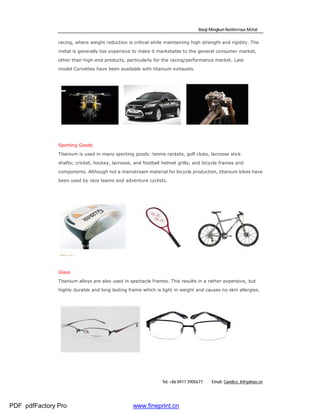
               Titanium metal is used in automotive applications, particularly in automobile or motorcycle

                                                               Tel: +86 0917 3905677   Email: Candice_li@yahoo.cn


PDF pdfFactory Pro                               www.fineprint.cn
Baoji Mingkun Nonferrous Metal

               racing, where weight reduction is critical while maintaining high strength and rigidity. The

               metal is generally too expensive to make it marketable to the general consumer market,

               other than high-end products, particularly for the racing/performance market. Late
               model Corvettes have been available with titanium exhausts.


               Sporting Goods

               Titanium is used in many sporting goods: tennis rackets, golf clubs, lacrosse stick

               shafts; cricket, hockey, lacrosse, and football helmet grills; and bicycle frames and

               components. Although not a mainstream material for bicycle production, titanium bikes have

               been used by race teams and adventure cyclists.


               Glass

               Titanium alloys are also used in spectacle frames. This results in a rather expensive, but
               highly durable and long lasting frame which is light in weight and causes no skin allergies.


                                                              Tel: +86 0917 3905677   Email: Candice_li@yahoo.cn


PDF pdfFactory Pro                               www.fineprint.cn
Baoji Mingkun Nonferrous Metal

               Outdoors

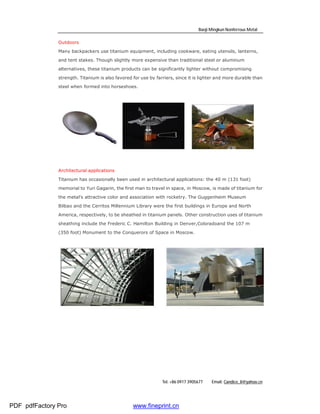
               Many backpackers use titanium equipment, including cookware, eating utensils, lanterns,

               and tent stakes. Though slightly more expensive than traditional steel or aluminum

               alternatives, these titanium products can be significantly lighter without compromising

               strength. Titanium is also favored for use by farriers, since it is lighter and more durable than

               steel when formed into horseshoes.


               Architectural applications

               Titanium has occasionally been used in architectural applications: the 40 m (131 foot)

               memorial to Yuri Gagarin, the first man to travel in space, in Moscow, is made of titanium for

               the metal's attractive color and association with rocketry. The Guggenheim Museum

               Bilbao and the Cerritos Millennium Library were the first buildings in Europe and North

               America, respectively, to be sheathed in titanium panels. Other construction uses of titanium

               sheathing include the Frederic C. Hamilton Building in Denver,Coloradoand the 107 m

               (350 foot) Monument to the Conquerors of Space in Moscow.


                                                                Tel: +86 0917 3905677   Email: Candice_li@yahoo.cn


PDF pdfFactory Pro                                www.fineprint.cn

Application of titanium alloy

  • 1.
    Baoji Mingkun NonferrousMetal 1. Aerospace and marine Due to their high tensile strength to density ratio, high corrosion resistance, fatigue resistance, high crack resistance, and ability to withstand moderately high temperatures without creeping, titanium alloys are used in aircraft, armor plating, naval ships, spacecraft, and missiles. For these applications titanium alloyed with aluminum, vanadium, and other elements is used for a variety of components including critical structural parts, fire walls, landing gear, exhaust ducts (helicopters), and hydraulic systems. In fact, about two thirds of all titanium metal produced is used in aircraft engines and frames. The SR-71 "Blackbird" was one of way for its use in modern military and commercial aircraft. An estimated 59 metric tons (130,000 pounds) are used in the Boeing 777, 45 in the Boeing 747, 18 in the Boeing 737, 32 in the Airbus A340, 18 in the Airbus A330, and 12 in the Airbus A320. The Airbus A380 may use 146 metric tons, including about 26 tons in the engines. In engine applications, titanium is used for rotors, compressor blades, hydraulic system components, and nacelles. The titanium 6AL-4V alloy accounts for almost 50% of all alloys used in aircraft applications. Due to its high corrosion resistance to sea water, titanium is used to make propeller shafts and rigging and in the heat exchangers of desalination plants; in heater-chillers for salt water aquariums, fishing line and leader, and for divers' knives. Titanium is used to manufacture the housings and other components of ocean-deployed surveillance and monitoring devices for scientific and military use. The former Soviet Union developed techniques for making submarines largely out of titanium. 2. Medical Because it is biocompatible (non-toxic and is not rejected by the body), titanium is used in a gamut of medical applications including surgical implements and implants, such as hip balls and sockets (joint replacement) that can stay in place for up to 20 years. The titanium is often alloyed with about 4% aluminum or 6% Al and 4% vanadium. Titanium has the inherent property to osseointegrate, enabling use in dental implants that can remain in place for over 30 years. This property is also useful for orthopedic implant applications. These benefit from titanium's lower modulus of elasticity (Young's modulus) to more closely match that of the bone that such devices are intended to repair. As a result, skeletal loads are more evenly shared between bone and implant, leading to a lower Tel: +86 0917 3905677 Email: Candice_li@yahoo.cn PDF pdfFactory Pro www.fineprint.cn
  • 2.
    Baoji Mingkun NonferrousMetal incidence of bone degradation due to stress shielding and periprosthetic bone fractures which occur at the boundaries of orthopedic implants. However, titanium alloys' stiffness is still more than twice that of bone so adjacent bone bears a greatly reduced load and may deteriorate. Since titanium is non-ferromagnetic, patients with titanium implants can be safely examined with magnetic resonance imaging (convenient for long-term implants). Preparing titanium for implantation in the body involves subjecting it to a high-temperature plasma arc which removes the surface atoms, exposing fresh titanium that is instantly oxidized. Titanium is also used for the surgical instruments used in image-guided surgery, as well as wheelchairs, crutches, and any other products where high strength and low weight are desirable. 3. Industrial Welded titanium pipe and process equipment (heat exchangers, tanks, process vessels, valves) are used in the chemical and petrochemical industries primarily for corrosion resistance. Specific alloys are used in down hole and nickel hydrometallurgy applications due to their high strength (e. g.: titanium Beta C alloy), corrosion resistance, or combination of both. The pulp and paper industry uses titanium in process equipment exposed to corrosive media such as sodium hypochlorite or wet chlorine gas (in the bleachery). Other applications include: ultrasonic welding, wave soldering, and sputtering targets. 4. Consumer and architectural Automotive applications Titanium metal is used in automotive applications, particularly in automobile or motorcycle Tel: +86 0917 3905677 Email: Candice_li@yahoo.cn PDF pdfFactory Pro www.fineprint.cn
  • 3.
    Baoji Mingkun NonferrousMetal racing, where weight reduction is critical while maintaining high strength and rigidity. The metal is generally too expensive to make it marketable to the general consumer market, other than high-end products, particularly for the racing/performance market. Late model Corvettes have been available with titanium exhausts. Sporting Goods Titanium is used in many sporting goods: tennis rackets, golf clubs, lacrosse stick shafts; cricket, hockey, lacrosse, and football helmet grills; and bicycle frames and components. Although not a mainstream material for bicycle production, titanium bikes have been used by race teams and adventure cyclists. Glass Titanium alloys are also used in spectacle frames. This results in a rather expensive, but highly durable and long lasting frame which is light in weight and causes no skin allergies. Tel: +86 0917 3905677 Email: Candice_li@yahoo.cn PDF pdfFactory Pro www.fineprint.cn
  • 4.
    Baoji Mingkun NonferrousMetal Outdoors Many backpackers use titanium equipment, including cookware, eating utensils, lanterns, and tent stakes. Though slightly more expensive than traditional steel or aluminum alternatives, these titanium products can be significantly lighter without compromising strength. Titanium is also favored for use by farriers, since it is lighter and more durable than steel when formed into horseshoes. Architectural applications Titanium has occasionally been used in architectural applications: the 40 m (131 foot) memorial to Yuri Gagarin, the first man to travel in space, in Moscow, is made of titanium for the metal's attractive color and association with rocketry. The Guggenheim Museum Bilbao and the Cerritos Millennium Library were the first buildings in Europe and North America, respectively, to be sheathed in titanium panels. Other construction uses of titanium sheathing include the Frederic C. Hamilton Building in Denver,Coloradoand the 107 m (350 foot) Monument to the Conquerors of Space in Moscow. Tel: +86 0917 3905677 Email: Candice_li@yahoo.cn PDF pdfFactory Pro www.fineprint.cn