Dr. R. T. Patil
Former Director CIPHET,
Pr. Scientist,
Central Institute of Agricultural
Engineering, Bhopal
Application of Artificial Intelligence in
Food Processing Sector
Status of Food Processing Industries
 Size of food market in India - Rs. 8,60,000 Crores
 Primarily processed food market – Rs. 2,80,000 crore
 Value added processed food market – Rs. 1,80,000 crore
 Investment during the 10th plan is estimated at Rs. 62,105
Crores
 Industry growth rate during the last five years is estimated
at 7.14% against GDP of 6.2%
 Investment required during next ten years – Rs. 1,10,000
crores
Food Quality and Safety Issues are Prime
Important
Use of Artificial Intelligence in the
Context of Food Processing
• In artificial intelligence the tolerance for imprecision
and uncertainty is exploited to achieve tractability,
lower cost, high Machine Intelligence Quotient
(MIQ) and economy of communication
• Artificial intelligence makes use of multivalued or
fuzzy logic
• Artificial intelligence can deal with ambiguous and
noisy data
• Artificial intelligence can yield approximate
answers but good enough to solve the practical
problems of trade
Artificial Intelligence
•Artificial intelligence can be used to model and analyse very
complex problems where conventional methods have not
been able to produce cost-effective, analytical, or complete
solutions.
•In agricultural and biological engineering, researchers and
engineers have developed methods to analyse the operation
of food processing.
•Fuzzy Logic (FL),
•Artificial Neural Networks (ANNs),
•Genetic Algorithms (Gas),
•Bayesian Inference (BI),
•Decision Tree (DT), and
•Support Vector Machines (SVMs)
Complex Food Process Control
 A single sensory property like color or texture can be linked individually to
several dimensions recorded by the human brain.
 The food industry works with non-uniform, variable raw materials that, when
processed, should shaped into a product that satisfies a fixed standard.
 The process control of foods are highly non-linear and variables are coupled.
 In addition to the temperature changes during a heating or cooling process,
there are biochemical (nutrient, color, flavor, etc.) or microbial changes that
should be considered.
 The moisture in food is constantly fluctuating either loss or gain throughout the
process which can affect the flavor, texture, nutrients concentration and other
properties.
 Other properties of foods such as density, thermal and electrical conductivity,
specific heat, viscosity, permeability, and effective moisture diffusivity are often
a function of composition, temperature, and moisture content, and therefore
keep changing during the process.
 The system is also quite non-homogeneous and hence detailed input data are
not available.
 Often, irregular shapes are present.
ANN for Crispness of Snack Foods
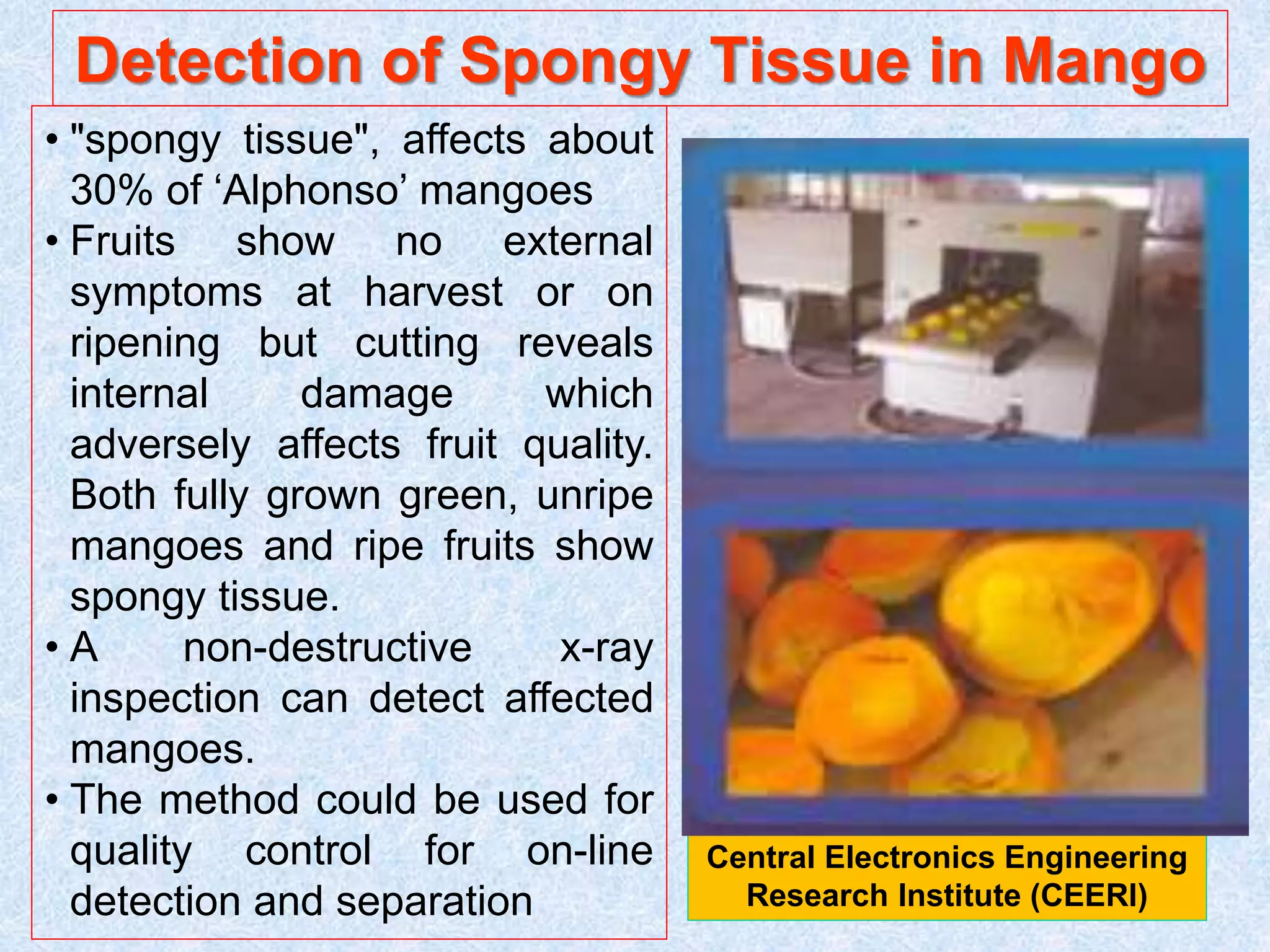
• The crispness was evaluated by
acoustic testing.
• The acoustic patterns were
generated by crushing the snack
samples with a pair of pincers
• The inputs for training the NNs
comprised 102 amplitudes of
sound signals in 0–7 kHz
frequency range at the intervals of
about 69 Hz with crispness grades
as outputs
• Probabilistic (PNN) models
showed good performance in
classifying the snack foods into
four grades of crispness.
• The prediction accuracy of models
ranged approximately from 96 to
98%
Plot of average amplitude of acoustical signal spectrum for
different moisture content of Pringles potato chip samples
Detection of Plant Diseases
• Electronic nose
incorporating AI was used
to detect plant disease
caused by Ganoderma
boninense fungus affecting
oil palm.
• The electronic nose,
Cyranose 320, has the
front end sensors and
artificial neural networks
for pattern recognition.
• The system was able to
differentiate healthy and
infected oil palm with a
high rate of accuracy.
Detection of Spongy Tissue in Mango
• "spongy tissue", affects about
30% of ‘Alphonso’ mangoes
• Fruits show no external
symptoms at harvest or on
ripening but cutting reveals
internal damage which
adversely affects fruit quality.
Both fully grown green, unripe
mangoes and ripe fruits show
spongy tissue.
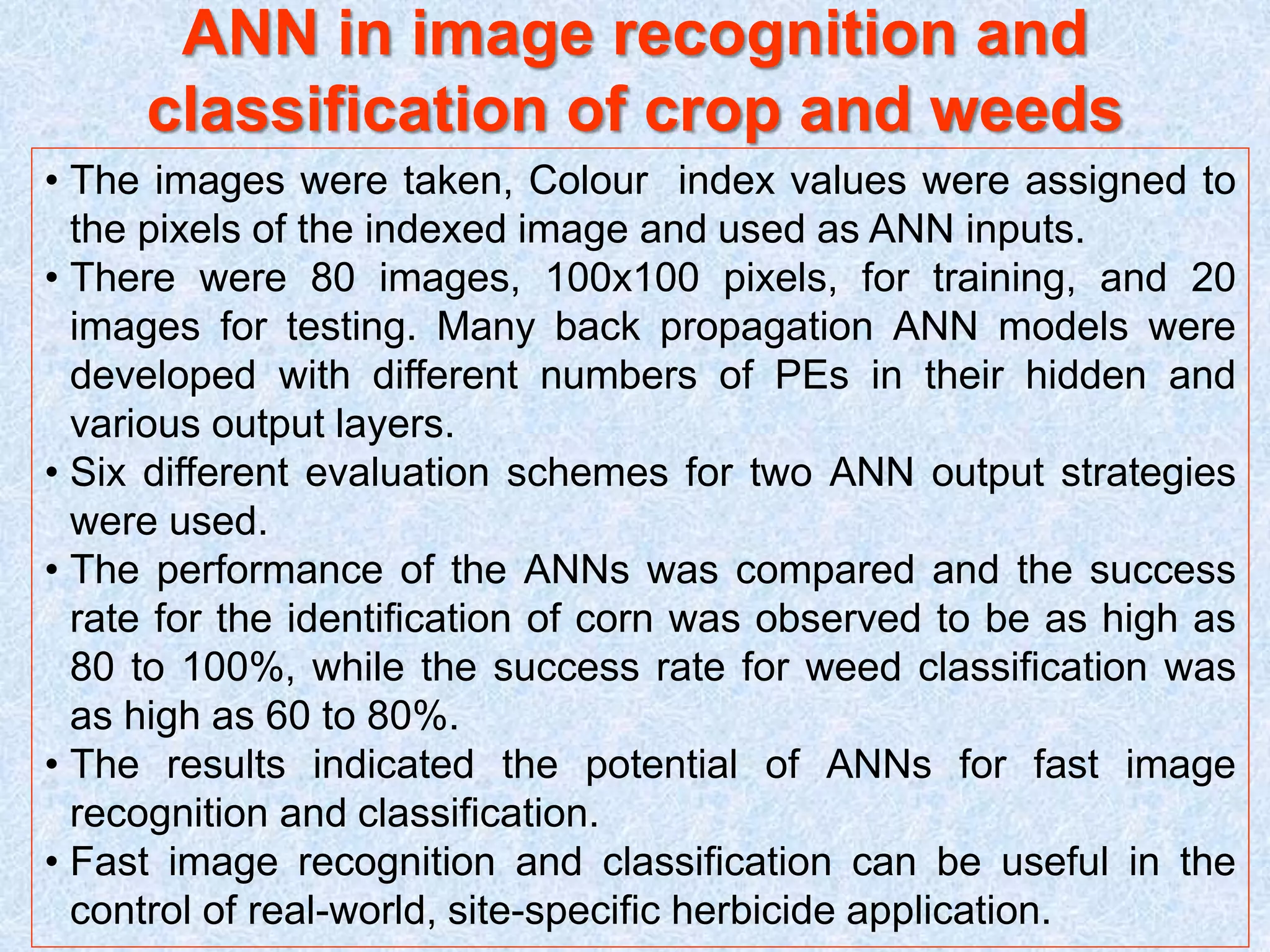
• A non-destructive x-ray
inspection can detect affected
mangoes.
• The method could be used for
quality control for on-line
detection and separation
Central Electronics Engineering
Research Institute (CEERI)
ANN in image recognition and
classification of crop and weeds
• The images were taken, Colour index values were assigned to
the pixels of the indexed image and used as ANN inputs.
• There were 80 images, 100x100 pixels, for training, and 20
images for testing. Many back propagation ANN models were
developed with different numbers of PEs in their hidden and
various output layers.
• Six different evaluation schemes for two ANN output strategies
were used.
• The performance of the ANNs was compared and the success
rate for the identification of corn was observed to be as high as
80 to 100%, while the success rate for weed classification was
as high as 60 to 80%.
• The results indicated the potential of ANNs for fast image
recognition and classification.
• Fast image recognition and classification can be useful in the
control of real-world, site-specific herbicide application.
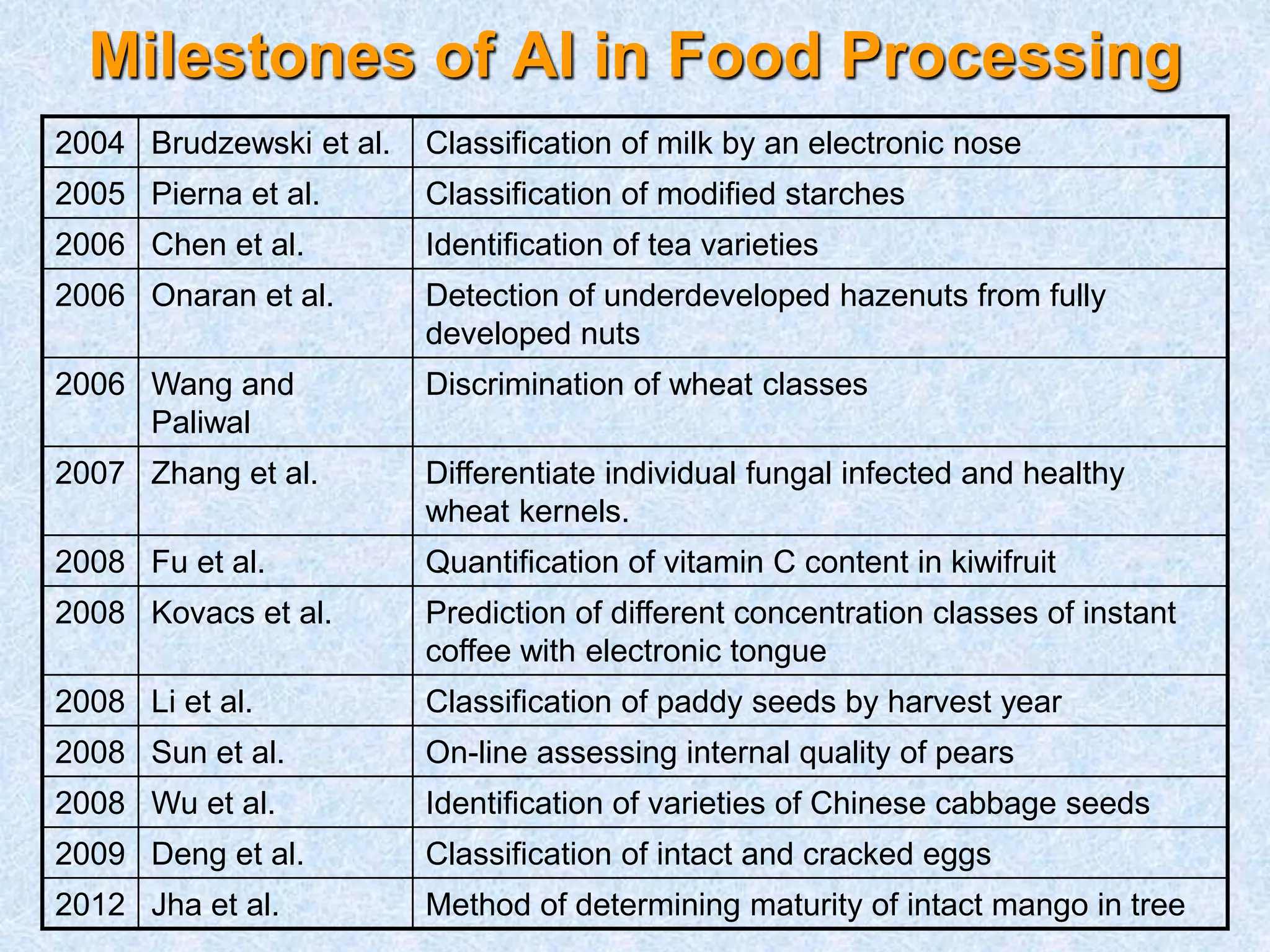
Milestones of AI in Food Processing
2004 Brudzewski et al. Classification of milk by an electronic nose
2005 Pierna et al. Classification of modified starches
2006 Chen et al. Identification of tea varieties
2006 Onaran et al. Detection of underdeveloped hazenuts from fully
developed nuts
2006 Wang and
Paliwal
Discrimination of wheat classes
2007 Zhang et al. Differentiate individual fungal infected and healthy
wheat kernels.
2008 Fu et al. Quantification of vitamin C content in kiwifruit
2008 Kovacs et al. Prediction of different concentration classes of instant
coffee with electronic tongue
2008 Li et al. Classification of paddy seeds by harvest year
2008 Sun et al. On-line assessing internal quality of pears
2008 Wu et al. Identification of varieties of Chinese cabbage seeds
2009 Deng et al. Classification of intact and cracked eggs
2012 Jha et al. Method of determining maturity of intact mango in tree
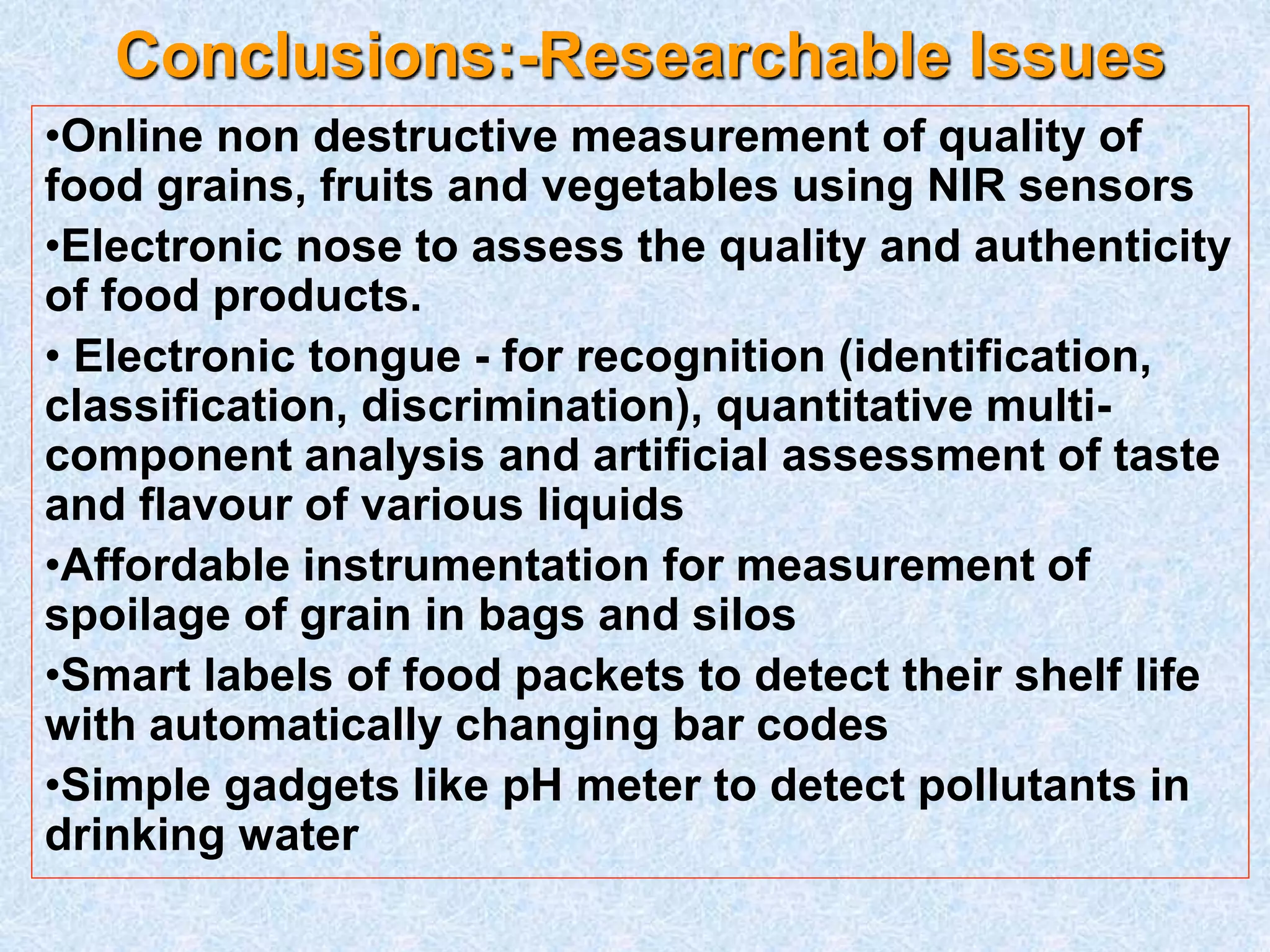
Conclusions:-Researchable Issues
•Online non destructive measurement of quality of
food grains, fruits and vegetables using NIR sensors
•Electronic nose to assess the quality and authenticity
of food products.
• Electronic tongue - for recognition (identification,
classification, discrimination), quantitative multi-
component analysis and artificial assessment of taste
and flavour of various liquids
•Affordable instrumentation for measurement of
spoilage of grain in bags and silos
•Smart labels of food packets to detect their shelf life
with automatically changing bar codes
•Simple gadgets like pH meter to detect pollutants in
drinking water
Application of artificial intelligence in food processing sector

Application of artificial intelligence in food processing sector

  • 1.
    Dr. R. T.Patil Former Director CIPHET, Pr. Scientist, Central Institute of Agricultural Engineering, Bhopal Application of Artificial Intelligence in Food Processing Sector
  • 2.
    Status of FoodProcessing Industries  Size of food market in India - Rs. 8,60,000 Crores  Primarily processed food market – Rs. 2,80,000 crore  Value added processed food market – Rs. 1,80,000 crore  Investment during the 10th plan is estimated at Rs. 62,105 Crores  Industry growth rate during the last five years is estimated at 7.14% against GDP of 6.2%  Investment required during next ten years – Rs. 1,10,000 crores Food Quality and Safety Issues are Prime Important
  • 3.
    Use of ArtificialIntelligence in the Context of Food Processing • In artificial intelligence the tolerance for imprecision and uncertainty is exploited to achieve tractability, lower cost, high Machine Intelligence Quotient (MIQ) and economy of communication • Artificial intelligence makes use of multivalued or fuzzy logic • Artificial intelligence can deal with ambiguous and noisy data • Artificial intelligence can yield approximate answers but good enough to solve the practical problems of trade
  • 4.
    Artificial Intelligence •Artificial intelligencecan be used to model and analyse very complex problems where conventional methods have not been able to produce cost-effective, analytical, or complete solutions. •In agricultural and biological engineering, researchers and engineers have developed methods to analyse the operation of food processing. •Fuzzy Logic (FL), •Artificial Neural Networks (ANNs), •Genetic Algorithms (Gas), •Bayesian Inference (BI), •Decision Tree (DT), and •Support Vector Machines (SVMs)
  • 5.
    Complex Food ProcessControl  A single sensory property like color or texture can be linked individually to several dimensions recorded by the human brain.  The food industry works with non-uniform, variable raw materials that, when processed, should shaped into a product that satisfies a fixed standard.  The process control of foods are highly non-linear and variables are coupled.  In addition to the temperature changes during a heating or cooling process, there are biochemical (nutrient, color, flavor, etc.) or microbial changes that should be considered.  The moisture in food is constantly fluctuating either loss or gain throughout the process which can affect the flavor, texture, nutrients concentration and other properties.  Other properties of foods such as density, thermal and electrical conductivity, specific heat, viscosity, permeability, and effective moisture diffusivity are often a function of composition, temperature, and moisture content, and therefore keep changing during the process.  The system is also quite non-homogeneous and hence detailed input data are not available.  Often, irregular shapes are present.
  • 6.
    ANN for Crispnessof Snack Foods • The crispness was evaluated by acoustic testing. • The acoustic patterns were generated by crushing the snack samples with a pair of pincers • The inputs for training the NNs comprised 102 amplitudes of sound signals in 0–7 kHz frequency range at the intervals of about 69 Hz with crispness grades as outputs • Probabilistic (PNN) models showed good performance in classifying the snack foods into four grades of crispness. • The prediction accuracy of models ranged approximately from 96 to 98% Plot of average amplitude of acoustical signal spectrum for different moisture content of Pringles potato chip samples
  • 7.
    Detection of PlantDiseases • Electronic nose incorporating AI was used to detect plant disease caused by Ganoderma boninense fungus affecting oil palm. • The electronic nose, Cyranose 320, has the front end sensors and artificial neural networks for pattern recognition. • The system was able to differentiate healthy and infected oil palm with a high rate of accuracy.
  • 8.
    Detection of SpongyTissue in Mango • "spongy tissue", affects about 30% of ‘Alphonso’ mangoes • Fruits show no external symptoms at harvest or on ripening but cutting reveals internal damage which adversely affects fruit quality. Both fully grown green, unripe mangoes and ripe fruits show spongy tissue. • A non-destructive x-ray inspection can detect affected mangoes. • The method could be used for quality control for on-line detection and separation Central Electronics Engineering Research Institute (CEERI)
  • 9.
    ANN in imagerecognition and classification of crop and weeds • The images were taken, Colour index values were assigned to the pixels of the indexed image and used as ANN inputs. • There were 80 images, 100x100 pixels, for training, and 20 images for testing. Many back propagation ANN models were developed with different numbers of PEs in their hidden and various output layers. • Six different evaluation schemes for two ANN output strategies were used. • The performance of the ANNs was compared and the success rate for the identification of corn was observed to be as high as 80 to 100%, while the success rate for weed classification was as high as 60 to 80%. • The results indicated the potential of ANNs for fast image recognition and classification. • Fast image recognition and classification can be useful in the control of real-world, site-specific herbicide application.
  • 10.
    Milestones of AIin Food Processing 2004 Brudzewski et al. Classification of milk by an electronic nose 2005 Pierna et al. Classification of modified starches 2006 Chen et al. Identification of tea varieties 2006 Onaran et al. Detection of underdeveloped hazenuts from fully developed nuts 2006 Wang and Paliwal Discrimination of wheat classes 2007 Zhang et al. Differentiate individual fungal infected and healthy wheat kernels. 2008 Fu et al. Quantification of vitamin C content in kiwifruit 2008 Kovacs et al. Prediction of different concentration classes of instant coffee with electronic tongue 2008 Li et al. Classification of paddy seeds by harvest year 2008 Sun et al. On-line assessing internal quality of pears 2008 Wu et al. Identification of varieties of Chinese cabbage seeds 2009 Deng et al. Classification of intact and cracked eggs 2012 Jha et al. Method of determining maturity of intact mango in tree
  • 11.
    Conclusions:-Researchable Issues •Online nondestructive measurement of quality of food grains, fruits and vegetables using NIR sensors •Electronic nose to assess the quality and authenticity of food products. • Electronic tongue - for recognition (identification, classification, discrimination), quantitative multi- component analysis and artificial assessment of taste and flavour of various liquids •Affordable instrumentation for measurement of spoilage of grain in bags and silos •Smart labels of food packets to detect their shelf life with automatically changing bar codes •Simple gadgets like pH meter to detect pollutants in drinking water