MACHINE VISION SYSTEM IN
FOOD INDUSTRY
Presented by
Mr. DINESH
Roll no. 18AG63R17
Department of Agricultural and Food Engineering
IIT Kharagpur
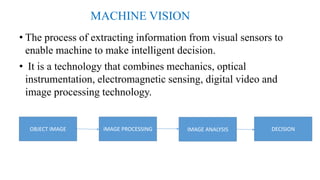
MACHINE VISION
• The process of extracting information from visual sensors to
enable machine to make intelligent decision.
• It is a technology that combines mechanics, optical
instrumentation, electromagnetic sensing, digital video and
image processing technology.
OBJECT IMAGE IMAGE PROCESSING IMAGE ANALYSIS DECISION
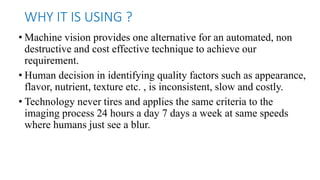
WHY IT IS USING ?
• Machine vision provides one alternative for an automated, non
destructive and cost effective technique to achieve our
requirement.
• Human decision in identifying quality factors such as appearance,
flavor, nutrient, texture etc. , is inconsistent, slow and costly.
• Technology never tires and applies the same criteria to the
imaging process 24 hours a day 7 days a week at same speeds
where humans just see a blur.
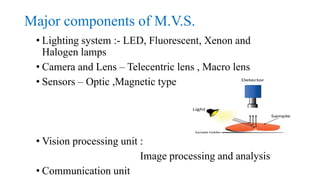
Major components of M.V.S.
• Lighting system :- LED, Fluorescent, Xenon and
Halogen lamps
• Camera and Lens – Telecentric lens , Macro lens
• Sensors – Optic ,Magnetic type
• Vision processing unit :
Image processing and analysis
• Communication unit
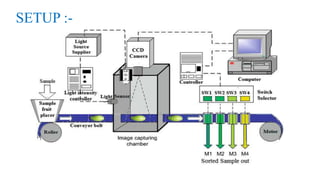
SETUP :-
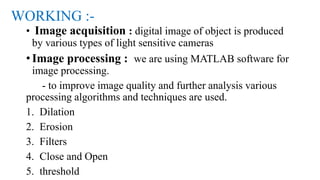
WORKING :-
• Image acquisition : digital image of object is produced
by various types of light sensitive cameras
•Image processing : we are using MATLAB software for
image processing.
- to improve image quality and further analysis various
processing algorithms and techniques are used.
1. Dilation
2. Erosion
3. Filters
4. Close and Open
5. threshold
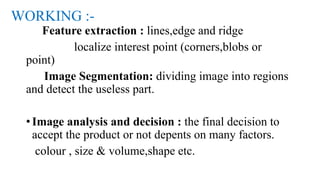
WORKING :-
Feature extraction : lines,edge and ridge
localize interest point (corners,blobs or
point)
Image Segmentation: dividing image into regions
and detect the useless part.
•Image analysis and decision : the final decision to
accept the product or not depents on many factors.
colour , size & volume,shape etc.
Application of machine vision in food industry
• › QUALITY CONTROL
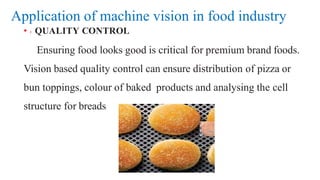
Ensuring food looks good is critical for premium brand foods.
Vision based quality control can ensure distribution of pizza or
bun toppings, colour of baked products and analysing the cell
structure for breads.
Application of machine vision in food industry
• › HARVESTING :
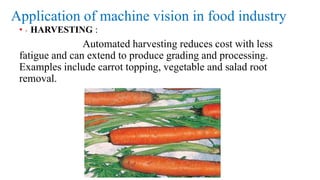
Automated harvesting reduces cost with less
fatigue and can extend to produce grading and processing.
Examples include carrot topping, vegetable and salad root
removal.
Application of machine vision in food industry
• SORTING AND GRADING:
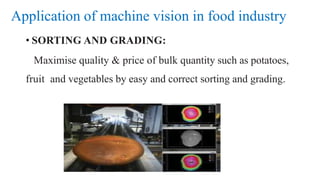
Maximise quality & price of bulk quantity such as potatoes,
fruit and vegetables by easy and correct sorting and grading.
Application of machine vision in food industry
•› PICKING & PACKI NG
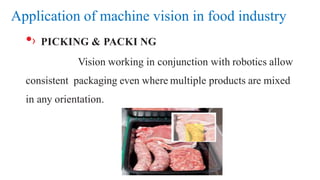
Vision working in conjunction with robotics allow
consistent packaging even where multiple products are mixed
in any orientation.
Application of machine vision in food industry
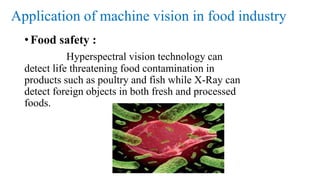
• Food safety :
Hyperspectral vision technology can
detect life threatening food contamination in
products such as poultry and fish while X-Ray can
detect foreign objects in both fresh and processed
foods.
Application of machine vision in food industry
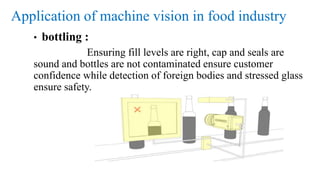
• bottling :
Ensuring fill levels are right, cap and seals are
sound and bottles are not contaminated ensure customer
confidence while detection of foreign bodies and stressed glass
ensure safety.
Application of machine vision in food industry
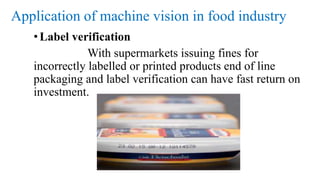
•Label verification
With supermarkets issuing fines for
incorrectly labelled or printed products end of line
packaging and label verification can have fast return on
investment.
ADVANTAGES:
• Increase productivity
• Increase quality of product
• Increase Customer satisfaction
• Lower capital cost
• Faster time to market
• Improve brand image
Conclusion
• Machine vision systems have been used increasingly in
industry for inspection and evaluation purposes as they can
provide rapid, economic, hygienic, consistent and objective
assessment.
• machine vision is a powerful tool of automation that includes
both image processing and image analysis tools.
• Machine vision based sorting system is an accurate and fast
process compare to manual sorting.
Reference
• Gunasekaran, S., “Machine vision technology for food quality
assurance”, Trends in Food Science and Technology, 7(8),
p.245-256, 1996.
• Locht, P., Thomsen, K., Mikkelsen, P., “Full color image
analysis as a tool for quality control and process development
in the food industry”, Paper No. 973006, ASAE, 2950 Niles
Road, St. Joseph, MI 49085-9659, USA, 1997.
• P. Sudhakara Rao et al, “Color Analysis of fruits using
machine vision system for Automatic Sorting and Grading”,
J. Instrum. Soc. India 34 p. 284-291, 2009.

MACHINE VISION IN FOOD INDUSTRY

  • 1.
    MACHINE VISION SYSTEMIN FOOD INDUSTRY Presented by Mr. DINESH Roll no. 18AG63R17 Department of Agricultural and Food Engineering IIT Kharagpur
  • 2.
    MACHINE VISION • Theprocess of extracting information from visual sensors to enable machine to make intelligent decision. • It is a technology that combines mechanics, optical instrumentation, electromagnetic sensing, digital video and image processing technology. OBJECT IMAGE IMAGE PROCESSING IMAGE ANALYSIS DECISION
  • 3.
    WHY IT ISUSING ? • Machine vision provides one alternative for an automated, non destructive and cost effective technique to achieve our requirement. • Human decision in identifying quality factors such as appearance, flavor, nutrient, texture etc. , is inconsistent, slow and costly. • Technology never tires and applies the same criteria to the imaging process 24 hours a day 7 days a week at same speeds where humans just see a blur.
  • 4.
    Major components ofM.V.S. • Lighting system :- LED, Fluorescent, Xenon and Halogen lamps • Camera and Lens – Telecentric lens , Macro lens • Sensors – Optic ,Magnetic type • Vision processing unit : Image processing and analysis • Communication unit
  • 5.
  • 6.
    WORKING :- • Imageacquisition : digital image of object is produced by various types of light sensitive cameras •Image processing : we are using MATLAB software for image processing. - to improve image quality and further analysis various processing algorithms and techniques are used. 1. Dilation 2. Erosion 3. Filters 4. Close and Open 5. threshold
  • 7.
    WORKING :- Feature extraction: lines,edge and ridge localize interest point (corners,blobs or point) Image Segmentation: dividing image into regions and detect the useless part. •Image analysis and decision : the final decision to accept the product or not depents on many factors. colour , size & volume,shape etc.
  • 8.
    Application of machinevision in food industry • › QUALITY CONTROL Ensuring food looks good is critical for premium brand foods. Vision based quality control can ensure distribution of pizza or bun toppings, colour of baked products and analysing the cell structure for breads.
  • 9.
    Application of machinevision in food industry • › HARVESTING : Automated harvesting reduces cost with less fatigue and can extend to produce grading and processing. Examples include carrot topping, vegetable and salad root removal.
  • 10.
    Application of machinevision in food industry • SORTING AND GRADING: Maximise quality & price of bulk quantity such as potatoes, fruit and vegetables by easy and correct sorting and grading.
  • 11.
    Application of machinevision in food industry •› PICKING & PACKI NG Vision working in conjunction with robotics allow consistent packaging even where multiple products are mixed in any orientation.
  • 12.
    Application of machinevision in food industry • Food safety : Hyperspectral vision technology can detect life threatening food contamination in products such as poultry and fish while X-Ray can detect foreign objects in both fresh and processed foods.
  • 13.
    Application of machinevision in food industry • bottling : Ensuring fill levels are right, cap and seals are sound and bottles are not contaminated ensure customer confidence while detection of foreign bodies and stressed glass ensure safety.
  • 14.
    Application of machinevision in food industry •Label verification With supermarkets issuing fines for incorrectly labelled or printed products end of line packaging and label verification can have fast return on investment.
  • 15.
    ADVANTAGES: • Increase productivity •Increase quality of product • Increase Customer satisfaction • Lower capital cost • Faster time to market • Improve brand image
  • 16.
    Conclusion • Machine visionsystems have been used increasingly in industry for inspection and evaluation purposes as they can provide rapid, economic, hygienic, consistent and objective assessment. • machine vision is a powerful tool of automation that includes both image processing and image analysis tools. • Machine vision based sorting system is an accurate and fast process compare to manual sorting.
  • 17.
    Reference • Gunasekaran, S.,“Machine vision technology for food quality assurance”, Trends in Food Science and Technology, 7(8), p.245-256, 1996. • Locht, P., Thomsen, K., Mikkelsen, P., “Full color image analysis as a tool for quality control and process development in the food industry”, Paper No. 973006, ASAE, 2950 Niles Road, St. Joseph, MI 49085-9659, USA, 1997. • P. Sudhakara Rao et al, “Color Analysis of fruits using machine vision system for Automatic Sorting and Grading”, J. Instrum. Soc. India 34 p. 284-291, 2009.