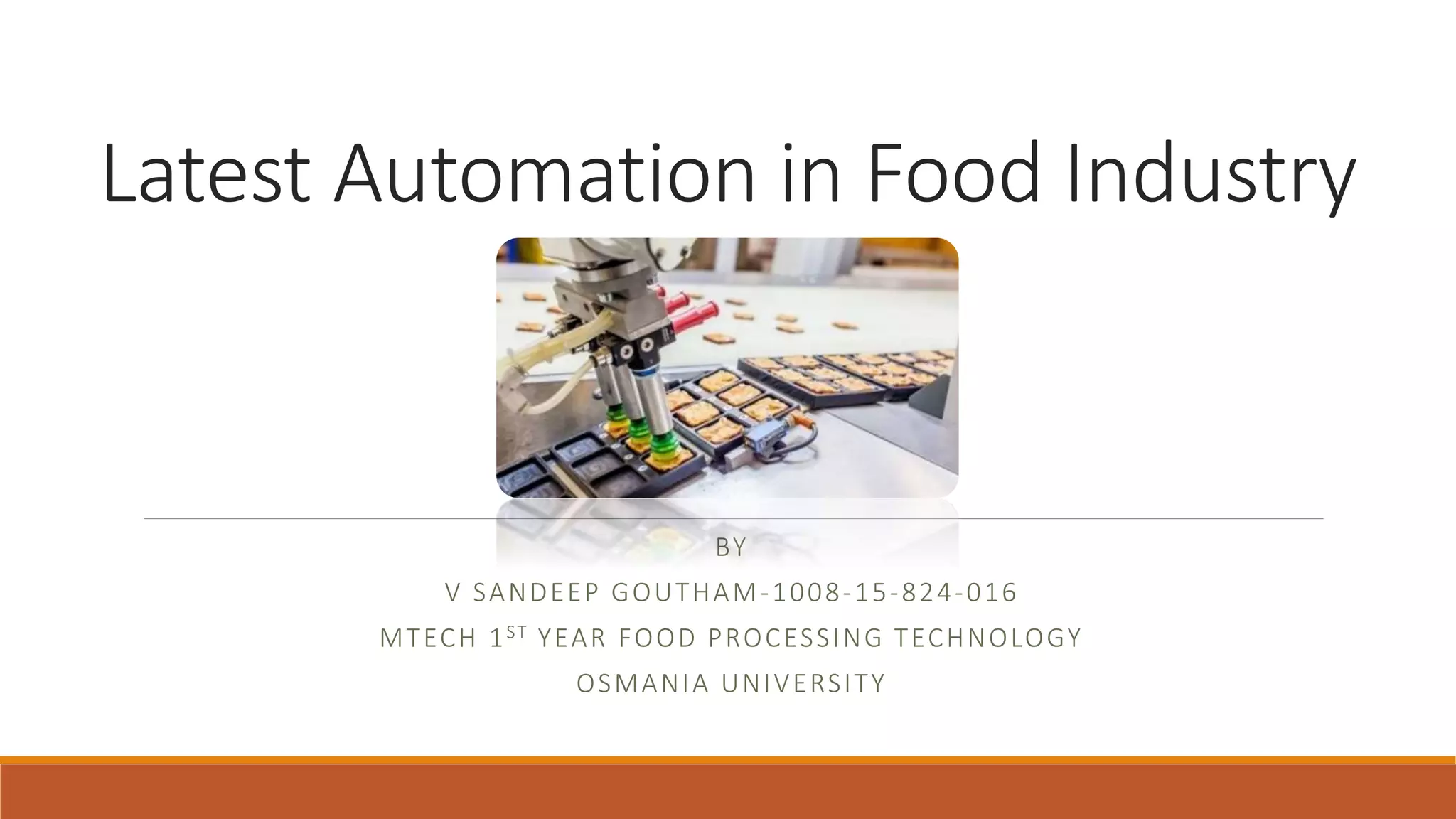
Latest Automation in Food Industry
BY
V SANDEEP GOUTHAM-1008-15-824-016
MTECH 1ST YEAR FOOD PROCESSING TECHNOLOGY
OSMANIA UNIVERSITY
Presentation Output
1*Introduction To Automation in Food Industry
2*Why Automation In Food Industry
3* Uniqueness of the Food Industry
4*Tools Of Automation In Food Industry
Introduction To Automation in Food Industry
*The current level of automation in the food industry has been described as
"islands of automation".
*Food industry presents many unique challenges to complete automation, the
industry has been successful in putting many automatic processes into place. The
next significant development will be to integrate these "islands of automation"
into an overall system of plant automation, from receiving raw materials to
shipping finished products
Introduction To Automation in Food Industry
*Nonetheless, the food industry now ranks among the fastest growing segments for plant
automation. For example, the food industry is among the top ten in using machine vision
technology, a key component in plant automation. However, most systems are isolated, batch-
type operations that target a specific task. In order for automation to be successful, it must be
integrated into the overall manufacturing system design and provide on-line, continuous control
capability
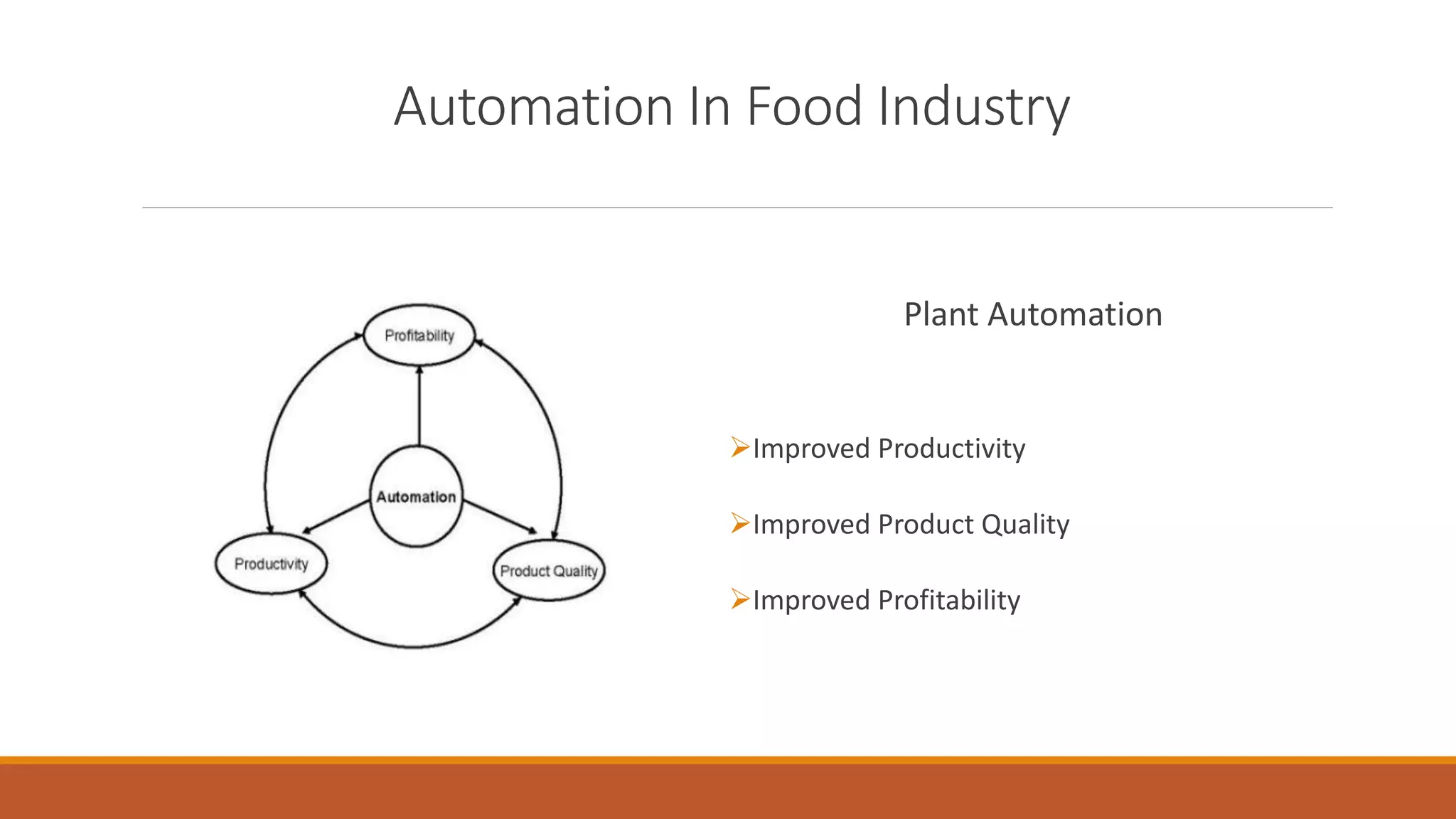
Automation In Food Industry
Plant Automation
Improved Productivity
Improved Product Quality
Improved Profitability
Automation In Food Industry
Improved Productivity
Plant productivity may be defined as the quantity of end products manufactured per unit
of operating parameters – plant size, number of workers, time of operation, etc
Improved Profitability
Automation helps to improve productivity and product quality. Both of these contribute
directly to improve profitability. Another important factor that makes automation
extremely critical for the food industry is the need to comply with food safety and
environmental regulatory agencies
Automation In Food Industry
Improved Product Quality
Quality assurance is one of the most important goals of any industry. The ability to in an expanding market
share. Quality–assurance methods used in the food industry have traditionally involved human visual
inspection
Uniqueness of the Food Industry
*One of the most important reasons for increased interest in automating the food industry is its
cost structure. Food processing is highly labor-intensive, with labor costs at anything up to 50
percent of the product cost. Improving productivity and reducing labor costs will therefore have
a significant impact on profitability
*Excellent examples of automation include processing and packaging Food products. Such as
Dairy ,Bakery ,Beverage ,Etc..,
Tools Of Automation In Food Industry
1. Computer Vision Systems
2.On-line Sensors
3.Expert Systems
4.Robot Technology
5. Computer Integrated Manufacturing
6. Flexible Manufacturing Systems
7. Systems Engineering
Tools Of Automation In Food Industry
Computer Vision Systems
Computer vision is the science that develops the theoretical and algorithmic basis by which useful
information about an object or scene can be automatically extracted and analyzed from an
observed image, image set, or image sequence.
Computer vision applications currently range from simple inspection to vision-guided robotic
assembly Such as Gauging ,Verification , Flow detection ,Identification, Recognition , Locating
Tools Of Automation In Food Industry
Online Sensor
Sensor is an object whose purpose is to detect events or changes in its environment, and then
provide a corresponding output. A sensor is a type of transducer; sensors may provide various
types of output, but typically use electrical or optical signals.
Classification Of Sensor are of Many Types –Nano Sensor ,Bio sensor ,Chemical Sensor ,Optical
Sensor Etc..
Tools Of Automation In Food Industry
Robot Technology
These technologies deal with automated machines (robots for short) that can take the place of
humans in dangerous environments or manufacturing processes, or resemble humans in
appearance, behaviors, and or cognition. Robots Technology have some kind of mechanical
construction, a frame, form or shape designed to achieve a particular task Within the Specific
Time .
Tools Of Automation In Food Industry
Computer Integrated Manufacturing
Computer-integrated manufacturing (CIM) is the manufacturing approach of using computers to
control the entire production process. This integration allows individual processes to exchange
information with each other and initiate actions.
Generally In Many Food Industry SAP (Computer Application ) Is Widely used In the Integrated
Process
Tools Of Automation In Food Industry
Schematic representation of on-line food quality evaluation using a computer vision system.
Few Advantages of Automation
*Increased throughput or productivity.
*Improved quality or increased predictability of quality.
*Improved robustness (consistency), of processes or product.
*Increased consistency of output.
*Reduced direct human labor costs and expenses
*Reduce the Time Of Processing High Utility
*Safer working conditions.
Few Disadvantages of Automation
*Lower skill levels of workers.
*High initial investment.
*Retrenchment or unemployment.
*Not suitable for short product life cycle
*Not economically justifiable for small scale production
*High Maintenance of Automation
Few Industries Of Automation
*ITC
*Parle
*Britannia
*Nestle
*Amul
*Coca Cola
*Pepsi
*Pedigree
*Con Agro
*Heritage
*Dairy Industry
*Bakery Units
*Oil Industry
*And So Many Industries
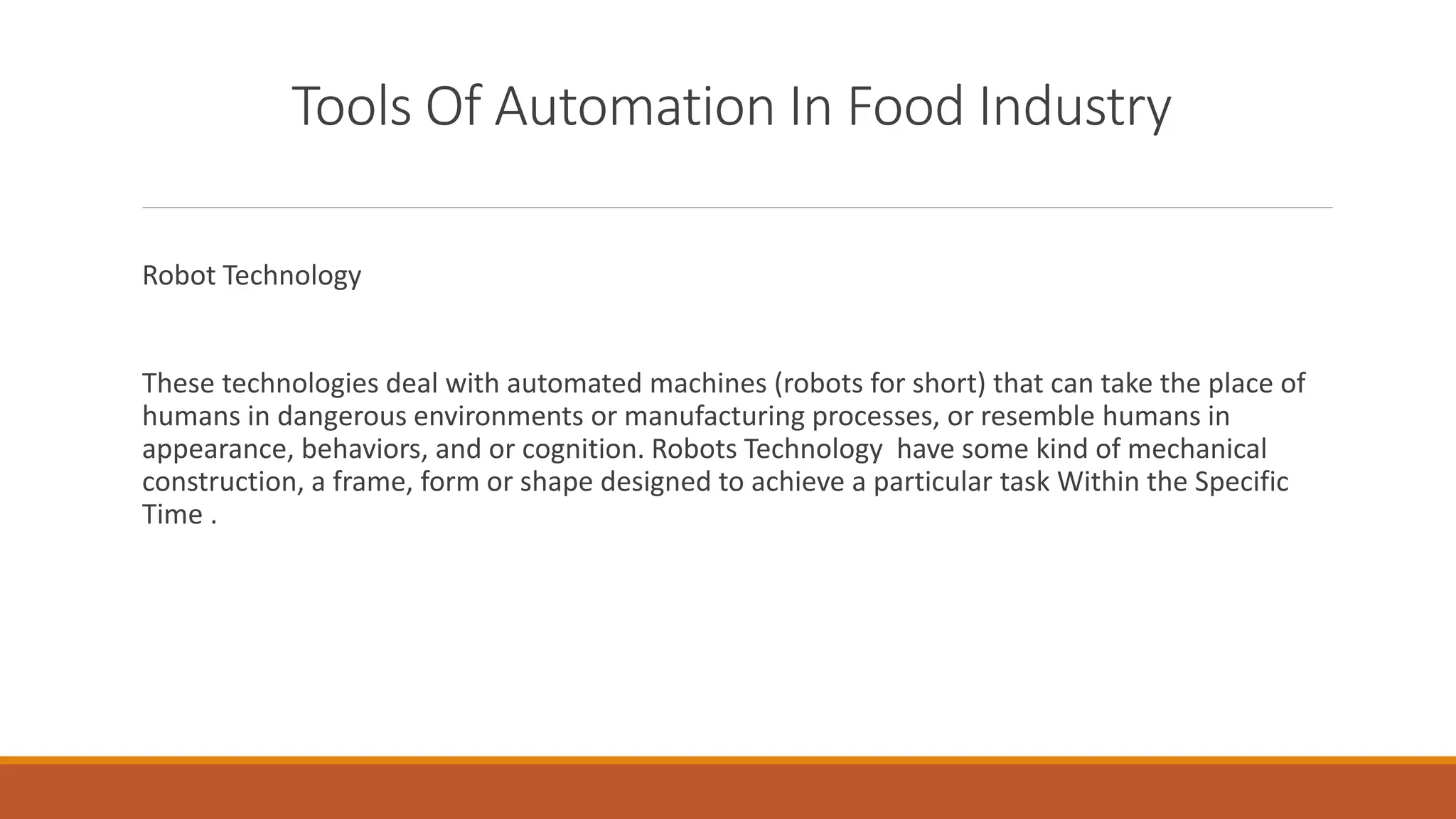
Few Flow Diagram Of Food Industry –Automation
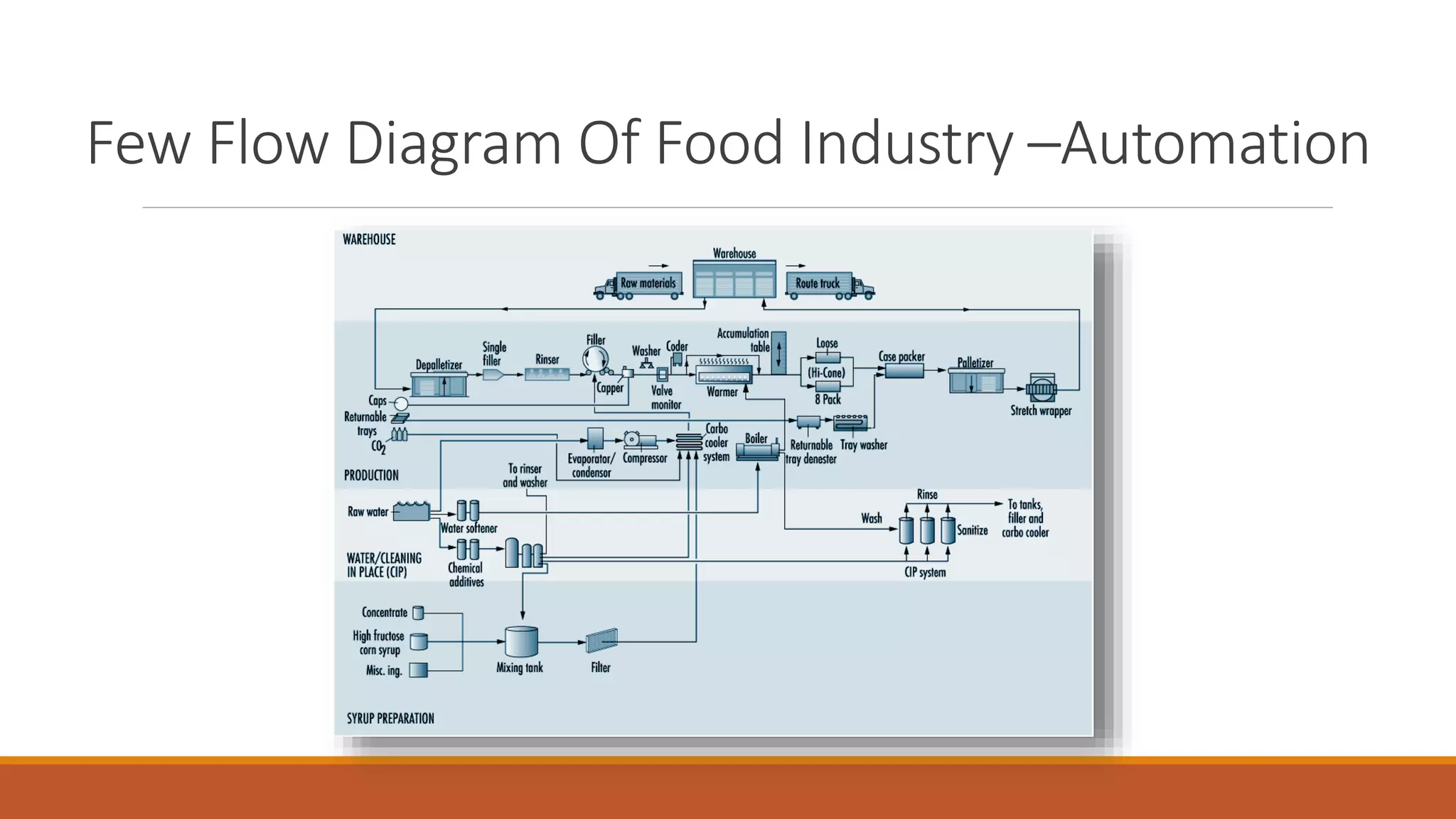
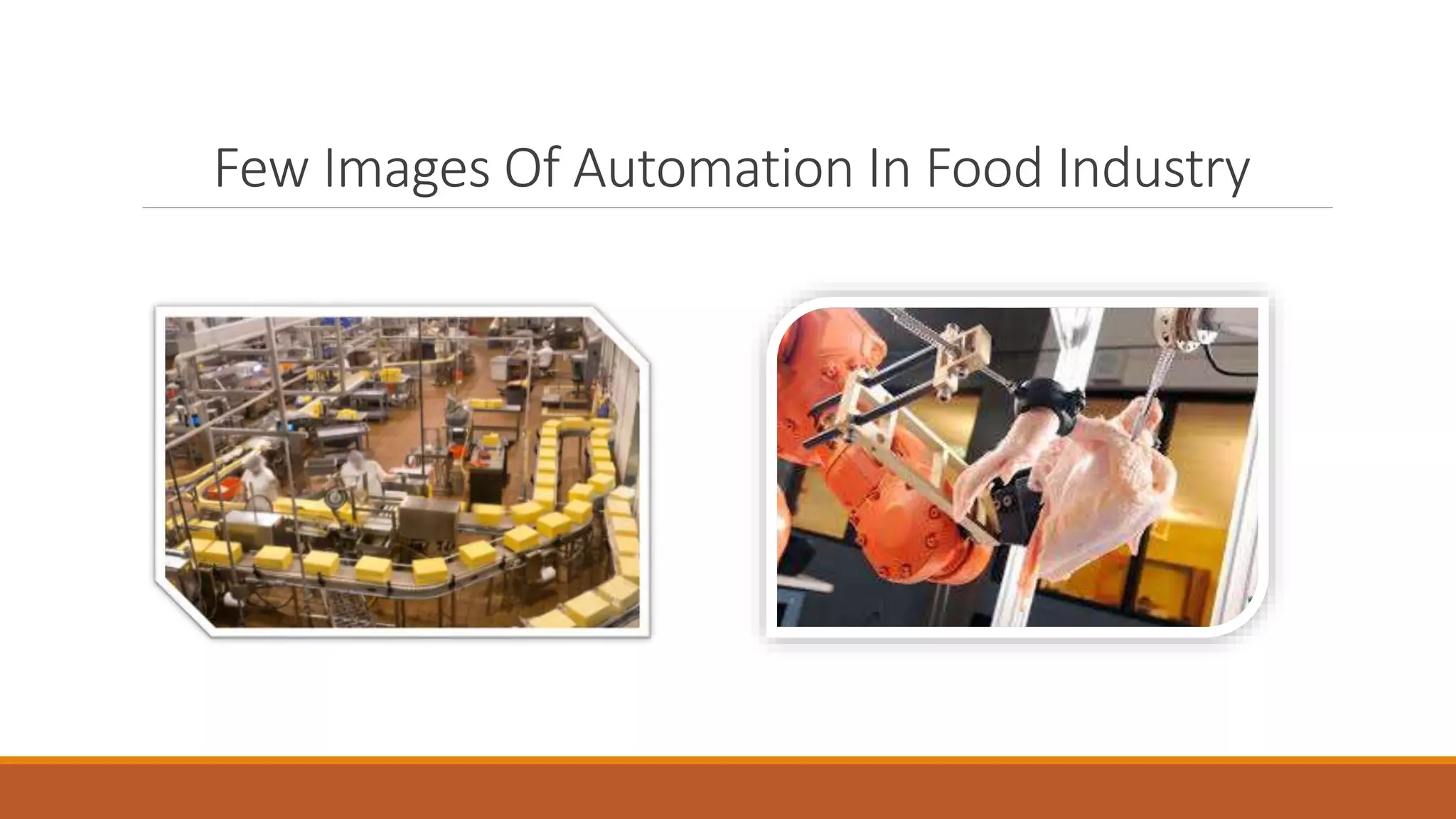
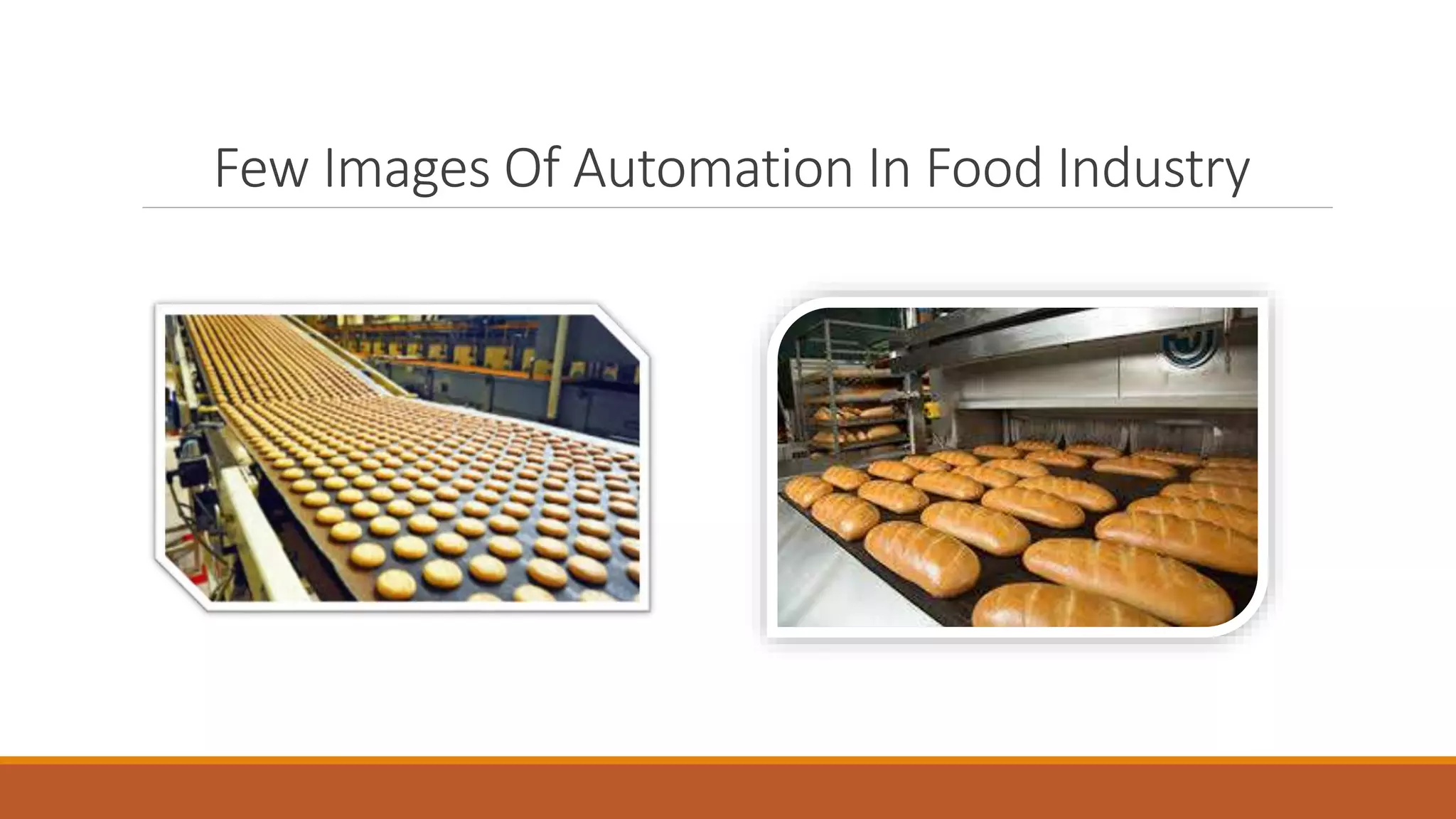
Few Images Of Automation In Food Industry
References
Asai K. and Takashima S., eds. (1994). Manufacturing Automation Systems and CIM Factories. New York: Chapman
and Hall. [Describes plant automation in the context of computer integrated manufacturing and robotics].
Biekert R. (1998). CIM Technology Fundamentals and Applications. Tinley Park, IL: The Goodheart-Willcox
Company, Inc. [Detailed description of computer integrated manufacturing technology].
Gunasekaran S. (1996). Computer vision technology for food quality assurance. Trends in Food Science &
Technology 7(8), 245-256. [Review of applications of computer vision in the food industry].
Mittal G.S., ed. (1997). Computerized Control Systems in the Food Industry. New York: Marcel Dekker, Inc.
[Presents several articles on various computer control systems and applications to the food industry].
References
Pinder A.C. and Godfrey G., eds. (1993). Food Process Monitoring Systems. New York: Blackie
Academic and Professional. [Describes several food process monitoring systems suitable for
automatic evaluation of many food processing operations].
Teixeira A.A. and Shoemaker C.F. (1989). Computerized Food Processing Operations. New York:
Van Nostrand Reinhold. [Presents information on computer architecture and controls for food
industry applications].
Food Processing. Chicago: Putnam Publishing. [A monthly publication that regularly carries
articles related to plant automation in the food industry].
THANK YOU

Latest automation in food industry

  • 1.
    Latest Automation inFood Industry BY V SANDEEP GOUTHAM-1008-15-824-016 MTECH 1ST YEAR FOOD PROCESSING TECHNOLOGY OSMANIA UNIVERSITY
  • 2.
    Presentation Output 1*Introduction ToAutomation in Food Industry 2*Why Automation In Food Industry 3* Uniqueness of the Food Industry 4*Tools Of Automation In Food Industry
  • 3.
    Introduction To Automationin Food Industry *The current level of automation in the food industry has been described as "islands of automation". *Food industry presents many unique challenges to complete automation, the industry has been successful in putting many automatic processes into place. The next significant development will be to integrate these "islands of automation" into an overall system of plant automation, from receiving raw materials to shipping finished products
  • 4.
    Introduction To Automationin Food Industry *Nonetheless, the food industry now ranks among the fastest growing segments for plant automation. For example, the food industry is among the top ten in using machine vision technology, a key component in plant automation. However, most systems are isolated, batch- type operations that target a specific task. In order for automation to be successful, it must be integrated into the overall manufacturing system design and provide on-line, continuous control capability
  • 5.
    Automation In FoodIndustry Plant Automation Improved Productivity Improved Product Quality Improved Profitability
  • 6.
    Automation In FoodIndustry Improved Productivity Plant productivity may be defined as the quantity of end products manufactured per unit of operating parameters – plant size, number of workers, time of operation, etc Improved Profitability Automation helps to improve productivity and product quality. Both of these contribute directly to improve profitability. Another important factor that makes automation extremely critical for the food industry is the need to comply with food safety and environmental regulatory agencies
  • 7.
    Automation In FoodIndustry Improved Product Quality Quality assurance is one of the most important goals of any industry. The ability to in an expanding market share. Quality–assurance methods used in the food industry have traditionally involved human visual inspection
  • 8.
    Uniqueness of theFood Industry *One of the most important reasons for increased interest in automating the food industry is its cost structure. Food processing is highly labor-intensive, with labor costs at anything up to 50 percent of the product cost. Improving productivity and reducing labor costs will therefore have a significant impact on profitability *Excellent examples of automation include processing and packaging Food products. Such as Dairy ,Bakery ,Beverage ,Etc..,
  • 9.
    Tools Of AutomationIn Food Industry 1. Computer Vision Systems 2.On-line Sensors 3.Expert Systems 4.Robot Technology 5. Computer Integrated Manufacturing 6. Flexible Manufacturing Systems 7. Systems Engineering
  • 10.
    Tools Of AutomationIn Food Industry Computer Vision Systems Computer vision is the science that develops the theoretical and algorithmic basis by which useful information about an object or scene can be automatically extracted and analyzed from an observed image, image set, or image sequence. Computer vision applications currently range from simple inspection to vision-guided robotic assembly Such as Gauging ,Verification , Flow detection ,Identification, Recognition , Locating
  • 11.
    Tools Of AutomationIn Food Industry Online Sensor Sensor is an object whose purpose is to detect events or changes in its environment, and then provide a corresponding output. A sensor is a type of transducer; sensors may provide various types of output, but typically use electrical or optical signals. Classification Of Sensor are of Many Types –Nano Sensor ,Bio sensor ,Chemical Sensor ,Optical Sensor Etc..
  • 12.
    Tools Of AutomationIn Food Industry Robot Technology These technologies deal with automated machines (robots for short) that can take the place of humans in dangerous environments or manufacturing processes, or resemble humans in appearance, behaviors, and or cognition. Robots Technology have some kind of mechanical construction, a frame, form or shape designed to achieve a particular task Within the Specific Time .
  • 13.
    Tools Of AutomationIn Food Industry Computer Integrated Manufacturing Computer-integrated manufacturing (CIM) is the manufacturing approach of using computers to control the entire production process. This integration allows individual processes to exchange information with each other and initiate actions. Generally In Many Food Industry SAP (Computer Application ) Is Widely used In the Integrated Process
  • 14.
    Tools Of AutomationIn Food Industry Schematic representation of on-line food quality evaluation using a computer vision system.
  • 15.
    Few Advantages ofAutomation *Increased throughput or productivity. *Improved quality or increased predictability of quality. *Improved robustness (consistency), of processes or product. *Increased consistency of output. *Reduced direct human labor costs and expenses *Reduce the Time Of Processing High Utility *Safer working conditions.
  • 16.
    Few Disadvantages ofAutomation *Lower skill levels of workers. *High initial investment. *Retrenchment or unemployment. *Not suitable for short product life cycle *Not economically justifiable for small scale production *High Maintenance of Automation
  • 17.
    Few Industries OfAutomation *ITC *Parle *Britannia *Nestle *Amul *Coca Cola *Pepsi *Pedigree *Con Agro *Heritage *Dairy Industry *Bakery Units *Oil Industry *And So Many Industries
  • 18.
    Few Flow DiagramOf Food Industry –Automation
  • 19.
    Few Flow DiagramOf Food Industry –Automation
  • 20.
    Few Images OfAutomation In Food Industry
  • 21.
    Few Images OfAutomation In Food Industry
  • 22.
    Few Images OfAutomation In Food Industry
  • 23.
    References Asai K. andTakashima S., eds. (1994). Manufacturing Automation Systems and CIM Factories. New York: Chapman and Hall. [Describes plant automation in the context of computer integrated manufacturing and robotics]. Biekert R. (1998). CIM Technology Fundamentals and Applications. Tinley Park, IL: The Goodheart-Willcox Company, Inc. [Detailed description of computer integrated manufacturing technology]. Gunasekaran S. (1996). Computer vision technology for food quality assurance. Trends in Food Science & Technology 7(8), 245-256. [Review of applications of computer vision in the food industry]. Mittal G.S., ed. (1997). Computerized Control Systems in the Food Industry. New York: Marcel Dekker, Inc. [Presents several articles on various computer control systems and applications to the food industry].
  • 24.
    References Pinder A.C. andGodfrey G., eds. (1993). Food Process Monitoring Systems. New York: Blackie Academic and Professional. [Describes several food process monitoring systems suitable for automatic evaluation of many food processing operations]. Teixeira A.A. and Shoemaker C.F. (1989). Computerized Food Processing Operations. New York: Van Nostrand Reinhold. [Presents information on computer architecture and controls for food industry applications]. Food Processing. Chicago: Putnam Publishing. [A monthly publication that regularly carries articles related to plant automation in the food industry].
  • 25.