Role of engineering principles and
mathematical modeling
Dr. R. T. Patil
Director,
Central Institute of Post Harvest
Engineering and Technology, Ludhiana
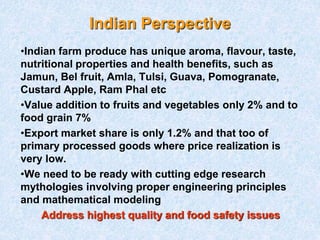
Indian Perspective
•Indian farm produce has unique aroma, flavour, taste,
nutritional properties and health benefits, such as
Jamun, Bel fruit, Amla, Tulsi, Guava, Pomogranate,
Custard Apple, Ram Phal etc
•Value addition to fruits and vegetables only 2% and to
food grain 7%
•Export market share is only 1.2% and that too of
primary processed goods where price realization is
very low.
•We need to be ready with cutting edge research
mythologies involving proper engineering principles
and mathematical modeling
Address highest quality and food safety issues
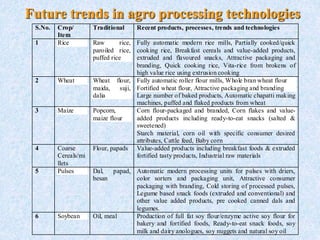
Future trends in agro processing technologies
S.No. Crop/
Item
Traditional Recent products, processes, trends and technologies
1 Rice Raw rice,
paroiled rice,
puffed rice
Fully automatic modern rice mills, Partially cooked/quick
cooking rice, Breakfast cereals and value-added products,
extruded and flavoured snacks, Attractive packaging and
branding, Quick cooking rice, Vita-rice from brokens of
high value rice using extrusion cooking
2 Wheat Wheat flour,
maida, suji,
dalia
Fully automatic roller flour mills, Whole bran wheat flour
Fortified wheat flour, Attractive packaging and branding
Large number of baked products, Automatic chapatti making
machines, puffed and flaked products from wheat
3 Maize Popcorn,
maize flour
Corn flour-packaged and branded, Corn flakes and value-
added products including ready-to-eat snacks (salted &
sweetened)
Starch material, corn oil with specific consumer desired
attributes, Cattle feed, Baby corn
4 Coarse
Cereals/mi
llets
Flour, papads Value-added products including breakfast foods & extruded
fortified tasty products, Industrial raw materials
5 Pulses Dal, papad,
besan
Automatic modern processing units for pulses with driers,
color sorters and packaging unit, Attractive consumer
packaging with branding, Cold storing of processed pulses,
Legume based snack foods (extruded and conventional) and
other value added products, pre cooked canned dals and
legumes.
6 Soybean Oil, meal Production of full fat soy flour/enzyme active soy flour for
bakery and fortified foods, Ready-to-eat snack foods, soy
milk and dairy anologues, soy nuggets and natural soy oil
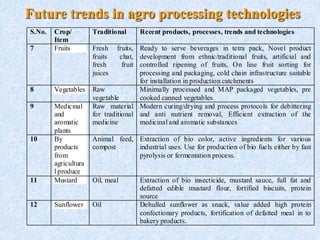
Future trends in agro processing technologies
S.No. Crop/
Item
Traditional Recent products, processes, trends and technologies
7 Fruits Fresh fruits,
fruits chat,
fresh fruit
juices
Ready to serve beverages in tetra pack, Novel product
development from ethnic/traditional fruits, artificial and
controlled ripening of fruits, On line fruit sorting for
processing and packaging, cold chain infrastructure suitable
for installation in production catchments
8 Vegetables Raw
vegetable
Minimally processed and MAP packaged vegetables, pre
cooked canned vegetables.
9 Medicinal
and
aromatic
plants
Raw material
for traditional
medicine
Modern curing/drying and process protocols for debittering
and anti nutrient removal, Efficient extraction of the
medicinal and aromatic substances
10 By
products
from
agricultura
l produce
Animal feed,
compost
Extraction of bio color, active ingredients for various
industrial uses. Use for production of bio fuels either by fast
pyrolysis or fermentation process.
11 Mustard Oil, meal Extraction of bio insecticide, mustard sauce, full fat and
defatted edible mustard flour, fortified biscuits, protein
source
12 Sunflower Oil Dehulled sunflower as snack, value added high protein
confectionary products, fortification of defatted meal in to
bakery products.
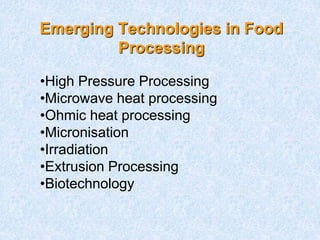
Emerging Technologies in Food
Processing
•High Pressure Processing
•Microwave heat processing
•Ohmic heat processing
•Micronisation
•Irradiation
•Extrusion Processing
•Biotechnology
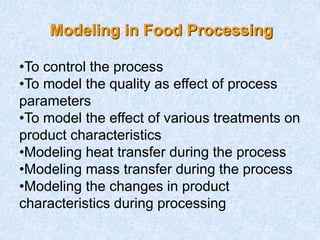
Modeling in Food Processing
•To control the process
•To model the quality as effect of process
parameters
•To model the effect of various treatments on
product characteristics
•Modeling heat transfer during the process
•Modeling mass transfer during the process
•Modeling the changes in product
characteristics during processing
High Pressure Processing
•HPP can replace conventional
processes, while maintaining
safety and quality.
•Effects of HPP are generally
marked as retention of color,
flavor and fresh appearance
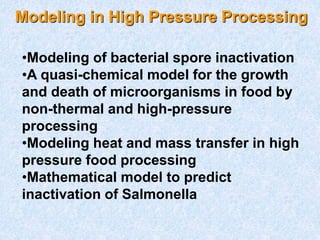
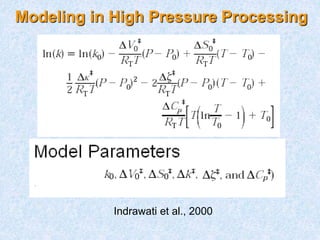
Modeling in High Pressure Processing
•Modeling of bacterial spore inactivation
•A quasi-chemical model for the growth
and death of microorganisms in food by
non-thermal and high-pressure
processing
•Modeling heat and mass transfer in high
pressure food processing
•Mathematical model to predict
inactivation of Salmonella
Modeling in High Pressure Processing
Indrawati et al., 2000
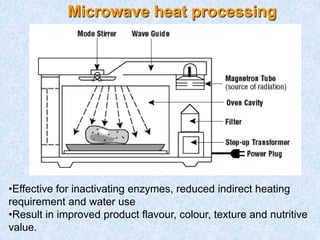
Microwave heat processing
•Effective for inactivating enzymes, reduced indirect heating
requirement and water use
•Result in improved product flavour, colour, texture and nutritive
value.
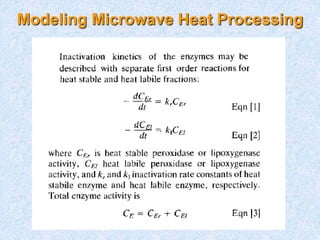
Modeling Microwave Heat Processing
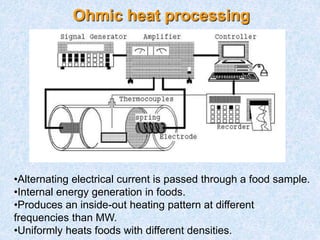
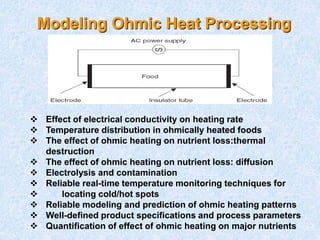
Ohmic heat processing
•Alternating electrical current is passed through a food sample.
•Internal energy generation in foods.
•Produces an inside-out heating pattern at different
frequencies than MW.
•Uniformly heats foods with different densities.
Modeling Ohmic Heat Processing
 Effect of electrical conductivity on heating rate
 Temperature distribution in ohmically heated foods
 The effect of ohmic heating on nutrient loss:thermal
destruction
 The effect of ohmic heating on nutrient loss: diffusion
 Electrolysis and contamination
 Reliable real-time temperature monitoring techniques for
 locating cold/hot spots
 Reliable modeling and prediction of ohmic heating patterns
 Well-defined product specifications and process parameters
 Quantification of effect of ohmic heating on major nutrients
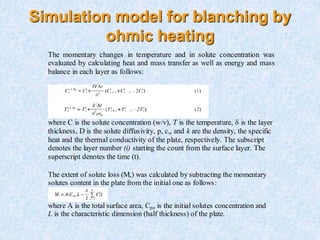
Simulation model for blanching by
ohmic heating
The extent of solute loss (M,) was calculated by subtracting the momentary
solutes content in the plate from the initial one as follows:
where A is the total surface area, Cpo is the initial solutes concentration and
L is the characteristic dimension (half thickness) of the plate.
The momentary changes in temperature and in solute concentration was
evaluated by calculating heat and mass transfer as well as energy and mass
balance in each layer as follows:
where C is the solute concentration (w/v), T is the temperature, is the layer
thickness, D is the solute diffusivity, p, c,, and k are the density, the specific
heat and the thermal conductivity of the plate, respectively. The subscript
denotes the layer number (i) starting the count from the surface layer. The
superscript denotes the time (t).
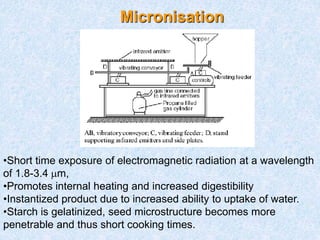
Micronisation
•Short time exposure of electromagnetic radiation at a wavelength
of 1.8-3.4 mm,
•Promotes internal heating and increased digestibility
•Instantized product due to increased ability to uptake of water.
•Starch is gelatinized, seed microstructure becomes more
penetrable and thus short cooking times.
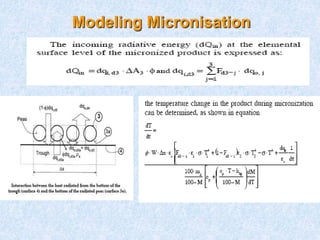
Modeling Micronisation
Irradiation
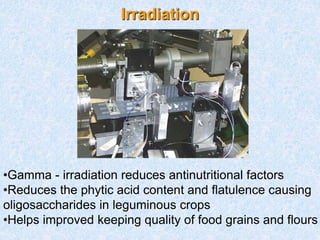
•Gamma - irradiation reduces antinutritional factors
•Reduces the phytic acid content and flatulence causing
oligosaccharides in leguminous crops
•Helps improved keeping quality of food grains and flours
Modeling Irradiation
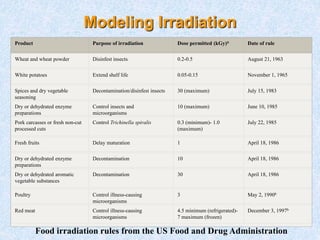
Product Purpose of irradiation Dose permitted (kGy)a Date of rule
Wheat and wheat powder Disinfest insects 0.2-0.5 August 21, 1963
White potatoes Extend shelf life 0.05-0.15 November 1, 1965
Spices and dry vegetable
seasoning
Decontamination/disinfest insects 30 (maximum) July 15, 1983
Dry or dehydrated enzyme
preparations
Control insects and
microorganisms
10 (maximum) June 10, 1985
Pork carcasses or fresh non-cut
processed cuts
Control Trichinella spiralis 0.3 (minimum)- 1.0
(maximum)
July 22, 1985
Fresh fruits Delay maturation 1 April 18, 1986
Dry or dehydrated enzyme
preparations
Decontamination 10 April 18, 1986
Dry or dehydrated aromatic
vegetable substances
Decontamination 30 April 18, 1986
Poultry Control illness-causing
microorganisms
3 May 2, 1990b
Red meat Control illness-causing
microorganisms
4.5 minimum (refrigerated)-
7 maximum (frozen)
December 3, 1997b
Food irradiation rules from the US Food and Drug Administration
Modeling Irradiation
Extrusion Processing
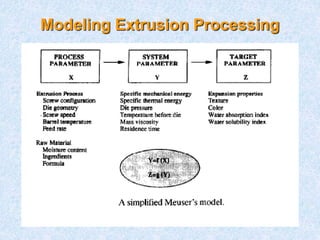
Modeling Extrusion Processing
Biotechnology
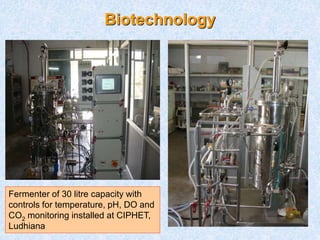
Fermenter of 30 litre capacity with
controls for temperature, pH, DO and
CO2 monitoring installed at CIPHET,
Ludhiana
Role of engineering principles and mathematical modeling

Role of engineering principles and mathematical modeling

  • 1.
    Role of engineeringprinciples and mathematical modeling Dr. R. T. Patil Director, Central Institute of Post Harvest Engineering and Technology, Ludhiana
  • 2.
    Indian Perspective •Indian farmproduce has unique aroma, flavour, taste, nutritional properties and health benefits, such as Jamun, Bel fruit, Amla, Tulsi, Guava, Pomogranate, Custard Apple, Ram Phal etc •Value addition to fruits and vegetables only 2% and to food grain 7% •Export market share is only 1.2% and that too of primary processed goods where price realization is very low. •We need to be ready with cutting edge research mythologies involving proper engineering principles and mathematical modeling Address highest quality and food safety issues
  • 3.
    Future trends inagro processing technologies S.No. Crop/ Item Traditional Recent products, processes, trends and technologies 1 Rice Raw rice, paroiled rice, puffed rice Fully automatic modern rice mills, Partially cooked/quick cooking rice, Breakfast cereals and value-added products, extruded and flavoured snacks, Attractive packaging and branding, Quick cooking rice, Vita-rice from brokens of high value rice using extrusion cooking 2 Wheat Wheat flour, maida, suji, dalia Fully automatic roller flour mills, Whole bran wheat flour Fortified wheat flour, Attractive packaging and branding Large number of baked products, Automatic chapatti making machines, puffed and flaked products from wheat 3 Maize Popcorn, maize flour Corn flour-packaged and branded, Corn flakes and value- added products including ready-to-eat snacks (salted & sweetened) Starch material, corn oil with specific consumer desired attributes, Cattle feed, Baby corn 4 Coarse Cereals/mi llets Flour, papads Value-added products including breakfast foods & extruded fortified tasty products, Industrial raw materials 5 Pulses Dal, papad, besan Automatic modern processing units for pulses with driers, color sorters and packaging unit, Attractive consumer packaging with branding, Cold storing of processed pulses, Legume based snack foods (extruded and conventional) and other value added products, pre cooked canned dals and legumes. 6 Soybean Oil, meal Production of full fat soy flour/enzyme active soy flour for bakery and fortified foods, Ready-to-eat snack foods, soy milk and dairy anologues, soy nuggets and natural soy oil
  • 4.
    Future trends inagro processing technologies S.No. Crop/ Item Traditional Recent products, processes, trends and technologies 7 Fruits Fresh fruits, fruits chat, fresh fruit juices Ready to serve beverages in tetra pack, Novel product development from ethnic/traditional fruits, artificial and controlled ripening of fruits, On line fruit sorting for processing and packaging, cold chain infrastructure suitable for installation in production catchments 8 Vegetables Raw vegetable Minimally processed and MAP packaged vegetables, pre cooked canned vegetables. 9 Medicinal and aromatic plants Raw material for traditional medicine Modern curing/drying and process protocols for debittering and anti nutrient removal, Efficient extraction of the medicinal and aromatic substances 10 By products from agricultura l produce Animal feed, compost Extraction of bio color, active ingredients for various industrial uses. Use for production of bio fuels either by fast pyrolysis or fermentation process. 11 Mustard Oil, meal Extraction of bio insecticide, mustard sauce, full fat and defatted edible mustard flour, fortified biscuits, protein source 12 Sunflower Oil Dehulled sunflower as snack, value added high protein confectionary products, fortification of defatted meal in to bakery products.
  • 5.
    Emerging Technologies inFood Processing •High Pressure Processing •Microwave heat processing •Ohmic heat processing •Micronisation •Irradiation •Extrusion Processing •Biotechnology
  • 6.
    Modeling in FoodProcessing •To control the process •To model the quality as effect of process parameters •To model the effect of various treatments on product characteristics •Modeling heat transfer during the process •Modeling mass transfer during the process •Modeling the changes in product characteristics during processing
  • 7.
    High Pressure Processing •HPPcan replace conventional processes, while maintaining safety and quality. •Effects of HPP are generally marked as retention of color, flavor and fresh appearance
  • 8.
    Modeling in HighPressure Processing •Modeling of bacterial spore inactivation •A quasi-chemical model for the growth and death of microorganisms in food by non-thermal and high-pressure processing •Modeling heat and mass transfer in high pressure food processing •Mathematical model to predict inactivation of Salmonella
  • 9.
    Modeling in HighPressure Processing Indrawati et al., 2000
  • 10.
    Microwave heat processing •Effectivefor inactivating enzymes, reduced indirect heating requirement and water use •Result in improved product flavour, colour, texture and nutritive value.
  • 11.
  • 12.
    Ohmic heat processing •Alternatingelectrical current is passed through a food sample. •Internal energy generation in foods. •Produces an inside-out heating pattern at different frequencies than MW. •Uniformly heats foods with different densities.
  • 13.
    Modeling Ohmic HeatProcessing  Effect of electrical conductivity on heating rate  Temperature distribution in ohmically heated foods  The effect of ohmic heating on nutrient loss:thermal destruction  The effect of ohmic heating on nutrient loss: diffusion  Electrolysis and contamination  Reliable real-time temperature monitoring techniques for  locating cold/hot spots  Reliable modeling and prediction of ohmic heating patterns  Well-defined product specifications and process parameters  Quantification of effect of ohmic heating on major nutrients
  • 14.
    Simulation model forblanching by ohmic heating The extent of solute loss (M,) was calculated by subtracting the momentary solutes content in the plate from the initial one as follows: where A is the total surface area, Cpo is the initial solutes concentration and L is the characteristic dimension (half thickness) of the plate. The momentary changes in temperature and in solute concentration was evaluated by calculating heat and mass transfer as well as energy and mass balance in each layer as follows: where C is the solute concentration (w/v), T is the temperature, is the layer thickness, D is the solute diffusivity, p, c,, and k are the density, the specific heat and the thermal conductivity of the plate, respectively. The subscript denotes the layer number (i) starting the count from the surface layer. The superscript denotes the time (t).
  • 15.
    Micronisation •Short time exposureof electromagnetic radiation at a wavelength of 1.8-3.4 mm, •Promotes internal heating and increased digestibility •Instantized product due to increased ability to uptake of water. •Starch is gelatinized, seed microstructure becomes more penetrable and thus short cooking times.
  • 16.
  • 17.
    Irradiation •Gamma - irradiationreduces antinutritional factors •Reduces the phytic acid content and flatulence causing oligosaccharides in leguminous crops •Helps improved keeping quality of food grains and flours
  • 18.
    Modeling Irradiation Product Purposeof irradiation Dose permitted (kGy)a Date of rule Wheat and wheat powder Disinfest insects 0.2-0.5 August 21, 1963 White potatoes Extend shelf life 0.05-0.15 November 1, 1965 Spices and dry vegetable seasoning Decontamination/disinfest insects 30 (maximum) July 15, 1983 Dry or dehydrated enzyme preparations Control insects and microorganisms 10 (maximum) June 10, 1985 Pork carcasses or fresh non-cut processed cuts Control Trichinella spiralis 0.3 (minimum)- 1.0 (maximum) July 22, 1985 Fresh fruits Delay maturation 1 April 18, 1986 Dry or dehydrated enzyme preparations Decontamination 10 April 18, 1986 Dry or dehydrated aromatic vegetable substances Decontamination 30 April 18, 1986 Poultry Control illness-causing microorganisms 3 May 2, 1990b Red meat Control illness-causing microorganisms 4.5 minimum (refrigerated)- 7 maximum (frozen) December 3, 1997b Food irradiation rules from the US Food and Drug Administration
  • 19.
  • 20.
  • 21.
  • 22.
    Biotechnology Fermenter of 30litre capacity with controls for temperature, pH, DO and CO2 monitoring installed at CIPHET, Ludhiana