PORTER’S FIVE FORCES ANALYSIS FOR
 THE TELECOM INDUSTRY IN INDIA


                Prepared By
                Akash Agamya
                Great Lakes Institute of
                Management
Introduction
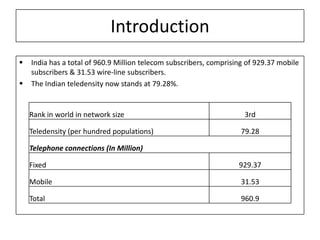
   India has a total of 960.9 Million telecom subscribers, comprising of 929.37 mobile
    subscribers & 31.53 wire-line subscribers.
   The Indian teledensity now stands at 79.28%.


    Rank in world in network size                                     3rd

    Teledensity (per hundred populations)                            79.28

    Telephone connections (In Million)

    Fixed                                                           929.37

    Mobile                                                           31.53

    Total                                                            960.9
Introduction
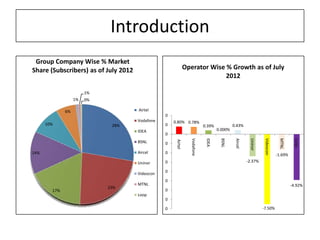
 Group Company Wise % Market
Share (Subscribers) as of July 2012                            Operator Wise % Growth as of July
                                                                             2012

                        1%
                   1%   0%

              6%                      Airtel
                                                 0
                                      Vodafone       0.80% 0.78%
      10%                     28%                0                          0.39%            0.43%
                                      IDEA                                          0.000%
                                                 0


                                                                                     BSNL


                                                                                                                  Videocon


                                                                                                                              MTNL


                                                                                                                                       Loop
                                                                             IDEA


                                                                                                        Uninor
                                                                 Vodafone


                                                                                              Aircel
                                                      Airtel
                                      BSNL       0

14%                                   Aircel     0                                                                           -1.69%
                                      Uninor     0                                                     -2.37%

                                                 0
                                      Videocon
                                                 0
                                      MTNL                                                                                            -4.92%
                             23%
        17%                                      0
                                      Loop
                                                 0

                                                 0                                                               -7.50%
Introduction
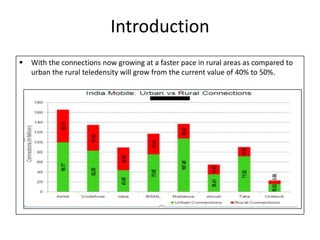
   With the connections now growing at a faster pace in rural areas as compared to
    urban the rural teledensity will grow from the current value of 40% to 50%.
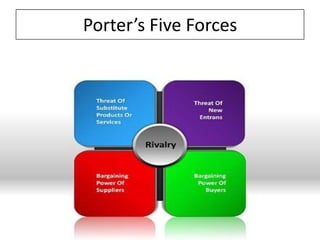
Porter’s Five Forces
Competitors Analysis - High

   Concentration – Market Share and Structure
   Financial Analysis – Past, Present, Future
   Global Presence and Marketing Network
   Future Prospects
   Overall Analysis
Competitors Analysis
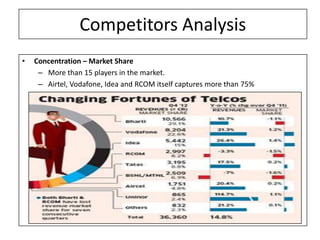
•   Concentration – Market Share
     – More than 15 players in the market.
     – Airtel, Vodafone, Idea and RCOM itself captures more than 75%
Competitors Analysis
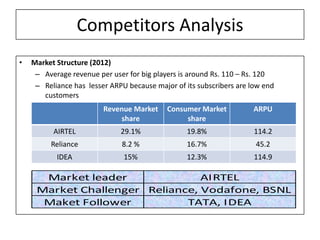
•   Market Structure (2012)
     – Average revenue per user for big players is around Rs. 110 – Rs. 120
     – Reliance has lesser ARPU because major of its subscribers are low end
       customers
                         Revenue Market     Consumer Market          ARPU
                             share               share
          AIRTEL              29.1%               19.8%               114.2
         Reliance             8.2 %               16.7%               45.2
           IDEA                15%                12.3%               114.9

      Market leader              AIRTEL
     Market Challenger Reliance, Vodafone, BSNL
      Maket Follower          TATA, IDEA
Competitors Analysis
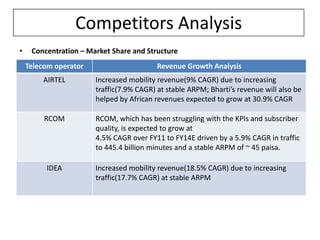
•    Concentration – Market Share and Structure
    Telecom operator                      Revenue Growth Analysis
        AIRTEL         Increased mobility revenue(9% CAGR) due to increasing
                       traffic(7.9% CAGR) at stable ARPM; Bharti’s revenue will also be
                       helped by African revenues expected to grow at 30.9% CAGR

         RCOM          RCOM, which has been struggling with the KPIs and subscriber
                       quality, is expected to grow at
                       4.5% CAGR over FY11 to FY14E driven by a 5.9% CAGR in traffic
                       to 445.4 billion minutes and a stable ARPM of ~ 45 paisa.

         IDEA          Increased mobility revenue(18.5% CAGR) due to increasing
                       traffic(17.7% CAGR) at stable ARPM
Competitors Analysis
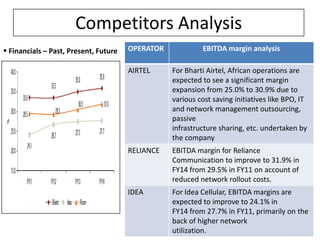
 Financials – Past, Present, Future   OPERATOR            EBITDA margin analysis

                                       AIRTEL     For Bharti Airtel, African operations are
                                                  expected to see a significant margin
                                                  expansion from 25.0% to 30.9% due to
                                                  various cost saving initiatives like BPO, IT
                                                  and network management outsourcing,
                                                  passive
                                                  infrastructure sharing, etc. undertaken by
                                                  the company
                                       RELIANCE   EBITDA margin for Reliance
                                                  Communication to improve to 31.9% in
                                                  FY14 from 29.5% in FY11 on account of
                                                  reduced network rollout costs.
                                       IDEA       For Idea Cellular, EBITDA margins are
                                                  expected to improve to 24.1% in
                                                  FY14 from 27.7% in FY11, primarily on the
                                                  back of higher network
                                                  utilization.
Competitors Analysis
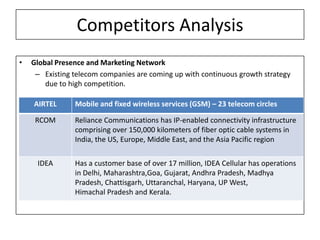
•   Global Presence and Marketing Network
     – Existing telecom companies are coming up with continuous growth strategy
        due to high competition.

    AIRTEL      Mobile and fixed wireless services (GSM) – 23 telecom circles

     RCOM       Reliance Communications has IP-enabled connectivity infrastructure
                comprising over 150,000 kilometers of fiber optic cable systems in
                India, the US, Europe, Middle East, and the Asia Pacific region

     IDEA       Has a customer base of over 17 million, IDEA Cellular has operations
                in Delhi, Maharashtra,Goa, Gujarat, Andhra Pradesh, Madhya
                Pradesh, Chattisgarh, Uttaranchal, Haryana, UP West,
                Himachal Pradesh and Kerala.
Competitors Analysis
•     Future Prospects

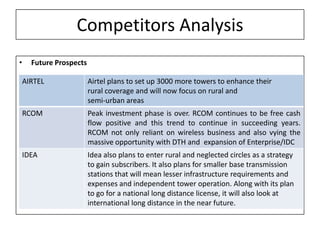
    AIRTEL               Airtel plans to set up 3000 more towers to enhance their
                         rural coverage and will now focus on rural and
                         semi-urban areas
    RCOM                 Peak investment phase is over. RCOM continues to be free cash
                         flow positive and this trend to continue in succeeding years.
                         RCOM not only reliant on wireless business and also vying the
                         massive opportunity with DTH and expansion of Enterprise/IDC
    IDEA                 Idea also plans to enter rural and neglected circles as a strategy
                         to gain subscribers. It also plans for smaller base transmission
                         stations that will mean lesser infrastructure requirements and
                         expenses and independent tower operation. Along with its plan
                         to go for a national long distance license, it will also look at
                         international long distance in the near future.
Competitors Analysis
•   Overall Analysis
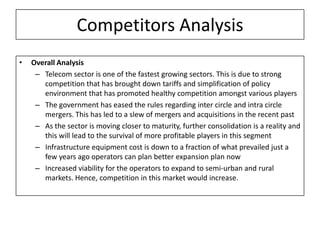
     – Telecom sector is one of the fastest growing sectors. This is due to strong
       competition that has brought down tariffs and simplification of policy
       environment that has promoted healthy competition amongst various players
     – The government has eased the rules regarding inter circle and intra circle
       mergers. This has led to a slew of mergers and acquisitions in the recent past
     – As the sector is moving closer to maturity, further consolidation is a reality and
       this will lead to the survival of more profitable players in this segment
     – Infrastructure equipment cost is down to a fraction of what prevailed just a
       few years ago operators can plan better expansion plan now
     – Increased viability for the operators to expand to semi-urban and rural
       markets. Hence, competition in this market would increase.
Buyer Power – High

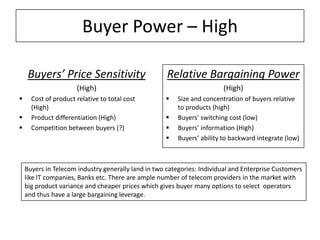
     Buyers’ Price Sensitivity                       Relative Bargaining Power
                      (High)                                             (High)
     Cost of product relative to total cost            Size and concentration of buyers relative
      (High)                                             to products (high)
     Product differentiation (High)                    Buyers’ switching cost (low)
     Competition between buyers (?)                    Buyers’ information (High)
                                                        Buyers’ ability to backward integrate (low)


    Buyers in Telecom industry generally land in two categories: Individual and Enterprise Customers
    like IT companies, Banks etc. There are ample number of telecom providers in the market with
    big product variance and cheaper prices which gives buyer many options to select operators
    and thus have a large bargaining leverage.
Buyer Power Analysis
•   Cost of product relative to total cost
     – Telecom products e.g. Voice calls, 3g etc cost 100% of the total cost of service
        and buyers are more sensible to pricing.

•   Product differentiation
     – Airtel, Relience,Idea and all other companies have similar prices for similar
        products and less likely for any one to maintain product differentiation and
        hence buyers have the option to switch over.
                       Airtel                                  Relience                                    Idea
                     -----------                               -----------                              -----------
                      Prepaid                                   Prepaid                                  Prepaid
        MRP(Rs.) DATA USAGE             VALIDITY MRP(Rs.)       DATA USAGE       VALIDITY MRP(Rs.)       DATA USAGE   VALIDITY
              250 1 GB                  30 Days             255 1 GB             30 Days             250 1 GB         30 Days
              450 2 GB                  30 Days             449 2 GB             30 Days             450 2 GB         30 Days
        1 Rs./min 300-plan (std)        30 days 1 Rs./min (std) 330-plan         30 days 1 Rs./min (std) 330-plan     30days

       [Ref: http://im.tech2.in.com/gallery/2012/may/3gplans_311641209465.jpg]
Buyer Power Analysis
•   Competition between buyer
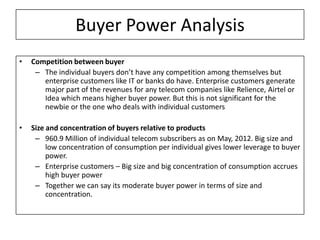
     – The individual buyers don’t have any competition among themselves but
       enterprise customers like IT or banks do have. Enterprise customers generate
       major part of the revenues for any telecom companies like Relience, Airtel or
       Idea which means higher buyer power. But this is not significant for the
       newbie or the one who deals with individual customers

•   Size and concentration of buyers relative to products
     – 960.9 Million of individual telecom subscribers as on May, 2012. Big size and
         low concentration of consumption per individual gives lower leverage to buyer
         power.
     – Enterprise customers – Big size and big concentration of consumption accrues
         high buyer power
     – Together we can say its moderate buyer power in terms of size and
         concentration.
Buyer Power Analysis
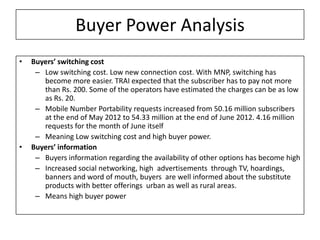
•   Buyers’ switching cost
     – Low switching cost. Low new connection cost. With MNP, switching has
       become more easier. TRAI expected that the subscriber has to pay not more
       than Rs. 200. Some of the operators have estimated the charges can be as low
       as Rs. 20.
     – Mobile Number Portability requests increased from 50.16 million subscribers
       at the end of May 2012 to 54.33 million at the end of June 2012. 4.16 million
       requests for the month of June itself
     – Meaning Low switching cost and high buyer power.
•   Buyers’ information
     – Buyers information regarding the availability of other options has become high
     – Increased social networking, high advertisements through TV, hoardings,
       banners and word of mouth, buyers are well informed about the substitute
       products with better offerings urban as well as rural areas.
     – Means high buyer power
Buyer Power Analysis
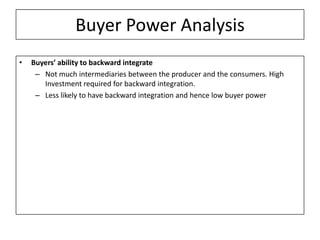
•   Buyers’ ability to backward integrate
     – Not much intermediaries between the producer and the consumers. High
       Investment required for backward integration.
     – Less likely to have backward integration and hence low buyer power
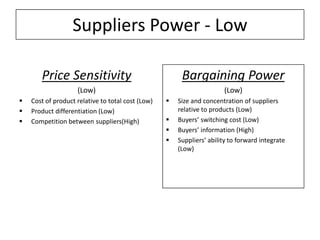
Suppliers Power - Low

       Price Sensitivity                                Bargaining Power
                    (Low)                                              (Low)
   Cost of product relative to total cost (Low)      Size and concentration of suppliers
   Product differentiation (Low)                      relative to products (Low)
   Competition between suppliers(High)               Buyers’ switching cost (Low)
                                                      Buyers’ information (High)
                                                      Suppliers’ ability to forward integrate
                                                       (Low)
Suppliers Power Analysis
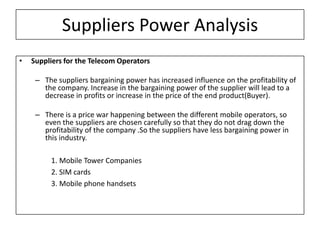
•   Suppliers for the Telecom Operators

     – The suppliers bargaining power has increased influence on the profitability of
       the company. Increase in the bargaining power of the supplier will lead to a
       decrease in profits or increase in the price of the end product(Buyer).

     – There is a price war happening between the different mobile operators, so
       even the suppliers are chosen carefully so that they do not drag down the
       profitability of the company .So the suppliers have less bargaining power in
       this industry.

         1. Mobile Tower Companies
         2. SIM cards
         3. Mobile phone handsets
Suppliers Power Analysis
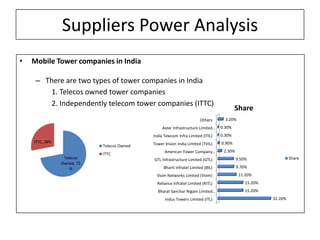
•   Mobile Tower companies in India

     – There are two types of tower companies in India
        1. Telecos owned tower companies
        2. Independently telecom tower companies (ITTC)
                                                                                          Share
                                                                       Others       3.20%
                                                 Aster Infrastructure Limited…    0.30%
                                            India Telecom Infra Limited (ITIL)    0.30%
    ITTC, 28%                               Tower Vision India Limited (TVIL)     0.90%
                            Telecos Owned
                                                  American Tower Company…          2.30%
                            ITTC
                 Telecos                    GTL Infrastructure Limited (GTL)               9.50%                 Share
                Owned, 72
                    %                             Bharti Infratel Limited (BIL)            9.70%
                                              Viom Networks Limited (Viom)                  11.20%
                                              Reliance Infratel Limited (RITL)                 15.20%
                                              Bharat Sanchar Nigam Limited…                    15.20%
                                                  Indus Towers Limited (ITL)                            32.20%
Suppliers Power Analysis
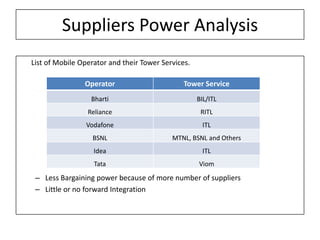
List of Mobile Operator and their Tower Services.

                Operator                       Tower Service
                  Bharti                            BIL/ITL
                 Reliance                            RITL
                Vodafone                              ITL
                  BSNL                     MTNL, BSNL and Others
                   Idea                               ITL
                   Tata                             Viom
 – Less Bargaining power because of more number of suppliers
 – Little or no forward Integration
Suppliers Power Analysis
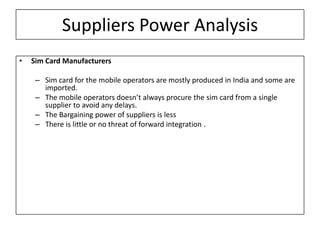
•   Sim Card Manufacturers

     – Sim card for the mobile operators are mostly produced in India and some are
       imported.
     – The mobile operators doesn’t always procure the sim card from a single
       supplier to avoid any delays.
     – The Bargaining power of suppliers is less
     – There is little or no threat of forward integration .
Suppliers Power Analysis
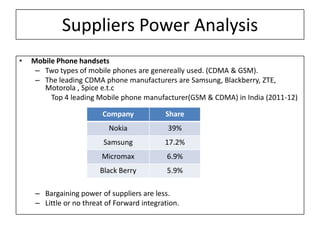
•   Mobile Phone handsets
     – Two types of mobile phones are genereally used. (CDMA & GSM).
     – The leading CDMA phone manufacturers are Samsung, Blackberry, ZTE,
       Motorola , Spice e.t.c
         Top 4 leading Mobile phone manufacturer(GSM & CDMA) in India (2011-12)

                          Company            Share
                            Nokia             39%
                          Samsung            17.2%
                         Micromax             6.9%
                         Black Berry          5.9%

     – Bargaining power of suppliers are less.
     – Little or no threat of Forward integration.
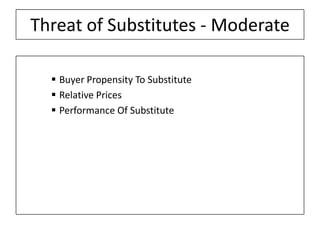
Threat of Substitutes - Moderate

   Buyer Propensity To Substitute
   Relative Prices
   Performance Of Substitute
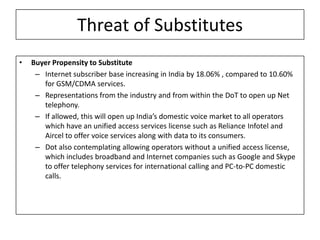
Threat of Substitutes
•   Buyer Propensity to Substitute
     – Internet subscriber base increasing in India by 18.06% , compared to 10.60%
       for GSM/CDMA services.
     – Representations from the industry and from within the DoT to open up Net
       telephony.
     – If allowed, this will open up India’s domestic voice market to all operators
       which have an unified access services license such as Reliance Infotel and
       Aircel to offer voice services along with data to its consumers.
     – Dot also contemplating allowing operators without a unified access license,
       which includes broadband and Internet companies such as Google and Skype
       to offer telephony services for international calling and PC-to-PC domestic
       calls.
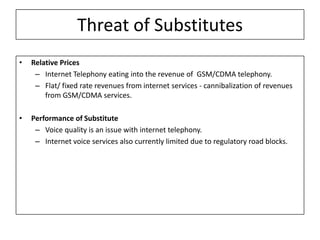
Threat of Substitutes
•   Relative Prices
     – Internet Telephony eating into the revenue of GSM/CDMA telephony.
     – Flat/ fixed rate revenues from internet services - cannibalization of revenues
        from GSM/CDMA services.

•   Performance of Substitute
     – Voice quality is an issue with internet telephony.
     – Internet voice services also currently limited due to regulatory road blocks.
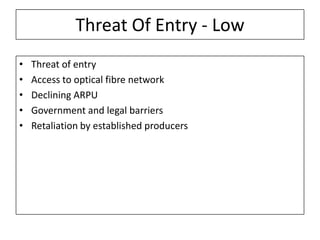
Threat Of Entry - Low
•   Threat of entry
•   Access to optical fibre network
•   Declining ARPU
•   Government and legal barriers
•   Retaliation by established producers
Threat Of Entry
•   Capital Requirements
     – The cost of active equipment is estimated to be 40 percent of the telecom
        operator's total capex, while the balance is accounted for by passive
        infrastructure.
     – Bharti has invested close to Rs. 230 billion to create the cellular infrastructure
        with 45,000 towers across the country. Typically, a ground based tower costs
        Rs. 25-30 lakh. A roof-based tower can be built for Rs.13-14 lakh.
     – Cost of maintaining one tower (active + passive) is estimated at Rs. 60,000-
        65,000 per month.
     – If tower is rented then monthly rent of Rs. 40,000-45,000 for active network.
     – The monthly outflow of a TSP would be close to Rs. 80,000-85,000 per tower
        per month.
     – However, the recent announcement made by BSNL about leasing its towers
        will help both the older and newer players to penetrate into new markets.
     – This factor makes the telecom industry moderately attractive for the new
        players and investors
Threat Of Entry
•   Declining ARPU
     – The market is maturing and new classes of consumers are mostly rural and
        their ARPU is well below $5 (probably $3-3.5). So, managing bottom-lines at
        such low levels of revenue per user will prove to be a challenge for new
        entrant

•   Access To Optical Fibre Network

     – The largest optical fibre has been built by the incumbent operator BSNL who is
       also the long distance operator.
     – The private sector players such as Bharti and Reliance have also constructed
       optical fibre cable network connecting mainly cities and towns but their
       presence is very limited in the rural areas and difficult terrains.
     – It is fairly difficult and cost- ineffective for new entrants to lay down optical
       fibre connecting remote places as well.
Threat Of Entry
•   Retaliation By Established Players
     – Also known as Incumbent Wrath signifies the leverage the players in the
       market commands. The incumbents grow because of an established network
       presence, a brand that consumers are aware of and sheer economies of scale.
     – Mobile termination charge which one operator pays to the other when the
       customer of the former uses the roaming charges of the latter. This is 30 paise
       a minute charge as of today. This is charged to the consumer as the cost of
       roaming. With an all India footprint (or 80% coverage), the incumbents
       effectively do not have to pay termination charges.
     – The incumbents have either been pocketing the termination charges or
       passing them to consumers “no roaming charge” kind of schemes. This factor
       makes the industry unattractive for the new entrants and investors.
     – The existing Telecom players might begin to bundle broadband, voice,
       wireless, video and other emerging technologies together, as well as a variety
       of value added content, in an effort to remain competitive, offer seamless
       services and attract more customers, at a cheaper price (incumbent wrath)
Threat Of Entry
•   Government And Legal Barriers
     – �Private operators will have to enter into an arrangement with fixed-service
       providers within a circle for traffic between long-distance and short-distance
       charging centres.
     – �Seven years time frame set for rollout of network, spread over four phases.
       Any shortfall in network coverage would result in encashment and forfeiture
       of bank guarantee of that phase.
     – Private operators to pay one-time entry fee of Rs.25 million plus a Financial
       Bank Guarantee (FBG) of Rs.200 million. The revenue sharing agreement
       would be to the extent of 6%.
     – Private operators allowed to set up landing facilities that access submarine
       cables and use excess bandwidth available.
     – No industrial license required for setting up manufacturing units for telecom
       equipment.
     – 100% Foreign Direct Investment (FDI) is allowed through automatic route for
       manufacturing of telecom equipments.
     – Moderate threat entry based on Government Policies.
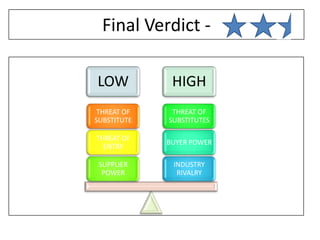
Final Verdict -

LOW           HIGH
 THREAT OF    THREAT OF
SUBSTITUTE   SUBSTITUTES

THREAT OF
             BUYER POWER
  ENTRY

 SUPPLIER     INDUSTRY
  POWER        RIVALRY

Porters five force analysis for telecom industry

  • 1.
    PORTER’S FIVE FORCESANALYSIS FOR THE TELECOM INDUSTRY IN INDIA Prepared By Akash Agamya Great Lakes Institute of Management
  • 2.
    Introduction  India has a total of 960.9 Million telecom subscribers, comprising of 929.37 mobile subscribers & 31.53 wire-line subscribers.  The Indian teledensity now stands at 79.28%. Rank in world in network size 3rd Teledensity (per hundred populations) 79.28 Telephone connections (In Million) Fixed 929.37 Mobile 31.53 Total 960.9
  • 3.
    Introduction Group CompanyWise % Market Share (Subscribers) as of July 2012 Operator Wise % Growth as of July 2012 1% 1% 0% 6% Airtel 0 Vodafone 0.80% 0.78% 10% 28% 0 0.39% 0.43% IDEA 0.000% 0 BSNL Videocon MTNL Loop IDEA Uninor Vodafone Aircel Airtel BSNL 0 14% Aircel 0 -1.69% Uninor 0 -2.37% 0 Videocon 0 MTNL -4.92% 23% 17% 0 Loop 0 0 -7.50%
  • 4.
    Introduction  With the connections now growing at a faster pace in rural areas as compared to urban the rural teledensity will grow from the current value of 40% to 50%.
  • 5.
  • 6.
    Competitors Analysis -High  Concentration – Market Share and Structure  Financial Analysis – Past, Present, Future  Global Presence and Marketing Network  Future Prospects  Overall Analysis
  • 7.
    Competitors Analysis • Concentration – Market Share – More than 15 players in the market. – Airtel, Vodafone, Idea and RCOM itself captures more than 75%
  • 8.
    Competitors Analysis • Market Structure (2012) – Average revenue per user for big players is around Rs. 110 – Rs. 120 – Reliance has lesser ARPU because major of its subscribers are low end customers Revenue Market Consumer Market ARPU share share AIRTEL 29.1% 19.8% 114.2 Reliance 8.2 % 16.7% 45.2 IDEA 15% 12.3% 114.9 Market leader AIRTEL Market Challenger Reliance, Vodafone, BSNL Maket Follower TATA, IDEA
  • 9.
    Competitors Analysis • Concentration – Market Share and Structure Telecom operator Revenue Growth Analysis AIRTEL Increased mobility revenue(9% CAGR) due to increasing traffic(7.9% CAGR) at stable ARPM; Bharti’s revenue will also be helped by African revenues expected to grow at 30.9% CAGR RCOM RCOM, which has been struggling with the KPIs and subscriber quality, is expected to grow at 4.5% CAGR over FY11 to FY14E driven by a 5.9% CAGR in traffic to 445.4 billion minutes and a stable ARPM of ~ 45 paisa. IDEA Increased mobility revenue(18.5% CAGR) due to increasing traffic(17.7% CAGR) at stable ARPM
  • 10.
    Competitors Analysis  Financials– Past, Present, Future OPERATOR EBITDA margin analysis AIRTEL For Bharti Airtel, African operations are expected to see a significant margin expansion from 25.0% to 30.9% due to various cost saving initiatives like BPO, IT and network management outsourcing, passive infrastructure sharing, etc. undertaken by the company RELIANCE EBITDA margin for Reliance Communication to improve to 31.9% in FY14 from 29.5% in FY11 on account of reduced network rollout costs. IDEA For Idea Cellular, EBITDA margins are expected to improve to 24.1% in FY14 from 27.7% in FY11, primarily on the back of higher network utilization.
  • 11.
    Competitors Analysis • Global Presence and Marketing Network – Existing telecom companies are coming up with continuous growth strategy due to high competition. AIRTEL Mobile and fixed wireless services (GSM) – 23 telecom circles RCOM Reliance Communications has IP-enabled connectivity infrastructure comprising over 150,000 kilometers of fiber optic cable systems in India, the US, Europe, Middle East, and the Asia Pacific region IDEA Has a customer base of over 17 million, IDEA Cellular has operations in Delhi, Maharashtra,Goa, Gujarat, Andhra Pradesh, Madhya Pradesh, Chattisgarh, Uttaranchal, Haryana, UP West, Himachal Pradesh and Kerala.
  • 12.
    Competitors Analysis • Future Prospects AIRTEL Airtel plans to set up 3000 more towers to enhance their rural coverage and will now focus on rural and semi-urban areas RCOM Peak investment phase is over. RCOM continues to be free cash flow positive and this trend to continue in succeeding years. RCOM not only reliant on wireless business and also vying the massive opportunity with DTH and expansion of Enterprise/IDC IDEA Idea also plans to enter rural and neglected circles as a strategy to gain subscribers. It also plans for smaller base transmission stations that will mean lesser infrastructure requirements and expenses and independent tower operation. Along with its plan to go for a national long distance license, it will also look at international long distance in the near future.
  • 13.
    Competitors Analysis • Overall Analysis – Telecom sector is one of the fastest growing sectors. This is due to strong competition that has brought down tariffs and simplification of policy environment that has promoted healthy competition amongst various players – The government has eased the rules regarding inter circle and intra circle mergers. This has led to a slew of mergers and acquisitions in the recent past – As the sector is moving closer to maturity, further consolidation is a reality and this will lead to the survival of more profitable players in this segment – Infrastructure equipment cost is down to a fraction of what prevailed just a few years ago operators can plan better expansion plan now – Increased viability for the operators to expand to semi-urban and rural markets. Hence, competition in this market would increase.
  • 14.
    Buyer Power –High Buyers’ Price Sensitivity Relative Bargaining Power (High) (High)  Cost of product relative to total cost  Size and concentration of buyers relative (High) to products (high)  Product differentiation (High)  Buyers’ switching cost (low)  Competition between buyers (?)  Buyers’ information (High)  Buyers’ ability to backward integrate (low) Buyers in Telecom industry generally land in two categories: Individual and Enterprise Customers like IT companies, Banks etc. There are ample number of telecom providers in the market with big product variance and cheaper prices which gives buyer many options to select operators and thus have a large bargaining leverage.
  • 15.
    Buyer Power Analysis • Cost of product relative to total cost – Telecom products e.g. Voice calls, 3g etc cost 100% of the total cost of service and buyers are more sensible to pricing. • Product differentiation – Airtel, Relience,Idea and all other companies have similar prices for similar products and less likely for any one to maintain product differentiation and hence buyers have the option to switch over. Airtel Relience Idea ----------- ----------- ----------- Prepaid Prepaid Prepaid MRP(Rs.) DATA USAGE VALIDITY MRP(Rs.) DATA USAGE VALIDITY MRP(Rs.) DATA USAGE VALIDITY 250 1 GB 30 Days 255 1 GB 30 Days 250 1 GB 30 Days 450 2 GB 30 Days 449 2 GB 30 Days 450 2 GB 30 Days 1 Rs./min 300-plan (std) 30 days 1 Rs./min (std) 330-plan 30 days 1 Rs./min (std) 330-plan 30days [Ref: http://im.tech2.in.com/gallery/2012/may/3gplans_311641209465.jpg]
  • 16.
    Buyer Power Analysis • Competition between buyer – The individual buyers don’t have any competition among themselves but enterprise customers like IT or banks do have. Enterprise customers generate major part of the revenues for any telecom companies like Relience, Airtel or Idea which means higher buyer power. But this is not significant for the newbie or the one who deals with individual customers • Size and concentration of buyers relative to products – 960.9 Million of individual telecom subscribers as on May, 2012. Big size and low concentration of consumption per individual gives lower leverage to buyer power. – Enterprise customers – Big size and big concentration of consumption accrues high buyer power – Together we can say its moderate buyer power in terms of size and concentration.
  • 17.
    Buyer Power Analysis • Buyers’ switching cost – Low switching cost. Low new connection cost. With MNP, switching has become more easier. TRAI expected that the subscriber has to pay not more than Rs. 200. Some of the operators have estimated the charges can be as low as Rs. 20. – Mobile Number Portability requests increased from 50.16 million subscribers at the end of May 2012 to 54.33 million at the end of June 2012. 4.16 million requests for the month of June itself – Meaning Low switching cost and high buyer power. • Buyers’ information – Buyers information regarding the availability of other options has become high – Increased social networking, high advertisements through TV, hoardings, banners and word of mouth, buyers are well informed about the substitute products with better offerings urban as well as rural areas. – Means high buyer power
  • 18.
    Buyer Power Analysis • Buyers’ ability to backward integrate – Not much intermediaries between the producer and the consumers. High Investment required for backward integration. – Less likely to have backward integration and hence low buyer power
  • 19.
    Suppliers Power -Low Price Sensitivity Bargaining Power (Low) (Low)  Cost of product relative to total cost (Low)  Size and concentration of suppliers  Product differentiation (Low) relative to products (Low)  Competition between suppliers(High)  Buyers’ switching cost (Low)  Buyers’ information (High)  Suppliers’ ability to forward integrate (Low)
  • 20.
    Suppliers Power Analysis • Suppliers for the Telecom Operators – The suppliers bargaining power has increased influence on the profitability of the company. Increase in the bargaining power of the supplier will lead to a decrease in profits or increase in the price of the end product(Buyer). – There is a price war happening between the different mobile operators, so even the suppliers are chosen carefully so that they do not drag down the profitability of the company .So the suppliers have less bargaining power in this industry. 1. Mobile Tower Companies 2. SIM cards 3. Mobile phone handsets
  • 21.
    Suppliers Power Analysis • Mobile Tower companies in India – There are two types of tower companies in India 1. Telecos owned tower companies 2. Independently telecom tower companies (ITTC) Share Others 3.20% Aster Infrastructure Limited… 0.30% India Telecom Infra Limited (ITIL) 0.30% ITTC, 28% Tower Vision India Limited (TVIL) 0.90% Telecos Owned American Tower Company… 2.30% ITTC Telecos GTL Infrastructure Limited (GTL) 9.50% Share Owned, 72 % Bharti Infratel Limited (BIL) 9.70% Viom Networks Limited (Viom) 11.20% Reliance Infratel Limited (RITL) 15.20% Bharat Sanchar Nigam Limited… 15.20% Indus Towers Limited (ITL) 32.20%
  • 22.
    Suppliers Power Analysis Listof Mobile Operator and their Tower Services. Operator Tower Service Bharti BIL/ITL Reliance RITL Vodafone ITL BSNL MTNL, BSNL and Others Idea ITL Tata Viom – Less Bargaining power because of more number of suppliers – Little or no forward Integration
  • 23.
    Suppliers Power Analysis • Sim Card Manufacturers – Sim card for the mobile operators are mostly produced in India and some are imported. – The mobile operators doesn’t always procure the sim card from a single supplier to avoid any delays. – The Bargaining power of suppliers is less – There is little or no threat of forward integration .
  • 24.
    Suppliers Power Analysis • Mobile Phone handsets – Two types of mobile phones are genereally used. (CDMA & GSM). – The leading CDMA phone manufacturers are Samsung, Blackberry, ZTE, Motorola , Spice e.t.c Top 4 leading Mobile phone manufacturer(GSM & CDMA) in India (2011-12) Company Share Nokia 39% Samsung 17.2% Micromax 6.9% Black Berry 5.9% – Bargaining power of suppliers are less. – Little or no threat of Forward integration.
  • 25.
    Threat of Substitutes- Moderate  Buyer Propensity To Substitute  Relative Prices  Performance Of Substitute
  • 26.
    Threat of Substitutes • Buyer Propensity to Substitute – Internet subscriber base increasing in India by 18.06% , compared to 10.60% for GSM/CDMA services. – Representations from the industry and from within the DoT to open up Net telephony. – If allowed, this will open up India’s domestic voice market to all operators which have an unified access services license such as Reliance Infotel and Aircel to offer voice services along with data to its consumers. – Dot also contemplating allowing operators without a unified access license, which includes broadband and Internet companies such as Google and Skype to offer telephony services for international calling and PC-to-PC domestic calls.
  • 27.
    Threat of Substitutes • Relative Prices – Internet Telephony eating into the revenue of GSM/CDMA telephony. – Flat/ fixed rate revenues from internet services - cannibalization of revenues from GSM/CDMA services. • Performance of Substitute – Voice quality is an issue with internet telephony. – Internet voice services also currently limited due to regulatory road blocks.
  • 28.
    Threat Of Entry- Low • Threat of entry • Access to optical fibre network • Declining ARPU • Government and legal barriers • Retaliation by established producers
  • 29.
    Threat Of Entry • Capital Requirements – The cost of active equipment is estimated to be 40 percent of the telecom operator's total capex, while the balance is accounted for by passive infrastructure. – Bharti has invested close to Rs. 230 billion to create the cellular infrastructure with 45,000 towers across the country. Typically, a ground based tower costs Rs. 25-30 lakh. A roof-based tower can be built for Rs.13-14 lakh. – Cost of maintaining one tower (active + passive) is estimated at Rs. 60,000- 65,000 per month. – If tower is rented then monthly rent of Rs. 40,000-45,000 for active network. – The monthly outflow of a TSP would be close to Rs. 80,000-85,000 per tower per month. – However, the recent announcement made by BSNL about leasing its towers will help both the older and newer players to penetrate into new markets. – This factor makes the telecom industry moderately attractive for the new players and investors
  • 30.
    Threat Of Entry • Declining ARPU – The market is maturing and new classes of consumers are mostly rural and their ARPU is well below $5 (probably $3-3.5). So, managing bottom-lines at such low levels of revenue per user will prove to be a challenge for new entrant • Access To Optical Fibre Network – The largest optical fibre has been built by the incumbent operator BSNL who is also the long distance operator. – The private sector players such as Bharti and Reliance have also constructed optical fibre cable network connecting mainly cities and towns but their presence is very limited in the rural areas and difficult terrains. – It is fairly difficult and cost- ineffective for new entrants to lay down optical fibre connecting remote places as well.
  • 31.
    Threat Of Entry • Retaliation By Established Players – Also known as Incumbent Wrath signifies the leverage the players in the market commands. The incumbents grow because of an established network presence, a brand that consumers are aware of and sheer economies of scale. – Mobile termination charge which one operator pays to the other when the customer of the former uses the roaming charges of the latter. This is 30 paise a minute charge as of today. This is charged to the consumer as the cost of roaming. With an all India footprint (or 80% coverage), the incumbents effectively do not have to pay termination charges. – The incumbents have either been pocketing the termination charges or passing them to consumers “no roaming charge” kind of schemes. This factor makes the industry unattractive for the new entrants and investors. – The existing Telecom players might begin to bundle broadband, voice, wireless, video and other emerging technologies together, as well as a variety of value added content, in an effort to remain competitive, offer seamless services and attract more customers, at a cheaper price (incumbent wrath)
  • 32.
    Threat Of Entry • Government And Legal Barriers – �Private operators will have to enter into an arrangement with fixed-service providers within a circle for traffic between long-distance and short-distance charging centres. – �Seven years time frame set for rollout of network, spread over four phases. Any shortfall in network coverage would result in encashment and forfeiture of bank guarantee of that phase. – Private operators to pay one-time entry fee of Rs.25 million plus a Financial Bank Guarantee (FBG) of Rs.200 million. The revenue sharing agreement would be to the extent of 6%. – Private operators allowed to set up landing facilities that access submarine cables and use excess bandwidth available. – No industrial license required for setting up manufacturing units for telecom equipment. – 100% Foreign Direct Investment (FDI) is allowed through automatic route for manufacturing of telecom equipments. – Moderate threat entry based on Government Policies.
  • 33.
    Final Verdict - LOW HIGH THREAT OF THREAT OF SUBSTITUTE SUBSTITUTES THREAT OF BUYER POWER ENTRY SUPPLIER INDUSTRY POWER RIVALRY