LEVELS OF STRATEGY
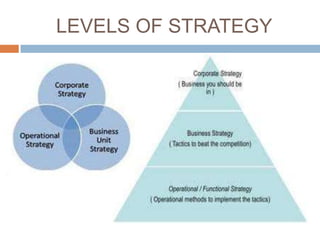
LEVELS OF STRATEGY
    Corporate level strategy (directional strategy)
                       Growth

                      Stability

                  Retrenchment


    Business level strategy (competitive strategy)
                  Cost leadership

              Differentiation (product)


             Functional level strategy
             Marketing strategy (4 p‟s)

       Financial strategy (sources of finance)

   R&D strategy (technological leader, innovation)
      Operation strategy (production strategy)
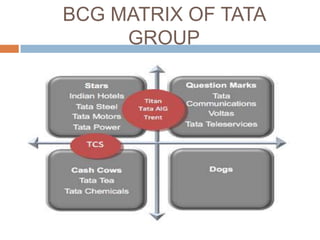
BCG MATRIX OF TATA
     GROUP
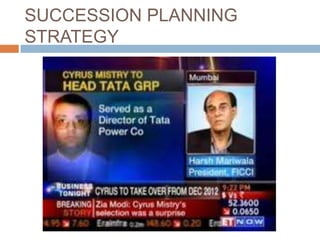
SUCCESSION PLANNING
STRATEGY
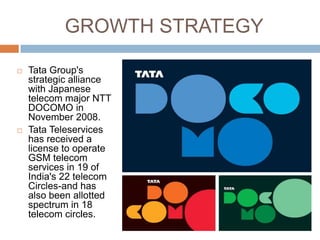
GROWTH STRATEGY

   Tata Group's
    strategic alliance
    with Japanese
    telecom major NTT
    DOCOMO in
    November 2008.
   Tata Teleservices
    has received a
    license to operate
    GSM telecom
    services in 19 of
    India's 22 telecom
    Circles-and has
    also been allotted
    spectrum in 18
    telecom circles.
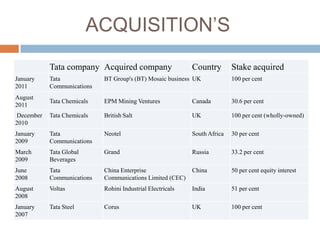
ACQUISITION‟S
           Tata company Acquired company                    Country        Stake acquired
January    Tata             BT Group's (BT) Mosaic business UK             100 per cent
2011       Communications
August
           Tata Chemicals   EPM Mining Ventures             Canada         30.6 per cent
2011
December   Tata Chemicals   British Salt                    UK             100 per cent (wholly-owned)
2010
January    Tata             Neotel                          South Africa   30 per cent
2009       Communications
March      Tata Global      Grand                           Russia         33.2 per cent
2009       Beverages
June       Tata             China Enterprise                China          50 per cent equity interest
2008       Communications   Communications Limited (CEC)
August     Voltas           Rohini Industrial Electricals   India          51 per cent
2008
January    Tata Steel       Corus                           UK             100 per cent
2007
JOINT VENTURE
•Tata & Fait since 2006
•Tata & Starbucks 50/50 JV
Starbucks Coffee “A Tata
Alliance”.
•Tata Motors (SA)
Tata Motors' joint venture with
Tata Africa Holdings, has an
assembly plant in the Gauteng
province of SA.
•Tata Automobile Corporation
SA
Tata Africa Holdings through a
joint venture between Accordian
Investments and the Imperial
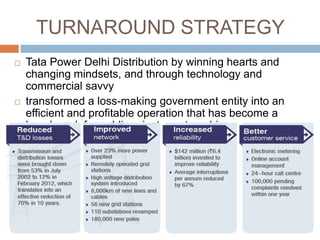
TURNAROUND STRATEGY
   Tata Power Delhi Distribution by winning hearts and
    changing mindsets, and through technology and
    commercial savvy
   transformed a loss-making government entity into an
    efficient and profitable operation that has become a
    benchmark for public-private partnerships
DIVESTMENT STRATEGY

   Tata Oil Mill (TOMCO) was divested and sold to
    Hindustan Levers as soaps and a detergent was
    not considered a core business for the Tata‟s.
   The pharmaceuticals companies of the Tata‟s-
    Merind and Tata Parma – were divested to
    Wockhardt.
   The cosmetics company Lakme was divested and
    sold to Hindustan Levers, as besides being a non
    core business, it was found to be a non-
    competitive and would have required substantial
    investment to be sustained.
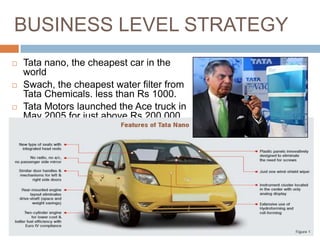
BUSINESS LEVEL STRATEGY
   Tata nano, the cheapest car in the
    world
   Swach, the cheapest water filter from
    Tata Chemicals. less than Rs 1000.
   Tata Motors launched the Ace truck in
    May 2005 for just above Rs 200,000.
PRODUCT DIFFERENTIATION
              STRATEGY
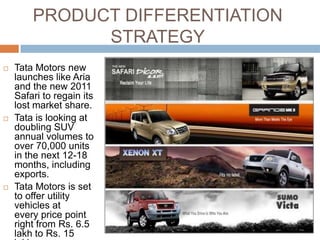
   Tata Motors new
    launches like Aria
    and the new 2011
    Safari to regain its
    lost market share.
   Tata is looking at
    doubling SUV
    annual volumes to
    over 70,000 units
    in the next 12-18
    months, including
    exports.
   Tata Motors is set
    to offer utility
    vehicles at
    every price point
    right from Rs. 6.5
    lakh to Rs. 15
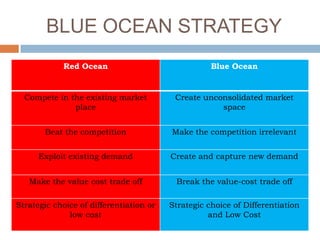
BLUE OCEAN STRATEGY
            Red Ocean                               Blue Ocean


  Compete in the existing market          Create unconsolidated market
              place                                  space


       Beat the competition              Make the competition irrelevant


      Exploit existing demand            Create and capture new demand


   Make the value cost trade off          Break the value-cost trade off

Strategic choice of differentiation or   Strategic choice of Differentiation
              low cost                             and Low Cost
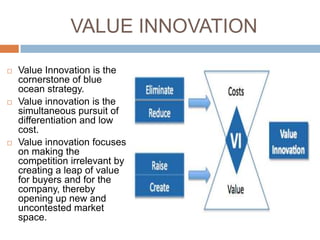
VALUE INNOVATION

   Value Innovation is the
    cornerstone of blue
    ocean strategy.
   Value innovation is the
    simultaneous pursuit of
    differentiation and low
    cost.
   Value innovation focuses
    on making the
    competition irrelevant by
    creating a leap of value
    for buyers and for the
    company, thereby
    opening up new and
    uncontested market
    space.
R&D STRATEGY
   Tata Group companies cumulatively spend Rs.12,500 crore on
    research & development.
   knowledge-based engineering application software from Tata
    Technologies that speeds up results.
   An engine „start-stop‟ technology developed by Jaguar Land
    Rover that stops an engine when the vehicle isn't moving, thus
    saving on fuel;
   High performance rail steel that saved £150,000 over five years
    was developed by Tata Steel Europe
   High standard steel for safer and fuel efficient vehicles from
    Tata Steel Europe
   The world's cheapest car, Nano, an innovation from Group
    company Tata Motors, launched in April 2009, has 37 patents,
   Swach, the cheapest water filter from Tata Chemicals, has 14.
   Tata Steel, which acquired British company Corus in 2007,
    meanwhile, files around 50 patents each year.
OPERATION‟S STRATEGY
   Jaguar Land Rover has re-hauled its supply
    chain to secure cost savings as well as a
    sustainability equation that gives the company
    a green edge
   A re-designing of process equipment at Tata
    Chemicals' Haldia plant that cut process
    downtime by 40%.
SUSTAINABILITY STRATEGY
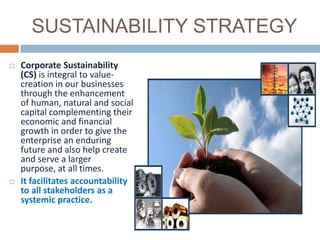
   Corporate Sustainability
    (CS) is integral to value-
    creation in our businesses
    through the enhancement
    of human, natural and social
    capital complementing their
    economic and financial
    growth in order to give the
    enterprise an enduring
    future and also help create
    and serve a larger
    purpose, at all times.
   It facilitates accountability
    to all stakeholders as a
    systemic practice.
“SUSTAINABILITY IN MOTION”
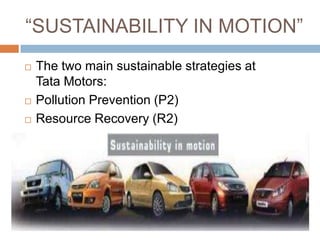
   The two main sustainable strategies at
    Tata Motors:
   Pollution Prevention (P2)
   Resource Recovery (R2)
P2 STRATEGIES
   P2 or pollution prevention is a proactive strategy
    that uses fewer or smarter resources to
    begin requiring lesser cleanup at the final
    disposal.
   It is done by reducing or eliminating waste at the
    source by modifying production
    processes, promoting the use of non-toxic or less-
    toxic substances, implementing conservation
    techniques, and re-using materials rather than
    putting them into the waste stream.
   It assumes no waste will occur. It is an effective
    „getting more from less‟ strategy.
   Reducing packaging material by either using
    sustainable packaging (replacing wood with
    metal) or reusing existing packaging (recycling
    wood).
   The company recycles close to 69 percent of
    the wood packaging thus eliminating use of
    fresh wood.
   Development of Vendor Park
   The company aims to source 60% of its
    components from the park thereby increasing
    its resource efficiency and reducing its
    emissions due to reduction in logistics and
R2 STRATEGIES
   This is a „getting more from the same‟ strategy
    where otherwise wasted resources are recovered
    by way of proper disposal – recycling or
    reconditioning.
   Increasing life of aggregates – ‘Recon’
    business
   In 2010-11 a total of 13,788 engines and 8,690
    other parts were reconditioned.
   Other resource conservation techniques like
    reusing engine oil for multiple testing cycles has
    been employed.
   A 200 litre engine oil barrel can now be used to
    test 170 engines instead of 85.
   Reusing paint sludge and thinner
   Last year, approximately 390 tonnes of hazardous paint
    sludge was converted to a low quality paint suitable for floor
    painting.
   Tata Motors has also developed a process to convert the
    incinerator ash to pavement bricks that can be used in
    walkways within the plant.
   This model has been very successful and has significantly
    reduced the amount of hazardous incinerated ash sent to
    landfills.
   Free Take-back network for Tata Motors’ ELVs (end-
    of-life vehicles)
   Under the End-of-Life Vehicle (ELV) regulations in the UK,
    Tata Motors has contracted with a national ELV service
    provider called Cartakeback.com Ltd. to provide owners of
    qualifying Tata vehicles, who wish to dispose of their vehicle
    at the end of its life, with access to a network of Authorised
Akshay Aggarwal
Deepanshu Chaudhary
Preeti Madan
Gaurav Anand
Abhigyan Bakshi

Tata strategy

  • 2.
  • 3.
    LEVELS OF STRATEGY Corporate level strategy (directional strategy)  Growth  Stability  Retrenchment Business level strategy (competitive strategy)  Cost leadership  Differentiation (product) Functional level strategy  Marketing strategy (4 p‟s)  Financial strategy (sources of finance)  R&D strategy (technological leader, innovation)  Operation strategy (production strategy)
  • 5.
    BCG MATRIX OFTATA GROUP
  • 6.
  • 7.
    GROWTH STRATEGY  Tata Group's strategic alliance with Japanese telecom major NTT DOCOMO in November 2008.  Tata Teleservices has received a license to operate GSM telecom services in 19 of India's 22 telecom Circles-and has also been allotted spectrum in 18 telecom circles.
  • 8.
    ACQUISITION‟S Tata company Acquired company Country Stake acquired January Tata BT Group's (BT) Mosaic business UK 100 per cent 2011 Communications August Tata Chemicals EPM Mining Ventures Canada 30.6 per cent 2011 December Tata Chemicals British Salt UK 100 per cent (wholly-owned) 2010 January Tata Neotel South Africa 30 per cent 2009 Communications March Tata Global Grand Russia 33.2 per cent 2009 Beverages June Tata China Enterprise China 50 per cent equity interest 2008 Communications Communications Limited (CEC) August Voltas Rohini Industrial Electricals India 51 per cent 2008 January Tata Steel Corus UK 100 per cent 2007
  • 9.
    JOINT VENTURE •Tata &Fait since 2006 •Tata & Starbucks 50/50 JV Starbucks Coffee “A Tata Alliance”. •Tata Motors (SA) Tata Motors' joint venture with Tata Africa Holdings, has an assembly plant in the Gauteng province of SA. •Tata Automobile Corporation SA Tata Africa Holdings through a joint venture between Accordian Investments and the Imperial
  • 10.
    TURNAROUND STRATEGY  Tata Power Delhi Distribution by winning hearts and changing mindsets, and through technology and commercial savvy  transformed a loss-making government entity into an efficient and profitable operation that has become a benchmark for public-private partnerships
  • 11.
    DIVESTMENT STRATEGY  Tata Oil Mill (TOMCO) was divested and sold to Hindustan Levers as soaps and a detergent was not considered a core business for the Tata‟s.  The pharmaceuticals companies of the Tata‟s- Merind and Tata Parma – were divested to Wockhardt.  The cosmetics company Lakme was divested and sold to Hindustan Levers, as besides being a non core business, it was found to be a non- competitive and would have required substantial investment to be sustained.
  • 12.
    BUSINESS LEVEL STRATEGY  Tata nano, the cheapest car in the world  Swach, the cheapest water filter from Tata Chemicals. less than Rs 1000.  Tata Motors launched the Ace truck in May 2005 for just above Rs 200,000.
  • 13.
    PRODUCT DIFFERENTIATION STRATEGY  Tata Motors new launches like Aria and the new 2011 Safari to regain its lost market share.  Tata is looking at doubling SUV annual volumes to over 70,000 units in the next 12-18 months, including exports.  Tata Motors is set to offer utility vehicles at every price point right from Rs. 6.5 lakh to Rs. 15
  • 14.
    BLUE OCEAN STRATEGY Red Ocean Blue Ocean Compete in the existing market Create unconsolidated market place space Beat the competition Make the competition irrelevant Exploit existing demand Create and capture new demand Make the value cost trade off Break the value-cost trade off Strategic choice of differentiation or Strategic choice of Differentiation low cost and Low Cost
  • 15.
    VALUE INNOVATION  Value Innovation is the cornerstone of blue ocean strategy.  Value innovation is the simultaneous pursuit of differentiation and low cost.  Value innovation focuses on making the competition irrelevant by creating a leap of value for buyers and for the company, thereby opening up new and uncontested market space.
  • 16.
    R&D STRATEGY  Tata Group companies cumulatively spend Rs.12,500 crore on research & development.  knowledge-based engineering application software from Tata Technologies that speeds up results.  An engine „start-stop‟ technology developed by Jaguar Land Rover that stops an engine when the vehicle isn't moving, thus saving on fuel;  High performance rail steel that saved £150,000 over five years was developed by Tata Steel Europe  High standard steel for safer and fuel efficient vehicles from Tata Steel Europe  The world's cheapest car, Nano, an innovation from Group company Tata Motors, launched in April 2009, has 37 patents,  Swach, the cheapest water filter from Tata Chemicals, has 14.  Tata Steel, which acquired British company Corus in 2007, meanwhile, files around 50 patents each year.
  • 17.
    OPERATION‟S STRATEGY  Jaguar Land Rover has re-hauled its supply chain to secure cost savings as well as a sustainability equation that gives the company a green edge  A re-designing of process equipment at Tata Chemicals' Haldia plant that cut process downtime by 40%.
  • 18.
    SUSTAINABILITY STRATEGY  Corporate Sustainability (CS) is integral to value- creation in our businesses through the enhancement of human, natural and social capital complementing their economic and financial growth in order to give the enterprise an enduring future and also help create and serve a larger purpose, at all times.  It facilitates accountability to all stakeholders as a systemic practice.
  • 19.
    “SUSTAINABILITY IN MOTION”  The two main sustainable strategies at Tata Motors:  Pollution Prevention (P2)  Resource Recovery (R2)
  • 20.
    P2 STRATEGIES  P2 or pollution prevention is a proactive strategy that uses fewer or smarter resources to begin requiring lesser cleanup at the final disposal.  It is done by reducing or eliminating waste at the source by modifying production processes, promoting the use of non-toxic or less- toxic substances, implementing conservation techniques, and re-using materials rather than putting them into the waste stream.  It assumes no waste will occur. It is an effective „getting more from less‟ strategy.
  • 21.
    Reducing packaging material by either using sustainable packaging (replacing wood with metal) or reusing existing packaging (recycling wood).  The company recycles close to 69 percent of the wood packaging thus eliminating use of fresh wood.  Development of Vendor Park  The company aims to source 60% of its components from the park thereby increasing its resource efficiency and reducing its emissions due to reduction in logistics and
  • 22.
    R2 STRATEGIES  This is a „getting more from the same‟ strategy where otherwise wasted resources are recovered by way of proper disposal – recycling or reconditioning.  Increasing life of aggregates – ‘Recon’ business  In 2010-11 a total of 13,788 engines and 8,690 other parts were reconditioned.  Other resource conservation techniques like reusing engine oil for multiple testing cycles has been employed.  A 200 litre engine oil barrel can now be used to test 170 engines instead of 85.
  • 23.
    Reusing paint sludge and thinner  Last year, approximately 390 tonnes of hazardous paint sludge was converted to a low quality paint suitable for floor painting.  Tata Motors has also developed a process to convert the incinerator ash to pavement bricks that can be used in walkways within the plant.  This model has been very successful and has significantly reduced the amount of hazardous incinerated ash sent to landfills.  Free Take-back network for Tata Motors’ ELVs (end- of-life vehicles)  Under the End-of-Life Vehicle (ELV) regulations in the UK, Tata Motors has contracted with a national ELV service provider called Cartakeback.com Ltd. to provide owners of qualifying Tata vehicles, who wish to dispose of their vehicle at the end of its life, with access to a network of Authorised
  • 24.
    Akshay Aggarwal Deepanshu Chaudhary PreetiMadan Gaurav Anand Abhigyan Bakshi