APPLE INC.: MANAGING A GLOBAL SUPPLY CHAIN
ABDUL REHMAN AYESHA MAJID
DONIA ISMAIL ELEENA NAZ
SHERMEEN ABBAS
Jessica Grant was an analyst with BXE Capital (BXE)
vice-president, Phillip Duchene
Both Grant and Duchene were trying to identify what changes, if any,
they should make to BXE’s portfolio.
“Apple is investing in its next generation of products, potentially the
first new major product lines since Tim Cook took over from Steve
Jobs,” she said.
Apple Inc., the world’s largest company by market capitalization, had
introduced a series of consumer products during the past dozen years
that had transformed it into the industry leader in consumer devices.
INTRODUCTION
Apple managed a global supply chain with creative development in the United States,
outsourced manufacturing in Asia and components sourced from suppliers around the
world.
Apple was in the centre of a complex ecosystem that produced market-leading
consumer devices. With $160 billion in cash in February 2014, the company was well-
capitalized.
Despite its commercial success, Apple’s stock was at $524.47 on February 28, 2014, 25
per cent below the $700 level it had reached in 2012.
Cook reassured investors that the firm was focused on the future, and it had a solid
pipeline of new products. This was his way of signaling to stakeholders that he would be
able to run the firm following the death of Steve Jobs,
“We’re working on some things that are extensions of things you can see and some that
you can't see,” Cook said at Apple’s annual shareholders' meeting on February 28, 2014.
INTRODUCTION
Industry observers were skeptical that the company could deliver new
product successes
The were unclear if Cook can successfully reshape the cult-like culture
that Jobs built.
INTRODUCTION
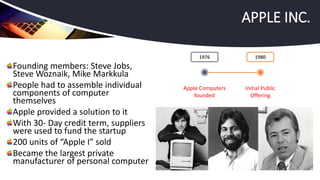
Founding members: Steve Jobs,
Steve Woznaik, Mike Markkula
People had to assemble individual
components of computer
themselves
Apple provided a solution to it
With 30- Day credit term, suppliers
were used to fund the startup
200 units of “Apple I” sold
Became the largest private
manufacturer of personal computer
APPLE INC.
19801976
Apple Computers
founded
Initial Public
Offering
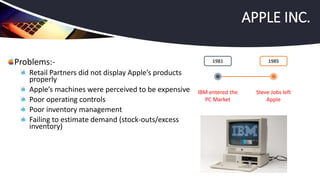
Problems:-
Retail Partners did not display Apple’s products
properly
Apple’s machines were perceived to be expensive
Poor operating controls
Poor inventory management
Failing to estimate demand (stock-outs/excess
inventory)
APPLE INC.
19851981
IBM entered the
PC Market
Steve Jobs left
Apple
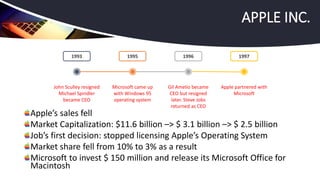
Apple’s sales fell
Market Capitalization: $11.6 billion –> $ 3.1 billion –> $ 2.5 billion
Job’s first decision: stopped licensing Apple’s Operating System
Market share fell from 10% to 3% as a result
Microsoft to invest $ 150 million and release its Microsoft Office for
Macintosh
APPLE INC.
1995 19961993 1997
John Sculley resigned
Michael Spindler
became CEO
Microsoft came up
with Windows 95
operating system
Gil Amelio became
CEO but resigned
later. Steve Jobs
returned as CEO
Apple partnered with
Microsoft
APPLE INC.
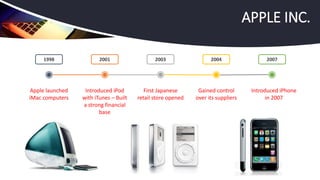
Introduced iPhone
in 2007
20072001 20031998 2004
Apple launched
iMac computers
Introduced iPod
with iTunes – Built
a strong financial
base
First Japanese
retail store opened
Gained control
over its suppliers
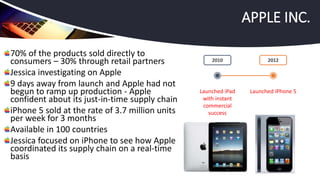
70% of the products sold directly to
consumers – 30% through retail partners
Jessica investigating on Apple
9 days away from launch and Apple had not
begun to ramp up production - Apple
confident about its just-in-time supply chain
iPhone 5 sold at the rate of 3.7 million units
per week for 3 months
Available in 100 countries
Jessica focused on iPhone to see how Apple
coordinated its supply chain on a real-time
basis
APPLE INC.
20122010
Launched iPad
with instant
commercial
success
Launched iPhone 5
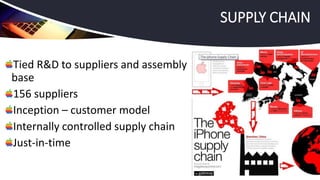
SUPPLY CHAIN
Tied R&D to suppliers and assembly
base
156 suppliers
Inception – customer model
Internally controlled supply chain
Just-in-time
CONT’D
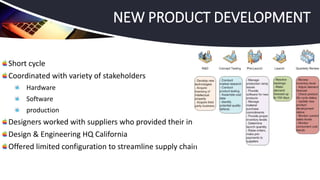
Short cycle
Coordinated with variety of stakeholders
Hardware
Software
production
Designers worked with suppliers who provided their in-house engineers
Design & Engineering HQ California
Offered limited configuration to streamline supply chain
NEW PRODUCT DEVELOPMENT
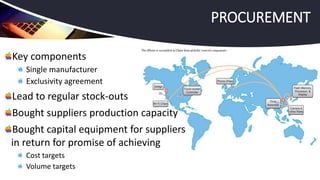
Key components
Single manufacturer
Exclusivity agreement
Lead to regular stock-outs
Bought suppliers production capacity
Bought capital equipment for suppliers
in return for promise of achieving
Cost targets
Volume targets
PROCUREMENT
Product forecast 150-days in advance
Continuous updates to supplier
For order changes
Instant response required
Used sales targets to manage
Production schedule
Purchase orders
Payment schedule
Quarterly inventory levels reviews to adjust
demand forecasts and production schedule
CONT’D
Closed ecosystem enabled
Large discount negotiations
Flexible manufacturing volume
Direct control
Detailed cost breakdown from supplier
Supplier kept 14 days inventory in their
pipeline
Cost to carry parts borne by supplier
Payable time period 90-days
Few suppliers were heisted to
capacity commitments
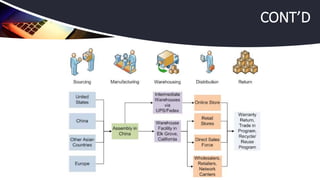
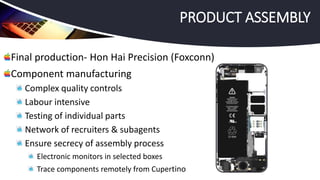
Final production- Hon Hai Precision (Foxconn)
Component manufacturing
Complex quality controls
Labour intensive
Testing of individual parts
Network of recruiters & subagents
Ensure secrecy of assembly process
Electronic monitors in selected boxes
Trace components remotely from Cupertino
PRODUCT ASSEMBLY
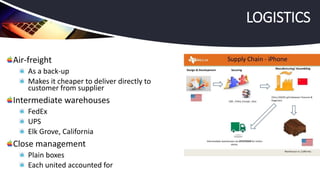
Air-freight
As a back-up
Makes it cheaper to deliver directly to
customer from supplier
Intermediate warehouses
FedEx
UPS
Elk Grove, California
Close management
Plain boxes
Each united accounted for
LOGISTICS
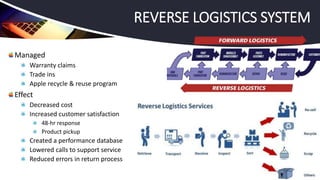
Managed
Warranty claims
Trade ins
Apple recycle & reuse program
Effect
Decreased cost
Increased customer satisfaction
48-hr response
Product pickup
Created a performance database
Lowered calls to support service
Reduced errors in return process
REVERSE LOGISTICS SYSTEM
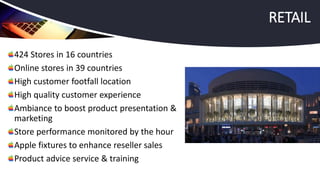
424 Stores in 16 countries
Online stores in 39 countries
High customer footfall location
High quality customer experience
Ambiance to boost product presentation &
marketing
Store performance monitored by the hour
Apple fixtures to enhance reseller sales
Product advice service & training
RETAIL
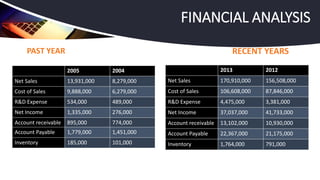
FINANCIAL ANALYSIS
PAST YEAR RECENT YEARS
2005 2004
Net Sales 13,931,000 8,279,000
Cost of Sales 9,888,000 6,279,000
R&D Expense 534,000 489,000
Net Income 1,335,000 276,000
Account receivable 895,000 774,000
Account Payable 1,779,000 1,451,000
Inventory 185,000 101,000
2013 2012
Net Sales 170,910,000 156,508,000
Cost of Sales 106,608,000 87,846,000
R&D Expense 4,475,000 3,381,000
Net Income 37,037,000 41,733,000
Account receivable 13,102,000 10,930,000
Account Payable 22,367,000 21,175,000
Inventory 1,764,000 791,000
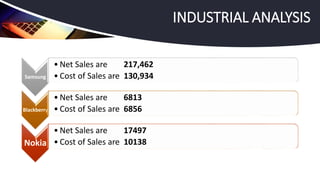
Samsung
• Net Sales are 217,462
• Cost of Sales are 130,934
Blackberry
• Net Sales are 6813
• Cost of Sales are 6856
Nokia
• Net Sales are 17497
• Cost of Sales are 10138
INDUSTRIAL ANALYSIS
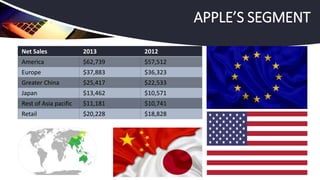
Net Sales 2013 2012
America $62,739 $57,512
Europe $37,883 $36,323
Greater China $25,417 $22,533
Japan $13,462 $10,571
Rest of Asia pacific $11,181 $10,741
Retail $20,228 $18,828
APPLE’S SEGMENT
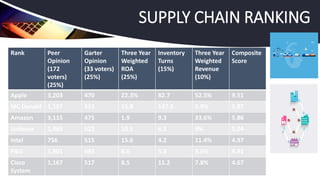
Rank Peer
Opinion
(172
voters)
(25%)
Garter
Opinion
(33 voters)
(25%)
Three Year
Weighted
ROA
(25%)
Inventory
Turns
(15%)
Three Year
Weighted
Revenue
(10%)
Composite
Score
Apple 3,203 470 22.3% 82.7 52.5% 9.51
MC Donald 1,197 353 15.8 147.5 5.9% 5.87
Amazon 3,115 475 1.9 9.3 33.6% 5.86
Unilever 1,469 522 10.5 6.5 9% 5.04
Intel 756 515 15.6 4.2 11.4% 4.97
P&G 1,901 493 8.6 5.8 3.6% 4.91
Cisco
System
1,167 517 8.5 11.2 7.8% 4.67
SUPPLY CHAIN RANKING
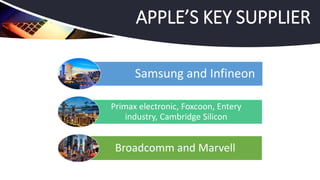
APPLE’S KEY SUPPLIER
Samsung and Infineon
Primax electronic, Foxcoon, Entery
industry, Cambridge Silicon
Broadcomm and Marvell
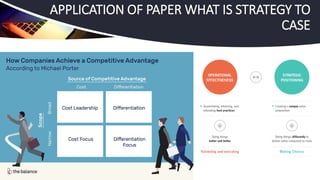
APPLICATION OF PAPER WHAT IS STRATEGY TO
CASE

Apple INC.: Managing a Global Supply Chain

  • 1.
    APPLE INC.: MANAGINGA GLOBAL SUPPLY CHAIN ABDUL REHMAN AYESHA MAJID DONIA ISMAIL ELEENA NAZ SHERMEEN ABBAS
  • 2.
    Jessica Grant wasan analyst with BXE Capital (BXE) vice-president, Phillip Duchene Both Grant and Duchene were trying to identify what changes, if any, they should make to BXE’s portfolio. “Apple is investing in its next generation of products, potentially the first new major product lines since Tim Cook took over from Steve Jobs,” she said. Apple Inc., the world’s largest company by market capitalization, had introduced a series of consumer products during the past dozen years that had transformed it into the industry leader in consumer devices. INTRODUCTION
  • 3.
    Apple managed aglobal supply chain with creative development in the United States, outsourced manufacturing in Asia and components sourced from suppliers around the world. Apple was in the centre of a complex ecosystem that produced market-leading consumer devices. With $160 billion in cash in February 2014, the company was well- capitalized. Despite its commercial success, Apple’s stock was at $524.47 on February 28, 2014, 25 per cent below the $700 level it had reached in 2012. Cook reassured investors that the firm was focused on the future, and it had a solid pipeline of new products. This was his way of signaling to stakeholders that he would be able to run the firm following the death of Steve Jobs, “We’re working on some things that are extensions of things you can see and some that you can't see,” Cook said at Apple’s annual shareholders' meeting on February 28, 2014. INTRODUCTION
  • 4.
    Industry observers wereskeptical that the company could deliver new product successes The were unclear if Cook can successfully reshape the cult-like culture that Jobs built. INTRODUCTION
  • 5.
    Founding members: SteveJobs, Steve Woznaik, Mike Markkula People had to assemble individual components of computer themselves Apple provided a solution to it With 30- Day credit term, suppliers were used to fund the startup 200 units of “Apple I” sold Became the largest private manufacturer of personal computer APPLE INC. 19801976 Apple Computers founded Initial Public Offering
  • 6.
    Problems:- Retail Partners didnot display Apple’s products properly Apple’s machines were perceived to be expensive Poor operating controls Poor inventory management Failing to estimate demand (stock-outs/excess inventory) APPLE INC. 19851981 IBM entered the PC Market Steve Jobs left Apple
  • 7.
    Apple’s sales fell MarketCapitalization: $11.6 billion –> $ 3.1 billion –> $ 2.5 billion Job’s first decision: stopped licensing Apple’s Operating System Market share fell from 10% to 3% as a result Microsoft to invest $ 150 million and release its Microsoft Office for Macintosh APPLE INC. 1995 19961993 1997 John Sculley resigned Michael Spindler became CEO Microsoft came up with Windows 95 operating system Gil Amelio became CEO but resigned later. Steve Jobs returned as CEO Apple partnered with Microsoft
  • 8.
    APPLE INC. Introduced iPhone in2007 20072001 20031998 2004 Apple launched iMac computers Introduced iPod with iTunes – Built a strong financial base First Japanese retail store opened Gained control over its suppliers
  • 9.
    70% of theproducts sold directly to consumers – 30% through retail partners Jessica investigating on Apple 9 days away from launch and Apple had not begun to ramp up production - Apple confident about its just-in-time supply chain iPhone 5 sold at the rate of 3.7 million units per week for 3 months Available in 100 countries Jessica focused on iPhone to see how Apple coordinated its supply chain on a real-time basis APPLE INC. 20122010 Launched iPad with instant commercial success Launched iPhone 5
  • 10.
    SUPPLY CHAIN Tied R&Dto suppliers and assembly base 156 suppliers Inception – customer model Internally controlled supply chain Just-in-time
  • 11.
  • 12.
    Short cycle Coordinated withvariety of stakeholders Hardware Software production Designers worked with suppliers who provided their in-house engineers Design & Engineering HQ California Offered limited configuration to streamline supply chain NEW PRODUCT DEVELOPMENT
  • 13.
    Key components Single manufacturer Exclusivityagreement Lead to regular stock-outs Bought suppliers production capacity Bought capital equipment for suppliers in return for promise of achieving Cost targets Volume targets PROCUREMENT
  • 14.
    Product forecast 150-daysin advance Continuous updates to supplier For order changes Instant response required Used sales targets to manage Production schedule Purchase orders Payment schedule Quarterly inventory levels reviews to adjust demand forecasts and production schedule CONT’D Closed ecosystem enabled Large discount negotiations Flexible manufacturing volume Direct control Detailed cost breakdown from supplier Supplier kept 14 days inventory in their pipeline Cost to carry parts borne by supplier Payable time period 90-days Few suppliers were heisted to capacity commitments
  • 15.
    Final production- HonHai Precision (Foxconn) Component manufacturing Complex quality controls Labour intensive Testing of individual parts Network of recruiters & subagents Ensure secrecy of assembly process Electronic monitors in selected boxes Trace components remotely from Cupertino PRODUCT ASSEMBLY
  • 16.
    Air-freight As a back-up Makesit cheaper to deliver directly to customer from supplier Intermediate warehouses FedEx UPS Elk Grove, California Close management Plain boxes Each united accounted for LOGISTICS
  • 17.
    Managed Warranty claims Trade ins Applerecycle & reuse program Effect Decreased cost Increased customer satisfaction 48-hr response Product pickup Created a performance database Lowered calls to support service Reduced errors in return process REVERSE LOGISTICS SYSTEM
  • 19.
    424 Stores in16 countries Online stores in 39 countries High customer footfall location High quality customer experience Ambiance to boost product presentation & marketing Store performance monitored by the hour Apple fixtures to enhance reseller sales Product advice service & training RETAIL
  • 20.
    FINANCIAL ANALYSIS PAST YEARRECENT YEARS 2005 2004 Net Sales 13,931,000 8,279,000 Cost of Sales 9,888,000 6,279,000 R&D Expense 534,000 489,000 Net Income 1,335,000 276,000 Account receivable 895,000 774,000 Account Payable 1,779,000 1,451,000 Inventory 185,000 101,000 2013 2012 Net Sales 170,910,000 156,508,000 Cost of Sales 106,608,000 87,846,000 R&D Expense 4,475,000 3,381,000 Net Income 37,037,000 41,733,000 Account receivable 13,102,000 10,930,000 Account Payable 22,367,000 21,175,000 Inventory 1,764,000 791,000
  • 21.
    Samsung • Net Salesare 217,462 • Cost of Sales are 130,934 Blackberry • Net Sales are 6813 • Cost of Sales are 6856 Nokia • Net Sales are 17497 • Cost of Sales are 10138 INDUSTRIAL ANALYSIS
  • 22.
    Net Sales 20132012 America $62,739 $57,512 Europe $37,883 $36,323 Greater China $25,417 $22,533 Japan $13,462 $10,571 Rest of Asia pacific $11,181 $10,741 Retail $20,228 $18,828 APPLE’S SEGMENT
  • 23.
    Rank Peer Opinion (172 voters) (25%) Garter Opinion (33 voters) (25%) ThreeYear Weighted ROA (25%) Inventory Turns (15%) Three Year Weighted Revenue (10%) Composite Score Apple 3,203 470 22.3% 82.7 52.5% 9.51 MC Donald 1,197 353 15.8 147.5 5.9% 5.87 Amazon 3,115 475 1.9 9.3 33.6% 5.86 Unilever 1,469 522 10.5 6.5 9% 5.04 Intel 756 515 15.6 4.2 11.4% 4.97 P&G 1,901 493 8.6 5.8 3.6% 4.91 Cisco System 1,167 517 8.5 11.2 7.8% 4.67 SUPPLY CHAIN RANKING
  • 24.
    APPLE’S KEY SUPPLIER Samsungand Infineon Primax electronic, Foxcoon, Entery industry, Cambridge Silicon Broadcomm and Marvell
  • 25.
    APPLICATION OF PAPERWHAT IS STRATEGY TO CASE

Editor's Notes

  • #2 © Copyright PresentationGo.com – The free PowerPoint template library
  • #6 © Copyright PresentationGo.com – The free PowerPoint template library
  • #7 © Copyright PresentationGo.com – The free PowerPoint template library