Marks & Spencer
Strategic Management-2
1
Group 7
Anand Kumar 12P127
Ankush Singla 12P129
Bhoomi Ashwin 12P131
Aditya Ram Chadha 12P132
Siddharth Bharadwaj 12P170
Soumyajit Sengupta 12P171
The Phoenix Rises
Business Model
Business was a way of Creating Value
for Customers & Employees
Pioneered a wide range of Social
Services & Benefits for Employees
Adopted principles of SEARS
including merchandise control
by a central organization
Began the Revolutionary Policy of
Direct Buying from
Manufacturers
Focused on a “Partnership Model”
•2 Retail Chains
acquired
•Local Resistance
•Union Jack was
viewed unfavourably
in Canada
Canada
•Paris store met
with moderate
success in 1975
•Further stores were
opened
France
•Full line stores in
Holland, Belgium
& Hong Kong
•Franchisees in
other Countries
Global Expansion
Major Attack on Costs &
Inefficiencies
Canadian Business Divested
Extension of Core Product Ranges
Push into Consumer Financial
Services, based on Charge Card &
M&S’s reputation
Global Expansion
1991 Re-Jig
Major Challenges & Renewed Focus
Clothing
•Cost Reduction
•Quality
Improvement
•Sourcing Speed
Financial
Services
• Build up
Charge
Card
Restore
Marks &
Spencer’s as
a Retail
Superpower
Food
•Customer
Access
Improvement
•Square Footage
Constant
Competing with firms that sourced from offshore partners
Maintaining quality while fighting on price
Overstocking
Lay offs, personnel and communication problems
Changing trend leading to reduced spending on apparels
Getting stores that are more accessible to people
Maintaining quality of prepared and processed food
Too much focus on cost efficiencies
Less availability of new store space due to U.K. property
regulations
Recovery
Development Expansion
SWOT Analysis
•Women’s clothing
•Home décor and
furnishing
•Understanding
customer behavior
through charge card
data base
• Compromise on
quality
• Unwise
acquisition
decisions
• Onshore sourcing
• Inconvenient store
locations
• Slower time to
market
• Brand
recognition
• M&S Charge
cards
• Size
• Real Estate
Strengths Weaknesses
OpportunitiesThreats
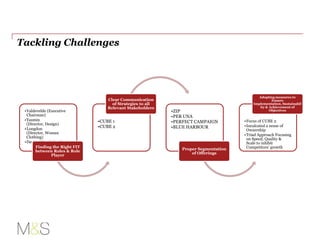
Tackling Challenges
•Valdevelde (Executive
Chairman)
•Yasmin
(Director, Design)
•Longdon
(Director, Women
Clothing)
•Davies (Head, Per Una)
Finding the Right FIT
between Roles & Role
Player
•CUBE 1
•CUBE 2
Clear Communication
of Strategies to all
Relevant Stakeholders
•ZIP
•PER UNA
•PERFECT CAMPAIGN
•BLUE HARBOUR
Proper Segmentation
of Offerings
•Focus of CUBE 2
•Inculcated a sense of
Ownership
•Triad Approach Focusing
on Speed, Quality &
Scale to inhibit
Competitors’ growth
Adopting measures to
Ensure
Implementation, Sustainabil
ity & Achievement of
Objectives
CUBE 1
Performance
outstripped
Expectations
Regaining
Focus on
Primary
Segments: 3
instead of 11
Faster Time
to Market
Merchandisi
ng Control
fully
Decentralized
Design
Control fully
Decentralized
Launch of “Perfect”
Campaign
Launch of “Per Una”
(One Woman)
10% incentive for
Charge Card Users to
Revisit Stores
Sourcing Pattern had been transformed from 70-30 British to 20-80 British
“Better Product, Lower Cost & Faster Time to Market”
Other
Initiatives
Zip:
Separate
Design &
Sourcing
Strategy
Simply
Food:
Convenience
Format &
Focused
Selling
Home:
Offshore
sourcing
Directly &
Large Store
Format to serve
Customer
Needs
Financial
Services:
“MORE”
introduced to
re-establish a
TIGHT
relationship
with Customers
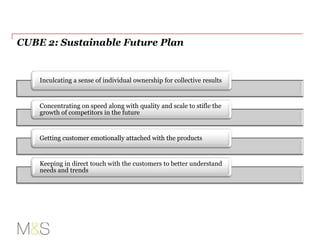
Inculcating a sense of individual ownership for collective results
Concentrating on speed along with quality and scale to stifle the
growth of competitors in the future
Getting customer emotionally attached with the products
Keeping in direct touch with the customers to better understand
needs and trends
CUBE 2: Sustainable Future Plan
Thank You!

Marks & Spencer_Strategic Management

  • 1.
    Marks & Spencer StrategicManagement-2 1 Group 7 Anand Kumar 12P127 Ankush Singla 12P129 Bhoomi Ashwin 12P131 Aditya Ram Chadha 12P132 Siddharth Bharadwaj 12P170 Soumyajit Sengupta 12P171 The Phoenix Rises
  • 2.
    Business Model Business wasa way of Creating Value for Customers & Employees Pioneered a wide range of Social Services & Benefits for Employees Adopted principles of SEARS including merchandise control by a central organization Began the Revolutionary Policy of Direct Buying from Manufacturers Focused on a “Partnership Model” •2 Retail Chains acquired •Local Resistance •Union Jack was viewed unfavourably in Canada Canada •Paris store met with moderate success in 1975 •Further stores were opened France •Full line stores in Holland, Belgium & Hong Kong •Franchisees in other Countries Global Expansion Major Attack on Costs & Inefficiencies Canadian Business Divested Extension of Core Product Ranges Push into Consumer Financial Services, based on Charge Card & M&S’s reputation Global Expansion 1991 Re-Jig
  • 3.
    Major Challenges &Renewed Focus Clothing •Cost Reduction •Quality Improvement •Sourcing Speed Financial Services • Build up Charge Card Restore Marks & Spencer’s as a Retail Superpower Food •Customer Access Improvement •Square Footage Constant Competing with firms that sourced from offshore partners Maintaining quality while fighting on price Overstocking Lay offs, personnel and communication problems Changing trend leading to reduced spending on apparels Getting stores that are more accessible to people Maintaining quality of prepared and processed food Too much focus on cost efficiencies Less availability of new store space due to U.K. property regulations Recovery Development Expansion
  • 4.
    SWOT Analysis •Women’s clothing •Homedécor and furnishing •Understanding customer behavior through charge card data base • Compromise on quality • Unwise acquisition decisions • Onshore sourcing • Inconvenient store locations • Slower time to market • Brand recognition • M&S Charge cards • Size • Real Estate Strengths Weaknesses OpportunitiesThreats
  • 5.
    Tackling Challenges •Valdevelde (Executive Chairman) •Yasmin (Director,Design) •Longdon (Director, Women Clothing) •Davies (Head, Per Una) Finding the Right FIT between Roles & Role Player •CUBE 1 •CUBE 2 Clear Communication of Strategies to all Relevant Stakeholders •ZIP •PER UNA •PERFECT CAMPAIGN •BLUE HARBOUR Proper Segmentation of Offerings •Focus of CUBE 2 •Inculcated a sense of Ownership •Triad Approach Focusing on Speed, Quality & Scale to inhibit Competitors’ growth Adopting measures to Ensure Implementation, Sustainabil ity & Achievement of Objectives
  • 6.
    CUBE 1 Performance outstripped Expectations Regaining Focus on Primary Segments:3 instead of 11 Faster Time to Market Merchandisi ng Control fully Decentralized Design Control fully Decentralized Launch of “Perfect” Campaign Launch of “Per Una” (One Woman) 10% incentive for Charge Card Users to Revisit Stores Sourcing Pattern had been transformed from 70-30 British to 20-80 British “Better Product, Lower Cost & Faster Time to Market” Other Initiatives Zip: Separate Design & Sourcing Strategy Simply Food: Convenience Format & Focused Selling Home: Offshore sourcing Directly & Large Store Format to serve Customer Needs Financial Services: “MORE” introduced to re-establish a TIGHT relationship with Customers
  • 7.
    Inculcating a senseof individual ownership for collective results Concentrating on speed along with quality and scale to stifle the growth of competitors in the future Getting customer emotionally attached with the products Keeping in direct touch with the customers to better understand needs and trends CUBE 2: Sustainable Future Plan
  • 8.