
Case study: Apple Inc- Strategic leadership and innovation at Apple Inc - By RenjithSreekumar
Contents   1. Introduction  2. Explanation of Adapted Framework   3. Q1. What are the Key features of the Apple Industry?       with Michael Porter’s 5 forces, SWOT (Opportunity, Threat)4. Q2. What is your evaluation of Steve Jobs as a  strategic leader       with John Kotter – Leading Change model5. Q3. Has Apple engaged in strategic innovation?      with Strategic Innovation framework6. Q5. Should Apple rethink its closed ecosystem, proprietary approach?   7. Conclusion
Introduction1. Objective of group B5’s presentation     - To analysis Apple’s case with effective frameworks     - To extract answers of questions from frameworks 2. Expected outcome of presentation      - Apple’s key features      - Apple’s competitive advantage          : Strength and weakness         : Innovation factors      - Predictions of Apple’s future       - Suggestions for Apple
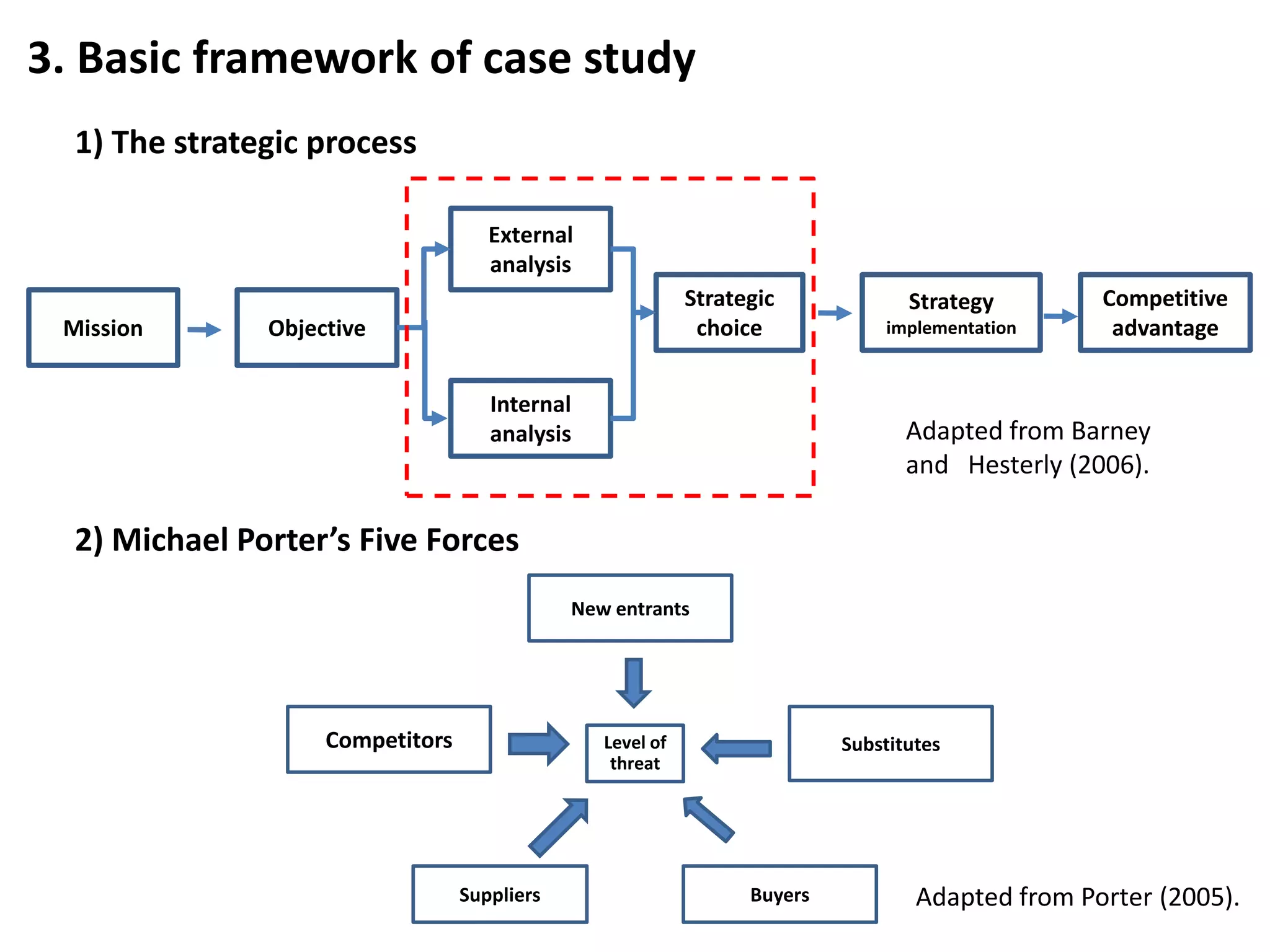
3. Basic framework of case studyExternal analysisStrategic choiceStrategy implementationCompetitive advantage      1) The strategic processMissionObjective Internal analysisAdapted from Barney and   Hesterly (2006).      2) Michael Porter’s Five ForcesAdapted from Porter (2005).New entrantsCompetitorsSubstitutesLevel of threatSuppliersBuyers
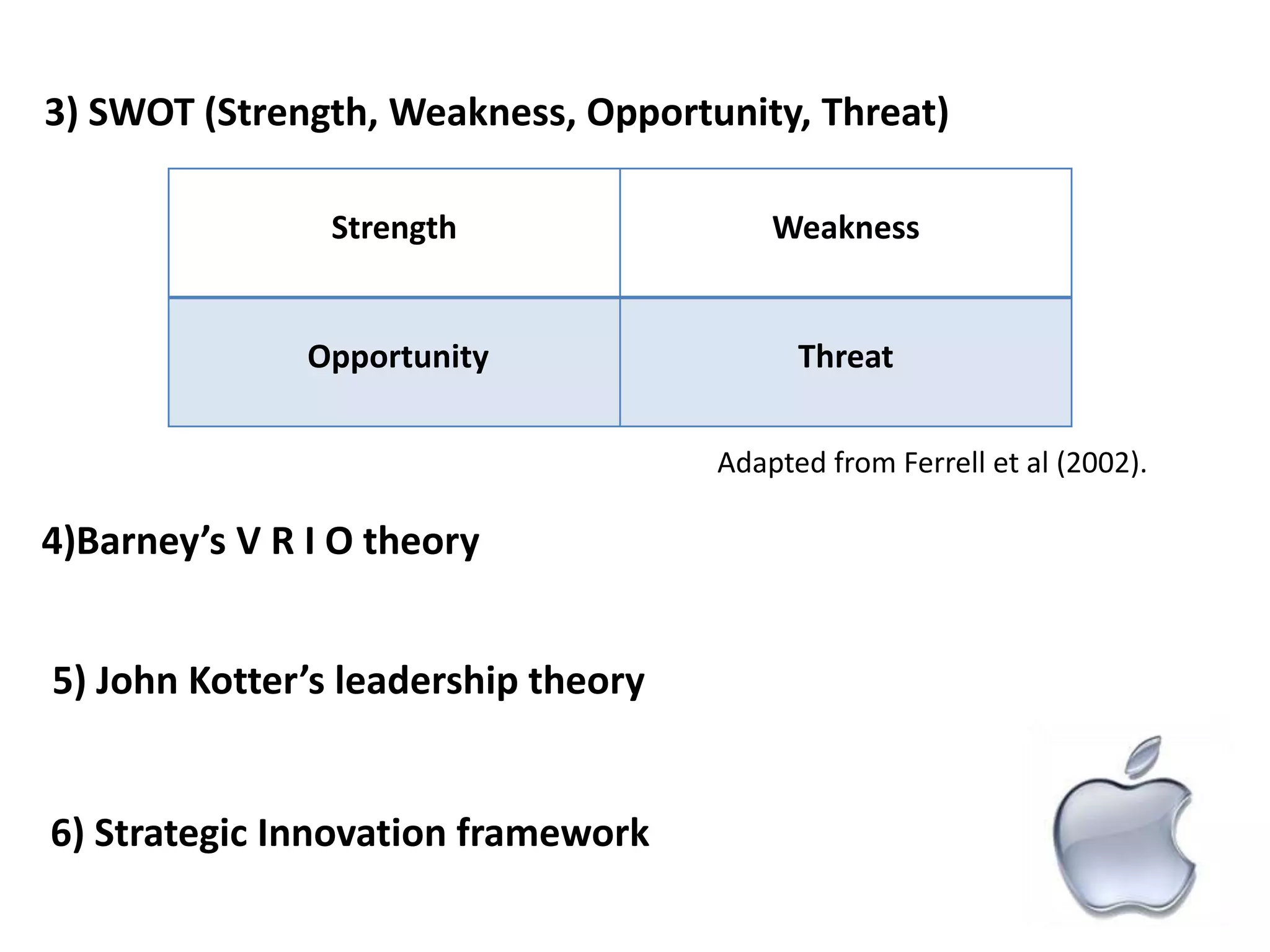
3) SWOT (Strength, Weakness, Opportunity, Threat)Adapted from Ferrell et al (2002).4)Barney’s V R I O theory5) John Kotter’s leadership theory    6) Strategic Innovation framework
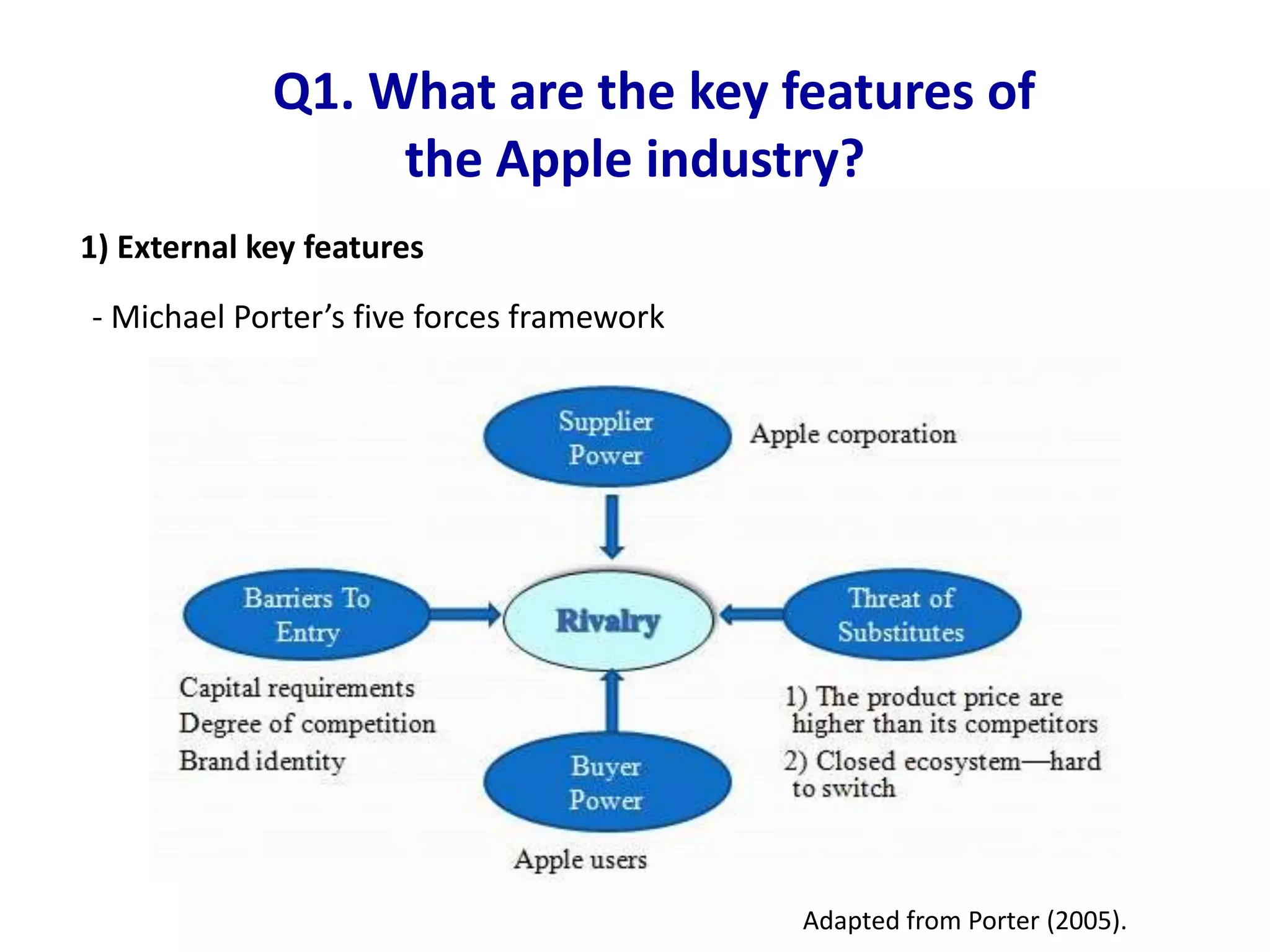
   Q1. What are the key features of the Apple industry?1) External key features          - Michael Porter’s five forces framework Adapted from Porter (2005).
2) Internal key featuresProduct diversification and innovation for long-term development (music, internet, computer)- Integration of software and hardware           Laptops + iPhoto,  iPod + iTunes, iPhone + Wireless internet   - Technological improvement with unique design   - Transcended the barriers of computer industry to cross many aspectof industries (iTunes, iPod, iPhone)
Loyal customer base Strong Apple culture and community
  Apple has created a youth culture and trendAn ambitious LeadershipTyrannic style
      Motivate employee
      Aggressive visions, brilliant, powerful and charismatic Q2: What is your evaluation of Steve Jobs as a strategic leader?Centralized, disciplinarian style of leadership.
Mechanistic approach to organisation
Core strategies – product based, aimed at driving the market
Style has taken Apple from brink of bankruptcy to being hugely profitable
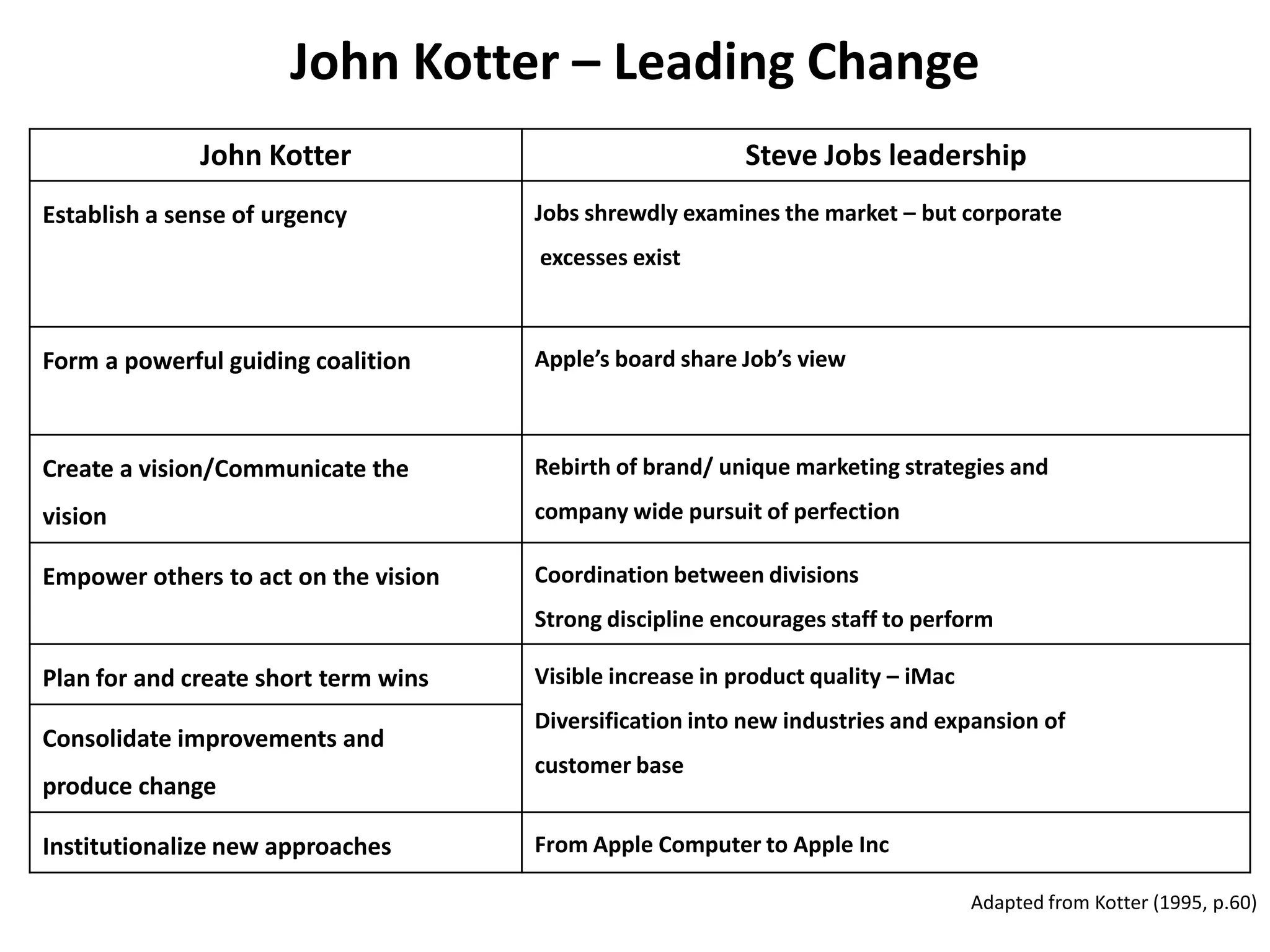
John Kotter – Leading ChangeAdapted from Kotter(1995, p.60)
Q3. Has Apple engaged in strategic innovation? “ Strategic Innovation is the creation of growth strategies, new product categories, services or business models that change the  game and generate significant new value for consumers, customers and the corporation.”  Adapted from Palmer and Kaplan,(2007, p.3)
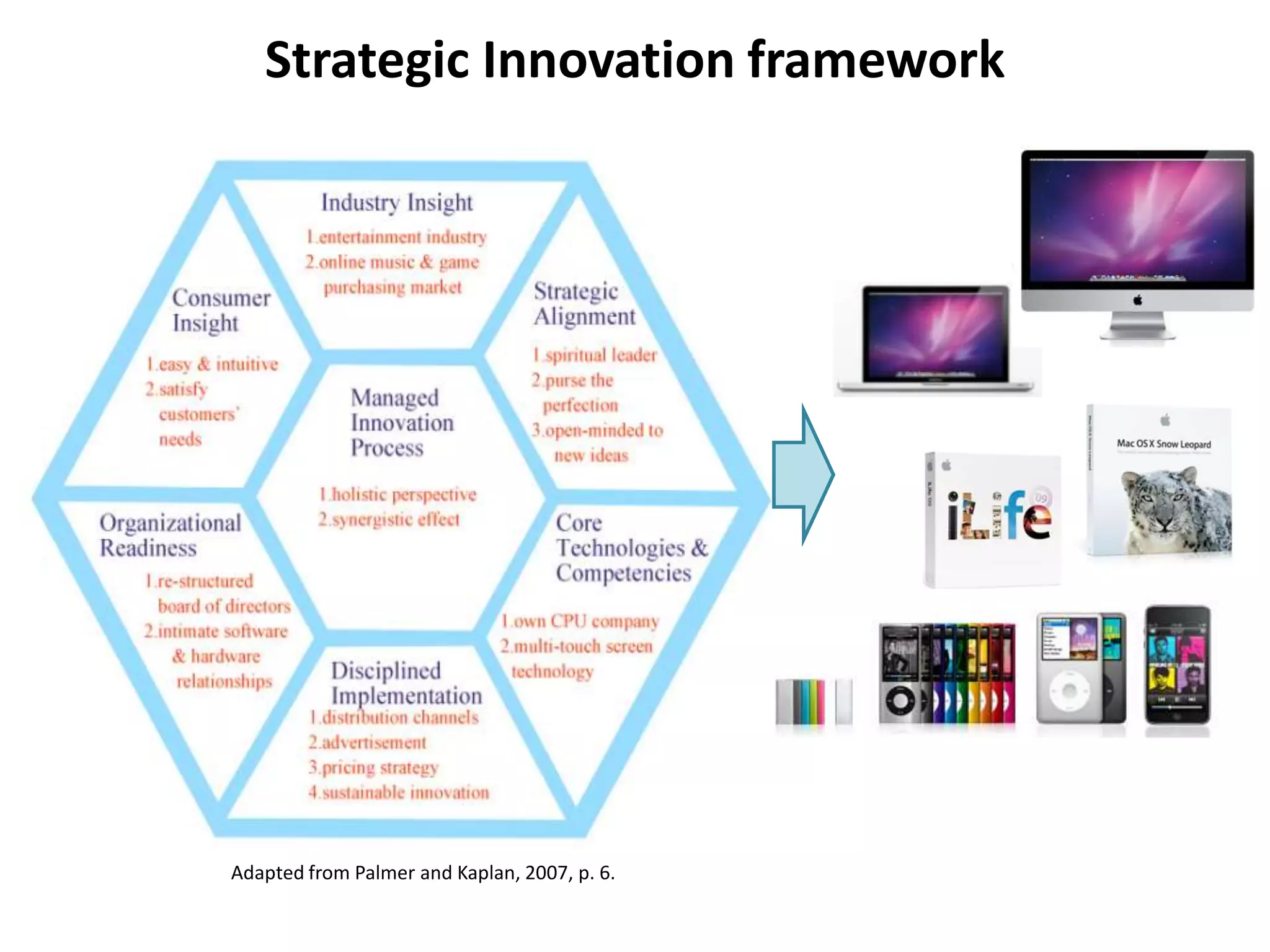
Strategic Innovation frameworkAdapted from Palmer and Kaplan, 2007, p. 6.
Q 5.Should Apple rethink its closed ecosystem, proprietary approach?
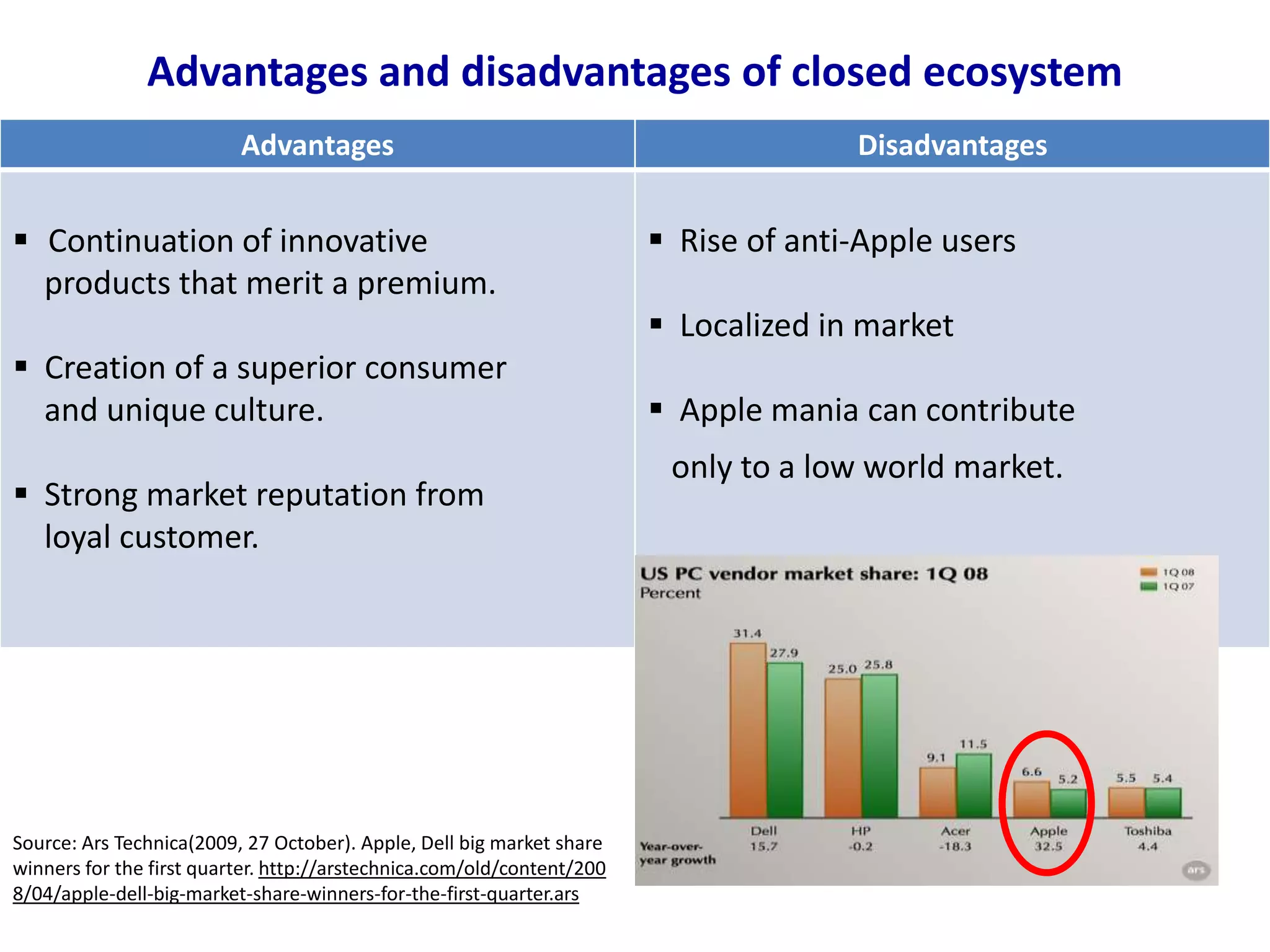
Advantages and disadvantages of closed ecosystemThisSource: Ars Technica(2009, 27 October). Apple, Dell big market share winners for the first quarter. http://arstechnica.com/old/content/2008/04/apple-dell-big-market-share-winners-for-the-first-quarter.ars
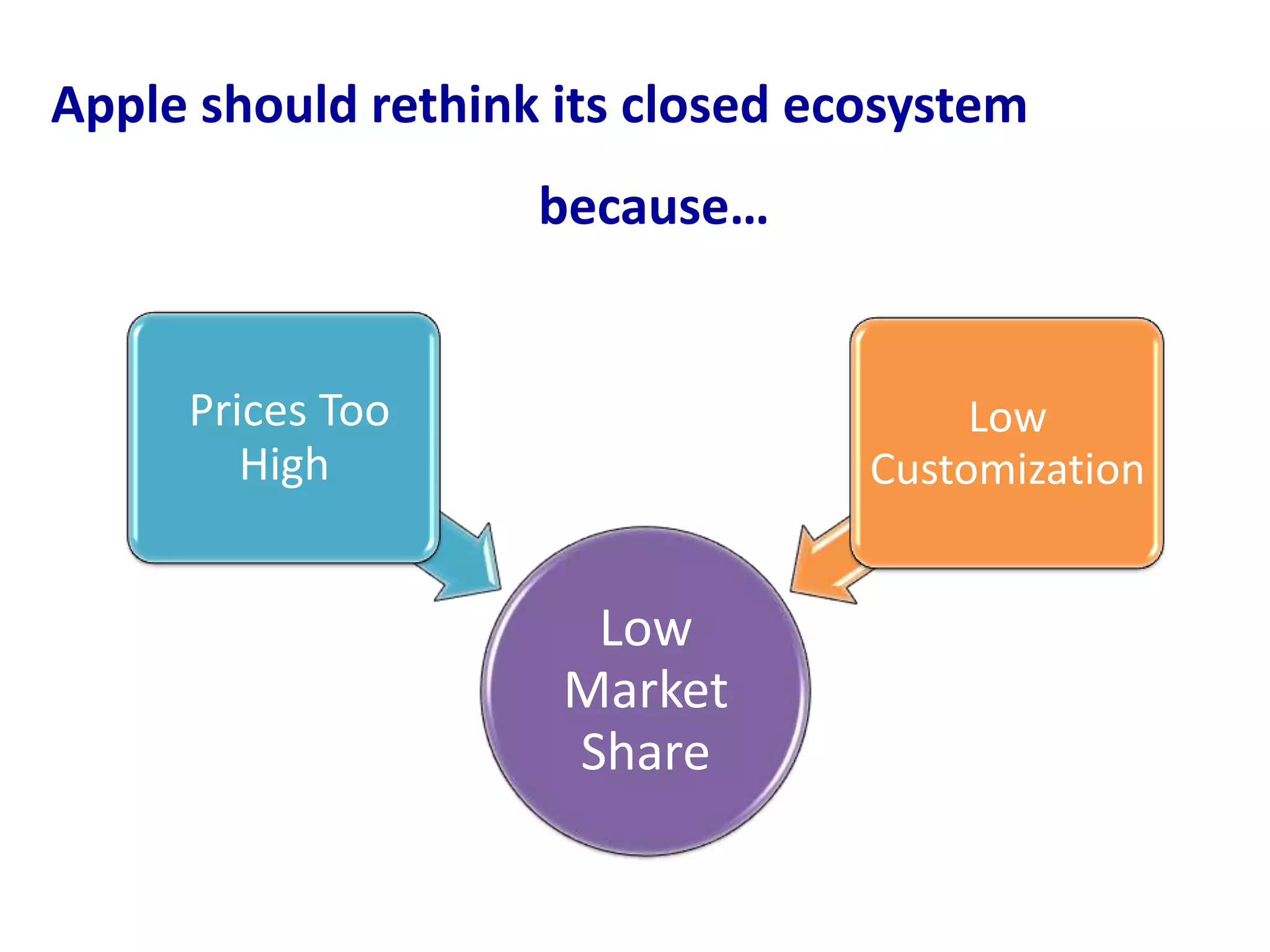
Apple should rethink its closed ecosystem    because…

Apple INC Case Study

  • 1.
    Case study: AppleInc- Strategic leadership and innovation at Apple Inc - By RenjithSreekumar
  • 2.
    Contents 1. Introduction 2. Explanation of Adapted Framework 3. Q1. What are the Key features of the Apple Industry? with Michael Porter’s 5 forces, SWOT (Opportunity, Threat)4. Q2. What is your evaluation of Steve Jobs as a strategic leader with John Kotter – Leading Change model5. Q3. Has Apple engaged in strategic innovation? with Strategic Innovation framework6. Q5. Should Apple rethink its closed ecosystem, proprietary approach? 7. Conclusion
  • 3.
    Introduction1. Objective ofgroup B5’s presentation - To analysis Apple’s case with effective frameworks - To extract answers of questions from frameworks 2. Expected outcome of presentation - Apple’s key features - Apple’s competitive advantage : Strength and weakness : Innovation factors - Predictions of Apple’s future - Suggestions for Apple
  • 4.
    3. Basic frameworkof case studyExternal analysisStrategic choiceStrategy implementationCompetitive advantage 1) The strategic processMissionObjective Internal analysisAdapted from Barney and Hesterly (2006). 2) Michael Porter’s Five ForcesAdapted from Porter (2005).New entrantsCompetitorsSubstitutesLevel of threatSuppliersBuyers
  • 5.
    3) SWOT (Strength,Weakness, Opportunity, Threat)Adapted from Ferrell et al (2002).4)Barney’s V R I O theory5) John Kotter’s leadership theory 6) Strategic Innovation framework
  • 6.
    Q1. What are the key features of the Apple industry?1) External key features - Michael Porter’s five forces framework Adapted from Porter (2005).
  • 7.
    2) Internal keyfeaturesProduct diversification and innovation for long-term development (music, internet, computer)- Integration of software and hardware Laptops + iPhoto, iPod + iTunes, iPhone + Wireless internet - Technological improvement with unique design - Transcended the barriers of computer industry to cross many aspectof industries (iTunes, iPod, iPhone)
  • 8.
    Loyal customer baseStrong Apple culture and community
  • 9.
    Applehas created a youth culture and trendAn ambitious LeadershipTyrannic style
  • 10.
    Motivate employee
  • 11.
    Aggressive visions, brilliant, powerful and charismatic Q2: What is your evaluation of Steve Jobs as a strategic leader?Centralized, disciplinarian style of leadership.
  • 12.
  • 13.
    Core strategies –product based, aimed at driving the market
  • 14.
    Style has takenApple from brink of bankruptcy to being hugely profitable
  • 15.
    John Kotter –Leading ChangeAdapted from Kotter(1995, p.60)
  • 16.
    Q3. Has Appleengaged in strategic innovation? “ Strategic Innovation is the creation of growth strategies, new product categories, services or business models that change the game and generate significant new value for consumers, customers and the corporation.” Adapted from Palmer and Kaplan,(2007, p.3)
  • 17.
    Strategic Innovation frameworkAdaptedfrom Palmer and Kaplan, 2007, p. 6.
  • 18.
    Q 5.Should Applerethink its closed ecosystem, proprietary approach?
  • 19.
    Advantages and disadvantagesof closed ecosystemThisSource: Ars Technica(2009, 27 October). Apple, Dell big market share winners for the first quarter. http://arstechnica.com/old/content/2008/04/apple-dell-big-market-share-winners-for-the-first-quarter.ars
  • 20.
    Apple should rethinkits closed ecosystem because…
  • 21.
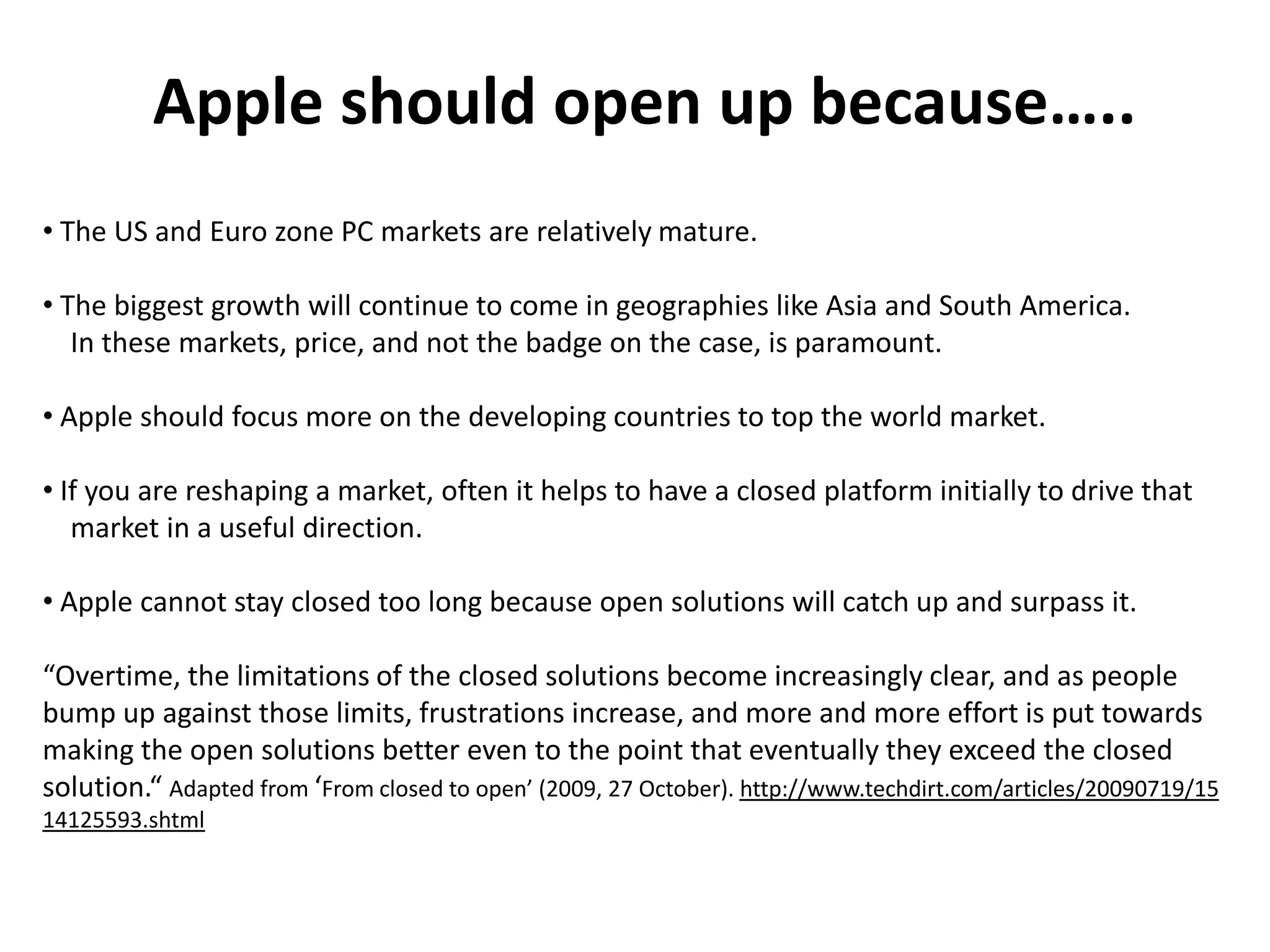
    Apple should openup because….. The US and Euro zone PC markets are relatively mature.
  • 22.
    The biggestgrowth will continue to come in geographies like Asia and South America. In these markets, price, and not the badge on the case, is paramount. Apple should focus more on the developing countries to top the world market.
  • 23.
    If youare reshaping a market, often it helps to have a closed platform initially to drive that market in a useful direction. Apple cannot stay closed too long because open solutions will catch up and surpass it.“Overtime, the limitations of the closed solutions become increasingly clear, and as people bump up against those limits, frustrations increase, and more and more effort is put towards making the open solutions better even to the point that eventually they exceed the closed solution.“ Adapted from ‘From closed to open’ (2009, 27 October). http://www.techdirt.com/articles/20090719/1514125593.shtml
  • 24.
    Conclusion1. Summary: SteveJobs- Leadership style - Spiritual leader : Products- High quality technology (software and hardware) - Closed ecosystem - Innovation : Customers - Loyal customer base
  • 25.
    ConclusionRecommendations to Apple1) Collaborate with more technology related industries and companies. 2) Aim for more interaction with customers. 3) Make the iMac more compatible. 4) Loosen the closed ecosystem approach. 5) Prepare for Apple post Steve Jobs.
  • 26.
    References1) Barney, J.B.and Hesterley, W.S., (2006). Strategic Management and Competitive Advantage, Pearson, New Jersey, pp. 5-15.2) Ferrell, O.C., Hartline, M.D. and Lucas, G.H., (2002). Marketing Strategy (5th Ed.), South Western, pp.50-73.3) Kotter, J., (1995) .Leading Change: Why Transformation Efforts Fail, Harvard Business Review, March -April, pp.59-67.4) Palmer, D. and Kaplan, S., (2007). A Framework for Strategic Innovation, InnovationPoint LLC, pp. 1-24.5) Porter, M. E., (2008). The Competitive Forces that Shape Strategy, Harvard Business Review , vol. 86, Issue 1, pp.78-93. Websites1) From closed to open (2009, 27 October). http://www.techdirt.com/articles/20090719/1514125593.shtml2) Ars Technica(2009, 27 October). Apple, Dell big market share winners for the first quarter. http://arstechnica.com/old/content/2008/04/apple-dell-big-market-share-winners-for-the-first-quarter.ars
  • 27.