Group 5
Strategic Alliances & Joint Ventures
Pharmaceuticals v/s FMCG

Strategic Alliances & Joint Ventures
Sagar Gupta
Radhika Bhatter
Rakshit Sharma
Soumyajit Sengupta
Varun Gopal
Aneesha Chandra
Cristina Morini

12P041
12P096
12P160
12P171
12P174
12P186
Exchange
Introduction
Pharmaceutical Industry

Key Trends
u 

The market size of the global pharmaceutical
industry stood at USD 962.1 billion in 2012

u 

In 2018, it is expected to grow to a market size of
USD 1,226 billion

u 

Asia is expected to witness the highest growth
rate between 11.4%-14.4%

u 

Latin America, Africa and Australia are expected
to closely follow at a CAGR between 10%-13%

u 

Japan
12%

ROW
8%

It is expected to grow at a CAGR of around 5% in
the next 5 years

u 

Market Size by Geographies

The developed parts of the world are expected to
show comparatively much lower growth rates:
u 

USA: 0.7%-3.7%

u 

Europe: (0.4)%-2.6%

u 

Japan: 1.7%-4.7%

u 

According to market size, North American market
would remain the most important

u 

Aging population
North
America
38%

Asia
18%

Key Industry Drivers

Changing lifestyles
Hectic daily activities

Europe
24%

Key Risks
Strict Regulation

Un-healthy eating activities
Increasing incidence of chronic diseases across
the entire global population

R&D Spending (USD million)
140

High Investment Requirement
Pricing Pressures and Shrinking
Margins
Reputation Management

A key success factor would be the ability to
create new technology and innovative drugs

131
127

129

120

Developing innovative products
(Patent Cliff)
2007
-- 2 --

2008

2009

2010

2011
Key Drivers for Strategic Alliances and Joint Ventures
Pharmaceutical Industry

Enter into Emerging Markets
• Asia and Latin America are expected to grow at the highest rate

Sharing R&D Costs
• R&D generally account for 15-20% of the revenues of a pharmaceutical company
• Increasing customer demands for more specific and direct cures
• Average cost per new drug is USD 300 million

Co-Developing New Products
• Share the risks associated with NPD
• Technology in return for Resources

Product Licensing and Co-Marketing
• Marketing accounts for 25% of the revenues of a pharmaceutical industry

Economies of Scale
• One of the main motives for cross-border alliances are for sharing production to increase capacity utilization and reduce investment

Benefitting from Partners Having an Established Strong Reputation
• As having a strong reputation is essential in this industry, firms can benefit from tying with partners who have a strong reputation in a country/region

Cost Effective Sourcing
• Drugs over $9 billion are expected to go off patent in 2015
• Firms are looking for outsourcing the drugs to players who can produce them at a low cost
-- 3 --
Merck – Alnylam
Non-Equity Strategic Alliance

u 

Publicly listed on NYSE, $140.56b M.Cap

u 

Publicly listed on Nasdaq, $3.71b M.Cap

u 

Founded in 1917 (USA nationalized the German
subsidiary)

u 

Founded in 2002 in Cambridge, Massachusetts

u 

Core focus is development & commercialization
of novel therapeutics based on RNAi

u 

7 specific patient assistance programs

u 

Among the top 7 Global Pharmaceutical Giants
by Revenue & Market Cap

u 

Created Regulus Therapeutics for development
of microRNAi in collaboration with Isis

u 

Revenue : $48billion

u 

Revenue : $66.21million

u 

2012 Facility of the Year Winner for its Vaccine
Facility

u 

Has entered into numerous strategic alliances
with all the major players in the industry

Key Drivers

Merck would provide Alnylam with a series of proprietary drug targets
for validation purposes

u 

Alnylam would provide the technical know-how in RNAi based
therapeutics, which Merck lacked

u 

Merck would inject cash in RNAi based drug development, giving it
financial control over the research

u 

Alnylam would test and develop RNAi based drugs for Merck to
commercialize, helping it remain an innovation leader

u 

Merck would help in commercialization of products

u 

Alnylam scientists would head the operational aspects

u 

Agreement
Details

u 

Merck would make upfront & annual cash payments to Alnylam

u 

u 

Merck would also undertake equity investment if certain technological
milestones were achieved by Alnylam

Merck would receive a co-exclusive license to Alnylam’s intellectual
property

u 

Merck would also make available all necessary requirements for RNAi
based drug R&D to Alnylam, after evaluation

Any promising development could be further harnessed by Merck to
create novel drugs

u 

Alnylam would dictate the pace of R&D and handle the operations

u 

-- 4 --
GSK – Dong-A
Equity Strategic Alliance

Publicly listed on LSE, GBP 75b M.Cap

u 

Publicly listed on KSE, Won 862m M.Cap

u 

Founded in 2000;Merger: Glaxo & Smithkline)

u 

Founded in 1932, in Seoul, South Korea

u 

99 cities, 39 countries of operations, 70 countries
of sales, 97,389 employees

u 

32 cities, 2 countries of operations, 7 countries of
sales, 2281 employees

u 

4th Largest company by Revenues, 7th Largest by
Market Cap.

u 

Largest manufacturer of OTC drugs, ethical
products, consumer brands & energy drinks

u 

Revenue : GBP 26billion

u 

Revenue: $817million

u 

Follows a Tuck-in M&A policy acquiring
companies to fill its portfolio gaps

u 

Largest Subsidiary of Dong-A Socio Holdings.

Agreement
Details

Key Drivers

u 

u 

Dong-A would lend its local marketing expertise in South Korea where
it had become the industry leader with lesser products

u 

GSK would impart its experience of managing other dynamic markets
to Dong-A to help it maintain its domestic leadership

u 

Dong-A would also help increase GSK’s product penetration in South
Korea through its efficient distribution network

u 

Dong-A would be able to learn of the processes followed by GSK to
help it become a global player in the industry

u 

GSK would be able to tap the “healthy” image created by Dong-A

u 

GSK’s proven product portfolio would help Dong-A enter new markets
within South Korea

u 

GlaxoSmithKline would invest GBP 74million to acquire a minority
stake of 9.9%

u 

Initial activities included co-promotion of select GSK products &
Dong-A products in South Korea for primary care

u 

Co-sharing of profits at 50-50
-- 5 --

u 

A new separate team would be created within Dong-A to
demarcate areas of cooperation and for proper management of the
alliance

u 

Alliance to be extended to other product segments if the initial
agreement proved successful.
Hisun – Pfizer
Joint Venture

u 

Publicly listed on SSE, CNY 15.6b M.Cap

u 

Publicly listed on NYSE, $190b M.Cap

u 

Founded in 1956, in Taizhou, China

u 

Founded in 1849, in Connecticut, USA

u 

30 countries, 9897 employees,

u 

34 factories, 5 countries of operations, 92
countries of sales, 91,500 employees

u 

Largest Chinese pharmaceutical firm by
revenues with subsidiaries in 7 countries

u 

Among the Largest research-based
pharmaceutical companies in the world

u 

Revenue : RMB 450million

u 

Revenue: $58.9billion

u 

Winner of numerous efficiency awards & also
voted as one of the most loved brands in China

u 

Major player in the M&A market with $68b
acquisition of Wyeth being the biggest deal

Key Drivers

Hisun would provide local production & distribution expertise for the
joint venture

u 

Pfizer would lend its global marketing expertise for the penetration of
the new products among the masses

u 

Local demand & environment based R&D would be imparted by Hisun

u 

Pfizer would impart managerial assistance in scaling up Hisun’s
operations within China and also surrounding regions

u 

Pfizer would gain entry into the growing Chinese branded generics
market and increase its global reach

u 

Hisun would be able to achieve its strategic goals of becoming the
Chinese pharmaceutical leader by a margin

u 

Agreement
Details

u 

The management of the Joint Venture would be comprised of equal
representation from Pfizer & Hisun

u 

Both parties to make available any resources, both financial and
physical, for the successful operation of the Joint Venture

u 

Primarily a manufacturing collaboration to tap the Chinese competitive
advantage of production ability

u 

Pfizer would support the Chinese pharmaceutical industry by lending
global feedbacks with respect to changing market dynamics

u 

Both parties to contribute an equal number of products to the Joint
Venture for initial operations

u 

Profits from the sale of products released by the JV would be shared
equally after management set aside funds for reinvestment

-- 6 --
Intrexon – Sun Pharmaceuticals
Joint Venture

u 

Publicly listed on BSE, INR 129,582Cr. M.Cap

u 

Publicly listed on NYSE, $2.1b M.Cap

u 

Founded in 1983, in Kolkata, India

u 

Founded in 1998, in Virginia, USA

u 

23 countries of operations & sales, 11,200
employees

u 

Pre-dominantly present in USA as a Syntheticbiology player

u 

3rd Largest Indian Pharmaceuticals company by
Revenue and the Largest by Profits & M.Cap

u 

1st of its kind company to combine engineering &
design aspects to create gene-systems

u 

Revenue : INR 8005 Cr.

u 

u 

Active in the M&A segment with inorganic growth
being a primary driver for the last 20 years

Has collaborations with almost every advanced
R&D lab in USA dealing with synthetic biology

u 

Recently successful in launching IPO

Key Drivers

Sun Pharma would lend its past experience in developing and
manufacturing complex dosage forms

u 

Intrexon would lend its biotechnology capabilities to the JV for
development of methods to deal with ocular diseases

u 

Sun Pharma would impart its marketing & production capabilities in
specialty pharmaceuticals in niche areas

u 

Sun Pharma would be able to leverage cutting edge technology to
become an innovation leader in a virgin field in India

u 

Intrexon would gain easy access to an emerging market like India

u 

Intrexon would also allow JV to use its RTS platform helping Sun gain
knowledge of such technology

u 

Agreement
Details

u 

Joint development of controllable gene-based therapies to tackle eye
diseases causing partial/total blindness

u 

Financing requirements would be fulfilled by equal contribution by both
Sun Pharma & Intrexon Corporation

u 

Equal Profit sharing mechanism from JV’s profits
-- 7 --

u 

JV would have access to Intrexon’s full product portfolio

u 

Sun Pharma would be the sole channel collaborator for Intrexon in India

u 

JV could be extended to other forms of ocular disease treament if the
initial arrangement succeeded.
Introduction
FMCG Industry

Key Industries
Personal
Laundry
Accessories
5%
3%

Others
2%

Key Industry Drivers
Dramatic population growth (A billion new customers)
Income gains in emerging economies (growing middle
class and improving purchasing power of rural class)

Household
Products
7%
Personal
Healthcare
8%

Food and
Beverages
35%

Rise of the Value Segment will Affect Margins
• Private label players account for 40% of supermarket sales in UK, 30%
in Germany,15% in USA
• Austerity measures in developed countries

Volatile raw material prices

Rapid urbanization

• Due to Emergence of Global Supply Chains
• Natural Resources Shortages

Changing lifestyles
Hair Care
12%

Key Risks

Shifting demographics – Aging Population
Personal
Care
28%

Price Deflation

Rise of Digital Consumers (Both e- and m-commerce)

Deteriorated Consumer Environment in Developed
Nations

Health and Wellness Concerns
u 

Emerging markets are expected to drive the
growth for the FMCG sector

Premiumization

u 

Asia is expected to overtake the West as the
main consumer market

Flexible Fulfilment of Orders (due to hectic schedules of
customers)

u 

In India, the FMCG sector is expected to grow at
a CAGR of 14.7%

Greater use of Bid Data Analytics

The industry is characterized by low margins and
is thus, voume-driven

Increase in Environmental and Social Responsibility

Increasing competition

u 

Speed and Success of Innovations
Brand and Marketing Effectiveness
• Particularly while entering into new markets, companies will have to
balance the target customer group and the requisite investment

Regulation and Quality Control Norms
-- 8 --
Key Drivers for Strategic Alliances and Joint Ventures
FMCG Industry
Enter into Emerging Markets
• Asia is expected to overtake the developed countries in terms of market size
• 1 billion more consumers in Asia and Africa in the next decade

Sharing Distribution Costs
• By entering into a strategic alliance, companies will be able to leverage the already established distribution network of other companies

Entering into New Products
• Instead of developing products from scratch, firms can form alliances to enter into new product segments

Economies of Scale
• Setting up of manufacturing facilities involves large capital expenditure
• Alliances allows the firms to improve capacity utilization of existing plants and saves cost of constructing new plants

Benefitting from Partners Having an Established Strong Brands
• Strong existing brands and reputation makes the entry into new markets easier for players

Streamlining Value Chain
• Strategic alliances may allow firms to source raw materials more efficiently

Sharing R&D costs
• The emerging value-conscious customers are looking for higher value and lower prices
• They also demand products which meet specific requirements
• Sharing R&D, allows firms to meet these demands without large outlays

Technology Transfers
-- 9 --
Tata Coffee – Starbucks
Starbucks Coffee, A Tata Alliance (Joint Venture)

u 

Publicly listed on BSE, INR 2062Cr M.Cap

u 

Publicly listed on NYSE, $57.75b M.Cap

u 

Founded in 1922

u 

Founded in 1971

u 

19 coffee estates in South India

u 

20,891 stores in 62 countries

u 

Largest integrated coffee plantation company in
the world

u 

Largest Coffee-house company in the world

u 

Revenue : $13.29billion (FY 2011)

u 

Revenue : $64million (FY 2011)

u 

Profit: $1.38billion (FY 2011)

u 

Profit: $8.4million (FY 2011)

Key Drivers

Tata Coffee would get a captive customer in the form of Starbucks for
its operations in India

u 

Starbucks would be able to enter the Indian market after a false start in
2007 (Future Group)

u 

Indian-grown Arabica’s brand position would improve globally

u 

Starbucks would earn greater public confidence through Tata

u 

Business Values fit as the Starbucks brand was known for Quality & a
Rich Customer Experience

u 

Business Values fit as Tata Group had a proven track record of
Unparalleled Ethics and Customer Value in India

u 

Agreement
Details

u 

Opening a Roasting & Packaging Facility in Karnataka

u 

Store operated by Tata Global Beverages

u 

Local Development of the signature Starbucks Espresso Roast

u 

Outlets positioned in Premium areas to preserve positioning

u 

Product Offerings customized to Indian sensibilities

u 

A tea brand to be developed under the Tata Tazo brand

u 

50 stores across the country by end of 2013
-- 10 --
Nestle – General Mills
Cereal Partners Worldwide (Joint Venture)

u 

Publicly listed on SIX:NESN, $233b M.Cap

u 

Publicly listed on NYSE, $30.55b M.Cap

u 

Founded in 1905, in Vevey, Switzerland

u 

Founded in 1866, in Minnesota, USA

u 

450 factories, 86 countries, 328,000 employees

u 

66 factories, 11 countries, 35,000 employees

u 

Largest food company in the World by Revenues

u 

Largest food company in the USA by Revenues

u 

Revenue : CHF 92billion

u 

Revenue: $14billion

u 

Ranked Most Profitable in Fortune Global 500 in
2011

u 

Ranked 124th in Fortune Global 500

Key Drivers

General Mills would lend its immaculate production efficiency &
product innovation to create new offerings

u 

Nestle would impart the requisite marketing efforts & distribution
channels to increase the sales of cereals

u 

General Mills would lend it cereal marketing expertise

u 

Nestle would streamline the value chain across the world

u 

General Mills had a broad portfolio of successful brands

u 

Nestle would help in achieving greater scale economies

u 

Agreement
Details

u 

Created in 1991 to sell breakfast cereals created by General Mills in 130 u 
countries, except USA & Canada under the Nestle brand

Partner acquisition prohibited as per JV Agreement

u 

u 

u 

Independent development of new cereal brands

CPW would be independently managed by a neutral board, with freedom
to operate as a separate legal entity

Allows for production of private label cereals in UK

u 

General Mills’ cereal specific production facilities outside USA would be
transferred to CPW

-- 11 --
Gorenje – Panasonic
Equity Strategic Alliance

Publicly listed on GRVG, $109m M.Cap

u 

Publicly listed on TSE, Yen 2283b M.Cap

u 

Founded in 1950, in Velenje, Slovenia

u 

Founded in 1918, in Osaka, Japan

u 

83 companies, 70 countries, 10,785 employees,
Continental M.Share=4%

u 

580 companies, 113 countries, 330,000
employees

u 

Largest Electronics company in Slovenia, 8th
largest electronics manufacturer in Europe

u 

Among the Big 4 Japanese electronics makers,
4th highest market share in TV in 2012

u 

Revenue : Euro 1.26billion

u 

Revenue: $75.8billion

u 

Winner of numerous innovation awards in
appliances manufacturing over the years

u 

Major player in the M&A market with nearly 25
deals in the last 4 years

Key Drivers

u 

u 

Panasonic will help in attaining higher absorption of fixed costs by
leveraging on increased production utilization

u 

Access to Gorenje’s efficient manufacturing capabilities

u 

Gorenje would lend its European marketing expertise & widespread
distribution channels

u 

Gorenje’s innovations could be developed further to create even better
products

Panasonic would help lend technical know-how towards development
of new products

u 

Help increase Gorenje’s stature in Europe even more

u 

Agreement
Details

u 

Panasonic would acquire a minority stake of 13% in Gorenje for
$12million

u 

Exchange of specific knowledge of market requirements, technical
solutions & development techniques

u 

Standstill agreement to be in place

u 

Panasonic brand to be used by Gorenje in Europe

u 

Joint development of new products, especially portable electronics

u 

Gorenje brand to be used in Asia by Panasonic in markets where
Gorenje is not present but Panasonic is.

-- 12 --
Reckitt Benckiser – Hoovers’ Company
Non-Equity Strategic Alliance

u 

Publicly listed on LSE, GBP 30.68b M.Cap

u 

Privately Held

u 

Founded in 1999, in Berkshire, UK

u 

Founded in 1908, in Ohio, USA

u 

60 countries of operation, 200 countries of sales,
35,900 employees

u 

Worldwide presence, except Europe where sister
concern is owned by Candy Group

u 

Largest British Consumer Goods company

u 

u 

Revenue : GBP 9.57billion

Fallen Giant in the field of home appliances &
equipment

u 

Category leader in most domains of operations,
with Dettol being the most iconic

u 

4th highest selling white goods player in USA

u 

Critically acclaimed equipment design with the
highest no. of patents in floor-care

Key Drivers

Hoover’s strong brand name in the floor-care segment

u 

u 

Hoover would lend unmatched product innovation capability &
manufacturing capacity

RB brought the strongest player in the household cleaning
consumable market

u 

RB lent its consumer chemical manufacturing expertise

u 

Hoover’s patent portfolio would help create a new market

u 

RB would lend its infrastructure & distribution networks

u 

Agreement
Details

u 

Joint development of products to create a revolutionary new product
segment

u 

Hoover’s patent portfolio to be made available to RB for product
development, with royalty tied to it

u 

Hoover equipment & RB household cleaning products would be in the
operating scope of the alliance

u 

Cross-sell products in each other’s distribution networks with Hoover’s
products being made available to retail consumers

u 

Incremental investment in distribution networks

u 

If successful, alliance could be extended in scope & size

-- 13 --
Key Drivers
Similarities and Differences

Similarities

u 

Differences

Entry into emerging markets and products
(extremely important for both sectors)

u 

Order of Importance is highly different

u 

In case of pharmaceutical sector, the main
drivers are

u 

Sharing of R&D costs

u 

Sharing of Marketing costs

u 

u 

Leveraging Established Distribution
Channel of Partner

Sharing of R&D and marketing
costs

u 

Co-development and production of
products

u 

u 

Leveraging the Strong Reputation and
Brands of Partner

u 

Achieving economies of scale in
production

In case of FMCG sector, main drivers are:
u 
u 

-- 14 --

Sharing of distribution networks
Leveraging strong brand name of
partner
Shift in Balance of Power
Similarities and Differences

Pharmaceutical Industry
u 

Merck-Alnylam
u 

u 

u 

Collaboration was terminated in 2007 due
to power collision
Merck got IP rights of all co-development
programs

u 

However, power balance is more towards
GSK (global partner) as Dong-A has had to
give up some products so as to market
GSK’s product line

Nestle-General Mills

Collaboration still exists

u 

Sustainable Power Balance

Sustainable Power Balance

Intrexon-Sun Pharmaceuticals
u 

Gorenje-Panasonic
u 

Panasonic is the minority stakeholder in
Gorenje

u 

u 

Sustainable
Power
Balance

JV was established in 1991 and has
delivered strong returns for both the
companies

u 

Hisun-Pfizer
u 

JV came in operation in 2012

u 

u 

Possible Power Balances for Alliances

TATA Coffee-Starbucks
u 

Collaboration still exists

u 

u 

u 

GSK-Dong-A
u 

u 

FMCG Industry

Towards
Local
Partner

Initial
Alliance

However, Gorenje has no stake in
Panasonic, thus putting it on a weaker end

Reckitt Benckiser – Hoover’s Company
u 

Strong alliance since 2001

u 

Sustainable Power Balance

JV announced on 1 October 2013

u 

Overall, pharmaceutical industry has a higher alliance failure rate of 50%. Power collisions are common and
generally results in lengthy court battles over IP disputes

u 

In case of FMCG sector, shift towards global partner or sustainable power balance are more frequent
-- 15 --

Power
Collision

Towards
Global
Partner
Strategic Alliance Orientation
Similarities and Differences

Primary Risk

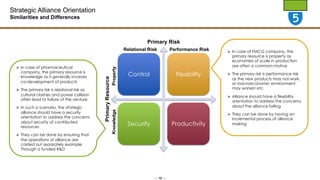
Ø  The primary risk is relational risk as
cultural clashes and power collision
often lead to failure of the venture
Ø  In such a scenario, the strategic
alliance should have a security
orientation to address the concerns
about security of contributed
resources
Ø  They can be done by ensuring that
the operations of alliance are
carried out separately example
Through a funded R&D

Property

Performance Risk

Control

Flexibility

Ø  In case of FMCG company, the
primary resource is property as
economies of scale in production
are often a common motive
Ø  The primary risk is performance risk
as the new products may not work,
or macroeconomic environment
may worsen etc.
Ø  Alliance should have a flexibility
orientation to address the concerns
about the alliance failing

Knowledge

Ø  In case of pharmaceutical
company, the primary resource is
knowledge as it generally involves
co-development of products

Primary Resource

Relational Risk

Security

Productivity

-- 16 --

Ø  They can be done by having an
incremental process of alliance
making
Value Derived from the Strategic Alliance
Similarities and Differences

Learning
Business
Development
Most Important
Value Creators in an
Alliance in the
Pharmaceutical
Sector

Growth Opportunities

Cash

New Strategic
Options

Market Share

Positioning

Supply

Capability
Development

IP Rights

Cost
Savings

Brand Loyalty
Component
Performance

Discounted
ROI

ROI

Short Run

Dynamic
ROI

Long Run

-- 17 --

Most Important
Value Creators in an
Alliance in the
FMCG Sector
Industry Life Cycle and Partner Selection
Similarities

Maturity Phase

Growth Phase

u 

Both industries are facing a mature
market in the developed countries

u 

Both industries are facing a growing
market in the emerging countries

u 

The growth rates are low and the big
players are already well-established

u 

The penetration is low and the potential is
huge

u 

Low degree of uncertainty in these
markets

u 

High degree of uncertainty and risk

u 

Hence, the strategic alliances in these
growing emerging markets are

u 

Hence, the strategic alliances in these
mature developed markets are
u 

u 

u 

Select partners which are strong in terms of
resources and capabilities

To select partners which have promising
ideas/prototypes of new technology and
products

u 

Licensing and co-marketing products to
reduce costs and gain market share

To find well-established partners to gain
local knowledge, leverage distribution
system and to reduce uncertainty

To develop new products according to the
requirements of these regions

To optimize the cost structure with the help
of process innovations

u 

u 

-- 18 --

FMCG v/s Pharmaceuticals: Strategic Alliances & Joint Ventures

  • 1.
    Group 5 Strategic Alliances& Joint Ventures Pharmaceuticals v/s FMCG Strategic Alliances & Joint Ventures Sagar Gupta Radhika Bhatter Rakshit Sharma Soumyajit Sengupta Varun Gopal Aneesha Chandra Cristina Morini 12P041 12P096 12P160 12P171 12P174 12P186 Exchange
  • 2.
    Introduction Pharmaceutical Industry Key Trends u  Themarket size of the global pharmaceutical industry stood at USD 962.1 billion in 2012 u  In 2018, it is expected to grow to a market size of USD 1,226 billion u  Asia is expected to witness the highest growth rate between 11.4%-14.4% u  Latin America, Africa and Australia are expected to closely follow at a CAGR between 10%-13% u  Japan 12% ROW 8% It is expected to grow at a CAGR of around 5% in the next 5 years u  Market Size by Geographies The developed parts of the world are expected to show comparatively much lower growth rates: u  USA: 0.7%-3.7% u  Europe: (0.4)%-2.6% u  Japan: 1.7%-4.7% u  According to market size, North American market would remain the most important u  Aging population North America 38% Asia 18% Key Industry Drivers Changing lifestyles Hectic daily activities Europe 24% Key Risks Strict Regulation Un-healthy eating activities Increasing incidence of chronic diseases across the entire global population R&D Spending (USD million) 140 High Investment Requirement Pricing Pressures and Shrinking Margins Reputation Management A key success factor would be the ability to create new technology and innovative drugs 131 127 129 120 Developing innovative products (Patent Cliff) 2007 -- 2 -- 2008 2009 2010 2011
  • 3.
    Key Drivers forStrategic Alliances and Joint Ventures Pharmaceutical Industry Enter into Emerging Markets • Asia and Latin America are expected to grow at the highest rate Sharing R&D Costs • R&D generally account for 15-20% of the revenues of a pharmaceutical company • Increasing customer demands for more specific and direct cures • Average cost per new drug is USD 300 million Co-Developing New Products • Share the risks associated with NPD • Technology in return for Resources Product Licensing and Co-Marketing • Marketing accounts for 25% of the revenues of a pharmaceutical industry Economies of Scale • One of the main motives for cross-border alliances are for sharing production to increase capacity utilization and reduce investment Benefitting from Partners Having an Established Strong Reputation • As having a strong reputation is essential in this industry, firms can benefit from tying with partners who have a strong reputation in a country/region Cost Effective Sourcing • Drugs over $9 billion are expected to go off patent in 2015 • Firms are looking for outsourcing the drugs to players who can produce them at a low cost -- 3 --
  • 4.
    Merck – Alnylam Non-EquityStrategic Alliance u  Publicly listed on NYSE, $140.56b M.Cap u  Publicly listed on Nasdaq, $3.71b M.Cap u  Founded in 1917 (USA nationalized the German subsidiary) u  Founded in 2002 in Cambridge, Massachusetts u  Core focus is development & commercialization of novel therapeutics based on RNAi u  7 specific patient assistance programs u  Among the top 7 Global Pharmaceutical Giants by Revenue & Market Cap u  Created Regulus Therapeutics for development of microRNAi in collaboration with Isis u  Revenue : $48billion u  Revenue : $66.21million u  2012 Facility of the Year Winner for its Vaccine Facility u  Has entered into numerous strategic alliances with all the major players in the industry Key Drivers Merck would provide Alnylam with a series of proprietary drug targets for validation purposes u  Alnylam would provide the technical know-how in RNAi based therapeutics, which Merck lacked u  Merck would inject cash in RNAi based drug development, giving it financial control over the research u  Alnylam would test and develop RNAi based drugs for Merck to commercialize, helping it remain an innovation leader u  Merck would help in commercialization of products u  Alnylam scientists would head the operational aspects u  Agreement Details u  Merck would make upfront & annual cash payments to Alnylam u  u  Merck would also undertake equity investment if certain technological milestones were achieved by Alnylam Merck would receive a co-exclusive license to Alnylam’s intellectual property u  Merck would also make available all necessary requirements for RNAi based drug R&D to Alnylam, after evaluation Any promising development could be further harnessed by Merck to create novel drugs u  Alnylam would dictate the pace of R&D and handle the operations u  -- 4 --
  • 5.
    GSK – Dong-A EquityStrategic Alliance Publicly listed on LSE, GBP 75b M.Cap u  Publicly listed on KSE, Won 862m M.Cap u  Founded in 2000;Merger: Glaxo & Smithkline) u  Founded in 1932, in Seoul, South Korea u  99 cities, 39 countries of operations, 70 countries of sales, 97,389 employees u  32 cities, 2 countries of operations, 7 countries of sales, 2281 employees u  4th Largest company by Revenues, 7th Largest by Market Cap. u  Largest manufacturer of OTC drugs, ethical products, consumer brands & energy drinks u  Revenue : GBP 26billion u  Revenue: $817million u  Follows a Tuck-in M&A policy acquiring companies to fill its portfolio gaps u  Largest Subsidiary of Dong-A Socio Holdings. Agreement Details Key Drivers u  u  Dong-A would lend its local marketing expertise in South Korea where it had become the industry leader with lesser products u  GSK would impart its experience of managing other dynamic markets to Dong-A to help it maintain its domestic leadership u  Dong-A would also help increase GSK’s product penetration in South Korea through its efficient distribution network u  Dong-A would be able to learn of the processes followed by GSK to help it become a global player in the industry u  GSK would be able to tap the “healthy” image created by Dong-A u  GSK’s proven product portfolio would help Dong-A enter new markets within South Korea u  GlaxoSmithKline would invest GBP 74million to acquire a minority stake of 9.9% u  Initial activities included co-promotion of select GSK products & Dong-A products in South Korea for primary care u  Co-sharing of profits at 50-50 -- 5 -- u  A new separate team would be created within Dong-A to demarcate areas of cooperation and for proper management of the alliance u  Alliance to be extended to other product segments if the initial agreement proved successful.
  • 6.
    Hisun – Pfizer JointVenture u  Publicly listed on SSE, CNY 15.6b M.Cap u  Publicly listed on NYSE, $190b M.Cap u  Founded in 1956, in Taizhou, China u  Founded in 1849, in Connecticut, USA u  30 countries, 9897 employees, u  34 factories, 5 countries of operations, 92 countries of sales, 91,500 employees u  Largest Chinese pharmaceutical firm by revenues with subsidiaries in 7 countries u  Among the Largest research-based pharmaceutical companies in the world u  Revenue : RMB 450million u  Revenue: $58.9billion u  Winner of numerous efficiency awards & also voted as one of the most loved brands in China u  Major player in the M&A market with $68b acquisition of Wyeth being the biggest deal Key Drivers Hisun would provide local production & distribution expertise for the joint venture u  Pfizer would lend its global marketing expertise for the penetration of the new products among the masses u  Local demand & environment based R&D would be imparted by Hisun u  Pfizer would impart managerial assistance in scaling up Hisun’s operations within China and also surrounding regions u  Pfizer would gain entry into the growing Chinese branded generics market and increase its global reach u  Hisun would be able to achieve its strategic goals of becoming the Chinese pharmaceutical leader by a margin u  Agreement Details u  The management of the Joint Venture would be comprised of equal representation from Pfizer & Hisun u  Both parties to make available any resources, both financial and physical, for the successful operation of the Joint Venture u  Primarily a manufacturing collaboration to tap the Chinese competitive advantage of production ability u  Pfizer would support the Chinese pharmaceutical industry by lending global feedbacks with respect to changing market dynamics u  Both parties to contribute an equal number of products to the Joint Venture for initial operations u  Profits from the sale of products released by the JV would be shared equally after management set aside funds for reinvestment -- 6 --
  • 7.
    Intrexon – SunPharmaceuticals Joint Venture u  Publicly listed on BSE, INR 129,582Cr. M.Cap u  Publicly listed on NYSE, $2.1b M.Cap u  Founded in 1983, in Kolkata, India u  Founded in 1998, in Virginia, USA u  23 countries of operations & sales, 11,200 employees u  Pre-dominantly present in USA as a Syntheticbiology player u  3rd Largest Indian Pharmaceuticals company by Revenue and the Largest by Profits & M.Cap u  1st of its kind company to combine engineering & design aspects to create gene-systems u  Revenue : INR 8005 Cr. u  u  Active in the M&A segment with inorganic growth being a primary driver for the last 20 years Has collaborations with almost every advanced R&D lab in USA dealing with synthetic biology u  Recently successful in launching IPO Key Drivers Sun Pharma would lend its past experience in developing and manufacturing complex dosage forms u  Intrexon would lend its biotechnology capabilities to the JV for development of methods to deal with ocular diseases u  Sun Pharma would impart its marketing & production capabilities in specialty pharmaceuticals in niche areas u  Sun Pharma would be able to leverage cutting edge technology to become an innovation leader in a virgin field in India u  Intrexon would gain easy access to an emerging market like India u  Intrexon would also allow JV to use its RTS platform helping Sun gain knowledge of such technology u  Agreement Details u  Joint development of controllable gene-based therapies to tackle eye diseases causing partial/total blindness u  Financing requirements would be fulfilled by equal contribution by both Sun Pharma & Intrexon Corporation u  Equal Profit sharing mechanism from JV’s profits -- 7 -- u  JV would have access to Intrexon’s full product portfolio u  Sun Pharma would be the sole channel collaborator for Intrexon in India u  JV could be extended to other forms of ocular disease treament if the initial arrangement succeeded.
  • 8.
    Introduction FMCG Industry Key Industries Personal Laundry Accessories 5% 3% Others 2% KeyIndustry Drivers Dramatic population growth (A billion new customers) Income gains in emerging economies (growing middle class and improving purchasing power of rural class) Household Products 7% Personal Healthcare 8% Food and Beverages 35% Rise of the Value Segment will Affect Margins • Private label players account for 40% of supermarket sales in UK, 30% in Germany,15% in USA • Austerity measures in developed countries Volatile raw material prices Rapid urbanization • Due to Emergence of Global Supply Chains • Natural Resources Shortages Changing lifestyles Hair Care 12% Key Risks Shifting demographics – Aging Population Personal Care 28% Price Deflation Rise of Digital Consumers (Both e- and m-commerce) Deteriorated Consumer Environment in Developed Nations Health and Wellness Concerns u  Emerging markets are expected to drive the growth for the FMCG sector Premiumization u  Asia is expected to overtake the West as the main consumer market Flexible Fulfilment of Orders (due to hectic schedules of customers) u  In India, the FMCG sector is expected to grow at a CAGR of 14.7% Greater use of Bid Data Analytics The industry is characterized by low margins and is thus, voume-driven Increase in Environmental and Social Responsibility Increasing competition u  Speed and Success of Innovations Brand and Marketing Effectiveness • Particularly while entering into new markets, companies will have to balance the target customer group and the requisite investment Regulation and Quality Control Norms -- 8 --
  • 9.
    Key Drivers forStrategic Alliances and Joint Ventures FMCG Industry Enter into Emerging Markets • Asia is expected to overtake the developed countries in terms of market size • 1 billion more consumers in Asia and Africa in the next decade Sharing Distribution Costs • By entering into a strategic alliance, companies will be able to leverage the already established distribution network of other companies Entering into New Products • Instead of developing products from scratch, firms can form alliances to enter into new product segments Economies of Scale • Setting up of manufacturing facilities involves large capital expenditure • Alliances allows the firms to improve capacity utilization of existing plants and saves cost of constructing new plants Benefitting from Partners Having an Established Strong Brands • Strong existing brands and reputation makes the entry into new markets easier for players Streamlining Value Chain • Strategic alliances may allow firms to source raw materials more efficiently Sharing R&D costs • The emerging value-conscious customers are looking for higher value and lower prices • They also demand products which meet specific requirements • Sharing R&D, allows firms to meet these demands without large outlays Technology Transfers -- 9 --
  • 10.
    Tata Coffee –Starbucks Starbucks Coffee, A Tata Alliance (Joint Venture) u  Publicly listed on BSE, INR 2062Cr M.Cap u  Publicly listed on NYSE, $57.75b M.Cap u  Founded in 1922 u  Founded in 1971 u  19 coffee estates in South India u  20,891 stores in 62 countries u  Largest integrated coffee plantation company in the world u  Largest Coffee-house company in the world u  Revenue : $13.29billion (FY 2011) u  Revenue : $64million (FY 2011) u  Profit: $1.38billion (FY 2011) u  Profit: $8.4million (FY 2011) Key Drivers Tata Coffee would get a captive customer in the form of Starbucks for its operations in India u  Starbucks would be able to enter the Indian market after a false start in 2007 (Future Group) u  Indian-grown Arabica’s brand position would improve globally u  Starbucks would earn greater public confidence through Tata u  Business Values fit as the Starbucks brand was known for Quality & a Rich Customer Experience u  Business Values fit as Tata Group had a proven track record of Unparalleled Ethics and Customer Value in India u  Agreement Details u  Opening a Roasting & Packaging Facility in Karnataka u  Store operated by Tata Global Beverages u  Local Development of the signature Starbucks Espresso Roast u  Outlets positioned in Premium areas to preserve positioning u  Product Offerings customized to Indian sensibilities u  A tea brand to be developed under the Tata Tazo brand u  50 stores across the country by end of 2013 -- 10 --
  • 11.
    Nestle – GeneralMills Cereal Partners Worldwide (Joint Venture) u  Publicly listed on SIX:NESN, $233b M.Cap u  Publicly listed on NYSE, $30.55b M.Cap u  Founded in 1905, in Vevey, Switzerland u  Founded in 1866, in Minnesota, USA u  450 factories, 86 countries, 328,000 employees u  66 factories, 11 countries, 35,000 employees u  Largest food company in the World by Revenues u  Largest food company in the USA by Revenues u  Revenue : CHF 92billion u  Revenue: $14billion u  Ranked Most Profitable in Fortune Global 500 in 2011 u  Ranked 124th in Fortune Global 500 Key Drivers General Mills would lend its immaculate production efficiency & product innovation to create new offerings u  Nestle would impart the requisite marketing efforts & distribution channels to increase the sales of cereals u  General Mills would lend it cereal marketing expertise u  Nestle would streamline the value chain across the world u  General Mills had a broad portfolio of successful brands u  Nestle would help in achieving greater scale economies u  Agreement Details u  Created in 1991 to sell breakfast cereals created by General Mills in 130 u  countries, except USA & Canada under the Nestle brand Partner acquisition prohibited as per JV Agreement u  u  u  Independent development of new cereal brands CPW would be independently managed by a neutral board, with freedom to operate as a separate legal entity Allows for production of private label cereals in UK u  General Mills’ cereal specific production facilities outside USA would be transferred to CPW -- 11 --
  • 12.
    Gorenje – Panasonic EquityStrategic Alliance Publicly listed on GRVG, $109m M.Cap u  Publicly listed on TSE, Yen 2283b M.Cap u  Founded in 1950, in Velenje, Slovenia u  Founded in 1918, in Osaka, Japan u  83 companies, 70 countries, 10,785 employees, Continental M.Share=4% u  580 companies, 113 countries, 330,000 employees u  Largest Electronics company in Slovenia, 8th largest electronics manufacturer in Europe u  Among the Big 4 Japanese electronics makers, 4th highest market share in TV in 2012 u  Revenue : Euro 1.26billion u  Revenue: $75.8billion u  Winner of numerous innovation awards in appliances manufacturing over the years u  Major player in the M&A market with nearly 25 deals in the last 4 years Key Drivers u  u  Panasonic will help in attaining higher absorption of fixed costs by leveraging on increased production utilization u  Access to Gorenje’s efficient manufacturing capabilities u  Gorenje would lend its European marketing expertise & widespread distribution channels u  Gorenje’s innovations could be developed further to create even better products Panasonic would help lend technical know-how towards development of new products u  Help increase Gorenje’s stature in Europe even more u  Agreement Details u  Panasonic would acquire a minority stake of 13% in Gorenje for $12million u  Exchange of specific knowledge of market requirements, technical solutions & development techniques u  Standstill agreement to be in place u  Panasonic brand to be used by Gorenje in Europe u  Joint development of new products, especially portable electronics u  Gorenje brand to be used in Asia by Panasonic in markets where Gorenje is not present but Panasonic is. -- 12 --
  • 13.
    Reckitt Benckiser –Hoovers’ Company Non-Equity Strategic Alliance u  Publicly listed on LSE, GBP 30.68b M.Cap u  Privately Held u  Founded in 1999, in Berkshire, UK u  Founded in 1908, in Ohio, USA u  60 countries of operation, 200 countries of sales, 35,900 employees u  Worldwide presence, except Europe where sister concern is owned by Candy Group u  Largest British Consumer Goods company u  u  Revenue : GBP 9.57billion Fallen Giant in the field of home appliances & equipment u  Category leader in most domains of operations, with Dettol being the most iconic u  4th highest selling white goods player in USA u  Critically acclaimed equipment design with the highest no. of patents in floor-care Key Drivers Hoover’s strong brand name in the floor-care segment u  u  Hoover would lend unmatched product innovation capability & manufacturing capacity RB brought the strongest player in the household cleaning consumable market u  RB lent its consumer chemical manufacturing expertise u  Hoover’s patent portfolio would help create a new market u  RB would lend its infrastructure & distribution networks u  Agreement Details u  Joint development of products to create a revolutionary new product segment u  Hoover’s patent portfolio to be made available to RB for product development, with royalty tied to it u  Hoover equipment & RB household cleaning products would be in the operating scope of the alliance u  Cross-sell products in each other’s distribution networks with Hoover’s products being made available to retail consumers u  Incremental investment in distribution networks u  If successful, alliance could be extended in scope & size -- 13 --
  • 14.
    Key Drivers Similarities andDifferences Similarities u  Differences Entry into emerging markets and products (extremely important for both sectors) u  Order of Importance is highly different u  In case of pharmaceutical sector, the main drivers are u  Sharing of R&D costs u  Sharing of Marketing costs u  u  Leveraging Established Distribution Channel of Partner Sharing of R&D and marketing costs u  Co-development and production of products u  u  Leveraging the Strong Reputation and Brands of Partner u  Achieving economies of scale in production In case of FMCG sector, main drivers are: u  u  -- 14 -- Sharing of distribution networks Leveraging strong brand name of partner
  • 15.
    Shift in Balanceof Power Similarities and Differences Pharmaceutical Industry u  Merck-Alnylam u  u  u  Collaboration was terminated in 2007 due to power collision Merck got IP rights of all co-development programs u  However, power balance is more towards GSK (global partner) as Dong-A has had to give up some products so as to market GSK’s product line Nestle-General Mills Collaboration still exists u  Sustainable Power Balance Sustainable Power Balance Intrexon-Sun Pharmaceuticals u  Gorenje-Panasonic u  Panasonic is the minority stakeholder in Gorenje u  u  Sustainable Power Balance JV was established in 1991 and has delivered strong returns for both the companies u  Hisun-Pfizer u  JV came in operation in 2012 u  u  Possible Power Balances for Alliances TATA Coffee-Starbucks u  Collaboration still exists u  u  u  GSK-Dong-A u  u  FMCG Industry Towards Local Partner Initial Alliance However, Gorenje has no stake in Panasonic, thus putting it on a weaker end Reckitt Benckiser – Hoover’s Company u  Strong alliance since 2001 u  Sustainable Power Balance JV announced on 1 October 2013 u  Overall, pharmaceutical industry has a higher alliance failure rate of 50%. Power collisions are common and generally results in lengthy court battles over IP disputes u  In case of FMCG sector, shift towards global partner or sustainable power balance are more frequent -- 15 -- Power Collision Towards Global Partner
  • 16.
    Strategic Alliance Orientation Similaritiesand Differences Primary Risk Ø  The primary risk is relational risk as cultural clashes and power collision often lead to failure of the venture Ø  In such a scenario, the strategic alliance should have a security orientation to address the concerns about security of contributed resources Ø  They can be done by ensuring that the operations of alliance are carried out separately example Through a funded R&D Property Performance Risk Control Flexibility Ø  In case of FMCG company, the primary resource is property as economies of scale in production are often a common motive Ø  The primary risk is performance risk as the new products may not work, or macroeconomic environment may worsen etc. Ø  Alliance should have a flexibility orientation to address the concerns about the alliance failing Knowledge Ø  In case of pharmaceutical company, the primary resource is knowledge as it generally involves co-development of products Primary Resource Relational Risk Security Productivity -- 16 -- Ø  They can be done by having an incremental process of alliance making
  • 17.
    Value Derived fromthe Strategic Alliance Similarities and Differences Learning Business Development Most Important Value Creators in an Alliance in the Pharmaceutical Sector Growth Opportunities Cash New Strategic Options Market Share Positioning Supply Capability Development IP Rights Cost Savings Brand Loyalty Component Performance Discounted ROI ROI Short Run Dynamic ROI Long Run -- 17 -- Most Important Value Creators in an Alliance in the FMCG Sector
  • 18.
    Industry Life Cycleand Partner Selection Similarities Maturity Phase Growth Phase u  Both industries are facing a mature market in the developed countries u  Both industries are facing a growing market in the emerging countries u  The growth rates are low and the big players are already well-established u  The penetration is low and the potential is huge u  Low degree of uncertainty in these markets u  High degree of uncertainty and risk u  Hence, the strategic alliances in these growing emerging markets are u  Hence, the strategic alliances in these mature developed markets are u  u  u  Select partners which are strong in terms of resources and capabilities To select partners which have promising ideas/prototypes of new technology and products u  Licensing and co-marketing products to reduce costs and gain market share To find well-established partners to gain local knowledge, leverage distribution system and to reduce uncertainty To develop new products according to the requirements of these regions To optimize the cost structure with the help of process innovations u  u  -- 18 --