Jack Welch‟s Leadership
GROUP 5, SECTION C, STRATEGIC MANAGEMENT-2
Anand Kumar 12P127
Ankush Singla 12P129
Bhoomi Ashwin 12P131
Aditya Chadha 12P132
Siddharth Bharadwaj 12P170
Soumyajit Sengupta 12P171
GE‟s Two Decades Transformation
General Electric: Background
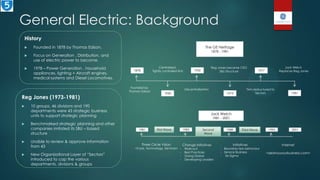
Reg Jones (1973-1981)
 10 groups, 46 divisions and 190
departments were 43 strategic business
units to support strategic planning
 Benchmarked strategic planning and other
companies imitated its SBU – based
structure
 Unable to review & approve information
from 43
 New Organizational Layer of “Sectors”
introduced to cap the various
departments, divisions & groups
The GE Heritage
1878 - 1981
1878
Founded by
Thomas Edison
1930
Centralized,
Tightly controlled firm 1950
Decentralization
1973
Reg Jones became CEO
SBU Structure 1977
Firm restructured to
Sectors 1981
Jack Welch
Replaces Reg Jones
Jack Welch
1981 - 2001
1981
Three Circle Vision
<Core, Technology, Services>
1983 1988 1995 2001First Wave Second
Wave
Third Wave
Change Initiatives
- Work-out
- Best Practices
- Going Global
- Developing Leaders
Initiatives
- Boundary less behaviour
- Service Business
- Six Sigma
Internet
<destroyyourbusiness.com>
History
 Founded in 1878 by Thomas Edison.
 Focus on Generation , Distribution, and
use of electric power to become.
 1978 – Power Generation , household
appliances, lighting + Aircraft engines,
medical systems and Diesel Locomotives.
Strategic Context & 1st Restructuring Wave
 Internal Issues
 Massive information
 Inefficient macro-business
 Bureaucracy
 External Environment
 Economic recession
 High interest rates
 Highest unemployment rate since the
depression
 Strong Dollar
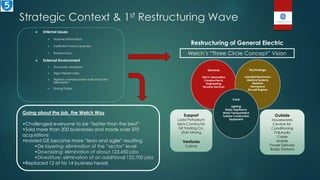
Restructuring of General Electric
Welch‟s “Three Circle Concept” Vision
Services
GECC Information
Construction &
Engineering
Nuclear Services
Technology
Industrial Electronics
Medical Systems
Material
Aerospace
Aircraft Engines
Core
Lighting
Major Appliance
Motor Transportation
Turbine Construction
Equipment
Support
Ladd Petroleum
Semi Conductor
GE Trading Co.
Utah Mining
Ventures
Calma
Outside
Housewares
Central Air-
Conditioning
TV&Audio
Cable
Mobile
Power Delivery
Radio Stations
Going about the job, the Welch Way
•Challenged everyone to be “better than the best”
•Sold more than 200 businesses and made over 370
acquisitions
•Insisted GE become more “lean and agile” resulting
•De layering: elimination of the “sector” level
•Downsizing: elimination of about 123,450 jobs
•Divestiture: elimination of an additional 122,700 jobs
•Replaced 12 of his 14 business heads
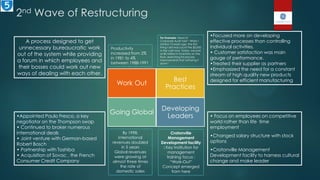
2nd Wave of Restructuring
Work Out
Best
Practices
Going Global
Developing
Leaders
A process designed to get
unnecessary bureaucratic work
out of the system while providing
a forum in which employees and
their bosses could work out new
ways of dealing with each other.
•Focused more on developing
effective processes than controlling
individual activities.
• Customer satisfaction was main
gauge of performance.
•Treated their supplier as partners
•Emphasized the need for a constant
stream of high quality new products
designed for efficient manufacturing
•Appointed Paulo Fresco, a key
negotiator on the Thompson swap
• Continued to broker numerous
international deals
• Joint venture with German-based
Robert Bosch
• Partnership with Toshiba
• Acquisition of Sovac , the French
Consumer Credit Company
• Focus on employees on competitive
world rather than life time
employment
•Changed salary structure with stock
options
•Crotonville Management
Development facility to harness cultural
change and make leader
Productivity
increased from 2%
in 1981 to 4%
between 1988-1991
For Example: Head of
Corporate Audit told “ When I
started 10 years ago, the first
thing I did was count the $5,000
in the cash box. Today, we look
at $5 million in inventory on the
floor, searching for process
improvements that will bring it
down”
By 1998,
international
revenues doubled
in 5 years
Global revenues
were growing at
almost three times
the rate of
domestic sales
Crotonville
Management
Development facility
: Key Institution for
management
training focus :
“Work-Out”
Concept emerged
from here
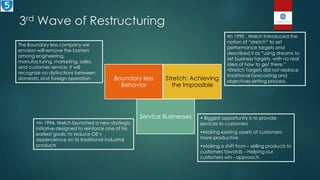
3rd Wave of Restructuring
Boundary less
Behavior
Stretch: Achieving
the Impossible
Service Businesses
The Boundary less company we
envision will remove the barriers
among engineering,
manufacturing, marketing, sales,
and customer service; it will
recognize no distinctions between
domestic and foreign operation
•In 1990 , Welch Introduced the
notion of “stretch” to set
performance targets and
described it as “using dreams to
set business targets, with no real
idea of how to get there.”
•Stretch Targets did not replace
traditional forecasting and
objectives-setting process.
•In 1994, Welch launched a new strategic
initiative designed to reinforce one of his
earliest goals: to reduce GE‟s
dependence on its traditional industrial
products
• Biggest opportunity is to provide
services to customers
•Making existing assets of customers
more productive
•Making a shift from – selling products to
customers towards – Helping our
customers win - approach
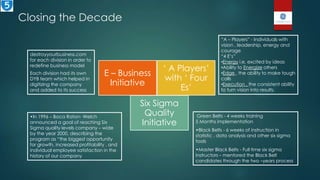
Closing the Decade
E – Business
Initiative
„ A Players‟
with „ Four
Es‟
Six Sigma
Quality
Initiative
destroyyourbusiness.com
for each division in order to
redefine business model
Each division had its own
DYB team which helped in
digitizing the company
and added to its success
“A – Players” - Individuals with
vision , leadership, energy and
courage
“4 E‟s”
•Energy i.e. excited by ideas
•Ability to Energize others
•Edge , the ability to make tough
calls
•Execution , the consistent ability
to turn vision into results.
•In 1996 – Boca Raton- Welch
announced a goal of reaching Six
Sigma quality levels company – wide
by the year 2000, describing the
program as “the biggest opportunity
for growth, increased profitability , and
individual employee satisfaction in the
history of our company
Green Belts - 4 weeks training
5 Months implementation
•Black Belts - 6 weeks of instruction in
statistic , data analysis and other six sigma
tools
•Master Black Belts - Full time six sigma
instructors – mentored the Black Belt
candidates through the two –years process
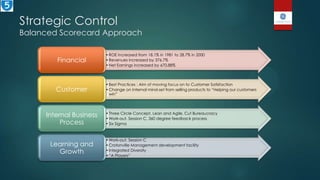
Strategic Control
Balanced Scorecard Approach
•ROE increased from 18.1% in 1981 to 28.7% in 2000
•Revenues increased by 376.7%
•Net Earnings increased by 670.88%
Financial
•Best Practices : Aim of moving focus on to Customer Satisfaction
•Change on Internal mind-set from selling products to “Helping our customers
win”
Customer
•Three Circle Concept, Lean and Agile, Cut Bureaucracy
•Work-out, Session C, 360 degree feedback process
•Six Sigma
Internal Business
Process
•Work-out, Session C
•Crotonville Management development facility
•Integrated Diversity
•“A Players”
Learning and
Growth
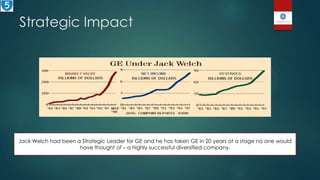
Strategic Impact
Jack Welch had been a Strategic Leader for GE and he has taken GE in 20 years at a stage no one would
have thought of – a highly successful diversified company.
Jack Welch
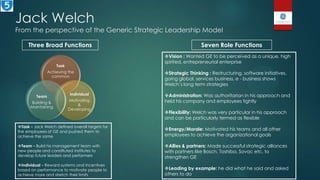
From the perspective of the Generic Strategic Leadership Model
Task
Achieving the
common
Individual
Motivating
&
Developing
Team
Building &
Maintaining
Three Broad Functions
Task – Jack Welch defined overall targets for
the employees of GE and pushed them to
achieve the same
Team – Build his management team with
new people and constituted institutes to
develop future leaders and performers
Individual – Reward systems and incentives
based on performance to motivate people to
achieve more and stretch their limits
Seven Role Functions
Vision : Wanted GE to be perceived as a unique, high
spirited, entrepreneurial enterprise
Strategic Thinking : Restructuring, software initiatives,
going global, services business, e - business shows
Welch‟s long term strategies
Administration: Was authoritarian in his approach and
held his company and employees tightly
Flexibility: Welch was very particular in his approach
and can be particularly termed as flexible
Energy/Morale: Motivated his teams and all other
employees to achieve the organizational goals
Allies & partners: Made successful strategic alliances
with partners like Bosch, Toshiba, Sovac etc. to
strengthen GE
Leading by example: he did what he said and asked
others to do
Jack Welch
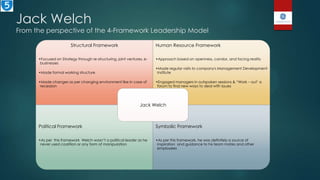
From the perspective of the 4-Framework Leadership Model
Structural Framework
•Focused on Strategy through re-structuring, joint ventures, e-
businesses
•Made formal working structure
•Made changes as per changing environment like in case of
recession
Human Resource Framework
•Approach based on openness, candor, and facing reality
•Made regular visits to company's Management Development
Institute
•Engaged managers in outspoken sessions & “Work – out‟ a
forum to find new ways to deal with issues
Political Framework
•As per this framework Welch wasn‟t a political leader as he
never used coalition or any form of manipulation
Symbolic Framework
•As per this framework, he was definitely a source of
inspiration and guidance to his team mates and other
employees
Jack Welch
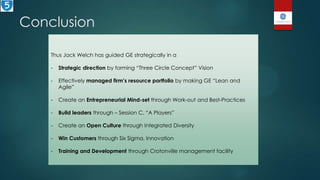
Conclusion
Thus Jack Welch has guided GE strategically in a
- Strategic direction by forming “Three Circle Concept” Vision
- Effectively managed firm’s resource portfolio by making GE “Lean and
Agile”
- Create an Entrepreneurial Mind-set through Work-out and Best-Practices
- Build leaders through – Session C, “A Players”
- Create an Open Culture through Integrated Diversity
- Win Customers through Six Sigma, Innovation
- Training and Development through Crotonville management facility
Thank You!

General Electric_Leadership

  • 1.
    Jack Welch‟s Leadership GROUP5, SECTION C, STRATEGIC MANAGEMENT-2 Anand Kumar 12P127 Ankush Singla 12P129 Bhoomi Ashwin 12P131 Aditya Chadha 12P132 Siddharth Bharadwaj 12P170 Soumyajit Sengupta 12P171 GE‟s Two Decades Transformation
  • 2.
    General Electric: Background RegJones (1973-1981)  10 groups, 46 divisions and 190 departments were 43 strategic business units to support strategic planning  Benchmarked strategic planning and other companies imitated its SBU – based structure  Unable to review & approve information from 43  New Organizational Layer of “Sectors” introduced to cap the various departments, divisions & groups The GE Heritage 1878 - 1981 1878 Founded by Thomas Edison 1930 Centralized, Tightly controlled firm 1950 Decentralization 1973 Reg Jones became CEO SBU Structure 1977 Firm restructured to Sectors 1981 Jack Welch Replaces Reg Jones Jack Welch 1981 - 2001 1981 Three Circle Vision <Core, Technology, Services> 1983 1988 1995 2001First Wave Second Wave Third Wave Change Initiatives - Work-out - Best Practices - Going Global - Developing Leaders Initiatives - Boundary less behaviour - Service Business - Six Sigma Internet <destroyyourbusiness.com> History  Founded in 1878 by Thomas Edison.  Focus on Generation , Distribution, and use of electric power to become.  1978 – Power Generation , household appliances, lighting + Aircraft engines, medical systems and Diesel Locomotives.
  • 3.
    Strategic Context &1st Restructuring Wave  Internal Issues  Massive information  Inefficient macro-business  Bureaucracy  External Environment  Economic recession  High interest rates  Highest unemployment rate since the depression  Strong Dollar Restructuring of General Electric Welch‟s “Three Circle Concept” Vision Services GECC Information Construction & Engineering Nuclear Services Technology Industrial Electronics Medical Systems Material Aerospace Aircraft Engines Core Lighting Major Appliance Motor Transportation Turbine Construction Equipment Support Ladd Petroleum Semi Conductor GE Trading Co. Utah Mining Ventures Calma Outside Housewares Central Air- Conditioning TV&Audio Cable Mobile Power Delivery Radio Stations Going about the job, the Welch Way •Challenged everyone to be “better than the best” •Sold more than 200 businesses and made over 370 acquisitions •Insisted GE become more “lean and agile” resulting •De layering: elimination of the “sector” level •Downsizing: elimination of about 123,450 jobs •Divestiture: elimination of an additional 122,700 jobs •Replaced 12 of his 14 business heads
  • 4.
    2nd Wave ofRestructuring Work Out Best Practices Going Global Developing Leaders A process designed to get unnecessary bureaucratic work out of the system while providing a forum in which employees and their bosses could work out new ways of dealing with each other. •Focused more on developing effective processes than controlling individual activities. • Customer satisfaction was main gauge of performance. •Treated their supplier as partners •Emphasized the need for a constant stream of high quality new products designed for efficient manufacturing •Appointed Paulo Fresco, a key negotiator on the Thompson swap • Continued to broker numerous international deals • Joint venture with German-based Robert Bosch • Partnership with Toshiba • Acquisition of Sovac , the French Consumer Credit Company • Focus on employees on competitive world rather than life time employment •Changed salary structure with stock options •Crotonville Management Development facility to harness cultural change and make leader Productivity increased from 2% in 1981 to 4% between 1988-1991 For Example: Head of Corporate Audit told “ When I started 10 years ago, the first thing I did was count the $5,000 in the cash box. Today, we look at $5 million in inventory on the floor, searching for process improvements that will bring it down” By 1998, international revenues doubled in 5 years Global revenues were growing at almost three times the rate of domestic sales Crotonville Management Development facility : Key Institution for management training focus : “Work-Out” Concept emerged from here
  • 5.
    3rd Wave ofRestructuring Boundary less Behavior Stretch: Achieving the Impossible Service Businesses The Boundary less company we envision will remove the barriers among engineering, manufacturing, marketing, sales, and customer service; it will recognize no distinctions between domestic and foreign operation •In 1990 , Welch Introduced the notion of “stretch” to set performance targets and described it as “using dreams to set business targets, with no real idea of how to get there.” •Stretch Targets did not replace traditional forecasting and objectives-setting process. •In 1994, Welch launched a new strategic initiative designed to reinforce one of his earliest goals: to reduce GE‟s dependence on its traditional industrial products • Biggest opportunity is to provide services to customers •Making existing assets of customers more productive •Making a shift from – selling products to customers towards – Helping our customers win - approach
  • 6.
    Closing the Decade E– Business Initiative „ A Players‟ with „ Four Es‟ Six Sigma Quality Initiative destroyyourbusiness.com for each division in order to redefine business model Each division had its own DYB team which helped in digitizing the company and added to its success “A – Players” - Individuals with vision , leadership, energy and courage “4 E‟s” •Energy i.e. excited by ideas •Ability to Energize others •Edge , the ability to make tough calls •Execution , the consistent ability to turn vision into results. •In 1996 – Boca Raton- Welch announced a goal of reaching Six Sigma quality levels company – wide by the year 2000, describing the program as “the biggest opportunity for growth, increased profitability , and individual employee satisfaction in the history of our company Green Belts - 4 weeks training 5 Months implementation •Black Belts - 6 weeks of instruction in statistic , data analysis and other six sigma tools •Master Black Belts - Full time six sigma instructors – mentored the Black Belt candidates through the two –years process
  • 7.
    Strategic Control Balanced ScorecardApproach •ROE increased from 18.1% in 1981 to 28.7% in 2000 •Revenues increased by 376.7% •Net Earnings increased by 670.88% Financial •Best Practices : Aim of moving focus on to Customer Satisfaction •Change on Internal mind-set from selling products to “Helping our customers win” Customer •Three Circle Concept, Lean and Agile, Cut Bureaucracy •Work-out, Session C, 360 degree feedback process •Six Sigma Internal Business Process •Work-out, Session C •Crotonville Management development facility •Integrated Diversity •“A Players” Learning and Growth
  • 8.
    Strategic Impact Jack Welchhad been a Strategic Leader for GE and he has taken GE in 20 years at a stage no one would have thought of – a highly successful diversified company.
  • 9.
    Jack Welch From theperspective of the Generic Strategic Leadership Model Task Achieving the common Individual Motivating & Developing Team Building & Maintaining Three Broad Functions Task – Jack Welch defined overall targets for the employees of GE and pushed them to achieve the same Team – Build his management team with new people and constituted institutes to develop future leaders and performers Individual – Reward systems and incentives based on performance to motivate people to achieve more and stretch their limits Seven Role Functions Vision : Wanted GE to be perceived as a unique, high spirited, entrepreneurial enterprise Strategic Thinking : Restructuring, software initiatives, going global, services business, e - business shows Welch‟s long term strategies Administration: Was authoritarian in his approach and held his company and employees tightly Flexibility: Welch was very particular in his approach and can be particularly termed as flexible Energy/Morale: Motivated his teams and all other employees to achieve the organizational goals Allies & partners: Made successful strategic alliances with partners like Bosch, Toshiba, Sovac etc. to strengthen GE Leading by example: he did what he said and asked others to do
  • 10.
    Jack Welch From theperspective of the 4-Framework Leadership Model Structural Framework •Focused on Strategy through re-structuring, joint ventures, e- businesses •Made formal working structure •Made changes as per changing environment like in case of recession Human Resource Framework •Approach based on openness, candor, and facing reality •Made regular visits to company's Management Development Institute •Engaged managers in outspoken sessions & “Work – out‟ a forum to find new ways to deal with issues Political Framework •As per this framework Welch wasn‟t a political leader as he never used coalition or any form of manipulation Symbolic Framework •As per this framework, he was definitely a source of inspiration and guidance to his team mates and other employees Jack Welch
  • 11.
    Conclusion Thus Jack Welchhas guided GE strategically in a - Strategic direction by forming “Three Circle Concept” Vision - Effectively managed firm’s resource portfolio by making GE “Lean and Agile” - Create an Entrepreneurial Mind-set through Work-out and Best-Practices - Build leaders through – Session C, “A Players” - Create an Open Culture through Integrated Diversity - Win Customers through Six Sigma, Innovation - Training and Development through Crotonville management facility
  • 12.