Severn Estuary SMP2 – Appendix I – Part A – Strategic Environmental Assessment
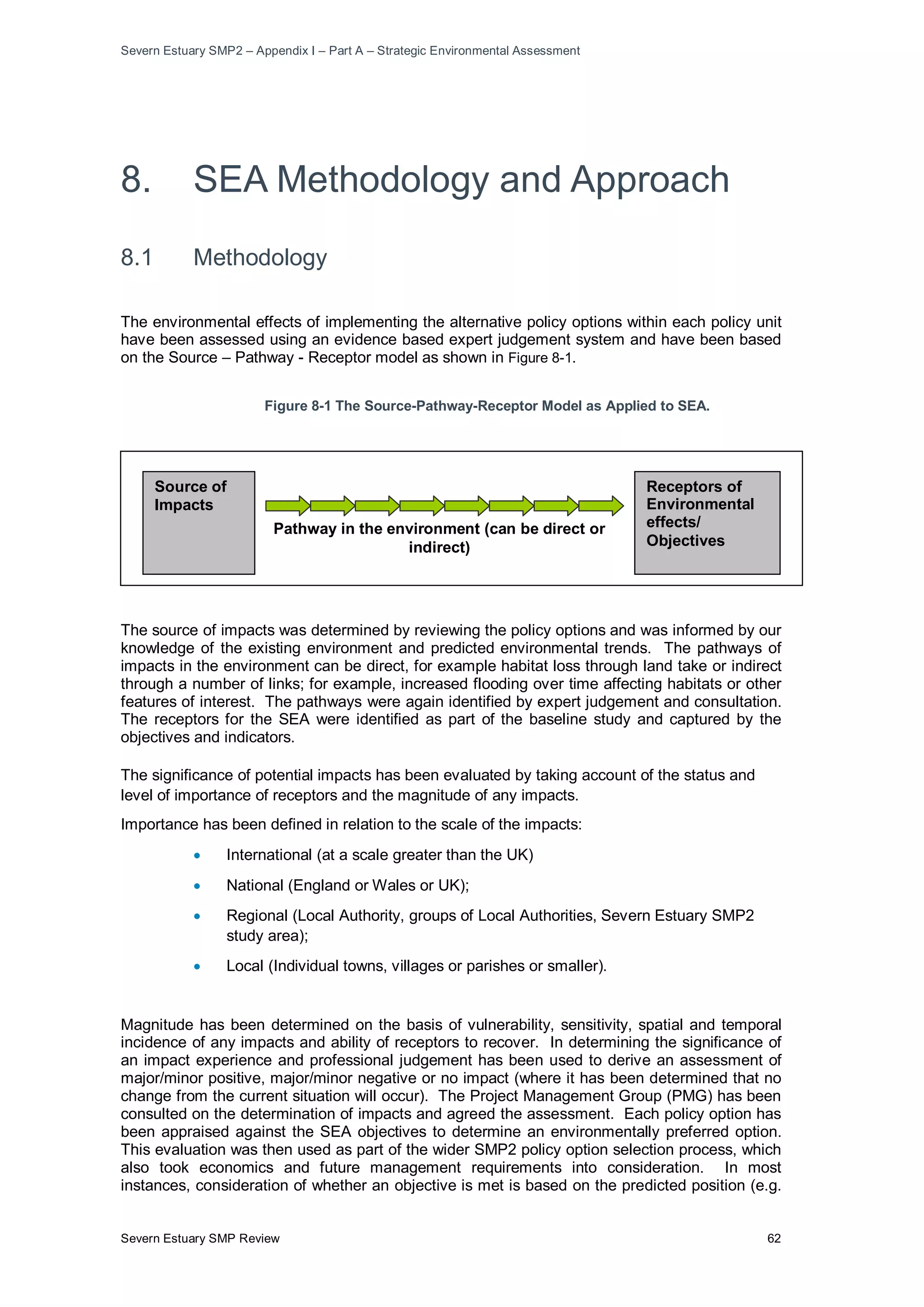
Severn Estuary SMP Review i
Appendix I: Part A - Strategic
Environmental Assessment
Report
Severn Estuary SMP2 – Appendix I – Part A – Strategic Environmental Assessment
Severn Estuary SMP Review ii
Notice
This report was produced by Atkins Ltd for the Severn Estuary Coastal Group for the specific purpose of the
Severn Estuary SMP2.
This report may not be used by any person other than the Severn Estuary Coastal Group without the Severn
Estuary Coastal Group’s express permission. In any event, Atkins accepts no liability for any costs, liabilities
or losses arising as a result of the use of or reliance upon the contents of this report by any person other
than the Severn Estuary Coastal Group.
Document History
JOB NUMBER: 5078599 DOCUMENT REF: 5078599/SMP2 Draft SEA
Report Draft 20-10-09.doc
01 For Review JS KRH KRH JMC 3/10/09
02 For Consultation JS KRH KRH JMC 23/10/09
03 For Consultation JS KRH KRH JMC 11/11/09
04 Final Draft for QRG Review JS KRH KRH JMC June
2010
04 Final Report for Publication JS KRH KRH JMC Sept
2010
Revision Purpose Description Originated Checked Reviewed Authorised Date
Severn Estuary SMP2 – Appendix I – Part A – Strategic Environmental Assessment
Severn Estuary SMP Review iii
Contents
Section Page
Non-Technical Summary vi
1. Introduction and Background 1
1.1 Overview 1
1.2 Defining and Managing Flood and Erosion Risk 1
1.3 Predicted Climate Change and Impacts 2
2. Scope of Study and SEA Process 4
2.1 The Need for Strategic Environmental Assessment 4
2.2 The Severn Estuary Shoreline Management Plan Review (SMP2) 5
2.3 The SEA Process 10
2.4 Synergies with Other Processes 11
3. Scope of the SEA 13
4. Consultation 23
4.1 Stakeholder Involvement 23
4.2 Consultation on the SEA 24
5. Review of Relevant Plans and Strategies 26
6. Deriving Objective Indicators and Targets 28
7. Baseline Data 33
7.1 Introduction 33
7.2 Population and Human Health 33
7.3 Biodiversity, Flora and Fauna 39
7.4 Fisheries 44
7.5 Soil Geology and Geomorphology 46
7.6 Land Use and Land Management 50
7.7 Water 52
7.8 Air and Climate 54
7.9 The Historic Environment (Cultural Heritage) 55
7.10 Landscape and Visual Amenity 57
7.11 Contaminated Land 61
7.12 Data Gaps and Uncertainties 61
8. SEA Methodology and Approach 62
8.1 Methodology 62
8.2 Assumptions 63
8.3 Strategic Options 65
9. Environmental Effects of Alternatives and the Preferred Strategy 68
9.1 Introduction 68
9.2 Selection of the Preferred SMP2 Policy Options 68
9.3 Option Selection and Impacts of the Preferred Strategy 70
9.4 Assessment of Cumulative Effects and Mitigation 86
10. Implementation and Monitoring Plan 99
Severn Estuary SMP2 – Appendix I – Part A – Strategic Environmental Assessment
Severn Estuary SMP Review iv
10.1 Human Environment: Access and Recreation 100
10.2 Biodiversity, Flora and Fauna 100
10.3 Historic Environment (Cultural Heritage) 101
10.4 Morphology 101
10.5 The Water Environment 102
11. Conclusions 103
List of Tables
Table 3-1 Summary of Issues Scoped into and out of the Severn Estuary SMP2 Strategic
Environmental Assessment 14
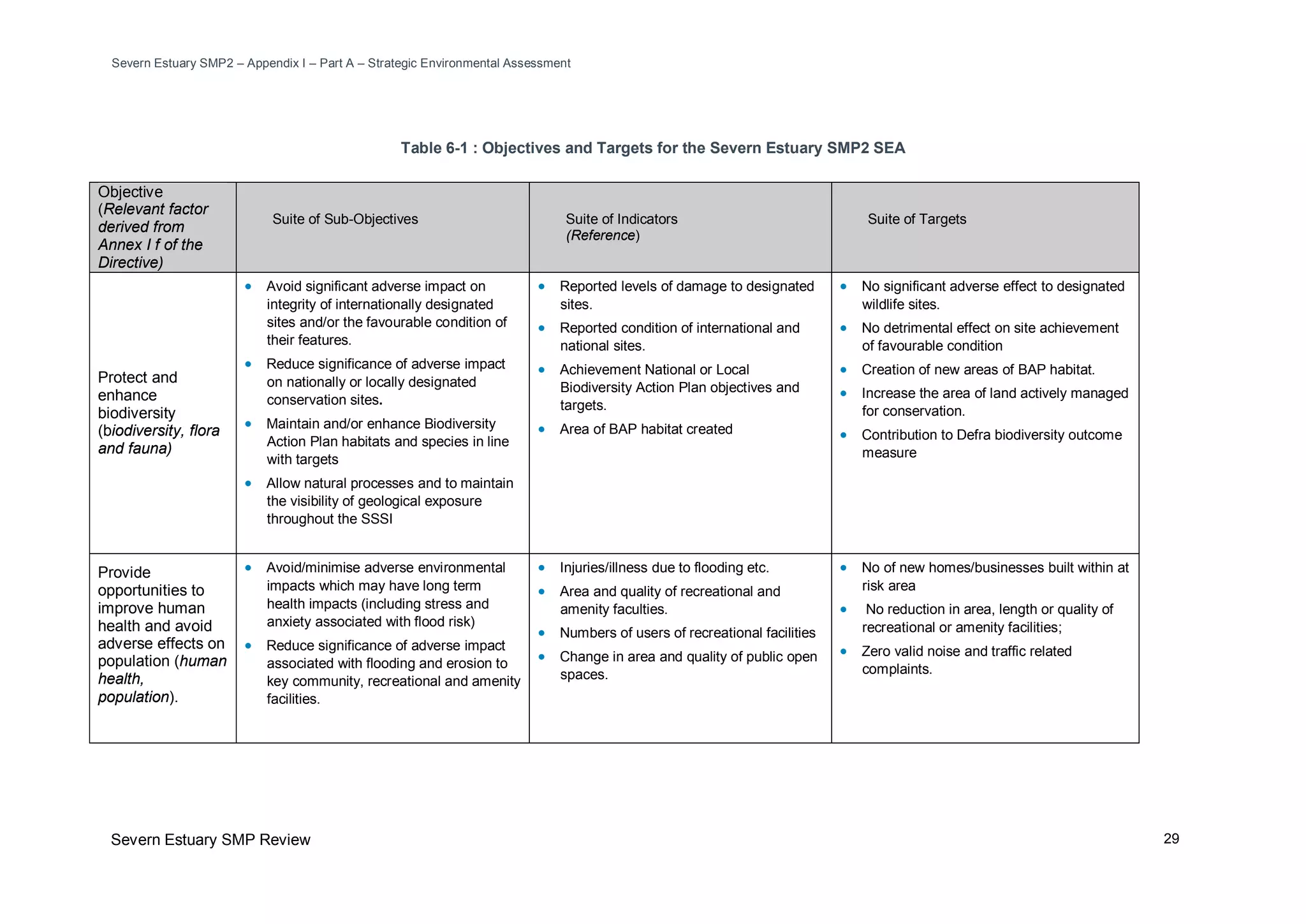
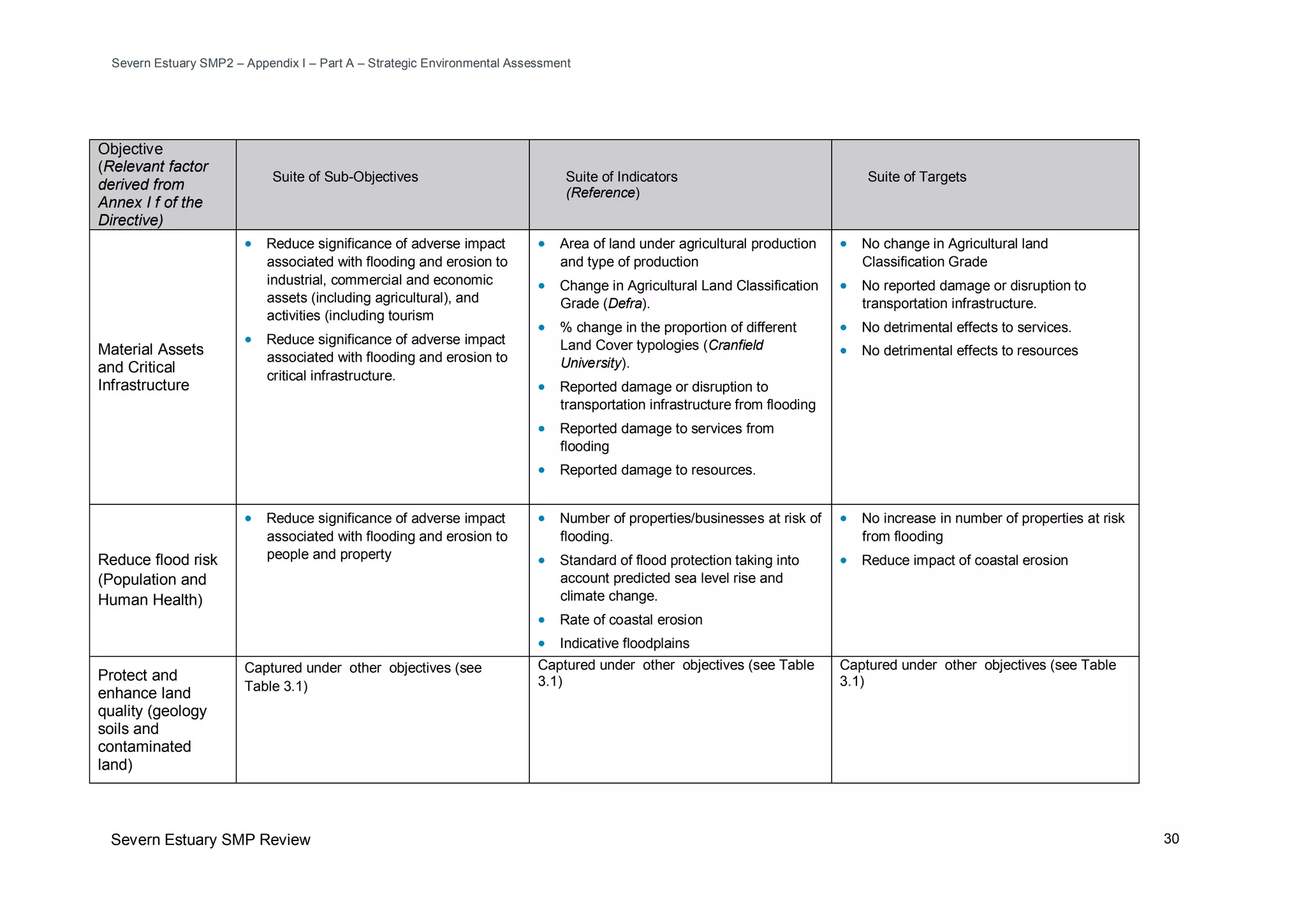
Table 6-1 : Objectives and Targets for the Severn Estuary SMP2 SEA 29
Table 9-1 SMP2 Preferred Policy Options 69
Table 9-2 Aggregated Impact Significance for the Preferred SMP2 Policies 97
List of Figures
Figure 1-1: Flood Risk and Erosion Management Strategic Planning Hierarchy 1
Figure 1-2 Coastal Squeeze resulting from Sea Level Rise 3
Figure 2-1: Application of Strategic Environmental Assessment (Environment Agency Guidance
Document, 2004) 4
Figure 2-2 – Area covered by the Shoreline Management Plan Review 7
Figure 2-3 – Key Locations Around the Study Area 7
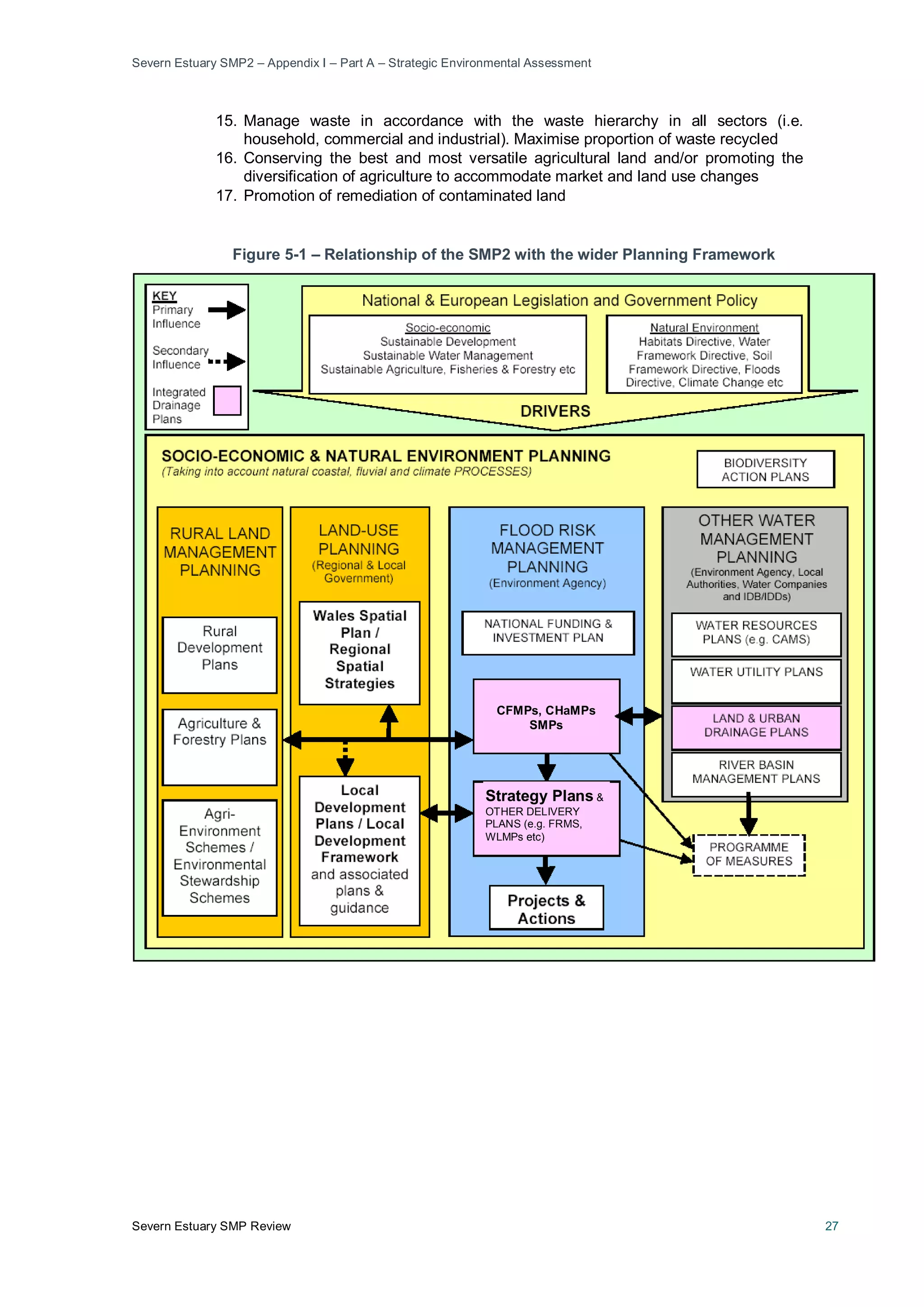
Figure 5-1 – Relationship of the SMP2 with the wider Planning Framework 27
Figure 8-1 The Source-Pathway-Receptor Model as Applied to SEA. 62
Annexes
Annex A – Policy and Plan Review
Annex B – Assessment of Alternative Policy Options
Annex C – Maps Showing Key Features of Policy Areas
Severn Estuary SMP2 – Appendix I – Part A – Strategic Environmental Assessment
Severn Estuary SMP Review v
This Appendix is divided into two parts which can be considered as separate reports:
Part A – Strategic Environmental Assessment (SEA)
Strategic Environmental Assessment (SEA) is the systematic appraisal of the possible effects of
decisions taken at a high level (such as those in strategies, policies and plans) on the built,
natural and historic environments.
The EU SEA Directive1
Although the SMP2 is not a statutory plan, it forms an integral part of decision making in relation
to coastal areas. Defra and WAG, therefore, recommend that an SEA is carried out.
sets out the legal requirements for this appraisal in EU countries. The
SEA Directive is transposed into law in England and Wales by the Environmental Assessment of
Plans and Programmes Regulations 2004 (SI 1633) and the Environmental Assessment of
Plans and Programmes (Wales) Regulations 2004 (SI 1656).
Whilst the SMP2 is being developed, the Environment Agency is also developing a Severn
Estuary Flood Risk Management Strategy (SEFRMS). This takes a more detailed look at the
future management of flood defence structures and how some of the flood risk policies proposed
in the SMP2 will be implemented. The areas and issues being considered for both the SMP2
and the SEFRMS are very similar and an SEA is required for both projects. To reduce confusion
between the two projects, aid communication and information sharing, and reduce costs to both
processes, some elements of the SEA process have been combined. More information on the
SEFRMS can be found in SMP2 Main Report Part A Section 1.5
Part B – Habitats Regulations Assessment (HRA)
The EU Habitats (92/43/EEC) and Birds (79/409/EEC) Directives aim to protect European birds,
other plant and animal species and the habitats that support them. In the UK, the Directives are
implemented through the Conservation of Habitats and Species Regulations 2010 as amended.
These are known as the Habitats Regulations.
The legislation requires ‘competent authorities’ to undertake an ‘appropriate assessment’ of
plans, projects and strategies that may have a significant effect on the site, if those plans,
projects or strategies are not directly concerned with the management of the protected sites
themselves. The process that includes the ‘appropriate assessment’ is known as a Habitats
Regulations Assessment (HRA).
In the UK, it is also policy to carry out a similar assessment for sites designated under the
Ramsar Convention (known as Ramsar sites).
The majority of the SMP2 area covers the Severn Estuary SAC, SPA and Ramsar site. Other
European protected sites are also wholly or partly within the area of the SMP2 or located nearby
and could be affected by the SMP2. The ‘competent authorities’ therefore need to carry out an
HRA to ensure that damage to the sites does not take place when the policies in the SMP2 are
followed. If the plan or project cannot be shown to have no adverse effect on the integrity of the
site(s), the competent authority is required to demonstrate that there are no alternative solutions
, and then seek a decision from the Secretary of State and/or WAG, that the plan should be
approved on the grounds of overriding public interest, subject to the provision of an appropriate
level compensation to offset the adverse impacts on the site(s).
For this SMP2, the competent authorities are WAG and Defra. In England, Defra has delegated
this role to the Environment Agency (EA).
1
Directive 2001/42/EC on the assessment of the effects of certain plans and programmes on the
environment.
Severn Estuary SMP2 – Appendix I – Part A – Strategic Environmental Assessment
Severn Estuary SMP Review vi
Non-Technical Summary
The Need for Strategic Environmental Assessment
Strategic Environmental Assessment (SEA) is the systematic appraisal of the potential
environmental consequences of high level decision-making, such as policies, plans, strategies
and programmes, before they are approved. It ensures that the implications of plans and
programmes are fully and transparently considered before final decisions are taken.
The requirement to undertake SEA in the European Union (EU) came about when the EC
Directive (2001/42/EC) ‘on the assessment of the effects of certain plans and programmes on
the environment’, known as the ‘SEA Directive’, came into force in 2004. The Directive is
implemented in England and Wales through the Environmental Assessment of Plans and
Programmes Regulations (SI 1633 2004) and the Environmental Assessment of Plans and
Programmes (Wales) Regulations (SI 1656 2004). The Directive and associated regulations
make SEA a mandatory requirement for certain plans and programmes which are likely to have
significant effects on the environment.
Defra guidance states that documented plans for medium to long-term river or coastal
management, such as Shoreline Management Plans (SMPs) and Flood Risk Management
Strategies (FRMSs), are not required by administrative provisions, as defined by ODPM (Office
for the Deputy Prime Minister). There is, therefore, no legal requirement to apply the Directive to
these plans. However, SMPs, Catchment Flood Management Plans (CFMPs) and Strategies
clearly help to set the framework for future planning, have significant environmental implications,
and require extensive consultation. Defra recommend therefore, that adopting an SEA approach
is appropriate and they strongly encourage the operating authorities to undertake SEA for these
plans. For these reasons and in accordance with good practice, an SEA of the SMP2 is being
undertaken.
The Severn Estuary Shoreline Management Plan Review (SMP2)
Shoreline Management Plans (SMPs) are non-statutory plans produced by Coastal Groups (in
this case the Severn Estuary Coastal Group) which are made up of maritime Local Authorities
and other bodies with coastal defence responsibilities or interests. Shoreline Management Plans
set high level policy approaches for the future management of flood and erosion risk along
coastline. SMPs allow the development of strategy plans to be prioritised.
SMPs typically cover large areas such as several counties or catchments and define the broad
policy for management of the plan area. They typically look at the predicted evolution of the
coast under three timeframes or epochs: 0-20 years, 20-50 years and 50-100 years. The SMP2
has divided the Severn Estuary study area into policy units (see Annex C), with one of the four
policy options being applied to each unit:
• Hold the existing defence line;
• Advance the existing defence line;
• Managed realignment - identifying a new shape for the shoreline and actively
managing change;
• No active intervention - a decision not to invest in providing or maintaining
defences.
Severn Estuary SMP2 – Appendix I – Part A – Strategic Environmental Assessment
Severn Estuary SMP Review vii
The Severn Estuary (Môr Hafren in Welsh) is located on the west coast of Britain, bordering both
England and Wales. It is renowned for having the second highest tidal range in the world. The
Severn is typical of estuaries in England and Wales, in that it has provided a focus for human
activity, a location for settlement, a source of food, water and raw materials and a gateway for
trading and exploration. The Estuary and its coastal hinterland support the cities of Cardiff,
Bristol, Newport and Gloucester. Major industries are located around the Estuary’s shores,
including modern port installations, chemical processing companies and power stations.
The Severn Estuary and its surrounding area are afforded a very high level of protection under
European wildlife law. Large areas of it are designated as a Special Protection Area (SPA) under
the Birds Directive and as a Special Conservation Area (SAC) under the Habitats Directive for
their intertidal and sub tidal habitats and migratory fish species. The area surrounding the
estuary is also designated as a wetland of international importance under the Ramsar
convention and as a Site of Special Scientific Interest. In addition, several freshwater SSSIs
(e.g. the Gwent Levels SSSI complex) lie behind the existing coastal defences.
The SMP2 study area stretches from Anchor Head (Birnbeck Island) on the English side of the
Estuary (a move northeast from the first SMP) to Lavernock Point on the Welsh side. The
upstream boundary is at Haw Bridge approximately 5km upstream of Gloucester.
The SEA Process
The SEA provides a systematic appraisal of the potential environmental consequences of high-
level decision-making; by addressing strategic level issues, the SEA process shapes the
selection of the preferred option. The SEA is therefore intended to ensure that consideration of
the socioeconomic and environmental issues relating to the coast have been central in the
development and evaluation of policy. Within the SEA process, the term ‘environment’ has
been used to cover the following receptors (as defined in Environmental Assessment of Plans
and Programmes Regulations, SI 1633 2004):
• Population & communities (including human health, critical infrastructure etc);
• Cultural heritage, including architectural and archaeological heritage;
• Material assets;
• Biodiversity, fauna and flora;
• Soil;
• Water;
• Air;
• Climatic factors; and
• Landscape.
The Assessment
An environmental assessment of the suite of four alternative SMP2 policies has been
undertaken at the strategic level and integrated into the SMP2 policy option selection process.
The SEA process has developed two key outputs: a Scoping report and an Environmental
report. The Scoping report established an environmental baseline for the Severn Estuary and
through doing so developed a series of SEA objectives, by which the SMP policies could be
assessed. The Scoping report underwent a four week consultation period in early 2009.
Following the consultation period and the provision of feedback by the statutory consultees and
others, the environmental assessment of preferred SMP2 policies was undertaken using the
SEA objectives agreed through the consultation period; the assessment fed back into the option
Severn Estuary SMP2 – Appendix I – Part A – Strategic Environmental Assessment
Severn Estuary SMP Review viii
selection process and a more detailed assessment of the preferred SMP2 polices was
undertaken. This report is the summation of that process and constitutes the Environmental
Report.
The methodology used to identify and predict the significant likely environmental effects related
to implementing the Severn Estuary SMP2 involved the use of an evidence-based, expert
judgement system based on the widely accepted Source-Pathway-Receptor model. The
appraisal largely took the form of a qualitative assessment based on professional judgement and
supported by peer reviewed literature, with the outcomes being scored in five categories
between major positive and major negative.
Key Features of the Estuary
Population and Human Health
• The tidal floodplain throughout the estuary is under pressure from development.
• Key development proposals in or adjacent to the study area include:
- the new M4: 24 miles of three lane motorway between Junction 23a
(Magor)and Junction 29 (Castleton);
- Severn Tidal Power Generation;
- development of wind farms;
- the regeneration of ports and waterfronts e.g. Portishead, Watchet and
Weston;
- Bristol Port;
- development of a new gas fired power station at Uskmouth and construction
of a 6km pipeline between Uskmouth and Marshfield;
- increased access to the coast and development of coastal footpaths in
England and Wales;
- potential development of new nuclear power; potential sites for new nuclear
power plants along the estuary include Oldbury and Hinkley.
• Significant conurbations within the SMP2 study area with populations of more
than 10,000 include Penarth, Cardiff, St Mellons, Newport, Caldicot/PortSkewett,
Lydney/Allaston/ Chepstow, Gloucester, Quedgely, Bristol, Portishead, Clevedon
and Yatton/Congresbury.
• Areas within the study area with high levels of deprivation include Gloucester,
Weston-Super-Mare, Burnham, Newport and Cardiff.
• Material assets including : M48, M4 and M5, two Severn road crossings, Severn
rail tunnel, several strategic rail routes including South Wales to London main
line and Chepstow to Gloucester, numerous sewage treatment works and
pumping stations, several power stations (including Avonmouth, Berkely, Oldbury
and Uskmouth).
• Numerous formal and informal tourism and recreation opportunities around the
estuary.
Severn Estuary SMP2 – Appendix I – Part A – Strategic Environmental Assessment
Severn Estuary SMP Review ix
Biodiversity, Flora and Fauna
• The study area supports a variety of habitats and a diverse flora and fauna, with
protected species of national and international importance present. There are
Seven Natura 2000 sites, over 50 SSSIs and 4 NNRs within the study area.
• Habitats around the estuary have been lost in the past due to increased
urbanisation, draining of land and intensification of agriculture. Many of the
Biodiversity Action Plans covering the study area highlight the importance of
reversing decline in habitats, particularly for wetlands.
Fisheries
• In addition to more common species the River Severn also supports: salmon, eel,
allis and twaite shad, river, brook and sea lamprey.
• Commercial salmon fishing on the estuary has declined in productivity and
importance; There is very little shell fishing on the Estuary, however commercial
fishing for white, sea fish does take place.
Soil Geology and Geomorphology
• Soil type and geology vary across the estuary; the shape (cross-section and plan
form) of the Severn Estuary is determined by the underlying geology.
• Studies undertaken for the Severn Coastal Habitat Management Plan (ABPmer,
2006) suggest that the main sediment source for the Severn Estuary is from the
river systems including the Wye, Avon, Usk and Severn.
• Future short term predictions (i.e. up to 2028) for morphological evolution
indicate some areas of the Estuary will experience marginal erosion (a loss of
saltmarsh of 10-30%), although there is local evidence of intermittent accretion;
however in other areas the short term trend is for both marginal erosion and
accretion (±20% variation in saltmarsh coverage).
• Man has influenced the geomorphology of the rivers within the Severn Basin in a
number of ways including:
- construction of structures that alter flow and deposition of sediment e.g.
Barrages;
- change of land use along the edge of the estuary;
- draining land that would otherwise have flooded e.g. the Gwent and
Somerset Levels;
- construction of flood defences or hard bank engineering which reduces
natural interaction with the floodplain;
- navigational or maintenance dredging is undertaken around ports e.g. Bristol,
Cardiff, Newport and Sharpness;
- dredging for mineral and aggregate in the wider estuary.
Severn Estuary SMP2 – Appendix I – Part A – Strategic Environmental Assessment
Severn Estuary SMP Review x
Land Use and Land Management
• Most of the study area is rural with agriculture being the major land use. Pasture
still dominates, but its extent has reduced in recent years due to increasing
conversion to arable farming.
• There are significant areas of residential, commercial and industrial development
at Avonmouth, Weston-Super-Mare, Gloucester, Lydney, Clevedon, Cardiff,
Newport and Chepstow.
• UK agriculture has been subject to some significant changes in the past five
years.
- Common Agricultural Policy (CAP) reform has resulted in some areas of land
being removed from agricultural production and the reallocation of grazing
land to arable use.
- changes in wheat prices have influenced farmers cropping choice and
amount of land in production (agricultural land prices have also increased);
- cultivation of crops for biofuels;
- future cultivation of genetically modified (GM) crops and
- changes in set-aside legislation.
Water
• Inputs to the Estuary that affect water quality include sewage effluents,
abandoned mines, diffuse runoff from agricultural and forestry activities, industrial
effluents and marine vessel discharges.
• Current and emerging legislation and policy drivers (such as the water
Framework Directive and Catchment Sensitive Farming (CSF) Initiatives are
likely to result in further improvements in water quality over the next ten years
and beyond
• Issues potentially affecting groundwater quality within the study area include:
- Increased tidal influence within coastal areas could result in saline intrusion
into freshwater bodies;
- increased levels of nitrate and phosphates in agricultural areas;
- contamination from industrial land use or landfill.
• In addition to the main rivers within the study area, there are numerous drainage
ditches (also known as reens or rhynes) bisecting the low lying land adjacent to
the estuary. The smaller reens and watercourses on the levels are maintained by
the relevant Internal Drainage Board;
Air and Climate
• Climate change is likely to increase tidal flood risk in the Severn Estuary. Flood
risk is exacerbated in low lying areas where increases sea levels can inhibit land
drainage.
Severn Estuary SMP2 – Appendix I – Part A – Strategic Environmental Assessment
Severn Estuary SMP Review xi
The Historic Environment (Cultural Heritage)
• The Severn Estuary is a phenomenally rich and varied archaeological landscape.
People have been living in this area since before the Severn Estuary was formed
in the Mesolithic, some 8,000 years ago.
• There are approximately 107 Scheduled Monuments within the Study Area.
These include the most prominent, best conserved and significant monuments
and features. However, they represent only a small proportion of the entire
archaeological record of the Severn Estuary.
• The total number of Listed Buildings with the Study Area runs into the thousands.
The greatest concentrations of Listed Buildings are those within the larger towns
and villages found within the study area: Gloucester, Berkeley, Thornbury,
Clevedon and Weston-super-Mare on the English side, and Newport, Cardiff Bay
and Penarth on the Welsh. In addition, the historic centres of many of the older
settlements within the study area are designated as Conservation Areas.
• There are 10 Registered Parks and Gardens within the Study Area and the
Gwent Levels are designated as a Landscape of Outstanding Historic Interest.
Landscape and Visual Amenity
• The study area is predominantly a riverside landscape with associated low lying
valleys; the lower sections for the study are have a distinctly estuarine landscape
with open expanses of salt marsh and mudflats; the area as a whole is further
characterised by expansive floodplains, open farmland and prominent views of
surrounding hills at the edges of the study area.
• The Wye Valley AONB extends from Mordiford (approx 4km south east of
Hereford) to Chepstow and the Gwent Levels are identified as a Landscape of
Outstanding Historic Interest.
Contaminated Land
• Land that is contaminated includes any land where intense industrial activity such
as chemical manufacturing, metal refining and finishing, steel production, old
landfill sites, oil refining, oil storage and gas production has occurred. There are
many of these sites around the Estuary.
Environmental Effects of the Preferred Strategy
An environmental assessment of the suite of four alternative SMP2 policies has been
undertaken at the strategic level (and detailed in Annex C). This assessment was then
integrated into the SMP2 policy option selection process, alongside economic and technical
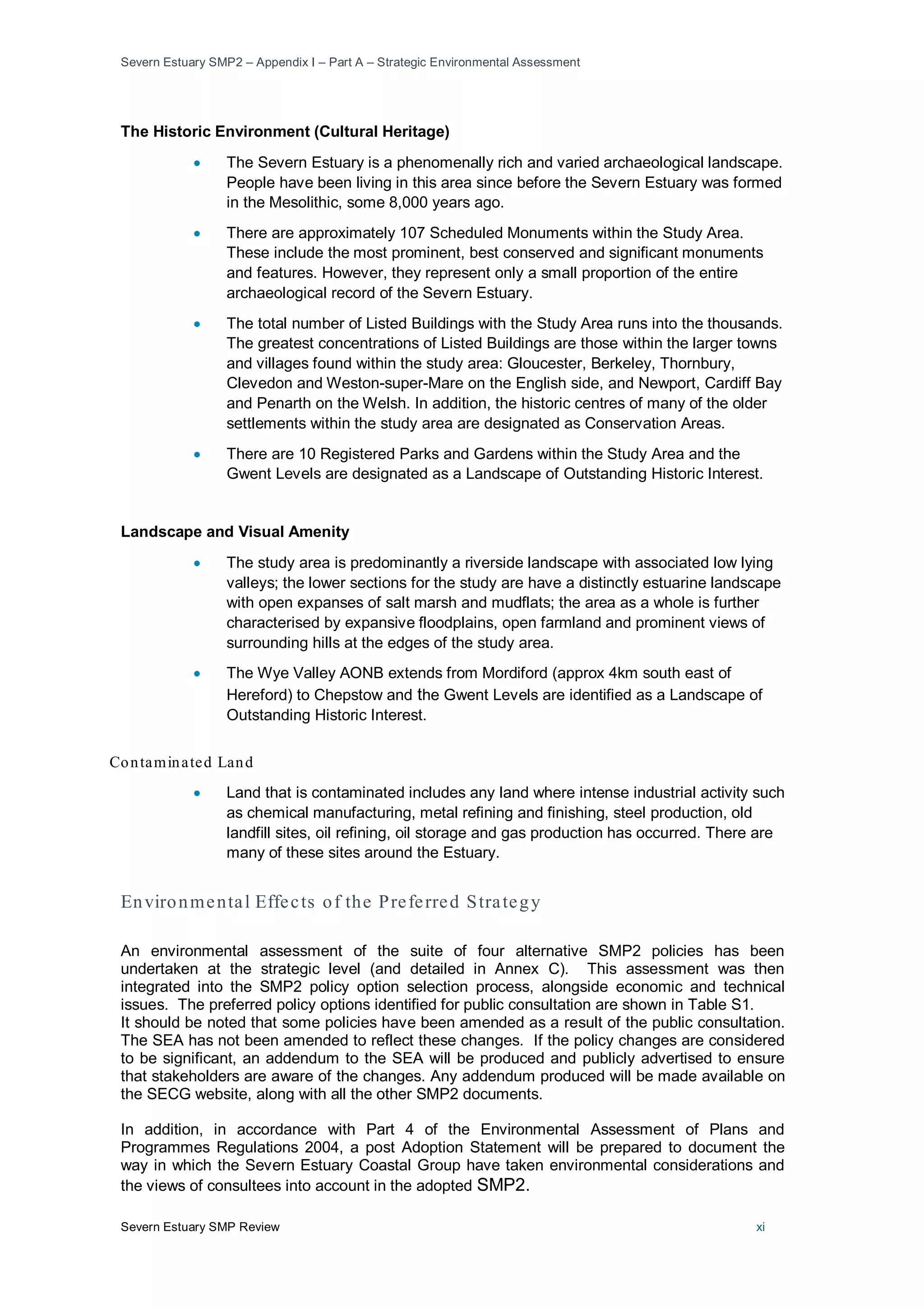
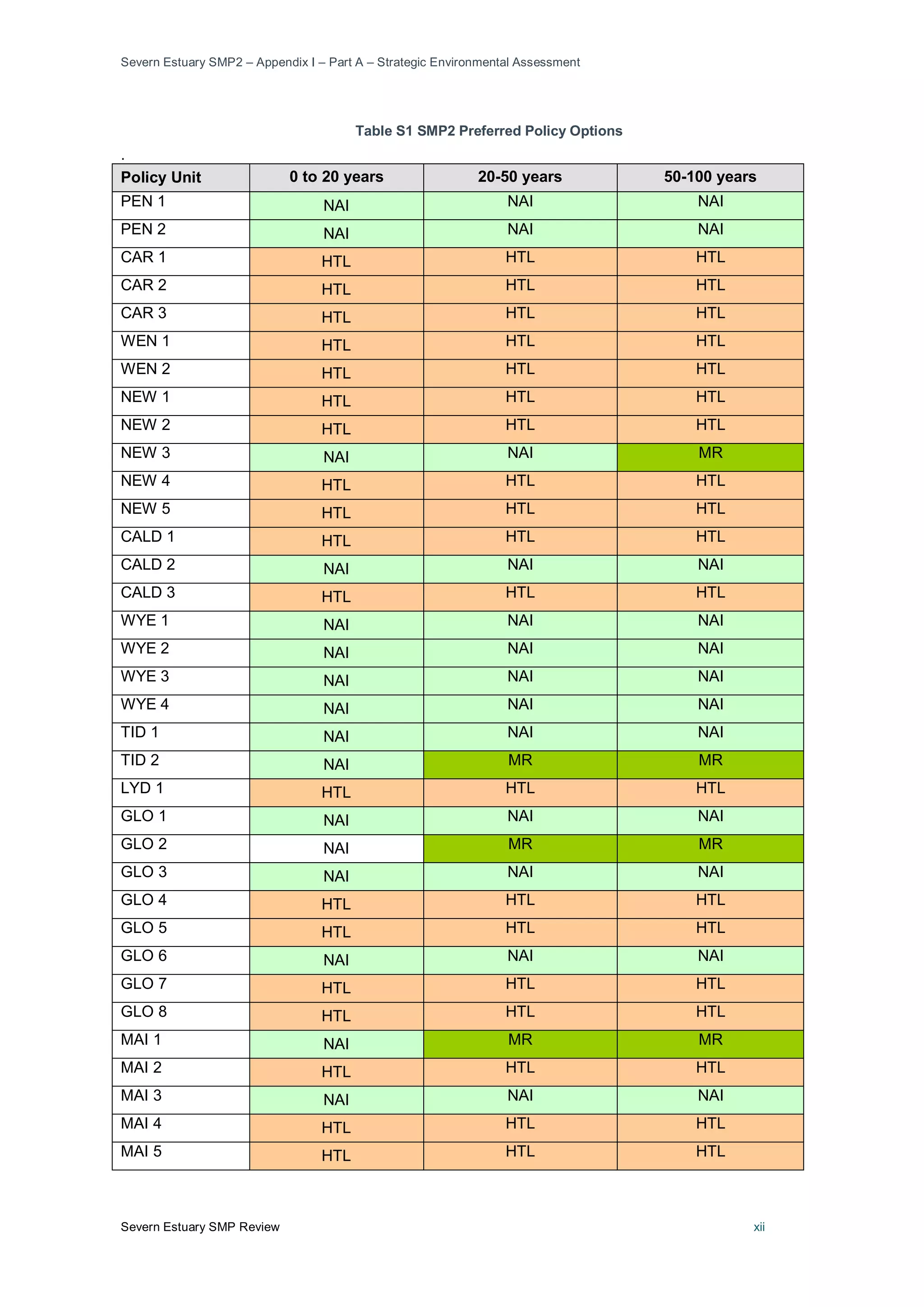
issues. The preferred policy options identified for public consultation are shown in Table S1.
It should be noted that some policies have been amended as a result of the public consultation.
The SEA has not been amended to reflect these changes. If the policy changes are considered
to be significant, an addendum to the SEA will be produced and publicly advertised to ensure
that stakeholders are aware of the changes. Any addendum produced will be made available on
the SECG website, along with all the other SMP2 documents.
In addition, in accordance with Part 4 of the Environmental Assessment of Plans and
Programmes Regulations 2004, a post Adoption Statement will be prepared to document the
way in which the Severn Estuary Coastal Group have taken environmental considerations and
the views of consultees into account in the adopted SMP2.
Severn Estuary SMP2 – Appendix I – Part A – Strategic Environmental Assessment
Severn Estuary SMP Review xii
Table S1 SMP2 Preferred Policy Options
.
Policy Unit 0 to 20 years 20-50 years 50-100 years
PEN 1 NAI NAI NAI
PEN 2 NAI NAI NAI
CAR 1 HTL HTL HTL
CAR 2 HTL HTL HTL
CAR 3 HTL HTL HTL
WEN 1 HTL HTL HTL
WEN 2 HTL HTL HTL
NEW 1 HTL HTL HTL
NEW 2 HTL HTL HTL
NEW 3 NAI NAI MR
NEW 4 HTL HTL HTL
NEW 5 HTL HTL HTL
CALD 1 HTL HTL HTL
CALD 2 NAI NAI NAI
CALD 3 HTL HTL HTL
WYE 1 NAI NAI NAI
WYE 2 NAI NAI NAI
WYE 3 NAI NAI NAI
WYE 4 NAI NAI NAI
TID 1 NAI NAI NAI
TID 2 NAI MR MR
LYD 1 HTL HTL HTL
GLO 1 NAI NAI NAI
GLO 2 NAI MR MR
GLO 3 NAI NAI NAI
GLO 4 HTL HTL HTL
GLO 5 HTL HTL HTL
GLO 6 NAI NAI NAI
GLO 7 HTL HTL HTL
GLO 8 HTL HTL HTL
MAI 1 NAI MR MR
MAI 2 HTL HTL HTL
MAI 3 NAI NAI NAI
MAI 4 HTL HTL HTL
MAI 5 HTL HTL HTL
Severn Estuary SMP2 – Appendix I – Part A – Strategic Environmental Assessment
Severn Estuary SMP Review xiii
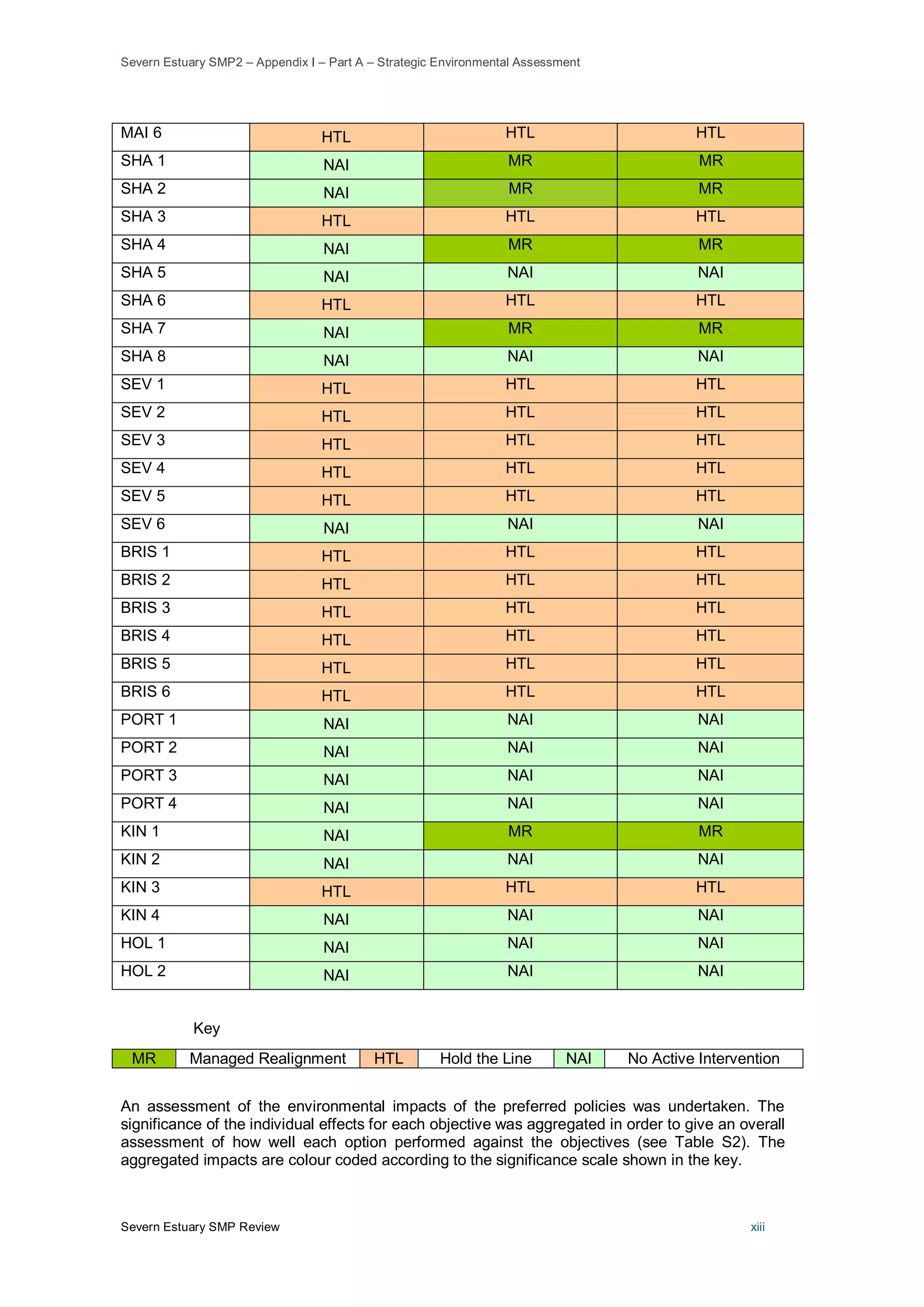
MAI 6 HTL HTL HTL
SHA 1 NAI MR MR
SHA 2 NAI MR MR
SHA 3 HTL HTL HTL
SHA 4 NAI MR MR
SHA 5 NAI NAI NAI
SHA 6 HTL HTL HTL
SHA 7 NAI MR MR
SHA 8 NAI NAI NAI
SEV 1 HTL HTL HTL
SEV 2 HTL HTL HTL
SEV 3 HTL HTL HTL
SEV 4 HTL HTL HTL
SEV 5 HTL HTL HTL
SEV 6 NAI NAI NAI
BRIS 1 HTL HTL HTL
BRIS 2 HTL HTL HTL
BRIS 3 HTL HTL HTL
BRIS 4 HTL HTL HTL
BRIS 5 HTL HTL HTL
BRIS 6 HTL HTL HTL
PORT 1 NAI NAI NAI
PORT 2 NAI NAI NAI
PORT 3 NAI NAI NAI
PORT 4 NAI NAI NAI
KIN 1 NAI MR MR
KIN 2 NAI NAI NAI
KIN 3 HTL HTL HTL
KIN 4 NAI NAI NAI
HOL 1 NAI NAI NAI
HOL 2 NAI NAI NAI
Key
MR Managed Realignment HTL Hold the Line NAI No Active Intervention
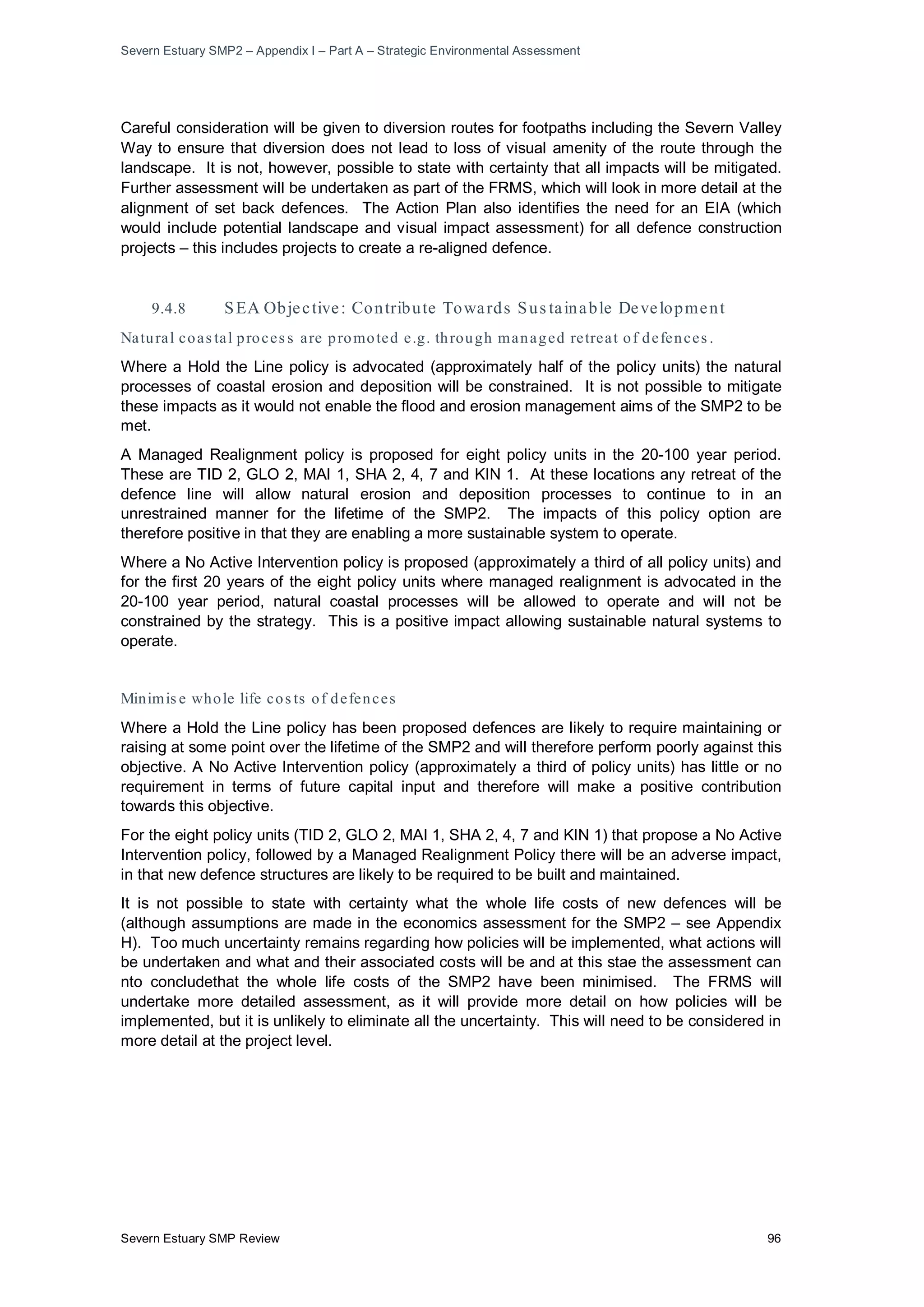
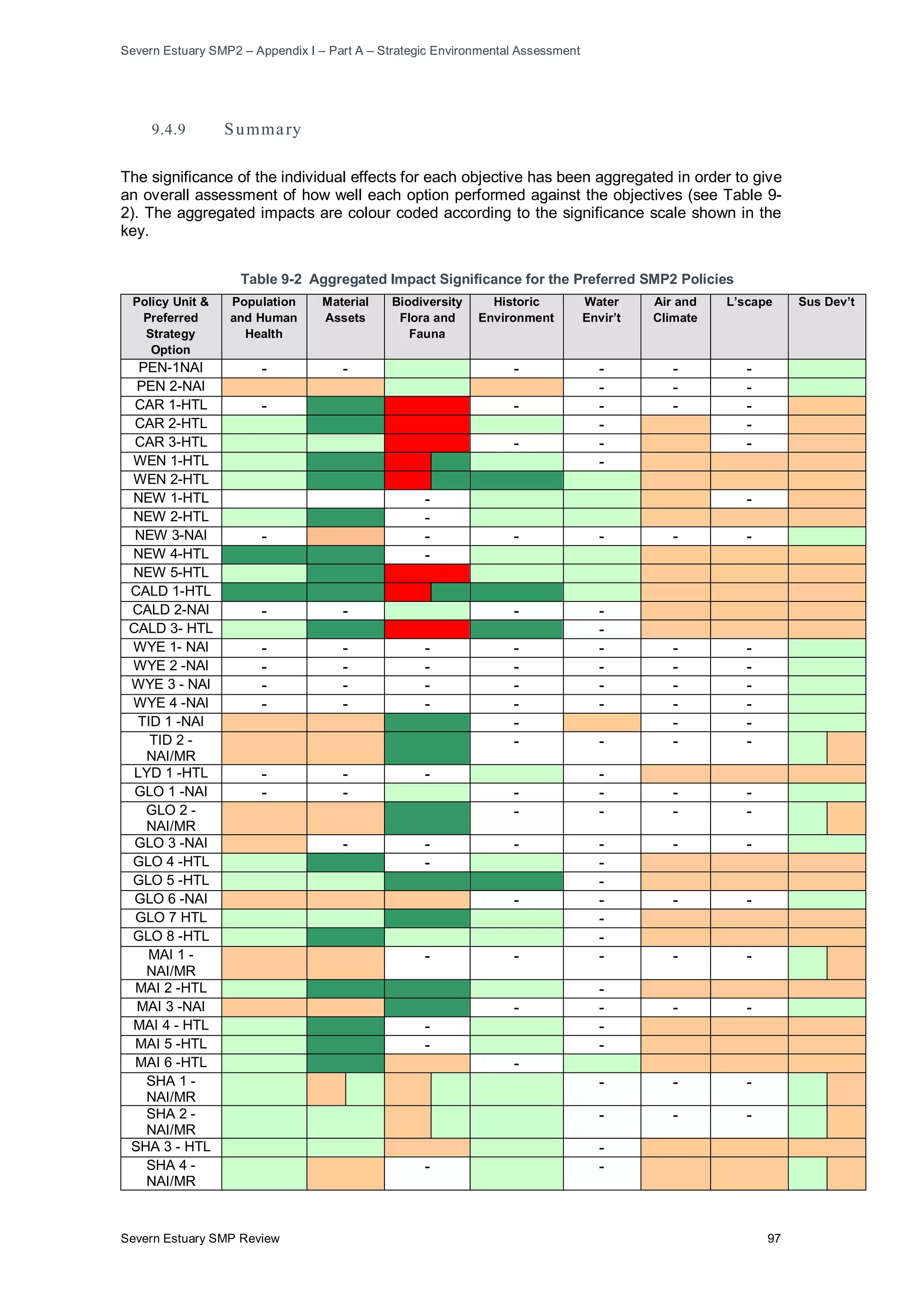
An assessment of the environmental impacts of the preferred policies was undertaken. The
significance of the individual effects for each objective was aggregated in order to give an overall
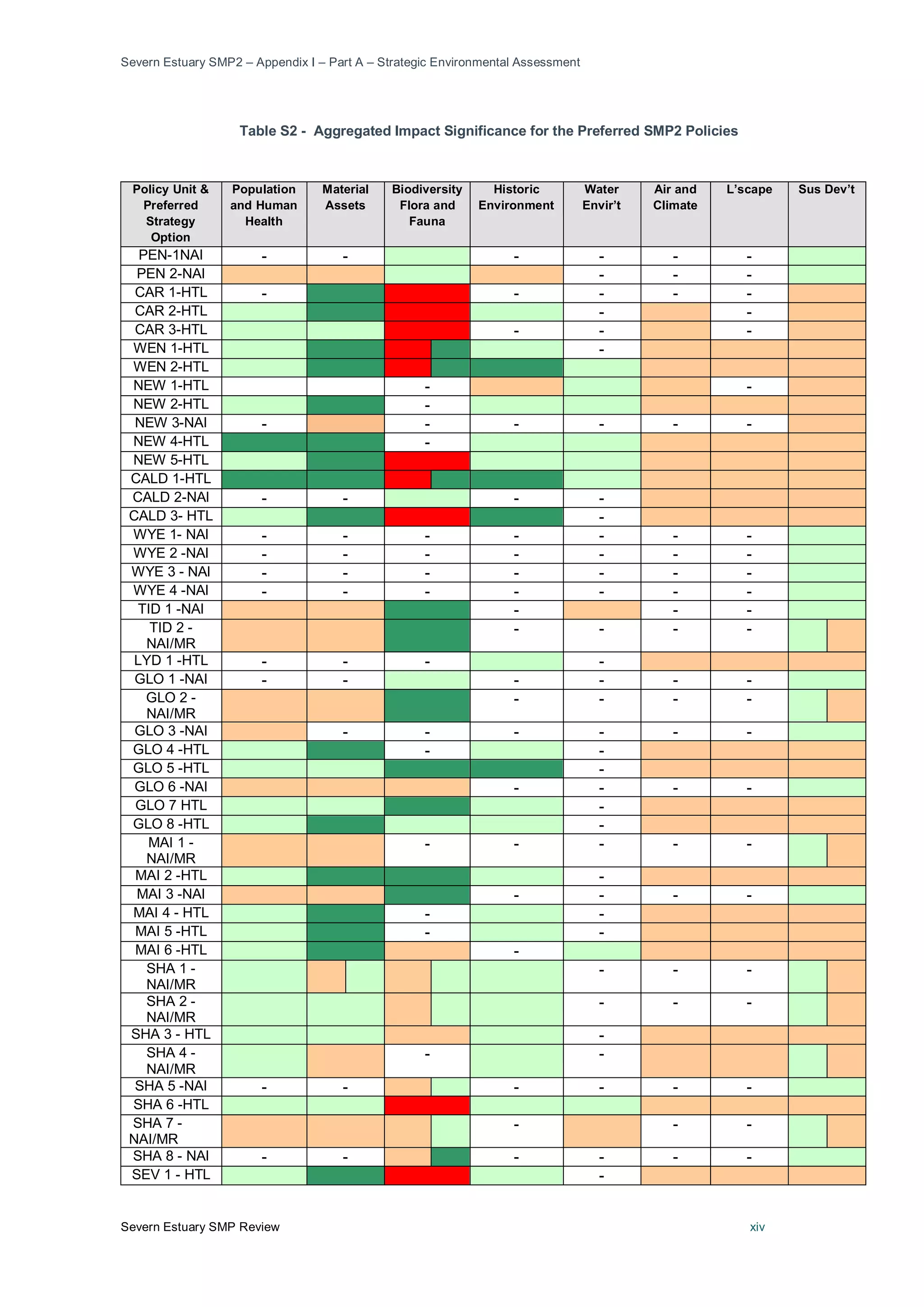
assessment of how well each option performed against the objectives (see Table S2). The
aggregated impacts are colour coded according to the significance scale shown in the key.
Severn Estuary SMP2 – Appendix I – Part A – Strategic Environmental Assessment
Severn Estuary SMP Review xiv
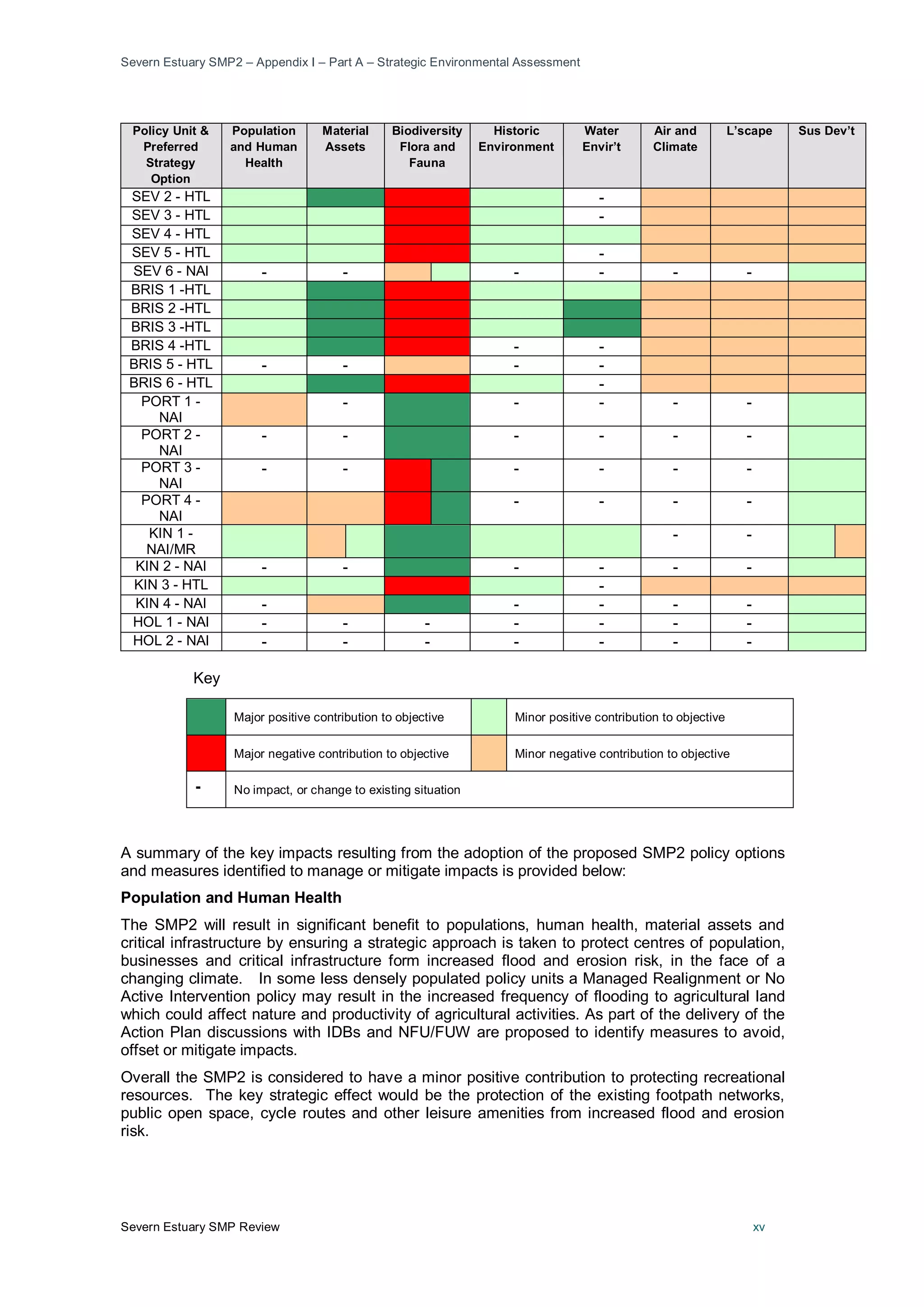
Table S2 - Aggregated Impact Significance for the Preferred SMP2 Policies
Policy Unit &
Preferred
Strategy
Option
Population
and Human
Health
Material
Assets
Biodiversity
Flora and
Fauna
Historic
Environment
Water
Envir’t
Air and
Climate
L’scape Sus Dev’t
PEN-1NAI - - - - - -
PEN 2-NAI - - -
CAR 1-HTL - - - - -
CAR 2-HTL - -
CAR 3-HTL - - -
WEN 1-HTL -
WEN 2-HTL
NEW 1-HTL - -
NEW 2-HTL -
NEW 3-NAI - - - - - -
NEW 4-HTL -
NEW 5-HTL
CALD 1-HTL
CALD 2-NAI - - - -
CALD 3- HTL -
WYE 1- NAI - - - - - - -
WYE 2 -NAI - - - - - - -
WYE 3 - NAI - - - - - - -
WYE 4 -NAI - - - - - - -
TID 1 -NAI - - -
TID 2 -
NAI/MR
- - - -
LYD 1 -HTL - - - -
GLO 1 -NAI - - - - - -
GLO 2 -
NAI/MR
- - - -
GLO 3 -NAI - - - - - -
GLO 4 -HTL - -
GLO 5 -HTL -
GLO 6 -NAI - - - -
GLO 7 HTL -
GLO 8 -HTL -
MAI 1 -
NAI/MR
- - - - -
MAI 2 -HTL -
MAI 3 -NAI - - - -
MAI 4 - HTL - -
MAI 5 -HTL - -
MAI 6 -HTL -
SHA 1 -
NAI/MR
- - -
SHA 2 -
NAI/MR
- - -
SHA 3 - HTL -
SHA 4 -
NAI/MR
- -
SHA 5 -NAI - - - - - -
SHA 6 -HTL
SHA 7 -
NAI/MR
- - -
SHA 8 - NAI - - - - - -
SEV 1 - HTL -
Severn Estuary SMP2 – Appendix I – Part A – Strategic Environmental Assessment
Severn Estuary SMP Review xv
Policy Unit &
Preferred
Strategy
Option
Population
and Human
Health
Material
Assets
Biodiversity
Flora and
Fauna
Historic
Environment
Water
Envir’t
Air and
Climate
L’scape Sus Dev’t
SEV 2 - HTL -
SEV 3 - HTL -
SEV 4 - HTL
SEV 5 - HTL -
SEV 6 - NAI - - - - - -
BRIS 1 -HTL
BRIS 2 -HTL
BRIS 3 -HTL
BRIS 4 -HTL - -
BRIS 5 - HTL - - - -
BRIS 6 - HTL -
PORT 1 -
NAI
- - - - -
PORT 2 -
NAI
- - - - - -
PORT 3 -
NAI
- - - - - -
PORT 4 -
NAI
- - - -
KIN 1 -
NAI/MR
- -
KIN 2 - NAI - - - - - -
KIN 3 - HTL -
KIN 4 - NAI - - - - -
HOL 1 - NAI - - - - - - -
HOL 2 - NAI - - - - - - -
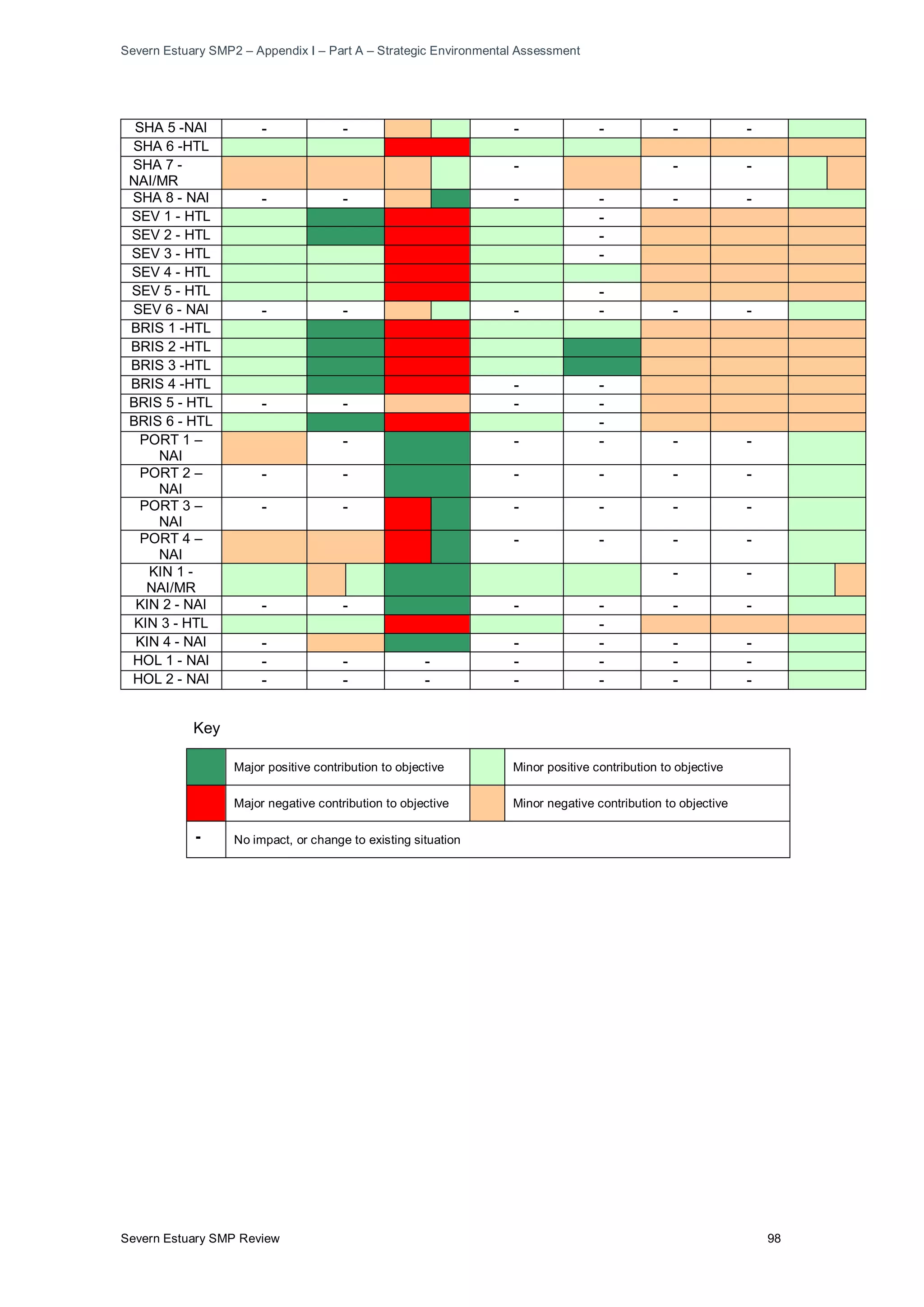
Key
Major positive contribution to objective Minor positive contribution to objective
Major negative contribution to objective Minor negative contribution to objective
- No impact, or change to existing situation
A summary of the key impacts resulting from the adoption of the proposed SMP2 policy options
and measures identified to manage or mitigate impacts is provided below:
Population and Human Health
The SMP2 will result in significant benefit to populations, human health, material assets and
critical infrastructure by ensuring a strategic approach is taken to protect centres of population,
businesses and critical infrastructure form increased flood and erosion risk, in the face of a
changing climate. In some less densely populated policy units a Managed Realignment or No
Active Intervention policy may result in the increased frequency of flooding to agricultural land
which could affect nature and productivity of agricultural activities. As part of the delivery of the
Action Plan discussions with IDBs and NFU/FUW are proposed to identify measures to avoid,
offset or mitigate impacts.
Overall the SMP2 is considered to have a minor positive contribution to protecting recreational
resources. The key strategic effect would be the protection of the existing footpath networks,
public open space, cycle routes and other leisure amenities from increased flood and erosion
risk.
Severn Estuary SMP2 – Appendix I – Part A – Strategic Environmental Assessment
Severn Estuary SMP Review xvi
Biodiversity Flora and Fauna
The assessment of likely significant effect undertaken for the SMP2 (see Appendix I, Part B)
concluded that the only European sites potentially affected by the implementation of the SMP2
are the Severn SPA, SAC and Ramsar sites and the Somerset Levels and Moors SPA/Ramsar.
This has been assessed as a major adverse impact. A calculation of the predicted habitat loss
is being undertaken as an integral part of the Habitat Regulations Assessment. The
Environment Agency is developing a Habitat Delivery Plan which will identify sites across the
estuary which can be secured to provide compensation for habitat loss. It is not possible to state
with certainty that a sufficient quantity of compensatory habitat or the required type / types will
be provided within the estuary. This uncertainty is due to the need to secure the agreement of
land owners and funding to implement projects as well as general uncertainty around how well
the sites will perform in developing the necessary replacement habitat. Further investigation and
assessment will be undertaken for the IROPI Statement of Case, prepared for the FRMS and as
part of the development of individual projects.
All of the SSSIs that comprise the Gwent Levels will be protected by a Hold the Line policy in
this location. No adverse impacts on any other non-geological SSSI are predicted and in many
cases a Hold the Line policy will ensure sites continue to be protected from adverse effects of
flooding and/or erosion. Overall the impact of the SMP2 on sites of national nature conservation
importance has been assessed as a major beneficial impact.
There are eleven coastal SSSIs designated for geological features and one RIGS within the
study area. Of these, nine of the SSSIs and the RIGS are located within policy units where No
Active Intervention is the preferred policy. This policy will ensure that the cliff faces continue to
be exposed to natural coastal processes, which will help to maintain the features for which these
SSSIs and the RIGS have been designated. Rhymney River Section SSSI is located within
policy unit CAR3 where a Hold the Line Policy is proposed. Further consideration of how the
policy will be delivered will be undertaken at the FRMS and project level to ensure adverse
impacts on the site are avoided or minimised. Overall the SMP2 will have a major positive
impact on geological SSSIs, although this conclusion should be treated with caution, as
uncertainty about how policy options will be implemented remain at the SMP2 level. The FRMS
will help to clarify some of these issues; others will need to be addressed at project level.
Historic Environment (Cultural Heritage)
Overall all the SMP2 will have a major beneficial impact on the historic environment, largely
protecting features and historic landscapes behind existing defences where a Hold the Line
policy is being proposed.
There is the potential for adverse effects on individual features within some policy units either
where structures are on the existing defence line (e.g. a SM within policy unit WEN 1) are in
front of the defence line (e.g. the pier and esplanade in PEN2) or are potentially affected by
increased flooding as a result of a No Active Intervention or Managed Realignment policy option.
In addition, where defence works are required to Hold the Line these could affect the setting of
designated historic environment assets. Further discussions with relevant heritage organisations
including County Archaeologists (in England), Cadw, English Heritage and the Gwent and
Glamorgan Archaeological Trust will be undertaken as part of the development of the SMP2
Action Plan to determine priorities for measures to avoid or mitigate potential impacts on the
heritage environment. Further assessment of impacts,as well as identification of avoidance and
mitigation measures will be undertaken at the FRMS and project level, when further details of
proposals are available.
Water Environment
The SMP2 will have a major positive effect on water resources and water quality, protecting key
features such as sewage treatment works, existing abstractions and source protection zones
from future flood and erosion risk.
Severn Estuary SMP2 – Appendix I – Part A – Strategic Environmental Assessment
Severn Estuary SMP Review xvii
Air and Climate
Where a no active intervention policy or managed realignment is to be applied, the natural
evolution of the coast will adapt to accommodate the impacts of climate change, delivering a
minor beneficial impact. A Hold the Line policy is likely to require ongoing maintenance or
increasing height of defences to take the effects of climate change into account so has been
assessed as having minor adverse impact in that the approach will not provide sustainable
ongoing adaptation to climate change
Landscape
Overall the SMP2 has been considered to have a neutral impact on the landscape of the Severn
estuary. Uncertainty remains over specific impacts and mitigation measures that will need to be
addressed either by the FRMS or at project level. The SMP2 Action Plan identifies the need to
undertaken EIAs for all maintenance or construction works undertaken in order to implement
policies.
Implementation of a Hold the Line policy may result in the need for new defences or the height of
existing defences to be increased. Although these will result in local adverse effects, measures
to ensure the structures are visually integrated into the local landscape will ensure this is only a
local minor adverse impact. The adoption of this policy option will however ensure that the
landscape behind the defence line is protected from change (major positive impact).
Where an option will result in a significant increase in the frequency of flooding of an area, a
change in vegetation structure is likely to occur and this has been assessed as potentially
resulting in a major adverse change to the landscape.
Sustainable Development
Overall the SM2 will have a neutral impact when considered in the light of the sustainability
objectives identified. No Active Intervention and Managed Realignment policies are suggested
for approximately half the policy units and will allow natural processes to continue to operate, a
minor beneficial impact. However a Hold the Line policy will constrain natural process, resulting
in a minor adverse impact.
Hold the line and managed realignment policies will require ongoing input of resources (minor
adverse effect), whereas the implementation of a Non Active Intervention policy will have
minimal resource requirement (minor beneficial effect).
Uncertainty remains over specific impacts and mitigation measures needed; this will be
considered further either by the FRMS or at project level. The SMP2 Action Plan identifies the
need to undertaken EIAs for all maintenance or construction works to implement policies.
Conclusions
Overall, implementation of the SMP2 will result in several major beneficial impacts including:
• long term protection of major centres of population, critical infrastructure and
material assets from flood and erosion risk;
• long term protection of the historic environment, water environment and
landscape of the Severn estuary from flood and erosion risk;
• long term protection of nationally designated nature conservation sites from flood
and erosion risk.
The SEA process has concluded that at the estuary wide scale the only major adverse impact
likely to result from the implementation of the preferred SMP2 policy options is the loss of
intertidal habitats from within the Severn Estuary European sites. A separate study (as part of
the FRMS) is being undertaken by the Environment Agency to identify sites around the estuary
Severn Estuary SMP2 – Appendix I – Part A – Strategic Environmental Assessment
Severn Estuary SMP Review xviii
that could be used to compensate for habitat loss and mitigate this impact, although uncertainty
remains due to the need to secure the agreement of land owners and funding to implement
projects. There is also more general uncertainty regarding how well the sites will perform in
developing the necessary replacement habitat. It is, therefore, not possible to state that all
impacts of the SMP2 will be mitigated and further assessment of impacts and development of
mitigation will be undertaken at the FRMS and project level.
Implementation and Monitoring
Monitoring proposals for the SMP2 have been derived, partly from the environmental objectives,
indictors and targets identified during the Scoping stage of the SEA. An Action Plan is being
developed as an integral part of the SMP2. The lead Local Authority for co-ordinating the Action
Plan is Monmouthshire County Council (MCC) as Chair of the SECG. The SECG intend to
monitor the delivery of the action plan through meetings held with Local Authorities (consisting of
elected member of the PMG, strategic planner and flood defence engineer) bordering the
Severn Estuary SMP2 shoreline, plus representatives from the EA, to discuss the approach to
implementation of the Severn Estuary SMP2.
Severn Estuary SMP2 – Appendix I – Part A – Strategic Environmental Assessment
Severn Estuary SMP Review 1
1. Introduction and Background
1.1 Overview
This document presents the findings of the Strategic Environmental Assessment (SEA)
undertaken for the Severn Estuary Shoreline Management Plan 2 (SMP2).
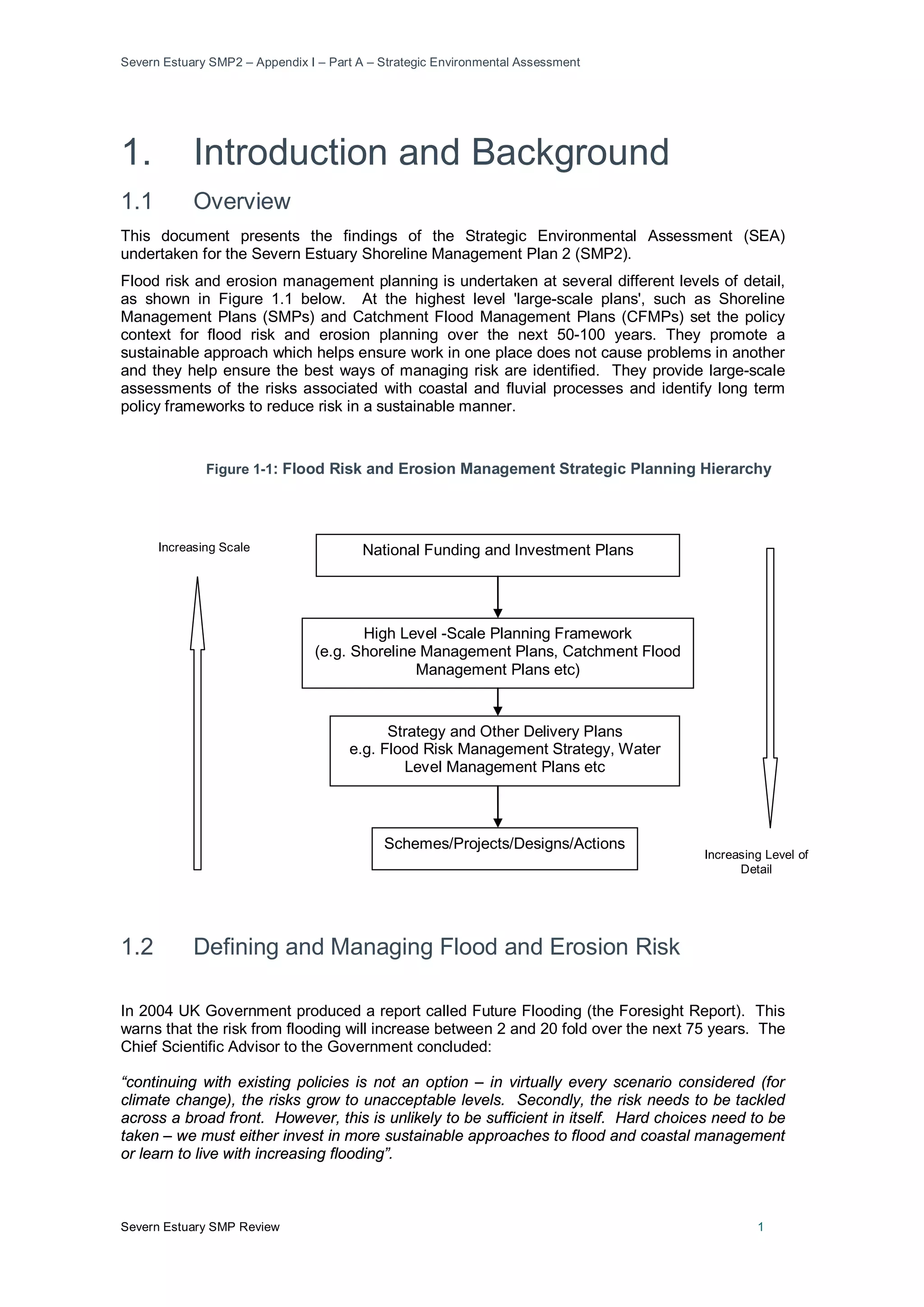
Flood risk and erosion management planning is undertaken at several different levels of detail,
as shown in Figure 1.1 below. At the highest level 'large-scale plans', such as Shoreline
Management Plans (SMPs) and Catchment Flood Management Plans (CFMPs) set the policy
context for flood risk and erosion planning over the next 50-100 years. They promote a
sustainable approach which helps ensure work in one place does not cause problems in another
and they help ensure the best ways of managing risk are identified. They provide large-scale
assessments of the risks associated with coastal and fluvial processes and identify long term
policy frameworks to reduce risk in a sustainable manner.
Figure 1-1: Flood Risk and Erosion Management Strategic Planning Hierarchy
1.2 Defining and Managing Flood and Erosion Risk
In 2004 UK Government produced a report called Future Flooding (the Foresight Report). This
warns that the risk from flooding will increase between 2 and 20 fold over the next 75 years. The
Chief Scientific Advisor to the Government concluded:
“continuing with existing policies is not an option – in virtually every scenario considered (for
climate change), the risks grow to unacceptable levels. Secondly, the risk needs to be tackled
across a broad front. However, this is unlikely to be sufficient in itself. Hard choices need to be
taken – we must either invest in more sustainable approaches to flood and coastal management
or learn to live with increasing flooding”.
High Level -Scale Planning Framework
(e.g. Shoreline Management Plans, Catchment Flood
Management Plans etc)
National Funding and Investment Plans
Strategy and Other Delivery Plans
e.g. Flood Risk Management Strategy, Water
Level Management Plans etc
Schemes/Projects/Designs/Actions
Increasing Scale
Increasing Level of
Detail
Severn Estuary SMP2 – Appendix I – Part A – Strategic Environmental Assessment
Severn Estuary SMP Review 2
Flooding and coastal erosion happen naturally and cannot always be prevented or predicted in
advance. They can have a major impact on lives, communities, the economy and the
environment. The judgement as to what is an acceptable and affordable level of flood and/or
erosion risk is a societal decision and is expressed and enacted through political process and
Government policy. Risk is a combination of two components, the likelihood (or probability) of a
particular flood event occurring and the consequence (or impact) that the event would have, if it
did occur. Flood and erosion risk management is about taking action to manage both the
likelihood and consequences of flood events and/or erosion.
Flood risk management can reduce the likelihood of flooding by managing the land, river and
drainage systems and by building and maintaining defences. Avoiding introducing additional
development into flood risk areas and relocating existing ‘at risk’ properties and community
facilities to lower risk areas can reduce the consequences of flooding. In addition, the
consequences of flooding can be managed by raising the level of flood awareness, increasing
the resilience of development in flood risk areas, by warning people when floods might occur so
that they can take actions to help themselves and by responding rapidly and effectively to
emergencies when they happen.
The Environment Agency is the principal flood defence operating authority in England and Wales
and is responsible under the Water Resources Act (1991) for managing flood risk from “main
rivers” and the sea. The EA is empowered (but does not have a legal obligation) to manage
flood risk from designated ‘main rivers’ and to provide coastal flood defence. Although the
Environment Agency is an England and Wales body, it has slightly different roles in England and
Wales. In England the EA provides a strategic overview role for coastal erosion and flooding. It
does not have this role in Wales.
Internal Drainage Boards (IDBs) have powers regarding drainage matters relating to significant
areas of land along the estuary. These areas are totally dependent on complex systems of flood
defences and land drainage to enable land to be used for agricultural production.
Local authorities also have a central responsibility for coordinating and delivering significant
changes to local flood risk management. Responsibilities include:
• collating and mapping flood risk management and drainage areas;
• coordinating surface water management plans;
• adopting and maintaining Sustainable Urban Drainage Schemes (SUDs);
• assessing and where necessary enhancing technical capabilities in flood risk
management;
• working with all relevant parties to tackle local problems of flooding.
1.3 Predicted Climate Change and Impacts
Our climate is changing, both in Britain and round the world. Climate change has consequences
for many aspects of our lives, including: water supply, the natural environment, health, business
and industry, agriculture, tourism and transport. Some of the most significant impacts of climate
change include:
• increased strain on water availability for people and ecosystems brought by
longer, hotter, drier summers and development in areas where water resources
are scarce;
• an increase in flood risk and coastal erosion caused by wetter winters, greater
storminess and sea level rise. In England and Wales, 5 million people already
live in flood risk areas and about 12 per cent of farmland and a quarter of
Severn Estuary SMP2 – Appendix I – Part A – Strategic Environmental Assessment
Severn Estuary SMP Review 3
industrial sites are at risk. Some 11 per cent of new homes are built in flood risk
areas in England;
• potential to harness energy from increased water volumes or tidal surges.
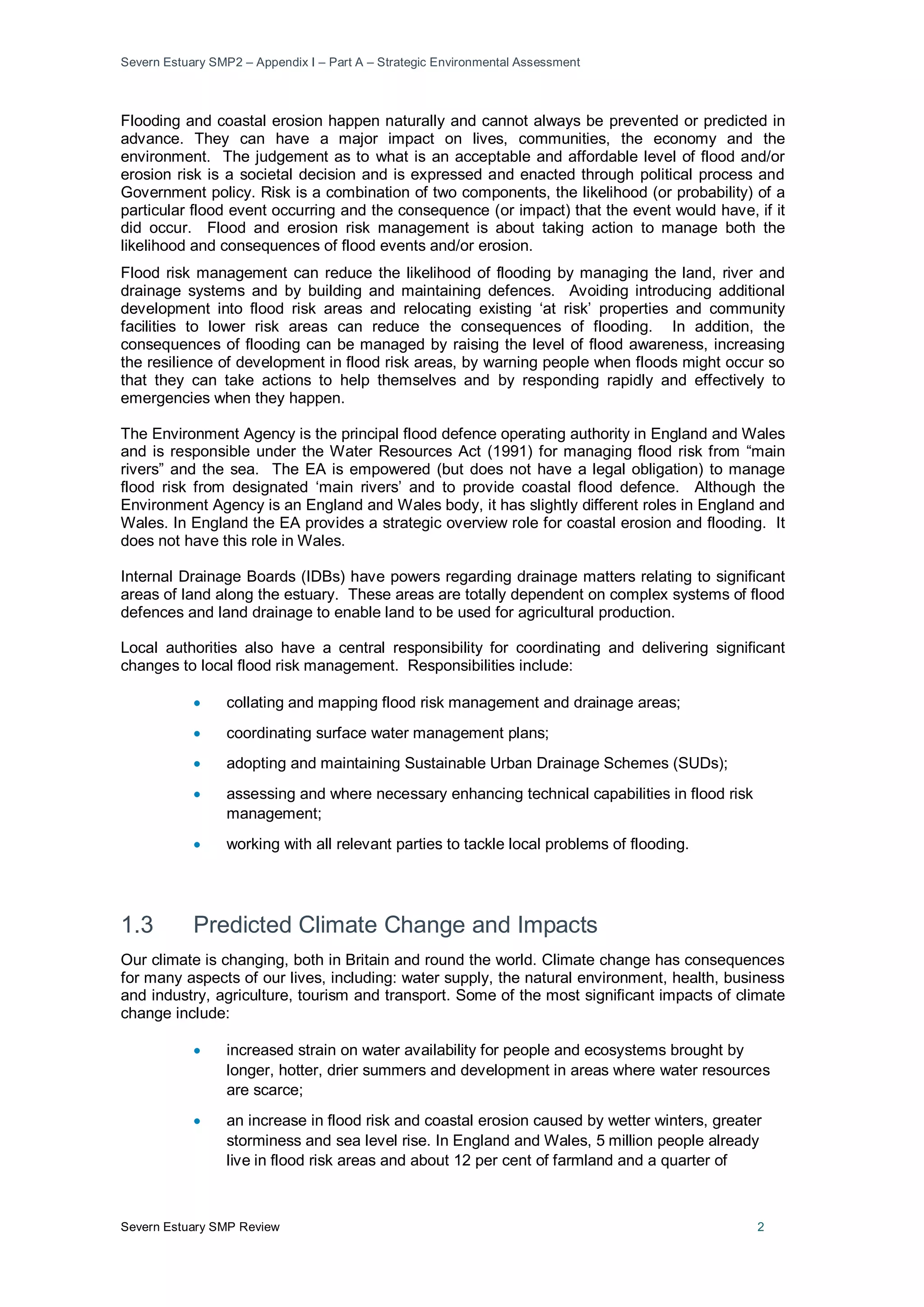
As much as 65 per cent of all flood risk is from coastal and tidal flooding. As storms and sea
levels increase, more properties, businesses and people will be affected. Sea levels around the
UK are now about 10 cm higher than they were in 1900. Coastal flooding will become
increasingly common, damaging property and threatening lives.
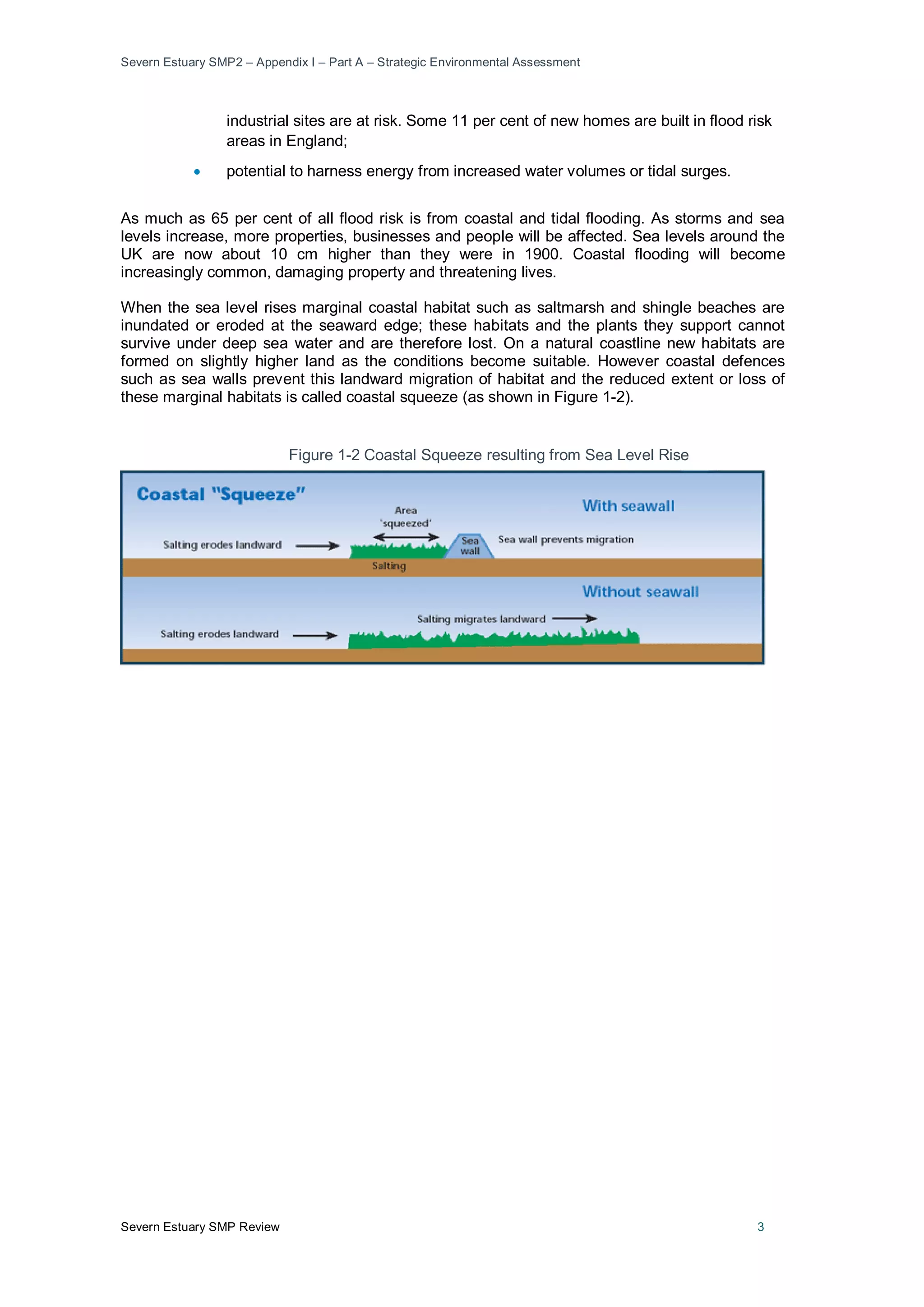
When the sea level rises marginal coastal habitat such as saltmarsh and shingle beaches are
inundated or eroded at the seaward edge; these habitats and the plants they support cannot
survive under deep sea water and are therefore lost. On a natural coastline new habitats are
formed on slightly higher land as the conditions become suitable. However coastal defences
such as sea walls prevent this landward migration of habitat and the reduced extent or loss of
these marginal habitats is called coastal squeeze (as shown in Figure 1-2).
Figure 1-2 Coastal Squeeze resulting from Sea Level Rise
Severn Estuary SMP2 – Appendix I – Part A – Strategic Environmental Assessment
Severn Estuary SMP Review 4
2. Scope of Study and SEA Process
2.1 The Need for Strategic Environmental Assessment
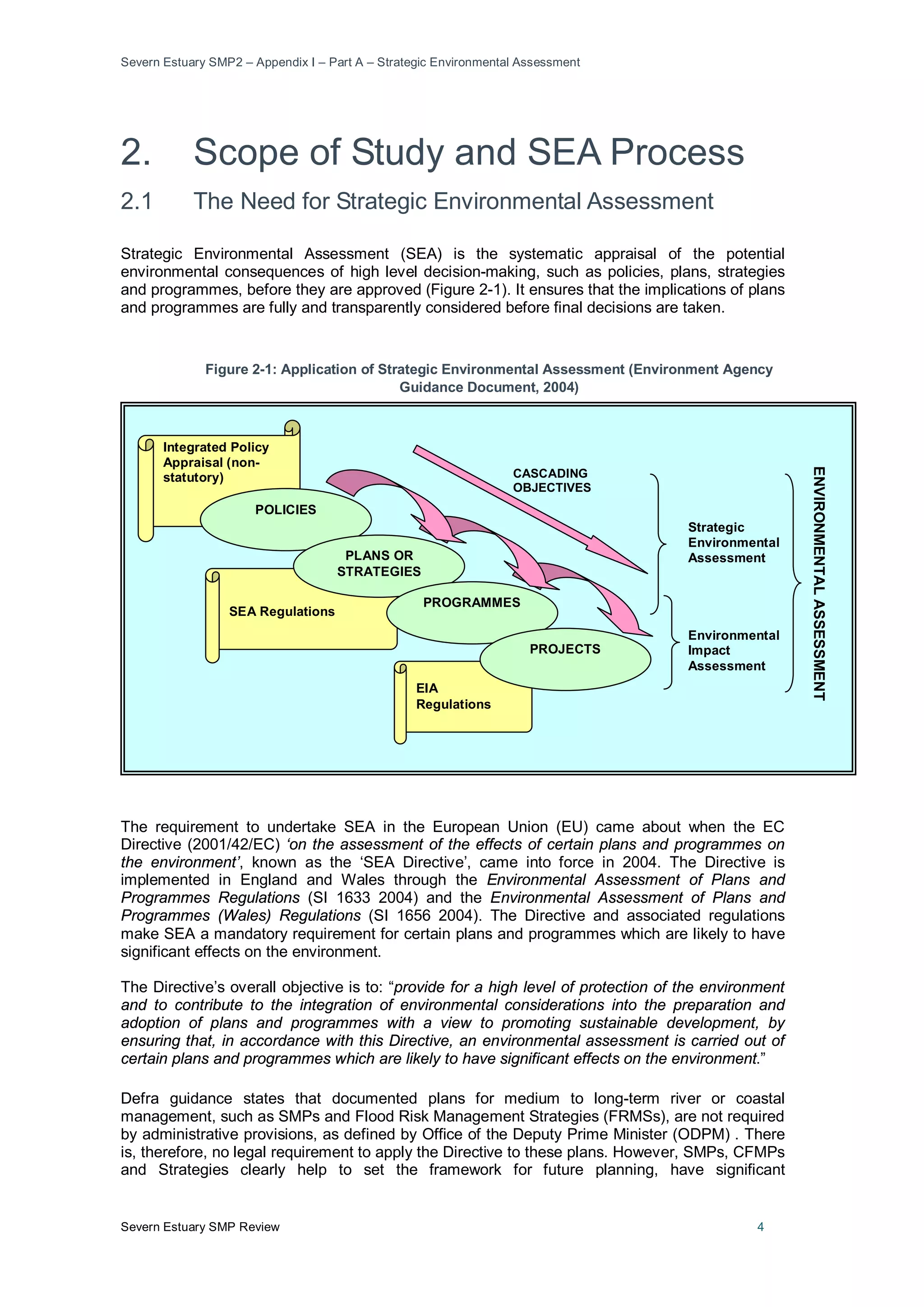
Strategic Environmental Assessment (SEA) is the systematic appraisal of the potential
environmental consequences of high level decision-making, such as policies, plans, strategies
and programmes, before they are approved (Figure 2-1). It ensures that the implications of plans
and programmes are fully and transparently considered before final decisions are taken.
Figure 2-1: Application of Strategic Environmental Assessment (Environment Agency
Guidance Document, 2004)
The requirement to undertake SEA in the European Union (EU) came about when the EC
Directive (2001/42/EC) ‘on the assessment of the effects of certain plans and programmes on
the environment’, known as the ‘SEA Directive’, came into force in 2004. The Directive is
implemented in England and Wales through the Environmental Assessment of Plans and
Programmes Regulations (SI 1633 2004) and the Environmental Assessment of Plans and
Programmes (Wales) Regulations (SI 1656 2004). The Directive and associated regulations
make SEA a mandatory requirement for certain plans and programmes which are likely to have
significant effects on the environment.
The Directive’s overall objective is to: “provide for a high level of protection of the environment
and to contribute to the integration of environmental considerations into the preparation and
adoption of plans and programmes with a view to promoting sustainable development, by
ensuring that, in accordance with this Directive, an environmental assessment is carried out of
certain plans and programmes which are likely to have significant effects on the environment.”
Defra guidance states that documented plans for medium to long-term river or coastal
management, such as SMPs and Flood Risk Management Strategies (FRMSs), are not required
by administrative provisions, as defined by Office of the Deputy Prime Minister (ODPM) . There
is, therefore, no legal requirement to apply the Directive to these plans. However, SMPs, CFMPs
and Strategies clearly help to set the framework for future planning, have significant
Integrated Policy
Appraisal (non-
statutory)
SEA Regulations
EIA
Regulations
POLICIES
PLANS OR
STRATEGIES
PROGRAMMES
PROJECTS
CASCADING
OBJECTIVES
ENVIRONMENTALASSESSMENT
Strategic
Environmental
Assessment
Environmental
Impact
Assessment
Severn Estuary SMP2 – Appendix I – Part A – Strategic Environmental Assessment
Severn Estuary SMP Review 5
environmental implications, and require extensive consultation. Defra recommend therefore, that
adopting an SEA approach is appropriate and they strongly encourage the operating authorities
to undertake SEA for these plans. For these reasons and in accordance with good practice, an
SEA of the SMP2 is being undertaken.
2.2 The Severn Estuary Shoreline Management Plan Review
(SMP2)
2.2.1 Context
Shoreline Management Plans (SMPs) are non-statutory plans produced by Coastal Groups (in
this case the Severn Estuary Coastal Group) which are made up of maritime Local Authorities
and other bodies with coastal defence responsibilities or interests. Shoreline Management Plans
set high level policy approaches for the future management of flood and erosion risk along
coastline. They involve undertaking a large scale assessment of the risks associated with
coastal processes and present a long term policy framework to reduce these risks to people and
the developed, historic and natural environment in a sustainable manner. SMPs allow the
development of strategy plans to be prioritised.
SMPs typically cover large areas such as several counties or catchments and define the broad
policy for management of the plan area. They typically look at the predicted evolution of the
coast under three timeframes or epochs: 0-20 years, 20-50 years and 50-100 years. The SMP2
has divided the Severn Estuary study area into policy units (see Annex C), with one of the four
policy options (see Section 9 for more detail ) being applied to each unit:
• Hold the existing defence line;
• Advance the existing defence line;
• Managed realignment - identifying a new shape for the shoreline and actively
managing change;
• No active intervention - a decision not to invest in providing or maintaining
defences.
Following approval of the SMP2 the policies will be developed into implementation plans within
the Severn Estuary Flood Risk Management Strategy (FRMS). FRMSs are long-term plans for
sustainable flood risk management of an area taking full account of the requirements set out in
relevant overarching plans such as the CFMP and SMP; they are typically undertaken by the
Environment Agency and identify appropriate levels of protection for all flood risk areas, taking
onto consideration economic and environmental costs and benefits. They also address how
flood risk management will be implemented on the ground e.g. detailing alignment and type of
defences. Strategy plans will normally be consistent with the recommendations of relevant
overarching plans (including SMPs), unless subsequent detailed investigations suggest that
these should be revised.
2.2.2 Definition of the SMP2 Study Area
The Severn Estuary (Môr Hafren in Welsh) is located on the west coast of Britain, bordering both
England and Wales. It is renowned for having the second highest tidal range in the world. The
Severn is typical of estuaries in England and Wales, in that it has provided a focus for human
activity, a location for settlement, a source of food, water and raw materials and a gateway for
trading and exploration. The Estuary and its coastal hinterland support the cities of Cardiff,
Bristol, Newport and Gloucester. Major industries are located around the Estuary’s shores,
including modern port installations, chemical processing companies and power stations.
The Severn Estuary and its surrounding area are afforded a very high level of protection under
European wildlife law. Large areas are designated as a Special Protection Area (SPA) under the
Severn Estuary SMP2 – Appendix I – Part A – Strategic Environmental Assessment
Severn Estuary SMP Review 6
Birds Directive and as a Special Conservation Area (SAC) under the Habitats Directive for their
intertidal and sub tidal habitats and migratory fish species. The area surrounding the estuary is
also designated as a wetland of international importance under the Ramsar convention and as a
Site of Special Scientific Interest. In addition, several freshwater SSSIs (e.g. the Gwent Levels
SSSI complex) lie behind the existing coastal defences.
The SMP2 study area stretches from Anchor Head (Birnbeck Island) on the English side of the
Estuary (a move northeast from the first SMP) to Lavernock Point on the Welsh side. The
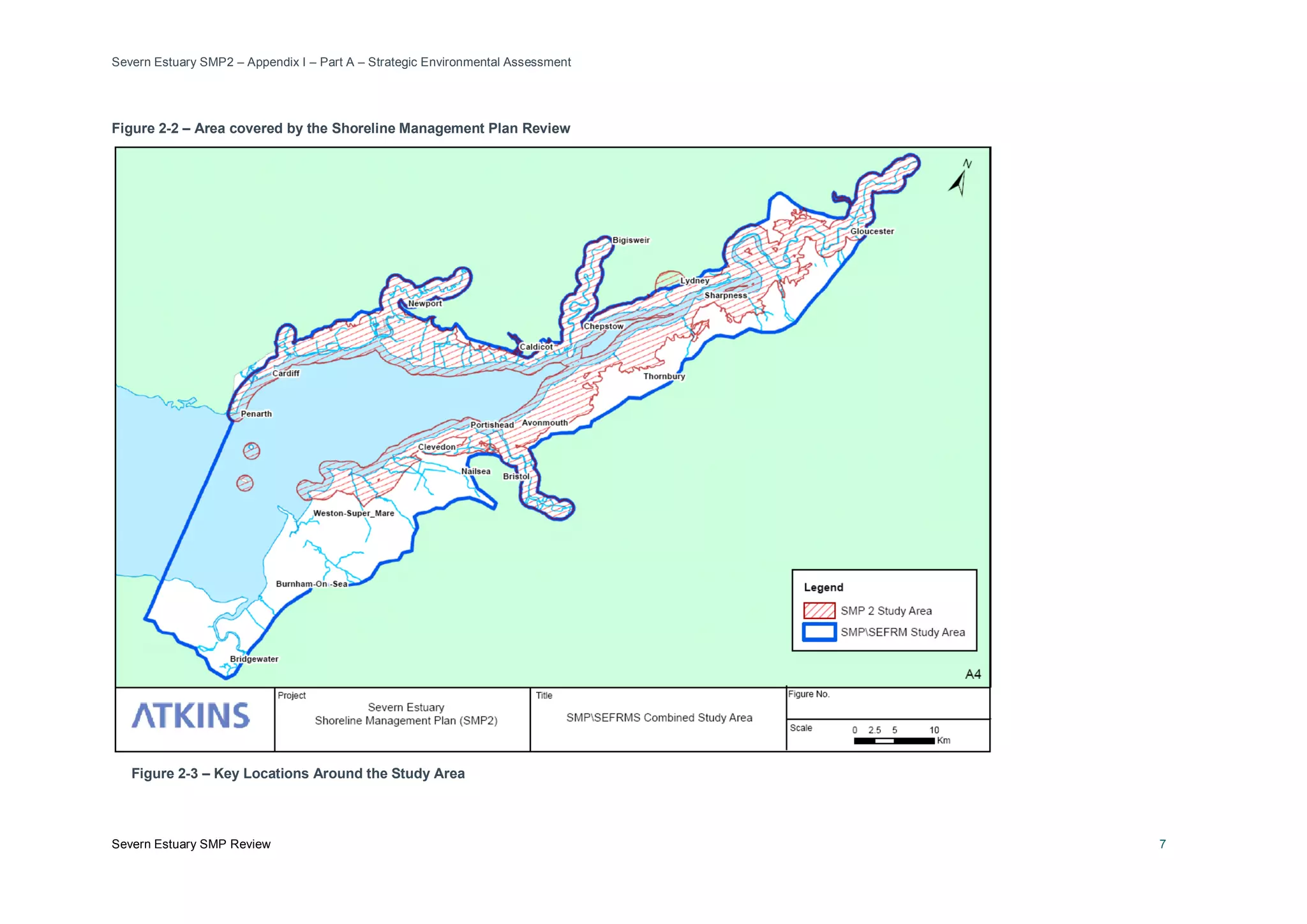
upstream boundary is at Haw Bridge approximately 5km upstream of Gloucester (Figure 2-2
shows the SMP2 study area, alongside that of the FRMS, with key locations referred to within
this report shown in Figure 2-3). The extent of coastline selected for inclusion within the study
area has been influenced by our current knowledge of the coastal process in operation within the
estuary. For the purposes of data gathering and obtaining an indication of key issues we have
used the current 1 in 1000 year extreme event floodplain to create a buffer zone around the
coastline and rivers that form the SMP2 boundary. This corresponds to the extreme flood event
outline identified in PPS 25 Development and Flood Risk and TAN 15 Development and Flood
Risk. Using this buffer zone will ensure that all areas likely to be affected by changes to the
shoreline or flooding from the sea are included within the SMP2.
2.2.3 Current Flood and Eros ion Ris k
Estuary Processes
Within the Severn Estuary the physical environment is varied. The whole area is dominated by
tidal processes, although fluvial influence becomes more appreciable north of the Noose. There
is a significant wave climate downstream of the Second Severn Crossing, diminishing upstream
due to reduced fetch and shelter from swell waves. The geomorphology of the Severn Estuary is
dominated by tidal processes, consisting of areas of offshore sand banks and bed rock
(generally downstream of the Severn Crossings), with the shoreline fringed by mudflats and
saltmarsh, and intermittent sand beaches downstream of Clevedon. The floodplain itself is
predominantly historically reclaimed land adjacent to the Gwent Levels and the Avon and
Somerset Levels, noted to have low land levels relative to the Severn Estuary tidal range.
Risk of Flooding and Erosion
A high level consideration of flood risk under current conditions has identified that the Standard
of Protection (SoP) for flood defences around the Severn Estuary varies significantly between
100% Annual Event Probability (AEP) (i.e. the magnitude of event statistically predicted to occur
once every year) and 0.1% AEP (i.e. the magnitude of event statistically predicted to occur once
every 100 years). Particularly weak sections of defence exist along the River Usk (policy units
NEW 1-5), Awre/Arlingham peninsulas and intermittent lengths near Gloucester (policy units
GLO 1-8, SHAR 1-7, MAI 1-5), near the River Avon (policy units BRIS 1-3 and PORT 1-4) and
along Congresbury Yeo (policy unit KIN 1).
Current understanding indicates that in the short term (up to year 2028) the predicted
geomorphological evolution along the estuary fringes for policy units PEN 1-2, CAR 1-2, WEN 1-
2, CALD 1, BRIS 1-3, PORT 1-4 and KIN 1-4 is marginal erosion (a loss of saltmarsh of 10-
30%), although there is local evidence of intermittent accretion. For policy units TID1-2, GLOU 1-
8, MAI 1-5, SHAR 1-8 and SEV 1-6 the short term trend is for both marginal erosion and
accretion (±20% variation in saltmarsh coverage). In the medium to long term (2058 and 2108)
uncertainties significantly increase. In relation to flood risk, virtually all flood defences are
predicted to have structurally failed due to degradation under the No Active Intervention scenario
after the year 2058.
Severn Estuary SMP2 – Appendix I – Part A – Strategic Environmental Assessment
Severn Estuary SMP Review 7
Figure 2-2 – Area covered by the Shoreline Management Plan Review
Figure 2-3 – Key Locations Around the Study Area
Severn Estuary SMP2 – Appendix I – Part A – Strategic Environmental Assessment
Severn Estuary SMP Review 8
Severn Estuary SMP2 – Appendix I – Part A – Strategic Environmental Assessment
Severn Estuary SMP Review 9
The English Heritage Severn Estuary Rapid Coastal Zone Assessment (Gloucestershire County
Council 2008) identified (for England only) areas where high degrees of change were likely to be
expected over the next 100 years; areas of high parietal change identified included Sand Bay
(north of Weston-super-Mare). Areas identified as being unlikely to be affected by change
include:
• Sand Point to St Thomas Head;
• Clevedon to Portishead;
• Sharpness to Purton;
• Broadoak to Northington;
• Hagloe to Beachley.
Future predictions of climate change within the Severn Estuary include a rise in sea level of
approximately 1m and up to 20% increase in river flows. These are indicative values and the
actual impact of climate change could vary significantly. A high level assessment of the flood
defences indicates that within the 100 year timeframe of the SMP2, if the flood defences were
not maintained the general Severn Estuary floodplain would be completely inundated on an
annual basis (100% AEP).
Consequences of Flooding and Coastal Erosion
Within the Severn Estuary flood processes and risks dominate over the erosion processes and
risks. This is due to a) predicted climate change impacts (specifically sea level rise and
increased storminess) reducing Standard of Protection significantly in the medium and long term
epochs, whilst historical and predicted future erosion has less direct impact, and b) the extent of
flooding propagating up to 10km inland in comparison to erosion up to the 10m order of
magnitude.
There are a wide range of consequences to flooding and coastal erosion. The built environment
consists of large conurbations (including Cardiff, Newport, Gloucester, Avonmouth/Bristol,
Portishead, Clevedon and Weston-Super-Mare) and smaller, scattered residential areas, with
large areas of agricultural usage. The physical, natural and built environment supports tourism
throughout the Severn Estuary.
Strategic infrastructure potentially at risk from flooding includes transport routes (motorways and
railways), industry (a number of ports, power stations and chemical processing plants), and
power and fuel transmission lines.
The Severn Estuary and its floodplain benefit from various environmental designations (both
national and international) related to habitats, wildlife and archaeology. It has a distinct
landscape consisting of a diverse range of flat, open and gently undulating plains, interrupted by
hilly areas.
As an example, a worst case scenario of complete inundation in the present day would result in
a flooded area of approximately 1000km
2
. This would have serious implications for all receptors
identified in Section 5, rendering large parts of the human, natural and built environment
unsustainable. It would result in approximately 198,000 properties (both residential and
commercial) directly affected by flooding, over £5 Billion worth of property damage, serious
interruption and/or damage to strategic infrastructure and agricultural land, livestock and crops,
and widespread degradation of ecology (both flora and fauna) and landscape character.
Severn Estuary SMP2 – Appendix I – Part A – Strategic Environmental Assessment
Severn Estuary SMP Review 10
2.3 The SEA Process
Taking account of the possible impacts of decisions on the environment through SEA is a step by
step process that is integral to the whole SMP2 development process. The SEA legislation
requires that certain actions are taken (e.g. early and on-going stakeholder engagement) and
that certain outputs are produced (e.g. an Environmental Report). The SEA has followed a
number of key stages and has met the requirements of the SEA Directive in the following ways:
• SEA Scoping Report – this was produced in January 2009. It was circulated to
the SECG and was brought to the attention of other stakeholders as part of the
Key Stakeholder Group (KSG) events held in January 2009, through Severn
Estuary Partnership (SEP) E-news and was published on the SECG website.
The report covers the SMP2 and the SEFRMS;
• Identification of Key Environmental Information – the SEA Scoping Report,
describes the environment in terms of ‘receptors’ (Population & human health;
Biodiversity; Land use; Geology & soils; Water; Air; Material assets; Historic
environment; Landscape; and the interrelationship between them); this
information also informed the SMP2 Theme Review (see Appendix D of main
SMP2 report), SEA Scoping Report and Section 7 of this document;
• Identification of Objectives – the SMP2 identifies features and objectives
around the shoreline of the Severn Estuary. The objectives take account of the
risks to that feature from coastal erosion and flooding and the benefits people get
from the features. Issues and objectives are set out clearly in Appendix E of the
main SMP2 report, the SEA Scoping Report and Sections 6 and 7 of this
document;
• Assessment of four alternative Policy Options, including their potential
impacts on the environment – The environmental effects of implementing the
alternative policy options within each policy unit have been assessed. The source
of impacts was determined by reviewing the policy options and was informed by
our knowledge of the existing environment and predicted environmental trends.
The pathways of impacts in the environment can be direct, for example habitat
loss through land take or indirect through a number of links; for example,
increased flooding over time affecting habitats or other features of interest. The
pathways were again identified by expert judgement and consultation. The
results of this assessment were then taken into consideration as part of the
overall SMP2 policy selection process which also took economic factors into
account. The assessment is detailed in Appendix F of the main SMP2 report and
Sections 8 and 9 and Annex B of this report
• Effects of the SMP2 – preferred SMP2 options were selected and the effect of
that policy on each stretch of shoreline (Policy Unit) was then undertaken and is
presented in Appendix G of the main SMP2 report and Sections 8 and 9 of this
report.
• Environmental Report– this environmental report summarises the findings of
the SEA process to date; this report will be subject to public consultation along
with other deliverables from the project.
• Monitoring – the SMP2 Action Plan and Section 10 of this report set out the
monitoring requirements within the SMP2 area; this will be further developed
following the public consultation.
• Post Adoption Statement – this document is part of the SEA process. It will
summarise how environmental issues were integrated into the SMP process; the
reasons for choosing the preferred options; the consultation results and the
monitoring that is proposed. This will be developed and finalised following
completion of the final SMP2 in 2010.
Severn Estuary SMP2 – Appendix I – Part A – Strategic Environmental Assessment
Severn Estuary SMP Review 11
Following the SMP2 development process, the public consultation and revision, the SMP2
should be adopted/approved by Local Authorities and the Environment Agency (via Regional
Flood Defence Committees or their equivalent) and WAG. Natural England (NE) and the
Countryside Council for Wales (CCW) are advisors to the Severn Estuary Coastal Group
(SECG), individual partners on the group and national government. Their input to the
development of the SMP2 ensures it is compliant with relevant national and EU nature
conservation legislation.
Should any major changes in the SEA be required, for example resulting from policy changes
that arise as a result of the consultation process, an addendum to the SEA will be published. In
addition, in accordance with Part 4 of the Environmental Assessment of Plans and Programmes
Regulations 2004, a post Adoption Statement will be prepared to document the way in which the
Severn Estuary Coastal Group have taken environmental considerations and the views of
consultees into account in the adopted SMP2.
2.4 Synergies with Other Processes
The SEA will form a component of the wider assessment mechanisms for the SMP which also
includes:
• An Appropriate Assessment under the Habitats Directive (Council Directive
92/43/EEC on the Conservation of natural habitats and of wild fauna and flora);
and
• Consideration of the requirements of the Water Framework Directive (Council
Directive 2000/60/EC establishing a framework for Community action in the field
of water policy).
2.4.1 Habitat Regulations As s es s ment
The Habitats Directive is implemented in the UK through the Conservation (Natural Habitats &c.)
Regulations 1994 (the Habitats Regulations), as amended. If the SMP2 is considered likely to
have a significant effect on a European site, it must be subject to assessment under the Habitats
Regulations. This approach applies to all European sites in England and Wales and includes all
Special Areas of Conservation and Special Protection Areas. As a matter of policy, we are also
applying this to Ramsar sites.
There are numerous European sites located within and adjacent to the SMP2 study area. In
order to assess the impacts of the preferred policy options of the SMP2, a test of likely
significant effect and an Appropriate Assessment have been undertaken and are detailed in
Appendix I Part B. As part of this HRA, the competent authorities will have regard to the manner
in which the plan would be carried out, and to any conditions or restrictions which could avoid
adverse impacts on the European site(s) (Conservation of Habitats and Species Regulations
2010). Where appropriate, specific actions to avoid adverse impacts have been included in the
SMP2 Action Plan (see Main Report - Part C).
Where the Appropriate Assessment has been unable to conclude that the SMP2 does not
adversely affect the integrity of the European sites, the SMP2 may only be adopted if the
requirements of Regulations 103 and 105 of the Habitats Regulations are met:
• firstly, there must be no alternative solutions to the SMP2 that would have a
lesser effect on the European site; and, if there are no alternative solutions
• secondly, there must be imperative reasons of over-riding public interest for
adopting the SMP2.
Furthermore, the SMP2 may only be adopted in these circumstances if it can be demonstrated
that, the Secretary of State can be satisfied that the competent authority will be able to secure
Severn Estuary SMP2 – Appendix I – Part A – Strategic Environmental Assessment
Severn Estuary SMP Review 12
any necessary compensatory measures to ensure that the overall coherence of Natura 2000 is
protected.
The HRA for the Severn SMP2 was unable to demonstrate no adverse effects on two
European sites within and adjacent to the study area and a Statement of Case is being
prepared for Defra/WAG approval to demonstrate that there are no acceptable alternative policy
options and the SMP2 is required for Imperative Reasons of Overriding Public Interest (IROPI).
A Habitat Delivery Plan is currently being prepared by the Environment Agency to identify
potential areas of habitat compensation around the estuary; this study, once complete, will
support the SEA and HRA. Initial findings suggest that enough areas for compensation can be
identified within the SMP2 study area, however some degree of uncertainty remains particlalry
surrounding issues such as securing land owner agreement and funding to implement projects.
There is also uncertainty regarding how well the sites will perform in developing the necessary
replacement habitat. More work is required to identify the most appropriate areas to create
replacement habitat and to ensure that actions are undertaken to create such replacement
habitat. The FRMS project will continue after the SMP2 has been completed.
The HRA and SEA have been undertaken in parallel to ensure that the plan does not set the
framework for coastline management which is subsequently compromised by the necessity to
meet the requirements of the Habitats Regulations.
The procedures for agreeing and signing off the HRA are different in England and Wales. The
Countryside Council for Wales (CCW) advises Welsh management authorities on nature
conservation matters, including the Welsh Assembly Government (WAG) Local Authorities and
the Environment Agency Wales (EAW). Natural England (NE) advises English management
authorities on nature conservation matters, including Defra, Local Authorities and the
Environment Agency (EA).
The cross border nature of this SMP2 makes the legal requirements of these pieces of
legislation complicated because there is no one ‘competent authority’ that can act for and sign
off all the assessments. This means that ensuring all the authorities are satisfied that the HRA
has been completed in accordance with the legislation is a complex process.
2.4.2 Water Framework Directive
A separate assessment of the compliance of the SMP2 policies with the Water Framework
Directive (WFD) environmental objectives has been undertaken by the Environment Agency and
the results of this assessment can be found in Appendix J to the main SMP2 report.
Severn Estuary SMP2 – Appendix I – Part A – Strategic Environmental Assessment
Severn Estuary SMP Review 13
3. Scope of the SEA
A scoping exercise was undertaken in late 2008 to identify the key environmental issues within
the study area and define the scope of this SEA. Under the SEA Directive, The Assessment of
Plans and Programmes Regulations (2001/42EC) identifies environmental factors that must be
initially considered for all SEAs. These include:
• Human Beings including population and human health;
• Biodiversity, Flora and Fauna;
• Soil;
• Water;
• Air;
• Climatic factors;
• Material assets;
• Cultural, architectural and archaeological heritage;
• Landscape; and the
• Inter-relationship between the above factors
Table 3-1 summarises issues scoped into and out of the SEA. The SEA addresses, at the
strategic level, the implications of implementing the SMP2 policies. Impacts at the site or project
level will be addressed through the Environmental Impact Assessment (EIA) process as part of
the appraisal undertaken for specific schemes.
The scoping process allows issues that are not considered to be significant for the purposes of
the SMP2 to be ‘scoped out’ of the SEA. Similarly, other issues of particular relevance or
significance to the catchment and not included within the SEA Directive may be ‘scoped in’ to
the SEA. These impacts may be positive or negative, direct or indirect, temporary or permanent
and of varying severity. The SEA process will identify likely impacts, evaluate their relative
significance and identify the potential for mitigation where possible.
Severn Estuary SMP2 – Appendix I – Part A – Strategic Environmental Assessment
Severn Estuary SMP Review
14
Table 3-1 Summary of Issues Scoped into and out of the Severn Estuary SMP2 Strategic Environmental Assessment
Receptor
Scope and Justification How this issue will link to the
SEA Objective Table 6.1 and
Section 9
Scoped out Scoped In
Population and
Human Health
Population,
businesses and
properties at risk
from flooding
SMP policy options will affect the
population within flood risk areas, as well
as business and property.
Reduce significance of adverse impact
associated with flooding and erosion to
people and property
Reduce significance of adverse impact
associated with flooding and erosion to
industrial, commercial and economic
assets (including agricultural), and
activities (including tourism)
Recreational and
amenity resources of
national and regional
importance
SMP policy options could affect important
recreational and amenity resources and
could also present opportunities to deliver
recreational benefits
Reduce significance of adverse impact
associated with flooding and erosion to
key community, recreational and
amenity facilities.
Quality of life/Social
deprivation
Quality of life is affected by flooding and
erosion; more socially deprived
communities are likely to be more
significantly affected
Avoid/minimise environmental impacts
which may have long term health
impacts (including stress and anxiety
associated with flood and erosion risk)
Reduce significance of adverse impact
associated with flooding and erosion to
people and property
Employment The SMP2 will not have a significant direct
effect on employment at the regional level,
as it will not result in the creation or loss of
jobs. The effects of any flood or erosion risk
management policy on employment would
be considered further at project EIA stage
The effects of flood risk on businesses as
employers is captured under “Population,
businesses and properties at risk from
flooding”
Reduce significance of adverse impact
associated with flooding and erosion to
industrial, commercial and economic
assets (including agricultural), and
activities (including tourism)
Severn Estuary SMP2 – Appendix I – Part A – Strategic Environmental Assessment
Severn Estuary SMP Review
15
Receptor
Scope and Justification How this issue will link to the
SEA Objective Table 6.1 and
Section 9
Scoped out Scoped In
Noise The SMP2 will not have a significant effect
on noise at a regional level. The effects of
any flood or erosion flood risk management
activities on noise would be considered
further at project EIA stage
Biodiversity International and
European Sites of
Conservation
Importance (SAC,
SPA, Ramsar site)
and known supporting
sites
The SMP2 may have implications for both
the integrity and features of European and
international sites. The assessment will
focus on those sites affected by current or
future erosion or flooding and/or those that
are dependent on the water environment to
maintain their features of interest; the
assessment will also give due
consideration to impacts on designated
sites beyond the study area and areas
outside designated sites used by European
site features/species, as appropriate. In
addition, consideration will be given to
cumulative and in combination effects.
Avoid significant adverse impact on the
integrity of internationally designated
sites and/or the favourable condition of
their features.
Severn Estuary SMP2 – Appendix I – Part A – Strategic Environmental Assessment
Severn Estuary SMP Review
16
Receptor
Scope and Justification How this issue will link to the
SEA Objective Table 6.1 and
Section 9
Scoped out Scoped In
Sites of National
Conservation
Importance (NNRs,
SSSIs)
SMP policy options could have direct or
indirect effects on the features of nationally
designated sites. The SEA will focus on
those sites potentially affected by changes
in the current flooding regime and/or SMP2
policy options.
Reduce significance of adverse impact
on nationally or locally designated
conservation sites.
Allow natural processes and to maintain
the visibility of geological exposures
throughout the SSSI
Nationally important
Habitats and Species
(UK BAP)
Potential impacts on species or habitats not
classified within the UK BAP will not be
addressed within the SEA but will be
considered further at project EIA stage. We
have not included all BAP species and
habitats, but selected a list of those most
likely to be found in or adjacent to the
Estuary. Non priority BAP species/habitats
have been excluded
The SMP2 could have direct or indirect
effects on UK priority BAP species and
habitats. The SEA will only consider those
habitats and species known to be found
within the study area.
Maintain and/or enhance Biodiversity
Action Plan habitats and species in line
with existing targets/plans
Sites of Local
Conservation
Importance (e.g.
CWS, LNRs)
Locally designated sites of nature
conservation importance may be affected
by the SMP2. Where data is made
available on these sites they will be
included.
Reduce significance of adverse impact
associated with managing adverse
impacts on nationally or locally
designated conservation sites.
European Protected
Species
Due to the scale of the study and availability
of data it is not possible to assess impacts
on European protected species at the policy
unit level. Potential impacts will be
addressed as an integral part of more local
assessments/studies.
Impacts on European protected species
have been incorporated where they form
part of a national or international nature
conservation designation
Avoid significant adverse impact on the
integrity of internationally designated
sites and/or the favourable condition of
their features.
Reduce significance of adverse impact
associated with managing adverse
impacts on nationally or locally
designated conservation sites.
Severn Estuary SMP2 – Appendix I – Part A – Strategic Environmental Assessment
Severn Estuary SMP Review
17
Receptor
Scope and Justification How this issue will link to the
SEA Objective Table 6.1 and
Section 9
Scoped out Scoped In
Land Use,
Geology and
Soils (inc
Geomorphology
and
Contaminated
Land)
Land Use SMP2 strategic measures could have direct
or indirect effects on land use, including
agriculture.
Reduce significance of adverse impact
associated with flooding and erosion to
industrial, commercial and economic
assets (including agricultural), and
activities (including tourism) (captured
within Population and Human Health
suite of objectives)
Geology The SMP2 will not have a significant effect
on geology. More detailed interactions
between flood risk and erosion management
and geology would be considered further at
project EIA stage.
A broad understanding of the local geology
is required as it is a factor affecting both
flood risk and erosion.
Water resource issues linked to geology
will be considered as part of the Water
receptor where relevant.
Policy options could affect geological
SSSIs particularly those along the coast
Allow natural processes and to maintain
the visibility of geological exposures
throughout the SSSI (captured within
Biodiversity suite of objectives)
Water resources are protected
(captured within Water objectives)
Severn Estuary SMP2 – Appendix I – Part A – Strategic Environmental Assessment
Severn Estuary SMP Review
18
Receptor
Scope and Justification How this issue will link to the
SEA Objective Table 6.1 and
Section 9
Scoped out Scoped In
Soils SMP policy options strategic measures
could alter the extent or duration of tidal
flooding and therefore have implications for
soil quality and therefore land use
(including agriculture) and nature
conservation
Reduce significance of adverse impact
associated with flooding and erosion to
industrial, commercial and economic
assets (including agricultural), and
activities (including tourism) (captured
within Population and Human Health
suite of objectives)
Reduce significance of adverse impact
associated with maintaining the integrity
of internationally designated sites and
the favourable condition of their
features (captured within Population
and Human Health suite of objectives)
Reduce significance of adverse impact
on nationally or locally designated
conservation sites. (captured within
Biodiversity suite of objectives)
Geomorphology Terrestrial geomorphology will not be
significantly affected by SMP policy options
Flood risk management policy could have
direct and indirect effects on fluvial and
estuarine geomorphology, and could offer
opportunities to restore natural systems
Natural coastal process are promoted
e.g. through managed retreat of
defences.
Contaminated Land Existing areas of contamination could have
implications for future flood risk and erosion
management along the estuary; the estuary
has numerous existing or past industrial
uses and active and closed landfill sites
No detriment to water quality
Water Water Quality Flood risk management policy could have
direct and indirect effects on water quality
(surface and ground)
No detriment to water quality
Severn Estuary SMP2 – Appendix I – Part A – Strategic Environmental Assessment
Severn Estuary SMP Review
19
Receptor
Scope and Justification How this issue will link to the
SEA Objective Table 6.1 and
Section 9
Scoped out Scoped In
Water Resources Flood risk management policy could have
direct and indirect effects on water
resources (surface and ground)
Water resources are protected
Air Air Quality SMP policy options will not have a significant
effect on air quality at a regional level. The
effects of strategy policy on air quality would
be considered further at project EIA stage
Climate Change Climate change is a key driver of flood risk
management, however SMP policy options
will not significantly affect the impacts of
climate change; they will only
accommodate them. Options and
measures should minimise contributions to
future climate change
Policy is designed to adapt to or
accommodate climate change trends.
Material Assets Nationally and
Regionally important
community facilities
(hospitals,
educational facilities),
emergency services,
transport
infrastructure, power
& water supplies
SMP policy options could have direct and
indirect adverse/beneficial effects on
national and regionally important material
assets; navigation will be considered as
appropriate.
Reduce significance of adverse impact
associated with flooding and erosion to
critical infrastructure
Reduce significance of adverse impact
associated with flooding and erosion to
industrial, commercial and economic
assets (including agricultural), and
activities (including tourism)
Historic
Environment
(Cultural
Heritage)
Landscapes of
Historic Interest
SMP policy options could potentially affect
areas listed on the Register.
Reduce significance of adverse impact
to scheduled and locally, regionally and
nationally important cultural historic
environment sites and their setting.
World Heritage Sites There are no World Heritage Sties within the
study area
Severn Estuary SMP2 – Appendix I – Part A – Strategic Environmental Assessment
Severn Estuary SMP Review
20
Receptor
Scope and Justification How this issue will link to the
SEA Objective Table 6.1 and
Section 9
Scoped out Scoped In
Scheduled
Monuments
SMP policy options could potentially affect
scheduled sites. In many cases it is difficult
to predict what the impacts of an altered
flooding regime might be, as the survival of
some features e.g. protected wrecks is
dependent on permanent water logging,
whilst other features might be damaged by
increased saturation. The SEA will
consider those SMs within the defined
study area, however, listed buildings have
been used to characterise the impacts of
flooding on the historic environment as they
are typically adversely affected by any
increase in inundation.
Reduce significance of adverse impact
to scheduled and locally, regionally and
nationally important cultural historic
environment sites and their setting.
Historic Parks and
Gardens
SMP policy options could potentially affect
designated sites. The SEA will only
consider those sites within the study area.
Reduce significance of adverse impact
to scheduled and locally, regionally and
nationally important cultural historic
environment sites and their setting.
Listed Buildings The SMP2 could have a significant effect on
individual listed buildings. However, due to
the large number of listed buildings in the
study area, it is not practicable to determine
detailed impacts on individual structures.
The effects of flood risk and erosion
management activities policy on individual
listed buildings would be considered further
at project EIA stage.
To aid in the assessment of significance
and future monitoring numbers of listed
buildings will be used as an indicator at the
appraisal stage to help quantify impacts of
SMP policy options on the historic
environment
Reduce significance of adverse impact
to scheduled and locally, regionally and
nationally important cultural historic
environment sites and their setting.
Conservation Areas Conservation Areas will not be considered
within the SEA however, listed buildings will
be used at the appraisal stage and
subsequent monitoring to help determine the
significance of impacts of policy options on
the historic environment
Severn Estuary SMP2 – Appendix I – Part A – Strategic Environmental Assessment
Severn Estuary SMP Review
21
Receptor
Scope and Justification How this issue will link to the
SEA Objective Table 6.1 and
Section 9
Scoped out Scoped In
Other known and
unknown features of
archaeological and/or
heritage interest
It is not practicable to determine the effects
of the SMP policy options on every known
feature of archaeological interest. The
SMP2 will therefore focus on sites of
national importance. The way in which any
negative effects on other heritage features
can be minimised would be considered
further at project EIA stage.
The effects of flood risk management on as
yet unidentified heritage resources will also
be considered at project level assessment.
Historic Battlefields There are no Historic Battlefields within the
study area.
Landscape National Park There are no National Parks in the study
area
AONB The Mendip Hills AONB lies within the
study area for the SMP2. The SEA will
address impacts of the SMP2 strategic
measures on the AONB
Avoid detrimental effects to landscape
character.
Local landscape
designations e.g.
SLA, AGLV etc
The strategy could have implications for
sites of regional and local landscape
importance; these will be addressed where
data is available
Avoid detrimental effects to landscape
character.
Heritage Coast There are no lengths of Heritage Coast
within the study area.
Avoid detrimental effects to landscape
character.
Interrelationship
between the
above factors
e.g. Water quality and
biodiversity; Land Use
change and
landscape; Quality of
life and
recreation/biodiversity
Inter-relationships will be included where relevant i.e. where policy options give rise to the
potential for secondary or cumulative impacts
Severn Estuary SMP2 – Appendix I – Part A – Strategic Environmental Assessment
Severn Estuary SMP Review
22
NB: for SPAs, SACs, SCIs and Ramsar sites where we cannot demonstrate that a significant detrimental effect is not likely to result from the SMP2 we will
undertake a Habitats Regulations Assessment in accordance with the requirements of the Habitats Directive.
Severn Estuary SMP2 – Appendix I – Part A – Strategic Environmental Assessment
Severn Estuary SMP Review 23
4. Consultation
4.1 Stakeholder Involvement
The opinions and views of stakeholders – those people that live, work and are interested in the
area affected by the SMP2 – are important in producing an effective SMP2. Throughout the
development of the SMP2, stakeholders have been asked to contribute information, local
knowledge and their views (see Appendix B of the main SMP2 Report).
Four different groups of stakeholders have been involved in the development of the
SMP2. No one group is more important than any other and views or comments raised
by one group do not have more or less weight than views raised by another.
• Severn Estuary Coastal Group (SECG) / Project Management Group (PMG) –
includes representatives from 10 Local Authorities, 3 Environment Agency (EA)
Regions, 2 Internal Drainage Boards (IDBs) and the national statutory nature
conservation bodies, as well as input from historic environment representatives
from England and Wales;
• Elected Members Forum (EMF) – a forum for elected representatives from the
Local Authorities within the SECG area to be involved in the SMP2 development
process. Elected Members ultimately represent their constituents – the residents,
businesses, etc. that will be affected by the SMP2 policies;
• Key Stakeholders Group (KSG) – a focal point for discussion and consultation –
made up of people with primary interests in the Estuary (industry, conservation,
user groups, etc.). Includes all town and parish councils; and
• All other stakeholders – this includes everyone that does not fall into one of the
groups above, including members of the public. It is the largest and most diverse
group. This group were and will continue to be contacted and made aware of
progress on the development of the SMP2 through:
- e-mail updates (using SEP monthly e-news, which reaches >1,000 contacts);
- SECG website (which shall host all information concerning the SMP2 and link
to the FRMS website);
- Consultation leaflets (bilingual);
- 3 x public exhibitions during the public consultation (Autumn 2009);
- Public consultation process (Autumn 2009);
- Publication of final SMP2 (including a bilingual summary leaflet).
Many people could be represented by more than one group e.g. home owners could be
represented by their local parish council, their elected Councillor or they could represent
themselves as a member of the public. It has been up to the individual to decide the best way for
them feed into the SMP2 development process. The Severn Estuary Coastal Group (SECG)
website (www.severnestuary.net/ secg) has provided a single point of access to information and
documents for all stakeholders throughout the project.
Meetings/Fora were held in January with the EMF and KSG, to introduce the SMP2 process and
outline links with the FRMS; at these meetings the opportunity was also taken to raise awareness
of the SEA Scoping Report, which was also posted on the SMP2 website comments invited. A
second round of meetings/fora were held with the same groups in Summer 2009 to discuss
Severn Estuary SMP2 – Appendix I – Part A – Strategic Environmental Assessment
Severn Estuary SMP Review 24
features, issues, objectives and policy drivers. A final round of fora and three public meetings are
scheduled for autumn/winter 2009, during the public consultation process. This will allow
feedback on the preferred SMP2 policy options and the SEA to be gathered and reviewed prior to
production of the final SMP2 report in April 2010.
Appendix B of the Main SMP2 report (Stakeholder Engagement and Consultation) provides more
detailed information on stakeholder consultation, responses received and how these been
incorporated into the development of the SMP2 and SEA. In addition, on completion of the public
consultation process a summary of comments received and how they have been taken in
consideration in the development of the SEA will be documented within the Statement of
Environmental Particulars.
4.2 Consultation on the SEA
Consultation on the SEA has been incorporated within the wider consultation on the SMP2. In
December 2008 the PMG were given the opportunity to comment on the draft Scoping Report for
the SEA. The SEA Scoping Report established the environmental baseline (including key
environmental issues) and developed a suite of objectives which have been used within this
report for the assessment of SMP policy options. The final version of the Scoping Report was
then placed on the SMP2 website for wider public consultation and comment in January 2009.
Attendees at the January EMF and KSG meetings were also invited to comment on the report.
Questions posed during the consultation period on the SEA scoping report were as follows:
1 Has the study area been adequately defined?
2 Have all plans relevant to the SMP2 been considered and have all the relevant
themes been identified?
3 Are there any other major development proposals within the study area of which
we should be aware?
4 Is the baseline data collected at this stage of an appropriate level and depth in the
context of the SMP2?
5 Are there any other environmental issues in the study area that should be
considered within the SEA and have all significant opportunities and constraints
been identified?
6 Are the draft SEA objectives, targets and indicators proposed at this stage
suitable in the context of the SMP2 and are there any objectives that should be
removed or included?
7 Do you have any further comments on the proposed approach and scope of the
SEA
Feedback was received from:
• CCW
• The Environment Agency
• Caldicot and Wentloodge IDB
• Somerset County Council
• Cadw and
• Gloucestershire County Council.
The feedback focussed on:
• ensuring integration of the SMP, with CFMPs and the FRMS;
• suggested amendments to the objectives, indicator and targets;
Severn Estuary SMP2 – Appendix I – Part A – Strategic Environmental Assessment
Severn Estuary SMP Review 25
• suggested clarification on issues scoped into and out of the SEA;
• suggested clarification on trends, opportunities and constraints;
• comments regarding potential impacts of European sites and species and
requirement to create compensatory habitat;
• suggested additional plans and policies to consider as part of the SEA.
No feedback was received from the general public. All comments have been considered and
included in the SEA process and this report as appropriate. In addition, the consultation process
provided the opportunity to scope out certain SEA receptors which were deemed as not being
pertinent to the assessment of SMP policy; this includes air quality, terrestrial geomorphology and
noise.
This SEA report will also be circulated for comment and feedback. The report will be placed on
the project website as part of the public consultation exercise. In addition, it will be discussed at
the EMF and KSG meeting scheduled for this autumn and winter, and made available at the
public exhibitions programmed for the same period. Any feedback from this phase of consultation
will be reviewed and should major changes to the SEA report be required an addendum will be
published. In addition, in accordance with Part 4 of the Environmental Assessment of Plans and
Programmes Regulations 2004, a post Adoption Statement will be prepared to document the way
in which the Severn Estuary Coastal Group have taken environmental considerations and the
views of consultees into account in the adopted SMP2. Consultation with stakeholders will
continue through the life of the SMP2, by means of reporting and feedback, and the monitoring of
issues and review of action plans. The FRMS will also be subject to consultation and as
individual projects are implemented from the Strategy they too will be subject to their own
consultation process.
Severn Estuary SMP2 – Appendix I – Part A – Strategic Environmental Assessment
Severn Estuary SMP Review 26
5. Review of Relevant Plans and
Strategies
Annex 1(a) of the SEA Directive, requires:
“An outline of the contents and main objectives of the plan or programme and of its
relationship with other relevant plans and programmes”;
Annex 1(e) requires identification of:
“The Environmental Protection objectives, established at international, Community or
Member State level, which are relevant to the plan or programme and the way those
objectives and any environmental considerations have been taken into account during its
preparation”.
The interaction of the SMP2 with other relevant plans and policies including land use plans and
relevant Government and Environment Agency strategies and policies has been addressed as
part of the SEA process. As part of this process it was necessary to review other policies, plans
and programmes that might be affected or those that present a significant constraint or
opportunity for the SMP2, to evaluate their relevance, including any potential synergies and
conflicts. This is required to ensure the SMP2 is robust, realistic and compliant with SEA
requirements. The relationship of the Strategy with the wider planning framework is shown within
Figure 5-1.
Numerous proposals for harnessing tidal power in the Severn Estuary are currently being
discussed by a range of organisations. However, we cannot assume any one particular tidal
power solution will be pursued and so need to develop SMP that can be implemented
independently of others. The Flood Risk Management Strategy for the Severn Estuary being
developed by the Environment Agency will identify any investment in new defences that should
be held back because tidal power options could make it unnecessary.
The full policy and plan review is documented in Annex A. The table summarises the main
environmental themes and objectives that emerge from the plans, programmes and policies that
have been reviewed. These themes and objectives have been taken into account when setting
the SEA objectives that will be used to assess the environmental effects of the different coastal
management options.
The major environmental themes identified by the review to date include:
1. promote sustainable development
2. seek to improve quality of life and protect the most vulnerable communities
3. Protect and enhance recreation, tourism and access to and along the coast
4. Conserve and enhance biodiversity including endangered species and habitats
5. Maintain, improve and develop fisheries
6. Maintain and enhance landscape character
7. Improve and protect inland, coastal and groundwater quality
8. Manage the risk of flooding and coastal erosion
9. Protect coastal resources and natural coastal processes
10. Adapt to climate change and reduce contributions to climate change by reducing
the emissions of greenhouse gases
11. Conserve and where appropriate enhance the historic and cultural environment
12. Encourage the sustainable use of natural resources
13. Minimise the use of energy and optimise the use of renewable resources
14. Maintain and improve air quality
Severn Estuary SMP2 – Appendix I – Part A – Strategic Environmental Assessment
Severn Estuary SMP Review 27
15. Manage waste in accordance with the waste hierarchy in all sectors (i.e.
household, commercial and industrial). Maximise proportion of waste recycled
16. Conserving the best and most versatile agricultural land and/or promoting the
diversification of agriculture to accommodate market and land use changes
17. Promotion of remediation of contaminated land
Figure 5-1 – Relationship of the SMP2 with the wider Planning Framework
CFMPs, CHaMPs
SMPs
Strategy Plans &
OTHER DELIVERY
PLANS (e.g. FRMS,
WLMPs etc)
Severn Estuary SMP2 – Appendix I – Part A – Strategic Environmental Assessment
Severn Estuary SMP Review 28
6. Deriving Objective Indicators and
Targets
This section describes the framework of objectives, targets and indicators that forms the basis for
predicting and assessing the effects that are likely to arise from the implementation of the SMP2.
This is achieved by translating the baseline information and the key environmental issues
identified into a series of environmental objectives against which each option can be assessed.
The list of objectives incorporates the relevant environmental themes and objectives identified
from other plans, programmes and policies, where relevant to the nature and aims of the SMP2.
For each objective, one or more targets are set. Objectives, indicators and targets are intended
to be quantitative where possible and measurable as they provide the basis for monitoring the
effects of the SMP2 over the long-term following implementation. The objectives and associated
indicators and targets are presented in Table 6-1.
The objectives focus on key issues that would have a significant influence on the development of
the SMP2 and that could be used to appraise alternative policy options or strategic measures.
Discussion with stakeholders was used to further refine and develop these objectives and sub-
objectives.
Baseline data collection was and will continue to be guided by these objectives and sub-
objectives to avoid gathering too much, or too detailed, information not relevant to the study area.
The objectives and sub-objectives will also be used as a benchmark against which the effects of
implementing the Strategy are assessed and monitored once it is implemented.
Severn Estuary SMP2 – Appendix I – Part A – Strategic Environmental Assessment
Severn Estuary SMP Review 29
Table 6-1 : Objectives and Targets for the Severn Estuary SMP2 SEA
Objective
(Relevant factor
derived from
Annex I f of the
Directive)
Suite of Sub-Objectives Suite of Indicators
(Reference)
Suite of Targets
Protect and
enhance
biodiversity
(biodiversity, flora
and fauna)
• Avoid significant adverse impact on
integrity of internationally designated
sites and/or the favourable condition of
their features.
• Reduce significance of adverse impact
on nationally or locally designated
conservation sites.
• Maintain and/or enhance Biodiversity
Action Plan habitats and species in line
with targets
• Allow natural processes and to maintain
the visibility of geological exposure
throughout the SSSI
• Reported levels of damage to designated
sites.
• Reported condition of international and
national sites.
• Achievement National or Local
Biodiversity Action Plan objectives and
targets.
• Area of BAP habitat created
• No significant adverse effect to designated
wildlife sites.
• No detrimental effect on site achievement
of favourable condition
• Creation of new areas of BAP habitat.
• Increase the area of land actively managed
for conservation.
• Contribution to Defra biodiversity outcome
measure
Provide
opportunities to
improve human
health and avoid
adverse effects on
population (human
health,
population).
• Avoid/minimise adverse environmental
impacts which may have long term
health impacts (including stress and
anxiety associated with flood risk)
• Reduce significance of adverse impact
associated with flooding and erosion to
key community, recreational and amenity
facilities.
• Injuries/illness due to flooding etc.
• Area and quality of recreational and
amenity faculties.
• Numbers of users of recreational facilities
• Change in area and quality of public open
spaces.
• No of new homes/businesses built within at
risk area
• No reduction in area, length or quality of
recreational or amenity facilities;
• Zero valid noise and traffic related
complaints.
Severn Estuary SMP2 – Appendix I – Part A – Strategic Environmental Assessment
Severn Estuary SMP Review 30
Objective
(Relevant factor
derived from
Annex I f of the
Directive)
Suite of Sub-Objectives Suite of Indicators
(Reference)
Suite of Targets
Material Assets
and Critical
Infrastructure
• Reduce significance of adverse impact
associated with flooding and erosion to
industrial, commercial and economic
assets (including agricultural), and
activities (including tourism
• Reduce significance of adverse impact
associated with flooding and erosion to
critical infrastructure.
• Area of land under agricultural production
and type of production
• Change in Agricultural Land Classification
Grade (Defra).
• % change in the proportion of different
Land Cover typologies (Cranfield
University).
• Reported damage or disruption to
transportation infrastructure from flooding
• Reported damage to services from
flooding
• Reported damage to resources.
• No change in Agricultural land
Classification Grade
• No reported damage or disruption to
transportation infrastructure.
• No detrimental effects to services.
• No detrimental effects to resources
Reduce flood risk
(Population and
Human Health)
• Reduce significance of adverse impact
associated with flooding and erosion to
people and property
• Number of properties/businesses at risk of
flooding.
• Standard of flood protection taking into
account predicted sea level rise and
climate change.
• Rate of coastal erosion
• Indicative floodplains
• No increase in number of properties at risk
from flooding
• Reduce impact of coastal erosion
Protect and
enhance land
quality (geology
soils and
contaminated
land)
Captured under other objectives (see
Table 3.1)
Captured under other objectives (see Table
3.1)
Captured under other objectives (see Table
3.1)
Severn Estuary SMP2 – Appendix I – Part A – Strategic Environmental Assessment
Severn Estuary SMP Review 31
Objective
(Relevant factor
derived from
Annex I f of the
Directive)
Suite of Sub-Objectives Suite of Indicators
(Reference)
Suite of Targets
Protect and
enhance water
environment
(water)
• Water resources are protected
• No detriment to water quality
• Groundwater levels and quality (Agency
Vision Indicator)
• Variation in chemical and biological GQA
(Agency Vision Indicators).
• Maintain existing groundwater levels and
quality.
• No detrimental change in water quality
(chemical or biological GQA)
• Compliance with RQOs
Mitigate impacts
from climate
change and
reduce
contribution to
green house effect
(climatic factors)
• Flood management strategy is designed
to adapt to or accommodate climate
change trends.
• Indicative floodplains under current
conditions and under climate change
scenarios
• CO2 emissions per person and per sector.
• No increase in vulnerability to climate
change.
Sustainably
manage the
historic
environment
(cultural heritage).
• Reduce significance of adverse impact
to scheduled and locally, regionally and
nationally important cultural historic
environment sites and their setting
• Number of listed buildings at risk;
• Number of archaeological evaluations and
other studies that have been produced as
a result of implementing the strategy.
• Reported damage to sites
• No increase in number of listed buildings at
risk
• Damage to sites of national importance is
minimised
• Archaeological mitigation where
archaeology is affected.
Protect and
enhance
landscape
character /visual
amenity
(landscape)
• Avoid detrimental effects to landscape
character
• Landscape character assessment
(qualitative indicator)
• No detrimental effects on landscape
character (qualitative target.)
Severn Estuary SMP2 – Appendix I – Part A – Strategic Environmental Assessment
Severn Estuary SMP Review 32
Objective
(Relevant factor
derived from
Annex I f of the
Directive)
Suite of Sub-Objectives Suite of Indicators
(Reference)
Suite of Targets
Contribute
towards
Sustainable
Development
(none)
• Natural coastal process are promoted
e.g. through managed retreat of
defences.
• Minimise whole life costs of defences.
• Length of new defences outlined by
strategic measures
• Area of land under managed or retreat or
do nothing
• whole life cost of defences
• Losses of intertidal habitat due to climate
change and planned construction of
defences compensated/replaced on at
least a 1:1 basis
• No increase in whole life costs of defences
Severn Estuary SMP2 – Appendix I – Part A – Strategic Environmental Assessment
Severn Estuary SMP Review 33
7. Baseline Data
7.1 Introduction
Baseline data has been obtained from consultees and a review of available documents.
Sources used have been referenced throughout the Section. Baseline information provides the
basis for predicting effects on the environment and helps to identify any relevant environmental
trends and existing problems that may be affected by the Strategy. This section sets out the key
environmental information that will be used in the SEA. The baseline information presented in
this section is at a strategic level, appropriate to the scale of the study. A prediction of the likely
evolution of the baseline environment without the implementation of the strategy is also
provided along with a summary of key opportunities and constraints.
7.2 Population and Human Health
7.2.1 Planning and Development Control
The study area covers the following local authorities:
• Cardiff County Council
• Newport County Council
• Vale of Glamorgan County Council
• Monmouthshire County Council
• Forest of Dean District Council
• Gloucester City Council
• Gloucestershire County Council
• Stroud District Council
• South Gloucestershire Council
• Bristol City Council
• North Somerset Council
• Somerset County Council
The tidal floodplain throughout the estuary is under pressure from development. This is partly
due to the pressure on planning authorities to expand their allocation of land for housing,
commercial and industrial uses, and partly due to commercial pressures to find inexpensive,
available land.
Planning Policy Guidance (PPG) 20 - Coastal Planning and PPS25 Development and Flood
Risk (in England) and Technical Advice Note (TAN) 14: Coastal Planning and Technical Advice
Note (TAN) 15: Development and Flood Risk (in Wales) state that existing development should
not be put at further risk from flooding and that development should not be allowed in areas at
risk of flooding, erosion or land instability. The guidance promotes a precautionary (risk based)
approach to development within the floodplain that incorporates possible effects from climate
change. The goal is that floodplains are used for their natural purposes (i.e. they flood). Due to
extensive development within the estuary and existing flood defences the floodplain of the
Severn is not functioning naturally or effectively. These guidance notes state the need for future
development to shift away from the floodplain. They state that hard defences and increasing
protection may not be the most sustainable solutions to flooding, particularly as increasing
protection for existing ‘at risk’ properties can lead to further development infill. Naturally
functioning floodplains also provide habitat and landscape value.
Severn Estuary SMP2 – Appendix I – Part A – Strategic Environmental Assessment
Severn Estuary SMP Review 34
The Scoping study has reviewed local development plans, regional policies relating to
development, development targets and proposed locations for development across the study
area; key development proposals in or adjacent to the study area include:
• the new M4: 24 miles of three lane motorway between Junction 23a (Magor) and
Junction 29 (Castleton). The road, which will run through Newport County
Borough, will have a major adverse impact on the Gwent Levels;
• Severn Tidal Power Generation – numerous feasibility studies are currently
being undertaken into the development of barrages across the Severn and its
tributaries, as a means of generating tidal power; any such development may
have adverse impacts on the hydrology, morphology, biodiversity and landscape
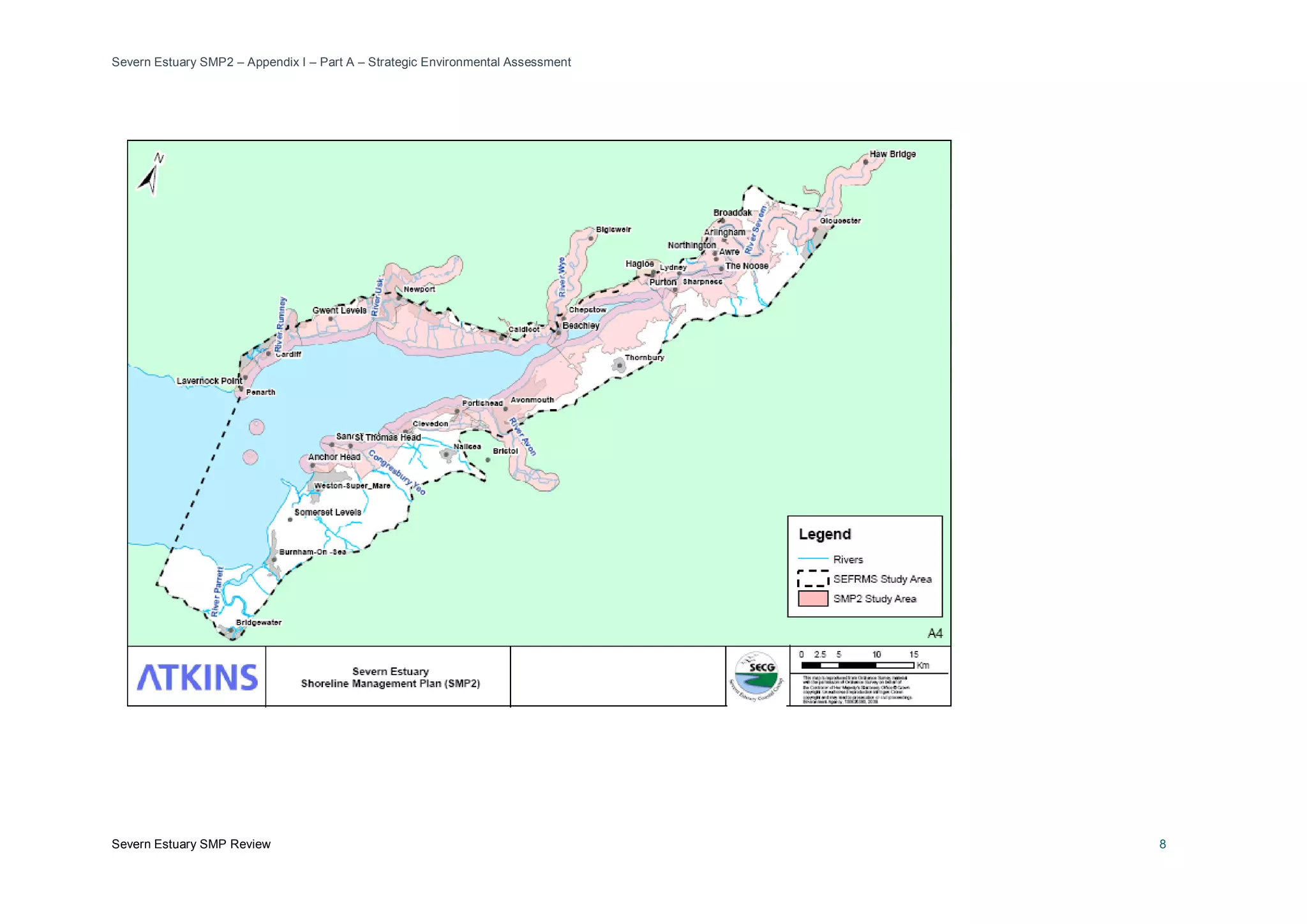
of the estuary;
• wind turbines – there are several proposals across the study area to develop
alternative energy sources including onshore or offshore wind turbines; this may
affect the landscape character of the estuary as well as result in bird collisions
and mortalities;
• the regeneration of ports and waterfronts will bring new opportunities for
recreation, housing and tourism development to coastal locations such as
Portishead, Watchet and Weston.
• Bristol Port Company’s proposed Deep Sea Container Terminal at Avonmouth,
will potentially adversely affect estuarine processes and encroach into the
Severn Estuary European site;
• Severn Power are developing a new gas fired power station at Uskmouth; works
will also involve the construction of a 6km pipeline between Uskmouth and
Marshfield; given the existing developed nature of this site, long term strategic
level impacts are considered unlikely;
• the Marine Bill will include proposals for a coastal footpath along the entire
British shoreline; within Wales WAG have already given a commitment in its
strategic agenda “ Wales - A Better Country” to further extend public access to
the coast of Wales and allocated £1.5 million towards achieving this; this will
enhance recreation opportunities, but alignments may conflict with SMP2
policies.
• The UK Government’s Nuclear White paper 2008: 'meeting the energy
challenge' identified new nuclear power stations as having a role to play in the
country’s future energy mix alongside other low carbon sources; potential sites
for new nuclear power plants along the estuary include Oldbury and Hinkley. As
any new developments are likely to be located on existing power station sites,
conflicts with the SMP2 policy options are considered unlikely. Impacts of the
development are likely to include potential effects on the Severn European site.
It is anticipated that the final SMP2 will provide guidance to Local Planning
Authorities by setting future policies for flood and erosion risk management which will
be implemented over the next 50 to 100 years.
Severn Estuary SMP2 – Appendix I – Part A – Strategic Environmental Assessment
Severn Estuary SMP Review 35
7.2.2 Population
Significant conurbations within the SMP2 study area with populations of more than 10,000
include Penarth, Cardiff, St Mellons, Newport, Caldicot/PortSkewett, Lydney/Allaston/
Chepstow, Gloucester, Quedgely, Bristol, Portishead, Clevedon and Yatton/Congresbury.
Key strategic planning documents including the Regional Spatial Strategies, Wales a Better
Country and the local plans advocate that population growth across the study area be contained
within the urban areas where possible. Population growth is having a secondary impact on the
capacity of other systems including infrastructure and utilities.
7.2.3 Deprivation and Regeneration
The Index of Multiple Deprivation is a statistically generated output that that can be used to
identify small geographical areas that are deprived. The measure combines information from a
range of datasets including:
• Income;
• Employment;
• Health deprivation and disability;
• Education, skills and training;
• Barriers to housing and services;
• Crime, and
• Living environment.
Areas within the study area with high levels of deprivation include Gloucester, Weston-Super-
Mare, Burnham, Newport and Cardiff. The general trend across the area is one of an ageing
population and an ongoing lack of access to basic services, particularly in rural areas. A number
of towns within the study area are experiencing regeneration and redevelopment of areas
around watercourses including Gloucester Docks, Newport and the area around the Cardiff Bay
Barrage. Regeneration brings investment and improvement to waterside areas but this can also
add pressures on the existing transport networks and water systems.
7.2.4 Economic Activity
The majority of the study area is dependent on farming, with grazing being the dominant activity.
Centres of commercial and industrial development exist at Avonmouth, Gloucester, Newport,
Cardiff, Lydney and Bristol.
In the 1960s - 1980 peat extraction was a major industry in Somerset but this is starting to
decline following public concern over peat conservation issues. It is, however, still locally
important.
Marine sand and gravel extraction take place along the estuary. These activities have the
potential to lead to increased coastal erosion due to changes in sediment transport patterns and
alterations in beach levels with resultant implications for coastal defence, nature conservation
amenity beaches and possibly tourism. As part of the regulation of the marine dredging industry
monitoring is undertaken on a regular basis to assess any impact on the coastline
7.2.5 Material As s ets
Three major transport routes cross the lower Severn Estuary: the older M48 Severn Road
Bridge between Aust and Beachley Point, and the newer M4 crossing between Severn
Beach/Pilling and Caldicot, and the Severn rail tunnel which crosses just to the north of the M4
crossing – connecting rail services between London Paddington and South Wales runs parallel
to the coast and in places is within 2300m of the defences. Another important strategic rail route
is the Chepstow to Gloucester line which runs close the right bank of the estuary from Tidenham
to Blakeney. The majority of the roads within the immediate flood risk area are minor roads,
Severn Estuary SMP2 – Appendix I – Part A – Strategic Environmental Assessment
Severn Estuary SMP Review 36
lanes, tracks and byways. Public footpaths and the Severn Valley Way are located along or
adjacent to much of the existing defences.
There are numerous key water management assets (sewage treatment works, pumping stations
and outfalls) along the coast and electricity transmission lines and pylons are located within the
study area between Magor Pill and Mathern Pill.
Much of the development along the Severn Estuary is around ports, which are centres of
maritime industry, including heavy industry and transport, commercial fisheries and mineral and
aggregate extraction. There are also power generation plants based at Avonmouth, Berkeley,
Oldbury, and Uskmouth.
7.2.6 Touris m and Recreation
Tourism is recognised by both the Welsh and English Governments as a key wealth creator and
it is already an integral part of the economy and way of life around the Estuary. Spatial plans
and strategies for the area recognise the importance of tourism and seek to encourage its
growth as it brings economic, environmental and social benefits and supports local services.
Tourism along both sides of the Estuary is shaped by the pattern of principal towns and cities,
traditional coastal resorts, small historic market towns, villages and natural landscape features.
There are traditional holiday locations such as Burnham-on-Sea and Weston-super-Mare as
well as a number of areas that are becoming tourist centres associated with regeneration
including Gloucester Docks and Cardiff Bay. Developments at Cardiff Bay cater for a new
generation of tourism with its concentration on the arts, music, shopping and business.
The coast also offers intrinsic value and provides centres for exploring the Quantocks, Mendip
Hills and Somerset Levels. The network of small historic market towns and villages, and
associated historic and wildlife attractions are important to the fabric of the area, particularly
Chepstow and the Wye Valley, Lydney and Berkeley and Slimbridge in the higher reaches of
the Estuary. Other visitor attractions include boat trips to the islands of Steep Holm and Flat
Holm as well as fishing and pleasure trips from most other resorts. The main growth potential
lies in the short holiday market and in business-related tourism.
The cities of Gloucester and Bristol, along with the visitor centre at Slimbridge are recreational
and tourist hotspots. There is also a developing Community Forest, the Forest of Avon, which
stretches from Thornbury, south westwards beyond Weston-super-Mare. This comprises forest
paths, long distance paths and nature reserves. Long distance paths such as the Severn Way
along the river form another attraction to the area. The Severn Bore, a tidal wave up to 1.2m
high caused by tides sweeping up the narrow funnel of the estuary, is another attraction.
Recreation related to the coast is limited due to the difficulty of access, limited sandy beaches,
high tides and strong currents. Despite this, the Estuary offers a diverse and often challenging
environment for a wide variety of sporting and recreational interests particularly in the vicinity of
Oldbury, Chepstow, Portishead, Cardiff, Newport, Penarth and Barry.
SMP2 policy options have the potential to facilitate or constrain future recreational actives along
the coastal zone. A Hold the Line Policy is likely to ensure existing activities behind the defence
line are maintained, whilst features in front of the defence may be at future risk of flooding
and/or erosion.
Sailing and boating
Sailing and boating are popular, with each part of the Estuary being host to a different range of
activities, such as sailing, dinghy-ing, canoeing and large cruisers. Moorings within Cardiff Bay
Barrage are expected to increase from 1,000 boats to 2,500 in the next five years. Marinas exist
at Penarth, Bridgwater and Sharpness, with facilities having been recently developed at
Portishead. Many other craft are based on the Estuary on river moorings and in local harbours.
Other craft, from sailing dinghies and speedboats to personal watercraft, are able to launch at
public slipways and may travel from far a field to use the Estuary.
Bird watching
Large numbers of waders and wildfowl can be seen around the Estuary, particularly in winter.
Thousands of people come to the Estuary to watch the birds and visit nature reserves.
Wildfowling clubs affiliated to the British Association for Shooting and Conservation, and
Severn Estuary SMP2 – Appendix I – Part A – Strategic Environmental Assessment
Severn Estuary SMP Review 37
recognised for integrating their activities with conservation in estuaries, own or lease sporting
rights over the foreshore and adjacent land. The Wildfowl and Wetlands Trust have a visitor
centre at Slimbridge, and on the Welsh side of the estuary, the Newport Wetlands Centre run by
the RSPB provides a similar facility.
Angling
Angling from the shore and from boats on the Estuary is a popular leisure activity, with private
and charter boats operating from ports and harbours in the area. Leisure fishing for sea fish
makes a significant contribution to the economy as well as providing recreation. Although it has
declined in recent years, there are many plans to try to restore this trend. The Severn Estuary is
one of the most important elver fisheries in Europe bringing benefits to the local economy.
However, there have been concerns recently regarding declining stocks due to over exploitation
and loss of habitat.
7.2.7 Ports and Navigation
The Severn Estuary’s ports are extremely important to the regional and, in some cases, national
economy. Coastal shipping typically uses around 20% of the energy used by road transport and
can help to lead to substantial reductions in road congestion. The good motorway connections
on both sides of the Estuary mean that there are significant environmental as well as economic
benefits to be gained from transporting goods by boat.
The major ports within the Estuary area are Bristol (Royal Portbury and Avonmouth), Cardiff and
Newport, with smaller facilities at Sharpness, Gloucester and Bridgwater. The Port of Bristol,
which is privately owned, has undergone significant expansion over the last ten years and
handles cars (import and export), timber and forest products, coal and coke, animal foodstuffs,
petroleum products (including Liquid Petroleum Gas), raw materials for manufacturing,
container traffic and marine dredged aggregates.
The ports of Cardiff and Newport are operated by Associated British Ports (ABP). Cardiff
handles mainly petroleum products, steel, timber, dry bulks, containers and fruit juices. Newport
handles steel imports and exports, agri-bulks, solid fuels, timber, plywood and glass. Both
handle marine dredged aggregates.
British Waterways is the port authority for Sharpness Dock where cargo operations are carried
out by private companies. Sharpness Dock handles dry bulk, grain, foodstuff, fertiliser, scrap
metal and other goods. Gloucester Harbour Trustees are the competent harbour authority for
the tidal waters of the River Severn from a point seaward of the Second Severn Crossing to
Gloucester, and the tidal River Wye to Bigsweir Bridge. Newport Harbour Commissioners
control the tidal waters of the River Usk.
Sedgemoor District Council is the Harbour Authority at the Port of Bridgwater, where all the
commercial wharves are in private hands. Trade at Bridgwater is currently increasing,
particularly dry bulk imports from the near continent.
Port maintenance dredging takes place at most of the ports in the Severn Estuary area. The
material dredged comprises almost entirely fine silts which are disposed of at designated
disposal sites, licensed by Defra or WAG under the 1985 Food and Environment Protection Act
Part II.
7.2.8 Other
Walking, horse riding and cycling are favoured pursuits and there is demand for further long
distance routes (e.g. Gloucestershire Coastal Path and the Wales Coastal Footpath). The
Marine Bill will make provisions for creating a coastal footpath around the shoreline of the UK.
Recreational pastimes such as bathing, land yachting, kite buggies and beach racing occur at
various locations around the Estuary where lengthy stretches of sand form the primary tourist
attraction. In general, however, the use of the Severn Estuary by recreational craft is
significantly less than around “honey pot” areas of the south and east coasts of England and
South and West Wales.
Severn Estuary SMP2 – Appendix I – Part A – Strategic Environmental Assessment
Severn Estuary SMP Review 38
Likely Evolution of the Baseline without the Implementation of the Plan
Ongoing housing and infrastructure development could lead to increases in the number of
properties and economic assets at risk of flooding as well as increasing the population at risk
of flooding.
Increased risk of flooding could in the longer term result in increased levels of stress and
anxiety amongst populations living in at-risk areas.
An increased resident population and changes in lifestyle are likely to result in increased
demand for recreation, including access to the coast, countryside and water related recreation.
This is expected to include the development of a new long distance footpath.
There is expected to be key development in or near to the study area. This will be in relation
to power generation by nuclear/gas fired powers stations and/or renewable energies. There is
also expected to be development and of ports and waterfronts.
Tourism is expected to continue to be an integral part of the economy and way of life around
the Estuary. This is expected to continue to grow with further investment to the area.
Further development of access to and along the coast is likely to occur in accordance with
political drivers
Climate change and sea level rise will increase the tidal flood and erosion risk to populations
along the estuary
Environmental Issues Constraints and Opportunities
Populations are predicted to increase with associated development and pressure on the
coastline
Increased risk of flooding will increase stress and anxiety amongst at risk populations.
Insurance premiums and property prices may be affected.
Opportunity to reduce significance of flooding impacts and erosion impacts on to key
community recreational and amenity facilities.
Opportunities for recreation and health benefits
Material and economic assets along the coastal strip including transport, communications
links, services, businesses, utilities need to be safeguarded. The strategy may also influence
the potential for future development.
Coastal regeneration is increasing economic development, particularly in relation to tourism
and recreation. Opportunities to work in partnership with developers, local authorities and
other bodies to incorporate recreational and amenity enhancements into coastal management
schemes.
Marine extraction can affect coastal processes and has the potential to lead to increased
erosion.
Severn Estuary SMP2 – Appendix I – Part A – Strategic Environmental Assessment
Severn Estuary SMP Review 39
7.3 Biodiversity, Flora and Fauna
The study area supports a variety of habitats and a diverse flora and fauna, with protected
species of national and international importance present. There are seven Natura 2000 sites
(sites of European importance, comprising Special Areas of Conservation, designated under the
Habitats Directive (92/43/EEC) and Special Protection Areas (SPA), designated under the Birds
Directive (79/409/EC)), two Ramsar sites and over 50 SSSIs within the SMP2 study area.
Potential impacts on flora and fauna are complex and will depend on the SMP2 policy option
adopted and the nature of the habitat/species affected (e.g saline/freshwater, terrestrial/aquatic
etc.). For example a hold the line policy would protect terrestrial habitats and species behind a
defence, but coastal squeeze would in the medium to long term affect intertidal habitats in front
of the defence.
7.3.1 Sites of International Nature Cons ervation Importance
The Natura 2000 European network of protected sites represents areas of the highest value for
natural habitats and species of plants and animals that are rare, endangered or vulnerable in
the European Community. Ramsar sites are wetlands designated as internationally important
under the Convention on Wetlands (Ramsar, 1971). A summary of the sites within or
immediately adjacent to the study area is provided below. Additional information can be found in
Appendix I Part B: Assessment of Likely Significant Effect.
Severn Es tuary SPA
Key features of the Severn Estuary SPA include:
• internationally important populations of regularly occurring Annex 1 species,
Bewick’s swan;
• internationally important populations of regularly occurring migratory bird
species: including: white-fronted goose, gadwall, shelduck, dunlin and
redshank;
• internationally important assemblage of wintering waterfowl.
Severn Es tuary Rams ar Site
The Severn Estuary is a Wetland of International Importance under the 1971 Ramsar
Convention for the following reasons:
• its immense tidal range affecting the physical environment and biological
communities;
• supporting four Habitats Directive Annex I features present on the SCI (including
sandbanks, estuaries, mudflats and Atlantic salt meadows).
• unusual estuarine communities, reduced species diversity and high productivity;
• the run of migratory fish between the sea and rivers via the estuary;
• important site for migratory birds during spring and autumn
• assemblages of waterfowl of international importance.
• a rich assemblage of breeding birds of international importance.
• important feeding and nursery ground for many fish species including allis shad
and twaite shad.
Severn Estuary SMP2 – Appendix I – Part A – Strategic Environmental Assessment
Severn Estuary SMP Review 40
Severn Es tuary SAC
Qualifying features include of the Severn Estuary SAC include:
• populations of the species twaite shad, river lamprey and sea lamprey.
• the Annex 1 Habitats it supports; the area is considered to be one of the best in
the UK for the habitats Atlantic salt meadows, reefs, estuaries, intertidal mudflats
and sandflats and subtidal sandbanks.
Walmore Common SPA and Rams ar Site
This is a relatively small area of improved grassland and ditches primarily designated for the
internationally important numbers of overwintering Bewick’s swan it attracts. The grassland
used for feeding and roosting is maintained by grazing and natural winter flooding.
River Us k SAC
The River Usk is designated as a SAC. The designation extends from the mouth of the River
Usk into its headwaters beyond the village of Sennybridge. Species and habitats of international
conservation importance for which the river is designated include:
• the populations of twaite shad, allis shad, sea lamprey, brook lamprey, river
lamprey, bullhead, Atlantic salmon and otter it supports;
• ranunculus habitat (watercourses of plain to montane levels with the
Ranunculion fluitantis and Callitricho-Batrachion vegetation).
River Wye SAC
The River Wye SAC extends from the mouth of the Wye upstream into Gloucestershire,
Herefordshire and Powys. Details of species and habitats of international conservation
importance for which the site is designated include:
• ranunculus habitat (watercourses of plain to montane levels with the
Ranunculion fluitantis and Callitricho-Batrachion vegetation), transition mires and
quaking bogs.
• the populations of White-clawed (or Atlantic stream) crayfish, twaite shad, allis
shad, sea lamprey, brook lamprey, river lamprey, bullhead, Atlantic salmon and
otter it supports.
North Somers et and Mendip Bats cSAC
This cSAC is characterised by scrub, heath, woodland and grassland areas. The key habitats
that have resulted in its designation include; semi-natural dry grassland and scrubland facies;
Tilio-Acerion forests of slopes, screes and ravines; and caves. These habitats support greater
and lesser horseshoe bats, which are the primary species for which the SAC is designated.
Wye Valley and Fores t of Dean Bat Sites SAC
The species that are a primary reason for selection of this site are greater and lesser horseshoe
bat. This complex of sites contains about 26% of the national population of lesser horseshoe
bats. It supports an exceptional breeding population, and the majority of sites within the complex
are maternity roosts. The bats are believed to hibernate in the many disused mines in the area.
The site also supports about 6% of the UK population of greater horseshoe bats. The site
contains the main maternity roost for bats in this area, which are believed to hibernate in the
many disused mines in the Forest.
Severn Estuary SMP2 – Appendix I – Part A – Strategic Environmental Assessment
Severn Estuary SMP Review 41
Wye Valley Woodlands SAC
The Wye Valley contains abundant and near-continuous semi-natural woodland along the
gorge. The habitats that are the primary reasons for the selection of this site are: beech forests,
forests of slopes, screes and ravines (Priority feature) and woods of the British Isles (Priority
feature). Lesser horseshoe bats are also a feature of the site.
Avon Gorge SAC
The primary reason for the designation of the is site is the Tilio-Acerion forests of slopes, screes
and ravines, the limsestone cliffs and screes that the River Avon gorge supports. The semi-
natural dry grasslands and scrubland habitat located on the limestone soils are also a site
feature.
In addition to the above sites there are a number of European sites within neighbouring SMP2
study areas which could potentially be affected by the SMP2. These include:
• Limestone Coast of South West Wales/
Arfordir Calchfaen de Orllewin Cymru
SAC
• River Tywi/Afon Tywi SAC,
Pembrokeshire Marine/Sir Benfro Forol
SAC
• Carmarthen Bay and Estuaries/ Bae
Caerfyrddin ac Aberoedd SAC
• Carmarthen Bay/ Bae Caerfyrddin
SPA, Carmarthen Bay Dunes/Twyni
Bae Caerfyrddin SAC
• Castlemartin Coast SPA, Burry Inlet SPA
Ramsar, Dunraven Bay SAC
• Crymlyn Bog SAC Ramsar
• Kenfig/Cynffig SAC • Somerset Levels and Moors SPA,
Ramsar
• Exmoor Heaths SAC • Exmoor and Quantocks Oak Woods
SAC
• Lundy SAC • Braunton Burrows SAC
• Tintagel Marsland Clovelly Coast SAC
7.3.2 Sites of National Importance
Sites of Special Scientific Interest
Sites of Special Scientific Interest (SSSIs) are of national importance for nature conservation
and are afforded protection under the Wildlife and Countryside Act (1981) (as amended) and the
Countryside and Rights of Way Act (2000). There are over 50 SSSIs within the study area; the
sites. A number of the SSSIs are also internationally important for their wildlife and habitats and
are therefore designated covered by the SAC, SCI, SPA and Ramsar sites designations
outlined above.
National Nature Reserves
In addition to the SSSIs, there are also four NNRs within the SMP2 study are: Newport
Wetlands, The Hudnalls, Leigh Woods and Gordano Valley. National Nature Reserves were
established to protect the most important areas of wildlife habitat and geological formations in
Britain as places for scientific research.
Sites of Local Importance
There are nine Local Nature Reserves within the SMP2 study area.
Severn Estuary SMP2 – Appendix I – Part A – Strategic Environmental Assessment
Severn Estuary SMP Review 42
7.3.3 Biodivers ity Action Plans
The government has a commitment to maintain biodiversity. The overall goal is “to conserve
and enhance the biological diversity within the UK and to contribute to the conservation of global
biodiversity through all appropriate mechanisms. Biodiversity Action Plans (BAPs) have been
created at a national and local level to protect and enhance the diversity of flora and fauna. The
UK BAP (Biodiversity: The UK Action Plan, 2004) sets out action plans for priority species and
habitats. Local Biodiversity Action Plans (LBAPs) are used to identify the local contributions that
can be made to achieving the UK BAP priorities as well as identifying other local biodiversity
priorities. LBAPs covering the study area include:
Wales
• Wild About Cardiff, March 2002;
• A Local Biodiversity Action Plan for Newport (date unknown);
• Monmouthshire Local Biodiversity Action Plan, Development and Biodiversity
Supplementary Planning Guidance, July 2005;
• Vale of Glamorgan Local Biodiversity Action Plan, Vale of Glamorgan Council
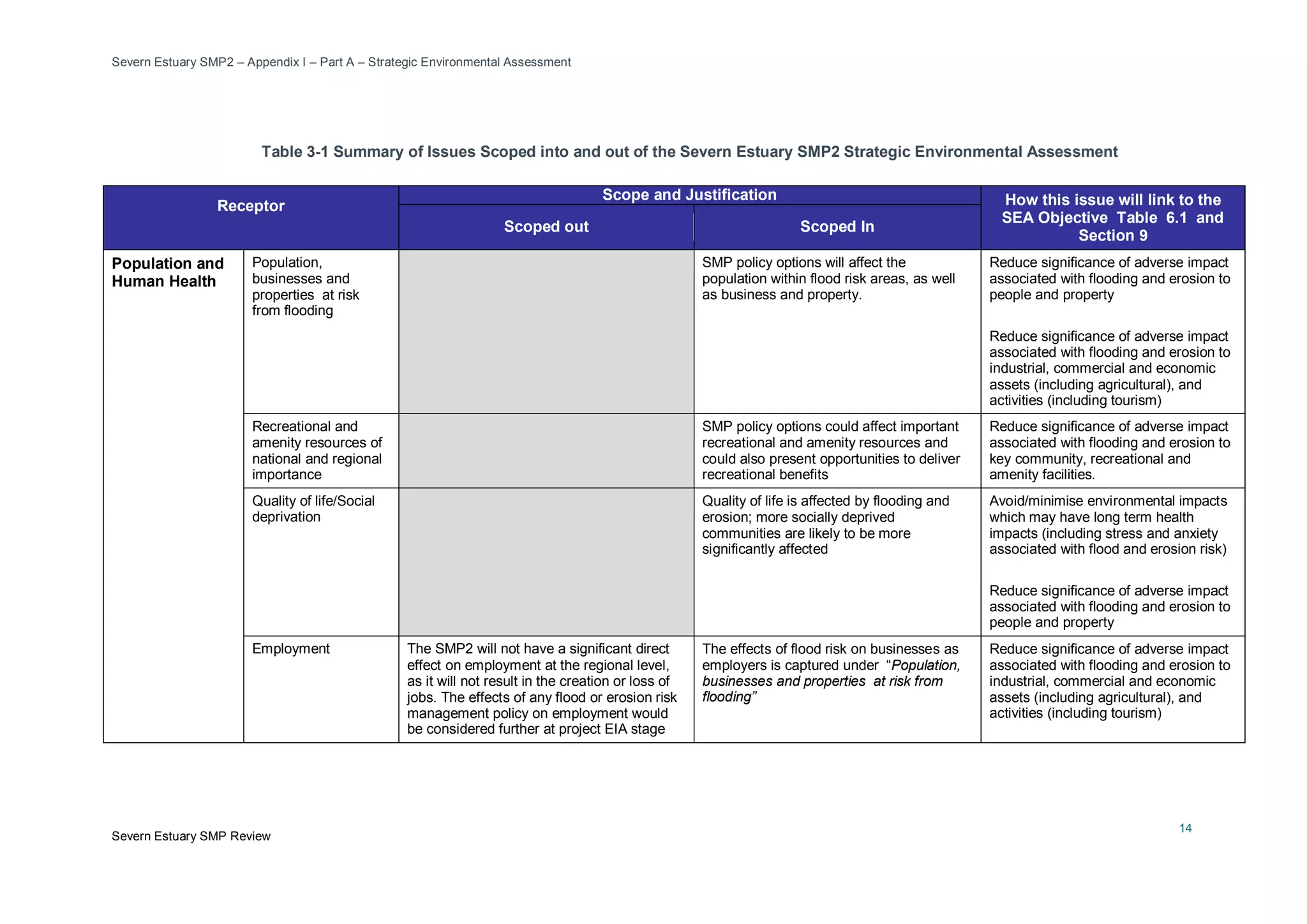
May 2002.
England
• Biodiversity Action Plan for Gloucestershire, 2000;
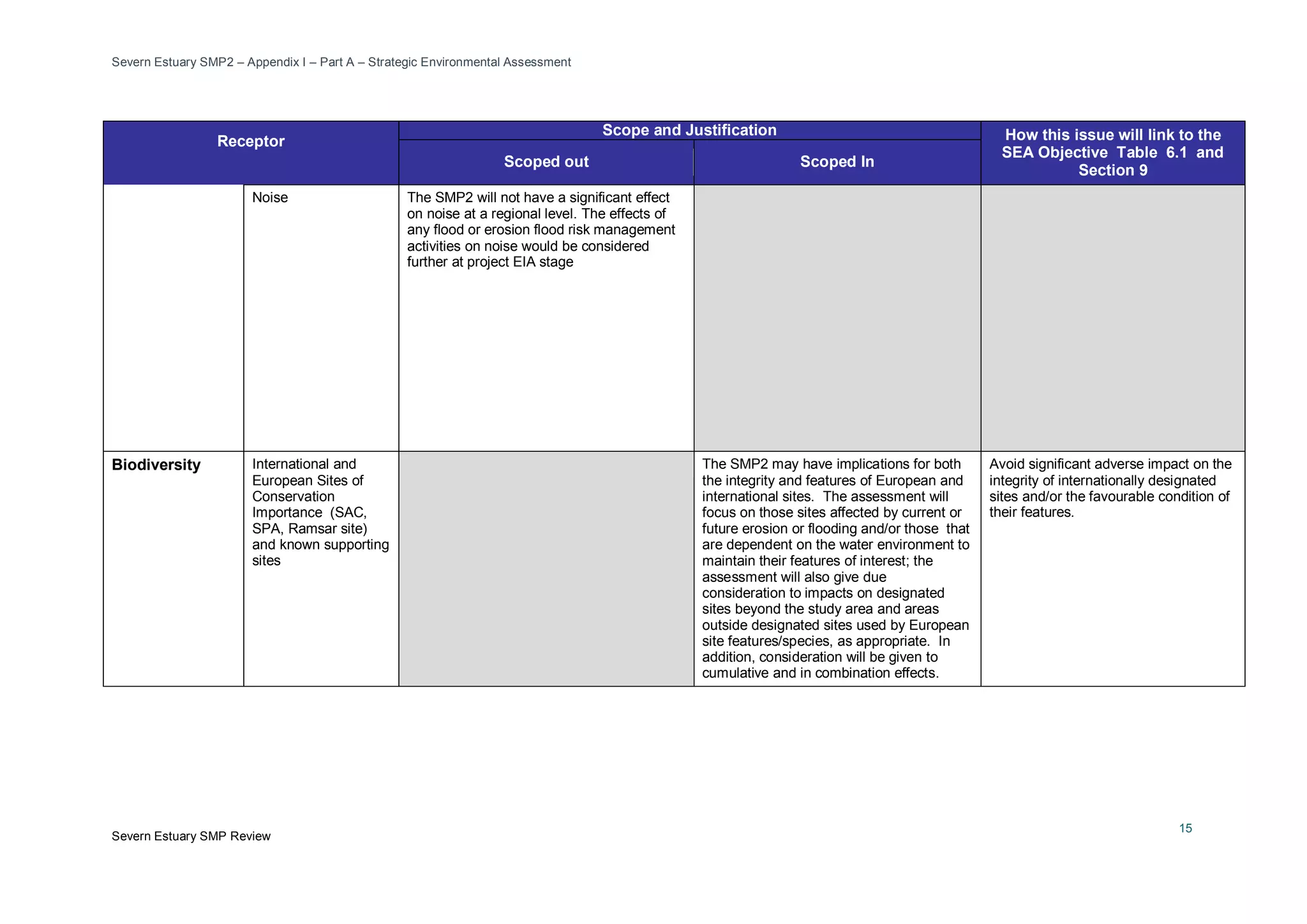
• South Gloucestershire Local Biodiversity Action Plan, March 2008;
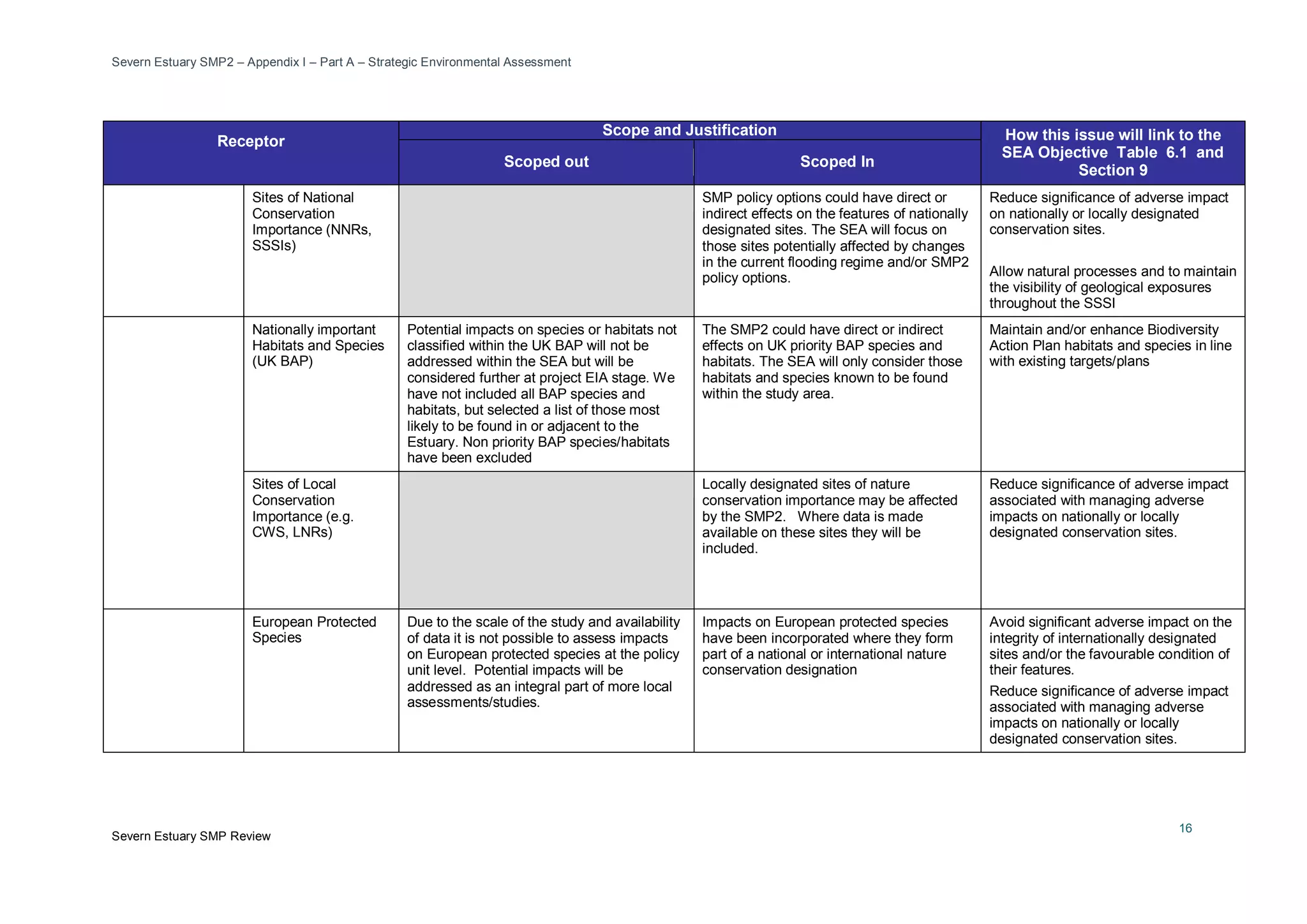
• Bristol Biodiversity Action Plan, 2008;
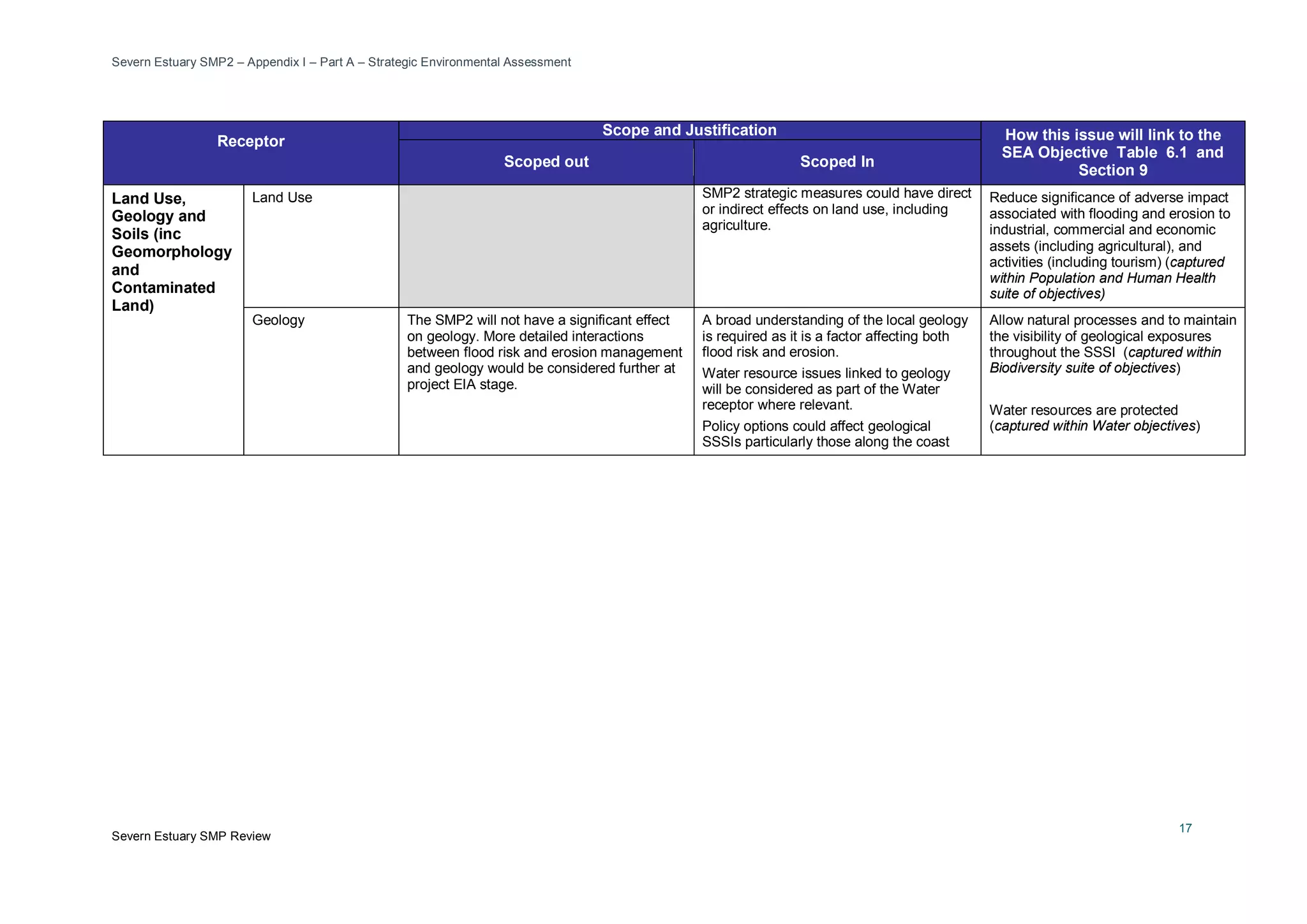
• North Somerset Biodiversity Action Plan – Action for Nature, 2005;
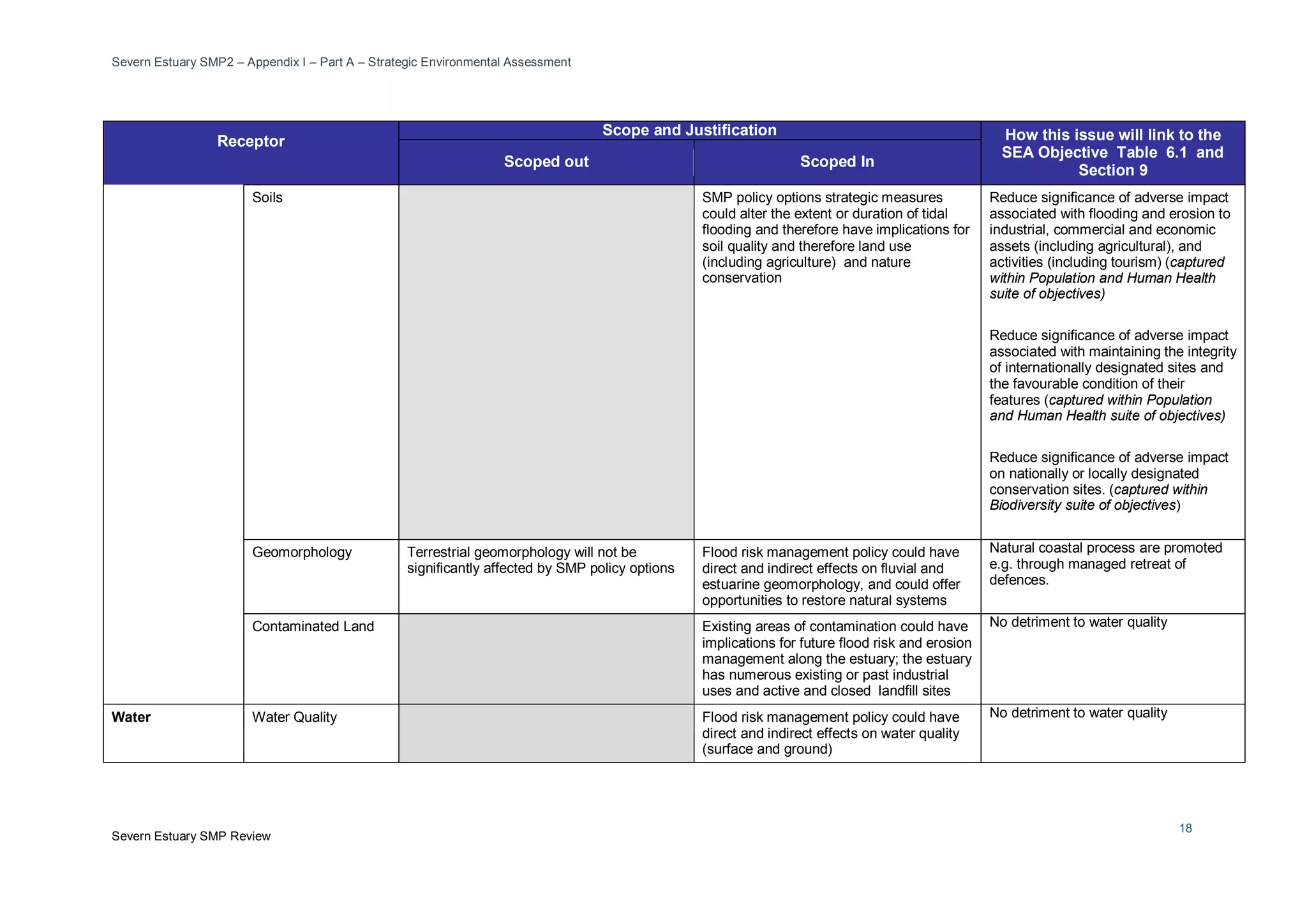
• Sedgemoor Local Biodiversity Action Plan, 2008;
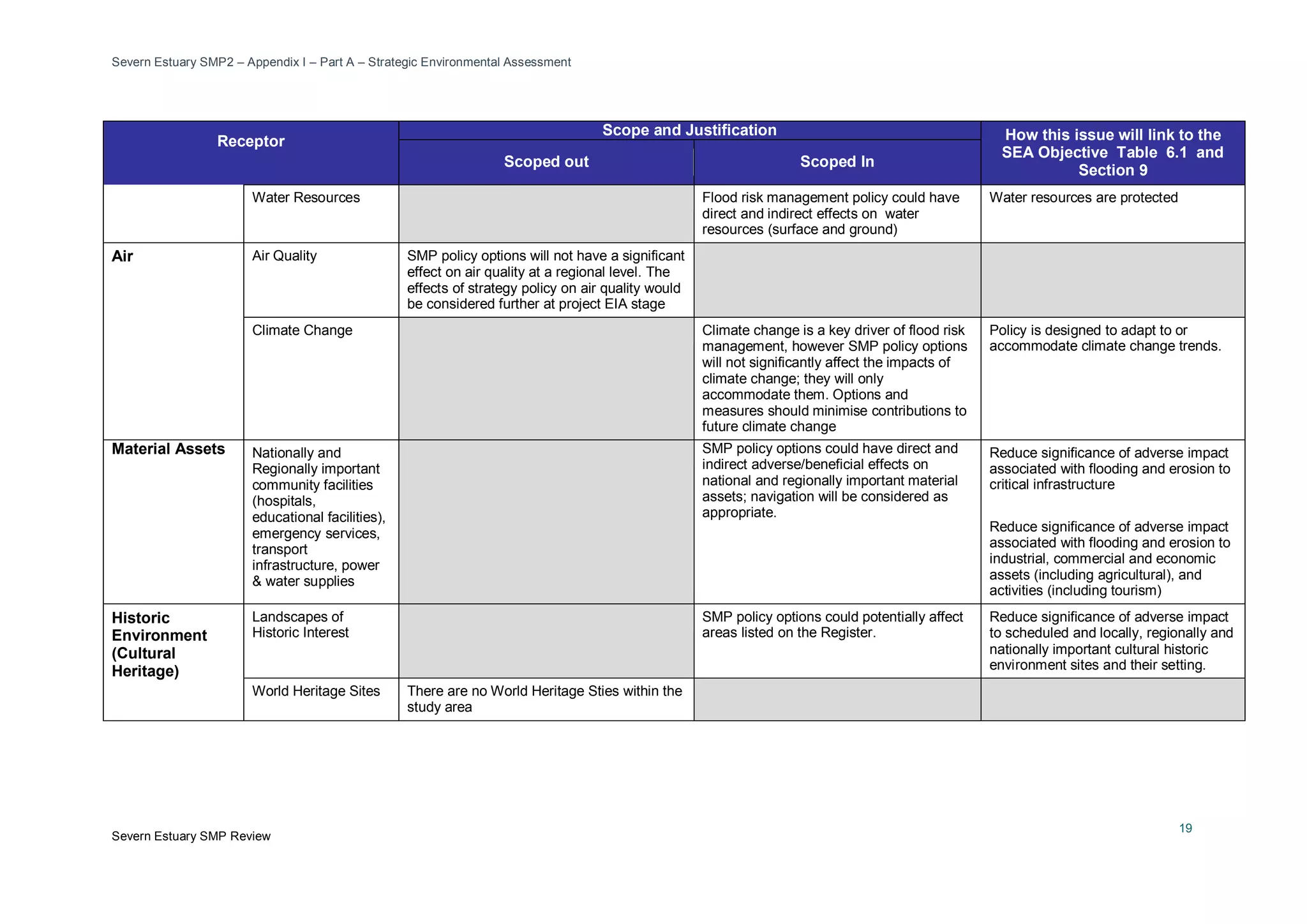
• West Somerset Local Biodiversity Action Plan, May 2008;
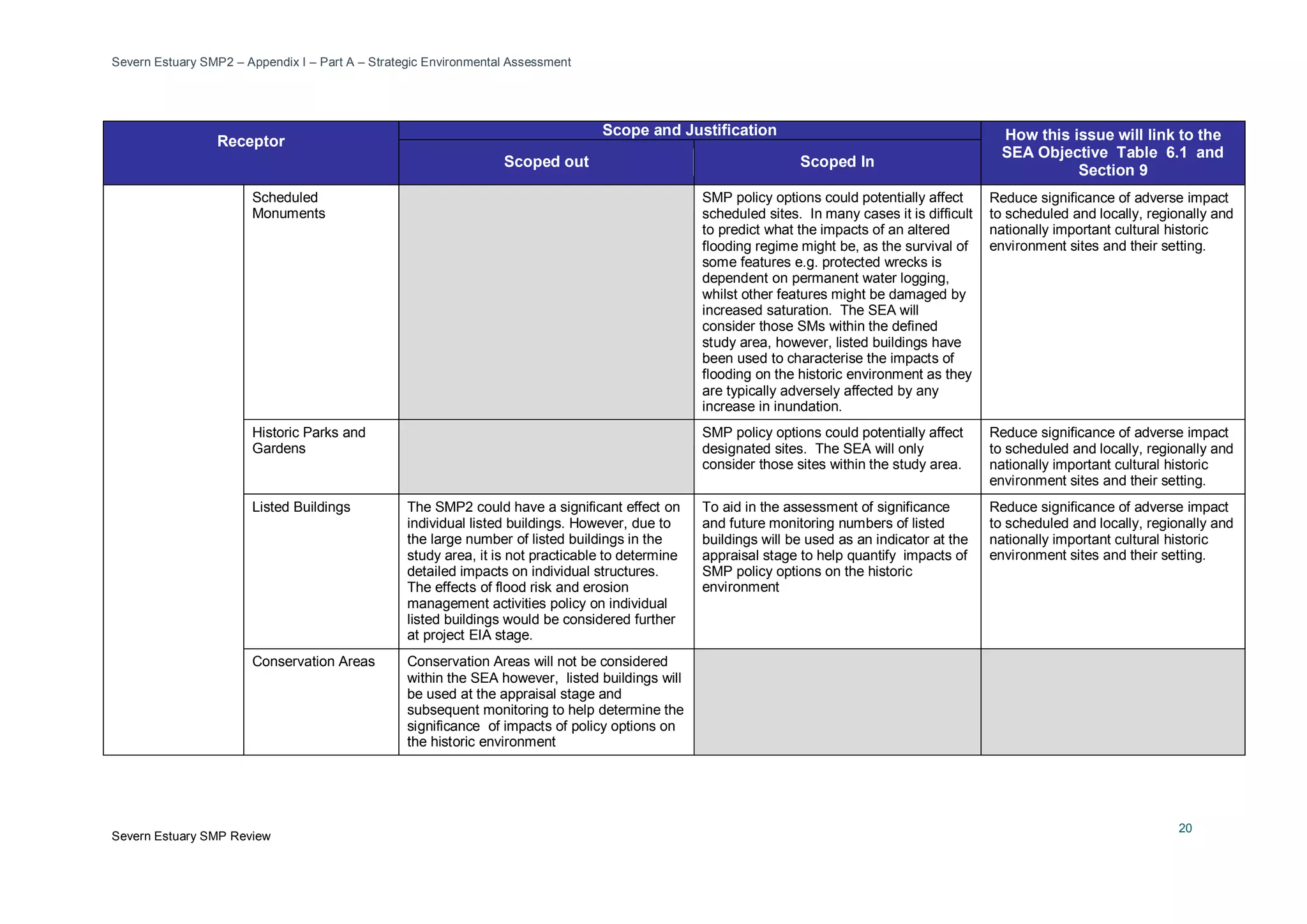
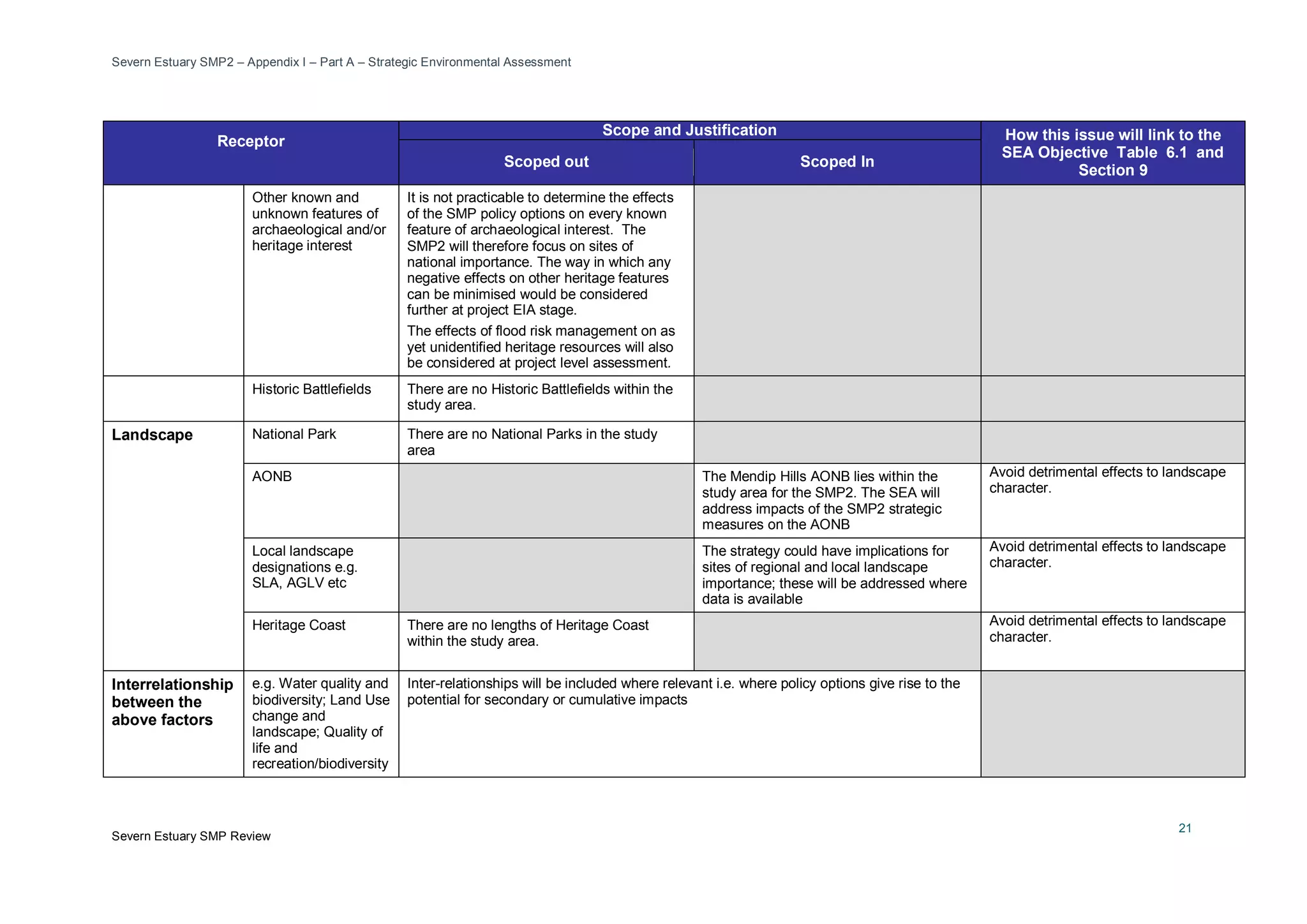
• The Somerset Biodiversity Strategy 2008-2018 : “ Wild Somerset 2008”.
The Severn Estuary and its hinterland support a number of important BAP habitats and species.
The priority habitats most relevant to the study area are identified as follows:
• floodplain and coastal grazing marsh;
• coastal saltmarsh;
• mudflats
• sub-littoral sands and gravels;
• grasslands;
• reedbeds;
• ancient and/or species-rich hedgerows;
• old meadows and pastures (encompassing lowland calcareous grassland,
lowland meadows and lowland dry-acid grassland);
• ponds, rhynes, rivers and water bodies (chalk rivers);
• orchards.
Habitats around the estuary have been lost in the past due to increased urbanisation, draining
of land and intensification of agriculture. Many of the plans covering the study area highlight the
Severn Estuary SMP2 – Appendix I – Part A – Strategic Environmental Assessment
Severn Estuary SMP Review 43
importance of reversing decline in habitats, particularly for wetlands. Initiatives and partnerships
are trying to reverse this trend including the Severn Vyrnwy Land Management Initiative, the
Severn and Avon Vales Wetland Partnership and areas within Environmentally Sensitive Areas
where land owners are provided with targeted agri-environmental support to maintain landscape
and biodiversity features.
The large tidal range on the estuary provides an extensive intertidal zone of coastal grazing
marsh, saltmarsh and mudflats. Mudflats are dominant around the Cardiff Grounds and central
parts of the estuary and on the lower tributaries.
Saltmarsh is confined to low energy, sheltered environments such as on the Wentloodge,
Gwent and Caldicot Levels and inner estuary. Areas of saltmarsh are dwindling in the UK as a
whole, therefore the Severn Estuary saltmarsh (over 1100 hectares in total) is increasing in
value as a wildlife habitat. It is an important component of the Severn Estuary SSSI, SPA and
SAC. Saltmarsh vegetation holds sediment from the Estuary, in some cases maintaining a
natural intertidal “buffer” for to flooding and high waves. The management of the saltmarsh,
including the intensity of grazing, affects not only the wildlife value of this habitat, but also
maintenance of the net area of saltmarsh on the Severn Estuary. Larger areas of saltmarsh and
mudflat are found around New Grounds (at Slimbridge – Headquarters for the Wildfowl and
Wetlands Trust), Lydney, Beachley and Sedbury. These habitats provide important feeding
grounds for wading birds, migratory wildfowl and fish (at some, or all stages of their life cycles).
However, these areas have been declining over recent years due to coastal squeeze and
pressure from development.
Man has had a major impact on the environment of the Severn Estuary leading to the decline of
habitats. However, in some areas manmade influence is maintaining the habitat. The low-lying
ground of the Severn Levels has been reclaimed from tidal inundation by a complex network of
sluices and drainage channels (rhynes and reens) for agriculture. The artificially high water table
in summer now supports a variety of nationally rare species. Some of these areas are
designated as SSSIs, which have been classified as being in unfavourable condition in recent
years due to the lack of management of the ditches and poor water quality.
Ancient orchards are listed as a locally important habitat and are scattered around the upper
sections of the study area, for example at Rodley and Minsterworth. The orchards comprise
mature species of local and native pear, plum and apple trees, e.g. the Berkeley Pippin. These
old specimens provide important landscape and habitat value for insect eating birds and dead
wood eating invertebrates
Floodplain grazing marsh exists in the upper areas of the study area, e.g. around Minsterworth
and Elmore. These areas experience regular inundation as they are low-lying, have few or low
defences, and are in the bottle-necks of meander bends. As floodwaters are brackish, a
specialised vegetation community develops, which can grade into saltmarsh at the channel
edges. Other habitats that are found around the Severn Estuary and lower tributaries include
rocky intertidal platforms and beaches near the Severn bridges, sub-tidal channels around the
Newport Deep and sea cliffs.
Many of the habitats along the estuary such as the Gwent Levels are also under pressure from
expanding arable production, and development. The Habitat Action Plans (HAPs) outlined
within regional and local BAPs provide some level of protection to these habitats. These plans
identify habitats of particular local and regional value and set out targets for their management.
Many habitats, e.g. old orchards, have declined over the past century and recent initiatives are
in place to maintain, improve and extend them.
Key BAP species within the study area include:
• bats;
• dormouse;
• great crested newt and other amphibians;
• otter;
Severn Estuary SMP2 – Appendix I – Part A – Strategic Environmental Assessment
Severn Estuary SMP Review 44
• water vole;
• allis and twaite shad;
• lapwing;
• Bittern.
The SMP2 will consider the impacts of polices and strategic measures on the sites and BAP
species and habitats identified above.
Likely Evolution of the Baseline without the Implementation of the Plan
Existing plans and policies which specifically aim to halt the decline of biodiversity, protect
existing resources and reverse losses are already in place. Particularly stringent protection from
development is given to international sites.
PSA targets in place to ensure that the majority of nationally important sites are in Favourable
Condition by 2010. The Severn SSSI is currently at risk of failing this target due to coastal
squeeze
Climate change and sea level rise will have implications for the habitats and species for which
sites are designated, for example distribution of bird species. This may have implications for
the number and distribution of species for which the Severn Estuary SPA/Ramsar site is
designated
The Water Framework Directive will have an increasing influence, as there will be a statutory
requirement for inland and coastal water bodies to meet ‘good ecological status’ (see baseline
for Water). This is likely to be a significant driver to improvements in aquatic biodiversity in the
area.
Environmental Issues Constraints and Opportunities
There is a need to avoid significant impact on integrity of internationally designated sites and the
favourable conditions of their features.
Biodiversity Action Plan habitats and species should to be maintained and enhanced in line with
targets.
Designated sites are at ongoing risk from development and coastal squeeze. SMP2 will need to
consider coastal squeeze implications.
The impacts of the SMP2 on European sites will need to be subject to assessment under the
requirements of the Habitats Regulations. There is likely to be a need to create compensatory
habitat.
Strategic options for capital schemes may give rise to opportunities to improve ecological
connectivity both as part of protected sites and by the enhancement and/or restoration of other
key habitats.
7.4 Fisheries
The River Severn and its tributaries including the Wye and Usk have in the past been important
salmon fisheries, however over the past decade populations have been decreasing In addition,
there were concerns that mixed stock salmon fishing was reducing the numbers of rare shad as
by-catch. Controls on fishing, aimed at increasing stocks, have since been imposed by the
Environment Agency who own the fishery.
Severn Estuary SMP2 – Appendix I – Part A – Strategic Environmental Assessment
Severn Estuary SMP Review 45
The River Severn has the biggest migration of eels of any river in England and Wales and the
elver fishery is an important commercial fishery, with the juveniles being exported to Europe and
the Far East, while there still remains a limited adult eel fishery for export or local smoking. Elver
stocks have declined by as much as 98% in recent years and this has prompted Europe to
expect all member states to produce Eel Management Plans. The main issues affecting
populations on the Severn are exploitation, loss of habitat (river connectivity with its floodplain),
proposed hydropower schemes and barriers to migration. The elver and sea trout enter the
saltmarsh across the levels during high tides to feed, and then retreat out as the tide recedes.
The Severn is one of a few rivers in England and Wales that supports a twaite and an allis shad
population. Shad are members of the herring family that live in salt water but spawn in fresh
water. Historically, the River Severn supported a huge commercial shad fishery with fish
spawning upstream of Shrewsbury, but with the creation of the Severn Navigation in the 19th
Century, shad were excluded from their historical range by the creation of the navigation weirs.
The population of the allis shad in the UK has declined since the mid-nineteenth century to the
point where it has a sporadic distribution around the coast with no known spawning
grounds/rivers. The twaite shad has also declined, although spawning populations are known to
be present on the Severn downstream of Worcester and on the Usk and Wye. The main issues
facing shad are barriers to migration, poor stock assessment, navigation activities and habitat
loss.
The Severn contains three types of lamprey (brook, river and sea). River and Sea Lamprey
enter the river to spawn each year. Sea lamprey make long upstream movements to above
Shrewsbury on the main Severn and are quite visible spawning on the gravel shallows. The
migration of river lamprey is less well understood, but it is thought that they spawn further down
the river. The sea lamprey stock is thought to be healthy but inter year variations are not
uncommon; it is generally accepted that river lampreys have declined over the last 25 years.
The reasons for this decline are not fully understood.
Salmon, twaite shad and the lamprey species (sea and river) are all features of the Severn
Estuary SAC and consequently afforded a very high level of statutory protection. Allis shad is
also a feature of the River Usk and River Wye SACs and listed within the Ramsar citation for the
Severn Estuary. Shad also spawn on the River Tywi in Camarthenshire and are a feature of the
River Tywi SAC.
Commercial salmon fishing has declined in productivity and importance. Drift nets, draft nets
(seine or long nets), the traditional methods of ‘fixed engines’ (putts and putchers), and hand-
held lave nets are methods once employed, but all these fisheries have reduced. This has
occurred partly due to Government supported buyouts and Net Limitation Orders such as the
closure of the drift net fishery which operated off the Welsh coast between Newport and
Chepstow and the putcher fishery at Goldcliff near Newport.
There is very little shell fishing on the Estuary, but traditional activities include the use of ‘mud
horses’ by a small number of fishermen, taken out over the intertidal mud in Bridgwater Bay to
fish for shrimps.
Commercial fishing for white, sea fish also takes place on the Estuary, including trawling,
longlining, and the use of beach nets for cod, whiting, bass, sole, plaice and mullet. As
previously mentioned there are several small eel and elver fisheries along the Severn.
Likely Evolution of the Baseline without the Implementation of the Plan
The coastline and Severn Estuary rivers are likely to continue to be important recreational and
commercial fisheries and fish migration routes.
The River Severn and the Rivers Wye and Usk have had controls imposed on fishing them with
the aim of increasing stocks. Salmon and other species are expected to see a reverse in
decline of the populations.
Eel Management Plans are being produced by the Environment Agency to conserve eels and
elvers in the River Severn, as a result the risk to eel populations should reduce and numbers
are hoped to recover
Severn Estuary SMP2 – Appendix I – Part A – Strategic Environmental Assessment
Severn Estuary SMP Review 46
Commercial salmon fishing in the Severn Estuary has declined in productivity and importance,
partly due to Government buyouts and net order limitations. It is unlikely that there will be an
increase in commercial salmon fishing. Commercial fishing for other species is also unlikely to
rapidly increase.
Environmental Issues Constraints and Opportunities
The salmon fishery has in the past been over exploited and elver numbers are in decline.
Increased development and/or recreational activity along the coast may affect fish and elver
populations. The implementation of strategic options has the potential to affect fish stocks.
Access to estuary is an important consideration for recreational fisheries and the ability to keep
and launch boats from the coast is a consideration for commercial interests.
Biodiversity Action Plan habitats and species need to be maintained and enhanced in line with
targets. Eel Management Plan targets need to be taken into account.
7.5 Soil Geology and Geomorphology
7.5.1 Soils
Soils play a fundamental role in the quality and distribution of water within a catchment. They
have a significant impact on how an area responds to rainfall, being responsible for the relative
proportions of the rainfall that are retained in the soil, pass to groundwater or contribute to
surface water runoff. Loosely packed, deep soils retain more rainfall and have a slower
response than shallow or densely packed soils. The permeability of catchment soils has an
important influence on the speed and magnitude of a river’s and a catchment’s response to
rainfall:
• impermeable soils will allow rainwater to run off the catchment very quickly and
flow into surface water bodies such as lakes and rivers. In severe
circumstances, this can lead to flash flooding;
• permeable soils with a low porosity can allow more water to infiltrate into the
ground but at a slow rate. This allows the soil to store water where it is used by
plants and other organisms in the soil;
• permeable soils with a greater porosity will allow rainwater to infiltrate into the
ground which may contribute to groundwater flow. The rate at which it does this
is dependant on the pore sizes and structure of the soil.
There are a wide range of soil types across the study area affecting permeability and land use
The lowland coastal areas along much of the estuary including the Gwent and Somerset Levels
are characterised by fertile peaty soils.
7.5.2 Geology
The impact of geology on flood risk and erosion is determined by the effects on topography, the
permeability of rocks and their resistance to erosion. Permeability, along with other factors such
as vegetation cover and topography, will influence the response of an area to a rainfall event.
The hardness of the rocks across the study area have heavily influenced the evolution and
shape of the estuary and continue to exert an influence on topography and rates of erosion.
The Severn catchment exhibits a very varied geology. The bedrocks of the Estuary and its
surrounds consist of clays, mudstones, sandstones and limestones, ranging in age from
Ordovician to Jurassic, and represent past marine and terrestrial environments.
Severn Estuary SMP2 – Appendix I – Part A – Strategic Environmental Assessment
Severn Estuary SMP Review 47
During the late Permian and Triassic, the ‘mountains’ formed by the folding of the Carboniferous
Limestone were weathered down to form low hills in an arid landscape. Eventually the hills were
submerged beneath an extensive desert lake which was then inundated by the Jurassic sea.
Limestones, clays and sandstones were deposited over the region during the Jurassic and
Cretaceous. During the Tertiary, western Britain was uplifted by events related to the opening of
the Atlantic. This resulted in the stripping off of much of the Cretaceous and Jurassic cover,
leaving low-lying areas on which soft Jurassic clays and Triassic marls now outcrop and
commonly form and surround the broader parts of the funnels of the Estuary.
The resistant Carboniferous Limestone now forms many of the east-west trending hills and
ridges which surround the Estuary and provide the headlands and islands (Brean Down, Steep
Holm, Flat Holm, and Sully Island) which contribute to the Estuary’s funnel shape. The lower
reaches of the River Severn flow over non aquifer Triassic Mercia mudstone group strata and
Jurassic Lower Lias clays. The Cotswold escarpment (Jurassic Limestones) delineates the
watershed.
More recent Quaternary deposits lain down over the past two million years have served to
provide the drift geology coverage for the area. These typically consist of riverine alluviums,
peats and marine clays together with glacial deposits of sands clays and gravels. High sea
levels during the Quaternary interglacials were responsible for many of the coastal features
fashioned out of bedrock, while sand and mud were deposited in the low-lying embayments
(e.g. Wentlooge, Caldicott and Somerset Levels). Reworked glacial sediments have also been
deposited in the main Estuary flats.
7.5.3 Geomorphology
Geomorphology is the study of the landforms and the continuing natural processes that have
created the physical environment we see today. Coastal and fluvial geomorphological
processes shape the landscape and river channels by eroding, transporting and depositing
sediment. Changes in the way sediment is created, transferred and deposited in one area can
result in geomorphological changes elsewhere, and can influence present and future erosion
and flood risk. We need to consider geomorphology within the SMP2 because an
understanding of coastal and estuarine processes is critical to achieving sustainable flood risk
management, and a diverse and healthy environment in terms of habitats and ecology.
Sediment erosion, transport and deposition processes are controlled by factors that govern the
balance between water and sediment inputs to any length of river or coastline. These factors
include geology, topography, soil type, climatic trends, land management practices, sediment
size, structure of the bed and bank materials, valley floor slope, and the channel morphology.
These factors together determine the distribution of energy at different flows and hence the
energy available to transport sediment.
Sediment and Morphology
A summary of key morphological characteristics for the Severn and its main tributaries is
provided below:
The River Severn ranges from a fluvially dominated channel (less than 50m wide) downstream
of Gloucester to a predominantly tidally dominated channel that is over 8,000m wide at
Avonmouth. The dynamic nature of the estuary is partly due to its large tidal range, reaching in
excess of 14.5m at Avonmouth at spring tide. The estuary has the second largest tidal range
anywhere in the world. This means that large volumes of water enter the estuary, often at high
speed, and rapidly change the estuary’s physical character through erosion, deposition and
sediment transport. Some reaches within the estuary are eroding rapidly as a consequence, for
example erosion at Cone Pill is currently up to 5m/year.
The existing shoreline of the estuary is very varied with mudflats, sandflats and saltmarsh
fronting an alluvial backshore. Some higher ground of easily eroded sandstone and limestone is
present between Clevedon and Portishead and again at Aust (near the first Severn Bridge).
The shape (cross-section and plan form) of the Severn Estuary is determined by the underlying
geology. Zones of harder Silurian, Devonian and Cambrian rock are interspersed with softer
Severn Estuary SMP2 – Appendix I – Part A – Strategic Environmental Assessment
Severn Estuary SMP Review 48
Triassic Marls and Mudstones. The varying rates of erosion experienced by such rocks has led
to a series of tight meander bends and exposed limestone cliff, for example at Aust. These are
interspersed with larger, flatter embayments filled with estuarine muds and fine sands, for
example at New Grounds (Slimbridge). The estuary and the coastal floodplain is a dynamic
environment that is constantly evolving by both natural processes, including sediment
deposition and erosion, and by human influences such as the reclamation of land.
The lower Severn is funnel shaped and orientated in a south-west to north-east direction. Areas
of resistant bedrock hold the funnel shape for example at Sudbrook, Beachley and Aust. The
funnel shape of the estuary concentrates large volumes of flow from the Bristol Channel into an
ever-decreasing width of channel, and so accentuates the tidal range so that the estuary
experiences the ‘Severn Bore’ or tidal wave, associated with rising tides. The tidal wave moves
at the front of the rising tide and can rise to 2m high and travel at 16km per hour. This is a local
phenomenon and tourist attraction.
The Lower Severn estuary has been experiencing tidal inundation throughout the Holocene,
which has caused the estuarine system to move slowly inland as a result of sea-level rise. The
estuary has also widened due to the increasing amount of tidal water in the system.
Coastal and Estuarine Processes
An extensive amount of work has previously been carried out analysing the geomorphological
processes both within the wider Estuary and focussing on the estuary fringes. Whilst a large
number of studies have resulted in generally accepted conceptual sediment transport models of
the Severn Estuary, detailed prediction of the natural evolution of sandbanks, mudflats and
saltmarsh over time is difficult and prone to large uncertainties, as highlighted by the Severn
Estuary CHaMP (ABPmer, 2006).
There is a recent history of continuing coastal erosion of beaches and salt marshes which are
natural/soft coastal defences. The natural shoreline movements are now largely curtailed by
artificial defences against the continuing threat of erosion.
The coastal processes of erosion, deposition and flooding are driven by natural forces acting on
the materials forming the bed and sides of the estuary. These natural forces are:
• tides and currents;
• winds and waves;
• meteorologically driven surges;
• flood water flows down rivers.
The estuary is subject to a great tidal range and also to fairly strong currents. Seaward areas
tend to be dominated by tides and waves whilst upstream areas are dominated progressively by
fresh water flow and the incidence of river flood waters. Flooding in seaward areas depends on
the joint occurrence of high waves occurring at times of high water levels at spring tides, either
from the tide alone or from the contribution of tide and surge. Flooding towards the head of the
estuary depends on the joint occurrence of high flood discharges at the time of high water levels
- waves are less of a problem but in downstream areas are still of significance.
The sediment budget of the estuary is a balance between the inputs and outputs of the fluvial
system. Studies undertaken for the Severn Coastal Habitat Management Plan (ABPmer, 2006)
suggest that the main sediment source for the Severn Estuary is from the river systems
including the Wye, Avon, Usk and Severn itself. Minor sources of sediment come from minor
cliff recession and other forms of erosion making up a total sediment source of between 4.16M
to 5.4M tonnes a year. Some of this sediment is deposited in the system in the form of
saltmarsh and mudflat accretion and subtidal deposition in the Newport Deep, this amounts to
between 1.06 to 2.06M tonnes a year. However large amounts of sediment (30M tonnes per
year) are being transported within and through the system.
Severn Estuary SMP2 – Appendix I – Part A – Strategic Environmental Assessment
Severn Estuary SMP Review 49
Current understanding indicates that in the short term (up to year 2028) the predicted
geomorphological evolution along the estuary fringes for policy units PEN1-2, CAR 1-2, WEN 1-
2, CALD1 and BRIS 1-3, PORT 1-4, KIN 1-4 is marginal erosion (a loss of saltmarsh of 10-
30%), although there is local evidence of intermittent accretion. For TID1-2, GLOU 1-8, MAI 1-5,
SHAR 1-8 and SEV 1-6 the short term trend is for both marginal erosion and accretion (±20%
variation in saltmarsh coverage). In the medium to long term (2058 and 2108) uncertainties
significantly increase. In relation to flood risk, virtually all flood defences are predicted to have
structurally failed due to degradation under the Do Nothing scenario after the year 2058.
Human Influence
Man has influenced the geomorphology of the rivers within the Severn Basin in a number of
ways including:
• Construction of structures that alter flow and deposition of sediment e.g.
navigation weirs such as at Gloucester and the Cardiff Bay Barrage; these have
all had an effect on the sediment budget. The completion of the Cardiff Bay
Barrage in 1999 has changed the lower reaches of the River Ely from a tidally
dominated system to a fluvial system. The barrage governs flow and level in the
lower parts of the catchment and has altered the channel processes and
geomorphology.
• Change of land use along the edge of the estuary which affects bank stability
and influences the amount of sediment entering the system. Soil that is grazed
or susceptible to trampling by animals can be less resistant to erosion and wash
into watercourses following heavy rain.
• Draining land that would otherwise have flooded by constructing channels, re-
routing watercourses or by pumping water away. e.g. the Gwent and Somerset
Levels.
• By constructing flood defences or hard bank engineering which reduces natural
interaction with the floodplain. This can increase water conveyance and energy
and cause erosion of natural features.
• Navigational or maintenance dredging is undertaken around ports to maintain a
deep enough channel for ships such as at Bristol, Cardiff, Newport and
Sharpness. In addition, dredging for mineral and aggregate extraction takes
place. In terms of the latter, an estimated 1.5M tonnes per year is extracted from
the Severn Estuary. Dredging can remobilise sediment within the estuary system
and may increase erosion as the estuary tries to rebalance the sediment budget.
Likely Evolution of the Baseline without the Implementation of the Plan
Marine and estuary aggregate removal for channel maintenance around ports such as Bristol,
Cardiff, Newport and Sharpness will continue as there is likely to be net accretion of these
aggregates, so an ongoing requirement for dredging.
If no work is undertaken all defences are likely to have structurally failed due to degradation in
the medium term (that is by the year 2058).
There is a risk of marginal erosion along some parts of the estuary; no significant erosion is
predicted
Severn Estuary SMP2 – Appendix I – Part A – Strategic Environmental Assessment
Severn Estuary SMP Review 50
Environmental Issues Constraints and Opportunities
Coastal management has the potential to affect natural processes along the frontage. The
strategy will seek opportunities to maintain and restore natural processes along the coast.
7.6 Land Use and Land Management
The character of land cover and different types of land management practices influence how
floods are generated, where and when they may occur and how much damage they cause.
This is because land use and land management can have a significant effect upon rainfall runoff
and infiltration rates.
Land use affects the amount of rainfall that runs off the land. For example, urbanisation,
intensive agriculture or short vegetation tends to increase run-off rates, whilst forest cover can
increase interception and the ability of the ground to absorb rainfall, thereby decreasing run-off.
Land use can be greatly affected by humans. Changes in land management have the potential
to disrupt natural flow paths and flood storage patterns. This may take the form of faster and
increased runoff from deforested fields or loss of floodplain to housing developments. It is also
possible for human actions to work in harmony with nature, in the creation of wetland
environments and by reconnecting floodplains where flood defences are no longer considered
appropriate.
There are significant areas of residential, commercial and industrial development at Avonmouth,
Weston-Super-Mare, Gloucester, Lydney, Clevedon, Cardiff, Newport and Chepstow.
Development in floodplains, even behind flood defences can significantly increase flood risk as
defences rarely exclude all magnitudes of flooding. Urban areas may also be at risk of flooding
from inadequate drainage systems resulting in surface and groundwater flooding.
Most of the study area is rural, with agriculture being the major land use. Pasture still
dominates, but its extent has reduced in recent years due to increasing conversion to arable
farming. Agricultural land use is interspersed with patches of woodland, and remnants of old
orchard systems.
Since Roman times, land has been reclaimed from the estuary and drained for agricultural
purposes. This has led to a complex pattern of man-made drainage channels (also known as
reens or rhynes) in many areas. Some of the land that is now drained is below mean high-water
level, and would otherwise flood, but due to the location of flood defences and drainage ditches,
the land is available for agricultural use. Internal Drainage Boards within the study area manage
the drainage of this land.
Defra classifies agricultural land into five grades, based on climate, land gradients, aspect, flood
risk and underlying soil characteristics, with Grades 1 to 3a being considered the ‘best and most
versatile’ soils. Over 87 per cent of agricultural land within the SMP2 study area is Grade 1 to 3
classification (very high to high quality agricultural land). There is continued financial pressure
for farmers to diversify their activities, such as providing facilities for commercial re-use,
recreation and tourism with a view to increasing their income, and to provide for public access.
Conservation initiatives may also be a source of income, whilst providing positive help for
farmers to conserve and enhance wildlife. These measures are positively encouraged by
Government initiatives.
Other businesses depend on the rural environment independent of farming practices, such as
those associated with tourism and leisure activities. It is essential to ensure that they are
conducted in sympathy with the rural character of the Estuary.
Due to the risk of regular fluvial and tidal flooding, much of the estuarine land is defended by
formal and informal structures. Many of the more recent formal structures have been
constructed and are maintained by the Environment Agency, but farmers, private estates and
industrial depots have also constructed local defences. In the main, the defences comprise
earth embankments, some with stone pitching to withstand erosion, but there are also concrete
and stone defences.
Severn Estuary SMP2 – Appendix I – Part A – Strategic Environmental Assessment
Severn Estuary SMP Review 51
Welsh Agri-Environment Schemes
A number of agri-environmental schemes are run by the Welsh Assembly Government; the
flagship scheme is Tir Gofal. The scheme was established in 1999 as an integral part of the
first Rural Development Programme for Wales. It is a whole farm scheme and is available on
farmed land throughout Wales. It rewards farmers for caring for the environmental, historical
and cultural features on their land and is designed to support the farming community in
protecting and enhancing the environmental and cultural landscapes of Wales. It provides the
opportunity to encourage landowners to pursue more sustainable land use management across
the whole farm, protecting and enhancing terrestrial habitats and features.
The Tir Gofal scheme sits within Welsh Assembly Government’s wider Tir Cymru programme
which also includes Tir Cynnal, Tir Mynydd, The Better Woodland for Wales and Organic
Farming.
The Welsh Assembly Government is also currently piloting a project to give advice and support
to farmers on a catchment basis to improve the environment and reduce their impact on local
streams, rivers and lakes. The project includes guidance on manure and nutrient management,
free soil analysis and other technical advice and funding for capital work to reduce run-off and
erosion. A whole range of other issues will be supported including;
• managing livestock access to streams etc;
• separating clean and dirty water;
• improving slurry-handling facilities.
English Agri-Environment Schemes
The Rural Development Programme for England includes support for conservation and
improvement of the rural environment, largely through the Environmental Stewardship Scheme,
which provides funding to farmers and other land managers in England who deliver effective
environmental management on their land. Its primary objectives are to:
• Conserve wildlife (biodiversity);
• Maintain and enhance landscape quality and character;
• Protect the historic environment and natural resources;
• Promote public access and understanding of the countryside;
• Natural resource protection.
Within the primary objectives it also has the secondary objectives of genetic conservation and
flood management.
UK agriculture has been subject to some significant changes in the past five years.
• Common Agricultural Policy (CAP) reform largely delivered by agricultural
subsides and incentives has resulted in some areas of land being removed from
agricultural production and the reallocation of grazing land to arable use.
• Variations in wheat prices has influenced farmers cropping choice and amount of
land in production (agricultural land prices have also increased);
• cultivation of crops for biofuels;
• increased cultivation of genetically modified (GM) crops and
• changes in set-aside legislation.
Severn Estuary SMP2 – Appendix I – Part A – Strategic Environmental Assessment
Severn Estuary SMP Review 52
Land use management has a role to play in controlling future run-off, controlling diffuse pollution
and mitigating the effects of climate change. It is important that our policies and actions for
managing future flood risk are aligned with existing and future agri environment policy.
Likely Evolution of the Baseline without the Implementation of the Plan
Without intervention, the risk of coastal and fluvial flooding of agricultural land is expected to
increase with the predicted effects of climate change.
Drained land such as the Gwent and Somerset Levels is likely to be continued to be drained
in the future for agricultural purposes, and because of European and National designations
which are in place to conserve habitat and species which are present at specific sites.
However sites will be at increased risk of coastal flooding in the future.
The nature and type of future agricultural production is uncertain; political drivers include
increased emphasis on self sufficiency in food production, use of land for production of bio
fuels and fluctuating prices of wheat and land.
Environmental Issues Constraints and Opportunities
Environmental stewardship schemes will continue to promote good agricultural practices which
protect soil and biodiversity.
A requirement to maintain viability of agricultural land in the context of changing political/
economic drivers and sea level rise
The strategy will seek opportunities to maintain natural processes along the coast. The
management of estuarine features and adjoining land, including the re-establishment of
wetlands and traditional grazing regimes, is important.
7.7 Water
7.7.1 Surface Water Quality
Water quality in the catchment is important for potable water supply, maintaining fisheries and
recreation and for aquatic and riparian habitats.
Inputs to the Estuary that affect water quality include sewage effluents, abandoned mines,
diffuse runoff from agricultural and forestry activities, industrial effluents and marine vessel
discharges. Much of the heavy industry in the Estuary area is centred around Avonmouth and
between Newport and Barry in South-East Wales. Most of these process facilities are large and
are located on the Estuary to take advantage of water available for cooling and the high dilution
available for large volume trade effluent discharge into the Estuary. Contaminated land,
industrial facilities and those subject to the COMAH (Control of Major Accident Hazards) 1999
all have the potential to pose a risk to water quality.
The water quality of the Estuary is controlled by UK legislation, including that derived from
International conventions and EC Directives and implemented via UK Regulations. In the future,
management and monitoring requirements are likely to be determined by the implementation of
the EC Water Framework Directive. Under the Directive there is a requirement to:
• prevent a decline in quality and achieve good chemical and ecological status in
surface water by 2015;
• achieve good ecological potential in heavily modified water bodies by 2015.
At present the Environment Agency monitors the quality of the Estuary to assess compliance
with the Environmental Quality Standards (EQS) stipulated by the EC Dangerous Substances
Severn Estuary SMP2 – Appendix I – Part A – Strategic Environmental Assessment
Severn Estuary SMP Review 53
Directive. The Environment Agency also monitors designated bathing waters in line with the EC
Bathing Water Directive (1976). Many of the industrial effluent discharges will fall under the
Pollution Prevention and Control (PPC) Regulations which require continued reductions in
specific contaminants released. The River Wye is also designated as a sensitive area under the
European Urban Wastewater Treatment Directive due to high levels of nitrates. Where waste
water is released to these areas, it must undergo a secondary treatment in order to reduce its
impact on the environment.
The legislation above and policy drivers (such as Catchment Sensitive Farming (CSF) Initiatives
are likely to result in further improvements in water quality over the next ten years and beyond.
However, flood and erosion risk management at the strategic level presents limited scope to
directly improve water quality, although, initiatives such as CSF may present opportunities to
work with others to achieve this objective.
7.7.2 Groundwater Quality
Groundwater provides vital resources for public supply, industry, agriculture and for numerous
rural communities. They also feed rivers and support wetlands. If groundwater becomes
polluted it is extremely difficult to clean up. The Environment Agency has published groundwater
vulnerability maps for England and Wales. In addition Source Protection Zones (SPZ) have
been identified for groundwater sources used for public drinking water supply. These zones
show the risk of contamination from any activities that might cause pollution and underpin the
Environment Agency's Groundwater Protection Policy. Issues potentially affecting groundwater
quality within the study area include:
• tidal influence within coastal areas could result in saline intrusion into freshwater
bodies;
• increased levels of nitrate and phosphates in agricultural areas;
• contamination from industrial land use or landfills.
7.7.3 Water Res ources and Surface Water Management
Abstractions from the main rivers flowing to the Estuary and from the Estuary and associated
tidal stretches of rivers include:
• major abstractions direct from the Estuary for cooling water for power stations.
This water is returned rapidly to the Estuary;
• large abstractions from the rivers Severn, Wye and Usk for public water supply;
• a major abstraction from the Severn at Gloucester by British Waterways in order
to feed the Gloucester Sharpness Canal and the abstractions from it, including a
large abstraction for public water supply by Bristol Water Company at Purton.
Estuary processes such as salt-water intrusion and the landward movement of sediment can
affect abstractions near the tidal limit. A recent operating agreement with British Waterways was
put in place to modify the pumping regime from the Severn to the Gloucester-Sharpness Canal
from the East Parting at Gloucester, so that the amount of water taken during adverse
conditions is reduced.
In addition to the main rivers within the study area, there are also numerous drainage ditches
(also known as reens or rhynes) bisecting the low lying land adjacent to the estuary. The
smaller reens and watercourses on the levels are maintained by the relevant Internal Drainage
Board; they also regulate water levels and carry out maintenance on behalf of the Environment
Agency on a rechargeable basis.
The reens typically have flap vales on them and are subject to a tide lock period of up to 4 hours
on every 12 tidal cycle. The watercourses within the levels (i.e. behind the defences) are largely
oversized trapezoidal channels, maintained to store peak flows of water when the tidal flap
Severn Estuary SMP2 – Appendix I – Part A – Strategic Environmental Assessment
Severn Estuary SMP Review 54
valves cannot discharge to the estuary during high tide. They are not routinely subject to tidal
inundation, and are predominantly freshwater habitats, except where saline intrusion occurs on
a periodic or regular basis creating brackish habitats.
The drainage boards undertake annual maintenance of all their adopted watercourses which
typically consists of flail mowing the banks twice a year and weed clearance typically once a
year dependant on weed growth. In addition, major re-profiling of the ditches is undertaken
once every 5-7 years.
Likely Evolution of the Baseline without the Implementation of the Plan
Climate change will increase the risk of flooding water supplies and treatment facilities along the
estuary; there is also an increased risk of pollution or salinisation of freshwater bodies and water
resources.
The need to meet Water Framework Directive water quality objectives for water bodies, and for
all inland and coastal water bodies to reach ‘good ecological status’ in the future will lead to
measures being taken to improve surface water quality in the medium to long term.
The Environment Agency will continue to monitor water quality and regulate abstraction and
discharges into surface and ground waters. The Environment Agency’s work is expected to
result in improvement in the water quality of failing waterbodies in the catchment and the
maintenance of, or a steady improvement in good and very good quality waters.
Many of the surface and groundwater sources within the study area are already classed as
having no water available, being over-licensed or over-abstracted. This is unlikely to change in
the future, as there will be increased demand for water as population grows within the area.
Changes in rainfall patterns predicted with climate change could further reduce the availability of
water resources.
Environmental Issues Constraints and Opportunities
The Strategy will seek to maintain or reduce flood risk to water resource, supply and treatment
assets from coastal flooding.
The Strategy will consider the implications of policy options and strategic measures on water
quality.
The Strategy should not impact on the abstractions from the Severn Estuary or its tributaries.
The Strategy will seek to minimise the risk of saline intrusion into important freshwater bodies.
Past current and future land use has the potential to affect water quality.
7.8 Air and Climate
The implications of climate change for flood risk and coastal erosion have been discussed in
Section 1.3. The SMP2 will take the most up to date climate change predictions into account
when identifying policies and strategic options for the future management of the coast.
The SMP2 will not have a significant effect on air quality at a regional level. The effects of SMP2
policy on air quality would be considered further at project EIA stage
Likely Evolution of the Baseline without the Implementation of the Plan
Climate change is predicted to result in increased storminess and combined with sea level rise
is likely to result in more frequent and severe incidences of coastal flooding.
Increased rainfall in the winter is likely to result in increased river flooding and reduced summer
Severn Estuary SMP2 – Appendix I – Part A – Strategic Environmental Assessment
Severn Estuary SMP Review 55
rainfall increases risk of flood conditions in summer months.
Without intervention, climate change is expected to increase the risk of flooding and erosion to
people, property, the natural environment and other assets within the study area.
Further measures (including improved treatment technologies and policy changes) are likely to
be in place to reduce greenhouse gas emissions in the future.
Environmental Issues Constraints and Opportunities
Climate change is likely to increase tidal flood risk in the Severn Estuary. Flood risk is
exacerbated in low lying areas where increases in sea level can inhibit land drainage.
The selection of strategic options must account for the predicted effects of climate change and
sea level rise and aim to adapt to these changes. It is important that CFMPs, the SMP2 and
FRMS are fully integrated.
Option selection should seek to reduce the potential to contribute to climate change through the
production of greenhouse gases through construction and operation of individual schemes.
7.9 The Historic Environment (Cultural Heritage)
The Severn Estuary is a phenomenally rich and varied archaeological landscape. It is perhaps
the most archaeological significant estuary in Europe. People have been living in this area since
before the Severn Estuary was formed in the Mesolithic, some 8,000 years ago, when rising
post-glacial sea levels saw the inundation of low lying ground. Evidence of early human activity
is preserved in the mud-flats and inter-tidal zones of the Gwent Levels and Somerset Levels,
including the footprints of Mesolithic children. It is the wet and waterlogged conditions of much
of the Severn Estuary area – in particular its rich peat deposits – buried under later alluvium that
has led to the preservation of so much archaeological material. Evidence includes Bronze Age
settlements and trackways, Iron Age villages, houses and trackways, Romano-British
farmsteads and land drainage, medieval fishtraps, rheens/rhines (drainage ditches) and sea
walls, post-medieval drainage and land reclamation, enclosure landscapes, as well as later
activities that have shaped this landscape, including agriculture, industry, urban expansion,
communication, tourism and defence. Palaeo-environmental evidence is particularly significant
due to the extent of its survival in this area.
The River Severn meanders over a course that has altered over time; areas that are now well
inland may once have been inter-tidal with huge potential for archaeological deposits; much of
this land has been reclaimed from the river. Furthermore maritime areas also contain
archaeological remains, including shipwrecks, artefacts, submerged landscapes and World War
II aircraft crash sites. The Severn has a rich maritime heritage, including the remains of boats at
Newport (medieval), Barland’s Farm (Roman) and Caldicot (Bronze Age). It is not simply the
route and former course of the river that is significant: The adjacent Levels are an essential
element of the Severn landscape that contain archaeological remains arising from the activities
that took place along the river such as industry, farming, transportation, settlement, and the way
of life of the people living on its shores.
The built heritage of the Severn Estuary is defined predominantly by the history, function and
development of its major urban centres and use of vernacular traditions and materials in more
rural areas. Gloucester, with its Roman origins and later industrial significance, includes a
diversity of building types, styles and materials, reflecting its strategic position at the head of the
estuary. Other settlements, such as Newport, Cardiff and Penarth reflect the predominance of
industry in Wales in the 19
th
and early 20th
centuries, and include examples of industries, docks
and workers housing. Clevedon, Weston-super-Mare and Burnham-on-Sea reflect the growth of
tourism and the popularity of sea-side resorts, characterised by villas, piers and promenades.
There are also thousands of other smaller historic houses and buildings (many of which are
designated Listed Buildings) within the more rural areas of the Study Area. These reflect the
Severn Estuary SMP2 – Appendix I – Part A – Strategic Environmental Assessment
Severn Estuary SMP Review 56
development of housing and settlement in both England and Wales, illustrating the use of
vernacular materials and styles and the later influence of imported materials.
The 20
th
century influence on the Severn Estuary was considerable. Mass communication by
train and car replaced shipping as the predominant form of transport. Prominent aspects of the
landscape were appropriated for defence during World War II. Large scale industries developed
along shore close to the major port at Avonmouth. The two islands in the estuary (Flat Holm and
Steep Holm) also reflect the importance of the waterways for safe shipping, communication and
defence in first the 19
th
and later 20
th
centuries.
7.9.1 Scheduled Monuments
There are approximately 107 Scheduled Monuments within the Study Area. These include the
most prominent, best conserved and significant monuments and features. However, they
represent only a small proportion of the entire archaeological record of the Severn Estuary
(nationally, only 6% of all archaeological features and deposits are protected through
scheduling). Those that are scheduled comprise earthworks or masonry remains, including
Neolithic and Bronze Age barrows, Iron Age hill forts, Roman sites, a short length of Offa’s
Dyke, Norman and later motte and baileys and castles, medieval moated settlements and
religious sites, historic sea defences and twentieth-century military structures. Scheduling to
date has not included areas of inter-tidal or palaeo-environmental deposits.
7.9.2 Lis ted Buildings
The total number of Listed Buildings with the Study Area runs into the thousands. The greatest
concentrations of Listed Buildings are those within the larger towns and villages found within the
Study Area: Gloucester, Berkeley, Thornbury, Clevedon and Weston-super-Mare on the English
side, and Newport, Cardiff Bay and Penarth on the Welsh. Gloucester, Berkeley, Thornbury and
Newport have medieval or earlier origins, and many of the Listed Buildings date to the medieval
and early post-medieval periods (i.e. dating from the 13
th
/14
th
centuries through to the 18
th
/19
th
centuries). Clevedon and Weston-super-Mare largely owe their development to the growth of
sea-side tourism in the 19
th
century. Cardiff Bay and Penarth developed as a result of industrial
expansion in the 19
th
and 20th
centuries. Newport is also significant for its industrial heritage.
There are many other single Listed Buildings or clusters of Listed Buildings within the Study
Area. These relate to individual houses, smaller villages and hamlets within predominately rural
settings, and are mostly domestic in origin and purpose, reflecting the vernacular traditions and
materials of different areas (i.e. stone, timber framing, brick, thatch) as well as the influence of
imported materials and styles (i.e. slate, engineered brick, dressed stonework, etc).
7.9.3 Cons ervation Areas
Most of the large groupings of Listed Buildings are also included within designated Conservation
Areas and are a major contributor to the landscape character of the Severn Estuary.
7.9.4 Regis tered Parks & Gardens (England)
There are ten Registered Parks and Gardens within the Study Area. This is a non-statutory
designation, but a material planning consideration under Planning Policy Guidance 15 (Planning
and the Historic Environment).
7.9.5 Regis ter of Lands capes , Parks and Gardens of Outs tanding His toric
Interes t (Wales )
The Gwent Levels Historic Landscape of Outstanding Historic Interest in Wales is included
within the Register of Landscapes, Parks and Gardens of Outstanding Historic Interest of Wales
(No 17). This site falls within the SMP2 study area.
7.9.6 World Heritage Sites
There are no World Heritage Sites (WHS) within the study area.
Severn Estuary SMP2 – Appendix I – Part A – Strategic Environmental Assessment
Severn Estuary SMP Review 57
Likely Evolution of the Baseline without the Implementation of the Plan
Flood and erosion risk to the historic environment would be likely to increase.
Further developments within the floodplain and increasing tourism use are likely to put
additional pressure on the historic environment.
Environmental Issues Constraints and Opportunities
As time passes the risk of erosion and/or flooding to some Scheduled Monuments and other
archaeological sites will increase. The strategy will seek to minimise the significance of impacts
on the historic environment.
The SMP2 will seek to sustainably manage and where appropriate conserve and enhance
features of architectural, historical and archaeological interest in their setting.
The Severn Estuary is a phenomenally rich and varied archaeological landscape. The potential
for unknown or unevaluated features existing is high
In delivering the SMP2 there will be opportunities to learn more about the heritage value of the
estuary
7.10 Landscape and Visual Amenity
7.10.1 Lands cape Character
The landscape is an important national resource and though subject to natural evolution and
change, it must be considered in its current condition as a valuable resource for future
generations. It is character that makes each part of the landscape distinct and gives it a
particular sense of place. This section involves the identification of those features or
combinations of elements that contribute to the character of the landscape, thereby enabling the
special character and qualities of an area to be understood.
Landscape character assessments exist for different scales. These include, at the larger scale,
the National Landscape Character Map of England sub-divided by Region into the more detailed
Joint Character Area assessments prepared by the Countryside Agency and the local
assessments prepared by County and District Councils. For the purposes of this baseline
condition study the landscape character has been identified at a regional level.
National Countryside Character (England)
There are six Landscape Character Areas applicable to the English study area. These include;
105 Forest of Dean and Lower Wye
106 Severn and Avon Vales
118 Bristol, Avon Valleys and Ridges
141 Mendip Hills
142 Somerset Levels and Moors
146 Vale of Taunton and Quantock Fringes
105 Forest of Dean and Lower Wye: The Forest Dean and Lower Wye plateau opens out
above the low-lying river valley of the Severn vale to the north of the study area. This area is
characterised by a rolling, agricultural landscape of medium sized arable and pasture fields
bound by hedges, and intermittent trees, and fragmented coniferous plantations. There are
Severn Estuary SMP2 – Appendix I – Part A – Strategic Environmental Assessment
Severn Estuary SMP Review 58
prominent views toward the rolling hills of Monmouthshire to the north and west and over the
Severn to Cotswold ridge in the east.
The character of the Forest of Dean and Lower Wye in relation to the Severn Estuary includes
the confluence with the River Wye, noted for its designated status under an AONB, although
this area does not fall within the study area, the context of the Wye Valley in relation to the study
area is an important element to consider as the AONB is described as being one of the finest
lowland landscapes in Britain.
106 Severn and Avon Vales: The Severn and Avon Vales is characterised by an open
riverside landscape with fragmented woodland and low lying valleys of the Severn and Avon
rivers. In the east, there is a distinct boundary against the Cotswolds, in the west, the edge of
the Forest of Dean confines the Severn Vale to narrow riverside levels. South of the City of
Gloucester the Severn is a unifying feature drawing together the surrounding network of fields.
As the Severn gradually broadens out into the estuary it is a dominant feature, flanked on both
sides by the slopes of the Forest of Dean to the west and the Cotswold escarpment to the east.
The Severn and Avon Vales are further characterised by expansive floodplains, open farmland
and prominent views of surrounding hills at the edges of the study area – including the
Cotswolds, Bredon and the Malverns. On the west bank of the Severn, small villages sit on the
edge of steeply rising agricultural land. The southern section of the area is characterised by the
industrial sites of Avonmouth and the estuary power stations at Berkeley and Oldbury which
dominate the landscape setting.
118 Bristol, Avon Valleys and Ridges: This character area occupies a limited section
within the eastern boundary of the study area and includes the limestone ridge east of
Thornbury, contrasted by the low-lying, Severnside levels to the west. The area further south
encompasses the urban areas of Portishead, Clevedon and Nailsea. South west of Bristol the
area is bound by the Mendip Hills and the Severn side levels extending from the Severn and
Avon Vales.
141 Mendip Hills: The western extents of the Mendip Hills character area occupy a relatively
small section of the study area. The Mendip Hills provide expansive views across the flat
landscape of the Somerset Levels and Moors to the west. In the south west of the area the
landscape narrows towards the rough grassland ridge at Brean Down. Beyond the coast the
limestone islands of Flat Holm and Steep Holm rise from the Bristol Channel and are visible for
long distances from lowland Somerset and the coastline of South Wales.
142 Somerset Levels and Moors: This character area occupies a large section of the study
area including the coastline between Clevedon and Burnham on Sea, including Stolford village.
The area is characterised by the flat, open landscape of pasture and wetland divided up by
ditches (known as rhynes or reens) which co-exist with the sea wall structures, sluices and
pumping stations. The seasonal flooding across large areas of the levels creates a distinctive
transient characteristic to this landscape. The Somerset levels around Bridgwater Bay and
Parrett estuary abut areas of extensive mudflats, sand dunes stretch northwards to Brean
Down, where caravan parks and camp sites are prominent features.
146 Vale of Taunton and Quantock Fringes: To the west of the Somerset Levels and
Moors the study area extends into the north eastern fringes of the Vale of Taunton area. This
area is characterised by an open and rolling landscape comprising fragmented settlements with
individual trees and blocks of wet pasture descending onto the remote coastline of Bridgwater
Bay. The power station at Hinckley Point is a prominent landmark on the shoreline, with views of
Steep Holm and Flat Holm and beyond to the Welsh Coast.
Countryside Character (Wales)
The terrestrial landscape character of Wales is assessed through the Welsh Assembly
Government, compiled by Landmap, whereby information about the landscape is gathered,
Severn Estuary SMP2 – Appendix I – Part A – Strategic Environmental Assessment
Severn Estuary SMP Review 59
organised and evaluated into a nationally consistent data set based on Cultural, Historical,
Habitat and Visual/Sensory elements. The approach undertaken by Landmap evaluates the
classification of distinct Aspect Areas, which differs to that of the Countryside Agency’s
classification of the landscape character of England into numerically classified character areas,
as outlined above.
Although not all of Wales has been mapped, (i.e.; the Cities of Cardiff and Newport), the areas
that have been classified to date show a diversity of landscapes.
The Landmap classification identifies the study area as a landscape that is distinctly estuarine
with open expanses of valued salt marsh and mudflats The open estuarine landscape provides
dramatic long distance views of the wider Severn Estuary with the backdrop of the English
coast; however these views are interrupted by the prominent Severn bridges and infrastructure
associated with the transport corridors and electrical pylons which flank the coastline. The
Gwent Levels are noted for their national significance, as the largest levels system in the UK.
The baseline review of available information identifies the landscape of South Wales as far
more fragmented than that of the English area, with a distinct transition from the low-lying
estuarine levels to the rolling open lowlands surrounding the conurbations of Cardiff and
Newport. Also of note is the strong distinctive character of the meandering River Wye and its
context as part of the lower tidal reaches of the Wye Valley (AONB). Penarth forms the western
extents of the study area, and is identified as a suburb of Cardiff, characterised by its Victorian
core and sea front.
In addition, a study to characterise the seascapes of Wales has recently been completed (White
Consultants 2008). This will be reviewed in more detail as part of the SEA.
County Countryside Character
Following a baseline review of the relevant county and district development bodies within the
study area, the following authorities have carried out landscape character assessments and
strategies, these include;
• Forest of Dean Landscape Strategy (Forest of Dean District Council, 2004) and
Landscape Supplementary Planning Document (Forest of Dean District Council,
2007),
• Gloucestershire Landscape Character Assessment (Gloucestershire County
Council, 2006),
• Stroud Landscape Assessment Supplementary Planning Guidance (Stroud
District Council, 2000)
• South Gloucestershire Landscape Character Assessment Supplementary
Planning Document (South Gloucestershire Council, 2005);
• North Somerset Landscape Character Assessment Supplementary Planning
Document (North Somerset Council 2005),
• The Landscape Study of Cardiff (Cardiff County Council, 1999), and
Landscape Designations
Landscape designations are applied to areas of special value at international, national, regional
or local level in response to particular qualities or historical or cultural associations. These areas
are generally considered to be of a higher sensitivity to change and therefore the potential
effects and impacts of measures proposed for the Severn Estuary on designated landscapes
Severn Estuary SMP2 – Appendix I – Part A – Strategic Environmental Assessment
Severn Estuary SMP Review 60
must be considered both independently and as contributors to sensitivity and ability to
accommodate change.
National Parks
Under the National Parks and Access to the Countryside Act 1949 both National Parks and
Areas of Outstanding Natural Beauty (AONBs) were given legal designation to protect the
countryside and to conserve and enhance their natural beauty. There area currently no National
Parks or those pending designation within the study area.
In April 2008 the Government published the draft Marine Bill for consultation. The draft bill
outlines the Government’s commitment to introduce a new framework for the English coastline
and contains provisions for improving access to the English coast. A consultation paper was
put to the English National Park Authorities Association in September 2007 whilst Natural
England published an outline of the scheme which it will use to decide where the new coastal
access rights will apply at local level.
Area of Outstanding Natural Beauty (AONB)
The Wye Valley AONB falls within the SMP2 study area and extends from Mordiford (approx
4km south east of Hereford) to Chepstow.
Heritage Coasts
The baseline review of information has revealed there are currently no sections of Heritage
Coastline designations within the study area.
Likely Evolution of the Baseline without the Implementation of the Plan
Increase in tourism-related developments and activities may impact on the landscape.
Ongoing protection to wider landscape and character through the AONB designation.
The intensification of agricultural practices and changes in land use have the potential to affect
the landscape character of the Severn Estuary.
Progressive pressure on developing land on the fringes of urban settlements has the potential
to affect the landscape character of the Severn Estuary.
Under a scenario of continued climate change coastal landscapes are likely to change as a
result of increased frequency and duration of inundation, resulting in amongst other things a
change in vegetation composition; this is likely to be particularly significant in low lying areas
where the land has been reclaimed and drained.
Potential for loss of trees, unimproved grassland and historic hedgerows due to agricultural
intensification in areas outside of agri-environment schemes.
Environmental Issues Constraints and Opportunities
The SMP2 and subsequent FRSM will need to consider the impacts of policy options on the
character of the landscape within the study area, as part of the optioneering process to ensure
the implications of alternatives on the landscape and views are fully considered at the strategic
level, and uncertainties and issues for further assessment at the project level identified.
In delivering SEA policies at the project level the Environment Agency and/or Local Authorities
proposing schemes will be required to undertake a full assessment of the existing landscape
character and quality, and identify key views within a study area. This baseline assessment will
inform the landscape and visual impact assessment, EIA process, selection of preferred option
and any mitigation that may be required.
Severn Estuary SMP2 – Appendix I – Part A – Strategic Environmental Assessment
Severn Estuary SMP Review 61
The SMP2 will seek opportunities to identify, conserve and enhance landscape character and
important landscape features such as wetland areas and areas of historical interest, whilst
protecting their setting within the wider environment.
Diversion of coastal footpaths may be necessary along some stretches of coastline. This may
have an impact on the landscape character or views.
7.11 Contaminated Land
Land that is contaminated includes any land where intense industrial activity such as chemical
manufacturing, metal refining and finishing, steel production, old landfill sites, oil refining, oil
storage and gas production has occurred. There are many of these sites around the Estuary.
Under the 2006 Contaminated Land Regulations (Si 2006, No 1380), Local Authorities are
responsible for surveying their areas and identifying sites which may give rise to environmental
or human health problems. Local Authorities and the Environment Agency will then discuss the
nature of the sites and those that are designated as 'special' will become the responsibility of
the Environment Agency. Sites will then have action plans to remedy the contamination.
Likely Evolution of the Baseline without the Implementation of the Plan
Contaminated land sites will be assessed by Local Authorities and those identified as high risk
will have action plans produced to remedy the contamination by the Environment Agency.
Without intervention, climate change is expected to increase the risk of flooding and erosion to
contaminated sites within the study area.
Environmental Issues Constraints and Opportunities
The Strategy will seek to maintain or reduce the risk of flooding at or near to sites which have
contaminated land issues to reduce adverse water quality impacts.
7.12 Data Gaps and Uncertainties
The above provides an initial framework for assessing, monitoring and reviewing the SMP2,
however there are inevitably areas where data is currently sparse or absent. Some of these
areas include:
• coastal processes forecasting: coastal process within the Severn Estuary are
complex and little understood, ongoing monitoring is required as outlined in the
FMP in order to provide reliable data on coastal process which can be used with
confidence in implementing flood management options.
• Infrastructure plans over the life of the SMP2: There are a wide range of plans
and proposals, many of which are outside the direct influence of the Strategy
teams, which could influence or be affected by flood risk and erosion
management, as detailed in Annex A.
Severn Estuary SMP2 – Appendix I – Part A – Strategic Environmental Assessment
Severn Estuary SMP Review 62
8. SEA Methodology and Approach
8.1 Methodology
The environmental effects of implementing the alternative policy options within each policy unit
have been assessed using an evidence based expert judgement system and have been based
on the Source – Pathway - Receptor model as shown in Figure 8-1.
Figure 8-1 The Source-Pathway-Receptor Model as Applied to SEA.
The source of impacts was determined by reviewing the policy options and was informed by our
knowledge of the existing environment and predicted environmental trends. The pathways of
impacts in the environment can be direct, for example habitat loss through land take or indirect
through a number of links; for example, increased flooding over time affecting habitats or other
features of interest. The pathways were again identified by expert judgement and consultation.
The receptors for the SEA were identified as part of the baseline study and captured by the
objectives and indicators.
The significance of potential impacts has been evaluated by taking account of the status and
level of importance of receptors and the magnitude of any impacts.
Importance has been defined in relation to the scale of the impacts:
• International (at a scale greater than the UK)
• National (England or Wales or UK);
• Regional (Local Authority, groups of Local Authorities, Severn Estuary SMP2
study area);
• Local (Individual towns, villages or parishes or smaller).
Magnitude has been determined on the basis of vulnerability, sensitivity, spatial and temporal
incidence of any impacts and ability of receptors to recover. In determining the significance of
an impact experience and professional judgement has been used to derive an assessment of
major/minor positive, major/minor negative or no impact (where it has been determined that no
change from the current situation will occur). The Project Management Group (PMG) has been
consulted on the determination of impacts and agreed the assessment. Each policy option has
been appraised against the SEA objectives to determine an environmentally preferred option.
This evaluation was then used as part of the wider SMP2 policy option selection process, which
also took economics and future management requirements into consideration. In most
instances, consideration of whether an objective is met is based on the predicted position (e.g.
Receptors of
Environmental
effects/
Objectives
Source of
Impacts
Pathway in the environment (can be direct or
indirect)
Severn Estuary SMP2 – Appendix I – Part A – Strategic Environmental Assessment
Severn Estuary SMP Review 63
the extent of retreat), form (e.g. existence of a beach) of the estuary shoreline or extent of flood
risk and/or erosion from tidal inundation. In the majority of cases the environmentally preferred
option is also the preferred SMP2 policy. However where the two differ, justification for the
selection of the SMP2 policy option is provided.
The SMP2 outlines broad policy options to be adopted across each of the policy units, and
many if not all of the policy options are likely to result in the identification of some potentially
adverse effects. This does not necessarily mean that the policy is unacceptable, but that
measures to avoid or mitigate these impacts will need to be identified in the SMP2 Action Plan
or at the FRMS or implementation (project) stage.
8.2 Assumptions
In developing the SMP2 and assessing how different policy options perform against the SEA
objectives, a number of assumptions have had to be made about what particular phrases (as
defined within the Defra Procedural Guidance (Shoreline Management Plan guidance Volume 1:
Aims and requirements and Volume 2: Procedures, March 2006) actually mean in the context
of this SMP2. These assumptions are set out below with the reasons for decisions made and
the consequences of those decisions. It should be emphasised that this SMP2 is unique in
terms of it totally encompassing a European conservation designation, it represents the only
totally estuarine SMP, has flooding (not erosion) as the dominant management risk and
straddles two countries. For these reasons, the Guidance has needed to be clarified in places to
accommodate this.
8.2.1 Property, Land Us e & Human Health
The SMP2 considers the impacts on people, human health and land use over a large area and
long time. Nationally important centres of population have been judged to be those containing
more than 10,000 people within one area. With this criterion in mind, major centres of
population include:
• Penarth • Caldicot / Port Skewett • Bristol
• Cardiff • Lydney / Allaston/
Chepstow
• Portishead
• St. Mellons • Gloucester • Clevedon
• Newport • Quedgely • Yatton / Congresbury
Quedgely and Yatton / Congresbury are only partly within the SMP2 area, but as they contain
more than 10,000 people, they are included as major centres of population.
8.2.2 Critical Infras tructure
Critical infrastructure is the transportation, communication and service features that are vitally
important for the region and potentially difficult and costly to relocate. They include motorways,
railways, large electricity power stations and large water treatment works. In some more rural
areas where there is only one access road into / out of a location, this is also considered to be
critical infrastructure, as there is no alternative route available (critical for emergency access
and community well being etc). Critical infrastructure has been assessed as being a feature of
national importance.
8.2.3 Agricultural Land
A large area of the SMP2 is agricultural land and its importance at a local, regional and national
level is recognised. However there is no national policy or guidance on how important
agricultural land is in making decisions about managing the risk of coastal flooding and erosion.
Based on the lack of such guidance or policy, the SMP2 and SEA have not placed a national
importance on agricultural land with the study area.
Severn Estuary SMP2 – Appendix I – Part A – Strategic Environmental Assessment
Severn Estuary SMP Review 64
8.2.4 Nature Cons ervation
There are many designated nature conservation sites in the SMP2 area of local, national and
international importance. The SMP2 considers the European sites within the study area and
those outside, potentially affected by the SMP2 as being of international importance. This
includes SACs, SPAs and Ramsar sites. Nationally designated sites such as SSSIs and NNRs
have been assessed as being of national importance. Key Wildlife Sites (KWS) and LNRs have
been assessed as being of local importance.
As the SMP2 is a high level document, impacts on biodiversity habitats and species have been
made at a very broad scale. It is not practicable to assess biodiversity impacts within individual
policy units to any level of detail, so generic assumptions have been made regarding habitats
likely to be present and affected. Further assessments of the impacts of flood risk management
on biodiversity features will be undertaken as part of the FRMS and the delivery of individual
projects. This will ensure that significant adverse impacts are avoided or mitigated.
Where impacts on European sites have been identified as a result of active intervention e.g. due
to a Hold the Line or Advance the Line policy this has been assessed as an adverse impact,
largely due to the effects of coastal squeeze. In the case of No Active Intervention, natural
processes will be allowed to continue to dominate and no adverse impacts are identified;
however in some instances roll back of habitats may be restricted by high cliffs or natural
geology. This impact is not a direct result of the SMP2 and the fact that natural processes are
continuing to operate means the policy has been assessed as performing well against the
relevant SEA objective. Therefore while effects that might be considered as adversely affecting
the site might occur under this option, this will not be as a consequence of a the SMP2.
There will inevitably be impacts on the Severn Estuary European site, largely where a policy of
Hold the Line in combination with sea level rise will result in loss of intertidal habitat. The HRA
will quantify predicted habitat loss across the estuary. A separate project is being undertaken by
the Environment Agency to identify potential habitats creation sites around the estuary to offset
intertidal and other habitat loss. This is being undertaken in consultation with statutory and non-
statutory nature conservation bodies.
8.2.5 Lands cape Character & Vis ual Amenity
The Mendips AONB designation has been assessed as being of national importance. Other
designated and non-designated landscape sites are not considered to be of national
importance.
8.2.6 His toric Environment (Cultural Heritage)
The historic environment of the Severn Estuary is important. There is no clear guidance on how
the historic environment should be prioritised when considering coastal flooding and erosion.
Individual listed or scheduled structures occur throughout the majority of policy units and
impacts on some features are inevitable. Where clusters of nationally designated features
occur these have been assessed as being of national importance at a strategic level; in addition
the Gwent Levels Historic Landscape Area has been considered to be of national importance.
8.2.7 Amenity & Recreation
The All-Wales Coastal Path and the intention to create a coastal path in England has been
assessed as being of national importance. This is because national government in England and
Wales has a clear policy in place in relation to these features. This shows that national
government considers these recreational features to be particularly important in the
management of the coast In addition the Severn Valley Way has also been assessed a being of
national importance. Other recreational features have not been given the same level of
importance.
Severn Estuary SMP2 – Appendix I – Part A – Strategic Environmental Assessment
Severn Estuary SMP Review 65
8.2.8 Water Quality and Res ources
The Severn River basin district relies on groundwater and rivers for drinking water. The main
responsibility for implementing actions that secure sustainable use and availability of water falls
on a number of different sectors, including the water industry, agriculture and consumers.
Impacts on the water environment have being assessed as being of local importance.
A separate assessment of the compliance of the SMP2 policies with the Water Framework
Directive (WFD) environmental objectives has been undertaken by the Environment Agency and
the results of this assessment can be found in Appendix J of the main SMP2 Report.
8.2.9 Cardiff Bay Barrage
The SMP2 assumes that the Cardiff Bay Barrage remains operational throughout the entire
SMP2 period (100 years) and operates as it was designed to. It does not consider risks
associated with the failure of the barrage or its infrastructure. These assumptions are
consistent with those made in the Taff and Ely Catchment Flood Management Plan (CFMP).
This means that even under No Active Intervention (NAI), the Cardiff Bay Barrage prevents
coastal flooding along its length during all three SMP2 epochs.
8.2.10 Flood Ris k Management (FRM) Benefit
As a minimum a HTL policy will maintain the location and height of the existing defence line; this
may in some instances result in an increased frequently of overtopping of defences; in others
work may be undertaken to maintain or increase the standard of protection provided. In
undertaking the SEA it has been assumed that adopting a HTL policy will maintain or increase
the current standard of protection.
Managed realignment undertaken in the upper estuary is likely to provide both habitat creation
opportunities and tidal FRM benefit. However moving downstream, the dominance of coastal
and tidal process increases, which means that it would not be possible to provide storage for the
volumes of tidal water that would move up the estuary under a tidal surge. It has therefore been
assumed that any realignment undertaken downstream of Awre and Arlington will not provide
any FRM benefit,.
8.3 Strategic Options
8.3.1 Policy Options
An initial brief review of all four generic Defra policy options was undertaken to determine which
policies could be appropriate, considering not only the defined objectives but also their technical
feasibility, and likely economic justification. In order to determine the likely economic
justification, a broad assessment was made of assets potentially at risk under the baseline
scenario No Active Intervention (NAI). The definitions of each policy option for this SMP2 are set
out below:
Hold the Line (HTL) by maintaining or changing the s tandard of protection.
Hold the Line (HTL) means keeping the line of the defence in approximately its
current location. This may mean repairing or replacing defences. HTL may include
some minor adjustment to the position of the defence to suit new defence structures
and the particular engineering solutions developed when defences are designed.
There are three ways
• HTL to increase the amount of protection that the defences provide – this will
mean changing the height, width or size of defences to cope with more severe
floods than they do today. Using flood risk management terminology this means
improving the Standard of Protection (SoP). It is sometimes referred to as an
in which HTL may be implemented:
Severn Estuary SMP2 – Appendix I – Part A – Strategic Environmental Assessment
Severn Estuary SMP Review 66
Improve policy in EA River or coastal strategy studies (e.g. the Severn Estuary
Flood Risk Management Strategy (SEFRMS).
• HTL to counter increases in sea level rise and climate change impacts - this will
mean changing the height, width or size of defences to cope with changes
caused by climate change and sea level rise. Using flood risk management
terminology this means maintaining the same Standard of Protection (SoP) as
today. It is sometimes referred to as a Sustain policy in EA River or coastal
strategy studies (e.g. the Severn Estuary Flood Risk Management Strategy
(SEFRMS).
• HTL but not increasing the size of defences so that, as climate change and sea
level rise impacts increase, the level of protection may gradually decrease
Whether or not a HTL policy means increasing the size of built defences or not is not
considered at an SMP2 level. The decision on how a HTL policy will be implemented
will be considered in more detail by the SEFRMS (see Section 1.5).
and
other actions may be needed to cope with the impacts of flooding (e.g. flood
warnings, demountable defences, changes in building materials). Using flood
risk management terminology this assumes the Standard of Protection (SoP)
will gradually decrease over time. It is sometimes referred to as a Maintain
policy in EA River or coastal strategy studies (e.g. the Severn Estuary Flood
Risk Management Strategy (SEFRMS).
A HTL policy does not guarantee funding
Advance the Line (ATL)
for defence maintenance and / or capital
works along these sections of the shoreline. All actions to manage the risk of
flooding and erosion compete for a limited amount of funding. Decisions will have to
be made on how to prioritise management measures.
The Advance the Line (ATL) policy option means reclaiming land from the sea by building new
defences further seaward. This option assumes land reclamation and increased standard of
protection from flooding and erosion to the current assets. Using this policy should be limited to
those Policy Units where significant land reclamation is considered.
ATL is not considered to be a suitable policy choice in rivers/tributaries flowing into the Severn
Estuary or in the Estuary upstream of Awre (upstream of the Noose). ATL would reduce the
amount of water and the flood conveyance in these locations. This policy option could lead to
greater flooding and / or increase erosion.
Managed Realignment (MR)
Managed Realignment involves allowing the shoreline to move backwards or forwards, with
management, to control or limit movement (such as reducing erosion or building new defences
on the landward side of the original defences). The landward movement of defences, giving up
some land to the sea to form a more sustainable defence in the long-term, may create additional
habitat such as mud flats or saltmarsh, which provide natural flood risk management benefits.
Managed realignment is used where there is a need for continued intervention to achieve a
specific outcome. It may arise from a series of different circumstances. The overall aim is that
management of the shoreline would be improved by either allowing or creating the conditions for
the coast to realign. One example of this is moving a linear flood defence back from the active
coastal zone, providing a more secure position for defences, while also allowing the shoreline to
adjust. In other cases the coast may be allowed to retreat before intervention is undertaken,
which may create the opportunity to retain a beach in front of a set back hard defence.
Managed realignment should also take account of how adjacent Policy Units function together.
Severn Estuary SMP2 – Appendix I – Part A – Strategic Environmental Assessment
Severn Estuary SMP Review 67
For example, it may be that in one Policy Unit the policy is to hold the line and in doing so; the
coast in an adjacent unit is allowed to function more naturally.
How and when a MR policy will be implemented, the location of the new line of defence and
what the new defences will be built from will be considered in more detail by the SEFRMS. A
MR policy does not guarantee funding for new realigned defences or their future maintenance
along these sections of the shoreline. All actions to manage the risk of flooding and erosion
compete for a limited amount of funding. Decisions will have to be made on how to prioritise
management measures.
No Active Intervention (NAI), where there is no inves tment in coas tal defences or
operations .
The No Active Intervention (NAI) policy option is based on assuming that no maintenance,
repair or replacement of the existing defence structures takes place. It is a ‘do nothing’ scenario
against which different policies can be tested. It is also a viable policy choice for some
stretches of coast e.g. where there is a low risk of flooding or erosion now or in the future.
NAI does not mean that defences will be allowed to fail in an uncontrolled or unsafe manner.
An NAI policy option will require defences to be monitored and may require some engineering
works to be undertaken to ensure that the defences do not pose a threat to public health and
safety. This may include minor repairs in some places or safe removal of defences in others.
Overall, the NAI policy option means that defences will gradually be removed, either manually to
ensure the safety of the public, or through weathering, and will not be replaced. Information on
the NAI assessment and the condition of the defences is contained in Appendix C of the main
SMP2 document. A No Active Intervention policy can arise from two distinct sets of
circumstances:
• The coast needs to be allowed to develop naturally. Typically, it may be
that erosion of a frontage is providing sediment to other sections of the
coast. It may, therefore, be important that the coast is allowed to continue
to erode if sustainable intervention is to be achieved elsewhere.
• Where it is unlikely that operating authorities would provide funding for
defence. In such cases, privately funded works may still be permissible but
there may be conditions associated with this to ensure that private works do
not result in negative impacts on other interests.
In setting policy there will be important caveats. There is undoubtedly uncertainty associated
with behaviour of the estuary, in particular in relation to the ability to maintain defences in
relation to the estuary’s response to sea level rise. In addition to the above there are potential
impacts on the important natural conservation interests that need to be considered. While the
proposed management plan is realistic set against anticipated change this will need to be
monitored and reviewed.
Severn Estuary SMP2 – Appendix I – Part A – Strategic Environmental Assessment
Severn Estuary SMP Review 68
9. Environmental Effects of
Alternatives and the Preferred
Strategy
9.1 Introduction
As described in Section 8, the four SMP2 policy options have been assessed against the SEA
objectives for each of the policy units, and the environmental effects identified have been
recorded in a matrix for each option. Environmental effects were identified for the three SMP2
epochs. The matrices provide a detailed assessment of impacts resulting from each of the
policy options, without mitigation, including an assessment of the relative significance of impacts
for each of the four SMP2 policy options and can be found in Annex B of this report and
Appendix F of the main SMP2 document. In order to provide additional context to the
assessment process, maps summarising key features within each of the policy units and
showing areas at risk under a No Active Intervention scenario are contained in Annex C of this
report. The evaluation of the policies against the SEA objectives was used as part of the wider
SMP2 policy option selection process, which also took economics and future management
requirements into consideration.
9.2 Selection of the Preferred SMP2 Policy Options
The preferred SMP2 policy options have been identified through analysis of the options against
environmental, engineering and economic criteria. In deriving the preferred option the Strategy
has therefore considered for each option:
• Whether it will have an adverse or beneficial impact on the environment and
whether it could provide opportunities to protect or improve the built or natural
environment;
• How it would address the specific flood and erosion risk to people, property and
critical infrastructure within each policy unit, now and in the future;
• Whether it is technically feasible; and
• What the economic costs are versus the benefit in terms of reducing damages to
property and the risk to the population.
The preferred policy options produced for public consultation for each policy unit over the three
epochs are summarised in the Table 9-1 below.
It should be noted that some policies have been amended as a result of the public consultation.
The SEA has not been amended to reflect these changes. If the policy changes are considered
to be significant, an addendum to the SEA will be produced and publicly advertised to ensure
that stakeholders are aware of the changes. Any addendum produced will be made available
on the SECG website, along with all the other SMP2 documents.
In addition, in accordance with Part 4 of the Environmental Assessment of Plans and
Programmes Regulations 2004, a post Adoption Statement will be prepared to document the
way in which the Severn Estuary Coastal Group have taken environmental considerations and
the views of consultees into account in the adopted SMP2.
Severn Estuary SMP2 – Appendix I – Part A – Strategic Environmental Assessment
Severn Estuary SMP Review 69
Table 9-1 SMP2 Preferred Policy Options
Policy Unit 0 to 20 years 20-50 years 50-100 years
PEN 1 NAI NAI NAI
PEN 2 NAI NAI NAI
CAR 1 HTL HTL HTL
CAR 2 HTL HTL HTL
CAR 3 HTL HTL HTL
WEN 1 HTL HTL HTL
WEN 2 HTL HTL HTL
NEW 1 HTL HTL HTL
NEW 2 HTL HTL HTL
NEW 3 NAI NAI MR
NEW 4 HTL HTL HTL
NEW 5 HTL HTL HTL
CALD 1 HTL HTL HTL
CALD 2 NAI NAI NAI
CALD 3 HTL HTL HTL
WYE 1 NAI NAI NAI
WYE 2 NAI NAI NAI
WYE 3 NAI NAI NAI
WYE 4 NAI NAI NAI
TID 1 NAI NAI NAI
TID 2 NAI MR MR
LYD 1 HTL HTL HTL
GLO 1 NAI NAI NAI
GLO 2 NAI MR MR
GLO 3 NAI NAI NAI
GLO 4 HTL HTL HTL
GLO 5 HTL HTL HTL
GLO 6 NAI NAI NAI
GLO 7 HTL HTL HTL
GLO 8 HTL HTL HTL
MAI 1 NAI MR MR
MAI 2 HTL HTL HTL
MAI 3 NAI NAI NAI
MAI 4 HTL HTL HTL
MAI 5 HTL HTL HTL
MAI 6 HTL HTL HTL
Severn Estuary SMP2 – Appendix I – Part A – Strategic Environmental Assessment
Severn Estuary SMP Review 70
SHA 1 NAI MR MR
SHA 2 NAI MR MR
SHA 3 HTL HTL HTL
SHA 4 NAI MR MR
SHA 5 NAI NAI NAI
SHA 6 HTL HTL HTL
SHA 7 NAI MR MR
SHA 8 NAI NAI NAI
SEV 1 HTL HTL HTL
SEV 2 HTL HTL HTL
SEV 3 HTL HTL HTL
SEV 4 HTL HTL HTL
SEV 5 HTL HTL HTL
SEV 6 NAI NAI NAI
BRIS 1 HTL HTL HTL
BRIS 2 HTL HTL HTL
BRIS 3 HTL HTL HTL
BRIS 4 HTL HTL HTL
BRIS 5 HTL HTL HTL
BRIS 6 HTL HTL HTL
PORT 1 NAI NAI NAI
PORT 2 NAI NAI NAI
PORT 3 NAI NAI NAI
PORT 4 NAI NAI NAI
KIN 1 NAI MR MR
KIN 2 NAI NAI NAI
KIN 3 HTL HTL HTL
KIN 4 NAI NAI NAI
HOL 1 NAI NAI NAI
HOL 2 NAI NAI NAI
Key
MR Managed Realignment HTL Hold the Line NAI No Active Intervention
9.3 Option Selection and Impacts of the Preferred Strategy
As part of the SEA process, for each policy unit all the SMP2 policies have been assessed
against the full range of the environmental objectives, to give an environmentally preferred
option. A summary of the environmentally preferred option, the preferred SMP2 policy options
Severn Estuary SMP2 – Appendix I – Part A – Strategic Environmental Assessment
Severn Estuary SMP Review 71
and key impacts, for each policy unit is provided below. Where the environmentally preferred
option differs from the selected SMP2 policy option, justification for the decisions made is
provided. A more detailed summary of all the impacts resulting from each of the SMP2 policy
options can be found in Annex B.
One of the major potential impacts occurring across the estuary largely as a result of adopting a
Hold the Line policy is the loss of intertidal habitats from within the Severn Estuary European
sites. The Severn Estuary Flood Risk Management Strategy (FRMS) that is being developed by
the Environment Agency includes work to create a Habitat Delivery Plan to identify replacement
areas of habitat to compensate for any areas of EU protected habitat lost through coastal
erosion and flood risk management. Initial findings suggest that enough areas for compensation
can be identified within the SMP2 study area but more work is required to identify the most
appropriate areas to create replacement habitat. The FRMS project will continue after the SMP2
has been completed. Additional mitigation measures are detailed within the text below and in
Section 10 which summarises implementation and monitoring proposals for the SMP2.
9.3.1 Penarth Theme Area (PEN)
PEN 1 - South of Forest Road: No Active Intervention is the environmentally preferred
option and the selected SMP2 policy for PEN1; there are no features at risk from current or
future tidal flood or erosion risk. A policy of NAI will allow natural processes to continue to
operate and designated sites will evolve as a result of these processes, a minor positive impact.
No adverse impacts are likely to arise from the implementation of this policy in this location.
PEN 2 - Forest Road to Penarth Head: Overall No Active Intervention is the environmentally
preferred option and the selected SMP2 policy for PEN2; there are some features behind the
existing defences at risk from current or future tidal flood risk from overtopping, but it is thought
that these can be dealt with by actions other than HTL. A policy of NAI will allow natural
processes to continue to operate and designated nature conservation sites will evolve as a
result of these processes, a minor positive impact. There are however some features in front of
the exiting defence line (including the pier, esplanade and lifeboat station) that may be at risk of
increased overtopping and /or erosion in the long term (years 50-100), this impact has been
assessed as a minor negative impact that would occur under any of the selected options;
measures to manage and mitigate these impacts will be explored further by the relevant Coastal
Group members.
9.3.2 Cardiff Theme Area (CAR)
CAR 1 - Cardiff Bay: No Active Intervention and Hold the Line both perform favourably against
the SEA objectives, as there is no existing flood risk in this unit due to the presence of the
barrage, although there is some limited risk of erosion to the dock area. However under No
Active Intervention the condition of the barrage would deteriorate and the risk of it failing post
year 100 would increase; given the economic investment made in delivering the barrage this is
considered an unacceptable option and the environmentally preferred option and the selected
SMP2 policy option along this unit is therefore Hold the Line. The Hold the Line option will
restrict natural processes operating along the coastline in this location (minor adverse impact)
and coastal squeeze in front of the defence line will result in the medium to long term which,
given the status of the Severn as a site of European nature conservation importance, is
considered a major adverse impact. Intertidal habitat will need to be created elsewhere within
the estuary to offset this loss. In addition, this option will require ongoing capital input, and so
does not perform well against the sustainability objective, resulting in a minor adverse impact.
CAR 2 - Barrage to River Rhymney, Rover Way: Both the Hold the Line and No Active
Intervention polices result in major adverse effects. Adopting NAI will allow natural coastal
processes to operate and the intertidal habitats of the Severn estuary to evolve naturally.
However it will not protect people, property and critical infrastructure (in particular Cardiff
Docks) from flood risk, resulting in a major adverse impact, primarily to the critical infrastructure
of the docks; therefore Hold the Line is the preferred policy option, as flood risk to the human
Severn Estuary SMP2 – Appendix I – Part A – Strategic Environmental Assessment
Severn Estuary SMP Review 72
environment will be managed. Adverse effects associated with this option include loss of
intertidal habitat within the Severn Estuary European sites, a major impact which will need to be
mitigated by habitat creation elsewhere in the estuary, the restriction of natural process and the
requirement for ongoing capital input The latter two are both considered to be minor impacts
and habitat losses are not expected to be significant in this area until the 20-50 year epoch.
Raising of defences, if undertaken, may have an adverse effect on the local landscape and
views. A full landscape and visual impact assessment as part of an EIA will need to be
undertaken at the project level to influence the preferred option and identify any mitigation
required to offset adverse impacts.
CAR 3 - River Rhymney to Lamby Way landfill site drain / sewer outfall: Hold the Line is
the environmentally preferred option and the selected SMP2 policy option for this policy unit as
there is an overriding requirement to manage the flood risk to people, property and
infrastructure within Cardiff, during and beyond the life of the SMP2. Adverse effects that may
result include the restricted operation of natural coastal processes (minor impact) and loss of
intertidal habitats within the Severn Estuary European site/SSSI as a result of coastal squeeze
in the mid to long term (major impact); this loss of habitat will need to be mitigated for by habitat
creation elsewhere within the estuary. This policy option could potentially affect the Rhymney
River Section geological SSSI. The site is maintained by erosional processes maintaining the
geological exposure. Assuming any defences that might be constructed are behind the site with
sufficient space for the necessary erosion of the exposure over time adverse effects will be
avoided. Further development of options at the FRMS and scheme level will ensure that full
consideration of potential impacts on the SSSI are incorporated into the decision making
process and impacts avoided wherever possible. Selection of a Hold the Line option will
continue to restrict the operation of natural coastal processes in this location and will require an
ongoing capital input to maintain the defences, both of which are considered to be minor
adverse impacts. Maintaining or raising defences may have an adverse effect on landscape and
views; any projects developed will required a full landscape and visual impact assessment as
part of an EIA to influence the preferred schemes and detailed design and identify measures
required to mitigate adverse impacts.
9.3.3 Wentlooge Theme Area (WEN)
WEN 1 - Lamby Way Landfill site drain/sewer outfall to Sluice House Farm / Tarwick
Rhyne: the environmentally preferred option and the selected SMP2 policy option is Hold the
Line. This protects key aspects of the human environment including residential properties and
the Great Western Railway line running from Swansea to Bristol, and an electricity substation
from future erosion and flood risk (major beneficial impacts). In addition the Gwent Levels
Historic Landscape Area and SSSI are protected from increased flooding (major beneficial
impact). Adverse impacts will however include coastal squeeze in the mid to long term,
adversely affecting the Severn European sites (major impact), which will need to be mitigated by
habitat creation elsewhere in the estuary. In addition, the HTL option does not perform
favourably on sustainability grounds and the defences will require ongoing maintenance (minor
adverse impact). Local landscape impacts may arise as a result of maintaining or raising the
defences. A landscape and visual impact assessment will need to be undertaken as part of an
EIA at the project level will inform the decision making process and ensure any significant
adverse effects on landscape and visual amenity are avoided or mitigated. Attention to detailed
design of any new defences to ensure visual integration within the existing landscape is an
example of such mitigation. Despite some adverse impacts, the requirement to protect
properties and critical infrastructure from increased flood risk mean the overall Hold the Line is
the preferred option.
Policy Unit WEN 2 – Sluice House Farm / Tarwick Rhyne to west bank of River Ebbw at
Maesglas railway bridge: the environmentally preferred option and the selected SMP2 policy
option is Hold the Line. This protects key aspects of the human environment including
residential properties, the main line railway between Swansea and Bristol and an electricity
substation (major beneficial impacts). In addition the Gwent Levels Historic Landscape Area and
SSSI are protected from increased flooding (major beneficial impact). Adverse impacts will
however affect the Severn European sites with loss of intertidal habitat resulting in the mid to
Severn Estuary SMP2 – Appendix I – Part A – Strategic Environmental Assessment
Severn Estuary SMP Review 73
long terms. Habitat will need to be created elsewhere within the estuary to mitigate this major
adverse impact. In addition the HTL option does not perform favourable on sustainability
grounds and the defences will require an ongoing capital input (minor adverse impact).
Maintaining or raising defences may have a local adverse effect on landscape and views; any
projects developed will require a full landscape and visual impact assessment as part of an EIA
to influence the preferred schemes and detailed design and identify measures required to
mitigate adverse impacts (e.g. attention to detailed design to ensure visual integration of any
new defences within the existing landscape) Despite these adverse impacts, the requirement to
protect properties and critical infrastructure from increased flood risk mean the overall Hold the
Line is the preferred option.
9.3.4 Newport and the River Us k Theme Area (NEW)
Policy Unit NEW 1 – East bank of River Ebbw at Maesglas railway bridge to west bank
Usk at transporter bridge: Overall a policy of Hold the Line is the environmentally preferred
option for this unit, as well as the selected SMP2 policy. This will ensure critical infrastructure
and isolated residential properties are protected from increased flood risk (major beneficial
impact). No European or nationally designated nature conservation sites are affected by this
policy and its implementation will ensure both the historic environment and water quality are
protected. There is a minor adverse effect in relation to sustainability, as the defence will
require ongoing capital investment and natural coastal processes will be restricted in this
location. Raising of defences, if undertaken, may have an adverse effect on the local landscape
and views. A full landscape and visual impact assessment will need to be undertaken at the
project level as part of an EIA to influence the preferred option and identify any mitigation
required to offset adverse impacts.
Policy Unit NEW 2 – West bank of Usk at transporter bridge to west bank of Usk at M4
crossing: Overall a policy of Hold the Line is the environmentally preferred option as well as
the selected SMP2 policy for this unit. This will ensure critical infrastructure and isolated
residential properties are protected from increased flood risk (major beneficial impact). No
European or nationally designated nature conservation sites are affected by this policy and its
implementation will ensure both the historic environment and water quality are protected (minor
beneficial impacts). Minor adverse effects include the requirement for ongoing capital
investment and potential local landscape impacts if defences need to be raised or altered. A
landscape and visual impact assessment will need to be undertaken at the project level as part
of an EIA to inform the decision making process and ensure any significant adverse effects on
landscape and visual amenity are avoided or mitigated at the scheme level. Attention to detailed
design to ensure visual integration of any new defences within the existing landscape is an
example of mitigation that might be proposed to mitigate this impact.
Policy Unit NEW 3 - River Usk (both Banks) at M4 crossing to Newbridge on Usk: No
properties, critical infrastructure or designated sites are at risk of flooding within the policy unit
either now or in the future; No Active Intervention is therefore the environmentally preferred
policy option, as well as the selected SMP2 policy for this unit; this will potentially result in an
increased risk of flooding of agricultural land along the River Usk east of Caerleon. As part of
the development of the Action Plan for the SMP2 further discussions with IDBs and the
NFU/FUW are proposed to discuss how these potential impacts can be avoided or mitigated.
Policy Unit NEW 4 – East Bank of Usk at M4 crossing to Spytty Pill, North of A48
crossing: Significant numbers of properties and several elements of critical infrastructure
(including M4, main line railway, electricity substation, and Gwent Police station) within this
policy unit are potentially at future risk of flooding; therefore Hold the Line is the
environmentally preferred and selected SMP2 policy option in this unit. Adopting this policy
option will not affect any European or nationally designated nature conservation or heritage
sites, but may result in minor local landscape impacts should defences be altered or raised in
the future; the requirement for ongoing capital input is also assessed as a minor adverse
impact. A landscape and visual impact assessment will need to be undertaken at the project
level as part of an EIA to inform the decision making process and ensure any significant
adverse effects on landscape and visual amenity are avoided or mitigated at the scheme level.
Severn Estuary SMP2 – Appendix I – Part A – Strategic Environmental Assessment
Severn Estuary SMP Review 74
Policy Unit NEW 5 – Spytty Pill, north of Uskmouth Power station point: Several important
economic assets and elements of critical infrastructure are located behind the defences
including an electricity substation and Uskmouth Power Station. A Hold the Line policy is
therefore the environmentally preferred option for this reach as well as the selected SMP2
policy. Potential adverse effects include possible loss of intertidal habitats within the Severn
European sites (major) and the requirement for capital investment (minor). Intertidal habitat will
need to be created elsewhere within the estuary to offset adverse impacts on the Severn
European sites and SSSI. Maintaining or raising defences may have an adverse effect on
landscape and views; any projects developed will require a full landscape and visual impact
assessment as part of an EIA to influence the preferred schemes and detailed design and
identify measures required to mitigate adverse impacts.
9.3.5 Caldicot Levels Theme Area (CALD)
Policy Unit CALD 1 – Uskmouth Power Station point to Sudbrook Point, north of M4
Severn Crossing: the environmentally preferred option and the selected SMP2 policy is Hold
the Line. This policy protects key aspects of the human environment including residential areas
of Caldicot, Magor and Undy, isolated properties across the levels, Llanwern Steel works and
other industrial facilities and critical infrastructure including the Swansea-Bristol main line
railway, the M4, electricity transmission lines and sewerage infrastructure. In addition, the
Gwent Levels SSSI will be protected from increased inundation (major positive impact).
Adverse impacts resulting from adopting this policy will include loss of intertidal habitats, within
the Severn European sites/SSSI (major impact); this will need to be mitigated by habitat
creation elsewhere within the estuary. Minor adverse impacts on the local landscape may result
from the requirement to raise existing defences, but adopting a Hold the Line policy will ensure
the Gwent Levels Historic landscape area and numerous SAMs and Listed structures will be
protected (major beneficial impact). Any projects developed will require a full landscape and
visual impact assessment as part of an EIA to influence the preferred schemes and detailed
design and identify measures required to mitigate adverse impacts.
Policy Unit CALD 2 – Sudbrook Point, north of M4 Severn Crossing to Black Rock at
Black Rock Road: No elements of the human or natural environment are at risk of flooding or
erosion now or in the future; No Active Intervention is therefore the environmentally preferred
option and the selected SMP2 policy; this will allow coastal processes to function and maintain
the natural interactions at the shoreline that generate the current habitats. No adverse impacts
are predicted to result from the implementation of policy options.
Policy Unit CALD 3 – Caldicot – Black Rock at Black Rock Road to west bank of River
Wye at Park Redding, Thornwell : Within this unit residential properties (including Thornwell,
Mathern and isolated properties) and critical infrastructure (including Electricity transmission
network, the M48, and the Swansea to Bristol mainline Railway are at risk of flooding. Hold the
Line is therefore the environmentally preferred option and the selected SMP2 policy which will
ensure these features are protected (major beneficial impact). In addition, adopting this policy
will ensure that nationally recognised historic features (including the Gwent Levels Historic
landscape) as well as the Gwent Levels SSSI are protected (major beneficial impact). However
the Severn Estuary European sites and the SSSI are likely to be affected by coastal squeeze
(major adverse impact). There may be minor local adverse impacts associated with increasing
the height of defences and the structures will require ongoing capital investment. A full
landscape and visual impact assessment will be required at the scheme level as part of an EIA
to influence the selection of the preferred option and detailed design, and to identify measures
required to mitigate any adverse impacts on landscape and /or views. Habitats will need to be
created elsewhere in the estuary to compensate for the loss of intertidal habitat. This option
was selected due to the overriding need to protected property, life and critical infrastructure in
this location.
Severn Estuary SMP2 – Appendix I – Part A – Strategic Environmental Assessment
Severn Estuary SMP Review 75
9.3.6 Cheps tow and the River Wye Theme Area (WYE)
Policy Unit Wye 1 – West bank Wye at Park Redding, Thornwell to west bank River Wye
at Alcove Wood: No features of the natural human environment are at risk from current or
future flooding and erosion. No Active Intervention is therefore the environmentally preferred
option. No adverse impacts will arise from the adoption of this option.
Policy Unit Wye 2 – West bank River Wye at Alcove Wood, Chepstow to Bigsweir Bridge
& east bank River Wye at Bigsweir Bridge to Bridge Street bridge, Sedbury: No features
of the natural human environment are at risk from current or future flooding and erosion. No
Active Intervention is therefore the environmentally preferred option and the selected SMP2
policy. No adverse impacts will arise from the adoption of this option.
Policy Unit Wye 3– East bank River Wye at Bridge Street bridge, Sedbury to Sedbury
STW: No features of the natural human environment are at risk from current or future flooding
and erosion. No Active Intervention is therefore the environmentally preferred option and the
selected SMP2 policy. No adverse impacts will arise from the adoption of this option.
Policy Unit Wye 4– east bank River Wye at Sedbury STW to End of Beachley Road,
Beachley Point: No features of the natural human environment are at risk from current or
future flooding and erosion. No Active Intervention is therefore the environmentally preferred
option and the selected SMP2 policy. No adverse impacts will arise from the adoption of this
option.
9.3.7 Tidenham and Surrounding Villages Theme Area (TID)
Policy Unit TID 1– Tidenham and surrounding villages – End of Beachley Road, Beachley
Point to Guscar Rocks: No properties or recreational features are at risk from flooding within
this policy unit. Limited flood risk to agricultural land exists within the first 20 years increasing
from year 20 onwards; there is also increased risk of marginal flooding or flood water erosion to
the railway line. In addition, two scheduled monuments (Broad Stone to the south of Stroat and
a Roman villa south west of Woolaston) are at increased risk of flooding from year 20 onwards.
For these reasons Hold the Line is the environmentally preferred option. However given the
limited extent of flooding and isolated nature of features at risk it is unlikely that the costs of
implementing a Hold the Line policy would be justified by the economic benefits accrued, No
Active Intervention is therefore the SMP2 policy option which has been selected. This option
will help maintain the condition and features of the Severn European sites (major beneficial
impact) but in the medium to long term there will be an increased risk of flooding to agricultural
land and the Scheduled monuments identified. Discussions with IDBs and the NFU/FUW will be
held as part of the development of the Action Plan for the SMP2 to identify measures to avoid,
offset or mitigate potential impacts on agriculture. Liaison with English Heritage regarding
measures to mitigate potential impacts on the scheduled monuments will help mitigate adverse
impacts on these features. Local defence measures will mitigate potential impacts on the
railway line.
Policy Unit TID2 – Tidenham and surrounding villages – Guscar Rocks to Lydney
Harbour: Due to the large number of residential properties in Ayleburton and outskirts of
Lydney, industrial operations on the outskirts of Lydney and a considerable length of the
mainline railway all at risk from year 20 onwards, the environmentally preferred option and the
selected SMP2 policy for this policy unit is Hold the Line. Adverse impacts will include loss of
intertidal habitats from within the Severn European sites and SSSI, a major adverse impact
which will need to be mitigated by habitat creation elsewhere in the estuary. Defences will
require ongoing capital investment and there may be local impacts on landscape resulting from
raising of defences, both considered to be minor adverse impacts. A landscape and visual
impact assessment will need to be undertaken at the project level as part of an EIA to inform the
decision making process and ensure any significant adverse effects on landscape and visual
amenity are avoided or mitigated at the scheme level. Attention to the detailed design of any
new defences to ensure visual integration within the existing landscape is an example of such
mitigation.
Severn Estuary SMP2 – Appendix I – Part A – Strategic Environmental Assessment
Severn Estuary SMP Review 76
9.3.8 Lydney Harbour Theme Area (LYD)
Policy Unit LYD 1 – Lydney Harbour basin: No assets are at risk from flooding within this
policy unit. However the adoption of a No Active Intervention policy would mean maintenance
of the harbour would cease and the condition of the harbour, which is an important economic,
recreational and historic asset, would be affected, potentially affecting its future operation.
Flooding in this unit could affect features in adjacent policy units. For this reason Hold the Line
is the environmentally preferred option and the selected SMP2 policy. Apart from the ongoing
capital investment commitment and potential for local landscape impacts, both minor adverse
impact; there are no other adverse effects associated with this policy option. A full landscape
and visual impact assessment will be required aspart of the EIA process to inform the
development of any scheme, and to allow appropriate mitigation to be developed.
9.3.9 Lydney to Glouces ter Theme Area (GLO)
Policy Unit GLO 1– Lydney to Gloucester – Lydney Harbour to Brims Pill (GLO 1)
No aspects of the human or natural environment are at risk of flooding either now or in the
future; the preferred environmental option and the selected SMP2 policy is therefore No Active
Intervention. Under this option natural coastal processes will continue to operate and maintain
the features of the designated nature conservation sites. No adverse impacts have been
identified under this option.
Policy Unit GLO 2– Lydney to Gloucester – Brims Pill to Northington Farm: Hold the Line,
No Active Intervention and Managed Realignment all have both positive and negative
environmental outcomes and there is no clear preferred environmental option. Within the policy
unit there are a few isolated properties, approximately 200m of the railway at Blakeney and
agricultural land on the Awre peninsular at risk of increased flooding under the NAI /MR policy
option; however adopting these options could help to ensure the features for which the Severn
Estuary European site is designated sites are maintained; they will also offer a more sustainable
approach to flood risk management.
Adoption of a Hold the Line policy would protect the features of the environment identified as
being at risk above; however adverse effects on the Severn Estuary European site would result
and this option would require ongoing capital investment to deliver and maintain.
Given the small number and localised nature of features at risk it is unlikely that the costs of
implementing a Hold the line policy would be justified by the economic benefits accrued and No
Active Intervention followed by Managed Realignment from year 20 are the preferred policy
options. Impacts on property, critical infrastructure, landscape and visual amenity, economic,
historic and recreational assets will depend on the alignment selected and the defence line will
be located to minimise adverse impacts; where appropriate local measures to protect features
will be considered. A landscape and visual impact assessment would need to be undertaken at
the project level as part of an EIA to inform the decision making process and ensure any
significant adverse effects on landscape and visual amenity are avoided or mitigated. This
option will offer opportunities for habitat creation which will contribute towards offsetting some of
the losses resulting from the adoption of a Hold the Line Policy elsewhere. Delivery would
require capital investment. Further details on avoid or reduce impacts will be considered as part
of the Action Plan for the SMP and as an integral part of the development of the FRMS.
Policy Unit GLO 3– Lydney to Gloucester – Northington Farm to Newnham Church: For the
duration of the SMP2 limited erosion and flood risk will not impact on residential properties, critical
infrastructure or material assets and No Active Intervention is therefore preferred from an
environmental viewpoint and is also the selected SMP2 policy. The only potential adverse
impact is increased risk of flooding to recreational assets such as local footpaths, a minor
adverse impact; measures to realign or divert these features will be explored with the Action
Plan and as part of the FRMS.
Policy Unit GLO4 – Lydney to Gloucester – Newnham Church to Farm north of Broadoak:
The town of Newham and its associated residential properties, critical infrastructure and
Severn Estuary SMP2 – Appendix I – Part A – Strategic Environmental Assessment
Severn Estuary SMP Review 77
historical assets are located on top of the cliff and is therefore at risk if coastal erosion is
allowed to proceed unchecked. This would be a major adverse impact and could potentially
result in loss of life. The preferred environmental option is and the selected SMP2 policy is
therefore Hold the Line. Coastal squeeze and loss of intertidal habitats will result (major
adverse impact), however this could be mitigated by habitat creation elsewhere in the estuary.
In addition there will be an ongoing requirement for capital investment, a minor adverse impact.
Local landscape impacts may arise as a result of maintaining or raising the defences. A
landscape and visual impact assessment will need to be undertaken at the project level as part
of an EIA to inform the decision making process and ensure any significant adverse effects on
landscape and visual amenity are avoided or mitigated.
Policy Unit GLO 5 – Lydney to Gloucester – Farm to north of Broadoak to Hill Farm,
Rodley: Property and critical infrastructure are at risk of flooding along with recreational and
historic assets. A Hold the Line policy is therefore the environmentally preferred option and the
selected SMP2 policy for this policy unit. Adverse impacts will include loss of BAP habitat
(intertidal) which will need to be compensated for by habitat creation elsewhere in the estuary
and the requirement of ongoing capital investment, both of which are considered to be minor
adverse impacts. Maintaining or raising defences may have a local adverse effect on landscape
and views; any projects developed will required a full landscape and visual impact assessment
as part of an EIA to influence the preferred schemes and detailed design and identify measures
required to mitigate adverse impacts
Policy Unit GLO6 – Lydney to Gloucester – west bank at Hill Farm, Rodley to west bank
at Goose Lane farm: No aspects of the human or natural environment within this policy unit are
subject to flood or erosion risk either now or in the future. The preferred environmental policy
and the selected SMP2 policy is therefore No Active Intervention; no adverse impacts are
predicted to arise as result of adopting this policy.
Policy Unit GLO 7– Lydney to Gloucester – west bank at Goose Lane farm to west bank
at Ley Road: Hold the Line is the environmentally preferred option and the selected SMP2
policy as it will protect residential properties, critical infrastructure and Walmore Common
SPA/NNR from tidal flooding (major positive impact). There may be some loss of intertidal BAP
habitat as a result of coastal squeeze, a major adverse impact which will need to be mitigated
by habitat creation elsewhere within the estuary There may be minor adverse local landscape
impacts resulting from the requirement to maintain or raise the defences. Any projects
developed will required a full landscape and visual impact assessment as part of an EIA to
influence the preferred schemes and detailed design and identify measures required to mitigate
adverse impacts. This option would require ongoing capital investment.
Policy Unit – Lydney to Gloucester – Ley Road to Drain from Long Brook (GLO 8): Hold
the Line is the environmentally preferred option and the selected SMP2 policy as it will protect
residential properties, critical infrastructure and agricultural land from tidal flooding. There may
be some loss of intertidal BAP habitat as a result of coastal squeeze, a major adverse impact
which will need to be mitigated by habitat creation elsewhere within the estuary. There may be
adverse local landscape impacts resulting from the requirement to maintain/raise the defences;
a landscape and visual impact assessment will need to be be undertaken at the project level as
part of an EIA; any adverse impacts will need to be avoided or mitigated wherever possible.
Maintenance of defences would require ongoing capital investment.
9.3.10 Glouces ter to Haw Bridge Theme Area (MAI)
Policy Unit MAI 1– Gloucester to Haw Bridge – west bank at Drain from Long Brook to west
bank at railway/ A40 bridge: Up until year 20 defences will manage the risk of flooding to
existing properties and land. From year 20 onwards a total of 349 ha of agricultural land will be
undefended and subject to frequent flood risk; in addition a few isolated properties, and several
public footpaths will be at increase risk of flooding. Hold the Line is therefore the
environmentally preferred option for this policy unit
However given the small number and localised nature of features at risk it is unlikely that the
costs of implementing a Hold the Line policy would be justified by the economic benefits
Severn Estuary SMP2 – Appendix I – Part A – Strategic Environmental Assessment
Severn Estuary SMP Review 78
accrued and No Active Intervention is therefore the preferred policy option. Managing impacts
on individual properties and public rights of way and avoidance or mitigation actions will an
integral part of subsequent more detailed studies. This option will offer opportunities for habitat
creation which could contribute towards compensating for some of the losses resulting from the
adoption of a Hold the Line Policy elsewhere. Inundation of terrestrial habitats will alter the local
landscape; further assessment of potential impacts will be undertaken by the FRMS and a full
landscape and visual impact assessment will need to be undertaken at the project level as part
of an EIA to characterise any impacts and allow appropriate mitigation to be identified.
Policy Unit MAI 2 – Gloucester to Haw Bridge –Lower Parting to west bank at Haw Bridge,
including River Leadon: Isolated properties, some limited elements of critical infrastructure
and agricultural land are the primary assets at risk in this unit and a Hold the Line policy is
therefore the environmentally preferred option. Due to areas of low lying ground in this and
linked Policy Units (MAI 1, MAI 2, MAI 3, MAI 4, MAI 5 and MAI 6) Hold the Line is also the
overall preferred policy. There may be some loss of intertidal BAP habitat as a result of coastal
squeeze, a major adverse impact which will need to be mitigated by habitat creation elsewhere
within the estuary. Maintaining or raising defences may have a local adverse effect on
landscape and views; any projects developed will require a full landscape and visual impact
assessment as part of an EIA to influence the preferred scheme and detailed design, and
identify measures required to mitigate adverse impacts. Ongoing capital investment would be
required.
Policy Unit MAI 3– Gloucester to Haw Bridge – East bank at Haw Bridge (B4213) to Upper
Parting Hold the Line, No Active Intervention and Managed Realignment all have both positive
and negative environmental outcomes and there is no clear preferred environmental option
within this policy unit. If a No Active Intervention and/or Managed Realignment policy were
implemented, no properties or major elements of critical infrastructure would be at risk of
flooding either now or in the future. Some recreational features such as local open space and
footpath networks would be affected and agricultural land would be at risk. However adopting
this policy option would allow the Severn Estuary European sites to evolve and function
naturally and would require minimal resource input to deliver and maintain. A Hold the Line
policy would protect all the assets at risk identified above, but would result in some intertidal
habitat loss within the Severn European sites, as well as local landscape impacts.
Due to the fact that there are limited assets at risk and the extent of the floodplain is limited by
high ground it unlikely that the costs of implementing a Hold the Line policy would be justified by
the economic benefits accrued No Active Intervention is therefore the selected option. Under
this option the existing flood defences will continue to afford protection to properties and land for
the first 20 years. From year 20 onwards flooding will remain constrained to a strip along the
river. Agricultural land will experience more frequent flooding and become unusable. Mitigation
may include shoreline defences or other actions.
Policy Unit MAI 4 – Gloucester to Haw Bridge – Upper Parting to Lower Parting (left bank
of parting): Hold the Line is the environmentally preferred and the selected SMP2 policy for
this policy unit; it will protect property critical infrastructure, recreational and historical assets
and agricultural land from increased flood risk. There may be some loss of BAP habitat
(intertidal) as a result of coastal squeeze and potentially minor adverse local landscape impacts
resulting from the requirement to maintain or improve defences. A landscape and visual impact
assessment will need to be undertaken at the project level as part of an EIA to inform the
decision making process and ensure any significant adverse effects on landscape and visual
amenity are avoided or mitigated Loss of intertidal habitat will be mitigated by habitat creation
elsewhere within the estuary.
Policy Unit MAI 5 – Gloucester to Haw Bridge – Alney Island: Hold the Line is the
environmentally preferred option and the selected SMP2 policy for this policy unit; it will protect
property critical infrastructure, recreational and historical assets and agricultural land from
increased flood risk. This option will also serve to maintain the features of Alney Island LNR.
There may be some loss of intertidal BAP habitat as a result of coastal squeeze, a major
adverse impact which will need to be mitigated by habitat creation elsewhere within the estuary.
In addition there may potentially be minor adverse local landscape impacts resulting from the
Severn Estuary SMP2 – Appendix I – Part A – Strategic Environmental Assessment
Severn Estuary SMP Review 79
requirement to maintain or improve defences. Further assessment of potential impacts will be
undertaken as part of the SEA for the FRMS; in addition, a landscape and visual impact
assessment will need to be undertaken at the project level as part of an EIA to inform the
decision making process and ensure any significant adverse effects on landscape and visual
amenity are avoided or mitigated
Policy Unit MAI 6– Gloucester to Haw Bridge – Lower Parting to Severn Farm: Hold the
Line is the environmentally preferred option and the selected SMP2 policy for this policy unit; it
will protect property critical infrastructure, recreational assets, agricultural land and the water
environment. There may be some loss of BAP habitat (intertidal) as a result of coastal squeeze,
a major adverse impact that will need to be mitigated by habitat creation elsewhere within the
estuary. In addition there may potentially be local landscape impacts resulting from the
requirement to maintain or improve defences. Any projects developed will require a full
landscape and visual impact assessment as part of an EIA to influence the preferred schemes
and detailed design and identify measures required to mitigate adverse impacts.
Gloucester to Haw Bridge – Lower Parting to Severn Farm (MAI 6)
9.3.11 Glouces ter to Sharpnes s Theme Area (SHAR)
Policy Unit SHAR 1 – Gloucester to Sharpness – Severn Farm to Wicks Green: Hold the
Line is the environmentally preferred option for this policy unit, as it will protect the isolated
properties, recreational assets, agricultural land and water environment within the policy unit.
However given the small number and localised nature of features at risk it is unlikely that the
costs of implementing a Hold the Line policy would be justified by the economic benefits
accrued and No Active Intervention/Managed Realignment is therefore the preferred policy
option. This option will offer opportunities for habitat creation which could help contribute
towards compensating some of the losses resulting from the adoption of a Hold the Line Policy
elsewhere.
Within the first epoch existing flood defences will continue to reduce the risk to existing
properties and land. Following this, defences will be monitored and managed to ensure failures
do not pose a H&S risk. A total of 156 ha of agricultural land will be undefended and will be
subject to frequent flood risk. Realigned defences will manage the risk to properties and land
behind new defences. Assets in front of realigned defences will be at risk from inundation.
Potential impacts on individual properties, public rights of way and land use will also be taken
into consideration as part of the development of the SMP Action Plan; discussions are planned
to be held with the relevant IDBs, NFU and local authorities to inform this process and any
measures identified will be incorporated into the development of the FRMS. Mitigation actions
including use of local defences will be considered as an integral part of subsequent more
detailed studies and prior to determining alignment of new defences. In addition tidal inundation
will alter the local landscape. A full landscape and visual impact assessment will need to be
undertaken at the scheme level as part of an EIA to influence the preferred option and detailed
design, and to identify measures required to mitigate adverse impacts.
Policy Unit SHAR 2– Gloucester to Sharpness – Wicks Green to Longney Green: Hold
the Line is the environmentally preferred option for this policy unit, as it will protect the isolated
properties, the Severn Valley Way and other footpaths, agricultural land and water environment
within the policy unit. However given the small number and localised nature of features at risk it
is unlikely that the costs of implementing a Hold the Line policy would be justified by the
economic benefits accrued and No Active Intervention/Managed Realignment is therefore
the preferred policy option.
Within the first epoch existing flood defences will continue to reduce the risk to existing
properties and land. Following this, defences will be monitored and managed to ensure failures
do not pose a Health & Safety risk. Under a No Active Intervention policy a total of 156 Ha of
agricultural land will be undefended and will be subject to frequent flood risk, however
realignment of defences may reduce this area. Realigned defences will manage the risk to
properties and land behind new defences. Assets in front of realigned defences will continue to
be at risk from inundation. Impacts on individual properties, public rights of way and land, and
Severn Estuary SMP2 – Appendix I – Part A – Strategic Environmental Assessment
Severn Estuary SMP Review 80
mitigation actions to address them will need be considered as an integral part of the
development of Action Plan for the SMP2. Potential impacts and avoidance and mitigation
measures will be key factors in detrain the new defence alignment and will be explored further
as part of the FRMS and subsequent more detailed studies. Increased tidal inundation will alter
the local landscape. A full landscape and visual impact assessment will need to be undertaken
at the scheme level as part of an EIA to influence the preferred option and detailed design, and
to identify measures required to mitigate adverse impacts. This option will offer opportunities for
habitat creation which could help contribute towards offsetting/compensating some of the losses
resulting from the adoption of a Hold the Line Policy elsewhere.
Policy Unit SHAR 3– Gloucester to Sharpness – Longney Green to Overton Lane:
Residential areas (including Saul, Framilode and isolated properties), recreational assets
(including the Severn Valley Way), access to communities to the west (including Overton and
Arlington), historical assets and agricultural land will all be at increased risk of flooding from
year 20 onwards. Hold the Line is therefore the environmentally preferred policy and the
selected SMP2 policy option. The only major adverse impact to result from adoption of this
policy is the loss of intertidal habitat; however habitat creation sites are being identified around
the estuary to offset any loss of intertidal habitat. Maintaining or raising defences may have a
local adverse effect on landscape and views; any projects developed will require a full
landscape and visual impact assessment as part of an EIA to influence the preferred schemes
and detailed design and identify measures required to mitigate adverse impacts..
Policy Unit SHAR 4 – Gloucester to Sharpness – Overton Lane to upstream of Hock Cliff:
Arlingham and additional isolated properties, recreational assets including the Severn Valley
Way, agricultural land and listed structures in Arlingham are at risk of flooding from year 20
onwards. Hold the Line is therefore the environmentally preferred option. However given the
small number and localised nature of features at risk it is unlikely that the costs of implementing
a Hold the Line policy would be justified by the economic benefits accrued and No Active
Intervention/Managed Realignment is therefore the preferred policy option. This option will
offer opportunities for habitat creation which could help contribute towards
offsetting/compensating some of the losses resulting from the adoption of a Hold the Line Policy
elsewhere.
Within the first two epochs the existing flood defences will continue to reduce the risk to existing
properties and land. Subsequently with No Active Intervention a total of 409 Ha of agricultural
land on the seaward side of the new defence line would be undefended and be subject to
frequent flood risk. Realigned defences will manage the risk to properties and land behind new
defences and reduce impacts. Assets in front of realigned defences will still be at risk from
inundation. Impacts on property, land and recreational and historic assets, will be key factors
taken into consideration in determining the new defence alignment. Mitigation actions including
use of local defences will be considered as an integral part of subsequent more detailed studies
and prior to determining alignment of new defences. This will be addressed in more detail as
part of the SMP2 Action Plan, FRMS Strategy and individual projects.
Policy Unit SHAR 5 – Gloucester to Sharpness – Hock Cliff: No aspects of the human or
natural environment are at risk of flooding or erosion now or in the future within this policy unit
and No Active Intervention is therefore the environmentally preferred and the selected SMP2
policy option. No adverse effects are likely to result from adopting this option.
Policy Unit SHAR 6 – Gloucester to Sharpness – downstream of Hock Cliff to Frampton
Pill: Frampton on Severn and Oatfield and agricultural land along the coast are predicted to be
at increased risk of flooding in the future; flooding could also affect recreational assets such as
the Severn Valley Way and listed properties within Frampton on Severn. Hold the Line is
therefore the environmentally preferred policy option and the selected SMP2 policy. Adoption of
this policy is likely to result in loss of intertidal habitat within the European and nationally
designated sites as a result of coastal squeeze; this major adverse effect will need to be offset
by habitat creation elsewhere within the estuary. Some minor, adverse, local landscape
impacts may arise as a result of maintaining or raising the defences. any projects developed will
require a landscape and visual impact assessment as part of an EIA to influence the preferred
schemes and detailed design and identify measures required to mitigate adverse impacts.
Severn Estuary SMP2 – Appendix I – Part A – Strategic Environmental Assessment
Severn Estuary SMP Review 81
Policy Unit SHA 7– Gloucester to Sharpness – Frampton Pill to Tites Point : Slimbridge
and isolated residential properties are at risk within this policy unit, as is the canal and
potentially electricity transmission pylons. In addition, the recreational assets such as Slimbridge
and Severn Valley Way are also at risk. For these reasons Hold the Line is the environmentally
preferred option. However given the small number and localised nature of features at risk it is
unlikely that the costs of implementing a Hold the Line policy would be justified by the economic
benefits accrued and No Active Intervention/Managed Realignment is therefore the preferred
policy option. Increased tidal flooding will alter the local landscape; a full landscape and visual
impact assessment will need to be undertaken as part of an EIA at the project level to
characterise impacts and allow mitigation to be identified. This option will offer opportunities for
habitat creation which could help contribute towards offsetting some of the losses resulting from
the adoption of a Hold the Line Policy elsewhere, however, terrestrial and freshwater habitat will
also be lost.
Up until the end of the second epoch (year 50) the existing flood defences will continue to
reduce the risk to existing properties and land in this epoch. Following this a realigned defence
will manage the risk of impacts to properties and land behind new defences. Assets in front of
realigned defences will still be at risk from inundation. Impacts on property, land and
recreational and historic assets and potential avoidance and/or mitigation measures will be key
factors taken into consideration when determining the preferred defence alignment as part of
the FRMS. These issues will be addressed in more detail as part of the SMP2 Action Plan,
FRMS Strategy and individual projects. Increased tidal inundation will alter the local landscape.
A full landscape and visual impact assessment will need to be undertaken at the scheme level
as part of an EIA to influence the preferred option and detailed design, and to identify measures
required to mitigate adverse impacts. Adopting this policy option will help mitigate the loss of
habitat elsewhere in the estuary and maintain the condition and features of the Severn
European sites, a major beneficial impact.
Policy Unit SHA 8 – Gloucester to Sharpness – Royal Drift outfall to Sharpness Docks:
No aspects of the human or natural environment are at risk of flooding or erosion now or in the
future within this policy unit and No Active Intervention is therefore the environmentally
preferred and SMP2 selected policy option. No adverse effects are likely to result from adopting
this option.
9.3.12 Sharpnes s to Severn Cros s ings Theme Area (SEV)
Policy Unit SEV 1 – Sharpness to Severn Crossings – South of Sharpness docks to Bull
Rock: The villages of Berkeley, Hook Street and isolated properties in the surrounding area,
along with agricultural within this policy unit coast are predicted to be at increased risk of
flooding in the future; flooding could also affect recreational assets such as the Severn Valley
Way. In addition this unit is linked to the adjacent units within which Berkeley power station is
located and potentially at increased risk of flooding in the future. Hold the Line is therefore the
environmentally preferred and selected SMP2 policy option. Adoption of this policy is likely to
result in loss of intertidal habitat within the European and nationally designated sites as a result
of coastal squeeze; this major adverse impact will need to be offset by habitat creation
elsewhere within the estuary. Some minor, adverse, local landscape impacts may arise as a
result of maintaining or raising the defences, any projects developed will require a full landscape
and visual impact assessment as part of an EIA to influence the preferred schemes and detailed
design and identify measures to mitigate adverse impacts.
Policy Unit SEV 2 – Sharpness to Severn Crossings –Bull Rock to southern boundary of
Berkeley power station: Berkeley Power Station and residential areas within this policy unit
are predicted to be at increased risk of flooding in the future; flooding could also affect
recreational assets such as the Severn Valley Way and Sustrans route 41. Hold the Line is
therefore the environmentally preferred and selected SMP2 policy option. Adoption of this
policy is likely to result in loss of intertidal habitat within the European and nationally designated
sites as a result of coastal squeeze; this major adverse impact will need to be offset by habitat
creation elsewhere within the estuary. Some minor, adverse, local landscape impacts may
Severn Estuary SMP2 – Appendix I – Part A – Strategic Environmental Assessment
Severn Estuary SMP Review 82
arise as a result of maintaining or raising the defences; any projects developed will require a full
landscape and visual impact assessment as part of an EIA to influence the preferred schemes
and detailed design and identify measures required to mitigate adverse impacts..Policy Unit
SEV 3– Sharpness to Severn Crossings –southern boundary of Berkeley power station to
Oldbury Power station: Residential properties and recreational assets such as the Severn
Valley Way and Sustrans route 41 are at risk of flooding, as is agricultural land; in addition
connectivity with adjacent units means both Berkley and Oldbury power stations are at
increased risk of flooding if this policy unit floods. Hold the Line is therefore the environmentally
preferred and SMP2 selected policy option. Adoption of this policy is likely to result in loss of
intertidal habitat within the European and nationally designated sites as a result of coastal
squeeze; this major adverse will need to be offset by habitat creation elsewhere within the
estuary. Maintaining or raising defences may have a local adverse effect on landscape and
views; any projects developed will require a full landscape and visual impact assessment as
part of an EIA to influence the preferred schemes and detailed design and identify measures
required to mitigate adverse impacts.
Policy Unit SEV4 – Sharpness to Severn Crossings – Oldbury power station: the presence
of the power station within this unit means Hold the Line is the environmentally preferred policy
option and the selected SMP2 policy. Adoption of this policy will also mean agricultural land
along the coast and recreational assets such as the Severn Valley Way and Sustrans route 41
are protected from increased risk of flooding in the future. Adoption of this policy is likely to
result in loss of intertidal habitat within the European and nationally designated sites as a result
of coastal squeeze; this major adverse impact will need to be offset by habitat creation
elsewhere within the estuary. Raising of defences, if undertaken, may have an adverse effect
on the local landscape and views. A full landscape and visual impact assessment will need to
be undertaken at the project level as part of an EIA to influence the preferred option and identify
any mitigation required to offset adverse impacts. .
Policy Unit SEV 5– Sharpness to Severn Crossings – Oldbury power station to Littleton
Warth: Oldbury on Severn and isolated residential properties along with agricultural land and
heritage features within Oldbury are predicted to be at increased risk of flooding in the future;
flooding could also affect recreational assets such as the Severn Valley Way. This unit is in
hydraulic connectivity with SEV 4 so any flooding within this unit could place the power station
at risk. Hold the Line is therefore the environmentally preferred and the selected SMP2 policy
option. Adoption of this policy is likely to result in loss of intertidal habitat within the European
and nationally designated sites as a result of coastal squeeze; this major adverse will need to
be offset by habitat creation elsewhere within the estuary. Maintaining or raising defences may
have an adverse effect on landscape and views; any projects developed will require a
landscape and visual impact assessment as part of an EIA to influence the preferred scheme
and detailed design, and identify measures required to mitigate adverse impacts.
Policy Unit SEV 6 – Sharpness to Severn Crossings – Littleton Warth to Aust Ferry : No
aspects of the human or natural environment are at risk of flooding or erosion now or in the
future within this policy unit and No Active Intervention is therefore the environmentally
preferred and selected SMP2 policy option. No adverse effects are likely to result from adopting
this option.
9.3.13 Severns ide to Bris tol and Avon Theme Area (BRIS)
Policy Unit BRIS 1 – Bristol and Severnside Aust Ferry (site of) to New Passage:
Residential properties at Northwick and Redwick, critical infrastructure (including the M4. M48
and Severn tunnel) and agricultural land are all predicted to be at increased risk of flooding in
the future; flooding could also affect recreational assets such as the Severn Valley Way. This
unit is also hydraulically linked with units BRIS 2-5. Hold the Line is therefore the
environmentally preferred policy option and the selected SMP2 policy. Adoption of this policy is
likely to result in loss of intertidal habitat within the European and nationally designated sites as
a result of coastal squeeze; this major adverse impact will need to be offset by habitat creation
elsewhere within the estuary. Some minor, adverse, local landscape impacts may arise as a
result of maintaining or raising the defences. A landscape and visual impact assessment will
need to be undertaken at the project level as part of an EIA to inform the decision making
Severn Estuary SMP2 – Appendix I – Part A – Strategic Environmental Assessment
Severn Estuary SMP Review 83
process and ensure any significant adverse effects on landscape and visual amenity are
avoided or mitigated.
Policy Unit BRIS 2 – Bristol and Severnside -New Passage to north extent of Severnside
Works: Residential properties at Severn Beach, critical infrastructure (including the M4. M5,
Seabank power station 48 and Severn tunnel) and agricultural land are all predicted to be at
increased risk of flooding in the future; flooding could also affect recreational and historic assets.
This unit is also hydraulically linked with units BRIS 1 and 3-5. Hold the Line is therefore the
environmentally preferred and selected SMP2 policy option. Adoption of this policy is likely to
result in loss of intertidal habitat within the European and nationally designated sites as a result
of coastal squeeze; this major, adverse impact will need to be offset by habitat creation
elsewhere within the estuary. Some minor, adverse local landscape impacts may arise as a
result of maintaining or raising the defences, any projects developed will require a full landscape
and visual impact assessment as part of an EIA to influence the preferred scheme and detailed
design, and identify measures required to mitigate adverse impacts. (BIS 2)
Policy Unit BRIS 3 – North extent of Severnside Works to Avonmouth Pier: Residential
properties at Avonmouth, critical infrastructure (including the M49. M5, electricity substations,
Avonmouth sewage treatment works and Avonmouth Docks) are all predicted to be at increased
risk of flooding in the future. This unit is also hydraulically linked with units BRIS 1-2 and 4-5.
Hold the Line is therefore the environmentally preferred policy and selected SMP2 policy
option. Adoption of this policy is likely to result in loss of intertidal habitat within the European
and nationally designated sites as a result of coastal squeeze; this major, adverse impact will
need to be offset by habitat creation elsewhere within the estuary. Raising of defences, if
undertaken, may have a local adverse effect on the local landscape and views. A full landscape
and visual impact assessment will need to be be undertaken at the project level as part of an
EIA to influence selection of the preferred option and identify any mitigation required to offset
adverse impacts.
Policy Unit BRIS 4 – Bristol and Severnside - Avonmouth Pier to Netham Weir:
Residential properties at Avonmouth, critical infrastructure (including the M49. M5, electricity
substations, Avonmouth sewage treatment works and Avonmouth Docks) are all predicted to be
at increased risk of flooding in the future. This unit is also hydraulically linked with units BRIS 1-
3 and 5. Hold the Line is therefore the environmentally preferred and selected SMP2 policy
option. Maintaining or raising defences may have a local adverse effect on landscape and
views; any projects developed will require a full landscape and visual impact assessment as
part of an EIA to influence the preferred schemes and detailed design and identify measures
required to mitigate adverse impacts.
Policy Unit BRIS 5– Bristol and Severnside - Netham Weir to Avon road (Eastern In
Gordano): There are limited flood and erosion risks to the human and natural environment
within this policy unit, however as it is located within the centre of the city of Bristol with
significant development immediately behind the defences a policy of Hold the Line is the
environmentally preferred and selected SMP2 policy option. No significant adverse effects are
considered likely to arise from adopting this option.
Policy Unit BRIS 6 – Bristol and Severnside- Avon road (Eastern In Gordano) to
Portishead Pier: The residential developments of Portbury Wharf and Sheepway, economic
activities within the docks and critical infrastructure including the M5, Avonmouth road and rail
bridge and Portbury Wharf Sewage Treatment works are predicted to be at increased risk of
flooding in the future; flooding could also affect recreational assets including footpath networks
and a Sustrans route, as well as designated heritage features. Due to the local topography,
flooding via this unit has the potential to affect large areas of agricultural land to the south of
Portishead and to the north of the M4. Hold the Line is therefore the environmentally preferred
and the selected SMP2 policy option. Adoption of this policy is likely to result in loss of intertidal
habitat within the European and nationally designated sites as a result of coastal squeeze; this
major adverse impact will need to be offset by habitat creation elsewhere within the estuary.
Some minor, adverse, local landscape impacts may arise as a result of maintaining or raising
the defences; any proposals will require a landscape and visual impact assessment as part of
Severn Estuary SMP2 – Appendix I – Part A – Strategic Environmental Assessment
Severn Estuary SMP Review 84
an EIA to influence the preferred option and detailed design, and identify measures required to
mitigate adverse impacts. (BRS 6)
9.3.14 Portis head and Clevedon Theme Area (PORT)
Policy Unit PORT 1 – Portishead and Clevedon – Portishead Pier to swimming pool: No
aspects of the human or natural environment are at risk of flooding or erosion now or in the
future within this policy unit and No Active Intervention is therefore the environmentally
preferred policy option and the selected SMP2 policy. No adverse effects are likely to result
from adopting this option.
Policy Unit PORT 2 – Portishead and Clevedon - swimming pool to southern extent of
Esplanade: Road: No aspects of the human or natural environment are at risk of flooding or
erosion now or in the future within this policy unit and No Active Intervention is therefore the
environmentally preferred policy option and the selected SMP2 policy. No adverse effects are
likely to result from adopting this option.
(ORT 2)
Policy Unit PORT 3 – Portishead and Clevedon - southern extent of Esplanade Road to
Ladye Point: No aspects of the human or natural environment are at risk of flooding or erosion
now or in the future within this policy unit and No Active Intervention is therefore the is
therefore the environmentally preferred policy option and the selected SMP2 policy. No adverse
effects are likely to result from adopting this option.
Policy Unit PORT 4 – Portishead and Clevedon - Ladye Point to Old Church Road: No
aspects of the human or natural environment are at risk of flooding or erosion now or in the
future within this policy unit and No Active Intervention is therefore the environmentally
preferred policy option and the selected SMP2 policy. No adverse effects are likely to result
from adopting this option.
9.3.15 Kings ton Seymour to Sand Bay Theme Area (KIN)
Policy Unit KIN1 – Kingston Seymour to Sand Bay - Old Church Road to St Thomas’
Head Residential properties on the outskirts of Clevedon, isolated residential properties and
large areas of agricultural land, recreational features such as footpaths and a golf course and
designated heritage features (4 SMs and numerous isolated listed structures). The
environmentally preferred option for this policy unit is therefore Hold the Line.
However given the isolated nature of features at risk it is unlikely that the costs of implementing
a Hold the Line policy would be justified by the economic benefits accrued and No Active
Intervention/Managed Realignment is therefore the preferred policy option. This option will
offer opportunities for habitat creation which could help contribute towards offsetting some of the
losses resulting from the adoption of a Hold the Line Policy elsewhere. For the first 20 years
existing defences will remain in place managing the risk of impacts from flooding to properties
and land. Within the second epoch realigned defences will manage the risk of impacts to
properties and land behind new defences. Assets in front of realigned defences will be at risk
from inundation. Impacts on property, land use, recreational features and historic assets and
mitigation actions will need to be considered in determining the new alignment for the defences.
This will be addressed in more detail as part of the SMP2 Action Plan, FRMS Strategy and
individual projects. Inundation of terrestrial habitats will alter the local landscape; further
assessment of potential impacts will be undertaken by the FRMS and a full landscape and
visual impact assessment will need to be undertaken as part of an EIA at the project level to
characterise any impacts and allow appropriate mitigation to be identified. A MR policy may
benefit flood risk management in adjacent, linked Policy Units (KIN 3, KIN 4). Adopting these
policy options will help maintain the condition and features of the Severn European sites, a
major beneficial impact.
Policy Unit KIN 2 – Kingston Seymour to Sand Bay – St Thomas’ Head to Middle Hope car
park (Sand Point): No Active Intervention is the environmentally preferred and selected
SMP2 policy option for KIN2; there are no features at risk from current or future tidal flood or
Severn Estuary SMP2 – Appendix I – Part A – Strategic Environmental Assessment
Severn Estuary SMP Review 85
erosion risk. A policy of NAI will allow natural processes to continue to operate and designated
sites will evolve as a result of these processes. No adverse impacts are likely to arise from the
implementation of this policy in this location.
Policy Unit KIN 3 – Kingston Seymour to Sand Bay - Middle Hope car park to southern
extent of Beach Road: Economic assets along the coast largely relating to tourism and
agriculture and critical infrastructure including the M5 and two electricity substations are at
increased risk of flooding. The environmentally preferred option and the selected SMP2 policy
for this unit is therefore Hold the Line. Adoption of this policy is likely to result in loss of
intertidal habitat within the European and nationally designated sites as a result of coastal
squeeze; this major adverse impact will need to be offset by habitat creation elsewhere within
the estuary. Active management of the sand dunes may adversely affect the condition of the
SSSI. Some minor, adverse, local landscape impacts may arise as a result of maintaining or
raising the defences; a landscape and visual impact assessment will be need to be undertaken
at the project level as part of an EIA; any adverse impacts will be avoided or mitigated wherever
possible.
Policy Unit KIN 4 – Kingston Seymour to Sand Bay - southern extent of Beach Road to
Birnbeck Island: No Active Intervention is the environmentally preferred and the selected
SMP2 policy for KIN 4; there are no features at risk from current or future tidal flood or erosion
risk. A policy of NAI will allow natural processes to continue to operate and designated sites will
evolve as a result of these processes. No adverse impacts are likely to arise from the
implementation of this policy in this location.
9.3.16 The Holms Theme Area (HOL)
Policy Unit HOL1 – The Holms – Flat Holm: No features of the human environment are at
risk from current or future flood risk or erosion. Similarly there are no heritage assets or water
features at risk. Therefore No Active Intervention is the preferred policy option for this unit;
this will allow natural processes to continue to operate and allow the Seven Estuary European
sites and SSSI to evolve naturally. There are no adverse environmental impacts associated
with the policy option.
Policy Unit HOL2 – The Holms – Steep Holm: Policy Unit HOL1 – The Holms – Flat Holm:
No features of the human environment are at risk from current or future flood risk or erosion.
Similarly there are no heritage assets or water features at risk. Therefore No Active
Intervention is the preferred policy option for this unit; this will allow natural processes to
continue to operate and allow the Seven Estuary European sites and SSSI to evolve naturally.
There are no adverse environmental impacts associated with the policy option.
Severn Estuary SMP2 – Appendix I – Part A – Strategic Environmental Assessment
Severn Estuary SMP Review 86
The significant environmental effects (both positive and negative) of implementing the preferred
SMP2 policy options in each policy unit are described against each of the SEA objectives below.
Where possible, mitigation measures have been suggested in order to avoid, reduce or offset
any significant effects of the Strategy. Further details of the impacts of all of the options can be
found in the accompanying SEA matrices, which are included in Annex B of this report.
9.4 Assessment of Cumulative Effects and Mitigation
The SEA Directive also requires an analysis of the cumulative effects of a plan or programme.
The section below considers the in-combination effects of the options that make up the
preferred Strategy on common features as well as the additive effects of a number of impacts
and this is described in the following sections against each of the objectives.
9.4.1 SEA Objective: Population and Human Health
Reduce s ignificance of impact as s ociated with flooding and eros ion to people and
property/Avoid/minimis e environmental impacts which may have long term health
impacts (including s tres s and anxiety as s ociated with flood ris k)
All communities and properties located within policy units where a Hold the Line policy is
proposed will be protected to some degree in the future. The standard of protection may
however vary depending on whether defences are maintained at their current height or raised to
accommodate sea level rise.
Within the following policy units a policy of No Active Intervention is proposed; however existing
topography means that no people or properties are at risk: PEN1, PEN2, CALD2, WYE 1-4
SHAR 5, SHAR 8, SEV6, PORT 1-4, KIN2, KIN 4, HOL1-2.
Other policy units where a No Active Intervention is proposed include:
• TID 1: Within the first 20 years the remaining defences will remain intact; within
the second epoch increased flooding will occur however no properties are
identified as being at risk; by year 100 there may be some risk to residential
properties.
• GLO 1: From years 1- 50 limited erosion and flood risk will not impact on existing
property. From year 50 onwards there is an increased risk from flooding and
erosion, however no residential properties are at risk.
• GLO3, GLO 6: For the duration of the SMP2 limited erosion and flood risk will
not impact on existing property or human health.
• MAI 3: For the first 20 years the existing flood defences will continue to afford
protection to existing properties. From year 20 onwards flooding will remain
constrained to a strip along the river but no properties will be at risk.
The remaining units have polices of No Active Intervention changing to Managed Realignment
at year 20 or 50. Likely impacts are as follows:
• NEW 3, TID 2, GLO 2, MAI 1, SHAR 1, SHAR 2, KIN 1: For the first 20 years it
is proposed that the existing defences will remain in place managing the risk of
impacts from flooding to properties. Within the second epoch realigned defences
will manage the risk of impacts to properties behind new defences. Assets in
front of realigned defences will be at risk from inundation. Impacts on property
and avoidance or mitigation measures will be key factors taken into
consideration when determining the new defence alignment.
• SHAR 7: Up until the end of the second epoch (year 50) the existing flood
defences will continue to reduce the risk to existing properties and land.
Following this realigned defences will manage the risk of impacts to properties
behind new defences.
Severn Estuary SMP2 – Appendix I – Part A – Strategic Environmental Assessment
Severn Estuary SMP Review 87
Reduce s ignificance of impact as s ociated with flooding and eros ion to key community,
recreational and amenity facilities .
Recreational or amenity facilities that provide the community with access to leisure or outdoor
pursuits include long distance coastal footpaths, local footpaths, Sustrans cycle routes, seafront
esplanades, campsites, leisure centres, boat launch points and areas of bird watching and
fishing.
Assets that lie behind the defences within policy units where a hold the line option is proposed
will be protected from flood and erosion risk. This includes CAR 2-3 (local open space), WEN
1-2 (coastal footpath), NEW 2,4,5 (local open space and other facilities), CALD 1,3 (coastal
footpath across Caldicot levels), LYD1 (Lydney harbour), GLOS 4 (Public car park in
Newnham), GLOS 5,7,8 (coastal footpath), MAI 2 (footbath on west bank), MAI 5,6 (Severn
Valley Way and public open space), SHA 3,6 (Severn Valley way and Gloucester and
Sharpness Canal), SEV1-5 (Severn Valley Way and public open space), BRIS 1-2 (local
footpaths and camping and caravan site), BRIS 6 (Sustrans route, leisure centre protected, local
footpaths protected), KIN 3 (local footpath, sea front esplanade, car park and campsite).
A non active intervention policy has been proposed for approximately one third of the policy
units. Most of these units have high ground and / or hard geology so recreational assets are not
at risk of flooding or erosion and recreation assets will not be affected by the adoption of this
policy option. . There are however, two policy units PEN 2 and PORT 4 where No Active
Intervention is the proposed policy option and assets are deemed to be at risk. In PEN2 and
PORT4 the sea front esplanade and local footpath network (and also at Penarth the pier and
gallery) are likely to be at increased risk of tidal flooding and erosion during the 20-100 year
period.
For eight policy units a no active intervention policy for the first 20 years will then be superseded
by managed realignment for the 20-100 year period. The nature of the impacts arising from this
combination of options will depend on the exact locations and extent of the managed
realignment. For example at SHA 1 and 2 the managed realignment could impact on the
coastal Severn Valley Way footpath and require it to be realigned. In GLOS 2 the coastal
footpath is located on the flood defence embankment so this would have to be diverted and
repositioned under this policy. Once realignment has taken place coastal footpaths and other
assets would however be protected from risk of future flooding and erosion. The Slimbridge
wetland centre is located in SHA 7 which has managed realignment proposed for 20-100 years.
Realignment along this reach is already being considered by the Wildfowl and Wetlands Trust.
Managed realignment of this unit would ensure that the Gloucester and Sharpness Canal and
other local footpaths are protected. Just south of Clevedon in KIN 1 there is a golf course and
network of local footpaths. It is likely that the managed realignment policy will protect these
features but specific impacts would depend on realignment plans. Impacts and avoidance or
mitigation actions such as diversion of footpaths will be considered in determining the alignment
for new defences and when determining the details of how a no active intervention policy will be
delivered.
9.4.2 SEA Objective: Material As s ets and Critical Infras tructure
Reduce s ignificance of impact as s ociated with flooding and erosion to critical
infras tructure/ Reduce s ignificance of impact as sociated with flooding and eros ion to
indus trial, commercial and economic as s ets (including agricultural), and activities
(including touris m
All critical infrastructure and economic assets located within policy units where a Hold the Line
policy is proposed will be protected to some degree in the future. The standard of protection
Severn Estuary SMP2 – Appendix I – Part A – Strategic Environmental Assessment
Severn Estuary SMP Review 88
may however vary depending on whether defences are maintained at their current height or
raised to accommodate sea level rise.
Within the following policy units a policy of No Active Intervention is proposed; however existing
topography means that critical infrastructure and economic assets remain protected from future
flood and/or erosion risk: PEN 1, PEN 2, CALD 2, WYE 1-4, SHAR 5, SHAR 8, SEV 6, PORT
1-4, KIN 2, KIN 4, HOL 1-2
Other policy units where a No Active Intervention is proposed include:
• TID 1 Within the first 20 years the remaining defences will remain intact and
limited flood risk to agricultural land exists; within the second and third epochs
there is increased marginal flood risk to the railway line.
• GLO 1 From years 1- 50 limited erosion and flood risk will not impact on existing
land use. From year 50 onwards the railway and Sewage Treatment Works
could be at risk from erosion.
• GLO3 For the duration of the SMP2 limited erosion and flood risk will not impact
on existing land use or critical infrastructure health.
• GLO 6 For the duration of the SMP2 limited erosion and flood risk will not impact
on existing land use or critical infrastructure.
• MAI 3 For the first 20 years the existing flood defences will continue to afford
protection to existing critical infrastructure, economic assets and land in this
epoch. From year 20 onwards flooding will remain constrained to a strip along
the river. Agricultural land will experience more frequent flooding and become
unusable.
Local measures will need to be identified to avoid or mitigate these impacts at the more detailed
strategy or project level; further information on this will be developed as part of the SMP2 Action
Plan, FRMS strategy and individual projects. The FRMS will allow potential impacts and
therefore mitigation to be identified with a greater degree of accuracy, both in terms of location
of impacts and likely standard of protection to be provided. Mitigation which may be appropriate
to those at increased flood risk includes advice and support for landowners and tenants from the
Environment Agency regarding levels of flood risk, flood warning services and measures to
increase flood resilience. At present at the SMP2 level it is not possible to quantify the impacts
and associated mitigation so there remain risks that mitigation may not be possible or that the
significance of flooding / erosion to critical infrastructure is not reduced. These issues will be
addressed in more detail at the FRMS level and further at project level.
The remaining units have polices of NAI changing to Managed Realignment at year 20 or 50.
• NEW 3: For the first 20 years, present defences will remain in place reducing the
risk of flooding to land. In the second epoch following failure of the defences
flooding to agricultural land can be expected. After year 50 further flood risk to
assets is prevented by realignment of the defences will occur.
• TID 2: For the duration of the first epoch flood risk to flood risk exists to some
agricultural land and the railway line. From years 20 -100 realigned defences will
protect land and assets behind new defences. Assets in front of realigned
defences will be at risk from inundation.
• GLO 2: For the duration of the first epoch the existing flood defences will
continue to reduce the risk of impacts to critical infrastructure, economic assets
and land; From years 20 to 50 agricultural realigned defences will protect land
and assets behind new defences. Assets in front of realigned defence including
agricultural land will be at risk from inundation.
Severn Estuary SMP2 – Appendix I – Part A – Strategic Environmental Assessment
Severn Estuary SMP Review 89
• MAI 1: Up until year 20 defences will manage the risk of flooding to critical
infrastructure, economic assets and land. From year 20 onwards a total of 349
ha of agricultural land will be undefended and subject to frequent flood risk.
Realigned defences will manage the risk to of land behind new defences. Assets
in front of realigned defences will be at risk from inundation.
• SHAR 1: Within the first epoch the existing flood defences will continue to
reduce the risk to critical infrastructure, economic assets and land. Following
this, defences will be monitored and managed to ensure failures do not pose a
H&S risk. A total of 156 ha of agricultural land will be undefended and will be
subject to frequent flood risk. Realigned defences will manage the risk to critical
infrastructure, economic assets and land behind new defences. Assets in front of
realigned defences will be at risk from inundation.
• SHAR 2: For the first 20 years the existing flood defences will continue to reduce
the risk to critical infrastructure, economic assets and land; within the second
epoch a total of 352 Ha of agricultural land will be undefended and will be
subject to frequent flood risk. Realigned defences will manage the risk to
properties and land behind new defences. Assets in front of realigned defences
will be at risk from inundation.
• SHAR 4: Within the first epoch the existing flood defences will continue to
reduce the risk to critical infrastructure, economic assets and land. Subsequently
a total of 409 Ha of agricultural land will be undefended and will be subject to
frequent flood risk. Realigned defences will manage the risk to properties and
land behind new defences. Assets in front of realigned defences will be at risk
from inundation.
• SHAR 7: Up unit the end of the second epoch (year 50) the existing flood
defences will continue to reduce the risk to critical infrastructure, economic
assets and land. Following this realigned defences will manage the risk of
impacts assets and land behind new defences
• KIN1 For the first 20 years it is proposed that the existing defences will remain
in place managing the risk of impacts from flooding to critical infrastructure,
economic assets and land. Within the second epoch realigned defences will
manage the risk of impacts behind new defences. Assets in front of realigned
defences will be at risk from inundation.
Where potential impacts on land use and potentially agricultural production have been identified
mitigation actions will be taken into consideration in determining the new alignment for
defences. Discussions with IDBs, NFU/FUW representatives and local authorities are planned
as part of the development of the SMP2 Action Plan and the outcomes of these will further
inform avoidance or mitigation actions to be adopted to when considering future defence
alignments or developing policy implementation or development plans, in order to mitigate the
impact of individual proposals on property and land. Mitigation which may be appropriate
includes advice and support for landowners and tenants from the Environment Agency
regarding levels of flood risk, flood warning services and measures to increase flood resilience.
It is not possible to quantify the impacts and associated mitigation needed at the SMP2 level so,
there remain risks that mitigation may not be possible or that the significance of flooding /
erosion to critical infrastructure is not reduced. These issues will be addressed in more detail at
the FRMS level and further at project level. The SMP2 Action Plan identifies additional actions
to help reduce these risks.
Severn Estuary SMP2 – Appendix I – Part A – Strategic Environmental Assessment
Severn Estuary SMP Review 90
9.4.3 SEA Objective: Biodivers ity Flora and Fauna
Avoid s ignificant impact on integrity of internationally des ignated s ites and the
favourable condition of their features .
The assessment of likely significant effect undertaken for the SMP2 (see Appendix I Part B)
concluded that the only European sites potentially affected by the implementation of the SMP2
are the Severn SPA, SAC and Ramsar sites and the Somerset Levels and Moors SPA and
Ramsar site. The assessment undertaken for the SEA also identifies major adverse impacts to
the Severn Estuary SAC, SPA and Ramsar sites as a result mainly of loss of intertidal habitat
caused by coastal squeeze.
The sixteen policy units upstream of GLO 3 on the west bank and SHA 4 on the east bank are
located outside of the Severn estuary and policies within these units are considered unlikely to
significantly affect the European sites.
In addition polices for units along the tributaries of the Severn including BRIS 4-6 (HTL), WYE
1-4 (NAI), NEW 1-2 (HTL), NEW 3 (NAI) and NEW 4-5 (HTL) have been judged not to affect the
Severn European Sites.
CAR 1-3, WEN 1-2, CALD1 and 3, SEV 1-5, BRIS 1-3 and KIN3 all have a Hold the Line
polices which will result in coastal squeeze and loss of intertidal habitats within the sites. A
Habitats Regulations Assessment has been undertaken to quantify habitat loss and has
concluded that it is not possible to mitigate impacts resulting from coastal squeeze and
cumulative loss of habitat arising form the footprint of new defences; in order for the plan to
proceed, amongst other criteria compensatory habitat needs to be identified. A Habitat Delivery
Plan is being prepared by the Environment Agency as part of the Severn FRMS to identify areas
for habitat creation around the Estuary that could be used to compensate for losses that have
been identified. These sites will be incorporated into the Environment Agency’s Regional
Habitat Creation programme. At present indicative areas have been identified, but habitat
creation actions have not been implemented and no compensatory habitat has yet been
created. There remain risks associated with habitat creation projects not going forward, such as
securing the agreement of landowners and funding to undertake projects / actions. There is
also uncertainty regarding creating the type of habitat that is needed and the timing of habitat
creation, as there is imperfect understanding of the natural processes. It is not possible to
quantify or eliminate these risks at the SMP2 level.
The SMP2 Action Plan identifies actions to help reduce these risks. The FRMS will help better
understand the risks and help reduce them. The IROPI process will also help to reduce risks
associated with habitat creation. It is unclear if all risks will be eliminated by these processes.
The Action Plan identifies the need to monitor habitat losses against habitat creation and the
progress of individual habitat creation projects. The Action Plan also identifies the need for all
projects to undergo EIA in order to reduce / eliminate / mitigate the impacts of individual
projects.
No Active Intervention or a combination of No Active Intervention and Managed Retreat are
proposed for the remaining nineteen policy units. The precise nature of the impacts within these
policy units will depend on the local geology and topography. However adopting a No Active
Intervention Policy means that natural coastal processes will continue to operate within these
units and any changes to the coastal environment will not be as a result of the implementation
of the SMP2.
The Holms lie within the Severn European site designation and a policy of NAI will not affect the
site. Within policy units PEN 1-2, KIN 2 and 4 the existing hard geology and resultant high
topography means that even with no intervention the rate of sea level rise is likely to outpace
the speed at which the cliff face erodes and habitats roll back resulting in some loss of intertidal
habitats. Where managed realignment is proposed there are likely to be opportunities for
habitat creation to offset losses of intertidal habitat that will result elsewhere around the estuary.
Severn Estuary SMP2 – Appendix I – Part A – Strategic Environmental Assessment
Severn Estuary SMP Review 91
Reduce s ignificance of impact as s ociated with managing advers e impacts on condition
of nationally or locally des ignated cons ervation s ites .
Impacts on the Severn SSSI will be similar to those outlined above for the Severn European
sites; the nature of the impact will depend to a certain extent on further detail about how the
preferred SMP2 policy might be implemented, but further assessment and, if necessary, impact
avoidance or mitigation will be specified within the Severn FRMS and/or at the project level.
Potential effects on individual sites are discussed in more detail below:
• All of the SSSIs that comprise the Gwent Levels will be protected by a Hold the
Line policy (WEN1 Rhymney and Peterstone (WEN1), St Brides (WEN2 & NEW
1) Nash and Goldcliff (CALD 1) Whitson) (CALD1), Redwick and Llandevenny
(CALD 1) and Magor and Undy (CALD 1)
• The Lower Usk SSSI is considered unlikely to be significantly affected by polices
NEW 1-5. Hold the Line policies (NEW 1-2 and 4-5), may reduce intertidal
habitat, but the tidal range of the Usk is large and intertidal habitat itself is not
one of the features of the site. A No Active Intervention Policy ( NEW 3) may
benefit the site
• Bushy Close SSSI will be protected by a Hold the Line policy at CALD 3
• The two SSSIs with the WYE policy unit: Lower Wye SSSI and Pennsylvania
Fields will remain unaffected, as a NAI policy is proposed and coastal and
estuarine processes will continue to operate in an unrestrained manner.
• Walmore Common NNR and SSSI is located within GLO 7 and will be protected
from potential inundation by a Hold the Line Policy as will Frampton Pools SSSI
(SHA 6), Ashleworth Ham SSSI (MAI 2) and Alney Island LNR (MAI 5).
• Although a No Active Intervention Policy is proposed for KIN 2, Middle Hope
SSSI is located on top of the cliff and is considered unlikely to be significantly
affected by the implementation of this policy over the lifetime of the SMP2.
It is not possible to quantify the impacts and associated mitigation needed at the SMP2 level
due to the strategic nature of the plan. Further investigation is planned as part of the FRMS and
will also be needed at the project level. At this stage it is not possible to state with certainty that
all the risks to SSSIs will be eliminated / mitigated. The risks outlined above for habitat creation
for European sites are also relevant for SSSIs.
The Action Plan identifies the need for all projects to undergo EIA in order to reduce / eliminate /
mitigate the impacts of individual projects.
Maintain and Enhance Biodivers ity Action Plan habitats and species in line with targets
It is not possible to assess with any degree of detail or certainty impacts to BAP habitats or
species within individual policy units. Where a Hold the Line policy is proposed, impacts are
likely to include loss of intertidal habitats. No Active Intervention and/or managed realignment
may offer the opportunity to create BAP habitats however impacts will depend on local
characteristics and will need to be assessed in more detail and avoided/mitigated as part of the
FRMS and/or individual project proposals.
Sites for habitat creation will identified within the Habitat Delivery Plan being prepared for the
FRMS; these sites will be incorporated into the Regional Habitat Creation Programme.
At this stage it is not possible to state with certainty that all the risks to BAP habitats will be
eliminated / mitigated. The risks outlined above for habitat creation for European sites are also
relevant for BAP habitats / species. The Action Plan identifies the need for all projects to
undergo EIA in order to reduce / eliminate / mitigate the impacts of individual projects.
Severn Estuary SMP2 – Appendix I – Part A – Strategic Environmental Assessment
Severn Estuary SMP Review 92
Reduce s ignificance of impact as s ociated with maintaining the vis ibility of geological
expos ures throughout geological SSSIs
There are eleven coastal SSSIs and designated for geological features and one RIGS within the
study area. Of these nine of the SSSIs and the RIGS all located within policy units where No
Active Intervention is the preferred policy. This policy will ensure that the cliff faces continue to
be exposed to natural coastal processes, which will help to maintain the features for which
these SSSIs and the RIGS have been designated.
Rhymney River Section SSSI is located within policy unit CAR3 where a Hold the Line Policy is
proposed. The site is maintained by erosional processes maintaining the geological exposure.
Assuming any defences that might be constructed are behind the site with sufficient space for
the necessary erosion of the exposure over time, adverse effects will be avoided. It is not
possible to state with certainty that this would happen, so risks to the site potentially remain.
Further assessment of potential impacts and mitigation measures will be undertaken at the
FRMS, as further details of the nature, location and type of defence are identified. Scheme level
EIA will also be undertaken and is identified as an action within the SMP2 Action Plan.
9.4.4 SEA Objective: His toric Environment (Cultural Heritage)
Reduce s ignificance of impact to s cheduled and locally, regionally and nationally
important cultural his toric environment s ites and their s etting
From a cultural heritage perspective any assets which lie behind defences within policy units
where a Hold the Line Option is being pursued will continue to be protected from flood and
erosion risk. This includes listed structures and scheduled monuments located behind the
defences within the policy units CAR 1-3 (including listed structures and a SAM (Pen y Lan
Roman Fort) within the city of Cardiff), WEN 1-2 (including a number of listed structures and St
Mary’s Churchyard Cross SAM at Marshfield), NEW1, 2, 4 and 5 (including listed structures and
SAMs in urban and industrial areas of Newport), CALD 1 (including clusters of listed
structures/SAMs in Magor and Undy) and CALD 3, LYD 1 (including Lydney Harbour, Lydney
Docks and Village Cross Lydney SAMs), GLO 4 (including a density of listed buildings at
Newnham on Severn), GLO 5 (including Westbury Court Gardens), GLO 7 (one listed structure)
& GLO 8, MAI 2, 4, 5 & 6, SHA 3 (2 or 3 listed structures), SHA 6 (listed structures in Frampton
on Severn) SEV 1-4 (numerous isolated listed structures across the floodplain and 3 listed
structures at Oldbury on Severn), BRIS 1-6 ( including seven SAMs, six Registered Parks and
Gardens and a high number of listed buildings).
As a HTL policy is proposed for WEN 1-2 and CALD 1 and 3 the Gwent Levels Outstanding
Historic Landscape will remain largely unaffected by the SMP2, apart from potential minor local
impacts associated with raising or reinforcement of existing defences. In addition there may be
some loss of intertidal habitat as a result of sea level rise/coastal squeeze. However it is
considered that this will not detract significantly from the landscape character of the area.
However there is a SAM within policy unit WEN 1 (relict seawall Rumney Great Wharf) located
along the defence line which could be affected by future work to the existing defences.
There are no designated heritage features within the following policy units at risk from current or
future tidal flooding or erosion and the NAI policy option proposed for these units will therefore
not have an adverse effect: CALD 2, NEW 3, WYE 1-4, GLO 1 GLO 3, GLO 6, MAI 3, SHAR 5,
SHAR 8, SEV 6, PORT 1-4, KIN 2, KIN 4, HOL 1 and 2.
An NAI policy is proposed for PEN1 and 2. However, the majority of assets within the Penarth
policy units are not at risk of current or future erosion due to the existing hard geology and
resultant high topography. However the pier and esplanade (PEN2) will be at increased risk of
flood overtopping from year 20 onwards.
An NAI policy is also proposed for TID1; within this policy unit two scheduled monuments are at
increased risk of flooding with the 50-100 year scenario: Broad Stone to the south of Stroat and
a Roman villa south west of Woolaston.
Severn Estuary SMP2 – Appendix I – Part A – Strategic Environmental Assessment
Severn Estuary SMP Review 93
No Active intervention followed by managed realignment is proposed for nine policy units.
Within GLO2 and TID2 no designated are features at risk from current or future erosion.
However there are a number of policy units which support features potentially at risk from future
tidal flooding or erosion. Whether or not these features are affected will depend upon the
alignment line selected.
• MAI 1– listed structures in Minsterworth no assets at risk
• SHA 1 and SHA 2 – NAI/MR listed structures in Elmore Back and Downend
potentially at risk from increased flooding in the medium to long term
• SHA 4 – few listed structures in Arlingham potentially at risk
• SHA 7 and 5 - six listed structures at risk – largely associated with the canal
• KIN 1 listed structures and schedule moments including those in the villages of
Wick St Lawrence, Kingston Seymour, and Portbury Ho.
It is not possible to state with certainty that all the impacts to historic environment assets have
been mitigated and risks potentially remain.
Further discussions with relevant heritage organisations including County Archaeologists (in
England), Cadw, English Heritage and the Gwent Glamorgan Archaeological Trust (GGAT) will
be undertaken as part of the development of the SMP2 Action plan to determine priorities for
measures to avoid or mitigate potential impacts on the heritage environment. The Action Plan
identifies a number of actions to better understand the historic assets around the estuary and,
hence the risks to them from flooding and coastal erosion.
Potential impacts will also be in key consideration when determining the alignment for defences
as part of the development of the FRMS. The Environment Agency is committed to assessing
the impacts of its activities on the historic environment at the project level; assessment of
potential impacts and any subsequent mitigation will focus on excavations undertaken for the
construction or improvement of new defences.
The SMP2 Action Plan identifies the need for EIA as part of the development or maintenance of
defences to fully understand the potential impacts to and mitigation needed to maintain the
historic environment.
9.4.5 SEA Objective: Water Environment
Water res ources are protected
In terms of water resources and surface water management, assets to be protected include
power station abstractions, and public water supply abstractions from the lower sections of the
Rivers Severn, Usk and Wye, as well as the Purton abstraction by Bristol Water from the
Gloucester and Sharpness Canal.
The strategy is unlikely to impact on the power stations’ ability to abstract water for cooling.
Oldbury Power station (SEV 4 – HTL), Uskmouth (NEW 5 – HTL) and Berkeley Power station
(SEV 2 – HTL). The Hold the Line policy proposed for these reaches will ensure they remain
protected from flooding and are unlikely to impact on the operations including the use of sea
water for cooling.
There are very few water resources abstractions from the lower sections of the Severn, Usk and
Wye. No abstractions from the Rivers Usk or Wye are at risk of tidal flooding as all major
abstractions are located upstream of the study area. British Waterways abstract water from the
River Severn at Gloucester to the Gloucester and Sharpness Canal. The proposed option for
this policy unit (MAI 5) is Hold the Line so there will be limited risk of tidal flooding to this
abstraction.
The Purton abstraction (used by Bristol Water to abstract water for public water supply from the
Gloucester and Sharpness Canal) is not itself at risk from tidal flooding because it is on higher
ground. The Gloucester and Sharpness Canal is however at risk of flooding; the
implementation of a Hold the Line in policy units MAI 5 and 6, SHA 3 and 6 will ensure the
feature is not a risk from flooding via these policy units. A No Active Intervention /Managed
Severn Estuary SMP2 – Appendix I – Part A – Strategic Environmental Assessment
Severn Estuary SMP Review 94
Realignment policy is identified for SHA 1, 2 and 7 the canal will be protected from flooding.
The canal is not at risk of flooding from SHAR 1 and 2. Within SHAR 4 when determining the
alignment of defences, potential impacts on the canal will be taken into account and the new
defence alignment will avoid adversely affecting the canal. A further assessment of impacts and
identification of avoidance or mitigation measures will be undertaken at the FRMS and/or project
stage.
There are two Source Protection Zones (SPZ) which could be at risk from tidal flooding. In
CALD 1 a level 3 SPZ will be protected by a Hold the Line policy; a level 1 SPZ is located in
PORT 3 and 4, for which a policy of No Active Intervention is proposed. However the area
beneath which the SPZ lies is not at current or future risk of tidal flooding.
Water resource abstractions of less than 20m
3
per day are exempt from requiring an abstraction
licence. There could be freshwater abstractions of small quantity (for example for irrigation
purposes by farmers) which may be impacted on in areas where a no active implementation
policy is to be implemented. There are only a limited number of areas which could still flood
under this policy as most of the reaches where this policy is to be applied are on higher ground.
Areas which could potentially be affected include agricultural land within in GLOS 3 and 6.
The Environment Agency has carried out a retrospective assessment of the potential impacts of
the SMP2 on the Water Framework Directive (WFD), which is in Appendix J.
No detriment to water quality
Surface water and groundwater quality are unlikely to be significantly affected by the
implementation of the SMP2 as impacts are typically restricted to coastal and estuarine
reaches. There could be risks to the water quality of groundwater sources, and the surface
water source the Gloucester and Sharpness Canal. Adverse effects on marine water quality
impacts could occur if sewage treatment works, industrial or nuclear power plants or areas of
contaminated land such as active or historic landfill sites are flooded.
There are two water Source Protection Zones which could be at risk from tidal flooding and
therefore potentially an influx of saline water. In CALD 1 a level 3 SPZ will be protected by a
hold the line policy and in KIN1 a level 1 SPZ will be protected by a policy of no active
implementation in the first 20 years and my managed realignment between 20-100 years.
The Gloucester and Sharpness Canal is at risk of flooding and so could experience a change in
water quality. However with the implementation of Hold The Line in policy units MAI 5 and 6,
SHA 3 and 6, and No Active Intervention /Managed Realignment proposed for units SHA 1, 2
and 7 the canal will be protected from flooding. (Note: the canal is not at risk of flooding from
SHA 4 or 5).
The Environment Agency has carried out a retrospective assessment of the potential impacts of
the SMP2 on the Water Framework Directive (WFD), which is in Appendix J.
9.4.6 SEA Objective: Air and Climate
Flood management s trategy is des igned to adapt to or accommodate climate change
trends
Where a hold the line policy is to be applied for the purpose of the SEA is has been assumed
that the standard of protection will be maintained or increased over the lifetime of the SMP. It
should be noted that defence height would have to be increased to provide the same consistent
or increased standard of protection over time. This option is however not sustainable as the
height of defences cannot be increased indefinitely as sea level rise continues to increase and
so will not provide sustainable ongoing adaptation to climate change (CAR 1-3, WEN 1-1, NEW
1-2, NEW 4-5, CALD 3, LYD 1, GLO 4-5, GLO 7-8, MAI 2, MAI 4-6, SHA 3, SHA 6, SEV 1-5,
BRIS 1-6, KIN 3). It is not clear if the SoP would be maintained in all HTL policy units, as there
are three possible ways in which HTL could be implements (see 8.3.1 for an explanation of
Severn Estuary SMP2 – Appendix I – Part A – Strategic Environmental Assessment
Severn Estuary SMP Review 95
HTL). It is, therefore, not possible to say if the potential impacts are as great as assumed in the
SEA. The FRMS will look in more detail at how the policy options will be implemented, including
the SoP.
Where a no active intervention policy is to be applied, the natural evolution of the coast will
adapt to accommodate the impacts of climate change (PEN 1-2, NEW 3, WYE 1-4, TID1, GLO
1, MAI 3, SHA 5, SHA 8, SEV 6, PORT 1-4, KIN 2, KIN 4, HOL 1-2).
Where a managed realignment policy is to be implemented either between the 0-100 year time
period or between 20-100years, the option will accommodate the effects of climate change as
the retreated defences will, in the upper estuary, provide some flood risk management benefit
and across the estuary as a whole managed realignment will allow habitats to roll back
providing benefit to protected sites (TID 2, GLO 2, MAI 1 SHA 1-2 SHA 4, SHA 8, KIN 1).
9.4.7 SEA Objective: Lands cape
Avoid detrimental effects and enhance lands cape character
Assets to be protected include landscape characters identified in both the English and Welsh
parts of the study area, as well as the Mendip Hills AONB. Other landscape features such as
wetland areas and areas of historical interest have also been considered in terms of landscape.
A Hold the Line policy option has been proposed for approximately half of the policy units. For
some of these policy units where flood risk is minimal, for example CAR 1 and CAR 2 and BRIS
3 and 4, there will be little change to the landscape character because limited raising of
defences is required. However, for the majority of policy units the local landscape will be
impacted on by the raised height of the sea defences; this could also disrupt views from coastal
footpaths (e.g. SEV 1 or GLO 5 – 4) and affect visual amenity. This will be a long term visual
impact, but at this stage is assessed as having only a local, minor, adverse impact. Further
assessment of impacts will be undertaken at the FRMS stage when more detail on the location,
nature and type of defences are known. In addition, a landscape and visual impact assessment
will be required by a scheme proponent (likely to be the Local Authority or the Environment
Agency) at the project level to characterise the existing local landscape and views and allow
impacts on landscape and visual amenity to be identified and quantified in more detail. This will
allow impacts to be avoided or mitigated. The Action Plan identifies the need for an EIA (which
would include potential landscape and visual impact assessment) for all defence construction
and maintenance projects. It is not, however, possible to state with certainty that all impacts will
be mitigated.
No Active Intervention has been proposed for approximately a third of the policy units. Most of
these units have high ground and or hard geology so are not at risk of flooding or erosion and
will not be affected by the adoption of this policy option.
The increasing frequency of flooding in policy units at increased flood risk, is likely to alter
vegetation (with terrestrial species replaced by more salt tolerant plants) and as a consequence
the local landscape; these impacts may be considered positive or negative. A neutral score has
been assigned to reflect uncertainties present at this strategic level and the fact that in some
cases the change may depend on perception. Within predominantly rural policy units, for
example GLO 6 increased frequency of flooding could result in alterations in vegetation
condition and structure, which would lead to landscape change. It is not possible to state with
certainty that all impacts will be mitigated and further assessment will be required as part of the
FRMS.
For those seven policy units where non active intervention is to be implemented for the first 20
years and managed realignment for the 20-100 year time period the retreat of the defences will
cause a local landscape change, but its significance will depend on the specific details of retreat
for each policy unit. There will be an increased risk of flooding on the seaward side of the new
defences so there is likely to by a change to the vegetation structure and landscape in areas.
Severn Estuary SMP2 – Appendix I – Part A – Strategic Environmental Assessment
Severn Estuary SMP Review 96
Careful consideration will be given to diversion routes for footpaths including the Severn Valley
Way to ensure that diversion does not lead to loss of visual amenity of the route through the
landscape. It is not, however, possible to state with certainty that all impacts will be mitigated.
Further assessment will be undertaken as part of the FRMS, which will look in more detail at the
alignment of set back defences. The Action Plan also identifies the need for an EIA (which
would include potential landscape and visual impact assessment) for all defence construction
projects – this includes projects to create a re-aligned defence.
9.4.8 SEA Objective: Contribute Towards Sus tainable Development
Natural coas tal proces s are promoted e.g. through managed retreat of defences .
Where a Hold the Line policy is advocated (approximately half of the policy units) the natural
processes of coastal erosion and deposition will be constrained. It is not possible to mitigate
these impacts as it would not enable the flood and erosion management aims of the SMP2 to be
met.
A Managed Realignment policy is proposed for eight policy units in the 20-100 year period.
These are TID 2, GLO 2, MAI 1, SHA 2, 4, 7 and KIN 1. At these locations any retreat of the
defence line will allow natural erosion and deposition processes to continue to in an
unrestrained manner for the lifetime of the SMP2. The impacts of this policy option are
therefore positive in that they are enabling a more sustainable system to operate.
Where a No Active Intervention policy is proposed (approximately a third of all policy units) and
for the first 20 years of the eight policy units where managed realignment is advocated in the
20-100 year period, natural coastal processes will be allowed to operate and will not be
constrained by the strategy. This is a positive impact allowing sustainable natural systems to
operate.
Minimis e whole life cos ts of defences
Where a Hold the Line policy has been proposed defences are likely to require maintaining or
raising at some point over the lifetime of the SMP2 and will therefore perform poorly against this
objective. A No Active Intervention policy (approximately a third of policy units) has little or no
requirement in terms of future capital input and therefore will make a positive contribution
towards this objective.
For the eight policy units (TID 2, GLO 2, MAI 1, SHA 2, 4, 7 and KIN 1) that propose a No Active
Intervention policy, followed by a Managed Realignment Policy there will be an adverse impact,
in that new defence structures are likely to be required to be built and maintained.
It is not possible to state with certainty what the whole life costs of new defences will be
(although assumptions are made in the economics assessment for the SMP2 – see Appendix
H). Too much uncertainty remains regarding how policies will be implemented, what actions will
be undertaken and what and their associated costs will be and at this stae the assessment can
nto concludethat the whole life costs of the SMP2 have been minimised. The FRMS will
undertake more detailed assessment, as it will provide more detail on how policies will be
implemented, but it is unlikely to eliminate all the uncertainty. This will need to be considered in
more detail at the project level.
Severn Estuary SMP2 – Appendix I – Part A – Strategic Environmental Assessment
Severn Estuary SMP Review 97
9.4.9 Summary
The significance of the individual effects for each objective has been aggregated in order to give
an overall assessment of how well each option performed against the objectives (see Table 9-
2). The aggregated impacts are colour coded according to the significance scale shown in the
key.
Table 9-2 Aggregated Impact Significance for the Preferred SMP2 Policies
Policy Unit &
Preferred
Strategy
Option
Population
and Human
Health
Material
Assets
Biodiversity
Flora and
Fauna
Historic
Environment
Water
Envir’t
Air and
Climate
L’scape Sus Dev’t
PEN-1NAI - - - - - -
PEN 2-NAI - - -
CAR 1-HTL - - - - -
CAR 2-HTL - -
CAR 3-HTL - - -
WEN 1-HTL -
WEN 2-HTL
NEW 1-HTL - -
NEW 2-HTL -
NEW 3-NAI - - - - - -
NEW 4-HTL -
NEW 5-HTL
CALD 1-HTL
CALD 2-NAI - - - -
CALD 3- HTL -
WYE 1- NAI - - - - - - -
WYE 2 -NAI - - - - - - -
WYE 3 - NAI - - - - - - -
WYE 4 -NAI - - - - - - -
TID 1 -NAI - - -
TID 2 -
NAI/MR
- - - -
LYD 1 -HTL - - - -
GLO 1 -NAI - - - - - -
GLO 2 -
NAI/MR
- - - -
GLO 3 -NAI - - - - - -
GLO 4 -HTL - -
GLO 5 -HTL -
GLO 6 -NAI - - - -
GLO 7 HTL -
GLO 8 -HTL -
MAI 1 -
NAI/MR
- - - - -
MAI 2 -HTL -
MAI 3 -NAI - - - -
MAI 4 - HTL - -
MAI 5 -HTL - -
MAI 6 -HTL -
SHA 1 -
NAI/MR
- - -
SHA 2 -
NAI/MR
- - -
SHA 3 - HTL -
SHA 4 -
NAI/MR
- -
Severn Estuary SMP2 – Appendix I – Part A – Strategic Environmental Assessment
Severn Estuary SMP Review 98
SHA 5 -NAI - - - - - -
SHA 6 -HTL
SHA 7 -
NAI/MR
- - -
SHA 8 - NAI - - - - - -
SEV 1 - HTL -
SEV 2 - HTL -
SEV 3 - HTL -
SEV 4 - HTL
SEV 5 - HTL -
SEV 6 - NAI - - - - - -
BRIS 1 -HTL
BRIS 2 -HTL
BRIS 3 -HTL
BRIS 4 -HTL - -
BRIS 5 - HTL - - - -
BRIS 6 - HTL -
PORT 1 –
NAI
- - - - -
PORT 2 –
NAI
- - - - - -
PORT 3 –
NAI
- - - - - -
PORT 4 –
NAI
- - - -
KIN 1 -
NAI/MR
- -
KIN 2 - NAI - - - - - -
KIN 3 - HTL -
KIN 4 - NAI - - - - -
HOL 1 - NAI - - - - - - -
HOL 2 - NAI - - - - - - -
Key
Major positive contribution to objective Minor positive contribution to objective
Major negative contribution to objective Minor negative contribution to objective
- No impact, or change to existing situation
Severn Estuary SMP2 – Appendix I – Part A – Strategic Environmental Assessment
Severn Estuary SMP Review 99
10. Implementation and Monitoring
Plan
The SEA directive sets out that “member states shall monitor the significant environmental
effects of the implementation of plans and programmes to identify at an early stage unforeseen,
adverse effects and be able to undertake appropriate remedial action “(Article 10.1). In addition
the Environmental Report should provide a “description of the measures envisaged concerning
monitoring” (Annex I).
With these requirements in mind this section of the report documents how, once adopted the
environmental effects of implementing the strategy will be monitored against predictions made
by the SEA. The key objectives of monitoring are to:
• ensure the mitigation measures are fully implemented and are effective;
• monitor all the significant environmental effects identified during the assessment
and documented in the Environmental Report. This includes all significant
positive, adverse, foreseen and unforeseen environmental effects;
• identify any unforeseen environmental effects and
• avoid duplication of monitoring by utilising existing monitoring programmes
Monitoring proposals have in part been derived from the environmental objectives, indictors and
targets identified during the Scoping stage of the SEA although it should be noted that the
monitoring proposed may not specially be testing compliance with all the suggested targets
identified in Section 6.
An Action Plan is being developed as an integral part of the SMP2 to:
• present the process for the implementation of the recommendations and
policies of the SMP2;
• promote use of the SMP recommendations in spatial planning;
• identify procedures for the management of the SMP until its next review;
• define the operations, activities and monitoring requirements to resolve existing
uncertainties hindering policy implementation;
• provide a framework to ensure the SMP2 is used by the relevant planning
authorities and made available to the stakeholders;
• establish a framework to monitor progress and inform future SMP review.
The lead LA for co-ordinating the AP is Monmouthshire County Council (MCC). They intend to
monitor the delivery of the action plan through meetings held with LA (consisting of elected
member of the PMG, strategic planner and flood defence engineer) bordering the Severn
Estuary SMP2 shoreline, plus representatives from the EA, to discuss the approach to
implementation of the Severn Estuary SMP2. Specific monitoring measures proposed are
summarised below:
Severn Estuary SMP2 – Appendix I – Part A – Strategic Environmental Assessment
Severn Estuary SMP Review 100
10.1 Human Environment: Access and Recreation
There is limited information about the level of current activities going on and user attitudes to
change and future demand. This combined lack of information makes it difficult to plan
proactively for change. An “Assets at Risk” register for the access and recreation sites around
the Severn Estuary coast would help to provide the framework for improved coastal data and
information management in Wales, as well as acting as the portal for improving advice to
coastal decision makers. This would, however, need to be supplemented with user experience
and demand information so that decisions can be made not only based on what is at risk, but
what is most important to protect (from a user perspective). This requirement will be addressed
within the SMP2 Action Plan.
There will be a need to monitor and review proposals for the All Wales Coastal Path as they are
developed and assess the implications for proposed footpath alignments in the context of the
preferred SMP2 polices. A similar exercise will need to be undertaken in England when the
Marine and Coastal Access Bill is passed. It is recommended that this role l be undertaken by
local authorities.
10.2 Biodiversity, Flora and Fauna
There is considerable variation in the nature, age and level of detail of data on designated areas
of nature conservation. This means that in areas where data collation is only relatively recent it
is difficult to establish long term trends supported by scientific evidence. In addition, many of the
influences on nature conservation are linked to changes to the physical environment. Any
uncertainty in the impact of climate change on the physical environment therefore has
implications for understanding impacts on nature conservation (CCW, 2008)
10.2.1 European Sites
Some of the policies within the SMP2 will inevitably affect European sites across the estuary
and in particular the Severn Estuary SAC, SPA and Ramsar site. The Appropriate Assessment
to be undertaken for the SMP will provide additional information on intertidal habitat losses
predicted to arise as a result of the implementation of the SMP, and measures to mitigate or
compensate these impacts. It is likely that an IROPI Statement of Case will be needed. (see
Appendix I Part B).
Managed Realignment is proposed in a number of Policy Units and has been selected where
there is the potential to create and compensate for habitats lost as a result of coastal squeeze at
other stretches of shoreline of the Severn Estuary. A detailed Habitat Delivery plan is being
developed as part of the Severn Estuary Flood Risk Management Strategy to compensate for
habitat lost as result of coastal squeeze and the construction of new defences as well as a
vehicle to help achieve Environment Agency BAP targets.
Within England it has now been agreed by the Coastal Forum, that the Environment Agency
Regional Habitat Creation programmes (RHCP’s) can be used to deliver compensatory habitats
for SMPs and FRMSs. Local Authorities who are responsible for the development on some
SMP’s, will liaise with RHCP coordinators to ensure that their habitat requirements (i.e. from
coast protection works) are included in the RHCP’s. Natural England (NE) will also consult with
the RHCP to establish and agree what type of habitat must be created and its geographical
position in relation to the losses. Consultation with NE must also occur once the site has been
decided upon to establish the validity of the selected site. This agreement with NE is extremely
important in determining Environment Agency approval for delivery of the habitat creation,
without it the habitat creation may not be supported. NE will also need to work with the
Environment Agency to agree and put in place a monitoring package to monitor habitat
evolution and determine whether and when any sites created as compensatory habitat have
achieved the required ecological functioning to be considered as compensating for the losses
Severn Estuary SMP2 – Appendix I – Part A – Strategic Environmental Assessment
Severn Estuary SMP Review 101
elsewhere. The changing nature and extent of intertidal habitat and the ratio of mudflat to
saltmarsh will require ongoing monitoring, potentially linked to the monitoring of SSSIs (see
below). The SMP2 Action Plan identifies the need for monitoring of overall habitat losses and
gains as well as of individual habitat creation projects.
10.2.2 SSSIs
The SMP has the potential to affect the condition of SSSIs through changes in habitat and
coastal management. The continued monitoring of SSSI units is essential as this will enable an
early determination of where favourable condition may be threatened by inappropriate coastal
management (SMP policy). It is considered that the existing monitoring programme undertaken
by Natural England and CCW would be sufficient for this purpose, but there is a need to feed
any findings into ongoing reviews of the SMP Action Plan and the subsequent evolution of SMP
policy.
10.2.3 BAP Habitats
Implementation of the SMP will result in the shift in transitional habitat composition (particularly
the loss or gain of intertidal habitat and the relative ratios of mudflat to saltmarsh). There is a
need to ensure that monitoring of BAP habitat in the plan area is provided in a manner which
will highlight shifts in BAP habitat extent, and inform the BAP recording process. This
mechanism is required to ensure that wider mechanisms exist for BAP habitat creation which
addresses emerging requirements based on the effects of the SMP. This task is likely to be
taken on by one or several of the following: Environment Agency, Local Authority, CCW, NE.
10.3 Historic Environment (Cultural Heritage)
Given the importance of the historic environment within the Severn Estuary the implementation
of the SMP2 will inevitably affect some features of the estuary. Data on heritage features within
the Severn Estuary is extensive but often fragmented. There is a need to compile a dataset of
prioritised features of the historic environment and assess the relative importance of assets
around the Severn. For prioritised heritage features, specific details regarding the preferred
management of the site are required in order to fully and effectively assess appropriate policy.
The formulation of a prioritised list of heritage features with preferred management practices will
inform the development of policy and assist where there is a conflict of interest: e.g.
Management practices that protect developed features of the shoreline from flooding may affect
the quality of the heritage feature at the site. Once the SMP2 is completed, it is important for
future study to consider an appropriate programme of survey, recording and investigation to
record heritage features (known and unknown) where proposed policy results in their loss.
Within the SMP Action Plan therefore, Cadw; English Heritage; Local Authorities; Glamorgan-
Gwent Archaeological Trust will be instrumental in establishing what the specific nature of
losses may be, and where losses are known, a figure for investigation established so that this
funding can be sought from Government. The intent of addressing this matter within the SMP
Action Plan will be to ensure that funds are made available to investigate threatened sites and
to better understand the importance of historic environment features around the estuary.
10.4 Morphology
Monitoring of foreshore levels, and erosion rates (where relevant) will be undertaken to
contribute to the recording and assessment of shoreline evolution, to provide quantified rates of
shoreline evolution and changes in intertidal habitats such as saltmarsh. The SMP2 Action Plan
identifies the need for monitoring of overall habitat losses and gains as well as of individual
habitat creation projects.
Severn Estuary SMP2 – Appendix I – Part A – Strategic Environmental Assessment
Severn Estuary SMP Review 102
10.5 The Water Environment
Data on groundwater, flood risk and water quality is already routinely collated by the
Environment Agency and this information will feed into the ongoing monitoring for the SMP2
Severn Estuary SMP2 – Appendix I – Part A – Strategic Environmental Assessment
Severn Estuary SMP Review 103
11. Conclusions
The Severn Estuary SMP2 is a non-statutory plan which aims to set high level
policy approaches for the future management of flood and erosion risk along the
estuary’s coastline. SMPs allow the development of strategy plans to be
prioritised.
The SMP2 outlines broad policy options to be adopted across each of the policy
units within the study area, and many if not all of the policy options are likely to
result in the identification of some potentially adverse effects. This does not
necessarily mean that the policy is unacceptable, but that measures to avoid or
mitigate these impacts will need to be identified in the SMP2 Action Plan or at the
FRMS or implementation (project) stage.
A summary the aggregated impacts resulting from the adoption of the proposed
SMP2 policy options and measures identified to manage or mitigate impacts is
provided below:
Population and Human Health
The SMP2 will result in significant benefit to populations, human health, material
assets and critical infrastructure by ensuring a strategic approach is taken to
protect centres of population, businesses and critical infrastructure form increased
flood and erosion risk, in the face of a changing climate. In some less densely
populated policy units a Managed Realignment or No Active Intervention policy
may result in the increased frequency of flooding to agricultural land which could
affect nature and productivity of agricultural activities. As part of the delivery of the
Action Plan discussions with IDBs and NFU/FUW are proposed to identify
measures to avoid, offset or mitigate impacts.
Overall the SMP2 is considered to have a minor positive contribution to protecting
recreational resources. The key strategic effect would be the protection of the
existing footpath networks, public open space, cycle routes and other leisure
amenities from increased flood and erosion risk.
Biodiversity Flora and Fauna
The assessment of likely significant effect undertaken for the SMP2 (see
Appendix I Part B) concluded that the only European sites potentially affected by
the implementation of the SMP2 are the Severn SPA, SAC and Ramsar sites and
the Somerset Levels and Moors SPA and Ramsar sites. This has been assessed
as a major adverse impact. A calculation of the predicted habitat loss has been
undertaken as an integral part of the Appropriate Assessment (see Appendix I
Part B). The Environment Agency are developing a Habitat Delivery Plan which
will identify sites across the estuary which can potentially be secured to provide
compensation for habitat loss. It is not possible to state with certainty that a
sufficient quantity of compensatory habitat or the required type / types will be
provided with the Severn Estuary. This uncertainty is due to the need to secure
the agreement of land owners and funding to implement projects as well as
general uncertainty around how well the sites will perform in developing the
necessary replacement habitat. Further investigation and assessment will be
undertaken for the IROPI Statement of Case, as part of the FRMS and for
individual projects.
All of the SSSIs that comprise the Gwent Levels will be protected by a Hold the
Line policy in this location. No adverse impacts on any other non-geological SSSI
are predicted and in many cases a Hold the Line policy will ensure sites continue
Severn Estuary SMP2 – Appendix I – Part A – Strategic Environmental Assessment
Severn Estuary SMP Review 104
to be protected from adverse effects of flooding and/or erosion. Overall the impact
of the SMP2 on sites of national nature conservation importance has been
assessed as a major beneficial impact.
There are eleven coastal SSSIs and designated for geological features and one
RIGS within the study area. Of these, nine of the SSSIs and the RIGS all located
within policy units where No Active Intervention is the preferred policy. This policy
will ensure that the cliff faces continue to be exposed to natural coastal
processes, which will help to maintain the features for which these SSSIs and the
RIGS have been designated. Rhymney River Section SSSI is located within policy
unit CAR3 where a Hold the Line Policy is proposed. Further consideration of how
the policy will be delivered will be undertaken at the FRMS and project level to
ensure adverse impacts on the site are avoided or minimised. Overall the SMP2
will have a major positive impact on geological SSSIs, although this conclusion
should be treated with caution, as uncertainty about how policy options will be
implemented remain at the SMP2 level. The FRMS will help to clarify some of
these issues; others will need to be addressed at project level.
Historic Environment (Cultural Heritage)
Overall all the SMP2 will have a major beneficial impact on the historic
environment, largely protecting features and historic landscapes behind existing
defences where a Hold the Line policy is being proposed.
There is the potential for adverse effects on individual features within some policy
units either where structures are on the existing defence line (e.g. a SAM within
policy unit WEN 1) are in front of the defence line (e.g. the pier and esplanade in
PEN2) or are potentially affected by increased flooding as a result of a No Active
Intervention or Managed Realignment policy option. Further discussions with
relevant heritage organisations including County Archaeologists (in England),
Cadw, English Heritage and the Gwent and Glamorgan Archaeological Trust will
be undertaken as part of the development of the SMP2 Action Plan to determine
priorities for measures to avoid or mitigate potential impacts on the heritage
environment.
Water Environment
The SMP2 will have a major positive effect on water resources and water quality,
protecting key features such as sewage treatment works, existing abstractions
and source protection zones from future flood and erosion risk.
Air and Climate
Where a no active intervention policy or managed realignment is to be applied,
the natural evolution of the coast will adapt to accommodate the impacts of
climate change, delivering a minor beneficial impact. A Hold the Line policy is
likely to require ongoing maintenance or increasing height of defences to take the
effects of climate change into account so has been assessed as having minor
adverse impact in that the approach will not provide sustainable ongoing
adaptation to climate change
Landscape
Overall the SMP2 has been considered to have a neutral impact on the landscape
of the Severn estuary. Uncertainty remains over specific impacts and mitigation
measures needed that will need to be addressed either by the FRMS or at project
level. The SMP2 Action Plan identifies the need to undertaken EIAs for all
maintenance or construction works to implement policies.
Severn Estuary SMP2 – Appendix I – Part A – Strategic Environmental Assessment
Severn Estuary SMP Review 105
Implementation of a Hold the Line policy may result in the need for new defences
or the height of existing defences to be increased. Although these will result in
local adverse effects, measures to ensure the structures are visually integrated
into the local landscape will ensure this is only a local minor adverse impact. The
adoption of this policy option will however ensure that the landscape behind the
defence line is protected from change (major positive impact).
Where an option will result in a significant increase in the frequency of flooding of
an area, a change in vegetation structure is likely to occur and this has been
assessed as potentially resulting in a major adverse change to the landscape.
Sustainable Development
Overall the SM2 will have a neutral impact when considered in the light of the
sustainability objectives identified. No Active Intervention and Managed
Realignment policies are suggested for approximately half the policy units and will
allow natural processes to continue to operate, a minor beneficial impact.
However a Hold the Line policy will constrain natural process, resulting in a minor
adverse impact.
Hold the line and managed realignment policies will require ongoing input of
resources (minor adverse effect), whereas the implementation of a Non Active
Intervention policy will have minimal resource requirement (minor beneficial
effect).
Uncertainty remains over specific impacts and mitigation measures needed that
will need to be addressed either by the FRMS or at project level. The SMP2
Action Plan identifies the need to undertaken EIAs for all maintenance or
construction works to implement policies.
Severn Estuary SMP2 – Appendix I – Part A – Strategic Environmental Assessment
Severn Estuary SMP Review 106
References
Atkins (2003) Gwent Levels Foreshore Management Plan Phase III
Babtie Brown & Root, River Severn Strategy A Flood Management Strategy For
the River Severn Corridor Scoping Report January 2002 Project Ref. No. 5009
Byron, H. (2000). Biodiversity Impact: Biodiversity and Environmental Impact
Assessment: A Good Practice Guide for Road Schemes. RSPB, WWF-UK,
English Nature and the Wildlife Trusts, Sandy
CCW, EA, EN, UKCIP, Levett-Therivel sustainability consultants, CAG, ECI
(2004) Strategic Environmental Assessment and Climate Change: Guidance for
Practitioners. May 2004.
Defra (2004) Guidance on Water Level Management Plans for European Sites,
Defra, London, 2004.
English Heritage/Gloucestershire County Council, Severn Estuary Rapid Coastal
Zone Assessment, Phase 1 Report, August 2008
Gifford and Partners (1998) Severn Estuary Shoreline Management Plan, Mor
Hafren: Volume 1: Data, Issues and Objectives. Phase 2 report (draft), Severn
Estuary Coastal Group, Gifford Associated Consultants, Southampton, July 1998.
Gwent County Council (1996) Gwent Structure Plan 1991 – 2006: Adopted
Structure Plan, March 1996.
Jacobs Babtie, ABP Marine Environmental Research, and Royal Haskoning,
(2006) Severn Estuary ChaMP
Monmouthshire Biodiversity Partnership (2005) Monmouthshire Local Biodiversity
Action Plan, Monmouthshire County Council and the Countryside Council for
Wales, co-ordinated, distributed, collated and edited by the Monmouthshire
Biodiversity Partnership, Cwbran, July 2005.
National Audit Office (2001) Inland Flood Defence: Report by the Comptroller and
Auditor General HC 299, Session 2000-2001: 15 March 2001. The Stationery
Office, London, 2001.
National Assembly for Wales (2000) Wales: Changing Climate, Challenging
Choices – a Scoping study of climate change impacts in Wales. Edited by Farrar,
JF and Vase, P, University of Wales, Bangor, May 2000.
Newport County Borough Council (1999) Newport Unitary Development Plan
1996 – 2011; Deposit Plan, November 1999.
Office for National Statistics, 2004 (WWW)
http://www.wales.gov.uk/keypubstatisticsforwalesfigures/content/population/2003
mye-la.htm
National Statistics (WWW): http://www.neighbourhood.statistics.gov.uk
Maclean, I.M.D., Austin, G.E., Rehfisch, M.M., et al. In press. Global warming
causes rapid changes in the distribution and abundance of birds in winter. Global
Change Biology.
Severn Estuary SMP2 – Appendix I – Part A – Strategic Environmental Assessment
Severn Estuary SMP Review 107
Royal Haskoning (2003) The North Wessex Proto-Champ. Royal Haskoning,
2003
Thomas, C.D. and Lennon, J.J. (1999). Birds extend their ranges northwards.
Nature, 399, 213.
Tidal Severn Flood Management Strategy Scoping report 7th November 2002
Babtie Brown & Root
White Consultants (2008) Regional Seascape Assessment for Wales, CCW Policy
Research report (08/03)
Severn Estuary SMP2 – Appendix I – Part A – Strategic Environmental Assessment
Severn Estuary SMP Review 108
GLOSSARY OF TERMS
— A —
Advance the line
The construction of a new flood management scheme in front of existing flood
defences
Agri-environment schemes
Schemes under EC Regulation 1257/99 which offer grants for measures to
conserve and enhance the countryside.
Tir Cynnal Agri-environment Scheme
The National Assembly for Wales are responsible for Tir Cynnal, a new ‘entry
level’ agri-environment scheme that acts as a precursor to Tir Gofal (see below). It
is a mechanism for farmers to receive incentive payments for converting at least
5% of their total land areas to semi-natural wildlife habitat, for example through
river corridor works.
Tir Cymru
The Tir Cymru agri-environment scheme includes the Tir Gofal and Tir Cynnal
programmes. Tir Gofal is WAG’s flagship agri-environment scheme that was
introduced in 1999 to replace the Environmentally Sensitive Area (ESA) and Tir
Cymen schemes. It is a whole farm scheme, available on farmed land throughout
Wales. It rewards farmers for caring for the environmental, historical and cultural
features on their land and is designed to support the farming community in
protecting and enhancing the environmental and cultural landscapes of Wales. It
provides the opportunity to encourage landowners in the CFMP area to pursue
more sustainable land use management. The Tir Cynnal scheme was introduced
by WAG in 2005. It is a whole farm, entry-level scheme which aims to give Welsh
farmers more opportunities to protect areas and features of environmental
importance on their land, in return for payment. This scheme requires greater
levels of environmental protection than the SPS Cross Compliance requirements,
but is not as demanding as Tir Gofal. Participants in this scheme must identify the
risks to soil, water and air on their farm arising from current farming practices, and
ensure that 5 per cent of the total area is set aside for wildlife habitats.
Tir Gofal Agri-environment Scheme
Tir Gofal, for which the National Assembly for Wales are also responsible for, is a
whole farm initiative which aims to encourage agricultural practices that will
protect and enhance the landscapes of Wales, and their cultural features and
associated wildlife, through the provision of incentive payments.
Agricultural Land Classification
A grading system for agricultural land based on the analysis of long-term physical
limitations for agricultural use. Climate, site and soil characteristics and the
interactions between them can affect the classification.
Average Annual Damages (AAD)
Depending on its size (or severity), each flood will cause a different amount of
flood damage. The average annual damage is the average damage in pounds per
year that would occur in a designated area from flooding over a very long period
of time. In many years there may be no flood damage, in some years there will be
minor damage (caused by small, relatively frequent floods) and, in a few years,
there will be major flood damage (caused by large, rare flood events).
Annual Exceedence Probability (AEP)
This is the statistical chance of a flood of a given size happening in any one year.
For example, a flood with a 1% AEP will happen, on average, every 100 years.
Severn Estuary SMP2 – Appendix I – Part A – Strategic Environmental Assessment
Severn Estuary SMP Review 109
This can also be expressed as a 1/100 chance of happening in any one year or a
100 year return period. A flood with an AEP of 10% will happen, on average, once
every 10 years and has a 1/10 chance of happening in any one year or a 10 year
return period.
Aquifer
An aquifer is an underground layer of water-bearing permeable rock, or
unconsolidated materials (gravel, sand silt or clay) from which groundwater can
be extracted.
Area of Outstanding Natural Beauty (AONB)
AONBs were formally designated under the National Parks and Access to the
Countryside Act of 1949 to protect areas of the countryside of high scenic quality
that cannot be selected for National Park status owing to their lack of
opportunities for outdoor recreation (an essential objective of National Parks). The
Countryside Council for Wales is responsible for advising the National Assembly
for Wales regarding the designation of AONBs. Further information on AONBs
can be found at: http://www.aonb.org.uk
Attenuation
In relation to flooding, the impact of the floodplain on the shape of a flood
hydrograph (reducing flood peak and increase flood duration) due to a
combination of storage and resistance. Flood attenuation provided by 'natural
storage' has increasingly been considered as a useful complement to
conventional flood defences in certain situations, e.g. flood attenuation areas that
can be used to cope with overflow when river levels rise. By allowing floodwaters
on to these open spaces, downstream properties can be better protected.
— B —
Biodiversity Action Plan (BAP)
An agreed plan for a habitat or species, which forms part of the UK’s commitment
to biodiversity. BAPs are statutory documents. For further information, consult the
BAP website: http://www.ukbap.org.uk
Birds Directive
European Community Directive (79/409/EEC) on the conservation of wild birds.
Implemented in the UK as the Conservation (Natural Habitats, etc.) Regulations
(1994). For further information, consult the Office of Public Sector Information
website: http://www.opsi.gov.uk or Her Majesty’s Stationary Office (HMSO)
website: http://www.hmso.gov.uk/si/si1994/Uksi_19942716_en_1.htm
Boulder Clay
Residue deposited by glaciers as they retreated at the end of the ice ages. It
consists of a mixture of rock fragments, clay, sand and gravels. Boulder clay is
variously known as till or ground moraine.
— C —
Cadw
Cadw is the Welsh Assembly Government's historic environment division. Its aim
is to promote the conservation and appreciation of Wales's historic environment.
Cadw is the prime source of information on designated assets. Information on
non-designated assets is held in the Glamorgan-Gwent Archaeological Trust’s
Historic Environment Record (HER) (www.ggat.org.uk) and the National
Monuments Record (NMR). Further details may be available either on the Royal
Commission on the Ancient and Historical Monuments of Wales website:
http://www.rcahmw.org.uk/ or via Cadw’s website: www.cadw.wales.gov.uk
Severn Estuary SMP2 – Appendix I – Part A – Strategic Environmental Assessment
Severn Estuary SMP Review 110
Calcareous
Of, or containing, carbonate of lime or sandstone.
Catchment
The area drained by a particular river or watercourse. A surface water catchment
is the area defined by the highest boundary between two catchments whilst a
groundwater catchment is the area that contributes to the groundwater component
of the river flow.
Catchment Abstraction Management Strategy (CAMS)
Environment Agency strategy document outlining the availability and pressures on
water resources in a catchment.
Catchment Flood Management Plan (CFMP)
A CFMP is a large scale, long-term (50 to 100 years) strategic planning
framework for the integrated management of flood risks to people and the
developed and natural environment in a sustainable manner.
Catchment Sensitive Farming
Government initiative aimed at reducing diffuse water pollution from agriculture in
England and Wales. The programme seeks to help meet Water Framework
Directive water quality targets. The project aims to improve the environment and
reduce farming’s impact on local streams, rivers and lakes.
Coastal Habitat Management Plan (CHaMP)
Strategic plans that quantify habitat change (loss and gain) over a 30-100 year
timescale and recommend measures to prevent future losses. Measures include
modifying flood and coastal defence options to avoid damage, or identifying the
necessary habitat restoration or recreation works to compensate for unavoidable
losses. CHaMP actions are delivered through Shoreline Management Plans
(SMPs) and other flood and coastal defence strategies and schemes.
Living with the Sea - CHaMPS - What are they?
Coastal Squeeze
Areas of saltmarsh or mudflat that become trapped between the seawall and the
rising sea levels.
Common Agricultural Policy (CAP)
The CAP is a system of EU agricultural subsidies and programmes. The subsidies
guarantee a minimum price to producers by direct payment of a subsidy for crops
planted. Reforms of the system are currently underway, including a new Single
Payment Scheme for direct farm payments that is being introduced in the UK.
Communication Plan
A plan that sets out the CFMP consultation programme, and specific
arrangements for consulting both internal teams and external organisations.
Conservation Areas
These are areas, usually in towns and villages, where the character of buildings
and other public spaces is of “special architectural or historical interest”. Such
areas are defined by the Local Planning Authorities and are afforded different
development controls to open countryside and built up areas not under this
definition.
Conveyance
Conveyance is a measure of how well a channel or structure, such as a bridge or
culvert, allows water to pass through. It depends on the physical characteristics of
the channel or structure, including its size, shape and surface roughness.
Severn Estuary SMP2 – Appendix I – Part A – Strategic Environmental Assessment
Severn Estuary SMP Review 111
Countryside and Rights of Way Act (CRoW)
The Countryside and Rights of Way (CRoW) Act 2000 came into force on 30
January 2001. The Act applies in England and Wales and has five parts:
1. Access to the Countryside.
2. Public Rights of Way and Road Traffic.
3. Nature Conservation and Wildlife Protection.
4. Areas of Outstanding Natural Beauty.
5. Miscellaneous and Supplementary.
Of these, Part 3 is the most relevant in terms of catchment flood management as
it gives biodiversity a statutory basis, revises SSSI notification procedures, greatly
increases protection for SSSIs and strengthens the advisory role of EN / CCW,
increases the scope of some wildlife offences and increases penalties. For further
information, refer to the Office of Public Sector Information website:
http://opsi.gov.uk or Her Majesty’s Stationery Office (HMSO) website:
www.hmso.gov.uk/acts/acts2000/20000037.htm
Countryside Character Areas
Non-statutory sub-divisions of England, as defined under the Countryside
Agency’s Countryside Character Initiative. There are 159 Character Areas in
England, each with a broadly cohesive countryside character and specific
ecological and landscape issues.
Countryside Council for Wales / Cyngor Cefn Gwlad Cymru
The Countryside Council for Wales is the Government's statutory adviser on
sustaining natural beauty, wildlife and the opportunity for outdoor enjoyment in
Wales and its inshore waters.
Home Page - Countryside Council for Wales
County Wildlife Site (CWS) / Site of Nature Conservation Importance (SNCI)
CWSs and SNCIs are designated at a local level through inclusion within local or
unitary development plans due to their regional or local conservation interest.
These sites are usually adopted by local authorities for planning purposes but
have no statutory protection. Further information on these designations can be
found at the following website: http://www.naturenet.net/status/sinc.html
Critical Ordinary Watercourses (COWs)
Stretches of non-main watercourses that have been defined as critical in terms of
flood risk management through consultation between the Environment Agency,
Local Authorities and Internal Drainage Boards (IDBs).
— D —
Department for Communities and Local Government (DCLG)
The successor to the Office of the Deputy Prime Minister (ODPM) It is
responsible for promoting community cohesion and equality, housing, urban
generation, planning and local government.
http://www.communities.gov.uk
Department for Energy and Climate Change (DECC) Created in October 2008, to
bring together: energy policy (previously with BIS - the Department for Business,
Innovation & Skills), and climate change mitigation policy (previously with Defra - the
Department for Environment, Food and Rural Affairs). For further information: Home -
Department of Energy and Climate Change
Department for Business, Enterprise and Regulatory Reform (BERR)
Government department created on 28 June 2007 on the disbanding of the
Department of Trade and Industry (DTI), and was itself disbanded on 6 June 2009
on the creation of the Department for Business, Innovation and Skills.
Severn Estuary SMP2 – Appendix I – Part A – Strategic Environmental Assessment
Severn Estuary SMP Review 112
Defra
Department for Environment, Food and Rural Affairs. The department of central
Government responsible for flood management policy in England.
Defra, UK - About Defra
Defra/Welsh Assembly Government PAG3 document
Defra’s/WAG PAG (project appraisal guidance) documents set out the criteria
which determine whether or not a scheme is eligible for grant aid. PAG 3 relates
to economic appraisal (based on cost of the scheme verses the damages that the
scheme will avoid). The other PAG documents are;
PAG1. Overview
PAG2. Strategic planning and appraisal
PAG4. Approaches to risk
PAG5. Environmental Appraisal
Defra, UK - Flood Management - Project Appraisal Guidance
DG5 Register
Register held by water companies of the frequency of actual flooding of properties
from the public sewerage system by foul water, surface water or combined
sewage.
DTLR
Department for Transport, Local Government and the Regions; the department
responsible for developing and implementing planning policies. Replaced by the
Office of the Deputy Prime Minister. – now superseded by Dept for Local
Communities
Drift
In geology, drift is transported rock debris overlying the solid bedrock. The
transport mechanisms can include rivers and glaciers. Glacial drift is a general
term for the coarsely graded and extremely heterogeneous sediments of glacial
origin. In the UK the term drift is commonly used to describe any deposits of
quaternary age.
— E —
English Heritage
English Heritage is the Government's statutory adviser on the historic
environment in England. Officially known as the Historic Buildings and
Monuments Commission for England, English Heritage is an Executive Non-
departmental Public Body sponsored by the Department for Culture, Media and
Sport (DCMS). Its powers and responsibilities are set out in the National Heritage
Act (1983) and it reports to Parliament through the Secretary of State for Culture,
Media and Sport. About Us: English Heritage
Environment Agency
Non-departmental public body responsible for the delivery of UK Government
policy relating to the environment and flood risk management in England and
Wales.
Environmental Impact Assessment (EIA)
The process by which the likely impacts of a project or development upon the
environment are identified and assessed to determine their significance. EIA are
statutory for many developments likely to have an adverse environmental impact,
and for any plan affecting a European designated site for conservation.
Severn Estuary SMP2 – Appendix I – Part A – Strategic Environmental Assessment
Severn Estuary SMP Review 113
Environmentally Sensitive Areas (ESA)
Introduced by the Ministry of Agriculture, Fisheries and Food (MAFF; predecessor
to DEFRA) in 1987 and are designated under the provisions of sections 18 and 19
of the 1986 Agriculture Act and Environmentally Sensitive Area (Stage II)
Designation (Amendment)(No2) Order 2001. They are governed by DEFRA and
offer incentives (on a 10 year agreement with a 5 year break clause) to encourage
farmers to adopt agricultural practices, which would safeguard and improve parts
of the country of particularly high landscape, wildlife or historic value. DEFRA
introduced the Environmental Stewardship Scheme in March 2005 which
supersedes (with enhancements) the Environmentally Sensitive Areas and
Countryside Stewardship Schemes. Further details can be found on the DEFRA
website:
http://www.defra.gov.uk/erdp/schemes/esas/default.htm
Environmental Stewardship Scheme (ESS)
ESS is a new agri-environmental scheme, launched in March 2005, which
provides funding to farmers and other land managers in England who deliver
effective environmental management on their land. The scheme is intended to
build on the recognised success of the ESA and Countryside Stewardship
schemes.
Evaporation
The process where a liquid (water) changes into a gas (water vapour).
— F —
Fisheries Action Plan
A document setting out a vision for rivers, canals and stillwater fisheries within a
catchment and an actions plan to address the main issues affecting them.
Potential funding is also identified where possible. We are developing FAPs in
partnership with representatives of the local fisheries community. The production
of FAPs was proposed in the Salmon and Freshwater Fisheries Review 2000 and
has since been supported by the Government. More information and existing
FAPs are available on our website: http://www.environment-agency.gov.uk
Flood cell
A discrete area of flood-risk that is bounded by raised land features or structures,
which prevent the passage of flood waters.
Flood Damages
Flood damages are worked out from the estimated flood depth and extent data
obtained from hydraulic modelling. By combining the information on the type and
value of properties shown to be within the modelled flood outline, it is possible to
calculate the overall damage the flooding would cause. Flood damage figures can
be given for a range of specified magnitudes of flood event, for example, the 1%
annual probability flood event.
Flood Defence
A structure (or system of structures) for the alleviation of flooding from rivers or
the sea. Flood defences only reduce the likelihood of flooding and not the
consequences of flooding when they are overtopped. Flood risk is a combination
of likelihood of the event occurring and the consequences when it does.
Flood Event
An occurrence of flooding.
Severn Estuary SMP2 – Appendix I – Part A – Strategic Environmental Assessment
Severn Estuary SMP Review 114
Flood Map
Shows flooding from rivers and sea, with a 1 % and 0.5 % chance respectively of
happening in any one year. The extreme flood outline (EFO) is also shown for
both river and tidal flooding with a 0.1 % annual chance. The flood map also
displays flood defences and the areas that benefit from them. It can be found on
our website at www.environment-agency.gov.uk/flood . These maps are
sometimes referred to as Section 105 maps, or Indicative Flood Maps.
Floodplain
Any area of land over which water flows or would flow if there were no flood
defences. It can also be a place where water is stored during a flood event.
Flood Risk
Flood risk is the product of the likelihood (or frequency) of flood events and their
consequences (such as property loss or damage, physical harm or distress and
social and economic disruption).
Flood Risk Management
Changing the frequency or consequences of flooding to an appropriate level
(appropriate to land use), and monitoring to make sure that flood risks remain at
this level. This should take account of other needs to manage water levels, and
opportunities and constraints. It is not just about applying flood defence
measures.
Flood Risk Management Strategy
A long-term approach to developing and setting out the policy, objectives and
options for flood defence taking into account a broad range of local, national and
international issues.
Fluvial
Relating to a watercourse (river or stream)
Fluvial Geomorphology
Processes and forms associated with the erosion, transport and deposition of
river sediment.
Forestry Commission Wales
Forestry Commission Wales acts as the Welsh Assembly Government’s
department of Forestry and directly as stewards of the 38% of welsh woodlands
owned by the National Assembly. Their mission and corporate plan is to help
deliver Better Woodlands for a Better Wales. Forestry Commission Wales
Freshwater Fisheries Directive Designation
An EC Directive (78/659/EEC) aiming to protect and improve water quality and
forming part of the Environment Agency’s water quality monitoring programme.
The Directive sets standards to safeguard freshwater fisheries, mainly relating to
the quality of the water, and requires that certain designated stretches of water
meet these standards in order to enable fish to live or breed.Environment Agency
- Freshwater Fish Directive
— G —
General Quality Assessment
The Environment Agency assesses river quality annually using a survey called
the General Quality Assessment (GQA) scheme. This measures four aspects of
river quality – biology, chemistry, nutrients and aesthetic quality.
Severn Estuary SMP2 – Appendix I – Part A – Strategic Environmental Assessment
Severn Estuary SMP Review 115
Geographical Information System (GIS)
A GIS is a computer-based system for capturing, storing, checking, integrating,
manipulating, analysing and displaying data that are spatially referenced.
Geomorphology
Geomorphology is concerned with the structure, origin and development of the
topographical features of the earth’s crust. Fluvial Geomorphology is concerned
with the physical processes that create sediment erosion and deposition and
which define the shape of a river and its floodplain.
Glacial Till
Till is an unsorted glacial sediment. Glacial till is that part of glacial drift which
was deposited directly by the glacier. It may vary from clays to mixtures of clay,
sand, gravel and boulders.
Groundwater
Water occurring below ground in natural formations (typically rocks, gravels and
sands). The subsurface water in the zone of saturation, including water below the
water table and water occupying cavities, pores and openings in underlying soils
and rocks.
— H —
Habitats Directive
European Community Directive (92/43/EEC) on the Conservation of Natural
Habitats and of Wild Flora and Fauna. Implemented in the UK through the
Conservation (Natural Habitats, etc.) Regulations (1994) and known as the
‘Habitats Directive’. It establishes a system to protect certain fauna, flora and
habitats deemed to be of European conservation importance. For further
information refer to the Office of Public Sector Information website:
http://www.opsi.gov.uk/si/si1994/Uksi_19942716_en_1.htm
Historic Character Areas
The historic landscape characterisation process (see below) divides each
landscape area on the Register into a number of smaller, more discrete,
geographical areas of broadly consistent historic character.
Historic Environment
Encompassing all elements of designated or un-designated archaeological sites,
historic buildings and historic landscapes. It also includes sites of
palaeoenvironmental interest that provide information about the nature of past
landscapes, climate and environments.
Historic Landscapes Register
The Historic Landscapes Register provides a national overview of the historic
content of the Welsh landscape. It is a non-statutory, advisory Register which
aims to provide information and raise awareness on important historic landscape
areas in Wales, in order to aid their protection and conservation and to give the
historic environment equal weight alongside more traditional issues of nature
conservation, wildlife protection and scenic amenity. Part 1 of the Register
identifies ‘landscapes of outstanding historic interest’ and Part 2 identifies
‘landscapes of special historic interest’.
Historic Parks and Gardens
Starting in 1992, Cadw has undertaken a comprehensive survey of historic parks
and gardens in Wales. Parks and gardens thought to be of national importance
have been included on the Cadw/ICOMOS Register of Parks and Gardens of
Special Historic Interest in Wales. The Register was compiled in order to aid the
informed conservation of historic parks and gardens by owners, local planning
Severn Estuary SMP2 – Appendix I – Part A – Strategic Environmental Assessment
Severn Estuary SMP Review 116
authorities, developers, statutory bodies and all concerned with them. It is non-
statutory.
Hold the line
Maintaining the existing flood defences and control structures in their present
positions. This may mean repairing or replacing defences in the same place as
they currently exist. It does not necessarily mean increasing the standard of
protection to counteract sea level rise and climate change.
— I —
Impermeable
Used to describe materials, natural or synthetic, which have the ability to resist
the passage of fluid through them.
Inception Report
Provides a detailed description of the work carried out during the CFMP inception
stage. This includes a summary of catchment data collection and early
understanding of the main issues we should consider for effective flood risk
management during later phases of the CFMP process.
Indicative Standard of Protection
The range of level of protection to be considered for flood defences, based upon
the use of the land being protected. They do not represent any entitlement to
protection or minimum level to be achieved.
Internal Drainage Boards
IDBs are long established bodies operating predominantly under the Land
Drainage Act 1991 and have permissive powers to undertake work to secure
drainage and water level management of their districts and undertake flood risk
management works on ordinary water courses within their districts (i.e.
watercourses other than ‘main river’). Much of their work involves the
maintenance of rivers, drainage channels and pumping stations, facilitating
drainage of new developments and advising on planning applications. They also
have statutory duties with regard to the environment and recreation when
exercising their permissive powers.
Inundation
To cover with water - especially flood waters
— L —
Land Management
A scheme, plan or other project deliberately using particular practices to affect
the character, quality or value of an area. Land Management is subject to UK
legislation and may require authorisation from a competent authority where it
results in a change in Land Use, may require planning permission.
Land Use
The use to which an area of land is put (e.g. residential, agriculture, forestry,
etc.). The term Land Use is used in many contexts and is controlled by the town
and country planning system.
Landscape Character Areas (LCAs)
Landscape Character Areas are developed by the Countryside Agency under the
Countryside Character Initiative, and have a strong social, historical and cultural
element. The Countryside Character Initiative is a programme of information and
advice on the character of the English countryside. It includes systematic
Severn Estuary SMP2 – Appendix I – Part A – Strategic Environmental Assessment
Severn Estuary SMP Review 117
descriptions of the features and characteristics that make the landscape and
guidance documents on how to undertake Landscape Character Assessment.
Local Biodiversity Action Plan (LBAP)
A local agenda (produced by a Local Authority) with plans and targets to protect
and enhance biodiversity and achieve sustainable development. The
Environment Agency is committed to BAPs and works with UK Government (Rio
Earth Summit, 1992) to realise LBAP objectives.
Local Development Documents
These are statutory plans providing information used to decide planning
applications for land use development in England. The system currently consists
of Local Development Plans (produced by District Councils and Unitary
Authorities) and Structure Plans (produced by County Councils and Metropolitan
Councils). The Planning and Compulsory Purchase Act 2004 replaces these
documents with Regional Spatial Strategies (e.g. for south east England) and
Local Development Frameworks.
Local Development Plans
These are statutory plans providing information used to decide planning
applications for land use development in Wales.
Local Nature Reserve (LNR)
Designated under the National Parks and Access to the Countryside Act 1949 by
local authorities (which must have some legal control over the site), in
consultation with Countryside Council for Wales, for their locally important wildlife
or geological features. They are generally meant for education and recreation as
well as conservation. For further information, refer to the Countryside Council for
Wales website: http://www.ccw.gov.uk
For further information refer to the Natural England website: Natural England -
Home Page
— M —
Main River
Main rivers are usually larger streams and rivers, but also include smaller
watercourses of strategic drainage importance. A main river is defined as a
watercourse shown as such on a main river map, and can include any structure
or appliance for controlling or regulating the flow of water in, into or out of the
main river. Our powers to carry out flood defence works apply to main rivers only.
Main rivers are designated by the Welsh Assembly Government and Defra.
Managed realignment
The policy of Managed Realignment involves the placement of a new Managed
Realignment flood defence landward of the existing flood defences or realignment
to higher ground. This policy would be achieved through the partial or complete
removal of the existing flood defences or through regulated tidal exchange. This
policy would be gradually implemented and regularly monitored in order to study
any potential effects on the overall estuary shape.
Mean High Water Springs (MHWS)
The average of the spring tides, which happen every two weeks.
Ministry of Agriculture, Fisheries and Food (MAFF)
Predecessor Government Department to Defra
Severn Estuary SMP2 – Appendix I – Part A – Strategic Environmental Assessment
Severn Estuary SMP Review 118
Morphology
The study of form or shape e.g. the shape of river channels and how this
changes overtime by processes of erosion and sedimentation.
— N —
National Assembly for Wales (NAW)
The National Assembly for Wales is the representative body with legislative
powers in devolved areas. It has sixty elected members and meets in the
Senedd. http://www.wales.gov.uk/organipo/index.htm .
The role of the National Assembly for Wales is to scrutinise and monitor the
Welsh Assembly Government
National Farmers Union (NFU)
The National Farmers' Union represents the farmers and growers of England and
Wales. Its central objective is to promote successful and socially responsible
agriculture and horticulture, while ensuring the long term viability of rural
communities. http://www.nfuonline.com/x286.xml. NFU Cymru represents the
farmers of Wales. NFU Cymru - National Farmers Union of Wales - Welsh
Farming and Agriculture
National Nature Reserve (NNR)
National Nature Reserves are designated under the National Parks and Access
to the Countryside Act 1949 or the Wildlife and Countryside Act 1981 (as
amended) primarily or nature conservation, but can also include sites with special
geological or physical features. They were established to protect the most
important areas of wildlife habitat and geological formations in Britain, and as
places for scientific research. They are usually owned or leased by Countryside
Council for Wales, or managed in accordance with a Nature Reserve Agreement
with the landowner or occupier.
National Park
A National Park Authority's duties and powers are derived from a number of Acts
of Parliament and statements of Government Policy, most recently the
Environment Act (1995). The statutory purposes of National Parks, which the
National Park Authority has the duty to pursue, are to:
• to conserve and improve the natural beauty, wildlife and cultural heritage of the
area;
• to promote opportunities for the public to understand and enjoy the area's
special qualities.
In pursuing these purposes National Park Authorities also have a duty to seek to
foster the economic and social well being of the communities within the National
Park, but without incurring significant expenditure in doing so. Further information
can be found on the National Park Authorities’ website: http://www.anpa.gov.uk/
National Salmon Strategy
We have taken over implementation of the National Salmon Strategy, which was
launched by the National Rivers Authority in February 1996. It sets out objectives
for the management of salmon fisheries in England and Wales to preserve fish
stocks for the future whilst protecting sustainable exploitation and recognising the
economic value of fisheries. Implementation takes the form of Salmon Action
Plans which are local documents produced at a catchment scale.
Natura 2000 Network
European network of protected sites which represent areas of the highest value
for natural habitats and species of plants and animals which are rare,
endangered or vulnerable in the European Community. The Natura 2000 network
includes Special Areas of Conservation (SAC) or Sites of Community Importance
(SCI) where they support rare, endangered or vulnerable natural habitats and
Severn Estuary SMP2 – Appendix I – Part A – Strategic Environmental Assessment
Severn Estuary SMP Review 119
species of plants or animals (other than birds). Where areas support significant
numbers of wild birds and their habitats, they may become Special Protection
Areas (SPA). SACs and SCIs are designated under the Habitats Directive and
SPAs are classified under the Birds Directive.
Natural Area Profiles
Natural Areas are developed by Natural England, each area having a
characteristic association of wildlife and natural features. There are 120 Natural
Areas in England and each has a unique identity resulting from the interaction of
wildlife, landforms, geology, land use and human impact.
Natural England
Natural England works for people, places and nature, to enhance biodiversity,
landscapes and wildlife in rural, urban, coastal and marine areas; promoting
access, recreation and public well-being, and contributing to the way natural
resources in England are managed so that they can be enjoyed now and in the
future.
No active intervention
There would be no further active intervention by the Environment Agency. Without
intervention the defences would eventually fail and areas currently protected from
flooding would no longer be protected. This would happen gradually over a long
period of time. However, land owners may be entitled to pay for the continued
maintenance of the flood defences or undertake maintenance themselves
following the preparation of an Exit Strategy.
Non-main River
See Ordinary watercourses
Non-Statutory Plans
Since about 1990, there have been a number of initiatives in regard to non-
statutory plans dealing, in particular with coastal issues. Many of these contain
policies and proposals that have land-use planning implications. Non-statutory
plans include: CFMPs, SMPs, CHaMPs, Estuary management plans, River Basin
management Plans, Local Environment Agency Plans and Water Level
Management Plans.
— O —
Offline / Online storage
Offline storage: the deliberate creation of a separate flood area (or areas)
adjacent to a river, linked to the river through a sluice, weir or other control
mechanism. Depending on the frequency of flooding all or part of the flood
storage area may be maintained for farming (grazing or arable) or for wildlife or
environmental benefits. On-line: river and storage areas are directly connected by
removing embankments thereby creating a permanently wet area that fills further
during flood events. On-line areas flood more frequently and in a loss controlled
manner than off-line storage, this means they are less efficient and consequently
a larger area is required for the same return period.
Office of the Deputy Prime Minister (ODPM)
The former department of central Government responsible for policy on planning
and other related issues. Formerly DTLR. Has been replaced by the Department
for Communities and Local Government (DCLG).
The Office of Water Services (OFWAT)
The economic regulator of water and sewerage services in England and Wales.
Severn Estuary SMP2 – Appendix I – Part A – Strategic Environmental Assessment
Severn Estuary SMP Review 120
Ordinary Watercourses
All watercourses not designated as ‘main rivers’. Operating authorities, such as
Local Authorities have powers and duties to maintain ordinary watercourses
within their boundaries. Riparian owners (land owners) are responsible for
maintaining ordinary watercourses.
Ordnance Datum Newlyn (ODN)
A traditional vertical coordinate system, consisting of a tide gauge datum with its
origin (0,0) located at Newlyn (Cornwall) and a Terrestrial Reference Frame
observed by spirit levelling between 200 fundamental benchmarks across Britain.
Each benchmark has a vertical height only (not ellipsoid height or accurate
horizontal position). This coordinate system is important because it is used to
describe vertical positions of features on British maps (for example, spot heights
and contours) in terms of height above average sea level.
Outfall
The outlet of a river, drain or a sewer where it discharges into the sea, a lake etc.
— P —
Permeable
Able to be penetrated by water
Planning and Compulsory Purchase Act (2004)
Legislation promoted by the Office of the Deputy Prime Minister, which
substantially reformed the town planning and compulsory purchase framework in
Great Britain. It amended and recalled significant parts of the existing planning
and compulsory purchase legislation and introduced reforms such as the
abolition of Local Plans and Structure Plans, and their replacement with Local
Development Frameworks.
Planning Policy Statement 25: Development and Flood Risk (PPS25) –
England Only
One of a series of Planning Policy Statements notes (PPSs) issued by DTLR to
advise local planning authorities and developers. While PPSs are not statutory,
planning authorities have to consider them when they prepare plans and
determine planning applications. PPs25, issued in July 2001, raises the profile of
flood risk, which should be considered at all stages of the planning and
development process and across the whole catchment. It emphasises the need
to act on a precautionary basis and to take account of climate change. It provides
advice on future urban development in areas at risk of flooding. It assesses
proposals according to the amount of risk and promotes the concept of
Sustainable Drainage Systems (SuDS) in new developments or redevelopments.
For further information please refer to the Office of the Deputy Prime Minister’s
planning website: http://www.planning.odpm.gov.uk/pps25/
Planning Policy Wales
Planning Policy Wales sets out the land use planning policies of the Welsh
Assembly Government. It is supplemented by a series of Technical Advice Notes
(TANs). Together they comprise national planning policy which should be taken
into account by local planning authorities in Wales in the preparation of unitary
development plans (UDPs) and Local Development Plans (LDPs).
Policy Appraisal
Process of evaluating chosen policies against catchment objectives and
scenarios of catchment change.
Severn Estuary SMP2 – Appendix I – Part A – Strategic Environmental Assessment
Severn Estuary SMP Review 121
Probability of Occurrence
The probability of a flood event being met or exceeded in any one year (usually
expressed as a return period – e.g. 1% AEP).
— Q —
— R —
Ramsar site
The Ramsar Convention on Wetlands of International Importance, especially as
Waterfowl Habitat (1971) requires the UK Government to promote using wetlands
wisely and to protect wetlands of international importance. This includes the
designation of certain areas as Ramsar sites, where their importance for nature
conservation (especially with respect to waterfowl) and environmental
sustainability meet certain criteria. Ramsar sites receive SSSI designation under
The Countryside and Rights of Way (CRoW) Act 2000 and The Wildlife and
Countryside Act 1981 (as amended).Further information can be located on the
RAMSAR convention on wetlands website: http://www.ramsar.org/
Receptor
Asset, people or environmental, cultural or landscape resource that is at risk of
flooding.
Reens Drainage ditch on the Gwent Levels
Regional Planning Guidance (RPG) – England Only
Planning Guidance issued by the Government Office for the region. RPGs are to
be replaced by statutory Regional Spatial Strategies (RSS).
Regional Spatial Strategy (RSS) – England Only
Regional Spatial Strategies (RSS) provide a spatial framework to inform the
preparation of local development documents, local transport plans and regional
and sub-regional strategies and programmes that have a bearing on land use
activities.
Registered Historic Parks and Gardens
English Heritage maintains a Register of Parks and Gardens of special historic
interest in England. Cadw maintains a Register of parks and Gardens of special
historic interest in Wales. The respective registers seek to ensure that the
features and qualities that make these landscapes of national importance are
safeguarded but does not give extra protection.
Register of Landscapes of Historic Interest in Wales
In 1998 and 2001, as a first step towards raising the profile of historic landscapes
in Wales, Cadw, CCW and ICOMOS (UK) (International Council on Monuments
and Sites) published the two-volume Register of Landscapes of Historic Interest
in Wales. This advisory and non-statutory document highlights what are
considered to be the best examples of different types of historic landscape in
Wales.
Return Period
The average interval in years between events of similar or greater size (e.g. a
flow with a return period of 1 in 100 years will be equalled or exceeded on
average once in every 100 years). This does not mean that they will happen
regularly however. To be more accurate, the 100 year flood should be expressed
as an event that has a 1 % chance of being met or exceeded in any one year.
Severn Estuary SMP2 – Appendix I – Part A – Strategic Environmental Assessment
Severn Estuary SMP Review 122
Riparian
Land or habitat connected with, or immediately adjacent to, the banks of a river
or stream.
Risk Assessment
Consideration of the risks inherent in a project, leading to the development of
actions to control, mitigate or accept risks.
River Basin Management
Maintaining a balance between human activities and demands and ecological
and hydrological status within river basin catchments. River Basin Management
requires an understanding of all the elements of catchment management and the
legislation that drives them such as the EU Water Framework and Habitats
Directives.
River Basin Management Plan
Part of the Water Framework Directive and will be implemented in 2009. They will
describe the unique characteristics of each river basin, and the pressures it faces
from pollution and over-use. We will develop a programme of measures, which
sets out the WFD directives for each river basin.
Riverine
Relating to a watercourse (river or stream) and its floodplain.
Run-off
That part of rainfall which finds its way into streams, rivers etc and flows
eventually to the sea
— S —
Salmon Action Plan (SAP)
Local plan for the management of salmon, prepared by the Environment Agency.
Saltmarsh
An intertidal habitat comprising salt tolerant vegetation. Frequency and duration of
tidal inundation determines which plants and animal species are present. Salt
marshes are bisected by meandering creek systems, which allow tidal waters to
drain in and out. The creeks slow down tidal energy and the marsh plants slow
down wave energy.
Scheduled Monuments, (SM)
To protect archaeological sites for future generations, the most valuable sites
may be “scheduled”. Scheduling means nationally important sites and
monuments are protected by law by being placed on a list, or ‘schedule’. Cadw
identifies sites in Wales, which should be placed on the schedule by the Welsh
Assembly Government. The current legislation, the Ancient Monuments and
Archaeological Areas Act 1979, supports a formal system of scheduled
monument consent for any work affecting a designated monument. Further
information can be found on the Cadw (http://www.cadw.wales.gov.uk ) and
English Heritage (www.english-hertiage.org.uk) websites.
Scoping Report
Report that will gather information on catchment characteristics and flood risk. It
will test how sensitive the CFMP area is to future changes in climate and land
use and develop draft catchment objectives.
Sea level rise
The rise and fall of sea levels throughout time in response to global climate and
local tectonic changes.
Severn Estuary SMP2 – Appendix I – Part A – Strategic Environmental Assessment
Severn Estuary SMP Review 123
Sedimentation
The process of depositing sediment.
Shoreline Management Plan (SMP)
Non-statutory plans to provide sustainable coastal defence policies (to prevent
erosion by the sea and flooding of low-lying coastal land), and to set objectives
for managing the shoreline in the future. These are prepared by us or maritime
local authorities, individually or as part of coastal defence groups.
Single Payment Scheme (SPS)
An agri-environment scheme that came into force in January 2005 and replaced
most of the individual Common Agricultural Policy (CAP) subsidy payments
previously made to farmers. Farmers claiming the SPS must be actively farming
and/or maintaining the land in Good Agricultural and Environmental Condition.
Site of Community Importance (SCI)
Site of Community Importance adopted by the European Commission under
Article 4(2) of the EC Habitats and Species Directive (92/43/EEC). Defined as a
site which, in the biogeographical region or regions to which it belongs,
contributes significantly to the maintenance or restoration at a favourable
conservation status of a natural habitat type or of a species and may also
contribute significantly to the coherence of Natura 2000, and/or contributes
significantly to the maintenance of biological diversity within the biogeographic
region or regions concerned.). These sites have been adopted by the European
Commission but not yet formally designated by the government of each country.
Site of National Conservation Interest (SNCI)
SNCIs are designated at a local level through inclusion within local or unitary
development plans for their regional or local conservation interest. They are
usually adopted by Local Authorities for planning but have no statutory
protection.
Site of Special Scientific Interest (SSSI)
Sites notified under the Wildlife and Countryside Act 1981 (as amended by the
Countryside and Rights of Way (CRoW) Act 2000) for their flora, fauna,
geological or physiographical features. Notification of a SSSI includes a list of
activities that may be harmful to the special interest of the site. Section 28 of the
Wildlife and Countryside Act 1981 (provisions relating to SSSIs) has been
replaced by a new Section 28 in Schedule 9 of the CRoW Act. The new Section
28 provides significantly improved protection for SSSIs. All SACs, SCIs, SPAs
and Ramsar sites are designated as SSSIs. For further information, refer to
CCW’s website: http://www.ccw.gov.uk/
Special Area for Conservation (SAC), Candidate Special Area for
Conservation (cSAC)
An internationally important site for habitats and/or species, designated as
required under the European Community ‘Habitats Directive’ (92/43/EEC). SACs
are protected for their internationally important habitat and non-bird species. A
cSAC is a candidate site, but is afforded the same status as if it were confirmed.
SACs and cSACs also receive SSSI designation under The Countryside and
Rights of Way (CRoW) Act (2000) and The Wildlife and Countryside Act (1981)
(as amended). For further details refer to the Joint Nature Conservation
Committee website:
http://www.jncc.gov.uk/ProtectedSites/SACselection/UK_SAC_map.htm
Special Protection Area (SPA), Proposed Special Protection Area (pSPA)
A site of international importance for birds, designated as required by the EC
Birds Directive. A pSPA is a proposed site, but has the same status as a
confirmed site. SPAs are designated for their international importance as
Severn Estuary SMP2 – Appendix I – Part A – Strategic Environmental Assessment
Severn Estuary SMP Review 124
breeding, feeding and roosting habitat for bird species. The Government has to
consider the conservation of SPAs in all its planning decisions. SPAs receive
SSSI designation under The Countryside and Rights of Way (CRoW) Act 2000
and The Wildlife and Countryside Act 1981 (as amended). For further details
refer to the European Commission: website:
http://europa.eu.int/comm/environment/nature/spa/intro_en.pdf and The Joint
Nature Conservation Committee website at:
http://www.jncc.gov.uk/ukspa/sites/spalistA-C.htm
Standard of Protection (SoP)
The standard of flood defence afforded to a location or community, expressed as
the chance of a flood event causing flooding to an area or overtopping of
defences. A SoP of 0.1% (1 in 100 chance of occurrence in any given year)
means that the location will not flood until this or greater events occur.
Strategic Environmental Assessment (SEA)
Applying EIA to earlier, more strategic, decision-making policies, plans and
programmes. SEA has been a legal requirement since 2004 for plans and
programmes which are required by legislation and may lead to developments that
would require EIA. It is not formally required for CFMP but the principles of SEA
will be incorporated into the development of the Draft CFMP. For further details,
please consult the Welsh Assembly Government website:
www.wales.gov.uk/index.htm and the Office of Public Sector Information website:
http://www.opsi.gov.uk/si/si2004/20041633.htm
Structure Plan
A statutory plan comprising part of the Development Plan, prepared by County
Councils or a combination of unitary authorities, containing strategic policies that
cover key planning issues over the area and provide a framework for local
planning, including Unitary Development Plans (UDPs). To be replaced under the
new planning system with Local Development Frameworks (which comprise all
sub-regional plans).
Surface Water Flooding
This type of flooding occurs when the volume of water falling or flowing onto the
ground surface (generally a man-made surface) overwhelms existing drainage
systems.
Sustainability
A concept, which deals with man’s effect on the environment through
development. Sustainable development is ‘development which meets the needs
of the present without compromising the ability of future generations to meet their
own needs’ (Bruntland, 1987). In the case of flood risk, sustainability is about
how much flood risk management options avoid tying future generations into
inflexible or expensive options for flood defence. This usually includes
considering other defences and likely developments as well as processes within
a catchment. It should also take account of, for example, the long-term demands
for non-renewable materials.
Sustainability Appraisal (SA)
Sustainability Appraisal (SA) is a form of assessment that is broader in scope
than SEA. It extends to considering the social and economic, as well as the
environmental, effects of a strategy or plan, and evaluates these in relation to the
aims of sustainable development. Under the Planning & Compulsory Purchase
Act 2004.
Sustainable Drainage Systems (SuDS)
A sequence of management practices and control structures designed to
minimise the impact of surface water on flood risk and the environment.
Severn Estuary SMP2 – Appendix I – Part A – Strategic Environmental Assessment
Severn Estuary SMP Review 125
Techniques include the use of porous materials and soak-away systems to
increase the time taken for water to enter the river network.
Sustrans
A sustainable transport charity which works on practical projects to encourage
people to walk, cycle and use public transport to reduce motor traffic and its
adverse effects.
— T —
Technical Advice Note 15 (TAN 15): Development and Flood Risk
One of a series of Technical Advice Notes (TANs) issued by the Welsh Assembly
Government to advise local planning authorities and developers. In conjunction
with Planning Policy Wales 2002 it provides advice on development and flood
risk as this relates to sustainability principles, and provides a framework within
which risks from both river and coastal flooding, and from additional run-off from
development in any location can be addressed. For further information, please
refer to the Welsh Assembly Government’s website: Welsh Assembly
Government | Technical Advice Note (TAN) 15: Development and Flood Risk
(2004).
Telemetry
The means by which a data signal is transferred to a remote control centre via
the telephone network.
The Country Land and Business Association
With almost one hundred years experience, the Country Land and Business
Association (CLA) is the premier organisation safeguarding the interests of those
responsible for land, property and business throughout rural England and Wales.
Country Land & Business Association
Topography
Physical features of a geographical area.
Transport Wales, Welsh Assembly Government
Transport Policy of the National Assembly for Wales. Responsible for
maintenance and improvement of trunk roads and motorways in Wales.
Administration of grants to local authorities and other bodies to fund a range of
capital transport schemes and transport services.
— U —
UK Climate Change Impacts Programme (UKCIP)
UKIP02 developed future emissions scenarios to study climate change. It was
updated in 2005, and is due for its next update in 2008. The programme is
funded by the Department for Environment, Food and Rural Affairs (Defra) and
modelled by the Hadley Centre for Climate Prediction and Research (part of the
Met Office), and are a key component of UK national and regional climate
impacts assessment.
Unitary Development Plans
These are statutory plans providing information used to decide planning
applications for land use development. UDPs sit alongside Local Plans (produced
by District Councils and Unitary Authorities) and Structure Plans (produced by
County Councils and Metropolitan Councils). The Planning and Compulsory
Purchase Act 2004 replaces all these documents with Local Development
Frameworks, to include Local Development Plans, which are currently being
completed by Local Authorities across Wales.
Severn Estuary SMP2 – Appendix I – Part A – Strategic Environmental Assessment
Severn Estuary SMP Review 126
— W —
Wales Spatial Plan
The Wales Spatial Plan is a 20 year plan for the sustainable development of
Wales. The plan goes further than traditional land use planning by providing a
consistent basis for the spatial integration of all policy in Wales, including those
Welsh Assembly Government policies that are not directly associated with the
land use planning system.
Watercourses
Water features include rivers, lakes, ponds, canals and coastal waters.
Water Framework Directive (WFD)
European Community Directive (2000/60/EC) on integrated river basin
management. The WFD sets out environmental objectives for water status based
on: ecological and chemical measures; common monitoring and assessment
strategies; arrangements for river basin administration and planning; and a
programme of measures to meet the objectives. For further details consult the
European Commission website: http://europa.eu.int
Water Level Management Plan (WLMP)
A document setting out the needs for managing water levels in a defined flood
plain area (usually a SSSI). The aim of this document is to achieve a balance
between different needs for drainage.
Water Table
The natural level of underground water, used as a standard of measurement in
the process of conserving water. Where the water table meets the ground surface
springs, streams, rivers and lakes occur.
Welsh Assembly Government (WAG)
The Welsh Assembly Government is the devolved government for Wales. Led by
the First Minister, it is responsible for many issues, including health, education,
economic development, culture, the environment and transport.
http://new.wales.gov.uk/?lang=en
Wildlife and Countryside Act 1981 (as amended)
The principle mechanism for the legislative protection for wildlife in Great Britain.
This legislation is the means by which the EC Habitats Directive and EC Birds
Directive are implemented in Britain.
Woodland for Wales
Woodlands for Wales sets out the National Assembly’s strategy for trees and
woodlands in Wales. It presents a Vision for forestry and woodland policy over the
next 50 years and sets a direction for the way in which trees and woodlands will
contribute to a sustainable future for the people of Wales.
http://www.forestry.gov.uk/forestry/INFD-5NLKT7
World Heritage Sites
World Heritage Sites receive designation from the United Nations Educational,
Scientific and Cultural Organisation (UNESCO). These sites must be protected or
safeguarded but receive no additional statutory protection from such designation,
although there is an assumption that they will already be of such importance to
receive protection from their status alone, if not from existing statutory
arrangements and laws (such as Heritage, Conservation, Environmental,
Planning, etc. at national and local level). Planning authorities regard the status of
World Heritage Sites as a material consideration in determining planning
applications and applications for permission for development affecting listed
Severn Estuary SMP2 – Appendix I – Part A – Strategic Environmental Assessment
Severn Estuary SMP Review 127
buildings and their setting. For further details refer to the UNESCO website:
http://whc.unesco.org/toc/mainf13.htm

Appendix i part a sea_final_dec2010

  • 1.
    Severn Estuary SMP2– Appendix I – Part A – Strategic Environmental Assessment Severn Estuary SMP Review i Appendix I: Part A - Strategic Environmental Assessment Report
  • 2.
    Severn Estuary SMP2– Appendix I – Part A – Strategic Environmental Assessment Severn Estuary SMP Review ii Notice This report was produced by Atkins Ltd for the Severn Estuary Coastal Group for the specific purpose of the Severn Estuary SMP2. This report may not be used by any person other than the Severn Estuary Coastal Group without the Severn Estuary Coastal Group’s express permission. In any event, Atkins accepts no liability for any costs, liabilities or losses arising as a result of the use of or reliance upon the contents of this report by any person other than the Severn Estuary Coastal Group. Document History JOB NUMBER: 5078599 DOCUMENT REF: 5078599/SMP2 Draft SEA Report Draft 20-10-09.doc 01 For Review JS KRH KRH JMC 3/10/09 02 For Consultation JS KRH KRH JMC 23/10/09 03 For Consultation JS KRH KRH JMC 11/11/09 04 Final Draft for QRG Review JS KRH KRH JMC June 2010 04 Final Report for Publication JS KRH KRH JMC Sept 2010 Revision Purpose Description Originated Checked Reviewed Authorised Date
  • 3.
    Severn Estuary SMP2– Appendix I – Part A – Strategic Environmental Assessment Severn Estuary SMP Review iii Contents Section Page Non-Technical Summary vi 1. Introduction and Background 1 1.1 Overview 1 1.2 Defining and Managing Flood and Erosion Risk 1 1.3 Predicted Climate Change and Impacts 2 2. Scope of Study and SEA Process 4 2.1 The Need for Strategic Environmental Assessment 4 2.2 The Severn Estuary Shoreline Management Plan Review (SMP2) 5 2.3 The SEA Process 10 2.4 Synergies with Other Processes 11 3. Scope of the SEA 13 4. Consultation 23 4.1 Stakeholder Involvement 23 4.2 Consultation on the SEA 24 5. Review of Relevant Plans and Strategies 26 6. Deriving Objective Indicators and Targets 28 7. Baseline Data 33 7.1 Introduction 33 7.2 Population and Human Health 33 7.3 Biodiversity, Flora and Fauna 39 7.4 Fisheries 44 7.5 Soil Geology and Geomorphology 46 7.6 Land Use and Land Management 50 7.7 Water 52 7.8 Air and Climate 54 7.9 The Historic Environment (Cultural Heritage) 55 7.10 Landscape and Visual Amenity 57 7.11 Contaminated Land 61 7.12 Data Gaps and Uncertainties 61 8. SEA Methodology and Approach 62 8.1 Methodology 62 8.2 Assumptions 63 8.3 Strategic Options 65 9. Environmental Effects of Alternatives and the Preferred Strategy 68 9.1 Introduction 68 9.2 Selection of the Preferred SMP2 Policy Options 68 9.3 Option Selection and Impacts of the Preferred Strategy 70 9.4 Assessment of Cumulative Effects and Mitigation 86 10. Implementation and Monitoring Plan 99
  • 4.
    Severn Estuary SMP2– Appendix I – Part A – Strategic Environmental Assessment Severn Estuary SMP Review iv 10.1 Human Environment: Access and Recreation 100 10.2 Biodiversity, Flora and Fauna 100 10.3 Historic Environment (Cultural Heritage) 101 10.4 Morphology 101 10.5 The Water Environment 102 11. Conclusions 103 List of Tables Table 3-1 Summary of Issues Scoped into and out of the Severn Estuary SMP2 Strategic Environmental Assessment 14 Table 6-1 : Objectives and Targets for the Severn Estuary SMP2 SEA 29 Table 9-1 SMP2 Preferred Policy Options 69 Table 9-2 Aggregated Impact Significance for the Preferred SMP2 Policies 97 List of Figures Figure 1-1: Flood Risk and Erosion Management Strategic Planning Hierarchy 1 Figure 1-2 Coastal Squeeze resulting from Sea Level Rise 3 Figure 2-1: Application of Strategic Environmental Assessment (Environment Agency Guidance Document, 2004) 4 Figure 2-2 – Area covered by the Shoreline Management Plan Review 7 Figure 2-3 – Key Locations Around the Study Area 7 Figure 5-1 – Relationship of the SMP2 with the wider Planning Framework 27 Figure 8-1 The Source-Pathway-Receptor Model as Applied to SEA. 62 Annexes Annex A – Policy and Plan Review Annex B – Assessment of Alternative Policy Options Annex C – Maps Showing Key Features of Policy Areas
  • 5.
    Severn Estuary SMP2– Appendix I – Part A – Strategic Environmental Assessment Severn Estuary SMP Review v This Appendix is divided into two parts which can be considered as separate reports: Part A – Strategic Environmental Assessment (SEA) Strategic Environmental Assessment (SEA) is the systematic appraisal of the possible effects of decisions taken at a high level (such as those in strategies, policies and plans) on the built, natural and historic environments. The EU SEA Directive1 Although the SMP2 is not a statutory plan, it forms an integral part of decision making in relation to coastal areas. Defra and WAG, therefore, recommend that an SEA is carried out. sets out the legal requirements for this appraisal in EU countries. The SEA Directive is transposed into law in England and Wales by the Environmental Assessment of Plans and Programmes Regulations 2004 (SI 1633) and the Environmental Assessment of Plans and Programmes (Wales) Regulations 2004 (SI 1656). Whilst the SMP2 is being developed, the Environment Agency is also developing a Severn Estuary Flood Risk Management Strategy (SEFRMS). This takes a more detailed look at the future management of flood defence structures and how some of the flood risk policies proposed in the SMP2 will be implemented. The areas and issues being considered for both the SMP2 and the SEFRMS are very similar and an SEA is required for both projects. To reduce confusion between the two projects, aid communication and information sharing, and reduce costs to both processes, some elements of the SEA process have been combined. More information on the SEFRMS can be found in SMP2 Main Report Part A Section 1.5 Part B – Habitats Regulations Assessment (HRA) The EU Habitats (92/43/EEC) and Birds (79/409/EEC) Directives aim to protect European birds, other plant and animal species and the habitats that support them. In the UK, the Directives are implemented through the Conservation of Habitats and Species Regulations 2010 as amended. These are known as the Habitats Regulations. The legislation requires ‘competent authorities’ to undertake an ‘appropriate assessment’ of plans, projects and strategies that may have a significant effect on the site, if those plans, projects or strategies are not directly concerned with the management of the protected sites themselves. The process that includes the ‘appropriate assessment’ is known as a Habitats Regulations Assessment (HRA). In the UK, it is also policy to carry out a similar assessment for sites designated under the Ramsar Convention (known as Ramsar sites). The majority of the SMP2 area covers the Severn Estuary SAC, SPA and Ramsar site. Other European protected sites are also wholly or partly within the area of the SMP2 or located nearby and could be affected by the SMP2. The ‘competent authorities’ therefore need to carry out an HRA to ensure that damage to the sites does not take place when the policies in the SMP2 are followed. If the plan or project cannot be shown to have no adverse effect on the integrity of the site(s), the competent authority is required to demonstrate that there are no alternative solutions , and then seek a decision from the Secretary of State and/or WAG, that the plan should be approved on the grounds of overriding public interest, subject to the provision of an appropriate level compensation to offset the adverse impacts on the site(s). For this SMP2, the competent authorities are WAG and Defra. In England, Defra has delegated this role to the Environment Agency (EA). 1 Directive 2001/42/EC on the assessment of the effects of certain plans and programmes on the environment.
  • 6.
    Severn Estuary SMP2– Appendix I – Part A – Strategic Environmental Assessment Severn Estuary SMP Review vi Non-Technical Summary The Need for Strategic Environmental Assessment Strategic Environmental Assessment (SEA) is the systematic appraisal of the potential environmental consequences of high level decision-making, such as policies, plans, strategies and programmes, before they are approved. It ensures that the implications of plans and programmes are fully and transparently considered before final decisions are taken. The requirement to undertake SEA in the European Union (EU) came about when the EC Directive (2001/42/EC) ‘on the assessment of the effects of certain plans and programmes on the environment’, known as the ‘SEA Directive’, came into force in 2004. The Directive is implemented in England and Wales through the Environmental Assessment of Plans and Programmes Regulations (SI 1633 2004) and the Environmental Assessment of Plans and Programmes (Wales) Regulations (SI 1656 2004). The Directive and associated regulations make SEA a mandatory requirement for certain plans and programmes which are likely to have significant effects on the environment. Defra guidance states that documented plans for medium to long-term river or coastal management, such as Shoreline Management Plans (SMPs) and Flood Risk Management Strategies (FRMSs), are not required by administrative provisions, as defined by ODPM (Office for the Deputy Prime Minister). There is, therefore, no legal requirement to apply the Directive to these plans. However, SMPs, Catchment Flood Management Plans (CFMPs) and Strategies clearly help to set the framework for future planning, have significant environmental implications, and require extensive consultation. Defra recommend therefore, that adopting an SEA approach is appropriate and they strongly encourage the operating authorities to undertake SEA for these plans. For these reasons and in accordance with good practice, an SEA of the SMP2 is being undertaken. The Severn Estuary Shoreline Management Plan Review (SMP2) Shoreline Management Plans (SMPs) are non-statutory plans produced by Coastal Groups (in this case the Severn Estuary Coastal Group) which are made up of maritime Local Authorities and other bodies with coastal defence responsibilities or interests. Shoreline Management Plans set high level policy approaches for the future management of flood and erosion risk along coastline. SMPs allow the development of strategy plans to be prioritised. SMPs typically cover large areas such as several counties or catchments and define the broad policy for management of the plan area. They typically look at the predicted evolution of the coast under three timeframes or epochs: 0-20 years, 20-50 years and 50-100 years. The SMP2 has divided the Severn Estuary study area into policy units (see Annex C), with one of the four policy options being applied to each unit: • Hold the existing defence line; • Advance the existing defence line; • Managed realignment - identifying a new shape for the shoreline and actively managing change; • No active intervention - a decision not to invest in providing or maintaining defences.
  • 7.
    Severn Estuary SMP2– Appendix I – Part A – Strategic Environmental Assessment Severn Estuary SMP Review vii The Severn Estuary (Môr Hafren in Welsh) is located on the west coast of Britain, bordering both England and Wales. It is renowned for having the second highest tidal range in the world. The Severn is typical of estuaries in England and Wales, in that it has provided a focus for human activity, a location for settlement, a source of food, water and raw materials and a gateway for trading and exploration. The Estuary and its coastal hinterland support the cities of Cardiff, Bristol, Newport and Gloucester. Major industries are located around the Estuary’s shores, including modern port installations, chemical processing companies and power stations. The Severn Estuary and its surrounding area are afforded a very high level of protection under European wildlife law. Large areas of it are designated as a Special Protection Area (SPA) under the Birds Directive and as a Special Conservation Area (SAC) under the Habitats Directive for their intertidal and sub tidal habitats and migratory fish species. The area surrounding the estuary is also designated as a wetland of international importance under the Ramsar convention and as a Site of Special Scientific Interest. In addition, several freshwater SSSIs (e.g. the Gwent Levels SSSI complex) lie behind the existing coastal defences. The SMP2 study area stretches from Anchor Head (Birnbeck Island) on the English side of the Estuary (a move northeast from the first SMP) to Lavernock Point on the Welsh side. The upstream boundary is at Haw Bridge approximately 5km upstream of Gloucester. The SEA Process The SEA provides a systematic appraisal of the potential environmental consequences of high- level decision-making; by addressing strategic level issues, the SEA process shapes the selection of the preferred option. The SEA is therefore intended to ensure that consideration of the socioeconomic and environmental issues relating to the coast have been central in the development and evaluation of policy. Within the SEA process, the term ‘environment’ has been used to cover the following receptors (as defined in Environmental Assessment of Plans and Programmes Regulations, SI 1633 2004): • Population & communities (including human health, critical infrastructure etc); • Cultural heritage, including architectural and archaeological heritage; • Material assets; • Biodiversity, fauna and flora; • Soil; • Water; • Air; • Climatic factors; and • Landscape. The Assessment An environmental assessment of the suite of four alternative SMP2 policies has been undertaken at the strategic level and integrated into the SMP2 policy option selection process. The SEA process has developed two key outputs: a Scoping report and an Environmental report. The Scoping report established an environmental baseline for the Severn Estuary and through doing so developed a series of SEA objectives, by which the SMP policies could be assessed. The Scoping report underwent a four week consultation period in early 2009. Following the consultation period and the provision of feedback by the statutory consultees and others, the environmental assessment of preferred SMP2 policies was undertaken using the SEA objectives agreed through the consultation period; the assessment fed back into the option
  • 8.
    Severn Estuary SMP2– Appendix I – Part A – Strategic Environmental Assessment Severn Estuary SMP Review viii selection process and a more detailed assessment of the preferred SMP2 polices was undertaken. This report is the summation of that process and constitutes the Environmental Report. The methodology used to identify and predict the significant likely environmental effects related to implementing the Severn Estuary SMP2 involved the use of an evidence-based, expert judgement system based on the widely accepted Source-Pathway-Receptor model. The appraisal largely took the form of a qualitative assessment based on professional judgement and supported by peer reviewed literature, with the outcomes being scored in five categories between major positive and major negative. Key Features of the Estuary Population and Human Health • The tidal floodplain throughout the estuary is under pressure from development. • Key development proposals in or adjacent to the study area include: - the new M4: 24 miles of three lane motorway between Junction 23a (Magor)and Junction 29 (Castleton); - Severn Tidal Power Generation; - development of wind farms; - the regeneration of ports and waterfronts e.g. Portishead, Watchet and Weston; - Bristol Port; - development of a new gas fired power station at Uskmouth and construction of a 6km pipeline between Uskmouth and Marshfield; - increased access to the coast and development of coastal footpaths in England and Wales; - potential development of new nuclear power; potential sites for new nuclear power plants along the estuary include Oldbury and Hinkley. • Significant conurbations within the SMP2 study area with populations of more than 10,000 include Penarth, Cardiff, St Mellons, Newport, Caldicot/PortSkewett, Lydney/Allaston/ Chepstow, Gloucester, Quedgely, Bristol, Portishead, Clevedon and Yatton/Congresbury. • Areas within the study area with high levels of deprivation include Gloucester, Weston-Super-Mare, Burnham, Newport and Cardiff. • Material assets including : M48, M4 and M5, two Severn road crossings, Severn rail tunnel, several strategic rail routes including South Wales to London main line and Chepstow to Gloucester, numerous sewage treatment works and pumping stations, several power stations (including Avonmouth, Berkely, Oldbury and Uskmouth). • Numerous formal and informal tourism and recreation opportunities around the estuary.
  • 9.
    Severn Estuary SMP2– Appendix I – Part A – Strategic Environmental Assessment Severn Estuary SMP Review ix Biodiversity, Flora and Fauna • The study area supports a variety of habitats and a diverse flora and fauna, with protected species of national and international importance present. There are Seven Natura 2000 sites, over 50 SSSIs and 4 NNRs within the study area. • Habitats around the estuary have been lost in the past due to increased urbanisation, draining of land and intensification of agriculture. Many of the Biodiversity Action Plans covering the study area highlight the importance of reversing decline in habitats, particularly for wetlands. Fisheries • In addition to more common species the River Severn also supports: salmon, eel, allis and twaite shad, river, brook and sea lamprey. • Commercial salmon fishing on the estuary has declined in productivity and importance; There is very little shell fishing on the Estuary, however commercial fishing for white, sea fish does take place. Soil Geology and Geomorphology • Soil type and geology vary across the estuary; the shape (cross-section and plan form) of the Severn Estuary is determined by the underlying geology. • Studies undertaken for the Severn Coastal Habitat Management Plan (ABPmer, 2006) suggest that the main sediment source for the Severn Estuary is from the river systems including the Wye, Avon, Usk and Severn. • Future short term predictions (i.e. up to 2028) for morphological evolution indicate some areas of the Estuary will experience marginal erosion (a loss of saltmarsh of 10-30%), although there is local evidence of intermittent accretion; however in other areas the short term trend is for both marginal erosion and accretion (±20% variation in saltmarsh coverage). • Man has influenced the geomorphology of the rivers within the Severn Basin in a number of ways including: - construction of structures that alter flow and deposition of sediment e.g. Barrages; - change of land use along the edge of the estuary; - draining land that would otherwise have flooded e.g. the Gwent and Somerset Levels; - construction of flood defences or hard bank engineering which reduces natural interaction with the floodplain; - navigational or maintenance dredging is undertaken around ports e.g. Bristol, Cardiff, Newport and Sharpness; - dredging for mineral and aggregate in the wider estuary.
  • 10.
    Severn Estuary SMP2– Appendix I – Part A – Strategic Environmental Assessment Severn Estuary SMP Review x Land Use and Land Management • Most of the study area is rural with agriculture being the major land use. Pasture still dominates, but its extent has reduced in recent years due to increasing conversion to arable farming. • There are significant areas of residential, commercial and industrial development at Avonmouth, Weston-Super-Mare, Gloucester, Lydney, Clevedon, Cardiff, Newport and Chepstow. • UK agriculture has been subject to some significant changes in the past five years. - Common Agricultural Policy (CAP) reform has resulted in some areas of land being removed from agricultural production and the reallocation of grazing land to arable use. - changes in wheat prices have influenced farmers cropping choice and amount of land in production (agricultural land prices have also increased); - cultivation of crops for biofuels; - future cultivation of genetically modified (GM) crops and - changes in set-aside legislation. Water • Inputs to the Estuary that affect water quality include sewage effluents, abandoned mines, diffuse runoff from agricultural and forestry activities, industrial effluents and marine vessel discharges. • Current and emerging legislation and policy drivers (such as the water Framework Directive and Catchment Sensitive Farming (CSF) Initiatives are likely to result in further improvements in water quality over the next ten years and beyond • Issues potentially affecting groundwater quality within the study area include: - Increased tidal influence within coastal areas could result in saline intrusion into freshwater bodies; - increased levels of nitrate and phosphates in agricultural areas; - contamination from industrial land use or landfill. • In addition to the main rivers within the study area, there are numerous drainage ditches (also known as reens or rhynes) bisecting the low lying land adjacent to the estuary. The smaller reens and watercourses on the levels are maintained by the relevant Internal Drainage Board; Air and Climate • Climate change is likely to increase tidal flood risk in the Severn Estuary. Flood risk is exacerbated in low lying areas where increases sea levels can inhibit land drainage.
  • 11.
    Severn Estuary SMP2– Appendix I – Part A – Strategic Environmental Assessment Severn Estuary SMP Review xi The Historic Environment (Cultural Heritage) • The Severn Estuary is a phenomenally rich and varied archaeological landscape. People have been living in this area since before the Severn Estuary was formed in the Mesolithic, some 8,000 years ago. • There are approximately 107 Scheduled Monuments within the Study Area. These include the most prominent, best conserved and significant monuments and features. However, they represent only a small proportion of the entire archaeological record of the Severn Estuary. • The total number of Listed Buildings with the Study Area runs into the thousands. The greatest concentrations of Listed Buildings are those within the larger towns and villages found within the study area: Gloucester, Berkeley, Thornbury, Clevedon and Weston-super-Mare on the English side, and Newport, Cardiff Bay and Penarth on the Welsh. In addition, the historic centres of many of the older settlements within the study area are designated as Conservation Areas. • There are 10 Registered Parks and Gardens within the Study Area and the Gwent Levels are designated as a Landscape of Outstanding Historic Interest. Landscape and Visual Amenity • The study area is predominantly a riverside landscape with associated low lying valleys; the lower sections for the study are have a distinctly estuarine landscape with open expanses of salt marsh and mudflats; the area as a whole is further characterised by expansive floodplains, open farmland and prominent views of surrounding hills at the edges of the study area. • The Wye Valley AONB extends from Mordiford (approx 4km south east of Hereford) to Chepstow and the Gwent Levels are identified as a Landscape of Outstanding Historic Interest. Contaminated Land • Land that is contaminated includes any land where intense industrial activity such as chemical manufacturing, metal refining and finishing, steel production, old landfill sites, oil refining, oil storage and gas production has occurred. There are many of these sites around the Estuary. Environmental Effects of the Preferred Strategy An environmental assessment of the suite of four alternative SMP2 policies has been undertaken at the strategic level (and detailed in Annex C). This assessment was then integrated into the SMP2 policy option selection process, alongside economic and technical issues. The preferred policy options identified for public consultation are shown in Table S1. It should be noted that some policies have been amended as a result of the public consultation. The SEA has not been amended to reflect these changes. If the policy changes are considered to be significant, an addendum to the SEA will be produced and publicly advertised to ensure that stakeholders are aware of the changes. Any addendum produced will be made available on the SECG website, along with all the other SMP2 documents. In addition, in accordance with Part 4 of the Environmental Assessment of Plans and Programmes Regulations 2004, a post Adoption Statement will be prepared to document the way in which the Severn Estuary Coastal Group have taken environmental considerations and the views of consultees into account in the adopted SMP2.
  • 12.
    Severn Estuary SMP2– Appendix I – Part A – Strategic Environmental Assessment Severn Estuary SMP Review xii Table S1 SMP2 Preferred Policy Options . Policy Unit 0 to 20 years 20-50 years 50-100 years PEN 1 NAI NAI NAI PEN 2 NAI NAI NAI CAR 1 HTL HTL HTL CAR 2 HTL HTL HTL CAR 3 HTL HTL HTL WEN 1 HTL HTL HTL WEN 2 HTL HTL HTL NEW 1 HTL HTL HTL NEW 2 HTL HTL HTL NEW 3 NAI NAI MR NEW 4 HTL HTL HTL NEW 5 HTL HTL HTL CALD 1 HTL HTL HTL CALD 2 NAI NAI NAI CALD 3 HTL HTL HTL WYE 1 NAI NAI NAI WYE 2 NAI NAI NAI WYE 3 NAI NAI NAI WYE 4 NAI NAI NAI TID 1 NAI NAI NAI TID 2 NAI MR MR LYD 1 HTL HTL HTL GLO 1 NAI NAI NAI GLO 2 NAI MR MR GLO 3 NAI NAI NAI GLO 4 HTL HTL HTL GLO 5 HTL HTL HTL GLO 6 NAI NAI NAI GLO 7 HTL HTL HTL GLO 8 HTL HTL HTL MAI 1 NAI MR MR MAI 2 HTL HTL HTL MAI 3 NAI NAI NAI MAI 4 HTL HTL HTL MAI 5 HTL HTL HTL
  • 13.
    Severn Estuary SMP2– Appendix I – Part A – Strategic Environmental Assessment Severn Estuary SMP Review xiii MAI 6 HTL HTL HTL SHA 1 NAI MR MR SHA 2 NAI MR MR SHA 3 HTL HTL HTL SHA 4 NAI MR MR SHA 5 NAI NAI NAI SHA 6 HTL HTL HTL SHA 7 NAI MR MR SHA 8 NAI NAI NAI SEV 1 HTL HTL HTL SEV 2 HTL HTL HTL SEV 3 HTL HTL HTL SEV 4 HTL HTL HTL SEV 5 HTL HTL HTL SEV 6 NAI NAI NAI BRIS 1 HTL HTL HTL BRIS 2 HTL HTL HTL BRIS 3 HTL HTL HTL BRIS 4 HTL HTL HTL BRIS 5 HTL HTL HTL BRIS 6 HTL HTL HTL PORT 1 NAI NAI NAI PORT 2 NAI NAI NAI PORT 3 NAI NAI NAI PORT 4 NAI NAI NAI KIN 1 NAI MR MR KIN 2 NAI NAI NAI KIN 3 HTL HTL HTL KIN 4 NAI NAI NAI HOL 1 NAI NAI NAI HOL 2 NAI NAI NAI Key MR Managed Realignment HTL Hold the Line NAI No Active Intervention An assessment of the environmental impacts of the preferred policies was undertaken. The significance of the individual effects for each objective was aggregated in order to give an overall assessment of how well each option performed against the objectives (see Table S2). The aggregated impacts are colour coded according to the significance scale shown in the key.
  • 14.
    Severn Estuary SMP2– Appendix I – Part A – Strategic Environmental Assessment Severn Estuary SMP Review xiv Table S2 - Aggregated Impact Significance for the Preferred SMP2 Policies Policy Unit & Preferred Strategy Option Population and Human Health Material Assets Biodiversity Flora and Fauna Historic Environment Water Envir’t Air and Climate L’scape Sus Dev’t PEN-1NAI - - - - - - PEN 2-NAI - - - CAR 1-HTL - - - - - CAR 2-HTL - - CAR 3-HTL - - - WEN 1-HTL - WEN 2-HTL NEW 1-HTL - - NEW 2-HTL - NEW 3-NAI - - - - - - NEW 4-HTL - NEW 5-HTL CALD 1-HTL CALD 2-NAI - - - - CALD 3- HTL - WYE 1- NAI - - - - - - - WYE 2 -NAI - - - - - - - WYE 3 - NAI - - - - - - - WYE 4 -NAI - - - - - - - TID 1 -NAI - - - TID 2 - NAI/MR - - - - LYD 1 -HTL - - - - GLO 1 -NAI - - - - - - GLO 2 - NAI/MR - - - - GLO 3 -NAI - - - - - - GLO 4 -HTL - - GLO 5 -HTL - GLO 6 -NAI - - - - GLO 7 HTL - GLO 8 -HTL - MAI 1 - NAI/MR - - - - - MAI 2 -HTL - MAI 3 -NAI - - - - MAI 4 - HTL - - MAI 5 -HTL - - MAI 6 -HTL - SHA 1 - NAI/MR - - - SHA 2 - NAI/MR - - - SHA 3 - HTL - SHA 4 - NAI/MR - - SHA 5 -NAI - - - - - - SHA 6 -HTL SHA 7 - NAI/MR - - - SHA 8 - NAI - - - - - - SEV 1 - HTL -
  • 15.
    Severn Estuary SMP2– Appendix I – Part A – Strategic Environmental Assessment Severn Estuary SMP Review xv Policy Unit & Preferred Strategy Option Population and Human Health Material Assets Biodiversity Flora and Fauna Historic Environment Water Envir’t Air and Climate L’scape Sus Dev’t SEV 2 - HTL - SEV 3 - HTL - SEV 4 - HTL SEV 5 - HTL - SEV 6 - NAI - - - - - - BRIS 1 -HTL BRIS 2 -HTL BRIS 3 -HTL BRIS 4 -HTL - - BRIS 5 - HTL - - - - BRIS 6 - HTL - PORT 1 - NAI - - - - - PORT 2 - NAI - - - - - - PORT 3 - NAI - - - - - - PORT 4 - NAI - - - - KIN 1 - NAI/MR - - KIN 2 - NAI - - - - - - KIN 3 - HTL - KIN 4 - NAI - - - - - HOL 1 - NAI - - - - - - - HOL 2 - NAI - - - - - - - Key Major positive contribution to objective Minor positive contribution to objective Major negative contribution to objective Minor negative contribution to objective - No impact, or change to existing situation A summary of the key impacts resulting from the adoption of the proposed SMP2 policy options and measures identified to manage or mitigate impacts is provided below: Population and Human Health The SMP2 will result in significant benefit to populations, human health, material assets and critical infrastructure by ensuring a strategic approach is taken to protect centres of population, businesses and critical infrastructure form increased flood and erosion risk, in the face of a changing climate. In some less densely populated policy units a Managed Realignment or No Active Intervention policy may result in the increased frequency of flooding to agricultural land which could affect nature and productivity of agricultural activities. As part of the delivery of the Action Plan discussions with IDBs and NFU/FUW are proposed to identify measures to avoid, offset or mitigate impacts. Overall the SMP2 is considered to have a minor positive contribution to protecting recreational resources. The key strategic effect would be the protection of the existing footpath networks, public open space, cycle routes and other leisure amenities from increased flood and erosion risk.
  • 16.
    Severn Estuary SMP2– Appendix I – Part A – Strategic Environmental Assessment Severn Estuary SMP Review xvi Biodiversity Flora and Fauna The assessment of likely significant effect undertaken for the SMP2 (see Appendix I, Part B) concluded that the only European sites potentially affected by the implementation of the SMP2 are the Severn SPA, SAC and Ramsar sites and the Somerset Levels and Moors SPA/Ramsar. This has been assessed as a major adverse impact. A calculation of the predicted habitat loss is being undertaken as an integral part of the Habitat Regulations Assessment. The Environment Agency is developing a Habitat Delivery Plan which will identify sites across the estuary which can be secured to provide compensation for habitat loss. It is not possible to state with certainty that a sufficient quantity of compensatory habitat or the required type / types will be provided within the estuary. This uncertainty is due to the need to secure the agreement of land owners and funding to implement projects as well as general uncertainty around how well the sites will perform in developing the necessary replacement habitat. Further investigation and assessment will be undertaken for the IROPI Statement of Case, prepared for the FRMS and as part of the development of individual projects. All of the SSSIs that comprise the Gwent Levels will be protected by a Hold the Line policy in this location. No adverse impacts on any other non-geological SSSI are predicted and in many cases a Hold the Line policy will ensure sites continue to be protected from adverse effects of flooding and/or erosion. Overall the impact of the SMP2 on sites of national nature conservation importance has been assessed as a major beneficial impact. There are eleven coastal SSSIs designated for geological features and one RIGS within the study area. Of these, nine of the SSSIs and the RIGS are located within policy units where No Active Intervention is the preferred policy. This policy will ensure that the cliff faces continue to be exposed to natural coastal processes, which will help to maintain the features for which these SSSIs and the RIGS have been designated. Rhymney River Section SSSI is located within policy unit CAR3 where a Hold the Line Policy is proposed. Further consideration of how the policy will be delivered will be undertaken at the FRMS and project level to ensure adverse impacts on the site are avoided or minimised. Overall the SMP2 will have a major positive impact on geological SSSIs, although this conclusion should be treated with caution, as uncertainty about how policy options will be implemented remain at the SMP2 level. The FRMS will help to clarify some of these issues; others will need to be addressed at project level. Historic Environment (Cultural Heritage) Overall all the SMP2 will have a major beneficial impact on the historic environment, largely protecting features and historic landscapes behind existing defences where a Hold the Line policy is being proposed. There is the potential for adverse effects on individual features within some policy units either where structures are on the existing defence line (e.g. a SM within policy unit WEN 1) are in front of the defence line (e.g. the pier and esplanade in PEN2) or are potentially affected by increased flooding as a result of a No Active Intervention or Managed Realignment policy option. In addition, where defence works are required to Hold the Line these could affect the setting of designated historic environment assets. Further discussions with relevant heritage organisations including County Archaeologists (in England), Cadw, English Heritage and the Gwent and Glamorgan Archaeological Trust will be undertaken as part of the development of the SMP2 Action Plan to determine priorities for measures to avoid or mitigate potential impacts on the heritage environment. Further assessment of impacts,as well as identification of avoidance and mitigation measures will be undertaken at the FRMS and project level, when further details of proposals are available. Water Environment The SMP2 will have a major positive effect on water resources and water quality, protecting key features such as sewage treatment works, existing abstractions and source protection zones from future flood and erosion risk.
  • 17.
    Severn Estuary SMP2– Appendix I – Part A – Strategic Environmental Assessment Severn Estuary SMP Review xvii Air and Climate Where a no active intervention policy or managed realignment is to be applied, the natural evolution of the coast will adapt to accommodate the impacts of climate change, delivering a minor beneficial impact. A Hold the Line policy is likely to require ongoing maintenance or increasing height of defences to take the effects of climate change into account so has been assessed as having minor adverse impact in that the approach will not provide sustainable ongoing adaptation to climate change Landscape Overall the SMP2 has been considered to have a neutral impact on the landscape of the Severn estuary. Uncertainty remains over specific impacts and mitigation measures that will need to be addressed either by the FRMS or at project level. The SMP2 Action Plan identifies the need to undertaken EIAs for all maintenance or construction works undertaken in order to implement policies. Implementation of a Hold the Line policy may result in the need for new defences or the height of existing defences to be increased. Although these will result in local adverse effects, measures to ensure the structures are visually integrated into the local landscape will ensure this is only a local minor adverse impact. The adoption of this policy option will however ensure that the landscape behind the defence line is protected from change (major positive impact). Where an option will result in a significant increase in the frequency of flooding of an area, a change in vegetation structure is likely to occur and this has been assessed as potentially resulting in a major adverse change to the landscape. Sustainable Development Overall the SM2 will have a neutral impact when considered in the light of the sustainability objectives identified. No Active Intervention and Managed Realignment policies are suggested for approximately half the policy units and will allow natural processes to continue to operate, a minor beneficial impact. However a Hold the Line policy will constrain natural process, resulting in a minor adverse impact. Hold the line and managed realignment policies will require ongoing input of resources (minor adverse effect), whereas the implementation of a Non Active Intervention policy will have minimal resource requirement (minor beneficial effect). Uncertainty remains over specific impacts and mitigation measures needed; this will be considered further either by the FRMS or at project level. The SMP2 Action Plan identifies the need to undertaken EIAs for all maintenance or construction works to implement policies. Conclusions Overall, implementation of the SMP2 will result in several major beneficial impacts including: • long term protection of major centres of population, critical infrastructure and material assets from flood and erosion risk; • long term protection of the historic environment, water environment and landscape of the Severn estuary from flood and erosion risk; • long term protection of nationally designated nature conservation sites from flood and erosion risk. The SEA process has concluded that at the estuary wide scale the only major adverse impact likely to result from the implementation of the preferred SMP2 policy options is the loss of intertidal habitats from within the Severn Estuary European sites. A separate study (as part of the FRMS) is being undertaken by the Environment Agency to identify sites around the estuary
  • 18.
    Severn Estuary SMP2– Appendix I – Part A – Strategic Environmental Assessment Severn Estuary SMP Review xviii that could be used to compensate for habitat loss and mitigate this impact, although uncertainty remains due to the need to secure the agreement of land owners and funding to implement projects. There is also more general uncertainty regarding how well the sites will perform in developing the necessary replacement habitat. It is, therefore, not possible to state that all impacts of the SMP2 will be mitigated and further assessment of impacts and development of mitigation will be undertaken at the FRMS and project level. Implementation and Monitoring Monitoring proposals for the SMP2 have been derived, partly from the environmental objectives, indictors and targets identified during the Scoping stage of the SEA. An Action Plan is being developed as an integral part of the SMP2. The lead Local Authority for co-ordinating the Action Plan is Monmouthshire County Council (MCC) as Chair of the SECG. The SECG intend to monitor the delivery of the action plan through meetings held with Local Authorities (consisting of elected member of the PMG, strategic planner and flood defence engineer) bordering the Severn Estuary SMP2 shoreline, plus representatives from the EA, to discuss the approach to implementation of the Severn Estuary SMP2.
  • 19.
    Severn Estuary SMP2– Appendix I – Part A – Strategic Environmental Assessment Severn Estuary SMP Review 1 1. Introduction and Background 1.1 Overview This document presents the findings of the Strategic Environmental Assessment (SEA) undertaken for the Severn Estuary Shoreline Management Plan 2 (SMP2). Flood risk and erosion management planning is undertaken at several different levels of detail, as shown in Figure 1.1 below. At the highest level 'large-scale plans', such as Shoreline Management Plans (SMPs) and Catchment Flood Management Plans (CFMPs) set the policy context for flood risk and erosion planning over the next 50-100 years. They promote a sustainable approach which helps ensure work in one place does not cause problems in another and they help ensure the best ways of managing risk are identified. They provide large-scale assessments of the risks associated with coastal and fluvial processes and identify long term policy frameworks to reduce risk in a sustainable manner. Figure 1-1: Flood Risk and Erosion Management Strategic Planning Hierarchy 1.2 Defining and Managing Flood and Erosion Risk In 2004 UK Government produced a report called Future Flooding (the Foresight Report). This warns that the risk from flooding will increase between 2 and 20 fold over the next 75 years. The Chief Scientific Advisor to the Government concluded: “continuing with existing policies is not an option – in virtually every scenario considered (for climate change), the risks grow to unacceptable levels. Secondly, the risk needs to be tackled across a broad front. However, this is unlikely to be sufficient in itself. Hard choices need to be taken – we must either invest in more sustainable approaches to flood and coastal management or learn to live with increasing flooding”. High Level -Scale Planning Framework (e.g. Shoreline Management Plans, Catchment Flood Management Plans etc) National Funding and Investment Plans Strategy and Other Delivery Plans e.g. Flood Risk Management Strategy, Water Level Management Plans etc Schemes/Projects/Designs/Actions Increasing Scale Increasing Level of Detail
  • 20.
    Severn Estuary SMP2– Appendix I – Part A – Strategic Environmental Assessment Severn Estuary SMP Review 2 Flooding and coastal erosion happen naturally and cannot always be prevented or predicted in advance. They can have a major impact on lives, communities, the economy and the environment. The judgement as to what is an acceptable and affordable level of flood and/or erosion risk is a societal decision and is expressed and enacted through political process and Government policy. Risk is a combination of two components, the likelihood (or probability) of a particular flood event occurring and the consequence (or impact) that the event would have, if it did occur. Flood and erosion risk management is about taking action to manage both the likelihood and consequences of flood events and/or erosion. Flood risk management can reduce the likelihood of flooding by managing the land, river and drainage systems and by building and maintaining defences. Avoiding introducing additional development into flood risk areas and relocating existing ‘at risk’ properties and community facilities to lower risk areas can reduce the consequences of flooding. In addition, the consequences of flooding can be managed by raising the level of flood awareness, increasing the resilience of development in flood risk areas, by warning people when floods might occur so that they can take actions to help themselves and by responding rapidly and effectively to emergencies when they happen. The Environment Agency is the principal flood defence operating authority in England and Wales and is responsible under the Water Resources Act (1991) for managing flood risk from “main rivers” and the sea. The EA is empowered (but does not have a legal obligation) to manage flood risk from designated ‘main rivers’ and to provide coastal flood defence. Although the Environment Agency is an England and Wales body, it has slightly different roles in England and Wales. In England the EA provides a strategic overview role for coastal erosion and flooding. It does not have this role in Wales. Internal Drainage Boards (IDBs) have powers regarding drainage matters relating to significant areas of land along the estuary. These areas are totally dependent on complex systems of flood defences and land drainage to enable land to be used for agricultural production. Local authorities also have a central responsibility for coordinating and delivering significant changes to local flood risk management. Responsibilities include: • collating and mapping flood risk management and drainage areas; • coordinating surface water management plans; • adopting and maintaining Sustainable Urban Drainage Schemes (SUDs); • assessing and where necessary enhancing technical capabilities in flood risk management; • working with all relevant parties to tackle local problems of flooding. 1.3 Predicted Climate Change and Impacts Our climate is changing, both in Britain and round the world. Climate change has consequences for many aspects of our lives, including: water supply, the natural environment, health, business and industry, agriculture, tourism and transport. Some of the most significant impacts of climate change include: • increased strain on water availability for people and ecosystems brought by longer, hotter, drier summers and development in areas where water resources are scarce; • an increase in flood risk and coastal erosion caused by wetter winters, greater storminess and sea level rise. In England and Wales, 5 million people already live in flood risk areas and about 12 per cent of farmland and a quarter of
  • 21.
    Severn Estuary SMP2– Appendix I – Part A – Strategic Environmental Assessment Severn Estuary SMP Review 3 industrial sites are at risk. Some 11 per cent of new homes are built in flood risk areas in England; • potential to harness energy from increased water volumes or tidal surges. As much as 65 per cent of all flood risk is from coastal and tidal flooding. As storms and sea levels increase, more properties, businesses and people will be affected. Sea levels around the UK are now about 10 cm higher than they were in 1900. Coastal flooding will become increasingly common, damaging property and threatening lives. When the sea level rises marginal coastal habitat such as saltmarsh and shingle beaches are inundated or eroded at the seaward edge; these habitats and the plants they support cannot survive under deep sea water and are therefore lost. On a natural coastline new habitats are formed on slightly higher land as the conditions become suitable. However coastal defences such as sea walls prevent this landward migration of habitat and the reduced extent or loss of these marginal habitats is called coastal squeeze (as shown in Figure 1-2). Figure 1-2 Coastal Squeeze resulting from Sea Level Rise
  • 22.
    Severn Estuary SMP2– Appendix I – Part A – Strategic Environmental Assessment Severn Estuary SMP Review 4 2. Scope of Study and SEA Process 2.1 The Need for Strategic Environmental Assessment Strategic Environmental Assessment (SEA) is the systematic appraisal of the potential environmental consequences of high level decision-making, such as policies, plans, strategies and programmes, before they are approved (Figure 2-1). It ensures that the implications of plans and programmes are fully and transparently considered before final decisions are taken. Figure 2-1: Application of Strategic Environmental Assessment (Environment Agency Guidance Document, 2004) The requirement to undertake SEA in the European Union (EU) came about when the EC Directive (2001/42/EC) ‘on the assessment of the effects of certain plans and programmes on the environment’, known as the ‘SEA Directive’, came into force in 2004. The Directive is implemented in England and Wales through the Environmental Assessment of Plans and Programmes Regulations (SI 1633 2004) and the Environmental Assessment of Plans and Programmes (Wales) Regulations (SI 1656 2004). The Directive and associated regulations make SEA a mandatory requirement for certain plans and programmes which are likely to have significant effects on the environment. The Directive’s overall objective is to: “provide for a high level of protection of the environment and to contribute to the integration of environmental considerations into the preparation and adoption of plans and programmes with a view to promoting sustainable development, by ensuring that, in accordance with this Directive, an environmental assessment is carried out of certain plans and programmes which are likely to have significant effects on the environment.” Defra guidance states that documented plans for medium to long-term river or coastal management, such as SMPs and Flood Risk Management Strategies (FRMSs), are not required by administrative provisions, as defined by Office of the Deputy Prime Minister (ODPM) . There is, therefore, no legal requirement to apply the Directive to these plans. However, SMPs, CFMPs and Strategies clearly help to set the framework for future planning, have significant Integrated Policy Appraisal (non- statutory) SEA Regulations EIA Regulations POLICIES PLANS OR STRATEGIES PROGRAMMES PROJECTS CASCADING OBJECTIVES ENVIRONMENTALASSESSMENT Strategic Environmental Assessment Environmental Impact Assessment
  • 23.
    Severn Estuary SMP2– Appendix I – Part A – Strategic Environmental Assessment Severn Estuary SMP Review 5 environmental implications, and require extensive consultation. Defra recommend therefore, that adopting an SEA approach is appropriate and they strongly encourage the operating authorities to undertake SEA for these plans. For these reasons and in accordance with good practice, an SEA of the SMP2 is being undertaken. 2.2 The Severn Estuary Shoreline Management Plan Review (SMP2) 2.2.1 Context Shoreline Management Plans (SMPs) are non-statutory plans produced by Coastal Groups (in this case the Severn Estuary Coastal Group) which are made up of maritime Local Authorities and other bodies with coastal defence responsibilities or interests. Shoreline Management Plans set high level policy approaches for the future management of flood and erosion risk along coastline. They involve undertaking a large scale assessment of the risks associated with coastal processes and present a long term policy framework to reduce these risks to people and the developed, historic and natural environment in a sustainable manner. SMPs allow the development of strategy plans to be prioritised. SMPs typically cover large areas such as several counties or catchments and define the broad policy for management of the plan area. They typically look at the predicted evolution of the coast under three timeframes or epochs: 0-20 years, 20-50 years and 50-100 years. The SMP2 has divided the Severn Estuary study area into policy units (see Annex C), with one of the four policy options (see Section 9 for more detail ) being applied to each unit: • Hold the existing defence line; • Advance the existing defence line; • Managed realignment - identifying a new shape for the shoreline and actively managing change; • No active intervention - a decision not to invest in providing or maintaining defences. Following approval of the SMP2 the policies will be developed into implementation plans within the Severn Estuary Flood Risk Management Strategy (FRMS). FRMSs are long-term plans for sustainable flood risk management of an area taking full account of the requirements set out in relevant overarching plans such as the CFMP and SMP; they are typically undertaken by the Environment Agency and identify appropriate levels of protection for all flood risk areas, taking onto consideration economic and environmental costs and benefits. They also address how flood risk management will be implemented on the ground e.g. detailing alignment and type of defences. Strategy plans will normally be consistent with the recommendations of relevant overarching plans (including SMPs), unless subsequent detailed investigations suggest that these should be revised. 2.2.2 Definition of the SMP2 Study Area The Severn Estuary (Môr Hafren in Welsh) is located on the west coast of Britain, bordering both England and Wales. It is renowned for having the second highest tidal range in the world. The Severn is typical of estuaries in England and Wales, in that it has provided a focus for human activity, a location for settlement, a source of food, water and raw materials and a gateway for trading and exploration. The Estuary and its coastal hinterland support the cities of Cardiff, Bristol, Newport and Gloucester. Major industries are located around the Estuary’s shores, including modern port installations, chemical processing companies and power stations. The Severn Estuary and its surrounding area are afforded a very high level of protection under European wildlife law. Large areas are designated as a Special Protection Area (SPA) under the
  • 24.
    Severn Estuary SMP2– Appendix I – Part A – Strategic Environmental Assessment Severn Estuary SMP Review 6 Birds Directive and as a Special Conservation Area (SAC) under the Habitats Directive for their intertidal and sub tidal habitats and migratory fish species. The area surrounding the estuary is also designated as a wetland of international importance under the Ramsar convention and as a Site of Special Scientific Interest. In addition, several freshwater SSSIs (e.g. the Gwent Levels SSSI complex) lie behind the existing coastal defences. The SMP2 study area stretches from Anchor Head (Birnbeck Island) on the English side of the Estuary (a move northeast from the first SMP) to Lavernock Point on the Welsh side. The upstream boundary is at Haw Bridge approximately 5km upstream of Gloucester (Figure 2-2 shows the SMP2 study area, alongside that of the FRMS, with key locations referred to within this report shown in Figure 2-3). The extent of coastline selected for inclusion within the study area has been influenced by our current knowledge of the coastal process in operation within the estuary. For the purposes of data gathering and obtaining an indication of key issues we have used the current 1 in 1000 year extreme event floodplain to create a buffer zone around the coastline and rivers that form the SMP2 boundary. This corresponds to the extreme flood event outline identified in PPS 25 Development and Flood Risk and TAN 15 Development and Flood Risk. Using this buffer zone will ensure that all areas likely to be affected by changes to the shoreline or flooding from the sea are included within the SMP2. 2.2.3 Current Flood and Eros ion Ris k Estuary Processes Within the Severn Estuary the physical environment is varied. The whole area is dominated by tidal processes, although fluvial influence becomes more appreciable north of the Noose. There is a significant wave climate downstream of the Second Severn Crossing, diminishing upstream due to reduced fetch and shelter from swell waves. The geomorphology of the Severn Estuary is dominated by tidal processes, consisting of areas of offshore sand banks and bed rock (generally downstream of the Severn Crossings), with the shoreline fringed by mudflats and saltmarsh, and intermittent sand beaches downstream of Clevedon. The floodplain itself is predominantly historically reclaimed land adjacent to the Gwent Levels and the Avon and Somerset Levels, noted to have low land levels relative to the Severn Estuary tidal range. Risk of Flooding and Erosion A high level consideration of flood risk under current conditions has identified that the Standard of Protection (SoP) for flood defences around the Severn Estuary varies significantly between 100% Annual Event Probability (AEP) (i.e. the magnitude of event statistically predicted to occur once every year) and 0.1% AEP (i.e. the magnitude of event statistically predicted to occur once every 100 years). Particularly weak sections of defence exist along the River Usk (policy units NEW 1-5), Awre/Arlingham peninsulas and intermittent lengths near Gloucester (policy units GLO 1-8, SHAR 1-7, MAI 1-5), near the River Avon (policy units BRIS 1-3 and PORT 1-4) and along Congresbury Yeo (policy unit KIN 1). Current understanding indicates that in the short term (up to year 2028) the predicted geomorphological evolution along the estuary fringes for policy units PEN 1-2, CAR 1-2, WEN 1- 2, CALD 1, BRIS 1-3, PORT 1-4 and KIN 1-4 is marginal erosion (a loss of saltmarsh of 10- 30%), although there is local evidence of intermittent accretion. For policy units TID1-2, GLOU 1- 8, MAI 1-5, SHAR 1-8 and SEV 1-6 the short term trend is for both marginal erosion and accretion (±20% variation in saltmarsh coverage). In the medium to long term (2058 and 2108) uncertainties significantly increase. In relation to flood risk, virtually all flood defences are predicted to have structurally failed due to degradation under the No Active Intervention scenario after the year 2058.
  • 25.
    Severn Estuary SMP2– Appendix I – Part A – Strategic Environmental Assessment Severn Estuary SMP Review 7 Figure 2-2 – Area covered by the Shoreline Management Plan Review Figure 2-3 – Key Locations Around the Study Area
  • 26.
    Severn Estuary SMP2– Appendix I – Part A – Strategic Environmental Assessment Severn Estuary SMP Review 8
  • 27.
    Severn Estuary SMP2– Appendix I – Part A – Strategic Environmental Assessment Severn Estuary SMP Review 9 The English Heritage Severn Estuary Rapid Coastal Zone Assessment (Gloucestershire County Council 2008) identified (for England only) areas where high degrees of change were likely to be expected over the next 100 years; areas of high parietal change identified included Sand Bay (north of Weston-super-Mare). Areas identified as being unlikely to be affected by change include: • Sand Point to St Thomas Head; • Clevedon to Portishead; • Sharpness to Purton; • Broadoak to Northington; • Hagloe to Beachley. Future predictions of climate change within the Severn Estuary include a rise in sea level of approximately 1m and up to 20% increase in river flows. These are indicative values and the actual impact of climate change could vary significantly. A high level assessment of the flood defences indicates that within the 100 year timeframe of the SMP2, if the flood defences were not maintained the general Severn Estuary floodplain would be completely inundated on an annual basis (100% AEP). Consequences of Flooding and Coastal Erosion Within the Severn Estuary flood processes and risks dominate over the erosion processes and risks. This is due to a) predicted climate change impacts (specifically sea level rise and increased storminess) reducing Standard of Protection significantly in the medium and long term epochs, whilst historical and predicted future erosion has less direct impact, and b) the extent of flooding propagating up to 10km inland in comparison to erosion up to the 10m order of magnitude. There are a wide range of consequences to flooding and coastal erosion. The built environment consists of large conurbations (including Cardiff, Newport, Gloucester, Avonmouth/Bristol, Portishead, Clevedon and Weston-Super-Mare) and smaller, scattered residential areas, with large areas of agricultural usage. The physical, natural and built environment supports tourism throughout the Severn Estuary. Strategic infrastructure potentially at risk from flooding includes transport routes (motorways and railways), industry (a number of ports, power stations and chemical processing plants), and power and fuel transmission lines. The Severn Estuary and its floodplain benefit from various environmental designations (both national and international) related to habitats, wildlife and archaeology. It has a distinct landscape consisting of a diverse range of flat, open and gently undulating plains, interrupted by hilly areas. As an example, a worst case scenario of complete inundation in the present day would result in a flooded area of approximately 1000km 2 . This would have serious implications for all receptors identified in Section 5, rendering large parts of the human, natural and built environment unsustainable. It would result in approximately 198,000 properties (both residential and commercial) directly affected by flooding, over £5 Billion worth of property damage, serious interruption and/or damage to strategic infrastructure and agricultural land, livestock and crops, and widespread degradation of ecology (both flora and fauna) and landscape character.
  • 28.
    Severn Estuary SMP2– Appendix I – Part A – Strategic Environmental Assessment Severn Estuary SMP Review 10 2.3 The SEA Process Taking account of the possible impacts of decisions on the environment through SEA is a step by step process that is integral to the whole SMP2 development process. The SEA legislation requires that certain actions are taken (e.g. early and on-going stakeholder engagement) and that certain outputs are produced (e.g. an Environmental Report). The SEA has followed a number of key stages and has met the requirements of the SEA Directive in the following ways: • SEA Scoping Report – this was produced in January 2009. It was circulated to the SECG and was brought to the attention of other stakeholders as part of the Key Stakeholder Group (KSG) events held in January 2009, through Severn Estuary Partnership (SEP) E-news and was published on the SECG website. The report covers the SMP2 and the SEFRMS; • Identification of Key Environmental Information – the SEA Scoping Report, describes the environment in terms of ‘receptors’ (Population & human health; Biodiversity; Land use; Geology & soils; Water; Air; Material assets; Historic environment; Landscape; and the interrelationship between them); this information also informed the SMP2 Theme Review (see Appendix D of main SMP2 report), SEA Scoping Report and Section 7 of this document; • Identification of Objectives – the SMP2 identifies features and objectives around the shoreline of the Severn Estuary. The objectives take account of the risks to that feature from coastal erosion and flooding and the benefits people get from the features. Issues and objectives are set out clearly in Appendix E of the main SMP2 report, the SEA Scoping Report and Sections 6 and 7 of this document; • Assessment of four alternative Policy Options, including their potential impacts on the environment – The environmental effects of implementing the alternative policy options within each policy unit have been assessed. The source of impacts was determined by reviewing the policy options and was informed by our knowledge of the existing environment and predicted environmental trends. The pathways of impacts in the environment can be direct, for example habitat loss through land take or indirect through a number of links; for example, increased flooding over time affecting habitats or other features of interest. The pathways were again identified by expert judgement and consultation. The results of this assessment were then taken into consideration as part of the overall SMP2 policy selection process which also took economic factors into account. The assessment is detailed in Appendix F of the main SMP2 report and Sections 8 and 9 and Annex B of this report • Effects of the SMP2 – preferred SMP2 options were selected and the effect of that policy on each stretch of shoreline (Policy Unit) was then undertaken and is presented in Appendix G of the main SMP2 report and Sections 8 and 9 of this report. • Environmental Report– this environmental report summarises the findings of the SEA process to date; this report will be subject to public consultation along with other deliverables from the project. • Monitoring – the SMP2 Action Plan and Section 10 of this report set out the monitoring requirements within the SMP2 area; this will be further developed following the public consultation. • Post Adoption Statement – this document is part of the SEA process. It will summarise how environmental issues were integrated into the SMP process; the reasons for choosing the preferred options; the consultation results and the monitoring that is proposed. This will be developed and finalised following completion of the final SMP2 in 2010.
  • 29.
    Severn Estuary SMP2– Appendix I – Part A – Strategic Environmental Assessment Severn Estuary SMP Review 11 Following the SMP2 development process, the public consultation and revision, the SMP2 should be adopted/approved by Local Authorities and the Environment Agency (via Regional Flood Defence Committees or their equivalent) and WAG. Natural England (NE) and the Countryside Council for Wales (CCW) are advisors to the Severn Estuary Coastal Group (SECG), individual partners on the group and national government. Their input to the development of the SMP2 ensures it is compliant with relevant national and EU nature conservation legislation. Should any major changes in the SEA be required, for example resulting from policy changes that arise as a result of the consultation process, an addendum to the SEA will be published. In addition, in accordance with Part 4 of the Environmental Assessment of Plans and Programmes Regulations 2004, a post Adoption Statement will be prepared to document the way in which the Severn Estuary Coastal Group have taken environmental considerations and the views of consultees into account in the adopted SMP2. 2.4 Synergies with Other Processes The SEA will form a component of the wider assessment mechanisms for the SMP which also includes: • An Appropriate Assessment under the Habitats Directive (Council Directive 92/43/EEC on the Conservation of natural habitats and of wild fauna and flora); and • Consideration of the requirements of the Water Framework Directive (Council Directive 2000/60/EC establishing a framework for Community action in the field of water policy). 2.4.1 Habitat Regulations As s es s ment The Habitats Directive is implemented in the UK through the Conservation (Natural Habitats &c.) Regulations 1994 (the Habitats Regulations), as amended. If the SMP2 is considered likely to have a significant effect on a European site, it must be subject to assessment under the Habitats Regulations. This approach applies to all European sites in England and Wales and includes all Special Areas of Conservation and Special Protection Areas. As a matter of policy, we are also applying this to Ramsar sites. There are numerous European sites located within and adjacent to the SMP2 study area. In order to assess the impacts of the preferred policy options of the SMP2, a test of likely significant effect and an Appropriate Assessment have been undertaken and are detailed in Appendix I Part B. As part of this HRA, the competent authorities will have regard to the manner in which the plan would be carried out, and to any conditions or restrictions which could avoid adverse impacts on the European site(s) (Conservation of Habitats and Species Regulations 2010). Where appropriate, specific actions to avoid adverse impacts have been included in the SMP2 Action Plan (see Main Report - Part C). Where the Appropriate Assessment has been unable to conclude that the SMP2 does not adversely affect the integrity of the European sites, the SMP2 may only be adopted if the requirements of Regulations 103 and 105 of the Habitats Regulations are met: • firstly, there must be no alternative solutions to the SMP2 that would have a lesser effect on the European site; and, if there are no alternative solutions • secondly, there must be imperative reasons of over-riding public interest for adopting the SMP2. Furthermore, the SMP2 may only be adopted in these circumstances if it can be demonstrated that, the Secretary of State can be satisfied that the competent authority will be able to secure
  • 30.
    Severn Estuary SMP2– Appendix I – Part A – Strategic Environmental Assessment Severn Estuary SMP Review 12 any necessary compensatory measures to ensure that the overall coherence of Natura 2000 is protected. The HRA for the Severn SMP2 was unable to demonstrate no adverse effects on two European sites within and adjacent to the study area and a Statement of Case is being prepared for Defra/WAG approval to demonstrate that there are no acceptable alternative policy options and the SMP2 is required for Imperative Reasons of Overriding Public Interest (IROPI). A Habitat Delivery Plan is currently being prepared by the Environment Agency to identify potential areas of habitat compensation around the estuary; this study, once complete, will support the SEA and HRA. Initial findings suggest that enough areas for compensation can be identified within the SMP2 study area, however some degree of uncertainty remains particlalry surrounding issues such as securing land owner agreement and funding to implement projects. There is also uncertainty regarding how well the sites will perform in developing the necessary replacement habitat. More work is required to identify the most appropriate areas to create replacement habitat and to ensure that actions are undertaken to create such replacement habitat. The FRMS project will continue after the SMP2 has been completed. The HRA and SEA have been undertaken in parallel to ensure that the plan does not set the framework for coastline management which is subsequently compromised by the necessity to meet the requirements of the Habitats Regulations. The procedures for agreeing and signing off the HRA are different in England and Wales. The Countryside Council for Wales (CCW) advises Welsh management authorities on nature conservation matters, including the Welsh Assembly Government (WAG) Local Authorities and the Environment Agency Wales (EAW). Natural England (NE) advises English management authorities on nature conservation matters, including Defra, Local Authorities and the Environment Agency (EA). The cross border nature of this SMP2 makes the legal requirements of these pieces of legislation complicated because there is no one ‘competent authority’ that can act for and sign off all the assessments. This means that ensuring all the authorities are satisfied that the HRA has been completed in accordance with the legislation is a complex process. 2.4.2 Water Framework Directive A separate assessment of the compliance of the SMP2 policies with the Water Framework Directive (WFD) environmental objectives has been undertaken by the Environment Agency and the results of this assessment can be found in Appendix J to the main SMP2 report.
  • 31.
    Severn Estuary SMP2– Appendix I – Part A – Strategic Environmental Assessment Severn Estuary SMP Review 13 3. Scope of the SEA A scoping exercise was undertaken in late 2008 to identify the key environmental issues within the study area and define the scope of this SEA. Under the SEA Directive, The Assessment of Plans and Programmes Regulations (2001/42EC) identifies environmental factors that must be initially considered for all SEAs. These include: • Human Beings including population and human health; • Biodiversity, Flora and Fauna; • Soil; • Water; • Air; • Climatic factors; • Material assets; • Cultural, architectural and archaeological heritage; • Landscape; and the • Inter-relationship between the above factors Table 3-1 summarises issues scoped into and out of the SEA. The SEA addresses, at the strategic level, the implications of implementing the SMP2 policies. Impacts at the site or project level will be addressed through the Environmental Impact Assessment (EIA) process as part of the appraisal undertaken for specific schemes. The scoping process allows issues that are not considered to be significant for the purposes of the SMP2 to be ‘scoped out’ of the SEA. Similarly, other issues of particular relevance or significance to the catchment and not included within the SEA Directive may be ‘scoped in’ to the SEA. These impacts may be positive or negative, direct or indirect, temporary or permanent and of varying severity. The SEA process will identify likely impacts, evaluate their relative significance and identify the potential for mitigation where possible.
  • 32.
    Severn Estuary SMP2– Appendix I – Part A – Strategic Environmental Assessment Severn Estuary SMP Review 14 Table 3-1 Summary of Issues Scoped into and out of the Severn Estuary SMP2 Strategic Environmental Assessment Receptor Scope and Justification How this issue will link to the SEA Objective Table 6.1 and Section 9 Scoped out Scoped In Population and Human Health Population, businesses and properties at risk from flooding SMP policy options will affect the population within flood risk areas, as well as business and property. Reduce significance of adverse impact associated with flooding and erosion to people and property Reduce significance of adverse impact associated with flooding and erosion to industrial, commercial and economic assets (including agricultural), and activities (including tourism) Recreational and amenity resources of national and regional importance SMP policy options could affect important recreational and amenity resources and could also present opportunities to deliver recreational benefits Reduce significance of adverse impact associated with flooding and erosion to key community, recreational and amenity facilities. Quality of life/Social deprivation Quality of life is affected by flooding and erosion; more socially deprived communities are likely to be more significantly affected Avoid/minimise environmental impacts which may have long term health impacts (including stress and anxiety associated with flood and erosion risk) Reduce significance of adverse impact associated with flooding and erosion to people and property Employment The SMP2 will not have a significant direct effect on employment at the regional level, as it will not result in the creation or loss of jobs. The effects of any flood or erosion risk management policy on employment would be considered further at project EIA stage The effects of flood risk on businesses as employers is captured under “Population, businesses and properties at risk from flooding” Reduce significance of adverse impact associated with flooding and erosion to industrial, commercial and economic assets (including agricultural), and activities (including tourism)
  • 33.
    Severn Estuary SMP2– Appendix I – Part A – Strategic Environmental Assessment Severn Estuary SMP Review 15 Receptor Scope and Justification How this issue will link to the SEA Objective Table 6.1 and Section 9 Scoped out Scoped In Noise The SMP2 will not have a significant effect on noise at a regional level. The effects of any flood or erosion flood risk management activities on noise would be considered further at project EIA stage Biodiversity International and European Sites of Conservation Importance (SAC, SPA, Ramsar site) and known supporting sites The SMP2 may have implications for both the integrity and features of European and international sites. The assessment will focus on those sites affected by current or future erosion or flooding and/or those that are dependent on the water environment to maintain their features of interest; the assessment will also give due consideration to impacts on designated sites beyond the study area and areas outside designated sites used by European site features/species, as appropriate. In addition, consideration will be given to cumulative and in combination effects. Avoid significant adverse impact on the integrity of internationally designated sites and/or the favourable condition of their features.
  • 34.
    Severn Estuary SMP2– Appendix I – Part A – Strategic Environmental Assessment Severn Estuary SMP Review 16 Receptor Scope and Justification How this issue will link to the SEA Objective Table 6.1 and Section 9 Scoped out Scoped In Sites of National Conservation Importance (NNRs, SSSIs) SMP policy options could have direct or indirect effects on the features of nationally designated sites. The SEA will focus on those sites potentially affected by changes in the current flooding regime and/or SMP2 policy options. Reduce significance of adverse impact on nationally or locally designated conservation sites. Allow natural processes and to maintain the visibility of geological exposures throughout the SSSI Nationally important Habitats and Species (UK BAP) Potential impacts on species or habitats not classified within the UK BAP will not be addressed within the SEA but will be considered further at project EIA stage. We have not included all BAP species and habitats, but selected a list of those most likely to be found in or adjacent to the Estuary. Non priority BAP species/habitats have been excluded The SMP2 could have direct or indirect effects on UK priority BAP species and habitats. The SEA will only consider those habitats and species known to be found within the study area. Maintain and/or enhance Biodiversity Action Plan habitats and species in line with existing targets/plans Sites of Local Conservation Importance (e.g. CWS, LNRs) Locally designated sites of nature conservation importance may be affected by the SMP2. Where data is made available on these sites they will be included. Reduce significance of adverse impact associated with managing adverse impacts on nationally or locally designated conservation sites. European Protected Species Due to the scale of the study and availability of data it is not possible to assess impacts on European protected species at the policy unit level. Potential impacts will be addressed as an integral part of more local assessments/studies. Impacts on European protected species have been incorporated where they form part of a national or international nature conservation designation Avoid significant adverse impact on the integrity of internationally designated sites and/or the favourable condition of their features. Reduce significance of adverse impact associated with managing adverse impacts on nationally or locally designated conservation sites.
  • 35.
    Severn Estuary SMP2– Appendix I – Part A – Strategic Environmental Assessment Severn Estuary SMP Review 17 Receptor Scope and Justification How this issue will link to the SEA Objective Table 6.1 and Section 9 Scoped out Scoped In Land Use, Geology and Soils (inc Geomorphology and Contaminated Land) Land Use SMP2 strategic measures could have direct or indirect effects on land use, including agriculture. Reduce significance of adverse impact associated with flooding and erosion to industrial, commercial and economic assets (including agricultural), and activities (including tourism) (captured within Population and Human Health suite of objectives) Geology The SMP2 will not have a significant effect on geology. More detailed interactions between flood risk and erosion management and geology would be considered further at project EIA stage. A broad understanding of the local geology is required as it is a factor affecting both flood risk and erosion. Water resource issues linked to geology will be considered as part of the Water receptor where relevant. Policy options could affect geological SSSIs particularly those along the coast Allow natural processes and to maintain the visibility of geological exposures throughout the SSSI (captured within Biodiversity suite of objectives) Water resources are protected (captured within Water objectives)
  • 36.
    Severn Estuary SMP2– Appendix I – Part A – Strategic Environmental Assessment Severn Estuary SMP Review 18 Receptor Scope and Justification How this issue will link to the SEA Objective Table 6.1 and Section 9 Scoped out Scoped In Soils SMP policy options strategic measures could alter the extent or duration of tidal flooding and therefore have implications for soil quality and therefore land use (including agriculture) and nature conservation Reduce significance of adverse impact associated with flooding and erosion to industrial, commercial and economic assets (including agricultural), and activities (including tourism) (captured within Population and Human Health suite of objectives) Reduce significance of adverse impact associated with maintaining the integrity of internationally designated sites and the favourable condition of their features (captured within Population and Human Health suite of objectives) Reduce significance of adverse impact on nationally or locally designated conservation sites. (captured within Biodiversity suite of objectives) Geomorphology Terrestrial geomorphology will not be significantly affected by SMP policy options Flood risk management policy could have direct and indirect effects on fluvial and estuarine geomorphology, and could offer opportunities to restore natural systems Natural coastal process are promoted e.g. through managed retreat of defences. Contaminated Land Existing areas of contamination could have implications for future flood risk and erosion management along the estuary; the estuary has numerous existing or past industrial uses and active and closed landfill sites No detriment to water quality Water Water Quality Flood risk management policy could have direct and indirect effects on water quality (surface and ground) No detriment to water quality
  • 37.
    Severn Estuary SMP2– Appendix I – Part A – Strategic Environmental Assessment Severn Estuary SMP Review 19 Receptor Scope and Justification How this issue will link to the SEA Objective Table 6.1 and Section 9 Scoped out Scoped In Water Resources Flood risk management policy could have direct and indirect effects on water resources (surface and ground) Water resources are protected Air Air Quality SMP policy options will not have a significant effect on air quality at a regional level. The effects of strategy policy on air quality would be considered further at project EIA stage Climate Change Climate change is a key driver of flood risk management, however SMP policy options will not significantly affect the impacts of climate change; they will only accommodate them. Options and measures should minimise contributions to future climate change Policy is designed to adapt to or accommodate climate change trends. Material Assets Nationally and Regionally important community facilities (hospitals, educational facilities), emergency services, transport infrastructure, power & water supplies SMP policy options could have direct and indirect adverse/beneficial effects on national and regionally important material assets; navigation will be considered as appropriate. Reduce significance of adverse impact associated with flooding and erosion to critical infrastructure Reduce significance of adverse impact associated with flooding and erosion to industrial, commercial and economic assets (including agricultural), and activities (including tourism) Historic Environment (Cultural Heritage) Landscapes of Historic Interest SMP policy options could potentially affect areas listed on the Register. Reduce significance of adverse impact to scheduled and locally, regionally and nationally important cultural historic environment sites and their setting. World Heritage Sites There are no World Heritage Sties within the study area
  • 38.
    Severn Estuary SMP2– Appendix I – Part A – Strategic Environmental Assessment Severn Estuary SMP Review 20 Receptor Scope and Justification How this issue will link to the SEA Objective Table 6.1 and Section 9 Scoped out Scoped In Scheduled Monuments SMP policy options could potentially affect scheduled sites. In many cases it is difficult to predict what the impacts of an altered flooding regime might be, as the survival of some features e.g. protected wrecks is dependent on permanent water logging, whilst other features might be damaged by increased saturation. The SEA will consider those SMs within the defined study area, however, listed buildings have been used to characterise the impacts of flooding on the historic environment as they are typically adversely affected by any increase in inundation. Reduce significance of adverse impact to scheduled and locally, regionally and nationally important cultural historic environment sites and their setting. Historic Parks and Gardens SMP policy options could potentially affect designated sites. The SEA will only consider those sites within the study area. Reduce significance of adverse impact to scheduled and locally, regionally and nationally important cultural historic environment sites and their setting. Listed Buildings The SMP2 could have a significant effect on individual listed buildings. However, due to the large number of listed buildings in the study area, it is not practicable to determine detailed impacts on individual structures. The effects of flood risk and erosion management activities policy on individual listed buildings would be considered further at project EIA stage. To aid in the assessment of significance and future monitoring numbers of listed buildings will be used as an indicator at the appraisal stage to help quantify impacts of SMP policy options on the historic environment Reduce significance of adverse impact to scheduled and locally, regionally and nationally important cultural historic environment sites and their setting. Conservation Areas Conservation Areas will not be considered within the SEA however, listed buildings will be used at the appraisal stage and subsequent monitoring to help determine the significance of impacts of policy options on the historic environment
  • 39.
    Severn Estuary SMP2– Appendix I – Part A – Strategic Environmental Assessment Severn Estuary SMP Review 21 Receptor Scope and Justification How this issue will link to the SEA Objective Table 6.1 and Section 9 Scoped out Scoped In Other known and unknown features of archaeological and/or heritage interest It is not practicable to determine the effects of the SMP policy options on every known feature of archaeological interest. The SMP2 will therefore focus on sites of national importance. The way in which any negative effects on other heritage features can be minimised would be considered further at project EIA stage. The effects of flood risk management on as yet unidentified heritage resources will also be considered at project level assessment. Historic Battlefields There are no Historic Battlefields within the study area. Landscape National Park There are no National Parks in the study area AONB The Mendip Hills AONB lies within the study area for the SMP2. The SEA will address impacts of the SMP2 strategic measures on the AONB Avoid detrimental effects to landscape character. Local landscape designations e.g. SLA, AGLV etc The strategy could have implications for sites of regional and local landscape importance; these will be addressed where data is available Avoid detrimental effects to landscape character. Heritage Coast There are no lengths of Heritage Coast within the study area. Avoid detrimental effects to landscape character. Interrelationship between the above factors e.g. Water quality and biodiversity; Land Use change and landscape; Quality of life and recreation/biodiversity Inter-relationships will be included where relevant i.e. where policy options give rise to the potential for secondary or cumulative impacts
  • 40.
    Severn Estuary SMP2– Appendix I – Part A – Strategic Environmental Assessment Severn Estuary SMP Review 22 NB: for SPAs, SACs, SCIs and Ramsar sites where we cannot demonstrate that a significant detrimental effect is not likely to result from the SMP2 we will undertake a Habitats Regulations Assessment in accordance with the requirements of the Habitats Directive.
  • 41.
    Severn Estuary SMP2– Appendix I – Part A – Strategic Environmental Assessment Severn Estuary SMP Review 23 4. Consultation 4.1 Stakeholder Involvement The opinions and views of stakeholders – those people that live, work and are interested in the area affected by the SMP2 – are important in producing an effective SMP2. Throughout the development of the SMP2, stakeholders have been asked to contribute information, local knowledge and their views (see Appendix B of the main SMP2 Report). Four different groups of stakeholders have been involved in the development of the SMP2. No one group is more important than any other and views or comments raised by one group do not have more or less weight than views raised by another. • Severn Estuary Coastal Group (SECG) / Project Management Group (PMG) – includes representatives from 10 Local Authorities, 3 Environment Agency (EA) Regions, 2 Internal Drainage Boards (IDBs) and the national statutory nature conservation bodies, as well as input from historic environment representatives from England and Wales; • Elected Members Forum (EMF) – a forum for elected representatives from the Local Authorities within the SECG area to be involved in the SMP2 development process. Elected Members ultimately represent their constituents – the residents, businesses, etc. that will be affected by the SMP2 policies; • Key Stakeholders Group (KSG) – a focal point for discussion and consultation – made up of people with primary interests in the Estuary (industry, conservation, user groups, etc.). Includes all town and parish councils; and • All other stakeholders – this includes everyone that does not fall into one of the groups above, including members of the public. It is the largest and most diverse group. This group were and will continue to be contacted and made aware of progress on the development of the SMP2 through: - e-mail updates (using SEP monthly e-news, which reaches >1,000 contacts); - SECG website (which shall host all information concerning the SMP2 and link to the FRMS website); - Consultation leaflets (bilingual); - 3 x public exhibitions during the public consultation (Autumn 2009); - Public consultation process (Autumn 2009); - Publication of final SMP2 (including a bilingual summary leaflet). Many people could be represented by more than one group e.g. home owners could be represented by their local parish council, their elected Councillor or they could represent themselves as a member of the public. It has been up to the individual to decide the best way for them feed into the SMP2 development process. The Severn Estuary Coastal Group (SECG) website (www.severnestuary.net/ secg) has provided a single point of access to information and documents for all stakeholders throughout the project. Meetings/Fora were held in January with the EMF and KSG, to introduce the SMP2 process and outline links with the FRMS; at these meetings the opportunity was also taken to raise awareness of the SEA Scoping Report, which was also posted on the SMP2 website comments invited. A second round of meetings/fora were held with the same groups in Summer 2009 to discuss
  • 42.
    Severn Estuary SMP2– Appendix I – Part A – Strategic Environmental Assessment Severn Estuary SMP Review 24 features, issues, objectives and policy drivers. A final round of fora and three public meetings are scheduled for autumn/winter 2009, during the public consultation process. This will allow feedback on the preferred SMP2 policy options and the SEA to be gathered and reviewed prior to production of the final SMP2 report in April 2010. Appendix B of the Main SMP2 report (Stakeholder Engagement and Consultation) provides more detailed information on stakeholder consultation, responses received and how these been incorporated into the development of the SMP2 and SEA. In addition, on completion of the public consultation process a summary of comments received and how they have been taken in consideration in the development of the SEA will be documented within the Statement of Environmental Particulars. 4.2 Consultation on the SEA Consultation on the SEA has been incorporated within the wider consultation on the SMP2. In December 2008 the PMG were given the opportunity to comment on the draft Scoping Report for the SEA. The SEA Scoping Report established the environmental baseline (including key environmental issues) and developed a suite of objectives which have been used within this report for the assessment of SMP policy options. The final version of the Scoping Report was then placed on the SMP2 website for wider public consultation and comment in January 2009. Attendees at the January EMF and KSG meetings were also invited to comment on the report. Questions posed during the consultation period on the SEA scoping report were as follows: 1 Has the study area been adequately defined? 2 Have all plans relevant to the SMP2 been considered and have all the relevant themes been identified? 3 Are there any other major development proposals within the study area of which we should be aware? 4 Is the baseline data collected at this stage of an appropriate level and depth in the context of the SMP2? 5 Are there any other environmental issues in the study area that should be considered within the SEA and have all significant opportunities and constraints been identified? 6 Are the draft SEA objectives, targets and indicators proposed at this stage suitable in the context of the SMP2 and are there any objectives that should be removed or included? 7 Do you have any further comments on the proposed approach and scope of the SEA Feedback was received from: • CCW • The Environment Agency • Caldicot and Wentloodge IDB • Somerset County Council • Cadw and • Gloucestershire County Council. The feedback focussed on: • ensuring integration of the SMP, with CFMPs and the FRMS; • suggested amendments to the objectives, indicator and targets;
  • 43.
    Severn Estuary SMP2– Appendix I – Part A – Strategic Environmental Assessment Severn Estuary SMP Review 25 • suggested clarification on issues scoped into and out of the SEA; • suggested clarification on trends, opportunities and constraints; • comments regarding potential impacts of European sites and species and requirement to create compensatory habitat; • suggested additional plans and policies to consider as part of the SEA. No feedback was received from the general public. All comments have been considered and included in the SEA process and this report as appropriate. In addition, the consultation process provided the opportunity to scope out certain SEA receptors which were deemed as not being pertinent to the assessment of SMP policy; this includes air quality, terrestrial geomorphology and noise. This SEA report will also be circulated for comment and feedback. The report will be placed on the project website as part of the public consultation exercise. In addition, it will be discussed at the EMF and KSG meeting scheduled for this autumn and winter, and made available at the public exhibitions programmed for the same period. Any feedback from this phase of consultation will be reviewed and should major changes to the SEA report be required an addendum will be published. In addition, in accordance with Part 4 of the Environmental Assessment of Plans and Programmes Regulations 2004, a post Adoption Statement will be prepared to document the way in which the Severn Estuary Coastal Group have taken environmental considerations and the views of consultees into account in the adopted SMP2. Consultation with stakeholders will continue through the life of the SMP2, by means of reporting and feedback, and the monitoring of issues and review of action plans. The FRMS will also be subject to consultation and as individual projects are implemented from the Strategy they too will be subject to their own consultation process.
  • 44.
    Severn Estuary SMP2– Appendix I – Part A – Strategic Environmental Assessment Severn Estuary SMP Review 26 5. Review of Relevant Plans and Strategies Annex 1(a) of the SEA Directive, requires: “An outline of the contents and main objectives of the plan or programme and of its relationship with other relevant plans and programmes”; Annex 1(e) requires identification of: “The Environmental Protection objectives, established at international, Community or Member State level, which are relevant to the plan or programme and the way those objectives and any environmental considerations have been taken into account during its preparation”. The interaction of the SMP2 with other relevant plans and policies including land use plans and relevant Government and Environment Agency strategies and policies has been addressed as part of the SEA process. As part of this process it was necessary to review other policies, plans and programmes that might be affected or those that present a significant constraint or opportunity for the SMP2, to evaluate their relevance, including any potential synergies and conflicts. This is required to ensure the SMP2 is robust, realistic and compliant with SEA requirements. The relationship of the Strategy with the wider planning framework is shown within Figure 5-1. Numerous proposals for harnessing tidal power in the Severn Estuary are currently being discussed by a range of organisations. However, we cannot assume any one particular tidal power solution will be pursued and so need to develop SMP that can be implemented independently of others. The Flood Risk Management Strategy for the Severn Estuary being developed by the Environment Agency will identify any investment in new defences that should be held back because tidal power options could make it unnecessary. The full policy and plan review is documented in Annex A. The table summarises the main environmental themes and objectives that emerge from the plans, programmes and policies that have been reviewed. These themes and objectives have been taken into account when setting the SEA objectives that will be used to assess the environmental effects of the different coastal management options. The major environmental themes identified by the review to date include: 1. promote sustainable development 2. seek to improve quality of life and protect the most vulnerable communities 3. Protect and enhance recreation, tourism and access to and along the coast 4. Conserve and enhance biodiversity including endangered species and habitats 5. Maintain, improve and develop fisheries 6. Maintain and enhance landscape character 7. Improve and protect inland, coastal and groundwater quality 8. Manage the risk of flooding and coastal erosion 9. Protect coastal resources and natural coastal processes 10. Adapt to climate change and reduce contributions to climate change by reducing the emissions of greenhouse gases 11. Conserve and where appropriate enhance the historic and cultural environment 12. Encourage the sustainable use of natural resources 13. Minimise the use of energy and optimise the use of renewable resources 14. Maintain and improve air quality
  • 45.
    Severn Estuary SMP2– Appendix I – Part A – Strategic Environmental Assessment Severn Estuary SMP Review 27 15. Manage waste in accordance with the waste hierarchy in all sectors (i.e. household, commercial and industrial). Maximise proportion of waste recycled 16. Conserving the best and most versatile agricultural land and/or promoting the diversification of agriculture to accommodate market and land use changes 17. Promotion of remediation of contaminated land Figure 5-1 – Relationship of the SMP2 with the wider Planning Framework CFMPs, CHaMPs SMPs Strategy Plans & OTHER DELIVERY PLANS (e.g. FRMS, WLMPs etc)
  • 46.
    Severn Estuary SMP2– Appendix I – Part A – Strategic Environmental Assessment Severn Estuary SMP Review 28 6. Deriving Objective Indicators and Targets This section describes the framework of objectives, targets and indicators that forms the basis for predicting and assessing the effects that are likely to arise from the implementation of the SMP2. This is achieved by translating the baseline information and the key environmental issues identified into a series of environmental objectives against which each option can be assessed. The list of objectives incorporates the relevant environmental themes and objectives identified from other plans, programmes and policies, where relevant to the nature and aims of the SMP2. For each objective, one or more targets are set. Objectives, indicators and targets are intended to be quantitative where possible and measurable as they provide the basis for monitoring the effects of the SMP2 over the long-term following implementation. The objectives and associated indicators and targets are presented in Table 6-1. The objectives focus on key issues that would have a significant influence on the development of the SMP2 and that could be used to appraise alternative policy options or strategic measures. Discussion with stakeholders was used to further refine and develop these objectives and sub- objectives. Baseline data collection was and will continue to be guided by these objectives and sub- objectives to avoid gathering too much, or too detailed, information not relevant to the study area. The objectives and sub-objectives will also be used as a benchmark against which the effects of implementing the Strategy are assessed and monitored once it is implemented.
  • 47.
    Severn Estuary SMP2– Appendix I – Part A – Strategic Environmental Assessment Severn Estuary SMP Review 29 Table 6-1 : Objectives and Targets for the Severn Estuary SMP2 SEA Objective (Relevant factor derived from Annex I f of the Directive) Suite of Sub-Objectives Suite of Indicators (Reference) Suite of Targets Protect and enhance biodiversity (biodiversity, flora and fauna) • Avoid significant adverse impact on integrity of internationally designated sites and/or the favourable condition of their features. • Reduce significance of adverse impact on nationally or locally designated conservation sites. • Maintain and/or enhance Biodiversity Action Plan habitats and species in line with targets • Allow natural processes and to maintain the visibility of geological exposure throughout the SSSI • Reported levels of damage to designated sites. • Reported condition of international and national sites. • Achievement National or Local Biodiversity Action Plan objectives and targets. • Area of BAP habitat created • No significant adverse effect to designated wildlife sites. • No detrimental effect on site achievement of favourable condition • Creation of new areas of BAP habitat. • Increase the area of land actively managed for conservation. • Contribution to Defra biodiversity outcome measure Provide opportunities to improve human health and avoid adverse effects on population (human health, population). • Avoid/minimise adverse environmental impacts which may have long term health impacts (including stress and anxiety associated with flood risk) • Reduce significance of adverse impact associated with flooding and erosion to key community, recreational and amenity facilities. • Injuries/illness due to flooding etc. • Area and quality of recreational and amenity faculties. • Numbers of users of recreational facilities • Change in area and quality of public open spaces. • No of new homes/businesses built within at risk area • No reduction in area, length or quality of recreational or amenity facilities; • Zero valid noise and traffic related complaints.
  • 48.
    Severn Estuary SMP2– Appendix I – Part A – Strategic Environmental Assessment Severn Estuary SMP Review 30 Objective (Relevant factor derived from Annex I f of the Directive) Suite of Sub-Objectives Suite of Indicators (Reference) Suite of Targets Material Assets and Critical Infrastructure • Reduce significance of adverse impact associated with flooding and erosion to industrial, commercial and economic assets (including agricultural), and activities (including tourism • Reduce significance of adverse impact associated with flooding and erosion to critical infrastructure. • Area of land under agricultural production and type of production • Change in Agricultural Land Classification Grade (Defra). • % change in the proportion of different Land Cover typologies (Cranfield University). • Reported damage or disruption to transportation infrastructure from flooding • Reported damage to services from flooding • Reported damage to resources. • No change in Agricultural land Classification Grade • No reported damage or disruption to transportation infrastructure. • No detrimental effects to services. • No detrimental effects to resources Reduce flood risk (Population and Human Health) • Reduce significance of adverse impact associated with flooding and erosion to people and property • Number of properties/businesses at risk of flooding. • Standard of flood protection taking into account predicted sea level rise and climate change. • Rate of coastal erosion • Indicative floodplains • No increase in number of properties at risk from flooding • Reduce impact of coastal erosion Protect and enhance land quality (geology soils and contaminated land) Captured under other objectives (see Table 3.1) Captured under other objectives (see Table 3.1) Captured under other objectives (see Table 3.1)
  • 49.
    Severn Estuary SMP2– Appendix I – Part A – Strategic Environmental Assessment Severn Estuary SMP Review 31 Objective (Relevant factor derived from Annex I f of the Directive) Suite of Sub-Objectives Suite of Indicators (Reference) Suite of Targets Protect and enhance water environment (water) • Water resources are protected • No detriment to water quality • Groundwater levels and quality (Agency Vision Indicator) • Variation in chemical and biological GQA (Agency Vision Indicators). • Maintain existing groundwater levels and quality. • No detrimental change in water quality (chemical or biological GQA) • Compliance with RQOs Mitigate impacts from climate change and reduce contribution to green house effect (climatic factors) • Flood management strategy is designed to adapt to or accommodate climate change trends. • Indicative floodplains under current conditions and under climate change scenarios • CO2 emissions per person and per sector. • No increase in vulnerability to climate change. Sustainably manage the historic environment (cultural heritage). • Reduce significance of adverse impact to scheduled and locally, regionally and nationally important cultural historic environment sites and their setting • Number of listed buildings at risk; • Number of archaeological evaluations and other studies that have been produced as a result of implementing the strategy. • Reported damage to sites • No increase in number of listed buildings at risk • Damage to sites of national importance is minimised • Archaeological mitigation where archaeology is affected. Protect and enhance landscape character /visual amenity (landscape) • Avoid detrimental effects to landscape character • Landscape character assessment (qualitative indicator) • No detrimental effects on landscape character (qualitative target.)
  • 50.
    Severn Estuary SMP2– Appendix I – Part A – Strategic Environmental Assessment Severn Estuary SMP Review 32 Objective (Relevant factor derived from Annex I f of the Directive) Suite of Sub-Objectives Suite of Indicators (Reference) Suite of Targets Contribute towards Sustainable Development (none) • Natural coastal process are promoted e.g. through managed retreat of defences. • Minimise whole life costs of defences. • Length of new defences outlined by strategic measures • Area of land under managed or retreat or do nothing • whole life cost of defences • Losses of intertidal habitat due to climate change and planned construction of defences compensated/replaced on at least a 1:1 basis • No increase in whole life costs of defences
  • 51.
    Severn Estuary SMP2– Appendix I – Part A – Strategic Environmental Assessment Severn Estuary SMP Review 33 7. Baseline Data 7.1 Introduction Baseline data has been obtained from consultees and a review of available documents. Sources used have been referenced throughout the Section. Baseline information provides the basis for predicting effects on the environment and helps to identify any relevant environmental trends and existing problems that may be affected by the Strategy. This section sets out the key environmental information that will be used in the SEA. The baseline information presented in this section is at a strategic level, appropriate to the scale of the study. A prediction of the likely evolution of the baseline environment without the implementation of the strategy is also provided along with a summary of key opportunities and constraints. 7.2 Population and Human Health 7.2.1 Planning and Development Control The study area covers the following local authorities: • Cardiff County Council • Newport County Council • Vale of Glamorgan County Council • Monmouthshire County Council • Forest of Dean District Council • Gloucester City Council • Gloucestershire County Council • Stroud District Council • South Gloucestershire Council • Bristol City Council • North Somerset Council • Somerset County Council The tidal floodplain throughout the estuary is under pressure from development. This is partly due to the pressure on planning authorities to expand their allocation of land for housing, commercial and industrial uses, and partly due to commercial pressures to find inexpensive, available land. Planning Policy Guidance (PPG) 20 - Coastal Planning and PPS25 Development and Flood Risk (in England) and Technical Advice Note (TAN) 14: Coastal Planning and Technical Advice Note (TAN) 15: Development and Flood Risk (in Wales) state that existing development should not be put at further risk from flooding and that development should not be allowed in areas at risk of flooding, erosion or land instability. The guidance promotes a precautionary (risk based) approach to development within the floodplain that incorporates possible effects from climate change. The goal is that floodplains are used for their natural purposes (i.e. they flood). Due to extensive development within the estuary and existing flood defences the floodplain of the Severn is not functioning naturally or effectively. These guidance notes state the need for future development to shift away from the floodplain. They state that hard defences and increasing protection may not be the most sustainable solutions to flooding, particularly as increasing protection for existing ‘at risk’ properties can lead to further development infill. Naturally functioning floodplains also provide habitat and landscape value.
  • 52.
    Severn Estuary SMP2– Appendix I – Part A – Strategic Environmental Assessment Severn Estuary SMP Review 34 The Scoping study has reviewed local development plans, regional policies relating to development, development targets and proposed locations for development across the study area; key development proposals in or adjacent to the study area include: • the new M4: 24 miles of three lane motorway between Junction 23a (Magor) and Junction 29 (Castleton). The road, which will run through Newport County Borough, will have a major adverse impact on the Gwent Levels; • Severn Tidal Power Generation – numerous feasibility studies are currently being undertaken into the development of barrages across the Severn and its tributaries, as a means of generating tidal power; any such development may have adverse impacts on the hydrology, morphology, biodiversity and landscape of the estuary; • wind turbines – there are several proposals across the study area to develop alternative energy sources including onshore or offshore wind turbines; this may affect the landscape character of the estuary as well as result in bird collisions and mortalities; • the regeneration of ports and waterfronts will bring new opportunities for recreation, housing and tourism development to coastal locations such as Portishead, Watchet and Weston. • Bristol Port Company’s proposed Deep Sea Container Terminal at Avonmouth, will potentially adversely affect estuarine processes and encroach into the Severn Estuary European site; • Severn Power are developing a new gas fired power station at Uskmouth; works will also involve the construction of a 6km pipeline between Uskmouth and Marshfield; given the existing developed nature of this site, long term strategic level impacts are considered unlikely; • the Marine Bill will include proposals for a coastal footpath along the entire British shoreline; within Wales WAG have already given a commitment in its strategic agenda “ Wales - A Better Country” to further extend public access to the coast of Wales and allocated £1.5 million towards achieving this; this will enhance recreation opportunities, but alignments may conflict with SMP2 policies. • The UK Government’s Nuclear White paper 2008: 'meeting the energy challenge' identified new nuclear power stations as having a role to play in the country’s future energy mix alongside other low carbon sources; potential sites for new nuclear power plants along the estuary include Oldbury and Hinkley. As any new developments are likely to be located on existing power station sites, conflicts with the SMP2 policy options are considered unlikely. Impacts of the development are likely to include potential effects on the Severn European site. It is anticipated that the final SMP2 will provide guidance to Local Planning Authorities by setting future policies for flood and erosion risk management which will be implemented over the next 50 to 100 years.
  • 53.
    Severn Estuary SMP2– Appendix I – Part A – Strategic Environmental Assessment Severn Estuary SMP Review 35 7.2.2 Population Significant conurbations within the SMP2 study area with populations of more than 10,000 include Penarth, Cardiff, St Mellons, Newport, Caldicot/PortSkewett, Lydney/Allaston/ Chepstow, Gloucester, Quedgely, Bristol, Portishead, Clevedon and Yatton/Congresbury. Key strategic planning documents including the Regional Spatial Strategies, Wales a Better Country and the local plans advocate that population growth across the study area be contained within the urban areas where possible. Population growth is having a secondary impact on the capacity of other systems including infrastructure and utilities. 7.2.3 Deprivation and Regeneration The Index of Multiple Deprivation is a statistically generated output that that can be used to identify small geographical areas that are deprived. The measure combines information from a range of datasets including: • Income; • Employment; • Health deprivation and disability; • Education, skills and training; • Barriers to housing and services; • Crime, and • Living environment. Areas within the study area with high levels of deprivation include Gloucester, Weston-Super- Mare, Burnham, Newport and Cardiff. The general trend across the area is one of an ageing population and an ongoing lack of access to basic services, particularly in rural areas. A number of towns within the study area are experiencing regeneration and redevelopment of areas around watercourses including Gloucester Docks, Newport and the area around the Cardiff Bay Barrage. Regeneration brings investment and improvement to waterside areas but this can also add pressures on the existing transport networks and water systems. 7.2.4 Economic Activity The majority of the study area is dependent on farming, with grazing being the dominant activity. Centres of commercial and industrial development exist at Avonmouth, Gloucester, Newport, Cardiff, Lydney and Bristol. In the 1960s - 1980 peat extraction was a major industry in Somerset but this is starting to decline following public concern over peat conservation issues. It is, however, still locally important. Marine sand and gravel extraction take place along the estuary. These activities have the potential to lead to increased coastal erosion due to changes in sediment transport patterns and alterations in beach levels with resultant implications for coastal defence, nature conservation amenity beaches and possibly tourism. As part of the regulation of the marine dredging industry monitoring is undertaken on a regular basis to assess any impact on the coastline 7.2.5 Material As s ets Three major transport routes cross the lower Severn Estuary: the older M48 Severn Road Bridge between Aust and Beachley Point, and the newer M4 crossing between Severn Beach/Pilling and Caldicot, and the Severn rail tunnel which crosses just to the north of the M4 crossing – connecting rail services between London Paddington and South Wales runs parallel to the coast and in places is within 2300m of the defences. Another important strategic rail route is the Chepstow to Gloucester line which runs close the right bank of the estuary from Tidenham to Blakeney. The majority of the roads within the immediate flood risk area are minor roads,
  • 54.
    Severn Estuary SMP2– Appendix I – Part A – Strategic Environmental Assessment Severn Estuary SMP Review 36 lanes, tracks and byways. Public footpaths and the Severn Valley Way are located along or adjacent to much of the existing defences. There are numerous key water management assets (sewage treatment works, pumping stations and outfalls) along the coast and electricity transmission lines and pylons are located within the study area between Magor Pill and Mathern Pill. Much of the development along the Severn Estuary is around ports, which are centres of maritime industry, including heavy industry and transport, commercial fisheries and mineral and aggregate extraction. There are also power generation plants based at Avonmouth, Berkeley, Oldbury, and Uskmouth. 7.2.6 Touris m and Recreation Tourism is recognised by both the Welsh and English Governments as a key wealth creator and it is already an integral part of the economy and way of life around the Estuary. Spatial plans and strategies for the area recognise the importance of tourism and seek to encourage its growth as it brings economic, environmental and social benefits and supports local services. Tourism along both sides of the Estuary is shaped by the pattern of principal towns and cities, traditional coastal resorts, small historic market towns, villages and natural landscape features. There are traditional holiday locations such as Burnham-on-Sea and Weston-super-Mare as well as a number of areas that are becoming tourist centres associated with regeneration including Gloucester Docks and Cardiff Bay. Developments at Cardiff Bay cater for a new generation of tourism with its concentration on the arts, music, shopping and business. The coast also offers intrinsic value and provides centres for exploring the Quantocks, Mendip Hills and Somerset Levels. The network of small historic market towns and villages, and associated historic and wildlife attractions are important to the fabric of the area, particularly Chepstow and the Wye Valley, Lydney and Berkeley and Slimbridge in the higher reaches of the Estuary. Other visitor attractions include boat trips to the islands of Steep Holm and Flat Holm as well as fishing and pleasure trips from most other resorts. The main growth potential lies in the short holiday market and in business-related tourism. The cities of Gloucester and Bristol, along with the visitor centre at Slimbridge are recreational and tourist hotspots. There is also a developing Community Forest, the Forest of Avon, which stretches from Thornbury, south westwards beyond Weston-super-Mare. This comprises forest paths, long distance paths and nature reserves. Long distance paths such as the Severn Way along the river form another attraction to the area. The Severn Bore, a tidal wave up to 1.2m high caused by tides sweeping up the narrow funnel of the estuary, is another attraction. Recreation related to the coast is limited due to the difficulty of access, limited sandy beaches, high tides and strong currents. Despite this, the Estuary offers a diverse and often challenging environment for a wide variety of sporting and recreational interests particularly in the vicinity of Oldbury, Chepstow, Portishead, Cardiff, Newport, Penarth and Barry. SMP2 policy options have the potential to facilitate or constrain future recreational actives along the coastal zone. A Hold the Line Policy is likely to ensure existing activities behind the defence line are maintained, whilst features in front of the defence may be at future risk of flooding and/or erosion. Sailing and boating Sailing and boating are popular, with each part of the Estuary being host to a different range of activities, such as sailing, dinghy-ing, canoeing and large cruisers. Moorings within Cardiff Bay Barrage are expected to increase from 1,000 boats to 2,500 in the next five years. Marinas exist at Penarth, Bridgwater and Sharpness, with facilities having been recently developed at Portishead. Many other craft are based on the Estuary on river moorings and in local harbours. Other craft, from sailing dinghies and speedboats to personal watercraft, are able to launch at public slipways and may travel from far a field to use the Estuary. Bird watching Large numbers of waders and wildfowl can be seen around the Estuary, particularly in winter. Thousands of people come to the Estuary to watch the birds and visit nature reserves. Wildfowling clubs affiliated to the British Association for Shooting and Conservation, and
  • 55.
    Severn Estuary SMP2– Appendix I – Part A – Strategic Environmental Assessment Severn Estuary SMP Review 37 recognised for integrating their activities with conservation in estuaries, own or lease sporting rights over the foreshore and adjacent land. The Wildfowl and Wetlands Trust have a visitor centre at Slimbridge, and on the Welsh side of the estuary, the Newport Wetlands Centre run by the RSPB provides a similar facility. Angling Angling from the shore and from boats on the Estuary is a popular leisure activity, with private and charter boats operating from ports and harbours in the area. Leisure fishing for sea fish makes a significant contribution to the economy as well as providing recreation. Although it has declined in recent years, there are many plans to try to restore this trend. The Severn Estuary is one of the most important elver fisheries in Europe bringing benefits to the local economy. However, there have been concerns recently regarding declining stocks due to over exploitation and loss of habitat. 7.2.7 Ports and Navigation The Severn Estuary’s ports are extremely important to the regional and, in some cases, national economy. Coastal shipping typically uses around 20% of the energy used by road transport and can help to lead to substantial reductions in road congestion. The good motorway connections on both sides of the Estuary mean that there are significant environmental as well as economic benefits to be gained from transporting goods by boat. The major ports within the Estuary area are Bristol (Royal Portbury and Avonmouth), Cardiff and Newport, with smaller facilities at Sharpness, Gloucester and Bridgwater. The Port of Bristol, which is privately owned, has undergone significant expansion over the last ten years and handles cars (import and export), timber and forest products, coal and coke, animal foodstuffs, petroleum products (including Liquid Petroleum Gas), raw materials for manufacturing, container traffic and marine dredged aggregates. The ports of Cardiff and Newport are operated by Associated British Ports (ABP). Cardiff handles mainly petroleum products, steel, timber, dry bulks, containers and fruit juices. Newport handles steel imports and exports, agri-bulks, solid fuels, timber, plywood and glass. Both handle marine dredged aggregates. British Waterways is the port authority for Sharpness Dock where cargo operations are carried out by private companies. Sharpness Dock handles dry bulk, grain, foodstuff, fertiliser, scrap metal and other goods. Gloucester Harbour Trustees are the competent harbour authority for the tidal waters of the River Severn from a point seaward of the Second Severn Crossing to Gloucester, and the tidal River Wye to Bigsweir Bridge. Newport Harbour Commissioners control the tidal waters of the River Usk. Sedgemoor District Council is the Harbour Authority at the Port of Bridgwater, where all the commercial wharves are in private hands. Trade at Bridgwater is currently increasing, particularly dry bulk imports from the near continent. Port maintenance dredging takes place at most of the ports in the Severn Estuary area. The material dredged comprises almost entirely fine silts which are disposed of at designated disposal sites, licensed by Defra or WAG under the 1985 Food and Environment Protection Act Part II. 7.2.8 Other Walking, horse riding and cycling are favoured pursuits and there is demand for further long distance routes (e.g. Gloucestershire Coastal Path and the Wales Coastal Footpath). The Marine Bill will make provisions for creating a coastal footpath around the shoreline of the UK. Recreational pastimes such as bathing, land yachting, kite buggies and beach racing occur at various locations around the Estuary where lengthy stretches of sand form the primary tourist attraction. In general, however, the use of the Severn Estuary by recreational craft is significantly less than around “honey pot” areas of the south and east coasts of England and South and West Wales.
  • 56.
    Severn Estuary SMP2– Appendix I – Part A – Strategic Environmental Assessment Severn Estuary SMP Review 38 Likely Evolution of the Baseline without the Implementation of the Plan Ongoing housing and infrastructure development could lead to increases in the number of properties and economic assets at risk of flooding as well as increasing the population at risk of flooding. Increased risk of flooding could in the longer term result in increased levels of stress and anxiety amongst populations living in at-risk areas. An increased resident population and changes in lifestyle are likely to result in increased demand for recreation, including access to the coast, countryside and water related recreation. This is expected to include the development of a new long distance footpath. There is expected to be key development in or near to the study area. This will be in relation to power generation by nuclear/gas fired powers stations and/or renewable energies. There is also expected to be development and of ports and waterfronts. Tourism is expected to continue to be an integral part of the economy and way of life around the Estuary. This is expected to continue to grow with further investment to the area. Further development of access to and along the coast is likely to occur in accordance with political drivers Climate change and sea level rise will increase the tidal flood and erosion risk to populations along the estuary Environmental Issues Constraints and Opportunities Populations are predicted to increase with associated development and pressure on the coastline Increased risk of flooding will increase stress and anxiety amongst at risk populations. Insurance premiums and property prices may be affected. Opportunity to reduce significance of flooding impacts and erosion impacts on to key community recreational and amenity facilities. Opportunities for recreation and health benefits Material and economic assets along the coastal strip including transport, communications links, services, businesses, utilities need to be safeguarded. The strategy may also influence the potential for future development. Coastal regeneration is increasing economic development, particularly in relation to tourism and recreation. Opportunities to work in partnership with developers, local authorities and other bodies to incorporate recreational and amenity enhancements into coastal management schemes. Marine extraction can affect coastal processes and has the potential to lead to increased erosion.
  • 57.
    Severn Estuary SMP2– Appendix I – Part A – Strategic Environmental Assessment Severn Estuary SMP Review 39 7.3 Biodiversity, Flora and Fauna The study area supports a variety of habitats and a diverse flora and fauna, with protected species of national and international importance present. There are seven Natura 2000 sites (sites of European importance, comprising Special Areas of Conservation, designated under the Habitats Directive (92/43/EEC) and Special Protection Areas (SPA), designated under the Birds Directive (79/409/EC)), two Ramsar sites and over 50 SSSIs within the SMP2 study area. Potential impacts on flora and fauna are complex and will depend on the SMP2 policy option adopted and the nature of the habitat/species affected (e.g saline/freshwater, terrestrial/aquatic etc.). For example a hold the line policy would protect terrestrial habitats and species behind a defence, but coastal squeeze would in the medium to long term affect intertidal habitats in front of the defence. 7.3.1 Sites of International Nature Cons ervation Importance The Natura 2000 European network of protected sites represents areas of the highest value for natural habitats and species of plants and animals that are rare, endangered or vulnerable in the European Community. Ramsar sites are wetlands designated as internationally important under the Convention on Wetlands (Ramsar, 1971). A summary of the sites within or immediately adjacent to the study area is provided below. Additional information can be found in Appendix I Part B: Assessment of Likely Significant Effect. Severn Es tuary SPA Key features of the Severn Estuary SPA include: • internationally important populations of regularly occurring Annex 1 species, Bewick’s swan; • internationally important populations of regularly occurring migratory bird species: including: white-fronted goose, gadwall, shelduck, dunlin and redshank; • internationally important assemblage of wintering waterfowl. Severn Es tuary Rams ar Site The Severn Estuary is a Wetland of International Importance under the 1971 Ramsar Convention for the following reasons: • its immense tidal range affecting the physical environment and biological communities; • supporting four Habitats Directive Annex I features present on the SCI (including sandbanks, estuaries, mudflats and Atlantic salt meadows). • unusual estuarine communities, reduced species diversity and high productivity; • the run of migratory fish between the sea and rivers via the estuary; • important site for migratory birds during spring and autumn • assemblages of waterfowl of international importance. • a rich assemblage of breeding birds of international importance. • important feeding and nursery ground for many fish species including allis shad and twaite shad.
  • 58.
    Severn Estuary SMP2– Appendix I – Part A – Strategic Environmental Assessment Severn Estuary SMP Review 40 Severn Es tuary SAC Qualifying features include of the Severn Estuary SAC include: • populations of the species twaite shad, river lamprey and sea lamprey. • the Annex 1 Habitats it supports; the area is considered to be one of the best in the UK for the habitats Atlantic salt meadows, reefs, estuaries, intertidal mudflats and sandflats and subtidal sandbanks. Walmore Common SPA and Rams ar Site This is a relatively small area of improved grassland and ditches primarily designated for the internationally important numbers of overwintering Bewick’s swan it attracts. The grassland used for feeding and roosting is maintained by grazing and natural winter flooding. River Us k SAC The River Usk is designated as a SAC. The designation extends from the mouth of the River Usk into its headwaters beyond the village of Sennybridge. Species and habitats of international conservation importance for which the river is designated include: • the populations of twaite shad, allis shad, sea lamprey, brook lamprey, river lamprey, bullhead, Atlantic salmon and otter it supports; • ranunculus habitat (watercourses of plain to montane levels with the Ranunculion fluitantis and Callitricho-Batrachion vegetation). River Wye SAC The River Wye SAC extends from the mouth of the Wye upstream into Gloucestershire, Herefordshire and Powys. Details of species and habitats of international conservation importance for which the site is designated include: • ranunculus habitat (watercourses of plain to montane levels with the Ranunculion fluitantis and Callitricho-Batrachion vegetation), transition mires and quaking bogs. • the populations of White-clawed (or Atlantic stream) crayfish, twaite shad, allis shad, sea lamprey, brook lamprey, river lamprey, bullhead, Atlantic salmon and otter it supports. North Somers et and Mendip Bats cSAC This cSAC is characterised by scrub, heath, woodland and grassland areas. The key habitats that have resulted in its designation include; semi-natural dry grassland and scrubland facies; Tilio-Acerion forests of slopes, screes and ravines; and caves. These habitats support greater and lesser horseshoe bats, which are the primary species for which the SAC is designated. Wye Valley and Fores t of Dean Bat Sites SAC The species that are a primary reason for selection of this site are greater and lesser horseshoe bat. This complex of sites contains about 26% of the national population of lesser horseshoe bats. It supports an exceptional breeding population, and the majority of sites within the complex are maternity roosts. The bats are believed to hibernate in the many disused mines in the area. The site also supports about 6% of the UK population of greater horseshoe bats. The site contains the main maternity roost for bats in this area, which are believed to hibernate in the many disused mines in the Forest.
  • 59.
    Severn Estuary SMP2– Appendix I – Part A – Strategic Environmental Assessment Severn Estuary SMP Review 41 Wye Valley Woodlands SAC The Wye Valley contains abundant and near-continuous semi-natural woodland along the gorge. The habitats that are the primary reasons for the selection of this site are: beech forests, forests of slopes, screes and ravines (Priority feature) and woods of the British Isles (Priority feature). Lesser horseshoe bats are also a feature of the site. Avon Gorge SAC The primary reason for the designation of the is site is the Tilio-Acerion forests of slopes, screes and ravines, the limsestone cliffs and screes that the River Avon gorge supports. The semi- natural dry grasslands and scrubland habitat located on the limestone soils are also a site feature. In addition to the above sites there are a number of European sites within neighbouring SMP2 study areas which could potentially be affected by the SMP2. These include: • Limestone Coast of South West Wales/ Arfordir Calchfaen de Orllewin Cymru SAC • River Tywi/Afon Tywi SAC, Pembrokeshire Marine/Sir Benfro Forol SAC • Carmarthen Bay and Estuaries/ Bae Caerfyrddin ac Aberoedd SAC • Carmarthen Bay/ Bae Caerfyrddin SPA, Carmarthen Bay Dunes/Twyni Bae Caerfyrddin SAC • Castlemartin Coast SPA, Burry Inlet SPA Ramsar, Dunraven Bay SAC • Crymlyn Bog SAC Ramsar • Kenfig/Cynffig SAC • Somerset Levels and Moors SPA, Ramsar • Exmoor Heaths SAC • Exmoor and Quantocks Oak Woods SAC • Lundy SAC • Braunton Burrows SAC • Tintagel Marsland Clovelly Coast SAC 7.3.2 Sites of National Importance Sites of Special Scientific Interest Sites of Special Scientific Interest (SSSIs) are of national importance for nature conservation and are afforded protection under the Wildlife and Countryside Act (1981) (as amended) and the Countryside and Rights of Way Act (2000). There are over 50 SSSIs within the study area; the sites. A number of the SSSIs are also internationally important for their wildlife and habitats and are therefore designated covered by the SAC, SCI, SPA and Ramsar sites designations outlined above. National Nature Reserves In addition to the SSSIs, there are also four NNRs within the SMP2 study are: Newport Wetlands, The Hudnalls, Leigh Woods and Gordano Valley. National Nature Reserves were established to protect the most important areas of wildlife habitat and geological formations in Britain as places for scientific research. Sites of Local Importance There are nine Local Nature Reserves within the SMP2 study area.
  • 60.
    Severn Estuary SMP2– Appendix I – Part A – Strategic Environmental Assessment Severn Estuary SMP Review 42 7.3.3 Biodivers ity Action Plans The government has a commitment to maintain biodiversity. The overall goal is “to conserve and enhance the biological diversity within the UK and to contribute to the conservation of global biodiversity through all appropriate mechanisms. Biodiversity Action Plans (BAPs) have been created at a national and local level to protect and enhance the diversity of flora and fauna. The UK BAP (Biodiversity: The UK Action Plan, 2004) sets out action plans for priority species and habitats. Local Biodiversity Action Plans (LBAPs) are used to identify the local contributions that can be made to achieving the UK BAP priorities as well as identifying other local biodiversity priorities. LBAPs covering the study area include: Wales • Wild About Cardiff, March 2002; • A Local Biodiversity Action Plan for Newport (date unknown); • Monmouthshire Local Biodiversity Action Plan, Development and Biodiversity Supplementary Planning Guidance, July 2005; • Vale of Glamorgan Local Biodiversity Action Plan, Vale of Glamorgan Council May 2002. England • Biodiversity Action Plan for Gloucestershire, 2000; • South Gloucestershire Local Biodiversity Action Plan, March 2008; • Bristol Biodiversity Action Plan, 2008; • North Somerset Biodiversity Action Plan – Action for Nature, 2005; • Sedgemoor Local Biodiversity Action Plan, 2008; • West Somerset Local Biodiversity Action Plan, May 2008; • The Somerset Biodiversity Strategy 2008-2018 : “ Wild Somerset 2008”. The Severn Estuary and its hinterland support a number of important BAP habitats and species. The priority habitats most relevant to the study area are identified as follows: • floodplain and coastal grazing marsh; • coastal saltmarsh; • mudflats • sub-littoral sands and gravels; • grasslands; • reedbeds; • ancient and/or species-rich hedgerows; • old meadows and pastures (encompassing lowland calcareous grassland, lowland meadows and lowland dry-acid grassland); • ponds, rhynes, rivers and water bodies (chalk rivers); • orchards. Habitats around the estuary have been lost in the past due to increased urbanisation, draining of land and intensification of agriculture. Many of the plans covering the study area highlight the
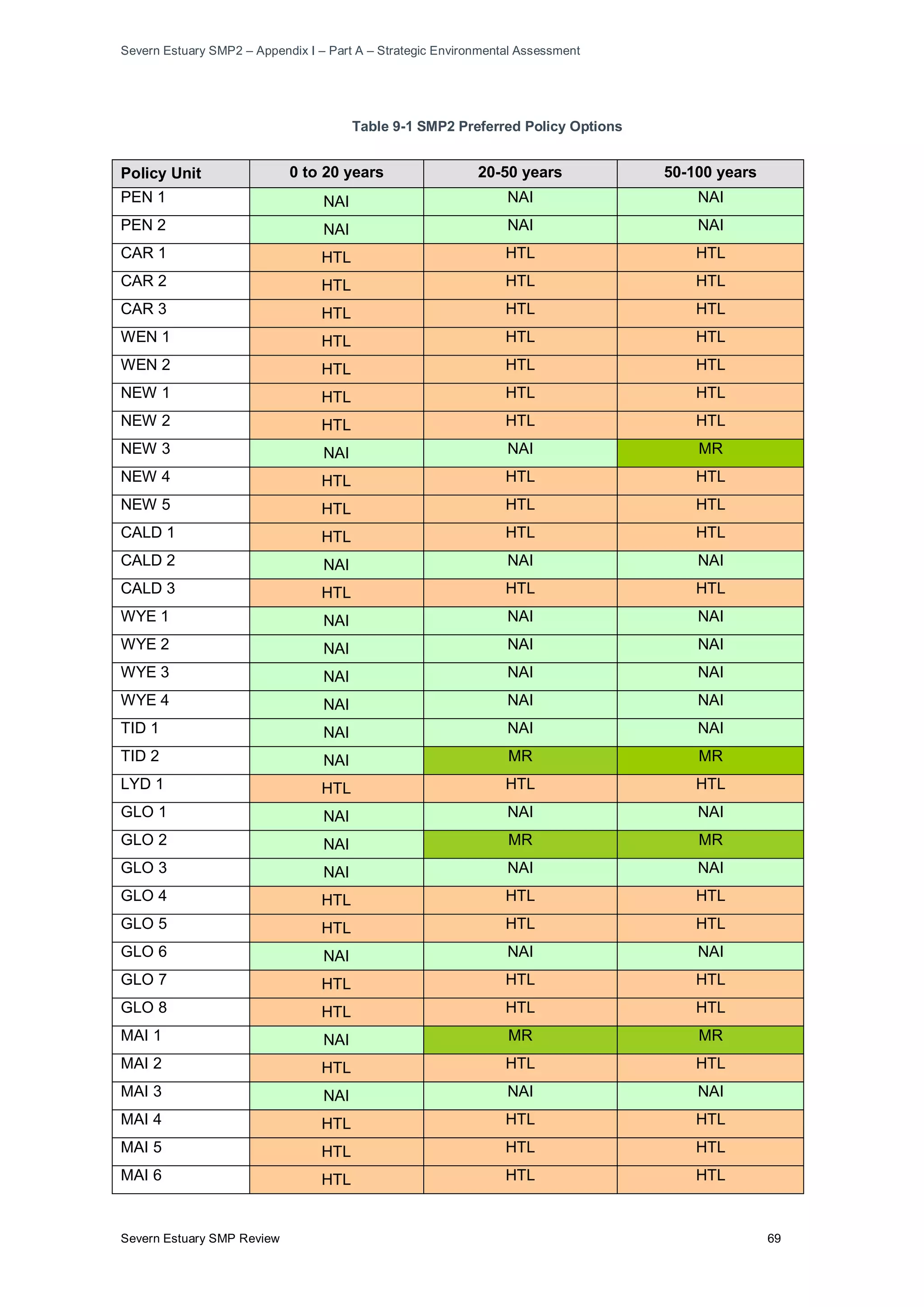
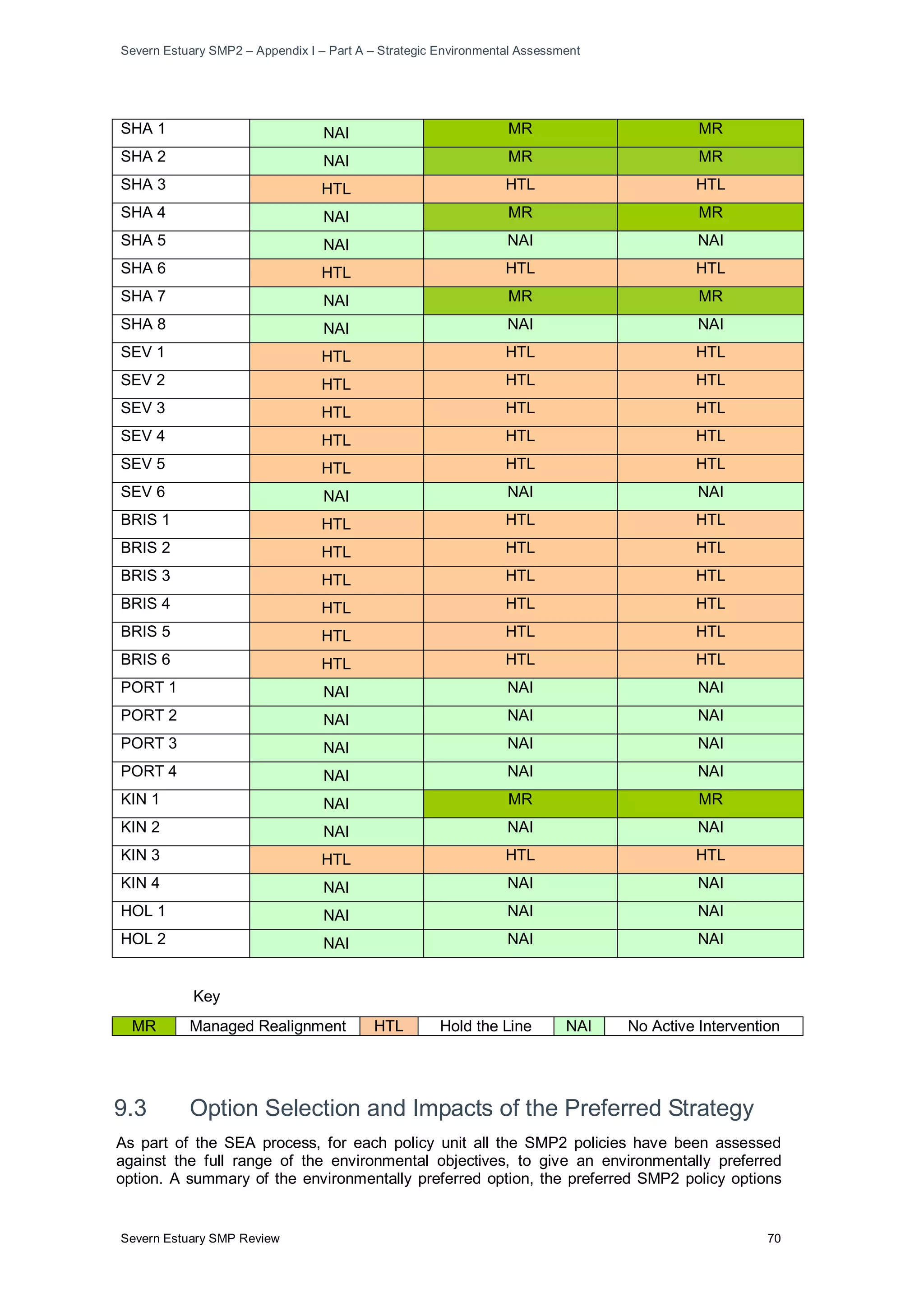
  • 61.
    Severn Estuary SMP2– Appendix I – Part A – Strategic Environmental Assessment Severn Estuary SMP Review 43 importance of reversing decline in habitats, particularly for wetlands. Initiatives and partnerships are trying to reverse this trend including the Severn Vyrnwy Land Management Initiative, the Severn and Avon Vales Wetland Partnership and areas within Environmentally Sensitive Areas where land owners are provided with targeted agri-environmental support to maintain landscape and biodiversity features. The large tidal range on the estuary provides an extensive intertidal zone of coastal grazing marsh, saltmarsh and mudflats. Mudflats are dominant around the Cardiff Grounds and central parts of the estuary and on the lower tributaries. Saltmarsh is confined to low energy, sheltered environments such as on the Wentloodge, Gwent and Caldicot Levels and inner estuary. Areas of saltmarsh are dwindling in the UK as a whole, therefore the Severn Estuary saltmarsh (over 1100 hectares in total) is increasing in value as a wildlife habitat. It is an important component of the Severn Estuary SSSI, SPA and SAC. Saltmarsh vegetation holds sediment from the Estuary, in some cases maintaining a natural intertidal “buffer” for to flooding and high waves. The management of the saltmarsh, including the intensity of grazing, affects not only the wildlife value of this habitat, but also maintenance of the net area of saltmarsh on the Severn Estuary. Larger areas of saltmarsh and mudflat are found around New Grounds (at Slimbridge – Headquarters for the Wildfowl and Wetlands Trust), Lydney, Beachley and Sedbury. These habitats provide important feeding grounds for wading birds, migratory wildfowl and fish (at some, or all stages of their life cycles). However, these areas have been declining over recent years due to coastal squeeze and pressure from development. Man has had a major impact on the environment of the Severn Estuary leading to the decline of habitats. However, in some areas manmade influence is maintaining the habitat. The low-lying ground of the Severn Levels has been reclaimed from tidal inundation by a complex network of sluices and drainage channels (rhynes and reens) for agriculture. The artificially high water table in summer now supports a variety of nationally rare species. Some of these areas are designated as SSSIs, which have been classified as being in unfavourable condition in recent years due to the lack of management of the ditches and poor water quality. Ancient orchards are listed as a locally important habitat and are scattered around the upper sections of the study area, for example at Rodley and Minsterworth. The orchards comprise mature species of local and native pear, plum and apple trees, e.g. the Berkeley Pippin. These old specimens provide important landscape and habitat value for insect eating birds and dead wood eating invertebrates Floodplain grazing marsh exists in the upper areas of the study area, e.g. around Minsterworth and Elmore. These areas experience regular inundation as they are low-lying, have few or low defences, and are in the bottle-necks of meander bends. As floodwaters are brackish, a specialised vegetation community develops, which can grade into saltmarsh at the channel edges. Other habitats that are found around the Severn Estuary and lower tributaries include rocky intertidal platforms and beaches near the Severn bridges, sub-tidal channels around the Newport Deep and sea cliffs. Many of the habitats along the estuary such as the Gwent Levels are also under pressure from expanding arable production, and development. The Habitat Action Plans (HAPs) outlined within regional and local BAPs provide some level of protection to these habitats. These plans identify habitats of particular local and regional value and set out targets for their management. Many habitats, e.g. old orchards, have declined over the past century and recent initiatives are in place to maintain, improve and extend them. Key BAP species within the study area include: • bats; • dormouse; • great crested newt and other amphibians; • otter;
  • 62.
    Severn Estuary SMP2– Appendix I – Part A – Strategic Environmental Assessment Severn Estuary SMP Review 44 • water vole; • allis and twaite shad; • lapwing; • Bittern. The SMP2 will consider the impacts of polices and strategic measures on the sites and BAP species and habitats identified above. Likely Evolution of the Baseline without the Implementation of the Plan Existing plans and policies which specifically aim to halt the decline of biodiversity, protect existing resources and reverse losses are already in place. Particularly stringent protection from development is given to international sites. PSA targets in place to ensure that the majority of nationally important sites are in Favourable Condition by 2010. The Severn SSSI is currently at risk of failing this target due to coastal squeeze Climate change and sea level rise will have implications for the habitats and species for which sites are designated, for example distribution of bird species. This may have implications for the number and distribution of species for which the Severn Estuary SPA/Ramsar site is designated The Water Framework Directive will have an increasing influence, as there will be a statutory requirement for inland and coastal water bodies to meet ‘good ecological status’ (see baseline for Water). This is likely to be a significant driver to improvements in aquatic biodiversity in the area. Environmental Issues Constraints and Opportunities There is a need to avoid significant impact on integrity of internationally designated sites and the favourable conditions of their features. Biodiversity Action Plan habitats and species should to be maintained and enhanced in line with targets. Designated sites are at ongoing risk from development and coastal squeeze. SMP2 will need to consider coastal squeeze implications. The impacts of the SMP2 on European sites will need to be subject to assessment under the requirements of the Habitats Regulations. There is likely to be a need to create compensatory habitat. Strategic options for capital schemes may give rise to opportunities to improve ecological connectivity both as part of protected sites and by the enhancement and/or restoration of other key habitats. 7.4 Fisheries The River Severn and its tributaries including the Wye and Usk have in the past been important salmon fisheries, however over the past decade populations have been decreasing In addition, there were concerns that mixed stock salmon fishing was reducing the numbers of rare shad as by-catch. Controls on fishing, aimed at increasing stocks, have since been imposed by the Environment Agency who own the fishery.
  • 63.
    Severn Estuary SMP2– Appendix I – Part A – Strategic Environmental Assessment Severn Estuary SMP Review 45 The River Severn has the biggest migration of eels of any river in England and Wales and the elver fishery is an important commercial fishery, with the juveniles being exported to Europe and the Far East, while there still remains a limited adult eel fishery for export or local smoking. Elver stocks have declined by as much as 98% in recent years and this has prompted Europe to expect all member states to produce Eel Management Plans. The main issues affecting populations on the Severn are exploitation, loss of habitat (river connectivity with its floodplain), proposed hydropower schemes and barriers to migration. The elver and sea trout enter the saltmarsh across the levels during high tides to feed, and then retreat out as the tide recedes. The Severn is one of a few rivers in England and Wales that supports a twaite and an allis shad population. Shad are members of the herring family that live in salt water but spawn in fresh water. Historically, the River Severn supported a huge commercial shad fishery with fish spawning upstream of Shrewsbury, but with the creation of the Severn Navigation in the 19th Century, shad were excluded from their historical range by the creation of the navigation weirs. The population of the allis shad in the UK has declined since the mid-nineteenth century to the point where it has a sporadic distribution around the coast with no known spawning grounds/rivers. The twaite shad has also declined, although spawning populations are known to be present on the Severn downstream of Worcester and on the Usk and Wye. The main issues facing shad are barriers to migration, poor stock assessment, navigation activities and habitat loss. The Severn contains three types of lamprey (brook, river and sea). River and Sea Lamprey enter the river to spawn each year. Sea lamprey make long upstream movements to above Shrewsbury on the main Severn and are quite visible spawning on the gravel shallows. The migration of river lamprey is less well understood, but it is thought that they spawn further down the river. The sea lamprey stock is thought to be healthy but inter year variations are not uncommon; it is generally accepted that river lampreys have declined over the last 25 years. The reasons for this decline are not fully understood. Salmon, twaite shad and the lamprey species (sea and river) are all features of the Severn Estuary SAC and consequently afforded a very high level of statutory protection. Allis shad is also a feature of the River Usk and River Wye SACs and listed within the Ramsar citation for the Severn Estuary. Shad also spawn on the River Tywi in Camarthenshire and are a feature of the River Tywi SAC. Commercial salmon fishing has declined in productivity and importance. Drift nets, draft nets (seine or long nets), the traditional methods of ‘fixed engines’ (putts and putchers), and hand- held lave nets are methods once employed, but all these fisheries have reduced. This has occurred partly due to Government supported buyouts and Net Limitation Orders such as the closure of the drift net fishery which operated off the Welsh coast between Newport and Chepstow and the putcher fishery at Goldcliff near Newport. There is very little shell fishing on the Estuary, but traditional activities include the use of ‘mud horses’ by a small number of fishermen, taken out over the intertidal mud in Bridgwater Bay to fish for shrimps. Commercial fishing for white, sea fish also takes place on the Estuary, including trawling, longlining, and the use of beach nets for cod, whiting, bass, sole, plaice and mullet. As previously mentioned there are several small eel and elver fisheries along the Severn. Likely Evolution of the Baseline without the Implementation of the Plan The coastline and Severn Estuary rivers are likely to continue to be important recreational and commercial fisheries and fish migration routes. The River Severn and the Rivers Wye and Usk have had controls imposed on fishing them with the aim of increasing stocks. Salmon and other species are expected to see a reverse in decline of the populations. Eel Management Plans are being produced by the Environment Agency to conserve eels and elvers in the River Severn, as a result the risk to eel populations should reduce and numbers are hoped to recover
  • 64.
    Severn Estuary SMP2– Appendix I – Part A – Strategic Environmental Assessment Severn Estuary SMP Review 46 Commercial salmon fishing in the Severn Estuary has declined in productivity and importance, partly due to Government buyouts and net order limitations. It is unlikely that there will be an increase in commercial salmon fishing. Commercial fishing for other species is also unlikely to rapidly increase. Environmental Issues Constraints and Opportunities The salmon fishery has in the past been over exploited and elver numbers are in decline. Increased development and/or recreational activity along the coast may affect fish and elver populations. The implementation of strategic options has the potential to affect fish stocks. Access to estuary is an important consideration for recreational fisheries and the ability to keep and launch boats from the coast is a consideration for commercial interests. Biodiversity Action Plan habitats and species need to be maintained and enhanced in line with targets. Eel Management Plan targets need to be taken into account. 7.5 Soil Geology and Geomorphology 7.5.1 Soils Soils play a fundamental role in the quality and distribution of water within a catchment. They have a significant impact on how an area responds to rainfall, being responsible for the relative proportions of the rainfall that are retained in the soil, pass to groundwater or contribute to surface water runoff. Loosely packed, deep soils retain more rainfall and have a slower response than shallow or densely packed soils. The permeability of catchment soils has an important influence on the speed and magnitude of a river’s and a catchment’s response to rainfall: • impermeable soils will allow rainwater to run off the catchment very quickly and flow into surface water bodies such as lakes and rivers. In severe circumstances, this can lead to flash flooding; • permeable soils with a low porosity can allow more water to infiltrate into the ground but at a slow rate. This allows the soil to store water where it is used by plants and other organisms in the soil; • permeable soils with a greater porosity will allow rainwater to infiltrate into the ground which may contribute to groundwater flow. The rate at which it does this is dependant on the pore sizes and structure of the soil. There are a wide range of soil types across the study area affecting permeability and land use The lowland coastal areas along much of the estuary including the Gwent and Somerset Levels are characterised by fertile peaty soils. 7.5.2 Geology The impact of geology on flood risk and erosion is determined by the effects on topography, the permeability of rocks and their resistance to erosion. Permeability, along with other factors such as vegetation cover and topography, will influence the response of an area to a rainfall event. The hardness of the rocks across the study area have heavily influenced the evolution and shape of the estuary and continue to exert an influence on topography and rates of erosion. The Severn catchment exhibits a very varied geology. The bedrocks of the Estuary and its surrounds consist of clays, mudstones, sandstones and limestones, ranging in age from Ordovician to Jurassic, and represent past marine and terrestrial environments.
  • 65.
    Severn Estuary SMP2– Appendix I – Part A – Strategic Environmental Assessment Severn Estuary SMP Review 47 During the late Permian and Triassic, the ‘mountains’ formed by the folding of the Carboniferous Limestone were weathered down to form low hills in an arid landscape. Eventually the hills were submerged beneath an extensive desert lake which was then inundated by the Jurassic sea. Limestones, clays and sandstones were deposited over the region during the Jurassic and Cretaceous. During the Tertiary, western Britain was uplifted by events related to the opening of the Atlantic. This resulted in the stripping off of much of the Cretaceous and Jurassic cover, leaving low-lying areas on which soft Jurassic clays and Triassic marls now outcrop and commonly form and surround the broader parts of the funnels of the Estuary. The resistant Carboniferous Limestone now forms many of the east-west trending hills and ridges which surround the Estuary and provide the headlands and islands (Brean Down, Steep Holm, Flat Holm, and Sully Island) which contribute to the Estuary’s funnel shape. The lower reaches of the River Severn flow over non aquifer Triassic Mercia mudstone group strata and Jurassic Lower Lias clays. The Cotswold escarpment (Jurassic Limestones) delineates the watershed. More recent Quaternary deposits lain down over the past two million years have served to provide the drift geology coverage for the area. These typically consist of riverine alluviums, peats and marine clays together with glacial deposits of sands clays and gravels. High sea levels during the Quaternary interglacials were responsible for many of the coastal features fashioned out of bedrock, while sand and mud were deposited in the low-lying embayments (e.g. Wentlooge, Caldicott and Somerset Levels). Reworked glacial sediments have also been deposited in the main Estuary flats. 7.5.3 Geomorphology Geomorphology is the study of the landforms and the continuing natural processes that have created the physical environment we see today. Coastal and fluvial geomorphological processes shape the landscape and river channels by eroding, transporting and depositing sediment. Changes in the way sediment is created, transferred and deposited in one area can result in geomorphological changes elsewhere, and can influence present and future erosion and flood risk. We need to consider geomorphology within the SMP2 because an understanding of coastal and estuarine processes is critical to achieving sustainable flood risk management, and a diverse and healthy environment in terms of habitats and ecology. Sediment erosion, transport and deposition processes are controlled by factors that govern the balance between water and sediment inputs to any length of river or coastline. These factors include geology, topography, soil type, climatic trends, land management practices, sediment size, structure of the bed and bank materials, valley floor slope, and the channel morphology. These factors together determine the distribution of energy at different flows and hence the energy available to transport sediment. Sediment and Morphology A summary of key morphological characteristics for the Severn and its main tributaries is provided below: The River Severn ranges from a fluvially dominated channel (less than 50m wide) downstream of Gloucester to a predominantly tidally dominated channel that is over 8,000m wide at Avonmouth. The dynamic nature of the estuary is partly due to its large tidal range, reaching in excess of 14.5m at Avonmouth at spring tide. The estuary has the second largest tidal range anywhere in the world. This means that large volumes of water enter the estuary, often at high speed, and rapidly change the estuary’s physical character through erosion, deposition and sediment transport. Some reaches within the estuary are eroding rapidly as a consequence, for example erosion at Cone Pill is currently up to 5m/year. The existing shoreline of the estuary is very varied with mudflats, sandflats and saltmarsh fronting an alluvial backshore. Some higher ground of easily eroded sandstone and limestone is present between Clevedon and Portishead and again at Aust (near the first Severn Bridge). The shape (cross-section and plan form) of the Severn Estuary is determined by the underlying geology. Zones of harder Silurian, Devonian and Cambrian rock are interspersed with softer
  • 66.
    Severn Estuary SMP2– Appendix I – Part A – Strategic Environmental Assessment Severn Estuary SMP Review 48 Triassic Marls and Mudstones. The varying rates of erosion experienced by such rocks has led to a series of tight meander bends and exposed limestone cliff, for example at Aust. These are interspersed with larger, flatter embayments filled with estuarine muds and fine sands, for example at New Grounds (Slimbridge). The estuary and the coastal floodplain is a dynamic environment that is constantly evolving by both natural processes, including sediment deposition and erosion, and by human influences such as the reclamation of land. The lower Severn is funnel shaped and orientated in a south-west to north-east direction. Areas of resistant bedrock hold the funnel shape for example at Sudbrook, Beachley and Aust. The funnel shape of the estuary concentrates large volumes of flow from the Bristol Channel into an ever-decreasing width of channel, and so accentuates the tidal range so that the estuary experiences the ‘Severn Bore’ or tidal wave, associated with rising tides. The tidal wave moves at the front of the rising tide and can rise to 2m high and travel at 16km per hour. This is a local phenomenon and tourist attraction. The Lower Severn estuary has been experiencing tidal inundation throughout the Holocene, which has caused the estuarine system to move slowly inland as a result of sea-level rise. The estuary has also widened due to the increasing amount of tidal water in the system. Coastal and Estuarine Processes An extensive amount of work has previously been carried out analysing the geomorphological processes both within the wider Estuary and focussing on the estuary fringes. Whilst a large number of studies have resulted in generally accepted conceptual sediment transport models of the Severn Estuary, detailed prediction of the natural evolution of sandbanks, mudflats and saltmarsh over time is difficult and prone to large uncertainties, as highlighted by the Severn Estuary CHaMP (ABPmer, 2006). There is a recent history of continuing coastal erosion of beaches and salt marshes which are natural/soft coastal defences. The natural shoreline movements are now largely curtailed by artificial defences against the continuing threat of erosion. The coastal processes of erosion, deposition and flooding are driven by natural forces acting on the materials forming the bed and sides of the estuary. These natural forces are: • tides and currents; • winds and waves; • meteorologically driven surges; • flood water flows down rivers. The estuary is subject to a great tidal range and also to fairly strong currents. Seaward areas tend to be dominated by tides and waves whilst upstream areas are dominated progressively by fresh water flow and the incidence of river flood waters. Flooding in seaward areas depends on the joint occurrence of high waves occurring at times of high water levels at spring tides, either from the tide alone or from the contribution of tide and surge. Flooding towards the head of the estuary depends on the joint occurrence of high flood discharges at the time of high water levels - waves are less of a problem but in downstream areas are still of significance. The sediment budget of the estuary is a balance between the inputs and outputs of the fluvial system. Studies undertaken for the Severn Coastal Habitat Management Plan (ABPmer, 2006) suggest that the main sediment source for the Severn Estuary is from the river systems including the Wye, Avon, Usk and Severn itself. Minor sources of sediment come from minor cliff recession and other forms of erosion making up a total sediment source of between 4.16M to 5.4M tonnes a year. Some of this sediment is deposited in the system in the form of saltmarsh and mudflat accretion and subtidal deposition in the Newport Deep, this amounts to between 1.06 to 2.06M tonnes a year. However large amounts of sediment (30M tonnes per year) are being transported within and through the system.
  • 67.
    Severn Estuary SMP2– Appendix I – Part A – Strategic Environmental Assessment Severn Estuary SMP Review 49 Current understanding indicates that in the short term (up to year 2028) the predicted geomorphological evolution along the estuary fringes for policy units PEN1-2, CAR 1-2, WEN 1- 2, CALD1 and BRIS 1-3, PORT 1-4, KIN 1-4 is marginal erosion (a loss of saltmarsh of 10- 30%), although there is local evidence of intermittent accretion. For TID1-2, GLOU 1-8, MAI 1-5, SHAR 1-8 and SEV 1-6 the short term trend is for both marginal erosion and accretion (±20% variation in saltmarsh coverage). In the medium to long term (2058 and 2108) uncertainties significantly increase. In relation to flood risk, virtually all flood defences are predicted to have structurally failed due to degradation under the Do Nothing scenario after the year 2058. Human Influence Man has influenced the geomorphology of the rivers within the Severn Basin in a number of ways including: • Construction of structures that alter flow and deposition of sediment e.g. navigation weirs such as at Gloucester and the Cardiff Bay Barrage; these have all had an effect on the sediment budget. The completion of the Cardiff Bay Barrage in 1999 has changed the lower reaches of the River Ely from a tidally dominated system to a fluvial system. The barrage governs flow and level in the lower parts of the catchment and has altered the channel processes and geomorphology. • Change of land use along the edge of the estuary which affects bank stability and influences the amount of sediment entering the system. Soil that is grazed or susceptible to trampling by animals can be less resistant to erosion and wash into watercourses following heavy rain. • Draining land that would otherwise have flooded by constructing channels, re- routing watercourses or by pumping water away. e.g. the Gwent and Somerset Levels. • By constructing flood defences or hard bank engineering which reduces natural interaction with the floodplain. This can increase water conveyance and energy and cause erosion of natural features. • Navigational or maintenance dredging is undertaken around ports to maintain a deep enough channel for ships such as at Bristol, Cardiff, Newport and Sharpness. In addition, dredging for mineral and aggregate extraction takes place. In terms of the latter, an estimated 1.5M tonnes per year is extracted from the Severn Estuary. Dredging can remobilise sediment within the estuary system and may increase erosion as the estuary tries to rebalance the sediment budget. Likely Evolution of the Baseline without the Implementation of the Plan Marine and estuary aggregate removal for channel maintenance around ports such as Bristol, Cardiff, Newport and Sharpness will continue as there is likely to be net accretion of these aggregates, so an ongoing requirement for dredging. If no work is undertaken all defences are likely to have structurally failed due to degradation in the medium term (that is by the year 2058). There is a risk of marginal erosion along some parts of the estuary; no significant erosion is predicted
  • 68.
    Severn Estuary SMP2– Appendix I – Part A – Strategic Environmental Assessment Severn Estuary SMP Review 50 Environmental Issues Constraints and Opportunities Coastal management has the potential to affect natural processes along the frontage. The strategy will seek opportunities to maintain and restore natural processes along the coast. 7.6 Land Use and Land Management The character of land cover and different types of land management practices influence how floods are generated, where and when they may occur and how much damage they cause. This is because land use and land management can have a significant effect upon rainfall runoff and infiltration rates. Land use affects the amount of rainfall that runs off the land. For example, urbanisation, intensive agriculture or short vegetation tends to increase run-off rates, whilst forest cover can increase interception and the ability of the ground to absorb rainfall, thereby decreasing run-off. Land use can be greatly affected by humans. Changes in land management have the potential to disrupt natural flow paths and flood storage patterns. This may take the form of faster and increased runoff from deforested fields or loss of floodplain to housing developments. It is also possible for human actions to work in harmony with nature, in the creation of wetland environments and by reconnecting floodplains where flood defences are no longer considered appropriate. There are significant areas of residential, commercial and industrial development at Avonmouth, Weston-Super-Mare, Gloucester, Lydney, Clevedon, Cardiff, Newport and Chepstow. Development in floodplains, even behind flood defences can significantly increase flood risk as defences rarely exclude all magnitudes of flooding. Urban areas may also be at risk of flooding from inadequate drainage systems resulting in surface and groundwater flooding. Most of the study area is rural, with agriculture being the major land use. Pasture still dominates, but its extent has reduced in recent years due to increasing conversion to arable farming. Agricultural land use is interspersed with patches of woodland, and remnants of old orchard systems. Since Roman times, land has been reclaimed from the estuary and drained for agricultural purposes. This has led to a complex pattern of man-made drainage channels (also known as reens or rhynes) in many areas. Some of the land that is now drained is below mean high-water level, and would otherwise flood, but due to the location of flood defences and drainage ditches, the land is available for agricultural use. Internal Drainage Boards within the study area manage the drainage of this land. Defra classifies agricultural land into five grades, based on climate, land gradients, aspect, flood risk and underlying soil characteristics, with Grades 1 to 3a being considered the ‘best and most versatile’ soils. Over 87 per cent of agricultural land within the SMP2 study area is Grade 1 to 3 classification (very high to high quality agricultural land). There is continued financial pressure for farmers to diversify their activities, such as providing facilities for commercial re-use, recreation and tourism with a view to increasing their income, and to provide for public access. Conservation initiatives may also be a source of income, whilst providing positive help for farmers to conserve and enhance wildlife. These measures are positively encouraged by Government initiatives. Other businesses depend on the rural environment independent of farming practices, such as those associated with tourism and leisure activities. It is essential to ensure that they are conducted in sympathy with the rural character of the Estuary. Due to the risk of regular fluvial and tidal flooding, much of the estuarine land is defended by formal and informal structures. Many of the more recent formal structures have been constructed and are maintained by the Environment Agency, but farmers, private estates and industrial depots have also constructed local defences. In the main, the defences comprise earth embankments, some with stone pitching to withstand erosion, but there are also concrete and stone defences.
  • 69.
    Severn Estuary SMP2– Appendix I – Part A – Strategic Environmental Assessment Severn Estuary SMP Review 51 Welsh Agri-Environment Schemes A number of agri-environmental schemes are run by the Welsh Assembly Government; the flagship scheme is Tir Gofal. The scheme was established in 1999 as an integral part of the first Rural Development Programme for Wales. It is a whole farm scheme and is available on farmed land throughout Wales. It rewards farmers for caring for the environmental, historical and cultural features on their land and is designed to support the farming community in protecting and enhancing the environmental and cultural landscapes of Wales. It provides the opportunity to encourage landowners to pursue more sustainable land use management across the whole farm, protecting and enhancing terrestrial habitats and features. The Tir Gofal scheme sits within Welsh Assembly Government’s wider Tir Cymru programme which also includes Tir Cynnal, Tir Mynydd, The Better Woodland for Wales and Organic Farming. The Welsh Assembly Government is also currently piloting a project to give advice and support to farmers on a catchment basis to improve the environment and reduce their impact on local streams, rivers and lakes. The project includes guidance on manure and nutrient management, free soil analysis and other technical advice and funding for capital work to reduce run-off and erosion. A whole range of other issues will be supported including; • managing livestock access to streams etc; • separating clean and dirty water; • improving slurry-handling facilities. English Agri-Environment Schemes The Rural Development Programme for England includes support for conservation and improvement of the rural environment, largely through the Environmental Stewardship Scheme, which provides funding to farmers and other land managers in England who deliver effective environmental management on their land. Its primary objectives are to: • Conserve wildlife (biodiversity); • Maintain and enhance landscape quality and character; • Protect the historic environment and natural resources; • Promote public access and understanding of the countryside; • Natural resource protection. Within the primary objectives it also has the secondary objectives of genetic conservation and flood management. UK agriculture has been subject to some significant changes in the past five years. • Common Agricultural Policy (CAP) reform largely delivered by agricultural subsides and incentives has resulted in some areas of land being removed from agricultural production and the reallocation of grazing land to arable use. • Variations in wheat prices has influenced farmers cropping choice and amount of land in production (agricultural land prices have also increased); • cultivation of crops for biofuels; • increased cultivation of genetically modified (GM) crops and • changes in set-aside legislation.
  • 70.
    Severn Estuary SMP2– Appendix I – Part A – Strategic Environmental Assessment Severn Estuary SMP Review 52 Land use management has a role to play in controlling future run-off, controlling diffuse pollution and mitigating the effects of climate change. It is important that our policies and actions for managing future flood risk are aligned with existing and future agri environment policy. Likely Evolution of the Baseline without the Implementation of the Plan Without intervention, the risk of coastal and fluvial flooding of agricultural land is expected to increase with the predicted effects of climate change. Drained land such as the Gwent and Somerset Levels is likely to be continued to be drained in the future for agricultural purposes, and because of European and National designations which are in place to conserve habitat and species which are present at specific sites. However sites will be at increased risk of coastal flooding in the future. The nature and type of future agricultural production is uncertain; political drivers include increased emphasis on self sufficiency in food production, use of land for production of bio fuels and fluctuating prices of wheat and land. Environmental Issues Constraints and Opportunities Environmental stewardship schemes will continue to promote good agricultural practices which protect soil and biodiversity. A requirement to maintain viability of agricultural land in the context of changing political/ economic drivers and sea level rise The strategy will seek opportunities to maintain natural processes along the coast. The management of estuarine features and adjoining land, including the re-establishment of wetlands and traditional grazing regimes, is important. 7.7 Water 7.7.1 Surface Water Quality Water quality in the catchment is important for potable water supply, maintaining fisheries and recreation and for aquatic and riparian habitats. Inputs to the Estuary that affect water quality include sewage effluents, abandoned mines, diffuse runoff from agricultural and forestry activities, industrial effluents and marine vessel discharges. Much of the heavy industry in the Estuary area is centred around Avonmouth and between Newport and Barry in South-East Wales. Most of these process facilities are large and are located on the Estuary to take advantage of water available for cooling and the high dilution available for large volume trade effluent discharge into the Estuary. Contaminated land, industrial facilities and those subject to the COMAH (Control of Major Accident Hazards) 1999 all have the potential to pose a risk to water quality. The water quality of the Estuary is controlled by UK legislation, including that derived from International conventions and EC Directives and implemented via UK Regulations. In the future, management and monitoring requirements are likely to be determined by the implementation of the EC Water Framework Directive. Under the Directive there is a requirement to: • prevent a decline in quality and achieve good chemical and ecological status in surface water by 2015; • achieve good ecological potential in heavily modified water bodies by 2015. At present the Environment Agency monitors the quality of the Estuary to assess compliance with the Environmental Quality Standards (EQS) stipulated by the EC Dangerous Substances
  • 71.
    Severn Estuary SMP2– Appendix I – Part A – Strategic Environmental Assessment Severn Estuary SMP Review 53 Directive. The Environment Agency also monitors designated bathing waters in line with the EC Bathing Water Directive (1976). Many of the industrial effluent discharges will fall under the Pollution Prevention and Control (PPC) Regulations which require continued reductions in specific contaminants released. The River Wye is also designated as a sensitive area under the European Urban Wastewater Treatment Directive due to high levels of nitrates. Where waste water is released to these areas, it must undergo a secondary treatment in order to reduce its impact on the environment. The legislation above and policy drivers (such as Catchment Sensitive Farming (CSF) Initiatives are likely to result in further improvements in water quality over the next ten years and beyond. However, flood and erosion risk management at the strategic level presents limited scope to directly improve water quality, although, initiatives such as CSF may present opportunities to work with others to achieve this objective. 7.7.2 Groundwater Quality Groundwater provides vital resources for public supply, industry, agriculture and for numerous rural communities. They also feed rivers and support wetlands. If groundwater becomes polluted it is extremely difficult to clean up. The Environment Agency has published groundwater vulnerability maps for England and Wales. In addition Source Protection Zones (SPZ) have been identified for groundwater sources used for public drinking water supply. These zones show the risk of contamination from any activities that might cause pollution and underpin the Environment Agency's Groundwater Protection Policy. Issues potentially affecting groundwater quality within the study area include: • tidal influence within coastal areas could result in saline intrusion into freshwater bodies; • increased levels of nitrate and phosphates in agricultural areas; • contamination from industrial land use or landfills. 7.7.3 Water Res ources and Surface Water Management Abstractions from the main rivers flowing to the Estuary and from the Estuary and associated tidal stretches of rivers include: • major abstractions direct from the Estuary for cooling water for power stations. This water is returned rapidly to the Estuary; • large abstractions from the rivers Severn, Wye and Usk for public water supply; • a major abstraction from the Severn at Gloucester by British Waterways in order to feed the Gloucester Sharpness Canal and the abstractions from it, including a large abstraction for public water supply by Bristol Water Company at Purton. Estuary processes such as salt-water intrusion and the landward movement of sediment can affect abstractions near the tidal limit. A recent operating agreement with British Waterways was put in place to modify the pumping regime from the Severn to the Gloucester-Sharpness Canal from the East Parting at Gloucester, so that the amount of water taken during adverse conditions is reduced. In addition to the main rivers within the study area, there are also numerous drainage ditches (also known as reens or rhynes) bisecting the low lying land adjacent to the estuary. The smaller reens and watercourses on the levels are maintained by the relevant Internal Drainage Board; they also regulate water levels and carry out maintenance on behalf of the Environment Agency on a rechargeable basis. The reens typically have flap vales on them and are subject to a tide lock period of up to 4 hours on every 12 tidal cycle. The watercourses within the levels (i.e. behind the defences) are largely oversized trapezoidal channels, maintained to store peak flows of water when the tidal flap
  • 72.
    Severn Estuary SMP2– Appendix I – Part A – Strategic Environmental Assessment Severn Estuary SMP Review 54 valves cannot discharge to the estuary during high tide. They are not routinely subject to tidal inundation, and are predominantly freshwater habitats, except where saline intrusion occurs on a periodic or regular basis creating brackish habitats. The drainage boards undertake annual maintenance of all their adopted watercourses which typically consists of flail mowing the banks twice a year and weed clearance typically once a year dependant on weed growth. In addition, major re-profiling of the ditches is undertaken once every 5-7 years. Likely Evolution of the Baseline without the Implementation of the Plan Climate change will increase the risk of flooding water supplies and treatment facilities along the estuary; there is also an increased risk of pollution or salinisation of freshwater bodies and water resources. The need to meet Water Framework Directive water quality objectives for water bodies, and for all inland and coastal water bodies to reach ‘good ecological status’ in the future will lead to measures being taken to improve surface water quality in the medium to long term. The Environment Agency will continue to monitor water quality and regulate abstraction and discharges into surface and ground waters. The Environment Agency’s work is expected to result in improvement in the water quality of failing waterbodies in the catchment and the maintenance of, or a steady improvement in good and very good quality waters. Many of the surface and groundwater sources within the study area are already classed as having no water available, being over-licensed or over-abstracted. This is unlikely to change in the future, as there will be increased demand for water as population grows within the area. Changes in rainfall patterns predicted with climate change could further reduce the availability of water resources. Environmental Issues Constraints and Opportunities The Strategy will seek to maintain or reduce flood risk to water resource, supply and treatment assets from coastal flooding. The Strategy will consider the implications of policy options and strategic measures on water quality. The Strategy should not impact on the abstractions from the Severn Estuary or its tributaries. The Strategy will seek to minimise the risk of saline intrusion into important freshwater bodies. Past current and future land use has the potential to affect water quality. 7.8 Air and Climate The implications of climate change for flood risk and coastal erosion have been discussed in Section 1.3. The SMP2 will take the most up to date climate change predictions into account when identifying policies and strategic options for the future management of the coast. The SMP2 will not have a significant effect on air quality at a regional level. The effects of SMP2 policy on air quality would be considered further at project EIA stage Likely Evolution of the Baseline without the Implementation of the Plan Climate change is predicted to result in increased storminess and combined with sea level rise is likely to result in more frequent and severe incidences of coastal flooding. Increased rainfall in the winter is likely to result in increased river flooding and reduced summer
  • 73.
    Severn Estuary SMP2– Appendix I – Part A – Strategic Environmental Assessment Severn Estuary SMP Review 55 rainfall increases risk of flood conditions in summer months. Without intervention, climate change is expected to increase the risk of flooding and erosion to people, property, the natural environment and other assets within the study area. Further measures (including improved treatment technologies and policy changes) are likely to be in place to reduce greenhouse gas emissions in the future. Environmental Issues Constraints and Opportunities Climate change is likely to increase tidal flood risk in the Severn Estuary. Flood risk is exacerbated in low lying areas where increases in sea level can inhibit land drainage. The selection of strategic options must account for the predicted effects of climate change and sea level rise and aim to adapt to these changes. It is important that CFMPs, the SMP2 and FRMS are fully integrated. Option selection should seek to reduce the potential to contribute to climate change through the production of greenhouse gases through construction and operation of individual schemes. 7.9 The Historic Environment (Cultural Heritage) The Severn Estuary is a phenomenally rich and varied archaeological landscape. It is perhaps the most archaeological significant estuary in Europe. People have been living in this area since before the Severn Estuary was formed in the Mesolithic, some 8,000 years ago, when rising post-glacial sea levels saw the inundation of low lying ground. Evidence of early human activity is preserved in the mud-flats and inter-tidal zones of the Gwent Levels and Somerset Levels, including the footprints of Mesolithic children. It is the wet and waterlogged conditions of much of the Severn Estuary area – in particular its rich peat deposits – buried under later alluvium that has led to the preservation of so much archaeological material. Evidence includes Bronze Age settlements and trackways, Iron Age villages, houses and trackways, Romano-British farmsteads and land drainage, medieval fishtraps, rheens/rhines (drainage ditches) and sea walls, post-medieval drainage and land reclamation, enclosure landscapes, as well as later activities that have shaped this landscape, including agriculture, industry, urban expansion, communication, tourism and defence. Palaeo-environmental evidence is particularly significant due to the extent of its survival in this area. The River Severn meanders over a course that has altered over time; areas that are now well inland may once have been inter-tidal with huge potential for archaeological deposits; much of this land has been reclaimed from the river. Furthermore maritime areas also contain archaeological remains, including shipwrecks, artefacts, submerged landscapes and World War II aircraft crash sites. The Severn has a rich maritime heritage, including the remains of boats at Newport (medieval), Barland’s Farm (Roman) and Caldicot (Bronze Age). It is not simply the route and former course of the river that is significant: The adjacent Levels are an essential element of the Severn landscape that contain archaeological remains arising from the activities that took place along the river such as industry, farming, transportation, settlement, and the way of life of the people living on its shores. The built heritage of the Severn Estuary is defined predominantly by the history, function and development of its major urban centres and use of vernacular traditions and materials in more rural areas. Gloucester, with its Roman origins and later industrial significance, includes a diversity of building types, styles and materials, reflecting its strategic position at the head of the estuary. Other settlements, such as Newport, Cardiff and Penarth reflect the predominance of industry in Wales in the 19 th and early 20th centuries, and include examples of industries, docks and workers housing. Clevedon, Weston-super-Mare and Burnham-on-Sea reflect the growth of tourism and the popularity of sea-side resorts, characterised by villas, piers and promenades. There are also thousands of other smaller historic houses and buildings (many of which are designated Listed Buildings) within the more rural areas of the Study Area. These reflect the
  • 74.
    Severn Estuary SMP2– Appendix I – Part A – Strategic Environmental Assessment Severn Estuary SMP Review 56 development of housing and settlement in both England and Wales, illustrating the use of vernacular materials and styles and the later influence of imported materials. The 20 th century influence on the Severn Estuary was considerable. Mass communication by train and car replaced shipping as the predominant form of transport. Prominent aspects of the landscape were appropriated for defence during World War II. Large scale industries developed along shore close to the major port at Avonmouth. The two islands in the estuary (Flat Holm and Steep Holm) also reflect the importance of the waterways for safe shipping, communication and defence in first the 19 th and later 20 th centuries. 7.9.1 Scheduled Monuments There are approximately 107 Scheduled Monuments within the Study Area. These include the most prominent, best conserved and significant monuments and features. However, they represent only a small proportion of the entire archaeological record of the Severn Estuary (nationally, only 6% of all archaeological features and deposits are protected through scheduling). Those that are scheduled comprise earthworks or masonry remains, including Neolithic and Bronze Age barrows, Iron Age hill forts, Roman sites, a short length of Offa’s Dyke, Norman and later motte and baileys and castles, medieval moated settlements and religious sites, historic sea defences and twentieth-century military structures. Scheduling to date has not included areas of inter-tidal or palaeo-environmental deposits. 7.9.2 Lis ted Buildings The total number of Listed Buildings with the Study Area runs into the thousands. The greatest concentrations of Listed Buildings are those within the larger towns and villages found within the Study Area: Gloucester, Berkeley, Thornbury, Clevedon and Weston-super-Mare on the English side, and Newport, Cardiff Bay and Penarth on the Welsh. Gloucester, Berkeley, Thornbury and Newport have medieval or earlier origins, and many of the Listed Buildings date to the medieval and early post-medieval periods (i.e. dating from the 13 th /14 th centuries through to the 18 th /19 th centuries). Clevedon and Weston-super-Mare largely owe their development to the growth of sea-side tourism in the 19 th century. Cardiff Bay and Penarth developed as a result of industrial expansion in the 19 th and 20th centuries. Newport is also significant for its industrial heritage. There are many other single Listed Buildings or clusters of Listed Buildings within the Study Area. These relate to individual houses, smaller villages and hamlets within predominately rural settings, and are mostly domestic in origin and purpose, reflecting the vernacular traditions and materials of different areas (i.e. stone, timber framing, brick, thatch) as well as the influence of imported materials and styles (i.e. slate, engineered brick, dressed stonework, etc). 7.9.3 Cons ervation Areas Most of the large groupings of Listed Buildings are also included within designated Conservation Areas and are a major contributor to the landscape character of the Severn Estuary. 7.9.4 Regis tered Parks & Gardens (England) There are ten Registered Parks and Gardens within the Study Area. This is a non-statutory designation, but a material planning consideration under Planning Policy Guidance 15 (Planning and the Historic Environment). 7.9.5 Regis ter of Lands capes , Parks and Gardens of Outs tanding His toric Interes t (Wales ) The Gwent Levels Historic Landscape of Outstanding Historic Interest in Wales is included within the Register of Landscapes, Parks and Gardens of Outstanding Historic Interest of Wales (No 17). This site falls within the SMP2 study area. 7.9.6 World Heritage Sites There are no World Heritage Sites (WHS) within the study area.
  • 75.
    Severn Estuary SMP2– Appendix I – Part A – Strategic Environmental Assessment Severn Estuary SMP Review 57 Likely Evolution of the Baseline without the Implementation of the Plan Flood and erosion risk to the historic environment would be likely to increase. Further developments within the floodplain and increasing tourism use are likely to put additional pressure on the historic environment. Environmental Issues Constraints and Opportunities As time passes the risk of erosion and/or flooding to some Scheduled Monuments and other archaeological sites will increase. The strategy will seek to minimise the significance of impacts on the historic environment. The SMP2 will seek to sustainably manage and where appropriate conserve and enhance features of architectural, historical and archaeological interest in their setting. The Severn Estuary is a phenomenally rich and varied archaeological landscape. The potential for unknown or unevaluated features existing is high In delivering the SMP2 there will be opportunities to learn more about the heritage value of the estuary 7.10 Landscape and Visual Amenity 7.10.1 Lands cape Character The landscape is an important national resource and though subject to natural evolution and change, it must be considered in its current condition as a valuable resource for future generations. It is character that makes each part of the landscape distinct and gives it a particular sense of place. This section involves the identification of those features or combinations of elements that contribute to the character of the landscape, thereby enabling the special character and qualities of an area to be understood. Landscape character assessments exist for different scales. These include, at the larger scale, the National Landscape Character Map of England sub-divided by Region into the more detailed Joint Character Area assessments prepared by the Countryside Agency and the local assessments prepared by County and District Councils. For the purposes of this baseline condition study the landscape character has been identified at a regional level. National Countryside Character (England) There are six Landscape Character Areas applicable to the English study area. These include; 105 Forest of Dean and Lower Wye 106 Severn and Avon Vales 118 Bristol, Avon Valleys and Ridges 141 Mendip Hills 142 Somerset Levels and Moors 146 Vale of Taunton and Quantock Fringes 105 Forest of Dean and Lower Wye: The Forest Dean and Lower Wye plateau opens out above the low-lying river valley of the Severn vale to the north of the study area. This area is characterised by a rolling, agricultural landscape of medium sized arable and pasture fields bound by hedges, and intermittent trees, and fragmented coniferous plantations. There are
  • 76.
    Severn Estuary SMP2– Appendix I – Part A – Strategic Environmental Assessment Severn Estuary SMP Review 58 prominent views toward the rolling hills of Monmouthshire to the north and west and over the Severn to Cotswold ridge in the east. The character of the Forest of Dean and Lower Wye in relation to the Severn Estuary includes the confluence with the River Wye, noted for its designated status under an AONB, although this area does not fall within the study area, the context of the Wye Valley in relation to the study area is an important element to consider as the AONB is described as being one of the finest lowland landscapes in Britain. 106 Severn and Avon Vales: The Severn and Avon Vales is characterised by an open riverside landscape with fragmented woodland and low lying valleys of the Severn and Avon rivers. In the east, there is a distinct boundary against the Cotswolds, in the west, the edge of the Forest of Dean confines the Severn Vale to narrow riverside levels. South of the City of Gloucester the Severn is a unifying feature drawing together the surrounding network of fields. As the Severn gradually broadens out into the estuary it is a dominant feature, flanked on both sides by the slopes of the Forest of Dean to the west and the Cotswold escarpment to the east. The Severn and Avon Vales are further characterised by expansive floodplains, open farmland and prominent views of surrounding hills at the edges of the study area – including the Cotswolds, Bredon and the Malverns. On the west bank of the Severn, small villages sit on the edge of steeply rising agricultural land. The southern section of the area is characterised by the industrial sites of Avonmouth and the estuary power stations at Berkeley and Oldbury which dominate the landscape setting. 118 Bristol, Avon Valleys and Ridges: This character area occupies a limited section within the eastern boundary of the study area and includes the limestone ridge east of Thornbury, contrasted by the low-lying, Severnside levels to the west. The area further south encompasses the urban areas of Portishead, Clevedon and Nailsea. South west of Bristol the area is bound by the Mendip Hills and the Severn side levels extending from the Severn and Avon Vales. 141 Mendip Hills: The western extents of the Mendip Hills character area occupy a relatively small section of the study area. The Mendip Hills provide expansive views across the flat landscape of the Somerset Levels and Moors to the west. In the south west of the area the landscape narrows towards the rough grassland ridge at Brean Down. Beyond the coast the limestone islands of Flat Holm and Steep Holm rise from the Bristol Channel and are visible for long distances from lowland Somerset and the coastline of South Wales. 142 Somerset Levels and Moors: This character area occupies a large section of the study area including the coastline between Clevedon and Burnham on Sea, including Stolford village. The area is characterised by the flat, open landscape of pasture and wetland divided up by ditches (known as rhynes or reens) which co-exist with the sea wall structures, sluices and pumping stations. The seasonal flooding across large areas of the levels creates a distinctive transient characteristic to this landscape. The Somerset levels around Bridgwater Bay and Parrett estuary abut areas of extensive mudflats, sand dunes stretch northwards to Brean Down, where caravan parks and camp sites are prominent features. 146 Vale of Taunton and Quantock Fringes: To the west of the Somerset Levels and Moors the study area extends into the north eastern fringes of the Vale of Taunton area. This area is characterised by an open and rolling landscape comprising fragmented settlements with individual trees and blocks of wet pasture descending onto the remote coastline of Bridgwater Bay. The power station at Hinckley Point is a prominent landmark on the shoreline, with views of Steep Holm and Flat Holm and beyond to the Welsh Coast. Countryside Character (Wales) The terrestrial landscape character of Wales is assessed through the Welsh Assembly Government, compiled by Landmap, whereby information about the landscape is gathered,
  • 77.
    Severn Estuary SMP2– Appendix I – Part A – Strategic Environmental Assessment Severn Estuary SMP Review 59 organised and evaluated into a nationally consistent data set based on Cultural, Historical, Habitat and Visual/Sensory elements. The approach undertaken by Landmap evaluates the classification of distinct Aspect Areas, which differs to that of the Countryside Agency’s classification of the landscape character of England into numerically classified character areas, as outlined above. Although not all of Wales has been mapped, (i.e.; the Cities of Cardiff and Newport), the areas that have been classified to date show a diversity of landscapes. The Landmap classification identifies the study area as a landscape that is distinctly estuarine with open expanses of valued salt marsh and mudflats The open estuarine landscape provides dramatic long distance views of the wider Severn Estuary with the backdrop of the English coast; however these views are interrupted by the prominent Severn bridges and infrastructure associated with the transport corridors and electrical pylons which flank the coastline. The Gwent Levels are noted for their national significance, as the largest levels system in the UK. The baseline review of available information identifies the landscape of South Wales as far more fragmented than that of the English area, with a distinct transition from the low-lying estuarine levels to the rolling open lowlands surrounding the conurbations of Cardiff and Newport. Also of note is the strong distinctive character of the meandering River Wye and its context as part of the lower tidal reaches of the Wye Valley (AONB). Penarth forms the western extents of the study area, and is identified as a suburb of Cardiff, characterised by its Victorian core and sea front. In addition, a study to characterise the seascapes of Wales has recently been completed (White Consultants 2008). This will be reviewed in more detail as part of the SEA. County Countryside Character Following a baseline review of the relevant county and district development bodies within the study area, the following authorities have carried out landscape character assessments and strategies, these include; • Forest of Dean Landscape Strategy (Forest of Dean District Council, 2004) and Landscape Supplementary Planning Document (Forest of Dean District Council, 2007), • Gloucestershire Landscape Character Assessment (Gloucestershire County Council, 2006), • Stroud Landscape Assessment Supplementary Planning Guidance (Stroud District Council, 2000) • South Gloucestershire Landscape Character Assessment Supplementary Planning Document (South Gloucestershire Council, 2005); • North Somerset Landscape Character Assessment Supplementary Planning Document (North Somerset Council 2005), • The Landscape Study of Cardiff (Cardiff County Council, 1999), and Landscape Designations Landscape designations are applied to areas of special value at international, national, regional or local level in response to particular qualities or historical or cultural associations. These areas are generally considered to be of a higher sensitivity to change and therefore the potential effects and impacts of measures proposed for the Severn Estuary on designated landscapes
  • 78.
    Severn Estuary SMP2– Appendix I – Part A – Strategic Environmental Assessment Severn Estuary SMP Review 60 must be considered both independently and as contributors to sensitivity and ability to accommodate change. National Parks Under the National Parks and Access to the Countryside Act 1949 both National Parks and Areas of Outstanding Natural Beauty (AONBs) were given legal designation to protect the countryside and to conserve and enhance their natural beauty. There area currently no National Parks or those pending designation within the study area. In April 2008 the Government published the draft Marine Bill for consultation. The draft bill outlines the Government’s commitment to introduce a new framework for the English coastline and contains provisions for improving access to the English coast. A consultation paper was put to the English National Park Authorities Association in September 2007 whilst Natural England published an outline of the scheme which it will use to decide where the new coastal access rights will apply at local level. Area of Outstanding Natural Beauty (AONB) The Wye Valley AONB falls within the SMP2 study area and extends from Mordiford (approx 4km south east of Hereford) to Chepstow. Heritage Coasts The baseline review of information has revealed there are currently no sections of Heritage Coastline designations within the study area. Likely Evolution of the Baseline without the Implementation of the Plan Increase in tourism-related developments and activities may impact on the landscape. Ongoing protection to wider landscape and character through the AONB designation. The intensification of agricultural practices and changes in land use have the potential to affect the landscape character of the Severn Estuary. Progressive pressure on developing land on the fringes of urban settlements has the potential to affect the landscape character of the Severn Estuary. Under a scenario of continued climate change coastal landscapes are likely to change as a result of increased frequency and duration of inundation, resulting in amongst other things a change in vegetation composition; this is likely to be particularly significant in low lying areas where the land has been reclaimed and drained. Potential for loss of trees, unimproved grassland and historic hedgerows due to agricultural intensification in areas outside of agri-environment schemes. Environmental Issues Constraints and Opportunities The SMP2 and subsequent FRSM will need to consider the impacts of policy options on the character of the landscape within the study area, as part of the optioneering process to ensure the implications of alternatives on the landscape and views are fully considered at the strategic level, and uncertainties and issues for further assessment at the project level identified. In delivering SEA policies at the project level the Environment Agency and/or Local Authorities proposing schemes will be required to undertake a full assessment of the existing landscape character and quality, and identify key views within a study area. This baseline assessment will inform the landscape and visual impact assessment, EIA process, selection of preferred option and any mitigation that may be required.
  • 79.
    Severn Estuary SMP2– Appendix I – Part A – Strategic Environmental Assessment Severn Estuary SMP Review 61 The SMP2 will seek opportunities to identify, conserve and enhance landscape character and important landscape features such as wetland areas and areas of historical interest, whilst protecting their setting within the wider environment. Diversion of coastal footpaths may be necessary along some stretches of coastline. This may have an impact on the landscape character or views. 7.11 Contaminated Land Land that is contaminated includes any land where intense industrial activity such as chemical manufacturing, metal refining and finishing, steel production, old landfill sites, oil refining, oil storage and gas production has occurred. There are many of these sites around the Estuary. Under the 2006 Contaminated Land Regulations (Si 2006, No 1380), Local Authorities are responsible for surveying their areas and identifying sites which may give rise to environmental or human health problems. Local Authorities and the Environment Agency will then discuss the nature of the sites and those that are designated as 'special' will become the responsibility of the Environment Agency. Sites will then have action plans to remedy the contamination. Likely Evolution of the Baseline without the Implementation of the Plan Contaminated land sites will be assessed by Local Authorities and those identified as high risk will have action plans produced to remedy the contamination by the Environment Agency. Without intervention, climate change is expected to increase the risk of flooding and erosion to contaminated sites within the study area. Environmental Issues Constraints and Opportunities The Strategy will seek to maintain or reduce the risk of flooding at or near to sites which have contaminated land issues to reduce adverse water quality impacts. 7.12 Data Gaps and Uncertainties The above provides an initial framework for assessing, monitoring and reviewing the SMP2, however there are inevitably areas where data is currently sparse or absent. Some of these areas include: • coastal processes forecasting: coastal process within the Severn Estuary are complex and little understood, ongoing monitoring is required as outlined in the FMP in order to provide reliable data on coastal process which can be used with confidence in implementing flood management options. • Infrastructure plans over the life of the SMP2: There are a wide range of plans and proposals, many of which are outside the direct influence of the Strategy teams, which could influence or be affected by flood risk and erosion management, as detailed in Annex A.
  • 80.
    Severn Estuary SMP2– Appendix I – Part A – Strategic Environmental Assessment Severn Estuary SMP Review 62 8. SEA Methodology and Approach 8.1 Methodology The environmental effects of implementing the alternative policy options within each policy unit have been assessed using an evidence based expert judgement system and have been based on the Source – Pathway - Receptor model as shown in Figure 8-1. Figure 8-1 The Source-Pathway-Receptor Model as Applied to SEA. The source of impacts was determined by reviewing the policy options and was informed by our knowledge of the existing environment and predicted environmental trends. The pathways of impacts in the environment can be direct, for example habitat loss through land take or indirect through a number of links; for example, increased flooding over time affecting habitats or other features of interest. The pathways were again identified by expert judgement and consultation. The receptors for the SEA were identified as part of the baseline study and captured by the objectives and indicators. The significance of potential impacts has been evaluated by taking account of the status and level of importance of receptors and the magnitude of any impacts. Importance has been defined in relation to the scale of the impacts: • International (at a scale greater than the UK) • National (England or Wales or UK); • Regional (Local Authority, groups of Local Authorities, Severn Estuary SMP2 study area); • Local (Individual towns, villages or parishes or smaller). Magnitude has been determined on the basis of vulnerability, sensitivity, spatial and temporal incidence of any impacts and ability of receptors to recover. In determining the significance of an impact experience and professional judgement has been used to derive an assessment of major/minor positive, major/minor negative or no impact (where it has been determined that no change from the current situation will occur). The Project Management Group (PMG) has been consulted on the determination of impacts and agreed the assessment. Each policy option has been appraised against the SEA objectives to determine an environmentally preferred option. This evaluation was then used as part of the wider SMP2 policy option selection process, which also took economics and future management requirements into consideration. In most instances, consideration of whether an objective is met is based on the predicted position (e.g. Receptors of Environmental effects/ Objectives Source of Impacts Pathway in the environment (can be direct or indirect)
  • 81.
    Severn Estuary SMP2– Appendix I – Part A – Strategic Environmental Assessment Severn Estuary SMP Review 63 the extent of retreat), form (e.g. existence of a beach) of the estuary shoreline or extent of flood risk and/or erosion from tidal inundation. In the majority of cases the environmentally preferred option is also the preferred SMP2 policy. However where the two differ, justification for the selection of the SMP2 policy option is provided. The SMP2 outlines broad policy options to be adopted across each of the policy units, and many if not all of the policy options are likely to result in the identification of some potentially adverse effects. This does not necessarily mean that the policy is unacceptable, but that measures to avoid or mitigate these impacts will need to be identified in the SMP2 Action Plan or at the FRMS or implementation (project) stage. 8.2 Assumptions In developing the SMP2 and assessing how different policy options perform against the SEA objectives, a number of assumptions have had to be made about what particular phrases (as defined within the Defra Procedural Guidance (Shoreline Management Plan guidance Volume 1: Aims and requirements and Volume 2: Procedures, March 2006) actually mean in the context of this SMP2. These assumptions are set out below with the reasons for decisions made and the consequences of those decisions. It should be emphasised that this SMP2 is unique in terms of it totally encompassing a European conservation designation, it represents the only totally estuarine SMP, has flooding (not erosion) as the dominant management risk and straddles two countries. For these reasons, the Guidance has needed to be clarified in places to accommodate this. 8.2.1 Property, Land Us e & Human Health The SMP2 considers the impacts on people, human health and land use over a large area and long time. Nationally important centres of population have been judged to be those containing more than 10,000 people within one area. With this criterion in mind, major centres of population include: • Penarth • Caldicot / Port Skewett • Bristol • Cardiff • Lydney / Allaston/ Chepstow • Portishead • St. Mellons • Gloucester • Clevedon • Newport • Quedgely • Yatton / Congresbury Quedgely and Yatton / Congresbury are only partly within the SMP2 area, but as they contain more than 10,000 people, they are included as major centres of population. 8.2.2 Critical Infras tructure Critical infrastructure is the transportation, communication and service features that are vitally important for the region and potentially difficult and costly to relocate. They include motorways, railways, large electricity power stations and large water treatment works. In some more rural areas where there is only one access road into / out of a location, this is also considered to be critical infrastructure, as there is no alternative route available (critical for emergency access and community well being etc). Critical infrastructure has been assessed as being a feature of national importance. 8.2.3 Agricultural Land A large area of the SMP2 is agricultural land and its importance at a local, regional and national level is recognised. However there is no national policy or guidance on how important agricultural land is in making decisions about managing the risk of coastal flooding and erosion. Based on the lack of such guidance or policy, the SMP2 and SEA have not placed a national importance on agricultural land with the study area.
  • 82.
    Severn Estuary SMP2– Appendix I – Part A – Strategic Environmental Assessment Severn Estuary SMP Review 64 8.2.4 Nature Cons ervation There are many designated nature conservation sites in the SMP2 area of local, national and international importance. The SMP2 considers the European sites within the study area and those outside, potentially affected by the SMP2 as being of international importance. This includes SACs, SPAs and Ramsar sites. Nationally designated sites such as SSSIs and NNRs have been assessed as being of national importance. Key Wildlife Sites (KWS) and LNRs have been assessed as being of local importance. As the SMP2 is a high level document, impacts on biodiversity habitats and species have been made at a very broad scale. It is not practicable to assess biodiversity impacts within individual policy units to any level of detail, so generic assumptions have been made regarding habitats likely to be present and affected. Further assessments of the impacts of flood risk management on biodiversity features will be undertaken as part of the FRMS and the delivery of individual projects. This will ensure that significant adverse impacts are avoided or mitigated. Where impacts on European sites have been identified as a result of active intervention e.g. due to a Hold the Line or Advance the Line policy this has been assessed as an adverse impact, largely due to the effects of coastal squeeze. In the case of No Active Intervention, natural processes will be allowed to continue to dominate and no adverse impacts are identified; however in some instances roll back of habitats may be restricted by high cliffs or natural geology. This impact is not a direct result of the SMP2 and the fact that natural processes are continuing to operate means the policy has been assessed as performing well against the relevant SEA objective. Therefore while effects that might be considered as adversely affecting the site might occur under this option, this will not be as a consequence of a the SMP2. There will inevitably be impacts on the Severn Estuary European site, largely where a policy of Hold the Line in combination with sea level rise will result in loss of intertidal habitat. The HRA will quantify predicted habitat loss across the estuary. A separate project is being undertaken by the Environment Agency to identify potential habitats creation sites around the estuary to offset intertidal and other habitat loss. This is being undertaken in consultation with statutory and non- statutory nature conservation bodies. 8.2.5 Lands cape Character & Vis ual Amenity The Mendips AONB designation has been assessed as being of national importance. Other designated and non-designated landscape sites are not considered to be of national importance. 8.2.6 His toric Environment (Cultural Heritage) The historic environment of the Severn Estuary is important. There is no clear guidance on how the historic environment should be prioritised when considering coastal flooding and erosion. Individual listed or scheduled structures occur throughout the majority of policy units and impacts on some features are inevitable. Where clusters of nationally designated features occur these have been assessed as being of national importance at a strategic level; in addition the Gwent Levels Historic Landscape Area has been considered to be of national importance. 8.2.7 Amenity & Recreation The All-Wales Coastal Path and the intention to create a coastal path in England has been assessed as being of national importance. This is because national government in England and Wales has a clear policy in place in relation to these features. This shows that national government considers these recreational features to be particularly important in the management of the coast In addition the Severn Valley Way has also been assessed a being of national importance. Other recreational features have not been given the same level of importance.
  • 83.
    Severn Estuary SMP2– Appendix I – Part A – Strategic Environmental Assessment Severn Estuary SMP Review 65 8.2.8 Water Quality and Res ources The Severn River basin district relies on groundwater and rivers for drinking water. The main responsibility for implementing actions that secure sustainable use and availability of water falls on a number of different sectors, including the water industry, agriculture and consumers. Impacts on the water environment have being assessed as being of local importance. A separate assessment of the compliance of the SMP2 policies with the Water Framework Directive (WFD) environmental objectives has been undertaken by the Environment Agency and the results of this assessment can be found in Appendix J of the main SMP2 Report. 8.2.9 Cardiff Bay Barrage The SMP2 assumes that the Cardiff Bay Barrage remains operational throughout the entire SMP2 period (100 years) and operates as it was designed to. It does not consider risks associated with the failure of the barrage or its infrastructure. These assumptions are consistent with those made in the Taff and Ely Catchment Flood Management Plan (CFMP). This means that even under No Active Intervention (NAI), the Cardiff Bay Barrage prevents coastal flooding along its length during all three SMP2 epochs. 8.2.10 Flood Ris k Management (FRM) Benefit As a minimum a HTL policy will maintain the location and height of the existing defence line; this may in some instances result in an increased frequently of overtopping of defences; in others work may be undertaken to maintain or increase the standard of protection provided. In undertaking the SEA it has been assumed that adopting a HTL policy will maintain or increase the current standard of protection. Managed realignment undertaken in the upper estuary is likely to provide both habitat creation opportunities and tidal FRM benefit. However moving downstream, the dominance of coastal and tidal process increases, which means that it would not be possible to provide storage for the volumes of tidal water that would move up the estuary under a tidal surge. It has therefore been assumed that any realignment undertaken downstream of Awre and Arlington will not provide any FRM benefit,. 8.3 Strategic Options 8.3.1 Policy Options An initial brief review of all four generic Defra policy options was undertaken to determine which policies could be appropriate, considering not only the defined objectives but also their technical feasibility, and likely economic justification. In order to determine the likely economic justification, a broad assessment was made of assets potentially at risk under the baseline scenario No Active Intervention (NAI). The definitions of each policy option for this SMP2 are set out below: Hold the Line (HTL) by maintaining or changing the s tandard of protection. Hold the Line (HTL) means keeping the line of the defence in approximately its current location. This may mean repairing or replacing defences. HTL may include some minor adjustment to the position of the defence to suit new defence structures and the particular engineering solutions developed when defences are designed. There are three ways • HTL to increase the amount of protection that the defences provide – this will mean changing the height, width or size of defences to cope with more severe floods than they do today. Using flood risk management terminology this means improving the Standard of Protection (SoP). It is sometimes referred to as an in which HTL may be implemented:
  • 84.
    Severn Estuary SMP2– Appendix I – Part A – Strategic Environmental Assessment Severn Estuary SMP Review 66 Improve policy in EA River or coastal strategy studies (e.g. the Severn Estuary Flood Risk Management Strategy (SEFRMS). • HTL to counter increases in sea level rise and climate change impacts - this will mean changing the height, width or size of defences to cope with changes caused by climate change and sea level rise. Using flood risk management terminology this means maintaining the same Standard of Protection (SoP) as today. It is sometimes referred to as a Sustain policy in EA River or coastal strategy studies (e.g. the Severn Estuary Flood Risk Management Strategy (SEFRMS). • HTL but not increasing the size of defences so that, as climate change and sea level rise impacts increase, the level of protection may gradually decrease Whether or not a HTL policy means increasing the size of built defences or not is not considered at an SMP2 level. The decision on how a HTL policy will be implemented will be considered in more detail by the SEFRMS (see Section 1.5). and other actions may be needed to cope with the impacts of flooding (e.g. flood warnings, demountable defences, changes in building materials). Using flood risk management terminology this assumes the Standard of Protection (SoP) will gradually decrease over time. It is sometimes referred to as a Maintain policy in EA River or coastal strategy studies (e.g. the Severn Estuary Flood Risk Management Strategy (SEFRMS). A HTL policy does not guarantee funding Advance the Line (ATL) for defence maintenance and / or capital works along these sections of the shoreline. All actions to manage the risk of flooding and erosion compete for a limited amount of funding. Decisions will have to be made on how to prioritise management measures. The Advance the Line (ATL) policy option means reclaiming land from the sea by building new defences further seaward. This option assumes land reclamation and increased standard of protection from flooding and erosion to the current assets. Using this policy should be limited to those Policy Units where significant land reclamation is considered. ATL is not considered to be a suitable policy choice in rivers/tributaries flowing into the Severn Estuary or in the Estuary upstream of Awre (upstream of the Noose). ATL would reduce the amount of water and the flood conveyance in these locations. This policy option could lead to greater flooding and / or increase erosion. Managed Realignment (MR) Managed Realignment involves allowing the shoreline to move backwards or forwards, with management, to control or limit movement (such as reducing erosion or building new defences on the landward side of the original defences). The landward movement of defences, giving up some land to the sea to form a more sustainable defence in the long-term, may create additional habitat such as mud flats or saltmarsh, which provide natural flood risk management benefits. Managed realignment is used where there is a need for continued intervention to achieve a specific outcome. It may arise from a series of different circumstances. The overall aim is that management of the shoreline would be improved by either allowing or creating the conditions for the coast to realign. One example of this is moving a linear flood defence back from the active coastal zone, providing a more secure position for defences, while also allowing the shoreline to adjust. In other cases the coast may be allowed to retreat before intervention is undertaken, which may create the opportunity to retain a beach in front of a set back hard defence. Managed realignment should also take account of how adjacent Policy Units function together.
  • 85.
    Severn Estuary SMP2– Appendix I – Part A – Strategic Environmental Assessment Severn Estuary SMP Review 67 For example, it may be that in one Policy Unit the policy is to hold the line and in doing so; the coast in an adjacent unit is allowed to function more naturally. How and when a MR policy will be implemented, the location of the new line of defence and what the new defences will be built from will be considered in more detail by the SEFRMS. A MR policy does not guarantee funding for new realigned defences or their future maintenance along these sections of the shoreline. All actions to manage the risk of flooding and erosion compete for a limited amount of funding. Decisions will have to be made on how to prioritise management measures. No Active Intervention (NAI), where there is no inves tment in coas tal defences or operations . The No Active Intervention (NAI) policy option is based on assuming that no maintenance, repair or replacement of the existing defence structures takes place. It is a ‘do nothing’ scenario against which different policies can be tested. It is also a viable policy choice for some stretches of coast e.g. where there is a low risk of flooding or erosion now or in the future. NAI does not mean that defences will be allowed to fail in an uncontrolled or unsafe manner. An NAI policy option will require defences to be monitored and may require some engineering works to be undertaken to ensure that the defences do not pose a threat to public health and safety. This may include minor repairs in some places or safe removal of defences in others. Overall, the NAI policy option means that defences will gradually be removed, either manually to ensure the safety of the public, or through weathering, and will not be replaced. Information on the NAI assessment and the condition of the defences is contained in Appendix C of the main SMP2 document. A No Active Intervention policy can arise from two distinct sets of circumstances: • The coast needs to be allowed to develop naturally. Typically, it may be that erosion of a frontage is providing sediment to other sections of the coast. It may, therefore, be important that the coast is allowed to continue to erode if sustainable intervention is to be achieved elsewhere. • Where it is unlikely that operating authorities would provide funding for defence. In such cases, privately funded works may still be permissible but there may be conditions associated with this to ensure that private works do not result in negative impacts on other interests. In setting policy there will be important caveats. There is undoubtedly uncertainty associated with behaviour of the estuary, in particular in relation to the ability to maintain defences in relation to the estuary’s response to sea level rise. In addition to the above there are potential impacts on the important natural conservation interests that need to be considered. While the proposed management plan is realistic set against anticipated change this will need to be monitored and reviewed.
  • 86.
    Severn Estuary SMP2– Appendix I – Part A – Strategic Environmental Assessment Severn Estuary SMP Review 68 9. Environmental Effects of Alternatives and the Preferred Strategy 9.1 Introduction As described in Section 8, the four SMP2 policy options have been assessed against the SEA objectives for each of the policy units, and the environmental effects identified have been recorded in a matrix for each option. Environmental effects were identified for the three SMP2 epochs. The matrices provide a detailed assessment of impacts resulting from each of the policy options, without mitigation, including an assessment of the relative significance of impacts for each of the four SMP2 policy options and can be found in Annex B of this report and Appendix F of the main SMP2 document. In order to provide additional context to the assessment process, maps summarising key features within each of the policy units and showing areas at risk under a No Active Intervention scenario are contained in Annex C of this report. The evaluation of the policies against the SEA objectives was used as part of the wider SMP2 policy option selection process, which also took economics and future management requirements into consideration. 9.2 Selection of the Preferred SMP2 Policy Options The preferred SMP2 policy options have been identified through analysis of the options against environmental, engineering and economic criteria. In deriving the preferred option the Strategy has therefore considered for each option: • Whether it will have an adverse or beneficial impact on the environment and whether it could provide opportunities to protect or improve the built or natural environment; • How it would address the specific flood and erosion risk to people, property and critical infrastructure within each policy unit, now and in the future; • Whether it is technically feasible; and • What the economic costs are versus the benefit in terms of reducing damages to property and the risk to the population. The preferred policy options produced for public consultation for each policy unit over the three epochs are summarised in the Table 9-1 below. It should be noted that some policies have been amended as a result of the public consultation. The SEA has not been amended to reflect these changes. If the policy changes are considered to be significant, an addendum to the SEA will be produced and publicly advertised to ensure that stakeholders are aware of the changes. Any addendum produced will be made available on the SECG website, along with all the other SMP2 documents. In addition, in accordance with Part 4 of the Environmental Assessment of Plans and Programmes Regulations 2004, a post Adoption Statement will be prepared to document the way in which the Severn Estuary Coastal Group have taken environmental considerations and the views of consultees into account in the adopted SMP2.
  • 87.
    Severn Estuary SMP2– Appendix I – Part A – Strategic Environmental Assessment Severn Estuary SMP Review 69 Table 9-1 SMP2 Preferred Policy Options Policy Unit 0 to 20 years 20-50 years 50-100 years PEN 1 NAI NAI NAI PEN 2 NAI NAI NAI CAR 1 HTL HTL HTL CAR 2 HTL HTL HTL CAR 3 HTL HTL HTL WEN 1 HTL HTL HTL WEN 2 HTL HTL HTL NEW 1 HTL HTL HTL NEW 2 HTL HTL HTL NEW 3 NAI NAI MR NEW 4 HTL HTL HTL NEW 5 HTL HTL HTL CALD 1 HTL HTL HTL CALD 2 NAI NAI NAI CALD 3 HTL HTL HTL WYE 1 NAI NAI NAI WYE 2 NAI NAI NAI WYE 3 NAI NAI NAI WYE 4 NAI NAI NAI TID 1 NAI NAI NAI TID 2 NAI MR MR LYD 1 HTL HTL HTL GLO 1 NAI NAI NAI GLO 2 NAI MR MR GLO 3 NAI NAI NAI GLO 4 HTL HTL HTL GLO 5 HTL HTL HTL GLO 6 NAI NAI NAI GLO 7 HTL HTL HTL GLO 8 HTL HTL HTL MAI 1 NAI MR MR MAI 2 HTL HTL HTL MAI 3 NAI NAI NAI MAI 4 HTL HTL HTL MAI 5 HTL HTL HTL MAI 6 HTL HTL HTL
  • 88.
    Severn Estuary SMP2– Appendix I – Part A – Strategic Environmental Assessment Severn Estuary SMP Review 70 SHA 1 NAI MR MR SHA 2 NAI MR MR SHA 3 HTL HTL HTL SHA 4 NAI MR MR SHA 5 NAI NAI NAI SHA 6 HTL HTL HTL SHA 7 NAI MR MR SHA 8 NAI NAI NAI SEV 1 HTL HTL HTL SEV 2 HTL HTL HTL SEV 3 HTL HTL HTL SEV 4 HTL HTL HTL SEV 5 HTL HTL HTL SEV 6 NAI NAI NAI BRIS 1 HTL HTL HTL BRIS 2 HTL HTL HTL BRIS 3 HTL HTL HTL BRIS 4 HTL HTL HTL BRIS 5 HTL HTL HTL BRIS 6 HTL HTL HTL PORT 1 NAI NAI NAI PORT 2 NAI NAI NAI PORT 3 NAI NAI NAI PORT 4 NAI NAI NAI KIN 1 NAI MR MR KIN 2 NAI NAI NAI KIN 3 HTL HTL HTL KIN 4 NAI NAI NAI HOL 1 NAI NAI NAI HOL 2 NAI NAI NAI Key MR Managed Realignment HTL Hold the Line NAI No Active Intervention 9.3 Option Selection and Impacts of the Preferred Strategy As part of the SEA process, for each policy unit all the SMP2 policies have been assessed against the full range of the environmental objectives, to give an environmentally preferred option. A summary of the environmentally preferred option, the preferred SMP2 policy options
  • 89.
    Severn Estuary SMP2– Appendix I – Part A – Strategic Environmental Assessment Severn Estuary SMP Review 71 and key impacts, for each policy unit is provided below. Where the environmentally preferred option differs from the selected SMP2 policy option, justification for the decisions made is provided. A more detailed summary of all the impacts resulting from each of the SMP2 policy options can be found in Annex B. One of the major potential impacts occurring across the estuary largely as a result of adopting a Hold the Line policy is the loss of intertidal habitats from within the Severn Estuary European sites. The Severn Estuary Flood Risk Management Strategy (FRMS) that is being developed by the Environment Agency includes work to create a Habitat Delivery Plan to identify replacement areas of habitat to compensate for any areas of EU protected habitat lost through coastal erosion and flood risk management. Initial findings suggest that enough areas for compensation can be identified within the SMP2 study area but more work is required to identify the most appropriate areas to create replacement habitat. The FRMS project will continue after the SMP2 has been completed. Additional mitigation measures are detailed within the text below and in Section 10 which summarises implementation and monitoring proposals for the SMP2. 9.3.1 Penarth Theme Area (PEN) PEN 1 - South of Forest Road: No Active Intervention is the environmentally preferred option and the selected SMP2 policy for PEN1; there are no features at risk from current or future tidal flood or erosion risk. A policy of NAI will allow natural processes to continue to operate and designated sites will evolve as a result of these processes, a minor positive impact. No adverse impacts are likely to arise from the implementation of this policy in this location. PEN 2 - Forest Road to Penarth Head: Overall No Active Intervention is the environmentally preferred option and the selected SMP2 policy for PEN2; there are some features behind the existing defences at risk from current or future tidal flood risk from overtopping, but it is thought that these can be dealt with by actions other than HTL. A policy of NAI will allow natural processes to continue to operate and designated nature conservation sites will evolve as a result of these processes, a minor positive impact. There are however some features in front of the exiting defence line (including the pier, esplanade and lifeboat station) that may be at risk of increased overtopping and /or erosion in the long term (years 50-100), this impact has been assessed as a minor negative impact that would occur under any of the selected options; measures to manage and mitigate these impacts will be explored further by the relevant Coastal Group members. 9.3.2 Cardiff Theme Area (CAR) CAR 1 - Cardiff Bay: No Active Intervention and Hold the Line both perform favourably against the SEA objectives, as there is no existing flood risk in this unit due to the presence of the barrage, although there is some limited risk of erosion to the dock area. However under No Active Intervention the condition of the barrage would deteriorate and the risk of it failing post year 100 would increase; given the economic investment made in delivering the barrage this is considered an unacceptable option and the environmentally preferred option and the selected SMP2 policy option along this unit is therefore Hold the Line. The Hold the Line option will restrict natural processes operating along the coastline in this location (minor adverse impact) and coastal squeeze in front of the defence line will result in the medium to long term which, given the status of the Severn as a site of European nature conservation importance, is considered a major adverse impact. Intertidal habitat will need to be created elsewhere within the estuary to offset this loss. In addition, this option will require ongoing capital input, and so does not perform well against the sustainability objective, resulting in a minor adverse impact. CAR 2 - Barrage to River Rhymney, Rover Way: Both the Hold the Line and No Active Intervention polices result in major adverse effects. Adopting NAI will allow natural coastal processes to operate and the intertidal habitats of the Severn estuary to evolve naturally. However it will not protect people, property and critical infrastructure (in particular Cardiff Docks) from flood risk, resulting in a major adverse impact, primarily to the critical infrastructure of the docks; therefore Hold the Line is the preferred policy option, as flood risk to the human
  • 90.
    Severn Estuary SMP2– Appendix I – Part A – Strategic Environmental Assessment Severn Estuary SMP Review 72 environment will be managed. Adverse effects associated with this option include loss of intertidal habitat within the Severn Estuary European sites, a major impact which will need to be mitigated by habitat creation elsewhere in the estuary, the restriction of natural process and the requirement for ongoing capital input The latter two are both considered to be minor impacts and habitat losses are not expected to be significant in this area until the 20-50 year epoch. Raising of defences, if undertaken, may have an adverse effect on the local landscape and views. A full landscape and visual impact assessment as part of an EIA will need to be undertaken at the project level to influence the preferred option and identify any mitigation required to offset adverse impacts. CAR 3 - River Rhymney to Lamby Way landfill site drain / sewer outfall: Hold the Line is the environmentally preferred option and the selected SMP2 policy option for this policy unit as there is an overriding requirement to manage the flood risk to people, property and infrastructure within Cardiff, during and beyond the life of the SMP2. Adverse effects that may result include the restricted operation of natural coastal processes (minor impact) and loss of intertidal habitats within the Severn Estuary European site/SSSI as a result of coastal squeeze in the mid to long term (major impact); this loss of habitat will need to be mitigated for by habitat creation elsewhere within the estuary. This policy option could potentially affect the Rhymney River Section geological SSSI. The site is maintained by erosional processes maintaining the geological exposure. Assuming any defences that might be constructed are behind the site with sufficient space for the necessary erosion of the exposure over time adverse effects will be avoided. Further development of options at the FRMS and scheme level will ensure that full consideration of potential impacts on the SSSI are incorporated into the decision making process and impacts avoided wherever possible. Selection of a Hold the Line option will continue to restrict the operation of natural coastal processes in this location and will require an ongoing capital input to maintain the defences, both of which are considered to be minor adverse impacts. Maintaining or raising defences may have an adverse effect on landscape and views; any projects developed will required a full landscape and visual impact assessment as part of an EIA to influence the preferred schemes and detailed design and identify measures required to mitigate adverse impacts. 9.3.3 Wentlooge Theme Area (WEN) WEN 1 - Lamby Way Landfill site drain/sewer outfall to Sluice House Farm / Tarwick Rhyne: the environmentally preferred option and the selected SMP2 policy option is Hold the Line. This protects key aspects of the human environment including residential properties and the Great Western Railway line running from Swansea to Bristol, and an electricity substation from future erosion and flood risk (major beneficial impacts). In addition the Gwent Levels Historic Landscape Area and SSSI are protected from increased flooding (major beneficial impact). Adverse impacts will however include coastal squeeze in the mid to long term, adversely affecting the Severn European sites (major impact), which will need to be mitigated by habitat creation elsewhere in the estuary. In addition, the HTL option does not perform favourably on sustainability grounds and the defences will require ongoing maintenance (minor adverse impact). Local landscape impacts may arise as a result of maintaining or raising the defences. A landscape and visual impact assessment will need to be undertaken as part of an EIA at the project level will inform the decision making process and ensure any significant adverse effects on landscape and visual amenity are avoided or mitigated. Attention to detailed design of any new defences to ensure visual integration within the existing landscape is an example of such mitigation. Despite some adverse impacts, the requirement to protect properties and critical infrastructure from increased flood risk mean the overall Hold the Line is the preferred option. Policy Unit WEN 2 – Sluice House Farm / Tarwick Rhyne to west bank of River Ebbw at Maesglas railway bridge: the environmentally preferred option and the selected SMP2 policy option is Hold the Line. This protects key aspects of the human environment including residential properties, the main line railway between Swansea and Bristol and an electricity substation (major beneficial impacts). In addition the Gwent Levels Historic Landscape Area and SSSI are protected from increased flooding (major beneficial impact). Adverse impacts will however affect the Severn European sites with loss of intertidal habitat resulting in the mid to
  • 91.
    Severn Estuary SMP2– Appendix I – Part A – Strategic Environmental Assessment Severn Estuary SMP Review 73 long terms. Habitat will need to be created elsewhere within the estuary to mitigate this major adverse impact. In addition the HTL option does not perform favourable on sustainability grounds and the defences will require an ongoing capital input (minor adverse impact). Maintaining or raising defences may have a local adverse effect on landscape and views; any projects developed will require a full landscape and visual impact assessment as part of an EIA to influence the preferred schemes and detailed design and identify measures required to mitigate adverse impacts (e.g. attention to detailed design to ensure visual integration of any new defences within the existing landscape) Despite these adverse impacts, the requirement to protect properties and critical infrastructure from increased flood risk mean the overall Hold the Line is the preferred option. 9.3.4 Newport and the River Us k Theme Area (NEW) Policy Unit NEW 1 – East bank of River Ebbw at Maesglas railway bridge to west bank Usk at transporter bridge: Overall a policy of Hold the Line is the environmentally preferred option for this unit, as well as the selected SMP2 policy. This will ensure critical infrastructure and isolated residential properties are protected from increased flood risk (major beneficial impact). No European or nationally designated nature conservation sites are affected by this policy and its implementation will ensure both the historic environment and water quality are protected. There is a minor adverse effect in relation to sustainability, as the defence will require ongoing capital investment and natural coastal processes will be restricted in this location. Raising of defences, if undertaken, may have an adverse effect on the local landscape and views. A full landscape and visual impact assessment will need to be undertaken at the project level as part of an EIA to influence the preferred option and identify any mitigation required to offset adverse impacts. Policy Unit NEW 2 – West bank of Usk at transporter bridge to west bank of Usk at M4 crossing: Overall a policy of Hold the Line is the environmentally preferred option as well as the selected SMP2 policy for this unit. This will ensure critical infrastructure and isolated residential properties are protected from increased flood risk (major beneficial impact). No European or nationally designated nature conservation sites are affected by this policy and its implementation will ensure both the historic environment and water quality are protected (minor beneficial impacts). Minor adverse effects include the requirement for ongoing capital investment and potential local landscape impacts if defences need to be raised or altered. A landscape and visual impact assessment will need to be undertaken at the project level as part of an EIA to inform the decision making process and ensure any significant adverse effects on landscape and visual amenity are avoided or mitigated at the scheme level. Attention to detailed design to ensure visual integration of any new defences within the existing landscape is an example of mitigation that might be proposed to mitigate this impact. Policy Unit NEW 3 - River Usk (both Banks) at M4 crossing to Newbridge on Usk: No properties, critical infrastructure or designated sites are at risk of flooding within the policy unit either now or in the future; No Active Intervention is therefore the environmentally preferred policy option, as well as the selected SMP2 policy for this unit; this will potentially result in an increased risk of flooding of agricultural land along the River Usk east of Caerleon. As part of the development of the Action Plan for the SMP2 further discussions with IDBs and the NFU/FUW are proposed to discuss how these potential impacts can be avoided or mitigated. Policy Unit NEW 4 – East Bank of Usk at M4 crossing to Spytty Pill, North of A48 crossing: Significant numbers of properties and several elements of critical infrastructure (including M4, main line railway, electricity substation, and Gwent Police station) within this policy unit are potentially at future risk of flooding; therefore Hold the Line is the environmentally preferred and selected SMP2 policy option in this unit. Adopting this policy option will not affect any European or nationally designated nature conservation or heritage sites, but may result in minor local landscape impacts should defences be altered or raised in the future; the requirement for ongoing capital input is also assessed as a minor adverse impact. A landscape and visual impact assessment will need to be undertaken at the project level as part of an EIA to inform the decision making process and ensure any significant adverse effects on landscape and visual amenity are avoided or mitigated at the scheme level.
  • 92.
    Severn Estuary SMP2– Appendix I – Part A – Strategic Environmental Assessment Severn Estuary SMP Review 74 Policy Unit NEW 5 – Spytty Pill, north of Uskmouth Power station point: Several important economic assets and elements of critical infrastructure are located behind the defences including an electricity substation and Uskmouth Power Station. A Hold the Line policy is therefore the environmentally preferred option for this reach as well as the selected SMP2 policy. Potential adverse effects include possible loss of intertidal habitats within the Severn European sites (major) and the requirement for capital investment (minor). Intertidal habitat will need to be created elsewhere within the estuary to offset adverse impacts on the Severn European sites and SSSI. Maintaining or raising defences may have an adverse effect on landscape and views; any projects developed will require a full landscape and visual impact assessment as part of an EIA to influence the preferred schemes and detailed design and identify measures required to mitigate adverse impacts. 9.3.5 Caldicot Levels Theme Area (CALD) Policy Unit CALD 1 – Uskmouth Power Station point to Sudbrook Point, north of M4 Severn Crossing: the environmentally preferred option and the selected SMP2 policy is Hold the Line. This policy protects key aspects of the human environment including residential areas of Caldicot, Magor and Undy, isolated properties across the levels, Llanwern Steel works and other industrial facilities and critical infrastructure including the Swansea-Bristol main line railway, the M4, electricity transmission lines and sewerage infrastructure. In addition, the Gwent Levels SSSI will be protected from increased inundation (major positive impact). Adverse impacts resulting from adopting this policy will include loss of intertidal habitats, within the Severn European sites/SSSI (major impact); this will need to be mitigated by habitat creation elsewhere within the estuary. Minor adverse impacts on the local landscape may result from the requirement to raise existing defences, but adopting a Hold the Line policy will ensure the Gwent Levels Historic landscape area and numerous SAMs and Listed structures will be protected (major beneficial impact). Any projects developed will require a full landscape and visual impact assessment as part of an EIA to influence the preferred schemes and detailed design and identify measures required to mitigate adverse impacts. Policy Unit CALD 2 – Sudbrook Point, north of M4 Severn Crossing to Black Rock at Black Rock Road: No elements of the human or natural environment are at risk of flooding or erosion now or in the future; No Active Intervention is therefore the environmentally preferred option and the selected SMP2 policy; this will allow coastal processes to function and maintain the natural interactions at the shoreline that generate the current habitats. No adverse impacts are predicted to result from the implementation of policy options. Policy Unit CALD 3 – Caldicot – Black Rock at Black Rock Road to west bank of River Wye at Park Redding, Thornwell : Within this unit residential properties (including Thornwell, Mathern and isolated properties) and critical infrastructure (including Electricity transmission network, the M48, and the Swansea to Bristol mainline Railway are at risk of flooding. Hold the Line is therefore the environmentally preferred option and the selected SMP2 policy which will ensure these features are protected (major beneficial impact). In addition, adopting this policy will ensure that nationally recognised historic features (including the Gwent Levels Historic landscape) as well as the Gwent Levels SSSI are protected (major beneficial impact). However the Severn Estuary European sites and the SSSI are likely to be affected by coastal squeeze (major adverse impact). There may be minor local adverse impacts associated with increasing the height of defences and the structures will require ongoing capital investment. A full landscape and visual impact assessment will be required at the scheme level as part of an EIA to influence the selection of the preferred option and detailed design, and to identify measures required to mitigate any adverse impacts on landscape and /or views. Habitats will need to be created elsewhere in the estuary to compensate for the loss of intertidal habitat. This option was selected due to the overriding need to protected property, life and critical infrastructure in this location.
  • 93.
    Severn Estuary SMP2– Appendix I – Part A – Strategic Environmental Assessment Severn Estuary SMP Review 75 9.3.6 Cheps tow and the River Wye Theme Area (WYE) Policy Unit Wye 1 – West bank Wye at Park Redding, Thornwell to west bank River Wye at Alcove Wood: No features of the natural human environment are at risk from current or future flooding and erosion. No Active Intervention is therefore the environmentally preferred option. No adverse impacts will arise from the adoption of this option. Policy Unit Wye 2 – West bank River Wye at Alcove Wood, Chepstow to Bigsweir Bridge & east bank River Wye at Bigsweir Bridge to Bridge Street bridge, Sedbury: No features of the natural human environment are at risk from current or future flooding and erosion. No Active Intervention is therefore the environmentally preferred option and the selected SMP2 policy. No adverse impacts will arise from the adoption of this option. Policy Unit Wye 3– East bank River Wye at Bridge Street bridge, Sedbury to Sedbury STW: No features of the natural human environment are at risk from current or future flooding and erosion. No Active Intervention is therefore the environmentally preferred option and the selected SMP2 policy. No adverse impacts will arise from the adoption of this option. Policy Unit Wye 4– east bank River Wye at Sedbury STW to End of Beachley Road, Beachley Point: No features of the natural human environment are at risk from current or future flooding and erosion. No Active Intervention is therefore the environmentally preferred option and the selected SMP2 policy. No adverse impacts will arise from the adoption of this option. 9.3.7 Tidenham and Surrounding Villages Theme Area (TID) Policy Unit TID 1– Tidenham and surrounding villages – End of Beachley Road, Beachley Point to Guscar Rocks: No properties or recreational features are at risk from flooding within this policy unit. Limited flood risk to agricultural land exists within the first 20 years increasing from year 20 onwards; there is also increased risk of marginal flooding or flood water erosion to the railway line. In addition, two scheduled monuments (Broad Stone to the south of Stroat and a Roman villa south west of Woolaston) are at increased risk of flooding from year 20 onwards. For these reasons Hold the Line is the environmentally preferred option. However given the limited extent of flooding and isolated nature of features at risk it is unlikely that the costs of implementing a Hold the Line policy would be justified by the economic benefits accrued, No Active Intervention is therefore the SMP2 policy option which has been selected. This option will help maintain the condition and features of the Severn European sites (major beneficial impact) but in the medium to long term there will be an increased risk of flooding to agricultural land and the Scheduled monuments identified. Discussions with IDBs and the NFU/FUW will be held as part of the development of the Action Plan for the SMP2 to identify measures to avoid, offset or mitigate potential impacts on agriculture. Liaison with English Heritage regarding measures to mitigate potential impacts on the scheduled monuments will help mitigate adverse impacts on these features. Local defence measures will mitigate potential impacts on the railway line. Policy Unit TID2 – Tidenham and surrounding villages – Guscar Rocks to Lydney Harbour: Due to the large number of residential properties in Ayleburton and outskirts of Lydney, industrial operations on the outskirts of Lydney and a considerable length of the mainline railway all at risk from year 20 onwards, the environmentally preferred option and the selected SMP2 policy for this policy unit is Hold the Line. Adverse impacts will include loss of intertidal habitats from within the Severn European sites and SSSI, a major adverse impact which will need to be mitigated by habitat creation elsewhere in the estuary. Defences will require ongoing capital investment and there may be local impacts on landscape resulting from raising of defences, both considered to be minor adverse impacts. A landscape and visual impact assessment will need to be undertaken at the project level as part of an EIA to inform the decision making process and ensure any significant adverse effects on landscape and visual amenity are avoided or mitigated at the scheme level. Attention to the detailed design of any new defences to ensure visual integration within the existing landscape is an example of such mitigation.
  • 94.
    Severn Estuary SMP2– Appendix I – Part A – Strategic Environmental Assessment Severn Estuary SMP Review 76 9.3.8 Lydney Harbour Theme Area (LYD) Policy Unit LYD 1 – Lydney Harbour basin: No assets are at risk from flooding within this policy unit. However the adoption of a No Active Intervention policy would mean maintenance of the harbour would cease and the condition of the harbour, which is an important economic, recreational and historic asset, would be affected, potentially affecting its future operation. Flooding in this unit could affect features in adjacent policy units. For this reason Hold the Line is the environmentally preferred option and the selected SMP2 policy. Apart from the ongoing capital investment commitment and potential for local landscape impacts, both minor adverse impact; there are no other adverse effects associated with this policy option. A full landscape and visual impact assessment will be required aspart of the EIA process to inform the development of any scheme, and to allow appropriate mitigation to be developed. 9.3.9 Lydney to Glouces ter Theme Area (GLO) Policy Unit GLO 1– Lydney to Gloucester – Lydney Harbour to Brims Pill (GLO 1) No aspects of the human or natural environment are at risk of flooding either now or in the future; the preferred environmental option and the selected SMP2 policy is therefore No Active Intervention. Under this option natural coastal processes will continue to operate and maintain the features of the designated nature conservation sites. No adverse impacts have been identified under this option. Policy Unit GLO 2– Lydney to Gloucester – Brims Pill to Northington Farm: Hold the Line, No Active Intervention and Managed Realignment all have both positive and negative environmental outcomes and there is no clear preferred environmental option. Within the policy unit there are a few isolated properties, approximately 200m of the railway at Blakeney and agricultural land on the Awre peninsular at risk of increased flooding under the NAI /MR policy option; however adopting these options could help to ensure the features for which the Severn Estuary European site is designated sites are maintained; they will also offer a more sustainable approach to flood risk management. Adoption of a Hold the Line policy would protect the features of the environment identified as being at risk above; however adverse effects on the Severn Estuary European site would result and this option would require ongoing capital investment to deliver and maintain. Given the small number and localised nature of features at risk it is unlikely that the costs of implementing a Hold the line policy would be justified by the economic benefits accrued and No Active Intervention followed by Managed Realignment from year 20 are the preferred policy options. Impacts on property, critical infrastructure, landscape and visual amenity, economic, historic and recreational assets will depend on the alignment selected and the defence line will be located to minimise adverse impacts; where appropriate local measures to protect features will be considered. A landscape and visual impact assessment would need to be undertaken at the project level as part of an EIA to inform the decision making process and ensure any significant adverse effects on landscape and visual amenity are avoided or mitigated. This option will offer opportunities for habitat creation which will contribute towards offsetting some of the losses resulting from the adoption of a Hold the Line Policy elsewhere. Delivery would require capital investment. Further details on avoid or reduce impacts will be considered as part of the Action Plan for the SMP and as an integral part of the development of the FRMS. Policy Unit GLO 3– Lydney to Gloucester – Northington Farm to Newnham Church: For the duration of the SMP2 limited erosion and flood risk will not impact on residential properties, critical infrastructure or material assets and No Active Intervention is therefore preferred from an environmental viewpoint and is also the selected SMP2 policy. The only potential adverse impact is increased risk of flooding to recreational assets such as local footpaths, a minor adverse impact; measures to realign or divert these features will be explored with the Action Plan and as part of the FRMS. Policy Unit GLO4 – Lydney to Gloucester – Newnham Church to Farm north of Broadoak: The town of Newham and its associated residential properties, critical infrastructure and
  • 95.
    Severn Estuary SMP2– Appendix I – Part A – Strategic Environmental Assessment Severn Estuary SMP Review 77 historical assets are located on top of the cliff and is therefore at risk if coastal erosion is allowed to proceed unchecked. This would be a major adverse impact and could potentially result in loss of life. The preferred environmental option is and the selected SMP2 policy is therefore Hold the Line. Coastal squeeze and loss of intertidal habitats will result (major adverse impact), however this could be mitigated by habitat creation elsewhere in the estuary. In addition there will be an ongoing requirement for capital investment, a minor adverse impact. Local landscape impacts may arise as a result of maintaining or raising the defences. A landscape and visual impact assessment will need to be undertaken at the project level as part of an EIA to inform the decision making process and ensure any significant adverse effects on landscape and visual amenity are avoided or mitigated. Policy Unit GLO 5 – Lydney to Gloucester – Farm to north of Broadoak to Hill Farm, Rodley: Property and critical infrastructure are at risk of flooding along with recreational and historic assets. A Hold the Line policy is therefore the environmentally preferred option and the selected SMP2 policy for this policy unit. Adverse impacts will include loss of BAP habitat (intertidal) which will need to be compensated for by habitat creation elsewhere in the estuary and the requirement of ongoing capital investment, both of which are considered to be minor adverse impacts. Maintaining or raising defences may have a local adverse effect on landscape and views; any projects developed will required a full landscape and visual impact assessment as part of an EIA to influence the preferred schemes and detailed design and identify measures required to mitigate adverse impacts Policy Unit GLO6 – Lydney to Gloucester – west bank at Hill Farm, Rodley to west bank at Goose Lane farm: No aspects of the human or natural environment within this policy unit are subject to flood or erosion risk either now or in the future. The preferred environmental policy and the selected SMP2 policy is therefore No Active Intervention; no adverse impacts are predicted to arise as result of adopting this policy. Policy Unit GLO 7– Lydney to Gloucester – west bank at Goose Lane farm to west bank at Ley Road: Hold the Line is the environmentally preferred option and the selected SMP2 policy as it will protect residential properties, critical infrastructure and Walmore Common SPA/NNR from tidal flooding (major positive impact). There may be some loss of intertidal BAP habitat as a result of coastal squeeze, a major adverse impact which will need to be mitigated by habitat creation elsewhere within the estuary There may be minor adverse local landscape impacts resulting from the requirement to maintain or raise the defences. Any projects developed will required a full landscape and visual impact assessment as part of an EIA to influence the preferred schemes and detailed design and identify measures required to mitigate adverse impacts. This option would require ongoing capital investment. Policy Unit – Lydney to Gloucester – Ley Road to Drain from Long Brook (GLO 8): Hold the Line is the environmentally preferred option and the selected SMP2 policy as it will protect residential properties, critical infrastructure and agricultural land from tidal flooding. There may be some loss of intertidal BAP habitat as a result of coastal squeeze, a major adverse impact which will need to be mitigated by habitat creation elsewhere within the estuary. There may be adverse local landscape impacts resulting from the requirement to maintain/raise the defences; a landscape and visual impact assessment will need to be be undertaken at the project level as part of an EIA; any adverse impacts will need to be avoided or mitigated wherever possible. Maintenance of defences would require ongoing capital investment. 9.3.10 Glouces ter to Haw Bridge Theme Area (MAI) Policy Unit MAI 1– Gloucester to Haw Bridge – west bank at Drain from Long Brook to west bank at railway/ A40 bridge: Up until year 20 defences will manage the risk of flooding to existing properties and land. From year 20 onwards a total of 349 ha of agricultural land will be undefended and subject to frequent flood risk; in addition a few isolated properties, and several public footpaths will be at increase risk of flooding. Hold the Line is therefore the environmentally preferred option for this policy unit However given the small number and localised nature of features at risk it is unlikely that the costs of implementing a Hold the Line policy would be justified by the economic benefits
  • 96.
    Severn Estuary SMP2– Appendix I – Part A – Strategic Environmental Assessment Severn Estuary SMP Review 78 accrued and No Active Intervention is therefore the preferred policy option. Managing impacts on individual properties and public rights of way and avoidance or mitigation actions will an integral part of subsequent more detailed studies. This option will offer opportunities for habitat creation which could contribute towards compensating for some of the losses resulting from the adoption of a Hold the Line Policy elsewhere. Inundation of terrestrial habitats will alter the local landscape; further assessment of potential impacts will be undertaken by the FRMS and a full landscape and visual impact assessment will need to be undertaken at the project level as part of an EIA to characterise any impacts and allow appropriate mitigation to be identified. Policy Unit MAI 2 – Gloucester to Haw Bridge –Lower Parting to west bank at Haw Bridge, including River Leadon: Isolated properties, some limited elements of critical infrastructure and agricultural land are the primary assets at risk in this unit and a Hold the Line policy is therefore the environmentally preferred option. Due to areas of low lying ground in this and linked Policy Units (MAI 1, MAI 2, MAI 3, MAI 4, MAI 5 and MAI 6) Hold the Line is also the overall preferred policy. There may be some loss of intertidal BAP habitat as a result of coastal squeeze, a major adverse impact which will need to be mitigated by habitat creation elsewhere within the estuary. Maintaining or raising defences may have a local adverse effect on landscape and views; any projects developed will require a full landscape and visual impact assessment as part of an EIA to influence the preferred scheme and detailed design, and identify measures required to mitigate adverse impacts. Ongoing capital investment would be required. Policy Unit MAI 3– Gloucester to Haw Bridge – East bank at Haw Bridge (B4213) to Upper Parting Hold the Line, No Active Intervention and Managed Realignment all have both positive and negative environmental outcomes and there is no clear preferred environmental option within this policy unit. If a No Active Intervention and/or Managed Realignment policy were implemented, no properties or major elements of critical infrastructure would be at risk of flooding either now or in the future. Some recreational features such as local open space and footpath networks would be affected and agricultural land would be at risk. However adopting this policy option would allow the Severn Estuary European sites to evolve and function naturally and would require minimal resource input to deliver and maintain. A Hold the Line policy would protect all the assets at risk identified above, but would result in some intertidal habitat loss within the Severn European sites, as well as local landscape impacts. Due to the fact that there are limited assets at risk and the extent of the floodplain is limited by high ground it unlikely that the costs of implementing a Hold the Line policy would be justified by the economic benefits accrued No Active Intervention is therefore the selected option. Under this option the existing flood defences will continue to afford protection to properties and land for the first 20 years. From year 20 onwards flooding will remain constrained to a strip along the river. Agricultural land will experience more frequent flooding and become unusable. Mitigation may include shoreline defences or other actions. Policy Unit MAI 4 – Gloucester to Haw Bridge – Upper Parting to Lower Parting (left bank of parting): Hold the Line is the environmentally preferred and the selected SMP2 policy for this policy unit; it will protect property critical infrastructure, recreational and historical assets and agricultural land from increased flood risk. There may be some loss of BAP habitat (intertidal) as a result of coastal squeeze and potentially minor adverse local landscape impacts resulting from the requirement to maintain or improve defences. A landscape and visual impact assessment will need to be undertaken at the project level as part of an EIA to inform the decision making process and ensure any significant adverse effects on landscape and visual amenity are avoided or mitigated Loss of intertidal habitat will be mitigated by habitat creation elsewhere within the estuary. Policy Unit MAI 5 – Gloucester to Haw Bridge – Alney Island: Hold the Line is the environmentally preferred option and the selected SMP2 policy for this policy unit; it will protect property critical infrastructure, recreational and historical assets and agricultural land from increased flood risk. This option will also serve to maintain the features of Alney Island LNR. There may be some loss of intertidal BAP habitat as a result of coastal squeeze, a major adverse impact which will need to be mitigated by habitat creation elsewhere within the estuary. In addition there may potentially be minor adverse local landscape impacts resulting from the
  • 97.
    Severn Estuary SMP2– Appendix I – Part A – Strategic Environmental Assessment Severn Estuary SMP Review 79 requirement to maintain or improve defences. Further assessment of potential impacts will be undertaken as part of the SEA for the FRMS; in addition, a landscape and visual impact assessment will need to be undertaken at the project level as part of an EIA to inform the decision making process and ensure any significant adverse effects on landscape and visual amenity are avoided or mitigated Policy Unit MAI 6– Gloucester to Haw Bridge – Lower Parting to Severn Farm: Hold the Line is the environmentally preferred option and the selected SMP2 policy for this policy unit; it will protect property critical infrastructure, recreational assets, agricultural land and the water environment. There may be some loss of BAP habitat (intertidal) as a result of coastal squeeze, a major adverse impact that will need to be mitigated by habitat creation elsewhere within the estuary. In addition there may potentially be local landscape impacts resulting from the requirement to maintain or improve defences. Any projects developed will require a full landscape and visual impact assessment as part of an EIA to influence the preferred schemes and detailed design and identify measures required to mitigate adverse impacts. Gloucester to Haw Bridge – Lower Parting to Severn Farm (MAI 6) 9.3.11 Glouces ter to Sharpnes s Theme Area (SHAR) Policy Unit SHAR 1 – Gloucester to Sharpness – Severn Farm to Wicks Green: Hold the Line is the environmentally preferred option for this policy unit, as it will protect the isolated properties, recreational assets, agricultural land and water environment within the policy unit. However given the small number and localised nature of features at risk it is unlikely that the costs of implementing a Hold the Line policy would be justified by the economic benefits accrued and No Active Intervention/Managed Realignment is therefore the preferred policy option. This option will offer opportunities for habitat creation which could help contribute towards compensating some of the losses resulting from the adoption of a Hold the Line Policy elsewhere. Within the first epoch existing flood defences will continue to reduce the risk to existing properties and land. Following this, defences will be monitored and managed to ensure failures do not pose a H&S risk. A total of 156 ha of agricultural land will be undefended and will be subject to frequent flood risk. Realigned defences will manage the risk to properties and land behind new defences. Assets in front of realigned defences will be at risk from inundation. Potential impacts on individual properties, public rights of way and land use will also be taken into consideration as part of the development of the SMP Action Plan; discussions are planned to be held with the relevant IDBs, NFU and local authorities to inform this process and any measures identified will be incorporated into the development of the FRMS. Mitigation actions including use of local defences will be considered as an integral part of subsequent more detailed studies and prior to determining alignment of new defences. In addition tidal inundation will alter the local landscape. A full landscape and visual impact assessment will need to be undertaken at the scheme level as part of an EIA to influence the preferred option and detailed design, and to identify measures required to mitigate adverse impacts. Policy Unit SHAR 2– Gloucester to Sharpness – Wicks Green to Longney Green: Hold the Line is the environmentally preferred option for this policy unit, as it will protect the isolated properties, the Severn Valley Way and other footpaths, agricultural land and water environment within the policy unit. However given the small number and localised nature of features at risk it is unlikely that the costs of implementing a Hold the Line policy would be justified by the economic benefits accrued and No Active Intervention/Managed Realignment is therefore the preferred policy option. Within the first epoch existing flood defences will continue to reduce the risk to existing properties and land. Following this, defences will be monitored and managed to ensure failures do not pose a Health & Safety risk. Under a No Active Intervention policy a total of 156 Ha of agricultural land will be undefended and will be subject to frequent flood risk, however realignment of defences may reduce this area. Realigned defences will manage the risk to properties and land behind new defences. Assets in front of realigned defences will continue to be at risk from inundation. Impacts on individual properties, public rights of way and land, and
  • 98.
    Severn Estuary SMP2– Appendix I – Part A – Strategic Environmental Assessment Severn Estuary SMP Review 80 mitigation actions to address them will need be considered as an integral part of the development of Action Plan for the SMP2. Potential impacts and avoidance and mitigation measures will be key factors in detrain the new defence alignment and will be explored further as part of the FRMS and subsequent more detailed studies. Increased tidal inundation will alter the local landscape. A full landscape and visual impact assessment will need to be undertaken at the scheme level as part of an EIA to influence the preferred option and detailed design, and to identify measures required to mitigate adverse impacts. This option will offer opportunities for habitat creation which could help contribute towards offsetting/compensating some of the losses resulting from the adoption of a Hold the Line Policy elsewhere. Policy Unit SHAR 3– Gloucester to Sharpness – Longney Green to Overton Lane: Residential areas (including Saul, Framilode and isolated properties), recreational assets (including the Severn Valley Way), access to communities to the west (including Overton and Arlington), historical assets and agricultural land will all be at increased risk of flooding from year 20 onwards. Hold the Line is therefore the environmentally preferred policy and the selected SMP2 policy option. The only major adverse impact to result from adoption of this policy is the loss of intertidal habitat; however habitat creation sites are being identified around the estuary to offset any loss of intertidal habitat. Maintaining or raising defences may have a local adverse effect on landscape and views; any projects developed will require a full landscape and visual impact assessment as part of an EIA to influence the preferred schemes and detailed design and identify measures required to mitigate adverse impacts.. Policy Unit SHAR 4 – Gloucester to Sharpness – Overton Lane to upstream of Hock Cliff: Arlingham and additional isolated properties, recreational assets including the Severn Valley Way, agricultural land and listed structures in Arlingham are at risk of flooding from year 20 onwards. Hold the Line is therefore the environmentally preferred option. However given the small number and localised nature of features at risk it is unlikely that the costs of implementing a Hold the Line policy would be justified by the economic benefits accrued and No Active Intervention/Managed Realignment is therefore the preferred policy option. This option will offer opportunities for habitat creation which could help contribute towards offsetting/compensating some of the losses resulting from the adoption of a Hold the Line Policy elsewhere. Within the first two epochs the existing flood defences will continue to reduce the risk to existing properties and land. Subsequently with No Active Intervention a total of 409 Ha of agricultural land on the seaward side of the new defence line would be undefended and be subject to frequent flood risk. Realigned defences will manage the risk to properties and land behind new defences and reduce impacts. Assets in front of realigned defences will still be at risk from inundation. Impacts on property, land and recreational and historic assets, will be key factors taken into consideration in determining the new defence alignment. Mitigation actions including use of local defences will be considered as an integral part of subsequent more detailed studies and prior to determining alignment of new defences. This will be addressed in more detail as part of the SMP2 Action Plan, FRMS Strategy and individual projects. Policy Unit SHAR 5 – Gloucester to Sharpness – Hock Cliff: No aspects of the human or natural environment are at risk of flooding or erosion now or in the future within this policy unit and No Active Intervention is therefore the environmentally preferred and the selected SMP2 policy option. No adverse effects are likely to result from adopting this option. Policy Unit SHAR 6 – Gloucester to Sharpness – downstream of Hock Cliff to Frampton Pill: Frampton on Severn and Oatfield and agricultural land along the coast are predicted to be at increased risk of flooding in the future; flooding could also affect recreational assets such as the Severn Valley Way and listed properties within Frampton on Severn. Hold the Line is therefore the environmentally preferred policy option and the selected SMP2 policy. Adoption of this policy is likely to result in loss of intertidal habitat within the European and nationally designated sites as a result of coastal squeeze; this major adverse effect will need to be offset by habitat creation elsewhere within the estuary. Some minor, adverse, local landscape impacts may arise as a result of maintaining or raising the defences. any projects developed will require a landscape and visual impact assessment as part of an EIA to influence the preferred schemes and detailed design and identify measures required to mitigate adverse impacts.
  • 99.
    Severn Estuary SMP2– Appendix I – Part A – Strategic Environmental Assessment Severn Estuary SMP Review 81 Policy Unit SHA 7– Gloucester to Sharpness – Frampton Pill to Tites Point : Slimbridge and isolated residential properties are at risk within this policy unit, as is the canal and potentially electricity transmission pylons. In addition, the recreational assets such as Slimbridge and Severn Valley Way are also at risk. For these reasons Hold the Line is the environmentally preferred option. However given the small number and localised nature of features at risk it is unlikely that the costs of implementing a Hold the Line policy would be justified by the economic benefits accrued and No Active Intervention/Managed Realignment is therefore the preferred policy option. Increased tidal flooding will alter the local landscape; a full landscape and visual impact assessment will need to be undertaken as part of an EIA at the project level to characterise impacts and allow mitigation to be identified. This option will offer opportunities for habitat creation which could help contribute towards offsetting some of the losses resulting from the adoption of a Hold the Line Policy elsewhere, however, terrestrial and freshwater habitat will also be lost. Up until the end of the second epoch (year 50) the existing flood defences will continue to reduce the risk to existing properties and land in this epoch. Following this a realigned defence will manage the risk of impacts to properties and land behind new defences. Assets in front of realigned defences will still be at risk from inundation. Impacts on property, land and recreational and historic assets and potential avoidance and/or mitigation measures will be key factors taken into consideration when determining the preferred defence alignment as part of the FRMS. These issues will be addressed in more detail as part of the SMP2 Action Plan, FRMS Strategy and individual projects. Increased tidal inundation will alter the local landscape. A full landscape and visual impact assessment will need to be undertaken at the scheme level as part of an EIA to influence the preferred option and detailed design, and to identify measures required to mitigate adverse impacts. Adopting this policy option will help mitigate the loss of habitat elsewhere in the estuary and maintain the condition and features of the Severn European sites, a major beneficial impact. Policy Unit SHA 8 – Gloucester to Sharpness – Royal Drift outfall to Sharpness Docks: No aspects of the human or natural environment are at risk of flooding or erosion now or in the future within this policy unit and No Active Intervention is therefore the environmentally preferred and SMP2 selected policy option. No adverse effects are likely to result from adopting this option. 9.3.12 Sharpnes s to Severn Cros s ings Theme Area (SEV) Policy Unit SEV 1 – Sharpness to Severn Crossings – South of Sharpness docks to Bull Rock: The villages of Berkeley, Hook Street and isolated properties in the surrounding area, along with agricultural within this policy unit coast are predicted to be at increased risk of flooding in the future; flooding could also affect recreational assets such as the Severn Valley Way. In addition this unit is linked to the adjacent units within which Berkeley power station is located and potentially at increased risk of flooding in the future. Hold the Line is therefore the environmentally preferred and selected SMP2 policy option. Adoption of this policy is likely to result in loss of intertidal habitat within the European and nationally designated sites as a result of coastal squeeze; this major adverse impact will need to be offset by habitat creation elsewhere within the estuary. Some minor, adverse, local landscape impacts may arise as a result of maintaining or raising the defences, any projects developed will require a full landscape and visual impact assessment as part of an EIA to influence the preferred schemes and detailed design and identify measures to mitigate adverse impacts. Policy Unit SEV 2 – Sharpness to Severn Crossings –Bull Rock to southern boundary of Berkeley power station: Berkeley Power Station and residential areas within this policy unit are predicted to be at increased risk of flooding in the future; flooding could also affect recreational assets such as the Severn Valley Way and Sustrans route 41. Hold the Line is therefore the environmentally preferred and selected SMP2 policy option. Adoption of this policy is likely to result in loss of intertidal habitat within the European and nationally designated sites as a result of coastal squeeze; this major adverse impact will need to be offset by habitat creation elsewhere within the estuary. Some minor, adverse, local landscape impacts may
  • 100.
    Severn Estuary SMP2– Appendix I – Part A – Strategic Environmental Assessment Severn Estuary SMP Review 82 arise as a result of maintaining or raising the defences; any projects developed will require a full landscape and visual impact assessment as part of an EIA to influence the preferred schemes and detailed design and identify measures required to mitigate adverse impacts..Policy Unit SEV 3– Sharpness to Severn Crossings –southern boundary of Berkeley power station to Oldbury Power station: Residential properties and recreational assets such as the Severn Valley Way and Sustrans route 41 are at risk of flooding, as is agricultural land; in addition connectivity with adjacent units means both Berkley and Oldbury power stations are at increased risk of flooding if this policy unit floods. Hold the Line is therefore the environmentally preferred and SMP2 selected policy option. Adoption of this policy is likely to result in loss of intertidal habitat within the European and nationally designated sites as a result of coastal squeeze; this major adverse will need to be offset by habitat creation elsewhere within the estuary. Maintaining or raising defences may have a local adverse effect on landscape and views; any projects developed will require a full landscape and visual impact assessment as part of an EIA to influence the preferred schemes and detailed design and identify measures required to mitigate adverse impacts. Policy Unit SEV4 – Sharpness to Severn Crossings – Oldbury power station: the presence of the power station within this unit means Hold the Line is the environmentally preferred policy option and the selected SMP2 policy. Adoption of this policy will also mean agricultural land along the coast and recreational assets such as the Severn Valley Way and Sustrans route 41 are protected from increased risk of flooding in the future. Adoption of this policy is likely to result in loss of intertidal habitat within the European and nationally designated sites as a result of coastal squeeze; this major adverse impact will need to be offset by habitat creation elsewhere within the estuary. Raising of defences, if undertaken, may have an adverse effect on the local landscape and views. A full landscape and visual impact assessment will need to be undertaken at the project level as part of an EIA to influence the preferred option and identify any mitigation required to offset adverse impacts. . Policy Unit SEV 5– Sharpness to Severn Crossings – Oldbury power station to Littleton Warth: Oldbury on Severn and isolated residential properties along with agricultural land and heritage features within Oldbury are predicted to be at increased risk of flooding in the future; flooding could also affect recreational assets such as the Severn Valley Way. This unit is in hydraulic connectivity with SEV 4 so any flooding within this unit could place the power station at risk. Hold the Line is therefore the environmentally preferred and the selected SMP2 policy option. Adoption of this policy is likely to result in loss of intertidal habitat within the European and nationally designated sites as a result of coastal squeeze; this major adverse will need to be offset by habitat creation elsewhere within the estuary. Maintaining or raising defences may have an adverse effect on landscape and views; any projects developed will require a landscape and visual impact assessment as part of an EIA to influence the preferred scheme and detailed design, and identify measures required to mitigate adverse impacts. Policy Unit SEV 6 – Sharpness to Severn Crossings – Littleton Warth to Aust Ferry : No aspects of the human or natural environment are at risk of flooding or erosion now or in the future within this policy unit and No Active Intervention is therefore the environmentally preferred and selected SMP2 policy option. No adverse effects are likely to result from adopting this option. 9.3.13 Severns ide to Bris tol and Avon Theme Area (BRIS) Policy Unit BRIS 1 – Bristol and Severnside Aust Ferry (site of) to New Passage: Residential properties at Northwick and Redwick, critical infrastructure (including the M4. M48 and Severn tunnel) and agricultural land are all predicted to be at increased risk of flooding in the future; flooding could also affect recreational assets such as the Severn Valley Way. This unit is also hydraulically linked with units BRIS 2-5. Hold the Line is therefore the environmentally preferred policy option and the selected SMP2 policy. Adoption of this policy is likely to result in loss of intertidal habitat within the European and nationally designated sites as a result of coastal squeeze; this major adverse impact will need to be offset by habitat creation elsewhere within the estuary. Some minor, adverse, local landscape impacts may arise as a result of maintaining or raising the defences. A landscape and visual impact assessment will need to be undertaken at the project level as part of an EIA to inform the decision making
  • 101.
    Severn Estuary SMP2– Appendix I – Part A – Strategic Environmental Assessment Severn Estuary SMP Review 83 process and ensure any significant adverse effects on landscape and visual amenity are avoided or mitigated. Policy Unit BRIS 2 – Bristol and Severnside -New Passage to north extent of Severnside Works: Residential properties at Severn Beach, critical infrastructure (including the M4. M5, Seabank power station 48 and Severn tunnel) and agricultural land are all predicted to be at increased risk of flooding in the future; flooding could also affect recreational and historic assets. This unit is also hydraulically linked with units BRIS 1 and 3-5. Hold the Line is therefore the environmentally preferred and selected SMP2 policy option. Adoption of this policy is likely to result in loss of intertidal habitat within the European and nationally designated sites as a result of coastal squeeze; this major, adverse impact will need to be offset by habitat creation elsewhere within the estuary. Some minor, adverse local landscape impacts may arise as a result of maintaining or raising the defences, any projects developed will require a full landscape and visual impact assessment as part of an EIA to influence the preferred scheme and detailed design, and identify measures required to mitigate adverse impacts. (BIS 2) Policy Unit BRIS 3 – North extent of Severnside Works to Avonmouth Pier: Residential properties at Avonmouth, critical infrastructure (including the M49. M5, electricity substations, Avonmouth sewage treatment works and Avonmouth Docks) are all predicted to be at increased risk of flooding in the future. This unit is also hydraulically linked with units BRIS 1-2 and 4-5. Hold the Line is therefore the environmentally preferred policy and selected SMP2 policy option. Adoption of this policy is likely to result in loss of intertidal habitat within the European and nationally designated sites as a result of coastal squeeze; this major, adverse impact will need to be offset by habitat creation elsewhere within the estuary. Raising of defences, if undertaken, may have a local adverse effect on the local landscape and views. A full landscape and visual impact assessment will need to be be undertaken at the project level as part of an EIA to influence selection of the preferred option and identify any mitigation required to offset adverse impacts. Policy Unit BRIS 4 – Bristol and Severnside - Avonmouth Pier to Netham Weir: Residential properties at Avonmouth, critical infrastructure (including the M49. M5, electricity substations, Avonmouth sewage treatment works and Avonmouth Docks) are all predicted to be at increased risk of flooding in the future. This unit is also hydraulically linked with units BRIS 1- 3 and 5. Hold the Line is therefore the environmentally preferred and selected SMP2 policy option. Maintaining or raising defences may have a local adverse effect on landscape and views; any projects developed will require a full landscape and visual impact assessment as part of an EIA to influence the preferred schemes and detailed design and identify measures required to mitigate adverse impacts. Policy Unit BRIS 5– Bristol and Severnside - Netham Weir to Avon road (Eastern In Gordano): There are limited flood and erosion risks to the human and natural environment within this policy unit, however as it is located within the centre of the city of Bristol with significant development immediately behind the defences a policy of Hold the Line is the environmentally preferred and selected SMP2 policy option. No significant adverse effects are considered likely to arise from adopting this option. Policy Unit BRIS 6 – Bristol and Severnside- Avon road (Eastern In Gordano) to Portishead Pier: The residential developments of Portbury Wharf and Sheepway, economic activities within the docks and critical infrastructure including the M5, Avonmouth road and rail bridge and Portbury Wharf Sewage Treatment works are predicted to be at increased risk of flooding in the future; flooding could also affect recreational assets including footpath networks and a Sustrans route, as well as designated heritage features. Due to the local topography, flooding via this unit has the potential to affect large areas of agricultural land to the south of Portishead and to the north of the M4. Hold the Line is therefore the environmentally preferred and the selected SMP2 policy option. Adoption of this policy is likely to result in loss of intertidal habitat within the European and nationally designated sites as a result of coastal squeeze; this major adverse impact will need to be offset by habitat creation elsewhere within the estuary. Some minor, adverse, local landscape impacts may arise as a result of maintaining or raising the defences; any proposals will require a landscape and visual impact assessment as part of
  • 102.
    Severn Estuary SMP2– Appendix I – Part A – Strategic Environmental Assessment Severn Estuary SMP Review 84 an EIA to influence the preferred option and detailed design, and identify measures required to mitigate adverse impacts. (BRS 6) 9.3.14 Portis head and Clevedon Theme Area (PORT) Policy Unit PORT 1 – Portishead and Clevedon – Portishead Pier to swimming pool: No aspects of the human or natural environment are at risk of flooding or erosion now or in the future within this policy unit and No Active Intervention is therefore the environmentally preferred policy option and the selected SMP2 policy. No adverse effects are likely to result from adopting this option. Policy Unit PORT 2 – Portishead and Clevedon - swimming pool to southern extent of Esplanade: Road: No aspects of the human or natural environment are at risk of flooding or erosion now or in the future within this policy unit and No Active Intervention is therefore the environmentally preferred policy option and the selected SMP2 policy. No adverse effects are likely to result from adopting this option. (ORT 2) Policy Unit PORT 3 – Portishead and Clevedon - southern extent of Esplanade Road to Ladye Point: No aspects of the human or natural environment are at risk of flooding or erosion now or in the future within this policy unit and No Active Intervention is therefore the is therefore the environmentally preferred policy option and the selected SMP2 policy. No adverse effects are likely to result from adopting this option. Policy Unit PORT 4 – Portishead and Clevedon - Ladye Point to Old Church Road: No aspects of the human or natural environment are at risk of flooding or erosion now or in the future within this policy unit and No Active Intervention is therefore the environmentally preferred policy option and the selected SMP2 policy. No adverse effects are likely to result from adopting this option. 9.3.15 Kings ton Seymour to Sand Bay Theme Area (KIN) Policy Unit KIN1 – Kingston Seymour to Sand Bay - Old Church Road to St Thomas’ Head Residential properties on the outskirts of Clevedon, isolated residential properties and large areas of agricultural land, recreational features such as footpaths and a golf course and designated heritage features (4 SMs and numerous isolated listed structures). The environmentally preferred option for this policy unit is therefore Hold the Line. However given the isolated nature of features at risk it is unlikely that the costs of implementing a Hold the Line policy would be justified by the economic benefits accrued and No Active Intervention/Managed Realignment is therefore the preferred policy option. This option will offer opportunities for habitat creation which could help contribute towards offsetting some of the losses resulting from the adoption of a Hold the Line Policy elsewhere. For the first 20 years existing defences will remain in place managing the risk of impacts from flooding to properties and land. Within the second epoch realigned defences will manage the risk of impacts to properties and land behind new defences. Assets in front of realigned defences will be at risk from inundation. Impacts on property, land use, recreational features and historic assets and mitigation actions will need to be considered in determining the new alignment for the defences. This will be addressed in more detail as part of the SMP2 Action Plan, FRMS Strategy and individual projects. Inundation of terrestrial habitats will alter the local landscape; further assessment of potential impacts will be undertaken by the FRMS and a full landscape and visual impact assessment will need to be undertaken as part of an EIA at the project level to characterise any impacts and allow appropriate mitigation to be identified. A MR policy may benefit flood risk management in adjacent, linked Policy Units (KIN 3, KIN 4). Adopting these policy options will help maintain the condition and features of the Severn European sites, a major beneficial impact. Policy Unit KIN 2 – Kingston Seymour to Sand Bay – St Thomas’ Head to Middle Hope car park (Sand Point): No Active Intervention is the environmentally preferred and selected SMP2 policy option for KIN2; there are no features at risk from current or future tidal flood or
  • 103.
    Severn Estuary SMP2– Appendix I – Part A – Strategic Environmental Assessment Severn Estuary SMP Review 85 erosion risk. A policy of NAI will allow natural processes to continue to operate and designated sites will evolve as a result of these processes. No adverse impacts are likely to arise from the implementation of this policy in this location. Policy Unit KIN 3 – Kingston Seymour to Sand Bay - Middle Hope car park to southern extent of Beach Road: Economic assets along the coast largely relating to tourism and agriculture and critical infrastructure including the M5 and two electricity substations are at increased risk of flooding. The environmentally preferred option and the selected SMP2 policy for this unit is therefore Hold the Line. Adoption of this policy is likely to result in loss of intertidal habitat within the European and nationally designated sites as a result of coastal squeeze; this major adverse impact will need to be offset by habitat creation elsewhere within the estuary. Active management of the sand dunes may adversely affect the condition of the SSSI. Some minor, adverse, local landscape impacts may arise as a result of maintaining or raising the defences; a landscape and visual impact assessment will be need to be undertaken at the project level as part of an EIA; any adverse impacts will be avoided or mitigated wherever possible. Policy Unit KIN 4 – Kingston Seymour to Sand Bay - southern extent of Beach Road to Birnbeck Island: No Active Intervention is the environmentally preferred and the selected SMP2 policy for KIN 4; there are no features at risk from current or future tidal flood or erosion risk. A policy of NAI will allow natural processes to continue to operate and designated sites will evolve as a result of these processes. No adverse impacts are likely to arise from the implementation of this policy in this location. 9.3.16 The Holms Theme Area (HOL) Policy Unit HOL1 – The Holms – Flat Holm: No features of the human environment are at risk from current or future flood risk or erosion. Similarly there are no heritage assets or water features at risk. Therefore No Active Intervention is the preferred policy option for this unit; this will allow natural processes to continue to operate and allow the Seven Estuary European sites and SSSI to evolve naturally. There are no adverse environmental impacts associated with the policy option. Policy Unit HOL2 – The Holms – Steep Holm: Policy Unit HOL1 – The Holms – Flat Holm: No features of the human environment are at risk from current or future flood risk or erosion. Similarly there are no heritage assets or water features at risk. Therefore No Active Intervention is the preferred policy option for this unit; this will allow natural processes to continue to operate and allow the Seven Estuary European sites and SSSI to evolve naturally. There are no adverse environmental impacts associated with the policy option.
  • 104.
    Severn Estuary SMP2– Appendix I – Part A – Strategic Environmental Assessment Severn Estuary SMP Review 86 The significant environmental effects (both positive and negative) of implementing the preferred SMP2 policy options in each policy unit are described against each of the SEA objectives below. Where possible, mitigation measures have been suggested in order to avoid, reduce or offset any significant effects of the Strategy. Further details of the impacts of all of the options can be found in the accompanying SEA matrices, which are included in Annex B of this report. 9.4 Assessment of Cumulative Effects and Mitigation The SEA Directive also requires an analysis of the cumulative effects of a plan or programme. The section below considers the in-combination effects of the options that make up the preferred Strategy on common features as well as the additive effects of a number of impacts and this is described in the following sections against each of the objectives. 9.4.1 SEA Objective: Population and Human Health Reduce s ignificance of impact as s ociated with flooding and eros ion to people and property/Avoid/minimis e environmental impacts which may have long term health impacts (including s tres s and anxiety as s ociated with flood ris k) All communities and properties located within policy units where a Hold the Line policy is proposed will be protected to some degree in the future. The standard of protection may however vary depending on whether defences are maintained at their current height or raised to accommodate sea level rise. Within the following policy units a policy of No Active Intervention is proposed; however existing topography means that no people or properties are at risk: PEN1, PEN2, CALD2, WYE 1-4 SHAR 5, SHAR 8, SEV6, PORT 1-4, KIN2, KIN 4, HOL1-2. Other policy units where a No Active Intervention is proposed include: • TID 1: Within the first 20 years the remaining defences will remain intact; within the second epoch increased flooding will occur however no properties are identified as being at risk; by year 100 there may be some risk to residential properties. • GLO 1: From years 1- 50 limited erosion and flood risk will not impact on existing property. From year 50 onwards there is an increased risk from flooding and erosion, however no residential properties are at risk. • GLO3, GLO 6: For the duration of the SMP2 limited erosion and flood risk will not impact on existing property or human health. • MAI 3: For the first 20 years the existing flood defences will continue to afford protection to existing properties. From year 20 onwards flooding will remain constrained to a strip along the river but no properties will be at risk. The remaining units have polices of No Active Intervention changing to Managed Realignment at year 20 or 50. Likely impacts are as follows: • NEW 3, TID 2, GLO 2, MAI 1, SHAR 1, SHAR 2, KIN 1: For the first 20 years it is proposed that the existing defences will remain in place managing the risk of impacts from flooding to properties. Within the second epoch realigned defences will manage the risk of impacts to properties behind new defences. Assets in front of realigned defences will be at risk from inundation. Impacts on property and avoidance or mitigation measures will be key factors taken into consideration when determining the new defence alignment. • SHAR 7: Up until the end of the second epoch (year 50) the existing flood defences will continue to reduce the risk to existing properties and land. Following this realigned defences will manage the risk of impacts to properties behind new defences.
  • 105.
    Severn Estuary SMP2– Appendix I – Part A – Strategic Environmental Assessment Severn Estuary SMP Review 87 Reduce s ignificance of impact as s ociated with flooding and eros ion to key community, recreational and amenity facilities . Recreational or amenity facilities that provide the community with access to leisure or outdoor pursuits include long distance coastal footpaths, local footpaths, Sustrans cycle routes, seafront esplanades, campsites, leisure centres, boat launch points and areas of bird watching and fishing. Assets that lie behind the defences within policy units where a hold the line option is proposed will be protected from flood and erosion risk. This includes CAR 2-3 (local open space), WEN 1-2 (coastal footpath), NEW 2,4,5 (local open space and other facilities), CALD 1,3 (coastal footpath across Caldicot levels), LYD1 (Lydney harbour), GLOS 4 (Public car park in Newnham), GLOS 5,7,8 (coastal footpath), MAI 2 (footbath on west bank), MAI 5,6 (Severn Valley Way and public open space), SHA 3,6 (Severn Valley way and Gloucester and Sharpness Canal), SEV1-5 (Severn Valley Way and public open space), BRIS 1-2 (local footpaths and camping and caravan site), BRIS 6 (Sustrans route, leisure centre protected, local footpaths protected), KIN 3 (local footpath, sea front esplanade, car park and campsite). A non active intervention policy has been proposed for approximately one third of the policy units. Most of these units have high ground and / or hard geology so recreational assets are not at risk of flooding or erosion and recreation assets will not be affected by the adoption of this policy option. . There are however, two policy units PEN 2 and PORT 4 where No Active Intervention is the proposed policy option and assets are deemed to be at risk. In PEN2 and PORT4 the sea front esplanade and local footpath network (and also at Penarth the pier and gallery) are likely to be at increased risk of tidal flooding and erosion during the 20-100 year period. For eight policy units a no active intervention policy for the first 20 years will then be superseded by managed realignment for the 20-100 year period. The nature of the impacts arising from this combination of options will depend on the exact locations and extent of the managed realignment. For example at SHA 1 and 2 the managed realignment could impact on the coastal Severn Valley Way footpath and require it to be realigned. In GLOS 2 the coastal footpath is located on the flood defence embankment so this would have to be diverted and repositioned under this policy. Once realignment has taken place coastal footpaths and other assets would however be protected from risk of future flooding and erosion. The Slimbridge wetland centre is located in SHA 7 which has managed realignment proposed for 20-100 years. Realignment along this reach is already being considered by the Wildfowl and Wetlands Trust. Managed realignment of this unit would ensure that the Gloucester and Sharpness Canal and other local footpaths are protected. Just south of Clevedon in KIN 1 there is a golf course and network of local footpaths. It is likely that the managed realignment policy will protect these features but specific impacts would depend on realignment plans. Impacts and avoidance or mitigation actions such as diversion of footpaths will be considered in determining the alignment for new defences and when determining the details of how a no active intervention policy will be delivered. 9.4.2 SEA Objective: Material As s ets and Critical Infras tructure Reduce s ignificance of impact as s ociated with flooding and erosion to critical infras tructure/ Reduce s ignificance of impact as sociated with flooding and eros ion to indus trial, commercial and economic as s ets (including agricultural), and activities (including touris m All critical infrastructure and economic assets located within policy units where a Hold the Line policy is proposed will be protected to some degree in the future. The standard of protection
  • 106.
    Severn Estuary SMP2– Appendix I – Part A – Strategic Environmental Assessment Severn Estuary SMP Review 88 may however vary depending on whether defences are maintained at their current height or raised to accommodate sea level rise. Within the following policy units a policy of No Active Intervention is proposed; however existing topography means that critical infrastructure and economic assets remain protected from future flood and/or erosion risk: PEN 1, PEN 2, CALD 2, WYE 1-4, SHAR 5, SHAR 8, SEV 6, PORT 1-4, KIN 2, KIN 4, HOL 1-2 Other policy units where a No Active Intervention is proposed include: • TID 1 Within the first 20 years the remaining defences will remain intact and limited flood risk to agricultural land exists; within the second and third epochs there is increased marginal flood risk to the railway line. • GLO 1 From years 1- 50 limited erosion and flood risk will not impact on existing land use. From year 50 onwards the railway and Sewage Treatment Works could be at risk from erosion. • GLO3 For the duration of the SMP2 limited erosion and flood risk will not impact on existing land use or critical infrastructure health. • GLO 6 For the duration of the SMP2 limited erosion and flood risk will not impact on existing land use or critical infrastructure. • MAI 3 For the first 20 years the existing flood defences will continue to afford protection to existing critical infrastructure, economic assets and land in this epoch. From year 20 onwards flooding will remain constrained to a strip along the river. Agricultural land will experience more frequent flooding and become unusable. Local measures will need to be identified to avoid or mitigate these impacts at the more detailed strategy or project level; further information on this will be developed as part of the SMP2 Action Plan, FRMS strategy and individual projects. The FRMS will allow potential impacts and therefore mitigation to be identified with a greater degree of accuracy, both in terms of location of impacts and likely standard of protection to be provided. Mitigation which may be appropriate to those at increased flood risk includes advice and support for landowners and tenants from the Environment Agency regarding levels of flood risk, flood warning services and measures to increase flood resilience. At present at the SMP2 level it is not possible to quantify the impacts and associated mitigation so there remain risks that mitigation may not be possible or that the significance of flooding / erosion to critical infrastructure is not reduced. These issues will be addressed in more detail at the FRMS level and further at project level. The remaining units have polices of NAI changing to Managed Realignment at year 20 or 50. • NEW 3: For the first 20 years, present defences will remain in place reducing the risk of flooding to land. In the second epoch following failure of the defences flooding to agricultural land can be expected. After year 50 further flood risk to assets is prevented by realignment of the defences will occur. • TID 2: For the duration of the first epoch flood risk to flood risk exists to some agricultural land and the railway line. From years 20 -100 realigned defences will protect land and assets behind new defences. Assets in front of realigned defences will be at risk from inundation. • GLO 2: For the duration of the first epoch the existing flood defences will continue to reduce the risk of impacts to critical infrastructure, economic assets and land; From years 20 to 50 agricultural realigned defences will protect land and assets behind new defences. Assets in front of realigned defence including agricultural land will be at risk from inundation.
  • 107.
    Severn Estuary SMP2– Appendix I – Part A – Strategic Environmental Assessment Severn Estuary SMP Review 89 • MAI 1: Up until year 20 defences will manage the risk of flooding to critical infrastructure, economic assets and land. From year 20 onwards a total of 349 ha of agricultural land will be undefended and subject to frequent flood risk. Realigned defences will manage the risk to of land behind new defences. Assets in front of realigned defences will be at risk from inundation. • SHAR 1: Within the first epoch the existing flood defences will continue to reduce the risk to critical infrastructure, economic assets and land. Following this, defences will be monitored and managed to ensure failures do not pose a H&S risk. A total of 156 ha of agricultural land will be undefended and will be subject to frequent flood risk. Realigned defences will manage the risk to critical infrastructure, economic assets and land behind new defences. Assets in front of realigned defences will be at risk from inundation. • SHAR 2: For the first 20 years the existing flood defences will continue to reduce the risk to critical infrastructure, economic assets and land; within the second epoch a total of 352 Ha of agricultural land will be undefended and will be subject to frequent flood risk. Realigned defences will manage the risk to properties and land behind new defences. Assets in front of realigned defences will be at risk from inundation. • SHAR 4: Within the first epoch the existing flood defences will continue to reduce the risk to critical infrastructure, economic assets and land. Subsequently a total of 409 Ha of agricultural land will be undefended and will be subject to frequent flood risk. Realigned defences will manage the risk to properties and land behind new defences. Assets in front of realigned defences will be at risk from inundation. • SHAR 7: Up unit the end of the second epoch (year 50) the existing flood defences will continue to reduce the risk to critical infrastructure, economic assets and land. Following this realigned defences will manage the risk of impacts assets and land behind new defences • KIN1 For the first 20 years it is proposed that the existing defences will remain in place managing the risk of impacts from flooding to critical infrastructure, economic assets and land. Within the second epoch realigned defences will manage the risk of impacts behind new defences. Assets in front of realigned defences will be at risk from inundation. Where potential impacts on land use and potentially agricultural production have been identified mitigation actions will be taken into consideration in determining the new alignment for defences. Discussions with IDBs, NFU/FUW representatives and local authorities are planned as part of the development of the SMP2 Action Plan and the outcomes of these will further inform avoidance or mitigation actions to be adopted to when considering future defence alignments or developing policy implementation or development plans, in order to mitigate the impact of individual proposals on property and land. Mitigation which may be appropriate includes advice and support for landowners and tenants from the Environment Agency regarding levels of flood risk, flood warning services and measures to increase flood resilience. It is not possible to quantify the impacts and associated mitigation needed at the SMP2 level so, there remain risks that mitigation may not be possible or that the significance of flooding / erosion to critical infrastructure is not reduced. These issues will be addressed in more detail at the FRMS level and further at project level. The SMP2 Action Plan identifies additional actions to help reduce these risks.
  • 108.
    Severn Estuary SMP2– Appendix I – Part A – Strategic Environmental Assessment Severn Estuary SMP Review 90 9.4.3 SEA Objective: Biodivers ity Flora and Fauna Avoid s ignificant impact on integrity of internationally des ignated s ites and the favourable condition of their features . The assessment of likely significant effect undertaken for the SMP2 (see Appendix I Part B) concluded that the only European sites potentially affected by the implementation of the SMP2 are the Severn SPA, SAC and Ramsar sites and the Somerset Levels and Moors SPA and Ramsar site. The assessment undertaken for the SEA also identifies major adverse impacts to the Severn Estuary SAC, SPA and Ramsar sites as a result mainly of loss of intertidal habitat caused by coastal squeeze. The sixteen policy units upstream of GLO 3 on the west bank and SHA 4 on the east bank are located outside of the Severn estuary and policies within these units are considered unlikely to significantly affect the European sites. In addition polices for units along the tributaries of the Severn including BRIS 4-6 (HTL), WYE 1-4 (NAI), NEW 1-2 (HTL), NEW 3 (NAI) and NEW 4-5 (HTL) have been judged not to affect the Severn European Sites. CAR 1-3, WEN 1-2, CALD1 and 3, SEV 1-5, BRIS 1-3 and KIN3 all have a Hold the Line polices which will result in coastal squeeze and loss of intertidal habitats within the sites. A Habitats Regulations Assessment has been undertaken to quantify habitat loss and has concluded that it is not possible to mitigate impacts resulting from coastal squeeze and cumulative loss of habitat arising form the footprint of new defences; in order for the plan to proceed, amongst other criteria compensatory habitat needs to be identified. A Habitat Delivery Plan is being prepared by the Environment Agency as part of the Severn FRMS to identify areas for habitat creation around the Estuary that could be used to compensate for losses that have been identified. These sites will be incorporated into the Environment Agency’s Regional Habitat Creation programme. At present indicative areas have been identified, but habitat creation actions have not been implemented and no compensatory habitat has yet been created. There remain risks associated with habitat creation projects not going forward, such as securing the agreement of landowners and funding to undertake projects / actions. There is also uncertainty regarding creating the type of habitat that is needed and the timing of habitat creation, as there is imperfect understanding of the natural processes. It is not possible to quantify or eliminate these risks at the SMP2 level. The SMP2 Action Plan identifies actions to help reduce these risks. The FRMS will help better understand the risks and help reduce them. The IROPI process will also help to reduce risks associated with habitat creation. It is unclear if all risks will be eliminated by these processes. The Action Plan identifies the need to monitor habitat losses against habitat creation and the progress of individual habitat creation projects. The Action Plan also identifies the need for all projects to undergo EIA in order to reduce / eliminate / mitigate the impacts of individual projects. No Active Intervention or a combination of No Active Intervention and Managed Retreat are proposed for the remaining nineteen policy units. The precise nature of the impacts within these policy units will depend on the local geology and topography. However adopting a No Active Intervention Policy means that natural coastal processes will continue to operate within these units and any changes to the coastal environment will not be as a result of the implementation of the SMP2. The Holms lie within the Severn European site designation and a policy of NAI will not affect the site. Within policy units PEN 1-2, KIN 2 and 4 the existing hard geology and resultant high topography means that even with no intervention the rate of sea level rise is likely to outpace the speed at which the cliff face erodes and habitats roll back resulting in some loss of intertidal habitats. Where managed realignment is proposed there are likely to be opportunities for habitat creation to offset losses of intertidal habitat that will result elsewhere around the estuary.
  • 109.
    Severn Estuary SMP2– Appendix I – Part A – Strategic Environmental Assessment Severn Estuary SMP Review 91 Reduce s ignificance of impact as s ociated with managing advers e impacts on condition of nationally or locally des ignated cons ervation s ites . Impacts on the Severn SSSI will be similar to those outlined above for the Severn European sites; the nature of the impact will depend to a certain extent on further detail about how the preferred SMP2 policy might be implemented, but further assessment and, if necessary, impact avoidance or mitigation will be specified within the Severn FRMS and/or at the project level. Potential effects on individual sites are discussed in more detail below: • All of the SSSIs that comprise the Gwent Levels will be protected by a Hold the Line policy (WEN1 Rhymney and Peterstone (WEN1), St Brides (WEN2 & NEW 1) Nash and Goldcliff (CALD 1) Whitson) (CALD1), Redwick and Llandevenny (CALD 1) and Magor and Undy (CALD 1) • The Lower Usk SSSI is considered unlikely to be significantly affected by polices NEW 1-5. Hold the Line policies (NEW 1-2 and 4-5), may reduce intertidal habitat, but the tidal range of the Usk is large and intertidal habitat itself is not one of the features of the site. A No Active Intervention Policy ( NEW 3) may benefit the site • Bushy Close SSSI will be protected by a Hold the Line policy at CALD 3 • The two SSSIs with the WYE policy unit: Lower Wye SSSI and Pennsylvania Fields will remain unaffected, as a NAI policy is proposed and coastal and estuarine processes will continue to operate in an unrestrained manner. • Walmore Common NNR and SSSI is located within GLO 7 and will be protected from potential inundation by a Hold the Line Policy as will Frampton Pools SSSI (SHA 6), Ashleworth Ham SSSI (MAI 2) and Alney Island LNR (MAI 5). • Although a No Active Intervention Policy is proposed for KIN 2, Middle Hope SSSI is located on top of the cliff and is considered unlikely to be significantly affected by the implementation of this policy over the lifetime of the SMP2. It is not possible to quantify the impacts and associated mitigation needed at the SMP2 level due to the strategic nature of the plan. Further investigation is planned as part of the FRMS and will also be needed at the project level. At this stage it is not possible to state with certainty that all the risks to SSSIs will be eliminated / mitigated. The risks outlined above for habitat creation for European sites are also relevant for SSSIs. The Action Plan identifies the need for all projects to undergo EIA in order to reduce / eliminate / mitigate the impacts of individual projects. Maintain and Enhance Biodivers ity Action Plan habitats and species in line with targets It is not possible to assess with any degree of detail or certainty impacts to BAP habitats or species within individual policy units. Where a Hold the Line policy is proposed, impacts are likely to include loss of intertidal habitats. No Active Intervention and/or managed realignment may offer the opportunity to create BAP habitats however impacts will depend on local characteristics and will need to be assessed in more detail and avoided/mitigated as part of the FRMS and/or individual project proposals. Sites for habitat creation will identified within the Habitat Delivery Plan being prepared for the FRMS; these sites will be incorporated into the Regional Habitat Creation Programme. At this stage it is not possible to state with certainty that all the risks to BAP habitats will be eliminated / mitigated. The risks outlined above for habitat creation for European sites are also relevant for BAP habitats / species. The Action Plan identifies the need for all projects to undergo EIA in order to reduce / eliminate / mitigate the impacts of individual projects.
  • 110.
    Severn Estuary SMP2– Appendix I – Part A – Strategic Environmental Assessment Severn Estuary SMP Review 92 Reduce s ignificance of impact as s ociated with maintaining the vis ibility of geological expos ures throughout geological SSSIs There are eleven coastal SSSIs and designated for geological features and one RIGS within the study area. Of these nine of the SSSIs and the RIGS all located within policy units where No Active Intervention is the preferred policy. This policy will ensure that the cliff faces continue to be exposed to natural coastal processes, which will help to maintain the features for which these SSSIs and the RIGS have been designated. Rhymney River Section SSSI is located within policy unit CAR3 where a Hold the Line Policy is proposed. The site is maintained by erosional processes maintaining the geological exposure. Assuming any defences that might be constructed are behind the site with sufficient space for the necessary erosion of the exposure over time, adverse effects will be avoided. It is not possible to state with certainty that this would happen, so risks to the site potentially remain. Further assessment of potential impacts and mitigation measures will be undertaken at the FRMS, as further details of the nature, location and type of defence are identified. Scheme level EIA will also be undertaken and is identified as an action within the SMP2 Action Plan. 9.4.4 SEA Objective: His toric Environment (Cultural Heritage) Reduce s ignificance of impact to s cheduled and locally, regionally and nationally important cultural his toric environment s ites and their s etting From a cultural heritage perspective any assets which lie behind defences within policy units where a Hold the Line Option is being pursued will continue to be protected from flood and erosion risk. This includes listed structures and scheduled monuments located behind the defences within the policy units CAR 1-3 (including listed structures and a SAM (Pen y Lan Roman Fort) within the city of Cardiff), WEN 1-2 (including a number of listed structures and St Mary’s Churchyard Cross SAM at Marshfield), NEW1, 2, 4 and 5 (including listed structures and SAMs in urban and industrial areas of Newport), CALD 1 (including clusters of listed structures/SAMs in Magor and Undy) and CALD 3, LYD 1 (including Lydney Harbour, Lydney Docks and Village Cross Lydney SAMs), GLO 4 (including a density of listed buildings at Newnham on Severn), GLO 5 (including Westbury Court Gardens), GLO 7 (one listed structure) & GLO 8, MAI 2, 4, 5 & 6, SHA 3 (2 or 3 listed structures), SHA 6 (listed structures in Frampton on Severn) SEV 1-4 (numerous isolated listed structures across the floodplain and 3 listed structures at Oldbury on Severn), BRIS 1-6 ( including seven SAMs, six Registered Parks and Gardens and a high number of listed buildings). As a HTL policy is proposed for WEN 1-2 and CALD 1 and 3 the Gwent Levels Outstanding Historic Landscape will remain largely unaffected by the SMP2, apart from potential minor local impacts associated with raising or reinforcement of existing defences. In addition there may be some loss of intertidal habitat as a result of sea level rise/coastal squeeze. However it is considered that this will not detract significantly from the landscape character of the area. However there is a SAM within policy unit WEN 1 (relict seawall Rumney Great Wharf) located along the defence line which could be affected by future work to the existing defences. There are no designated heritage features within the following policy units at risk from current or future tidal flooding or erosion and the NAI policy option proposed for these units will therefore not have an adverse effect: CALD 2, NEW 3, WYE 1-4, GLO 1 GLO 3, GLO 6, MAI 3, SHAR 5, SHAR 8, SEV 6, PORT 1-4, KIN 2, KIN 4, HOL 1 and 2. An NAI policy is proposed for PEN1 and 2. However, the majority of assets within the Penarth policy units are not at risk of current or future erosion due to the existing hard geology and resultant high topography. However the pier and esplanade (PEN2) will be at increased risk of flood overtopping from year 20 onwards. An NAI policy is also proposed for TID1; within this policy unit two scheduled monuments are at increased risk of flooding with the 50-100 year scenario: Broad Stone to the south of Stroat and a Roman villa south west of Woolaston.
  • 111.
    Severn Estuary SMP2– Appendix I – Part A – Strategic Environmental Assessment Severn Estuary SMP Review 93 No Active intervention followed by managed realignment is proposed for nine policy units. Within GLO2 and TID2 no designated are features at risk from current or future erosion. However there are a number of policy units which support features potentially at risk from future tidal flooding or erosion. Whether or not these features are affected will depend upon the alignment line selected. • MAI 1– listed structures in Minsterworth no assets at risk • SHA 1 and SHA 2 – NAI/MR listed structures in Elmore Back and Downend potentially at risk from increased flooding in the medium to long term • SHA 4 – few listed structures in Arlingham potentially at risk • SHA 7 and 5 - six listed structures at risk – largely associated with the canal • KIN 1 listed structures and schedule moments including those in the villages of Wick St Lawrence, Kingston Seymour, and Portbury Ho. It is not possible to state with certainty that all the impacts to historic environment assets have been mitigated and risks potentially remain. Further discussions with relevant heritage organisations including County Archaeologists (in England), Cadw, English Heritage and the Gwent Glamorgan Archaeological Trust (GGAT) will be undertaken as part of the development of the SMP2 Action plan to determine priorities for measures to avoid or mitigate potential impacts on the heritage environment. The Action Plan identifies a number of actions to better understand the historic assets around the estuary and, hence the risks to them from flooding and coastal erosion. Potential impacts will also be in key consideration when determining the alignment for defences as part of the development of the FRMS. The Environment Agency is committed to assessing the impacts of its activities on the historic environment at the project level; assessment of potential impacts and any subsequent mitigation will focus on excavations undertaken for the construction or improvement of new defences. The SMP2 Action Plan identifies the need for EIA as part of the development or maintenance of defences to fully understand the potential impacts to and mitigation needed to maintain the historic environment. 9.4.5 SEA Objective: Water Environment Water res ources are protected In terms of water resources and surface water management, assets to be protected include power station abstractions, and public water supply abstractions from the lower sections of the Rivers Severn, Usk and Wye, as well as the Purton abstraction by Bristol Water from the Gloucester and Sharpness Canal. The strategy is unlikely to impact on the power stations’ ability to abstract water for cooling. Oldbury Power station (SEV 4 – HTL), Uskmouth (NEW 5 – HTL) and Berkeley Power station (SEV 2 – HTL). The Hold the Line policy proposed for these reaches will ensure they remain protected from flooding and are unlikely to impact on the operations including the use of sea water for cooling. There are very few water resources abstractions from the lower sections of the Severn, Usk and Wye. No abstractions from the Rivers Usk or Wye are at risk of tidal flooding as all major abstractions are located upstream of the study area. British Waterways abstract water from the River Severn at Gloucester to the Gloucester and Sharpness Canal. The proposed option for this policy unit (MAI 5) is Hold the Line so there will be limited risk of tidal flooding to this abstraction. The Purton abstraction (used by Bristol Water to abstract water for public water supply from the Gloucester and Sharpness Canal) is not itself at risk from tidal flooding because it is on higher ground. The Gloucester and Sharpness Canal is however at risk of flooding; the implementation of a Hold the Line in policy units MAI 5 and 6, SHA 3 and 6 will ensure the feature is not a risk from flooding via these policy units. A No Active Intervention /Managed
  • 112.
    Severn Estuary SMP2– Appendix I – Part A – Strategic Environmental Assessment Severn Estuary SMP Review 94 Realignment policy is identified for SHA 1, 2 and 7 the canal will be protected from flooding. The canal is not at risk of flooding from SHAR 1 and 2. Within SHAR 4 when determining the alignment of defences, potential impacts on the canal will be taken into account and the new defence alignment will avoid adversely affecting the canal. A further assessment of impacts and identification of avoidance or mitigation measures will be undertaken at the FRMS and/or project stage. There are two Source Protection Zones (SPZ) which could be at risk from tidal flooding. In CALD 1 a level 3 SPZ will be protected by a Hold the Line policy; a level 1 SPZ is located in PORT 3 and 4, for which a policy of No Active Intervention is proposed. However the area beneath which the SPZ lies is not at current or future risk of tidal flooding. Water resource abstractions of less than 20m 3 per day are exempt from requiring an abstraction licence. There could be freshwater abstractions of small quantity (for example for irrigation purposes by farmers) which may be impacted on in areas where a no active implementation policy is to be implemented. There are only a limited number of areas which could still flood under this policy as most of the reaches where this policy is to be applied are on higher ground. Areas which could potentially be affected include agricultural land within in GLOS 3 and 6. The Environment Agency has carried out a retrospective assessment of the potential impacts of the SMP2 on the Water Framework Directive (WFD), which is in Appendix J. No detriment to water quality Surface water and groundwater quality are unlikely to be significantly affected by the implementation of the SMP2 as impacts are typically restricted to coastal and estuarine reaches. There could be risks to the water quality of groundwater sources, and the surface water source the Gloucester and Sharpness Canal. Adverse effects on marine water quality impacts could occur if sewage treatment works, industrial or nuclear power plants or areas of contaminated land such as active or historic landfill sites are flooded. There are two water Source Protection Zones which could be at risk from tidal flooding and therefore potentially an influx of saline water. In CALD 1 a level 3 SPZ will be protected by a hold the line policy and in KIN1 a level 1 SPZ will be protected by a policy of no active implementation in the first 20 years and my managed realignment between 20-100 years. The Gloucester and Sharpness Canal is at risk of flooding and so could experience a change in water quality. However with the implementation of Hold The Line in policy units MAI 5 and 6, SHA 3 and 6, and No Active Intervention /Managed Realignment proposed for units SHA 1, 2 and 7 the canal will be protected from flooding. (Note: the canal is not at risk of flooding from SHA 4 or 5). The Environment Agency has carried out a retrospective assessment of the potential impacts of the SMP2 on the Water Framework Directive (WFD), which is in Appendix J. 9.4.6 SEA Objective: Air and Climate Flood management s trategy is des igned to adapt to or accommodate climate change trends Where a hold the line policy is to be applied for the purpose of the SEA is has been assumed that the standard of protection will be maintained or increased over the lifetime of the SMP. It should be noted that defence height would have to be increased to provide the same consistent or increased standard of protection over time. This option is however not sustainable as the height of defences cannot be increased indefinitely as sea level rise continues to increase and so will not provide sustainable ongoing adaptation to climate change (CAR 1-3, WEN 1-1, NEW 1-2, NEW 4-5, CALD 3, LYD 1, GLO 4-5, GLO 7-8, MAI 2, MAI 4-6, SHA 3, SHA 6, SEV 1-5, BRIS 1-6, KIN 3). It is not clear if the SoP would be maintained in all HTL policy units, as there are three possible ways in which HTL could be implements (see 8.3.1 for an explanation of
  • 113.
    Severn Estuary SMP2– Appendix I – Part A – Strategic Environmental Assessment Severn Estuary SMP Review 95 HTL). It is, therefore, not possible to say if the potential impacts are as great as assumed in the SEA. The FRMS will look in more detail at how the policy options will be implemented, including the SoP. Where a no active intervention policy is to be applied, the natural evolution of the coast will adapt to accommodate the impacts of climate change (PEN 1-2, NEW 3, WYE 1-4, TID1, GLO 1, MAI 3, SHA 5, SHA 8, SEV 6, PORT 1-4, KIN 2, KIN 4, HOL 1-2). Where a managed realignment policy is to be implemented either between the 0-100 year time period or between 20-100years, the option will accommodate the effects of climate change as the retreated defences will, in the upper estuary, provide some flood risk management benefit and across the estuary as a whole managed realignment will allow habitats to roll back providing benefit to protected sites (TID 2, GLO 2, MAI 1 SHA 1-2 SHA 4, SHA 8, KIN 1). 9.4.7 SEA Objective: Lands cape Avoid detrimental effects and enhance lands cape character Assets to be protected include landscape characters identified in both the English and Welsh parts of the study area, as well as the Mendip Hills AONB. Other landscape features such as wetland areas and areas of historical interest have also been considered in terms of landscape. A Hold the Line policy option has been proposed for approximately half of the policy units. For some of these policy units where flood risk is minimal, for example CAR 1 and CAR 2 and BRIS 3 and 4, there will be little change to the landscape character because limited raising of defences is required. However, for the majority of policy units the local landscape will be impacted on by the raised height of the sea defences; this could also disrupt views from coastal footpaths (e.g. SEV 1 or GLO 5 – 4) and affect visual amenity. This will be a long term visual impact, but at this stage is assessed as having only a local, minor, adverse impact. Further assessment of impacts will be undertaken at the FRMS stage when more detail on the location, nature and type of defences are known. In addition, a landscape and visual impact assessment will be required by a scheme proponent (likely to be the Local Authority or the Environment Agency) at the project level to characterise the existing local landscape and views and allow impacts on landscape and visual amenity to be identified and quantified in more detail. This will allow impacts to be avoided or mitigated. The Action Plan identifies the need for an EIA (which would include potential landscape and visual impact assessment) for all defence construction and maintenance projects. It is not, however, possible to state with certainty that all impacts will be mitigated. No Active Intervention has been proposed for approximately a third of the policy units. Most of these units have high ground and or hard geology so are not at risk of flooding or erosion and will not be affected by the adoption of this policy option. The increasing frequency of flooding in policy units at increased flood risk, is likely to alter vegetation (with terrestrial species replaced by more salt tolerant plants) and as a consequence the local landscape; these impacts may be considered positive or negative. A neutral score has been assigned to reflect uncertainties present at this strategic level and the fact that in some cases the change may depend on perception. Within predominantly rural policy units, for example GLO 6 increased frequency of flooding could result in alterations in vegetation condition and structure, which would lead to landscape change. It is not possible to state with certainty that all impacts will be mitigated and further assessment will be required as part of the FRMS. For those seven policy units where non active intervention is to be implemented for the first 20 years and managed realignment for the 20-100 year time period the retreat of the defences will cause a local landscape change, but its significance will depend on the specific details of retreat for each policy unit. There will be an increased risk of flooding on the seaward side of the new defences so there is likely to by a change to the vegetation structure and landscape in areas.
  • 114.
    Severn Estuary SMP2– Appendix I – Part A – Strategic Environmental Assessment Severn Estuary SMP Review 96 Careful consideration will be given to diversion routes for footpaths including the Severn Valley Way to ensure that diversion does not lead to loss of visual amenity of the route through the landscape. It is not, however, possible to state with certainty that all impacts will be mitigated. Further assessment will be undertaken as part of the FRMS, which will look in more detail at the alignment of set back defences. The Action Plan also identifies the need for an EIA (which would include potential landscape and visual impact assessment) for all defence construction projects – this includes projects to create a re-aligned defence. 9.4.8 SEA Objective: Contribute Towards Sus tainable Development Natural coas tal proces s are promoted e.g. through managed retreat of defences . Where a Hold the Line policy is advocated (approximately half of the policy units) the natural processes of coastal erosion and deposition will be constrained. It is not possible to mitigate these impacts as it would not enable the flood and erosion management aims of the SMP2 to be met. A Managed Realignment policy is proposed for eight policy units in the 20-100 year period. These are TID 2, GLO 2, MAI 1, SHA 2, 4, 7 and KIN 1. At these locations any retreat of the defence line will allow natural erosion and deposition processes to continue to in an unrestrained manner for the lifetime of the SMP2. The impacts of this policy option are therefore positive in that they are enabling a more sustainable system to operate. Where a No Active Intervention policy is proposed (approximately a third of all policy units) and for the first 20 years of the eight policy units where managed realignment is advocated in the 20-100 year period, natural coastal processes will be allowed to operate and will not be constrained by the strategy. This is a positive impact allowing sustainable natural systems to operate. Minimis e whole life cos ts of defences Where a Hold the Line policy has been proposed defences are likely to require maintaining or raising at some point over the lifetime of the SMP2 and will therefore perform poorly against this objective. A No Active Intervention policy (approximately a third of policy units) has little or no requirement in terms of future capital input and therefore will make a positive contribution towards this objective. For the eight policy units (TID 2, GLO 2, MAI 1, SHA 2, 4, 7 and KIN 1) that propose a No Active Intervention policy, followed by a Managed Realignment Policy there will be an adverse impact, in that new defence structures are likely to be required to be built and maintained. It is not possible to state with certainty what the whole life costs of new defences will be (although assumptions are made in the economics assessment for the SMP2 – see Appendix H). Too much uncertainty remains regarding how policies will be implemented, what actions will be undertaken and what and their associated costs will be and at this stae the assessment can nto concludethat the whole life costs of the SMP2 have been minimised. The FRMS will undertake more detailed assessment, as it will provide more detail on how policies will be implemented, but it is unlikely to eliminate all the uncertainty. This will need to be considered in more detail at the project level.
  • 115.
    Severn Estuary SMP2– Appendix I – Part A – Strategic Environmental Assessment Severn Estuary SMP Review 97 9.4.9 Summary The significance of the individual effects for each objective has been aggregated in order to give an overall assessment of how well each option performed against the objectives (see Table 9- 2). The aggregated impacts are colour coded according to the significance scale shown in the key. Table 9-2 Aggregated Impact Significance for the Preferred SMP2 Policies Policy Unit & Preferred Strategy Option Population and Human Health Material Assets Biodiversity Flora and Fauna Historic Environment Water Envir’t Air and Climate L’scape Sus Dev’t PEN-1NAI - - - - - - PEN 2-NAI - - - CAR 1-HTL - - - - - CAR 2-HTL - - CAR 3-HTL - - - WEN 1-HTL - WEN 2-HTL NEW 1-HTL - - NEW 2-HTL - NEW 3-NAI - - - - - - NEW 4-HTL - NEW 5-HTL CALD 1-HTL CALD 2-NAI - - - - CALD 3- HTL - WYE 1- NAI - - - - - - - WYE 2 -NAI - - - - - - - WYE 3 - NAI - - - - - - - WYE 4 -NAI - - - - - - - TID 1 -NAI - - - TID 2 - NAI/MR - - - - LYD 1 -HTL - - - - GLO 1 -NAI - - - - - - GLO 2 - NAI/MR - - - - GLO 3 -NAI - - - - - - GLO 4 -HTL - - GLO 5 -HTL - GLO 6 -NAI - - - - GLO 7 HTL - GLO 8 -HTL - MAI 1 - NAI/MR - - - - - MAI 2 -HTL - MAI 3 -NAI - - - - MAI 4 - HTL - - MAI 5 -HTL - - MAI 6 -HTL - SHA 1 - NAI/MR - - - SHA 2 - NAI/MR - - - SHA 3 - HTL - SHA 4 - NAI/MR - -
  • 116.
    Severn Estuary SMP2– Appendix I – Part A – Strategic Environmental Assessment Severn Estuary SMP Review 98 SHA 5 -NAI - - - - - - SHA 6 -HTL SHA 7 - NAI/MR - - - SHA 8 - NAI - - - - - - SEV 1 - HTL - SEV 2 - HTL - SEV 3 - HTL - SEV 4 - HTL SEV 5 - HTL - SEV 6 - NAI - - - - - - BRIS 1 -HTL BRIS 2 -HTL BRIS 3 -HTL BRIS 4 -HTL - - BRIS 5 - HTL - - - - BRIS 6 - HTL - PORT 1 – NAI - - - - - PORT 2 – NAI - - - - - - PORT 3 – NAI - - - - - - PORT 4 – NAI - - - - KIN 1 - NAI/MR - - KIN 2 - NAI - - - - - - KIN 3 - HTL - KIN 4 - NAI - - - - - HOL 1 - NAI - - - - - - - HOL 2 - NAI - - - - - - - Key Major positive contribution to objective Minor positive contribution to objective Major negative contribution to objective Minor negative contribution to objective - No impact, or change to existing situation
  • 117.
    Severn Estuary SMP2– Appendix I – Part A – Strategic Environmental Assessment Severn Estuary SMP Review 99 10. Implementation and Monitoring Plan The SEA directive sets out that “member states shall monitor the significant environmental effects of the implementation of plans and programmes to identify at an early stage unforeseen, adverse effects and be able to undertake appropriate remedial action “(Article 10.1). In addition the Environmental Report should provide a “description of the measures envisaged concerning monitoring” (Annex I). With these requirements in mind this section of the report documents how, once adopted the environmental effects of implementing the strategy will be monitored against predictions made by the SEA. The key objectives of monitoring are to: • ensure the mitigation measures are fully implemented and are effective; • monitor all the significant environmental effects identified during the assessment and documented in the Environmental Report. This includes all significant positive, adverse, foreseen and unforeseen environmental effects; • identify any unforeseen environmental effects and • avoid duplication of monitoring by utilising existing monitoring programmes Monitoring proposals have in part been derived from the environmental objectives, indictors and targets identified during the Scoping stage of the SEA although it should be noted that the monitoring proposed may not specially be testing compliance with all the suggested targets identified in Section 6. An Action Plan is being developed as an integral part of the SMP2 to: • present the process for the implementation of the recommendations and policies of the SMP2; • promote use of the SMP recommendations in spatial planning; • identify procedures for the management of the SMP until its next review; • define the operations, activities and monitoring requirements to resolve existing uncertainties hindering policy implementation; • provide a framework to ensure the SMP2 is used by the relevant planning authorities and made available to the stakeholders; • establish a framework to monitor progress and inform future SMP review. The lead LA for co-ordinating the AP is Monmouthshire County Council (MCC). They intend to monitor the delivery of the action plan through meetings held with LA (consisting of elected member of the PMG, strategic planner and flood defence engineer) bordering the Severn Estuary SMP2 shoreline, plus representatives from the EA, to discuss the approach to implementation of the Severn Estuary SMP2. Specific monitoring measures proposed are summarised below:
  • 118.
    Severn Estuary SMP2– Appendix I – Part A – Strategic Environmental Assessment Severn Estuary SMP Review 100 10.1 Human Environment: Access and Recreation There is limited information about the level of current activities going on and user attitudes to change and future demand. This combined lack of information makes it difficult to plan proactively for change. An “Assets at Risk” register for the access and recreation sites around the Severn Estuary coast would help to provide the framework for improved coastal data and information management in Wales, as well as acting as the portal for improving advice to coastal decision makers. This would, however, need to be supplemented with user experience and demand information so that decisions can be made not only based on what is at risk, but what is most important to protect (from a user perspective). This requirement will be addressed within the SMP2 Action Plan. There will be a need to monitor and review proposals for the All Wales Coastal Path as they are developed and assess the implications for proposed footpath alignments in the context of the preferred SMP2 polices. A similar exercise will need to be undertaken in England when the Marine and Coastal Access Bill is passed. It is recommended that this role l be undertaken by local authorities. 10.2 Biodiversity, Flora and Fauna There is considerable variation in the nature, age and level of detail of data on designated areas of nature conservation. This means that in areas where data collation is only relatively recent it is difficult to establish long term trends supported by scientific evidence. In addition, many of the influences on nature conservation are linked to changes to the physical environment. Any uncertainty in the impact of climate change on the physical environment therefore has implications for understanding impacts on nature conservation (CCW, 2008) 10.2.1 European Sites Some of the policies within the SMP2 will inevitably affect European sites across the estuary and in particular the Severn Estuary SAC, SPA and Ramsar site. The Appropriate Assessment to be undertaken for the SMP will provide additional information on intertidal habitat losses predicted to arise as a result of the implementation of the SMP, and measures to mitigate or compensate these impacts. It is likely that an IROPI Statement of Case will be needed. (see Appendix I Part B). Managed Realignment is proposed in a number of Policy Units and has been selected where there is the potential to create and compensate for habitats lost as a result of coastal squeeze at other stretches of shoreline of the Severn Estuary. A detailed Habitat Delivery plan is being developed as part of the Severn Estuary Flood Risk Management Strategy to compensate for habitat lost as result of coastal squeeze and the construction of new defences as well as a vehicle to help achieve Environment Agency BAP targets. Within England it has now been agreed by the Coastal Forum, that the Environment Agency Regional Habitat Creation programmes (RHCP’s) can be used to deliver compensatory habitats for SMPs and FRMSs. Local Authorities who are responsible for the development on some SMP’s, will liaise with RHCP coordinators to ensure that their habitat requirements (i.e. from coast protection works) are included in the RHCP’s. Natural England (NE) will also consult with the RHCP to establish and agree what type of habitat must be created and its geographical position in relation to the losses. Consultation with NE must also occur once the site has been decided upon to establish the validity of the selected site. This agreement with NE is extremely important in determining Environment Agency approval for delivery of the habitat creation, without it the habitat creation may not be supported. NE will also need to work with the Environment Agency to agree and put in place a monitoring package to monitor habitat evolution and determine whether and when any sites created as compensatory habitat have achieved the required ecological functioning to be considered as compensating for the losses
  • 119.
    Severn Estuary SMP2– Appendix I – Part A – Strategic Environmental Assessment Severn Estuary SMP Review 101 elsewhere. The changing nature and extent of intertidal habitat and the ratio of mudflat to saltmarsh will require ongoing monitoring, potentially linked to the monitoring of SSSIs (see below). The SMP2 Action Plan identifies the need for monitoring of overall habitat losses and gains as well as of individual habitat creation projects. 10.2.2 SSSIs The SMP has the potential to affect the condition of SSSIs through changes in habitat and coastal management. The continued monitoring of SSSI units is essential as this will enable an early determination of where favourable condition may be threatened by inappropriate coastal management (SMP policy). It is considered that the existing monitoring programme undertaken by Natural England and CCW would be sufficient for this purpose, but there is a need to feed any findings into ongoing reviews of the SMP Action Plan and the subsequent evolution of SMP policy. 10.2.3 BAP Habitats Implementation of the SMP will result in the shift in transitional habitat composition (particularly the loss or gain of intertidal habitat and the relative ratios of mudflat to saltmarsh). There is a need to ensure that monitoring of BAP habitat in the plan area is provided in a manner which will highlight shifts in BAP habitat extent, and inform the BAP recording process. This mechanism is required to ensure that wider mechanisms exist for BAP habitat creation which addresses emerging requirements based on the effects of the SMP. This task is likely to be taken on by one or several of the following: Environment Agency, Local Authority, CCW, NE. 10.3 Historic Environment (Cultural Heritage) Given the importance of the historic environment within the Severn Estuary the implementation of the SMP2 will inevitably affect some features of the estuary. Data on heritage features within the Severn Estuary is extensive but often fragmented. There is a need to compile a dataset of prioritised features of the historic environment and assess the relative importance of assets around the Severn. For prioritised heritage features, specific details regarding the preferred management of the site are required in order to fully and effectively assess appropriate policy. The formulation of a prioritised list of heritage features with preferred management practices will inform the development of policy and assist where there is a conflict of interest: e.g. Management practices that protect developed features of the shoreline from flooding may affect the quality of the heritage feature at the site. Once the SMP2 is completed, it is important for future study to consider an appropriate programme of survey, recording and investigation to record heritage features (known and unknown) where proposed policy results in their loss. Within the SMP Action Plan therefore, Cadw; English Heritage; Local Authorities; Glamorgan- Gwent Archaeological Trust will be instrumental in establishing what the specific nature of losses may be, and where losses are known, a figure for investigation established so that this funding can be sought from Government. The intent of addressing this matter within the SMP Action Plan will be to ensure that funds are made available to investigate threatened sites and to better understand the importance of historic environment features around the estuary. 10.4 Morphology Monitoring of foreshore levels, and erosion rates (where relevant) will be undertaken to contribute to the recording and assessment of shoreline evolution, to provide quantified rates of shoreline evolution and changes in intertidal habitats such as saltmarsh. The SMP2 Action Plan identifies the need for monitoring of overall habitat losses and gains as well as of individual habitat creation projects.
  • 120.
    Severn Estuary SMP2– Appendix I – Part A – Strategic Environmental Assessment Severn Estuary SMP Review 102 10.5 The Water Environment Data on groundwater, flood risk and water quality is already routinely collated by the Environment Agency and this information will feed into the ongoing monitoring for the SMP2
  • 121.
    Severn Estuary SMP2– Appendix I – Part A – Strategic Environmental Assessment Severn Estuary SMP Review 103 11. Conclusions The Severn Estuary SMP2 is a non-statutory plan which aims to set high level policy approaches for the future management of flood and erosion risk along the estuary’s coastline. SMPs allow the development of strategy plans to be prioritised. The SMP2 outlines broad policy options to be adopted across each of the policy units within the study area, and many if not all of the policy options are likely to result in the identification of some potentially adverse effects. This does not necessarily mean that the policy is unacceptable, but that measures to avoid or mitigate these impacts will need to be identified in the SMP2 Action Plan or at the FRMS or implementation (project) stage. A summary the aggregated impacts resulting from the adoption of the proposed SMP2 policy options and measures identified to manage or mitigate impacts is provided below: Population and Human Health The SMP2 will result in significant benefit to populations, human health, material assets and critical infrastructure by ensuring a strategic approach is taken to protect centres of population, businesses and critical infrastructure form increased flood and erosion risk, in the face of a changing climate. In some less densely populated policy units a Managed Realignment or No Active Intervention policy may result in the increased frequency of flooding to agricultural land which could affect nature and productivity of agricultural activities. As part of the delivery of the Action Plan discussions with IDBs and NFU/FUW are proposed to identify measures to avoid, offset or mitigate impacts. Overall the SMP2 is considered to have a minor positive contribution to protecting recreational resources. The key strategic effect would be the protection of the existing footpath networks, public open space, cycle routes and other leisure amenities from increased flood and erosion risk. Biodiversity Flora and Fauna The assessment of likely significant effect undertaken for the SMP2 (see Appendix I Part B) concluded that the only European sites potentially affected by the implementation of the SMP2 are the Severn SPA, SAC and Ramsar sites and the Somerset Levels and Moors SPA and Ramsar sites. This has been assessed as a major adverse impact. A calculation of the predicted habitat loss has been undertaken as an integral part of the Appropriate Assessment (see Appendix I Part B). The Environment Agency are developing a Habitat Delivery Plan which will identify sites across the estuary which can potentially be secured to provide compensation for habitat loss. It is not possible to state with certainty that a sufficient quantity of compensatory habitat or the required type / types will be provided with the Severn Estuary. This uncertainty is due to the need to secure the agreement of land owners and funding to implement projects as well as general uncertainty around how well the sites will perform in developing the necessary replacement habitat. Further investigation and assessment will be undertaken for the IROPI Statement of Case, as part of the FRMS and for individual projects. All of the SSSIs that comprise the Gwent Levels will be protected by a Hold the Line policy in this location. No adverse impacts on any other non-geological SSSI are predicted and in many cases a Hold the Line policy will ensure sites continue
  • 122.
    Severn Estuary SMP2– Appendix I – Part A – Strategic Environmental Assessment Severn Estuary SMP Review 104 to be protected from adverse effects of flooding and/or erosion. Overall the impact of the SMP2 on sites of national nature conservation importance has been assessed as a major beneficial impact. There are eleven coastal SSSIs and designated for geological features and one RIGS within the study area. Of these, nine of the SSSIs and the RIGS all located within policy units where No Active Intervention is the preferred policy. This policy will ensure that the cliff faces continue to be exposed to natural coastal processes, which will help to maintain the features for which these SSSIs and the RIGS have been designated. Rhymney River Section SSSI is located within policy unit CAR3 where a Hold the Line Policy is proposed. Further consideration of how the policy will be delivered will be undertaken at the FRMS and project level to ensure adverse impacts on the site are avoided or minimised. Overall the SMP2 will have a major positive impact on geological SSSIs, although this conclusion should be treated with caution, as uncertainty about how policy options will be implemented remain at the SMP2 level. The FRMS will help to clarify some of these issues; others will need to be addressed at project level. Historic Environment (Cultural Heritage) Overall all the SMP2 will have a major beneficial impact on the historic environment, largely protecting features and historic landscapes behind existing defences where a Hold the Line policy is being proposed. There is the potential for adverse effects on individual features within some policy units either where structures are on the existing defence line (e.g. a SAM within policy unit WEN 1) are in front of the defence line (e.g. the pier and esplanade in PEN2) or are potentially affected by increased flooding as a result of a No Active Intervention or Managed Realignment policy option. Further discussions with relevant heritage organisations including County Archaeologists (in England), Cadw, English Heritage and the Gwent and Glamorgan Archaeological Trust will be undertaken as part of the development of the SMP2 Action Plan to determine priorities for measures to avoid or mitigate potential impacts on the heritage environment. Water Environment The SMP2 will have a major positive effect on water resources and water quality, protecting key features such as sewage treatment works, existing abstractions and source protection zones from future flood and erosion risk. Air and Climate Where a no active intervention policy or managed realignment is to be applied, the natural evolution of the coast will adapt to accommodate the impacts of climate change, delivering a minor beneficial impact. A Hold the Line policy is likely to require ongoing maintenance or increasing height of defences to take the effects of climate change into account so has been assessed as having minor adverse impact in that the approach will not provide sustainable ongoing adaptation to climate change Landscape Overall the SMP2 has been considered to have a neutral impact on the landscape of the Severn estuary. Uncertainty remains over specific impacts and mitigation measures needed that will need to be addressed either by the FRMS or at project level. The SMP2 Action Plan identifies the need to undertaken EIAs for all maintenance or construction works to implement policies.
  • 123.
    Severn Estuary SMP2– Appendix I – Part A – Strategic Environmental Assessment Severn Estuary SMP Review 105 Implementation of a Hold the Line policy may result in the need for new defences or the height of existing defences to be increased. Although these will result in local adverse effects, measures to ensure the structures are visually integrated into the local landscape will ensure this is only a local minor adverse impact. The adoption of this policy option will however ensure that the landscape behind the defence line is protected from change (major positive impact). Where an option will result in a significant increase in the frequency of flooding of an area, a change in vegetation structure is likely to occur and this has been assessed as potentially resulting in a major adverse change to the landscape. Sustainable Development Overall the SM2 will have a neutral impact when considered in the light of the sustainability objectives identified. No Active Intervention and Managed Realignment policies are suggested for approximately half the policy units and will allow natural processes to continue to operate, a minor beneficial impact. However a Hold the Line policy will constrain natural process, resulting in a minor adverse impact. Hold the line and managed realignment policies will require ongoing input of resources (minor adverse effect), whereas the implementation of a Non Active Intervention policy will have minimal resource requirement (minor beneficial effect). Uncertainty remains over specific impacts and mitigation measures needed that will need to be addressed either by the FRMS or at project level. The SMP2 Action Plan identifies the need to undertaken EIAs for all maintenance or construction works to implement policies.
  • 124.
    Severn Estuary SMP2– Appendix I – Part A – Strategic Environmental Assessment Severn Estuary SMP Review 106 References Atkins (2003) Gwent Levels Foreshore Management Plan Phase III Babtie Brown & Root, River Severn Strategy A Flood Management Strategy For the River Severn Corridor Scoping Report January 2002 Project Ref. No. 5009 Byron, H. (2000). Biodiversity Impact: Biodiversity and Environmental Impact Assessment: A Good Practice Guide for Road Schemes. RSPB, WWF-UK, English Nature and the Wildlife Trusts, Sandy CCW, EA, EN, UKCIP, Levett-Therivel sustainability consultants, CAG, ECI (2004) Strategic Environmental Assessment and Climate Change: Guidance for Practitioners. May 2004. Defra (2004) Guidance on Water Level Management Plans for European Sites, Defra, London, 2004. English Heritage/Gloucestershire County Council, Severn Estuary Rapid Coastal Zone Assessment, Phase 1 Report, August 2008 Gifford and Partners (1998) Severn Estuary Shoreline Management Plan, Mor Hafren: Volume 1: Data, Issues and Objectives. Phase 2 report (draft), Severn Estuary Coastal Group, Gifford Associated Consultants, Southampton, July 1998. Gwent County Council (1996) Gwent Structure Plan 1991 – 2006: Adopted Structure Plan, March 1996. Jacobs Babtie, ABP Marine Environmental Research, and Royal Haskoning, (2006) Severn Estuary ChaMP Monmouthshire Biodiversity Partnership (2005) Monmouthshire Local Biodiversity Action Plan, Monmouthshire County Council and the Countryside Council for Wales, co-ordinated, distributed, collated and edited by the Monmouthshire Biodiversity Partnership, Cwbran, July 2005. National Audit Office (2001) Inland Flood Defence: Report by the Comptroller and Auditor General HC 299, Session 2000-2001: 15 March 2001. The Stationery Office, London, 2001. National Assembly for Wales (2000) Wales: Changing Climate, Challenging Choices – a Scoping study of climate change impacts in Wales. Edited by Farrar, JF and Vase, P, University of Wales, Bangor, May 2000. Newport County Borough Council (1999) Newport Unitary Development Plan 1996 – 2011; Deposit Plan, November 1999. Office for National Statistics, 2004 (WWW) http://www.wales.gov.uk/keypubstatisticsforwalesfigures/content/population/2003 mye-la.htm National Statistics (WWW): http://www.neighbourhood.statistics.gov.uk Maclean, I.M.D., Austin, G.E., Rehfisch, M.M., et al. In press. Global warming causes rapid changes in the distribution and abundance of birds in winter. Global Change Biology.
  • 125.
    Severn Estuary SMP2– Appendix I – Part A – Strategic Environmental Assessment Severn Estuary SMP Review 107 Royal Haskoning (2003) The North Wessex Proto-Champ. Royal Haskoning, 2003 Thomas, C.D. and Lennon, J.J. (1999). Birds extend their ranges northwards. Nature, 399, 213. Tidal Severn Flood Management Strategy Scoping report 7th November 2002 Babtie Brown & Root White Consultants (2008) Regional Seascape Assessment for Wales, CCW Policy Research report (08/03)
  • 126.
    Severn Estuary SMP2– Appendix I – Part A – Strategic Environmental Assessment Severn Estuary SMP Review 108 GLOSSARY OF TERMS — A — Advance the line The construction of a new flood management scheme in front of existing flood defences Agri-environment schemes Schemes under EC Regulation 1257/99 which offer grants for measures to conserve and enhance the countryside. Tir Cynnal Agri-environment Scheme The National Assembly for Wales are responsible for Tir Cynnal, a new ‘entry level’ agri-environment scheme that acts as a precursor to Tir Gofal (see below). It is a mechanism for farmers to receive incentive payments for converting at least 5% of their total land areas to semi-natural wildlife habitat, for example through river corridor works. Tir Cymru The Tir Cymru agri-environment scheme includes the Tir Gofal and Tir Cynnal programmes. Tir Gofal is WAG’s flagship agri-environment scheme that was introduced in 1999 to replace the Environmentally Sensitive Area (ESA) and Tir Cymen schemes. It is a whole farm scheme, available on farmed land throughout Wales. It rewards farmers for caring for the environmental, historical and cultural features on their land and is designed to support the farming community in protecting and enhancing the environmental and cultural landscapes of Wales. It provides the opportunity to encourage landowners in the CFMP area to pursue more sustainable land use management. The Tir Cynnal scheme was introduced by WAG in 2005. It is a whole farm, entry-level scheme which aims to give Welsh farmers more opportunities to protect areas and features of environmental importance on their land, in return for payment. This scheme requires greater levels of environmental protection than the SPS Cross Compliance requirements, but is not as demanding as Tir Gofal. Participants in this scheme must identify the risks to soil, water and air on their farm arising from current farming practices, and ensure that 5 per cent of the total area is set aside for wildlife habitats. Tir Gofal Agri-environment Scheme Tir Gofal, for which the National Assembly for Wales are also responsible for, is a whole farm initiative which aims to encourage agricultural practices that will protect and enhance the landscapes of Wales, and their cultural features and associated wildlife, through the provision of incentive payments. Agricultural Land Classification A grading system for agricultural land based on the analysis of long-term physical limitations for agricultural use. Climate, site and soil characteristics and the interactions between them can affect the classification. Average Annual Damages (AAD) Depending on its size (or severity), each flood will cause a different amount of flood damage. The average annual damage is the average damage in pounds per year that would occur in a designated area from flooding over a very long period of time. In many years there may be no flood damage, in some years there will be minor damage (caused by small, relatively frequent floods) and, in a few years, there will be major flood damage (caused by large, rare flood events). Annual Exceedence Probability (AEP) This is the statistical chance of a flood of a given size happening in any one year. For example, a flood with a 1% AEP will happen, on average, every 100 years.
  • 127.
    Severn Estuary SMP2– Appendix I – Part A – Strategic Environmental Assessment Severn Estuary SMP Review 109 This can also be expressed as a 1/100 chance of happening in any one year or a 100 year return period. A flood with an AEP of 10% will happen, on average, once every 10 years and has a 1/10 chance of happening in any one year or a 10 year return period. Aquifer An aquifer is an underground layer of water-bearing permeable rock, or unconsolidated materials (gravel, sand silt or clay) from which groundwater can be extracted. Area of Outstanding Natural Beauty (AONB) AONBs were formally designated under the National Parks and Access to the Countryside Act of 1949 to protect areas of the countryside of high scenic quality that cannot be selected for National Park status owing to their lack of opportunities for outdoor recreation (an essential objective of National Parks). The Countryside Council for Wales is responsible for advising the National Assembly for Wales regarding the designation of AONBs. Further information on AONBs can be found at: http://www.aonb.org.uk Attenuation In relation to flooding, the impact of the floodplain on the shape of a flood hydrograph (reducing flood peak and increase flood duration) due to a combination of storage and resistance. Flood attenuation provided by 'natural storage' has increasingly been considered as a useful complement to conventional flood defences in certain situations, e.g. flood attenuation areas that can be used to cope with overflow when river levels rise. By allowing floodwaters on to these open spaces, downstream properties can be better protected. — B — Biodiversity Action Plan (BAP) An agreed plan for a habitat or species, which forms part of the UK’s commitment to biodiversity. BAPs are statutory documents. For further information, consult the BAP website: http://www.ukbap.org.uk Birds Directive European Community Directive (79/409/EEC) on the conservation of wild birds. Implemented in the UK as the Conservation (Natural Habitats, etc.) Regulations (1994). For further information, consult the Office of Public Sector Information website: http://www.opsi.gov.uk or Her Majesty’s Stationary Office (HMSO) website: http://www.hmso.gov.uk/si/si1994/Uksi_19942716_en_1.htm Boulder Clay Residue deposited by glaciers as they retreated at the end of the ice ages. It consists of a mixture of rock fragments, clay, sand and gravels. Boulder clay is variously known as till or ground moraine. — C — Cadw Cadw is the Welsh Assembly Government's historic environment division. Its aim is to promote the conservation and appreciation of Wales's historic environment. Cadw is the prime source of information on designated assets. Information on non-designated assets is held in the Glamorgan-Gwent Archaeological Trust’s Historic Environment Record (HER) (www.ggat.org.uk) and the National Monuments Record (NMR). Further details may be available either on the Royal Commission on the Ancient and Historical Monuments of Wales website: http://www.rcahmw.org.uk/ or via Cadw’s website: www.cadw.wales.gov.uk
  • 128.
    Severn Estuary SMP2– Appendix I – Part A – Strategic Environmental Assessment Severn Estuary SMP Review 110 Calcareous Of, or containing, carbonate of lime or sandstone. Catchment The area drained by a particular river or watercourse. A surface water catchment is the area defined by the highest boundary between two catchments whilst a groundwater catchment is the area that contributes to the groundwater component of the river flow. Catchment Abstraction Management Strategy (CAMS) Environment Agency strategy document outlining the availability and pressures on water resources in a catchment. Catchment Flood Management Plan (CFMP) A CFMP is a large scale, long-term (50 to 100 years) strategic planning framework for the integrated management of flood risks to people and the developed and natural environment in a sustainable manner. Catchment Sensitive Farming Government initiative aimed at reducing diffuse water pollution from agriculture in England and Wales. The programme seeks to help meet Water Framework Directive water quality targets. The project aims to improve the environment and reduce farming’s impact on local streams, rivers and lakes. Coastal Habitat Management Plan (CHaMP) Strategic plans that quantify habitat change (loss and gain) over a 30-100 year timescale and recommend measures to prevent future losses. Measures include modifying flood and coastal defence options to avoid damage, or identifying the necessary habitat restoration or recreation works to compensate for unavoidable losses. CHaMP actions are delivered through Shoreline Management Plans (SMPs) and other flood and coastal defence strategies and schemes. Living with the Sea - CHaMPS - What are they? Coastal Squeeze Areas of saltmarsh or mudflat that become trapped between the seawall and the rising sea levels. Common Agricultural Policy (CAP) The CAP is a system of EU agricultural subsidies and programmes. The subsidies guarantee a minimum price to producers by direct payment of a subsidy for crops planted. Reforms of the system are currently underway, including a new Single Payment Scheme for direct farm payments that is being introduced in the UK. Communication Plan A plan that sets out the CFMP consultation programme, and specific arrangements for consulting both internal teams and external organisations. Conservation Areas These are areas, usually in towns and villages, where the character of buildings and other public spaces is of “special architectural or historical interest”. Such areas are defined by the Local Planning Authorities and are afforded different development controls to open countryside and built up areas not under this definition. Conveyance Conveyance is a measure of how well a channel or structure, such as a bridge or culvert, allows water to pass through. It depends on the physical characteristics of the channel or structure, including its size, shape and surface roughness.
  • 129.
    Severn Estuary SMP2– Appendix I – Part A – Strategic Environmental Assessment Severn Estuary SMP Review 111 Countryside and Rights of Way Act (CRoW) The Countryside and Rights of Way (CRoW) Act 2000 came into force on 30 January 2001. The Act applies in England and Wales and has five parts: 1. Access to the Countryside. 2. Public Rights of Way and Road Traffic. 3. Nature Conservation and Wildlife Protection. 4. Areas of Outstanding Natural Beauty. 5. Miscellaneous and Supplementary. Of these, Part 3 is the most relevant in terms of catchment flood management as it gives biodiversity a statutory basis, revises SSSI notification procedures, greatly increases protection for SSSIs and strengthens the advisory role of EN / CCW, increases the scope of some wildlife offences and increases penalties. For further information, refer to the Office of Public Sector Information website: http://opsi.gov.uk or Her Majesty’s Stationery Office (HMSO) website: www.hmso.gov.uk/acts/acts2000/20000037.htm Countryside Character Areas Non-statutory sub-divisions of England, as defined under the Countryside Agency’s Countryside Character Initiative. There are 159 Character Areas in England, each with a broadly cohesive countryside character and specific ecological and landscape issues. Countryside Council for Wales / Cyngor Cefn Gwlad Cymru The Countryside Council for Wales is the Government's statutory adviser on sustaining natural beauty, wildlife and the opportunity for outdoor enjoyment in Wales and its inshore waters. Home Page - Countryside Council for Wales County Wildlife Site (CWS) / Site of Nature Conservation Importance (SNCI) CWSs and SNCIs are designated at a local level through inclusion within local or unitary development plans due to their regional or local conservation interest. These sites are usually adopted by local authorities for planning purposes but have no statutory protection. Further information on these designations can be found at the following website: http://www.naturenet.net/status/sinc.html Critical Ordinary Watercourses (COWs) Stretches of non-main watercourses that have been defined as critical in terms of flood risk management through consultation between the Environment Agency, Local Authorities and Internal Drainage Boards (IDBs). — D — Department for Communities and Local Government (DCLG) The successor to the Office of the Deputy Prime Minister (ODPM) It is responsible for promoting community cohesion and equality, housing, urban generation, planning and local government. http://www.communities.gov.uk Department for Energy and Climate Change (DECC) Created in October 2008, to bring together: energy policy (previously with BIS - the Department for Business, Innovation & Skills), and climate change mitigation policy (previously with Defra - the Department for Environment, Food and Rural Affairs). For further information: Home - Department of Energy and Climate Change Department for Business, Enterprise and Regulatory Reform (BERR) Government department created on 28 June 2007 on the disbanding of the Department of Trade and Industry (DTI), and was itself disbanded on 6 June 2009 on the creation of the Department for Business, Innovation and Skills.
  • 130.
    Severn Estuary SMP2– Appendix I – Part A – Strategic Environmental Assessment Severn Estuary SMP Review 112 Defra Department for Environment, Food and Rural Affairs. The department of central Government responsible for flood management policy in England. Defra, UK - About Defra Defra/Welsh Assembly Government PAG3 document Defra’s/WAG PAG (project appraisal guidance) documents set out the criteria which determine whether or not a scheme is eligible for grant aid. PAG 3 relates to economic appraisal (based on cost of the scheme verses the damages that the scheme will avoid). The other PAG documents are; PAG1. Overview PAG2. Strategic planning and appraisal PAG4. Approaches to risk PAG5. Environmental Appraisal Defra, UK - Flood Management - Project Appraisal Guidance DG5 Register Register held by water companies of the frequency of actual flooding of properties from the public sewerage system by foul water, surface water or combined sewage. DTLR Department for Transport, Local Government and the Regions; the department responsible for developing and implementing planning policies. Replaced by the Office of the Deputy Prime Minister. – now superseded by Dept for Local Communities Drift In geology, drift is transported rock debris overlying the solid bedrock. The transport mechanisms can include rivers and glaciers. Glacial drift is a general term for the coarsely graded and extremely heterogeneous sediments of glacial origin. In the UK the term drift is commonly used to describe any deposits of quaternary age. — E — English Heritage English Heritage is the Government's statutory adviser on the historic environment in England. Officially known as the Historic Buildings and Monuments Commission for England, English Heritage is an Executive Non- departmental Public Body sponsored by the Department for Culture, Media and Sport (DCMS). Its powers and responsibilities are set out in the National Heritage Act (1983) and it reports to Parliament through the Secretary of State for Culture, Media and Sport. About Us: English Heritage Environment Agency Non-departmental public body responsible for the delivery of UK Government policy relating to the environment and flood risk management in England and Wales. Environmental Impact Assessment (EIA) The process by which the likely impacts of a project or development upon the environment are identified and assessed to determine their significance. EIA are statutory for many developments likely to have an adverse environmental impact, and for any plan affecting a European designated site for conservation.
  • 131.
    Severn Estuary SMP2– Appendix I – Part A – Strategic Environmental Assessment Severn Estuary SMP Review 113 Environmentally Sensitive Areas (ESA) Introduced by the Ministry of Agriculture, Fisheries and Food (MAFF; predecessor to DEFRA) in 1987 and are designated under the provisions of sections 18 and 19 of the 1986 Agriculture Act and Environmentally Sensitive Area (Stage II) Designation (Amendment)(No2) Order 2001. They are governed by DEFRA and offer incentives (on a 10 year agreement with a 5 year break clause) to encourage farmers to adopt agricultural practices, which would safeguard and improve parts of the country of particularly high landscape, wildlife or historic value. DEFRA introduced the Environmental Stewardship Scheme in March 2005 which supersedes (with enhancements) the Environmentally Sensitive Areas and Countryside Stewardship Schemes. Further details can be found on the DEFRA website: http://www.defra.gov.uk/erdp/schemes/esas/default.htm Environmental Stewardship Scheme (ESS) ESS is a new agri-environmental scheme, launched in March 2005, which provides funding to farmers and other land managers in England who deliver effective environmental management on their land. The scheme is intended to build on the recognised success of the ESA and Countryside Stewardship schemes. Evaporation The process where a liquid (water) changes into a gas (water vapour). — F — Fisheries Action Plan A document setting out a vision for rivers, canals and stillwater fisheries within a catchment and an actions plan to address the main issues affecting them. Potential funding is also identified where possible. We are developing FAPs in partnership with representatives of the local fisheries community. The production of FAPs was proposed in the Salmon and Freshwater Fisheries Review 2000 and has since been supported by the Government. More information and existing FAPs are available on our website: http://www.environment-agency.gov.uk Flood cell A discrete area of flood-risk that is bounded by raised land features or structures, which prevent the passage of flood waters. Flood Damages Flood damages are worked out from the estimated flood depth and extent data obtained from hydraulic modelling. By combining the information on the type and value of properties shown to be within the modelled flood outline, it is possible to calculate the overall damage the flooding would cause. Flood damage figures can be given for a range of specified magnitudes of flood event, for example, the 1% annual probability flood event. Flood Defence A structure (or system of structures) for the alleviation of flooding from rivers or the sea. Flood defences only reduce the likelihood of flooding and not the consequences of flooding when they are overtopped. Flood risk is a combination of likelihood of the event occurring and the consequences when it does. Flood Event An occurrence of flooding.
  • 132.
    Severn Estuary SMP2– Appendix I – Part A – Strategic Environmental Assessment Severn Estuary SMP Review 114 Flood Map Shows flooding from rivers and sea, with a 1 % and 0.5 % chance respectively of happening in any one year. The extreme flood outline (EFO) is also shown for both river and tidal flooding with a 0.1 % annual chance. The flood map also displays flood defences and the areas that benefit from them. It can be found on our website at www.environment-agency.gov.uk/flood . These maps are sometimes referred to as Section 105 maps, or Indicative Flood Maps. Floodplain Any area of land over which water flows or would flow if there were no flood defences. It can also be a place where water is stored during a flood event. Flood Risk Flood risk is the product of the likelihood (or frequency) of flood events and their consequences (such as property loss or damage, physical harm or distress and social and economic disruption). Flood Risk Management Changing the frequency or consequences of flooding to an appropriate level (appropriate to land use), and monitoring to make sure that flood risks remain at this level. This should take account of other needs to manage water levels, and opportunities and constraints. It is not just about applying flood defence measures. Flood Risk Management Strategy A long-term approach to developing and setting out the policy, objectives and options for flood defence taking into account a broad range of local, national and international issues. Fluvial Relating to a watercourse (river or stream) Fluvial Geomorphology Processes and forms associated with the erosion, transport and deposition of river sediment. Forestry Commission Wales Forestry Commission Wales acts as the Welsh Assembly Government’s department of Forestry and directly as stewards of the 38% of welsh woodlands owned by the National Assembly. Their mission and corporate plan is to help deliver Better Woodlands for a Better Wales. Forestry Commission Wales Freshwater Fisheries Directive Designation An EC Directive (78/659/EEC) aiming to protect and improve water quality and forming part of the Environment Agency’s water quality monitoring programme. The Directive sets standards to safeguard freshwater fisheries, mainly relating to the quality of the water, and requires that certain designated stretches of water meet these standards in order to enable fish to live or breed.Environment Agency - Freshwater Fish Directive — G — General Quality Assessment The Environment Agency assesses river quality annually using a survey called the General Quality Assessment (GQA) scheme. This measures four aspects of river quality – biology, chemistry, nutrients and aesthetic quality.
  • 133.
    Severn Estuary SMP2– Appendix I – Part A – Strategic Environmental Assessment Severn Estuary SMP Review 115 Geographical Information System (GIS) A GIS is a computer-based system for capturing, storing, checking, integrating, manipulating, analysing and displaying data that are spatially referenced. Geomorphology Geomorphology is concerned with the structure, origin and development of the topographical features of the earth’s crust. Fluvial Geomorphology is concerned with the physical processes that create sediment erosion and deposition and which define the shape of a river and its floodplain. Glacial Till Till is an unsorted glacial sediment. Glacial till is that part of glacial drift which was deposited directly by the glacier. It may vary from clays to mixtures of clay, sand, gravel and boulders. Groundwater Water occurring below ground in natural formations (typically rocks, gravels and sands). The subsurface water in the zone of saturation, including water below the water table and water occupying cavities, pores and openings in underlying soils and rocks. — H — Habitats Directive European Community Directive (92/43/EEC) on the Conservation of Natural Habitats and of Wild Flora and Fauna. Implemented in the UK through the Conservation (Natural Habitats, etc.) Regulations (1994) and known as the ‘Habitats Directive’. It establishes a system to protect certain fauna, flora and habitats deemed to be of European conservation importance. For further information refer to the Office of Public Sector Information website: http://www.opsi.gov.uk/si/si1994/Uksi_19942716_en_1.htm Historic Character Areas The historic landscape characterisation process (see below) divides each landscape area on the Register into a number of smaller, more discrete, geographical areas of broadly consistent historic character. Historic Environment Encompassing all elements of designated or un-designated archaeological sites, historic buildings and historic landscapes. It also includes sites of palaeoenvironmental interest that provide information about the nature of past landscapes, climate and environments. Historic Landscapes Register The Historic Landscapes Register provides a national overview of the historic content of the Welsh landscape. It is a non-statutory, advisory Register which aims to provide information and raise awareness on important historic landscape areas in Wales, in order to aid their protection and conservation and to give the historic environment equal weight alongside more traditional issues of nature conservation, wildlife protection and scenic amenity. Part 1 of the Register identifies ‘landscapes of outstanding historic interest’ and Part 2 identifies ‘landscapes of special historic interest’. Historic Parks and Gardens Starting in 1992, Cadw has undertaken a comprehensive survey of historic parks and gardens in Wales. Parks and gardens thought to be of national importance have been included on the Cadw/ICOMOS Register of Parks and Gardens of Special Historic Interest in Wales. The Register was compiled in order to aid the informed conservation of historic parks and gardens by owners, local planning
  • 134.
    Severn Estuary SMP2– Appendix I – Part A – Strategic Environmental Assessment Severn Estuary SMP Review 116 authorities, developers, statutory bodies and all concerned with them. It is non- statutory. Hold the line Maintaining the existing flood defences and control structures in their present positions. This may mean repairing or replacing defences in the same place as they currently exist. It does not necessarily mean increasing the standard of protection to counteract sea level rise and climate change. — I — Impermeable Used to describe materials, natural or synthetic, which have the ability to resist the passage of fluid through them. Inception Report Provides a detailed description of the work carried out during the CFMP inception stage. This includes a summary of catchment data collection and early understanding of the main issues we should consider for effective flood risk management during later phases of the CFMP process. Indicative Standard of Protection The range of level of protection to be considered for flood defences, based upon the use of the land being protected. They do not represent any entitlement to protection or minimum level to be achieved. Internal Drainage Boards IDBs are long established bodies operating predominantly under the Land Drainage Act 1991 and have permissive powers to undertake work to secure drainage and water level management of their districts and undertake flood risk management works on ordinary water courses within their districts (i.e. watercourses other than ‘main river’). Much of their work involves the maintenance of rivers, drainage channels and pumping stations, facilitating drainage of new developments and advising on planning applications. They also have statutory duties with regard to the environment and recreation when exercising their permissive powers. Inundation To cover with water - especially flood waters — L — Land Management A scheme, plan or other project deliberately using particular practices to affect the character, quality or value of an area. Land Management is subject to UK legislation and may require authorisation from a competent authority where it results in a change in Land Use, may require planning permission. Land Use The use to which an area of land is put (e.g. residential, agriculture, forestry, etc.). The term Land Use is used in many contexts and is controlled by the town and country planning system. Landscape Character Areas (LCAs) Landscape Character Areas are developed by the Countryside Agency under the Countryside Character Initiative, and have a strong social, historical and cultural element. The Countryside Character Initiative is a programme of information and advice on the character of the English countryside. It includes systematic
  • 135.
    Severn Estuary SMP2– Appendix I – Part A – Strategic Environmental Assessment Severn Estuary SMP Review 117 descriptions of the features and characteristics that make the landscape and guidance documents on how to undertake Landscape Character Assessment. Local Biodiversity Action Plan (LBAP) A local agenda (produced by a Local Authority) with plans and targets to protect and enhance biodiversity and achieve sustainable development. The Environment Agency is committed to BAPs and works with UK Government (Rio Earth Summit, 1992) to realise LBAP objectives. Local Development Documents These are statutory plans providing information used to decide planning applications for land use development in England. The system currently consists of Local Development Plans (produced by District Councils and Unitary Authorities) and Structure Plans (produced by County Councils and Metropolitan Councils). The Planning and Compulsory Purchase Act 2004 replaces these documents with Regional Spatial Strategies (e.g. for south east England) and Local Development Frameworks. Local Development Plans These are statutory plans providing information used to decide planning applications for land use development in Wales. Local Nature Reserve (LNR) Designated under the National Parks and Access to the Countryside Act 1949 by local authorities (which must have some legal control over the site), in consultation with Countryside Council for Wales, for their locally important wildlife or geological features. They are generally meant for education and recreation as well as conservation. For further information, refer to the Countryside Council for Wales website: http://www.ccw.gov.uk For further information refer to the Natural England website: Natural England - Home Page — M — Main River Main rivers are usually larger streams and rivers, but also include smaller watercourses of strategic drainage importance. A main river is defined as a watercourse shown as such on a main river map, and can include any structure or appliance for controlling or regulating the flow of water in, into or out of the main river. Our powers to carry out flood defence works apply to main rivers only. Main rivers are designated by the Welsh Assembly Government and Defra. Managed realignment The policy of Managed Realignment involves the placement of a new Managed Realignment flood defence landward of the existing flood defences or realignment to higher ground. This policy would be achieved through the partial or complete removal of the existing flood defences or through regulated tidal exchange. This policy would be gradually implemented and regularly monitored in order to study any potential effects on the overall estuary shape. Mean High Water Springs (MHWS) The average of the spring tides, which happen every two weeks. Ministry of Agriculture, Fisheries and Food (MAFF) Predecessor Government Department to Defra
  • 136.
    Severn Estuary SMP2– Appendix I – Part A – Strategic Environmental Assessment Severn Estuary SMP Review 118 Morphology The study of form or shape e.g. the shape of river channels and how this changes overtime by processes of erosion and sedimentation. — N — National Assembly for Wales (NAW) The National Assembly for Wales is the representative body with legislative powers in devolved areas. It has sixty elected members and meets in the Senedd. http://www.wales.gov.uk/organipo/index.htm . The role of the National Assembly for Wales is to scrutinise and monitor the Welsh Assembly Government National Farmers Union (NFU) The National Farmers' Union represents the farmers and growers of England and Wales. Its central objective is to promote successful and socially responsible agriculture and horticulture, while ensuring the long term viability of rural communities. http://www.nfuonline.com/x286.xml. NFU Cymru represents the farmers of Wales. NFU Cymru - National Farmers Union of Wales - Welsh Farming and Agriculture National Nature Reserve (NNR) National Nature Reserves are designated under the National Parks and Access to the Countryside Act 1949 or the Wildlife and Countryside Act 1981 (as amended) primarily or nature conservation, but can also include sites with special geological or physical features. They were established to protect the most important areas of wildlife habitat and geological formations in Britain, and as places for scientific research. They are usually owned or leased by Countryside Council for Wales, or managed in accordance with a Nature Reserve Agreement with the landowner or occupier. National Park A National Park Authority's duties and powers are derived from a number of Acts of Parliament and statements of Government Policy, most recently the Environment Act (1995). The statutory purposes of National Parks, which the National Park Authority has the duty to pursue, are to: • to conserve and improve the natural beauty, wildlife and cultural heritage of the area; • to promote opportunities for the public to understand and enjoy the area's special qualities. In pursuing these purposes National Park Authorities also have a duty to seek to foster the economic and social well being of the communities within the National Park, but without incurring significant expenditure in doing so. Further information can be found on the National Park Authorities’ website: http://www.anpa.gov.uk/ National Salmon Strategy We have taken over implementation of the National Salmon Strategy, which was launched by the National Rivers Authority in February 1996. It sets out objectives for the management of salmon fisheries in England and Wales to preserve fish stocks for the future whilst protecting sustainable exploitation and recognising the economic value of fisheries. Implementation takes the form of Salmon Action Plans which are local documents produced at a catchment scale. Natura 2000 Network European network of protected sites which represent areas of the highest value for natural habitats and species of plants and animals which are rare, endangered or vulnerable in the European Community. The Natura 2000 network includes Special Areas of Conservation (SAC) or Sites of Community Importance (SCI) where they support rare, endangered or vulnerable natural habitats and
  • 137.
    Severn Estuary SMP2– Appendix I – Part A – Strategic Environmental Assessment Severn Estuary SMP Review 119 species of plants or animals (other than birds). Where areas support significant numbers of wild birds and their habitats, they may become Special Protection Areas (SPA). SACs and SCIs are designated under the Habitats Directive and SPAs are classified under the Birds Directive. Natural Area Profiles Natural Areas are developed by Natural England, each area having a characteristic association of wildlife and natural features. There are 120 Natural Areas in England and each has a unique identity resulting from the interaction of wildlife, landforms, geology, land use and human impact. Natural England Natural England works for people, places and nature, to enhance biodiversity, landscapes and wildlife in rural, urban, coastal and marine areas; promoting access, recreation and public well-being, and contributing to the way natural resources in England are managed so that they can be enjoyed now and in the future. No active intervention There would be no further active intervention by the Environment Agency. Without intervention the defences would eventually fail and areas currently protected from flooding would no longer be protected. This would happen gradually over a long period of time. However, land owners may be entitled to pay for the continued maintenance of the flood defences or undertake maintenance themselves following the preparation of an Exit Strategy. Non-main River See Ordinary watercourses Non-Statutory Plans Since about 1990, there have been a number of initiatives in regard to non- statutory plans dealing, in particular with coastal issues. Many of these contain policies and proposals that have land-use planning implications. Non-statutory plans include: CFMPs, SMPs, CHaMPs, Estuary management plans, River Basin management Plans, Local Environment Agency Plans and Water Level Management Plans. — O — Offline / Online storage Offline storage: the deliberate creation of a separate flood area (or areas) adjacent to a river, linked to the river through a sluice, weir or other control mechanism. Depending on the frequency of flooding all or part of the flood storage area may be maintained for farming (grazing or arable) or for wildlife or environmental benefits. On-line: river and storage areas are directly connected by removing embankments thereby creating a permanently wet area that fills further during flood events. On-line areas flood more frequently and in a loss controlled manner than off-line storage, this means they are less efficient and consequently a larger area is required for the same return period. Office of the Deputy Prime Minister (ODPM) The former department of central Government responsible for policy on planning and other related issues. Formerly DTLR. Has been replaced by the Department for Communities and Local Government (DCLG). The Office of Water Services (OFWAT) The economic regulator of water and sewerage services in England and Wales.
  • 138.
    Severn Estuary SMP2– Appendix I – Part A – Strategic Environmental Assessment Severn Estuary SMP Review 120 Ordinary Watercourses All watercourses not designated as ‘main rivers’. Operating authorities, such as Local Authorities have powers and duties to maintain ordinary watercourses within their boundaries. Riparian owners (land owners) are responsible for maintaining ordinary watercourses. Ordnance Datum Newlyn (ODN) A traditional vertical coordinate system, consisting of a tide gauge datum with its origin (0,0) located at Newlyn (Cornwall) and a Terrestrial Reference Frame observed by spirit levelling between 200 fundamental benchmarks across Britain. Each benchmark has a vertical height only (not ellipsoid height or accurate horizontal position). This coordinate system is important because it is used to describe vertical positions of features on British maps (for example, spot heights and contours) in terms of height above average sea level. Outfall The outlet of a river, drain or a sewer where it discharges into the sea, a lake etc. — P — Permeable Able to be penetrated by water Planning and Compulsory Purchase Act (2004) Legislation promoted by the Office of the Deputy Prime Minister, which substantially reformed the town planning and compulsory purchase framework in Great Britain. It amended and recalled significant parts of the existing planning and compulsory purchase legislation and introduced reforms such as the abolition of Local Plans and Structure Plans, and their replacement with Local Development Frameworks. Planning Policy Statement 25: Development and Flood Risk (PPS25) – England Only One of a series of Planning Policy Statements notes (PPSs) issued by DTLR to advise local planning authorities and developers. While PPSs are not statutory, planning authorities have to consider them when they prepare plans and determine planning applications. PPs25, issued in July 2001, raises the profile of flood risk, which should be considered at all stages of the planning and development process and across the whole catchment. It emphasises the need to act on a precautionary basis and to take account of climate change. It provides advice on future urban development in areas at risk of flooding. It assesses proposals according to the amount of risk and promotes the concept of Sustainable Drainage Systems (SuDS) in new developments or redevelopments. For further information please refer to the Office of the Deputy Prime Minister’s planning website: http://www.planning.odpm.gov.uk/pps25/ Planning Policy Wales Planning Policy Wales sets out the land use planning policies of the Welsh Assembly Government. It is supplemented by a series of Technical Advice Notes (TANs). Together they comprise national planning policy which should be taken into account by local planning authorities in Wales in the preparation of unitary development plans (UDPs) and Local Development Plans (LDPs). Policy Appraisal Process of evaluating chosen policies against catchment objectives and scenarios of catchment change.
  • 139.
    Severn Estuary SMP2– Appendix I – Part A – Strategic Environmental Assessment Severn Estuary SMP Review 121 Probability of Occurrence The probability of a flood event being met or exceeded in any one year (usually expressed as a return period – e.g. 1% AEP). — Q — — R — Ramsar site The Ramsar Convention on Wetlands of International Importance, especially as Waterfowl Habitat (1971) requires the UK Government to promote using wetlands wisely and to protect wetlands of international importance. This includes the designation of certain areas as Ramsar sites, where their importance for nature conservation (especially with respect to waterfowl) and environmental sustainability meet certain criteria. Ramsar sites receive SSSI designation under The Countryside and Rights of Way (CRoW) Act 2000 and The Wildlife and Countryside Act 1981 (as amended).Further information can be located on the RAMSAR convention on wetlands website: http://www.ramsar.org/ Receptor Asset, people or environmental, cultural or landscape resource that is at risk of flooding. Reens Drainage ditch on the Gwent Levels Regional Planning Guidance (RPG) – England Only Planning Guidance issued by the Government Office for the region. RPGs are to be replaced by statutory Regional Spatial Strategies (RSS). Regional Spatial Strategy (RSS) – England Only Regional Spatial Strategies (RSS) provide a spatial framework to inform the preparation of local development documents, local transport plans and regional and sub-regional strategies and programmes that have a bearing on land use activities. Registered Historic Parks and Gardens English Heritage maintains a Register of Parks and Gardens of special historic interest in England. Cadw maintains a Register of parks and Gardens of special historic interest in Wales. The respective registers seek to ensure that the features and qualities that make these landscapes of national importance are safeguarded but does not give extra protection. Register of Landscapes of Historic Interest in Wales In 1998 and 2001, as a first step towards raising the profile of historic landscapes in Wales, Cadw, CCW and ICOMOS (UK) (International Council on Monuments and Sites) published the two-volume Register of Landscapes of Historic Interest in Wales. This advisory and non-statutory document highlights what are considered to be the best examples of different types of historic landscape in Wales. Return Period The average interval in years between events of similar or greater size (e.g. a flow with a return period of 1 in 100 years will be equalled or exceeded on average once in every 100 years). This does not mean that they will happen regularly however. To be more accurate, the 100 year flood should be expressed as an event that has a 1 % chance of being met or exceeded in any one year.
  • 140.
    Severn Estuary SMP2– Appendix I – Part A – Strategic Environmental Assessment Severn Estuary SMP Review 122 Riparian Land or habitat connected with, or immediately adjacent to, the banks of a river or stream. Risk Assessment Consideration of the risks inherent in a project, leading to the development of actions to control, mitigate or accept risks. River Basin Management Maintaining a balance between human activities and demands and ecological and hydrological status within river basin catchments. River Basin Management requires an understanding of all the elements of catchment management and the legislation that drives them such as the EU Water Framework and Habitats Directives. River Basin Management Plan Part of the Water Framework Directive and will be implemented in 2009. They will describe the unique characteristics of each river basin, and the pressures it faces from pollution and over-use. We will develop a programme of measures, which sets out the WFD directives for each river basin. Riverine Relating to a watercourse (river or stream) and its floodplain. Run-off That part of rainfall which finds its way into streams, rivers etc and flows eventually to the sea — S — Salmon Action Plan (SAP) Local plan for the management of salmon, prepared by the Environment Agency. Saltmarsh An intertidal habitat comprising salt tolerant vegetation. Frequency and duration of tidal inundation determines which plants and animal species are present. Salt marshes are bisected by meandering creek systems, which allow tidal waters to drain in and out. The creeks slow down tidal energy and the marsh plants slow down wave energy. Scheduled Monuments, (SM) To protect archaeological sites for future generations, the most valuable sites may be “scheduled”. Scheduling means nationally important sites and monuments are protected by law by being placed on a list, or ‘schedule’. Cadw identifies sites in Wales, which should be placed on the schedule by the Welsh Assembly Government. The current legislation, the Ancient Monuments and Archaeological Areas Act 1979, supports a formal system of scheduled monument consent for any work affecting a designated monument. Further information can be found on the Cadw (http://www.cadw.wales.gov.uk ) and English Heritage (www.english-hertiage.org.uk) websites. Scoping Report Report that will gather information on catchment characteristics and flood risk. It will test how sensitive the CFMP area is to future changes in climate and land use and develop draft catchment objectives. Sea level rise The rise and fall of sea levels throughout time in response to global climate and local tectonic changes.
  • 141.
    Severn Estuary SMP2– Appendix I – Part A – Strategic Environmental Assessment Severn Estuary SMP Review 123 Sedimentation The process of depositing sediment. Shoreline Management Plan (SMP) Non-statutory plans to provide sustainable coastal defence policies (to prevent erosion by the sea and flooding of low-lying coastal land), and to set objectives for managing the shoreline in the future. These are prepared by us or maritime local authorities, individually or as part of coastal defence groups. Single Payment Scheme (SPS) An agri-environment scheme that came into force in January 2005 and replaced most of the individual Common Agricultural Policy (CAP) subsidy payments previously made to farmers. Farmers claiming the SPS must be actively farming and/or maintaining the land in Good Agricultural and Environmental Condition. Site of Community Importance (SCI) Site of Community Importance adopted by the European Commission under Article 4(2) of the EC Habitats and Species Directive (92/43/EEC). Defined as a site which, in the biogeographical region or regions to which it belongs, contributes significantly to the maintenance or restoration at a favourable conservation status of a natural habitat type or of a species and may also contribute significantly to the coherence of Natura 2000, and/or contributes significantly to the maintenance of biological diversity within the biogeographic region or regions concerned.). These sites have been adopted by the European Commission but not yet formally designated by the government of each country. Site of National Conservation Interest (SNCI) SNCIs are designated at a local level through inclusion within local or unitary development plans for their regional or local conservation interest. They are usually adopted by Local Authorities for planning but have no statutory protection. Site of Special Scientific Interest (SSSI) Sites notified under the Wildlife and Countryside Act 1981 (as amended by the Countryside and Rights of Way (CRoW) Act 2000) for their flora, fauna, geological or physiographical features. Notification of a SSSI includes a list of activities that may be harmful to the special interest of the site. Section 28 of the Wildlife and Countryside Act 1981 (provisions relating to SSSIs) has been replaced by a new Section 28 in Schedule 9 of the CRoW Act. The new Section 28 provides significantly improved protection for SSSIs. All SACs, SCIs, SPAs and Ramsar sites are designated as SSSIs. For further information, refer to CCW’s website: http://www.ccw.gov.uk/ Special Area for Conservation (SAC), Candidate Special Area for Conservation (cSAC) An internationally important site for habitats and/or species, designated as required under the European Community ‘Habitats Directive’ (92/43/EEC). SACs are protected for their internationally important habitat and non-bird species. A cSAC is a candidate site, but is afforded the same status as if it were confirmed. SACs and cSACs also receive SSSI designation under The Countryside and Rights of Way (CRoW) Act (2000) and The Wildlife and Countryside Act (1981) (as amended). For further details refer to the Joint Nature Conservation Committee website: http://www.jncc.gov.uk/ProtectedSites/SACselection/UK_SAC_map.htm Special Protection Area (SPA), Proposed Special Protection Area (pSPA) A site of international importance for birds, designated as required by the EC Birds Directive. A pSPA is a proposed site, but has the same status as a confirmed site. SPAs are designated for their international importance as
  • 142.
    Severn Estuary SMP2– Appendix I – Part A – Strategic Environmental Assessment Severn Estuary SMP Review 124 breeding, feeding and roosting habitat for bird species. The Government has to consider the conservation of SPAs in all its planning decisions. SPAs receive SSSI designation under The Countryside and Rights of Way (CRoW) Act 2000 and The Wildlife and Countryside Act 1981 (as amended). For further details refer to the European Commission: website: http://europa.eu.int/comm/environment/nature/spa/intro_en.pdf and The Joint Nature Conservation Committee website at: http://www.jncc.gov.uk/ukspa/sites/spalistA-C.htm Standard of Protection (SoP) The standard of flood defence afforded to a location or community, expressed as the chance of a flood event causing flooding to an area or overtopping of defences. A SoP of 0.1% (1 in 100 chance of occurrence in any given year) means that the location will not flood until this or greater events occur. Strategic Environmental Assessment (SEA) Applying EIA to earlier, more strategic, decision-making policies, plans and programmes. SEA has been a legal requirement since 2004 for plans and programmes which are required by legislation and may lead to developments that would require EIA. It is not formally required for CFMP but the principles of SEA will be incorporated into the development of the Draft CFMP. For further details, please consult the Welsh Assembly Government website: www.wales.gov.uk/index.htm and the Office of Public Sector Information website: http://www.opsi.gov.uk/si/si2004/20041633.htm Structure Plan A statutory plan comprising part of the Development Plan, prepared by County Councils or a combination of unitary authorities, containing strategic policies that cover key planning issues over the area and provide a framework for local planning, including Unitary Development Plans (UDPs). To be replaced under the new planning system with Local Development Frameworks (which comprise all sub-regional plans). Surface Water Flooding This type of flooding occurs when the volume of water falling or flowing onto the ground surface (generally a man-made surface) overwhelms existing drainage systems. Sustainability A concept, which deals with man’s effect on the environment through development. Sustainable development is ‘development which meets the needs of the present without compromising the ability of future generations to meet their own needs’ (Bruntland, 1987). In the case of flood risk, sustainability is about how much flood risk management options avoid tying future generations into inflexible or expensive options for flood defence. This usually includes considering other defences and likely developments as well as processes within a catchment. It should also take account of, for example, the long-term demands for non-renewable materials. Sustainability Appraisal (SA) Sustainability Appraisal (SA) is a form of assessment that is broader in scope than SEA. It extends to considering the social and economic, as well as the environmental, effects of a strategy or plan, and evaluates these in relation to the aims of sustainable development. Under the Planning & Compulsory Purchase Act 2004. Sustainable Drainage Systems (SuDS) A sequence of management practices and control structures designed to minimise the impact of surface water on flood risk and the environment.
  • 143.
    Severn Estuary SMP2– Appendix I – Part A – Strategic Environmental Assessment Severn Estuary SMP Review 125 Techniques include the use of porous materials and soak-away systems to increase the time taken for water to enter the river network. Sustrans A sustainable transport charity which works on practical projects to encourage people to walk, cycle and use public transport to reduce motor traffic and its adverse effects. — T — Technical Advice Note 15 (TAN 15): Development and Flood Risk One of a series of Technical Advice Notes (TANs) issued by the Welsh Assembly Government to advise local planning authorities and developers. In conjunction with Planning Policy Wales 2002 it provides advice on development and flood risk as this relates to sustainability principles, and provides a framework within which risks from both river and coastal flooding, and from additional run-off from development in any location can be addressed. For further information, please refer to the Welsh Assembly Government’s website: Welsh Assembly Government | Technical Advice Note (TAN) 15: Development and Flood Risk (2004). Telemetry The means by which a data signal is transferred to a remote control centre via the telephone network. The Country Land and Business Association With almost one hundred years experience, the Country Land and Business Association (CLA) is the premier organisation safeguarding the interests of those responsible for land, property and business throughout rural England and Wales. Country Land & Business Association Topography Physical features of a geographical area. Transport Wales, Welsh Assembly Government Transport Policy of the National Assembly for Wales. Responsible for maintenance and improvement of trunk roads and motorways in Wales. Administration of grants to local authorities and other bodies to fund a range of capital transport schemes and transport services. — U — UK Climate Change Impacts Programme (UKCIP) UKIP02 developed future emissions scenarios to study climate change. It was updated in 2005, and is due for its next update in 2008. The programme is funded by the Department for Environment, Food and Rural Affairs (Defra) and modelled by the Hadley Centre for Climate Prediction and Research (part of the Met Office), and are a key component of UK national and regional climate impacts assessment. Unitary Development Plans These are statutory plans providing information used to decide planning applications for land use development. UDPs sit alongside Local Plans (produced by District Councils and Unitary Authorities) and Structure Plans (produced by County Councils and Metropolitan Councils). The Planning and Compulsory Purchase Act 2004 replaces all these documents with Local Development Frameworks, to include Local Development Plans, which are currently being completed by Local Authorities across Wales.
  • 144.
    Severn Estuary SMP2– Appendix I – Part A – Strategic Environmental Assessment Severn Estuary SMP Review 126 — W — Wales Spatial Plan The Wales Spatial Plan is a 20 year plan for the sustainable development of Wales. The plan goes further than traditional land use planning by providing a consistent basis for the spatial integration of all policy in Wales, including those Welsh Assembly Government policies that are not directly associated with the land use planning system. Watercourses Water features include rivers, lakes, ponds, canals and coastal waters. Water Framework Directive (WFD) European Community Directive (2000/60/EC) on integrated river basin management. The WFD sets out environmental objectives for water status based on: ecological and chemical measures; common monitoring and assessment strategies; arrangements for river basin administration and planning; and a programme of measures to meet the objectives. For further details consult the European Commission website: http://europa.eu.int Water Level Management Plan (WLMP) A document setting out the needs for managing water levels in a defined flood plain area (usually a SSSI). The aim of this document is to achieve a balance between different needs for drainage. Water Table The natural level of underground water, used as a standard of measurement in the process of conserving water. Where the water table meets the ground surface springs, streams, rivers and lakes occur. Welsh Assembly Government (WAG) The Welsh Assembly Government is the devolved government for Wales. Led by the First Minister, it is responsible for many issues, including health, education, economic development, culture, the environment and transport. http://new.wales.gov.uk/?lang=en Wildlife and Countryside Act 1981 (as amended) The principle mechanism for the legislative protection for wildlife in Great Britain. This legislation is the means by which the EC Habitats Directive and EC Birds Directive are implemented in Britain. Woodland for Wales Woodlands for Wales sets out the National Assembly’s strategy for trees and woodlands in Wales. It presents a Vision for forestry and woodland policy over the next 50 years and sets a direction for the way in which trees and woodlands will contribute to a sustainable future for the people of Wales. http://www.forestry.gov.uk/forestry/INFD-5NLKT7 World Heritage Sites World Heritage Sites receive designation from the United Nations Educational, Scientific and Cultural Organisation (UNESCO). These sites must be protected or safeguarded but receive no additional statutory protection from such designation, although there is an assumption that they will already be of such importance to receive protection from their status alone, if not from existing statutory arrangements and laws (such as Heritage, Conservation, Environmental, Planning, etc. at national and local level). Planning authorities regard the status of World Heritage Sites as a material consideration in determining planning applications and applications for permission for development affecting listed
  • 145.
    Severn Estuary SMP2– Appendix I – Part A – Strategic Environmental Assessment Severn Estuary SMP Review 127 buildings and their setting. For further details refer to the UNESCO website: http://whc.unesco.org/toc/mainf13.htm