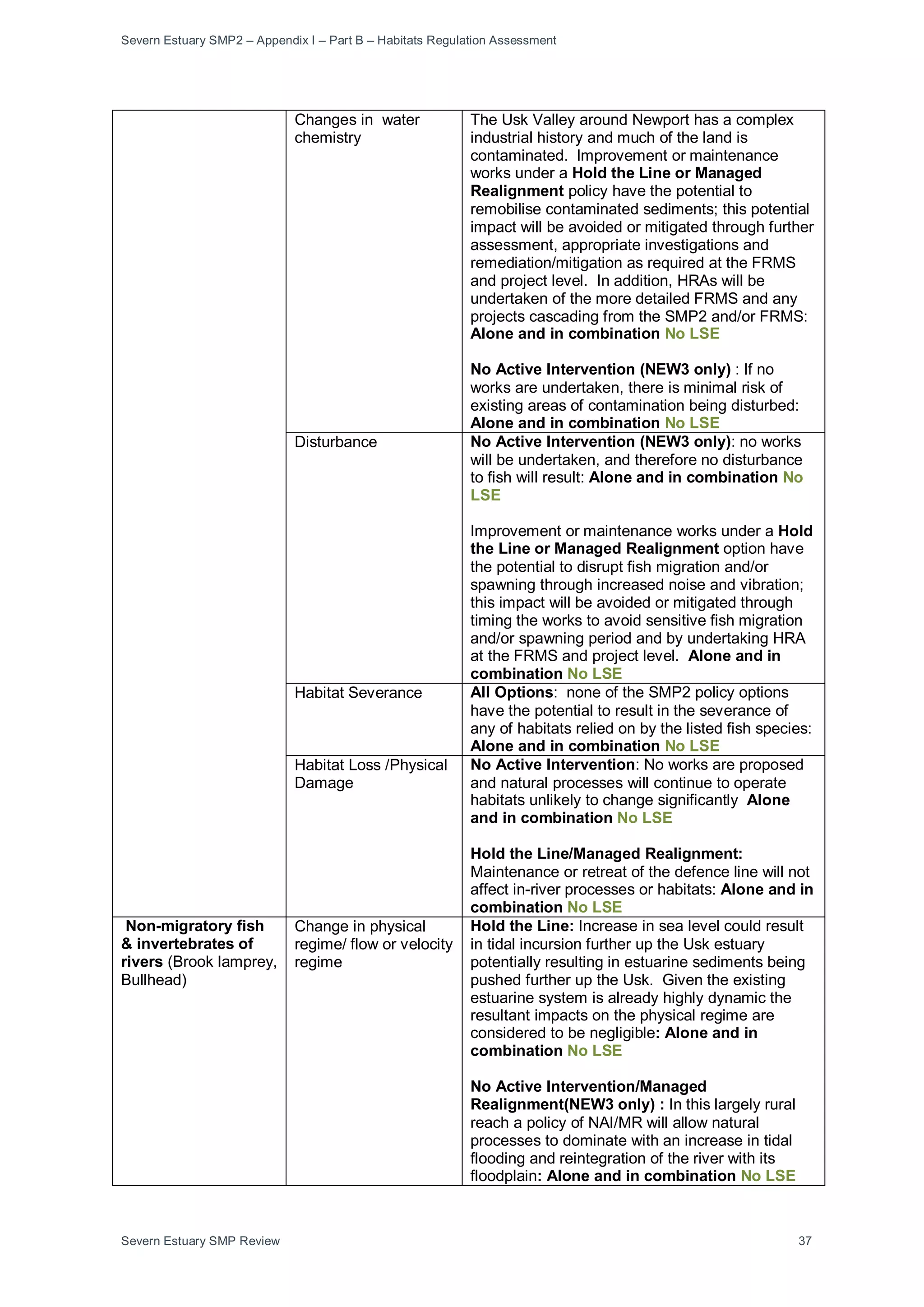
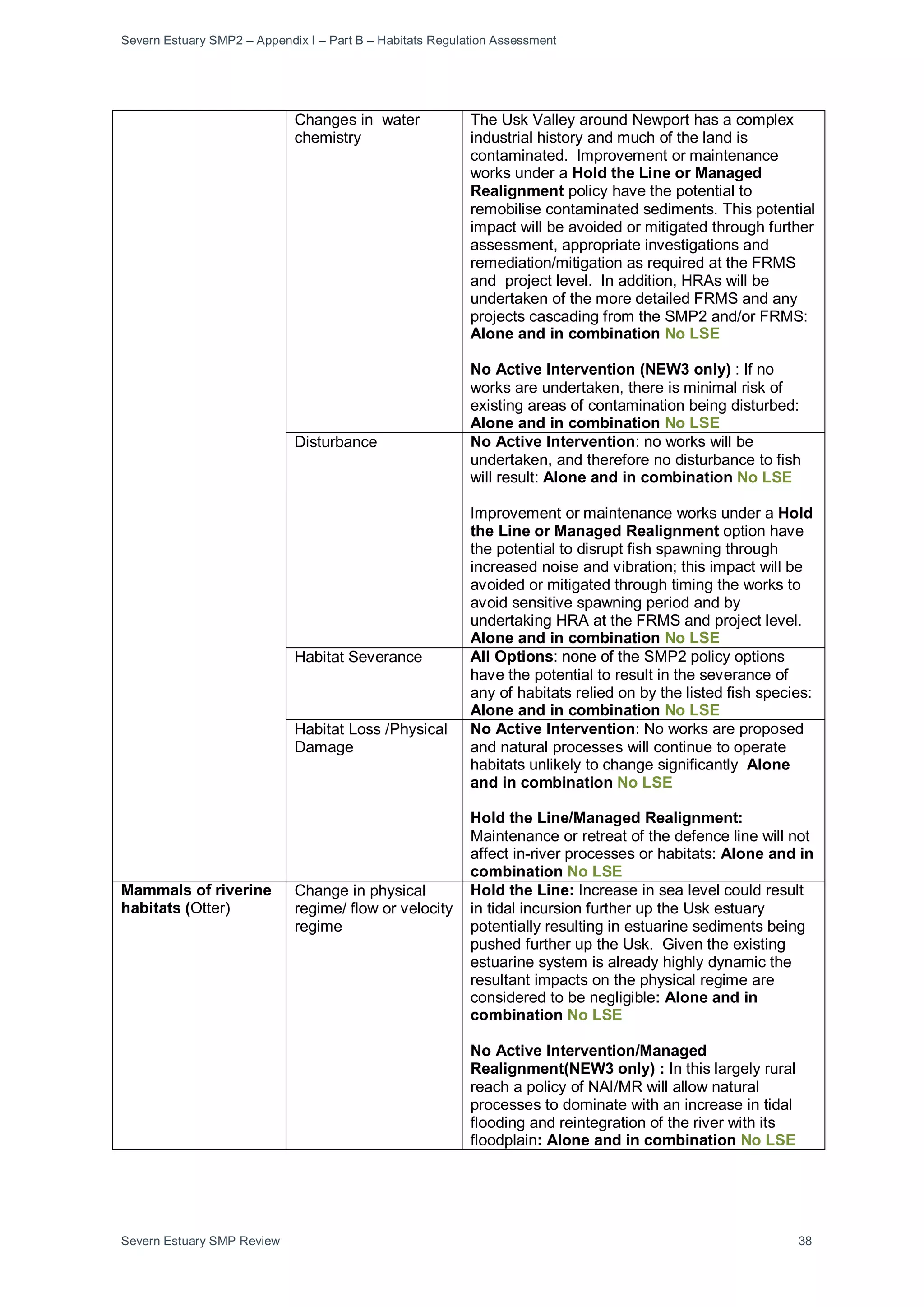
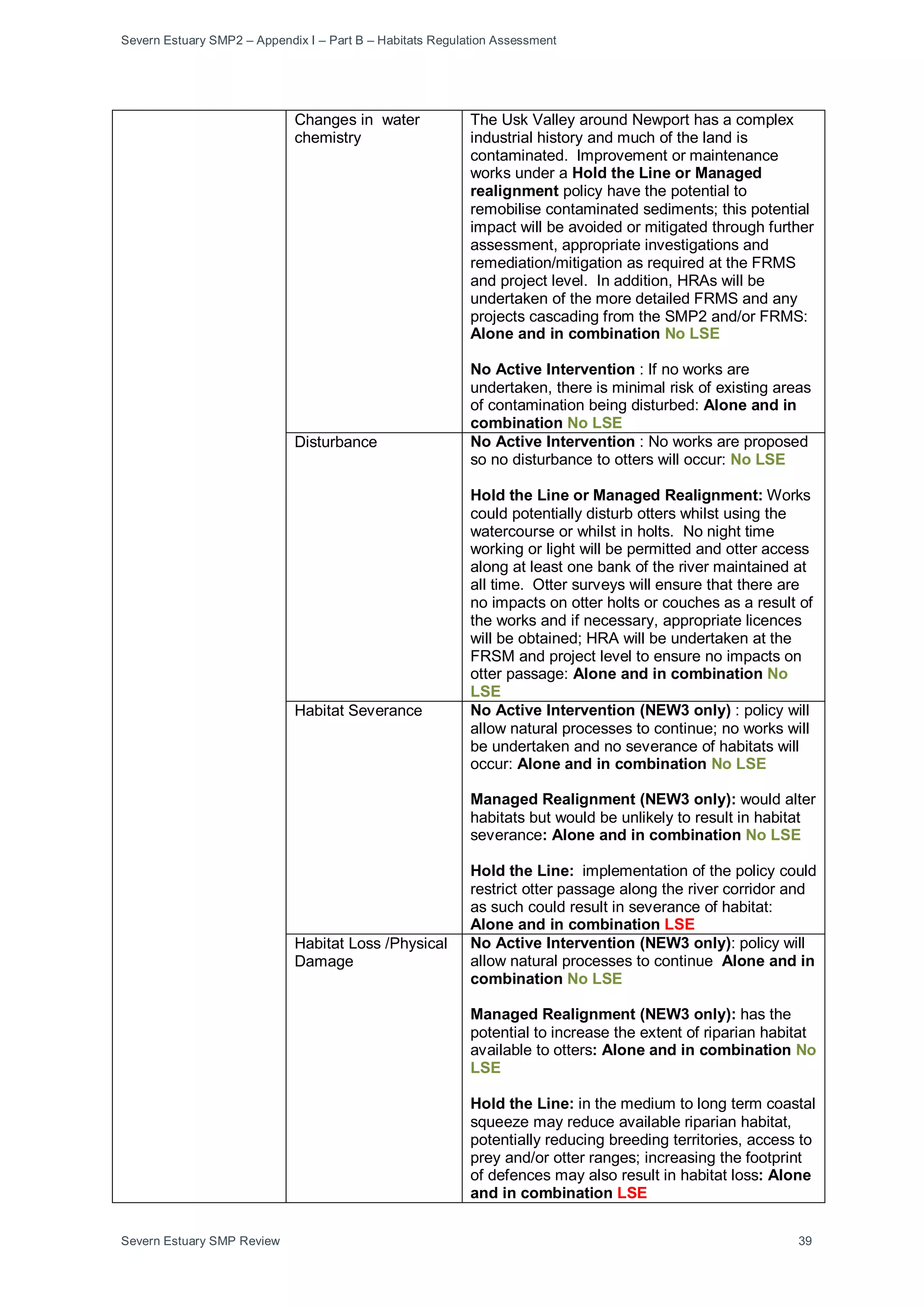
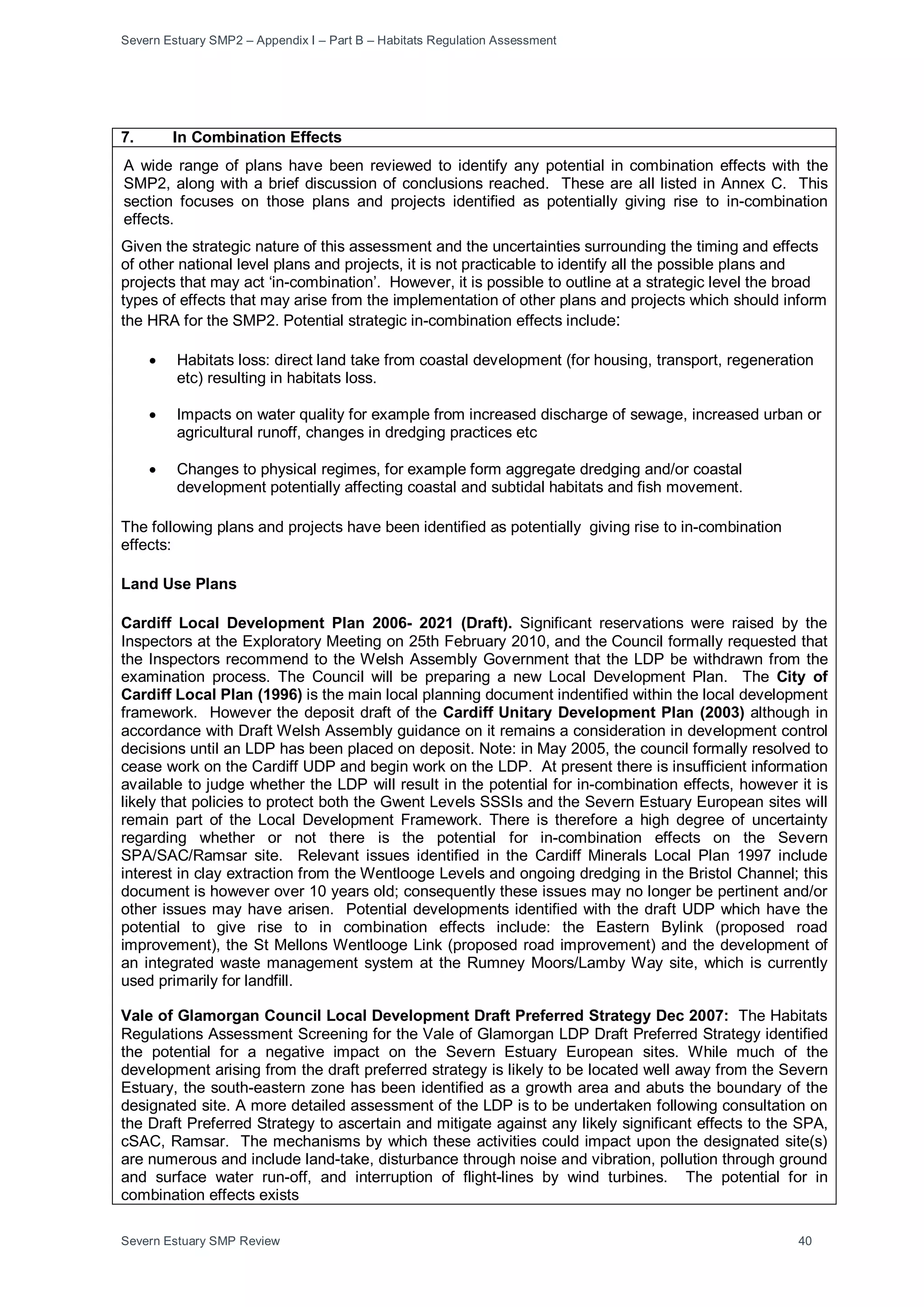
Severn Estuary SMP2 – Appendix I – Part B – Habitats Regulation Assessment
i
Severn Estuary SMP Review
Appendix I: Part B - Habitat
Regulations Assessment
Severn Estuary SMP2 – Appendix I – Part B – Habitats Regulation Assessment
ii
Severn Estuary SMP Review
Notice
This report was produced by Atkins Ltd for the Severn Estuary Coastal Group for the specific purpose of the
Severn Estuary SMP2.
This report may not be used by any person other than the Severn Estuary Coastal Group without the Severn
Estuary Coastal Group’s express permission. In any event, Atkins accepts no liability for any costs, liabilities
or losses arising as a result of the use of or reliance upon the contents of this report by any person other
than the Severn Estuary Coastal Group.
Document History
JOB NUMBER: 5078599 DOCUMENT REF: 5078599
1.0 For Review SP KRH KRH JMC 06/05/10
2.0 For QRG SP KRH KRH JMC 27/05/10
3.0 Final SP KRH KRH RS Dec 2010
Revision Purpose Description Originated Checked Reviewed Authorised Date
Severn Estuary SMP2 – Appendix I – Part B – Habitats Regulation Assessment
iii
Severn Estuary SMP Review
Contents
1. INTRODUCTION ...................................................................................1
2. STAGE 1 ASSESSMENT .......................................................................2
2.1 Consideration of Sites ...............................................................................................2
2.2 Conclusion of Stage 1 Assessment........................................................................... 5
3. STAGE 2 ASSESSMENT .......................................................................6
4. STAGE 3 ASSESSMENT – ASSESSMENT OF ADVERSE EFFECT ON SITE
INTEGRITY................................................................................................45
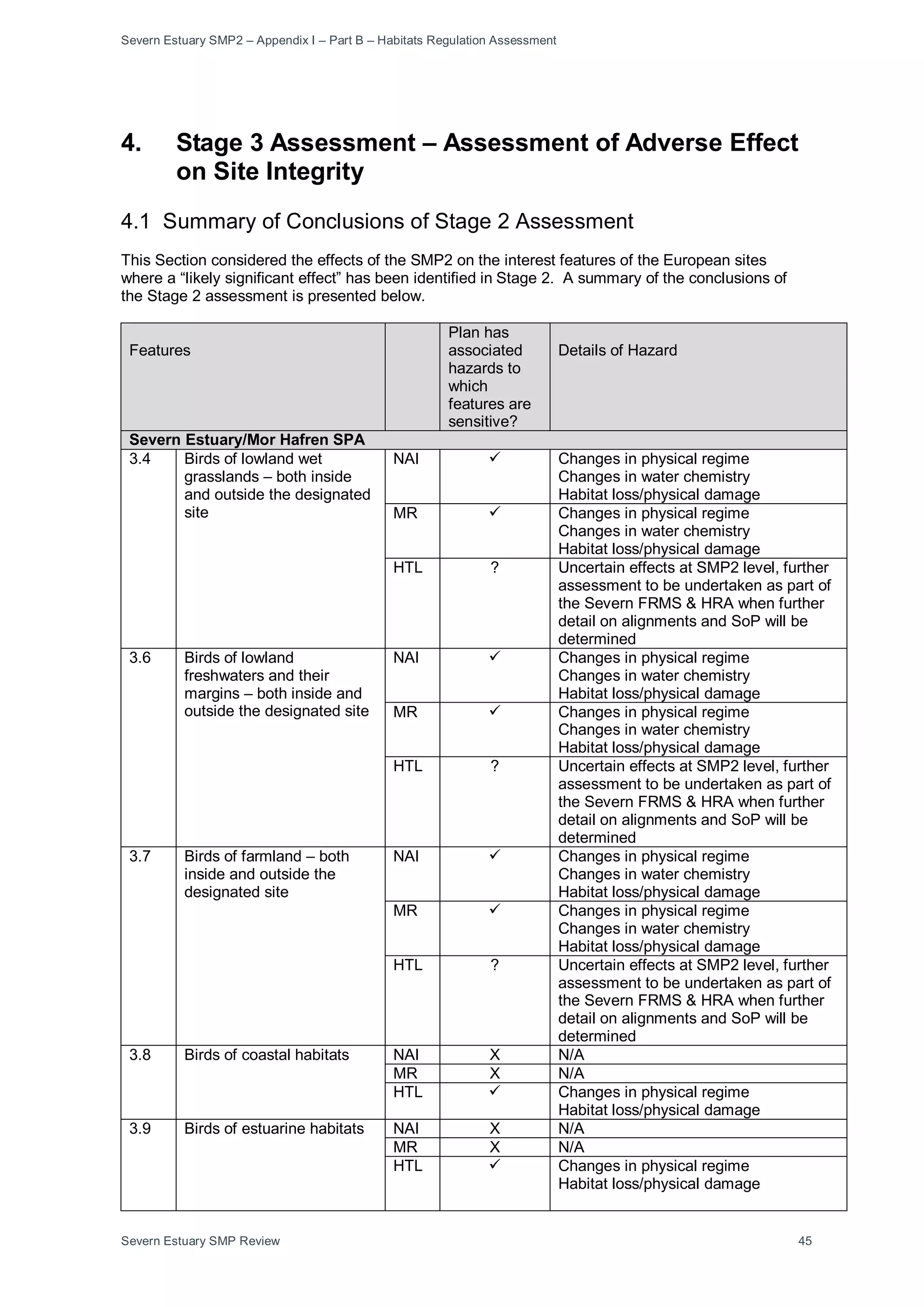
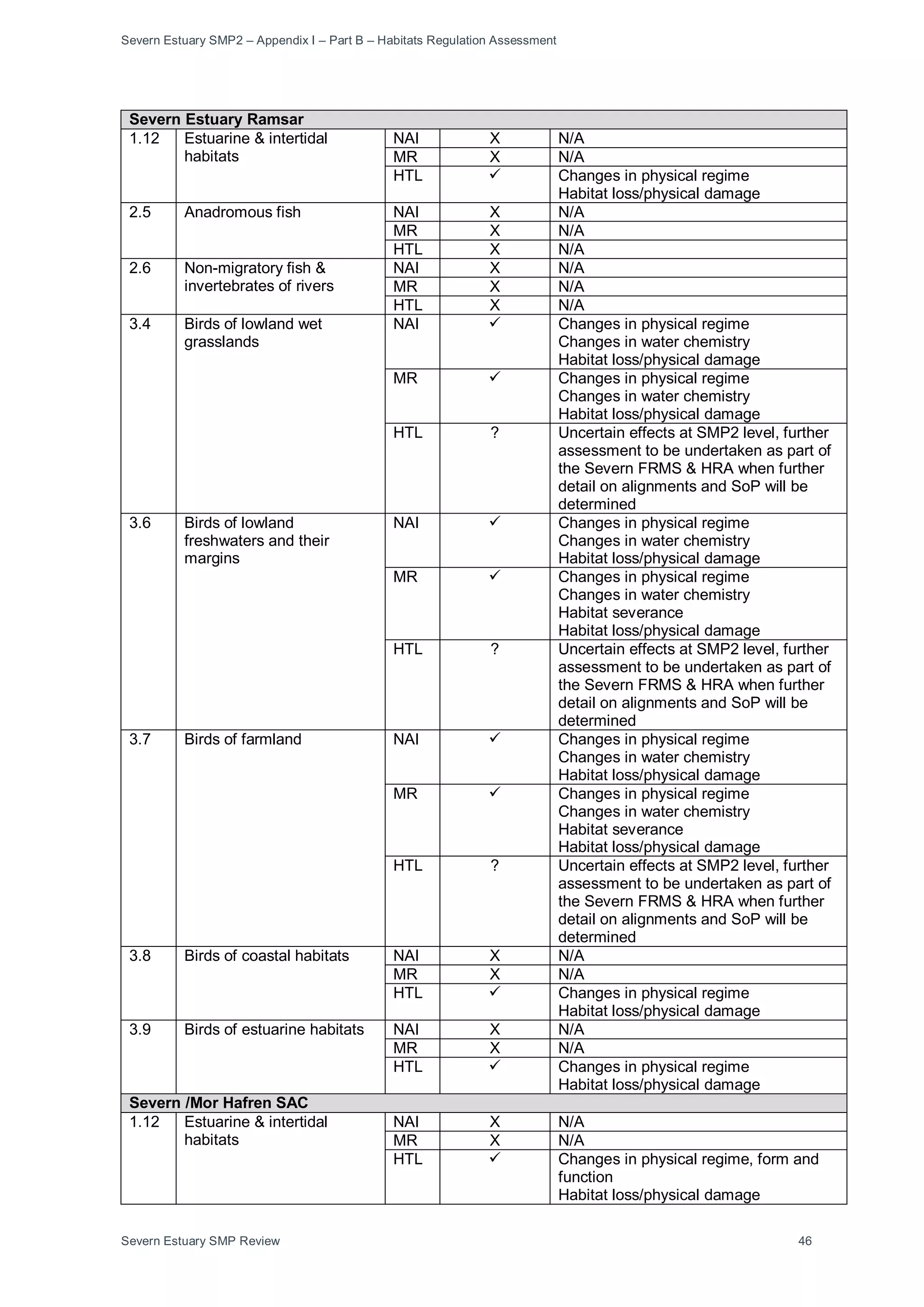
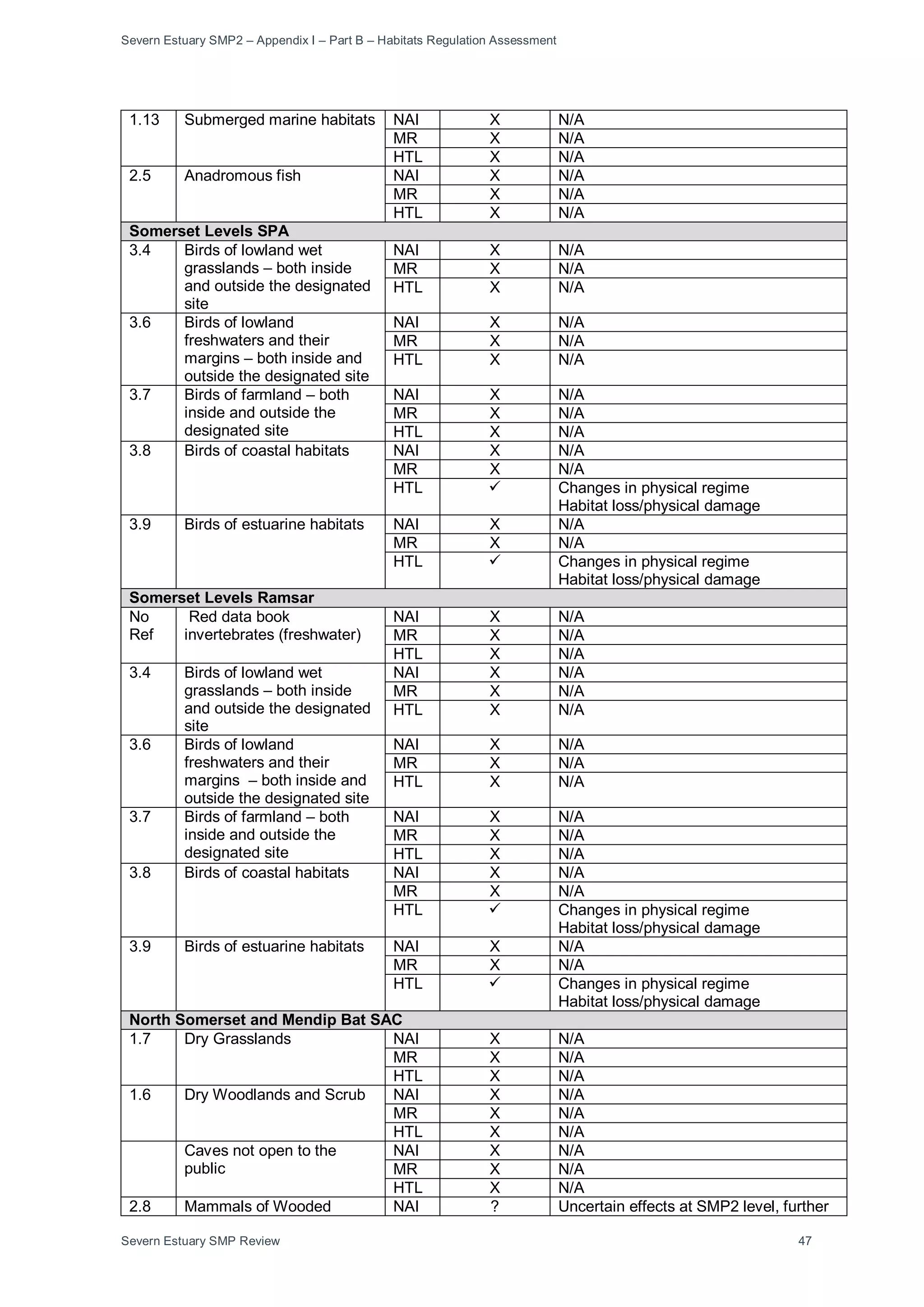
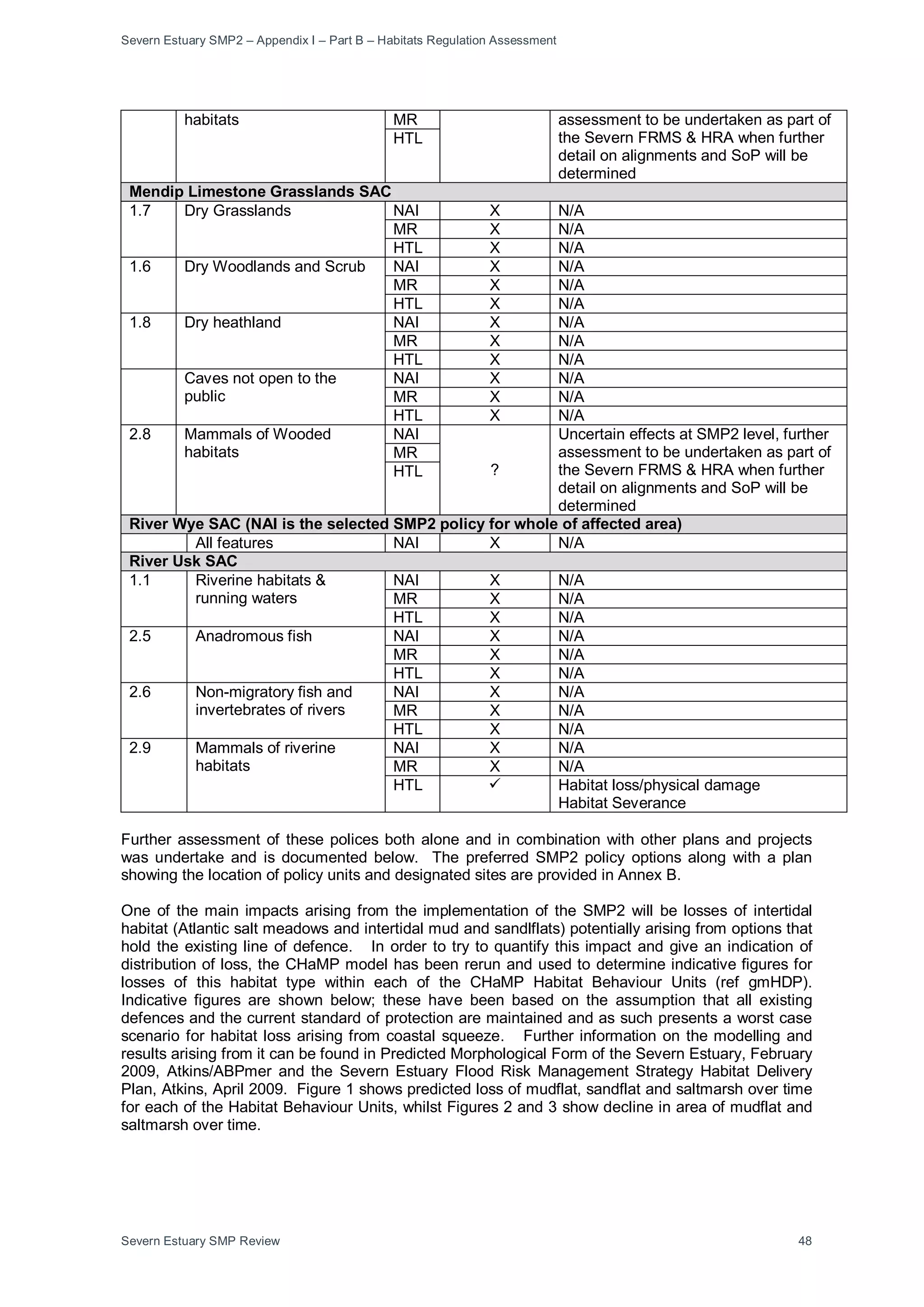
4.1 Summary of Conclusions of Stage 2 Assessment...................................................... 45
4.2 Appropriate Assessment Record............................................................................. 51
4.3 Conclusion of Stage 3 Assessment......................................................................... 62
5.0 PART B: FINAL APPROPRIATE ASSESSMENT RECORD: SEVERN
ESTUARY SMP2 (MAY 2010) ...................................................................65
Severn Estuary SMP2 – Appendix I – Part B – Habitats Regulation Assessment
Severn Estuary SMP Review 1
Severn Estuary Shoreline Management Plan Review
Habitats Regulations Assessment
March 2010
1. Introduction
The Severn Estuary Shoreline Management Plan Review (SMP2) has the potential to affect a
number of European sites (Special Protection Areas (SPAs), Special Areas of Conservation (SACs)
and Ramsar sites) located across the estuary. The European Union Birds Directive (79/409/EEC)
and Habitats Directive (92/43/EEC) (under which these sites are designated) are implemented in the
UK by the Conservation of Habitats and Species Regulations 2010 (SI 290) (also known as the
Habitats Regulations), which consolidate and update the Conservation (Natural Habitats, &c.)
Regulations 1994 (the 1994 Regulations).
Section 61 of the Habitats Regulations requires that a competent authority, before deciding to
undertake, or give any consent, permission or other authorisation for a plan or project which is likely
to have a significant effect on a European site in Great Britain (either alone or in combination with
other plans or projects) shall make an appropriate assessment of the implications for the site in view
of that site's conservation objectives.
This document is a record of the Habitats Regulations Assessment undertaken for the Severn
Estuary Shoreline Management Plan Review (SMP2). In undertaking this assessment the
Environment Agency EU Habitats and Birds Directive Handbook has been used to provide guidance
on the approach to the assessment and the format of the report.
The HRA process can be broken down into four stages:
• Stage 1 : Determine whether the plan is relevant and identify the Competent Authority and
scope which sites are going to be assessed, along with a rationale for decisions made;
• Stage 2 : Assess whether the plan is likely to have a significant effect on a European site
alone or in combination with other plans or projects;
• Stage 3 : Where required, assess adverse effect on site integrity (Appropriate Assessment);
• Stages 4 & 5: Where the Appropriate Assessment (Stage 3) is unable to conclude that the
plan or project does not adversely affect the integrity of the Natura 2000 site, the plan or
project may only be adopted if it can be demonstrated that there are no alternative solutions
that would have a lesser effect on the Natura 2000 site; and, if there are no alternative
solutions, there must be imperative reasons of overriding public interest (IROPI) for adopting
the plan or project; compensatory measures also need to be identified.
The HRA has been informed by predicted future changes in flood and erosion risk, derived from
modelling and assessment undertaken as part of the development of the SMP2; this work is detailed
in Appendix C of the SMP2 Report: Baseline Understanding of Coastal Behaviour and Dynamics.
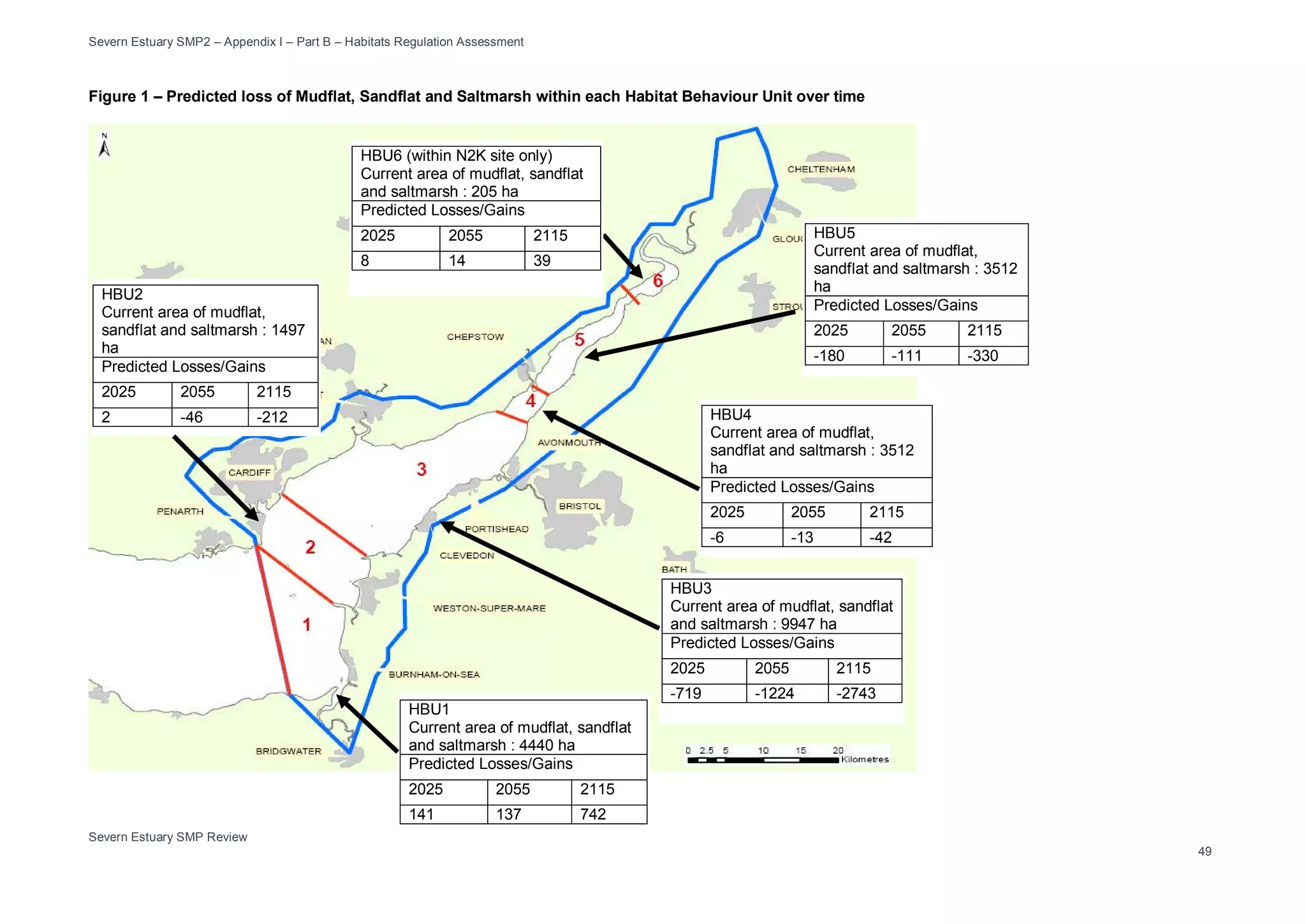
One of the main impacts arising from the implementation of the SMP2 will be losses of intertidal
habitat (Atlantic salt meadows and intertidal mud and sandlflats) potentially arising from options that
hold the existing line of defence. In order to try to quantify and address this impact the Environment
Agency has commissioned work undertaken as part of the development of the Severn Estuary Flood
Risk Management Strategy (FRMS) (in progress). As part of this element of work the 2006 CHaMP
model was updated with revised sea level predictions (Defra 2006), improved 1D-regime modelling
techniques, and removal of the 18.6 year astronomical nodal cycle (which previously masked habitat
impacts). This work has identified indicative figures for losses of intertidal habitat within each of the
CHaMP habitat behaviour units (HBUs). Figures are based on the assumption that all existing
defences and the current standard of protection are maintained, and as such presents a worst case
Severn Estuary SMP2 – Appendix I – Part B – Habitats Regulation Assessment
Severn Estuary SMP Review 2
scenario for habitat loss arising from coastal squeeze. Further information on the modelling and
results arising from it can be found in; Morphological Form of the Severn Estuary, February 2009,
Atkins/ABPmer and the Severn Estuary Flood Risk Management Strategy Habitat Delivery Plan,
Atkins/ABPmer, April 2009.
2. Stage 1 Assessment
2.1 Consideration of Sites
Due to the fact that SMPs are considered by Defra, WAG, the Environment Agency, Natural England
and CCW to fall within the criteria outlined within Regulation 61 of the Conservation of Habitats and
Species Regulations 2010 (SI 290)), they require a Habitats Regulations Assessment (HRA) to be
undertaken.
Within England, the Environment Agency is considered to be the competent authority for this HRA.
WAG has confirmed that it will be the competent authority within Wales.
Due to the magnitude of the estuary and the scale of physical processes involved, it was considered
possible that the effects of implementing the SMP2 could extend beyond the boundary of the study
area. Therefore the area included within this initial Stage extends beyond the SMP2 study area,
and is bounded in the east by the tidal extent of the River Severn north of Gloucester, and in
the west by St Govan’s Head (north) and Hartland Point (south); in addition, sites which might
potentially be hydrologically connected with the Severn Estuary or its tidal tributaries, sites with
mobile features such as birds or bats which could be affected by the SMP2, or those which have a
clear ecological connection with the estuary have also been included. The 30 sites considered
within this Stage are listed below:
• Severn Estuary/Mor Hafren SAC
• Severn Estuary/Mor Hafren SPA
• Severn Estuary/Mor Hafren Ramsar
• River Usk/Afon Wysg SAC
• River Wye/Afon Gwy SAC
• Somerset Levels and Moors SPA
• Somerset Levels and Moors Ramsar
• Limestone Coast of South West Wales/ Arfordir Calchfaen de Orllewin Cymru SAC
• River Tywi/Afon Tywi SAC
• Pembrokeshire Marine/Sir Benfro Forol SAC
• Carmarthen Bay and Estuaries/ Bae Caerfyrddin ac Aberoedd SAC
• Carmarthen Bay/ Bae Caerfyrddin SPA
• Carmarthen Bay Dunes/Twyni Bae Caerfyrddin SAC
• Castlemartin Coast SPA
• Burry Inlet SPA Ramsar
• Dunraven Bay SAC
• Crymlyn Bog SAC Ramsar
• Kenfig/Cynffig SAC
• Wye Valley Woodlands/ Coetiroedd Dyffryn Gwy SAC
• Wye Valley and Forest of Dean Bat sites / Safleoedd Ystlumod Dyffryn Gwy a Fforest y
Ddena SAC
• Walmore Common SPA, Ramsar
• Avon Gorge Woodlands SAC
• North Somerset and Mendip Bat SAC
• Mendip Limestone Grasslands SAC
• Mendip Woodlands SAC
Severn Estuary SMP2 – Appendix I – Part B – Habitats Regulation Assessment
Severn Estuary SMP Review 3
• Exmoor Heaths SAC
• Exmoor and Quantocks Oak Woods SAC
• Tintagel Marsland Clovelly Coast SAC
• Braunton Burrows SAC
• Lundy SAC
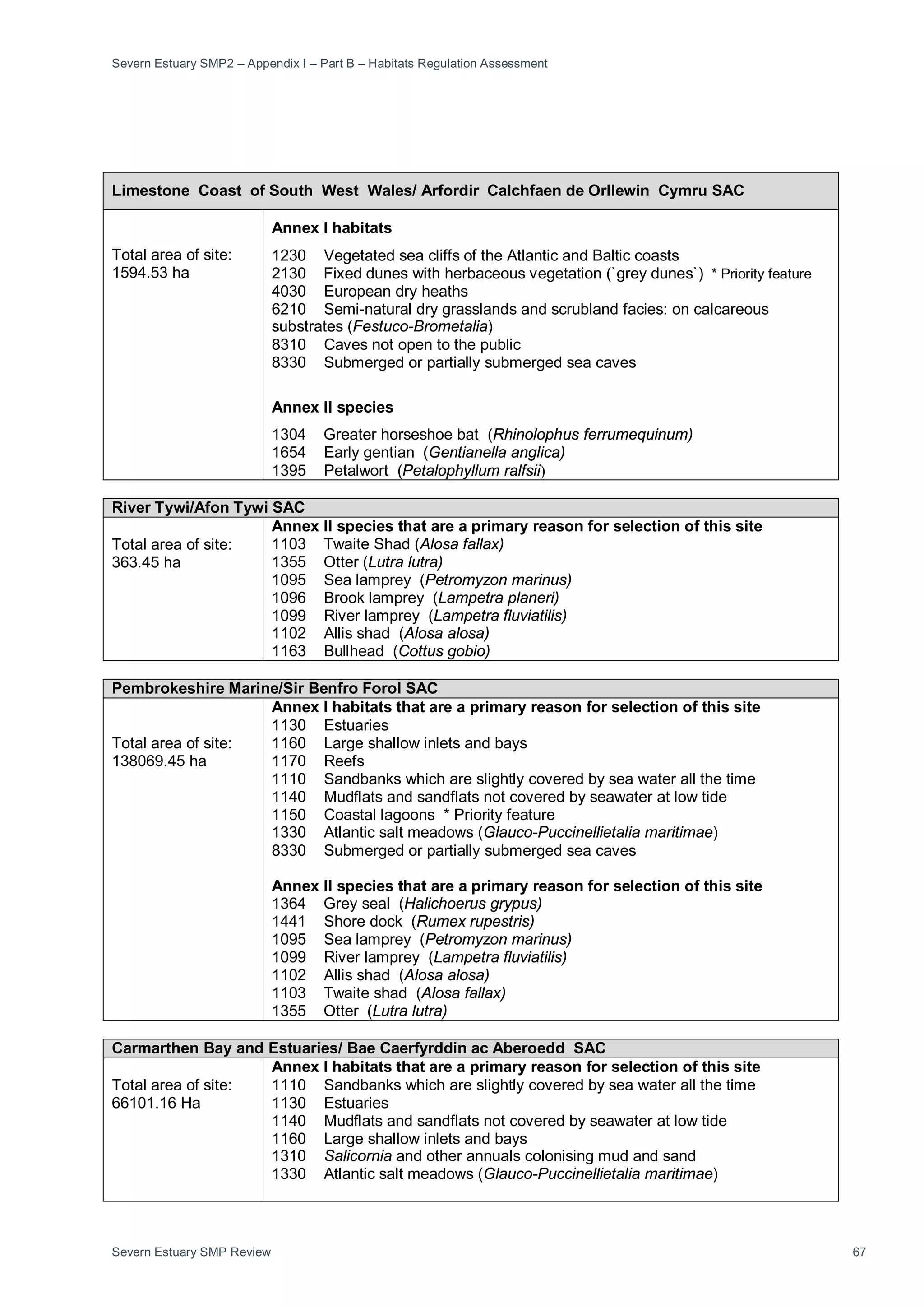
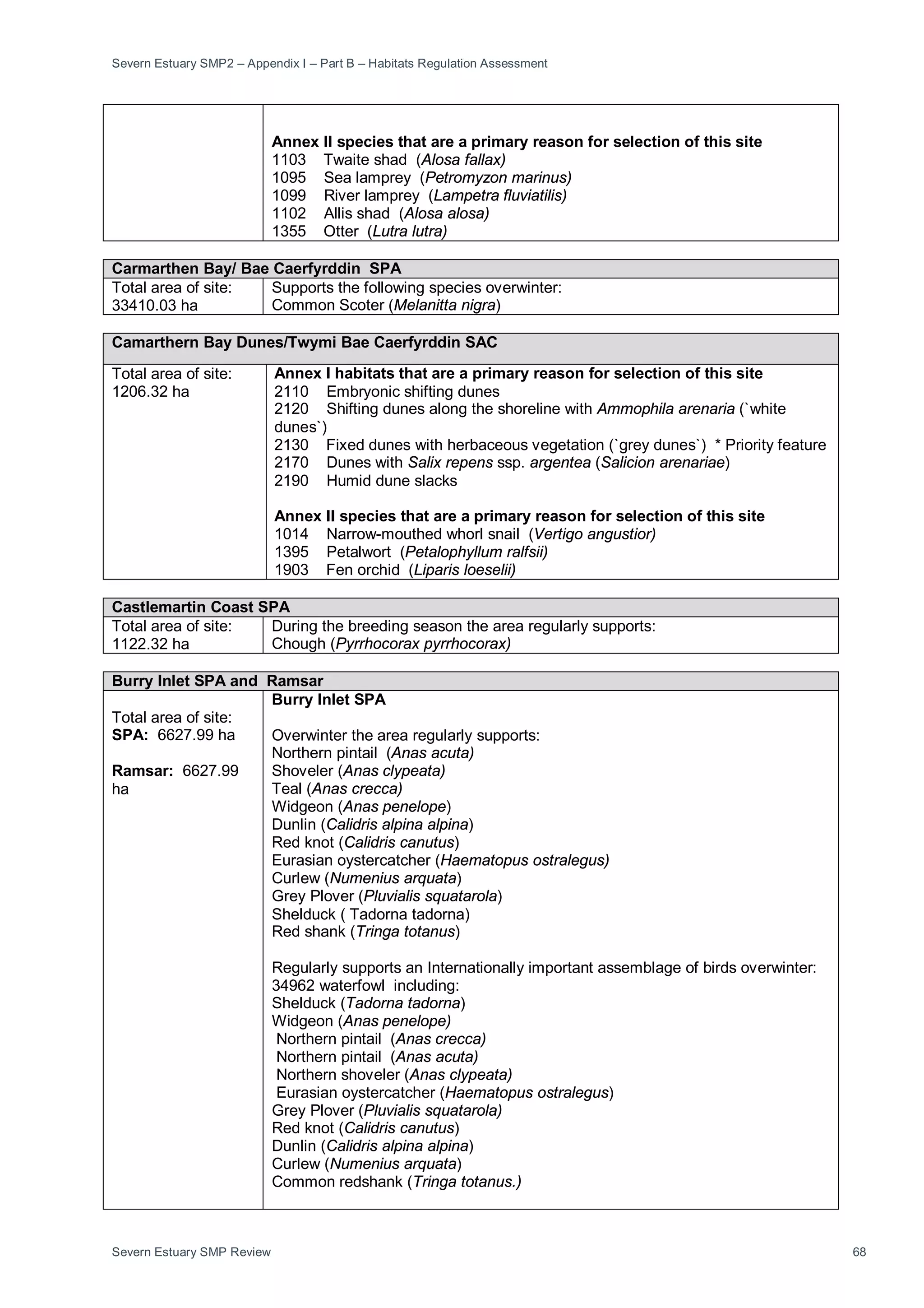
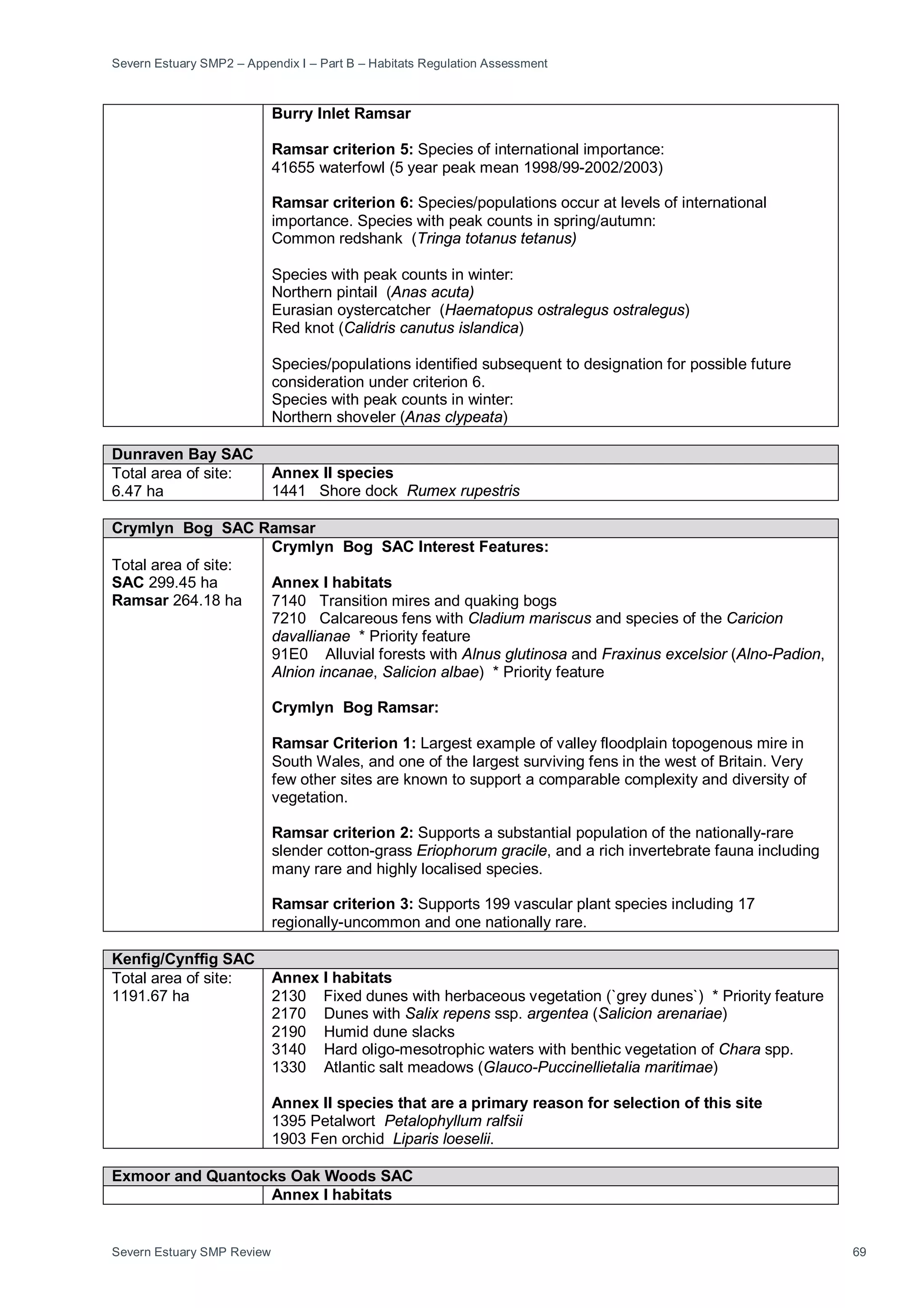
Following an initial review of the sites’ interest features (seeAnnex A) and conservation objectives
the following sites were scoped out from further assessment; a brief justification as to why no
impacts are considered likely is provided.
A. Although the following sites are hydraulically linked to the study area via the estuary they are
outside the SMP2 study area and have been assessed as being unaffected by any changes in
coastal processes.
• Limestone Coast of South West Wales/ Arfordir Calchfaen de Orllewin Cymru SAC
- located at least 65 km downstream of study area
• River Tywi/Afon Tywi SAC - located more than 100km downstream of study area
• Pembrokeshire Marine/Sir Benfro Forol SAC - located approximately 110 km downstream
of study area
• Carmarthen Bay and Estuaries/ Bae Caerfyrddin ac Aberoedd SAC - located
approximately 80 km downstream of the study area.
• Carmarthen Bay/ Bae Caerfyrddin SPA - located approximately 80 km downstream of
study area
• Camarthern Bay Dunes/Twymi Bae Caerfyrddin SAC - located approximately 85 km
downstream of study area
• Castlemartin Coast SPA - located approximately 120 km downstream of study area
• Burry Inlet SPA and Ramsar - located approximately 74 km downstream of study area
• Dunraven Bay SAC - located approximately 30 km downstream of study area
• Kenfig/Cynffig SAC - located approximately 40 km downstream of study area
Discussion of potential effects: the risk of tidal flooding or erosion of the sites will not
increase as a result of the implementation of the SMP2. Any alterations to coastal processes
that could potentially result from the implementation of SMP2 policies will typically be local in
nature. The headland at Penarth will constrain impacts on coastal processes westwards along
the estuary; any impacts from the Severn SMP2 would be small scale and local in nature when
compared to the magnitude and complexity of processes operating at an estuary wide scale.
Habitats, species and conservation objectives of the sites are therefore considered unlikely to
be affected by the SMP2. Significant adverse in combination effects are also considered
unlikely.
B. Crymlyn Bog SAC & Ramsar - located approximately 80 km downstream of study area; there
is also potential for hydraulic connectivity via The Glan y Wern Canal and the Tennant Canal.
Discussion of potential effects: The risk of tidal flooding of the site will not increase as a
result of the implementation of the SMP2. Any alterations to coastal processes that could
potentially result from the implementation of SMP2 policies will typically be local in nature; the
headland at Penarth will constrain impacts on coastal processes westwards along the estuary.
In addition, the site is approximately 600m inland and would be protected from any changes to
Severn Estuary SMP2 – Appendix I – Part B – Habitats Regulation Assessment
Severn Estuary SMP Review 4
coastal erosional and depositional processes. Habitats, species and conservation objectives of
the site are therefore considered unlikely to be affected by the SMP2. Significant adverse in
combination effects are also considered unlikely.
C. Although the following sites are hydraulically linked to the study area via the estuary they are
outside the SMP2 study area and have been assessed as being unaffected by any changes in
coastal processes
• Exmoor and Quantocks Oak Woods SAC - located 40 km downstream of study area and
elevated outside the flood risk area.
• Exmoor Heaths SAC - located 40 km downstream of study area and elevated outside the
flood risk area.
• Tintagel Marsland Covelly Coast SAC - located approximately 120km downstream of the
study area
• Braunton Burrows SAC - located 90 km downstream of study area
• Lundy SAC - located approximately 120km downstream of study area
Discussion of potential effects: the implementation of the Severn SMP2 will not affect tidal
ranges, coastal processes or flood risk west of the Middle Hope and Brean Down promontories.
Any impacts from the Severn SMP2 would be very small scale both alone and in combination
with other plans and projects and local in effect when compared to the magnitude and
complexity of processes operating at an estuary wide scale. Habitats, species and conservation
objectives of the sites are therefore considered unlikely to be affected by the SMP2.
D. Wye Valley Woodlands/ Coetiroedd Dyffryn Gwy SAC - A policy of No Active Intervention
(NAI) is proposed for each of the reaches within the Wye policy unit. No increase in flood or
erosion risk is predicted within any of the above reaches over the lifetime of the SMP2; natural
processes will continue to dominate. The SAC comprises several woodland areas spread along
the Wye Valley, predominantly within reaches WYE2 and 3. None of the sites are currently
affected by tidal processes or flooding and this will remain the case in the future; within this
section of the study area flood and erosion risk is not predicted to increase under an NAI policy;
neither the woodland sites themselves nor associated bat foraging habitat within the area will be
affected by the implementation of the SMP2 policies. Significant adverse in combination effects
are also considered unlikely.
E. Wye Valley and Forest of Dean Bat Sites / Safleoedd Ystlumod Dyffryn Gwy a Fforest y
Ddena SAC - A policy of NAI is proposed for each of the reaches within the Wye policy unit. No
increase in flood or erosion risk is predicted within any of the above reaches over the lifetime of
the SMP2; natural processes will continue to dominate and therefore no impacts are predicted.
The SAC comprises several sites spread along the Wye Valley. None of the sites are currently
affected by tidal processes or flooding and this will remain the case in the future; within this
section of the study area flood and erosion risk is not predicted to increase under an NAI policy;
neither the SACs nor associated bat foraging habitat within the area will be affected by the
implementation of the SMP2 policies. Significant adverse in combination effects are also
considered unlikely.
F. Walmore Common SPA and Ramsar
Options for policy units along this stretch of coast are as follows:
GLO5 GLO6 GL7 GLO8
HTL NAI HTL HTL
The existing defence
line will be
maintained
Natural processes
will continue to
operate within this
The existing defence
line will be maintained
Given that a key
The existing
defence line will be
maintained Given
Severn Estuary SMP2 – Appendix I – Part B – Habitats Regulation Assessment
Severn Estuary SMP Review 5
reach. There is
currently no flood or
erosion risk within
this reach and
modelling indicates
that this will not
change in the future
transport route and a
number of properties lie
between the estuary and
the site it has been
assumed that the SoP
will be retained or
improved and the site
will receive ongoing
protection from tidal
flooding
that a key transport
route and a number
of properties lie
between the
estuary and the site
it has been
assumed that the
SoP will be retained
or improved and
the site will receive
ongoing protection
from tidal flooding
An important habitat on the site is the grassland, which is maintained by grazing and natural
freshwater winter flooding which is in turn determined by rainfall, run-off and river levels. The
marshy grassland and ditches are maintained and enhanced by maintaining high water levels
from spring to autumn through the implementation of a water level management plan The site
currently has roughly a 1 in 200 year standard of protection from tidal flooding. With a HTL
policy at GL7, it has been assumed that the standard of protection offered to the site will be
maintained or increased. The site will not be at risk from tidal flooding and/or erosion. Sea level
rise may result in increased tide locking of land behind the defences, however this would be as
a result of sea levels rise, not the implementation of the SMP2 The feature of the site
(Bewick’s Swan) and the habitats that support them will be unaffected by the preferred policy
options. However the SMP2 does not identify the standard of flood protection to be provided by
flood defences; this will be addressed by the Severn Flood Risk Management Strategy (FRMS).
This assessment has concluded no likely significant effects on the SAC and Ramsar site at the
SMP2 level, however the potential for impacts will be reviewed as part of the HRA for the
FRMS, when further information on the standard of protection from tidal flooding to be provided
will be available. Significant adverse in combination effects are considered unlikely.
G. Avon Gorge Woodlands SAC - A Hold the Line policy is proposed for all the reaches within the
policy unit. There is currently no flood or erosion risk within this reach and this will not change in
the future. The SAC is located adjacent to the River Avon on both the left and right banks within
Policy Units BRIS 4 and 5. The site is currently unaffected by tidal processes and this will
remain the case under the preferred policy. None of the habitats for which the site is designated
nor the sites’ conservation objectives will be affected. Significant adverse in combination effects
are also considered unlikely.
H. Mendip Woodlands SAC - the SAC is a woodland site, over 41km from the coast. The site is
more than 40km outside the tidal floodplain and this situation is predicted to continue over the
lifetime of the SMP2. The Annex I feature for which the site is designated (Tilio-Acerion forests )
will not be affected by the SMP2. Significant adverse in combination effects are also considered
unlikely.
2.2 Conclusion of Stage 1 Assessment
Likely significant adverse effects on the following sites could not be ruled out at this stage and they
have therefore been carried forward for further assessment at Stage 2 (Section 3):
• Severn Estuary/Mor Hafren SPA
• Severn Estuary/Mor Hafren Ramsar
• Severn Estuary/Mor Hafren SAC
• River Usk/Afon Wysg SAC
• River Wye / Afon Gwy SAC
• Somerset Levels and Moors SPA and Ramsar
• North Somerset and Mendip Bat SAC
Severn Estuary SMP2 – Appendix I – Part B – Habitats Regulation Assessment
Severn Estuary SMP Review 6
• Mendip Limestone Grasslands SAC
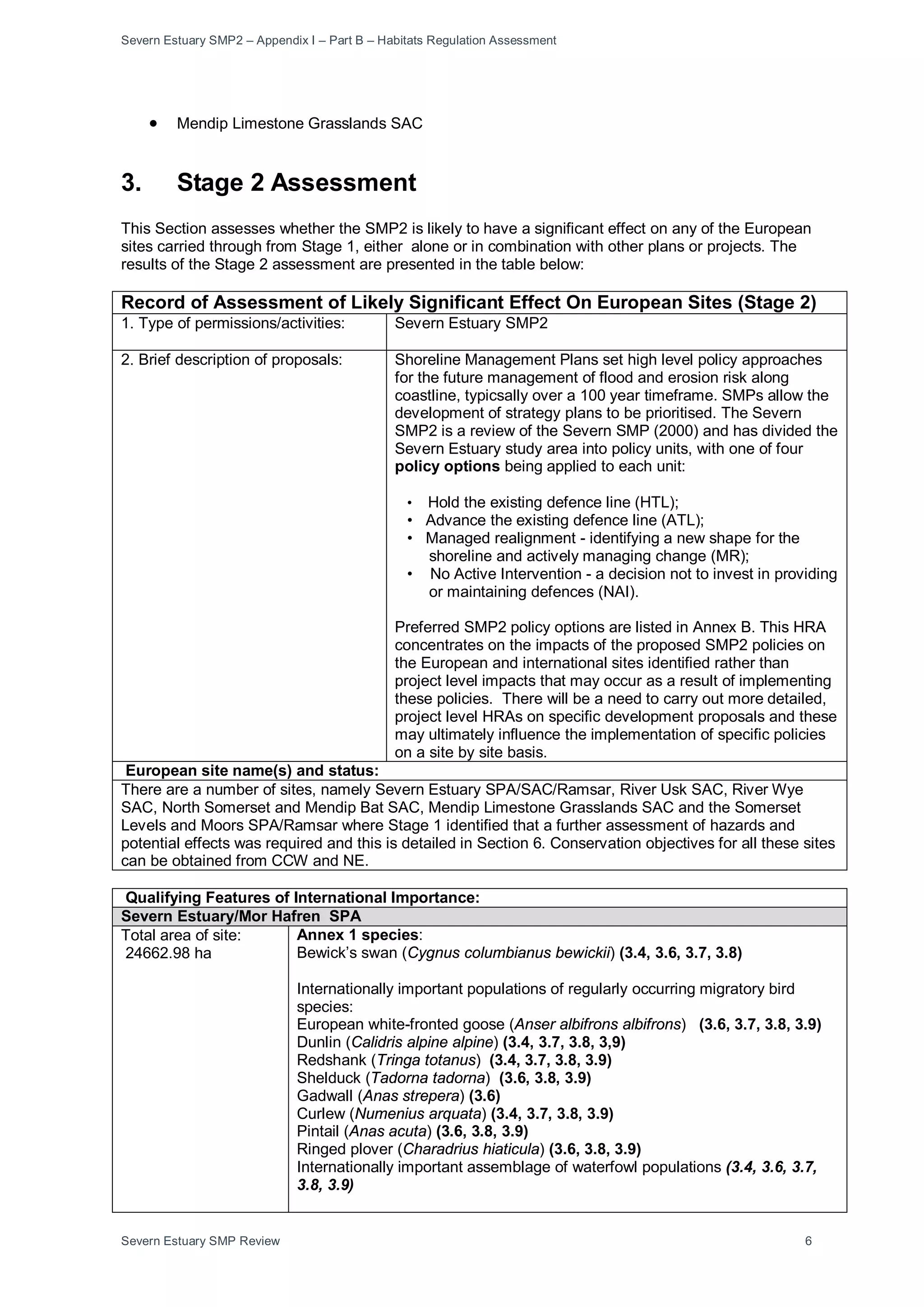
3. Stage 2 Assessment
This Section assesses whether the SMP2 is likely to have a significant effect on any of the European
sites carried through from Stage 1, either alone or in combination with other plans or projects. The
results of the Stage 2 assessment are presented in the table below:
Record of Assessment of Likely Significant Effect On European Sites (Stage 2)
1. Type of permissions/activities: Severn Estuary SMP2
2. Brief description of proposals: Shoreline Management Plans set high level policy approaches
for the future management of flood and erosion risk along
coastline, typicsally over a 100 year timeframe. SMPs allow the
development of strategy plans to be prioritised. The Severn
SMP2 is a review of the Severn SMP (2000) and has divided the
Severn Estuary study area into policy units, with one of four
policy options being applied to each unit:
• Hold the existing defence line (HTL);
• Advance the existing defence line (ATL);
• Managed realignment - identifying a new shape for the
shoreline and actively managing change (MR);
• No Active Intervention - a decision not to invest in providing
or maintaining defences (NAI).
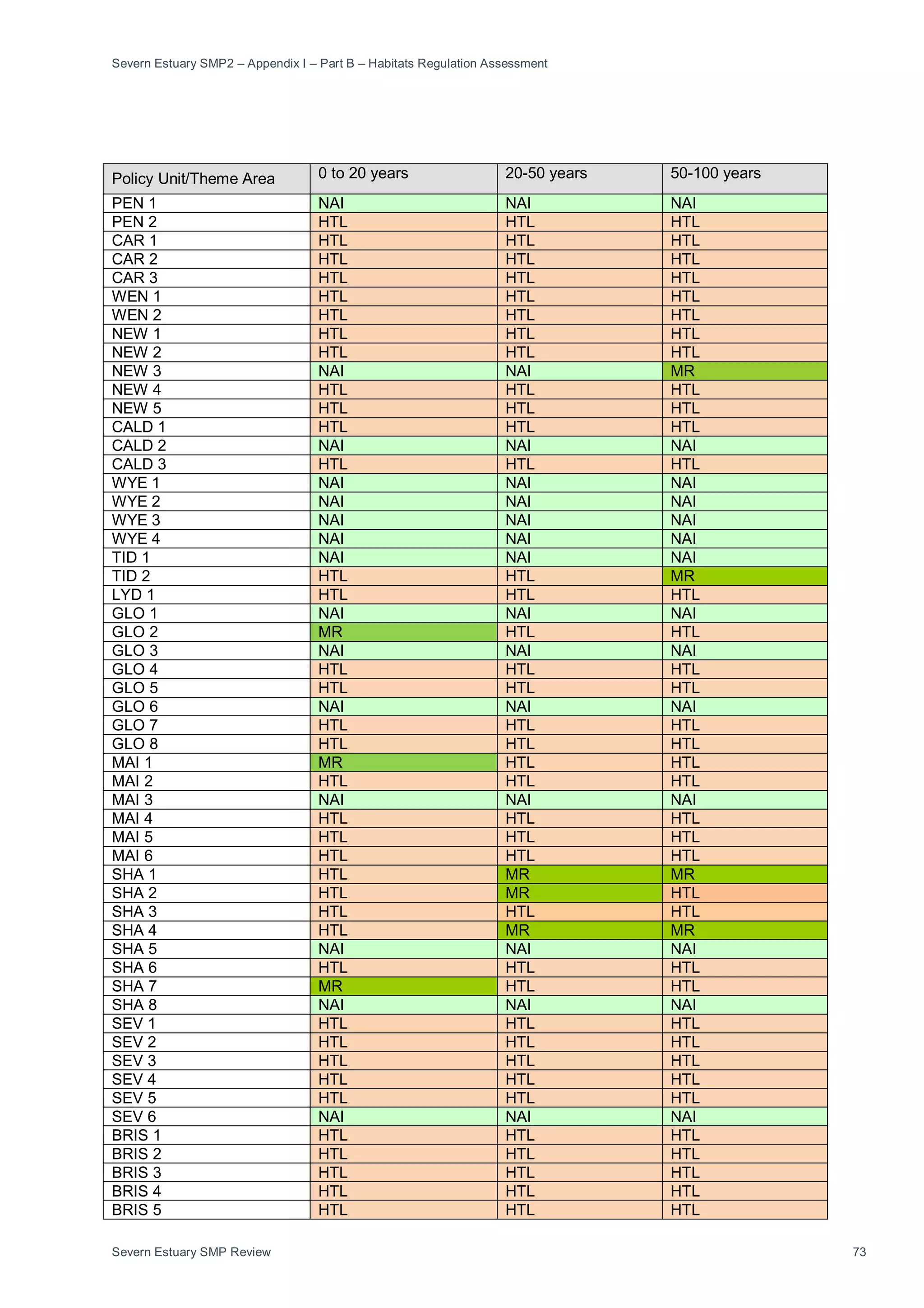
Preferred SMP2 policy options are listed in Annex B. This HRA
concentrates on the impacts of the proposed SMP2 policies on
the European and international sites identified rather than
project level impacts that may occur as a result of implementing
these policies. There will be a need to carry out more detailed,
project level HRAs on specific development proposals and these
may ultimately influence the implementation of specific policies
on a site by site basis.
European site name(s) and status:
There are a number of sites, namely Severn Estuary SPA/SAC/Ramsar, River Usk SAC, River Wye
SAC, North Somerset and Mendip Bat SAC, Mendip Limestone Grasslands SAC and the Somerset
Levels and Moors SPA/Ramsar where Stage 1 identified that a further assessment of hazards and
potential effects was required and this is detailed in Section 6. Conservation objectives for all these sites
can be obtained from CCW and NE.
Qualifying Features of International Importance:
Severn Estuary/Mor Hafren SPA
Total area of site:
24662.98 ha
Annex 1 species:
Bewick’s swan (Cygnus columbianus bewickii) (3.4, 3.6, 3.7, 3.8)
Internationally important populations of regularly occurring migratory bird
species:
European white-fronted goose (Anser albifrons albifrons) (3.6, 3.7, 3.8, 3.9)
Dunlin (Calidris alpine alpine) (3.4, 3.7, 3.8, 3,9)
Redshank (Tringa totanus) (3.4, 3.7, 3.8, 3.9)
Shelduck (Tadorna tadorna) (3.6, 3.8, 3.9)
Gadwall (Anas strepera) (3.6)
Curlew (Numenius arquata) (3.4, 3.7, 3.8, 3.9)
Pintail (Anas acuta) (3.6, 3.8, 3.9)
Ringed plover (Charadrius hiaticula) (3.6, 3.8, 3.9)
Internationally important assemblage of waterfowl populations (3.4, 3.6, 3.7,
3.8, 3.9)
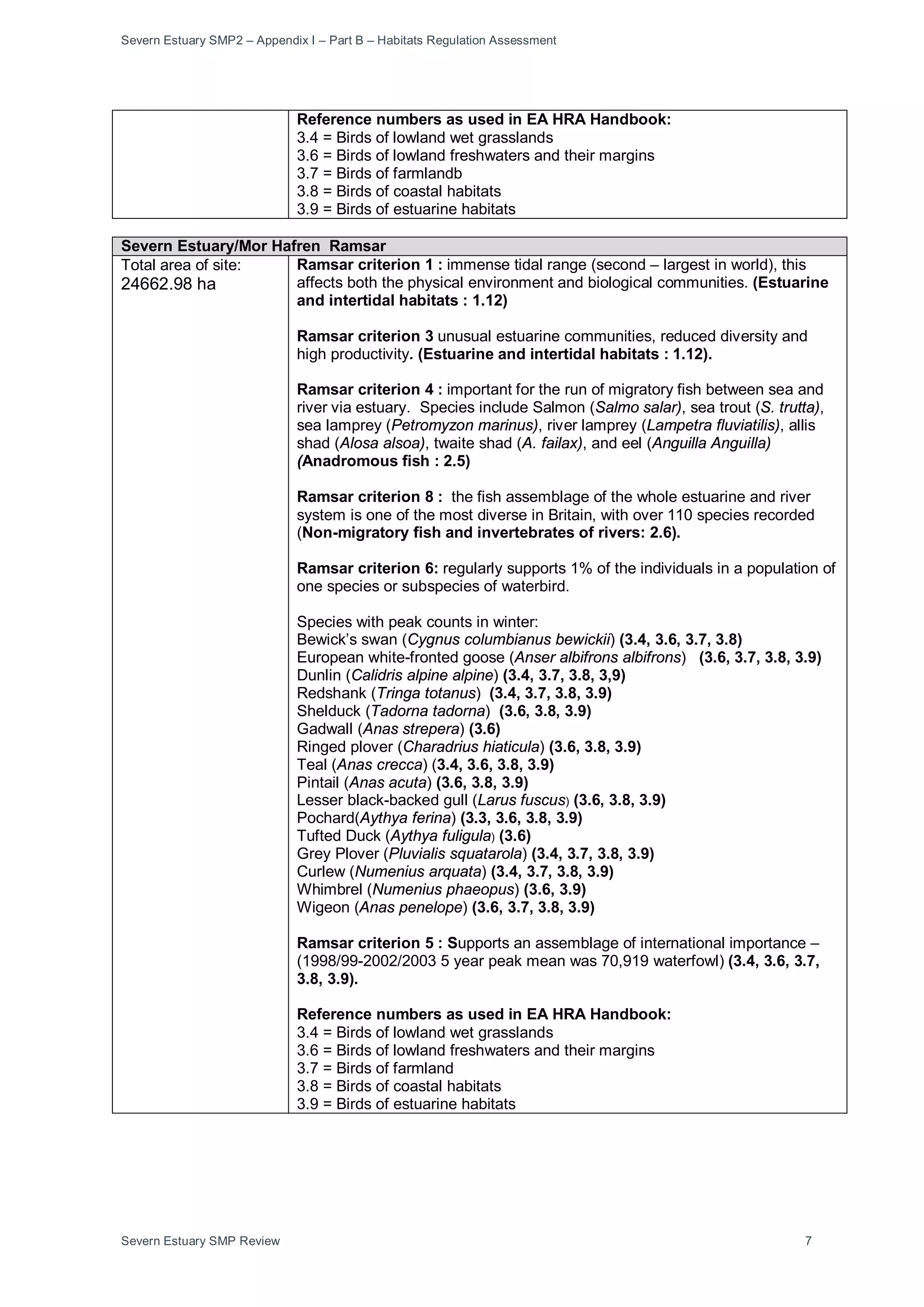
Severn Estuary SMP2 – Appendix I – Part B – Habitats Regulation Assessment
Severn Estuary SMP Review 7
Reference numbers as used in EA HRA Handbook:
3.4 = Birds of lowland wet grasslands
3.6 = Birds of lowland freshwaters and their margins
3.7 = Birds of farmlandb
3.8 = Birds of coastal habitats
3.9 = Birds of estuarine habitats
Severn Estuary/Mor Hafren Ramsar
Total area of site:
24662.98 ha
Ramsar criterion 1 : immense tidal range (second – largest in world), this
affects both the physical environment and biological communities. (Estuarine
and intertidal habitats : 1.12)
Ramsar criterion 3 unusual estuarine communities, reduced diversity and
high productivity. (Estuarine and intertidal habitats : 1.12).
Ramsar criterion 4 : important for the run of migratory fish between sea and
river via estuary. Species include Salmon (Salmo salar), sea trout (S. trutta),
sea lamprey (Petromyzon marinus), river lamprey (Lampetra fluviatilis), allis
shad (Alosa alsoa), twaite shad (A. failax), and eel (Anguilla Anguilla)
(Anadromous fish : 2.5)
Ramsar criterion 8 : the fish assemblage of the whole estuarine and river
system is one of the most diverse in Britain, with over 110 species recorded
(Non-migratory fish and invertebrates of rivers: 2.6).
Ramsar criterion 6: regularly supports 1% of the individuals in a population of
one species or subspecies of waterbird.
Species with peak counts in winter:
Bewick’s swan (Cygnus columbianus bewickii) (3.4, 3.6, 3.7, 3.8)
European white-fronted goose (Anser albifrons albifrons) (3.6, 3.7, 3.8, 3.9)
Dunlin (Calidris alpine alpine) (3.4, 3.7, 3.8, 3,9)
Redshank (Tringa totanus) (3.4, 3.7, 3.8, 3.9)
Shelduck (Tadorna tadorna) (3.6, 3.8, 3.9)
Gadwall (Anas strepera) (3.6)
Ringed plover (Charadrius hiaticula) (3.6, 3.8, 3.9)
Teal (Anas crecca) (3.4, 3.6, 3.8, 3.9)
Pintail (Anas acuta) (3.6, 3.8, 3.9)
Lesser black-backed gull (Larus fuscus) (3.6, 3.8, 3.9)
Pochard(Aythya ferina) (3.3, 3.6, 3.8, 3.9)
Tufted Duck (Aythya fuligula) (3.6)
Grey Plover (Pluvialis squatarola) (3.4, 3.7, 3.8, 3.9)
Curlew (Numenius arquata) (3.4, 3.7, 3.8, 3.9)
Whimbrel (Numenius phaeopus) (3.6, 3.9)
Wigeon (Anas penelope) (3.6, 3.7, 3.8, 3.9)
Ramsar criterion 5 : Supports an assemblage of international importance –
(1998/99-2002/2003 5 year peak mean was 70,919 waterfowl) (3.4, 3.6, 3.7,
3.8, 3.9).
Reference numbers as used in EA HRA Handbook:
3.4 = Birds of lowland wet grasslands
3.6 = Birds of lowland freshwaters and their margins
3.7 = Birds of farmland
3.8 = Birds of coastal habitats
3.9 = Birds of estuarine habitats
Severn Estuary SMP2 – Appendix I – Part B – Habitats Regulation Assessment
Severn Estuary SMP Review 8
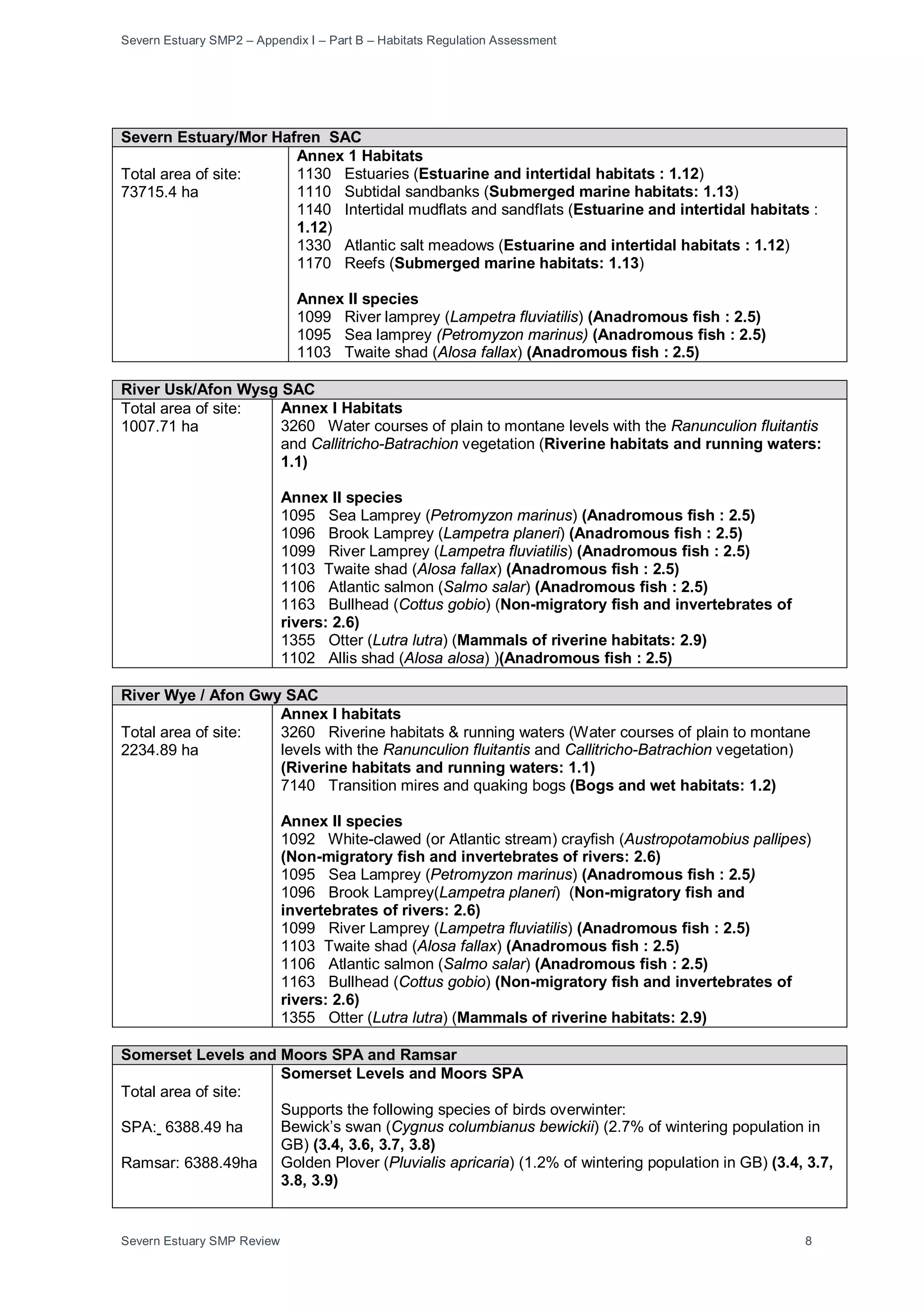
Severn Estuary/Mor Hafren SAC
Total area of site:
73715.4 ha
Annex 1 Habitats
1130 Estuaries (Estuarine and intertidal habitats : 1.12)
1110 Subtidal sandbanks (Submerged marine habitats: 1.13)
1140 Intertidal mudflats and sandflats (Estuarine and intertidal habitats :
1.12)
1330 Atlantic salt meadows (Estuarine and intertidal habitats : 1.12)
1170 Reefs (Submerged marine habitats: 1.13)
Annex II species
1099 River lamprey (Lampetra fluviatilis) (Anadromous fish : 2.5)
1095 Sea lamprey (Petromyzon marinus) (Anadromous fish : 2.5)
1103 Twaite shad (Alosa fallax) (Anadromous fish : 2.5)
River Usk/Afon Wysg SAC
Total area of site:
1007.71 ha
Annex I Habitats
3260 Water courses of plain to montane levels with the Ranunculion fluitantis
and Callitricho-Batrachion vegetation (Riverine habitats and running waters:
1.1)
Annex II species
1095 Sea Lamprey (Petromyzon marinus) (Anadromous fish : 2.5)
1096 Brook Lamprey (Lampetra planeri) (Anadromous fish : 2.5)
1099 River Lamprey (Lampetra fluviatilis) (Anadromous fish : 2.5)
1103 Twaite shad (Alosa fallax) (Anadromous fish : 2.5)
1106 Atlantic salmon (Salmo salar) (Anadromous fish : 2.5)
1163 Bullhead (Cottus gobio) (Non-migratory fish and invertebrates of
rivers: 2.6)
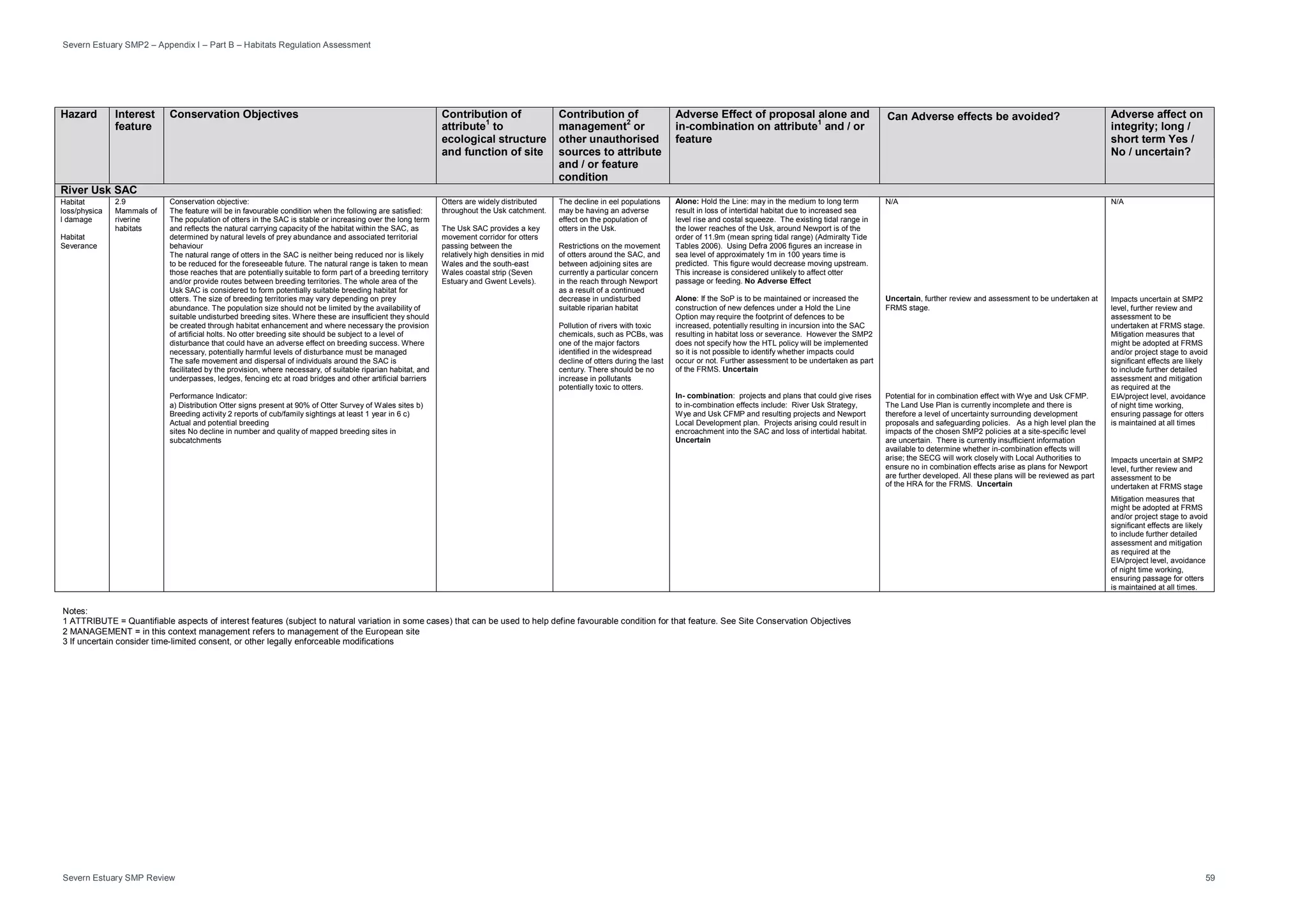
1355 Otter (Lutra lutra) (Mammals of riverine habitats: 2.9)
1102 Allis shad (Alosa alosa) )(Anadromous fish : 2.5)
River Wye / Afon Gwy SAC
Total area of site:
2234.89 ha
Annex I habitats
3260 Riverine habitats & running waters (Water courses of plain to montane
levels with the Ranunculion fluitantis and Callitricho-Batrachion vegetation)
(Riverine habitats and running waters: 1.1)
7140 Transition mires and quaking bogs (Bogs and wet habitats: 1.2)
Annex II species
1092 White-clawed (or Atlantic stream) crayfish (Austropotamobius pallipes)
(Non-migratory fish and invertebrates of rivers: 2.6)
1095 Sea Lamprey (Petromyzon marinus) (Anadromous fish : 2.5)
1096 Brook Lamprey(Lampetra planeri) (Non-migratory fish and
invertebrates of rivers: 2.6)
1099 River Lamprey (Lampetra fluviatilis) (Anadromous fish : 2.5)
1103 Twaite shad (Alosa fallax) (Anadromous fish : 2.5)
1106 Atlantic salmon (Salmo salar) (Anadromous fish : 2.5)
1163 Bullhead (Cottus gobio) (Non-migratory fish and invertebrates of
rivers: 2.6)
1355 Otter (Lutra lutra) (Mammals of riverine habitats: 2.9)
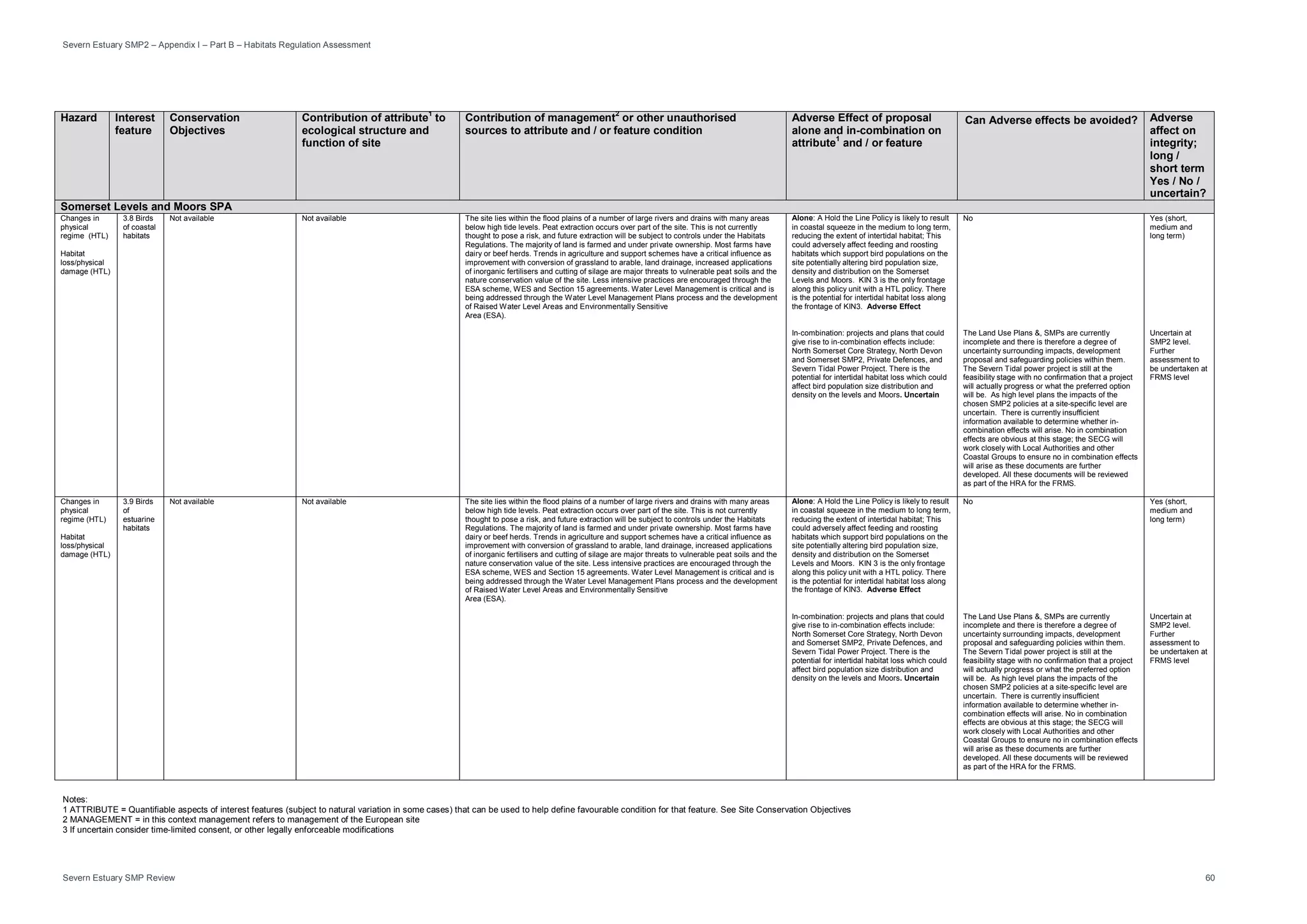
Somerset Levels and Moors SPA and Ramsar
Total area of site:
SPA: 6388.49 ha
Ramsar: 6388.49ha
Somerset Levels and Moors SPA
Supports the following species of birds overwinter:
Bewick’s swan (Cygnus columbianus bewickii) (2.7% of wintering population in
GB) (3.4, 3.6, 3.7, 3.8)
Golden Plover (Pluvialis apricaria) (1.2% of wintering population in GB) (3.4, 3.7,
3.8, 3.9)
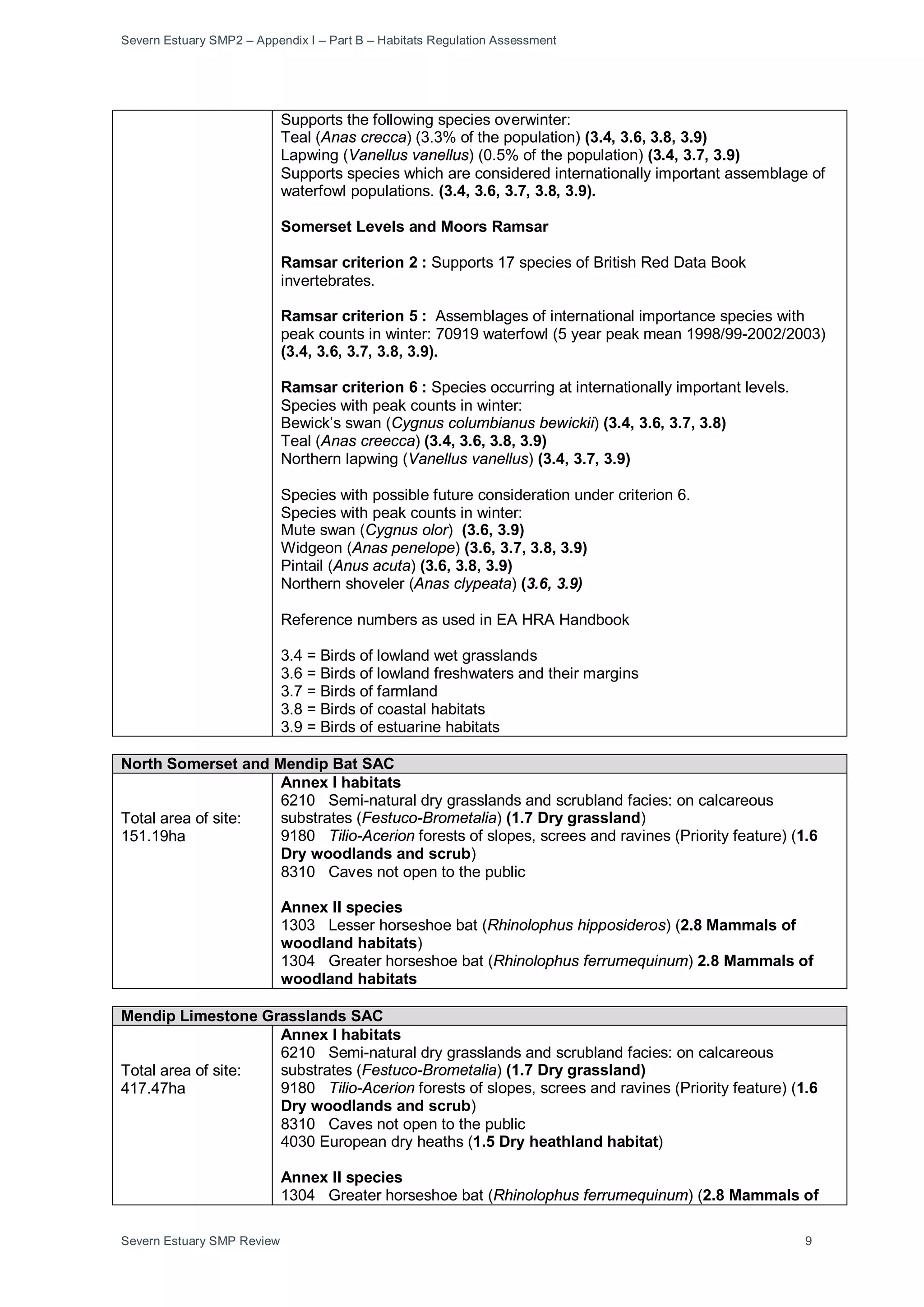
Severn Estuary SMP2 – Appendix I – Part B – Habitats Regulation Assessment
Severn Estuary SMP Review 9
Supports the following species overwinter:
Teal (Anas crecca) (3.3% of the population) (3.4, 3.6, 3.8, 3.9)
Lapwing (Vanellus vanellus) (0.5% of the population) (3.4, 3.7, 3.9)
Supports species which are considered internationally important assemblage of
waterfowl populations. (3.4, 3.6, 3.7, 3.8, 3.9).
Somerset Levels and Moors Ramsar
Ramsar criterion 2 : Supports 17 species of British Red Data Book
invertebrates.
Ramsar criterion 5 : Assemblages of international importance species with
peak counts in winter: 70919 waterfowl (5 year peak mean 1998/99-2002/2003)
(3.4, 3.6, 3.7, 3.8, 3.9).
Ramsar criterion 6 : Species occurring at internationally important levels.
Species with peak counts in winter:
Bewick’s swan (Cygnus columbianus bewickii) (3.4, 3.6, 3.7, 3.8)
Teal (Anas creecca) (3.4, 3.6, 3.8, 3.9)
Northern lapwing (Vanellus vanellus) (3.4, 3.7, 3.9)
Species with possible future consideration under criterion 6.
Species with peak counts in winter:
Mute swan (Cygnus olor) (3.6, 3.9)
Widgeon (Anas penelope) (3.6, 3.7, 3.8, 3.9)
Pintail (Anus acuta) (3.6, 3.8, 3.9)
Northern shoveler (Anas clypeata) (3.6, 3.9)
Reference numbers as used in EA HRA Handbook
3.4 = Birds of lowland wet grasslands
3.6 = Birds of lowland freshwaters and their margins
3.7 = Birds of farmland
3.8 = Birds of coastal habitats
3.9 = Birds of estuarine habitats
North Somerset and Mendip Bat SAC
Total area of site:
151.19ha
Annex I habitats
6210 Semi-natural dry grasslands and scrubland facies: on calcareous
substrates (Festuco-Brometalia) (1.7 Dry grassland)
9180 Tilio-Acerion forests of slopes, screes and ravines (Priority feature) (1.6
Dry woodlands and scrub)
8310 Caves not open to the public
Annex II species
1303 Lesser horseshoe bat (Rhinolophus hipposideros) (2.8 Mammals of
woodland habitats)
1304 Greater horseshoe bat (Rhinolophus ferrumequinum) 2.8 Mammals of
woodland habitats
Mendip Limestone Grasslands SAC
Total area of site:
417.47ha
Annex I habitats
6210 Semi-natural dry grasslands and scrubland facies: on calcareous
substrates (Festuco-Brometalia) (1.7 Dry grassland)
9180 Tilio-Acerion forests of slopes, screes and ravines (Priority feature) (1.6
Dry woodlands and scrub)
8310 Caves not open to the public
4030 European dry heaths (1.5 Dry heathland habitat)
Annex II species
1304 Greater horseshoe bat (Rhinolophus ferrumequinum) (2.8 Mammals of
Severn Estuary SMP2 – Appendix I – Part B – Habitats Regulation Assessment
Severn Estuary SMP Review 10
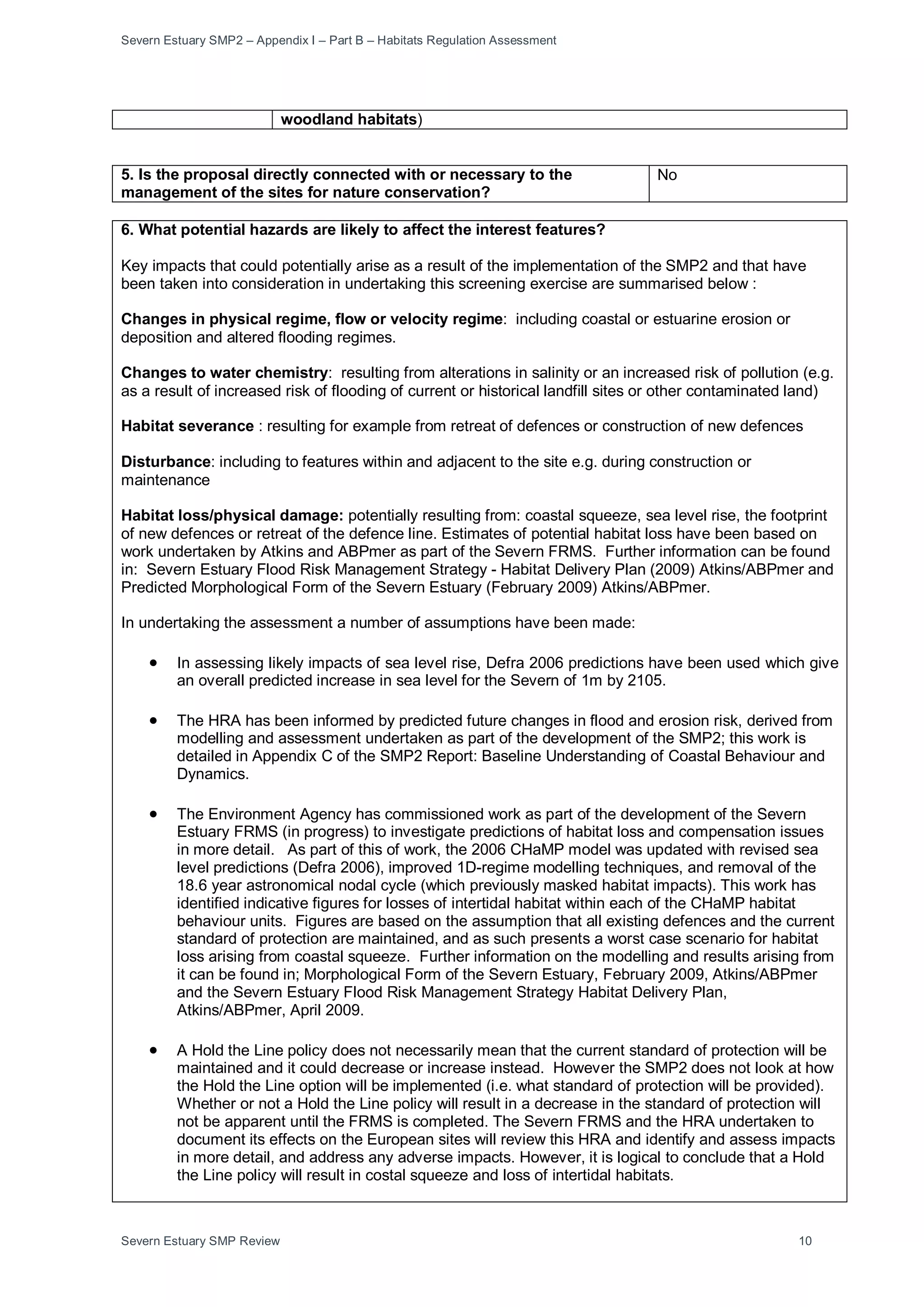
woodland habitats)
5. Is the proposal directly connected with or necessary to the
management of the sites for nature conservation?
No
6. What potential hazards are likely to affect the interest features?
Key impacts that could potentially arise as a result of the implementation of the SMP2 and that have
been taken into consideration in undertaking this screening exercise are summarised below :
Changes in physical regime, flow or velocity regime: including coastal or estuarine erosion or
deposition and altered flooding regimes.
Changes to water chemistry: resulting from alterations in salinity or an increased risk of pollution (e.g.
as a result of increased risk of flooding of current or historical landfill sites or other contaminated land)
Habitat severance : resulting for example from retreat of defences or construction of new defences
Disturbance: including to features within and adjacent to the site e.g. during construction or
maintenance
Habitat loss/physical damage: potentially resulting from: coastal squeeze, sea level rise, the footprint
of new defences or retreat of the defence line. Estimates of potential habitat loss have been based on
work undertaken by Atkins and ABPmer as part of the Severn FRMS. Further information can be found
in: Severn Estuary Flood Risk Management Strategy - Habitat Delivery Plan (2009) Atkins/ABPmer and
Predicted Morphological Form of the Severn Estuary (February 2009) Atkins/ABPmer.
In undertaking the assessment a number of assumptions have been made:
• In assessing likely impacts of sea level rise, Defra 2006 predictions have been used which give
an overall predicted increase in sea level for the Severn of 1m by 2105.
• The HRA has been informed by predicted future changes in flood and erosion risk, derived from
modelling and assessment undertaken as part of the development of the SMP2; this work is
detailed in Appendix C of the SMP2 Report: Baseline Understanding of Coastal Behaviour and
Dynamics.
• The Environment Agency has commissioned work as part of the development of the Severn
Estuary FRMS (in progress) to investigate predictions of habitat loss and compensation issues
in more detail. As part of this of work, the 2006 CHaMP model was updated with revised sea
level predictions (Defra 2006), improved 1D-regime modelling techniques, and removal of the
18.6 year astronomical nodal cycle (which previously masked habitat impacts). This work has
identified indicative figures for losses of intertidal habitat within each of the CHaMP habitat
behaviour units. Figures are based on the assumption that all existing defences and the current
standard of protection are maintained, and as such presents a worst case scenario for habitat
loss arising from coastal squeeze. Further information on the modelling and results arising from
it can be found in; Morphological Form of the Severn Estuary, February 2009, Atkins/ABPmer
and the Severn Estuary Flood Risk Management Strategy Habitat Delivery Plan,
Atkins/ABPmer, April 2009.
• A Hold the Line policy does not necessarily mean that the current standard of protection will be
maintained and it could decrease or increase instead. However the SMP2 does not look at how
the Hold the Line option will be implemented (i.e. what standard of protection will be provided).
Whether or not a Hold the Line policy will result in a decrease in the standard of protection will
not be apparent until the FRMS is completed. The Severn FRMS and the HRA undertaken to
document its effects on the European sites will review this HRA and identify and assess impacts
in more detail, and address any adverse impacts. However, it is logical to conclude that a Hold
the Line policy will result in costal squeeze and loss of intertidal habitats.
Severn Estuary SMP2 – Appendix I – Part B – Habitats Regulation Assessment
Severn Estuary SMP Review 11
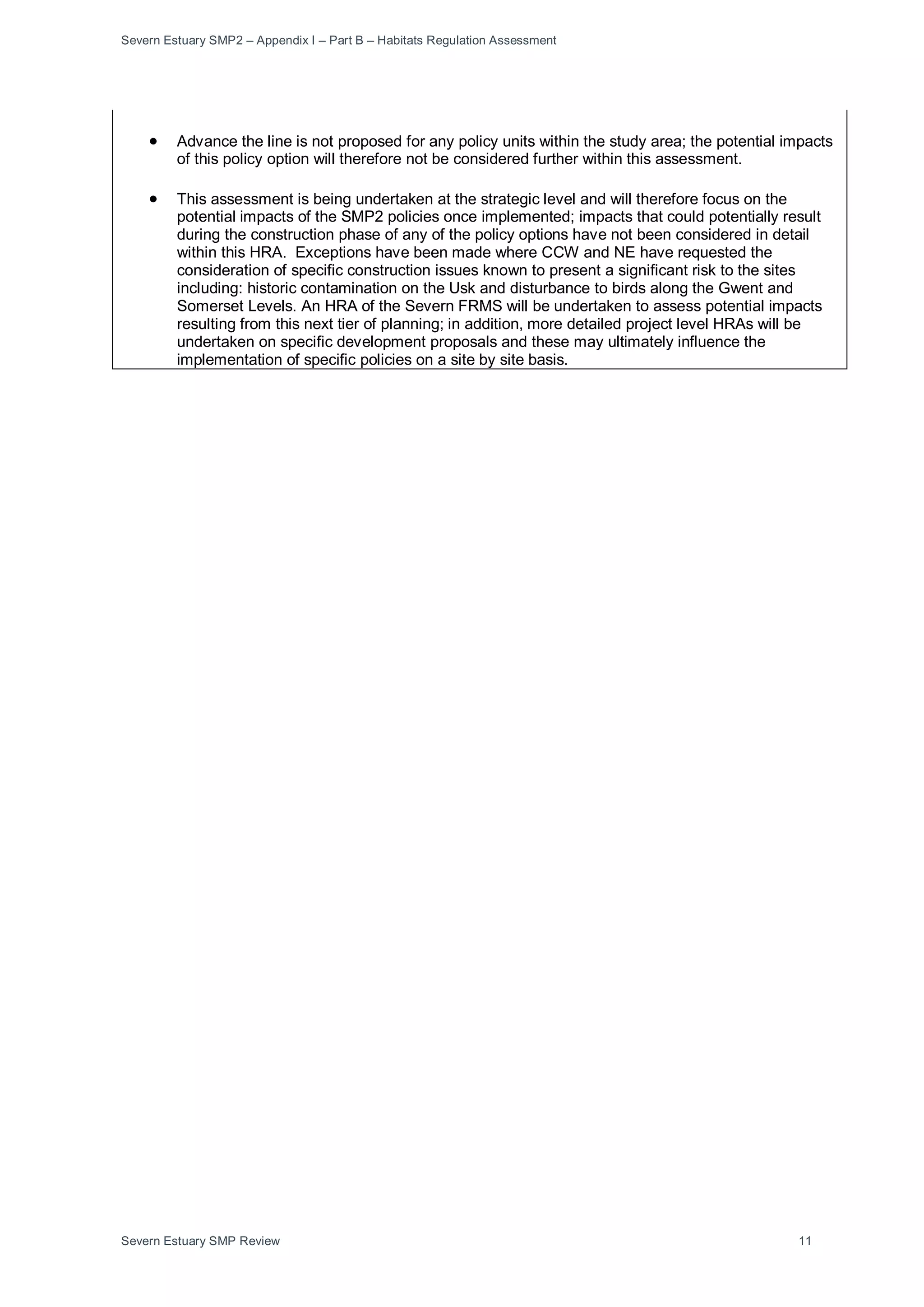
• Advance the line is not proposed for any policy units within the study area; the potential impacts
of this policy option will therefore not be considered further within this assessment.
• This assessment is being undertaken at the strategic level and will therefore focus on the
potential impacts of the SMP2 policies once implemented; impacts that could potentially result
during the construction phase of any of the policy options have not been considered in detail
within this HRA. Exceptions have been made where CCW and NE have requested the
consideration of specific construction issues known to present a significant risk to the sites
including: historic contamination on the Usk and disturbance to birds along the Gwent and
Somerset Levels. An HRA of the Severn FRMS will be undertaken to assess potential impacts
resulting from this next tier of planning; in addition, more detailed project level HRAs will be
undertaken on specific development proposals and these may ultimately influence the
implementation of specific policies on a site by site basis.
Severn Estuary SMP2 – Appendix I – Part B – Habitats Regulation Assessment
Severn Estuary SMP Review 12
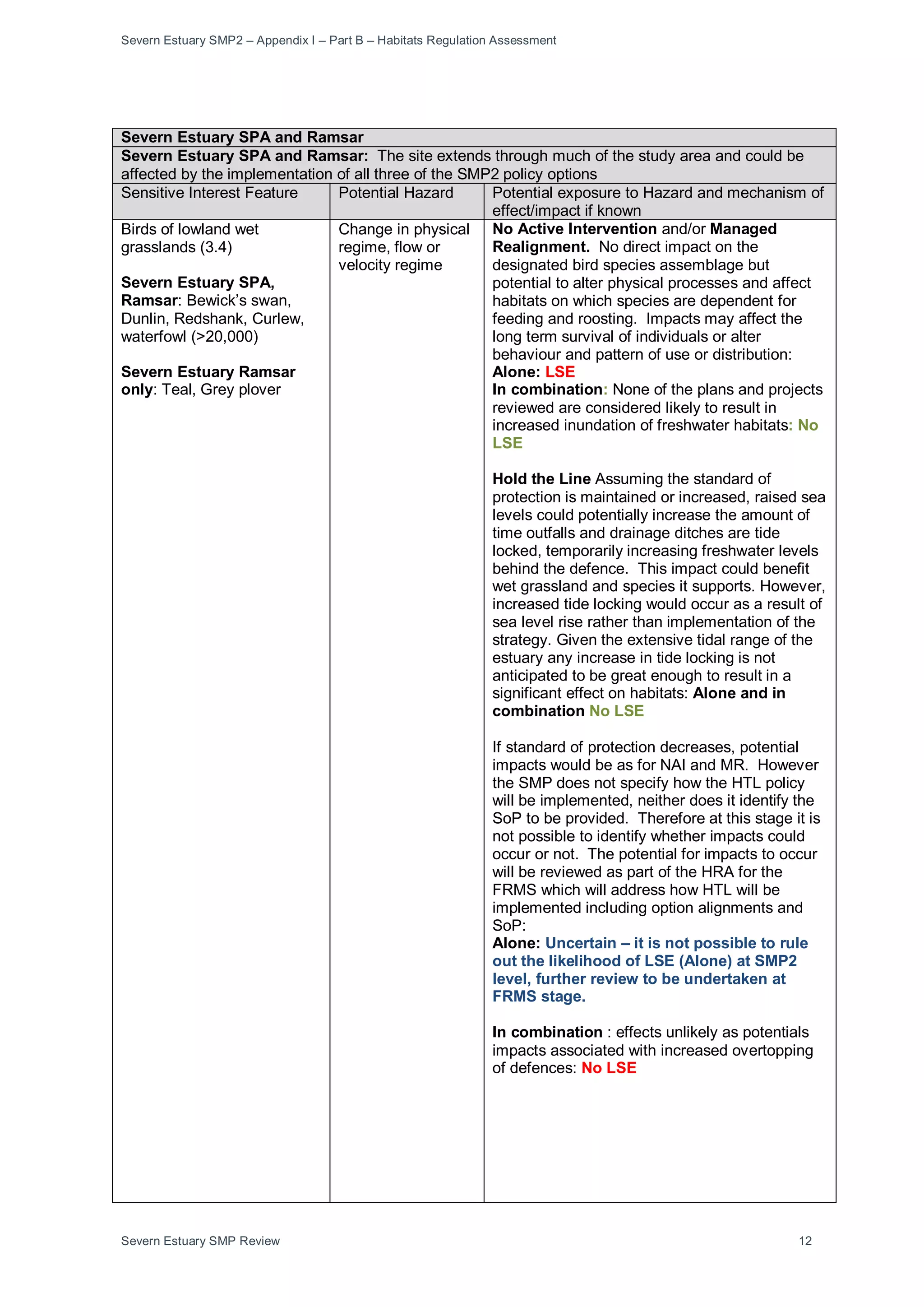
Severn Estuary SPA and Ramsar
Severn Estuary SPA and Ramsar: The site extends through much of the study area and could be
affected by the implementation of all three of the SMP2 policy options
Sensitive Interest Feature Potential Hazard Potential exposure to Hazard and mechanism of
effect/impact if known
Birds of lowland wet
grasslands (3.4)
Severn Estuary SPA,
Ramsar: Bewick’s swan,
Dunlin, Redshank, Curlew,
waterfowl (>20,000)
Severn Estuary Ramsar
only: Teal, Grey plover
Change in physical
regime, flow or
velocity regime
No Active Intervention and/or Managed
Realignment. No direct impact on the
designated bird species assemblage but
potential to alter physical processes and affect
habitats on which species are dependent for
feeding and roosting. Impacts may affect the
long term survival of individuals or alter
behaviour and pattern of use or distribution:
Alone: LSE
In combination: None of the plans and projects
reviewed are considered likely to result in
increased inundation of freshwater habitats: No
LSE
Hold the Line Assuming the standard of
protection is maintained or increased, raised sea
levels could potentially increase the amount of
time outfalls and drainage ditches are tide
locked, temporarily increasing freshwater levels
behind the defence. This impact could benefit
wet grassland and species it supports. However,
increased tide locking would occur as a result of
sea level rise rather than implementation of the
strategy. Given the extensive tidal range of the
estuary any increase in tide locking is not
anticipated to be great enough to result in a
significant effect on habitats: Alone and in
combination No LSE
If standard of protection decreases, potential
impacts would be as for NAI and MR. However
the SMP does not specify how the HTL policy
will be implemented, neither does it identify the
SoP to be provided. Therefore at this stage it is
not possible to identify whether impacts could
occur or not. The potential for impacts to occur
will be reviewed as part of the HRA for the
FRMS which will address how HTL will be
implemented including option alignments and
SoP:
Alone: Uncertain – it is not possible to rule
out the likelihood of LSE (Alone) at SMP2
level, further review to be undertaken at
FRMS stage.
In combination : effects unlikely as potentials
impacts associated with increased overtopping
of defences: No LSE
Severn Estuary SMP2 – Appendix I – Part B – Habitats Regulation Assessment
Severn Estuary SMP Review 13
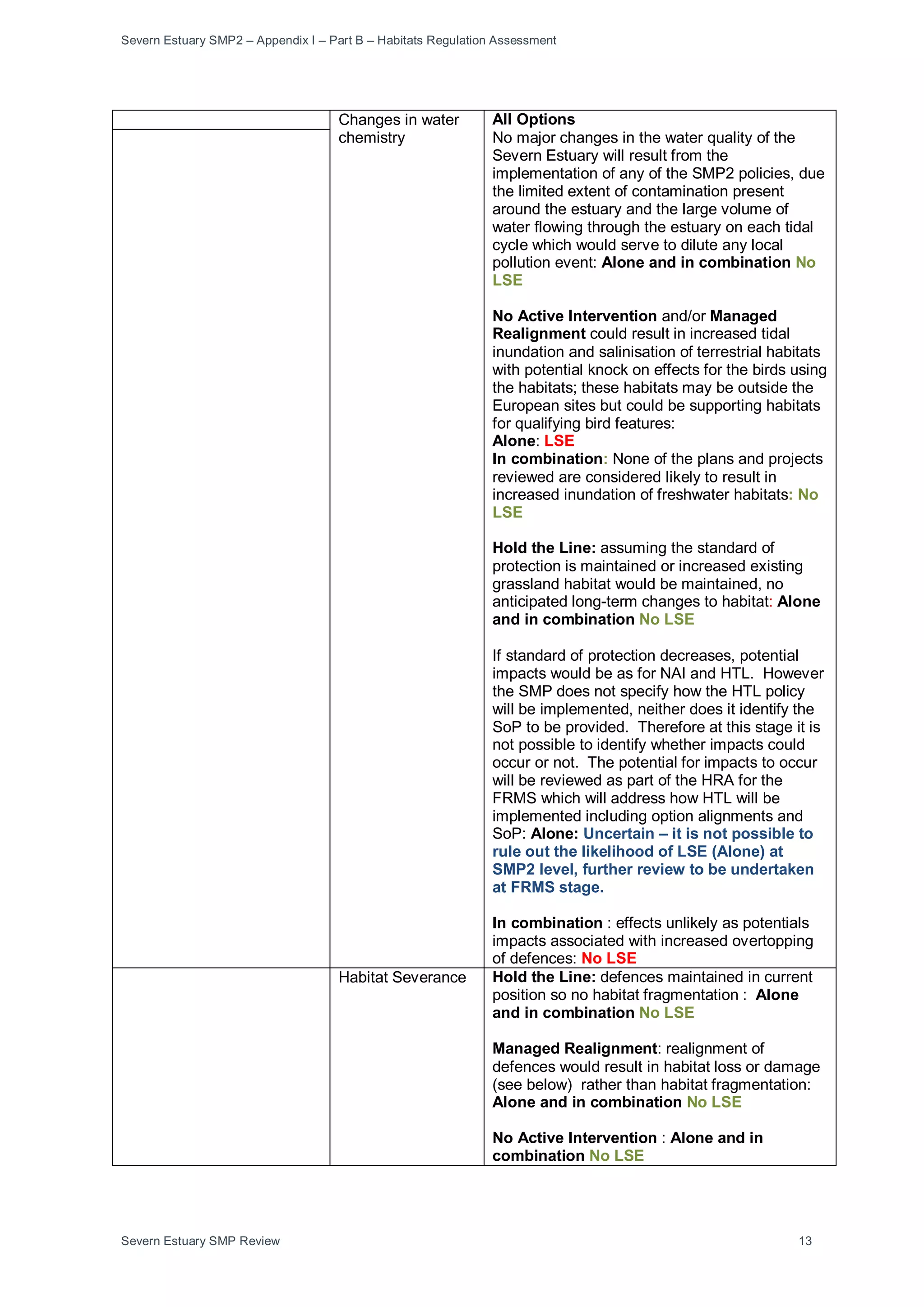
Changes in water
chemistry
All Options
No major changes in the water quality of the
Severn Estuary will result from the
implementation of any of the SMP2 policies, due
the limited extent of contamination present
around the estuary and the large volume of
water flowing through the estuary on each tidal
cycle which would serve to dilute any local
pollution event: Alone and in combination No
LSE
No Active Intervention and/or Managed
Realignment could result in increased tidal
inundation and salinisation of terrestrial habitats
with potential knock on effects for the birds using
the habitats; these habitats may be outside the
European sites but could be supporting habitats
for qualifying bird features:
Alone: LSE
In combination: None of the plans and projects
reviewed are considered likely to result in
increased inundation of freshwater habitats: No
LSE
Hold the Line: assuming the standard of
protection is maintained or increased existing
grassland habitat would be maintained, no
anticipated long-term changes to habitat: Alone
and in combination No LSE
If standard of protection decreases, potential
impacts would be as for NAI and HTL. However
the SMP does not specify how the HTL policy
will be implemented, neither does it identify the
SoP to be provided. Therefore at this stage it is
not possible to identify whether impacts could
occur or not. The potential for impacts to occur
will be reviewed as part of the HRA for the
FRMS which will address how HTL will be
implemented including option alignments and
SoP: Alone: Uncertain – it is not possible to
rule out the likelihood of LSE (Alone) at
SMP2 level, further review to be undertaken
at FRMS stage.
In combination : effects unlikely as potentials
impacts associated with increased overtopping
of defences: No LSE
Habitat Severance Hold the Line: defences maintained in current
position so no habitat fragmentation : Alone
and in combination No LSE
Managed Realignment: realignment of
defences would result in habitat loss or damage
(see below) rather than habitat fragmentation:
Alone and in combination No LSE
No Active Intervention : Alone and in
combination No LSE
Severn Estuary SMP2 – Appendix I – Part B – Habitats Regulation Assessment
Severn Estuary SMP Review 14
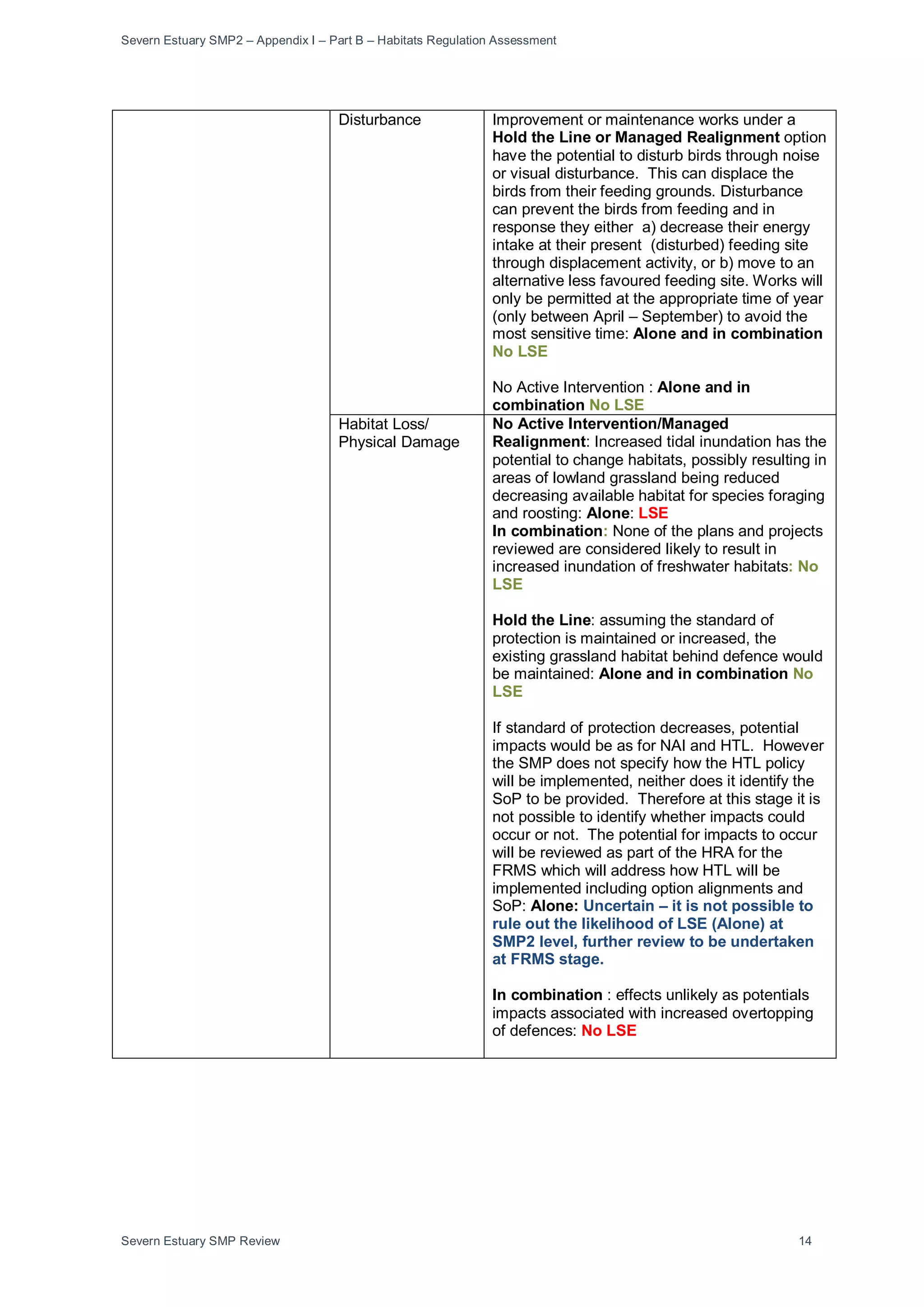
Disturbance Improvement or maintenance works under a
Hold the Line or Managed Realignment option
have the potential to disturb birds through noise
or visual disturbance. This can displace the
birds from their feeding grounds. Disturbance
can prevent the birds from feeding and in
response they either a) decrease their energy
intake at their present (disturbed) feeding site
through displacement activity, or b) move to an
alternative less favoured feeding site. Works will
only be permitted at the appropriate time of year
(only between April – September) to avoid the
most sensitive time: Alone and in combination
No LSE
No Active Intervention : Alone and in
combination No LSE
Habitat Loss/
Physical Damage
No Active Intervention/Managed
Realignment: Increased tidal inundation has the
potential to change habitats, possibly resulting in
areas of lowland grassland being reduced
decreasing available habitat for species foraging
and roosting: Alone: LSE
In combination: None of the plans and projects
reviewed are considered likely to result in
increased inundation of freshwater habitats: No
LSE
Hold the Line: assuming the standard of
protection is maintained or increased, the
existing grassland habitat behind defence would
be maintained: Alone and in combination No
LSE
If standard of protection decreases, potential
impacts would be as for NAI and HTL. However
the SMP does not specify how the HTL policy
will be implemented, neither does it identify the
SoP to be provided. Therefore at this stage it is
not possible to identify whether impacts could
occur or not. The potential for impacts to occur
will be reviewed as part of the HRA for the
FRMS which will address how HTL will be
implemented including option alignments and
SoP: Alone: Uncertain – it is not possible to
rule out the likelihood of LSE (Alone) at
SMP2 level, further review to be undertaken
at FRMS stage.
In combination : effects unlikely as potentials
impacts associated with increased overtopping
of defences: No LSE
Severn Estuary SMP2 – Appendix I – Part B – Habitats Regulation Assessment
Severn Estuary SMP Review 15
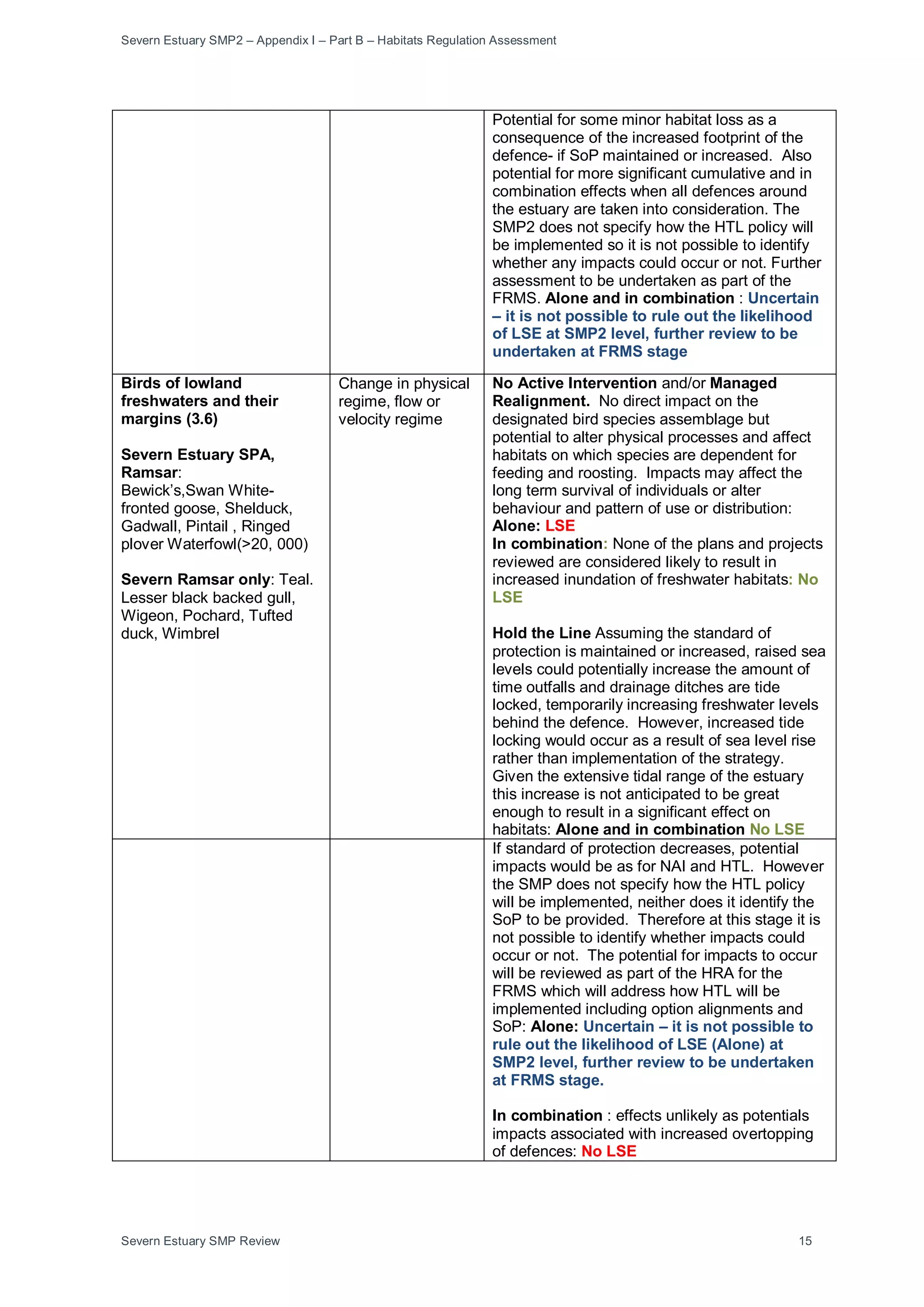
Potential for some minor habitat loss as a
consequence of the increased footprint of the
defence- if SoP maintained or increased. Also
potential for more significant cumulative and in
combination effects when all defences around
the estuary are taken into consideration. The
SMP2 does not specify how the HTL policy will
be implemented so it is not possible to identify
whether any impacts could occur or not. Further
assessment to be undertaken as part of the
FRMS. Alone and in combination : Uncertain
– it is not possible to rule out the likelihood
of LSE at SMP2 level, further review to be
undertaken at FRMS stage
Birds of lowland
freshwaters and their
margins (3.6)
Severn Estuary SPA,
Ramsar:
Bewick’s,Swan White-
fronted goose, Shelduck,
Gadwall, Pintail , Ringed
plover Waterfowl(>20, 000)
Severn Ramsar only: Teal.
Lesser black backed gull,
Wigeon, Pochard, Tufted
duck, Wimbrel
Change in physical
regime, flow or
velocity regime
No Active Intervention and/or Managed
Realignment. No direct impact on the
designated bird species assemblage but
potential to alter physical processes and affect
habitats on which species are dependent for
feeding and roosting. Impacts may affect the
long term survival of individuals or alter
behaviour and pattern of use or distribution:
Alone: LSE
In combination: None of the plans and projects
reviewed are considered likely to result in
increased inundation of freshwater habitats: No
LSE
Hold the Line Assuming the standard of
protection is maintained or increased, raised sea
levels could potentially increase the amount of
time outfalls and drainage ditches are tide
locked, temporarily increasing freshwater levels
behind the defence. However, increased tide
locking would occur as a result of sea level rise
rather than implementation of the strategy.
Given the extensive tidal range of the estuary
this increase is not anticipated to be great
enough to result in a significant effect on
habitats: Alone and in combination No LSE
If standard of protection decreases, potential
impacts would be as for NAI and HTL. However
the SMP does not specify how the HTL policy
will be implemented, neither does it identify the
SoP to be provided. Therefore at this stage it is
not possible to identify whether impacts could
occur or not. The potential for impacts to occur
will be reviewed as part of the HRA for the
FRMS which will address how HTL will be
implemented including option alignments and
SoP: Alone: Uncertain – it is not possible to
rule out the likelihood of LSE (Alone) at
SMP2 level, further review to be undertaken
at FRMS stage.
In combination : effects unlikely as potentials
impacts associated with increased overtopping
of defences: No LSE
Severn Estuary SMP2 – Appendix I – Part B – Habitats Regulation Assessment
Severn Estuary SMP Review 16
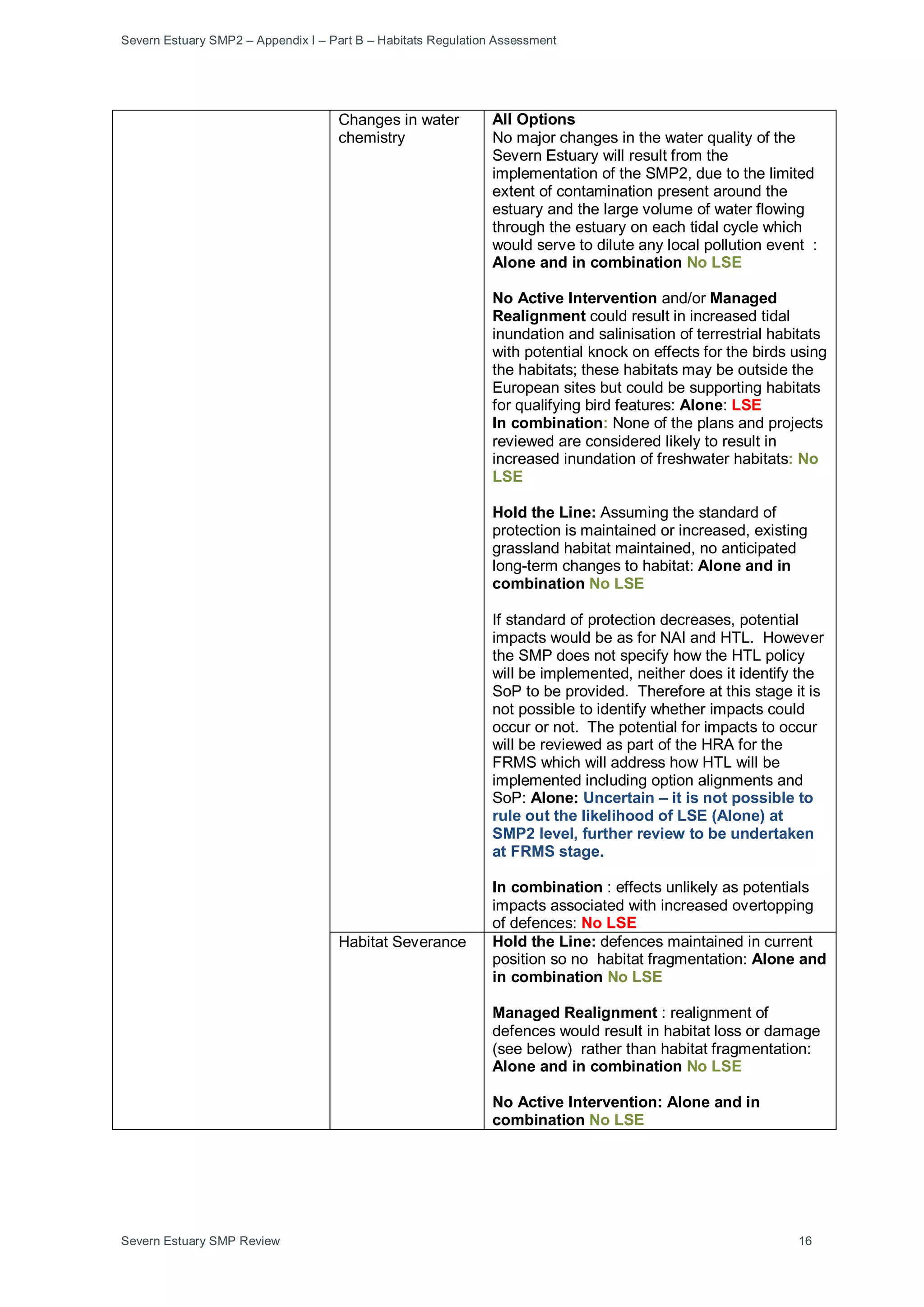
Changes in water
chemistry
All Options
No major changes in the water quality of the
Severn Estuary will result from the
implementation of the SMP2, due to the limited
extent of contamination present around the
estuary and the large volume of water flowing
through the estuary on each tidal cycle which
would serve to dilute any local pollution event :
Alone and in combination No LSE
No Active Intervention and/or Managed
Realignment could result in increased tidal
inundation and salinisation of terrestrial habitats
with potential knock on effects for the birds using
the habitats; these habitats may be outside the
European sites but could be supporting habitats
for qualifying bird features: Alone: LSE
In combination: None of the plans and projects
reviewed are considered likely to result in
increased inundation of freshwater habitats: No
LSE
Hold the Line: Assuming the standard of
protection is maintained or increased, existing
grassland habitat maintained, no anticipated
long-term changes to habitat: Alone and in
combination No LSE
If standard of protection decreases, potential
impacts would be as for NAI and HTL. However
the SMP does not specify how the HTL policy
will be implemented, neither does it identify the
SoP to be provided. Therefore at this stage it is
not possible to identify whether impacts could
occur or not. The potential for impacts to occur
will be reviewed as part of the HRA for the
FRMS which will address how HTL will be
implemented including option alignments and
SoP: Alone: Uncertain – it is not possible to
rule out the likelihood of LSE (Alone) at
SMP2 level, further review to be undertaken
at FRMS stage.
In combination : effects unlikely as potentials
impacts associated with increased overtopping
of defences: No LSE
Habitat Severance Hold the Line: defences maintained in current
position so no habitat fragmentation: Alone and
in combination No LSE
Managed Realignment : realignment of
defences would result in habitat loss or damage
(see below) rather than habitat fragmentation:
Alone and in combination No LSE
No Active Intervention: Alone and in
combination No LSE
Severn Estuary SMP2 – Appendix I – Part B – Habitats Regulation Assessment
Severn Estuary SMP Review 17
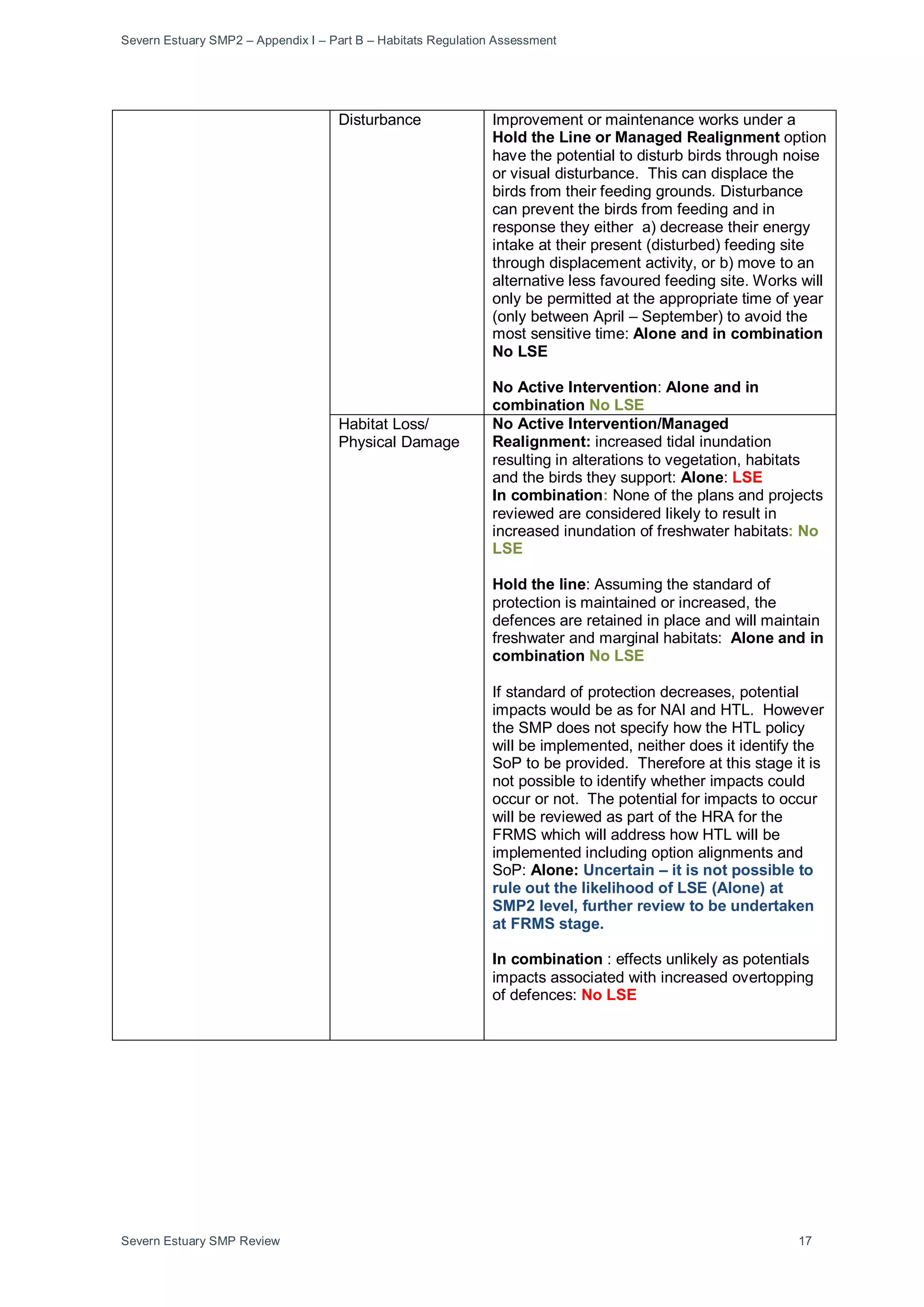
Disturbance Improvement or maintenance works under a
Hold the Line or Managed Realignment option
have the potential to disturb birds through noise
or visual disturbance. This can displace the
birds from their feeding grounds. Disturbance
can prevent the birds from feeding and in
response they either a) decrease their energy
intake at their present (disturbed) feeding site
through displacement activity, or b) move to an
alternative less favoured feeding site. Works will
only be permitted at the appropriate time of year
(only between April – September) to avoid the
most sensitive time: Alone and in combination
No LSE
No Active Intervention: Alone and in
combination No LSE
Habitat Loss/
Physical Damage
No Active Intervention/Managed
Realignment: increased tidal inundation
resulting in alterations to vegetation, habitats
and the birds they support: Alone: LSE
In combination: None of the plans and projects
reviewed are considered likely to result in
increased inundation of freshwater habitats: No
LSE
Hold the line: Assuming the standard of
protection is maintained or increased, the
defences are retained in place and will maintain
freshwater and marginal habitats: Alone and in
combination No LSE
If standard of protection decreases, potential
impacts would be as for NAI and HTL. However
the SMP does not specify how the HTL policy
will be implemented, neither does it identify the
SoP to be provided. Therefore at this stage it is
not possible to identify whether impacts could
occur or not. The potential for impacts to occur
will be reviewed as part of the HRA for the
FRMS which will address how HTL will be
implemented including option alignments and
SoP: Alone: Uncertain – it is not possible to
rule out the likelihood of LSE (Alone) at
SMP2 level, further review to be undertaken
at FRMS stage.
In combination : effects unlikely as potentials
impacts associated with increased overtopping
of defences: No LSE
Severn Estuary SMP2 – Appendix I – Part B – Habitats Regulation Assessment
Severn Estuary SMP Review 18
Potential for some minor habitat loss as a
consequence of the increased footprint of the
defence - if SoP maintained or increased. Also
potential for more significant cumulative and in
combination effects when all defences around
the estuary are taken into consideration. The
SMP2 does not specify how the HTL policy will
be implemented so it is not possible to identify
whether any impacts could occur or not. Further
assessment to be undertaken as part of the
FRMS. Alone and in combination :Uncertain
– it is not possible to rule out the likelihood
of LSE at SMP2 level, further review to be
undertaken at FRMS stage
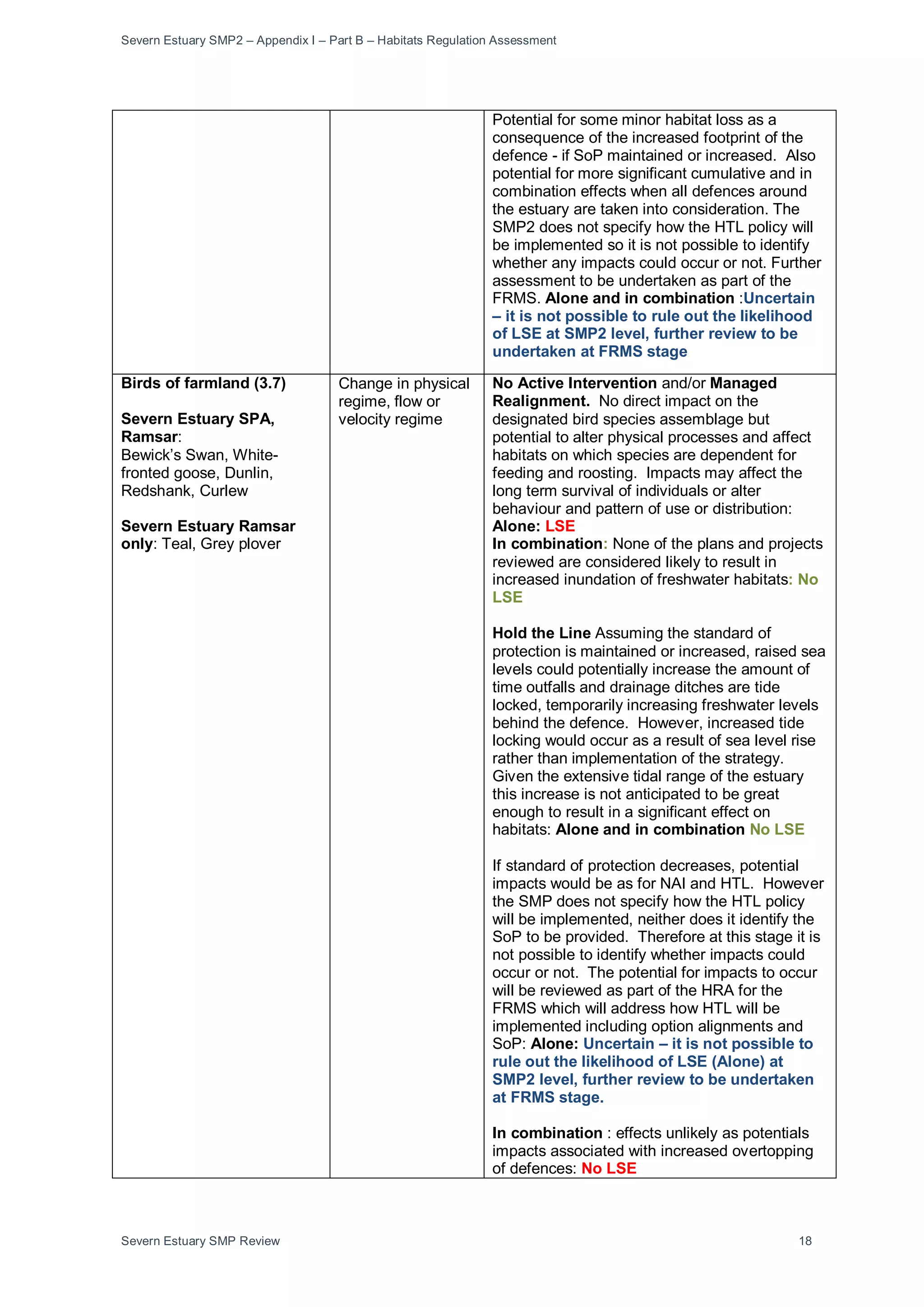
Birds of farmland (3.7)
Severn Estuary SPA,
Ramsar:
Bewick’s Swan, White-
fronted goose, Dunlin,
Redshank, Curlew
Severn Estuary Ramsar
only: Teal, Grey plover
Change in physical
regime, flow or
velocity regime
No Active Intervention and/or Managed
Realignment. No direct impact on the
designated bird species assemblage but
potential to alter physical processes and affect
habitats on which species are dependent for
feeding and roosting. Impacts may affect the
long term survival of individuals or alter
behaviour and pattern of use or distribution:
Alone: LSE
In combination: None of the plans and projects
reviewed are considered likely to result in
increased inundation of freshwater habitats: No
LSE
Hold the Line Assuming the standard of
protection is maintained or increased, raised sea
levels could potentially increase the amount of
time outfalls and drainage ditches are tide
locked, temporarily increasing freshwater levels
behind the defence. However, increased tide
locking would occur as a result of sea level rise
rather than implementation of the strategy.
Given the extensive tidal range of the estuary
this increase is not anticipated to be great
enough to result in a significant effect on
habitats: Alone and in combination No LSE
If standard of protection decreases, potential
impacts would be as for NAI and HTL. However
the SMP does not specify how the HTL policy
will be implemented, neither does it identify the
SoP to be provided. Therefore at this stage it is
not possible to identify whether impacts could
occur or not. The potential for impacts to occur
will be reviewed as part of the HRA for the
FRMS which will address how HTL will be
implemented including option alignments and
SoP: Alone: Uncertain – it is not possible to
rule out the likelihood of LSE (Alone) at
SMP2 level, further review to be undertaken
at FRMS stage.
In combination : effects unlikely as potentials
impacts associated with increased overtopping
of defences: No LSE
Severn Estuary SMP2 – Appendix I – Part B – Habitats Regulation Assessment
Severn Estuary SMP Review 19
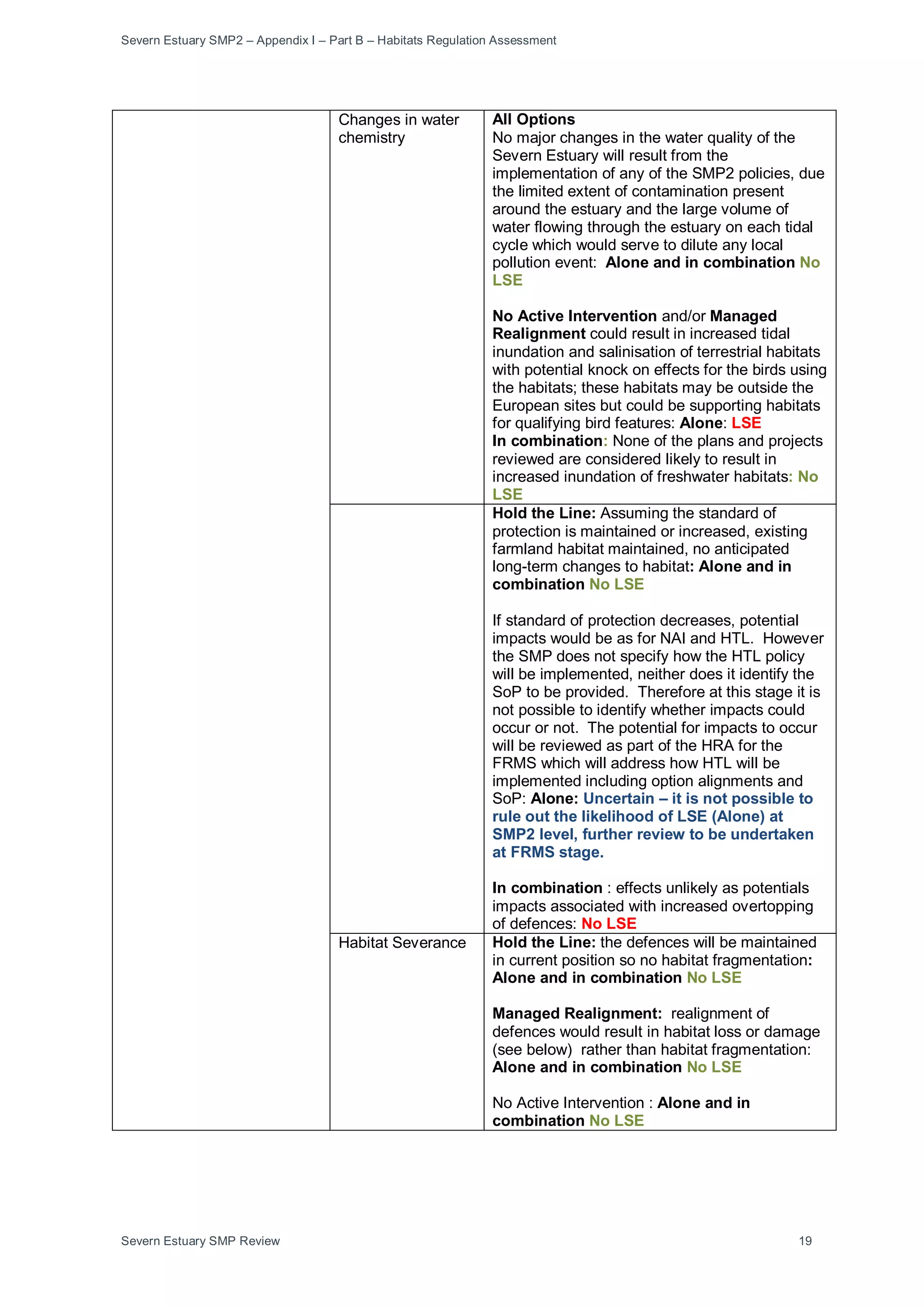
Changes in water
chemistry
All Options
No major changes in the water quality of the
Severn Estuary will result from the
implementation of any of the SMP2 policies, due
the limited extent of contamination present
around the estuary and the large volume of
water flowing through the estuary on each tidal
cycle which would serve to dilute any local
pollution event: Alone and in combination No
LSE
No Active Intervention and/or Managed
Realignment could result in increased tidal
inundation and salinisation of terrestrial habitats
with potential knock on effects for the birds using
the habitats; these habitats may be outside the
European sites but could be supporting habitats
for qualifying bird features: Alone: LSE
In combination: None of the plans and projects
reviewed are considered likely to result in
increased inundation of freshwater habitats: No
LSE
Hold the Line: Assuming the standard of
protection is maintained or increased, existing
farmland habitat maintained, no anticipated
long-term changes to habitat: Alone and in
combination No LSE
If standard of protection decreases, potential
impacts would be as for NAI and HTL. However
the SMP does not specify how the HTL policy
will be implemented, neither does it identify the
SoP to be provided. Therefore at this stage it is
not possible to identify whether impacts could
occur or not. The potential for impacts to occur
will be reviewed as part of the HRA for the
FRMS which will address how HTL will be
implemented including option alignments and
SoP: Alone: Uncertain – it is not possible to
rule out the likelihood of LSE (Alone) at
SMP2 level, further review to be undertaken
at FRMS stage.
In combination : effects unlikely as potentials
impacts associated with increased overtopping
of defences: No LSE
Habitat Severance Hold the Line: the defences will be maintained
in current position so no habitat fragmentation:
Alone and in combination No LSE
Managed Realignment: realignment of
defences would result in habitat loss or damage
(see below) rather than habitat fragmentation:
Alone and in combination No LSE
No Active Intervention : Alone and in
combination No LSE
Severn Estuary SMP2 – Appendix I – Part B – Habitats Regulation Assessment
Severn Estuary SMP Review 20
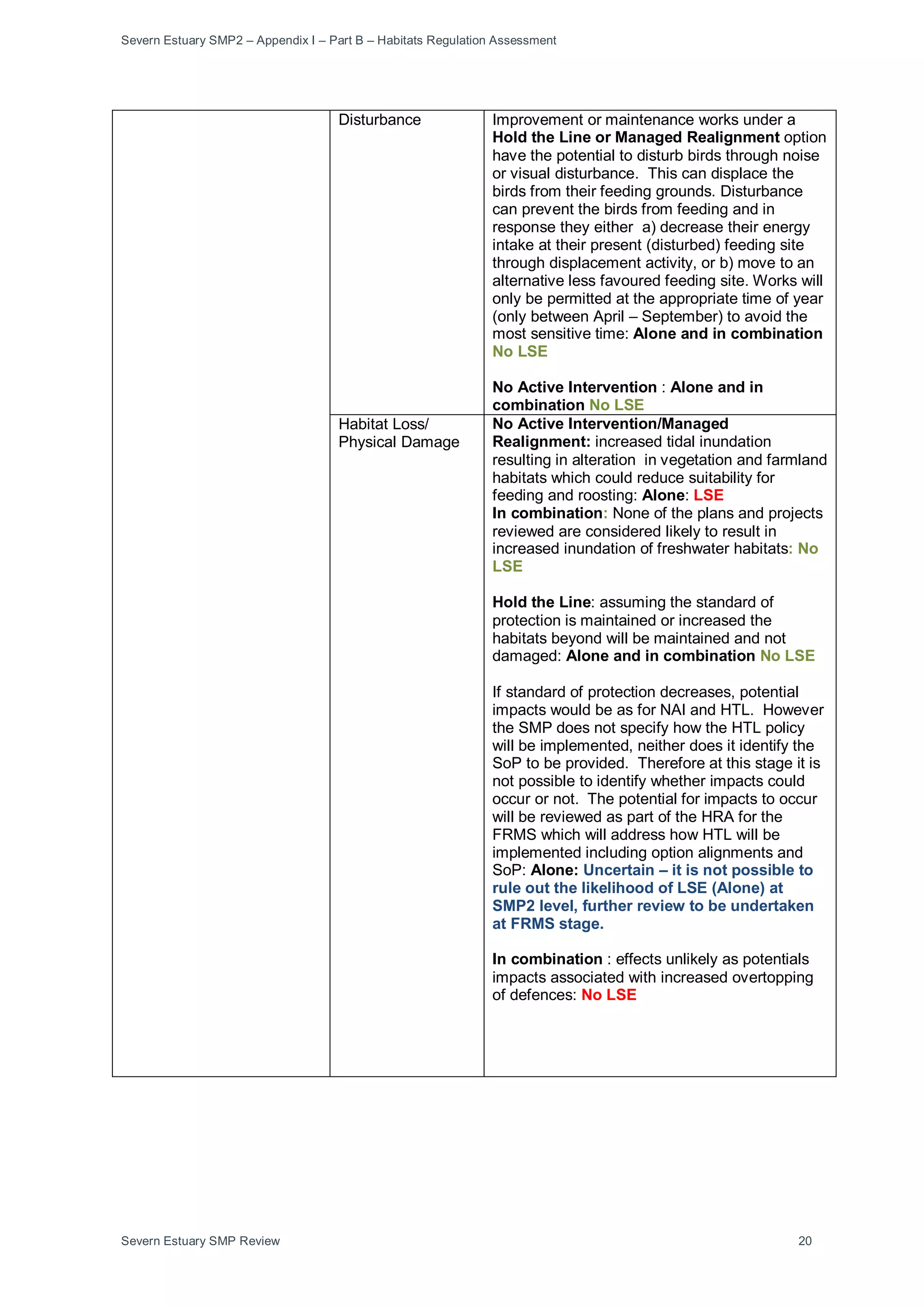
Disturbance Improvement or maintenance works under a
Hold the Line or Managed Realignment option
have the potential to disturb birds through noise
or visual disturbance. This can displace the
birds from their feeding grounds. Disturbance
can prevent the birds from feeding and in
response they either a) decrease their energy
intake at their present (disturbed) feeding site
through displacement activity, or b) move to an
alternative less favoured feeding site. Works will
only be permitted at the appropriate time of year
(only between April – September) to avoid the
most sensitive time: Alone and in combination
No LSE
No Active Intervention : Alone and in
combination No LSE
Habitat Loss/
Physical Damage
No Active Intervention/Managed
Realignment: increased tidal inundation
resulting in alteration in vegetation and farmland
habitats which could reduce suitability for
feeding and roosting: Alone: LSE
In combination: None of the plans and projects
reviewed are considered likely to result in
increased inundation of freshwater habitats: No
LSE
Hold the Line: assuming the standard of
protection is maintained or increased the
habitats beyond will be maintained and not
damaged: Alone and in combination No LSE
If standard of protection decreases, potential
impacts would be as for NAI and HTL. However
the SMP does not specify how the HTL policy
will be implemented, neither does it identify the
SoP to be provided. Therefore at this stage it is
not possible to identify whether impacts could
occur or not. The potential for impacts to occur
will be reviewed as part of the HRA for the
FRMS which will address how HTL will be
implemented including option alignments and
SoP: Alone: Uncertain – it is not possible to
rule out the likelihood of LSE (Alone) at
SMP2 level, further review to be undertaken
at FRMS stage.
In combination : effects unlikely as potentials
impacts associated with increased overtopping
of defences: No LSE
Severn Estuary SMP2 – Appendix I – Part B – Habitats Regulation Assessment
Severn Estuary SMP Review 21
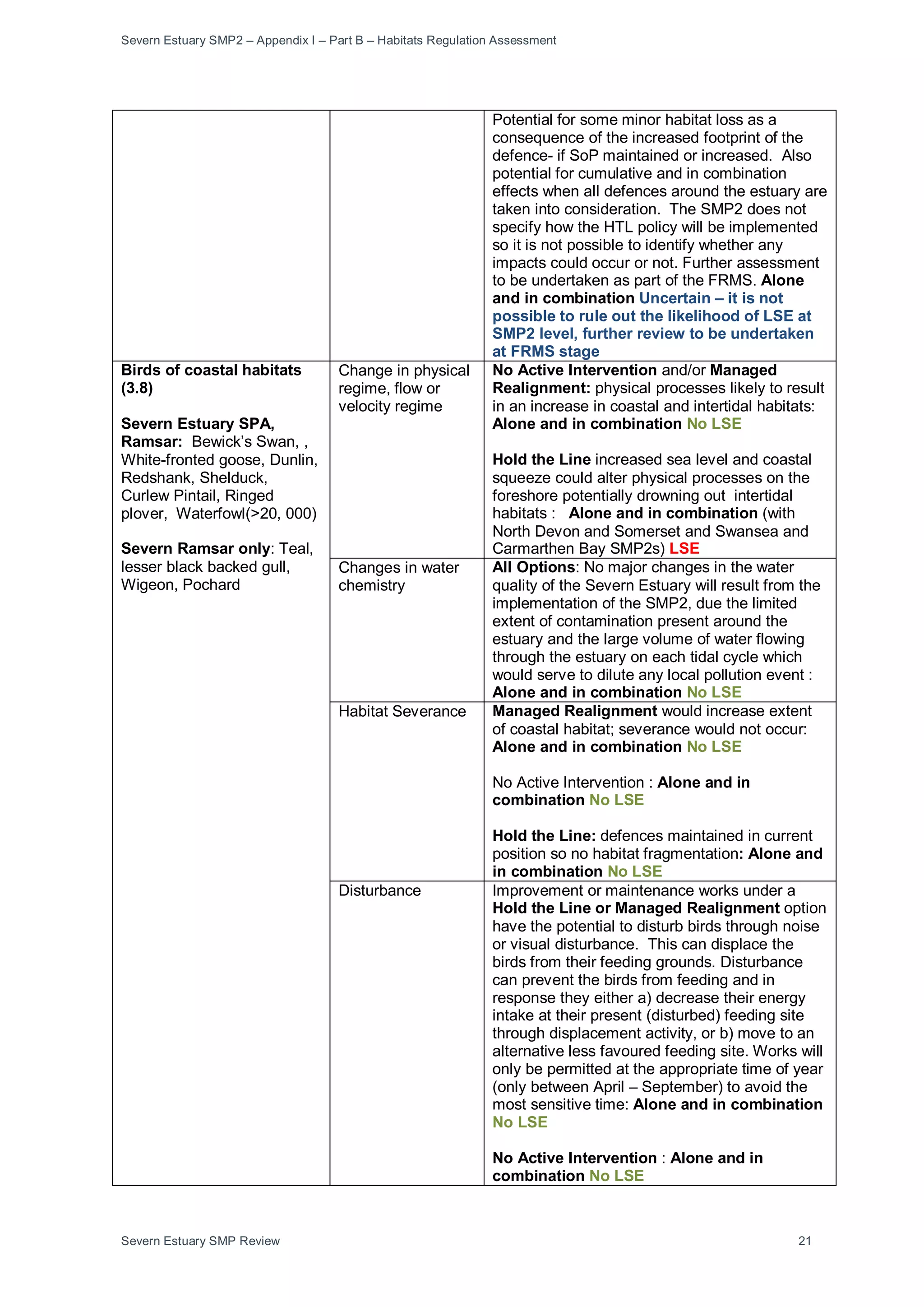
Potential for some minor habitat loss as a
consequence of the increased footprint of the
defence- if SoP maintained or increased. Also
potential for cumulative and in combination
effects when all defences around the estuary are
taken into consideration. The SMP2 does not
specify how the HTL policy will be implemented
so it is not possible to identify whether any
impacts could occur or not. Further assessment
to be undertaken as part of the FRMS. Alone
and in combination Uncertain – it is not
possible to rule out the likelihood of LSE at
SMP2 level, further review to be undertaken
at FRMS stage
Birds of coastal habitats
(3.8)
Severn Estuary SPA,
Ramsar: Bewick’s Swan, ,
White-fronted goose, Dunlin,
Redshank, Shelduck,
Curlew Pintail, Ringed
plover, Waterfowl(>20, 000)
Severn Ramsar only: Teal,
lesser black backed gull,
Wigeon, Pochard
Change in physical
regime, flow or
velocity regime
No Active Intervention and/or Managed
Realignment: physical processes likely to result
in an increase in coastal and intertidal habitats:
Alone and in combination No LSE
Hold the Line increased sea level and coastal
squeeze could alter physical processes on the
foreshore potentially drowning out intertidal
habitats : Alone and in combination (with
North Devon and Somerset and Swansea and
Carmarthen Bay SMP2s) LSE
Changes in water
chemistry
All Options: No major changes in the water
quality of the Severn Estuary will result from the
implementation of the SMP2, due the limited
extent of contamination present around the
estuary and the large volume of water flowing
through the estuary on each tidal cycle which
would serve to dilute any local pollution event :
Alone and in combination No LSE
Habitat Severance Managed Realignment would increase extent
of coastal habitat; severance would not occur:
Alone and in combination No LSE
No Active Intervention : Alone and in
combination No LSE
Hold the Line: defences maintained in current
position so no habitat fragmentation: Alone and
in combination No LSE
Disturbance Improvement or maintenance works under a
Hold the Line or Managed Realignment option
have the potential to disturb birds through noise
or visual disturbance. This can displace the
birds from their feeding grounds. Disturbance
can prevent the birds from feeding and in
response they either a) decrease their energy
intake at their present (disturbed) feeding site
through displacement activity, or b) move to an
alternative less favoured feeding site. Works will
only be permitted at the appropriate time of year
(only between April – September) to avoid the
most sensitive time: Alone and in combination
No LSE
No Active Intervention : Alone and in
combination No LSE
Severn Estuary SMP2 – Appendix I – Part B – Habitats Regulation Assessment
Severn Estuary SMP Review 22
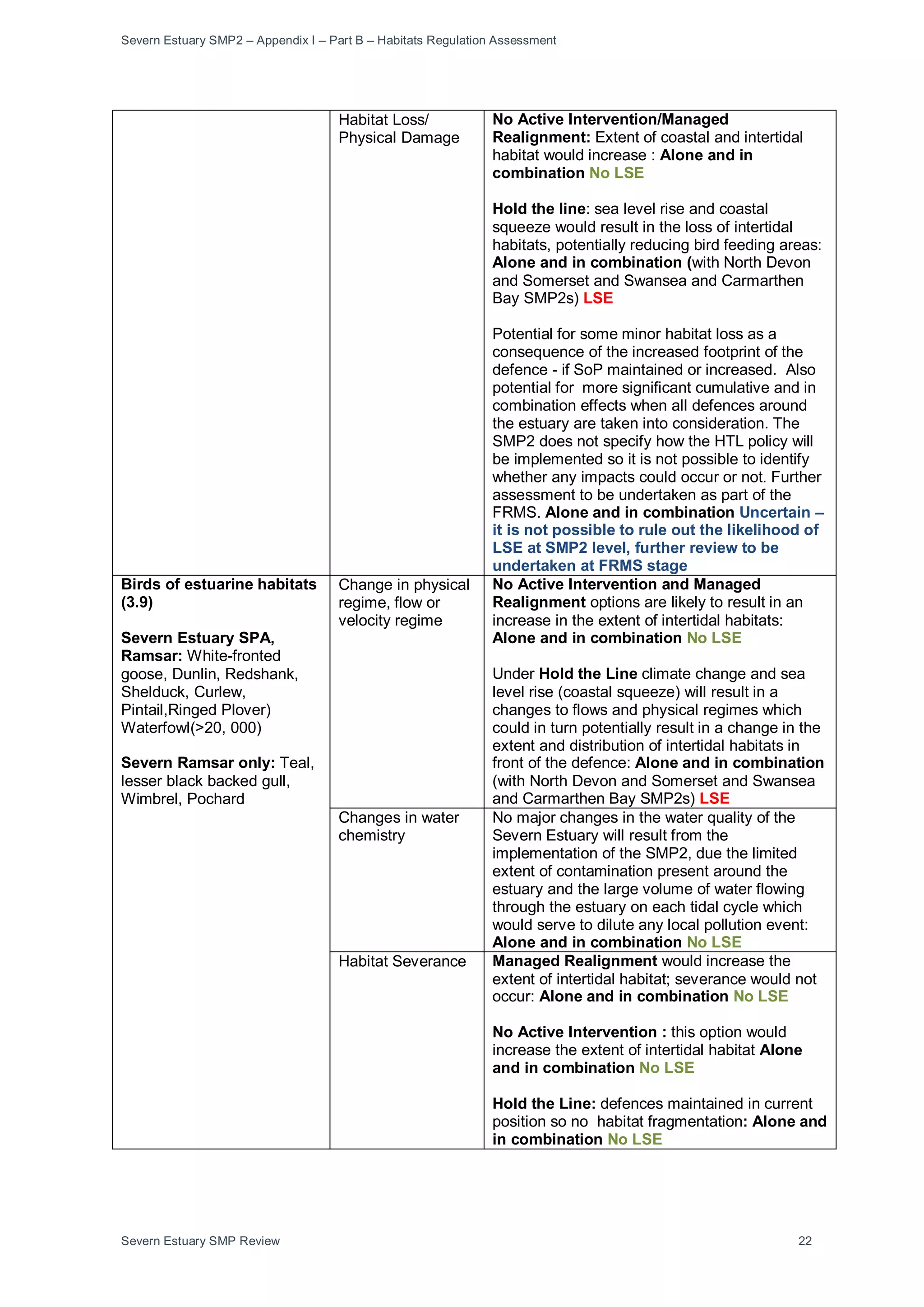
Habitat Loss/
Physical Damage
No Active Intervention/Managed
Realignment: Extent of coastal and intertidal
habitat would increase : Alone and in
combination No LSE
Hold the line: sea level rise and coastal
squeeze would result in the loss of intertidal
habitats, potentially reducing bird feeding areas:
Alone and in combination (with North Devon
and Somerset and Swansea and Carmarthen
Bay SMP2s) LSE
Potential for some minor habitat loss as a
consequence of the increased footprint of the
defence - if SoP maintained or increased. Also
potential for more significant cumulative and in
combination effects when all defences around
the estuary are taken into consideration. The
SMP2 does not specify how the HTL policy will
be implemented so it is not possible to identify
whether any impacts could occur or not. Further
assessment to be undertaken as part of the
FRMS. Alone and in combination Uncertain –
it is not possible to rule out the likelihood of
LSE at SMP2 level, further review to be
undertaken at FRMS stage
Birds of estuarine habitats
(3.9)
Severn Estuary SPA,
Ramsar: White-fronted
goose, Dunlin, Redshank,
Shelduck, Curlew,
Pintail,Ringed Plover)
Waterfowl(>20, 000)
Severn Ramsar only: Teal,
lesser black backed gull,
Wimbrel, Pochard
Change in physical
regime, flow or
velocity regime
No Active Intervention and Managed
Realignment options are likely to result in an
increase in the extent of intertidal habitats:
Alone and in combination No LSE
Under Hold the Line climate change and sea
level rise (coastal squeeze) will result in a
changes to flows and physical regimes which
could in turn potentially result in a change in the
extent and distribution of intertidal habitats in
front of the defence: Alone and in combination
(with North Devon and Somerset and Swansea
and Carmarthen Bay SMP2s) LSE
Changes in water
chemistry
No major changes in the water quality of the
Severn Estuary will result from the
implementation of the SMP2, due the limited
extent of contamination present around the
estuary and the large volume of water flowing
through the estuary on each tidal cycle which
would serve to dilute any local pollution event:
Alone and in combination No LSE
Habitat Severance Managed Realignment would increase the
extent of intertidal habitat; severance would not
occur: Alone and in combination No LSE
No Active Intervention : this option would
increase the extent of intertidal habitat Alone
and in combination No LSE
Hold the Line: defences maintained in current
position so no habitat fragmentation: Alone and
in combination No LSE
Severn Estuary SMP2 – Appendix I – Part B – Habitats Regulation Assessment
Severn Estuary SMP Review 23
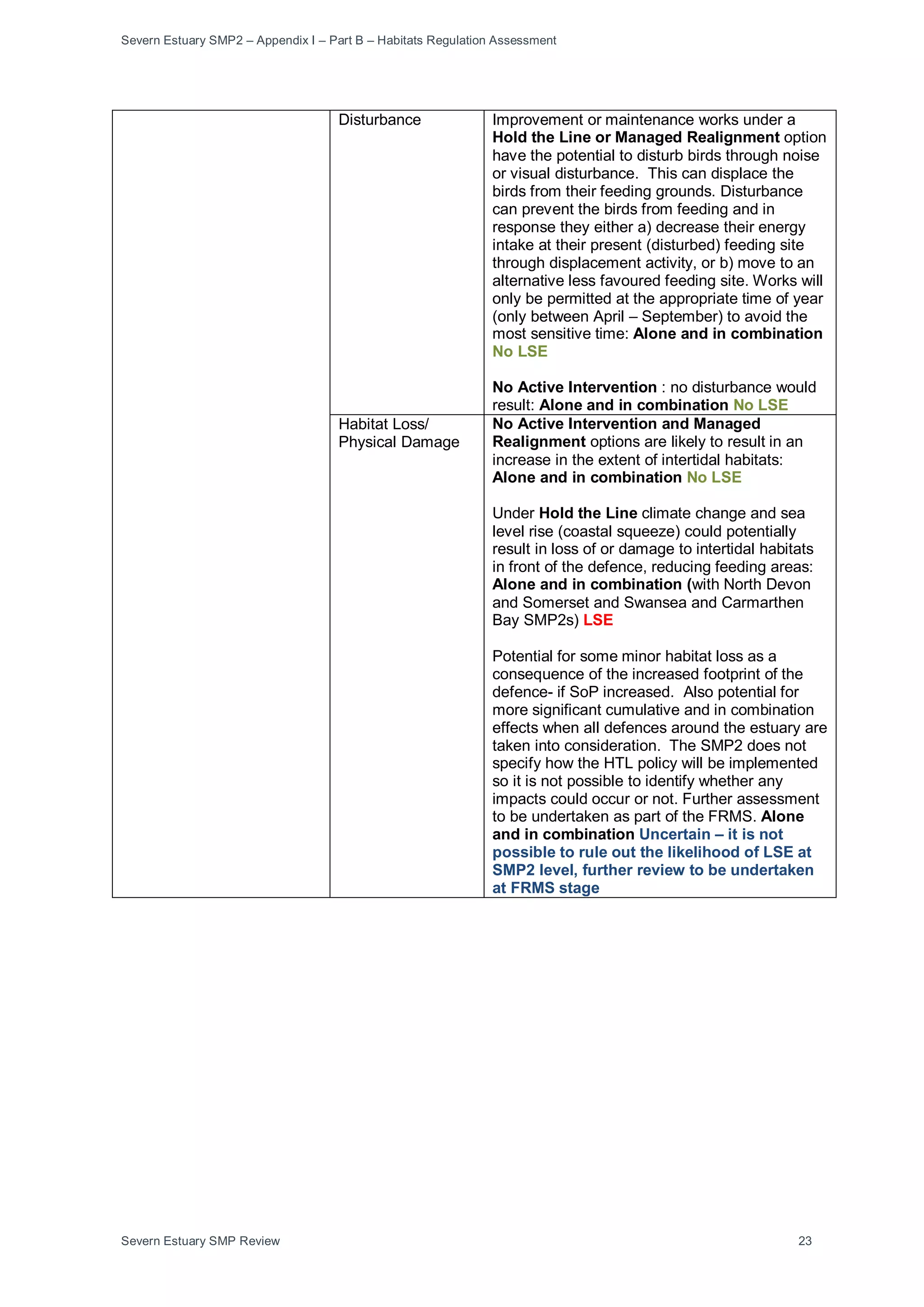
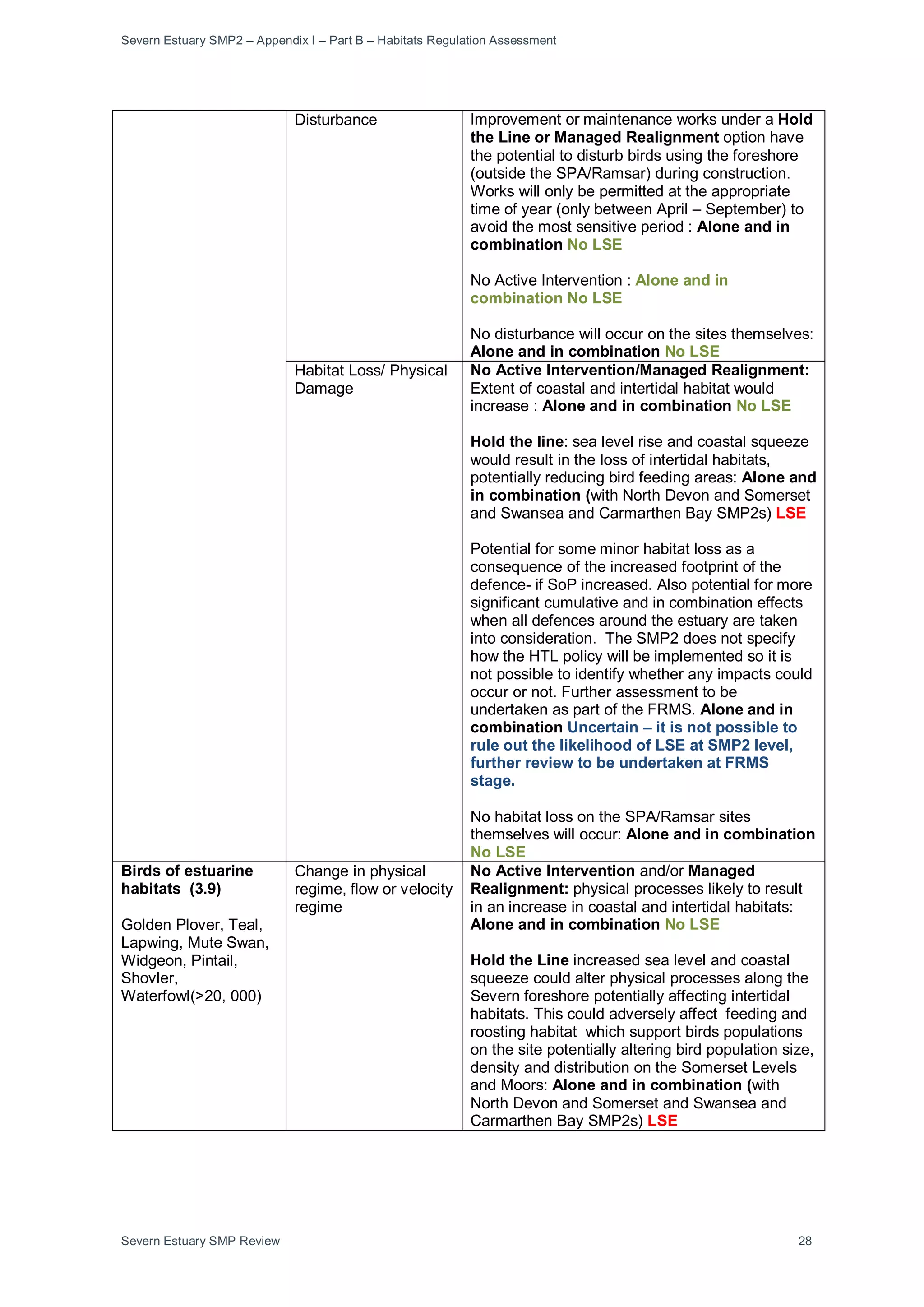
Disturbance Improvement or maintenance works under a
Hold the Line or Managed Realignment option
have the potential to disturb birds through noise
or visual disturbance. This can displace the
birds from their feeding grounds. Disturbance
can prevent the birds from feeding and in
response they either a) decrease their energy
intake at their present (disturbed) feeding site
through displacement activity, or b) move to an
alternative less favoured feeding site. Works will
only be permitted at the appropriate time of year
(only between April – September) to avoid the
most sensitive time: Alone and in combination
No LSE
No Active Intervention : no disturbance would
result: Alone and in combination No LSE
Habitat Loss/
Physical Damage
No Active Intervention and Managed
Realignment options are likely to result in an
increase in the extent of intertidal habitats:
Alone and in combination No LSE
Under Hold the Line climate change and sea
level rise (coastal squeeze) could potentially
result in loss of or damage to intertidal habitats
in front of the defence, reducing feeding areas:
Alone and in combination (with North Devon
and Somerset and Swansea and Carmarthen
Bay SMP2s) LSE
Potential for some minor habitat loss as a
consequence of the increased footprint of the
defence- if SoP increased. Also potential for
more significant cumulative and in combination
effects when all defences around the estuary are
taken into consideration. The SMP2 does not
specify how the HTL policy will be implemented
so it is not possible to identify whether any
impacts could occur or not. Further assessment
to be undertaken as part of the FRMS. Alone
and in combination Uncertain – it is not
possible to rule out the likelihood of LSE at
SMP2 level, further review to be undertaken
at FRMS stage
Severn Estuary SMP2 – Appendix I – Part B – Habitats Regulation Assessment
Severn Estuary SMP Review 24
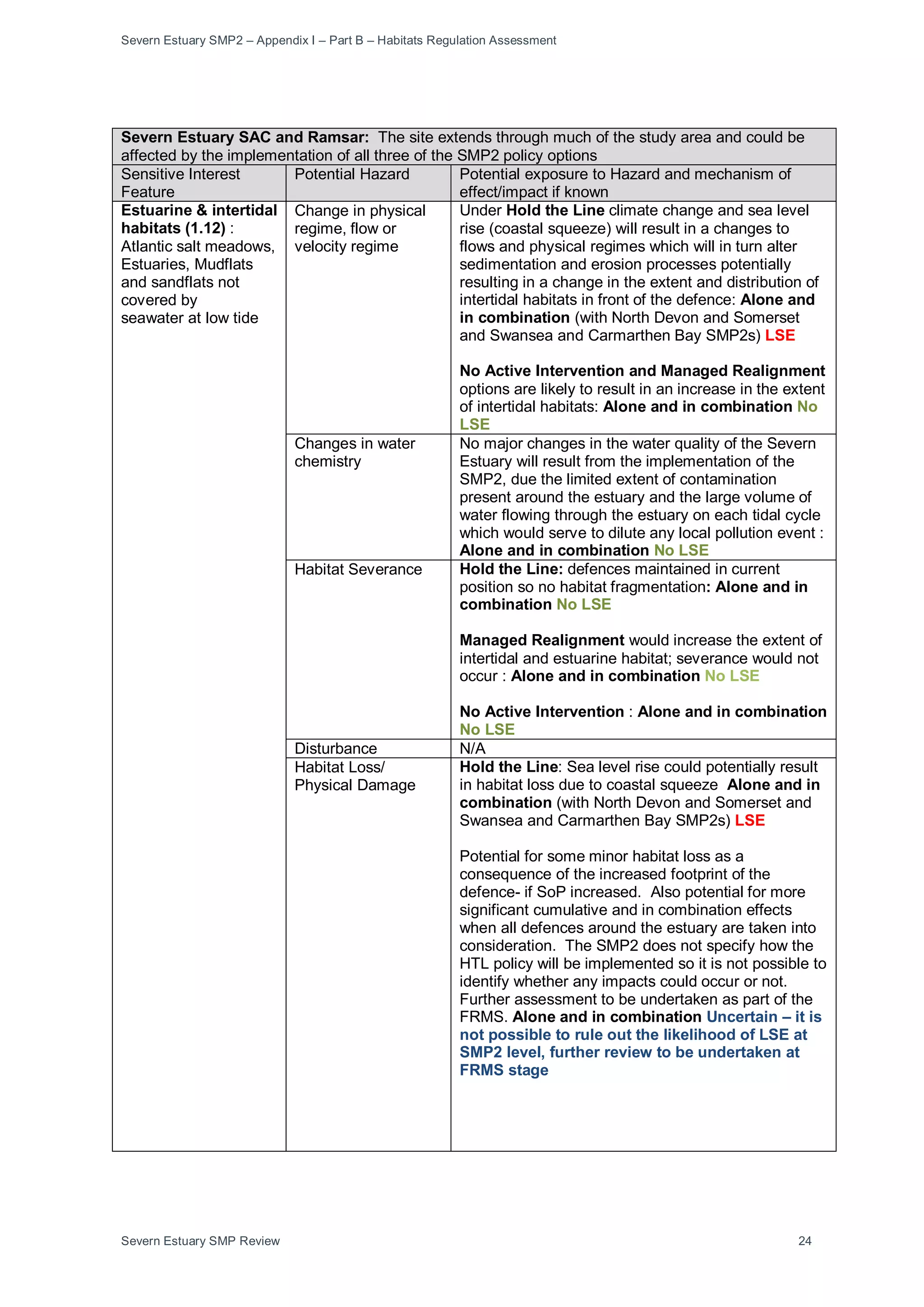
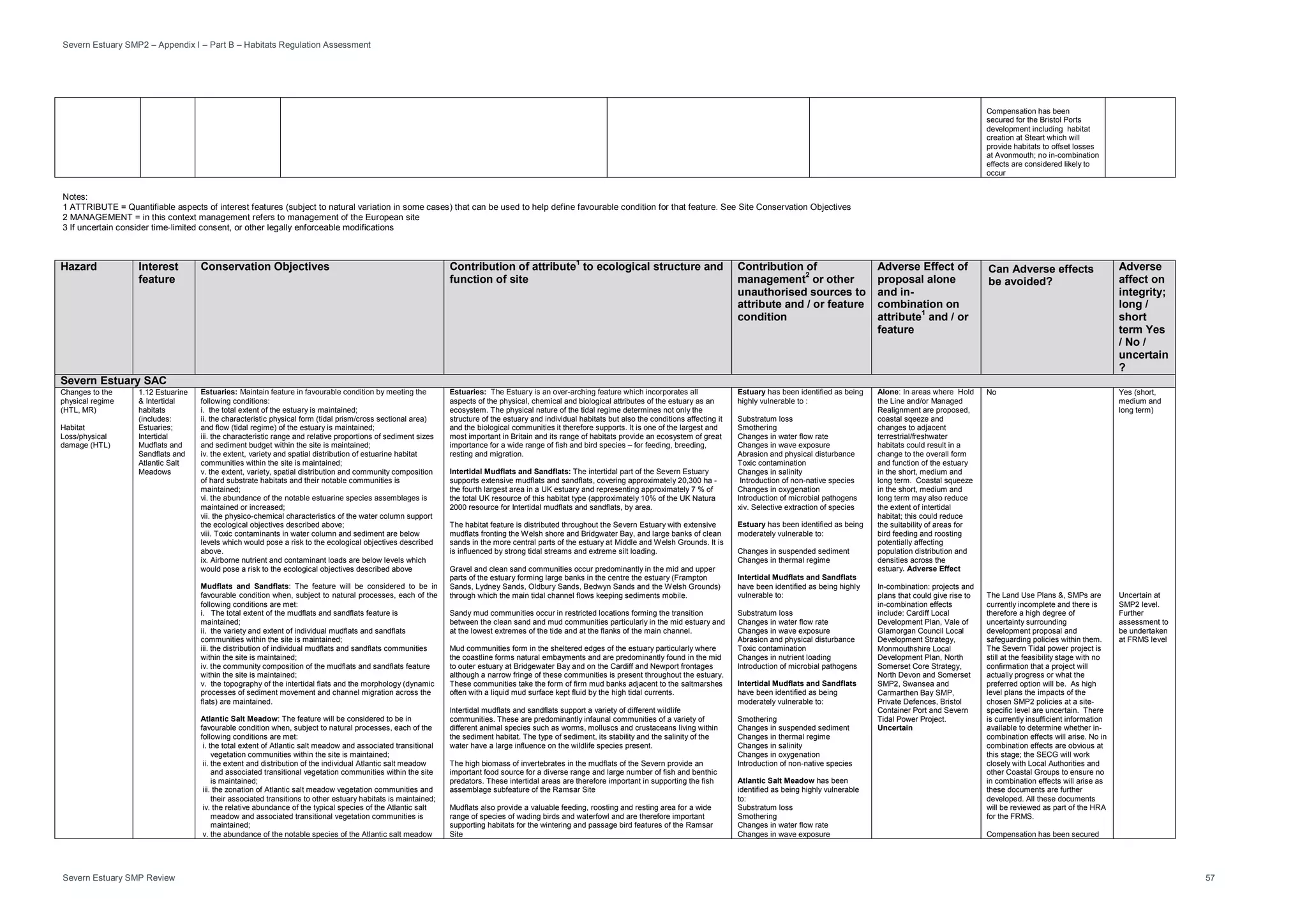
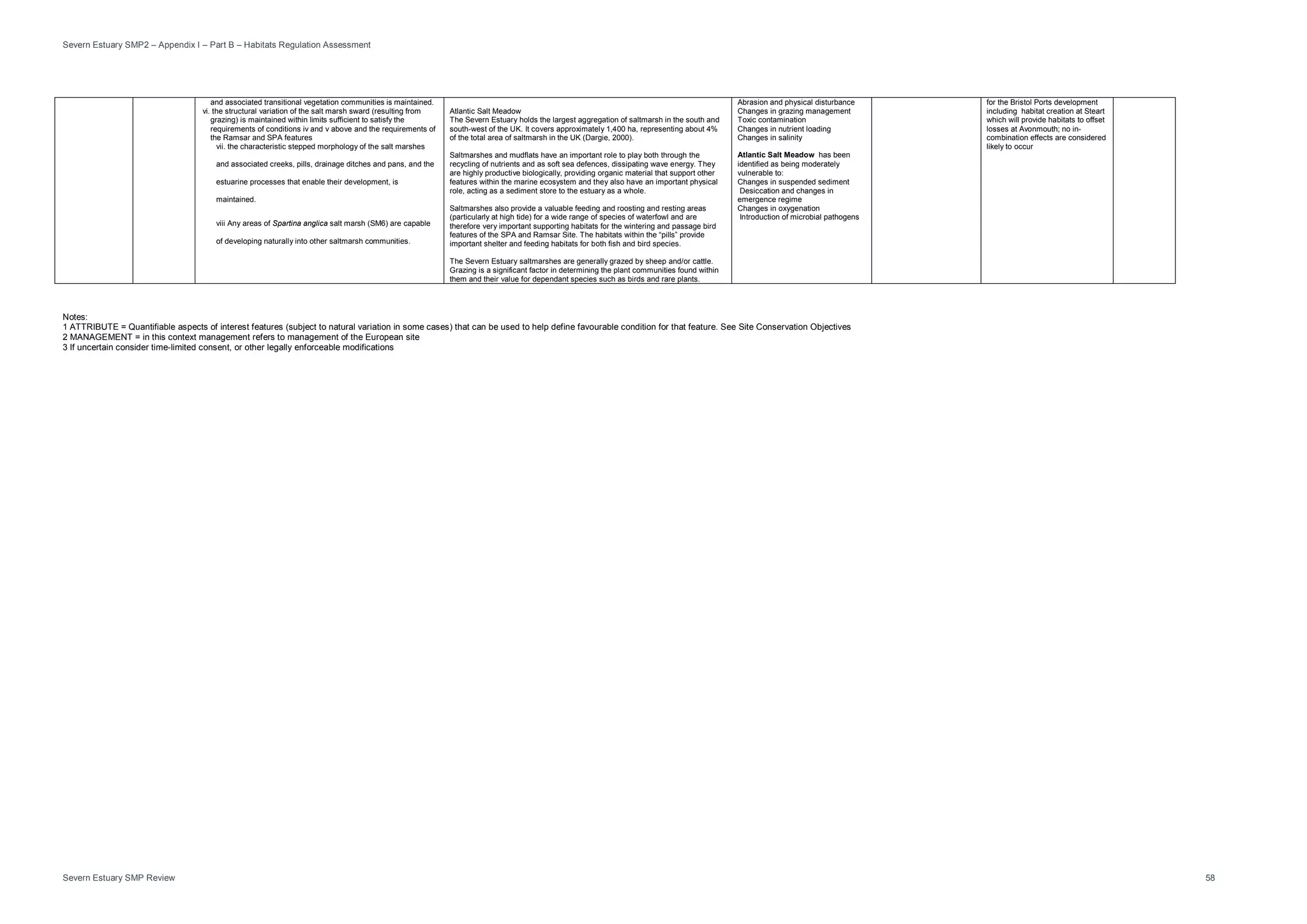
Severn Estuary SAC and Ramsar: The site extends through much of the study area and could be
affected by the implementation of all three of the SMP2 policy options
Sensitive Interest
Feature
Potential Hazard Potential exposure to Hazard and mechanism of
effect/impact if known
Estuarine & intertidal
habitats (1.12) :
Atlantic salt meadows,
Estuaries, Mudflats
and sandflats not
covered by
seawater at low tide
Change in physical
regime, flow or
velocity regime
Under Hold the Line climate change and sea level
rise (coastal squeeze) will result in a changes to
flows and physical regimes which will in turn alter
sedimentation and erosion processes potentially
resulting in a change in the extent and distribution of
intertidal habitats in front of the defence: Alone and
in combination (with North Devon and Somerset
and Swansea and Carmarthen Bay SMP2s) LSE
No Active Intervention and Managed Realignment
options are likely to result in an increase in the extent
of intertidal habitats: Alone and in combination No
LSE
Changes in water
chemistry
No major changes in the water quality of the Severn
Estuary will result from the implementation of the
SMP2, due the limited extent of contamination
present around the estuary and the large volume of
water flowing through the estuary on each tidal cycle
which would serve to dilute any local pollution event :
Alone and in combination No LSE
Habitat Severance Hold the Line: defences maintained in current
position so no habitat fragmentation: Alone and in
combination No LSE
Managed Realignment would increase the extent of
intertidal and estuarine habitat; severance would not
occur : Alone and in combination No LSE
No Active Intervention : Alone and in combination
No LSE
Disturbance N/A
Habitat Loss/
Physical Damage
Hold the Line: Sea level rise could potentially result
in habitat loss due to coastal squeeze Alone and in
combination (with North Devon and Somerset and
Swansea and Carmarthen Bay SMP2s) LSE
Potential for some minor habitat loss as a
consequence of the increased footprint of the
defence- if SoP increased. Also potential for more
significant cumulative and in combination effects
when all defences around the estuary are taken into
consideration. The SMP2 does not specify how the
HTL policy will be implemented so it is not possible to
identify whether any impacts could occur or not.
Further assessment to be undertaken as part of the
FRMS. Alone and in combination Uncertain – it is
not possible to rule out the likelihood of LSE at
SMP2 level, further review to be undertaken at
FRMS stage
Severn Estuary SMP2 – Appendix I – Part B – Habitats Regulation Assessment
Severn Estuary SMP Review 25
Managed Realignment: Realignment of defences
would increase the extent of intertidal and estuarine
habitats: Alone and in combination No LSE
No Active Intervention: extent if intertidal habitat
would roll back as sea level rose: Alone and in
combination No LSE
Anadromous fish
(2.5) : Allis shad,
Atlantic salmon, River
Lamprey, Sea
lamprey, Twaite shad
Change in physical
regime, flow or
velocity regime
All Options: Any changes in estuarine process that
might arise from any of the SMP2 policies will not be
significant enough at the estuary scale to affect fish
species for which the site is designated : Alone and
in combination No LSE
Changes in water
chemistry
All Options: No major changes in the water quality
of the Severn Estuary will result from the
implementation of the SMP2, due the limited extent
of contamination present around the estuary and the
large volume of water flowing through the estuary on
each tidal cycle which would serve to dilute any local
pollution event : Alone and in combination No LSE
Habitat Severance All Options: Implementation of any of the SMP2 will
not result in the severance of any of habitats relied
on by the listed fish species: Alone and in
combination No LSE
Disturbance All Options: None of the SMP2 policy options will
result in disturbance to fish species within the estuary
primarily due to the size of the estuary (and therefore
available fish habitats) and the fact that any works
would be located on the line or landward of existing
defences: Alone and in combination No LSE
Habitat Loss/
Physical Damage
All Options: Implementation of the SMP2 policies
will not result in the loss of or damage to any habitats
relied on by the listed fish species: Alone and in
combination No LSE
Severn Estuary Ramsar Only
The site extends through much of the study area and could be affected by the implementation of all
three of the SMP2 policy options
Sensitive Interest
Feature
Potential Hazard Potential exposure to Hazard and mechanism of
effect/impact if known
Severn Estuary
Ramsar
Non-migratory fish &
invertebrates of rivers
(2.6)
Change in physical
regime, flow or velocity
regime
All Options: Any changes in estuarine process that
might arise from any of the SMP2 policies will not
be significant enough at the estuary scale to affect
fish species for which the site is designated: Alone
and in combination No LSE
Changes in water
chemistry
All Options: No major changes in the water quality
of the Severn Estuary will result from the
implementation of the SMP2, due the limited extent
of contamination present around the estuary and
the large volume of water flowing through the
estuary on each tidal cycle which would serve to
dilute any local pollution event : Alone and in
combination No LSE
Habitat Severance All Options: Implementation of any of the SMP2
will not result in the severance of any of habitats
relied on by the listed fish species: Alone and in
combination No LSE
Severn Estuary SMP2 – Appendix I – Part B – Habitats Regulation Assessment
Severn Estuary SMP Review 26
Disturbance All Options: None of the SMP2 policy options will
result in disturbance to fish species within the
estuary primarily due to the size of the estuary (and
therefore available fish habitats) and the fact that
any works would be located on the line or landward
of existing defences: Alone and in combination
No LSE
Habitat Loss/ Physical
Damage
All Options: Implementation of the SMP2 policies
will not result in the loss of or damage to any
habitats relied on by the listed fish species: Alone
and in combination No LSE
Severn/Mor Hafren SAC Only
The site extends through much of the study area and could be affected by the implementation of all
three of the SMP2 policy options
Sensitive Interest
Feature
Potential Hazard Potential exposure to Hazard and mechanism of
effect/impact if known
Submerged marine
habitats (1.13) :
Reefs, subtidal
sandbanks that are
slightly covered by
sea water all the time.
Change in physical
regime/flow or velocity
regime
All Options: SMP2 polices could lead to changes
in estuarine process which in turn could affect
patterns of erosion and sedimentation; however
when considered in the context of the large scale
dynamic sub-tidal processes already operating
within the estuary any changes due to the SMP2
policy options would not be significant: Alone
and in combination No LSE
Changes in water
chemistry
All Options: No major changes in the water
quality of the Severn Estuary will result from the
implementation of the SMP2, due the limited
extent of contamination present around the
estuary and the large volume of water flowing
through the estuary on each tidal cycle which
would serve to dilute any local pollution event :
Alone and in combination No LSE
Habitat Severance N/A
Disturbance N/A
Habitat Loss /Physical
Damage
All Options: There would be no direct habitat loss
to any submerged habitats: Alone and in
combination No LSE
Somerset Levels and Moors SPA and Ramsar
The site lies outside the study area, (located approximately 15km downstream) but is potentially
hydraulically linked to the study area via flooding from the estuary. The levels are currently at risk
from extreme flood events from the estuary (e.g. 1 in 1000 year events). The preferred SMP2 policies
will not increase tidal flood risk to the site
Sensitive Interest
Feature
Potential Hazard Potential exposure to Hazard and mechanism of
effect/impact if known
Birds of lowland wet
grasslands (3.4)
Bewick’s swan,
Golden Plover, Teal,
Lapwing
Waterfowl(>20, 000)
Change in physical
regime, flow or velocity
regime
All Options: The preferred SMP2 policies will not
increase tidal flood risk to the site; physical
processes operating on the site will remain
unaltered: Alone and in combination No LSE
Changes in water
chemistry
All Options: The preferred SMP2 policies will not
affect water quality on the site: Alone and in
combination No LSE
Habitat Severance All Options: The preferred SMP2 policies will not
sever any habitats within the site: Alone and in
combination No LSE
Disturbance All Options: The preferred SMP2 policies will not
disturb birds using wet grassland habitats: Alone
and in combination No LSE
Severn Estuary SMP2 – Appendix I – Part B – Habitats Regulation Assessment
Severn Estuary SMP Review 27
Habitat Loss/ Physical
Damage
All Options: No loss of wet grassland habitat
within the site will occur: Alone and in
combination No LSE
Birds of lowland
freshwaters and
their margins (3.6)
Bewick’s swan, Teal,
Widgeon, Pintail,
Shovler,
Waterfowl(>20, 000),
Change in physical
regime, flow or velocity
regime
All Options: The preferred SMP2 policies will not
increase tidal flood risk to the site; physical
processes operating on the site will remain
unaltered: Alone and in combination No LSE
Changes in water
chemistry
All Options: The preferred SMP2 policies will not
affect water quality on the site: Alone and in
combination No LSE
Habitat Severance All Options: The preferred SMP2 policies will not
sever any habitats within the site: Alone and in
combination No LSE
Disturbance All Options: The preferred SMP2 policies will not
disturb birds using lowland freshwater habitats: No
Alone and in combination LSE
Habitat Loss/ Physical
Damage
All Options: No loss of lowland freshwater habitat
within the site will occur: Alone and in
combination No LSE
Birds of farmland
(3.7)
Bewick’s swan,
Lapwing, Widgeon
Change in physical
regime, flow or velocity
regime
All Options: The preferred SMP2 policies will not
increase tidal flood risk to the site; physical
processes operating on the site will remain
unaltered: Alone and in combination No LSE
Changes in water
chemistry
All Options: The preferred SMP2 policies will not
affect water quality on the site: Alone and in
combination No LSE
Habitat Severance All Options: The preferred SMP2 policies will not
sever any habitats within the site: No LSE
Disturbance All Options: The preferred SMP2 policies will not
disturb birds using farmland habitats: Alone and
in combination No LSE
Habitat Loss/ Physical
Damage
All Options: No loss of farmland habitat within the
site will occur: Alone and in combination No LSE
Birds of coastal
habitats (3.8)
Bewick’s Swan,
Golden Plover, Teal,
Widgeon, Pintail,
Waterfowl(>20, 000)
Change in physical
regime, flow or velocity
regime
No Active Intervention and/or Managed
Realignment: physical processes likely to result
in an increase in coastal and intertidal habitats:
Alone and in combination No LSE
Hold the Line increased sea level and coastal
squeeze could alter physical processes along the
Severn foreshore potentially affecting intertidal
habitats. This could adversely affect feeding and
roosting habitats which support bird populations
on the site potentially altering bird population size,
density and distribution on the Somerset Levels
and Moors: Alone and in combination (with
North Devon and Somerset and Swansea and
Carmarthen Bay SMP2s) LSE
Changes in water
chemistry
All Options: No major changes in the water
quality of the Severn Estuary will result from the
implementation of the SMP2, due the limited
extent of contamination present around the
estuary and the large volume of water flowing
through the estuary on each tidal cycle which
would serve to dilute any local pollution event.
Water quality on the or the Levels and Moors will
be unaffected : Alone and in combination No
LSE
Habitat Severance All Options: no severance of coastal habitats or
the levels and Moors sites will occur: Alone and
in combination No LSE
Severn Estuary SMP2 – Appendix I – Part B – Habitats Regulation Assessment
Severn Estuary SMP Review 28
Disturbance Improvement or maintenance works under a Hold
the Line or Managed Realignment option have
the potential to disturb birds using the foreshore
(outside the SPA/Ramsar) during construction.
Works will only be permitted at the appropriate
time of year (only between April – September) to
avoid the most sensitive period : Alone and in
combination No LSE
No Active Intervention : Alone and in
combination No LSE
No disturbance will occur on the sites themselves:
Alone and in combination No LSE
Habitat Loss/ Physical
Damage
No Active Intervention/Managed Realignment:
Extent of coastal and intertidal habitat would
increase : Alone and in combination No LSE
Hold the line: sea level rise and coastal squeeze
would result in the loss of intertidal habitats,
potentially reducing bird feeding areas: Alone and
in combination (with North Devon and Somerset
and Swansea and Carmarthen Bay SMP2s) LSE
Potential for some minor habitat loss as a
consequence of the increased footprint of the
defence- if SoP increased. Also potential for more
significant cumulative and in combination effects
when all defences around the estuary are taken
into consideration. The SMP2 does not specify
how the HTL policy will be implemented so it is
not possible to identify whether any impacts could
occur or not. Further assessment to be
undertaken as part of the FRMS. Alone and in
combination Uncertain – it is not possible to
rule out the likelihood of LSE at SMP2 level,
further review to be undertaken at FRMS
stage.
No habitat loss on the SPA/Ramsar sites
themselves will occur: Alone and in combination
No LSE
Birds of estuarine
habitats (3.9)
Golden Plover, Teal,
Lapwing, Mute Swan,
Widgeon, Pintail,
Shovler,
Waterfowl(>20, 000)
Change in physical
regime, flow or velocity
regime
No Active Intervention and/or Managed
Realignment: physical processes likely to result
in an increase in coastal and intertidal habitats:
Alone and in combination No LSE
Hold the Line increased sea level and coastal
squeeze could alter physical processes along the
Severn foreshore potentially affecting intertidal
habitats. This could adversely affect feeding and
roosting habitat which support birds populations
on the site potentially altering bird population size,
density and distribution on the Somerset Levels
and Moors: Alone and in combination (with
North Devon and Somerset and Swansea and
Carmarthen Bay SMP2s) LSE
Severn Estuary SMP2 – Appendix I – Part B – Habitats Regulation Assessment
Severn Estuary SMP Review 29
Changes in water
chemistry
All Options: No major changes in the water
quality of the Severn Estuary will result from the
implementation of the SMP2, due the limited
extent of contamination present around the
estuary and the large volume of water flowing
through the estuary on each tidal cycle which
would serve to dilute any local pollution event.
Water quality on the or the Levels and Moors will
be unaffected : Alone and in combination No
LSE
Habitat Severance All Options: no severance of coastal habitats or
the levels and Moors sites will occur: Alone and
in combination No LSE
Disturbance Improvement or maintenance works under a Hold
the Line or Managed Realignment option have
the potential to disturb birds using the foreshore
(outside the SPA/Ramsar) during construction.
Works will only be permitted at the appropriate
time of year (only between April – September) to
avoid the most sensitive period : Alone and in
combination No LSE
No Active Intervention : Alone and in
combination No LSE
No disturbance will occur on the sites themselves:
Alone and in combination No LSE
Habitat Loss/ Physical
Damage
No Active Intervention/Managed Realignment:
Extent of coastal and intertidal habitat would
increase : Alone and in combination No LSE
Hold the line: sea level rise and coastal squeeze
would result in the loss of intertidal habitats,
potentially reducing bird feeding areas: Alone and
in combination (with North Devon and Somerset
and Swansea and Carmarthen Bay SMP2s) LSE
Potential for some minor habitat loss as a
consequence of the increased footprint of the
defence - if SoP increased. Also potential for
more significant cumulative and in combination
effects when all defences around the estuary are
taken into consideration. The SMP2 does not
specify how the HTL policy will be implemented so
it is not possible to identify whether any impacts
could occur or not. Further assessment to be
undertaken as part of the FRMS: Alone and in
combination (with North Devon and Somerset
and Swansea and Carmarthen Bay SMP2s)
Uncertain – it is not possible to rule out the
likelihood of LSE at SMP2 level, further review
to be undertaken at FRMS stage.
No habitat loss on the SPA/Ramsar sites
themselves will occur: Alone and in combination
No LSE
Severn Estuary SMP2 – Appendix I – Part B – Habitats Regulation Assessment
Severn Estuary SMP Review 30
Somerset Levels Ramsar Only
The site lies outside the study area, (located approximately 15km downstream) but is potentially
hydraulically linked to the study area via flooding from the estuary. The levels are currently at risk
from extreme flood events from the estuary (e.g. 1 in 1000 year events). The preferred SMP2 policies
will not increase flood risk to the site
Sensitive Interest
Feature
Potential Hazard Potential exposure to Hazard and mechanism of
effect/impact if known
Red data book
invertebrates
(freshwater)
Change in physical
regime, flow or velocity
regime
All Options: The preferred SMP2 policies will not
significantly increase tidal flood risk to the site;
physical processes operating on the site will
remain unaltered. Increased tide locking of the
site may occur, increasing fluvial water levels on
the site, however this would be as a result of sea
level rise rather than implementation of the
Strategy: Alone and in combination No LSE
Changes in water
chemistry
All Options: The preferred SMP2 policies will not
affect water quality on the site: Alone and in
combination No LSE
Habitat Severance All Options: The preferred SMP2 policies will not
sever any habitats within the site: Alone and in
combination No LSE
Disturbance All Options: The preferred SMP2 policies will not
disturb invertebrate species on the site: Alone
and in combination No LSE
Habitat Loss/ Physical
Damage
All Options: No loss of habitat within the site will
occur; increased tide locking of the site may
occur, increasing fluvial water levels on the site,
however this would be as a result of sea level rise
rather than implementation of the Strategy: Alone
and in combination No LSE
North Somerset and Mendip Bat SAC
The site lies outside the study area, (located approximately 15km inland) however horseshoe bats
are known to feed on the levels with hedges used to shelter while feeding
Sensitive Interest
Feature
Potential Hazard Potential exposure to Hazard and mechanism of
effect/impact if known
1.7 Dry Grasslands
(6210 Semi-natural
dry grasslands and
scrubland facies: on
calcareous substrates
(Festuco-Brometalia))
Change in physical
regime, flow or velocity
regime
All Options: These habitats are not currently at
flood risk; this will not change under the preferred
SMP2 policies: Alone and in combination No
LSE
Changes in water
chemistry
All Options: These habitats are not currently at
flood risk; this will not change under the preferred
SMP2 policies; water quality n the vicinity of the
will be unaffected : Alone and in combination
No LSE
Habitat Severance All Options: These habitats are not currently at
flood risk; this will not change under the preferred
SMP2 policies; habitats will be unaffected by the
SMP2: Alone and in combination No LSE
Disturbance N/A
Habitat Loss/ Physical
Damage
All Options: No loss of habitat within the site will
occur: Alone and in combination No LSE
1.6 Dry Woodlands
and Scrub (9180
Tilio-Acerion forests of
slopes, screes and
ravines (Priority
feature)
Change in physical
regime, flow or velocity
regime
All Options: These habitats are not currently at
flood risk; this will not change under the preferred
SMP2 policies: Alone and in combination : No
LSE
Changes in water
chemistry
All Options: These habitats are not currently at
flood risk; this will not change under the preferred
SMP2 policies; water quality n the vicinity of the
will be unaffected : Alone and in combination
No LSE
Severn Estuary SMP2 – Appendix I – Part B – Habitats Regulation Assessment
Severn Estuary SMP Review 31
Habitat Severance All Options: These habitats are not currently at
flood risk; this will not change under the preferred
SMP2 policies; habitats will be unaffected by the
SMP2: Alone and in combination No LSE
Disturbance N/A
Habitat Loss/ Physical
Damage
All Options: No loss of habitat within the site will
occur: Alone and in combination No LSE
8310 Caves not open
to the public
Change in physical
regime, flow or velocity
regime
All Options: These habitats are not currently at
flood risk; this will not change under the preferred
SMP2 policies: Alone and in combination No
LSE
Changes in water
chemistry
All Options: These habitats are not currently at
flood risk; this will not change under the preferred
SMP2 policies; water quality n the vicinity of the
will be unaffected : Alone and in combination
No LSE
Habitat Severance All Options: These habitats are not currently at
flood risk; this will not change under the preferred
SMP2 policies; habitats will be unaffected by the
SMP2: Alone and in combination No LSE
Disturbance N/A
Habitat Loss/ Physical
Damage
All Options: No loss of habitat within the site will
occur: Alone and in combination No LSE
2.8 Mammals of
Wooded habitats 1303
Lesser horseshoe bat
(Rhinolophus
hipposideros)
1304 Greater
horseshoe bat
(Rhinolophus
ferrumequinum)
Change in physical
regime, flow or velocity
regime
Physical processes on the site will remain
unaffected: Alone and in combination No LSE
Changes in water
chemistry
N/A
Habitat Severance No habitats will be severed: Alone and in
combination No LSE
Disturbance N/A
Habitat Loss/ Physical
Damage
All Options: Increased tidal flooding of the bat
feeding areas on the Levels could result in loss of
invertebrates and also hedges used to shelter
while feeding. Alone and in combination (with
South Devon and Dorset SMP2): Uncertain – it is
not possible to rule out the likelihood of LSE
at the SMP2 level, further review to be
undertaken at FRMS stage
Mendip Limestone Grasslands SAC
The site lies outside the study area, (located approximately 15km inland) however horseshoe bats
are known to feed on the levels with hedges used to shelter while feeding
Sensitive Interest
Feature
Potential Hazard Potential exposure to Hazard and mechanism of
effect/impact if known
1.7 Dry Grasslands
(6210 Semi-natural
dry grasslands and
scrubland facies: on
calcareous substrates
(Festuco-Brometalia))
Change in physical
regime, flow or velocity
regime
All Options: These habitats are not currently at
flood risk; this will not change under the preferred
SMP2 policies: Alone and in combination No
LSE
Changes in water
chemistry
All Options: These habitats are not currently at
flood risk; this will not change under the preferred
SMP2 policies; water quality n the vicinity of the
will be unaffected : Alone and in combination
No LSE
Habitat Severance All Options: These habitats are not currently at
flood risk; this will not change under the preferred
SMP2 policies; habitats will be unaffected by the
SMP2: Alone and in combination No LSE
Disturbance N/A
Habitat Loss/ Physical
Damage
All Options: No loss of habitat within the site will
occur: Alone and in combination No LSE
Severn Estuary SMP2 – Appendix I – Part B – Habitats Regulation Assessment
Severn Estuary SMP Review 32
1.6 Dry Woodlands
and Scrub (9180
Tilio-Acerion forests of
slopes, screes and
ravines (Priority
feature))
Change in physical
regime, flow or velocity
regime
All Options: These habitats are not currently at
flood risk; this will not change under the preferred
SMP2 policies: Alone and in combination No
LSE
Changes in water
chemistry
All Options: These habitats are not currently at
flood risk; this will not change under the preferred
SMP2 policies; water quality n the vicinity of the
will be unaffected : Alone and in combination
No LSE
Habitat Severance All Options: These habitats are not currently at
flood risk; this will not change under the preferred
SMP2 policies; habitats will be unaffected by the
SMP2: Alone and in combination No LSE
Disturbance N/A
Habitat Loss/ Physical
Damage
All Options: No loss of habitat within the site will
occur: Alone and in combination No LSE
1.8 Dry heathland
habitats
(4030 European dry
heaths)
Change in physical
regime, flow or velocity
regime
All Options: These habitats are not currently at
flood risk; this will not change under the preferred
SMP2 policies: Alone and in combination No
LSE
Changes in water
chemistry
All Options: These habitats are not currently at
flood risk; this will not change under the preferred
SMP2 policies; water quality n the vicinity of the
will be unaffected : Alone and in combination
No LSE
Habitat Severance All Options: These habitats are not currently at
flood risk; this will not change under the preferred
SMP2 policies; habitats will be unaffected by the
SMP2: Alone and in combination No LSE
Disturbance N/A
Habitat Loss/ Physical
Damage
All Options: No loss of habitat within the site will
occur: Alone and in combination No LSE
8310 Caves not open
to the public
Change in physical
regime, flow or velocity
regime
All Options: These habitats are not currently at
flood risk; this will not change under the preferred
SMP2 policies: Alone and in combination No
LSE
Changes in water
chemistry
All Options: These habitats are not currently at
flood risk; this will not change under the preferred
SMP2 policies; water quality n the vicinity of the
will be unaffected : Alone and in combination
No LSE
Habitat Severance All Options: These habitats are not currently at
flood risk; this will not change under the preferred
SMP2 policies; habitats will be unaffected by the
SMP2: Alone and in combination No LSE
Disturbance N/A
Habitat Loss/ Physical
Damage
All Options: No loss of habitat within the site will
occur: Alone and in combination No LSE
2.8 Mammals of
Wooded habitats
(1304 Greater
horseshoe bat
(Rhinolophus
ferrumequinum)
Change in physical
regime, flow or velocity
regime
Physical processes on the site will remain
unaffected: Alone and in combination No LSE
Changes in water
chemistry
N/A
Habitat Severance No habitats will be severed: Alone and in
combination No LSE
Disturbance N/A
Severn Estuary SMP2 – Appendix I – Part B – Habitats Regulation Assessment
Severn Estuary SMP Review 33
Habitat Loss/ Physical
Damage
Increased tidal tidal flooding of the bat feeding
areas on the Levels could result in loss of
invertebrates and also hedges used to shelter
while feeding. TheSMP2 does not identify new
defence alignments or the SoP to be provided
under a Hold the Line policy: Alone and in
combination (with South Devon and Dorset
SMP2) Uncertain – it is not possible to rule out
the likelihood of LSE at the SMP2 level, further
review to be undertaken at FRMS stage
Wye SAC
No Active Intervention is the selected SMP2 policy option in the vicinity of the SAC (WYE 1-4)
Sensitive Interest
Feature
Potential Hazard Potential exposure to Hazard and mechanism of
effect/impact if known
Riverine habitats &
running waters (1.1):
Water courses of plain
to montane levels with
the Ranunculion
fluitantis and
Callitricho-Batrachion
vegetation
Change in physical
regime/ flow or velocity
regime
Policy will allow natural processes to continue to
operate ; no increase in flood or erosion risk is
predicted to occur over the lifetime of the SMP2;
the physical characteristics of the Wye, namely
the hard geology of the gorge mean significant
changes to the physical characteristics or
processes are unlikely to result: Alone and in
combination No LSE
Changes in water
chemistry
There are no major areas of contamination known
to exist along the river and the hard geology of the
gorge means negligible erosion is predicted to
occur. No construction works will be undertaken.
No major changes in the water quality of the Wye
will result from the implementation of the SMP2:
Alone and in combination No LSE
Disturbance No works to be undertaken so no disturbance will
result: Alone and in combination No LSE
Habitat Severance No works are proposed and physical process are
unlikely to change significantly; habitats will be
unaffected: Alone and in combination No LSE
Habitat Loss /Physical
Damage
No works are proposed and physical process are
unlikely to change significantly; habitats will be
unaffected: Alone and in combination No LSE
Bogs & wet habitats
(sensitive to
acidification)
(Transition mires and
quaking bogs)
Change in physical
regime/ flow or velocity
regime
This feature is located at the top of the Wye
catchment and is very unlikely to be affected by
the SMP2 polices : Alone and in combination
No LSE
Changes in water
chemistry
This feature is located at the top of the Wye
catchment and is very unlikely to be affected by
the SMP2 polices : Alone and in combination
No LSE
Disturbance No works to be undertaken so no disturbance will
result. In addition, this feature is located at the top
of the Wye catchment and is very unlikely to be
affected by the SMP2 polices : Alone and in
combination No LSE
Habitat Severance No works to be undertaken so no severance will
result. In addition, this feature is located at the top
of the Wye catchment and is very unlikely to be
affected by the SMP2 polices : Alone and in
combination No LSE
Habitat Loss /Physical
Damage
No works to be undertaken so no habitat loss will
result. In addition, this feature is located at the top
of the Wye catchment and is very unlikely to be
affected by the SMP2 polices : Alone and in
combination No LSE
Severn Estuary SMP2 – Appendix I – Part B – Habitats Regulation Assessment
Severn Estuary SMP Review 34
Anadromous fish
(2.5) : Allis shad,
Atlantic salmon, River
Lamprey, Sea
lamprey, Twaite shad
Change in physical
regime/flow or velocity
regime
Adoption of a No Active Intervention policy will
allow natural processes to continue to operate no
increase in flood or erosion risk is predicted to
occur over the lifetime of the SMP2; the physical
characteristics of the Wye, namely the hard
geology of the gorge mean significant changes to
the physical characteristics or processes are likely
to result: Alone and in combination No LSE
Changes to water
chemistry
There are no major areas of contamination known
to exist and the hard geology of the gorge mans
negligible erosion is predicted to occur and no
construction works will be undertaken. No major
changes in the water quality of the Wye will result
from the implementation of the SMP2: Alone and
in combination No LSE
Disturbance No works to be undertaken so no disturbance will
result : Alone and in combination No LSE
Habitat Severance No works are proposed and physical process are
unlikely to change significantly; habitats will be
unaffected: Alone and in combination No LSE
Habitat Loss /Physical
Damage
No works are proposed and physical process are
unlikely to change significantly; habitats will be
unaffected: Alone and in combination No LSE
Non-migratory fish &
invertebrates of
rivers (Atlantic stream
or White-clawed
crayfish, Brook
lamprey, Bullhead
Change in physical
regime/ flow or velocity
regime
Policy will allow natural processes to continue to
operate ; no increase in flood or erosion risk is
predicted to occur over the lifetime of the SMP2;
the physical characteristics of the Wye, namely
the hard geology of the gorge mean significant
changes to the physical characteristics or
processes are likely to result: Alone and in
combination No LSE
Changes in water
chemistry
There are no major areas of contamination known
to exist along the Wye Valley therefore and
therefore No major changes in the water quality of
the Wye will result from the implementation of the
SMP2: Alone and in combination No LSE
Disturbance No works to be undertaken so no disturbance will
result: Alone and in combination No LSE
Habitat Severance No works are proposed and physical process are
unlikely to change significantly; habitats will be
unaffected: No LSE
Habitat Loss /Physical
Damage
No works are proposed and physical process are
unlikely to change significantly; habitats will be
unaffected: Alone and in combination No LSE
Mammals of riverine
habitats (Otter)
Change in physical
regime/ flow or velocity
regime
Adoption of a No Active Intervention policy will
allow natural processes to continue to operate; no
increase in flood or erosion risk is predicted to
occur over the lifetime of the SMP2; the physical
characteristics of the Wye, namely the hard
geology of the gorge mean significant changes to
the physical characteristics or processes are likely
to result: Alone and in combination No LSE
Changes in water
chemistry
There are no major areas of contamination known
to exist along the Wye Valley therefore and
therefore No major changes in the water quality of
the Wye will result from the implementation of the
SMP2: Alone and in combination No LSE
Disturbance No works to be undertaken so no disturbance will
result: Alone and in combination No LSE
Severn Estuary SMP2 – Appendix I – Part B – Habitats Regulation Assessment
Severn Estuary SMP Review 35
Habitat Severance No works are proposed and physical process are
unlikely to change significantly; habitats will be
unaffected: Alone and in combination No LSE
Habitat Loss /Physical
Damage
No works are proposed and physical process are
unlikely to change significantly; habitats will be
unaffected : Alone and in combination No LSE
River Usk SAC
SMP2 policy options are as follows:
NEW1 NEW2 NEW3 NEW4 NEW5
HTL HTL NAI/MR HTL HTL
Sensitive Interest
Feature
Potential Hazard Potential exposure to Hazard and mechanism of
effect/impact if known
Riverine habitats &
running waters
(Floating vegetation of
Ranunculus of plain
and submountainous
rivers)
Change in physical
regime/ flow or velocity
regime
Hold the Line: Increase in sea level could result
in tidal incursion further up the Usk estuary
potentially resulting in estuarine sediments being
pushed further up the Usk. Given the existing
estuarine system is already highly dynamic the
resultant impacts on the physical regime are
considered to be negligible: Alone No LSE
In combination : potential for in combination
effects with the Wye and Usk CFMP however
further details at FRMS needed Uncertain – it is
not possible to rule out the likelihood of LSE
at the SMP2 level, further review to be
undertaken at FRMS stage
No Active Intervention/Managed Realignment
(NEW3 only) : In this largely rural reach a policy
of NAI/MR will allow natural processes to
dominate with an increase in tidal flooding and
reintegration of the river with its floodplain: Alone
and in combination No LSE
Changes in water
chemistry
No Active Intervention (NEW 3 only): If no
works are undertaken, there is minimal risk of
existing areas of contamination being disturbed:
Alone and in combination No LSE
Hold the Line or Managed Realignment: The
Usk Valley around Newport has a complex
industrial history and much of the land is
contaminated. Improvement or maintenance
works under a Hold the Line policy and Managed
Realignment have the potential to remobilise
contaminated sediments; this potential impact will
be avoided or mitigated through appropriate
investigations and remediation/mitigation at the
project level as appropriate. In addition more
detailed HRA will be undertaken at the FRMS and
project level with appropriate avoidance or
mitigation measures identified: Alone and in
combination No LSE
Disturbance N/A
Severn Estuary SMP2 – Appendix I – Part B – Habitats Regulation Assessment
Severn Estuary SMP Review 36
Habitat Severance No Active Intervention (NEW3 only): No works
are proposed and physical process are unlikely to
change significantly; habitats will be unaffected
Alone and in combination No LSE
Hold the Line/Managed Realignment: habitat
feature of would not be severed as a result the
implementation of any of these polices Alone
and in combination No LSE
Habitat Loss /Physical
Damage
No Active Intervention (NEW3 only): No works
are proposed and natural processes will continue
to operate habitats are unlikely to change
significantly Alone and in combination No LSE
Hold the Line/Managed Realignment:
Maintenance or retreat of the defence line will not
affect in-river processes or habitats. The main
area likely to be affected by the requirement to
increase the size of defences would be around
Newport; Ranunculus habitat is absent from this
Management unit of the SAC: Alone and in
combination No LSE
Anadromous fish
(Allis shad, Atlantic
salmon, River
Lamprey, Sea
lamprey, Twaite shad)
Change in physical
regime/ flow or velocity
regime
Hold the Line: Increase in sea level could result
in tidal incursion further up the Usk estuary
potentially resulting in estuarine sediments being
pushed further up the Usk. Given the existing
estuarine system is already highly dynamic the
resultant impacts on the physical regime are
considered to be negligible: Alone : No LSE
There is the potential for the increased incursion
of tidal waters to affect freshwater migratory cues,
however fluvial flows are also predicted to
increase under climate change so effect are not
considered significant: Alone :No LSE
Flows and morphology are considered unlikely to
change enough to affect fish migration: Alone :No
LSE
In combination : potential for in combination
effects with the Wye and Usk CFMP however
further details at FRMS needed Uncertain – it is
not possible to rule out the likelihood of LSE
at the SMP2 level, further review to be
undertaken at FRMS stage
No Active Intervention/Managed
Realignment(NEW3 only): In this largely rural
reach a policy of NAI/MR will allow natural
processes to dominate with an increase in tidal
flooding and reintegration of the river with its
floodplain: Alone and in combination No LSE
Severn Estuary SMP2 – Appendix I – Part B – Habitats Regulation Assessment
Severn Estuary SMP Review 37
Changes in water
chemistry
The Usk Valley around Newport has a complex
industrial history and much of the land is
contaminated. Improvement or maintenance
works under a Hold the Line or Managed
Realignment policy have the potential to
remobilise contaminated sediments; this potential
impact will be avoided or mitigated through further
assessment, appropriate investigations and
remediation/mitigation as required at the FRMS
and project level. In addition, HRAs will be
undertaken of the more detailed FRMS and any
projects cascading from the SMP2 and/or FRMS:
Alone and in combination No LSE
No Active Intervention (NEW3 only) : If no
works are undertaken, there is minimal risk of
existing areas of contamination being disturbed:
Alone and in combination No LSE
Disturbance No Active Intervention (NEW3 only): no works
will be undertaken, and therefore no disturbance
to fish will result: Alone and in combination No
LSE
Improvement or maintenance works under a Hold
the Line or Managed Realignment option have
the potential to disrupt fish migration and/or
spawning through increased noise and vibration;
this impact will be avoided or mitigated through
timing the works to avoid sensitive fish migration
and/or spawning period and by undertaking HRA
at the FRMS and project level. Alone and in
combination No LSE
Habitat Severance All Options: none of the SMP2 policy options
have the potential to result in the severance of
any of habitats relied on by the listed fish species:
Alone and in combination No LSE
Habitat Loss /Physical
Damage
No Active Intervention: No works are proposed
and natural processes will continue to operate
habitats unlikely to change significantly Alone
and in combination No LSE
Hold the Line/Managed Realignment:
Maintenance or retreat of the defence line will not
affect in-river processes or habitats: Alone and in
combination No LSE
Non-migratory fish
& invertebrates of
rivers (Brook lamprey,
Bullhead)
Change in physical
regime/ flow or velocity
regime
Hold the Line: Increase in sea level could result
in tidal incursion further up the Usk estuary
potentially resulting in estuarine sediments being
pushed further up the Usk. Given the existing
estuarine system is already highly dynamic the
resultant impacts on the physical regime are
considered to be negligible: Alone and in
combination No LSE
No Active Intervention/Managed
Realignment(NEW3 only) : In this largely rural
reach a policy of NAI/MR will allow natural
processes to dominate with an increase in tidal
flooding and reintegration of the river with its
floodplain: Alone and in combination No LSE
Severn Estuary SMP2 – Appendix I – Part B – Habitats Regulation Assessment
Severn Estuary SMP Review 38
Changes in water
chemistry
The Usk Valley around Newport has a complex
industrial history and much of the land is
contaminated. Improvement or maintenance
works under a Hold the Line or Managed
Realignment policy have the potential to
remobilise contaminated sediments. This potential
impact will be avoided or mitigated through further
assessment, appropriate investigations and
remediation/mitigation as required at the FRMS
and project level. In addition, HRAs will be
undertaken of the more detailed FRMS and any
projects cascading from the SMP2 and/or FRMS:
Alone and in combination No LSE
No Active Intervention (NEW3 only) : If no
works are undertaken, there is minimal risk of
existing areas of contamination being disturbed:
Alone and in combination No LSE
Disturbance No Active Intervention: no works will be
undertaken, and therefore no disturbance to fish
will result: Alone and in combination No LSE
Improvement or maintenance works under a Hold
the Line or Managed Realignment option have
the potential to disrupt fish spawning through
increased noise and vibration; this impact will be
avoided or mitigated through timing the works to
avoid sensitive spawning period and by
undertaking HRA at the FRMS and project level.
Alone and in combination No LSE
Habitat Severance All Options: none of the SMP2 policy options
have the potential to result in the severance of
any of habitats relied on by the listed fish species:
Alone and in combination No LSE
Habitat Loss /Physical
Damage
No Active Intervention: No works are proposed
and natural processes will continue to operate
habitats unlikely to change significantly Alone
and in combination No LSE
Hold the Line/Managed Realignment:
Maintenance or retreat of the defence line will not
affect in-river processes or habitats: Alone and in
combination No LSE
Mammals of riverine
habitats (Otter)
Change in physical
regime/ flow or velocity
regime
Hold the Line: Increase in sea level could result
in tidal incursion further up the Usk estuary
potentially resulting in estuarine sediments being
pushed further up the Usk. Given the existing
estuarine system is already highly dynamic the
resultant impacts on the physical regime are
considered to be negligible: Alone and in
combination No LSE
No Active Intervention/Managed
Realignment(NEW3 only) : In this largely rural
reach a policy of NAI/MR will allow natural
processes to dominate with an increase in tidal
flooding and reintegration of the river with its
floodplain: Alone and in combination No LSE
Severn Estuary SMP2 – Appendix I – Part B – Habitats Regulation Assessment
Severn Estuary SMP Review 39
Changes in water
chemistry
The Usk Valley around Newport has a complex
industrial history and much of the land is
contaminated. Improvement or maintenance
works under a Hold the Line or Managed
realignment policy have the potential to
remobilise contaminated sediments; this potential
impact will be avoided or mitigated through further
assessment, appropriate investigations and
remediation/mitigation as required at the FRMS
and project level. In addition, HRAs will be
undertaken of the more detailed FRMS and any
projects cascading from the SMP2 and/or FRMS:
Alone and in combination No LSE
No Active Intervention : If no works are
undertaken, there is minimal risk of existing areas
of contamination being disturbed: Alone and in
combination No LSE
Disturbance No Active Intervention : No works are proposed
so no disturbance to otters will occur: No LSE
Hold the Line or Managed Realignment: Works
could potentially disturb otters whilst using the
watercourse or whilst in holts. No night time
working or light will be permitted and otter access
along at least one bank of the river maintained at
all time. Otter surveys will ensure that there are
no impacts on otter holts or couches as a result of
the works and if necessary, appropriate licences
will be obtained; HRA will be undertaken at the
FRSM and project level to ensure no impacts on
otter passage: Alone and in combination No
LSE
Habitat Severance No Active Intervention (NEW3 only) : policy will
allow natural processes to continue; no works will
be undertaken and no severance of habitats will
occur: Alone and in combination No LSE
Managed Realignment (NEW3 only): would alter
habitats but would be unlikely to result in habitat
severance: Alone and in combination No LSE
Hold the Line: implementation of the policy could
restrict otter passage along the river corridor and
as such could result in severance of habitat:
Alone and in combination LSE
Habitat Loss /Physical
Damage
No Active Intervention (NEW3 only): policy will
allow natural processes to continue Alone and in
combination No LSE
Managed Realignment (NEW3 only): has the
potential to increase the extent of riparian habitat
available to otters: Alone and in combination No
LSE
Hold the Line: in the medium to long term coastal
squeeze may reduce available riparian habitat,
potentially reducing breeding territories, access to
prey and/or otter ranges; increasing the footprint
of defences may also result in habitat loss: Alone
and in combination LSE
Severn Estuary SMP2 – Appendix I – Part B – Habitats Regulation Assessment
Severn Estuary SMP Review 40
7. In Combination Effects
A wide range of plans have been reviewed to identify any potential in combination effects with the
SMP2, along with a brief discussion of conclusions reached. These are all listed in Annex C. This
section focuses on those plans and projects identified as potentially giving rise to in-combination
effects.
Given the strategic nature of this assessment and the uncertainties surrounding the timing and effects
of other national level plans and projects, it is not practicable to identify all the possible plans and
projects that may act ‘in-combination’. However, it is possible to outline at a strategic level the broad
types of effects that may arise from the implementation of other plans and projects which should inform
the HRA for the SMP2. Potential strategic in-combination effects include:
• Habitats loss: direct land take from coastal development (for housing, transport, regeneration
etc) resulting in habitats loss.
• Impacts on water quality for example from increased discharge of sewage, increased urban or
agricultural runoff, changes in dredging practices etc
• Changes to physical regimes, for example form aggregate dredging and/or coastal
development potentially affecting coastal and subtidal habitats and fish movement.
The following plans and projects have been identified as potentially giving rise to in-combination
effects:
Land Use Plans
Cardiff Local Development Plan 2006- 2021 (Draft). Significant reservations were raised by the
Inspectors at the Exploratory Meeting on 25th February 2010, and the Council formally requested that
the Inspectors recommend to the Welsh Assembly Government that the LDP be withdrawn from the
examination process. The Council will be preparing a new Local Development Plan. The City of
Cardiff Local Plan (1996) is the main local planning document indentified within the local development
framework. However the deposit draft of the Cardiff Unitary Development Plan (2003) although in
accordance with Draft Welsh Assembly guidance on it remains a consideration in development control
decisions until an LDP has been placed on deposit. Note: in May 2005, the council formally resolved to
cease work on the Cardiff UDP and begin work on the LDP. At present there is insufficient information
available to judge whether the LDP will result in the potential for in-combination effects, however it is
likely that policies to protect both the Gwent Levels SSSIs and the Severn Estuary European sites will
remain part of the Local Development Framework. There is therefore a high degree of uncertainty
regarding whether or not there is the potential for in-combination effects on the Severn
SPA/SAC/Ramsar site. Relevant issues identified in the Cardiff Minerals Local Plan 1997 include
interest in clay extraction from the Wentlooge Levels and ongoing dredging in the Bristol Channel; this
document is however over 10 years old; consequently these issues may no longer be pertinent and/or
other issues may have arisen. Potential developments identified with the draft UDP which have the
potential to give rise to in combination effects include: the Eastern Bylink (proposed road
improvement), the St Mellons Wentlooge Link (proposed road improvement) and the development of
an integrated waste management system at the Rumney Moors/Lamby Way site, which is currently
used primarily for landfill.
Vale of Glamorgan Council Local Development Draft Preferred Strategy Dec 2007: The Habitats
Regulations Assessment Screening for the Vale of Glamorgan LDP Draft Preferred Strategy identified
the potential for a negative impact on the Severn Estuary European sites. While much of the
development arising from the draft preferred strategy is likely to be located well away from the Severn
Estuary, the south-eastern zone has been identified as a growth area and abuts the boundary of the
designated site. A more detailed assessment of the LDP is to be undertaken following consultation on
the Draft Preferred Strategy to ascertain and mitigate against any likely significant effects to the SPA,
cSAC, Ramsar. The mechanisms by which these activities could impact upon the designated site(s)
are numerous and include land-take, disturbance through noise and vibration, pollution through ground
and surface water run-off, and interruption of flight-lines by wind turbines. The potential for in
combination effects exists
Severn Estuary SMP2 – Appendix I – Part B – Habitats Regulation Assessment
Severn Estuary SMP Review 41
Monmouthshire County Council Adopted Unitary Development Plan 1996-2011 (adopted 2006):
The HRA of the Monmouthshire County Council UDP concluded that it was unlikely that the Plan will
have a significant effect on European sites/species, or adversely affect a site’s integrity. No in-
combination effects can be identified at this strategic level. The Monmouthshire LDP is currently in
preparation and will contain land use allocations and policies for future development in Monmouthshire
for the period 2011-2021. A HRA Screening of the Pre-Deposit Proposals was undertaken in May 2009
and identified the potential for likely significant effects, but identified that these impacts could be
entirely avoided or mitigated against through further revisions of the LDP strategy and policies; the
HRA will be reviewed at a more advanced version of the plan in order for a complete assessment to
take place. Potential impacts were identified on the Usk SAC (arising from: development in
Abergavenny/Llanfoist and Usk, a Strategic Employment Site within 2.5km of the site at Llanfoist, sites
identified for waste facilities which may lead to waste related development near the SAC and mineral
safeguarding policies which may lead to eventual additional mining and quarrying) the Severn
SPA/SAC/Ramsar (arising from development in Chepstow, Sudbrook and Magor/Undy, Strategic
Housing Sites at Magor/Undy and Portskewett within 5km and 2.5km of the site respectively, a
Strategic Mixed Use Site within 2.5km of the site at Chepstow, an Employment site at Sudbrook within
2.5km of the site, and 3 Employment sites at Magor/Undy within 5 km of the site, sites will be identified
for waste facilities which may lead to waste related development near the site, mineral safeguarding
which may lead to eventual additional mining and quarrying and key strategic transport projects could
increase diffuse pollution) and the Wye SAC (arising from: development in Monmouth and Chepstow,
a Strategic Mixed Use Site within 2.5km of the site at Monmouth and adjacent a Strategic Mixed Use
Site in Chepstow, an Employment site at Sudbrook within 5km of the site, waste facilities which may
lead to waste related development near this SAC and mineral safeguarding which may lead to
eventual additional mining and quarrying. It is clear at this stage that it will be necessary for the LDP to
recognise these sites in preparing the strategy and developing plan policies, and to work in partnership
with adjacent local authorities who are producing plans which will in-combination increase the impact
on these sites.
Newport City Council Unitary Development Plan 1996-2011 (Adopted May 2006): No HRA of the
Plan appears to have been undertaken. The development of brownfield sites in close proximity to the
River Usk SAC could have the potential to affect water quality as a result of construction activities. This
also has implications for the River Severn SPA/ Ramsar/ cSAC as the River Usk flows into the Severn
Estuary. Newport Local Development Plan 2011 – 2026: the LDP is currently in preparation; the
HRA screening of the LDP is still in draft. A number of recommendations have been made to ensure
that the final draft of the LDP avoids and/or minimises impacts on the European sites identified during
this study. It is anticipated, however that further appropriate assessment work will be required to
assess the in-combination effects of water usage on the River Usk SAC and River Wye SAC, including
changes to the LDP policy wording, further investigations to aid future assessments and ways of
managing and mitigating specific impacts. At this high level stage it is not possible to identify any in
combination effects, however redevelopment in the centre of Newport is likely to rise to opportunity for
in-combination effects on the Usk SAC
North Somerset Replacement Local Plan (2007) The proposals map for the plan has been reviewed.
The plan contains proposals for the regeneration of the waterfront in Weston-super-Mare, however this
work will be undertaken behind the existing defence line and as such is considered unlikely to affect
the Severn European site Works undertaken are consistent with the Hold the Line policy identified
within the North Devon and Somerset SMP2 and predictions for habitat loss resulting from this policy
have taken this into account. There are no polices within the local plan that are likely to give rise to in-
combination effects North Somerset Replacement Local Plan will remain the principal planning
document until 2011. The North Somerset Core Strategy (being produced as part of the Local
Development Framework) is currently in preparation. A consultation draft of the Core Strategy was
produced in 2009. Preparation of the Habitats Regulations and Sustainability Appraisal in underway
and will be made available to support the next stage of the Core Strategy to be adopted in 2011. It is
therefore currently not possible to determine whether there is the potential for in-combination effects
with the Core Strategy.
Other Plans
Severn Estuary SMP2 – Appendix I – Part B – Habitats Regulation Assessment
Severn Estuary SMP Review 42
Catchment Flood Management Plans for the Taff and Ely, Eastern Valleys, Wye and Usk, Bristol
Avon, Severn Tidal Tributaries and Somerset. The preferred policy for the Usk is to continue with
current or alternative actions to mange flood risk and there is considered to be the potential for in-
combination effects on the Usk SAC both on river habitats and anadromous fish species. Further
assessment will be required at the project level when either CFMP or SMP2 policy actions are being
considered for implementation.
Other SMP2s around the Estuary
Draft North Devon and Somerset SMP2, 2009. This SMP is adjacent to the Severn SMP2 study are
and extends west from Hartland Point in Devon to Anchor Head in Somerset. An HRA for this SMP2 is
also being prepared however there is the potential for in-combination effects on the Severn Estuary
European Sites, particularly cumulative and in-combination effects that could arise from coastal
squeeze and habitat loss arising from footprint of defences.
Swansea and Carmarthen Bay SMP. The SMP study area extends from St. Anne’s Head in
Pembrokeshire to Lavernock Point in Vale of Glamorgan. The SMP is still under development. No
conclusive assessment on the potential for in-combination effects can be undertaken until preferred
policies for the South Wales SMP have been identified.
PROJECTS
Private Defences: Along parts of the SMP2 shoreline, there are private defences that have been built
by individual landowners. The preferred policy within the SMP2 indicate where defences could, or
could not, be maintained for technical and / or environmental reasons, i.e. influence on coastal erosion
or flooding. It is acknowledged that at some point individuals may wish to build new defences where
presently there are none or increase / improve existing defences. In these situations, these actions
may be permitted, but it is the responsibility of the landowner to demonstrate there would be no
adverse impacts on coastal processes (either upstream or downstream or in the area offshore) or
designated and protected features, as part of the normal planning application process. It is not possible
to prescribe specific policies for this situation as it is unknown if, when or where individual landowners
may wish to build or amend private defences.
Bristol Container Port: On 25th March 2010, the Department for Transport gave consent for the
construction of Bristol's Deep Sea Container Terminal. The facility will be located with the estuary and
will have four berths capable of receiving vessels of 16 metre draft, at all states of the tide. The HRA
undertaken for the project concluded it was likely to have a significant effect on the Severn Estuary
SPA, Ramsar site and the SAC. The main impacts were identified as: the permanent loss of a small
area of intertidal habitat from within the SPA and SAC; the alteration of conditions that support sea bed
dwelling animal communities within an area of approximately 80 hectares of intertidal mudflat due to
increased accretion; and a resultant reduction, that could be temporary, in available feeding resources
for waterfowl and waders, within the above intertidal area, of approximately 60 hectares of intertidal
area due to potential changes in seabed life. The Secretary of State considered that there were
imperative reasons of overriding public interest, of an economic and social nature, as to why the
proposals should be permitted, in spite of a negative assessment of their impact on European and
international sites of conservation significance. Natural England and the Countryside Council for Wales
advised that their objections could be overcome through implementation of a Compensation Mitigation
and Monitoring Agreement. This included, among other measures, the provision of compensation
habitat on the Steart Peninsula on the Severn Estuary or an appropriate alternative site. The loss of
intertidal habitat means there is the potential for in-combination effects.
Avonmouth Renewable Energy Generation : there are a number of consented and proposed
renewable energy proposals in the Avonmouth area including the Royal Portbury Dock renewable
Energy Plant and Avomouth Resource Park. These will largely be located within develop areas and
will be required to comply with Habitats Regulations including the production of a project level HRA.
These developments are unlikely to involve land take from the site so the main impacts are likely to
relate to disturbance. As the SMP2 does not identify the nature and timing of any works that may be
required, it is not possible to identify in combination effects this stge. Further assessment will be
undertaken as part of the HRS for the FRMS.
Severn Estuary SMP2 – Appendix I – Part B – Habitats Regulation Assessment
Severn Estuary SMP Review 43
Severn Tidal Power: The extremely high tidal range of the Severn Estuary means that the Estuary
could generate renewable energy from wave and tidal power technologies. The Department for Energy
and Climate Change (DECC) and WAG are currently part way through funding a study of possible
renewable energy generation technologies in the Severn Estuary. A two year project to evaluate the
potential for electricity generation from the Severn Estuary has reached its midpoint. Updates on the
progress of the project are available at the DECC website:
http://www.decc.gov.uk/en/content/cms/what_we_do/uk_supply/energy_mix/renewable/severn_tidal_p
ower/severn_tidal_power.aspx
The study aims to gather and assess evidence to help Government to decide if it should use public
money to help support a renewable energy generation scheme in the Severn. Phase 1 of the study
reduced a long list of 10 possible schemes down to a shorter list of 5 possible scheme types. These
are being considered in more detail in Phase 2. A public consultation on Phase 2 will probably take
place sometime during 2010. If a Severn tidal power project does go ahead, it would have to go
through the normal planning and permitting process that other developments go through. This could
take 3 - 5 years and would include more public consultation. The HRA cannot take into account the
impacts of any of the possible schemes, as no decision has been made on which one (if any) would be
supported by Government. This means there are too many uncertainties surrounding the option and
potential impacts to allow any meaningful assessment to be made.
River Usk Strategy and Subsequent Projects: The Council seeking to regenerate the centre of
Newport around the Usk. An HRA of the Strategy has been undertaken. The potential for in-
combination effects exists primarily arising from the loss of intertidal habitat and the possible impacts
on otter habitat.
8. Discussion of Likely Significant Effects on each of the European Sites
Is the potential scale or magnitude of any effect likely to be significant?
a) Alone?
(explain conclusion, e.g. in relation to de minimise criteria)
Severn Estuary SMP2 – Appendix I – Part B – Habitats Regulation Assessment
Severn Estuary SMP Review 44
Yes - The SMP2 could result in a range of actions that could affect the following sites and their
features, which have therefore been taken forward to Stage 3 Appropriate Assessment:
• Severn Estuary/Mor Hafren SPA
• Severn Estuar/Mor Hafren Ramsar and
• Severn Estuary/ Mor Hafren SAC.
• River Usk / Afon Wysg SAC
• Somerset Levels and Moors SPA
• Somerset Levels and Moors Ramsar
Impacts will primarily be due to:
• habitat loss within or adjacent to the designated sites as adopting a HTL policy will result in
coastal squeeze and progressive loss of intertidal habitat over time, and/or
• changes to habitats and physical processes resulting from increased inundation by sea water;
and/or
• changes to the form and function of the estuary feature as a result of the above.
In addition a number of sites have been identified as requiring further assessment of potential effects
(both alone and in-combination) at the FRMS stage once further information is available on defence
alignments, type of defence and the SoP to be provided. These include:
• Severn Estuary SAP/SAC and Ramsar: impacts on physical regime, water quality and habitats
may result from a HTL policy, depending on SoP provided. Potential for cumulative and in-
combination losses of habitat due to footprint of defence.
• Somerset Levels and Moors Spa and Ramsar: potential for cumulative and/or in combination
loss of habitat used by the features of the site to the footprint of the defences. Potential for
impacts will depending on the type of defences and SoP to be provided
• North Somerset and Mendip Bat SAC and Mendip Limestone grassland SAC: potential for
impacts on bat feeding habitat on the Levels, depending on alignment of new defences and
SoP provided.
b) In combination with other permissions and/or other plans or projects?
Yes - The SMP2 has the potential to have an impact on the Severn Estuary SPA, Ramsar and SAC,
Somerset Levels and Moors SPA, Somerset Levels and Moors Ramsar and the Usk SAC in
combination with other plans, including adjacent SMPs, land use plans and several projects.
10. Conclusion:
Is the proposal likely to
have a significant effect
‘alone and/or in
combination’ on a
European site?
Yes,
The SMP2 could result in a range of unspecified actions that could affect
the following sites and their features, which have therefore been taken
forward to Stage 3 Appropriate Assessment:
• Severn Estuary SPA,
• Severn Estuary Ramsar and
• Severn Estuary SAC
• River Usk / Afon Wysg SAC
• Somerset Levels and Moors SPA
• Somerset Levels and Moors Ramsar
Severn Estuary SMP2 – Appendix I – Part B – Habitats Regulation Assessment
Severn Estuary SMP Review 45
4. Stage 3 Assessment – Assessment of Adverse Effect
on Site Integrity
4.1 Summary of Conclusions of Stage 2 Assessment
This Section considered the effects of the SMP2 on the interest features of the European sites
where a “likely significant effect” has been identified in Stage 2. A summary of the conclusions of
the Stage 2 assessment is presented below.
Features
Plan has
associated
hazards to
which
features are
sensitive?
Details of Hazard
Severn Estuary/Mor Hafren SPA
3.4 Birds of lowland wet
grasslands – both inside
and outside the designated
site
NAI  Changes in physical regime
Changes in water chemistry
Habitat loss/physical damage
MR  Changes in physical regime
Changes in water chemistry
Habitat loss/physical damage
HTL ? Uncertain effects at SMP2 level, further
assessment to be undertaken as part of
the Severn FRMS & HRA when further
detail on alignments and SoP will be
determined
3.6 Birds of lowland
freshwaters and their
margins – both inside and
outside the designated site
NAI  Changes in physical regime
Changes in water chemistry
Habitat loss/physical damage
MR  Changes in physical regime
Changes in water chemistry
Habitat loss/physical damage
HTL ? Uncertain effects at SMP2 level, further
assessment to be undertaken as part of
the Severn FRMS & HRA when further
detail on alignments and SoP will be
determined
3.7 Birds of farmland – both
inside and outside the
designated site
NAI  Changes in physical regime
Changes in water chemistry
Habitat loss/physical damage
MR  Changes in physical regime
Changes in water chemistry
Habitat loss/physical damage
HTL ? Uncertain effects at SMP2 level, further
assessment to be undertaken as part of
the Severn FRMS & HRA when further
detail on alignments and SoP will be
determined
3.8 Birds of coastal habitats NAI X N/A
MR X N/A
HTL  Changes in physical regime
Habitat loss/physical damage
3.9 Birds of estuarine habitats NAI X N/A
MR X N/A
HTL  Changes in physical regime
Habitat loss/physical damage
Severn Estuary SMP2 – Appendix I – Part B – Habitats Regulation Assessment
Severn Estuary SMP Review 46
Severn Estuary Ramsar
1.12 Estuarine & intertidal
habitats
NAI X N/A
MR X N/A
HTL  Changes in physical regime
Habitat loss/physical damage
2.5 Anadromous fish NAI X N/A
MR X N/A
HTL X N/A
2.6 Non-migratory fish &
invertebrates of rivers
NAI X N/A
MR X N/A
HTL X N/A
3.4 Birds of lowland wet
grasslands
NAI  Changes in physical regime
Changes in water chemistry
Habitat loss/physical damage
MR  Changes in physical regime
Changes in water chemistry
Habitat loss/physical damage
HTL ? Uncertain effects at SMP2 level, further
assessment to be undertaken as part of
the Severn FRMS & HRA when further
detail on alignments and SoP will be
determined
3.6 Birds of lowland
freshwaters and their
margins
NAI  Changes in physical regime
Changes in water chemistry
Habitat loss/physical damage
MR  Changes in physical regime
Changes in water chemistry
Habitat severance
Habitat loss/physical damage
HTL ? Uncertain effects at SMP2 level, further
assessment to be undertaken as part of
the Severn FRMS & HRA when further
detail on alignments and SoP will be
determined
3.7 Birds of farmland NAI  Changes in physical regime
Changes in water chemistry
Habitat loss/physical damage
MR  Changes in physical regime
Changes in water chemistry
Habitat severance
Habitat loss/physical damage
HTL ? Uncertain effects at SMP2 level, further
assessment to be undertaken as part of
the Severn FRMS & HRA when further
detail on alignments and SoP will be
determined
3.8 Birds of coastal habitats NAI X N/A
MR X N/A
HTL  Changes in physical regime
Habitat loss/physical damage
3.9 Birds of estuarine habitats NAI X N/A
MR X N/A
HTL  Changes in physical regime
Habitat loss/physical damage
Severn /Mor Hafren SAC
1.12 Estuarine & intertidal
habitats
NAI X N/A
MR X N/A
HTL  Changes in physical regime, form and
function
Habitat loss/physical damage
Severn Estuary SMP2 – Appendix I – Part B – Habitats Regulation Assessment
Severn Estuary SMP Review 47
1.13 Submerged marine habitats NAI X N/A
MR X N/A
HTL X N/A
2.5 Anadromous fish NAI X N/A
MR X N/A
HTL X N/A
Somerset Levels SPA
3.4 Birds of lowland wet
grasslands – both inside
and outside the designated
site
NAI X N/A
MR X N/A
HTL X N/A
3.6 Birds of lowland
freshwaters and their
margins – both inside and
outside the designated site
NAI X N/A
MR X N/A
HTL X N/A
3.7 Birds of farmland – both
inside and outside the
designated site
NAI X N/A
MR X N/A
HTL X N/A
3.8 Birds of coastal habitats NAI X N/A
MR X N/A
HTL  Changes in physical regime
Habitat loss/physical damage
3.9 Birds of estuarine habitats NAI X N/A
MR X N/A
HTL  Changes in physical regime
Habitat loss/physical damage
Somerset Levels Ramsar
No
Ref
Red data book
invertebrates (freshwater)
NAI X N/A
MR X N/A
HTL X N/A
3.4 Birds of lowland wet
grasslands – both inside
and outside the designated
site
NAI X N/A
MR X N/A
HTL X N/A
3.6 Birds of lowland
freshwaters and their
margins – both inside and
outside the designated site
NAI X N/A
MR X N/A
HTL X N/A
3.7 Birds of farmland – both
inside and outside the
designated site
NAI X N/A
MR X N/A
HTL X N/A
3.8 Birds of coastal habitats NAI X N/A
MR X N/A
HTL  Changes in physical regime
Habitat loss/physical damage
3.9 Birds of estuarine habitats NAI X N/A
MR X N/A
HTL  Changes in physical regime
Habitat loss/physical damage
North Somerset and Mendip Bat SAC
1.7 Dry Grasslands NAI X N/A
MR X N/A
HTL X N/A
1.6 Dry Woodlands and Scrub NAI X N/A
MR X N/A
HTL X N/A
Caves not open to the
public
NAI X N/A
MR X N/A
HTL X N/A
2.8 Mammals of Wooded NAI ? Uncertain effects at SMP2 level, further
Severn Estuary SMP2 – Appendix I – Part B – Habitats Regulation Assessment
Severn Estuary SMP Review 48
habitats MR assessment to be undertaken as part of
the Severn FRMS & HRA when further
detail on alignments and SoP will be
determined
HTL
Mendip Limestone Grasslands SAC
1.7 Dry Grasslands NAI X N/A
MR X N/A
HTL X N/A
1.6 Dry Woodlands and Scrub NAI X N/A
MR X N/A
HTL X N/A
1.8 Dry heathland NAI X N/A
MR X N/A
HTL X N/A
Caves not open to the
public
NAI X N/A
MR X N/A
HTL X N/A
2.8 Mammals of Wooded
habitats
NAI
?
Uncertain effects at SMP2 level, further
assessment to be undertaken as part of
the Severn FRMS & HRA when further
detail on alignments and SoP will be
determined
MR
HTL
River Wye SAC (NAI is the selected SMP2 policy for whole of affected area)
All features NAI X N/A
River Usk SAC
1.1 Riverine habitats &
running waters
NAI X N/A
MR X N/A
HTL X N/A
2.5 Anadromous fish NAI X N/A
MR X N/A
HTL X N/A
2.6 Non-migratory fish and
invertebrates of rivers
NAI X N/A
MR X N/A
HTL X N/A
2.9 Mammals of riverine
habitats
NAI X N/A
MR X N/A
HTL  Habitat loss/physical damage
Habitat Severance
Further assessment of these polices both alone and in combination with other plans and projects
was undertake and is documented below. The preferred SMP2 policy options along with a plan
showing the location of policy units and designated sites are provided in Annex B.
One of the main impacts arising from the implementation of the SMP2 will be losses of intertidal
habitat (Atlantic salt meadows and intertidal mud and sandlflats) potentially arising from options that
hold the existing line of defence. In order to try to quantify this impact and give an indication of
distribution of loss, the CHaMP model has been rerun and used to determine indicative figures for
losses of this habitat type within each of the CHaMP Habitat Behaviour Units (ref gmHDP).
Indicative figures are shown below; these have been based on the assumption that all existing
defences and the current standard of protection are maintained and as such presents a worst case
scenario for habitat loss arising from coastal squeeze. Further information on the modelling and
results arising from it can be found in Predicted Morphological Form of the Severn Estuary, February
2009, Atkins/ABPmer and the Severn Estuary Flood Risk Management Strategy Habitat Delivery
Plan, Atkins, April 2009. Figure 1 shows predicted loss of mudflat, sandflat and saltmarsh over time
for each of the Habitat Behaviour Units, whilst Figures 2 and 3 show decline in area of mudflat and
saltmarsh over time.
Severn Estuary SMP2 – Appendix I – Part B – Habitats Regulation Assessment
Severn Estuary SMP Review 49
49
Figure 1 – Predicted loss of Mudflat, Sandflat and Saltmarsh within each Habitat Behaviour Unit over time
HBU1
Current area of mudflat, sandflat
and saltmarsh : 4440 ha
Predicted Losses/Gains
2025 2055 2115
141 137 742
HBU2
Current area of mudflat,
sandflat and saltmarsh : 1497
ha
Predicted Losses/Gains
2025 2055 2115
2 -46 -212
HBU3
Current area of mudflat, sandflat
and saltmarsh : 9947 ha
Predicted Losses/Gains
2025 2055 2115
-719 -1224 -2743
HBU5
Current area of mudflat,
sandflat and saltmarsh : 3512
ha
Predicted Losses/Gains
2025 2055 2115
-180 -111 -330
HBU4
Current area of mudflat,
sandflat and saltmarsh : 3512
ha
Predicted Losses/Gains
2025 2055 2115
-6 -13 -42
HBU6 (within N2K site only)
Current area of mudflat, sandflat
and saltmarsh : 205 ha
Predicted Losses/Gains
2025 2055 2115
8 14 39
Severn Estuary SMP2 – Appendix I – Part B – Habitats Regulation Assessment
Severn Estuary SMP Review 50
Figure 2 - Decline in Area of Mudflat within the N2K site over Time
Figure 3 - Decline in Area of Saltmarsh within the N2K site over Time
Area of
mudflat
(ha)
Area of
saltmarsh
(ha)
Severn Estuary SMP2 – Appendix I – Part B – Habitats Regulation Assessment
Severn Estuary SMP Review 51
4.2 Appropriate Assessment Record
Hazard Interest
feature
Conservation Objectives Contribution of attribute1
/supporting
habitats to ecological structure and
function of site
Contribution of management2
or
other unauthorised sources to
attribute and / or feature condition
vulnerability/threats
Adverse Effect of
proposal alone and in-
combination on attribute
1
and / or feature
Can Adverse effects
be avoided?
Adverse
affect on
integrity;
long /
short
term Yes/
No/
uncertain
?
Severn Estuary SPA:
Changes in
physical
regime
(NAI,MR)
Changes in
water
chemistry
(NAI,MR)
Habitat
loss/physical
damage
(NAI,MR)
3.4 Birds of
Lowland wet
grasslands
(Bewick’s
swan,
internationally
important
populations of
migratory
dunlin,
redshank,
curlew &
internationally
important
assemblages
of waterfowl
populations)
Bewick’s Swan:
(i) the 5 year peak mean population size for the Bewick’s swan
population is no less than 289 individuals (ie the 5 year peak mean
between 1988/9 - 1992/3);
(ii) the extent of saltmarsh at the Dumbles is maintained;
(iii) the extent of intertidal mudflats and sandflats at Frampton Sands,
Waveridge Sands and the Noose is maintained;
(iv) the extent of vegetation with an effective field size of >6 ha and
with unrestricted bird sightlines > 500m at feeding, roosting and
refuge sites are maintained;
(v) greater than 25% cover of suitable soft leaved herbs and grasses
in winter season throughout the transitional saltmarsh at the Dumbles
is maintained;
(vi) aggregations of Bewick’s swan at feeding, roosting and refuge
sites are not subject to significant disturbance.
Dunlin:
(i)the 5 year peak mean population size for the wintering dunlin
population is no less than 41,683 individuals (i.e. the 5 year peak
mean between 1988/9 - 1992/3);
(ii) the extent of saltmarsh and associated strandlines is maintained;
(iii) the extent of intertidal mudflats and sandflats is maintained;
(iv) the extent of hard substrate habitats is maintained;
(v) the extent of vegetation with a sward height of <10cm is
maintained throughout the saltmarsh ;
(vi) the abundance and macro-distribution of suitable invertebrates in
intertidal mudflats and sandflats is maintained;
(vii) the abundance and macro-distribution of suitable invertebrates in
hard substrate habitats) is maintained;
(viii) unrestricted bird sightlines of >200m at feeding and roosting
sites are maintained;
(ix) aggregations of dunlin at feeding or roosting sites are not subject
to significant disturbance.
Redshank: (i) the 5 year peak mean population size for the wintering
redshank population is no less than 2,013 individuals (ie the 5 year
peak mean between 1988/9 - 1992/3);
(ii) the extent of saltmarsh and associated strandlines is maintained;
(iii) the extent of intertidal mudflats and sandflats) is maintained;
(iv) the extent of hard substrate habitats) is maintained;
(v) the extent of vegetation with a sward height of <10cm throughout
the saltmarsh (Appendix 8) is maintained;
(vi) the abundance and macro-distribution of suitable invertebrates in
intertidal mudflats and sandflats is maintained;
(vii) the abundance and macro-distribution of suitable invertebrates in
hard substrate habitats is maintained;
(viii) unrestricted bird sightlines of >200m at feeding and roosting
sites are maintained;
ix) aggregations of redshank at feeding or roosting sites are not
subject to significant disturbance.
Internationally important assemblage of waterfowl:
(i) the 5 year peak mean population size for the waterfowl
assemblage is no less than 68,026 individuals (ie the 5 year peak
mean between 1988/9 - 1992/3);
(ii) the extent of saltmarsh and their associated strandlines is
maintained;
(iii) the extent of intertidal mudflats and sandflats is maintained;
(iv) the extent of hard substrate habitats is maintained;
(v) extent of vegetation of <10cm throughout the saltmarsh is
maintained;
(vi) the abundance and macroscale distribution of suitable
invertebrates in intertidal mudflats and sandflats is maintained;
(vii) the abundance and macroscale distribution of suitable
invertebrates in hard substrate habitats is maintained;
Lowland wet grasslands are valuable areas for waterfowl
using the estuary. At various times of day they are used for
feeding and roosting.
Bewick Swan are mainly found in upper Severn around
Slimbridge. They are dependent on the saltmarsh habitats
and often graze on a range of ‘soft’ meadow grasses found
in the wet meadows. Key supporting habitats: Intertidal
mudflats and sandflats , saltmarsh
Redshank and dunlin are distributed widely and feed
throughout the estuary on marine polychaete worms,
crustaceans and molluscs. They frequently feed along
undisturbed strandlines throughout the estuary. Dunlin are
found mostly on the mid shore whereas redshank are more
thinly distributed and are often found in smaller groups in the
creeks and sub-estuaries. The Severn has the third largest
wintering population of Dunlin in Britain. Feeding flocks are
widely distributed around the estuary particularly
downstream of the first Severn Bridge, with particular
concentrations at Rhymney/Peterstone, Uskmouth, Welsh
Grounds, Undy, Clevedon and Bridgwater Bay. There are
notable concentrations of redshank at the mouths of the
Rhymney, Wye, Avon and Parrett rivers
Dunlin & Redshank: Key supporting habitats: Intertidal
mudflats and sandflats, saltmarsh and hard substrate
habitats (rocky shores)
Significant disturbance attributable to human activity can
reduce food intake and or increase energy expenditure.
Any habitat loss or damage can result in a loss or damage
to areas used by birds for foraging, sheltering or roosting.
The lowland wet grassland habitat around the estuary
may be dependent on freshwater flows through rhine and
ditch systems which can be affected by changes in the
physical regime leading to loss/alteration of habitats.
Alteration to grazing regime can result in loss of suitable
roosting habitat since vegetation <10cm is required
throughout areas used by roosting waders
The Annex 1 species (Bewick’s Swan) is highly vulnerable
to:
Substratum loss and smothering (moderate to high)
Changes in water flow rate
Changes in wave exposure
Changes in grazing management
Noise and visual presence
Changes in nutrient loading
Changes in salinity
The Annex 1 species (Bewick’s Swan) is moderately to
Changes in suspended sediment
Desiccation and changes in emergence regime
Toxic contamination
Changes in oxygenation
Introduction of microbial pathogens
Internationally important waterfowl assemblage including
populations of regularly occurring migratory species is
highly vulnerable to:
Substratum loss and smothering (moderate to high)
Changes in water flow rate
Changes in wave exposure
Abrasion and physical disturbance
Changes in grazing management
Noise or visual disturbance
Toxic contamination
Changes in salinity (moderate to high)
Internationally important waterfowl assemblage including
populations of regularly occurring migratory species is
moderately vulnerable to:
Changes in suspended sediment
Desiccation and changes in emergence regime
Changes in nutrient loading
Changes in thermal regime
Changes in oxygenation
Introduction of microbial pathogens
Introduction of non-native species
Selective extraction of species
Alone: In areas where No Active
Intervention and/or MR are proposed,
increased inundation, changes in
physical processes and increased
salinity may affect habitats which the
birds use for feeding and roosting
potentially affecting population
distribution and densities across the
estuary. Adverse Effect
In-combination: None of the plans and
projects reviewed are considered likely
to result in increased inundation of
grassland habitats. No Effect
No
N/A
Yes (short,
medium and
long term)
N/A
Severn Estuary SMP2 – Appendix I – Part B – Habitats Regulation Assessment
Severn Estuary SMP Review 52
Hazard Interest
feature
Conservation Objectives Contribution of attribute1
/supporting
habitats to ecological structure and
function of site
Contribution of management2
or
other unauthorised sources to
attribute and / or feature condition
vulnerability/threats
Adverse Effect of
proposal alone and in-
combination on attribute
1
and / or feature
Can Adverse effects
be avoided?
Adverse
affect on
integrity;
long /
short
term Yes/
No/
uncertain
?
(viii) greater than 25% cover of suitable soft leaved herbs and
grasses during the winter on saltmarsh areas is maintained;
(ix) unrestricted bird sightlines of >500m at feeding and roosting sites
are maintained;
(x) waterfowl aggregations at feeding or roosting sites are not subject
to significant disturbance
Conservation objectives specifically for Curlew are not available.
Changes in
physical
regime
(NAI,MR)
Changes in
water
chemistry
(NAI,MR)
Habitat
loss/physical
damage
(NAI,MR)
3.6 Birds of
lowland
freshwaters
and their
margins
(Bewick’s
swan and
internationally
important
populations of
regularly
occurring
migratory
european
white-fronted
goose,
shelduck,
gadwall,
pintail &
ringed plover.
Internationally
important
assemblages
of waterfowl
populations
Bewick’s swan: Conservation objectives as for Interest Feature 3.4
European white-fronted goose: (i) the 5 year peak mean
population size for the wintering European white fronted goose
population is no less than 3,002 individuals (ie the 5 year peak mean
between 1988/9-1992/3);
(ii) the extent of saltmarsh at the Dumbles is maintained;
(iii) the extent of intertidal mudflats and sandflats at Frampton Sands,
Waveridge Sands and the Noose : is maintained;
(iv) greater than 25% cover of suitable soft-leaved herbs and grasses
is maintained during the winter on saltmarsh areas;
(v) unrestricted bird sightlines of >200m at feeding and roosting sites
are maintained;
(vi) aggregations of European white-fronted goose at feeding or
roosting sites are not subject to significant disturbance.
Shelduck:
(i) the extent of saltmarsh is maintained;
(ii) the extent of intertidal mudflats and sandflats is maintained;
(iii) the extent of hard substrate habitats is maintained;
(iv) the abundance and macro-distribution of suitable invertebrates in
intertidal mudflats and sandflats is maintained;
(v) the abundance and macro-distribution of suitable invertebrates in
intertidal mudflats and sandflats is maintained;
(vi) unrestricted bird sightlines of >200m at feeding and roosting sites
are maintained;
(vii) aggregations of shelduck at feeding or roosting sites are not
subject to significant disturbance.
Gadwall: (i) the 5 year peak mean population size for the wintering
gadwall population is no less than 330 (ie the 5 year peak mean
between 1988/9 - 1992/3);
(ii) the extent of intertidal mudflats and sandflats is maintained;
(iii) unrestricted bird sightlines of >200m at feeding and roosting sites
are maintained;
(iv) aggregations of gadwall at feeding or roosting sites are not
subject to significant disturbance.
Conservation objectives specifically for pintail or ringed plover are not
available.
Internationally important assemblage of waterfowl populations:
Conservation objectives as for Interest Feature 3.4
Lowland freshwater habitats and their margins are valuable
areas for waterfowl using the estuary. At various times of
day they are used for feeding and roosting.
The birds maintain a stable population of their prey items –
seeds, crustaceans, small fish, molluscs, worms, ragworms,
lugworms and other invertebrates.
European white fronted goose: key supporting habitats:
Intertidal mudflats and sandflats and saltmarsh
Gadwall are predominantly a freshwater species preferring
the wetland habitats that occur within the SPA behind the
flood defences most notably the freshwater wetlands at
Slimbridge and Bridgwater bay. However, they do make
use of the estuary but this is largely restricted to areas
where freshwater flows come into the estuary, particularly
larger pills and rivers- most notably at Avonmouth, between
the two Severn Bridges and at Woodspring and Weston
Bays.
Pintail are widely distributed around the estuary with a
notable concentration at the New Grounds. Pintail are also
found at Peterstone/Rhymney
Shelduck: Key supporting habitats: Intertidal mudflats and
sandflats, saltmarsh, hard substrate habitats (rocky shores)
Gadwall: Key supporting habitats Intertidal mudflats and
sandflats
Significant disturbance attributable to human activity can
reduce food intake and or increase energy expenditure.
Any habitat loss or damage can result in a loss or damage
to areas use for foraging, sheltering or roosting.
Alteration to freshwater The lowland wet grassland habitat
around the estuary may be dependent on freshwater
flows through rhine and ditch systems which can be
affected by changes in the physical regime leading to
loss/alteration of habitats. In particular gadwall are
threatened by changes to freshwater habitats.
Bewick’s swan vulnerability: see above under Interest
Feature 3.4.
Internationally important waterfowl assemblage including
populations of regularly occurring migratory species
vulnerability: see above under Interest Feature 3.4.
Alone: In areas where No Active
Intervention and/or MR are proposed,
increased inundation, changes in
physical processes and increased
salinity may affect habitats which the
birds use for feeding and roosting
potentially affecting population
distribution and densities across the
estuary. Adverse Effect
In-combination: None of the plans and
projects reviewed are considered likely
to result in increased inundation of
freshwater habitats. No Effect
No
N/A
Yes (short,
medium and
long term)
N/A
Changes in
physical
regime
(NAI,MR)
Changes in
water
chemistry
(NAI,MR)
Habitat
loss/physical
damage
(NAI,MR)
3.7 Birds of
farmland
(Bewick’s
swan &
internationally
important
populations of
regularly
occurring
migratory
European
white-fronted
goose, dunlin,
redshank,
curlew &
internationally
important
assemblage of
Bewick’s swan: Conservation objectives as listed for Interest
Feature 3.4
European white-fronted goose: Conservation objective as listed for
Interest Feature for 3.6
Dunlin: Conservation Objectives as listed for Interest Feature 3.4
Redshank: Conservation Objectives as listed for Interest Feature 3.4
Curlew: no specific Conservation Objectives
Internationally important assemblage of waterfowl populations:
Conservation objectives as listed for Interest Feature 3.4
Lowland freshwater habitats and their margins are valuable
areas for waterfowl using the estuary. At various times of
day they are used for feeding and roosting.
The birds maintain a stable population of their prey items –
seeds, crustaceans, small fish, molluscs, worms, ragworms,
lugworms and other invertebrates.
Bewick Swan are mainly found in upper Severn around
Slimbridge. They often graze on a range of ‘soft’ meadow
grasses found in the wet meadow and more recently, have
taken to foraging on agricultural land, in particular waste root
crops, grain stubbles and winter cereals.
European white fronted goose: key supporting habitats:
Intertidal mudflats and sandflats and saltmarsh
Dunlin, Redshank: key supporting habitats: Intertidal
Significant disturbance attributable to human activity can
reduce food intake and or increase energy expenditure.
Any habitat loss or damage can result in a loss or damage
to areas use for foraging, sheltering or roosting.
Alteration of management of farmland decreasing
suitability for foraging or roosting. Vegetation <10cm is
required for roosting waders.
Bewick’s swan vulnerability : listed under Section 3.4
Internationally important waterfowl assemblage including
populations of regularly occurring migratory species
vulnerability: see above under Interest Feature 3.4.
Alone: In areas where No Active
Intervention and/or MR are proposed,
increased inundation, changes in
physical processes and increased
salinity may affect habitats which the
birds use for feeding and roosting
potentially affecting population
distribution and densities across the
estuary. Adverse Effect
In-combination: None of the plans and
projects reviewed are considered likely
to result in increased inundation of
farmland habitats. No Effect
No
N/A
Yes (short,
medium and
long term)
N/A
Severn Estuary SMP2 – Appendix I – Part B – Habitats Regulation Assessment
Severn Estuary SMP Review 53
Hazard Interest
feature
Conservation Objectives Contribution of attribute1
/supporting
habitats to ecological structure and
function of site
Contribution of management2
or
other unauthorised sources to
attribute and / or feature condition
vulnerability/threats
Adverse Effect of
proposal alone and in-
combination on attribute
1
and / or feature
Can Adverse effects
be avoided?
Adverse
affect on
integrity;
long /
short
term Yes/
No/
uncertain
?
waterfowl
populations.
mudflats and sandflats, saltmarsh Hard substrate habitats
(rocky shores)
Changes in
physical
regime (HTL)
Habitat
loss/physical
damage (HTL)
3,8 Birds of
coastal
habitats
(Bewick’s
swan &
internationally
important
populations of
European
white-fronted
goose, dunlin,
redshank,
shelduck,
curlew, pintail
& ringed
plover &
internationally
important
assemblages
of waterfowl
populations.
Bewick’s swan: Conservation objectives as for Interest Feature for
3.4
European white-fronted goose: Conservation objectives as for
Feature 3.6
Dunlin: Conservation objectives listed under Interest Feature for 3.4
Redshank: Conservation objectives as for Interest Feature 3.4
Shelduck: Conservation objectives as for Interest Feature 3.6
No specific Conservation objectives for curlew, pintail & ringed plover
Internationally important assemblage of waterfowl populations:
Conservation objectives as for Interest Feature 3.4
Intertidal habitat utilised by birds includes mudflats,
sandflats, saltmarsh, mudflats, rocky shores. These habitats
provide important roosting and feeding areas for the birds.
Lowland freshwater habitats and their margins are valuable
areas for waterfowl using the estuary. At various times of
day they are used for feeding and roosting.
The birds maintain a stable population of their prey items –
seeds, crustaceans, small fish, molluscs, worms, ragworms,
lugworms and other invertebrates.
Bewick Swan are mainly found in upper Severn around
Slimbridge. They often graze on a range of ‘soft’ meadow
grasses found in the wet meadows.
Dunlin, Redshank, Shelduck: key supporting habitats:
Intertidal mudflats and sandflats, saltmarsh Hard substrate
habitats (rocky shores)
Significant disturbance attributable to human activity can
reduce food intake and or increase energy expenditure.
Any habitat loss or damage can result in a loss or damage
to areas use for foraging, sheltering or roosting.
Biological disturbance (introduction of non-native species
and translocation and selective extraction of species)
through encroachment of non native cord grass Spartina
anglica over mudflats used by feeding birds has
contributed to the loss of intertidal sediments and to an
increase in the extent of saltmarsh. Local declines in
Dunlin numbers have been attributed to the loss of habitat
on estuaries due to cord grass. Shelduck are also
considered to be particularly vulnerable.
Changes in grazing management (presence, duration &
intensity) can alter the habitat structure of vegetation
decreasing its suitability as a feeding or roosting site for
birds.
Toxic contamination of saltmarsh through bioaccumulation
can affect the wildfowl which feed on them
Bewick’s swan vulnerability : listed under Section 3.4
Internationally important waterfowl assemblage including
populations of regularly occurring migratory species
vulnerability: see above under Interest Feature 3.4.
Alone: A Hold the Line Policy is likely
to result in coastal squeeze in the short,
medium and long term, reducing the
extent of intertidal habitat; this could
reduce the suitability of areas for bird
feeding and roosting potentially
affecting population distribution and
densities across the estuary. Adverse
Effect
In-combination: projects and plans that
could give rise to in-combination effects
include: Cardiff Local Development
Plan, Vale of Glamorgan Council Local
Development Strategy, Monmouthshire
Local Development Plan, North
Somerset Core Strategy, North Devon
and Somerset SMP2, Swansea and
Carmarthen Bay SMP, Private
Defences, Bristol Container Port and
Severn Tidal Power Project. Uncertain
No
The Land Use Plans &, SMPs are
currently incomplete and there is
therefore a high degree of
uncertainty surrounding
development proposal and
safeguarding policies within them.
The Severn Tidal power project is
still at the feasibility stage with no
confirmation that a project will
actually progress or what the
preferred option will be. As high
level plans the impacts of the
chosen SMP2 policies at a site-
specific level are uncertain. There
is currently insufficient information
available to determine whether in-
combination effects will arise. No in
combination effects are obvious at
this stage; the SECG will work
closely with Local Authorities and
other Coastal Groups to ensure no
in combination effects will arise as
these documents are further
developed. All these documents
will be reviewed as part of the HRA
for the FRMS.
Compensation has been secured
for the Bristol Ports development
including habitat creation at Steart
which will provide habitats to offset
losses at Avonmouth; no in-
combination effects are considered
likely to occur
Yes (short,
medium and
long term)
Uncertain at
SMP2 level.
Further
assessment to
be undertaken
at FRMS level
Changes in
physical
regime (HTL)
Habitat
loss/physical
damage (HTL)
3.9 Birds of
estuarine
habitats
(Bewick’s
swan &
internationally
important
populations of
European
white-fronted
goose, dunlin,
redshank,
shelduck,
curlew, pintail
& ringed
plover &
internationally
important
assemblages
of waterfowl
populations.
Bewick’s swan: Conservation objectives as for Interest Feature 3.4
European white-fronted goose: Conservation objectives as for
Interest Feature 3.6
Dunlin: Conservation objectives as for Interest Feature 3.4
Redshank: Conservation objectives as for Interest Feature f3.4
Shelduck: Conservation objectives as for Interest Feature 3.6
No Conservation objectives given for curlew, pintail & ringed plover
Internationally important assemblage of waterfowl populations:
Conservation objectives as for Interest Feature 3.4
Mudflats and sandflats of the estuary provide undisturbed
refuge and a rich resource of intertidal invertebrates as food
for many species of migratory birds
Saltmarsh communities provide important feeding and
roosting areas. They provide an important safe haven from
tides. Intertidal habitat utilised by birds includes mudflats,
sandflats, saltmarsh, mudflats, rocky shores. These habitats
provide important roosting and feeding areas for the birds.
The birds maintain a stable population of their prey items –
seeds, crustaceans, small fish, molluscs, worms, ragworms,
lugworms and other invertebrates.
The shingle and rocks in the estuary provide feeding areas
for many wildfowl and waders and important roost sites at
high tide
The saltmarsh provides a safe haven for the feeding waders
and wildfowl from the tides that flood the mudflats twice a
day. Upper saltmarsh in particular makes ideal high water
roost sites and there are main high tide roosts in some
areas with little human disturbance where waders
congregate from their feeding areas. Waders in particular,
require very short vegetation to afford unrestricted views for
Significant disturbance attributable to human activity can
reduce food intake and or increase energy expenditure.
Any habitat loss or damage can result in a loss or damage
to areas use for foraging, sheltering or roosting.
Prey availability can vary due to sediment distribution
which can in turn affect waterbird distribution and
numbers across the intertidal habitats.
Water quality affects intertidal plant and animal
communities on which the waders will forage.
Changes in suspended sediments can lead to alterations
in light penetration which in turn changes the intertidal
mud and sandflat communities on which the waders feed.
Fresh water quantity, tidal flows, salinity gradients and
grazing necessary to maintain saltmarsh conditions
suitable for bird feeding and roosting
Biological disturbance (introduction of non-native species
and translocation and selective extraction of species)
through encroachment of non native cord grass Spartina
anglica over mudflats used by feeding birds has
Alone: A Hold the Line Policy is likely
to result in coastal squeeze in the short,
medium and long term, reducing the
extent of intertidal habitat; this could
reduce the suitability of areas for bird
feeding and roosting potentially
affecting population distribution and
densities across the estuary. Adverse
Effect
In-combination: projects and plans that
could give rise to in-combination effects
include: Cardiff Local Development
Plan, Vale of Glamorgan Council Local
Development Strategy, Monmouthshire
Local Development Plan, North
Somerset Core Strategy, North Devon
and Somerset SMP2, Swansea and
Carmarthen Bay SMP, Private
Defences, Bristol Container Port and
Severn Tidal Power Project. Uncertain
No
The Land Use Plans &, SMPs are
currently incomplete and there is
therefore a high degree of
uncertainty surrounding
development proposal and
safeguarding policies within them.
The Severn Tidal power project is
still at the feasibility stage with no
confirmation that a project will
actually progress or what the
preferred option will be. As high
level plans the impacts of the
chosen SMP2 policies at a site-
specific level are uncertain. There
is currently insufficient information
Yes (short,
medium and
long term)
Uncertain at
SMP2 level.
Further
assessment to
be undertaken
at FRMS level
Severn Estuary SMP2 – Appendix I – Part B – Habitats Regulation Assessment
Severn Estuary SMP Review 54
Hazard Interest
feature
Conservation Objectives Contribution of attribute1
/supporting
habitats to ecological structure and
function of site
Contribution of management2
or
other unauthorised sources to
attribute and / or feature condition
vulnerability/threats
Adverse Effect of
proposal alone and in-
combination on attribute
1
and / or feature
Can Adverse effects
be avoided?
Adverse
affect on
integrity;
long /
short
term Yes/
No/
uncertain
?
the early detection of predators
Bewick Swan are mainly found in upper Severn around
Slimbridge. They often graze on a range of ‘soft’ meadow
grasses found in the wet meadows.
Dunlin, Redshank, Shelduck: key supporting habitats:
Intertidal mudflats and sandflats, saltmarsh Hard substrate
habitats (rocky shores)
European white fronted goose: key supporting habitats:
Intertidal mudflats and sandflats and saltmarsh . The
European white-fronted geese roost at night on estuarine
sandbanks and usually fly less than 10km to the daytime
feeding grounds. The sandbanks adjacent to the New
Grounds at Slimbridge are a long established, traditional
wintering area. The European white-fronted geese graze on
a range of saltmarsh grasses and herbs
contributed to the loss of intertidal sediments and to an
increase in the extent of saltmarsh
Most of the waders and waterfowl within the assemblage
including the internationally important regularly occurring
migratory birds feed on invertebrates within and on the
sediments Changes to physical regime can affect
sediment loading and invertebrate abundance/distribution.
Bewick’s swan vulnerability : listed under Section 3.4
Internationally important waterfowl assemblage including
populations of regularly occurring migratory species
vulnerability: see above under Interest Feature 3.4.
available to determine whether in-
combination effects will arise. No in
combination effects are obvious at
this stage; the SECG will work
closely with Local Authorities and
other Coastal Groups to ensure no
in combination effects will arise as
these documents are further
developed. All these documents
will be reviewed as part of the HRA
for the FRMS.
Compensation has been secured
for the Bristol Ports development
including habitat creation at Steart
which will provide habitats to offset
losses at Avonmouth; no in-
combination effects are considered
likely to occur
Notes:
1 ATTRIBUTE = Quantifiable aspects of interest features (subject to natural variation in some cases) that can be used to help define favourable condition for that feature. See Site Conservation Objectives
2 MANAGEMENT = in this context management refers to management of the European site
3 If uncertain consider time-limited consent, or other legally enforceable modifications
Severn Estuary Ramsar
Hazard Interest
Feature
Conservation
Objectives
Contribution of attribute
1
/supporting habitats to ecological
structure and function of site
Contribution of management
2
or
other unauthorised sources to
attribute and / or feature condition
vulnerability/threats
Adverse Effect of proposal
alone and in-combination on
attribute
1
and / or feature
Can Adverse Effects
be avoided?
Adverse
affect on
integrity;
long /
short term
Yes / No /
uncertain?
Habitat Loss &
physical damage
(HTL)
Changes to the
physical regime
(HTL)
1.12
Estuarine
and
Intertidal
habitats
Maintain the feature
in favourable
condition as defined
by the conservation
objectives outlined
for the SAC (where
applicable)
Estuaries: The Estuary is an over-arching feature which incorporates all aspects of the
physical, chemical and biological attributes of the estuary as an ecosystem. The physical
nature of the tidal regime determines not only the structure of the estuary and individual
habitats but also the conditions affecting it and the biological communities it therefore
supports. It is one of the largest and most important in Britain and its range of habitats
provide an ecosystem of great importance for a wide range of fish and bird species – for
feeding, breeding, resting and migration.
Intertidal Mudflats and Sandflats: The intertidal part of the Severn Estuary supports
extensive mudflats and sandflats, covering approximately 20,300 ha - the fourth largest area
in a UK estuary and representing approximately 7 % of the total UK resource of this habitat
type (approximately 10% of the UK Natura 2000 resource for Intertidal mudflats and
sandflats, by area.
The habitat feature is distributed throughout the Severn Estuary with extensive mudflats
fronting the Welsh shore and Bridgwater Bay, and large banks of clean sands in the more
central parts of the estuary at Middle and Welsh Grounds. It is influenced by strong tidal
streams and extreme silt loading.
Gravel and clean sand communities occur predominantly in the mid and upper parts of the
estuary forming large banks in the centre the estuary (Frampton Sands, Lydney Sands,
Oldbury Sands, Bedwyn Sands and the Welsh Grounds) through which the main tidal
channel flows keeping sediments mobile.
Sandy mud communities occur in restricted locations forming the transition between the
Estuary has been identified as being highly vulnerable
to:
Substratum loss
Smothering
Changes in water flow rate
Changes in wave exposure
Abrasion and physical disturbance
Toxic contamination
Changes in salinity
Introduction of non-native species
xi. Changes in oxygenation
xii. Introduction of microbial pathogens
xiv. Selective extraction of species
Estuary has been identified as being moderately
vulnerable to:
Changes in suspended sediment
Changes in thermal regime
Intertidal Mudflats and Sandflats have been identified
as being highly vulnerable to:
Substratum loss
Alone: A Hold the Line Policy is likely to result
in coastal squeeze in the short, medium and
long term, reducing the extent of intertidal
habitat; this could reduce the suitability of
areas for bird feeding and roosting potentially
affecting population distribution and densities
across the estuary. Adverse Effect
In-combination: projects and plans that could
give rise to in-combination effects include:
Cardiff Local Development Plan, Vale of
Glamorgan Council Local Development
Strategy, Monmouthshire Local Development
Plan, North Somerset Core Strategy, North
Devon and Somerset SMP2, Swansea and
Carmarthen Bay SMP, Private Defences,
Bristol Container Port and Severn Tidal Power
Project. Uncertain
No
The Land Use Plans &, SMPs
are currently incomplete and
there is therefore a high degree
of uncertainty surrounding
development proposal and
safeguarding policies within
them. The Severn Tidal power
project is still at the feasibility
stage with no confirmation that a
project will actually progress or
what the preferred option will be.
As high level plans the impacts
of the chosen SMP2 policies at a
site-specific level are uncertain.
There is currently insufficient
information available to
determine whether in-
Yes (short,
medium and
long term)
Uncertain at
SMP2 level.
Further
assessment to
be undertaken at
FRMS level
Severn Estuary SMP2 – Appendix I – Part B – Habitats Regulation Assessment
Severn Estuary SMP Review 55
clean sand and mud communities particularly in the mid estuary and at the lowest extremes
of the tide and at the flanks of the main channel.
Mud communities form in the sheltered edges of the estuary particularly where the coastline
forms natural embayments and are predominantly found in the mid to outer estuary at
Bridgewater Bay and on the Cardiff and Newport frontages although a narrow fringe of these
communities is present throughout the estuary. These communities take the form of firm
mud banks adjacent to the saltmarshes often with a liquid mud surface kept fluid by the high
tidal currents.
Intertidal mudflats and sandflats support a variety of different wildlife communities. These
are predominantly infaunal communities of a variety of different animal species such as
worms, molluscs and crustaceans living within the sediment habitat. The type of sediment,
its stability and the salinity of the water have a large influence on the wildlife species
present.
The high biomass of invertebrates in the mudflats of the Severn provide an important food
source for a diverse range and large number of fish and benthic predators. These intertidal
areas are therefore important in supporting the fish assemblage subfeature of the Ramsar
Site
Mudflats also provide a valuable feeding, roosting and resting area for a wide range of
species of wading birds and waterfowl and are therefore important supporting habitats for
the wintering and passage bird features of the Ramsar Site
Atlantic Salt Meadow
The Severn Estuary holds the largest aggregation of saltmarsh in the south and south-west
of the UK. It covers approximately 1,400 ha, representing about 4% of the total area of
saltmarsh in the UK (Dargie, 2000).
Saltmarshes and mudflats have an important role to play both through the recycling of
nutrients and as soft sea defences, dissipating wave energy. They are highly productive
biologically, providing organic material that support other features within the marine
ecosystem and they also have an important physical role, acting as a sediment store to the
estuary as a whole.
Saltmarshes also provide a valuable feeding and roosting and resting areas (particularly at
high tide) for a wide range of species of waterfowl and are therefore very important
supporting habitats for the wintering and passage bird features of the SPA and Ramsar Site.
The habitats within the “pills” provide important shelter and feeding habitats for both fish and
bird species.
The Severn Estuary saltmarshes are generally grazed by sheep and/or cattle. Grazing is a
significant factor in determining the plant communities found within them and their value for
dependant species such as birds and rare plants.
Changes in water flow rate
Changes in wave exposure
Abrasion and physical disturbance
Toxic contamination
Changes in nutrient loading
Introduction of microbial pathogens
Intertidal Mudflats and Sandflats have been identified
as being moderately vulnerable to:
Smothering
Changes in suspended sediment
Changes in thermal regime
Changes in salinity
Changes in oxygenation
Introduction of non-native species
Atlantic Salt Meadow has been identified as being
highly vulnerable to:
Substratum loss
Smothering
Changes in water flow rate
Changes in wave exposure
Abrasion and physical disturbance
Changes in grazing management
Toxic contamination
Changes in nutrient loading
Changes in salinity
Atlantic Salt Meadow has been identified as being
moderately vulnerable to:
Changes in suspended sediment
Desiccation and changes in emergence regime
Changes in oxygenation
Introduction of microbial pathogens
combination effects will arise. No
in combination effects are
obvious at this stage; the SECG
will work closely with Local
Authorities and other Coastal
Groups to ensure no in
combination effects will arise as
these documents are further
developed. All these documents
will be reviewed as part of the
HRA for the FRMS.
Compensation has been
secured for the Bristol Ports
development including habitat
creation at Steart which will
provide habitats to offset losses
at Avonmouth; no in-combination
effects are considered likely to
occur
Changes to the
physical regime (NAI,
MR)
Changes in water
chemistry (NAI, MR)
Habitat Loss/physical
damage (NAI, MR)
3.4 Birds of
lowland wet
grasslands
Maintain the feature
in favourable
condition as defined
by the conservation
objectives outlined
for the SPA feature
See SPA assessment for Interest Feature 3.4 See SPA assessment for Interest Feature 3.4 Alone: In areas where No Active Intervention
and/or MR are proposed, increased
inundation, changes in physical processes and
increased salinity may affect habitats which
the birds use for feeding and roosting
potentially affecting population distribution and
densities across the estuary. Adverse Effect
In-combination: None of the plans and
projects reviewed are considered likely to
result in increased inundation of grassland
habitats. No Effect
No
N/A
Yes (short,
medium and
long term)
N/A
Changes in physical
regime (NAI, MR)
Changes in water
chemistry (NAI, MR)
Habitat loss/physical
damage(NAI, MR)
3.6 Birds of
lowland
freshwaters
and their
margins
Maintain the feature
in favourable
condition as defined
by the conservation
objectives outlined
for the SPA feature
See SPA assessment for Interest Feature 3.6 See SPA assessment for Interest Feature 3.6
Alone: In areas where No Active Intervention
and/or MR are proposed, increased
inundation, changes in physical processes and
increased salinity may affect habitats which
the birds use for feeding and roosting
potentially affecting population distribution and
densities across the estuary. Adverse Effect
In-combination: None of the plans and
projects reviewed are considered likely to
result in increased inundation of freshwater
habitats. No Effect
No
N/A
Yes (short,
medium and
long term)
N/A
Changes in physical
regime (NAI, MR)
Changes in water
chemistry(NAI, MR)
Habitat loss/physical
damage (NAI, MR)
3.7 Birds of
farmland
Maintain the feature
in favourable
condition as defined
by the conservation
objectives outlined
for the SPA feature
See SPA assessment for Interest Feature 3.7 See SPA assessment for Interest Feature 3.7
Alone: In areas where No Active Intervention
and/or MR are proposed, increased
inundation, changes in physical processes and
increased salinity may affect habitats which
the birds use for feeding and roosting
potentially affecting population distribution and
densities across the estuary. Adverse Effect
In-combination: None of the plans and
projects reviewed are considered likely to
No
N/A
Yes (short,
medium and
long term)
N/A
Severn Estuary SMP2 – Appendix I – Part B – Habitats Regulation Assessment
Severn Estuary SMP Review 56
result in increased inundation of farmland
habitats. No Effect
Changes in physical
regime (HTL)
Habitat loss/physical
damage (HTL)
3.8 Birds of
coastal
habitats
Maintain the feature
in favourable
condition as defined
by the conservation
objectives outlined
for the SPA feature
See SPA assessment for Interest Feature 3.8 See SPA assessment for Interest Feature 3.8 Alone: A Hold the Line Policy is likely to result
in coastal squeeze in the short, medium and
long term, reducing the extent of intertidal
habitat; this could reduce the suitability of
areas for bird feeding and roosting potentially
affecting population distribution and densities
across the estuary. Adverse Effect
In-combination: projects and plans that could
give rise to in-combination effects include:
Cardiff Local Development Plan, Vale of
Glamorgan Council Local Development
Strategy, Monmouthshire Local Development
Plan, North Somerset Core Strategy, North
Devon and Somerset SMP2, Swansea and
Carmarthen Bay SMP, Private Defences,
Bristol Container Port and Severn Tidal Power
Project. Uncertain
No
The Land Use Plans &, SMPs
are currently incomplete and
there is therefore a high degree
of uncertainty surrounding
development proposal and
safeguarding policies within
them. The Severn Tidal power
project is still at the feasibility
stage with no confirmation that a
project will actually progress or
what the preferred option will be.
As high level plans the impacts
of the chosen SMP2 policies at a
site-specific level are uncertain.
There is currently insufficient
information available to
determine whether in-
combination effects will arise. No
in combination effects are
obvious at this stage; the SECG
will work closely with Local
Authorities and other Coastal
Groups to ensure no in
combination effects will arise as
these documents are further
developed. All these documents
will be reviewed as part of the
HRA for the FRMS.
Compensation has been
secured for the Bristol Ports
development including habitat
creation at Steart which will
provide habitats to offset losses
at Avonmouth; no in-combination
effects are considered likely to
occur
Yes (short,
medium and
long term)
Uncertain at
SMP2 level.
Further
assessment to
be undertaken at
FRMS level
Changes in physical
regime (HTL)
Habitat loss/physical
damage (HTL)
3.9 Birds of
estuarine
habitats
Maintain the feature
in favourable
condition as defined
by the conservation
objectives outlined
for the SPA feature
See SPA assessment for Interest Feature 3.9 See SPA assessment for Interest Feature 3.9 Alone: A Hold the Line Policy is likely to result
in coastal squeeze in the short, medium and
long term, reducing the extent of intertidal
habitat; this could reduce the suitability of
areas for bird feeding and roosting potentially
affecting population distribution and densities
across the estuary. Adverse Effect
In-combination: projects and plans that could
give rise to in-combination effects include:
Cardiff Local Development Plan, Vale of
Glamorgan Council Local Development
Strategy, Monmouthshire Local Development
Plan, North Somerset Core Strategy, North
Devon and Somerset SMP2, Swansea and
Carmarthen Bay SMP, Private Defences,
Bristol Container Port and Severn Tidal Power
Project. Uncertain
No
The Land Use Plans &, SMPs
are currently incomplete and
there is therefore a high degree
of uncertainty surrounding
development proposal and
safeguarding policies within
them. The Severn Tidal power
project is still at the feasibility
stage with no confirmation that a
project will actually progress or
what the preferred option will be.
As high level plans the impacts
of the chosen SMP2 policies at a
site-specific level are uncertain.
There is currently insufficient
information available to
determine whether in-
combination effects will arise. No
in combination effects are
obvious at this stage; the SECG
will work closely with Local
Authorities and other Coastal
Groups to ensure no in
combination effects will arise as
these documents are further
developed. All these documents
will be reviewed as part of the
HRA for the FRMS.
Yes (short,
medium and
long term)
Uncertain at
SMP2 level.
Further
assessment to
be undertaken at
FRMS level
Severn Estuary SMP2 – Appendix I – Part B – Habitats Regulation Assessment
Severn Estuary SMP Review 57
Compensation has been
secured for the Bristol Ports
development including habitat
creation at Steart which will
provide habitats to offset losses
at Avonmouth; no in-combination
effects are considered likely to
occur
Notes:
1 ATTRIBUTE = Quantifiable aspects of interest features (subject to natural variation in some cases) that can be used to help define favourable condition for that feature. See Site Conservation Objectives
2 MANAGEMENT = in this context management refers to management of the European site
3 If uncertain consider time-limited consent, or other legally enforceable modifications
Hazard Interest
feature
Conservation Objectives Contribution of attribute1
to ecological structure and
function of site
Contribution of
management
2
or other
unauthorised sources to
attribute and / or feature
condition
Adverse Effect of
proposal alone
and in-
combination on
attribute
1
and / or
feature
Can Adverse effects
be avoided?
Adverse
affect on
integrity;
long /
short
term Yes
/ No /
uncertain
?
Severn Estuary SAC
Changes to the
physical regime
(HTL, MR)
Habitat
Loss/physical
damage (HTL)
1.12 Estuarine
& Intertidal
habitats
(includes:
Estuaries;
Intertidal
Mudflats and
Sandflats and
Atlantic Salt
Meadows
Estuaries: Maintain feature in favourable condition by meeting the
following conditions:
i. the total extent of the estuary is maintained;
ii. the characteristic physical form (tidal prism/cross sectional area)
and flow (tidal regime) of the estuary is maintained;
iii. the characteristic range and relative proportions of sediment sizes
and sediment budget within the site is maintained;
iv. the extent, variety and spatial distribution of estuarine habitat
communities within the site is maintained;
v. the extent, variety, spatial distribution and community composition
of hard substrate habitats and their notable communities is
maintained;
vi. the abundance of the notable estuarine species assemblages is
maintained or increased;
vii. the physico-chemical characteristics of the water column support
the ecological objectives described above;
viii. Toxic contaminants in water column and sediment are below
levels which would pose a risk to the ecological objectives described
above.
ix. Airborne nutrient and contaminant loads are below levels which
would pose a risk to the ecological objectives described above
Mudflats and Sandflats: The feature will be considered to be in
favourable condition when, subject to natural processes, each of the
following conditions are met:
i. The total extent of the mudflats and sandflats feature is
maintained;
ii. the variety and extent of individual mudflats and sandflats
communities within the site is maintained;
iii. the distribution of individual mudflats and sandflats communities
within the site is maintained;
iv. the community composition of the mudflats and sandflats feature
within the site is maintained;
v. the topography of the intertidal flats and the morphology (dynamic
processes of sediment movement and channel migration across the
flats) are maintained.
Atlantic Salt Meadow: The feature will be considered to be in
favourable condition when, subject to natural processes, each of the
following conditions are met:
i. the total extent of Atlantic salt meadow and associated transitional
vegetation communities within the site is maintained;
ii. the extent and distribution of the individual Atlantic salt meadow
and associated transitional vegetation communities within the site
is maintained;
iii. the zonation of Atlantic salt meadow vegetation communities and
their associated transitions to other estuary habitats is maintained;
iv. the relative abundance of the typical species of the Atlantic salt
meadow and associated transitional vegetation communities is
maintained;
v. the abundance of the notable species of the Atlantic salt meadow
Estuaries: The Estuary is an over-arching feature which incorporates all
aspects of the physical, chemical and biological attributes of the estuary as an
ecosystem. The physical nature of the tidal regime determines not only the
structure of the estuary and individual habitats but also the conditions affecting it
and the biological communities it therefore supports. It is one of the largest and
most important in Britain and its range of habitats provide an ecosystem of great
importance for a wide range of fish and bird species – for feeding, breeding,
resting and migration.
Intertidal Mudflats and Sandflats: The intertidal part of the Severn Estuary
supports extensive mudflats and sandflats, covering approximately 20,300 ha -
the fourth largest area in a UK estuary and representing approximately 7 % of
the total UK resource of this habitat type (approximately 10% of the UK Natura
2000 resource for Intertidal mudflats and sandflats, by area.
The habitat feature is distributed throughout the Severn Estuary with extensive
mudflats fronting the Welsh shore and Bridgwater Bay, and large banks of clean
sands in the more central parts of the estuary at Middle and Welsh Grounds. It is
is influenced by strong tidal streams and extreme silt loading.
Gravel and clean sand communities occur predominantly in the mid and upper
parts of the estuary forming large banks in the centre the estuary (Frampton
Sands, Lydney Sands, Oldbury Sands, Bedwyn Sands and the Welsh Grounds)
through which the main tidal channel flows keeping sediments mobile.
Sandy mud communities occur in restricted locations forming the transition
between the clean sand and mud communities particularly in the mid estuary and
at the lowest extremes of the tide and at the flanks of the main channel.
Mud communities form in the sheltered edges of the estuary particularly where
the coastline forms natural embayments and are predominantly found in the mid
to outer estuary at Bridgewater Bay and on the Cardiff and Newport frontages
although a narrow fringe of these communities is present throughout the estuary.
These communities take the form of firm mud banks adjacent to the saltmarshes
often with a liquid mud surface kept fluid by the high tidal currents.
Intertidal mudflats and sandflats support a variety of different wildlife
communities. These are predominantly infaunal communities of a variety of
different animal species such as worms, molluscs and crustaceans living within
the sediment habitat. The type of sediment, its stability and the salinity of the
water have a large influence on the wildlife species present.
The high biomass of invertebrates in the mudflats of the Severn provide an
important food source for a diverse range and large number of fish and benthic
predators. These intertidal areas are therefore important in supporting the fish
assemblage subfeature of the Ramsar Site
Mudflats also provide a valuable feeding, roosting and resting area for a wide
range of species of wading birds and waterfowl and are therefore important
supporting habitats for the wintering and passage bird features of the Ramsar
Site
Estuary has been identified as being
highly vulnerable to :
Substratum loss
Smothering
Changes in water flow rate
Changes in wave exposure
Abrasion and physical disturbance
Toxic contamination
Changes in salinity
Introduction of non-native species
Changes in oxygenation
Introduction of microbial pathogens
xiv. Selective extraction of species
Estuary has been identified as being
moderately vulnerable to:
Changes in suspended sediment
Changes in thermal regime
Intertidal Mudflats and Sandflats
have been identified as being highly
vulnerable to:
Substratum loss
Changes in water flow rate
Changes in wave exposure
Abrasion and physical disturbance
Toxic contamination
Changes in nutrient loading
Introduction of microbial pathogens
Intertidal Mudflats and Sandflats
have been identified as being
moderately vulnerable to:
Smothering
Changes in suspended sediment
Changes in thermal regime
Changes in salinity
Changes in oxygenation
Introduction of non-native species
Atlantic Salt Meadow has been
identified as being highly vulnerable
to:
Substratum loss
Smothering
Changes in water flow rate
Changes in wave exposure
Alone: In areas where Hold
the Line and/or Managed
Realignment are proposed,
coastal sqeeze and
changes to adjacent
terrestrial/freshwater
habitats could result in a
change to the overall form
and function of the estuary
in the short, medium and
long term. Coastal squeeze
in the short, medium and
long term may also reduce
the extent of intertidal
habitat; this could reduce
the suitability of areas for
bird feeding and roosting
potentially affecting
population distribution and
densities across the
estuary. Adverse Effect
In-combination: projects and
plans that could give rise to
in-combination effects
include: Cardiff Local
Development Plan, Vale of
Glamorgan Council Local
Development Strategy,
Monmouthshire Local
Development Plan, North
Somerset Core Strategy,
North Devon and Somerset
SMP2, Swansea and
Carmarthen Bay SMP,
Private Defences, Bristol
Container Port and Severn
Tidal Power Project.
Uncertain
No
The Land Use Plans &, SMPs are
currently incomplete and there is
therefore a high degree of
uncertainty surrounding
development proposal and
safeguarding policies within them.
The Severn Tidal power project is
still at the feasibility stage with no
confirmation that a project will
actually progress or what the
preferred option will be. As high
level plans the impacts of the
chosen SMP2 policies at a site-
specific level are uncertain. There
is currently insufficient information
available to determine whether in-
combination effects will arise. No in
combination effects are obvious at
this stage; the SECG will work
closely with Local Authorities and
other Coastal Groups to ensure no
in combination effects will arise as
these documents are further
developed. All these documents
will be reviewed as part of the HRA
for the FRMS.
Compensation has been secured
Yes (short,
medium and
long term)
Uncertain at
SMP2 level.
Further
assessment to
be undertaken
at FRMS level
Severn Estuary SMP2 – Appendix I – Part B – Habitats Regulation Assessment
Severn Estuary SMP Review 58
and associated transitional vegetation communities is maintained.
vi. the structural variation of the salt marsh sward (resulting from
grazing) is maintained within limits sufficient to satisfy the
requirements of conditions iv and v above and the requirements of
the Ramsar and SPA features
vii. the characteristic stepped morphology of the salt marshes
and associated creeks, pills, drainage ditches and pans, and the
estuarine processes that enable their development, is
maintained.
viii Any areas of Spartina anglica salt marsh (SM6) are capable
of developing naturally into other saltmarsh communities.
Atlantic Salt Meadow
The Severn Estuary holds the largest aggregation of saltmarsh in the south and
south-west of the UK. It covers approximately 1,400 ha, representing about 4%
of the total area of saltmarsh in the UK (Dargie, 2000).
Saltmarshes and mudflats have an important role to play both through the
recycling of nutrients and as soft sea defences, dissipating wave energy. They
are highly productive biologically, providing organic material that support other
features within the marine ecosystem and they also have an important physical
role, acting as a sediment store to the estuary as a whole.
Saltmarshes also provide a valuable feeding and roosting and resting areas
(particularly at high tide) for a wide range of species of waterfowl and are
therefore very important supporting habitats for the wintering and passage bird
features of the SPA and Ramsar Site. The habitats within the “pills” provide
important shelter and feeding habitats for both fish and bird species.
The Severn Estuary saltmarshes are generally grazed by sheep and/or cattle.
Grazing is a significant factor in determining the plant communities found within
them and their value for dependant species such as birds and rare plants.
Abrasion and physical disturbance
Changes in grazing management
Toxic contamination
Changes in nutrient loading
Changes in salinity
Atlantic Salt Meadow has been
identified as being moderately
vulnerable to:
Changes in suspended sediment
Desiccation and changes in
emergence regime
Changes in oxygenation
Introduction of microbial pathogens
for the Bristol Ports development
including habitat creation at Steart
which will provide habitats to offset
losses at Avonmouth; no in-
combination effects are considered
likely to occur
Notes:
1 ATTRIBUTE = Quantifiable aspects of interest features (subject to natural variation in some cases) that can be used to help define favourable condition for that feature. See Site Conservation Objectives
2 MANAGEMENT = in this context management refers to management of the European site
3 If uncertain consider time-limited consent, or other legally enforceable modifications
Severn Estuary SMP2 – Appendix I – Part B – Habitats Regulation Assessment
Severn Estuary SMP Review 59
Hazard Interest
feature
Conservation Objectives Contribution of
attribute
1
to
ecological structure
and function of site
Contribution of
management
2
or
other unauthorised
sources to attribute
and / or feature
condition
Adverse Effect of proposal alone and
in-combination on attribute
1
and / or
feature
Can Adverse effects be avoided? Adverse affect on
integrity; long /
short term Yes /
No / uncertain?
River Usk SAC
Habitat
loss/physica
l damage
Habitat
Severance
2.9
Mammals of
riverine
habitats
Conservation objective:
The feature will be in favourable condition when the following are satisfied:
The population of otters in the SAC is stable or increasing over the long term
and reflects the natural carrying capacity of the habitat within the SAC, as
determined by natural levels of prey abundance and associated territorial
behaviour
The natural range of otters in the SAC is neither being reduced nor is likely
to be reduced for the foreseeable future. The natural range is taken to mean
those reaches that are potentially suitable to form part of a breeding territory
and/or provide routes between breeding territories. The whole area of the
Usk SAC is considered to form potentially suitable breeding habitat for
otters. The size of breeding territories may vary depending on prey
abundance. The population size should not be limited by the availability of
suitable undisturbed breeding sites. Where these are insufficient they should
be created through habitat enhancement and where necessary the provision
of artificial holts. No otter breeding site should be subject to a level of
disturbance that could have an adverse effect on breeding success. Where
necessary, potentially harmful levels of disturbance must be managed
The safe movement and dispersal of individuals around the SAC is
facilitated by the provision, where necessary, of suitable riparian habitat, and
underpasses, ledges, fencing etc at road bridges and other artificial barriers
Performance Indicator:
a) Distribution Otter signs present at 90% of Otter Survey of Wales sites b)
Breeding activity 2 reports of cub/family sightings at least 1 year in 6 c)
Actual and potential breeding
sites No decline in number and quality of mapped breeding sites in
subcatchments
Otters are widely distributed
throughout the Usk catchment.
The Usk SAC provides a key
movement corridor for otters
passing between the
relatively high densities in mid
Wales and the south-east
Wales coastal strip (Seven
Estuary and Gwent Levels).
The decline in eel populations
may be having an adverse
effect on the population of
otters in the Usk.
Restrictions on the movement
of otters around the SAC, and
between adjoining sites are
currently a particular concern
in the reach through Newport
as a result of a continued
decrease in undisturbed
suitable riparian habitat
Pollution of rivers with toxic
chemicals, such as PCBs, was
one of the major factors
identified in the widespread
decline of otters during the last
century. There should be no
increase in pollutants
potentially toxic to otters.
Alone: Hold the Line: may in the medium to long term
result in loss of intertidal habitat due to increased sea
level rise and costal squeeze. The existing tidal range in
the lower reaches of the Usk, around Newport is of the
order of 11.9m (mean spring tidal range) (Admiralty Tide
Tables 2006). Using Defra 2006 figures an increase in
sea level of approximately 1m in 100 years time is
predicted. This figure would decrease moving upstream.
This increase is considered unlikely to affect otter
passage or feeding. No Adverse Effect
Alone: If the SoP is to be maintained or increased the
construction of new defences under a Hold the Line
Option may require the footprint of defences to be
increased, potentially resulting in incursion into the SAC
resulting in habitat loss or severance. However the SMP2
does not specify how the HTL policy will be implemented
so it is not possible to identify whether impacts could
occur or not. Further assessment to be undertaken as part
of the FRMS. Uncertain
In- combination: projects and plans that could give rises
to in-combination effects include: River Usk Strategy,
Wye and Usk CFMP and resulting projects and Newport
Local Development plan. Projects arising could result in
encroachment into the SAC and loss of intertidal habitat.
Uncertain
N/A
Uncertain, further review and assessment to be undertaken at
FRMS stage.
Potential for in combination effect with Wye and Usk CFMP.
The Land Use Plan is currently incomplete and there is
therefore a level of uncertainty surrounding development
proposals and safeguarding policies. As a high level plan the
impacts of the chosen SMP2 policies at a site-specific level
are uncertain. There is currently insufficient information
available to determine whether in-combination effects will
arise; the SECG will work closely with Local Authorities to
ensure no in combination effects arise as plans for Newport
are further developed. All these plans will be reviewed as part
of the HRA for the FRMS. Uncertain
N/A
Impacts uncertain at SMP2
level, further review and
assessment to be
undertaken at FRMS stage.
Mitigation measures that
might be adopted at FRMS
and/or project stage to avoid
significant effects are likely
to include further detailed
assessment and mitigation
as required at the
EIA/project level, avoidance
of night time working,
ensuring passage for otters
is maintained at all times
Impacts uncertain at SMP2
level, further review and
assessment to be
undertaken at FRMS stage
Mitigation measures that
might be adopted at FRMS
and/or project stage to avoid
significant effects are likely
to include further detailed
assessment and mitigation
as required at the
EIA/project level, avoidance
of night time working,
ensuring passage for otters
is maintained at all times.
Notes:
1 ATTRIBUTE = Quantifiable aspects of interest features (subject to natural variation in some cases) that can be used to help define favourable condition for that feature. See Site Conservation Objectives
2 MANAGEMENT = in this context management refers to management of the European site
3 If uncertain consider time-limited consent, or other legally enforceable modifications
Severn Estuary SMP2 – Appendix I – Part B – Habitats Regulation Assessment
Severn Estuary SMP Review 60
Hazard Interest
feature
Conservation
Objectives
Contribution of attribute1
to
ecological structure and
function of site
Contribution of management2
or other unauthorised
sources to attribute and / or feature condition
Adverse Effect of proposal
alone and in-combination on
attribute
1
and / or feature
Can Adverse effects be avoided? Adverse
affect on
integrity;
long /
short term
Yes / No /
uncertain?
Somerset Levels and Moors SPA
Changes in
physical
regime (HTL)
Habitat
loss/physical
damage (HTL)
3.8 Birds
of coastal
habitats
Not available Not available The site lies within the flood plains of a number of large rivers and drains with many areas
below high tide levels. Peat extraction occurs over part of the site. This is not currently
thought to pose a risk, and future extraction will be subject to controls under the Habitats
Regulations. The majority of land is farmed and under private ownership. Most farms have
dairy or beef herds. Trends in agriculture and support schemes have a critical influence as
improvement with conversion of grassland to arable, land drainage, increased applications
of inorganic fertilisers and cutting of silage are major threats to vulnerable peat soils and the
nature conservation value of the site. Less intensive practices are encouraged through the
ESA scheme, WES and Section 15 agreements. Water Level Management is critical and is
being addressed through the Water Level Management Plans process and the development
of Raised Water Level Areas and Environmentally Sensitive
Area (ESA).
Alone: A Hold the Line Policy is likely to result
in coastal squeeze in the medium to long term,
reducing the extent of intertidal habitat; This
could adversely affect feeding and roosting
habitats which support bird populations on the
site potentially altering bird population size,
density and distribution on the Somerset
Levels and Moors. KIN 3 is the only frontage
along this policy unit with a HTL policy. There
is the potential for intertidal habitat loss along
the frontage of KIN3. Adverse Effect
In-combination: projects and plans that could
give rise to in-combination effects include:
North Somerset Core Strategy, North Devon
and Somerset SMP2, Private Defences, and
Severn Tidal Power Project. There is the
potential for intertidal habitat loss which could
affect bird population size distribution and
density on the levels and Moors. Uncertain
No
The Land Use Plans &, SMPs are currently
incomplete and there is therefore a degree of
uncertainty surrounding impacts, development
proposal and safeguarding policies within them.
The Severn Tidal power project is still at the
feasibility stage with no confirmation that a project
will actually progress or what the preferred option
will be. As high level plans the impacts of the
chosen SMP2 policies at a site-specific level are
uncertain. There is currently insufficient
information available to determine whether in-
combination effects will arise. No in combination
effects are obvious at this stage; the SECG will
work closely with Local Authorities and other
Coastal Groups to ensure no in combination effects
will arise as these documents are further
developed. All these documents will be reviewed
as part of the HRA for the FRMS.
Yes (short,
medium and
long term)
Uncertain at
SMP2 level.
Further
assessment to
be undertaken at
FRMS level
Changes in
physical
regime (HTL)
Habitat
loss/physical
damage (HTL)
3.9 Birds
of
estuarine
habitats
Not available Not available The site lies within the flood plains of a number of large rivers and drains with many areas
below high tide levels. Peat extraction occurs over part of the site. This is not currently
thought to pose a risk, and future extraction will be subject to controls under the Habitats
Regulations. The majority of land is farmed and under private ownership. Most farms have
dairy or beef herds. Trends in agriculture and support schemes have a critical influence as
improvement with conversion of grassland to arable, land drainage, increased applications
of inorganic fertilisers and cutting of silage are major threats to vulnerable peat soils and the
nature conservation value of the site. Less intensive practices are encouraged through the
ESA scheme, WES and Section 15 agreements. Water Level Management is critical and is
being addressed through the Water Level Management Plans process and the development
of Raised Water Level Areas and Environmentally Sensitive
Area (ESA).
Alone: A Hold the Line Policy is likely to result
in coastal squeeze in the medium to long term,
reducing the extent of intertidal habitat; This
could adversely affect feeding and roosting
habitats which support bird populations on the
site potentially altering bird population size,
density and distribution on the Somerset
Levels and Moors. KIN 3 is the only frontage
along this policy unit with a HTL policy. There
is the potential for intertidal habitat loss along
the frontage of KIN3. Adverse Effect
In-combination: projects and plans that could
give rise to in-combination effects include:
North Somerset Core Strategy, North Devon
and Somerset SMP2, Private Defences, and
Severn Tidal Power Project. There is the
potential for intertidal habitat loss which could
affect bird population size distribution and
density on the levels and Moors. Uncertain
No
The Land Use Plans &, SMPs are currently
incomplete and there is therefore a degree of
uncertainty surrounding impacts, development
proposal and safeguarding policies within them.
The Severn Tidal power project is still at the
feasibility stage with no confirmation that a project
will actually progress or what the preferred option
will be. As high level plans the impacts of the
chosen SMP2 policies at a site-specific level are
uncertain. There is currently insufficient
information available to determine whether in-
combination effects will arise. No in combination
effects are obvious at this stage; the SECG will
work closely with Local Authorities and other
Coastal Groups to ensure no in combination effects
will arise as these documents are further
developed. All these documents will be reviewed
as part of the HRA for the FRMS.
Yes (short,
medium and
long term)
Uncertain at
SMP2 level.
Further
assessment to
be undertaken at
FRMS level
Notes:
1 ATTRIBUTE = Quantifiable aspects of interest features (subject to natural variation in some cases) that can be used to help define favourable condition for that feature. See Site Conservation Objectives
2 MANAGEMENT = in this context management refers to management of the European site
3 If uncertain consider time-limited consent, or other legally enforceable modifications
Severn Estuary SMP2 – Appendix I – Part B – Habitats Regulation Assessment
Severn Estuary SMP Review 61
Hazard Interest
feature
Conservation
Objectives
Contribution of attribute1
to
ecological structure and
function of site
Contribution of management2
or other
unauthorised sources to attribute and / or
feature condition
Adverse Effect of proposal alone
and in-combination on attribute1
and / or feature
Can Adverse effects be avoided? Adverse
affect on
integrity;
long /
short term
Yes / No /
uncertain?
Somerset Levels and Moors Ramsar
3.8 Birds of
coastal
habitats
Not available No factors (past, present or potential) adversely affecting the site’s
ecological character are identified
Alone: A Hold the Line Policy is likely to result in
coastal squeeze in the medium to long term, reducing
the extent of intertidal habitat; This could adversely
affect feeding and roosting habitats which support
bird populations on the site potentially altering bird
population size, density and distribution on the
Somerset Levels and Moors. KIN 3 is the only
frontage along this policy unit with a HTL policy.
There is the potential for intertidal habitat loss along
the frontage of KIN3. Adverse Effect
In-combination: projects and plans that could give
rise to in-combination effects include: North Somerset
Core Strategy, North Devon and Somerset SMP2,
Private Defences, and Severn Tidal Power Project.
There is the potential for intertidal habitat loss which
could affect bird population size distribution and
density on the levels and Moors. Uncertain
No
The Land Use Plans &, SMPs are currently incomplete and there
is therefore a degree of uncertainty surrounding impacts,
development proposal and safeguarding policies within them.
The Severn Tidal power project is still at the feasibility stage with
no confirmation that a project will actually progress or what the
preferred option will be. As high level plans the impacts of the
chosen SMP2 policies at a site-specific level are uncertain.
There is currently insufficient information available to determine
whether in-combination effects will arise. No in combination
effects are obvious at this stage; the SECG will work closely with
Local Authorities and other Coastal Groups to ensure no in
combination effects will arise as these documents are further
developed. All these documents will be reviewed as part of the
HRA for the FRMS.
Yes (short,
medium and
long term)
Uncertain at
SMP2 level.
Further
assessment to
be undertaken at
FRMS level
Changes in
physical
regime
(HTL)
Habitat
loss/physica
l damage
(HTL)
3.9 Birds of
estuarine
habitats
Not available No factors (past, present or potential) adversely affecting the site’s
ecological character are identified
Alone: A Hold the Line Policy is likely to result in
coastal squeeze in the medium to long term, reducing
the extent of intertidal habitat; This could adversely
affect feeding and roosting habitats which support
bird populations on the site potentially altering bird
population size, density and distribution on the
Somerset Levels and Moors. KIN 3 is the only
frontage along this policy unit with a HTL policy.
There is the potential for intertidal habitat loss along
the frontage of KIN3. Adverse Effect
In-combination: projects and plans that could give
rise to in-combination effects include: North Somerset
Core Strategy, North Devon and Somerset SMP2,
Private Defences, and Severn Tidal Power Project.
There is the potential for intertidal habitat loss which
could affect bird population size distribution and
density on the levels and Moors. Uncertain
No
The Land Use Plans &, SMPs are currently incomplete and there
is therefore a degree of uncertainty surrounding impacts,
development proposal and safeguarding policies within them.
The Severn Tidal power project is still at the feasibility stage with
no confirmation that a project will actually progress or what the
preferred option will be. As high level plans the impacts of the
chosen SMP2 policies at a site-specific level are uncertain.
There is currently insufficient information available to determine
whether in-combination effects will arise. No in combination
effects are obvious at this stage; the SECG will work closely with
Local Authorities and other Coastal Groups to ensure no in
combination effects will arise as these documents are further
developed. All these documents will be reviewed as part of the
HRA for the FRMS.
Yes (short,
medium and
long term)
Uncertain at
SMP2 level.
Further
assessment to
be undertaken at
FRMS level
Notes:
1 ATTRIBUTE = Quantifiable aspects of interest features (subject to natural variation in some cases) that can be used to help define favourable condition for that feature. See Site Conservation Objectives
2 MANAGEMENT = in this context management refers to management of the European site
3 If uncertain consider time-limited consent, or other legally enforceable modifications
.
Severn Estuary SMP2 – Appendix I – Part B – Habitats Regulation Assessment
Severn Estuary SMP Review 62
4.3 Conclusion of Stage 3 Assessment
Can it be ascertained that the plan will not adversely affect the integrity of the European site(s)? No
This assessment had been carried out considering the likely effects of the implementation of high level
policies identified in the Severn Estuary SMP2 alone and in-combination, on site integrity of a number of
European sites. These policies are by their nature high level and lack detail with regards to changes are
going to be caused by the delivery of the SMP2 and the specific areas that will be affected. Therefore, only a
high level assessment of the adverse impacts on sites can be undertaken.
In the majority of cases adverse impacts are likely to occur as a result of coastal squeeze, or increased tidal
inundation of freshwater habitats
Due to the high level strategic nature of the SMP2 there is a degree of uncertainty relating to exactly how
SMP2 polices will be implemented (e.g. defence alignment, deference type, standard of protection to be
provided) in many cases it has not been possible to determine whether or not a significant adverse effect is
likely and a number of potential impacts will be assessed in further details as part of the Severn Estuary
FRMS. These include:
Feature Potential impacts alone Potential impacts in combination
Severn Estuary/Mor Hafren SPA
3.4 Birds of lowland wet
grasslands,
3.6 Birds of lowland
freshwaters and their
margins,
3.7: Birds of farmland
Impacts of HTL on habitats
behind the defence will be
determined by SoP to be
provided.
None – potential impacts are largely associated with
increased overtopping of defences affecting
freshwater habitats behind the defence so no
potential for in combination effects considered likely
Severn Estuary Ramsar
3.4 Birds of lowland wet
grasslands, 3.6 Birds of
lowland freshwaters and
their margins, 3.7: Birds of
farmland – both inside and
outside the designated sit
Impacts of HTL on habitats
behind the defence will be
determined by SoP to be
provided.
None – potential impacts are largely associated with
increased overtopping of defences affecting
freshwater habitats behind the defence so no
potential for in combination effects considered likely
North Somerset and Mendip Bat SAC
2.8 mammals of wooded
habitats
Increased flooding could
affect bat foraging/feeding
habitat. Impacts resulting
from NAI, HTL and MR will
depend of the SoP to be
provided.
Impacts are largely associated with increased
flooding affecting habitats behind the defence so no
potential for in combination effects considered likely
Mendip Limestone Grasslands SAC
2.8 mammals of wooded
habitats
Increased flooding could
affect bat foraging/feeding
habitat. Impacts resulting
from NAI, HTL and MR will
depend of the SoP to be
provided.
Impacts are largely associated with increased
flooding affecting habitats behind the defence so no
potential for in combination effects considered likely
River Usk SAC
Mammals of riverine
habitats
Potential for habitat loss or
severance. Impacts will
depend on type of defence ,
further assessment to be
undertake at FRMS stage
Potential for in combination effect with Wye and Usk
CFMP and the Land Use Plan. plans will be reviewed
as part of the HRA for the FRMS
Significant effects are identified are summarised below:
Feature Potential impacts alone Potential impacts in combination
Severn Estuary SPA and Ramsar
3.4 Birds of lowland wet
grasslands,
3.6 Birds of lowland
freshwaters and their
margins,
No Active Intervention and/or MR:
increased inundation, changes in
physical processes and increased
salinity may affect habitats which the
birds use for feeding and roosting
x N/A
Severn Estuary SMP2 – Appendix I – Part B – Habitats Regulation Assessment
Severn Estuary SMP Review 63
3.7: Birds of farmland potentially affecting population
distribution and densities across the
estuary in the short, medium and
long term.
3,8 Birds of coastal habitats
3.9 Birds of estuarine
habitats
HTL is likely to result in coastal
squeeze in the short, medium and
long term, reducing the extent of
intertidal habitat; this could reduce
the suitability of areas for bird
feeding and roosting potentially
affecting population distribution and
densities across the estuary
 Cardiff Local Plan/UDP/Local
Development Plan, Vale of
Glamorgan Council Local
Development Strategy,
Monmouthshire Local Development
Plan, North Somerset Core Strategy,
North Devon and Somerset SMP2,
Swansea and Carmarthen Bay SMP,
Private Defences, Bristol Container
Port and Severn Tidal Power Project
High degree of uncertainty; further
assessment to be undertaken at
FRMS stage
Severn Estuary Ramsar and SAC
1.12 Estuarine and Intertidal
habitats
HTL is likely to result in coastal
squeeze in the short, medium and
long term, reducing the extent of
intertidal habitat; this could reduce
the suitability of areas for bird
feeding and roosting potentially
affecting population distribution and
densities across the estuary
HTL and MR could result in changes
to the form and function of the
overarching estuary feature
 Cardiff Local Plan/UDP/Local
Development Plan, Vale of
Glamorgan Council Local
Development Strategy,
Monmouthshire Local Development
Plan, North Somerset Core Strategy,
North Devon and Somerset SMP2,
Swansea and Carmarthen Bay SMP,
Private Defences, Bristol Container
Port and Severn Tidal Power Project
High degree of uncertainty; further
assessment to be undertaken at
FRMS stage.
Somerset Levels and Moors Spa and Ramsar
3.8 Birds of coastal
habitats, 3.9 Birds of
estuarine habitats
KIM3: HTL is likely to result in
coastal squeeze in the short,
medium and long term, reducing the
extent of intertidal habitat; this could
reduce the suitability of areas for
bird feeding and roosting potentially
affecting population distribution
 North Somerset Core Strategy, North
Devon and Somerset SMP2, Private
Defences, and Severn Tidal Power
Project. High degree of uncertainty;
further assessment to be undertaken
at FRMS stage
This assessment at the plan level does not remove the need for an assessment at the FRMS and/or project
level. The HRA undertaken for the FRMS will identify impacts with a greater degree of accuracy and certainty;
this assessment, when complete will further inform habitat compensation proposals. Any project arising out of
the plan will ensure any adverse effects on the integrity of European sites are avoided.
The SMP2 sets the strategic direction for managing the coastline within the study area on the basis that it
cannot be put into effect until more detailed appraisal and assessment has taken place on plans or projects
arising out of this SMP2 to show it and they have met the requirements of the Habitats Regulations. If a
project is not consistent with the SMP2 then a new Habitats Regulations Assessment may be required.
Furthermore, a project may be entirely consistent with the SMP2, but it may still require further Appropriate
Assessment at the FRMS or project stage as detail emerging may identify additional impacts that have not
been assessed here.
In accordance with the requirements of Regulations 103 and 105 of the Conservation Regulations 2010, as
the plan cannot be shown to have no adverse effect on the integrity of the sites, the Coastal Management
Group are required to demonstrate that there are no alternative solutions, and then seek a decision from the
Secretary of State and WAG that the plan should be approved on the grounds of overriding public interest
subject to provision of appropriate level compensation to offset losses of intertidal habitat and impacts on
bird populations.
Severn Estuary SMP2 – Appendix I – Part B – Habitats Regulation Assessment
Severn Estuary SMP Review 64
Name of EA officer undertaking appropriate assessment:
Signed: Date:
Endorsed by xxx – Area Environment Manager:
Signed: Date:
CCW/NE COMMENTS ON APPROPRIATE ASSESSMENT:
IS THERE AGREEMENT WITH THE CONCLUSION? YES/NO
(Please provide summary and explanation for answer given)
Signed: (CCW/NE local team manager) Date:
Severn Estuary SMP2 – Appendix I – Part B – Habitats Regulation Assessment
Severn Estuary SMP Review 65
5.0 Part B: Final Appropriate Assessment Record:
Severn Estuary SMP2 (May 2010)
This is a record of the appropriate assessment required by Section 61 of the Habitats Regulations 2010,
undertaken on behalf of the Severn Estuary Coastal Group in respect of the above plan, in accordance with
the Habitats Directive (Council Directive 92/43/EEC). Having considered that the plan would be likely to have
a significant effect on the Severn Estuary SPA, SAC and Ramsar sites, Somerset Levels and Moors SPA and
Ramsar site and River Usk SAC, and that the plan was not directly connected with or necessary to the
management of the sites for nature conservation, an appropriate assessment has been undertaken of the
implications of the proposal in view of the sites’ conservation objectives.
CCW and NE were consulted under Regulation 48(3) on [date] and their representations, to which the Agency
has had regard, are attached in Annex D [not yet inserted]. The conclusions of this appropriate assessment
are / are not in accordance with the advice and recommendations of CCW/NE".
The site’s nature conservation objectives have been taken into account, including consideration of the citation
for the site and information supplied by CCW/NE. The likely effects of the SMP2 on the international nature
conservation interests for which the sites were classified or designated may be summarised as [list of effects]:
• Loss of intertidal habitat (Severn SAC/Ramsar)
• Potential impacts on bird population size, distribution and density (Severn SPA/Ramsar; Somerset
Levels and Moors SPA/Ramsar).
• Loss of intertidal habitat potentially affecting otter passage or feeding
The assessment has concluded that the plan as proposed cannot be shown to have no adverse effect on the
integrity of the site. The imposition of conditions or restrictions on the way the proposal is to be carried out
has been considered and it is ascertained that:
i conditions or restrictions cannot/may not overcome the adverse effects on the integrity of the Severn
SPA/SAC/Ramsar and Somerset Levles and Moors
ii the following conditions and/or restrictions would avoid adverse effects on the integrity of the River
Usk SAC’:
• Further assessments of impacts at the FRSM and project level will be undertaken and will allow
potential impacts to be quantified and avoidance or mitigation measures indentified.
In accordance with the requirements of Regulations 103 and 105 of the Conservation Regulations 2010, as
the plan cannot be shown to have no adverse effect on the integrity of the sites, the Coastal Management
Group are required to demonstrate that there are no alternative solutions, and then seek a decision from the
Secretary of State and WAG that the plan should be approved on the grounds of overriding public interest
subject to provision of appropriate level compensation to offset losses of intertidal habitat and impacts on
bird populations.
Signed (relevant Area Management Team member) and date.
Severn Estuary SMP2 – Appendix I – Part B – Habitats Regulation Assessment
Severn Estuary SMP Review 66
Annex A
Summary of Site Interest Features
Severn Estuary SMP2 – Appendix I – Part B – Habitats Regulation Assessment
Severn Estuary SMP Review 67
Limestone Coast of South West Wales/ Arfordir Calchfaen de Orllewin Cymru SAC
Total area of site:
1594.53 ha
Annex I habitats
1230 Vegetated sea cliffs of the Atlantic and Baltic coasts
2130 Fixed dunes with herbaceous vegetation (`grey dunes`) * Priority feature
4030 European dry heaths
6210 Semi-natural dry grasslands and scrubland facies: on calcareous
substrates (Festuco-Brometalia)
8310 Caves not open to the public
8330 Submerged or partially submerged sea caves
Annex II species
1304 Greater horseshoe bat (Rhinolophus ferrumequinum)
1654 Early gentian (Gentianella anglica)
1395 Petalwort (Petalophyllum ralfsii)
River Tywi/Afon Tywi SAC
Total area of site:
363.45 ha
Annex II species that are a primary reason for selection of this site
1103 Twaite Shad (Alosa fallax)
1355 Otter (Lutra lutra)
1095 Sea lamprey (Petromyzon marinus)
1096 Brook lamprey (Lampetra planeri)
1099 River lamprey (Lampetra fluviatilis)
1102 Allis shad (Alosa alosa)
1163 Bullhead (Cottus gobio)
Pembrokeshire Marine/Sir Benfro Forol SAC
Total area of site:
138069.45 ha
Annex I habitats that are a primary reason for selection of this site
1130 Estuaries
1160 Large shallow inlets and bays
1170 Reefs
1110 Sandbanks which are slightly covered by sea water all the time
1140 Mudflats and sandflats not covered by seawater at low tide
1150 Coastal lagoons * Priority feature
1330 Atlantic salt meadows (Glauco-Puccinellietalia maritimae)
8330 Submerged or partially submerged sea caves
Annex II species that are a primary reason for selection of this site
1364 Grey seal (Halichoerus grypus)
1441 Shore dock (Rumex rupestris)
1095 Sea lamprey (Petromyzon marinus)
1099 River lamprey (Lampetra fluviatilis)
1102 Allis shad (Alosa alosa)
1103 Twaite shad (Alosa fallax)
1355 Otter (Lutra lutra)
Carmarthen Bay and Estuaries/ Bae Caerfyrddin ac Aberoedd SAC
Total area of site:
66101.16 Ha
Annex I habitats that are a primary reason for selection of this site
1110 Sandbanks which are slightly covered by sea water all the time
1130 Estuaries
1140 Mudflats and sandflats not covered by seawater at low tide
1160 Large shallow inlets and bays
1310 Salicornia and other annuals colonising mud and sand
1330 Atlantic salt meadows (Glauco-Puccinellietalia maritimae)
Severn Estuary SMP2 – Appendix I – Part B – Habitats Regulation Assessment
Severn Estuary SMP Review 68
Annex II species that are a primary reason for selection of this site
1103 Twaite shad (Alosa fallax)
1095 Sea lamprey (Petromyzon marinus)
1099 River lamprey (Lampetra fluviatilis)
1102 Allis shad (Alosa alosa)
1355 Otter (Lutra lutra)
Carmarthen Bay/ Bae Caerfyrddin SPA
Total area of site:
33410.03 ha
Supports the following species overwinter:
Common Scoter (Melanitta nigra)
Camarthern Bay Dunes/Twymi Bae Caerfyrddin SAC
Total area of site:
1206.32 ha
Annex I habitats that are a primary reason for selection of this site
2110 Embryonic shifting dunes
2120 Shifting dunes along the shoreline with Ammophila arenaria (`white
dunes`)
2130 Fixed dunes with herbaceous vegetation (`grey dunes`) * Priority feature
2170 Dunes with Salix repens ssp. argentea (Salicion arenariae)
2190 Humid dune slacks
Annex II species that are a primary reason for selection of this site
1014 Narrow-mouthed whorl snail (Vertigo angustior)
1395 Petalwort (Petalophyllum ralfsii)
1903 Fen orchid (Liparis loeselii)
Castlemartin Coast SPA
Total area of site:
1122.32 ha
During the breeding season the area regularly supports:
Chough (Pyrrhocorax pyrrhocorax)
Burry Inlet SPA and Ramsar
Total area of site:
SPA: 6627.99 ha
Ramsar: 6627.99
ha
Burry Inlet SPA
Overwinter the area regularly supports:
Northern pintail (Anas acuta)
Shoveler (Anas clypeata)
Teal (Anas crecca)
Widgeon (Anas penelope)
Dunlin (Calidris alpina alpina)
Red knot (Calidris canutus)
Eurasian oystercatcher (Haematopus ostralegus)
Curlew (Numenius arquata)
Grey Plover (Pluvialis squatarola)
Shelduck ( Tadorna tadorna)
Red shank (Tringa totanus)
Regularly supports an Internationally important assemblage of birds overwinter:
34962 waterfowl including:
Shelduck (Tadorna tadorna)
Widgeon (Anas penelope)
Northern pintail (Anas crecca)
Northern pintail (Anas acuta)
Northern shoveler (Anas clypeata)
Eurasian oystercatcher (Haematopus ostralegus)
Grey Plover (Pluvialis squatarola)
Red knot (Calidris canutus)
Dunlin (Calidris alpina alpina)
Curlew (Numenius arquata)
Common redshank (Tringa totanus.)
Severn Estuary SMP2 – Appendix I – Part B – Habitats Regulation Assessment
Severn Estuary SMP Review 69
Burry Inlet Ramsar
Ramsar criterion 5: Species of international importance:
41655 waterfowl (5 year peak mean 1998/99-2002/2003)
Ramsar criterion 6: Species/populations occur at levels of international
importance. Species with peak counts in spring/autumn:
Common redshank (Tringa totanus tetanus)
Species with peak counts in winter:
Northern pintail (Anas acuta)
Eurasian oystercatcher (Haematopus ostralegus ostralegus)
Red knot (Calidris canutus islandica)
Species/populations identified subsequent to designation for possible future
consideration under criterion 6.
Species with peak counts in winter:
Northern shoveler (Anas clypeata)
Dunraven Bay SAC
Total area of site:
6.47 ha
Annex II species
1441 Shore dock Rumex rupestris
Crymlyn Bog SAC Ramsar
Total area of site:
SAC 299.45 ha
Ramsar 264.18 ha
Crymlyn Bog SAC Interest Features:
Annex I habitats
7140 Transition mires and quaking bogs
7210 Calcareous fens with Cladium mariscus and species of the Caricion
davallianae * Priority feature
91E0 Alluvial forests with Alnus glutinosa and Fraxinus excelsior (Alno-Padion,
Alnion incanae, Salicion albae) * Priority feature
Crymlyn Bog Ramsar:
Ramsar Criterion 1: Largest example of valley floodplain topogenous mire in
South Wales, and one of the largest surviving fens in the west of Britain. Very
few other sites are known to support a comparable complexity and diversity of
vegetation.
Ramsar criterion 2: Supports a substantial population of the nationally-rare
slender cotton-grass Eriophorum gracile, and a rich invertebrate fauna including
many rare and highly localised species.
Ramsar criterion 3: Supports 199 vascular plant species including 17
regionally-uncommon and one nationally rare.
Kenfig/Cynffig SAC
Total area of site:
1191.67 ha
Annex I habitats
2130 Fixed dunes with herbaceous vegetation (`grey dunes`) * Priority feature
2170 Dunes with Salix repens ssp. argentea (Salicion arenariae)
2190 Humid dune slacks
3140 Hard oligo-mesotrophic waters with benthic vegetation of Chara spp.
1330 Atlantic salt meadows (Glauco-Puccinellietalia maritimae)
Annex II species that are a primary reason for selection of this site
1395 Petalwort Petalophyllum ralfsii
1903 Fen orchid Liparis loeselii.
Exmoor and Quantocks Oak Woods SAC
Annex I habitats
Severn Estuary SMP2 – Appendix I – Part B – Habitats Regulation Assessment
Severn Estuary SMP Review 70
Total area of site:
1895.17 ha
91A0 Old sessile oak woods with Ilex and Blechnum in the British Isles
91E0 Alluvial forests with Alnus glutinosa and Fraxinus excelsior (Alno-Padion,
Alnion incanae, Salicion albae) (Priority feature)
1308 Barbastelle (Barbastella barbastellus)
Annex II species
1323 Bechstein`s bat (Myotis bechsteinii)
1355 Otter (Lutra lutra)
Exmoor Heaths SAC
Total area of site:
10705.87 ha
Annex I habitats
4010 Northern Atlantic wet heaths with Erica tetralix
4030 European dry heaths
1230 Vegetated sea cliffs of the Atlantic and Baltic coasts
7130 Blanket bogs * Priority feature
7230 Alkaline fens
91A0 Old sessile oak woods with Ilex and Blechnum in the British Isles
Tintagel Marsland Covelly Coast SAC
Total area of site:
2429.84 ha
Annex I habitats
1230 Vegetated sea cliffs of the Atlantic and Baltic coasts
91A0 Old sessile oak woods with Ilex and Blechnum in the British Isles
4030 European dry heaths
Braunton Burrows SAC
Total area of site:
1346.64 ha
Annex I habitats
2120 Shifting dunes along the shoreline with Ammophila arenaria (`white
dunes`)
2130 Fixed dunes with herbaceous vegetation (`grey dunes`) * Priority feature
2170 Dunes with Salix repens ssp. argentea (Salicion arenariae)
2190 Humid dune slacks
1140 Mudflats and sandflats not covered by seawater at low tide
Annex II species 1395 Petalwort (Petalophyllum ralfsii)
Lundy SAC
Total area of site:
3064.53 ha
Annex I habitats
1170 Reefs
1110 Sandbanks which are slightly covered by sea water all the time
8330 Submerged or partially submerged sea caves
Annex II species
1364 Grey seal (Halichoerus grypus)
Wye Valley Woodlands/ Coetiroedd Dyffryn Gwy SAC
Total area of site:
916.24 ha
Annex I habitats
9130 Asperulo-Fagetum beech forests
9180 Tilio-Acerion forests of slopes, screes and ravines (Priority feature)
91J0 Taxus baccata woods of the British Isles (Priority feature)
Annex II species
1303 Lesser Horseshoe bat (Rhinolophus hipposideros)
Wye Valley and Forest of Dean Bat Sites / Safleoedd Ystlumod Dyffryn Gwy a Fforest y Ddena
SAC
Total area of site:
142.7 ha
Annex II species
1303 Lesser horseshoe bat (Rhinolophus hipposideros)
1304 Greater horseshoe bat (Rhinolophus ferrumequinum)
Walmore Common SPA and Ramsar
Relevant Preferred Policies
Severn Estuary SMP2 – Appendix I – Part B – Habitats Regulation Assessment
Severn Estuary SMP Review 71
Total area of site:
SPA 52.85 ha
Ramsar : 52.85 ha
Walmore Common SPA
Supports the following species overwinter:
Bewick’s swan (Cygnus columbianus bewickii)
Walmore Common Ramsar
Ramsar criterion 6: Supports species of international important levels:
Species with peak counts in winter:
Bewick’s swan (Cygnus columbianus bewickii)
Avon Gorge Woodlands SAC
Total area of site:
152.35 ha
Annex I habitats
9180 Tilio-Acerion forests of slopes, screes and ravines (Priority feature)
6210 Semi-natural dry grasslands and scrubland facies: on calcareous
substrates (Festuco-Brometalia)
North Somerset and Mendip Bat SAC
Total area of site:
151.19ha
Annex I habitats
6210 Semi-natural dry grasslands and scrubland facies: on calcareous
substrates (Festuco-Brometalia).
9180 Tilio-Acerion forests of slopes, screes and ravines (Priority feature)
8310 Caves not open to the public
Annex II species
1303 Lesser horseshoe bat (Rhinolophus hipposideros)
1304 Greater horseshoe bat (Rhinolophus ferrumequinum)
Mendip Limestone Grasslands SAC
Total area of site:
417.47ha
Annex I habitats
6210 Semi-natural dry grasslands and scrubland facies: on calcareous
substrates (Festuco-Brometalia).
9180 Tilio-Acerion forests of slopes, screes and ravines (Priority feature)
8310 Caves not open to the public
4030 European dry heaths
Annex II species
1304 Greater horseshoe bat (Rhinolophus ferrumequinum)
Mendip Woodlands SAC
Total area of site:
253.92ha
Annex I habitats
9180 Tilio-Acerion forests of slopes, screes and ravines (Priority feature)
Severn Estuary SMP2 – Appendix I – Part B – Habitats Regulation Assessment
Severn Estuary SMP Review 72
Annex B
SMP2 Policies
Severn Estuary SMP2 – Appendix I – Part B – Habitats Regulation Assessment
Severn Estuary SMP Review 73
Policy Unit/Theme Area 0 to 20 years 20-50 years 50-100 years
PEN 1 NAI NAI NAI
PEN 2 HTL HTL HTL
CAR 1 HTL HTL HTL
CAR 2 HTL HTL HTL
CAR 3 HTL HTL HTL
WEN 1 HTL HTL HTL
WEN 2 HTL HTL HTL
NEW 1 HTL HTL HTL
NEW 2 HTL HTL HTL
NEW 3 NAI NAI MR
NEW 4 HTL HTL HTL
NEW 5 HTL HTL HTL
CALD 1 HTL HTL HTL
CALD 2 NAI NAI NAI
CALD 3 HTL HTL HTL
WYE 1 NAI NAI NAI
WYE 2 NAI NAI NAI
WYE 3 NAI NAI NAI
WYE 4 NAI NAI NAI
TID 1 NAI NAI NAI
TID 2 HTL HTL MR
LYD 1 HTL HTL HTL
GLO 1 NAI NAI NAI
GLO 2 MR HTL HTL
GLO 3 NAI NAI NAI
GLO 4 HTL HTL HTL
GLO 5 HTL HTL HTL
GLO 6 NAI NAI NAI
GLO 7 HTL HTL HTL
GLO 8 HTL HTL HTL
MAI 1 MR HTL HTL
MAI 2 HTL HTL HTL
MAI 3 NAI NAI NAI
MAI 4 HTL HTL HTL
MAI 5 HTL HTL HTL
MAI 6 HTL HTL HTL
SHA 1 HTL MR MR
SHA 2 HTL MR HTL
SHA 3 HTL HTL HTL
SHA 4 HTL MR MR
SHA 5 NAI NAI NAI
SHA 6 HTL HTL HTL
SHA 7 MR HTL HTL
SHA 8 NAI NAI NAI
SEV 1 HTL HTL HTL
SEV 2 HTL HTL HTL
SEV 3 HTL HTL HTL
SEV 4 HTL HTL HTL
SEV 5 HTL HTL HTL
SEV 6 NAI NAI NAI
BRIS 1 HTL HTL HTL
BRIS 2 HTL HTL HTL
BRIS 3 HTL HTL HTL
BRIS 4 HTL HTL HTL
BRIS 5 HTL HTL HTL
Severn Estuary SMP2 – Appendix I – Part B – Habitats Regulation Assessment
Severn Estuary SMP Review 74
BRIS 6 HTL HTL HTL
PORT 1 NAI NAI NAI
PORT 2 NAI NAI NAI
PORT 3 NAI NAI NAI
PORT 4 HTL HTL HTL
KIN 1 MR MR MR
KIN 2 NAI NAI NAI
KIN 3 HTL HTL HTL
KIN 4 NAI NAI NAI
HOL 1 NAI NAI NAI
HOL 2 NAI NAI NAI
Severn Estuary SMP2 – Appendix I – Part B – Habitats Regulation Assessment
Severn Estuary SMP Review 75
Figure D1 - Boundaries of European Designated Sites in the Severn Estuary
Severn Estuary SMP2 – Appendix I – Part B – Habitats Regulation Assessment
Severn Estuary SMP Review 76
Figure D2 - SMP2 Policy Units or Theme Areas
Severn Estuary SMP2 – Appendix I – Part B – Habitats Regulation Assessment
Severn Estuary SMP Review 77
Annex C
Polices, Plans and Projects
reviewed as part of In-
Combination Assessment
Severn Estuary SMP2 – Appendix I – Part B – Habitats Regulation Assessment
Severn Estuary SMP Review 78
This Annex presents a summary of relevant plans polices and projects which have the potential to result
in in-combination effects on European sites within or adjacent to the SMP2 area. Those giving rise to
potential in combination effect have been highlighted.
NATIONAL, REGIONAL AND LOCAL SPATIAL PLANNING
WALES
Wales a Better Country (Welsh Assembly Government, September 2003): sets out WAG guiding
vision of a fairer, more prosperous, healthier and better educated country, with commitment to social
justice and to putting health and wealth creation that is sustainable at the heart of policy-making.
Aspirational and non location specific nature of the document means it is not possible to identify
impacts or individual sites with any degree of accuracy. Relevant aims are compatible with SMP2
including conservation of biodiversity. No in-combination effects can be identified at this strategic level.
Environment Strategy for Wales (Welsh Assembly Government, 2006) Addresses key challenges
faced by Wales under a number of broad areas: climate change, sustainable resource use, distinctive
biodiversity, landscapes and seascapes, local environment and environmental hazards. Aspirational
and non location specific nature of the document means it is not possible to identify impacts on
individual sites with any degree of accuracy. Relevant aims are compatible with SMP2 including
conservation of biodiversity. No in-combination effects can be identified at this strategic level.
Planning Policy Wales (Welsh Assembly Government, March 2002) sets out guidance on the
preparation and content of development plans and advice on development control decisions and
appeals. Aspirational and non location specific nature of the document means it is not possible to
identify impacts on individual sites with any degree of accuracy. Strategic approach to FRM compatible
with SMP2. No in-combination effects can be identified at this strategic level.
Sustainable Development Action Plan 2004-2007 (Welsh Assembly Government, 2004) Outlines
how WAG will promote sustainable development in the exercise of its functions. Aspirational and non
location specific nature of the document means it is not possible to identify impacts on individual sites
with any degree of accuracy. Relevant aims are compatible with SMP2 including conservation of
biodiversity. No in-combination effects can be identified at this strategic level.
People Places Futures: The Wales Spatial Plan and Wales Spatial Plan Update (Welsh Assembly
Government, 2004 and 2008). An HRA of the Wales Spatial Plan concluded that the asprational and
non location specific nature of the plan mean to was not possible to identify implications for individual
sites with any degree of precision and identified that HRA would be undertaken in greater detail in
relation to the lower tier plans including Local Development Plans. Relevant aims are compatible with
SMP2 including conservation of biodiversity. No in-combination effects can be identified at this
strategic level.
Wales Transport Strategy (Welsh Assembly Government 2006): ‘parent document’ to Regional
Transport plans; sets out how the Welsh Assembly Government proposes to deliver its transport duty to
2030. No location specific proposals; improving the efficient, reliable and sustainable movement of
people and freight as well as reducing the contribution of transport to greenhouse gas emissions will
help to mitigate or offset any increase in diffuse air pollution as a result of this Strategy. No in-
combination effects can be identified at this strategic level.
Minerals Planning Policy Wales Welsh Assembly Government 2001: No locations are specified.
The document contains strong policies in regard to the protection of Natura 2000 and Ramsar sites. No
in-combination effects can be identified at this strategic level.
Making the Most of Wales’ Coast (Welsh Assembly Government 2006) provides management
framework for management and informed decision-making on coastal issues so that coastal resources
are managed sustainably. Not location specific; relevant aims are compatible with that of the SMP2
including conservation of biodiversity. No in-combination effects can be identified at this strategic level.
Marine Aggregates Dredging Policy (National Assembly for Wales, November 2004): seeks to
ensure sustainable, objective and transparent decision-making to meet society's needs for aggregates
dredged from the Bristol Channel, Severn Estuary and River Severn. Promotes concept of
environmental capacity, along with application of Environmental Impact Assessment (EIA), Regional
Environmental Impact Assessment (REIA) and Appropriate Assessment (AA). Non location specific,
Severn Estuary SMP2 – Appendix I – Part B – Habitats Regulation Assessment
Severn Estuary SMP Review 79
but promotes approach to safeguard European sites. No potential for adverse in-combination effects at
SM2 level
Welsh Coastal Tourism Strategy – Draft Final Strategy (Welsh Assembly Government, January
2006) sets out a common strategy for developing the tourism potential of the coastline in a sustainable
way whilst responding to the needs of growth markets; recognises environmental carrying capacity and
potential for conflict of interests. Sets policy context and is non location specific; no adverse in
combination effects can be identified at this strategic level.
Wise about Waste: The National Waste Strategy for Wales (WAG 2002). The HRA screening
undertaken for this high level Strategy was not able to conclude no likely significant effect, but
acknowledged that the approach set out in the Strategy can be implemented without affecting the
integrity of Natural 2000 sites through further development of the approach as part of the Sector Plans.
Relevant Sector Plans will be subject to their own HRA Assessment, and their development will include
consultation with CCW, EAW and local authorities. No adverse in combination effects can be identified
at this strategic level
The South East Wales Consultation Draft Regional Waste Plan 1st Revision Oct 2007: within the
document Natura 2000 sites have designated as absolute areas of constraint, constituting areas that
are unsuitable for waste management facilities. In addition, impacts on designated sites as a result of
placing waste management facilities nearby have been considered. Site specific applications with be
subject to project level HRA. No adverse in combination effects can be identified at the strategic level.
Responding to Our Changing Climate (Welsh Assembly Government 2007): The SMP2 addresses
impacts of climate change and seeks to mitigate adverse effects on European sites. No potential for
adverse in combination effects.
Cardiff Local Development Plan 2006- 2021 (Draft). Significant reservations were raised by the
Inspectors at the Exploratory Meeting on 25th February 2010, and the Council formally requested that
the Inspectors recommend to the Welsh Assembly Government that the LDP be withdrawn from the
examination process. The Council will be preparing a new Local Development Plan. The City of
Cardiff Local Plan (1996) is the main local planning document indentified within the local development
framework. However the deposit draft of the Cardiff Unitary Development Plan (2003) although in
accordance with Draft Welsh Assembly guidance on it remains a consideration in development control
decisions until an LDP has been placed on deposit. Note: in May 2005, the council formally resolved to
cease work on the Cardiff UDP and begin work on the LDP. At present there is insufficient information
available to judge whether the LDP will result in the potential for in-combination effects, however it is
likely that policies to protect both the Gwent Levels SSSIs and the Severn Estuary European sites will
remain part of the Local Development Framework. There is therfore a high degree of uncertainty
regarding whether or not there is the potential for in-combination effects. Relevant issues identified in
the Cardiff Minerals Local Plan 1997 include interest in clay extraction from the Wentlooge Levels and
ongoing dredging in the Bristol Channel; this document is however over 10 years old; consequently
these issues may no longer be pertinent and/or other issues may have arisen. Potential developments
identified with the draft UDP which have the potential to give rise to in combination effects include: the
Eastern Bylink (proposed road improvement), the St Mellons Wentlooge Link (proposed road
improvement) and the development of an integrated waste management system at the Rumney
Moors/Lamby Way site, which is currently used primarily for landfill.
Vale of Glamorgan Council Local Development Draft Preferred Strategy Dec 2007: The Habitats
Regulations Assessment Screening for the Vale of Glamorgan LDP Draft Preferred Strategy identified
the potential for a negative impact on the Severn Estuary European sites. While much of the
development arising from the draft preferred strategy is likely to be located well away from the Severn
Estuary, the south-eastern zone has been identified as a growth area and abuts the boundary of the
designated site. A more detailed assessment of the LDP is to be undertaken following consultation on
the Draft Preferred Strategy to ascertain and mitigate against any likely significant effects to the SPA,
cSAC, Ramsar. The mechanisms by which these activities could impact upon the designated site(s)
are numerous and include land-take, disturbance through noise and vibration, pollution through ground
and surface water run-off, and interruption of flight-lines by wind turbines. The potential for in
combination effects exists
Severn Estuary SMP2 – Appendix I – Part B – Habitats Regulation Assessment
Severn Estuary SMP Review 80
Monmouthshire County Council Adopted Unitary Development Plan 1996-2011 (adopted 2006):
The HRA of the Monmouthshire County Council UDP concluded that it was unlikely that the Plan will
have a significant effect on European sites/species, or adversely affect a site’s integrity. No in-
combination effects can be identified at this strategic level. The Monmouthshire LDP is currently in
preparation and will contain land use allocations and policies for future development in Monmouthshire
for the period 2011-2021. A HRA Screening of the Pre-Deposit Proposals was undertaken in May 2009
and identified the potential for likely significant effects, but identified that these impacts could be entirely
avoided or mitigated against through further revisions of the LDP strategy and policies; the HRA will be
reviewed at a more advanced version of the plan in order for a complete assessment to take place.
Potential impacts were identified on the Usk SAC (arising from: development in Abergavenny/Llanfoist
and Usk, a Strategic Employment Site within 2.5km of the site at Llanfoist, sites identified for waste
facilities which may lead to waste related development near the SAC and mineral safeguarding policies
which may lead to eventual additional mining and quarrying) the Severn SPA/SAC/Ramsar (arising from
development in Chepstow, Sudbrook and Magor/Undy, Strategic Housing Sites at Magor/Undy and
Portskewett within 5km and 2.5km of the site respectively, a Strategic Mixed Use Site within 2.5km of
the site at Chepstow, an Employment site at Sudbrook within 2.5km of the site, and 3 Employment sites
at Magor/Undy within 5 km of the site, sites will be identified for waste facilities which may lead to waste
related development near the site, mineral safeguarding which may lead to eventual additional
mining and quarrying and key strategic transport projects could increase diffuse pollution) and the Wye
SAC (arising from: development in Monmouth and Chepstow, a Strategic Mixed Use Site within 2.5km
of the site at Monmouth and adjacent a Strategic Mixed Use Site in Chepstow, an Employment site at
Sudbrook within 5km of the site, waste facilities which may lead to waste related development near this
SAC and mineral safeguarding which may lead to eventual additional mining and quarrying. It is clear at
this stage that it will be necessary for the LDP to recognise these sites in preparing the strategy and
developing plan policies, and to work in partnership with adjacent local authorities who are producing
plans which will in-combination increase the impact on these sites.
Newport City Council Unitary Development Plan 1996-2011 (Adopted May 2006): No HRA of the
Plan appears to have been undertaken. The development of brownfield sites in close proximity to the
River Usk SAC could have the potential to affect water quality as a result of construction activities. This
also has implications for the River Severn SPA/ Ramsar/ cSAC as the River Usk flows into the Severn
Estuary. Newport Local Development Plan 2011 – 2026: the LDP is currently in preparation; the
HRA screening of the LDP is still in draft. A number of recommendations have been made to ensure
that the final draft of the LDP avoids and/or minimises impacts on the European sites identified during
this study. It is anticipated, however that further appropriate assessment work will be required to assess
the in-combination effects of water usage on the River Usk SAC and River Wye SAC, including
changes to the LDP policy wording, further investigations to aid future assessments and ways of
managing and mitigating specific impacts. At this high level stage it is not possible to identify any in
combination effects, however redevelopment in the centre of Newport is likely to rise to opportunity for
in-combination effects on the Usk SAC
SOUTH WEST
South West Regional Spatial Strategy Draft 2006-2026 (Government Office South West, 2004).
Sets out the regional development framework and the links between broad issues such as healthcare,
education and crime as well as basic infrastructure such as transport. It guides the local development
framework which provides more site specific development guidance. The HRA of the draft RSS
identified mitigation including the introduction of locationally specific safeguarding polices and
advocated further more detailed HRA at the local level when specific sites, delivery criteria, and relevant
planning conditions and obligations will be considered. These issues will be addressed through LDDs
and other planning documents, as well as informing the Screening stages of local level HRAs, including
at the project level. The HRA confirmed that the Draft RSS provides a reasonable measure of protection
for N2K sites in the South West at the strategic level. No adverse in combination effects can be
identified at this strategic level.
Our Environment: Our Future, The Regional Strategy for the South West Environment 2004-2014
(South West Regional Assembly in association with the South West Regional Environment
Network, 2004) Strategy provides vision and aims for the environment in the future; identifies
pressures threatening the environment and key issues to be tackled. Aspirational and non location
specific nature of the document means it is not possible to identify impacts on individual sites with any
Severn Estuary SMP2 – Appendix I – Part B – Habitats Regulation Assessment
Severn Estuary SMP Review 81
degree of accuracy. Relevant aims are compatible with SMP2 including conservation of biodiversity.
No in-combination effects can be identified at this strategic level.
South West Regional Housing Strategy 2005-2016 (South West Housing Board July 2005) sets
out policy to tackle the under-provision of housing in the South West; it is not location specific which
means it is not possible to identify impacts on individual sites. Further, more site specific details are
contained with relevant Local Development Framework. No in-combination effects can be identified at
this strategic level.
Towards 2015 Shaping Tomorrow’s Tourism (South West of England Regional Development
Agency/South West Tourism, January 2005): sets strategic context for further development of
tourism in the SW; non location specific; no potential for adverse in combination effects at the strategic
level.
Bristol City Council Local Plan 1997 A review of the Plan was undertaken in 2000 and an
independent assessment (the Sustainability Appraisal) found that it continued to be effective and would
only require alterations rather than a replacement plan. The short section of the council that abuts the
Estuary (Avonmouth) is already heavily developed by Bristol Ports. The plan does not promote and
additional development in the vicinity of the estuary; there is therefore not considered to be the potential
for in-combination effects. The Bristol Development Framework Core Strategy is now at submission
stage now). Following an initial screening process with Natural England, appropriate assessment was
undertaken for designated sites. For two sites, Avon Gorge and Severn Estuary, the appropriate
assessment led to refinement of policies relating to 'Avonmouth and Port' , 'Sustainable Energy' and
also enhanced the role of BCS9 'Green Infrastructure'. It is considered that the amendment of these
policies and additional policies within the document protecting European sites will ensure no in
combination effects.
North Somerset Replacement Local Plan (2007) The proposals map for the plan has been reviewed.
The plan contains proposals for the regeneration of the waterfront in Weston-super-Mare, however this
work will be undertaken behind the existing defence line and as such is considered unlikely to affect the
Severn European site There are no polices within the local plan that are likely to give rise to in-
combination effects North Somerset Replacement Local Plan will remain the principal planning
document until 2011. The North Somerset Core Strategy (being produced as part of the Local
Development Framework) is currently in preparation. A consultation draft of the Core Strategy was
produced in 2009. Preparation of the Habitats Regulations and Sustainability Appraisal in underway and
will be made available to support the next stage of the Core Strategy to be adopted in 2011. It is
therefore currently not possible to determine whether there is the potential for in-combination effects
with the Core Strategy.
WEST MIDLANDS
Regional Spatial Strategy for West Midlands (West Midlands Regional Assembly, January 2008)
provides a long term land use and transport planning framework for the Region; guides the preparation
of local authority development plans and local transport plans; determines (amongst other things) the
scale and distribution of housing and economic development across the Region, investment priorities
for transport and sets out policies for enhancing the environment. The screening exercise undertaken
as part of Stage 1 of the HRA identified the potential for LSE on the River Wye SAC (from future
abstraction of surface and groundwater, land use changes, impacts on water quality and supply and
impacts arising from increased levels of recreational use and disturbance) and the Severn SAC, SPA,
Ramsar (from increased demand for water supply including increased abstraction, water quality impacts
due to increasing surface water run-off, the adequacy of water treatment infrastructure and the
possibility of reduced flow concentrating pollutants). As a result Stage 2 revisions of the RSS introduced
additional policies offering further safeguards for European sites and emphasises the requirements for
HRAs undertaken at the LDD and project level. Taking into consideration the nature of the potential
impacts, the conclusions of the HRA and modifications to the Spatial Strategy there is not believed to
be potential for adverse in combination effects at this strategic level
West Midlands Regional Waste Planning Strategy 2001: this document identifies a set of strategic
principles to guide the planning and provision of waste management facilities in the West Midlands over
Severn Estuary SMP2 – Appendix I – Part B – Habitats Regulation Assessment
Severn Estuary SMP Review 82
a 10-15 year time frame. It is non-location specific so there is no potential for in-combination effects at
the SMP2 level.
Forest of Dean District Council Core Strategy Second Preferred Options (March 2008) The Core
Strategy is the principal document in the Forest of Dean Local Development Framework, and will guide
development and growth for a period of up to twenty years. Potential impacts are associated with Land
for housing; provision made for about 310 new dwellings a year until 2026, with approximately 50%
identified as being in Lydney and 12% in Coleford. Development pressures identified included land
take, increased transport movements and associated air pollutants, water abstraction for expanding
communities with potential to impact surface and groundwater and recreational pressures. Lydney lies
in close proximity to the Severn Estuary SPA, Ramsar and cSAC.and Coleford lies in close proximity to
the River Wye. The HRA of the Publication version concluded the plan would not be likely to adversely
impact water quality in the Severn Estuary SPA or SAC. It also concluded that the Core Strategy would
not have adverse impacts upon the integrity of the Severn Estuary site, through enhanced water
abstraction. Informed by the findings of the HRA, given the detailed and proactive control policies built
into the Core Strategy and taking into account the mitigation work being undertaken, the HRA also
concluded that the Core Strategy would not have significant adverse impacts upon the Severn Estuary
site, by negatively impacting qualifying bird species. The nature of the potential impacts, distance of
development areas from the Severn and conclusions of the HRA for the Core Strategy indicate there is
little potential for in-combination effects
Gloucestershire County Council Waste Core Strategy, Preferred Options 2008 Provides the
framework for sustainable waste management in the County. Natura 2000 sites have designated as
absolute areas of constraint, constituting areas that are unsuitable for waste management facilities. In
addition, impacts on designated sites as a result of placing waste management facilities nearby have
been considered. Policies to avoid internationally designated sites are proposed. No in-combination
effects are anticipated
Gloucester, Cheltenham, Tewkesbury Joint Core Strategy: Gloucester City Council is replacing its
existing Local Plan with as the 'Local Development Framework' or LDF. The Sustainability Appraisal
Screening Report for the core strategy states that It is considered unlikely that the Joint Core Strategy
will significantly affect the condition of any of these sites; however, a screening judgement will be
commissioned once details of the likely policy direction of the Joint Core Strategy become available. At
present the Core Strategy is not considered likely to result in any in-combination effects.
South Gloucestershire Core Strategy (Consultation Draft 2008): Public consultation on the Pre-
Submission Publication Draft Core Strategy is currently underway. HRA Screening of the Core Strategy
was undertaken as part of the sustainability appraisal for the Strategy. The Severn Estuary is the only
European site within the authority, As the Core Strategy is not proposing any development that might
affect the biodiversity of the Severn Estuary, the Council, in consultation with Natural England,
determined that an Appropriate Assessment of the Core Strategy will not be required. No in
combination effects are anticipated.
West of England Joint Waste Core Strategy identifies a number of sites Considered Appropriate for
Residual Waste Treatment Development in the Avonmouth Area (for waste facilities are near the
shoreline. (South of Severnside Works, DS07 Selvaco Plant, Severn Road, DS15 Advanced Transport
System Ltd, site, DS05 Merebank, Kings Weston Lane, Avonmouth, IS8 Warne Road,Weston-Super-
Mare. A Habitats Regulations Assessment of the Strategy was undertaken in 2009 and mitigation
identified to manage adverse effects on the sites. Potential impacts from these facilitates is likely to
largely relate to disturbance. Given that at present the requirement for and/or timing of the construction
of any defences is unknown it is not possible to identify with any certainty likely in combination effects.
Further assessment will be undertaken as part of the FRMS.
ENVIRONMENT AGENCY PLANS
Environment Agency Vision – Aims include managing flood risk and conserving the natural
environment. Aspiration and non locational nature of the document means it is not possible to identify
impacts on individual sites with any degree of accuracy. Relevant aims compatible with SMP2 and
conservation of biodiversity. No potential for in-combination effects.
Environment Agency Wales - Creating A Better Wales (2006-11) Aims include managing flood risk
and conserving the natural environment. Aspirational and non location specific nature of the document
Severn Estuary SMP2 – Appendix I – Part B – Habitats Regulation Assessment
Severn Estuary SMP Review 83
means it is not possible to identify impacts on individual sites with any degree of accuracy. Relevant
aims compatible with SMP2 and conservation of biodiversity. No in-combination effects can be
identified at this strategic level.
Environment Agency Wales South East Area Local Contribution (2003-2007) Aims include
managing flood risk and conserving the natural environment. Aspiration and non locational nature of
the document means it is not possible to identify impacts on individual sites with any degree of
accuracy. Relevant aims are compatible with SMP2. No in-combination effects can be identified at this
strategic level.
Environment Agency Severn River Basin Management Plan. WFD aims to deliver by 2015: clean
water for people and wildlife, wiser sustainable use of water, protect and enhance native wildlife and
habitats, protect the natural landscape, promoting the value of recreation. An assessment of the
compliance of the SMP2 with the WFD has been undertaken as part of the SMP2 process (see
Appendix J of main SMP2 documents). Relevant aims of both plans compatible. No in-combination
effects can be identified at this strategic level.
Catchment Flood Management Plans for the Taff and Ely, Eastern Valleys, Wye and Usk, Bristol
Avon, Severn Tidal Tributaries and Somerset. CFMPs aim to manage fluvial flooding within
technical, environmental and economic constraints. SMP2 took into consideration CFMPs policies.
HRAs were undertaken for all the CFMPs delivered. Potential adverse effects on an individual CFMP
basis were all considered to be insignificant, although it was recognised that any of the effects might
reach a threshold of significance if all the CFMPs were considered together. The in-combination
assessment for the CFMPs around the Severn Estuary concluded that there was no evidence that
critical thresholds would be exceeded, however it did note two areas of uncertainty in that CFMPs do
not identify specific actions with quantifiable outcomes and they may have both positive and negative
impacts within the same catchments and no critical thresholds have been identified for any of the
features. It was concluded that further more detailed assessment of specific actions in specific locations
would be required, as an integral part of the lower tiers of the flood risk management planning process.
No in-combination effects can be identified at this strategic level. Potential in-combination effects on
the Wye are considered unlikely as the preferred policy for the Lower Wye Policy Unit is to take action
to store water or mange runoff in locations which provide overall flood risk reduction and environmental
benefits. The preferred policy for the Usk is continue with current or alternative action to mange flood
risk and there is therefore the potential for in-combination effects on the Usk SAC.
OTHER
Marine Spatial Planning –The Marine and Coastal Access Act 2009 set up the Marine Management
Organisation (MMO) which has responsibility for preparing marine plans for the English and Welsh
inshore and offshore regions. These plans will bring together multiple users of the ocean – including
energy, industry, government, conservation and recreation, to make informed and coordinated
decisions about how to use marine resources. No MSPs are in preparation as yet, so it is not possible
to assess potential for in-combination effects. These plans will however be subject to SEA and HRA
which will ensure no in-combination effects with the Severn SMP2.
Wetlands, Land Use Change and Flood Management (2003) An agreed position statement prepared
by English Nature, the Environment Agency the Department for Environment, Food and Rural Affairs
(Defra) and the Forestry Commission on washlands, wetlands and land use changes in relation to flood
management. No location specific actions identified, so no potential for in combination effects at this
strategic level.
Securing the Future – Delivering UK Sustainable Development Strategy (HM Government 2005)
sets out Governments approach to sustainable development; no location specific recommendations/
actions so no potential for in combination effects at this strategic level.
50 Year vision for Wetlands: England’s Wetland Landscape: securing a future for nature, people
and the historic environment.(RSPB, English Heritage, Natural England, Wildlife Trusts,
Environment Agency, May 2008). Joint policy sets out promotes role of wetlands in FRM; not location
specific, so no potential for in-combination effects at strategic level.
South West Biodiversity Implementation Plan, Biodiversity: A natural advantage for the South
West (South West Regional Biodiversity Partnership, July 2004). Sets out a framework of policy,
priorities and actions to assist in a more joined up approach to biodiversity delivery. Regional Plan
Severn Estuary SMP2 – Appendix I – Part B – Habitats Regulation Assessment
Severn Estuary SMP Review 84
informs LBAPS and sets actions to restore floodplains and wetlands. Non location specific but
objectives are compatible with interests of biodiversity; no potential for adverse in-combination effects.
Countryside Character Volume 8: South West, The character of England’s natural and man-made
landscape (The Countryside Agency, 1996). Identifies and describes landscape character of the
area; no site specific actions or objectives identified; no potential for adverse in combination effects.
Register of Welsh Historic Landscapes (Countryside Council for Wales, December 1995)
identifies the best surviving examples of historic landscapes in Wales and is an importantway of
safeguarding the characteristics of these distinctive places. Protects areas and will not affect
biodiversity; no potential for adverse in combination effects.
Severn Estuary Rapid Coastal Zone Assessment (English Heritage, 2006) documents state of
knowledge on the archaeological resource on the English side of the Severn Estuary and makes an
assessment of threat from erosion. No actions arising from study, so no potential for in combination
effects.
Heritage Counts 2004 The State of South West’s Historic Environment (South West Historic
Environment Forum, 2004): Highlights threats to the regions historic coast areas. Non location
specific, no potential for in combination effects at the strategic level.
A Strategy for the Recreational Fisheries of Wales (Environment Agency November 2003): high
level framework to optimise Welsh coastal and inlands fisheries; non location specific, no potential for in
combination effects at the strategic level.
Welsh Fisheries Strategy (Welsh Assembly Government): promotes sustainable fisheries in Wales.
Non location specific, no potential for in combination effects at the strategic level.
The Sustainable Fisheries Programme (Environment Agency Wales): aims to ensure Welsh
Fisheries are healthy, productive and biologically diverse and provide a valuable and sustainable
natural resource. Non location specific, no potential for in combination effects at the strategic level.
Rural Development Plan for Wales (National Assembly for Wales (2000-2006 and 2007-2013)
Sets framework for rural development measures; sets framework for policy and is non location specific;
no potential for in combination effects at the strategic level.
England Rural Development Programme (Defra 2000) : Sets framework for rural development; sets
framework for policy and is non location specific; no potential for in combination effects at the strategic
level.
Gwent Levels Foreshore Management Plan (FMP) (Atkins, 2003); strategy to sustain the existing
and future sea defences and to optimise the use of resources via planned rather than reactive
measures. Precursor to SMP2 and FRMS. No longer a current policy document, although findings will
inform future work. No in-combination effects.
Warming to the Idea (South West Climate Change Impacts Partnership, 2003): Sets out potential
impacts of climate change. SMP2 addresses impacts of climate change and seeks to mitigate adverse
effects on European sites. No potential for adverse in combination effects. No potential for in
combination effects.
Making Space for Water: Taking Forward a new Government Strategy for Flood and Coastal
Erosion Risk Management in England (Defra, 2005). Highlights the need for an integrated approach
to management of flood risk. Ethos of SMP2 is compatible with this approach; no potential for adverse
in-combination effects.
Making the most of Wales’ Coast – Integrated Coastal Zone Management (ICZM) consultation
document. ECM Division (Welsh Assembly Government, January 2006). Provides a management
framework to facilitate integrated working along the coast; non location specific; no potential for adverse
in combination effects at the strategic level.
Framework For Future Flood Risk Management Programme (WAG, 2006): Documents review of
FRM funding and identifies the requirement for a new policy framework to prioritise FRM investment.
Severn Estuary SMP2 – Appendix I – Part B – Habitats Regulation Assessment
Severn Estuary SMP Review 85
Makes no location specific recommendations; no potential for adverse in combination effects at the
strategic level.
National Trust Wales Shifting Shores Living with a changing coastline, 2007; identified the fact
that 66 of the Trust’s coastline properties are at risk from tidal flooding. The trusts policy is to take a
long-term view, working with natural coastal change wherever possible. The policy favours adaptation,
because this will give the time and space to adjust and provides the best chance of conserving the
natural coastline, which is of great cultural and economic value. Early adaptation is also considered
likely to be the most realistic and cost-effective approach for the long term. The policy echoes the
principles of the SMP2 in seeking to determine long term plan for the management of the coastline.
The are no site specific proposals and no potential for in-combination effects.
The Future of Transport: a Network for 2030 (Dept for Transport 2004): is a government white
Paper that sets out the national transport expenditure plans to 2015, and considers the factors that will
shape the country’s various transport networks over the next 30 years. The document contains no site
specific proposals and there is no potential for in-combination effects at the SMP2 level
Draft National Policy Statement for Energy Infrastructure (Department for Energy and Climate
Change, 2009) : A HRA of the policy statement has been undertaken . Sections EN-1 to EN-5 of the
policy statement address: overarching NPS for Energy (EN-1). Fossil Fuel Electricity Generating
Infrastructure (EN-2), Renewable Electricity Infrastructure (EN-3), Gas Supply Infrastructure and Gas
and Oil Pipelines (EN-4), and Electricity Networks Infrastructure (EN-5). They are all non-locationally
specific policies covering England and Wales and do not identify locations to construct new nationally
significant infrastructure. As a result it has not been possible to identify specific European site or sites
which could potentially be subject to in-combination effects. Section EN-6. Details the draft Nuclear
National Policy Statement and identifies Hinkley and Oldbury as two of ten sites potentially suitable for
the deployment of new nuclear power by the end of 2025. The HRA undertaken concluded that HRA at
this strategic level could not rule out the potential for adverse effects on the integrity of five European
Sites (the Severn Estuary cSAC, SPA, Ramsar and the River Wye SAC and the River Usk SAC
(Hinkley only) through impacts on water resources and quality, habitat and species loss and
fragmentation/ coastal squeeze and disturbance (noise, light and visual). It went on to say further
assessment supported by detailed data at the project level will be required before it can be concluded
that nuclear power development at this nominated site can be undertaken without adversely impacting
upon the integrity of the European Sites. Therefore, only at the project level HRA can a conclusion of no
adverse effect on site integrity be made with any confidence.
Other SMP2s around the Estuary
Draft North Devon and Somerset , 2009. This SMP is adjacent to the Severn SMP2 study are and
extends west from Hartland Point in Devon to Anchor Head in Somerset. An HRA for this SMP2 is also
being prepared however there is the potential for in-combination effects on the Severn Estuary
European Sites
Swansea and Carmarthen Bay SMP. The SMP study area extends from St. Anne’s Head in
Pembrokeshire to Lavernock Point in Vale of Glamorgan. The SMP is still under development. No
conclusive assessment on the potential for in-combination effects can be undertaken until preferred
policies for the South Wales SMP have been identified.
PROJECTS
Private Defences: Along parts of the SMP2 shoreline, there are private defences that have been built
by individual landowners. The preferred policy within the SMP2 indicate where defences could, or could
not, be maintained for technical and / or environmental reasons, i.e. influence on coastal erosion or
flooding. It is acknowledged that at some point individuals may wish to build new defences where
presently there are none or increase / improve existing defences. In these situations, these actions may
be permitted, but it is the responsibility of the landowner to demonstrate there would be no adverse
impacts on coastal processes (either upstream or downstream or in the area offshore) or designated
and protected features, as part of the normal planning application process. It is not possible to prescribe
specific policies for this situation as it is unknown if, when or where individual landowners may wish to
build or amend private defences.
Severn Estuary SMP2 – Appendix I – Part B – Habitats Regulation Assessment
Severn Estuary SMP Review 86
Oldbury Power Station Oldbury will continue to generate electricity until the end of 2010.
Decommissioning ofnthe site will run from 2010 to 2101. The existing power station is located behind
the defences and outside the European site, so the potential for in-combination effects is considered
unlikely. In addition Oldbury has been identified as a potentially suitable location for the deployment of
new nuclear power by the end of 2025. Due to uncertainties surrounding the nature and timing of any
redevelopment it is not possible to undertake any assessment of in-combination effects at this stage.
Severn Tidal Power: The extremely high tidal range of the Severn Estuary means that the Estuary
could generate renewable energy from wave and tidal power technologies. The Department for Energy
and Climate Change (DECC) and WAG are currently part way through funding a study of possible
renewable energy generation technologies in the Severn Estuary. A two year project to evaluate the
potential for electricity generation from the Severn Estuary has reached its midpoint. Updates on the
progress of the project are available at the DECC website:
http://www.decc.gov.uk/en/content/cms/what_we_do/uk_supply/energy_mix/renewable/severn_tidal_po
wer/severn_tidal_power.aspx
The study aims to gather and assess evidence to help Government to decide if it should use public
money to help support a renewable energy generation scheme in the Severn. Phase 1 of the study
reduced a long list of 10 possible schemes down to a shorter list of 5 possible scheme types. These are
being considered in more detail in Phase 2. A public consultation on Phase 2 will probably take place
some time during 2010. If a Severn tidal power project does go ahead, it would have to go through the
normal planning and permitting process that other developments go through. This could take 3 - 5 years
and would include more public consultation. The HRA cannot take into account the impacts of any of
the possible schemes, as no decision has been made on which one (if any) would be supported by
Government. This means there are too many uncertainties surrounding the option and potential impacts
to allow any meaningful assessment to be made.
Uskmouth Power Station Severn Power Ltd (owned by Carron Energy) have planning permission for
a CCGT (Combined Cycle Gas Turbine) with construction due to start in 2010. It is assumed that an
HRA of the project has been undertaken and signed off by CCW; no significant loss of intertidal habitat
is anticipated to result from the proecjt, which from necessity will be locate behind existing defecnes.
SMP2 polices in the vicinity of the power station are Hold the Line, however it is unlikely that works on
the defences (if required) will be undertaken in this area during the construction phase. No in-
combination effects are anticipated
Bristol Container Port : On 25th March 2010, the Department for Transport gave consent for the
construction of Bristol's Deep Sea Container Terminal. The facility will be located with the estuary and
will have four berths capable of receiving vessels of 16 metre draft, at all states of the tide. The HRA
undertaken for the project concluded it was likely to have a significant effect on the Severn Estuary
SPA, Ramsar site and the SAC. The main impacts were identified as: the permanent loss of a small
area of intertidal habitat from within the SPA and SAC; the alteration of conditions that support sea bed
dwelling animal communities within an area of approximately 80 hectares of intertidal mudflat due to
increased accretion; and a resultant reduction, that could be temporary, in available feeding resources
for waterfowl and waders, within the above intertidal area, of approximately 60 hectares of intertidal
area due to potential changes in seabed life. The Secretary of State considered that there were
imperative reasons of overriding public interest, of an economic and social nature, as to why the
proposals should be permitted, in spite of a negative assessment of their impact on European and
international sites of conservation significance. Natural England and the Countryside Council for Wales
advised that their objections could be overcome through implementation of a Compensation Mitigation
and Monitoring Agreement. This included, among other measures, the provision of compensation
habitat on the Steart Peninsula on the Severn Estuary or an appropriate alternative site. The loss of
intertidal habitat means there is the potential for in-combination effects.
River Usk Strategy and resultant projects : The Council seeking to regenerate the centre of Newport
around the Usk. An HRA of the Strategy has been undertaken. The potential for in-combination effects
exists primarily arising from the loss of intertidal habitat and the possible impacts on otter habitat.

Appendix i part b _hra_final_dec2010

  • 1.
    Severn Estuary SMP2– Appendix I – Part B – Habitats Regulation Assessment i Severn Estuary SMP Review Appendix I: Part B - Habitat Regulations Assessment
  • 2.
    Severn Estuary SMP2– Appendix I – Part B – Habitats Regulation Assessment ii Severn Estuary SMP Review Notice This report was produced by Atkins Ltd for the Severn Estuary Coastal Group for the specific purpose of the Severn Estuary SMP2. This report may not be used by any person other than the Severn Estuary Coastal Group without the Severn Estuary Coastal Group’s express permission. In any event, Atkins accepts no liability for any costs, liabilities or losses arising as a result of the use of or reliance upon the contents of this report by any person other than the Severn Estuary Coastal Group. Document History JOB NUMBER: 5078599 DOCUMENT REF: 5078599 1.0 For Review SP KRH KRH JMC 06/05/10 2.0 For QRG SP KRH KRH JMC 27/05/10 3.0 Final SP KRH KRH RS Dec 2010 Revision Purpose Description Originated Checked Reviewed Authorised Date
  • 3.
    Severn Estuary SMP2– Appendix I – Part B – Habitats Regulation Assessment iii Severn Estuary SMP Review Contents 1. INTRODUCTION ...................................................................................1 2. STAGE 1 ASSESSMENT .......................................................................2 2.1 Consideration of Sites ...............................................................................................2 2.2 Conclusion of Stage 1 Assessment........................................................................... 5 3. STAGE 2 ASSESSMENT .......................................................................6 4. STAGE 3 ASSESSMENT – ASSESSMENT OF ADVERSE EFFECT ON SITE INTEGRITY................................................................................................45 4.1 Summary of Conclusions of Stage 2 Assessment...................................................... 45 4.2 Appropriate Assessment Record............................................................................. 51 4.3 Conclusion of Stage 3 Assessment......................................................................... 62 5.0 PART B: FINAL APPROPRIATE ASSESSMENT RECORD: SEVERN ESTUARY SMP2 (MAY 2010) ...................................................................65
  • 4.
    Severn Estuary SMP2– Appendix I – Part B – Habitats Regulation Assessment Severn Estuary SMP Review 1 Severn Estuary Shoreline Management Plan Review Habitats Regulations Assessment March 2010 1. Introduction The Severn Estuary Shoreline Management Plan Review (SMP2) has the potential to affect a number of European sites (Special Protection Areas (SPAs), Special Areas of Conservation (SACs) and Ramsar sites) located across the estuary. The European Union Birds Directive (79/409/EEC) and Habitats Directive (92/43/EEC) (under which these sites are designated) are implemented in the UK by the Conservation of Habitats and Species Regulations 2010 (SI 290) (also known as the Habitats Regulations), which consolidate and update the Conservation (Natural Habitats, &c.) Regulations 1994 (the 1994 Regulations). Section 61 of the Habitats Regulations requires that a competent authority, before deciding to undertake, or give any consent, permission or other authorisation for a plan or project which is likely to have a significant effect on a European site in Great Britain (either alone or in combination with other plans or projects) shall make an appropriate assessment of the implications for the site in view of that site's conservation objectives. This document is a record of the Habitats Regulations Assessment undertaken for the Severn Estuary Shoreline Management Plan Review (SMP2). In undertaking this assessment the Environment Agency EU Habitats and Birds Directive Handbook has been used to provide guidance on the approach to the assessment and the format of the report. The HRA process can be broken down into four stages: • Stage 1 : Determine whether the plan is relevant and identify the Competent Authority and scope which sites are going to be assessed, along with a rationale for decisions made; • Stage 2 : Assess whether the plan is likely to have a significant effect on a European site alone or in combination with other plans or projects; • Stage 3 : Where required, assess adverse effect on site integrity (Appropriate Assessment); • Stages 4 & 5: Where the Appropriate Assessment (Stage 3) is unable to conclude that the plan or project does not adversely affect the integrity of the Natura 2000 site, the plan or project may only be adopted if it can be demonstrated that there are no alternative solutions that would have a lesser effect on the Natura 2000 site; and, if there are no alternative solutions, there must be imperative reasons of overriding public interest (IROPI) for adopting the plan or project; compensatory measures also need to be identified. The HRA has been informed by predicted future changes in flood and erosion risk, derived from modelling and assessment undertaken as part of the development of the SMP2; this work is detailed in Appendix C of the SMP2 Report: Baseline Understanding of Coastal Behaviour and Dynamics. One of the main impacts arising from the implementation of the SMP2 will be losses of intertidal habitat (Atlantic salt meadows and intertidal mud and sandlflats) potentially arising from options that hold the existing line of defence. In order to try to quantify and address this impact the Environment Agency has commissioned work undertaken as part of the development of the Severn Estuary Flood Risk Management Strategy (FRMS) (in progress). As part of this element of work the 2006 CHaMP model was updated with revised sea level predictions (Defra 2006), improved 1D-regime modelling techniques, and removal of the 18.6 year astronomical nodal cycle (which previously masked habitat impacts). This work has identified indicative figures for losses of intertidal habitat within each of the CHaMP habitat behaviour units (HBUs). Figures are based on the assumption that all existing defences and the current standard of protection are maintained, and as such presents a worst case
  • 5.
    Severn Estuary SMP2– Appendix I – Part B – Habitats Regulation Assessment Severn Estuary SMP Review 2 scenario for habitat loss arising from coastal squeeze. Further information on the modelling and results arising from it can be found in; Morphological Form of the Severn Estuary, February 2009, Atkins/ABPmer and the Severn Estuary Flood Risk Management Strategy Habitat Delivery Plan, Atkins/ABPmer, April 2009. 2. Stage 1 Assessment 2.1 Consideration of Sites Due to the fact that SMPs are considered by Defra, WAG, the Environment Agency, Natural England and CCW to fall within the criteria outlined within Regulation 61 of the Conservation of Habitats and Species Regulations 2010 (SI 290)), they require a Habitats Regulations Assessment (HRA) to be undertaken. Within England, the Environment Agency is considered to be the competent authority for this HRA. WAG has confirmed that it will be the competent authority within Wales. Due to the magnitude of the estuary and the scale of physical processes involved, it was considered possible that the effects of implementing the SMP2 could extend beyond the boundary of the study area. Therefore the area included within this initial Stage extends beyond the SMP2 study area, and is bounded in the east by the tidal extent of the River Severn north of Gloucester, and in the west by St Govan’s Head (north) and Hartland Point (south); in addition, sites which might potentially be hydrologically connected with the Severn Estuary or its tidal tributaries, sites with mobile features such as birds or bats which could be affected by the SMP2, or those which have a clear ecological connection with the estuary have also been included. The 30 sites considered within this Stage are listed below: • Severn Estuary/Mor Hafren SAC • Severn Estuary/Mor Hafren SPA • Severn Estuary/Mor Hafren Ramsar • River Usk/Afon Wysg SAC • River Wye/Afon Gwy SAC • Somerset Levels and Moors SPA • Somerset Levels and Moors Ramsar • Limestone Coast of South West Wales/ Arfordir Calchfaen de Orllewin Cymru SAC • River Tywi/Afon Tywi SAC • Pembrokeshire Marine/Sir Benfro Forol SAC • Carmarthen Bay and Estuaries/ Bae Caerfyrddin ac Aberoedd SAC • Carmarthen Bay/ Bae Caerfyrddin SPA • Carmarthen Bay Dunes/Twyni Bae Caerfyrddin SAC • Castlemartin Coast SPA • Burry Inlet SPA Ramsar • Dunraven Bay SAC • Crymlyn Bog SAC Ramsar • Kenfig/Cynffig SAC • Wye Valley Woodlands/ Coetiroedd Dyffryn Gwy SAC • Wye Valley and Forest of Dean Bat sites / Safleoedd Ystlumod Dyffryn Gwy a Fforest y Ddena SAC • Walmore Common SPA, Ramsar • Avon Gorge Woodlands SAC • North Somerset and Mendip Bat SAC • Mendip Limestone Grasslands SAC • Mendip Woodlands SAC
  • 6.
    Severn Estuary SMP2– Appendix I – Part B – Habitats Regulation Assessment Severn Estuary SMP Review 3 • Exmoor Heaths SAC • Exmoor and Quantocks Oak Woods SAC • Tintagel Marsland Clovelly Coast SAC • Braunton Burrows SAC • Lundy SAC Following an initial review of the sites’ interest features (seeAnnex A) and conservation objectives the following sites were scoped out from further assessment; a brief justification as to why no impacts are considered likely is provided. A. Although the following sites are hydraulically linked to the study area via the estuary they are outside the SMP2 study area and have been assessed as being unaffected by any changes in coastal processes. • Limestone Coast of South West Wales/ Arfordir Calchfaen de Orllewin Cymru SAC - located at least 65 km downstream of study area • River Tywi/Afon Tywi SAC - located more than 100km downstream of study area • Pembrokeshire Marine/Sir Benfro Forol SAC - located approximately 110 km downstream of study area • Carmarthen Bay and Estuaries/ Bae Caerfyrddin ac Aberoedd SAC - located approximately 80 km downstream of the study area. • Carmarthen Bay/ Bae Caerfyrddin SPA - located approximately 80 km downstream of study area • Camarthern Bay Dunes/Twymi Bae Caerfyrddin SAC - located approximately 85 km downstream of study area • Castlemartin Coast SPA - located approximately 120 km downstream of study area • Burry Inlet SPA and Ramsar - located approximately 74 km downstream of study area • Dunraven Bay SAC - located approximately 30 km downstream of study area • Kenfig/Cynffig SAC - located approximately 40 km downstream of study area Discussion of potential effects: the risk of tidal flooding or erosion of the sites will not increase as a result of the implementation of the SMP2. Any alterations to coastal processes that could potentially result from the implementation of SMP2 policies will typically be local in nature. The headland at Penarth will constrain impacts on coastal processes westwards along the estuary; any impacts from the Severn SMP2 would be small scale and local in nature when compared to the magnitude and complexity of processes operating at an estuary wide scale. Habitats, species and conservation objectives of the sites are therefore considered unlikely to be affected by the SMP2. Significant adverse in combination effects are also considered unlikely. B. Crymlyn Bog SAC & Ramsar - located approximately 80 km downstream of study area; there is also potential for hydraulic connectivity via The Glan y Wern Canal and the Tennant Canal. Discussion of potential effects: The risk of tidal flooding of the site will not increase as a result of the implementation of the SMP2. Any alterations to coastal processes that could potentially result from the implementation of SMP2 policies will typically be local in nature; the headland at Penarth will constrain impacts on coastal processes westwards along the estuary. In addition, the site is approximately 600m inland and would be protected from any changes to
  • 7.
    Severn Estuary SMP2– Appendix I – Part B – Habitats Regulation Assessment Severn Estuary SMP Review 4 coastal erosional and depositional processes. Habitats, species and conservation objectives of the site are therefore considered unlikely to be affected by the SMP2. Significant adverse in combination effects are also considered unlikely. C. Although the following sites are hydraulically linked to the study area via the estuary they are outside the SMP2 study area and have been assessed as being unaffected by any changes in coastal processes • Exmoor and Quantocks Oak Woods SAC - located 40 km downstream of study area and elevated outside the flood risk area. • Exmoor Heaths SAC - located 40 km downstream of study area and elevated outside the flood risk area. • Tintagel Marsland Covelly Coast SAC - located approximately 120km downstream of the study area • Braunton Burrows SAC - located 90 km downstream of study area • Lundy SAC - located approximately 120km downstream of study area Discussion of potential effects: the implementation of the Severn SMP2 will not affect tidal ranges, coastal processes or flood risk west of the Middle Hope and Brean Down promontories. Any impacts from the Severn SMP2 would be very small scale both alone and in combination with other plans and projects and local in effect when compared to the magnitude and complexity of processes operating at an estuary wide scale. Habitats, species and conservation objectives of the sites are therefore considered unlikely to be affected by the SMP2. D. Wye Valley Woodlands/ Coetiroedd Dyffryn Gwy SAC - A policy of No Active Intervention (NAI) is proposed for each of the reaches within the Wye policy unit. No increase in flood or erosion risk is predicted within any of the above reaches over the lifetime of the SMP2; natural processes will continue to dominate. The SAC comprises several woodland areas spread along the Wye Valley, predominantly within reaches WYE2 and 3. None of the sites are currently affected by tidal processes or flooding and this will remain the case in the future; within this section of the study area flood and erosion risk is not predicted to increase under an NAI policy; neither the woodland sites themselves nor associated bat foraging habitat within the area will be affected by the implementation of the SMP2 policies. Significant adverse in combination effects are also considered unlikely. E. Wye Valley and Forest of Dean Bat Sites / Safleoedd Ystlumod Dyffryn Gwy a Fforest y Ddena SAC - A policy of NAI is proposed for each of the reaches within the Wye policy unit. No increase in flood or erosion risk is predicted within any of the above reaches over the lifetime of the SMP2; natural processes will continue to dominate and therefore no impacts are predicted. The SAC comprises several sites spread along the Wye Valley. None of the sites are currently affected by tidal processes or flooding and this will remain the case in the future; within this section of the study area flood and erosion risk is not predicted to increase under an NAI policy; neither the SACs nor associated bat foraging habitat within the area will be affected by the implementation of the SMP2 policies. Significant adverse in combination effects are also considered unlikely. F. Walmore Common SPA and Ramsar Options for policy units along this stretch of coast are as follows: GLO5 GLO6 GL7 GLO8 HTL NAI HTL HTL The existing defence line will be maintained Natural processes will continue to operate within this The existing defence line will be maintained Given that a key The existing defence line will be maintained Given
  • 8.
    Severn Estuary SMP2– Appendix I – Part B – Habitats Regulation Assessment Severn Estuary SMP Review 5 reach. There is currently no flood or erosion risk within this reach and modelling indicates that this will not change in the future transport route and a number of properties lie between the estuary and the site it has been assumed that the SoP will be retained or improved and the site will receive ongoing protection from tidal flooding that a key transport route and a number of properties lie between the estuary and the site it has been assumed that the SoP will be retained or improved and the site will receive ongoing protection from tidal flooding An important habitat on the site is the grassland, which is maintained by grazing and natural freshwater winter flooding which is in turn determined by rainfall, run-off and river levels. The marshy grassland and ditches are maintained and enhanced by maintaining high water levels from spring to autumn through the implementation of a water level management plan The site currently has roughly a 1 in 200 year standard of protection from tidal flooding. With a HTL policy at GL7, it has been assumed that the standard of protection offered to the site will be maintained or increased. The site will not be at risk from tidal flooding and/or erosion. Sea level rise may result in increased tide locking of land behind the defences, however this would be as a result of sea levels rise, not the implementation of the SMP2 The feature of the site (Bewick’s Swan) and the habitats that support them will be unaffected by the preferred policy options. However the SMP2 does not identify the standard of flood protection to be provided by flood defences; this will be addressed by the Severn Flood Risk Management Strategy (FRMS). This assessment has concluded no likely significant effects on the SAC and Ramsar site at the SMP2 level, however the potential for impacts will be reviewed as part of the HRA for the FRMS, when further information on the standard of protection from tidal flooding to be provided will be available. Significant adverse in combination effects are considered unlikely. G. Avon Gorge Woodlands SAC - A Hold the Line policy is proposed for all the reaches within the policy unit. There is currently no flood or erosion risk within this reach and this will not change in the future. The SAC is located adjacent to the River Avon on both the left and right banks within Policy Units BRIS 4 and 5. The site is currently unaffected by tidal processes and this will remain the case under the preferred policy. None of the habitats for which the site is designated nor the sites’ conservation objectives will be affected. Significant adverse in combination effects are also considered unlikely. H. Mendip Woodlands SAC - the SAC is a woodland site, over 41km from the coast. The site is more than 40km outside the tidal floodplain and this situation is predicted to continue over the lifetime of the SMP2. The Annex I feature for which the site is designated (Tilio-Acerion forests ) will not be affected by the SMP2. Significant adverse in combination effects are also considered unlikely. 2.2 Conclusion of Stage 1 Assessment Likely significant adverse effects on the following sites could not be ruled out at this stage and they have therefore been carried forward for further assessment at Stage 2 (Section 3): • Severn Estuary/Mor Hafren SPA • Severn Estuary/Mor Hafren Ramsar • Severn Estuary/Mor Hafren SAC • River Usk/Afon Wysg SAC • River Wye / Afon Gwy SAC • Somerset Levels and Moors SPA and Ramsar • North Somerset and Mendip Bat SAC
  • 9.
    Severn Estuary SMP2– Appendix I – Part B – Habitats Regulation Assessment Severn Estuary SMP Review 6 • Mendip Limestone Grasslands SAC 3. Stage 2 Assessment This Section assesses whether the SMP2 is likely to have a significant effect on any of the European sites carried through from Stage 1, either alone or in combination with other plans or projects. The results of the Stage 2 assessment are presented in the table below: Record of Assessment of Likely Significant Effect On European Sites (Stage 2) 1. Type of permissions/activities: Severn Estuary SMP2 2. Brief description of proposals: Shoreline Management Plans set high level policy approaches for the future management of flood and erosion risk along coastline, typicsally over a 100 year timeframe. SMPs allow the development of strategy plans to be prioritised. The Severn SMP2 is a review of the Severn SMP (2000) and has divided the Severn Estuary study area into policy units, with one of four policy options being applied to each unit: • Hold the existing defence line (HTL); • Advance the existing defence line (ATL); • Managed realignment - identifying a new shape for the shoreline and actively managing change (MR); • No Active Intervention - a decision not to invest in providing or maintaining defences (NAI). Preferred SMP2 policy options are listed in Annex B. This HRA concentrates on the impacts of the proposed SMP2 policies on the European and international sites identified rather than project level impacts that may occur as a result of implementing these policies. There will be a need to carry out more detailed, project level HRAs on specific development proposals and these may ultimately influence the implementation of specific policies on a site by site basis. European site name(s) and status: There are a number of sites, namely Severn Estuary SPA/SAC/Ramsar, River Usk SAC, River Wye SAC, North Somerset and Mendip Bat SAC, Mendip Limestone Grasslands SAC and the Somerset Levels and Moors SPA/Ramsar where Stage 1 identified that a further assessment of hazards and potential effects was required and this is detailed in Section 6. Conservation objectives for all these sites can be obtained from CCW and NE. Qualifying Features of International Importance: Severn Estuary/Mor Hafren SPA Total area of site: 24662.98 ha Annex 1 species: Bewick’s swan (Cygnus columbianus bewickii) (3.4, 3.6, 3.7, 3.8) Internationally important populations of regularly occurring migratory bird species: European white-fronted goose (Anser albifrons albifrons) (3.6, 3.7, 3.8, 3.9) Dunlin (Calidris alpine alpine) (3.4, 3.7, 3.8, 3,9) Redshank (Tringa totanus) (3.4, 3.7, 3.8, 3.9) Shelduck (Tadorna tadorna) (3.6, 3.8, 3.9) Gadwall (Anas strepera) (3.6) Curlew (Numenius arquata) (3.4, 3.7, 3.8, 3.9) Pintail (Anas acuta) (3.6, 3.8, 3.9) Ringed plover (Charadrius hiaticula) (3.6, 3.8, 3.9) Internationally important assemblage of waterfowl populations (3.4, 3.6, 3.7, 3.8, 3.9)
  • 10.
    Severn Estuary SMP2– Appendix I – Part B – Habitats Regulation Assessment Severn Estuary SMP Review 7 Reference numbers as used in EA HRA Handbook: 3.4 = Birds of lowland wet grasslands 3.6 = Birds of lowland freshwaters and their margins 3.7 = Birds of farmlandb 3.8 = Birds of coastal habitats 3.9 = Birds of estuarine habitats Severn Estuary/Mor Hafren Ramsar Total area of site: 24662.98 ha Ramsar criterion 1 : immense tidal range (second – largest in world), this affects both the physical environment and biological communities. (Estuarine and intertidal habitats : 1.12) Ramsar criterion 3 unusual estuarine communities, reduced diversity and high productivity. (Estuarine and intertidal habitats : 1.12). Ramsar criterion 4 : important for the run of migratory fish between sea and river via estuary. Species include Salmon (Salmo salar), sea trout (S. trutta), sea lamprey (Petromyzon marinus), river lamprey (Lampetra fluviatilis), allis shad (Alosa alsoa), twaite shad (A. failax), and eel (Anguilla Anguilla) (Anadromous fish : 2.5) Ramsar criterion 8 : the fish assemblage of the whole estuarine and river system is one of the most diverse in Britain, with over 110 species recorded (Non-migratory fish and invertebrates of rivers: 2.6). Ramsar criterion 6: regularly supports 1% of the individuals in a population of one species or subspecies of waterbird. Species with peak counts in winter: Bewick’s swan (Cygnus columbianus bewickii) (3.4, 3.6, 3.7, 3.8) European white-fronted goose (Anser albifrons albifrons) (3.6, 3.7, 3.8, 3.9) Dunlin (Calidris alpine alpine) (3.4, 3.7, 3.8, 3,9) Redshank (Tringa totanus) (3.4, 3.7, 3.8, 3.9) Shelduck (Tadorna tadorna) (3.6, 3.8, 3.9) Gadwall (Anas strepera) (3.6) Ringed plover (Charadrius hiaticula) (3.6, 3.8, 3.9) Teal (Anas crecca) (3.4, 3.6, 3.8, 3.9) Pintail (Anas acuta) (3.6, 3.8, 3.9) Lesser black-backed gull (Larus fuscus) (3.6, 3.8, 3.9) Pochard(Aythya ferina) (3.3, 3.6, 3.8, 3.9) Tufted Duck (Aythya fuligula) (3.6) Grey Plover (Pluvialis squatarola) (3.4, 3.7, 3.8, 3.9) Curlew (Numenius arquata) (3.4, 3.7, 3.8, 3.9) Whimbrel (Numenius phaeopus) (3.6, 3.9) Wigeon (Anas penelope) (3.6, 3.7, 3.8, 3.9) Ramsar criterion 5 : Supports an assemblage of international importance – (1998/99-2002/2003 5 year peak mean was 70,919 waterfowl) (3.4, 3.6, 3.7, 3.8, 3.9). Reference numbers as used in EA HRA Handbook: 3.4 = Birds of lowland wet grasslands 3.6 = Birds of lowland freshwaters and their margins 3.7 = Birds of farmland 3.8 = Birds of coastal habitats 3.9 = Birds of estuarine habitats
  • 11.
    Severn Estuary SMP2– Appendix I – Part B – Habitats Regulation Assessment Severn Estuary SMP Review 8 Severn Estuary/Mor Hafren SAC Total area of site: 73715.4 ha Annex 1 Habitats 1130 Estuaries (Estuarine and intertidal habitats : 1.12) 1110 Subtidal sandbanks (Submerged marine habitats: 1.13) 1140 Intertidal mudflats and sandflats (Estuarine and intertidal habitats : 1.12) 1330 Atlantic salt meadows (Estuarine and intertidal habitats : 1.12) 1170 Reefs (Submerged marine habitats: 1.13) Annex II species 1099 River lamprey (Lampetra fluviatilis) (Anadromous fish : 2.5) 1095 Sea lamprey (Petromyzon marinus) (Anadromous fish : 2.5) 1103 Twaite shad (Alosa fallax) (Anadromous fish : 2.5) River Usk/Afon Wysg SAC Total area of site: 1007.71 ha Annex I Habitats 3260 Water courses of plain to montane levels with the Ranunculion fluitantis and Callitricho-Batrachion vegetation (Riverine habitats and running waters: 1.1) Annex II species 1095 Sea Lamprey (Petromyzon marinus) (Anadromous fish : 2.5) 1096 Brook Lamprey (Lampetra planeri) (Anadromous fish : 2.5) 1099 River Lamprey (Lampetra fluviatilis) (Anadromous fish : 2.5) 1103 Twaite shad (Alosa fallax) (Anadromous fish : 2.5) 1106 Atlantic salmon (Salmo salar) (Anadromous fish : 2.5) 1163 Bullhead (Cottus gobio) (Non-migratory fish and invertebrates of rivers: 2.6) 1355 Otter (Lutra lutra) (Mammals of riverine habitats: 2.9) 1102 Allis shad (Alosa alosa) )(Anadromous fish : 2.5) River Wye / Afon Gwy SAC Total area of site: 2234.89 ha Annex I habitats 3260 Riverine habitats & running waters (Water courses of plain to montane levels with the Ranunculion fluitantis and Callitricho-Batrachion vegetation) (Riverine habitats and running waters: 1.1) 7140 Transition mires and quaking bogs (Bogs and wet habitats: 1.2) Annex II species 1092 White-clawed (or Atlantic stream) crayfish (Austropotamobius pallipes) (Non-migratory fish and invertebrates of rivers: 2.6) 1095 Sea Lamprey (Petromyzon marinus) (Anadromous fish : 2.5) 1096 Brook Lamprey(Lampetra planeri) (Non-migratory fish and invertebrates of rivers: 2.6) 1099 River Lamprey (Lampetra fluviatilis) (Anadromous fish : 2.5) 1103 Twaite shad (Alosa fallax) (Anadromous fish : 2.5) 1106 Atlantic salmon (Salmo salar) (Anadromous fish : 2.5) 1163 Bullhead (Cottus gobio) (Non-migratory fish and invertebrates of rivers: 2.6) 1355 Otter (Lutra lutra) (Mammals of riverine habitats: 2.9) Somerset Levels and Moors SPA and Ramsar Total area of site: SPA: 6388.49 ha Ramsar: 6388.49ha Somerset Levels and Moors SPA Supports the following species of birds overwinter: Bewick’s swan (Cygnus columbianus bewickii) (2.7% of wintering population in GB) (3.4, 3.6, 3.7, 3.8) Golden Plover (Pluvialis apricaria) (1.2% of wintering population in GB) (3.4, 3.7, 3.8, 3.9)
  • 12.
    Severn Estuary SMP2– Appendix I – Part B – Habitats Regulation Assessment Severn Estuary SMP Review 9 Supports the following species overwinter: Teal (Anas crecca) (3.3% of the population) (3.4, 3.6, 3.8, 3.9) Lapwing (Vanellus vanellus) (0.5% of the population) (3.4, 3.7, 3.9) Supports species which are considered internationally important assemblage of waterfowl populations. (3.4, 3.6, 3.7, 3.8, 3.9). Somerset Levels and Moors Ramsar Ramsar criterion 2 : Supports 17 species of British Red Data Book invertebrates. Ramsar criterion 5 : Assemblages of international importance species with peak counts in winter: 70919 waterfowl (5 year peak mean 1998/99-2002/2003) (3.4, 3.6, 3.7, 3.8, 3.9). Ramsar criterion 6 : Species occurring at internationally important levels. Species with peak counts in winter: Bewick’s swan (Cygnus columbianus bewickii) (3.4, 3.6, 3.7, 3.8) Teal (Anas creecca) (3.4, 3.6, 3.8, 3.9) Northern lapwing (Vanellus vanellus) (3.4, 3.7, 3.9) Species with possible future consideration under criterion 6. Species with peak counts in winter: Mute swan (Cygnus olor) (3.6, 3.9) Widgeon (Anas penelope) (3.6, 3.7, 3.8, 3.9) Pintail (Anus acuta) (3.6, 3.8, 3.9) Northern shoveler (Anas clypeata) (3.6, 3.9) Reference numbers as used in EA HRA Handbook 3.4 = Birds of lowland wet grasslands 3.6 = Birds of lowland freshwaters and their margins 3.7 = Birds of farmland 3.8 = Birds of coastal habitats 3.9 = Birds of estuarine habitats North Somerset and Mendip Bat SAC Total area of site: 151.19ha Annex I habitats 6210 Semi-natural dry grasslands and scrubland facies: on calcareous substrates (Festuco-Brometalia) (1.7 Dry grassland) 9180 Tilio-Acerion forests of slopes, screes and ravines (Priority feature) (1.6 Dry woodlands and scrub) 8310 Caves not open to the public Annex II species 1303 Lesser horseshoe bat (Rhinolophus hipposideros) (2.8 Mammals of woodland habitats) 1304 Greater horseshoe bat (Rhinolophus ferrumequinum) 2.8 Mammals of woodland habitats Mendip Limestone Grasslands SAC Total area of site: 417.47ha Annex I habitats 6210 Semi-natural dry grasslands and scrubland facies: on calcareous substrates (Festuco-Brometalia) (1.7 Dry grassland) 9180 Tilio-Acerion forests of slopes, screes and ravines (Priority feature) (1.6 Dry woodlands and scrub) 8310 Caves not open to the public 4030 European dry heaths (1.5 Dry heathland habitat) Annex II species 1304 Greater horseshoe bat (Rhinolophus ferrumequinum) (2.8 Mammals of
  • 13.
    Severn Estuary SMP2– Appendix I – Part B – Habitats Regulation Assessment Severn Estuary SMP Review 10 woodland habitats) 5. Is the proposal directly connected with or necessary to the management of the sites for nature conservation? No 6. What potential hazards are likely to affect the interest features? Key impacts that could potentially arise as a result of the implementation of the SMP2 and that have been taken into consideration in undertaking this screening exercise are summarised below : Changes in physical regime, flow or velocity regime: including coastal or estuarine erosion or deposition and altered flooding regimes. Changes to water chemistry: resulting from alterations in salinity or an increased risk of pollution (e.g. as a result of increased risk of flooding of current or historical landfill sites or other contaminated land) Habitat severance : resulting for example from retreat of defences or construction of new defences Disturbance: including to features within and adjacent to the site e.g. during construction or maintenance Habitat loss/physical damage: potentially resulting from: coastal squeeze, sea level rise, the footprint of new defences or retreat of the defence line. Estimates of potential habitat loss have been based on work undertaken by Atkins and ABPmer as part of the Severn FRMS. Further information can be found in: Severn Estuary Flood Risk Management Strategy - Habitat Delivery Plan (2009) Atkins/ABPmer and Predicted Morphological Form of the Severn Estuary (February 2009) Atkins/ABPmer. In undertaking the assessment a number of assumptions have been made: • In assessing likely impacts of sea level rise, Defra 2006 predictions have been used which give an overall predicted increase in sea level for the Severn of 1m by 2105. • The HRA has been informed by predicted future changes in flood and erosion risk, derived from modelling and assessment undertaken as part of the development of the SMP2; this work is detailed in Appendix C of the SMP2 Report: Baseline Understanding of Coastal Behaviour and Dynamics. • The Environment Agency has commissioned work as part of the development of the Severn Estuary FRMS (in progress) to investigate predictions of habitat loss and compensation issues in more detail. As part of this of work, the 2006 CHaMP model was updated with revised sea level predictions (Defra 2006), improved 1D-regime modelling techniques, and removal of the 18.6 year astronomical nodal cycle (which previously masked habitat impacts). This work has identified indicative figures for losses of intertidal habitat within each of the CHaMP habitat behaviour units. Figures are based on the assumption that all existing defences and the current standard of protection are maintained, and as such presents a worst case scenario for habitat loss arising from coastal squeeze. Further information on the modelling and results arising from it can be found in; Morphological Form of the Severn Estuary, February 2009, Atkins/ABPmer and the Severn Estuary Flood Risk Management Strategy Habitat Delivery Plan, Atkins/ABPmer, April 2009. • A Hold the Line policy does not necessarily mean that the current standard of protection will be maintained and it could decrease or increase instead. However the SMP2 does not look at how the Hold the Line option will be implemented (i.e. what standard of protection will be provided). Whether or not a Hold the Line policy will result in a decrease in the standard of protection will not be apparent until the FRMS is completed. The Severn FRMS and the HRA undertaken to document its effects on the European sites will review this HRA and identify and assess impacts in more detail, and address any adverse impacts. However, it is logical to conclude that a Hold the Line policy will result in costal squeeze and loss of intertidal habitats.
  • 14.
    Severn Estuary SMP2– Appendix I – Part B – Habitats Regulation Assessment Severn Estuary SMP Review 11 • Advance the line is not proposed for any policy units within the study area; the potential impacts of this policy option will therefore not be considered further within this assessment. • This assessment is being undertaken at the strategic level and will therefore focus on the potential impacts of the SMP2 policies once implemented; impacts that could potentially result during the construction phase of any of the policy options have not been considered in detail within this HRA. Exceptions have been made where CCW and NE have requested the consideration of specific construction issues known to present a significant risk to the sites including: historic contamination on the Usk and disturbance to birds along the Gwent and Somerset Levels. An HRA of the Severn FRMS will be undertaken to assess potential impacts resulting from this next tier of planning; in addition, more detailed project level HRAs will be undertaken on specific development proposals and these may ultimately influence the implementation of specific policies on a site by site basis.
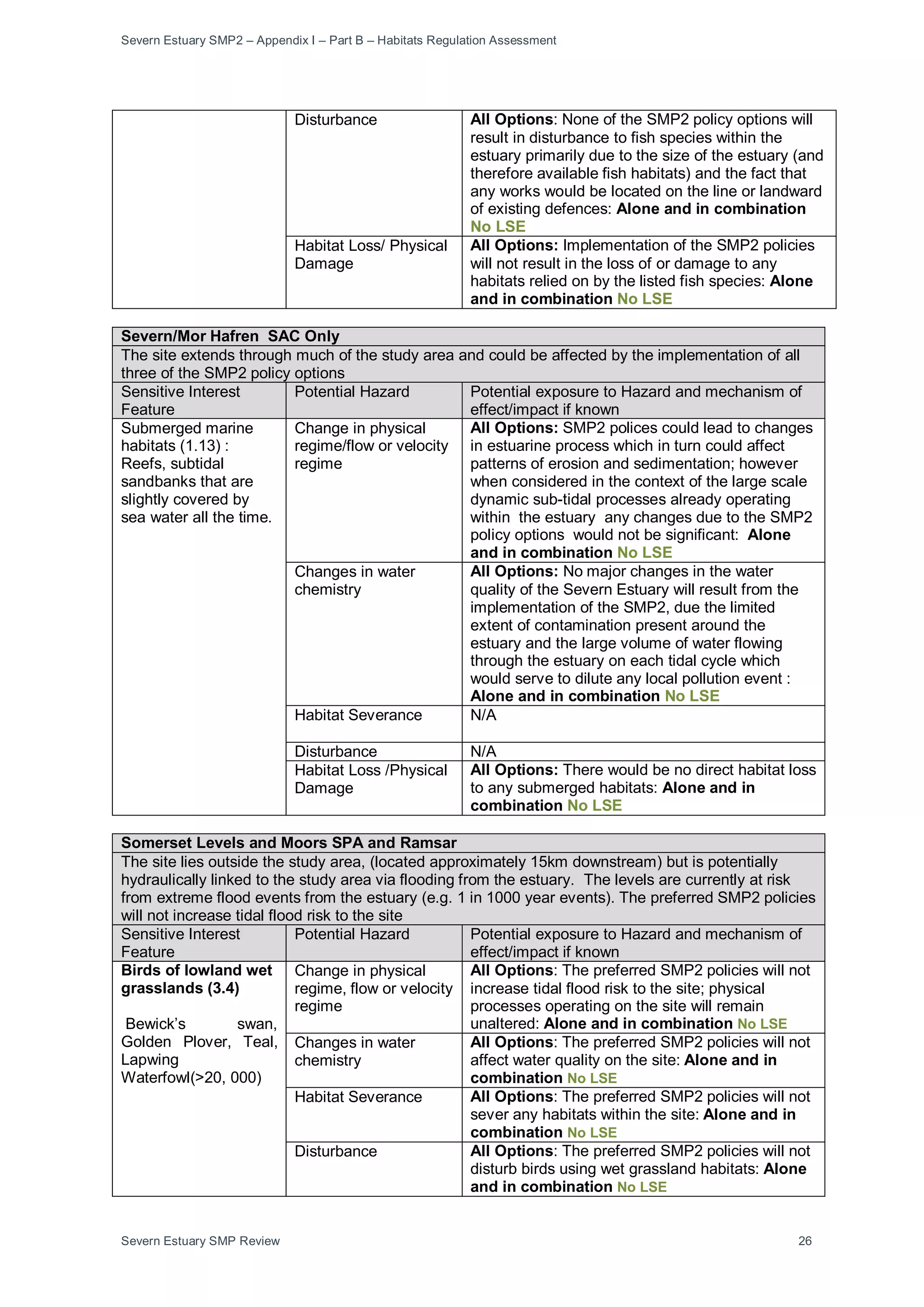
  • 15.
    Severn Estuary SMP2– Appendix I – Part B – Habitats Regulation Assessment Severn Estuary SMP Review 12 Severn Estuary SPA and Ramsar Severn Estuary SPA and Ramsar: The site extends through much of the study area and could be affected by the implementation of all three of the SMP2 policy options Sensitive Interest Feature Potential Hazard Potential exposure to Hazard and mechanism of effect/impact if known Birds of lowland wet grasslands (3.4) Severn Estuary SPA, Ramsar: Bewick’s swan, Dunlin, Redshank, Curlew, waterfowl (>20,000) Severn Estuary Ramsar only: Teal, Grey plover Change in physical regime, flow or velocity regime No Active Intervention and/or Managed Realignment. No direct impact on the designated bird species assemblage but potential to alter physical processes and affect habitats on which species are dependent for feeding and roosting. Impacts may affect the long term survival of individuals or alter behaviour and pattern of use or distribution: Alone: LSE In combination: None of the plans and projects reviewed are considered likely to result in increased inundation of freshwater habitats: No LSE Hold the Line Assuming the standard of protection is maintained or increased, raised sea levels could potentially increase the amount of time outfalls and drainage ditches are tide locked, temporarily increasing freshwater levels behind the defence. This impact could benefit wet grassland and species it supports. However, increased tide locking would occur as a result of sea level rise rather than implementation of the strategy. Given the extensive tidal range of the estuary any increase in tide locking is not anticipated to be great enough to result in a significant effect on habitats: Alone and in combination No LSE If standard of protection decreases, potential impacts would be as for NAI and MR. However the SMP does not specify how the HTL policy will be implemented, neither does it identify the SoP to be provided. Therefore at this stage it is not possible to identify whether impacts could occur or not. The potential for impacts to occur will be reviewed as part of the HRA for the FRMS which will address how HTL will be implemented including option alignments and SoP: Alone: Uncertain – it is not possible to rule out the likelihood of LSE (Alone) at SMP2 level, further review to be undertaken at FRMS stage. In combination : effects unlikely as potentials impacts associated with increased overtopping of defences: No LSE
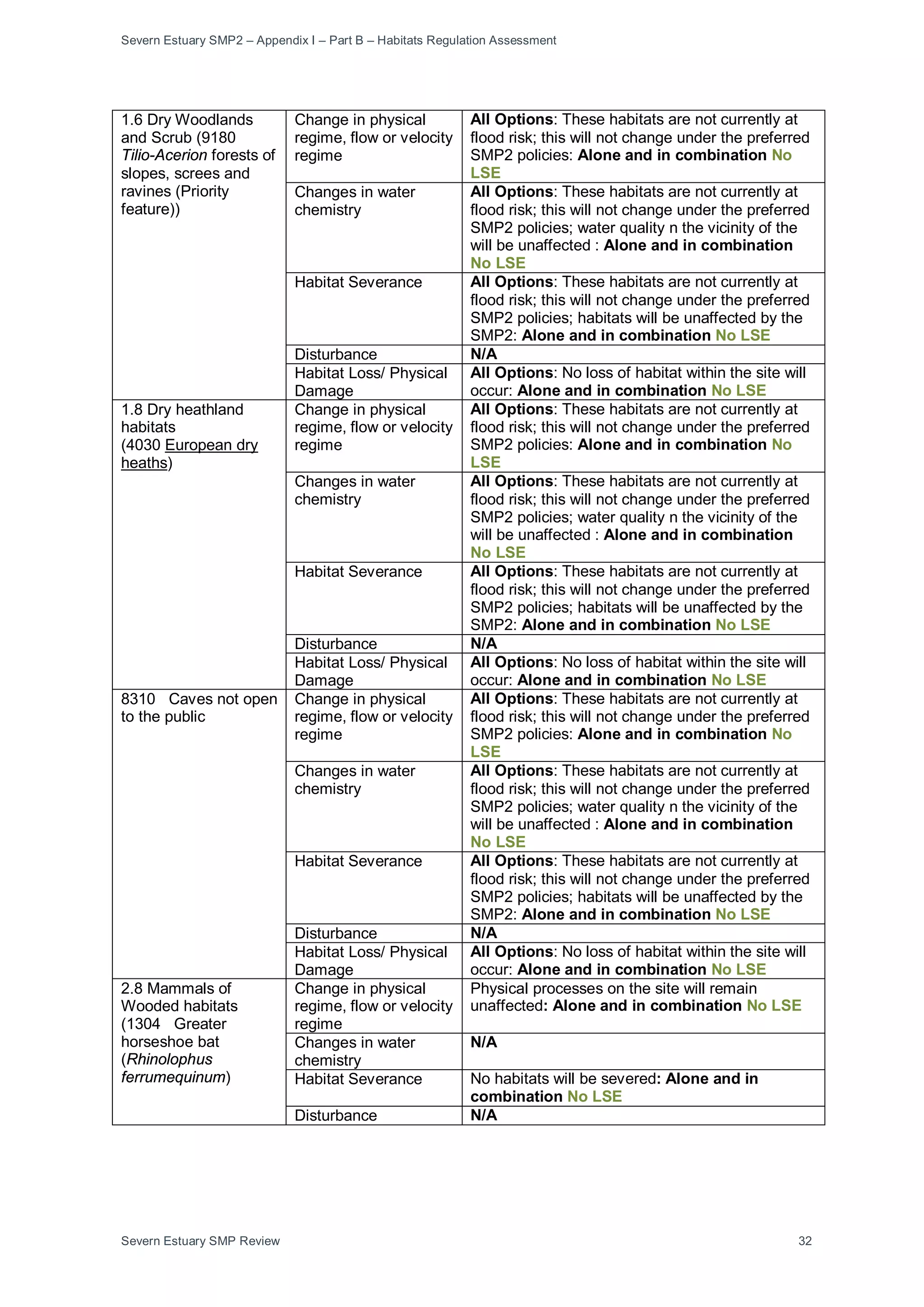
  • 16.
    Severn Estuary SMP2– Appendix I – Part B – Habitats Regulation Assessment Severn Estuary SMP Review 13 Changes in water chemistry All Options No major changes in the water quality of the Severn Estuary will result from the implementation of any of the SMP2 policies, due the limited extent of contamination present around the estuary and the large volume of water flowing through the estuary on each tidal cycle which would serve to dilute any local pollution event: Alone and in combination No LSE No Active Intervention and/or Managed Realignment could result in increased tidal inundation and salinisation of terrestrial habitats with potential knock on effects for the birds using the habitats; these habitats may be outside the European sites but could be supporting habitats for qualifying bird features: Alone: LSE In combination: None of the plans and projects reviewed are considered likely to result in increased inundation of freshwater habitats: No LSE Hold the Line: assuming the standard of protection is maintained or increased existing grassland habitat would be maintained, no anticipated long-term changes to habitat: Alone and in combination No LSE If standard of protection decreases, potential impacts would be as for NAI and HTL. However the SMP does not specify how the HTL policy will be implemented, neither does it identify the SoP to be provided. Therefore at this stage it is not possible to identify whether impacts could occur or not. The potential for impacts to occur will be reviewed as part of the HRA for the FRMS which will address how HTL will be implemented including option alignments and SoP: Alone: Uncertain – it is not possible to rule out the likelihood of LSE (Alone) at SMP2 level, further review to be undertaken at FRMS stage. In combination : effects unlikely as potentials impacts associated with increased overtopping of defences: No LSE Habitat Severance Hold the Line: defences maintained in current position so no habitat fragmentation : Alone and in combination No LSE Managed Realignment: realignment of defences would result in habitat loss or damage (see below) rather than habitat fragmentation: Alone and in combination No LSE No Active Intervention : Alone and in combination No LSE
  • 17.
    Severn Estuary SMP2– Appendix I – Part B – Habitats Regulation Assessment Severn Estuary SMP Review 14 Disturbance Improvement or maintenance works under a Hold the Line or Managed Realignment option have the potential to disturb birds through noise or visual disturbance. This can displace the birds from their feeding grounds. Disturbance can prevent the birds from feeding and in response they either a) decrease their energy intake at their present (disturbed) feeding site through displacement activity, or b) move to an alternative less favoured feeding site. Works will only be permitted at the appropriate time of year (only between April – September) to avoid the most sensitive time: Alone and in combination No LSE No Active Intervention : Alone and in combination No LSE Habitat Loss/ Physical Damage No Active Intervention/Managed Realignment: Increased tidal inundation has the potential to change habitats, possibly resulting in areas of lowland grassland being reduced decreasing available habitat for species foraging and roosting: Alone: LSE In combination: None of the plans and projects reviewed are considered likely to result in increased inundation of freshwater habitats: No LSE Hold the Line: assuming the standard of protection is maintained or increased, the existing grassland habitat behind defence would be maintained: Alone and in combination No LSE If standard of protection decreases, potential impacts would be as for NAI and HTL. However the SMP does not specify how the HTL policy will be implemented, neither does it identify the SoP to be provided. Therefore at this stage it is not possible to identify whether impacts could occur or not. The potential for impacts to occur will be reviewed as part of the HRA for the FRMS which will address how HTL will be implemented including option alignments and SoP: Alone: Uncertain – it is not possible to rule out the likelihood of LSE (Alone) at SMP2 level, further review to be undertaken at FRMS stage. In combination : effects unlikely as potentials impacts associated with increased overtopping of defences: No LSE
  • 18.
    Severn Estuary SMP2– Appendix I – Part B – Habitats Regulation Assessment Severn Estuary SMP Review 15 Potential for some minor habitat loss as a consequence of the increased footprint of the defence- if SoP maintained or increased. Also potential for more significant cumulative and in combination effects when all defences around the estuary are taken into consideration. The SMP2 does not specify how the HTL policy will be implemented so it is not possible to identify whether any impacts could occur or not. Further assessment to be undertaken as part of the FRMS. Alone and in combination : Uncertain – it is not possible to rule out the likelihood of LSE at SMP2 level, further review to be undertaken at FRMS stage Birds of lowland freshwaters and their margins (3.6) Severn Estuary SPA, Ramsar: Bewick’s,Swan White- fronted goose, Shelduck, Gadwall, Pintail , Ringed plover Waterfowl(>20, 000) Severn Ramsar only: Teal. Lesser black backed gull, Wigeon, Pochard, Tufted duck, Wimbrel Change in physical regime, flow or velocity regime No Active Intervention and/or Managed Realignment. No direct impact on the designated bird species assemblage but potential to alter physical processes and affect habitats on which species are dependent for feeding and roosting. Impacts may affect the long term survival of individuals or alter behaviour and pattern of use or distribution: Alone: LSE In combination: None of the plans and projects reviewed are considered likely to result in increased inundation of freshwater habitats: No LSE Hold the Line Assuming the standard of protection is maintained or increased, raised sea levels could potentially increase the amount of time outfalls and drainage ditches are tide locked, temporarily increasing freshwater levels behind the defence. However, increased tide locking would occur as a result of sea level rise rather than implementation of the strategy. Given the extensive tidal range of the estuary this increase is not anticipated to be great enough to result in a significant effect on habitats: Alone and in combination No LSE If standard of protection decreases, potential impacts would be as for NAI and HTL. However the SMP does not specify how the HTL policy will be implemented, neither does it identify the SoP to be provided. Therefore at this stage it is not possible to identify whether impacts could occur or not. The potential for impacts to occur will be reviewed as part of the HRA for the FRMS which will address how HTL will be implemented including option alignments and SoP: Alone: Uncertain – it is not possible to rule out the likelihood of LSE (Alone) at SMP2 level, further review to be undertaken at FRMS stage. In combination : effects unlikely as potentials impacts associated with increased overtopping of defences: No LSE
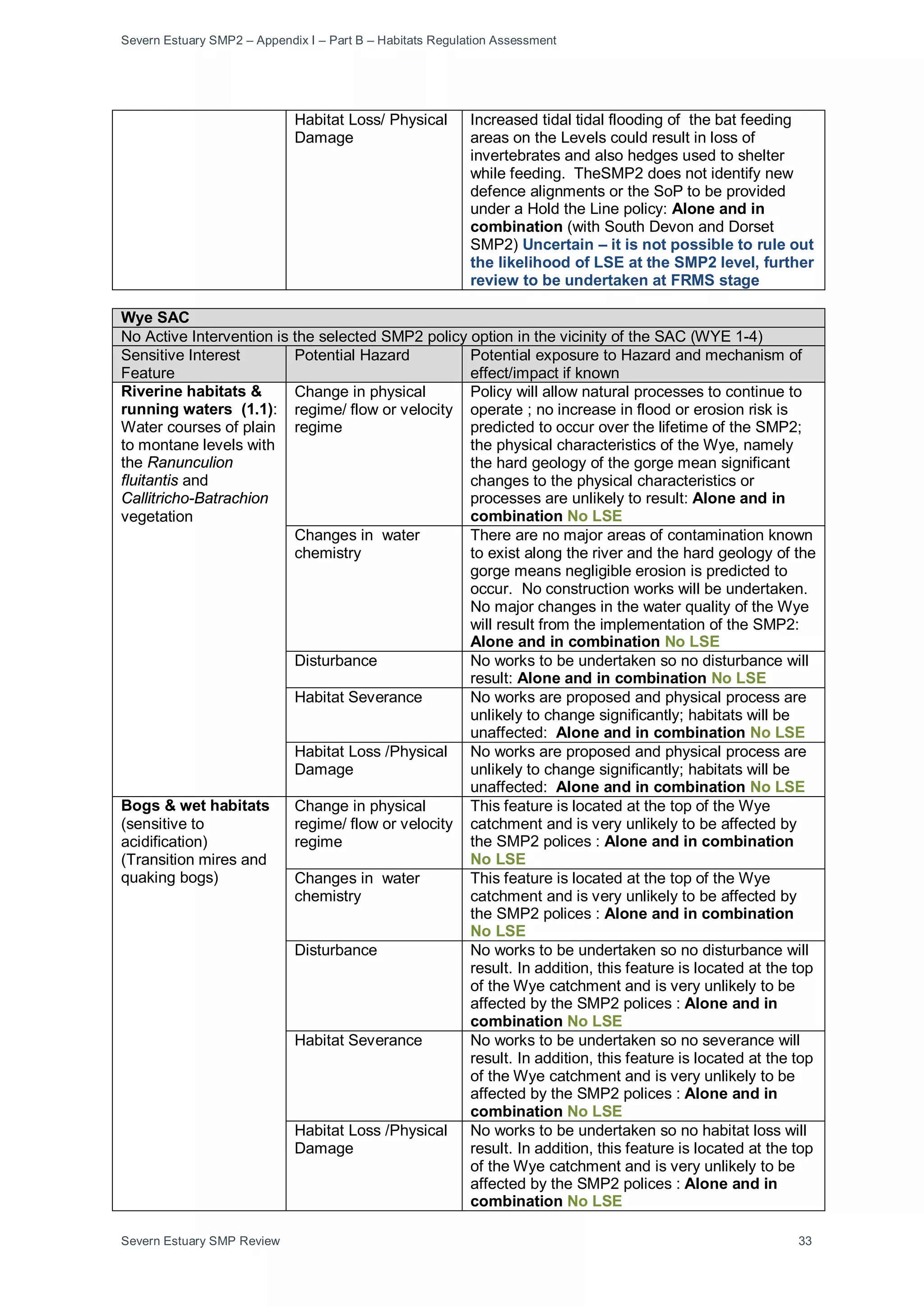
  • 19.
    Severn Estuary SMP2– Appendix I – Part B – Habitats Regulation Assessment Severn Estuary SMP Review 16 Changes in water chemistry All Options No major changes in the water quality of the Severn Estuary will result from the implementation of the SMP2, due to the limited extent of contamination present around the estuary and the large volume of water flowing through the estuary on each tidal cycle which would serve to dilute any local pollution event : Alone and in combination No LSE No Active Intervention and/or Managed Realignment could result in increased tidal inundation and salinisation of terrestrial habitats with potential knock on effects for the birds using the habitats; these habitats may be outside the European sites but could be supporting habitats for qualifying bird features: Alone: LSE In combination: None of the plans and projects reviewed are considered likely to result in increased inundation of freshwater habitats: No LSE Hold the Line: Assuming the standard of protection is maintained or increased, existing grassland habitat maintained, no anticipated long-term changes to habitat: Alone and in combination No LSE If standard of protection decreases, potential impacts would be as for NAI and HTL. However the SMP does not specify how the HTL policy will be implemented, neither does it identify the SoP to be provided. Therefore at this stage it is not possible to identify whether impacts could occur or not. The potential for impacts to occur will be reviewed as part of the HRA for the FRMS which will address how HTL will be implemented including option alignments and SoP: Alone: Uncertain – it is not possible to rule out the likelihood of LSE (Alone) at SMP2 level, further review to be undertaken at FRMS stage. In combination : effects unlikely as potentials impacts associated with increased overtopping of defences: No LSE Habitat Severance Hold the Line: defences maintained in current position so no habitat fragmentation: Alone and in combination No LSE Managed Realignment : realignment of defences would result in habitat loss or damage (see below) rather than habitat fragmentation: Alone and in combination No LSE No Active Intervention: Alone and in combination No LSE
  • 20.
    Severn Estuary SMP2– Appendix I – Part B – Habitats Regulation Assessment Severn Estuary SMP Review 17 Disturbance Improvement or maintenance works under a Hold the Line or Managed Realignment option have the potential to disturb birds through noise or visual disturbance. This can displace the birds from their feeding grounds. Disturbance can prevent the birds from feeding and in response they either a) decrease their energy intake at their present (disturbed) feeding site through displacement activity, or b) move to an alternative less favoured feeding site. Works will only be permitted at the appropriate time of year (only between April – September) to avoid the most sensitive time: Alone and in combination No LSE No Active Intervention: Alone and in combination No LSE Habitat Loss/ Physical Damage No Active Intervention/Managed Realignment: increased tidal inundation resulting in alterations to vegetation, habitats and the birds they support: Alone: LSE In combination: None of the plans and projects reviewed are considered likely to result in increased inundation of freshwater habitats: No LSE Hold the line: Assuming the standard of protection is maintained or increased, the defences are retained in place and will maintain freshwater and marginal habitats: Alone and in combination No LSE If standard of protection decreases, potential impacts would be as for NAI and HTL. However the SMP does not specify how the HTL policy will be implemented, neither does it identify the SoP to be provided. Therefore at this stage it is not possible to identify whether impacts could occur or not. The potential for impacts to occur will be reviewed as part of the HRA for the FRMS which will address how HTL will be implemented including option alignments and SoP: Alone: Uncertain – it is not possible to rule out the likelihood of LSE (Alone) at SMP2 level, further review to be undertaken at FRMS stage. In combination : effects unlikely as potentials impacts associated with increased overtopping of defences: No LSE
  • 21.
    Severn Estuary SMP2– Appendix I – Part B – Habitats Regulation Assessment Severn Estuary SMP Review 18 Potential for some minor habitat loss as a consequence of the increased footprint of the defence - if SoP maintained or increased. Also potential for more significant cumulative and in combination effects when all defences around the estuary are taken into consideration. The SMP2 does not specify how the HTL policy will be implemented so it is not possible to identify whether any impacts could occur or not. Further assessment to be undertaken as part of the FRMS. Alone and in combination :Uncertain – it is not possible to rule out the likelihood of LSE at SMP2 level, further review to be undertaken at FRMS stage Birds of farmland (3.7) Severn Estuary SPA, Ramsar: Bewick’s Swan, White- fronted goose, Dunlin, Redshank, Curlew Severn Estuary Ramsar only: Teal, Grey plover Change in physical regime, flow or velocity regime No Active Intervention and/or Managed Realignment. No direct impact on the designated bird species assemblage but potential to alter physical processes and affect habitats on which species are dependent for feeding and roosting. Impacts may affect the long term survival of individuals or alter behaviour and pattern of use or distribution: Alone: LSE In combination: None of the plans and projects reviewed are considered likely to result in increased inundation of freshwater habitats: No LSE Hold the Line Assuming the standard of protection is maintained or increased, raised sea levels could potentially increase the amount of time outfalls and drainage ditches are tide locked, temporarily increasing freshwater levels behind the defence. However, increased tide locking would occur as a result of sea level rise rather than implementation of the strategy. Given the extensive tidal range of the estuary this increase is not anticipated to be great enough to result in a significant effect on habitats: Alone and in combination No LSE If standard of protection decreases, potential impacts would be as for NAI and HTL. However the SMP does not specify how the HTL policy will be implemented, neither does it identify the SoP to be provided. Therefore at this stage it is not possible to identify whether impacts could occur or not. The potential for impacts to occur will be reviewed as part of the HRA for the FRMS which will address how HTL will be implemented including option alignments and SoP: Alone: Uncertain – it is not possible to rule out the likelihood of LSE (Alone) at SMP2 level, further review to be undertaken at FRMS stage. In combination : effects unlikely as potentials impacts associated with increased overtopping of defences: No LSE
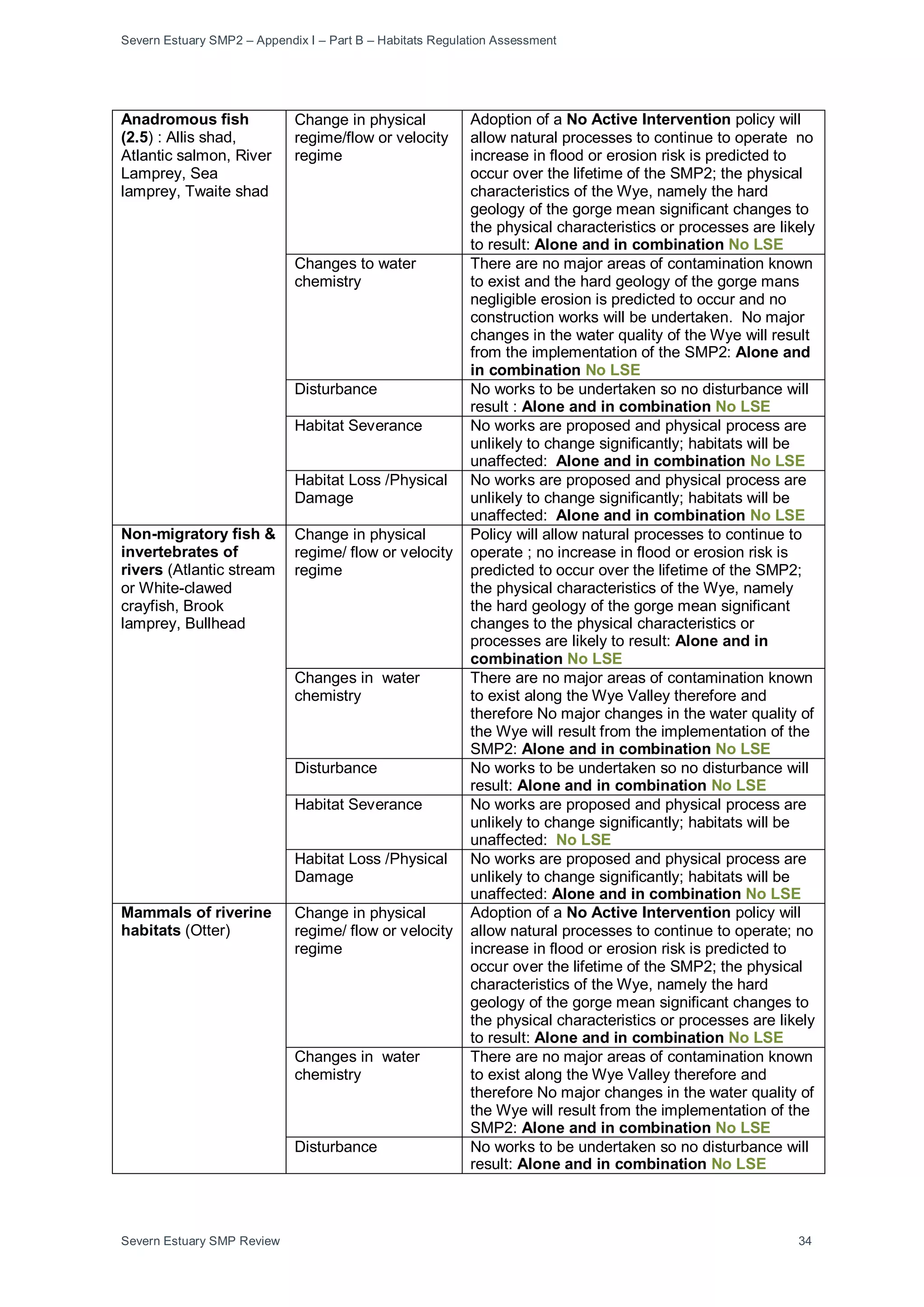
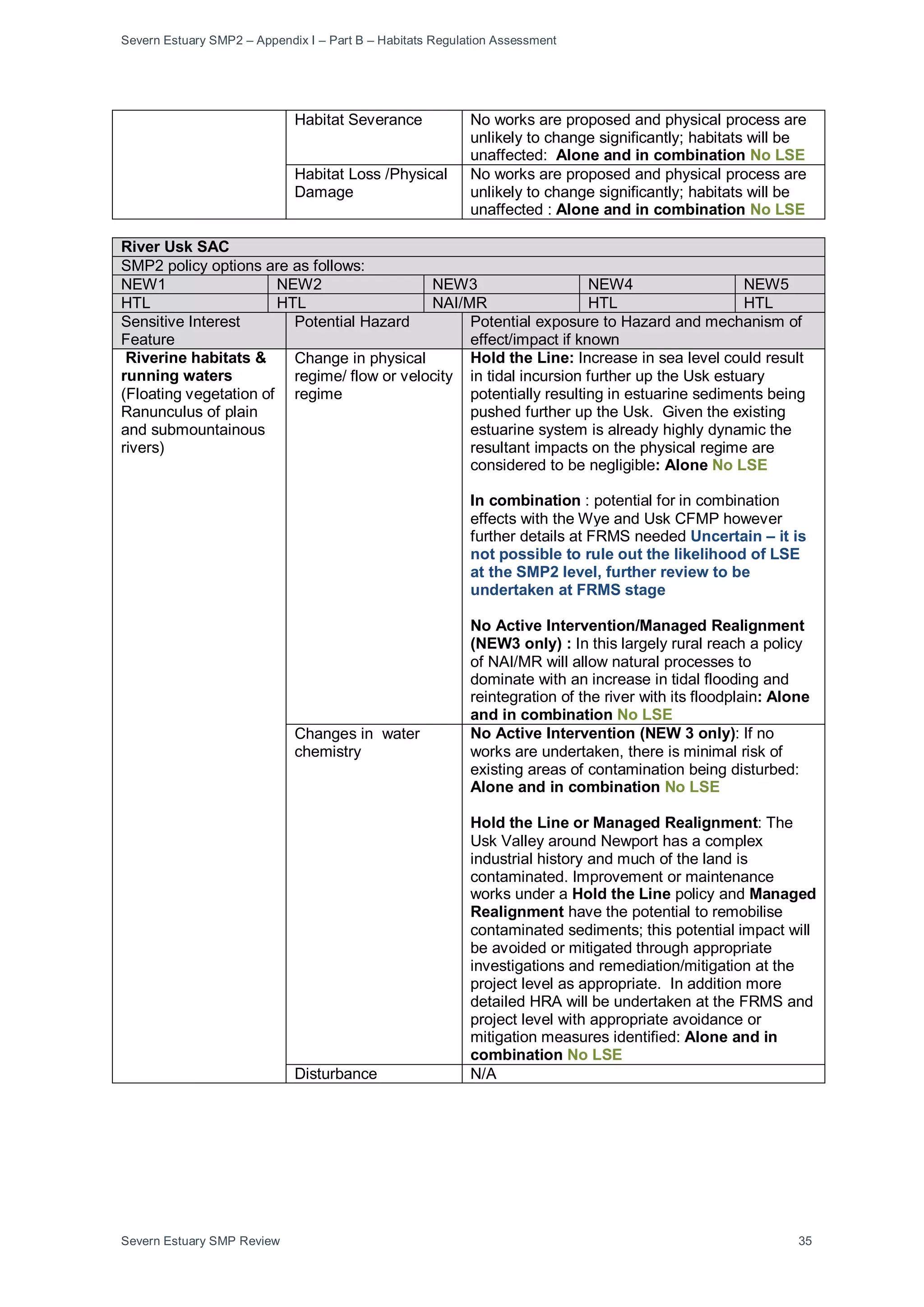
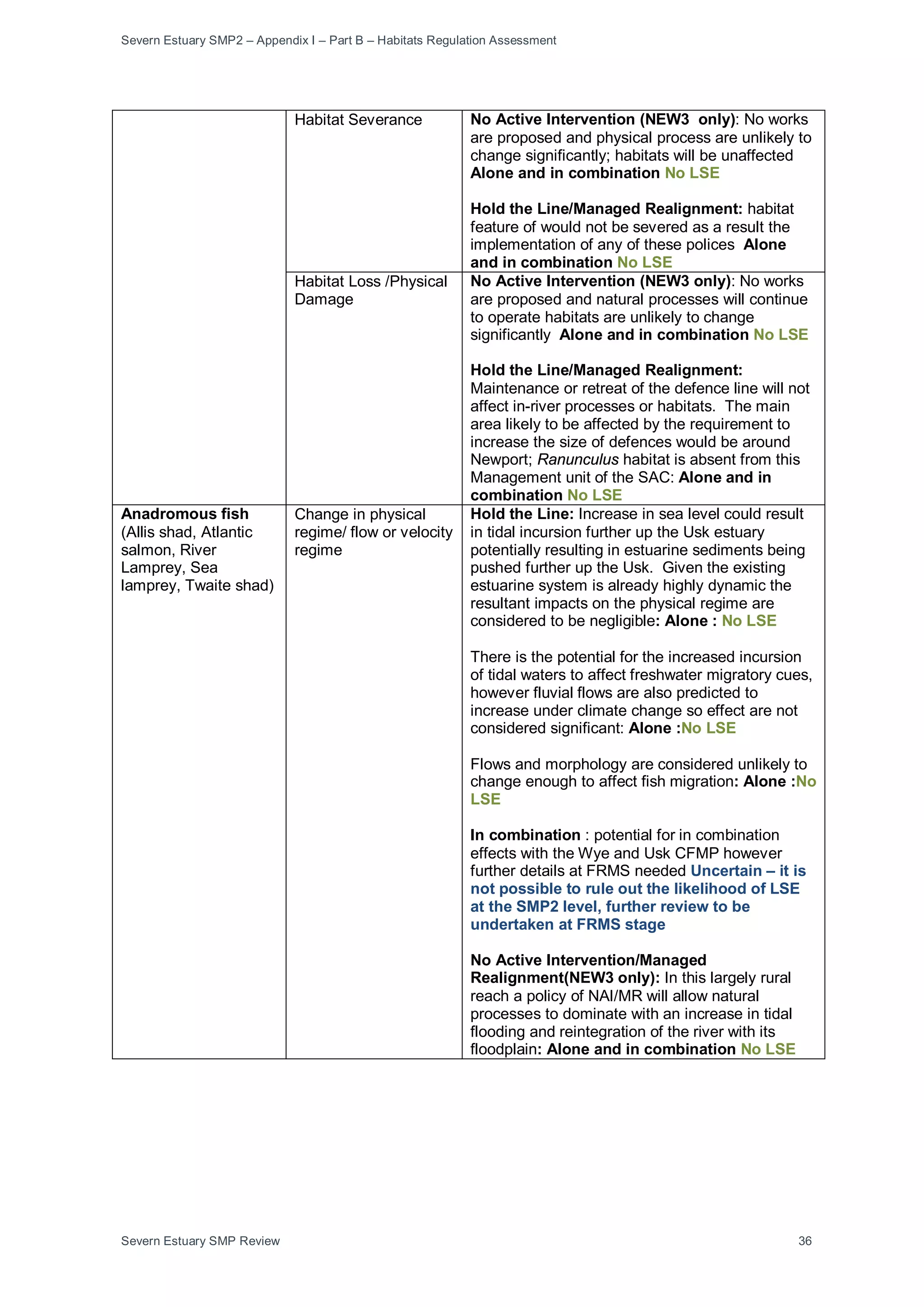
  • 22.
    Severn Estuary SMP2– Appendix I – Part B – Habitats Regulation Assessment Severn Estuary SMP Review 19 Changes in water chemistry All Options No major changes in the water quality of the Severn Estuary will result from the implementation of any of the SMP2 policies, due the limited extent of contamination present around the estuary and the large volume of water flowing through the estuary on each tidal cycle which would serve to dilute any local pollution event: Alone and in combination No LSE No Active Intervention and/or Managed Realignment could result in increased tidal inundation and salinisation of terrestrial habitats with potential knock on effects for the birds using the habitats; these habitats may be outside the European sites but could be supporting habitats for qualifying bird features: Alone: LSE In combination: None of the plans and projects reviewed are considered likely to result in increased inundation of freshwater habitats: No LSE Hold the Line: Assuming the standard of protection is maintained or increased, existing farmland habitat maintained, no anticipated long-term changes to habitat: Alone and in combination No LSE If standard of protection decreases, potential impacts would be as for NAI and HTL. However the SMP does not specify how the HTL policy will be implemented, neither does it identify the SoP to be provided. Therefore at this stage it is not possible to identify whether impacts could occur or not. The potential for impacts to occur will be reviewed as part of the HRA for the FRMS which will address how HTL will be implemented including option alignments and SoP: Alone: Uncertain – it is not possible to rule out the likelihood of LSE (Alone) at SMP2 level, further review to be undertaken at FRMS stage. In combination : effects unlikely as potentials impacts associated with increased overtopping of defences: No LSE Habitat Severance Hold the Line: the defences will be maintained in current position so no habitat fragmentation: Alone and in combination No LSE Managed Realignment: realignment of defences would result in habitat loss or damage (see below) rather than habitat fragmentation: Alone and in combination No LSE No Active Intervention : Alone and in combination No LSE
  • 23.
    Severn Estuary SMP2– Appendix I – Part B – Habitats Regulation Assessment Severn Estuary SMP Review 20 Disturbance Improvement or maintenance works under a Hold the Line or Managed Realignment option have the potential to disturb birds through noise or visual disturbance. This can displace the birds from their feeding grounds. Disturbance can prevent the birds from feeding and in response they either a) decrease their energy intake at their present (disturbed) feeding site through displacement activity, or b) move to an alternative less favoured feeding site. Works will only be permitted at the appropriate time of year (only between April – September) to avoid the most sensitive time: Alone and in combination No LSE No Active Intervention : Alone and in combination No LSE Habitat Loss/ Physical Damage No Active Intervention/Managed Realignment: increased tidal inundation resulting in alteration in vegetation and farmland habitats which could reduce suitability for feeding and roosting: Alone: LSE In combination: None of the plans and projects reviewed are considered likely to result in increased inundation of freshwater habitats: No LSE Hold the Line: assuming the standard of protection is maintained or increased the habitats beyond will be maintained and not damaged: Alone and in combination No LSE If standard of protection decreases, potential impacts would be as for NAI and HTL. However the SMP does not specify how the HTL policy will be implemented, neither does it identify the SoP to be provided. Therefore at this stage it is not possible to identify whether impacts could occur or not. The potential for impacts to occur will be reviewed as part of the HRA for the FRMS which will address how HTL will be implemented including option alignments and SoP: Alone: Uncertain – it is not possible to rule out the likelihood of LSE (Alone) at SMP2 level, further review to be undertaken at FRMS stage. In combination : effects unlikely as potentials impacts associated with increased overtopping of defences: No LSE
  • 24.
    Severn Estuary SMP2– Appendix I – Part B – Habitats Regulation Assessment Severn Estuary SMP Review 21 Potential for some minor habitat loss as a consequence of the increased footprint of the defence- if SoP maintained or increased. Also potential for cumulative and in combination effects when all defences around the estuary are taken into consideration. The SMP2 does not specify how the HTL policy will be implemented so it is not possible to identify whether any impacts could occur or not. Further assessment to be undertaken as part of the FRMS. Alone and in combination Uncertain – it is not possible to rule out the likelihood of LSE at SMP2 level, further review to be undertaken at FRMS stage Birds of coastal habitats (3.8) Severn Estuary SPA, Ramsar: Bewick’s Swan, , White-fronted goose, Dunlin, Redshank, Shelduck, Curlew Pintail, Ringed plover, Waterfowl(>20, 000) Severn Ramsar only: Teal, lesser black backed gull, Wigeon, Pochard Change in physical regime, flow or velocity regime No Active Intervention and/or Managed Realignment: physical processes likely to result in an increase in coastal and intertidal habitats: Alone and in combination No LSE Hold the Line increased sea level and coastal squeeze could alter physical processes on the foreshore potentially drowning out intertidal habitats : Alone and in combination (with North Devon and Somerset and Swansea and Carmarthen Bay SMP2s) LSE Changes in water chemistry All Options: No major changes in the water quality of the Severn Estuary will result from the implementation of the SMP2, due the limited extent of contamination present around the estuary and the large volume of water flowing through the estuary on each tidal cycle which would serve to dilute any local pollution event : Alone and in combination No LSE Habitat Severance Managed Realignment would increase extent of coastal habitat; severance would not occur: Alone and in combination No LSE No Active Intervention : Alone and in combination No LSE Hold the Line: defences maintained in current position so no habitat fragmentation: Alone and in combination No LSE Disturbance Improvement or maintenance works under a Hold the Line or Managed Realignment option have the potential to disturb birds through noise or visual disturbance. This can displace the birds from their feeding grounds. Disturbance can prevent the birds from feeding and in response they either a) decrease their energy intake at their present (disturbed) feeding site through displacement activity, or b) move to an alternative less favoured feeding site. Works will only be permitted at the appropriate time of year (only between April – September) to avoid the most sensitive time: Alone and in combination No LSE No Active Intervention : Alone and in combination No LSE
  • 25.
    Severn Estuary SMP2– Appendix I – Part B – Habitats Regulation Assessment Severn Estuary SMP Review 22 Habitat Loss/ Physical Damage No Active Intervention/Managed Realignment: Extent of coastal and intertidal habitat would increase : Alone and in combination No LSE Hold the line: sea level rise and coastal squeeze would result in the loss of intertidal habitats, potentially reducing bird feeding areas: Alone and in combination (with North Devon and Somerset and Swansea and Carmarthen Bay SMP2s) LSE Potential for some minor habitat loss as a consequence of the increased footprint of the defence - if SoP maintained or increased. Also potential for more significant cumulative and in combination effects when all defences around the estuary are taken into consideration. The SMP2 does not specify how the HTL policy will be implemented so it is not possible to identify whether any impacts could occur or not. Further assessment to be undertaken as part of the FRMS. Alone and in combination Uncertain – it is not possible to rule out the likelihood of LSE at SMP2 level, further review to be undertaken at FRMS stage Birds of estuarine habitats (3.9) Severn Estuary SPA, Ramsar: White-fronted goose, Dunlin, Redshank, Shelduck, Curlew, Pintail,Ringed Plover) Waterfowl(>20, 000) Severn Ramsar only: Teal, lesser black backed gull, Wimbrel, Pochard Change in physical regime, flow or velocity regime No Active Intervention and Managed Realignment options are likely to result in an increase in the extent of intertidal habitats: Alone and in combination No LSE Under Hold the Line climate change and sea level rise (coastal squeeze) will result in a changes to flows and physical regimes which could in turn potentially result in a change in the extent and distribution of intertidal habitats in front of the defence: Alone and in combination (with North Devon and Somerset and Swansea and Carmarthen Bay SMP2s) LSE Changes in water chemistry No major changes in the water quality of the Severn Estuary will result from the implementation of the SMP2, due the limited extent of contamination present around the estuary and the large volume of water flowing through the estuary on each tidal cycle which would serve to dilute any local pollution event: Alone and in combination No LSE Habitat Severance Managed Realignment would increase the extent of intertidal habitat; severance would not occur: Alone and in combination No LSE No Active Intervention : this option would increase the extent of intertidal habitat Alone and in combination No LSE Hold the Line: defences maintained in current position so no habitat fragmentation: Alone and in combination No LSE
  • 26.
    Severn Estuary SMP2– Appendix I – Part B – Habitats Regulation Assessment Severn Estuary SMP Review 23 Disturbance Improvement or maintenance works under a Hold the Line or Managed Realignment option have the potential to disturb birds through noise or visual disturbance. This can displace the birds from their feeding grounds. Disturbance can prevent the birds from feeding and in response they either a) decrease their energy intake at their present (disturbed) feeding site through displacement activity, or b) move to an alternative less favoured feeding site. Works will only be permitted at the appropriate time of year (only between April – September) to avoid the most sensitive time: Alone and in combination No LSE No Active Intervention : no disturbance would result: Alone and in combination No LSE Habitat Loss/ Physical Damage No Active Intervention and Managed Realignment options are likely to result in an increase in the extent of intertidal habitats: Alone and in combination No LSE Under Hold the Line climate change and sea level rise (coastal squeeze) could potentially result in loss of or damage to intertidal habitats in front of the defence, reducing feeding areas: Alone and in combination (with North Devon and Somerset and Swansea and Carmarthen Bay SMP2s) LSE Potential for some minor habitat loss as a consequence of the increased footprint of the defence- if SoP increased. Also potential for more significant cumulative and in combination effects when all defences around the estuary are taken into consideration. The SMP2 does not specify how the HTL policy will be implemented so it is not possible to identify whether any impacts could occur or not. Further assessment to be undertaken as part of the FRMS. Alone and in combination Uncertain – it is not possible to rule out the likelihood of LSE at SMP2 level, further review to be undertaken at FRMS stage
  • 27.
    Severn Estuary SMP2– Appendix I – Part B – Habitats Regulation Assessment Severn Estuary SMP Review 24 Severn Estuary SAC and Ramsar: The site extends through much of the study area and could be affected by the implementation of all three of the SMP2 policy options Sensitive Interest Feature Potential Hazard Potential exposure to Hazard and mechanism of effect/impact if known Estuarine & intertidal habitats (1.12) : Atlantic salt meadows, Estuaries, Mudflats and sandflats not covered by seawater at low tide Change in physical regime, flow or velocity regime Under Hold the Line climate change and sea level rise (coastal squeeze) will result in a changes to flows and physical regimes which will in turn alter sedimentation and erosion processes potentially resulting in a change in the extent and distribution of intertidal habitats in front of the defence: Alone and in combination (with North Devon and Somerset and Swansea and Carmarthen Bay SMP2s) LSE No Active Intervention and Managed Realignment options are likely to result in an increase in the extent of intertidal habitats: Alone and in combination No LSE Changes in water chemistry No major changes in the water quality of the Severn Estuary will result from the implementation of the SMP2, due the limited extent of contamination present around the estuary and the large volume of water flowing through the estuary on each tidal cycle which would serve to dilute any local pollution event : Alone and in combination No LSE Habitat Severance Hold the Line: defences maintained in current position so no habitat fragmentation: Alone and in combination No LSE Managed Realignment would increase the extent of intertidal and estuarine habitat; severance would not occur : Alone and in combination No LSE No Active Intervention : Alone and in combination No LSE Disturbance N/A Habitat Loss/ Physical Damage Hold the Line: Sea level rise could potentially result in habitat loss due to coastal squeeze Alone and in combination (with North Devon and Somerset and Swansea and Carmarthen Bay SMP2s) LSE Potential for some minor habitat loss as a consequence of the increased footprint of the defence- if SoP increased. Also potential for more significant cumulative and in combination effects when all defences around the estuary are taken into consideration. The SMP2 does not specify how the HTL policy will be implemented so it is not possible to identify whether any impacts could occur or not. Further assessment to be undertaken as part of the FRMS. Alone and in combination Uncertain – it is not possible to rule out the likelihood of LSE at SMP2 level, further review to be undertaken at FRMS stage
  • 28.
    Severn Estuary SMP2– Appendix I – Part B – Habitats Regulation Assessment Severn Estuary SMP Review 25 Managed Realignment: Realignment of defences would increase the extent of intertidal and estuarine habitats: Alone and in combination No LSE No Active Intervention: extent if intertidal habitat would roll back as sea level rose: Alone and in combination No LSE Anadromous fish (2.5) : Allis shad, Atlantic salmon, River Lamprey, Sea lamprey, Twaite shad Change in physical regime, flow or velocity regime All Options: Any changes in estuarine process that might arise from any of the SMP2 policies will not be significant enough at the estuary scale to affect fish species for which the site is designated : Alone and in combination No LSE Changes in water chemistry All Options: No major changes in the water quality of the Severn Estuary will result from the implementation of the SMP2, due the limited extent of contamination present around the estuary and the large volume of water flowing through the estuary on each tidal cycle which would serve to dilute any local pollution event : Alone and in combination No LSE Habitat Severance All Options: Implementation of any of the SMP2 will not result in the severance of any of habitats relied on by the listed fish species: Alone and in combination No LSE Disturbance All Options: None of the SMP2 policy options will result in disturbance to fish species within the estuary primarily due to the size of the estuary (and therefore available fish habitats) and the fact that any works would be located on the line or landward of existing defences: Alone and in combination No LSE Habitat Loss/ Physical Damage All Options: Implementation of the SMP2 policies will not result in the loss of or damage to any habitats relied on by the listed fish species: Alone and in combination No LSE Severn Estuary Ramsar Only The site extends through much of the study area and could be affected by the implementation of all three of the SMP2 policy options Sensitive Interest Feature Potential Hazard Potential exposure to Hazard and mechanism of effect/impact if known Severn Estuary Ramsar Non-migratory fish & invertebrates of rivers (2.6) Change in physical regime, flow or velocity regime All Options: Any changes in estuarine process that might arise from any of the SMP2 policies will not be significant enough at the estuary scale to affect fish species for which the site is designated: Alone and in combination No LSE Changes in water chemistry All Options: No major changes in the water quality of the Severn Estuary will result from the implementation of the SMP2, due the limited extent of contamination present around the estuary and the large volume of water flowing through the estuary on each tidal cycle which would serve to dilute any local pollution event : Alone and in combination No LSE Habitat Severance All Options: Implementation of any of the SMP2 will not result in the severance of any of habitats relied on by the listed fish species: Alone and in combination No LSE
  • 29.
    Severn Estuary SMP2– Appendix I – Part B – Habitats Regulation Assessment Severn Estuary SMP Review 26 Disturbance All Options: None of the SMP2 policy options will result in disturbance to fish species within the estuary primarily due to the size of the estuary (and therefore available fish habitats) and the fact that any works would be located on the line or landward of existing defences: Alone and in combination No LSE Habitat Loss/ Physical Damage All Options: Implementation of the SMP2 policies will not result in the loss of or damage to any habitats relied on by the listed fish species: Alone and in combination No LSE Severn/Mor Hafren SAC Only The site extends through much of the study area and could be affected by the implementation of all three of the SMP2 policy options Sensitive Interest Feature Potential Hazard Potential exposure to Hazard and mechanism of effect/impact if known Submerged marine habitats (1.13) : Reefs, subtidal sandbanks that are slightly covered by sea water all the time. Change in physical regime/flow or velocity regime All Options: SMP2 polices could lead to changes in estuarine process which in turn could affect patterns of erosion and sedimentation; however when considered in the context of the large scale dynamic sub-tidal processes already operating within the estuary any changes due to the SMP2 policy options would not be significant: Alone and in combination No LSE Changes in water chemistry All Options: No major changes in the water quality of the Severn Estuary will result from the implementation of the SMP2, due the limited extent of contamination present around the estuary and the large volume of water flowing through the estuary on each tidal cycle which would serve to dilute any local pollution event : Alone and in combination No LSE Habitat Severance N/A Disturbance N/A Habitat Loss /Physical Damage All Options: There would be no direct habitat loss to any submerged habitats: Alone and in combination No LSE Somerset Levels and Moors SPA and Ramsar The site lies outside the study area, (located approximately 15km downstream) but is potentially hydraulically linked to the study area via flooding from the estuary. The levels are currently at risk from extreme flood events from the estuary (e.g. 1 in 1000 year events). The preferred SMP2 policies will not increase tidal flood risk to the site Sensitive Interest Feature Potential Hazard Potential exposure to Hazard and mechanism of effect/impact if known Birds of lowland wet grasslands (3.4) Bewick’s swan, Golden Plover, Teal, Lapwing Waterfowl(>20, 000) Change in physical regime, flow or velocity regime All Options: The preferred SMP2 policies will not increase tidal flood risk to the site; physical processes operating on the site will remain unaltered: Alone and in combination No LSE Changes in water chemistry All Options: The preferred SMP2 policies will not affect water quality on the site: Alone and in combination No LSE Habitat Severance All Options: The preferred SMP2 policies will not sever any habitats within the site: Alone and in combination No LSE Disturbance All Options: The preferred SMP2 policies will not disturb birds using wet grassland habitats: Alone and in combination No LSE
  • 30.
    Severn Estuary SMP2– Appendix I – Part B – Habitats Regulation Assessment Severn Estuary SMP Review 27 Habitat Loss/ Physical Damage All Options: No loss of wet grassland habitat within the site will occur: Alone and in combination No LSE Birds of lowland freshwaters and their margins (3.6) Bewick’s swan, Teal, Widgeon, Pintail, Shovler, Waterfowl(>20, 000), Change in physical regime, flow or velocity regime All Options: The preferred SMP2 policies will not increase tidal flood risk to the site; physical processes operating on the site will remain unaltered: Alone and in combination No LSE Changes in water chemistry All Options: The preferred SMP2 policies will not affect water quality on the site: Alone and in combination No LSE Habitat Severance All Options: The preferred SMP2 policies will not sever any habitats within the site: Alone and in combination No LSE Disturbance All Options: The preferred SMP2 policies will not disturb birds using lowland freshwater habitats: No Alone and in combination LSE Habitat Loss/ Physical Damage All Options: No loss of lowland freshwater habitat within the site will occur: Alone and in combination No LSE Birds of farmland (3.7) Bewick’s swan, Lapwing, Widgeon Change in physical regime, flow or velocity regime All Options: The preferred SMP2 policies will not increase tidal flood risk to the site; physical processes operating on the site will remain unaltered: Alone and in combination No LSE Changes in water chemistry All Options: The preferred SMP2 policies will not affect water quality on the site: Alone and in combination No LSE Habitat Severance All Options: The preferred SMP2 policies will not sever any habitats within the site: No LSE Disturbance All Options: The preferred SMP2 policies will not disturb birds using farmland habitats: Alone and in combination No LSE Habitat Loss/ Physical Damage All Options: No loss of farmland habitat within the site will occur: Alone and in combination No LSE Birds of coastal habitats (3.8) Bewick’s Swan, Golden Plover, Teal, Widgeon, Pintail, Waterfowl(>20, 000) Change in physical regime, flow or velocity regime No Active Intervention and/or Managed Realignment: physical processes likely to result in an increase in coastal and intertidal habitats: Alone and in combination No LSE Hold the Line increased sea level and coastal squeeze could alter physical processes along the Severn foreshore potentially affecting intertidal habitats. This could adversely affect feeding and roosting habitats which support bird populations on the site potentially altering bird population size, density and distribution on the Somerset Levels and Moors: Alone and in combination (with North Devon and Somerset and Swansea and Carmarthen Bay SMP2s) LSE Changes in water chemistry All Options: No major changes in the water quality of the Severn Estuary will result from the implementation of the SMP2, due the limited extent of contamination present around the estuary and the large volume of water flowing through the estuary on each tidal cycle which would serve to dilute any local pollution event. Water quality on the or the Levels and Moors will be unaffected : Alone and in combination No LSE Habitat Severance All Options: no severance of coastal habitats or the levels and Moors sites will occur: Alone and in combination No LSE
  • 31.
    Severn Estuary SMP2– Appendix I – Part B – Habitats Regulation Assessment Severn Estuary SMP Review 28 Disturbance Improvement or maintenance works under a Hold the Line or Managed Realignment option have the potential to disturb birds using the foreshore (outside the SPA/Ramsar) during construction. Works will only be permitted at the appropriate time of year (only between April – September) to avoid the most sensitive period : Alone and in combination No LSE No Active Intervention : Alone and in combination No LSE No disturbance will occur on the sites themselves: Alone and in combination No LSE Habitat Loss/ Physical Damage No Active Intervention/Managed Realignment: Extent of coastal and intertidal habitat would increase : Alone and in combination No LSE Hold the line: sea level rise and coastal squeeze would result in the loss of intertidal habitats, potentially reducing bird feeding areas: Alone and in combination (with North Devon and Somerset and Swansea and Carmarthen Bay SMP2s) LSE Potential for some minor habitat loss as a consequence of the increased footprint of the defence- if SoP increased. Also potential for more significant cumulative and in combination effects when all defences around the estuary are taken into consideration. The SMP2 does not specify how the HTL policy will be implemented so it is not possible to identify whether any impacts could occur or not. Further assessment to be undertaken as part of the FRMS. Alone and in combination Uncertain – it is not possible to rule out the likelihood of LSE at SMP2 level, further review to be undertaken at FRMS stage. No habitat loss on the SPA/Ramsar sites themselves will occur: Alone and in combination No LSE Birds of estuarine habitats (3.9) Golden Plover, Teal, Lapwing, Mute Swan, Widgeon, Pintail, Shovler, Waterfowl(>20, 000) Change in physical regime, flow or velocity regime No Active Intervention and/or Managed Realignment: physical processes likely to result in an increase in coastal and intertidal habitats: Alone and in combination No LSE Hold the Line increased sea level and coastal squeeze could alter physical processes along the Severn foreshore potentially affecting intertidal habitats. This could adversely affect feeding and roosting habitat which support birds populations on the site potentially altering bird population size, density and distribution on the Somerset Levels and Moors: Alone and in combination (with North Devon and Somerset and Swansea and Carmarthen Bay SMP2s) LSE
  • 32.
    Severn Estuary SMP2– Appendix I – Part B – Habitats Regulation Assessment Severn Estuary SMP Review 29 Changes in water chemistry All Options: No major changes in the water quality of the Severn Estuary will result from the implementation of the SMP2, due the limited extent of contamination present around the estuary and the large volume of water flowing through the estuary on each tidal cycle which would serve to dilute any local pollution event. Water quality on the or the Levels and Moors will be unaffected : Alone and in combination No LSE Habitat Severance All Options: no severance of coastal habitats or the levels and Moors sites will occur: Alone and in combination No LSE Disturbance Improvement or maintenance works under a Hold the Line or Managed Realignment option have the potential to disturb birds using the foreshore (outside the SPA/Ramsar) during construction. Works will only be permitted at the appropriate time of year (only between April – September) to avoid the most sensitive period : Alone and in combination No LSE No Active Intervention : Alone and in combination No LSE No disturbance will occur on the sites themselves: Alone and in combination No LSE Habitat Loss/ Physical Damage No Active Intervention/Managed Realignment: Extent of coastal and intertidal habitat would increase : Alone and in combination No LSE Hold the line: sea level rise and coastal squeeze would result in the loss of intertidal habitats, potentially reducing bird feeding areas: Alone and in combination (with North Devon and Somerset and Swansea and Carmarthen Bay SMP2s) LSE Potential for some minor habitat loss as a consequence of the increased footprint of the defence - if SoP increased. Also potential for more significant cumulative and in combination effects when all defences around the estuary are taken into consideration. The SMP2 does not specify how the HTL policy will be implemented so it is not possible to identify whether any impacts could occur or not. Further assessment to be undertaken as part of the FRMS: Alone and in combination (with North Devon and Somerset and Swansea and Carmarthen Bay SMP2s) Uncertain – it is not possible to rule out the likelihood of LSE at SMP2 level, further review to be undertaken at FRMS stage. No habitat loss on the SPA/Ramsar sites themselves will occur: Alone and in combination No LSE
  • 33.
    Severn Estuary SMP2– Appendix I – Part B – Habitats Regulation Assessment Severn Estuary SMP Review 30 Somerset Levels Ramsar Only The site lies outside the study area, (located approximately 15km downstream) but is potentially hydraulically linked to the study area via flooding from the estuary. The levels are currently at risk from extreme flood events from the estuary (e.g. 1 in 1000 year events). The preferred SMP2 policies will not increase flood risk to the site Sensitive Interest Feature Potential Hazard Potential exposure to Hazard and mechanism of effect/impact if known Red data book invertebrates (freshwater) Change in physical regime, flow or velocity regime All Options: The preferred SMP2 policies will not significantly increase tidal flood risk to the site; physical processes operating on the site will remain unaltered. Increased tide locking of the site may occur, increasing fluvial water levels on the site, however this would be as a result of sea level rise rather than implementation of the Strategy: Alone and in combination No LSE Changes in water chemistry All Options: The preferred SMP2 policies will not affect water quality on the site: Alone and in combination No LSE Habitat Severance All Options: The preferred SMP2 policies will not sever any habitats within the site: Alone and in combination No LSE Disturbance All Options: The preferred SMP2 policies will not disturb invertebrate species on the site: Alone and in combination No LSE Habitat Loss/ Physical Damage All Options: No loss of habitat within the site will occur; increased tide locking of the site may occur, increasing fluvial water levels on the site, however this would be as a result of sea level rise rather than implementation of the Strategy: Alone and in combination No LSE North Somerset and Mendip Bat SAC The site lies outside the study area, (located approximately 15km inland) however horseshoe bats are known to feed on the levels with hedges used to shelter while feeding Sensitive Interest Feature Potential Hazard Potential exposure to Hazard and mechanism of effect/impact if known 1.7 Dry Grasslands (6210 Semi-natural dry grasslands and scrubland facies: on calcareous substrates (Festuco-Brometalia)) Change in physical regime, flow or velocity regime All Options: These habitats are not currently at flood risk; this will not change under the preferred SMP2 policies: Alone and in combination No LSE Changes in water chemistry All Options: These habitats are not currently at flood risk; this will not change under the preferred SMP2 policies; water quality n the vicinity of the will be unaffected : Alone and in combination No LSE Habitat Severance All Options: These habitats are not currently at flood risk; this will not change under the preferred SMP2 policies; habitats will be unaffected by the SMP2: Alone and in combination No LSE Disturbance N/A Habitat Loss/ Physical Damage All Options: No loss of habitat within the site will occur: Alone and in combination No LSE 1.6 Dry Woodlands and Scrub (9180 Tilio-Acerion forests of slopes, screes and ravines (Priority feature) Change in physical regime, flow or velocity regime All Options: These habitats are not currently at flood risk; this will not change under the preferred SMP2 policies: Alone and in combination : No LSE Changes in water chemistry All Options: These habitats are not currently at flood risk; this will not change under the preferred SMP2 policies; water quality n the vicinity of the will be unaffected : Alone and in combination No LSE
  • 34.
    Severn Estuary SMP2– Appendix I – Part B – Habitats Regulation Assessment Severn Estuary SMP Review 31 Habitat Severance All Options: These habitats are not currently at flood risk; this will not change under the preferred SMP2 policies; habitats will be unaffected by the SMP2: Alone and in combination No LSE Disturbance N/A Habitat Loss/ Physical Damage All Options: No loss of habitat within the site will occur: Alone and in combination No LSE 8310 Caves not open to the public Change in physical regime, flow or velocity regime All Options: These habitats are not currently at flood risk; this will not change under the preferred SMP2 policies: Alone and in combination No LSE Changes in water chemistry All Options: These habitats are not currently at flood risk; this will not change under the preferred SMP2 policies; water quality n the vicinity of the will be unaffected : Alone and in combination No LSE Habitat Severance All Options: These habitats are not currently at flood risk; this will not change under the preferred SMP2 policies; habitats will be unaffected by the SMP2: Alone and in combination No LSE Disturbance N/A Habitat Loss/ Physical Damage All Options: No loss of habitat within the site will occur: Alone and in combination No LSE 2.8 Mammals of Wooded habitats 1303 Lesser horseshoe bat (Rhinolophus hipposideros) 1304 Greater horseshoe bat (Rhinolophus ferrumequinum) Change in physical regime, flow or velocity regime Physical processes on the site will remain unaffected: Alone and in combination No LSE Changes in water chemistry N/A Habitat Severance No habitats will be severed: Alone and in combination No LSE Disturbance N/A Habitat Loss/ Physical Damage All Options: Increased tidal flooding of the bat feeding areas on the Levels could result in loss of invertebrates and also hedges used to shelter while feeding. Alone and in combination (with South Devon and Dorset SMP2): Uncertain – it is not possible to rule out the likelihood of LSE at the SMP2 level, further review to be undertaken at FRMS stage Mendip Limestone Grasslands SAC The site lies outside the study area, (located approximately 15km inland) however horseshoe bats are known to feed on the levels with hedges used to shelter while feeding Sensitive Interest Feature Potential Hazard Potential exposure to Hazard and mechanism of effect/impact if known 1.7 Dry Grasslands (6210 Semi-natural dry grasslands and scrubland facies: on calcareous substrates (Festuco-Brometalia)) Change in physical regime, flow or velocity regime All Options: These habitats are not currently at flood risk; this will not change under the preferred SMP2 policies: Alone and in combination No LSE Changes in water chemistry All Options: These habitats are not currently at flood risk; this will not change under the preferred SMP2 policies; water quality n the vicinity of the will be unaffected : Alone and in combination No LSE Habitat Severance All Options: These habitats are not currently at flood risk; this will not change under the preferred SMP2 policies; habitats will be unaffected by the SMP2: Alone and in combination No LSE Disturbance N/A Habitat Loss/ Physical Damage All Options: No loss of habitat within the site will occur: Alone and in combination No LSE
  • 35.
    Severn Estuary SMP2– Appendix I – Part B – Habitats Regulation Assessment Severn Estuary SMP Review 32 1.6 Dry Woodlands and Scrub (9180 Tilio-Acerion forests of slopes, screes and ravines (Priority feature)) Change in physical regime, flow or velocity regime All Options: These habitats are not currently at flood risk; this will not change under the preferred SMP2 policies: Alone and in combination No LSE Changes in water chemistry All Options: These habitats are not currently at flood risk; this will not change under the preferred SMP2 policies; water quality n the vicinity of the will be unaffected : Alone and in combination No LSE Habitat Severance All Options: These habitats are not currently at flood risk; this will not change under the preferred SMP2 policies; habitats will be unaffected by the SMP2: Alone and in combination No LSE Disturbance N/A Habitat Loss/ Physical Damage All Options: No loss of habitat within the site will occur: Alone and in combination No LSE 1.8 Dry heathland habitats (4030 European dry heaths) Change in physical regime, flow or velocity regime All Options: These habitats are not currently at flood risk; this will not change under the preferred SMP2 policies: Alone and in combination No LSE Changes in water chemistry All Options: These habitats are not currently at flood risk; this will not change under the preferred SMP2 policies; water quality n the vicinity of the will be unaffected : Alone and in combination No LSE Habitat Severance All Options: These habitats are not currently at flood risk; this will not change under the preferred SMP2 policies; habitats will be unaffected by the SMP2: Alone and in combination No LSE Disturbance N/A Habitat Loss/ Physical Damage All Options: No loss of habitat within the site will occur: Alone and in combination No LSE 8310 Caves not open to the public Change in physical regime, flow or velocity regime All Options: These habitats are not currently at flood risk; this will not change under the preferred SMP2 policies: Alone and in combination No LSE Changes in water chemistry All Options: These habitats are not currently at flood risk; this will not change under the preferred SMP2 policies; water quality n the vicinity of the will be unaffected : Alone and in combination No LSE Habitat Severance All Options: These habitats are not currently at flood risk; this will not change under the preferred SMP2 policies; habitats will be unaffected by the SMP2: Alone and in combination No LSE Disturbance N/A Habitat Loss/ Physical Damage All Options: No loss of habitat within the site will occur: Alone and in combination No LSE 2.8 Mammals of Wooded habitats (1304 Greater horseshoe bat (Rhinolophus ferrumequinum) Change in physical regime, flow or velocity regime Physical processes on the site will remain unaffected: Alone and in combination No LSE Changes in water chemistry N/A Habitat Severance No habitats will be severed: Alone and in combination No LSE Disturbance N/A
  • 36.
    Severn Estuary SMP2– Appendix I – Part B – Habitats Regulation Assessment Severn Estuary SMP Review 33 Habitat Loss/ Physical Damage Increased tidal tidal flooding of the bat feeding areas on the Levels could result in loss of invertebrates and also hedges used to shelter while feeding. TheSMP2 does not identify new defence alignments or the SoP to be provided under a Hold the Line policy: Alone and in combination (with South Devon and Dorset SMP2) Uncertain – it is not possible to rule out the likelihood of LSE at the SMP2 level, further review to be undertaken at FRMS stage Wye SAC No Active Intervention is the selected SMP2 policy option in the vicinity of the SAC (WYE 1-4) Sensitive Interest Feature Potential Hazard Potential exposure to Hazard and mechanism of effect/impact if known Riverine habitats & running waters (1.1): Water courses of plain to montane levels with the Ranunculion fluitantis and Callitricho-Batrachion vegetation Change in physical regime/ flow or velocity regime Policy will allow natural processes to continue to operate ; no increase in flood or erosion risk is predicted to occur over the lifetime of the SMP2; the physical characteristics of the Wye, namely the hard geology of the gorge mean significant changes to the physical characteristics or processes are unlikely to result: Alone and in combination No LSE Changes in water chemistry There are no major areas of contamination known to exist along the river and the hard geology of the gorge means negligible erosion is predicted to occur. No construction works will be undertaken. No major changes in the water quality of the Wye will result from the implementation of the SMP2: Alone and in combination No LSE Disturbance No works to be undertaken so no disturbance will result: Alone and in combination No LSE Habitat Severance No works are proposed and physical process are unlikely to change significantly; habitats will be unaffected: Alone and in combination No LSE Habitat Loss /Physical Damage No works are proposed and physical process are unlikely to change significantly; habitats will be unaffected: Alone and in combination No LSE Bogs & wet habitats (sensitive to acidification) (Transition mires and quaking bogs) Change in physical regime/ flow or velocity regime This feature is located at the top of the Wye catchment and is very unlikely to be affected by the SMP2 polices : Alone and in combination No LSE Changes in water chemistry This feature is located at the top of the Wye catchment and is very unlikely to be affected by the SMP2 polices : Alone and in combination No LSE Disturbance No works to be undertaken so no disturbance will result. In addition, this feature is located at the top of the Wye catchment and is very unlikely to be affected by the SMP2 polices : Alone and in combination No LSE Habitat Severance No works to be undertaken so no severance will result. In addition, this feature is located at the top of the Wye catchment and is very unlikely to be affected by the SMP2 polices : Alone and in combination No LSE Habitat Loss /Physical Damage No works to be undertaken so no habitat loss will result. In addition, this feature is located at the top of the Wye catchment and is very unlikely to be affected by the SMP2 polices : Alone and in combination No LSE
  • 37.
    Severn Estuary SMP2– Appendix I – Part B – Habitats Regulation Assessment Severn Estuary SMP Review 34 Anadromous fish (2.5) : Allis shad, Atlantic salmon, River Lamprey, Sea lamprey, Twaite shad Change in physical regime/flow or velocity regime Adoption of a No Active Intervention policy will allow natural processes to continue to operate no increase in flood or erosion risk is predicted to occur over the lifetime of the SMP2; the physical characteristics of the Wye, namely the hard geology of the gorge mean significant changes to the physical characteristics or processes are likely to result: Alone and in combination No LSE Changes to water chemistry There are no major areas of contamination known to exist and the hard geology of the gorge mans negligible erosion is predicted to occur and no construction works will be undertaken. No major changes in the water quality of the Wye will result from the implementation of the SMP2: Alone and in combination No LSE Disturbance No works to be undertaken so no disturbance will result : Alone and in combination No LSE Habitat Severance No works are proposed and physical process are unlikely to change significantly; habitats will be unaffected: Alone and in combination No LSE Habitat Loss /Physical Damage No works are proposed and physical process are unlikely to change significantly; habitats will be unaffected: Alone and in combination No LSE Non-migratory fish & invertebrates of rivers (Atlantic stream or White-clawed crayfish, Brook lamprey, Bullhead Change in physical regime/ flow or velocity regime Policy will allow natural processes to continue to operate ; no increase in flood or erosion risk is predicted to occur over the lifetime of the SMP2; the physical characteristics of the Wye, namely the hard geology of the gorge mean significant changes to the physical characteristics or processes are likely to result: Alone and in combination No LSE Changes in water chemistry There are no major areas of contamination known to exist along the Wye Valley therefore and therefore No major changes in the water quality of the Wye will result from the implementation of the SMP2: Alone and in combination No LSE Disturbance No works to be undertaken so no disturbance will result: Alone and in combination No LSE Habitat Severance No works are proposed and physical process are unlikely to change significantly; habitats will be unaffected: No LSE Habitat Loss /Physical Damage No works are proposed and physical process are unlikely to change significantly; habitats will be unaffected: Alone and in combination No LSE Mammals of riverine habitats (Otter) Change in physical regime/ flow or velocity regime Adoption of a No Active Intervention policy will allow natural processes to continue to operate; no increase in flood or erosion risk is predicted to occur over the lifetime of the SMP2; the physical characteristics of the Wye, namely the hard geology of the gorge mean significant changes to the physical characteristics or processes are likely to result: Alone and in combination No LSE Changes in water chemistry There are no major areas of contamination known to exist along the Wye Valley therefore and therefore No major changes in the water quality of the Wye will result from the implementation of the SMP2: Alone and in combination No LSE Disturbance No works to be undertaken so no disturbance will result: Alone and in combination No LSE
  • 38.
    Severn Estuary SMP2– Appendix I – Part B – Habitats Regulation Assessment Severn Estuary SMP Review 35 Habitat Severance No works are proposed and physical process are unlikely to change significantly; habitats will be unaffected: Alone and in combination No LSE Habitat Loss /Physical Damage No works are proposed and physical process are unlikely to change significantly; habitats will be unaffected : Alone and in combination No LSE River Usk SAC SMP2 policy options are as follows: NEW1 NEW2 NEW3 NEW4 NEW5 HTL HTL NAI/MR HTL HTL Sensitive Interest Feature Potential Hazard Potential exposure to Hazard and mechanism of effect/impact if known Riverine habitats & running waters (Floating vegetation of Ranunculus of plain and submountainous rivers) Change in physical regime/ flow or velocity regime Hold the Line: Increase in sea level could result in tidal incursion further up the Usk estuary potentially resulting in estuarine sediments being pushed further up the Usk. Given the existing estuarine system is already highly dynamic the resultant impacts on the physical regime are considered to be negligible: Alone No LSE In combination : potential for in combination effects with the Wye and Usk CFMP however further details at FRMS needed Uncertain – it is not possible to rule out the likelihood of LSE at the SMP2 level, further review to be undertaken at FRMS stage No Active Intervention/Managed Realignment (NEW3 only) : In this largely rural reach a policy of NAI/MR will allow natural processes to dominate with an increase in tidal flooding and reintegration of the river with its floodplain: Alone and in combination No LSE Changes in water chemistry No Active Intervention (NEW 3 only): If no works are undertaken, there is minimal risk of existing areas of contamination being disturbed: Alone and in combination No LSE Hold the Line or Managed Realignment: The Usk Valley around Newport has a complex industrial history and much of the land is contaminated. Improvement or maintenance works under a Hold the Line policy and Managed Realignment have the potential to remobilise contaminated sediments; this potential impact will be avoided or mitigated through appropriate investigations and remediation/mitigation at the project level as appropriate. In addition more detailed HRA will be undertaken at the FRMS and project level with appropriate avoidance or mitigation measures identified: Alone and in combination No LSE Disturbance N/A
  • 39.
    Severn Estuary SMP2– Appendix I – Part B – Habitats Regulation Assessment Severn Estuary SMP Review 36 Habitat Severance No Active Intervention (NEW3 only): No works are proposed and physical process are unlikely to change significantly; habitats will be unaffected Alone and in combination No LSE Hold the Line/Managed Realignment: habitat feature of would not be severed as a result the implementation of any of these polices Alone and in combination No LSE Habitat Loss /Physical Damage No Active Intervention (NEW3 only): No works are proposed and natural processes will continue to operate habitats are unlikely to change significantly Alone and in combination No LSE Hold the Line/Managed Realignment: Maintenance or retreat of the defence line will not affect in-river processes or habitats. The main area likely to be affected by the requirement to increase the size of defences would be around Newport; Ranunculus habitat is absent from this Management unit of the SAC: Alone and in combination No LSE Anadromous fish (Allis shad, Atlantic salmon, River Lamprey, Sea lamprey, Twaite shad) Change in physical regime/ flow or velocity regime Hold the Line: Increase in sea level could result in tidal incursion further up the Usk estuary potentially resulting in estuarine sediments being pushed further up the Usk. Given the existing estuarine system is already highly dynamic the resultant impacts on the physical regime are considered to be negligible: Alone : No LSE There is the potential for the increased incursion of tidal waters to affect freshwater migratory cues, however fluvial flows are also predicted to increase under climate change so effect are not considered significant: Alone :No LSE Flows and morphology are considered unlikely to change enough to affect fish migration: Alone :No LSE In combination : potential for in combination effects with the Wye and Usk CFMP however further details at FRMS needed Uncertain – it is not possible to rule out the likelihood of LSE at the SMP2 level, further review to be undertaken at FRMS stage No Active Intervention/Managed Realignment(NEW3 only): In this largely rural reach a policy of NAI/MR will allow natural processes to dominate with an increase in tidal flooding and reintegration of the river with its floodplain: Alone and in combination No LSE
  • 40.
    Severn Estuary SMP2– Appendix I – Part B – Habitats Regulation Assessment Severn Estuary SMP Review 37 Changes in water chemistry The Usk Valley around Newport has a complex industrial history and much of the land is contaminated. Improvement or maintenance works under a Hold the Line or Managed Realignment policy have the potential to remobilise contaminated sediments; this potential impact will be avoided or mitigated through further assessment, appropriate investigations and remediation/mitigation as required at the FRMS and project level. In addition, HRAs will be undertaken of the more detailed FRMS and any projects cascading from the SMP2 and/or FRMS: Alone and in combination No LSE No Active Intervention (NEW3 only) : If no works are undertaken, there is minimal risk of existing areas of contamination being disturbed: Alone and in combination No LSE Disturbance No Active Intervention (NEW3 only): no works will be undertaken, and therefore no disturbance to fish will result: Alone and in combination No LSE Improvement or maintenance works under a Hold the Line or Managed Realignment option have the potential to disrupt fish migration and/or spawning through increased noise and vibration; this impact will be avoided or mitigated through timing the works to avoid sensitive fish migration and/or spawning period and by undertaking HRA at the FRMS and project level. Alone and in combination No LSE Habitat Severance All Options: none of the SMP2 policy options have the potential to result in the severance of any of habitats relied on by the listed fish species: Alone and in combination No LSE Habitat Loss /Physical Damage No Active Intervention: No works are proposed and natural processes will continue to operate habitats unlikely to change significantly Alone and in combination No LSE Hold the Line/Managed Realignment: Maintenance or retreat of the defence line will not affect in-river processes or habitats: Alone and in combination No LSE Non-migratory fish & invertebrates of rivers (Brook lamprey, Bullhead) Change in physical regime/ flow or velocity regime Hold the Line: Increase in sea level could result in tidal incursion further up the Usk estuary potentially resulting in estuarine sediments being pushed further up the Usk. Given the existing estuarine system is already highly dynamic the resultant impacts on the physical regime are considered to be negligible: Alone and in combination No LSE No Active Intervention/Managed Realignment(NEW3 only) : In this largely rural reach a policy of NAI/MR will allow natural processes to dominate with an increase in tidal flooding and reintegration of the river with its floodplain: Alone and in combination No LSE
  • 41.
    Severn Estuary SMP2– Appendix I – Part B – Habitats Regulation Assessment Severn Estuary SMP Review 38 Changes in water chemistry The Usk Valley around Newport has a complex industrial history and much of the land is contaminated. Improvement or maintenance works under a Hold the Line or Managed Realignment policy have the potential to remobilise contaminated sediments. This potential impact will be avoided or mitigated through further assessment, appropriate investigations and remediation/mitigation as required at the FRMS and project level. In addition, HRAs will be undertaken of the more detailed FRMS and any projects cascading from the SMP2 and/or FRMS: Alone and in combination No LSE No Active Intervention (NEW3 only) : If no works are undertaken, there is minimal risk of existing areas of contamination being disturbed: Alone and in combination No LSE Disturbance No Active Intervention: no works will be undertaken, and therefore no disturbance to fish will result: Alone and in combination No LSE Improvement or maintenance works under a Hold the Line or Managed Realignment option have the potential to disrupt fish spawning through increased noise and vibration; this impact will be avoided or mitigated through timing the works to avoid sensitive spawning period and by undertaking HRA at the FRMS and project level. Alone and in combination No LSE Habitat Severance All Options: none of the SMP2 policy options have the potential to result in the severance of any of habitats relied on by the listed fish species: Alone and in combination No LSE Habitat Loss /Physical Damage No Active Intervention: No works are proposed and natural processes will continue to operate habitats unlikely to change significantly Alone and in combination No LSE Hold the Line/Managed Realignment: Maintenance or retreat of the defence line will not affect in-river processes or habitats: Alone and in combination No LSE Mammals of riverine habitats (Otter) Change in physical regime/ flow or velocity regime Hold the Line: Increase in sea level could result in tidal incursion further up the Usk estuary potentially resulting in estuarine sediments being pushed further up the Usk. Given the existing estuarine system is already highly dynamic the resultant impacts on the physical regime are considered to be negligible: Alone and in combination No LSE No Active Intervention/Managed Realignment(NEW3 only) : In this largely rural reach a policy of NAI/MR will allow natural processes to dominate with an increase in tidal flooding and reintegration of the river with its floodplain: Alone and in combination No LSE
  • 42.
    Severn Estuary SMP2– Appendix I – Part B – Habitats Regulation Assessment Severn Estuary SMP Review 39 Changes in water chemistry The Usk Valley around Newport has a complex industrial history and much of the land is contaminated. Improvement or maintenance works under a Hold the Line or Managed realignment policy have the potential to remobilise contaminated sediments; this potential impact will be avoided or mitigated through further assessment, appropriate investigations and remediation/mitigation as required at the FRMS and project level. In addition, HRAs will be undertaken of the more detailed FRMS and any projects cascading from the SMP2 and/or FRMS: Alone and in combination No LSE No Active Intervention : If no works are undertaken, there is minimal risk of existing areas of contamination being disturbed: Alone and in combination No LSE Disturbance No Active Intervention : No works are proposed so no disturbance to otters will occur: No LSE Hold the Line or Managed Realignment: Works could potentially disturb otters whilst using the watercourse or whilst in holts. No night time working or light will be permitted and otter access along at least one bank of the river maintained at all time. Otter surveys will ensure that there are no impacts on otter holts or couches as a result of the works and if necessary, appropriate licences will be obtained; HRA will be undertaken at the FRSM and project level to ensure no impacts on otter passage: Alone and in combination No LSE Habitat Severance No Active Intervention (NEW3 only) : policy will allow natural processes to continue; no works will be undertaken and no severance of habitats will occur: Alone and in combination No LSE Managed Realignment (NEW3 only): would alter habitats but would be unlikely to result in habitat severance: Alone and in combination No LSE Hold the Line: implementation of the policy could restrict otter passage along the river corridor and as such could result in severance of habitat: Alone and in combination LSE Habitat Loss /Physical Damage No Active Intervention (NEW3 only): policy will allow natural processes to continue Alone and in combination No LSE Managed Realignment (NEW3 only): has the potential to increase the extent of riparian habitat available to otters: Alone and in combination No LSE Hold the Line: in the medium to long term coastal squeeze may reduce available riparian habitat, potentially reducing breeding territories, access to prey and/or otter ranges; increasing the footprint of defences may also result in habitat loss: Alone and in combination LSE
  • 43.
    Severn Estuary SMP2– Appendix I – Part B – Habitats Regulation Assessment Severn Estuary SMP Review 40 7. In Combination Effects A wide range of plans have been reviewed to identify any potential in combination effects with the SMP2, along with a brief discussion of conclusions reached. These are all listed in Annex C. This section focuses on those plans and projects identified as potentially giving rise to in-combination effects. Given the strategic nature of this assessment and the uncertainties surrounding the timing and effects of other national level plans and projects, it is not practicable to identify all the possible plans and projects that may act ‘in-combination’. However, it is possible to outline at a strategic level the broad types of effects that may arise from the implementation of other plans and projects which should inform the HRA for the SMP2. Potential strategic in-combination effects include: • Habitats loss: direct land take from coastal development (for housing, transport, regeneration etc) resulting in habitats loss. • Impacts on water quality for example from increased discharge of sewage, increased urban or agricultural runoff, changes in dredging practices etc • Changes to physical regimes, for example form aggregate dredging and/or coastal development potentially affecting coastal and subtidal habitats and fish movement. The following plans and projects have been identified as potentially giving rise to in-combination effects: Land Use Plans Cardiff Local Development Plan 2006- 2021 (Draft). Significant reservations were raised by the Inspectors at the Exploratory Meeting on 25th February 2010, and the Council formally requested that the Inspectors recommend to the Welsh Assembly Government that the LDP be withdrawn from the examination process. The Council will be preparing a new Local Development Plan. The City of Cardiff Local Plan (1996) is the main local planning document indentified within the local development framework. However the deposit draft of the Cardiff Unitary Development Plan (2003) although in accordance with Draft Welsh Assembly guidance on it remains a consideration in development control decisions until an LDP has been placed on deposit. Note: in May 2005, the council formally resolved to cease work on the Cardiff UDP and begin work on the LDP. At present there is insufficient information available to judge whether the LDP will result in the potential for in-combination effects, however it is likely that policies to protect both the Gwent Levels SSSIs and the Severn Estuary European sites will remain part of the Local Development Framework. There is therefore a high degree of uncertainty regarding whether or not there is the potential for in-combination effects on the Severn SPA/SAC/Ramsar site. Relevant issues identified in the Cardiff Minerals Local Plan 1997 include interest in clay extraction from the Wentlooge Levels and ongoing dredging in the Bristol Channel; this document is however over 10 years old; consequently these issues may no longer be pertinent and/or other issues may have arisen. Potential developments identified with the draft UDP which have the potential to give rise to in combination effects include: the Eastern Bylink (proposed road improvement), the St Mellons Wentlooge Link (proposed road improvement) and the development of an integrated waste management system at the Rumney Moors/Lamby Way site, which is currently used primarily for landfill. Vale of Glamorgan Council Local Development Draft Preferred Strategy Dec 2007: The Habitats Regulations Assessment Screening for the Vale of Glamorgan LDP Draft Preferred Strategy identified the potential for a negative impact on the Severn Estuary European sites. While much of the development arising from the draft preferred strategy is likely to be located well away from the Severn Estuary, the south-eastern zone has been identified as a growth area and abuts the boundary of the designated site. A more detailed assessment of the LDP is to be undertaken following consultation on the Draft Preferred Strategy to ascertain and mitigate against any likely significant effects to the SPA, cSAC, Ramsar. The mechanisms by which these activities could impact upon the designated site(s) are numerous and include land-take, disturbance through noise and vibration, pollution through ground and surface water run-off, and interruption of flight-lines by wind turbines. The potential for in combination effects exists
  • 44.
    Severn Estuary SMP2– Appendix I – Part B – Habitats Regulation Assessment Severn Estuary SMP Review 41 Monmouthshire County Council Adopted Unitary Development Plan 1996-2011 (adopted 2006): The HRA of the Monmouthshire County Council UDP concluded that it was unlikely that the Plan will have a significant effect on European sites/species, or adversely affect a site’s integrity. No in- combination effects can be identified at this strategic level. The Monmouthshire LDP is currently in preparation and will contain land use allocations and policies for future development in Monmouthshire for the period 2011-2021. A HRA Screening of the Pre-Deposit Proposals was undertaken in May 2009 and identified the potential for likely significant effects, but identified that these impacts could be entirely avoided or mitigated against through further revisions of the LDP strategy and policies; the HRA will be reviewed at a more advanced version of the plan in order for a complete assessment to take place. Potential impacts were identified on the Usk SAC (arising from: development in Abergavenny/Llanfoist and Usk, a Strategic Employment Site within 2.5km of the site at Llanfoist, sites identified for waste facilities which may lead to waste related development near the SAC and mineral safeguarding policies which may lead to eventual additional mining and quarrying) the Severn SPA/SAC/Ramsar (arising from development in Chepstow, Sudbrook and Magor/Undy, Strategic Housing Sites at Magor/Undy and Portskewett within 5km and 2.5km of the site respectively, a Strategic Mixed Use Site within 2.5km of the site at Chepstow, an Employment site at Sudbrook within 2.5km of the site, and 3 Employment sites at Magor/Undy within 5 km of the site, sites will be identified for waste facilities which may lead to waste related development near the site, mineral safeguarding which may lead to eventual additional mining and quarrying and key strategic transport projects could increase diffuse pollution) and the Wye SAC (arising from: development in Monmouth and Chepstow, a Strategic Mixed Use Site within 2.5km of the site at Monmouth and adjacent a Strategic Mixed Use Site in Chepstow, an Employment site at Sudbrook within 5km of the site, waste facilities which may lead to waste related development near this SAC and mineral safeguarding which may lead to eventual additional mining and quarrying. It is clear at this stage that it will be necessary for the LDP to recognise these sites in preparing the strategy and developing plan policies, and to work in partnership with adjacent local authorities who are producing plans which will in-combination increase the impact on these sites. Newport City Council Unitary Development Plan 1996-2011 (Adopted May 2006): No HRA of the Plan appears to have been undertaken. The development of brownfield sites in close proximity to the River Usk SAC could have the potential to affect water quality as a result of construction activities. This also has implications for the River Severn SPA/ Ramsar/ cSAC as the River Usk flows into the Severn Estuary. Newport Local Development Plan 2011 – 2026: the LDP is currently in preparation; the HRA screening of the LDP is still in draft. A number of recommendations have been made to ensure that the final draft of the LDP avoids and/or minimises impacts on the European sites identified during this study. It is anticipated, however that further appropriate assessment work will be required to assess the in-combination effects of water usage on the River Usk SAC and River Wye SAC, including changes to the LDP policy wording, further investigations to aid future assessments and ways of managing and mitigating specific impacts. At this high level stage it is not possible to identify any in combination effects, however redevelopment in the centre of Newport is likely to rise to opportunity for in-combination effects on the Usk SAC North Somerset Replacement Local Plan (2007) The proposals map for the plan has been reviewed. The plan contains proposals for the regeneration of the waterfront in Weston-super-Mare, however this work will be undertaken behind the existing defence line and as such is considered unlikely to affect the Severn European site Works undertaken are consistent with the Hold the Line policy identified within the North Devon and Somerset SMP2 and predictions for habitat loss resulting from this policy have taken this into account. There are no polices within the local plan that are likely to give rise to in- combination effects North Somerset Replacement Local Plan will remain the principal planning document until 2011. The North Somerset Core Strategy (being produced as part of the Local Development Framework) is currently in preparation. A consultation draft of the Core Strategy was produced in 2009. Preparation of the Habitats Regulations and Sustainability Appraisal in underway and will be made available to support the next stage of the Core Strategy to be adopted in 2011. It is therefore currently not possible to determine whether there is the potential for in-combination effects with the Core Strategy. Other Plans
  • 45.
    Severn Estuary SMP2– Appendix I – Part B – Habitats Regulation Assessment Severn Estuary SMP Review 42 Catchment Flood Management Plans for the Taff and Ely, Eastern Valleys, Wye and Usk, Bristol Avon, Severn Tidal Tributaries and Somerset. The preferred policy for the Usk is to continue with current or alternative actions to mange flood risk and there is considered to be the potential for in- combination effects on the Usk SAC both on river habitats and anadromous fish species. Further assessment will be required at the project level when either CFMP or SMP2 policy actions are being considered for implementation. Other SMP2s around the Estuary Draft North Devon and Somerset SMP2, 2009. This SMP is adjacent to the Severn SMP2 study are and extends west from Hartland Point in Devon to Anchor Head in Somerset. An HRA for this SMP2 is also being prepared however there is the potential for in-combination effects on the Severn Estuary European Sites, particularly cumulative and in-combination effects that could arise from coastal squeeze and habitat loss arising from footprint of defences. Swansea and Carmarthen Bay SMP. The SMP study area extends from St. Anne’s Head in Pembrokeshire to Lavernock Point in Vale of Glamorgan. The SMP is still under development. No conclusive assessment on the potential for in-combination effects can be undertaken until preferred policies for the South Wales SMP have been identified. PROJECTS Private Defences: Along parts of the SMP2 shoreline, there are private defences that have been built by individual landowners. The preferred policy within the SMP2 indicate where defences could, or could not, be maintained for technical and / or environmental reasons, i.e. influence on coastal erosion or flooding. It is acknowledged that at some point individuals may wish to build new defences where presently there are none or increase / improve existing defences. In these situations, these actions may be permitted, but it is the responsibility of the landowner to demonstrate there would be no adverse impacts on coastal processes (either upstream or downstream or in the area offshore) or designated and protected features, as part of the normal planning application process. It is not possible to prescribe specific policies for this situation as it is unknown if, when or where individual landowners may wish to build or amend private defences. Bristol Container Port: On 25th March 2010, the Department for Transport gave consent for the construction of Bristol's Deep Sea Container Terminal. The facility will be located with the estuary and will have four berths capable of receiving vessels of 16 metre draft, at all states of the tide. The HRA undertaken for the project concluded it was likely to have a significant effect on the Severn Estuary SPA, Ramsar site and the SAC. The main impacts were identified as: the permanent loss of a small area of intertidal habitat from within the SPA and SAC; the alteration of conditions that support sea bed dwelling animal communities within an area of approximately 80 hectares of intertidal mudflat due to increased accretion; and a resultant reduction, that could be temporary, in available feeding resources for waterfowl and waders, within the above intertidal area, of approximately 60 hectares of intertidal area due to potential changes in seabed life. The Secretary of State considered that there were imperative reasons of overriding public interest, of an economic and social nature, as to why the proposals should be permitted, in spite of a negative assessment of their impact on European and international sites of conservation significance. Natural England and the Countryside Council for Wales advised that their objections could be overcome through implementation of a Compensation Mitigation and Monitoring Agreement. This included, among other measures, the provision of compensation habitat on the Steart Peninsula on the Severn Estuary or an appropriate alternative site. The loss of intertidal habitat means there is the potential for in-combination effects. Avonmouth Renewable Energy Generation : there are a number of consented and proposed renewable energy proposals in the Avonmouth area including the Royal Portbury Dock renewable Energy Plant and Avomouth Resource Park. These will largely be located within develop areas and will be required to comply with Habitats Regulations including the production of a project level HRA. These developments are unlikely to involve land take from the site so the main impacts are likely to relate to disturbance. As the SMP2 does not identify the nature and timing of any works that may be required, it is not possible to identify in combination effects this stge. Further assessment will be undertaken as part of the HRS for the FRMS.
  • 46.
    Severn Estuary SMP2– Appendix I – Part B – Habitats Regulation Assessment Severn Estuary SMP Review 43 Severn Tidal Power: The extremely high tidal range of the Severn Estuary means that the Estuary could generate renewable energy from wave and tidal power technologies. The Department for Energy and Climate Change (DECC) and WAG are currently part way through funding a study of possible renewable energy generation technologies in the Severn Estuary. A two year project to evaluate the potential for electricity generation from the Severn Estuary has reached its midpoint. Updates on the progress of the project are available at the DECC website: http://www.decc.gov.uk/en/content/cms/what_we_do/uk_supply/energy_mix/renewable/severn_tidal_p ower/severn_tidal_power.aspx The study aims to gather and assess evidence to help Government to decide if it should use public money to help support a renewable energy generation scheme in the Severn. Phase 1 of the study reduced a long list of 10 possible schemes down to a shorter list of 5 possible scheme types. These are being considered in more detail in Phase 2. A public consultation on Phase 2 will probably take place sometime during 2010. If a Severn tidal power project does go ahead, it would have to go through the normal planning and permitting process that other developments go through. This could take 3 - 5 years and would include more public consultation. The HRA cannot take into account the impacts of any of the possible schemes, as no decision has been made on which one (if any) would be supported by Government. This means there are too many uncertainties surrounding the option and potential impacts to allow any meaningful assessment to be made. River Usk Strategy and Subsequent Projects: The Council seeking to regenerate the centre of Newport around the Usk. An HRA of the Strategy has been undertaken. The potential for in- combination effects exists primarily arising from the loss of intertidal habitat and the possible impacts on otter habitat. 8. Discussion of Likely Significant Effects on each of the European Sites Is the potential scale or magnitude of any effect likely to be significant? a) Alone? (explain conclusion, e.g. in relation to de minimise criteria)
  • 47.
    Severn Estuary SMP2– Appendix I – Part B – Habitats Regulation Assessment Severn Estuary SMP Review 44 Yes - The SMP2 could result in a range of actions that could affect the following sites and their features, which have therefore been taken forward to Stage 3 Appropriate Assessment: • Severn Estuary/Mor Hafren SPA • Severn Estuar/Mor Hafren Ramsar and • Severn Estuary/ Mor Hafren SAC. • River Usk / Afon Wysg SAC • Somerset Levels and Moors SPA • Somerset Levels and Moors Ramsar Impacts will primarily be due to: • habitat loss within or adjacent to the designated sites as adopting a HTL policy will result in coastal squeeze and progressive loss of intertidal habitat over time, and/or • changes to habitats and physical processes resulting from increased inundation by sea water; and/or • changes to the form and function of the estuary feature as a result of the above. In addition a number of sites have been identified as requiring further assessment of potential effects (both alone and in-combination) at the FRMS stage once further information is available on defence alignments, type of defence and the SoP to be provided. These include: • Severn Estuary SAP/SAC and Ramsar: impacts on physical regime, water quality and habitats may result from a HTL policy, depending on SoP provided. Potential for cumulative and in- combination losses of habitat due to footprint of defence. • Somerset Levels and Moors Spa and Ramsar: potential for cumulative and/or in combination loss of habitat used by the features of the site to the footprint of the defences. Potential for impacts will depending on the type of defences and SoP to be provided • North Somerset and Mendip Bat SAC and Mendip Limestone grassland SAC: potential for impacts on bat feeding habitat on the Levels, depending on alignment of new defences and SoP provided. b) In combination with other permissions and/or other plans or projects? Yes - The SMP2 has the potential to have an impact on the Severn Estuary SPA, Ramsar and SAC, Somerset Levels and Moors SPA, Somerset Levels and Moors Ramsar and the Usk SAC in combination with other plans, including adjacent SMPs, land use plans and several projects. 10. Conclusion: Is the proposal likely to have a significant effect ‘alone and/or in combination’ on a European site? Yes, The SMP2 could result in a range of unspecified actions that could affect the following sites and their features, which have therefore been taken forward to Stage 3 Appropriate Assessment: • Severn Estuary SPA, • Severn Estuary Ramsar and • Severn Estuary SAC • River Usk / Afon Wysg SAC • Somerset Levels and Moors SPA • Somerset Levels and Moors Ramsar
  • 48.
    Severn Estuary SMP2– Appendix I – Part B – Habitats Regulation Assessment Severn Estuary SMP Review 45 4. Stage 3 Assessment – Assessment of Adverse Effect on Site Integrity 4.1 Summary of Conclusions of Stage 2 Assessment This Section considered the effects of the SMP2 on the interest features of the European sites where a “likely significant effect” has been identified in Stage 2. A summary of the conclusions of the Stage 2 assessment is presented below. Features Plan has associated hazards to which features are sensitive? Details of Hazard Severn Estuary/Mor Hafren SPA 3.4 Birds of lowland wet grasslands – both inside and outside the designated site NAI  Changes in physical regime Changes in water chemistry Habitat loss/physical damage MR  Changes in physical regime Changes in water chemistry Habitat loss/physical damage HTL ? Uncertain effects at SMP2 level, further assessment to be undertaken as part of the Severn FRMS & HRA when further detail on alignments and SoP will be determined 3.6 Birds of lowland freshwaters and their margins – both inside and outside the designated site NAI  Changes in physical regime Changes in water chemistry Habitat loss/physical damage MR  Changes in physical regime Changes in water chemistry Habitat loss/physical damage HTL ? Uncertain effects at SMP2 level, further assessment to be undertaken as part of the Severn FRMS & HRA when further detail on alignments and SoP will be determined 3.7 Birds of farmland – both inside and outside the designated site NAI  Changes in physical regime Changes in water chemistry Habitat loss/physical damage MR  Changes in physical regime Changes in water chemistry Habitat loss/physical damage HTL ? Uncertain effects at SMP2 level, further assessment to be undertaken as part of the Severn FRMS & HRA when further detail on alignments and SoP will be determined 3.8 Birds of coastal habitats NAI X N/A MR X N/A HTL  Changes in physical regime Habitat loss/physical damage 3.9 Birds of estuarine habitats NAI X N/A MR X N/A HTL  Changes in physical regime Habitat loss/physical damage
  • 49.
    Severn Estuary SMP2– Appendix I – Part B – Habitats Regulation Assessment Severn Estuary SMP Review 46 Severn Estuary Ramsar 1.12 Estuarine & intertidal habitats NAI X N/A MR X N/A HTL  Changes in physical regime Habitat loss/physical damage 2.5 Anadromous fish NAI X N/A MR X N/A HTL X N/A 2.6 Non-migratory fish & invertebrates of rivers NAI X N/A MR X N/A HTL X N/A 3.4 Birds of lowland wet grasslands NAI  Changes in physical regime Changes in water chemistry Habitat loss/physical damage MR  Changes in physical regime Changes in water chemistry Habitat loss/physical damage HTL ? Uncertain effects at SMP2 level, further assessment to be undertaken as part of the Severn FRMS & HRA when further detail on alignments and SoP will be determined 3.6 Birds of lowland freshwaters and their margins NAI  Changes in physical regime Changes in water chemistry Habitat loss/physical damage MR  Changes in physical regime Changes in water chemistry Habitat severance Habitat loss/physical damage HTL ? Uncertain effects at SMP2 level, further assessment to be undertaken as part of the Severn FRMS & HRA when further detail on alignments and SoP will be determined 3.7 Birds of farmland NAI  Changes in physical regime Changes in water chemistry Habitat loss/physical damage MR  Changes in physical regime Changes in water chemistry Habitat severance Habitat loss/physical damage HTL ? Uncertain effects at SMP2 level, further assessment to be undertaken as part of the Severn FRMS & HRA when further detail on alignments and SoP will be determined 3.8 Birds of coastal habitats NAI X N/A MR X N/A HTL  Changes in physical regime Habitat loss/physical damage 3.9 Birds of estuarine habitats NAI X N/A MR X N/A HTL  Changes in physical regime Habitat loss/physical damage Severn /Mor Hafren SAC 1.12 Estuarine & intertidal habitats NAI X N/A MR X N/A HTL  Changes in physical regime, form and function Habitat loss/physical damage
  • 50.
    Severn Estuary SMP2– Appendix I – Part B – Habitats Regulation Assessment Severn Estuary SMP Review 47 1.13 Submerged marine habitats NAI X N/A MR X N/A HTL X N/A 2.5 Anadromous fish NAI X N/A MR X N/A HTL X N/A Somerset Levels SPA 3.4 Birds of lowland wet grasslands – both inside and outside the designated site NAI X N/A MR X N/A HTL X N/A 3.6 Birds of lowland freshwaters and their margins – both inside and outside the designated site NAI X N/A MR X N/A HTL X N/A 3.7 Birds of farmland – both inside and outside the designated site NAI X N/A MR X N/A HTL X N/A 3.8 Birds of coastal habitats NAI X N/A MR X N/A HTL  Changes in physical regime Habitat loss/physical damage 3.9 Birds of estuarine habitats NAI X N/A MR X N/A HTL  Changes in physical regime Habitat loss/physical damage Somerset Levels Ramsar No Ref Red data book invertebrates (freshwater) NAI X N/A MR X N/A HTL X N/A 3.4 Birds of lowland wet grasslands – both inside and outside the designated site NAI X N/A MR X N/A HTL X N/A 3.6 Birds of lowland freshwaters and their margins – both inside and outside the designated site NAI X N/A MR X N/A HTL X N/A 3.7 Birds of farmland – both inside and outside the designated site NAI X N/A MR X N/A HTL X N/A 3.8 Birds of coastal habitats NAI X N/A MR X N/A HTL  Changes in physical regime Habitat loss/physical damage 3.9 Birds of estuarine habitats NAI X N/A MR X N/A HTL  Changes in physical regime Habitat loss/physical damage North Somerset and Mendip Bat SAC 1.7 Dry Grasslands NAI X N/A MR X N/A HTL X N/A 1.6 Dry Woodlands and Scrub NAI X N/A MR X N/A HTL X N/A Caves not open to the public NAI X N/A MR X N/A HTL X N/A 2.8 Mammals of Wooded NAI ? Uncertain effects at SMP2 level, further
  • 51.
    Severn Estuary SMP2– Appendix I – Part B – Habitats Regulation Assessment Severn Estuary SMP Review 48 habitats MR assessment to be undertaken as part of the Severn FRMS & HRA when further detail on alignments and SoP will be determined HTL Mendip Limestone Grasslands SAC 1.7 Dry Grasslands NAI X N/A MR X N/A HTL X N/A 1.6 Dry Woodlands and Scrub NAI X N/A MR X N/A HTL X N/A 1.8 Dry heathland NAI X N/A MR X N/A HTL X N/A Caves not open to the public NAI X N/A MR X N/A HTL X N/A 2.8 Mammals of Wooded habitats NAI ? Uncertain effects at SMP2 level, further assessment to be undertaken as part of the Severn FRMS & HRA when further detail on alignments and SoP will be determined MR HTL River Wye SAC (NAI is the selected SMP2 policy for whole of affected area) All features NAI X N/A River Usk SAC 1.1 Riverine habitats & running waters NAI X N/A MR X N/A HTL X N/A 2.5 Anadromous fish NAI X N/A MR X N/A HTL X N/A 2.6 Non-migratory fish and invertebrates of rivers NAI X N/A MR X N/A HTL X N/A 2.9 Mammals of riverine habitats NAI X N/A MR X N/A HTL  Habitat loss/physical damage Habitat Severance Further assessment of these polices both alone and in combination with other plans and projects was undertake and is documented below. The preferred SMP2 policy options along with a plan showing the location of policy units and designated sites are provided in Annex B. One of the main impacts arising from the implementation of the SMP2 will be losses of intertidal habitat (Atlantic salt meadows and intertidal mud and sandlflats) potentially arising from options that hold the existing line of defence. In order to try to quantify this impact and give an indication of distribution of loss, the CHaMP model has been rerun and used to determine indicative figures for losses of this habitat type within each of the CHaMP Habitat Behaviour Units (ref gmHDP). Indicative figures are shown below; these have been based on the assumption that all existing defences and the current standard of protection are maintained and as such presents a worst case scenario for habitat loss arising from coastal squeeze. Further information on the modelling and results arising from it can be found in Predicted Morphological Form of the Severn Estuary, February 2009, Atkins/ABPmer and the Severn Estuary Flood Risk Management Strategy Habitat Delivery Plan, Atkins, April 2009. Figure 1 shows predicted loss of mudflat, sandflat and saltmarsh over time for each of the Habitat Behaviour Units, whilst Figures 2 and 3 show decline in area of mudflat and saltmarsh over time.
  • 52.
    Severn Estuary SMP2– Appendix I – Part B – Habitats Regulation Assessment Severn Estuary SMP Review 49 49 Figure 1 – Predicted loss of Mudflat, Sandflat and Saltmarsh within each Habitat Behaviour Unit over time HBU1 Current area of mudflat, sandflat and saltmarsh : 4440 ha Predicted Losses/Gains 2025 2055 2115 141 137 742 HBU2 Current area of mudflat, sandflat and saltmarsh : 1497 ha Predicted Losses/Gains 2025 2055 2115 2 -46 -212 HBU3 Current area of mudflat, sandflat and saltmarsh : 9947 ha Predicted Losses/Gains 2025 2055 2115 -719 -1224 -2743 HBU5 Current area of mudflat, sandflat and saltmarsh : 3512 ha Predicted Losses/Gains 2025 2055 2115 -180 -111 -330 HBU4 Current area of mudflat, sandflat and saltmarsh : 3512 ha Predicted Losses/Gains 2025 2055 2115 -6 -13 -42 HBU6 (within N2K site only) Current area of mudflat, sandflat and saltmarsh : 205 ha Predicted Losses/Gains 2025 2055 2115 8 14 39
  • 53.
    Severn Estuary SMP2– Appendix I – Part B – Habitats Regulation Assessment Severn Estuary SMP Review 50 Figure 2 - Decline in Area of Mudflat within the N2K site over Time Figure 3 - Decline in Area of Saltmarsh within the N2K site over Time Area of mudflat (ha) Area of saltmarsh (ha)
  • 54.
    Severn Estuary SMP2– Appendix I – Part B – Habitats Regulation Assessment Severn Estuary SMP Review 51 4.2 Appropriate Assessment Record Hazard Interest feature Conservation Objectives Contribution of attribute1 /supporting habitats to ecological structure and function of site Contribution of management2 or other unauthorised sources to attribute and / or feature condition vulnerability/threats Adverse Effect of proposal alone and in- combination on attribute 1 and / or feature Can Adverse effects be avoided? Adverse affect on integrity; long / short term Yes/ No/ uncertain ? Severn Estuary SPA: Changes in physical regime (NAI,MR) Changes in water chemistry (NAI,MR) Habitat loss/physical damage (NAI,MR) 3.4 Birds of Lowland wet grasslands (Bewick’s swan, internationally important populations of migratory dunlin, redshank, curlew & internationally important assemblages of waterfowl populations) Bewick’s Swan: (i) the 5 year peak mean population size for the Bewick’s swan population is no less than 289 individuals (ie the 5 year peak mean between 1988/9 - 1992/3); (ii) the extent of saltmarsh at the Dumbles is maintained; (iii) the extent of intertidal mudflats and sandflats at Frampton Sands, Waveridge Sands and the Noose is maintained; (iv) the extent of vegetation with an effective field size of >6 ha and with unrestricted bird sightlines > 500m at feeding, roosting and refuge sites are maintained; (v) greater than 25% cover of suitable soft leaved herbs and grasses in winter season throughout the transitional saltmarsh at the Dumbles is maintained; (vi) aggregations of Bewick’s swan at feeding, roosting and refuge sites are not subject to significant disturbance. Dunlin: (i)the 5 year peak mean population size for the wintering dunlin population is no less than 41,683 individuals (i.e. the 5 year peak mean between 1988/9 - 1992/3); (ii) the extent of saltmarsh and associated strandlines is maintained; (iii) the extent of intertidal mudflats and sandflats is maintained; (iv) the extent of hard substrate habitats is maintained; (v) the extent of vegetation with a sward height of <10cm is maintained throughout the saltmarsh ; (vi) the abundance and macro-distribution of suitable invertebrates in intertidal mudflats and sandflats is maintained; (vii) the abundance and macro-distribution of suitable invertebrates in hard substrate habitats) is maintained; (viii) unrestricted bird sightlines of >200m at feeding and roosting sites are maintained; (ix) aggregations of dunlin at feeding or roosting sites are not subject to significant disturbance. Redshank: (i) the 5 year peak mean population size for the wintering redshank population is no less than 2,013 individuals (ie the 5 year peak mean between 1988/9 - 1992/3); (ii) the extent of saltmarsh and associated strandlines is maintained; (iii) the extent of intertidal mudflats and sandflats) is maintained; (iv) the extent of hard substrate habitats) is maintained; (v) the extent of vegetation with a sward height of <10cm throughout the saltmarsh (Appendix 8) is maintained; (vi) the abundance and macro-distribution of suitable invertebrates in intertidal mudflats and sandflats is maintained; (vii) the abundance and macro-distribution of suitable invertebrates in hard substrate habitats is maintained; (viii) unrestricted bird sightlines of >200m at feeding and roosting sites are maintained; ix) aggregations of redshank at feeding or roosting sites are not subject to significant disturbance. Internationally important assemblage of waterfowl: (i) the 5 year peak mean population size for the waterfowl assemblage is no less than 68,026 individuals (ie the 5 year peak mean between 1988/9 - 1992/3); (ii) the extent of saltmarsh and their associated strandlines is maintained; (iii) the extent of intertidal mudflats and sandflats is maintained; (iv) the extent of hard substrate habitats is maintained; (v) extent of vegetation of <10cm throughout the saltmarsh is maintained; (vi) the abundance and macroscale distribution of suitable invertebrates in intertidal mudflats and sandflats is maintained; (vii) the abundance and macroscale distribution of suitable invertebrates in hard substrate habitats is maintained; Lowland wet grasslands are valuable areas for waterfowl using the estuary. At various times of day they are used for feeding and roosting. Bewick Swan are mainly found in upper Severn around Slimbridge. They are dependent on the saltmarsh habitats and often graze on a range of ‘soft’ meadow grasses found in the wet meadows. Key supporting habitats: Intertidal mudflats and sandflats , saltmarsh Redshank and dunlin are distributed widely and feed throughout the estuary on marine polychaete worms, crustaceans and molluscs. They frequently feed along undisturbed strandlines throughout the estuary. Dunlin are found mostly on the mid shore whereas redshank are more thinly distributed and are often found in smaller groups in the creeks and sub-estuaries. The Severn has the third largest wintering population of Dunlin in Britain. Feeding flocks are widely distributed around the estuary particularly downstream of the first Severn Bridge, with particular concentrations at Rhymney/Peterstone, Uskmouth, Welsh Grounds, Undy, Clevedon and Bridgwater Bay. There are notable concentrations of redshank at the mouths of the Rhymney, Wye, Avon and Parrett rivers Dunlin & Redshank: Key supporting habitats: Intertidal mudflats and sandflats, saltmarsh and hard substrate habitats (rocky shores) Significant disturbance attributable to human activity can reduce food intake and or increase energy expenditure. Any habitat loss or damage can result in a loss or damage to areas used by birds for foraging, sheltering or roosting. The lowland wet grassland habitat around the estuary may be dependent on freshwater flows through rhine and ditch systems which can be affected by changes in the physical regime leading to loss/alteration of habitats. Alteration to grazing regime can result in loss of suitable roosting habitat since vegetation <10cm is required throughout areas used by roosting waders The Annex 1 species (Bewick’s Swan) is highly vulnerable to: Substratum loss and smothering (moderate to high) Changes in water flow rate Changes in wave exposure Changes in grazing management Noise and visual presence Changes in nutrient loading Changes in salinity The Annex 1 species (Bewick’s Swan) is moderately to Changes in suspended sediment Desiccation and changes in emergence regime Toxic contamination Changes in oxygenation Introduction of microbial pathogens Internationally important waterfowl assemblage including populations of regularly occurring migratory species is highly vulnerable to: Substratum loss and smothering (moderate to high) Changes in water flow rate Changes in wave exposure Abrasion and physical disturbance Changes in grazing management Noise or visual disturbance Toxic contamination Changes in salinity (moderate to high) Internationally important waterfowl assemblage including populations of regularly occurring migratory species is moderately vulnerable to: Changes in suspended sediment Desiccation and changes in emergence regime Changes in nutrient loading Changes in thermal regime Changes in oxygenation Introduction of microbial pathogens Introduction of non-native species Selective extraction of species Alone: In areas where No Active Intervention and/or MR are proposed, increased inundation, changes in physical processes and increased salinity may affect habitats which the birds use for feeding and roosting potentially affecting population distribution and densities across the estuary. Adverse Effect In-combination: None of the plans and projects reviewed are considered likely to result in increased inundation of grassland habitats. No Effect No N/A Yes (short, medium and long term) N/A
  • 55.
    Severn Estuary SMP2– Appendix I – Part B – Habitats Regulation Assessment Severn Estuary SMP Review 52 Hazard Interest feature Conservation Objectives Contribution of attribute1 /supporting habitats to ecological structure and function of site Contribution of management2 or other unauthorised sources to attribute and / or feature condition vulnerability/threats Adverse Effect of proposal alone and in- combination on attribute 1 and / or feature Can Adverse effects be avoided? Adverse affect on integrity; long / short term Yes/ No/ uncertain ? (viii) greater than 25% cover of suitable soft leaved herbs and grasses during the winter on saltmarsh areas is maintained; (ix) unrestricted bird sightlines of >500m at feeding and roosting sites are maintained; (x) waterfowl aggregations at feeding or roosting sites are not subject to significant disturbance Conservation objectives specifically for Curlew are not available. Changes in physical regime (NAI,MR) Changes in water chemistry (NAI,MR) Habitat loss/physical damage (NAI,MR) 3.6 Birds of lowland freshwaters and their margins (Bewick’s swan and internationally important populations of regularly occurring migratory european white-fronted goose, shelduck, gadwall, pintail & ringed plover. Internationally important assemblages of waterfowl populations Bewick’s swan: Conservation objectives as for Interest Feature 3.4 European white-fronted goose: (i) the 5 year peak mean population size for the wintering European white fronted goose population is no less than 3,002 individuals (ie the 5 year peak mean between 1988/9-1992/3); (ii) the extent of saltmarsh at the Dumbles is maintained; (iii) the extent of intertidal mudflats and sandflats at Frampton Sands, Waveridge Sands and the Noose : is maintained; (iv) greater than 25% cover of suitable soft-leaved herbs and grasses is maintained during the winter on saltmarsh areas; (v) unrestricted bird sightlines of >200m at feeding and roosting sites are maintained; (vi) aggregations of European white-fronted goose at feeding or roosting sites are not subject to significant disturbance. Shelduck: (i) the extent of saltmarsh is maintained; (ii) the extent of intertidal mudflats and sandflats is maintained; (iii) the extent of hard substrate habitats is maintained; (iv) the abundance and macro-distribution of suitable invertebrates in intertidal mudflats and sandflats is maintained; (v) the abundance and macro-distribution of suitable invertebrates in intertidal mudflats and sandflats is maintained; (vi) unrestricted bird sightlines of >200m at feeding and roosting sites are maintained; (vii) aggregations of shelduck at feeding or roosting sites are not subject to significant disturbance. Gadwall: (i) the 5 year peak mean population size for the wintering gadwall population is no less than 330 (ie the 5 year peak mean between 1988/9 - 1992/3); (ii) the extent of intertidal mudflats and sandflats is maintained; (iii) unrestricted bird sightlines of >200m at feeding and roosting sites are maintained; (iv) aggregations of gadwall at feeding or roosting sites are not subject to significant disturbance. Conservation objectives specifically for pintail or ringed plover are not available. Internationally important assemblage of waterfowl populations: Conservation objectives as for Interest Feature 3.4 Lowland freshwater habitats and their margins are valuable areas for waterfowl using the estuary. At various times of day they are used for feeding and roosting. The birds maintain a stable population of their prey items – seeds, crustaceans, small fish, molluscs, worms, ragworms, lugworms and other invertebrates. European white fronted goose: key supporting habitats: Intertidal mudflats and sandflats and saltmarsh Gadwall are predominantly a freshwater species preferring the wetland habitats that occur within the SPA behind the flood defences most notably the freshwater wetlands at Slimbridge and Bridgwater bay. However, they do make use of the estuary but this is largely restricted to areas where freshwater flows come into the estuary, particularly larger pills and rivers- most notably at Avonmouth, between the two Severn Bridges and at Woodspring and Weston Bays. Pintail are widely distributed around the estuary with a notable concentration at the New Grounds. Pintail are also found at Peterstone/Rhymney Shelduck: Key supporting habitats: Intertidal mudflats and sandflats, saltmarsh, hard substrate habitats (rocky shores) Gadwall: Key supporting habitats Intertidal mudflats and sandflats Significant disturbance attributable to human activity can reduce food intake and or increase energy expenditure. Any habitat loss or damage can result in a loss or damage to areas use for foraging, sheltering or roosting. Alteration to freshwater The lowland wet grassland habitat around the estuary may be dependent on freshwater flows through rhine and ditch systems which can be affected by changes in the physical regime leading to loss/alteration of habitats. In particular gadwall are threatened by changes to freshwater habitats. Bewick’s swan vulnerability: see above under Interest Feature 3.4. Internationally important waterfowl assemblage including populations of regularly occurring migratory species vulnerability: see above under Interest Feature 3.4. Alone: In areas where No Active Intervention and/or MR are proposed, increased inundation, changes in physical processes and increased salinity may affect habitats which the birds use for feeding and roosting potentially affecting population distribution and densities across the estuary. Adverse Effect In-combination: None of the plans and projects reviewed are considered likely to result in increased inundation of freshwater habitats. No Effect No N/A Yes (short, medium and long term) N/A Changes in physical regime (NAI,MR) Changes in water chemistry (NAI,MR) Habitat loss/physical damage (NAI,MR) 3.7 Birds of farmland (Bewick’s swan & internationally important populations of regularly occurring migratory European white-fronted goose, dunlin, redshank, curlew & internationally important assemblage of Bewick’s swan: Conservation objectives as listed for Interest Feature 3.4 European white-fronted goose: Conservation objective as listed for Interest Feature for 3.6 Dunlin: Conservation Objectives as listed for Interest Feature 3.4 Redshank: Conservation Objectives as listed for Interest Feature 3.4 Curlew: no specific Conservation Objectives Internationally important assemblage of waterfowl populations: Conservation objectives as listed for Interest Feature 3.4 Lowland freshwater habitats and their margins are valuable areas for waterfowl using the estuary. At various times of day they are used for feeding and roosting. The birds maintain a stable population of their prey items – seeds, crustaceans, small fish, molluscs, worms, ragworms, lugworms and other invertebrates. Bewick Swan are mainly found in upper Severn around Slimbridge. They often graze on a range of ‘soft’ meadow grasses found in the wet meadow and more recently, have taken to foraging on agricultural land, in particular waste root crops, grain stubbles and winter cereals. European white fronted goose: key supporting habitats: Intertidal mudflats and sandflats and saltmarsh Dunlin, Redshank: key supporting habitats: Intertidal Significant disturbance attributable to human activity can reduce food intake and or increase energy expenditure. Any habitat loss or damage can result in a loss or damage to areas use for foraging, sheltering or roosting. Alteration of management of farmland decreasing suitability for foraging or roosting. Vegetation <10cm is required for roosting waders. Bewick’s swan vulnerability : listed under Section 3.4 Internationally important waterfowl assemblage including populations of regularly occurring migratory species vulnerability: see above under Interest Feature 3.4. Alone: In areas where No Active Intervention and/or MR are proposed, increased inundation, changes in physical processes and increased salinity may affect habitats which the birds use for feeding and roosting potentially affecting population distribution and densities across the estuary. Adverse Effect In-combination: None of the plans and projects reviewed are considered likely to result in increased inundation of farmland habitats. No Effect No N/A Yes (short, medium and long term) N/A
  • 56.
    Severn Estuary SMP2– Appendix I – Part B – Habitats Regulation Assessment Severn Estuary SMP Review 53 Hazard Interest feature Conservation Objectives Contribution of attribute1 /supporting habitats to ecological structure and function of site Contribution of management2 or other unauthorised sources to attribute and / or feature condition vulnerability/threats Adverse Effect of proposal alone and in- combination on attribute 1 and / or feature Can Adverse effects be avoided? Adverse affect on integrity; long / short term Yes/ No/ uncertain ? waterfowl populations. mudflats and sandflats, saltmarsh Hard substrate habitats (rocky shores) Changes in physical regime (HTL) Habitat loss/physical damage (HTL) 3,8 Birds of coastal habitats (Bewick’s swan & internationally important populations of European white-fronted goose, dunlin, redshank, shelduck, curlew, pintail & ringed plover & internationally important assemblages of waterfowl populations. Bewick’s swan: Conservation objectives as for Interest Feature for 3.4 European white-fronted goose: Conservation objectives as for Feature 3.6 Dunlin: Conservation objectives listed under Interest Feature for 3.4 Redshank: Conservation objectives as for Interest Feature 3.4 Shelduck: Conservation objectives as for Interest Feature 3.6 No specific Conservation objectives for curlew, pintail & ringed plover Internationally important assemblage of waterfowl populations: Conservation objectives as for Interest Feature 3.4 Intertidal habitat utilised by birds includes mudflats, sandflats, saltmarsh, mudflats, rocky shores. These habitats provide important roosting and feeding areas for the birds. Lowland freshwater habitats and their margins are valuable areas for waterfowl using the estuary. At various times of day they are used for feeding and roosting. The birds maintain a stable population of their prey items – seeds, crustaceans, small fish, molluscs, worms, ragworms, lugworms and other invertebrates. Bewick Swan are mainly found in upper Severn around Slimbridge. They often graze on a range of ‘soft’ meadow grasses found in the wet meadows. Dunlin, Redshank, Shelduck: key supporting habitats: Intertidal mudflats and sandflats, saltmarsh Hard substrate habitats (rocky shores) Significant disturbance attributable to human activity can reduce food intake and or increase energy expenditure. Any habitat loss or damage can result in a loss or damage to areas use for foraging, sheltering or roosting. Biological disturbance (introduction of non-native species and translocation and selective extraction of species) through encroachment of non native cord grass Spartina anglica over mudflats used by feeding birds has contributed to the loss of intertidal sediments and to an increase in the extent of saltmarsh. Local declines in Dunlin numbers have been attributed to the loss of habitat on estuaries due to cord grass. Shelduck are also considered to be particularly vulnerable. Changes in grazing management (presence, duration & intensity) can alter the habitat structure of vegetation decreasing its suitability as a feeding or roosting site for birds. Toxic contamination of saltmarsh through bioaccumulation can affect the wildfowl which feed on them Bewick’s swan vulnerability : listed under Section 3.4 Internationally important waterfowl assemblage including populations of regularly occurring migratory species vulnerability: see above under Interest Feature 3.4. Alone: A Hold the Line Policy is likely to result in coastal squeeze in the short, medium and long term, reducing the extent of intertidal habitat; this could reduce the suitability of areas for bird feeding and roosting potentially affecting population distribution and densities across the estuary. Adverse Effect In-combination: projects and plans that could give rise to in-combination effects include: Cardiff Local Development Plan, Vale of Glamorgan Council Local Development Strategy, Monmouthshire Local Development Plan, North Somerset Core Strategy, North Devon and Somerset SMP2, Swansea and Carmarthen Bay SMP, Private Defences, Bristol Container Port and Severn Tidal Power Project. Uncertain No The Land Use Plans &, SMPs are currently incomplete and there is therefore a high degree of uncertainty surrounding development proposal and safeguarding policies within them. The Severn Tidal power project is still at the feasibility stage with no confirmation that a project will actually progress or what the preferred option will be. As high level plans the impacts of the chosen SMP2 policies at a site- specific level are uncertain. There is currently insufficient information available to determine whether in- combination effects will arise. No in combination effects are obvious at this stage; the SECG will work closely with Local Authorities and other Coastal Groups to ensure no in combination effects will arise as these documents are further developed. All these documents will be reviewed as part of the HRA for the FRMS. Compensation has been secured for the Bristol Ports development including habitat creation at Steart which will provide habitats to offset losses at Avonmouth; no in- combination effects are considered likely to occur Yes (short, medium and long term) Uncertain at SMP2 level. Further assessment to be undertaken at FRMS level Changes in physical regime (HTL) Habitat loss/physical damage (HTL) 3.9 Birds of estuarine habitats (Bewick’s swan & internationally important populations of European white-fronted goose, dunlin, redshank, shelduck, curlew, pintail & ringed plover & internationally important assemblages of waterfowl populations. Bewick’s swan: Conservation objectives as for Interest Feature 3.4 European white-fronted goose: Conservation objectives as for Interest Feature 3.6 Dunlin: Conservation objectives as for Interest Feature 3.4 Redshank: Conservation objectives as for Interest Feature f3.4 Shelduck: Conservation objectives as for Interest Feature 3.6 No Conservation objectives given for curlew, pintail & ringed plover Internationally important assemblage of waterfowl populations: Conservation objectives as for Interest Feature 3.4 Mudflats and sandflats of the estuary provide undisturbed refuge and a rich resource of intertidal invertebrates as food for many species of migratory birds Saltmarsh communities provide important feeding and roosting areas. They provide an important safe haven from tides. Intertidal habitat utilised by birds includes mudflats, sandflats, saltmarsh, mudflats, rocky shores. These habitats provide important roosting and feeding areas for the birds. The birds maintain a stable population of their prey items – seeds, crustaceans, small fish, molluscs, worms, ragworms, lugworms and other invertebrates. The shingle and rocks in the estuary provide feeding areas for many wildfowl and waders and important roost sites at high tide The saltmarsh provides a safe haven for the feeding waders and wildfowl from the tides that flood the mudflats twice a day. Upper saltmarsh in particular makes ideal high water roost sites and there are main high tide roosts in some areas with little human disturbance where waders congregate from their feeding areas. Waders in particular, require very short vegetation to afford unrestricted views for Significant disturbance attributable to human activity can reduce food intake and or increase energy expenditure. Any habitat loss or damage can result in a loss or damage to areas use for foraging, sheltering or roosting. Prey availability can vary due to sediment distribution which can in turn affect waterbird distribution and numbers across the intertidal habitats. Water quality affects intertidal plant and animal communities on which the waders will forage. Changes in suspended sediments can lead to alterations in light penetration which in turn changes the intertidal mud and sandflat communities on which the waders feed. Fresh water quantity, tidal flows, salinity gradients and grazing necessary to maintain saltmarsh conditions suitable for bird feeding and roosting Biological disturbance (introduction of non-native species and translocation and selective extraction of species) through encroachment of non native cord grass Spartina anglica over mudflats used by feeding birds has Alone: A Hold the Line Policy is likely to result in coastal squeeze in the short, medium and long term, reducing the extent of intertidal habitat; this could reduce the suitability of areas for bird feeding and roosting potentially affecting population distribution and densities across the estuary. Adverse Effect In-combination: projects and plans that could give rise to in-combination effects include: Cardiff Local Development Plan, Vale of Glamorgan Council Local Development Strategy, Monmouthshire Local Development Plan, North Somerset Core Strategy, North Devon and Somerset SMP2, Swansea and Carmarthen Bay SMP, Private Defences, Bristol Container Port and Severn Tidal Power Project. Uncertain No The Land Use Plans &, SMPs are currently incomplete and there is therefore a high degree of uncertainty surrounding development proposal and safeguarding policies within them. The Severn Tidal power project is still at the feasibility stage with no confirmation that a project will actually progress or what the preferred option will be. As high level plans the impacts of the chosen SMP2 policies at a site- specific level are uncertain. There is currently insufficient information Yes (short, medium and long term) Uncertain at SMP2 level. Further assessment to be undertaken at FRMS level
  • 57.
    Severn Estuary SMP2– Appendix I – Part B – Habitats Regulation Assessment Severn Estuary SMP Review 54 Hazard Interest feature Conservation Objectives Contribution of attribute1 /supporting habitats to ecological structure and function of site Contribution of management2 or other unauthorised sources to attribute and / or feature condition vulnerability/threats Adverse Effect of proposal alone and in- combination on attribute 1 and / or feature Can Adverse effects be avoided? Adverse affect on integrity; long / short term Yes/ No/ uncertain ? the early detection of predators Bewick Swan are mainly found in upper Severn around Slimbridge. They often graze on a range of ‘soft’ meadow grasses found in the wet meadows. Dunlin, Redshank, Shelduck: key supporting habitats: Intertidal mudflats and sandflats, saltmarsh Hard substrate habitats (rocky shores) European white fronted goose: key supporting habitats: Intertidal mudflats and sandflats and saltmarsh . The European white-fronted geese roost at night on estuarine sandbanks and usually fly less than 10km to the daytime feeding grounds. The sandbanks adjacent to the New Grounds at Slimbridge are a long established, traditional wintering area. The European white-fronted geese graze on a range of saltmarsh grasses and herbs contributed to the loss of intertidal sediments and to an increase in the extent of saltmarsh Most of the waders and waterfowl within the assemblage including the internationally important regularly occurring migratory birds feed on invertebrates within and on the sediments Changes to physical regime can affect sediment loading and invertebrate abundance/distribution. Bewick’s swan vulnerability : listed under Section 3.4 Internationally important waterfowl assemblage including populations of regularly occurring migratory species vulnerability: see above under Interest Feature 3.4. available to determine whether in- combination effects will arise. No in combination effects are obvious at this stage; the SECG will work closely with Local Authorities and other Coastal Groups to ensure no in combination effects will arise as these documents are further developed. All these documents will be reviewed as part of the HRA for the FRMS. Compensation has been secured for the Bristol Ports development including habitat creation at Steart which will provide habitats to offset losses at Avonmouth; no in- combination effects are considered likely to occur Notes: 1 ATTRIBUTE = Quantifiable aspects of interest features (subject to natural variation in some cases) that can be used to help define favourable condition for that feature. See Site Conservation Objectives 2 MANAGEMENT = in this context management refers to management of the European site 3 If uncertain consider time-limited consent, or other legally enforceable modifications Severn Estuary Ramsar Hazard Interest Feature Conservation Objectives Contribution of attribute 1 /supporting habitats to ecological structure and function of site Contribution of management 2 or other unauthorised sources to attribute and / or feature condition vulnerability/threats Adverse Effect of proposal alone and in-combination on attribute 1 and / or feature Can Adverse Effects be avoided? Adverse affect on integrity; long / short term Yes / No / uncertain? Habitat Loss & physical damage (HTL) Changes to the physical regime (HTL) 1.12 Estuarine and Intertidal habitats Maintain the feature in favourable condition as defined by the conservation objectives outlined for the SAC (where applicable) Estuaries: The Estuary is an over-arching feature which incorporates all aspects of the physical, chemical and biological attributes of the estuary as an ecosystem. The physical nature of the tidal regime determines not only the structure of the estuary and individual habitats but also the conditions affecting it and the biological communities it therefore supports. It is one of the largest and most important in Britain and its range of habitats provide an ecosystem of great importance for a wide range of fish and bird species – for feeding, breeding, resting and migration. Intertidal Mudflats and Sandflats: The intertidal part of the Severn Estuary supports extensive mudflats and sandflats, covering approximately 20,300 ha - the fourth largest area in a UK estuary and representing approximately 7 % of the total UK resource of this habitat type (approximately 10% of the UK Natura 2000 resource for Intertidal mudflats and sandflats, by area. The habitat feature is distributed throughout the Severn Estuary with extensive mudflats fronting the Welsh shore and Bridgwater Bay, and large banks of clean sands in the more central parts of the estuary at Middle and Welsh Grounds. It is influenced by strong tidal streams and extreme silt loading. Gravel and clean sand communities occur predominantly in the mid and upper parts of the estuary forming large banks in the centre the estuary (Frampton Sands, Lydney Sands, Oldbury Sands, Bedwyn Sands and the Welsh Grounds) through which the main tidal channel flows keeping sediments mobile. Sandy mud communities occur in restricted locations forming the transition between the Estuary has been identified as being highly vulnerable to: Substratum loss Smothering Changes in water flow rate Changes in wave exposure Abrasion and physical disturbance Toxic contamination Changes in salinity Introduction of non-native species xi. Changes in oxygenation xii. Introduction of microbial pathogens xiv. Selective extraction of species Estuary has been identified as being moderately vulnerable to: Changes in suspended sediment Changes in thermal regime Intertidal Mudflats and Sandflats have been identified as being highly vulnerable to: Substratum loss Alone: A Hold the Line Policy is likely to result in coastal squeeze in the short, medium and long term, reducing the extent of intertidal habitat; this could reduce the suitability of areas for bird feeding and roosting potentially affecting population distribution and densities across the estuary. Adverse Effect In-combination: projects and plans that could give rise to in-combination effects include: Cardiff Local Development Plan, Vale of Glamorgan Council Local Development Strategy, Monmouthshire Local Development Plan, North Somerset Core Strategy, North Devon and Somerset SMP2, Swansea and Carmarthen Bay SMP, Private Defences, Bristol Container Port and Severn Tidal Power Project. Uncertain No The Land Use Plans &, SMPs are currently incomplete and there is therefore a high degree of uncertainty surrounding development proposal and safeguarding policies within them. The Severn Tidal power project is still at the feasibility stage with no confirmation that a project will actually progress or what the preferred option will be. As high level plans the impacts of the chosen SMP2 policies at a site-specific level are uncertain. There is currently insufficient information available to determine whether in- Yes (short, medium and long term) Uncertain at SMP2 level. Further assessment to be undertaken at FRMS level
  • 58.
    Severn Estuary SMP2– Appendix I – Part B – Habitats Regulation Assessment Severn Estuary SMP Review 55 clean sand and mud communities particularly in the mid estuary and at the lowest extremes of the tide and at the flanks of the main channel. Mud communities form in the sheltered edges of the estuary particularly where the coastline forms natural embayments and are predominantly found in the mid to outer estuary at Bridgewater Bay and on the Cardiff and Newport frontages although a narrow fringe of these communities is present throughout the estuary. These communities take the form of firm mud banks adjacent to the saltmarshes often with a liquid mud surface kept fluid by the high tidal currents. Intertidal mudflats and sandflats support a variety of different wildlife communities. These are predominantly infaunal communities of a variety of different animal species such as worms, molluscs and crustaceans living within the sediment habitat. The type of sediment, its stability and the salinity of the water have a large influence on the wildlife species present. The high biomass of invertebrates in the mudflats of the Severn provide an important food source for a diverse range and large number of fish and benthic predators. These intertidal areas are therefore important in supporting the fish assemblage subfeature of the Ramsar Site Mudflats also provide a valuable feeding, roosting and resting area for a wide range of species of wading birds and waterfowl and are therefore important supporting habitats for the wintering and passage bird features of the Ramsar Site Atlantic Salt Meadow The Severn Estuary holds the largest aggregation of saltmarsh in the south and south-west of the UK. It covers approximately 1,400 ha, representing about 4% of the total area of saltmarsh in the UK (Dargie, 2000). Saltmarshes and mudflats have an important role to play both through the recycling of nutrients and as soft sea defences, dissipating wave energy. They are highly productive biologically, providing organic material that support other features within the marine ecosystem and they also have an important physical role, acting as a sediment store to the estuary as a whole. Saltmarshes also provide a valuable feeding and roosting and resting areas (particularly at high tide) for a wide range of species of waterfowl and are therefore very important supporting habitats for the wintering and passage bird features of the SPA and Ramsar Site. The habitats within the “pills” provide important shelter and feeding habitats for both fish and bird species. The Severn Estuary saltmarshes are generally grazed by sheep and/or cattle. Grazing is a significant factor in determining the plant communities found within them and their value for dependant species such as birds and rare plants. Changes in water flow rate Changes in wave exposure Abrasion and physical disturbance Toxic contamination Changes in nutrient loading Introduction of microbial pathogens Intertidal Mudflats and Sandflats have been identified as being moderately vulnerable to: Smothering Changes in suspended sediment Changes in thermal regime Changes in salinity Changes in oxygenation Introduction of non-native species Atlantic Salt Meadow has been identified as being highly vulnerable to: Substratum loss Smothering Changes in water flow rate Changes in wave exposure Abrasion and physical disturbance Changes in grazing management Toxic contamination Changes in nutrient loading Changes in salinity Atlantic Salt Meadow has been identified as being moderately vulnerable to: Changes in suspended sediment Desiccation and changes in emergence regime Changes in oxygenation Introduction of microbial pathogens combination effects will arise. No in combination effects are obvious at this stage; the SECG will work closely with Local Authorities and other Coastal Groups to ensure no in combination effects will arise as these documents are further developed. All these documents will be reviewed as part of the HRA for the FRMS. Compensation has been secured for the Bristol Ports development including habitat creation at Steart which will provide habitats to offset losses at Avonmouth; no in-combination effects are considered likely to occur Changes to the physical regime (NAI, MR) Changes in water chemistry (NAI, MR) Habitat Loss/physical damage (NAI, MR) 3.4 Birds of lowland wet grasslands Maintain the feature in favourable condition as defined by the conservation objectives outlined for the SPA feature See SPA assessment for Interest Feature 3.4 See SPA assessment for Interest Feature 3.4 Alone: In areas where No Active Intervention and/or MR are proposed, increased inundation, changes in physical processes and increased salinity may affect habitats which the birds use for feeding and roosting potentially affecting population distribution and densities across the estuary. Adverse Effect In-combination: None of the plans and projects reviewed are considered likely to result in increased inundation of grassland habitats. No Effect No N/A Yes (short, medium and long term) N/A Changes in physical regime (NAI, MR) Changes in water chemistry (NAI, MR) Habitat loss/physical damage(NAI, MR) 3.6 Birds of lowland freshwaters and their margins Maintain the feature in favourable condition as defined by the conservation objectives outlined for the SPA feature See SPA assessment for Interest Feature 3.6 See SPA assessment for Interest Feature 3.6 Alone: In areas where No Active Intervention and/or MR are proposed, increased inundation, changes in physical processes and increased salinity may affect habitats which the birds use for feeding and roosting potentially affecting population distribution and densities across the estuary. Adverse Effect In-combination: None of the plans and projects reviewed are considered likely to result in increased inundation of freshwater habitats. No Effect No N/A Yes (short, medium and long term) N/A Changes in physical regime (NAI, MR) Changes in water chemistry(NAI, MR) Habitat loss/physical damage (NAI, MR) 3.7 Birds of farmland Maintain the feature in favourable condition as defined by the conservation objectives outlined for the SPA feature See SPA assessment for Interest Feature 3.7 See SPA assessment for Interest Feature 3.7 Alone: In areas where No Active Intervention and/or MR are proposed, increased inundation, changes in physical processes and increased salinity may affect habitats which the birds use for feeding and roosting potentially affecting population distribution and densities across the estuary. Adverse Effect In-combination: None of the plans and projects reviewed are considered likely to No N/A Yes (short, medium and long term) N/A
  • 59.
    Severn Estuary SMP2– Appendix I – Part B – Habitats Regulation Assessment Severn Estuary SMP Review 56 result in increased inundation of farmland habitats. No Effect Changes in physical regime (HTL) Habitat loss/physical damage (HTL) 3.8 Birds of coastal habitats Maintain the feature in favourable condition as defined by the conservation objectives outlined for the SPA feature See SPA assessment for Interest Feature 3.8 See SPA assessment for Interest Feature 3.8 Alone: A Hold the Line Policy is likely to result in coastal squeeze in the short, medium and long term, reducing the extent of intertidal habitat; this could reduce the suitability of areas for bird feeding and roosting potentially affecting population distribution and densities across the estuary. Adverse Effect In-combination: projects and plans that could give rise to in-combination effects include: Cardiff Local Development Plan, Vale of Glamorgan Council Local Development Strategy, Monmouthshire Local Development Plan, North Somerset Core Strategy, North Devon and Somerset SMP2, Swansea and Carmarthen Bay SMP, Private Defences, Bristol Container Port and Severn Tidal Power Project. Uncertain No The Land Use Plans &, SMPs are currently incomplete and there is therefore a high degree of uncertainty surrounding development proposal and safeguarding policies within them. The Severn Tidal power project is still at the feasibility stage with no confirmation that a project will actually progress or what the preferred option will be. As high level plans the impacts of the chosen SMP2 policies at a site-specific level are uncertain. There is currently insufficient information available to determine whether in- combination effects will arise. No in combination effects are obvious at this stage; the SECG will work closely with Local Authorities and other Coastal Groups to ensure no in combination effects will arise as these documents are further developed. All these documents will be reviewed as part of the HRA for the FRMS. Compensation has been secured for the Bristol Ports development including habitat creation at Steart which will provide habitats to offset losses at Avonmouth; no in-combination effects are considered likely to occur Yes (short, medium and long term) Uncertain at SMP2 level. Further assessment to be undertaken at FRMS level Changes in physical regime (HTL) Habitat loss/physical damage (HTL) 3.9 Birds of estuarine habitats Maintain the feature in favourable condition as defined by the conservation objectives outlined for the SPA feature See SPA assessment for Interest Feature 3.9 See SPA assessment for Interest Feature 3.9 Alone: A Hold the Line Policy is likely to result in coastal squeeze in the short, medium and long term, reducing the extent of intertidal habitat; this could reduce the suitability of areas for bird feeding and roosting potentially affecting population distribution and densities across the estuary. Adverse Effect In-combination: projects and plans that could give rise to in-combination effects include: Cardiff Local Development Plan, Vale of Glamorgan Council Local Development Strategy, Monmouthshire Local Development Plan, North Somerset Core Strategy, North Devon and Somerset SMP2, Swansea and Carmarthen Bay SMP, Private Defences, Bristol Container Port and Severn Tidal Power Project. Uncertain No The Land Use Plans &, SMPs are currently incomplete and there is therefore a high degree of uncertainty surrounding development proposal and safeguarding policies within them. The Severn Tidal power project is still at the feasibility stage with no confirmation that a project will actually progress or what the preferred option will be. As high level plans the impacts of the chosen SMP2 policies at a site-specific level are uncertain. There is currently insufficient information available to determine whether in- combination effects will arise. No in combination effects are obvious at this stage; the SECG will work closely with Local Authorities and other Coastal Groups to ensure no in combination effects will arise as these documents are further developed. All these documents will be reviewed as part of the HRA for the FRMS. Yes (short, medium and long term) Uncertain at SMP2 level. Further assessment to be undertaken at FRMS level
  • 60.
    Severn Estuary SMP2– Appendix I – Part B – Habitats Regulation Assessment Severn Estuary SMP Review 57 Compensation has been secured for the Bristol Ports development including habitat creation at Steart which will provide habitats to offset losses at Avonmouth; no in-combination effects are considered likely to occur Notes: 1 ATTRIBUTE = Quantifiable aspects of interest features (subject to natural variation in some cases) that can be used to help define favourable condition for that feature. See Site Conservation Objectives 2 MANAGEMENT = in this context management refers to management of the European site 3 If uncertain consider time-limited consent, or other legally enforceable modifications Hazard Interest feature Conservation Objectives Contribution of attribute1 to ecological structure and function of site Contribution of management 2 or other unauthorised sources to attribute and / or feature condition Adverse Effect of proposal alone and in- combination on attribute 1 and / or feature Can Adverse effects be avoided? Adverse affect on integrity; long / short term Yes / No / uncertain ? Severn Estuary SAC Changes to the physical regime (HTL, MR) Habitat Loss/physical damage (HTL) 1.12 Estuarine & Intertidal habitats (includes: Estuaries; Intertidal Mudflats and Sandflats and Atlantic Salt Meadows Estuaries: Maintain feature in favourable condition by meeting the following conditions: i. the total extent of the estuary is maintained; ii. the characteristic physical form (tidal prism/cross sectional area) and flow (tidal regime) of the estuary is maintained; iii. the characteristic range and relative proportions of sediment sizes and sediment budget within the site is maintained; iv. the extent, variety and spatial distribution of estuarine habitat communities within the site is maintained; v. the extent, variety, spatial distribution and community composition of hard substrate habitats and their notable communities is maintained; vi. the abundance of the notable estuarine species assemblages is maintained or increased; vii. the physico-chemical characteristics of the water column support the ecological objectives described above; viii. Toxic contaminants in water column and sediment are below levels which would pose a risk to the ecological objectives described above. ix. Airborne nutrient and contaminant loads are below levels which would pose a risk to the ecological objectives described above Mudflats and Sandflats: The feature will be considered to be in favourable condition when, subject to natural processes, each of the following conditions are met: i. The total extent of the mudflats and sandflats feature is maintained; ii. the variety and extent of individual mudflats and sandflats communities within the site is maintained; iii. the distribution of individual mudflats and sandflats communities within the site is maintained; iv. the community composition of the mudflats and sandflats feature within the site is maintained; v. the topography of the intertidal flats and the morphology (dynamic processes of sediment movement and channel migration across the flats) are maintained. Atlantic Salt Meadow: The feature will be considered to be in favourable condition when, subject to natural processes, each of the following conditions are met: i. the total extent of Atlantic salt meadow and associated transitional vegetation communities within the site is maintained; ii. the extent and distribution of the individual Atlantic salt meadow and associated transitional vegetation communities within the site is maintained; iii. the zonation of Atlantic salt meadow vegetation communities and their associated transitions to other estuary habitats is maintained; iv. the relative abundance of the typical species of the Atlantic salt meadow and associated transitional vegetation communities is maintained; v. the abundance of the notable species of the Atlantic salt meadow Estuaries: The Estuary is an over-arching feature which incorporates all aspects of the physical, chemical and biological attributes of the estuary as an ecosystem. The physical nature of the tidal regime determines not only the structure of the estuary and individual habitats but also the conditions affecting it and the biological communities it therefore supports. It is one of the largest and most important in Britain and its range of habitats provide an ecosystem of great importance for a wide range of fish and bird species – for feeding, breeding, resting and migration. Intertidal Mudflats and Sandflats: The intertidal part of the Severn Estuary supports extensive mudflats and sandflats, covering approximately 20,300 ha - the fourth largest area in a UK estuary and representing approximately 7 % of the total UK resource of this habitat type (approximately 10% of the UK Natura 2000 resource for Intertidal mudflats and sandflats, by area. The habitat feature is distributed throughout the Severn Estuary with extensive mudflats fronting the Welsh shore and Bridgwater Bay, and large banks of clean sands in the more central parts of the estuary at Middle and Welsh Grounds. It is is influenced by strong tidal streams and extreme silt loading. Gravel and clean sand communities occur predominantly in the mid and upper parts of the estuary forming large banks in the centre the estuary (Frampton Sands, Lydney Sands, Oldbury Sands, Bedwyn Sands and the Welsh Grounds) through which the main tidal channel flows keeping sediments mobile. Sandy mud communities occur in restricted locations forming the transition between the clean sand and mud communities particularly in the mid estuary and at the lowest extremes of the tide and at the flanks of the main channel. Mud communities form in the sheltered edges of the estuary particularly where the coastline forms natural embayments and are predominantly found in the mid to outer estuary at Bridgewater Bay and on the Cardiff and Newport frontages although a narrow fringe of these communities is present throughout the estuary. These communities take the form of firm mud banks adjacent to the saltmarshes often with a liquid mud surface kept fluid by the high tidal currents. Intertidal mudflats and sandflats support a variety of different wildlife communities. These are predominantly infaunal communities of a variety of different animal species such as worms, molluscs and crustaceans living within the sediment habitat. The type of sediment, its stability and the salinity of the water have a large influence on the wildlife species present. The high biomass of invertebrates in the mudflats of the Severn provide an important food source for a diverse range and large number of fish and benthic predators. These intertidal areas are therefore important in supporting the fish assemblage subfeature of the Ramsar Site Mudflats also provide a valuable feeding, roosting and resting area for a wide range of species of wading birds and waterfowl and are therefore important supporting habitats for the wintering and passage bird features of the Ramsar Site Estuary has been identified as being highly vulnerable to : Substratum loss Smothering Changes in water flow rate Changes in wave exposure Abrasion and physical disturbance Toxic contamination Changes in salinity Introduction of non-native species Changes in oxygenation Introduction of microbial pathogens xiv. Selective extraction of species Estuary has been identified as being moderately vulnerable to: Changes in suspended sediment Changes in thermal regime Intertidal Mudflats and Sandflats have been identified as being highly vulnerable to: Substratum loss Changes in water flow rate Changes in wave exposure Abrasion and physical disturbance Toxic contamination Changes in nutrient loading Introduction of microbial pathogens Intertidal Mudflats and Sandflats have been identified as being moderately vulnerable to: Smothering Changes in suspended sediment Changes in thermal regime Changes in salinity Changes in oxygenation Introduction of non-native species Atlantic Salt Meadow has been identified as being highly vulnerable to: Substratum loss Smothering Changes in water flow rate Changes in wave exposure Alone: In areas where Hold the Line and/or Managed Realignment are proposed, coastal sqeeze and changes to adjacent terrestrial/freshwater habitats could result in a change to the overall form and function of the estuary in the short, medium and long term. Coastal squeeze in the short, medium and long term may also reduce the extent of intertidal habitat; this could reduce the suitability of areas for bird feeding and roosting potentially affecting population distribution and densities across the estuary. Adverse Effect In-combination: projects and plans that could give rise to in-combination effects include: Cardiff Local Development Plan, Vale of Glamorgan Council Local Development Strategy, Monmouthshire Local Development Plan, North Somerset Core Strategy, North Devon and Somerset SMP2, Swansea and Carmarthen Bay SMP, Private Defences, Bristol Container Port and Severn Tidal Power Project. Uncertain No The Land Use Plans &, SMPs are currently incomplete and there is therefore a high degree of uncertainty surrounding development proposal and safeguarding policies within them. The Severn Tidal power project is still at the feasibility stage with no confirmation that a project will actually progress or what the preferred option will be. As high level plans the impacts of the chosen SMP2 policies at a site- specific level are uncertain. There is currently insufficient information available to determine whether in- combination effects will arise. No in combination effects are obvious at this stage; the SECG will work closely with Local Authorities and other Coastal Groups to ensure no in combination effects will arise as these documents are further developed. All these documents will be reviewed as part of the HRA for the FRMS. Compensation has been secured Yes (short, medium and long term) Uncertain at SMP2 level. Further assessment to be undertaken at FRMS level
  • 61.
    Severn Estuary SMP2– Appendix I – Part B – Habitats Regulation Assessment Severn Estuary SMP Review 58 and associated transitional vegetation communities is maintained. vi. the structural variation of the salt marsh sward (resulting from grazing) is maintained within limits sufficient to satisfy the requirements of conditions iv and v above and the requirements of the Ramsar and SPA features vii. the characteristic stepped morphology of the salt marshes and associated creeks, pills, drainage ditches and pans, and the estuarine processes that enable their development, is maintained. viii Any areas of Spartina anglica salt marsh (SM6) are capable of developing naturally into other saltmarsh communities. Atlantic Salt Meadow The Severn Estuary holds the largest aggregation of saltmarsh in the south and south-west of the UK. It covers approximately 1,400 ha, representing about 4% of the total area of saltmarsh in the UK (Dargie, 2000). Saltmarshes and mudflats have an important role to play both through the recycling of nutrients and as soft sea defences, dissipating wave energy. They are highly productive biologically, providing organic material that support other features within the marine ecosystem and they also have an important physical role, acting as a sediment store to the estuary as a whole. Saltmarshes also provide a valuable feeding and roosting and resting areas (particularly at high tide) for a wide range of species of waterfowl and are therefore very important supporting habitats for the wintering and passage bird features of the SPA and Ramsar Site. The habitats within the “pills” provide important shelter and feeding habitats for both fish and bird species. The Severn Estuary saltmarshes are generally grazed by sheep and/or cattle. Grazing is a significant factor in determining the plant communities found within them and their value for dependant species such as birds and rare plants. Abrasion and physical disturbance Changes in grazing management Toxic contamination Changes in nutrient loading Changes in salinity Atlantic Salt Meadow has been identified as being moderately vulnerable to: Changes in suspended sediment Desiccation and changes in emergence regime Changes in oxygenation Introduction of microbial pathogens for the Bristol Ports development including habitat creation at Steart which will provide habitats to offset losses at Avonmouth; no in- combination effects are considered likely to occur Notes: 1 ATTRIBUTE = Quantifiable aspects of interest features (subject to natural variation in some cases) that can be used to help define favourable condition for that feature. See Site Conservation Objectives 2 MANAGEMENT = in this context management refers to management of the European site 3 If uncertain consider time-limited consent, or other legally enforceable modifications
  • 62.
    Severn Estuary SMP2– Appendix I – Part B – Habitats Regulation Assessment Severn Estuary SMP Review 59 Hazard Interest feature Conservation Objectives Contribution of attribute 1 to ecological structure and function of site Contribution of management 2 or other unauthorised sources to attribute and / or feature condition Adverse Effect of proposal alone and in-combination on attribute 1 and / or feature Can Adverse effects be avoided? Adverse affect on integrity; long / short term Yes / No / uncertain? River Usk SAC Habitat loss/physica l damage Habitat Severance 2.9 Mammals of riverine habitats Conservation objective: The feature will be in favourable condition when the following are satisfied: The population of otters in the SAC is stable or increasing over the long term and reflects the natural carrying capacity of the habitat within the SAC, as determined by natural levels of prey abundance and associated territorial behaviour The natural range of otters in the SAC is neither being reduced nor is likely to be reduced for the foreseeable future. The natural range is taken to mean those reaches that are potentially suitable to form part of a breeding territory and/or provide routes between breeding territories. The whole area of the Usk SAC is considered to form potentially suitable breeding habitat for otters. The size of breeding territories may vary depending on prey abundance. The population size should not be limited by the availability of suitable undisturbed breeding sites. Where these are insufficient they should be created through habitat enhancement and where necessary the provision of artificial holts. No otter breeding site should be subject to a level of disturbance that could have an adverse effect on breeding success. Where necessary, potentially harmful levels of disturbance must be managed The safe movement and dispersal of individuals around the SAC is facilitated by the provision, where necessary, of suitable riparian habitat, and underpasses, ledges, fencing etc at road bridges and other artificial barriers Performance Indicator: a) Distribution Otter signs present at 90% of Otter Survey of Wales sites b) Breeding activity 2 reports of cub/family sightings at least 1 year in 6 c) Actual and potential breeding sites No decline in number and quality of mapped breeding sites in subcatchments Otters are widely distributed throughout the Usk catchment. The Usk SAC provides a key movement corridor for otters passing between the relatively high densities in mid Wales and the south-east Wales coastal strip (Seven Estuary and Gwent Levels). The decline in eel populations may be having an adverse effect on the population of otters in the Usk. Restrictions on the movement of otters around the SAC, and between adjoining sites are currently a particular concern in the reach through Newport as a result of a continued decrease in undisturbed suitable riparian habitat Pollution of rivers with toxic chemicals, such as PCBs, was one of the major factors identified in the widespread decline of otters during the last century. There should be no increase in pollutants potentially toxic to otters. Alone: Hold the Line: may in the medium to long term result in loss of intertidal habitat due to increased sea level rise and costal squeeze. The existing tidal range in the lower reaches of the Usk, around Newport is of the order of 11.9m (mean spring tidal range) (Admiralty Tide Tables 2006). Using Defra 2006 figures an increase in sea level of approximately 1m in 100 years time is predicted. This figure would decrease moving upstream. This increase is considered unlikely to affect otter passage or feeding. No Adverse Effect Alone: If the SoP is to be maintained or increased the construction of new defences under a Hold the Line Option may require the footprint of defences to be increased, potentially resulting in incursion into the SAC resulting in habitat loss or severance. However the SMP2 does not specify how the HTL policy will be implemented so it is not possible to identify whether impacts could occur or not. Further assessment to be undertaken as part of the FRMS. Uncertain In- combination: projects and plans that could give rises to in-combination effects include: River Usk Strategy, Wye and Usk CFMP and resulting projects and Newport Local Development plan. Projects arising could result in encroachment into the SAC and loss of intertidal habitat. Uncertain N/A Uncertain, further review and assessment to be undertaken at FRMS stage. Potential for in combination effect with Wye and Usk CFMP. The Land Use Plan is currently incomplete and there is therefore a level of uncertainty surrounding development proposals and safeguarding policies. As a high level plan the impacts of the chosen SMP2 policies at a site-specific level are uncertain. There is currently insufficient information available to determine whether in-combination effects will arise; the SECG will work closely with Local Authorities to ensure no in combination effects arise as plans for Newport are further developed. All these plans will be reviewed as part of the HRA for the FRMS. Uncertain N/A Impacts uncertain at SMP2 level, further review and assessment to be undertaken at FRMS stage. Mitigation measures that might be adopted at FRMS and/or project stage to avoid significant effects are likely to include further detailed assessment and mitigation as required at the EIA/project level, avoidance of night time working, ensuring passage for otters is maintained at all times Impacts uncertain at SMP2 level, further review and assessment to be undertaken at FRMS stage Mitigation measures that might be adopted at FRMS and/or project stage to avoid significant effects are likely to include further detailed assessment and mitigation as required at the EIA/project level, avoidance of night time working, ensuring passage for otters is maintained at all times. Notes: 1 ATTRIBUTE = Quantifiable aspects of interest features (subject to natural variation in some cases) that can be used to help define favourable condition for that feature. See Site Conservation Objectives 2 MANAGEMENT = in this context management refers to management of the European site 3 If uncertain consider time-limited consent, or other legally enforceable modifications
  • 63.
    Severn Estuary SMP2– Appendix I – Part B – Habitats Regulation Assessment Severn Estuary SMP Review 60 Hazard Interest feature Conservation Objectives Contribution of attribute1 to ecological structure and function of site Contribution of management2 or other unauthorised sources to attribute and / or feature condition Adverse Effect of proposal alone and in-combination on attribute 1 and / or feature Can Adverse effects be avoided? Adverse affect on integrity; long / short term Yes / No / uncertain? Somerset Levels and Moors SPA Changes in physical regime (HTL) Habitat loss/physical damage (HTL) 3.8 Birds of coastal habitats Not available Not available The site lies within the flood plains of a number of large rivers and drains with many areas below high tide levels. Peat extraction occurs over part of the site. This is not currently thought to pose a risk, and future extraction will be subject to controls under the Habitats Regulations. The majority of land is farmed and under private ownership. Most farms have dairy or beef herds. Trends in agriculture and support schemes have a critical influence as improvement with conversion of grassland to arable, land drainage, increased applications of inorganic fertilisers and cutting of silage are major threats to vulnerable peat soils and the nature conservation value of the site. Less intensive practices are encouraged through the ESA scheme, WES and Section 15 agreements. Water Level Management is critical and is being addressed through the Water Level Management Plans process and the development of Raised Water Level Areas and Environmentally Sensitive Area (ESA). Alone: A Hold the Line Policy is likely to result in coastal squeeze in the medium to long term, reducing the extent of intertidal habitat; This could adversely affect feeding and roosting habitats which support bird populations on the site potentially altering bird population size, density and distribution on the Somerset Levels and Moors. KIN 3 is the only frontage along this policy unit with a HTL policy. There is the potential for intertidal habitat loss along the frontage of KIN3. Adverse Effect In-combination: projects and plans that could give rise to in-combination effects include: North Somerset Core Strategy, North Devon and Somerset SMP2, Private Defences, and Severn Tidal Power Project. There is the potential for intertidal habitat loss which could affect bird population size distribution and density on the levels and Moors. Uncertain No The Land Use Plans &, SMPs are currently incomplete and there is therefore a degree of uncertainty surrounding impacts, development proposal and safeguarding policies within them. The Severn Tidal power project is still at the feasibility stage with no confirmation that a project will actually progress or what the preferred option will be. As high level plans the impacts of the chosen SMP2 policies at a site-specific level are uncertain. There is currently insufficient information available to determine whether in- combination effects will arise. No in combination effects are obvious at this stage; the SECG will work closely with Local Authorities and other Coastal Groups to ensure no in combination effects will arise as these documents are further developed. All these documents will be reviewed as part of the HRA for the FRMS. Yes (short, medium and long term) Uncertain at SMP2 level. Further assessment to be undertaken at FRMS level Changes in physical regime (HTL) Habitat loss/physical damage (HTL) 3.9 Birds of estuarine habitats Not available Not available The site lies within the flood plains of a number of large rivers and drains with many areas below high tide levels. Peat extraction occurs over part of the site. This is not currently thought to pose a risk, and future extraction will be subject to controls under the Habitats Regulations. The majority of land is farmed and under private ownership. Most farms have dairy or beef herds. Trends in agriculture and support schemes have a critical influence as improvement with conversion of grassland to arable, land drainage, increased applications of inorganic fertilisers and cutting of silage are major threats to vulnerable peat soils and the nature conservation value of the site. Less intensive practices are encouraged through the ESA scheme, WES and Section 15 agreements. Water Level Management is critical and is being addressed through the Water Level Management Plans process and the development of Raised Water Level Areas and Environmentally Sensitive Area (ESA). Alone: A Hold the Line Policy is likely to result in coastal squeeze in the medium to long term, reducing the extent of intertidal habitat; This could adversely affect feeding and roosting habitats which support bird populations on the site potentially altering bird population size, density and distribution on the Somerset Levels and Moors. KIN 3 is the only frontage along this policy unit with a HTL policy. There is the potential for intertidal habitat loss along the frontage of KIN3. Adverse Effect In-combination: projects and plans that could give rise to in-combination effects include: North Somerset Core Strategy, North Devon and Somerset SMP2, Private Defences, and Severn Tidal Power Project. There is the potential for intertidal habitat loss which could affect bird population size distribution and density on the levels and Moors. Uncertain No The Land Use Plans &, SMPs are currently incomplete and there is therefore a degree of uncertainty surrounding impacts, development proposal and safeguarding policies within them. The Severn Tidal power project is still at the feasibility stage with no confirmation that a project will actually progress or what the preferred option will be. As high level plans the impacts of the chosen SMP2 policies at a site-specific level are uncertain. There is currently insufficient information available to determine whether in- combination effects will arise. No in combination effects are obvious at this stage; the SECG will work closely with Local Authorities and other Coastal Groups to ensure no in combination effects will arise as these documents are further developed. All these documents will be reviewed as part of the HRA for the FRMS. Yes (short, medium and long term) Uncertain at SMP2 level. Further assessment to be undertaken at FRMS level Notes: 1 ATTRIBUTE = Quantifiable aspects of interest features (subject to natural variation in some cases) that can be used to help define favourable condition for that feature. See Site Conservation Objectives 2 MANAGEMENT = in this context management refers to management of the European site 3 If uncertain consider time-limited consent, or other legally enforceable modifications
  • 64.
    Severn Estuary SMP2– Appendix I – Part B – Habitats Regulation Assessment Severn Estuary SMP Review 61 Hazard Interest feature Conservation Objectives Contribution of attribute1 to ecological structure and function of site Contribution of management2 or other unauthorised sources to attribute and / or feature condition Adverse Effect of proposal alone and in-combination on attribute1 and / or feature Can Adverse effects be avoided? Adverse affect on integrity; long / short term Yes / No / uncertain? Somerset Levels and Moors Ramsar 3.8 Birds of coastal habitats Not available No factors (past, present or potential) adversely affecting the site’s ecological character are identified Alone: A Hold the Line Policy is likely to result in coastal squeeze in the medium to long term, reducing the extent of intertidal habitat; This could adversely affect feeding and roosting habitats which support bird populations on the site potentially altering bird population size, density and distribution on the Somerset Levels and Moors. KIN 3 is the only frontage along this policy unit with a HTL policy. There is the potential for intertidal habitat loss along the frontage of KIN3. Adverse Effect In-combination: projects and plans that could give rise to in-combination effects include: North Somerset Core Strategy, North Devon and Somerset SMP2, Private Defences, and Severn Tidal Power Project. There is the potential for intertidal habitat loss which could affect bird population size distribution and density on the levels and Moors. Uncertain No The Land Use Plans &, SMPs are currently incomplete and there is therefore a degree of uncertainty surrounding impacts, development proposal and safeguarding policies within them. The Severn Tidal power project is still at the feasibility stage with no confirmation that a project will actually progress or what the preferred option will be. As high level plans the impacts of the chosen SMP2 policies at a site-specific level are uncertain. There is currently insufficient information available to determine whether in-combination effects will arise. No in combination effects are obvious at this stage; the SECG will work closely with Local Authorities and other Coastal Groups to ensure no in combination effects will arise as these documents are further developed. All these documents will be reviewed as part of the HRA for the FRMS. Yes (short, medium and long term) Uncertain at SMP2 level. Further assessment to be undertaken at FRMS level Changes in physical regime (HTL) Habitat loss/physica l damage (HTL) 3.9 Birds of estuarine habitats Not available No factors (past, present or potential) adversely affecting the site’s ecological character are identified Alone: A Hold the Line Policy is likely to result in coastal squeeze in the medium to long term, reducing the extent of intertidal habitat; This could adversely affect feeding and roosting habitats which support bird populations on the site potentially altering bird population size, density and distribution on the Somerset Levels and Moors. KIN 3 is the only frontage along this policy unit with a HTL policy. There is the potential for intertidal habitat loss along the frontage of KIN3. Adverse Effect In-combination: projects and plans that could give rise to in-combination effects include: North Somerset Core Strategy, North Devon and Somerset SMP2, Private Defences, and Severn Tidal Power Project. There is the potential for intertidal habitat loss which could affect bird population size distribution and density on the levels and Moors. Uncertain No The Land Use Plans &, SMPs are currently incomplete and there is therefore a degree of uncertainty surrounding impacts, development proposal and safeguarding policies within them. The Severn Tidal power project is still at the feasibility stage with no confirmation that a project will actually progress or what the preferred option will be. As high level plans the impacts of the chosen SMP2 policies at a site-specific level are uncertain. There is currently insufficient information available to determine whether in-combination effects will arise. No in combination effects are obvious at this stage; the SECG will work closely with Local Authorities and other Coastal Groups to ensure no in combination effects will arise as these documents are further developed. All these documents will be reviewed as part of the HRA for the FRMS. Yes (short, medium and long term) Uncertain at SMP2 level. Further assessment to be undertaken at FRMS level Notes: 1 ATTRIBUTE = Quantifiable aspects of interest features (subject to natural variation in some cases) that can be used to help define favourable condition for that feature. See Site Conservation Objectives 2 MANAGEMENT = in this context management refers to management of the European site 3 If uncertain consider time-limited consent, or other legally enforceable modifications .
  • 65.
    Severn Estuary SMP2– Appendix I – Part B – Habitats Regulation Assessment Severn Estuary SMP Review 62 4.3 Conclusion of Stage 3 Assessment Can it be ascertained that the plan will not adversely affect the integrity of the European site(s)? No This assessment had been carried out considering the likely effects of the implementation of high level policies identified in the Severn Estuary SMP2 alone and in-combination, on site integrity of a number of European sites. These policies are by their nature high level and lack detail with regards to changes are going to be caused by the delivery of the SMP2 and the specific areas that will be affected. Therefore, only a high level assessment of the adverse impacts on sites can be undertaken. In the majority of cases adverse impacts are likely to occur as a result of coastal squeeze, or increased tidal inundation of freshwater habitats Due to the high level strategic nature of the SMP2 there is a degree of uncertainty relating to exactly how SMP2 polices will be implemented (e.g. defence alignment, deference type, standard of protection to be provided) in many cases it has not been possible to determine whether or not a significant adverse effect is likely and a number of potential impacts will be assessed in further details as part of the Severn Estuary FRMS. These include: Feature Potential impacts alone Potential impacts in combination Severn Estuary/Mor Hafren SPA 3.4 Birds of lowland wet grasslands, 3.6 Birds of lowland freshwaters and their margins, 3.7: Birds of farmland Impacts of HTL on habitats behind the defence will be determined by SoP to be provided. None – potential impacts are largely associated with increased overtopping of defences affecting freshwater habitats behind the defence so no potential for in combination effects considered likely Severn Estuary Ramsar 3.4 Birds of lowland wet grasslands, 3.6 Birds of lowland freshwaters and their margins, 3.7: Birds of farmland – both inside and outside the designated sit Impacts of HTL on habitats behind the defence will be determined by SoP to be provided. None – potential impacts are largely associated with increased overtopping of defences affecting freshwater habitats behind the defence so no potential for in combination effects considered likely North Somerset and Mendip Bat SAC 2.8 mammals of wooded habitats Increased flooding could affect bat foraging/feeding habitat. Impacts resulting from NAI, HTL and MR will depend of the SoP to be provided. Impacts are largely associated with increased flooding affecting habitats behind the defence so no potential for in combination effects considered likely Mendip Limestone Grasslands SAC 2.8 mammals of wooded habitats Increased flooding could affect bat foraging/feeding habitat. Impacts resulting from NAI, HTL and MR will depend of the SoP to be provided. Impacts are largely associated with increased flooding affecting habitats behind the defence so no potential for in combination effects considered likely River Usk SAC Mammals of riverine habitats Potential for habitat loss or severance. Impacts will depend on type of defence , further assessment to be undertake at FRMS stage Potential for in combination effect with Wye and Usk CFMP and the Land Use Plan. plans will be reviewed as part of the HRA for the FRMS Significant effects are identified are summarised below: Feature Potential impacts alone Potential impacts in combination Severn Estuary SPA and Ramsar 3.4 Birds of lowland wet grasslands, 3.6 Birds of lowland freshwaters and their margins, No Active Intervention and/or MR: increased inundation, changes in physical processes and increased salinity may affect habitats which the birds use for feeding and roosting x N/A
  • 66.
    Severn Estuary SMP2– Appendix I – Part B – Habitats Regulation Assessment Severn Estuary SMP Review 63 3.7: Birds of farmland potentially affecting population distribution and densities across the estuary in the short, medium and long term. 3,8 Birds of coastal habitats 3.9 Birds of estuarine habitats HTL is likely to result in coastal squeeze in the short, medium and long term, reducing the extent of intertidal habitat; this could reduce the suitability of areas for bird feeding and roosting potentially affecting population distribution and densities across the estuary  Cardiff Local Plan/UDP/Local Development Plan, Vale of Glamorgan Council Local Development Strategy, Monmouthshire Local Development Plan, North Somerset Core Strategy, North Devon and Somerset SMP2, Swansea and Carmarthen Bay SMP, Private Defences, Bristol Container Port and Severn Tidal Power Project High degree of uncertainty; further assessment to be undertaken at FRMS stage Severn Estuary Ramsar and SAC 1.12 Estuarine and Intertidal habitats HTL is likely to result in coastal squeeze in the short, medium and long term, reducing the extent of intertidal habitat; this could reduce the suitability of areas for bird feeding and roosting potentially affecting population distribution and densities across the estuary HTL and MR could result in changes to the form and function of the overarching estuary feature  Cardiff Local Plan/UDP/Local Development Plan, Vale of Glamorgan Council Local Development Strategy, Monmouthshire Local Development Plan, North Somerset Core Strategy, North Devon and Somerset SMP2, Swansea and Carmarthen Bay SMP, Private Defences, Bristol Container Port and Severn Tidal Power Project High degree of uncertainty; further assessment to be undertaken at FRMS stage. Somerset Levels and Moors Spa and Ramsar 3.8 Birds of coastal habitats, 3.9 Birds of estuarine habitats KIM3: HTL is likely to result in coastal squeeze in the short, medium and long term, reducing the extent of intertidal habitat; this could reduce the suitability of areas for bird feeding and roosting potentially affecting population distribution  North Somerset Core Strategy, North Devon and Somerset SMP2, Private Defences, and Severn Tidal Power Project. High degree of uncertainty; further assessment to be undertaken at FRMS stage This assessment at the plan level does not remove the need for an assessment at the FRMS and/or project level. The HRA undertaken for the FRMS will identify impacts with a greater degree of accuracy and certainty; this assessment, when complete will further inform habitat compensation proposals. Any project arising out of the plan will ensure any adverse effects on the integrity of European sites are avoided. The SMP2 sets the strategic direction for managing the coastline within the study area on the basis that it cannot be put into effect until more detailed appraisal and assessment has taken place on plans or projects arising out of this SMP2 to show it and they have met the requirements of the Habitats Regulations. If a project is not consistent with the SMP2 then a new Habitats Regulations Assessment may be required. Furthermore, a project may be entirely consistent with the SMP2, but it may still require further Appropriate Assessment at the FRMS or project stage as detail emerging may identify additional impacts that have not been assessed here. In accordance with the requirements of Regulations 103 and 105 of the Conservation Regulations 2010, as the plan cannot be shown to have no adverse effect on the integrity of the sites, the Coastal Management Group are required to demonstrate that there are no alternative solutions, and then seek a decision from the Secretary of State and WAG that the plan should be approved on the grounds of overriding public interest subject to provision of appropriate level compensation to offset losses of intertidal habitat and impacts on bird populations.
  • 67.
    Severn Estuary SMP2– Appendix I – Part B – Habitats Regulation Assessment Severn Estuary SMP Review 64 Name of EA officer undertaking appropriate assessment: Signed: Date: Endorsed by xxx – Area Environment Manager: Signed: Date: CCW/NE COMMENTS ON APPROPRIATE ASSESSMENT: IS THERE AGREEMENT WITH THE CONCLUSION? YES/NO (Please provide summary and explanation for answer given) Signed: (CCW/NE local team manager) Date:
  • 68.
    Severn Estuary SMP2– Appendix I – Part B – Habitats Regulation Assessment Severn Estuary SMP Review 65 5.0 Part B: Final Appropriate Assessment Record: Severn Estuary SMP2 (May 2010) This is a record of the appropriate assessment required by Section 61 of the Habitats Regulations 2010, undertaken on behalf of the Severn Estuary Coastal Group in respect of the above plan, in accordance with the Habitats Directive (Council Directive 92/43/EEC). Having considered that the plan would be likely to have a significant effect on the Severn Estuary SPA, SAC and Ramsar sites, Somerset Levels and Moors SPA and Ramsar site and River Usk SAC, and that the plan was not directly connected with or necessary to the management of the sites for nature conservation, an appropriate assessment has been undertaken of the implications of the proposal in view of the sites’ conservation objectives. CCW and NE were consulted under Regulation 48(3) on [date] and their representations, to which the Agency has had regard, are attached in Annex D [not yet inserted]. The conclusions of this appropriate assessment are / are not in accordance with the advice and recommendations of CCW/NE". The site’s nature conservation objectives have been taken into account, including consideration of the citation for the site and information supplied by CCW/NE. The likely effects of the SMP2 on the international nature conservation interests for which the sites were classified or designated may be summarised as [list of effects]: • Loss of intertidal habitat (Severn SAC/Ramsar) • Potential impacts on bird population size, distribution and density (Severn SPA/Ramsar; Somerset Levels and Moors SPA/Ramsar). • Loss of intertidal habitat potentially affecting otter passage or feeding The assessment has concluded that the plan as proposed cannot be shown to have no adverse effect on the integrity of the site. The imposition of conditions or restrictions on the way the proposal is to be carried out has been considered and it is ascertained that: i conditions or restrictions cannot/may not overcome the adverse effects on the integrity of the Severn SPA/SAC/Ramsar and Somerset Levles and Moors ii the following conditions and/or restrictions would avoid adverse effects on the integrity of the River Usk SAC’: • Further assessments of impacts at the FRSM and project level will be undertaken and will allow potential impacts to be quantified and avoidance or mitigation measures indentified. In accordance with the requirements of Regulations 103 and 105 of the Conservation Regulations 2010, as the plan cannot be shown to have no adverse effect on the integrity of the sites, the Coastal Management Group are required to demonstrate that there are no alternative solutions, and then seek a decision from the Secretary of State and WAG that the plan should be approved on the grounds of overriding public interest subject to provision of appropriate level compensation to offset losses of intertidal habitat and impacts on bird populations. Signed (relevant Area Management Team member) and date.
  • 69.
    Severn Estuary SMP2– Appendix I – Part B – Habitats Regulation Assessment Severn Estuary SMP Review 66 Annex A Summary of Site Interest Features
  • 70.
    Severn Estuary SMP2– Appendix I – Part B – Habitats Regulation Assessment Severn Estuary SMP Review 67 Limestone Coast of South West Wales/ Arfordir Calchfaen de Orllewin Cymru SAC Total area of site: 1594.53 ha Annex I habitats 1230 Vegetated sea cliffs of the Atlantic and Baltic coasts 2130 Fixed dunes with herbaceous vegetation (`grey dunes`) * Priority feature 4030 European dry heaths 6210 Semi-natural dry grasslands and scrubland facies: on calcareous substrates (Festuco-Brometalia) 8310 Caves not open to the public 8330 Submerged or partially submerged sea caves Annex II species 1304 Greater horseshoe bat (Rhinolophus ferrumequinum) 1654 Early gentian (Gentianella anglica) 1395 Petalwort (Petalophyllum ralfsii) River Tywi/Afon Tywi SAC Total area of site: 363.45 ha Annex II species that are a primary reason for selection of this site 1103 Twaite Shad (Alosa fallax) 1355 Otter (Lutra lutra) 1095 Sea lamprey (Petromyzon marinus) 1096 Brook lamprey (Lampetra planeri) 1099 River lamprey (Lampetra fluviatilis) 1102 Allis shad (Alosa alosa) 1163 Bullhead (Cottus gobio) Pembrokeshire Marine/Sir Benfro Forol SAC Total area of site: 138069.45 ha Annex I habitats that are a primary reason for selection of this site 1130 Estuaries 1160 Large shallow inlets and bays 1170 Reefs 1110 Sandbanks which are slightly covered by sea water all the time 1140 Mudflats and sandflats not covered by seawater at low tide 1150 Coastal lagoons * Priority feature 1330 Atlantic salt meadows (Glauco-Puccinellietalia maritimae) 8330 Submerged or partially submerged sea caves Annex II species that are a primary reason for selection of this site 1364 Grey seal (Halichoerus grypus) 1441 Shore dock (Rumex rupestris) 1095 Sea lamprey (Petromyzon marinus) 1099 River lamprey (Lampetra fluviatilis) 1102 Allis shad (Alosa alosa) 1103 Twaite shad (Alosa fallax) 1355 Otter (Lutra lutra) Carmarthen Bay and Estuaries/ Bae Caerfyrddin ac Aberoedd SAC Total area of site: 66101.16 Ha Annex I habitats that are a primary reason for selection of this site 1110 Sandbanks which are slightly covered by sea water all the time 1130 Estuaries 1140 Mudflats and sandflats not covered by seawater at low tide 1160 Large shallow inlets and bays 1310 Salicornia and other annuals colonising mud and sand 1330 Atlantic salt meadows (Glauco-Puccinellietalia maritimae)
  • 71.
    Severn Estuary SMP2– Appendix I – Part B – Habitats Regulation Assessment Severn Estuary SMP Review 68 Annex II species that are a primary reason for selection of this site 1103 Twaite shad (Alosa fallax) 1095 Sea lamprey (Petromyzon marinus) 1099 River lamprey (Lampetra fluviatilis) 1102 Allis shad (Alosa alosa) 1355 Otter (Lutra lutra) Carmarthen Bay/ Bae Caerfyrddin SPA Total area of site: 33410.03 ha Supports the following species overwinter: Common Scoter (Melanitta nigra) Camarthern Bay Dunes/Twymi Bae Caerfyrddin SAC Total area of site: 1206.32 ha Annex I habitats that are a primary reason for selection of this site 2110 Embryonic shifting dunes 2120 Shifting dunes along the shoreline with Ammophila arenaria (`white dunes`) 2130 Fixed dunes with herbaceous vegetation (`grey dunes`) * Priority feature 2170 Dunes with Salix repens ssp. argentea (Salicion arenariae) 2190 Humid dune slacks Annex II species that are a primary reason for selection of this site 1014 Narrow-mouthed whorl snail (Vertigo angustior) 1395 Petalwort (Petalophyllum ralfsii) 1903 Fen orchid (Liparis loeselii) Castlemartin Coast SPA Total area of site: 1122.32 ha During the breeding season the area regularly supports: Chough (Pyrrhocorax pyrrhocorax) Burry Inlet SPA and Ramsar Total area of site: SPA: 6627.99 ha Ramsar: 6627.99 ha Burry Inlet SPA Overwinter the area regularly supports: Northern pintail (Anas acuta) Shoveler (Anas clypeata) Teal (Anas crecca) Widgeon (Anas penelope) Dunlin (Calidris alpina alpina) Red knot (Calidris canutus) Eurasian oystercatcher (Haematopus ostralegus) Curlew (Numenius arquata) Grey Plover (Pluvialis squatarola) Shelduck ( Tadorna tadorna) Red shank (Tringa totanus) Regularly supports an Internationally important assemblage of birds overwinter: 34962 waterfowl including: Shelduck (Tadorna tadorna) Widgeon (Anas penelope) Northern pintail (Anas crecca) Northern pintail (Anas acuta) Northern shoveler (Anas clypeata) Eurasian oystercatcher (Haematopus ostralegus) Grey Plover (Pluvialis squatarola) Red knot (Calidris canutus) Dunlin (Calidris alpina alpina) Curlew (Numenius arquata) Common redshank (Tringa totanus.)
  • 72.
    Severn Estuary SMP2– Appendix I – Part B – Habitats Regulation Assessment Severn Estuary SMP Review 69 Burry Inlet Ramsar Ramsar criterion 5: Species of international importance: 41655 waterfowl (5 year peak mean 1998/99-2002/2003) Ramsar criterion 6: Species/populations occur at levels of international importance. Species with peak counts in spring/autumn: Common redshank (Tringa totanus tetanus) Species with peak counts in winter: Northern pintail (Anas acuta) Eurasian oystercatcher (Haematopus ostralegus ostralegus) Red knot (Calidris canutus islandica) Species/populations identified subsequent to designation for possible future consideration under criterion 6. Species with peak counts in winter: Northern shoveler (Anas clypeata) Dunraven Bay SAC Total area of site: 6.47 ha Annex II species 1441 Shore dock Rumex rupestris Crymlyn Bog SAC Ramsar Total area of site: SAC 299.45 ha Ramsar 264.18 ha Crymlyn Bog SAC Interest Features: Annex I habitats 7140 Transition mires and quaking bogs 7210 Calcareous fens with Cladium mariscus and species of the Caricion davallianae * Priority feature 91E0 Alluvial forests with Alnus glutinosa and Fraxinus excelsior (Alno-Padion, Alnion incanae, Salicion albae) * Priority feature Crymlyn Bog Ramsar: Ramsar Criterion 1: Largest example of valley floodplain topogenous mire in South Wales, and one of the largest surviving fens in the west of Britain. Very few other sites are known to support a comparable complexity and diversity of vegetation. Ramsar criterion 2: Supports a substantial population of the nationally-rare slender cotton-grass Eriophorum gracile, and a rich invertebrate fauna including many rare and highly localised species. Ramsar criterion 3: Supports 199 vascular plant species including 17 regionally-uncommon and one nationally rare. Kenfig/Cynffig SAC Total area of site: 1191.67 ha Annex I habitats 2130 Fixed dunes with herbaceous vegetation (`grey dunes`) * Priority feature 2170 Dunes with Salix repens ssp. argentea (Salicion arenariae) 2190 Humid dune slacks 3140 Hard oligo-mesotrophic waters with benthic vegetation of Chara spp. 1330 Atlantic salt meadows (Glauco-Puccinellietalia maritimae) Annex II species that are a primary reason for selection of this site 1395 Petalwort Petalophyllum ralfsii 1903 Fen orchid Liparis loeselii. Exmoor and Quantocks Oak Woods SAC Annex I habitats
  • 73.
    Severn Estuary SMP2– Appendix I – Part B – Habitats Regulation Assessment Severn Estuary SMP Review 70 Total area of site: 1895.17 ha 91A0 Old sessile oak woods with Ilex and Blechnum in the British Isles 91E0 Alluvial forests with Alnus glutinosa and Fraxinus excelsior (Alno-Padion, Alnion incanae, Salicion albae) (Priority feature) 1308 Barbastelle (Barbastella barbastellus) Annex II species 1323 Bechstein`s bat (Myotis bechsteinii) 1355 Otter (Lutra lutra) Exmoor Heaths SAC Total area of site: 10705.87 ha Annex I habitats 4010 Northern Atlantic wet heaths with Erica tetralix 4030 European dry heaths 1230 Vegetated sea cliffs of the Atlantic and Baltic coasts 7130 Blanket bogs * Priority feature 7230 Alkaline fens 91A0 Old sessile oak woods with Ilex and Blechnum in the British Isles Tintagel Marsland Covelly Coast SAC Total area of site: 2429.84 ha Annex I habitats 1230 Vegetated sea cliffs of the Atlantic and Baltic coasts 91A0 Old sessile oak woods with Ilex and Blechnum in the British Isles 4030 European dry heaths Braunton Burrows SAC Total area of site: 1346.64 ha Annex I habitats 2120 Shifting dunes along the shoreline with Ammophila arenaria (`white dunes`) 2130 Fixed dunes with herbaceous vegetation (`grey dunes`) * Priority feature 2170 Dunes with Salix repens ssp. argentea (Salicion arenariae) 2190 Humid dune slacks 1140 Mudflats and sandflats not covered by seawater at low tide Annex II species 1395 Petalwort (Petalophyllum ralfsii) Lundy SAC Total area of site: 3064.53 ha Annex I habitats 1170 Reefs 1110 Sandbanks which are slightly covered by sea water all the time 8330 Submerged or partially submerged sea caves Annex II species 1364 Grey seal (Halichoerus grypus) Wye Valley Woodlands/ Coetiroedd Dyffryn Gwy SAC Total area of site: 916.24 ha Annex I habitats 9130 Asperulo-Fagetum beech forests 9180 Tilio-Acerion forests of slopes, screes and ravines (Priority feature) 91J0 Taxus baccata woods of the British Isles (Priority feature) Annex II species 1303 Lesser Horseshoe bat (Rhinolophus hipposideros) Wye Valley and Forest of Dean Bat Sites / Safleoedd Ystlumod Dyffryn Gwy a Fforest y Ddena SAC Total area of site: 142.7 ha Annex II species 1303 Lesser horseshoe bat (Rhinolophus hipposideros) 1304 Greater horseshoe bat (Rhinolophus ferrumequinum) Walmore Common SPA and Ramsar Relevant Preferred Policies
  • 74.
    Severn Estuary SMP2– Appendix I – Part B – Habitats Regulation Assessment Severn Estuary SMP Review 71 Total area of site: SPA 52.85 ha Ramsar : 52.85 ha Walmore Common SPA Supports the following species overwinter: Bewick’s swan (Cygnus columbianus bewickii) Walmore Common Ramsar Ramsar criterion 6: Supports species of international important levels: Species with peak counts in winter: Bewick’s swan (Cygnus columbianus bewickii) Avon Gorge Woodlands SAC Total area of site: 152.35 ha Annex I habitats 9180 Tilio-Acerion forests of slopes, screes and ravines (Priority feature) 6210 Semi-natural dry grasslands and scrubland facies: on calcareous substrates (Festuco-Brometalia) North Somerset and Mendip Bat SAC Total area of site: 151.19ha Annex I habitats 6210 Semi-natural dry grasslands and scrubland facies: on calcareous substrates (Festuco-Brometalia). 9180 Tilio-Acerion forests of slopes, screes and ravines (Priority feature) 8310 Caves not open to the public Annex II species 1303 Lesser horseshoe bat (Rhinolophus hipposideros) 1304 Greater horseshoe bat (Rhinolophus ferrumequinum) Mendip Limestone Grasslands SAC Total area of site: 417.47ha Annex I habitats 6210 Semi-natural dry grasslands and scrubland facies: on calcareous substrates (Festuco-Brometalia). 9180 Tilio-Acerion forests of slopes, screes and ravines (Priority feature) 8310 Caves not open to the public 4030 European dry heaths Annex II species 1304 Greater horseshoe bat (Rhinolophus ferrumequinum) Mendip Woodlands SAC Total area of site: 253.92ha Annex I habitats 9180 Tilio-Acerion forests of slopes, screes and ravines (Priority feature)
  • 75.
    Severn Estuary SMP2– Appendix I – Part B – Habitats Regulation Assessment Severn Estuary SMP Review 72 Annex B SMP2 Policies
  • 76.
    Severn Estuary SMP2– Appendix I – Part B – Habitats Regulation Assessment Severn Estuary SMP Review 73 Policy Unit/Theme Area 0 to 20 years 20-50 years 50-100 years PEN 1 NAI NAI NAI PEN 2 HTL HTL HTL CAR 1 HTL HTL HTL CAR 2 HTL HTL HTL CAR 3 HTL HTL HTL WEN 1 HTL HTL HTL WEN 2 HTL HTL HTL NEW 1 HTL HTL HTL NEW 2 HTL HTL HTL NEW 3 NAI NAI MR NEW 4 HTL HTL HTL NEW 5 HTL HTL HTL CALD 1 HTL HTL HTL CALD 2 NAI NAI NAI CALD 3 HTL HTL HTL WYE 1 NAI NAI NAI WYE 2 NAI NAI NAI WYE 3 NAI NAI NAI WYE 4 NAI NAI NAI TID 1 NAI NAI NAI TID 2 HTL HTL MR LYD 1 HTL HTL HTL GLO 1 NAI NAI NAI GLO 2 MR HTL HTL GLO 3 NAI NAI NAI GLO 4 HTL HTL HTL GLO 5 HTL HTL HTL GLO 6 NAI NAI NAI GLO 7 HTL HTL HTL GLO 8 HTL HTL HTL MAI 1 MR HTL HTL MAI 2 HTL HTL HTL MAI 3 NAI NAI NAI MAI 4 HTL HTL HTL MAI 5 HTL HTL HTL MAI 6 HTL HTL HTL SHA 1 HTL MR MR SHA 2 HTL MR HTL SHA 3 HTL HTL HTL SHA 4 HTL MR MR SHA 5 NAI NAI NAI SHA 6 HTL HTL HTL SHA 7 MR HTL HTL SHA 8 NAI NAI NAI SEV 1 HTL HTL HTL SEV 2 HTL HTL HTL SEV 3 HTL HTL HTL SEV 4 HTL HTL HTL SEV 5 HTL HTL HTL SEV 6 NAI NAI NAI BRIS 1 HTL HTL HTL BRIS 2 HTL HTL HTL BRIS 3 HTL HTL HTL BRIS 4 HTL HTL HTL BRIS 5 HTL HTL HTL
  • 77.
    Severn Estuary SMP2– Appendix I – Part B – Habitats Regulation Assessment Severn Estuary SMP Review 74 BRIS 6 HTL HTL HTL PORT 1 NAI NAI NAI PORT 2 NAI NAI NAI PORT 3 NAI NAI NAI PORT 4 HTL HTL HTL KIN 1 MR MR MR KIN 2 NAI NAI NAI KIN 3 HTL HTL HTL KIN 4 NAI NAI NAI HOL 1 NAI NAI NAI HOL 2 NAI NAI NAI
  • 78.
    Severn Estuary SMP2– Appendix I – Part B – Habitats Regulation Assessment Severn Estuary SMP Review 75 Figure D1 - Boundaries of European Designated Sites in the Severn Estuary
  • 79.
    Severn Estuary SMP2– Appendix I – Part B – Habitats Regulation Assessment Severn Estuary SMP Review 76 Figure D2 - SMP2 Policy Units or Theme Areas
  • 80.
    Severn Estuary SMP2– Appendix I – Part B – Habitats Regulation Assessment Severn Estuary SMP Review 77 Annex C Polices, Plans and Projects reviewed as part of In- Combination Assessment
  • 81.
    Severn Estuary SMP2– Appendix I – Part B – Habitats Regulation Assessment Severn Estuary SMP Review 78 This Annex presents a summary of relevant plans polices and projects which have the potential to result in in-combination effects on European sites within or adjacent to the SMP2 area. Those giving rise to potential in combination effect have been highlighted. NATIONAL, REGIONAL AND LOCAL SPATIAL PLANNING WALES Wales a Better Country (Welsh Assembly Government, September 2003): sets out WAG guiding vision of a fairer, more prosperous, healthier and better educated country, with commitment to social justice and to putting health and wealth creation that is sustainable at the heart of policy-making. Aspirational and non location specific nature of the document means it is not possible to identify impacts or individual sites with any degree of accuracy. Relevant aims are compatible with SMP2 including conservation of biodiversity. No in-combination effects can be identified at this strategic level. Environment Strategy for Wales (Welsh Assembly Government, 2006) Addresses key challenges faced by Wales under a number of broad areas: climate change, sustainable resource use, distinctive biodiversity, landscapes and seascapes, local environment and environmental hazards. Aspirational and non location specific nature of the document means it is not possible to identify impacts on individual sites with any degree of accuracy. Relevant aims are compatible with SMP2 including conservation of biodiversity. No in-combination effects can be identified at this strategic level. Planning Policy Wales (Welsh Assembly Government, March 2002) sets out guidance on the preparation and content of development plans and advice on development control decisions and appeals. Aspirational and non location specific nature of the document means it is not possible to identify impacts on individual sites with any degree of accuracy. Strategic approach to FRM compatible with SMP2. No in-combination effects can be identified at this strategic level. Sustainable Development Action Plan 2004-2007 (Welsh Assembly Government, 2004) Outlines how WAG will promote sustainable development in the exercise of its functions. Aspirational and non location specific nature of the document means it is not possible to identify impacts on individual sites with any degree of accuracy. Relevant aims are compatible with SMP2 including conservation of biodiversity. No in-combination effects can be identified at this strategic level. People Places Futures: The Wales Spatial Plan and Wales Spatial Plan Update (Welsh Assembly Government, 2004 and 2008). An HRA of the Wales Spatial Plan concluded that the asprational and non location specific nature of the plan mean to was not possible to identify implications for individual sites with any degree of precision and identified that HRA would be undertaken in greater detail in relation to the lower tier plans including Local Development Plans. Relevant aims are compatible with SMP2 including conservation of biodiversity. No in-combination effects can be identified at this strategic level. Wales Transport Strategy (Welsh Assembly Government 2006): ‘parent document’ to Regional Transport plans; sets out how the Welsh Assembly Government proposes to deliver its transport duty to 2030. No location specific proposals; improving the efficient, reliable and sustainable movement of people and freight as well as reducing the contribution of transport to greenhouse gas emissions will help to mitigate or offset any increase in diffuse air pollution as a result of this Strategy. No in- combination effects can be identified at this strategic level. Minerals Planning Policy Wales Welsh Assembly Government 2001: No locations are specified. The document contains strong policies in regard to the protection of Natura 2000 and Ramsar sites. No in-combination effects can be identified at this strategic level. Making the Most of Wales’ Coast (Welsh Assembly Government 2006) provides management framework for management and informed decision-making on coastal issues so that coastal resources are managed sustainably. Not location specific; relevant aims are compatible with that of the SMP2 including conservation of biodiversity. No in-combination effects can be identified at this strategic level. Marine Aggregates Dredging Policy (National Assembly for Wales, November 2004): seeks to ensure sustainable, objective and transparent decision-making to meet society's needs for aggregates dredged from the Bristol Channel, Severn Estuary and River Severn. Promotes concept of environmental capacity, along with application of Environmental Impact Assessment (EIA), Regional Environmental Impact Assessment (REIA) and Appropriate Assessment (AA). Non location specific,
  • 82.
    Severn Estuary SMP2– Appendix I – Part B – Habitats Regulation Assessment Severn Estuary SMP Review 79 but promotes approach to safeguard European sites. No potential for adverse in-combination effects at SM2 level Welsh Coastal Tourism Strategy – Draft Final Strategy (Welsh Assembly Government, January 2006) sets out a common strategy for developing the tourism potential of the coastline in a sustainable way whilst responding to the needs of growth markets; recognises environmental carrying capacity and potential for conflict of interests. Sets policy context and is non location specific; no adverse in combination effects can be identified at this strategic level. Wise about Waste: The National Waste Strategy for Wales (WAG 2002). The HRA screening undertaken for this high level Strategy was not able to conclude no likely significant effect, but acknowledged that the approach set out in the Strategy can be implemented without affecting the integrity of Natural 2000 sites through further development of the approach as part of the Sector Plans. Relevant Sector Plans will be subject to their own HRA Assessment, and their development will include consultation with CCW, EAW and local authorities. No adverse in combination effects can be identified at this strategic level The South East Wales Consultation Draft Regional Waste Plan 1st Revision Oct 2007: within the document Natura 2000 sites have designated as absolute areas of constraint, constituting areas that are unsuitable for waste management facilities. In addition, impacts on designated sites as a result of placing waste management facilities nearby have been considered. Site specific applications with be subject to project level HRA. No adverse in combination effects can be identified at the strategic level. Responding to Our Changing Climate (Welsh Assembly Government 2007): The SMP2 addresses impacts of climate change and seeks to mitigate adverse effects on European sites. No potential for adverse in combination effects. Cardiff Local Development Plan 2006- 2021 (Draft). Significant reservations were raised by the Inspectors at the Exploratory Meeting on 25th February 2010, and the Council formally requested that the Inspectors recommend to the Welsh Assembly Government that the LDP be withdrawn from the examination process. The Council will be preparing a new Local Development Plan. The City of Cardiff Local Plan (1996) is the main local planning document indentified within the local development framework. However the deposit draft of the Cardiff Unitary Development Plan (2003) although in accordance with Draft Welsh Assembly guidance on it remains a consideration in development control decisions until an LDP has been placed on deposit. Note: in May 2005, the council formally resolved to cease work on the Cardiff UDP and begin work on the LDP. At present there is insufficient information available to judge whether the LDP will result in the potential for in-combination effects, however it is likely that policies to protect both the Gwent Levels SSSIs and the Severn Estuary European sites will remain part of the Local Development Framework. There is therfore a high degree of uncertainty regarding whether or not there is the potential for in-combination effects. Relevant issues identified in the Cardiff Minerals Local Plan 1997 include interest in clay extraction from the Wentlooge Levels and ongoing dredging in the Bristol Channel; this document is however over 10 years old; consequently these issues may no longer be pertinent and/or other issues may have arisen. Potential developments identified with the draft UDP which have the potential to give rise to in combination effects include: the Eastern Bylink (proposed road improvement), the St Mellons Wentlooge Link (proposed road improvement) and the development of an integrated waste management system at the Rumney Moors/Lamby Way site, which is currently used primarily for landfill. Vale of Glamorgan Council Local Development Draft Preferred Strategy Dec 2007: The Habitats Regulations Assessment Screening for the Vale of Glamorgan LDP Draft Preferred Strategy identified the potential for a negative impact on the Severn Estuary European sites. While much of the development arising from the draft preferred strategy is likely to be located well away from the Severn Estuary, the south-eastern zone has been identified as a growth area and abuts the boundary of the designated site. A more detailed assessment of the LDP is to be undertaken following consultation on the Draft Preferred Strategy to ascertain and mitigate against any likely significant effects to the SPA, cSAC, Ramsar. The mechanisms by which these activities could impact upon the designated site(s) are numerous and include land-take, disturbance through noise and vibration, pollution through ground and surface water run-off, and interruption of flight-lines by wind turbines. The potential for in combination effects exists
  • 83.
    Severn Estuary SMP2– Appendix I – Part B – Habitats Regulation Assessment Severn Estuary SMP Review 80 Monmouthshire County Council Adopted Unitary Development Plan 1996-2011 (adopted 2006): The HRA of the Monmouthshire County Council UDP concluded that it was unlikely that the Plan will have a significant effect on European sites/species, or adversely affect a site’s integrity. No in- combination effects can be identified at this strategic level. The Monmouthshire LDP is currently in preparation and will contain land use allocations and policies for future development in Monmouthshire for the period 2011-2021. A HRA Screening of the Pre-Deposit Proposals was undertaken in May 2009 and identified the potential for likely significant effects, but identified that these impacts could be entirely avoided or mitigated against through further revisions of the LDP strategy and policies; the HRA will be reviewed at a more advanced version of the plan in order for a complete assessment to take place. Potential impacts were identified on the Usk SAC (arising from: development in Abergavenny/Llanfoist and Usk, a Strategic Employment Site within 2.5km of the site at Llanfoist, sites identified for waste facilities which may lead to waste related development near the SAC and mineral safeguarding policies which may lead to eventual additional mining and quarrying) the Severn SPA/SAC/Ramsar (arising from development in Chepstow, Sudbrook and Magor/Undy, Strategic Housing Sites at Magor/Undy and Portskewett within 5km and 2.5km of the site respectively, a Strategic Mixed Use Site within 2.5km of the site at Chepstow, an Employment site at Sudbrook within 2.5km of the site, and 3 Employment sites at Magor/Undy within 5 km of the site, sites will be identified for waste facilities which may lead to waste related development near the site, mineral safeguarding which may lead to eventual additional mining and quarrying and key strategic transport projects could increase diffuse pollution) and the Wye SAC (arising from: development in Monmouth and Chepstow, a Strategic Mixed Use Site within 2.5km of the site at Monmouth and adjacent a Strategic Mixed Use Site in Chepstow, an Employment site at Sudbrook within 5km of the site, waste facilities which may lead to waste related development near this SAC and mineral safeguarding which may lead to eventual additional mining and quarrying. It is clear at this stage that it will be necessary for the LDP to recognise these sites in preparing the strategy and developing plan policies, and to work in partnership with adjacent local authorities who are producing plans which will in-combination increase the impact on these sites. Newport City Council Unitary Development Plan 1996-2011 (Adopted May 2006): No HRA of the Plan appears to have been undertaken. The development of brownfield sites in close proximity to the River Usk SAC could have the potential to affect water quality as a result of construction activities. This also has implications for the River Severn SPA/ Ramsar/ cSAC as the River Usk flows into the Severn Estuary. Newport Local Development Plan 2011 – 2026: the LDP is currently in preparation; the HRA screening of the LDP is still in draft. A number of recommendations have been made to ensure that the final draft of the LDP avoids and/or minimises impacts on the European sites identified during this study. It is anticipated, however that further appropriate assessment work will be required to assess the in-combination effects of water usage on the River Usk SAC and River Wye SAC, including changes to the LDP policy wording, further investigations to aid future assessments and ways of managing and mitigating specific impacts. At this high level stage it is not possible to identify any in combination effects, however redevelopment in the centre of Newport is likely to rise to opportunity for in-combination effects on the Usk SAC SOUTH WEST South West Regional Spatial Strategy Draft 2006-2026 (Government Office South West, 2004). Sets out the regional development framework and the links between broad issues such as healthcare, education and crime as well as basic infrastructure such as transport. It guides the local development framework which provides more site specific development guidance. The HRA of the draft RSS identified mitigation including the introduction of locationally specific safeguarding polices and advocated further more detailed HRA at the local level when specific sites, delivery criteria, and relevant planning conditions and obligations will be considered. These issues will be addressed through LDDs and other planning documents, as well as informing the Screening stages of local level HRAs, including at the project level. The HRA confirmed that the Draft RSS provides a reasonable measure of protection for N2K sites in the South West at the strategic level. No adverse in combination effects can be identified at this strategic level. Our Environment: Our Future, The Regional Strategy for the South West Environment 2004-2014 (South West Regional Assembly in association with the South West Regional Environment Network, 2004) Strategy provides vision and aims for the environment in the future; identifies pressures threatening the environment and key issues to be tackled. Aspirational and non location specific nature of the document means it is not possible to identify impacts on individual sites with any
  • 84.
    Severn Estuary SMP2– Appendix I – Part B – Habitats Regulation Assessment Severn Estuary SMP Review 81 degree of accuracy. Relevant aims are compatible with SMP2 including conservation of biodiversity. No in-combination effects can be identified at this strategic level. South West Regional Housing Strategy 2005-2016 (South West Housing Board July 2005) sets out policy to tackle the under-provision of housing in the South West; it is not location specific which means it is not possible to identify impacts on individual sites. Further, more site specific details are contained with relevant Local Development Framework. No in-combination effects can be identified at this strategic level. Towards 2015 Shaping Tomorrow’s Tourism (South West of England Regional Development Agency/South West Tourism, January 2005): sets strategic context for further development of tourism in the SW; non location specific; no potential for adverse in combination effects at the strategic level. Bristol City Council Local Plan 1997 A review of the Plan was undertaken in 2000 and an independent assessment (the Sustainability Appraisal) found that it continued to be effective and would only require alterations rather than a replacement plan. The short section of the council that abuts the Estuary (Avonmouth) is already heavily developed by Bristol Ports. The plan does not promote and additional development in the vicinity of the estuary; there is therefore not considered to be the potential for in-combination effects. The Bristol Development Framework Core Strategy is now at submission stage now). Following an initial screening process with Natural England, appropriate assessment was undertaken for designated sites. For two sites, Avon Gorge and Severn Estuary, the appropriate assessment led to refinement of policies relating to 'Avonmouth and Port' , 'Sustainable Energy' and also enhanced the role of BCS9 'Green Infrastructure'. It is considered that the amendment of these policies and additional policies within the document protecting European sites will ensure no in combination effects. North Somerset Replacement Local Plan (2007) The proposals map for the plan has been reviewed. The plan contains proposals for the regeneration of the waterfront in Weston-super-Mare, however this work will be undertaken behind the existing defence line and as such is considered unlikely to affect the Severn European site There are no polices within the local plan that are likely to give rise to in- combination effects North Somerset Replacement Local Plan will remain the principal planning document until 2011. The North Somerset Core Strategy (being produced as part of the Local Development Framework) is currently in preparation. A consultation draft of the Core Strategy was produced in 2009. Preparation of the Habitats Regulations and Sustainability Appraisal in underway and will be made available to support the next stage of the Core Strategy to be adopted in 2011. It is therefore currently not possible to determine whether there is the potential for in-combination effects with the Core Strategy. WEST MIDLANDS Regional Spatial Strategy for West Midlands (West Midlands Regional Assembly, January 2008) provides a long term land use and transport planning framework for the Region; guides the preparation of local authority development plans and local transport plans; determines (amongst other things) the scale and distribution of housing and economic development across the Region, investment priorities for transport and sets out policies for enhancing the environment. The screening exercise undertaken as part of Stage 1 of the HRA identified the potential for LSE on the River Wye SAC (from future abstraction of surface and groundwater, land use changes, impacts on water quality and supply and impacts arising from increased levels of recreational use and disturbance) and the Severn SAC, SPA, Ramsar (from increased demand for water supply including increased abstraction, water quality impacts due to increasing surface water run-off, the adequacy of water treatment infrastructure and the possibility of reduced flow concentrating pollutants). As a result Stage 2 revisions of the RSS introduced additional policies offering further safeguards for European sites and emphasises the requirements for HRAs undertaken at the LDD and project level. Taking into consideration the nature of the potential impacts, the conclusions of the HRA and modifications to the Spatial Strategy there is not believed to be potential for adverse in combination effects at this strategic level West Midlands Regional Waste Planning Strategy 2001: this document identifies a set of strategic principles to guide the planning and provision of waste management facilities in the West Midlands over
  • 85.
    Severn Estuary SMP2– Appendix I – Part B – Habitats Regulation Assessment Severn Estuary SMP Review 82 a 10-15 year time frame. It is non-location specific so there is no potential for in-combination effects at the SMP2 level. Forest of Dean District Council Core Strategy Second Preferred Options (March 2008) The Core Strategy is the principal document in the Forest of Dean Local Development Framework, and will guide development and growth for a period of up to twenty years. Potential impacts are associated with Land for housing; provision made for about 310 new dwellings a year until 2026, with approximately 50% identified as being in Lydney and 12% in Coleford. Development pressures identified included land take, increased transport movements and associated air pollutants, water abstraction for expanding communities with potential to impact surface and groundwater and recreational pressures. Lydney lies in close proximity to the Severn Estuary SPA, Ramsar and cSAC.and Coleford lies in close proximity to the River Wye. The HRA of the Publication version concluded the plan would not be likely to adversely impact water quality in the Severn Estuary SPA or SAC. It also concluded that the Core Strategy would not have adverse impacts upon the integrity of the Severn Estuary site, through enhanced water abstraction. Informed by the findings of the HRA, given the detailed and proactive control policies built into the Core Strategy and taking into account the mitigation work being undertaken, the HRA also concluded that the Core Strategy would not have significant adverse impacts upon the Severn Estuary site, by negatively impacting qualifying bird species. The nature of the potential impacts, distance of development areas from the Severn and conclusions of the HRA for the Core Strategy indicate there is little potential for in-combination effects Gloucestershire County Council Waste Core Strategy, Preferred Options 2008 Provides the framework for sustainable waste management in the County. Natura 2000 sites have designated as absolute areas of constraint, constituting areas that are unsuitable for waste management facilities. In addition, impacts on designated sites as a result of placing waste management facilities nearby have been considered. Policies to avoid internationally designated sites are proposed. No in-combination effects are anticipated Gloucester, Cheltenham, Tewkesbury Joint Core Strategy: Gloucester City Council is replacing its existing Local Plan with as the 'Local Development Framework' or LDF. The Sustainability Appraisal Screening Report for the core strategy states that It is considered unlikely that the Joint Core Strategy will significantly affect the condition of any of these sites; however, a screening judgement will be commissioned once details of the likely policy direction of the Joint Core Strategy become available. At present the Core Strategy is not considered likely to result in any in-combination effects. South Gloucestershire Core Strategy (Consultation Draft 2008): Public consultation on the Pre- Submission Publication Draft Core Strategy is currently underway. HRA Screening of the Core Strategy was undertaken as part of the sustainability appraisal for the Strategy. The Severn Estuary is the only European site within the authority, As the Core Strategy is not proposing any development that might affect the biodiversity of the Severn Estuary, the Council, in consultation with Natural England, determined that an Appropriate Assessment of the Core Strategy will not be required. No in combination effects are anticipated. West of England Joint Waste Core Strategy identifies a number of sites Considered Appropriate for Residual Waste Treatment Development in the Avonmouth Area (for waste facilities are near the shoreline. (South of Severnside Works, DS07 Selvaco Plant, Severn Road, DS15 Advanced Transport System Ltd, site, DS05 Merebank, Kings Weston Lane, Avonmouth, IS8 Warne Road,Weston-Super- Mare. A Habitats Regulations Assessment of the Strategy was undertaken in 2009 and mitigation identified to manage adverse effects on the sites. Potential impacts from these facilitates is likely to largely relate to disturbance. Given that at present the requirement for and/or timing of the construction of any defences is unknown it is not possible to identify with any certainty likely in combination effects. Further assessment will be undertaken as part of the FRMS. ENVIRONMENT AGENCY PLANS Environment Agency Vision – Aims include managing flood risk and conserving the natural environment. Aspiration and non locational nature of the document means it is not possible to identify impacts on individual sites with any degree of accuracy. Relevant aims compatible with SMP2 and conservation of biodiversity. No potential for in-combination effects. Environment Agency Wales - Creating A Better Wales (2006-11) Aims include managing flood risk and conserving the natural environment. Aspirational and non location specific nature of the document
  • 86.
    Severn Estuary SMP2– Appendix I – Part B – Habitats Regulation Assessment Severn Estuary SMP Review 83 means it is not possible to identify impacts on individual sites with any degree of accuracy. Relevant aims compatible with SMP2 and conservation of biodiversity. No in-combination effects can be identified at this strategic level. Environment Agency Wales South East Area Local Contribution (2003-2007) Aims include managing flood risk and conserving the natural environment. Aspiration and non locational nature of the document means it is not possible to identify impacts on individual sites with any degree of accuracy. Relevant aims are compatible with SMP2. No in-combination effects can be identified at this strategic level. Environment Agency Severn River Basin Management Plan. WFD aims to deliver by 2015: clean water for people and wildlife, wiser sustainable use of water, protect and enhance native wildlife and habitats, protect the natural landscape, promoting the value of recreation. An assessment of the compliance of the SMP2 with the WFD has been undertaken as part of the SMP2 process (see Appendix J of main SMP2 documents). Relevant aims of both plans compatible. No in-combination effects can be identified at this strategic level. Catchment Flood Management Plans for the Taff and Ely, Eastern Valleys, Wye and Usk, Bristol Avon, Severn Tidal Tributaries and Somerset. CFMPs aim to manage fluvial flooding within technical, environmental and economic constraints. SMP2 took into consideration CFMPs policies. HRAs were undertaken for all the CFMPs delivered. Potential adverse effects on an individual CFMP basis were all considered to be insignificant, although it was recognised that any of the effects might reach a threshold of significance if all the CFMPs were considered together. The in-combination assessment for the CFMPs around the Severn Estuary concluded that there was no evidence that critical thresholds would be exceeded, however it did note two areas of uncertainty in that CFMPs do not identify specific actions with quantifiable outcomes and they may have both positive and negative impacts within the same catchments and no critical thresholds have been identified for any of the features. It was concluded that further more detailed assessment of specific actions in specific locations would be required, as an integral part of the lower tiers of the flood risk management planning process. No in-combination effects can be identified at this strategic level. Potential in-combination effects on the Wye are considered unlikely as the preferred policy for the Lower Wye Policy Unit is to take action to store water or mange runoff in locations which provide overall flood risk reduction and environmental benefits. The preferred policy for the Usk is continue with current or alternative action to mange flood risk and there is therefore the potential for in-combination effects on the Usk SAC. OTHER Marine Spatial Planning –The Marine and Coastal Access Act 2009 set up the Marine Management Organisation (MMO) which has responsibility for preparing marine plans for the English and Welsh inshore and offshore regions. These plans will bring together multiple users of the ocean – including energy, industry, government, conservation and recreation, to make informed and coordinated decisions about how to use marine resources. No MSPs are in preparation as yet, so it is not possible to assess potential for in-combination effects. These plans will however be subject to SEA and HRA which will ensure no in-combination effects with the Severn SMP2. Wetlands, Land Use Change and Flood Management (2003) An agreed position statement prepared by English Nature, the Environment Agency the Department for Environment, Food and Rural Affairs (Defra) and the Forestry Commission on washlands, wetlands and land use changes in relation to flood management. No location specific actions identified, so no potential for in combination effects at this strategic level. Securing the Future – Delivering UK Sustainable Development Strategy (HM Government 2005) sets out Governments approach to sustainable development; no location specific recommendations/ actions so no potential for in combination effects at this strategic level. 50 Year vision for Wetlands: England’s Wetland Landscape: securing a future for nature, people and the historic environment.(RSPB, English Heritage, Natural England, Wildlife Trusts, Environment Agency, May 2008). Joint policy sets out promotes role of wetlands in FRM; not location specific, so no potential for in-combination effects at strategic level. South West Biodiversity Implementation Plan, Biodiversity: A natural advantage for the South West (South West Regional Biodiversity Partnership, July 2004). Sets out a framework of policy, priorities and actions to assist in a more joined up approach to biodiversity delivery. Regional Plan
  • 87.
    Severn Estuary SMP2– Appendix I – Part B – Habitats Regulation Assessment Severn Estuary SMP Review 84 informs LBAPS and sets actions to restore floodplains and wetlands. Non location specific but objectives are compatible with interests of biodiversity; no potential for adverse in-combination effects. Countryside Character Volume 8: South West, The character of England’s natural and man-made landscape (The Countryside Agency, 1996). Identifies and describes landscape character of the area; no site specific actions or objectives identified; no potential for adverse in combination effects. Register of Welsh Historic Landscapes (Countryside Council for Wales, December 1995) identifies the best surviving examples of historic landscapes in Wales and is an importantway of safeguarding the characteristics of these distinctive places. Protects areas and will not affect biodiversity; no potential for adverse in combination effects. Severn Estuary Rapid Coastal Zone Assessment (English Heritage, 2006) documents state of knowledge on the archaeological resource on the English side of the Severn Estuary and makes an assessment of threat from erosion. No actions arising from study, so no potential for in combination effects. Heritage Counts 2004 The State of South West’s Historic Environment (South West Historic Environment Forum, 2004): Highlights threats to the regions historic coast areas. Non location specific, no potential for in combination effects at the strategic level. A Strategy for the Recreational Fisheries of Wales (Environment Agency November 2003): high level framework to optimise Welsh coastal and inlands fisheries; non location specific, no potential for in combination effects at the strategic level. Welsh Fisheries Strategy (Welsh Assembly Government): promotes sustainable fisheries in Wales. Non location specific, no potential for in combination effects at the strategic level. The Sustainable Fisheries Programme (Environment Agency Wales): aims to ensure Welsh Fisheries are healthy, productive and biologically diverse and provide a valuable and sustainable natural resource. Non location specific, no potential for in combination effects at the strategic level. Rural Development Plan for Wales (National Assembly for Wales (2000-2006 and 2007-2013) Sets framework for rural development measures; sets framework for policy and is non location specific; no potential for in combination effects at the strategic level. England Rural Development Programme (Defra 2000) : Sets framework for rural development; sets framework for policy and is non location specific; no potential for in combination effects at the strategic level. Gwent Levels Foreshore Management Plan (FMP) (Atkins, 2003); strategy to sustain the existing and future sea defences and to optimise the use of resources via planned rather than reactive measures. Precursor to SMP2 and FRMS. No longer a current policy document, although findings will inform future work. No in-combination effects. Warming to the Idea (South West Climate Change Impacts Partnership, 2003): Sets out potential impacts of climate change. SMP2 addresses impacts of climate change and seeks to mitigate adverse effects on European sites. No potential for adverse in combination effects. No potential for in combination effects. Making Space for Water: Taking Forward a new Government Strategy for Flood and Coastal Erosion Risk Management in England (Defra, 2005). Highlights the need for an integrated approach to management of flood risk. Ethos of SMP2 is compatible with this approach; no potential for adverse in-combination effects. Making the most of Wales’ Coast – Integrated Coastal Zone Management (ICZM) consultation document. ECM Division (Welsh Assembly Government, January 2006). Provides a management framework to facilitate integrated working along the coast; non location specific; no potential for adverse in combination effects at the strategic level. Framework For Future Flood Risk Management Programme (WAG, 2006): Documents review of FRM funding and identifies the requirement for a new policy framework to prioritise FRM investment.
  • 88.
    Severn Estuary SMP2– Appendix I – Part B – Habitats Regulation Assessment Severn Estuary SMP Review 85 Makes no location specific recommendations; no potential for adverse in combination effects at the strategic level. National Trust Wales Shifting Shores Living with a changing coastline, 2007; identified the fact that 66 of the Trust’s coastline properties are at risk from tidal flooding. The trusts policy is to take a long-term view, working with natural coastal change wherever possible. The policy favours adaptation, because this will give the time and space to adjust and provides the best chance of conserving the natural coastline, which is of great cultural and economic value. Early adaptation is also considered likely to be the most realistic and cost-effective approach for the long term. The policy echoes the principles of the SMP2 in seeking to determine long term plan for the management of the coastline. The are no site specific proposals and no potential for in-combination effects. The Future of Transport: a Network for 2030 (Dept for Transport 2004): is a government white Paper that sets out the national transport expenditure plans to 2015, and considers the factors that will shape the country’s various transport networks over the next 30 years. The document contains no site specific proposals and there is no potential for in-combination effects at the SMP2 level Draft National Policy Statement for Energy Infrastructure (Department for Energy and Climate Change, 2009) : A HRA of the policy statement has been undertaken . Sections EN-1 to EN-5 of the policy statement address: overarching NPS for Energy (EN-1). Fossil Fuel Electricity Generating Infrastructure (EN-2), Renewable Electricity Infrastructure (EN-3), Gas Supply Infrastructure and Gas and Oil Pipelines (EN-4), and Electricity Networks Infrastructure (EN-5). They are all non-locationally specific policies covering England and Wales and do not identify locations to construct new nationally significant infrastructure. As a result it has not been possible to identify specific European site or sites which could potentially be subject to in-combination effects. Section EN-6. Details the draft Nuclear National Policy Statement and identifies Hinkley and Oldbury as two of ten sites potentially suitable for the deployment of new nuclear power by the end of 2025. The HRA undertaken concluded that HRA at this strategic level could not rule out the potential for adverse effects on the integrity of five European Sites (the Severn Estuary cSAC, SPA, Ramsar and the River Wye SAC and the River Usk SAC (Hinkley only) through impacts on water resources and quality, habitat and species loss and fragmentation/ coastal squeeze and disturbance (noise, light and visual). It went on to say further assessment supported by detailed data at the project level will be required before it can be concluded that nuclear power development at this nominated site can be undertaken without adversely impacting upon the integrity of the European Sites. Therefore, only at the project level HRA can a conclusion of no adverse effect on site integrity be made with any confidence. Other SMP2s around the Estuary Draft North Devon and Somerset , 2009. This SMP is adjacent to the Severn SMP2 study are and extends west from Hartland Point in Devon to Anchor Head in Somerset. An HRA for this SMP2 is also being prepared however there is the potential for in-combination effects on the Severn Estuary European Sites Swansea and Carmarthen Bay SMP. The SMP study area extends from St. Anne’s Head in Pembrokeshire to Lavernock Point in Vale of Glamorgan. The SMP is still under development. No conclusive assessment on the potential for in-combination effects can be undertaken until preferred policies for the South Wales SMP have been identified. PROJECTS Private Defences: Along parts of the SMP2 shoreline, there are private defences that have been built by individual landowners. The preferred policy within the SMP2 indicate where defences could, or could not, be maintained for technical and / or environmental reasons, i.e. influence on coastal erosion or flooding. It is acknowledged that at some point individuals may wish to build new defences where presently there are none or increase / improve existing defences. In these situations, these actions may be permitted, but it is the responsibility of the landowner to demonstrate there would be no adverse impacts on coastal processes (either upstream or downstream or in the area offshore) or designated and protected features, as part of the normal planning application process. It is not possible to prescribe specific policies for this situation as it is unknown if, when or where individual landowners may wish to build or amend private defences.
  • 89.
    Severn Estuary SMP2– Appendix I – Part B – Habitats Regulation Assessment Severn Estuary SMP Review 86 Oldbury Power Station Oldbury will continue to generate electricity until the end of 2010. Decommissioning ofnthe site will run from 2010 to 2101. The existing power station is located behind the defences and outside the European site, so the potential for in-combination effects is considered unlikely. In addition Oldbury has been identified as a potentially suitable location for the deployment of new nuclear power by the end of 2025. Due to uncertainties surrounding the nature and timing of any redevelopment it is not possible to undertake any assessment of in-combination effects at this stage. Severn Tidal Power: The extremely high tidal range of the Severn Estuary means that the Estuary could generate renewable energy from wave and tidal power technologies. The Department for Energy and Climate Change (DECC) and WAG are currently part way through funding a study of possible renewable energy generation technologies in the Severn Estuary. A two year project to evaluate the potential for electricity generation from the Severn Estuary has reached its midpoint. Updates on the progress of the project are available at the DECC website: http://www.decc.gov.uk/en/content/cms/what_we_do/uk_supply/energy_mix/renewable/severn_tidal_po wer/severn_tidal_power.aspx The study aims to gather and assess evidence to help Government to decide if it should use public money to help support a renewable energy generation scheme in the Severn. Phase 1 of the study reduced a long list of 10 possible schemes down to a shorter list of 5 possible scheme types. These are being considered in more detail in Phase 2. A public consultation on Phase 2 will probably take place some time during 2010. If a Severn tidal power project does go ahead, it would have to go through the normal planning and permitting process that other developments go through. This could take 3 - 5 years and would include more public consultation. The HRA cannot take into account the impacts of any of the possible schemes, as no decision has been made on which one (if any) would be supported by Government. This means there are too many uncertainties surrounding the option and potential impacts to allow any meaningful assessment to be made. Uskmouth Power Station Severn Power Ltd (owned by Carron Energy) have planning permission for a CCGT (Combined Cycle Gas Turbine) with construction due to start in 2010. It is assumed that an HRA of the project has been undertaken and signed off by CCW; no significant loss of intertidal habitat is anticipated to result from the proecjt, which from necessity will be locate behind existing defecnes. SMP2 polices in the vicinity of the power station are Hold the Line, however it is unlikely that works on the defences (if required) will be undertaken in this area during the construction phase. No in- combination effects are anticipated Bristol Container Port : On 25th March 2010, the Department for Transport gave consent for the construction of Bristol's Deep Sea Container Terminal. The facility will be located with the estuary and will have four berths capable of receiving vessels of 16 metre draft, at all states of the tide. The HRA undertaken for the project concluded it was likely to have a significant effect on the Severn Estuary SPA, Ramsar site and the SAC. The main impacts were identified as: the permanent loss of a small area of intertidal habitat from within the SPA and SAC; the alteration of conditions that support sea bed dwelling animal communities within an area of approximately 80 hectares of intertidal mudflat due to increased accretion; and a resultant reduction, that could be temporary, in available feeding resources for waterfowl and waders, within the above intertidal area, of approximately 60 hectares of intertidal area due to potential changes in seabed life. The Secretary of State considered that there were imperative reasons of overriding public interest, of an economic and social nature, as to why the proposals should be permitted, in spite of a negative assessment of their impact on European and international sites of conservation significance. Natural England and the Countryside Council for Wales advised that their objections could be overcome through implementation of a Compensation Mitigation and Monitoring Agreement. This included, among other measures, the provision of compensation habitat on the Steart Peninsula on the Severn Estuary or an appropriate alternative site. The loss of intertidal habitat means there is the potential for in-combination effects. River Usk Strategy and resultant projects : The Council seeking to regenerate the centre of Newport around the Usk. An HRA of the Strategy has been undertaken. The potential for in-combination effects exists primarily arising from the loss of intertidal habitat and the possible impacts on otter habitat.