Global Peatlands Assessment – Mapping, Policy, and Action
GLF Peatlands 2024 – The Climate Solution We Forgot 06 June 2024
Overview of the Global Peatlands
Assessment
Global Distribution and Key Data
Global Peatlands Assessment
Summary for Policy Makers
Structure
226 Contributors
44% women; 56% men
51 different countries
Authors, reviewers, review editors,
and information providers
Global Distribution
Peatlands in 177 out of
193 UN Member States
Global peatland extent per country (including probable peatland).
Source: Global Peatlands Assessment data retrieved from the Global Peatland Database compiled by the Greifswald Mire Centre. For more details on the methods and references used for this map, see Annex III. Production of the Global Peatland Map 2.0.
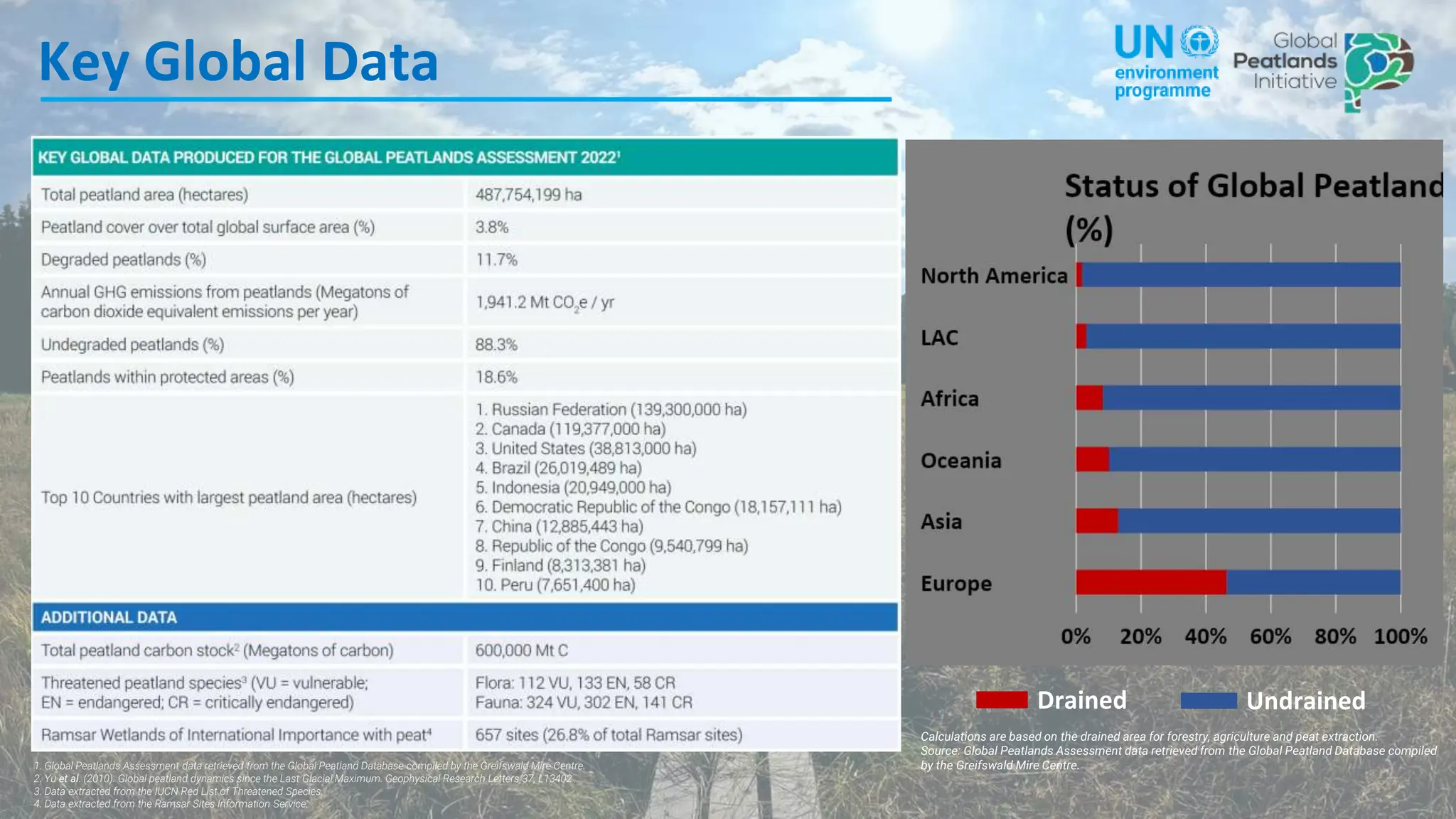
Key Global Data
Drained Undrained
Calculations are based on the drained area for forestry, agriculture and peat extraction.
Source: Global Peatlands Assessment data retrieved from the Global Peatland Database compiled
by the Greifswald Mire Centre.
1. Global Peatlands Assessment data retrieved from the Global Peatland Database compiled by the Greifswald Mire Centre.
2. Yu et al. (2010). Global peatland dynamics since the Last Glacial Maximum. Geophysical Research Letters 37, L13402
3. Data extracted from the IUCN Red List of Threatened Species.
4. Data extracted from the Ramsar Sites Information Service.
Global GHG Emissions
Emissions from peatlands degraded by forestry, agriculture and peat extraction per country (microbial respiration only, without fire; including CO2, CH4, N2O, DOC, and emissions from ditches. Data have been derived from multiple sources. Numbers may change with future
assessments, but the order of magnitude will probably stay the same for many countries (especially for developed countries and main emitters).
Source: Global Peatlands Assessment data retrieved from the Global Peatland Database compiled by the Greifswald Mire Centre. For more details on the methods and references used for this map, see Annex III.3 Production of Thematic Maps.
Online Map
BE PART OF THE SOLUTION!
To learn more about this Initiative contact our team:
Fabrice Inkonkoy, fabrice.inkonkoy@un.org
Patrick Scheel, patrick.scheel@un.org
Caroline Borowski, caroline.borowski@un.org
And take a look at our website: http://www.globalpeatlands.org/
Because #PeatlandsMatter

Overview of the Global Peatlands Assessment

  • 1.
    Global Peatlands Assessment– Mapping, Policy, and Action GLF Peatlands 2024 – The Climate Solution We Forgot 06 June 2024 Overview of the Global Peatlands Assessment Global Distribution and Key Data
  • 2.
  • 3.
    Structure 226 Contributors 44% women;56% men 51 different countries Authors, reviewers, review editors, and information providers
  • 4.
    Global Distribution Peatlands in177 out of 193 UN Member States Global peatland extent per country (including probable peatland). Source: Global Peatlands Assessment data retrieved from the Global Peatland Database compiled by the Greifswald Mire Centre. For more details on the methods and references used for this map, see Annex III. Production of the Global Peatland Map 2.0.
  • 5.
    Key Global Data DrainedUndrained Calculations are based on the drained area for forestry, agriculture and peat extraction. Source: Global Peatlands Assessment data retrieved from the Global Peatland Database compiled by the Greifswald Mire Centre. 1. Global Peatlands Assessment data retrieved from the Global Peatland Database compiled by the Greifswald Mire Centre. 2. Yu et al. (2010). Global peatland dynamics since the Last Glacial Maximum. Geophysical Research Letters 37, L13402 3. Data extracted from the IUCN Red List of Threatened Species. 4. Data extracted from the Ramsar Sites Information Service.
  • 6.
    Global GHG Emissions Emissionsfrom peatlands degraded by forestry, agriculture and peat extraction per country (microbial respiration only, without fire; including CO2, CH4, N2O, DOC, and emissions from ditches. Data have been derived from multiple sources. Numbers may change with future assessments, but the order of magnitude will probably stay the same for many countries (especially for developed countries and main emitters). Source: Global Peatlands Assessment data retrieved from the Global Peatland Database compiled by the Greifswald Mire Centre. For more details on the methods and references used for this map, see Annex III.3 Production of Thematic Maps.
  • 7.
  • 8.
    BE PART OFTHE SOLUTION! To learn more about this Initiative contact our team: Fabrice Inkonkoy, fabrice.inkonkoy@un.org Patrick Scheel, patrick.scheel@un.org Caroline Borowski, caroline.borowski@un.org And take a look at our website: http://www.globalpeatlands.org/ Because #PeatlandsMatter

Editor's Notes

  • #2  Research Consultant focusing on global peatland research. Translation of science into policy and action 🡪 disseminating findings of GPA, identifying peatland knowledge gaps and advancing global peatland monitoring and mapping. GPA - webinars and impact analysis GPI RWG – PeatQuest and Evidence Synthesis Training and Impact Programme Mapping: GPHA and WESR Survey