Severn Estuary SMP2 - Appendix C - Baseline Understanding of Coastal Behaviour, Dynamics and Coastal Defences
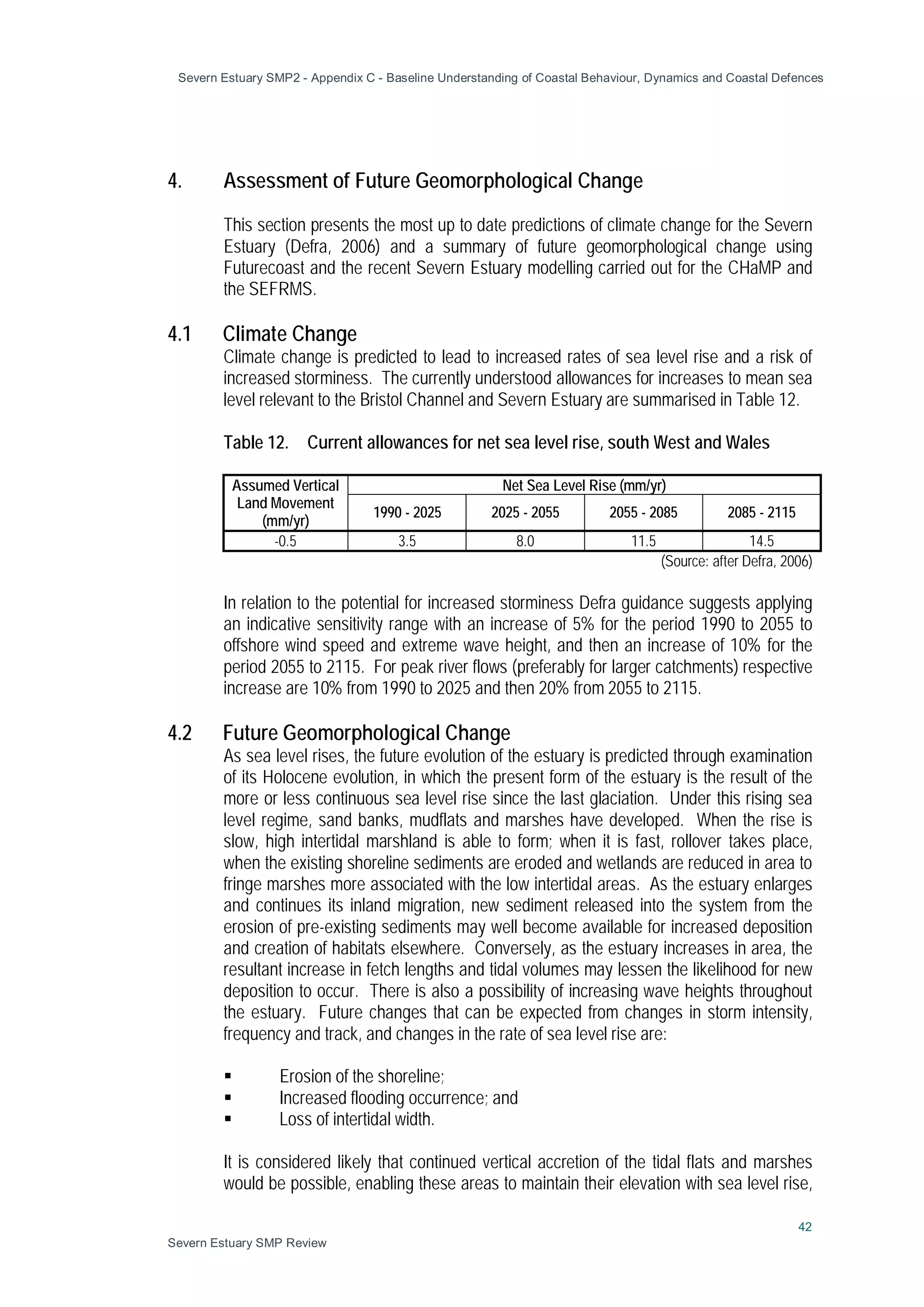
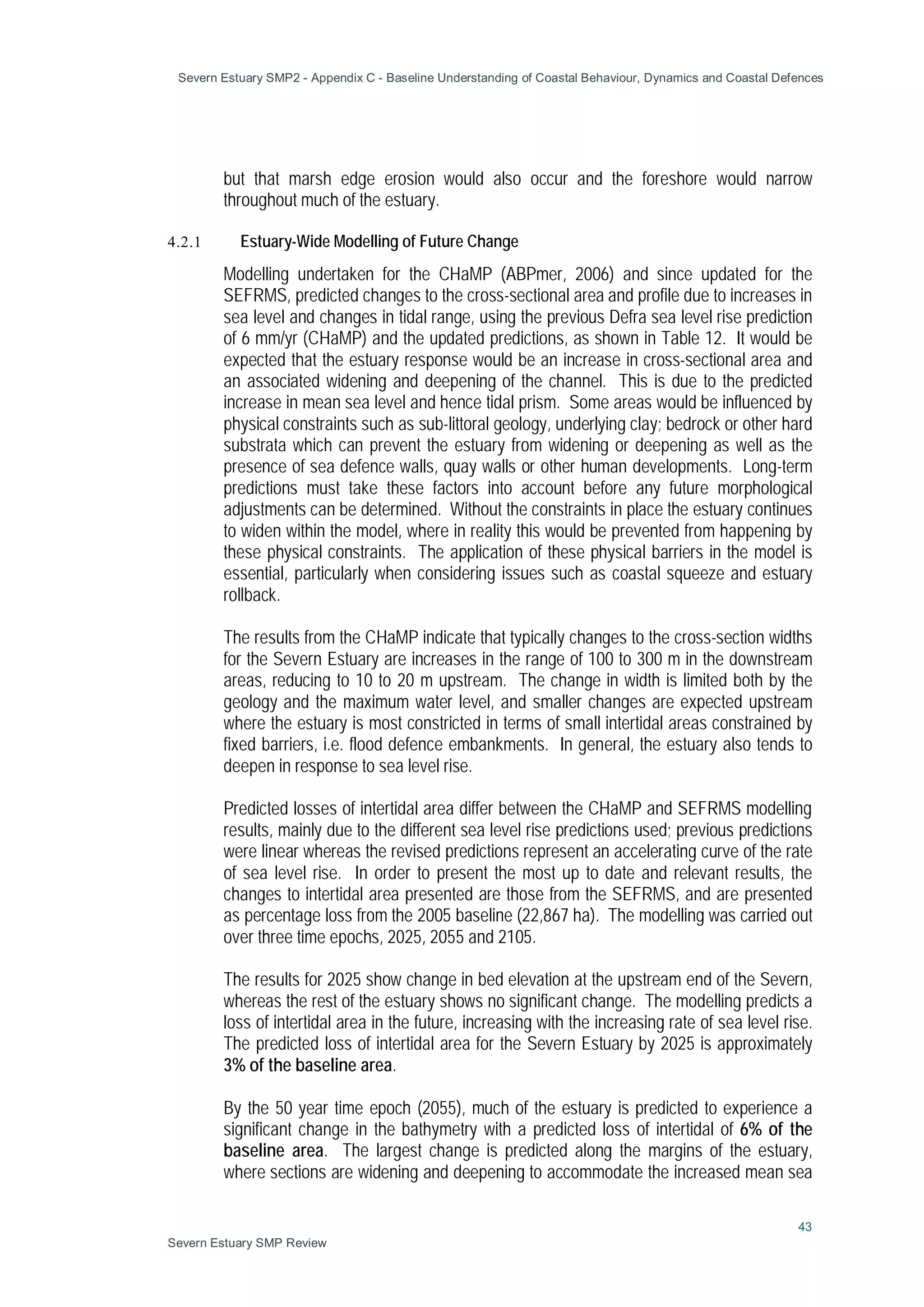
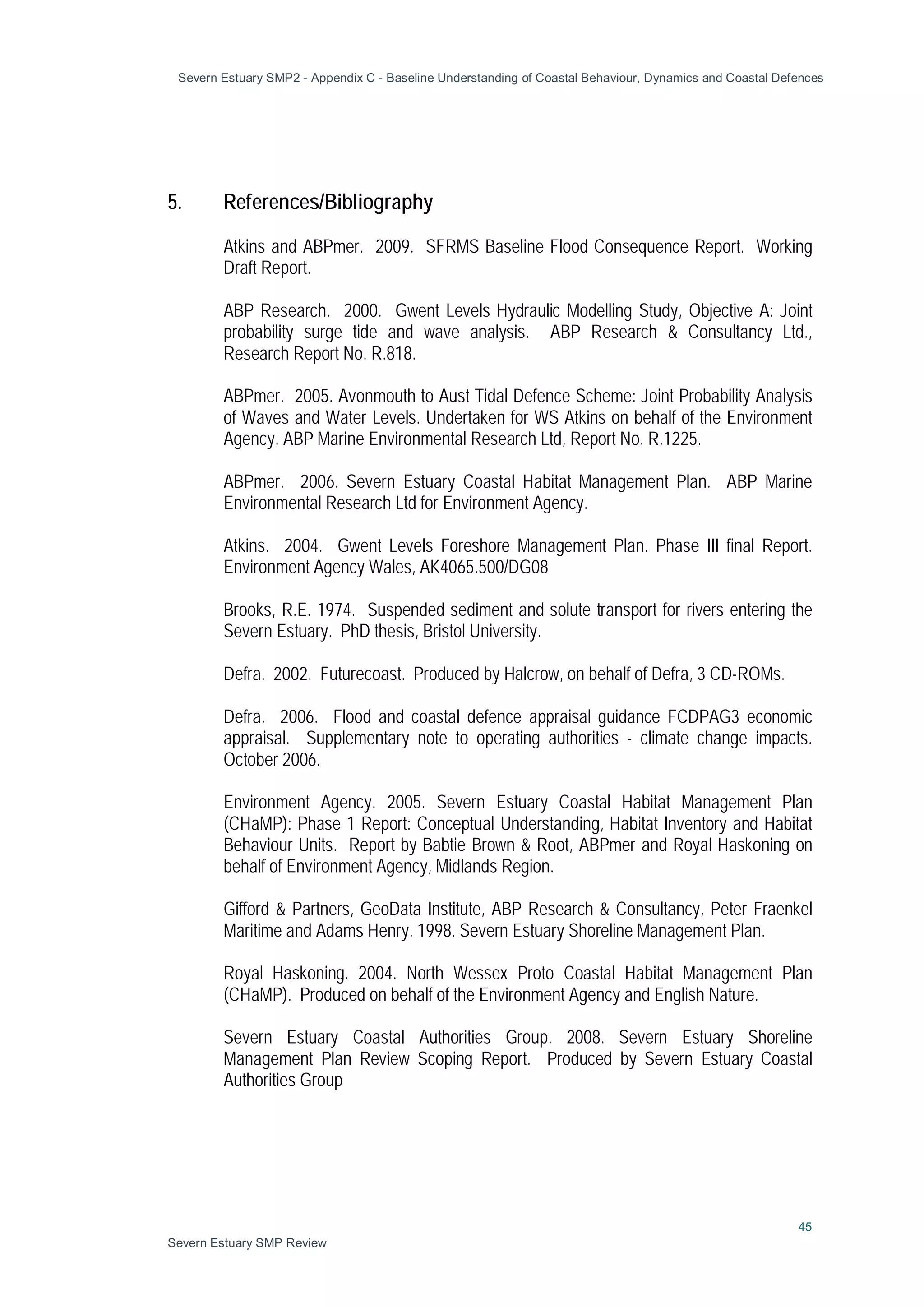
Severn Estuary SMP Review 1
Appendix C:
Baseline Understanding of
Coastal Behaviour and Dynamics
Coastal Defences
Baseline Scenarios
Severn Estuary SMP2 - Appendix C - Baseline Understanding of Coastal Behaviour, Dynamics and Coastal Defences
Severn Estuary SMP Review 2
Severn Estuary Shoreline Management
Plan Review (SMP2)
Appendix C : (A) Baseline Understanding of Coastal
Behaviour and Dynamics, (B) Coastal Defences and
(C) Baseline Scenario Report
December 2010
Notice
This report was produced by ABPmer and Atkins for the Severn Estuary Coastal Group for the specific
purpose of the Severn Estuary Shoreline Management Plan Review (SMP2).
This report may not be used by any person other than the Severn Estuary Coastal Group without The
Severn Estuary Coastal Group's express permission. In any event, Atkins accepts no liability for any costs,
liabilities or losses arising as a result of the use of or reliance upon the contents of this report by any person
other than the Severn Estuary Coastal Group.
Severn Estuary SMP2 - Appendix C - Baseline Understanding of Coastal Behaviour, Dynamics and Coastal Defences
Severn Estuary SMP Review 3
Document History – Parts A and B: Coastal Behaviour, Dynamics and Defences
JOB NUMBER: 5078599 DOCUMENT REF: Coastal Behaviour, Dynamics
and Defences Task 2.1
01 Draft for Stakeholder
Comment – PART A
ABPMer KW JMcC RS 7 May
2009
02 Draft for Stakeholder
Comment – PART B
PC KW JMcC RS 7 May
2009
03 Final Draft – PART B CW PC JMcC RS 31 July
2009
04 For PMG Review SB PC JMcC RS
2 Sept
2009
05
Final Draft for QRG Review SB KW JM RS 25 May
2010
06
Final Draft for QRG Review SB KW JM RS Sept
2010
07 Final KW PC PC RS Dec 2010
Revision Purpose Description Originated Checked Reviewed Authorised Date
Document History – Part C: Develop Baseline Scenarios
JOB NUMBER: 5078599
DOCUMENT REF: Develop Baseline Scenarios.
Task 2.2
01 First Internal Draft SB PC
8 May
2009
02 Second Internal Draft CW PC JMcC RS
31 July
2009
03 For PMG Review SB PC JMcC RS
2 Sept
2009
04
Final Draft for QRG Review SB KW JM RS 25 May
2010
05
Final Draft for QRG Review SB KW JM RS Sept
2010
06 Final KW PC PC RS Dec 2010
Revision Purpose Description Originated Checked Reviewed Authorised Date
Severn Estuary SMP2 - Appendix C - Baseline Understanding of Coastal Behaviour, Dynamics and Coastal Defences
Severn Estuary SMP Review iv
Contents
Section Page
Supporting Appendices vi
Acronyms and Abbreviations viii
Compliance to the SMP2 Quality Review Group (QRG) Terms of Reference xii
Purpose of the Report 1
1. Introduction 7
1.1 Extent of the SMP 8
1.2 Structure of Part A 9
1.3 Assumptions and Limitations 9
2. Estuary Description and Processes 11
2.1 Overview 11
2.2 Geology and Coastal Evolution 12
2.3 Geomorphology 14
2.4 Present Estuary Behaviour 16
2.5 Hydrodynamics 17
2.6 Sediment Transport 23
3. Process Units and Shoreline Change 29
3.1 PU1 Penarth 31
3.2 PU2 Cardiff Bay 31
3.3 PU3 Wentlooge 32
3.4 PU4 River Usk 33
3.5 PU5 Uskmouth 33
3.6 PU6 Caldicot Levels 34
3.7 PU7 The Severn Crossings 34
3.8 PU8 River Wye 35
3.9 PU9 Beachley to Lydney Point and Sharpness 35
3.10 PU10 Lydney Point to Tites Point (Sharpness to Purton) 36
3.11 PU11 Tites Point to Hock Cliff 36
3.12 PU12 Hock Cliff to Longney Pool 37
3.13 PU13 Longney Pool to The Weirs 38
3.14 PU14 The Weirs to Haw Bridge 38
3.15 PU15 New Passage to Portishead 38
3.16 PU16 River Avon 39
3.17 PU17 Portishead to Clevedon 39
3.18 PU18 Kingston Seymour 40
3.19 PU19 Middle Hope 40
3.20 PU20 Sand Bay 40
3.21 PU22 The Holms 41
4. Assessment of Future Geomorphological Change 42
4.1 Climate Change 42
4.2 Future Geomorphological Change 42
5. References/Bibliography 45
PART B - Coastal Defence Report 60
Severn Estuary SMP2 - Appendix C - Baseline Understanding of Coastal Behaviour, Dynamics and Coastal Defences
Severn Estuary SMP Review v
PART C - Develop Baseline Scenarios 88
1. Aim of this Part 89
1.1. Approach 89
1.2. Baseline Scenarios 89
1.3. Climate Change and Sea Level Rise 90
1.4. The Severn Bore 91
Baseline Case 1 – No Active Intervention 92
Baseline Case 2 – With Present Management 119
Annex A SMP1 Policies 150
Annex B No Active Intervention Mapping 156
Annex C With Present Management Mapping 183
Severn Estuary SMP2 - Appendix C - Baseline Understanding of Coastal Behaviour, Dynamics and Coastal Defences
Severn Estuary SMP Review vi
Supporting Appendices
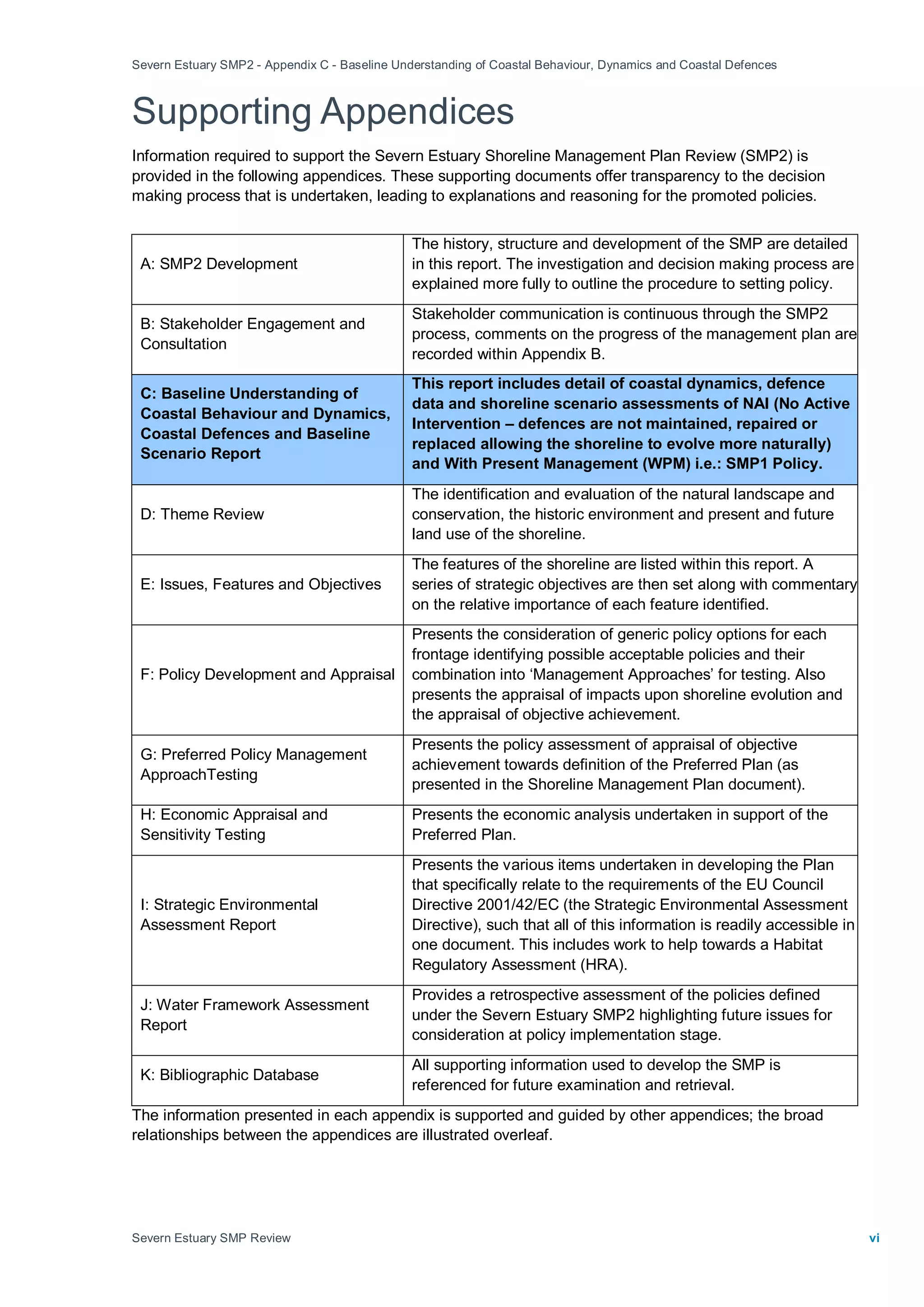
Information required to support the Severn Estuary Shoreline Management Plan Review (SMP2) is
provided in the following appendices. These supporting documents offer transparency to the decision
making process that is undertaken, leading to explanations and reasoning for the promoted policies.
A: SMP2 Development
The history, structure and development of the SMP are detailed
in this report. The investigation and decision making process are
explained more fully to outline the procedure to setting policy.
B: Stakeholder Engagement and
Consultation
Stakeholder communication is continuous through the SMP2
process, comments on the progress of the management plan are
recorded within Appendix B.
C: Baseline Understanding of
Coastal Behaviour and Dynamics,
Coastal Defences and Baseline
Scenario Report
This report includes detail of coastal dynamics, defence
data and shoreline scenario assessments of NAI (No Active
Intervention – defences are not maintained, repaired or
replaced allowing the shoreline to evolve more naturally)
and With Present Management (WPM) i.e.: SMP1 Policy.
D: Theme Review
The identification and evaluation of the natural landscape and
conservation, the historic environment and present and future
land use of the shoreline.
E: Issues, Features and Objectives
The features of the shoreline are listed within this report. A
series of strategic objectives are then set along with commentary
on the relative importance of each feature identified.
F: Policy Development and Appraisal
Presents the consideration of generic policy options for each
frontage identifying possible acceptable policies and their
combination into ‘Management Approaches’ for testing. Also
presents the appraisal of impacts upon shoreline evolution and
the appraisal of objective achievement.
G: Preferred Policy Management
ApproachTesting
Presents the policy assessment of appraisal of objective
achievement towards definition of the Preferred Plan (as
presented in the Shoreline Management Plan document).
H: Economic Appraisal and
Sensitivity Testing
Presents the economic analysis undertaken in support of the
Preferred Plan.
I: Strategic Environmental
Assessment Report
Presents the various items undertaken in developing the Plan
that specifically relate to the requirements of the EU Council
Directive 2001/42/EC (the Strategic Environmental Assessment
Directive), such that all of this information is readily accessible in
one document. This includes work to help towards a Habitat
Regulatory Assessment (HRA).
J: Water Framework Assessment
Report
Provides a retrospective assessment of the policies defined
under the Severn Estuary SMP2 highlighting future issues for
consideration at policy implementation stage.
K: Bibliographic Database
All supporting information used to develop the SMP is
referenced for future examination and retrieval.
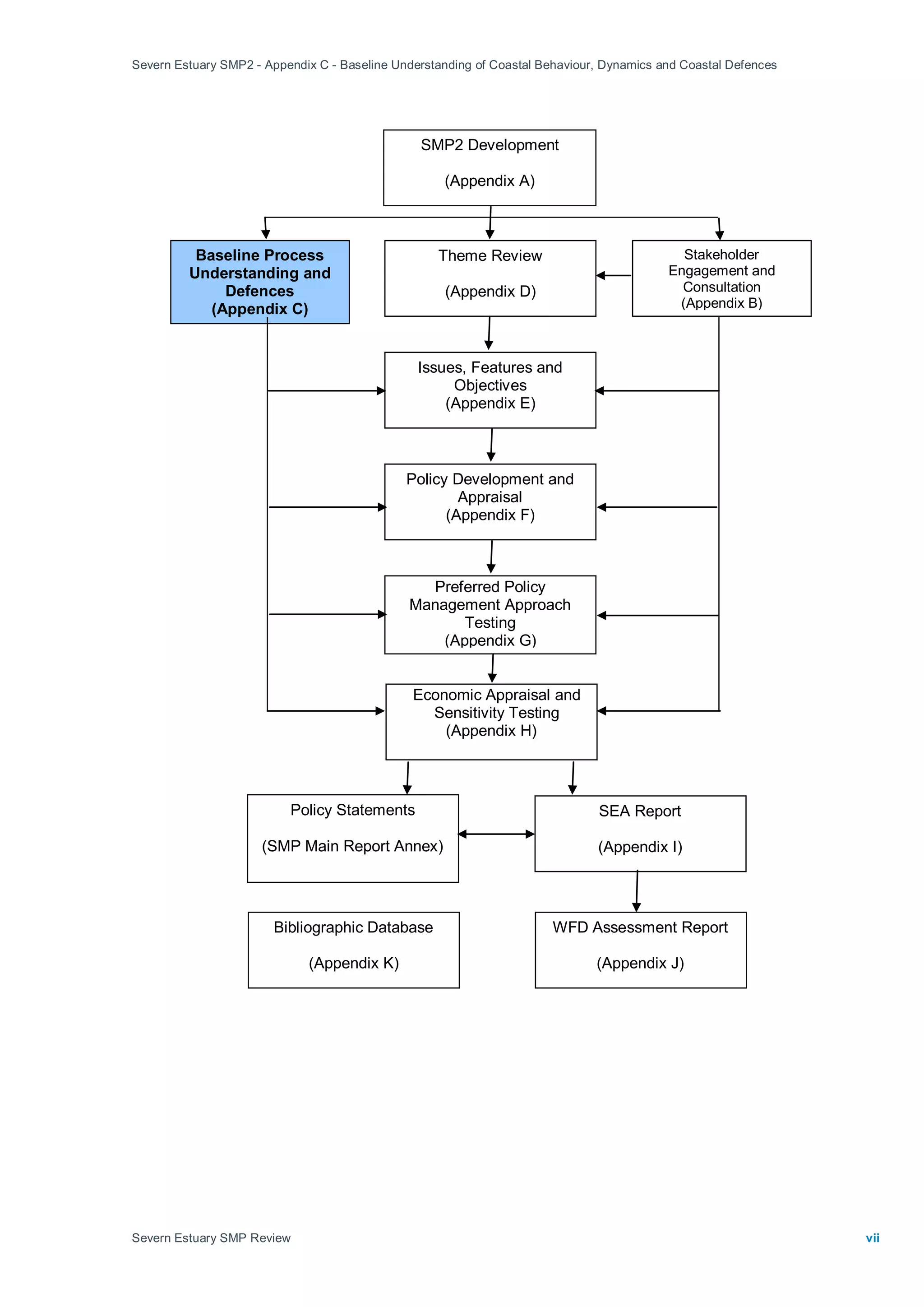
The information presented in each appendix is supported and guided by other appendices; the broad
relationships between the appendices are illustrated overleaf.
Severn Estuary SMP2 - Appendix C - Baseline Understanding of Coastal Behaviour, Dynamics and Coastal Defences
Severn Estuary SMP Review vii
SMP2 Development
(Appendix A)
Baseline Process
Understanding and
Defences
(Appendix C)
Theme Review
(Appendix D)
Stakeholder
Engagement and
Consultation
(Appendix B)
Issues, Features and
Objectives
(Appendix E)
Policy Development and
Appraisal
(Appendix F)
Preferred Policy
Management Approach
Testing
(Appendix G)
Economic Appraisal and
Sensitivity Testing
(Appendix H)
Policy Statements
(SMP Main Report Annex)
SEA Report
(Appendix I)
Bibliographic Database
(Appendix K)
WFD Assessment Report
(Appendix J)
Severn Estuary SMP2 - Appendix C - Baseline Understanding of Coastal Behaviour, Dynamics and Coastal Defences
Severn Estuary SMP Review viii
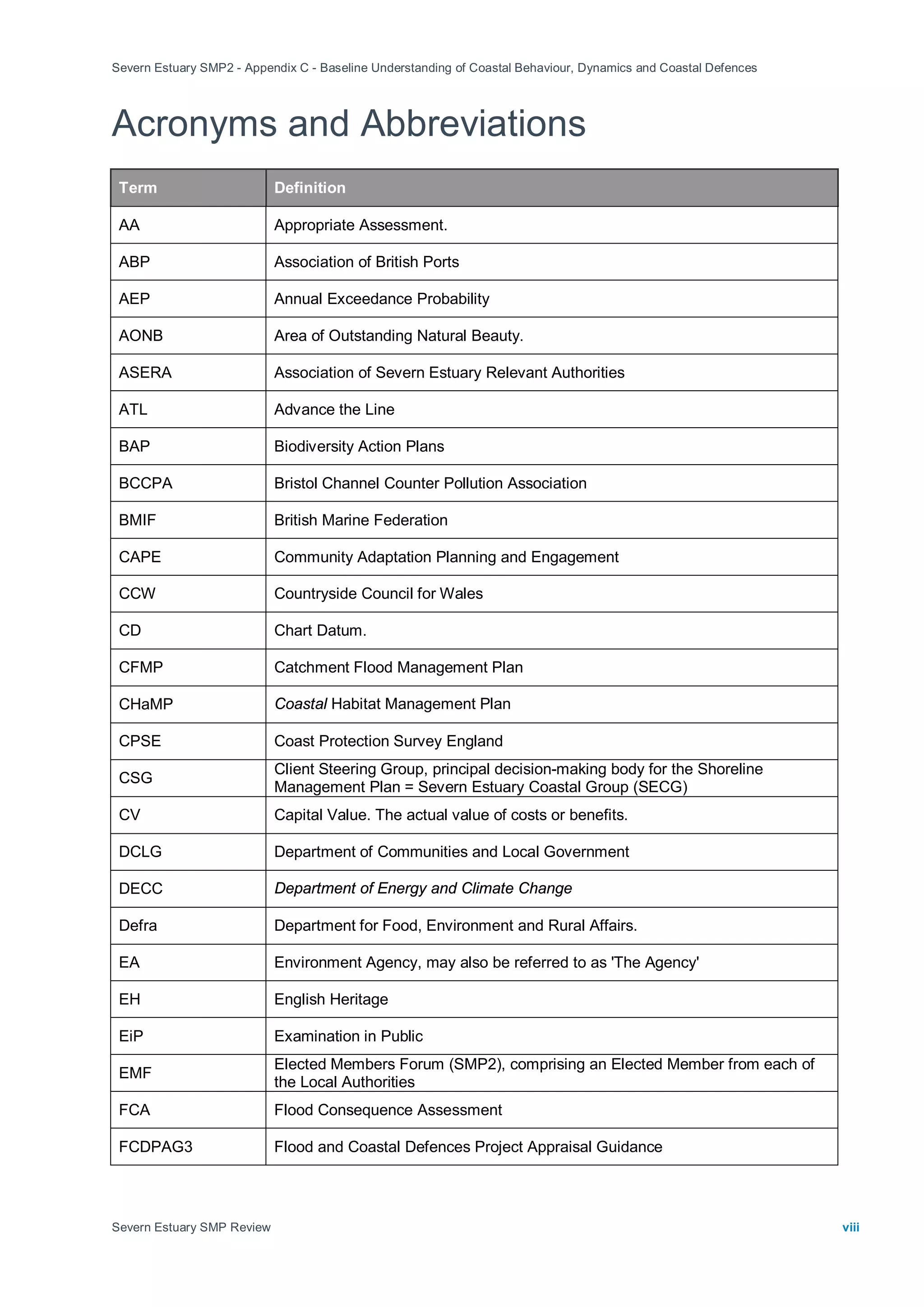
Acronyms and Abbreviations
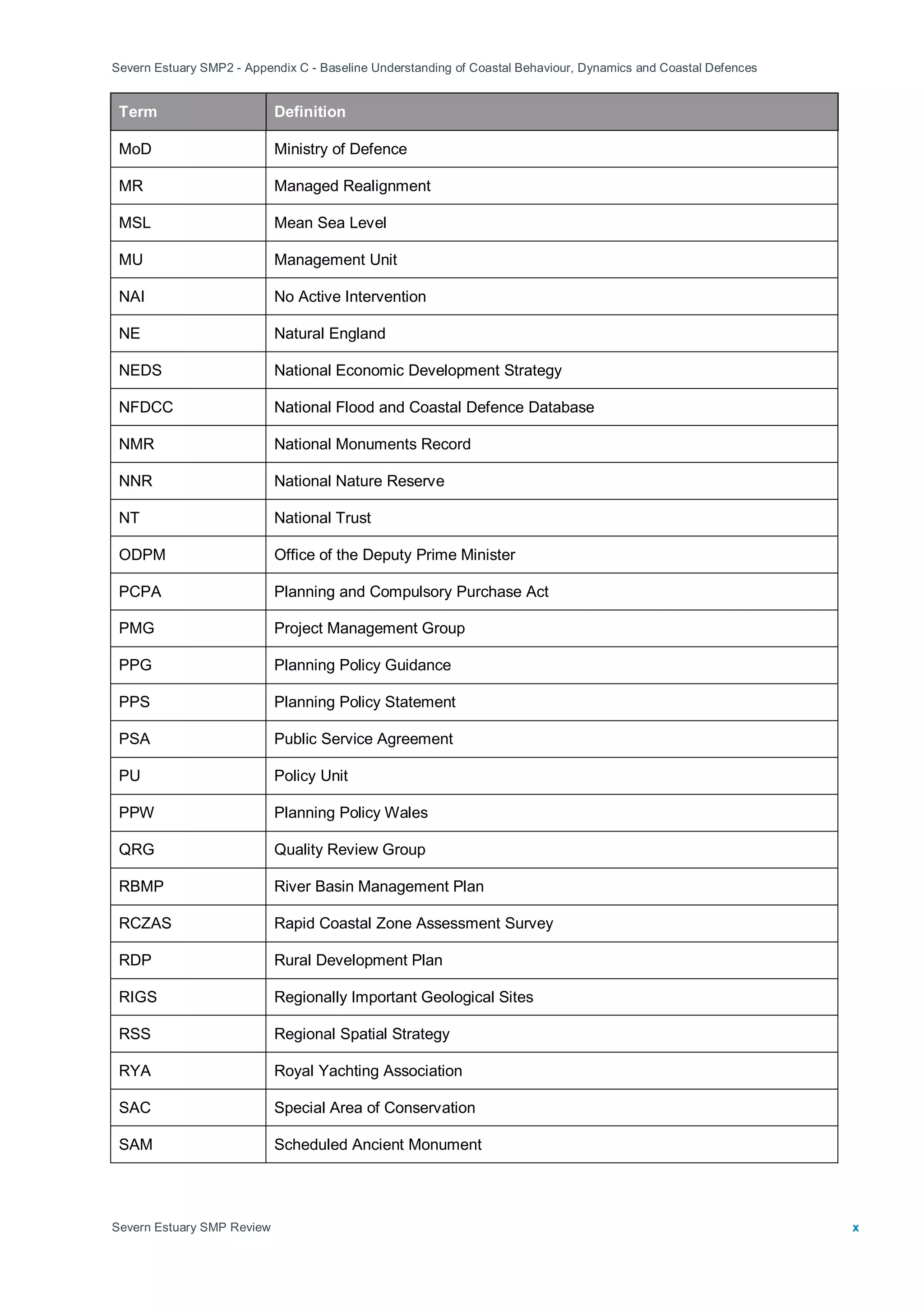
Term Definition
AA Appropriate Assessment.
ABP Association of British Ports
AEP Annual Exceedance Probability
AONB Area of Outstanding Natural Beauty.
ASERA Association of Severn Estuary Relevant Authorities
ATL Advance the Line
BAP Biodiversity Action Plans
BCCPA Bristol Channel Counter Pollution Association
BMIF British Marine Federation
CAPE Community Adaptation Planning and Engagement
CCW Countryside Council for Wales
CD Chart Datum.
CFMP Catchment Flood Management Plan
CHaMP Coastal Habitat Management Plan
CPSE Coast Protection Survey England
CSG
Client Steering Group, principal decision-making body for the Shoreline
Management Plan = Severn Estuary Coastal Group (SECG)
CV Capital Value. The actual value of costs or benefits.
DCLG Department of Communities and Local Government
DECC Department of Energy and Climate Change
Defra Department for Food, Environment and Rural Affairs.
EA Environment Agency, may also be referred to as 'The Agency'
EH English Heritage
EiP Examination in Public
EMF
Elected Members Forum (SMP2), comprising an Elected Member from each of
the Local Authorities
FCA Flood Consequence Assessment
FCDPAG3 Flood and Coastal Defences Project Appraisal Guidance
Severn Estuary SMP2 - Appendix C - Baseline Understanding of Coastal Behaviour, Dynamics and Coastal Defences
Severn Estuary SMP Review ix
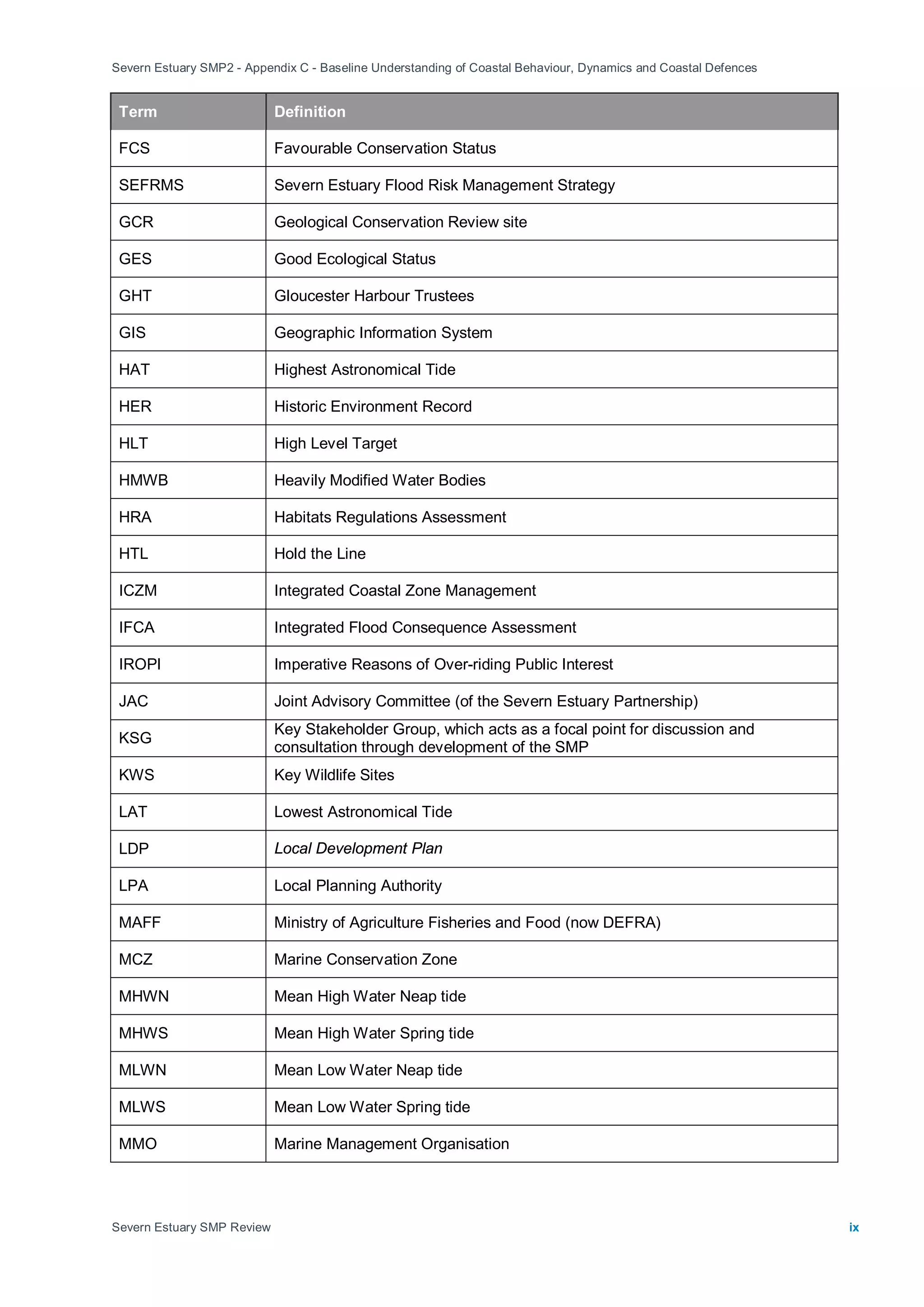
Term Definition
FCS Favourable Conservation Status
SEFRMS Severn Estuary Flood Risk Management Strategy
GCR Geological Conservation Review site
GES Good Ecological Status
GHT Gloucester Harbour Trustees
GIS Geographic Information System
HAT Highest Astronomical Tide
HER Historic Environment Record
HLT High Level Target
HMWB Heavily Modified Water Bodies
HRA Habitats Regulations Assessment
HTL Hold the Line
ICZM Integrated Coastal Zone Management
IFCA Integrated Flood Consequence Assessment
IROPI Imperative Reasons of Over-riding Public Interest
JAC Joint Advisory Committee (of the Severn Estuary Partnership)
KSG
Key Stakeholder Group, which acts as a focal point for discussion and
consultation through development of the SMP
KWS Key Wildlife Sites
LAT Lowest Astronomical Tide
LDP Local Development Plan
LPA Local Planning Authority
MAFF Ministry of Agriculture Fisheries and Food (now DEFRA)
MCZ Marine Conservation Zone
MHWN Mean High Water Neap tide
MHWS Mean High Water Spring tide
MLWN Mean Low Water Neap tide
MLWS Mean Low Water Spring tide
MMO Marine Management Organisation
Severn Estuary SMP2 - Appendix C - Baseline Understanding of Coastal Behaviour, Dynamics and Coastal Defences
Severn Estuary SMP Review x
Term Definition
MoD Ministry of Defence
MR Managed Realignment
MSL Mean Sea Level
MU Management Unit
NAI No Active Intervention
NE Natural England
NEDS National Economic Development Strategy
NFDCC National Flood and Coastal Defence Database
NMR National Monuments Record
NNR National Nature Reserve
NT National Trust
ODPM Office of the Deputy Prime Minister
PCPA Planning and Compulsory Purchase Act
PMG Project Management Group
PPG Planning Policy Guidance
PPS Planning Policy Statement
PSA Public Service Agreement
PU Policy Unit
PPW Planning Policy Wales
QRG Quality Review Group
RBMP River Basin Management Plan
RCZAS Rapid Coastal Zone Assessment Survey
RDP Rural Development Plan
RIGS Regionally Important Geological Sites
RSS Regional Spatial Strategy
RYA Royal Yachting Association
SAC Special Area of Conservation
SAM Scheduled Ancient Monument
Severn Estuary SMP2 - Appendix C - Baseline Understanding of Coastal Behaviour, Dynamics and Coastal Defences
Severn Estuary SMP Review xi
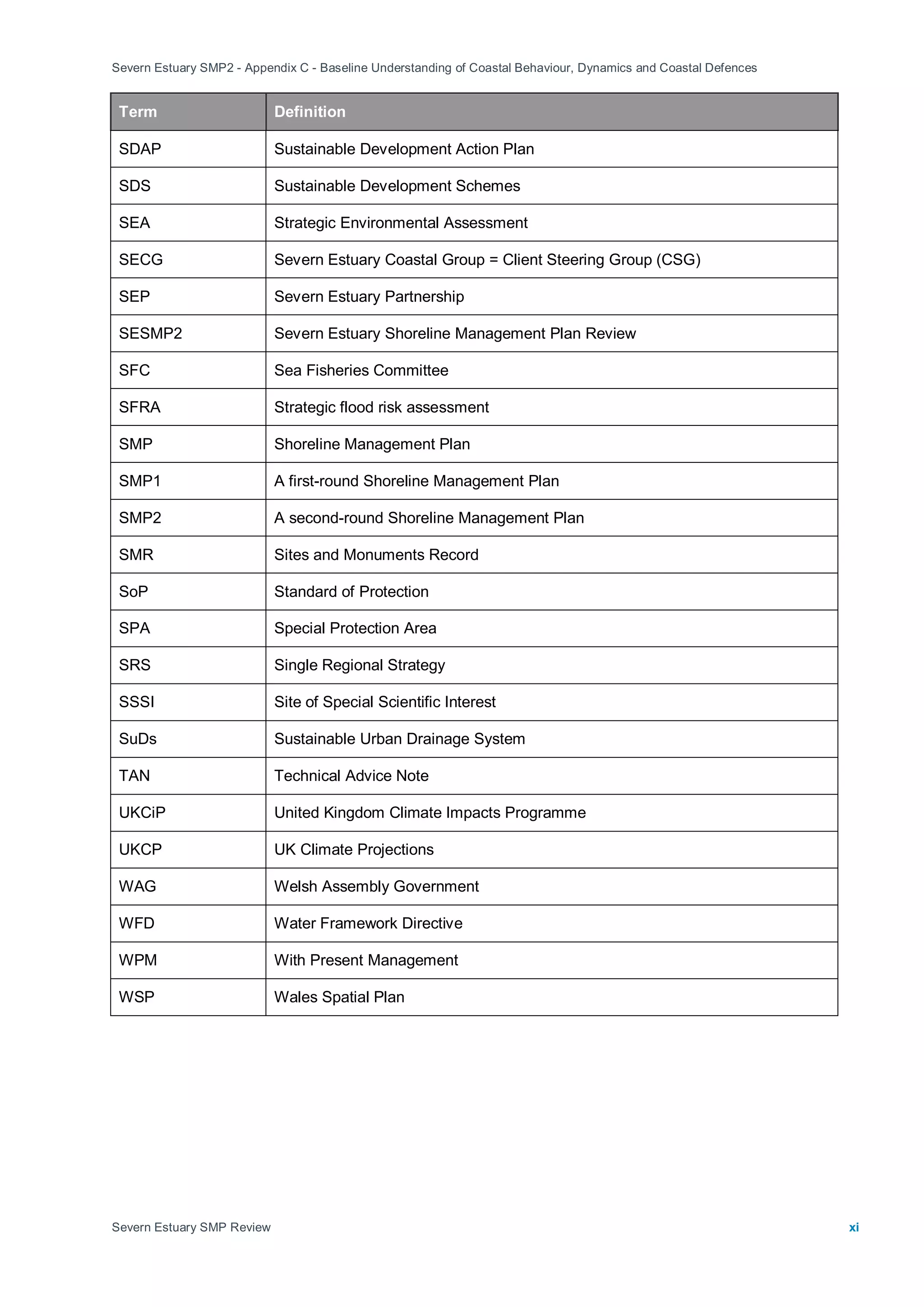
Term Definition
SDAP Sustainable Development Action Plan
SDS Sustainable Development Schemes
SEA Strategic Environmental Assessment
SECG Severn Estuary Coastal Group = Client Steering Group (CSG)
SEP Severn Estuary Partnership
SESMP2 Severn Estuary Shoreline Management Plan Review
SFC Sea Fisheries Committee
SFRA Strategic flood risk assessment
SMP Shoreline Management Plan
SMP1 A first-round Shoreline Management Plan
SMP2 A second-round Shoreline Management Plan
SMR Sites and Monuments Record
SoP Standard of Protection
SPA Special Protection Area
SRS Single Regional Strategy
SSSI Site of Special Scientific Interest
SuDs Sustainable Urban Drainage System
TAN Technical Advice Note
UKCiP United Kingdom Climate Impacts Programme
UKCP UK Climate Projections
WAG Welsh Assembly Government
WFD Water Framework Directive
WPM With Present Management
WSP Wales Spatial Plan
Severn Estuary SMP2 - Appendix C - Baseline Understanding of Coastal Behaviour, Dynamics and Coastal Defences
Severn Estuary SMP Review xii
Compliance to the SMP2 Quality
Review Group (QRG) Terms of
Reference
This Appendix of the SMP 2 seeks to meet the following requirements set out by the
Terms of Reference (ToR) of the Quality Review Group:
• Futurecoast has been used as the basis of the coastal process
assessment, updated as appropriate with coastal monitoring data and
any recent Coastal Management Strategies. The coastal processes
in the area are sufficiently understood and uncertainty documented
[including climate change – see Part A of this Report
• National Flood and Coastal Defence Database (NFCDD) and/or up-to-
date monitoring data has been used to assess the existing defence
assets. Residual life is adequately addressed, high risk assets clearly
identified and used in the NAI appraisal.
].
• Baseline scenarios of No Active Intervention (NAI) and With Present
Management practices have been appraised and predicted shoreline
change mapped. Appraisals include consideration of climate change
and discuss shoreline response (both in terms of how the shoreline
will look and where it will be) for the three epochs. Any interactions
and independencies along the coast have been considered.
Assumptions made regarding defences are clear for each location
under each epoch, e.g. timing of defence failure -
See Part B of this Report.
• Where any mathematical models have been used, their purpose,
assumptions made, and outputs are clearly reported.
see Part C of this
Report.
• Key uncertainties, e.g. due to gaps in data, knowledge or modelling,
are clearly set out in the plan and where appropriate sensitivity
analysis has been undertaken to appraise the impact of uncertainties
on policy decisions
(no additional
models used in this study)
. (see SMP2 Action Plan)
Severn Estuary SMP2 - Appendix C - Baseline Understanding of Coastal Behaviour, Dynamics and Coastal Defences
Severn Estuary SMP Review 1
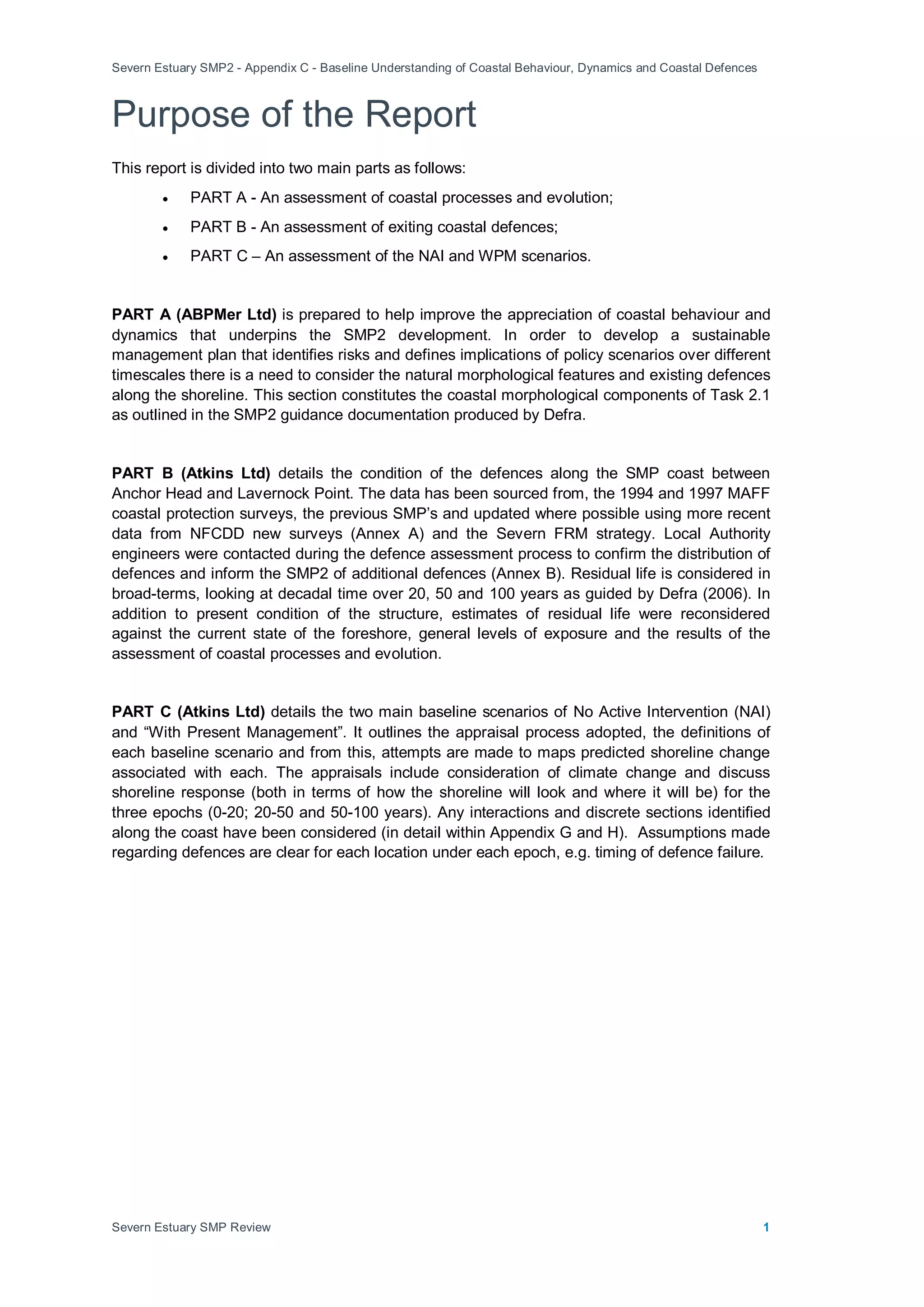
Purpose of the Report
This report is divided into two main parts as follows:
• PART A - An assessment of coastal processes and evolution;
• PART B - An assessment of exiting coastal defences;
• PART C – An assessment of the NAI and WPM scenarios.
PART A (ABPMer Ltd) is prepared to help improve the appreciation of coastal behaviour and
dynamics that underpins the SMP2 development. In order to develop a sustainable
management plan that identifies risks and defines implications of policy scenarios over different
timescales there is a need to consider the natural morphological features and existing defences
along the shoreline. This section constitutes the coastal morphological components of Task 2.1
as outlined in the SMP2 guidance documentation produced by Defra.
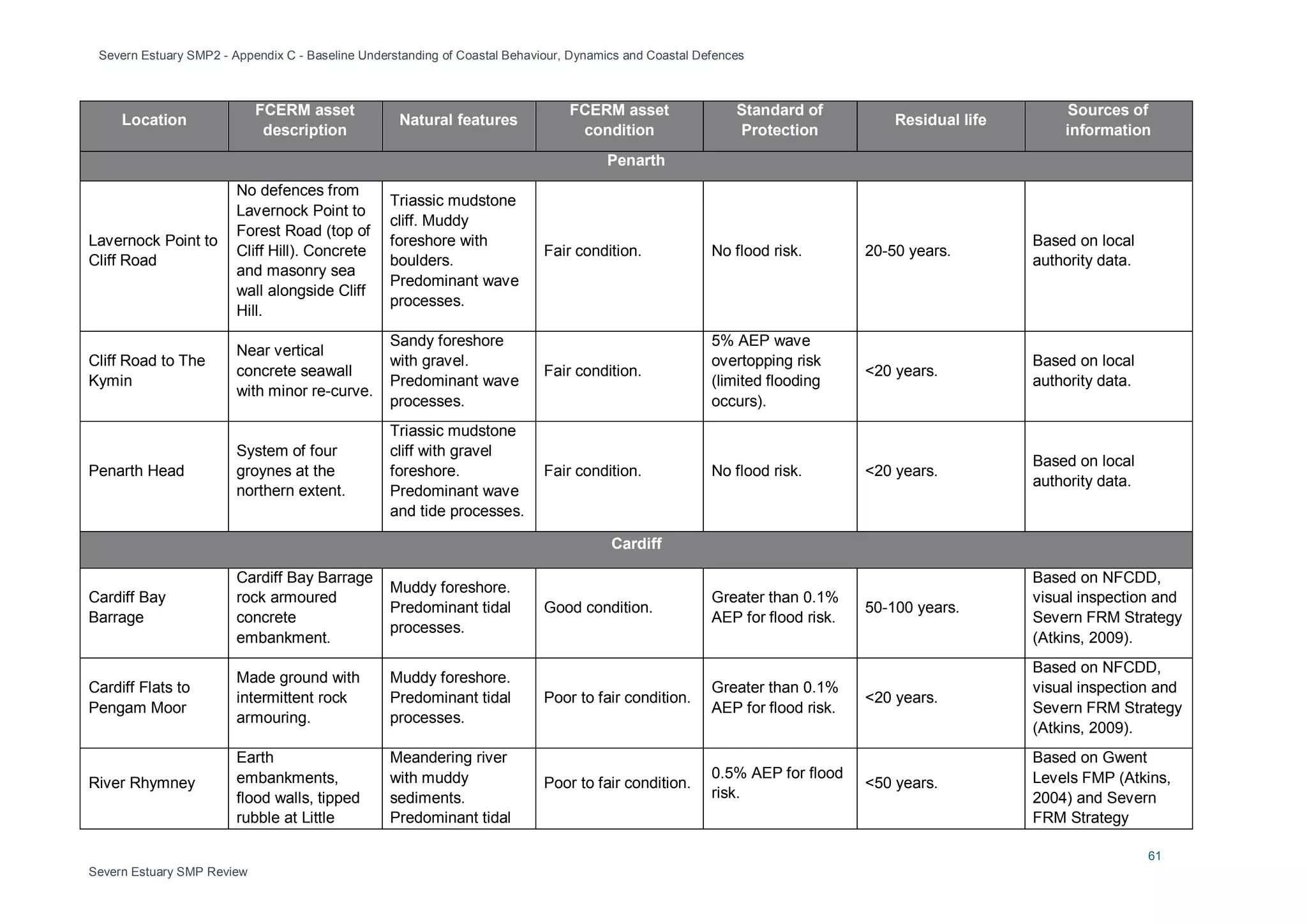
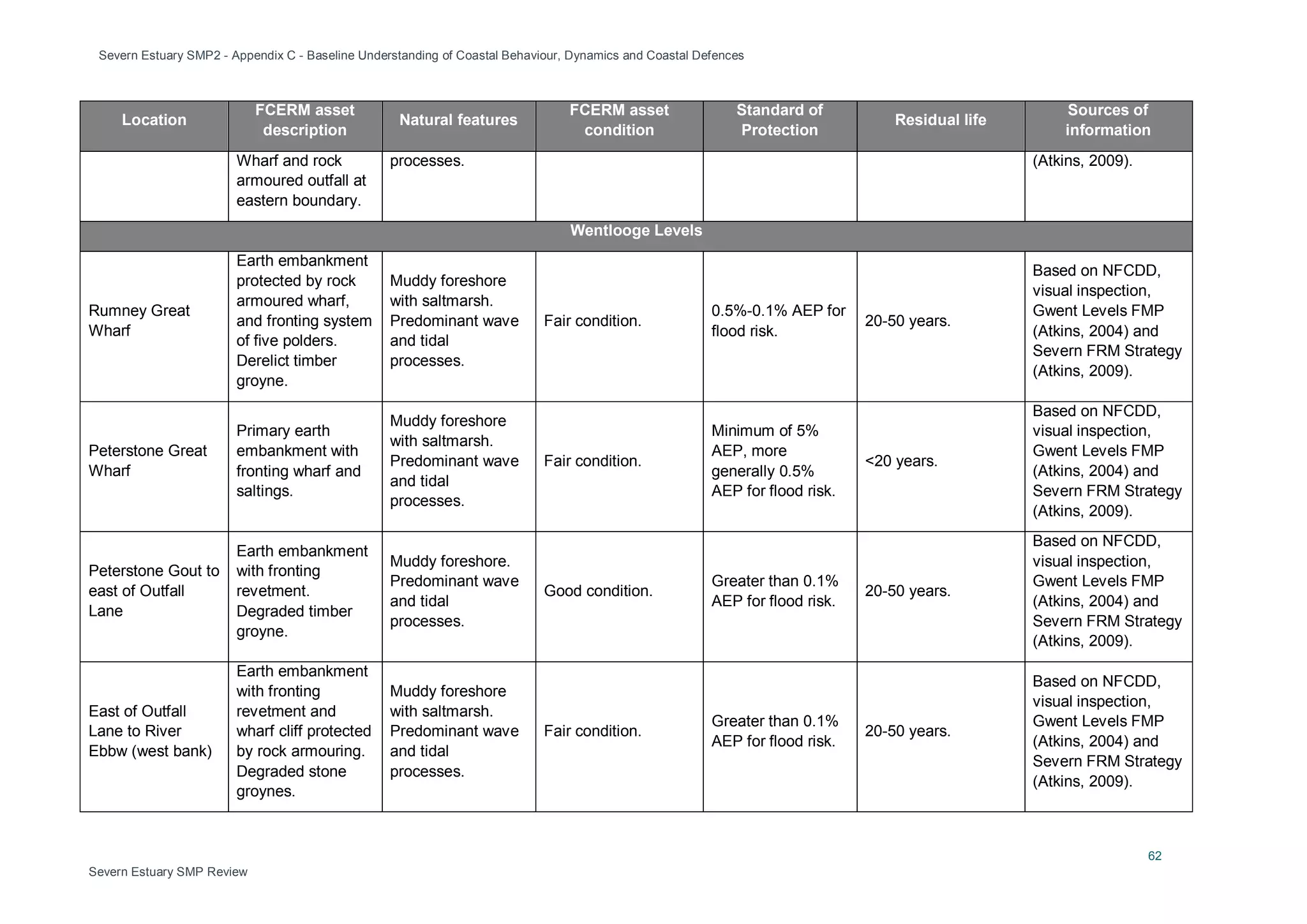
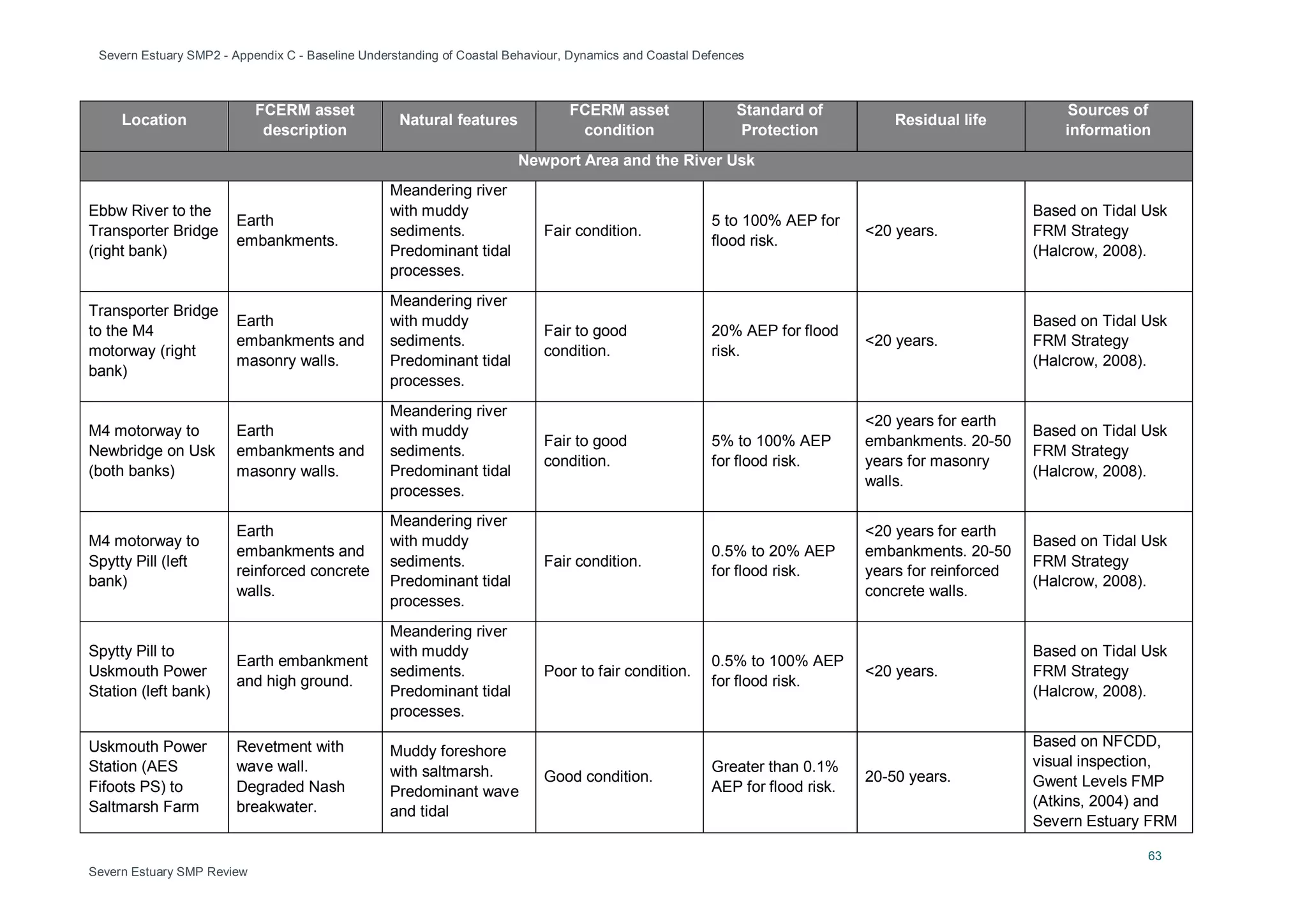
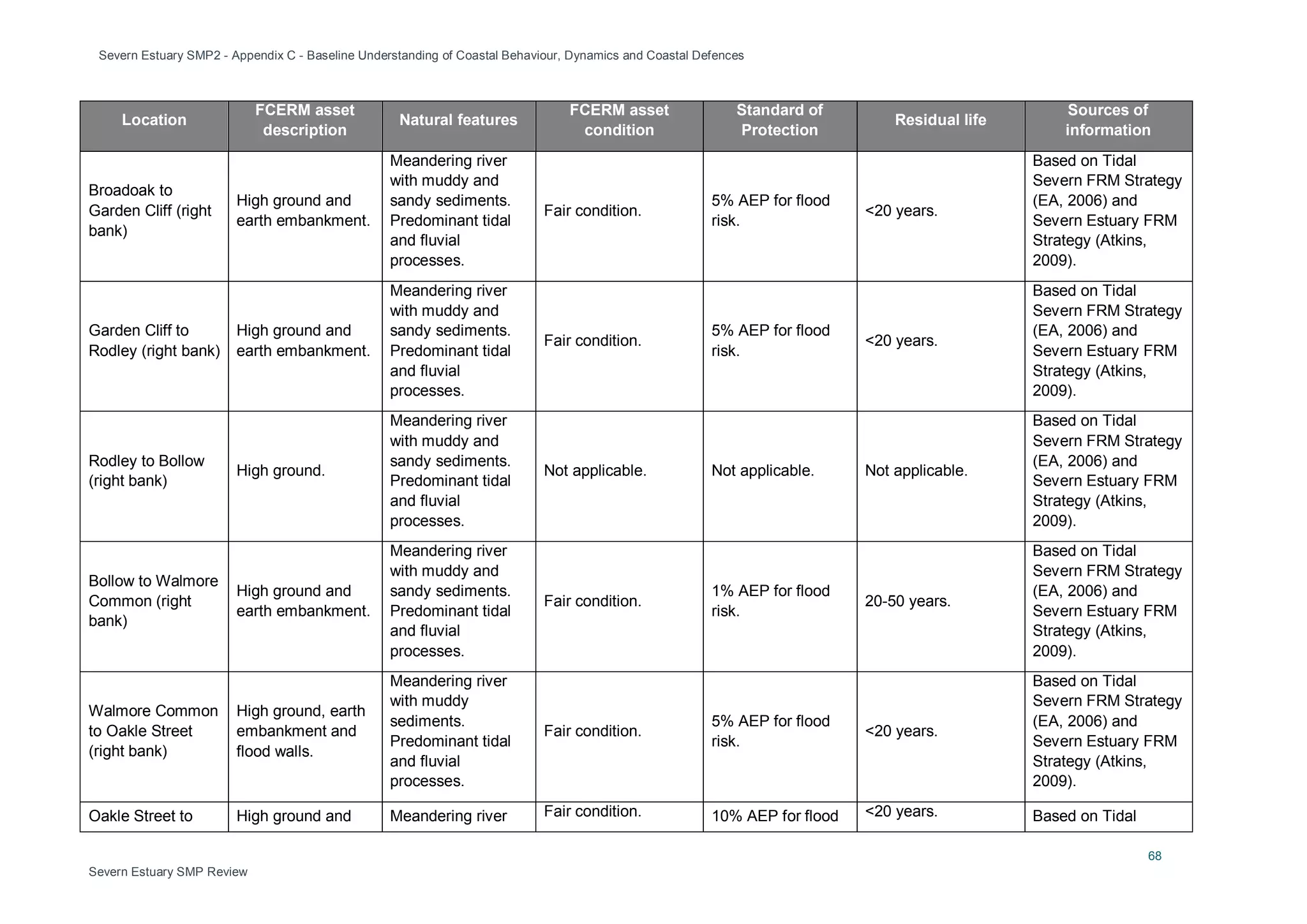
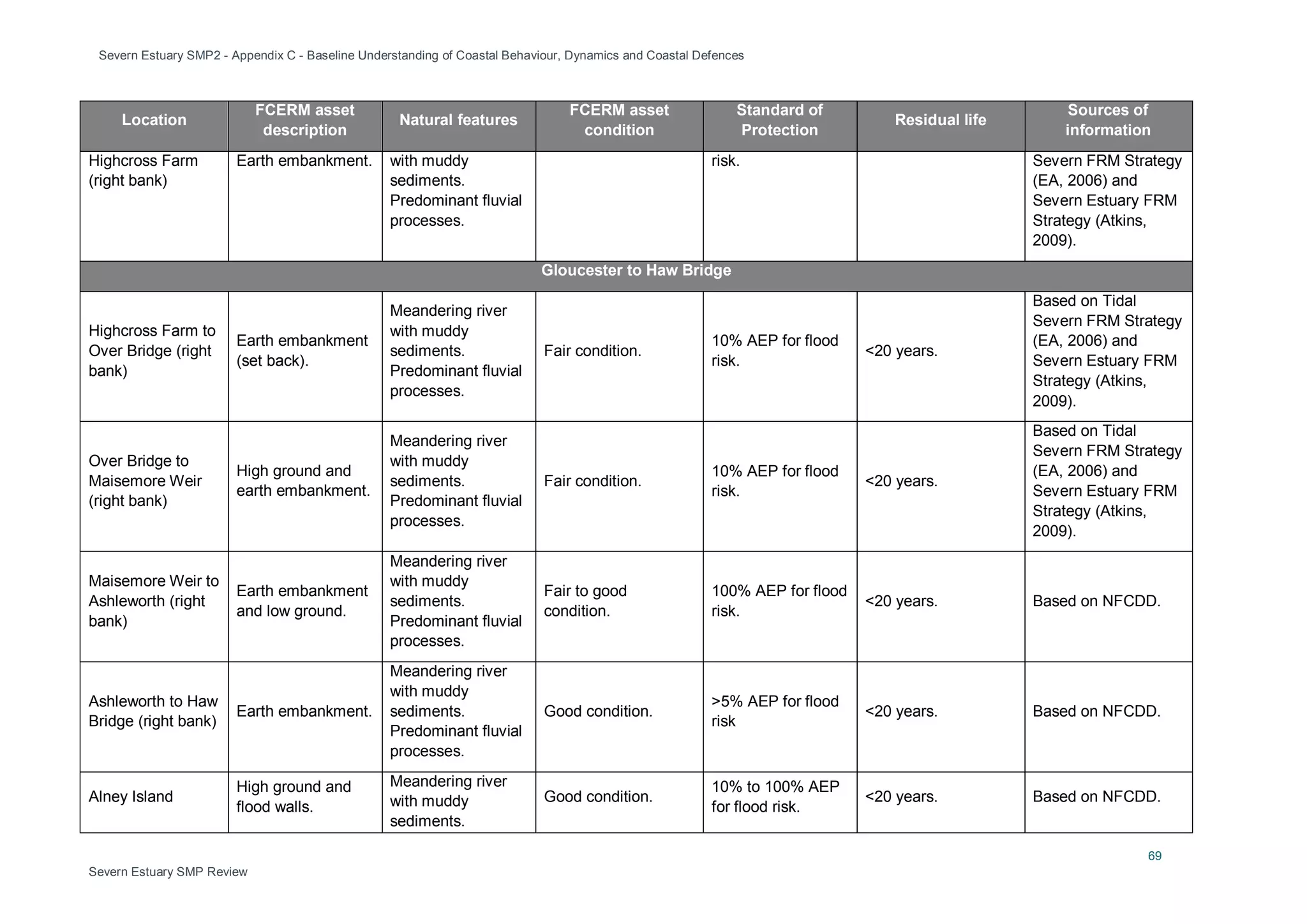
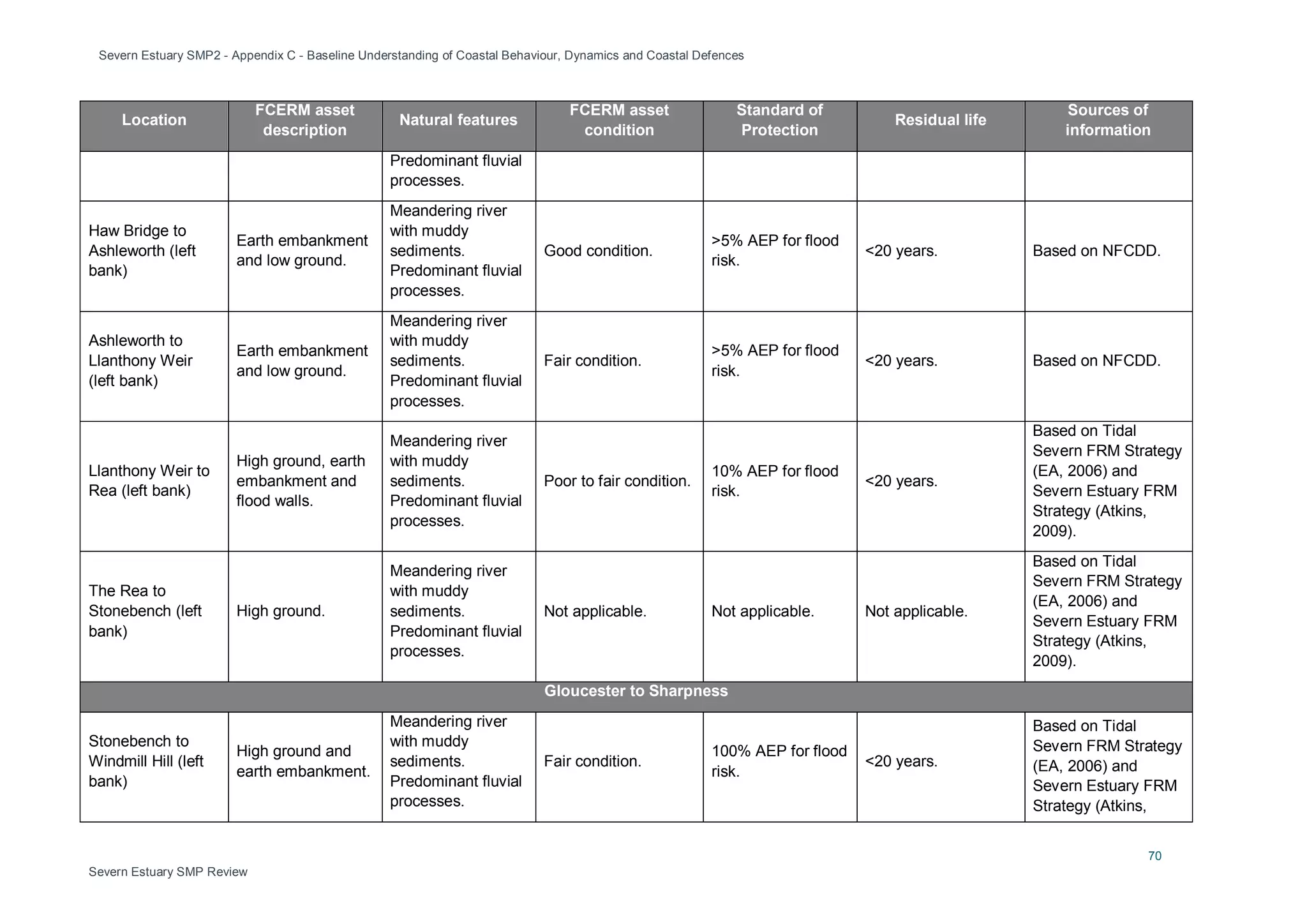
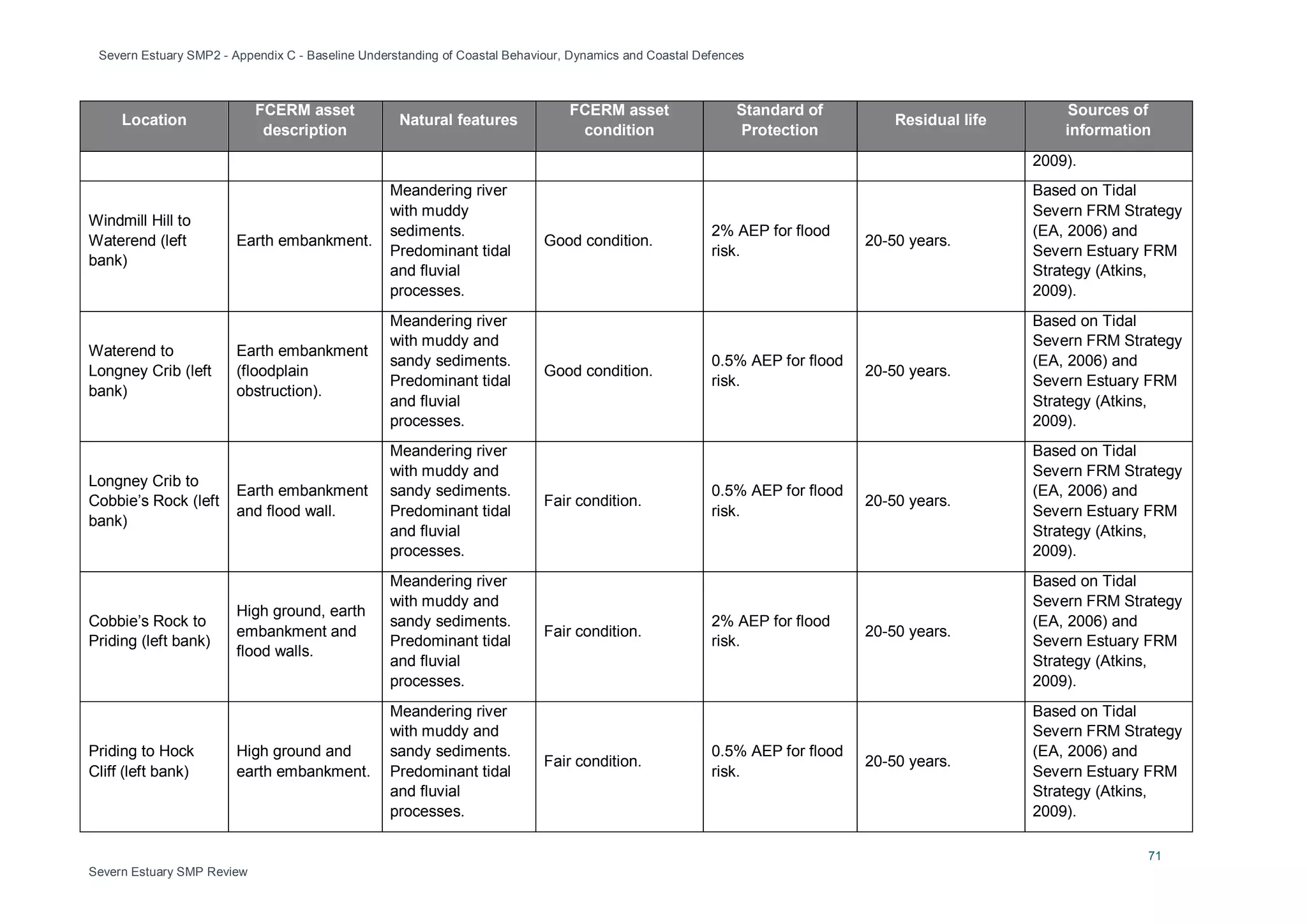
PART B (Atkins Ltd) details the condition of the defences along the SMP coast between
Anchor Head and Lavernock Point. The data has been sourced from, the 1994 and 1997 MAFF
coastal protection surveys, the previous SMP’s and updated where possible using more recent
data from NFCDD new surveys (Annex A) and the Severn FRM strategy. Local Authority
engineers were contacted during the defence assessment process to confirm the distribution of
defences and inform the SMP2 of additional defences (Annex B). Residual life is considered in
broad-terms, looking at decadal time over 20, 50 and 100 years as guided by Defra (2006). In
addition to present condition of the structure, estimates of residual life were reconsidered
against the current state of the foreshore, general levels of exposure and the results of the
assessment of coastal processes and evolution.
PART C (Atkins Ltd) details the two main baseline scenarios of No Active Intervention (NAI)
and “With Present Management”. It outlines the appraisal process adopted, the definitions of
each baseline scenario and from this, attempts are made to maps predicted shoreline change
associated with each. The appraisals include consideration of climate change and discuss
shoreline response (both in terms of how the shoreline will look and where it will be) for the
three epochs (0-20; 20-50 and 50-100 years). Any interactions and discrete sections identified
along the coast have been considered (in detail within Appendix G and H). Assumptions made
regarding defences are clear for each location under each epoch, e.g. timing of defence failure.
Severn Estuary SMP2 - Appendix C - Baseline
Understanding of Coastal Behaviour, Dynamics and
Coastal Defences
i
Severn Estuary SMP Review
PART A: Severn Estuary SMP2:
Baseline Understanding of
Coastal Behaviour and
Dynamics
Date: May 2009
Project Ref: Error! Reference source not
found.
Report No: R 1507
Severn Estuary SMP2 - Appendix C - Baseline Understanding of Coastal Behaviour, Dynamics and Coastal Defences
3
Severn Estuary SMP Review
Atkins Ltd
Severn Estuary SMP2:
Baseline Understanding of Coastal Behaviour and Dynamics
Date: May 2009
Project Ref: Error! Reference source not found.
Report No: R 1507
© ABP Marine Environmental Research Ltd
Version Details of Change Authorised By Date
1 Draft H Roberts 09.02.09
2 Final A Williams 10.03.09
3 Final updated with external comments H Roberts 08.05.09
Document Authorisation Signature Date
Project Manager: H Roberts
Quality Manager: N J Frost
Project Director: A Williams
ABP Marine Environmental Research Ltd
Suite B, Waterside House
Town Quay Tel: +44(0)23 8071 1840
SOUTHAMPTON Fax: +44(0)23 8071 1841
Hampshire Web: www.abpmer.co.uk
SO14 2AQ Email: enquiries@abpmer.co.uk
Severn Estuary SMP2 - Appendix C - Baseline Understanding of Coastal Behaviour, Dynamics and Coastal Defences
4
Severn Estuary SMP Review
PART A: Severn Estuary SMP2:
Baseline Understanding of Coastal Behaviour and Dynamics
Contents
Page
Error! Bookmark not defined.
1. Introduction 7
1.1 Extent of the SMP 8
1.2 Structure of this Report 9
2. Estuary Description and Processes 11
2.1 Overview 11
2.2 Geology and Coastal Evolution 12
2.3 Geomorphology 14
2.4 Present Estuary Behaviour 16
2.5 Hydrodynamics 17
2.5.1 Tides and Currents 17
2.5.2 Wave Climate, Winds and Surges 19
2.5.3 Freshwater Flows 22
2.6 Sediment Transport 23
2.6.1 Sources 24
2.6.2 Pathways 25
2.6.3 Sinks/Stores 26
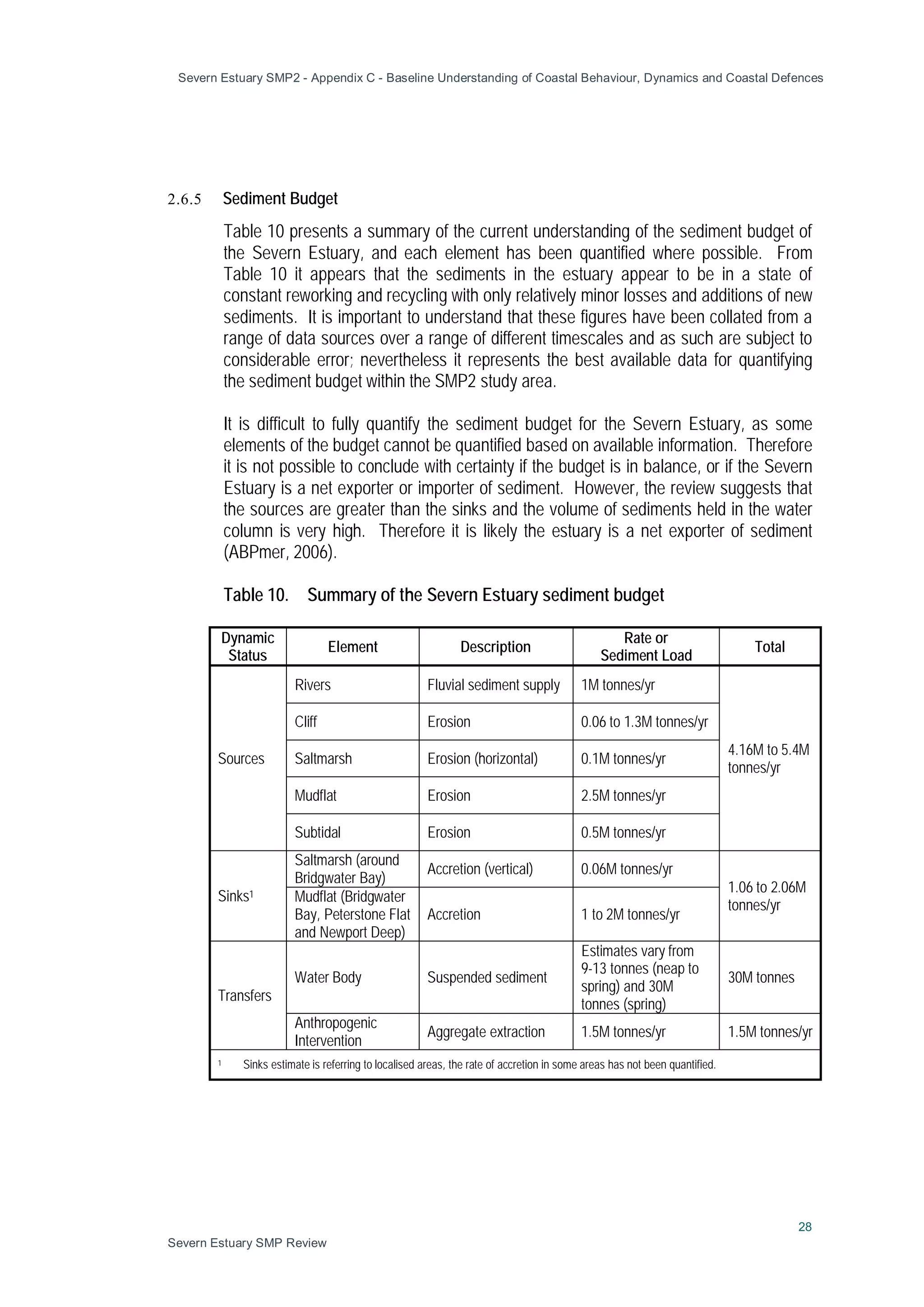
2.6.4 Sediment Budget 28
3. Process Units and Shoreline Change 29
3.1 PU1 Penarth 31
3.2 PU2 Cardiff Bay 31
3.3 PU3 Wentlooge 32
3.4 PU4 River Usk 33
3.5 PU5 Uskmouth 33
3.6 PU6 Caldicot Levels 34
3.7 PU7 The Severn Crossings 34
3.8 PU8 River Wye 35
3.9 PU9 Beachley to Lydney Point and Sharpness 35
3.10 PU10 Lydney Point to Tites Point (Sharpness to Purton) 36
3.11 PU11 Tites Point to Hock Cliff 36
3.12 PU12 Hock Cliff to Longney Pool 37
3.13 PU13 Longney Pool to The Weirs 38
3.14 PU14 The Weirs to Haw Bridge 38
3.15 PU15 New Passage to Portishead 38
3.16 PU16 River Avon 39
3.17 PU17 Portishead to Clevedon 39
3.18 PU18 Kingston Seymour 40
3.19 PU19 Middle Hope 40
3.20 PU20 Sand Bay 40
3.21 PU22 The Holms 41
Severn Estuary SMP2 - Appendix C - Baseline Understanding of Coastal Behaviour, Dynamics and Coastal Defences
5
Severn Estuary SMP Review
4. Assessment of Future Geomorphological Change 42
4.1 Climate Change 42
4.2 Future Geomorphological Change 42
4.2.1 Estuary-Wide Modelling of Future Change 43
5. References/Bibliography 45
Tables
Table 1. SMP extent in rivers and estuaries 8
Table 2. Predicted return period values of significant wave height Hs for
locations within the Severn Estuary 20
Table 3. Predicted 100 year significant wave heights 21
Table 4. Maximum surge heights in the outer Severn Estuary 21
Table 5. Predicted return period water levels 21
Table 6. Present day extreme water levels (mODN) 22
Table 7. River flow characteristics 23
Table 8. Suspended sediment yield of major tributaries of the Severn Estuary 24
Table 9. Saltmarsh changes within the Proto CHaMP study area between 1946-8
and 2000 25
Table 10. Summary of the Severn Estuary sediment budget 28
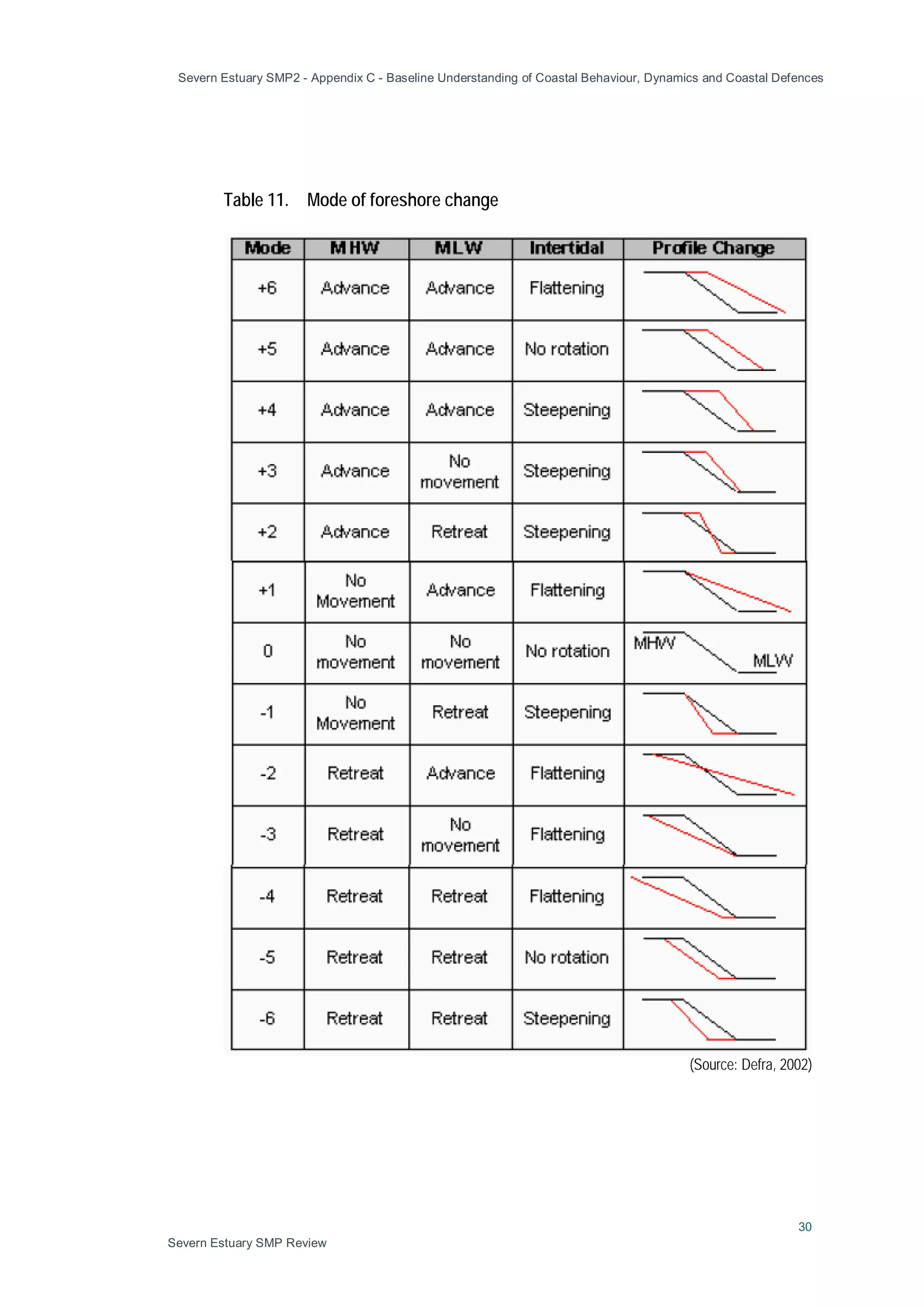
Table 11. Mode of foreshore change 30
Table 12. Current allowances for net sea level rise, South West and Wales 42
Severn Estuary SMP2 - Appendix C - Baseline Understanding of Coastal Behaviour, Dynamics and Coastal Defences
6
Severn Estuary SMP Review
Figures
1. Severn Estuary SMP Boundary
2a. Location Map of the Severn Estuary (Inner)
2b. Location Map of the Severn Estuary (Middle)
2c. Location Map of the Severn Estuary (Outer)
3. Process Units and Strategic Flood Cells
4. Severn Estuary Conceptual Map of Coastal Processes
5. Bathymetry of the Severn Estuary
6. Tidal Range in the Severn Estuary as Measured Along the Shoreline
7. Spring Tidal Range at Avonmouth
8. Wind Rose from Avonmouth
9. Locations of 100 Year Significant Wave Height
10. Schematised Patterns of Sand Circulation
11. Schematised Circulation of Fine Sediment
Severn Estuary SMP2 - Appendix C - Baseline Understanding of Coastal Behaviour, Dynamics and Coastal Defences
7
Severn Estuary SMP Review
1. Introduction
The aim of this report is to provide a review of coastal behaviour and dynamics based
on the division of the estuarine shoreline into Process Units, as described for the first
round SMP (Giffords 1998). The information contained within this report will then be
used to develop the baseline scenarios (see Part C of this Report), identify risks and to
test the response and implications of different management policy unit scenarios over
the different timescales set for the second generation Severn Estuary SMP (SMP2).
Ultimately, this information will help to determine the future management policies for
the estuary. As well as considering natural features along the coast, this review will
also consider the existing coastal defences, in terms of location, type and, in broad
terms, residual life (see Part B of this Report).
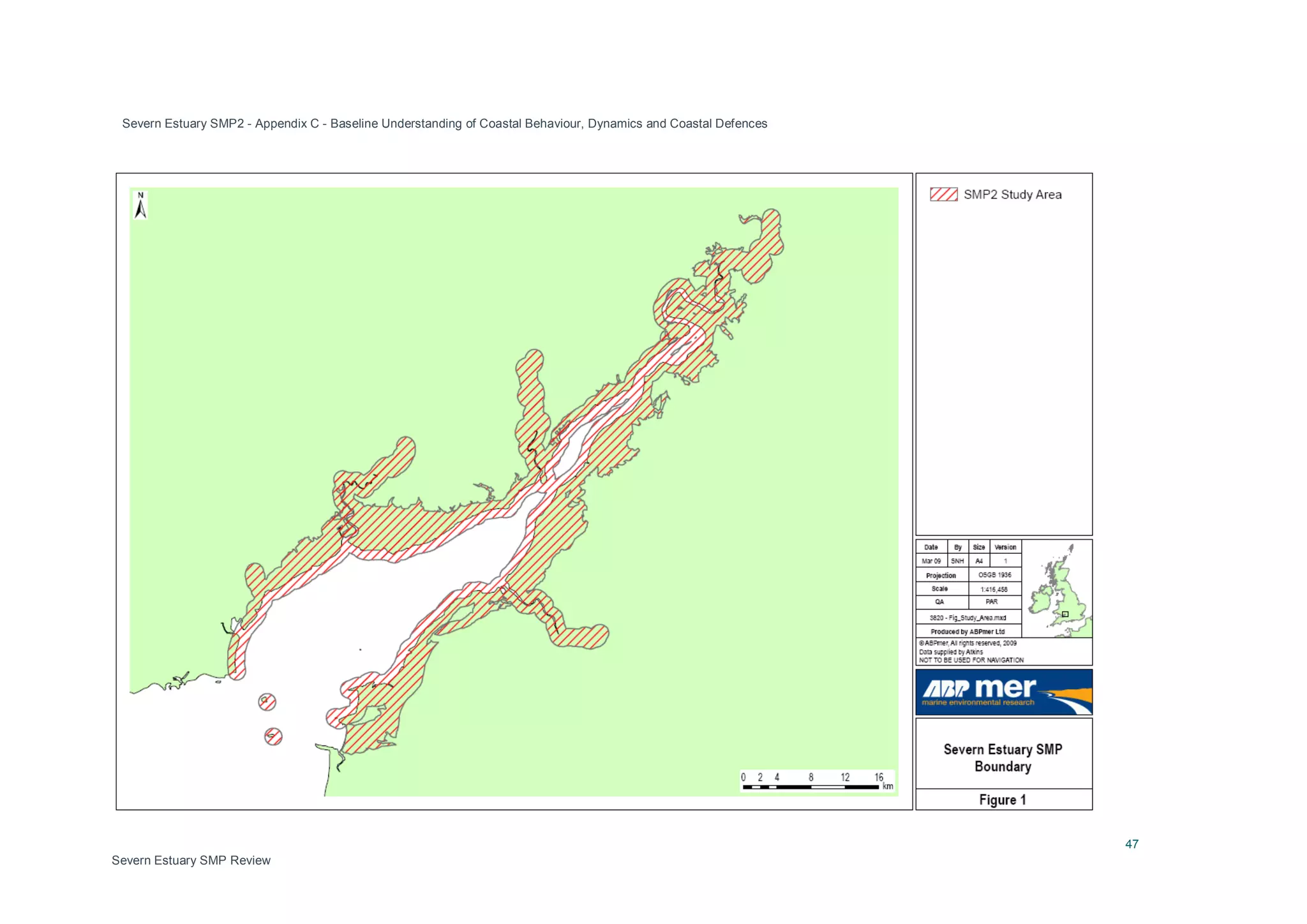
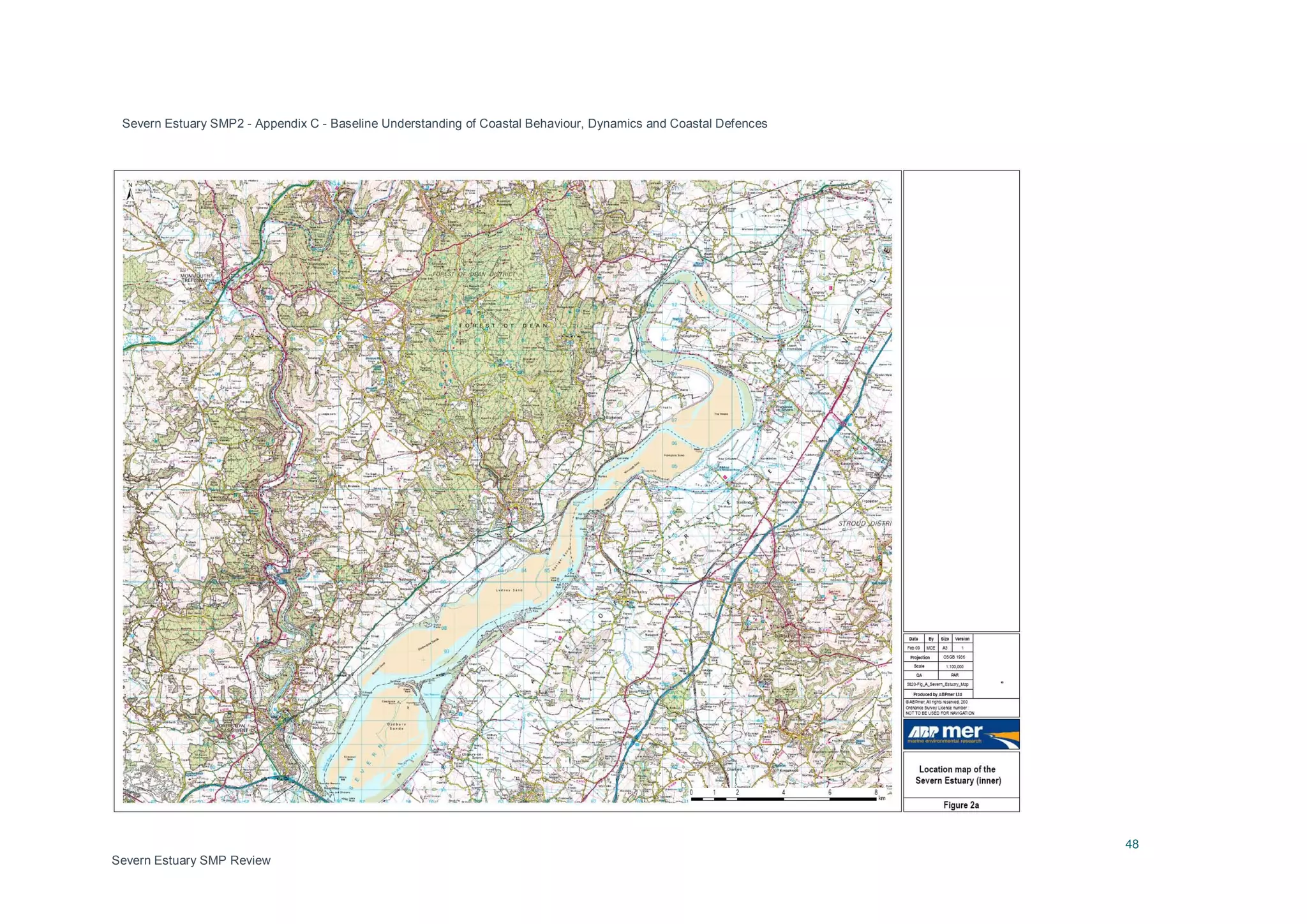
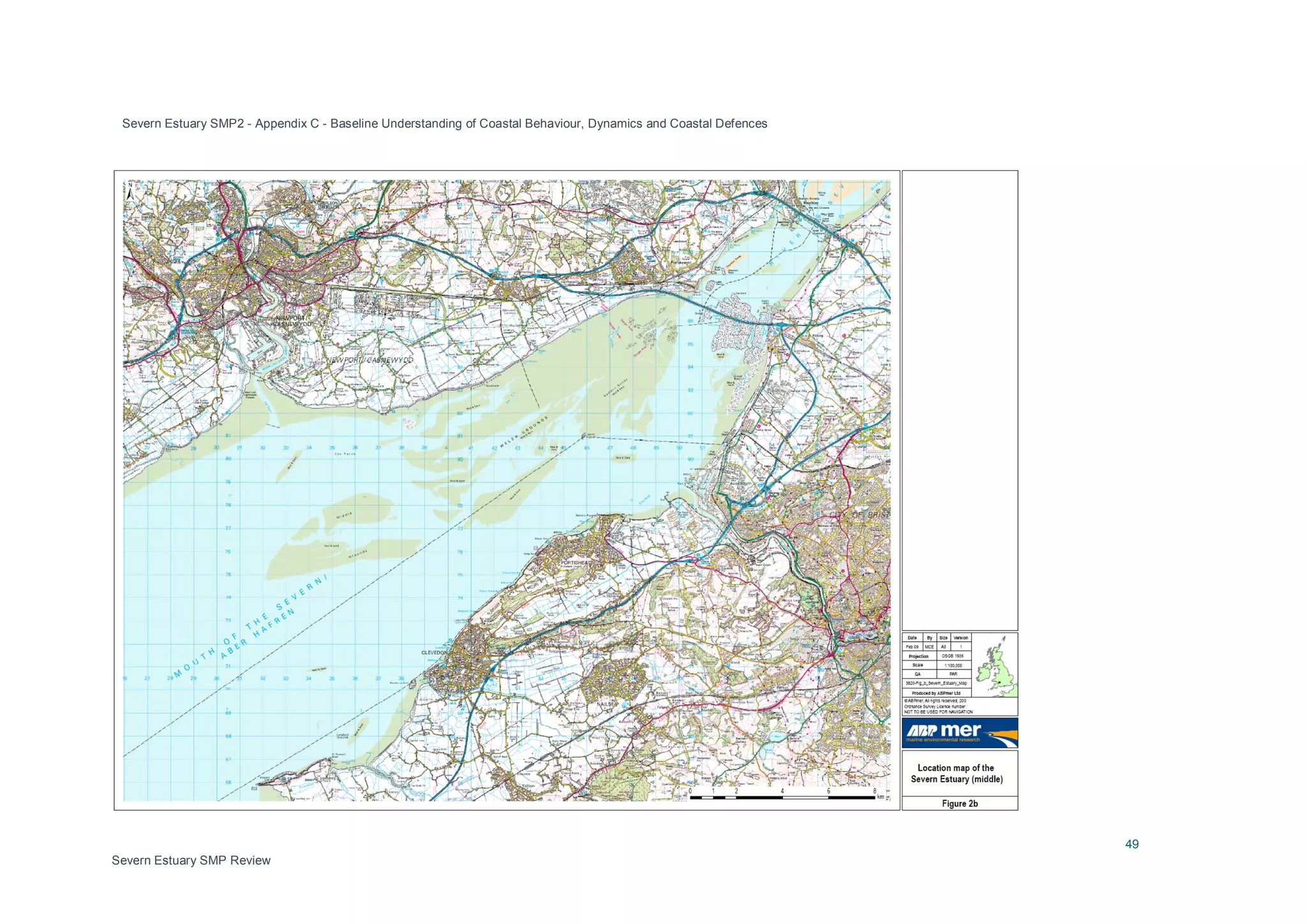
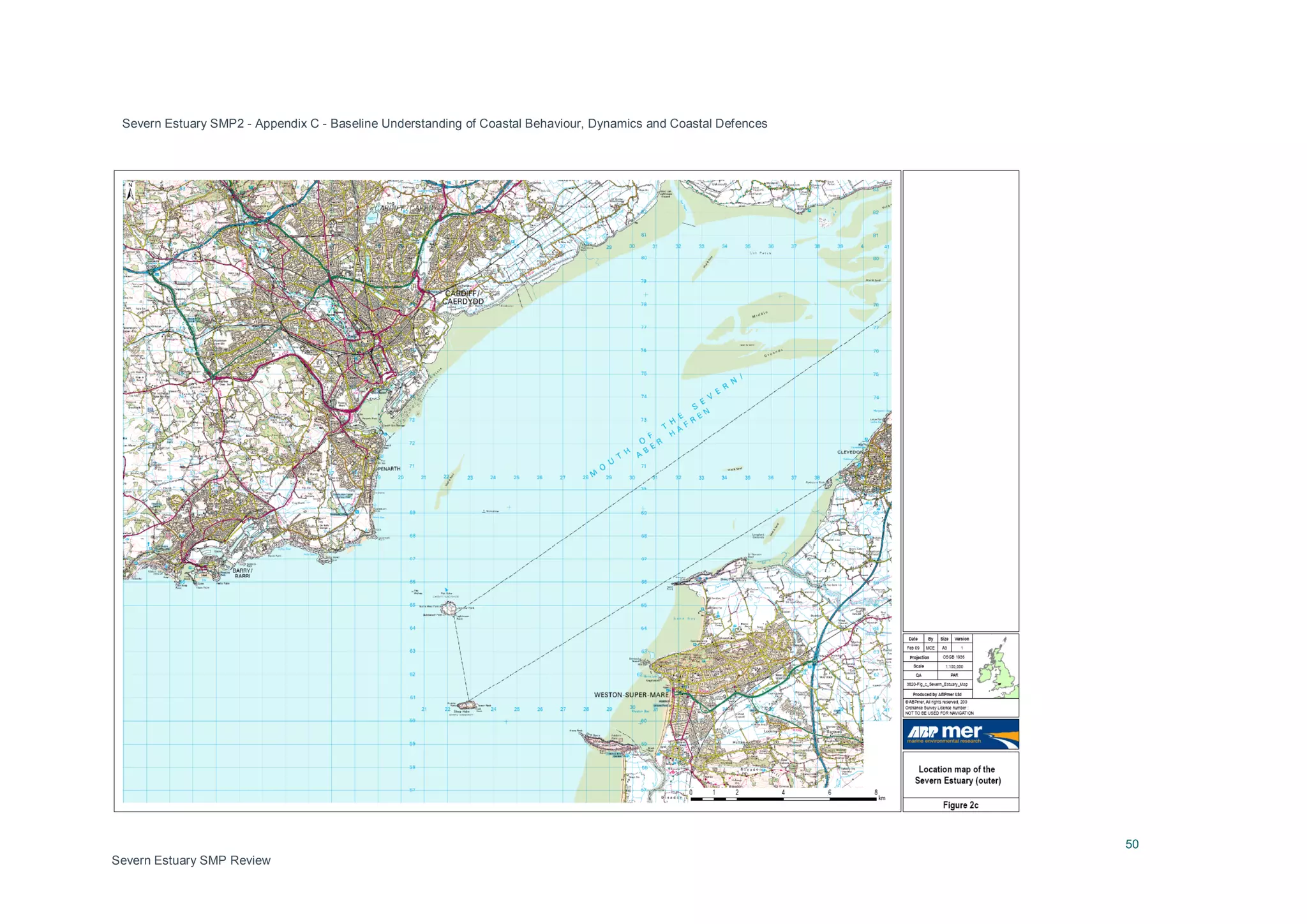
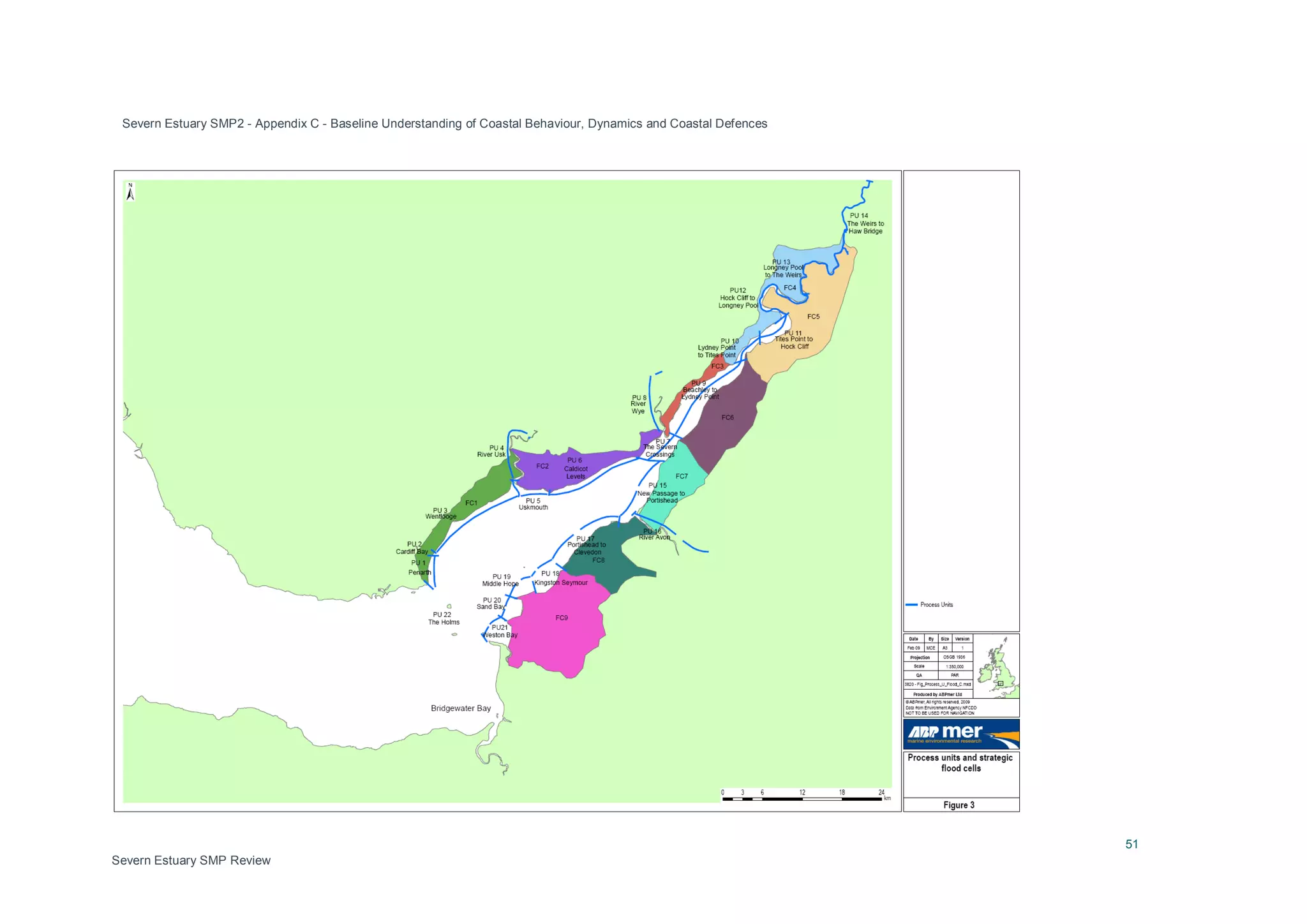
Figure 1 shows the boundary of the SMP, Figures 2a-c provide more information on
the location of the estuary. Figure 3 provides an outline of the process units and flood
cells.
This report aims to present information in a logical and concise format, and to be
accessible to a non-technical audience. As such, this review utilises high-level reports
such as the first round SMP, Futurecoast, the Severn Estuary Coastal Habitat
Management Plan (CHaMP), the Gwent Levels Foreshore Management Plan and the
ongoing Severn Estuary Flood Risk Management Strategy (SEFRMS). In accordance
with the SMP Guidance (Defra, 2006) this review does not aim to provide any new
analyses, quantification or modelling related to the estuarine processes. In order to
make the content as readable as possible to all stakeholders, the referencing to source
material has been kept to a minimum and is focused mainly on reference to the above
documents. However, all the documents used directly within the report are listed in
Section 5.
This report includes:
 Review of existing reports and literature of the coastal behaviour and
dynamics from the Severn Estuary First Generation SMP and other more
recent coastal strategy studies;
 Review of existing data and reports of coastal behaviour and dynamics from
the SEFRMS;
 A summary of the relevant information contained within Futurecoast;
This report should be read in conjunction with the Part B of this report which provides
a summary of coastal defence information including the location, type and residual life
(estimated time until the defence fails) of each defence length.
Severn Estuary SMP2 - Appendix C - Baseline Understanding of Coastal Behaviour, Dynamics and Coastal Defences
8
Severn Estuary SMP Review
1.1 Extent of the SMP
The extent of the first round SMP was from Lavernock Point on the north (Welsh) side
of the estuary upstream to the limit of the tidal influence at Gloucester and to Brean
Down (south of Weston-super-Mare) on the southern (English) side of the estuary.
The limit of the rivers and estuaries was taken to be the coastal protection limit.
The extent of the SMP was reviewed by the Severn Estuary Coastal Authorities Group
and documented in the Severn Estuary Shoreline Management Plan Scoping Report
(Severn Estuary Coastal Authorities Group, September 2008). The report concluded
that the southern English boundary should be moved north to Anchor Head (north of
Weston-super-Mare) to avoid breach potential and possible outflanking from the south
of Brean Down. The new boundary would also provide a reasonable divide between
the open-coast Bridgwater frontage of the North Devon and Somerset SMP Review
and the Severn Estuary. This is illustrated in Figure 1.
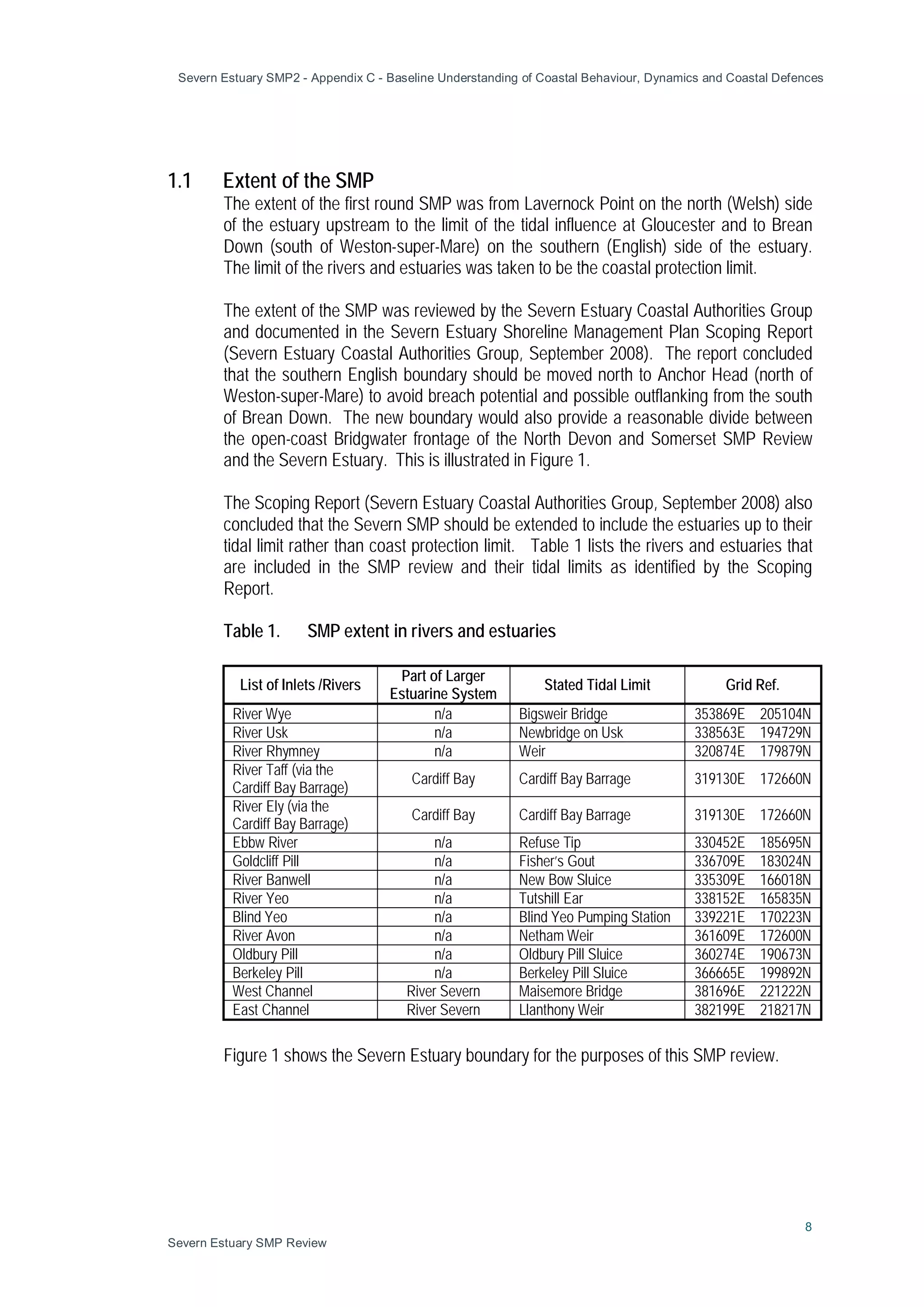
The Scoping Report (Severn Estuary Coastal Authorities Group, September 2008) also
concluded that the Severn SMP should be extended to include the estuaries up to their
tidal limit rather than coast protection limit. Table 1 lists the rivers and estuaries that
are included in the SMP review and their tidal limits as identified by the Scoping
Report.
Table 1. SMP extent in rivers and estuaries
List of Inlets /Rivers
Part of Larger
Estuarine System
Stated Tidal Limit Grid Ref.
River Wye n/a Bigsweir Bridge 353869E 205104N
River Usk n/a Newbridge on Usk 338563E 194729N
River Rhymney n/a Weir 320874E 179879N
River Taff (via the
Cardiff Bay Barrage)
Cardiff Bay Cardiff Bay Barrage 319130E 172660N
River Ely (via the
Cardiff Bay Barrage)
Cardiff Bay Cardiff Bay Barrage 319130E 172660N
Ebbw River n/a Refuse Tip 330452E 185695N
Goldcliff Pill n/a Fisher’s Gout 336709E 183024N
River Banwell n/a New Bow Sluice 335309E 166018N
River Yeo n/a Tutshill Ear 338152E 165835N
Blind Yeo n/a Blind Yeo Pumping Station 339221E 170223N
River Avon n/a Netham Weir 361609E 172600N
Oldbury Pill n/a Oldbury Pill Sluice 360274E 190673N
Berkeley Pill n/a Berkeley Pill Sluice 366665E 199892N
West Channel River Severn Maisemore Bridge 381696E 221222N
East Channel River Severn Llanthony Weir 382199E 218217N
Figure 1 shows the Severn Estuary boundary for the purposes of this SMP review.
Severn Estuary SMP2 - Appendix C - Baseline Understanding of Coastal Behaviour, Dynamics and Coastal Defences
9
Severn Estuary SMP Review
1.2 Structure of Part A
Section 2 introduces the Severn Estuary as a system and then provides summaries of
the geology, geomorphology, present estuarine behaviour, the hydrodynamics,
including tides and currents, the wave climate, surges and extreme water levels,
freshwater flows, and the sediment transport within the estuary.
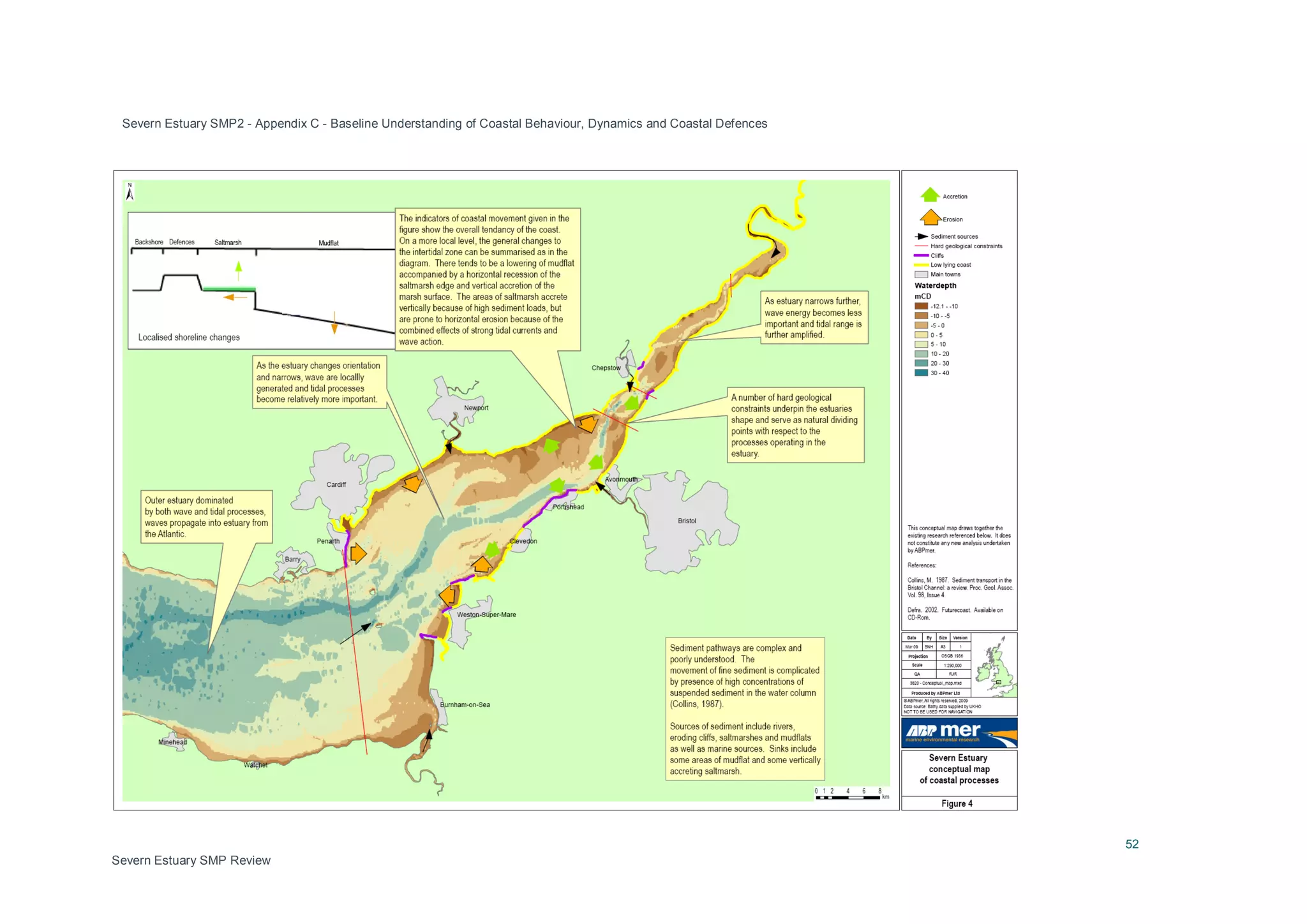
Section 2 and 3 are supported by a conceptual map of the estuary supporting the
following descriptions and illustrating the key physical control and linkage features
within the SMP2 area. For example, sediment sources/sinks and pathways, sediment
transport pathways (rates and nearshore transport potential), erosion and accretion
rates, wave climate and areas at risk from overtopping. This map is limited to baseline
processes, and does not include predictions of future change (Figure 4).
Section 3 provides a description of each of the units within the SMP as defined in the
first round SMP, and a review of their historical change, utilising information from
Futurecoast (Defra, 2002), where applicable.
Section 4 presents an assessment of future change in the Severn Estuary including an
introduction to the most up to date predictions of climate change; and analysis of future
geomorphological change within the estuary, using predictions from Futurecoast
(Defra, 2002), as well as those from the CHaMP (ABPmer, 2006) and more recently
updated for the SEFRMS (ongoing, ABPmer & Atkins).
1.3 Assumptions and Limitations
There is no single dataset that provides a detailed and up to date description of the
seabed bathymetry for the Severn Estuary. This is a significant limitation.
Existing Admiralty Charts are commonly only updated where there is an interest to
report safe depths in areas used for navigation and when new surveys are provided to
UKHO.
The intertidal and shallow areas across sandbanks are surveyed on an infrequent basis
and in places this data has not been resurveyed since 1938.
Admiralty Charts do not extend much further upstream than Sharpness which is the
furthest port upstream in the estuary.
Geological and geomorphological information (e.g. sediment type and depth to rock
head) in areas upstream of The Shoots remains incomplete and hence represents a
key missing dataset for this SMP2.
The number of wave measurement sites within the Severn Estuary is very small
relative to the amount of water level and flow data. The primary dataset was collected
to support earlier barrage studies during the period 1978 to 1981 and using surface
mounted wave recorders.
Severn Estuary SMP2 - Appendix C - Baseline Understanding of Coastal Behaviour, Dynamics and Coastal Defences
10
Severn Estuary SMP Review
There is a lack of routine monitoring at any strategic level which offers quantification of
rates of change in morphological features across the estuary. This is a significant issue
for this SMP2 in terms of being able to attempt any type of shoreline evolution
quantification which has presented itself as a key challenge for this project.
Severn Estuary SMP2 - Appendix C - Baseline Understanding of Coastal Behaviour, Dynamics and Coastal Defences
11
Severn Estuary SMP Review
2. Estuary Description and Processes
2.1 Overview
The information presented within Section 2 is adapted from the following 4 main
reports:
• ABPmer. 2006. Severn Estuary Coastal Habitat Management Plan. ABP
Marine Environmental Research Ltd for Environment Agency.
• Atkins. 2004. Gwent Levels Foreshore Management Plan. Phase III final
Report. Environment Agency Wales, AK4065.500/DG08
• Defra. 2002. Futurecoast. Produced by Halcrow, on behalf of Defra, 3 CD-
Roms.
• ABPMer and HR Wallingford (2008) Severn Tidal Power – Scoping Topic
Scoping Topic Paper – Hydraulics and Geomorphology, Study for DECC
(2008)
Reference to “ongoing ABPMer & Atkins” refers to the Severn Estuary Flood Risk
Management Study (SEFRMS) which is being prepared in parallel to the SMP2. No
reports from that project are publically available at the time of writing. It should be
noted that the Severn CHaMP (ABPMer 2006) only measured changes to the
bathymetry of the estuary, all other descriptions of historical estuarine behaviour was
sourced form other reports which are already referenced in the SMP2 review.
The Severn Estuary is the largest coastal plain type estuary in the UK, with the second
largest tidal range in the world, at 10 to 12 m (Defra, 2002). The estuary extends from
Haw Bridge to the north of Gloucester (Figure 2a) to its downstream limit of the estuary
between the headland at Lavernock Point (Welsh coast) and Brean Down on the
southern side of Weston Bay on the English coast (Figure 2c). The area to seaward is
commonly referred to as the Inner Bristol Channel. It is at this location where the
orientation of the coastline changes from a mainly east to west trend downstream to a
north-east alignment and the start of the funnel-shaped estuary. The estuary extends
from 15 km wide in its outer reaches to <60 m wide in the Severn near Gloucester. In
most places it is less than 5 m deep, although the maximum depth of 30 m is in the
principal channel between Flat Holm and Steep Holm at the seaward boundary of the
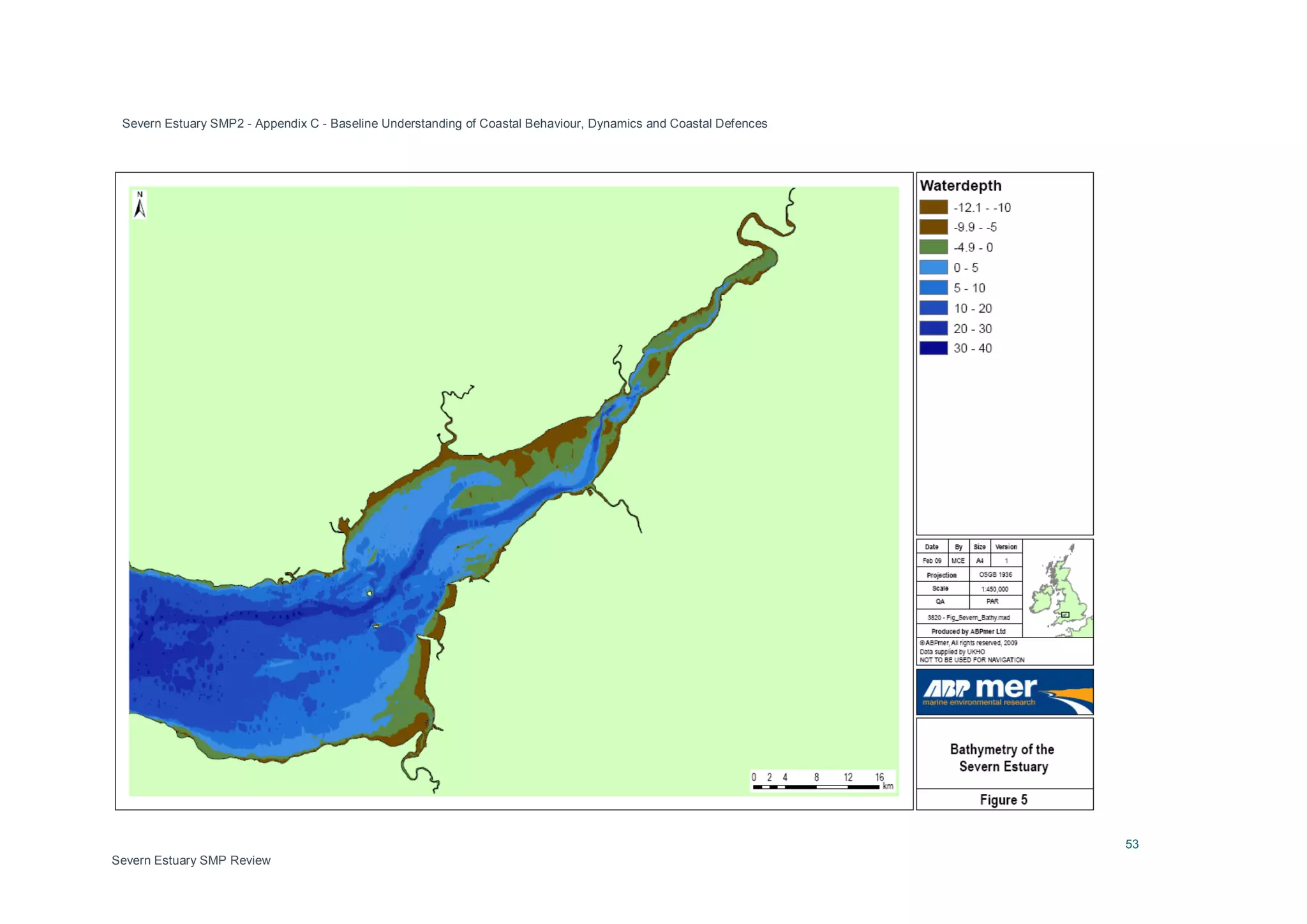
SMP area (Figure 5). The tidal limit of the Severn is normally taken to be at
Maisemore (West Parting) and Llanthony (West Parting) weirs, near Gloucester.
However, on high spring tides the weirs can be overtopped by the tidal bore, and here
the limit of the tidal flood risk is taken as the limit of the SMP, at Haw Bridge.
The Severn Estuary is a high-energy environment and a dynamic system that
responds to the influence of tides and storms, which are events that can move large
quantities of sediments and alter channel profiles and locations. The most significant
threat (with the exception of major development) over the next 100 years is from
Severn Estuary SMP2 - Appendix C - Baseline Understanding of Coastal Behaviour, Dynamics and Coastal Defences
12
Severn Estuary SMP Review
climate change and the response of the estuary to increases in sea level and
storminess. The net effect of these issues is to create coastal squeeze along the
developed/defended margins of the estuary, with the potential for loss of intertidal
features (Defra, 2002).
The hydrodynamic character of the Severn Estuary is partly due to its form and partly
due to its geographic setting. The form is determined from geological evolution,
human intervention and interaction with present day physical processes resulting in a
funnel shaped estuary. The main estuary channel is the former river channel, which
became drowned and infilled as sea levels increased in the post-glacial period. The
geographical setting of the estuary produces the very high tidal range that forms a
major control on hydrodynamic processes.
The principal morphological components of the Severn Estuary are:
 Rocky intertidal platforms covered with a thin veneer of sediment;
 Major sand deposits and sandbanks in the central parts of the estuary;
 Subtidal channels, with gravel and sand or mud deposits;
 Muddy tributary estuaries;
 Muddy intertidal foreshores with relatively limited saltmarsh;
 Sand beaches and dunes on the Atlantic facing coast.
There are currently approximately 22,600 ha of intertidal habitat within the Severn
Estuary (ongoing, ABPmer & Atkins). However, there is predicted to be a net loss of
intertidal mudflats, sandflats and saltmarshes over the next 100 years. These losses
are predicted to be unevenly distributed throughout the estuary with the greatest
relative losses in the middle and outer estuary and gains within the inner estuary
(ongoing, ABPmer & Atkins). This is driven by the predicted morphological and
hydrodynamic changes within these sections of the estuary.
2.2 Geology and Coastal Evolution
The present configuration of the Bristol Channel and Seven Estuary as seen today has
been formed during the Quaternary glacial and interglacial periods. The broad
underlying geology in the outer estuary (i.e. to seaward of the Severn Crossings) is of
folded and faulted lower Jurassic mudstones and limestones. Carboniferous limestone
exposures occur at the headlands and the islands of Flat Holm and Steep Holm
(Figure 2c). Further into the estuary, at Sharpness (Figure 2b), more resistant Silurian,
Devonian and Cambrian strata transect the estuary and upstream of this point Jurassic
and Triassic marls and sandstones underlie recent alluvial deposits. Bordering much
of the estuarine deposits are Devonian and Carboniferous lithologies of Old Red
Sandstone and limestones. Bedrock is evident in the cliff sections producing a rock-
constrained system.
The Holocene started at the end of the last glaciation, at which time mean sea levels
are believed to be around 30 m below present day levels. The estuarine environment
would have been to the west (seaward) of its present location with a freshwater river
valley where the inner estuary is today. Following deglaciation, available data
Severn Estuary SMP2 - Appendix C - Baseline Understanding of Coastal Behaviour, Dynamics and Coastal Defences
13
Severn Estuary SMP Review
indicates an initial rapid rise in sea level of 25 m to around 6,000 years BP, which
displaced the estuary landward into the river valley and resulted in sections of palaeo-
channels being infilled. Coastal plains were submerged and rocky headlands such as
Brean Down were likely to be islands (Figure 2b). Since that time the size and shape
of the Bristol Channel and Severn Estuary have varied with ongoing fluctuations in sea
level. Subsequent rates of sea level rise to the present day were slower (approximately
1 mm/yr to 2,500 BP).
Prior to the rise in sea level the estuary was divided into two zones, one of bedload
transport towards the sea, and one of transport inland. The rise in sea level caused
the divide between the two zones to move up the estuary, in a landward direction.
Sandy sediments were transported into the estuary to form the extensive banks now
found along the original river channel axis, but the rise also released sediment from the
seaward margin of the estuary into the Celtic Sea. The effect of rising sea levels has
resulted in a wide expanse of exposed seabed without any major sediment cover, over
an area extending from the Inner Bristol Channel into the lower reaches of the Severn
Estuary, resulting in little sediment availability in this area. The present position of the
bedload parting zone is now considered to be at the boundary between the Inner
Bristol Channel and the Severn Estuary.
Lying directly on the underlying bedrock or earlier Pleistocene sediments of the Severn
Estuary, at least four discrete sediment formations have been identified. With a
thickness of 10-15 m, these deposits consist of alluvial and estuarine sediments and
comprise much of the existing shoreline of the estuary. The earliest of these is the
Wentlooge Formation, which first began accumulating between 3,000-2,500 years ago
and ended at the start of the first Roman occupation about 2,000 years BP. Earth
embankments were initially built during the Roman period and the marshes were
drained for agriculture. This reclamation had the effect of narrowing the estuary and
separating it from the natural fine sediment sink area. Three further formations: the
Rumney (early Medieval to the 19th Century), the Awre (19th Century) and the
Northwick (20th Century), are seen as steps or terraces across the intertidal zone.
Solid geological formations provide a set of hard constraints on the further evolution of
the estuary. The boundary of the estuary with the Inner Bristol Channel is essentially a
geological divide corresponding to a denuded spine of carboniferous limestone
extending between the headland feature of Brean Down to the islands of Steep Holm
and Flat Holm and across to Lavernock Point, which is a further headland formed of
Lower Lias mudstones. The seabed at this location remains sediment poor with large
areas of exposed rocky seabed. The location of the first Severn Bridge also
represents a geological constraint bounded by Aust Cliff (Lower Lias) and Beachley
Point (Keuper Marl), and with a series of rock platforms which direct the passage of the
water. The Shoots, at the location of the Second Severn Crossing, is a further
geologically constrained reach of the estuary, with an over-deepened channel. A
further over-deepening occurs between Flat Holm and Steep Holm, where the channel
passes between Flat and Steep Holm and out to the Inner Bristol Channel, and is
frequently infilled with gravels.
Severn Estuary SMP2 - Appendix C - Baseline Understanding of Coastal Behaviour, Dynamics and Coastal Defences
14
Severn Estuary SMP Review
Superficial sediments that rest on the top of the bedrock are glacial till, post-glacial
valley infill, Flandrian accumulations and surface sediments, of which the surface
sediments interact with waves and tides. The largest sediment accumulation in the
estuary is the infilled river valley (in the area occupied by Middle Ground; Figure 2b)
with sediment depths of up to 30m. However, unconsolidated sediment cover in the
estuary is generally thin (typically less than 5m), and the total quantity of coarse
sediment is small when compared with the tidal volumes, making this area relatively
poor in coarse sediment. Sediments are also highly divided, leading to distinct and
separate deposits of gravels, sands and muds, with areas of mixed sediments virtually
absent.
2.3 Geomorphology
The Severn Estuary is the largest coastal plain type estuary in the UK. The tidal limit of
the Severn is normally taken to be at Maisemore (West Parting) and Llanthony (West
Parting) weirs, near Gloucester (Figure 2a). However, on high spring tides the weirs
can be overtopped by the tidal bore. The predicted 1 in 100 year tidal flood risk area
extends further upstream to Haw Bridge on the River Severn, the site which is
regarded as the furthest upstream point where estuarine sediments have been
identified.
The downstream limit is between the headland at Lavernock Point (Welsh coast) and
Brean Down on the southern side of Weston Bay on the English coast (Figures 2c) and
it is at this location where the orientation of the coastline changes from a mainly east to
west trend downstream to a north-east alignment and the start of the funnel-shaped
estuary. These changes in form have an effect on the local wave regime (reduced
exposure to Atlantic swell) and tidal regime (through amplification of the tidal range).
The estuary extends from 15 km wide in its outer reaches to <60 m wide in the Severn
near Gloucester. In most places it is less than 5 m deep, although the maximum depth
of 30 m is in the principal channel between Flat Holm and Steep Holm at the seaward
boundary of the SMP area (Figure 5).
The funnel shape of the estuary is anchored by periodic bedrock promontories along
the shoreline, including Hinkley Point and Lavernock Point at the western end of the
study area, Redwick and Sudbrook at the Second Severn Crossing, Aust and Beachley
at the Severn Road Bridge, and at Sharpness and Purton (Figure 2b). Each of these
constriction zones serves as natural dividing points with respect to the dynamic
processes operating within the estuary. Geomorphologically, the shape of the Severn
Estuary is extremely significant as the increasingly narrow channel width serves to
focus the incoming tidal wave, increasing its amplitude and creating high current
velocities.
The western end of the estuary, open to the full extent of the Bristol Channel, which is
in turn exposed to the Atlantic Ocean, is heavily influenced by wave processes. As the
estuary narrows, the effects of wind waves lessen, and are superseded by the
influence of tidal currents and river processes. The rocky headlands, such as Brean
Down and Sand Point (Figure 2b), serve to modify wave and tidal processes,
Severn Estuary SMP2 - Appendix C - Baseline Understanding of Coastal Behaviour, Dynamics and Coastal Defences
15
Severn Estuary SMP Review
disrupting littoral sediment transport and deflecting tidal currents in such a way as to
favour deposition.
The margins of the estuary are dominated by wide intertidal mudflats and low-lying
‘levels’ (former floodplains), which would be inundated at high water in the absence of
flood embankments, or by higher ground forming sea cliffs. The flood embankments
currently artificially constrain the natural development of the estuary and prevent the
floodplain from receiving sediment-laden water. Human activity has influenced the
past evolution of the study area, particularly through reclamation, construction of flood
banks, industrialisation and the planting of Spartina.
The other tributaries entering the estuary include the Rivers Frome, Cam, Avon, Yeo,
Banwell, Brue and Axon on the English coast, the Ebbw, Wye, Usk and Rhymney on
the Welsh coast, and the Taff and Ely that discharge into the Severn Estuary through
Cardiff Bay.
The principal morphological components of the Severn Estuary are:
 Rocky intertidal platforms covered with a thin veneer of sediment;
 Major sand deposits and sandbanks in the central parts of the estuary;
 Subtidal channels, with gravel and sand or mud deposits;
 Muddy tributary estuaries;
 Muddy intertidal foreshores with relatively limited saltmarsh;
 Sand beaches and dunes on the Atlantic facing coast;
 Shingle beaches.
Habitat areas and predicted losses and gains were identified in the Severn CHaMP
(ABPMer 2006). These figures have now been reviewed and updated as part of the
SEFRMS (ABPmer and Atkins, ongoing (which were originally sourced from the
CCW/Natural England Phase 1 Intertidal Survey). Although the SEFRMS does not
cover the same extent as SMP2, which excludes Bridgewater Bay, the data have been
used as it provides the best available data source. At the time of writing, permission is
not granted by the EA to release these figures and hence are not included at this
stage. To ascertain such information, readers are requested to contact the SEFRMS
team at the Environment Agency).
There are large areas of rocky intertidal (about 1,500 ha) throughout the area, which
are more predominant on the English side of the estuary. The types of rocky intertidal
present include boulders, expanses of rock platforms, mussel/cobble scars and rocky
pools. Rocky shores dominate the coastal zone in a number of areas, the most
notable in the vicinity of the Second Severn Crossing, between Portishead and Sand
Point, Lydney Cliff, Purton Passage and the outer Estuary. The sand deposits on
Middle Grounds, Cardiff Grounds and Welsh Grounds, in the centre of the estuary, are
generally mobile and can change location and nature over a range of timescales.
Subtidal channels tend to remain stable, but within the channels there may be periodic
formations of fluid mud layers or sand waves, depending on the local sediment regime.
Severn Estuary SMP2 - Appendix C - Baseline Understanding of Coastal Behaviour, Dynamics and Coastal Defences
16
Severn Estuary SMP Review
The mudflats are extensive, comprising approximately 90% of the intertidal area
(ongoing, ABPmer & Atkins) and are often found in association with the tributaries
entering the Severn. Most of the muddy intertidal foreshores exhibit net erosion,
although there may be seasonal variations, with accumulations and loss of material in
response to changes in sediment supply and wave action.
Saltmarsh occupies approximately 7% of the intertidal area (ongoing ABPmer and
Atkins). The sections of the estuary that support large extents of saltmarsh include the
Wentlooge Levels, Caldicot Levels, Gwent Levels, the Severn Crossings, and into the
inner reaches of the estuary. Areas of saltmarsh tend to accrete vertically in response
to sea level rise and as a result of high sediment loads, but are prone to horizontal
erosion because of the combined effects of strong tidal currents and wave action at the
appropriate tidal height.
Shingle beaches are associated with many of the rocky intertidal areas, particularly on
the English side, but also on both sides of the Second Severn Crossing. On the Welsh
side there are scattered regions of shingle beaches interspersed amongst the rocky
section of coastline near the outer estuary.
The key constraints to future morphological development are physical barriers such as
flood embankments and non-erodible geological formations; and sediment availability,
as well as the impacts of climate change.
2.4 Present Estuary Behaviour
The Severn Estuary is presumed to be under erosional pressure due to rising sea
levels and as a major portion of the original natural intertidal area has been reclaimed
over the past 2,000 years. Recent analysis has shown that both high and low water
levels have moved landwards over much of the shoreline within the SMP area. The
entire coastline downstream of Beachley appears to be marginally erosional, and
exceptions to this are relatively rare. The most notable exception is in the vicinity of
the River Usk at Newport, where there has been significant seaward movement of low
water, but the system here is complex and an assessment of the sediment budget is
difficult (Section 2.6). It is also true that the shoreline upriver of Beachley is more
complex than the assumption of erosion throughout. The upper and outer areas of the
estuary show a clear trend of net accretion over the past 100 years. The trend in the
central estuary is less marked, although net erosion is evident.
For rock cliffs and platforms, there is a general understanding that erosion does occur,
although at a slow rate and difficult to demonstrate discernable historical trend analysis
over time. For example, a rate of 0.14 m/yr is reported for the cliffs between Lavernock
and Penarth Head (Defra 2002). There are, however, exceptions, e.g. in Sand Bay
(Worlebury Hill) slump erosion of 3.6 m/yr appears to be responsible for foreshore
accretion (Defra 2002).
Horizontal erosion and accretion rates of marsh and associated mudflats are variable,
ranging from erosion rates of 0.29 to 10.5 m/yr, with a mean of 2.13 ± 2.49 m/yr, to
Severn Estuary SMP2 - Appendix C - Baseline Understanding of Coastal Behaviour, Dynamics and Coastal Defences
17
Severn Estuary SMP Review
accretion rates of 0.33 to 3.75 m/yr, with a mean of 1.66 ± 1.63 m/yr (ABPMer 2006).
It is apparent that marshes and mudflats are eroding more commonly and at a faster
rate than accretion is occurring. Marsh erosion in some places can be related to
Spartina anglica planting and colonisation and subsequent dieback, i.e. there was a
general trend of erosion before Spartina was introduced in the 1920s, which resulted in
accretion. However, following this, dieback of the Spartina has resulted in a decrease
in extent and has led to marsh edge erosion.
Whilst the marshes are being lost through edge erosion, the vertical accretion of the
marshes has been accelerating. Whilst the reasons for this are not obvious, it may be
that edge erosion and vertical accretion are related. With erosion, more sediment
becomes available for deposition over the remaining, and gradually decreasing, marsh
surface area.
The predominant long-term trend for mudflat behaviour is also one of erosion, although
there is a paucity of data. There is evidence of mudflat lowering at Rumney Great
Wharf and the Wentlooge Levels that has been estimated at 4.3 and 1.5 cm/yr,
respectively. In other areas (Bridgwater Bay, Peterstone Flats and intertidal areas
near the Newport Deep), net accretion is thought to be occurring. Core data from the
mudflats of Bridgwater Bay indicate a deposition rate of about 0.5 cm/yr.
In general, areas within the estuary are now eroding, and this situation is likely to be
exacerbated in the future by sea level rise.
2.5 Hydrodynamics
The hydrodynamic character of the Severn Estuary is partly due to its form and partly
due to its geographic setting. The following section describes the forcing factors of the
tides, waves, water levels and the resulting sediment transport within the estuary.
2.5.1 Tides and Currents
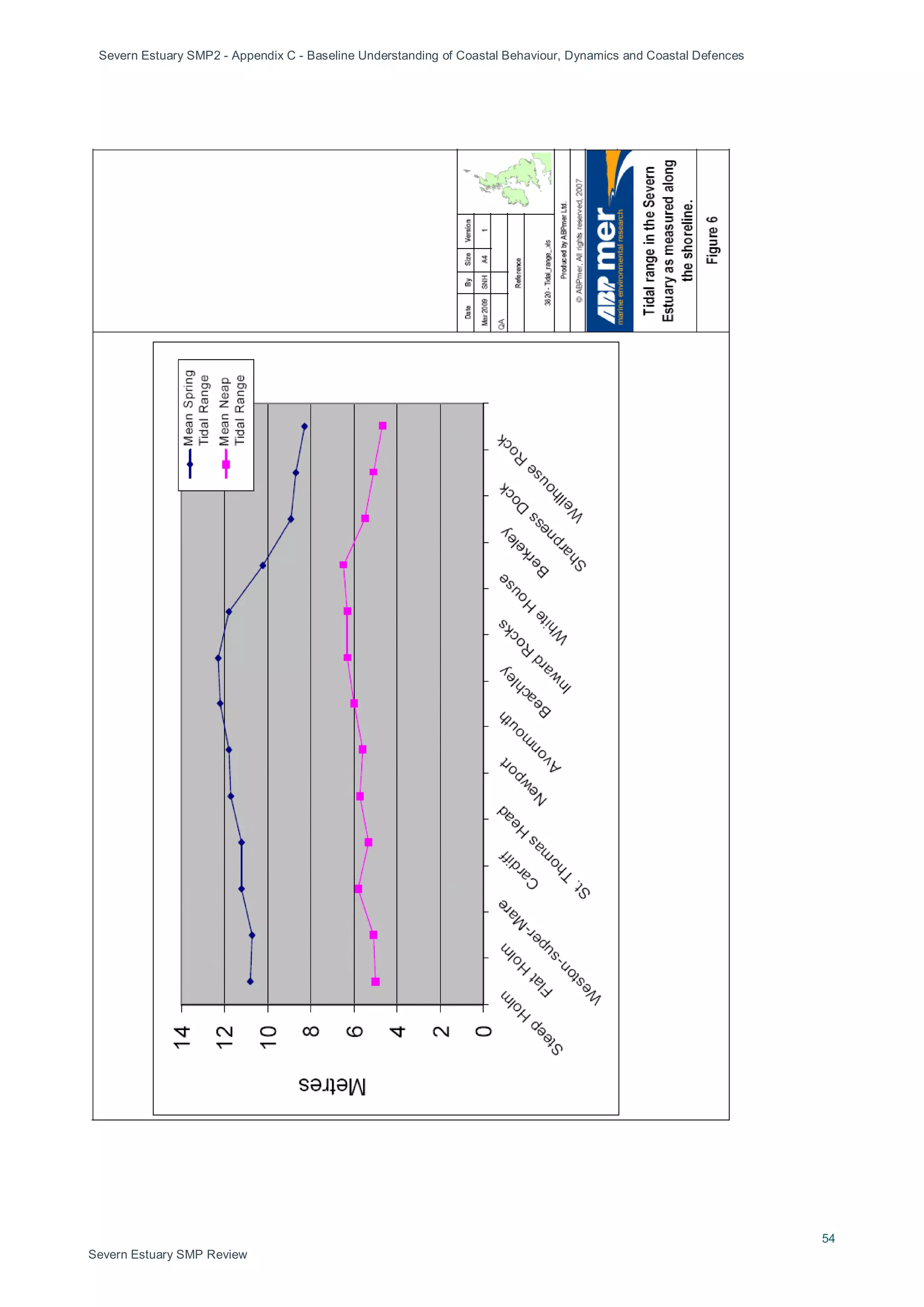
The Severn Estuary is subject to a strongly semi-diurnal and very large tide of 10 to 12
m, giving the estuary the second largest tidal range in the world (Figure 6). This high
tidal range is due to the combination of the North Atlantic tidal wave approaching
through the Bristol Channel and the further amplification and convergence of this tidal
wave as it moves into the funnel-shape of the Severn Estuary. The tidal prism (i.e. the
volume of water the enters and leaves the estuary on an average tide, calculated as
the difference between the tidal volume at high water and that at low water) of the
Severn Estuary has been calculated at approximately 96 x 108 m3.
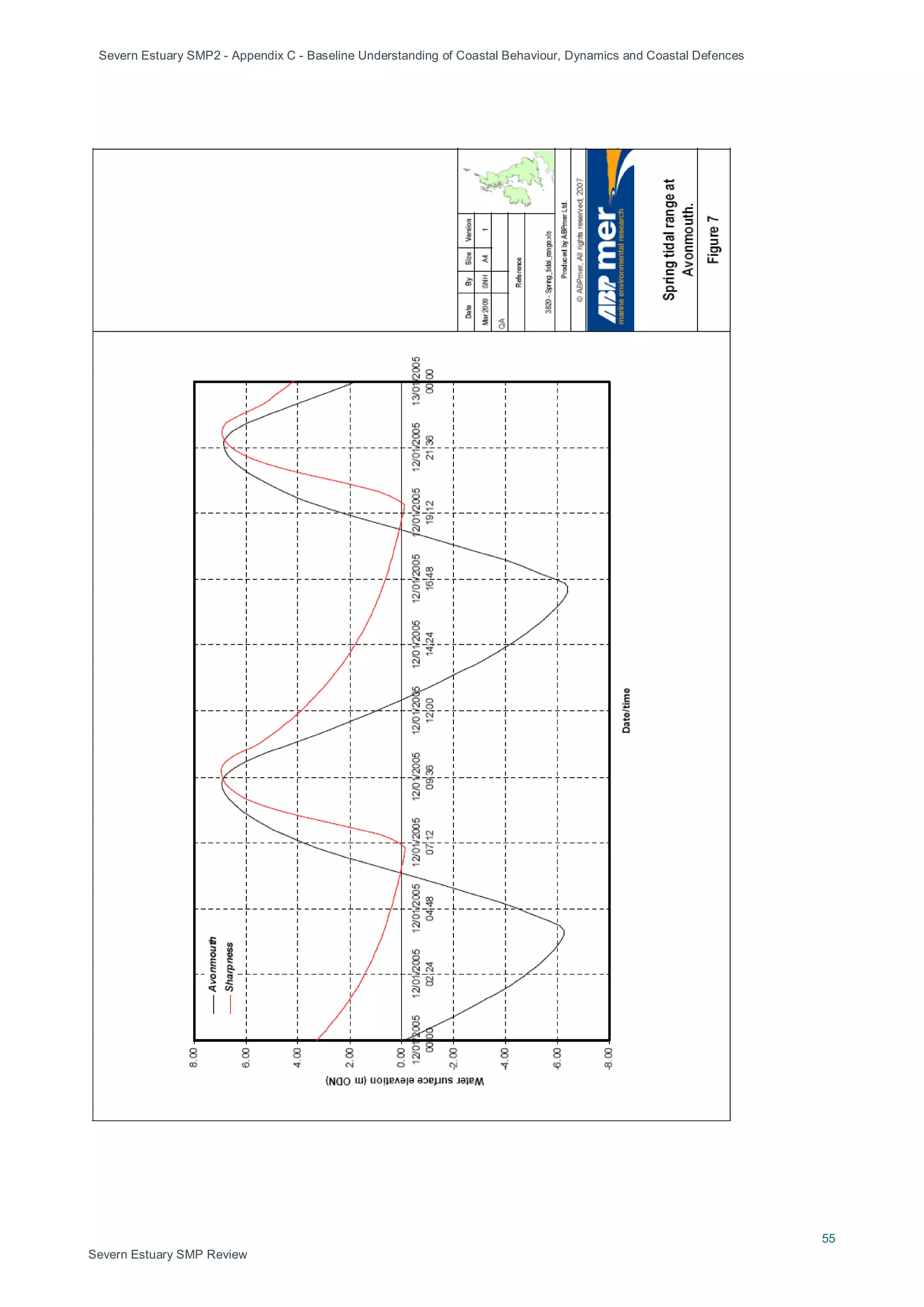
The tide enters the Severn Estuary from the Bristol Channel as a progressive tidal
wave with a fairly symmetrical sinusoidal shape. As the tide moves upstream it
amplifies in range due to the funnel shape of the estuary, reaching a mean spring tidal
range of 12.2m at Avonmouth and a maximum of 12.3 m on mean spring tides at
Beachley (Chepstow, Severn Bridge) (Figure 7). Further upstream the estuary widens
out slightly and shallows rapidly leading to increased asymmetry of the shape of the
tidal curve and therefore steepening of the curve due to the shallow water effects (i.e.
Severn Estuary SMP2 - Appendix C - Baseline Understanding of Coastal Behaviour, Dynamics and Coastal Defences
18
Severn Estuary SMP Review
the interaction of the tidal wave with the shallowing bed causes a slowing of the trough
of the tidal wave with respect to the crest, therefore creating asymmetry) the flood tide
becomes increasingly short and steep, whereas the ebb drops less steeply and more
slowly (i.e. with a longer duration). For example, at Avonmouth the spring flood tide
typically lasts about 5.5 hours compared to 7 hours of ebb flow (Figure 7). Eventually
this steepening leads to formation of a tidal bore from Awre to Avonmouth on high
spring tides, the size of which can reach 1.2m. Information on the tidal bore is
explained further within Part C (Section 1.5) of this report.
Around low water there is a further feature of the tide: upstream of Oldbury Power
Station low water levels on neap tides fall to marginally lower levels (0.1 m on average)
than on spring tides. This is due to the longer times required to drain larger volumes of
water on a spring tide, meaning that the system has not fully drained before the next
flood tide commences.
The large and rapid rise and fall of the tide leads to very strong currents through the
main body of the estuary. These strong currents maintain deep channels and high
suspended sediment loads. Flows also increase in strength where they are forced
through constrained narrows (e.g. The Shoots, just below the Second Severn
Crossing, where the currents are in excess of 6 m/s). Where the tide becomes
asymmetric then a dominance is established between ebb and flood currents: i.e. the
flood tide becomes dominant in strength over the ebb (flood currents increasingly
exceed those occurring on the ebb tide), but the duration of the ebb tide is longer. This
effect also increases further up the estuary. These currents appear to be the primary
mechanism for sorting seabed materials, so that the channels tend to contain gravels,
with rocky patches, and the intertidal margins of the estuary have muddy deposits.
Within the centre of the estuary there is also a large sand body called Middle Grounds,
which extends to the north east into Welsh Grounds (Figure 2b). The estuary is
considered to be ebb dominant towards the mouth, whilst further upstream the estuary
is flood dominant. The location of the switch is just upstream of Avonmouth, which
relates to a change in the bathymetry from deep water at the mouth to the shallow
water of the upper estuary, although the position will vary as a function of factors
including tidal range, fluvial flows and topography.
The direction of the currents is strongly influenced by the morphology of the seabed
with currents generally aligned through the main channels and past shallow
sandbanks. However, geological hard points extend out into the estuary and can
influence the tidal flows to produce local modifications to the flow regime; for example,
The Shoots directs the ebb tide over to the English shoreline upstream of Avonmouth.
At the confluences of the main tributaries there can also be impacts on the estuary flow
as the tidal stream is influenced by flooding or ebbing tide within the tributary, which
also leads to a dynamic local morphology in the tributary mouths. Typically the
influence of freshwater discharges into the estuary from tributaries is negligible
because under most conditions the tidal prism dominates. However, under high fluvial
discharges, the relative significance of peak discharge is likely to become more locally
significant with the potential to introduce large amounts of sediment. The currents
created by the incoming tide travels up the estuary until the opposing fluvial flow
Severn Estuary SMP2 - Appendix C - Baseline Understanding of Coastal Behaviour, Dynamics and Coastal Defences
19
Severn Estuary SMP Review
creates an area of slack flow, the location and timing of which varies with each tide. As
the current is slowed and then stops altogether, deposition of both incoming and fluvial
sediment can be expected. The tidal asymmetry results in a division of the sediment
transport between mud and sand.
Marine sands are pushed up the estuary during the fast flowing flood tide where it is
deposited at the point where slack water is reached. The slower flowing ebb tide is
unable to remobilise all the material for a seaward return and therefore sand is
transported up the estuary by a process called ‘tidal pumping’. The landward direction
of net sand transport has been confirmed by sediment trends analysis. Muds appear
to remain in suspension for most tides and tend to be introduced into the estuary from
fluvial sources.
In response to climate change there is likely to be an increase in mean sea level, which
will modify the tidal dynamics and the shallow water interactions, by increasing the tidal
wavelength leading to the potential for changes in the tidal range.
2.5.2 Wave Climate, Winds and Surges
The wave climate within the Severn Estuary is considered to be mainly wind-
generated, with exposure to Atlantic swell waves limited by the change in orientation of
the estuary around Flat Holm and Steep Holm (approximately at the western-most
boundary of the SMP) (Figures 1 and 2). The wave conditions are linked to exposure
to the direction of prevailing winds and fetch distances. At high water wave fetches
can extend over long distances, whereas at low water the intertidal banks dramatically
reduce fetches. Sand Bay and Weston Bay are the limit of the Atlantic facing beaches
exposed to swell waves (Figure 2c).
Swell waves enter the Bristol Channel from the Atlantic Ocean, their height tending to
decline in their passage up the estuary. As the alignment changes to the northeast at
the boundary of the SMP area, the coast becomes increasingly protected from the
incoming swell, and wind generated waves become more important. Because of the
large tidal range, the Severn Estuary constantly changes as intertidal banks and wide
intertidal flats become inundated and exposed, thereby changing the fetch distances
over which waves can be generated. Upstream of Avonmouth, as the estuary narrows
and fetches distances decrease, the size of waves also declines.
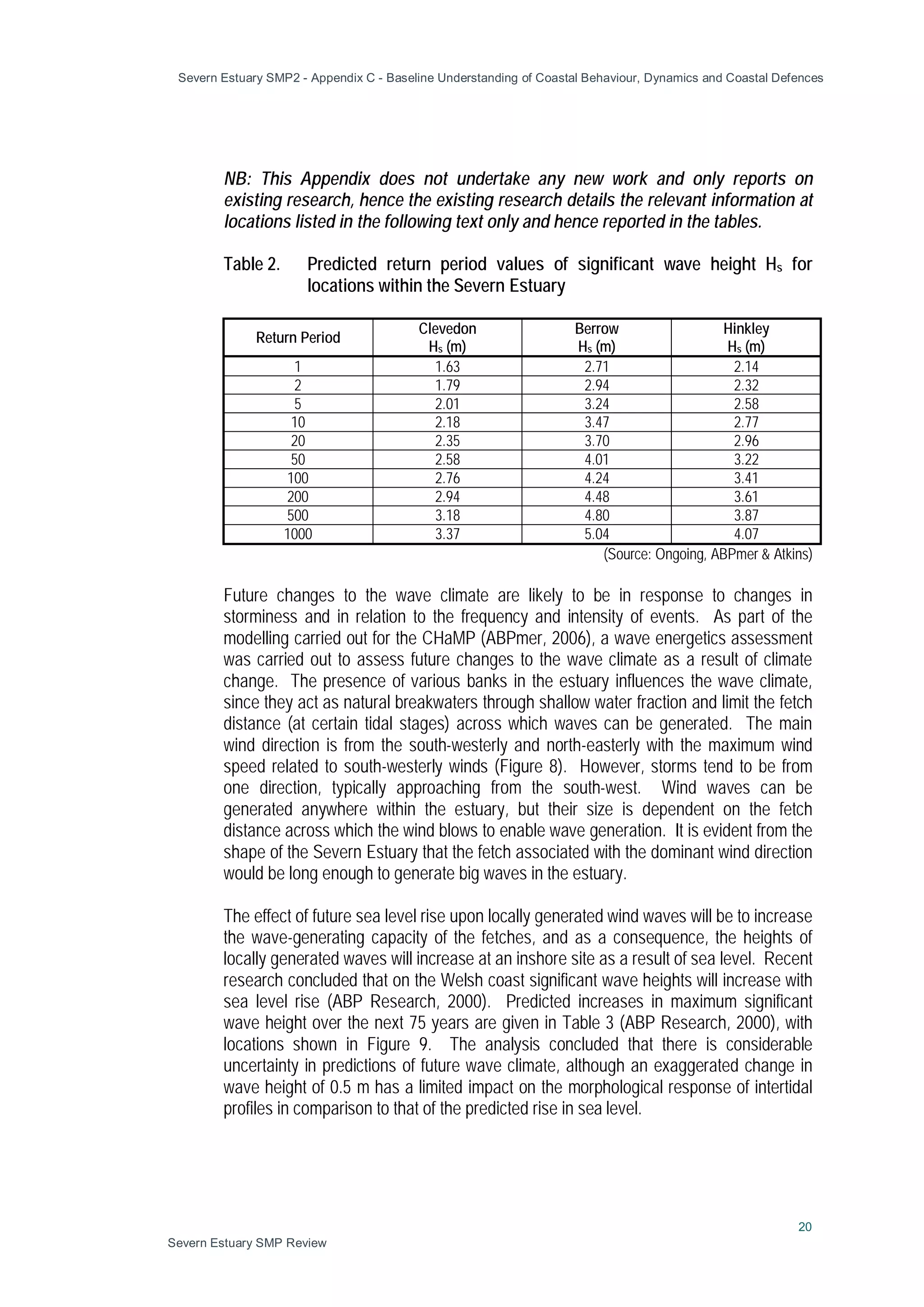
Inshore significant wave heights have been modelled for Hinkley, Berrow and
Clevedon (ongoing, ABPmer & Atkins). No sites were selected on the Wales coast as
part of the SEFRMS study. Table 2 shows that the predicted wave climate is the most
severe at Berrow and this is to be expected since it directly faces the dominant
westerly wave direction. Hinkley is more exposed and therefore more severe than
Clevedon, owing to its position on the outer edge of the Severn Estuary, but its
orientation, along with its location within a small embayment upstream of Hinkley Point
will result in a less severe predicted wave climate at Hinkley than at Berrow.
Severn Estuary SMP2 - Appendix C - Baseline Understanding of Coastal Behaviour, Dynamics and Coastal Defences
20
Severn Estuary SMP Review
NB: This Appendix does not undertake any new work and only reports on
existing research, hence the existing research details the relevant information at
locations listed in the following text only and hence reported in the tables.
Table 2. Predicted return period values of significant wave height Hs for
locations within the Severn Estuary
Return Period
Clevedon
Hs (m)
Berrow
Hs (m)
Hinkley
Hs (m)
1 1.63 2.71 2.14
2 1.79 2.94 2.32
5 2.01 3.24 2.58
10 2.18 3.47 2.77
20 2.35 3.70 2.96
50 2.58 4.01 3.22
100 2.76 4.24 3.41
200 2.94 4.48 3.61
500 3.18 4.80 3.87
1000 3.37 5.04 4.07
(Source: Ongoing, ABPmer & Atkins)
Future changes to the wave climate are likely to be in response to changes in
storminess and in relation to the frequency and intensity of events. As part of the
modelling carried out for the CHaMP (ABPmer, 2006), a wave energetics assessment
was carried out to assess future changes to the wave climate as a result of climate
change. The presence of various banks in the estuary influences the wave climate,
since they act as natural breakwaters through shallow water fraction and limit the fetch
distance (at certain tidal stages) across which waves can be generated. The main
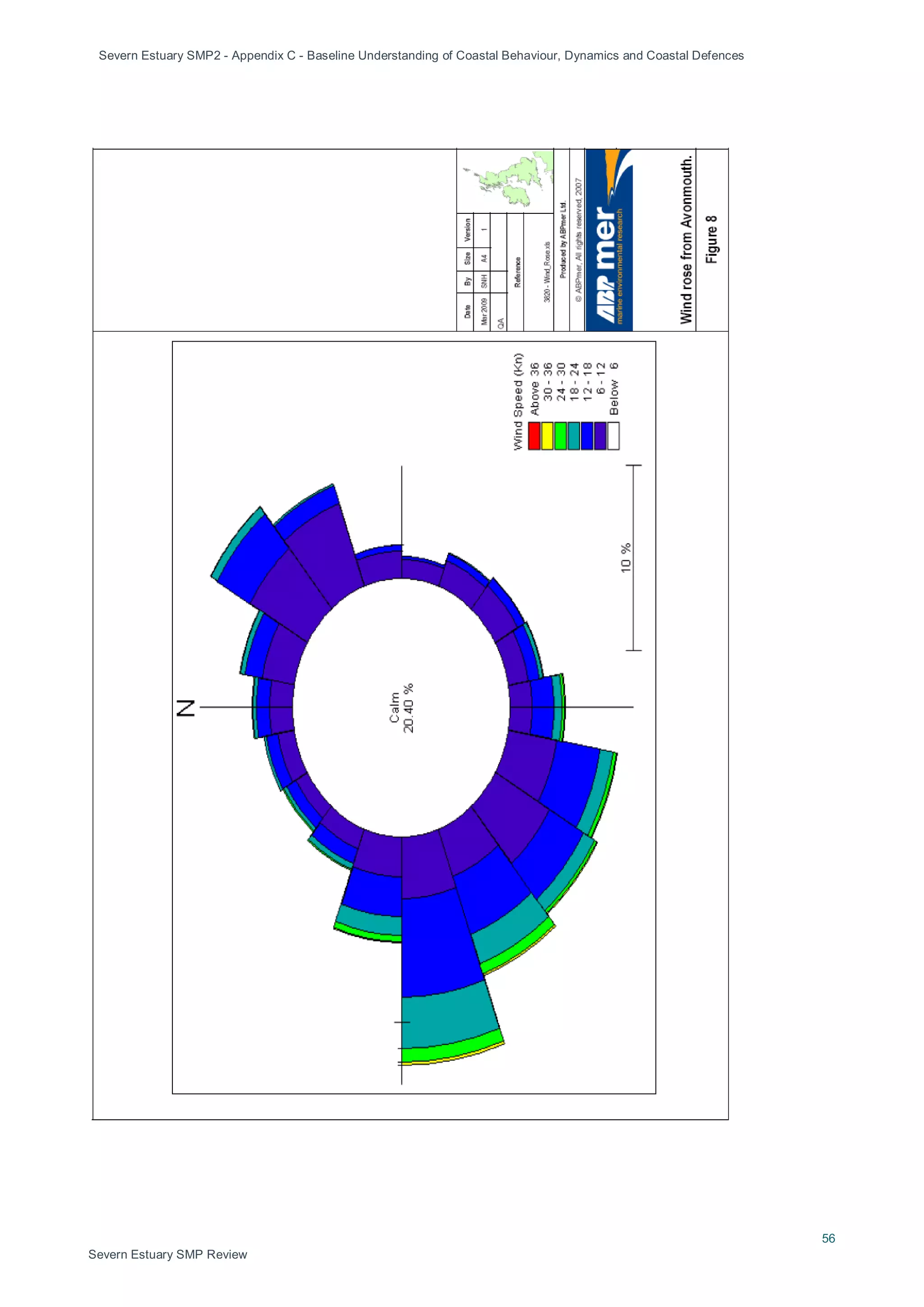
wind direction is from the south-westerly and north-easterly with the maximum wind
speed related to south-westerly winds (Figure 8). However, storms tend to be from
one direction, typically approaching from the south-west. Wind waves can be
generated anywhere within the estuary, but their size is dependent on the fetch
distance across which the wind blows to enable wave generation. It is evident from the
shape of the Severn Estuary that the fetch associated with the dominant wind direction
would be long enough to generate big waves in the estuary.
The effect of future sea level rise upon locally generated wind waves will be to increase
the wave-generating capacity of the fetches, and as a consequence, the heights of
locally generated waves will increase at an inshore site as a result of sea level. Recent
research concluded that on the Welsh coast significant wave heights will increase with
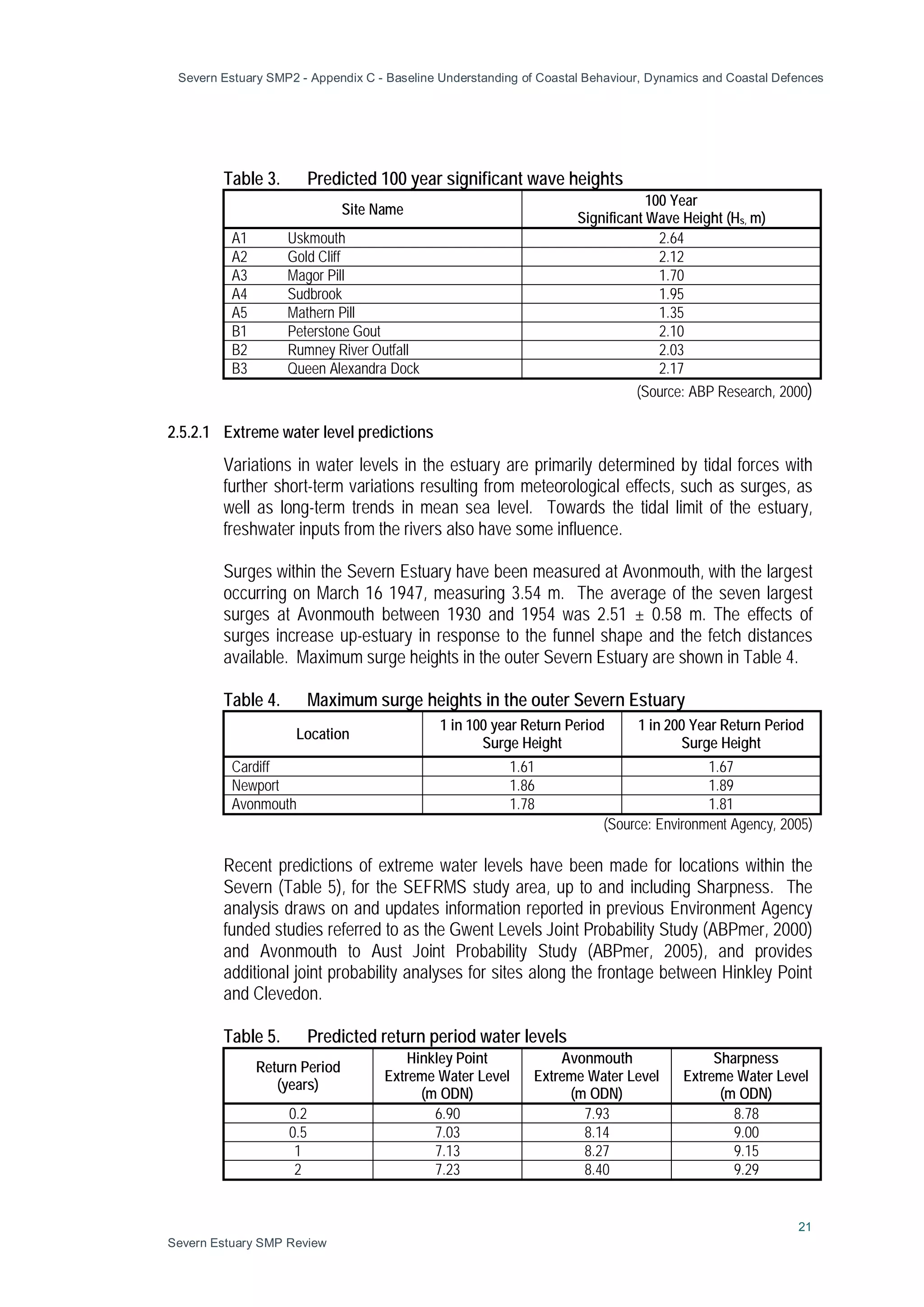
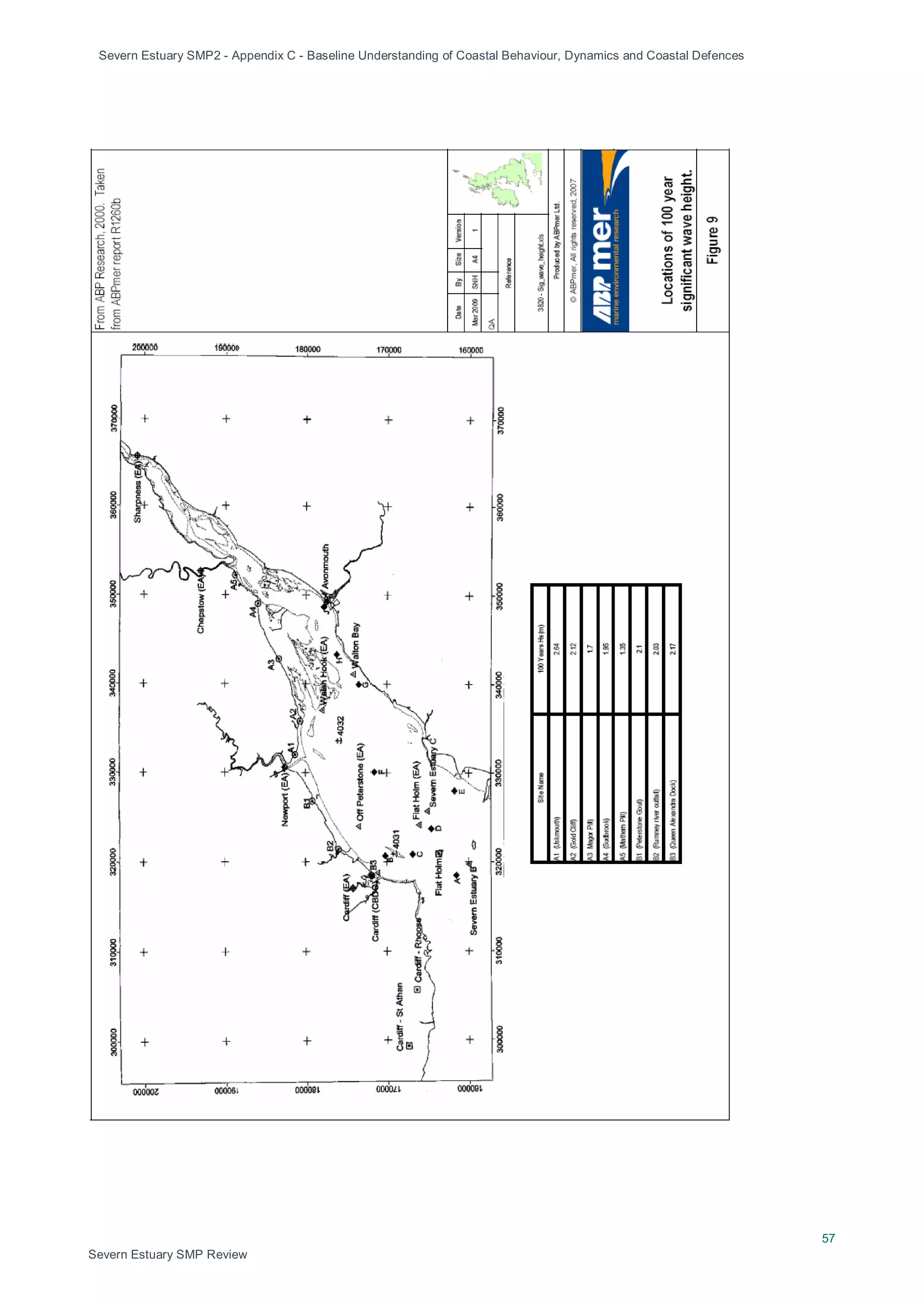
sea level rise (ABP Research, 2000). Predicted increases in maximum significant
wave height over the next 75 years are given in Table 3 (ABP Research, 2000), with
locations shown in Figure 9. The analysis concluded that there is considerable
uncertainty in predictions of future wave climate, although an exaggerated change in
wave height of 0.5 m has a limited impact on the morphological response of intertidal
profiles in comparison to that of the predicted rise in sea level.
Severn Estuary SMP2 - Appendix C - Baseline Understanding of Coastal Behaviour, Dynamics and Coastal Defences
21
Severn Estuary SMP Review
Table 3. Predicted 100 year significant wave heights
Site Name
100 Year
Significant Wave Height (Hs, m)
A1 Uskmouth 2.64
A2 Gold Cliff 2.12
A3 Magor Pill 1.70
A4 Sudbrook 1.95
A5 Mathern Pill 1.35
B1 Peterstone Gout 2.10
B2 Rumney River Outfall 2.03
B3 Queen Alexandra Dock 2.17
(Source: ABP Research, 2000)
2.5.2.1 Extreme water level predictions
Variations in water levels in the estuary are primarily determined by tidal forces with
further short-term variations resulting from meteorological effects, such as surges, as
well as long-term trends in mean sea level. Towards the tidal limit of the estuary,
freshwater inputs from the rivers also have some influence.
Surges within the Severn Estuary have been measured at Avonmouth, with the largest
occurring on March 16 1947, measuring 3.54 m. The average of the seven largest
surges at Avonmouth between 1930 and 1954 was 2.51 ± 0.58 m. The effects of
surges increase up-estuary in response to the funnel shape and the fetch distances
available. Maximum surge heights in the outer Severn Estuary are shown in Table 4.
Table 4. Maximum surge heights in the outer Severn Estuary
Location
1 in 100 year Return Period
Surge Height
1 in 200 Year Return Period
Surge Height
Cardiff 1.61 1.67
Newport 1.86 1.89
Avonmouth 1.78 1.81
(Source: Environment Agency, 2005)
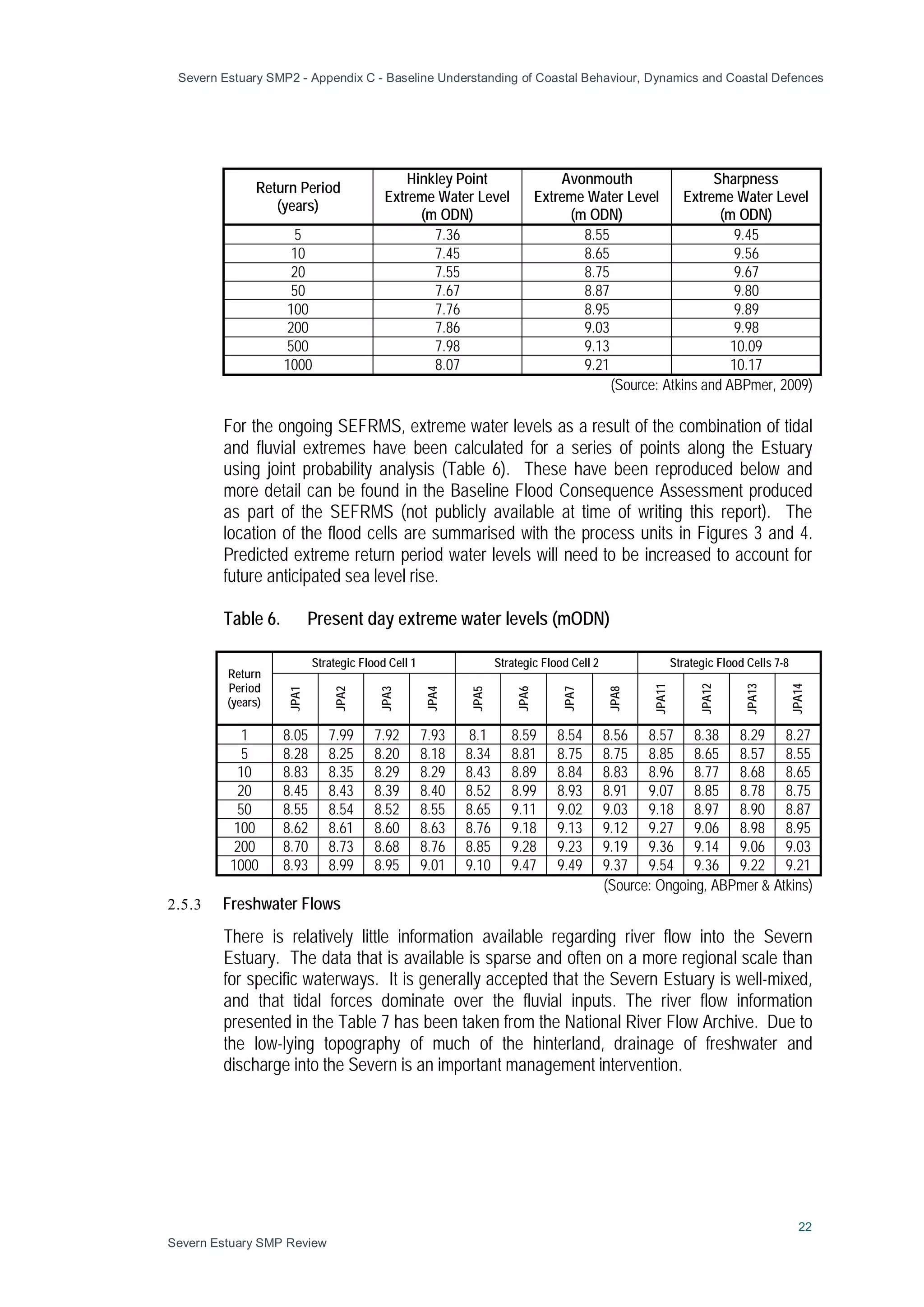
Recent predictions of extreme water levels have been made for locations within the
Severn (Table 5), for the SEFRMS study area, up to and including Sharpness. The
analysis draws on and updates information reported in previous Environment Agency
funded studies referred to as the Gwent Levels Joint Probability Study (ABPmer, 2000)
and Avonmouth to Aust Joint Probability Study (ABPmer, 2005), and provides
additional joint probability analyses for sites along the frontage between Hinkley Point
and Clevedon.
Table 5. Predicted return period water levels
Return Period
(years)
Hinkley Point
Extreme Water Level
(m ODN)
Avonmouth
Extreme Water Level
(m ODN)
Sharpness
Extreme Water Level
(m ODN)
0.2 6.90 7.93 8.78
0.5 7.03 8.14 9.00
1 7.13 8.27 9.15
2 7.23 8.40 9.29
Severn Estuary SMP2 - Appendix C - Baseline Understanding of Coastal Behaviour, Dynamics and Coastal Defences
22
Severn Estuary SMP Review
Return Period
(years)
Hinkley Point
Extreme Water Level
(m ODN)
Avonmouth
Extreme Water Level
(m ODN)
Sharpness
Extreme Water Level
(m ODN)
5 7.36 8.55 9.45
10 7.45 8.65 9.56
20 7.55 8.75 9.67
50 7.67 8.87 9.80
100 7.76 8.95 9.89
200 7.86 9.03 9.98
500 7.98 9.13 10.09
1000 8.07 9.21 10.17
(Source: Atkins and ABPmer, 2009)
For the ongoing SEFRMS, extreme water levels as a result of the combination of tidal
and fluvial extremes have been calculated for a series of points along the Estuary
using joint probability analysis (Table 6). These have been reproduced below and
more detail can be found in the Baseline Flood Consequence Assessment produced
as part of the SEFRMS (not publicly available at time of writing this report). The
location of the flood cells are summarised with the process units in Figures 3 and 4.
Predicted extreme return period water levels will need to be increased to account for
future anticipated sea level rise.
Table 6. Present day extreme water levels (mODN)
Return
Period
(years)
Strategic Flood Cell 1 Strategic Flood Cell 2 Strategic Flood Cells 7-8
JPA1
JPA2
JPA3
JPA4
JPA5
JPA6
JPA7
JPA8
JPA11
JPA12
JPA13
JPA14
1 8.05 7.99 7.92 7.93 8.1 8.59 8.54 8.56 8.57 8.38 8.29 8.27
5 8.28 8.25 8.20 8.18 8.34 8.81 8.75 8.75 8.85 8.65 8.57 8.55
10 8.83 8.35 8.29 8.29 8.43 8.89 8.84 8.83 8.96 8.77 8.68 8.65
20 8.45 8.43 8.39 8.40 8.52 8.99 8.93 8.91 9.07 8.85 8.78 8.75
50 8.55 8.54 8.52 8.55 8.65 9.11 9.02 9.03 9.18 8.97 8.90 8.87
100 8.62 8.61 8.60 8.63 8.76 9.18 9.13 9.12 9.27 9.06 8.98 8.95
200 8.70 8.73 8.68 8.76 8.85 9.28 9.23 9.19 9.36 9.14 9.06 9.03
1000 8.93 8.99 8.95 9.01 9.10 9.47 9.49 9.37 9.54 9.36 9.22 9.21
(Source: Ongoing, ABPmer & Atkins)
2.5.3 Freshwater Flows
There is relatively little information available regarding river flow into the Severn
Estuary. The data that is available is sparse and often on a more regional scale than
for specific waterways. It is generally accepted that the Severn Estuary is well-mixed,
and that tidal forces dominate over the fluvial inputs. The river flow information
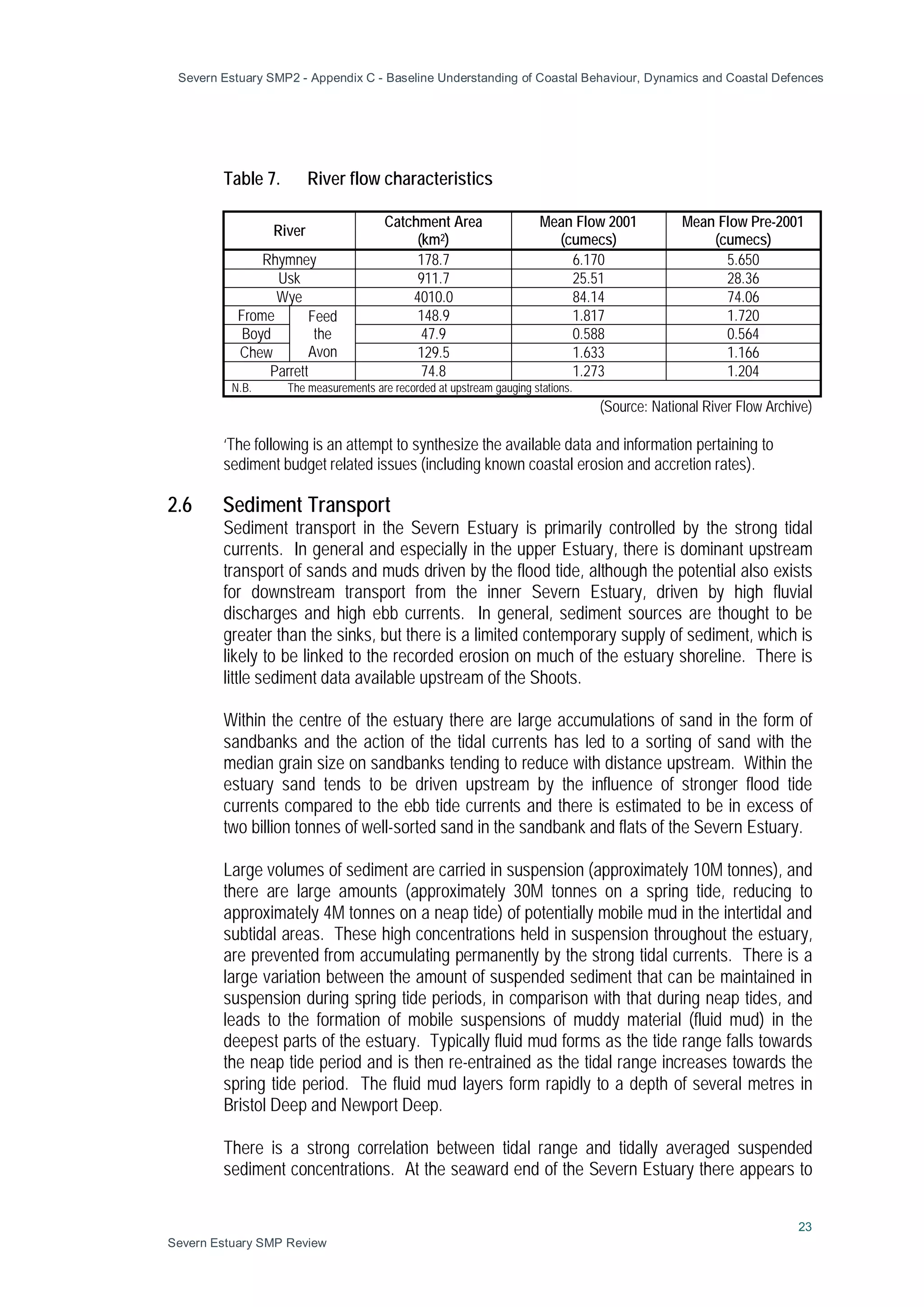
presented in the Table 7 has been taken from the National River Flow Archive. Due to
the low-lying topography of much of the hinterland, drainage of freshwater and
discharge into the Severn is an important management intervention.
Severn Estuary SMP2 - Appendix C - Baseline Understanding of Coastal Behaviour, Dynamics and Coastal Defences
23
Severn Estuary SMP Review
Table 7. River flow characteristics
River
Catchment Area
(km2)
Mean Flow 2001
(cumecs)
Mean Flow Pre-2001
(cumecs)
Rhymney 178.7 6.170 5.650
Usk 911.7 25.51 28.36
Wye 4010.0 84.14 74.06
Frome Feed
the
Avon
148.9 1.817 1.720
Boyd 47.9 0.588 0.564
Chew 129.5 1.633 1.166
Parrett 74.8 1.273 1.204
N.B. The measurements are recorded at upstream gauging stations.
(Source: National River Flow Archive)
‘The following is an attempt to synthesize the available data and information pertaining to
sediment budget related issues (including known coastal erosion and accretion rates).
2.6 Sediment Transport
Sediment transport in the Severn Estuary is primarily controlled by the strong tidal
currents. In general and especially in the upper Estuary, there is dominant upstream
transport of sands and muds driven by the flood tide, although the potential also exists
for downstream transport from the inner Severn Estuary, driven by high fluvial
discharges and high ebb currents. In general, sediment sources are thought to be
greater than the sinks, but there is a limited contemporary supply of sediment, which is
likely to be linked to the recorded erosion on much of the estuary shoreline. There is
little sediment data available upstream of the Shoots.
Within the centre of the estuary there are large accumulations of sand in the form of
sandbanks and the action of the tidal currents has led to a sorting of sand with the
median grain size on sandbanks tending to reduce with distance upstream. Within the
estuary sand tends to be driven upstream by the influence of stronger flood tide
currents compared to the ebb tide currents and there is estimated to be in excess of
two billion tonnes of well-sorted sand in the sandbank and flats of the Severn Estuary.
Large volumes of sediment are carried in suspension (approximately 10M tonnes), and
there are large amounts (approximately 30M tonnes on a spring tide, reducing to
approximately 4M tonnes on a neap tide) of potentially mobile mud in the intertidal and
subtidal areas. These high concentrations held in suspension throughout the estuary,
are prevented from accumulating permanently by the strong tidal currents. There is a
large variation between the amount of suspended sediment that can be maintained in
suspension during spring tide periods, in comparison with that during neap tides, and
leads to the formation of mobile suspensions of muddy material (fluid mud) in the
deepest parts of the estuary. Typically fluid mud forms as the tide range falls towards
the neap tide period and is then re-entrained as the tidal range increases towards the
spring tide period. The fluid mud layers form rapidly to a depth of several metres in
Bristol Deep and Newport Deep.
There is a strong correlation between tidal range and tidally averaged suspended
sediment concentrations. At the seaward end of the Severn Estuary there appears to
Severn Estuary SMP2 - Appendix C - Baseline Understanding of Coastal Behaviour, Dynamics and Coastal Defences
24
Severn Estuary SMP Review
be little seasonal influence on the relationship, although further upstream average
concentrations in the summer months are lower. This is likely to be in response to the
influence of seasonal discharge from the tributaries and the effects of wave action over
the intertidal areas. During the summer months the intertidal areas may typically
accumulate muddy material which is then removed during periods of greater wave
action (i.e. winter storms).
2.6.1 Sources
2.6.1.1 Fluvial sources
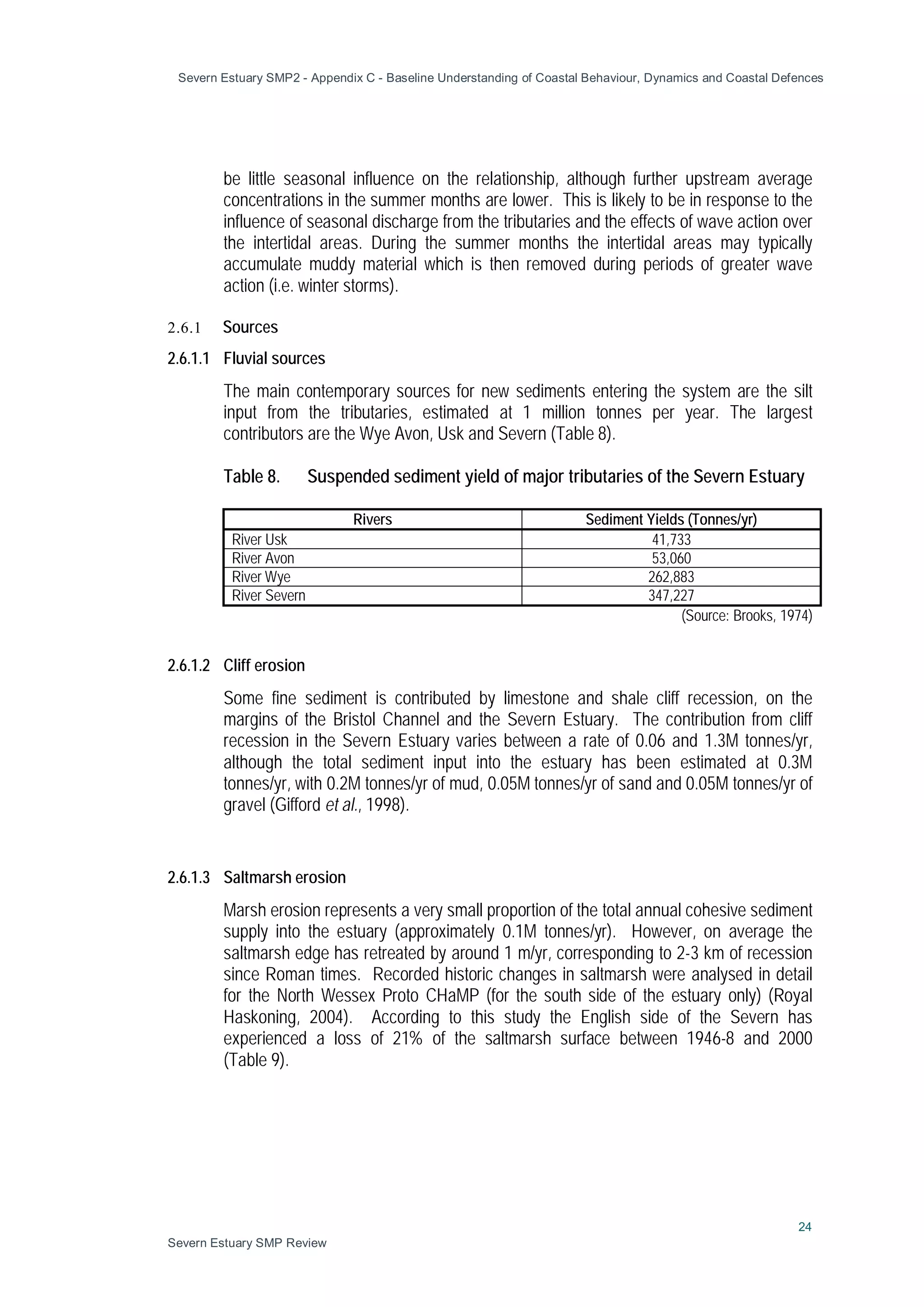
The main contemporary sources for new sediments entering the system are the silt
input from the tributaries, estimated at 1 million tonnes per year. The largest
contributors are the Wye Avon, Usk and Severn (Table 8).
Table 8. Suspended sediment yield of major tributaries of the Severn Estuary
Rivers Sediment Yields (Tonnes/yr)
River Usk 41,733
River Avon 53,060
River Wye 262,883
River Severn 347,227
(Source: Brooks, 1974)
2.6.1.2 Cliff erosion
Some fine sediment is contributed by limestone and shale cliff recession, on the
margins of the Bristol Channel and the Severn Estuary. The contribution from cliff
recession in the Severn Estuary varies between a rate of 0.06 and 1.3M tonnes/yr,
although the total sediment input into the estuary has been estimated at 0.3M
tonnes/yr, with 0.2M tonnes/yr of mud, 0.05M tonnes/yr of sand and 0.05M tonnes/yr of
gravel (Gifford et al., 1998).
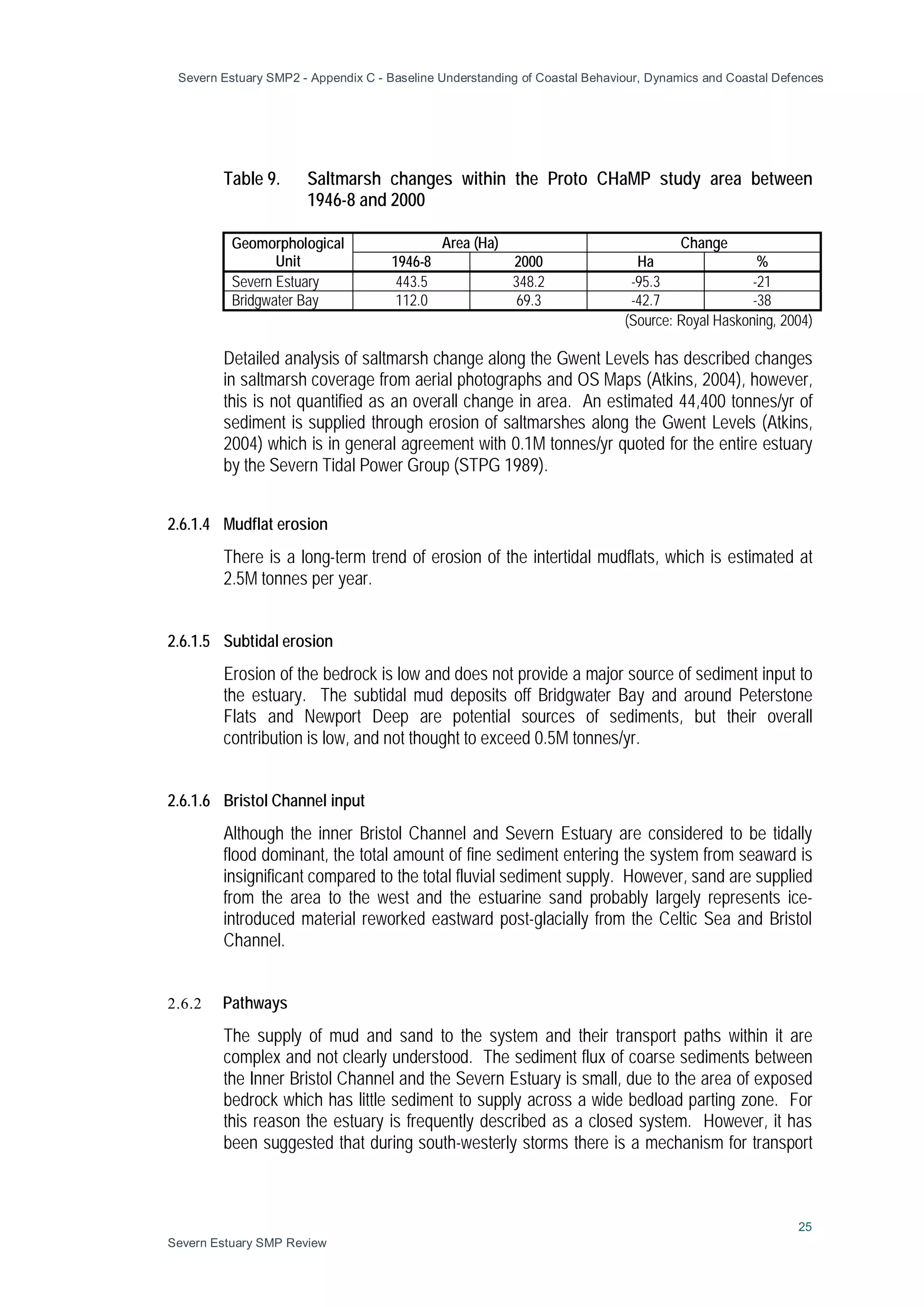
2.6.1.3 Saltmarsh erosion
Marsh erosion represents a very small proportion of the total annual cohesive sediment
supply into the estuary (approximately 0.1M tonnes/yr). However, on average the
saltmarsh edge has retreated by around 1 m/yr, corresponding to 2-3 km of recession
since Roman times. Recorded historic changes in saltmarsh were analysed in detail
for the North Wessex Proto CHaMP (for the south side of the estuary only) (Royal
Haskoning, 2004). According to this study the English side of the Severn has
experienced a loss of 21% of the saltmarsh surface between 1946-8 and 2000
(Table 9).
Severn Estuary SMP2 - Appendix C - Baseline Understanding of Coastal Behaviour, Dynamics and Coastal Defences
25
Severn Estuary SMP Review
Table 9. Saltmarsh changes within the Proto CHaMP study area between
1946-8 and 2000
Geomorphological
Unit
Area (Ha) Change
1946-8 2000 Ha %
Severn Estuary 443.5 348.2 -95.3 -21
Bridgwater Bay 112.0 69.3 -42.7 -38
(Source: Royal Haskoning, 2004)
Detailed analysis of saltmarsh change along the Gwent Levels has described changes
in saltmarsh coverage from aerial photographs and OS Maps (Atkins, 2004), however,
this is not quantified as an overall change in area. An estimated 44,400 tonnes/yr of
sediment is supplied through erosion of saltmarshes along the Gwent Levels (Atkins,
2004) which is in general agreement with 0.1M tonnes/yr quoted for the entire estuary
by the Severn Tidal Power Group (STPG 1989).
2.6.1.4 Mudflat erosion
There is a long-term trend of erosion of the intertidal mudflats, which is estimated at
2.5M tonnes per year.
2.6.1.5 Subtidal erosion
Erosion of the bedrock is low and does not provide a major source of sediment input to
the estuary. The subtidal mud deposits off Bridgwater Bay and around Peterstone
Flats and Newport Deep are potential sources of sediments, but their overall
contribution is low, and not thought to exceed 0.5M tonnes/yr.
2.6.1.6 Bristol Channel input
Although the inner Bristol Channel and Severn Estuary are considered to be tidally
flood dominant, the total amount of fine sediment entering the system from seaward is
insignificant compared to the total fluvial sediment supply. However, sand are supplied
from the area to the west and the estuarine sand probably largely represents ice-
introduced material reworked eastward post-glacially from the Celtic Sea and Bristol
Channel.
2.6.2 Pathways
The supply of mud and sand to the system and their transport paths within it are
complex and not clearly understood. The sediment flux of coarse sediments between
the Inner Bristol Channel and the Severn Estuary is small, due to the area of exposed
bedrock which has little sediment to supply across a wide bedload parting zone. For
this reason the estuary is frequently described as a closed system. However, it has
been suggested that during south-westerly storms there is a mechanism for transport
Severn Estuary SMP2 - Appendix C - Baseline Understanding of Coastal Behaviour, Dynamics and Coastal Defences
26
Severn Estuary SMP Review
which can drive sediments from seaward across the bedload parting zone and into the
estuary.
2.6.2.1 Sand transport pathways
From available evidence it appears that sand moves eastward into the Severn Estuary.
Along this route the various banks form local recirculation cells, and some sand may
return westward along the southern sand zone (Figure 10).
2.6.2.2 Fine sediment transport pathways
The movement of fine sediment is complicated by the presence of high concentrations
of suspended sediment in the water column. Mud deposits in Bridgwater Bay are
thought to move along the estuary, mainly on the English side, to form the turbid water
mass. Further sediment transport patterns include a down-estuary transport from
Newport to Barry, with up-estuary transport dominant in other parts of the estuary
(Figure 11).
2.6.3 Sinks/Stores
The main active sink for muddy material in the estuary is Newport Deep and the
subtidal area fronting Bridgwater Bay. There is not a significant supply of fine
sediment from the Bristol Channel, and the present maintenance dredging of fine
sediments within the estuary does not lead to any significant removal of fines from the
estuary.
2.6.3.1 Saltmarsh accretion
The intertidal saltmarshes have historically been subject to extensive land claim,
thereby diminishing their capacity to act as a sink for cohesive sediments. Landward
recession of the marsh edge is currently taking place; however, many saltmarsh
surfaces are experiencing vertical accretion. Examples include the marshes at Pill
House and Brean and between Steart and Hinkley, around Bridgwater Bay. These
marshes are reported to have accreted 0.06M tonnes/yr between 1962 and 1964
(ABPmer, 2006).
2.6.3.2 Mudflat accretion
In some areas mudflats are erosional, and in other parts accretional. Mudflats in
Bridgwater Bay, Peterstone Flats and Newport Deep are characterised by an accretion
rate of between 1 and 2M tonnes/yr. Variation in mudflat behaviour can be attributed
to the fluvial flows, and mud transport is more significantly associated with the
tributaries of the Severn Estuary. The mixing of freshwater and seawater encourages
local deposition in some intertidal areas, whereas in the central regions of the Severn
Estuary the tidal flows are generally strong enough to prevent significant deposition
Severn Estuary SMP2 - Appendix C - Baseline Understanding of Coastal Behaviour, Dynamics and Coastal Defences
27
Severn Estuary SMP Review
(Gifford et al., 1998). Due to the spatial variability in the behaviour of the mudflats, it is
not possible to quantify the contribution of these elements as a sink.
2.6.3.3 Subtidal deposition
Within the study area mudflat deposition has been identified within an area at the
mouth of the River Usk and the inner Severn Estuary. It is not possible to quantify the
contemporary sediment volume of seabed deposition for Bridgwater Bay or the Severn
Estuary as a whole.
2.6.3.4 Suspended sediment
There is believed to be a long residence time for material within the study area, with
little gain or loss from the system. Suspended sediment concentrations within the
estuary are very large and increase upstream to peak around Sharpness on spring
tides. Estimates of spring tide suspended sediment concentrations vary from 13M
tonnes to 30M tonnes within the estuary, and an estimate on a neap tide was 4M to 9M
tonnes (ABPmer, 2006). This suspended load is thought to be at a capacity level, i.e.
the amount is relatively constant and no more sediment can be added into the system
without either being lost to the Atlantic Ocean or becoming deposited.
Suspended sediment concentrations vary significantly and have been measured at
>250 mg/l to <10,000 mg/l in the Severn Estuary, with a vertical concentration gradient
responding to semi-diurnal and spring-neap cycles. The lack of a primary sink due to
historic reclamation is thought to be part of the reason for high sediment
concentrations in the estuary (ABPmer, 2006).
2.6.4 Anthropogenic activities
The current anthropogenic activities that have the potential to affect sediment transport
within the Severn Estuary are dredging for navigation and for aggregate extraction.
Ports undertake routine maintenance dredging at the ports of Bristol, Cardiff, Newport
and Sharpness, and material is disposed of either at licensed pumped discharges or
deposited at licensed spoil grounds. Such activities do not represent a net loss of
sediment to the system, but rather a recycling of sediment within the system, but they
do amend the sediment budgets and morphology locally (CHaMP, 2005).
Approximately 1.5M tonnes of aggregate are landed at the Severn Estuary ports
annually, although this includes sediment sourced from Nash Bank and Holm Sand,
both of which are in the Bristol Channel. Numerous studies have been undertaken to
assess the possible effects of aggregate extraction on coastal processes, but to date
no effects have been proven (CHaMP, 2005). Whilst the dredging activities affect the
sand bank morphology locally and also create sediment plumes, the scale of the
effects is considered to be within the high degree of natural variability within the
system.
Severn Estuary SMP2 - Appendix C - Baseline Understanding of Coastal Behaviour, Dynamics and Coastal Defences
28
Severn Estuary SMP Review
2.6.5 Sediment Budget
Table 10 presents a summary of the current understanding of the sediment budget of
the Severn Estuary, and each element has been quantified where possible. From
Table 10 it appears that the sediments in the estuary appear to be in a state of
constant reworking and recycling with only relatively minor losses and additions of new
sediments. It is important to understand that these figures have been collated from a
range of data sources over a range of different timescales and as such are subject to
considerable error; nevertheless it represents the best available data for quantifying
the sediment budget within the SMP2 study area.
It is difficult to fully quantify the sediment budget for the Severn Estuary, as some
elements of the budget cannot be quantified based on available information. Therefore
it is not possible to conclude with certainty if the budget is in balance, or if the Severn
Estuary is a net exporter or importer of sediment. However, the review suggests that
the sources are greater than the sinks and the volume of sediments held in the water
column is very high. Therefore it is likely the estuary is a net exporter of sediment
(ABPmer, 2006).
Table 10. Summary of the Severn Estuary sediment budget
Dynamic
Status
Element Description
Rate or
Sediment Load
Total
Sources
Rivers Fluvial sediment supply 1M tonnes/yr
4.16M to 5.4M
tonnes/yr
Cliff Erosion 0.06 to 1.3M tonnes/yr
Saltmarsh Erosion (horizontal) 0.1M tonnes/yr
Mudflat Erosion 2.5M tonnes/yr
Subtidal Erosion 0.5M tonnes/yr
Sinks1
Saltmarsh (around
Bridgwater Bay)
Accretion (vertical) 0.06M tonnes/yr
1.06 to 2.06M
tonnes/yr
Mudflat (Bridgwater
Bay, Peterstone Flat
and Newport Deep)
Accretion 1 to 2M tonnes/yr
Transfers
Water Body Suspended sediment
Estimates vary from
9-13 tonnes (neap to
spring) and 30M
tonnes (spring)
30M tonnes
Anthropogenic
Intervention
Aggregate extraction 1.5M tonnes/yr 1.5M tonnes/yr
1 Sinks estimate is referring to localised areas, the rate of accretion in some areas has not been quantified.
Severn Estuary SMP2 - Appendix C - Baseline Understanding of Coastal Behaviour, Dynamics and Coastal Defences
29
Severn Estuary SMP Review
3. Process Units and Shoreline Change
This section refers to Process Units as defined for the first Severn Estuary SMP
(Figure 3) (Gifford et al., 1998). Analysis undertaken for Futurecoast on change in
shoreline position is included, where shoreline change is demarked by the cliff line or
the mean high water mark or mean low water mark. For each unit considered to be
open coast within Futurecoast (i.e. up to and including the Severn Crossings) an
overview of historical shoreline change is presented in the form of a ‘mode of foreshore
change’, using the information presented in Table 11.
Throughout this section north bank refers to the left bank when looking upstream
(Welsh bank) throughout the following description whilst south bank refers to the right
bank (English bank) when looking upstream.
Severn Estuary SMP2 - Appendix C - Baseline Understanding of Coastal Behaviour, Dynamics and Coastal Defences
30
Severn Estuary SMP Review
Table 11. Mode of foreshore change
(Source: Defra, 2002)
Severn Estuary SMP2 - Appendix C - Baseline Understanding of Coastal Behaviour, Dynamics and Coastal Defences
31
Severn Estuary SMP Review
3.1 PU1 Penarth
The Penarth unit extends from Lavernock Point (the southern boundary of the SMP on
the Welsh side) in the south to the southern end of the Cardiff Bay Barrage. Most of
the east facing unit has a soft cliff coastline of Triassic mudstone, with the exception of
the low-lying frontage at Penarth Esplanade. There are extensive areas of intertidal
rock exposures fronting Ranny Bay (in the south) and Penarth Head (in the north), and
there is a wave-cut rock platform, which is partially covered by beach sediments
(shingle) in the vicinity of Penarth Pier. Beach material is predominantly derived from
cliff erosion. The sedimentary environment consists of a boulder strewn foreshore with
limestone and maerl cliffs that weather rapidly. Offshore sediment transport is
considered to be in dynamic equilibrium and an anticlockwise circulatory transport
around Cardiff Grounds (approximately 3 km offshore). The predominant transported
sediment size is fine to medium sand (0.25 mm – 0.35 mm). The Cardiff Grounds spoil
site is two miles east of Penarth Head.
The Penarth frontage is generally sheltered from ocean waves due to its orientation,
although Lavernock Point is exposed to waves propagating up the Bristol Channel.
The dominant wave directions for the unit are 60º to 120º. Predicted tidal residuals
show an ebb dominated process along the inshore area.
There is evidence of low rates of cliff line retreat and erosion of the shingle beach.
Due to the extensive areas of intertidal rock exposures at Ranny Bay there is little
evidence of significant change on this coastline over the last 100 years. Stakeholders
are reporting cliff erosion of the coastal path in the area which seems to be of local
concern. Further north and adjacent to Penarth Head, there is some evidence of cliff-
line retreat at rates of 0.14 m/yr. The cliffs supply sediment to the toe, providing
protection and sediment to the unit. Over the last 100 years evidence suggests the low
water mark has moved landward, narrowing the foreshore and increasing vulnerability
to extreme waves and water levels.
Futurecoast Summary
There is evidence of some cliff retreat with foreshore steepening and retreat. Some
beaches have dropped in height. Mode of foreshore change at Lower Penarth: +1
(Table 11).
3.2 PU2 Cardiff Bay
The Cardiff Bay unit extends from Penarth Head in the south to Cardiff Flats in the
north, covering the Cardiff Bay Barrage. The unit historically included a drowned tidal
inlet of the Rivers Taff and Ely backed by the Cardiff Levels, but much of the present
frontage and hinterland stands on reclaimed land. The south-east facing embayment
was impounded by the Cardiff Bay Barrage (completed in 1999), constructed across
the mouth of the bay between Queen Alexander Dock and Penarth Head. Prior to the
barrage construction, the Bay had a large expanse of tidal mudflats, with some
saltmarsh on the nearshore. The Taff and Ely rivers that discharge into the Bay are
now non-tidal, influencing the deposition of sediment within the Bay.
The barrage impounds water within the Bay as a recreational amenity feature though it
is also a flood defence structure which can be closed to prevent high tides in the
Severn Estuary SMP2 - Appendix C - Baseline Understanding of Coastal Behaviour, Dynamics and Coastal Defences
32
Severn Estuary SMP Review
estuary entering the Bay. The barrage is predicted to remain in place until 2108
(ongoing, ABPmer & Atkins) with minimal maintenance.
Futurecoast Summary
Major changes have resulted from extensive port development, reclamation and
infilling. Mode of foreshore change at west Cardiff: -6 (Table 11).
3.3 PU3 Wentlooge
The Wentlooge Unit extends from Cardiff Flats in the south to the western bank of the
River Usk in the north. The majority of the unit is low-lying, with the exception of the
area between Cardiff Flats and Pengam Moors to the south of Cardiff (and the mouth
of the River Rhymney). The unit has a low-lying foreshore composed of muddy
Holocene marine and estuarine alluvium covering relatively wide intertidal mudflats,
extending up to 1.6 km offshore.
Predicted tidal residuals for the Wentlooge Levels show an ebb-dominance, with the
majority of current vectors directed onshore.
Along all sections of this unit the position of MLW has retreated and the intertidal zone
narrowed. There is also evidence of foreshore lowering. Analysis of OS maps and
aerial photographs shows that the saltmarsh along this frontage reduced in area
between 1887 and 1946 (Atkins, 2004). A program of Spartina planting in the 1950s
caused the saltmarsh to expand in area between OS surveys of 1946 and 1971 at
Peterstone Great Wharf but Rumney Great Wharf still continued to erode (Atkins,
2004). Surveys from 1971 and 1994 show that saltmarsh along this frontage eroded
further between these dates, this was followed by some accretion at Peterstone Great
Wharf and erosion at Rumney Great Wharf between 1994 and 1999 (Atkins, 2004).
The cross-sectional profiles at Wentlooge and Rumney show a narrow and relatively
steep upper saltmarsh. The top of the saltmarsh is approximately 1.5 m below mean
high water and confirms the lowering of the upper zone levels downstream. There is
some indication that at Rumney the tidal flat has been lowered by approximately 3 m
over the last 70 years (Gifford et al., 1998), confirming that the area is undergoing
significant erosion. Analysis of available data suggests an overall lowering of 4.3 cm/yr
of the intertidal mudflats in the vicinity of Rumney Great Wharf between 1926 and 1997
and 1.3 – 1.8 cm/yr between 1965 and 2002 at a similar location (Atkins, 2004).
Sections of the foreshore are undergoing accretion (i.e. Peterstone Great Wharf) and
others erosion (i.e. Rumney Great Wharf). Revetments have been placed along
certain sections, stabilising the shoreline. Analysis of OS maps has shown spatially
varying rates of change: south of Rumney Great Wharf eroding at 2.1 m/yr; north of
Rumney Great Wharf eroding at 1.3 m/yr; and Peterstone Great Wharf accreting at
0.4 m/yr.
Severn Estuary SMP2 - Appendix C - Baseline Understanding of Coastal Behaviour, Dynamics and Coastal Defences
33
Severn Estuary SMP Review
Futurecoast Summary
Rumney Great Wharf has been undergoing mudflat erosion since 1886 (60 to 205 m
retreat of MHWM) and Peterstone Great Wharf accreting (130 to 210 m extension of
MHWM). The coastline is stable is between Peterstone Gout and West Usk
Lighthouse, though there has been slight localised landward movement of MLW.
Between the lighthouse and the River Usk the saltmarsh is accreting at the northern
end and eroding at the southern end. Mode of foreshore change at the Wentlooge
Levels: -6 (Table 11).
3.4 PU4 River Usk
The River Usk unit extends from the mouth of the Usk between the Wentlooge Levels
and Newport Docks at the confluence with the Ebbw, to the tidal limit at Newbridge-on-
Usk. The River Usk is a meandering tidal river channel through Devonian sandstone
and mudstone. The river is flanked by extensively developed land and open spaces
with flood protection. There is also a dredged navigation channel into Newport Docks.
Through Newport the channel is fairly canalised and generally there have been limited
changes due to the bank protection. The upstream reaches north of Newport follow a
meandering course. The tidal dynamics of the Usk behave in a similar manner to that
in the Severn Estuary, with little modification. The high tidal range ensures that there
are strong tidal currents.
The strong tidal currents of the Usk erode and transport large quantities of fine
sediment during spring tides, but during neap tides much of this sediment is deposited
on the bed, forming very soft or fluid mud deposits, to be remobilised on the next
spring tides. This unit is generally characterised by no net erosion or deposition of
cohesive sediments. In the lower reaches of the estuary there are areas of both locally
accreting and locally eroding saltmarsh.
3.5 PU5 Uskmouth
The Uskmouth unit extends from Uskmouth Power Station at the mouth of the Usk in
the west to Gold Cliff in the east. The eastern boundary marks the transition from low-
lying alluvium to the Jurassic Lias cliffs at Gold Cliff. The unit is at the western end of
the Caldicot Levels, and therefore has a low-lying backshore, fronted by wide intertidal
mudflats. The area consists of wet reedbeds, wet grasslands and shallow saline
lagoons. The intertidal area is essentially an extension of the muddy foreshore at the
mouth of the Usk.
The tidal dynamics of this unit behave in a similar manner to that in the Severn
Estuary, with little modification. The predicted tidal results along the inshore of the
Caldicot Levels unit are directed upstream.
The line of the estuary mouth has changed little, and in the past has been largely
maintained by maintenance dredging. The western section of this unit is eroding and
the eastern is accreting. There are saltmarsh areas along much of the shoreline,
particularly between the Nash Breakwater and Goldcliff Pill, which has suffered
significant localised erosion and accretion over the last 100 years. The construction of
the Cardiff Bay Barrage and the loss of the SSSI led to a mitigation scheme, the Gwent
Severn Estuary SMP2 - Appendix C - Baseline Understanding of Coastal Behaviour, Dynamics and Coastal Defences
34
Severn Estuary SMP Review
Wetlands Reserve, being constructed along the frontage of Uskmouth, Saltmarsh and
Gold Cliff.
Futurecoast Summary
At Uskmouth the shoreline has retreated between 75 and 135 m in the last 100 years,
whilst further to the east there has been accretion at MHW, 130 m at Salt Marsh Reen
and 230 m at Goldcliff Pill. There has been extensive erosion at Gold Cliff and groynes
have been constructed. Mode of foreshore change at the Gold Cliff frontage: +1
(Table 11).
3.6 PU6 Caldicot Levels
This unit extends from the rocky outcrop at the Gold Cliff promontory in the south west
to the southern side of Sudbrook Point in the north-east, where there is a transition
from the low-lying alluvial plain of the Caldicot Levels to the Old Red Sandstone
headland at Sudbrook. The unit is a south-east facing, low-lying foreshore composed
of muddy Holocene marine and estuarine alluvium, fronted by a relatively wide
intertidal expanse of saltmarsh and sandbanks. The backshore is almost entirely
below the level of mean high water springs and is therefore defended by a continuous
clay embankment located on former marsh surfaces, typically reinforced by a wall and
revetment. Predicted tidal residuals show a downstream, onshore directed current,
although to the north of Gold Cliff residuals are directed offshore.
There has been long-term retreat and erosion of saltmarsh in the past, although the
rates do vary. The saltmarsh located north of Magor Pill, extending to Caldicot Pill has
been subject to a long term erosional trend and retreat of the mean high water mark by
up to 140 m (between West Pill and Caldicot Pill) and up to 170 m adjacent to Rogiet
Moor Pill/West Pill), since the 1880s. However, to the south west of Magor Pill MHW
has not changed significantly. There has also been erosion of the intertidal zone below
that of the marsh. Some increase of saltmarsh area between 1946 and 1998 along
this frontage can be explained by the planting of Spartina in the area (Atkins, 2004).
Futurecoast Summary
Between Gold Cliff and Cold Harbour Pill, there has been movement of MHW, although
near Cold Harbour Pill there has been extensive movement to seaward of MLW. To
the east erosion dominates; at Caldicot Pill, where the intertidal width has remained
constant, MHW and MLW have been subject to recession. Mode of foreshore change
at Redwick (centre of frontage): +6, and at Caldicot Pill: -6 (Table 11).
3.7 PU7 The Severn Crossings
This unit includes both banks of the Severn, from Sudbrook Point to Beachley on the
north bank, and from New Passage to Aust Rock on the south bank; and relates to the
constriction of the estuary between the promontories on each side. There are rock
exposures offshore, notably the English Stones and the estuary is restricted to a single
navigable channel; The Shoots. The Shoots has locally scoured depths in excess of
10 m and an area with extensive drying banks. Around the Severn bridges the river is
obstructed by rocks, which create high turbulence through the tide. The tide divides at
Beachley Point, with one branch flowing into the River Wye and the other flowing
Severn Estuary SMP2 - Appendix C - Baseline Understanding of Coastal Behaviour, Dynamics and Coastal Defences
35
Severn Estuary SMP Review
upstream. Current velocities can reach 3 m/s, although the strength and direction of
the tide is greatly affected by the submergence of banks and rock areas, as well as
freshwater flows from the rivers. There is little or no slack water in the main channels
and the tide may run in opposing directions as the tide turns.
Both shorelines include extensive areas of low-lying land. On the north (Welsh) bank
the Sudbrook headland comprises low sandstone cliffs and the Second Severn
Crossing structures. To the north it is low-lying with saltmarsh and intertidal mudflats,
with headlands at Black Rock and Beachley. The intertidal flats at Mathern Oaze have
remained stable or have increased in area over the last 100 years, and the shoreline
has also remained stable with only local or small scale changes. The Beachley
headland comprises hard rock outcrops and low marl cliffs.
On the southern (English) bank, the stretch between New Passage and Aust Warth is
low-lying and is defended with grassed embankments. There is saltmarsh on the
foreshore and intertidal zone, generally with a shallow slope, and the higher saltmarsh
clearly shows the former surfaces of the Northwick and Rumney formations. The
stretch from Littleton Warth to Aust Warth, including Aust Cliff, is located on higher
ground. The mudflat area of Northwick Oaze is relatively stable, although there has
been accretion at Aust and Beachley (between 20 and 60 m at the latter since the
1880s).
Futurecoast Summary
The cliffs and rock platform are resistant to erosion. There has been a slight seaward
movement of MHW at Mathern Oaze, with changes to MLW. There has been
saltmarsh accretion to the east of the River Wye (north bank) of 20 to 60 m. at
Northwick Oaze the shoreline has been stable and at Aust Warth both MHW and MLW
have migrated seawards. Mode of foreshore change at Mathern: +1; and at Aust: +4
(Table 11).
3.8 PU8 River Wye
This unit extends from the mouth of the River Wye to Bigsweir Bridge, the tidal limit.
The river flows through predominantly carboniferous limestone geology with Triassic
sandstone outcropping at the upstream limit and at the mouth. The Wye is constrained
over much of its length by high ground and narrow floodplains. The meander bends
are constrained by bedrock and have changed little over the last 100 years. There are
localised mudflat margins. There has been little change to the river form due to the
influences of bedrock and weirs.
Futurecoast Summary
No coverage.
3.9 PU9 Beachley to Lydney Point and Sharpness
This unit includes both banks of the Severn. On the north bank the unit extends from
Beachley to Lydney Point, and on the south bank from Littleton Warth to Sharpness
Docks. The unit lies between the two constrictions in the width of the estuary at
Beachley/Aust and Lydney/Sharpness. The coast is characterised by coastal outcrops
Severn Estuary SMP2 - Appendix C - Baseline Understanding of Coastal Behaviour, Dynamics and Coastal Defences
36
Severn Estuary SMP Review
of hard geology, cliffs and intertidal rock exposures. Both banks have extensive areas
of low-lying land behind, except for the cliff line between Beachley and Pillhouse
Rocks.
Offshore there are large intertidal sand banks (e.g. Beacon Sands) and rock exposures
with influence the low tide channel. The tidal range here is reduced and the tidal wave
becomes more asymmetric.
Movement of the coastline is linked to the sand bars and channel behaviour occurring
at different timescales to the estuary sequence of erosion and accretion. Recent
erosion has been noted at Cone Pill (8.2 m/yr since 1989); Lydney defences and Cone
Pill to Guscar Rocks (resulting from bank slippages, in turn due to landward translation
of the secondary low water channel and the increasing curvature of the channel
meander).
Futurecoast Summary
No coverage.
3.10 PU10 Lydney Point to Tites Point (Sharpness to Purton)
This unit includes both banks of the Severn, from Lydney Point to Wellhouse Rock on
the north bank and from Sharpness Docks to Cotterday Hole (Tites Point) on the south
bank. There is a significant reduction in the width of the estuary between Sharpness
and Tites Point and this area can be referred to as a rock controlled basin. The tides
within this unit are characterised by a tidal wave that has a shorter flood period
compared to that of the ebb. The tide also becomes more asymmetric with distance
upstream.
The shorelines on both banks of the process unit have been fairly stable for the last
100 years. There is low-lying land at Purton, to the west of Tites Point which is
defended, although the most of the rest of the unit is bordered by higher ground. The
unit comprises mainly Devonian mudstone cliffs with outcrops of Jurassic mudstone
cliffs at the northern end of the unit (Purton and Cotterday Hole). There are intertidal
sand banks present. There has been little movement in the shoreline, and the only
evidence is some small scale accretion and erosion on the Sharpness Bank in the last
100 years.
Futurecoast Summary
No coverage.
3.11 PU11 Tites Point to Hock Cliff
This unit includes both banks of the Severn, from Hagloe House to Awre on the north
bank and from Tites Point to Hock Cliff on the south bank. Upstream of Tites Point
there is a large increase in the width of the estuary and the upstream boundary of the
unit relates to the transition from the more open estuary with long fetches to the
meandering tidal river. The tide has a shorter flood period compared to that of the ebb.
Severn Estuary SMP2 - Appendix C - Baseline Understanding of Coastal Behaviour, Dynamics and Coastal Defences
37
Severn Estuary SMP Review
The tidal range is also reduced and the tidal wave becomes more asymmetric with
distance upstream.
There is historic evidence for variation in the location and extent of the offshore sand
and mud banks and bars; however, the position of the high water mark has remained
fairly stable within this reach although there are more changes on the south bank of the
channel. There has also been some movement of MLW.
On the north bank there are some grassed embankments, although much of the land is
above extreme tide level, there is low-lying land at the mouth of Bideford Brook and at
the inside of the meander east of Awre; there has been little movement of MHW.
The entire south bank frontage is low-lying, and the area comprises recent estuarine
alluvium backed by older estuarine alluvium. At the upstream end of the unit there is
an extensive near and offshore area of mud. There are a series of warths along this
bank. There is an accretional trend between Middle Point and Tites Point, whilst the
mud bank adjacent to Frampton has either eroded or remained relatively stable.
Futurecoast Summary
No coverage.
3.12 PU12 Hock Cliff to Longney Pool
This unit includes both banks of the Severn, from Hayward to Cowley’s Elm on the
north bank, and from Hock Cliff to Longney Pool on the south bank. The upstream
boundary of the unit relates to the transition from predominantly sandy shoals to finer
sediments upstream. The tidal wave has a short but rapid flood and long ebb.
The outer parts of the meander have remained stable over the last 100 years, although
there is erosion of the cliff at Newnham on the north bank. The inner parts of the
meander have experienced a pattern of accretion and erosion with bars increasing in
size as others decrease. The extent of movement is controlled by rocky outcrops.
Banks at the downstream end show less change, though there is deposition at MHW.
At Lower Dumball there is a tendency towards accretion of sediments, whereas Upper
Dumball is stable. The stretch from Dumball to Rodley Bank fluctuates between
accretion and erosion.
The south bank is characterised by low-lying alluvium and sedimentary depositional
environments. At the upstream end of the unit there is potential for erosion on the
outside bend of the river meander. At Longney Bend typically the banks have been
eroding and the mudflats accreting.
Futurecoast Summary
No coverage.
Severn Estuary SMP2 - Appendix C - Baseline Understanding of Coastal Behaviour, Dynamics and Coastal Defences
38
Severn Estuary SMP Review
3.13 PU13 Longney Pool to The Weirs
This unit includes both banks of the Severn, from Cowley’s Elm to Maisemore on the
north bank, and from Longney Pool to Llanthony Weir on the south bank. The
upstream boundaries are the normal limit of tidal flows of the Severn, and the weirs
prevent saline intrusion under normal conditions, although they are overtopped by high
spring tides. The sediments within this unit are predominantly fine. The tidal wave has
a very short but rapid flood and long ebb, and the tidal range reduces with distance
upstream.
The low-lying ground is mainly estuarine alluvium. There is additional erosion control
on the outside of the meander adjacent to the village of Elmore. Upstream from the
Lower Parting the western channel is the main flood channel and the eastern is the
navigation channel. The rural reaches up to the weirs are defended by earth bunds in
poor condition. The channel is relatively stable in platform.
Futurecoast Summary
No coverage.
3.14 PU14 The Weirs to Haw Bridge
This unit includes both banks of the Severn, from Maisemore and Llanthony Weirs to
Haw Bridge, which represents the upstream limit of the SMP. The western channel is
the main flood channel and the east channel is the navigation channel through the city
of Gloucester. This unit is essentially a fluvial reach with only infrequent tidal influence;
however, it is included within the SMP due to process interactions between this unit
and the estuary downstream of the weirs. There has been little change in the position
of the channel.
Futurecoast Summary
No coverage.
3.15 PU15 New Passage to Portishead
This unit extends from New Passage in the north to the Old Pier at Portishead in the
south, on the south bank of the Severn. The north-eastern boundary marks the
transition from the low-lying saltmarsh shoreline of the Severn Crossings unit (PU7) to
the offshore rocky exposures of English Stones. The south-western boundary marks a
transition from the low-lying shoreline of Portbury Wharf to the cliffed coast of the
Portishead to Clevedon unit (PU17). The unit is a north-west facing embayment, and
the shoreline is generally fronted by intertidal mud, sand or gravel banks, saltmarsh
and rock outcrops at the northern end. Between Chittering Warth and Old Passage
there is a large gravel and sand bank at the mudflat edge. The River Avon is at the
south-western end of the unit.
There has been marked accretion, for example, at Christening Wharf historic survey
indicate 104 m of accretion, and at Chapel Pill there has been 100 to 160 m of
accretion and a slight seaward extension of MLW. The channel of Avonmouth port is
generally controlled by anthropogenic structures, although the wide intertidal area has
Severn Estuary SMP2 - Appendix C - Baseline Understanding of Coastal Behaviour, Dynamics and Coastal Defences
39
Severn Estuary SMP Review
reduced from 0.8 km wide to 0.17 km, although the area behind the East Breakwater
has continued to accrete.
Futurecoast Summary
Development at Avonmouth port has masked shoreline behaviour. Portbury Wharf has
undergone accretion. The channel and port entrance is generally controlled by
anthropogenic features. MHW has migrated seaward in the area to the south of Stup
Pill and northward to Severn Beach. Mode of foreshore change at East Compton
(northern end of Unit): +1; and at Stup Pill: +6 (Table 11).
3.16 PU16 River Avon
The River Avon unit extends from the mouth of the Avon to the Netham Weir upstream
in Bristol, which is the normal tidal limit, although it is overtopped by high spring tides.
The underlying geology varies upstream, as does the land use. There has been little
natural morphological change in the outer estuary, although there has been a slight
expansion of the marsh areas. However, there has been extensive reclamation and
development at the mouth of the channel, which has constrained the estuary mouth,
narrowing the tidal inlet.
Futurecoast Summary
No coverage.
3.17 PU17 Portishead to Clevedon
This unit extends from Portbury Docks in the north-east to Wains Hill in the south-west,
and is characterised by cliffs fronted by a rock platform, forming a narrow intertidal
area, covered by intermittent mud and gravel deposits. The north-eastern boundary
marks the transition from the cliffed coast in this unit to the low-lying estuarine alluvium
shoreline to the north. The south-western boundary marks the southern limit of the
rocky cliffs and wave cut platform at Wains Hill. The tidal residuals show ebb-
dominance. The cliffed coast is largely undefended, although some local protection is
in place, and the cliffs have a hard rock geology which is resistant to erosion. Erosion
rates do vary through the unit according to local geological and geomorphological
factors, although they are generally low.
The northern part of the unit from the Old Pier in Portishead to Portishead Point is
cliffed, with a wave cut platform. The cliffed areas are subject to slow erosion rates,
although some cliff sections have specific geological conditions that contribute to
higher erosion rates, such as the lack of a toe area.
Salthouse and Woodhill Bays are the only low-lying areas in the unit: Salthouse Bay
was a muddy depositional environment, which was enclosed by the construction of a
seawall; and Kilkenny and Woodhill Bays are fronted by saltmarsh which has
accumulated to 130 m wide and the low water mark has also moved seaward in this
area. Offshore from Clevedon a new sand bar is forming.
Severn Estuary SMP2 - Appendix C - Baseline Understanding of Coastal Behaviour, Dynamics and Coastal Defences
40
Severn Estuary SMP Review
Futurecoast Summary
Erosion of the cliff section is low and temporally variable. Saltmarsh has accumulated
in Kilkenny and Woodhill Bays, although the latter is currently eroding, particularly at
mid-tide level, in conjunction with foreshore narrowing and steepening. Mode of
foreshore change (from north to south along unit frontage) at Portishead: +4; at
Weston-in-Compton: +1; and at Walton Park: +1 (Table 11).
3.18 PU18 Kingston Seymour
This unit extends from Wains Hill in the north to St Thomas’s Head in the south. Wains
Hill marks the transition from the cliffed coast to the north to the low-lying shoreline of
estuarine alluvium to the south. There are resistant rock outcrops to the south-west
and north-east. A number of tributaries discharge into this unit including (from north to
south) the Blind Yeo that discharges into Clevedon Pill; Kingston Pill, the Congresbury
Yeo River and the River Banwell.
The tides are ebb-dominant in this area. Some protection from wave and tide
processes is afforded to the shoreline by offshore sand banks. This process unit
comprises of low-lying land is defended along the entire frontage by a system of
embankments, fronted by upper and lower saltmarsh of varying width and mudflats.
Although foreshore accretion has been noted in the vicinity of Clevedon Pill (just to
south of Wains Hill) which has accreted by up to 200 m since the 1880s, the general
trend over the past 100 years is for erosion within much of the bay, with a net loss of
saltmarsh. Rates of erosion of 0.4 to 1.1 m/yr have been measured along the frontage.
Futurecoast Summary
There is a general trend of erosion with a 40 to 100 m reduction in foreshore width
since the 1880s. There has been variable saltmarsh accretion to the south of Wains
Hill, with up to 200 m accretion over the last century. Mode of foreshore change at
Treble House Farm: +6; and at Wick Warth: -6 (Table 11).
3.19 PU19 Middle Hope
This unit extends from St Thomas’s Head to Sand Point and the boundaries are
defined by the seaward limits of the carboniferous limestone headlands at each end.
The unit has steep cliffs, and a narrow rocky intertidal area. The central section, Middle
Hope, is a ridge that rises to a height of 43 m. To the rear of the ridge is low lying
estuarine alluvium. The hard rock cliffs experience only a low rate of erosion and there
are no coastal defences along this frontage. There is some evidence of narrowing of
the foreshore within the central section especially of the muddy lower intertidal zone.
This has been accompanied by steepening of the foreshore but this does not appear to
have resulted in an increased rate of cliff erosion, due to the presence of the wave cut
platform.
Futurecoast Summary
No coverage.
3.20 PU20 Sand Bay
Severn Estuary SMP2 - Appendix C - Baseline Understanding of Coastal Behaviour, Dynamics and Coastal Defences
41
Severn Estuary SMP Review
This unit extends from Sand Point in the north to Birnbeck Island in the south. The
headlands at each end of the Bay are composed of carboniferous limestone. The bay
faces towards the west and has a large intertidal area of sandbanks and mudflats,
which dries to a line between the headlands. Sand dunes form the backshore and part
of the sea defence. There is also an area of saltmarsh at the northern end, with an
intertidal rock platform. To the north of the headland to the south the rocky intertidal
platform is covered by gravel and boulders. The tidal residuals within the Bay are
thought to be flood dominated, forming part of an offshore anti-clockwise circulation.
This unit is likely to be subject to significant wave action during storm events.
Low-lying land is defended by the wide beach and dune system. The Bay appears to
have generally remained stable over the last 100 years with little movement of MHW
and MLW, although there has been erosion at the southern end and accretion at the
northern end (450 m over the last 100 years). A large beach renourishment scheme
was undertaken in the 1980s, and parts of the dunes have been stabilised by artificial
means.
Erosion at the southern end of the bay was due to wave attack on the cliff face, and
there have been local cliff failures. Rock has been placed to protect the cliff at this
location.
Futurecoast Summary
At Worlebury Hill (southern part of the Bay) MHW has migrated seawards, as a result
of cliff failures. In the central bay, MHW and MLW have remained stable, with some
evidence of beach lowering. At the northern end of the Bay, MHW has prograded by
approximately 450 m since the 1880s. Mode of foreshore change at Sand Bay: -6
(Table 11).
3.21 PU22 The Holms
This process unit includes the two small islands of Flat Holm and Steep Holm, which
are on the southern, downstream boundary of the SMP. Flat Holm has a shoreline of 2
km and rises to 26 m. Steep Holm is 4 km to the south of Flat Holm, has a shoreline of
2 km and rises to 72 m. Both islands are formed of carboniferous limestone and there
is little recorded evidence of morphological change. The Holms are subject to very
limited development.
Futurecoast Summary
No coverage.
Severn Estuary SMP2 - Appendix C - Baseline Understanding of Coastal Behaviour, Dynamics and Coastal Defences
42
Severn Estuary SMP Review
4. Assessment of Future Geomorphological Change
This section presents the most up to date predictions of climate change for the Severn
Estuary (Defra, 2006) and a summary of future geomorphological change using
Futurecoast and the recent Severn Estuary modelling carried out for the CHaMP and
the SEFRMS.
4.1 Climate Change
Climate change is predicted to lead to increased rates of sea level rise and a risk of
increased storminess. The currently understood allowances for increases to mean sea
level relevant to the Bristol Channel and Severn Estuary are summarised in Table 12.
Table 12. Current allowances for net sea level rise, south West and Wales
Assumed Vertical
Land Movement
(mm/yr)
Net Sea Level Rise (mm/yr)
1990 - 2025 2025 - 2055 2055 - 2085 2085 - 2115
-0.5 3.5 8.0 11.5 14.5
(Source: after Defra, 2006)
In relation to the potential for increased storminess Defra guidance suggests applying
an indicative sensitivity range with an increase of 5% for the period 1990 to 2055 to
offshore wind speed and extreme wave height, and then an increase of 10% for the
period 2055 to 2115. For peak river flows (preferably for larger catchments) respective
increase are 10% from 1990 to 2025 and then 20% from 2055 to 2115.
4.2 Future Geomorphological Change
As sea level rises, the future evolution of the estuary is predicted through examination
of its Holocene evolution, in which the present form of the estuary is the result of the
more or less continuous sea level rise since the last glaciation. Under this rising sea
level regime, sand banks, mudflats and marshes have developed. When the rise is
slow, high intertidal marshland is able to form; when it is fast, rollover takes place,
when the existing shoreline sediments are eroded and wetlands are reduced in area to
fringe marshes more associated with the low intertidal areas. As the estuary enlarges
and continues its inland migration, new sediment released into the system from the
erosion of pre-existing sediments may well become available for increased deposition
and creation of habitats elsewhere. Conversely, as the estuary increases in area, the
resultant increase in fetch lengths and tidal volumes may lessen the likelihood for new
deposition to occur. There is also a possibility of increasing wave heights throughout
the estuary. Future changes that can be expected from changes in storm intensity,
frequency and track, and changes in the rate of sea level rise are:
 Erosion of the shoreline;
 Increased flooding occurrence; and
 Loss of intertidal width.
It is considered likely that continued vertical accretion of the tidal flats and marshes
would be possible, enabling these areas to maintain their elevation with sea level rise,
Severn Estuary SMP2 - Appendix C - Baseline Understanding of Coastal Behaviour, Dynamics and Coastal Defences
43
Severn Estuary SMP Review
but that marsh edge erosion would also occur and the foreshore would narrow
throughout much of the estuary.
4.2.1 Estuary-Wide Modelling of Future Change
Modelling undertaken for the CHaMP (ABPmer, 2006) and since updated for the
SEFRMS, predicted changes to the cross-sectional area and profile due to increases in
sea level and changes in tidal range, using the previous Defra sea level rise prediction
of 6 mm/yr (CHaMP) and the updated predictions, as shown in Table 12. It would be
expected that the estuary response would be an increase in cross-sectional area and
an associated widening and deepening of the channel. This is due to the predicted
increase in mean sea level and hence tidal prism. Some areas would be influenced by
physical constraints such as sub-littoral geology, underlying clay; bedrock or other hard
substrata which can prevent the estuary from widening or deepening as well as the
presence of sea defence walls, quay walls or other human developments. Long-term
predictions must take these factors into account before any future morphological
adjustments can be determined. Without the constraints in place the estuary continues
to widen within the model, where in reality this would be prevented from happening by
these physical constraints. The application of these physical barriers in the model is
essential, particularly when considering issues such as coastal squeeze and estuary
rollback.
The results from the CHaMP indicate that typically changes to the cross-section widths
for the Severn Estuary are increases in the range of 100 to 300 m in the downstream
areas, reducing to 10 to 20 m upstream. The change in width is limited both by the
geology and the maximum water level, and smaller changes are expected upstream
where the estuary is most constricted in terms of small intertidal areas constrained by
fixed barriers, i.e. flood defence embankments. In general, the estuary also tends to
deepen in response to sea level rise.
Predicted losses of intertidal area differ between the CHaMP and SEFRMS modelling
results, mainly due to the different sea level rise predictions used; previous predictions
were linear whereas the revised predictions represent an accelerating curve of the rate
of sea level rise. In order to present the most up to date and relevant results, the
changes to intertidal area presented are those from the SEFRMS, and are presented
as percentage loss from the 2005 baseline (22,867 ha). The modelling was carried out
over three time epochs, 2025, 2055 and 2105.
The results for 2025 show change in bed elevation at the upstream end of the Severn,
whereas the rest of the estuary shows no significant change. The modelling predicts a
loss of intertidal area in the future, increasing with the increasing rate of sea level rise.
The predicted loss of intertidal area for the Severn Estuary by 2025 is approximately
3% of the baseline area.
By the 50 year time epoch (2055), much of the estuary is predicted to experience a
significant change in the bathymetry with a predicted loss of intertidal of 6% of the
baseline area. The largest change is predicted along the margins of the estuary,
where sections are widening and deepening to accommodate the increased mean sea
Severn Estuary SMP2 - Appendix C - Baseline Understanding of Coastal Behaviour, Dynamics and Coastal Defences
44
Severn Estuary SMP Review
level. The loss of intertidal area and the increase in mean depth will result in an
increase in water elevations.
By 2105 a loss of 15% of the baseline intertidal area is predicted. The loss of
intertidal area is likely to lead to a significant change to the flow regime along the
margins of the estuary, which is in turn likely to increase the risk of erosion of existing
flood defences. Deeper bed elevations coupled with an increase in mean sea level
increase the risk of larger wave heights.
Severn Estuary SMP2 - Appendix C - Baseline Understanding of Coastal Behaviour, Dynamics and Coastal Defences
45
Severn Estuary SMP Review
5. References/Bibliography
Atkins and ABPmer. 2009. SFRMS Baseline Flood Consequence Report. Working
Draft Report.
ABP Research. 2000. Gwent Levels Hydraulic Modelling Study, Objective A: Joint
probability surge tide and wave analysis. ABP Research & Consultancy Ltd.,
Research Report No. R.818.
ABPmer. 2005. Avonmouth to Aust Tidal Defence Scheme: Joint Probability Analysis
of Waves and Water Levels. Undertaken for WS Atkins on behalf of the Environment
Agency. ABP Marine Environmental Research Ltd, Report No. R.1225.
ABPmer. 2006. Severn Estuary Coastal Habitat Management Plan. ABP Marine
Environmental Research Ltd for Environment Agency.
Atkins. 2004. Gwent Levels Foreshore Management Plan. Phase III final Report.
Environment Agency Wales, AK4065.500/DG08
Brooks, R.E. 1974. Suspended sediment and solute transport for rivers entering the
Severn Estuary. PhD thesis, Bristol University.
Defra. 2002. Futurecoast. Produced by Halcrow, on behalf of Defra, 3 CD-ROMs.
Defra. 2006. Flood and coastal defence appraisal guidance FCDPAG3 economic
appraisal. Supplementary note to operating authorities - climate change impacts.
October 2006.
Environment Agency. 2005. Severn Estuary Coastal Habitat Management Plan
(CHaMP): Phase 1 Report: Conceptual Understanding, Habitat Inventory and Habitat
Behaviour Units. Report by Babtie Brown & Root, ABPmer and Royal Haskoning on
behalf of Environment Agency, Midlands Region.
Gifford & Partners, GeoData Institute, ABP Research & Consultancy, Peter Fraenkel
Maritime and Adams Henry. 1998. Severn Estuary Shoreline Management Plan.
Royal Haskoning. 2004. North Wessex Proto Coastal Habitat Management Plan
(CHaMP). Produced on behalf of the Environment Agency and English Nature.
Severn Estuary Coastal Authorities Group. 2008. Severn Estuary Shoreline
Management Plan Review Scoping Report. Produced by Severn Estuary Coastal
Authorities Group
Severn Estuary SMP2 - Appendix C - Baseline Understanding of Coastal Behaviour, Dynamics and Coastal Defences
46
Severn Estuary SMP Review
Figures
Severn Estuary SMP2 - Appendix C - Baseline Understanding of Coastal Behaviour, Dynamics and Coastal Defences
47
Severn Estuary SMP Review
Severn Estuary SMP2 - Appendix C - Baseline Understanding of Coastal Behaviour, Dynamics and Coastal Defences
48
Severn Estuary SMP Review
Severn Estuary SMP2 - Appendix C - Baseline Understanding of Coastal Behaviour, Dynamics and Coastal Defences
49
Severn Estuary SMP Review
Severn Estuary SMP2 - Appendix C - Baseline Understanding of Coastal Behaviour, Dynamics and Coastal Defences
50
Severn Estuary SMP Review
Severn Estuary SMP2 - Appendix C - Baseline Understanding of Coastal Behaviour, Dynamics and Coastal Defences
51
Severn Estuary SMP Review
Severn Estuary SMP2 - Appendix C - Baseline Understanding of Coastal Behaviour, Dynamics and Coastal Defences
52
Severn Estuary SMP Review
Severn Estuary SMP2 - Appendix C - Baseline Understanding of Coastal Behaviour, Dynamics and Coastal Defences
53
Severn Estuary SMP Review
Severn Estuary SMP2 - Appendix C - Baseline Understanding of Coastal Behaviour, Dynamics and Coastal Defences
54
Severn Estuary SMP Review
Severn Estuary SMP2 - Appendix C - Baseline Understanding of Coastal Behaviour, Dynamics and Coastal Defences
55
Severn Estuary SMP Review
Severn Estuary SMP2 - Appendix C - Baseline Understanding of Coastal Behaviour, Dynamics and Coastal Defences
56
Severn Estuary SMP Review
Severn Estuary SMP2 - Appendix C - Baseline Understanding of Coastal Behaviour, Dynamics and Coastal Defences
57
Severn Estuary SMP Review
Severn Estuary SMP2 - Appendix C - Baseline Understanding of Coastal Behaviour, Dynamics and Coastal Defences
58
Severn Estuary SMP Review
Severn Estuary SMP2 - Appendix C - Baseline Understanding of Coastal Behaviour, Dynamics and Coastal Defences
59
Severn Estuary SMP Review
Severn Estuary SMP2 - Appendix C - Baseline Understanding of Coastal Behaviour, Dynamics and Coastal Defences
60
Severn Estuary SMP Review
PART B - Coastal Defence Report
This Part details the condition of the defences along the SMP coast between Anchor Head and Lavernock
Point. The data has been sourced from, the 1994 and 1997 MAFF coastal protection surveys, the previous
SMP’s and updated where possible using more recent data from NFCDD new surveys and the Severn FRM
strategy. Local Authority engineers were contacted during the defence assessment process to confirm the
distribution of defences and inform the SMP2 of additional defences. Residual life is considered in broad-
terms, looking at decadal time over 20, 50 and 100 years as guided by Defra (2006). In addition to present
condition of the structure, estimates of residual life were reconsidered against the current state of the
foreshore, general levels of exposure and the results of the assessment of coastal processes and evolution.
Severn Estuary SMP2 - Appendix C - Baseline Understanding of Coastal Behaviour, Dynamics and Coastal Defences
61
Severn Estuary SMP Review
Location
FCERM asset
description
Natural features
FCERM asset
condition
Standard of
Protection
Residual life
Sources of
information
Penarth
Lavernock Point to
Cliff Road
No defences from
Lavernock Point to
Forest Road (top of
Cliff Hill). Concrete
and masonry sea
wall alongside Cliff
Hill.
Triassic mudstone
cliff. Muddy
foreshore with
boulders.
Predominant wave
processes.
Fair condition. No flood risk. 20-50 years.
Based on local
authority data.
Cliff Road to The
Kymin
Near vertical
concrete seawall
with minor re-curve.
Sandy foreshore
with gravel.
Predominant wave
processes.
Fair condition.
5% AEP wave
overtopping risk
(limited flooding
occurs).
<20 years.
Based on local
authority data.
Penarth Head
System of four
groynes at the
northern extent.
Triassic mudstone
cliff with gravel
foreshore.
Predominant wave
and tide processes.
Fair condition. No flood risk. <20 years.
Based on local
authority data.
Cardiff
Cardiff Bay
Barrage
Cardiff Bay Barrage
rock armoured
concrete
embankment.
Muddy foreshore.
Predominant tidal
processes.
Good condition.
Greater than 0.1%
AEP for flood risk.
50-100 years.
Based on NFCDD,
visual inspection and
Severn FRM Strategy
(Atkins, 2009).
Cardiff Flats to
Pengam Moor
Made ground with
intermittent rock
armouring.
Muddy foreshore.
Predominant tidal
processes.
Poor to fair condition.
Greater than 0.1%
AEP for flood risk.
<20 years.
Based on NFCDD,
visual inspection and
Severn FRM Strategy
(Atkins, 2009).
River Rhymney
Earth
embankments,
flood walls, tipped
rubble at Little
Meandering river
with muddy
sediments.
Predominant tidal
Poor to fair condition.
0.5% AEP for flood
risk.
<50 years.
Based on Gwent
Levels FMP (Atkins,
2004) and Severn
FRM Strategy
Severn Estuary SMP2 - Appendix C - Baseline Understanding of Coastal Behaviour, Dynamics and Coastal Defences
62
Severn Estuary SMP Review
Location
FCERM asset
description
Natural features
FCERM asset
condition
Standard of
Protection
Residual life
Sources of
information
Wharf and rock
armoured outfall at
eastern boundary.
processes. (Atkins, 2009).
Wentlooge Levels
Rumney Great
Wharf
Earth embankment
protected by rock
armoured wharf,
and fronting system
of five polders.
Derelict timber
groyne.
Muddy foreshore
with saltmarsh.
Predominant wave
and tidal
processes.
Fair condition.
0.5%-0.1% AEP for
flood risk.
20-50 years.
Based on NFCDD,
visual inspection,
Gwent Levels FMP
(Atkins, 2004) and
Severn FRM Strategy
(Atkins, 2009).
Peterstone Great
Wharf
Primary earth
embankment with
fronting wharf and
saltings.
Muddy foreshore
with saltmarsh.
Predominant wave
and tidal
processes.
Fair condition.
Minimum of 5%
AEP, more
generally 0.5%
AEP for flood risk.
<20 years.
Based on NFCDD,
visual inspection,
Gwent Levels FMP
(Atkins, 2004) and
Severn FRM Strategy
(Atkins, 2009).
Peterstone Gout to
east of Outfall
Lane
Earth embankment
with fronting
revetment.
Degraded timber
groyne.
Muddy foreshore.
Predominant wave
and tidal
processes.
Good condition.
Greater than 0.1%
AEP for flood risk.
20-50 years.
Based on NFCDD,
visual inspection,
Gwent Levels FMP
(Atkins, 2004) and
Severn FRM Strategy
(Atkins, 2009).
East of Outfall
Lane to River
Ebbw (west bank)
Earth embankment
with fronting
revetment and
wharf cliff protected
by rock armouring.
Degraded stone
groynes.
Muddy foreshore
with saltmarsh.
Predominant wave
and tidal
processes.
Fair condition.
Greater than 0.1%
AEP for flood risk.
20-50 years.
Based on NFCDD,
visual inspection,
Gwent Levels FMP
(Atkins, 2004) and
Severn FRM Strategy
(Atkins, 2009).
Severn Estuary SMP2 - Appendix C - Baseline Understanding of Coastal Behaviour, Dynamics and Coastal Defences
63
Severn Estuary SMP Review
Location
FCERM asset
description
Natural features
FCERM asset
condition
Standard of
Protection
Residual life
Sources of
information
Newport Area and the River Usk
Ebbw River to the
Transporter Bridge
(right bank)
Earth
embankments.
Meandering river
with muddy
sediments.
Predominant tidal
processes.
Fair condition.
5 to 100% AEP for
flood risk.
<20 years.
Based on Tidal Usk
FRM Strategy
(Halcrow, 2008).
Transporter Bridge
to the M4
motorway (right
bank)
Earth
embankments and
masonry walls.
Meandering river
with muddy
sediments.
Predominant tidal
processes.
Fair to good
condition.
20% AEP for flood
risk.
<20 years.
Based on Tidal Usk
FRM Strategy
(Halcrow, 2008).
M4 motorway to
Newbridge on Usk
(both banks)
Earth
embankments and
masonry walls.
Meandering river
with muddy
sediments.
Predominant tidal
processes.
Fair to good
condition.
5% to 100% AEP
for flood risk.
<20 years for earth
embankments. 20-50
years for masonry
walls.
Based on Tidal Usk
FRM Strategy
(Halcrow, 2008).
M4 motorway to
Spytty Pill (left
bank)
Earth
embankments and
reinforced concrete
walls.
Meandering river
with muddy
sediments.
Predominant tidal
processes.
Fair condition.
0.5% to 20% AEP
for flood risk.
<20 years for earth
embankments. 20-50
years for reinforced
concrete walls.
Based on Tidal Usk
FRM Strategy
(Halcrow, 2008).
Spytty Pill to
Uskmouth Power
Station (left bank)
Earth embankment
and high ground.
Meandering river
with muddy
sediments.
Predominant tidal
processes.
Poor to fair condition.
0.5% to 100% AEP
for flood risk.
<20 years.
Based on Tidal Usk
FRM Strategy
(Halcrow, 2008).
Uskmouth Power
Station (AES
Fifoots PS) to
Saltmarsh Farm
Revetment with
wave wall.
Degraded Nash
breakwater.
Muddy foreshore
with saltmarsh.
Predominant wave
and tidal
Good condition.
Greater than 0.1%
AEP for flood risk.
20-50 years.
Based on NFCDD,
visual inspection,
Gwent Levels FMP
(Atkins, 2004) and
Severn Estuary FRM
Severn Estuary SMP2 - Appendix C - Baseline Understanding of Coastal Behaviour, Dynamics and Coastal Defences
64
Severn Estuary SMP Review
Location
FCERM asset
description
Natural features
FCERM asset
condition
Standard of
Protection
Residual life
Sources of
information
processes. Strategy (Atkins,
2009).
Saltmarsh Farm to
Gold Cliff
Concrete revetment
with rock
armouring. System
of four stone
groynes at Goldcliff
Head.
Muddy foreshore
with saltmarsh.
Predominant wave
and tidal
processes.
Good condition.
Greater than 0.1%
AEP for flood risk.
20-50 years.
Based on NFCDD,
visual inspection,
Gwent Levels FMP
(Atkins, 2004) and
Severn Estuary FRM
Strategy (Atkins,
2009).
Caldicot Levels
Gold Cliff to West
Pill
Earth embankment
with rock armouring
or concrete
revetment.
Degraded stub
breakwaters.
Muddy foreshore.
Predominant wave
and tidal
processes.
Fair to good
condition.
Greater than 0.1%
AEP for flood risk.
20-50 years.
Based on NFCDD,
visual inspection,
Gwent Levels FMP
(Atkins, 2004) and
Severn Estuary FRM
Strategy (Atkins,
2009).
West Pill to West
of Sudbrook Point
Earth embankment
with rock
armouring.
Muddy foreshore
with saltmarsh.
Predominant wave
and tidal
processes.
Fair condition.
0.5% AEP for flood
risk.
20-50 years.
Based on NFCDD,
visual inspection,
Gwent Levels FMP
(Atkins, 2004) and
Severn Estuary FRM
Strategy (Atkins,
2009).
Sudbrook Point to
Black Rock
Rock armour and
groyne system.
Old Red Sandstone
headland.
Predominant wave
and tidal
processes.
Poor to fair condition
High ground
precludes flooding.
<20 years.
Based on Gwent
Levels FMP (Atkins,
2004) and local
authority data.
Black Rock to
Rock armoured and
earth
Muddy foreshore
with saltmarsh.
Fair condition. 0.5% AEP for flood 20-50 years. Based on NFCDD,
visual inspection,
Severn Estuary SMP2 - Appendix C - Baseline Understanding of Coastal Behaviour, Dynamics and Coastal Defences
65
Severn Estuary SMP Review
Location
FCERM asset
description
Natural features
FCERM asset
condition
Standard of
Protection
Residual life
Sources of
information
Thornwell embankments. Predominant wave
and tidal
processes.
risk. Gwent Levels FMP
(Atkins, 2004) and
Severn Estuary FRM
Strategy (Atkins,
2009).
Beachley Point High ground.
Hard geology cliff.
Predominant wave
and tidal
processes.
Not applicable. Not applicable. Not applicable.
Based on NFCDD
and visual inspection.
Chepstow, the River Wye and surrounding Area
Thornwell to
Alcove Wood (right
bank)
High ground and
flood walls.
Hard geology river
with muddy
sediments.
Predominant tidal
processes.
Good condition.
0.5% AEP for flood
risk.
20-50 years.
Based on Wye and
Usk CFMP (EA,
2008).
Alcove Wood-
Chapel House
Wood to Tintern
Abbey (both
banks)
High ground.
Hard geology river
with muddy
sediments.
Predominant tidal
processes.
Not applicable. Not applicable. Not applicable.
Based on Wye and
Usk CFMP (EA,
2008).
Chapel House
Wood to Sedbury
Sewage Works
(left bank)
High ground.
Hard geology river
with muddy
sediments.
Predominant tidal
processes.
Not applicable. Not applicable. Not applicable.
Based on Wye and
Usk CFMP (EA,
2008).
Sedbury Sewage
Works to north
Beachley (left
bank)
High and low
ground.
Hard geology river
with muddy
sediments.
Predominant tidal
processes.
Not applicable. Not applicable. Not applicable.
Based on Wye and
Usk CFMP (EA,
2008).
Severn Estuary SMP2 - Appendix C - Baseline Understanding of Coastal Behaviour, Dynamics and Coastal Defences
66
Severn Estuary SMP Review
Location
FCERM asset
description
Natural features
FCERM asset
condition
Standard of
Protection
Residual life
Sources of
information
Chepstow to Lydney
Beachley to
Pillhouse Rocks
Predominantly high
ground, with
embankment at
Sturch Pill.
Hard geology cliff
with rock outcrops,
muddy foreshore
with intermittent
saltmarsh and
sandbanks.
Predominant wave
and tidal
processes.
Fair condition.
0.5% AEP for flood
risk.
<20 years.
Based on Tidal
Severn FRM Strategy
(EA, 2006) and
Severn Estuary FRM
Strategy (Atkins,
2009).
Pillhouse Rocks to
Guscar Rocks
Railway
embankment with
failed tide flaps,
and intermittent
high ground.
Rock outcrops and
muddy foreshore,
with intermittent
saltmarsh and
sandbanks.
Predominant wave
and tidal
processes.
Not applicable.
Constrained
flooding occurs
during extreme
events.
Not applicable.
Based on Tidal
Severn FRM Strategy
(EA, 2006) and
Severn Estuary FRM
Strategy (Atkins,
2009).
Lydney
Guscar Rocks
to/and Lydney
Harbour
Rock armoured
embankment.
Rock outcrops and
muddy foreshore,
with sandbanks.
Predominant wave
and tidal
processes.
Good condition.
Greater than 0.1%
AEP for flood risk.
20-50 years.
Based on Tidal
Severn FRM Strategy
(EA, 2006) and
Severn Estuary FRM
Strategy (Atkins,
2009).
Lydney to Gloucester
Lydney Harbour to
Wellhouse Rock
(right bank)
High ground,
railway retaining
wall and
embankment.
Hard geology cliff
with rock outcrops,
muddy foreshore
and sandbanks.
Predominant tidal
Good condition.
0.5% AEP for flood
risk.
20-50 years.
Based on Tidal
Severn FRM Strategy
(EA, 2006) and
Severn Estuary FRM
Strategy (Atkins,
Severn Estuary SMP2 - Appendix C - Baseline Understanding of Coastal Behaviour, Dynamics and Coastal Defences
67
Severn Estuary SMP Review
Location
FCERM asset
description
Natural features
FCERM asset
condition
Standard of
Protection
Residual life
Sources of
information
processes. 2009).
Wellhouse Rock to
Poulton Court
(right bank)
High ground and
railway retaining
wall.
Meandering river
with muddy and
sandy sediments.
Predominant tidal
processes.
Fair condition. Not applicable. 20-50 years.
Based on Tidal
Severn FRM Strategy
(EA, 2006) and
Severn Estuary FRM
Strategy (Atkins,
2009).
Poulton Court to
Whitescourt (right
bank)
High ground and
earth embankment.
Meandering river
with muddy and
sandy sediments.
Predominant tidal
processes.
Poor to fair condition.
5% AEP for flood
risk.
<20 years.
Based on Tidal
Severn FRM Strategy
(EA, 2006) and
Severn Estuary FRM
Strategy (Atkins,
2009).
Whitescourt to
Northingham Farm
(right bank)
Embankments with
some masonry
protection.
Meandering river
with muddy and
sandy sediments.
Predominant tidal
processes.
Poor to fair condition.
20% AEP for flood
risk.
<20 years.
Based on Tidal
Severn FRM Strategy
(EA, 2006) and
Severn Estuary FRM
Strategy (Atkins,
2009).
Northington Farm
to Newnham (right
bank)
High ground and
earth
embankments.
Meandering river
with muddy and
sandy sediments.
Predominant tidal
and fluvial
processes.
Not applicable.
Constrained
flooding occurs
during extreme
events.
Not applicable.
Based on Tidal
Severn FRM Strategy
(EA, 2006) and
Severn Estuary FRM
Strategy (Atkins,
2009).
Newnham to
Broadoak (right
bank)
High ground, earth
embankment and
flood walls.
Meandering river
with muddy and
sandy sediments.
Predominant tidal
and fluvial
processes.
Fair condition.
5% AEP for flood
risk.
<20 years.
Based on Tidal
Severn FRM Strategy
(EA, 2006) and
Severn Estuary FRM
Strategy (Atkins,
2009).
Severn Estuary SMP2 - Appendix C - Baseline Understanding of Coastal Behaviour, Dynamics and Coastal Defences
68
Severn Estuary SMP Review
Location
FCERM asset
description
Natural features
FCERM asset
condition
Standard of
Protection
Residual life
Sources of
information
Broadoak to
Garden Cliff (right
bank)
High ground and
earth embankment.
Meandering river
with muddy and
sandy sediments.
Predominant tidal
and fluvial
processes.
Fair condition.
5% AEP for flood
risk.
<20 years.
Based on Tidal
Severn FRM Strategy
(EA, 2006) and
Severn Estuary FRM
Strategy (Atkins,
2009).
Garden Cliff to
Rodley (right bank)
High ground and
earth embankment.
Meandering river
with muddy and
sandy sediments.
Predominant tidal
and fluvial
processes.
Fair condition.
5% AEP for flood
risk.
<20 years.
Based on Tidal
Severn FRM Strategy
(EA, 2006) and
Severn Estuary FRM
Strategy (Atkins,
2009).
Rodley to Bollow
(right bank)
High ground.
Meandering river
with muddy and
sandy sediments.
Predominant tidal
and fluvial
processes.
Not applicable. Not applicable. Not applicable.
Based on Tidal
Severn FRM Strategy
(EA, 2006) and
Severn Estuary FRM
Strategy (Atkins,
2009).
Bollow to Walmore
Common (right
bank)
High ground and
earth embankment.
Meandering river
with muddy and
sandy sediments.
Predominant tidal
and fluvial
processes.
Fair condition.
1% AEP for flood
risk.
20-50 years.
Based on Tidal
Severn FRM Strategy
(EA, 2006) and
Severn Estuary FRM
Strategy (Atkins,
2009).
Walmore Common
to Oakle Street
(right bank)
High ground, earth
embankment and
flood walls.
Meandering river
with muddy
sediments.
Predominant tidal
and fluvial
processes.
Fair condition.
5% AEP for flood
risk.
<20 years.
Based on Tidal
Severn FRM Strategy
(EA, 2006) and
Severn Estuary FRM
Strategy (Atkins,
2009).
Oakle Street to High ground and Meandering river Fair condition. 10% AEP for flood <20 years. Based on Tidal
Severn Estuary SMP2 - Appendix C - Baseline Understanding of Coastal Behaviour, Dynamics and Coastal Defences
69
Severn Estuary SMP Review
Location
FCERM asset
description
Natural features
FCERM asset
condition
Standard of
Protection
Residual life
Sources of
information
Highcross Farm
(right bank)
Earth embankment. with muddy
sediments.
Predominant fluvial
processes.
risk. Severn FRM Strategy
(EA, 2006) and
Severn Estuary FRM
Strategy (Atkins,
2009).
Gloucester to Haw Bridge
Highcross Farm to
Over Bridge (right
bank)
Earth embankment
(set back).
Meandering river
with muddy
sediments.
Predominant fluvial
processes.
Fair condition.
10% AEP for flood
risk.
<20 years.
Based on Tidal
Severn FRM Strategy
(EA, 2006) and
Severn Estuary FRM
Strategy (Atkins,
2009).
Over Bridge to
Maisemore Weir
(right bank)
High ground and
earth embankment.
Meandering river
with muddy
sediments.
Predominant fluvial
processes.
Fair condition.
10% AEP for flood
risk.
<20 years.
Based on Tidal
Severn FRM Strategy
(EA, 2006) and
Severn Estuary FRM
Strategy (Atkins,
2009).
Maisemore Weir to
Ashleworth (right
bank)
Earth embankment
and low ground.
Meandering river
with muddy
sediments.
Predominant fluvial
processes.
Fair to good
condition.
100% AEP for flood
risk.
<20 years. Based on NFCDD.
Ashleworth to Haw
Bridge (right bank)
Earth embankment.
Meandering river
with muddy
sediments.
Predominant fluvial
processes.
Good condition.
>5% AEP for flood
risk
<20 years. Based on NFCDD.
Alney Island
High ground and
flood walls.
Meandering river
with muddy
sediments.
Good condition.
10% to 100% AEP
for flood risk.
<20 years. Based on NFCDD.
Severn Estuary SMP2 - Appendix C - Baseline Understanding of Coastal Behaviour, Dynamics and Coastal Defences
70
Severn Estuary SMP Review
Location
FCERM asset
description
Natural features
FCERM asset
condition
Standard of
Protection
Residual life
Sources of
information
Predominant fluvial
processes.
Haw Bridge to
Ashleworth (left
bank)
Earth embankment
and low ground.
Meandering river
with muddy
sediments.
Predominant fluvial
processes.
Good condition.
>5% AEP for flood
risk.
<20 years. Based on NFCDD.
Ashleworth to
Llanthony Weir
(left bank)
Earth embankment
and low ground.
Meandering river
with muddy
sediments.
Predominant fluvial
processes.
Fair condition.
>5% AEP for flood
risk.
<20 years. Based on NFCDD.
Llanthony Weir to
Rea (left bank)
High ground, earth
embankment and
flood walls.
Meandering river
with muddy
sediments.
Predominant fluvial
processes.
Poor to fair condition.
10% AEP for flood
risk.
<20 years.
Based on Tidal
Severn FRM Strategy
(EA, 2006) and
Severn Estuary FRM
Strategy (Atkins,
2009).
The Rea to
Stonebench (left
bank)
High ground.
Meandering river
with muddy
sediments.
Predominant fluvial
processes.
Not applicable. Not applicable. Not applicable.
Based on Tidal
Severn FRM Strategy
(EA, 2006) and
Severn Estuary FRM
Strategy (Atkins,
2009).
Gloucester to Sharpness
Stonebench to
Windmill Hill (left
bank)
High ground and
earth embankment.
Meandering river
with muddy
sediments.
Predominant fluvial
processes.
Fair condition.
100% AEP for flood
risk.
<20 years.
Based on Tidal
Severn FRM Strategy
(EA, 2006) and
Severn Estuary FRM
Strategy (Atkins,
Severn Estuary SMP2 - Appendix C - Baseline Understanding of Coastal Behaviour, Dynamics and Coastal Defences
71
Severn Estuary SMP Review
Location
FCERM asset
description
Natural features
FCERM asset
condition
Standard of
Protection
Residual life
Sources of
information
2009).
Windmill Hill to
Waterend (left
bank)
Earth embankment.
Meandering river
with muddy
sediments.
Predominant tidal
and fluvial
processes.
Good condition.
2% AEP for flood
risk.
20-50 years.
Based on Tidal
Severn FRM Strategy
(EA, 2006) and
Severn Estuary FRM
Strategy (Atkins,
2009).
Waterend to
Longney Crib (left
bank)
Earth embankment
(floodplain
obstruction).
Meandering river
with muddy and
sandy sediments.
Predominant tidal
and fluvial
processes.
Good condition.
0.5% AEP for flood
risk.
20-50 years.
Based on Tidal
Severn FRM Strategy
(EA, 2006) and
Severn Estuary FRM
Strategy (Atkins,
2009).
Longney Crib to
Cobbie’s Rock (left
bank)
Earth embankment
and flood wall.
Meandering river
with muddy and
sandy sediments.
Predominant tidal
and fluvial
processes.
Fair condition.
0.5% AEP for flood
risk.
20-50 years.
Based on Tidal
Severn FRM Strategy
(EA, 2006) and
Severn Estuary FRM
Strategy (Atkins,
2009).
Cobbie’s Rock to
Priding (left bank)
High ground, earth
embankment and
flood walls.
Meandering river
with muddy and
sandy sediments.
Predominant tidal
and fluvial
processes.
Fair condition.
2% AEP for flood
risk.
20-50 years.
Based on Tidal
Severn FRM Strategy
(EA, 2006) and
Severn Estuary FRM
Strategy (Atkins,
2009).
Priding to Hock
Cliff (left bank)
High ground and
earth embankment.
Meandering river
with muddy and
sandy sediments.
Predominant tidal
and fluvial
processes.
Fair condition.
0.5% AEP for flood
risk.
20-50 years.
Based on Tidal
Severn FRM Strategy
(EA, 2006) and
Severn Estuary FRM
Strategy (Atkins,
2009).
Severn Estuary SMP2 - Appendix C - Baseline Understanding of Coastal Behaviour, Dynamics and Coastal Defences
72
Severn Estuary SMP Review
Location
FCERM asset
description
Natural features
FCERM asset
condition
Standard of
Protection
Residual life
Sources of
information
Hock Cliff to Hock
Ditch (left bank)
High ground.
Meandering river
with muddy and
sandy sediments.
Predominant tidal
processes.
Not applicable. Not applicable. Not applicable.
Based on Tidal
Severn FRM Strategy
(EA, 2006) and
Severn Estuary FRM
Strategy (Atkins,
2009).
Hock Ditch to
Splatt Bridge (left
bank)
Canal banks.
Meandering river
with muddy and
sandy sediments.
Predominant tidal
processes.
Fair condition.
0.1% AEP for flood
risk.
20-50 years.
Based on Tidal
Severn FRM Strategy
(EA, 2006) and
Severn Estuary FRM
Strategy (Atkins,
2009).
Splatt Bridge to
Royal Drift Outfall
(left bank)
Earth embankment.
System of five
stone groynes.
Meandering river
with muddy and
sandy sediments.
Predominant tidal
processes.
Fair condition.
0.1% AEP for flood
risk.
20-50 years.
Based on Tidal
Severn FRM Strategy
(EA, 2006) and
Severn Estuary FRM
Strategy (Atkins,
2009).
Royal Drift Outfall
to Tites Point (left
bank)
High ground.
Meandering river
with muddy and
sandy sediments.
Predominant tidal
processes.
Not applicable. Not applicable. Not applicable.
Based on Tidal
Severn FRM Strategy
(EA, 2006) and
Severn Estuary FRM
Strategy (Atkins,
2009).
Sharpness to Severn Crossings
Tites Point to
Saniger Pill (left
bank)
Canal bank, fronted
by sunken barges,
and earth
embankment.
Hard geology cliff
with rock outcrops,
muddy foreshore
and sandbanks.
Predominant tidal
processes.
Fair condition.
1% AEP for flood
risk.
20-50 years.
Based on Tidal
Severn FRM Strategy
(EA, 2006) and
Severn Estuary FRM
Strategy (Atkins,
2009).
Severn Estuary SMP2 - Appendix C - Baseline Understanding of Coastal Behaviour, Dynamics and Coastal Defences
73
Severn Estuary SMP Review
Location
FCERM asset
description
Natural features
FCERM asset
condition
Standard of
Protection
Residual life
Sources of
information
Saniger Pill to
Berkeley Pill
Earth embankment.
Muddy foreshore
with sandbanks.
Predominant wave
and tidal
processes.
Fair condition.
1% AEP for flood
risk.
20-50 years.
Based on Tidal
Severn FRM Strategy
(EA, 2006) and
Severn Estuary FRM
Strategy (Atkins,
2009).
Berkely Pill to Hill
Pill
Earth embankment.
Muddy foreshore
with sandbanks.
Predominant wave
and tidal
processes.
Fair condition.
2% AEP for flood
risk.
20-50 years.
Based on Tidal
Severn FRM Strategy
(EA, 2006) and
Severn Estuary FRM
Strategy (Atkins,
2009).
Hill Pill to Oldbury
Pill
Earth embankment.
Muddy foreshore
with sandbanks.
Predominant wave
and tidal
processes.
Poor to fair condition.
5% AEP for flood
risk.
<20 years.
Based on Tidal
Severn FRM Strategy
(EA, 2006) and
Severn Estuary FRM
Strategy (Atkins,
2009).
Oldbury Pill to
Littleton Pill
Earth embankment.
Muddy foreshore
with sandbanks.
Predominant wave
and tidal
processes.
Fair condition.
2% AEP for flood
risk.
20-50 years.
Based on Tidal
Severn FRM Strategy
(EA, 2006) and
Severn Estuary FRM
Strategy (Atkins,
2009).
Liitleton Pill to Aust
Cliff
High ground and
earth embankment.
Muddy foreshore.
Predominant wave
and tidal
processes.
Fair condition.
0.5% AEP for flood
risk.
20-50 years.
Based on Tidal
Severn FRM Strategy
(EA, 2006) and
Severn Estuary FRM
Strategy (Atkins,
2009).
Severnside, Bristol and Avon
Severn Estuary SMP2 - Appendix C - Baseline Understanding of Coastal Behaviour, Dynamics and Coastal Defences
74
Severn Estuary SMP Review
Location
FCERM asset
description
Natural features
FCERM asset
condition
Standard of
Protection
Residual life
Sources of
information
Aust Cliff to Old
Passage
High ground.
Muddy foreshore.
Predominant wave
and tidal
processes.
Not applicable. Not applicable. Not applicable.
Based on Tidal
Severn FRM Strategy
(EA, 2006) and
Severn Estuary FRM
Strategy (Atkins,
2009).
Old Passage to
New Passage
Earth embankment.
Muddy foreshore
with saltmarsh.
Predominant wave
and tidal
processes.
Fair condition.
0.5% AEP for flood
risk.
20-50 years.
Based on Tidal
Severn FRM Strategy
(EA, 2006) and
Severn Estuary FRM
Strategy (Atkins,
2009).
New Passage to
Mitchell’s Salt
Rhine
Concrete revetment
and railway
embankment.
Muddy foreshore
with saltmarsh.
Predominant wave
and tidal
processes.
Fair condition.
0.1% AEP for flood
risk.
20-50 years.
Based on Tidal
Severn FRM Strategy
(EA, 2006) and
Severn Estuary FRM
Strategy (Atkins,
2009).
Mitchell’s Salt
Rhine to
Avonmouth Pier
Earth embankment
with tipped rubble
at the toe, concrete
wall.
Muddy foreshore
with saltmarsh.
Predominant wave
and tidal
processes.
Poor condition.
5% AEP for flood
risk.
<20 years.
Based on Tidal
Severn FRM Strategy
(EA, 2006) and
Severn Estuary FRM
Strategy (Atkins,
2009).
Avonmouth Pier to
M5 motorway
(right bank)
Avonmouth Dock
jetties and earth
embankments with
tipped rubble.
River with muddy
sediments.
Predominant tidal
processes.
Poor condition.
5% AEP for flood
risk.
<20 years.
Based on Tidal
Severn FRM Strategy
(EA, 2006) and
Severn Estuary FRM
Strategy (Atkins,
2009).
M5 motorway to High ground, earth River with muddy Poor to good 1% AEP for flood <50 years. Based on NFCDD,
Severn Estuary SMP2 - Appendix C - Baseline Understanding of Coastal Behaviour, Dynamics and Coastal Defences
75
Severn Estuary SMP Review
Location
FCERM asset
description
Natural features
FCERM asset
condition
Standard of
Protection
Residual life
Sources of
information
Cumberland Basin
(right bank)
embankments and
concrete/masonry
walls.
sediments.
Predominant tidal
processes.
condition. risk. Local Authority data
and photographs.
Cumberland Basin
to Netham Weir
(both banks)
Lock gates, earth
embankments and
concrete/masonry
walls.
River with muddy
sediments.
Predominant tidal
processes.
Poor to good
condition.
2% to 0.2% AEP
for flood risk.
<50 years.
Based on NFCDD,
local authority data
and photographs.
Cumberland Basin
to Pill (left bank)
High ground, earth
embankments and
masonry walls.
River with muddy
sediments.
Predominant tidal
processes.
Poor to fair condition.
1% to 100% AEP
for flood risk.
<50 years
Based on NFCDD,
local authority data
and photographs.
Pill to Portbury
Pier (left bank)
Earth embankment
and high ground.
River with muddy
sediments.
Predominant tidal
processes.
Poor condition.
0.1% AEP for flood
risk.
<20 years.
Based on Severn
Estuary FRM
Strategy (Atkins,
2009).
Portbury Pier to
west of the Old
Pier, Portishead
Royal Portbury
Dock pier and earth
embankment.
Muddy foreshore
with saltmarsh.
Predominant wave
and tidal
processes.
Fair condition.
0.5% AEP for flood
risk.
20-50 years.
Based on Severn
Estuary FRM
Strategy (Atkins,
2009).
Portishead and Clevedon
Old Pier,
Portishead to
Portishead Point
Old Pier and high
ground.
Resistant
carboniferous
limestone cliff
coast. Predominant
wave and tidal
processes.
Not applicable. Not applicable. Not applicable.
Based on Severn
Estuary FRM
Strategy (Atkins,
2009).
Woodhill Bay
Masonry wall and
promenade.
Muddy foreshore
with saltmarsh.
Predominant wave
Good condition.
0.1% AEP for flood
risk.
20-50 years.
Based on Severn
Estuary FRM
Strategy (Atkins,
Severn Estuary SMP2 - Appendix C - Baseline Understanding of Coastal Behaviour, Dynamics and Coastal Defences
76
Severn Estuary SMP Review
Location
FCERM asset
description
Natural features
FCERM asset
condition
Standard of
Protection
Residual life
Sources of
information
and tidal
processes.
2009).
Kilkenny Bay to
Ladye Point
High ground.
Resistant
carboniferous
limestone cliff
coast. Predominant
wave and tidal
processes.
Not applicable. Not applicable. Not applicable.
Based on Severn
Estuary FRM
Strategy (Atkins,
2009).
Clevedon Masonry walls.
Muddy foreshore
with cobbles and
rock platform.
Predominant wave
and tidal
processes.
Good condition.
0.5% AEP for flood
risk.
20-50 years.
Based on Severn
Estuary FRM
Strategy (Atkins,
2009).
Kingston Seymour to Sand Bay
Wains Hill to St.
Thomas Head
(Kingston
Seymour Bay)
Rock armoured,
asphalted and
earth
embankments.
Muddy foreshore
with saltmarsh.
Predominant wave
and tidal
processes.
Good condition.
Generally 0.5%
AEP for flood risk,
5% AEP for fluvial
embankments.
Generally 20-50
years, <20 years for
fluvial embankments.
Based on Severn
Estuary FRM
Strategy (Atkins,
2009).
St. Thomas Head
to Sand Point
High ground.
Resistant
carboniferous
limestone cliff
coast. Predominant
wave and tidal
processes.
Not applicable. Not applicable. Not applicable.
Based on Severn
Estuary FRM
Strategy (Atkins,
2009).
Sand Bay Sand dunes.
Sand dunes.
Predominant wave
and tidal
processes.
Good condition.
0.5% AEP for flood
risk.
20-50 years.
Based on Severn
Estuary FRM
Strategy (Atkins,
2009).
Severn Estuary SMP2 - Appendix C - Baseline Understanding of Coastal Behaviour, Dynamics and Coastal Defences
77
Severn Estuary SMP Review
Location
FCERM asset
description
Natural features
FCERM asset
condition
Standard of
Protection
Residual life
Sources of
information
South Kewstroke
to Birnbeck Island
High ground.
Hard geology.
Predominant wave
and tidal
processes.
Not applicable. Not applicable. Not applicable.
Based on Severn
Estuary FRM
Strategy (Atkins,
2009).
The Holms
Flat Holm
High ground. Hard geology.
Predominant wave/
tidal processes.
Not applicable. Not applicable. Not applicable.
Based on
photographs.
Steep Holm High ground.
Hard geology.
Predominant wave/
tidal processes.
Not applicable. Not applicable. Not applicable.
Based on
photographs.
Severn Estuary SMP2 - Appendix C - Baseline Understanding of Coastal Behaviour, Dynamics and Coastal Defences
78
Severn Estuary SMP Review
Annex: NFCDD Survey Update Coastline (Atkins 2009)
Severn Estuary SMP2 - Appendix C - Baseline Understanding of Coastal Behaviour, Dynamics and Coastal Defences
79
Severn Estuary SMP Review
Annex B: Local Authorities Defence Enquires
Severn Estuary SMP2 - Appendix C - Baseline Understanding of Coastal Behaviour, Dynamics and Coastal Defences
80
Severn Estuary SMP Review
Your Ref:
Our Ref: 5078599/60/62/2.3 - L02
Ext No: 8323
19 February 2009
Severn Estuary Shoreline Management Plan – Defence Length Clarification
Dear Sirs
The first Shoreline Management Plan (SMP) for the Severn was produced in 2000. This plan is
now under review (known hereon in as SMP2). The Severn Estuary SMP2 covers the area of
coast from Lavernock Point near Penarth, Wales, up to Haw Bridge near Gloucester and down to
Anchor Head, east of Weston Bay, in England. The SMP2 will include rivers that flow into the
Estuary up to their tidal limit and stretch inland to the locations within the 1 in 1000 year flood
zone.
A SMP provides a large-scale assessment of the risks associated with coastal processes and the
way that the coastline transforms over time. This assessment then provides the evidence to help
inform the development of present and long term policies. These policies are used to reduce the
risks to people, developments and historic and natural environments, in a sustainable manner.
An important stage of the SMP2 in allowing policies to develop is the identification of all coastal
defences within the study boundary. We have identified a number of these defences that fall
within your authority already, and would like further information on other defences (e.g.: private
owners etc) that may have been missed from our study to date.
In the first instance we would like to review the coastal defence data (enclosed) and fill in /
amend the tables enclosed.
We are working to a strict deadline and would appreciate a rapid response to this request before
Friday 27
th
February. If you require any further data from us please do not hesitate to call.
For more information on the SMP2 visit www.severnestuary.net/secg
Yours faithfully,
For and on behalf of Atkins Limited
Jonathan McCue
Project Manager, Rivers & Coastal Warrington
Jonathan.McCue@atkinsglobal.com
Severn Estuary SMP2 - Appendix C - Baseline Understanding of Coastal Behaviour, Dynamics and Coastal Defences
81
Severn Estuary SMP Review
Enquiry to the Local Authority: Stroud
A unique code provided to each
coastal defences asset - New
references will be assigned by
the Operating Authority
(Environment Agency  Local
Authority)
Please provide
engineering drawing
reference
This data will be obtained from
Operating Authorities :
Environment Agency, Local
Authority or Private
The design standard of the
defence defined as a return
period in years, if known
Any comment?
Asset Reference
Engineering Drawing
Reference
Maintainer Design Standard Comments
112GF22210202C01 Private 200
112GF22210202C02 Private 200
112GF22210202C03 Private 200
112GF22210202C04 Private 200
112GF22210203C06 Private Unknown
Response received on 24th
February 2009, from Stroud District Council
I have checked with colleagues in our Environmental Health team who deal with drainage issues and none of us are aware of any other coastal
defences in private or council control. As far as I am aware, the defences that do exist in the District are in the control of the Environment Agency and
I suggest you contact them in this regard.
Could you also note that three of the five place names are incorrectly spelt on your map. They should read as Bream, Berkeley and Frampton-on-
Severn.
Regards
Peter Gilbert
Planning Strategy Manager
Stroud District Council
Tel: 01453 754305
Fax: 01453 754945
www.stroud.gov.uk
Enquiry to the Local Authority: Vale of Glamorgan
Severn Estuary SMP2 - Appendix C - Baseline Understanding of Coastal Behaviour, Dynamics and Coastal Defences
82
Severn Estuary SMP Review
A unique code provided to each
coastal defences asset - New
references will be assigned by
the Operating Authority
(Environment Agency  Local
Authority)
Please provide engineering
drawing reference
This data will be obtained
from Operating
Authorities : Environment
Agency, Local Authority
or Private
The design standard of the
defence defined as a return
period in years, if known
Any comment ?
Asset Reference
Engineering Drawing
Reference
Maintainer Design Standard Comments
103HA90060101C02 Private 100
103HA90070102C01 Private Unknown
Response received on 25th
February 2009, from Vale of Glamorgan District Council
SFEdwards@valeofglamorgan.gov.uk
Thank you for your email. The defences referred to are not private, but are owned and maintained by the Vale of Glamorgan Council. I attach a spreadsheet which
indicates the location/type of defence structures in the Vale. Items 10 – 15 cover the Penarth area. I hope this is of use.
Regards
Steve.
Name of Local Authority: Bristol
A unique code provided to each
coastal defences asset - New
references will be assigned by
the Operating Authority
(Environment Agency  Local
Authority)
Please provide engineering
drawing reference
This data will be obtained
from Operating Authorities :
Environment Agency, Local
Authority or Private
The design standard of the
defence defined as a return
period in years, if known
Comments
Asset Reference
Engineering Drawing
Reference
Maintainer Design Standard Comments
112GF22200201C02 private 100
112GF22200201C04 private 100
112GF22200201C06 private 100
Severn Estuary SMP2 - Appendix C - Baseline Understanding of Coastal Behaviour, Dynamics and Coastal Defences
83
Severn Estuary SMP Review
112GF22200101C01 private 100
112GF22200101C02 private 100
683/0405/02 private 99
No response has been received yet.
Name of Local Authority: Cardiff
A unique code provided to each
coastal defences asset - New
references will be assigned by
the Operating Authority
(Environment Agency  Local
Authority)
Please provide engineering
drawing reference
This data will be obtained
from Operating
Authorities : Environment
Agency, Local Authority
or Private
The design standard of the
defence defined as a return
period in years, if known
Any comment ?
Asset Reference
Engineering Drawing
Reference
Maintainer Design Standard Comments
103HA90050301C03 private 100
103HA90050301C04 private 200
103HA90050301C05 private 200
103HA90060101C01 private 200
103HA90060101C02 private 100
No change to the above has been received from Bristol CC.
Name of Local Authority: Forest of Dean
A unique code provided to each
coastal defences asset - New
references will be assigned by
the Operating Authority
(Environment Agency  Local
Authority)
Please provide
engineering drawing
reference
This data will be obtained from
Operating Authorities :
Environment Agency, Local
Authority or Private
The design standard of the
defence defined as a return
period in years, if known
Comments
Asset Reference
Engineering Drawing
Reference
Maintainer Design Standard Comments
032HA22220501C02 Private Unknown
032HA22220301B04 Private Unknown
032HA22220301C01 Local Authority Unknown
No change to the above has been received from Forest of Dean Council.
Severn Estuary SMP2 - Appendix C - Baseline Understanding of Coastal Behaviour, Dynamics and Coastal Defences
84
Severn Estuary SMP Review
Name of Local Authority: Monmouthshire
A unique code provided to each
coastal defences asset - New
references will be assigned by
the Operating Authority
(Environment Agency  Local
Authority)
Please provide
engineering drawing
reference
This data will be obtained from
Operating Authorities :
Environment Agency, Local
Authority or Private
The design standard of the
defence defined as a return
period in years, if known
Any comment ?
Asset Reference
Engineering Drawing
Reference
Maintainer Design Standard Comments
103HA90030102C01 Private Unknown
103HA90030101C02 Private Unknown
No change to the above has been received from Monmouthshire CC.
Name of Local Authority: Newport
A unique code provided to each
coastal defences asset - New
references will be assigned by
the Operating Authority
(Environment Agency  Local
Authority)
Please provide engineering
drawing reference
This data will be obtained
from Operating
Authorities : Environment
Agency, Local Authority
or Private
The design standard of the
defence defined as a return
period in years, if known
Any comment ?
Asset Reference
Engineering Drawing
Reference
Maintainer Design Standard Comments
103HA90040201C01 private Unknown
Response received on 27th
April, 2009, from Newport City Council.
Reply from Lindsay.Christian@newport.gov.uk with updates.
Thank you for your email. The defences referred to are not private, but are owned and maintained by the Vale of Glamorgan Council. I attach a spreadsheet which
indicates
Severn Estuary SMP2 - Appendix C - Baseline Understanding of Coastal Behaviour, Dynamics and Coastal Defences
85
Severn Estuary SMP Review
Name of Local Authority: North Somerset
A unique code provided to each
coastal defences asset - New
references will be assigned by
the Operating Authority
(Environment Agency  Local
Authority)
Please provide
engineering drawing
reference
This data will be obtained from
Operating Authorities :
Environment Agency, Local
Authority or Private
The design standard of the
defence defined as a return
period in years, if known
Comments
Asset Reference
Engineering Drawing
Reference
Maintainer Design Standard Comments
112GES8251003C03 local authority 50
112GES8251004C01 private 100
112GES8251004C02 local authority 50
112GES8301001C01 private 100
112GES8301002C01 local authority 50
112GES8301003C02 private 50
112GES8350501C03 private 100
112GES8350501C04 private 100
112GES8350502C01 private 5
112GES8350502C03 private 100
112GES8350502C04 private 100
112GES8350503C01 private 5
112GES8350504C01 private 100
112GES8350504C02 private 100
112GES8350504C03 private 100
112GES8350504C04 private 100
112GES8350504C06 private 100
112GES8350504C07 private 100
112GES8350505C02 private 100
112GES8400501C02 private 100
112GES8400501C08 private 100
112GES8400501C11 private 100
112GES8251002C01 local authority 50
112GES8251003C01 local authority 100
112GES8251003C02 local authority 50
112GES8150502C01 local authority 100
112GES8250504C08 private 200
112GES8251001C02 private 200
Severn Estuary SMP2 - Appendix C - Baseline Understanding of Coastal Behaviour, Dynamics and Coastal Defences
86
Severn Estuary SMP Review
112GES8301005C02 private 50
112GES8350502C06 private 100
112GES8350504C05 private 100
112GES8350505C01 private 100
112GES8400501C06 private 100
683/0504/01 local authority 99
683/0505/01 local authority 99
683/0506/01 private 99
683/0507/01 private 99
683/0508/01 local authority 99
683/0509/01 local authority 99
Response received on 23rd
February 2009, from North Somerset Council
John.Inman@n-somerset.gov.uk
As a result of a lack of resource my input into the NFCDD database has been virtually nil therefore to comment on the data you have sent me will not be possible. I
will therefore have to agree with the data stated. If there is another way of checking this data please let me know.
Regards
John Inman
Principal Engineer (Drainage)
Streets and Open Spaces
Tele : 01934 - 427307.
e-mail john.inman@n-somerset.gov.uk
Name of Local Authority: South Gloucestershire
A unique code provided to each
coastal defences asset - New
references will be assigned by
the Operating Authority
(Environment Agency  Local
Authority)
Please provide
engineering drawing
reference
This data will be obtained from
Operating Authorities :
Environment Agency, Local
Authority or Private
The design standard of the
defence defined as a return
period in years, if known
Any comment ?
Asset Reference
Engineering Drawing
Reference
Maintainer Design Standard Comments
Severn Estuary SMP2 - Appendix C - Baseline Understanding of Coastal Behaviour, Dynamics and Coastal Defences
87
Severn Estuary SMP Review
112GF22200201C06 private 100
112GF22200202C01 private 100
112GF22200301C05 local authority 100
112GF22200301C06 private 100
112GF22200301C07 local authority 100
112GF22200301C08 local authority 100
112GF22200301C09 local authority 100
112GF22200301C10 local authority 100
112GF22200901C07 private 200
112GF22200901C09 private 1000
112GF22201001C01 private 1000
112GF22201001C02 private 1000
112GF22201001C03 private 1000
112GF22201001C04 private 1000
112GF22200202C02 private 100
112GF22200202C03 private 100
112GF22200501C02 private 200
112GF22200602C01 local authority 200
112GF22201001C05 private 1000
112GF22201001C06 private 1000
112GF22201001C07 private 1000
683/0301/01 private 99
No change to the above has been received from South Gloucestershire Council.
Severn Estuary SMP2 - Appendix C - Baseline Understanding of Coastal Behaviour, Dynamics and Coastal Defences
88
Severn Estuary SMP Review
PART C - Develop Baseline Scenarios
Severn Estuary SMP2 - Appendix C - Baseline Understanding of Coastal Behaviour, Dynamics and Coastal Defences
89
Severn Estuary SMP Review
1. Aim of this Part
The scenario analysis for the Severn Estuary SMP2 aims to provide an appreciation of how the
shoreline is behaving and the influence that shoreline management policy may have upon its
behaviour over time. This is the basis upon which flood and coastal erosion risks are determined.
The development and appraisal of policy scenarios will be developed from this baseline scenario
analysis.
1.1. Approach
The scenario analysis provides an understanding of coastal evolution along the Severn Estuary
Shoreline in response to baseline scenarios of coastal management:
• ‘No Active Intervention’;
• ‘With Present Management’.
The data to guide the analysis is provided by our understanding of coastal behaviour and
dynamics both historically and present day. Data on future shoreline has been gathered from the
Severn Estuary FRM Strategy, Severn Estuary SMP1, Severn Estuary CHaMP and Futurecoast
studies, as well as regional and scheme levels studies such as the Gwent Levels FMP, Rumney
Great Wharf FDS and Avonmouth to Aust Tidal Defence Strategy.
The analysis takes into account changing wider scale hydrodynamic and geomorphological
processes in order to predict the response of the shoreline over the 3 epochs of 0-20 year, 20-50
years and 50-100 years. For each policy scenario the following has been identified:
• What the shoreline will look like (feature characteristics i.e. morphology and sedimentology);
• Where the shoreline will be (position);
• What has caused the change to occur;
• What the impacts are along the coast to identified features.
1.2. Baseline Scenarios
No Active Intervention (NAI)
The ‘No Active Intervention’ assessment assumes that defences are not maintained.
The effectiveness of the defences will change across each time period as some fail sooner than
others, depending on their residual life. In order to make an assessment of residual life of
defences, the type of defence, condition and material will be noted by the assessment.
Appraisals include consideration of climate change and discuss shoreline response (both in terms
of how the shoreline will look and where it will be) for each of the three epochs.
The NAI interpretation is mapped and included in Annex B.
With Pres ent Management (WPM)
The ‘With Present Management’ assessment of the shoreline will consider the policies in place
that guide the current management practices (as set by the SMP1).
The assessment will identify lengths of coast where, due to altering coastal processes (e.g. rising
relative sea levels), current levels of maintenance on defences may become ineffective at
managing the risk of flooding and/or erosion and where more significant management regimes
would be needed to maintain their integrity and effectiveness.
Severn Estuary SMP2 - Appendix C - Baseline Understanding of Coastal Behaviour, Dynamics and Coastal Defences
90
Severn Estuary SMP Review
Where the underlying policy is ‘Hold the Line’ then the current defence is sustained (i.e. maintain
current day Standard of Protection (SoP) of 1% AEP) for the length of coast. If the underlying
SMP1 policy is ‘Do Nothing’, then it is assumed that NAI is the current practice, so the defence
lasts as long as it’s residual life and then fails. Details on the SMP1 policies are presented at the
end of this Part.
Using this interpretation, we can describe how the shore or any beach / saltmarsh, etc. in front of
the current line of defence will change under the current practice.
The WPM interpretation is mapped and included in Annex C.
Unders tanding the Maps
This section is a guide to help understand the No Active Intervention and With Present
Management maps.
The maps show the tidal flooding and erosion expected at the shoreline considered by the SMP2
over the 3 epochs; 0-20 years, 20-50 and 50 to 100years. The movement of the shoreline or flood
extent is mapped from Mean High Water Springs (MHWS) (see Main Report for definition of
MHWS).
Text boxes have been added to NAI maps where localised detail is not mapped.
1.3. Climate Change and Sea Level Rise
Alterations to relative sea level can have implications for the shoreline management. The modern
day shoreline is heavily populated with human settlements including hard structures that cannot
easily be moved to suit the adjustments to relative sea level.
It is generally recognised that the global climate is changing, with implications for sea level and
the storminess of the climate. Changes to global sea level (eustatic change) are influenced by
climatic changes as temperature rise results in increased volume of water through thermal
expansion and melting ice. Evidence suggests that global average sea level rose by about
1.5mm/year during the twentieth century (after natural land movements); this is believed to be due
to a number of factors including thermal expansion of warming ocean waters and the melting of
land glaciers.
The South of England is currently undergoing changes to the land level (isostatic), the land
rebounding from glacial cover over 10,000 years before present. The Severn Estuary shoreline
has been subsiding at a rate of 0.2 to 0.5mm per year (Shennan and Horton, 2002), this trend of
subsidence is expected to continue over the next 100years.
The anticipated changes have implications for the management of future coast, but there remains
considerable uncertainty both within the science of future climate modelling and the impact on
shoreline management.
The UK Climate Impacts Programme scenarios (UKCIP02) suggest that by 2080 the sea level
will rise by between 20cm and 80cm in the South West and by about 40cm around Wales. Formal
guidance on UKCIP02 was issued by Defra in 2006 and WAG in 2007.
TheUKCIP02 predictions have recently been updated by the UK Climate Projections 2009
(UKCP09), which estimate sea level rises between 37cm and 53cm in England and Wales.
Due to the timing of UKCP09 publications, the SMP2 used UKCIP02 predictions as applied in
Defra (2006) and WAG (2007). The UKCP09 sea level rise predictions are either less than or
similar to the Defra (2006) and WAG (2007) guidance, dependent on which emissions scenario is
chosen.
The change in MHWS has been calculated using the Defra (2006) and WAG (2007) formal
guidance for sea level rise and information on the height of the land. This has been plotted on a
Severn Estuary SMP2 - Appendix C - Baseline Understanding of Coastal Behaviour, Dynamics and Coastal Defences
91
Severn Estuary SMP Review
map to show what would happen if current defences were not maintained, repaired or replaced.
This is the No Active Intervention scenario.
Assumed Vertical Land
Movement (mm/yr)
Net Sea Level Rise (mm/yr)
1990 - 2025 2025 - 2055 2055 - 2085 2085 - 2115
-0.5 3.5 8.0 11.5 14.5
(Source: after Defra, 2006)
1.4. The Severn Bore
The Severn Tidal Bore is a large surge wave that is experienced in the Severn Estuary. The
phenomenon is generated in the Upper Severn Estuary as the water is funnelled into the
increasingly narrow and shallow channel as the tide rises, thus forming the wave.
Tidal bores form at high tide, and are most prominent in when the tidal range is greatest (Kirby
and Shaw, 2004). The height of the bore is dependent on factors such as wind strength and
direction, and freshwater levels (Higgins, 2007). When there is a high level of freshwater in the
Upper Severn Estuary the bore height is decreased, therefore counteracting potential increased
flood risk. However, in the event of overtopping, saturated soils due to adverse weather conditions
can lead to flooding on the fields adjacent to the estuary as occurred in February, 2009 (BBC,
2009).
The increased tidal flood risk, nor in addition to fluvial flood risk, caused by the tidal bore is not
documented, and therefore has not been included in the baseline scenario flood risk mapping.
Severn Estuary SMP2 - Appendix C - Baseline Understanding of Coastal Behaviour, Dynamics and Coastal Defences
92
Severn Estuary SMP Review
Baseline Case 1 – No Active Intervention
Baseline Scenario 1 – No Active Intervention
Predicted Change for:
Location
Years 0 – 20 (2025) Years 20 – 50 (2055) Years 50 – 100 (2105)
Defences Natural Coast Defences Natural Coast Defences Natural Coast
Penarth
Lavernock Point to
Penarth
Esplanade
The concrete and
masonry sea wall
alongside Cliff Hill
will remain in place.
High ground
prevents flood risk.
There has been
little change in the
cliff position over
the past 100 years,
and this is
expected to
continue. Flattening
of the foreshore is
expected.
The concrete and
masonry wall is
expected to remain in
place, although its
condition will
deteriorate
significantly. High
ground prevents flood
risk.
Cliff erosion rates
are expected to
increase marginally
where not
protected, due to
sea level rise and
greater storminess.
The foreshore will
continue to flatten
and erode.
The concrete and
masonry wall are
expected to fail in this
period. High ground
prevents flood risk.
Cliff erosion rates will
continue to increase,
with the now
unprotected section
also eroding more
rapidly. Erosion
would be punctuated
by significant cliff falls
rather than continual
erosion. The
foreshore will
continue to flatten
and erode.
Penarth
Esplanade: Cliff
Road to The
Kymin
Penarth Esplanade
seawall will
deteriorate and fail
during this period.
High ground
prevents tidal flood
risk, although
nuisance wave
overtopping could
occur.
The shoreline
position will be
maintained by the
seawall. The low
lying foreshore,
whilst sheltered
from the dominant
wave direction, is
predicted to flatten.
Penarth Esplanade
seawall will have
failed in this period.
High ground prevents
tidal flood risk,
although significant
wave overtopping
could occur.
The shoreline
position will be
maintained by the
seawall. The low
lying foreshore,
whilst sheltered
from the dominant
wave direction, is
predicted to flatten.
Penarth Esplanade
seawall will have
failed in this period.
High ground prevents
tidal flood risk,
although wave
overtopping could
occur.
The shoreline
position will evolve
towards its natural
location. The low
lying foreshore, whilst
sheltered from the
dominant waves, will
be vulnerable to
erosion.
Penarth Head The groyne system
to the north will
The cliff position
has moved
The failed groyne
system will not fulfil
The cliff will retreat
at an increased
The failed groyne
system will not fulfil
The cliff will retreat at
an accelerated rate
Severn Estuary SMP2 - Appendix C - Baseline Understanding of Coastal Behaviour, Dynamics and Coastal Defences
93
Severn Estuary SMP Review
Baseline Scenario 1 – No Active Intervention
Predicted Change for:
Location
Years 0 – 20 (2025) Years 20 – 50 (2055) Years 50 – 100 (2105)
Defences Natural Coast Defences Natural Coast Defences Natural Coast
deteriorate and fail
in this period. High
ground prevents
flood risk.
landward by
0.1m/year; this
trend is expected to
continue. Beach
loss will begin to
occur.
its function. High
ground prevents flood
risk.
rate due to partial
loss of the beach,
sea level rise and
greater storminess.
its function. High
ground prevents flood
risk.
due to complete loss
of the beach, sea
level rise and greater
storminess.
Cardiff Area
Cardiff Bay
Barrage
Cardiff Bay Barrage
is expected to
maintain the
existing shoreline.
The high crest level
of Cardiff Bay
Barrage will
prevent flooding.
The natural siltation
of the Taff and Ely
estuary will
establish natural
conditions at the
foreshore after
navigational
dredging.
Cardiff Bay Barrage
is expected to
maintain the existing
shoreline. The high
crest level of Cardiff
Bay Barrage will
prevent flooding.
The natural siltation
of the Taff and Ely
estuary will
establish natural
conditions at the
foreshore after
navigational
dredging.
Cardiff Bay Barrage,
whilst deteriorating,
will maintain the
shoreline position.
The natural siltation
of the foreshore will
continue.
Cardiff Flats to
Pengam Moor
The rock armouring
will deteriorate and
fail in this period.
Relatively high
made ground levels
limit flood risk.
Historic erosion of
the shoreline and
foreshore will
continue.
The failed rock
armouring will have
some residual
function in this
period. Relatively
high made ground
levels limit flood risk.
Erosion of the
shoreline and
foreshore will
accelerate.
The failed rock
armouring will not
provide protection.
Relatively high made
ground levels limit
flood risk.
Erosion of the
shoreline and
foreshore will
accelerate.
River Rhymney
The mixture of
defences are
expected to
deteriorate and
some fail.
Embankment
The mixture of
defences, where
adjacent to the
river, will hold the
banks in place.
The mixture of
defences are
expected to have
failed by this period.
Embankment breach
will occur under the
The River
Rhymney banks
will be able to
meander naturally.
Failure of the
defences would result
in critical flood risk.
Complete failure of
the earth
embankments will
allow the River
Rhymney to meander
Severn Estuary SMP2 - Appendix C - Baseline Understanding of Coastal Behaviour, Dynamics and Coastal Defences
94
Severn Estuary SMP Review
Baseline Scenario 1 – No Active Intervention
Predicted Change for:
Location
Years 0 – 20 (2025) Years 20 – 50 (2055) Years 50 – 100 (2105)
Defences Natural Coast Defences Natural Coast Defences Natural Coast
breach will occur in
the 0.5% AEP
(annual expected
probability) event:
flood risk is limited.
10% AEP event:
flood risk is
significant.
naturally.
Wentlooge
Rumney Great
Wharf
Earth embankment
and rock armouring
will remain in place.
The polder field will
deteriorate but still
function.
Embankment
breach will occur in
the 0.5% AEP flood
event; flood risk is
limited.
Historical foreshore
retreat of circa
2m/year will be
halted due to rock
armouring. Fronting
mudflats will
continue to lower.
Embankment and
rock armouring will
begin to fail in this
period. The polder
field are expected to
fail completely.
Embankment breach
will occur under the
2% flood AEP event:
flood risk is medium.
The foreshore will
continue to
steepen. The
mudflats will
continue to lower
and saltmarsh will
erode significantly.
Complete failure of
the embankment, and
continued erosion is
expected. Regular
flooding of the
Wentlooge Levels
would occur.
The mudflats will
undergo significant
lowering, with the
eroding saltmarsh
losing its coherence.
The shoreline will
migrate inland.
MHWS (Mean high
water springs) will be
located at the back of
the floodplain.
Peterstone Great
Wharf
Earth embankment
and historically
stable, rock
armoured,
saltmarsh will
remain in place.
Breach will occur in
the event of the
10% AEP flood
occurring:
significant flood
The rock armouring
will maintain the
shoreline position,
with steepening
and lowering of the
mudflats. Breach of
low section of
defence would
occur in extreme
events.
Embankment and
rock armoured
saltmarsh are
expected to fail more
widely in this period.
Breach will occur in
the event of the 20%
AEP flood occurring:
significant flood risk.
The foreshore will
continue to
steepen. The
mudflats will
continue to lower
and saltmarsh will
erode significantly.
Complete failure of
the embankment, and
continued erosion, is
anticipated. Regular
flooding of the
Wentlooge Levels
would occur.
The mudflats will
undergo significant
lowering, with the
eroding saltmarsh
losing its coherence.
The shoreline will
migrate inland.
MHWS (Mean high
water springs) will be
located at the back of
the floodplain.
Severn Estuary SMP2 - Appendix C - Baseline Understanding of Coastal Behaviour, Dynamics and Coastal Defences
95
Severn Estuary SMP Review
Baseline Scenario 1 – No Active Intervention
Predicted Change for:
Location
Years 0 – 20 (2025) Years 20 – 50 (2055) Years 50 – 100 (2105)
Defences Natural Coast Defences Natural Coast Defences Natural Coast
risk.
Peterstone Gout to
east of Outfall
Lane
The armoured
embankment is
expected to remain
in place. Breach
will occur in the
event of the 0.1%
AEP significant
flood event: limited
flood risk.
Historically stable
saltmarsh will
recede at a rate of
0.1m/year, with
steepening and
lowering of the
mudflats.
The armoured
embankment will
begin to fail in this
period. Breach will
occur in the event of
the 0.1% AEP
significant flood
event: limited flood
risk.
The saltmarsh will
recede at a rate of
0.1m/year, with
steepening and
lowering of the
mudflats.
The armoured
embankments are
expected to fail
during this period.
Regular flooding of
the Wentlooge Levels
would occur.
The saltmarsh will
recede at an
accelerated rate, with
steepening and
lowering of the
mudflats. MHWS
(Mean high water
springs) will be
located at the back of
the floodplain.
East of Outfall
Lane to River
Ebbw (west bank)
The armoured
embankment is
expected to remain
in place. Breach
will occur in the
event of the 0.1%
AEP significant
flood event: limited
flood risk.
Historically stable
saltmarsh will
recede at a rate of
0.1m/year, with
steepening and
lowering of the
mudflats.
The armoured
embankment will
begin to fail in this
period. Breach will
occur in the event of
the 0.1% AEP
significant flood
event: limited flood
risk.
The saltmarsh will
recede at a rate of
0.1m/year, with
steepening and
lowering of the
mudflats.
The armoured
embankments are
expected to fail
during this period.
Regular flooding of
the Wentlooge Levels
would occur.
The saltmarsh will
recede at an
accelerated rate, with
steepening and
lowering of the
mudflats. MHWS
(Mean high water
springs) will be
located at the back of
the floodplain.
Newport Area and the River Usk
Ebbw River to the
Transporter Bridge
(right bank)
The earth
embankments will
deteriorate and fail
in this period.
Regular flooding
will occur although
The channel cuts
through Devonian
sandstone and
mudstone. This has
been historically
stable and is
The failed earth
embankments will
allow regular flooding
although constrained
by relatively high
ground.
The channel cuts
through Devonian
sandstone and
mudstone. This has
been historically
stable and is
The failed earth
embankments will
allow regular
flooding: this will
result in a high level
of flood risk due to
Although the channel
has historically been
stable, meandering of
the river could occur.
Severn Estuary SMP2 - Appendix C - Baseline Understanding of Coastal Behaviour, Dynamics and Coastal Defences
96
Severn Estuary SMP Review
Baseline Scenario 1 – No Active Intervention
Predicted Change for:
Location
Years 0 – 20 (2025) Years 20 – 50 (2055) Years 50 – 100 (2105)
Defences Natural Coast Defences Natural Coast Defences Natural Coast
constrained by
relatively high
ground.
expected to
continue.
expected to
continue.
sea level rise.
Transporter Bridge
to the M4
motorway (right
bank)
The earth
embankments and
masonry walls will
deteriorate and fail
in this period.
Regular flooding
will occur.
The channel cuts
through Devonian
sandstone and
mudstone. This has
been historically
stable and is
expected to
continue. MHWS
will be located
landward at the
back of the
floodplain.
The failed earth
embankments and
masonry walls will
allow regular
flooding.
The channel cuts
through Devonian
sandstone and
mudstone. This has
been historically
stable and is
expected to
continue. MHWS
will be located
landward at the
back of the
floodplain.
The failed earth
embankments and
masonry walls will
allow regular
flooding.
Although the channel
has historically been
stable, meandering of
the river could occur.
MHWS will be
located landward at
the back of the
floodplain.
M4 motorway to
Newbridge on Usk
(both banks)
The earth
embankments will
deteriorate and fail
in this period, with
deterioration of the
masonry walls also.
Regular but
spatially
constrained
flooding will occur.
The channel cuts
through Devonian
sandstone and
mudstone. This has
been historically
stable and is
expected to
continue. MHWS
will be located
landward at the
back of the
floodplain.
The masonry walls
are expected to fail in
this period, allowing
regular but spatially
constrained flooding.
The channel cuts
through Devonian
sandstone and
mudstone. This has
been historically
stable and is
expected to
continue.
The failed earth
embankments and
masonry walls will
allow regular but
spatially constrained
flooding.
Although the channel
has historically been
stable, meandering of
the river could occur.
M4 motorway to
Spytty Pill (left
The earth
embankments will
The channel cuts
through Devonian
The reinforced
concrete walls are
The channel cuts
through Devonian
The failed earth
embankments and
Although the channel
has historically been
Severn Estuary SMP2 - Appendix C - Baseline Understanding of Coastal Behaviour, Dynamics and Coastal Defences
97
Severn Estuary SMP Review
Baseline Scenario 1 – No Active Intervention
Predicted Change for:
Location
Years 0 – 20 (2025) Years 20 – 50 (2055) Years 50 – 100 (2105)
Defences Natural Coast Defences Natural Coast Defences Natural Coast
bank) deteriorate and fail
in this period, with
deterioration of the
reinforced concrete
walls also. Regular
but spatially
constrained
flooding will occur.
sandstone and
mudstone. This has
been historically
stable and is
expected to
continue. MHWS
will be located
landward at the
back of the
floodplain.
expected to fail in this
period, allowing
regular but spatially
constrained flooding.
sandstone and
mudstone. This has
been historically
stable and is
expected to
continue.
reinforced concrete
walls will allow
regular but spatially
constrained flooding.
stable, meandering of
the river could occur.
Spytty Pill to
Uskmouth Power
Station (left bank)
The earth
embankment will
deteriorate and fail
in this period.
Regular
widespread
flooding will occur
through to the
Caldicot Levels.
The channel cuts
through Devonian
sandstone and
mudstone. This has
been historically
stable and is
expected to
continue. MHWS
will be located
landward at the
back of the
floodplain.
The failed earth
embankment will
allow regular
widespread flooding
to occur through to
the Caldicot Levels.
The channel cuts
through Devonian
sandstone and
mudstone. This has
been historically
stable and is
expected to
continue. MHWS
will be located
landward at the
back of the
floodplain.
The failed earth
embankment will
allow regular
widespread flooding
to occur through to
the Caldicot Levels.
Although the channel
has historically been
stable, meandering of
the river could occur.
MHWS will be
located landward at
the back of the
floodplain.
Uskmouth Power
Station (AES
Fifoots PS) to
Saltmarsh Farm
The revetment with
wave wall will
remain in place in
this period. Breach
will occur in the
event of the 0.1%
AEP significant
The existing
shoreline position
will remain,
although the
foreshore will
continue to lower.
The revetments with
wave wall are
expected to fail
during this period.
Breach will occur in
the event of the 0.1%
AEP significant flood
The existing
shoreline position
will remain,
although the
foreshore will
continue to lower.
MHWS will be
The revetment with
wave wall will have
failed in this period
and allow regular
widespread flooding
to occur through to
the Caldicot Levels.
The shoreline will
migrate inland.
MHWS will be
located at the back of
the floodplain.
Severn Estuary SMP2 - Appendix C - Baseline Understanding of Coastal Behaviour, Dynamics and Coastal Defences
98
Severn Estuary SMP Review
Baseline Scenario 1 – No Active Intervention
Predicted Change for:
Location
Years 0 – 20 (2025) Years 20 – 50 (2055) Years 50 – 100 (2105)
Defences Natural Coast Defences Natural Coast Defences Natural Coast
flood event: limited
flood risk.
event: limited flood
risk.
located at the back
of the floodplain.
Saltmarsh Farm to
Gold Cliff
The concrete
revetment with rock
armouring will
remain in place in
this period,
although the
system of four
stone groynes will
deteriorate. Breach
will occur in the
event of the 0.1%
AEP significant
flood event: limited
flood risk.
The historic
shoreline retreat
rate of 1m/year is
expected to
continue.
The concrete
revetment with rock
armouring will
deteriorate and
eventually fail in this
period, along with the
system of four stone
groynes. Breach will
occur in the event of
the 0.1% AEP
significant flood
event: limited flood
risk.
The historic retreat
rate of 1m/year is
expected to
accelerate. MHWS
will be located at
the back of the
floodplain.
The concrete
revetment with rock
armouring will have
failed in this period
and allow regular
widespread flooding
to occur through to
the Caldicot Levels.
Historic retreat rate of
1m/year is expected
to further accelerate.
MHWS will be
located landward at
the back of the
floodplain.
Caldicot Levels
Gold Cliff to West
Pill
The earth
embankment with
rock
armouring/concrete
revetment will
remain in place in
this period. Breach
will occur in the
event of the 0.1%
AEP significant
flood event: limited
The historical trend
of mudflat erosion
with relatively
stable upper
saltmarsh will
continue.
The earth
embankment with
rock
armouring/concrete
revetment will
deteriorate and
eventually fail in this
period. Breach will
occur in the event of
the 2% AEP
significant flood
event: medium flood
The continued
mudflat erosion will
result in increased
exposure
promoting
significant erosion
of the upper
saltmarsh. MHWS
will be located at
the back of the
floodplain.
The earth
embankment with
concrete
revetment/rock
armouring will have
failed in this period
and allow regular
widespread flooding
to occur through to
the Caldicot Levels.
Continued erosion
will result in large
scale loss of the
upper saltmarsh.
MHWS will be
located landward at
the back of the
floodplain.
Severn Estuary SMP2 - Appendix C - Baseline Understanding of Coastal Behaviour, Dynamics and Coastal Defences
99
Severn Estuary SMP Review
Baseline Scenario 1 – No Active Intervention
Predicted Change for:
Location
Years 0 – 20 (2025) Years 20 – 50 (2055) Years 50 – 100 (2105)
Defences Natural Coast Defences Natural Coast Defences Natural Coast
flood risk. risk.
West Pill to West
of Sudbrook Point
The earth
embankment with
rock armouring is
expected to remain
in place. Breach
will occur under the
0.5% AEP flood
event: limited flood
risk.
The historical trend
of marginal
saltmarsh accretion
is expected to
continue.
The earth
embankment with
rock armouring will
deteriorate and
eventually fail in this
period. Breach will
occur in the event of
the 5% AEP flood
occurring: medium
flood risk.
Accretion is
expected to slow
and reverse due to
accelerated sea
level rise. MHWS
will be located
landward at the
back of the
floodplain.
The earth
embankment with
rock armouring will
have failed in this
period and allow
regular widespread
flooding to occur
through to the
Caldicot Levels.
Continued erosion of
the saltmarsh is
predicted to occur.
MHWS will be
located landward at
the back of the
floodplain.
Sudbrook Point to
Black Rock
The rock armour
and groyne system
are expected to fail
in this period. High
ground precludes
flooding.
The Old Red
Sandstone
headland at
Sudbrook is
predicted to remain
stable or slowly
erode.
The rock armour and
groyne system will
have lost its function
in this period. High
ground precludes
flooding.
The Old Red
Sandstone
headland at
Sudbrook is
predicted to slowly
erode.
Complete failure of
the rock armour and
groyne system. High
ground precludes
flooding.
Shoreline retreat
rates will increase
due to accelerated
climate change.
Black Rock to
Thornwell
The rock armoured
and earth
embankments are
expected to remain
in place. Breach
will occur under the
0.5% AEP flood
event: limited flood
risk.
The foreshore is
expected to flatten.
The rock armoured
and earth
embankments will
deteriorate and
eventually fail in this
period. Breach will
occur under the 5%
AEP flood event: high
flood risk.
The shoreline will
begin to retreat.
MHWS will be
located landward at
the back of the
floodplain.
Complete failure of
the rock armoured
and earth
embankments, with
regular widespread
flooding.
The shoreline will
begin to retreat.
MHWS will be
located landward at
the back of the
floodplain.
Beachley Point No defences; high Hard geology cliff No defences; high Hard geology cliff No defences; high Hard geology cliff will
Severn Estuary SMP2 - Appendix C - Baseline Understanding of Coastal Behaviour, Dynamics and Coastal Defences
100
Severn Estuary SMP Review
Baseline Scenario 1 – No Active Intervention
Predicted Change for:
Location
Years 0 – 20 (2025) Years 20 – 50 (2055) Years 50 – 100 (2105)
Defences Natural Coast Defences Natural Coast Defences Natural Coast
ground prevents
flood risk.
will remain stable. ground prevents flood
risk.
will remain stable. ground prevents flood
risk.
remain stable.
Chepstow, the River Wye and surrounding Area
Thornwell to
Alcove Wood (right
bank)
The flood defences
at Chepstow will
remain in place.
Breach will occur
under the 0.5%
AEP flood event:
limited flood risk.
Hard geology river
will remain stable.
The flood defences at
Chepstow will
deteriorate and fail in
this period. Breach
will occur under the
1% AEP flood event:
limited flood risk.
Hard geology river
will remain stable.
The flood defences
will have failed in this
period, allowing
regular but spatially
constrained flooding.
Hard geology river
will remain stable.
Alcove Wood-
Chapel House
Wood to Tintern
Abbey (both
banks)
General high
ground prevents
flood risk except at
Tintern.
Hard geology river
will remain stable.
General high ground
prevents flood risk
except at Tintern.
Hard geology river
will remain stable.
General high ground
prevents flood risk
except at Tintern.
Hard geology river
will remain stable.
Chapel House
Wood to Sedbury
Sewage Works
(left bank)
General high
ground prevents
flood risk.
Hard geology river
will remain stable.
General high ground
prevents flood risk.
Hard geology river
will remain stable.
General high ground
prevents flood risk.
Hard geology river
will remain stable.
Sedbury Sewage
Works to north
Beachley (left
bank)
Spatially
constrained
flooding.
Hard geology river
will remain stable.
Spatially constrained
flooding.
Hard geology river
will remain stable.
Spatially constrained
flooding.
Hard geology river
will remain stable.
Chepstow to Lydney
Beachley to
Pillhouse Rocks
Predominantly high
ground, with
embankment at
Cliff will remain
stable.
Predominantly high
ground, with failed
embankment at
Cliff will remain
stable.
Predominantly high
ground, with
embankment at
Cliff will remain
stable.
Severn Estuary SMP2 - Appendix C - Baseline Understanding of Coastal Behaviour, Dynamics and Coastal Defences
101
Severn Estuary SMP Review
Baseline Scenario 1 – No Active Intervention
Predicted Change for:
Location
Years 0 – 20 (2025) Years 20 – 50 (2055) Years 50 – 100 (2105)
Defences Natural Coast Defences Natural Coast Defences Natural Coast
Sturch Pill
eventually failing.
Breach will occur
under the 0.5%
AEP event: limited
flood risk.
Sturch Pill. Regular
flooding of
constrained
floodplain.
Sturch Pill failing in
this period. Regular
flooding of
constrained
floodplain.
Pillhouse Rocks to
Guscar Rocks
Railway
embankment with
failed tide flaps,
and intermittent
high ground.
Constrained
flooding occurs
during extreme
events.
Variable erosion
and accretion of the
shoreline region will
continue.
Railway embankment
with failed tide flaps,
and intermittent high
ground. Constrained
flooding occurs
during extreme
events.
Erosional
processes will
become dominant,
with slow retreat of
the shoreline
(0.1m/year).
Railway embankment
with failed tide flaps,
and intermittent high
ground. Constrained
flooding occurs
during extreme
events.
Erosional processes
will become
dominant, with slow
retreat of the
shoreline
(0.1m/year).
Lydney
Guscar Rocks
to/and Lydney
Harbour
The rock armoured
embankment will
remain in place.
Breach will occur
under the 0.1%
AEP event: limited
flood risk.
Significant variation
in erosion/accretion
(up to 8m/year
locally at Cone Pill)
will continue.
The rock armoured
embankment will
deteriorate and fail
towards the end of
this period. Breach
will occur under the
5% AEP event:
medium flood risk.
Erosional
processes will
become dominant,
with slow retreat of
the shoreline
(0.1m/year).
Complete failure of
the rock armoured
embankment, with
regular flooding.
Erosional processes
at the shoreline will
result in landward
migration of the
shoreline. MHWS will
be located landward
at the back of the
floodplain.
Lydney to Gloucester
Lydney Harbour to
Wellhouse Rock
The railway
retaining wall and
embankment will
The mudstone cliffs
will remain stable.
The railway retaining
wall and
embankment will
The mudstone cliff
will undergo limited
The railway retaining
wall and
embankment will
The mudstone cliff
will undergo limited
Severn Estuary SMP2 - Appendix C - Baseline Understanding of Coastal Behaviour, Dynamics and Coastal Defences
102
Severn Estuary SMP Review
Baseline Scenario 1 – No Active Intervention
Predicted Change for:
Location
Years 0 – 20 (2025) Years 20 – 50 (2055) Years 50 – 100 (2105)
Defences Natural Coast Defences Natural Coast Defences Natural Coast
(right bank) remain in place.
Breach will occur
under the 0.5%
AEP event: limited
flood risk.
deteriorate and
eventually fail during
this period. Limited
flood risk.
erosion. have failed in this
period, although flood
risk will be limited.
erosion.
Wellhouse Rock to
Poulton Court
(right bank)
The railway
retaining wall will
remain in place.
Limited flood risk.
The mudstone cliffs
will remain stable.
The railway retaining
wall will deteriorate
and fail in this period,
with limited flood risk.
The mudstone cliff
will undergo limited
erosion.
The failed railway
retaining wall will
allow limited flood
risk.
The mudstone cliff
will undergo limited
erosion.
Poulton Court to
Whitescourt (right
bank)
The earth
embankment will
deteriorate and fail
in this period.
Breach will occur
under the 5% AEP
event: high flood
risk.
The mudstone cliffs
will remain stable.
The failed earth
embankment will
allow regular but
constrained flooding.
MHWS would be
located at the back of
the floodplain.
The mudstone cliff
will undergo limited
erosion.
The failed earth
embankment will
allow regular but
constrained flooding.
MHWS would be
located at the back of
the floodplain.
The mudstone cliff
will undergo limited
erosion.
Whitescourt to
Northingham Farm
(right bank)
The embankments
with some masonry
protection will
deteriorate and fail
in this period.
Breach of the
defences will occur
in the event of the
20% AEP flood:
significant flood
risk.
Erosion will
continue at the
coast resulting in a
migration of the
shoreline inland.
MHWS would be
located at the back
of the floodplain.
Complete failure of
the embankments
would allow regular
flooding.
The rate of erosion
at the shoreline will
accelerate. MHWS
would be located at
the back of the
floodplain.
Complete failure of
the embankments
would allow regular
flooding.
The rate of erosion at
the shoreline will
accelerate. MHWS
would be located at
the back of the
floodplain.
Severn Estuary SMP2 - Appendix C - Baseline Understanding of Coastal Behaviour, Dynamics and Coastal Defences
103
Severn Estuary SMP Review
Baseline Scenario 1 – No Active Intervention
Predicted Change for:
Location
Years 0 – 20 (2025) Years 20 – 50 (2055) Years 50 – 100 (2105)
Defences Natural Coast Defences Natural Coast Defences Natural Coast
Northington Farm
to Newnham (right
bank)
The earth
embankments will
deteriorate and fail
towards the end of
this period. Breach
of the defences will
occur under the 5%
AEP event, with
constrained
flooding.
Erosion will
continue at the
coast resulting in a
migration of the
shoreline inland.
The earth
embankments are
expected to fail
during this period,
with constrained
flooding.
The rate of erosion
at the shoreline will
accelerate as a
result of sea level
rise.
Complete failure of
the embankments,
with constrained
flooding.
The rate of erosion at
the shoreline will
accelerate.
Newnham to
Broadoak (right
bank)
The earth
embankment and
flood walls will
deteriorate and fail
during this period.
Breach of the
defences will occur
under the 5% AEP
event, with
constrained
flooding.
Erosion will
continue at the
coast resulting in a
migration of the
shoreline inland.
The earth
embankment and
flood walls will have
failed during this
period, with
constrained flooding.
The rate of erosion
at the shoreline will
accelerate as a
result of sea level
rise.
Complete failure of
the embankment and
flood walls, with
constrained flooding.
The rate of erosion at
the shoreline will
accelerate.
Broadoak to
Garden Cliff (right
bank)
The earth
embankments will
deteriorate and fail
during this period.
Breach of the
defences will occur
under the 5% AEP
event: significant
Erosion will
continue at the
coast resulting in a
migration of the
shoreline inland.
MHWS would be
located at the back
of the floodplain.
The earth
embankments will
have failed during
this period, with
regular flooding.
The rate of erosion
at the shoreline will
accelerate as a
result of sea level
rise. MHWS would
be located at the
back of the
floodplain.
Complete failure of
the embankments,
with regular flooding.
The rate of erosion at
the shoreline will
accelerate. MHWS
would be located at
the back of the
floodplain.
Severn Estuary SMP2 - Appendix C - Baseline Understanding of Coastal Behaviour, Dynamics and Coastal Defences
104
Severn Estuary SMP Review
Baseline Scenario 1 – No Active Intervention
Predicted Change for:
Location
Years 0 – 20 (2025) Years 20 – 50 (2055) Years 50 – 100 (2105)
Defences Natural Coast Defences Natural Coast Defences Natural Coast
flood risk.
Garden Cliff to
Rodley (right bank)
The earth
embankments will
deteriorate and fail
during this period.
Breach of the
defences will occur
under the 5% AEP
event.
Erosion will
continue at the
coast resulting in a
migration of the
shoreline inland.
MHWS would be
located at the back
of the floodplain.
The earth
embankments will
have failed in this
period, with regular
flooding.
The rate of erosion
at the shoreline will
accelerate as a
result of sea level
rise. MHWS would
be located at the
back of the
floodplain.
Complete failure of
the embankments,
with regular flooding.
The rate of erosion at
the shoreline will
accelerate. MHWS
would be located at
the back of the
floodplain.
Rodley to Bollow
(right bank)
No defences: high
ground.
Erosion will
continue at the
coast resulting in a
migration of the
shoreline inland.
No defences: high
ground.
The rate of erosion
at the shoreline will
accelerate as a
result of sea level
rise.
No defences: high
ground.
The rate of erosion at
the shoreline will
accelerate.
Bollow to Walmore
Common (right
bank)
The earth
embankments will
deteriorate during
this period. Breach
of the defences will
occur under the 1%
AEP event.
Erosion will
continue at the
coast resulting in a
migration of the
shoreline inland.
The earth
embankments are
expected to fail
during this period,
with regular flooding.
The rate of erosion
at the shoreline will
accelerate as a
result of sea level
rise. MHWS would
be located at the
back of the
floodplain.
Complete failure of
the embankments,
with regular flooding.
The rate of erosion at
the shoreline will
accelerate. MHWS
would be located at
the back of the
floodplain.
Walmore Common
to Oakle Street
(right bank)
The earth
embankments and
flood walls will
deteriorate during
this period. Breach
of the defences will
Erosion will
continue at the
coast resulting in a
migration of the
shoreline inland.
The earth
embankments and
flood walls are
expected to fail
during this period,
with regular flooding.
The rate of erosion
at the shoreline will
accelerate as a
result of sea level
rise. MHWS would
be located at the
Complete failure of
the embankments
and flood walls, with
regular flooding.
The rate of erosion at
the shoreline will
accelerate. MHWS
would be located at
the back of the
floodplain.
Severn Estuary SMP2 - Appendix C - Baseline Understanding of Coastal Behaviour, Dynamics and Coastal Defences
105
Severn Estuary SMP Review
Baseline Scenario 1 – No Active Intervention
Predicted Change for:
Location
Years 0 – 20 (2025) Years 20 – 50 (2055) Years 50 – 100 (2105)
Defences Natural Coast Defences Natural Coast Defences Natural Coast
occur under the 5%
AEP event:
significant flood
risk.
back of the
floodplain.
Oakle Street to
Highcross Farm
(right bank)
The earth
embankments will
deteriorate and fail
towards the end of
this period. Breach
of the defences will
occur under the
10% AEP event:
significant flood
risk.
Erosion will
continue at the
coast resulting in a
migration of the
shoreline inland.
The earth
embankments are
expected to fail
during this period,
with regular flooding.
The rate of erosion
at the shoreline will
accelerate as a
result of sea level
rise. MHWS would
be located at the
back of the
floodplain.
Complete failure of
the embankments,
with regular flooding.
The rate of erosion at
the shoreline will
accelerate. MHWS
would be located at
the back of the
floodplain.
Highcross Farm to
Over Bridge (right
bank)
The earth
embankments will
deteriorate and fail
towards the end of
this period. Breach
of the defences will
occur under the
10% AEP event:
significant flood
risk.
Erosion will
continue at the
coast resulting in a
migration of the
shoreline inland.
The earth
embankments are
expected to fail
during this period,
with regular flooding.
The rate of erosion
at the shoreline will
accelerate as a
result of sea level
rise. MHWS would
be located at the
back of the
floodplain.
Complete failure of
the embankments,
with regular flooding.
The rate of erosion at
the shoreline will
accelerate. MHWS
would be located at
the back of the
floodplain.
Over Bridge to
Maisemore Weir
(right bank, west
channel of The
The earth
embankments will
deteriorate and fail
towards the end of
this period. Breach
Erosion will
continue at the
coast resulting in a
migration of the
The earth
embankments are
expected to fail
during this period,
with constrained
The rate of erosion
at the shoreline will
accelerate as a
result of sea level
Complete failure of
the embankments,
with constrained
flooding.
The rate of erosion at
the shoreline will
accelerate.
Severn Estuary SMP2 - Appendix C - Baseline Understanding of Coastal Behaviour, Dynamics and Coastal Defences
106
Severn Estuary SMP Review
Baseline Scenario 1 – No Active Intervention
Predicted Change for:
Location
Years 0 – 20 (2025) Years 20 – 50 (2055) Years 50 – 100 (2105)
Defences Natural Coast Defences Natural Coast Defences Natural Coast
Partings) of the defences will
occur under the
10% AEP event:
significant flood
risk.
shoreline inland. flooding. rise.
Gloucester to Haw Bridge
Maisemore Weir to
Ashleworth (right
bank)
The earth
embankments will
deteriorate and fail
towards the end of
this period.
Flooding will occur
under the 100%
AEP event:
significant flood
risk.
Erosion will
continue at the
coast resulting in a
migration of the
shoreline inland.
The earth
embankments are
expected to fail
during this period,
with constrained
flooding.
The rate of erosion
at the shoreline will
accelerate as a
result of sea level
rise.
Complete failure of
the embankments,
with constrained
flooding.
The rate of erosion at
the shoreline will
accelerate.
Ashleworth to Haw
Bridge (right bank)
The earth
embankments will
deteriorate and fail
towards the end of
this period.
Flooding will occur
above 5% AEP
events: significant
flood risk.
Erosion will
continue at the
coast resulting in a
migration of the
shoreline inland.
The earth
embankments are
expected to fail
during this period,
with regular flooding.
The rate of erosion
at the shoreline will
accelerate as a
result of sea level
rise.
Complete failure of
the embankments,
with regular flooding.
The rate of erosion at
the shoreline will
accelerate.
Alney Island (Inner
banks of The
Partings)
The flood walls will
deteriorate and fail
in this period.
Erosion will
continue at the
coast resulting in a
The flood walls are
expected to fail
during this period,
The rate of erosion
at the shoreline will
accelerate as a
Complete failure of
the flood walls, with
regular flooding.
The rate of erosion at
the shoreline will
accelerate.
Severn Estuary SMP2 - Appendix C - Baseline Understanding of Coastal Behaviour, Dynamics and Coastal Defences
107
Severn Estuary SMP Review
Baseline Scenario 1 – No Active Intervention
Predicted Change for:
Location
Years 0 – 20 (2025) Years 20 – 50 (2055) Years 50 – 100 (2105)
Defences Natural Coast Defences Natural Coast Defences Natural Coast
Flooding will occur
under the 10% to
100% AEP event:
significant flood
risk.
migration of the
shoreline inland.
with regular flooding. result of sea level
rise.
Haw Bridge to
Ashleworth (left
bank)
The earth
embankments will
deteriorate and fail
towards the end of
this period.
Flooding will occur
above 5% AEP
events: significant
flood risk.
Erosion will
continue at the
coast resulting in a
migration of the
shoreline inland.
The earth
embankments are
expected to fail
during this period,
with regular flooding.
The rate of erosion
at the shoreline will
accelerate as a
result of sea level
rise.
Complete failure of
the embankments,
with regular flooding.
The rate of erosion at
the shoreline will
accelerate.
Ashleworth to
Llanthony Weir
(left bank)
The earth
embankments will
deteriorate and fail
towards the end of
this period.
Flooding will occur
above 5% AEP
events: significant
flood risk.
Erosion will
continue at the
coast resulting in a
migration of the
shoreline inland.
The earth
embankments are
expected to fail
during this period,
with regular flooding.
The rate of erosion
at the shoreline will
accelerate as a
result of sea level
rise.
Complete failure of
the embankments,
with regular flooding.
The rate of erosion at
the shoreline will
accelerate.
Gloucester to north Sharpness
Llanthony Weir to
Rea (left bank,
east channel of
The Partings)
The earth
embankments and
flood walls will
deteriorate and fail
Erosion will
continue at the
coast resulting in a
migration of the
The earth
embankments and
flood walls are
expected to fail
The rate of erosion
at the shoreline will
accelerate as a
result of sea level
Complete failure of
the embankments
and flood walls, with
constrained flooding.
The rate of erosion at
the shoreline will
accelerate.
Severn Estuary SMP2 - Appendix C - Baseline Understanding of Coastal Behaviour, Dynamics and Coastal Defences
108
Severn Estuary SMP Review
Baseline Scenario 1 – No Active Intervention
Predicted Change for:
Location
Years 0 – 20 (2025) Years 20 – 50 (2055) Years 50 – 100 (2105)
Defences Natural Coast Defences Natural Coast Defences Natural Coast
towards the end of
this period. Breach
of the defences will
occur under the
10% AEP event:
significant flood
risk.
shoreline inland. during this period,
with constrained
flooding.
rise.
The Rea to
Stonebench (left
bank)
No defences: high
ground.
Erosion will
continue at the
coast resulting in a
migration of the
shoreline inland.
No defences: high
ground.
The rate of erosion
at the shoreline will
accelerate as a
result of sea level
rise.
No defences: high
ground.
The rate of erosion at
the shoreline will
accelerate.
Stonebench to
Windmill Hill (left
bank)
The earth
embankments will
deteriorate and fail
towards the end of
this period. Breach
will occur under the
100% AEP event:
significant flood
risk.
Erosion will
continue at the
coast resulting in a
migration of the
shoreline inland.
The earth
embankments are
expected to fail
during this period,
with regular flooding.
The rate of erosion
at the shoreline will
accelerate as a
result of sea level
rise.
Complete failure of
the embankments,
with regular flooding.
The rate of erosion at
the shoreline will
accelerate.
Windmill Hill to
Waterend (left
bank)
The earth
embankments will
remain in place
during this period.
Breach will occur
under the 2% AEP
event: medium
Erosion will
continue at the
coast resulting in a
migration of the
shoreline inland.
The earth
embankments will
deteriorate and fail
during this period,
with regular flooding.
The rate of erosion
at the shoreline will
accelerate as a
result of sea level
rise. MHWS would
be located at the
back of the
Complete failure of
the embankments,
with regular flooding.
The rate of erosion at
the shoreline will
accelerate. MHWS
would be located at
the back of the
floodplain.
Severn Estuary SMP2 - Appendix C - Baseline Understanding of Coastal Behaviour, Dynamics and Coastal Defences
109
Severn Estuary SMP Review
Baseline Scenario 1 – No Active Intervention
Predicted Change for:
Location
Years 0 – 20 (2025) Years 20 – 50 (2055) Years 50 – 100 (2105)
Defences Natural Coast Defences Natural Coast Defences Natural Coast
flood risk. floodplain.
Waterend to
Longney Crib (left
bank)
The earth
embankments will
remain in place
during this period.
Breach will occur
under the 0.5%
AEP event:
significant flood
risk.
Erosion will
continue at the
coast resulting in a
migration of the
shoreline inland.
The earth
embankments will
deteriorate and fail
during this period,
with regular flooding.
The rate of erosion
at the shoreline will
accelerate as a
result of sea level
rise. MHWS would
be located at the
back of the
floodplain.
Complete failure of
the embankments,
with regular flooding.
The rate of erosion at
the shoreline will
accelerate. MHWS
would be located at
the back of the
floodplain.
Longney Crib to
Cobbie’s Rock (left
bank)
The earth
embankments and
flood walls will
remain in place
during this period.
Breach will occur
under the 0.5%
AEP event: limited
flood risk.
Erosion will
continue at the
coast resulting in a
migration of the
shoreline inland.
The earth
embankments and
flood walls will
deteriorate and fail
during this period,
with regular flooding.
The rate of erosion
at the shoreline will
accelerate as a
result of sea level
rise. MHWS would
be located at the
back of the
floodplain.
Complete failure of
the embankments
and flood walls, with
regular flooding.
The rate of erosion at
the shoreline will
accelerate. MHWS
would be located at
the back of the
floodplain.
Cobbie’s Rock to
Priding (left bank)
The earth
embankments and
flood walls will
remain in place
during this period.
Breach will occur
under the 2% AEP
event: medium
flood risk.
Erosion will
continue at the
coast resulting in a
migration of the
shoreline inland.
The earth
embankments and
flood walls will
deteriorate and fail
during this period,
with regular flooding.
The rate of erosion
at the shoreline will
accelerate as a
result of sea level
rise. MHWS would
be located at the
back of the
floodplain.
Complete failure of
the embankments
and flood walls, with
regular flooding.
The rate of erosion at
the shoreline will
accelerate. MHWS
would be located at
the back of the
floodplain.
Severn Estuary SMP2 - Appendix C - Baseline Understanding of Coastal Behaviour, Dynamics and Coastal Defences
110
Severn Estuary SMP Review
Baseline Scenario 1 – No Active Intervention
Predicted Change for:
Location
Years 0 – 20 (2025) Years 20 – 50 (2055) Years 50 – 100 (2105)
Defences Natural Coast Defences Natural Coast Defences Natural Coast
Priding to Hock
Cliff (left bank)
The earth
embankments will
remain in place
during this period.
Breach will occur
under the 0.5%
AEP event: limited
flood risk.
Erosion will
continue at the
coast resulting in a
migration of the
shoreline inland.
The earth
embankments will
deteriorate and fail
during this period,
with regular flooding.
The rate of erosion
at the shoreline will
accelerate as a
result of sea level
rise. MHWS would
be located at the
back of the
floodplain.
Complete failure of
the embankments,
with regular flooding.
The rate of erosion at
the shoreline will
accelerate. MHWS
would be located at
the back of the
floodplain.
Hock Cliff to Hock
Ditch (left bank)
No defences: high
ground.
Erosion will
continue at the
coast resulting in a
migration of the
shoreline inland.
No defences: high
ground.
The rate of erosion
at the shoreline will
accelerate as a
result of sea level
rise.
No defences: high
ground.
The rate of erosion at
the shoreline will
accelerate.
Hock Ditch to
Splatt Bridge (left
bank)
The canal banks
will remain in place
during this period.
Breach will occur
under the 0.1%
AEP event: limited
flood risk.
Erosion will
continue at the
coast resulting in a
migration of the
shoreline inland.
The canal banks will
deteriorate and fail
during this period,
with regular flooding.
The rate of erosion
at the shoreline will
accelerate as a
result of sea level
rise. MHWS would
be located at the
back of the
floodplain.
Complete failure of
the canal banks, with
regular flooding.
The rate of erosion at
the shoreline will
accelerate. MHWS
would be located at
the back of the
floodplain.
Splatt Bridge to
Royal Drift Outfall
(left bank)
The groyne system
will deteriorate and
possibly fail in this
period. Breach will
occur under the
0.1% AEP event:
limited flood risk.
Variable erosion
and accretion of the
shoreline will
continue.
The earth
embankments are
expected to fail and
allow regular
flooding.
The rate of erosion
at the shoreline will
accelerate as a
result of sea level
rise. MHWS would
be located at the
back of the
Complete failure of
the earth
embankment, with
regular flooding.
The rate of erosion at
the shoreline will
accelerate. MHWS
would be located at
the back of the
floodplain.
Severn Estuary SMP2 - Appendix C - Baseline Understanding of Coastal Behaviour, Dynamics and Coastal Defences
111
Severn Estuary SMP Review
Baseline Scenario 1 – No Active Intervention
Predicted Change for:
Location
Years 0 – 20 (2025) Years 20 – 50 (2055) Years 50 – 100 (2105)
Defences Natural Coast Defences Natural Coast Defences Natural Coast
floodplain.
Royal Drift Outfall
to Tites Point (left
bank)
No defences: high
ground.
Historically stable
cliffs will remain
stable.
No defences: high
ground.
Historically stable
cliffs will remain
stable.
No defences: high
ground.
Historically stable
cliffs will remain
stable.
Sharpness to Severn Crossings
Tites Point to
Saniger Pill (left
bank)
The canal bank,
fronted by sunken
barges, and earth
embankment will
remain in place for
this period. Breach
will occur under the
1% AEP event:
limited flood risk.
Limited erosion of
existing saltmarsh.
The canal bank and
earth embankment
will deteriorate and
fail in this period, with
regular but spatially
constrained flooding.
The shoreline will
migrate inland at an
accelerated pace.
Complete failure of
the canal bank and
earth embankment,
with regular but
spatially constrained
flooding.
Erosional processes
will accelerate.
Saniger Pill to
Berkeley Pill
The earth
embankment will
remain in place for
this period. Breach
will occur under the
1% AEP event:
limited flood risk.
Limited erosion of
existing saltmarsh.
The earth
embankment will
deteriorate and fail in
this period, with
regular but spatially
constrained flooding.
The shoreline will
migrate inland at an
accelerated pace.
Complete failure of
the earth
embankment, with
regular but spatially
constrained flooding.
Erosional processes
will accelerate.
Berkely Pill to Hill
Pill
The earth
embankment will
remain in place for
this period. Breach
will occur under the
2% AEP event:
Limited erosion of
existing saltmarsh.
The earth
embankment will
deteriorate and fail in
this period, with
regular flooding.
The shoreline will
migrate inland at an
accelerated pace.
MHWS would be
located at the back
of the floodplain.
Complete failure of
the earth
embankment, with
regular flooding.
Erosional processes
will accelerate.
MHWS would be
located at the back of
the floodplain.
Severn Estuary SMP2 - Appendix C - Baseline Understanding of Coastal Behaviour, Dynamics and Coastal Defences
112
Severn Estuary SMP Review
Baseline Scenario 1 – No Active Intervention
Predicted Change for:
Location
Years 0 – 20 (2025) Years 20 – 50 (2055) Years 50 – 100 (2105)
Defences Natural Coast Defences Natural Coast Defences Natural Coast
medium flood risk.
Hill Pill to Oldbury
Pill
The earth
embankment will
remain in place for
this period. Breach
will occur under the
5% AEP event:
high flood risk.
Limited erosion of
existing saltmarsh.
MHWS would be
located at the back
of the floodplain.
The earth
embankment will
deteriorate and fail in
this period, with
regular flooding.
The shoreline will
migrate inland at an
accelerated pace.
MHWS would be
located at the back
of the floodplain.
Complete failure of
the earth
embankment, with
regular flooding.
Erosional processes
will accelerate.
MHWS would be
located at the back of
the floodplain.
Oldbury Pill to
Littleton Pill
The earth
embankment will
remain in place for
this period. Breach
will occur under the
2% AEP event:
medium flood risk.
Limited erosion of
existing saltmarsh.
The earth
embankment will
deteriorate and fail in
this period, with
regular flooding.
The shoreline will
migrate inland at an
accelerated pace.
MHWS would be
located at the back
of the floodplain.
Complete failure of
the earth
embankment, with
regular flooding.
Erosional processes
will accelerate.
MHWS would be
located at the back of
the floodplain.
Littleton Pill to
Aust Cliff
The earth
embankment will
remain in place for
this period. Breach
will occur under the
2% AEP event:
medium flood risk.
Limited erosion of
existing saltmarsh.
The earth
embankment will
deteriorate and fail in
this period, with
regular flooding.
MHWS would be
located at the back of
the floodplain.
The shoreline will
migrate inland at an
accelerated pace.
MHWS would be
located at the back
of the floodplain.
Complete failure of
the earth
embankment, with
regular flooding.
MHWS would be
located at the back of
the floodplain.
Erosional processes
will accelerate.
MHWS would be
located at the back of
the floodplain.
Severnside, Bristol and Avon
Aust Cliff to Old
Passage
No defences.
Hard geology cliff
will remain stable,
with the foreshore
No defences.
Hard geology cliff
will remain stable,
with the foreshore
No defences.
Hard geology cliff will
remain stable, with
the foreshore
Severn Estuary SMP2 - Appendix C - Baseline Understanding of Coastal Behaviour, Dynamics and Coastal Defences
113
Severn Estuary SMP Review
Baseline Scenario 1 – No Active Intervention
Predicted Change for:
Location
Years 0 – 20 (2025) Years 20 – 50 (2055) Years 50 – 100 (2105)
Defences Natural Coast Defences Natural Coast Defences Natural Coast
steepening. steepening. steepening.
Old Passage to
New Passage
Embankments will
remain in place.
Breach will occur
under the 0.5%
AEP flood event:
limited flood risk.
Low-lying
saltmarsh-fronted
shoreline will
remain stable.
Embankments are
expected to fail
during this period,
with regular extensive
flooding.
Low-lying
saltmarsh-fronted
shoreline will
remain stable.
MHWS will be
located at the back
of the floodplain.
Complete failure of
embankments, with
regular extensive
flooding.
Erosion of the wide
saltmarsh towards
the failed
embankment. MHWS
will be located at the
back of the
floodplain.
New Passage to
Mitchell’s Salt
Rhine
The concrete
revetment and
railway
embankment
(although
deteriorating) will
remain place in this
period. Breach will
occur under the
0.1% AEP flood
event: limited flood
risk.
The foreshore has
historically
experience minor
erosion and
accretion; therefore
will remain stable.
The concrete
revetment and
railway embankment
will further deteriorate
and fail during this
period, with regular
extensive flooding.
The saltmarsh will
undergo erosion.
MHWS will be
located at the back
of the floodplain.
Complete failure of
embankments and
revetments, with
regular extensive
flooding.
The saltmarsh will
undergo erosion.
MHWS will be
located at the back of
the floodplain.
Mitchell’s Salt
Rhine to
Avonmouth Pier
The earth
embankment and
concrete walls will
deteriorate and fail
during this period.
Breach will occur
under the 5% AEP
flood event:
significant flood
The foreshore has
historically
experience minor
erosion and
accretion; therefore
will remain stable.
The earth
embankment and
concrete walls are
expected to fail
during this period,
with constrained
flooding.
The saltmarsh will
undergo erosion.
Complete failure of
earth embankment
and concrete walls,
with constrained
flooding.
The saltmarsh will
undergo erosion.
Severn Estuary SMP2 - Appendix C - Baseline Understanding of Coastal Behaviour, Dynamics and Coastal Defences
114
Severn Estuary SMP Review
Baseline Scenario 1 – No Active Intervention
Predicted Change for:
Location
Years 0 – 20 (2025) Years 20 – 50 (2055) Years 50 – 100 (2105)
Defences Natural Coast Defences Natural Coast Defences Natural Coast
risk.
Avonmouth Pier to
M5 motorway
(right bank)
The earth
embankment will
deteriorate and fail
in this period: the
jetties will begin to
deteriorate. Breach
will occur under the
5% AEP flood
event: significant
flood risk.
The generally
stable foreshore
will continue.
The earth
embankment will
further deteriorate
and fail during this
period, with
constrained flooding.
The generally
stable foreshore
will continue.
Complete failure of
earth embankment,
with constrained
flooding.
The generally stable
foreshore will
continue.
M5 motorway to
Cumberland Basin
(right bank)
The earth
embankment and
concrete/masonry
walls will
deteriorate and
possibly fail this
period. Breach will
occur under the 1%
AEP flood event:
significant flood
risk.
Hard geology will
remain stable.
The earth
embankment and
concrete/masonry
walls are expected to
fail in this period, with
constrained flooding.
Hard geology will
remain stable.
Complete failure of
assets, with
constrained flooding.
Hard geology will
remain stable.
Cumberland Basin
to Netham Weir
(both banks)
The mixture of
defences will
deteriorate and
possibly fail this
period. Breach will
occur under the 2%
to 0.2% AEP flood
Hard geology will
remain stable.
The mixture of
defences are
expected to fail in this
period, with
constrained flooding.
Hard geology will
remain stable.
Complete failure of
assets, with
constrained flooding.
Hard geology will
remain stable.
Severn Estuary SMP2 - Appendix C - Baseline Understanding of Coastal Behaviour, Dynamics and Coastal Defences
115
Severn Estuary SMP Review
Baseline Scenario 1 – No Active Intervention
Predicted Change for:
Location
Years 0 – 20 (2025) Years 20 – 50 (2055) Years 50 – 100 (2105)
Defences Natural Coast Defences Natural Coast Defences Natural Coast
event: limited to
medium flood risk.
Cumberland Basin
to Pill (left bank)
The mixture of
defences will
deteriorate and
possibly fail this
period. Breach will
occur under the 1%
to 100% AEP flood
event: limited to
significant flood
risk.
Hard geology will
remain stable.
The mixture of
defences are
expected to fail in this
period, with
constrained flooding.
Hard geology will
remain stable.
Complete failure of
assets, with
constrained flooding.
Hard geology will
remain stable.
Pill to Portbury
Pier (left bank)
The earth
embankment will
deteriorate and fail
in this period.
Breach will occur
under the 0.1%
AEP event: limited
flood risk.
The generally
stable foreshore
will continue.
The failed earth
embankment will
allow constrained
flooding due to high
made ground levels.
The generally
stable foreshore
will continue.
The failed earth
embankment will
allow constrained
flooding due to high
made ground levels.
The generally stable
foreshore will
continue.
Portbury Pier to
west of the Old
Pier, Portishead
Earth embankment
will remain in place
for this period.
Breach will occur
under the 0.1%
AEP flood event:
limited flood risk.
Wide expanse of
stable saltmarsh
will continue.
The earth
embankment are
expected to fail in this
period and allow
widespread flooding.
Wide expanse of
eroding saltmarsh
will continue.
MHWS will be
located at the back
of the floodplain,
creating tidal
islands.
The failed earth
embankment will
allow widespread
flooding.
Wide expanse of
eroding saltmarsh.
MHWS will be
located at the back of
the floodplain,
creating tidal islands.
Severn Estuary SMP2 - Appendix C - Baseline Understanding of Coastal Behaviour, Dynamics and Coastal Defences
116
Severn Estuary SMP Review
Baseline Scenario 1 – No Active Intervention
Predicted Change for:
Location
Years 0 – 20 (2025) Years 20 – 50 (2055) Years 50 – 100 (2105)
Defences Natural Coast Defences Natural Coast Defences Natural Coast
Portishead and Clevedon
Old Pier,
Portishead to
Portishead Point
No defences: high
ground.
Resistant
carboniferous
limestone cliff
coast.
No defences: high
ground.
Resistant
carboniferous
limestone cliff
coast.
No defences: high
ground.
Resistant
carboniferous
limestone cliff coast.
Woodhill Bay
Masonry wall will
possibly fail but due
to promenade width
would not affect
flooding. Limited
flood risk.
Historically stable
saltmarsh will
continue.
Continued erosion of
the promenade would
occur, although flood
risk would still be
limited.
Previously stable
saltmarsh would
begin to erode.
Complete erosion of
promenade and sea
level rise would result
in widespread
flooding.
Saltmarsh would
continue to erode.
MHWS will be
located at the back of
the floodplain.
Kilkenny Bay to
Ladye Point
No defences: high
ground.
Resistant
carboniferous
limestone cliff
coast.
No defences: high
ground.
Resistant
carboniferous
limestone cliff
coast.
No defences: high
ground.
Resistant
carboniferous
limestone cliff coast.
Clevedon
Masonry wall will
deteriorate but
remain in place.
Breach will occur in
the event of the
0.5% AEP flood:
limited flood risk.
Rocky platform with
cobbles would
remain stable.
Continued
deterioration of the
masonry wall would
result in failure and
constrained flooding.
Rocky platform with
cobbles would
remain stable.
Failed masonry wall
would allow
constrained flooding.
Rocky platform with
cobbles would
remain stable.
Kingston Seymour to Sand Bay
Wains Hill to St.
Thomas Head
(Kingston
Seymour Bay)
Armoured coastal
embankments will
remain in place.
Breach will occur in
Varying erosion
and accretion, with
a general retreat
rate of 1 m/yr.
Armoured coastal
embankments will
deteriorate and fail in
this period, with
Accelerated erosion
of the saltmarsh will
begin to undermine
the coastal
Complete failure of
all defences is
expected in this
period, with
Continued
acceleration of
erosion, with
shoreline moving
Severn Estuary SMP2 - Appendix C - Baseline Understanding of Coastal Behaviour, Dynamics and Coastal Defences
117
Severn Estuary SMP Review
Baseline Scenario 1 – No Active Intervention
Predicted Change for:
Location
Years 0 – 20 (2025) Years 20 – 50 (2055) Years 50 – 100 (2105)
Defences Natural Coast Defences Natural Coast Defences Natural Coast
the event of the
10% AEP flood:
significant flood
risk. Fluvial
embankments are
expected to fail in
this period, with
widespread
flooding.
MHWS will be
located at the back
of the floodplain,
creating tidal
islands.
widespread regular
flooding.
embankments.
MHWS will be
located at the back
of the floodplain,
creating tidal
islands.
widespread regular
flooding.
significantly
landward. MHWS will
be located at the
back of the
floodplain, creating
tidal islands.
St. Thomas Head
to Sand Point
No defences.
Cliffed shoreline
will remain stable,
steepening of the
foreshore
expected.
No defences.
Cliffed shoreline will
remain stable,
steepening of the
foreshore expected.
No defences.
Cliffed shoreline will
remain stable,
steepening of the
foreshore expected.
Sand Bay
Sand dunes will
remain in place.
Breach will occur in
the event of the
0.5% AEP flood.
Foreshore
expected to have a
steeper intertidal
zone, resulting in
the retreat of the
MHW and MLW
marks.
Sand dunes will
erode and fail in this
period, with regular
extensive flooding.
Accelerated erosion
through sand
dunes. MHWS will
be located at the
back of the
floodplain, creating
tidal islands.
Complete failure of
sand dunes, with
regular extensive
flooding.
Accelerated erosion
past sand dunes.
MHWS will be
located at the back of
the floodplain,
creating tidal islands.
South Kewstroke
to Birnbeck Island
No defences.
Hard geology with
relatively stable
shoreline.
No defences.
Hard geology with
relatively stable
shoreline.
No defences.
Hard geology with
relatively stable
shoreline.
The Holms
Flat Holm No defences. Hard geology with
relatively stable
No defences. Hard geology with
relatively stable
No defences. Hard geology with
relatively stable
Severn Estuary SMP2 - Appendix C - Baseline Understanding of Coastal Behaviour, Dynamics and Coastal Defences
118
Severn Estuary SMP Review
Baseline Scenario 1 – No Active Intervention
Predicted Change for:
Location
Years 0 – 20 (2025) Years 20 – 50 (2055) Years 50 – 100 (2105)
Defences Natural Coast Defences Natural Coast Defences Natural Coast
shoreline. shoreline. shoreline.
Steep Holm
No defences. Hard geology with
relatively stable
shoreline.
No defences. Hard geology with
relatively stable
shoreline.
No defences. Hard geology with
relatively stable
shoreline.
Severn Estuary SMP2 - Appendix C - Baseline Understanding of Coastal Behaviour, Dynamics and Coastal Defences
119
Severn Estuary SMP Review
Baseline Case 2 – With Present Management
,
Baseline Scenario 1 – With Present Management
Predicted Scenario Under Present Management (SMP1 Set Policy):
Locations
Existing Short Term Long Term
Present Management
(SMP1 Policy) and
Defences
Natural Coast
Present Management
(SMP1 Policy) and
Defences
Natural Coast
Present Management
(SMP1 Policy) and
Defences
Natural Coast
Penarth
Lavernock Point to
Penarth
Esplanade
Do Nothing
The concrete and
masonry sea wall
alongside Cliff Hill will
remain in place. High
ground prevents flood
risk.
There has been
little change in
the cliff position
over the past 100
years, and this is
expected to
continue.
Flattening of the
foreshore is
expected.
Do Nothing
The concrete and
masonry wall is expected
to remain in place,
although its condition will
deteriorate. High ground
prevents flood risk.
Cliff erosion
rates are
expected to
increase where
not protected,
due to sea level
rise and greater
storminess. The
foreshore will
continue to
flatten and
erode.
Do Nothing
The concrete and
masonry wall alongside
Cliff Hill are expected to
fail in this period. High
ground prevents flood
risk.
Cliff erosion rates
will continue to
increase, with the
now unprotected
section also
eroding more
rapidly. Erosion
would be
punctuated by
significant cliff
falls rather than
continual erosion.
The foreshore will
continue to flatten
and erode.
Penarth
Esplanade: Cliff
Road to The
Kymin
Hold the Line
Defences to hold the
shoreline position
with maintenance.
Penarth Esplanade
sea wall is expected
to maintain the
existing shoreline.
SoP against breach
of 5% AEP.
Defences to hold
the shoreline
position.
Hold the Line
Increasing maintenance
needed to maintain the
integrity and
effectiveness of the
seawall.
Defences to
hold the
shoreline
position.
Foreshore
narrowing of the
shingle beach
as result of
increased
MHWS and
storminess.
Hold the Line
Significant maintenance
needed to maintain the
integrity and
effectiveness of the
seawall.
Defences to hold
the shoreline
position. Further
foreshore
narrowing of the
shingle beach.
Severn Estuary SMP2 - Appendix C - Baseline Understanding of Coastal Behaviour, Dynamics and Coastal Defences
120
Severn Estuary SMP Review
Baseline Scenario 1 – With Present Management
Predicted Scenario Under Present Management (SMP1 Set Policy):
Locations
Existing Short Term Long Term
Present Management
(SMP1 Policy) and
Defences
Natural Coast
Present Management
(SMP1 Policy) and
Defences
Natural Coast
Present Management
(SMP1 Policy) and
Defences
Natural Coast
Penarth Head Hold the Line
4 groynes on North
face to hold the
shoreline with
significant
maintenance.
Defences to hold
the shoreline
position. There
will be narrowing
of the shingle
beach.
Hold the Line (or
retreat the Line by cliff
control)
Significant
improvements/replaceme
nt of groynes required to
maintain the integrity and
effectiveness of the
seawall and hold the line.
Defences to
hold the
shoreline
position. There
will be further
foreshore
narrowing of the
shingle beach.
Hold the Line (or
retreat the Line by cliff
control)
The practice of
maintaining the
shoreline with the
present groynes will
become technically
inefficient with rising sea
levels and increased
storminess proving the
sediment capture
ineffective. More
significant management
regimes would be
needed to hold the line.
Defences to hold
the shoreline
position.
Cardiff Area
Cardiff Bay
Barrage
Hold the Line
Cardiff Bay Barrage
over 1km is expected
to maintain the
existing shoreline.
SoP against breach
of > 0.1% AEP.
Defences to hold
the present
shoreline.
Hold the Line
The Cardiff Bay Barrage
is expected to maintain
the shoreline position.
SoP against flooding of >
0.1%.
Defences to
hold the present
shoreline.
Hold the Line
Cardiff Bay Barrage to
hold the current
shoreline with
maintenance.
Defences to hold
the present
shoreline.
Cardiff Flats to
Pengam Moor
Hold the Line
Significant
improvements/replac
ement of rock
armouring required in
order to maintain the
Significant
improvements/
replacement of
rock armour
required to
prevent the
Hold the Line
Significant
improvements/replaceme
nt of rock armouring
required in order to
maintain the integrity,
Significant
improvements/
replacement of
rock armour
required to
prevent the
Hold the Line
Significant
improvements/replacem
ent of rock armouring
required in order to
maintain the integrity,
Significant
improvements/
replacement of
rock armour
required to
prevent the
Severn Estuary SMP2 - Appendix C - Baseline Understanding of Coastal Behaviour, Dynamics and Coastal Defences
121
Severn Estuary SMP Review
Baseline Scenario 1 – With Present Management
Predicted Scenario Under Present Management (SMP1 Set Policy):
Locations
Existing Short Term Long Term
Present Management
(SMP1 Policy) and
Defences
Natural Coast
Present Management
(SMP1 Policy) and
Defences
Natural Coast
Present Management
(SMP1 Policy) and
Defences
Natural Coast
integrity,
effectiveness of the
defence, and to Hold
the Line. Relatively
high made ground
levels limit flood risk.
natural historic
erosion of the
shoreline.
effectiveness of the
defence, and to Hold the
Line. Relatively high
made ground levels limit
flood risk.
natural historic
erosion of the
shoreline.
effectiveness of the
defence, and to Hold the
Line. Relatively high
made ground levels limit
flood risk.
natural historic
erosion of the
shoreline.
River Rhymney Hold the Line
Mixture of defences
to hold the shoreline
position. Additional
maintenance and
improvement of
defences is required
to maintain 0.5% AEP
flood risk.
The mixture of
defences, where
adjacent to the
river, will hold the
banks in place.
Hold the Line
Significant maintenance
required to ensure
position of the shoreline
is held. Additional
maintenance and
improvement of defences
is required to maintain
0.5% AEP flood risk.
The mixture of
defences,
where adjacent
to the river, will
hold the banks
in place.
Hold the Line
Replacement defences
required to Hold the
Line. It is technically
possible to manage the
shoreline as current
policy sets but this will
become unsustainable
practice in the long term.
More significant
management regimes
would be needed to hold
the line.
The mixture of
defences, where
adjacent to the
river, will hold the
banks in place.
Wentlooge
Rumney Great
Wharf
Hold the Line
Defences to hold the
shoreline. Flood risk
is limited.
The saltmarsh
shoreline will
retreat toward the
defence line.
Hold the Line or
Retreat the Line
Defences will require
some maintenance in
order to hold the present
shoreline.
The saltmarsh
shoreline will
retreat toward
the defence
line.
Hold the Line or
Retreat the Line
Significant
maintenance/replaceme
nt of defences will be
required to hold the
present shoreline and
prevent regular flooding.
A retreated defence line
will allow flood risk to
areas further inland to
The saltmarsh
shoreline will
retreat toward the
defence line.
Severn Estuary SMP2 - Appendix C - Baseline Understanding of Coastal Behaviour, Dynamics and Coastal Defences
122
Severn Estuary SMP Review
Baseline Scenario 1 – With Present Management
Predicted Scenario Under Present Management (SMP1 Set Policy):
Locations
Existing Short Term Long Term
Present Management
(SMP1 Policy) and
Defences
Natural Coast
Present Management
(SMP1 Policy) and
Defences
Natural Coast
Present Management
(SMP1 Policy) and
Defences
Natural Coast
be minimised.
Peterstone Great
Wharf
Hold the Line
Defences to hold the
shoreline, although
flood risk remains
significant.
The saltmarsh
shoreline will
retreat toward the
defence line.
Hold the Line
Defences will require
some maintenance in
order to hold the present
shoreline. Flood risk
increases.
The saltmarsh
shoreline will
retreat toward
the defence
line.
Hold the Line or
Retreat the Line
Significant
maintenance/replaceme
nt of defences will be
required to hold the
present shoreline and
prevent regular flooding.
More significant
management regimes
would be needed to hold
the line. A retreated
defence line will allow
flood risk to areas further
inland to be minimised.
The saltmarsh
shoreline will
retreat toward the
defence line.
Peterstone Gout to
east of Outfall
Lane
Hold the Line
Defences to hold the
shoreline. Flood risk
is limited.
The saltmarsh
shoreline will
retreat toward the
defence line.
Hold the Line
Defences will require
some maintenance in
order to hold the present
shoreline.
The saltmarsh
shoreline will
retreat toward
the defence
line.
Hold the Line or
Retreat the Line
Significant
maintenance/replaceme
nt of defences will be
required to hold the
present shoreline and
prevent regular flooding.
More significant
management regimes
would be needed to hold
the line. A retreated
defence line will allow
flood risk to areas further
The saltmarsh
shoreline will
retreat toward the
defence line.
Severn Estuary SMP2 - Appendix C - Baseline Understanding of Coastal Behaviour, Dynamics and Coastal Defences
123
Severn Estuary SMP Review
Baseline Scenario 1 – With Present Management
Predicted Scenario Under Present Management (SMP1 Set Policy):
Locations
Existing Short Term Long Term
Present Management
(SMP1 Policy) and
Defences
Natural Coast
Present Management
(SMP1 Policy) and
Defences
Natural Coast
Present Management
(SMP1 Policy) and
Defences
Natural Coast
inland to be minimised.
East of Outfall
Lane to River
Ebbw (west bank)
Hold the Line
Defences to hold the
shoreline. Flood risk
is limited.
The saltmarsh
shoreline will
retreat toward the
defence line.
Hold the Line
Defences to hold the
shoreline. Flood risk is
limited.
The saltmarsh
shoreline will
retreat toward
the defence
line.
Hold the Line or
Retreat the Line
Significant
maintenance/replaceme
nt of defences will be
required to hold the
present shoreline and
prevent regular flooding.
A retreated defence line
will allow flood risk to
areas further inland to
be minimised.
The saltmarsh
shoreline will
retreat toward the
defence line.
Newport Area and the River Usk
Ebbw River to the
Transporter Bridge
(right bank)
Hold the Line
Significant
maintenance/replace
ment of defences is
required to hold the
present shoreline and
reduce flood risk.
Defences to
hold the
shoreline.
Hold the Line
Significant
maintenance/replacement
of defences is required to
hold the present shoreline
and reduce flood risk.
Defences to
hold the
shoreline.
Hold the Line
Replacement of
defences is required to
hold the present
shoreline. Current
practice becomes
ineffective.
Defences to hold
the shoreline.
Transporter Bridge
to the M4 (right
bank)
Hold the Line
Significant
maintenance/replace
ment of defences is
required to hold the
present shoreline and
reduce flood risk.
Defences to
hold the
shoreline.
Hold the Line
Significant
maintenance/replacement
of defences is required to
hold the present shoreline
and reduce flood risk.
Defences to
hold the
shoreline.
Hold the Line or
Retreat the Line
Replacement of
defences is required to
hold the present
shoreline. More
significant management
regimes would be
needed to hold the line.
Current practice
Defences to hold
or realign the
shoreline.
Severn Estuary SMP2 - Appendix C - Baseline Understanding of Coastal Behaviour, Dynamics and Coastal Defences
124
Severn Estuary SMP Review
Baseline Scenario 1 – With Present Management
Predicted Scenario Under Present Management (SMP1 Set Policy):
Locations
Existing Short Term Long Term
Present Management
(SMP1 Policy) and
Defences
Natural Coast
Present Management
(SMP1 Policy) and
Defences
Natural Coast
Present Management
(SMP1 Policy) and
Defences
Natural Coast
becomes ineffective.
The M4 to
Caerleon (both
banks)
Hold the Line
Significant
maintenance/replace
ment of defences is
required to hold the
present shoreline and
reduce flood risk.
Defences to
hold the
shoreline.
Hold the Line
Significant
maintenance/replacement
of defences is required to
hold the present shoreline
and reduce flood risk.
Defences to
hold the
shoreline.
Hold the Line or
Retreat the Line
Replacement of
defences is required to
hold the present
shoreline. More
significant management
regimes would be
needed to hold the line.
Current practice
becomes ineffective.
Defences to hold
or realign the
shoreline.
M4 to Spytty Pill
(left bank)
Hold the Line
Significant
maintenance/replace
ment of defences is
required to hold the
present shoreline and
reduce flood risk.
Defences to
hold the
shoreline.
Hold the Line
Significant
maintenance/replacement
of defences is required to
hold the present shoreline
and reduce flood risk.
Defences to
hold the
shoreline.
Hold the Line
Replacement of
defences is required to
hold the present
shoreline. More
significant management
regimes would be
needed to hold the line.
Current practice
becomes ineffective.
Defences to hold
the shoreline.
Spytty Pill to
Uskmouth Power
Station (left bank)
Hold the Line
Significant
maintenance/replace
ment of defences is
required to hold the
present shoreline and
reduce flood risk.
Defences to
hold the
shoreline.
Hold the Line
Significant
maintenance/replacement
of defences is required to
hold the present shoreline
and reduce flood risk.
Defences to
hold the
shoreline.
Hold the Line
Replacement of
defences is required to
hold the present
shoreline. More
significant management
regimes would be
needed to hold the line.
Current practice
Defences to hold
the shoreline.
Severn Estuary SMP2 - Appendix C - Baseline Understanding of Coastal Behaviour, Dynamics and Coastal Defences
125
Severn Estuary SMP Review
Baseline Scenario 1 – With Present Management
Predicted Scenario Under Present Management (SMP1 Set Policy):
Locations
Existing Short Term Long Term
Present Management
(SMP1 Policy) and
Defences
Natural Coast
Present Management
(SMP1 Policy) and
Defences
Natural Coast
Present Management
(SMP1 Policy) and
Defences
Natural Coast
becomes ineffective.
Uskmouth Power
Station (AES
Fifoots Point PS)
to Saltmarsh Farm
Hold the Line
(Locally Retreat)
The defences will
remain in place for
this period, holding
the present shoreline.
Defences to
hold the
shoreline.
Hold the Line
The defences will remain
in place for this period,
holding the present
shoreline. Some
maintenance required to
maintain level of flood
defence.
Defences to
hold the
shoreline.
Hold the Line of
Retreat the Line
Significant
maintenance/replaceme
nt of defences is
required to hold the
present shoreline and
maintain level of flood
defence. More
significant management
regimes would be
needed to hold the line.
Defences to hold
the shoreline.
Saltmarsh Farm to
Gold Cliff
Hold the Line
Defences to hold the
shoreline. Some
maintenance required
to groyne system to
maintain current
function.
Defences to hold
the shoreline.
Saltmarsh
expected to
retreat in line with
historic rates.
Hold the Line (or
Locally Retreat the
Line)
Significant maintenance
to defences required to
maintain current
standard of protection
and hold the present
shoreline.
Defences to
hold the
shoreline.
Accelerated
retreat of
saltmarsh as a
result of sea
level rise and
increased
storminess.
Retreat of
defences to
match retreat of
the natural
shoreline will
increase the
effectiveness of
sustainability of
defences.
Hold the Line or
Retreat the Line
Significant maintenance/
replacement of defences
required to maintain
current standard of
protection and hold the
present shoreline. More
significant management
regimes would be
needed to hold the line.
Accelerated
retreat of
saltmarsh as a
result of sea level
rise and increased
storminess.
Retreat of
defences to match
retreat of the
natural shoreline
will increase the
effectiveness of
sustainability of
defences.
Severn Estuary SMP2 - Appendix C - Baseline Understanding of Coastal Behaviour, Dynamics and Coastal Defences
126
Severn Estuary SMP Review
Baseline Scenario 1 – With Present Management
Predicted Scenario Under Present Management (SMP1 Set Policy):
Locations
Existing Short Term Long Term
Present Management
(SMP1 Policy) and
Defences
Natural Coast
Present Management
(SMP1 Policy) and
Defences
Natural Coast
Present Management
(SMP1 Policy) and
Defences
Natural Coast
Caldicot Levels
Gold Cliff to West
Pill
Hold the Line
Defences to hold the
shoreline.
Defences to hold
the shoreline.
Saltmarsh
expected to
retreat in line with
historic rates.
Hold the Line
Maintenance to defences
is required to maintain
the current standard of
protection and hold the
shoreline.
Defences to
hold the
shoreline.
Accelerated
retreat of
saltmarsh as a
result of sea
level rise and
increased
storminess.
Hold the Line or
Retreat the Line
Significant maintenance/
replacement of defences
required to maintain
current standard of
protection and hold the
present shoreline. More
significant management
regimes would be
needed to hold the line.
Accelerated
retreat of
saltmarsh as a
result of sea level
rise and increased
storminess.
Retreat of
defences to match
retreat of the
natural shoreline
will increase the
effectiveness of
sustainability of
defences.
West Pill to West
of Sudbrook Point
Hold the Line
Defences to hold the
shoreline.
Defences to hold
the shoreline.
Saltmarsh
expected to
retreat in line with
historic rates.
Hold the Line
Maintenance to defences
is required to maintain
the current standard of
protection and hold the
shoreline.
Defences to
hold the
shoreline.
Accelerated
retreat of
saltmarsh as a
result of sea
level rise and
increased
storminess.
Hold the Line or
Retreat the Line
Significant maintenance/
replacement of defences
required to maintain
current standard of
protection and hold the
present shoreline. More
significant management
regimes would be
needed to hold the line.
Accelerated
retreat of
saltmarsh as a
result of sea level
rise and increased
storminess.
Retreat of
defences to match
retreat of the
natural shoreline
will increase the
effectiveness of
sustainability of
defences.
Sudbrook Point to
Black Rock
Do Nothing (Locally
Hold the Line)
The Old Red
Sandstone
Do Nothing (Locally
Hold the Line or
The Old Red
Sandstone
Do Nothing (Locally
Hold the Line or
Shoreline retreat
rates will increase
Severn Estuary SMP2 - Appendix C - Baseline Understanding of Coastal Behaviour, Dynamics and Coastal Defences
127
Severn Estuary SMP Review
Baseline Scenario 1 – With Present Management
Predicted Scenario Under Present Management (SMP1 Set Policy):
Locations
Existing Short Term Long Term
Present Management
(SMP1 Policy) and
Defences
Natural Coast
Present Management
(SMP1 Policy) and
Defences
Natural Coast
Present Management
(SMP1 Policy) and
Defences
Natural Coast
Defences to hold the
shoreline.
headland at
Sudbrook is
predicted to
remain stable or
slowly erode.
Retreat the Line)
Defences to hold the
shoreline, some
maintenance required to
maintain standard of
protection.
headland at
Sudbrook is
predicted to
remain stable or
slowly erode.
Retreat the Line)
Significant maintenance/
replacement of defences
required to maintain
current standard of
protection and hold the
present shoreline.
due to accelerated
climate change.
Black Rock to
Thornwell
Hold the Line / Do
Nothing
The rock armoured
and earth
embankments are
expected to remain in
place. Breach will
occur under the 0.5%
AEP flood event:
limited flood risk.
The foreshore is
expected to
flatten.
Hold the Line / Retreat
the Line
The rock armoured and
earth embankments will
remain in place with
some maintenance.
Breach will occur under
the 5% AEP flood event:
high flood risk.
Generally stable
shoreline.
Hold the Line / Retreat
the Line
The rock armoured and
earth embankments will
remain in place with
significant maintenance,
although breach would
occur under the 100%
AEP flood event.
The shoreline will
begin to retreat.
Beachley Point Do Nothing
No defences; high
ground prevents flood
risk.
Hard geology cliff
will remain
stable.
Do Nothing
No defences; high
ground prevents flood
risk.
Hard geology
cliff will remain
stable.
Do Nothing
No defences; high
ground prevents flood
risk.
Hard geology cliff
will remain stable.
Chepstow, the River Wye and surrounding Area
Thornwell to
Alcove Wood (right
bank)
Do Nothing (Locally
Hold the Line)
The flood defences at
Chepstow will remain
in place. Breach will
occur under the 0.5%
AEP flood event:
limited flood risk.
Hard geology
river will remain
stable.
Do Nothing (Locally
Hold the Line)
The flood defences at
Chepstow will deteriorate
but remain in place in
this period. Breach will
occur under the 1% AEP
flood event: limited flood
Hard geology
river will remain
stable.
Do Nothing (Locally
Hold the Line)
The flood defences are
expected to fail in this
period, allowing regular
but spatially constrained
flooding.
Hard geology river
will remain stable.
Severn Estuary SMP2 - Appendix C - Baseline Understanding of Coastal Behaviour, Dynamics and Coastal Defences
128
Severn Estuary SMP Review
Baseline Scenario 1 – With Present Management
Predicted Scenario Under Present Management (SMP1 Set Policy):
Locations
Existing Short Term Long Term
Present Management
(SMP1 Policy) and
Defences
Natural Coast
Present Management
(SMP1 Policy) and
Defences
Natural Coast
Present Management
(SMP1 Policy) and
Defences
Natural Coast
risk.
Alcove Wood-
Chapel House
Wood to Tintern
Abbey (both
banks)
Do Nothing (Locally
Hold the Line)
General high ground
prevents flood risk
except at Tintern.
Hard geology
river will remain
stable.
Do Nothing (Locally
Hold the Line)
General high ground
prevents flood risk
except at Tintern.
Hard geology
river will remain
stable.
Do Nothing (Locally
Hold the Line)
General high ground
prevents flood risk
except at Tintern.
Hard geology river
will remain stable.
Chapel House
Wood to Sedbury
Sewage Works
(left bank)
Do Nothing
General high ground
prevents flood risk.
Hard geology
river will remain
stable.
Do Nothing
General high ground
prevents flood risk.
Hard geology
river will remain
stable.
Do Nothing
General high ground
prevents flood risk.
Hard geology river
will remain stable.
Sedbury Sewage
Works to north
Beachley (left
bank)
Do Nothing
Spatially constrained
flooding.
Hard geology
river will remain
stable.
Do Nothing
Spatially constrained
flooding.
Hard geology
river will remain
stable.
Do Nothing
Spatially constrained
flooding.
Hard geology river
will remain stable.
Chepstow to Lydney
Beachley to
Pillhouse Rocks
Do Nothing
Predominantly high
ground, with
embankment at
Sturch Pill
deteriorating. Breach
will occur under the
0.5% AEP event:
limited flood risk.
Cliff will remain
stable.
Do Nothing
Predominantly high
ground, with failed
embankment at Sturch
Pill. Regular flooding of
constrained floodplain.
Cliff will remain
stable.
Do Nothing or Retreat
the Line
Predominantly high
ground, with
embankment at Sturch
Pill failing in this period.
Regular flooding of
constrained floodplain.
Cliff will remain
stable.
Pillhouse Rocks to
Guscar Rocks
Do Nothing
Railway embankment
with failed tide flaps,
and intermittent high
ground. Constrained
flooding occurs
during extreme
Variable erosion
and accretion of
the shoreline
region will
continue.
Do Nothing
Railway embankment
with failed tide flaps, and
intermittent high ground.
Constrained flooding
occurs during extreme
events.
Erosional
processes will
become
dominant, with
slow retreat of
the shoreline
(0.1m/year).
Do Nothing
Railway embankment
with failed tide flaps, and
intermittent high ground.
Constrained flooding
occurs during extreme
events.
Erosional
processes will
become dominant,
with slow retreat
of the shoreline
(0.1m/year).
Severn Estuary SMP2 - Appendix C - Baseline Understanding of Coastal Behaviour, Dynamics and Coastal Defences
129
Severn Estuary SMP Review
Baseline Scenario 1 – With Present Management
Predicted Scenario Under Present Management (SMP1 Set Policy):
Locations
Existing Short Term Long Term
Present Management
(SMP1 Policy) and
Defences
Natural Coast
Present Management
(SMP1 Policy) and
Defences
Natural Coast
Present Management
(SMP1 Policy) and
Defences
Natural Coast
events.
Lydney
Guscar Rocks
to/and Lydney
Harbour
Hold the Line
Defences to hold the
present shoreline.
Muddy foreshore
margin to migrate
landward.
Muddy foreshore
margin to migrate
landward.
Variations across
the shoreline.
Hold the Line
Significant maintenance
of the rock armoured
embankment is required
to maintain the existing
standard of protection.
Erosional
processes will
become
dominant, with
retreat of the
foreshore.
Hold the Line or
Retreat the Line
(locally)
Significant
maintenance/replaceme
nt of the rock armoured
embankment is required
to maintain the existing
standard of protection.
More significant
management regimes
would be needed to hold
the line.
Dominant erosion
processes will
remove the
muddy foreshore
leaving increased
pressure on
defences - current
defence practices
may be ineffective
at sustaining the
current defence.
Lydney to Gloucester
Lydney Harbour to
Wellhouse Rock
(right bank)
Hold the Line
Defences to hold the
line.
The mudstone
cliffs will remain
stable.
Hold the Line
Defences to hold the line
with some maintenance
required to maintain the
current standard of
protection.
The mudstone
cliff will undergo
limited erosion.
Hold the Line
Continued
maintenance/replaceme
nt of defences required
to maintain the present
shoreline. More
significant management
regimes would be
needed to hold the line.
The mudstone cliff
will undergo
limited erosion.
Wellhouse Rock to
Poulton Court
(right bank)
Hold the Line
The railway retaining
wall will hold the
present shoreline.
The mudstone
cliffs will remain
stable.
Hold the Line
Significant maintenance
will be required to the
railway retaining wall to
maintain the current
The mudstone
cliff will undergo
limited erosion.
Hold the Line
Significant maintenance
will be required to the
railway retaining wall to
maintain the current
The mudstone cliff
will undergo
limited erosion.
Severn Estuary SMP2 - Appendix C - Baseline Understanding of Coastal Behaviour, Dynamics and Coastal Defences
130
Severn Estuary SMP Review
Baseline Scenario 1 – With Present Management
Predicted Scenario Under Present Management (SMP1 Set Policy):
Locations
Existing Short Term Long Term
Present Management
(SMP1 Policy) and
Defences
Natural Coast
Present Management
(SMP1 Policy) and
Defences
Natural Coast
Present Management
(SMP1 Policy) and
Defences
Natural Coast
shoreline position. shoreline position. More
significant management
regimes would be
needed to hold the line.
Poulton Court to
Whitescourt, Awre
(right bank)
Do Nothing
The earth
embankment will
deteriorate and fail in
this period. Breach
will occur under the
5% AEP event: high
flood risk.
The mudstone
cliffs will remain
stable.
Do Nothing
The failed earth
embankment will allow
regular but constrained
flooding. MHWS would
be located at the back of
the floodplain.
The mudstone
cliff will undergo
limited erosion.
Do Nothing
The failed earth
embankment will allow
regular but constrained
flooding. MHWS would
be located at the back of
the floodplain.
The mudstone cliff
will undergo
limited erosion.
Whitescourt to
Northington Farm
(right bank)
Hold the Line
Significant
maintenance is
required to the
embankments and
masonry protection to
ensure the present
defence line and
standard of protection
(high flood risk) is
maintained.
Defences to hold
the shoreline,
with significant
erosion of the
foreshore.
Hold the Line or
Retreat the Line
Significant maintenance
to / replacement of
defences is required to
hold the existing
shoreline. Re-alignment
of a retreated defence
line would be a more
sustainable approach to
achieving the current
standard of protection.
The rate of
erosion at the
shoreline will
accelerate.
MHWS would
be located at
the back of the
floodplain.
Retreat the Line
A retreated defence line
will allow the current
standard of defence to
be achieved.
The rate of
erosion at the
shoreline will
accelerate.
MHWS would be
located at the
back of the
floodplain.
Northington Farm
to Newnham (right
bank).
Do Nothing
The earth
embankments will
deteriorate and fail
towards the end of
this period. Breach of
the defences will
Erosion will
continue at the
coast resulting in
a migration of the
shoreline inland.
Do Nothing (generally)
or Hold the Line
(locally)
The earth embankments
are expected to fail
during this period, with
constrained flooding.
The rate of
erosion at the
shoreline will
accelerate as a
result of sea
level rise.
Do Nothing (generally)
or Hold the Line
(locally)
Complete failure of the
embankments, with
constrained flooding.
The rate of
erosion at the
shoreline will
accelerate.
Severn Estuary SMP2 - Appendix C - Baseline Understanding of Coastal Behaviour, Dynamics and Coastal Defences
131
Severn Estuary SMP Review
Baseline Scenario 1 – With Present Management
Predicted Scenario Under Present Management (SMP1 Set Policy):
Locations
Existing Short Term Long Term
Present Management
(SMP1 Policy) and
Defences
Natural Coast
Present Management
(SMP1 Policy) and
Defences
Natural Coast
Present Management
(SMP1 Policy) and
Defences
Natural Coast
occur under the 5%
AEP event, with
constrained flooding.
Newnham to
Broadoak (right
bank)
Hold the Line
Significant
maintenance required
to the earth
embankment and
flood walls to
maintain the current
shoreline position and
standard of
protection. Breach of
the defences will
occur under the 5%
AEP event.
Defences to hold
the shoreline.
Hold the Line
Significant maintenance
to / replacement of the
earth embankment is
required to maintain the
current shoreline position
and standard of
protection.
Defences to
hold the
shoreline. The
rate of erosion
at the shoreline
will accelerate
as a result of
sea level rise.
Hold the Line
Significant maintenance
to / replacement of the
earth embankment is
required to maintain the
current shoreline
position and standard of
protection. Present
management practices
become unsustainable
the foreshore continues
to erode at an
accelerated rate.
Defences to hold
the shoreline. The
rate of erosion at
the shoreline will
accelerate.
Broadoak to
Garden Cliff (right
bank).
Hold the Line
(locally Do Nothing)
Significant
maintenance required
to the earth
embankment and
flood walls to
maintain the current
shoreline position and
standard of protection
locally. Breach of the
defences will occur
under the 5% AEP
event.
Defences to hold
the shoreline.
Hold the Line
(locally Do Nothing)
Significant maintenance
required to the earth
embankment and flood
walls to maintain the
current shoreline position
and standard of
protection locally.
Regular flooding likely
locally where NAI.
Defences to
hold the
shoreline. The
rate of erosion
at the shoreline
will accelerate
as a result of
sea level rise.
Hold the Line
(locally Do Nothing)
Significant maintenance
to / replacement of earth
embankment is required
and flood walls to
maintain the current
shoreline position and
standard of protection
locally. This action will
be unsustainable
although technically
possible. Regular
flooding likely locally
where NAI.
Defences to hold
the shoreline. The
rate of erosion at
the shoreline will
accelerate.
Severn Estuary SMP2 - Appendix C - Baseline Understanding of Coastal Behaviour, Dynamics and Coastal Defences
132
Severn Estuary SMP Review
Baseline Scenario 1 – With Present Management
Predicted Scenario Under Present Management (SMP1 Set Policy):
Locations
Existing Short Term Long Term
Present Management
(SMP1 Policy) and
Defences
Natural Coast
Present Management
(SMP1 Policy) and
Defences
Natural Coast
Present Management
(SMP1 Policy) and
Defences
Natural Coast
Garden Cliff to
Rodley (right
bank).
Hold the Line
Significant
maintenance is
required to earth
embankments to hold
the present shoreline
and standard of
protection provided.
Breach of the
defences will occur
under the 5% AEP
event.
Defences to hold
the shoreline.
Hold the Line
Significant maintenance
is required to earth
embankments to hold the
present shoreline and
standard of protection
provided.
Defences to
hold the
shoreline. The
rate of erosion
at the shoreline
will accelerate
as a result of
sea level rise.
Hold the Line or
Retreat the Line
Significant maintenance
to / replacement of
defences would be
required to earth
embankments in the
present position to hold
shoreline and standard
of protection. A retreated
defence line would be a
more sustainable
approach to flood
defence.
Defences to hold
the shoreline. The
rate of erosion at
the shoreline will
accelerate.
Rodley to Bollow
(right bank)
Do Nothing
No defences: high
ground.
Erosion will
continue at the
coast resulting in
a migration of the
shoreline inland.
Do Nothing
No defences: high
ground.
The rate of
erosion at the
shoreline will
accelerate as a
result of sea
level rise.
Do Nothing
No defences: high
ground.
The rate of
erosion at the
shoreline will
accelerate.
Bollow to
Wallmore
Common (right
bank)
Hold the Line
Significant
maintenance to earth
embankments
required to hold the
present defence line
and standard of
protection. Breach of
the defences will
occur under the 1%
AEP event.
Defences to hold
the shoreline.
Hold the Line
Significant maintenance
to earth embankments
required to hold the
present defence line and
standard of protection.
Defences to
hold the
shoreline. The
rate of erosion
at the shoreline
will accelerate
as a result of
sea level rise.
Hold the Line or
Retreat the Line
Significant maintenance
to/ replacement of earth
embankments required
to hold the present
defence line and
standard of protection. A
retreated defence line
would provide a more
sustainable approach to
maintaining the current
The rate of
erosion at the
shoreline will
accelerate.
MHWS would be
located at the
back of the
floodplain.
Severn Estuary SMP2 - Appendix C - Baseline Understanding of Coastal Behaviour, Dynamics and Coastal Defences
133
Severn Estuary SMP Review
Baseline Scenario 1 – With Present Management
Predicted Scenario Under Present Management (SMP1 Set Policy):
Locations
Existing Short Term Long Term
Present Management
(SMP1 Policy) and
Defences
Natural Coast
Present Management
(SMP1 Policy) and
Defences
Natural Coast
Present Management
(SMP1 Policy) and
Defences
Natural Coast
standard of protection.
Wallmore
Common to Oakle
Street (right bank)
Hold the Line
Significant
maintenance to earth
embankments
required to hold the
present defence line
and standard of
protection. Breach of
the defences will
occur under the 5%
AEP event.
Defences to hold
the shoreline.
Hold the Line
Significant maintenance
to earth embankments
required to hold the
present defence line and
standard of protection.
Defences to
hold the
shoreline. The
rate of erosion
at the shoreline
will accelerate
as a result of
sea level rise.
Hold the Line
Significant maintenance
to/ replacement of earth
embankments required
to hold the present
defence line and
standard of protection.
Defences to hold
the shoreline. The
rate of erosion at
the shoreline will
accelerate.
Oakle Street to
High Cross Farm
(right bank)
Hold the Line
Significant
maintenance to earth
embankments
required to hold the
present defence line
and standard of
protection. Breach of
the defences will
occur under the 10%
AEP event.
Defences to hold
the shoreline.
Hold the Line
Significant maintenance
to earth embankments
required to hold the
present defence line and
standard of protection.
Defences to
hold the
shoreline. The
rate of erosion
at the shoreline
will accelerate
as a result of
sea level rise.
Hold the Line
Significant maintenance
to/ replacement of earth
embankments required
to hold the present
defence line and
standard of protection.
Defences to hold
the shoreline. The
rate of erosion at
the shoreline will
accelerate.
High Cross Farm
to Over Bridge
(right bank)
Hold the Line
Significant
maintenance /
replacement of the
earth embankment
required to hold the
current shoreline and
maintain the current
Defences to hold
the shoreline.
Hold the Line or
Retreat the Line
Significant maintenance /
replacement of the earth
embankment required to
hold the current
shoreline and maintain
the current standard of
The rate of
erosion at the
shoreline will
accelerate as a
result of sea
level rise.
MHWS would
be located at
Hold the Line or
Retreat the Line
Significant maintenance/
replacement of the earth
embankment required to
hold the current
shoreline and maintain
the current standard of
The rate of
erosion at the
shoreline will
accelerate.
MHWS would be
located at the
back of the
floodplain.
Severn Estuary SMP2 - Appendix C - Baseline Understanding of Coastal Behaviour, Dynamics and Coastal Defences
134
Severn Estuary SMP Review
Baseline Scenario 1 – With Present Management
Predicted Scenario Under Present Management (SMP1 Set Policy):
Locations
Existing Short Term Long Term
Present Management
(SMP1 Policy) and
Defences
Natural Coast
Present Management
(SMP1 Policy) and
Defences
Natural Coast
Present Management
(SMP1 Policy) and
Defences
Natural Coast
standard of
protection: Breach of
the defences will
occur under the 10%
AEP event: significant
flood risk.
protection. The
management practice of
'Hold the Line' becomes
unsustainable as the
erosion at the foreshore
accelerates.
the back of the
floodplain.
protection. The
management practice of
'Hold the Line' becomes
unsustainable as the
erosion at the foreshore
accelerates.
Over Bridge to
Maisemore Weir
(right bank, west
channel of The
Partings)
Hold the Line
Significant
maintenance will be
required to the earth
embankments in
order to hold the
shoreline and
maintain the current
standard of
protection: 10% AEP
event: significant
flood risk. The
maintenance and
possible replacement
of the defences at the
present position is
technically possible
but not sustainable as
the foreshore
continues to erode at
an accelerating rate.
Defences to hold
the shoreline.
Hold the Line
Significant maintenance /
replacement of the earth
embankments will be
required in order to hold
the shoreline and
maintain the current
standard of protection.
The maintenance and
possible replacement of
the defences at the
present position is
technically possible but
not sustainable as the
foreshore continues to
erode at an accelerating
rate.
Defences to
hold the
shoreline. The
rate of erosion
at the shoreline
will accelerate
as a result of
sea level rise.
Hold the Line or
Retreat the Line
Significant maintenance
/ replacement of the
earth embankments will
be required in order to
hold the shoreline and
maintain the current
standard of protection.
The maintenance and
possible replacement of
the defences at the
present position is
technically possible but
not sustainable as the
foreshore continues to
erode at an accelerating
rate. Local retreat of the
line will be a more
sustainable approach to
flood defence.
The rate of
erosion at the
shoreline will
accelerate.
Gloucester and Tewkesbury
Maisemore Weir to
Ashleworth (right
Severn CFMP Policy
Reduce existing flood
risk management
Erosion will
continue at the
The earth embankments
are expected to fail
The rate of
erosion at the
Complete failure of the
embankments, with
The rate of
erosion at the
Severn Estuary SMP2 - Appendix C - Baseline Understanding of Coastal Behaviour, Dynamics and Coastal Defences
135
Severn Estuary SMP Review
Baseline Scenario 1 – With Present Management
Predicted Scenario Under Present Management (SMP1 Set Policy):
Locations
Existing Short Term Long Term
Present Management
(SMP1 Policy) and
Defences
Natural Coast
Present Management
(SMP1 Policy) and
Defences
Natural Coast
Present Management
(SMP1 Policy) and
Defences
Natural Coast
bank) actions (accepting
that flood risk will
increase over
Time)
The earth
embankments will
deteriorate and fail
towards the end of
this period, with
constrained flooding.
coast resulting in
a migration of the
shoreline inland.
during this period, with
constrained flooding.
shoreline will
accelerate as a
result of sea
level rise.
constrained flooding. shoreline will
accelerate.
Ashleworth to Haw
Bridge (right bank)
Severn CFMP Policy
Reduce existing flood
risk management
actions (accepting
that flood risk will
increase over
Time)
The earth
embankments will
deteriorate and fail
towards the end of
this period, with
regular flooding.
Erosion will
continue at the
coast resulting in
a migration of the
shoreline inland.
The earth embankments
are expected to fail
during this period, with
regular flooding.
The rate of
erosion at the
shoreline will
accelerate as a
result of sea
level rise.
Complete failure of the
embankments, with
regular flooding.
The rate of
erosion at the
shoreline will
accelerate.
Alney Island
(inner banks of
The Partings)
Severn CFMP Policy
Reduce existing flood
risk management
actions (accepting
that flood risk will
increase over
Erosion will
continue at the
coast resulting in
a migration of the
shoreline inland.
The flood walls are
expected to fail during
this period, with regular
flooding.
The rate of
erosion at the
shoreline will
accelerate as a
result of sea
Complete failure of the
flood walls, with regular
flooding.
The rate of
erosion at the
shoreline will
accelerate.
Severn Estuary SMP2 - Appendix C - Baseline Understanding of Coastal Behaviour, Dynamics and Coastal Defences
136
Severn Estuary SMP Review
Baseline Scenario 1 – With Present Management
Predicted Scenario Under Present Management (SMP1 Set Policy):
Locations
Existing Short Term Long Term
Present Management
(SMP1 Policy) and
Defences
Natural Coast
Present Management
(SMP1 Policy) and
Defences
Natural Coast
Present Management
(SMP1 Policy) and
Defences
Natural Coast
Time)
The flood walls, whilst
deteriorating will
remain in place.
Flooding will occur
under the 10% to
100% AEP event:
significant flood risk.
level rise.
Haw Bridge to
Ashleworth (left
bank)
Severn CFMP Policy
Reduce existing flood
risk management
actions (accepting
that flood risk will
increase over
time
The earth
embankments will
deteriorate and fail
towards the end of
this period, with
regular flooding.
Erosion will
continue at the
coast resulting in
a migration of the
shoreline inland.
The earth embankments
are expected to fail
during this period, with
regular flooding.
The rate of
erosion at the
shoreline will
accelerate as a
result of sea
level rise.
Complete failure of the
embankments, with
regular flooding.
The rate of
erosion at the
shoreline will
accelerate.
Ashleworth to
Llanthony Weir
(left bank)
Severn CFMP Policy
Reduce existing flood
risk management
actions (accepting
that flood risk will
increase over
time
Erosion will
continue at the
coast resulting in
a migration of the
shoreline inland.
The earth embankments
are expected to fail
during this period, with
regular flooding.
The rate of
erosion at the
shoreline will
accelerate as a
result of sea
level rise.
Complete failure of the
embankments, with
regular flooding.
The rate of
erosion at the
shoreline will
accelerate.
Severn Estuary SMP2 - Appendix C - Baseline Understanding of Coastal Behaviour, Dynamics and Coastal Defences
137
Severn Estuary SMP Review
Baseline Scenario 1 – With Present Management
Predicted Scenario Under Present Management (SMP1 Set Policy):
Locations
Existing Short Term Long Term
Present Management
(SMP1 Policy) and
Defences
Natural Coast
Present Management
(SMP1 Policy) and
Defences
Natural Coast
Present Management
(SMP1 Policy) and
Defences
Natural Coast
The earth
embankments will
deteriorate and fail
towards the end of
this period, with
regular flooding.
Llanthony Weir to
Rea (left bank,
east channel of
The Partings)
Hold the Line
Significant
maintenance will be
required to the earth
embankments and
flood walls to hold the
present shoreline and
maintain the standard
of protection. Breach
of the defences will
occur under the 10%
AEP event: significant
flood risk.
Defences to hold
the shoreline.
Hold the Line
Significant maintenance
to / replacement of the
earth embankments will
be required to hold the
present shoreline and
maintain the current
standard of protection.
Defences to
hold the
shoreline. The
rate of erosion
at the shoreline
will accelerate
as a result of
sea level rise.
Hold the Line
Significant maintenance
to / replacement of the
earth embankments will
be required to hold the
present shoreline and
maintain the current
standard of protection.
The management
practice becomes
unsustainable as the
rate of erosion at the
shoreline accelerates.
Defences to hold
the shoreline. The
rate of erosion at
the shoreline will
accelerate.
Gloucester to north Sharpness
Rea to
Stonebench (left
bank)
Hold the Line,
locally Do Nothing
No current defences:
high ground.
Defences may be
required to hold the
existing shoreline
locally as erosion of
the natural shoreline
continues.
Defences to hold
the shoreline.
Erosion will
continue at the
coast resulting in
a migration of the
shoreline inland.
Hold the Line, locally
Do Nothing
No defences: high
ground. Defences may
be required to hold the
existing shoreline locally
as erosion of the natural
shoreline accelerates.
Defences to
hold the
shoreline. The
rate of erosion
at the shoreline
will accelerate
as a result of
sea level rise.
Hold the Line, locally
Do Nothing
No defences: high
ground. Defences may
be required to hold the
existing shoreline locally
as erosion of the natural
shoreline accelerates.
Defences to hold
the shoreline. The
rate of erosion at
the shoreline will
accelerate.
Severn Estuary SMP2 - Appendix C - Baseline Understanding of Coastal Behaviour, Dynamics and Coastal Defences
138
Severn Estuary SMP Review
Baseline Scenario 1 – With Present Management
Predicted Scenario Under Present Management (SMP1 Set Policy):
Locations
Existing Short Term Long Term
Present Management
(SMP1 Policy) and
Defences
Natural Coast
Present Management
(SMP1 Policy) and
Defences
Natural Coast
Present Management
(SMP1 Policy) and
Defences
Natural Coast
Stonebench to
Windmill Hill (left
bank)
Hold the Line,
locally Do Nothing
Significant
maintenance to earth
embankments is
required in order to
hold the existing
shoreline and
maintain the current
standard of
protection.
Defences to hold
the shoreline.
Erosion will
continue at the
coast resulting in
a migration of the
shoreline inland.
Hold the Line, locally
Do Nothing
Significant maintenance
to earth embankments is
required in order to hold
the existing shoreline
and maintain the current
standard of protection
preventing frequent
flooding.
Defences to
hold the
shoreline. The
rate of erosion
at the shoreline
will accelerate
as a result of
sea level rise.
Hold the Line, locally
Do Nothing
Significant maintenance
to / replacement of the
earth embankments will
be required to hold the
present shoreline and
maintain the current
standard of protection.
The management
practice becomes
unsustainable as the
rate of erosion at the
shoreline accelerates.
Defences to hold
the shoreline. The
rate of erosion at
the shoreline will
accelerate.
Windmill Hill to
Waterend (left
bank)
Hold the Line
Earth embankments
to hold the existing
shoreline. Standard
of protection: breach
will occur under the
2% AEP event:
medium flood risk.
Defences to hold
the shoreline.
Hold the Line
Significant maintenance
required to earth
embankments to hold the
existing shoreline and
maintain the current
standard of protection,
preventing regular
flooding.
Defences to
hold the
shoreline. The
rate of erosion
at the shoreline
will accelerate
as a result of
sea level rise.
Hold the Line or
Retreat the Line
Significant maintenance
to / replacement of the
earth embankments will
be required to hold the
present shoreline and
maintain the current
standard of protection.
The management
practice may become
unsustainable as the
rate of erosion at the
shoreline accelerates.
The rate of
erosion at the
shoreline will
accelerate.
Waterend to
Longney Crib (left
bank)
Hold the Line
The earth
embankments will
remain in place
Defences to hold
the shoreline.
Hold the Line or
Retreat the Line
The earth embankments
will deteriorate and fail
The rate of
erosion at the
shoreline will
accelerate.
Retreat the Line
The earth embankments
will have failed in this
period.
The rate of
erosion at the
shoreline will
accelerate.
Severn Estuary SMP2 - Appendix C - Baseline Understanding of Coastal Behaviour, Dynamics and Coastal Defences
139
Severn Estuary SMP Review
Baseline Scenario 1 – With Present Management
Predicted Scenario Under Present Management (SMP1 Set Policy):
Locations
Existing Short Term Long Term
Present Management
(SMP1 Policy) and
Defences
Natural Coast
Present Management
(SMP1 Policy) and
Defences
Natural Coast
Present Management
(SMP1 Policy) and
Defences
Natural Coast
during this period.
Breach will occur
under the 0.5% AEP
event: significant
flood risk.
during this period, with
regular flooding.
MHWS would be
located at the
back of the
floodplain.
Longney Crib to
Cobbie’s Rock (left
bank)
Hold the Line
The earth
embankments and
flood walls will remain
in place during this
period to hold the
present shoreline.
Standard of
protection: breach will
occur under the 0.5%
AEP event: limited
flood risk.
Defences to hold
the shoreline.
Hold the Line
Significant maintenance
to earth embankments to
hold the shoreline and
maintain the current
standard of protection to
prevent breach and
regular flooding.
Defences to
hold the
shoreline. The
rate of erosion
at the shoreline
will accelerate
as a result of
sea level rise.
Hold the Line or
Retreat the Line
Significant maintenance
to / replacement of the
embankments and flood
walls will be required to
hold the present
shoreline and maintain
the current standard of
protection. The
management practice (to
Hold the Line) is
technically possible
although unsustainable
in the long term as the
erosion rate at the
shoreline accelerates.
The rate of
erosion at the
shoreline will
accelerate.
MHWS would be
located at the
back of the
floodplain.
Cobbie’s Rock to
Priding (left bank)
Hold the Line
The earth
embankments and
flood walls will hold
the present shoreline.
Breach will occur
under the 2% AEP
event: medium flood
risk.
Defences to hold
the shoreline.
Hold the Line
Significant maintenance
to earth embankments
and flood walls to hold
the shoreline and
maintain the current
standard of protection to
prevent breach and
regular flooding.
Defences to
hold the
shoreline. The
rate of erosion
at the shoreline
will accelerate
as a result of
sea level rise.
Hold the Line
Significant maintenance
to / replacement of the
embankments and flood
walls will be required to
hold the present
shoreline and maintain
the current standard of
protection. The
management practice (to
Defences to hold
the shoreline. The
rate of erosion at
the shoreline will
accelerate.
Severn Estuary SMP2 - Appendix C - Baseline Understanding of Coastal Behaviour, Dynamics and Coastal Defences
140
Severn Estuary SMP Review
Baseline Scenario 1 – With Present Management
Predicted Scenario Under Present Management (SMP1 Set Policy):
Locations
Existing Short Term Long Term
Present Management
(SMP1 Policy) and
Defences
Natural Coast
Present Management
(SMP1 Policy) and
Defences
Natural Coast
Present Management
(SMP1 Policy) and
Defences
Natural Coast
Hold the Line) is
technically possible
although unsustainable
in the long term as the
erosion rate at the
shoreline accelerates.
Priding to Hock
Cliff (left bank)
Hold the Line
The earth
embankments will
hold the present
shoreline. Breach will
occur under the 0.5%
AEP event: limited
flood risk.
Defences to hold
the shoreline.
Hold the Line
Significant maintenance
to earth embankments
and flood walls to hold
the shoreline and
maintain the current
standard of protection to
prevent breach and
regular flooding.
Defences to
hold the
shoreline. The
rate of erosion
at the shoreline
will accelerate
as a result of
sea level rise.
Hold the Line
Significant maintenance
to / replacement of the
embankments will be
required to hold the
present shoreline and
maintain the current
standard of protection.
The management
practice (to Hold the
Line) is technically
possible although
unsustainable in the long
term as the erosion rate
at the shoreline
accelerates. A retreat of
the defence line would
be a more sustainable
approach to flood
defence.
Defences to hold
the shoreline. The
rate of erosion at
the shoreline will
accelerate.
Hock Cliff to Hock
Ditch (left bank)
Do Nothing
No defences: high
ground.
Erosion will
continue at the
coast resulting in
a migration of the
shoreline inland.
Do Nothing
No defences: high
ground.
The rate of
erosion at the
shoreline will
accelerate as a
result of sea
level rise.
Do Nothing
No defences: high
ground.
The rate of
erosion at the
shoreline will
accelerate.
Severn Estuary SMP2 - Appendix C - Baseline Understanding of Coastal Behaviour, Dynamics and Coastal Defences
141
Severn Estuary SMP Review
Baseline Scenario 1 – With Present Management
Predicted Scenario Under Present Management (SMP1 Set Policy):
Locations
Existing Short Term Long Term
Present Management
(SMP1 Policy) and
Defences
Natural Coast
Present Management
(SMP1 Policy) and
Defences
Natural Coast
Present Management
(SMP1 Policy) and
Defences
Natural Coast
Hock Ditch to
Splatt Bridge (left
bank)
Hold the Line
The canal banks will
hold the shoreline.
Breach will occur
under the 0.1% AEP
event: limited flood
risk.
Defences to hold
the shoreline.
Hold the Line
Significant maintenance
required to maintain the
integrity of the canal
banks, holding the
present shoreline and
maintaining the current
standard of protection.
Defences to
hold the
shoreline. The
rate of erosion
at the shoreline
will accelerate
as a result of
sea level rise.
Hold the Line or
Retreat the Line
Significant maintenance
/replacement of defence
required to maintain the
integrity of the canal
banks, holding the
present shoreline and
maintaining the current
standard of protection.
Continued maintenance
of the shoreline
becomes unsustainable
as accelerated erosion
rates increase the
pressure on the defence.
The rate of
erosion at the
shoreline will
accelerate.
MHWS would be
located at the
back of the
floodplain.
Splatt Bridge to
Royal Drift Outfall
(left bank)
Hold the Line
Significant
maintenance will be
required to the
current defence
system in order to
maintain the standard
of defence and hold
the shoreline.
Defences to hold
the shoreline.
Hold the Line or
Retreat the Line
Replacement of the
defence will be required
in order to maintain the
standard of defence and
hold the shoreline.
Replacement without
retreat of the defence
line may be
unsustainable as
continued erosion of the
foreshore moves MHWS
to the back of the
floodplain.
The rate of
erosion at the
shoreline will
accelerate as a
result of sea
level rise.
MHWS would
be located at
the back of the
floodplain.
Hold the Line or
Retreat the Line
Replacement of the
defence will be required
in order to maintain the
standard of defence and
hold the shoreline.
Replacement without
retreat of the defence
line will be unsustainable
as continued erosion of
the foreshore moves
MHWS to the back of
the floodplain.
The rate of
erosion at the
shoreline will
accelerate.
MHWS would be
located at the
back of the
floodplain.
Royal Drift Outfall Hold the Line Historically stable Hold the Line Historically Hold the Line or Historically stable
Severn Estuary SMP2 - Appendix C - Baseline Understanding of Coastal Behaviour, Dynamics and Coastal Defences
142
Severn Estuary SMP Review
Baseline Scenario 1 – With Present Management
Predicted Scenario Under Present Management (SMP1 Set Policy):
Locations
Existing Short Term Long Term
Present Management
(SMP1 Policy) and
Defences
Natural Coast
Present Management
(SMP1 Policy) and
Defences
Natural Coast
Present Management
(SMP1 Policy) and
Defences
Natural Coast
to Tites Point (left
bank)
No defences: high
ground. Shoreline
held.
cliffs will remain
stable.
No defences: high
ground. Shoreline held.
stable cliffs will
remain stable.
Retreat the Line
No defences: high
ground. Shoreline held.
cliffs will remain
stable.
Sharpness to Severn Crossings
Tites Point to
Saniger Pill (left
bank)
Hold the Line
(locally), Do Nothing
(locally)
The canal bank,
fronted by sunken
barges, and earth
embankment will hold
the present shoreline.
Breach will occur
under the 1% AEP
event: limited flood
risk.
Defences to hold
the shoreline.
Limited erosion
of existing
saltmarsh.
Hold the Line (locally),
Do Nothing (locally)
Significant maintenance
required to the canal
bank and earth
embankment to hold the
present shoreline and
maintain the current
standard of protection.
Shoreline migration of
the saltmarsh toward the
defence line may make
the maintenance of the
existing shoreline
unsustainable.
Defences to
hold the
shoreline.
Significant
erosion of
existing
saltmarsh.
Hold the Line (locally),
Do Nothing (locally)
Significant maintenance
required to the canal
bank and earth
embankment to hold the
present shoreline and
maintain the current
standard of protection.
Accelerated shoreline
migration of the
saltmarsh toward the
defence line may deem
the maintenance of the
existing shoreline,
although technically
possible, unsustainable.
Defences to hold
the shoreline.
Significant erosion
of existing
saltmarsh.
Saniger Pill to
Berkeley Pill
Hold the Line
The earth
embankment defence
will hold the present
shoreline. Breach will
occur under the 1%
AEP event: limited
flood risk.
Defences to hold
the shoreline.
Limited erosion
of existing
saltmarsh.
Hold the Line
Significant maintenance
required to the earth
embankment to hold the
present shoreline and
current standard of
protection.
Defences to
hold the
shoreline.
Significant
erosion of
existing
saltmarsh.
Retreat the Line
Re-alignment of the
shoreline in light of
accelerated shoreline
migration will render the
maintenance of the
existing standard of
protection more
sustainable.
Erosional
processes will
accelerate.
MHWS would be
located at the
back of the
floodplain.
Berkely Pill to Hill Hold the Line Defences to hold Hold the Line Defences to Hold the Line or Erosional
Severn Estuary SMP2 - Appendix C - Baseline Understanding of Coastal Behaviour, Dynamics and Coastal Defences
143
Severn Estuary SMP Review
Baseline Scenario 1 – With Present Management
Predicted Scenario Under Present Management (SMP1 Set Policy):
Locations
Existing Short Term Long Term
Present Management
(SMP1 Policy) and
Defences
Natural Coast
Present Management
(SMP1 Policy) and
Defences
Natural Coast
Present Management
(SMP1 Policy) and
Defences
Natural Coast
Pill The earth
embankment will hold
the present shoreline.
Breach will occur
under the 2% AEP
event: medium flood
risk.
the shoreline.
Limited erosion
of existing
saltmarsh.
Significant maintenance
required to the earth
embankment to hold the
present shoreline and
current standard of
protection.
hold the
shoreline.
Significant
erosion of
existing
saltmarsh.
Retreat the Line
Replacement of the
earth embankment will
be necessary to hold the
present shoreline and
achieve the current
standard of protection.
Re-alignment of a
retreated defence in line
with the eroding existing
saltmarsh will be a more
sustainable option.
processes will
accelerate.
MHWS would be
located at the
back of the
floodplain.
Hill Pill to Oldbury
Pill
Hold the Line
The earth
embankment will hold
the present shoreline
maintaining a
standard of protection
of the 5% AEP event
breach: high flood
risk.
Defences to hold
the shoreline.
Limited erosion
of existing
saltmarsh.
Hold the Line
Significant maintenance
is required to the earth
embankment to hold the
present shoreline and to
maintain a standard of
protection of the 5% AEP
event breach: high flood
risk.
Defences to
hold the
shoreline.
Significant
erosion of
existing
saltmarsh.
Hold the Line or
Retreat the Line
Significant maintenance
to / replacement of the
earth embankment will
be necessary to hold the
present shoreline and
achieve the current
standard of protection.
Re-alignment of a
retreated defence in line
with the eroding existing
saltmarsh will be a more
sustainable option.
Erosional
processes will
accelerate.
MHWS would be
located at the
back of the
floodplain.
Oldbury Pill to
Littleton Pill
Hold the Line
The earth
embankment will hold
the existing shoreline
and maintain a flood
defence standard of
Defences to hold
the shoreline.
Limited erosion
of existing
saltmarsh.
Hold the Line
Significant maintenance
is required to the earth
embankment to hold the
present shoreline and to
maintain the current
Defences to
hold the
shoreline.
Significant
erosion of
existing
Hold the Line or
Retreat the Line
Significant maintenance
/ replacement of the
earth embankment will
be required to hold the
Erosional
processes will
accelerate.
MHWS would be
located at the
back of the
Severn Estuary SMP2 - Appendix C - Baseline Understanding of Coastal Behaviour, Dynamics and Coastal Defences
144
Severn Estuary SMP Review
Baseline Scenario 1 – With Present Management
Predicted Scenario Under Present Management (SMP1 Set Policy):
Locations
Existing Short Term Long Term
Present Management
(SMP1 Policy) and
Defences
Natural Coast
Present Management
(SMP1 Policy) and
Defences
Natural Coast
Present Management
(SMP1 Policy) and
Defences
Natural Coast
2% AEP event
breach: medium flood
risk.
standard of protection. saltmarsh. present shoreline and
achieve the present
standard of protection.
floodplain.
Littleton Pill to
Aust Cliff
Hold the Line
The earth
embankment will hold
the existing shoreline
and maintain a flood
defence standard of
2% AEP event
breach: medium flood
risk.
Defences to hold
the shoreline.
Limited erosion
of existing
saltmarsh.
Hold the Line
Significant maintenance
is required to the earth
embankment to hold the
present shoreline and to
maintain the current
standard of protection.
Defences to
hold the
shoreline.
Significant
erosion of
existing
saltmarsh.
Hold the Line or
Retreat the Line
Significant maintenance
/ replacement of the
earth embankment will
be required to hold the
present shoreline and
achieve the present
standard of protection.
Erosional
processes will
accelerate.
MHWS would be
located at the
back of the
floodplain.
Severnside, Bristol and Avon
Aust Cliff to Old
Passage
Do Nothing, locally
Hold the Line
No defences.
Hard geology cliff
will remain
stable, with the
foreshore
steepening.
Do Nothing, locally
Hold the Line
No defences.
Hard geology
cliff will remain
stable, with the
foreshore
steepening.
Do Nothing, locally
Hold the Line
No defences.
Hard geology cliff
will remain stable,
with the foreshore
steepening.
Old Passage to
New Passage
Hold the Line
Defences to hold the
current shoreline
position.
Low-lying
saltmarsh-fronted
shoreline will
remain stable.
Hold the Line
Significant maintenance
to defence works
required to maintain
current shoreline position
and standard of
protection.
Low-lying
saltmarsh-
fronted
shoreline will
remain stable.
Hold the Line or
Retreat the Line
Significant maintenance
to / replacement of
defence works required
to maintain current
standard of protection.
Erosion of the
wide saltmarsh
towards the
embankment.
MHWS will be
located at the
back of the
floodplain.
New Passage to
Mitchell’s Salt
Rhine
Hold the Line
Defences to hold the
current shoreline
position. Maintenance
required to maintain
The foreshore
has historically
experience minor
erosion and
accretion;
Hold the Line
Significant maintenance
to defence works
required to maintain
current shoreline position
Defences to
hold the
shoreline. The
saltmarsh will
undergo
Hold the Line or
Retreat the Line
Significant maintenance
to defence works
required to maintain
The saltmarsh will
undergo erosion.
MHWS will be
located at the
back of the
Severn Estuary SMP2 - Appendix C - Baseline Understanding of Coastal Behaviour, Dynamics and Coastal Defences
145
Severn Estuary SMP Review
Baseline Scenario 1 – With Present Management
Predicted Scenario Under Present Management (SMP1 Set Policy):
Locations
Existing Short Term Long Term
Present Management
(SMP1 Policy) and
Defences
Natural Coast
Present Management
(SMP1 Policy) and
Defences
Natural Coast
Present Management
(SMP1 Policy) and
Defences
Natural Coast
the current standard
of protection.
therefore will
remain stable.
and standard of
protection.
erosion. current shoreline
position and standard of
protection.
floodplain.
Mitchell’s Salt
Rhine to
Avonmouth Pier
Hold the Line
Significant
maintenance to
defence works
required to maintain
current shoreline
position and standard
of protection.
The foreshore
has historically
experience minor
erosion and
accretion;
therefore will
remain stable.
Hold the Line
Significant maintenance
to / replacement of
defence works required
to maintain current
shoreline position and
standard of protection.
Defences to
hold the
shoreline. The
saltmarsh will
undergo
erosion.
Hold the Line or
Retreat the Line
Significant maintenance
to / replacement of
defence works required
to maintain current
shoreline position and
standard of protection.
Upkeep of the present
defence may become
ineffective against
coastal processes.
The saltmarsh will
undergo erosion.
MHWS will be
located at the
back of the
floodplain.
Avonmouth Pier to
M5 motorway
(right bank)
Hold the Line
Significant
maintenance to /
replacement of
defence works
required to maintain
current shoreline
position and standard
of protection.
The generally
stable foreshore
will continue.
Hold the Line
Significant maintenance
to / replacement of
defence works required
to maintain current
shoreline position and
standard of protection.
The generally
stable foreshore
will continue.
Hold the Line
Significant maintenance
to / replacement of
defence works required
to maintain current
shoreline position and
standard of protection.
The generally
stable foreshore
will continue.
M5 motorway to
Cumberland Basin
(right bank)
Hold the Line
Maintenance to earth
embankment and
concrete/masonry
walls required to hold
the present shoreline
and maintain the
Hard geology will
remain stable.
Hold the Line
Significant maintenance
to / replacement of the
earth embankment and
concrete/masonry
required to maintain
current shoreline position
Hard geology
will remain
stable.
Hold the Line
Significant maintenance
to / replacement of the
earth embankment and
concrete/masonry
required to maintain
current shoreline
Hard geology will
remain stable.
Severn Estuary SMP2 - Appendix C - Baseline Understanding of Coastal Behaviour, Dynamics and Coastal Defences
146
Severn Estuary SMP Review
Baseline Scenario 1 – With Present Management
Predicted Scenario Under Present Management (SMP1 Set Policy):
Locations
Existing Short Term Long Term
Present Management
(SMP1 Policy) and
Defences
Natural Coast
Present Management
(SMP1 Policy) and
Defences
Natural Coast
Present Management
(SMP1 Policy) and
Defences
Natural Coast
current standard of
protection.
and standard of
protection.
position and standard of
protection.
Cumberland Basin
to Netham Weir
(both banks)
Hold the Line
Significant
maintenance to /
replacement of the
mixture of defences
required to maintain
the current shoreline
position standard of
protection. Breach
will occur under the
2% to 0.2% AEP
flood event: limited to
medium flood risk.
Hard geology will
remain stable.
Hold the Line
Significant maintenance
to / replacement of the
mixture of defences
required to maintain the
current shoreline position
standard of protection.
Hard geology
will remain
stable.
Hold the Line
Maintenance to the
defences may be
ineffective at maintaining
the current shoreline and
standard of protection.
Improved defences
required to hold the
present shoreline and
provide a standard of
protective to match the
current.
Hard geology will
remain stable.
Cumberland Basin
to Pill (left bank)
Do Nothing
The mixture of
defences will
deteriorate and
possibly fail this
period. Breach will
occur under the 1%
to 100% AEP flood
event: limited to
significant flood risk.
Hard geology will
remain stable.
Do Nothing
The mixture of defences
are expected to fail in
this period, with
constrained flooding.
Hard geology
will remain
stable.
Do Nothing
Complete failure of
assets, with constrained
flooding.
Hard geology will
remain stable.
Pill to Portbury
Pier (left bank)
Hold the Line
Significant
maintenance to the
earth embankment
required to hold the
present shoreline and
The generally
stable foreshore
will continue.
Hold the Line
Significant maintenance
to / replacement of the
earth embankment
required to hold the
present shoreline and
The generally
stable foreshore
will continue.
Hold the Line
Significant maintenance
to / replacement of the
earth embankment
required to hold the
present shoreline and
The generally
stable foreshore
will continue.
Severn Estuary SMP2 - Appendix C - Baseline Understanding of Coastal Behaviour, Dynamics and Coastal Defences
147
Severn Estuary SMP Review
Baseline Scenario 1 – With Present Management
Predicted Scenario Under Present Management (SMP1 Set Policy):
Locations
Existing Short Term Long Term
Present Management
(SMP1 Policy) and
Defences
Natural Coast
Present Management
(SMP1 Policy) and
Defences
Natural Coast
Present Management
(SMP1 Policy) and
Defences
Natural Coast
maintain the current
standard of
protection. Breach
will occur under the
0.1% AEP event:
limited flood risk.
maintain the current
standard of protection
against constrained
flooding and subsequent
erosion.
maintain the current
standard of protection
against constrained
flooding and subsequent
erosion.
Portbury Pier to
west of the Old
Pier, Portishead
Hold the Line
(locally Retreat the
Line)
Earth embankment
defences will hold the
present shoreline and
maintain the current
standard of protection
of 0.1% AEP flood
event: limited flood
risk.
Wide expanse of
stable saltmarsh
will continue.
Hold the Line (locally
Retreat the Line)
Significant maintenance
required to maintain the
current shoreline position
and maintain the current
standard of protection to
prevent widespread
flooding.
Wide expanse
of eroding
saltmarsh will
continue.
Hold the Line (locally
Retreat the Line)
Significant maintenance
to / replacement of the
earth embankment is
required to maintain the
current shoreline
position and maintain
the current standard of
protection to prevent
widespread flooding.
Wide expanse of
eroding saltmarsh.
Portishead and Clevedon
Old Pier,
Portishead to
Portishead Point
Do Nothing
No defences: high
ground.
Resistant
carboniferous
limestone cliff
coast.
Do Nothing
No defences: high
ground.
Resistant
carboniferous
limestone cliff
coast.
Do Nothing, locally
Retreat the Line
No defences: high
ground.
Resistant
carboniferous
limestone cliff
coast.
Woodhill Bay Hold the Line
Promenade to hold
the existing shoreline.
Historically stable
saltmarsh will
continue.
Hold the Line
Promenade to hold the
existing shoreline,
maintenance required to
hold the existing level of
defence.
Previously
stable saltmarsh
would begin to
erode.
Hold the Line
Significant maintenance
/ replacement of defence
required to maintain
current standard of
protection.
Saltmarsh would
continue to erode.
Kilkenny Bay to
Ladye Point
Do Nothing
No defences: high
ground.
Resistant
carboniferous
limestone cliff
Do Nothing, locally
Retreat the Line
No defences: high
Resistant
carboniferous
limestone cliff
Do Nothing, locally
Retreat the Line
No defences: high
Resistant
carboniferous
limestone cliff
Severn Estuary SMP2 - Appendix C - Baseline Understanding of Coastal Behaviour, Dynamics and Coastal Defences
148
Severn Estuary SMP Review
Baseline Scenario 1 – With Present Management
Predicted Scenario Under Present Management (SMP1 Set Policy):
Locations
Existing Short Term Long Term
Present Management
(SMP1 Policy) and
Defences
Natural Coast
Present Management
(SMP1 Policy) and
Defences
Natural Coast
Present Management
(SMP1 Policy) and
Defences
Natural Coast
coast. ground. coast. ground. coast.
Clevedon Hold the Line,
locally Do Nothing
Masonry wall will
deteriorate but
remain in place.
Breach will occur in
the event of the 0.5%
AEP flood: limited
flood risk.
Rocky platform
with cobbles
would remain
stable.
Hold the Line, locally
Retreat the Line or Do
Nothing
Continued deterioration
of the masonry wall
would result in failure
and constrained flooding.
Rocky platform
with cobbles
would remain
stable.
Hold the Line, locally
Do Nothing
Failed masonry wall
would allow constrained
flooding.
Rocky platform
with cobbles
would remain
stable.
Kingston Seymour to Sand Bay
Wains Hill to St
Thomas Head
Hold the Line
Defences to hold the
current shoreline,
maintenance required
to maintain the
current standard of
protection.
Varying erosion
and accretion,
with a general
retreat rate of 1
m/yr.
Hold the Line
Significant
maintenance/replacemen
t of the defences
required to ensure
defences hold the
shoreline and maintain
the current standard of
protection.
Accelerated
erosion of the
saltmarsh.
Hold the Line or
Retreat the Line
Replacement of the
current defences will be
required to hold the
present shoreline.
Continued
acceleration of
erosion, with
shoreline moving
significantly
landward. MHWS
will be located at
the back of the
floodplain,
creating tidal
islands.
St. Thomas Head
to Sand Point
Do Nothing
No defences.
Cliffed shoreline
will remain
stable,
steepening of the
foreshore
expected.
Do Nothing
No defences.
Cliffed shoreline
will remain
stable,
steepening of
the foreshore
expected.
Do Nothing
No defences.
Cliffed shoreline
will remain stable,
steepening of the
foreshore
expected.
Sand Bay Do Nothing
Sand dunes will
remain in place.
Foreshore
expected to have
a steeper
Do Nothing
Significant erosion of the
sand dunes will occur,
Accelerated
erosion of the
sand dunes.
Do Nothing
Complete failure of sand
dunes, with regular
Accelerated
erosion past sand
dunes. MHWS will
Severn Estuary SMP2 - Appendix C - Baseline Understanding of Coastal Behaviour, Dynamics and Coastal Defences
149
Severn Estuary SMP Review
Baseline Scenario 1 – With Present Management
Predicted Scenario Under Present Management (SMP1 Set Policy):
Locations
Existing Short Term Long Term
Present Management
(SMP1 Policy) and
Defences
Natural Coast
Present Management
(SMP1 Policy) and
Defences
Natural Coast
Present Management
(SMP1 Policy) and
Defences
Natural Coast
Breach will occur in
the event of the 0.5%
AEP flood.
intertidal zone,
resulting in the
retreat of the
MHW and MLW
marks.
with regular flooding
possible.
MHWS will be
located at the
back of the
floodplain,
creating tidal
islands.
extensive flooding. be located at the
back of the
floodplain,
creating tidal
islands.
South Kewstoke to
Binbeck Island
Do Nothing (locally
Hold the Line)
No defences.
Hard geology
with relatively
stable shoreline.
Do Nothing (locally
Hold the Line)
No defences.
Hard geology
with relatively
stable shoreline.
Do Nothing
No defences.
Hard geology with
relatively stable
shoreline.
The Holms
Flat Holm Do Nothing
No defences.
Hard geology
with relatively
stable shoreline.
Do Nothing
No defences.
Hard geology
with relatively
stable shoreline.
Do Nothing
No defences.
Hard geology with
relatively stable
shoreline.
Steep Holm Do Nothing
No defences.
Hard geology
with relatively
stable shoreline.
Do Nothing
No defences.
Hard geology
with relatively
stable shoreline.
Do Nothing
No defences.
Hard geology with
relatively stable
shoreline.
Severn Estuary SMP2 - Appendix C - Baseline Understanding of Coastal Behaviour, Dynamics and Coastal Defences
150
Severn Estuary SMP Review
Annex A SMP1 Policies
SMP1 Process
Unit
SMP1 MU SMP1 MU name Existing short term long term
Penarth 1/1 Lavernock Point to Cliff Road Do nothing Do nothing Do nothing
1/2 Cliff Road to The Kymin Hold the Line Hold the Line Hold the Line
1/3 Penarth Head Hold the Line
Hold the Line / Retreat the
Line
Hold the Line / Retreat the
Line
Cardiff 2/1 Cardiff Bay Hold the Line Hold the Line Hold the Line
Wentlooge 3/1 Cardiff Flats Hold the Line Hold the Line Hold the Line
3/2
N of Cardiff Flats to Pengham
Green
Hold the Line Hold the Line Hold the Line
3/3 River Rhymney Hold the Line Hold the Line Hold the Line
3/4 Rumney Great Wharf Hold the line
Hold the Line / Retreat the
Line
Hold the Line / Retreat the
Line
3/5 Peterstone Great Wharf Hold the line Hold the line
Hold the Line / Retreat the
Line
3/6
Peterstone Gout to east of
Outfall Lane
Hold the line Hold the line
Hold the Line / Retreat the
Line
3/7
East of Outfall Lane to New
Gout
Hold the line Hold the line
Hold the Line / Retreat the
Line
3/8 River Ebbw (west bank) Hold the line
Hold the Line / Retreat the
Line
Hold the Line / Retreat the
Line
River Usk 4/1
River Ebbw (east bank) to
transporter bridge
Hold the Line Hold the Line Hold the Line
Severn Estuary SMP2 - Appendix C - Baseline Understanding of Coastal Behaviour, Dynamics and Coastal Defences
151
Severn Estuary SMP Review
4/2
Transporter bridge to M4 (right
bank)
Hold the Line Hold the Line
Hold the Line / Retreat the
Line
4/3 M4 to Caerleon (both banks) Hold the Line Hold the Line
Hold the Line / Retreat the
Line
4/4 M4 to Spytty Pill (left bank) Hold the Line Hold the Line Hold the Line
4/5
Spytty Pill to Uskmouth power
station (left bank)
Hold the Line Hold the Line Hold the Line
Uskmouth 5/1
Uskmouth power stn to
Saltmarsh Farm
Hold the Line (locally retreat) Hold the Line
Hold the Line / Retreat the
Line
5/2 Saltmarsh Farm to Gold Cliff Hold the Line
Hold the Line (or locally
retreat)
Hold the Line / Retreat the
Line
Caldicot Levels 6/1 Gold Cliff to Cold Harbour Pill Hold the Line Hold the Line
Hold the Line / Retreat the
Line
6/2 Cold Harbour Pill to West Pill Hold the Line Hold the Line
Hold the Line / Retreat the
Line
6/3
West Pill to West of Sudbrook
Point
Hold the Line Hold the Line
Hold the Line / Retreat the
Line
Severn Crossings 7/1 Sudbrook Point to Black Rock Do nothing (locally hold)
Do nothing (locally hold or
retreat)
Do nothing (locally hold or
retreat)
7/2 Black Rock to Thornwell Hold the Line / Do nothing
Hold the Line / Retreat the
Line
Hold the Line / Retreat the
Line
7/3 Beachley Point Do nothing Do nothing Do nothing
7/4 Aust Cliff to Old Passage Do nothing (locally hold) Do nothing (locally hold) Do nothing (locally hold)
7/5 Old Passage to New Passage Hold the Line Hold the Line
Hold the Line / Retreat the
Line
River Wye 8/1
Chepstow - Thornwell to
Alcove Wood (right bank)
Do nothing (locally hold) Do nothing (locally hold) Do nothing (locally hold)
Severn Estuary SMP2 - Appendix C - Baseline Understanding of Coastal Behaviour, Dynamics and Coastal Defences
152
Severn Estuary SMP Review
8/2
Alcove Wood to Tintern Abbey
to Chapel House Wood
Do nothing (locally hold) Do nothing (locally hold) Do nothing (locally hold)
8/3
Chapel House Wood to
Sedbury Sewage Works (left
bank)
Do nothing Do nothing Do nothing
8/4
Sedbury sewage works to
north Beachley (left bank)
Do nothing Do nothing Do nothing
Beachley to
Sharpness
9/1
Beachley to Sedbury Cliffs
(right bank)
Do nothing Do nothing Do nothing / Retreat the Line
9/2 Sedbury Cliffs (right bank) Do nothing Do nothing Do nothing
9/3
Sturch Pill to Guscar Rocks
(right bank)
Do nothing / Hold / Retreat Do nothing / Hold / Retreat Do nothing / Hold / Retreat
9/4
Guscar Rocks to Lydney
Mouth (right bank)
Hold the Line Hold the Line
Hold the Line / Retreat the
Line
9/5
South of Sharpness to
Berkeley Pill (left bank)
Hold the Line Hold the Line Retreat the Line
9/6
Berkeley Power Station (left
bank)
Hold the Line Hold the Line
Hold the Line / Retreat the
Line
9/7
South of Berkeley Power Stn
to Chapel House (left bank)
Hold the Line Hold the Line
Hold the Line / Retreat the
Line
9/8
Chapel House to south of
Oldbury Power Stn (left bank)
Hold the Line Hold the Line
Hold the Line / Retreat the
Line
9/9 Oldbury to Littleton (left bank) Hold the Line Hold the Line
Hold the Line / Retreat the
Line
Sharpness to
Purton
10/1
Lydney Harbour to Cliff Farm
(right bank)
Do nothing Do nothing Do nothing
10/2
Cliff Farm to Wellhouse Rock
(right bank)
Hold the Line Hold the Line Hold the Line
Severn Estuary SMP2 - Appendix C - Baseline Understanding of Coastal Behaviour, Dynamics and Coastal Defences
153
Severn Estuary SMP Review
10/3
Wellhouse Rock to Poulton
Court (right bank)
Hold the Line Hold the Line Hold the Line
10/4
Tites Point to South of Ridge
Sand (left bank)
Hold the Line Hold the Line Hold the Line
10/5 Sharpness (north) (left bank) Hold the Line Hold the Line Hold the Line
10/6 Sharpness (west) (left bank)
Hold (locally) / Do nothing
(locally)
Hold (locally) / Do nothing
(locally)
Hold (locally) / Do nothing
(locally)
Tites Point to Hock
Cliff
11/1
Poulton Court to Whitescourt,
Awre (right bank)
Do nothing Do nothing Do nothing
11/2
Whitescourt to Hayward (right
bank)
Hold the Line
Hold the Line / Retreat the
Line
Retreat the Line
11/3
Hock Ditch to Frampton
Breakwater (left bank)
Hold the Line Hold the Line
Hold the Line / Retreat the
Line
11/4
Frampton Breakwater to the
Dumbles (left bank)
Hold the Line
Hold the Line / Retreat the
Line
Hold the Line / Retreat the
Line
11/5 The Royal Drift (left bank) Hold the Line Hold the Line
Hold the Line / Retreat the
Line
Hock Cliff to
Longley Pool
12/1
Hayward to Northington Farm
(right bank)
Hold the Line Hold the Line
12/2
Northington Farm to Portlands
Nab (right bank)
Do nothing Do nothing (hold locally) Do nothing (hold locally)
12/3
Portlands Nab to Newnham
(right bank)
Do nothing
Do nothing (hold / retreat
locally)
Do nothing (hold / retreat
locally)
12/4
Newnham to Broadoak (right
bank)
Hold the Line Hold the Line Hold the Line
12/5
Braodoak to Garden Cliff (right
bank)
Hold the Line (do nothing
locally)
Hold the Line (do nothing
locally)
Hold the Line (do nothing
locally)
12/6 The Dumballs (right bank) Hold the Line Hold the Line
Hold the Line / Retreat the
Line
Severn Estuary SMP2 - Appendix C - Baseline Understanding of Coastal Behaviour, Dynamics and Coastal Defences
154
Severn Estuary SMP Review
12/7
Longney Crib to Priding Wick
Court (left bank)
Hold the Line Hold the Line Hold the Line
12/8
Priding Wick Court to
Longmarsh Pill (left bank)
Hold the Line Hold the Line
Hold the Line / Retreat the
Line
12/9
Longmarsh Pill to Hock Ditch
(left bank)
Do nothing Do nothing Do nothing
Longney Pool to
Maisemore
13/1 Rodley to Bollow (right bank) Do nothing Do nothing Do nothing
13/2
Bollow to Hartland's Hill (right
bank)
Hold the Line Hold the Line
Hold the Line / Retreat the
Line
13/3
Hartland's Hill to Denny's Hill
(right bank)
Hold the Line Hold the Line Hold the Line
13/4
Denny Hill to Minsterworth
(right bank)
Hold the Line Hold the Line Hold the Line
13/5 Minsterworth Ham (right bank) Hold the Line Hold the Line
Hold the Line / Retreat the
Line
The Weirs to Haw
Bridge
14 fluvial fluvial fluvial
Avonmouth 15/1
New Passage to Severside
Works
Hold the Line Hold the Line Hold the Line (retreat locally)
15/2
Severnside Works to Mitchell's
Salt Rhine
Hold the Line Hold the Line
Hold the Line / Retreat the
Line
15/3
Mitchell's salt Rhine to
Avonmouth Pier
Hold the Line Hold the Line
Hold the Line / Retreat the
Line
15/4
Portbury Pier to Old Pier,
Portishead
Hold the Line Hold the Line (retreat locally) Hold the Line (retreat locally)
River Avon 16/1
Avonmouth Pier to Netham
Weir (right bank)
Hold the Line Hold the Line Hold the Line
16/2 Netham Weir to Burgh Walls Hold the Line Hold the Line Hold the Line
Severn Estuary SMP2 - Appendix C - Baseline Understanding of Coastal Behaviour, Dynamics and Coastal Defences
155
Severn Estuary SMP Review
(left bank)
16/3 Chapel Pill (left bank) Do nothing Do nothing Do nothing
16/4
Chapel Pill to Portbury Pier
(left bank)
Hold the Line Hold the Line Hold the Line
Clevedon 17/1 Old Pier to Portishead Point Do nothing Do nothing Do nothing (retreat locally)
17/2 Woodhill Bay Hold the Line Hold the Line Hold the Line
17/3 Kilkenny Bay to Redcliff Bay Do nothing Do nothing (retreat locally) Do nothing (retreat locally)
17/4 Redcliffe Bay to Ladye Point Do nothing Do nothing Do nothing
17/5 Clevedon
Hold the Line (do nothing
locally)
Hold the line (retreat / do
nothing locally)
Hold the line (retreat / do
nothing locally)
Kingston Seymour 18/1 Wains Hill to Thomas Head Hold the Line Hold the Line
Hold the Line / Retreat the
Line
Middle Hope 19/1
St Thomas Head to Sand
Point
Do nothing Do nothing Do nothing
Sand Bay 20/1
Sand Point to Middle Hope car
park
Do nothing Do nothing Do nothing
20/2
Middle Hope car park to south
Kewstoke
Hold the Line Hold the Line
Hold the Line / Retreat the
Line
20/3
South Kewstoke to Birnbeck
Island
Do nothing (locally hold) Do nothing (locally hold)
Do nothing (locally hold / do
nothing)
Severn Estuary SMP2 - Appendix C - Baseline Understanding of Coastal Behaviour, Dynamics and Coastal Defences
156
Severn Estuary SMP Review
Annex B No Active Intervention Mapping
Severn Estuary SMP2 - Appendix C - Baseline Understanding of Coastal Behaviour, Dynamics and Coastal Defences
157
Severn Estuary SMP Review
Severn Estuary SMP2 - Appendix C - Baseline Understanding of Coastal Behaviour, Dynamics and Coastal Defences
158
Severn Estuary SMP Review
Severn Estuary SMP2 - Appendix C - Baseline Understanding of Coastal Behaviour, Dynamics and Coastal Defences
159
Severn Estuary SMP Review
Severn Estuary SMP2 - Appendix C - Baseline Understanding of Coastal Behaviour, Dynamics and Coastal Defences
160
Severn Estuary SMP Review
Severn Estuary SMP2 - Appendix C - Baseline Understanding of Coastal Behaviour, Dynamics and Coastal Defences
161
Severn Estuary SMP Review
Severn Estuary SMP2 - Appendix C - Baseline Understanding of Coastal Behaviour, Dynamics and Coastal Defences
162
Severn Estuary SMP Review
Severn Estuary SMP2 - Appendix C - Baseline Understanding of Coastal Behaviour, Dynamics and Coastal Defences
163
Severn Estuary SMP Review
Severn Estuary SMP2 - Appendix C - Baseline Understanding of Coastal Behaviour, Dynamics and Coastal Defences
164
Severn Estuary SMP Review
Severn Estuary SMP2 - Appendix C - Baseline Understanding of Coastal Behaviour, Dynamics and Coastal Defences
165
Severn Estuary SMP Review
Severn Estuary SMP2 - Appendix C - Baseline Understanding of Coastal Behaviour, Dynamics and Coastal Defences
166
Severn Estuary SMP Review
Severn Estuary SMP2 - Appendix C - Baseline Understanding of Coastal Behaviour, Dynamics and Coastal Defences
167
Severn Estuary SMP Review
Severn Estuary SMP2 - Appendix C - Baseline Understanding of Coastal Behaviour, Dynamics and Coastal Defences
168
Severn Estuary SMP Review
Severn Estuary SMP2 - Appendix C - Baseline Understanding of Coastal Behaviour, Dynamics and Coastal Defences
169
Severn Estuary SMP Review
Severn Estuary SMP2 - Appendix C - Baseline Understanding of Coastal Behaviour, Dynamics and Coastal Defences
170
Severn Estuary SMP Review
Severn Estuary SMP2 - Appendix C - Baseline Understanding of Coastal Behaviour, Dynamics and Coastal Defences
171
Severn Estuary SMP Review
Severn Estuary SMP2 - Appendix C - Baseline Understanding of Coastal Behaviour, Dynamics and Coastal Defences
172
Severn Estuary SMP Review
Severn Estuary SMP2 - Appendix C - Baseline Understanding of Coastal Behaviour, Dynamics and Coastal Defences
173
Severn Estuary SMP Review
Severn Estuary SMP2 - Appendix C - Baseline Understanding of Coastal Behaviour, Dynamics and Coastal Defences
174
Severn Estuary SMP Review
Severn Estuary SMP2 - Appendix C - Baseline Understanding of Coastal Behaviour, Dynamics and Coastal Defences
175
Severn Estuary SMP Review
Severn Estuary SMP2 - Appendix C - Baseline Understanding of Coastal Behaviour, Dynamics and Coastal Defences
176
Severn Estuary SMP Review
Severn Estuary SMP2 - Appendix C - Baseline Understanding of Coastal Behaviour, Dynamics and Coastal Defences
177
Severn Estuary SMP Review
Severn Estuary SMP2 - Appendix C - Baseline Understanding of Coastal Behaviour, Dynamics and Coastal Defences
178
Severn Estuary SMP Review
Severn Estuary SMP2 - Appendix C - Baseline Understanding of Coastal Behaviour, Dynamics and Coastal Defences
179
Severn Estuary SMP Review
Severn Estuary SMP2 - Appendix C - Baseline Understanding of Coastal Behaviour, Dynamics and Coastal Defences
180
Severn Estuary SMP Review
Severn Estuary SMP2 - Appendix C - Baseline Understanding of Coastal Behaviour, Dynamics and Coastal Defences
181
Severn Estuary SMP Review
Severn Estuary SMP2 - Appendix C - Baseline Understanding of Coastal Behaviour, Dynamics and Coastal Defences
182
Severn Estuary SMP Review
Severn Estuary SMP2 - Appendix C - Baseline Understanding of Coastal Behaviour, Dynamics and Coastal Defences
183
Severn Estuary SMP Review
Annex C With Present Management Mapping
NB: The following maps show the location of SMP1 Management Units to depict where the
limitations of where existing policies exist.
Severn Estuary SMP2 - Appendix C - Baseline Understanding of Coastal Behaviour, Dynamics and Coastal Defences
184
Severn Estuary SMP Review
Severn Estuary SMP2 - Appendix C - Baseline Understanding of Coastal Behaviour, Dynamics and Coastal Defences
185
Severn Estuary SMP Review
Severn Estuary SMP2 - Appendix C - Baseline Understanding of Coastal Behaviour, Dynamics and Coastal Defences
186
Severn Estuary SMP Review
Severn Estuary SMP2 - Appendix C - Baseline Understanding of Coastal Behaviour, Dynamics and Coastal Defences
187
Severn Estuary SMP Review
Severn Estuary SMP2 - Appendix C - Baseline Understanding of Coastal Behaviour, Dynamics and Coastal Defences
188
Severn Estuary SMP Review
Severn Estuary SMP2 - Appendix C - Baseline Understanding of Coastal Behaviour, Dynamics and Coastal Defences
189
Severn Estuary SMP Review

Appendix c baseline understanding final_dec2010

  • 1.
    Severn Estuary SMP2- Appendix C - Baseline Understanding of Coastal Behaviour, Dynamics and Coastal Defences Severn Estuary SMP Review 1 Appendix C: Baseline Understanding of Coastal Behaviour and Dynamics Coastal Defences Baseline Scenarios
  • 2.
    Severn Estuary SMP2- Appendix C - Baseline Understanding of Coastal Behaviour, Dynamics and Coastal Defences Severn Estuary SMP Review 2 Severn Estuary Shoreline Management Plan Review (SMP2) Appendix C : (A) Baseline Understanding of Coastal Behaviour and Dynamics, (B) Coastal Defences and (C) Baseline Scenario Report December 2010 Notice This report was produced by ABPmer and Atkins for the Severn Estuary Coastal Group for the specific purpose of the Severn Estuary Shoreline Management Plan Review (SMP2). This report may not be used by any person other than the Severn Estuary Coastal Group without The Severn Estuary Coastal Group's express permission. In any event, Atkins accepts no liability for any costs, liabilities or losses arising as a result of the use of or reliance upon the contents of this report by any person other than the Severn Estuary Coastal Group.
  • 3.
    Severn Estuary SMP2- Appendix C - Baseline Understanding of Coastal Behaviour, Dynamics and Coastal Defences Severn Estuary SMP Review 3 Document History – Parts A and B: Coastal Behaviour, Dynamics and Defences JOB NUMBER: 5078599 DOCUMENT REF: Coastal Behaviour, Dynamics and Defences Task 2.1 01 Draft for Stakeholder Comment – PART A ABPMer KW JMcC RS 7 May 2009 02 Draft for Stakeholder Comment – PART B PC KW JMcC RS 7 May 2009 03 Final Draft – PART B CW PC JMcC RS 31 July 2009 04 For PMG Review SB PC JMcC RS 2 Sept 2009 05 Final Draft for QRG Review SB KW JM RS 25 May 2010 06 Final Draft for QRG Review SB KW JM RS Sept 2010 07 Final KW PC PC RS Dec 2010 Revision Purpose Description Originated Checked Reviewed Authorised Date Document History – Part C: Develop Baseline Scenarios JOB NUMBER: 5078599 DOCUMENT REF: Develop Baseline Scenarios. Task 2.2 01 First Internal Draft SB PC 8 May 2009 02 Second Internal Draft CW PC JMcC RS 31 July 2009 03 For PMG Review SB PC JMcC RS 2 Sept 2009 04 Final Draft for QRG Review SB KW JM RS 25 May 2010 05 Final Draft for QRG Review SB KW JM RS Sept 2010 06 Final KW PC PC RS Dec 2010 Revision Purpose Description Originated Checked Reviewed Authorised Date
  • 4.
    Severn Estuary SMP2- Appendix C - Baseline Understanding of Coastal Behaviour, Dynamics and Coastal Defences Severn Estuary SMP Review iv Contents Section Page Supporting Appendices vi Acronyms and Abbreviations viii Compliance to the SMP2 Quality Review Group (QRG) Terms of Reference xii Purpose of the Report 1 1. Introduction 7 1.1 Extent of the SMP 8 1.2 Structure of Part A 9 1.3 Assumptions and Limitations 9 2. Estuary Description and Processes 11 2.1 Overview 11 2.2 Geology and Coastal Evolution 12 2.3 Geomorphology 14 2.4 Present Estuary Behaviour 16 2.5 Hydrodynamics 17 2.6 Sediment Transport 23 3. Process Units and Shoreline Change 29 3.1 PU1 Penarth 31 3.2 PU2 Cardiff Bay 31 3.3 PU3 Wentlooge 32 3.4 PU4 River Usk 33 3.5 PU5 Uskmouth 33 3.6 PU6 Caldicot Levels 34 3.7 PU7 The Severn Crossings 34 3.8 PU8 River Wye 35 3.9 PU9 Beachley to Lydney Point and Sharpness 35 3.10 PU10 Lydney Point to Tites Point (Sharpness to Purton) 36 3.11 PU11 Tites Point to Hock Cliff 36 3.12 PU12 Hock Cliff to Longney Pool 37 3.13 PU13 Longney Pool to The Weirs 38 3.14 PU14 The Weirs to Haw Bridge 38 3.15 PU15 New Passage to Portishead 38 3.16 PU16 River Avon 39 3.17 PU17 Portishead to Clevedon 39 3.18 PU18 Kingston Seymour 40 3.19 PU19 Middle Hope 40 3.20 PU20 Sand Bay 40 3.21 PU22 The Holms 41 4. Assessment of Future Geomorphological Change 42 4.1 Climate Change 42 4.2 Future Geomorphological Change 42 5. References/Bibliography 45 PART B - Coastal Defence Report 60
  • 5.
    Severn Estuary SMP2- Appendix C - Baseline Understanding of Coastal Behaviour, Dynamics and Coastal Defences Severn Estuary SMP Review v PART C - Develop Baseline Scenarios 88 1. Aim of this Part 89 1.1. Approach 89 1.2. Baseline Scenarios 89 1.3. Climate Change and Sea Level Rise 90 1.4. The Severn Bore 91 Baseline Case 1 – No Active Intervention 92 Baseline Case 2 – With Present Management 119 Annex A SMP1 Policies 150 Annex B No Active Intervention Mapping 156 Annex C With Present Management Mapping 183
  • 6.
    Severn Estuary SMP2- Appendix C - Baseline Understanding of Coastal Behaviour, Dynamics and Coastal Defences Severn Estuary SMP Review vi Supporting Appendices Information required to support the Severn Estuary Shoreline Management Plan Review (SMP2) is provided in the following appendices. These supporting documents offer transparency to the decision making process that is undertaken, leading to explanations and reasoning for the promoted policies. A: SMP2 Development The history, structure and development of the SMP are detailed in this report. The investigation and decision making process are explained more fully to outline the procedure to setting policy. B: Stakeholder Engagement and Consultation Stakeholder communication is continuous through the SMP2 process, comments on the progress of the management plan are recorded within Appendix B. C: Baseline Understanding of Coastal Behaviour and Dynamics, Coastal Defences and Baseline Scenario Report This report includes detail of coastal dynamics, defence data and shoreline scenario assessments of NAI (No Active Intervention – defences are not maintained, repaired or replaced allowing the shoreline to evolve more naturally) and With Present Management (WPM) i.e.: SMP1 Policy. D: Theme Review The identification and evaluation of the natural landscape and conservation, the historic environment and present and future land use of the shoreline. E: Issues, Features and Objectives The features of the shoreline are listed within this report. A series of strategic objectives are then set along with commentary on the relative importance of each feature identified. F: Policy Development and Appraisal Presents the consideration of generic policy options for each frontage identifying possible acceptable policies and their combination into ‘Management Approaches’ for testing. Also presents the appraisal of impacts upon shoreline evolution and the appraisal of objective achievement. G: Preferred Policy Management ApproachTesting Presents the policy assessment of appraisal of objective achievement towards definition of the Preferred Plan (as presented in the Shoreline Management Plan document). H: Economic Appraisal and Sensitivity Testing Presents the economic analysis undertaken in support of the Preferred Plan. I: Strategic Environmental Assessment Report Presents the various items undertaken in developing the Plan that specifically relate to the requirements of the EU Council Directive 2001/42/EC (the Strategic Environmental Assessment Directive), such that all of this information is readily accessible in one document. This includes work to help towards a Habitat Regulatory Assessment (HRA). J: Water Framework Assessment Report Provides a retrospective assessment of the policies defined under the Severn Estuary SMP2 highlighting future issues for consideration at policy implementation stage. K: Bibliographic Database All supporting information used to develop the SMP is referenced for future examination and retrieval. The information presented in each appendix is supported and guided by other appendices; the broad relationships between the appendices are illustrated overleaf.
  • 7.
    Severn Estuary SMP2- Appendix C - Baseline Understanding of Coastal Behaviour, Dynamics and Coastal Defences Severn Estuary SMP Review vii SMP2 Development (Appendix A) Baseline Process Understanding and Defences (Appendix C) Theme Review (Appendix D) Stakeholder Engagement and Consultation (Appendix B) Issues, Features and Objectives (Appendix E) Policy Development and Appraisal (Appendix F) Preferred Policy Management Approach Testing (Appendix G) Economic Appraisal and Sensitivity Testing (Appendix H) Policy Statements (SMP Main Report Annex) SEA Report (Appendix I) Bibliographic Database (Appendix K) WFD Assessment Report (Appendix J)
  • 8.
    Severn Estuary SMP2- Appendix C - Baseline Understanding of Coastal Behaviour, Dynamics and Coastal Defences Severn Estuary SMP Review viii Acronyms and Abbreviations Term Definition AA Appropriate Assessment. ABP Association of British Ports AEP Annual Exceedance Probability AONB Area of Outstanding Natural Beauty. ASERA Association of Severn Estuary Relevant Authorities ATL Advance the Line BAP Biodiversity Action Plans BCCPA Bristol Channel Counter Pollution Association BMIF British Marine Federation CAPE Community Adaptation Planning and Engagement CCW Countryside Council for Wales CD Chart Datum. CFMP Catchment Flood Management Plan CHaMP Coastal Habitat Management Plan CPSE Coast Protection Survey England CSG Client Steering Group, principal decision-making body for the Shoreline Management Plan = Severn Estuary Coastal Group (SECG) CV Capital Value. The actual value of costs or benefits. DCLG Department of Communities and Local Government DECC Department of Energy and Climate Change Defra Department for Food, Environment and Rural Affairs. EA Environment Agency, may also be referred to as 'The Agency' EH English Heritage EiP Examination in Public EMF Elected Members Forum (SMP2), comprising an Elected Member from each of the Local Authorities FCA Flood Consequence Assessment FCDPAG3 Flood and Coastal Defences Project Appraisal Guidance
  • 9.
    Severn Estuary SMP2- Appendix C - Baseline Understanding of Coastal Behaviour, Dynamics and Coastal Defences Severn Estuary SMP Review ix Term Definition FCS Favourable Conservation Status SEFRMS Severn Estuary Flood Risk Management Strategy GCR Geological Conservation Review site GES Good Ecological Status GHT Gloucester Harbour Trustees GIS Geographic Information System HAT Highest Astronomical Tide HER Historic Environment Record HLT High Level Target HMWB Heavily Modified Water Bodies HRA Habitats Regulations Assessment HTL Hold the Line ICZM Integrated Coastal Zone Management IFCA Integrated Flood Consequence Assessment IROPI Imperative Reasons of Over-riding Public Interest JAC Joint Advisory Committee (of the Severn Estuary Partnership) KSG Key Stakeholder Group, which acts as a focal point for discussion and consultation through development of the SMP KWS Key Wildlife Sites LAT Lowest Astronomical Tide LDP Local Development Plan LPA Local Planning Authority MAFF Ministry of Agriculture Fisheries and Food (now DEFRA) MCZ Marine Conservation Zone MHWN Mean High Water Neap tide MHWS Mean High Water Spring tide MLWN Mean Low Water Neap tide MLWS Mean Low Water Spring tide MMO Marine Management Organisation
  • 10.
    Severn Estuary SMP2- Appendix C - Baseline Understanding of Coastal Behaviour, Dynamics and Coastal Defences Severn Estuary SMP Review x Term Definition MoD Ministry of Defence MR Managed Realignment MSL Mean Sea Level MU Management Unit NAI No Active Intervention NE Natural England NEDS National Economic Development Strategy NFDCC National Flood and Coastal Defence Database NMR National Monuments Record NNR National Nature Reserve NT National Trust ODPM Office of the Deputy Prime Minister PCPA Planning and Compulsory Purchase Act PMG Project Management Group PPG Planning Policy Guidance PPS Planning Policy Statement PSA Public Service Agreement PU Policy Unit PPW Planning Policy Wales QRG Quality Review Group RBMP River Basin Management Plan RCZAS Rapid Coastal Zone Assessment Survey RDP Rural Development Plan RIGS Regionally Important Geological Sites RSS Regional Spatial Strategy RYA Royal Yachting Association SAC Special Area of Conservation SAM Scheduled Ancient Monument
  • 11.
    Severn Estuary SMP2- Appendix C - Baseline Understanding of Coastal Behaviour, Dynamics and Coastal Defences Severn Estuary SMP Review xi Term Definition SDAP Sustainable Development Action Plan SDS Sustainable Development Schemes SEA Strategic Environmental Assessment SECG Severn Estuary Coastal Group = Client Steering Group (CSG) SEP Severn Estuary Partnership SESMP2 Severn Estuary Shoreline Management Plan Review SFC Sea Fisheries Committee SFRA Strategic flood risk assessment SMP Shoreline Management Plan SMP1 A first-round Shoreline Management Plan SMP2 A second-round Shoreline Management Plan SMR Sites and Monuments Record SoP Standard of Protection SPA Special Protection Area SRS Single Regional Strategy SSSI Site of Special Scientific Interest SuDs Sustainable Urban Drainage System TAN Technical Advice Note UKCiP United Kingdom Climate Impacts Programme UKCP UK Climate Projections WAG Welsh Assembly Government WFD Water Framework Directive WPM With Present Management WSP Wales Spatial Plan
  • 12.
    Severn Estuary SMP2- Appendix C - Baseline Understanding of Coastal Behaviour, Dynamics and Coastal Defences Severn Estuary SMP Review xii Compliance to the SMP2 Quality Review Group (QRG) Terms of Reference This Appendix of the SMP 2 seeks to meet the following requirements set out by the Terms of Reference (ToR) of the Quality Review Group: • Futurecoast has been used as the basis of the coastal process assessment, updated as appropriate with coastal monitoring data and any recent Coastal Management Strategies. The coastal processes in the area are sufficiently understood and uncertainty documented [including climate change – see Part A of this Report • National Flood and Coastal Defence Database (NFCDD) and/or up-to- date monitoring data has been used to assess the existing defence assets. Residual life is adequately addressed, high risk assets clearly identified and used in the NAI appraisal. ]. • Baseline scenarios of No Active Intervention (NAI) and With Present Management practices have been appraised and predicted shoreline change mapped. Appraisals include consideration of climate change and discuss shoreline response (both in terms of how the shoreline will look and where it will be) for the three epochs. Any interactions and independencies along the coast have been considered. Assumptions made regarding defences are clear for each location under each epoch, e.g. timing of defence failure - See Part B of this Report. • Where any mathematical models have been used, their purpose, assumptions made, and outputs are clearly reported. see Part C of this Report. • Key uncertainties, e.g. due to gaps in data, knowledge or modelling, are clearly set out in the plan and where appropriate sensitivity analysis has been undertaken to appraise the impact of uncertainties on policy decisions (no additional models used in this study) . (see SMP2 Action Plan)
  • 13.
    Severn Estuary SMP2- Appendix C - Baseline Understanding of Coastal Behaviour, Dynamics and Coastal Defences Severn Estuary SMP Review 1 Purpose of the Report This report is divided into two main parts as follows: • PART A - An assessment of coastal processes and evolution; • PART B - An assessment of exiting coastal defences; • PART C – An assessment of the NAI and WPM scenarios. PART A (ABPMer Ltd) is prepared to help improve the appreciation of coastal behaviour and dynamics that underpins the SMP2 development. In order to develop a sustainable management plan that identifies risks and defines implications of policy scenarios over different timescales there is a need to consider the natural morphological features and existing defences along the shoreline. This section constitutes the coastal morphological components of Task 2.1 as outlined in the SMP2 guidance documentation produced by Defra. PART B (Atkins Ltd) details the condition of the defences along the SMP coast between Anchor Head and Lavernock Point. The data has been sourced from, the 1994 and 1997 MAFF coastal protection surveys, the previous SMP’s and updated where possible using more recent data from NFCDD new surveys (Annex A) and the Severn FRM strategy. Local Authority engineers were contacted during the defence assessment process to confirm the distribution of defences and inform the SMP2 of additional defences (Annex B). Residual life is considered in broad-terms, looking at decadal time over 20, 50 and 100 years as guided by Defra (2006). In addition to present condition of the structure, estimates of residual life were reconsidered against the current state of the foreshore, general levels of exposure and the results of the assessment of coastal processes and evolution. PART C (Atkins Ltd) details the two main baseline scenarios of No Active Intervention (NAI) and “With Present Management”. It outlines the appraisal process adopted, the definitions of each baseline scenario and from this, attempts are made to maps predicted shoreline change associated with each. The appraisals include consideration of climate change and discuss shoreline response (both in terms of how the shoreline will look and where it will be) for the three epochs (0-20; 20-50 and 50-100 years). Any interactions and discrete sections identified along the coast have been considered (in detail within Appendix G and H). Assumptions made regarding defences are clear for each location under each epoch, e.g. timing of defence failure.
  • 14.
    Severn Estuary SMP2- Appendix C - Baseline Understanding of Coastal Behaviour, Dynamics and Coastal Defences i Severn Estuary SMP Review PART A: Severn Estuary SMP2: Baseline Understanding of Coastal Behaviour and Dynamics Date: May 2009 Project Ref: Error! Reference source not found. Report No: R 1507
  • 15.
    Severn Estuary SMP2- Appendix C - Baseline Understanding of Coastal Behaviour, Dynamics and Coastal Defences 3 Severn Estuary SMP Review Atkins Ltd Severn Estuary SMP2: Baseline Understanding of Coastal Behaviour and Dynamics Date: May 2009 Project Ref: Error! Reference source not found. Report No: R 1507 © ABP Marine Environmental Research Ltd Version Details of Change Authorised By Date 1 Draft H Roberts 09.02.09 2 Final A Williams 10.03.09 3 Final updated with external comments H Roberts 08.05.09 Document Authorisation Signature Date Project Manager: H Roberts Quality Manager: N J Frost Project Director: A Williams ABP Marine Environmental Research Ltd Suite B, Waterside House Town Quay Tel: +44(0)23 8071 1840 SOUTHAMPTON Fax: +44(0)23 8071 1841 Hampshire Web: www.abpmer.co.uk SO14 2AQ Email: enquiries@abpmer.co.uk
  • 16.
    Severn Estuary SMP2- Appendix C - Baseline Understanding of Coastal Behaviour, Dynamics and Coastal Defences 4 Severn Estuary SMP Review PART A: Severn Estuary SMP2: Baseline Understanding of Coastal Behaviour and Dynamics Contents Page Error! Bookmark not defined. 1. Introduction 7 1.1 Extent of the SMP 8 1.2 Structure of this Report 9 2. Estuary Description and Processes 11 2.1 Overview 11 2.2 Geology and Coastal Evolution 12 2.3 Geomorphology 14 2.4 Present Estuary Behaviour 16 2.5 Hydrodynamics 17 2.5.1 Tides and Currents 17 2.5.2 Wave Climate, Winds and Surges 19 2.5.3 Freshwater Flows 22 2.6 Sediment Transport 23 2.6.1 Sources 24 2.6.2 Pathways 25 2.6.3 Sinks/Stores 26 2.6.4 Sediment Budget 28 3. Process Units and Shoreline Change 29 3.1 PU1 Penarth 31 3.2 PU2 Cardiff Bay 31 3.3 PU3 Wentlooge 32 3.4 PU4 River Usk 33 3.5 PU5 Uskmouth 33 3.6 PU6 Caldicot Levels 34 3.7 PU7 The Severn Crossings 34 3.8 PU8 River Wye 35 3.9 PU9 Beachley to Lydney Point and Sharpness 35 3.10 PU10 Lydney Point to Tites Point (Sharpness to Purton) 36 3.11 PU11 Tites Point to Hock Cliff 36 3.12 PU12 Hock Cliff to Longney Pool 37 3.13 PU13 Longney Pool to The Weirs 38 3.14 PU14 The Weirs to Haw Bridge 38 3.15 PU15 New Passage to Portishead 38 3.16 PU16 River Avon 39 3.17 PU17 Portishead to Clevedon 39 3.18 PU18 Kingston Seymour 40 3.19 PU19 Middle Hope 40 3.20 PU20 Sand Bay 40 3.21 PU22 The Holms 41
  • 17.
    Severn Estuary SMP2- Appendix C - Baseline Understanding of Coastal Behaviour, Dynamics and Coastal Defences 5 Severn Estuary SMP Review 4. Assessment of Future Geomorphological Change 42 4.1 Climate Change 42 4.2 Future Geomorphological Change 42 4.2.1 Estuary-Wide Modelling of Future Change 43 5. References/Bibliography 45 Tables Table 1. SMP extent in rivers and estuaries 8 Table 2. Predicted return period values of significant wave height Hs for locations within the Severn Estuary 20 Table 3. Predicted 100 year significant wave heights 21 Table 4. Maximum surge heights in the outer Severn Estuary 21 Table 5. Predicted return period water levels 21 Table 6. Present day extreme water levels (mODN) 22 Table 7. River flow characteristics 23 Table 8. Suspended sediment yield of major tributaries of the Severn Estuary 24 Table 9. Saltmarsh changes within the Proto CHaMP study area between 1946-8 and 2000 25 Table 10. Summary of the Severn Estuary sediment budget 28 Table 11. Mode of foreshore change 30 Table 12. Current allowances for net sea level rise, South West and Wales 42
  • 18.
    Severn Estuary SMP2- Appendix C - Baseline Understanding of Coastal Behaviour, Dynamics and Coastal Defences 6 Severn Estuary SMP Review Figures 1. Severn Estuary SMP Boundary 2a. Location Map of the Severn Estuary (Inner) 2b. Location Map of the Severn Estuary (Middle) 2c. Location Map of the Severn Estuary (Outer) 3. Process Units and Strategic Flood Cells 4. Severn Estuary Conceptual Map of Coastal Processes 5. Bathymetry of the Severn Estuary 6. Tidal Range in the Severn Estuary as Measured Along the Shoreline 7. Spring Tidal Range at Avonmouth 8. Wind Rose from Avonmouth 9. Locations of 100 Year Significant Wave Height 10. Schematised Patterns of Sand Circulation 11. Schematised Circulation of Fine Sediment
  • 19.
    Severn Estuary SMP2- Appendix C - Baseline Understanding of Coastal Behaviour, Dynamics and Coastal Defences 7 Severn Estuary SMP Review 1. Introduction The aim of this report is to provide a review of coastal behaviour and dynamics based on the division of the estuarine shoreline into Process Units, as described for the first round SMP (Giffords 1998). The information contained within this report will then be used to develop the baseline scenarios (see Part C of this Report), identify risks and to test the response and implications of different management policy unit scenarios over the different timescales set for the second generation Severn Estuary SMP (SMP2). Ultimately, this information will help to determine the future management policies for the estuary. As well as considering natural features along the coast, this review will also consider the existing coastal defences, in terms of location, type and, in broad terms, residual life (see Part B of this Report). Figure 1 shows the boundary of the SMP, Figures 2a-c provide more information on the location of the estuary. Figure 3 provides an outline of the process units and flood cells. This report aims to present information in a logical and concise format, and to be accessible to a non-technical audience. As such, this review utilises high-level reports such as the first round SMP, Futurecoast, the Severn Estuary Coastal Habitat Management Plan (CHaMP), the Gwent Levels Foreshore Management Plan and the ongoing Severn Estuary Flood Risk Management Strategy (SEFRMS). In accordance with the SMP Guidance (Defra, 2006) this review does not aim to provide any new analyses, quantification or modelling related to the estuarine processes. In order to make the content as readable as possible to all stakeholders, the referencing to source material has been kept to a minimum and is focused mainly on reference to the above documents. However, all the documents used directly within the report are listed in Section 5. This report includes:  Review of existing reports and literature of the coastal behaviour and dynamics from the Severn Estuary First Generation SMP and other more recent coastal strategy studies;  Review of existing data and reports of coastal behaviour and dynamics from the SEFRMS;  A summary of the relevant information contained within Futurecoast; This report should be read in conjunction with the Part B of this report which provides a summary of coastal defence information including the location, type and residual life (estimated time until the defence fails) of each defence length.
  • 20.
    Severn Estuary SMP2- Appendix C - Baseline Understanding of Coastal Behaviour, Dynamics and Coastal Defences 8 Severn Estuary SMP Review 1.1 Extent of the SMP The extent of the first round SMP was from Lavernock Point on the north (Welsh) side of the estuary upstream to the limit of the tidal influence at Gloucester and to Brean Down (south of Weston-super-Mare) on the southern (English) side of the estuary. The limit of the rivers and estuaries was taken to be the coastal protection limit. The extent of the SMP was reviewed by the Severn Estuary Coastal Authorities Group and documented in the Severn Estuary Shoreline Management Plan Scoping Report (Severn Estuary Coastal Authorities Group, September 2008). The report concluded that the southern English boundary should be moved north to Anchor Head (north of Weston-super-Mare) to avoid breach potential and possible outflanking from the south of Brean Down. The new boundary would also provide a reasonable divide between the open-coast Bridgwater frontage of the North Devon and Somerset SMP Review and the Severn Estuary. This is illustrated in Figure 1. The Scoping Report (Severn Estuary Coastal Authorities Group, September 2008) also concluded that the Severn SMP should be extended to include the estuaries up to their tidal limit rather than coast protection limit. Table 1 lists the rivers and estuaries that are included in the SMP review and their tidal limits as identified by the Scoping Report. Table 1. SMP extent in rivers and estuaries List of Inlets /Rivers Part of Larger Estuarine System Stated Tidal Limit Grid Ref. River Wye n/a Bigsweir Bridge 353869E 205104N River Usk n/a Newbridge on Usk 338563E 194729N River Rhymney n/a Weir 320874E 179879N River Taff (via the Cardiff Bay Barrage) Cardiff Bay Cardiff Bay Barrage 319130E 172660N River Ely (via the Cardiff Bay Barrage) Cardiff Bay Cardiff Bay Barrage 319130E 172660N Ebbw River n/a Refuse Tip 330452E 185695N Goldcliff Pill n/a Fisher’s Gout 336709E 183024N River Banwell n/a New Bow Sluice 335309E 166018N River Yeo n/a Tutshill Ear 338152E 165835N Blind Yeo n/a Blind Yeo Pumping Station 339221E 170223N River Avon n/a Netham Weir 361609E 172600N Oldbury Pill n/a Oldbury Pill Sluice 360274E 190673N Berkeley Pill n/a Berkeley Pill Sluice 366665E 199892N West Channel River Severn Maisemore Bridge 381696E 221222N East Channel River Severn Llanthony Weir 382199E 218217N Figure 1 shows the Severn Estuary boundary for the purposes of this SMP review.
  • 21.
    Severn Estuary SMP2- Appendix C - Baseline Understanding of Coastal Behaviour, Dynamics and Coastal Defences 9 Severn Estuary SMP Review 1.2 Structure of Part A Section 2 introduces the Severn Estuary as a system and then provides summaries of the geology, geomorphology, present estuarine behaviour, the hydrodynamics, including tides and currents, the wave climate, surges and extreme water levels, freshwater flows, and the sediment transport within the estuary. Section 2 and 3 are supported by a conceptual map of the estuary supporting the following descriptions and illustrating the key physical control and linkage features within the SMP2 area. For example, sediment sources/sinks and pathways, sediment transport pathways (rates and nearshore transport potential), erosion and accretion rates, wave climate and areas at risk from overtopping. This map is limited to baseline processes, and does not include predictions of future change (Figure 4). Section 3 provides a description of each of the units within the SMP as defined in the first round SMP, and a review of their historical change, utilising information from Futurecoast (Defra, 2002), where applicable. Section 4 presents an assessment of future change in the Severn Estuary including an introduction to the most up to date predictions of climate change; and analysis of future geomorphological change within the estuary, using predictions from Futurecoast (Defra, 2002), as well as those from the CHaMP (ABPmer, 2006) and more recently updated for the SEFRMS (ongoing, ABPmer & Atkins). 1.3 Assumptions and Limitations There is no single dataset that provides a detailed and up to date description of the seabed bathymetry for the Severn Estuary. This is a significant limitation. Existing Admiralty Charts are commonly only updated where there is an interest to report safe depths in areas used for navigation and when new surveys are provided to UKHO. The intertidal and shallow areas across sandbanks are surveyed on an infrequent basis and in places this data has not been resurveyed since 1938. Admiralty Charts do not extend much further upstream than Sharpness which is the furthest port upstream in the estuary. Geological and geomorphological information (e.g. sediment type and depth to rock head) in areas upstream of The Shoots remains incomplete and hence represents a key missing dataset for this SMP2. The number of wave measurement sites within the Severn Estuary is very small relative to the amount of water level and flow data. The primary dataset was collected to support earlier barrage studies during the period 1978 to 1981 and using surface mounted wave recorders.
  • 22.
    Severn Estuary SMP2- Appendix C - Baseline Understanding of Coastal Behaviour, Dynamics and Coastal Defences 10 Severn Estuary SMP Review There is a lack of routine monitoring at any strategic level which offers quantification of rates of change in morphological features across the estuary. This is a significant issue for this SMP2 in terms of being able to attempt any type of shoreline evolution quantification which has presented itself as a key challenge for this project.
  • 23.
    Severn Estuary SMP2- Appendix C - Baseline Understanding of Coastal Behaviour, Dynamics and Coastal Defences 11 Severn Estuary SMP Review 2. Estuary Description and Processes 2.1 Overview The information presented within Section 2 is adapted from the following 4 main reports: • ABPmer. 2006. Severn Estuary Coastal Habitat Management Plan. ABP Marine Environmental Research Ltd for Environment Agency. • Atkins. 2004. Gwent Levels Foreshore Management Plan. Phase III final Report. Environment Agency Wales, AK4065.500/DG08 • Defra. 2002. Futurecoast. Produced by Halcrow, on behalf of Defra, 3 CD- Roms. • ABPMer and HR Wallingford (2008) Severn Tidal Power – Scoping Topic Scoping Topic Paper – Hydraulics and Geomorphology, Study for DECC (2008) Reference to “ongoing ABPMer & Atkins” refers to the Severn Estuary Flood Risk Management Study (SEFRMS) which is being prepared in parallel to the SMP2. No reports from that project are publically available at the time of writing. It should be noted that the Severn CHaMP (ABPMer 2006) only measured changes to the bathymetry of the estuary, all other descriptions of historical estuarine behaviour was sourced form other reports which are already referenced in the SMP2 review. The Severn Estuary is the largest coastal plain type estuary in the UK, with the second largest tidal range in the world, at 10 to 12 m (Defra, 2002). The estuary extends from Haw Bridge to the north of Gloucester (Figure 2a) to its downstream limit of the estuary between the headland at Lavernock Point (Welsh coast) and Brean Down on the southern side of Weston Bay on the English coast (Figure 2c). The area to seaward is commonly referred to as the Inner Bristol Channel. It is at this location where the orientation of the coastline changes from a mainly east to west trend downstream to a north-east alignment and the start of the funnel-shaped estuary. The estuary extends from 15 km wide in its outer reaches to <60 m wide in the Severn near Gloucester. In most places it is less than 5 m deep, although the maximum depth of 30 m is in the principal channel between Flat Holm and Steep Holm at the seaward boundary of the SMP area (Figure 5). The tidal limit of the Severn is normally taken to be at Maisemore (West Parting) and Llanthony (West Parting) weirs, near Gloucester. However, on high spring tides the weirs can be overtopped by the tidal bore, and here the limit of the tidal flood risk is taken as the limit of the SMP, at Haw Bridge. The Severn Estuary is a high-energy environment and a dynamic system that responds to the influence of tides and storms, which are events that can move large quantities of sediments and alter channel profiles and locations. The most significant threat (with the exception of major development) over the next 100 years is from
  • 24.
    Severn Estuary SMP2- Appendix C - Baseline Understanding of Coastal Behaviour, Dynamics and Coastal Defences 12 Severn Estuary SMP Review climate change and the response of the estuary to increases in sea level and storminess. The net effect of these issues is to create coastal squeeze along the developed/defended margins of the estuary, with the potential for loss of intertidal features (Defra, 2002). The hydrodynamic character of the Severn Estuary is partly due to its form and partly due to its geographic setting. The form is determined from geological evolution, human intervention and interaction with present day physical processes resulting in a funnel shaped estuary. The main estuary channel is the former river channel, which became drowned and infilled as sea levels increased in the post-glacial period. The geographical setting of the estuary produces the very high tidal range that forms a major control on hydrodynamic processes. The principal morphological components of the Severn Estuary are:  Rocky intertidal platforms covered with a thin veneer of sediment;  Major sand deposits and sandbanks in the central parts of the estuary;  Subtidal channels, with gravel and sand or mud deposits;  Muddy tributary estuaries;  Muddy intertidal foreshores with relatively limited saltmarsh;  Sand beaches and dunes on the Atlantic facing coast. There are currently approximately 22,600 ha of intertidal habitat within the Severn Estuary (ongoing, ABPmer & Atkins). However, there is predicted to be a net loss of intertidal mudflats, sandflats and saltmarshes over the next 100 years. These losses are predicted to be unevenly distributed throughout the estuary with the greatest relative losses in the middle and outer estuary and gains within the inner estuary (ongoing, ABPmer & Atkins). This is driven by the predicted morphological and hydrodynamic changes within these sections of the estuary. 2.2 Geology and Coastal Evolution The present configuration of the Bristol Channel and Seven Estuary as seen today has been formed during the Quaternary glacial and interglacial periods. The broad underlying geology in the outer estuary (i.e. to seaward of the Severn Crossings) is of folded and faulted lower Jurassic mudstones and limestones. Carboniferous limestone exposures occur at the headlands and the islands of Flat Holm and Steep Holm (Figure 2c). Further into the estuary, at Sharpness (Figure 2b), more resistant Silurian, Devonian and Cambrian strata transect the estuary and upstream of this point Jurassic and Triassic marls and sandstones underlie recent alluvial deposits. Bordering much of the estuarine deposits are Devonian and Carboniferous lithologies of Old Red Sandstone and limestones. Bedrock is evident in the cliff sections producing a rock- constrained system. The Holocene started at the end of the last glaciation, at which time mean sea levels are believed to be around 30 m below present day levels. The estuarine environment would have been to the west (seaward) of its present location with a freshwater river valley where the inner estuary is today. Following deglaciation, available data
  • 25.
    Severn Estuary SMP2- Appendix C - Baseline Understanding of Coastal Behaviour, Dynamics and Coastal Defences 13 Severn Estuary SMP Review indicates an initial rapid rise in sea level of 25 m to around 6,000 years BP, which displaced the estuary landward into the river valley and resulted in sections of palaeo- channels being infilled. Coastal plains were submerged and rocky headlands such as Brean Down were likely to be islands (Figure 2b). Since that time the size and shape of the Bristol Channel and Severn Estuary have varied with ongoing fluctuations in sea level. Subsequent rates of sea level rise to the present day were slower (approximately 1 mm/yr to 2,500 BP). Prior to the rise in sea level the estuary was divided into two zones, one of bedload transport towards the sea, and one of transport inland. The rise in sea level caused the divide between the two zones to move up the estuary, in a landward direction. Sandy sediments were transported into the estuary to form the extensive banks now found along the original river channel axis, but the rise also released sediment from the seaward margin of the estuary into the Celtic Sea. The effect of rising sea levels has resulted in a wide expanse of exposed seabed without any major sediment cover, over an area extending from the Inner Bristol Channel into the lower reaches of the Severn Estuary, resulting in little sediment availability in this area. The present position of the bedload parting zone is now considered to be at the boundary between the Inner Bristol Channel and the Severn Estuary. Lying directly on the underlying bedrock or earlier Pleistocene sediments of the Severn Estuary, at least four discrete sediment formations have been identified. With a thickness of 10-15 m, these deposits consist of alluvial and estuarine sediments and comprise much of the existing shoreline of the estuary. The earliest of these is the Wentlooge Formation, which first began accumulating between 3,000-2,500 years ago and ended at the start of the first Roman occupation about 2,000 years BP. Earth embankments were initially built during the Roman period and the marshes were drained for agriculture. This reclamation had the effect of narrowing the estuary and separating it from the natural fine sediment sink area. Three further formations: the Rumney (early Medieval to the 19th Century), the Awre (19th Century) and the Northwick (20th Century), are seen as steps or terraces across the intertidal zone. Solid geological formations provide a set of hard constraints on the further evolution of the estuary. The boundary of the estuary with the Inner Bristol Channel is essentially a geological divide corresponding to a denuded spine of carboniferous limestone extending between the headland feature of Brean Down to the islands of Steep Holm and Flat Holm and across to Lavernock Point, which is a further headland formed of Lower Lias mudstones. The seabed at this location remains sediment poor with large areas of exposed rocky seabed. The location of the first Severn Bridge also represents a geological constraint bounded by Aust Cliff (Lower Lias) and Beachley Point (Keuper Marl), and with a series of rock platforms which direct the passage of the water. The Shoots, at the location of the Second Severn Crossing, is a further geologically constrained reach of the estuary, with an over-deepened channel. A further over-deepening occurs between Flat Holm and Steep Holm, where the channel passes between Flat and Steep Holm and out to the Inner Bristol Channel, and is frequently infilled with gravels.
  • 26.
    Severn Estuary SMP2- Appendix C - Baseline Understanding of Coastal Behaviour, Dynamics and Coastal Defences 14 Severn Estuary SMP Review Superficial sediments that rest on the top of the bedrock are glacial till, post-glacial valley infill, Flandrian accumulations and surface sediments, of which the surface sediments interact with waves and tides. The largest sediment accumulation in the estuary is the infilled river valley (in the area occupied by Middle Ground; Figure 2b) with sediment depths of up to 30m. However, unconsolidated sediment cover in the estuary is generally thin (typically less than 5m), and the total quantity of coarse sediment is small when compared with the tidal volumes, making this area relatively poor in coarse sediment. Sediments are also highly divided, leading to distinct and separate deposits of gravels, sands and muds, with areas of mixed sediments virtually absent. 2.3 Geomorphology The Severn Estuary is the largest coastal plain type estuary in the UK. The tidal limit of the Severn is normally taken to be at Maisemore (West Parting) and Llanthony (West Parting) weirs, near Gloucester (Figure 2a). However, on high spring tides the weirs can be overtopped by the tidal bore. The predicted 1 in 100 year tidal flood risk area extends further upstream to Haw Bridge on the River Severn, the site which is regarded as the furthest upstream point where estuarine sediments have been identified. The downstream limit is between the headland at Lavernock Point (Welsh coast) and Brean Down on the southern side of Weston Bay on the English coast (Figures 2c) and it is at this location where the orientation of the coastline changes from a mainly east to west trend downstream to a north-east alignment and the start of the funnel-shaped estuary. These changes in form have an effect on the local wave regime (reduced exposure to Atlantic swell) and tidal regime (through amplification of the tidal range). The estuary extends from 15 km wide in its outer reaches to <60 m wide in the Severn near Gloucester. In most places it is less than 5 m deep, although the maximum depth of 30 m is in the principal channel between Flat Holm and Steep Holm at the seaward boundary of the SMP area (Figure 5). The funnel shape of the estuary is anchored by periodic bedrock promontories along the shoreline, including Hinkley Point and Lavernock Point at the western end of the study area, Redwick and Sudbrook at the Second Severn Crossing, Aust and Beachley at the Severn Road Bridge, and at Sharpness and Purton (Figure 2b). Each of these constriction zones serves as natural dividing points with respect to the dynamic processes operating within the estuary. Geomorphologically, the shape of the Severn Estuary is extremely significant as the increasingly narrow channel width serves to focus the incoming tidal wave, increasing its amplitude and creating high current velocities. The western end of the estuary, open to the full extent of the Bristol Channel, which is in turn exposed to the Atlantic Ocean, is heavily influenced by wave processes. As the estuary narrows, the effects of wind waves lessen, and are superseded by the influence of tidal currents and river processes. The rocky headlands, such as Brean Down and Sand Point (Figure 2b), serve to modify wave and tidal processes,
  • 27.
    Severn Estuary SMP2- Appendix C - Baseline Understanding of Coastal Behaviour, Dynamics and Coastal Defences 15 Severn Estuary SMP Review disrupting littoral sediment transport and deflecting tidal currents in such a way as to favour deposition. The margins of the estuary are dominated by wide intertidal mudflats and low-lying ‘levels’ (former floodplains), which would be inundated at high water in the absence of flood embankments, or by higher ground forming sea cliffs. The flood embankments currently artificially constrain the natural development of the estuary and prevent the floodplain from receiving sediment-laden water. Human activity has influenced the past evolution of the study area, particularly through reclamation, construction of flood banks, industrialisation and the planting of Spartina. The other tributaries entering the estuary include the Rivers Frome, Cam, Avon, Yeo, Banwell, Brue and Axon on the English coast, the Ebbw, Wye, Usk and Rhymney on the Welsh coast, and the Taff and Ely that discharge into the Severn Estuary through Cardiff Bay. The principal morphological components of the Severn Estuary are:  Rocky intertidal platforms covered with a thin veneer of sediment;  Major sand deposits and sandbanks in the central parts of the estuary;  Subtidal channels, with gravel and sand or mud deposits;  Muddy tributary estuaries;  Muddy intertidal foreshores with relatively limited saltmarsh;  Sand beaches and dunes on the Atlantic facing coast;  Shingle beaches. Habitat areas and predicted losses and gains were identified in the Severn CHaMP (ABPMer 2006). These figures have now been reviewed and updated as part of the SEFRMS (ABPmer and Atkins, ongoing (which were originally sourced from the CCW/Natural England Phase 1 Intertidal Survey). Although the SEFRMS does not cover the same extent as SMP2, which excludes Bridgewater Bay, the data have been used as it provides the best available data source. At the time of writing, permission is not granted by the EA to release these figures and hence are not included at this stage. To ascertain such information, readers are requested to contact the SEFRMS team at the Environment Agency). There are large areas of rocky intertidal (about 1,500 ha) throughout the area, which are more predominant on the English side of the estuary. The types of rocky intertidal present include boulders, expanses of rock platforms, mussel/cobble scars and rocky pools. Rocky shores dominate the coastal zone in a number of areas, the most notable in the vicinity of the Second Severn Crossing, between Portishead and Sand Point, Lydney Cliff, Purton Passage and the outer Estuary. The sand deposits on Middle Grounds, Cardiff Grounds and Welsh Grounds, in the centre of the estuary, are generally mobile and can change location and nature over a range of timescales. Subtidal channels tend to remain stable, but within the channels there may be periodic formations of fluid mud layers or sand waves, depending on the local sediment regime.
  • 28.
    Severn Estuary SMP2- Appendix C - Baseline Understanding of Coastal Behaviour, Dynamics and Coastal Defences 16 Severn Estuary SMP Review The mudflats are extensive, comprising approximately 90% of the intertidal area (ongoing, ABPmer & Atkins) and are often found in association with the tributaries entering the Severn. Most of the muddy intertidal foreshores exhibit net erosion, although there may be seasonal variations, with accumulations and loss of material in response to changes in sediment supply and wave action. Saltmarsh occupies approximately 7% of the intertidal area (ongoing ABPmer and Atkins). The sections of the estuary that support large extents of saltmarsh include the Wentlooge Levels, Caldicot Levels, Gwent Levels, the Severn Crossings, and into the inner reaches of the estuary. Areas of saltmarsh tend to accrete vertically in response to sea level rise and as a result of high sediment loads, but are prone to horizontal erosion because of the combined effects of strong tidal currents and wave action at the appropriate tidal height. Shingle beaches are associated with many of the rocky intertidal areas, particularly on the English side, but also on both sides of the Second Severn Crossing. On the Welsh side there are scattered regions of shingle beaches interspersed amongst the rocky section of coastline near the outer estuary. The key constraints to future morphological development are physical barriers such as flood embankments and non-erodible geological formations; and sediment availability, as well as the impacts of climate change. 2.4 Present Estuary Behaviour The Severn Estuary is presumed to be under erosional pressure due to rising sea levels and as a major portion of the original natural intertidal area has been reclaimed over the past 2,000 years. Recent analysis has shown that both high and low water levels have moved landwards over much of the shoreline within the SMP area. The entire coastline downstream of Beachley appears to be marginally erosional, and exceptions to this are relatively rare. The most notable exception is in the vicinity of the River Usk at Newport, where there has been significant seaward movement of low water, but the system here is complex and an assessment of the sediment budget is difficult (Section 2.6). It is also true that the shoreline upriver of Beachley is more complex than the assumption of erosion throughout. The upper and outer areas of the estuary show a clear trend of net accretion over the past 100 years. The trend in the central estuary is less marked, although net erosion is evident. For rock cliffs and platforms, there is a general understanding that erosion does occur, although at a slow rate and difficult to demonstrate discernable historical trend analysis over time. For example, a rate of 0.14 m/yr is reported for the cliffs between Lavernock and Penarth Head (Defra 2002). There are, however, exceptions, e.g. in Sand Bay (Worlebury Hill) slump erosion of 3.6 m/yr appears to be responsible for foreshore accretion (Defra 2002). Horizontal erosion and accretion rates of marsh and associated mudflats are variable, ranging from erosion rates of 0.29 to 10.5 m/yr, with a mean of 2.13 ± 2.49 m/yr, to
  • 29.
    Severn Estuary SMP2- Appendix C - Baseline Understanding of Coastal Behaviour, Dynamics and Coastal Defences 17 Severn Estuary SMP Review accretion rates of 0.33 to 3.75 m/yr, with a mean of 1.66 ± 1.63 m/yr (ABPMer 2006). It is apparent that marshes and mudflats are eroding more commonly and at a faster rate than accretion is occurring. Marsh erosion in some places can be related to Spartina anglica planting and colonisation and subsequent dieback, i.e. there was a general trend of erosion before Spartina was introduced in the 1920s, which resulted in accretion. However, following this, dieback of the Spartina has resulted in a decrease in extent and has led to marsh edge erosion. Whilst the marshes are being lost through edge erosion, the vertical accretion of the marshes has been accelerating. Whilst the reasons for this are not obvious, it may be that edge erosion and vertical accretion are related. With erosion, more sediment becomes available for deposition over the remaining, and gradually decreasing, marsh surface area. The predominant long-term trend for mudflat behaviour is also one of erosion, although there is a paucity of data. There is evidence of mudflat lowering at Rumney Great Wharf and the Wentlooge Levels that has been estimated at 4.3 and 1.5 cm/yr, respectively. In other areas (Bridgwater Bay, Peterstone Flats and intertidal areas near the Newport Deep), net accretion is thought to be occurring. Core data from the mudflats of Bridgwater Bay indicate a deposition rate of about 0.5 cm/yr. In general, areas within the estuary are now eroding, and this situation is likely to be exacerbated in the future by sea level rise. 2.5 Hydrodynamics The hydrodynamic character of the Severn Estuary is partly due to its form and partly due to its geographic setting. The following section describes the forcing factors of the tides, waves, water levels and the resulting sediment transport within the estuary. 2.5.1 Tides and Currents The Severn Estuary is subject to a strongly semi-diurnal and very large tide of 10 to 12 m, giving the estuary the second largest tidal range in the world (Figure 6). This high tidal range is due to the combination of the North Atlantic tidal wave approaching through the Bristol Channel and the further amplification and convergence of this tidal wave as it moves into the funnel-shape of the Severn Estuary. The tidal prism (i.e. the volume of water the enters and leaves the estuary on an average tide, calculated as the difference between the tidal volume at high water and that at low water) of the Severn Estuary has been calculated at approximately 96 x 108 m3. The tide enters the Severn Estuary from the Bristol Channel as a progressive tidal wave with a fairly symmetrical sinusoidal shape. As the tide moves upstream it amplifies in range due to the funnel shape of the estuary, reaching a mean spring tidal range of 12.2m at Avonmouth and a maximum of 12.3 m on mean spring tides at Beachley (Chepstow, Severn Bridge) (Figure 7). Further upstream the estuary widens out slightly and shallows rapidly leading to increased asymmetry of the shape of the tidal curve and therefore steepening of the curve due to the shallow water effects (i.e.
  • 30.
    Severn Estuary SMP2- Appendix C - Baseline Understanding of Coastal Behaviour, Dynamics and Coastal Defences 18 Severn Estuary SMP Review the interaction of the tidal wave with the shallowing bed causes a slowing of the trough of the tidal wave with respect to the crest, therefore creating asymmetry) the flood tide becomes increasingly short and steep, whereas the ebb drops less steeply and more slowly (i.e. with a longer duration). For example, at Avonmouth the spring flood tide typically lasts about 5.5 hours compared to 7 hours of ebb flow (Figure 7). Eventually this steepening leads to formation of a tidal bore from Awre to Avonmouth on high spring tides, the size of which can reach 1.2m. Information on the tidal bore is explained further within Part C (Section 1.5) of this report. Around low water there is a further feature of the tide: upstream of Oldbury Power Station low water levels on neap tides fall to marginally lower levels (0.1 m on average) than on spring tides. This is due to the longer times required to drain larger volumes of water on a spring tide, meaning that the system has not fully drained before the next flood tide commences. The large and rapid rise and fall of the tide leads to very strong currents through the main body of the estuary. These strong currents maintain deep channels and high suspended sediment loads. Flows also increase in strength where they are forced through constrained narrows (e.g. The Shoots, just below the Second Severn Crossing, where the currents are in excess of 6 m/s). Where the tide becomes asymmetric then a dominance is established between ebb and flood currents: i.e. the flood tide becomes dominant in strength over the ebb (flood currents increasingly exceed those occurring on the ebb tide), but the duration of the ebb tide is longer. This effect also increases further up the estuary. These currents appear to be the primary mechanism for sorting seabed materials, so that the channels tend to contain gravels, with rocky patches, and the intertidal margins of the estuary have muddy deposits. Within the centre of the estuary there is also a large sand body called Middle Grounds, which extends to the north east into Welsh Grounds (Figure 2b). The estuary is considered to be ebb dominant towards the mouth, whilst further upstream the estuary is flood dominant. The location of the switch is just upstream of Avonmouth, which relates to a change in the bathymetry from deep water at the mouth to the shallow water of the upper estuary, although the position will vary as a function of factors including tidal range, fluvial flows and topography. The direction of the currents is strongly influenced by the morphology of the seabed with currents generally aligned through the main channels and past shallow sandbanks. However, geological hard points extend out into the estuary and can influence the tidal flows to produce local modifications to the flow regime; for example, The Shoots directs the ebb tide over to the English shoreline upstream of Avonmouth. At the confluences of the main tributaries there can also be impacts on the estuary flow as the tidal stream is influenced by flooding or ebbing tide within the tributary, which also leads to a dynamic local morphology in the tributary mouths. Typically the influence of freshwater discharges into the estuary from tributaries is negligible because under most conditions the tidal prism dominates. However, under high fluvial discharges, the relative significance of peak discharge is likely to become more locally significant with the potential to introduce large amounts of sediment. The currents created by the incoming tide travels up the estuary until the opposing fluvial flow
  • 31.
    Severn Estuary SMP2- Appendix C - Baseline Understanding of Coastal Behaviour, Dynamics and Coastal Defences 19 Severn Estuary SMP Review creates an area of slack flow, the location and timing of which varies with each tide. As the current is slowed and then stops altogether, deposition of both incoming and fluvial sediment can be expected. The tidal asymmetry results in a division of the sediment transport between mud and sand. Marine sands are pushed up the estuary during the fast flowing flood tide where it is deposited at the point where slack water is reached. The slower flowing ebb tide is unable to remobilise all the material for a seaward return and therefore sand is transported up the estuary by a process called ‘tidal pumping’. The landward direction of net sand transport has been confirmed by sediment trends analysis. Muds appear to remain in suspension for most tides and tend to be introduced into the estuary from fluvial sources. In response to climate change there is likely to be an increase in mean sea level, which will modify the tidal dynamics and the shallow water interactions, by increasing the tidal wavelength leading to the potential for changes in the tidal range. 2.5.2 Wave Climate, Winds and Surges The wave climate within the Severn Estuary is considered to be mainly wind- generated, with exposure to Atlantic swell waves limited by the change in orientation of the estuary around Flat Holm and Steep Holm (approximately at the western-most boundary of the SMP) (Figures 1 and 2). The wave conditions are linked to exposure to the direction of prevailing winds and fetch distances. At high water wave fetches can extend over long distances, whereas at low water the intertidal banks dramatically reduce fetches. Sand Bay and Weston Bay are the limit of the Atlantic facing beaches exposed to swell waves (Figure 2c). Swell waves enter the Bristol Channel from the Atlantic Ocean, their height tending to decline in their passage up the estuary. As the alignment changes to the northeast at the boundary of the SMP area, the coast becomes increasingly protected from the incoming swell, and wind generated waves become more important. Because of the large tidal range, the Severn Estuary constantly changes as intertidal banks and wide intertidal flats become inundated and exposed, thereby changing the fetch distances over which waves can be generated. Upstream of Avonmouth, as the estuary narrows and fetches distances decrease, the size of waves also declines. Inshore significant wave heights have been modelled for Hinkley, Berrow and Clevedon (ongoing, ABPmer & Atkins). No sites were selected on the Wales coast as part of the SEFRMS study. Table 2 shows that the predicted wave climate is the most severe at Berrow and this is to be expected since it directly faces the dominant westerly wave direction. Hinkley is more exposed and therefore more severe than Clevedon, owing to its position on the outer edge of the Severn Estuary, but its orientation, along with its location within a small embayment upstream of Hinkley Point will result in a less severe predicted wave climate at Hinkley than at Berrow.
  • 32.
    Severn Estuary SMP2- Appendix C - Baseline Understanding of Coastal Behaviour, Dynamics and Coastal Defences 20 Severn Estuary SMP Review NB: This Appendix does not undertake any new work and only reports on existing research, hence the existing research details the relevant information at locations listed in the following text only and hence reported in the tables. Table 2. Predicted return period values of significant wave height Hs for locations within the Severn Estuary Return Period Clevedon Hs (m) Berrow Hs (m) Hinkley Hs (m) 1 1.63 2.71 2.14 2 1.79 2.94 2.32 5 2.01 3.24 2.58 10 2.18 3.47 2.77 20 2.35 3.70 2.96 50 2.58 4.01 3.22 100 2.76 4.24 3.41 200 2.94 4.48 3.61 500 3.18 4.80 3.87 1000 3.37 5.04 4.07 (Source: Ongoing, ABPmer & Atkins) Future changes to the wave climate are likely to be in response to changes in storminess and in relation to the frequency and intensity of events. As part of the modelling carried out for the CHaMP (ABPmer, 2006), a wave energetics assessment was carried out to assess future changes to the wave climate as a result of climate change. The presence of various banks in the estuary influences the wave climate, since they act as natural breakwaters through shallow water fraction and limit the fetch distance (at certain tidal stages) across which waves can be generated. The main wind direction is from the south-westerly and north-easterly with the maximum wind speed related to south-westerly winds (Figure 8). However, storms tend to be from one direction, typically approaching from the south-west. Wind waves can be generated anywhere within the estuary, but their size is dependent on the fetch distance across which the wind blows to enable wave generation. It is evident from the shape of the Severn Estuary that the fetch associated with the dominant wind direction would be long enough to generate big waves in the estuary. The effect of future sea level rise upon locally generated wind waves will be to increase the wave-generating capacity of the fetches, and as a consequence, the heights of locally generated waves will increase at an inshore site as a result of sea level. Recent research concluded that on the Welsh coast significant wave heights will increase with sea level rise (ABP Research, 2000). Predicted increases in maximum significant wave height over the next 75 years are given in Table 3 (ABP Research, 2000), with locations shown in Figure 9. The analysis concluded that there is considerable uncertainty in predictions of future wave climate, although an exaggerated change in wave height of 0.5 m has a limited impact on the morphological response of intertidal profiles in comparison to that of the predicted rise in sea level.
  • 33.
    Severn Estuary SMP2- Appendix C - Baseline Understanding of Coastal Behaviour, Dynamics and Coastal Defences 21 Severn Estuary SMP Review Table 3. Predicted 100 year significant wave heights Site Name 100 Year Significant Wave Height (Hs, m) A1 Uskmouth 2.64 A2 Gold Cliff 2.12 A3 Magor Pill 1.70 A4 Sudbrook 1.95 A5 Mathern Pill 1.35 B1 Peterstone Gout 2.10 B2 Rumney River Outfall 2.03 B3 Queen Alexandra Dock 2.17 (Source: ABP Research, 2000) 2.5.2.1 Extreme water level predictions Variations in water levels in the estuary are primarily determined by tidal forces with further short-term variations resulting from meteorological effects, such as surges, as well as long-term trends in mean sea level. Towards the tidal limit of the estuary, freshwater inputs from the rivers also have some influence. Surges within the Severn Estuary have been measured at Avonmouth, with the largest occurring on March 16 1947, measuring 3.54 m. The average of the seven largest surges at Avonmouth between 1930 and 1954 was 2.51 ± 0.58 m. The effects of surges increase up-estuary in response to the funnel shape and the fetch distances available. Maximum surge heights in the outer Severn Estuary are shown in Table 4. Table 4. Maximum surge heights in the outer Severn Estuary Location 1 in 100 year Return Period Surge Height 1 in 200 Year Return Period Surge Height Cardiff 1.61 1.67 Newport 1.86 1.89 Avonmouth 1.78 1.81 (Source: Environment Agency, 2005) Recent predictions of extreme water levels have been made for locations within the Severn (Table 5), for the SEFRMS study area, up to and including Sharpness. The analysis draws on and updates information reported in previous Environment Agency funded studies referred to as the Gwent Levels Joint Probability Study (ABPmer, 2000) and Avonmouth to Aust Joint Probability Study (ABPmer, 2005), and provides additional joint probability analyses for sites along the frontage between Hinkley Point and Clevedon. Table 5. Predicted return period water levels Return Period (years) Hinkley Point Extreme Water Level (m ODN) Avonmouth Extreme Water Level (m ODN) Sharpness Extreme Water Level (m ODN) 0.2 6.90 7.93 8.78 0.5 7.03 8.14 9.00 1 7.13 8.27 9.15 2 7.23 8.40 9.29
  • 34.
    Severn Estuary SMP2- Appendix C - Baseline Understanding of Coastal Behaviour, Dynamics and Coastal Defences 22 Severn Estuary SMP Review Return Period (years) Hinkley Point Extreme Water Level (m ODN) Avonmouth Extreme Water Level (m ODN) Sharpness Extreme Water Level (m ODN) 5 7.36 8.55 9.45 10 7.45 8.65 9.56 20 7.55 8.75 9.67 50 7.67 8.87 9.80 100 7.76 8.95 9.89 200 7.86 9.03 9.98 500 7.98 9.13 10.09 1000 8.07 9.21 10.17 (Source: Atkins and ABPmer, 2009) For the ongoing SEFRMS, extreme water levels as a result of the combination of tidal and fluvial extremes have been calculated for a series of points along the Estuary using joint probability analysis (Table 6). These have been reproduced below and more detail can be found in the Baseline Flood Consequence Assessment produced as part of the SEFRMS (not publicly available at time of writing this report). The location of the flood cells are summarised with the process units in Figures 3 and 4. Predicted extreme return period water levels will need to be increased to account for future anticipated sea level rise. Table 6. Present day extreme water levels (mODN) Return Period (years) Strategic Flood Cell 1 Strategic Flood Cell 2 Strategic Flood Cells 7-8 JPA1 JPA2 JPA3 JPA4 JPA5 JPA6 JPA7 JPA8 JPA11 JPA12 JPA13 JPA14 1 8.05 7.99 7.92 7.93 8.1 8.59 8.54 8.56 8.57 8.38 8.29 8.27 5 8.28 8.25 8.20 8.18 8.34 8.81 8.75 8.75 8.85 8.65 8.57 8.55 10 8.83 8.35 8.29 8.29 8.43 8.89 8.84 8.83 8.96 8.77 8.68 8.65 20 8.45 8.43 8.39 8.40 8.52 8.99 8.93 8.91 9.07 8.85 8.78 8.75 50 8.55 8.54 8.52 8.55 8.65 9.11 9.02 9.03 9.18 8.97 8.90 8.87 100 8.62 8.61 8.60 8.63 8.76 9.18 9.13 9.12 9.27 9.06 8.98 8.95 200 8.70 8.73 8.68 8.76 8.85 9.28 9.23 9.19 9.36 9.14 9.06 9.03 1000 8.93 8.99 8.95 9.01 9.10 9.47 9.49 9.37 9.54 9.36 9.22 9.21 (Source: Ongoing, ABPmer & Atkins) 2.5.3 Freshwater Flows There is relatively little information available regarding river flow into the Severn Estuary. The data that is available is sparse and often on a more regional scale than for specific waterways. It is generally accepted that the Severn Estuary is well-mixed, and that tidal forces dominate over the fluvial inputs. The river flow information presented in the Table 7 has been taken from the National River Flow Archive. Due to the low-lying topography of much of the hinterland, drainage of freshwater and discharge into the Severn is an important management intervention.
  • 35.
    Severn Estuary SMP2- Appendix C - Baseline Understanding of Coastal Behaviour, Dynamics and Coastal Defences 23 Severn Estuary SMP Review Table 7. River flow characteristics River Catchment Area (km2) Mean Flow 2001 (cumecs) Mean Flow Pre-2001 (cumecs) Rhymney 178.7 6.170 5.650 Usk 911.7 25.51 28.36 Wye 4010.0 84.14 74.06 Frome Feed the Avon 148.9 1.817 1.720 Boyd 47.9 0.588 0.564 Chew 129.5 1.633 1.166 Parrett 74.8 1.273 1.204 N.B. The measurements are recorded at upstream gauging stations. (Source: National River Flow Archive) ‘The following is an attempt to synthesize the available data and information pertaining to sediment budget related issues (including known coastal erosion and accretion rates). 2.6 Sediment Transport Sediment transport in the Severn Estuary is primarily controlled by the strong tidal currents. In general and especially in the upper Estuary, there is dominant upstream transport of sands and muds driven by the flood tide, although the potential also exists for downstream transport from the inner Severn Estuary, driven by high fluvial discharges and high ebb currents. In general, sediment sources are thought to be greater than the sinks, but there is a limited contemporary supply of sediment, which is likely to be linked to the recorded erosion on much of the estuary shoreline. There is little sediment data available upstream of the Shoots. Within the centre of the estuary there are large accumulations of sand in the form of sandbanks and the action of the tidal currents has led to a sorting of sand with the median grain size on sandbanks tending to reduce with distance upstream. Within the estuary sand tends to be driven upstream by the influence of stronger flood tide currents compared to the ebb tide currents and there is estimated to be in excess of two billion tonnes of well-sorted sand in the sandbank and flats of the Severn Estuary. Large volumes of sediment are carried in suspension (approximately 10M tonnes), and there are large amounts (approximately 30M tonnes on a spring tide, reducing to approximately 4M tonnes on a neap tide) of potentially mobile mud in the intertidal and subtidal areas. These high concentrations held in suspension throughout the estuary, are prevented from accumulating permanently by the strong tidal currents. There is a large variation between the amount of suspended sediment that can be maintained in suspension during spring tide periods, in comparison with that during neap tides, and leads to the formation of mobile suspensions of muddy material (fluid mud) in the deepest parts of the estuary. Typically fluid mud forms as the tide range falls towards the neap tide period and is then re-entrained as the tidal range increases towards the spring tide period. The fluid mud layers form rapidly to a depth of several metres in Bristol Deep and Newport Deep. There is a strong correlation between tidal range and tidally averaged suspended sediment concentrations. At the seaward end of the Severn Estuary there appears to
  • 36.
    Severn Estuary SMP2- Appendix C - Baseline Understanding of Coastal Behaviour, Dynamics and Coastal Defences 24 Severn Estuary SMP Review be little seasonal influence on the relationship, although further upstream average concentrations in the summer months are lower. This is likely to be in response to the influence of seasonal discharge from the tributaries and the effects of wave action over the intertidal areas. During the summer months the intertidal areas may typically accumulate muddy material which is then removed during periods of greater wave action (i.e. winter storms). 2.6.1 Sources 2.6.1.1 Fluvial sources The main contemporary sources for new sediments entering the system are the silt input from the tributaries, estimated at 1 million tonnes per year. The largest contributors are the Wye Avon, Usk and Severn (Table 8). Table 8. Suspended sediment yield of major tributaries of the Severn Estuary Rivers Sediment Yields (Tonnes/yr) River Usk 41,733 River Avon 53,060 River Wye 262,883 River Severn 347,227 (Source: Brooks, 1974) 2.6.1.2 Cliff erosion Some fine sediment is contributed by limestone and shale cliff recession, on the margins of the Bristol Channel and the Severn Estuary. The contribution from cliff recession in the Severn Estuary varies between a rate of 0.06 and 1.3M tonnes/yr, although the total sediment input into the estuary has been estimated at 0.3M tonnes/yr, with 0.2M tonnes/yr of mud, 0.05M tonnes/yr of sand and 0.05M tonnes/yr of gravel (Gifford et al., 1998). 2.6.1.3 Saltmarsh erosion Marsh erosion represents a very small proportion of the total annual cohesive sediment supply into the estuary (approximately 0.1M tonnes/yr). However, on average the saltmarsh edge has retreated by around 1 m/yr, corresponding to 2-3 km of recession since Roman times. Recorded historic changes in saltmarsh were analysed in detail for the North Wessex Proto CHaMP (for the south side of the estuary only) (Royal Haskoning, 2004). According to this study the English side of the Severn has experienced a loss of 21% of the saltmarsh surface between 1946-8 and 2000 (Table 9).
  • 37.
    Severn Estuary SMP2- Appendix C - Baseline Understanding of Coastal Behaviour, Dynamics and Coastal Defences 25 Severn Estuary SMP Review Table 9. Saltmarsh changes within the Proto CHaMP study area between 1946-8 and 2000 Geomorphological Unit Area (Ha) Change 1946-8 2000 Ha % Severn Estuary 443.5 348.2 -95.3 -21 Bridgwater Bay 112.0 69.3 -42.7 -38 (Source: Royal Haskoning, 2004) Detailed analysis of saltmarsh change along the Gwent Levels has described changes in saltmarsh coverage from aerial photographs and OS Maps (Atkins, 2004), however, this is not quantified as an overall change in area. An estimated 44,400 tonnes/yr of sediment is supplied through erosion of saltmarshes along the Gwent Levels (Atkins, 2004) which is in general agreement with 0.1M tonnes/yr quoted for the entire estuary by the Severn Tidal Power Group (STPG 1989). 2.6.1.4 Mudflat erosion There is a long-term trend of erosion of the intertidal mudflats, which is estimated at 2.5M tonnes per year. 2.6.1.5 Subtidal erosion Erosion of the bedrock is low and does not provide a major source of sediment input to the estuary. The subtidal mud deposits off Bridgwater Bay and around Peterstone Flats and Newport Deep are potential sources of sediments, but their overall contribution is low, and not thought to exceed 0.5M tonnes/yr. 2.6.1.6 Bristol Channel input Although the inner Bristol Channel and Severn Estuary are considered to be tidally flood dominant, the total amount of fine sediment entering the system from seaward is insignificant compared to the total fluvial sediment supply. However, sand are supplied from the area to the west and the estuarine sand probably largely represents ice- introduced material reworked eastward post-glacially from the Celtic Sea and Bristol Channel. 2.6.2 Pathways The supply of mud and sand to the system and their transport paths within it are complex and not clearly understood. The sediment flux of coarse sediments between the Inner Bristol Channel and the Severn Estuary is small, due to the area of exposed bedrock which has little sediment to supply across a wide bedload parting zone. For this reason the estuary is frequently described as a closed system. However, it has been suggested that during south-westerly storms there is a mechanism for transport
  • 38.
    Severn Estuary SMP2- Appendix C - Baseline Understanding of Coastal Behaviour, Dynamics and Coastal Defences 26 Severn Estuary SMP Review which can drive sediments from seaward across the bedload parting zone and into the estuary. 2.6.2.1 Sand transport pathways From available evidence it appears that sand moves eastward into the Severn Estuary. Along this route the various banks form local recirculation cells, and some sand may return westward along the southern sand zone (Figure 10). 2.6.2.2 Fine sediment transport pathways The movement of fine sediment is complicated by the presence of high concentrations of suspended sediment in the water column. Mud deposits in Bridgwater Bay are thought to move along the estuary, mainly on the English side, to form the turbid water mass. Further sediment transport patterns include a down-estuary transport from Newport to Barry, with up-estuary transport dominant in other parts of the estuary (Figure 11). 2.6.3 Sinks/Stores The main active sink for muddy material in the estuary is Newport Deep and the subtidal area fronting Bridgwater Bay. There is not a significant supply of fine sediment from the Bristol Channel, and the present maintenance dredging of fine sediments within the estuary does not lead to any significant removal of fines from the estuary. 2.6.3.1 Saltmarsh accretion The intertidal saltmarshes have historically been subject to extensive land claim, thereby diminishing their capacity to act as a sink for cohesive sediments. Landward recession of the marsh edge is currently taking place; however, many saltmarsh surfaces are experiencing vertical accretion. Examples include the marshes at Pill House and Brean and between Steart and Hinkley, around Bridgwater Bay. These marshes are reported to have accreted 0.06M tonnes/yr between 1962 and 1964 (ABPmer, 2006). 2.6.3.2 Mudflat accretion In some areas mudflats are erosional, and in other parts accretional. Mudflats in Bridgwater Bay, Peterstone Flats and Newport Deep are characterised by an accretion rate of between 1 and 2M tonnes/yr. Variation in mudflat behaviour can be attributed to the fluvial flows, and mud transport is more significantly associated with the tributaries of the Severn Estuary. The mixing of freshwater and seawater encourages local deposition in some intertidal areas, whereas in the central regions of the Severn Estuary the tidal flows are generally strong enough to prevent significant deposition
  • 39.
    Severn Estuary SMP2- Appendix C - Baseline Understanding of Coastal Behaviour, Dynamics and Coastal Defences 27 Severn Estuary SMP Review (Gifford et al., 1998). Due to the spatial variability in the behaviour of the mudflats, it is not possible to quantify the contribution of these elements as a sink. 2.6.3.3 Subtidal deposition Within the study area mudflat deposition has been identified within an area at the mouth of the River Usk and the inner Severn Estuary. It is not possible to quantify the contemporary sediment volume of seabed deposition for Bridgwater Bay or the Severn Estuary as a whole. 2.6.3.4 Suspended sediment There is believed to be a long residence time for material within the study area, with little gain or loss from the system. Suspended sediment concentrations within the estuary are very large and increase upstream to peak around Sharpness on spring tides. Estimates of spring tide suspended sediment concentrations vary from 13M tonnes to 30M tonnes within the estuary, and an estimate on a neap tide was 4M to 9M tonnes (ABPmer, 2006). This suspended load is thought to be at a capacity level, i.e. the amount is relatively constant and no more sediment can be added into the system without either being lost to the Atlantic Ocean or becoming deposited. Suspended sediment concentrations vary significantly and have been measured at >250 mg/l to <10,000 mg/l in the Severn Estuary, with a vertical concentration gradient responding to semi-diurnal and spring-neap cycles. The lack of a primary sink due to historic reclamation is thought to be part of the reason for high sediment concentrations in the estuary (ABPmer, 2006). 2.6.4 Anthropogenic activities The current anthropogenic activities that have the potential to affect sediment transport within the Severn Estuary are dredging for navigation and for aggregate extraction. Ports undertake routine maintenance dredging at the ports of Bristol, Cardiff, Newport and Sharpness, and material is disposed of either at licensed pumped discharges or deposited at licensed spoil grounds. Such activities do not represent a net loss of sediment to the system, but rather a recycling of sediment within the system, but they do amend the sediment budgets and morphology locally (CHaMP, 2005). Approximately 1.5M tonnes of aggregate are landed at the Severn Estuary ports annually, although this includes sediment sourced from Nash Bank and Holm Sand, both of which are in the Bristol Channel. Numerous studies have been undertaken to assess the possible effects of aggregate extraction on coastal processes, but to date no effects have been proven (CHaMP, 2005). Whilst the dredging activities affect the sand bank morphology locally and also create sediment plumes, the scale of the effects is considered to be within the high degree of natural variability within the system.
  • 40.
    Severn Estuary SMP2- Appendix C - Baseline Understanding of Coastal Behaviour, Dynamics and Coastal Defences 28 Severn Estuary SMP Review 2.6.5 Sediment Budget Table 10 presents a summary of the current understanding of the sediment budget of the Severn Estuary, and each element has been quantified where possible. From Table 10 it appears that the sediments in the estuary appear to be in a state of constant reworking and recycling with only relatively minor losses and additions of new sediments. It is important to understand that these figures have been collated from a range of data sources over a range of different timescales and as such are subject to considerable error; nevertheless it represents the best available data for quantifying the sediment budget within the SMP2 study area. It is difficult to fully quantify the sediment budget for the Severn Estuary, as some elements of the budget cannot be quantified based on available information. Therefore it is not possible to conclude with certainty if the budget is in balance, or if the Severn Estuary is a net exporter or importer of sediment. However, the review suggests that the sources are greater than the sinks and the volume of sediments held in the water column is very high. Therefore it is likely the estuary is a net exporter of sediment (ABPmer, 2006). Table 10. Summary of the Severn Estuary sediment budget Dynamic Status Element Description Rate or Sediment Load Total Sources Rivers Fluvial sediment supply 1M tonnes/yr 4.16M to 5.4M tonnes/yr Cliff Erosion 0.06 to 1.3M tonnes/yr Saltmarsh Erosion (horizontal) 0.1M tonnes/yr Mudflat Erosion 2.5M tonnes/yr Subtidal Erosion 0.5M tonnes/yr Sinks1 Saltmarsh (around Bridgwater Bay) Accretion (vertical) 0.06M tonnes/yr 1.06 to 2.06M tonnes/yr Mudflat (Bridgwater Bay, Peterstone Flat and Newport Deep) Accretion 1 to 2M tonnes/yr Transfers Water Body Suspended sediment Estimates vary from 9-13 tonnes (neap to spring) and 30M tonnes (spring) 30M tonnes Anthropogenic Intervention Aggregate extraction 1.5M tonnes/yr 1.5M tonnes/yr 1 Sinks estimate is referring to localised areas, the rate of accretion in some areas has not been quantified.
  • 41.
    Severn Estuary SMP2- Appendix C - Baseline Understanding of Coastal Behaviour, Dynamics and Coastal Defences 29 Severn Estuary SMP Review 3. Process Units and Shoreline Change This section refers to Process Units as defined for the first Severn Estuary SMP (Figure 3) (Gifford et al., 1998). Analysis undertaken for Futurecoast on change in shoreline position is included, where shoreline change is demarked by the cliff line or the mean high water mark or mean low water mark. For each unit considered to be open coast within Futurecoast (i.e. up to and including the Severn Crossings) an overview of historical shoreline change is presented in the form of a ‘mode of foreshore change’, using the information presented in Table 11. Throughout this section north bank refers to the left bank when looking upstream (Welsh bank) throughout the following description whilst south bank refers to the right bank (English bank) when looking upstream.
  • 42.
    Severn Estuary SMP2- Appendix C - Baseline Understanding of Coastal Behaviour, Dynamics and Coastal Defences 30 Severn Estuary SMP Review Table 11. Mode of foreshore change (Source: Defra, 2002)
  • 43.
    Severn Estuary SMP2- Appendix C - Baseline Understanding of Coastal Behaviour, Dynamics and Coastal Defences 31 Severn Estuary SMP Review 3.1 PU1 Penarth The Penarth unit extends from Lavernock Point (the southern boundary of the SMP on the Welsh side) in the south to the southern end of the Cardiff Bay Barrage. Most of the east facing unit has a soft cliff coastline of Triassic mudstone, with the exception of the low-lying frontage at Penarth Esplanade. There are extensive areas of intertidal rock exposures fronting Ranny Bay (in the south) and Penarth Head (in the north), and there is a wave-cut rock platform, which is partially covered by beach sediments (shingle) in the vicinity of Penarth Pier. Beach material is predominantly derived from cliff erosion. The sedimentary environment consists of a boulder strewn foreshore with limestone and maerl cliffs that weather rapidly. Offshore sediment transport is considered to be in dynamic equilibrium and an anticlockwise circulatory transport around Cardiff Grounds (approximately 3 km offshore). The predominant transported sediment size is fine to medium sand (0.25 mm – 0.35 mm). The Cardiff Grounds spoil site is two miles east of Penarth Head. The Penarth frontage is generally sheltered from ocean waves due to its orientation, although Lavernock Point is exposed to waves propagating up the Bristol Channel. The dominant wave directions for the unit are 60º to 120º. Predicted tidal residuals show an ebb dominated process along the inshore area. There is evidence of low rates of cliff line retreat and erosion of the shingle beach. Due to the extensive areas of intertidal rock exposures at Ranny Bay there is little evidence of significant change on this coastline over the last 100 years. Stakeholders are reporting cliff erosion of the coastal path in the area which seems to be of local concern. Further north and adjacent to Penarth Head, there is some evidence of cliff- line retreat at rates of 0.14 m/yr. The cliffs supply sediment to the toe, providing protection and sediment to the unit. Over the last 100 years evidence suggests the low water mark has moved landward, narrowing the foreshore and increasing vulnerability to extreme waves and water levels. Futurecoast Summary There is evidence of some cliff retreat with foreshore steepening and retreat. Some beaches have dropped in height. Mode of foreshore change at Lower Penarth: +1 (Table 11). 3.2 PU2 Cardiff Bay The Cardiff Bay unit extends from Penarth Head in the south to Cardiff Flats in the north, covering the Cardiff Bay Barrage. The unit historically included a drowned tidal inlet of the Rivers Taff and Ely backed by the Cardiff Levels, but much of the present frontage and hinterland stands on reclaimed land. The south-east facing embayment was impounded by the Cardiff Bay Barrage (completed in 1999), constructed across the mouth of the bay between Queen Alexander Dock and Penarth Head. Prior to the barrage construction, the Bay had a large expanse of tidal mudflats, with some saltmarsh on the nearshore. The Taff and Ely rivers that discharge into the Bay are now non-tidal, influencing the deposition of sediment within the Bay. The barrage impounds water within the Bay as a recreational amenity feature though it is also a flood defence structure which can be closed to prevent high tides in the
  • 44.
    Severn Estuary SMP2- Appendix C - Baseline Understanding of Coastal Behaviour, Dynamics and Coastal Defences 32 Severn Estuary SMP Review estuary entering the Bay. The barrage is predicted to remain in place until 2108 (ongoing, ABPmer & Atkins) with minimal maintenance. Futurecoast Summary Major changes have resulted from extensive port development, reclamation and infilling. Mode of foreshore change at west Cardiff: -6 (Table 11). 3.3 PU3 Wentlooge The Wentlooge Unit extends from Cardiff Flats in the south to the western bank of the River Usk in the north. The majority of the unit is low-lying, with the exception of the area between Cardiff Flats and Pengam Moors to the south of Cardiff (and the mouth of the River Rhymney). The unit has a low-lying foreshore composed of muddy Holocene marine and estuarine alluvium covering relatively wide intertidal mudflats, extending up to 1.6 km offshore. Predicted tidal residuals for the Wentlooge Levels show an ebb-dominance, with the majority of current vectors directed onshore. Along all sections of this unit the position of MLW has retreated and the intertidal zone narrowed. There is also evidence of foreshore lowering. Analysis of OS maps and aerial photographs shows that the saltmarsh along this frontage reduced in area between 1887 and 1946 (Atkins, 2004). A program of Spartina planting in the 1950s caused the saltmarsh to expand in area between OS surveys of 1946 and 1971 at Peterstone Great Wharf but Rumney Great Wharf still continued to erode (Atkins, 2004). Surveys from 1971 and 1994 show that saltmarsh along this frontage eroded further between these dates, this was followed by some accretion at Peterstone Great Wharf and erosion at Rumney Great Wharf between 1994 and 1999 (Atkins, 2004). The cross-sectional profiles at Wentlooge and Rumney show a narrow and relatively steep upper saltmarsh. The top of the saltmarsh is approximately 1.5 m below mean high water and confirms the lowering of the upper zone levels downstream. There is some indication that at Rumney the tidal flat has been lowered by approximately 3 m over the last 70 years (Gifford et al., 1998), confirming that the area is undergoing significant erosion. Analysis of available data suggests an overall lowering of 4.3 cm/yr of the intertidal mudflats in the vicinity of Rumney Great Wharf between 1926 and 1997 and 1.3 – 1.8 cm/yr between 1965 and 2002 at a similar location (Atkins, 2004). Sections of the foreshore are undergoing accretion (i.e. Peterstone Great Wharf) and others erosion (i.e. Rumney Great Wharf). Revetments have been placed along certain sections, stabilising the shoreline. Analysis of OS maps has shown spatially varying rates of change: south of Rumney Great Wharf eroding at 2.1 m/yr; north of Rumney Great Wharf eroding at 1.3 m/yr; and Peterstone Great Wharf accreting at 0.4 m/yr.
  • 45.
    Severn Estuary SMP2- Appendix C - Baseline Understanding of Coastal Behaviour, Dynamics and Coastal Defences 33 Severn Estuary SMP Review Futurecoast Summary Rumney Great Wharf has been undergoing mudflat erosion since 1886 (60 to 205 m retreat of MHWM) and Peterstone Great Wharf accreting (130 to 210 m extension of MHWM). The coastline is stable is between Peterstone Gout and West Usk Lighthouse, though there has been slight localised landward movement of MLW. Between the lighthouse and the River Usk the saltmarsh is accreting at the northern end and eroding at the southern end. Mode of foreshore change at the Wentlooge Levels: -6 (Table 11). 3.4 PU4 River Usk The River Usk unit extends from the mouth of the Usk between the Wentlooge Levels and Newport Docks at the confluence with the Ebbw, to the tidal limit at Newbridge-on- Usk. The River Usk is a meandering tidal river channel through Devonian sandstone and mudstone. The river is flanked by extensively developed land and open spaces with flood protection. There is also a dredged navigation channel into Newport Docks. Through Newport the channel is fairly canalised and generally there have been limited changes due to the bank protection. The upstream reaches north of Newport follow a meandering course. The tidal dynamics of the Usk behave in a similar manner to that in the Severn Estuary, with little modification. The high tidal range ensures that there are strong tidal currents. The strong tidal currents of the Usk erode and transport large quantities of fine sediment during spring tides, but during neap tides much of this sediment is deposited on the bed, forming very soft or fluid mud deposits, to be remobilised on the next spring tides. This unit is generally characterised by no net erosion or deposition of cohesive sediments. In the lower reaches of the estuary there are areas of both locally accreting and locally eroding saltmarsh. 3.5 PU5 Uskmouth The Uskmouth unit extends from Uskmouth Power Station at the mouth of the Usk in the west to Gold Cliff in the east. The eastern boundary marks the transition from low- lying alluvium to the Jurassic Lias cliffs at Gold Cliff. The unit is at the western end of the Caldicot Levels, and therefore has a low-lying backshore, fronted by wide intertidal mudflats. The area consists of wet reedbeds, wet grasslands and shallow saline lagoons. The intertidal area is essentially an extension of the muddy foreshore at the mouth of the Usk. The tidal dynamics of this unit behave in a similar manner to that in the Severn Estuary, with little modification. The predicted tidal results along the inshore of the Caldicot Levels unit are directed upstream. The line of the estuary mouth has changed little, and in the past has been largely maintained by maintenance dredging. The western section of this unit is eroding and the eastern is accreting. There are saltmarsh areas along much of the shoreline, particularly between the Nash Breakwater and Goldcliff Pill, which has suffered significant localised erosion and accretion over the last 100 years. The construction of the Cardiff Bay Barrage and the loss of the SSSI led to a mitigation scheme, the Gwent
  • 46.
    Severn Estuary SMP2- Appendix C - Baseline Understanding of Coastal Behaviour, Dynamics and Coastal Defences 34 Severn Estuary SMP Review Wetlands Reserve, being constructed along the frontage of Uskmouth, Saltmarsh and Gold Cliff. Futurecoast Summary At Uskmouth the shoreline has retreated between 75 and 135 m in the last 100 years, whilst further to the east there has been accretion at MHW, 130 m at Salt Marsh Reen and 230 m at Goldcliff Pill. There has been extensive erosion at Gold Cliff and groynes have been constructed. Mode of foreshore change at the Gold Cliff frontage: +1 (Table 11). 3.6 PU6 Caldicot Levels This unit extends from the rocky outcrop at the Gold Cliff promontory in the south west to the southern side of Sudbrook Point in the north-east, where there is a transition from the low-lying alluvial plain of the Caldicot Levels to the Old Red Sandstone headland at Sudbrook. The unit is a south-east facing, low-lying foreshore composed of muddy Holocene marine and estuarine alluvium, fronted by a relatively wide intertidal expanse of saltmarsh and sandbanks. The backshore is almost entirely below the level of mean high water springs and is therefore defended by a continuous clay embankment located on former marsh surfaces, typically reinforced by a wall and revetment. Predicted tidal residuals show a downstream, onshore directed current, although to the north of Gold Cliff residuals are directed offshore. There has been long-term retreat and erosion of saltmarsh in the past, although the rates do vary. The saltmarsh located north of Magor Pill, extending to Caldicot Pill has been subject to a long term erosional trend and retreat of the mean high water mark by up to 140 m (between West Pill and Caldicot Pill) and up to 170 m adjacent to Rogiet Moor Pill/West Pill), since the 1880s. However, to the south west of Magor Pill MHW has not changed significantly. There has also been erosion of the intertidal zone below that of the marsh. Some increase of saltmarsh area between 1946 and 1998 along this frontage can be explained by the planting of Spartina in the area (Atkins, 2004). Futurecoast Summary Between Gold Cliff and Cold Harbour Pill, there has been movement of MHW, although near Cold Harbour Pill there has been extensive movement to seaward of MLW. To the east erosion dominates; at Caldicot Pill, where the intertidal width has remained constant, MHW and MLW have been subject to recession. Mode of foreshore change at Redwick (centre of frontage): +6, and at Caldicot Pill: -6 (Table 11). 3.7 PU7 The Severn Crossings This unit includes both banks of the Severn, from Sudbrook Point to Beachley on the north bank, and from New Passage to Aust Rock on the south bank; and relates to the constriction of the estuary between the promontories on each side. There are rock exposures offshore, notably the English Stones and the estuary is restricted to a single navigable channel; The Shoots. The Shoots has locally scoured depths in excess of 10 m and an area with extensive drying banks. Around the Severn bridges the river is obstructed by rocks, which create high turbulence through the tide. The tide divides at Beachley Point, with one branch flowing into the River Wye and the other flowing
  • 47.
    Severn Estuary SMP2- Appendix C - Baseline Understanding of Coastal Behaviour, Dynamics and Coastal Defences 35 Severn Estuary SMP Review upstream. Current velocities can reach 3 m/s, although the strength and direction of the tide is greatly affected by the submergence of banks and rock areas, as well as freshwater flows from the rivers. There is little or no slack water in the main channels and the tide may run in opposing directions as the tide turns. Both shorelines include extensive areas of low-lying land. On the north (Welsh) bank the Sudbrook headland comprises low sandstone cliffs and the Second Severn Crossing structures. To the north it is low-lying with saltmarsh and intertidal mudflats, with headlands at Black Rock and Beachley. The intertidal flats at Mathern Oaze have remained stable or have increased in area over the last 100 years, and the shoreline has also remained stable with only local or small scale changes. The Beachley headland comprises hard rock outcrops and low marl cliffs. On the southern (English) bank, the stretch between New Passage and Aust Warth is low-lying and is defended with grassed embankments. There is saltmarsh on the foreshore and intertidal zone, generally with a shallow slope, and the higher saltmarsh clearly shows the former surfaces of the Northwick and Rumney formations. The stretch from Littleton Warth to Aust Warth, including Aust Cliff, is located on higher ground. The mudflat area of Northwick Oaze is relatively stable, although there has been accretion at Aust and Beachley (between 20 and 60 m at the latter since the 1880s). Futurecoast Summary The cliffs and rock platform are resistant to erosion. There has been a slight seaward movement of MHW at Mathern Oaze, with changes to MLW. There has been saltmarsh accretion to the east of the River Wye (north bank) of 20 to 60 m. at Northwick Oaze the shoreline has been stable and at Aust Warth both MHW and MLW have migrated seawards. Mode of foreshore change at Mathern: +1; and at Aust: +4 (Table 11). 3.8 PU8 River Wye This unit extends from the mouth of the River Wye to Bigsweir Bridge, the tidal limit. The river flows through predominantly carboniferous limestone geology with Triassic sandstone outcropping at the upstream limit and at the mouth. The Wye is constrained over much of its length by high ground and narrow floodplains. The meander bends are constrained by bedrock and have changed little over the last 100 years. There are localised mudflat margins. There has been little change to the river form due to the influences of bedrock and weirs. Futurecoast Summary No coverage. 3.9 PU9 Beachley to Lydney Point and Sharpness This unit includes both banks of the Severn. On the north bank the unit extends from Beachley to Lydney Point, and on the south bank from Littleton Warth to Sharpness Docks. The unit lies between the two constrictions in the width of the estuary at Beachley/Aust and Lydney/Sharpness. The coast is characterised by coastal outcrops
  • 48.
    Severn Estuary SMP2- Appendix C - Baseline Understanding of Coastal Behaviour, Dynamics and Coastal Defences 36 Severn Estuary SMP Review of hard geology, cliffs and intertidal rock exposures. Both banks have extensive areas of low-lying land behind, except for the cliff line between Beachley and Pillhouse Rocks. Offshore there are large intertidal sand banks (e.g. Beacon Sands) and rock exposures with influence the low tide channel. The tidal range here is reduced and the tidal wave becomes more asymmetric. Movement of the coastline is linked to the sand bars and channel behaviour occurring at different timescales to the estuary sequence of erosion and accretion. Recent erosion has been noted at Cone Pill (8.2 m/yr since 1989); Lydney defences and Cone Pill to Guscar Rocks (resulting from bank slippages, in turn due to landward translation of the secondary low water channel and the increasing curvature of the channel meander). Futurecoast Summary No coverage. 3.10 PU10 Lydney Point to Tites Point (Sharpness to Purton) This unit includes both banks of the Severn, from Lydney Point to Wellhouse Rock on the north bank and from Sharpness Docks to Cotterday Hole (Tites Point) on the south bank. There is a significant reduction in the width of the estuary between Sharpness and Tites Point and this area can be referred to as a rock controlled basin. The tides within this unit are characterised by a tidal wave that has a shorter flood period compared to that of the ebb. The tide also becomes more asymmetric with distance upstream. The shorelines on both banks of the process unit have been fairly stable for the last 100 years. There is low-lying land at Purton, to the west of Tites Point which is defended, although the most of the rest of the unit is bordered by higher ground. The unit comprises mainly Devonian mudstone cliffs with outcrops of Jurassic mudstone cliffs at the northern end of the unit (Purton and Cotterday Hole). There are intertidal sand banks present. There has been little movement in the shoreline, and the only evidence is some small scale accretion and erosion on the Sharpness Bank in the last 100 years. Futurecoast Summary No coverage. 3.11 PU11 Tites Point to Hock Cliff This unit includes both banks of the Severn, from Hagloe House to Awre on the north bank and from Tites Point to Hock Cliff on the south bank. Upstream of Tites Point there is a large increase in the width of the estuary and the upstream boundary of the unit relates to the transition from the more open estuary with long fetches to the meandering tidal river. The tide has a shorter flood period compared to that of the ebb.
  • 49.
    Severn Estuary SMP2- Appendix C - Baseline Understanding of Coastal Behaviour, Dynamics and Coastal Defences 37 Severn Estuary SMP Review The tidal range is also reduced and the tidal wave becomes more asymmetric with distance upstream. There is historic evidence for variation in the location and extent of the offshore sand and mud banks and bars; however, the position of the high water mark has remained fairly stable within this reach although there are more changes on the south bank of the channel. There has also been some movement of MLW. On the north bank there are some grassed embankments, although much of the land is above extreme tide level, there is low-lying land at the mouth of Bideford Brook and at the inside of the meander east of Awre; there has been little movement of MHW. The entire south bank frontage is low-lying, and the area comprises recent estuarine alluvium backed by older estuarine alluvium. At the upstream end of the unit there is an extensive near and offshore area of mud. There are a series of warths along this bank. There is an accretional trend between Middle Point and Tites Point, whilst the mud bank adjacent to Frampton has either eroded or remained relatively stable. Futurecoast Summary No coverage. 3.12 PU12 Hock Cliff to Longney Pool This unit includes both banks of the Severn, from Hayward to Cowley’s Elm on the north bank, and from Hock Cliff to Longney Pool on the south bank. The upstream boundary of the unit relates to the transition from predominantly sandy shoals to finer sediments upstream. The tidal wave has a short but rapid flood and long ebb. The outer parts of the meander have remained stable over the last 100 years, although there is erosion of the cliff at Newnham on the north bank. The inner parts of the meander have experienced a pattern of accretion and erosion with bars increasing in size as others decrease. The extent of movement is controlled by rocky outcrops. Banks at the downstream end show less change, though there is deposition at MHW. At Lower Dumball there is a tendency towards accretion of sediments, whereas Upper Dumball is stable. The stretch from Dumball to Rodley Bank fluctuates between accretion and erosion. The south bank is characterised by low-lying alluvium and sedimentary depositional environments. At the upstream end of the unit there is potential for erosion on the outside bend of the river meander. At Longney Bend typically the banks have been eroding and the mudflats accreting. Futurecoast Summary No coverage.
  • 50.
    Severn Estuary SMP2- Appendix C - Baseline Understanding of Coastal Behaviour, Dynamics and Coastal Defences 38 Severn Estuary SMP Review 3.13 PU13 Longney Pool to The Weirs This unit includes both banks of the Severn, from Cowley’s Elm to Maisemore on the north bank, and from Longney Pool to Llanthony Weir on the south bank. The upstream boundaries are the normal limit of tidal flows of the Severn, and the weirs prevent saline intrusion under normal conditions, although they are overtopped by high spring tides. The sediments within this unit are predominantly fine. The tidal wave has a very short but rapid flood and long ebb, and the tidal range reduces with distance upstream. The low-lying ground is mainly estuarine alluvium. There is additional erosion control on the outside of the meander adjacent to the village of Elmore. Upstream from the Lower Parting the western channel is the main flood channel and the eastern is the navigation channel. The rural reaches up to the weirs are defended by earth bunds in poor condition. The channel is relatively stable in platform. Futurecoast Summary No coverage. 3.14 PU14 The Weirs to Haw Bridge This unit includes both banks of the Severn, from Maisemore and Llanthony Weirs to Haw Bridge, which represents the upstream limit of the SMP. The western channel is the main flood channel and the east channel is the navigation channel through the city of Gloucester. This unit is essentially a fluvial reach with only infrequent tidal influence; however, it is included within the SMP due to process interactions between this unit and the estuary downstream of the weirs. There has been little change in the position of the channel. Futurecoast Summary No coverage. 3.15 PU15 New Passage to Portishead This unit extends from New Passage in the north to the Old Pier at Portishead in the south, on the south bank of the Severn. The north-eastern boundary marks the transition from the low-lying saltmarsh shoreline of the Severn Crossings unit (PU7) to the offshore rocky exposures of English Stones. The south-western boundary marks a transition from the low-lying shoreline of Portbury Wharf to the cliffed coast of the Portishead to Clevedon unit (PU17). The unit is a north-west facing embayment, and the shoreline is generally fronted by intertidal mud, sand or gravel banks, saltmarsh and rock outcrops at the northern end. Between Chittering Warth and Old Passage there is a large gravel and sand bank at the mudflat edge. The River Avon is at the south-western end of the unit. There has been marked accretion, for example, at Christening Wharf historic survey indicate 104 m of accretion, and at Chapel Pill there has been 100 to 160 m of accretion and a slight seaward extension of MLW. The channel of Avonmouth port is generally controlled by anthropogenic structures, although the wide intertidal area has
  • 51.
    Severn Estuary SMP2- Appendix C - Baseline Understanding of Coastal Behaviour, Dynamics and Coastal Defences 39 Severn Estuary SMP Review reduced from 0.8 km wide to 0.17 km, although the area behind the East Breakwater has continued to accrete. Futurecoast Summary Development at Avonmouth port has masked shoreline behaviour. Portbury Wharf has undergone accretion. The channel and port entrance is generally controlled by anthropogenic features. MHW has migrated seaward in the area to the south of Stup Pill and northward to Severn Beach. Mode of foreshore change at East Compton (northern end of Unit): +1; and at Stup Pill: +6 (Table 11). 3.16 PU16 River Avon The River Avon unit extends from the mouth of the Avon to the Netham Weir upstream in Bristol, which is the normal tidal limit, although it is overtopped by high spring tides. The underlying geology varies upstream, as does the land use. There has been little natural morphological change in the outer estuary, although there has been a slight expansion of the marsh areas. However, there has been extensive reclamation and development at the mouth of the channel, which has constrained the estuary mouth, narrowing the tidal inlet. Futurecoast Summary No coverage. 3.17 PU17 Portishead to Clevedon This unit extends from Portbury Docks in the north-east to Wains Hill in the south-west, and is characterised by cliffs fronted by a rock platform, forming a narrow intertidal area, covered by intermittent mud and gravel deposits. The north-eastern boundary marks the transition from the cliffed coast in this unit to the low-lying estuarine alluvium shoreline to the north. The south-western boundary marks the southern limit of the rocky cliffs and wave cut platform at Wains Hill. The tidal residuals show ebb- dominance. The cliffed coast is largely undefended, although some local protection is in place, and the cliffs have a hard rock geology which is resistant to erosion. Erosion rates do vary through the unit according to local geological and geomorphological factors, although they are generally low. The northern part of the unit from the Old Pier in Portishead to Portishead Point is cliffed, with a wave cut platform. The cliffed areas are subject to slow erosion rates, although some cliff sections have specific geological conditions that contribute to higher erosion rates, such as the lack of a toe area. Salthouse and Woodhill Bays are the only low-lying areas in the unit: Salthouse Bay was a muddy depositional environment, which was enclosed by the construction of a seawall; and Kilkenny and Woodhill Bays are fronted by saltmarsh which has accumulated to 130 m wide and the low water mark has also moved seaward in this area. Offshore from Clevedon a new sand bar is forming.
  • 52.
    Severn Estuary SMP2- Appendix C - Baseline Understanding of Coastal Behaviour, Dynamics and Coastal Defences 40 Severn Estuary SMP Review Futurecoast Summary Erosion of the cliff section is low and temporally variable. Saltmarsh has accumulated in Kilkenny and Woodhill Bays, although the latter is currently eroding, particularly at mid-tide level, in conjunction with foreshore narrowing and steepening. Mode of foreshore change (from north to south along unit frontage) at Portishead: +4; at Weston-in-Compton: +1; and at Walton Park: +1 (Table 11). 3.18 PU18 Kingston Seymour This unit extends from Wains Hill in the north to St Thomas’s Head in the south. Wains Hill marks the transition from the cliffed coast to the north to the low-lying shoreline of estuarine alluvium to the south. There are resistant rock outcrops to the south-west and north-east. A number of tributaries discharge into this unit including (from north to south) the Blind Yeo that discharges into Clevedon Pill; Kingston Pill, the Congresbury Yeo River and the River Banwell. The tides are ebb-dominant in this area. Some protection from wave and tide processes is afforded to the shoreline by offshore sand banks. This process unit comprises of low-lying land is defended along the entire frontage by a system of embankments, fronted by upper and lower saltmarsh of varying width and mudflats. Although foreshore accretion has been noted in the vicinity of Clevedon Pill (just to south of Wains Hill) which has accreted by up to 200 m since the 1880s, the general trend over the past 100 years is for erosion within much of the bay, with a net loss of saltmarsh. Rates of erosion of 0.4 to 1.1 m/yr have been measured along the frontage. Futurecoast Summary There is a general trend of erosion with a 40 to 100 m reduction in foreshore width since the 1880s. There has been variable saltmarsh accretion to the south of Wains Hill, with up to 200 m accretion over the last century. Mode of foreshore change at Treble House Farm: +6; and at Wick Warth: -6 (Table 11). 3.19 PU19 Middle Hope This unit extends from St Thomas’s Head to Sand Point and the boundaries are defined by the seaward limits of the carboniferous limestone headlands at each end. The unit has steep cliffs, and a narrow rocky intertidal area. The central section, Middle Hope, is a ridge that rises to a height of 43 m. To the rear of the ridge is low lying estuarine alluvium. The hard rock cliffs experience only a low rate of erosion and there are no coastal defences along this frontage. There is some evidence of narrowing of the foreshore within the central section especially of the muddy lower intertidal zone. This has been accompanied by steepening of the foreshore but this does not appear to have resulted in an increased rate of cliff erosion, due to the presence of the wave cut platform. Futurecoast Summary No coverage. 3.20 PU20 Sand Bay
  • 53.
    Severn Estuary SMP2- Appendix C - Baseline Understanding of Coastal Behaviour, Dynamics and Coastal Defences 41 Severn Estuary SMP Review This unit extends from Sand Point in the north to Birnbeck Island in the south. The headlands at each end of the Bay are composed of carboniferous limestone. The bay faces towards the west and has a large intertidal area of sandbanks and mudflats, which dries to a line between the headlands. Sand dunes form the backshore and part of the sea defence. There is also an area of saltmarsh at the northern end, with an intertidal rock platform. To the north of the headland to the south the rocky intertidal platform is covered by gravel and boulders. The tidal residuals within the Bay are thought to be flood dominated, forming part of an offshore anti-clockwise circulation. This unit is likely to be subject to significant wave action during storm events. Low-lying land is defended by the wide beach and dune system. The Bay appears to have generally remained stable over the last 100 years with little movement of MHW and MLW, although there has been erosion at the southern end and accretion at the northern end (450 m over the last 100 years). A large beach renourishment scheme was undertaken in the 1980s, and parts of the dunes have been stabilised by artificial means. Erosion at the southern end of the bay was due to wave attack on the cliff face, and there have been local cliff failures. Rock has been placed to protect the cliff at this location. Futurecoast Summary At Worlebury Hill (southern part of the Bay) MHW has migrated seawards, as a result of cliff failures. In the central bay, MHW and MLW have remained stable, with some evidence of beach lowering. At the northern end of the Bay, MHW has prograded by approximately 450 m since the 1880s. Mode of foreshore change at Sand Bay: -6 (Table 11). 3.21 PU22 The Holms This process unit includes the two small islands of Flat Holm and Steep Holm, which are on the southern, downstream boundary of the SMP. Flat Holm has a shoreline of 2 km and rises to 26 m. Steep Holm is 4 km to the south of Flat Holm, has a shoreline of 2 km and rises to 72 m. Both islands are formed of carboniferous limestone and there is little recorded evidence of morphological change. The Holms are subject to very limited development. Futurecoast Summary No coverage.
  • 54.
    Severn Estuary SMP2- Appendix C - Baseline Understanding of Coastal Behaviour, Dynamics and Coastal Defences 42 Severn Estuary SMP Review 4. Assessment of Future Geomorphological Change This section presents the most up to date predictions of climate change for the Severn Estuary (Defra, 2006) and a summary of future geomorphological change using Futurecoast and the recent Severn Estuary modelling carried out for the CHaMP and the SEFRMS. 4.1 Climate Change Climate change is predicted to lead to increased rates of sea level rise and a risk of increased storminess. The currently understood allowances for increases to mean sea level relevant to the Bristol Channel and Severn Estuary are summarised in Table 12. Table 12. Current allowances for net sea level rise, south West and Wales Assumed Vertical Land Movement (mm/yr) Net Sea Level Rise (mm/yr) 1990 - 2025 2025 - 2055 2055 - 2085 2085 - 2115 -0.5 3.5 8.0 11.5 14.5 (Source: after Defra, 2006) In relation to the potential for increased storminess Defra guidance suggests applying an indicative sensitivity range with an increase of 5% for the period 1990 to 2055 to offshore wind speed and extreme wave height, and then an increase of 10% for the period 2055 to 2115. For peak river flows (preferably for larger catchments) respective increase are 10% from 1990 to 2025 and then 20% from 2055 to 2115. 4.2 Future Geomorphological Change As sea level rises, the future evolution of the estuary is predicted through examination of its Holocene evolution, in which the present form of the estuary is the result of the more or less continuous sea level rise since the last glaciation. Under this rising sea level regime, sand banks, mudflats and marshes have developed. When the rise is slow, high intertidal marshland is able to form; when it is fast, rollover takes place, when the existing shoreline sediments are eroded and wetlands are reduced in area to fringe marshes more associated with the low intertidal areas. As the estuary enlarges and continues its inland migration, new sediment released into the system from the erosion of pre-existing sediments may well become available for increased deposition and creation of habitats elsewhere. Conversely, as the estuary increases in area, the resultant increase in fetch lengths and tidal volumes may lessen the likelihood for new deposition to occur. There is also a possibility of increasing wave heights throughout the estuary. Future changes that can be expected from changes in storm intensity, frequency and track, and changes in the rate of sea level rise are:  Erosion of the shoreline;  Increased flooding occurrence; and  Loss of intertidal width. It is considered likely that continued vertical accretion of the tidal flats and marshes would be possible, enabling these areas to maintain their elevation with sea level rise,
  • 55.
    Severn Estuary SMP2- Appendix C - Baseline Understanding of Coastal Behaviour, Dynamics and Coastal Defences 43 Severn Estuary SMP Review but that marsh edge erosion would also occur and the foreshore would narrow throughout much of the estuary. 4.2.1 Estuary-Wide Modelling of Future Change Modelling undertaken for the CHaMP (ABPmer, 2006) and since updated for the SEFRMS, predicted changes to the cross-sectional area and profile due to increases in sea level and changes in tidal range, using the previous Defra sea level rise prediction of 6 mm/yr (CHaMP) and the updated predictions, as shown in Table 12. It would be expected that the estuary response would be an increase in cross-sectional area and an associated widening and deepening of the channel. This is due to the predicted increase in mean sea level and hence tidal prism. Some areas would be influenced by physical constraints such as sub-littoral geology, underlying clay; bedrock or other hard substrata which can prevent the estuary from widening or deepening as well as the presence of sea defence walls, quay walls or other human developments. Long-term predictions must take these factors into account before any future morphological adjustments can be determined. Without the constraints in place the estuary continues to widen within the model, where in reality this would be prevented from happening by these physical constraints. The application of these physical barriers in the model is essential, particularly when considering issues such as coastal squeeze and estuary rollback. The results from the CHaMP indicate that typically changes to the cross-section widths for the Severn Estuary are increases in the range of 100 to 300 m in the downstream areas, reducing to 10 to 20 m upstream. The change in width is limited both by the geology and the maximum water level, and smaller changes are expected upstream where the estuary is most constricted in terms of small intertidal areas constrained by fixed barriers, i.e. flood defence embankments. In general, the estuary also tends to deepen in response to sea level rise. Predicted losses of intertidal area differ between the CHaMP and SEFRMS modelling results, mainly due to the different sea level rise predictions used; previous predictions were linear whereas the revised predictions represent an accelerating curve of the rate of sea level rise. In order to present the most up to date and relevant results, the changes to intertidal area presented are those from the SEFRMS, and are presented as percentage loss from the 2005 baseline (22,867 ha). The modelling was carried out over three time epochs, 2025, 2055 and 2105. The results for 2025 show change in bed elevation at the upstream end of the Severn, whereas the rest of the estuary shows no significant change. The modelling predicts a loss of intertidal area in the future, increasing with the increasing rate of sea level rise. The predicted loss of intertidal area for the Severn Estuary by 2025 is approximately 3% of the baseline area. By the 50 year time epoch (2055), much of the estuary is predicted to experience a significant change in the bathymetry with a predicted loss of intertidal of 6% of the baseline area. The largest change is predicted along the margins of the estuary, where sections are widening and deepening to accommodate the increased mean sea
  • 56.
    Severn Estuary SMP2- Appendix C - Baseline Understanding of Coastal Behaviour, Dynamics and Coastal Defences 44 Severn Estuary SMP Review level. The loss of intertidal area and the increase in mean depth will result in an increase in water elevations. By 2105 a loss of 15% of the baseline intertidal area is predicted. The loss of intertidal area is likely to lead to a significant change to the flow regime along the margins of the estuary, which is in turn likely to increase the risk of erosion of existing flood defences. Deeper bed elevations coupled with an increase in mean sea level increase the risk of larger wave heights.
  • 57.
    Severn Estuary SMP2- Appendix C - Baseline Understanding of Coastal Behaviour, Dynamics and Coastal Defences 45 Severn Estuary SMP Review 5. References/Bibliography Atkins and ABPmer. 2009. SFRMS Baseline Flood Consequence Report. Working Draft Report. ABP Research. 2000. Gwent Levels Hydraulic Modelling Study, Objective A: Joint probability surge tide and wave analysis. ABP Research & Consultancy Ltd., Research Report No. R.818. ABPmer. 2005. Avonmouth to Aust Tidal Defence Scheme: Joint Probability Analysis of Waves and Water Levels. Undertaken for WS Atkins on behalf of the Environment Agency. ABP Marine Environmental Research Ltd, Report No. R.1225. ABPmer. 2006. Severn Estuary Coastal Habitat Management Plan. ABP Marine Environmental Research Ltd for Environment Agency. Atkins. 2004. Gwent Levels Foreshore Management Plan. Phase III final Report. Environment Agency Wales, AK4065.500/DG08 Brooks, R.E. 1974. Suspended sediment and solute transport for rivers entering the Severn Estuary. PhD thesis, Bristol University. Defra. 2002. Futurecoast. Produced by Halcrow, on behalf of Defra, 3 CD-ROMs. Defra. 2006. Flood and coastal defence appraisal guidance FCDPAG3 economic appraisal. Supplementary note to operating authorities - climate change impacts. October 2006. Environment Agency. 2005. Severn Estuary Coastal Habitat Management Plan (CHaMP): Phase 1 Report: Conceptual Understanding, Habitat Inventory and Habitat Behaviour Units. Report by Babtie Brown & Root, ABPmer and Royal Haskoning on behalf of Environment Agency, Midlands Region. Gifford & Partners, GeoData Institute, ABP Research & Consultancy, Peter Fraenkel Maritime and Adams Henry. 1998. Severn Estuary Shoreline Management Plan. Royal Haskoning. 2004. North Wessex Proto Coastal Habitat Management Plan (CHaMP). Produced on behalf of the Environment Agency and English Nature. Severn Estuary Coastal Authorities Group. 2008. Severn Estuary Shoreline Management Plan Review Scoping Report. Produced by Severn Estuary Coastal Authorities Group
  • 58.
    Severn Estuary SMP2- Appendix C - Baseline Understanding of Coastal Behaviour, Dynamics and Coastal Defences 46 Severn Estuary SMP Review Figures
  • 59.
    Severn Estuary SMP2- Appendix C - Baseline Understanding of Coastal Behaviour, Dynamics and Coastal Defences 47 Severn Estuary SMP Review
  • 60.
    Severn Estuary SMP2- Appendix C - Baseline Understanding of Coastal Behaviour, Dynamics and Coastal Defences 48 Severn Estuary SMP Review
  • 61.
    Severn Estuary SMP2- Appendix C - Baseline Understanding of Coastal Behaviour, Dynamics and Coastal Defences 49 Severn Estuary SMP Review
  • 62.
    Severn Estuary SMP2- Appendix C - Baseline Understanding of Coastal Behaviour, Dynamics and Coastal Defences 50 Severn Estuary SMP Review
  • 63.
    Severn Estuary SMP2- Appendix C - Baseline Understanding of Coastal Behaviour, Dynamics and Coastal Defences 51 Severn Estuary SMP Review
  • 64.
    Severn Estuary SMP2- Appendix C - Baseline Understanding of Coastal Behaviour, Dynamics and Coastal Defences 52 Severn Estuary SMP Review
  • 65.
    Severn Estuary SMP2- Appendix C - Baseline Understanding of Coastal Behaviour, Dynamics and Coastal Defences 53 Severn Estuary SMP Review
  • 66.
    Severn Estuary SMP2- Appendix C - Baseline Understanding of Coastal Behaviour, Dynamics and Coastal Defences 54 Severn Estuary SMP Review
  • 67.
    Severn Estuary SMP2- Appendix C - Baseline Understanding of Coastal Behaviour, Dynamics and Coastal Defences 55 Severn Estuary SMP Review
  • 68.
    Severn Estuary SMP2- Appendix C - Baseline Understanding of Coastal Behaviour, Dynamics and Coastal Defences 56 Severn Estuary SMP Review
  • 69.
    Severn Estuary SMP2- Appendix C - Baseline Understanding of Coastal Behaviour, Dynamics and Coastal Defences 57 Severn Estuary SMP Review
  • 70.
    Severn Estuary SMP2- Appendix C - Baseline Understanding of Coastal Behaviour, Dynamics and Coastal Defences 58 Severn Estuary SMP Review
  • 71.
    Severn Estuary SMP2- Appendix C - Baseline Understanding of Coastal Behaviour, Dynamics and Coastal Defences 59 Severn Estuary SMP Review
  • 72.
    Severn Estuary SMP2- Appendix C - Baseline Understanding of Coastal Behaviour, Dynamics and Coastal Defences 60 Severn Estuary SMP Review PART B - Coastal Defence Report This Part details the condition of the defences along the SMP coast between Anchor Head and Lavernock Point. The data has been sourced from, the 1994 and 1997 MAFF coastal protection surveys, the previous SMP’s and updated where possible using more recent data from NFCDD new surveys and the Severn FRM strategy. Local Authority engineers were contacted during the defence assessment process to confirm the distribution of defences and inform the SMP2 of additional defences. Residual life is considered in broad- terms, looking at decadal time over 20, 50 and 100 years as guided by Defra (2006). In addition to present condition of the structure, estimates of residual life were reconsidered against the current state of the foreshore, general levels of exposure and the results of the assessment of coastal processes and evolution.
  • 73.
    Severn Estuary SMP2- Appendix C - Baseline Understanding of Coastal Behaviour, Dynamics and Coastal Defences 61 Severn Estuary SMP Review Location FCERM asset description Natural features FCERM asset condition Standard of Protection Residual life Sources of information Penarth Lavernock Point to Cliff Road No defences from Lavernock Point to Forest Road (top of Cliff Hill). Concrete and masonry sea wall alongside Cliff Hill. Triassic mudstone cliff. Muddy foreshore with boulders. Predominant wave processes. Fair condition. No flood risk. 20-50 years. Based on local authority data. Cliff Road to The Kymin Near vertical concrete seawall with minor re-curve. Sandy foreshore with gravel. Predominant wave processes. Fair condition. 5% AEP wave overtopping risk (limited flooding occurs). <20 years. Based on local authority data. Penarth Head System of four groynes at the northern extent. Triassic mudstone cliff with gravel foreshore. Predominant wave and tide processes. Fair condition. No flood risk. <20 years. Based on local authority data. Cardiff Cardiff Bay Barrage Cardiff Bay Barrage rock armoured concrete embankment. Muddy foreshore. Predominant tidal processes. Good condition. Greater than 0.1% AEP for flood risk. 50-100 years. Based on NFCDD, visual inspection and Severn FRM Strategy (Atkins, 2009). Cardiff Flats to Pengam Moor Made ground with intermittent rock armouring. Muddy foreshore. Predominant tidal processes. Poor to fair condition. Greater than 0.1% AEP for flood risk. <20 years. Based on NFCDD, visual inspection and Severn FRM Strategy (Atkins, 2009). River Rhymney Earth embankments, flood walls, tipped rubble at Little Meandering river with muddy sediments. Predominant tidal Poor to fair condition. 0.5% AEP for flood risk. <50 years. Based on Gwent Levels FMP (Atkins, 2004) and Severn FRM Strategy
  • 74.
    Severn Estuary SMP2- Appendix C - Baseline Understanding of Coastal Behaviour, Dynamics and Coastal Defences 62 Severn Estuary SMP Review Location FCERM asset description Natural features FCERM asset condition Standard of Protection Residual life Sources of information Wharf and rock armoured outfall at eastern boundary. processes. (Atkins, 2009). Wentlooge Levels Rumney Great Wharf Earth embankment protected by rock armoured wharf, and fronting system of five polders. Derelict timber groyne. Muddy foreshore with saltmarsh. Predominant wave and tidal processes. Fair condition. 0.5%-0.1% AEP for flood risk. 20-50 years. Based on NFCDD, visual inspection, Gwent Levels FMP (Atkins, 2004) and Severn FRM Strategy (Atkins, 2009). Peterstone Great Wharf Primary earth embankment with fronting wharf and saltings. Muddy foreshore with saltmarsh. Predominant wave and tidal processes. Fair condition. Minimum of 5% AEP, more generally 0.5% AEP for flood risk. <20 years. Based on NFCDD, visual inspection, Gwent Levels FMP (Atkins, 2004) and Severn FRM Strategy (Atkins, 2009). Peterstone Gout to east of Outfall Lane Earth embankment with fronting revetment. Degraded timber groyne. Muddy foreshore. Predominant wave and tidal processes. Good condition. Greater than 0.1% AEP for flood risk. 20-50 years. Based on NFCDD, visual inspection, Gwent Levels FMP (Atkins, 2004) and Severn FRM Strategy (Atkins, 2009). East of Outfall Lane to River Ebbw (west bank) Earth embankment with fronting revetment and wharf cliff protected by rock armouring. Degraded stone groynes. Muddy foreshore with saltmarsh. Predominant wave and tidal processes. Fair condition. Greater than 0.1% AEP for flood risk. 20-50 years. Based on NFCDD, visual inspection, Gwent Levels FMP (Atkins, 2004) and Severn FRM Strategy (Atkins, 2009).
  • 75.
    Severn Estuary SMP2- Appendix C - Baseline Understanding of Coastal Behaviour, Dynamics and Coastal Defences 63 Severn Estuary SMP Review Location FCERM asset description Natural features FCERM asset condition Standard of Protection Residual life Sources of information Newport Area and the River Usk Ebbw River to the Transporter Bridge (right bank) Earth embankments. Meandering river with muddy sediments. Predominant tidal processes. Fair condition. 5 to 100% AEP for flood risk. <20 years. Based on Tidal Usk FRM Strategy (Halcrow, 2008). Transporter Bridge to the M4 motorway (right bank) Earth embankments and masonry walls. Meandering river with muddy sediments. Predominant tidal processes. Fair to good condition. 20% AEP for flood risk. <20 years. Based on Tidal Usk FRM Strategy (Halcrow, 2008). M4 motorway to Newbridge on Usk (both banks) Earth embankments and masonry walls. Meandering river with muddy sediments. Predominant tidal processes. Fair to good condition. 5% to 100% AEP for flood risk. <20 years for earth embankments. 20-50 years for masonry walls. Based on Tidal Usk FRM Strategy (Halcrow, 2008). M4 motorway to Spytty Pill (left bank) Earth embankments and reinforced concrete walls. Meandering river with muddy sediments. Predominant tidal processes. Fair condition. 0.5% to 20% AEP for flood risk. <20 years for earth embankments. 20-50 years for reinforced concrete walls. Based on Tidal Usk FRM Strategy (Halcrow, 2008). Spytty Pill to Uskmouth Power Station (left bank) Earth embankment and high ground. Meandering river with muddy sediments. Predominant tidal processes. Poor to fair condition. 0.5% to 100% AEP for flood risk. <20 years. Based on Tidal Usk FRM Strategy (Halcrow, 2008). Uskmouth Power Station (AES Fifoots PS) to Saltmarsh Farm Revetment with wave wall. Degraded Nash breakwater. Muddy foreshore with saltmarsh. Predominant wave and tidal Good condition. Greater than 0.1% AEP for flood risk. 20-50 years. Based on NFCDD, visual inspection, Gwent Levels FMP (Atkins, 2004) and Severn Estuary FRM
  • 76.
    Severn Estuary SMP2- Appendix C - Baseline Understanding of Coastal Behaviour, Dynamics and Coastal Defences 64 Severn Estuary SMP Review Location FCERM asset description Natural features FCERM asset condition Standard of Protection Residual life Sources of information processes. Strategy (Atkins, 2009). Saltmarsh Farm to Gold Cliff Concrete revetment with rock armouring. System of four stone groynes at Goldcliff Head. Muddy foreshore with saltmarsh. Predominant wave and tidal processes. Good condition. Greater than 0.1% AEP for flood risk. 20-50 years. Based on NFCDD, visual inspection, Gwent Levels FMP (Atkins, 2004) and Severn Estuary FRM Strategy (Atkins, 2009). Caldicot Levels Gold Cliff to West Pill Earth embankment with rock armouring or concrete revetment. Degraded stub breakwaters. Muddy foreshore. Predominant wave and tidal processes. Fair to good condition. Greater than 0.1% AEP for flood risk. 20-50 years. Based on NFCDD, visual inspection, Gwent Levels FMP (Atkins, 2004) and Severn Estuary FRM Strategy (Atkins, 2009). West Pill to West of Sudbrook Point Earth embankment with rock armouring. Muddy foreshore with saltmarsh. Predominant wave and tidal processes. Fair condition. 0.5% AEP for flood risk. 20-50 years. Based on NFCDD, visual inspection, Gwent Levels FMP (Atkins, 2004) and Severn Estuary FRM Strategy (Atkins, 2009). Sudbrook Point to Black Rock Rock armour and groyne system. Old Red Sandstone headland. Predominant wave and tidal processes. Poor to fair condition High ground precludes flooding. <20 years. Based on Gwent Levels FMP (Atkins, 2004) and local authority data. Black Rock to Rock armoured and earth Muddy foreshore with saltmarsh. Fair condition. 0.5% AEP for flood 20-50 years. Based on NFCDD, visual inspection,
  • 77.
    Severn Estuary SMP2- Appendix C - Baseline Understanding of Coastal Behaviour, Dynamics and Coastal Defences 65 Severn Estuary SMP Review Location FCERM asset description Natural features FCERM asset condition Standard of Protection Residual life Sources of information Thornwell embankments. Predominant wave and tidal processes. risk. Gwent Levels FMP (Atkins, 2004) and Severn Estuary FRM Strategy (Atkins, 2009). Beachley Point High ground. Hard geology cliff. Predominant wave and tidal processes. Not applicable. Not applicable. Not applicable. Based on NFCDD and visual inspection. Chepstow, the River Wye and surrounding Area Thornwell to Alcove Wood (right bank) High ground and flood walls. Hard geology river with muddy sediments. Predominant tidal processes. Good condition. 0.5% AEP for flood risk. 20-50 years. Based on Wye and Usk CFMP (EA, 2008). Alcove Wood- Chapel House Wood to Tintern Abbey (both banks) High ground. Hard geology river with muddy sediments. Predominant tidal processes. Not applicable. Not applicable. Not applicable. Based on Wye and Usk CFMP (EA, 2008). Chapel House Wood to Sedbury Sewage Works (left bank) High ground. Hard geology river with muddy sediments. Predominant tidal processes. Not applicable. Not applicable. Not applicable. Based on Wye and Usk CFMP (EA, 2008). Sedbury Sewage Works to north Beachley (left bank) High and low ground. Hard geology river with muddy sediments. Predominant tidal processes. Not applicable. Not applicable. Not applicable. Based on Wye and Usk CFMP (EA, 2008).
  • 78.
    Severn Estuary SMP2- Appendix C - Baseline Understanding of Coastal Behaviour, Dynamics and Coastal Defences 66 Severn Estuary SMP Review Location FCERM asset description Natural features FCERM asset condition Standard of Protection Residual life Sources of information Chepstow to Lydney Beachley to Pillhouse Rocks Predominantly high ground, with embankment at Sturch Pill. Hard geology cliff with rock outcrops, muddy foreshore with intermittent saltmarsh and sandbanks. Predominant wave and tidal processes. Fair condition. 0.5% AEP for flood risk. <20 years. Based on Tidal Severn FRM Strategy (EA, 2006) and Severn Estuary FRM Strategy (Atkins, 2009). Pillhouse Rocks to Guscar Rocks Railway embankment with failed tide flaps, and intermittent high ground. Rock outcrops and muddy foreshore, with intermittent saltmarsh and sandbanks. Predominant wave and tidal processes. Not applicable. Constrained flooding occurs during extreme events. Not applicable. Based on Tidal Severn FRM Strategy (EA, 2006) and Severn Estuary FRM Strategy (Atkins, 2009). Lydney Guscar Rocks to/and Lydney Harbour Rock armoured embankment. Rock outcrops and muddy foreshore, with sandbanks. Predominant wave and tidal processes. Good condition. Greater than 0.1% AEP for flood risk. 20-50 years. Based on Tidal Severn FRM Strategy (EA, 2006) and Severn Estuary FRM Strategy (Atkins, 2009). Lydney to Gloucester Lydney Harbour to Wellhouse Rock (right bank) High ground, railway retaining wall and embankment. Hard geology cliff with rock outcrops, muddy foreshore and sandbanks. Predominant tidal Good condition. 0.5% AEP for flood risk. 20-50 years. Based on Tidal Severn FRM Strategy (EA, 2006) and Severn Estuary FRM Strategy (Atkins,
  • 79.
    Severn Estuary SMP2- Appendix C - Baseline Understanding of Coastal Behaviour, Dynamics and Coastal Defences 67 Severn Estuary SMP Review Location FCERM asset description Natural features FCERM asset condition Standard of Protection Residual life Sources of information processes. 2009). Wellhouse Rock to Poulton Court (right bank) High ground and railway retaining wall. Meandering river with muddy and sandy sediments. Predominant tidal processes. Fair condition. Not applicable. 20-50 years. Based on Tidal Severn FRM Strategy (EA, 2006) and Severn Estuary FRM Strategy (Atkins, 2009). Poulton Court to Whitescourt (right bank) High ground and earth embankment. Meandering river with muddy and sandy sediments. Predominant tidal processes. Poor to fair condition. 5% AEP for flood risk. <20 years. Based on Tidal Severn FRM Strategy (EA, 2006) and Severn Estuary FRM Strategy (Atkins, 2009). Whitescourt to Northingham Farm (right bank) Embankments with some masonry protection. Meandering river with muddy and sandy sediments. Predominant tidal processes. Poor to fair condition. 20% AEP for flood risk. <20 years. Based on Tidal Severn FRM Strategy (EA, 2006) and Severn Estuary FRM Strategy (Atkins, 2009). Northington Farm to Newnham (right bank) High ground and earth embankments. Meandering river with muddy and sandy sediments. Predominant tidal and fluvial processes. Not applicable. Constrained flooding occurs during extreme events. Not applicable. Based on Tidal Severn FRM Strategy (EA, 2006) and Severn Estuary FRM Strategy (Atkins, 2009). Newnham to Broadoak (right bank) High ground, earth embankment and flood walls. Meandering river with muddy and sandy sediments. Predominant tidal and fluvial processes. Fair condition. 5% AEP for flood risk. <20 years. Based on Tidal Severn FRM Strategy (EA, 2006) and Severn Estuary FRM Strategy (Atkins, 2009).
  • 80.
    Severn Estuary SMP2- Appendix C - Baseline Understanding of Coastal Behaviour, Dynamics and Coastal Defences 68 Severn Estuary SMP Review Location FCERM asset description Natural features FCERM asset condition Standard of Protection Residual life Sources of information Broadoak to Garden Cliff (right bank) High ground and earth embankment. Meandering river with muddy and sandy sediments. Predominant tidal and fluvial processes. Fair condition. 5% AEP for flood risk. <20 years. Based on Tidal Severn FRM Strategy (EA, 2006) and Severn Estuary FRM Strategy (Atkins, 2009). Garden Cliff to Rodley (right bank) High ground and earth embankment. Meandering river with muddy and sandy sediments. Predominant tidal and fluvial processes. Fair condition. 5% AEP for flood risk. <20 years. Based on Tidal Severn FRM Strategy (EA, 2006) and Severn Estuary FRM Strategy (Atkins, 2009). Rodley to Bollow (right bank) High ground. Meandering river with muddy and sandy sediments. Predominant tidal and fluvial processes. Not applicable. Not applicable. Not applicable. Based on Tidal Severn FRM Strategy (EA, 2006) and Severn Estuary FRM Strategy (Atkins, 2009). Bollow to Walmore Common (right bank) High ground and earth embankment. Meandering river with muddy and sandy sediments. Predominant tidal and fluvial processes. Fair condition. 1% AEP for flood risk. 20-50 years. Based on Tidal Severn FRM Strategy (EA, 2006) and Severn Estuary FRM Strategy (Atkins, 2009). Walmore Common to Oakle Street (right bank) High ground, earth embankment and flood walls. Meandering river with muddy sediments. Predominant tidal and fluvial processes. Fair condition. 5% AEP for flood risk. <20 years. Based on Tidal Severn FRM Strategy (EA, 2006) and Severn Estuary FRM Strategy (Atkins, 2009). Oakle Street to High ground and Meandering river Fair condition. 10% AEP for flood <20 years. Based on Tidal
  • 81.
    Severn Estuary SMP2- Appendix C - Baseline Understanding of Coastal Behaviour, Dynamics and Coastal Defences 69 Severn Estuary SMP Review Location FCERM asset description Natural features FCERM asset condition Standard of Protection Residual life Sources of information Highcross Farm (right bank) Earth embankment. with muddy sediments. Predominant fluvial processes. risk. Severn FRM Strategy (EA, 2006) and Severn Estuary FRM Strategy (Atkins, 2009). Gloucester to Haw Bridge Highcross Farm to Over Bridge (right bank) Earth embankment (set back). Meandering river with muddy sediments. Predominant fluvial processes. Fair condition. 10% AEP for flood risk. <20 years. Based on Tidal Severn FRM Strategy (EA, 2006) and Severn Estuary FRM Strategy (Atkins, 2009). Over Bridge to Maisemore Weir (right bank) High ground and earth embankment. Meandering river with muddy sediments. Predominant fluvial processes. Fair condition. 10% AEP for flood risk. <20 years. Based on Tidal Severn FRM Strategy (EA, 2006) and Severn Estuary FRM Strategy (Atkins, 2009). Maisemore Weir to Ashleworth (right bank) Earth embankment and low ground. Meandering river with muddy sediments. Predominant fluvial processes. Fair to good condition. 100% AEP for flood risk. <20 years. Based on NFCDD. Ashleworth to Haw Bridge (right bank) Earth embankment. Meandering river with muddy sediments. Predominant fluvial processes. Good condition. >5% AEP for flood risk <20 years. Based on NFCDD. Alney Island High ground and flood walls. Meandering river with muddy sediments. Good condition. 10% to 100% AEP for flood risk. <20 years. Based on NFCDD.
  • 82.
    Severn Estuary SMP2- Appendix C - Baseline Understanding of Coastal Behaviour, Dynamics and Coastal Defences 70 Severn Estuary SMP Review Location FCERM asset description Natural features FCERM asset condition Standard of Protection Residual life Sources of information Predominant fluvial processes. Haw Bridge to Ashleworth (left bank) Earth embankment and low ground. Meandering river with muddy sediments. Predominant fluvial processes. Good condition. >5% AEP for flood risk. <20 years. Based on NFCDD. Ashleworth to Llanthony Weir (left bank) Earth embankment and low ground. Meandering river with muddy sediments. Predominant fluvial processes. Fair condition. >5% AEP for flood risk. <20 years. Based on NFCDD. Llanthony Weir to Rea (left bank) High ground, earth embankment and flood walls. Meandering river with muddy sediments. Predominant fluvial processes. Poor to fair condition. 10% AEP for flood risk. <20 years. Based on Tidal Severn FRM Strategy (EA, 2006) and Severn Estuary FRM Strategy (Atkins, 2009). The Rea to Stonebench (left bank) High ground. Meandering river with muddy sediments. Predominant fluvial processes. Not applicable. Not applicable. Not applicable. Based on Tidal Severn FRM Strategy (EA, 2006) and Severn Estuary FRM Strategy (Atkins, 2009). Gloucester to Sharpness Stonebench to Windmill Hill (left bank) High ground and earth embankment. Meandering river with muddy sediments. Predominant fluvial processes. Fair condition. 100% AEP for flood risk. <20 years. Based on Tidal Severn FRM Strategy (EA, 2006) and Severn Estuary FRM Strategy (Atkins,
  • 83.
    Severn Estuary SMP2- Appendix C - Baseline Understanding of Coastal Behaviour, Dynamics and Coastal Defences 71 Severn Estuary SMP Review Location FCERM asset description Natural features FCERM asset condition Standard of Protection Residual life Sources of information 2009). Windmill Hill to Waterend (left bank) Earth embankment. Meandering river with muddy sediments. Predominant tidal and fluvial processes. Good condition. 2% AEP for flood risk. 20-50 years. Based on Tidal Severn FRM Strategy (EA, 2006) and Severn Estuary FRM Strategy (Atkins, 2009). Waterend to Longney Crib (left bank) Earth embankment (floodplain obstruction). Meandering river with muddy and sandy sediments. Predominant tidal and fluvial processes. Good condition. 0.5% AEP for flood risk. 20-50 years. Based on Tidal Severn FRM Strategy (EA, 2006) and Severn Estuary FRM Strategy (Atkins, 2009). Longney Crib to Cobbie’s Rock (left bank) Earth embankment and flood wall. Meandering river with muddy and sandy sediments. Predominant tidal and fluvial processes. Fair condition. 0.5% AEP for flood risk. 20-50 years. Based on Tidal Severn FRM Strategy (EA, 2006) and Severn Estuary FRM Strategy (Atkins, 2009). Cobbie’s Rock to Priding (left bank) High ground, earth embankment and flood walls. Meandering river with muddy and sandy sediments. Predominant tidal and fluvial processes. Fair condition. 2% AEP for flood risk. 20-50 years. Based on Tidal Severn FRM Strategy (EA, 2006) and Severn Estuary FRM Strategy (Atkins, 2009). Priding to Hock Cliff (left bank) High ground and earth embankment. Meandering river with muddy and sandy sediments. Predominant tidal and fluvial processes. Fair condition. 0.5% AEP for flood risk. 20-50 years. Based on Tidal Severn FRM Strategy (EA, 2006) and Severn Estuary FRM Strategy (Atkins, 2009).
  • 84.
    Severn Estuary SMP2- Appendix C - Baseline Understanding of Coastal Behaviour, Dynamics and Coastal Defences 72 Severn Estuary SMP Review Location FCERM asset description Natural features FCERM asset condition Standard of Protection Residual life Sources of information Hock Cliff to Hock Ditch (left bank) High ground. Meandering river with muddy and sandy sediments. Predominant tidal processes. Not applicable. Not applicable. Not applicable. Based on Tidal Severn FRM Strategy (EA, 2006) and Severn Estuary FRM Strategy (Atkins, 2009). Hock Ditch to Splatt Bridge (left bank) Canal banks. Meandering river with muddy and sandy sediments. Predominant tidal processes. Fair condition. 0.1% AEP for flood risk. 20-50 years. Based on Tidal Severn FRM Strategy (EA, 2006) and Severn Estuary FRM Strategy (Atkins, 2009). Splatt Bridge to Royal Drift Outfall (left bank) Earth embankment. System of five stone groynes. Meandering river with muddy and sandy sediments. Predominant tidal processes. Fair condition. 0.1% AEP for flood risk. 20-50 years. Based on Tidal Severn FRM Strategy (EA, 2006) and Severn Estuary FRM Strategy (Atkins, 2009). Royal Drift Outfall to Tites Point (left bank) High ground. Meandering river with muddy and sandy sediments. Predominant tidal processes. Not applicable. Not applicable. Not applicable. Based on Tidal Severn FRM Strategy (EA, 2006) and Severn Estuary FRM Strategy (Atkins, 2009). Sharpness to Severn Crossings Tites Point to Saniger Pill (left bank) Canal bank, fronted by sunken barges, and earth embankment. Hard geology cliff with rock outcrops, muddy foreshore and sandbanks. Predominant tidal processes. Fair condition. 1% AEP for flood risk. 20-50 years. Based on Tidal Severn FRM Strategy (EA, 2006) and Severn Estuary FRM Strategy (Atkins, 2009).
  • 85.
    Severn Estuary SMP2- Appendix C - Baseline Understanding of Coastal Behaviour, Dynamics and Coastal Defences 73 Severn Estuary SMP Review Location FCERM asset description Natural features FCERM asset condition Standard of Protection Residual life Sources of information Saniger Pill to Berkeley Pill Earth embankment. Muddy foreshore with sandbanks. Predominant wave and tidal processes. Fair condition. 1% AEP for flood risk. 20-50 years. Based on Tidal Severn FRM Strategy (EA, 2006) and Severn Estuary FRM Strategy (Atkins, 2009). Berkely Pill to Hill Pill Earth embankment. Muddy foreshore with sandbanks. Predominant wave and tidal processes. Fair condition. 2% AEP for flood risk. 20-50 years. Based on Tidal Severn FRM Strategy (EA, 2006) and Severn Estuary FRM Strategy (Atkins, 2009). Hill Pill to Oldbury Pill Earth embankment. Muddy foreshore with sandbanks. Predominant wave and tidal processes. Poor to fair condition. 5% AEP for flood risk. <20 years. Based on Tidal Severn FRM Strategy (EA, 2006) and Severn Estuary FRM Strategy (Atkins, 2009). Oldbury Pill to Littleton Pill Earth embankment. Muddy foreshore with sandbanks. Predominant wave and tidal processes. Fair condition. 2% AEP for flood risk. 20-50 years. Based on Tidal Severn FRM Strategy (EA, 2006) and Severn Estuary FRM Strategy (Atkins, 2009). Liitleton Pill to Aust Cliff High ground and earth embankment. Muddy foreshore. Predominant wave and tidal processes. Fair condition. 0.5% AEP for flood risk. 20-50 years. Based on Tidal Severn FRM Strategy (EA, 2006) and Severn Estuary FRM Strategy (Atkins, 2009). Severnside, Bristol and Avon
  • 86.
    Severn Estuary SMP2- Appendix C - Baseline Understanding of Coastal Behaviour, Dynamics and Coastal Defences 74 Severn Estuary SMP Review Location FCERM asset description Natural features FCERM asset condition Standard of Protection Residual life Sources of information Aust Cliff to Old Passage High ground. Muddy foreshore. Predominant wave and tidal processes. Not applicable. Not applicable. Not applicable. Based on Tidal Severn FRM Strategy (EA, 2006) and Severn Estuary FRM Strategy (Atkins, 2009). Old Passage to New Passage Earth embankment. Muddy foreshore with saltmarsh. Predominant wave and tidal processes. Fair condition. 0.5% AEP for flood risk. 20-50 years. Based on Tidal Severn FRM Strategy (EA, 2006) and Severn Estuary FRM Strategy (Atkins, 2009). New Passage to Mitchell’s Salt Rhine Concrete revetment and railway embankment. Muddy foreshore with saltmarsh. Predominant wave and tidal processes. Fair condition. 0.1% AEP for flood risk. 20-50 years. Based on Tidal Severn FRM Strategy (EA, 2006) and Severn Estuary FRM Strategy (Atkins, 2009). Mitchell’s Salt Rhine to Avonmouth Pier Earth embankment with tipped rubble at the toe, concrete wall. Muddy foreshore with saltmarsh. Predominant wave and tidal processes. Poor condition. 5% AEP for flood risk. <20 years. Based on Tidal Severn FRM Strategy (EA, 2006) and Severn Estuary FRM Strategy (Atkins, 2009). Avonmouth Pier to M5 motorway (right bank) Avonmouth Dock jetties and earth embankments with tipped rubble. River with muddy sediments. Predominant tidal processes. Poor condition. 5% AEP for flood risk. <20 years. Based on Tidal Severn FRM Strategy (EA, 2006) and Severn Estuary FRM Strategy (Atkins, 2009). M5 motorway to High ground, earth River with muddy Poor to good 1% AEP for flood <50 years. Based on NFCDD,
  • 87.
    Severn Estuary SMP2- Appendix C - Baseline Understanding of Coastal Behaviour, Dynamics and Coastal Defences 75 Severn Estuary SMP Review Location FCERM asset description Natural features FCERM asset condition Standard of Protection Residual life Sources of information Cumberland Basin (right bank) embankments and concrete/masonry walls. sediments. Predominant tidal processes. condition. risk. Local Authority data and photographs. Cumberland Basin to Netham Weir (both banks) Lock gates, earth embankments and concrete/masonry walls. River with muddy sediments. Predominant tidal processes. Poor to good condition. 2% to 0.2% AEP for flood risk. <50 years. Based on NFCDD, local authority data and photographs. Cumberland Basin to Pill (left bank) High ground, earth embankments and masonry walls. River with muddy sediments. Predominant tidal processes. Poor to fair condition. 1% to 100% AEP for flood risk. <50 years Based on NFCDD, local authority data and photographs. Pill to Portbury Pier (left bank) Earth embankment and high ground. River with muddy sediments. Predominant tidal processes. Poor condition. 0.1% AEP for flood risk. <20 years. Based on Severn Estuary FRM Strategy (Atkins, 2009). Portbury Pier to west of the Old Pier, Portishead Royal Portbury Dock pier and earth embankment. Muddy foreshore with saltmarsh. Predominant wave and tidal processes. Fair condition. 0.5% AEP for flood risk. 20-50 years. Based on Severn Estuary FRM Strategy (Atkins, 2009). Portishead and Clevedon Old Pier, Portishead to Portishead Point Old Pier and high ground. Resistant carboniferous limestone cliff coast. Predominant wave and tidal processes. Not applicable. Not applicable. Not applicable. Based on Severn Estuary FRM Strategy (Atkins, 2009). Woodhill Bay Masonry wall and promenade. Muddy foreshore with saltmarsh. Predominant wave Good condition. 0.1% AEP for flood risk. 20-50 years. Based on Severn Estuary FRM Strategy (Atkins,
  • 88.
    Severn Estuary SMP2- Appendix C - Baseline Understanding of Coastal Behaviour, Dynamics and Coastal Defences 76 Severn Estuary SMP Review Location FCERM asset description Natural features FCERM asset condition Standard of Protection Residual life Sources of information and tidal processes. 2009). Kilkenny Bay to Ladye Point High ground. Resistant carboniferous limestone cliff coast. Predominant wave and tidal processes. Not applicable. Not applicable. Not applicable. Based on Severn Estuary FRM Strategy (Atkins, 2009). Clevedon Masonry walls. Muddy foreshore with cobbles and rock platform. Predominant wave and tidal processes. Good condition. 0.5% AEP for flood risk. 20-50 years. Based on Severn Estuary FRM Strategy (Atkins, 2009). Kingston Seymour to Sand Bay Wains Hill to St. Thomas Head (Kingston Seymour Bay) Rock armoured, asphalted and earth embankments. Muddy foreshore with saltmarsh. Predominant wave and tidal processes. Good condition. Generally 0.5% AEP for flood risk, 5% AEP for fluvial embankments. Generally 20-50 years, <20 years for fluvial embankments. Based on Severn Estuary FRM Strategy (Atkins, 2009). St. Thomas Head to Sand Point High ground. Resistant carboniferous limestone cliff coast. Predominant wave and tidal processes. Not applicable. Not applicable. Not applicable. Based on Severn Estuary FRM Strategy (Atkins, 2009). Sand Bay Sand dunes. Sand dunes. Predominant wave and tidal processes. Good condition. 0.5% AEP for flood risk. 20-50 years. Based on Severn Estuary FRM Strategy (Atkins, 2009).
  • 89.
    Severn Estuary SMP2- Appendix C - Baseline Understanding of Coastal Behaviour, Dynamics and Coastal Defences 77 Severn Estuary SMP Review Location FCERM asset description Natural features FCERM asset condition Standard of Protection Residual life Sources of information South Kewstroke to Birnbeck Island High ground. Hard geology. Predominant wave and tidal processes. Not applicable. Not applicable. Not applicable. Based on Severn Estuary FRM Strategy (Atkins, 2009). The Holms Flat Holm High ground. Hard geology. Predominant wave/ tidal processes. Not applicable. Not applicable. Not applicable. Based on photographs. Steep Holm High ground. Hard geology. Predominant wave/ tidal processes. Not applicable. Not applicable. Not applicable. Based on photographs.
  • 90.
    Severn Estuary SMP2- Appendix C - Baseline Understanding of Coastal Behaviour, Dynamics and Coastal Defences 78 Severn Estuary SMP Review Annex: NFCDD Survey Update Coastline (Atkins 2009)
  • 91.
    Severn Estuary SMP2- Appendix C - Baseline Understanding of Coastal Behaviour, Dynamics and Coastal Defences 79 Severn Estuary SMP Review Annex B: Local Authorities Defence Enquires
  • 92.
    Severn Estuary SMP2- Appendix C - Baseline Understanding of Coastal Behaviour, Dynamics and Coastal Defences 80 Severn Estuary SMP Review Your Ref: Our Ref: 5078599/60/62/2.3 - L02 Ext No: 8323 19 February 2009 Severn Estuary Shoreline Management Plan – Defence Length Clarification Dear Sirs The first Shoreline Management Plan (SMP) for the Severn was produced in 2000. This plan is now under review (known hereon in as SMP2). The Severn Estuary SMP2 covers the area of coast from Lavernock Point near Penarth, Wales, up to Haw Bridge near Gloucester and down to Anchor Head, east of Weston Bay, in England. The SMP2 will include rivers that flow into the Estuary up to their tidal limit and stretch inland to the locations within the 1 in 1000 year flood zone. A SMP provides a large-scale assessment of the risks associated with coastal processes and the way that the coastline transforms over time. This assessment then provides the evidence to help inform the development of present and long term policies. These policies are used to reduce the risks to people, developments and historic and natural environments, in a sustainable manner. An important stage of the SMP2 in allowing policies to develop is the identification of all coastal defences within the study boundary. We have identified a number of these defences that fall within your authority already, and would like further information on other defences (e.g.: private owners etc) that may have been missed from our study to date. In the first instance we would like to review the coastal defence data (enclosed) and fill in / amend the tables enclosed. We are working to a strict deadline and would appreciate a rapid response to this request before Friday 27 th February. If you require any further data from us please do not hesitate to call. For more information on the SMP2 visit www.severnestuary.net/secg Yours faithfully, For and on behalf of Atkins Limited Jonathan McCue Project Manager, Rivers & Coastal Warrington Jonathan.McCue@atkinsglobal.com
  • 93.
    Severn Estuary SMP2- Appendix C - Baseline Understanding of Coastal Behaviour, Dynamics and Coastal Defences 81 Severn Estuary SMP Review Enquiry to the Local Authority: Stroud A unique code provided to each coastal defences asset - New references will be assigned by the Operating Authority (Environment Agency Local Authority) Please provide engineering drawing reference This data will be obtained from Operating Authorities : Environment Agency, Local Authority or Private The design standard of the defence defined as a return period in years, if known Any comment? Asset Reference Engineering Drawing Reference Maintainer Design Standard Comments 112GF22210202C01 Private 200 112GF22210202C02 Private 200 112GF22210202C03 Private 200 112GF22210202C04 Private 200 112GF22210203C06 Private Unknown Response received on 24th February 2009, from Stroud District Council I have checked with colleagues in our Environmental Health team who deal with drainage issues and none of us are aware of any other coastal defences in private or council control. As far as I am aware, the defences that do exist in the District are in the control of the Environment Agency and I suggest you contact them in this regard. Could you also note that three of the five place names are incorrectly spelt on your map. They should read as Bream, Berkeley and Frampton-on- Severn. Regards Peter Gilbert Planning Strategy Manager Stroud District Council Tel: 01453 754305 Fax: 01453 754945 www.stroud.gov.uk Enquiry to the Local Authority: Vale of Glamorgan
  • 94.
    Severn Estuary SMP2- Appendix C - Baseline Understanding of Coastal Behaviour, Dynamics and Coastal Defences 82 Severn Estuary SMP Review A unique code provided to each coastal defences asset - New references will be assigned by the Operating Authority (Environment Agency Local Authority) Please provide engineering drawing reference This data will be obtained from Operating Authorities : Environment Agency, Local Authority or Private The design standard of the defence defined as a return period in years, if known Any comment ? Asset Reference Engineering Drawing Reference Maintainer Design Standard Comments 103HA90060101C02 Private 100 103HA90070102C01 Private Unknown Response received on 25th February 2009, from Vale of Glamorgan District Council SFEdwards@valeofglamorgan.gov.uk Thank you for your email. The defences referred to are not private, but are owned and maintained by the Vale of Glamorgan Council. I attach a spreadsheet which indicates the location/type of defence structures in the Vale. Items 10 – 15 cover the Penarth area. I hope this is of use. Regards Steve. Name of Local Authority: Bristol A unique code provided to each coastal defences asset - New references will be assigned by the Operating Authority (Environment Agency Local Authority) Please provide engineering drawing reference This data will be obtained from Operating Authorities : Environment Agency, Local Authority or Private The design standard of the defence defined as a return period in years, if known Comments Asset Reference Engineering Drawing Reference Maintainer Design Standard Comments 112GF22200201C02 private 100 112GF22200201C04 private 100 112GF22200201C06 private 100
  • 95.
    Severn Estuary SMP2- Appendix C - Baseline Understanding of Coastal Behaviour, Dynamics and Coastal Defences 83 Severn Estuary SMP Review 112GF22200101C01 private 100 112GF22200101C02 private 100 683/0405/02 private 99 No response has been received yet. Name of Local Authority: Cardiff A unique code provided to each coastal defences asset - New references will be assigned by the Operating Authority (Environment Agency Local Authority) Please provide engineering drawing reference This data will be obtained from Operating Authorities : Environment Agency, Local Authority or Private The design standard of the defence defined as a return period in years, if known Any comment ? Asset Reference Engineering Drawing Reference Maintainer Design Standard Comments 103HA90050301C03 private 100 103HA90050301C04 private 200 103HA90050301C05 private 200 103HA90060101C01 private 200 103HA90060101C02 private 100 No change to the above has been received from Bristol CC. Name of Local Authority: Forest of Dean A unique code provided to each coastal defences asset - New references will be assigned by the Operating Authority (Environment Agency Local Authority) Please provide engineering drawing reference This data will be obtained from Operating Authorities : Environment Agency, Local Authority or Private The design standard of the defence defined as a return period in years, if known Comments Asset Reference Engineering Drawing Reference Maintainer Design Standard Comments 032HA22220501C02 Private Unknown 032HA22220301B04 Private Unknown 032HA22220301C01 Local Authority Unknown No change to the above has been received from Forest of Dean Council.
  • 96.
    Severn Estuary SMP2- Appendix C - Baseline Understanding of Coastal Behaviour, Dynamics and Coastal Defences 84 Severn Estuary SMP Review Name of Local Authority: Monmouthshire A unique code provided to each coastal defences asset - New references will be assigned by the Operating Authority (Environment Agency Local Authority) Please provide engineering drawing reference This data will be obtained from Operating Authorities : Environment Agency, Local Authority or Private The design standard of the defence defined as a return period in years, if known Any comment ? Asset Reference Engineering Drawing Reference Maintainer Design Standard Comments 103HA90030102C01 Private Unknown 103HA90030101C02 Private Unknown No change to the above has been received from Monmouthshire CC. Name of Local Authority: Newport A unique code provided to each coastal defences asset - New references will be assigned by the Operating Authority (Environment Agency Local Authority) Please provide engineering drawing reference This data will be obtained from Operating Authorities : Environment Agency, Local Authority or Private The design standard of the defence defined as a return period in years, if known Any comment ? Asset Reference Engineering Drawing Reference Maintainer Design Standard Comments 103HA90040201C01 private Unknown Response received on 27th April, 2009, from Newport City Council. Reply from Lindsay.Christian@newport.gov.uk with updates. Thank you for your email. The defences referred to are not private, but are owned and maintained by the Vale of Glamorgan Council. I attach a spreadsheet which indicates
  • 97.
    Severn Estuary SMP2- Appendix C - Baseline Understanding of Coastal Behaviour, Dynamics and Coastal Defences 85 Severn Estuary SMP Review Name of Local Authority: North Somerset A unique code provided to each coastal defences asset - New references will be assigned by the Operating Authority (Environment Agency Local Authority) Please provide engineering drawing reference This data will be obtained from Operating Authorities : Environment Agency, Local Authority or Private The design standard of the defence defined as a return period in years, if known Comments Asset Reference Engineering Drawing Reference Maintainer Design Standard Comments 112GES8251003C03 local authority 50 112GES8251004C01 private 100 112GES8251004C02 local authority 50 112GES8301001C01 private 100 112GES8301002C01 local authority 50 112GES8301003C02 private 50 112GES8350501C03 private 100 112GES8350501C04 private 100 112GES8350502C01 private 5 112GES8350502C03 private 100 112GES8350502C04 private 100 112GES8350503C01 private 5 112GES8350504C01 private 100 112GES8350504C02 private 100 112GES8350504C03 private 100 112GES8350504C04 private 100 112GES8350504C06 private 100 112GES8350504C07 private 100 112GES8350505C02 private 100 112GES8400501C02 private 100 112GES8400501C08 private 100 112GES8400501C11 private 100 112GES8251002C01 local authority 50 112GES8251003C01 local authority 100 112GES8251003C02 local authority 50 112GES8150502C01 local authority 100 112GES8250504C08 private 200 112GES8251001C02 private 200
  • 98.
    Severn Estuary SMP2- Appendix C - Baseline Understanding of Coastal Behaviour, Dynamics and Coastal Defences 86 Severn Estuary SMP Review 112GES8301005C02 private 50 112GES8350502C06 private 100 112GES8350504C05 private 100 112GES8350505C01 private 100 112GES8400501C06 private 100 683/0504/01 local authority 99 683/0505/01 local authority 99 683/0506/01 private 99 683/0507/01 private 99 683/0508/01 local authority 99 683/0509/01 local authority 99 Response received on 23rd February 2009, from North Somerset Council John.Inman@n-somerset.gov.uk As a result of a lack of resource my input into the NFCDD database has been virtually nil therefore to comment on the data you have sent me will not be possible. I will therefore have to agree with the data stated. If there is another way of checking this data please let me know. Regards John Inman Principal Engineer (Drainage) Streets and Open Spaces Tele : 01934 - 427307. e-mail john.inman@n-somerset.gov.uk Name of Local Authority: South Gloucestershire A unique code provided to each coastal defences asset - New references will be assigned by the Operating Authority (Environment Agency Local Authority) Please provide engineering drawing reference This data will be obtained from Operating Authorities : Environment Agency, Local Authority or Private The design standard of the defence defined as a return period in years, if known Any comment ? Asset Reference Engineering Drawing Reference Maintainer Design Standard Comments
  • 99.
    Severn Estuary SMP2- Appendix C - Baseline Understanding of Coastal Behaviour, Dynamics and Coastal Defences 87 Severn Estuary SMP Review 112GF22200201C06 private 100 112GF22200202C01 private 100 112GF22200301C05 local authority 100 112GF22200301C06 private 100 112GF22200301C07 local authority 100 112GF22200301C08 local authority 100 112GF22200301C09 local authority 100 112GF22200301C10 local authority 100 112GF22200901C07 private 200 112GF22200901C09 private 1000 112GF22201001C01 private 1000 112GF22201001C02 private 1000 112GF22201001C03 private 1000 112GF22201001C04 private 1000 112GF22200202C02 private 100 112GF22200202C03 private 100 112GF22200501C02 private 200 112GF22200602C01 local authority 200 112GF22201001C05 private 1000 112GF22201001C06 private 1000 112GF22201001C07 private 1000 683/0301/01 private 99 No change to the above has been received from South Gloucestershire Council.
  • 100.
    Severn Estuary SMP2- Appendix C - Baseline Understanding of Coastal Behaviour, Dynamics and Coastal Defences 88 Severn Estuary SMP Review PART C - Develop Baseline Scenarios
  • 101.
    Severn Estuary SMP2- Appendix C - Baseline Understanding of Coastal Behaviour, Dynamics and Coastal Defences 89 Severn Estuary SMP Review 1. Aim of this Part The scenario analysis for the Severn Estuary SMP2 aims to provide an appreciation of how the shoreline is behaving and the influence that shoreline management policy may have upon its behaviour over time. This is the basis upon which flood and coastal erosion risks are determined. The development and appraisal of policy scenarios will be developed from this baseline scenario analysis. 1.1. Approach The scenario analysis provides an understanding of coastal evolution along the Severn Estuary Shoreline in response to baseline scenarios of coastal management: • ‘No Active Intervention’; • ‘With Present Management’. The data to guide the analysis is provided by our understanding of coastal behaviour and dynamics both historically and present day. Data on future shoreline has been gathered from the Severn Estuary FRM Strategy, Severn Estuary SMP1, Severn Estuary CHaMP and Futurecoast studies, as well as regional and scheme levels studies such as the Gwent Levels FMP, Rumney Great Wharf FDS and Avonmouth to Aust Tidal Defence Strategy. The analysis takes into account changing wider scale hydrodynamic and geomorphological processes in order to predict the response of the shoreline over the 3 epochs of 0-20 year, 20-50 years and 50-100 years. For each policy scenario the following has been identified: • What the shoreline will look like (feature characteristics i.e. morphology and sedimentology); • Where the shoreline will be (position); • What has caused the change to occur; • What the impacts are along the coast to identified features. 1.2. Baseline Scenarios No Active Intervention (NAI) The ‘No Active Intervention’ assessment assumes that defences are not maintained. The effectiveness of the defences will change across each time period as some fail sooner than others, depending on their residual life. In order to make an assessment of residual life of defences, the type of defence, condition and material will be noted by the assessment. Appraisals include consideration of climate change and discuss shoreline response (both in terms of how the shoreline will look and where it will be) for each of the three epochs. The NAI interpretation is mapped and included in Annex B. With Pres ent Management (WPM) The ‘With Present Management’ assessment of the shoreline will consider the policies in place that guide the current management practices (as set by the SMP1). The assessment will identify lengths of coast where, due to altering coastal processes (e.g. rising relative sea levels), current levels of maintenance on defences may become ineffective at managing the risk of flooding and/or erosion and where more significant management regimes would be needed to maintain their integrity and effectiveness.
  • 102.
    Severn Estuary SMP2- Appendix C - Baseline Understanding of Coastal Behaviour, Dynamics and Coastal Defences 90 Severn Estuary SMP Review Where the underlying policy is ‘Hold the Line’ then the current defence is sustained (i.e. maintain current day Standard of Protection (SoP) of 1% AEP) for the length of coast. If the underlying SMP1 policy is ‘Do Nothing’, then it is assumed that NAI is the current practice, so the defence lasts as long as it’s residual life and then fails. Details on the SMP1 policies are presented at the end of this Part. Using this interpretation, we can describe how the shore or any beach / saltmarsh, etc. in front of the current line of defence will change under the current practice. The WPM interpretation is mapped and included in Annex C. Unders tanding the Maps This section is a guide to help understand the No Active Intervention and With Present Management maps. The maps show the tidal flooding and erosion expected at the shoreline considered by the SMP2 over the 3 epochs; 0-20 years, 20-50 and 50 to 100years. The movement of the shoreline or flood extent is mapped from Mean High Water Springs (MHWS) (see Main Report for definition of MHWS). Text boxes have been added to NAI maps where localised detail is not mapped. 1.3. Climate Change and Sea Level Rise Alterations to relative sea level can have implications for the shoreline management. The modern day shoreline is heavily populated with human settlements including hard structures that cannot easily be moved to suit the adjustments to relative sea level. It is generally recognised that the global climate is changing, with implications for sea level and the storminess of the climate. Changes to global sea level (eustatic change) are influenced by climatic changes as temperature rise results in increased volume of water through thermal expansion and melting ice. Evidence suggests that global average sea level rose by about 1.5mm/year during the twentieth century (after natural land movements); this is believed to be due to a number of factors including thermal expansion of warming ocean waters and the melting of land glaciers. The South of England is currently undergoing changes to the land level (isostatic), the land rebounding from glacial cover over 10,000 years before present. The Severn Estuary shoreline has been subsiding at a rate of 0.2 to 0.5mm per year (Shennan and Horton, 2002), this trend of subsidence is expected to continue over the next 100years. The anticipated changes have implications for the management of future coast, but there remains considerable uncertainty both within the science of future climate modelling and the impact on shoreline management. The UK Climate Impacts Programme scenarios (UKCIP02) suggest that by 2080 the sea level will rise by between 20cm and 80cm in the South West and by about 40cm around Wales. Formal guidance on UKCIP02 was issued by Defra in 2006 and WAG in 2007. TheUKCIP02 predictions have recently been updated by the UK Climate Projections 2009 (UKCP09), which estimate sea level rises between 37cm and 53cm in England and Wales. Due to the timing of UKCP09 publications, the SMP2 used UKCIP02 predictions as applied in Defra (2006) and WAG (2007). The UKCP09 sea level rise predictions are either less than or similar to the Defra (2006) and WAG (2007) guidance, dependent on which emissions scenario is chosen. The change in MHWS has been calculated using the Defra (2006) and WAG (2007) formal guidance for sea level rise and information on the height of the land. This has been plotted on a
  • 103.
    Severn Estuary SMP2- Appendix C - Baseline Understanding of Coastal Behaviour, Dynamics and Coastal Defences 91 Severn Estuary SMP Review map to show what would happen if current defences were not maintained, repaired or replaced. This is the No Active Intervention scenario. Assumed Vertical Land Movement (mm/yr) Net Sea Level Rise (mm/yr) 1990 - 2025 2025 - 2055 2055 - 2085 2085 - 2115 -0.5 3.5 8.0 11.5 14.5 (Source: after Defra, 2006) 1.4. The Severn Bore The Severn Tidal Bore is a large surge wave that is experienced in the Severn Estuary. The phenomenon is generated in the Upper Severn Estuary as the water is funnelled into the increasingly narrow and shallow channel as the tide rises, thus forming the wave. Tidal bores form at high tide, and are most prominent in when the tidal range is greatest (Kirby and Shaw, 2004). The height of the bore is dependent on factors such as wind strength and direction, and freshwater levels (Higgins, 2007). When there is a high level of freshwater in the Upper Severn Estuary the bore height is decreased, therefore counteracting potential increased flood risk. However, in the event of overtopping, saturated soils due to adverse weather conditions can lead to flooding on the fields adjacent to the estuary as occurred in February, 2009 (BBC, 2009). The increased tidal flood risk, nor in addition to fluvial flood risk, caused by the tidal bore is not documented, and therefore has not been included in the baseline scenario flood risk mapping.
  • 104.
    Severn Estuary SMP2- Appendix C - Baseline Understanding of Coastal Behaviour, Dynamics and Coastal Defences 92 Severn Estuary SMP Review Baseline Case 1 – No Active Intervention Baseline Scenario 1 – No Active Intervention Predicted Change for: Location Years 0 – 20 (2025) Years 20 – 50 (2055) Years 50 – 100 (2105) Defences Natural Coast Defences Natural Coast Defences Natural Coast Penarth Lavernock Point to Penarth Esplanade The concrete and masonry sea wall alongside Cliff Hill will remain in place. High ground prevents flood risk. There has been little change in the cliff position over the past 100 years, and this is expected to continue. Flattening of the foreshore is expected. The concrete and masonry wall is expected to remain in place, although its condition will deteriorate significantly. High ground prevents flood risk. Cliff erosion rates are expected to increase marginally where not protected, due to sea level rise and greater storminess. The foreshore will continue to flatten and erode. The concrete and masonry wall are expected to fail in this period. High ground prevents flood risk. Cliff erosion rates will continue to increase, with the now unprotected section also eroding more rapidly. Erosion would be punctuated by significant cliff falls rather than continual erosion. The foreshore will continue to flatten and erode. Penarth Esplanade: Cliff Road to The Kymin Penarth Esplanade seawall will deteriorate and fail during this period. High ground prevents tidal flood risk, although nuisance wave overtopping could occur. The shoreline position will be maintained by the seawall. The low lying foreshore, whilst sheltered from the dominant wave direction, is predicted to flatten. Penarth Esplanade seawall will have failed in this period. High ground prevents tidal flood risk, although significant wave overtopping could occur. The shoreline position will be maintained by the seawall. The low lying foreshore, whilst sheltered from the dominant wave direction, is predicted to flatten. Penarth Esplanade seawall will have failed in this period. High ground prevents tidal flood risk, although wave overtopping could occur. The shoreline position will evolve towards its natural location. The low lying foreshore, whilst sheltered from the dominant waves, will be vulnerable to erosion. Penarth Head The groyne system to the north will The cliff position has moved The failed groyne system will not fulfil The cliff will retreat at an increased The failed groyne system will not fulfil The cliff will retreat at an accelerated rate
  • 105.
    Severn Estuary SMP2- Appendix C - Baseline Understanding of Coastal Behaviour, Dynamics and Coastal Defences 93 Severn Estuary SMP Review Baseline Scenario 1 – No Active Intervention Predicted Change for: Location Years 0 – 20 (2025) Years 20 – 50 (2055) Years 50 – 100 (2105) Defences Natural Coast Defences Natural Coast Defences Natural Coast deteriorate and fail in this period. High ground prevents flood risk. landward by 0.1m/year; this trend is expected to continue. Beach loss will begin to occur. its function. High ground prevents flood risk. rate due to partial loss of the beach, sea level rise and greater storminess. its function. High ground prevents flood risk. due to complete loss of the beach, sea level rise and greater storminess. Cardiff Area Cardiff Bay Barrage Cardiff Bay Barrage is expected to maintain the existing shoreline. The high crest level of Cardiff Bay Barrage will prevent flooding. The natural siltation of the Taff and Ely estuary will establish natural conditions at the foreshore after navigational dredging. Cardiff Bay Barrage is expected to maintain the existing shoreline. The high crest level of Cardiff Bay Barrage will prevent flooding. The natural siltation of the Taff and Ely estuary will establish natural conditions at the foreshore after navigational dredging. Cardiff Bay Barrage, whilst deteriorating, will maintain the shoreline position. The natural siltation of the foreshore will continue. Cardiff Flats to Pengam Moor The rock armouring will deteriorate and fail in this period. Relatively high made ground levels limit flood risk. Historic erosion of the shoreline and foreshore will continue. The failed rock armouring will have some residual function in this period. Relatively high made ground levels limit flood risk. Erosion of the shoreline and foreshore will accelerate. The failed rock armouring will not provide protection. Relatively high made ground levels limit flood risk. Erosion of the shoreline and foreshore will accelerate. River Rhymney The mixture of defences are expected to deteriorate and some fail. Embankment The mixture of defences, where adjacent to the river, will hold the banks in place. The mixture of defences are expected to have failed by this period. Embankment breach will occur under the The River Rhymney banks will be able to meander naturally. Failure of the defences would result in critical flood risk. Complete failure of the earth embankments will allow the River Rhymney to meander
  • 106.
    Severn Estuary SMP2- Appendix C - Baseline Understanding of Coastal Behaviour, Dynamics and Coastal Defences 94 Severn Estuary SMP Review Baseline Scenario 1 – No Active Intervention Predicted Change for: Location Years 0 – 20 (2025) Years 20 – 50 (2055) Years 50 – 100 (2105) Defences Natural Coast Defences Natural Coast Defences Natural Coast breach will occur in the 0.5% AEP (annual expected probability) event: flood risk is limited. 10% AEP event: flood risk is significant. naturally. Wentlooge Rumney Great Wharf Earth embankment and rock armouring will remain in place. The polder field will deteriorate but still function. Embankment breach will occur in the 0.5% AEP flood event; flood risk is limited. Historical foreshore retreat of circa 2m/year will be halted due to rock armouring. Fronting mudflats will continue to lower. Embankment and rock armouring will begin to fail in this period. The polder field are expected to fail completely. Embankment breach will occur under the 2% flood AEP event: flood risk is medium. The foreshore will continue to steepen. The mudflats will continue to lower and saltmarsh will erode significantly. Complete failure of the embankment, and continued erosion is expected. Regular flooding of the Wentlooge Levels would occur. The mudflats will undergo significant lowering, with the eroding saltmarsh losing its coherence. The shoreline will migrate inland. MHWS (Mean high water springs) will be located at the back of the floodplain. Peterstone Great Wharf Earth embankment and historically stable, rock armoured, saltmarsh will remain in place. Breach will occur in the event of the 10% AEP flood occurring: significant flood The rock armouring will maintain the shoreline position, with steepening and lowering of the mudflats. Breach of low section of defence would occur in extreme events. Embankment and rock armoured saltmarsh are expected to fail more widely in this period. Breach will occur in the event of the 20% AEP flood occurring: significant flood risk. The foreshore will continue to steepen. The mudflats will continue to lower and saltmarsh will erode significantly. Complete failure of the embankment, and continued erosion, is anticipated. Regular flooding of the Wentlooge Levels would occur. The mudflats will undergo significant lowering, with the eroding saltmarsh losing its coherence. The shoreline will migrate inland. MHWS (Mean high water springs) will be located at the back of the floodplain.
  • 107.
    Severn Estuary SMP2- Appendix C - Baseline Understanding of Coastal Behaviour, Dynamics and Coastal Defences 95 Severn Estuary SMP Review Baseline Scenario 1 – No Active Intervention Predicted Change for: Location Years 0 – 20 (2025) Years 20 – 50 (2055) Years 50 – 100 (2105) Defences Natural Coast Defences Natural Coast Defences Natural Coast risk. Peterstone Gout to east of Outfall Lane The armoured embankment is expected to remain in place. Breach will occur in the event of the 0.1% AEP significant flood event: limited flood risk. Historically stable saltmarsh will recede at a rate of 0.1m/year, with steepening and lowering of the mudflats. The armoured embankment will begin to fail in this period. Breach will occur in the event of the 0.1% AEP significant flood event: limited flood risk. The saltmarsh will recede at a rate of 0.1m/year, with steepening and lowering of the mudflats. The armoured embankments are expected to fail during this period. Regular flooding of the Wentlooge Levels would occur. The saltmarsh will recede at an accelerated rate, with steepening and lowering of the mudflats. MHWS (Mean high water springs) will be located at the back of the floodplain. East of Outfall Lane to River Ebbw (west bank) The armoured embankment is expected to remain in place. Breach will occur in the event of the 0.1% AEP significant flood event: limited flood risk. Historically stable saltmarsh will recede at a rate of 0.1m/year, with steepening and lowering of the mudflats. The armoured embankment will begin to fail in this period. Breach will occur in the event of the 0.1% AEP significant flood event: limited flood risk. The saltmarsh will recede at a rate of 0.1m/year, with steepening and lowering of the mudflats. The armoured embankments are expected to fail during this period. Regular flooding of the Wentlooge Levels would occur. The saltmarsh will recede at an accelerated rate, with steepening and lowering of the mudflats. MHWS (Mean high water springs) will be located at the back of the floodplain. Newport Area and the River Usk Ebbw River to the Transporter Bridge (right bank) The earth embankments will deteriorate and fail in this period. Regular flooding will occur although The channel cuts through Devonian sandstone and mudstone. This has been historically stable and is The failed earth embankments will allow regular flooding although constrained by relatively high ground. The channel cuts through Devonian sandstone and mudstone. This has been historically stable and is The failed earth embankments will allow regular flooding: this will result in a high level of flood risk due to Although the channel has historically been stable, meandering of the river could occur.
  • 108.
    Severn Estuary SMP2- Appendix C - Baseline Understanding of Coastal Behaviour, Dynamics and Coastal Defences 96 Severn Estuary SMP Review Baseline Scenario 1 – No Active Intervention Predicted Change for: Location Years 0 – 20 (2025) Years 20 – 50 (2055) Years 50 – 100 (2105) Defences Natural Coast Defences Natural Coast Defences Natural Coast constrained by relatively high ground. expected to continue. expected to continue. sea level rise. Transporter Bridge to the M4 motorway (right bank) The earth embankments and masonry walls will deteriorate and fail in this period. Regular flooding will occur. The channel cuts through Devonian sandstone and mudstone. This has been historically stable and is expected to continue. MHWS will be located landward at the back of the floodplain. The failed earth embankments and masonry walls will allow regular flooding. The channel cuts through Devonian sandstone and mudstone. This has been historically stable and is expected to continue. MHWS will be located landward at the back of the floodplain. The failed earth embankments and masonry walls will allow regular flooding. Although the channel has historically been stable, meandering of the river could occur. MHWS will be located landward at the back of the floodplain. M4 motorway to Newbridge on Usk (both banks) The earth embankments will deteriorate and fail in this period, with deterioration of the masonry walls also. Regular but spatially constrained flooding will occur. The channel cuts through Devonian sandstone and mudstone. This has been historically stable and is expected to continue. MHWS will be located landward at the back of the floodplain. The masonry walls are expected to fail in this period, allowing regular but spatially constrained flooding. The channel cuts through Devonian sandstone and mudstone. This has been historically stable and is expected to continue. The failed earth embankments and masonry walls will allow regular but spatially constrained flooding. Although the channel has historically been stable, meandering of the river could occur. M4 motorway to Spytty Pill (left The earth embankments will The channel cuts through Devonian The reinforced concrete walls are The channel cuts through Devonian The failed earth embankments and Although the channel has historically been
  • 109.
    Severn Estuary SMP2- Appendix C - Baseline Understanding of Coastal Behaviour, Dynamics and Coastal Defences 97 Severn Estuary SMP Review Baseline Scenario 1 – No Active Intervention Predicted Change for: Location Years 0 – 20 (2025) Years 20 – 50 (2055) Years 50 – 100 (2105) Defences Natural Coast Defences Natural Coast Defences Natural Coast bank) deteriorate and fail in this period, with deterioration of the reinforced concrete walls also. Regular but spatially constrained flooding will occur. sandstone and mudstone. This has been historically stable and is expected to continue. MHWS will be located landward at the back of the floodplain. expected to fail in this period, allowing regular but spatially constrained flooding. sandstone and mudstone. This has been historically stable and is expected to continue. reinforced concrete walls will allow regular but spatially constrained flooding. stable, meandering of the river could occur. Spytty Pill to Uskmouth Power Station (left bank) The earth embankment will deteriorate and fail in this period. Regular widespread flooding will occur through to the Caldicot Levels. The channel cuts through Devonian sandstone and mudstone. This has been historically stable and is expected to continue. MHWS will be located landward at the back of the floodplain. The failed earth embankment will allow regular widespread flooding to occur through to the Caldicot Levels. The channel cuts through Devonian sandstone and mudstone. This has been historically stable and is expected to continue. MHWS will be located landward at the back of the floodplain. The failed earth embankment will allow regular widespread flooding to occur through to the Caldicot Levels. Although the channel has historically been stable, meandering of the river could occur. MHWS will be located landward at the back of the floodplain. Uskmouth Power Station (AES Fifoots PS) to Saltmarsh Farm The revetment with wave wall will remain in place in this period. Breach will occur in the event of the 0.1% AEP significant The existing shoreline position will remain, although the foreshore will continue to lower. The revetments with wave wall are expected to fail during this period. Breach will occur in the event of the 0.1% AEP significant flood The existing shoreline position will remain, although the foreshore will continue to lower. MHWS will be The revetment with wave wall will have failed in this period and allow regular widespread flooding to occur through to the Caldicot Levels. The shoreline will migrate inland. MHWS will be located at the back of the floodplain.
  • 110.
    Severn Estuary SMP2- Appendix C - Baseline Understanding of Coastal Behaviour, Dynamics and Coastal Defences 98 Severn Estuary SMP Review Baseline Scenario 1 – No Active Intervention Predicted Change for: Location Years 0 – 20 (2025) Years 20 – 50 (2055) Years 50 – 100 (2105) Defences Natural Coast Defences Natural Coast Defences Natural Coast flood event: limited flood risk. event: limited flood risk. located at the back of the floodplain. Saltmarsh Farm to Gold Cliff The concrete revetment with rock armouring will remain in place in this period, although the system of four stone groynes will deteriorate. Breach will occur in the event of the 0.1% AEP significant flood event: limited flood risk. The historic shoreline retreat rate of 1m/year is expected to continue. The concrete revetment with rock armouring will deteriorate and eventually fail in this period, along with the system of four stone groynes. Breach will occur in the event of the 0.1% AEP significant flood event: limited flood risk. The historic retreat rate of 1m/year is expected to accelerate. MHWS will be located at the back of the floodplain. The concrete revetment with rock armouring will have failed in this period and allow regular widespread flooding to occur through to the Caldicot Levels. Historic retreat rate of 1m/year is expected to further accelerate. MHWS will be located landward at the back of the floodplain. Caldicot Levels Gold Cliff to West Pill The earth embankment with rock armouring/concrete revetment will remain in place in this period. Breach will occur in the event of the 0.1% AEP significant flood event: limited The historical trend of mudflat erosion with relatively stable upper saltmarsh will continue. The earth embankment with rock armouring/concrete revetment will deteriorate and eventually fail in this period. Breach will occur in the event of the 2% AEP significant flood event: medium flood The continued mudflat erosion will result in increased exposure promoting significant erosion of the upper saltmarsh. MHWS will be located at the back of the floodplain. The earth embankment with concrete revetment/rock armouring will have failed in this period and allow regular widespread flooding to occur through to the Caldicot Levels. Continued erosion will result in large scale loss of the upper saltmarsh. MHWS will be located landward at the back of the floodplain.
  • 111.
    Severn Estuary SMP2- Appendix C - Baseline Understanding of Coastal Behaviour, Dynamics and Coastal Defences 99 Severn Estuary SMP Review Baseline Scenario 1 – No Active Intervention Predicted Change for: Location Years 0 – 20 (2025) Years 20 – 50 (2055) Years 50 – 100 (2105) Defences Natural Coast Defences Natural Coast Defences Natural Coast flood risk. risk. West Pill to West of Sudbrook Point The earth embankment with rock armouring is expected to remain in place. Breach will occur under the 0.5% AEP flood event: limited flood risk. The historical trend of marginal saltmarsh accretion is expected to continue. The earth embankment with rock armouring will deteriorate and eventually fail in this period. Breach will occur in the event of the 5% AEP flood occurring: medium flood risk. Accretion is expected to slow and reverse due to accelerated sea level rise. MHWS will be located landward at the back of the floodplain. The earth embankment with rock armouring will have failed in this period and allow regular widespread flooding to occur through to the Caldicot Levels. Continued erosion of the saltmarsh is predicted to occur. MHWS will be located landward at the back of the floodplain. Sudbrook Point to Black Rock The rock armour and groyne system are expected to fail in this period. High ground precludes flooding. The Old Red Sandstone headland at Sudbrook is predicted to remain stable or slowly erode. The rock armour and groyne system will have lost its function in this period. High ground precludes flooding. The Old Red Sandstone headland at Sudbrook is predicted to slowly erode. Complete failure of the rock armour and groyne system. High ground precludes flooding. Shoreline retreat rates will increase due to accelerated climate change. Black Rock to Thornwell The rock armoured and earth embankments are expected to remain in place. Breach will occur under the 0.5% AEP flood event: limited flood risk. The foreshore is expected to flatten. The rock armoured and earth embankments will deteriorate and eventually fail in this period. Breach will occur under the 5% AEP flood event: high flood risk. The shoreline will begin to retreat. MHWS will be located landward at the back of the floodplain. Complete failure of the rock armoured and earth embankments, with regular widespread flooding. The shoreline will begin to retreat. MHWS will be located landward at the back of the floodplain. Beachley Point No defences; high Hard geology cliff No defences; high Hard geology cliff No defences; high Hard geology cliff will
  • 112.
    Severn Estuary SMP2- Appendix C - Baseline Understanding of Coastal Behaviour, Dynamics and Coastal Defences 100 Severn Estuary SMP Review Baseline Scenario 1 – No Active Intervention Predicted Change for: Location Years 0 – 20 (2025) Years 20 – 50 (2055) Years 50 – 100 (2105) Defences Natural Coast Defences Natural Coast Defences Natural Coast ground prevents flood risk. will remain stable. ground prevents flood risk. will remain stable. ground prevents flood risk. remain stable. Chepstow, the River Wye and surrounding Area Thornwell to Alcove Wood (right bank) The flood defences at Chepstow will remain in place. Breach will occur under the 0.5% AEP flood event: limited flood risk. Hard geology river will remain stable. The flood defences at Chepstow will deteriorate and fail in this period. Breach will occur under the 1% AEP flood event: limited flood risk. Hard geology river will remain stable. The flood defences will have failed in this period, allowing regular but spatially constrained flooding. Hard geology river will remain stable. Alcove Wood- Chapel House Wood to Tintern Abbey (both banks) General high ground prevents flood risk except at Tintern. Hard geology river will remain stable. General high ground prevents flood risk except at Tintern. Hard geology river will remain stable. General high ground prevents flood risk except at Tintern. Hard geology river will remain stable. Chapel House Wood to Sedbury Sewage Works (left bank) General high ground prevents flood risk. Hard geology river will remain stable. General high ground prevents flood risk. Hard geology river will remain stable. General high ground prevents flood risk. Hard geology river will remain stable. Sedbury Sewage Works to north Beachley (left bank) Spatially constrained flooding. Hard geology river will remain stable. Spatially constrained flooding. Hard geology river will remain stable. Spatially constrained flooding. Hard geology river will remain stable. Chepstow to Lydney Beachley to Pillhouse Rocks Predominantly high ground, with embankment at Cliff will remain stable. Predominantly high ground, with failed embankment at Cliff will remain stable. Predominantly high ground, with embankment at Cliff will remain stable.
  • 113.
    Severn Estuary SMP2- Appendix C - Baseline Understanding of Coastal Behaviour, Dynamics and Coastal Defences 101 Severn Estuary SMP Review Baseline Scenario 1 – No Active Intervention Predicted Change for: Location Years 0 – 20 (2025) Years 20 – 50 (2055) Years 50 – 100 (2105) Defences Natural Coast Defences Natural Coast Defences Natural Coast Sturch Pill eventually failing. Breach will occur under the 0.5% AEP event: limited flood risk. Sturch Pill. Regular flooding of constrained floodplain. Sturch Pill failing in this period. Regular flooding of constrained floodplain. Pillhouse Rocks to Guscar Rocks Railway embankment with failed tide flaps, and intermittent high ground. Constrained flooding occurs during extreme events. Variable erosion and accretion of the shoreline region will continue. Railway embankment with failed tide flaps, and intermittent high ground. Constrained flooding occurs during extreme events. Erosional processes will become dominant, with slow retreat of the shoreline (0.1m/year). Railway embankment with failed tide flaps, and intermittent high ground. Constrained flooding occurs during extreme events. Erosional processes will become dominant, with slow retreat of the shoreline (0.1m/year). Lydney Guscar Rocks to/and Lydney Harbour The rock armoured embankment will remain in place. Breach will occur under the 0.1% AEP event: limited flood risk. Significant variation in erosion/accretion (up to 8m/year locally at Cone Pill) will continue. The rock armoured embankment will deteriorate and fail towards the end of this period. Breach will occur under the 5% AEP event: medium flood risk. Erosional processes will become dominant, with slow retreat of the shoreline (0.1m/year). Complete failure of the rock armoured embankment, with regular flooding. Erosional processes at the shoreline will result in landward migration of the shoreline. MHWS will be located landward at the back of the floodplain. Lydney to Gloucester Lydney Harbour to Wellhouse Rock The railway retaining wall and embankment will The mudstone cliffs will remain stable. The railway retaining wall and embankment will The mudstone cliff will undergo limited The railway retaining wall and embankment will The mudstone cliff will undergo limited
  • 114.
    Severn Estuary SMP2- Appendix C - Baseline Understanding of Coastal Behaviour, Dynamics and Coastal Defences 102 Severn Estuary SMP Review Baseline Scenario 1 – No Active Intervention Predicted Change for: Location Years 0 – 20 (2025) Years 20 – 50 (2055) Years 50 – 100 (2105) Defences Natural Coast Defences Natural Coast Defences Natural Coast (right bank) remain in place. Breach will occur under the 0.5% AEP event: limited flood risk. deteriorate and eventually fail during this period. Limited flood risk. erosion. have failed in this period, although flood risk will be limited. erosion. Wellhouse Rock to Poulton Court (right bank) The railway retaining wall will remain in place. Limited flood risk. The mudstone cliffs will remain stable. The railway retaining wall will deteriorate and fail in this period, with limited flood risk. The mudstone cliff will undergo limited erosion. The failed railway retaining wall will allow limited flood risk. The mudstone cliff will undergo limited erosion. Poulton Court to Whitescourt (right bank) The earth embankment will deteriorate and fail in this period. Breach will occur under the 5% AEP event: high flood risk. The mudstone cliffs will remain stable. The failed earth embankment will allow regular but constrained flooding. MHWS would be located at the back of the floodplain. The mudstone cliff will undergo limited erosion. The failed earth embankment will allow regular but constrained flooding. MHWS would be located at the back of the floodplain. The mudstone cliff will undergo limited erosion. Whitescourt to Northingham Farm (right bank) The embankments with some masonry protection will deteriorate and fail in this period. Breach of the defences will occur in the event of the 20% AEP flood: significant flood risk. Erosion will continue at the coast resulting in a migration of the shoreline inland. MHWS would be located at the back of the floodplain. Complete failure of the embankments would allow regular flooding. The rate of erosion at the shoreline will accelerate. MHWS would be located at the back of the floodplain. Complete failure of the embankments would allow regular flooding. The rate of erosion at the shoreline will accelerate. MHWS would be located at the back of the floodplain.
  • 115.
    Severn Estuary SMP2- Appendix C - Baseline Understanding of Coastal Behaviour, Dynamics and Coastal Defences 103 Severn Estuary SMP Review Baseline Scenario 1 – No Active Intervention Predicted Change for: Location Years 0 – 20 (2025) Years 20 – 50 (2055) Years 50 – 100 (2105) Defences Natural Coast Defences Natural Coast Defences Natural Coast Northington Farm to Newnham (right bank) The earth embankments will deteriorate and fail towards the end of this period. Breach of the defences will occur under the 5% AEP event, with constrained flooding. Erosion will continue at the coast resulting in a migration of the shoreline inland. The earth embankments are expected to fail during this period, with constrained flooding. The rate of erosion at the shoreline will accelerate as a result of sea level rise. Complete failure of the embankments, with constrained flooding. The rate of erosion at the shoreline will accelerate. Newnham to Broadoak (right bank) The earth embankment and flood walls will deteriorate and fail during this period. Breach of the defences will occur under the 5% AEP event, with constrained flooding. Erosion will continue at the coast resulting in a migration of the shoreline inland. The earth embankment and flood walls will have failed during this period, with constrained flooding. The rate of erosion at the shoreline will accelerate as a result of sea level rise. Complete failure of the embankment and flood walls, with constrained flooding. The rate of erosion at the shoreline will accelerate. Broadoak to Garden Cliff (right bank) The earth embankments will deteriorate and fail during this period. Breach of the defences will occur under the 5% AEP event: significant Erosion will continue at the coast resulting in a migration of the shoreline inland. MHWS would be located at the back of the floodplain. The earth embankments will have failed during this period, with regular flooding. The rate of erosion at the shoreline will accelerate as a result of sea level rise. MHWS would be located at the back of the floodplain. Complete failure of the embankments, with regular flooding. The rate of erosion at the shoreline will accelerate. MHWS would be located at the back of the floodplain.
  • 116.
    Severn Estuary SMP2- Appendix C - Baseline Understanding of Coastal Behaviour, Dynamics and Coastal Defences 104 Severn Estuary SMP Review Baseline Scenario 1 – No Active Intervention Predicted Change for: Location Years 0 – 20 (2025) Years 20 – 50 (2055) Years 50 – 100 (2105) Defences Natural Coast Defences Natural Coast Defences Natural Coast flood risk. Garden Cliff to Rodley (right bank) The earth embankments will deteriorate and fail during this period. Breach of the defences will occur under the 5% AEP event. Erosion will continue at the coast resulting in a migration of the shoreline inland. MHWS would be located at the back of the floodplain. The earth embankments will have failed in this period, with regular flooding. The rate of erosion at the shoreline will accelerate as a result of sea level rise. MHWS would be located at the back of the floodplain. Complete failure of the embankments, with regular flooding. The rate of erosion at the shoreline will accelerate. MHWS would be located at the back of the floodplain. Rodley to Bollow (right bank) No defences: high ground. Erosion will continue at the coast resulting in a migration of the shoreline inland. No defences: high ground. The rate of erosion at the shoreline will accelerate as a result of sea level rise. No defences: high ground. The rate of erosion at the shoreline will accelerate. Bollow to Walmore Common (right bank) The earth embankments will deteriorate during this period. Breach of the defences will occur under the 1% AEP event. Erosion will continue at the coast resulting in a migration of the shoreline inland. The earth embankments are expected to fail during this period, with regular flooding. The rate of erosion at the shoreline will accelerate as a result of sea level rise. MHWS would be located at the back of the floodplain. Complete failure of the embankments, with regular flooding. The rate of erosion at the shoreline will accelerate. MHWS would be located at the back of the floodplain. Walmore Common to Oakle Street (right bank) The earth embankments and flood walls will deteriorate during this period. Breach of the defences will Erosion will continue at the coast resulting in a migration of the shoreline inland. The earth embankments and flood walls are expected to fail during this period, with regular flooding. The rate of erosion at the shoreline will accelerate as a result of sea level rise. MHWS would be located at the Complete failure of the embankments and flood walls, with regular flooding. The rate of erosion at the shoreline will accelerate. MHWS would be located at the back of the floodplain.
  • 117.
    Severn Estuary SMP2- Appendix C - Baseline Understanding of Coastal Behaviour, Dynamics and Coastal Defences 105 Severn Estuary SMP Review Baseline Scenario 1 – No Active Intervention Predicted Change for: Location Years 0 – 20 (2025) Years 20 – 50 (2055) Years 50 – 100 (2105) Defences Natural Coast Defences Natural Coast Defences Natural Coast occur under the 5% AEP event: significant flood risk. back of the floodplain. Oakle Street to Highcross Farm (right bank) The earth embankments will deteriorate and fail towards the end of this period. Breach of the defences will occur under the 10% AEP event: significant flood risk. Erosion will continue at the coast resulting in a migration of the shoreline inland. The earth embankments are expected to fail during this period, with regular flooding. The rate of erosion at the shoreline will accelerate as a result of sea level rise. MHWS would be located at the back of the floodplain. Complete failure of the embankments, with regular flooding. The rate of erosion at the shoreline will accelerate. MHWS would be located at the back of the floodplain. Highcross Farm to Over Bridge (right bank) The earth embankments will deteriorate and fail towards the end of this period. Breach of the defences will occur under the 10% AEP event: significant flood risk. Erosion will continue at the coast resulting in a migration of the shoreline inland. The earth embankments are expected to fail during this period, with regular flooding. The rate of erosion at the shoreline will accelerate as a result of sea level rise. MHWS would be located at the back of the floodplain. Complete failure of the embankments, with regular flooding. The rate of erosion at the shoreline will accelerate. MHWS would be located at the back of the floodplain. Over Bridge to Maisemore Weir (right bank, west channel of The The earth embankments will deteriorate and fail towards the end of this period. Breach Erosion will continue at the coast resulting in a migration of the The earth embankments are expected to fail during this period, with constrained The rate of erosion at the shoreline will accelerate as a result of sea level Complete failure of the embankments, with constrained flooding. The rate of erosion at the shoreline will accelerate.
  • 118.
    Severn Estuary SMP2- Appendix C - Baseline Understanding of Coastal Behaviour, Dynamics and Coastal Defences 106 Severn Estuary SMP Review Baseline Scenario 1 – No Active Intervention Predicted Change for: Location Years 0 – 20 (2025) Years 20 – 50 (2055) Years 50 – 100 (2105) Defences Natural Coast Defences Natural Coast Defences Natural Coast Partings) of the defences will occur under the 10% AEP event: significant flood risk. shoreline inland. flooding. rise. Gloucester to Haw Bridge Maisemore Weir to Ashleworth (right bank) The earth embankments will deteriorate and fail towards the end of this period. Flooding will occur under the 100% AEP event: significant flood risk. Erosion will continue at the coast resulting in a migration of the shoreline inland. The earth embankments are expected to fail during this period, with constrained flooding. The rate of erosion at the shoreline will accelerate as a result of sea level rise. Complete failure of the embankments, with constrained flooding. The rate of erosion at the shoreline will accelerate. Ashleworth to Haw Bridge (right bank) The earth embankments will deteriorate and fail towards the end of this period. Flooding will occur above 5% AEP events: significant flood risk. Erosion will continue at the coast resulting in a migration of the shoreline inland. The earth embankments are expected to fail during this period, with regular flooding. The rate of erosion at the shoreline will accelerate as a result of sea level rise. Complete failure of the embankments, with regular flooding. The rate of erosion at the shoreline will accelerate. Alney Island (Inner banks of The Partings) The flood walls will deteriorate and fail in this period. Erosion will continue at the coast resulting in a The flood walls are expected to fail during this period, The rate of erosion at the shoreline will accelerate as a Complete failure of the flood walls, with regular flooding. The rate of erosion at the shoreline will accelerate.
  • 119.
    Severn Estuary SMP2- Appendix C - Baseline Understanding of Coastal Behaviour, Dynamics and Coastal Defences 107 Severn Estuary SMP Review Baseline Scenario 1 – No Active Intervention Predicted Change for: Location Years 0 – 20 (2025) Years 20 – 50 (2055) Years 50 – 100 (2105) Defences Natural Coast Defences Natural Coast Defences Natural Coast Flooding will occur under the 10% to 100% AEP event: significant flood risk. migration of the shoreline inland. with regular flooding. result of sea level rise. Haw Bridge to Ashleworth (left bank) The earth embankments will deteriorate and fail towards the end of this period. Flooding will occur above 5% AEP events: significant flood risk. Erosion will continue at the coast resulting in a migration of the shoreline inland. The earth embankments are expected to fail during this period, with regular flooding. The rate of erosion at the shoreline will accelerate as a result of sea level rise. Complete failure of the embankments, with regular flooding. The rate of erosion at the shoreline will accelerate. Ashleworth to Llanthony Weir (left bank) The earth embankments will deteriorate and fail towards the end of this period. Flooding will occur above 5% AEP events: significant flood risk. Erosion will continue at the coast resulting in a migration of the shoreline inland. The earth embankments are expected to fail during this period, with regular flooding. The rate of erosion at the shoreline will accelerate as a result of sea level rise. Complete failure of the embankments, with regular flooding. The rate of erosion at the shoreline will accelerate. Gloucester to north Sharpness Llanthony Weir to Rea (left bank, east channel of The Partings) The earth embankments and flood walls will deteriorate and fail Erosion will continue at the coast resulting in a migration of the The earth embankments and flood walls are expected to fail The rate of erosion at the shoreline will accelerate as a result of sea level Complete failure of the embankments and flood walls, with constrained flooding. The rate of erosion at the shoreline will accelerate.
  • 120.
    Severn Estuary SMP2- Appendix C - Baseline Understanding of Coastal Behaviour, Dynamics and Coastal Defences 108 Severn Estuary SMP Review Baseline Scenario 1 – No Active Intervention Predicted Change for: Location Years 0 – 20 (2025) Years 20 – 50 (2055) Years 50 – 100 (2105) Defences Natural Coast Defences Natural Coast Defences Natural Coast towards the end of this period. Breach of the defences will occur under the 10% AEP event: significant flood risk. shoreline inland. during this period, with constrained flooding. rise. The Rea to Stonebench (left bank) No defences: high ground. Erosion will continue at the coast resulting in a migration of the shoreline inland. No defences: high ground. The rate of erosion at the shoreline will accelerate as a result of sea level rise. No defences: high ground. The rate of erosion at the shoreline will accelerate. Stonebench to Windmill Hill (left bank) The earth embankments will deteriorate and fail towards the end of this period. Breach will occur under the 100% AEP event: significant flood risk. Erosion will continue at the coast resulting in a migration of the shoreline inland. The earth embankments are expected to fail during this period, with regular flooding. The rate of erosion at the shoreline will accelerate as a result of sea level rise. Complete failure of the embankments, with regular flooding. The rate of erosion at the shoreline will accelerate. Windmill Hill to Waterend (left bank) The earth embankments will remain in place during this period. Breach will occur under the 2% AEP event: medium Erosion will continue at the coast resulting in a migration of the shoreline inland. The earth embankments will deteriorate and fail during this period, with regular flooding. The rate of erosion at the shoreline will accelerate as a result of sea level rise. MHWS would be located at the back of the Complete failure of the embankments, with regular flooding. The rate of erosion at the shoreline will accelerate. MHWS would be located at the back of the floodplain.
  • 121.
    Severn Estuary SMP2- Appendix C - Baseline Understanding of Coastal Behaviour, Dynamics and Coastal Defences 109 Severn Estuary SMP Review Baseline Scenario 1 – No Active Intervention Predicted Change for: Location Years 0 – 20 (2025) Years 20 – 50 (2055) Years 50 – 100 (2105) Defences Natural Coast Defences Natural Coast Defences Natural Coast flood risk. floodplain. Waterend to Longney Crib (left bank) The earth embankments will remain in place during this period. Breach will occur under the 0.5% AEP event: significant flood risk. Erosion will continue at the coast resulting in a migration of the shoreline inland. The earth embankments will deteriorate and fail during this period, with regular flooding. The rate of erosion at the shoreline will accelerate as a result of sea level rise. MHWS would be located at the back of the floodplain. Complete failure of the embankments, with regular flooding. The rate of erosion at the shoreline will accelerate. MHWS would be located at the back of the floodplain. Longney Crib to Cobbie’s Rock (left bank) The earth embankments and flood walls will remain in place during this period. Breach will occur under the 0.5% AEP event: limited flood risk. Erosion will continue at the coast resulting in a migration of the shoreline inland. The earth embankments and flood walls will deteriorate and fail during this period, with regular flooding. The rate of erosion at the shoreline will accelerate as a result of sea level rise. MHWS would be located at the back of the floodplain. Complete failure of the embankments and flood walls, with regular flooding. The rate of erosion at the shoreline will accelerate. MHWS would be located at the back of the floodplain. Cobbie’s Rock to Priding (left bank) The earth embankments and flood walls will remain in place during this period. Breach will occur under the 2% AEP event: medium flood risk. Erosion will continue at the coast resulting in a migration of the shoreline inland. The earth embankments and flood walls will deteriorate and fail during this period, with regular flooding. The rate of erosion at the shoreline will accelerate as a result of sea level rise. MHWS would be located at the back of the floodplain. Complete failure of the embankments and flood walls, with regular flooding. The rate of erosion at the shoreline will accelerate. MHWS would be located at the back of the floodplain.
  • 122.
    Severn Estuary SMP2- Appendix C - Baseline Understanding of Coastal Behaviour, Dynamics and Coastal Defences 110 Severn Estuary SMP Review Baseline Scenario 1 – No Active Intervention Predicted Change for: Location Years 0 – 20 (2025) Years 20 – 50 (2055) Years 50 – 100 (2105) Defences Natural Coast Defences Natural Coast Defences Natural Coast Priding to Hock Cliff (left bank) The earth embankments will remain in place during this period. Breach will occur under the 0.5% AEP event: limited flood risk. Erosion will continue at the coast resulting in a migration of the shoreline inland. The earth embankments will deteriorate and fail during this period, with regular flooding. The rate of erosion at the shoreline will accelerate as a result of sea level rise. MHWS would be located at the back of the floodplain. Complete failure of the embankments, with regular flooding. The rate of erosion at the shoreline will accelerate. MHWS would be located at the back of the floodplain. Hock Cliff to Hock Ditch (left bank) No defences: high ground. Erosion will continue at the coast resulting in a migration of the shoreline inland. No defences: high ground. The rate of erosion at the shoreline will accelerate as a result of sea level rise. No defences: high ground. The rate of erosion at the shoreline will accelerate. Hock Ditch to Splatt Bridge (left bank) The canal banks will remain in place during this period. Breach will occur under the 0.1% AEP event: limited flood risk. Erosion will continue at the coast resulting in a migration of the shoreline inland. The canal banks will deteriorate and fail during this period, with regular flooding. The rate of erosion at the shoreline will accelerate as a result of sea level rise. MHWS would be located at the back of the floodplain. Complete failure of the canal banks, with regular flooding. The rate of erosion at the shoreline will accelerate. MHWS would be located at the back of the floodplain. Splatt Bridge to Royal Drift Outfall (left bank) The groyne system will deteriorate and possibly fail in this period. Breach will occur under the 0.1% AEP event: limited flood risk. Variable erosion and accretion of the shoreline will continue. The earth embankments are expected to fail and allow regular flooding. The rate of erosion at the shoreline will accelerate as a result of sea level rise. MHWS would be located at the back of the Complete failure of the earth embankment, with regular flooding. The rate of erosion at the shoreline will accelerate. MHWS would be located at the back of the floodplain.
  • 123.
    Severn Estuary SMP2- Appendix C - Baseline Understanding of Coastal Behaviour, Dynamics and Coastal Defences 111 Severn Estuary SMP Review Baseline Scenario 1 – No Active Intervention Predicted Change for: Location Years 0 – 20 (2025) Years 20 – 50 (2055) Years 50 – 100 (2105) Defences Natural Coast Defences Natural Coast Defences Natural Coast floodplain. Royal Drift Outfall to Tites Point (left bank) No defences: high ground. Historically stable cliffs will remain stable. No defences: high ground. Historically stable cliffs will remain stable. No defences: high ground. Historically stable cliffs will remain stable. Sharpness to Severn Crossings Tites Point to Saniger Pill (left bank) The canal bank, fronted by sunken barges, and earth embankment will remain in place for this period. Breach will occur under the 1% AEP event: limited flood risk. Limited erosion of existing saltmarsh. The canal bank and earth embankment will deteriorate and fail in this period, with regular but spatially constrained flooding. The shoreline will migrate inland at an accelerated pace. Complete failure of the canal bank and earth embankment, with regular but spatially constrained flooding. Erosional processes will accelerate. Saniger Pill to Berkeley Pill The earth embankment will remain in place for this period. Breach will occur under the 1% AEP event: limited flood risk. Limited erosion of existing saltmarsh. The earth embankment will deteriorate and fail in this period, with regular but spatially constrained flooding. The shoreline will migrate inland at an accelerated pace. Complete failure of the earth embankment, with regular but spatially constrained flooding. Erosional processes will accelerate. Berkely Pill to Hill Pill The earth embankment will remain in place for this period. Breach will occur under the 2% AEP event: Limited erosion of existing saltmarsh. The earth embankment will deteriorate and fail in this period, with regular flooding. The shoreline will migrate inland at an accelerated pace. MHWS would be located at the back of the floodplain. Complete failure of the earth embankment, with regular flooding. Erosional processes will accelerate. MHWS would be located at the back of the floodplain.
  • 124.
    Severn Estuary SMP2- Appendix C - Baseline Understanding of Coastal Behaviour, Dynamics and Coastal Defences 112 Severn Estuary SMP Review Baseline Scenario 1 – No Active Intervention Predicted Change for: Location Years 0 – 20 (2025) Years 20 – 50 (2055) Years 50 – 100 (2105) Defences Natural Coast Defences Natural Coast Defences Natural Coast medium flood risk. Hill Pill to Oldbury Pill The earth embankment will remain in place for this period. Breach will occur under the 5% AEP event: high flood risk. Limited erosion of existing saltmarsh. MHWS would be located at the back of the floodplain. The earth embankment will deteriorate and fail in this period, with regular flooding. The shoreline will migrate inland at an accelerated pace. MHWS would be located at the back of the floodplain. Complete failure of the earth embankment, with regular flooding. Erosional processes will accelerate. MHWS would be located at the back of the floodplain. Oldbury Pill to Littleton Pill The earth embankment will remain in place for this period. Breach will occur under the 2% AEP event: medium flood risk. Limited erosion of existing saltmarsh. The earth embankment will deteriorate and fail in this period, with regular flooding. The shoreline will migrate inland at an accelerated pace. MHWS would be located at the back of the floodplain. Complete failure of the earth embankment, with regular flooding. Erosional processes will accelerate. MHWS would be located at the back of the floodplain. Littleton Pill to Aust Cliff The earth embankment will remain in place for this period. Breach will occur under the 2% AEP event: medium flood risk. Limited erosion of existing saltmarsh. The earth embankment will deteriorate and fail in this period, with regular flooding. MHWS would be located at the back of the floodplain. The shoreline will migrate inland at an accelerated pace. MHWS would be located at the back of the floodplain. Complete failure of the earth embankment, with regular flooding. MHWS would be located at the back of the floodplain. Erosional processes will accelerate. MHWS would be located at the back of the floodplain. Severnside, Bristol and Avon Aust Cliff to Old Passage No defences. Hard geology cliff will remain stable, with the foreshore No defences. Hard geology cliff will remain stable, with the foreshore No defences. Hard geology cliff will remain stable, with the foreshore
  • 125.
    Severn Estuary SMP2- Appendix C - Baseline Understanding of Coastal Behaviour, Dynamics and Coastal Defences 113 Severn Estuary SMP Review Baseline Scenario 1 – No Active Intervention Predicted Change for: Location Years 0 – 20 (2025) Years 20 – 50 (2055) Years 50 – 100 (2105) Defences Natural Coast Defences Natural Coast Defences Natural Coast steepening. steepening. steepening. Old Passage to New Passage Embankments will remain in place. Breach will occur under the 0.5% AEP flood event: limited flood risk. Low-lying saltmarsh-fronted shoreline will remain stable. Embankments are expected to fail during this period, with regular extensive flooding. Low-lying saltmarsh-fronted shoreline will remain stable. MHWS will be located at the back of the floodplain. Complete failure of embankments, with regular extensive flooding. Erosion of the wide saltmarsh towards the failed embankment. MHWS will be located at the back of the floodplain. New Passage to Mitchell’s Salt Rhine The concrete revetment and railway embankment (although deteriorating) will remain place in this period. Breach will occur under the 0.1% AEP flood event: limited flood risk. The foreshore has historically experience minor erosion and accretion; therefore will remain stable. The concrete revetment and railway embankment will further deteriorate and fail during this period, with regular extensive flooding. The saltmarsh will undergo erosion. MHWS will be located at the back of the floodplain. Complete failure of embankments and revetments, with regular extensive flooding. The saltmarsh will undergo erosion. MHWS will be located at the back of the floodplain. Mitchell’s Salt Rhine to Avonmouth Pier The earth embankment and concrete walls will deteriorate and fail during this period. Breach will occur under the 5% AEP flood event: significant flood The foreshore has historically experience minor erosion and accretion; therefore will remain stable. The earth embankment and concrete walls are expected to fail during this period, with constrained flooding. The saltmarsh will undergo erosion. Complete failure of earth embankment and concrete walls, with constrained flooding. The saltmarsh will undergo erosion.
  • 126.
    Severn Estuary SMP2- Appendix C - Baseline Understanding of Coastal Behaviour, Dynamics and Coastal Defences 114 Severn Estuary SMP Review Baseline Scenario 1 – No Active Intervention Predicted Change for: Location Years 0 – 20 (2025) Years 20 – 50 (2055) Years 50 – 100 (2105) Defences Natural Coast Defences Natural Coast Defences Natural Coast risk. Avonmouth Pier to M5 motorway (right bank) The earth embankment will deteriorate and fail in this period: the jetties will begin to deteriorate. Breach will occur under the 5% AEP flood event: significant flood risk. The generally stable foreshore will continue. The earth embankment will further deteriorate and fail during this period, with constrained flooding. The generally stable foreshore will continue. Complete failure of earth embankment, with constrained flooding. The generally stable foreshore will continue. M5 motorway to Cumberland Basin (right bank) The earth embankment and concrete/masonry walls will deteriorate and possibly fail this period. Breach will occur under the 1% AEP flood event: significant flood risk. Hard geology will remain stable. The earth embankment and concrete/masonry walls are expected to fail in this period, with constrained flooding. Hard geology will remain stable. Complete failure of assets, with constrained flooding. Hard geology will remain stable. Cumberland Basin to Netham Weir (both banks) The mixture of defences will deteriorate and possibly fail this period. Breach will occur under the 2% to 0.2% AEP flood Hard geology will remain stable. The mixture of defences are expected to fail in this period, with constrained flooding. Hard geology will remain stable. Complete failure of assets, with constrained flooding. Hard geology will remain stable.
  • 127.
    Severn Estuary SMP2- Appendix C - Baseline Understanding of Coastal Behaviour, Dynamics and Coastal Defences 115 Severn Estuary SMP Review Baseline Scenario 1 – No Active Intervention Predicted Change for: Location Years 0 – 20 (2025) Years 20 – 50 (2055) Years 50 – 100 (2105) Defences Natural Coast Defences Natural Coast Defences Natural Coast event: limited to medium flood risk. Cumberland Basin to Pill (left bank) The mixture of defences will deteriorate and possibly fail this period. Breach will occur under the 1% to 100% AEP flood event: limited to significant flood risk. Hard geology will remain stable. The mixture of defences are expected to fail in this period, with constrained flooding. Hard geology will remain stable. Complete failure of assets, with constrained flooding. Hard geology will remain stable. Pill to Portbury Pier (left bank) The earth embankment will deteriorate and fail in this period. Breach will occur under the 0.1% AEP event: limited flood risk. The generally stable foreshore will continue. The failed earth embankment will allow constrained flooding due to high made ground levels. The generally stable foreshore will continue. The failed earth embankment will allow constrained flooding due to high made ground levels. The generally stable foreshore will continue. Portbury Pier to west of the Old Pier, Portishead Earth embankment will remain in place for this period. Breach will occur under the 0.1% AEP flood event: limited flood risk. Wide expanse of stable saltmarsh will continue. The earth embankment are expected to fail in this period and allow widespread flooding. Wide expanse of eroding saltmarsh will continue. MHWS will be located at the back of the floodplain, creating tidal islands. The failed earth embankment will allow widespread flooding. Wide expanse of eroding saltmarsh. MHWS will be located at the back of the floodplain, creating tidal islands.
  • 128.
    Severn Estuary SMP2- Appendix C - Baseline Understanding of Coastal Behaviour, Dynamics and Coastal Defences 116 Severn Estuary SMP Review Baseline Scenario 1 – No Active Intervention Predicted Change for: Location Years 0 – 20 (2025) Years 20 – 50 (2055) Years 50 – 100 (2105) Defences Natural Coast Defences Natural Coast Defences Natural Coast Portishead and Clevedon Old Pier, Portishead to Portishead Point No defences: high ground. Resistant carboniferous limestone cliff coast. No defences: high ground. Resistant carboniferous limestone cliff coast. No defences: high ground. Resistant carboniferous limestone cliff coast. Woodhill Bay Masonry wall will possibly fail but due to promenade width would not affect flooding. Limited flood risk. Historically stable saltmarsh will continue. Continued erosion of the promenade would occur, although flood risk would still be limited. Previously stable saltmarsh would begin to erode. Complete erosion of promenade and sea level rise would result in widespread flooding. Saltmarsh would continue to erode. MHWS will be located at the back of the floodplain. Kilkenny Bay to Ladye Point No defences: high ground. Resistant carboniferous limestone cliff coast. No defences: high ground. Resistant carboniferous limestone cliff coast. No defences: high ground. Resistant carboniferous limestone cliff coast. Clevedon Masonry wall will deteriorate but remain in place. Breach will occur in the event of the 0.5% AEP flood: limited flood risk. Rocky platform with cobbles would remain stable. Continued deterioration of the masonry wall would result in failure and constrained flooding. Rocky platform with cobbles would remain stable. Failed masonry wall would allow constrained flooding. Rocky platform with cobbles would remain stable. Kingston Seymour to Sand Bay Wains Hill to St. Thomas Head (Kingston Seymour Bay) Armoured coastal embankments will remain in place. Breach will occur in Varying erosion and accretion, with a general retreat rate of 1 m/yr. Armoured coastal embankments will deteriorate and fail in this period, with Accelerated erosion of the saltmarsh will begin to undermine the coastal Complete failure of all defences is expected in this period, with Continued acceleration of erosion, with shoreline moving
  • 129.
    Severn Estuary SMP2- Appendix C - Baseline Understanding of Coastal Behaviour, Dynamics and Coastal Defences 117 Severn Estuary SMP Review Baseline Scenario 1 – No Active Intervention Predicted Change for: Location Years 0 – 20 (2025) Years 20 – 50 (2055) Years 50 – 100 (2105) Defences Natural Coast Defences Natural Coast Defences Natural Coast the event of the 10% AEP flood: significant flood risk. Fluvial embankments are expected to fail in this period, with widespread flooding. MHWS will be located at the back of the floodplain, creating tidal islands. widespread regular flooding. embankments. MHWS will be located at the back of the floodplain, creating tidal islands. widespread regular flooding. significantly landward. MHWS will be located at the back of the floodplain, creating tidal islands. St. Thomas Head to Sand Point No defences. Cliffed shoreline will remain stable, steepening of the foreshore expected. No defences. Cliffed shoreline will remain stable, steepening of the foreshore expected. No defences. Cliffed shoreline will remain stable, steepening of the foreshore expected. Sand Bay Sand dunes will remain in place. Breach will occur in the event of the 0.5% AEP flood. Foreshore expected to have a steeper intertidal zone, resulting in the retreat of the MHW and MLW marks. Sand dunes will erode and fail in this period, with regular extensive flooding. Accelerated erosion through sand dunes. MHWS will be located at the back of the floodplain, creating tidal islands. Complete failure of sand dunes, with regular extensive flooding. Accelerated erosion past sand dunes. MHWS will be located at the back of the floodplain, creating tidal islands. South Kewstroke to Birnbeck Island No defences. Hard geology with relatively stable shoreline. No defences. Hard geology with relatively stable shoreline. No defences. Hard geology with relatively stable shoreline. The Holms Flat Holm No defences. Hard geology with relatively stable No defences. Hard geology with relatively stable No defences. Hard geology with relatively stable
  • 130.
    Severn Estuary SMP2- Appendix C - Baseline Understanding of Coastal Behaviour, Dynamics and Coastal Defences 118 Severn Estuary SMP Review Baseline Scenario 1 – No Active Intervention Predicted Change for: Location Years 0 – 20 (2025) Years 20 – 50 (2055) Years 50 – 100 (2105) Defences Natural Coast Defences Natural Coast Defences Natural Coast shoreline. shoreline. shoreline. Steep Holm No defences. Hard geology with relatively stable shoreline. No defences. Hard geology with relatively stable shoreline. No defences. Hard geology with relatively stable shoreline.
  • 131.
    Severn Estuary SMP2- Appendix C - Baseline Understanding of Coastal Behaviour, Dynamics and Coastal Defences 119 Severn Estuary SMP Review Baseline Case 2 – With Present Management , Baseline Scenario 1 – With Present Management Predicted Scenario Under Present Management (SMP1 Set Policy): Locations Existing Short Term Long Term Present Management (SMP1 Policy) and Defences Natural Coast Present Management (SMP1 Policy) and Defences Natural Coast Present Management (SMP1 Policy) and Defences Natural Coast Penarth Lavernock Point to Penarth Esplanade Do Nothing The concrete and masonry sea wall alongside Cliff Hill will remain in place. High ground prevents flood risk. There has been little change in the cliff position over the past 100 years, and this is expected to continue. Flattening of the foreshore is expected. Do Nothing The concrete and masonry wall is expected to remain in place, although its condition will deteriorate. High ground prevents flood risk. Cliff erosion rates are expected to increase where not protected, due to sea level rise and greater storminess. The foreshore will continue to flatten and erode. Do Nothing The concrete and masonry wall alongside Cliff Hill are expected to fail in this period. High ground prevents flood risk. Cliff erosion rates will continue to increase, with the now unprotected section also eroding more rapidly. Erosion would be punctuated by significant cliff falls rather than continual erosion. The foreshore will continue to flatten and erode. Penarth Esplanade: Cliff Road to The Kymin Hold the Line Defences to hold the shoreline position with maintenance. Penarth Esplanade sea wall is expected to maintain the existing shoreline. SoP against breach of 5% AEP. Defences to hold the shoreline position. Hold the Line Increasing maintenance needed to maintain the integrity and effectiveness of the seawall. Defences to hold the shoreline position. Foreshore narrowing of the shingle beach as result of increased MHWS and storminess. Hold the Line Significant maintenance needed to maintain the integrity and effectiveness of the seawall. Defences to hold the shoreline position. Further foreshore narrowing of the shingle beach.
  • 132.
    Severn Estuary SMP2- Appendix C - Baseline Understanding of Coastal Behaviour, Dynamics and Coastal Defences 120 Severn Estuary SMP Review Baseline Scenario 1 – With Present Management Predicted Scenario Under Present Management (SMP1 Set Policy): Locations Existing Short Term Long Term Present Management (SMP1 Policy) and Defences Natural Coast Present Management (SMP1 Policy) and Defences Natural Coast Present Management (SMP1 Policy) and Defences Natural Coast Penarth Head Hold the Line 4 groynes on North face to hold the shoreline with significant maintenance. Defences to hold the shoreline position. There will be narrowing of the shingle beach. Hold the Line (or retreat the Line by cliff control) Significant improvements/replaceme nt of groynes required to maintain the integrity and effectiveness of the seawall and hold the line. Defences to hold the shoreline position. There will be further foreshore narrowing of the shingle beach. Hold the Line (or retreat the Line by cliff control) The practice of maintaining the shoreline with the present groynes will become technically inefficient with rising sea levels and increased storminess proving the sediment capture ineffective. More significant management regimes would be needed to hold the line. Defences to hold the shoreline position. Cardiff Area Cardiff Bay Barrage Hold the Line Cardiff Bay Barrage over 1km is expected to maintain the existing shoreline. SoP against breach of > 0.1% AEP. Defences to hold the present shoreline. Hold the Line The Cardiff Bay Barrage is expected to maintain the shoreline position. SoP against flooding of > 0.1%. Defences to hold the present shoreline. Hold the Line Cardiff Bay Barrage to hold the current shoreline with maintenance. Defences to hold the present shoreline. Cardiff Flats to Pengam Moor Hold the Line Significant improvements/replac ement of rock armouring required in order to maintain the Significant improvements/ replacement of rock armour required to prevent the Hold the Line Significant improvements/replaceme nt of rock armouring required in order to maintain the integrity, Significant improvements/ replacement of rock armour required to prevent the Hold the Line Significant improvements/replacem ent of rock armouring required in order to maintain the integrity, Significant improvements/ replacement of rock armour required to prevent the
  • 133.
    Severn Estuary SMP2- Appendix C - Baseline Understanding of Coastal Behaviour, Dynamics and Coastal Defences 121 Severn Estuary SMP Review Baseline Scenario 1 – With Present Management Predicted Scenario Under Present Management (SMP1 Set Policy): Locations Existing Short Term Long Term Present Management (SMP1 Policy) and Defences Natural Coast Present Management (SMP1 Policy) and Defences Natural Coast Present Management (SMP1 Policy) and Defences Natural Coast integrity, effectiveness of the defence, and to Hold the Line. Relatively high made ground levels limit flood risk. natural historic erosion of the shoreline. effectiveness of the defence, and to Hold the Line. Relatively high made ground levels limit flood risk. natural historic erosion of the shoreline. effectiveness of the defence, and to Hold the Line. Relatively high made ground levels limit flood risk. natural historic erosion of the shoreline. River Rhymney Hold the Line Mixture of defences to hold the shoreline position. Additional maintenance and improvement of defences is required to maintain 0.5% AEP flood risk. The mixture of defences, where adjacent to the river, will hold the banks in place. Hold the Line Significant maintenance required to ensure position of the shoreline is held. Additional maintenance and improvement of defences is required to maintain 0.5% AEP flood risk. The mixture of defences, where adjacent to the river, will hold the banks in place. Hold the Line Replacement defences required to Hold the Line. It is technically possible to manage the shoreline as current policy sets but this will become unsustainable practice in the long term. More significant management regimes would be needed to hold the line. The mixture of defences, where adjacent to the river, will hold the banks in place. Wentlooge Rumney Great Wharf Hold the Line Defences to hold the shoreline. Flood risk is limited. The saltmarsh shoreline will retreat toward the defence line. Hold the Line or Retreat the Line Defences will require some maintenance in order to hold the present shoreline. The saltmarsh shoreline will retreat toward the defence line. Hold the Line or Retreat the Line Significant maintenance/replaceme nt of defences will be required to hold the present shoreline and prevent regular flooding. A retreated defence line will allow flood risk to areas further inland to The saltmarsh shoreline will retreat toward the defence line.
  • 134.
    Severn Estuary SMP2- Appendix C - Baseline Understanding of Coastal Behaviour, Dynamics and Coastal Defences 122 Severn Estuary SMP Review Baseline Scenario 1 – With Present Management Predicted Scenario Under Present Management (SMP1 Set Policy): Locations Existing Short Term Long Term Present Management (SMP1 Policy) and Defences Natural Coast Present Management (SMP1 Policy) and Defences Natural Coast Present Management (SMP1 Policy) and Defences Natural Coast be minimised. Peterstone Great Wharf Hold the Line Defences to hold the shoreline, although flood risk remains significant. The saltmarsh shoreline will retreat toward the defence line. Hold the Line Defences will require some maintenance in order to hold the present shoreline. Flood risk increases. The saltmarsh shoreline will retreat toward the defence line. Hold the Line or Retreat the Line Significant maintenance/replaceme nt of defences will be required to hold the present shoreline and prevent regular flooding. More significant management regimes would be needed to hold the line. A retreated defence line will allow flood risk to areas further inland to be minimised. The saltmarsh shoreline will retreat toward the defence line. Peterstone Gout to east of Outfall Lane Hold the Line Defences to hold the shoreline. Flood risk is limited. The saltmarsh shoreline will retreat toward the defence line. Hold the Line Defences will require some maintenance in order to hold the present shoreline. The saltmarsh shoreline will retreat toward the defence line. Hold the Line or Retreat the Line Significant maintenance/replaceme nt of defences will be required to hold the present shoreline and prevent regular flooding. More significant management regimes would be needed to hold the line. A retreated defence line will allow flood risk to areas further The saltmarsh shoreline will retreat toward the defence line.
  • 135.
    Severn Estuary SMP2- Appendix C - Baseline Understanding of Coastal Behaviour, Dynamics and Coastal Defences 123 Severn Estuary SMP Review Baseline Scenario 1 – With Present Management Predicted Scenario Under Present Management (SMP1 Set Policy): Locations Existing Short Term Long Term Present Management (SMP1 Policy) and Defences Natural Coast Present Management (SMP1 Policy) and Defences Natural Coast Present Management (SMP1 Policy) and Defences Natural Coast inland to be minimised. East of Outfall Lane to River Ebbw (west bank) Hold the Line Defences to hold the shoreline. Flood risk is limited. The saltmarsh shoreline will retreat toward the defence line. Hold the Line Defences to hold the shoreline. Flood risk is limited. The saltmarsh shoreline will retreat toward the defence line. Hold the Line or Retreat the Line Significant maintenance/replaceme nt of defences will be required to hold the present shoreline and prevent regular flooding. A retreated defence line will allow flood risk to areas further inland to be minimised. The saltmarsh shoreline will retreat toward the defence line. Newport Area and the River Usk Ebbw River to the Transporter Bridge (right bank) Hold the Line Significant maintenance/replace ment of defences is required to hold the present shoreline and reduce flood risk. Defences to hold the shoreline. Hold the Line Significant maintenance/replacement of defences is required to hold the present shoreline and reduce flood risk. Defences to hold the shoreline. Hold the Line Replacement of defences is required to hold the present shoreline. Current practice becomes ineffective. Defences to hold the shoreline. Transporter Bridge to the M4 (right bank) Hold the Line Significant maintenance/replace ment of defences is required to hold the present shoreline and reduce flood risk. Defences to hold the shoreline. Hold the Line Significant maintenance/replacement of defences is required to hold the present shoreline and reduce flood risk. Defences to hold the shoreline. Hold the Line or Retreat the Line Replacement of defences is required to hold the present shoreline. More significant management regimes would be needed to hold the line. Current practice Defences to hold or realign the shoreline.
  • 136.
    Severn Estuary SMP2- Appendix C - Baseline Understanding of Coastal Behaviour, Dynamics and Coastal Defences 124 Severn Estuary SMP Review Baseline Scenario 1 – With Present Management Predicted Scenario Under Present Management (SMP1 Set Policy): Locations Existing Short Term Long Term Present Management (SMP1 Policy) and Defences Natural Coast Present Management (SMP1 Policy) and Defences Natural Coast Present Management (SMP1 Policy) and Defences Natural Coast becomes ineffective. The M4 to Caerleon (both banks) Hold the Line Significant maintenance/replace ment of defences is required to hold the present shoreline and reduce flood risk. Defences to hold the shoreline. Hold the Line Significant maintenance/replacement of defences is required to hold the present shoreline and reduce flood risk. Defences to hold the shoreline. Hold the Line or Retreat the Line Replacement of defences is required to hold the present shoreline. More significant management regimes would be needed to hold the line. Current practice becomes ineffective. Defences to hold or realign the shoreline. M4 to Spytty Pill (left bank) Hold the Line Significant maintenance/replace ment of defences is required to hold the present shoreline and reduce flood risk. Defences to hold the shoreline. Hold the Line Significant maintenance/replacement of defences is required to hold the present shoreline and reduce flood risk. Defences to hold the shoreline. Hold the Line Replacement of defences is required to hold the present shoreline. More significant management regimes would be needed to hold the line. Current practice becomes ineffective. Defences to hold the shoreline. Spytty Pill to Uskmouth Power Station (left bank) Hold the Line Significant maintenance/replace ment of defences is required to hold the present shoreline and reduce flood risk. Defences to hold the shoreline. Hold the Line Significant maintenance/replacement of defences is required to hold the present shoreline and reduce flood risk. Defences to hold the shoreline. Hold the Line Replacement of defences is required to hold the present shoreline. More significant management regimes would be needed to hold the line. Current practice Defences to hold the shoreline.
  • 137.
    Severn Estuary SMP2- Appendix C - Baseline Understanding of Coastal Behaviour, Dynamics and Coastal Defences 125 Severn Estuary SMP Review Baseline Scenario 1 – With Present Management Predicted Scenario Under Present Management (SMP1 Set Policy): Locations Existing Short Term Long Term Present Management (SMP1 Policy) and Defences Natural Coast Present Management (SMP1 Policy) and Defences Natural Coast Present Management (SMP1 Policy) and Defences Natural Coast becomes ineffective. Uskmouth Power Station (AES Fifoots Point PS) to Saltmarsh Farm Hold the Line (Locally Retreat) The defences will remain in place for this period, holding the present shoreline. Defences to hold the shoreline. Hold the Line The defences will remain in place for this period, holding the present shoreline. Some maintenance required to maintain level of flood defence. Defences to hold the shoreline. Hold the Line of Retreat the Line Significant maintenance/replaceme nt of defences is required to hold the present shoreline and maintain level of flood defence. More significant management regimes would be needed to hold the line. Defences to hold the shoreline. Saltmarsh Farm to Gold Cliff Hold the Line Defences to hold the shoreline. Some maintenance required to groyne system to maintain current function. Defences to hold the shoreline. Saltmarsh expected to retreat in line with historic rates. Hold the Line (or Locally Retreat the Line) Significant maintenance to defences required to maintain current standard of protection and hold the present shoreline. Defences to hold the shoreline. Accelerated retreat of saltmarsh as a result of sea level rise and increased storminess. Retreat of defences to match retreat of the natural shoreline will increase the effectiveness of sustainability of defences. Hold the Line or Retreat the Line Significant maintenance/ replacement of defences required to maintain current standard of protection and hold the present shoreline. More significant management regimes would be needed to hold the line. Accelerated retreat of saltmarsh as a result of sea level rise and increased storminess. Retreat of defences to match retreat of the natural shoreline will increase the effectiveness of sustainability of defences.
  • 138.
    Severn Estuary SMP2- Appendix C - Baseline Understanding of Coastal Behaviour, Dynamics and Coastal Defences 126 Severn Estuary SMP Review Baseline Scenario 1 – With Present Management Predicted Scenario Under Present Management (SMP1 Set Policy): Locations Existing Short Term Long Term Present Management (SMP1 Policy) and Defences Natural Coast Present Management (SMP1 Policy) and Defences Natural Coast Present Management (SMP1 Policy) and Defences Natural Coast Caldicot Levels Gold Cliff to West Pill Hold the Line Defences to hold the shoreline. Defences to hold the shoreline. Saltmarsh expected to retreat in line with historic rates. Hold the Line Maintenance to defences is required to maintain the current standard of protection and hold the shoreline. Defences to hold the shoreline. Accelerated retreat of saltmarsh as a result of sea level rise and increased storminess. Hold the Line or Retreat the Line Significant maintenance/ replacement of defences required to maintain current standard of protection and hold the present shoreline. More significant management regimes would be needed to hold the line. Accelerated retreat of saltmarsh as a result of sea level rise and increased storminess. Retreat of defences to match retreat of the natural shoreline will increase the effectiveness of sustainability of defences. West Pill to West of Sudbrook Point Hold the Line Defences to hold the shoreline. Defences to hold the shoreline. Saltmarsh expected to retreat in line with historic rates. Hold the Line Maintenance to defences is required to maintain the current standard of protection and hold the shoreline. Defences to hold the shoreline. Accelerated retreat of saltmarsh as a result of sea level rise and increased storminess. Hold the Line or Retreat the Line Significant maintenance/ replacement of defences required to maintain current standard of protection and hold the present shoreline. More significant management regimes would be needed to hold the line. Accelerated retreat of saltmarsh as a result of sea level rise and increased storminess. Retreat of defences to match retreat of the natural shoreline will increase the effectiveness of sustainability of defences. Sudbrook Point to Black Rock Do Nothing (Locally Hold the Line) The Old Red Sandstone Do Nothing (Locally Hold the Line or The Old Red Sandstone Do Nothing (Locally Hold the Line or Shoreline retreat rates will increase
  • 139.
    Severn Estuary SMP2- Appendix C - Baseline Understanding of Coastal Behaviour, Dynamics and Coastal Defences 127 Severn Estuary SMP Review Baseline Scenario 1 – With Present Management Predicted Scenario Under Present Management (SMP1 Set Policy): Locations Existing Short Term Long Term Present Management (SMP1 Policy) and Defences Natural Coast Present Management (SMP1 Policy) and Defences Natural Coast Present Management (SMP1 Policy) and Defences Natural Coast Defences to hold the shoreline. headland at Sudbrook is predicted to remain stable or slowly erode. Retreat the Line) Defences to hold the shoreline, some maintenance required to maintain standard of protection. headland at Sudbrook is predicted to remain stable or slowly erode. Retreat the Line) Significant maintenance/ replacement of defences required to maintain current standard of protection and hold the present shoreline. due to accelerated climate change. Black Rock to Thornwell Hold the Line / Do Nothing The rock armoured and earth embankments are expected to remain in place. Breach will occur under the 0.5% AEP flood event: limited flood risk. The foreshore is expected to flatten. Hold the Line / Retreat the Line The rock armoured and earth embankments will remain in place with some maintenance. Breach will occur under the 5% AEP flood event: high flood risk. Generally stable shoreline. Hold the Line / Retreat the Line The rock armoured and earth embankments will remain in place with significant maintenance, although breach would occur under the 100% AEP flood event. The shoreline will begin to retreat. Beachley Point Do Nothing No defences; high ground prevents flood risk. Hard geology cliff will remain stable. Do Nothing No defences; high ground prevents flood risk. Hard geology cliff will remain stable. Do Nothing No defences; high ground prevents flood risk. Hard geology cliff will remain stable. Chepstow, the River Wye and surrounding Area Thornwell to Alcove Wood (right bank) Do Nothing (Locally Hold the Line) The flood defences at Chepstow will remain in place. Breach will occur under the 0.5% AEP flood event: limited flood risk. Hard geology river will remain stable. Do Nothing (Locally Hold the Line) The flood defences at Chepstow will deteriorate but remain in place in this period. Breach will occur under the 1% AEP flood event: limited flood Hard geology river will remain stable. Do Nothing (Locally Hold the Line) The flood defences are expected to fail in this period, allowing regular but spatially constrained flooding. Hard geology river will remain stable.
  • 140.
    Severn Estuary SMP2- Appendix C - Baseline Understanding of Coastal Behaviour, Dynamics and Coastal Defences 128 Severn Estuary SMP Review Baseline Scenario 1 – With Present Management Predicted Scenario Under Present Management (SMP1 Set Policy): Locations Existing Short Term Long Term Present Management (SMP1 Policy) and Defences Natural Coast Present Management (SMP1 Policy) and Defences Natural Coast Present Management (SMP1 Policy) and Defences Natural Coast risk. Alcove Wood- Chapel House Wood to Tintern Abbey (both banks) Do Nothing (Locally Hold the Line) General high ground prevents flood risk except at Tintern. Hard geology river will remain stable. Do Nothing (Locally Hold the Line) General high ground prevents flood risk except at Tintern. Hard geology river will remain stable. Do Nothing (Locally Hold the Line) General high ground prevents flood risk except at Tintern. Hard geology river will remain stable. Chapel House Wood to Sedbury Sewage Works (left bank) Do Nothing General high ground prevents flood risk. Hard geology river will remain stable. Do Nothing General high ground prevents flood risk. Hard geology river will remain stable. Do Nothing General high ground prevents flood risk. Hard geology river will remain stable. Sedbury Sewage Works to north Beachley (left bank) Do Nothing Spatially constrained flooding. Hard geology river will remain stable. Do Nothing Spatially constrained flooding. Hard geology river will remain stable. Do Nothing Spatially constrained flooding. Hard geology river will remain stable. Chepstow to Lydney Beachley to Pillhouse Rocks Do Nothing Predominantly high ground, with embankment at Sturch Pill deteriorating. Breach will occur under the 0.5% AEP event: limited flood risk. Cliff will remain stable. Do Nothing Predominantly high ground, with failed embankment at Sturch Pill. Regular flooding of constrained floodplain. Cliff will remain stable. Do Nothing or Retreat the Line Predominantly high ground, with embankment at Sturch Pill failing in this period. Regular flooding of constrained floodplain. Cliff will remain stable. Pillhouse Rocks to Guscar Rocks Do Nothing Railway embankment with failed tide flaps, and intermittent high ground. Constrained flooding occurs during extreme Variable erosion and accretion of the shoreline region will continue. Do Nothing Railway embankment with failed tide flaps, and intermittent high ground. Constrained flooding occurs during extreme events. Erosional processes will become dominant, with slow retreat of the shoreline (0.1m/year). Do Nothing Railway embankment with failed tide flaps, and intermittent high ground. Constrained flooding occurs during extreme events. Erosional processes will become dominant, with slow retreat of the shoreline (0.1m/year).
  • 141.
    Severn Estuary SMP2- Appendix C - Baseline Understanding of Coastal Behaviour, Dynamics and Coastal Defences 129 Severn Estuary SMP Review Baseline Scenario 1 – With Present Management Predicted Scenario Under Present Management (SMP1 Set Policy): Locations Existing Short Term Long Term Present Management (SMP1 Policy) and Defences Natural Coast Present Management (SMP1 Policy) and Defences Natural Coast Present Management (SMP1 Policy) and Defences Natural Coast events. Lydney Guscar Rocks to/and Lydney Harbour Hold the Line Defences to hold the present shoreline. Muddy foreshore margin to migrate landward. Muddy foreshore margin to migrate landward. Variations across the shoreline. Hold the Line Significant maintenance of the rock armoured embankment is required to maintain the existing standard of protection. Erosional processes will become dominant, with retreat of the foreshore. Hold the Line or Retreat the Line (locally) Significant maintenance/replaceme nt of the rock armoured embankment is required to maintain the existing standard of protection. More significant management regimes would be needed to hold the line. Dominant erosion processes will remove the muddy foreshore leaving increased pressure on defences - current defence practices may be ineffective at sustaining the current defence. Lydney to Gloucester Lydney Harbour to Wellhouse Rock (right bank) Hold the Line Defences to hold the line. The mudstone cliffs will remain stable. Hold the Line Defences to hold the line with some maintenance required to maintain the current standard of protection. The mudstone cliff will undergo limited erosion. Hold the Line Continued maintenance/replaceme nt of defences required to maintain the present shoreline. More significant management regimes would be needed to hold the line. The mudstone cliff will undergo limited erosion. Wellhouse Rock to Poulton Court (right bank) Hold the Line The railway retaining wall will hold the present shoreline. The mudstone cliffs will remain stable. Hold the Line Significant maintenance will be required to the railway retaining wall to maintain the current The mudstone cliff will undergo limited erosion. Hold the Line Significant maintenance will be required to the railway retaining wall to maintain the current The mudstone cliff will undergo limited erosion.
  • 142.
    Severn Estuary SMP2- Appendix C - Baseline Understanding of Coastal Behaviour, Dynamics and Coastal Defences 130 Severn Estuary SMP Review Baseline Scenario 1 – With Present Management Predicted Scenario Under Present Management (SMP1 Set Policy): Locations Existing Short Term Long Term Present Management (SMP1 Policy) and Defences Natural Coast Present Management (SMP1 Policy) and Defences Natural Coast Present Management (SMP1 Policy) and Defences Natural Coast shoreline position. shoreline position. More significant management regimes would be needed to hold the line. Poulton Court to Whitescourt, Awre (right bank) Do Nothing The earth embankment will deteriorate and fail in this period. Breach will occur under the 5% AEP event: high flood risk. The mudstone cliffs will remain stable. Do Nothing The failed earth embankment will allow regular but constrained flooding. MHWS would be located at the back of the floodplain. The mudstone cliff will undergo limited erosion. Do Nothing The failed earth embankment will allow regular but constrained flooding. MHWS would be located at the back of the floodplain. The mudstone cliff will undergo limited erosion. Whitescourt to Northington Farm (right bank) Hold the Line Significant maintenance is required to the embankments and masonry protection to ensure the present defence line and standard of protection (high flood risk) is maintained. Defences to hold the shoreline, with significant erosion of the foreshore. Hold the Line or Retreat the Line Significant maintenance to / replacement of defences is required to hold the existing shoreline. Re-alignment of a retreated defence line would be a more sustainable approach to achieving the current standard of protection. The rate of erosion at the shoreline will accelerate. MHWS would be located at the back of the floodplain. Retreat the Line A retreated defence line will allow the current standard of defence to be achieved. The rate of erosion at the shoreline will accelerate. MHWS would be located at the back of the floodplain. Northington Farm to Newnham (right bank). Do Nothing The earth embankments will deteriorate and fail towards the end of this period. Breach of the defences will Erosion will continue at the coast resulting in a migration of the shoreline inland. Do Nothing (generally) or Hold the Line (locally) The earth embankments are expected to fail during this period, with constrained flooding. The rate of erosion at the shoreline will accelerate as a result of sea level rise. Do Nothing (generally) or Hold the Line (locally) Complete failure of the embankments, with constrained flooding. The rate of erosion at the shoreline will accelerate.
  • 143.
    Severn Estuary SMP2- Appendix C - Baseline Understanding of Coastal Behaviour, Dynamics and Coastal Defences 131 Severn Estuary SMP Review Baseline Scenario 1 – With Present Management Predicted Scenario Under Present Management (SMP1 Set Policy): Locations Existing Short Term Long Term Present Management (SMP1 Policy) and Defences Natural Coast Present Management (SMP1 Policy) and Defences Natural Coast Present Management (SMP1 Policy) and Defences Natural Coast occur under the 5% AEP event, with constrained flooding. Newnham to Broadoak (right bank) Hold the Line Significant maintenance required to the earth embankment and flood walls to maintain the current shoreline position and standard of protection. Breach of the defences will occur under the 5% AEP event. Defences to hold the shoreline. Hold the Line Significant maintenance to / replacement of the earth embankment is required to maintain the current shoreline position and standard of protection. Defences to hold the shoreline. The rate of erosion at the shoreline will accelerate as a result of sea level rise. Hold the Line Significant maintenance to / replacement of the earth embankment is required to maintain the current shoreline position and standard of protection. Present management practices become unsustainable the foreshore continues to erode at an accelerated rate. Defences to hold the shoreline. The rate of erosion at the shoreline will accelerate. Broadoak to Garden Cliff (right bank). Hold the Line (locally Do Nothing) Significant maintenance required to the earth embankment and flood walls to maintain the current shoreline position and standard of protection locally. Breach of the defences will occur under the 5% AEP event. Defences to hold the shoreline. Hold the Line (locally Do Nothing) Significant maintenance required to the earth embankment and flood walls to maintain the current shoreline position and standard of protection locally. Regular flooding likely locally where NAI. Defences to hold the shoreline. The rate of erosion at the shoreline will accelerate as a result of sea level rise. Hold the Line (locally Do Nothing) Significant maintenance to / replacement of earth embankment is required and flood walls to maintain the current shoreline position and standard of protection locally. This action will be unsustainable although technically possible. Regular flooding likely locally where NAI. Defences to hold the shoreline. The rate of erosion at the shoreline will accelerate.
  • 144.
    Severn Estuary SMP2- Appendix C - Baseline Understanding of Coastal Behaviour, Dynamics and Coastal Defences 132 Severn Estuary SMP Review Baseline Scenario 1 – With Present Management Predicted Scenario Under Present Management (SMP1 Set Policy): Locations Existing Short Term Long Term Present Management (SMP1 Policy) and Defences Natural Coast Present Management (SMP1 Policy) and Defences Natural Coast Present Management (SMP1 Policy) and Defences Natural Coast Garden Cliff to Rodley (right bank). Hold the Line Significant maintenance is required to earth embankments to hold the present shoreline and standard of protection provided. Breach of the defences will occur under the 5% AEP event. Defences to hold the shoreline. Hold the Line Significant maintenance is required to earth embankments to hold the present shoreline and standard of protection provided. Defences to hold the shoreline. The rate of erosion at the shoreline will accelerate as a result of sea level rise. Hold the Line or Retreat the Line Significant maintenance to / replacement of defences would be required to earth embankments in the present position to hold shoreline and standard of protection. A retreated defence line would be a more sustainable approach to flood defence. Defences to hold the shoreline. The rate of erosion at the shoreline will accelerate. Rodley to Bollow (right bank) Do Nothing No defences: high ground. Erosion will continue at the coast resulting in a migration of the shoreline inland. Do Nothing No defences: high ground. The rate of erosion at the shoreline will accelerate as a result of sea level rise. Do Nothing No defences: high ground. The rate of erosion at the shoreline will accelerate. Bollow to Wallmore Common (right bank) Hold the Line Significant maintenance to earth embankments required to hold the present defence line and standard of protection. Breach of the defences will occur under the 1% AEP event. Defences to hold the shoreline. Hold the Line Significant maintenance to earth embankments required to hold the present defence line and standard of protection. Defences to hold the shoreline. The rate of erosion at the shoreline will accelerate as a result of sea level rise. Hold the Line or Retreat the Line Significant maintenance to/ replacement of earth embankments required to hold the present defence line and standard of protection. A retreated defence line would provide a more sustainable approach to maintaining the current The rate of erosion at the shoreline will accelerate. MHWS would be located at the back of the floodplain.
  • 145.
    Severn Estuary SMP2- Appendix C - Baseline Understanding of Coastal Behaviour, Dynamics and Coastal Defences 133 Severn Estuary SMP Review Baseline Scenario 1 – With Present Management Predicted Scenario Under Present Management (SMP1 Set Policy): Locations Existing Short Term Long Term Present Management (SMP1 Policy) and Defences Natural Coast Present Management (SMP1 Policy) and Defences Natural Coast Present Management (SMP1 Policy) and Defences Natural Coast standard of protection. Wallmore Common to Oakle Street (right bank) Hold the Line Significant maintenance to earth embankments required to hold the present defence line and standard of protection. Breach of the defences will occur under the 5% AEP event. Defences to hold the shoreline. Hold the Line Significant maintenance to earth embankments required to hold the present defence line and standard of protection. Defences to hold the shoreline. The rate of erosion at the shoreline will accelerate as a result of sea level rise. Hold the Line Significant maintenance to/ replacement of earth embankments required to hold the present defence line and standard of protection. Defences to hold the shoreline. The rate of erosion at the shoreline will accelerate. Oakle Street to High Cross Farm (right bank) Hold the Line Significant maintenance to earth embankments required to hold the present defence line and standard of protection. Breach of the defences will occur under the 10% AEP event. Defences to hold the shoreline. Hold the Line Significant maintenance to earth embankments required to hold the present defence line and standard of protection. Defences to hold the shoreline. The rate of erosion at the shoreline will accelerate as a result of sea level rise. Hold the Line Significant maintenance to/ replacement of earth embankments required to hold the present defence line and standard of protection. Defences to hold the shoreline. The rate of erosion at the shoreline will accelerate. High Cross Farm to Over Bridge (right bank) Hold the Line Significant maintenance / replacement of the earth embankment required to hold the current shoreline and maintain the current Defences to hold the shoreline. Hold the Line or Retreat the Line Significant maintenance / replacement of the earth embankment required to hold the current shoreline and maintain the current standard of The rate of erosion at the shoreline will accelerate as a result of sea level rise. MHWS would be located at Hold the Line or Retreat the Line Significant maintenance/ replacement of the earth embankment required to hold the current shoreline and maintain the current standard of The rate of erosion at the shoreline will accelerate. MHWS would be located at the back of the floodplain.
  • 146.
    Severn Estuary SMP2- Appendix C - Baseline Understanding of Coastal Behaviour, Dynamics and Coastal Defences 134 Severn Estuary SMP Review Baseline Scenario 1 – With Present Management Predicted Scenario Under Present Management (SMP1 Set Policy): Locations Existing Short Term Long Term Present Management (SMP1 Policy) and Defences Natural Coast Present Management (SMP1 Policy) and Defences Natural Coast Present Management (SMP1 Policy) and Defences Natural Coast standard of protection: Breach of the defences will occur under the 10% AEP event: significant flood risk. protection. The management practice of 'Hold the Line' becomes unsustainable as the erosion at the foreshore accelerates. the back of the floodplain. protection. The management practice of 'Hold the Line' becomes unsustainable as the erosion at the foreshore accelerates. Over Bridge to Maisemore Weir (right bank, west channel of The Partings) Hold the Line Significant maintenance will be required to the earth embankments in order to hold the shoreline and maintain the current standard of protection: 10% AEP event: significant flood risk. The maintenance and possible replacement of the defences at the present position is technically possible but not sustainable as the foreshore continues to erode at an accelerating rate. Defences to hold the shoreline. Hold the Line Significant maintenance / replacement of the earth embankments will be required in order to hold the shoreline and maintain the current standard of protection. The maintenance and possible replacement of the defences at the present position is technically possible but not sustainable as the foreshore continues to erode at an accelerating rate. Defences to hold the shoreline. The rate of erosion at the shoreline will accelerate as a result of sea level rise. Hold the Line or Retreat the Line Significant maintenance / replacement of the earth embankments will be required in order to hold the shoreline and maintain the current standard of protection. The maintenance and possible replacement of the defences at the present position is technically possible but not sustainable as the foreshore continues to erode at an accelerating rate. Local retreat of the line will be a more sustainable approach to flood defence. The rate of erosion at the shoreline will accelerate. Gloucester and Tewkesbury Maisemore Weir to Ashleworth (right Severn CFMP Policy Reduce existing flood risk management Erosion will continue at the The earth embankments are expected to fail The rate of erosion at the Complete failure of the embankments, with The rate of erosion at the
  • 147.
    Severn Estuary SMP2- Appendix C - Baseline Understanding of Coastal Behaviour, Dynamics and Coastal Defences 135 Severn Estuary SMP Review Baseline Scenario 1 – With Present Management Predicted Scenario Under Present Management (SMP1 Set Policy): Locations Existing Short Term Long Term Present Management (SMP1 Policy) and Defences Natural Coast Present Management (SMP1 Policy) and Defences Natural Coast Present Management (SMP1 Policy) and Defences Natural Coast bank) actions (accepting that flood risk will increase over Time) The earth embankments will deteriorate and fail towards the end of this period, with constrained flooding. coast resulting in a migration of the shoreline inland. during this period, with constrained flooding. shoreline will accelerate as a result of sea level rise. constrained flooding. shoreline will accelerate. Ashleworth to Haw Bridge (right bank) Severn CFMP Policy Reduce existing flood risk management actions (accepting that flood risk will increase over Time) The earth embankments will deteriorate and fail towards the end of this period, with regular flooding. Erosion will continue at the coast resulting in a migration of the shoreline inland. The earth embankments are expected to fail during this period, with regular flooding. The rate of erosion at the shoreline will accelerate as a result of sea level rise. Complete failure of the embankments, with regular flooding. The rate of erosion at the shoreline will accelerate. Alney Island (inner banks of The Partings) Severn CFMP Policy Reduce existing flood risk management actions (accepting that flood risk will increase over Erosion will continue at the coast resulting in a migration of the shoreline inland. The flood walls are expected to fail during this period, with regular flooding. The rate of erosion at the shoreline will accelerate as a result of sea Complete failure of the flood walls, with regular flooding. The rate of erosion at the shoreline will accelerate.
  • 148.
    Severn Estuary SMP2- Appendix C - Baseline Understanding of Coastal Behaviour, Dynamics and Coastal Defences 136 Severn Estuary SMP Review Baseline Scenario 1 – With Present Management Predicted Scenario Under Present Management (SMP1 Set Policy): Locations Existing Short Term Long Term Present Management (SMP1 Policy) and Defences Natural Coast Present Management (SMP1 Policy) and Defences Natural Coast Present Management (SMP1 Policy) and Defences Natural Coast Time) The flood walls, whilst deteriorating will remain in place. Flooding will occur under the 10% to 100% AEP event: significant flood risk. level rise. Haw Bridge to Ashleworth (left bank) Severn CFMP Policy Reduce existing flood risk management actions (accepting that flood risk will increase over time The earth embankments will deteriorate and fail towards the end of this period, with regular flooding. Erosion will continue at the coast resulting in a migration of the shoreline inland. The earth embankments are expected to fail during this period, with regular flooding. The rate of erosion at the shoreline will accelerate as a result of sea level rise. Complete failure of the embankments, with regular flooding. The rate of erosion at the shoreline will accelerate. Ashleworth to Llanthony Weir (left bank) Severn CFMP Policy Reduce existing flood risk management actions (accepting that flood risk will increase over time Erosion will continue at the coast resulting in a migration of the shoreline inland. The earth embankments are expected to fail during this period, with regular flooding. The rate of erosion at the shoreline will accelerate as a result of sea level rise. Complete failure of the embankments, with regular flooding. The rate of erosion at the shoreline will accelerate.
  • 149.
    Severn Estuary SMP2- Appendix C - Baseline Understanding of Coastal Behaviour, Dynamics and Coastal Defences 137 Severn Estuary SMP Review Baseline Scenario 1 – With Present Management Predicted Scenario Under Present Management (SMP1 Set Policy): Locations Existing Short Term Long Term Present Management (SMP1 Policy) and Defences Natural Coast Present Management (SMP1 Policy) and Defences Natural Coast Present Management (SMP1 Policy) and Defences Natural Coast The earth embankments will deteriorate and fail towards the end of this period, with regular flooding. Llanthony Weir to Rea (left bank, east channel of The Partings) Hold the Line Significant maintenance will be required to the earth embankments and flood walls to hold the present shoreline and maintain the standard of protection. Breach of the defences will occur under the 10% AEP event: significant flood risk. Defences to hold the shoreline. Hold the Line Significant maintenance to / replacement of the earth embankments will be required to hold the present shoreline and maintain the current standard of protection. Defences to hold the shoreline. The rate of erosion at the shoreline will accelerate as a result of sea level rise. Hold the Line Significant maintenance to / replacement of the earth embankments will be required to hold the present shoreline and maintain the current standard of protection. The management practice becomes unsustainable as the rate of erosion at the shoreline accelerates. Defences to hold the shoreline. The rate of erosion at the shoreline will accelerate. Gloucester to north Sharpness Rea to Stonebench (left bank) Hold the Line, locally Do Nothing No current defences: high ground. Defences may be required to hold the existing shoreline locally as erosion of the natural shoreline continues. Defences to hold the shoreline. Erosion will continue at the coast resulting in a migration of the shoreline inland. Hold the Line, locally Do Nothing No defences: high ground. Defences may be required to hold the existing shoreline locally as erosion of the natural shoreline accelerates. Defences to hold the shoreline. The rate of erosion at the shoreline will accelerate as a result of sea level rise. Hold the Line, locally Do Nothing No defences: high ground. Defences may be required to hold the existing shoreline locally as erosion of the natural shoreline accelerates. Defences to hold the shoreline. The rate of erosion at the shoreline will accelerate.
  • 150.
    Severn Estuary SMP2- Appendix C - Baseline Understanding of Coastal Behaviour, Dynamics and Coastal Defences 138 Severn Estuary SMP Review Baseline Scenario 1 – With Present Management Predicted Scenario Under Present Management (SMP1 Set Policy): Locations Existing Short Term Long Term Present Management (SMP1 Policy) and Defences Natural Coast Present Management (SMP1 Policy) and Defences Natural Coast Present Management (SMP1 Policy) and Defences Natural Coast Stonebench to Windmill Hill (left bank) Hold the Line, locally Do Nothing Significant maintenance to earth embankments is required in order to hold the existing shoreline and maintain the current standard of protection. Defences to hold the shoreline. Erosion will continue at the coast resulting in a migration of the shoreline inland. Hold the Line, locally Do Nothing Significant maintenance to earth embankments is required in order to hold the existing shoreline and maintain the current standard of protection preventing frequent flooding. Defences to hold the shoreline. The rate of erosion at the shoreline will accelerate as a result of sea level rise. Hold the Line, locally Do Nothing Significant maintenance to / replacement of the earth embankments will be required to hold the present shoreline and maintain the current standard of protection. The management practice becomes unsustainable as the rate of erosion at the shoreline accelerates. Defences to hold the shoreline. The rate of erosion at the shoreline will accelerate. Windmill Hill to Waterend (left bank) Hold the Line Earth embankments to hold the existing shoreline. Standard of protection: breach will occur under the 2% AEP event: medium flood risk. Defences to hold the shoreline. Hold the Line Significant maintenance required to earth embankments to hold the existing shoreline and maintain the current standard of protection, preventing regular flooding. Defences to hold the shoreline. The rate of erosion at the shoreline will accelerate as a result of sea level rise. Hold the Line or Retreat the Line Significant maintenance to / replacement of the earth embankments will be required to hold the present shoreline and maintain the current standard of protection. The management practice may become unsustainable as the rate of erosion at the shoreline accelerates. The rate of erosion at the shoreline will accelerate. Waterend to Longney Crib (left bank) Hold the Line The earth embankments will remain in place Defences to hold the shoreline. Hold the Line or Retreat the Line The earth embankments will deteriorate and fail The rate of erosion at the shoreline will accelerate. Retreat the Line The earth embankments will have failed in this period. The rate of erosion at the shoreline will accelerate.
  • 151.
    Severn Estuary SMP2- Appendix C - Baseline Understanding of Coastal Behaviour, Dynamics and Coastal Defences 139 Severn Estuary SMP Review Baseline Scenario 1 – With Present Management Predicted Scenario Under Present Management (SMP1 Set Policy): Locations Existing Short Term Long Term Present Management (SMP1 Policy) and Defences Natural Coast Present Management (SMP1 Policy) and Defences Natural Coast Present Management (SMP1 Policy) and Defences Natural Coast during this period. Breach will occur under the 0.5% AEP event: significant flood risk. during this period, with regular flooding. MHWS would be located at the back of the floodplain. Longney Crib to Cobbie’s Rock (left bank) Hold the Line The earth embankments and flood walls will remain in place during this period to hold the present shoreline. Standard of protection: breach will occur under the 0.5% AEP event: limited flood risk. Defences to hold the shoreline. Hold the Line Significant maintenance to earth embankments to hold the shoreline and maintain the current standard of protection to prevent breach and regular flooding. Defences to hold the shoreline. The rate of erosion at the shoreline will accelerate as a result of sea level rise. Hold the Line or Retreat the Line Significant maintenance to / replacement of the embankments and flood walls will be required to hold the present shoreline and maintain the current standard of protection. The management practice (to Hold the Line) is technically possible although unsustainable in the long term as the erosion rate at the shoreline accelerates. The rate of erosion at the shoreline will accelerate. MHWS would be located at the back of the floodplain. Cobbie’s Rock to Priding (left bank) Hold the Line The earth embankments and flood walls will hold the present shoreline. Breach will occur under the 2% AEP event: medium flood risk. Defences to hold the shoreline. Hold the Line Significant maintenance to earth embankments and flood walls to hold the shoreline and maintain the current standard of protection to prevent breach and regular flooding. Defences to hold the shoreline. The rate of erosion at the shoreline will accelerate as a result of sea level rise. Hold the Line Significant maintenance to / replacement of the embankments and flood walls will be required to hold the present shoreline and maintain the current standard of protection. The management practice (to Defences to hold the shoreline. The rate of erosion at the shoreline will accelerate.
  • 152.
    Severn Estuary SMP2- Appendix C - Baseline Understanding of Coastal Behaviour, Dynamics and Coastal Defences 140 Severn Estuary SMP Review Baseline Scenario 1 – With Present Management Predicted Scenario Under Present Management (SMP1 Set Policy): Locations Existing Short Term Long Term Present Management (SMP1 Policy) and Defences Natural Coast Present Management (SMP1 Policy) and Defences Natural Coast Present Management (SMP1 Policy) and Defences Natural Coast Hold the Line) is technically possible although unsustainable in the long term as the erosion rate at the shoreline accelerates. Priding to Hock Cliff (left bank) Hold the Line The earth embankments will hold the present shoreline. Breach will occur under the 0.5% AEP event: limited flood risk. Defences to hold the shoreline. Hold the Line Significant maintenance to earth embankments and flood walls to hold the shoreline and maintain the current standard of protection to prevent breach and regular flooding. Defences to hold the shoreline. The rate of erosion at the shoreline will accelerate as a result of sea level rise. Hold the Line Significant maintenance to / replacement of the embankments will be required to hold the present shoreline and maintain the current standard of protection. The management practice (to Hold the Line) is technically possible although unsustainable in the long term as the erosion rate at the shoreline accelerates. A retreat of the defence line would be a more sustainable approach to flood defence. Defences to hold the shoreline. The rate of erosion at the shoreline will accelerate. Hock Cliff to Hock Ditch (left bank) Do Nothing No defences: high ground. Erosion will continue at the coast resulting in a migration of the shoreline inland. Do Nothing No defences: high ground. The rate of erosion at the shoreline will accelerate as a result of sea level rise. Do Nothing No defences: high ground. The rate of erosion at the shoreline will accelerate.
  • 153.
    Severn Estuary SMP2- Appendix C - Baseline Understanding of Coastal Behaviour, Dynamics and Coastal Defences 141 Severn Estuary SMP Review Baseline Scenario 1 – With Present Management Predicted Scenario Under Present Management (SMP1 Set Policy): Locations Existing Short Term Long Term Present Management (SMP1 Policy) and Defences Natural Coast Present Management (SMP1 Policy) and Defences Natural Coast Present Management (SMP1 Policy) and Defences Natural Coast Hock Ditch to Splatt Bridge (left bank) Hold the Line The canal banks will hold the shoreline. Breach will occur under the 0.1% AEP event: limited flood risk. Defences to hold the shoreline. Hold the Line Significant maintenance required to maintain the integrity of the canal banks, holding the present shoreline and maintaining the current standard of protection. Defences to hold the shoreline. The rate of erosion at the shoreline will accelerate as a result of sea level rise. Hold the Line or Retreat the Line Significant maintenance /replacement of defence required to maintain the integrity of the canal banks, holding the present shoreline and maintaining the current standard of protection. Continued maintenance of the shoreline becomes unsustainable as accelerated erosion rates increase the pressure on the defence. The rate of erosion at the shoreline will accelerate. MHWS would be located at the back of the floodplain. Splatt Bridge to Royal Drift Outfall (left bank) Hold the Line Significant maintenance will be required to the current defence system in order to maintain the standard of defence and hold the shoreline. Defences to hold the shoreline. Hold the Line or Retreat the Line Replacement of the defence will be required in order to maintain the standard of defence and hold the shoreline. Replacement without retreat of the defence line may be unsustainable as continued erosion of the foreshore moves MHWS to the back of the floodplain. The rate of erosion at the shoreline will accelerate as a result of sea level rise. MHWS would be located at the back of the floodplain. Hold the Line or Retreat the Line Replacement of the defence will be required in order to maintain the standard of defence and hold the shoreline. Replacement without retreat of the defence line will be unsustainable as continued erosion of the foreshore moves MHWS to the back of the floodplain. The rate of erosion at the shoreline will accelerate. MHWS would be located at the back of the floodplain. Royal Drift Outfall Hold the Line Historically stable Hold the Line Historically Hold the Line or Historically stable
  • 154.
    Severn Estuary SMP2- Appendix C - Baseline Understanding of Coastal Behaviour, Dynamics and Coastal Defences 142 Severn Estuary SMP Review Baseline Scenario 1 – With Present Management Predicted Scenario Under Present Management (SMP1 Set Policy): Locations Existing Short Term Long Term Present Management (SMP1 Policy) and Defences Natural Coast Present Management (SMP1 Policy) and Defences Natural Coast Present Management (SMP1 Policy) and Defences Natural Coast to Tites Point (left bank) No defences: high ground. Shoreline held. cliffs will remain stable. No defences: high ground. Shoreline held. stable cliffs will remain stable. Retreat the Line No defences: high ground. Shoreline held. cliffs will remain stable. Sharpness to Severn Crossings Tites Point to Saniger Pill (left bank) Hold the Line (locally), Do Nothing (locally) The canal bank, fronted by sunken barges, and earth embankment will hold the present shoreline. Breach will occur under the 1% AEP event: limited flood risk. Defences to hold the shoreline. Limited erosion of existing saltmarsh. Hold the Line (locally), Do Nothing (locally) Significant maintenance required to the canal bank and earth embankment to hold the present shoreline and maintain the current standard of protection. Shoreline migration of the saltmarsh toward the defence line may make the maintenance of the existing shoreline unsustainable. Defences to hold the shoreline. Significant erosion of existing saltmarsh. Hold the Line (locally), Do Nothing (locally) Significant maintenance required to the canal bank and earth embankment to hold the present shoreline and maintain the current standard of protection. Accelerated shoreline migration of the saltmarsh toward the defence line may deem the maintenance of the existing shoreline, although technically possible, unsustainable. Defences to hold the shoreline. Significant erosion of existing saltmarsh. Saniger Pill to Berkeley Pill Hold the Line The earth embankment defence will hold the present shoreline. Breach will occur under the 1% AEP event: limited flood risk. Defences to hold the shoreline. Limited erosion of existing saltmarsh. Hold the Line Significant maintenance required to the earth embankment to hold the present shoreline and current standard of protection. Defences to hold the shoreline. Significant erosion of existing saltmarsh. Retreat the Line Re-alignment of the shoreline in light of accelerated shoreline migration will render the maintenance of the existing standard of protection more sustainable. Erosional processes will accelerate. MHWS would be located at the back of the floodplain. Berkely Pill to Hill Hold the Line Defences to hold Hold the Line Defences to Hold the Line or Erosional
  • 155.
    Severn Estuary SMP2- Appendix C - Baseline Understanding of Coastal Behaviour, Dynamics and Coastal Defences 143 Severn Estuary SMP Review Baseline Scenario 1 – With Present Management Predicted Scenario Under Present Management (SMP1 Set Policy): Locations Existing Short Term Long Term Present Management (SMP1 Policy) and Defences Natural Coast Present Management (SMP1 Policy) and Defences Natural Coast Present Management (SMP1 Policy) and Defences Natural Coast Pill The earth embankment will hold the present shoreline. Breach will occur under the 2% AEP event: medium flood risk. the shoreline. Limited erosion of existing saltmarsh. Significant maintenance required to the earth embankment to hold the present shoreline and current standard of protection. hold the shoreline. Significant erosion of existing saltmarsh. Retreat the Line Replacement of the earth embankment will be necessary to hold the present shoreline and achieve the current standard of protection. Re-alignment of a retreated defence in line with the eroding existing saltmarsh will be a more sustainable option. processes will accelerate. MHWS would be located at the back of the floodplain. Hill Pill to Oldbury Pill Hold the Line The earth embankment will hold the present shoreline maintaining a standard of protection of the 5% AEP event breach: high flood risk. Defences to hold the shoreline. Limited erosion of existing saltmarsh. Hold the Line Significant maintenance is required to the earth embankment to hold the present shoreline and to maintain a standard of protection of the 5% AEP event breach: high flood risk. Defences to hold the shoreline. Significant erosion of existing saltmarsh. Hold the Line or Retreat the Line Significant maintenance to / replacement of the earth embankment will be necessary to hold the present shoreline and achieve the current standard of protection. Re-alignment of a retreated defence in line with the eroding existing saltmarsh will be a more sustainable option. Erosional processes will accelerate. MHWS would be located at the back of the floodplain. Oldbury Pill to Littleton Pill Hold the Line The earth embankment will hold the existing shoreline and maintain a flood defence standard of Defences to hold the shoreline. Limited erosion of existing saltmarsh. Hold the Line Significant maintenance is required to the earth embankment to hold the present shoreline and to maintain the current Defences to hold the shoreline. Significant erosion of existing Hold the Line or Retreat the Line Significant maintenance / replacement of the earth embankment will be required to hold the Erosional processes will accelerate. MHWS would be located at the back of the
  • 156.
    Severn Estuary SMP2- Appendix C - Baseline Understanding of Coastal Behaviour, Dynamics and Coastal Defences 144 Severn Estuary SMP Review Baseline Scenario 1 – With Present Management Predicted Scenario Under Present Management (SMP1 Set Policy): Locations Existing Short Term Long Term Present Management (SMP1 Policy) and Defences Natural Coast Present Management (SMP1 Policy) and Defences Natural Coast Present Management (SMP1 Policy) and Defences Natural Coast 2% AEP event breach: medium flood risk. standard of protection. saltmarsh. present shoreline and achieve the present standard of protection. floodplain. Littleton Pill to Aust Cliff Hold the Line The earth embankment will hold the existing shoreline and maintain a flood defence standard of 2% AEP event breach: medium flood risk. Defences to hold the shoreline. Limited erosion of existing saltmarsh. Hold the Line Significant maintenance is required to the earth embankment to hold the present shoreline and to maintain the current standard of protection. Defences to hold the shoreline. Significant erosion of existing saltmarsh. Hold the Line or Retreat the Line Significant maintenance / replacement of the earth embankment will be required to hold the present shoreline and achieve the present standard of protection. Erosional processes will accelerate. MHWS would be located at the back of the floodplain. Severnside, Bristol and Avon Aust Cliff to Old Passage Do Nothing, locally Hold the Line No defences. Hard geology cliff will remain stable, with the foreshore steepening. Do Nothing, locally Hold the Line No defences. Hard geology cliff will remain stable, with the foreshore steepening. Do Nothing, locally Hold the Line No defences. Hard geology cliff will remain stable, with the foreshore steepening. Old Passage to New Passage Hold the Line Defences to hold the current shoreline position. Low-lying saltmarsh-fronted shoreline will remain stable. Hold the Line Significant maintenance to defence works required to maintain current shoreline position and standard of protection. Low-lying saltmarsh- fronted shoreline will remain stable. Hold the Line or Retreat the Line Significant maintenance to / replacement of defence works required to maintain current standard of protection. Erosion of the wide saltmarsh towards the embankment. MHWS will be located at the back of the floodplain. New Passage to Mitchell’s Salt Rhine Hold the Line Defences to hold the current shoreline position. Maintenance required to maintain The foreshore has historically experience minor erosion and accretion; Hold the Line Significant maintenance to defence works required to maintain current shoreline position Defences to hold the shoreline. The saltmarsh will undergo Hold the Line or Retreat the Line Significant maintenance to defence works required to maintain The saltmarsh will undergo erosion. MHWS will be located at the back of the
  • 157.
    Severn Estuary SMP2- Appendix C - Baseline Understanding of Coastal Behaviour, Dynamics and Coastal Defences 145 Severn Estuary SMP Review Baseline Scenario 1 – With Present Management Predicted Scenario Under Present Management (SMP1 Set Policy): Locations Existing Short Term Long Term Present Management (SMP1 Policy) and Defences Natural Coast Present Management (SMP1 Policy) and Defences Natural Coast Present Management (SMP1 Policy) and Defences Natural Coast the current standard of protection. therefore will remain stable. and standard of protection. erosion. current shoreline position and standard of protection. floodplain. Mitchell’s Salt Rhine to Avonmouth Pier Hold the Line Significant maintenance to defence works required to maintain current shoreline position and standard of protection. The foreshore has historically experience minor erosion and accretion; therefore will remain stable. Hold the Line Significant maintenance to / replacement of defence works required to maintain current shoreline position and standard of protection. Defences to hold the shoreline. The saltmarsh will undergo erosion. Hold the Line or Retreat the Line Significant maintenance to / replacement of defence works required to maintain current shoreline position and standard of protection. Upkeep of the present defence may become ineffective against coastal processes. The saltmarsh will undergo erosion. MHWS will be located at the back of the floodplain. Avonmouth Pier to M5 motorway (right bank) Hold the Line Significant maintenance to / replacement of defence works required to maintain current shoreline position and standard of protection. The generally stable foreshore will continue. Hold the Line Significant maintenance to / replacement of defence works required to maintain current shoreline position and standard of protection. The generally stable foreshore will continue. Hold the Line Significant maintenance to / replacement of defence works required to maintain current shoreline position and standard of protection. The generally stable foreshore will continue. M5 motorway to Cumberland Basin (right bank) Hold the Line Maintenance to earth embankment and concrete/masonry walls required to hold the present shoreline and maintain the Hard geology will remain stable. Hold the Line Significant maintenance to / replacement of the earth embankment and concrete/masonry required to maintain current shoreline position Hard geology will remain stable. Hold the Line Significant maintenance to / replacement of the earth embankment and concrete/masonry required to maintain current shoreline Hard geology will remain stable.
  • 158.
    Severn Estuary SMP2- Appendix C - Baseline Understanding of Coastal Behaviour, Dynamics and Coastal Defences 146 Severn Estuary SMP Review Baseline Scenario 1 – With Present Management Predicted Scenario Under Present Management (SMP1 Set Policy): Locations Existing Short Term Long Term Present Management (SMP1 Policy) and Defences Natural Coast Present Management (SMP1 Policy) and Defences Natural Coast Present Management (SMP1 Policy) and Defences Natural Coast current standard of protection. and standard of protection. position and standard of protection. Cumberland Basin to Netham Weir (both banks) Hold the Line Significant maintenance to / replacement of the mixture of defences required to maintain the current shoreline position standard of protection. Breach will occur under the 2% to 0.2% AEP flood event: limited to medium flood risk. Hard geology will remain stable. Hold the Line Significant maintenance to / replacement of the mixture of defences required to maintain the current shoreline position standard of protection. Hard geology will remain stable. Hold the Line Maintenance to the defences may be ineffective at maintaining the current shoreline and standard of protection. Improved defences required to hold the present shoreline and provide a standard of protective to match the current. Hard geology will remain stable. Cumberland Basin to Pill (left bank) Do Nothing The mixture of defences will deteriorate and possibly fail this period. Breach will occur under the 1% to 100% AEP flood event: limited to significant flood risk. Hard geology will remain stable. Do Nothing The mixture of defences are expected to fail in this period, with constrained flooding. Hard geology will remain stable. Do Nothing Complete failure of assets, with constrained flooding. Hard geology will remain stable. Pill to Portbury Pier (left bank) Hold the Line Significant maintenance to the earth embankment required to hold the present shoreline and The generally stable foreshore will continue. Hold the Line Significant maintenance to / replacement of the earth embankment required to hold the present shoreline and The generally stable foreshore will continue. Hold the Line Significant maintenance to / replacement of the earth embankment required to hold the present shoreline and The generally stable foreshore will continue.
  • 159.
    Severn Estuary SMP2- Appendix C - Baseline Understanding of Coastal Behaviour, Dynamics and Coastal Defences 147 Severn Estuary SMP Review Baseline Scenario 1 – With Present Management Predicted Scenario Under Present Management (SMP1 Set Policy): Locations Existing Short Term Long Term Present Management (SMP1 Policy) and Defences Natural Coast Present Management (SMP1 Policy) and Defences Natural Coast Present Management (SMP1 Policy) and Defences Natural Coast maintain the current standard of protection. Breach will occur under the 0.1% AEP event: limited flood risk. maintain the current standard of protection against constrained flooding and subsequent erosion. maintain the current standard of protection against constrained flooding and subsequent erosion. Portbury Pier to west of the Old Pier, Portishead Hold the Line (locally Retreat the Line) Earth embankment defences will hold the present shoreline and maintain the current standard of protection of 0.1% AEP flood event: limited flood risk. Wide expanse of stable saltmarsh will continue. Hold the Line (locally Retreat the Line) Significant maintenance required to maintain the current shoreline position and maintain the current standard of protection to prevent widespread flooding. Wide expanse of eroding saltmarsh will continue. Hold the Line (locally Retreat the Line) Significant maintenance to / replacement of the earth embankment is required to maintain the current shoreline position and maintain the current standard of protection to prevent widespread flooding. Wide expanse of eroding saltmarsh. Portishead and Clevedon Old Pier, Portishead to Portishead Point Do Nothing No defences: high ground. Resistant carboniferous limestone cliff coast. Do Nothing No defences: high ground. Resistant carboniferous limestone cliff coast. Do Nothing, locally Retreat the Line No defences: high ground. Resistant carboniferous limestone cliff coast. Woodhill Bay Hold the Line Promenade to hold the existing shoreline. Historically stable saltmarsh will continue. Hold the Line Promenade to hold the existing shoreline, maintenance required to hold the existing level of defence. Previously stable saltmarsh would begin to erode. Hold the Line Significant maintenance / replacement of defence required to maintain current standard of protection. Saltmarsh would continue to erode. Kilkenny Bay to Ladye Point Do Nothing No defences: high ground. Resistant carboniferous limestone cliff Do Nothing, locally Retreat the Line No defences: high Resistant carboniferous limestone cliff Do Nothing, locally Retreat the Line No defences: high Resistant carboniferous limestone cliff
  • 160.
    Severn Estuary SMP2- Appendix C - Baseline Understanding of Coastal Behaviour, Dynamics and Coastal Defences 148 Severn Estuary SMP Review Baseline Scenario 1 – With Present Management Predicted Scenario Under Present Management (SMP1 Set Policy): Locations Existing Short Term Long Term Present Management (SMP1 Policy) and Defences Natural Coast Present Management (SMP1 Policy) and Defences Natural Coast Present Management (SMP1 Policy) and Defences Natural Coast coast. ground. coast. ground. coast. Clevedon Hold the Line, locally Do Nothing Masonry wall will deteriorate but remain in place. Breach will occur in the event of the 0.5% AEP flood: limited flood risk. Rocky platform with cobbles would remain stable. Hold the Line, locally Retreat the Line or Do Nothing Continued deterioration of the masonry wall would result in failure and constrained flooding. Rocky platform with cobbles would remain stable. Hold the Line, locally Do Nothing Failed masonry wall would allow constrained flooding. Rocky platform with cobbles would remain stable. Kingston Seymour to Sand Bay Wains Hill to St Thomas Head Hold the Line Defences to hold the current shoreline, maintenance required to maintain the current standard of protection. Varying erosion and accretion, with a general retreat rate of 1 m/yr. Hold the Line Significant maintenance/replacemen t of the defences required to ensure defences hold the shoreline and maintain the current standard of protection. Accelerated erosion of the saltmarsh. Hold the Line or Retreat the Line Replacement of the current defences will be required to hold the present shoreline. Continued acceleration of erosion, with shoreline moving significantly landward. MHWS will be located at the back of the floodplain, creating tidal islands. St. Thomas Head to Sand Point Do Nothing No defences. Cliffed shoreline will remain stable, steepening of the foreshore expected. Do Nothing No defences. Cliffed shoreline will remain stable, steepening of the foreshore expected. Do Nothing No defences. Cliffed shoreline will remain stable, steepening of the foreshore expected. Sand Bay Do Nothing Sand dunes will remain in place. Foreshore expected to have a steeper Do Nothing Significant erosion of the sand dunes will occur, Accelerated erosion of the sand dunes. Do Nothing Complete failure of sand dunes, with regular Accelerated erosion past sand dunes. MHWS will
  • 161.
    Severn Estuary SMP2- Appendix C - Baseline Understanding of Coastal Behaviour, Dynamics and Coastal Defences 149 Severn Estuary SMP Review Baseline Scenario 1 – With Present Management Predicted Scenario Under Present Management (SMP1 Set Policy): Locations Existing Short Term Long Term Present Management (SMP1 Policy) and Defences Natural Coast Present Management (SMP1 Policy) and Defences Natural Coast Present Management (SMP1 Policy) and Defences Natural Coast Breach will occur in the event of the 0.5% AEP flood. intertidal zone, resulting in the retreat of the MHW and MLW marks. with regular flooding possible. MHWS will be located at the back of the floodplain, creating tidal islands. extensive flooding. be located at the back of the floodplain, creating tidal islands. South Kewstoke to Binbeck Island Do Nothing (locally Hold the Line) No defences. Hard geology with relatively stable shoreline. Do Nothing (locally Hold the Line) No defences. Hard geology with relatively stable shoreline. Do Nothing No defences. Hard geology with relatively stable shoreline. The Holms Flat Holm Do Nothing No defences. Hard geology with relatively stable shoreline. Do Nothing No defences. Hard geology with relatively stable shoreline. Do Nothing No defences. Hard geology with relatively stable shoreline. Steep Holm Do Nothing No defences. Hard geology with relatively stable shoreline. Do Nothing No defences. Hard geology with relatively stable shoreline. Do Nothing No defences. Hard geology with relatively stable shoreline.
  • 162.
    Severn Estuary SMP2- Appendix C - Baseline Understanding of Coastal Behaviour, Dynamics and Coastal Defences 150 Severn Estuary SMP Review Annex A SMP1 Policies SMP1 Process Unit SMP1 MU SMP1 MU name Existing short term long term Penarth 1/1 Lavernock Point to Cliff Road Do nothing Do nothing Do nothing 1/2 Cliff Road to The Kymin Hold the Line Hold the Line Hold the Line 1/3 Penarth Head Hold the Line Hold the Line / Retreat the Line Hold the Line / Retreat the Line Cardiff 2/1 Cardiff Bay Hold the Line Hold the Line Hold the Line Wentlooge 3/1 Cardiff Flats Hold the Line Hold the Line Hold the Line 3/2 N of Cardiff Flats to Pengham Green Hold the Line Hold the Line Hold the Line 3/3 River Rhymney Hold the Line Hold the Line Hold the Line 3/4 Rumney Great Wharf Hold the line Hold the Line / Retreat the Line Hold the Line / Retreat the Line 3/5 Peterstone Great Wharf Hold the line Hold the line Hold the Line / Retreat the Line 3/6 Peterstone Gout to east of Outfall Lane Hold the line Hold the line Hold the Line / Retreat the Line 3/7 East of Outfall Lane to New Gout Hold the line Hold the line Hold the Line / Retreat the Line 3/8 River Ebbw (west bank) Hold the line Hold the Line / Retreat the Line Hold the Line / Retreat the Line River Usk 4/1 River Ebbw (east bank) to transporter bridge Hold the Line Hold the Line Hold the Line
  • 163.
    Severn Estuary SMP2- Appendix C - Baseline Understanding of Coastal Behaviour, Dynamics and Coastal Defences 151 Severn Estuary SMP Review 4/2 Transporter bridge to M4 (right bank) Hold the Line Hold the Line Hold the Line / Retreat the Line 4/3 M4 to Caerleon (both banks) Hold the Line Hold the Line Hold the Line / Retreat the Line 4/4 M4 to Spytty Pill (left bank) Hold the Line Hold the Line Hold the Line 4/5 Spytty Pill to Uskmouth power station (left bank) Hold the Line Hold the Line Hold the Line Uskmouth 5/1 Uskmouth power stn to Saltmarsh Farm Hold the Line (locally retreat) Hold the Line Hold the Line / Retreat the Line 5/2 Saltmarsh Farm to Gold Cliff Hold the Line Hold the Line (or locally retreat) Hold the Line / Retreat the Line Caldicot Levels 6/1 Gold Cliff to Cold Harbour Pill Hold the Line Hold the Line Hold the Line / Retreat the Line 6/2 Cold Harbour Pill to West Pill Hold the Line Hold the Line Hold the Line / Retreat the Line 6/3 West Pill to West of Sudbrook Point Hold the Line Hold the Line Hold the Line / Retreat the Line Severn Crossings 7/1 Sudbrook Point to Black Rock Do nothing (locally hold) Do nothing (locally hold or retreat) Do nothing (locally hold or retreat) 7/2 Black Rock to Thornwell Hold the Line / Do nothing Hold the Line / Retreat the Line Hold the Line / Retreat the Line 7/3 Beachley Point Do nothing Do nothing Do nothing 7/4 Aust Cliff to Old Passage Do nothing (locally hold) Do nothing (locally hold) Do nothing (locally hold) 7/5 Old Passage to New Passage Hold the Line Hold the Line Hold the Line / Retreat the Line River Wye 8/1 Chepstow - Thornwell to Alcove Wood (right bank) Do nothing (locally hold) Do nothing (locally hold) Do nothing (locally hold)
  • 164.
    Severn Estuary SMP2- Appendix C - Baseline Understanding of Coastal Behaviour, Dynamics and Coastal Defences 152 Severn Estuary SMP Review 8/2 Alcove Wood to Tintern Abbey to Chapel House Wood Do nothing (locally hold) Do nothing (locally hold) Do nothing (locally hold) 8/3 Chapel House Wood to Sedbury Sewage Works (left bank) Do nothing Do nothing Do nothing 8/4 Sedbury sewage works to north Beachley (left bank) Do nothing Do nothing Do nothing Beachley to Sharpness 9/1 Beachley to Sedbury Cliffs (right bank) Do nothing Do nothing Do nothing / Retreat the Line 9/2 Sedbury Cliffs (right bank) Do nothing Do nothing Do nothing 9/3 Sturch Pill to Guscar Rocks (right bank) Do nothing / Hold / Retreat Do nothing / Hold / Retreat Do nothing / Hold / Retreat 9/4 Guscar Rocks to Lydney Mouth (right bank) Hold the Line Hold the Line Hold the Line / Retreat the Line 9/5 South of Sharpness to Berkeley Pill (left bank) Hold the Line Hold the Line Retreat the Line 9/6 Berkeley Power Station (left bank) Hold the Line Hold the Line Hold the Line / Retreat the Line 9/7 South of Berkeley Power Stn to Chapel House (left bank) Hold the Line Hold the Line Hold the Line / Retreat the Line 9/8 Chapel House to south of Oldbury Power Stn (left bank) Hold the Line Hold the Line Hold the Line / Retreat the Line 9/9 Oldbury to Littleton (left bank) Hold the Line Hold the Line Hold the Line / Retreat the Line Sharpness to Purton 10/1 Lydney Harbour to Cliff Farm (right bank) Do nothing Do nothing Do nothing 10/2 Cliff Farm to Wellhouse Rock (right bank) Hold the Line Hold the Line Hold the Line
  • 165.
    Severn Estuary SMP2- Appendix C - Baseline Understanding of Coastal Behaviour, Dynamics and Coastal Defences 153 Severn Estuary SMP Review 10/3 Wellhouse Rock to Poulton Court (right bank) Hold the Line Hold the Line Hold the Line 10/4 Tites Point to South of Ridge Sand (left bank) Hold the Line Hold the Line Hold the Line 10/5 Sharpness (north) (left bank) Hold the Line Hold the Line Hold the Line 10/6 Sharpness (west) (left bank) Hold (locally) / Do nothing (locally) Hold (locally) / Do nothing (locally) Hold (locally) / Do nothing (locally) Tites Point to Hock Cliff 11/1 Poulton Court to Whitescourt, Awre (right bank) Do nothing Do nothing Do nothing 11/2 Whitescourt to Hayward (right bank) Hold the Line Hold the Line / Retreat the Line Retreat the Line 11/3 Hock Ditch to Frampton Breakwater (left bank) Hold the Line Hold the Line Hold the Line / Retreat the Line 11/4 Frampton Breakwater to the Dumbles (left bank) Hold the Line Hold the Line / Retreat the Line Hold the Line / Retreat the Line 11/5 The Royal Drift (left bank) Hold the Line Hold the Line Hold the Line / Retreat the Line Hock Cliff to Longley Pool 12/1 Hayward to Northington Farm (right bank) Hold the Line Hold the Line 12/2 Northington Farm to Portlands Nab (right bank) Do nothing Do nothing (hold locally) Do nothing (hold locally) 12/3 Portlands Nab to Newnham (right bank) Do nothing Do nothing (hold / retreat locally) Do nothing (hold / retreat locally) 12/4 Newnham to Broadoak (right bank) Hold the Line Hold the Line Hold the Line 12/5 Braodoak to Garden Cliff (right bank) Hold the Line (do nothing locally) Hold the Line (do nothing locally) Hold the Line (do nothing locally) 12/6 The Dumballs (right bank) Hold the Line Hold the Line Hold the Line / Retreat the Line
  • 166.
    Severn Estuary SMP2- Appendix C - Baseline Understanding of Coastal Behaviour, Dynamics and Coastal Defences 154 Severn Estuary SMP Review 12/7 Longney Crib to Priding Wick Court (left bank) Hold the Line Hold the Line Hold the Line 12/8 Priding Wick Court to Longmarsh Pill (left bank) Hold the Line Hold the Line Hold the Line / Retreat the Line 12/9 Longmarsh Pill to Hock Ditch (left bank) Do nothing Do nothing Do nothing Longney Pool to Maisemore 13/1 Rodley to Bollow (right bank) Do nothing Do nothing Do nothing 13/2 Bollow to Hartland's Hill (right bank) Hold the Line Hold the Line Hold the Line / Retreat the Line 13/3 Hartland's Hill to Denny's Hill (right bank) Hold the Line Hold the Line Hold the Line 13/4 Denny Hill to Minsterworth (right bank) Hold the Line Hold the Line Hold the Line 13/5 Minsterworth Ham (right bank) Hold the Line Hold the Line Hold the Line / Retreat the Line The Weirs to Haw Bridge 14 fluvial fluvial fluvial Avonmouth 15/1 New Passage to Severside Works Hold the Line Hold the Line Hold the Line (retreat locally) 15/2 Severnside Works to Mitchell's Salt Rhine Hold the Line Hold the Line Hold the Line / Retreat the Line 15/3 Mitchell's salt Rhine to Avonmouth Pier Hold the Line Hold the Line Hold the Line / Retreat the Line 15/4 Portbury Pier to Old Pier, Portishead Hold the Line Hold the Line (retreat locally) Hold the Line (retreat locally) River Avon 16/1 Avonmouth Pier to Netham Weir (right bank) Hold the Line Hold the Line Hold the Line 16/2 Netham Weir to Burgh Walls Hold the Line Hold the Line Hold the Line
  • 167.
    Severn Estuary SMP2- Appendix C - Baseline Understanding of Coastal Behaviour, Dynamics and Coastal Defences 155 Severn Estuary SMP Review (left bank) 16/3 Chapel Pill (left bank) Do nothing Do nothing Do nothing 16/4 Chapel Pill to Portbury Pier (left bank) Hold the Line Hold the Line Hold the Line Clevedon 17/1 Old Pier to Portishead Point Do nothing Do nothing Do nothing (retreat locally) 17/2 Woodhill Bay Hold the Line Hold the Line Hold the Line 17/3 Kilkenny Bay to Redcliff Bay Do nothing Do nothing (retreat locally) Do nothing (retreat locally) 17/4 Redcliffe Bay to Ladye Point Do nothing Do nothing Do nothing 17/5 Clevedon Hold the Line (do nothing locally) Hold the line (retreat / do nothing locally) Hold the line (retreat / do nothing locally) Kingston Seymour 18/1 Wains Hill to Thomas Head Hold the Line Hold the Line Hold the Line / Retreat the Line Middle Hope 19/1 St Thomas Head to Sand Point Do nothing Do nothing Do nothing Sand Bay 20/1 Sand Point to Middle Hope car park Do nothing Do nothing Do nothing 20/2 Middle Hope car park to south Kewstoke Hold the Line Hold the Line Hold the Line / Retreat the Line 20/3 South Kewstoke to Birnbeck Island Do nothing (locally hold) Do nothing (locally hold) Do nothing (locally hold / do nothing)
  • 168.
    Severn Estuary SMP2- Appendix C - Baseline Understanding of Coastal Behaviour, Dynamics and Coastal Defences 156 Severn Estuary SMP Review Annex B No Active Intervention Mapping
  • 169.
    Severn Estuary SMP2- Appendix C - Baseline Understanding of Coastal Behaviour, Dynamics and Coastal Defences 157 Severn Estuary SMP Review
  • 170.
    Severn Estuary SMP2- Appendix C - Baseline Understanding of Coastal Behaviour, Dynamics and Coastal Defences 158 Severn Estuary SMP Review
  • 171.
    Severn Estuary SMP2- Appendix C - Baseline Understanding of Coastal Behaviour, Dynamics and Coastal Defences 159 Severn Estuary SMP Review
  • 172.
    Severn Estuary SMP2- Appendix C - Baseline Understanding of Coastal Behaviour, Dynamics and Coastal Defences 160 Severn Estuary SMP Review
  • 173.
    Severn Estuary SMP2- Appendix C - Baseline Understanding of Coastal Behaviour, Dynamics and Coastal Defences 161 Severn Estuary SMP Review
  • 174.
    Severn Estuary SMP2- Appendix C - Baseline Understanding of Coastal Behaviour, Dynamics and Coastal Defences 162 Severn Estuary SMP Review
  • 175.
    Severn Estuary SMP2- Appendix C - Baseline Understanding of Coastal Behaviour, Dynamics and Coastal Defences 163 Severn Estuary SMP Review
  • 176.
    Severn Estuary SMP2- Appendix C - Baseline Understanding of Coastal Behaviour, Dynamics and Coastal Defences 164 Severn Estuary SMP Review
  • 177.
    Severn Estuary SMP2- Appendix C - Baseline Understanding of Coastal Behaviour, Dynamics and Coastal Defences 165 Severn Estuary SMP Review
  • 178.
    Severn Estuary SMP2- Appendix C - Baseline Understanding of Coastal Behaviour, Dynamics and Coastal Defences 166 Severn Estuary SMP Review
  • 179.
    Severn Estuary SMP2- Appendix C - Baseline Understanding of Coastal Behaviour, Dynamics and Coastal Defences 167 Severn Estuary SMP Review
  • 180.
    Severn Estuary SMP2- Appendix C - Baseline Understanding of Coastal Behaviour, Dynamics and Coastal Defences 168 Severn Estuary SMP Review
  • 181.
    Severn Estuary SMP2- Appendix C - Baseline Understanding of Coastal Behaviour, Dynamics and Coastal Defences 169 Severn Estuary SMP Review
  • 182.
    Severn Estuary SMP2- Appendix C - Baseline Understanding of Coastal Behaviour, Dynamics and Coastal Defences 170 Severn Estuary SMP Review
  • 183.
    Severn Estuary SMP2- Appendix C - Baseline Understanding of Coastal Behaviour, Dynamics and Coastal Defences 171 Severn Estuary SMP Review
  • 184.
    Severn Estuary SMP2- Appendix C - Baseline Understanding of Coastal Behaviour, Dynamics and Coastal Defences 172 Severn Estuary SMP Review
  • 185.
    Severn Estuary SMP2- Appendix C - Baseline Understanding of Coastal Behaviour, Dynamics and Coastal Defences 173 Severn Estuary SMP Review
  • 186.
    Severn Estuary SMP2- Appendix C - Baseline Understanding of Coastal Behaviour, Dynamics and Coastal Defences 174 Severn Estuary SMP Review
  • 187.
    Severn Estuary SMP2- Appendix C - Baseline Understanding of Coastal Behaviour, Dynamics and Coastal Defences 175 Severn Estuary SMP Review
  • 188.
    Severn Estuary SMP2- Appendix C - Baseline Understanding of Coastal Behaviour, Dynamics and Coastal Defences 176 Severn Estuary SMP Review
  • 189.
    Severn Estuary SMP2- Appendix C - Baseline Understanding of Coastal Behaviour, Dynamics and Coastal Defences 177 Severn Estuary SMP Review
  • 190.
    Severn Estuary SMP2- Appendix C - Baseline Understanding of Coastal Behaviour, Dynamics and Coastal Defences 178 Severn Estuary SMP Review
  • 191.
    Severn Estuary SMP2- Appendix C - Baseline Understanding of Coastal Behaviour, Dynamics and Coastal Defences 179 Severn Estuary SMP Review
  • 192.
    Severn Estuary SMP2- Appendix C - Baseline Understanding of Coastal Behaviour, Dynamics and Coastal Defences 180 Severn Estuary SMP Review
  • 193.
    Severn Estuary SMP2- Appendix C - Baseline Understanding of Coastal Behaviour, Dynamics and Coastal Defences 181 Severn Estuary SMP Review
  • 194.
    Severn Estuary SMP2- Appendix C - Baseline Understanding of Coastal Behaviour, Dynamics and Coastal Defences 182 Severn Estuary SMP Review
  • 195.
    Severn Estuary SMP2- Appendix C - Baseline Understanding of Coastal Behaviour, Dynamics and Coastal Defences 183 Severn Estuary SMP Review Annex C With Present Management Mapping NB: The following maps show the location of SMP1 Management Units to depict where the limitations of where existing policies exist.
  • 196.
    Severn Estuary SMP2- Appendix C - Baseline Understanding of Coastal Behaviour, Dynamics and Coastal Defences 184 Severn Estuary SMP Review
  • 197.
    Severn Estuary SMP2- Appendix C - Baseline Understanding of Coastal Behaviour, Dynamics and Coastal Defences 185 Severn Estuary SMP Review
  • 198.
    Severn Estuary SMP2- Appendix C - Baseline Understanding of Coastal Behaviour, Dynamics and Coastal Defences 186 Severn Estuary SMP Review
  • 199.
    Severn Estuary SMP2- Appendix C - Baseline Understanding of Coastal Behaviour, Dynamics and Coastal Defences 187 Severn Estuary SMP Review
  • 200.
    Severn Estuary SMP2- Appendix C - Baseline Understanding of Coastal Behaviour, Dynamics and Coastal Defences 188 Severn Estuary SMP Review
  • 201.
    Severn Estuary SMP2- Appendix C - Baseline Understanding of Coastal Behaviour, Dynamics and Coastal Defences 189 Severn Estuary SMP Review