E-portfolios, Higher Education
and Lifelong Learning
Sara Hattersley, E-Learning Manager,
Centre for Lifelong Learning
University of Warwick
Intended outcomes
To explore the place of e-portfolios in Higher
Education, considering their relevance to lifelong
learners, specifically.
To consider the ways in which e-portfolios can
provide a holistic, inter-connected account of
learners during a course of study.
To consider examples from University of
Warwick.
Growing body of knowledge and
interest
2009 - the Association for Authentic,
Experiential, and Evidence-Based Learning
(AAEEBL).
2011 - the International Journal of
ePortfolio (IJeP).
Institution-wide, managed solutions (e.g.
Mahara at Warwick).
What is an e-portfolio?
Repository for files, folders and digital artefacts.
A record of student learning and achievement
A means of assessing student performance
A place for reflective practice
A social networking space
A student-led space for personal and collaborative
curation
A transformative space for personal change.
A tool for re-imagining Higher Education?
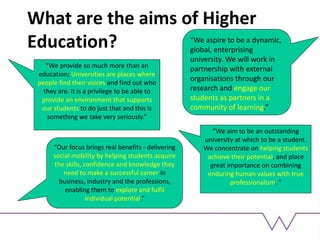
What are the aims of Higher
Education?
“We provide so much more than an
education; Universities are places where
people find their voices and find out who
they are. It is a privilege to be able to
provide an environment that supports
our students to do just that and this is
something we take very seriously.”
“We aspire to be a dynamic,
global, enterprising
university. We will work in
partnership with external
organisations through our
research and engage our
students as partners in a
community of learning.”
“Our focus brings real benefits - delivering
social mobility by helping students acquire
the skills, confidence and knowledge they
need to make a successful career in
business, industry and the professions,
enabling them to explore and fulfil
individual potential.”
“We aim to be an outstanding
university at which to be a student.
We concentrate on helping students
achieve their potential, and place
great importance on combining
enduring human values with true
professionalism. ”
The value of the co-curriculum
Research points to the value of extra-curricula
activities (UG research, internships etc) and the
relationship between this and academic success.
Students persist in these ‘high impact practices’
(Bass).
Lifelong learners engage less in these co-
curricula activities; but their ‘lives’ provide these
opportunities and the context in which they truly
learn.
Re-imagining ‘co-curricula’
Returning adult learners have life, career and
personal narratives which offer rich insight in
themselves, but when combined with academic
E-Portfolios, more than any other tools, have
the potential to be able to capture this
integrative learning – connecting experiences
and knowledge from the academic and other
contexts.
Narrative identity/story telling
“Narratives draw together disparate and somehow
discordant elements to the concordant unity of plot.”
(Ricoeur, 1992 in Madden)
E-Portfolios can provide a space for narratives and
storytelling, central to Schon’s reflection-in-action (1983)
and relating to Knowles’ (2012) assumptions about how
adult experiences affect learning.
The (often) competing priorities of adult learners should
be viewed as assets – an opportunity to enrich learning
and assessment, and tools for drawing synthesis with
academic experiences in HE.
Issues with e-portfolios
Shulman (1998) points to issues of trivialisation, misrepresentation
and the e-portfolio as merely a place to ‘show off’ materials.
Clark (2011) argues that adults do not realistically want to keep their
life ‘in a shoebox’.
Interoperability and long-term ownership present institutional
dilemmas and student frustration.
Questions of academic rigour – suitable for assessment (formative
and summative?)
Shift from a ‘teaching paradigm to learning paradigm’ is not easy in
HE (Khan, 2014).
Suitability of tools and student IT skills
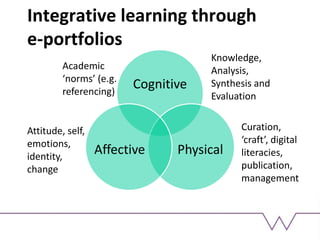
Integrative learning through
e-portfolios
Cognitive
PhysicalAffective
Knowledge,
Analysis,
Synthesis and
Evaluation
Academic
‘norms’ (e.g.
referencing)
Attitude, self,
emotions,
identity,
change
Curation,
‘craft’, digital
literacies,
publication,
management
Re-presenting academic
assessment
E-portfolios can offer a ‘re-presentation’ of the
traditional academic assignment, which conforms to
referencing norms and can be securely submitted.
As tools for formative assessment, e-portfolios offer a
unique space for dialogue between tutor and student
and for reciprocal teaching and feedback between
learners.
Structuralist, iterative teacher-learner relationship
reminiscent of HE before the advent of the public exam
(Trevitt, 2013).
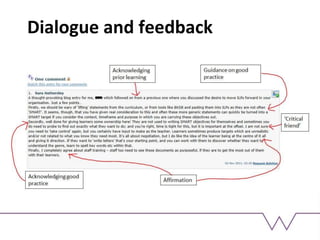
Dialogue and feedback
Affective learning
Reflective practice within e-portfolios can articulate
‘changes’ experienced by the student.
Reflection and engagement together (drawing synthesis
between worlds) can lead to transformation.
Measuring/accounting for changes in confidence, pride,
skills, perspective and identity can tell us a lot about the
learning that has taken place and inform curriculum
design (Springfield et al 2015).
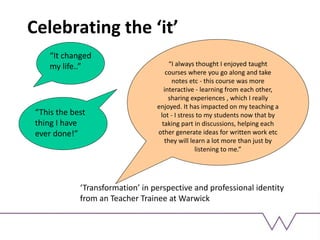
Celebrating the ‘it’
“It changed
my life..”
“This the best
thing I have
ever done!”
“I always thought I enjoyed taught
courses where you go along and take
notes etc - this course was more
interactive - learning from each other,
sharing experiences , which I really
enjoyed. It has impacted on my teaching a
lot - I stress to my students now that by
taking part in discussions, helping each
other generate ideas for written work etc
they will learn a lot more than just by
listening to me.”
‘Transformation’ in perspective and professional identity
from an Teacher Trainee at Warwick
Curation and meaningful action
WYSIWYG interfaces allow for the curation and
publication of online materials in spaces such as e-
portfolios, without knowledge of programming.
The craft and process of curation through e-portfolios
might also be directly related to the value placed by
students on their work.
‘Student as producer’ is a current concept in HE
Research shows adult returning learners (particularly age
40-60 cohort) lack confidence in IT skills BUT e-portfolios
may work well with students’ existing digital literacy
practices.
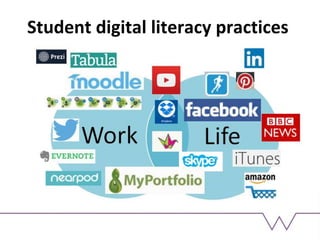
Student digital literacy practices
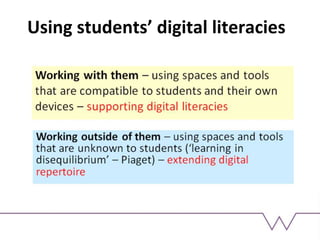
Using students’ digital literacies
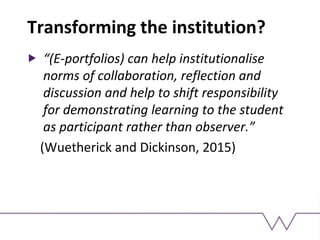
Transforming the institution?
“(E-portfolios) can help institutionalise
norms of collaboration, reflection and
discussion and help to shift responsibility
for demonstrating learning to the student
as participant rather than observer.”
(Wuetherick and Dickinson, 2015)
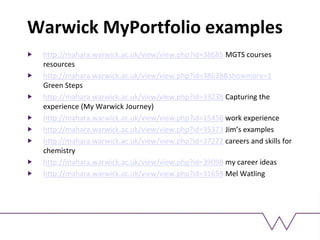
Warwick MyPortfolio examples
http://mahara.warwick.ac.uk/view/view.php?id=38685 MGTS courses
resources
http://mahara.warwick.ac.uk/view/view.php?id=38638&showmore=1
Green Steps
http://mahara.warwick.ac.uk/view/view.php?id=33238 Capturing the
experience (My Warwick Journey)
http://mahara.warwick.ac.uk/view/view.php?id=15456 work experience
http://mahara.warwick.ac.uk/view/view.php?id=35373 Jim’s examples
http://mahara.warwick.ac.uk/view/view.php?id=37222 careers and skills for
chemistry
http://mahara.warwick.ac.uk/view/view.php?id=39098 my career ideas
http://mahara.warwick.ac.uk/view/view.php?id=31659 Mel Watling
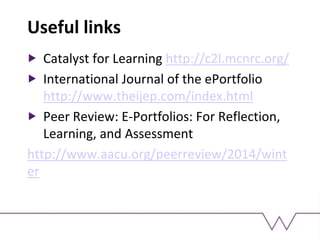
Useful links
Catalyst for Learning http://c2l.mcnrc.org/
International Journal of the ePortfolio
http://www.theijep.com/index.html
Peer Review: E-Portfolios: For Reflection,
Learning, and Assessment
http://www.aacu.org/peerreview/2014/wint
er

Cll conference 2015

  • 1.
    E-portfolios, Higher Education andLifelong Learning Sara Hattersley, E-Learning Manager, Centre for Lifelong Learning University of Warwick
  • 2.
    Intended outcomes To explorethe place of e-portfolios in Higher Education, considering their relevance to lifelong learners, specifically. To consider the ways in which e-portfolios can provide a holistic, inter-connected account of learners during a course of study. To consider examples from University of Warwick.
  • 3.
    Growing body ofknowledge and interest 2009 - the Association for Authentic, Experiential, and Evidence-Based Learning (AAEEBL). 2011 - the International Journal of ePortfolio (IJeP). Institution-wide, managed solutions (e.g. Mahara at Warwick).
  • 4.
    What is ane-portfolio? Repository for files, folders and digital artefacts. A record of student learning and achievement A means of assessing student performance A place for reflective practice A social networking space A student-led space for personal and collaborative curation A transformative space for personal change. A tool for re-imagining Higher Education?
  • 5.
    What are theaims of Higher Education? “We provide so much more than an education; Universities are places where people find their voices and find out who they are. It is a privilege to be able to provide an environment that supports our students to do just that and this is something we take very seriously.” “We aspire to be a dynamic, global, enterprising university. We will work in partnership with external organisations through our research and engage our students as partners in a community of learning.” “Our focus brings real benefits - delivering social mobility by helping students acquire the skills, confidence and knowledge they need to make a successful career in business, industry and the professions, enabling them to explore and fulfil individual potential.” “We aim to be an outstanding university at which to be a student. We concentrate on helping students achieve their potential, and place great importance on combining enduring human values with true professionalism. ”
  • 6.
    The value ofthe co-curriculum Research points to the value of extra-curricula activities (UG research, internships etc) and the relationship between this and academic success. Students persist in these ‘high impact practices’ (Bass). Lifelong learners engage less in these co- curricula activities; but their ‘lives’ provide these opportunities and the context in which they truly learn.
  • 7.
    Re-imagining ‘co-curricula’ Returning adultlearners have life, career and personal narratives which offer rich insight in themselves, but when combined with academic E-Portfolios, more than any other tools, have the potential to be able to capture this integrative learning – connecting experiences and knowledge from the academic and other contexts.
  • 8.
    Narrative identity/story telling “Narrativesdraw together disparate and somehow discordant elements to the concordant unity of plot.” (Ricoeur, 1992 in Madden) E-Portfolios can provide a space for narratives and storytelling, central to Schon’s reflection-in-action (1983) and relating to Knowles’ (2012) assumptions about how adult experiences affect learning. The (often) competing priorities of adult learners should be viewed as assets – an opportunity to enrich learning and assessment, and tools for drawing synthesis with academic experiences in HE.
  • 9.
    Issues with e-portfolios Shulman(1998) points to issues of trivialisation, misrepresentation and the e-portfolio as merely a place to ‘show off’ materials. Clark (2011) argues that adults do not realistically want to keep their life ‘in a shoebox’. Interoperability and long-term ownership present institutional dilemmas and student frustration. Questions of academic rigour – suitable for assessment (formative and summative?) Shift from a ‘teaching paradigm to learning paradigm’ is not easy in HE (Khan, 2014). Suitability of tools and student IT skills
  • 10.
    Integrative learning through e-portfolios Cognitive PhysicalAffective Knowledge, Analysis, Synthesisand Evaluation Academic ‘norms’ (e.g. referencing) Attitude, self, emotions, identity, change Curation, ‘craft’, digital literacies, publication, management
  • 11.
    Re-presenting academic assessment E-portfolios canoffer a ‘re-presentation’ of the traditional academic assignment, which conforms to referencing norms and can be securely submitted. As tools for formative assessment, e-portfolios offer a unique space for dialogue between tutor and student and for reciprocal teaching and feedback between learners. Structuralist, iterative teacher-learner relationship reminiscent of HE before the advent of the public exam (Trevitt, 2013).
  • 12.
  • 13.
    Affective learning Reflective practicewithin e-portfolios can articulate ‘changes’ experienced by the student. Reflection and engagement together (drawing synthesis between worlds) can lead to transformation. Measuring/accounting for changes in confidence, pride, skills, perspective and identity can tell us a lot about the learning that has taken place and inform curriculum design (Springfield et al 2015).
  • 14.
    Celebrating the ‘it’ “Itchanged my life..” “This the best thing I have ever done!” “I always thought I enjoyed taught courses where you go along and take notes etc - this course was more interactive - learning from each other, sharing experiences , which I really enjoyed. It has impacted on my teaching a lot - I stress to my students now that by taking part in discussions, helping each other generate ideas for written work etc they will learn a lot more than just by listening to me.” ‘Transformation’ in perspective and professional identity from an Teacher Trainee at Warwick
  • 15.
    Curation and meaningfulaction WYSIWYG interfaces allow for the curation and publication of online materials in spaces such as e- portfolios, without knowledge of programming. The craft and process of curation through e-portfolios might also be directly related to the value placed by students on their work. ‘Student as producer’ is a current concept in HE Research shows adult returning learners (particularly age 40-60 cohort) lack confidence in IT skills BUT e-portfolios may work well with students’ existing digital literacy practices.
  • 16.
  • 17.
  • 18.
    Transforming the institution? “(E-portfolios)can help institutionalise norms of collaboration, reflection and discussion and help to shift responsibility for demonstrating learning to the student as participant rather than observer.” (Wuetherick and Dickinson, 2015)
  • 19.
    Warwick MyPortfolio examples http://mahara.warwick.ac.uk/view/view.php?id=38685MGTS courses resources http://mahara.warwick.ac.uk/view/view.php?id=38638&showmore=1 Green Steps http://mahara.warwick.ac.uk/view/view.php?id=33238 Capturing the experience (My Warwick Journey) http://mahara.warwick.ac.uk/view/view.php?id=15456 work experience http://mahara.warwick.ac.uk/view/view.php?id=35373 Jim’s examples http://mahara.warwick.ac.uk/view/view.php?id=37222 careers and skills for chemistry http://mahara.warwick.ac.uk/view/view.php?id=39098 my career ideas http://mahara.warwick.ac.uk/view/view.php?id=31659 Mel Watling
  • 20.
    Useful links Catalyst forLearning http://c2l.mcnrc.org/ International Journal of the ePortfolio http://www.theijep.com/index.html Peer Review: E-Portfolios: For Reflection, Learning, and Assessment http://www.aacu.org/peerreview/2014/wint er