1
Final Doctoral Oral Examination
Rita Zuba Prokopetz
July 19, 2019
Examination Committee Members:
Dr. Norman Vaughan (External)
Dr. Jane Arscott
Dr. Pamela Walsh
Dr. Debra Hoven (Supervisor)
Capstone Electronic Portfolios of Master’s Students:
An Online Ethnography
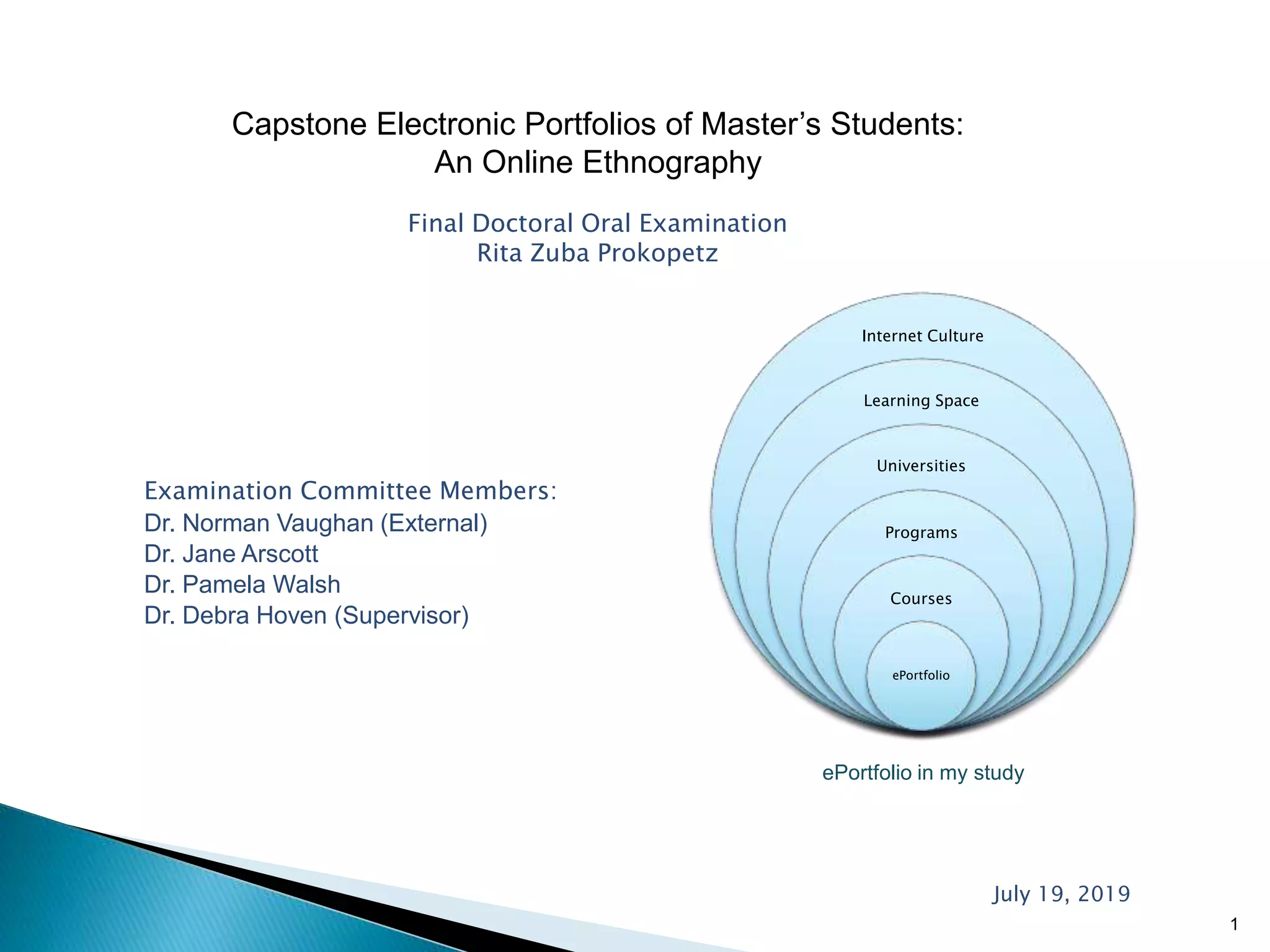
Internet Culture
Learning Space
Universities
Programs
Courses
ePortfolio
ePortfolio in my study
2
 My online ethnography
 Evolution of cycle of fieldwork (3 course iterations)
 Coming into the study (professional self-development)
 Research questions my study sought to address
 Review of the Literature (four constructs)
 Epistemology
 My research Process
 Addressing the research questions
 Observation – students’ emergent realizations
 Findings – student perceptions
 Recommendations
 Contribution and Significance
 Areas for Future Research
Background
My research study
3
(p. 32)
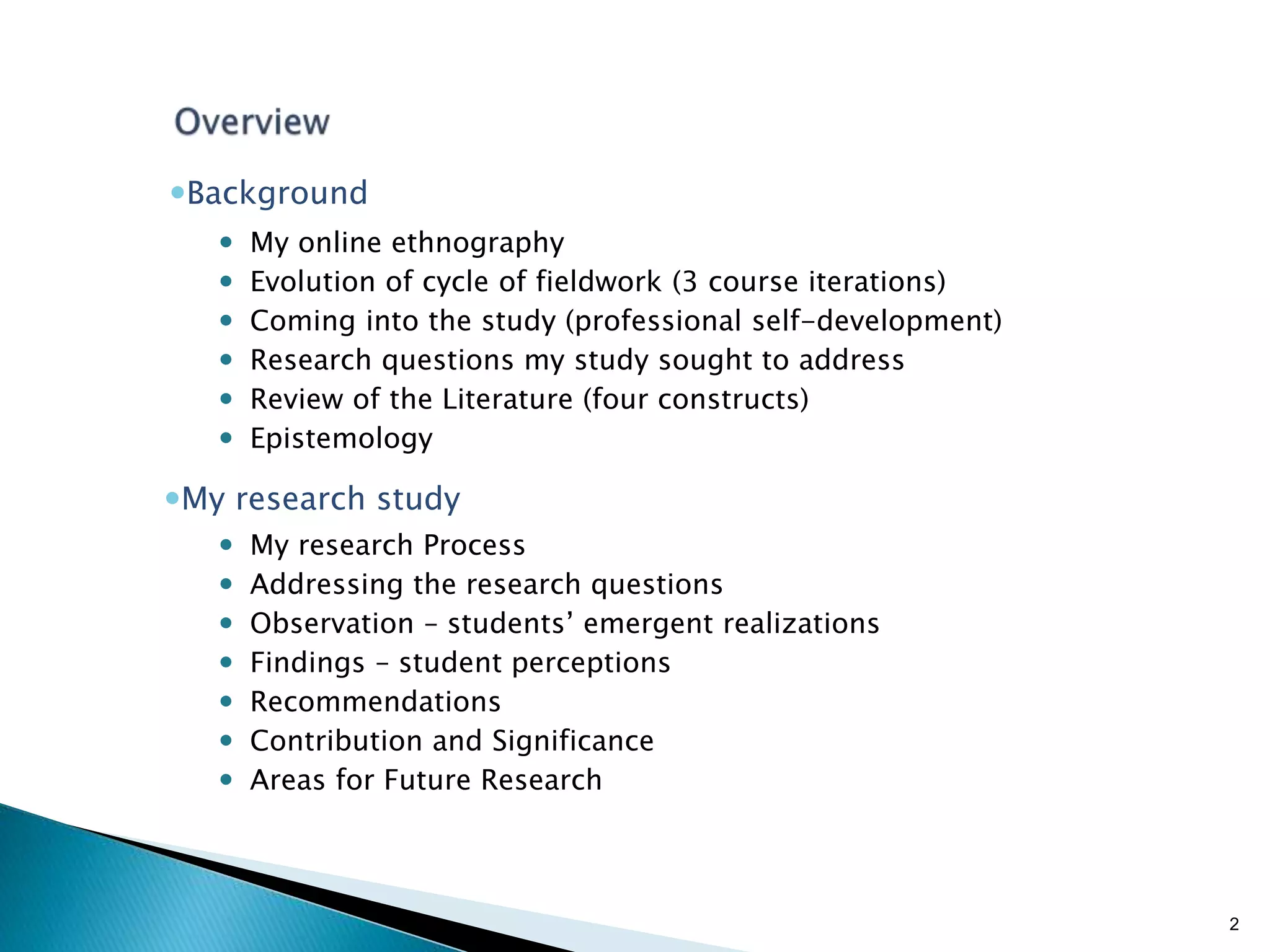
Etic view
Emic view
Reflective
journal
Reflexive
journal
Rich
description
Eportfolio
subculture
Capstone course
Program
Institution
Vast Internet
learning space
Arvey (2003)
Doane (2003)
Eisner (1998)
“thick descriptions” (Geertz, 1973)
4
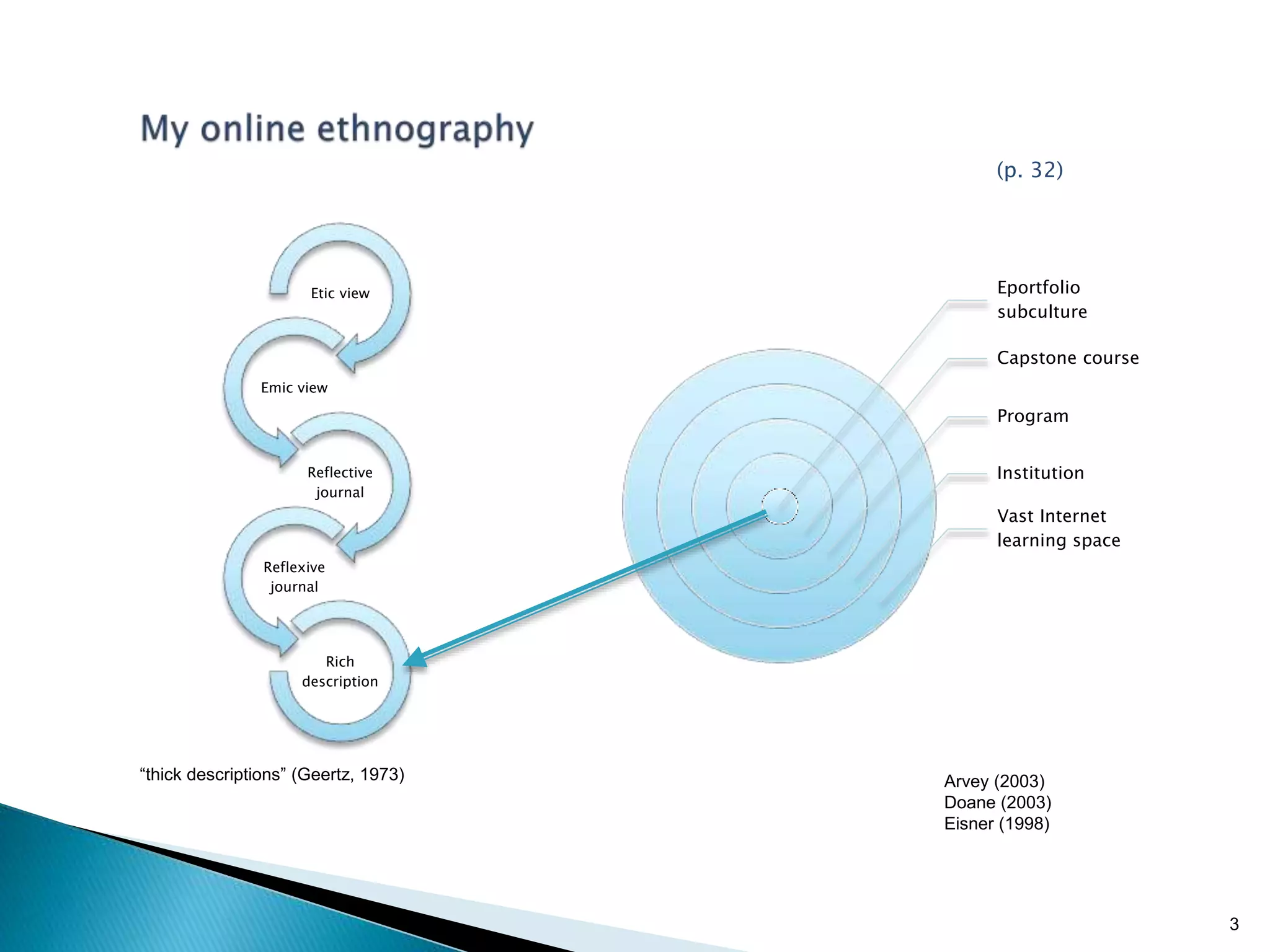
observer
emic
participant
participant
- observer
etic
(pp. 108-111)
Self
reflection
Image source: Clipart
Primary research technique
Eisner (1998)
Lincoln and Guba (1985)
Body as a site of knowing
Conquergood (1991)
Examination of our ways of doing
Hibbert, MacIntosh, and Coupland (2010)
5
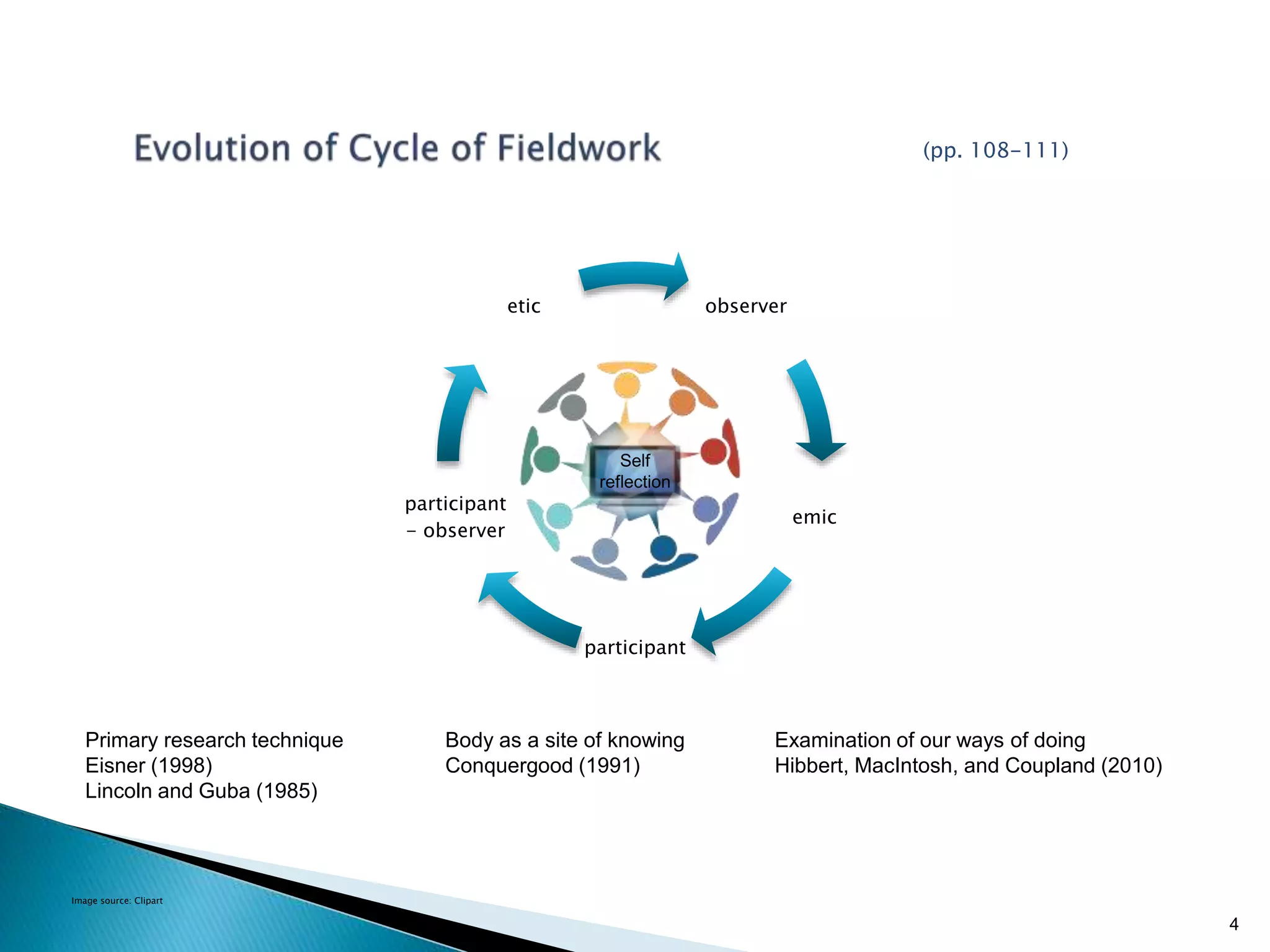
 Emergence of the Problem
While observing master’s students, I perceived their
 Difficulty thinking through experiences to date
 Struggle aligning competencies with experiences
 Challenge articulating achievement of competencies
 My personal perspective
During my observations, I relied on
 Experience as creator, curator, user of an eportfolio
 Proponent of interpretivist / constructivist approach
 Reflective practitioner and reflexive researcher
(p. 5, pp. 89-93)
6
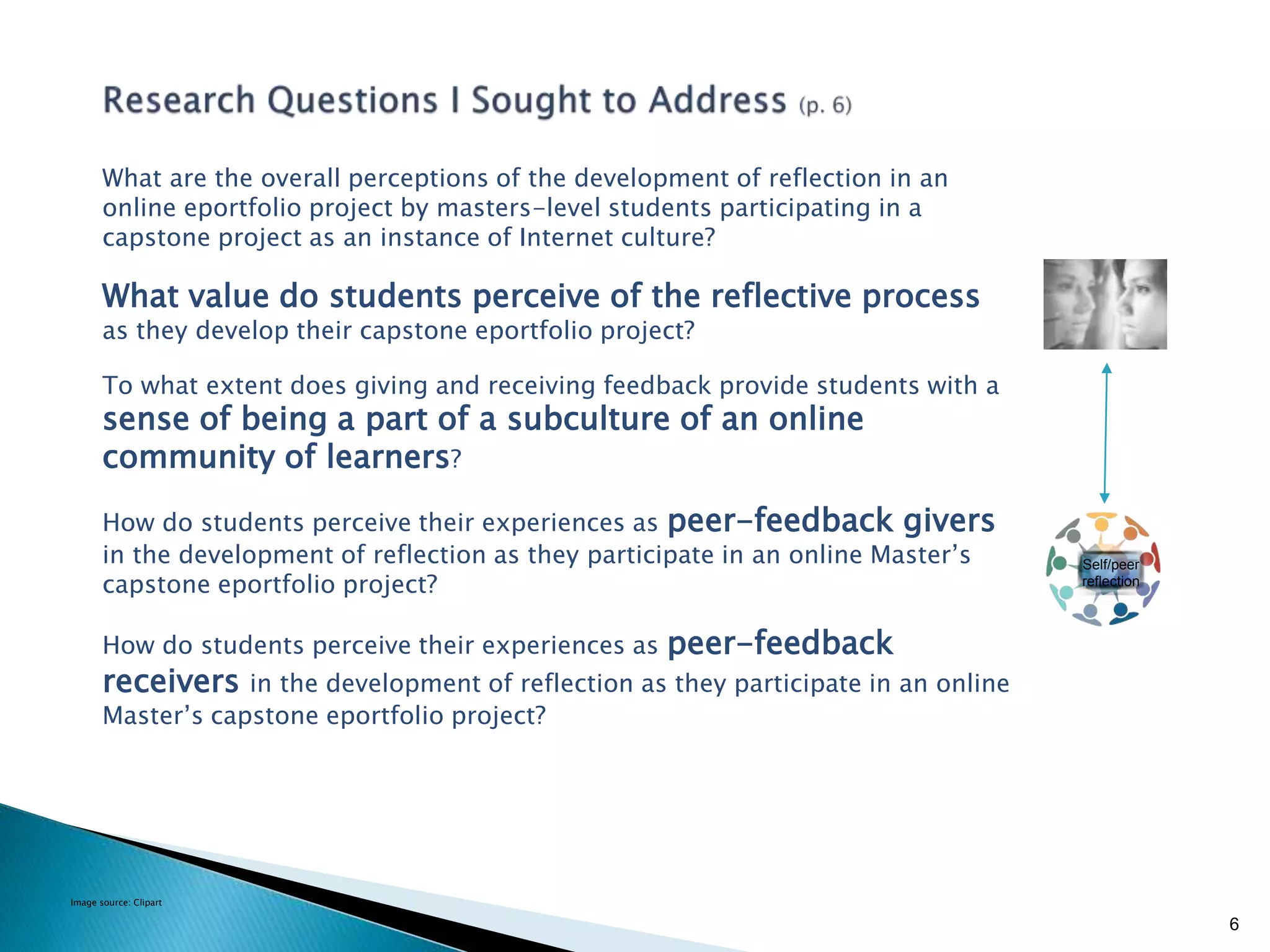
What are the overall perceptions of the development of reflection in an
online eportfolio project by masters-level students participating in a
capstone project as an instance of Internet culture?
What value do students perceive of the reflective process
as they develop their capstone eportfolio project?
To what extent does giving and receiving feedback provide students with a
sense of being a part of a subculture of an online
community of learners?
How do students perceive their experiences as peer-feedback givers
in the development of reflection as they participate in an online Master’s
capstone eportfolio project?
How do students perceive their experiences as peer-feedback
receivers in the development of reflection as they participate in an online
Master’s capstone eportfolio project?
Self/peer
reflection
Image source: Clipart
7
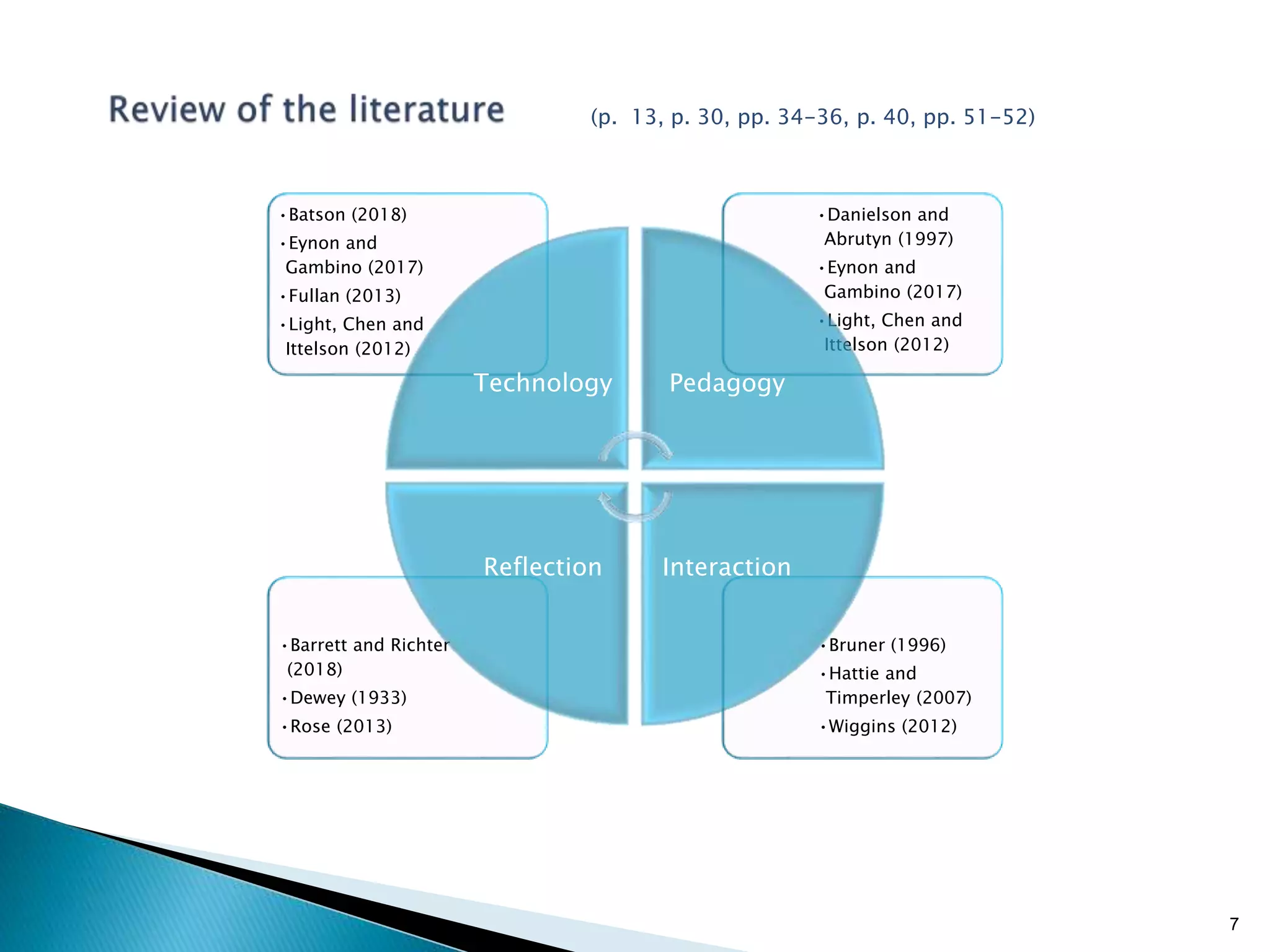
•Bruner (1996)
•Hattie and
Timperley (2007)
•Wiggins (2012)
•Barrett and Richter
(2018)
•Dewey (1933)
•Rose (2013)
•Danielson and
Abrutyn (1997)
•Eynon and
Gambino (2017)
•Light, Chen and
Ittelson (2012)
•Batson (2018)
•Eynon and
Gambino (2017)
•Fullan (2013)
•Light, Chen and
Ittelson (2012)
Technology Pedagogy
InteractionReflection
(p. 13, p. 30, pp. 34-36, p. 40, pp. 51-52)
8
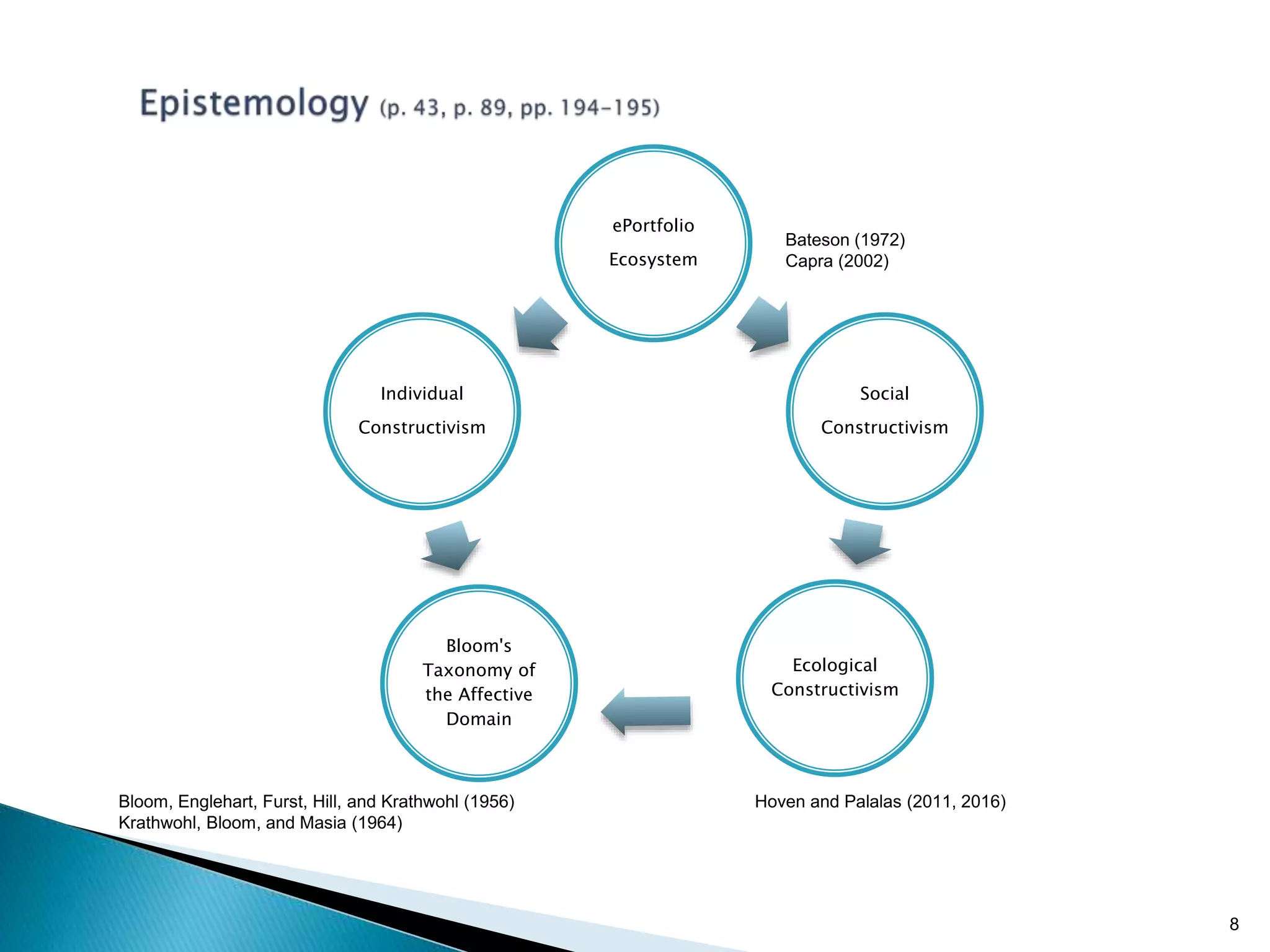
ePortfolio
Ecosystem
Social
Constructivism
Ecological
Constructivism
Bloom's
Taxonomy of
the Affective
Domain
Individual
Constructivism
Bateson (1972)
Capra (2002)
Bloom, Englehart, Furst, Hill, and Krathwohl (1956)
Krathwohl, Bloom, and Masia (1964)
Hoven and Palalas (2011, 2016)
9
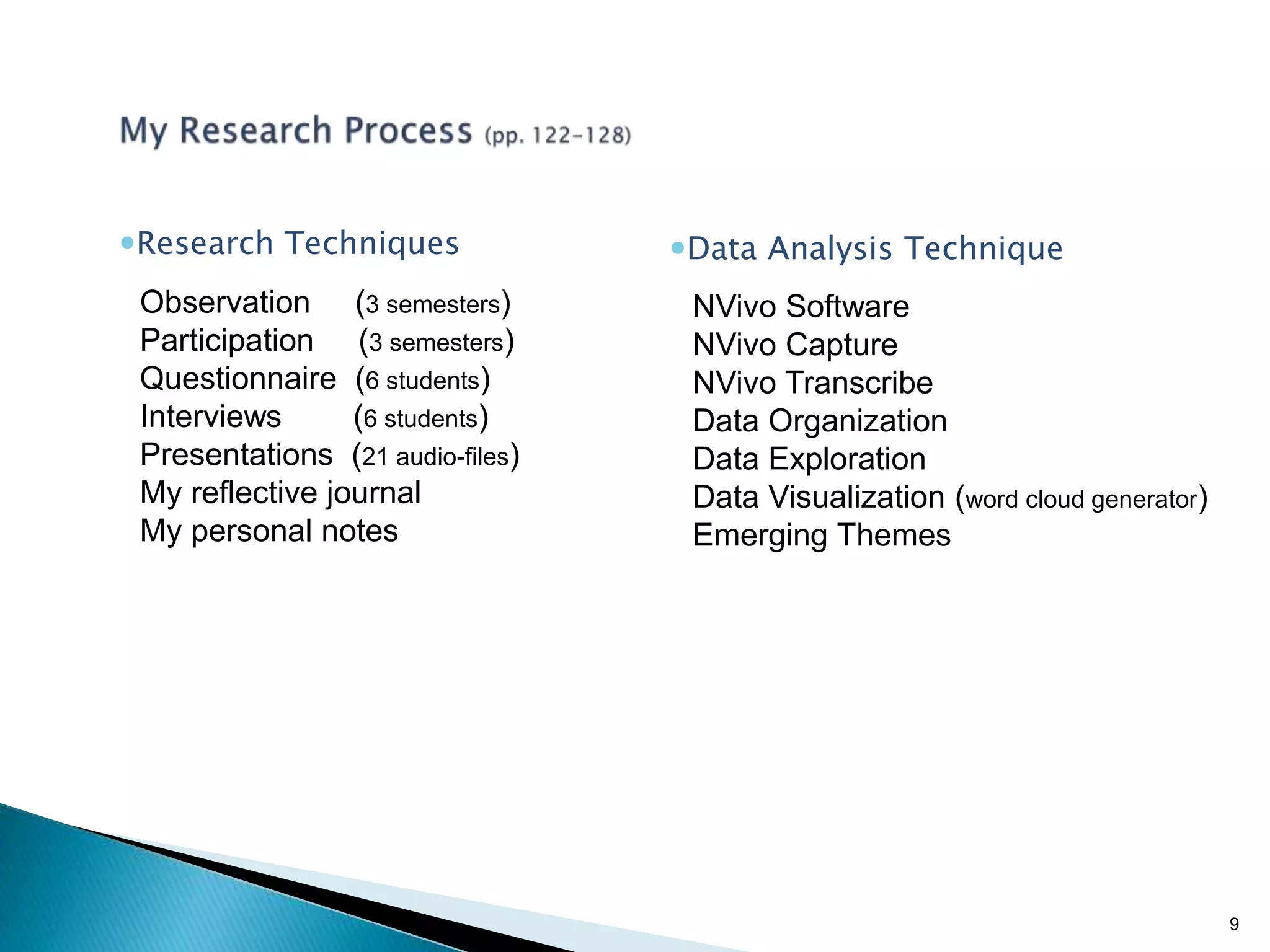
Observation (3 semesters)
Participation (3 semesters)
Questionnaire (6 students)
Interviews (6 students)
Presentations (21 audio-files)
My reflective journal
My personal notes
Research Techniques Data Analysis Technique
NVivo Software
NVivo Capture
NVivo Transcribe
Data Organization
Data Exploration
Data Visualization (word cloud generator)
Emerging Themes
10
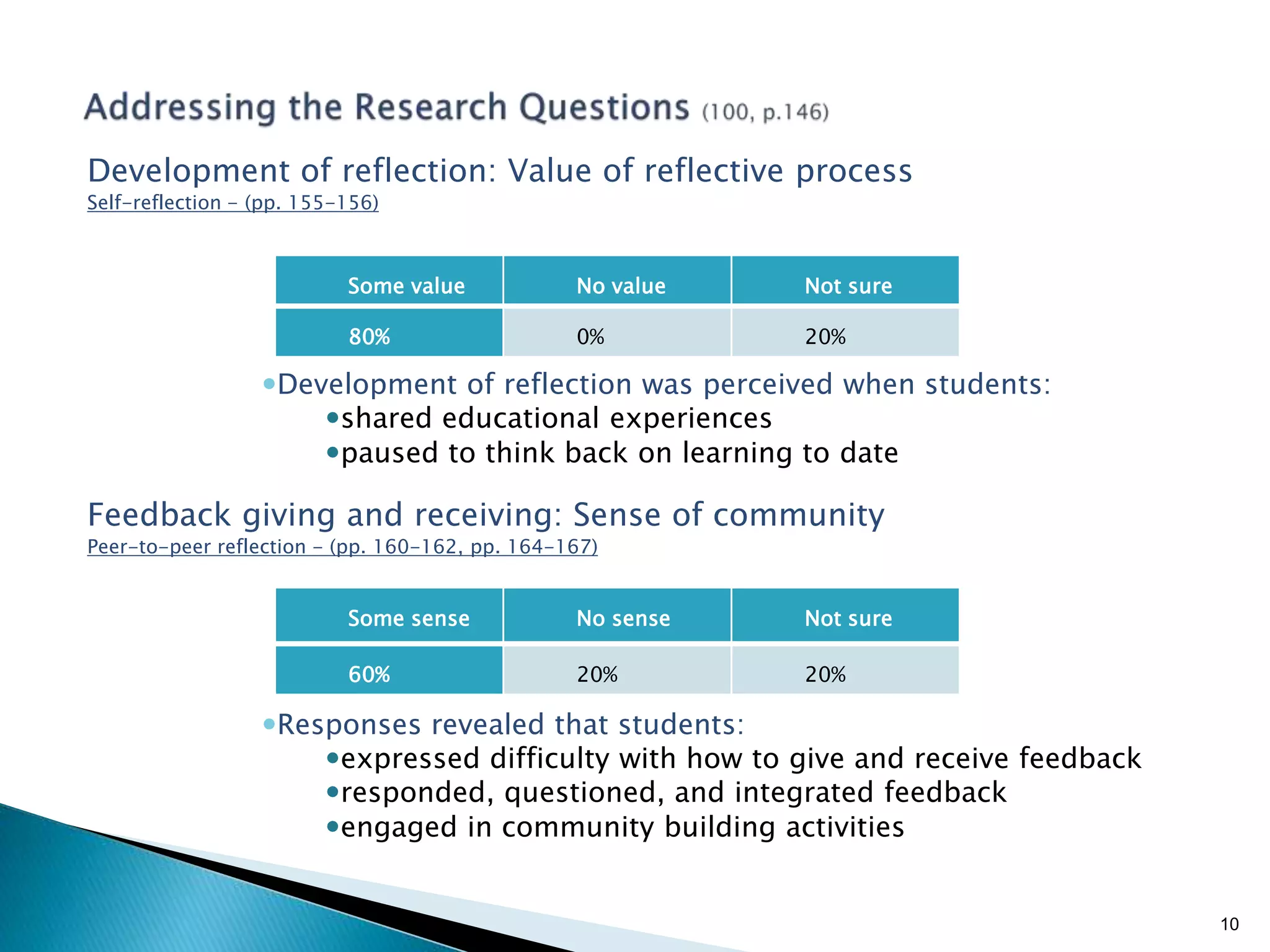
Development of reflection: Value of reflective process
Self-reflection - (pp. 155-156)
Feedback giving and receiving: Sense of community
Peer-to-peer reflection - (pp. 160-162, pp. 164-167)
Some value No value Not sure
80% 0% 20%
Some sense No sense Not sure
60% 20% 20%
Development of reflection was perceived when students:
shared educational experiences
paused to think back on learning to date
Responses revealed that students:
expressed difficulty with how to give and receive feedback
responded, questioned, and integrated feedback
engaged in community building activities
11
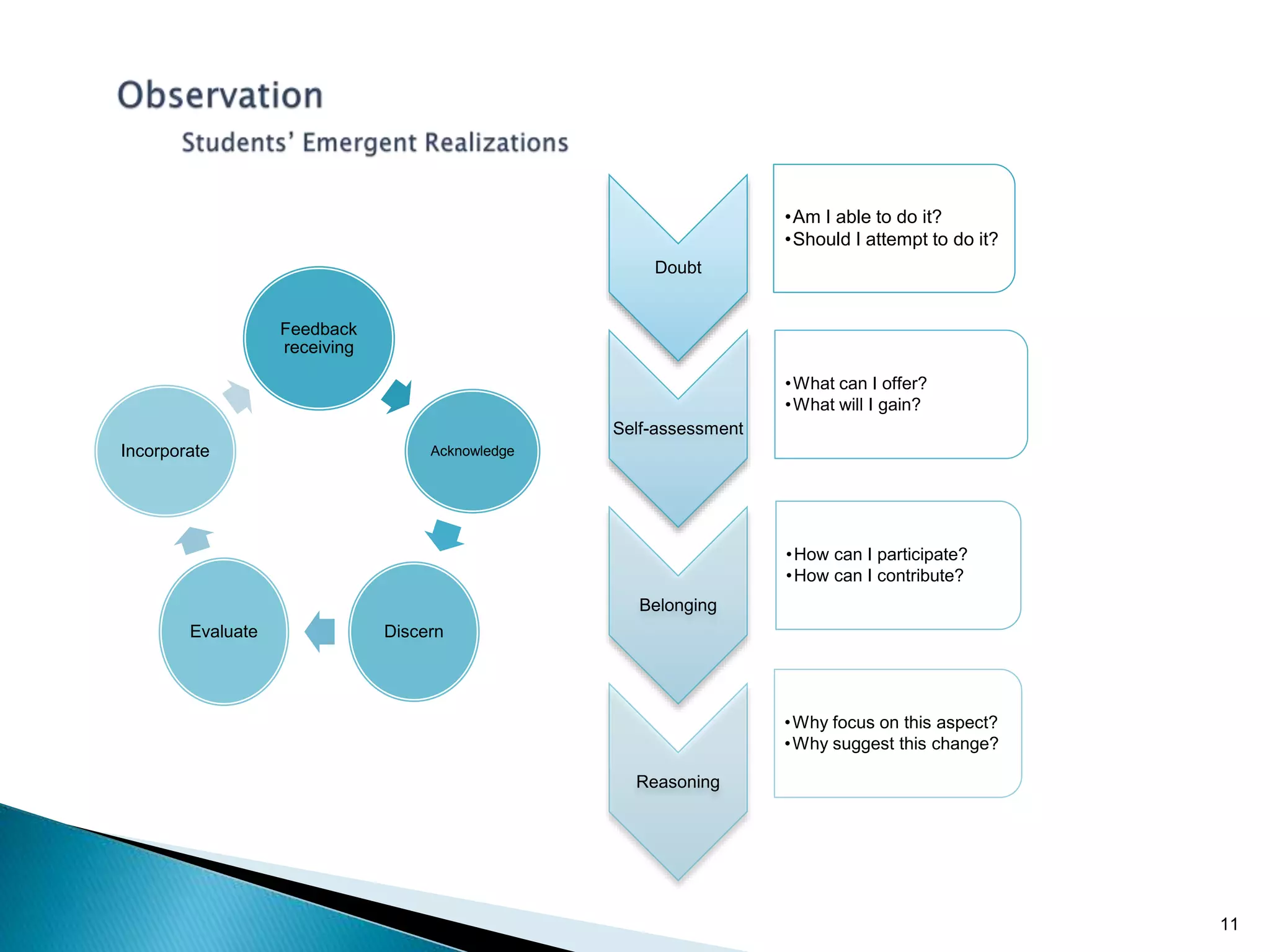
Feedback
receiving
Acknowledge
DiscernEvaluate
Incorporate
Doubt
•Am I able to do it?
•Should I attempt to do it?
Self-assessment
•What can I offer?
•What will I gain?
Belonging
•How can I participate?
•How can I contribute?
Reasoning
•Why focus on this aspect?
•Why suggest this change?
12
• know more about eportfolios
• experiment with more platforms
• experience reflective writing
• learn about experiential learning
• learn to give constructive
feedback
• gain confidence in providing
targeted feedback
• learn how to prevent taking
comments too personally
Perception of Study Participants (p. 150)
13
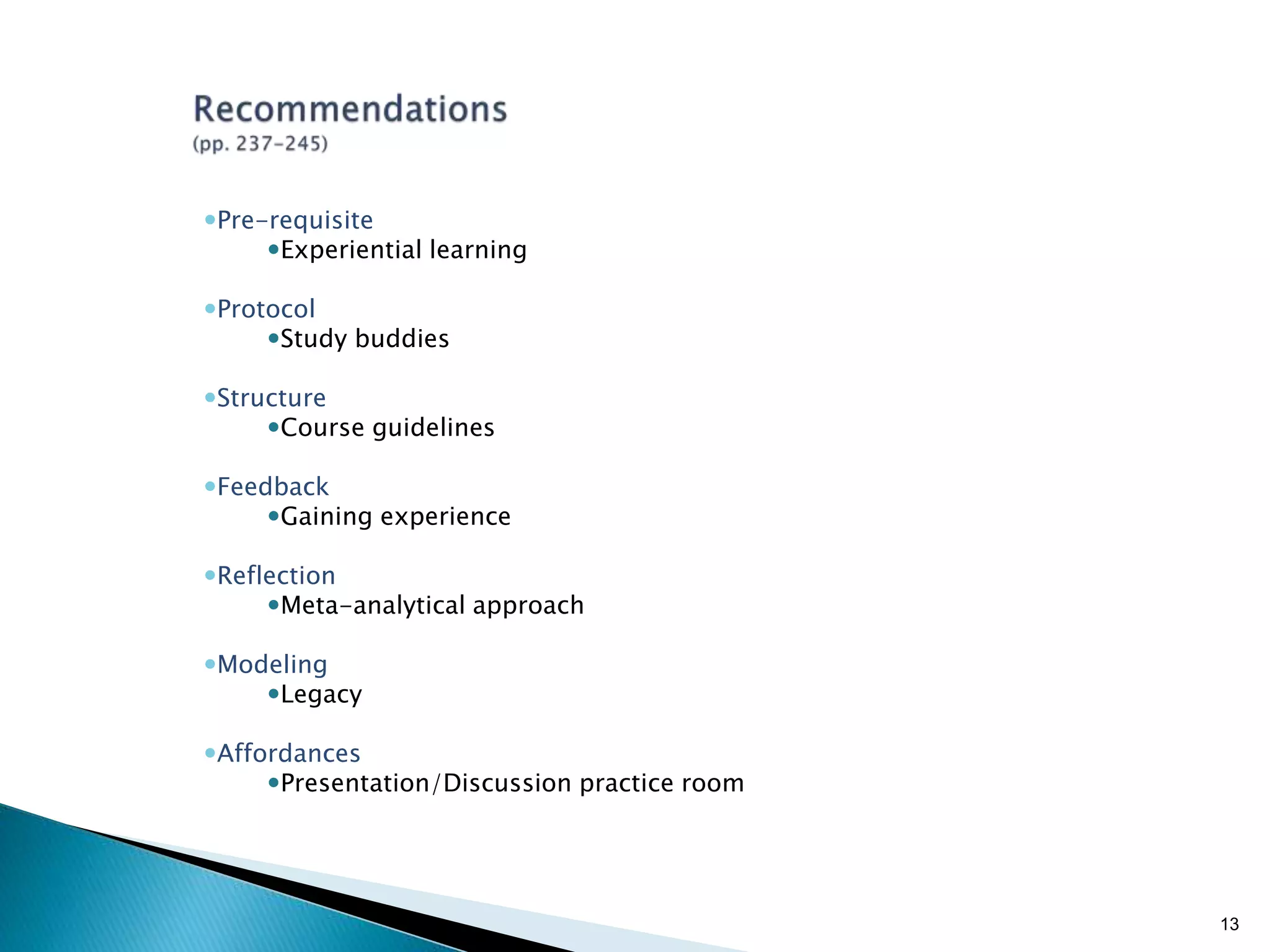
Pre-requisite
Experiential learning
Protocol
Study buddies
Structure
Course guidelines
Feedback
Gaining experience
Reflection
Meta-analytical approach
Modeling
Legacy
Affordances
Presentation/Discussion practice room
14
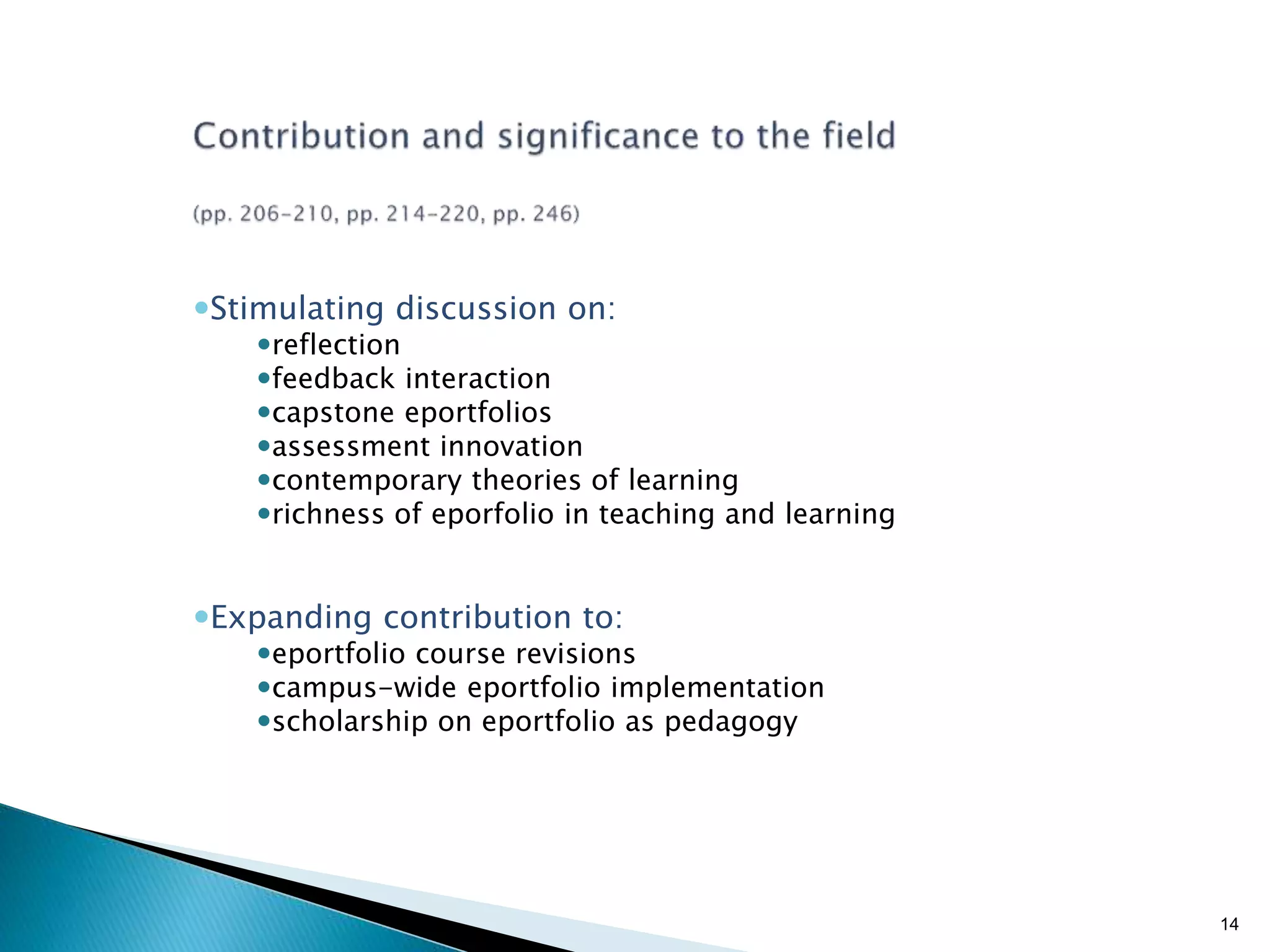
Stimulating discussion on:
reflection
feedback interaction
capstone eportfolios
assessment innovation
contemporary theories of learning
richness of eporfolio in teaching and learning
Expanding contribution to:
eportfolio course revisions
campus-wide eportfolio implementation
scholarship on eportfolio as pedagogy
15
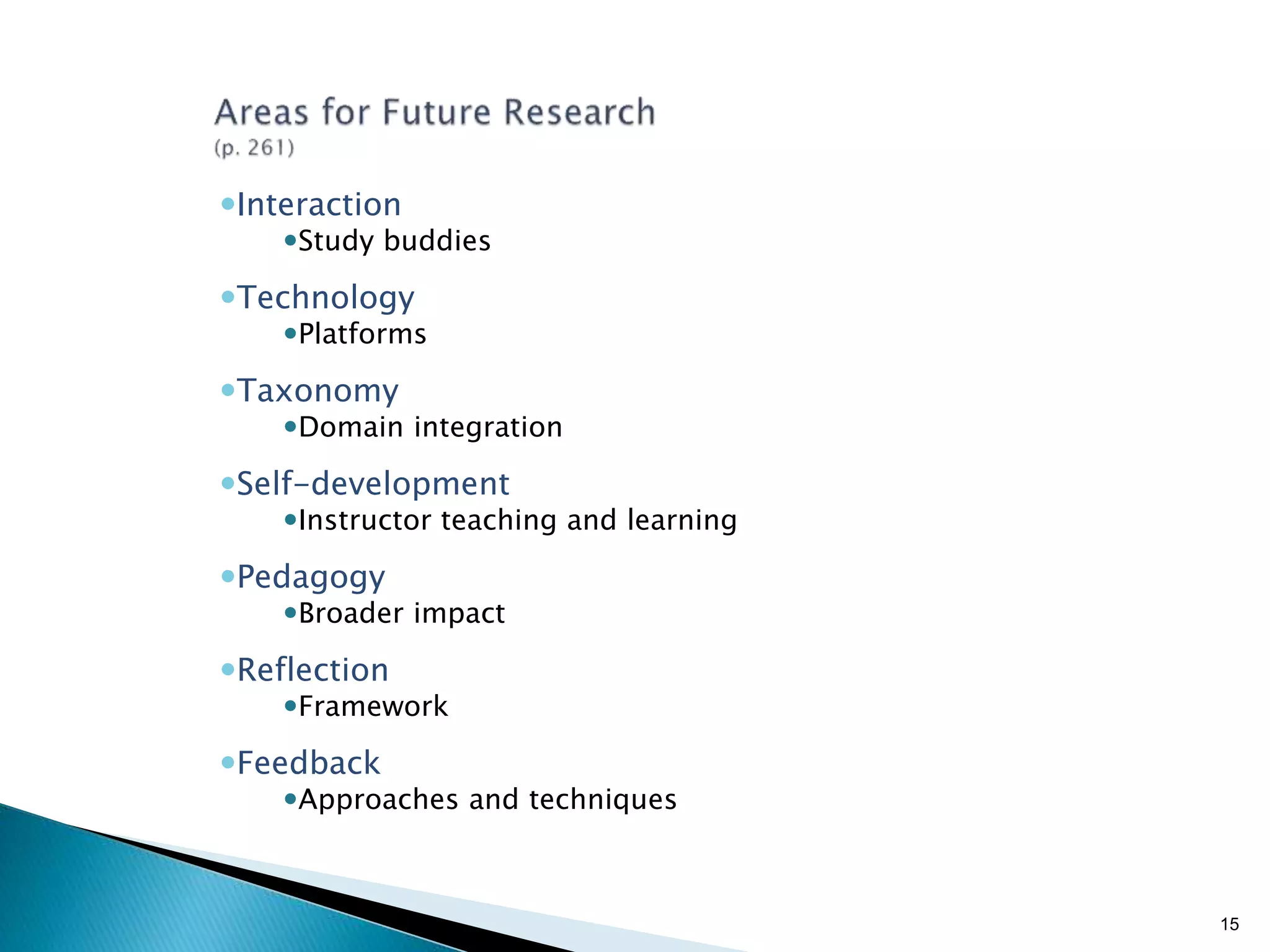
Interaction
Study buddies
Technology
Platforms
Taxonomy
Domain integration
Self-development
Instructor teaching and learning
Pedagogy
Broader impact
Reflection
Framework
Feedback
Approaches and techniques
16
Thank you!
17
Arvey, M. (2003). Doing reflexivity: A collaborative, narrative approach. In L. Finlay & B. Gough (Eds.), Reflexivity (pp. 163-175). Oxford, UK: Blackwell.
Barrett, H. C., & Richter, J. (2018). Reflection4Learning [Website].
Bateson, G. (1972). Steps to an ecology of mind: Collected essays in anthropology, psychiatry, evolution, and epistemology. Northvale, NJ: Jason
Aronson.
Batson, T. (2018). The eportfolio idea as guide star for higher education. The AAEEBL ePortfolio Review, 2(2), 9-11.
Bruner, J. S. (1996). The culture of education. Cambridge, MA: Harvard university Press.
Bloom, B. S., Englehart, M. D., Furst, E. J., Hill, W. H., & Krathwohl, D. R. (1956). Taxonomy of educational objectives: The classification of educational
goals. Handbook I: Cognitive domain. White Plains, NY: Longman.
Capra, F. (2002). The hidden connections: Integrating the biological, cognitive, and social dimensions of life into a science of sustainability. New York,
NY: Doubleday.
Conquergood, D. (1991). Rethinking ethnography: Towards a critical cultural politics. Communication Monographs, 58, 179-194.
Danielson, C., & Abrutyn, L. (1997). Introduction to using portfolios in the classroom. Alexandria, VA: Association for Supervision and Curriculum
Development.
Dewey, J. (1933). How we think. Buffalo, NY: Prometheus Books.
Doane, G. (2003). Reflexivity as presence: A journey of self enquiry. In L. Finlay & B. Gough (Eds.), Reflexivity (pp. 93-102). Oxford, UK: Blackwell.
Eisner, E. W. (1998). The enlightened eye: Qualitative inquiry and the enhancement of educational practice. Upper Saddle River: NJ: Prentice Hall.
Eynon, B., & Gambino, L. M. (2017). High-impact eportfolio practice: A catalyst for student, faculty, and institutional learning. Sterling, VA: Stylus.
Fullan, M. (2013). Stratosphere: Integrating technology, pedagogy, and change knowledge. Toronto, ON: Pearson.
Hattie, J., & Timperley, H. (2007). The Power of Feedback. Review of Educational Research, 77(1), 81-112.
Hibbert, P., MacInstosh, R., & Coupland, C. (2010). Reflexivity, recursion and relationality in organizational research processes. Qualitative Research in
Organizations and Management: An International Journal, 5(1), 47-62.
Hoven, D., & Palalas, A. (2011). (Re)conceptualizing design approaches for mobile language learning. CALICO Journal, 28(3), 699-720.
Hoven, D., & Palalas, A. (2016). Ecological Constructivism as a new learning theory for MALL: An open system of beliefs, observations and informed
explanations. In A. Palalas & M. Ally (Eds.), The international handbook of mobile-assisted language learning (pp. 113-137). China Central Radio & TV
University Press Co., Ltd.
Krathwohl, D. R., Bloom, B. S., & Masia, B. B. (1964). Taxonomy of educational objectives: The classification of educational goals, Handbook II: Affective
domain. London, UK: Longman Group.
Light, T. P., Chen, H. L., & Ittelson, J. C. (2012). Documenting learning with eportfolios: A guide for college instructors. San Francisco, CA: Jossey-Bass.
Lincoln, Y. S., & Guba, E. (1985). Naturalistic inquiry. Beverly Hill, CA: Sage.
Rose, E. (2013). On reflection: An essay on technology, education, and the status of thought in the twenty-first century. Toronto, CA: Canadian Scholars’
Press.
Wiggins, G. (2012). Seven keys to effective feedback. Educational Leadership, 70(1), 10-16.

EdD: Dissertation Defence

  • 1.
    1 Final Doctoral OralExamination Rita Zuba Prokopetz July 19, 2019 Examination Committee Members: Dr. Norman Vaughan (External) Dr. Jane Arscott Dr. Pamela Walsh Dr. Debra Hoven (Supervisor) Capstone Electronic Portfolios of Master’s Students: An Online Ethnography Internet Culture Learning Space Universities Programs Courses ePortfolio ePortfolio in my study
  • 2.
    2  My onlineethnography  Evolution of cycle of fieldwork (3 course iterations)  Coming into the study (professional self-development)  Research questions my study sought to address  Review of the Literature (four constructs)  Epistemology  My research Process  Addressing the research questions  Observation – students’ emergent realizations  Findings – student perceptions  Recommendations  Contribution and Significance  Areas for Future Research Background My research study
  • 3.
    3 (p. 32) Etic view Emicview Reflective journal Reflexive journal Rich description Eportfolio subculture Capstone course Program Institution Vast Internet learning space Arvey (2003) Doane (2003) Eisner (1998) “thick descriptions” (Geertz, 1973)
  • 4.
    4 observer emic participant participant - observer etic (pp. 108-111) Self reflection Imagesource: Clipart Primary research technique Eisner (1998) Lincoln and Guba (1985) Body as a site of knowing Conquergood (1991) Examination of our ways of doing Hibbert, MacIntosh, and Coupland (2010)
  • 5.
    5  Emergence ofthe Problem While observing master’s students, I perceived their  Difficulty thinking through experiences to date  Struggle aligning competencies with experiences  Challenge articulating achievement of competencies  My personal perspective During my observations, I relied on  Experience as creator, curator, user of an eportfolio  Proponent of interpretivist / constructivist approach  Reflective practitioner and reflexive researcher (p. 5, pp. 89-93)
  • 6.
    6 What are theoverall perceptions of the development of reflection in an online eportfolio project by masters-level students participating in a capstone project as an instance of Internet culture? What value do students perceive of the reflective process as they develop their capstone eportfolio project? To what extent does giving and receiving feedback provide students with a sense of being a part of a subculture of an online community of learners? How do students perceive their experiences as peer-feedback givers in the development of reflection as they participate in an online Master’s capstone eportfolio project? How do students perceive their experiences as peer-feedback receivers in the development of reflection as they participate in an online Master’s capstone eportfolio project? Self/peer reflection Image source: Clipart
  • 7.
    7 •Bruner (1996) •Hattie and Timperley(2007) •Wiggins (2012) •Barrett and Richter (2018) •Dewey (1933) •Rose (2013) •Danielson and Abrutyn (1997) •Eynon and Gambino (2017) •Light, Chen and Ittelson (2012) •Batson (2018) •Eynon and Gambino (2017) •Fullan (2013) •Light, Chen and Ittelson (2012) Technology Pedagogy InteractionReflection (p. 13, p. 30, pp. 34-36, p. 40, pp. 51-52)
  • 8.
    8 ePortfolio Ecosystem Social Constructivism Ecological Constructivism Bloom's Taxonomy of the Affective Domain Individual Constructivism Bateson(1972) Capra (2002) Bloom, Englehart, Furst, Hill, and Krathwohl (1956) Krathwohl, Bloom, and Masia (1964) Hoven and Palalas (2011, 2016)
  • 9.
    9 Observation (3 semesters) Participation(3 semesters) Questionnaire (6 students) Interviews (6 students) Presentations (21 audio-files) My reflective journal My personal notes Research Techniques Data Analysis Technique NVivo Software NVivo Capture NVivo Transcribe Data Organization Data Exploration Data Visualization (word cloud generator) Emerging Themes
  • 10.
    10 Development of reflection:Value of reflective process Self-reflection - (pp. 155-156) Feedback giving and receiving: Sense of community Peer-to-peer reflection - (pp. 160-162, pp. 164-167) Some value No value Not sure 80% 0% 20% Some sense No sense Not sure 60% 20% 20% Development of reflection was perceived when students: shared educational experiences paused to think back on learning to date Responses revealed that students: expressed difficulty with how to give and receive feedback responded, questioned, and integrated feedback engaged in community building activities
  • 11.
    11 Feedback receiving Acknowledge DiscernEvaluate Incorporate Doubt •Am I ableto do it? •Should I attempt to do it? Self-assessment •What can I offer? •What will I gain? Belonging •How can I participate? •How can I contribute? Reasoning •Why focus on this aspect? •Why suggest this change?
  • 12.
    12 • know moreabout eportfolios • experiment with more platforms • experience reflective writing • learn about experiential learning • learn to give constructive feedback • gain confidence in providing targeted feedback • learn how to prevent taking comments too personally Perception of Study Participants (p. 150)
  • 13.
    13 Pre-requisite Experiential learning Protocol Study buddies Structure Courseguidelines Feedback Gaining experience Reflection Meta-analytical approach Modeling Legacy Affordances Presentation/Discussion practice room
  • 14.
    14 Stimulating discussion on: reflection feedbackinteraction capstone eportfolios assessment innovation contemporary theories of learning richness of eporfolio in teaching and learning Expanding contribution to: eportfolio course revisions campus-wide eportfolio implementation scholarship on eportfolio as pedagogy
  • 15.
    15 Interaction Study buddies Technology Platforms Taxonomy Domain integration Self-development Instructorteaching and learning Pedagogy Broader impact Reflection Framework Feedback Approaches and techniques
  • 16.
  • 17.
    17 Arvey, M. (2003).Doing reflexivity: A collaborative, narrative approach. In L. Finlay & B. Gough (Eds.), Reflexivity (pp. 163-175). Oxford, UK: Blackwell. Barrett, H. C., & Richter, J. (2018). Reflection4Learning [Website]. Bateson, G. (1972). Steps to an ecology of mind: Collected essays in anthropology, psychiatry, evolution, and epistemology. Northvale, NJ: Jason Aronson. Batson, T. (2018). The eportfolio idea as guide star for higher education. The AAEEBL ePortfolio Review, 2(2), 9-11. Bruner, J. S. (1996). The culture of education. Cambridge, MA: Harvard university Press. Bloom, B. S., Englehart, M. D., Furst, E. J., Hill, W. H., & Krathwohl, D. R. (1956). Taxonomy of educational objectives: The classification of educational goals. Handbook I: Cognitive domain. White Plains, NY: Longman. Capra, F. (2002). The hidden connections: Integrating the biological, cognitive, and social dimensions of life into a science of sustainability. New York, NY: Doubleday. Conquergood, D. (1991). Rethinking ethnography: Towards a critical cultural politics. Communication Monographs, 58, 179-194. Danielson, C., & Abrutyn, L. (1997). Introduction to using portfolios in the classroom. Alexandria, VA: Association for Supervision and Curriculum Development. Dewey, J. (1933). How we think. Buffalo, NY: Prometheus Books. Doane, G. (2003). Reflexivity as presence: A journey of self enquiry. In L. Finlay & B. Gough (Eds.), Reflexivity (pp. 93-102). Oxford, UK: Blackwell. Eisner, E. W. (1998). The enlightened eye: Qualitative inquiry and the enhancement of educational practice. Upper Saddle River: NJ: Prentice Hall. Eynon, B., & Gambino, L. M. (2017). High-impact eportfolio practice: A catalyst for student, faculty, and institutional learning. Sterling, VA: Stylus. Fullan, M. (2013). Stratosphere: Integrating technology, pedagogy, and change knowledge. Toronto, ON: Pearson. Hattie, J., & Timperley, H. (2007). The Power of Feedback. Review of Educational Research, 77(1), 81-112. Hibbert, P., MacInstosh, R., & Coupland, C. (2010). Reflexivity, recursion and relationality in organizational research processes. Qualitative Research in Organizations and Management: An International Journal, 5(1), 47-62. Hoven, D., & Palalas, A. (2011). (Re)conceptualizing design approaches for mobile language learning. CALICO Journal, 28(3), 699-720. Hoven, D., & Palalas, A. (2016). Ecological Constructivism as a new learning theory for MALL: An open system of beliefs, observations and informed explanations. In A. Palalas & M. Ally (Eds.), The international handbook of mobile-assisted language learning (pp. 113-137). China Central Radio & TV University Press Co., Ltd. Krathwohl, D. R., Bloom, B. S., & Masia, B. B. (1964). Taxonomy of educational objectives: The classification of educational goals, Handbook II: Affective domain. London, UK: Longman Group. Light, T. P., Chen, H. L., & Ittelson, J. C. (2012). Documenting learning with eportfolios: A guide for college instructors. San Francisco, CA: Jossey-Bass. Lincoln, Y. S., & Guba, E. (1985). Naturalistic inquiry. Beverly Hill, CA: Sage. Rose, E. (2013). On reflection: An essay on technology, education, and the status of thought in the twenty-first century. Toronto, CA: Canadian Scholars’ Press. Wiggins, G. (2012). Seven keys to effective feedback. Educational Leadership, 70(1), 10-16.