Presentation on APD &
Laser Diode
Purpose
This presentation is about Optical detector (APD) of a specific
commercial model and what does it do with addition to Laser Diode
and it’s commercial use also from a specific model.
Optical Detector
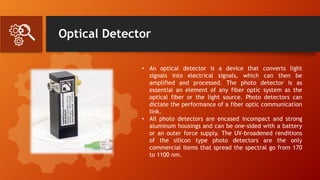
• An optical detector is a device that converts light
signals into electrical signals, which can then be
amplified and processed. The photo detector is as
essential an element of any fiber optic system as the
optical fiber or the light source. Photo detectors can
dictate the performance of a fiber optic communication
link.
• All photo detectors are encased incompact and strong
aluminum housings and can be one-sided with a battery
or an outer force supply. The UV-broadened renditions
of the silicon type photo detectors are the only
commercial items that spread the spectral go from 170
to 1100 nm.
Commercial Model APD based UPD-15IR2-FC
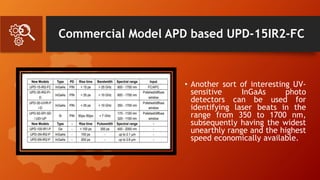
• Another sort of interesting UV-
sensitive InGaAs photo
detectors can be used for
identifying laser beats in the
range from 350 to 1700 nm,
subsequently having the widest
unearthly range and the highest
speed economically available.
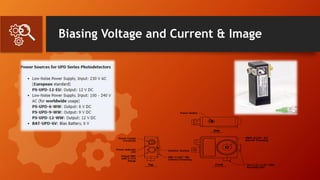
Biasing Voltage and Current & Image
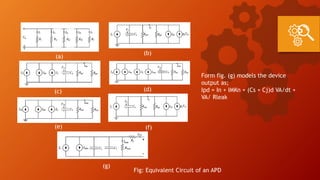
Fig: Equivalent Circuit of an APD
Form fig. (g) models the device
output as;
Ipd = In + IMKn + (Cs + Cj)d VA/dt +
VA/ Rleak
(g)
(a)
(d)(c)
(b)
(f)(e)
Structure of APD and UPD-15-IR2-FC APD
photodetector
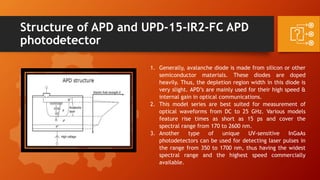
1. Generally, avalanche diode is made from silicon or other
semiconductor materials. These diodes are doped
heavily. Thus, the depletion region width in this diode is
very slight. APD’s are mainly used for their high speed &
internal gain in optical communications.
2. This model series are best suited for measurement of
optical waveforms from DC to 25 GHz. Various models
feature rise times as short as 15 ps and cover the
spectral range from 170 to 2600 nm.
3. Another type of unique UV-sensitive InGaAs
photodetectors can be used for detecting laser pulses in
the range from 350 to 1700 nm, thus having the widest
spectral range and the highest speed commercially
available.
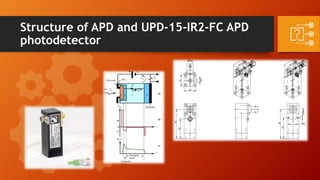
Structure of APD and UPD-15-IR2-FC APD
photodetector
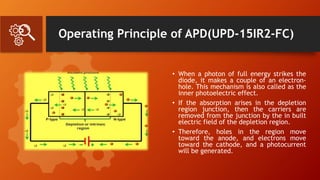
Operating Principle of APD(UPD-15IR2-FC)
• When a photon of full energy strikes the
diode, it makes a couple of an electron-
hole. This mechanism is also called as the
inner photoelectric effect.
• If the absorption arises in the depletion
region junction, then the carriers are
removed from the junction by the in built
electric field of the depletion region.
• Therefore, holes in the region move
toward the anode, and electrons move
toward the cathode, and a photocurrent
will be generated.
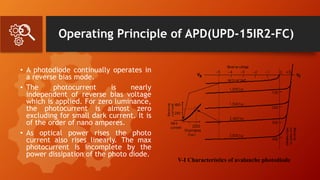
Operating Principle of APD(UPD-15IR2-FC)
• A photodiode continually operates in
a reverse bias mode.
• The photocurrent is nearly
independent of reverse bias voltage
which is applied. For zero luminance,
the photocurrent is almost zero
excluding for small dark current. It is
of the order of nano amperes.
• As optical power rises the photo
current also rises linearly. The max
photocurrent is incomplete by the
power dissipation of the photo diode.
V-I Characteristics of avalanche photodiode
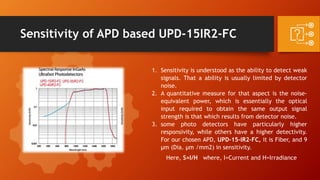
Sensitivity of APD based UPD-15IR2-FC
1. Sensitivity is understood as the ability to detect weak
signals. That a ability is usually limited by detector
noise.
2. A quantitative measure for that aspect is the noise-
equivalent power, which is essentially the optical
input required to obtain the same output signal
strength is that which results from detector noise.
3. some photo detectors have particularly higher
responsivity, while others have a higher detectivity.
For our chosen APD, UPD-15-IR2-FC, it is Fiber, and 9
μm (Dia. μm /mm2) in sensitivity.
Here, S=I/H where, I=Current and H=Irradiance
Plots and information of APD based UPD-15IR2-FC
UPD-15IR2-FC:
• According to varies companies’ ultrafast
photodetector price is computable for optical
communication link. Price range basically shows the
variety between different model and their prices. As
far our research our selected Alphalas.
• UPD-15IR2-FC model is priced somewhere between
$2200-$2500 based on adds on like wideband high-gain
amplifiers with this model
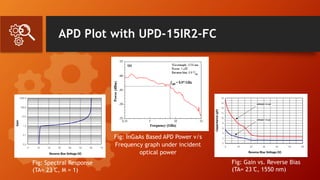
APD Plot with UPD-15IR2-FC
Fig: InGaAs Based APD Power v/s
Frequency graph under incident
optical power
Fig: Spectral Response
(TA= 23 ̊C, M = 1)
Fig: Gain vs. Reverse Bias
(TA= 23 ̊C, 1550 nm)
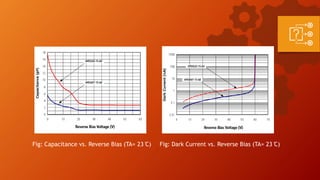
Fig: Capacitance vs. Reverse Bias (TA= 23 ̊C) Fig: Dark Current vs. Reverse Bias (TA= 23 ̊C)
Uses of APD and UPD-15IR2-FC
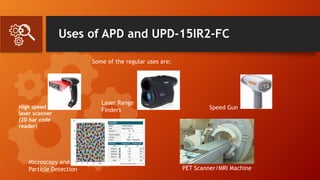
• we already know APD’s are mainly used for their high
speed & internal gain in optical communications, and for
this specific model, it has faster rise time of 15ps and
wider bandwidth of 25GHz with spectral range of 700-
1700nm.
• Applications of APD’s are mainly for with respect to this
specific model includes;
I. Pulse Form Measurements
II. Pulse Duration Measurements
III. Precise Synchronization
IV. Mode Beating Monitoring
V. Heterodyne Measurements
Uses of APD and UPD-15IR2-FC
Some of the regular uses are;
High speed
laser scanner
(2D bar code
reader)
Laser Range
Finders Speed Gun
Microscopy and
Particle Detection PET Scanner/MRI Machine
Quantum efficiency of APD (UPD-15IR2-FC)
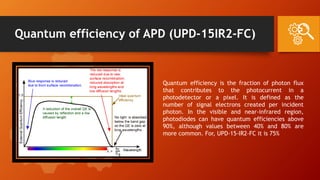
Quantum efficiency is the fraction of photon flux
that contributes to the photocurrent in a
photodetector or a pixel. It is defined as the
number of signal electrons created per incident
photon. In the visible and near-infrared region,
photodiodes can have quantum efficiencies above
90%, although values between 40% and 80% are
more common. For, UPD-15-IR2-FC it is 75%
NEP and Responsivity of APD (UPD-15IR2-FC)
The Noise Equivalent Power (NEP) is the common
metric that quantifies a photodetector’s sensitivity
or the power generated by a noise source.
Essentially, the NEP expresses the minimum
detectable power per square root bandwidth of a
given detector; in other words, it’s a measure of
the weakest optical signal that can be detected.
NEP can also be called Optical Power per
Square root of Bandwidth and can be formulized as:
𝑝1
𝐵
=
1
𝑅
2ⅇ 𝐼 𝑑 + 𝐼 𝑝ℎ
NEP and Responsivity of APD (UPD-15IR2-FC)
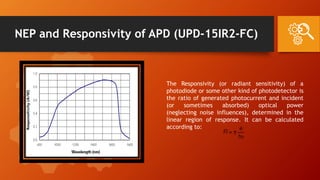
The Responsivity (or radiant sensitivity) of a
photodiode or some other kind of photodetector is
the ratio of generated photocurrent and incident
(or sometimes absorbed) optical power
(neglecting noise influences), determined in the
linear region of response. It can be calculated
according to:
Detectivity of APD (UPD-15IR2-FC)
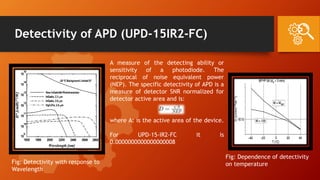
A measure of the detecting ability or
sensitivity of a photodiode. The
reciprocal of noise equivalent power
(NEP). The specific detectivity of APD is a
measure of detector SNR normalized for
detector active area and is:
where A: is the active area of the device.
For UPD-15-IR2-FC it is
0.0000000000000000008
Fig: Detectivity with response to
Wavelength
Fig: Dependence of detectivity
on temperature
Laser Diode
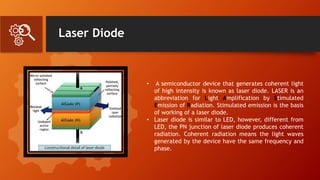
• A semiconductor device that generates coherent light
of high intensity is known as laser diode. LASER is an
abbreviation for Light Amplification by Stimulated
Emission of Radiation. Stimulated emission is the basis
of working of a laser diode.
• Laser diode is similar to LED, however, different from
LED, the PN junction of laser diode produces coherent
radiation. Coherent radiation means the light waves
generated by the device have the same frequency and
phase.
Commercial Model of Fiber Bragg Grating Stabilized
Laser Diode (RLS/976nm-950mW)
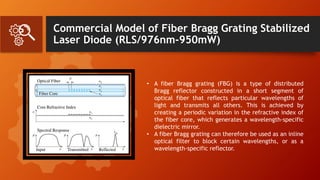
• A fiber Bragg grating (FBG) is a type of distributed
Bragg reflector constructed in a short segment of
optical fiber that reflects particular wavelengths of
light and transmits all others. This is achieved by
creating a periodic variation in the refractive index of
the fiber core, which generates a wavelength-specific
dielectric mirror.
• A fiber Bragg grating can therefore be used as an inline

optical filter to block certain wavelengths, or as a
wavelength-specific reflector.
Commercial Model of Fiber Bragg Grating Stabilized
Laser Diode (RLS/976nm-950mW)
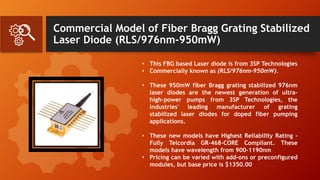
• This FBG based Laser diode is from 3SP Technologies
• Commercially known as (RLS/976nm-950mW).
• These 950mW fiber Bragg grating stabilized 976nm
laser diodes are the newest generation of ultra-
high-power pumps from 3SP Technologies, the
industries' leading manufacturer of grating
stabilized laser diodes for doped fiber pumping
applications.
• These new models have Highest Reliability Rating -
Fully Telcordia GR-468-CORE Compliant. These
models have wavelength from 900-1190nm
• Pricing can be varied with add-ons or preconfigured
modules, but base price is $1350.00
Types of Laser Diodes
There is different type of Laser Diodes with different
operating system and principle and every one of them has
different type of functionality and applications. Some of
the type of LDs are;
• Multi-longitudinal mode (MLM) or Fabry-Perot laser
• Single longitudinal mode laser (SLM)
• Single longitudinal mode with distributed feedback
laser, usually called a DFB laser
• DFB laser with external modulator
• Distributed Bragg Reflector lasers (DBR)
• Vertical-cavity surface-emitting laser (VCSEL)
• Double heterostructure lasers
• Quantum well lasers
• Quantum cascade lasers
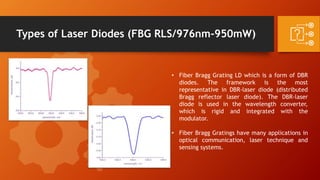
Types of Laser Diodes (FBG RLS/976nm-950mW)
• Fiber Bragg Grating LD which is a form of DBR
diodes. The framework is the most
representative in DBR-laser diode (distributed
Bragg reflector laser diode). The DBR-laser
diode is used in the wavelength converter,
which is rigid and integrated with the
modulator.
• Fiber Bragg Gratings have many applications in
optical communication, laser technique and
sensing systems.
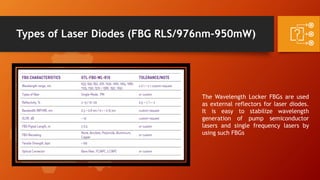
Types of Laser Diodes (FBG RLS/976nm-950mW)
The Wavelength Locker FBGs are used
as external reflectors for laser diodes.
It is easy to stabilize wavelength
generation of pump semiconductor
lasers and single frequency lasers by
using such FBGs
Mechanism of FBG Laser Diode FBG
(RLS/976nm-950mW)
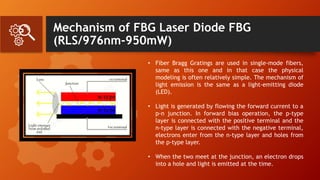
• Fiber Bragg Gratings are used in single-mode fibers,
same as this one and in that case the physical
modeling is often relatively simple. The mechanism of
light emission is the same as a light-emitting diode
(LED).
• Light is generated by flowing the forward current to a
p-n junction. In forward bias operation, the p-type
layer is connected with the positive terminal and the
n-type layer is connected with the negative terminal,
electrons enter from the n-type layer and holes from
the p-type layer.
• When the two meet at the junction, an electron drops
into a hole and light is emitted at the time.
FBG Laser diode wavelength and uses of
those wavelength
• The emission wavelength of a laser diode is essentially
determined by the band gap of the laser-active
semiconductor material: the photon energy is close to
the band gap energy.
• In quantum well lasers, there is also some influence of
the quantum well thickness. A variety of
semiconductor materials makes it possible to cover
wide spectral regions.
• In particular, there are many ternary and quaternary
semiconductor compounds, where the bandgap energy
can be adjusted in a wide range simply by varying the
composition details
FBG Laser diode wavelength and uses of
those wavelength
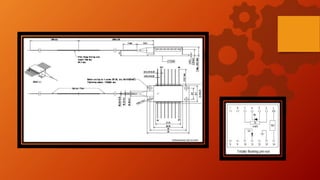
• They are based on in-house wafer growth and chip
development technology. The butterfly package is a low
profile, epoxy-free, 14-pin module which offers > 950
milli-watts of CW output power.
• The wavelength is locked using an FBG which is located
in the polarization maintaining (PM) fiber pigtail. These
laser diodes are offered with bare fiber (no connector)
for direct coupling.
• Laser diodes, which are capable of converting electrical
current into light, are available from 3SP technologies
with center wavelengths in the 375 - 2000 nm range and
output powers from 1.5 mW up to 3 W. We also offer
Quantum Cascade Lasers (QCLs) with center wavelengths
ranging from 4.05 to 11.00 µm.
FBG Laser diode wavelength and uses of
those wavelength
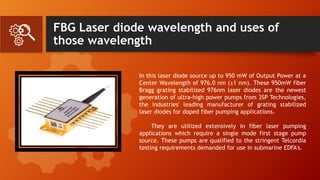
In this laser diode source up to 950 mW of Output Power at a
Center Wavelength of 976.0 nm (±1 nm). These 950mW fiber
Bragg grating stabilized 976nm laser diodes are the newest
generation of ultra-high power pumps from 3SP Technologies,
the industries' leading manufacturer of grating stabilized
laser diodes for doped fiber pumping applications.
They are utilized extensively in fiber laser pumping
applications which require a single mode first stage pump
source. These pumps are qualified to the stringent Telcordia
testing requirements demanded for use in submarine EDFA's.
Applications of FBG Laser Diode
(RLS/976nm-950mW)
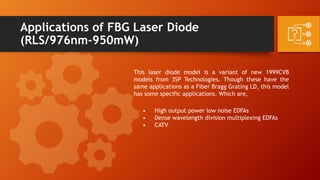
This laser diode model is a variant of new 1999CVB
models from 3SP Technologies. Though these have the
same applications as a Fiber Bragg Grating LD, this model
has some specific applications. Which are,
• High output power low noise EDFAs
• Dense wavelength division multiplexing EDFAs
• CATV
Applications of FBG Laser Diode
(RLS/976nm-950mW)
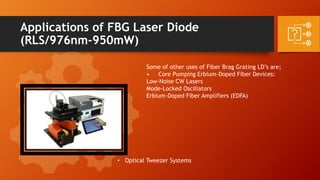
Some of other uses of Fiber Brag Grating LD’s are;
• Core Pumping Erbium-Doped Fiber Devices:
Low-Noise CW Lasers
Mode-Locked Oscillators
Erbium-Doped Fiber Amplifiers (EDFA)
• Optical Tweezer Systems
Applications of FBG Laser Diode
(RLS/976nm-950mW)
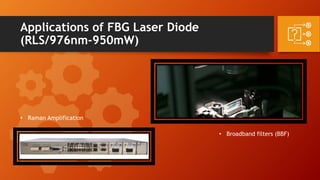
• Broadband filters (BBF)
• Raman Amplification
Thank You

APD & Laser Diode

  • 1.
    Presentation on APD& Laser Diode
  • 2.
    Purpose This presentation isabout Optical detector (APD) of a specific commercial model and what does it do with addition to Laser Diode and it’s commercial use also from a specific model.
  • 3.
    Optical Detector • Anoptical detector is a device that converts light signals into electrical signals, which can then be amplified and processed. The photo detector is as essential an element of any fiber optic system as the optical fiber or the light source. Photo detectors can dictate the performance of a fiber optic communication link. • All photo detectors are encased incompact and strong aluminum housings and can be one-sided with a battery or an outer force supply. The UV-broadened renditions of the silicon type photo detectors are the only commercial items that spread the spectral go from 170 to 1100 nm.
  • 4.
    Commercial Model APDbased UPD-15IR2-FC • Another sort of interesting UV- sensitive InGaAs photo detectors can be used for identifying laser beats in the range from 350 to 1700 nm, subsequently having the widest unearthly range and the highest speed economically available.
  • 5.
    Biasing Voltage andCurrent & Image
  • 6.
    Fig: Equivalent Circuitof an APD Form fig. (g) models the device output as; Ipd = In + IMKn + (Cs + Cj)d VA/dt + VA/ Rleak (g) (a) (d)(c) (b) (f)(e)
  • 7.
    Structure of APDand UPD-15-IR2-FC APD photodetector 1. Generally, avalanche diode is made from silicon or other semiconductor materials. These diodes are doped heavily. Thus, the depletion region width in this diode is very slight. APD’s are mainly used for their high speed & internal gain in optical communications. 2. This model series are best suited for measurement of optical waveforms from DC to 25 GHz. Various models feature rise times as short as 15 ps and cover the spectral range from 170 to 2600 nm. 3. Another type of unique UV-sensitive InGaAs photodetectors can be used for detecting laser pulses in the range from 350 to 1700 nm, thus having the widest spectral range and the highest speed commercially available.
  • 8.
    Structure of APDand UPD-15-IR2-FC APD photodetector
  • 9.
    Operating Principle ofAPD(UPD-15IR2-FC) • When a photon of full energy strikes the diode, it makes a couple of an electron- hole. This mechanism is also called as the inner photoelectric effect. • If the absorption arises in the depletion region junction, then the carriers are removed from the junction by the in built electric field of the depletion region. • Therefore, holes in the region move toward the anode, and electrons move toward the cathode, and a photocurrent will be generated.
  • 10.
    Operating Principle ofAPD(UPD-15IR2-FC) • A photodiode continually operates in a reverse bias mode. • The photocurrent is nearly independent of reverse bias voltage which is applied. For zero luminance, the photocurrent is almost zero excluding for small dark current. It is of the order of nano amperes. • As optical power rises the photo current also rises linearly. The max photocurrent is incomplete by the power dissipation of the photo diode. V-I Characteristics of avalanche photodiode
  • 11.
    Sensitivity of APDbased UPD-15IR2-FC 1. Sensitivity is understood as the ability to detect weak signals. That a ability is usually limited by detector noise. 2. A quantitative measure for that aspect is the noise- equivalent power, which is essentially the optical input required to obtain the same output signal strength is that which results from detector noise. 3. some photo detectors have particularly higher responsivity, while others have a higher detectivity. For our chosen APD, UPD-15-IR2-FC, it is Fiber, and 9 μm (Dia. μm /mm2) in sensitivity. Here, S=I/H where, I=Current and H=Irradiance
  • 12.
    Plots and informationof APD based UPD-15IR2-FC UPD-15IR2-FC: • According to varies companies’ ultrafast photodetector price is computable for optical communication link. Price range basically shows the variety between different model and their prices. As far our research our selected Alphalas. • UPD-15IR2-FC model is priced somewhere between $2200-$2500 based on adds on like wideband high-gain amplifiers with this model
  • 13.
    APD Plot withUPD-15IR2-FC Fig: InGaAs Based APD Power v/s Frequency graph under incident optical power Fig: Spectral Response (TA= 23 ̊C, M = 1) Fig: Gain vs. Reverse Bias (TA= 23 ̊C, 1550 nm)
  • 14.
    Fig: Capacitance vs.Reverse Bias (TA= 23 ̊C) Fig: Dark Current vs. Reverse Bias (TA= 23 ̊C)
  • 15.
    Uses of APDand UPD-15IR2-FC • we already know APD’s are mainly used for their high speed & internal gain in optical communications, and for this specific model, it has faster rise time of 15ps and wider bandwidth of 25GHz with spectral range of 700- 1700nm. • Applications of APD’s are mainly for with respect to this specific model includes; I. Pulse Form Measurements II. Pulse Duration Measurements III. Precise Synchronization IV. Mode Beating Monitoring V. Heterodyne Measurements
  • 16.
    Uses of APDand UPD-15IR2-FC Some of the regular uses are; High speed laser scanner (2D bar code reader) Laser Range Finders Speed Gun Microscopy and Particle Detection PET Scanner/MRI Machine
  • 17.
    Quantum efficiency ofAPD (UPD-15IR2-FC) Quantum efficiency is the fraction of photon flux that contributes to the photocurrent in a photodetector or a pixel. It is defined as the number of signal electrons created per incident photon. In the visible and near-infrared region, photodiodes can have quantum efficiencies above 90%, although values between 40% and 80% are more common. For, UPD-15-IR2-FC it is 75%
  • 18.
    NEP and Responsivityof APD (UPD-15IR2-FC) The Noise Equivalent Power (NEP) is the common metric that quantifies a photodetector’s sensitivity or the power generated by a noise source. Essentially, the NEP expresses the minimum detectable power per square root bandwidth of a given detector; in other words, it’s a measure of the weakest optical signal that can be detected. NEP can also be called Optical Power per Square root of Bandwidth and can be formulized as: 𝑝1 𝐵 = 1 𝑅 2ⅇ 𝐼 𝑑 + 𝐼 𝑝ℎ
  • 19.
    NEP and Responsivityof APD (UPD-15IR2-FC) The Responsivity (or radiant sensitivity) of a photodiode or some other kind of photodetector is the ratio of generated photocurrent and incident (or sometimes absorbed) optical power (neglecting noise influences), determined in the linear region of response. It can be calculated according to:
  • 20.
    Detectivity of APD(UPD-15IR2-FC) A measure of the detecting ability or sensitivity of a photodiode. The reciprocal of noise equivalent power (NEP). The specific detectivity of APD is a measure of detector SNR normalized for detector active area and is: where A: is the active area of the device. For UPD-15-IR2-FC it is 0.0000000000000000008 Fig: Detectivity with response to Wavelength Fig: Dependence of detectivity on temperature
  • 21.
    Laser Diode • Asemiconductor device that generates coherent light of high intensity is known as laser diode. LASER is an abbreviation for Light Amplification by Stimulated Emission of Radiation. Stimulated emission is the basis of working of a laser diode. • Laser diode is similar to LED, however, different from LED, the PN junction of laser diode produces coherent radiation. Coherent radiation means the light waves generated by the device have the same frequency and phase.
  • 22.
    Commercial Model ofFiber Bragg Grating Stabilized Laser Diode (RLS/976nm-950mW) • A fiber Bragg grating (FBG) is a type of distributed Bragg reflector constructed in a short segment of optical fiber that reflects particular wavelengths of light and transmits all others. This is achieved by creating a periodic variation in the refractive index of the fiber core, which generates a wavelength-specific dielectric mirror. • A fiber Bragg grating can therefore be used as an inline optical filter to block certain wavelengths, or as a wavelength-specific reflector.
  • 23.
    Commercial Model ofFiber Bragg Grating Stabilized Laser Diode (RLS/976nm-950mW) • This FBG based Laser diode is from 3SP Technologies • Commercially known as (RLS/976nm-950mW). • These 950mW fiber Bragg grating stabilized 976nm laser diodes are the newest generation of ultra- high-power pumps from 3SP Technologies, the industries' leading manufacturer of grating stabilized laser diodes for doped fiber pumping applications. • These new models have Highest Reliability Rating - Fully Telcordia GR-468-CORE Compliant. These models have wavelength from 900-1190nm • Pricing can be varied with add-ons or preconfigured modules, but base price is $1350.00
  • 24.
    Types of LaserDiodes There is different type of Laser Diodes with different operating system and principle and every one of them has different type of functionality and applications. Some of the type of LDs are; • Multi-longitudinal mode (MLM) or Fabry-Perot laser • Single longitudinal mode laser (SLM) • Single longitudinal mode with distributed feedback laser, usually called a DFB laser • DFB laser with external modulator • Distributed Bragg Reflector lasers (DBR) • Vertical-cavity surface-emitting laser (VCSEL) • Double heterostructure lasers • Quantum well lasers • Quantum cascade lasers
  • 25.
    Types of LaserDiodes (FBG RLS/976nm-950mW) • Fiber Bragg Grating LD which is a form of DBR diodes. The framework is the most representative in DBR-laser diode (distributed Bragg reflector laser diode). The DBR-laser diode is used in the wavelength converter, which is rigid and integrated with the modulator. • Fiber Bragg Gratings have many applications in optical communication, laser technique and sensing systems.
  • 26.
    Types of LaserDiodes (FBG RLS/976nm-950mW) The Wavelength Locker FBGs are used as external reflectors for laser diodes. It is easy to stabilize wavelength generation of pump semiconductor lasers and single frequency lasers by using such FBGs
  • 27.
    Mechanism of FBGLaser Diode FBG (RLS/976nm-950mW) • Fiber Bragg Gratings are used in single-mode fibers, same as this one and in that case the physical modeling is often relatively simple. The mechanism of light emission is the same as a light-emitting diode (LED). • Light is generated by flowing the forward current to a p-n junction. In forward bias operation, the p-type layer is connected with the positive terminal and the n-type layer is connected with the negative terminal, electrons enter from the n-type layer and holes from the p-type layer. • When the two meet at the junction, an electron drops into a hole and light is emitted at the time.
  • 29.
    FBG Laser diodewavelength and uses of those wavelength • The emission wavelength of a laser diode is essentially determined by the band gap of the laser-active semiconductor material: the photon energy is close to the band gap energy. • In quantum well lasers, there is also some influence of the quantum well thickness. A variety of semiconductor materials makes it possible to cover wide spectral regions. • In particular, there are many ternary and quaternary semiconductor compounds, where the bandgap energy can be adjusted in a wide range simply by varying the composition details
  • 30.
    FBG Laser diodewavelength and uses of those wavelength • They are based on in-house wafer growth and chip development technology. The butterfly package is a low profile, epoxy-free, 14-pin module which offers > 950 milli-watts of CW output power. • The wavelength is locked using an FBG which is located in the polarization maintaining (PM) fiber pigtail. These laser diodes are offered with bare fiber (no connector) for direct coupling. • Laser diodes, which are capable of converting electrical current into light, are available from 3SP technologies with center wavelengths in the 375 - 2000 nm range and output powers from 1.5 mW up to 3 W. We also offer Quantum Cascade Lasers (QCLs) with center wavelengths ranging from 4.05 to 11.00 µm.
  • 31.
    FBG Laser diodewavelength and uses of those wavelength In this laser diode source up to 950 mW of Output Power at a Center Wavelength of 976.0 nm (±1 nm). These 950mW fiber Bragg grating stabilized 976nm laser diodes are the newest generation of ultra-high power pumps from 3SP Technologies, the industries' leading manufacturer of grating stabilized laser diodes for doped fiber pumping applications. They are utilized extensively in fiber laser pumping applications which require a single mode first stage pump source. These pumps are qualified to the stringent Telcordia testing requirements demanded for use in submarine EDFA's.
  • 32.
    Applications of FBGLaser Diode (RLS/976nm-950mW) This laser diode model is a variant of new 1999CVB models from 3SP Technologies. Though these have the same applications as a Fiber Bragg Grating LD, this model has some specific applications. Which are, • High output power low noise EDFAs • Dense wavelength division multiplexing EDFAs • CATV
  • 33.
    Applications of FBGLaser Diode (RLS/976nm-950mW) Some of other uses of Fiber Brag Grating LD’s are; • Core Pumping Erbium-Doped Fiber Devices: Low-Noise CW Lasers Mode-Locked Oscillators Erbium-Doped Fiber Amplifiers (EDFA) • Optical Tweezer Systems
  • 34.
    Applications of FBGLaser Diode (RLS/976nm-950mW) • Broadband filters (BBF) • Raman Amplification
  • 35.

Editor's Notes

  • #3 Notes to presenter: What is your purpose for sharing this reflection? Is it at the end of a unit or project? Are you sharing this reflection, at the attainment of a learning goal you set for yourself? Is it at the end of a course? State your purpose for the reflection or even the purpose of the learning experience or learning goal. Be clear and be specific in stating your purpose.
  • #4 Notes to presenter: Description of what you learned in your own words on one side. Include information about the topic Details about the topic will also be helpful here. Tell the story of your learning experience. Just like a story there should always be a beginning, middle and an end. On the other side, you can add a graphic that provides evidence of what you learned. Feel free to use more than one slide to reflect upon your process. It also helps to add some video of your process.
  • #5 Notes to presenter: Description of what you learned in your own words on one side. Include information about the topic Details about the topic will also be helpful here. Tell the story of your learning experience. Just like a story there should always be a beginning, middle and an end. On the other side, you can add a graphic that provides evidence of what you learned. Feel free to use more than one slide to reflect upon your process. It also helps to add some video of your process.
  • #6 Notes to presenter: Description of what you learned in your own words on one side. Include information about the topic Details about the topic will also be helpful here. Tell the story of your learning experience. Just like a story there should always be a beginning, middle and an end. On the other side, you can add a graphic that provides evidence of what you learned. Feel free to use more than one slide to reflect upon your process. It also helps to add some video of your process.
  • #10 Notes to presenter: Description of what you learned in your own words on one side. Include information about the topic Details about the topic will also be helpful here. Tell the story of your learning experience. Just like a story there should always be a beginning, middle and an end. On the other side, you can add a graphic that provides evidence of what you learned. Feel free to use more than one slide to reflect upon your process. It also helps to add some video of your process.
  • #11 Notes to presenter: Description of what you learned in your own words on one side. Include information about the topic Details about the topic will also be helpful here. Tell the story of your learning experience. Just like a story there should always be a beginning, middle and an end. On the other side, you can add a graphic that provides evidence of what you learned. Feel free to use more than one slide to reflect upon your process. It also helps to add some video of your process.
  • #14 Notes to presenter: Description of what you learned in your own words on one side. Include information about the topic Details about the topic will also be helpful here. Tell the story of your learning experience. Just like a story there should always be a beginning, middle and an end. On the other side, you can add a graphic that provides evidence of what you learned. Feel free to use more than one slide to reflect upon your process. It also helps to add some video of your process.
  • #16 Notes to presenter: Description of what you learned in your own words on one side. Include information about the topic Details about the topic will also be helpful here. Tell the story of your learning experience. Just like a story there should always be a beginning, middle and an end. On the other side, you can add a graphic that provides evidence of what you learned. Feel free to use more than one slide to reflect upon your process. It also helps to add some video of your process.
  • #17 Notes to presenter: Description of what you learned in your own words on one side. Include information about the topic Details about the topic will also be helpful here. Tell the story of your learning experience. Just like a story there should always be a beginning, middle and an end. On the other side, you can add a graphic that provides evidence of what you learned. Feel free to use more than one slide to reflect upon your process. It also helps to add some video of your process.
  • #22 Notes to presenter: Description of what you learned in your own words on one side. Include information about the topic Details about the topic will also be helpful here. Tell the story of your learning experience. Just like a story there should always be a beginning, middle and an end. On the other side, you can add a graphic that provides evidence of what you learned. Feel free to use more than one slide to reflect upon your process. It also helps to add some video of your process.
  • #23 Notes to presenter: Description of what you learned in your own words on one side. Include information about the topic Details about the topic will also be helpful here. Tell the story of your learning experience. Just like a story there should always be a beginning, middle and an end. On the other side, you can add a graphic that provides evidence of what you learned. Feel free to use more than one slide to reflect upon your process. It also helps to add some video of your process.
  • #24 Notes to presenter: Description of what you learned in your own words on one side. Include information about the topic Details about the topic will also be helpful here. Tell the story of your learning experience. Just like a story there should always be a beginning, middle and an end. On the other side, you can add a graphic that provides evidence of what you learned. Feel free to use more than one slide to reflect upon your process. It also helps to add some video of your process.
  • #28 Notes to presenter: Description of what you learned in your own words on one side. Include information about the topic Details about the topic will also be helpful here. Tell the story of your learning experience. Just like a story there should always be a beginning, middle and an end. On the other side, you can add a graphic that provides evidence of what you learned. Feel free to use more than one slide to reflect upon your process. It also helps to add some video of your process.
  • #29 Notes to presenter: Description of what you learned in your own words on one side. Include information about the topic Details about the topic will also be helpful here. Tell the story of your learning experience. Just like a story there should always be a beginning, middle and an end. On the other side, you can add a graphic that provides evidence of what you learned. Feel free to use more than one slide to reflect upon your process. It also helps to add some video of your process.
  • #30 Notes to presenter: Description of what you learned in your own words on one side. Include information about the topic Details about the topic will also be helpful here. Tell the story of your learning experience. Just like a story there should always be a beginning, middle and an end. On the other side, you can add a graphic that provides evidence of what you learned. Feel free to use more than one slide to reflect upon your process. It also helps to add some video of your process.
  • #31 Notes to presenter: Description of what you learned in your own words on one side. Include information about the topic Details about the topic will also be helpful here. Tell the story of your learning experience. Just like a story there should always be a beginning, middle and an end. On the other side, you can add a graphic that provides evidence of what you learned. Feel free to use more than one slide to reflect upon your process. It also helps to add some video of your process.
  • #32 Notes to presenter: Description of what you learned in your own words on one side. Include information about the topic Details about the topic will also be helpful here. Tell the story of your learning experience. Just like a story there should always be a beginning, middle and an end. On the other side, you can add a graphic that provides evidence of what you learned. Feel free to use more than one slide to reflect upon your process. It also helps to add some video of your process.
  • #36 Notes to presenter: What did you think at first? What obstacles did you encounter along the way? How did you overcome those obstacles? What images can you add to support your process? This SmartArt allows you add images and text to help outline your process. If a picture is worth a thousand words, then pictures and words should help you communicate this reflection on learning perfectly! You can always click on Insert>SmartArt to change this graphic or select the graphic and click on the Design contextual menu to change the colors. Feel free to use more than one slide to reflect upon your process. It also helps to add some video of your process.