


© 2016 MapR Technologies 10-1
© 2016 MapR Technologies
Machine Learning with Apache Spark
© 2016 MapR Technologies 10-2
© 2016 MapR Technologies
© 2016 MapR Technologies 10-3
Agenda
• Brief overview of
• Classification
• Clustering
• Collaborative Filtering
• Predicting Flight Delays using a Decision Tree
© 2016 MapR Technologies 10-4
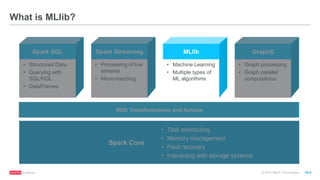
Spark SQL
• Structured Data
• Querying with
SQL/HQL
• DataFrames
Spark Streaming
• Processing of live
streams
• Micro-batching
MLlib
• Machine Learning
• Multiple types of
ML algorithms
GraphX
• Graph processing
• Graph parallel
computations
RDD Transformations and Actions
• Task scheduling
• Memory management
• Fault recovery
• Interacting with storage systems
Spark Core
What is MLlib?
© 2016 MapR Technologies 10-5
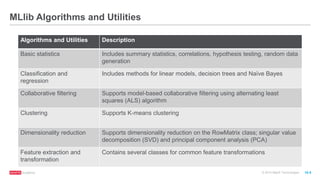
MLlib Algorithms and Utilities
Algorithms and Utilities Description
Basic statistics Includes summary statistics, correlations, hypothesis testing, random data
generation
Classification and
regression
Includes methods for linear models, decision trees and Naïve Bayes
Collaborative filtering Supports model-based collaborative filtering using alternating least
squares (ALS) algorithm
Clustering Supports K-means clustering
Dimensionality reduction Supports dimensionality reduction on the RowMatrix class; singular value
decomposition (SVD) and principal component analysis (PCA)
Feature extraction and
transformation
Contains several classes for common feature transformations
© 2016 MapR Technologies 10-6
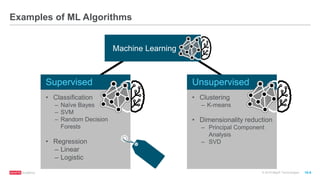
Examples of ML Algorithms
Supervised
• Classification
– Naïve Bayes
– SVM
– Random Decision
Forests
• Regression
– Linear
– Logistic
Machine Learning
Unsupervised
• Clustering
– K-means
• Dimensionality reduction
– Principal Component
Analysis
– SVD
© 2016 MapR Technologies 10-7
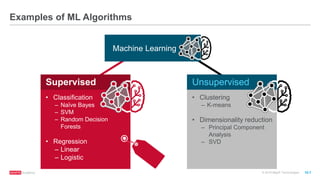
Examples of ML Algorithms
Supervised
• Classification
– Naïve Bayes
– SVM
– Random Decision
Forests
• Regression
– Linear
– Logistic
Machine Learning
Unsupervised
• Clustering
– K-means
• Dimensionality reduction
– Principal Component
Analysis
– SVD
© 2016 MapR Technologies 10-8
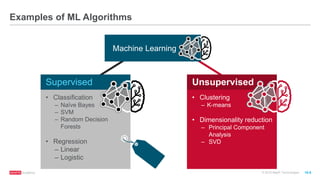
Examples of ML Algorithms
Machine Learning
Unsupervised
• Clustering
– K-means
• Dimensionality reduction
– Principal Component
Analysis
– SVD
Supervised
• Classification
– Naïve Bayes
– SVM
– Random Decision
Forests
• Regression
– Linear
– Logistic
© 2016 MapR Technologies 10-9
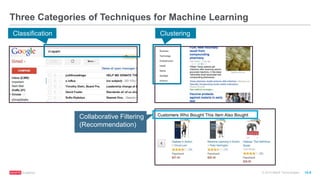
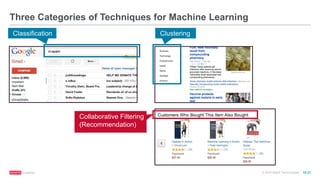
Three Categories of Techniques for Machine Learning
Collaborative Filtering
(Recommendation)
Classification Clustering
© 2016 MapR Technologies 10-10
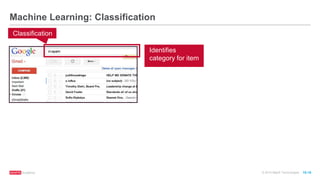
Machine Learning: Classification
Classification
Identifies
category for item
© 2016 MapR Technologies 10-11
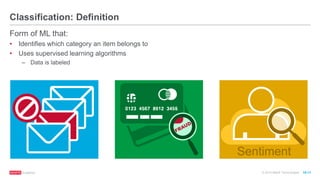
Classification: Definition
Form of ML that:
• Identifies which category an item belongs to
• Uses supervised learning algorithms
– Data is labeled
Sentiment
© 2016 MapR Technologies 10-12
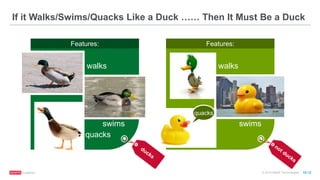
If it Walks/Swims/Quacks Like a Duck …… Then It Must Be a Duck
swims
walks
quacks
Features:
walks
quacks
swims
Features:
© 2016 MapR Technologies 10-13
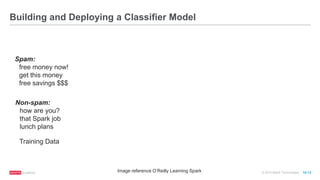
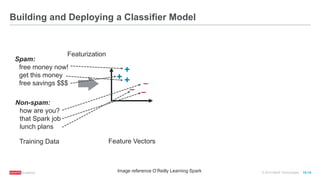
Building and Deploying a Classifier Model
Image reference O’Reilly Learning Spark
Spam:
free money now!
get this money
free savings $$$
Training Data
Non-spam:
how are you?
that Spark job
lunch plans
© 2016 MapR Technologies 10-14
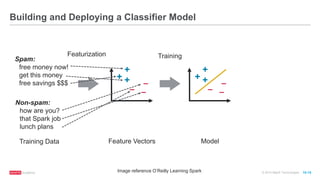
Building and Deploying a Classifier Model
Image reference O’Reilly Learning Spark
+
+
̶+
̶ ̶
Feature Vectors
Featurization
Spam:
free money now!
get this money
free savings $$$
Training Data
Non-spam:
how are you?
that Spark job
lunch plans
© 2016 MapR Technologies 10-15
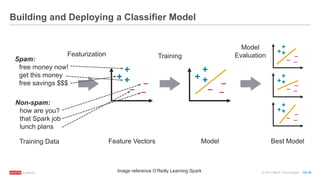
Building and Deploying a Classifier Model
Image reference O’Reilly Learning Spark
+
+
̶+
̶ ̶
Feature Vectors Model
Featurization TrainingSpam:
free money now!
get this money
free savings $$$
Training Data
Non-spam:
how are you?
that Spark job
lunch plans
+
+
̶+
̶ ̶
© 2016 MapR Technologies 10-16
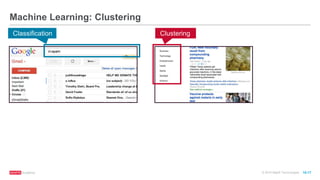
Building and Deploying a Classifier Model
Image reference O’Reilly Learning Spark
+
+
̶+
̶ ̶
Feature Vectors Model
Featurization Training
Model
Evaluation
Best Model
Spam:
free money now!
get this money
free savings $$$
Training Data
Non-spam:
how are you?
that Spark job
lunch plans
+
+
̶+
̶ ̶
+
+
̶+
̶ ̶
+
+
̶+
̶ ̶
+
+
̶+
̶ ̶
© 2016 MapR Technologies 10-17
Machine Learning: Clustering
Classification Clustering
© 2016 MapR Technologies 10-18
Clustering: Definition
• Unsupervised learning task
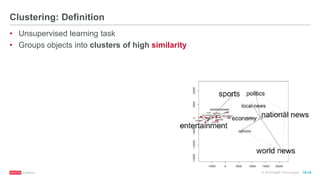
• Groups objects into clusters of high similarity
© 2016 MapR Technologies 10-19
Clustering: Definition
• Unsupervised learning task
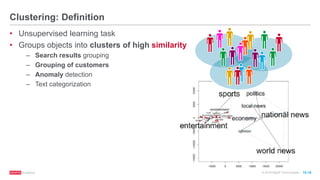
• Groups objects into clusters of high similarity
– Search results grouping
– Grouping of customers
– Anomaly detection
– Text categorization
© 2016 MapR Technologies 10-20
Clustering: Example
• Group similar objects
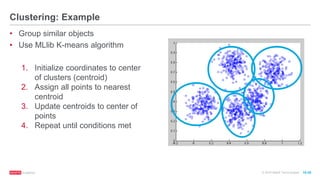
• Use MLlib K-means algorithm
1. Initialize coordinates to center
of clusters (centroid)
2. Assign all points to nearest
centroid
3. Update centroids to center of
points
4. Repeat until conditions met
© 2016 MapR Technologies 10-21
Three Categories of Techniques for Machine Learning
Collaborative Filtering
(Recommendation)
Classification Clustering
© 2016 MapR Technologies 10-22
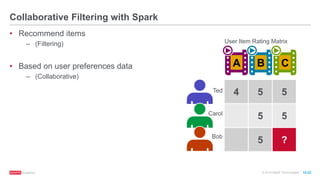
Collaborative Filtering with Spark
• Recommend items
– (Filtering)
• Based on user preferences data
– (Collaborative)
4 5 5
5 5
5 ?
Ted
Carol
Bob
A B C
User Item Rating Matrix
© 2016 MapR Technologies 10-23
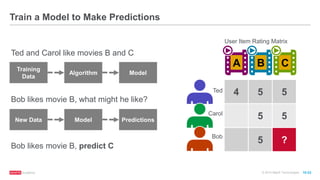
Train a Model to Make Predictions
Ted and Carol like movies B and C
Bob likes movie B, what might he like?
Bob likes movie B, predict C
Training
Data
ModelAlgorithm
New Data PredictionsModel
4 5 5
5 5
5 ?
Ted
Carol
Bob
A B C
User Item Rating Matrix
© 2016 MapR Technologies 10-24
© 2016 MapR Technologies
Predict Flight Delays
© 2016 MapR Technologies 10-25
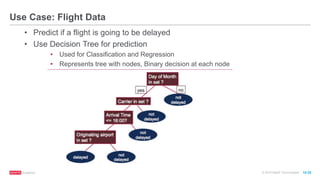
Use Case: Flight Data
• Predict if a flight is going to be delayed
• Use Decision Tree for prediction
• Used for Classification and Regression
• Represents tree with nodes, Binary decision at each node
© 2016 MapR Technologies 10-26
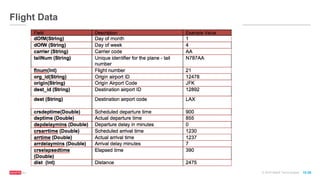
Flight Data
© 2016 MapR Technologies 10-27
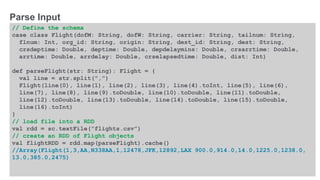
// Define the schema
case class Flight(dofM: String, dofW: String, carrier: String, tailnum: String,
flnum: Int, org_id: String, origin: String, dest_id: String, dest: String,
crsdeptime: Double, deptime: Double, depdelaymins: Double, crsarrtime: Double,
arrtime: Double, arrdelay: Double, crselapsedtime: Double, dist: Int)
def parseFlight(str: String): Flight = {
val line = str.split(",")
Flight(line(0), line(1), line(2), line(3), line(4).toInt, line(5), line(6),
line(7), line(8), line(9).toDouble, line(10).toDouble, line(11).toDouble,
line(12).toDouble, line(13).toDouble, line(14).toDouble, line(15).toDouble,
line(16).toInt)
}
// load file into a RDD
val rdd = sc.textFile(”flights.csv”)
// create an RDD of Flight objects
val flightRDD = rdd.map(parseFlight).cache()
//Array(Flight(1,3,AA,N338AA,1,12478,JFK,12892,LAX 900.0,914.0,14.0,1225.0,1238.0,
13.0,385.0,2475)
Parse Input
© 2016 MapR Technologies 10-28
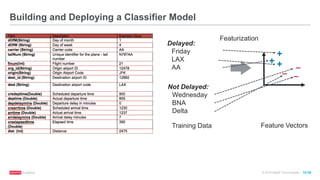
Building and Deploying a Classifier Model
+
+
̶+
̶ ̶
Feature Vectors
Featurization
Delayed:
Friday
LAX
AA
Training Data
Not Delayed:
Wednesday
BNA
Delta
© 2016 MapR Technologies 10-29
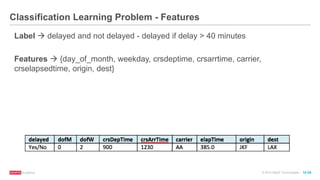
Classification Learning Problem - Features
Label  delayed and not delayed - delayed if delay > 40 minutes
Features  {day_of_month, weekday, crsdeptime, crsarrtime, carrier,
crselapsedtime, origin, dest}
© 2016 MapR Technologies 10-30
// create map of airline -> number
var carrierMap: Map[String, Int] = Map()
var index: Int = 0
flightsRDD.map(flight => flight.carrier).distinct.collect.foreach(
x => { carrierMap += (x -> index); index += 1 }
)
carrierMap.toString
// String = Map(DL -> 5,US -> 9, AA -> 6, UA -> 4...)
// create map of destination airport -> number
var destMap: Map[String, Int] = Map()
var index2: Int = 0
flightsRDD.map(flight => flight.dest).distinct.collect.foreach(
x => { destMap += (x -> index2); index2 += 1 })
destMap.toString
// Map(JFK -> 214, LAX -> 294, ATL -> 273,MIA -> 175 ...
Transform non-numeric features into numeric values
© 2016 MapR Technologies 10-31
Classification Learning Problem - Features
Label  delayed and not delayed - delayed if delay > 40 minutes
Features  {day_of_month, weekday, crsdeptime, crsarrtime, carrier,
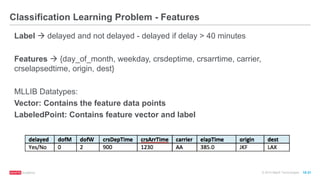
crselapsedtime, origin, dest}
MLLIB Datatypes:
Vector: Contains the feature data points
LabeledPoint: Contains feature vector and label
© 2016 MapR Technologies 10-32
// Defining the features array
val mlprep = flightsRDD.map(flight => {
val monthday = flight.dofM.toInt - 1 // category
val weekday = flight.dofW.toInt - 1 // category
val crsdeptime1 = flight.crsdeptime.toInt
val crsarrtime1 = flight.crsarrtime.toInt
val carrier1 = carrierMap(flight.carrier) // category
val crselapsedtime1 = flight.crselapsedtime.toDouble
val origin1 = originMap(flight.origin) // category
val dest1 = destMap(flight.dest) // category
val delayed = if (flight.depdelaymins.toDouble > 40) 1.0 else 0.0
Array(delayed.toDouble, monthday.toDouble, weekday.toDouble, crsdeptime1.toDouble,
crsarrtime1.toDouble, carrier1.toDouble, crselapsedtime1.toDouble, origin1.toDouble,
dest1.toDouble)
})
mlprep.take(1)
//Array(Array(0.0, 0.0, 2.0, 900.0, 1225.0, 6.0, 385.0, 214.0, 294.0))
val mldata = mlprep.map(x => LabeledPoint(x(0),Vectors.dense(x(1),x(2),x(3),x(4), x(5),x(6),
x(7), x(8))))
mldata.take(1)
// Array[LabeledPoint] = Array((0.0,[0.0,2.0,900.0,1225.0,6.0,385.0,214.0,294.0]))
Define the features, Create LabeledPoint with Vector
© 2016 MapR Technologies 10-36
Build Model
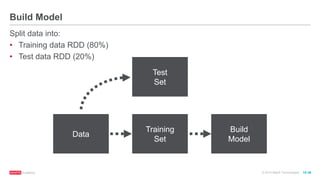
Split data into:
• Training data RDD (80%)
• Test data RDD (20%)
Data
Build
Model
Training
Set
Test
Set
© 2016 MapR Technologies 10-37
// Randomly split RDD into training data RDD (80%) and test
data RDD (20%)
val splits = mldata.randomSplit(Array(0.8, 0.2))
val trainingRDD = splits(0).cache()
val testRDD = splits(1).cache()
testData.take(1)
//Array[LabeledPoint] =
Array((0.0,[18.0,6.0,900.0,1225.0,6.0,385.0,214.0,294.0]))
Split Data
© 2016 MapR Technologies 10-38
Build Model
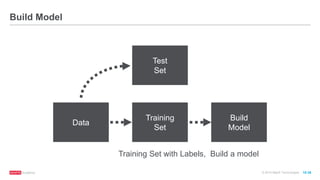
Training Set with Labels, Build a model
Data
Build
Model
Training
Set
Test
Set
© 2016 MapR Technologies 10-39
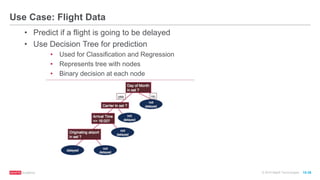
Use Case: Flight Data
• Predict if a flight is going to be delayed
• Use Decision Tree for prediction
• Used for Classification and Regression
• Represents tree with nodes
• Binary decision at each node
© 2016 MapR Technologies 10-40
// set ranges for categorical features
var categoricalFeaturesInfo = Map[Int, Int]()
categoricalFeaturesInfo += (0 -> 31) //dofM 31 categories
categoricalFeaturesInfo += (1 -> 7) //dofW 7 categories
categoricalFeaturesInfo += (4 -> carrierMap.size) //number of carriers
categoricalFeaturesInfo += (6 -> originMap.size) //number of origin airports
categoricalFeaturesInfo += (7 -> destMap.size) //number of dest airports
val numClasses = 2
val impurity = "gini"
val maxDepth = 9
val maxBins = 7000
// call DecisionTree trainClassifier with the trainingData , which returns the model
val model = DecisionTree.trainClassifier(trainingData, numClasses, categoricalFeaturesInfo,
impurity, maxDepth, maxBins)
Build Model
© 2016 MapR Technologies 10-41
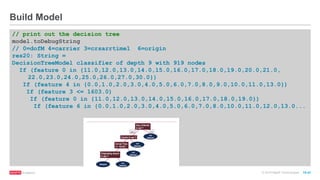
// print out the decision tree
model.toDebugString
// 0=dofM 4=carrier 3=crsarrtime1 6=origin
res20: String =
DecisionTreeModel classifier of depth 9 with 919 nodes
If (feature 0 in {11.0,12.0,13.0,14.0,15.0,16.0,17.0,18.0,19.0,20.0,21.0,
22.0,23.0,24.0,25.0,26.0,27.0,30.0})
If (feature 4 in {0.0,1.0,2.0,3.0,4.0,5.0,6.0,7.0,8.0,9.0,10.0,11.0,13.0})
If (feature 3 <= 1603.0)
If (feature 0 in {11.0,12.0,13.0,14.0,15.0,16.0,17.0,18.0,19.0})
If (feature 6 in {0.0,1.0,2.0,3.0,4.0,5.0,6.0,7.0,8.0,10.0,11.0,12.0,13.0...
Build Model
© 2016 MapR Technologies 10-42
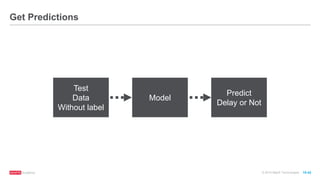
Get Predictions
Test
Data
Without label
Predict
Delay or Not
Model
© 2016 MapR Technologies 10-43
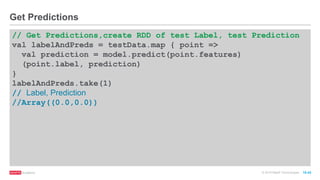
// Get Predictions,create RDD of test Label, test Prediction
val labelAndPreds = testData.map { point =>
val prediction = model.predict(point.features)
(point.label, prediction)
}
labelAndPreds.take(1)
// Label, Prediction
//Array((0.0,0.0))
Get Predictions
© 2016 MapR Technologies 10-44
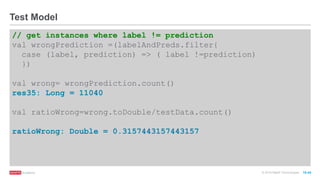
// get instances where label != prediction
val wrongPrediction =(labelAndPreds.filter{
case (label, prediction) => ( label !=prediction)
})
val wrong= wrongPrediction.count()
res35: Long = 11040
val ratioWrong=wrong.toDouble/testData.count()
ratioWrong: Double = 0.3157443157443157
Test Model
© 2016 MapR Technologies 10-45
To Learn More:
• Download example code
– https://github.com/caroljmcdonald/sparkmldecisiontree
• Read explanation of example code
– https://www.mapr.com/blog/apache-spark-machine-learning-tutorial
• Engage with us!
– https://www.mapr.com/blog/author/carol-mcdonald
– https://community.mapr.com
© 2016 MapR Technologies 10-46
Q&A
@mapr
https://www.mapr.com/blog/author/carol-mcdonald
Engage with us!
mapr-technologies

Apache Spark Machine Learning Decision Trees

  • 1.
    © 2016 MapRTechnologies 10-1 © 2016 MapR Technologies Machine Learning with Apache Spark
  • 2.
    © 2016 MapRTechnologies 10-2 © 2016 MapR Technologies
  • 3.
    © 2016 MapRTechnologies 10-3 Agenda • Brief overview of • Classification • Clustering • Collaborative Filtering • Predicting Flight Delays using a Decision Tree
  • 4.
    © 2016 MapRTechnologies 10-4 Spark SQL • Structured Data • Querying with SQL/HQL • DataFrames Spark Streaming • Processing of live streams • Micro-batching MLlib • Machine Learning • Multiple types of ML algorithms GraphX • Graph processing • Graph parallel computations RDD Transformations and Actions • Task scheduling • Memory management • Fault recovery • Interacting with storage systems Spark Core What is MLlib?
  • 5.
    © 2016 MapRTechnologies 10-5 MLlib Algorithms and Utilities Algorithms and Utilities Description Basic statistics Includes summary statistics, correlations, hypothesis testing, random data generation Classification and regression Includes methods for linear models, decision trees and Naïve Bayes Collaborative filtering Supports model-based collaborative filtering using alternating least squares (ALS) algorithm Clustering Supports K-means clustering Dimensionality reduction Supports dimensionality reduction on the RowMatrix class; singular value decomposition (SVD) and principal component analysis (PCA) Feature extraction and transformation Contains several classes for common feature transformations
  • 6.
    © 2016 MapRTechnologies 10-6 Examples of ML Algorithms Supervised • Classification – Naïve Bayes – SVM – Random Decision Forests • Regression – Linear – Logistic Machine Learning Unsupervised • Clustering – K-means • Dimensionality reduction – Principal Component Analysis – SVD
  • 7.
    © 2016 MapRTechnologies 10-7 Examples of ML Algorithms Supervised • Classification – Naïve Bayes – SVM – Random Decision Forests • Regression – Linear – Logistic Machine Learning Unsupervised • Clustering – K-means • Dimensionality reduction – Principal Component Analysis – SVD
  • 8.
    © 2016 MapRTechnologies 10-8 Examples of ML Algorithms Machine Learning Unsupervised • Clustering – K-means • Dimensionality reduction – Principal Component Analysis – SVD Supervised • Classification – Naïve Bayes – SVM – Random Decision Forests • Regression – Linear – Logistic
  • 9.
    © 2016 MapRTechnologies 10-9 Three Categories of Techniques for Machine Learning Collaborative Filtering (Recommendation) Classification Clustering
  • 10.
    © 2016 MapRTechnologies 10-10 Machine Learning: Classification Classification Identifies category for item
  • 11.
    © 2016 MapRTechnologies 10-11 Classification: Definition Form of ML that: • Identifies which category an item belongs to • Uses supervised learning algorithms – Data is labeled Sentiment
  • 12.
    © 2016 MapRTechnologies 10-12 If it Walks/Swims/Quacks Like a Duck …… Then It Must Be a Duck swims walks quacks Features: walks quacks swims Features:
  • 13.
    © 2016 MapRTechnologies 10-13 Building and Deploying a Classifier Model Image reference O’Reilly Learning Spark Spam: free money now! get this money free savings $$$ Training Data Non-spam: how are you? that Spark job lunch plans
  • 14.
    © 2016 MapRTechnologies 10-14 Building and Deploying a Classifier Model Image reference O’Reilly Learning Spark + + ̶+ ̶ ̶ Feature Vectors Featurization Spam: free money now! get this money free savings $$$ Training Data Non-spam: how are you? that Spark job lunch plans
  • 15.
    © 2016 MapRTechnologies 10-15 Building and Deploying a Classifier Model Image reference O’Reilly Learning Spark + + ̶+ ̶ ̶ Feature Vectors Model Featurization TrainingSpam: free money now! get this money free savings $$$ Training Data Non-spam: how are you? that Spark job lunch plans + + ̶+ ̶ ̶
  • 16.
    © 2016 MapRTechnologies 10-16 Building and Deploying a Classifier Model Image reference O’Reilly Learning Spark + + ̶+ ̶ ̶ Feature Vectors Model Featurization Training Model Evaluation Best Model Spam: free money now! get this money free savings $$$ Training Data Non-spam: how are you? that Spark job lunch plans + + ̶+ ̶ ̶ + + ̶+ ̶ ̶ + + ̶+ ̶ ̶ + + ̶+ ̶ ̶
  • 17.
    © 2016 MapRTechnologies 10-17 Machine Learning: Clustering Classification Clustering
  • 18.
    © 2016 MapRTechnologies 10-18 Clustering: Definition • Unsupervised learning task • Groups objects into clusters of high similarity
  • 19.
    © 2016 MapRTechnologies 10-19 Clustering: Definition • Unsupervised learning task • Groups objects into clusters of high similarity – Search results grouping – Grouping of customers – Anomaly detection – Text categorization
  • 20.
    © 2016 MapRTechnologies 10-20 Clustering: Example • Group similar objects • Use MLlib K-means algorithm 1. Initialize coordinates to center of clusters (centroid) 2. Assign all points to nearest centroid 3. Update centroids to center of points 4. Repeat until conditions met
  • 21.
    © 2016 MapRTechnologies 10-21 Three Categories of Techniques for Machine Learning Collaborative Filtering (Recommendation) Classification Clustering
  • 22.
    © 2016 MapRTechnologies 10-22 Collaborative Filtering with Spark • Recommend items – (Filtering) • Based on user preferences data – (Collaborative) 4 5 5 5 5 5 ? Ted Carol Bob A B C User Item Rating Matrix
  • 23.
    © 2016 MapRTechnologies 10-23 Train a Model to Make Predictions Ted and Carol like movies B and C Bob likes movie B, what might he like? Bob likes movie B, predict C Training Data ModelAlgorithm New Data PredictionsModel 4 5 5 5 5 5 ? Ted Carol Bob A B C User Item Rating Matrix
  • 24.
    © 2016 MapRTechnologies 10-24 © 2016 MapR Technologies Predict Flight Delays
  • 25.
    © 2016 MapRTechnologies 10-25 Use Case: Flight Data • Predict if a flight is going to be delayed • Use Decision Tree for prediction • Used for Classification and Regression • Represents tree with nodes, Binary decision at each node
  • 26.
    © 2016 MapRTechnologies 10-26 Flight Data
  • 27.
    © 2016 MapRTechnologies 10-27 // Define the schema case class Flight(dofM: String, dofW: String, carrier: String, tailnum: String, flnum: Int, org_id: String, origin: String, dest_id: String, dest: String, crsdeptime: Double, deptime: Double, depdelaymins: Double, crsarrtime: Double, arrtime: Double, arrdelay: Double, crselapsedtime: Double, dist: Int) def parseFlight(str: String): Flight = { val line = str.split(",") Flight(line(0), line(1), line(2), line(3), line(4).toInt, line(5), line(6), line(7), line(8), line(9).toDouble, line(10).toDouble, line(11).toDouble, line(12).toDouble, line(13).toDouble, line(14).toDouble, line(15).toDouble, line(16).toInt) } // load file into a RDD val rdd = sc.textFile(”flights.csv”) // create an RDD of Flight objects val flightRDD = rdd.map(parseFlight).cache() //Array(Flight(1,3,AA,N338AA,1,12478,JFK,12892,LAX 900.0,914.0,14.0,1225.0,1238.0, 13.0,385.0,2475) Parse Input
  • 28.
    © 2016 MapRTechnologies 10-28 Building and Deploying a Classifier Model + + ̶+ ̶ ̶ Feature Vectors Featurization Delayed: Friday LAX AA Training Data Not Delayed: Wednesday BNA Delta
  • 29.
    © 2016 MapRTechnologies 10-29 Classification Learning Problem - Features Label  delayed and not delayed - delayed if delay > 40 minutes Features  {day_of_month, weekday, crsdeptime, crsarrtime, carrier, crselapsedtime, origin, dest}
  • 30.
    © 2016 MapRTechnologies 10-30 // create map of airline -> number var carrierMap: Map[String, Int] = Map() var index: Int = 0 flightsRDD.map(flight => flight.carrier).distinct.collect.foreach( x => { carrierMap += (x -> index); index += 1 } ) carrierMap.toString // String = Map(DL -> 5,US -> 9, AA -> 6, UA -> 4...) // create map of destination airport -> number var destMap: Map[String, Int] = Map() var index2: Int = 0 flightsRDD.map(flight => flight.dest).distinct.collect.foreach( x => { destMap += (x -> index2); index2 += 1 }) destMap.toString // Map(JFK -> 214, LAX -> 294, ATL -> 273,MIA -> 175 ... Transform non-numeric features into numeric values
  • 31.
    © 2016 MapRTechnologies 10-31 Classification Learning Problem - Features Label  delayed and not delayed - delayed if delay > 40 minutes Features  {day_of_month, weekday, crsdeptime, crsarrtime, carrier, crselapsedtime, origin, dest} MLLIB Datatypes: Vector: Contains the feature data points LabeledPoint: Contains feature vector and label
  • 32.
    © 2016 MapRTechnologies 10-32 // Defining the features array val mlprep = flightsRDD.map(flight => { val monthday = flight.dofM.toInt - 1 // category val weekday = flight.dofW.toInt - 1 // category val crsdeptime1 = flight.crsdeptime.toInt val crsarrtime1 = flight.crsarrtime.toInt val carrier1 = carrierMap(flight.carrier) // category val crselapsedtime1 = flight.crselapsedtime.toDouble val origin1 = originMap(flight.origin) // category val dest1 = destMap(flight.dest) // category val delayed = if (flight.depdelaymins.toDouble > 40) 1.0 else 0.0 Array(delayed.toDouble, monthday.toDouble, weekday.toDouble, crsdeptime1.toDouble, crsarrtime1.toDouble, carrier1.toDouble, crselapsedtime1.toDouble, origin1.toDouble, dest1.toDouble) }) mlprep.take(1) //Array(Array(0.0, 0.0, 2.0, 900.0, 1225.0, 6.0, 385.0, 214.0, 294.0)) val mldata = mlprep.map(x => LabeledPoint(x(0),Vectors.dense(x(1),x(2),x(3),x(4), x(5),x(6), x(7), x(8)))) mldata.take(1) // Array[LabeledPoint] = Array((0.0,[0.0,2.0,900.0,1225.0,6.0,385.0,214.0,294.0])) Define the features, Create LabeledPoint with Vector
  • 33.
    © 2016 MapRTechnologies 10-36 Build Model Split data into: • Training data RDD (80%) • Test data RDD (20%) Data Build Model Training Set Test Set
  • 34.
    © 2016 MapRTechnologies 10-37 // Randomly split RDD into training data RDD (80%) and test data RDD (20%) val splits = mldata.randomSplit(Array(0.8, 0.2)) val trainingRDD = splits(0).cache() val testRDD = splits(1).cache() testData.take(1) //Array[LabeledPoint] = Array((0.0,[18.0,6.0,900.0,1225.0,6.0,385.0,214.0,294.0])) Split Data
  • 35.
    © 2016 MapRTechnologies 10-38 Build Model Training Set with Labels, Build a model Data Build Model Training Set Test Set
  • 36.
    © 2016 MapRTechnologies 10-39 Use Case: Flight Data • Predict if a flight is going to be delayed • Use Decision Tree for prediction • Used for Classification and Regression • Represents tree with nodes • Binary decision at each node
  • 37.
    © 2016 MapRTechnologies 10-40 // set ranges for categorical features var categoricalFeaturesInfo = Map[Int, Int]() categoricalFeaturesInfo += (0 -> 31) //dofM 31 categories categoricalFeaturesInfo += (1 -> 7) //dofW 7 categories categoricalFeaturesInfo += (4 -> carrierMap.size) //number of carriers categoricalFeaturesInfo += (6 -> originMap.size) //number of origin airports categoricalFeaturesInfo += (7 -> destMap.size) //number of dest airports val numClasses = 2 val impurity = "gini" val maxDepth = 9 val maxBins = 7000 // call DecisionTree trainClassifier with the trainingData , which returns the model val model = DecisionTree.trainClassifier(trainingData, numClasses, categoricalFeaturesInfo, impurity, maxDepth, maxBins) Build Model
  • 38.
    © 2016 MapRTechnologies 10-41 // print out the decision tree model.toDebugString // 0=dofM 4=carrier 3=crsarrtime1 6=origin res20: String = DecisionTreeModel classifier of depth 9 with 919 nodes If (feature 0 in {11.0,12.0,13.0,14.0,15.0,16.0,17.0,18.0,19.0,20.0,21.0, 22.0,23.0,24.0,25.0,26.0,27.0,30.0}) If (feature 4 in {0.0,1.0,2.0,3.0,4.0,5.0,6.0,7.0,8.0,9.0,10.0,11.0,13.0}) If (feature 3 <= 1603.0) If (feature 0 in {11.0,12.0,13.0,14.0,15.0,16.0,17.0,18.0,19.0}) If (feature 6 in {0.0,1.0,2.0,3.0,4.0,5.0,6.0,7.0,8.0,10.0,11.0,12.0,13.0... Build Model
  • 39.
    © 2016 MapRTechnologies 10-42 Get Predictions Test Data Without label Predict Delay or Not Model
  • 40.
    © 2016 MapRTechnologies 10-43 // Get Predictions,create RDD of test Label, test Prediction val labelAndPreds = testData.map { point => val prediction = model.predict(point.features) (point.label, prediction) } labelAndPreds.take(1) // Label, Prediction //Array((0.0,0.0)) Get Predictions
  • 41.
    © 2016 MapRTechnologies 10-44 // get instances where label != prediction val wrongPrediction =(labelAndPreds.filter{ case (label, prediction) => ( label !=prediction) }) val wrong= wrongPrediction.count() res35: Long = 11040 val ratioWrong=wrong.toDouble/testData.count() ratioWrong: Double = 0.3157443157443157 Test Model
  • 42.
    © 2016 MapRTechnologies 10-45 To Learn More: • Download example code – https://github.com/caroljmcdonald/sparkmldecisiontree • Read explanation of example code – https://www.mapr.com/blog/apache-spark-machine-learning-tutorial • Engage with us! – https://www.mapr.com/blog/author/carol-mcdonald – https://community.mapr.com
  • 43.
    © 2016 MapRTechnologies 10-46 Q&A @mapr https://www.mapr.com/blog/author/carol-mcdonald Engage with us! mapr-technologies

Editor's Notes

  • #5 Spark’s machine learning (ML) library goal is to make practical machine learning scalable and easy.
  • #6 MLlib provides the machine learning algorithms and utilities listed here. In this talk we will be going over Classification using Decision trees.
  • #7 In general, machine learning may be broken down into two classes of algorithms: supervised and unsupervised.
  • #8 Supervised algorithms use labeled data in which both the input and output are provided to the algorithm.
  • #9 Unsupervised algorithms do not have the outputs in advance. These algorithms are left to make sense of the data without any hints.
  • #10 Next we will briefly describe three common categories of machine learning techniques, starting with Classification.
  • #11 Gmail uses a machine learning technique called classification to classify if an email is spam or not, based on the data of an email: the sender, recipients, subject, and message body. Classification takes a set of data with known labels and learns how to label new records based on that information. The algorithm identifies which category an item belongs to, based on labeled examples of known items. For example, it identifies whether an email is spam or not based on emails known to be spam or not.
  • #12 Classification is a supervised algorithm meaning it uses labeled data, for example, labeled as spam/non-spam or fraud/non-fraud to build a model. The model is then use to predict the label or class for new data. Some common use cases for classification include credit card fraud detection and email spam detection.
  • #13 You can classify something based on pre-determined features. Features are the “if questions” that you ask. The label is the answer to those questions. In this example, if it walks, swims, and quacks like a duck, then the label is "duck".
  • #14 To build a classifier model, you first extract the features that most contribute to the classification. In our email example, we find features that define an email as spam, or not spam.
  • #15 The features are transformed and put into Feature Vectors, which is an array of numbers representing the value for each feature.
  • #16 An algorithm “trains” a model by making associations between the input features and the labeled output associated with those features.
  • #17 Then at runtime, we deploy the best model which can then be used to make predictions on new points.
  • #18 Google News uses a technique called clustering to group news articles into different categories, based on title and content. Clustering algorithms discover groupings that occur in collections of data.
  • #19 In clustering, an algorithm classifies inputs into categories by analyzing similarities between input examples. Clustering uses unsupervised algorithms, which do not have the outputs in advance. No known classes are used as a reference, as with a supervised algorithm like classification.
  • #20 Clustering can be used for many purposes, for example: grouping similar customers anomaly detection, such as fraud detection and text categorization, such as sorting books into genres
  • #21 K-means is one of the most commonly used clustering algorithms. The Objective of the K-means algorithm is given a set of data points, create K number of clusters that group the most similar (closest) points.
  • #22 Amazon uses a machine learning technique called collaborative filtering or recommendation, to determine products users will like based on their history and similarity to other users.
  • #23 Collaborative filtering algorithms recommend items (this is the filtering part) based on preference information from many users (this is the collaborative part). The collaborative filtering approach is based on similarity; people who liked similar items in the past will like similar items in the future. ----- In the example shown, Ted likes movies A, B, and C. Carol likes movies B and C. Bob likes movie B. To recommend a movie to Bob, we calculate that users who liked B also liked C, so C is a possible recommendation for Bob.
  • #24 The goal of a collaborative filtering algorithm is to take preferences data from users, and to create a model that can be used for recommendations or predictions.   Ted likes movies A, B, and C. Carol likes movies B and C. We take this data and run it through an algorithm to build a model.   Then when we have new data such as Bob likes movie B, we use the model to predict that C is a possible recommendation for Bob.
  • #25 Next We will look at using a Decision Tree to predict if a flight is going to be delayed.
  • #26 Decision trees create a model that predicts the class or label based on several input features. Decision trees work by evaluating an expression containing a feature at every node and selecting a branch to the next node based on the answer. The feature questions are the nodes, and the answers “yes” or “no” are the branches in the tree to the child nodes.
  • #27 We are using flight information for January 2014. For each flight, we have the following
  • #28 we use a Scala case class to define the Flight schema corresponding to a line in the csv data file The parseFlight function parses a line from the data file into the Flight class we load the flight data into the an RDD, then we use the map transformation on the RDD. This will apply the parseFlight function to each element in the rdd, and return a new RDD of Flight objects.
  • #29 Next the features are transformed and put into a Feature Vector, which is a vector of numbers representing the value for each feature.
  • #30 We want to extract the features that will contribute to the classification the most. In our example, we will use the features day of the month, day of the week, the carrier, departure time, arrival time, the origin airport and destination airport. The label is delayed or not delayed. A flight is considered to be delayed if it is more than 40 minutes late.
  • #31 Here we transform the non-numeric features into numeric values. For example, the carrier AA is the number 6. airport ATL is 273.
  • #32 Next we put the label and features Vector in a LabeledPoint , which holds the features and label.
  • #33 Here The features for each flight are put into an RDD of arrays of numbers representing the value for each feature. Next, we create an RDD of LabeledPoints consisting of the label and the features in numeric format for each flight.
  • #34 A typical machine learning workflow is shown here. To make our predictions, we will perform the following steps
  • #35 Split the data into two parts, one for building the model and one for testing the model.
  • #36 We then run the algorithm to build and train a model. We make predictions with the training data, and observe the results. Then, test the model with the test data.
  • #37 Next we split the data into two parts, one for building the model and one for testing the model.
  • #38 The top line in the code shown here applies the 80-20 split to our data.
  • #39 Next we build the model with the training data set which has labels
  • #40 As a reminder We will use Decision Tree algorithm to build the model
  • #41 categoricalFeaturesInfo specifies which features are categorical and how many categorical values each of those features can take. This is given as a map from feature index to the number of categories for that feature. The first categorical feature, categoricalFeaturesInfo = (0 -> 31) specifies that feature index 0 (which represents the day of the month) has 31 categories (values {1, ..., 31}). The second one represents day of the week and can take the values from 1 though 7. The carrier value can go from 1 to the number of distinct carriers and so on. maxDepth: Maximum depth of a tree. maxBins: Number of bins used when discretizing continuous features. impurity: Impurity measure of the homogeneity of the labels at the node.
  • #42 Model.toDebugString prints out the decision tree, which asks the following questions to determine if the flight was delayed or not:
  • #43 Now that we have trained our model, we want to get predictions for the test data without the label , in order to compare the predictions to the label
  • #44 Next we use the test data to get predictions. Here we create and RDD with the Test Labels and Test Predictions in order to compare the predictions to the actual flight delay label.
  • #45 Here we compare the predictions to the label. The wrong prediction ratio is the count of wrong predictions divided by the count of test data values, which is 31%.