Machine Learning with Big Data
using Apache Spark
Mukundan Agaram
Amit Singh
Agenda
Machine Learning Concepts1
Econometrics Model for Recession Prediction
Apache Spark Code Review
4
Platform & Data3
Prevalent Use Cases2
Other ML Concepts and Wrap Up
QA
5
What is Machine Learning
• Branch of AI
– Alan Turing – can machines think???
– “Field of study that gives Computers the ability to learn without
being explicitly programmed” – Arthur Samuel
• Learn from data
• Improve with experience
• Iteratively refine a model that can be used to predict outcomes of
questions based on previous learning
Types of Machine Learning
MachineLearning
Supervised
Regression
Interest rate
prediction
Classification Spam/No-spam
Unsupervised Clustering
Social Network
analysis
Recommender
Systems
Collaborative
Filtering
Netflix
recommendation
Prevalent Use Cases
• Spam Detection – Google Gmail
• Voice Recognition – Apple Siri
• Stock Trading
–High Frequency
–Recommendation Systems
–Algorithmic Trading
• Robotics
–Acquire skills – grasping objects, locomotion, automated driving and navigation
• Medicine and Healthcare
–Healthcare Analytics, Prediction based on Genomes, Health sensor analysis
• Advertising:
–Targeted Advertising based on interests and social media
• Retail and E Commerce:
–Frequency club cards, targeting coupons and promotions
–Recommendation Engines
Use Cases
• Gaming Analytics
– Predictive Analytics for Sports Games, Console based gaming profiles, upsell and
targeting in-app purchases and mods
• Internet of Things
– Large scale sensor data analysis for prediction, classification
• Social Network Analysis
– Facebook, LinkedIn
• Astronomy
– Galaxy formation
Languages and Platforms
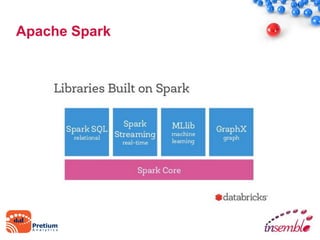
• Apache Spark – MLlib
– Scala, Java, Python
• Mahout
• Python Libraries
– Scikit-learn, PyML, PyBrain, matplotlib
• R
– Open Source statistical programming language
• Matlab
• SAS
• Weka
• Octave
• Clojure
Apache Spark
Data Repositories
• UC Irvine Machine Learning Repository
• Infochimps
• Kaggle
• FRED – Federal Reserve Board in Kansas
• Many others...
Logistic Regression (Linear)
Logistic Regression (Non-Linear)
Logistic Regression
Model Design
• Data Collection
–Identify key inputs to the model
• Data Transformation and Curation
–Human ‘analyst’ should be able to view the data sets make predictions
–Data needs to be cleaned, scrubbed, transformed – normalized
–Generally most important step for any type of supervised learning
algorithm
• Review the data
• Visually make predictions of individual learning indicators
Sample Econometrics Model
• Objective: Predict Economic Conditions (Growth/Recession)
• Supervised Learning
• Widely used algorithms
• Logistic Regression
• SVM
• RandomForest (Decision Trees)
• Current Challenges
– Forecasts are either too early – 6-12 months before contraction starts
– Forecasts are too late and reported by NBER (National Bureau of Economic
Research) after recession has started
– Individuals and Corporations cannot plan effectively based on prevailing economic
conditions
Sample Econometrics Model
• Use ‘leading indicators’ for economic health
–Treasury Yield Curve between 10 year and 3 month (T10Y3M)
–Industrial Production (INDPRO)
–Unemployment insurance
–Market Returns – S&P500
Data Transformation and Curation
-3.
-1.5
0.
1.5
3.
2/2/1986 7/2/1988 12/2/1990 5/2/1993 10/2/1995 3/2/1998 8/2/2000 1/2/2003 6/2/2005 11/2/2007 4/2/2010 9/2/2012 2/2/2015 7/2/2017
Treasury Yield Curve - Normalized
T10Y3M Recession (1/0 - Y/N)
Data Transformation and Curation
-13.5
-9.
-4.5
0.
4.5
2/2/1986 7/2/1988 12/2/1990 5/2/1993 10/2/1995 3/2/1998 8/2/2000 1/2/2003 6/2/2005 11/2/2007 4/2/2010 9/2/2012 2/2/2015 7/2/2017
Industrial Production - Normalized
Frequency: MonthlyINDPRO
Frequency: MonthlyRecession (1/0 - Y/N)
Data Transformation and Curation
-0.875
-0.4375
0.
0.4375
0.875
1.3125
2/2/1986 9/2/1988 4/2/1991 11/2/1993 6/2/1996 1/2/1999 8/2/2001 3/2/2004 10/2/2006 5/2/2009 12/2/2011 7/2/2014 2/2/2017
Unemployment Insurance - Normalized
Frequency: MonthlyCCSA
Frequency: MonthlyRecession (1/0 - Y/N)
Data Transformation and Curation
-3.
-1.5
0.
1.5
3.
2/2/1986 9/2/1988 4/2/1991 11/2/1993 6/2/1996 1/2/1999 8/2/2001 3/2/2004 10/2/2006 5/2/2009 12/2/2011 7/2/2014 2/2/2017
S&P500 - Normalized
Frequency: MonthlyS&P500 - Norm
Frequency: MonthlyRecession (1/0 - Y/N)
Data Plots in Spark Shell
• Data Plots in Spark Shell (Demo)
Bias versus Variance
Model Training and Testing
• Model Data should be divided into
Training
Cross Validation
Testing set
• Splitting into these 3 helps improve model performance in
real world by eliminating bias and variance and helps get
model closer to optimal results
• More features does not necessarily mean a better prediction
• MLlib provides API to help with these operations
Model Performance Measurements
• Precision
• Recall
• F1 Score
• Confusion Matrix
Model Performance Measurements
• Precision
 How often does our algorithm have false positives
 = true positives / # predicted positive
 = true positives / (true positive + false positive)
 High precision is good (i.e. closer to 1)
 You want a big number, because you want false positive
to be as close to 0 as possible
Model Performance Measurements
• Recall
 How sensitive is our algorithm?
 Of all patients in set that actually have cancer, what
fraction did we correctly detect
 = true positives / # actual positives
 = true positive / (true positive + false negative)
• High recall is good (i.e. closer to 1)
• You want a big number, because you want false negative to
be as close to 0 as possible
Model Performance Measurements
F1Score (fscore)
• = 2 * (PR/ [P + R])
• Fscore is like taking the average of precision and recall
giving a higher weight to the lower value
Model Results and Code Review
• Logistic Regression
• SVM
• Random Forest
Apache Spark MLlib
• Algorithms Supported:
–Linear SVM
–Logistic Regression SGD
–Classification and Regression Tree
–K-Means Clustering
–Recommendation versus alternating mean squares
–Singular Value Decomposition
–Linear Regression with L1 and L2 Regularization
–Multinomial Naïve Bayes
–Basic Statistics
–Feature Transformations
Unsupervised Learning
• K Means Clustering
– Customer Segmentation
– Social Network Analysis
– Computer Data Center Analysis
– Astronomical Galaxy formations
• Recommendation Engines
Unsupervised Learning – K Means
Recommender Systems
• Class of information filtering system that
predicts the ‘rating’ or ‘preference’ user
would give to an item
• Examples:
– NetFlix
– Amazon
– Apple Genius
Recommender
• Collaborative Filtering
– User-User
– Item-Item
Recommender Systems
Q/A

Machine Learning with Big Data using Apache Spark

  • 1.
    Machine Learning withBig Data using Apache Spark Mukundan Agaram Amit Singh
  • 2.
    Agenda Machine Learning Concepts1 EconometricsModel for Recession Prediction Apache Spark Code Review 4 Platform & Data3 Prevalent Use Cases2 Other ML Concepts and Wrap Up QA 5
  • 3.
    What is MachineLearning • Branch of AI – Alan Turing – can machines think??? – “Field of study that gives Computers the ability to learn without being explicitly programmed” – Arthur Samuel • Learn from data • Improve with experience • Iteratively refine a model that can be used to predict outcomes of questions based on previous learning
  • 4.
    Types of MachineLearning MachineLearning Supervised Regression Interest rate prediction Classification Spam/No-spam Unsupervised Clustering Social Network analysis Recommender Systems Collaborative Filtering Netflix recommendation
  • 5.
    Prevalent Use Cases •Spam Detection – Google Gmail • Voice Recognition – Apple Siri • Stock Trading –High Frequency –Recommendation Systems –Algorithmic Trading • Robotics –Acquire skills – grasping objects, locomotion, automated driving and navigation • Medicine and Healthcare –Healthcare Analytics, Prediction based on Genomes, Health sensor analysis • Advertising: –Targeted Advertising based on interests and social media • Retail and E Commerce: –Frequency club cards, targeting coupons and promotions –Recommendation Engines
  • 6.
    Use Cases • GamingAnalytics – Predictive Analytics for Sports Games, Console based gaming profiles, upsell and targeting in-app purchases and mods • Internet of Things – Large scale sensor data analysis for prediction, classification • Social Network Analysis – Facebook, LinkedIn • Astronomy – Galaxy formation
  • 7.
    Languages and Platforms •Apache Spark – MLlib – Scala, Java, Python • Mahout • Python Libraries – Scikit-learn, PyML, PyBrain, matplotlib • R – Open Source statistical programming language • Matlab • SAS • Weka • Octave • Clojure
  • 8.
  • 9.
    Data Repositories • UCIrvine Machine Learning Repository • Infochimps • Kaggle • FRED – Federal Reserve Board in Kansas • Many others...
  • 10.
  • 11.
  • 12.
  • 13.
    Model Design • DataCollection –Identify key inputs to the model • Data Transformation and Curation –Human ‘analyst’ should be able to view the data sets make predictions –Data needs to be cleaned, scrubbed, transformed – normalized –Generally most important step for any type of supervised learning algorithm • Review the data • Visually make predictions of individual learning indicators
  • 14.
    Sample Econometrics Model •Objective: Predict Economic Conditions (Growth/Recession) • Supervised Learning • Widely used algorithms • Logistic Regression • SVM • RandomForest (Decision Trees) • Current Challenges – Forecasts are either too early – 6-12 months before contraction starts – Forecasts are too late and reported by NBER (National Bureau of Economic Research) after recession has started – Individuals and Corporations cannot plan effectively based on prevailing economic conditions
  • 15.
    Sample Econometrics Model •Use ‘leading indicators’ for economic health –Treasury Yield Curve between 10 year and 3 month (T10Y3M) –Industrial Production (INDPRO) –Unemployment insurance –Market Returns – S&P500
  • 16.
    Data Transformation andCuration -3. -1.5 0. 1.5 3. 2/2/1986 7/2/1988 12/2/1990 5/2/1993 10/2/1995 3/2/1998 8/2/2000 1/2/2003 6/2/2005 11/2/2007 4/2/2010 9/2/2012 2/2/2015 7/2/2017 Treasury Yield Curve - Normalized T10Y3M Recession (1/0 - Y/N)
  • 17.
    Data Transformation andCuration -13.5 -9. -4.5 0. 4.5 2/2/1986 7/2/1988 12/2/1990 5/2/1993 10/2/1995 3/2/1998 8/2/2000 1/2/2003 6/2/2005 11/2/2007 4/2/2010 9/2/2012 2/2/2015 7/2/2017 Industrial Production - Normalized Frequency: MonthlyINDPRO Frequency: MonthlyRecession (1/0 - Y/N)
  • 18.
    Data Transformation andCuration -0.875 -0.4375 0. 0.4375 0.875 1.3125 2/2/1986 9/2/1988 4/2/1991 11/2/1993 6/2/1996 1/2/1999 8/2/2001 3/2/2004 10/2/2006 5/2/2009 12/2/2011 7/2/2014 2/2/2017 Unemployment Insurance - Normalized Frequency: MonthlyCCSA Frequency: MonthlyRecession (1/0 - Y/N)
  • 19.
    Data Transformation andCuration -3. -1.5 0. 1.5 3. 2/2/1986 9/2/1988 4/2/1991 11/2/1993 6/2/1996 1/2/1999 8/2/2001 3/2/2004 10/2/2006 5/2/2009 12/2/2011 7/2/2014 2/2/2017 S&P500 - Normalized Frequency: MonthlyS&P500 - Norm Frequency: MonthlyRecession (1/0 - Y/N)
  • 20.
    Data Plots inSpark Shell • Data Plots in Spark Shell (Demo)
  • 21.
  • 22.
    Model Training andTesting • Model Data should be divided into Training Cross Validation Testing set • Splitting into these 3 helps improve model performance in real world by eliminating bias and variance and helps get model closer to optimal results • More features does not necessarily mean a better prediction • MLlib provides API to help with these operations
  • 23.
    Model Performance Measurements •Precision • Recall • F1 Score • Confusion Matrix
  • 24.
    Model Performance Measurements •Precision  How often does our algorithm have false positives  = true positives / # predicted positive  = true positives / (true positive + false positive)  High precision is good (i.e. closer to 1)  You want a big number, because you want false positive to be as close to 0 as possible
  • 25.
    Model Performance Measurements •Recall  How sensitive is our algorithm?  Of all patients in set that actually have cancer, what fraction did we correctly detect  = true positives / # actual positives  = true positive / (true positive + false negative) • High recall is good (i.e. closer to 1) • You want a big number, because you want false negative to be as close to 0 as possible
  • 26.
    Model Performance Measurements F1Score(fscore) • = 2 * (PR/ [P + R]) • Fscore is like taking the average of precision and recall giving a higher weight to the lower value
  • 27.
    Model Results andCode Review • Logistic Regression • SVM • Random Forest
  • 28.
    Apache Spark MLlib •Algorithms Supported: –Linear SVM –Logistic Regression SGD –Classification and Regression Tree –K-Means Clustering –Recommendation versus alternating mean squares –Singular Value Decomposition –Linear Regression with L1 and L2 Regularization –Multinomial Naïve Bayes –Basic Statistics –Feature Transformations
  • 29.
    Unsupervised Learning • KMeans Clustering – Customer Segmentation – Social Network Analysis – Computer Data Center Analysis – Astronomical Galaxy formations • Recommendation Engines
  • 30.
  • 31.
    Recommender Systems • Classof information filtering system that predicts the ‘rating’ or ‘preference’ user would give to an item • Examples: – NetFlix – Amazon – Apple Genius
  • 32.
  • 33.
  • 34.