Azure Machine Learning
(Data Camp)
Mostafa Elzoghbi
Sr. Technical Evangelist – Microsoft
@MostafaElzoghbi
http://mostafa.rocks
Session Objectives & Takeaways
• What is Data Science?
• What is Machine Learning?
• Why do we need Machine Learning?
• Azure ML studio platform capabilities.
• Machine Learning basic concepts & algorithms:
• How to build a model
• Supervised vs Unsupervised models
• Evaluate a model.
• ML algorithms: Regression, classification, clustering and
recommendations.
Data Science Involves
• Data science is about using data to make decision that drive actions.
• Data science process involves:
• Data selection
• Preprocessing
• Transformation
• Data Mining
• Delivering value from data : Interpretation and evaluation
Data Science
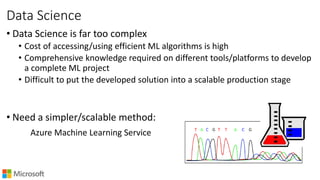
• Data Science is far too complex
• Cost of accessing/using efficient ML algorithms is high
• Comprehensive knowledge required on different tools/platforms to develop
a complete ML project
• Difficult to put the developed solution into a scalable production stage
• Need a simpler/scalable method:
Azure Machine Learning Service
What is Machine Learning ?
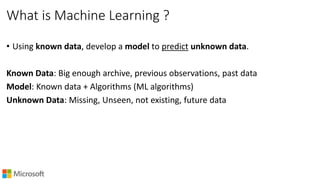
• Using known data, develop a model to predict unknown data.
Known Data: Big enough archive, previous observations, past data
Model: Known data + Algorithms (ML algorithms)
Unknown Data: Missing, Unseen, not existing, future data
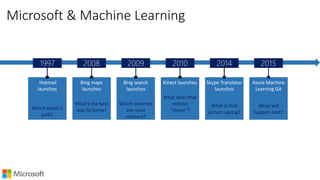
Microsoft & Machine Learning
Bing maps
launches
What’s the best
way to home?
Kinect launches
What does that
motion
“mean”?
Azure Machine
Learning GA
What will
happen next?
Hotmail
launches
Which email is
junk?
Bing search
launches
Which searches
are most
relevant?
Skype Translator
launches
What is that
person saying?
201420091997 201520102008
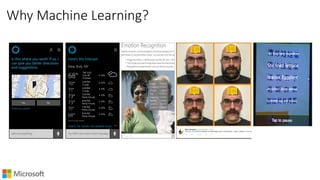
Why Machine Learning?
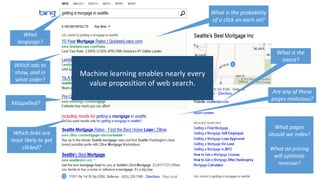
Machine learning enables nearly every
value proposition of web search.
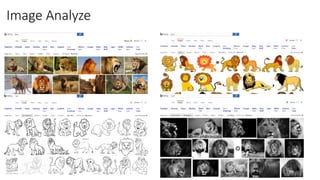
Image Analyze
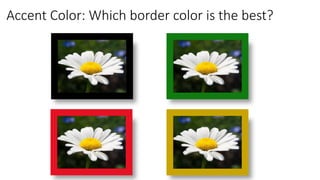
Accent Color: Which border color is the best?
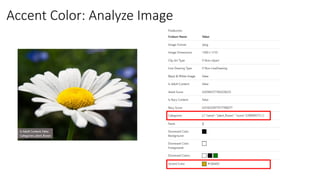
Accent Color: Analyze Image
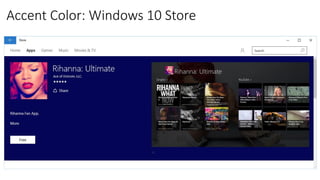
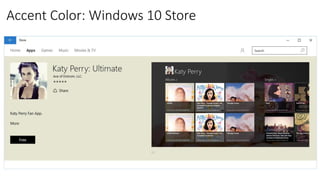
Accent Color: Windows 10 Store
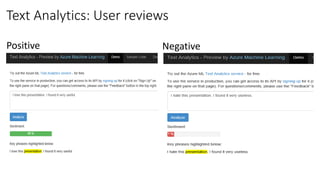
Text Analytics: User reviews
Positive Negative
Microsoft Azure Machine Learning
Make machine learning accessible to every enterprise,
data scientist, developer, information worker, consumer,
and device anywhere in the world.
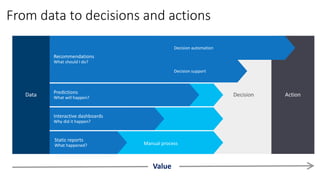
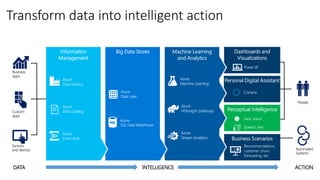
From data to decisions and actions
Value
Transform data into intelligent action
DATA
Business
apps
Custom
apps
Sensors
and devices
INTELLIGENCE ACTION
People
Automated
Systems
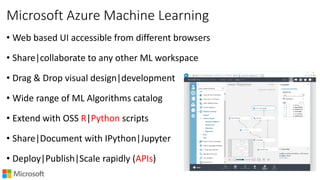
Microsoft Azure Machine Learning
• Web based UI accessible from different browsers
• Share|collaborate to any other ML workspace
• Drag & Drop visual design|development
• Wide range of ML Algorithms catalog
• Extend with OSS R|Python scripts
• Share|Document with IPython|Jupyter
• Deploy|Publish|Scale rapidly (APIs)
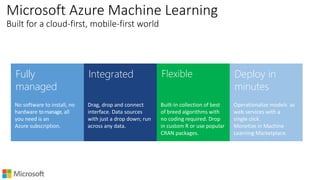
Fully
managed
Integrated Flexible Deploy in
minutes
No software to install, no
hardware tomanage, all
you need is an
Azure subscription.
Drag, drop and connect
interface. Data sources
with just a drop down; run
across any data.
Built-in collection of best
of breed algorithms with
no coding required. Drop
in custom R or use popular
CRAN packages.
Operationalize models as
web services with a
single click.
Monetize in Machine
Learning Marketplace.
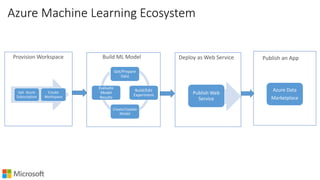
Azure Machine Learning Ecosystem
Get/Prepare
Data
Build/Edit
Experiment
Create/Update
Model
Evaluate
Model
Results
Publish Web
Service
Build ML Model Deploy as Web ServiceProvision Workspace
Get Azure
Subscription
Create
Workspace
Publish an App
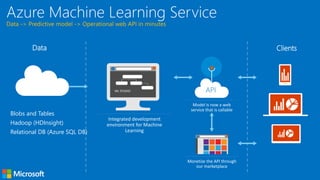
Azure Data
Marketplace
Blobs and Tables
Hadoop (HDInsight)
Relational DB (Azure SQL DB)
Data Clients
Model is now a web
service that is callable
Monetize the API through
our marketplace
API
Integrated development
environment for Machine
Learning
ML STUDIO
DEMO
Azure Machine Learning Studio
EXAMPLE
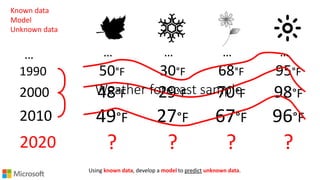
50°F 30°F 68°F 95°F1990
48°F 29°F 70°F 98°F2000
49°F 27°F 67°F 96°F2010
? ? ? ?2020
… … … ……
Known data
Model
Unknown data
Weather forecast sample
Using known data, develop a model to predict unknown data.
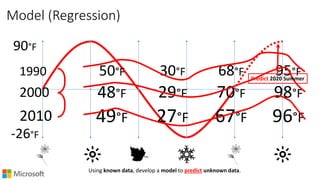
Model (Regression)
90°F
-26°F
50°F 30°F 68°F 95°F1990
48°F 29°F 70°F 98°F2000
49°F 27°F 67°F 96°F2010
Using known data, develop a model to predict unknown data.
Predict 2020 Summer
EXAMPLE
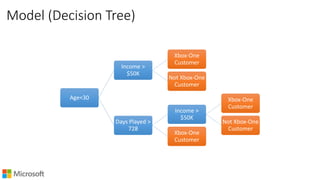
Model (Decision Tree)
Age<30
Income >
$50K
Xbox-One
Customer
Not Xbox-One
Customer
Days Played >
728
Income >
$50K
Xbox-One
Customer
Not Xbox-One
Customer
Xbox-One
Customer
EXAMPLE
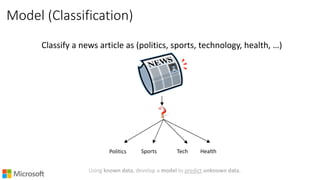
Classify a news article as (politics, sports, technology, health, …)
Politics Sports Tech Health
Model (Classification)
Using known data, develop a model to predict unknown data.
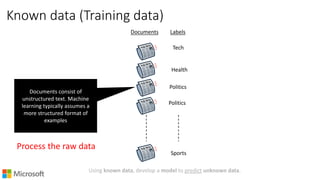
Known data (Training data)
Using known data, develop a model to predict unknown data.
Documents Labels
Tech
Health
Politics
Politics
Sports
Documents consist of
unstructured text. Machine
learning typically assumes a
more structured format of
examples
Process the raw data
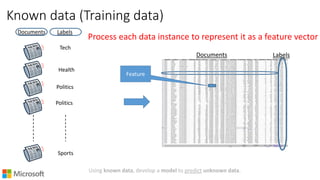
Known data (Training data)
Using known data, develop a model to predict unknown data.
LabelsDocuments
Feature
Documents Labels
Tech
Health
Politics
Politics
Sports
Process each data instance to represent it as a feature vector
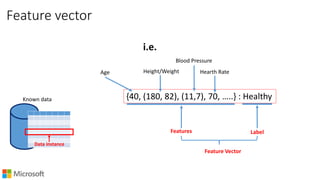
Feature vector
Known data
Data instance
i.e.
{40, (180, 82), (11,7), 70, …..} : Healthy
Age Height/Weight
Blood Pressure
Hearth Rate
LabelFeatures
Feature Vector
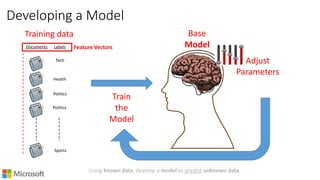
Developing a Model
Using known data, develop a model to predict unknown data.
Documents Labels
Tech
Health
Politics
Politics
Sports
Training data
Train
the
Model
Feature Vectors
Base
Model
Adjust
Parameters
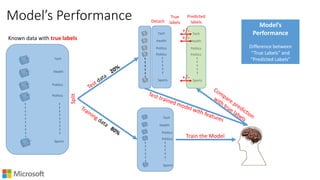
Model’s Performance
Known data with true labels
Tech
Health
Politics
Politics
Sports
Tech
Health
Politics
Politics
Sports
Tech
Health
Politics
Politics
Sports
Model’s
Performance
Difference between
“True Labels” and
“Predicted Labels”
True
labels
Tech
Health
Politics
Politics
Sports
Predicted
labels
Train the Model
Split
Detach
+/-
+/-
+/-
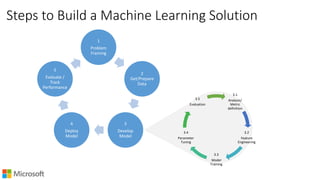
Steps to Build a Machine Learning Solution
1
Problem
Framing
2
Get/Prepare
Data
3
Develop
Model
4
Deploy
Model
5
Evaluate /
Track
Performance
3.1
Analysis/
Metric
definition
3.2
Feature
Engineering
3.3
Model
Training
3.4
Parameter
Tuning
3.5
Evaluation
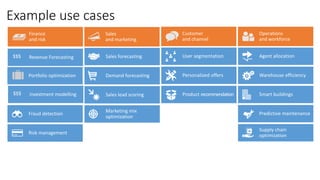
Example use cases
Machine Learning Algorithms
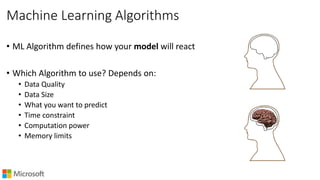
• ML Algorithm defines how your model will react
• Which Algorithm to use? Depends on:
• Data Quality
• Data Size
• What you want to predict
• Time constraint
• Computation power
• Memory limits
Machine Learning Algorithms
You can develop solutions by using
• Custom algorithms written in R | Python
• Ready to use ML services from data market
• Existing algorithms
Machine Learning Algorithms
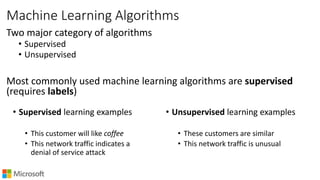
Two major category of algorithms
• Supervised
• Unsupervised
Most commonly used machine learning algorithms are supervised
(requires labels)
• Supervised learning examples
• This customer will like coffee
• This network traffic indicates a
denial of service attack
• Unsupervised learning examples
• These customers are similar
• This network traffic is unusual
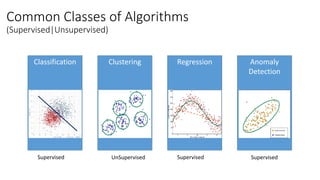
Common Classes of Algorithms
(Supervised|Unsupervised)
Classification Regression Anomaly
Detection
Clustering
Supervised Supervised SupervisedUnSupervised
Why you need to know these algorithms?
• If you want to answer a YES|NO question, it is classification
• If you want to predict a numerical value, it is regression
• If you want to group data into similar observations, it is clustering
• If you want to recommend an item, it is recommender system
• If you want to find anomalies in a group, it is anomaly detection
and many other ML algorithms for specific problem
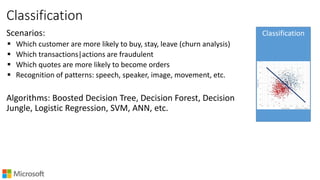
Classification
Scenarios:
 Which customer are more likely to buy, stay, leave (churn analysis)
 Which transactions|actions are fraudulent
 Which quotes are more likely to become orders
 Recognition of patterns: speech, speaker, image, movement, etc.
Algorithms: Boosted Decision Tree, Decision Forest, Decision
Jungle, Logistic Regression, SVM, ANN, etc.
Classification
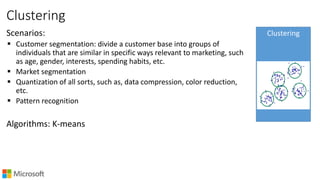
Clustering
Scenarios:
 Customer segmentation: divide a customer base into groups of
individuals that are similar in specific ways relevant to marketing, such
as age, gender, interests, spending habits, etc.
 Market segmentation
 Quantization of all sorts, such as, data compression, color reduction,
etc.
 Pattern recognition
Algorithms: K-means
Clustering
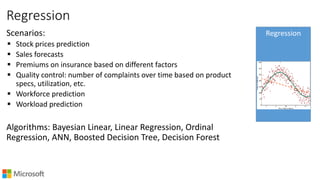
Regression
Scenarios:
 Stock prices prediction
 Sales forecasts
 Premiums on insurance based on different factors
 Quality control: number of complaints over time based on product
specs, utilization, etc.
 Workforce prediction
 Workload prediction
Algorithms: Bayesian Linear, Linear Regression, Ordinal
Regression, ANN, Boosted Decision Tree, Decision Forest
Regression
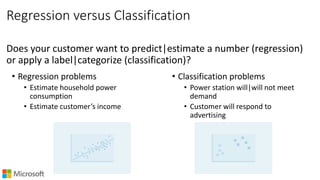
Regression versus Classification
Does your customer want to predict|estimate a number (regression)
or apply a label|categorize (classification)?
• Regression problems
• Estimate household power
consumption
• Estimate customer’s income
• Classification problems
• Power station will|will not meet
demand
• Customer will respond to
advertising
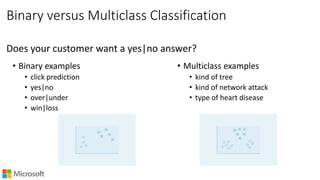
Binary versus Multiclass Classification
Does your customer want a yes|no answer?
• Binary examples
• click prediction
• yes|no
• over|under
• win|loss
• Multiclass examples
• kind of tree
• kind of network attack
• type of heart disease
DEMO
Machine Learning Basics Infographic
References
• Free e-book “Azure Machine Learning”
• https://mva.microsoft.com/ebooks#9780735698178
• Azure Machine Learning documentation
• https://azure.microsoft.com/en-us/documentation/services/machine-
learning/
• Data Science and Machine Learning Essentials
• www.edx.org
• Azure ML HOL (GitHub):
• https://github.com/Azure-Readiness/hol-azure-machine-learning/
HOL Document
• Access Azure HOL Doc: https://aka.ms/azuremlhol
Thank you
• Check out my blog for Azure ML articles: http://mostafa.rocks
• Follow me on Twitter: @MostafaElzoghbi

Azure Machine Learning

  • 1.
    Azure Machine Learning (DataCamp) Mostafa Elzoghbi Sr. Technical Evangelist – Microsoft @MostafaElzoghbi http://mostafa.rocks
  • 2.
    Session Objectives &Takeaways • What is Data Science? • What is Machine Learning? • Why do we need Machine Learning? • Azure ML studio platform capabilities. • Machine Learning basic concepts & algorithms: • How to build a model • Supervised vs Unsupervised models • Evaluate a model. • ML algorithms: Regression, classification, clustering and recommendations.
  • 3.
    Data Science Involves •Data science is about using data to make decision that drive actions. • Data science process involves: • Data selection • Preprocessing • Transformation • Data Mining • Delivering value from data : Interpretation and evaluation
  • 4.
    Data Science • DataScience is far too complex • Cost of accessing/using efficient ML algorithms is high • Comprehensive knowledge required on different tools/platforms to develop a complete ML project • Difficult to put the developed solution into a scalable production stage • Need a simpler/scalable method: Azure Machine Learning Service
  • 5.
    What is MachineLearning ? • Using known data, develop a model to predict unknown data. Known Data: Big enough archive, previous observations, past data Model: Known data + Algorithms (ML algorithms) Unknown Data: Missing, Unseen, not existing, future data
  • 6.
    Microsoft & MachineLearning Bing maps launches What’s the best way to home? Kinect launches What does that motion “mean”? Azure Machine Learning GA What will happen next? Hotmail launches Which email is junk? Bing search launches Which searches are most relevant? Skype Translator launches What is that person saying? 201420091997 201520102008
  • 7.
  • 8.
    Machine learning enablesnearly every value proposition of web search.
  • 9.
  • 10.
    Accent Color: Whichborder color is the best?
  • 11.
  • 12.
  • 13.
  • 14.
    Text Analytics: Userreviews Positive Negative
  • 15.
    Microsoft Azure MachineLearning Make machine learning accessible to every enterprise, data scientist, developer, information worker, consumer, and device anywhere in the world.
  • 16.
    From data todecisions and actions Value
  • 17.
    Transform data intointelligent action DATA Business apps Custom apps Sensors and devices INTELLIGENCE ACTION People Automated Systems
  • 18.
    Microsoft Azure MachineLearning • Web based UI accessible from different browsers • Share|collaborate to any other ML workspace • Drag & Drop visual design|development • Wide range of ML Algorithms catalog • Extend with OSS R|Python scripts • Share|Document with IPython|Jupyter • Deploy|Publish|Scale rapidly (APIs)
  • 19.
    Fully managed Integrated Flexible Deployin minutes No software to install, no hardware tomanage, all you need is an Azure subscription. Drag, drop and connect interface. Data sources with just a drop down; run across any data. Built-in collection of best of breed algorithms with no coding required. Drop in custom R or use popular CRAN packages. Operationalize models as web services with a single click. Monetize in Machine Learning Marketplace.
  • 20.
    Azure Machine LearningEcosystem Get/Prepare Data Build/Edit Experiment Create/Update Model Evaluate Model Results Publish Web Service Build ML Model Deploy as Web ServiceProvision Workspace Get Azure Subscription Create Workspace Publish an App Azure Data Marketplace
  • 21.
    Blobs and Tables Hadoop(HDInsight) Relational DB (Azure SQL DB) Data Clients Model is now a web service that is callable Monetize the API through our marketplace API Integrated development environment for Machine Learning ML STUDIO
  • 22.
  • 23.
  • 24.
    50°F 30°F 68°F95°F1990 48°F 29°F 70°F 98°F2000 49°F 27°F 67°F 96°F2010 ? ? ? ?2020 … … … …… Known data Model Unknown data Weather forecast sample Using known data, develop a model to predict unknown data.
  • 25.
    Model (Regression) 90°F -26°F 50°F 30°F68°F 95°F1990 48°F 29°F 70°F 98°F2000 49°F 27°F 67°F 96°F2010 Using known data, develop a model to predict unknown data. Predict 2020 Summer
  • 26.
  • 27.
    Model (Decision Tree) Age<30 Income> $50K Xbox-One Customer Not Xbox-One Customer Days Played > 728 Income > $50K Xbox-One Customer Not Xbox-One Customer Xbox-One Customer
  • 28.
  • 29.
    Classify a newsarticle as (politics, sports, technology, health, …) Politics Sports Tech Health Model (Classification) Using known data, develop a model to predict unknown data.
  • 30.
    Known data (Trainingdata) Using known data, develop a model to predict unknown data. Documents Labels Tech Health Politics Politics Sports Documents consist of unstructured text. Machine learning typically assumes a more structured format of examples Process the raw data
  • 31.
    Known data (Trainingdata) Using known data, develop a model to predict unknown data. LabelsDocuments Feature Documents Labels Tech Health Politics Politics Sports Process each data instance to represent it as a feature vector
  • 32.
    Feature vector Known data Datainstance i.e. {40, (180, 82), (11,7), 70, …..} : Healthy Age Height/Weight Blood Pressure Hearth Rate LabelFeatures Feature Vector
  • 33.
    Developing a Model Usingknown data, develop a model to predict unknown data. Documents Labels Tech Health Politics Politics Sports Training data Train the Model Feature Vectors Base Model Adjust Parameters
  • 34.
    Model’s Performance Known datawith true labels Tech Health Politics Politics Sports Tech Health Politics Politics Sports Tech Health Politics Politics Sports Model’s Performance Difference between “True Labels” and “Predicted Labels” True labels Tech Health Politics Politics Sports Predicted labels Train the Model Split Detach +/- +/- +/-
  • 35.
    Steps to Builda Machine Learning Solution 1 Problem Framing 2 Get/Prepare Data 3 Develop Model 4 Deploy Model 5 Evaluate / Track Performance 3.1 Analysis/ Metric definition 3.2 Feature Engineering 3.3 Model Training 3.4 Parameter Tuning 3.5 Evaluation
  • 36.
  • 37.
    Machine Learning Algorithms •ML Algorithm defines how your model will react • Which Algorithm to use? Depends on: • Data Quality • Data Size • What you want to predict • Time constraint • Computation power • Memory limits
  • 38.
    Machine Learning Algorithms Youcan develop solutions by using • Custom algorithms written in R | Python • Ready to use ML services from data market • Existing algorithms
  • 39.
    Machine Learning Algorithms Twomajor category of algorithms • Supervised • Unsupervised Most commonly used machine learning algorithms are supervised (requires labels) • Supervised learning examples • This customer will like coffee • This network traffic indicates a denial of service attack • Unsupervised learning examples • These customers are similar • This network traffic is unusual
  • 40.
    Common Classes ofAlgorithms (Supervised|Unsupervised) Classification Regression Anomaly Detection Clustering Supervised Supervised SupervisedUnSupervised
  • 41.
    Why you needto know these algorithms? • If you want to answer a YES|NO question, it is classification • If you want to predict a numerical value, it is regression • If you want to group data into similar observations, it is clustering • If you want to recommend an item, it is recommender system • If you want to find anomalies in a group, it is anomaly detection and many other ML algorithms for specific problem
  • 42.
    Classification Scenarios:  Which customerare more likely to buy, stay, leave (churn analysis)  Which transactions|actions are fraudulent  Which quotes are more likely to become orders  Recognition of patterns: speech, speaker, image, movement, etc. Algorithms: Boosted Decision Tree, Decision Forest, Decision Jungle, Logistic Regression, SVM, ANN, etc. Classification
  • 43.
    Clustering Scenarios:  Customer segmentation:divide a customer base into groups of individuals that are similar in specific ways relevant to marketing, such as age, gender, interests, spending habits, etc.  Market segmentation  Quantization of all sorts, such as, data compression, color reduction, etc.  Pattern recognition Algorithms: K-means Clustering
  • 44.
    Regression Scenarios:  Stock pricesprediction  Sales forecasts  Premiums on insurance based on different factors  Quality control: number of complaints over time based on product specs, utilization, etc.  Workforce prediction  Workload prediction Algorithms: Bayesian Linear, Linear Regression, Ordinal Regression, ANN, Boosted Decision Tree, Decision Forest Regression
  • 45.
    Regression versus Classification Doesyour customer want to predict|estimate a number (regression) or apply a label|categorize (classification)? • Regression problems • Estimate household power consumption • Estimate customer’s income • Classification problems • Power station will|will not meet demand • Customer will respond to advertising
  • 46.
    Binary versus MulticlassClassification Does your customer want a yes|no answer? • Binary examples • click prediction • yes|no • over|under • win|loss • Multiclass examples • kind of tree • kind of network attack • type of heart disease
  • 47.
  • 48.
    References • Free e-book“Azure Machine Learning” • https://mva.microsoft.com/ebooks#9780735698178 • Azure Machine Learning documentation • https://azure.microsoft.com/en-us/documentation/services/machine- learning/ • Data Science and Machine Learning Essentials • www.edx.org • Azure ML HOL (GitHub): • https://github.com/Azure-Readiness/hol-azure-machine-learning/
  • 49.
    HOL Document • AccessAzure HOL Doc: https://aka.ms/azuremlhol
  • 50.
    Thank you • Checkout my blog for Azure ML articles: http://mostafa.rocks • Follow me on Twitter: @MostafaElzoghbi