



© 2016 MapR Technologies 10-1
© 2016 MapR Technologies
Machine Learning with Apache Spark
© 2016 MapR Technologies 10-2
© 2016 MapR Technologies
© 2016 MapR Technologies 10-3
Agenda
• Brief overview of
• Classification
• Clustering
• Collaborative Filtering
• Predicting Flight Delays using a Decision Tree
© 2016 MapR Technologies 10-4
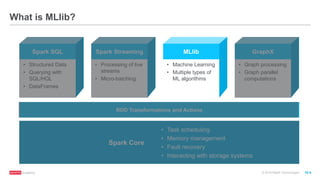
Spark SQL
• Structured Data
• Querying with
SQL/HQL
• DataFrames
Spark Streaming
• Processing of live
streams
• Micro-batching
MLlib
• Machine Learning
• Multiple types of
ML algorithms
GraphX
• Graph processing
• Graph parallel
computations
RDD Transformations and Actions
• Task scheduling
• Memory management
• Fault recovery
• Interacting with storage systems
Spark Core
What is MLlib?
© 2016 MapR Technologies 10-5
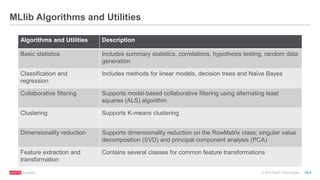
MLlib Algorithms and Utilities
Algorithms and Utilities Description
Basic statistics Includes summary statistics, correlations, hypothesis testing, random data
generation
Classification and
regression
Includes methods for linear models, decision trees and Naïve Bayes
Collaborative filtering Supports model-based collaborative filtering using alternating least
squares (ALS) algorithm
Clustering Supports K-means clustering
Dimensionality reduction Supports dimensionality reduction on the RowMatrix class; singular value
decomposition (SVD) and principal component analysis (PCA)
Feature extraction and
transformation
Contains several classes for common feature transformations
© 2016 MapR Technologies 10-6
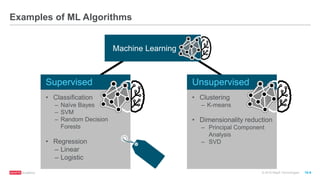
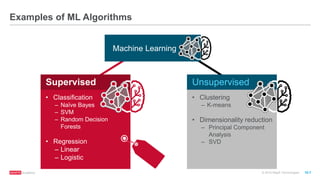
Examples of ML Algorithms
Supervised
• Classification
– Naïve Bayes
– SVM
– Random Decision
Forests
• Regression
– Linear
– Logistic
Machine Learning
Unsupervised
• Clustering
– K-means
• Dimensionality reduction
– Principal Component
Analysis
– SVD
© 2016 MapR Technologies 10-7
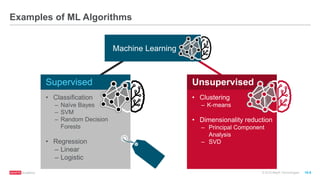
Examples of ML Algorithms
Supervised
• Classification
– Naïve Bayes
– SVM
– Random Decision
Forests
• Regression
– Linear
– Logistic
Machine Learning
Unsupervised
• Clustering
– K-means
• Dimensionality reduction
– Principal Component
Analysis
– SVD
© 2016 MapR Technologies 10-8
Examples of ML Algorithms
Machine Learning
Unsupervised
• Clustering
– K-means
• Dimensionality reduction
– Principal Component
Analysis
– SVD
Supervised
• Classification
– Naïve Bayes
– SVM
– Random Decision
Forests
• Regression
– Linear
– Logistic
© 2016 MapR Technologies 10-9
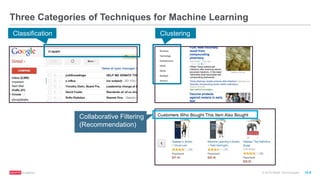
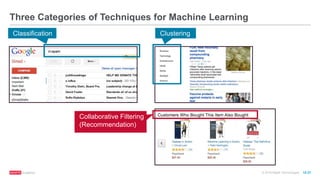
Three Categories of Techniques for Machine Learning
Collaborative Filtering
(Recommendation)
Classification Clustering
© 2016 MapR Technologies 10-10
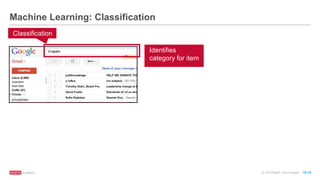
Machine Learning: Classification
Classification
Identifies
category for item
© 2016 MapR Technologies 10-11
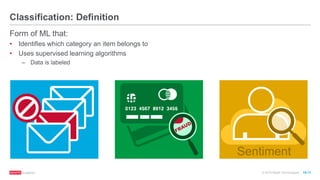
Classification: Definition
Form of ML that:
• Identifies which category an item belongs to
• Uses supervised learning algorithms
– Data is labeled
Sentiment
© 2016 MapR Technologies 10-12
If it Walks/Swims/Quacks Like a Duck …… Then It Must Be a Duck
swims
walks
quacks
Features:
walks
quacks
swims
Features:
© 2016 MapR Technologies 10-13
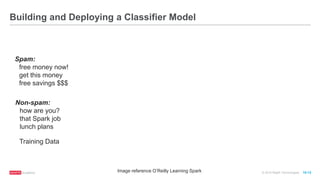
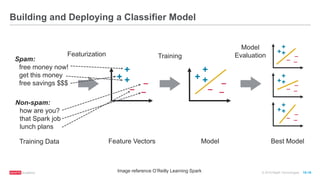
Building and Deploying a Classifier Model
Image reference O’Reilly Learning Spark
Spam:
free money now!
get this money
free savings $$$
Training Data
Non-spam:
how are you?
that Spark job
lunch plans
© 2016 MapR Technologies 10-14
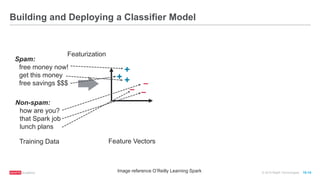
Building and Deploying a Classifier Model
Image reference O’Reilly Learning Spark
+
+
̶+
̶ ̶
Feature Vectors
Featurization
Spam:
free money now!
get this money
free savings $$$
Training Data
Non-spam:
how are you?
that Spark job
lunch plans
© 2016 MapR Technologies 10-15
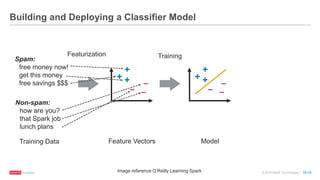
Building and Deploying a Classifier Model
Image reference O’Reilly Learning Spark
+
+
̶+
̶ ̶
Feature Vectors Model
Featurization TrainingSpam:
free money now!
get this money
free savings $$$
Training Data
Non-spam:
how are you?
that Spark job
lunch plans
+
+
̶+
̶ ̶
© 2016 MapR Technologies 10-16
Building and Deploying a Classifier Model
Image reference O’Reilly Learning Spark
+
+
̶+
̶ ̶
Feature Vectors Model
Featurization Training
Model
Evaluation
Best Model
Spam:
free money now!
get this money
free savings $$$
Training Data
Non-spam:
how are you?
that Spark job
lunch plans
+
+
̶+
̶ ̶
+
+
̶+
̶ ̶
+
+
̶+
̶ ̶
+
+
̶+
̶ ̶
© 2016 MapR Technologies 10-17
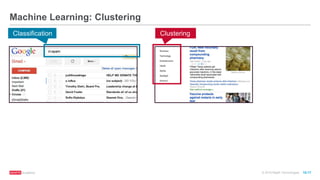
Machine Learning: Clustering
Classification Clustering
© 2016 MapR Technologies 10-18
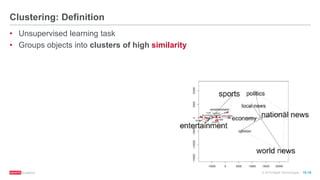
Clustering: Definition
• Unsupervised learning task
• Groups objects into clusters of high similarity
© 2016 MapR Technologies 10-19
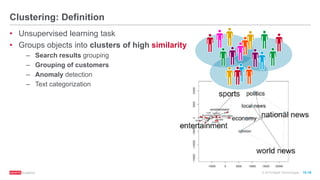
Clustering: Definition
• Unsupervised learning task
• Groups objects into clusters of high similarity
– Search results grouping
– Grouping of customers
– Anomaly detection
– Text categorization
© 2016 MapR Technologies 10-20
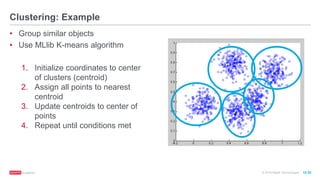
Clustering: Example
• Group similar objects
• Use MLlib K-means algorithm
1. Initialize coordinates to center
of clusters (centroid)
2. Assign all points to nearest
centroid
3. Update centroids to center of
points
4. Repeat until conditions met
© 2016 MapR Technologies 10-21
Three Categories of Techniques for Machine Learning
Collaborative Filtering
(Recommendation)
Classification Clustering
© 2016 MapR Technologies 10-22
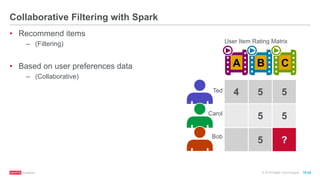
Collaborative Filtering with Spark
• Recommend items
– (Filtering)
• Based on user preferences data
– (Collaborative)
4 5 5
5 5
5 ?
Ted
Carol
Bob
A B C
User Item Rating Matrix
© 2016 MapR Technologies 10-23
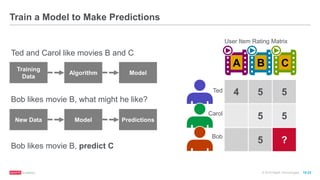
Train a Model to Make Predictions
Ted and Carol like movies B and C
Bob likes movie B, what might he like?
Bob likes movie B, predict C
Training
Data
ModelAlgorithm
New Data PredictionsModel
4 5 5
5 5
5 ?
Ted
Carol
Bob
A B C
User Item Rating Matrix
© 2016 MapR Technologies 10-24
© 2016 MapR Technologies
Predict Flight Delays
© 2016 MapR Technologies 10-25
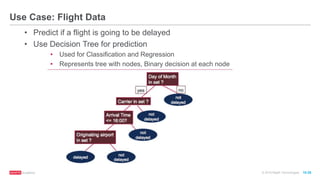
Use Case: Flight Data
• Predict if a flight is going to be delayed
• Use Decision Tree for prediction
• Used for Classification and Regression
• Represents tree with nodes, Binary decision at each node
© 2016 MapR Technologies 10-26
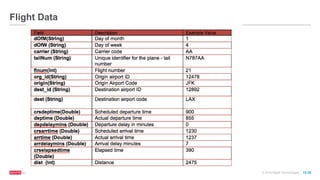
Flight Data
© 2016 MapR Technologies 10-27
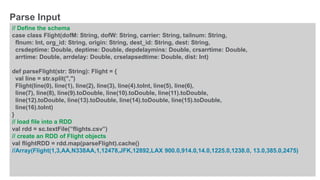
// Define the schema
case class Flight(dofM: String, dofW: String, carrier: String, tailnum: String,
flnum: Int, org_id: String, origin: String, dest_id: String, dest: String,
crsdeptime: Double, deptime: Double, depdelaymins: Double, crsarrtime: Double,
arrtime: Double, arrdelay: Double, crselapsedtime: Double, dist: Int)
def parseFlight(str: String): Flight = {
val line = str.split(",")
Flight(line(0), line(1), line(2), line(3), line(4).toInt, line(5), line(6),
line(7), line(8), line(9).toDouble, line(10).toDouble, line(11).toDouble,
line(12).toDouble, line(13).toDouble, line(14).toDouble, line(15).toDouble,
line(16).toInt)
}
// load file into a RDD
val rdd = sc.textFile(”flights.csv”)
// create an RDD of Flight objects
val flightRDD = rdd.map(parseFlight).cache()
//Array(Flight(1,3,AA,N338AA,1,12478,JFK,12892,LAX 900.0,914.0,14.0,1225.0,1238.0, 13.0,385.0,2475)
Parse Input
© 2016 MapR Technologies 10-28
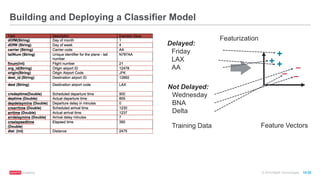
Building and Deploying a Classifier Model
+
+
̶+
̶ ̶
Feature Vectors
Featurization
Delayed:
Friday
LAX
AA
Training Data
Not Delayed:
Wednesday
BNA
Delta
© 2016 MapR Technologies 10-29
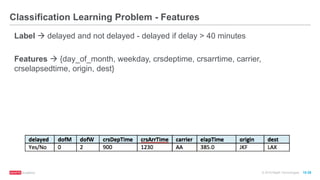
Classification Learning Problem - Features
Label  delayed and not delayed - delayed if delay > 40 minutes
Features  {day_of_month, weekday, crsdeptime, crsarrtime, carrier,
crselapsedtime, origin, dest}
© 2016 MapR Technologies 10-30
// create map of airline -> number
var carrierMap: Map[String, Int] = Map()
var index: Int = 0
flightsRDD.map(flight => flight.carrier).distinct.collect.foreach(
x => { carrierMap += (x -> index); index += 1 }
)
carrierMap.toString
// String = Map(DL -> 5,US -> 9, AA -> 6, UA -> 4...)
// create map of destination airport -> number
var destMap: Map[String, Int] = Map()
var index2: Int = 0
flightsRDD.map(flight => flight.dest).distinct.collect.foreach(
x => { destMap += (x -> index2); index2 += 1 })
destMap.toString
// Map(JFK -> 214, LAX -> 294, ATL -> 273,MIA -> 175 ...
Transform non-numeric features into numeric values
© 2016 MapR Technologies 10-31
Classification Learning Problem - Features
Label  delayed and not delayed - delayed if delay > 40 minutes
Features  {day_of_month, weekday, crsdeptime, crsarrtime, carrier,
crselapsedtime, origin, dest}
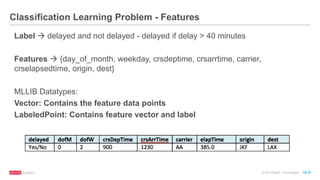
MLLIB Datatypes:
Vector: Contains the feature data points
LabeledPoint: Contains feature vector and label
© 2016 MapR Technologies 10-32
// Defining the features array
val mlprep = flightsRDD.map(flight => {
val monthday = flight.dofM.toInt - 1 // category
val weekday = flight.dofW.toInt - 1 // category
val crsdeptime1 = flight.crsdeptime.toInt
val crsarrtime1 = flight.crsarrtime.toInt
val carrier1 = carrierMap(flight.carrier) // category
val crselapsedtime1 = flight.crselapsedtime.toDouble
val origin1 = originMap(flight.origin) // category
val dest1 = destMap(flight.dest) // category
val delayed = if (flight.depdelaymins.toDouble > 40) 1.0 else 0.0
Array(delayed.toDouble, monthday.toDouble, weekday.toDouble, crsdeptime1.toDouble, crsarrtime1.toDouble,
carrier1.toDouble, crselapsedtime1.toDouble, origin1.toDouble, dest1.toDouble)
})
mlprep.take(1)
//Array(Array(0.0, 0.0, 2.0, 900.0, 1225.0, 6.0, 385.0, 214.0, 294.0))
val mldata = mlprep.map(x => LabeledPoint(x(0),Vectors.dense(x(1),x(2),x(3),x(4), x(5),x(6),
x(7), x(8))))
mldata.take(1)
// Array[LabeledPoint] = Array((0.0,[0.0,2.0,900.0,1225.0,6.0,385.0,214.0,294.0]))
Define the features, Create LabeledPoint with Vector
© 2016 MapR Technologies 10-33
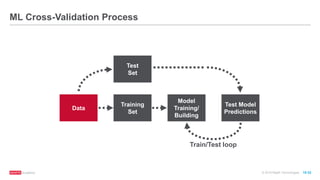
ML Cross-Validation Process
Data
Model
Training/
Building
Training
Set
Test Model
Predictions
Test
Set
Train/Test loop
© 2016 MapR Technologies 10-34
ML Cross-Validation Process
Data
Model
Training/
Building
Training
Set
Test Model
Predictions
Test
Set
Train/Test loop
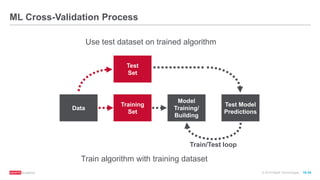
Train algorithm with training dataset
Use test dataset on trained algorithm
© 2016 MapR Technologies 10-35
ML Cross-Validation Process
Data
Model
Training/
Building
Training
Set
Test Model
Predictions
Test
Set
Train/Test loop
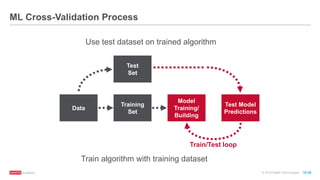
Train algorithm with training dataset
Use test dataset on trained algorithm
© 2016 MapR Technologies 10-36
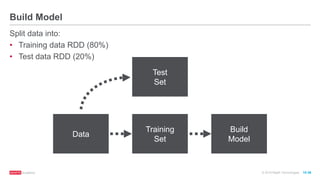
Build Model
Split data into:
• Training data RDD (80%)
• Test data RDD (20%)
Data
Build
Model
Training
Set
Test
Set
© 2016 MapR Technologies 10-37
// Randomly split RDD into training data RDD (80%) and test
data RDD (20%)
val splits = mldata.randomSplit(Array(0.8, 0.2))
val trainingRDD = splits(0).cache()
val testRDD = splits(1).cache()
testData.take(1)
//Array[LabeledPoint] =
Array((0.0,[18.0,6.0,900.0,1225.0,6.0,385.0,214.0,294.0]))
Split Data
© 2016 MapR Technologies 10-38
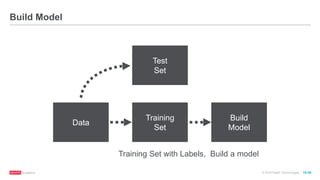
Build Model
Training Set with Labels, Build a model
Data
Build
Model
Training
Set
Test
Set
© 2016 MapR Technologies 10-39
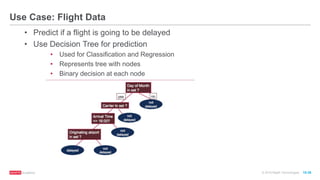
Use Case: Flight Data
• Predict if a flight is going to be delayed
• Use Decision Tree for prediction
• Used for Classification and Regression
• Represents tree with nodes
• Binary decision at each node
© 2016 MapR Technologies 10-40
// set ranges for categorical features
var categoricalFeaturesInfo = Map[Int, Int]()
categoricalFeaturesInfo += (0 -> 31) //dofM 31 categories
categoricalFeaturesInfo += (1 -> 7) //dofW 7 categories
categoricalFeaturesInfo += (4 -> carrierMap.size) //number of carriers
categoricalFeaturesInfo += (6 -> originMap.size) //number of origin airports
categoricalFeaturesInfo += (7 -> destMap.size) //number of dest airports
val numClasses = 2
val impurity = "gini"
val maxDepth = 9
val maxBins = 7000
// call DecisionTree trainClassifier with the trainingData , which returns the model
val model = DecisionTree.trainClassifier(trainingData, numClasses, categoricalFeaturesInfo,
impurity, maxDepth, maxBins)
Build Model
© 2016 MapR Technologies 10-41
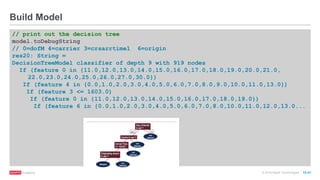
// print out the decision tree
model.toDebugString
// 0=dofM 4=carrier 3=crsarrtime1 6=origin
res20: String =
DecisionTreeModel classifier of depth 9 with 919 nodes
If (feature 0 in {11.0,12.0,13.0,14.0,15.0,16.0,17.0,18.0,19.0,20.0,21.0,
22.0,23.0,24.0,25.0,26.0,27.0,30.0})
If (feature 4 in {0.0,1.0,2.0,3.0,4.0,5.0,6.0,7.0,8.0,9.0,10.0,11.0,13.0})
If (feature 3 <= 1603.0)
If (feature 0 in {11.0,12.0,13.0,14.0,15.0,16.0,17.0,18.0,19.0})
If (feature 6 in {0.0,1.0,2.0,3.0,4.0,5.0,6.0,7.0,8.0,10.0,11.0,12.0,13.0...
Build Model
© 2016 MapR Technologies 10-42
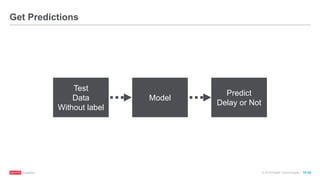
Get Predictions
Test
Data
Without label
Predict
Delay or Not
Model
© 2016 MapR Technologies 10-43
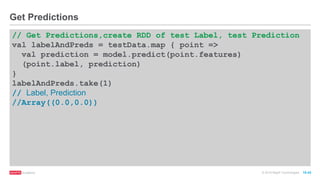
// Get Predictions,create RDD of test Label, test Prediction
val labelAndPreds = testData.map { point =>
val prediction = model.predict(point.features)
(point.label, prediction)
}
labelAndPreds.take(1)
// Label, Prediction
//Array((0.0,0.0))
Get Predictions
© 2016 MapR Technologies 10-44
To Learn More:
• Download example code
– https://github.com/caroljmcdonald/sparkmldecisiontree
• Read explanation of example code
– https://www.mapr.com/blog/apache-spark-machine-learning-tutorial
• Engage with us!
– https://www.mapr.com/blog/author/carol-mcdonald
– https://community.mapr.com
© 2016 MapR Technologies 10-45
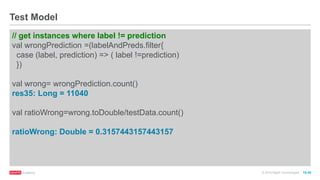
// get instances where label != prediction
val wrongPrediction =(labelAndPreds.filter{
case (label, prediction) => ( label !=prediction)
})
val wrong= wrongPrediction.count()
res35: Long = 11040
val ratioWrong=wrong.toDouble/testData.count()
ratioWrong: Double = 0.3157443157443157
Test Model

Free Code Friday - Machine Learning with Apache Spark

  • 1.
    © 2016 MapRTechnologies 10-1 © 2016 MapR Technologies Machine Learning with Apache Spark
  • 2.
    © 2016 MapRTechnologies 10-2 © 2016 MapR Technologies
  • 3.
    © 2016 MapRTechnologies 10-3 Agenda • Brief overview of • Classification • Clustering • Collaborative Filtering • Predicting Flight Delays using a Decision Tree
  • 4.
    © 2016 MapRTechnologies 10-4 Spark SQL • Structured Data • Querying with SQL/HQL • DataFrames Spark Streaming • Processing of live streams • Micro-batching MLlib • Machine Learning • Multiple types of ML algorithms GraphX • Graph processing • Graph parallel computations RDD Transformations and Actions • Task scheduling • Memory management • Fault recovery • Interacting with storage systems Spark Core What is MLlib?
  • 5.
    © 2016 MapRTechnologies 10-5 MLlib Algorithms and Utilities Algorithms and Utilities Description Basic statistics Includes summary statistics, correlations, hypothesis testing, random data generation Classification and regression Includes methods for linear models, decision trees and Naïve Bayes Collaborative filtering Supports model-based collaborative filtering using alternating least squares (ALS) algorithm Clustering Supports K-means clustering Dimensionality reduction Supports dimensionality reduction on the RowMatrix class; singular value decomposition (SVD) and principal component analysis (PCA) Feature extraction and transformation Contains several classes for common feature transformations
  • 6.
    © 2016 MapRTechnologies 10-6 Examples of ML Algorithms Supervised • Classification – Naïve Bayes – SVM – Random Decision Forests • Regression – Linear – Logistic Machine Learning Unsupervised • Clustering – K-means • Dimensionality reduction – Principal Component Analysis – SVD
  • 7.
    © 2016 MapRTechnologies 10-7 Examples of ML Algorithms Supervised • Classification – Naïve Bayes – SVM – Random Decision Forests • Regression – Linear – Logistic Machine Learning Unsupervised • Clustering – K-means • Dimensionality reduction – Principal Component Analysis – SVD
  • 8.
    © 2016 MapRTechnologies 10-8 Examples of ML Algorithms Machine Learning Unsupervised • Clustering – K-means • Dimensionality reduction – Principal Component Analysis – SVD Supervised • Classification – Naïve Bayes – SVM – Random Decision Forests • Regression – Linear – Logistic
  • 9.
    © 2016 MapRTechnologies 10-9 Three Categories of Techniques for Machine Learning Collaborative Filtering (Recommendation) Classification Clustering
  • 10.
    © 2016 MapRTechnologies 10-10 Machine Learning: Classification Classification Identifies category for item
  • 11.
    © 2016 MapRTechnologies 10-11 Classification: Definition Form of ML that: • Identifies which category an item belongs to • Uses supervised learning algorithms – Data is labeled Sentiment
  • 12.
    © 2016 MapRTechnologies 10-12 If it Walks/Swims/Quacks Like a Duck …… Then It Must Be a Duck swims walks quacks Features: walks quacks swims Features:
  • 13.
    © 2016 MapRTechnologies 10-13 Building and Deploying a Classifier Model Image reference O’Reilly Learning Spark Spam: free money now! get this money free savings $$$ Training Data Non-spam: how are you? that Spark job lunch plans
  • 14.
    © 2016 MapRTechnologies 10-14 Building and Deploying a Classifier Model Image reference O’Reilly Learning Spark + + ̶+ ̶ ̶ Feature Vectors Featurization Spam: free money now! get this money free savings $$$ Training Data Non-spam: how are you? that Spark job lunch plans
  • 15.
    © 2016 MapRTechnologies 10-15 Building and Deploying a Classifier Model Image reference O’Reilly Learning Spark + + ̶+ ̶ ̶ Feature Vectors Model Featurization TrainingSpam: free money now! get this money free savings $$$ Training Data Non-spam: how are you? that Spark job lunch plans + + ̶+ ̶ ̶
  • 16.
    © 2016 MapRTechnologies 10-16 Building and Deploying a Classifier Model Image reference O’Reilly Learning Spark + + ̶+ ̶ ̶ Feature Vectors Model Featurization Training Model Evaluation Best Model Spam: free money now! get this money free savings $$$ Training Data Non-spam: how are you? that Spark job lunch plans + + ̶+ ̶ ̶ + + ̶+ ̶ ̶ + + ̶+ ̶ ̶ + + ̶+ ̶ ̶
  • 17.
    © 2016 MapRTechnologies 10-17 Machine Learning: Clustering Classification Clustering
  • 18.
    © 2016 MapRTechnologies 10-18 Clustering: Definition • Unsupervised learning task • Groups objects into clusters of high similarity
  • 19.
    © 2016 MapRTechnologies 10-19 Clustering: Definition • Unsupervised learning task • Groups objects into clusters of high similarity – Search results grouping – Grouping of customers – Anomaly detection – Text categorization
  • 20.
    © 2016 MapRTechnologies 10-20 Clustering: Example • Group similar objects • Use MLlib K-means algorithm 1. Initialize coordinates to center of clusters (centroid) 2. Assign all points to nearest centroid 3. Update centroids to center of points 4. Repeat until conditions met
  • 21.
    © 2016 MapRTechnologies 10-21 Three Categories of Techniques for Machine Learning Collaborative Filtering (Recommendation) Classification Clustering
  • 22.
    © 2016 MapRTechnologies 10-22 Collaborative Filtering with Spark • Recommend items – (Filtering) • Based on user preferences data – (Collaborative) 4 5 5 5 5 5 ? Ted Carol Bob A B C User Item Rating Matrix
  • 23.
    © 2016 MapRTechnologies 10-23 Train a Model to Make Predictions Ted and Carol like movies B and C Bob likes movie B, what might he like? Bob likes movie B, predict C Training Data ModelAlgorithm New Data PredictionsModel 4 5 5 5 5 5 ? Ted Carol Bob A B C User Item Rating Matrix
  • 24.
    © 2016 MapRTechnologies 10-24 © 2016 MapR Technologies Predict Flight Delays
  • 25.
    © 2016 MapRTechnologies 10-25 Use Case: Flight Data • Predict if a flight is going to be delayed • Use Decision Tree for prediction • Used for Classification and Regression • Represents tree with nodes, Binary decision at each node
  • 26.
    © 2016 MapRTechnologies 10-26 Flight Data
  • 27.
    © 2016 MapRTechnologies 10-27 // Define the schema case class Flight(dofM: String, dofW: String, carrier: String, tailnum: String, flnum: Int, org_id: String, origin: String, dest_id: String, dest: String, crsdeptime: Double, deptime: Double, depdelaymins: Double, crsarrtime: Double, arrtime: Double, arrdelay: Double, crselapsedtime: Double, dist: Int) def parseFlight(str: String): Flight = { val line = str.split(",") Flight(line(0), line(1), line(2), line(3), line(4).toInt, line(5), line(6), line(7), line(8), line(9).toDouble, line(10).toDouble, line(11).toDouble, line(12).toDouble, line(13).toDouble, line(14).toDouble, line(15).toDouble, line(16).toInt) } // load file into a RDD val rdd = sc.textFile(”flights.csv”) // create an RDD of Flight objects val flightRDD = rdd.map(parseFlight).cache() //Array(Flight(1,3,AA,N338AA,1,12478,JFK,12892,LAX 900.0,914.0,14.0,1225.0,1238.0, 13.0,385.0,2475) Parse Input
  • 28.
    © 2016 MapRTechnologies 10-28 Building and Deploying a Classifier Model + + ̶+ ̶ ̶ Feature Vectors Featurization Delayed: Friday LAX AA Training Data Not Delayed: Wednesday BNA Delta
  • 29.
    © 2016 MapRTechnologies 10-29 Classification Learning Problem - Features Label  delayed and not delayed - delayed if delay > 40 minutes Features  {day_of_month, weekday, crsdeptime, crsarrtime, carrier, crselapsedtime, origin, dest}
  • 30.
    © 2016 MapRTechnologies 10-30 // create map of airline -> number var carrierMap: Map[String, Int] = Map() var index: Int = 0 flightsRDD.map(flight => flight.carrier).distinct.collect.foreach( x => { carrierMap += (x -> index); index += 1 } ) carrierMap.toString // String = Map(DL -> 5,US -> 9, AA -> 6, UA -> 4...) // create map of destination airport -> number var destMap: Map[String, Int] = Map() var index2: Int = 0 flightsRDD.map(flight => flight.dest).distinct.collect.foreach( x => { destMap += (x -> index2); index2 += 1 }) destMap.toString // Map(JFK -> 214, LAX -> 294, ATL -> 273,MIA -> 175 ... Transform non-numeric features into numeric values
  • 31.
    © 2016 MapRTechnologies 10-31 Classification Learning Problem - Features Label  delayed and not delayed - delayed if delay > 40 minutes Features  {day_of_month, weekday, crsdeptime, crsarrtime, carrier, crselapsedtime, origin, dest} MLLIB Datatypes: Vector: Contains the feature data points LabeledPoint: Contains feature vector and label
  • 32.
    © 2016 MapRTechnologies 10-32 // Defining the features array val mlprep = flightsRDD.map(flight => { val monthday = flight.dofM.toInt - 1 // category val weekday = flight.dofW.toInt - 1 // category val crsdeptime1 = flight.crsdeptime.toInt val crsarrtime1 = flight.crsarrtime.toInt val carrier1 = carrierMap(flight.carrier) // category val crselapsedtime1 = flight.crselapsedtime.toDouble val origin1 = originMap(flight.origin) // category val dest1 = destMap(flight.dest) // category val delayed = if (flight.depdelaymins.toDouble > 40) 1.0 else 0.0 Array(delayed.toDouble, monthday.toDouble, weekday.toDouble, crsdeptime1.toDouble, crsarrtime1.toDouble, carrier1.toDouble, crselapsedtime1.toDouble, origin1.toDouble, dest1.toDouble) }) mlprep.take(1) //Array(Array(0.0, 0.0, 2.0, 900.0, 1225.0, 6.0, 385.0, 214.0, 294.0)) val mldata = mlprep.map(x => LabeledPoint(x(0),Vectors.dense(x(1),x(2),x(3),x(4), x(5),x(6), x(7), x(8)))) mldata.take(1) // Array[LabeledPoint] = Array((0.0,[0.0,2.0,900.0,1225.0,6.0,385.0,214.0,294.0])) Define the features, Create LabeledPoint with Vector
  • 33.
    © 2016 MapRTechnologies 10-33 ML Cross-Validation Process Data Model Training/ Building Training Set Test Model Predictions Test Set Train/Test loop
  • 34.
    © 2016 MapRTechnologies 10-34 ML Cross-Validation Process Data Model Training/ Building Training Set Test Model Predictions Test Set Train/Test loop Train algorithm with training dataset Use test dataset on trained algorithm
  • 35.
    © 2016 MapRTechnologies 10-35 ML Cross-Validation Process Data Model Training/ Building Training Set Test Model Predictions Test Set Train/Test loop Train algorithm with training dataset Use test dataset on trained algorithm
  • 36.
    © 2016 MapRTechnologies 10-36 Build Model Split data into: • Training data RDD (80%) • Test data RDD (20%) Data Build Model Training Set Test Set
  • 37.
    © 2016 MapRTechnologies 10-37 // Randomly split RDD into training data RDD (80%) and test data RDD (20%) val splits = mldata.randomSplit(Array(0.8, 0.2)) val trainingRDD = splits(0).cache() val testRDD = splits(1).cache() testData.take(1) //Array[LabeledPoint] = Array((0.0,[18.0,6.0,900.0,1225.0,6.0,385.0,214.0,294.0])) Split Data
  • 38.
    © 2016 MapRTechnologies 10-38 Build Model Training Set with Labels, Build a model Data Build Model Training Set Test Set
  • 39.
    © 2016 MapRTechnologies 10-39 Use Case: Flight Data • Predict if a flight is going to be delayed • Use Decision Tree for prediction • Used for Classification and Regression • Represents tree with nodes • Binary decision at each node
  • 40.
    © 2016 MapRTechnologies 10-40 // set ranges for categorical features var categoricalFeaturesInfo = Map[Int, Int]() categoricalFeaturesInfo += (0 -> 31) //dofM 31 categories categoricalFeaturesInfo += (1 -> 7) //dofW 7 categories categoricalFeaturesInfo += (4 -> carrierMap.size) //number of carriers categoricalFeaturesInfo += (6 -> originMap.size) //number of origin airports categoricalFeaturesInfo += (7 -> destMap.size) //number of dest airports val numClasses = 2 val impurity = "gini" val maxDepth = 9 val maxBins = 7000 // call DecisionTree trainClassifier with the trainingData , which returns the model val model = DecisionTree.trainClassifier(trainingData, numClasses, categoricalFeaturesInfo, impurity, maxDepth, maxBins) Build Model
  • 41.
    © 2016 MapRTechnologies 10-41 // print out the decision tree model.toDebugString // 0=dofM 4=carrier 3=crsarrtime1 6=origin res20: String = DecisionTreeModel classifier of depth 9 with 919 nodes If (feature 0 in {11.0,12.0,13.0,14.0,15.0,16.0,17.0,18.0,19.0,20.0,21.0, 22.0,23.0,24.0,25.0,26.0,27.0,30.0}) If (feature 4 in {0.0,1.0,2.0,3.0,4.0,5.0,6.0,7.0,8.0,9.0,10.0,11.0,13.0}) If (feature 3 <= 1603.0) If (feature 0 in {11.0,12.0,13.0,14.0,15.0,16.0,17.0,18.0,19.0}) If (feature 6 in {0.0,1.0,2.0,3.0,4.0,5.0,6.0,7.0,8.0,10.0,11.0,12.0,13.0... Build Model
  • 42.
    © 2016 MapRTechnologies 10-42 Get Predictions Test Data Without label Predict Delay or Not Model
  • 43.
    © 2016 MapRTechnologies 10-43 // Get Predictions,create RDD of test Label, test Prediction val labelAndPreds = testData.map { point => val prediction = model.predict(point.features) (point.label, prediction) } labelAndPreds.take(1) // Label, Prediction //Array((0.0,0.0)) Get Predictions
  • 44.
    © 2016 MapRTechnologies 10-44 To Learn More: • Download example code – https://github.com/caroljmcdonald/sparkmldecisiontree • Read explanation of example code – https://www.mapr.com/blog/apache-spark-machine-learning-tutorial • Engage with us! – https://www.mapr.com/blog/author/carol-mcdonald – https://community.mapr.com
  • 45.
    © 2016 MapRTechnologies 10-45 // get instances where label != prediction val wrongPrediction =(labelAndPreds.filter{ case (label, prediction) => ( label !=prediction) }) val wrong= wrongPrediction.count() res35: Long = 11040 val ratioWrong=wrong.toDouble/testData.count() ratioWrong: Double = 0.3157443157443157 Test Model