AP
The Great Depression
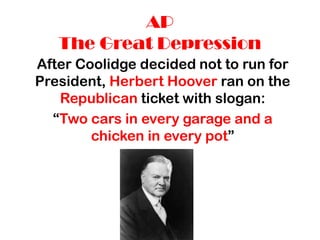
After Coolidge decided not to run for
President, Herbert Hoover ran on the
Republican ticket with slogan:
“Two cars in every garage and a
chicken in every pot”
Causes of the Great
Depression
• #1
Stock Market Crash
Why did the Market Crash?
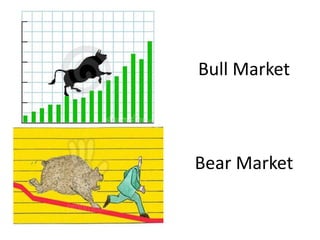
Bull market vs Bear Market
Bull Market
Bear Market
• http://money.cnn.com/data/dow30/
• In the 1920’s it was a Bull market. Many
people bought stocks on margin-they
borrowed money to buy stocks and
only put a small amount down as a
payment.
• For example: With $1,000, an investor
could buy $10,000 worth of stock. The
other $9,000 would come as a loan
from a stockbroker—he would hold the
stock as collateral.
• As long as the price kept rising buying
on margin was safe because you
always made money. It only took a
short time for prices of stocks to rise
and investors could pay back loans.
The Great Crash
• The bull market lasted only as long as
investors continued putting new money
into it. By the latter half of 1929, the
market was running out of new
customers. Professional investors
sensed danger and began to sell off
their holding. Prices slipped. Others
followed and prices fell even more.
Black Tuesday
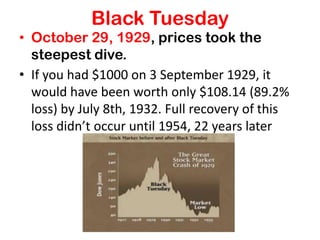
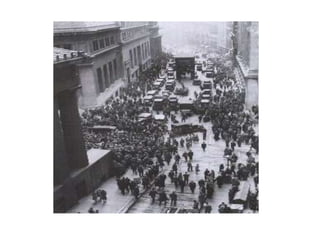
• October 29, 1929, prices took the
steepest dive.
• If you had $1000 on 3 September 1929, it
would have been worth only $108.14 (89.2%
loss) by July 8th, 1932. Full recovery of this
loss didn’t occur until 1954, 22 years later
Bank Failures
• The Crash hurt banks in two ways:
• ----banks had lent money to investors
• ----banks had invested in the Stock
Market
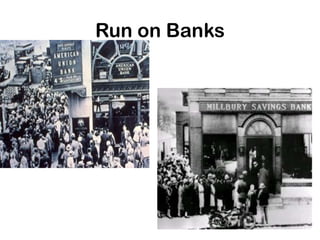
• Banks lost tons of money—people
panicked and ran to their banks to get
their money out of savings—money
was gone!!!!
Run on Banks
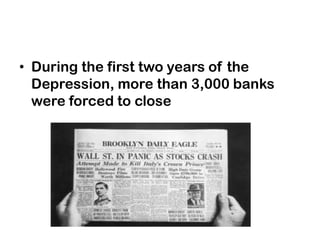
• During the first two years of the
Depression, more than 3,000 banks
were forced to close
Causes of the Depression
#2
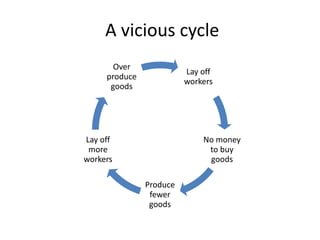
Overproduction of goods:
Efficient machinery increased the
production capacity of both factories
and farms. Low consumption of goods
led manufacturers to cut production
and lay off employees.
A vicious cycle
Lay off
workers
No money
to buy
goods
Produce
fewer
goods
Lay off
more
workers
Over
produce
goods
Causes of the Depression
• #3
• Uneven distribution of Income
• In 1929 2/3 of families earned less than
$2,500 a year, leaving them little
expendable income.
Causes of the Depression
• #4
• Decline in Export Sales:
• Hawley-Smoot Tariff put large tariffs
on imports. Americans did not buy
foreign goods because they were too
expensive and foreigners did not buy
Americans goods as well.
Causes of the Depression
• #5
• Mistakes by the Federal Reserve:
• During the 1920’s the Federal Reserve
made money very cheap to borrow
(low interest rates) but after the crash
they rose the interest rates—tightening
up credit.
Life During the Depression
• The Depression grew steadily
worse. In 1932 some 9,000
banks had failed and over
30,000 companies went out of
business. By 1933 ¼ or 25% or
1 in 4 people of the workforce
were unemployed.
• President Hoover believed
that government should not
interfere in the economy.
His reputation suffered as
his administration did
nothing for the people.
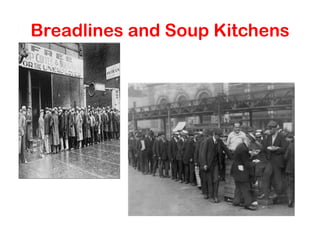
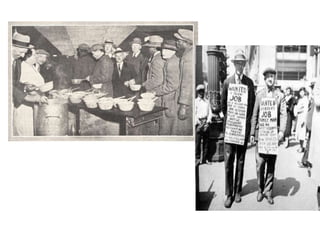
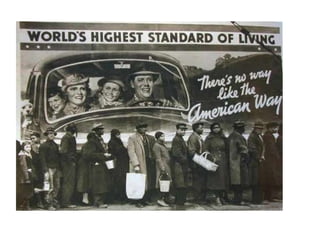
Breadlines and Soup Kitchens
Hobos
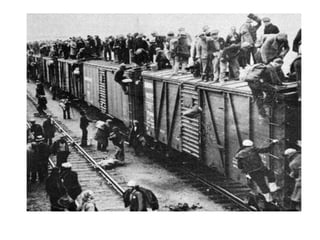
• In search of work or a better life, many
men began to wander around the
country, walking, hitchhiking “riding
the rails”.
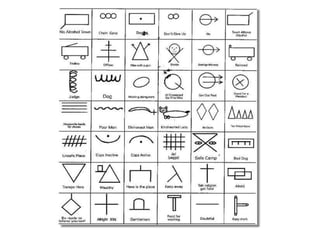
• They developed intricate symbols that
they wrote on trees, fences, or building
to warn or inform other hobos.
Because President Hoover did
nothing his name became
synonymous with the depression
• http://youtu.be/sfylLnHjcu0
• http://youtu.be/TZz7mwvmm7A
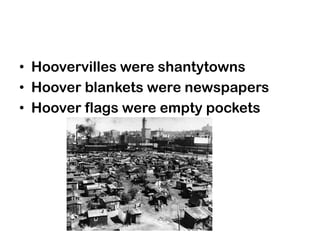
• Hoovervilles were shantytowns
• Hoover blankets were newspapers
• Hoover flags were empty pockets
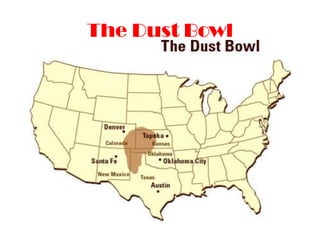
The Dust Bowl
• Farmers soon faced a new disaster.
Beginning in 1932, a terrible drought
struck the Great Plains. The soil dried to
dust and winds whipped the arid earth
up, blowing it around and blackening the
sky for hundreds of miles. Dust buried
crops and livestock and piled up against
farmhouses like snow. No matter how
carefully farm families sealed their home,
dust covered everything in the house.
• Film about the dust bowl
• http://youtu.be/csnY0Tnvdj8
• http://youtu.be/xAQsGdcLl4c
• Many families packed all their
belongings into old cars or trucks and
headed west to California, hoping for a
better life. Since many migrants were
from Oklahoma, they became known
as “Okies”. John Steinbeck
immortalized their story in his best
seller the Grapes of Wrath.
• http://youtu.be/jE6kKwUjb_c
Escaping the Depression
• Ordinary citizens often went to the
movies to escape to see people who
were rich, happy and successful. In the
early 1930’s:
• Animal Crackers-Marx Brothers
• http://youtu.be/8CQHOCsOfWw
• Walt Disney’s Snow White and the
Seven Dwarfs
• Gone with the Wind
Bonus Marchers
• In appreciation of the World War I service
of American soldiers and sailors,
Congress in 1924 had enacted a $1,000
bonus for each veteran, to be distributed
in 1945. Many veterans marched to
Washington D.C. to ask that they receive
their bonus early. Over 1500 camped out
near the White House. President Hoover
sent the police to clear them out. When
that didn’t work, he called in the Army.
Soon unarmed veterans were on the run
with 700 soldiers at their heels. Their
campsite was buried to the ground. It was
a public fiasco for Hoover.
• http://youtu.be/xkmo4ygPTjc
• http://youtu.be/eaGFvHwGwt0

Ap the great depression

  • 1.
    AP The Great Depression AfterCoolidge decided not to run for President, Herbert Hoover ran on the Republican ticket with slogan: “Two cars in every garage and a chicken in every pot”
  • 2.
    Causes of theGreat Depression • #1 Stock Market Crash Why did the Market Crash? Bull market vs Bear Market
  • 3.
  • 4.
  • 5.
    • In the1920’s it was a Bull market. Many people bought stocks on margin-they borrowed money to buy stocks and only put a small amount down as a payment.
  • 6.
    • For example:With $1,000, an investor could buy $10,000 worth of stock. The other $9,000 would come as a loan from a stockbroker—he would hold the stock as collateral. • As long as the price kept rising buying on margin was safe because you always made money. It only took a short time for prices of stocks to rise and investors could pay back loans.
  • 7.
    The Great Crash •The bull market lasted only as long as investors continued putting new money into it. By the latter half of 1929, the market was running out of new customers. Professional investors sensed danger and began to sell off their holding. Prices slipped. Others followed and prices fell even more.
  • 8.
    Black Tuesday • October29, 1929, prices took the steepest dive. • If you had $1000 on 3 September 1929, it would have been worth only $108.14 (89.2% loss) by July 8th, 1932. Full recovery of this loss didn’t occur until 1954, 22 years later
  • 10.
    Bank Failures • TheCrash hurt banks in two ways: • ----banks had lent money to investors • ----banks had invested in the Stock Market • Banks lost tons of money—people panicked and ran to their banks to get their money out of savings—money was gone!!!!
  • 11.
  • 12.
    • During thefirst two years of the Depression, more than 3,000 banks were forced to close
  • 13.
    Causes of theDepression #2 Overproduction of goods: Efficient machinery increased the production capacity of both factories and farms. Low consumption of goods led manufacturers to cut production and lay off employees.
  • 14.
    A vicious cycle Layoff workers No money to buy goods Produce fewer goods Lay off more workers Over produce goods
  • 15.
    Causes of theDepression • #3 • Uneven distribution of Income • In 1929 2/3 of families earned less than $2,500 a year, leaving them little expendable income.
  • 16.
    Causes of theDepression • #4 • Decline in Export Sales: • Hawley-Smoot Tariff put large tariffs on imports. Americans did not buy foreign goods because they were too expensive and foreigners did not buy Americans goods as well.
  • 17.
    Causes of theDepression • #5 • Mistakes by the Federal Reserve: • During the 1920’s the Federal Reserve made money very cheap to borrow (low interest rates) but after the crash they rose the interest rates—tightening up credit.
  • 18.
    Life During theDepression • The Depression grew steadily worse. In 1932 some 9,000 banks had failed and over 30,000 companies went out of business. By 1933 ¼ or 25% or 1 in 4 people of the workforce were unemployed.
  • 19.
    • President Hooverbelieved that government should not interfere in the economy. His reputation suffered as his administration did nothing for the people.
  • 20.
  • 23.
    Hobos • In searchof work or a better life, many men began to wander around the country, walking, hitchhiking “riding the rails”. • They developed intricate symbols that they wrote on trees, fences, or building to warn or inform other hobos.
  • 26.
    Because President Hooverdid nothing his name became synonymous with the depression • http://youtu.be/sfylLnHjcu0 • http://youtu.be/TZz7mwvmm7A
  • 27.
    • Hoovervilles wereshantytowns • Hoover blankets were newspapers • Hoover flags were empty pockets
  • 28.
  • 29.
    • Farmers soonfaced a new disaster. Beginning in 1932, a terrible drought struck the Great Plains. The soil dried to dust and winds whipped the arid earth up, blowing it around and blackening the sky for hundreds of miles. Dust buried crops and livestock and piled up against farmhouses like snow. No matter how carefully farm families sealed their home, dust covered everything in the house.
  • 30.
    • Film aboutthe dust bowl • http://youtu.be/csnY0Tnvdj8 • http://youtu.be/xAQsGdcLl4c
  • 31.
    • Many familiespacked all their belongings into old cars or trucks and headed west to California, hoping for a better life. Since many migrants were from Oklahoma, they became known as “Okies”. John Steinbeck immortalized their story in his best seller the Grapes of Wrath. • http://youtu.be/jE6kKwUjb_c
  • 32.
    Escaping the Depression •Ordinary citizens often went to the movies to escape to see people who were rich, happy and successful. In the early 1930’s: • Animal Crackers-Marx Brothers • http://youtu.be/8CQHOCsOfWw • Walt Disney’s Snow White and the Seven Dwarfs • Gone with the Wind
  • 33.
    Bonus Marchers • Inappreciation of the World War I service of American soldiers and sailors, Congress in 1924 had enacted a $1,000 bonus for each veteran, to be distributed in 1945. Many veterans marched to Washington D.C. to ask that they receive their bonus early. Over 1500 camped out near the White House. President Hoover sent the police to clear them out. When that didn’t work, he called in the Army. Soon unarmed veterans were on the run with 700 soldiers at their heels. Their campsite was buried to the ground. It was a public fiasco for Hoover.
  • 34.