•What are your
strategies for saving
money?
•If the stock market
collapsed today, how
would your family be
affected?
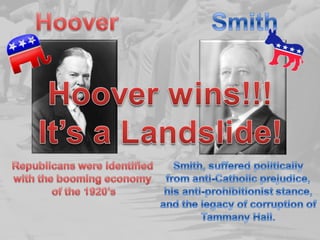
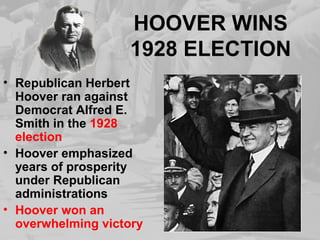
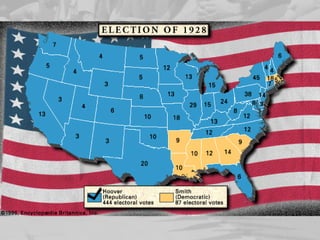
HOOVER WINS
1928 ELECTION
• Republican Herbert
Hoover ran against
Democrat Alfred E.
Smith in the 1928
election
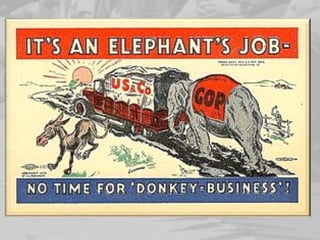
• Hoover emphasized
years of prosperity
under Republican
administrations
• Hoover won an
overwhelming victory
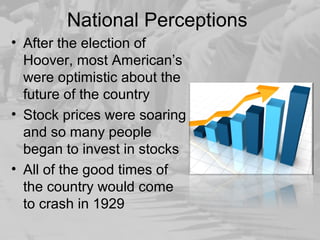
National Perceptions
• After the election of
Hoover, most American’s
were optimistic about the
future of the country
• Stock prices were soaring
and so many people
began to invest in stocks
• All of the good times of
the country would come
to crash in 1929
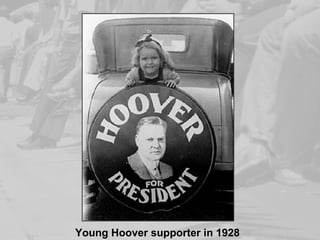
Young Hoover supporter in 1928
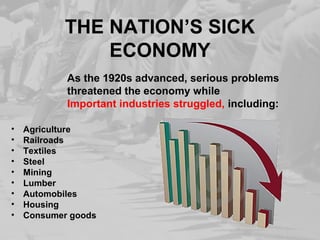
THE NATION’S SICK
ECONOMY
• Agriculture
• Railroads
• Textiles
• Steel
• Mining
• Lumber
• Automobiles
• Housing
• Consumer goods
As the 1920s advanced, serious problems
threatened the economy while
Important industries struggled, including:
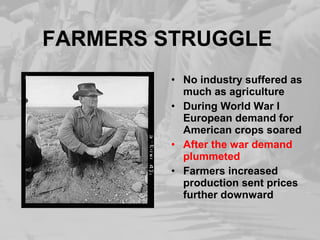
FARMERS STRUGGLE
• No industry suffered as
much as agriculture
• During World War I
European demand for
American crops soared
• After the war demand
plummeted
• Farmers increased
production sent prices
further downward
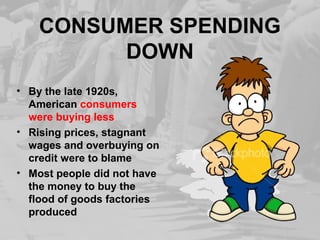
CONSUMER SPENDING
DOWN
• By the late 1920s,
American consumers
were buying less
• Rising prices, stagnant
wages and overbuying on
credit were to blame
• Most people did not have
the money to buy the
flood of goods factories
produced
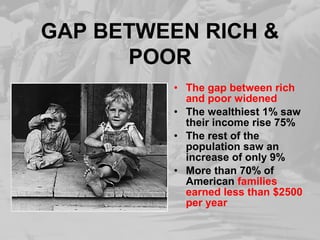
GAP BETWEEN RICH &
POOR
• The gap between rich
and poor widened
• The wealthiest 1% saw
their income rise 75%
• The rest of the
population saw an
increase of only 9%
• More than 70% of
American families
earned less than $2500
per year
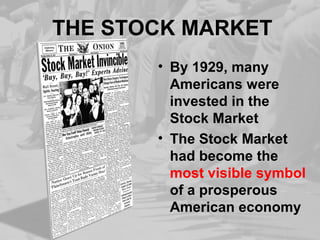
THE STOCK MARKET
• By 1929, many
Americans were
invested in the
Stock Market
• The Stock Market
had become the
most visible symbol
of a prosperous
American economy
THE STOCK MARKET
• The Dow Jones
Industrial Average
was the barometer
of the Stock
Market’s worth
• The Dow is a
measure based on
the price of 30 large
firms
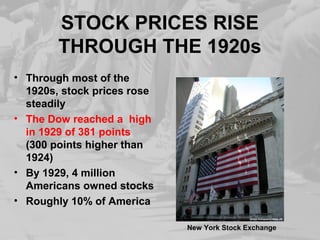
STOCK PRICES RISE
THROUGH THE 1920s
• Through most of the
1920s, stock prices rose
steadily
• The Dow reached a high
in 1929 of 381 points
(300 points higher than
1924)
• By 1929, 4 million
Americans owned stocks
• Roughly 10% of America
New York Stock Exchange
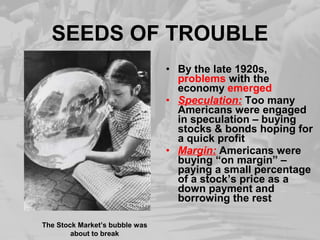
SEEDS OF TROUBLE
• By the late 1920s,
problems with the
economy emerged
• Speculation: Too many
Americans were engaged
in speculation – buying
stocks & bonds hoping for
a quick profit
• Margin: Americans were
buying “on margin” –
paying a small percentage
of a stock’s price as a
down payment and
borrowing the rest
The Stock Market’s bubble was
about to break
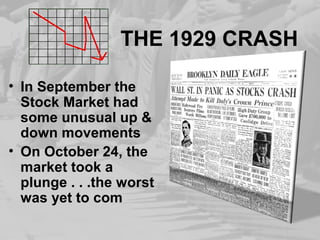
THE 1929 CRASH
• In September the
Stock Market had
some unusual up &
down movements
• On October 24, the
market took a
plunge . . .the worst
was yet to com
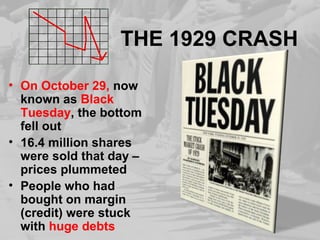
THE 1929 CRASH
• On October 29, now
known as Black
Tuesday, the bottom
fell out
• 16.4 million shares
were sold that day –
prices plummeted
• People who had
bought on margin
(credit) were stuck
with huge debts
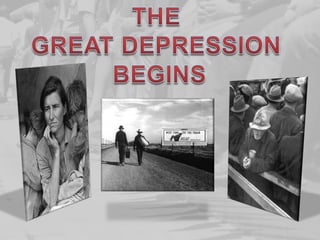
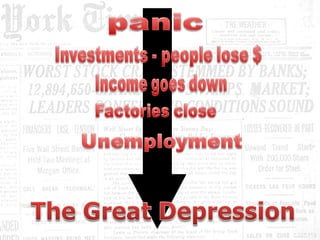
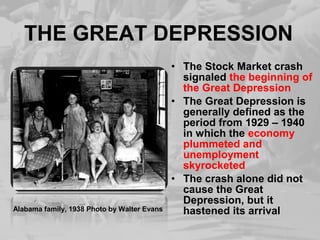
THE GREAT DEPRESSION
• The Stock Market crash
signaled the beginning of
the Great Depression
• The Great Depression is
generally defined as the
period from 1929 – 1940
in which the economy
plummeted and
unemployment
skyrocketed
• The crash alone did not
cause the Great
Depression, but it
hastened its arrivalAlabama family, 1938 Photo by Walter Evans
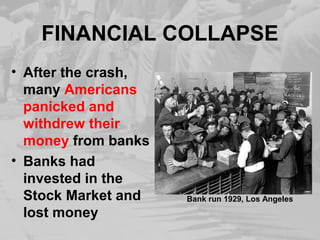
FINANCIAL COLLAPSE
• After the crash,
many Americans
panicked and
withdrew their
money from banks
• Banks had
invested in the
Stock Market and
lost money
Bank run 1929, Los Angeles
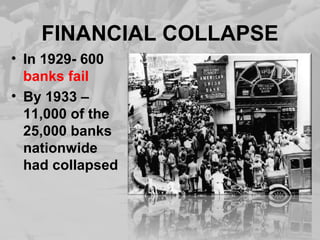
FINANCIAL COLLAPSE
• In 1929- 600
banks fail
• By 1933 –
11,000 of the
25,000 banks
nationwide
had collapsed
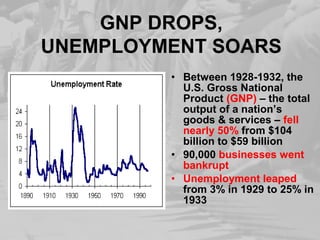
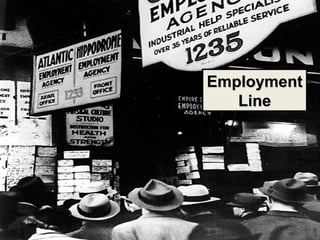
GNP DROPS,
UNEMPLOYMENT SOARS
• Between 1928-1932, the
U.S. Gross National
Product (GNP) – the total
output of a nation’s
goods & services – fell
nearly 50% from $104
billion to $59 billion
• 90,000 businesses went
bankrupt
• Unemployment leaped
from 3% in 1929 to 25% in
1933
EmploymentEmployment
LineLine
HAWLEY-
SMOOT TARIFF
• The U.S. was not the only
country gripped by the
Great Depression
• Much of Europe suffered
throughout the 1920s
• In 1930, Congress passed
the toughest tariff in U.S.
history called the
Hawley- Smoot Tariff
• It was meant to protect
U.S. industry yet had the
opposite effect
• Other countries enacted
their own tariffs and soon
world trade fell 40%
0
2
4
6
8
10
12
14
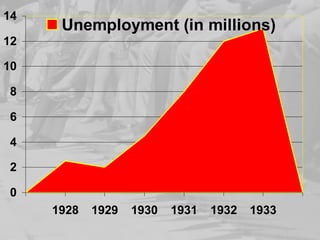
1928 1929 1930 1931 1932 1933
Unemployment (in millions)
0
0.5
1
1.5
2
2.5
3
3.5
4
4.5
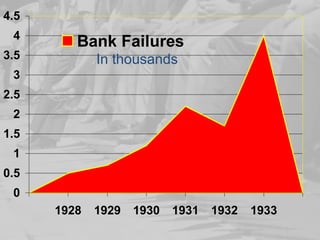
1928 1929 1930 1931 1932 1933
Bank Failures
In thousands
0
5
10
15
20
25
30
35
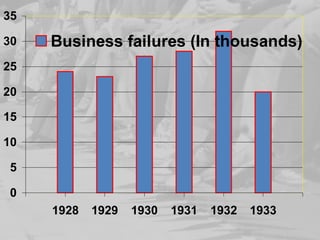
1928 1929 1930 1931 1932 1933
Business failures (In thousands)
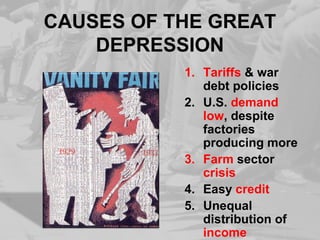
CAUSES OF THE GREAT
DEPRESSION
1. Tariffs & war
debt policies
2. U.S. demand
low, despite
factories
producing more
3. Farm sector
crisis
4. Easy credit
5. Unequal
distribution of
income
5-Square Pamphlet
Causes of the Great Depression
SECTION 2: HARDSHIPS
DURING DEPRESSION
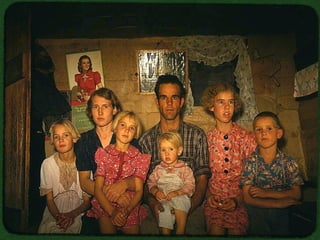
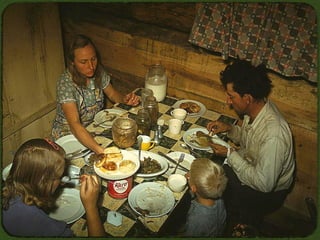
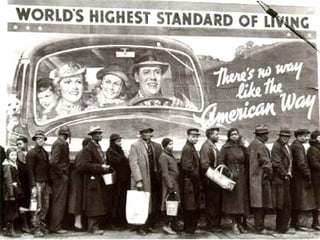
• The Great Depression brought hardship,
homelessness, and hunger to millions
• Across the country, people lost their jobs, and
their homes
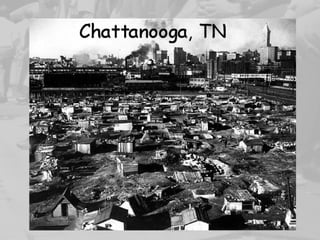
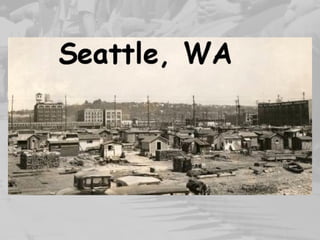
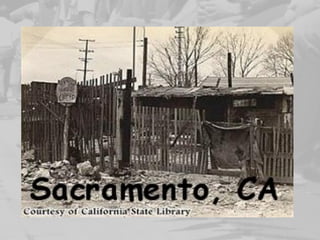
• Some built makeshifts shacks out of scrap
material
• Before long whole shantytowns (sometimes
called “Hoovervilles” in mock reference to
the president) sprung up
• Another symbol people began to display was
their pants pockets turned out, which were
known as “Hoover Flags”
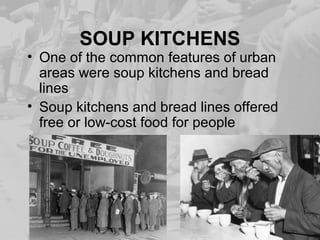
SOUP KITCHENS
• One of the common features of urban
areas were soup kitchens and bread
lines
• Soup kitchens and bread lines offered
free or low-cost food for people
CONDITIONS FOR MINORITIES
• Conditions for African Americans and
Latinos were especially difficult
• Unemployment was the highest among
minorities and their pay was the lowest
• Increased violence (24 lynchings in
1933 alone) marred the 1930s
• Many Mexicans were “encouraged” to
return to their homeland
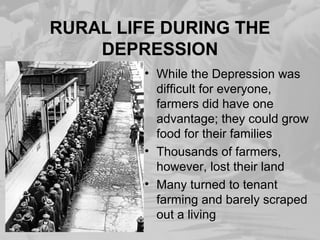
RURAL LIFE DURING THE
DEPRESSION
• While the Depression was
difficult for everyone,
farmers did have one
advantage; they could grow
food for their families
• Thousands of farmers,
however, lost their land
• Many turned to tenant
farming and barely scraped
out a living
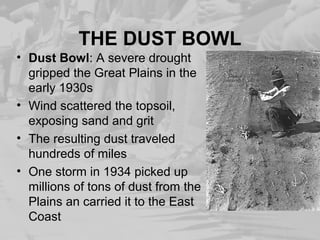
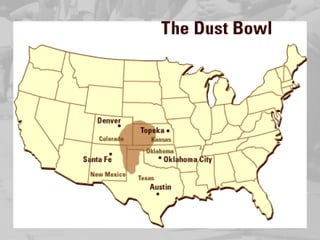
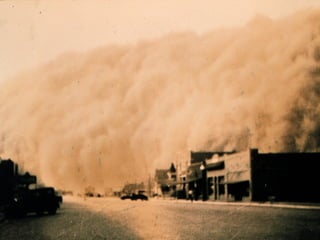
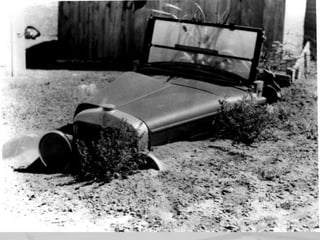
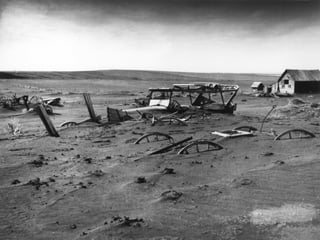
THE DUST BOWL
• Dust Bowl: A severe drought
gripped the Great Plains in the
early 1930s
• Wind scattered the topsoil,
exposing sand and grit
• The resulting dust traveled
hundreds of miles
• One storm in 1934 picked up
millions of tons of dust from the
Plains an carried it to the East
Coast
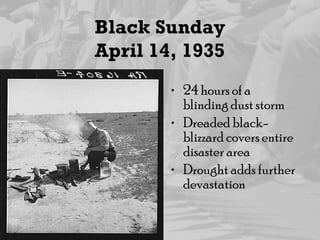
Black Sunday
April 14, 1935
• 24 hours of a
blinding dust storm
• Dreaded black-
blizzard covers entire
disaster area
• Drought adds further
devastation
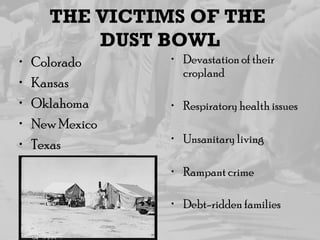
THE VICTIMS OF THE
DUST BOWL
• Colorado
• Kansas
• Oklahoma
• New Mexico
• Texas
• Devastation of their
cropland
• Respiratory health issues
• Unsanitary living
• Rampant crime
• Debt-ridden families
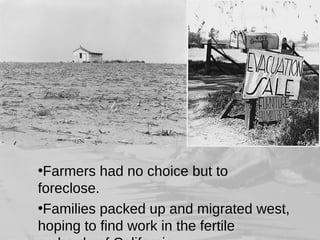
•Farmers had no choice but to
foreclose.
•Families packed up and migrated west,
hoping to find work in the fertile
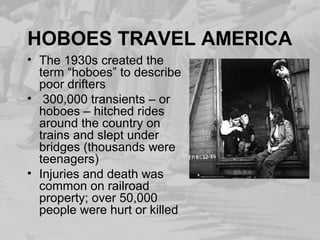
HOBOES TRAVEL AMERICA
• The 1930s created the
term “hoboes” to describe
poor drifters
• 300,000 transients – or
hoboes – hitched rides
around the country on
trains and slept under
bridges (thousands were
teenagers)
• Injuries and death was
common on railroad
property; over 50,000
people were hurt or killed
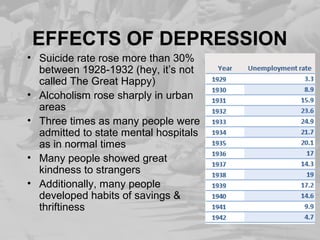
EFFECTS OF DEPRESSION
• Suicide rate rose more than 30%
between 1928-1932 (hey, it’s not
called The Great Happy)
• Alcoholism rose sharply in urban
areas
• Three times as many people were
admitted to state mental hospitals
as in normal times
• Many people showed great
kindness to strangers
• Additionally, many people
developed habits of savings &
thriftiness
SECTION 3: HOOVER
STRUGGLES WITH THE
DEPRESSION
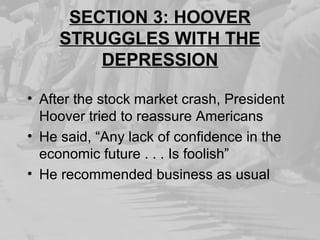
• After the stock market crash, President
Hoover tried to reassure Americans
• He said, “Any lack of confidence in the
economic future . . . Is foolish”
• He recommended business as usual
HOOVER’S PHILOSOPHY
• Hoover was not quick to react to the
depression
• He believed in “rugged individualism” –
the idea that people succeed through
their own efforts
• People should take care of themselves,
not depend on governmental hand-outs
• He said people should “pull themselves
up by their bootstraps”
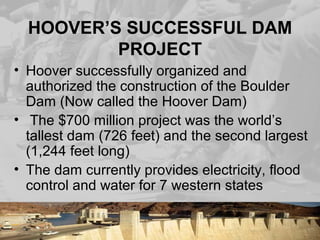
HOOVER’S SUCCESSFUL DAM
PROJECT
• Hoover successfully organized and
authorized the construction of the Boulder
Dam (Now called the Hoover Dam)
• The $700 million project was the world’s
tallest dam (726 feet) and the second largest
(1,244 feet long)
• The dam currently provides electricity, flood
control and water for 7 western states
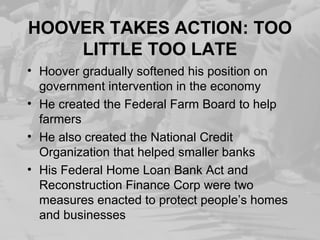
HOOVER TAKES ACTION: TOO
LITTLE TOO LATE
• Hoover gradually softened his position on
government intervention in the economy
• He created the Federal Farm Board to help
farmers
• He also created the National Credit
Organization that helped smaller banks
• His Federal Home Loan Bank Act and
Reconstruction Finance Corp were two
measures enacted to protect people’s homes
and businesses
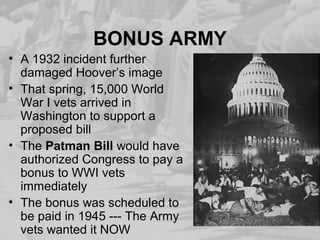
BONUS ARMY
• A 1932 incident further
damaged Hoover’s image
• That spring, 15,000 World
War I vets arrived in
Washington to support a
proposed bill
• The Patman Bill would have
authorized Congress to pay a
bonus to WWI vets
immediately
• The bonus was scheduled to
be paid in 1945 --- The Army
vets wanted it NOW
BONUS ARMY TURNED DOWN
• Hoover called the Bonus marchers,
“Communists and criminals”
• On June 17, 1932 the Senate voted
down the Putnam Bill
BONUS MARCHERS CLASH
WITH SOLDIERS
• Hoover told the Bonus marchers to go
home– most did
• 2,000 refused to leave
• Hoover sent a force of 1,000 soldiers
under the command of General
Douglas MacArthur and his aide Dwight
Eisenhower
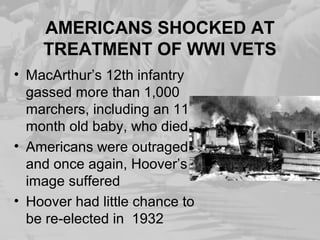
AMERICANS SHOCKED AT
TREATMENT OF WWI VETS
• MacArthur’s 12th infantry
gassed more than 1,000
marchers, including an 11-
month old baby, who died
• Americans were outraged
and once again, Hoover’s
image suffered
• Hoover had little chance to
be re-elected in 1932

Great depression 2010

  • 1.
    •What are your strategiesfor saving money?
  • 2.
    •If the stockmarket collapsed today, how would your family be affected?
  • 6.
    HOOVER WINS 1928 ELECTION •Republican Herbert Hoover ran against Democrat Alfred E. Smith in the 1928 election • Hoover emphasized years of prosperity under Republican administrations • Hoover won an overwhelming victory
  • 9.
    National Perceptions • Afterthe election of Hoover, most American’s were optimistic about the future of the country • Stock prices were soaring and so many people began to invest in stocks • All of the good times of the country would come to crash in 1929
  • 10.
  • 11.
    THE NATION’S SICK ECONOMY •Agriculture • Railroads • Textiles • Steel • Mining • Lumber • Automobiles • Housing • Consumer goods As the 1920s advanced, serious problems threatened the economy while Important industries struggled, including:
  • 12.
    FARMERS STRUGGLE • Noindustry suffered as much as agriculture • During World War I European demand for American crops soared • After the war demand plummeted • Farmers increased production sent prices further downward
  • 20.
    CONSUMER SPENDING DOWN • Bythe late 1920s, American consumers were buying less • Rising prices, stagnant wages and overbuying on credit were to blame • Most people did not have the money to buy the flood of goods factories produced
  • 21.
    GAP BETWEEN RICH& POOR • The gap between rich and poor widened • The wealthiest 1% saw their income rise 75% • The rest of the population saw an increase of only 9% • More than 70% of American families earned less than $2500 per year
  • 22.
    THE STOCK MARKET •By 1929, many Americans were invested in the Stock Market • The Stock Market had become the most visible symbol of a prosperous American economy
  • 23.
    THE STOCK MARKET •The Dow Jones Industrial Average was the barometer of the Stock Market’s worth • The Dow is a measure based on the price of 30 large firms
  • 24.
    STOCK PRICES RISE THROUGHTHE 1920s • Through most of the 1920s, stock prices rose steadily • The Dow reached a high in 1929 of 381 points (300 points higher than 1924) • By 1929, 4 million Americans owned stocks • Roughly 10% of America New York Stock Exchange
  • 25.
    SEEDS OF TROUBLE •By the late 1920s, problems with the economy emerged • Speculation: Too many Americans were engaged in speculation – buying stocks & bonds hoping for a quick profit • Margin: Americans were buying “on margin” – paying a small percentage of a stock’s price as a down payment and borrowing the rest The Stock Market’s bubble was about to break
  • 26.
    THE 1929 CRASH •In September the Stock Market had some unusual up & down movements • On October 24, the market took a plunge . . .the worst was yet to com
  • 27.
    THE 1929 CRASH •On October 29, now known as Black Tuesday, the bottom fell out • 16.4 million shares were sold that day – prices plummeted • People who had bought on margin (credit) were stuck with huge debts
  • 30.
    THE GREAT DEPRESSION •The Stock Market crash signaled the beginning of the Great Depression • The Great Depression is generally defined as the period from 1929 – 1940 in which the economy plummeted and unemployment skyrocketed • The crash alone did not cause the Great Depression, but it hastened its arrivalAlabama family, 1938 Photo by Walter Evans
  • 34.
    FINANCIAL COLLAPSE • Afterthe crash, many Americans panicked and withdrew their money from banks • Banks had invested in the Stock Market and lost money Bank run 1929, Los Angeles
  • 35.
    FINANCIAL COLLAPSE • In1929- 600 banks fail • By 1933 – 11,000 of the 25,000 banks nationwide had collapsed
  • 37.
    GNP DROPS, UNEMPLOYMENT SOARS •Between 1928-1932, the U.S. Gross National Product (GNP) – the total output of a nation’s goods & services – fell nearly 50% from $104 billion to $59 billion • 90,000 businesses went bankrupt • Unemployment leaped from 3% in 1929 to 25% in 1933
  • 38.
  • 39.
    HAWLEY- SMOOT TARIFF • TheU.S. was not the only country gripped by the Great Depression • Much of Europe suffered throughout the 1920s • In 1930, Congress passed the toughest tariff in U.S. history called the Hawley- Smoot Tariff • It was meant to protect U.S. industry yet had the opposite effect • Other countries enacted their own tariffs and soon world trade fell 40%
  • 40.
    0 2 4 6 8 10 12 14 1928 1929 19301931 1932 1933 Unemployment (in millions)
  • 41.
    0 0.5 1 1.5 2 2.5 3 3.5 4 4.5 1928 1929 19301931 1932 1933 Bank Failures In thousands
  • 42.
    0 5 10 15 20 25 30 35 1928 1929 19301931 1932 1933 Business failures (In thousands)
  • 43.
    CAUSES OF THEGREAT DEPRESSION 1. Tariffs & war debt policies 2. U.S. demand low, despite factories producing more 3. Farm sector crisis 4. Easy credit 5. Unequal distribution of income
  • 44.
    5-Square Pamphlet Causes ofthe Great Depression
  • 46.
    SECTION 2: HARDSHIPS DURINGDEPRESSION • The Great Depression brought hardship, homelessness, and hunger to millions • Across the country, people lost their jobs, and their homes • Some built makeshifts shacks out of scrap material • Before long whole shantytowns (sometimes called “Hoovervilles” in mock reference to the president) sprung up • Another symbol people began to display was their pants pockets turned out, which were known as “Hoover Flags”
  • 54.
    SOUP KITCHENS • Oneof the common features of urban areas were soup kitchens and bread lines • Soup kitchens and bread lines offered free or low-cost food for people
  • 55.
    CONDITIONS FOR MINORITIES •Conditions for African Americans and Latinos were especially difficult • Unemployment was the highest among minorities and their pay was the lowest • Increased violence (24 lynchings in 1933 alone) marred the 1930s • Many Mexicans were “encouraged” to return to their homeland
  • 56.
    RURAL LIFE DURINGTHE DEPRESSION • While the Depression was difficult for everyone, farmers did have one advantage; they could grow food for their families • Thousands of farmers, however, lost their land • Many turned to tenant farming and barely scraped out a living
  • 57.
    THE DUST BOWL •Dust Bowl: A severe drought gripped the Great Plains in the early 1930s • Wind scattered the topsoil, exposing sand and grit • The resulting dust traveled hundreds of miles • One storm in 1934 picked up millions of tons of dust from the Plains an carried it to the East Coast
  • 59.
    Black Sunday April 14,1935 • 24 hours of a blinding dust storm • Dreaded black- blizzard covers entire disaster area • Drought adds further devastation
  • 63.
    THE VICTIMS OFTHE DUST BOWL • Colorado • Kansas • Oklahoma • New Mexico • Texas • Devastation of their cropland • Respiratory health issues • Unsanitary living • Rampant crime • Debt-ridden families
  • 64.
    •Farmers had nochoice but to foreclose. •Families packed up and migrated west, hoping to find work in the fertile
  • 65.
    HOBOES TRAVEL AMERICA •The 1930s created the term “hoboes” to describe poor drifters • 300,000 transients – or hoboes – hitched rides around the country on trains and slept under bridges (thousands were teenagers) • Injuries and death was common on railroad property; over 50,000 people were hurt or killed
  • 66.
    EFFECTS OF DEPRESSION •Suicide rate rose more than 30% between 1928-1932 (hey, it’s not called The Great Happy) • Alcoholism rose sharply in urban areas • Three times as many people were admitted to state mental hospitals as in normal times • Many people showed great kindness to strangers • Additionally, many people developed habits of savings & thriftiness
  • 67.
    SECTION 3: HOOVER STRUGGLESWITH THE DEPRESSION • After the stock market crash, President Hoover tried to reassure Americans • He said, “Any lack of confidence in the economic future . . . Is foolish” • He recommended business as usual
  • 68.
    HOOVER’S PHILOSOPHY • Hooverwas not quick to react to the depression • He believed in “rugged individualism” – the idea that people succeed through their own efforts • People should take care of themselves, not depend on governmental hand-outs • He said people should “pull themselves up by their bootstraps”
  • 69.
    HOOVER’S SUCCESSFUL DAM PROJECT •Hoover successfully organized and authorized the construction of the Boulder Dam (Now called the Hoover Dam) • The $700 million project was the world’s tallest dam (726 feet) and the second largest (1,244 feet long) • The dam currently provides electricity, flood control and water for 7 western states
  • 70.
    HOOVER TAKES ACTION:TOO LITTLE TOO LATE • Hoover gradually softened his position on government intervention in the economy • He created the Federal Farm Board to help farmers • He also created the National Credit Organization that helped smaller banks • His Federal Home Loan Bank Act and Reconstruction Finance Corp were two measures enacted to protect people’s homes and businesses
  • 71.
    BONUS ARMY • A1932 incident further damaged Hoover’s image • That spring, 15,000 World War I vets arrived in Washington to support a proposed bill • The Patman Bill would have authorized Congress to pay a bonus to WWI vets immediately • The bonus was scheduled to be paid in 1945 --- The Army vets wanted it NOW
  • 72.
    BONUS ARMY TURNEDDOWN • Hoover called the Bonus marchers, “Communists and criminals” • On June 17, 1932 the Senate voted down the Putnam Bill
  • 73.
    BONUS MARCHERS CLASH WITHSOLDIERS • Hoover told the Bonus marchers to go home– most did • 2,000 refused to leave • Hoover sent a force of 1,000 soldiers under the command of General Douglas MacArthur and his aide Dwight Eisenhower
  • 74.
    AMERICANS SHOCKED AT TREATMENTOF WWI VETS • MacArthur’s 12th infantry gassed more than 1,000 marchers, including an 11- month old baby, who died • Americans were outraged and once again, Hoover’s image suffered • Hoover had little chance to be re-elected in 1932