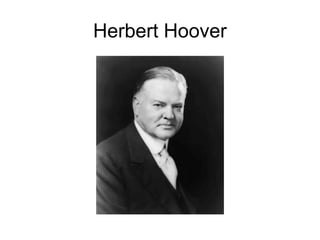
Herbert Hoover
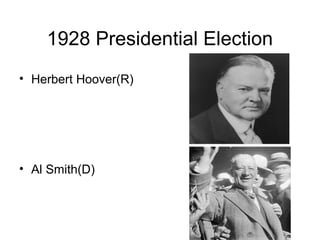
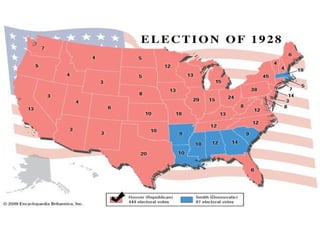
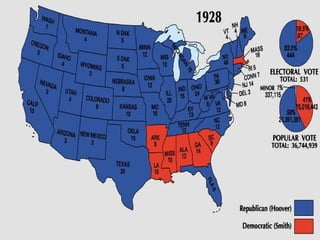
1928 Presidential Election
• Herbert Hoover(R)
• Al Smith(D)
Hoover’s Ironic Speech
• "We in America today are nearer to the
final triumph over poverty than ever before
in the history of this land... We shall soon
with the help of God be in sight of the day
when poverty will be banished from this
land."
• Herbert Hoover in his acceptance speech
June, 1928
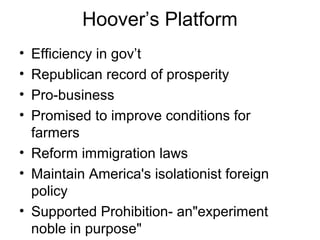
Hoover’s Platform
• Efficiency in gov’t
• Republican record of prosperity
• Pro-business
• Promised to improve conditions for
farmers
• Reform immigration laws
• Maintain America's isolationist foreign
policy
• Supported Prohibition- an"experiment
noble in purpose"
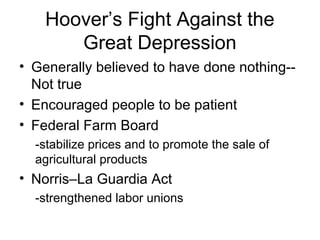
Hoover’s Fight Against the
Great Depression
• Generally believed to have done nothing--
Not true
• Encouraged people to be patient
• Federal Farm Board
-stabilize prices and to promote the sale of
agricultural products
• Norris–La Guardia Act
-strengthened labor unions
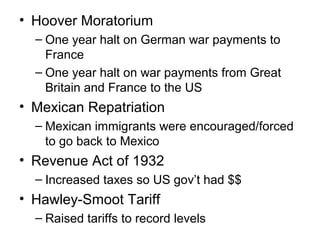
• Hoover Moratorium
– One year halt on German war payments to
France
– One year halt on war payments from Great
Britain and France to the US
• Mexican Repatriation
– Mexican immigrants were encouraged/forced
to go back to Mexico
• Revenue Act of 1932
– Increased taxes so US gov’t had $$
• Hawley-Smoot Tariff
– Raised tariffs to record levels
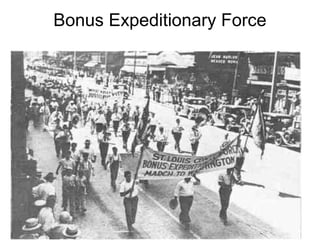
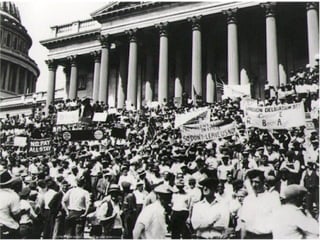
Bonus Expeditionary Force
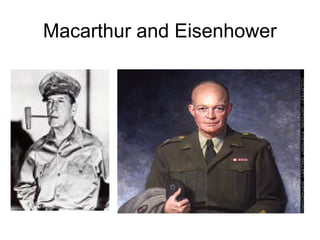
Macarthur and Eisenhower
Reconstruction Finance
Corporation (RFC)-1932
• Gave loans to banks, state and local
govt’s, and business’ to create
projects/jobs for people
• gave states loans for emergency relief
needs
• Started under Hoover
• Not as successful as Hoover had hoped
• Dissolved in 1946 after WWII
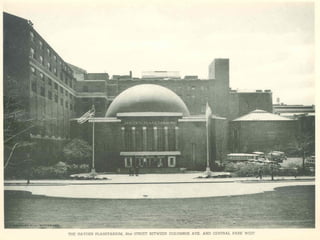
Hayden Planetarium-RFC
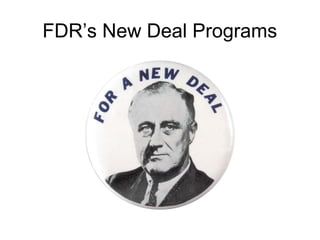
FDR’s New Deal Programs
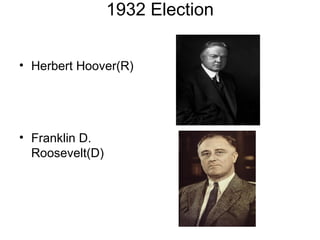
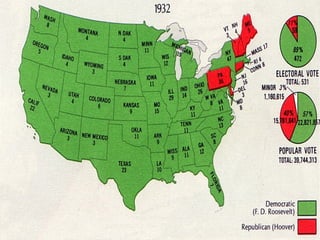
1932 Election
• Herbert Hoover(R)
• Franklin D.
Roosevelt(D)
Relief, Reform and Recovery
• Relief for the needy
• Economic recovery
• Financial reform
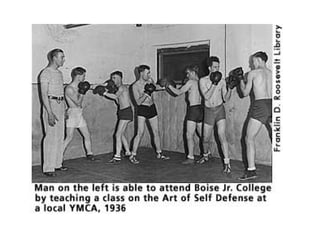
Civilian Conservation Corps (CCC)
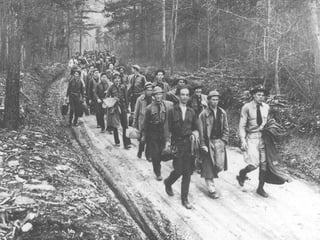
• Passed in 1933 during the “One Hundred
Days”
• CCC members worked 40 hours a week
and were paid $30 a month, with the
requirement that $25 of that be sent home
to family
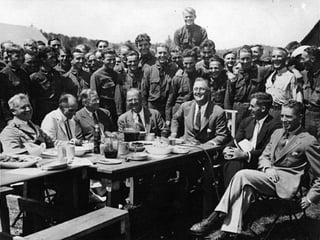
• Members lived in camps, wore uniforms,
and lived under military discipline
• The U.S. Army operated the camps
• The CCC was limited to young men age
18 to 25 whose fathers were on relief
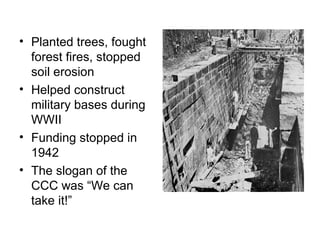
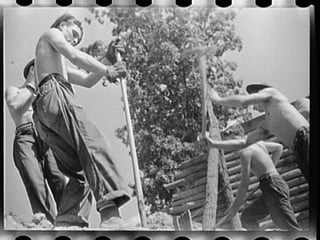
• Planted trees, fought
forest fires, stopped
soil erosion
• Helped construct
military bases during
WWII
• Funding stopped in
1942
• The slogan of the
CCC was “We can
take it!”
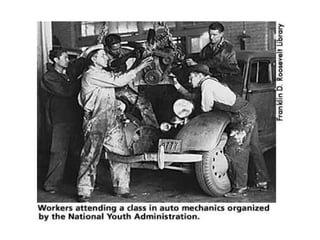
National Youth Administration
(NYA)
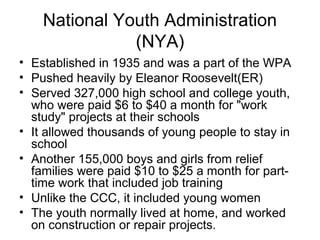
• Established in 1935 and was a part of the WPA
• Pushed heavily by Eleanor Roosevelt(ER)
• Served 327,000 high school and college youth,
who were paid $6 to $40 a month for "work
study" projects at their schools
• It allowed thousands of young people to stay in
school
• Another 155,000 boys and girls from relief
families were paid $10 to $25 a month for part-
time work that included job training
• Unlike the CCC, it included young women
• The youth normally lived at home, and worked
on construction or repair projects.
Federal Emergency Relief Act
(FERA)
• Enacted in 1933
• Main function was to create the Federal
Emergency Relief Administration (FERA)
• FERA distributed more than 20 million dollars in
direct aid to the unemployed
• This in turn would help the unemployed to find
new jobs.
• FERA had three primary objectives:
• 1) direct relief measures
• 2) provide work for employable people
• 3) provide many different types of relief
programs
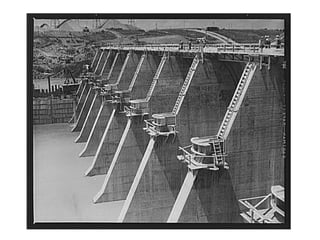
Public Works Administration (PWA)
• Established in 1933
• Created as many jobs as possible in many
different varieties
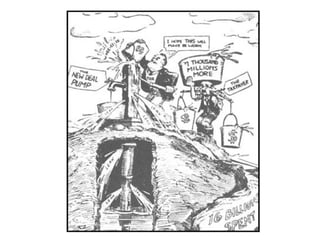
• Great example of FDR’s “priming the pump”
• Between July 1933 and March 1939 the PWA
funded the construction of more than 34,000
projects including airports, dams, aircraft
carriers, bridges,
• Was responsible for 70% of the new schools and
33% of the hospitals built between 1933-1939.
• Look at PWA Overhead
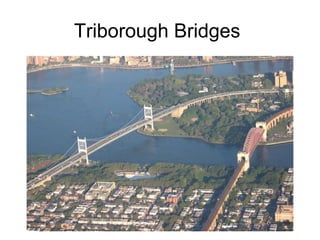
Triborough Bridges
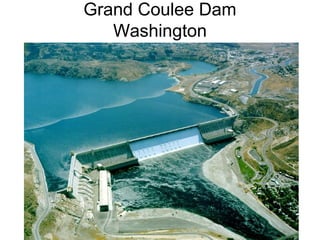
Grand Coulee Dam
Washington
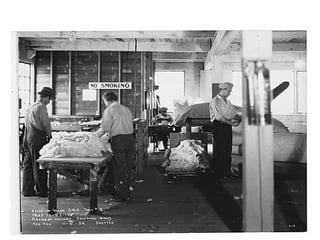
Civil Works Administration (CWA)
• Established in 1933 to create jobs for
millions of the unemployed
• The CWA created construction jobs,
mainly improving or constructing buildings
and bridges
• In just one year, the CWA cost the
government over $800,000,000 and was
cancelled
• So much was spent on this administration
because it hired 4 million people and was
mostly concerned with paying high wages
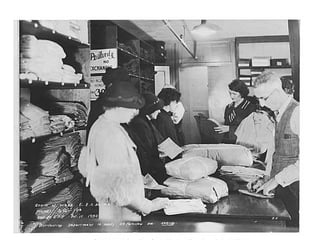
Works Progress Administration
• Established in 1935
• Largest and most comprehensive New
Deal Agency
• The WPA was a “make work" program
that provided jobs and income to the
unemployed during the Great Depression
• WPA projects primarily employed unskilled
workers in construction projects across the
nation
• The WPA built 650,000 miles of roads, 78,000
bridges, 125,000 buildings, and 7000 miles of
airport runways
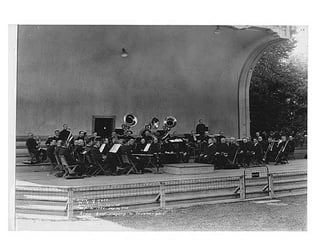
• It presented 225,000 concerts and produced
almost 475,000 works of art
• Federal Project No. 1(Federal One) of the WPA
was developed to give artistic and professional
work to the unemployed who qualified
• It consisted of the Federal Art Project (FAP),
Federal Music Project (FMP), Federal Theatre
Project (FTP), the Federal Writers’ Project
(FWP), and the Historical Records Survey (HRS)
• The WPA
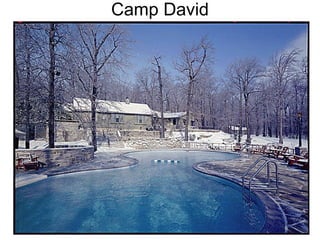
Camp David
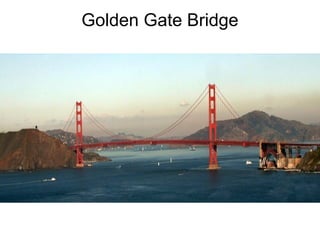
Golden Gate Bridge
Paul Cervantez
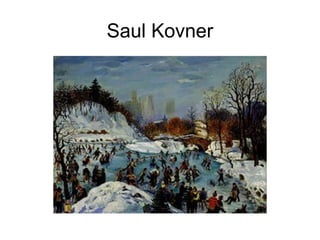
Saul Kovner
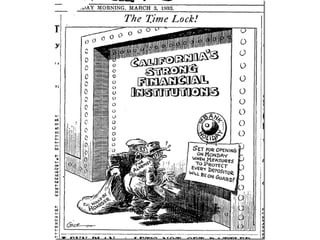
Emergency Banking Relief
Act(EBRA)
• Passed five days after taking office-March, 1933
• Passed in response to the thousands of banks
that closed down
• Passed four days after FDR announced the
Bank Holiday, which closed banks down
temporarily
• The EBRA would close down the bank,
reorganize it and then reopen the bank when it
was stable
• Provided insurance to people’s money in
the banks
• When banks reopened on March 13,
1933, many people put their money back
into the banks
• Within a couple of weeks, more than half
of the money that people withdrew from
banks was put back into banks
• Generally ended the bank runs that was
commonplace from 1929-1933.
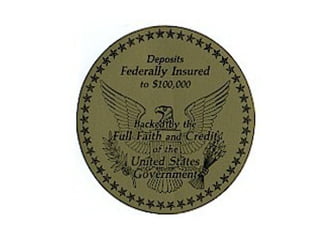
Federal Deposit Insurance
Corporation (FDIC)
• Created by the Glass-Steagall Act in 1933
• Insured people’s money in banks up to
$1000(today up to $100,000)
• Passed in response to the bank failures after the
stock market crash
• Insures money in savings and checking
accounts, money market accounts and CD’s
• Does not insure stocks, bonds, mutual funds,
items in safety deposit boxes, loss due to theft or
fraud and insurance accounts
Banking Act of 1935
• Made the FDIC a permanent agency
within the US government
• Strengthened the power of the Federal
Reserve making banking safer overall.
Federal Securities Act
• Passed in 1933
• Made the stock market a safer place for
people to invest their money
• Two goals:
• 1. “required that investors receive
significant information regarding securities
being offered for public sale”
• 2. “prohibited deceit, misrepresentations,
and other fraud in the sale of securities to
the public”
Securities and Exchange
Commission (SEC)
• Established in 1934
and is still around
today
• This organization
regulates the stock
market therefore
making the market
more secure and
safer for people’s
money
National Industrial Recovery Act (NIRA) and
National Recovery Administration (NRA)
• established “codes of fair competition” aimed at
supporting prices and wages and stimulating economic
recovery from the Great Depression
• The law created a National Recovery Administration
(NRA) to enforce codes
• The administration tried to make voluntary agreements
dealing with hours of work, rates of pay, and the fixing of
prices
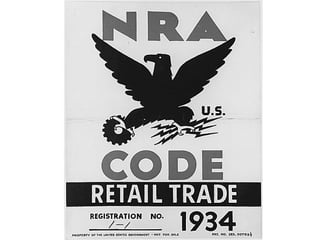
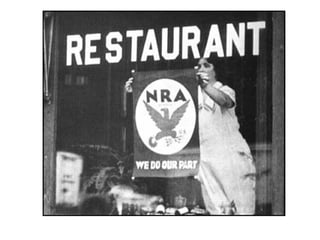
• Firms which voluntarily complied could display the Blue
Eagle
• The NIRA also helped create jobs for unemployed
workers(building schools)
• Section 7A guaranteed workers the right to unionize
• Declared unconstitutional by Supreme Court(1935)
• Seen as a failure
National Labor Relations Act/Board
(NLRA(B)
• established in 1935 through passage of
the National Labor Relations Act(Wagner
Act)
• conducts elections for unions
• Stresses collective bargaining
• investigates and fixes unfair labor
practices
• governed by a five-person board whose
members are appointed by the President
Fair Labor Standards Act (FLSA)
• Established a national minimum wage-40
cents/hour
• Established the 40 hour work week
• Guaranteed time and a half for overtime in
certain jobs
• Prohibited most child labor
• Still exists today
Agricultural Adjustment Act (AAA)
• Established in 1933
• Restricted production during the New Deal
by paying farmers to reduce the amount of
crops planted
• Its purpose was to reduce crop surplus so
prices would go up
• The farmers were paid by the federal
government for leaving some of their land
untilled
• The Act created a new agency, the
Agricultural Adjustment Administration to
carry out law
• The AAA oversaw a large-scale destruction of
existing crops and livestock in an attempt to
reduce surpluses
• For example, six million pigs and 220,000 sows
were slaughtered in the AAA's effort to raise
prices
• Cotton farmers plowed under a quarter of their
crop
• Due to the nature of the Great Depression, many
United States citizens saw the AAA as cruel
• While people in the cities were starving, the
federal government was destroying crops and
livestock in the country
• Farm prices more than doubled(1933-35)
• The AAA was declared unconstitutional by
the Supreme Court in 1936 because it
taxed one group(food processors) to pay
another
• The second AAA was passed in 1938
• The second AAA was funded from general
taxation, and therefore acceptable to the
Supreme Court
Soil Conservation and Domestic
Allotment Act
• Allowed the government to pay farmers to reduce
production so as to "conserve soil“ and prevent erosion
• It was a piece of legislation passed in response to the
Supreme Court's declaration that the Agricultural
Adjustment Act (AAA) was unconstitutional.
• Educated farmers on how to use their lands without
damaging them
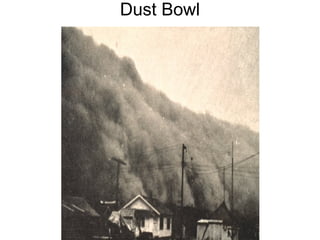
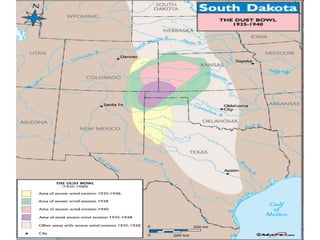
• Took immediate action to contain the dust bowl's effects
by planting trees and native grass
• Three years after the Act was adopted, soil erosion had
dropped 65%.
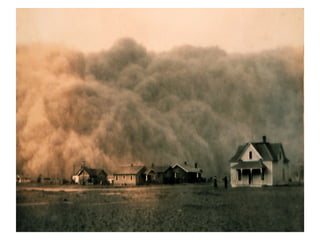
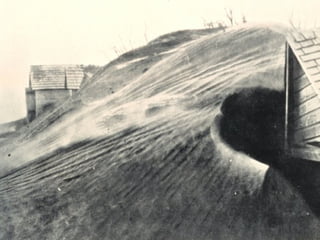
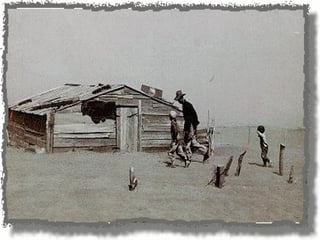
Dust Bowl
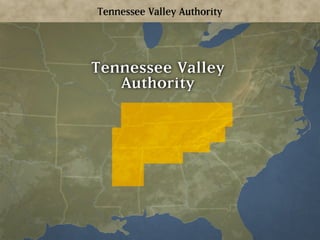
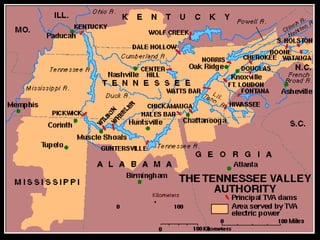
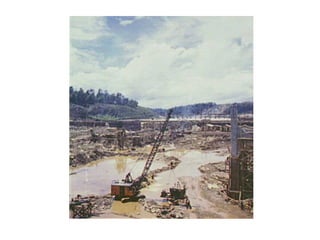
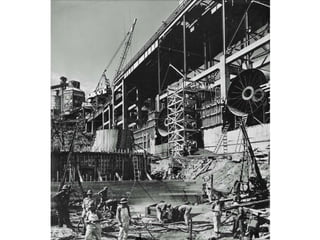
Tennessee Valley Authority (TVA)
• Created to generate electric power and
control floods in a seven state region
around the Tennessee River Valley
• FDR signed the Tennessee Valley
Authority Act creating the TVA on May 18,
1933
• The agency still exists and has grown to
become America's largest public power
company
• Some criticized the TVA for only helping a
specific region not the whole country
Rural Electrification
Administration(REA)
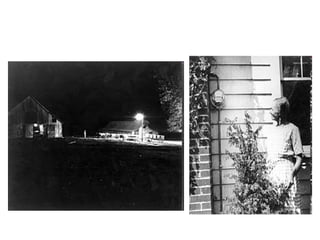
• The REA was created (1935)
• The REA provided farms with inexpensive electric
lighting and power and eventually telephone services.
• This brought all the electrical appliances that the cities
had since the 1920’s
• The REA made long-term loans to state and local
governments, to farmers' cooperatives, and to nonprofit
organizations to do the work.
• By 1939 rural households with electricity had risen to
25%(up from 10% 7 years earlier)
• The administration was abolished in 1994 and its
functions assumed by the Rural Utilities Service
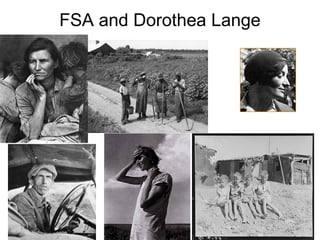
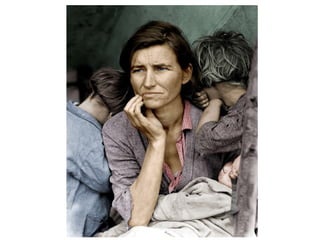
Farm Security Administration (FSA)
• Granted small farmers and tenant farmers
money to purchase farms
• The Dust Bowl forced a lot of farmers off
their farms
• Many farmers bought tractors with money
from the AAA thus forcing tenant farmers
off the land
• The FSA provided relief to these people
• http://www.livinghistoryfarm.org/farmingint
he30s/water_14.html
FSA and Dorothea Lange
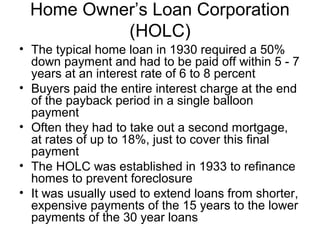
Home Owner’s Loan Corporation
(HOLC)
• The typical home loan in 1930 required a 50%
down payment and had to be paid off within 5 - 7
years at an interest rate of 6 to 8 percent
• Buyers paid the entire interest charge at the end
of the payback period in a single balloon
payment
• Often they had to take out a second mortgage,
at rates of up to 18%, just to cover this final
payment
• The HOLC was established in 1933 to refinance
homes to prevent foreclosure
• It was usually used to extend loans from shorter,
expensive payments of the 15 years to the lower
payments of the 30 year loans
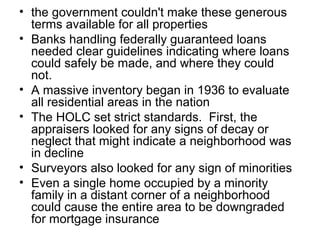
• the government couldn't make these generous
terms available for all properties
• Banks handling federally guaranteed loans
needed clear guidelines indicating where loans
could safely be made, and where they could
not.
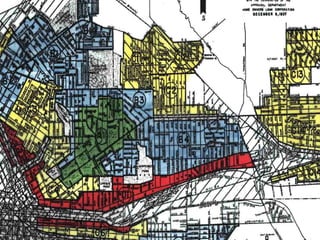
• A massive inventory began in 1936 to evaluate
all residential areas in the nation
• The HOLC set strict standards. First, the
appraisers looked for any signs of decay or
neglect that might indicate a neighborhood was
in decline
• Surveyors also looked for any sign of minorities
• Even a single home occupied by a minority
family in a distant corner of a neighborhood
could cause the entire area to be downgraded
for mortgage insurance
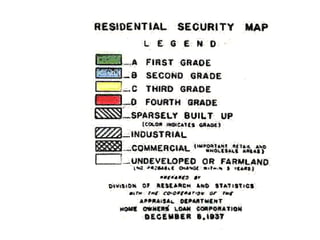
• A The "A" or "First Grade" areas were colored green and had the
federal government's full blessing. These were usually new or
recently built neighborhoods on the edge of town that were virtually
free of African Americans or "foreign-born whites." Lenders were
encouraged to offer the maximum amount available in the "A" areas
• B The "Second Grade" or "B" areas were colored blue. These were
still good neighborhoods but beginning to fray around the edges.
Here mortgage lenders were advised to make loans at 10 to 15
percent below the maximum available amount
• C "Third Grade" areas were colored yellow. These were older
neighborhoods with housing styles that might now be "out of
fashion." Often neighborhood covenants had expired. And, of
course, these areas were subject to "infiltration of a lower grade
population."
D "D" neighborhoods were usually struggling for survival -- and the
"Fourth Grade" designation guaranteed the struggle would be a
losing one. Characterized by "undesirable population or an
infiltration of it," mortgage lenders would often refuse to make any
loans on properties in these neighborhoods
Federal Housing
Administration(FHA)
• The Federal Housing Administration was created
in 1934
• Insured loans made by banks and other private
lenders for home building and home buying
• The goals of this organization are to improve
housing standards and conditions and to provide
an adequate home financing system
• In 1965, the Federal Housing Administration
became part of the Department of Housing and
Urban Development (HUD) and is still around
today
Unites States Housing
Authority(USHA)
• Created in 1937
• It was designed to lend money to the
states or communities for low-cost home
construction
• Homes were designed for low-income and
homeless people
• The USHA was absorbed by the National
Housing Agency in 1942
Social Security Administration
(SSA)
• Established in 1935
• provides retirement,
disability, and survivors'
benefits
• To qualify for these
benefits, most American
workers pay Social
Security taxes on their
earnings
• Future benefits are based
on employees'
contributions
• Each person is given a
Social Security number
Food, Drug and Cosmetic
Act(FFDCA)
• Passed in 1938
• Gave the Food and Drug Administration power
to regulate these industries
• Mandated a review of the safety of all new drugs
before going to market
• Banned false therapeutic claims in drug labeling
• Authorized factory inspections and expanded
enforcement powers by the FDA
• Set new regulatory standards for foods and
cosmetics
Indian Reorganization Act(IRA)
• Passed in 1934
• Abolished the Dawes Act and allowed Native
American to govern themselves on a tribal basis
• Allowed Native Americans to manage and keep
their own land
• Included provisions to help create job
opportunities on Indian Reservations. This has
led to many casinos on Indian Reservations
• The Act is still around today
Opponents
• Some say FDR went too far. Spent too
much $$.
• Others say he didn’t do enough. He
needed to do more
• A. What were some of the reasons the New
Deal was challenged?
• 1. Created a very powerful president that led
Congress, this was a violation of checks and
balances.
• 2. It was a radical departure from Laissez Faire
ideals. Created "big government" .
• 3. Some acts appeared interfering and
unconstitutional.
• 4. Heavy debt burden - the United States was
engaged in deficit spending and this was
unhealthy for the economy in the long run.
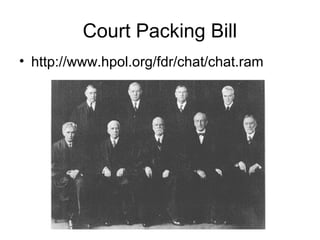
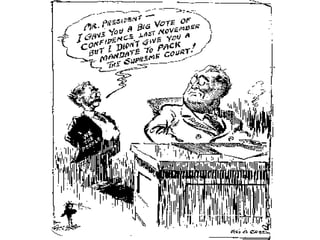
Court Packing Bill
• http://www.hpol.org/fdr/chat/chat.ram
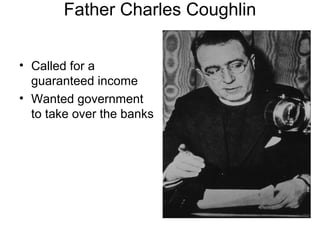
Father Charles Coughlin
• Called for a
guaranteed income
• Wanted government
to take over the banks
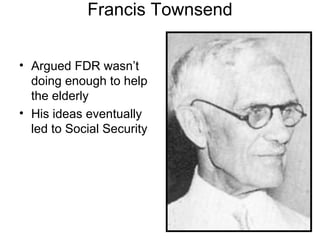
Francis Townsend
• Argued FDR wasn’t
doing enough to help
the elderly
• His ideas eventually
led to Social Security
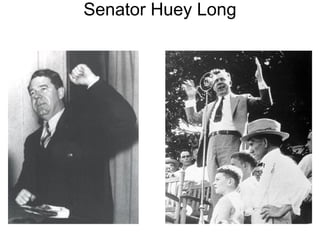
Senator Huey Long
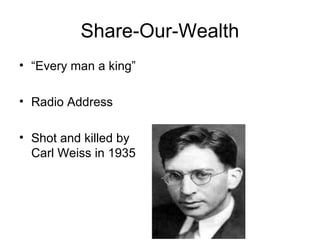
Share-Our-Wealth
• “Every man a king”
• Radio Address
• Shot and killed by
Carl Weiss in 1935

New dealorgsnew

  • 1.
  • 2.
    1928 Presidential Election •Herbert Hoover(R) • Al Smith(D)
  • 4.
    Hoover’s Ironic Speech •"We in America today are nearer to the final triumph over poverty than ever before in the history of this land... We shall soon with the help of God be in sight of the day when poverty will be banished from this land." • Herbert Hoover in his acceptance speech June, 1928
  • 5.
    Hoover’s Platform • Efficiencyin gov’t • Republican record of prosperity • Pro-business • Promised to improve conditions for farmers • Reform immigration laws • Maintain America's isolationist foreign policy • Supported Prohibition- an"experiment noble in purpose"
  • 7.
    Hoover’s Fight Againstthe Great Depression • Generally believed to have done nothing-- Not true • Encouraged people to be patient • Federal Farm Board -stabilize prices and to promote the sale of agricultural products • Norris–La Guardia Act -strengthened labor unions
  • 8.
    • Hoover Moratorium –One year halt on German war payments to France – One year halt on war payments from Great Britain and France to the US • Mexican Repatriation – Mexican immigrants were encouraged/forced to go back to Mexico • Revenue Act of 1932 – Increased taxes so US gov’t had $$ • Hawley-Smoot Tariff – Raised tariffs to record levels
  • 9.
  • 12.
  • 13.
    Reconstruction Finance Corporation (RFC)-1932 •Gave loans to banks, state and local govt’s, and business’ to create projects/jobs for people • gave states loans for emergency relief needs • Started under Hoover • Not as successful as Hoover had hoped • Dissolved in 1946 after WWII
  • 14.
  • 16.
  • 17.
    1932 Election • HerbertHoover(R) • Franklin D. Roosevelt(D)
  • 19.
    Relief, Reform andRecovery • Relief for the needy • Economic recovery • Financial reform
  • 20.
    Civilian Conservation Corps(CCC) • Passed in 1933 during the “One Hundred Days” • CCC members worked 40 hours a week and were paid $30 a month, with the requirement that $25 of that be sent home to family • Members lived in camps, wore uniforms, and lived under military discipline • The U.S. Army operated the camps • The CCC was limited to young men age 18 to 25 whose fathers were on relief
  • 21.
    • Planted trees,fought forest fires, stopped soil erosion • Helped construct military bases during WWII • Funding stopped in 1942 • The slogan of the CCC was “We can take it!”
  • 26.
    National Youth Administration (NYA) •Established in 1935 and was a part of the WPA • Pushed heavily by Eleanor Roosevelt(ER) • Served 327,000 high school and college youth, who were paid $6 to $40 a month for "work study" projects at their schools • It allowed thousands of young people to stay in school • Another 155,000 boys and girls from relief families were paid $10 to $25 a month for part- time work that included job training • Unlike the CCC, it included young women • The youth normally lived at home, and worked on construction or repair projects.
  • 29.
    Federal Emergency ReliefAct (FERA) • Enacted in 1933 • Main function was to create the Federal Emergency Relief Administration (FERA) • FERA distributed more than 20 million dollars in direct aid to the unemployed • This in turn would help the unemployed to find new jobs. • FERA had three primary objectives: • 1) direct relief measures • 2) provide work for employable people • 3) provide many different types of relief programs
  • 33.
    Public Works Administration(PWA) • Established in 1933 • Created as many jobs as possible in many different varieties • Great example of FDR’s “priming the pump” • Between July 1933 and March 1939 the PWA funded the construction of more than 34,000 projects including airports, dams, aircraft carriers, bridges, • Was responsible for 70% of the new schools and 33% of the hospitals built between 1933-1939. • Look at PWA Overhead
  • 35.
  • 36.
  • 37.
    Civil Works Administration(CWA) • Established in 1933 to create jobs for millions of the unemployed • The CWA created construction jobs, mainly improving or constructing buildings and bridges • In just one year, the CWA cost the government over $800,000,000 and was cancelled • So much was spent on this administration because it hired 4 million people and was mostly concerned with paying high wages
  • 38.
    Works Progress Administration •Established in 1935 • Largest and most comprehensive New Deal Agency • The WPA was a “make work" program that provided jobs and income to the unemployed during the Great Depression • WPA projects primarily employed unskilled workers in construction projects across the nation
  • 39.
    • The WPAbuilt 650,000 miles of roads, 78,000 bridges, 125,000 buildings, and 7000 miles of airport runways • It presented 225,000 concerts and produced almost 475,000 works of art • Federal Project No. 1(Federal One) of the WPA was developed to give artistic and professional work to the unemployed who qualified • It consisted of the Federal Art Project (FAP), Federal Music Project (FMP), Federal Theatre Project (FTP), the Federal Writers’ Project (FWP), and the Historical Records Survey (HRS) • The WPA
  • 40.
  • 41.
  • 42.
  • 43.
  • 44.
    Emergency Banking Relief Act(EBRA) •Passed five days after taking office-March, 1933 • Passed in response to the thousands of banks that closed down • Passed four days after FDR announced the Bank Holiday, which closed banks down temporarily • The EBRA would close down the bank, reorganize it and then reopen the bank when it was stable
  • 46.
    • Provided insuranceto people’s money in the banks • When banks reopened on March 13, 1933, many people put their money back into the banks • Within a couple of weeks, more than half of the money that people withdrew from banks was put back into banks • Generally ended the bank runs that was commonplace from 1929-1933.
  • 47.
    Federal Deposit Insurance Corporation(FDIC) • Created by the Glass-Steagall Act in 1933 • Insured people’s money in banks up to $1000(today up to $100,000) • Passed in response to the bank failures after the stock market crash • Insures money in savings and checking accounts, money market accounts and CD’s • Does not insure stocks, bonds, mutual funds, items in safety deposit boxes, loss due to theft or fraud and insurance accounts
  • 49.
    Banking Act of1935 • Made the FDIC a permanent agency within the US government • Strengthened the power of the Federal Reserve making banking safer overall.
  • 50.
    Federal Securities Act •Passed in 1933 • Made the stock market a safer place for people to invest their money • Two goals: • 1. “required that investors receive significant information regarding securities being offered for public sale” • 2. “prohibited deceit, misrepresentations, and other fraud in the sale of securities to the public”
  • 51.
    Securities and Exchange Commission(SEC) • Established in 1934 and is still around today • This organization regulates the stock market therefore making the market more secure and safer for people’s money
  • 52.
    National Industrial RecoveryAct (NIRA) and National Recovery Administration (NRA) • established “codes of fair competition” aimed at supporting prices and wages and stimulating economic recovery from the Great Depression • The law created a National Recovery Administration (NRA) to enforce codes • The administration tried to make voluntary agreements dealing with hours of work, rates of pay, and the fixing of prices • Firms which voluntarily complied could display the Blue Eagle • The NIRA also helped create jobs for unemployed workers(building schools) • Section 7A guaranteed workers the right to unionize • Declared unconstitutional by Supreme Court(1935) • Seen as a failure
  • 55.
    National Labor RelationsAct/Board (NLRA(B) • established in 1935 through passage of the National Labor Relations Act(Wagner Act) • conducts elections for unions • Stresses collective bargaining • investigates and fixes unfair labor practices • governed by a five-person board whose members are appointed by the President
  • 56.
    Fair Labor StandardsAct (FLSA) • Established a national minimum wage-40 cents/hour • Established the 40 hour work week • Guaranteed time and a half for overtime in certain jobs • Prohibited most child labor • Still exists today
  • 57.
    Agricultural Adjustment Act(AAA) • Established in 1933 • Restricted production during the New Deal by paying farmers to reduce the amount of crops planted • Its purpose was to reduce crop surplus so prices would go up • The farmers were paid by the federal government for leaving some of their land untilled • The Act created a new agency, the Agricultural Adjustment Administration to carry out law
  • 58.
    • The AAAoversaw a large-scale destruction of existing crops and livestock in an attempt to reduce surpluses • For example, six million pigs and 220,000 sows were slaughtered in the AAA's effort to raise prices • Cotton farmers plowed under a quarter of their crop • Due to the nature of the Great Depression, many United States citizens saw the AAA as cruel • While people in the cities were starving, the federal government was destroying crops and livestock in the country • Farm prices more than doubled(1933-35)
  • 59.
    • The AAAwas declared unconstitutional by the Supreme Court in 1936 because it taxed one group(food processors) to pay another • The second AAA was passed in 1938 • The second AAA was funded from general taxation, and therefore acceptable to the Supreme Court
  • 60.
    Soil Conservation andDomestic Allotment Act • Allowed the government to pay farmers to reduce production so as to "conserve soil“ and prevent erosion • It was a piece of legislation passed in response to the Supreme Court's declaration that the Agricultural Adjustment Act (AAA) was unconstitutional. • Educated farmers on how to use their lands without damaging them • Took immediate action to contain the dust bowl's effects by planting trees and native grass • Three years after the Act was adopted, soil erosion had dropped 65%.
  • 61.
  • 66.
    Tennessee Valley Authority(TVA) • Created to generate electric power and control floods in a seven state region around the Tennessee River Valley • FDR signed the Tennessee Valley Authority Act creating the TVA on May 18, 1933 • The agency still exists and has grown to become America's largest public power company • Some criticized the TVA for only helping a specific region not the whole country
  • 72.
    Rural Electrification Administration(REA) • TheREA was created (1935) • The REA provided farms with inexpensive electric lighting and power and eventually telephone services. • This brought all the electrical appliances that the cities had since the 1920’s • The REA made long-term loans to state and local governments, to farmers' cooperatives, and to nonprofit organizations to do the work. • By 1939 rural households with electricity had risen to 25%(up from 10% 7 years earlier) • The administration was abolished in 1994 and its functions assumed by the Rural Utilities Service
  • 74.
    Farm Security Administration(FSA) • Granted small farmers and tenant farmers money to purchase farms • The Dust Bowl forced a lot of farmers off their farms • Many farmers bought tractors with money from the AAA thus forcing tenant farmers off the land • The FSA provided relief to these people • http://www.livinghistoryfarm.org/farmingint he30s/water_14.html
  • 75.
  • 77.
    Home Owner’s LoanCorporation (HOLC) • The typical home loan in 1930 required a 50% down payment and had to be paid off within 5 - 7 years at an interest rate of 6 to 8 percent • Buyers paid the entire interest charge at the end of the payback period in a single balloon payment • Often they had to take out a second mortgage, at rates of up to 18%, just to cover this final payment • The HOLC was established in 1933 to refinance homes to prevent foreclosure • It was usually used to extend loans from shorter, expensive payments of the 15 years to the lower payments of the 30 year loans
  • 78.
    • the governmentcouldn't make these generous terms available for all properties • Banks handling federally guaranteed loans needed clear guidelines indicating where loans could safely be made, and where they could not. • A massive inventory began in 1936 to evaluate all residential areas in the nation • The HOLC set strict standards. First, the appraisers looked for any signs of decay or neglect that might indicate a neighborhood was in decline • Surveyors also looked for any sign of minorities • Even a single home occupied by a minority family in a distant corner of a neighborhood could cause the entire area to be downgraded for mortgage insurance
  • 81.
    • A The"A" or "First Grade" areas were colored green and had the federal government's full blessing. These were usually new or recently built neighborhoods on the edge of town that were virtually free of African Americans or "foreign-born whites." Lenders were encouraged to offer the maximum amount available in the "A" areas • B The "Second Grade" or "B" areas were colored blue. These were still good neighborhoods but beginning to fray around the edges. Here mortgage lenders were advised to make loans at 10 to 15 percent below the maximum available amount • C "Third Grade" areas were colored yellow. These were older neighborhoods with housing styles that might now be "out of fashion." Often neighborhood covenants had expired. And, of course, these areas were subject to "infiltration of a lower grade population." D "D" neighborhoods were usually struggling for survival -- and the "Fourth Grade" designation guaranteed the struggle would be a losing one. Characterized by "undesirable population or an infiltration of it," mortgage lenders would often refuse to make any loans on properties in these neighborhoods
  • 82.
    Federal Housing Administration(FHA) • TheFederal Housing Administration was created in 1934 • Insured loans made by banks and other private lenders for home building and home buying • The goals of this organization are to improve housing standards and conditions and to provide an adequate home financing system • In 1965, the Federal Housing Administration became part of the Department of Housing and Urban Development (HUD) and is still around today
  • 83.
    Unites States Housing Authority(USHA) •Created in 1937 • It was designed to lend money to the states or communities for low-cost home construction • Homes were designed for low-income and homeless people • The USHA was absorbed by the National Housing Agency in 1942
  • 84.
    Social Security Administration (SSA) •Established in 1935 • provides retirement, disability, and survivors' benefits • To qualify for these benefits, most American workers pay Social Security taxes on their earnings • Future benefits are based on employees' contributions • Each person is given a Social Security number
  • 86.
    Food, Drug andCosmetic Act(FFDCA) • Passed in 1938 • Gave the Food and Drug Administration power to regulate these industries • Mandated a review of the safety of all new drugs before going to market • Banned false therapeutic claims in drug labeling • Authorized factory inspections and expanded enforcement powers by the FDA • Set new regulatory standards for foods and cosmetics
  • 87.
    Indian Reorganization Act(IRA) •Passed in 1934 • Abolished the Dawes Act and allowed Native American to govern themselves on a tribal basis • Allowed Native Americans to manage and keep their own land • Included provisions to help create job opportunities on Indian Reservations. This has led to many casinos on Indian Reservations • The Act is still around today
  • 88.
    Opponents • Some sayFDR went too far. Spent too much $$. • Others say he didn’t do enough. He needed to do more
  • 89.
    • A. Whatwere some of the reasons the New Deal was challenged? • 1. Created a very powerful president that led Congress, this was a violation of checks and balances. • 2. It was a radical departure from Laissez Faire ideals. Created "big government" . • 3. Some acts appeared interfering and unconstitutional. • 4. Heavy debt burden - the United States was engaged in deficit spending and this was unhealthy for the economy in the long run.
  • 90.
    Court Packing Bill •http://www.hpol.org/fdr/chat/chat.ram
  • 92.
    Father Charles Coughlin •Called for a guaranteed income • Wanted government to take over the banks
  • 93.
    Francis Townsend • ArguedFDR wasn’t doing enough to help the elderly • His ideas eventually led to Social Security
  • 94.
  • 95.
    Share-Our-Wealth • “Every mana king” • Radio Address • Shot and killed by Carl Weiss in 1935