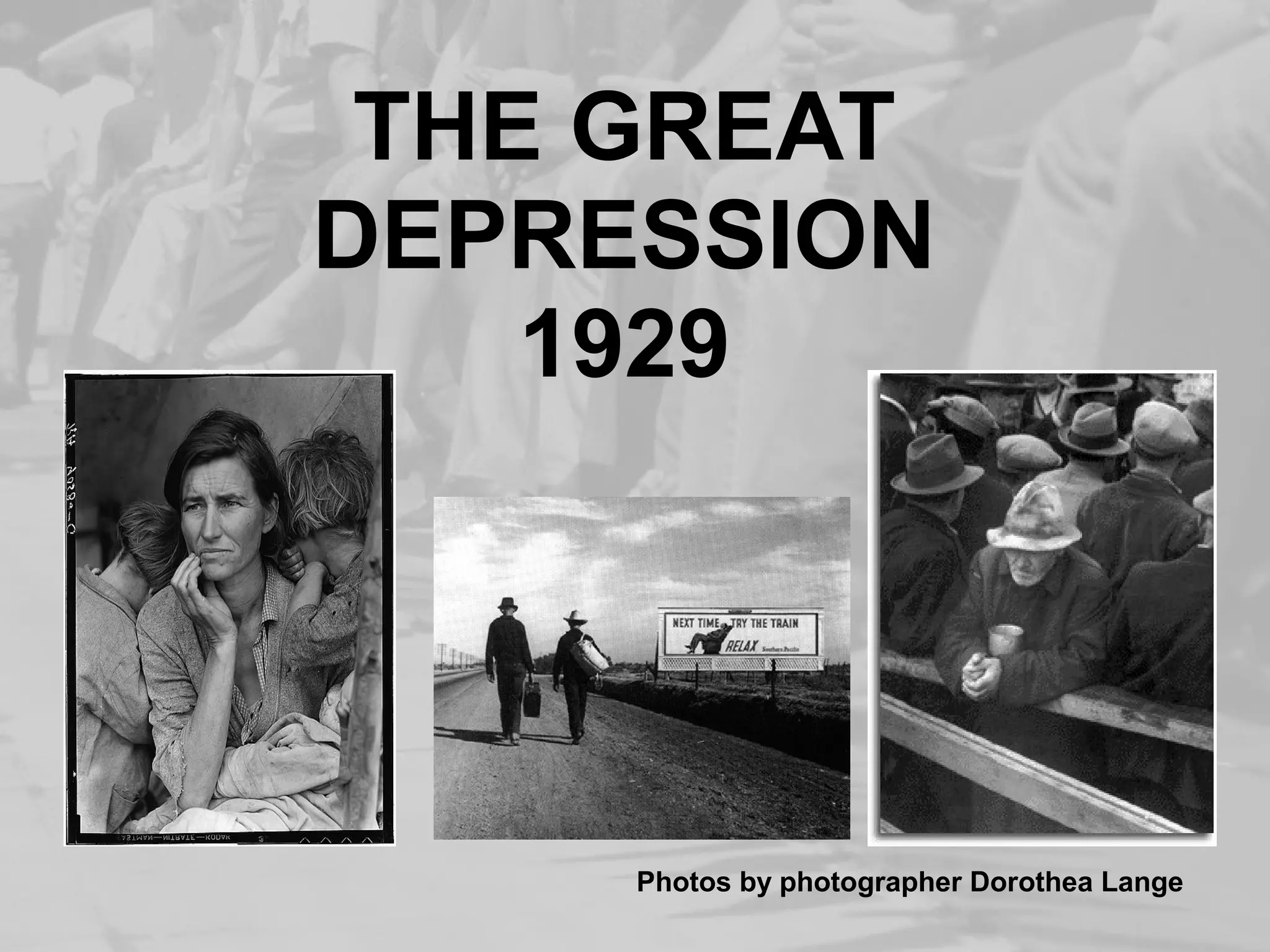
THE GREAT 
DEPRESSION 
1929 
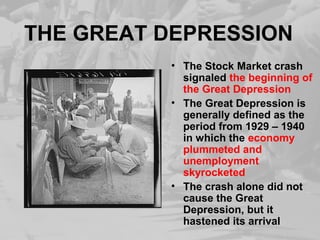
Photos by photographer Dorothea Lange
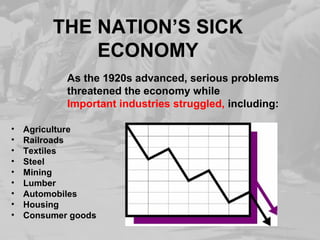
THE NATION’S SICK 
ECONOMY 
As the 1920s advanced, serious problems 
threatened the economy while 
Important industries struggled, including: 
• Agriculture 
• Railroads 
• Textiles 
• Steel 
• Mining 
• Lumber 
• Automobiles 
• Housing 
• Consumer goods
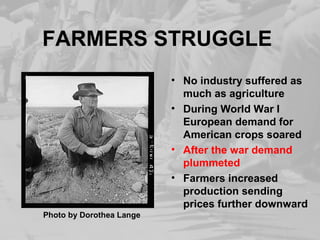
FARMERS STRUGGLE 
• No industry suffered as 
much as agriculture 
• During World War I 
European demand for 
American crops soared 
• After the war demand 
plummeted 
• Farmers increased 
production sending 
prices further downward 
Photo by Dorothea Lange
CONSUMER SPENDING 
DOWN 
• By the late 1920s, 
American consumers 
were buying less 
• Rising prices, stagnant 
wages and overbuying on 
credit were to blame 
• Most people did not have 
the money to buy the 
flood of goods factories 
produced
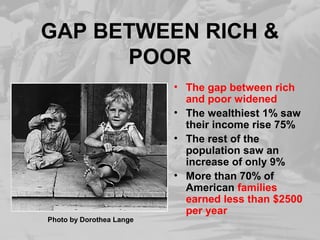
GAP BETWEEN RICH & 
POOR 
• The gap between rich 
and poor widened 
• The wealthiest 1% saw 
their income rise 75% 
• The rest of the 
population saw an 
increase of only 9% 
• More than 70% of 
American families 
earned less than $2500 
per year 
Photo by Dorothea Lange
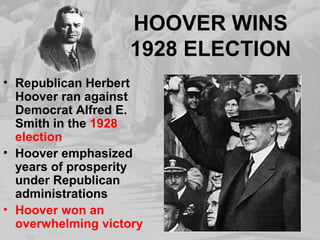
HOOVER WINS 
1928 ELECTION 
• Republican Herbert 
Hoover ran against 
Democrat Alfred E. 
Smith in the 1928 
election 
• Hoover emphasized 
years of prosperity 
under Republican 
administrations 
• Hoover won an 
overwhelming victory
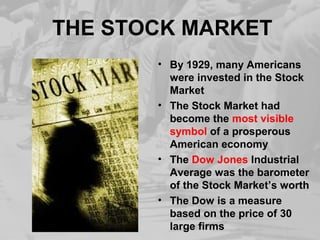
THE STOCK MARKET 
• By 1929, many Americans 
were invested in the Stock 
Market 
• The Stock Market had 
become the most visible 
symbol of a prosperous 
American economy 
• The Dow Jones Industrial 
Average was the barometer 
of the Stock Market’s worth 
• The Dow is a measure 
based on the price of 30 
large firms
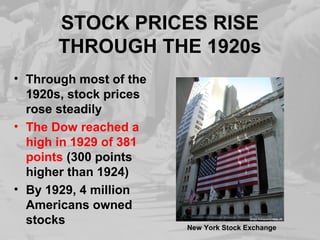
STOCK PRICES RISE 
THROUGH THE 1920s 
• Through most of the 
1920s, stock prices 
rose steadily 
• The Dow reached a 
high in 1929 of 381 
points (300 points 
higher than 1924) 
• By 1929, 4 million 
Americans owned 
stocks New York Stock Exchange
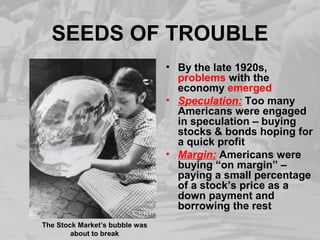
SEEDS OF TROUBLE 
• By the late 1920s, 
problems with the 
economy emerged 
• Speculation: Too many 
Americans were engaged 
in speculation – buying 
stocks & bonds hoping for 
a quick profit 
• Margin: Americans were 
buying “on margin” – 
paying a small percentage 
of a stock’s price as a 
down payment and 
borrowing the rest 
The Stock Market’s bubble was 
about to break
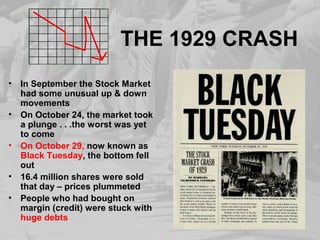
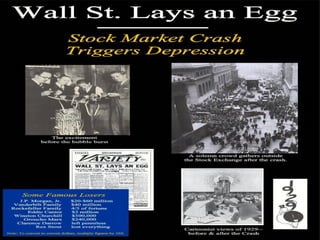
THE 1929 CRASH 
• In September the Stock Market 
had some unusual up & down 
movements 
• On October 24, the market took 
a plunge . . .the worst was yet 
to come 
• On October 29, now known as 
Black Tuesday, the bottom fell 
out 
• 16.4 million shares were sold 
that day – prices plummeted 
• People who had bought on 
margin (credit) were stuck with 
huge debts
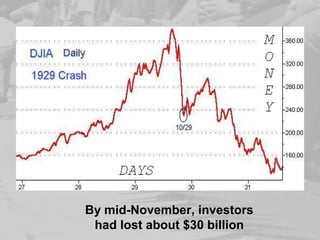
By mid-November, investors 
had lost about $30 billion
THE GREAT DEPRESSION 
• The Stock Market crash 
signaled the beginning of 
the Great Depression 
• The Great Depression is 
generally defined as the 
period from 1929 – 1940 
in which the economy 
plummeted and 
unemployment 
skyrocketed 
• The crash alone did not 
cause the Great 
Depression, but it 
hastened its arrival
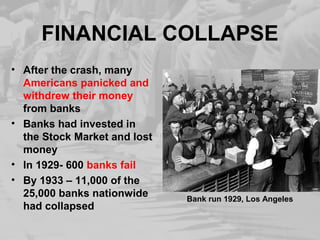
FINANCIAL COLLAPSE 
• After the crash, many 
Americans panicked and 
withdrew their money 
from banks 
• Banks had invested in 
the Stock Market and lost 
money 
• In 1929- 600 banks fail 
• By 1933 – 11,000 of the 
25,000 banks nationwide 
had collapsed Bank run 1929, Los Angeles
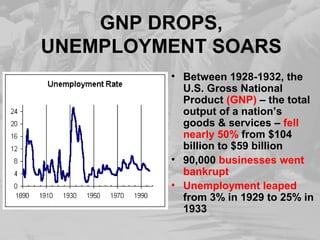
GNP DROPS, 
UNEMPLOYMENT SOARS 
• Between 1928-1932, the 
U.S. Gross National 
Product (GNP) – the total 
output of a nation’s 
goods & services – fell 
nearly 50% from $104 
billion to $59 billion 
• 90,000 businesses went 
bankrupt 
• Unemployment leaped 
from 3% in 1929 to 25% in 
1933
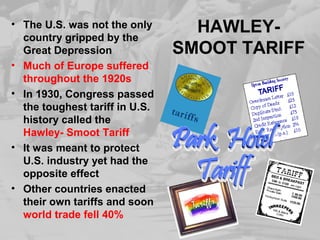
HAWLEY-SMOOT 
TARIFF 
• The U.S. was not the only 
country gripped by the 
Great Depression 
• Much of Europe suffered 
throughout the 1920s 
• In 1930, Congress passed 
the toughest tariff in U.S. 
history called the 
Hawley- Smoot Tariff 
• It was meant to protect 
U.S. industry yet had the 
opposite effect 
• Other countries enacted 
their own tariffs and soon 
world trade fell 40%
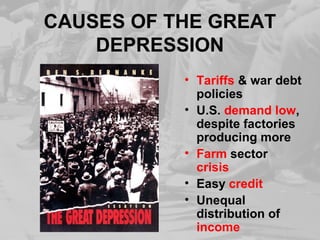
CAUSES OF THE GREAT 
DEPRESSION 
• Tariffs & war debt 
policies 
• U.S. demand low, 
despite factories 
producing more 
• Farm sector 
crisis 
• Easy credit 
• Unequal 
distribution of 
income
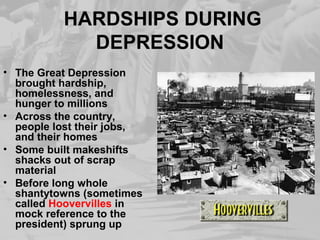
HARDSHIPS DURING 
DEPRESSION 
• The Great Depression 
brought hardship, 
homelessness, and 
hunger to millions 
• Across the country, 
people lost their jobs, 
and their homes 
• Some built makeshifts 
shacks out of scrap 
material 
• Before long whole 
shantytowns (sometimes 
called Hoovervilles in 
mock reference to the 
president) sprung up
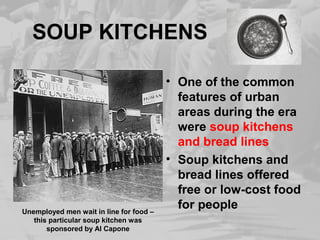
SOUP KITCHENS 
• One of the common 
features of urban 
areas during the era 
were soup kitchens 
and bread lines 
• Soup kitchens and 
bread lines offered 
free or low-cost food 
for people Unemployed men wait in line for food – 
this particular soup kitchen was 
sponsored by Al Capone
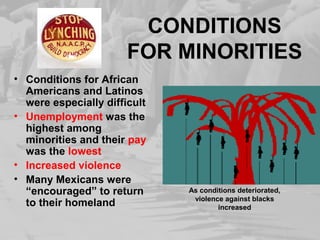
CONDITIONS 
FOR MINORITIES 
• Conditions for African 
Americans and Latinos 
were especially difficult 
• Unemployment was the 
highest among 
minorities and their pay 
was the lowest 
• Increased violence 
• Many Mexicans were 
“encouraged” to return 
to their homeland 
As conditions deteriorated, 
violence against blacks 
increased
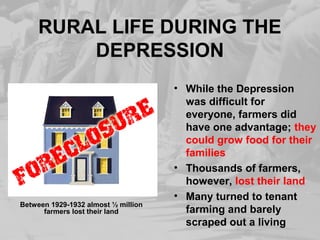
RURAL LIFE DURING THE 
DEPRESSION 
• While the Depression 
was difficult for 
everyone, farmers did 
have one advantage; they 
could grow food for their 
families 
• Thousands of farmers, 
however, lost their land 
• Many turned to tenant 
farming and barely 
scraped out a living 
Between 1929-1932 almost ½ million 
farmers lost their land
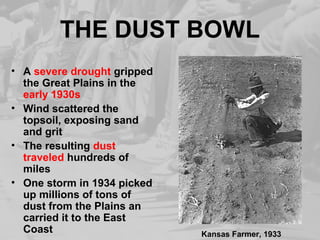
THE DUST BOWL 
• A severe drought gripped 
the Great Plains in the 
early 1930s 
• Wind scattered the 
topsoil, exposing sand 
and grit 
• The resulting dust 
traveled hundreds of 
miles 
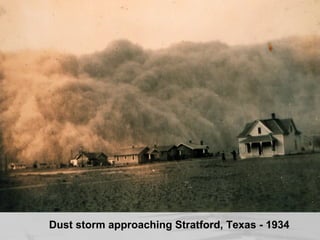
• One storm in 1934 picked 
up millions of tons of 
dust from the Plains an 
carried it to the East 
Coast Kansas Farmer, 1933
Dust storm approaching Stratford, Texas - 1934
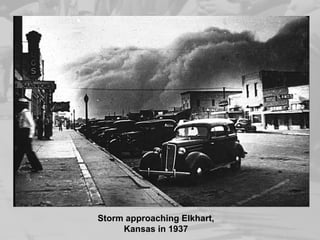
Storm approaching Elkhart, 
Kansas in 1937
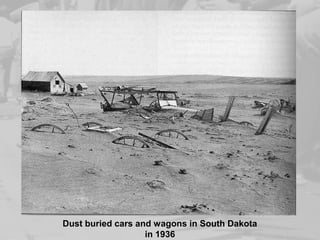
Dust buried cars and wagons in South Dakota 
in 1936
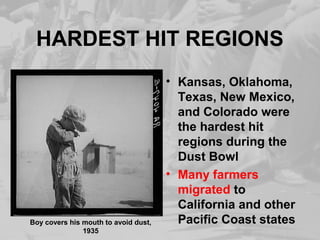
HARDEST HIT REGIONS 
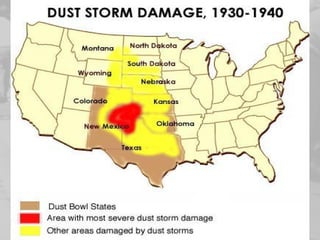
• Kansas, Oklahoma, 
Texas, New Mexico, 
and Colorado were 
the hardest hit 
regions during the 
Dust Bowl 
• Many farmers 
migrated to 
California and other 
Boy covers his mouth to avoid dust, Pacific Coast states 
1935
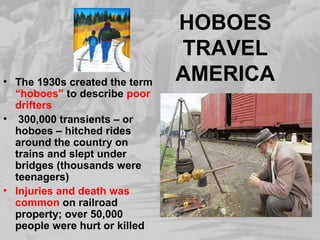
HOBOES 
TRAVEL 
AMERICA • The 1930s created the term 
“hoboes” to describe poor 
drifters 
• 300,000 transients – or 
hoboes – hitched rides 
around the country on 
trains and slept under 
bridges (thousands were 
teenagers) 
• Injuries and death was 
common on railroad 
property; over 50,000 
people were hurt or killed
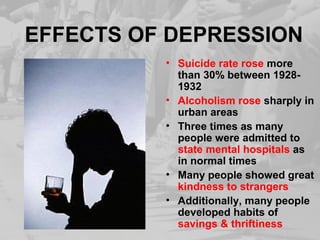
EFFECTS OF DEPRESSION 
• Suicide rate rose more 
than 30% between 1928- 
1932 
• Alcoholism rose sharply in 
urban areas 
• Three times as many 
people were admitted to 
state mental hospitals as 
in normal times 
• Many people showed great 
kindness to strangers 
• Additionally, many people 
developed habits of 
savings & thriftiness
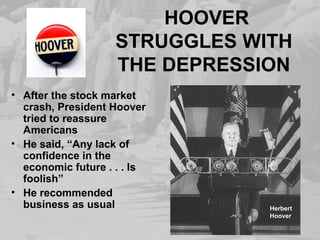
HOOVER 
STRUGGLES WITH 
THE DEPRESSION 
• After the stock market 
crash, President Hoover 
tried to reassure 
Americans 
• He said, “Any lack of 
confidence in the 
economic future . . . Is 
foolish” 
• He recommended 
business as usual Herbert 
Hoover
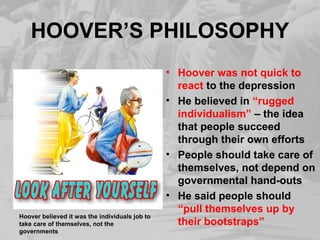
HOOVER’S PHILOSOPHY 
• Hoover was not quick to 
react to the depression 
• He believed in “rugged 
individualism” – the idea 
that people succeed 
through their own efforts 
• People should take care of 
themselves, not depend on 
governmental hand-outs 
• He said people should 
“pull themselves up by 
their bootstraps” Hoover believed it was the individuals job to 
take care of themselves, not the 
governments
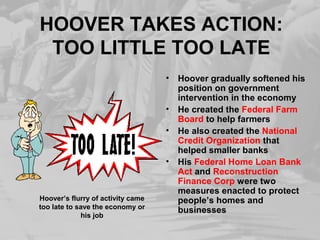
HOOVER TAKES ACTION: 
TOO LITTLE TOO LATE 
• Hoover gradually softened his 
position on government 
intervention in the economy 
• He created the Federal Farm 
Board to help farmers 
• He also created the National 
Credit Organization that 
helped smaller banks 
• His Federal Home Loan Bank 
Act and Reconstruction 
Finance Corp were two 
measures enacted to protect 
people’s homes and 
businesses 
Hoover’s flurry of activity came 
too late to save the economy or 
his job
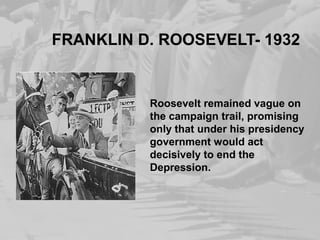
FRANKLIN D. ROOSEVELT- 1932 
Roosevelt remained vague on 
the campaign trail, promising 
only that under his presidency 
government would act 
decisively to end the 
Depression.
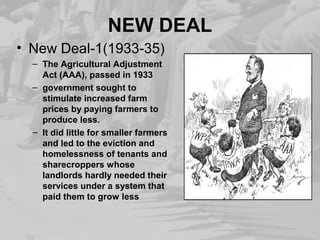
NEW DEAL 
• New Deal-1(1933-35) 
– The Agricultural Adjustment 
Act (AAA), passed in 1933 
– government sought to 
stimulate increased farm 
prices by paying farmers to 
produce less. 
– It did little for smaller farmers 
and led to the eviction and 
homelessness of tenants and 
sharecroppers whose 
landlords hardly needed their 
services under a system that 
paid them to grow less
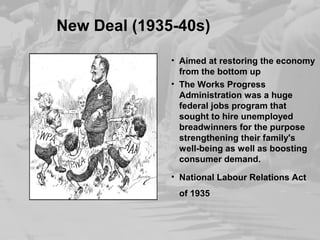
New Deal (1935-40s) 
• Aimed at restoring the economy 
from the bottom up 
• The Works Progress 
Administration was a huge 
federal jobs program that 
sought to hire unemployed 
breadwinners for the purpose 
strengthening their family's 
well-being as well as boosting 
consumer demand. 
• National Labour Relations Act 
of 1935
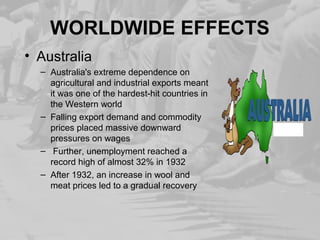
WORLDWIDE EFFECTS 
• Australia 
– Australia's extreme dependence on 
agricultural and industrial exports meant 
it was one of the hardest-hit countries in 
the Western world 
– Falling export demand and commodity 
prices placed massive downward 
pressures on wages 
– Further, unemployment reached a 
record high of almost 32% in 1932 
– After 1932, an increase in wool and 
meat prices led to a gradual recovery
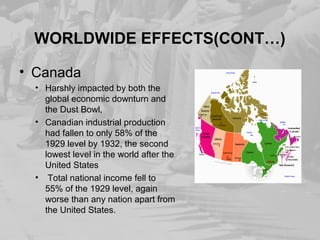
WORLDWIDE EFFECTS(CONT…) 
• Canada 
• Harshly impacted by both the 
global economic downturn and 
the Dust Bowl, 
• Canadian industrial production 
had fallen to only 58% of the 
1929 level by 1932, the second 
lowest level in the world after the 
United States 
• Total national income fell to 
55% of the 1929 level, again 
worse than any nation apart from 
the United States.
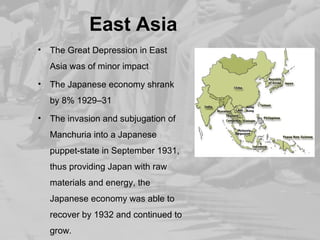
East Asia 
• The Great Depression in East 
Asia was of minor impact 
• The Japanese economy shrank 
by 8% 1929–31 
• The invasion and subjugation of 
Manchuria into a Japanese 
puppet-state in September 1931, 
thus providing Japan with raw 
materials and energy, the 
Japanese economy was able to 
recover by 1932 and continued to 
grow.
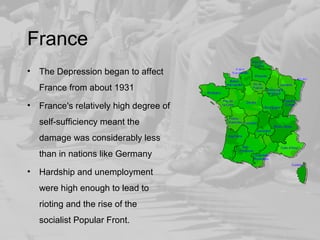
France 
• The Depression began to affect 
France from about 1931 
• France's relatively high degree of 
self-sufficiency meant the 
damage was considerably less 
than in nations like Germany 
• Hardship and unemployment 
were high enough to lead to 
rioting and the rise of the 
socialist Popular Front.
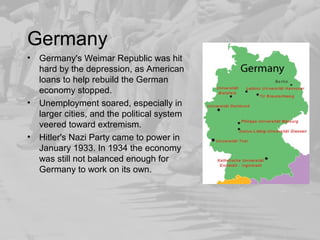
Germany 
• Germany's Weimar Republic was hit 
hard by the depression, as American 
loans to help rebuild the German 
economy stopped. 
• Unemployment soared, especially in 
larger cities, and the political system 
veered toward extremism. 
• Hitler's Nazi Party came to power in 
January 1933. In 1934 the economy 
was still not balanced enough for 
Germany to work on its own.
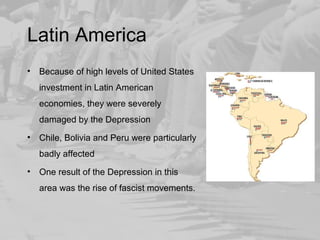
Latin America 
• Because of high levels of United States 
investment in Latin American 
economies, they were severely 
damaged by the Depression 
• Chile, Bolivia and Peru were particularly 
badly affected 
• One result of the Depression in this 
area was the rise of fascist movements.
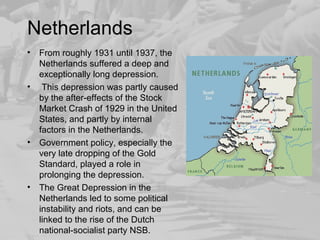
Netherlands 
• From roughly 1931 until 1937, the 
Netherlands suffered a deep and 
exceptionally long depression. 
• This depression was partly caused 
by the after-effects of the Stock 
Market Crash of 1929 in the United 
States, and partly by internal 
factors in the Netherlands. 
• Government policy, especially the 
very late dropping of the Gold 
Standard, played a role in 
prolonging the depression. 
• The Great Depression in the 
Netherlands led to some political 
instability and riots, and can be 
linked to the rise of the Dutch 
national-socialist party NSB.
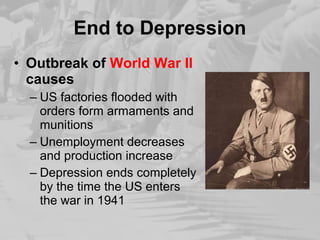
End to Depression 
• Outbreak of World War II 
causes 
– US factories flooded with 
orders form armaments and 
munitions 
– Unemployment decreases 
and production increase 
– Depression ends completely 
by the time the US enters 
the war in 1941
What did we learn from the 
1929 Crash? 
• Market can be very unpredictable 
• Investors must not get caught up in market 
bubble illusions 
• Market forces alone may be unable to 
achieve recovery from economic slump 
• Changes were needed in US economic 
structure

1929 Crash

  • 1.
    THE GREAT DEPRESSION 1929 Photos by photographer Dorothea Lange
  • 2.
    THE NATION’S SICK ECONOMY As the 1920s advanced, serious problems threatened the economy while Important industries struggled, including: • Agriculture • Railroads • Textiles • Steel • Mining • Lumber • Automobiles • Housing • Consumer goods
  • 3.
    FARMERS STRUGGLE •No industry suffered as much as agriculture • During World War I European demand for American crops soared • After the war demand plummeted • Farmers increased production sending prices further downward Photo by Dorothea Lange
  • 4.
    CONSUMER SPENDING DOWN • By the late 1920s, American consumers were buying less • Rising prices, stagnant wages and overbuying on credit were to blame • Most people did not have the money to buy the flood of goods factories produced
  • 5.
    GAP BETWEEN RICH& POOR • The gap between rich and poor widened • The wealthiest 1% saw their income rise 75% • The rest of the population saw an increase of only 9% • More than 70% of American families earned less than $2500 per year Photo by Dorothea Lange
  • 6.
    HOOVER WINS 1928ELECTION • Republican Herbert Hoover ran against Democrat Alfred E. Smith in the 1928 election • Hoover emphasized years of prosperity under Republican administrations • Hoover won an overwhelming victory
  • 7.
    THE STOCK MARKET • By 1929, many Americans were invested in the Stock Market • The Stock Market had become the most visible symbol of a prosperous American economy • The Dow Jones Industrial Average was the barometer of the Stock Market’s worth • The Dow is a measure based on the price of 30 large firms
  • 8.
    STOCK PRICES RISE THROUGH THE 1920s • Through most of the 1920s, stock prices rose steadily • The Dow reached a high in 1929 of 381 points (300 points higher than 1924) • By 1929, 4 million Americans owned stocks New York Stock Exchange
  • 9.
    SEEDS OF TROUBLE • By the late 1920s, problems with the economy emerged • Speculation: Too many Americans were engaged in speculation – buying stocks & bonds hoping for a quick profit • Margin: Americans were buying “on margin” – paying a small percentage of a stock’s price as a down payment and borrowing the rest The Stock Market’s bubble was about to break
  • 10.
    THE 1929 CRASH • In September the Stock Market had some unusual up & down movements • On October 24, the market took a plunge . . .the worst was yet to come • On October 29, now known as Black Tuesday, the bottom fell out • 16.4 million shares were sold that day – prices plummeted • People who had bought on margin (credit) were stuck with huge debts
  • 11.
    By mid-November, investors had lost about $30 billion
  • 13.
    THE GREAT DEPRESSION • The Stock Market crash signaled the beginning of the Great Depression • The Great Depression is generally defined as the period from 1929 – 1940 in which the economy plummeted and unemployment skyrocketed • The crash alone did not cause the Great Depression, but it hastened its arrival
  • 14.
    FINANCIAL COLLAPSE •After the crash, many Americans panicked and withdrew their money from banks • Banks had invested in the Stock Market and lost money • In 1929- 600 banks fail • By 1933 – 11,000 of the 25,000 banks nationwide had collapsed Bank run 1929, Los Angeles
  • 15.
    GNP DROPS, UNEMPLOYMENTSOARS • Between 1928-1932, the U.S. Gross National Product (GNP) – the total output of a nation’s goods & services – fell nearly 50% from $104 billion to $59 billion • 90,000 businesses went bankrupt • Unemployment leaped from 3% in 1929 to 25% in 1933
  • 16.
    HAWLEY-SMOOT TARIFF •The U.S. was not the only country gripped by the Great Depression • Much of Europe suffered throughout the 1920s • In 1930, Congress passed the toughest tariff in U.S. history called the Hawley- Smoot Tariff • It was meant to protect U.S. industry yet had the opposite effect • Other countries enacted their own tariffs and soon world trade fell 40%
  • 17.
    CAUSES OF THEGREAT DEPRESSION • Tariffs & war debt policies • U.S. demand low, despite factories producing more • Farm sector crisis • Easy credit • Unequal distribution of income
  • 18.
    HARDSHIPS DURING DEPRESSION • The Great Depression brought hardship, homelessness, and hunger to millions • Across the country, people lost their jobs, and their homes • Some built makeshifts shacks out of scrap material • Before long whole shantytowns (sometimes called Hoovervilles in mock reference to the president) sprung up
  • 19.
    SOUP KITCHENS •One of the common features of urban areas during the era were soup kitchens and bread lines • Soup kitchens and bread lines offered free or low-cost food for people Unemployed men wait in line for food – this particular soup kitchen was sponsored by Al Capone
  • 20.
    CONDITIONS FOR MINORITIES • Conditions for African Americans and Latinos were especially difficult • Unemployment was the highest among minorities and their pay was the lowest • Increased violence • Many Mexicans were “encouraged” to return to their homeland As conditions deteriorated, violence against blacks increased
  • 21.
    RURAL LIFE DURINGTHE DEPRESSION • While the Depression was difficult for everyone, farmers did have one advantage; they could grow food for their families • Thousands of farmers, however, lost their land • Many turned to tenant farming and barely scraped out a living Between 1929-1932 almost ½ million farmers lost their land
  • 22.
    THE DUST BOWL • A severe drought gripped the Great Plains in the early 1930s • Wind scattered the topsoil, exposing sand and grit • The resulting dust traveled hundreds of miles • One storm in 1934 picked up millions of tons of dust from the Plains an carried it to the East Coast Kansas Farmer, 1933
  • 23.
    Dust storm approachingStratford, Texas - 1934
  • 24.
  • 25.
    Dust buried carsand wagons in South Dakota in 1936
  • 26.
    HARDEST HIT REGIONS • Kansas, Oklahoma, Texas, New Mexico, and Colorado were the hardest hit regions during the Dust Bowl • Many farmers migrated to California and other Boy covers his mouth to avoid dust, Pacific Coast states 1935
  • 28.
    HOBOES TRAVEL AMERICA• The 1930s created the term “hoboes” to describe poor drifters • 300,000 transients – or hoboes – hitched rides around the country on trains and slept under bridges (thousands were teenagers) • Injuries and death was common on railroad property; over 50,000 people were hurt or killed
  • 29.
    EFFECTS OF DEPRESSION • Suicide rate rose more than 30% between 1928- 1932 • Alcoholism rose sharply in urban areas • Three times as many people were admitted to state mental hospitals as in normal times • Many people showed great kindness to strangers • Additionally, many people developed habits of savings & thriftiness
  • 30.
    HOOVER STRUGGLES WITH THE DEPRESSION • After the stock market crash, President Hoover tried to reassure Americans • He said, “Any lack of confidence in the economic future . . . Is foolish” • He recommended business as usual Herbert Hoover
  • 31.
    HOOVER’S PHILOSOPHY •Hoover was not quick to react to the depression • He believed in “rugged individualism” – the idea that people succeed through their own efforts • People should take care of themselves, not depend on governmental hand-outs • He said people should “pull themselves up by their bootstraps” Hoover believed it was the individuals job to take care of themselves, not the governments
  • 32.
    HOOVER TAKES ACTION: TOO LITTLE TOO LATE • Hoover gradually softened his position on government intervention in the economy • He created the Federal Farm Board to help farmers • He also created the National Credit Organization that helped smaller banks • His Federal Home Loan Bank Act and Reconstruction Finance Corp were two measures enacted to protect people’s homes and businesses Hoover’s flurry of activity came too late to save the economy or his job
  • 33.
    FRANKLIN D. ROOSEVELT-1932 Roosevelt remained vague on the campaign trail, promising only that under his presidency government would act decisively to end the Depression.
  • 34.
    NEW DEAL •New Deal-1(1933-35) – The Agricultural Adjustment Act (AAA), passed in 1933 – government sought to stimulate increased farm prices by paying farmers to produce less. – It did little for smaller farmers and led to the eviction and homelessness of tenants and sharecroppers whose landlords hardly needed their services under a system that paid them to grow less
  • 35.
    New Deal (1935-40s) • Aimed at restoring the economy from the bottom up • The Works Progress Administration was a huge federal jobs program that sought to hire unemployed breadwinners for the purpose strengthening their family's well-being as well as boosting consumer demand. • National Labour Relations Act of 1935
  • 36.
    WORLDWIDE EFFECTS •Australia – Australia's extreme dependence on agricultural and industrial exports meant it was one of the hardest-hit countries in the Western world – Falling export demand and commodity prices placed massive downward pressures on wages – Further, unemployment reached a record high of almost 32% in 1932 – After 1932, an increase in wool and meat prices led to a gradual recovery
  • 37.
    WORLDWIDE EFFECTS(CONT…) •Canada • Harshly impacted by both the global economic downturn and the Dust Bowl, • Canadian industrial production had fallen to only 58% of the 1929 level by 1932, the second lowest level in the world after the United States • Total national income fell to 55% of the 1929 level, again worse than any nation apart from the United States.
  • 38.
    East Asia •The Great Depression in East Asia was of minor impact • The Japanese economy shrank by 8% 1929–31 • The invasion and subjugation of Manchuria into a Japanese puppet-state in September 1931, thus providing Japan with raw materials and energy, the Japanese economy was able to recover by 1932 and continued to grow.
  • 39.
    France • TheDepression began to affect France from about 1931 • France's relatively high degree of self-sufficiency meant the damage was considerably less than in nations like Germany • Hardship and unemployment were high enough to lead to rioting and the rise of the socialist Popular Front.
  • 40.
    Germany • Germany'sWeimar Republic was hit hard by the depression, as American loans to help rebuild the German economy stopped. • Unemployment soared, especially in larger cities, and the political system veered toward extremism. • Hitler's Nazi Party came to power in January 1933. In 1934 the economy was still not balanced enough for Germany to work on its own.
  • 41.
    Latin America •Because of high levels of United States investment in Latin American economies, they were severely damaged by the Depression • Chile, Bolivia and Peru were particularly badly affected • One result of the Depression in this area was the rise of fascist movements.
  • 42.
    Netherlands • Fromroughly 1931 until 1937, the Netherlands suffered a deep and exceptionally long depression. • This depression was partly caused by the after-effects of the Stock Market Crash of 1929 in the United States, and partly by internal factors in the Netherlands. • Government policy, especially the very late dropping of the Gold Standard, played a role in prolonging the depression. • The Great Depression in the Netherlands led to some political instability and riots, and can be linked to the rise of the Dutch national-socialist party NSB.
  • 43.
    End to Depression • Outbreak of World War II causes – US factories flooded with orders form armaments and munitions – Unemployment decreases and production increase – Depression ends completely by the time the US enters the war in 1941
  • 44.
    What did welearn from the 1929 Crash? • Market can be very unpredictable • Investors must not get caught up in market bubble illusions • Market forces alone may be unable to achieve recovery from economic slump • Changes were needed in US economic structure