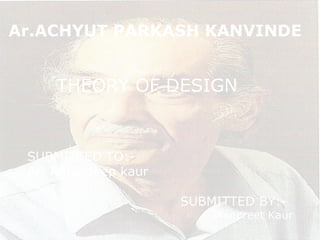
Ar.ACHYUT PARKASH KANVINDE
SUBMITTED TO:-
Ar. Amandeep kaur
SUBMITTED BY:-
Manpreet Kaur
THEORY OF DESIGN
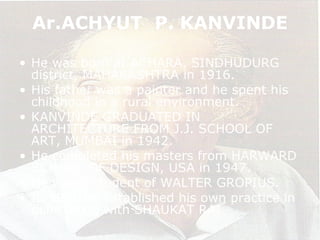
Ar.ACHYUT P. KANVINDE
• He was born at ACHARA, SINDHUDURG
district, MAHARASHTRA in 1916.
• His father was a painter and he spent his
childhood in a rural environment.
• KANVINDE GRADUATED IN
ARCHITECTURE FROM J.J. SCHOOL OF
ART, MUMBAI in 1942.
• He completed his masters from HARWARD
SCHOOL OF DESIGN, USA in 1947.
• He was a student of WALTER GROPIUS.
• In 1955 he established his own practice in
delhi along with SHAUKAT RAI.
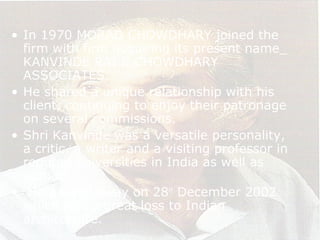
• In 1970 MORAD CHOWDHARY joined the
firm with firm acquiring its present name_
KANVINDE RAI & CHOWDHARY
ASSOCIATES.
• He shared a unique relationship with his
client, continuing to enjoy their patronage
on several commissions.
• Shri Kanvinde was a versatile personality,
a critic, a writer and a visiting professor in
reputed universities in India as well as
abroad.
• He passed away on 28th
December 2002
which was a great loss to Indian
architecture.
LIST OF AWARDS
• Recipient of PADMASHRI- National honour
from Govt. of India in 1975.
• Recipient of gold medal of the Indian
institute of architect in 1985.
• Recipient of national award of institution of
engineers for architectural engg. In 1990.
• Got great master national award by
J.K.Industries Ltd in 1993.
• Outstanding Konkani awards
[POSTHUMOUS] IN 2003.
• TMA PAI Foundation Manipal in 2003.
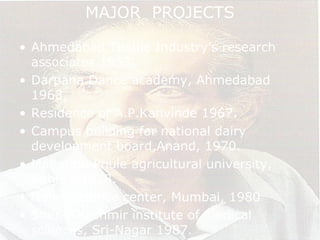
MAJOR PROJECTS
• Ahmedabad Textile Industry’s research
associates 1953.
• Darpana Dance academy, Ahmedabad
1963.
• Residence of A.P.Kanvinde 1967.
• Campus building for national dairy
development board,Anand, 1970.
• Mahatma Phule agricultural university,
Rahuri, 1978.
• Nehru science center, Mumbai, 1980
• Sher-I-Kashmir institute of medical
sciences, Sri-Nagar 1987.
• Legislative assembly & high court,
Sri nagar , 1989.
• National science centre, New Delhi,
1991.
• Metro dairy, Kolkata, 1996.
• Temple & vedic institute for Iskon,
Delhi, 1998.
• Banas II Dairy, Palanpur, 2000.
• Iskon Temple, varanasi on going
project.
PHILOSOPHY
• Acc. To him architecture is defined as “SATYAM
SHIVAM SUNDARAM”. Meaning that which is
beautiful embodies truth with pure & clean
qualities.
• Kanvinde realized that no meaningful architecture
could ever be built without understanding the
climate & geography of the region as well as the
pattern of society.
• Acc. To him architecture is not a museum of
materials.
• He used bricks, stones, concrete & aggregate
plaster with equal finesse and was always on the
look out for different materials where demanded
by the climatic context.
• He carried out consistently good buildings on
small scale budgets all around the country.
• His work carried out the spirit of modern
master which had a scientific , rational &
technological base.
• His belief in application of modern
technologies made him receptive to new
ideas & concepts, in search for a
democratic expression to Indian
architecture.
• His work was straight forward norms of
functional planning, invariable attempt to
achieve a form-oriented expression.
• All his life, he was constantly exploring
new ways of re-inviting the vocabulary of
architecture.
ACHIEVEMENTS
• He was one of the first practices that then
fledged A+D magazine profiled in 1985
[A+D – Volume – 1]
• He was one of the pioneers of the modern
moment in architecture.
• He is the author of a book called CAMPUS
DESIGN IN INDIA.
• For many years Kanvinde became a
spoke’s person of architectural profession.
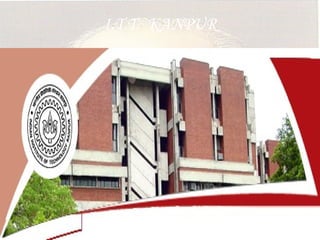
INDIAN INSTITUTE OF TECHNOLOGY
AT KANPUR
• It is located at KANPUR.
• The I.I.T KANPUR is one of such premier
institutions, established by the union govt.
to impart high quality technological
training in India located on the outskirts of
Kanpur city.
• It is the first example of comprehensive
modern campus built in the country.
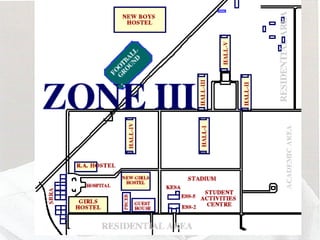
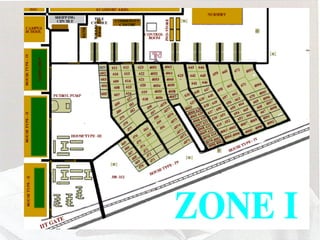
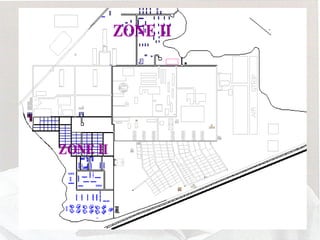
• The most significant aspect of the campus
is its planning by discipline, discarding the
conventional idea of separating activities
by departmental division.
I.T.T. KANPUR
• The plan is decentralized activities, are
connected by the walkway system this allows
the students to walk at 2 levels of the building
that are designed to receive a 2 level circulation.
• Plan was based on repetitive modules of certain
dimension.
• There is a unique layering of corridors.
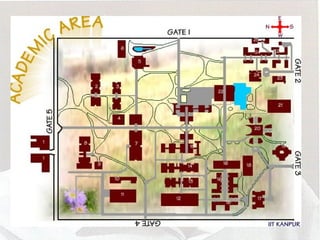
ACADEMIC COMPLEX
• The main academic complex is organized in a
quadrangle on an area of 20 hectares.
• It comprises of a library, a lecture theatre block,
a faculty
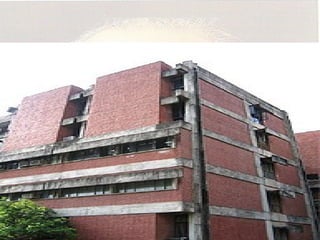
VIEW OF INSTITUTE
• Building, a computer center besides the
laboratories, workshops and areas for
cultural and recreational facilities.
• The library, lecture theatre block and
laboratories are two or three stories high.
• The faculty building is six storeyed and is
largest structure in the academic core and
entire campus is visible from the roof.
• Staircase, elevators & fire escape, spiral
stairs are provided for vertical circulation.
• All the building in academic area are
easily distinguishable through form
as well as structural.
LECTURE THEATRE
• This block is a double storeyed
structure with the ground floor being
stilted.
• It is liked to the library & laboratories
by corridors.
• The structure is reinforced concrete
frame and brick exposed walls the
windows are sunken to protect from
sun and rain.
• The interior is equipped more like an
auditorium than a classroom.
• The walls & ceiling are acoustically treated
with wall finishes & false ceilings.
• The flooring inside the lecture theatre is
terrazzo and in the corridors is kotah
stone highly polished.
LABORATORIES
• The laboratory building are distributed all
along the academic areas and are named
as eastern labs, western labs, northern
labs and the core labs.
• The design is based on modules.
• The laboratories are located on both sides
of a central corridor to make design more
than compact.
• The laboratory blocks are connected with
faculty building and the library except the
northern & southern laboratories by
means of corridors and by bridges.
WORKSHOPS
• The workshop block is situated on the
western periphery on the academic
complex.
• Fabrication work for various departments
& institute
Facilities are also carried out.
• The roof structure is saw tooth truss which
economical with the added advantage of
reduction in the volume of space enclosed.
CIRCULATION
• In order to allow for expansion, growth &
flexibility within the complex, activities
and services have been segregated and
interconnected by a linear movement
along 2 level corridors.
• Vehicular movement for both goods &
people is segregated
• From pedestrian movement maintaining
the integrity of the core as a pedestrian
island.
• Parking has been provided which restrict
cross movement of traffic within the
academic complex.
LANDSCAPING
• The I.I.T. campus is planned and
landscaped for environmental freedom.
• The core of the complex is stilted area of
lecture halls which is surrounded by
landscaping, water body & sculptures.
• The sunken garden is created for cultural
activities.
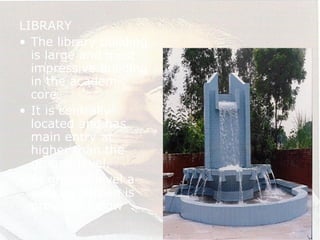
LIBRARY
• The library building
is large and most
impressive building
in the academic
core.
• It is centrally
located and has
main entry at
higher than the
ground level.
• At ground level a
sunken garden is
provided below
the central cutout.
• The structure is based on grid module &
has central large skylight.
• The windows are sunk deep into the walls
to provide glare free light.
• It is connected to lecture halls, labs by
corridors.
BUILDING FORM
• Building is based upon modular concept,
the buildings are harmonious in character,
have open forms with linking corridors &
spaces penetrating.
• Structural system consists of
reinforced concrete frames and slabs
with brick curtain wall.
• The external surfaces of concrete of
brick are left exposed to enhance the
aesthetic appeal.
• Skylights are important feature in
the library building and the computer
centre to provide indirect light in the
interior spaces.

Ap kanvinde

  • 1.
    Ar.ACHYUT PARKASH KANVINDE SUBMITTEDTO:- Ar. Amandeep kaur SUBMITTED BY:- Manpreet Kaur THEORY OF DESIGN
  • 2.
    Ar.ACHYUT P. KANVINDE •He was born at ACHARA, SINDHUDURG district, MAHARASHTRA in 1916. • His father was a painter and he spent his childhood in a rural environment. • KANVINDE GRADUATED IN ARCHITECTURE FROM J.J. SCHOOL OF ART, MUMBAI in 1942. • He completed his masters from HARWARD SCHOOL OF DESIGN, USA in 1947. • He was a student of WALTER GROPIUS. • In 1955 he established his own practice in delhi along with SHAUKAT RAI.
  • 3.
    • In 1970MORAD CHOWDHARY joined the firm with firm acquiring its present name_ KANVINDE RAI & CHOWDHARY ASSOCIATES. • He shared a unique relationship with his client, continuing to enjoy their patronage on several commissions. • Shri Kanvinde was a versatile personality, a critic, a writer and a visiting professor in reputed universities in India as well as abroad. • He passed away on 28th December 2002 which was a great loss to Indian architecture.
  • 4.
    LIST OF AWARDS •Recipient of PADMASHRI- National honour from Govt. of India in 1975. • Recipient of gold medal of the Indian institute of architect in 1985. • Recipient of national award of institution of engineers for architectural engg. In 1990. • Got great master national award by J.K.Industries Ltd in 1993. • Outstanding Konkani awards [POSTHUMOUS] IN 2003. • TMA PAI Foundation Manipal in 2003.
  • 5.
    MAJOR PROJECTS • AhmedabadTextile Industry’s research associates 1953. • Darpana Dance academy, Ahmedabad 1963. • Residence of A.P.Kanvinde 1967. • Campus building for national dairy development board,Anand, 1970. • Mahatma Phule agricultural university, Rahuri, 1978. • Nehru science center, Mumbai, 1980 • Sher-I-Kashmir institute of medical sciences, Sri-Nagar 1987.
  • 6.
    • Legislative assembly& high court, Sri nagar , 1989. • National science centre, New Delhi, 1991. • Metro dairy, Kolkata, 1996. • Temple & vedic institute for Iskon, Delhi, 1998. • Banas II Dairy, Palanpur, 2000. • Iskon Temple, varanasi on going project.
  • 7.
    PHILOSOPHY • Acc. Tohim architecture is defined as “SATYAM SHIVAM SUNDARAM”. Meaning that which is beautiful embodies truth with pure & clean qualities. • Kanvinde realized that no meaningful architecture could ever be built without understanding the climate & geography of the region as well as the pattern of society. • Acc. To him architecture is not a museum of materials. • He used bricks, stones, concrete & aggregate plaster with equal finesse and was always on the look out for different materials where demanded by the climatic context. • He carried out consistently good buildings on small scale budgets all around the country.
  • 8.
    • His workcarried out the spirit of modern master which had a scientific , rational & technological base. • His belief in application of modern technologies made him receptive to new ideas & concepts, in search for a democratic expression to Indian architecture. • His work was straight forward norms of functional planning, invariable attempt to achieve a form-oriented expression. • All his life, he was constantly exploring new ways of re-inviting the vocabulary of architecture.
  • 9.
    ACHIEVEMENTS • He wasone of the first practices that then fledged A+D magazine profiled in 1985 [A+D – Volume – 1] • He was one of the pioneers of the modern moment in architecture. • He is the author of a book called CAMPUS DESIGN IN INDIA. • For many years Kanvinde became a spoke’s person of architectural profession.
  • 10.
    INDIAN INSTITUTE OFTECHNOLOGY AT KANPUR • It is located at KANPUR. • The I.I.T KANPUR is one of such premier institutions, established by the union govt. to impart high quality technological training in India located on the outskirts of Kanpur city. • It is the first example of comprehensive modern campus built in the country. • The most significant aspect of the campus is its planning by discipline, discarding the conventional idea of separating activities by departmental division.
  • 11.
  • 12.
    • The planis decentralized activities, are connected by the walkway system this allows the students to walk at 2 levels of the building that are designed to receive a 2 level circulation. • Plan was based on repetitive modules of certain dimension. • There is a unique layering of corridors. ACADEMIC COMPLEX • The main academic complex is organized in a quadrangle on an area of 20 hectares. • It comprises of a library, a lecture theatre block, a faculty
  • 13.
  • 15.
    • Building, acomputer center besides the laboratories, workshops and areas for cultural and recreational facilities. • The library, lecture theatre block and laboratories are two or three stories high. • The faculty building is six storeyed and is largest structure in the academic core and entire campus is visible from the roof. • Staircase, elevators & fire escape, spiral stairs are provided for vertical circulation.
  • 16.
    • All thebuilding in academic area are easily distinguishable through form as well as structural. LECTURE THEATRE • This block is a double storeyed structure with the ground floor being stilted. • It is liked to the library & laboratories by corridors. • The structure is reinforced concrete frame and brick exposed walls the windows are sunken to protect from sun and rain.
  • 18.
    • The interioris equipped more like an auditorium than a classroom. • The walls & ceiling are acoustically treated with wall finishes & false ceilings. • The flooring inside the lecture theatre is terrazzo and in the corridors is kotah stone highly polished. LABORATORIES • The laboratory building are distributed all along the academic areas and are named as eastern labs, western labs, northern labs and the core labs.
  • 22.
    • The designis based on modules. • The laboratories are located on both sides of a central corridor to make design more than compact. • The laboratory blocks are connected with faculty building and the library except the northern & southern laboratories by means of corridors and by bridges. WORKSHOPS • The workshop block is situated on the western periphery on the academic complex. • Fabrication work for various departments & institute
  • 23.
    Facilities are alsocarried out. • The roof structure is saw tooth truss which economical with the added advantage of reduction in the volume of space enclosed. CIRCULATION • In order to allow for expansion, growth & flexibility within the complex, activities and services have been segregated and interconnected by a linear movement along 2 level corridors. • Vehicular movement for both goods & people is segregated
  • 24.
    • From pedestrianmovement maintaining the integrity of the core as a pedestrian island. • Parking has been provided which restrict cross movement of traffic within the academic complex. LANDSCAPING • The I.I.T. campus is planned and landscaped for environmental freedom. • The core of the complex is stilted area of lecture halls which is surrounded by landscaping, water body & sculptures. • The sunken garden is created for cultural activities.
  • 25.
    LIBRARY • The librarybuilding is large and most impressive building in the academic core. • It is centrally located and has main entry at higher than the ground level. • At ground level a sunken garden is provided below
  • 26.
    the central cutout. •The structure is based on grid module & has central large skylight. • The windows are sunk deep into the walls to provide glare free light. • It is connected to lecture halls, labs by corridors. BUILDING FORM • Building is based upon modular concept, the buildings are harmonious in character, have open forms with linking corridors & spaces penetrating.
  • 27.
    • Structural systemconsists of reinforced concrete frames and slabs with brick curtain wall. • The external surfaces of concrete of brick are left exposed to enhance the aesthetic appeal. • Skylights are important feature in the library building and the computer centre to provide indirect light in the interior spaces.