RESERCH
BY:
HAKIM DANISH
B.ARCH III YR
1482681002
ACHYUT KANVINDE (1916-2002)
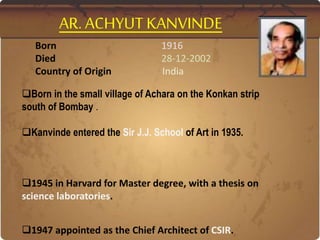
AR. ACHYUT KANVINDE
Born 1916
Died 28-12-2002
Country of Origin India
Born in the small village of Achara on the Konkan strip
south of Bombay .
Kanvinde entered the Sir J.J. School of Art in 1935.
1945 in Harvard for Master degree, with a thesis on
science laboratories.
1947 appointed as the Chief Architect of CSIR.
LIFETIME ACHIEVEMENTS
•Awarded Padma Shree in 1976.
•President IIA (1974-75)
•Co-Authored book “Campus Design in India”.
•IIA’s Babu Rao Mhatre Gold Medal for life time
achievement in 1985
•Great Masters Award from JK Industries Ltd. in
1993.
•Was also a part of the jury on the competition for
the Indira Gandhi National Center for Arts, along
with B.V. Doshi.
INFLUENCES
Claude Batley -1941
Avoided the loud, revolutionary
éclat of the machine-age
Follower of functionalism
Walter Gropius-1945
Gropius’s insistence for using space
as a tool for expressing universal
human values was what left most
lasting influence on his mind.
KANVINDE WITH GROPIUS,
HARVARD, 1946
PHILOSOPHIES OF ACHYUT KANVINDE
All his creations were in strict conformity with
these three principles:-
FUNCTIONALISM
MODERN ARCHITECTURE AND BRUTALISM
REGIONALISM
MODERN ARCHITECTURE AND
BRUTALISM
•Simplification of form and creation of ornament
from the structure.
•Elimination of unnecessary detail
•Visual expression of structure, as opposed to the
hiding of structural elements
Salk Institute, California
Louis Kahn
Bauhaus,Germany
Walter Gropius
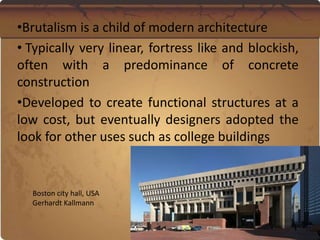
•Brutalism is a child of modern architecture
• Typically very linear, fortress like and blockish,
often with a predominance of concrete
construction
•Developed to create functional structures at a
low cost, but eventually designers adopted the
look for other uses such as college buildings
Boston city hall, USA
Gerhardt Kallmann
REGIONALISM
•Inevitably based on the exigencies of
•local climate,
•building materials and
•social conditions
•sound climatological principles.
IITK campus
1961-1965
CSIR
Harivallabdas House, Ahemdabad
Gandhi Krishi Vigyan Doodhsagar Dairy(1973)
National
Insurance Academy
Pune
1992
Projects by Achyut Kanvinde
Physical Research
Laboratory,Ahmdabad
Institute of Rural
Management,
anand (1979)
Nehru Science
Center, Mumbai
(1985)
National Science Center,
New Delhi (1991)
CBRI Roorkee
ISKCON Temple, East of
Kailash, Delhi (1998)
STYLE OF ARCHITECTURE : BRUTALISM
FEATURES
•Monstrous and raw
•The form is very rough and blocky
•Cold character
•Fortress like structure
•One of the first outburts of kanvinde’s
brutalism
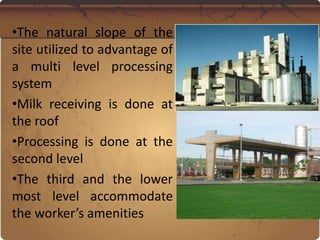
•The natural slope of the
site utilized to advantage of
a multi level processing
system
•Milk receiving is done at
the roof
•Processing is done at the
second level
•The third and the lower
most level accommodate
the worker’s amenities
•ventilation points are expressed as large shafts
that rise above the roof level
•They evacuate the hot air by natural convection
eliminating the need for mechanical exhaust system
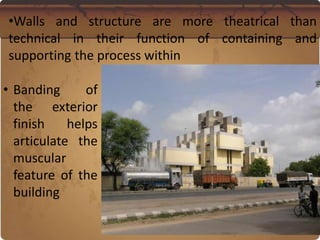
•Walls and structure are more theatrical than
technical in their function of containing and
supporting the process within
• Banding of
the exterior
finish helps
articulate the
muscular
feature of the
building
Location:
G. Babu Sakpal
Marg Mumbai,
Maharashtra
400018
022 24926042
Function
THIS COMPLEX houses; a variety of activities and exhibits
intended by the CSIR (Council of Scientific and Industrial
Research) to popularize science and technology
chiefly, a Children's Museum with, demonstration hall and
facilities for education
extension activities, a Museum of the history of science, a Hall
of Industry, and an outdoor science park .
 This complex has Discovery of India expositions, Art Gallery,
Auditorium and Exhibition Halls.
Concept
Need artificial lighting for effective presentation of exhibits, the idea
of forced ventilation emerged.
At the same time the idea of creating spaces of a certain quality
which helps receptivity of mind.
Apart from spatial organization, the main design problem was to
establish circulation of movement.
The topography of the decisively sloping site.
A series of multidirectional units was created with large column for
free spaces.
Circulation has been defined so that visitors return to the entry
level and can proceed to the cafeteria and other social facilities at
ground level.
Ventilation to all areas is ensured by a blower system.
The structural system is in waffle slab
and the structural columns at 12m centers
house the ventilation shafts.
Location:
Usman Pura
Ahmadabad, Gujarat 380013
079 2755 1389
 Darpana Academy Of Performing Arts, Indian Dance Academy
Darpana Academy of Performing Arts in Gujarat was founded by
Mrinalini and Vikram Sarabhai in 1949.
 Darpana Academy of Performing Arts today is a massive workshop
for the arts: where traditional beliefs meet technology to break the
boundaries between art and life.
 The Academy`s vision is a contemporary amalgamation of affirming
the role of creativity in culture, researching into the basic origins of life
and reaching out to the unsaid or unthought-of of themes in a language
that is universal.
function:
 Darpana Academy of Performing Arts today is a promising centre for
artists dedicated to excellence, innovation and the excitement of using the
variant art styles for a change.
 Darpana Academy of Performing Arts is one of the most strongly
founded Indian dance academies with more than 25,000
graduates, nearly 11000 performances, audiences in 90 countries and
pulsating arts environment.
 The entire activities of Darpana Academy of Performing Arts are
managed by a strong staff group.
Norh
Automatic
doors
Accessible
Entry
Graphical
keys:
Entry:
Enter through the north entrance to main lobby. Turn east to north-
south corridor to access dance studios and restrooms.
Floor plan:
Automatic Doors
Accessible Entry
Accessible Women's
Accessible Men's
IIT KANPUR
• Central deemed University located in Uttar Pradesh,
about 15 km north-west of the city of Kanpur in the
Kalyanpur suburb
• Constructed during 1960-1965
•Total area 1000 acres
•Academic buildings: 13 departments, PK Kelkar
Library, Computer Centres faculty offices,
laboratories and administrative buildings
•10 boys hostel and 2 girls hostel
•Sports complex
•Housing for faculty
FEATURES
FEATURES
•The residential campus is planned
and landscaped with a hope for environmental
freedom.
•Halls of residence, faculty and staff houses and
community buildings surround the central
academic area to provide flexibility in
movement and communication.
LECTURE
HALLS
DEPARTMENTS AND LABS
CANTEEN
FACULTY
OFFICE
AND LIBRARY
COMPUTER
DEPTT AND
LABS
• Core Pedestrian island which consist of lecture
halls surrounded by landscaping and water
body forming the main focus of the campus.
• The academic area is well connected by a long
corridor which links all the major buildings
• The academic area is set up in vicinity of
Hostels to provide quick accessibility to
students
SPLIT LEVEL CORRIDOR SYSTEM
• Minimize the walking distance, improving connectivity
• Create spatial expansion
• Give the impression of one large space hence space is used as a tool
•Conventional type of buildings were
designed as isolated islands
of departments
•Activities which students and faculties
share are designed to encourage meeting
and interaction
Hostels Quiet and private hostels
Hostels to create some sort of family
feeling in the students living in them.
VISUAL EXPRESSION OF
THE STRUCTURE
RATHER THAN HIDING
ITS STRUCTURAL
COMPONENTS
•In Kanpur, the local availability of high quality
brick and the prevalent labour and construction
practices made Kanvinde go for reinforced
concrete for structural frames and brick as infills
.
•reinforced-concrete post-and-slab construction,
with a series of flat slab-floors and a flat roof-
slab carried on concrete columns or posts
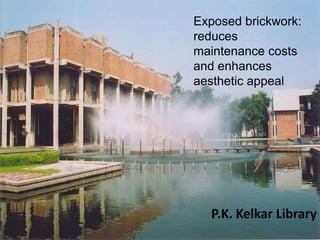
Exposed brickwork:
reduces
maintenance costs
and enhances
aesthetic appeal
P.K. Kelkar Library
Kanvinde’s expressive architecture was
variously interpreted as "an architectural
expression that reflected the culture and
aspirations“.
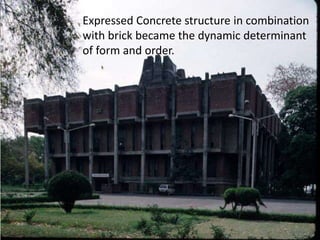
Expressed Concrete structure in combination
with brick became the dynamic determinant
of form and order.
CONCLUSION
•His works are generally raw and unemotional.
Yet he managed to make his designs appealing
and welcoming.
•His designs were distinct and unique yet having
one thing similar- functionalism.
•His designs appear to be built with a large
amount of thought having been given to making
them functionally efficient and practically
feasible.
Achyut Kanvinde
Achyut Kanvinde
Achyut Kanvinde

Achyut Kanvinde

  • 1.
    RESERCH BY: HAKIM DANISH B.ARCH IIIYR 1482681002 ACHYUT KANVINDE (1916-2002)
  • 2.
    AR. ACHYUT KANVINDE Born1916 Died 28-12-2002 Country of Origin India Born in the small village of Achara on the Konkan strip south of Bombay . Kanvinde entered the Sir J.J. School of Art in 1935. 1945 in Harvard for Master degree, with a thesis on science laboratories. 1947 appointed as the Chief Architect of CSIR.
  • 3.
    LIFETIME ACHIEVEMENTS •Awarded PadmaShree in 1976. •President IIA (1974-75) •Co-Authored book “Campus Design in India”. •IIA’s Babu Rao Mhatre Gold Medal for life time achievement in 1985 •Great Masters Award from JK Industries Ltd. in 1993. •Was also a part of the jury on the competition for the Indira Gandhi National Center for Arts, along with B.V. Doshi.
  • 4.
    INFLUENCES Claude Batley -1941 Avoidedthe loud, revolutionary éclat of the machine-age Follower of functionalism Walter Gropius-1945 Gropius’s insistence for using space as a tool for expressing universal human values was what left most lasting influence on his mind. KANVINDE WITH GROPIUS, HARVARD, 1946
  • 5.
    PHILOSOPHIES OF ACHYUTKANVINDE All his creations were in strict conformity with these three principles:- FUNCTIONALISM MODERN ARCHITECTURE AND BRUTALISM REGIONALISM
  • 6.
    MODERN ARCHITECTURE AND BRUTALISM •Simplificationof form and creation of ornament from the structure. •Elimination of unnecessary detail •Visual expression of structure, as opposed to the hiding of structural elements Salk Institute, California Louis Kahn Bauhaus,Germany Walter Gropius
  • 7.
    •Brutalism is achild of modern architecture • Typically very linear, fortress like and blockish, often with a predominance of concrete construction •Developed to create functional structures at a low cost, but eventually designers adopted the look for other uses such as college buildings Boston city hall, USA Gerhardt Kallmann
  • 8.
    REGIONALISM •Inevitably based onthe exigencies of •local climate, •building materials and •social conditions •sound climatological principles.
  • 9.
    IITK campus 1961-1965 CSIR Harivallabdas House,Ahemdabad Gandhi Krishi Vigyan Doodhsagar Dairy(1973) National Insurance Academy Pune 1992 Projects by Achyut Kanvinde
  • 10.
    Physical Research Laboratory,Ahmdabad Institute ofRural Management, anand (1979) Nehru Science Center, Mumbai (1985) National Science Center, New Delhi (1991) CBRI Roorkee ISKCON Temple, East of Kailash, Delhi (1998)
  • 11.
    STYLE OF ARCHITECTURE: BRUTALISM STYLE OF ARCHITECTURE : BRUTALISM
  • 12.
    FEATURES •Monstrous and raw •Theform is very rough and blocky •Cold character •Fortress like structure •One of the first outburts of kanvinde’s brutalism
  • 13.
    •The natural slopeof the site utilized to advantage of a multi level processing system •Milk receiving is done at the roof •Processing is done at the second level •The third and the lower most level accommodate the worker’s amenities
  • 15.
    •ventilation points areexpressed as large shafts that rise above the roof level •They evacuate the hot air by natural convection eliminating the need for mechanical exhaust system
  • 16.
    •Walls and structureare more theatrical than technical in their function of containing and supporting the process within • Banding of the exterior finish helps articulate the muscular feature of the building
  • 17.
    Location: G. Babu Sakpal MargMumbai, Maharashtra 400018 022 24926042
  • 18.
    Function THIS COMPLEX houses;a variety of activities and exhibits intended by the CSIR (Council of Scientific and Industrial Research) to popularize science and technology chiefly, a Children's Museum with, demonstration hall and facilities for education extension activities, a Museum of the history of science, a Hall of Industry, and an outdoor science park .  This complex has Discovery of India expositions, Art Gallery, Auditorium and Exhibition Halls.
  • 19.
    Concept Need artificial lightingfor effective presentation of exhibits, the idea of forced ventilation emerged. At the same time the idea of creating spaces of a certain quality which helps receptivity of mind. Apart from spatial organization, the main design problem was to establish circulation of movement. The topography of the decisively sloping site. A series of multidirectional units was created with large column for free spaces.
  • 20.
    Circulation has beendefined so that visitors return to the entry level and can proceed to the cafeteria and other social facilities at ground level. Ventilation to all areas is ensured by a blower system. The structural system is in waffle slab and the structural columns at 12m centers house the ventilation shafts.
  • 21.
  • 22.
     Darpana AcademyOf Performing Arts, Indian Dance Academy Darpana Academy of Performing Arts in Gujarat was founded by Mrinalini and Vikram Sarabhai in 1949.  Darpana Academy of Performing Arts today is a massive workshop for the arts: where traditional beliefs meet technology to break the boundaries between art and life.  The Academy`s vision is a contemporary amalgamation of affirming the role of creativity in culture, researching into the basic origins of life and reaching out to the unsaid or unthought-of of themes in a language that is universal. function:  Darpana Academy of Performing Arts today is a promising centre for artists dedicated to excellence, innovation and the excitement of using the variant art styles for a change.
  • 23.
     Darpana Academyof Performing Arts is one of the most strongly founded Indian dance academies with more than 25,000 graduates, nearly 11000 performances, audiences in 90 countries and pulsating arts environment.  The entire activities of Darpana Academy of Performing Arts are managed by a strong staff group.
  • 25.
  • 26.
    Entry: Enter through thenorth entrance to main lobby. Turn east to north- south corridor to access dance studios and restrooms. Floor plan: Automatic Doors Accessible Entry Accessible Women's Accessible Men's
  • 27.
  • 28.
    • Central deemedUniversity located in Uttar Pradesh, about 15 km north-west of the city of Kanpur in the Kalyanpur suburb • Constructed during 1960-1965
  • 29.
    •Total area 1000acres •Academic buildings: 13 departments, PK Kelkar Library, Computer Centres faculty offices, laboratories and administrative buildings •10 boys hostel and 2 girls hostel •Sports complex •Housing for faculty FEATURES
  • 31.
    FEATURES •The residential campusis planned and landscaped with a hope for environmental freedom. •Halls of residence, faculty and staff houses and community buildings surround the central academic area to provide flexibility in movement and communication.
  • 32.
  • 33.
    • Core Pedestrianisland which consist of lecture halls surrounded by landscaping and water body forming the main focus of the campus. • The academic area is well connected by a long corridor which links all the major buildings • The academic area is set up in vicinity of Hostels to provide quick accessibility to students
  • 34.
    SPLIT LEVEL CORRIDORSYSTEM • Minimize the walking distance, improving connectivity • Create spatial expansion • Give the impression of one large space hence space is used as a tool
  • 35.
    •Conventional type ofbuildings were designed as isolated islands of departments •Activities which students and faculties share are designed to encourage meeting and interaction
  • 36.
    Hostels Quiet andprivate hostels Hostels to create some sort of family feeling in the students living in them.
  • 37.
    VISUAL EXPRESSION OF THESTRUCTURE RATHER THAN HIDING ITS STRUCTURAL COMPONENTS
  • 38.
    •In Kanpur, thelocal availability of high quality brick and the prevalent labour and construction practices made Kanvinde go for reinforced concrete for structural frames and brick as infills . •reinforced-concrete post-and-slab construction, with a series of flat slab-floors and a flat roof- slab carried on concrete columns or posts
  • 39.
    Exposed brickwork: reduces maintenance costs andenhances aesthetic appeal P.K. Kelkar Library
  • 40.
    Kanvinde’s expressive architecturewas variously interpreted as "an architectural expression that reflected the culture and aspirations“.
  • 41.
    Expressed Concrete structurein combination with brick became the dynamic determinant of form and order.
  • 42.
    CONCLUSION •His works aregenerally raw and unemotional. Yet he managed to make his designs appealing and welcoming. •His designs were distinct and unique yet having one thing similar- functionalism. •His designs appear to be built with a large amount of thought having been given to making them functionally efficient and practically feasible.